THE POTOMAC
Reading edition
ESTHER SINGLETON
THE Potomac was an important river from the earliest period of the country’s history. Explorers followed its route to the interior of the country, and as early as 1784 The Potomac Company was chartered with Washington as its president for the purpose of connecting the Potomac Valley with the west by means of a canal for general land improvement. This was succeeded by the Chesapeake and Ohio Canal Company, whose canal runs parallel with and near to the river all the way from Georgetown to Cumberland.
The first attempt to explore the Chesapeake Bay and its tributary rivers was made in 1608 by Captain John Smith, who speaks of the Patawomeke as six or seven miles broad and navigable for 140 miles. Another Indian name was Cohonguroton (River of Swans). No less than forty tribes of the warlike Algonquins lived upon its banks and held their councils at the point of land now occupied by the Arsenal.
In 1634, Henry Fleet with some of Calvert’s people visited the Falls of the Potomac; and early in the Seventeenth Century several tracts of land on the river banks were granted to settlers. Among these was one Francis Pope, gentleman, who in 1663 had four hundred acres laid out which he called Rome, on the east side of the Anacostian River and to the mouth of the Tiber, for so this little arm of the Potomac was called more than a century before Washington was founded, there being a tradition that on its banks would rise a capital greater than Rome. The Tiber has now disappeared beneath the streets of Washington, but it once flowed below the hill on which the Capitol now stands between forest-lined banks and was noted for its shad and herring.
The Potomac is formed by the junction of two rivers on the boundary between Maryland and West Virginia. The North Branch rises in the Western Alleghanies and the South Branch in the Central; and, flowing north-east, they unite about fifteen miles south-east of Cumberland. The Potomac thus forms an irregular boundary between Maryland and West Virginia and Maryland and Virginia throughout its entire course of four hundred miles. Its chief tributaries are the Shenandoah from Virginia and the Monocacy from Maryland. At Harper’s Ferry the Potomac breaks through the Blue Ridge meeting the Shenandoah—“Daughter of the Stars”—which has cut its way through the mist-wreathed mountains, laved the Luray Caverns and watered a lovely valley. These rivers winding around Loudon Heights, Bolivar Heights and Maryland Heights are picturesque in the highest degree, and the scenery is rendered more interesting by the associations with John Brown’s raid and capture and other thrilling incidents of the Civil War.
Twelve miles below is Point of Rocks and below this the Monocacy joins the main stream.
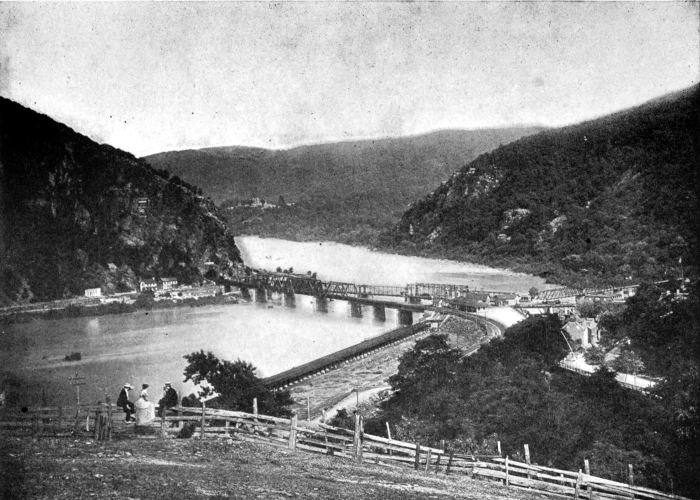
THE POTOMAC
A number of falls mark its course through the mountains; and about fifteen miles above Washington it descends rapidly until it reaches Great Falls, at which point it breaks through the mountain in a channel narrowing to a hundred yards in width and bounded on the Virginia side by perpendicular rocks seventy feet high. Cedars, oaks, willows and other forest trees contribute beauty to this wild spot, where cherries and strawberries abound, and which is the haunt of the rattlesnake and other venomous reptiles. The water falls in a series of cascades. Not far from this point Cabin-John Bridge is reached, a bridge formed of large blocks of granite 420 feet long and twenty feet wide, which springs the chasm of Cabin-John Creek at a height of 101 feet in a single arch of 220 feet. This is the largest stone arch in the world, the second being the Grosvenor Bridge (with a span of 200 feet), over the Dee.
At a distance of four miles below Great Falls, the stream widens and flows quietly for ten miles; and then descends thirty-seven feet in a second series of cascades known as Little Falls, about three miles above Georgetown. The Potomac, thus released from the hills above Georgetown, expands into a broad lake-like river, and receives the Anacostia at Washington, where it meets the tide. About twenty-five miles below Washington, it becomes an estuary from two to eight miles wide, and enters the Chesapeake Bay, after having made a journey of four hundred miles.
The chief places of interest on the banks of the Potomac are, of course, Washington, Arlington House, Mount Vernon, and the sleepy old town of Alexandria founded in 1748 and once a rival of Annapolis and Baltimore. It is full of associations with Washington, whose estate, Mount Vernon, is but a few miles below. Mount Vernon, in Washington’s time, an estate of two thousand acres, belonged originally to his half-brother, Lawrence, who named it for Admiral Vernon under whom he had served.
Arlington House, the residence of the adopted son of General Washington, George Washington Parke Custis, came into possession of Gen. Robert E. Lee through his wife who was the daughter of Mr. Custis. The house, built from drawings of the temple at Pæstum, near Naples, stands on a bluff two hundred feet above the river about four miles from Washington. The building with its two wings has a frontage of 140 feet and the portico sixty feet long is surmounted by a pediment resting on eight Doric columns twenty-six feet high and five feet in diameter. On the south were the gardens and greenhouses, and in the rear the kitchens, slave quarters and stables. In 1863 Arlington House and the estate of 1,000 acres was sold under the Confiscation Act and taken possession of by the National Government; and in 1867 the grounds were appropriated for a National Cemetery.
The Potomac was the scene of skirmishes in 1814, when Alexandria surrendered to the British; and in this connection it is interesting to learn what Admiral Napier, who commanded the fleet, has to say regarding the ascent of the river:
“The river Potomac is navigable for frigates as high up as Washington, but the navigation is extremely intricate and nature has done much for the protection of the country by placing one-third of the way up, very extensive and intricate shoals, called the ‘Kettle Bottoms.’ They are composed of oyster banks of various dimensions, some not larger than a boat, with passages between them.
“The best channel is on the Virginia shore; but the charts gave us mostly very bad directions and no pilots could be procured. A frigate had attempted some time before to effect a passage, and, after being frequently aground, gave it up as impossible. The American frigates themselves never attempted it with their guns in, and were several weeks in the passage from the naval yard at Washington to the mouth of the Potomac.
“When the tide was favourable and the wind light, we warped by hand; with the ebb and the wind strong, the hawsers were brought to the capstan. This operation began at daylight and was carried on without interruption till dark and lasted five days, during which the squadron warped upwards of fifty miles, and on the evening of the fifth day anchored off Maryland Point. The same day the public buildings of Washington were burnt. The reflection of the fire on the heavens was plainly seen from the ships, much to our mortification and disappointment, as we concluded that that act was committed at the moment of evacuating the town....
“The following morning, to our great joy, the wind became fair, and we made all sail up the river, which now assumed a more pleasing aspect. At five o’clock in the afternoon Mount Vernon—the retreat of the illustrious Washington—opened to our view and showed us, for the first time since we entered the Potomac, a gentleman’s residence. Higher up the river, on the opposite side, Fort Washington appeared to our anxious eyes; and, to our great satisfaction, it was considered assailable.
“A little before sunset the squadron anchored just out of gun-shot; the bomb vessels at once took up their positions to cover the frigates in the projected attack at daylight next morning and began throwing shells. The garrison, to our great surprise, retreated from the Fort; and, a short time after, Fort Washington was blown up—which left the capital of America, and the populous town of Alexandria, open to the squadron, without the loss of a man.
“A deputation from the town arrived to treat; but Captain Gordon declined entering into any arrangement till the squadron arrived before Alexandria. The channel was buoyed, and next morning the 27th, we anchored abreast of the town and dictated terms.
“Alexandria is a large well-built town and a place of great trade. It is eight miles below Washington, where few merchant ships go, and is, in fact, the mercantile capital, and, before the war, was a most flourishing town, but at the time of its capture had been going rapidly to decay. Agricultural produce was of little value; the storehouses were full of it. We learnt that the army after destroying Barney’s flotilla, had made a forced march on Washington, beat the Americans at Bladensburg, destroyed the public buildings and navy yard, and retreated to their ships. Had our little squadron been favoured by wind, the retreat would have been made along the right bank of the Potomac, under our protection, and the whole country in the course of that river would have been laid under contribution.”