THE CLYDE
Reading edition
ROBERT WALKER
GLASGOW and its river have acted and reacted the one upon the other; and the conditions of the city’s prosperity and well-being are indissolubly linked with the stream that wanders down from the upland moors of Lanarkshire, tumbling over precipices, meandering through rich orchard grounds, flowing through the busy haunts of men, until it widens into the noble estuary whose waves reflect the peaks of Arran and wash round the rugged steeps of Ailsa Craig. In its course the Clyde runs amid all variety of scenery: moorland, pastoral, woodland. It is, at one time, a shallow stream, humming over a pebbly bed and glittering in the clear sunshine; at another, a foul and sullen mass of water, which the energy of man has turned to good account in his commercial enterprises; and then again, a restless sea, whose white-crested waves break upon the base of Highland hills. Through all its changes, it is dear to the heart of every true Glasgovian. It has been a source of untold wealth to the place of his birth, and most of his happiest memories are connected with the sunny days of leisure he has spent among its lochs and by its sand-edged bays. Glasgow looks upon the Clyde as its own special glory and possession; it is proud of the manner in which the resources of the river have been developed; it is prouder still of its many natural beauties familiar to its citizens from their earliest youth, and an all-powerful attraction for the strangers who are led to our shores by the fame of its charms.
Glasgow, although it has many picturesque vistas within its bounds which the ordinary business man, engrossed with the cares of the Exchange, recks nothing of, is not, in itself, a magnet to draw tourists who are simply in search of the picturesque. Edinburgh, among Scottish cities, is, from its own natural beauty, the cynosure of neighbouring and far-away eyes. But Glasgow has the Clyde; and the Clyde, notwithstanding the advantages of the Callander and Oban Railway, is still the pleasantest and most picturesque gateway and avenue to the West Highlands, where tourists rightly love to congregate.
The practical energy and shrewdness of the Glasgow people early turned to the best advantage the inducements the Frith of Clyde offered to the thousands who were anxious for “change of air,” and on the outlook for summer resorts. In no district of our island are travelling facilities greater and travelling cheaper than on the Clyde. A wonderful change has taken place since 1812, when the Comet, the pioneer boat of a vast fleet of steamers, began to sail between Glasgow, Greenock and Helensburgh. Out of the Comet, with its forty-two feet of length, has been evolved what is generally regarded as the premier boat on the river, Mr. MacBrayne’s Columba, which carries the tourist-flocks from Glasgow to Ardrishaig, whence Mr. MacBrayne’s West Highland service is continued through the Crinan Canal.
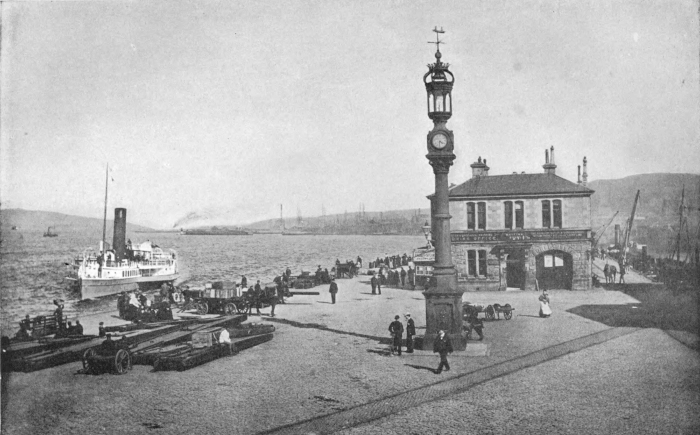
THE CLYDE
The Columba starts on her journey at seven o’clock in the morning, and as she threads her way down the busy river-channel, the passengers can note the stir and bustle of the wharves, and the evidences in ever-extending docks and quayage, the dredgers and divers, of the indefatigable energy and well-directed skill of the Clyde Trustees, that have turned a shallow meandering stream into a highway for the largest ships that float. Down past the building yards with their clanging hammers and great ships “of iron framed,” past what were once the cheerful rural villages of Govan and Partick, now the grimy hives of busy human bees, we steam, leaving behind us the ancient royal burgh of Renfrew and the mouth of the Cart, and come in view of Bowling and the Kilpatrick Hills, among which the patron saint of Ireland is said to have first seen the light. The river here broadens into something like an inland lake and the landscape grows decidedly picturesque. This has been a favourite subject for many Scottish landscape painters—Nasmyth, McCulloch and Bough among the rest. There is a wide stretch of view and the hills near and distant—the first glimpse we have yet had of the beginning of the Highlands—give to it dignity and variety. To the water, studded with craft of all rigs, Dalnottar Hill, Dunglass (where stands the monument to Bell, who introduced steam navigation to the Clyde), Dumbuck Hill and the mass of Dumbarton Castle, are effective background and setting.
At the Tail of the Bank, as the anchorage off Greenock is called, lie a motley crowd of craft: bluff-bowed timber ships, smart Australian clippers, handsome steam vessels of the various lines to America, gaily-painted foreign ships, and in the midst of them, an embodiment of power and authority, rides the guardship, a formidable ironclad.
The steamer at Greenock gathers passengers who have come down from Glasgow by rail, and she takes in more at Gourock, to which the Caledonian Company now run trains. The old Gourock pier, dear from its fishing associations to the hearts of many generations of Glasgow boys, is now completely altered; a fine quay front has been put up and a handsome station erected. Gourock is one of the oldest of the Clyde watering-places; in its day it was fashionable and thought to be pretty far removed from the giddy world; now it is the resort of the cheap-tripper, and has about its houses something of a second-rate look.
The view of the Frith from both Greenock and Gourock piers is one of great extent and beauty. Opposite, rise in the background range after range of hills, the fantastic ridges of “Argyle’s Bowling-green,” the Cobbler, the Black Hill of Kilmun, the steeps around Glen Messan, and stealing between these mountain masses are the lochs that are among the chief charms of the district. We have fronting us the entrances to the Gareloch, Loch Long and the Holy Loch, with wooded Roseneath and a white stretch along the shore of cottages and little towns. If we can only secure a day when the waves glitter in the sun and the fleecy clouds fleck the hillsides with alternate lights and shadows, then we need scarcely wish for a fairer scene.
Glasgow men are enthusiastic yachtsmen, and the regattas, the opening cruises and closing cruises of the various clubs are among the chief galas of the westcoast season. Our yachts and their builders—such as Watson and Fife—our skippers and our crews, are famous all the world over. The “white wings” spot the Frith at every turn, and there are few prettier sights than one of these Clyde greyhounds, bursting through the water under a cloud of canvas, with her lee-rail well buried in the sea.
Down the Cowal shore the steamer slips and the long belt of houses and villas that extends from Hunter’s Quay to Innellan—once all a lonely shore—is left behind, and we round Toward Point and its lighthouse into Rothsay Bay. This bay, with its environment of hills, is one of the choice bits on the Clyde; the natives all declare it to be finer than the Bay of Naples. Few Rothsay men have been at Naples. When a yacht club holds a regatta here, and the boats cluster at anchor off Rothsay and there are fireworks and illuminations, there is no livelier place than this same bay.
The town itself is beautifully situated, but looks best at a distance. From Barone Hill, at the back, a fine view can be obtained of the panorama of the bay. Rothsay has a long history: it is a royal burgh, and like Renfrew, gives a title to the Prince of Wales. Its chief glory is its ruined castle, over which Norsemen and Scots, Bruces and Baliols, have fought and murdered one another. Old memories and traditions cluster as thick round it as the ivy on its walls.
Leaving Rothsay, we sail into the Kyles of Bute, a narrow passage between the island and the mainland. The wonder is how the steamer can thread its way through the twisting, twining channel, that appears hardly broad enough for the Columba’s paddle-wheels. Now and again it almost seems as if we should run ashore from the sharpness of the turns. The Kyles are full of quiet beauty. As we look at the little hamlets sheltered under the wooded hills, they seem so out of the world and so remote from the common cares that burden humanity, that we wonder can ordinary sins and sorrows ever disturb there the calm routine of life. The evening hour is the hour of enchantment, when your boat gently drifts on the slow heaving water. The voices on the shore seem to reach you through a muffled and mysterious air; the opalescent light in the sky is reflected from the waves that lap against the boat; sweet scents are wafted from the hillsides that loom solemn in the gathering darkness; earth’s uneasy passions are at rest; for the young, it is a pleasant pause in the hurly-burly; for those who are growing old, it is the time of memories and regrets.
It is the garish light of day now, and with a long gaze at the rugged mist-wreathed peaks of Arran, we round Ardlamont Point and, away to the left, meet the sparkling waters and fresh breezes of Loch Fyne.
Tarbert, our first stoppage after the ferry at Ardlamont, is one of the most noted fishing-villages in the west of Scotland. The entrance to East Loch Tarbert, at which the steamer calls, is exceedingly picturesque, and the district, with its brown sails and its brawny fishermen, is one much beloved of artists. Henry Moore, Colin Hunter, David Murray, among the rest, have turned its beauties to great use. Tarbert is the great centre of the trawl (or seine) net fishing, which in Loch Fyne, after much discussion and many bickerings, has practically superseded in the Loch the old drift-net method. Trawl boats work in pairs with four men and a boy in each boat. Tarbert sends out between eighty and ninety boats, and an exceptionally good night’s catch for a pair of trawls is about four or five hundred boxes—each box containing, depending on the size of the herring, from three to five hundred fish. The men are sturdy, fine-looking fellows—and are fishermen proper, as distinguished from the half crofter, half-fishermen of the farther North-west Highlands. The fishing-fleet going out before sundown is, on a good evening, the sight of Tarbert, the brown sails and the yellow-brown boats glancing in the golden light, as they rush and hum through the clear blue-grey water. Tarbert itself, which lies principally round the inner harbour, is not a particularly inviting place—it smells generally strongly of herrings—but the hills around it are very pleasant to ramble over, and the walk to West Loch Tarbert leads through delightful highland country. There is a ruined castle here, which dominates the harbour and is redolent of memories of Robert the Bruce, the builder of the castle in 1325. The narrow isthmus that separates the East from the West Loch has been more than once surmounted by invading Norsemen and other bold buccaneers, who dragged their boats overland. Sir Walter Scott makes use of this fact in The Lord of the Isles.
At Ardrishaig, six miles beyond Tarbert and on the west side of Loch Gilp, the outward run of the Columba ends, and passengers for the West Highlands tranship to the Linnet, in order to be conveyed through the Crinan Canal.