DOWN THE ST. LAWRENCE
Reading edition
CHARLES DICKENS
QUEENSTON, at which place the steamboats start from Toronto (or I should rather say at which place they call, for their wharf is at Lewiston, on the opposite shore), is situated in a delicious valley, through which the Niagara River, in colour a very deep green, pursues its course. It is approached by a road that takes its winding way among the heights by which the town is sheltered; and seen from this point is extremely beautiful and picturesque.
Our steamboat came up directly this had left the wharf, and soon bore us to the mouth of the Niagara: where the Stars and Stripes of America flutter on one side, and the Union Jack of England on the other: and so narrow is the space between them that the sentinels in either fort can often hear the watchword of the other country given. Thence we emerged on Lake Ontario, an inland sea; and by half-past six o’clock were at Toronto.
The country round this town being very flat, is bare of scenic interest; but the town itself is full of life and motion, bustle, business, and improvement. The streets are well paved, and lighted with gas; the houses are large and good; the shops excellent. Many of them have a display of goods in their windows, such as may be seen in thriving county towns in England; and there are some which would do no discredit to the metropolis itself.
THE ST. LAWRENCE
The time of leaving Toronto for Kingston is noon. By eight o’clock next morning, the traveller is at the end of his journey, which is performed by steamboat upon Lake Ontario, calling at Port Hope and Coburg, the latter a cheerful, thriving little town. Vast quantities of flour form the chief item in the freight of these vessels. We had no fewer than one thousand and eighty barrels on board, between Coburg and Kingston.
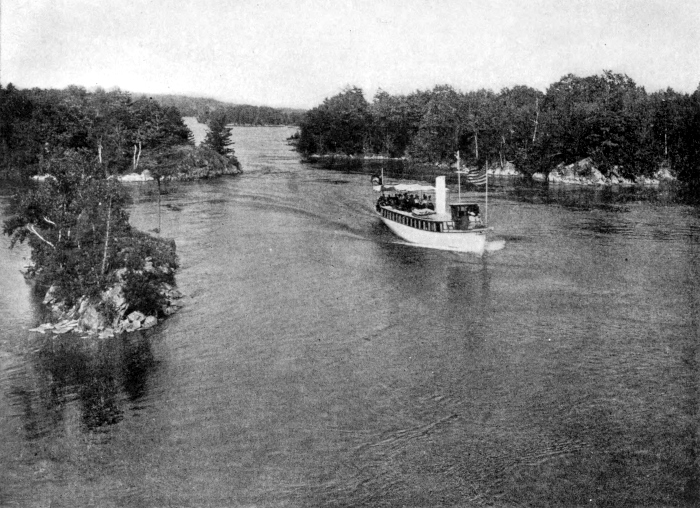
We left Kingston for Montreal on the tenth of May, at half-past nine in the morning, and proceeded in a steamboat down the St. Lawrence River. The beauty of this noble stream at almost any point, but especially in the commencement of this journey when it winds its way among the Thousand Islands, can hardly be imagined. The number and constant successions of these islands, all green and richly wooded; their fluctuating sizes, some so large that for half an hour together one among them will appear as the opposite bank of the river, and some so small that they are mere dimples on its broad bosom; their infinite variety of shapes; and the numberless combinations of beautiful forms which the trees growing on them present: all form a picture fraught with uncommon interest and pleasure.
In the afternoon we shot down some rapids where the river boiled and bubbled strangely, and where the force and headlong violence of the current were tremendous. At seven o’clock we reached Dickenson’s Landing, whence travellers proceed for two or three hours by stage-coach: the navigation of the river being rendered so dangerous and difficult in the interval, by rapids, that steamboats do not make the passage. The number and length of those portages, over which the roads are bad, and the travelling slow, render the way between the towns of Montreal and Kingston somewhat tedious.
Our course lay over a wide, uninclosed tract of country at a little distance from the riverside, whence the bright warning lights on the dangerous parts of the St. Lawrence shone vividly. The night was dark and raw, and the way dreary enough. It was nearly ten o’clock when we reached the wharf where the next steamboat lay; and went on board, and to bed.
She lay there all night, and started as soon as it was day. The morning was ushered in by a violent thunder-storm, and was very wet, but gradually improved and brightened up. Going on deck after breakfast, I was amazed to see floating down with the stream, a most gigantic raft, with some thirty or forty wooden houses upon it, and at least as many flag-masts, so that it looked like a nautical street. I saw many of these rafts afterwards, but never one so large. All the timber, or “lumber,” as it is called in America, which is brought down the St. Lawrence, is floated down in this manner. When the raft reaches its place of destination, it is broken up; the materials are sold, and the boatmen return for more.
At eight we landed again, and travelled by a stage-coach for four hours through a pleasant and well-cultivated country, perfectly French in every respect: in the appearance of the cottages; the air, language, and dress of the peasantry; the signboards on the shops and taverns; and the Virgin’s shrines, and crosses, by the wayside. Nearly every common labourer and boy, though he had no shoes to his feet, wore round his waist a sash of some bright colour: generally red: and the women, who were working in the fields and gardens, and doing all kinds of husbandry, wore, one and all, great flat straw hats with most capacious brims. There were Catholic Priests and Sisters of Charity in the village streets; and images of the Saviour at the corners of cross-roads, and in other public places.
At noon we went on board another steamboat, and reached the village of Lachine, nine miles from Montreal, by three o’clock. There we left the river, and went on by land.
Montreal is pleasantly situated on the margin of the St. Lawrence, and is backed by some bold heights, about which there are charming rides and drives. The streets are generally narrow and irregular, as in most French towns of any age; but in the more modern parts of the city, they are wide and airy. They display a great variety of very good shops; and both in the town and suburbs there are many excellent private dwellings. The granite quays are remarkable for their beauty, solidity and extent.
There is a very large Catholic cathedral here, recently erected; with two tall spires, of which one is yet unfinished. In the open space in front of this edifice, stands a solitary, grim-looking, square brick tower, which has a quaint and remarkable appearance, and which the wiseacres of the place have consequently determined to pull down immediately. The Government House is very superior to that at Kingston, and the town is full of life and bustle. In one of the suburbs is a plank road—not foot-path—five or six miles long, and a famous road it is, too. All the rides in the vicinity were made doubly interesting by the bursting out of spring, which is here so rapid, that it is but a day’s leap from barren winter, to the blooming youth of summer.
The steamboats to Quebec perform the journey in the night; that is to say, they leave Montreal at six in the evening, and arrive in Quebec at six next morning. We made this excursion during our stay in Montreal (which exceeded a fortnight), and were charmed by its interest and beauty.
The impression made upon the visitor by this Gibraltar of America: its giddy heights; its citadel suspended, as it were, in the air; its picturesque steep streets and frowning gateways; and the splendid views which burst upon the eye at every turn: is at once unique and lasting. It is a place not to be forgotten or mixed up in the mind with other places, or altered for a moment in the crowd of scenes a traveller can recall. Apart from the realities of this most picturesque city, there are associations clustering about it which would make a desert rich in interest. The dangerous precipice along whose rocky front Wolfe and his brave companions climbed to glory; the Plains of Abraham, where he received his mortal wound; the fortress, so chivalrously defended by Montcalm; and his soldier’s grave, dug for him while yet alive, by the bursting of a shell; are not the least among them, or among the gallant incidents of history. That is a noble Monument, too, and worthy of two great nations, which perpetuates the memory of both brave generals, and on which their names are jointly written.
The city is rich in public institutions and in Catholic churches and charities, but it is mainly in the prospect from the site of the Old Government House, and from the Citadel, that its surpassing beauty lies. The exquisite expanse of country, rich in field and forest, mountain-height and water, which lies stretched out before the view, with miles of Canadian villages, glancing in long white streaks, like veins along the landscape; the motley crowd of gables, roofs, and chimney-tops in the old hilly town immediately at hand; the beautiful St. Lawrence sparkling and flashing in the sunlight; and the tiny ships below the rock from which you gaze, whose distant rigging looks like spiders’ webs against the light, while casks and barrels on their decks dwindle into toys, and busy mariners become so many puppets: all this, framed by a sunken window in the fortress and looked at from the shadowed room within, forms one of the brightest and the most enchanting pictures that the eye can rest upon.
In the spring of the year, vast numbers of emigrants who have newly arrived from England or from Ireland, pass between Quebec and Montreal on their way to the backwoods and new settlements of Canada. If it be an entertaining lounge (as I very often found it) to take a morning stroll upon the quay at Montreal, and see them grouped in hundreds on the public wharfs about their chests and boxes, it is matter of deep interest to be their fellow-passenger on one of these steamboats, and, mingling with the concourse, see and hear them unobserved.