THE COLORADO
Reading edition
HENRY GANNETT
THE country drained by the Colorado River is a peculiar region. It is a country of plateaus and canons, the plateaus mainly arid and sterile, where the few streams flow in deep gorges far below the surface.
The longest and most northern branch of the Colorado is Green River, which heads in the Wind River Mountains, against the sources of the Bighorn and Snake Rivers. This stream, in its long course towards the south, receives the waters of the Uinta from the west, and the Yampa and White Rivers from the east. Near latitude 38° 15′ and longitude 110° it is joined by Grand River, a stream of nearly equal size, which heads in Middle Park, Colorado, drawing its first supplies of water from the snowfields of Long Peak. The stream below the junction of these two forks is known as the Colorado.
Below their junction, the principal branches of the Colorado from the east are the San Juan, the Colorado Chiquito, Williams Fork, and the Gila; on the west, the “Dirty Devil,” Paria, and Virgin.
This region is limited on the east, north, and north-west by high mountain ranges. Its surface is nearly flat, but by no means unbroken. There is little rolling or undulating country. Changes of level take place by very gentle, uniform slopes, or by abrupt, precipitous steps. A large part of the surface consists of bare rocks, with no soil or vegetation. A part is covered with a thin sandy soil, which supports a growth of sage and cacti, or even a few pinon pines and cedars. The only vegetation is that characteristic of an arid country.
2027
Copyright, 1902, by Detroit Photographic Company
THE COLORADO
This aridity has modified orographic forms to an astonishing degree. Where, under different climatic conditions, there would be produced a region similar in most respects to the prairies of the Mississippi valley, we find a country, flat indeed, or inclined at low angles, but one whose water-courses are far beneath the general level, deep down in cañons, hundreds, thousands of feet beneath the surface.
Great cliffs, thousands of feet in height, and extending like huge walls for hundreds of miles, change the level of the country at a single step.
Isolated buttes and mesas, of great height, are scattered over the plateaus, indicating the former height of the plain of which they formed parts.
“The landscape everywhere, away from the river, is of rock—cliffs of rock, tables of rock, terraces of rock, crags of rock—ten thousand strangely carved forms. Rocks everywhere, and no vegetation: no soil, no land. When speaking of these rocks, we must not conceive of piles of boulders, or heaps of fragments, but a whole land of naked rock, with giant forms carved on it; cathedral-shaped buttes, towering hundreds or thousands of feet; cliffs that cannot be scaled, and cañon walls that shrink the river into insignificance, with vast hollow domes and tall pinnacles, and shafts set on verge overhead, and all highly coloured—buff, grey, red, brown, and chocolate; never lichened, never moss-covered, but bare and often polished.”
The above description by Major J. W. Powell, who has explored the cañons of the Colorado, gives a graphic pen-picture of the lower and more arid plateaus of this region.
Nearly every watercourse, whether the stream be perennial or not, is a cañon; a narrow valley, with precipitous walls. In many cases, these cañons are so numerous that they cut the plateau into shreds—a mere skeleton of a country. Of such a section Lieutenant Ives, who explored the course of lower Colorado, writes: “The extent and magnitude of the system of cañons in that direction is astounding. The plateau is cut into shreds by these gigantic chasms, and resembles a vast ruin. Belts of country, miles in width, have been swept away, leaving only isolated mountains standing in the gap; fissures so profound that the eye cannot penetrate their depths are separated by walls whose thickness one can almost span; and slender spires, that seem tottering on their base, shoot up a thousand feet from vaults below.”
But few of these cañons contain water throughout the year. Most of them are dry at all times, excepting for a few days in the early spring, or for a few minutes or hours at most after a heavy shower. It is characteristic of Western North America, as of all arid countries, that the streams, away from their sources in the mountains, lose water, rather than gain it, in traversing the lower country. The dry atmosphere and the thirsty soil absorb it, and, in many cases, large streams entirely disappear in this way. This is the case to a great extent in the plateau country, and still more so in the Great Basin, where these are the only outlets to the drainage.
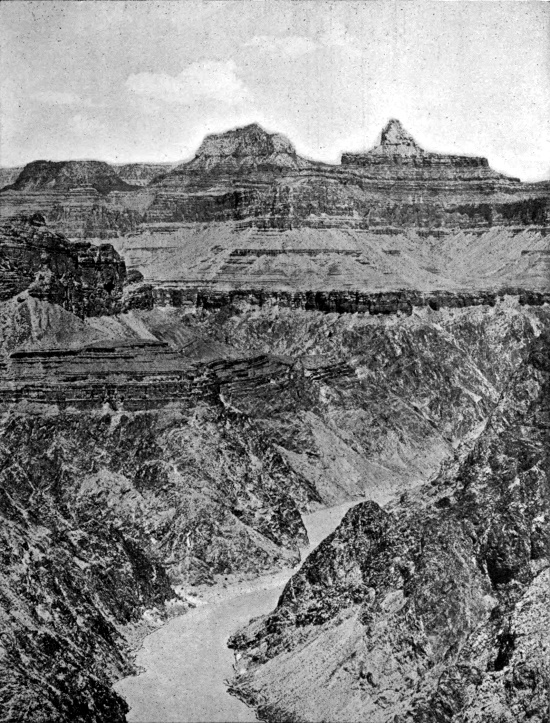
Those who have long and carefully studied the Grand Cañon of the Colorado do not hesitate for a moment to pronounce it by far the most sublime of all earthly spectacles. If its sublimity consisted only in its dimensions, it could be sufficiently set forth in a single sentence. It is more than 200 miles long, from five to twelve miles wide, and from 5,000 to 6,000 feet deep. There are in the world valleys which are longer and a few which are deeper. There are valleys flanked by summits loftier than the palisades of the Kaibab. Still the Grand Cañon is the sublimest thing on earth. It is not alone by virtue of its magnitudes, but by virtue of the whole—its ensemble.
The space under immediate view from our stand-point, fifty miles long and ten to twelve wide, is thronged with a great multitude of objects so vast in size, so bold yet majestic in form, so infinite in their details, that as the truth gradually reveals itself to the perceptions it arouses the strongest emotions. Unquestionably the great, the overruling feature is the wall on the opposite side of the gulf. Can mortal fancy create a picture of a mural front a mile in height, seven to ten miles distant, and receding into space in either direction? As the mind strives to realize its proportions its spirit is broken and its imagination completely crushed. If the wall were simple in its character, if it were only blank and sheer, some rest might be found in contemplating it; but it is full of diversity and eloquent with grand suggestions. It is deeply recessed by alcoves and amphitheatres receding far into the plateau beyond, and usually disclosing only the portals by which they open into the main chasm. Between them the promontories jut out ending in magnificent gables with sharp mitred angles. Thus the wall rambles in and out, turning numberless corners. Many of the angles are acute, and descend as sharp spurs like the forward edge of a ploughshare. Only those alcoves which are directly opposite to us can be seen in their full length and depth. Yet so excessive, nay, so prodigious, is the effect of foreshortening, that it is impossible to realize their full extensions.
Numerous detached masses are also seen flanking the ends of the long promontories. These buttes are of gigantic proportions, and yet so overwhelming is the effect of the wall against which they are projected that they seem insignificant in mass, and the observer is often deluded by them, failing to perceive that they are really detached from the wall and perhaps separated from it by an interval of a mile or two.
At the foot of this palisade is a platform through which meanders the inner gorge, in whose dark and sombre depths flows the river. Only in one place can the water surface be seen. In its winding the abyss which holds it extends for a short distance towards us and the line of vision enters the gorge lengthwise. Above and below this short reach the gorge swings its course in other directions and reveals only a dark, narrow opening, while its nearer wall hides its depth. This inner chasm is 1,000 to 2,000 feet deep. Its upper 200 feet is a vertical ledge of sandstone of a dark rich brownish colour. Beneath it lies the granite of a dark iron-grey shade, verging towards black, and lending a gloomy aspect to the lowest deeps. Perhaps half a mile of the river is disclosed. A pale, dirty red, without glimmer or sheen, a motionless surface, a small featureless spot enclosed in the dark shade of the granite, is all of it that is here visible. Yet we know it is a large river, 150 yards wide, with a headlong torrent foaming and plunging over rocky rapids.
The walls of the Grand Cañon and the level of the plateau descend by a succession of great steps, produced by faults, until the level of the river is reached at the mouth of the Grand Wash; and thus ends the Grand Cañon.
Below the Grand Wash, a dry stream bed which enters the Colorado from the north, the river turns south again and enters the Black Cañon of Lieutenant Ives’ report—a cañon which would be a remarkable feature were it not brought into such close juxtaposition with that described above.
Below it the river runs in narrow valleys and low cañons to its mouth.