A CYCLOPÆDIA OF PRACTICAL RECEIPTS, PROCESSES, AND COLLATERAL INFORMATION
Reading edition
A—ABBREVIATION
A-, ab-, abs-. [L.] In composition, from, denoting distance, departure, separation, or opposition; as in aberration, abstraction, abnormal, &c.
A-, an-. [Gr.] In composition, no, not, without, denoting the absence or loss of some quality or thing; as in achromatic, anhydrous, amorphous, &c.
AB′ACA (kăh). A species of vegetable fibre, of several varieties, obtained in the Philippine Islands, and remarkable for its brilliancy, strength, and durability. The finer kinds are woven into muslins, and other delicate fabrics; the coarser are formed into mats, cordage, and sail-cloth. It has been recently employed in Paris for the manufacture of various articles of furniture and dress; including bonnets, tapestry, carpets, network, hammocks, &c. The fibre, and fabrics made of it, may be bleached and dyed in a similar manner to flax and linen.
ABATTOIR. A public slaughter-house for cattle, &c., usually erected within the walls or precincts of a continental town or city.
ABBREVIATION. One or more of the earlier letters of a word used to express the whole.
1. Abbreviations in general use:—
A.B., Bachelor of Arts.
A.D., In the year of our Lord.
A.I.C., Associate of the Institute of Chemistry.
A.I.C.E., Associate of the Institute of Civil Engineers.
A.M., Master of Arts.—Before noon.
A.R.A., Associate of the Royal Academy.
B.A., Bachelor of Arts.
Bart., Baronet.
B.C., Before Christ.
B.D., Bachelor of Divinity.
B.Sc., Bachelor of Science.
C.B., Companion of the Bath.
C.E., Civil Engineer.
C.S., Civil Service.
D.C.L., Doctor of Civil Laws.
D.D., Doctor of Divinity.
D.G., By the Grace of God.
Dr., Doctor.—Debtor.
D.Sc., Doctor of Science.
D.V., God willing.
Ed., Editor, or Edition.
e.g., for example.
F.C.P., Fellow of the College of Preceptors.
F.C.S., Fellow of the Chemical Society.
F.G.S., Fellow of the Geological Society.
F.I.C., Fellow of the Institute of Chemistry.
F.L.S., Fellow of the Linnean Society.
F.R.A.S., Fellow of the Royal Astronomical Society.
F.R.C.P., Fellow of the Royal College of Physicians.
F.R.C.S., Fellow of the Royal College of Surgeons.
F.R.G.S., Fellow of the Royal Geographical Society.
F.R.S., Fellow of the Royal Society.
F.R.S.E., Fellow of the Royal Society of Edinburgh.
H.M.S., Her Majesty’s Ship.
H.R.H., His (or Her) Royal Highness.
i.e., That is.
Inst., Instant (the present month).
I.H.S., Jesus the Saviour of Man.
K.B., Knight of the Bath.
K.C.B., Knight Commander of the Bath.
K.G., Knight of the Garter.
Knt., Knight.
K.St.P., Knight of St. Patrick.
K.T., Knight of the Thistle.
L.A.C., Licentiate of the Apothecaries’ Company.
Lat., Latitude.
L.D., Licentiate in Dentistry.
LL.D., Doctor of Laws.
L.M., Licentiate in Midwifery.
Loc. cit., The part referred to.
Lon. or Long., Longitude.
M.A., Master of Arts.
M.B., Bachelor of Medicine.
M.C., Master of Surgery.—Master of the Ceremonies.
M.C.P., Member of the College of Preceptors.
M.D., Doctor of Medicine.
M.I.B.A., Member of the Institute of British Architects.
M.R.C.P., Member of the Royal College of Physicians.
M.R.C.S., Member of the Royal College of Surgeons.
M.R.C.V.S., Member of the Royal College of Veterinary Surgeons.
M.R.I., Member of the Royal Institution.
M.R.I.A., Member of the Royal Irish Academy.
MS., Manuscript.
MSS., Manuscripts.
Mus. Doc., Doctor of Music.
N.B., Mark well.
Nem. con., Without opposition.
O.H.M.S., On Her Majesty’s service.
Op. cit., The work quoted.
Per cent. (often expressed by the sign %), By the hundred.
Ph.D., Doctor of Philosophy.
P.M., Afternoon.
Prox., The next (month).
P.S., Postscript.
Q.C., Queen’s Counsel.
Qy. (?), Query, Question.
R.A., Royal Academician—Royal Artillery.
R.E., Royal Engineers.
R.H.A., Royal Horse Artillery.
R.M., Royal Marines.
R.N., Royal Navy.
Tr., Translator.
Ult., The last (month).
v. or vide, See.
W.S., Writer to the Signet.
&, ampersand, and.
&c., et cetera, And so on.
2. Abbreviations used in Prescriptions:—
A. aa., ana (Greek), of each. Equally by weight or measure.
Abdom., abdomen, the abdomen, the belly.
Abs. febr., absente febre, fever being absent.
Ad 2 vic., ad secundum vicem, to the second time; or ad duas vices, for two times.
Ad gr. acid., ad gratam aciditatem, to an agreeable acidity.
Ad def. animi, ad defectionem animi, to fainting.
Ad del. an., ad deliquium animi, to fainting.
Ad libit., ad libitum, at pleasure.
Add., adde, or addantur, add, or let them be added; addendus, to be added.
Adjac., adjacens, adjacent.
Admov., admove, admoveatur, admoveantur, apply, let it be applied, let them be applied.
Ads. febre, adstante febre, while the fever is present.
Alter. hor., alternis horis, every other hour.
Alvo adstr., alvo adstrictâ, when the bowels are confined.
Aq. astr., aqua astricta, frozen water.
Aq. bull., aqua bulliens, boiling water.
Aq. com., aqua communis, common water.
Aq. fluv., aqua fluviatilis, river water.
Aq. mar., aqua marina, sea water.
Aq. niv., aqua nivalis, snow water.
Aq. pluv., aqua pluviatilis, or pluvialis, rain water.
Aq. ferv., aqua fervens, hot water.
Aq. font., aqua fontana, or aqua fontis, spring water.
Bis ind., bis in dies, twice a day.
Bib., bibe, drink.
BB., Bbds., Barbadensis, Barbadoes, as aloë Barbadensis.
B.M., balneum mariæ, or balneum maris, a warm-water bath.
B. P., or B. Ph., British Pharmacopœia.
But., butyrum, butter.
B.V., balneum vaporis, a vapour bath.
Cærul., cæruleus, blue.
Cap., capiat, let him (or her) take.
Calom., calomelas, calomel, subchloride of mercury.
C. C., cornu cervi, hartshorn; it may also signify cucurbitula cruenta, the cupping-glass with scarificator.
C.C.U., cornu cervi ustum, burnt hartshorn.
Cochleat., cochleatim, by spoonfuls.
Coch. ampl., cochleare amplum, a large (or table) spoonful; about half a fluid ounce.
Coch. infant., cochleare infantis, a child’s (or tea) spoonful.
Coch. magn., cochleare magnum, a large spoonful.
Coch. med., cochleare medium, } a middling or moderate spoonful; that is,
Coch. mod., cochleare modicum,} a dessert-spoonful—about two fluid drachms.
Coch. parv., cochleare parvum, a small (or tea) spoonful; it contains about one fluid drachm.
Col., cola, strain.
Col., colatus, strained.
Colet., coletur, colat., colatur, let it be strained; colaturæ, to the strained liquor.
Colent., colentur, let them be strained.
Color., coloretur, let it be coloured.
Comp., compositus, compounded.
Cong., congius, a gallon.
Cons., conserva, conserve; also (imperat. of conservo) keep.
Cont. rem., or med., continuentur remedia, or medicamenta, let the remedies, or the medicines, be continued.
Coq., coque, boil; coquantur, let them be boiled.
Coq. ad med. consumpt., coque or coquatur ad medietatis consumptionem, boil, or let it be boiled to the consumption of one half.
Coq. S. A., coque secundum artem, boil according to art.
Coq. in S. A., coque in sufficiente quantitate aquæ, boil in a sufficient quantity of water.
Cort., cortex, bark.
C. v., cras vespere, to-morrow evening.
C. m. s., cras mane sumendus, to be taken to-morrow morning.
C. n., cras nocte, to-morrow night.
Crast., crastinus, for to-morrow.
Cuj., cujus, of which.
Cujusl., cujuslibet, of any.
Cyath. theæ, cyatho theæ, in a cup of tea.
Cyath., cyathus, vel, a wine-glass; from an ounce and half...
C. vinar., cyathus vinarius; to two ounces and half.
Deaur. pil., deaurentur pilulæ, let the pills be gilt.
Deb. spiss., debitur spissitudo, due consistence.
Dec., decanta, pour off.
Decub. hor., decubitûs horâ, at the hour of going to bed, or at bedtime.
De d. in d., de die in diem, from day to day.
Deglut., deglutiatur, let it be swallowed.
Dej. alv., dejectiones alvi, stools.
Det., detur, let it be given.
Dieb. alt., diebus alternis, every other day.
Dieb. tert., diebus tertiis, every third day.
Dil., dilue, dilutus, dilute (thin), diluted.
Diluc., diluculo, at break of day.
Dim., dimidius, one half.
D. in 2 plo., deter in duplo, let it be given in twice the quantity.
D. in p. æq., dividatur in partes æquales, let it be divided in equal parts.
D. P., directione propria, with a proper direction.
Donec alv. bis dej., donec alvus bis dejecerit, until the bowels have been twice opened.
Donec alv. sol. fuer., donec alvus soluta fuerit, until the bowels have been loosened.
Donec dol. neph. exulav., donec dolor nephriticus exulaverit, until the nephritic pain has been removed.
D., dosis, a dose.
Eburn., eburneus, made of ivory.
Ed., edulcorata, edulcorated.
Ejusd., ejusdem, of the same.
Elect., electuarium, an electuary.
Enem., enema, a clyster.
Exhib., exhibeatur, let it be administered.
Ext. sup. alut. moll., extende super alutam mollem, spread upon soft leather.
F., fac, make; fiat, fiant, let it be made, let them be made.
F. pil., fiant pilulæ, let pills be made.
Fasc., fasciculus, a bundle.
Feb. dur., febre durante, during the fever.
Fem. intern., femoribus internis, to the inside of the thighs.
F. venæs., fiat venæsectio, let venesection be performed.
F. H., fiat haustus, let a draught be made.
Fict., fictilis, earthen.
Fil., filtrum, a filter.
Fist. arm., fistula armata, a clyster-pipe and bladder fitted for use.
Fl., fluidus, fluid.
F. L. A., fiat lege artis, let it be made by the rules of art.
F. M., fiat mistura, let a mixture be made.
F. S. A., fiat secundum artem, let it be made according to art.
Gel. quav., gelatina quavis, in any jelly.
G. G. G., gummi guttæ gambæ, gamboge.
Gr., granum, a grain; grana, grains.
Gr. vj pond., grana sex pondere, six grains by weight.
Gtt., gutta, a drop; guttæ, drops.
Gtt. quibusd., guttis quibusdam, with some drops.
Guttat., guttatim, by drops.
Har. pil. sum. iij, harum pilularum sumantur tres, of these pills let three be taken.
H. D., or hor. decub., horâ decubitûs, at bedtime.
H. P., haustus purgans, purging draught.
H. S., horâ somni, at the hour of going to sleep.
Hor. un. spætio, horæ unius spatio, at the expiration of one hour.
Hor. interm., horis intermediis, in the intermediate hours.
Hor. 11mâ mat., horâ undecimâ matutinâ, at 11 o’clock in the morning.
Ind., indies, daily.
In pulm., in pulmento, in gruel.
Ind. Ph., Indian Pharmacopœia.
Inf., infunde, infuse.
Inj. enem., injiciatur enema, let a clyster be thrown up.
Jul., julepus, julapium, a julep.
Kal. ppt., kali præparatum, prepared kali (potassæ carbonas).
Lat. dol., lateri dolenti, to the affected side.
M., misce, mix; mensurâ, by measure; manipulus, a handful; minimum, a minim.
Mane pr., mane primo, early in the morning.
Man., manipulus, a handful.
Min., minimum, a minim, the 60th part of a drachm measure.
M. P., massa pilularum, a pill mass.
M.R., mistura, a mixture.
Mic. pan., mica panis, crumb of bread.
Mitt., mitte, send; mittantur, let them be sent.
Mitt. sang. ad ℥xij, mitte sanguinem ad ℥xij, take blood to twelve ounces.
Mod. præscr., modo præscripto, in the manner directed.
Mor. dict., more dicto, in the way ordered.
Mor. sol., more solito, in the usual way.
Ne tr. s. num., ne tradas sine nummo, do not deliver it without the money.
No., numero, in number.
N. M., nux moschata, a nutmeg.
O., octarius, a pint.
Ol. lini s. i., oleum lini sine ligné, cold-drawn linseed oil.
Omn. hor., omni horâ, every hour.
Omn. bid., omni biduo, every two days.
Omn. bih., omni bihorio, every two hours.
O. M., or omn. man., omni mane, every morning.
O. N., or omn. noct., omni nocte, every night.
Omn. quadr. hor., omni quadrante horæ, every quarter of an hour.
O. O. O., oleum olivæ optimum, best olive oil.
Ov., ovum, an egg.
Oz., the ounce avoirdupois.
P. æ., part. æqual., partes æquales, equal parts.
P. d., per deliquium, by deliquescence.
Past., pastillus, a pastil, or ball of paste.
P., pondere, by weight.
Ph. D., Pharmacopœia Dubliniensis.
Ph. E., Pharmacopœia Edinensis.
Ph. L., Pharmacopœia Londinensis.
Ph. U. S., Pharmacopœia of the United States.
Part. vic., partitis vicibus, in divided doses.
Per. op. emet., peractâ operatione emetici, the operation of the emetic being over.
Pocul., poculum, a cup.
Pocill., pocillum, a small cup.
Post sing. sed. liq., post singulas sedes liquidas, after every loose stool.
Ppt., præparata, prepared.
P. r. n., pro re nata, occasionally.
P. rat. ætat., pro ratione ætatis, according to the age.
Pug., pugillus, a pinch, a gripe between the thumb and the two first fingers.
Pulv., pulvis, pulverizatus, a powder, pulverised.
Q. l., quantum lubet, } as much as you
Q. p., quantum placet,} please.
Q. s., quantum sufficiat, as much as may suffice.
Quor., quorum, of which.
Q. V., quantum vis, as much as you will.
Red. in pulv., redactus in pulverem, reduced to powder.
Redig. in pulv., redigatur in pulverem, let it be reduced into powder.
Reg. umbil., regio umbilici, the umbilical region.
Repet., repetatur, or repetantur, let it, or them, be repeated.
S. A., secundum artem, according to art.
Scat., scatula, a box.
S. N., secundum naturam, according to nature.
Semidr., semidrachma, half a drachm.
Semih., semihora, half an hour.
Sesunc., sesuncia, half an ounce.
Sesquih., sesquihora, an hour and a half.
Si n. val., si non valeat, if it does not answer.
Si op. sit, si opus sit, if it be necessary.
Si vir. perm., si vires permittant, if the strength allow it.
Signat., signatura, a label.
Sign. n. pr., signetur nomine proprio, let it be written upon, let it be signed with the proper name (not the trade name).
Sing., singulorum, of each.
S. S. S., stratum super stratum, layer upon layer.
Ss., semi, a half.
St., stet, let it stand; stent, let them stand.
Sub fin. coct., sub finem coctionis, towards the end of boiling, when the boiling is nearly finished.
Sum. tal., sumat talem, let the patient take one such as this.
Summ., summitates, the summits or tops.
Sum., sume, sumat, sumatur, sumantur, take, let him or her take, let it be taken, let them be taken.
S. V., spiritus vini, spirit of wine.
S. V. R., spiritus vini rectificatus, rectified spirit of wine.
S. V. T., spiritus vini tenuis, proof spirit.
Tabel., tabella, a lozenge.
Temp. dext., tempori dextro, to the right temple.
T. O., tinctura opii, tincture of opium.
T. O. C., tinctura opii camphorata, camphorated tincture of opium.
Tra., tinctura, tincture.
Ult. præscr., ultimo præscriptus, last prescribed.
U. S. Ph., United States’ Pharmacopœia.
V. O. S., vitello ovi solutus, dissolved in the yolk of an egg.
Vom. urg., vomitione urgente, the vomiting being troublesome.
V. S. B., venæsectio brachii, bleeding from the arm.
Zz., zingiber, ginger.
See Formula, Prescriptions, Symbols, &c.
ABDO′MEN. [Eng., Fr., L.] In anatomy, the belly, or lower belly; the great cavity of the body extending from the thorax, or chest, to the bottom of the pelvis. It contains the stomach, intestines, liver, spleen, kidneys, bladder, &c.; and in the female, the uterus, ovaria. &c.
AB′ERNE′THY MEDICINES. These originally consisted of a calomel pill, and subsequently of a mercurial or ‘blue’ pill, to be taken over-night, followed by an aromatised black draught in the morning. The quantity of either of the former, for an adult, was about 3 gr. to 31⁄2 gr., increased a little in bulk by the addition of some liquorice powder; that of the latter, from 1 to 11⁄2 fl. oz. As, however, when frequently taken, these pills sometimes occasioned salivation, which proved prejudicial to their sale, a little compound extract of colocynth (Ph. L., 1836) was introduced into their composition, by which this objection was obviated. Ultimately, their composition was settled at 3 gr. of mercurial pill, and 2 gr. of compound extract of colocynth; and these proportions are still followed as the best by those who prepare and sell them. Persons who object to black draught, will find a dose of castor oil, or of any other mild purgative medicine that may be more agreeable to them, equally efficacious.
The occasional use of these medicines seldom fails to prove highly beneficial to the plethoric, bilious, and dyspeptic. In ordinary cases of constipation, headache, &c., arising from deranged stomach or liver, wherein the administration of mercurials is not contra-indicated, they will be found of great service. It need scarcely be added that these medicines are named after Mr Abernethy, the celebrated surgeon, who is said to have frequently employed them in his practice.
ABERRA′TION. [Eng., Fr.] Syn. Aberra′tio, L. A wandering or deviation from the usual course, or from the normal condition. In optics, the deviation of the rays of light from the true focus, when inflected by a lens or speculum. This arises from a difference in the physical nature of the rays, from the figure of the lenses or specula, or from the nature of the materials of which the media traversed are composed. See Achromatism, Lens, &c.
Aberration of mind. Mental alienation or wandering; insanity. A term frequently applied, in familiar language, to a mild form of incipient insanity or dementia, which is more or less occasional or continued, trifling or severe, according to circumstances. The studious, nervous, slothful, and those who are engaged in sedentary occupations and spend much of their time in ill-ventilated apartments, or who indulge in irregular or vicious habits, as well as ‘fast livers,’ are the most liable to this affection. It also frequently arises from disordered physical health.
Treat., &c. Change of scene, out-door exercise, agreeable company, pleasing and continued mental occupation, and due attention to diet, clothing, ventilation, &c., with the judicious use of some mild aperient medicine and tepid bathing, will generally alleviate, and frequently effect a cure. For the prevention of its accession, or its recurrence, care should be taken to promote the general health, and also, where necessary, to elevate the spirits and to divert the mind.
ABLU′TION. [Eng., Fr.] Syn. Ablu′tio, L. In a general sense, washing, cleansing, or purification by water.
Ablution. In hygiène and the toilet, a washing of the whole body, or any part of it. The value of frequent and copious affusions of pure water to the surface of the body is well known. During life, the skin is continually subjected to abrasion, and the processes of reproduction and decay, by which the cuticle, its exterior portion, is being constantly thrown off as effete and useless matter, in the shape of very minute scales or dust. This, mingling with the oily and saline products of the skin, acquires sufficient adhesiveness to attach itself to the surface of the body and clothing, as well as to attract the waste particles of the dress, and the dust and soot floating in the atmosphere. In this way, if occasional ablutions be not had recourse to, the channels of perspiration will become choked, and the clothing itself rendered unwholesome and unfit for use. The consequence of the pores of the skin being obstructed is impeded transpiration, by which its functions, as a respiratory organ, are interfered with or suspended. This adhering pellicle of refuse matter also acts as an irritant, and forms a favorable medium for the absorption, and the transmission into the body, of effluvia, miasmata, poisonous gases, and the infectious and contagious matters of disease. “The greater part of (contagious) poisons are conveyed to us through the external surface of our bodies; and it is fully proved that poison, already communicated, has been by cleanliness removed, before it could actually produce any bad effects. I here allude, in particular, to frequent washing, bathing, rinsing the mouth, combing and brushing the hair, and often changing the linen, clothing, and bedding.” (Hufeland.) Such are the immediate effects of neglected ablution of the skin; the further consequences are of an equally serious character. The blood being deprived of one of its sources of oxygen, and one of the outlets for its carbon, the functions of nutrition become imperfect, and the animal temperature lessened. The matters which would be thrown out of the system in the form of perspiration are retained, and must be eliminated by other channels. The lungs, the kidneys, the liver, and the bowels, are each, in their turn, overtasked to perform the functions of another organ. The oppressed viscera suffer from exhaustion, and incipient disease soon follows. Their particular offices are languidly performed, the equilibrium of health is disturbed, and skin diseases, or consumption, diarrhœa, dropsy, liver-complaints, visceral obesity, or some other serious diseases of the vital organs, ensue. When it is added, that no dirty or imperfectly washed skin can long continue healthy, and ceasing to be healthy must also cease to be agreeable and beautiful, the argument in favour of the daily use of water of good quality to the whole surface of the body, when possible, will surely be complete. The inculcation of habits of personal cleanliness cannot be too forcibly emphasized. The fact, however, cannot be overlooked, that in order to introduce habits of cleanliness amongst the poorer classes, a plentiful supply of water, combined with cheap baths, are requisite. Every officer of health should inquire into the amount as well as the character of the water supply in the district over which he has supervision. The body should be washed all over every morning with either cold or lukewarm water and soap. This custom is more necessary for workmen employed in laborious and dirty occupations than for those who live sedentary lives; but all people perspire, and from every drop of perspiration the water evaporates, and leaves a fraction of solid matter on and around the pores that excrete the perspiration. If this solid matter be not washed off, it accumulates and may derange the health. Instances have occurred in which persons suffering from extensive bodily burns have died, not from the effect of the injury, but from the destruction of the pores or excreting vessels, with which the skin is covered. It is well, therefore, to bear in mind that a dirty skin does not always come from without, but also from within. Cold ablution, that has been so indiscriminately recommended, is not half so efficacious, nor so safe, as lukewarm. The German aurists ascribe the presence of the large amount of deafness in England to our habit of washing the head and ears each morning with cold water.
Ablution. In medicine, the washing the body, externally, as by bathing; or internally, by diluting drinks. In ancient medicine, according to Galen, internal ablution was accomplished by the use of profuse libations of milk-whey; an object now aimed at, by the hydropathists, by the copious administration of pure cold water. To neglect the daily ablution of an infant is to discard one of the greatest aids to its healthy development and physical wellbeing. That disregard of this precaution is a fertile source of most of the skin diseases that affect infants and children there seems little question about amongst medical men. Water at a temperature ranging from 80° to 90° F. should always be used. Mr Chevasse, in his ‘Counsel to a Mother,’ is emphatic in his advocacy of rain water. He also advises the employment of Castile soap, and of glycerine soap, should there be any excoriation of the skin. Of course the same remarks apply to children as to infants, with this difference, that the ablution is to be performed with water a few degrees colder; and both infants and children should be rubbed dry with a dry soft towel. There are doubtless many persons who deem themselves cleanly washed, if in addition to their hands and arms, neck and face, undergoing duly daily ablution, they wash their feet once a week. These individuals cannot reflect that, because of their less exposure to the depurating influence of the atmosphere, the feet require to be more frequently washed than either the hands or face. See Bathing, Baths, Hydropathy, &c.
ABNORM′AL. [Eng., Fr.] Syn. Abnor′mis, L. In medicine and the collateral sciences, contrary to, or without system or rule; irregular; deformed; unnatural. In a diseased or unhealthy state.
ABORTION IN COWS. Abortion is the expulsion of the contents of the pregnant womb before the full period of gestation is complete, and occurs much more frequently in cows than in any other of the lower animals. Abortion is often induced by shocks and injuries, feeding on ergotised grasses, but more commonly by causes which are less obvious. Thus, bad smells, pasturing on flooded meadows, rich and stimulating food, and even association with other cows while aborting, are among the exciting causes of this malady. The premonitory signs are an irritable excited state of the animal, a discharge from the vagina, looseness and fulness of the external organs of generation, and, occasionally, sudden enlargement of the udder. These symptoms may continue for several days, and, if noticed before straining or other signs of calving have appeared, the animal should be copiously bled and placed in a comfortable loose-box, kept as quiet as possible, moderately supplied with soft laxative food, and, if the bowels be costive, with a pound or two of treacle daily. Powerful purgatives are too irritant, and must, therefore, be studiously avoided. Two ounces of laudanum, with the same quantity of sweet spirits of nitre, should be given twice a day until all danger is over. To prevent the continuance and spread of the evil, place the cow by herself as soon as she aborts; remove and bury the fœtus beyond the reach of other cows; feed off the cow, if practicable, but if she be again bulled, it ought not to be for several weeks, and until the period of heat is passing off; remove all disagreeable smells, and see that the remainder of the herd are moderately fed and carefully watched, so that the earliest symptoms of abortion may be noticed.
ABRA′SION. [Eng., Fr.] Syn. Abra′sio, L. The rubbing or wearing down of surfaces by friction. In the arts, the reduction or figuration of materials by the use of an abrasive tool, or grinder, of which the effective portion is an exact counterpart of the form to be produced.
Abrasion. In numismatics, the ‘wear and tear,’ or waste of the substance of coins, in the pocket and circulation. It forms a large item in the expense of a metallic currency. The means employed to obviate, or to reduce it, consist in either alloying the metal to render it tougher and harder, or raising the borders so as to lessen the surface exposed to friction. In well-formed coin both methods are adopted.
Abrasion. In pathology and surgery—1. A superficial removal or injury of the skin by fretting or friction.
Treat., &c. When the injured surface is large, or exposed, it should be protected from dirt and further injury, by applying a piece of lint or soft linen rag, covered with spermaceti cerate, or some other simple ointment; over which a piece of strapping, or bandage of any sort, may be placed to keep it on. In many cases, a piece of common sticking-plaster will be found quite sufficient.
2. A very superficial ulceration or excoriation of the intestinal or other mucous membrane. Treat. Aperients of castor oil, demulcents, and a light nutritious diet. See Excoriations.
ABRUS PRECATORIUS. (Ind. Ph.) Indian Liquorice Plant. Habitat. Tropical portions of both hemispheres, Officinal part. The root (Abri Radix, Indian Liquorice). Occurs in pieces of various lengths, from 1⁄2 to 1 inch in diameter; pale brown externally, yellowish internally; inodorous, taste sweetish and mucilaginous, much resembling officinal liquorice root. Properties and uses. Similar to those of liquorice, for which it forms an excellent substitute. Preparation. Extract of Abrus (Extractum Abri). Prepared as Extractum Glycyrrhizæ.
ABSCESS. A formation of matter or pus, resulting from inflammation, either acute or chronic. The symptoms are pain, swelling, heat, and redness, a conical projection on the swelling, often with a white point at the apex. Abscess or suppuration may come on any part of the body. When the local inflammation does not yield to cold lotions, apply poultices; a pledget of lint dipped in cold water and kept moist by means of oil-silk; a slice of bread softened with boiling water or milk, or linseed meal, make the best poultices. Should the pain be severe add laudanum, and additionally rub it round the swelling. Or apply common white paint by laying it on gently with a brush, or else tincture of marigold or arnica in the same manner. Chronic abscesses in the glands in the neck are usually scrofulous, and should be opened. Abscesses in the breast should not be opened too early, or others are formed. Those in the gums may be cut early, not so if in the tonsils. After opening with a needle or lancet-point external abscesses, continue to poultice till the hardness disappears, then dress with spermaceti ointment spread on lint. When the abscess is of a dangerous nature, lose no time in consulting a medical practitioner.
Treatment for horses and cattle. Mr Finlay Dun prescribes fomentations, poultices, counter-irritants, the knife, cauterisation, carbolic-acid dressing, stimulating injections, and the administration of sulphites and chlorate of potash.
ABSINTHE. [Fr.] Absinthium, L.; Wormwood, E.; Wermuth, G. This article is met with in commerce in the form of the dried herb with the flowers of Artemisia Absinthium, having a whitish-grey appearance, a soft feel, an aromatic and unpleasant odour, and an extremely bitter and aromatic flavour. The plant is indigenous, and grows in thickets, in mountainous districts, and on waste ground. Its odour is due to its containing an essential oil; its bitterness is referable to absinthin, a crystallisable principle which may be extracted from the herb by water or spirit. The name absinthe is also given to an intoxicating liqueur which is extensively drunk on the Continent, and which unfortunately appears to be rapidly attracting consumers in this country. The remarks on this subject by Blyth in his admirable ‘Dictionary of Hygiène’ are so pregnant with important facts that they will be here produced verbatim et literatim. “An analysis recently made at the Conservatoire des Arts shows that absinthe now contains a large quantity of antimony, a poison which cannot fail to add largely to the irritant effects necessarily produced on the alimentary canal and liver by constant doses of a concentrated alcoholic liquid. And we have recently received the results of some experiments made by M. Magnan, of Paris. By means of successive distillations he has been able to isolate various products—(1) a blue oil; (2) a yellowish oil; (3) an oxygenated substance. There was besides a yellowish residue left in the glass. These various substances were tried on animals; ten grammes of the yellow sediment given to a small dog produced no effect; thirty centigrammes of the blue oil produced from eight to ten epileptiform attacks. The oxygenated product proved, however, the most powerful toxic agent. Fifteen centigrammes of it, injected into the veins of a large dog, caused the most violent epileptic attacks, which followed in rapid succession, and ended in death. There was an extraordinary rise of temperature, from 39° to 42° Centigrade, and the post mortem showed various apoplectic centres. Dr Decaisne regards the terrible evil of this almost universal absinthe-drinking as the greatest national calamity that has ever befallen France, and has made an eloquent appeal to the Government to strike at once a decisive blow at the trade in this liqueur. Originally the only important ingredient in its composition besides alcohol was the essential oil of absinthium or wormwood; and though this without doubt added something to the mischievous effects of the liqueur, it would be impossible to trace to it, or to the other comparatively trivial ingredients, the more serious of the special results which are now observed to occur to victims of absinthe, though the habitual drinking even in small doses of good absinthe is believed by Dr Decaisne, sooner or later, to produce disorders in the animal economy. Now various deleterious substances are added, the most important of these being antimony. As at present constituted, therefore, and especially when drunk in the disastrous excess now common in Paris, and taken, as it frequently is, on an empty stomach, absinthe forms a chronic poison of almost unequalled virulence, both as an irritant to the stomach and bowels, and also as a destroyer of the nervous system. The effect of absinthe is to produce a superabundant activity of the brain, a cerebral excitement, which at first is agreeable; intoxication comes on rapidly; the head swims, and the effect produced is nearly the same as that of poisoning by a narcotic, which certainly does not occur with an equal dose of brandy. With the absinthe-drinker, as with the opium-eater, the excitement the spirit produces diminishes daily in intensity. Each day he is obliged to augment the dose in order to bring himself up to the right pitch. The diseases brought on by the excessive drinking of ardent spirits are produced with greater rapidity by the use of absinthe.” The amount of absinthe consumed in London has during the last few years been enormously on the increase. See Liqueurs.
ABSINTHIN. C16H22O5. The bitter principle of wormwood (Artemisia absinthium). A hard crystalline solid, having an intensely bitter taste; slightly soluble in water, very soluble in alcohol, less so in ether. Its physiological effects resemble those of extract of wormwood. Dose. 1⁄2 gr. to 2 gr., or more; in dyspepsia; as a stomachic, to promote the appetite, &c.; as a substitute for quinine in intermittents; and in worms.
ABSINTH′IUM. [L.] See Absinthe.
ABSOLUTE. Syns. Absolutus, L.; Absolu, Fr.; Undebingt, G. In chemistry, pure, unmixed; as absolute alcohol, pure spirit of wine, i.e. free from water.
ABSORBED′ (-sorbd′). Syn. Chilled; Absorbé, Fr. In painting, a term among French connoisseurs, to represent that state of a picture in which the oil has sunk into the canvas or ground, leaving the colours ‘flat,’ and the touches indistinct. The remedy consists in rubbing the surface of the picture, previously well cleaned, with a soft sponge dipped in a little drying oil, and after some days varnishing it; when it should be kept in a warm room until perfectly dry.
ABSORB′ENT. Syn. Absorb′ens, L.; Absorbant, Fr.; Absorbirend, Ger. Imbibing; that imbibes or sucks up; variously applied in science and art. (See below.)
Absorbent Ground. In painting, a picture-ground prepared wholly or chiefly in distemper or water colour, in order that the redundant oil in the colours subsequently applied may be immediately ‘absorbed,’ by which expedition is permitted, and brilliancy imparted to them.
Absorbent Surfaces. In the arts, these are usually rendered non-absorbent, preliminary to their being bronzed, gilded, painted, or varnished, by giving them one, or more, coats of thin size, so as to destroy their porosity; care being taken to allow each coat to become thoroughly dry before the application of the next one; and also, finally, to remove any unabsorbed excess of size from the surface, by means of a sponge dipped in warm water. This applies to ALABASTER, PAPER, WOOD, PLASTER CASTS, &c.; and to WALLS and CEILINGS which are not exposed to the weather, and which there is not time to prepare with drying oil. See Bronzing, Maps, Varnishing, &c.
Absorption and consequent adherence in porous moulds, as those of plaster, are usually prevented by thoroughly saturating the pores of the mould with melted tallow, or a mixture of tallow and bees’ wax; or for delicate objects or the electrotype, with white wax. The ‘dry moulds’ are either heated before the application of these substances, or they are boiled in them; any portion that may finally remain unabsorbed, being carefully removed with cotton-wool or a soft rag. Another method is to wash the moulds over two or three times with drying oil, or to boil them in it; after which they must be exposed to the air for some days, to dry and harden. Before being used for plaster, composition, &c., the surface of these prepared moulds require to be slightly moistened with sweet oil.
Plaster moulds are generally prepared for sulphur, wax, and gutta percha casts, by simply placing them (upright) with the back immersed in a little water, contained in any shallow vessel, as a saucer or plate; and letting them remain there until moisture begins to appear on the surface. The materials to be cast, or moulded, should then be used at the lowest possible temperature, to prevent the formation of air-bubbles.
The adherence of wax or mixtures containing it, and of gutta percha, is best prevented by moistening the surface of the mould (whether of plaster, metal, or gutta percha), immediately before use, with soft soap reduced to the consistence of thin cream with water. See Casts, Moulds, Electrotype, &c.
ABSORB′ENTS. In anatomy and physiology, two distinct sets of small, delicate, transparent vessels, which imbibe or suck up fluid substances, and convey them to the blood. They are termed lacteals or lymphatics; the former take up the chyme from the alimentary canal, the latter pervade almost every part of the body in which they absorb lymph.
Absorbents. In botany and vegetable physiology, the origins of the different vessels constituting the vascular tissue, as they are found in the root, where they imbibe or suck up the nutritive fluids from the soil. See Plants and Vegetables.
Absorbents. In agriculture and chemistry, substances which possess the power of withdrawing moisture from the atmosphere; as soils, argillaceous earths, &c. Also (but less frequently) substances which neutralise acids; as chalk, lime, and magnesia. Absorbents differ from ‘deliquescent salts’; the latter attract moisture and dissolve in it; whilst the former merely suck it into their pores, as a sponge does water. See Absorption.
Absorbents. Syn. Absorben′tia, L. In medicine and pharmacy, substances which remove acidity from the stomach and bowels. Of these the principal are—magnesia, carbonate and bicarbonate of magnesia, prepared chalk, and the carbonates and bicarbonates of potash, soda, and ammonia. The first four are popularly called earthy absorbents; and the others, alkaline absorbents. See Antacids.
The following absorbent mixtures are taken from Dr Kirby’s valuable work, ‘Selected Remedies’:
1. Infusion of rhubarb, 11⁄2 oz.; compound spirit of ammonia, 11⁄2 dr.; compound infusion of gentian to 6 oz. Two tablespoonfuls to be taken 3 times a day.
2. Bicarbonate of potash, 11⁄2 dr.; syrup, 2 drs.; compound spirit ammonia, 11⁄2 dr.; compound infusion of gentian to 6 oz. Two tablespoonfuls to be taken 3 times a day.
3. Bicarbonate of soda, 11⁄2 dr.; spirits of chloroform, 11⁄2 dr.; infusion of calumba to 6 oz. Two tablespoonfuls to be taken 3 times a day.
ABSORP′TION. [Eng., Fr.] Syn. Absorp′tio, L.; Einsaugung, Ger. The act or the power of absorbing, in various applications. (See below.)
Absorption. In agriculture, the power possessed by soils of absorbing moisture from the atmosphere. The more a soil is divided by labour and vegetation, the greater is its absorbent power, and, consequently, its fertility. Indeed, the latter chiefly depends on its capacity for imbibing moisture, and may be illustrated by reference to recent and disintegrated lava. (Leslie.) The finely divided state, most penetrable by the delicate fibres of plants, appears to derive its superior power of acting on atmospheric vapour from the augmentation of its surface and the multiplication of its points of contact. (Ure.) This method of increasing the fertility of a soil is well known to scientific farmers, and seldom neglected by them. (Loudon.) That soil must be regarded as the most fertile which possesses this power in the greatest degree. Garden-mould has the highest absorbent power of any mineral substance. (Leslie.)
Process of ascertaining the ABSORBENT POWER OF SOILS, and other substances. Thoroughly dry the article by the suitable application of a heat not exceeding 212° Fahr., continued for several hours, and transfer it, while still warm, into a clean dry phial furnished with a perfectly tight ground-glass stopper. When cold, quickly and cautiously introduce it, along with a delicate hygrometer, into a large wide-mouthed glass bottle, the atmosphere of which has been previously rendered as damp as possible, by suspending a piece of moistened rag or filtering paper in it. It must now be kept closed for some hours, when the hygrometer will indicate the degree of dryness of the enclosed air, and, consequently, the absorbent power of the substance examined.
Obs. Experiments of this nature are only relatively correct, and must be performed under exactly similar circumstances, to furnish reliable comparative results. The whole process, in each case, must be as similar as careful manipulation can possibly make them. With this reserve, they will be found invaluable to the agriculturist.
Absorption. In chemistry the passage of gases and vapours into liquid and solid substances. Thus, water absorbs the oxygen of the air, lime absorbs water, charcoal absorbs ammoniacal and other gases.
Absorption. In medicine and toxicology, see Medicines and Poisons.
Absorption. In perfumery, see Enfleurage.
Absorption. In physics, see Heat, Light, Refrigeration, &c.
Absorption. In physiology (animal and vegetable), the function of sucking, or taking up, of appropriate substances, by the ‘absorbent vessels.’ It is one of the chief vital functions, the primary object of which is to convey to the circulatory organs the proper supply of the materials necessary for the support and growth of the body; and subsequently, to remove and convey to these organs its effete and useless portions, in order to their ultimate elimination from the system.
Absorption. In surgery, the natural process by which tumours and their contents, morbid growths, and, sometimes, even healthy glands, &c., are gradually taken up and disappear, by the action of the ‘absorbents.’
Absorption (of Surfaces, Moulds, &c). See Absorbent Surfaces.
ABSTERG′ENTS. Syn. Abstergen′tia, L. In medicine and pharmacy, substances which cleanse or clear away foulness from the surface of the body or sores; as soap, lotions, &c. See Detergent, which has a nearly similar meaning, and is in more general use.
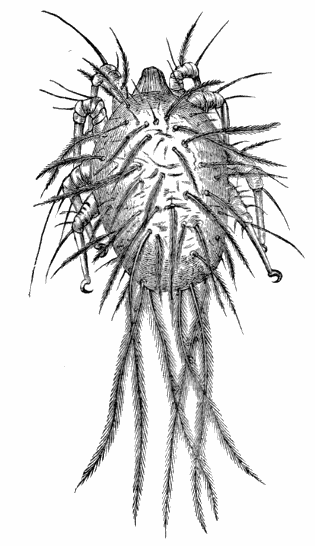
AC′ARI (-rī). [L.; prim. Gr.] Syn. Acar′idans; Acar′ides (dēz); Acarid′iæ. (-e-ē). In entomology, a division of arachnidans, including the mite and tick. All the species are either microscopic or extremely minute, and possess such tenacity of life as to resist for some time the action of boiling water, and to live with comparative impunity in alcohol. Leuwenhoek had one that lived eleven weeks glued on its back to the point of a needle, without food. The following are well known—ACARUS AUTUMNA′LIS, the harvest-bug or wheal-worm; A. DOMES′TICUS, the domestic tick; A. DYSENTE′RIÆ, the dysentery-tick; A. FARI′NÆ, the meal mite (fig. a); A. RI′′CINUS (rĭc-), the dog-tick; A. SAC′CHARI, the sugar-mite (fig. b); A. SI′′RO, the cheese-mite (fig. c); A. SCABIE′I, the itch-insect (fig. d).
The irritation of the skin, caused by these vermin, may be relieved by a lotion of equal parts of sal volatile and water; and they may be destroyed by tobacco water, or a lotion or ointment of stavesacre. See Itch, Mange, Parasites, Pediculi, Scab, &c.
Acarus Farinæ, or meal-mite (fig. a). This insect is found only in damaged flour, and is more frequently met with in the flour of the leguminosæ (beans, peas) than in that of the gramineæ (wheat, rye, oat).
Now and then a single acarus may occasionally be found in good flour, but even one should be regarded with suspicion, and the flour should afterwards be frequently examined to see if they are increasing.
Fig. a. Mag. 250 diams.
Acarus Sacchari, or sugar-mite (fig. b).
Fig. b. Mag. 260 diams.
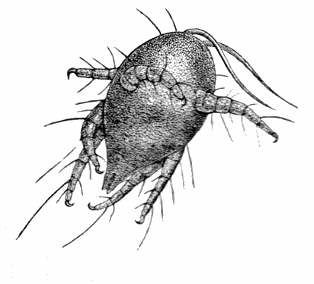
Most of the brown sugars of commerce are infested by this pest, which is of a size sufficiently large to be visible to the naked eye. The following method of proceeding will lead to its detection:
Dissolve 2 or 3 teaspoonfuls of sugar in a large wineglass of tepid water, and let the solution remain for an hour or so, at the expiration of which time the acari may be found, some on the surface of the liquid, some attaching themselves to the sides of the glass, and some at the bottom, mixed up with the copious and dark sediment, made up of fragments of cane, woody fibre, grit, dirt, and starch granules, which usually subside on dissolving even a small quantity of sugar in hot water. When first hatched this acarus is hardly visible.
Acari of all sizes—that is, in all stages of growth—may be met with in most samples of sugar.
Dr Hassall, in seventy-two samples of sugar which he examined, found sixty-nine containing them.
Fig. c.
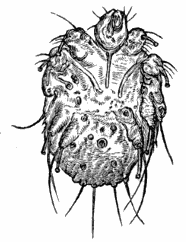
Acarus Siro, the cheese-mite (fig. c). The dry and powdery parts of decayed cheese, which by careful watching may very frequently be seen in movement, consist almost wholly of this insect and their eggs in different stages of development. The cheese-mite can hardly be seen without the aid of the microscope. They are very tenacious of life, even when kept without food. Mr Blyth says that under these circumstances “it is no uncommon sight to see them killing and devouring each other; and that cheese is rapidly destroyed by them; they crumble it into minute pieces, and emit a liquid substance which causes the decayed parts to spread speedily.” They may be destroyed by being exposed to a strong heat, or by putting the cheese for a short time in whisky.
Fig. d.
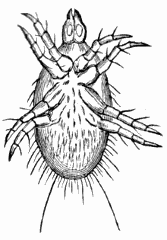
Acarus Scabiei, the itch-insect (fig. d). The parasitic character of the disease known as the itch was first demonstrated by Dr Bononio, who on turning out the contents of one of the little bladders that show themselves between the fingers of those affected with the complaint, and placing the fluid under the microscope, discovered a minute animal, very nimble in its movements, covered with short hairs, having a short head, a pair of strong mandibles or cutting-jaws, and eight legs, terminating in remarkable appendages, each provided with a sucker and setæ.
It has no eyes; but when disturbed it quickly draws in its head and feet, and then somewhat resembles the tortoise in appearance, its march being precisely the same. It usually lays sixteen eggs, which are carefully deposited in furrows under the skin, and ranged in pairs; these are hatched in about ten days.
“To find the itch-insect,” says Mr Jabez Hogg, “the operator must carefully examine the parts surrounding each pustule; he will then see a red line or spot communicating with it; this part, and not the pustule, must be probed with a fine-pointed instrument. The operator must not be disappointed by repeated failures.”
ACCIDENT′AL COLOURS. See Colours (Complementary).
ACCIDENTS. Black eye. Bathe the eye frequently with a soft piece of linen rag dipped in a lotion composed of one part of tincture of arnica and seven parts of water.
Burns and Scalds. Refer to Burns and Scalds.
Charcoal, combustion of, poisoning by. Refer to Carbonic Anhydride.
Choking, or suffocation from substances sticking in the throat. Refer to Choking.
Cut Finger. Refer to Cuts.
Precautions against Fires. Refer to Fires.
Precautions against Lightning. To take refuge under a tree during a thunderstorm accompanied by lightning is to expose oneself to a double danger—firstly, because by keeping the clothes dry these are prevented becoming the non-conductors they would be if damp; and secondly, because the tree, serving as a point of attraction for the lightning, conducts it to the ground, and in doing so frequently rends the trunks or branches, and kills any person or animal who happens to be close to, or in contact with, it at the time.
Never, therefore, if overtaken by a storm of thunder and lightning fly to the dangerous cover of a tree, pillar, hay-rick, wall, or hedge, but seek shelter in the nearest dwelling; or if this is not at hand, get to a part of the road or field where there is no object to attract the lightning, and there remain till the storm has expended itself. Also avoid particularly the proximity of iron gates, palisades, bronze statues, bell wires, iron railings, and such like. When in the house, do not sit or stand near the windows, doors, or walls, but place yourself in the middle of the room, unless there should be a lamp or chandelier hanging from the ceiling. Franklin recommends persons to keep away from the neighbourhood of fireplaces.
Treatment of persons struck by lightning. In case of any person being struck by lightning, immediately strip the body and throw bucketsful of cold water over it for ten or fifteen minutes; continued frictions and inhalations of the lungs must also be employed, and electricity should be tried if it be possible.
Accidents by Poison. The means to be adopted in cases where poison is taken, if the poison be known, are embodied in the antidotes, which will be found given in this volume under the respective poisons.
Under all circumstances, however, medical aid should be sought as expeditiously as possible, since many of the antidotes themselves being of a dangerous, if not poisonous, character, should only be administered under medical supervision. Pending the arrival of the doctor, no time should be lost in giving an emetic, consisting of a teaspoonful of flour of mustard in half a pint of warm water, supplemented by copious draughts of warm water, and tickling the throat with the finger if necessary.
Fish poisoning. It is a not unfrequent occurrence to find fish when eaten giving rise to a species of poisoning of a more or less violent form, such as a sense of weight at the stomach, accompanied with nausea, vertigo, headache, heat about the head and eyes, pains in the stomach, thirst, and often an eruption of the skin resembling nettle-rash. These symptoms may be sometimes due to the nature of the fish itself; sometimes to its being in a state unfit to be taken as food, as, for instance, when it is in a stale or decomposing condition; and occasionally to the peculiarity of constitution of those who partake of it, even if in a perfectly fresh condition. Whenever any of the symptoms above described follow from eating fish, an emetic of mustard and water (a teaspoonful of mustard in half a pint of water) should be administered. If subsequently a rash should appear, it would be well to take a dose of brisk purgative medicine, and, if necessary, a few doses of carbonate of soda 3 or 4 times during the day.
Poisonous Mushrooms. The same treatment should be followed as for fish. With some people the edible mushroom acts as a poison.
Sinks. See that these be securely trapped, and in the event of any unpleasant smell from them, pour down some disinfectant, such as chloride of lime, carbolic acid, or Condy’s fluid. The foul emanations from a sink ought to be regarded as of a most dangerous and pestilential nature.
Accidents to Children. Many, if not most, of the casualties to which children are exposed are given above, together with the best course to be pursued in the event of their being overtaken by any of them. There are, however, a few forms of disaster which seem more especially peculiar to children. Of these we may select—
Swallowing a piece of broken glass. In this case avoid giving purgatives, but give solid farinaceous food, so as to envelope the glass and enable it to pass through the bowels without causing injury by coming in contact with them.
Swallowing a coin. Give a dose or two of castor oil, and examine the stools until the coin is perceived.
A small coin sticking in the windpipe. Seize the child by the legs, letting his head hang downwards, then administer several brisk blows on the back with the palm of the hand, when very frequently the coin will be coughed out of the mouth and on to the floor. If this plan do not succeed, send immediately for medical aid.
ACCLI′MATE, or ACCLI′MATISE. In botany and zoology, to inure a plant or animal to a climate to which it is not indigenous. When so inured it is said to be ACCLIMATED. In medicine, to habituate the body to a foreign climate, so that it may not be peculiarly liable to its endemic diseases; or to become so habituated. Thus, a person who has resided several years at New Orleans without an attack of yellow fever, or having had an attack has satisfactorily recovered, is said to be ACCLI′MATISED.
ACCOM′PANIMENTS. In cookery and housekeeping, see Trimmings.
ACCUMULA′TION. [Eng., Fr.] Syn. Accumula′tio, L. In medicine, a term applied when the effects of the first dose of any substance still continue when the second is administered (accumulation of action); or when several doses of insoluble substances remain inactive in the system until their energy is developed by chemical influence (accumulation of doses). See Medicines, Poisons, &c.
ACEPH′ALANS. Syn. Aceph′ala, Cuv. In malacology, a class of aquatic mollusca, having no apparent head, but a mouth between the folds of their mantle. Several of them, as the oyster, cockle, mussel, scallop, &c., are consumed for food.
ACERB′ITY. Syn. Acerb′itas, L.; Acerbité, Fr.; Herbigkeit, Ger. In chemistry, &c., sourness, with bitterness and astringency, or harshness. See Cider, Fruit, Wine, &c.
ACERBO’S ANTI-RHEUMATIC AND ANTI-CATARRH OIL. For various horse diseases. Gum euphorbium, 10 parts; absolute alcohol, 10 parts; olive oil, 80 parts. Digest in a warm-water bath for 24 hours, then boil until all the spirit has evaporated, and, when cold, strain through cotton. (Hager.)
ACER′IDES. Plasters that do not contain wax.
ACES′CENT. Syns. Aces′cens, L.; Acescent, Aigrelet, Fr.; Säurlich, Ger. In chemistry, &c., growing sour; slightly tart or acid; having a tendency to sourness, or to run into the acetic fermentation, as wine, beer, malt-wort, &c. Hence, ACES′CENCE or ACES′CENCY (acescen′tia, L.; acescense, aigreur, Fr.; säurlichkeit, Ger.), the tendency to become slightly acid, or the quality of being so. See Acetification, Malt-liquors, Wine, Wort, &c.
ACETA′′RIOUS (-tāre′-e-ŭs). Used for salads (as plants); relating to salads (which see).
AC′ETATE (ăs′-). Syn. Ace′tas, L.; Acetate, Fr.; Essigsäure salze, Ger. In chemistry, a salt consisting of C2H3O2 (sometimes called the acid-radical of the acetates) with hydrogen, a metal, or a compound basic radical; e.g.,
Hydrogen acetate (acetic acid)HC2H3O2
Potassium acetateKC2H3O2
Lead (plumbic) acetatePb(C2H3O2)2
Ammonium acetateNH4C2H3O2
Salts of acetic acid (HC2H3O2) with the alkaloids are likewise termed acetates; e.g.,
Morphia acetate . C17H19NO3 . C2H4O2
Prep. That of the commercial acetates, and of many others, is noticed under the respective metals. In general, they may all be formed by direct solution of the carbonate, hydrate or oxide of the metal whose acetate it is desired to form, in dilute acetic acid; or from a solution of an acetate and of another salt of the metal, by double decomposition. In either case, the resulting solution must be carefully evaporated by a gentle heat, and, where possible, crystallised.
Prop., &c. All the neutral acetates, except those of molybdenum and tungsten, are more or less soluble in water, several so much so as to be uncrystallizable; many dissolve in alcohol; they suffer decomposition at a dull red heat, and by distillation, at that temperature, yield acetone and water, or acetone and acetic acid, and leave a carbonaceous residuum; at a full red-heat, those of potassium, sodium, barium, strontium, calcium, and magnesium, are converted into carbonates, whilst the other metallic acetates leave behind the pure metal, or its oxide. The aqueous solutions of the alkaline acetates soon turn mouldy and suffer decomposition. No more of them should, therefore, be dissolved at once than is required for immediate use.
Char., tests, &c. The acetates are known—1. By evolving fumes of acetic acid, recognisable by its peculiar and characteristic odour, on the addition of strong sulphuric acid:—2. By evolving the vapour of acetic ether (known by its peculiar and agreeable odour) when heated with a mixture of about equal parts of concentrated sulphuric acid and alcohol.
AC′ETATED (ăs′-). In chemistry and pharmacy, combined or impregnated with acetic acid or vinegar.
ACE′TIC. Syn. Ace′ticus, L.; Acétique, Fr. Of or relating to vinegar; made with acetic acid, as perfumes, &c. (See below.)
ACETIC ACID. HC2H3O2. Syn. Pyrolig′neous acid (pure); Acid of vinegar; Acidum ace′ticum, L.; Acide acetique, Fr.; Acido acetico, It.; Essigsäure, Ger.; Azynzuur, Dut.; Eisel, Sax. When free from water it crystallises on cooling, and is distinguished as—Acetic hydrate, Hy′drated acetic acid, Monohy′drated a. a., Gla′cial a. a., Monohydrated a. a., Ace′tum glacia′le, Acidum ace′ticum G., L., &c. the sour principle of vinegar.
Var. Commercial acetic acid is found under the form of the pure acid of the chemist and pharmaceutist (glacial and dilute), and of vinegar, of which there are several varieties, which are noticed under their respective heads.
Sources. Fermented liquors; the vinegars of commerce; alcoholic liquors; wood, from which it is obtained, as pyroligneous acid, by distillation; the commercial acetates of soda, potassa, lime, lead, copper, &c. The pure acetic acid of the chemist and of commerce is almost wholly obtained from the acetates, either by the action of a strong acid, which seizes on the base, setting the acid free; or, by dry distillation, in which the high degree of heat employed separates the acetic acid from the base in the form of vapour. It is also obtained by the oxidation of alcohol.
Prep. The following are the principal processes at present adopted to obtain pure acetic acid:—
1. From the Acetates in the moist way:—
a. From ACETATE OF SODA:—
1. Commercial acetate of soda (i.e., the ‘pure acetate’ of the pyroligneous acid works), in crystals, is put into the body of a stout copper still, and a deep cavity being made in the centre of the mass, about 35% of sulphuric acid of a sp. gr. of not less than 1·84 is poured in; the walls of the cavity are then thrown in upon the acid, and the whole briskly agitated, for a very short time, with a large wooden spatula; the head of the still is next luted on, and the distillation conducted at a gentle heat, the receiver being changed as soon as the distillate begins to acquire a slight empyreumatic odour. The product, when the process is well managed, is an almost colourless acid of the sp. gr. of fully 1·05, containing about 40% of glacial acid, or between 34% and 35% of anhydrous acid. Any trace of colour or empyreuma is removed by agitation with some well-washed and recently ignited vegetable charcoal, or with a very small quantity of recently ignited purified animal charcoal, and subsequently passing it through a prepared calico bag-filter; or by allowing it to stand, for about a fortnight, in barrels containing some beech-wood chips; after which it is ready for sale, either as the ordinary acetic acid or pure pyroligneous acid of commerce, or (on dilution, &c.) as vinegar.
2. The acid of sp. gr. 1·05 (obtained as above) is distilled with fused chloride of calcium, the distillate being run into a refrigerator; the crystals that form are drained at a temperature below 40° or 45° Fahr., and after removal to a warmer temperature, where they liquefy, and agitation with a little peroxide of lead, are submitted to a second distillation, as before; and this is repeated until the whole of the acid crystallises at 51° Fahr. The product is the glacial acetic acid of commerce.
Obs. The above are the processes usually adopted, on the large scale, in this country.
3. (M. Mollerat’s process—without distillation.) Pure commercial acetate of soda, in coarse powder, is placed in a hard glazed stoneware or glass pan or receiver set in a cool situation, and 35% or 36% of concentrated sulphuric acid, of the sp. gr. 1·843, added, in such a manner that the acid may flow under the powder, and little heat be generated by the operation; the whole is then allowed to remain in contact (covered) for some hours, when crystalline grains of sulphate of soda are found covering the bottom and sides of the vessel, and hydrated acetic acid, partly liquid and partly in crystals, the upper portion. The temperature being now slightly raised to a point just sufficient to cause the liquefaction of the crystals of acetic acid (i.e., to from 62° to 65° Fahr.), the fluid is poured off, and a very small quantity of pure acetate of lime added to it gradually, until it ceases to yield any trace of free sulphuric acid on evaporation. After sufficient repose it is carefully decanted for use. An excellent commercial strong acetic acid is thus obtained, without distillation, owing to the insolubility of sulphate of soda in acetic acid; and from which glacial acid may be procured by refrigeration. If, however, the process be badly managed, or the proportions of the ingredients be not carefully observed, the product will be contaminated with either a little sulphuric acid or saline matter. It is also important to the success of this process that it be performed in a cool apartment, and in well-cooled vessels. Perfectly pure acetic acid may easily be obtained by rectification from this acid. The above plan of superseding a troublesome distillation is one of the greatest improvements yet introduced into the manufacture of acetic acid.
4. (Liebig’s process.) Pure acetate of soda, thoroughly dried and finely powdered, 3 parts, is placed in a capacious retort, and pure concentrated sulphuric acid, 9·7 parts, poured over it through the tubulature. One eighth of the acetic acid passes over by the heat developed by the reaction of the ingredients. The heat of a sand bath is next applied and continued until the contents of the retort become quite liquid. The distillate, carefully rectified, yields two parts of pure acid, containing only 20 per cent. of water. On exposing the latter portion which comes over in a closed vessel to a temperature below 40° Fahr., crystals of hydrated acetic acid are deposited. The weaker, or liquid portion, being poured off, the crystals are again melted and re-crystallised by cooling. The crystals of the last operation, separated from the liquid, and carefully drained in a cool and closed vessel, are perfectly pure hydrated acetic acid.
Obs. The above is an excellent process for obtaining a chemically pure acid. The excess of sulphuric acid left from the process may be recovered by distillation; or the whole residuum may be employed in a second distillation with fresh acetate.
(C.) A Liebig’s Condenser. (The other reference letters are self-explanatory.)
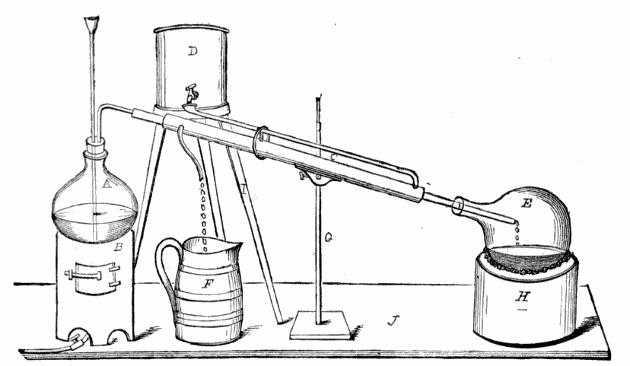
Although a retort is recommended by Liebig for the distillation, and is usually adopted, on the small scale, for the purpose, a flask closed by a cork perforated by two tubes, as exhibited by the engr., will be found more convenient and safe; as the product is then less likely to be contaminated by the ‘spirting’ of the ingredients over the brim of the vessel. The heat of a diffused gas-flame may also be often advantageously substituted for a sand bath.
b. From ACETATE OF POTASH:—
1. Acetate of potash (fused and powdered) is placed in a still, or other suitable vessel, and 50% of the strongest sulphuric acid (‘oil of vitriol’ of fully 1·84 sp. gr.) being added, the mixture is distilled to dryness, as before. The product is 50 to 51% of the weight of the acetate employed, with a sp. gr. of about 1·0735 to 1·074, containing about 66% of anhydrous acetic acid, or nearly 80% of ordinary glacial acid. By rectification from a little dried acetate of lead a perfectly pure acid of almost any strength may be obtained. The ingredients are nearly in equiv. proportions.
c. From ACETATE OF LEAD:—
1. (Ure.) Take of dried acetate of lead, 4 parts; strongest oil of vitriol, 1 part. Distil slowly to dryness. Nearly equal to the last.
2. (Liebig.) Acetate of lead, 3 parts; sulphuric acid, 8 parts; as before.
3. (Dollfuss’ Concentrated Acetic Acid.) Take of dried acetate of lead, 12 oz.; sulphuric acid, 6 oz.; distil 7 ounces.
d. From ACETATE OF LIME:—
1. (Christl.) Raw acetate or pyrolignate of lime (prepared by Völckel’s process), 100 parts, is mixed with hydrochloric acid (20° Baumé, or sp. gr. 1·1515), 120 parts; and after 12 hours, distilled in a copper vessel, with a gradually applied heat. The product is 100 parts or lbs. of acetic acid of 8° Baumé (sp. gr. 1·0556), containing about 47% of hydrated acid, only slightly coloured and empyreumatic, fit for various manufacturing purposes. The advantage of this process is the low price of hydrochloric acid, and the product not being contaminated with sulphuric or sulphurous acid.
Obs. It will be found that pyrolignate of lime generally contains 60% to 70% of neutral acetate; but should it contain either more or less, a proportionate quantity must be employed. When the proper proportions are used the distillate gives only a scarcely perceptible turbid cloud when tested with nitrate of silver. If the hydrochloric acid used has the sp. gr. 1·16, a less quantity being employed, the product will have the sp. gr. of 1·058 to 1·061, and will then contain from 48 to 51% of the monohydrate, or 41 or 42% of anhydrous acetic acid. The resin sometimes found floating on the mixed ingredients should be carefully removed, by skimming, before distillation.
As acid of the above strength is rarely required, and as the distillation is more easily conducted when the ingredients are less concentrated, a little water may be conveniently added either before or towards the end of the distillation. Hence the following proportions have been recommended:—
2. (Völckel.) Acetate of lime (as last), 100 parts; hydrochloric acid (sp. gr. 1·16), 90 to 95 parts; water, 25 parts; mix, and proceed as before. Prod. 96 to 98 parts of an excellent acid, well adapted to trading purposes, having a sp. gr. about 1·050, and containing nearly 40% of hydrated acetic acid. It has been correctly remarked, that the acetic acid produced with hydrochloric acid is always of better quality than that produced with sulphuric acid; being not only less coloured, but also entirely free from sulphurous acid. The distillation uniformly proceeds with ease and regularity, and the whole of the acetic acid passes over between 212° and 248° Fahr.; by which the danger of contamination with other products, resulting from a high degree of heat, is obviated.
3. An Acetic acid sufficiently strong and pure for many ordinary purposes may be obtained without distillation, by pouring strong sulphuric acid, 60 parts, diluted with water, 5 parts, on well-dried acetate of lime, 100 parts; digesting, with occasional agitation in a close vessel, decanting the clear liquid, and straining the remainder.
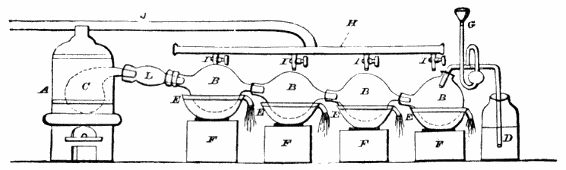
A, Furnace. B B B B, Glass receivers. C, Stoneware retort. D, Bottle containing vinegar. E E E E, Basins containing water. F F F F, Supports for basins. G, Welter safety-tube. H, Supply-pipe of cold water. I I I I, Cocks to supply water to the basins. J, Water main. L, Adapter connecting retort and globes.
II. From the Acetates by dry distillation with a sulphate:—
a. From ACETATE OF LEAD:—
1. Acetate of lead (dried), 5 parts; and sulphate of iron (gently calcined), 2 parts; are separately powdered; and after thorough mixture, carefully distilled, by the heat of a sand bath, into a well-cooled receiver. An economical process for a strong acid, under certain circumstances; but one now seldom adopted.
2. (Bardollier’s Strong Acetous acid.) Dried acetate of lead, 10 oz.; calcined green vitriol, 12 oz.; as the last.
b. From the ACETATES OF COPPER:—By substituting acetate or diacetate of copper, in equiv. proportions, or better with excess of the sulphate. Seldom used.
c. From ACETATE OF POTASH, as the last.
III. From the Acetates per se:—
a. From ACETATE OF COPPER:—Aromatic v.†; Spirit of verdigris†; Spiritus ven′eris†, L.; Esprit de venus, Fr.; Acidum ace′ticum, (Ph. L. 1787.) Process. Carefully dry crystallised verdigris (diacetate of copper) by a very gentle heat, and introduce it into a large stoneware retort (see engr.), the bottom of which has been previously coated with a mixture of clay and horse-dung, to render it more capable of standing the fire. Next place it in a suitable furnace, and connect it, by an adapter, with 3 or 4 double tubulated globes, the last of which must be furnished with a vertical tubulature, to which a double Welter’s safety-tube should be adapted; the other end being immersed in a basin half-filled with distilled vinegar or water, while the funnel portion communicates with the atmosphere. Then place each globe in a basin of water, kept cool by a stream constantly passing through it; and cover the upper portion with cloths kept continually wet with cold water. After 15 or 20 hours, fire may be applied, and must be so regulated that the drops follow each other with considerable rapidity from the end of the adapter, whilst the bubbles of air cause no inconvenience at the other end of the apparatus. If otherwise, the fire must be damped a little. The operation should be continued, and the fire gradually increased, until vapour ceases to come over, known by the globes gradually cooling, notwithstanding the heat of the furnace. The operation being concluded, the whole may be allowed to cool, and the acid collected preparatory to rectification. This may be effected in a similarly arranged apparatus, except that it must be wholly of glass; and the retort should not be much more than half-filled. The operation must now be very carefully conducted, and discontinued before barely the whole of the acid has distilled over; as the last portion is apt to injure the flavour and colour of the rest. The first portions which come over are very weak, and should be kept separate, until the sp. gr. reaches to about 1·372, when the receiver should be changed, and the product collected in separate portions, as noticed below.
Obs. Good diacetate of copper yields, by careful management, at a temperature of 400° to 560° Fahr., fully one half its weight of a greenish-coloured acid, of the sp. gr. of about 1·061, containing above 50% of hydrated acetic acid, or 43% of anhydrous acid. 20 lbs. of the ordinary acetate yields 93⁄4 lbs. of this rough acid, leaving a residuum of about 61⁄2 lbs. of metallic copper mixed with a little charcoal, in the retort; the remainder (nearly 2⁄10ths of the acid in the acetate) being decomposed by the heat, and lost. This 93⁄4 lbs. of crude acid yields by rectification, and dividing the products, 1⁄2 lb. of acid of the sp. gr. 1·023; 3 lbs. of the sp. gr. 1·042; and 6 lbs. of the sp. gr. 1·065; exclusive of a little acetone which comes over with it. In the first distillation, the strongest acid is found in the third receiver, and the weakest in the first. The acid obtained in this way is always accompanied with a little fragrant pyro-acetic spirit; which renders it preferable for aromatic vinegar and perfumery. It dissolves camphor, resins, and essential oils with facility. This is one of the oldest methods of obtaining glacial acetic acid, and the product is still preferred for some purposes. It is the RADICAL VINEGAR of the alchemists, and it is that which is preferred by the perfumers. Well-dried acetate of lead, or of iron, as well as several other acetates, may be substituted for acetate of copper in the above process; but are less economical and convenient. In all cases, great care must be taken to avoid over-firing, as thereby the quantity obtained is lessened, and the quality injured. The residuum of the distillation is pyrophoric and frequently inflames spontaneously, on exposure to the air. Due caution must be therefore observed regarding it.
IV. From Wood, by dry distillation. See Pyroligneous Acid. The preparation of the purified acid, by converting it into an acetate, and subsequent distillation with a strong acid, is noticed above.
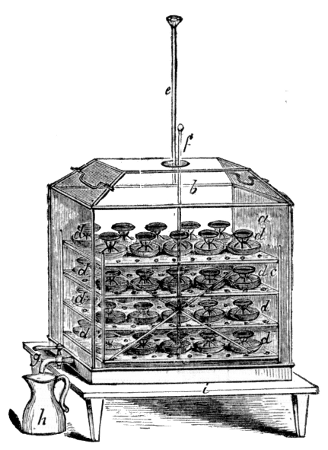
V. From Alcohol. (Alcohol vinegar, German acetic acid.) In a bell-glass, or an oblong glass case, perforated shelves are arranged, a few inches apart, one above another, on which are placed a number of small flat dishes of porcelain, earthenware, or wood. These dishes are filled with spirit of wine or dilute alcohol; and over each is suspended a watch-glass or capsule containing a portion of platinum-black; the whole being arranged so that the platinum-black and the surface of the alcohol are not more than 11⁄2 to 2 inches apart. Strips of porous paper are next so hung in the case, that their bottom edges are immersed in the spirit, to promote evaporation; and lastly, the apparatus, loosely covered, is set in a light place at a temperature of from 70° to 90° Fahr.—the sunshine, when convenient. In a short time the temperature of the platinum rises, and the formation of acetic acid begins; and the condensed vapour trickles down the sides of the glass and collects at the bottom of the case, whence it is removed once or twice a day. (See engr.) The product of a case of twelve cubic feet content, with 7 or 8 oz. of platinum-powder, is capable of producing daily, if well managed, nearly 1·31 lb. of hydrated acetic acid from 1 lb. of absolute alcohol; 25 lbs. of platinum-powder and 300 lbs. of alcohol will, in like manner, furnish a daily supply of nearly 350 lbs. of pure acid, and of other strengths in proportion. Theoretically, the product should be 130 parts of the hydrated acid for every 100 parts of alcohol consumed; but this is never quite obtained in practice, owing to a small portion of the alcohol mixing with the newly formed acid, and escaping decomposition; and from another small portion of both the alcohol, and of the newly formed aldehyd, being carried off by the air that permeates the apparatus. The platinum-powder does not waste, and the most inferior spirit may generally be employed.
Rationale. In this process, the alcohol (as in other cases of acetification) is first converted into aldehyd; and this, as rapidly as formed, absorbs oxygen and passes into hydrated acetic acid. The simultaneous formation of aldehyd during the oxygenation of that already formed, may be detected by its odour.
Obs. During the mutual action of the platinum-black and the vapour of alcohol, the temperature increases, and continues to do so until all the oxygen contained in the air enclosed in the case is consumed, when the acetification stops. On opening the case for a short time, to admit of a fresh supply of air, the operation recommences, thus showing its dependence on the oxygen of the atmosphere. For this transmutation, 100 grains of alcohol require 71 grains (equal to 200 cubic inches) of oxygen, or about 1000 cubic inches of atmospheric air. To render the process continuous and rapid, a fresh supply of air must, therefore, be constantly provided. This may be effected by either having a loosely covered opening at the top of the case, and several much smaller ones near its lower part; or (and preferably) by means of two small glass tubes passing through the lid or cover, one of which terminates just below the point of insertion, whilst the other divides into branches which reach to within a short distance from the bottom, as shown in the engraving. In this way a very slow current of fresh air will always be kept up in the apparatus.
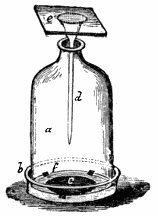
In practice, we find, that by loosely spreading the platinum-black on pieces of platinum-gauze, and supporting these on small tripods or bars of glass or porcelain (or even wood), the watch-glasses and their troublesome suspension may be dispensed with; as also may be the strip of porous paper, provided a temperature of not less than 90° Fahr. be maintained in the case or acetifier, which may easily be done by the application of artificial heat in the absence of sunshine. On the large scale, a case of wood with a glass roof, or even a well-seasoned cask or vat may be employed, in which case the temperature of the apparatus must be kept up either by means of steam-pipes or flues, or by the supply of warm air. On the small scale, a hand bell-glass placed on a dish, with a single watch-glass or piece of platinum-gauze, and a single capsule containing alcohol, may be used, provided the bell-glass be supported on three very small wedges, to admit of a supply of air. A modification of this is sometimes employed, in which the alcohol is supplied, in drops, to the platinum-black, by means of a long, tubular funnel passing through the mouth of the bell-glass, and having its lower extremity drawn to a very fine point, as shown in the engr. To ensure success, the platinum-black should be either fresh-prepared, or recently washed and very gently heated, before placing it in the acetifier. Spongy platinum, though ordered by many chemical compilers, does not answer well for this process.
By the above elegant and economical process, perfectly pure acetic acid of considerable strength may be produced from even impure alcohol; but it is impossible in this way to obtain a concentrated acid without a subsequent operation, because the action of platinum-black on absolute alcohol, or even on strong alcohol, is so violent that the platinum soon begins to glow, and inflammation ensues. Unfortunately the revenue laws of this country, until lately, stood in the way of the adoption of this beautiful process, unless duty-paid alcohol or methylated spirit be employed; but there is no statute that prevents an individual employing pure spirit, of any strength, on the small scale, for private consumption. In Germany, and in the United States of America, vinegar is manufactured on this plan, and from the low price of crude alcohol there, it will no doubt prove ultimately to be the cheapest source of both pure acetic acid and culinary vinegars.
VI. Miscellaneous Formulæ:—
1. An excellent acetic acid, of considerable strength, may be made by soaking fresh-burnt and perfectly dry charcoal in common vinegar, and then subjecting it to distillation. The water comes over first, and on increasing the heat, the acid follows. Vinegar-bottoms and waste vinegar may be used.
2. By exposing vinegar, or dilute acetic acid, to the air in very cold weather, or to freezing mixtures, the water separates in the form of ice, and the strong acetic acid may be obtained by draining it into suitable glass vessels, observing to do so at a temperature sufficiently low to keep the water solid. Said to answer well in cold climates.
3. Acetic acid containing 20% of water may be deprived of a good deal of its superfluous water by standing over dry sulphate of soda. (Liebig.) It may then be used either with or without distillation.
4. Acetic acid, of ordinary strength, may be concentrated to any degree, by rectification once, or oftener, from dry acetate of potash or soda, rejecting the first and last portions. The same acetate may be used repeatedly. The temperature need not exceed 400°, and must not rise above 570° Fahr.
Acetic acid. (B. P.) Syn. Acidum aceticum. Water mixed with 33% of hydrated acetic acid. Prepared by distilling acetate of soda with sulphuric acid. Colourless sour liquid. Sp. gr. 1·044.
Prop. Pure hydrated acetic acid is a thin, colourless liquid above 62 Fahr.; at 50° to 55° it crystallises in large, brilliant, colourless, transparent needles and plates, and even at 60° if a crystal of the acid be dropped in; at 40° it is a solid crystalline mass. Sp. gr.—liquid, 1·063 (Mollerat) to 1·0635 (Mohr);[3]—crystallised, 1·135 at 55° Fahr. (Ure). Odour, intensely pungent when concentrated, but grateful, fragrant, and refreshing, when diffused; taste, intensely sour and acrid, becoming agreeable and refreshing, on sufficient dilution with water; volatile; inflammable, burning with a white flame; vapour of boiling acid highly combustible; dissolves camphor, resins, gum resins, volatile oils, gelatin, gliadin, coagulated albumen, and fibrin (as muscle or the crassamentum of the blood); it coagulates casein, but not liquid albumen (as the serum of the blood and white of egg): miscible with alcohol, ether, and water in all proportions; boils at 248° Fahr.;[4] and is decomposed at a red heat. Its salts are called ACETATES (which see).
Char., Tests, &c.—1. Free acetic acid reddens litmus paper, like the other acids; and may be readily recognised by its odour and volatility:—2. Sesquichloride of iron being added, and the acid then nearly saturated with ammonia, the fluid acquires a deep dark-red colour.
Estim. See Acetimetry. Organic mixtures that cannot be thus tested, or from which the acid cannot be obtained by simple distillation, may be neutralised, if acid, with carbonate of lime, boiled for a few minutes, cooled, filtered, the lime precipitated with dilute sulphuric acid, and the whole submitted to distillation, when the acid contents of the distillate may be estimated as above.
Pur. By heat, it escapes (entirely) in vapour; nothing is precipitated on the addition of either hydrosulphuric acid, nitrate of silver, or chloride of barium. Sometimes it is contaminated with sulphurous acid, which may be recognised by putting a fluid drachm of the acid, mixed with an ounce of distilled water and half a drachm of pure hydrochloric acid, also a few pieces of granulated zinc, into a flask. While effervescence continues suspend a slip of white blotting-paper, moistened with solution of sub-acetate of lead, in the upper part of the flask above the liquid, for about five minutes. The paper should not be discoloured, and thus indicate the absence of sulphurous acid.
Adult. The acetic acid of the shops is chiefly adulterated with water. Sulphurous acid and lead are accidental contaminations; that of the latter often reaches 2%, making the acid poisonous.
Phys. eff., &c. In its concentrated state it is a corrosive and an acrid poison. Taken internally, it acts by dissolving the animal tissues, and by thus destroying the organisation causes death, like the other acids. In the dilute form it acts as a stimulant, rubefacient, alterative, refrigerant, and escharotic.
Uses. Acetic acid is much employed by the chemist and pharmaceutist, in the manufacture of various preparations, and in analysis; by the perfumer, in the composition of several of his most refreshing and agreeable scents; and in medicine, as an antiseptic, stimulant, rubefacient, alterative, refrigerant, and escharotic. Acetic acid (B. P.) applied by means of a piece of rag tied to the end of a small stick, is a nearly certain cure for ring-worm and scaldhead—one or two applications generally effecting a cure, and the severe smarting it causes is only of short duration; as a caustic, it removes warts and corns; a piece of lint or blotting-paper wetted with it and applied to the skin (evaporation being prevented), forms a useful extemporaneous blister. It was once employed as a disinfectant; but is now only used as a fumigation, to disguise the unpleasant smell of the sickroom and crowded assemblies. It is a popular refreshing scent in faintings, asphyxia, and nervous headache; and is a valuable rubefacient, astringent, and local stimulant. It is also used as a rubefacient and caustic in veterinary practice.
In the arts, the commercial acid (pure pyroligneous acid) is used by the engraver to etch his plates; as an antiseptic in pickling and preserving animal and vegetable substances used as food, and anatomical preparations; in dyeing and calico printing, and in the manufacture of medicated vinegars and other pharmaceutical preparations.
In the dilute state, its properties and applications are similar to those of ordinary vinegar, and are noticed under that head.
Poisoning from acetic acid is rare. When concentrated, it is capable, by its corrosive and solvent action, of perforating the coats of the stomach and digestive canal; and it colours the mucus of these organs by the chemical action it exerts upon the blood. Vinegar in an excessive quantity acts in a similar way, but in a slighter degree. The treatment and antidotes are similar to those directed in cases of poisoning by the other acids. See Poisons.
Duty, Excise, &c. See Vinegar.
Gen. commentary. Acetic acid, on the large scale, is principally prepared from acetate of soda, which yields by a comparatively inexpensive, and not a difficult operation, an acid sufficiently strong and pure for commercial purposes, without the necessity of rectification. In this process shallow vessels of wood or of copper formed without rivets or solder (except silver solder) in those parts exposed to the action of the acid, are generally employed for the purpose of the distillation. A coil of drawn copper pipe, heated by steam having a pressure of 30 to 40 lbs. to the inch, traverses the bottom of the apparatus, to impart the necessary heat. The refrigerator consists of well-cooled earthenware, Berlin ware, or glass vessels; and the adopter pipe is also of the same materials. Another common form, which is even still more convenient, is a stout copper still, furnished with a cast-iron jacket to hold high-pressure steam, the usual refrigeratory being employed. In a few instances the space between the still and jacket is filled with sand, oil, tallow, or fusible metal; in which case the apparatus is set in brickwork, and heated by a naked fire. Stills of earthenware are also frequently employed; and even worms and condensers of silver, or silvered copper, are sometimes used, and with advantage. With a leaden worm the product is always contaminated with a little of that metal; the efforts of the manufacturer to the contrary, by the exclusion of air, and by rejecting the first and last portions of the distillate, only lessening and not preventing this evil. A lute (if any) composed of linseed meal and water, with or without a little powdered plaster of paris, may be employed; but flat bands and short tubes of well-seasoned vulcanised india rubber are infinitely more convenient and efficacious. The ingredients being placed in the still, and well but hastily stirred together with a wooden spatula, the head is luted on, and the distillation soon afterwards commenced. The chief care now should be to increase the heat gradually as the distillation proceeds; and when a steam-heat is not used, to carefully avoid over-firing, particularly towards the close of the operation. A little acetic ether is added by some manufacturers. In this way 4 lbs. of acid of the sp. gr. 1·050, is obtained for every 3 lbs. of acetate of soda employed. Should rectification be had recourse to, the addition of about 2 or 3% of bichromate of potash, peroxide of manganese, or red oxide of lead, will remove empyreuma, if present. The first of these substances is the most effective; the power of the others being in the order in which they are printed. In distilling the weaker acids and vinegars, it is found useful to add from 25 to 30% of chloride of sodium, which, by raising the boiling-point of the liquid, allows the acid the more freely to pass over (Stein); but this addition proves disadvantageous when any sulphuric acid is present, in which case sulphate of soda may be employed instead. If this addition be not made, the whole of the acid cannot be obtained without distillation to dryness, and the generation of empyreuma.
On the small scale, glass retorts are usually directed to be used, but glass alembics or flasks are more convenient and safe, as already noticed. In the preparation of the pure acid, care should be taken that the acetate of soda does not contain common salt, as the carbonate of soda prepared by calcination, and frequently used to form the acetate, is generally contaminated with it, and yields up its hydrochloric acid or chlorine during the process of distillation, thus vitiating the product. In all the methods given the product becomes more concentrated in proportion to the dryness of the acetate and the strength of the oil of vitriol or muriatic acid employed. By using the one dry, and the other concentrated, glacial acid may always be obtained by collecting separately the last two fifths that come over, and submitting this to refrigeration.
According to Melsens, pure GLACIAL ACETIC ACID is most advantageously obtained by distilling pure and dry acetate of potash with an excess of strong and moderately pure acetic acid, rejecting that which first passes over.
Acetate of soda may be safely dried at a temperature of 400° to 450°, provided care be taken to avoid ignition from contact with sparks. A less heat is, however, quite sufficient to drive off the whole of its water of crystallisation. It is known to be dry by its assuming the appearance of a smooth oily liquid whilst hot. If, whilst heated, it emits fumes, it is suffering decomposition. The same applies to the other commercial acetates. Crystallised acetate of soda loses about 2⁄5ths of its weight by thorough drying.
When acetate of soda and sulphuric acid are the ingredients employed in the production of acetic acid, sulphate of soda is formed, which, in the large way, the chemist returns to the manufacturer of acetate of soda (i. e. to the pyroligneous acid maker), who employs it in the decomposition of fresh acetate or pyrolignite of lime. In this way the same soda-salt is employed over and over again, acting merely as the vehicle for the separation of the crude acetic acid in the solid form, and its easy and cheap transportation from one point to another. This ingenious method of mutual assistance resulting from the application of chemical science to provide for the wants of everyday life, offers some explanation of the extraordinarily low price at which acetic acid may now be purchased.
The acetic acid of commerce (pure pyroligneous acid) is almost wholly obtained from the acetates of soda and lime. The principal supply of crude acetate (pyrolignite) of soda is from America, Norway, and Sweden; but much is also obtained from our home manufactories. See Acetification, Acetimetry, Fermentation, Pyroligneous Acid, Sodium, (Acetate of), Vinegar, &c.
More recently, acetic acid has been obtained by decomposing with hydrochloric acid the double salt of chloride of calcium and acetate of lime, mentioned by Fritzsche (‘Ann. de Poggend,’ xxviii, 123). For this purpose, solutions of acetate of lime and chloride of calcium are mixed and evaporated, the combined salts readily crystallising in large needles. These are freed from the mother-liquor and distilled with common muriatic acid.
The acid furnished by this method requires redistillation, and is, moreover, contaminated with some of the fatty products always present in the crude pyrolignite.
Anhydrous Acetic Acid.
Syn.
Acetic Anhydride.
Acetic acid deprived of the elements of water.
Acetic Acid.Water.Acetic Anhydride.
2C2H4O2- H2O= C4H6O3.
Aromat′ic Acetic Acid. Syn. Aromatic vinegar; A. spirit of v.; Acidum Ace′ticum aromat′icum, L.—Prep. 1. (Ph. E. 1839.) Dried rosemary and origanum, of each 1 oz.; lavender flowers, 1⁄2 oz.; bruised cloves, 1⁄2 dr.; acetic acid (sp. gr. 1·068), 11⁄2 pint; macerate for 7 days, express, and filter. A fragrant and refreshing perfume. Omitted in Ph. E. 1841 and P. B. 1867.
2. (Ph. E. 1817.) As the last, but using distilled vinegar instead of the strong acid of the Pharmacopœia. Inferior.
3. (P. Cod. 1839) Camphor, 2 oz.; oil of lavender, 10 gr.; oil of cinnamon, 20 gr.; oil of cloves, 30 gr.; concentrated acetic acid, 1 pint. Very fragrant and refreshing.
4. (Ph. Bor. 1847; Cod. Med. Hamb. 1845.) Oil of cloves, 1 dr.; oils of lavender and citron, of each 2 scrup.; oils of bergamot and thyme, of each 1 scrup.; oil of cinnamon, 10 drops; strongest acetic acid, 1 oz.; mix. Limpid; yellow-brown; highly fragrant and refreshing. See Acetic Acid (Camphorated), and Vinegar (Aromatic).
Beaufoy’s Acetic Acid. A superior commercial acetic acid (i. e. purified pyroligneous acid), having a sp. gr. of about 1·044; or containing about 28% of real acetic acid, or 32 to 33% of the hydrated acid. Same strength, &c., as Acetic Acid P. B.
Cam′phorated Acetic Acid. Syn. Camphorated vinegar; Acidum ace′ticum camphora′tum, L.—Prep. 1. (Ph. E. 1841.) Camphor, 1⁄2 oz.; pulverise it by means of a few drops of spirit of wine, and then dissolve it in acetic acid (Ph. E.), 61⁄2 fl. oz.
2. (Ph. D. 1850.) Camphor, 1 oz.; rectified spirit, 1 fl. dr.; pulverise, and dissolve in strong acetic acid (acid. acet. fort. Ph. D.), 10 fl. oz.
Obs. This preparation is intended as a substitute for the aromatic acetic acid of the shops and previous pharmacopœias. It is also useful as an embrocation, in rheumatism and neuralgia; as an extemporaneous vesicant and counter-irritant; and as a fumigation in fevers, &c.
Dilute′ Acetic Acid. Syn. Acidum aceticum dilu′tum, L. Acetic acid, 1 pint; distilled water, 7 pints; mix, Sp. gr. 1·006. One fluid ounce corresponds to 16 grains of anhydrous acid (3·63 per cent.).
Glacial Acetic Acid. Syn. Acidum aceticum glaciale. Acetate of soda, 20 oz., is liquefied by a gentle heat, stirred till it becomes pulverulent, and then further heated until it fuses; it is at once removed from the fire, and, when cool, the mass is broken up, placed in a 3-pint stoppered retort connected with a Liebig’s condenser, and then treated with sulphuric acid, 8 fl. oz. When the distillation slackens heat is to be applied, and the process continued until 6 fl. oz. of acetic acid have passed over. If a little of the product strikes a blue colour when mixed with a solution of iodate of potassium containing mucilage of starch, the whole product must be agitated with perfectly dry black oxide of manganese, 1⁄4 oz., and redistilled. Sp. gr. 1·065; contains 85% of anhydrous acid.
ACETIC ANHYDRIDE. See Anhydrous Acetic Acid.
ACETICA. [L.] Medicated vinegars.
ACETIDUX, Dr DELFER’S. Made by Döllinger, of Berlin. For the radical and painless removal of warts, corns, hard skin, &c. A solution of 5 grms. of chromic acid in 15 grms. of water. (Schädler.)
ACETIFICATION. Syn. Acetifacio, L.; Acetification, Fr.; Essigmachen, Einsaüern, Ger. In chemistry, the act or process of converting into vinegar; also the state of undergoing such conversion.
Acetic acid is produced either by the partial dehydrogenation and subsequent oxidation of bodies containing its elements, or by their destructive distillation. The first is effected—by their exposure, in a finely divided state, to the action of air or atmospheric oxygen, as in the quick process of making vinegar; or—by submitting them, in combination with ferments, to contact with a free supply of atmospheric air, as in the old field process of making vinegar; or—by exposure to the direct action of chemical or mechanical oxidizing agents, as condensed air (platinum-black process), chromic and nitric acid, &c. In general, it is alcohol more or less dilute, particularly as it exists in fermented liquors, which is thus converted into acetic acid. In the second process (destructive distillation), wood is the substance usually employed, and heat is the agent which develops the acid.
The conversion of alcohol into acetic acid is not immediate and direct. The atmospheric oxygen first oxidises two atoms of its hydrogen, aldehyd and water being formed; and this aldehyd uniting with one atom of oxygen produces one molecule of ACETIC ACID. The changes are represented in the following equations:—
Alcohol.Oxygen.Aldehyd.Water.
1.C2H6O+ O= C2H4O+ H2O
Aldehyd.Oxygen.Acetic Acid.
2.C2H4O+ O= HC2H3O2
After the first formation of aldehyd, the two processes, unless artificially checked, go on simultaneously, as long as any undecomposed alcohol is present.
The conversion of alcohol into acetic acid, although greatly accelerated by the presence of nitrogenised organic matter (according to Mulder, of a fungus—the Mycoderma Vini or Vinegar Plant), is rather a case of eremacausis (slow combustion) than of fermentation. Acetification effects combination, as shown by the foregoing equations, whereas fermentation resolves complex bodies into simpler ones, e.g. sugar into alcohol and carbonic anhydride. Moreover, the presence of ferments is not essential to the change, since pure alcohol becomes acetified when exposed to the oxidising agents already named.
Another remarkable distinction between acetification and fermentation is, that the former requires the continued presence of atmospheric oxygen; whilst the vinous fermentation after being once established, proceeds perfectly without it.
During the oxidation of the alcohol of vegetable solutions, some of the other organic matters present also suffer change. A white gelatinous mass (mother of vinegar)[5] is commonly deposited; but this is a secondary result of the process, and not, as formerly supposed, one essential to it. In ordinary cases acetification occurs only at or near the surface of the liquid; which accounts for the length of time required for the operation under the old process of ‘fielding,’ and the shorter time in which it is accomplished by the improved process of Mr Ham. It proceeds favorably at temperatures ranging from 60° to 90° Fahr.; and most rapidly at 95° Fahr. (Liebig). In the ‘quick process’ of making vinegar a temperature of 90° to 92° is generally aimed at; but it often rises to 100°, or even to 105°, Fahr. As the temperature falls acetification proceeds more slowly, and at 46 to 50° Fahr. it ceases altogether (Liebig).
Aldehyd (see above) is an exceedingly volatile substance, and easily dissipated by a slight heat. It is, therefore, of the highest importance to duly regulate the temperature, as well as the supply of air, during acetification. In the ‘quick process’ of making vinegar the loss from this cause is always considerable, and often very great. This loss may be diminished by passing the heated air, as it escapes from the acetifier, through a porcelain or silvered copper worm or refrigerator, set in a chamber containing water of a temperature not higher than 40° to 45° Fahr.; the connection being made at the lower end of the worm, whilst the upper end is open to the air. On the small scale, as in the platinum-black process, the loss may be almost entirely prevented by causing the upper air tube to pass through a vessel containing ice or a freezing mixture; or by uniting it with the lower end of a Liebig’s condenser.