A CYCLOPÆDIA OF PRACTICAL RECEIPTS, PROCESSES, AND COLLATERAL INFORMATION (continued 39)
Reading edition
FEEDING BOTTLES. We extract from ‘The Sanitary Record’ the following valuable paper on ‘Feeding Bottles,’ by Dr Eustace Smith, assistant-physician to the City of London Hospital for Diseases of the Chest, and Physician to the East London Hospital for Children:—“In the artificial rearing of infants it is of importance that food should be given to them from a feeding-bottle. By this means the natural method of taking nourishment is imitated; the muscles of the mouth and cheeks are brought into play; and the secretion of saliva—a secretion which, very scanty at birth, becomes gradually more copious and takes so active a part in digestion—is encouraged and increased.
“Almost all babies will take their food more readily by this method, their instinct teaching them to suck everything that is put into their mouths. Even in cases where a deficiency in the hard palate presents so great an obstacle to sucking, on account of the impossibility of creating the necessary vacuum in the mouth, the difficulty can be overcome by a simple mechanical contrivance. Therefore, in every case of hand-feeding, a suitable bottle is the first thing to be desired.
“To be satisfactory a feeding-bottle must fulfil three indispensable conditions: it must be simple in construction and easily manageable; it must be capable of being readily cleaned; and in its use the milk must flow easily and without great effort on the part of the infant. The ordinary feeder in use at the present time consists of a flattened glass flask, closed at the mouth by a cap, which fits over the neck. A caoutchouc tube passes through the cap, and is connected inside the bottle with a straight glass pipe. The other end of the elastic tube is attached to the teat, or mouth-piece, by means of a short hollow cylinder called the ‘union-joint.’ The teat is firmly fixed to this by means of the shield. In the construction of the cap and union-joint, metal, earthenware, or wood, is employed. The metal used by the best makers is tin, and this, if cleanliness be properly attended to, is not objectionable. In cheaper bottles, sold in the shops for sixpence, the mouth is closed by a perforated cork, through which the flexible tube passes. Here there is no cap, but in all essential points the construction is the same as in the more expensive articles.
“In this apparatus it is important that the channel through the tubes should be perfectly free. The point at which the channel is narrowest is the union-joint, which connects the mouth-piece with the flexible tube. In a badly made bottle an impediment may exist at this point from carelessness in the manufacture, and may present a great obstacle to the ready passage of the fluid. Care also should be taken that the flexible tube passes completely through the cap, before it becomes connected with the glass pipe. This is very important. In the early feeding-bottles constructed upon this model by O′Connel, the glass pipe passed from within the bottle through the cap, and was attached outside this to the caoutchouc tube. It was thus held rigidly in the centre of the bottle, and as a natural consequence, when the apparatus was in use, unless the bottle was held upright during the whole meal, long before its contents were exhausted the milk ceased to flow, as the end of the pipe soon came to be above the surface of the fluid, which necessarily gravitated to the lowest part as the bottle lay on its side.
“When, however, the connection between the two tubes is made within instead of outside the bottle, this disadvantage no longer exists, for the glass tube being free to move, its end is able to sink to whichever side of the bottle is undermost, and therefore always remains below the level of the fluid. The best bottles have a small cylindrical stop, i.e. a thick ring of metal or wood placed within the flexible tube, just above its junction with the glass pipe. The object of this is to prevent the latter being drawn through the cap, and thus held rigidly in the centre of the bottle.
“The method of connection of the cap with the neck of the bottle is not unimportant. It should not be too tight or air will be prevented from entering the bottle to supply the place of the milk which is withdrawn. A common plan is to line the interior of the cap with cork, but this substance, besides its risk of being broken and detached by careless handling, has the further disadvantage of absorbing milk, which turns sour and may afterwards set up fermentation in fresh milk put into the bottle for a subsequent meal. In the best bottles the cap is constructed to screw on to the neck, as in the ‘Alexandra’ Feeding bottle made by the Messrs Maw; or is united to it by an application of the ‘bayonet catch,’ as in the ‘Improved’ feeding-bottle made by Messrs Lynch and Son. In this very admirable apparatus three grooves in the inside of the cap pass over corresponding projections on the neck of the bottle; the cap is then turned to the right, with a slight screwing motion, and becomes securely fastened.
“With badly made bottles infants often have very great difficulty in drawing up the milk, and can only do so by violent efforts, which soon exhaust their strength or their patience. There are two reasons why milk in these cases may not flow easily—either the cap fits too tightly, so that air cannot enter with sufficient facility in proportion as the liquid contents become diminished, as has just been mentioned; or the caoutchouc forming the flexible tube is too thin, so that it collapses when suction is applied. In the first case a small hole should be made through the cap, so as to allow a free admission of air, or if the bottle be a simpler one, closed at the mouth by a perforated cork, this may be slightly eased at the neck of the bottle, so as to fit less closely. In the second case, stouter caoutchouc should be used in the construction of the tube. In weakly infants, or those much reduced in strength by acute disease, special attention should be paid to these points, as such children will often refuse to take the bottle, if they find any difficulty in drawing up the milk.
“Infants born with a cleft palate cannot suck from an ordinary bottle, as the deficiency in the hard palate prevents the necessary vacuum being formed in the mouth. Such children are, therefore, usually brought up with a spoon, and often waste and die through insufficient nourishment. An ingenious contrivance first suggested by Mr Oakley Coles will, however, entirely remove the difficulty, and enable them to suck with as much ease as if they suffered from no such congenital difficulty. The plan is a very simple one, and consists in attaching to the nipple of any ordinary feeding-bottle a flap of sheet elastic, cut to fit the roof of the mouth. This flap must be of the shape and about the size of the bowl of a teaspoon, and is to be sewn to the upper part of the stalk of the teat, where this projects from the shield. In the mouth of the child the flap forms an artificial palate, which if the sheet elastic chosen be sufficiently stout, offers firm resistance to the tongue pressing against in sucking, and prevents fluid from passing into the nose in the act of swallowing.
“The closest attention must be paid to the cleaning of feeding-bottles. Each time after being used the whole apparatus should be well washed out with water containing a little soda in solution.
“The inside of the cap must be carefully cleaned, and the brush should be carried several times through the whole length of the tubing. Afterwards the bottle and tubes should be laid in cold water until again wanted. An objection to the common brush usually supplied with each feeder is, that after a few days’ use the softened bristles are apt to get detached and be caught in the joints of the tubing, whence they may afterwards be washed by the stream of fluid and be swallowed by the child. Accordingly, a new cleaner has been manufactured by Messrs Maw and Sons, in which bristles are entirely dispensed with. They are replaced by a thin strip of caoutchouc, which is wound round in a spiral form, at the end of the ordinary wire handle. This instrument answers all the purposes of a brush, without the disadvantages alluded to, and is besides far more durable.
“Excellent feeding-bottles are now made by many different manufacturers, and are sold at prices which place them within the reach of the poorest. These cannot all be mentioned, but some of the bottles more commonly met with, may be shortly referred to. The six-penny feeder made by Messrs Maw, Son, and Thompson, can be recommended for its simplicity of construction, and at the same time for its perfect efficiency. In this instrument there is no cap, instead the mouth of the bottle is closed by a cork, which is perforated for the passage of the flexible tube. In all other respects the construction of this apparatus is the same as in the more expensive instruments. The ‘Alexandra’ feeding-bottle, price half-a-crown, by the same makers, is an admirable bottle. The cap screws on to the neck, and is furnished with a small hole for the admission of air. A ‘stop’ in the lower part of the flexible tube prevents the glass pipe being drawn into the cap, and the instrument is supplied with all the latest improvements. The bottles made by Messrs Maw are all furnished with the new patent cleaner just described. The improved feeding-bottle made by Messrs Lynch and Son, at one shilling and eighteen pence, has been before referred to. The material used for the cap is boxwood. It is a capital bottle, and will give the fullest satisfaction to the purchaser. Mr Lang’s ‘Alma Mater’ feeding-bottle can also be recommended. In this instrument the cap is made of earthenware and is lined with cork. A good bottle is made by Mr Elam, of Oxford Street, price two shillings; the cap is formed of britannia metal, and screws on to the neck. A cheaper bottle, but one which for elegance of design and accuracy of detail cannot be surpassed, is Mr Mather’s ‘Princess’ feeding-bottle. A tin cup screws on the neck, and is pierced by a small hole for the admission of air. The opening is fitted with a ‘cone valve’ of simple and ingenious construction, which allows air to enter freely when suction is applied to the tube, but closes firmly against any escape through the air-hole of the fluid contents of the bottle. The bottle itself has a double curve towards the neck to provide against too sudden bending of the flexible tube against the tap. This is apt to happen when the curve is single, if the bottle lie with the convexity downwards, and partial obstruction of the tube may be the result. The ‘Princess’ feeding-bottle is sold in the shops for eighteen pence.
“All bottles bear their name in raised letters upon the glass, but a report which has obtained currency that these letters are hollow in the interior, and difficult to cleanse is without any foundation in fact. Any one may test this for himself by placing a finger within the bottle underneath the letters, when the internal surface will be found perfectly plain and uniform. In all cases where cork enters into the construction of a feeding-bottle, especial care should be taken in cleansing the apparatus, and the cork should be well soaked in soda and water in order that any sour milk it may contain may be neutralised at once.”
FEET (The). To preserve the feet in a proper condition, they should be frequently soaked, and well washed in warm or tepid water. The nails of the toes should be pared, to prevent their becoming inconveniently long, and from growing into the flesh, soaked, and well washed in warm or tepid water. Many persons suffer severely from TENDER FEET. This generally arises from the use of thin cotton or silk stockings, and boots or shoes that are either too tight or stiff, or not sufficiently porous to permit of the escape of the perspiration. Waterproof boots and shoes which are also air-tight (as those of gutta percha and India rubber), are common causes of tender feet, and even of headaches, dyspepsia, and apoplexy. The best treatment of tender feet is the immediate adoption of worsted stockings or socks, and light, easy shoes of buckskin, goatskin, or some other equally soft kind of leather. It is highly necessary for the preservation of health to preserve the feet DRY; persons who are, therefore, exposed to the wet, or who are frequently passengers through the public streets in bad weather, should regard sound and good boots and shoes as of the first importance. In fact, in a hygienic point of view, a wet back should be less shunned than wet feet. Many persons frequently experience EXTREME COLDNESS and NUMBNESS OF THE FEET. The best and most natural remedy for this is active exercise or friction, the former being always adopted when possible. In such cases the use of warm woollen stockings is absolutely necessary, and the debilitated and aged may advantageously keep them on throughout the night, or at all events until the feet acquire a comfortable degree of warmth. The DISAGREEABLE ODOUR which is evolved by the feet of some individuals in hot weather may be removed by the observance of extreme cleanliness, and by occasionally soaking the feet in warm water, to which a small quantity of chloride of lime or sal ammoniac has been added. A good deodoriser for unpleasant smelling feet is said to be the following, invented by M Paulcke:—A mixture of equal parts of salicylic acid, soap, talc, and starch, to be applied in the form of powder.
Distortion of the feet is not uncommon in childhood, being sometimes congenital, but as frequently the result of weakness or bad nursing. “A child with its feet turned inwards is called VARUS; when they are turned outwards it is styled VALGUS. The proper use of bandages, early applied, will generally correct these deformities; but if they be neglected in infancy they become incurable.” (‘Med. Lex.’) Clubfoot, of which there are several varieties, may also be frequently relieved by a simple surgical operation. See Boots and Shoes, Distortions.
FELT′ING. This is a process by which various species of fur, hair, and wool, are blended into a compact texture, in many respects resembling cloth. It depends on the peculiar anatomical construction of these substances, enabling them to interlace and intertwine with each other, by which they become permanently matted together. Felt was formerly chiefly employed for hats. It is now commonly used for mill-bands, filters, &c.; and when varnished or japanned, or saturated with asphalte or bitumen, is a durable substitute for japanned leather, and for roofing.
FENNEL. Syn. Fœniculum (Ph. L.), L. The fruit (seed) of Fœniculum dulce, or sweet fennel; the oil distilled from the fruit (OIL OF FENNEL; OLEUM FŒNICULI, L.) as well as a distilled water (FENNEL WATER; AQUA FŒNICULI, L.), are officinal in the Pharmacopœias. They are stimulant and carminative; but are now seldom employed.
FEN′UGREEK. The seeds of Trigonella Fœnum Græcum. Resolvent and stomachic. The seeds dye yellow; formerly roasted for coffee; now chiefly employed in veterinary medicine.
FER′MENT. Syn. Fermentum, L. A substance which induces fermentation. According to one view ferments are compounds whose decomposition proceeds simultaneously with that of the body undergoing metamorphosis. They all contain albuminous or azotised principles, which in a moist state putrefy and suffer decomposition. According to Pasteur, however, fermentation is excited by living organisms—fungi and infusoria. See Fermentation and Yeast.
FERMENTA′TION. Syn. Fermentatio, L. In chemistry, a peculiar metamorphosis of a complex organic substance, by a transposition of its elements under the agency of an external disturbing force. Fermentation, according to the theory proposed by Liebig, is a metamorphosis, by which the elements of a complex molecule group themselves so as to form more intimate and stable compounds. It is excited by the contact of all bodies the elements of which are in a state of active decomposition or fermentation. “In nitrogenised substances of a very complex constitution, putrefaction or fermentation is spontaneously established when water is present, and the temperature sufficiently high, and it continues till the original compounds are wholly destroyed. Substances destitute of nitrogen, on the contrary, require, in order to their undergoing this metamorphosis, the presence of a nitrogenised substance, already in a state of putrefaction (fermentation).” (Liebig.) The substances which promote this change are termed FERMENTS, and among these the principal are gliadin, gluten, vegetable albumen, and all nitrogenous substances in a state of spontaneous decomposition or fermentation. “It is imagined that when these substances, in the act of undergoing change, are brought into contact with neutral ternary compounds of small stability, as sugar, the molecular disturbance of the body, already in a state of decomposition, may be, as it were, propagated to the other, and bring about the destruction of the equilibrium of forces to which it owes its being. The complex body, under these circumstances, breaks up into simpler products, which possess greater permanence.” (Fownes.) Yeast, the ferment most commonly employed for inducing the vinous fermentation, is such a substance in an active state of putrefaction, and whose atoms are in continual motion. Putrefying animal substances are equally capable of exciting the same action. “If we add to a solution of pure sugar an albuminous substance, a caseous or fleshy matter, the development of yeast becomes manifest, and an additional quantity of it is found at the end of the operation. Thus, with nourishment, ferment engenders ferment. It is for this reason that a little fermenting must, added to a body of fresh grape juice, excite fermentation in the whole mass. These effects are not confined to alcoholic (vinous) fermentation. The smallest portion of sour milk, of sour dough, or sour juice of beet-root, of putrefied flesh and blood, occasions like alterations in fresh milk, dough, juice of beet-root, flesh, and blood. But further, and which is a very curious circumstance, if we put into a liquid containing any fermenting substance another in a sound state, the latter would suffer decomposition under the influence of the former. If we place urea in the presence of beer-yeast, it experiences no change; while if we add it to sugar-water in a fermenting state, the urea is converted into carbonate of ammonia. “We thus possess two modes of decomposition; the one direct, the other indirect.” (Ure.)
A very remarkable circumstance connected with fermentation is that it is always accompanied by the development of microscopic living organism—fungi and infusoria. “So constantly, indeed, is this the case, that many chemists and physiologists regard these organisms as the existing cause of fermentation and putrefaction; and this view appears to be corroborated by the fact that each particular kind of fermentation takes place most readily in contact with certain living organisms.” (Fownes.) Thus the vinous or alcohol-producing fermentation is accompanied, or caused, by two fungi, called Torula cerevisiæ and Penicillium glaucum; the acetous or vinegar-producing fermentation by Torula aceti; the lactous fermentation (souring of milk) by Penicillium glaucum.
The butyric fermentation by an animal—an infusorium, which cannot exist in free oxygen, but flourishes in an atmosphere of hydrogen, &c.
Of late years these latter views as to the cause of fermentation have been accepted by most of the scientific world, notwithstanding the opposition they experienced from so powerful an antagonist as Liebig.
From the researches of Pasteur, the distinguished author of the modern theory of fermentation, as opposed to the chemico-physical theory of Liebig, it appears that when yeast is placed in a solution of sugar and water, or in a solution of sugar and water containing albuminous substances, under proper conditions as to temperature, the fermentation that ensues is due to the process of growth taking place in the yeast plant; the new cells of which, in assimilating part of the sugar and converting it into cellulose and fat, cause, at the same time, the breaking up of the sugar molecule, and resolve it into the more stable combinations of alcohol and carbonic acid.
In order that the ferment or fungus should grow it is essential that, in addition to the cellulose and fat, it should be supplied with ammoniacal salts and soluble phosphates. These are generally present in the liquid about to be fermented; but when yeast is added to pure sugar and water “it lives at the expense of the sugar, and of the nitrogenous and mineral substances contained within itself.”[297]
Speaking of the influence of oxygen on the development of yeast on alcoholic fermentation, Pasteur states that ready-formed yeast can germinate and grow in a liquid containing sugar and albuminous matters, even when oxygen is completely excluded. The quantity of yeast formed, however, in this case, is but small, and the fermentation goes on slowly; nevertheless, a large quantity of sugar disappears (sixty to eighty parts to one part of yeast). If the air has access to a large surface the fermentation goes on quickly, and a much larger quantity of yeast is formed in proportion to the quantity of sugar which disappears.
In this case, also, oxygen is absorbed by the yeast, which grows quickly, but does not act so decidedly as a ferment, inasmuch as only four to ten parts of sugar disappear for one part of yeast produced.
When the air is excluded the same yeast again acts as a powerful ferment. Pasteur, therefore, infers that yeast which acts as a ferment in the absence of air abstracts oxygen from the sugar, and that upon this deoxidising power its action as a ferment depends. The violent activity of the yeast at the commencement of the fermentation is due to oxygen dissolved in the liquid. In liquids containing albumen (yeast and water, &c.) yeast likewise grows, though sparingly, even if the solution does not contain a trace of sugar, provided there is a sufficient access of air. But if the air is excluded this does not take place, even though the liquid may contain, besides albumen, a non-fermentable sugar, such as milk sugar. The yeast formed in a liquid not containing sugar possesses all the properties of a ferment, and excites fermentation in a solution of sugar excluded from the air.[298]
Similarly, Pasteur regards putrefaction as a kind of fermentation, set up and maintained by an animal organism, or ferment belonging to the genus Vibrio. Putrefaction, when taking place in contact with the air, is always accompanied by decay or EREMACAUSIS. The abandonment of the old theory as to the nature of eremacausis, viz. that it consisted in the gradual combustion of decaying organic matters by atmospheric oxygen, has been necessitated by the experiments of Pasteur, Schröder, and others, which have conclusively established the facts that organic substances are not oxidised by perfectly pure air, and that their decomposition and subsequent destruction are due to the presence in the air of the sporules or seeds of certain low organisms. Pasteur cites numerous instances corroborative of the statement that perfectly pure oxygen fails to affect, save to a very limited extent, organic substances.
In one case an aqueous infusion of yeast mixed with sugar was enclosed in a sealed flask with double its volume of air, which had been previously depurated by being made to pass through a red-hot tube. At the end of three years the liquid (which had during part of the time been kept at a temperature of from 25° to 30° Cent.) was found to be perfectly fresh and transparent, and the air when examined gave 18·1 vols. of oxygen, 80·5 vols. of nitrogen, and 1·4 of carbonic acid. Under the same conditions urine and milk, whether fresh or previously boiled, showed minute traces only of oxidation; crystals of uric acid and phosphates formed in the urine, but the milk was unaltered, having preserved its alkaline reaction, and showed no disposition to curdle.
Very different, however, was the result when either of the above substances was enclosed with ordinary air. It was then found that in a few days the whole of the oxygen was absorbed, carbonic acid being at the same time simultaneously formed. A certain quantity of moistened oak sawdust kept in contact with ordinary air for a fortnight was found at the end of that time to have absorbed 140 cubic centimètres of oxygen; whilst the same amount of sawdust enclosed with an equal volume of purified air had removed only a few cubic centimètres of the gas in a month. In the former experiment a microscopic film of mycelia and spores of Mucidineæ formed on the sawdust.
From numerous experiments of a like nature with the above, and attended with analogous results, chemists and physiologists now generally regard eremacausis as effected by agencies similar in character to those which produce fermentation and putrefaction.
“The observations of Schröder upon the processes of fermentation and putrefaction are remarkable. He has shown that any organic liquid may be prevented from fermenting or putrefying if it be heated under pressure to about 266° F. (130° C.), then transferred to a flask and boiled, the mouth of the flask being plugged whilst boiling with a pellet of cotton wool, which is left in the neck of the flask. In this way he preserved, during a hot summer, various liquids, including freshly-boiled wort, blood, white of egg, whey, urine, broth, and milk; but when afterwards the plug of cotton wool was withdrawn these liquids in a few days began to undergo decomposition. He explains these results by supposing that the spores of some organism must find access to the substance in order to set up the process of decomposition. By a temperature of 260° F. (126·7° C.) any such spores which the substance itself might contain are destroyed, and as the air is filtered through the cotton wool before it reaches the interior of the flask, none of these organic germs can afterwards gain access to the body under experiment. I have repeated some of these experiments with complete success.[299]
“If air be transmitted with suitable precautions slowly through narrow ignited platinum tubes, so as to destroy all suspended organic particles, no fermentation or putrefaction will take place on admitting such air into contact with putrescible substances previously heated to 260° for an hour.”[300]
Pasteur has shown the existence of these floating germs in the air by drawing a large volume of atmospheric air, by means of an aspirator, through a narrow tube obstructed by collodion wool. On subsequently dissolving this wool in a mixture of alcohol and ether various microscopic sporules were left undissolved.
The entire absence of the exciting causes—warmth, air, and moisture—leaves even those substances which under ordinary circumstances are most liable to change, in a state in which they may remain for an almost indefinite period without perceptible alteration. Thus, animal substances in a frozen or dry state do not undergo decomposition, nor does a solution of sugar or the juice of grapes (must) when perfectly excluded from the air; but on the mere exposure of these substances to warmth, moisture, or atmospheric air, putrefaction or fermentation immediately commences. Remove the cork from the bottle of ‘capillaire’ on the parlour sideboard, or pierce the skin of one of the grapes on the dessert table with a needle, and these bodies, which would have otherwise suffered no change for weeks, or even months, will soon exhibit symptoms of spontaneous decomposition. The knowledge of this fact has been practically applied to the preservation of animal and vegetable substances for food. Even the most putrescible of these may be preserved for an unlimited period by enclosure in metallic cases, or glass bottles, from which the air has been completely removed and excluded.
The important duties which fermentation or putrefaction performs in the economy of our globe, and in several of the arts of life and civilisation, have long rendered the development of its principles an object of the highest interest and importance, both in a scientific and practical point of view. In its most extended sense, this subtile process of nature, though occasionally productive of injurious effects, may be regarded as one of the most necessary and beneficial with which we are acquainted. Like the labours of a scavenger, it speedily removes from the surface of our globe those matters which would otherwise remain for some time without undergoing decomposition. It either dissipates in air, or reduces to more fixed and useful forms of matter, those organic substances which, by their presence, would prove noxious, or, at all events, useless to the animal and vegetable kingdoms. It is the giant power that cleans the Augean stable of nature, at the same time that it provides some of the most esteemed articles of utility and luxury for the well-being and enjoyment of man.
Chemists have distinguished fermentation into different varieties, which, in general, are named after the more important products of its action. Of late years, the number of these varieties has been greatly increased by the extension of the term to several operations besides those formerly included under it. See Acetification, Bread, Putrefaction, Brewing, &c.
FERN (Male). Syn. Male shield fern, Filix mas, Radix filicis, L. The root (rhizome) of the Lastræa Filix-mas, or male fern. It is bitter, astringent, or vermifuge.—Dose, 1 to 3 dr. in powder, or made into a decoction, repeated for 3 or 4 days, and followed by a purge. It is chiefly given in tapeworm. In Switzerland it is deemed almost infallible, but has proved less successful in these countries. See Oils.
FERRICY′ANIDE. Syn. Ferridcyanide, Ferridcyanuret. A compound of ferricyanogen with a metal or other basic radical. The FERRICYANIDE OF POTASSIUM, or ‘RED PRUSSIATE OF POTASH,’ as it is often improperly called, is a well-known example. The ferricyanides of AMMONIUM and the ALKALIES and ALKALINE EARTHS are soluble; those of most of the METALS, insoluble. See below.
FERRICYAN′OGEN. Syn. Ferridcyanogen, Ferric-cyanogen. The peculiar salt-radical which exists in the so-called red prussiate of potash. It is isomeric with ferrocyanogen, from which it differs in capacity of saturation (being tribasic), and in the behaviour of its compounds with solutions of the metals. It has not been isolated. See Potassium (Ferricyanide).
FERROCY′ANIDE. Syn. Ferrocyanuret, Prussiate; Ferrocyanidum, Ferrocyanuretum, L. A compound of ferrocyanogen with a metal or other basic radical. The principal substance of this kind is the FERROCYANIDE OF POTASSIUM or ‘YELLOW PRUSSIATE OF POTASH,’ as it is often called. See the respective basis—Ammonium, Potassium, Sodium, &c., and below.
FERROCYAN′OGEN. Syn. Ferrocyanogenium, L. A bibasic salt radical, composed of the elements of 3 equivalents of CYANOGEN and 1 equivalent of the metal IRON. It has never been isolated. It unites with the various bases to form FERROCYANIDES. See Cyanogen, Hydroferrocyanic Acid, Iron, &c.
FERRU′GO. [L.] Rust of iron. See Iron (Sesquioxide).
FE′VER. Syn. Febris, Pyrexia, L. In pathology a condition characterised by loss of appetite, thirst, languor, debility, unwillingness to move, accelerated pulse, increased heat of surface, and general disturbance of all the functions. A large number of diseases in which all or some of these symptoms appear are called FEVERS. They have been divided by nosologists into intermittent (INTERMITTENTES), remittent (REMITTENTES), and continued fevers (CONTINUÆ). The first of these are generally known as AGUES; the second differ from agues in there being one or more marked exacerbations and remissions of the symptoms every 24 hours, but without any entire intermission. The terms ‘hectic,’ ‘nervous,’ ‘bilious,’ ‘inflammatory,’ &c., have also been applied to particular varieties of fever; and names indicative of certain cutaneous appearances connected with them have been given to others; as ‘scarlet’ fever, ‘yellow’ fever, &c.
The usual symptoms of incipient fever (febrile symptoms) are—chilliness (varying from a simple shiver to a sensation of cold water running down the back), a quick pulse, hot and dry skin or flushing, languor, often evinced by yawning, depression of spirits, alternate fits of shivering and heat, hurried and uneasy respiration, flying pains in various parts of the body, as the head, back, and loins; loss of appetite, nausea or vomiting, dry mouth, furred tongue, costiveness, urine small in quantity, and usually of a deep colour, &c. When any of these symptoms appear, their progress may often be arrested by the timely exhibition of an emetic, followed by a saline purgative, and diaphoretics; at the same time promoting the action of these remedies by a low diet and drinking copiously of diluents, and carefully avoiding animal food, spirits, fermented liquors, or anything at all stimulant. Whenever symptoms of fever become established, medical advice should be sought and implicitly followed. In parts where it cannot be obtained the treatment recommended under Ague, Inflammation, Remittent Fever, and Typhus, may be followed with advantage.
In visiting or attending persons labouring under fevers, it is advisable to avoid immediate contact with them or their clothing, or standing near them in such a position as to inhale their breath, or the effluvia evolved (in some cases) by their bodies; and when remaining for some time in the apartment it is preferable to sit or stand near the fireplace, or between the window and door, as such parts of the room are generally better ventilated than the other portions. The greatest purifier of the atmosphere of a sick chamber is a good fire, because it occasions a continual current of the impure air up the chimney, and a corresponding influx of fresh air from without. Chloride of lime, or chloride of zinc, or their solutions, are also good purifiers. The first, however, should not be used in quantity, as the evolved chlorine might in that case impede the respiration of the patient. It is also advisable to avoid entering the room of a patient labouring under contagious diseases of any class when the stomach is empty or the spirits depressed; and it has been recommended to clear the mouth of the saliva immediately after quitting the chamber. See Ablution, &c.
FEVER DROPS (C. Warburg’s Vegetable). Camphor and aloes, 21⁄2; orange peel, 10; elecampane root, 12; digest with 90 per cent. spirit 240, mixed with ac. sulphuric dil. 24. To the tincture add quinine sulphate 9; tinct. opii crocatæ, 21⁄2. (Ragsky.)
FEVER POWDERS (James’s, also called James’s Powder and Pulvis Jacobi). It consists essentially of phosphate and antimoniate of lime with free antimonic acid.
FEVERSTONE—Lapis Anti-febrilis—Fieber Stein. Lead oxide, 54 parts; arsenic acid, 46 parts; melted together. (Winckler.)
FI′BRIN. Syn. Fibrine. An azotised substance, forming the coagulable portion of fresh-drawn blood, and the principal constituent of the muscular or fleshy parts of animals. It is eminently nutritious, and capable of yielding in the animal body albumen, caseine, and the tissues derived from them. (Liebig.)
Prep. Fibrin is easily obtained in a nearly pure state, by agitating or beating newly drawn blood with a small bundle of twigs, when it attaches itself to the latter under the form of long reddish filaments, which become white when worked with the hands in a stream of cold water. It may also be procured by washing the coagulum of blood, tied up in a cloth, in cold water, until all the soluble portions are removed. A small quantity of fat, which it still contains, may be removed by digesting it in ether.
Prop., &c. Pure fibrin occurs as long, white, elastic filaments, which are tasteless, inodorous, and insoluble in both hot and cold water. Wetted with acetic acid, it forms, after a time, a transparent jelly, which is slowly soluble in pure water. Very dilute solutions of the caustic alkalies dissolve it completely, and the new solution greatly resembles liquid albumen. Dried by a gentle heat it loses about 80% of water.
FICHTENNADEL-BRUSTZUCKER (Pine-needle Pectoral Sugar). (L. Morgenthau, Mannheim.) For irritable cough, hoarseness, tightness of the chest, asthma, stubborn lung affections, chronic catarrh, &c. Little sticks of bonbon, containing a very little opium, and wrapped in tinfoil. (Hager.)
FICHTENNADEL-TABAK (Pine-Needle Tobacco. (L. Morgenthau.) Is said to be patented in England. Ordinary tobacco moistened or sprinkled with a weak spirituous solution of wood wool extract and wood wool oil and dried; made up in cigars for smoking. (Hager.)
FIG. Syn. Ficus (B. P., Ph. L. E. & D.), Carica, Caricæ fructus, L. The figs of commerce are the dried fruit of Ficus Carica, the common fig-tree. They are demulcent, emollient, laxative, and pectoral. Roasted and boiled figs are occasionally employed as poultices to gumboils and other affections of the mouth.
FILARIA DRACUNCULUS. The Guinea worm. The female of this parasite is to be met with in tropical climates only, infesting the subcutaneous cellular tissue of man and some animals. In appearance it resembles a piece of white whip-cord of uniform thickness. According to Mr Ewart it varies in length from twelve and three quarters to forty inches, and is on an average twenty-five and a half inches long. It usually contains only one young worm, although rare instances have occurred in which as many as fifty of its progeny have been discovered in the same parent. In almost every case when this creature leaves the body, it does so by the lower extremities; occasionally, however, it does so by the mouth, the cheeks, or below the tongue. When the young of the guinea worm are placed in pure water they survive only four or five days; in foul water they will exist for three weeks. It appears that immersion in water, of the body of the person afflicted with the parasite, sometimes has the effect of inducing the creature to leave his human quarters, since Dr Lorimer states “that many people belonging to the bazaars in the vicinity of the lines, affected with the parasite, come, for the express purpose of extracting the worm, to the same tank where the men of the regiment bathe. The people so infested swim about in the water, with the worm hanging loose, drawing the limb quickly backwards and forwards, and from side to side, until the expulsion is affected.” Outside the body the guinea worm is generally found beneath organic débris in wells, tanks, and other reservoirs for water, from whence it appears to be now pretty universally admitted it effects an entrance through the skin during bathing or wading.
FILARIA SANGUINIS HOMINIS. In 1872, Dr T. R. Lewis, in examining microscopically the blood and urine of some of his patients in India, discovered a worm enveloped in an extremely delicate tube, closed at both ends, within which it could either elongate or shorten itself. This parasite (called from its principal habitat the Filaria Sanguinis Hominis) is about 1⁄75th of an inch in length, and about 1⁄35000th of an inch in diameter. When removed from the body with a small quantity of blood, it is described as being in a state of incessant motion, unceasingly coiling and uncoiling itself, lashing the blood-corpuscles in all directions, and insinuating itself between them.
The worms are said, when first taken from the body, to present a translucent appearance; the larger specimens, however, frequently exhibit an aggregation of granules towards the junction of the lower and middle half. Occasionally a bright spot, suggestive of a mouth, is seen at the thicker extremity. It is stated that they continue active from six to thirty hours. Mr Lewis does not believe they are able to perforate the tissues.
“These parasites,” says Mr Lewis, “are so persistently ubiquitous, as to be obtained day after day by simply pricking any portion of the body, even to the tips of the fingers and toes of both hands and both feet of one and the same person, with a finely pointed needle. On one occasion six excellent specimens were obtained in a single drop of blood by merely pricking the lobule of the ear.”
Dr Lewis estimates, from the number of the Filaria found in one drop of the blood of one patient, that his body must have contained more than 140,000. The presence of these creatures in the blood is believed to be the cause of chylous urine, which is a very common disease in the East. It seems probable they gain admission into the body from being present in drinking water.
FIL′BERT. Syn. Filberd. The fruit of the cultivated hazel or nut-tree (Corylus Avellana). Filberts are distinguished from common nuts by their lengthened figure and larger size. The best are imported from Spain.
FILES. The manufactures of these articles do not come within the limits of this work. It may, however, be useful to mention that FILES, FLOATS, and RASPS, which “cut dull” from age, dirt, or being much worn, are greatly improved by being kept wet, immersed in water for some hours, or even for a day or two.
Mr Ernest Spon recommends the following method for renovating files:—The file to be first cleansed from all foreign matter, and then dipped in a solution of one part of nitric acid, three parts of sulphuric acid, and seven parts of water; the time of immersion will be according to the extent the file has been worn, and the fineness of the teeth, varying from five seconds to five minutes. On taking it out of the mixture, wash in water, then dip in milk of lime, wash off the lime, dry by a gentle heat, rub over equal parts of olive oil and turpentine, and finally brush over with powdered coke.
FIL′TER. Syn. Filtrum, L. An instrument or apparatus for straining or filtering liquids.
FIL′TERING POWDERS. Prep. 1. Fuller’s earth washed, dried without heat, and reduced to coarse powder.
2. Pipe clay or potter’s clay, as the last. Both the above are used to filter and bleach oils.
3. Clay or fuller’s earth, 1 part; fine siliceous sand, 2 parts; the two are separately washed, after which they are drained, and mixed together, and dried as before. Used for GLUTINOUS OILS.
4. Granulated animal charcoal, sifted and fanned from the dust. Used to filter and bleach SYRUPS and VEGETABLE SOLUTIONS.
Obs. Filtering powders are prepared of several degrees of coarseness, and should be chosen with reference to the degree of fluidity of the liquid to be filtered through them. In no case should they be reduced to fine powder, as not only is the process of filtration thereby rendered unnecessarily tedious, but in some cases (as when charcoal dust is mixed with glutinous vegetable solutions and syrups) the filtrate carries off a portion of the powder, which can afterwards be separated from it only with considerable difficulty. See Charcoal, Filtration, Oil, &c.
FILTRA′TION. Syn. Filtratio, L. The separation of liquids from substances mechanically suspended in them, by passing them through media having pores sufficiently fine to retain or keep back the solid matter. Filtration is one of the most common and useful of the chemico-mechanical operations of the arts, and its successful performance in an economical and expeditious manner is therefore a matter of the highest importance in the laboratory, and, indeed, in almost every branch of human skill and industry, in which liquids are employed. Simple in principle, and apparently easily performed, it is, nevertheless, one of those operations which require no less of care than of tact and experience to conduct it with certainty and success. The losses sustained in the laboratory, by defective manipulation in this particular, often exceed those arising from ignorance and accidents in every other department conducted in it.
Filtration is generally resorted to for the purpose of freeing liquids from feculence, dirt, and other foreign matter, and for obtaining them in a clear or transparent state; but, in some cases, it has for its object the collection of the suspended substances, as precipitates, &c., and in others both these intentions are combined. The word ‘filtration’ is absolutely synonymous with ‘straining,’ but in the language of the laboratory it is usually applied to the operation of rendering liquids transparent, or nearly so, by passing them through fine media, as filtering paper, sand, and the like; whilst the term ‘straining’ is employed to designate the mere separation of the grosser portion, by means of coarse media, flannel, horsehair cloth, &c., through which they flow with considerable rapidity. Filtration is distinguished from ‘clarification’ by its mere mechanical action, whereas the latter operates by depuration, or the subsidence of the suspended substances or fæces, arising from their gravity being naturally greater than the fluid with which they are mixed, or being rendered so by the application of heat, or by the addition of some foreign substance.
The apparatus, vessels, or media, employed for filtration, are called ‘FILTERS,’ and are technically distinguished from ‘STRAINERS’ by the superior fineness of their pores.
Both strainers and filters act on the same principles as the common sieve on powders; they all, in like manner, retain or hold back the coarser matter, and permit the liquid or smaller and more attenuated particles to pass through. The term ‘medium’ (pleural ‘media’) is applied to the substance or substances through the pores of which the liquid percolates.
Fig. 1.
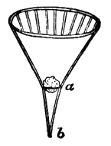
The form of filters, and the substances of which they are composed, are various, and depend upon the nature of the liquids for which they are intended. On the small scale, funnels of tin, zinc, copper, wedgwood-ware, earthenware, glass, or porcelain, are commonly employed as the containing vessels. (See engr.) The filtering medium may be any substance of a sufficiently spongy or porous nature to allow of the free percolation of the liquid, and whose pores are, at the same time, sufficiently small to render it limpid or transparent. Unsized paper, flannel, linen, calico, cotton wool, felt, sand, coarsely powdered charcoal, porous stone, or earthenware, and numerous other substances of a similar kind, are employed for this purpose.
Fig. 2.
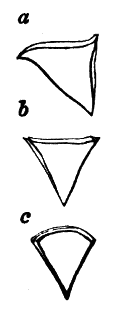
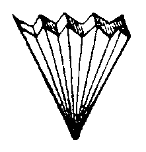
For many liquids that filter easily, and in which the suspended matter is of a coarse and porous nature, it is often sufficient merely to place a little cotton wool or tow, or a small piece of sponge, in neck of the funnel, as at (a, fig. 1) in the above engr.; but such an apparatus, from the small extent of the filtering surface, acts either slowly or imperfectly, and soon gets choked up. Filters of unsized paper are well suited for all liquids that are not of a corrosive or viscid nature, and are universally employed for filtering small quantities of liquids in the laboratory. A piece of the paper is taken of a size proportionate to the quantity of the liquid to be filtered, and is first doubled from corner to corner into a triangle (see engr. a), which is again doubled into a smaller triangle b, and the angular portion of the margin being rounded off with a pair of scissors c, it constitutes a paper cone, which is placed on a funnel of proportionate capacity, and is then nearly filled with the liquid. A piece of paper so cut, when laid flat upon the table, should be nearly circular. Filtering paper is now sold ready cut in circles of various sizes, which simply require doubling for use. Another method of forming a paper filter, preferred by some persons, is to double the paper once, as above, and then to fold it in a similar way to a fan, observing so to open it and lay it on the funnel that a sufficient interval be left between the two to permit of the free passage of the filtered liquid on its descent towards the receiver. The ‘plaited filter,’ as thus formed, is exceedingly useful for general purposes; it exposes the entire surface of the paper to the liquid, and allows filtration to proceed more rapidly than a ‘plain filter’ does. (See Fig. 3.)
Fig. 3.
Mr Rother takes objection to the ordinary plain paper filter employed in the laboratory, because of the superfluous fold which in two thicknesses lies under one half of the extended surface of the filter. He says the interposition of these two extra layers compels the liquid to pass through three thicknesses of paper on the half side of the extended filter, whilst the other half side presents only a single thickness. It is evident that the two hidden layers are a very appreciable impediment to the current, aside from the more important fact that the liquid will traverse this side less rapidly than the other, and thus occasion an imperfect washing of the precipitate, or at least prolong the operation beyond reasonable limits. Recognising these objections to the old filter, Mr Rother has invented a very simple modification of the plain filter which, whilst saving 50 per cent. of the paper, he states, removes all the defects of the old form. This new filter practically presents but a single thickness of paper to penetrate, at the same time preserving an even surface, equal in all other advantages to the plain filter.
The filtrations are said to be more rapid than with the usual form, and the absence of the superfluous half sheet admits of more rapid drying.
To make the new filter:—Cut the circular disk of filtering paper in two through the line of its diameter, take either half disk, and fold it across the line of the radius, then turn down the double edge of the cut side and fold it over several times—finally, run a hard smooth surface along the seam thus produced, to compress it, and spread the finished filter into an appropriate funnel, first moistening it with water before the liquid to be filtered is poured in.
In reference to funnels, it may be remarked that those employed for filtering rapidly should be deeply ribbed on the inside, or small rods of wood or glass, or pieces of straw, or quills, should be placed between them and the paper. The neck or tubular part of the funnel should, in like manner, be deeply ribbed or fluted on the outside, to permit of the free passage of the air, when it is placed in a narrow-mouthed bottle or receiver. When this is not the case, filtration proceeds but slowly, and the filtered liquid is apt to be driven up the outside of the neck of the funnel by the confined air, and to be continually hissing and flowing over the mouth of the vessel. The breadth of a funnel, to filter well, should be about three fourths its height, reckoning from the throat (a). When deeper, the paper is liable to be continually ruptured, from the pressure of the superincumbent fluid; and when shallower, filtration proceeds slowly, and an unnecessarily large surface of the liquid is exposed to the atmosphere, and is lost by evaporation. To lessen this as much as possible, the upper edge of the glass is frequently ground perfectly smooth, and a piece of smooth plate-glass is laid thereon. When paper filters are of large dimensions, or employed for aqueous fluids that rapidly soften the texture of the paper, or for collecting heavy powders, or metallic precipitates, it is usual to support them on linen or calico, to prevent them breaking. This is best done by folding the cloth up with the paper, and cutting the filter out of the two, in the same way as would be done with doubled paper, observing so to place it in the funnel that the paper and calico may remain close together, especially towards the bottom.
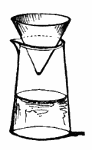
The filtration of small quantities of liquid, as in chemical experiments, may often be conveniently performed by merely placing the paper on the circular top of a recipient (see engr.), or on a ring of glass or earthenware laid on the top of any suitable vessel. A filter of this kind that will hold one fluid ounce will filter many ounces of some liquids in an hour.
Good filtering paper should contain no soluble matter, and should not give more than 1⁄250 to 1⁄230 of its weight of ashes. The soluble matter may be removed by washing it, first, with very dilute hydrochloric acid, and secondly, with distilled water.
The ‘Munktell’ Swedish filtering paper[301] is composed of flax fibres very much crushed and broken, and owes its value to the broken pieces of the fibres filling up the pores, and thus preventing solids from passing through the paper. Rhenish filtering paper is also made from flax, but in consequence of the more perfect condition of its fibres, is more porous than Munktell’s, and therefore inferior to it for filtering purposes. Another kind of Rhenish paper, also of flax, in which the fibres are much torn, is manufactured and is said to be a useful article, and to allow the rapid passage of fluids through it. The white filtering papers of English make have a small quantity of cotton mixed with the flax; and the fibres are much torn and crushed; hence they make serviceable filters.
The grey, circular cut filtering paper of varying sizes, of foreign make, as well as the grey sheet filtering paper of Dutch and English manufacture, contains a large quantity of wool, much of which is coloured; as well as jute and esparto grass, both of these latter in an unbleached state. The amount of ash in the Munktell paper has of late increased in quality.[302]
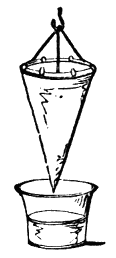
For filtering a larger quantity of a liquid than can be conveniently managed with a funnel, and also for substances that are either too viscid or too much loaded with feculence to allow them to pass freely through paper, conical bags made of flannel, felt, tweeled cotton cloth or Canton flannel, linen or calico, and suspended to iron-hooks by rings or tapes, are commonly employed. The first two of the above substances are preferable for saccharine, mucilaginous, and acidulous liquors; the third for oily ones; and the remainder for tinctures, weak alkaline lyes, and similar solutions. These bags have the disadvantage of sucking up a considerable quantity of the fluid poured into them, and are therefore objectionable, except for large quantities, or when they are to be continued in actual use as filters for some time. On the large scale, a number of them are usually worked together, and are generally enclosed in cases to prevent evaporation, and to exclude dirt from the filtered liquor that trickles down their sides. These arrangements will be noticed further on.
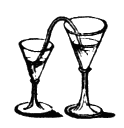
A simple mode of filtering aqueous fluids, which are not injured by exposure to the air, is to draw them off from one vessel to another, by means of a number of threads of loosely twisted cotton or worsted, arranged in the form of a syphon. (See engr.) The little cotton rope at once performs the operations of decantation and filtration. This method is often convenient for sucking off the water from a small quantity of a precipitate.
For fuller information on the subject of laboratory filtration, the reader is referred to the following papers (which are too long for quotation here) in ‘The Chemical News’:—
“On a New Mode of Filtration,” by J. B. Cooke, May 30th, 1873; “Filtering Apparatus,” by John F. Kerr, February 6th, 1874; “Implements for Filtration,” by P. Casamajor, July 23rd, 1875, and 30th, 1875; Ibid, by W. Jago, February 4th, 1876; “On Rapid Filtration,” by E. C. H. Hildebrand, August 11th, 1876; also to ‘Journal of the Chemical Society,’ for papers on:—“Simple Suction arrangement for Rapid Filtering,” by C. Holthof, vol. xxxii, part 2, p. 508; “Employment of Compressed Air on Filtering Solutions,” by W. Leübe, vol. xxxii, part 1, p. 270.
When solid substances, as porous stone or earthenware, are used as the media for filtrations, vessels of metal, wood, or stone-ware, are employed to contain them and the supernatant liquid. In these cases the filtering medium is usually arranged as a shelf or diaphragm, and divides the vessel into two compartments; the upper one being intended to contain the dirty liquid, and the under one to receive the same when filtered. Such an apparatus is set in operation by merely filling the upper chamber, and may at any time be readily cleared out by reversing it, and passing clean water through it in an opposite direction. Small arrangements of this kind, intended to be screwed on to the water supply-pipe by either end, and which answer the purpose intended in the most satisfactory manner, have been manufactured and vended under the name of ‘REVERSIBLE’ or ‘SELF-CLEANING FILTERS,’ When pulverulent substances, as sand, coarsely powdered charcoal, &c., are employed, a similar arrangement is followed; but in this case the shelf or diaphragm must consist of any convenient substance pierced with numerous holes, over which must be placed, first a stratum of coarse pebbles, next some of a finer description, and on this a proper quantity of the sand, charcoal, or other medium. Over the whole should be placed another layer of pebbles, or a board or plate of metal or earthenware, pierced with a number of holes, to allow the liquid to be poured into the filter without disturbing its arrangement. Apparatus of this kind, of a permanent description, and arranged for filtering large quantities of liquids, are properly denominated ‘FILTERING MACHINES,’
Among the liquids usually submitted to filtration, the following may be mentioned as the principal—water, oils, syrups, tinctures, vegetable juices, infusions, and decoctions.
The filtration of water may now be considered. The water of our wells is presented by nature ready filtered to the hand of man, and often exhibits an admirable degree of transparency and purity. It acquires this state by percolating through the mineral strata of the earth, which deprives it of the organic matter it derives from the soil and subsoil, but, at the same time, it dissolves a portion of the saline and earthy media through which it passes, and hence acquires that peculiar ‘hardness’ which is constantly found in spring water. On the large scale, this natural system of filtration has been imitated by some of the commercial companies that supply our cities and towns with water. Extensive beds of sand and gravel have been employed, with variable success, as the filtering media; and were it not that filters gradually lose their porosity by the accumulation of the retained matter in their pores, such a method would be excellent. But the great expense of such filters precludes the possibility of frequently cleaning or renewing them, by which means they can alone be kept in an efficient state.
A filter which possesses the advantages of being easily and cheaply cleaned when dirty, and which frees water from mechanical impurities with immense rapidity, may be formed by placing a stratum of sponge between two perforated metallic plates, united by a central screw, and arranged in such a manner as to permit of the sponge being compressed to any required degree. Water, under gentle pressure, flows with such rapidity through the pores of compressed sponge, that it is said that a few square feet of this substance will perfectly filter several millions of gallons of water daily. This method of filtration has been made the subject of a patent, and has been favorably noticed by the legislature.
A few barrels or hogsheads of water may be easily filtered daily, by the arrangement represented in the engraving.
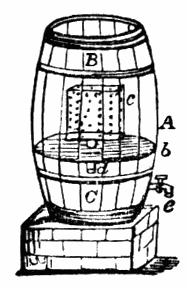
A. A common water-pipe or cock.
b. A false bottom fitting in perfectly water-tight.
c. A perforated wooden or metallic vessel or box covered with a bag of felt or other filtering substance (not shown in the engraving). d. A small tube, fitting water-tight into the false bottom and uniting the interior of the filter with the lower portion of the cask.
It is evident that when water is poured into the upper portion B of a vessel, so arranged, it will sink through the filter c, and pipe d, into the lower chamber C, and this filtration will go on as long as the supply continues, and water is drawn from the cock e. By uniting the cock e with a tank or casks, and by keeping the upper portion B always full by means of a ball-cock, a considerable quantity of water may be thus filtered. The advantage of this plan is, that the filter c can be always readily got at, and easily cleaned or renewed.
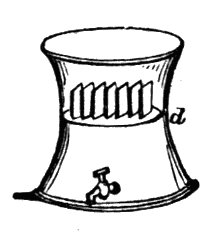
For filtering water on the small scale, and for domestic use, ‘alcarazzas,’ diaphragms of porous earthenware and filtering-stone and layers of sand and charcoal, &c., already referred to, are commonly employed as filtering media. The filtering power of porous stone or earthenware may be greatly increased by adopting the arrangement represented in the margin, which consists in making the diaphragm of the shape of a disc (d), supporting plates of the same material, the whole forming but one piece. The ‘PLATYLITHIC WATER-FILTERS,’ which are formed of porous stone cut on this plan, present 200 to 300 square inches of filtering surface. A cheap, useful form of portable filter, is the following, given in the ‘Proceedings of the British Association,’ “Take any common vessel, perforated below, such as a flower-pot, fill the lower portion with coarse pebbles, over which place a layer of finer ones, and on these a layer of clean coarse sand. On the top of this a piece of burnt clay, perforated with small holes, should be put, and on this again a stratum of three or four inches thick, of well burnt pounded animal charcoal. A filter thus formed will last a considerable time, and will be found particularly useful in removing noxious and putrescent substances held in solution by water.”[303] The ‘PORTABLE-FILTERS,’ set up in stone-ware, that are commonly sold in the shops, contain a stratum of sand, or coarsely-powdered charcoal;[304] before, however, having access to this, the water has to pass through a sponge, to remove the coarser portion of the impurities. Among the many new kinds of portable filters now offered for sale, which claim special notice, are the following, viz.—
1. The MOULDED CARBON FILTER, consisting of a spherical or cylindrical vessel formed of compressed carbon.
2. The SILICATED CARBON FILTER, in which the medium is a compact substance, formed of animal charcoal and the ashes of Boghead coal.
Of the many forms of this filter, we may mention the ‘Syphon Filter for Travellers,’ by means of which wholesome water may be drunk from any pond or stream by simply immersing the filter therein and drawing the water through the tube by suction. Of the ‘Silicated Carbon Filter,’ Professor Wanklyn says that it will render river water containing a considerable amount of free and albuminoid ammonia as pure as deep spring water.
3. Bischoff’s Patent Spongy-iron filter.—This differs from one invented many years ago by Dr Medlock, in bringing the water into contact with spongy iron instead of thin iron rods, and thus effecting filtration much more rapidly. Medlock believed that the iron rods brought about the oxidation of the nitrogenous organic matter and its consequent conversion into nitrites and nitrates. Bischoff states that he has experimentally investigated the properties of spongy iron, and finds that it—
a. Decomposes even distilled water, which has been previously boiled.
b. That it reduces nitric acid to ammonia.
c. That the amounts of organic nitrogen and albuminoid ammonia are always much reduced after filtration through spongy iron.
d. That a minute quantity of iron is dissolved by the carbonic acid contained in the water, ferrous bicarbonate being formed. The latter being soon oxidised and precipitated is easily removed by filtration.
e. That the action of spongy iron on impure water is two fold, viz. chemical and mechanical. “The chemical action is clearly indicated by the decomposition of water. The readiest explanation for the decomposition of water, is, the intimate contact between the electro-positive and electro-negative bodies, such as metallic iron and carbon, or even metallic iron and any ferric oxide, which has escaped reduction, or which has been reoxidised by exposure to air or water; and it may well be supposed that, consequent to the galvanic current thus produced, the atmospheric oxygen dissolved in water is ozonised, and caused to act as a powerful oxidising agent in organic matter.”
We extract the tables on the next page from the Sixth Report of the Royal Commission on Rivers’ Pollution. The Commissioners, we may here state, speak in high terms of this filter.
4. The so-called Magnetic carbide of iron filter. In this, the filtering material is said to be prepared by heating hæmatite with sawdust. This filter has a good repute.
⁂ The Royal Commission “on Rivers Pollution” strongly recommend filters of animal charcoal to be recharged every three to six months, “since they found that myriads of minute worms were developed in the animal charcoal, and passed out with the water when these filters were used for Thames water, and when the charcoal was not renewed at sufficiently short intervals.”
Cleansing of Filters.—Every two or three months (according to the kind of water) air should be blown through, and if the charcoal be in the block form it should be brushed. Then four to six ounces of the pharmacopœial solution of potassium permanganate, or twenty to thirty grains of the solid permanganate in a quart of distilled water, and ten drops of strong sulphuric acid, should be poured through, and subsequently a quarter to half an ounce of pure hydrochloric acid in two to four gallons of distilled water. This plan would be useful on foreign stations where the filter cannot be sent home, or taken to pieces; if it can be taken to pieces, the charcoal should be spread out in a thin layer, and exposed for some time to air or sun, or heated in an oven.
The Average Composition of Thames Water, before and after Filtration through Spongy Iron.
Description. Dissolved Matters.
Total solid impurity. Organic carbon. Organic nitrogen. Ammonia. Nitrogen, as nitrates and nitrites. Total combined nitrogen.
As delivered from Chelsea Waterworks 28·04·198 ·042·0009 ·117·220
The same water filtered through spongy iron 16·8·069 ·018·019 ·018·049
The mean of the 14th and 15th taken after the spongy iron filter had been in operation in the Rivers Commission Laboratory for upwards of eight months.[305] As supplied from Waterworks 24·47 ·170 ·055 ·001 ·098 ·154
After filtration through spongy iron 14·26·083 ·0160 0·016
Description. Dissolved Matters.
Previous Sewage or Animal contamination. Chlorine. Hardness. No. of samples analysed.
Temporary. Permanent. Total.
As delivered from Chelsea Waterworks 1·464 2·01 15·5 6·2 21·7 15
The same filtered through spongy iron ·177 2·00 6·8 4·9 11·7 15
The mean of the 14th and 15th samples taken after the spongy iron filters had been in operation in the Rivers Commission Laboratory for upwards of eight months. As supplied from Waterworks ·675 Analysis of the 15th sample. 1·95 — — 19·1 —
After filtration through spongy iron 0 1·95 — — 9·6 —
If sponges are at all used, they should be removed from time to time, and thoroughly washed in hot water.[306]
Oils are filtered, on the small scale, through cotton-wool, or unsized paper, arranged in a funnel; and on the large scale, through long bags, made of tweeled cotton-cloth (Canton flannel). These bags are usually made about 12 or 15 inches in diameter, and from 4 to 8 feet long (see engr.), and are inclosed in bottomless casings, or bags of coarse canvas, about 5 to 6 or 8 inches in diameter, for the purpose of condensing a great extent of filtering surface into the smallest possible space. A number of these double bags (from 1 to 50 or 60) are connected with corresponding holes in the bottom of a block-tin or tinned-copper cistern, into which the oil to be filtered is poured. The mode in which these bags are fastened to the cistern is of the utmost importance, as on the joint being close and secure depends the integrity of the apparatus. Three methods of doing this are figured in the engraving, which, with the references, will explain themselves, the same letters referring to the same parts of each.
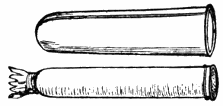
Filtering-bag of cotton-cloth.
Cotton filtering-bag, ‘creased,’ or enclosed in its canvas envelope, ready for fixing.
The second of the above arrangements is the least expensive, and certainly the most convenient in practice; and when the cylinder l fits the hole closely (allowing for the bag), is as safe, or safer, than an ordinary screw.
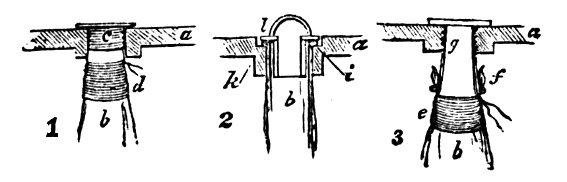
a. Bottom of cistern.
b. Filtering-bag.
c. Screw of the conical nozzle fitting into the cistern.
d. Binding cord connecting bag and nozzle.
e. Binding cord connecting bag and lower nozzle.
f. Bayonet-catch, connecting the lower portion of the nozzle fastened to the bag with the upper and fixed part, g.
i. The thick hem at the top of the bag (purposely made large by enclosing a piece of thick cord therein), resting on the shoulders, k.
l. A metallic cylinder, loosely fitting the hole in the cistern, and over which the top of the bag is drawn, before being put into its place; when fitted, as in the engraving, it retains the hem i securely in its place above the shoulder k.
The bags are surrounded by a wooden screen fitted up with doors for the purpose of keeping off the dust; and the bottom of the apartment is furnished with large steam-pipes, by which a proper temperature may be kept up in cold weather. The use of heat should, however, never be had recourse to when it can be avoided, as although it vastly increases the rate of filtration, the oil so filtered is more apt to become opaque in cold weather than when the process is conducted at the natural temperature of the atmosphere. This is particularly the case with castor oil and sperm oil. In the United States of America, where the latter is consumed in enormous quantities for illumination, the best is always ‘winter strained,’ as it is popularly called. In practice, it is more convenient to have a number of small cisterns at work (say 50 or 100 galls. each), than one or two larger ones, as any accident that may occur is more easily remedied, and that without stopping the whole operation.
When cotton-cloth bags are employed without being ‘creased,’ or enclosed in others of canvas, they should not be longer than about 3 or 4 feet, and not wider than about 5 or 6 inches when filled. When larger they are dangerous.
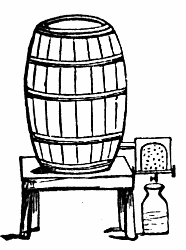
A convenient method of filtering a single cask of oil is, to insert the pipe of a two-way patent filter into the cork-hole, by which means the whole will be filtered as drawn off, without any trouble on the part of the operator. This filter consists of a porous bag stretched over a perforated metallic vessel, nearly the shape and size of the exterior casing, and its edge is tightly screwed between the sides and bottom of the latter, so as to be quite water-tight. The cock communicates with the interior of the perforated plate and filter, and the supply-pipe with the exterior. By this means the interior chamber, which occupies 5⁄6ths of the vessel, rapidly fills with filtered oil, and continues full as long as any liquor remains in the cask. This arrangement is also well adapted to the filtration of wines, beer, cordials, porter, and various other liquors. It is unequalled in simplicity and usefulness. The same filter may be removed from cask to cask, with the facility of a common cock.
The filtration of SYRUPS is now generally effected on the large scale by passing them through the ‘CREASED BAG FILTER’ just described. On the small scale, as employed by confectioners and druggists, they are usually passed through CONICAL FLANNEL BAGS. (See page 726.) The filtration of thick syrups is, however, attended with some difficulty, and it is therefore a good plan to filter them in a somewhat dilute state, and afterwards to reduce them to a proper consistence by evaporation in clean vessels of tinned copper, by steam heat. Syrups, when filtered in a heated state, run well for a time, but the pores of the fabric rapidly get choked, from the thickening of the syrup and partial crystallization of the sugar, occasioned by the evaporation of the aqueous portion from the surface of the bag. This may be partially prevented by enclosing the bag in a metallic casing. On the whole clarification is preferable for syrups to filtration on the small scale. They need only be well beaten up while cold with a little white of egg, and then heated; a scum rises, which must be removed as soon as it becomes consistent, and the skimming continued until the liquid becomes clear. Any floating portions of scum that may have escaped notice are easily removed by running the syrup through a coarse flannel strainer, whilst hot. The most extensive application of the process of filtration in the arts is in the refining of sugars.
Tinctures and dilute spirits are usually filtered, on the small scale, through BIBULOUS or UNSIZED PAPER placed on a funnel; and on the large scale, through thin and fine COTTON BAGS. In general, however, tinctures clarify themselves by the subsidence of the suspended matter, when allowed to repose for a few days. Hence it is the bottoms alone that require filtering; the supernatant clear portion need only be run through a small hair sieve, a piece of tow or cotton placed in the throat of a funnel, or some other coarse medium, to remove any floating substances, as pieces of straw, &c. Spirits which are largely loaded with essential oil, as those of ANISEED, &c., run rapidly through paper or calico, but usually require the addition of a spoonful or two of magnesia before they will flow quite clear. When possible, tinctures, spirits, and all similar volatile fluids, are better and more economically cleared by subsidence or clarification than by filtration, as, in the latter way, a portion is lost by evaporation, and the strength of the liquid is thereby altered.
Vegetable juices should be allowed to deposit their feculous portion before filtration. The supernatant liquid will then be often found quite clear. It is only when this is not the case that filtration should be had recourse to. A small quantity may be filtered through coarse or woollen filtering paper, supported on a piece of coarse calico placed on a funnel; when the quantity is large, one of the CONICAL BAGS before described should be employed. The bottoms from which the clear portion has been decanted should be placed on a separate filter, or else not added until the whole of the other portion has drained through. Vegetable juices are often rendered clear by simply heating them to about 180° or 200° Fahr., by which their albumen is coagulated; they are also frequently clarified by the addition of a little white of egg and heat, in the same way as syrups. Many of them (as those of hemlock, henbane, aconite, &c.) are greatly injured by heat, and must consequently be filtered, or only simply decanted after repose. In all cases they should be exposed to the air as little as possible, as they rapidly suffer decomposition.
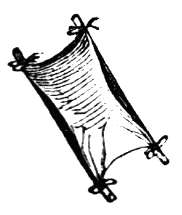
Vegetable infusions and decoctions may be cleared by defecation followed by filtration. The conical bags of flannel before described are usually employed for this purpose. When the liquid is to be evaporated to an extract, they are commonly suspended by a hook over the evaporating pan. A convenient method of straining these fluids, practised in the laboratory, is to stretch a square of flannel on a frame or ‘horse,’ securing it at the corners by pieces of string. (See engr.) Such a frame, laid across the mouth of a pan, is more easily fed with fresh liquid than a bag, whose mouth is 40 or 50 inches higher. The same purpose, for small quantities of liquid, is effected by laying the flannel across the mouth of a coarse hair sieve. The concentrated infusions and decoctions being usually weak tinctures, may be filtered in the same way as the latter. (See above.) Many vegetable solutions, that from the viscidity of the suspended matter can scarcely be filtered, may be readily clarified with white of egg in the cold, or pass the filter rapidly if a very small quantity of acetic, tartaric, sulphuric, or other strong acid, is previously added.
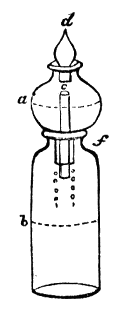
Corrosive liquids, as the STRONG ACIDS, are filtered through powdered glass, or SILICEOUS SAND, supported on pebbles in the throat of a glass funnel, or through asbestos or gun-cotton placed in the same manner. Charcoal has also been employed for the same purpose, but is not fit for some acids. Strong caustic alkaline lyes are also filtered through powdered glass or sand. Weak alkaline lyes may be filtered through fine calico, stretched across the mouth of a funnel. Many corrosive liquids, as solution of potassa, &c., require to be excluded from the air during filtration. The simplest apparatus that can be employed for this purpose is that figured in the margin:—(a) is a globular bottle fitted with the ground stopper (d), and having a perforated neck (f) ground to the bottle (b); (c) is a small tube, wrapped round with as much asbestos, linen, or calico, as is required to make it fit the under neck of the bottle through which it passes. The tube (c) may also be fixed by placing pebbles and powdered glass or sand round it, as before mentioned. For use, the solution to be filtered is poured into the bottle (a) nearly as high as the top of the tube (c), and the stopper is replaced. The liquid then descends into (b), and a similar quantity of air passes up the tube into (a). Liquor potassæ may be always obtained fine by depuration in close vessels, when the sediment of lime only need be filtered, which may be effected with calico fixed across the mouth of a funnel.
When a precipitate, or the suspended matter in a liquid, is the object of the filtration, the filter should be of such a nature that the powder may be easily separated from it, when dry, and that with the least loss possible. Linen filters are for this reason preferable for large quantities, and those of smooth bibulous paper for small ones. The powder should be washed down the sides of the filter, and collected, by means of a small stream of water, in one spot at the bottom, assisting the operation with a camel-hair pencil; and, when the whole is dry, it should be swept off the paper or cloth with a similar pencil or brush, and not removed by a knife, as is commonly done, when it can be possibly avoided.
The ‘first runnings’ of liquid from a filter are commonly foul, and are pumped back or returned until the fluid runs perfectly limpid and transparent, when it is ‘turned into’ the ‘filtered liquor cistern,’ or proper receiver. In many cases the liquid does not readily become transparent by simply passing through the filter; hence has arisen the use of FILTERING POWDERS, or substances which rapidly choke up the pores of the media in a sufficient degree to make the fluid pass clear. In the employment of these powders care should be taken that they are not in too fine a state of division, nor used in larger quantities than are absolutely necessary, as they are apt to choke up the filter, and to absorb a large quantity of the liquid. The less filtering powder used, the more rapid will be the progress of the filtration, and the longer will be the period during which the apparatus will continue in effective action. For some liquids these substances are employed for the double purpose of decolouring or whitening, as well as rendering them transparent. In such cases it is preferable first to pass the fluid through a layer of the substance in coarse powder, from which it will ‘run’ but slightly contaminated into the filter; or, if the powder is mixed with the whole body of the liquid, as in bleaching almond oil, &c., to pass the mixture through some coarser medium to remove the cruder portion before allowing it to run into the filter. Another plan is, after long agitation and subsequent repose, to decant the clearer portion from the grosser sediment, and to employ separate filters for the two. Granulated animal charcoal is used according to the first method, to decolour syrups, oils, &c.; and filtering powder by the second and third, to remove a portion of the colour, and to clarify castor and other oils. The common plan of mixing large quantities of filtering powder with castor oil, and throwing the whole into the filter, as adopted by the druggists, is injudicious. When simple filtration is required, it is better to use little or no powder, and to continue returning the oil that ‘runs’ through, until, by the swelling of the fibres of the filter bags, it flows quite clear. By this plan the same filters may be used for a long period of time (for many years), and will continue to work well; whilst, by the usual method, they rapidly decline in power, and soon deliver their contents slowly, and after a short time scarcely at all.
It is often of great advantage to render a filter ‘self-acting,’ or to construct it in such a way that it may ‘feed itself,’ so that it may continue full and at work without the constant attention of the operator. On the small scale, this may be readily effected on the principle of the common fountain lamp (see engr.); and on the large scale, by placing the vessel containing the unfiltered liquid on a higher level than the filter, and by having the end of the supply-pipe fitted with a ball-cock, to keep the liquid in the filter constantly at the same height.
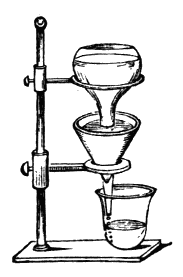
The rapidity of filtration depends upon—the porosity of the filtering medium—the extent of the filtering surface—the relative viscidity or mobility of the filtering liquid—the pressure or force by which the liquid is impelled through the pores of the filter, and—the porosity and fineness of the substances it holds in suspension. The most efficient filter is produced when the first two or the first three are so graduated to the others that liquid filters rapidly, and is at the same time rendered perfectly transparent.
In the common method of filtration no pressure is exerted beyond that of the weight of the column of the liquid resting on the filtering medium, but in some cases additional pressure is employed. This is had recourse to for the purpose of producing a more rapid filtration, and more especially for filtering liquids that, from their viscidity, will scarcely pass through the pores of substances sufficiently fine to remove their impurities in the ordinary way.
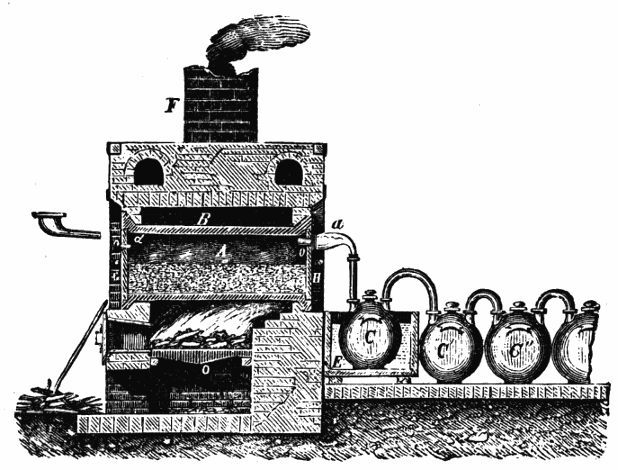
One of the easiest means of employing pressure in filtration is to increase the height of the column of the filtering liquid. From the peculiar properties of fluids, by which they transmit pressure in an equal degree in all directions, this column need not be of equal diameter throughout, but may be conveniently contracted to the size of a small pipe, as in the accompanying engraving, which represents a small filter on this construction at work. (a) Is the funnel or reservoir of foul liquid; (b) a small pipe conveying the liquid to the filter; (c c) a chamber, of which the upper portion (d) is filled with the descending liquid, and the lower portion (e) with the filtering media; (i i) are screws by which the bottom plate is fastened on, which plate is removed to clean out or renew the filter. For use, the cocks (k) and (l) are closed, and the liquid poured into the funnel (a); the cock (k) is next opened, and, in a few minutes after, the cock (l), when an uninterrupted flow of filtered liquor will be obtained as long as any fluid remains in the funnel (a) and the tube (b). The length of the tube determines the degree of pressure. Care must be taken first to pass the foul liquid through a hair sieve, or some other strainer, to remove any substance that might choke up the pipe (b).
Another method of employing pressure in filtration is the withdrawal of the air from the receiving vessel, as in the vacuum filter, by which a pressure of about 141⁄2 lbs. to the square inch becomes exerted on the surface of the liquid by the atmosphere. The vacuum in the receiving vessel may be produced by the air-pump, by steam, or by the Bunsen or Sprengel pump.
A commoner method of applying pressure than either of those already mentioned is to condense the air over the surface of the liquid by means of a forcing-pump, or by steam.
On the small scale, pressure may be applied to filtration by means of a syphon, whose shorter leg has its mouth blown into the shape of a bell or funnel, over which filtering paper or fine calico may be stretched.
The application of pressure to filtration is not always advantageous, and beyond a certain limit is generally attended with inconvenience, if not with absolute disadvantage. It is found in practice that fluids under pressure take a longer period to run clear than without pressure, and that ruptures of the media more frequently take place in the former case, or with pressure, than in the latter. Great pressure is in no case advantageous.
The filters already noticed are those that act by the fluid descending through the media; but in some cases the reverse method is employed, and the liquid filters upwards, instead of downwards. These are called ascending filters, and are often preferable to those on the descending principle, because the suspended matters that require removal by filtration usually sink, and thus a portion escapes being forced into the pores of the filter. They are also more convenient when pressure is employed. The construction depends upon the same principles as the common filter, and merely requires that the feeding vessel should be higher than the upper surface of the filtering media. Oils are conveniently filtered in this way, because of their little specific gravity. By fixing a small filter on this principle into the head of a cask, and pouring in water through a funnel, whose neck reaches nearly to the bottom of the cask, the oil will float up and pass the filter, leaving the sediment behind. In cold weather hot water may be employed.
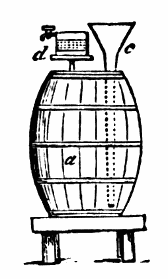
a. Cask of oil.
b. Stand.
c. Funnel for water.
d. Filter.
In some cases the upward and downward systems of filtration are united in the same apparatus, and this plan is advantageous where the space for operating is limited. For this purpose it is merely necessary to connect the bottom of an ascending filter with the top of a descending one, or the reverse; the proper pressure being in either case applied.
Filtration, the Laws of. The ‘Revue Universelle des Mines,’ 1874, pp. 469, 551 contains a paper by M. Paul Havre recording his investigations on the rapidity of the filtration of water through sand, wool, &c., which resulted in ascertaining and measuring the influences which may modify the flow of water. In all cases of filtration, the influences which are exerted are:—the pressure and temperature of the water, the thickness of the filtering medium, compression in the case of fibrous filters, the size of the grains and their mixture in the case of a filtering medium analogous to sand. The influence of obstruction, due to the dirtiness of the filter, depends on circumstances too variable to be taken into account. The delivery of a filter per square mètre per 24 hours is equal to two cubic mètres multiplied by the pressure of water in mètres, divided by the thickness of the filtering medium in mètres. An application of this formula is made to existing filter beds, including those at Southwark and at the Chelsea waterworks.
The first experiments for ascertaining the influence of a head of water on the delivery led to the following results:—The delivery increases in a higher ratio than the square root of the pressure, due to the height (Torrecelli’s Law); the delivery increases in direct ratio to the height of the column of water above the filter, admitting a previous initial delivery, due solely to the pressure of water above the filter; the co-efficient of the increase of delivery is constant, and in this case of a filtering substance 8·662 inches (22 centimètres) thick, is equal to 0·106 pint (6 centilitres) for sand to 0·528 pint (30 centilitres) for compressed wool, and to 0·792 pints (45 centilitres) for wool only slightly compressed.
The subsequent experiments were made with graduated transparent cylinders, 3·28 feet (1 mètre) high, with the ends perfectly level, the filtering substances being kept in place by a thick double cloth tied tightly under the bottom of the tube. This apparatus presented no other obstacle to the running of the water than the layer of filtering substance; it permitted experiments to be made at all temperatures, and the thickness of the filtering medium to be measured exactly.
In these experiments sand is ‘taken as the type of pulverulent substances,’ but an unexpected difficulty was encountered in the settling or partial agglomeration of the large and small grains of the unsifted sand, thus diminishing the delivery of water to one half, one third, and ultimately to one fifth of its previous volume. This led to the adoption of sand—the grains of which were uniform in size, and to the discovery of the fact that, other tissues being equal, the resistance of filtration is constant when the sand is coarse, when the grains of fine sand are of nearly equal size, and when there is but little fine sand mixed with the coarse. From experiments in filtering through a layer of coarse sand approximately 4 inches (10 centimètres) thick, it was found that the higher the temperature the more rapid was the delivery, and by filtering through a layer of coarser sand 11·8 inches (30 centimètres) thick, the conclusion was arrived at that the temperature exerts an influence in proportion to the thickness of the layer.
See Air-Pump, Bunsen’s Water-Air Pump; Clarification; Defecation; Finings, &c.
FI′NINGS. Substances used by publicans, brewers, wine merchants, &c., to clarify their liquors.
Prep. 1. (Brewer’s finings; Cooper’s f.) Isinglass (finely shredded), 1 lb., and sour beer or cider or vinegar, 3 or 4 pints, are macerated together, and more of the sour liquor added as the isinglass swells, until about a gallon has been used, agitation with a whisk or a small bundle of twigs being occasionally had recourse to, for the purpose of promoting the solution. As soon as the whole of the isinglass is dissolved, the mixture is reduced to the consistence of thin syrup, with weak mild beer, or cider, or any other liquid that the finings are intended for. The whole is next strained through a tammy cloth or a hair sieve, and at once reduced to a proper state of dilution, by the addition of more liquor. Product, 61⁄2 to 7 galls. “A pound of good isinglass will make about 12 galls. of finings.” (Ure.) Used to clarify fermented liquors, especially beer. 1 to 11⁄2 pint is the usual dose for a barrel of ale or porter; and a quart for a hogshead of cider or wine.
2. (Spirit finings.)—a. Alum (ord. cryst.), 1 lb.; powder, and divide it into 12 equal portions, which are to be separately wrapped in blue paper, and marked No. 1. Next take of carbonate of soda (sesquicarbonate of the shops), 6 oz.; divide this as the last, wrap it in white paper, and mark each parcel No. 2. Keeps dry anywhere.
b. From alum, 1 lb.; salt of tartar (dry), 1⁄4 lb.; proceed as before. The white papers containing the salt of tartar must be kept in a dry, well-corked, wide-mouthed bottle or jar. Both of the last two are used to clarify gin and cordials. The contents of one of the blue papers are dissolved in about a pint of hot water, and the resulting solution is well ‘rummaged up’ with the liquor. A solution of the contents of one of the white papers, in about 1⁄2 pint of hot water, is then added, and the agitation continued for some minutes longer; after which the cask is ‘bunged’ close and the whole allowed to repose until the next day. This is sufficient for a barrel (say 30 to 36 galls.), but many persons use double the quantity. The effect is not only to clarify, but also to ‘blanch’ the liquor.
Obs. Good liquors, either fermented or spirituous, need no artificial ‘fining,’ as they always clarify themselves by repose. With those, however, which are out of ‘condition,’ or of inferior quality, it is often necessary, as, without such a proceeding, they remain unsaleable. This is particularly the case with malt liquor. “Attempts to clarify it in the cask seldom fail to do harm. The only thing that can be used with advantage for fining foul or muddy beer is isinglass.” (Ure.) The disadvantages resulting from the artificial clarification of fermented liquors are—that they do not afterwards ‘stand well on draught,’ that much of the conservative astringent matter which they contain is precipitated with the ‘finings,’ that their piquancy and flavour is more or less diminished, and that they are more than usually liable to become flat and vapid, whether in cask or bottle. The larger the proportion of ‘finings’ used, the more marked are their injurious effects, and the shorter the interval which elapses before the accession of the several symptoms referred to. We have seen the most disastrous consequences follow the injudicious use of ‘finings,’ more especially in respect to those liquors in which a certain amount of piquancy, astringency, and briskness, is an essential condition. In one instance which came under our notice upwards of 30 barrels of ‘underground’ (a very strong old ale) was thus reduced in value to less than 1-3rd its original cost; and in another, a large bottled stock of the ‘finest old Burton’ was found to be utterly unsaleable. In both cases the ‘spoiled liquor’ was got rid of by mixing it in and selling it with 3d. and 4d. beer.
Liquors which ‘refuse to fine’ or become clear, when treated with ‘finings’ in the usual manner, are called ‘stubborn’ by coopers and cellarmen. See Brewing, Gin, Malt, Liquors, Wines, &c.
FIRE. The calamities resulting from this destructive agent are of such frequent occurrence, as to justly claim a notice of the subject here. The causes of fires are numerous, and of a varied character, and, in most instances, difficult to determine, because it is the interest of those concerned to suppress all evidence connected with the matter. Accident, that convenient word given to the imaginary hack to which so many fires are referred, if truthfully interpreted, will, in general, be found to be equivalent to carelessness, recklessness, or guilt. We believe that there are few fires which have happened that might not have been prevented by the exercise of common prudence, and that a vast number have been caused by direct negligence, arising from sheer laziness and indifference, to use no harsher terms. As familiar instances, may be mentioned—allowing sparks to fall on the ground and remain there without extinguishing them; carrying a naked candle into rooms containing inflammable substances; smoking carelessly and in dangerous places, as workshops, warehouses, on shipboard, &c.; keeping instantaneous light matches in improper places, and neglecting to pick up those that may happen to fall on the ground, &c. &c. The list might easily be extended, but we believe every reflecting reader can do so for himself. The great increase in the number of fires since the introduction of lucifer matches, and the almost general use of tobacco, cannot fail to have attracted the attention of every one. The danger of matches falling about might be avoided by the use of those which can only be ignited by rubbing them on the prepared surface of the box. These ‘safety matches’ are coming into general use, and must eventually supersede all the more dangerous kinds.