A CYCLOPÆDIA OF PRACTICAL RECEIPTS, PROCESSES, AND COLLATERAL INFORMATION (continued 8)
Reading edition
By means of the spectroscope quantities so inconceivably minute as the 33,000th of a grain of chloride of rubidium, the 170,000th of a grain of chloride of cæsium, the 2,500,000th of a grain of sodium, and the 6,000,000th of a grain of lithium, have been detected, and have revealed themselves to the sight by their characteristic bands in the spectrum. Hence it is that in making use of this branch of analysis the chemist has been enabled to show the universality of many elements hitherto regarded as being very sparingly distributed throughout the globe.
Thus lithium, which until lately was supposed to be one of the rare elements, has been found as a constituent of tea, tobacco, milk, blood, and in almost all spring waters. Furthermore, the prodigiously sensitive reactions afforded by the spectroscope have not only revealed the presence of infinitesimal quantities of known elements, but have led to the discovery of new ones which had escaped detection by the older and less delicate processes of analysis. It was by means of spectrum analysis that the two alkali metals, cæsium and rubidium, were discovered by Bunsen and Kirchkoff in 1860 in a mineral water at Durkheim, and that Mr Crookes in 1861 discovered the metal thallium in the deposit found in the flue of a pyrites furnace; whilst still more recently Messrs Reich and Richter, in a spectrum examination of a zinc ore from Freiberg, discovered the metal indium.
Larger.
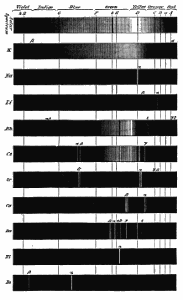
The most brilliant spectra are given by those salts which are the most easily volatilised, such as the chlorides, iodides, and bromides of the different metals. But it is only the metals of the alkalies and alkaline earths that give spectra that are characteristic. When it is desired to obtain the spectra of the other metals, they may be raised to the requisite temperature by means of the electric spark, which in passing through the two points of the metal operated upon volatilises a minute quantity of it, and thus enables it to emit its particular light. The electric sparks are best obtained by means of Ruhmkorff’s coil. Thus each metal may be made to yield a spectrum which specially belongs to it, and to it alone. When the electric discharge is sent through a compound gas or vapour, owing to the intense temperature generated separation of its constituents must take place, since the spectra produced are those of the elementary components of the gas. The permanent gases give each their peculiar spectrum when they are strongly heated, by which they may be recognised; thus the spectrum of hydrogen is composed of three bands, one being bright red, one green, and the other blue. Nitrogen gives a very complicated spectrum.
The accompanying figure exhibits a very complete form of the spectroscope adapted to a single prism.
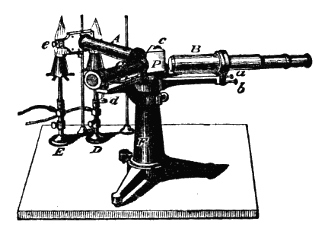
P represents a flint-glass prism supported on the cast-iron tripod F, and retained in its place by the spring c. At the end of the tube A nearest the prism is a lens, placed at the distance of its focus for parallel rays from a vertical slit at the other end of the tube. The width of the slit can be regulated by means of the screw e. One half of this slit is covered by a small rectangular prism designed to reflect the rays proceeding from the source of light D, down the axis of the tube, whilst the rays from the source of light E pass directly down the tube. By this arrangement the observer stationed at the end of the telescope B is able to compare the spectra of both lights, which are seen one above the other, and he can at once decide whether their lines coincide or differ. a and b are screws for adjusting the axis of the telescope so as to bring any part of the slit at e into the centre of the field of vision.
The telescope as well as the tube C is moveable in a horizontal plane around the axis of the tripod. The tube C contains a lens at the end next to the prism, and at the other end is a scale formed by transparent lines on an opaque ground; it is provided with a levelling screw, d. When the telescope has been properly adjusted to the examination of the spectrum, the tube C is moved until it is placed at such an angle with the telescope and the face of the prism, that when a light is transmitted through the scale the image of this scale is reflected into the telescope from the face of the prism nearest the observer. This image is rendered perfectly distinct by pushing in the tube which holds the scale nearer to the lens in C, or withdrawing it to a greater distance, as may be required. The reflected lines of the scale can then be employed for reading off the position of the dark or bright lines of the spectrum, as both will appear simultaneously overlapping each other in the field of the telescope.
By turning the tube C round upon the axis of the tripod any particular line of the scale can be brought to coincidence with any desired line of the spectrum. Stray light is excluded by covering the stand, the prism, and the ends of the tube adjoining it with a loose black cloth. The dispersive power upon the spectrum may be much increased by using several prisms instead of one. Kirchkoff used four prisms in his experiments upon the solar spectrum. Great care must be observed in placing the prisms; the refracting edge of each prism must be exactly vertical, and the position of minimum deviation for the rays to be observed must be obtained.
The preceding remarks have reference to the spectra produced when the vapours of certain elements are evolved in flame derived from artificial sources. When, however, solar light is examined by the spectroscope, results entirely the reverse follow.
If a beam of sunlight be sent through the slit of the spectroscope, the prismatic image is seen to be intersected by a number of fine black lines, varying in thickness and intensity, and invariably occupying the same relative position in the solar spectrum. These lines were first noticed so far back as 1815 by a German optician, Frauenhofer, after whom they were named Frauenhofer’s lines; but it was not until the invention of the spectroscope that the origin of these lines could be accounted for. By so arranging the instrument as to cause the spectrum from a solar beam, and that from a metallic element, to fall upon the field of the telescope, so that the solar spectrum shall be above the other, both being perfectly parallel; the bright bands or lines of the metal are all seen to be continued in the dark solar lines, for, as may be seen by consulting the plate of the different spectra, several lines are sometimes produced by one element alone. If, for instance, the sodium and solar spectra are thus compared, the bright yellow sodium line will be found to agree exactly not only in position, but also in intensity and breadth, with one of the dark solar ones. And the same thing occurs when the comparison is made with many of the other metals, the bright lines in the respective spectra furnished by them are each coincident with a particular dark line in the solar spectrum, and from every dark line in the latter a corresponding bright one can be found amongst the spectra of the metals. From what has just been stated, the inference seems irresistible that this coincidence between the dark solar lines and the bright lines of the metals cannot be accidental, but must be due to some intimate connection between them, and that this is the case can be proved beyond refutation by a simple experiment, in which the bright metallic lines can be changed into dark ones, corresponding in every particular with those of the solar spectrum. Thus the bright yellow soda lines coincident with Frauenhofer’s lines can be converted into dark ones by allowing the rays from a strong source of white light to pass through a flame coloured with sodium, and then making them fall upon the slit of the spectroscope. If we examine the spectrum obtained by this means, instead of seeing the usual bright double band upon a black ground, there will be presented to our sight a double dark line, corresponding exactly with the position and width of the sodium line, and instead of the black ground there will be a continuous spectrum of white light, as in the solar spectrum.
The explanation of this remarkable phenomenon is due to Kirchkoff, and is as follows:—When any substance is heated sufficiently to render it luminous, rays of a certain and definite degree of refrangibility are given out by it; whilst the same substance has also the power of absorbing rays of this identical refrangibility. In the above experiment, therefore, the yellow flame absorbed the same kind of light as it gave out, a corresponding decrease of intensity in its own particular position in the spectrum occurred, and a dark line showed itself in consequence.
In the same manner and under similar conditions the spectra of many other substances have been reversed.
Reasoning on these facts, Kirchkoff has been able to account for the presence in the solar spectrum of Frauenhofer’s dark lines. He supposes that in the luminous atmosphere surrounding the sun the vapours of various metals are present, each of which would give its characteristic system of bright lines; but behind this incandescent atmosphere containing metallic vapour is the still more intensely heated solid or liquid nucleus of the sun, which emits a brilliant continuous spectrum, containing rays of all degrees of refrangibility.
When the light of this intensely heated nucleus is transmitted through the incandescent photosphere of the sun, the bright lines which would be produced by the photosphere are reversed, and Frauenhofer’s dark lines are only the reversed bright lines which would be visible if the intensely heated nucleus were no longer there.
The correctness of this theory has been rigorously tested by Kirchkoff himself, who submitted the solar spectrum to a most minute and searching examination.
As a result of the knowledge thus obtained, the presence of certain metals in the sun’s atmosphere was an inevitable deduction. The metals hitherto detected in the solar photosphere are—iron, sodium, magnesium, calcium, chromium, nickel, barium, copper, zinc, strontium, cadmium, cobalt, manganese, aluminium, and titanium. Hydrogen also exists in large quantity as an incandescent gas, and gives rise to the red protuberances that may be observed during a total eclipse.
During the total eclipse of 1869, M. Janssen, a French astronomer, was enabled to obtain and figure the specimen of these red protuberances, which, taken exclusively from that source of light, gave not dark lines, but bright ones, corresponding in position with those of hydrogen, magnesium, and sodium.
The fixed stars, unlike the moon and planets, which shine only by reflected light, are not merely illuminated by self luminous bodies, and yield spectra, which show them to contain many elements known to us; their spectra are crossed by dark lines similar to, but not identical with those given by the sun’s light. The spectrum yielded by the star Aldebaran shows it to contain hydrogen, sodium, magnesium, calcium, iron, tellurium, antimony, bismuth, and mercury; in the spectrum of Sirius only sodium, magnesium, and hydrogen have been found; whilst in that of Orionis there is an absence of hydrogen. Most of the nebulæ and comets give spectra in which there are only bright lines. It is hence inferred that these celestial bodies are composed of masses of glowing gas, and, unlike the sun and stars, do not consist of a solid or liquid mass surrounded by a gaseous atmosphere. In the nebulæ hydrogen and nitrogen only have been found; and in comets, principally carbon.
ANANAS HEMP (Ananassa sativa, S. Brumelia ananas, as well as other species). This hemp comes from the West Indies and Central and South America, where the common ananas is cultivated. It is rather inferior to some varieties for spinning.
ANASTATIC PRINTING. See Printing and Zincography.
ANATHERIN BALSAM. The following formula is published by the Netherlands Society:—Tincture of myrrh, 160 grms.; tincture of catechu, 80 grms.; tincture of guaiacum, 40 grms.; tincture of rhatany, 40 grms.; tincture of cloves, 30 grms.; spirit of cochlearia, 20 grms.; oil of cassia, 20 drops; otto of roses, 1 drop; proof spirit, 630 grms.
ANATHERIN BALSAM (J. G. Popp, Vienna). A mouth-wash. Red sandal wood, 20 parts; guaiacum wood, 10 parts; myrrh, 25 parts; cloves, 15 parts; cinnamon, 5 parts; oils of cloves and cinnamon, of each, 2⁄3 part; spirit, 90 per cent., 1450 parts; rose water, 725 parts. Digest and filter.
Dr Hager, who gives the above, says that on the expiration of the patent the following formula was published, but that a preparation made from that process had only a distant resemblance to the actual compound. Myrrh, 1 part; guaiacum wood, 4 parts; saltpetre, 1 part; to be macerated for a night with corn brandy, 120 parts; spirit of cochlearia, 180 parts. Then distil of this 240 parts, in which are to be digested for 14 days garden rue, cochlearia, rose leaves, black mustard, horseradish, pellitory root, cinchona bark, club-moss, sage-vetiver, and alkanet root, of each 1 part. Strain and filter, and to each 120 parts of the filtrate add 1 part of spirit of nitrous ether. (Hager.)
ANATOM′ICAL. Syn. Anatom′icus, L.; Anatomique, Fr.; Anatomisch, Ger. Belonging to anatomy or dissection.
Anatomical Prepara′tions. Objects of interest in both surgical and pathological anatomy, and specimens in natural history, preserved by subjecting them to antiseptic processes, to which is also frequently added injection with coloured fluids (which subsequently harden), amalgams, or fusible metal, in order to display more fully the minute vessels, or the microscopic anatomy of the several parts. See Fusible Alloy, Injections, Preparations, Putrefaction, Skeletons, Solutions, &c.
ANCH′OVY (-chō′-). Syn. Anchois, Fr.; Anchove, Anschove, Ger.; Acciughe, Anchiove. It.; Anchova, Port., Sp. The clu′pea encrasic′olus (Linn.), a small fish of the herring tribe, closely resembling the English sprat. It is common in the Mediterranean, and occurs in the greatest abundance and of the finest quality about the island of Gorgona, near Leghorn. It is taken in the night, during May, June, and July.
Anchovies are prepared for sale or exportation by salting or pickling them—the heads, intestines and pectoral fins having been first removed, but not the scales, and afterwards packing them, along with rock-salt, in the small kegs in which they are imported into this country. The small fish are valued more than the larger ones. For the table they are often fried to a pale amber colour, in oil or butter; having previously been scraped clean, soaked for an hour or two in water, wiped dry, opened (without dividing the fish), and had the back-bones removed. Before being put into the pan they are usually highly seasoned with cayenne; and after being again closed, are dipped into a rich light batter. They are also divided into fillets, and served as sandwiches, or in curried toasts. Anchovies are also extensively potted (POTTED ANCHOVIES), and made into butter (A.-BUTTER), and into sauce (A.-SAUCE), particularly the last.
The anchovy has a fine and peculiar flavour, and is eaten as a delicacy all over Europe. It was known to the Greeks and Romans, who prepared from it a kind of garum for the table. It is said to be aperitive, stimulant, and stomachic.
The high price of genuine Gorgona anchovies has led the fraudulent dealer to either substitute for them, or mix with them, fish of a less expensive kind. The most frequent SUBSTITUTIONS are Dutch, French, and Sicilian fish of allied species or varieties, sardines and even the common sprat. The genuine Gorgona fish is about the length of one’s finger; and may be known by its silvery appearance; by the greater thickness of its head, which is sharp-pointed, with the upper jaw considerably the longest, and the mouth deeply divided; the dusky brown colour of its back,[58] and the pink salmon colour of its flesh. When only 3 months old, its flesh is pale; when of 6 months, rather pink; when of 10 to 12 months (or in its prime), a beautiful deep pink colour; and when much older, darker, but less lively. The fin-rays, varying in number with the age of the fish, are—
Yarrell.Hassall.[59]
Dorsal14,16 (?).
Pectoral15,—
Ventral7,—
Anal18,19 (?).
Caudal19,26 (?).
These fins are delicate in structure and greenish-white; and the membranes connecting the rays almost transparent. “The length of the head, compared with the length of the body alone, is as 1 to 3; the depth of the body but 2-3rds of the length of the head, and compared to the length of the whole fish is as 1 to 7;” the tail is deeply forked, the gill covers are elongated, and the scales of the body large and deciduous.” “The breadth of the eye is 1-5th of the length of the whole head.”[60] Dutch fish may be generally known by being deprived of the scales, and the French fish by their larger size; and both by the paler or whiter colour of their flesh; and sardines and sprats by the flesh being white. The genuine fish may also be known by the pickle, after repose or filtration, being of a clear pinkish colour, without any red sediment; whilst that from spurious kinds is turbid and red only when agitated, and deposits a heavy red sediment (Armenian bole, Venetian red, or red ochre) on repose. See Butter, Potting, Powders, Sauces, &c.
Anchovies, Brit′ish. See Sprats.
ANCHU′SIC ACID (-kū′zĭk). See Anchusine.
ANCHU′SINE. (-kū′zĭn). [Eng., Fr.] Syn. Anchu′sic acid*, Pseu′do-alkann′ine*, Pseudo-alka′′nium*; Anchusi′na, L. The resinoid constituting the colouring matter of alkanet-root (which see).
ANCHYLO′SIS (ăngk-e-). [L.; prim. Gr.] Syn. Ankylo′sis, Ancylo′sis (ăn-se-), L.; Ankylose, Fr., Ger. In pathology, stiffness or immobility of a joint naturally moveable. Anchylosis is either true or complete, as when the extremities of the bones forming a joint are reunited and immovable; or false, or incomplete, where the affection depends upon a contraction of the tendons and ligaments surrounding the joints, which nevertheless admit of a small degree of motion. For the first there is no available remedy; for the second gentle and progressive flexion and extension of the part daily (carefully avoiding violence), friction with oleaginous and stimulating liniments, and the use of the hot bath, vapour bath, or hot-air or Turkish bath, and electricity, have been strongly recommended, and have frequently proved successful.
ANCYLO′SIS. See Anchylosis.
ANDITROPFEN (Kirchner and Menge Arolsen), for weak digestion. Senna, 20 parts; rhubarb, 3 parts; jalap, 6 parts; zedoary root, 2 parts; ginger, 2 parts; galangal, 3 parts; soda, bicarbonate, 5 parts; sugar, 15 parts; water, 300 parts; spirit, 65 parts. After digestion this is to be strained and mixed with an infusion of 30 parts of yarrow (with the flowers) in 300 parts of hot water. After standing some time filter. (Hager.)
ANDROGRAPHIS PANICULATA. (Ind. Ph.) Syn. Kariyát. Habitat. Commonly in shady places all over India.—Officinal part. The dried stalks and root (Andrographis Caules et Radix, Kariyat, Creyat). The stem, which is usually met with, with the root attached, occurs in pieces of about a foot or more in length, quadrangular, of a lightish-brown colour, and persistent bitter taste.—Properties. Bitter tonic and stomachic, very analogous to quassia in its action.—Therapeutic uses. In general debility, in convalescence after fevers, and in the advanced stages of dysentery.
Preparations:—
Compound Infusion of Kariyát (Infusum Andrographis compositum). Take of Kariyát, bruised, 1⁄2 an ounce; orange-peel and coriander fruit, bruised, of each, 60 grains; boiling water, 10 fluid ounces. Infuse in a covered vessel for an hour and strain.—Dose. From 11⁄2 to 2 fluid ounces, twice or thrice daily.
Compound Tincture of Kariyát (Tinctura Andrographis composita). Take of kariyát root, cut small, 6 ounces; myrrh and aloes, in coarse powder, of each 1 ounce; brandy, 2 pints. Macerate for seven days in a closed vessel, with occasional agitation; strain, press, filter, and add sufficient brandy to make two pints.—Dose. From 1 to 4 fluid drachms. Said to be tonic, stimulant, and gently aperient, and to prove valuable in several forms of dyspepsia, and in torpidity of the bowels.
ANDROPOGON (CYMBOPOGON) CITRATUM. Lemon Grass. (Ind. Ph.) Habitat. Commonly cultivated in gardens in India; also in Ceylon, upon a large scale, for the sake of its volatile oil.—Officinal part. The volatile oil (Oleum Andropogi Citrati, Lemon Grass Oil, Oil of Verbena), obtained by distillation from the fresh plant; of a pale sherry colour, transparent, extremely pungent taste, and a peculiar fragrant lemon-like odour.—Properties. Stimulant, carminative, antispasmodic, and diaphoretic; locally applied, rubefacient.—Therapeutic use. In flatulent and spasmodic affections of the bowels, and in gastric irritability. In cholera it proves serviceable by aiding the process of reaction. Externally, as an embrocation in chronic rheumatism, neuralgia, sprains, and other painful affections.
Dose. From 3 to 6 drops, on sugar or in emulsion. For external application it should be diluted with twice its bulk of soap liniment or any bland oil.
ANDROPOGON (CYMBOPOGON) NARDUS. Citronelle. (Ind. Ph.) Habitat. Madras Peninsula and Ceylon. The volatile oil of this plant has similar properties to A. citratum. and is used for the same purposes.
ANDROPOGON PACHNODES. (Ind. Ph.) The volatile oil of this plant possesses similar properties to that of A. citratum, and is used for the same purposes.
ANELEC′TRIC (ăn-e-). Non-electric; a non-electric.
ANEMOM′ETER (ăn-e-). Syn. Anemom′etrum, L.; Anémomètre, Fr.; Windmesser, Ger. An instrument or apparatus for measuring the force or velocity of the wind, or of a current of air. Various contrivances have been adopted for this purpose. The anemometer of Dr Lind being also applicable to the determination of the draught of a chimney, and the strength of air-current, in ventilation, may be usefully described here:—
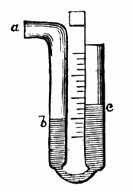
Uses and Appl. The open end (a) is kept, by means of a vane, presented to the wind, which acting on the surface of the water, or other liquid in b, raises the level of the fluid in the arm (c). The difference of the level of the fluid in the two arms of the instrument is the measure of the force of the wind. To estimate the draught of a flue or chimney, the arm (c) is placed in the chimney, and the orifice (a) in the apartment.[61]
ANEMOM′ETRY. Syn. Anemome′tria, L.; Anémometrie, Fr.; Windmessen, Ger. In meteorology, physics, &c., the art or act of measuring the velocity or force of the wind, or of ascertaining its direction.
ANEM′ONE (ă-nĕm′-o-ne). Syn. Anem′ony; Anem′one, L., Gr.; Anémone, Fr. The wind-flower. In botany, a genus of beautiful flowering herbaceous plants, of the nat. ord. Ranunculaceæ. The double flowers of some of the species are among the most elegant ornaments of our gardens. Others are used in medicine. They are all acrid and stimulating.
Anem′ones, Sea. (-o-nēz). Syn. An′imal-flowers‡, Sea sun′flowers‡. Animals of the genus actin′ia, so called from the resemblance of their claws or tentacles, when expanded, to the petals of a flower. They are of various colours, are generally fixed by one end to rocks or stones in the sand, and are very voracious, being accused of occasionally swallowing a mussel or a crab as large as a hen’s egg for a meal. They belong to the highly organised polypes of Cuvier.
ANEMON′IC ACID. See Anemonine.
ANEMONIN. A crystalline substance found in the leaves of several species of anemone, viz. A. pulsatilla, A. pretensis, A. nemorosa. Water distilled from these leaves, after some weeks, deposits a colourless inodorous substance, which softens at 150° C, giving off water and acrid vapours. It is purified by repeated crystallisation from boiling alcohol. Anemonin is a poisonous body. It causes slight irritation when applied to the skin. By the action of alkalies anemonin is transferred into anemonic acid.
ANEM′OSCOPE (ăn′-e—Brande, Mayne). Syn. Anemosco′pium, L.; Anémoscope, Fr.; Anemoskop, Ger. An instrument to measure the force and velocity of the wind. See Anemometer.
AN′EROID (-royd)[62]. In physics, &c., not fluid, or not depending on water or a fluid for its action; applied to a certain form of barometer (which see)
ANEURISM. A tumour on an artery, produced by the rupture of the inner coat of the vessel, and the blood getting between it and the outer coat.
ANGEL′ICA (-jĕl′-). [L., Port., Sp.; Ph. E. & D.] Syn. Garden Angelica; Angélique, Fr.; Angelika, A.-wurzel, Angelkraut, Ger. The angelica archangel′ica of Linnæus, an aromatic herbaceous plant with a biennial, fleshy root, indigenous to the north of Europe, but frequently found wild in England, and largely cultivated in our gardens. Dried root (ANGELICA, Ph. E.), aperient, carminative, diaphoretic, and tonic; much esteemed by the Laplanders, both as food and medicine;—fruit or seed (Angelica, Ph. D.) resembles the root, but is weaker. The whole plant has been extolled as an aromatic tonic. As a masticatory, it leaves an agreeable glowing heat in the mouth. The aromatic properties of this plant depend on a peculiar volatile oil and resin.
Uses, &c. It has been recommended in diarrhœa, dyspepsia, debility, and some fevers; but is now seldom used in medicine. Dose, 30 gr. to 1 dr. The dried root and seeds are used by rectifiers to flavour gin and liqueurs; and the fresh root, tender stems, stalks, &c., are made by the confectioners into an aromatic candy. See Candying, Liqueurs, &c.
Angelica Atropurpu′′rea. [Linn.] Syn. Amer′ican Angelica; Angelica, Ph. U. S. Hab. North America. Resembles garden angelica, but placed by some botanists in a separate, though allied genus. It is a popular remedy for flatulent colic, indigestion, and cardialgia, in the United States; and is there regarded as tonic, cordial, and aphrodisiac.
ANGEL′IC ACID. HC5H7O2. A volatile substance, noticed by L. A. Buchner, jun., in angelica-root. It has a pungent sour smell, and a biting acid taste; is sometimes fluid and oleaginous, and sometimes crystallised in striated prisms.[63]
ANGO′LA Syn. Ango′la-wool, Ango′′ra-w., Ango′na-w., &c.; Poil de chevron d′Angora, Fr.; (Engoor′, Engour′, or Engu′ri) Tiftic, Tur. The wool of ‘ca′pra Angoren′sis’ or the Angora-goat, of which the shawls of Cashmere are made, and others in imitation of them. It is also used to make plush, light cloths for paletôts which are repellent of wet, &c.; and is extensively employed in France in the manufacture of lace more brilliant than that of Valenciennes and Chantilly, and at half the price. See Alpaca, Shawls, Wool, &c.
ANGOSTU′RA, Angustu′ra. (-tūre′-ă). See Cusparia.
Angostura, False. See Brucea, Cusparia and Strychnos.
ANGOSTU′′RINE, Angustu′rine (-ĭn). See Cusparin.
ANHYDRIDE. Most, if not all modern chemists, adopting Gerhardt’s practice of limiting the title of acid to a particular class of substances which contain hydrogen, now regard all true acids as salts of hydrogen. Formerly many bodies, such as silica or white arsenic, were looked upon as acids, though if we adopt the foregoing definition they are not really so until they have combined with water. Such bodies, because they contain no hydrogen, are now distinguished as anhydrides; the substances, for example, familiarly known as carbonic, sulphurous, and phosphoric acids, must, upon the above principle, be designated carbonic, sulphurous, and phosphoric anhydrides. We may also define an anhydride to be an oxide which forms an acid on treatment with water.
ANHY′DROUS (-drŭs; an′hydrous, as marked by Brande, is less usual). Syn. An′hydrus, L.; Anhydré, Fr.; Wasserfrei, Ger. Free from water; dry. In chemistry and mineralogy, a term frequently applied to substances, as acids, alcohol, gases, salts, minerals, &c., which do not contain either free or combined water. Gases may generally be rendered anhydrous by passing them through a tube containing fused chloride of calcium, or (e.g. AMMONIA and two or three others) quick-lime, in coarse powder; and some of them, by passing them through concentrated sulphuric acid. Salts may generally be dried by cautiously submitting them to the action of heat, or by exposure to a very dry atmosphere; and alcohol, and many other volatile fluids, by careful distillation from chloride of calcium, or some other highly hygrometric substance.
AN′IL. [Fr., Sp., L.] The indigof′era anil of botanists—one of the plants yielding ‘indigo’—a native of America, but now largely cultivated in the East Indies. See Indigo (and below).
AN′ILINE[64] (-een). [Eng., Fr.] C6H7N. Syn. Phenyl′amine; Anili′na, Anili′num, &c., L. A peculiar volatile organic base first noticed by Unverdorben in empyreumatic bone-oil, and afterwards obtained by Runge from coal-tar, and by Fritzsche, Zinin, A. W. Hofmann, and others, as a product of various reactions, processes, and decompositions, particularly those attending the destructive distillation of organic bodies.
Prep. Aniline is now almost invariably obtained, on the large scale, either directly or indirectly from coal-tar or indigo; and chiefly from the basic oil or naphtha, or the nitrobenzol, of which the former is the principal source. The following are the leading commercial and experimental processes:
1. From COAL-TAR or COAL-TAR NAPHTHA:—The basic oil or basic portion of coal-tar or coal-tar naphtha, forming the latter, denser, and least volatile products of the distillation or rectification of these substances, is strongly agitated, for some time, along with hydrochloric acid in slight excess, a glass globe, or, on the large scale, a suitable vessel of lead, or of enamelled iron, being employed for the purpose; the clear portion of the liquid (containing the hydrochlorates of the bases present) is then decanted and carefully evaporated over an open fire until acrid fumes begin to be disengaged, when it is again decanted or filtered; the clear liquor, or filtrate is next treated with potash or milk of lime in excess, by which the bases—chiefly aniline and chinoline—are liberated under the form of a brownish oil; the whole of the resulting mixture is now submitted to distillation, the portion which passes over at or about 360° Fahr., and which consists chiefly of crude aniline, being collected separately; the product is purified by rectification and recollection, once or oftener, at the same temperature, and, lastly, by fresh treatment with hydrochloric acid and careful distillation with excess of potash, or milk of lime, as before.
2. From NITROBENZOL:—a. (Zinin.) An alcoholic solution of nitrobenzol, after saturation with ammonia, is treated with sulphuretted hydrogen, until, after some hours, a precipitation of sulphur takes place; the brown liquid is then repeatedly saturated with fresh sulphuretted hydrogen, until no more sulphur separates, the reaction being aided by occasionally heating or distilling the mixture; an excess of acid is next added, and, after filtering the liquid, and the removal of the alcohol and unaltered nitrobenzol by ebullition or distillation, the residuum is lastly distilled with caustic potash, in excess. The ANILINE found in the receiver may be rendered quite pure by forming it into oxalate of aniline, repeatedly crystallising the salt from alcohol, and finally distilling it with excess of caustic potassa, as before.
The following is a cheaper and more convenient process; and probably the best, or one of the best, that has yet been invented for obtaining aniline:—
b. (M. Béchamps.) From nitrobenzol distilled along with basic protacetate of iron; or, what is better, by distilling a mixture of iron-filings, 2 parts, and acetic acid, 1 part, with about an equal volume of nitrobenzol, the reaction being assisted, whenever the effervescence flags, by the application of a gentle heat. The liquor found in the receiver consists of aniline and water, from which the first, forming the lower portion, is obtained, after sufficient repose in a separator; or more easily, by adding a very little ether, which by dissolving in the aniline, causes it to rise to the surface, when it is at once decanted. A very spacious glass or earthenware retort must be employed in the process, as the mass swells up violently; and it must be connected with the receiver, on the small scale, by means of a Liebig’s condenser, and, on the large scale, by an ordinary worm-pipe and tub, kept in good action by a sufficient flow of cold water.
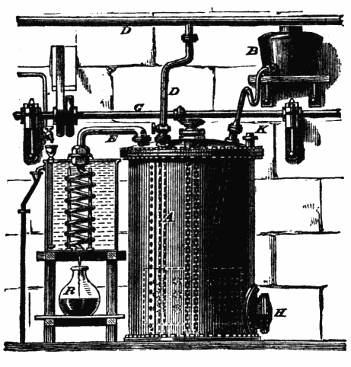
The apparatus for carrying out Béchamp’s method was devised by Nicholson, and is exhibited in the subjoined plate.
“It consists essentially of a cast-iron cylinder (A) of 10 hectolitres (220 cubic gallons) capacity. A stout iron tube is fitted to this vessel, reaching nearly to the bottom of the cylinder. The upper part of this tube is connected with the machinery (G), while the surface of the tube is fitted with steel projections. The tube serves to admit steam, as well as acting as a stirring apparatus. Sometimes, instead of this tube, a solid iron axle is employed, and in this case there is a separate steampipe (D). Through the opening at K the materials for making aniline are put into the apparatus, while the volatile products are carried off through E. H serves for emptying and cleaning the apparatus. The S-shaped tube connected with the vessel B acts as a safety valve. When it is intended to work with this apparatus there is poured into it through K 10 parts of acetic acid at 8° B. (sp. gr. 1·060), previously diluted with six times its weight of water; next there are added 30 parts of iron filings, or cast-iron borings, and 125 parts of nitrobenzol, and immediately after the stirring apparatus is set in motion. The reaction ensues directly, and is attended by a considerable evolution of heat and vapours. Gradually more iron is added until the quantity amounts to 180 parts. The escaping vapours are condensed in F, and the liquid condensed in R is from time to time poured back into the cylinder A. The reduction is finished after a few hours.”
3. From INDIGO:—Powdered indigo is added to a boiling and highly concentrated solution of caustic potash, as long as it dissolves and hydrogen gas is liberated; the resulting brownish-red liquid is evaporated to dryness, and the residuum is submitted to destructive distillation in a retort, which, owing to the intumesence of the mass, should be strong and spacious. The ANILINE is found in the receiver under the form of a brownish oil mixed with ammoniacal liquor, and by separation from the latter, and subsequent rectification, is obtained nearly colourless. It may be further purified, as in the preceding processes.—Prod. 18 to 20% of the indigo employed.
4. By fusing, with proper precautions, a mixture of isatine and hydrate of potassium (both in powder); a retort connected with a well-cooled receiver, being employed as the apparatus. Said by Profs A. W. Hofmann and Muspratt to be “the most eligible process for isolating” aniline.[65]
5. From anthranilic acid mixed with powdered glass or sand, and rapidly heated in a retort.
6. By treating an alcoholic solution of benzine with a little zinc and hydrochloric acid.
7. By heating phenyl-alcohol with ammonia in sealed tubes.
In Zinin’s process the nitrobenzol is dissolved in alcohol, and the solution, after the addition of ammonia, is saturated with sulphuretted hydrogen. After standing some time the solution deposits a large quantity of sulphur, and the liquid yields aniline.
Many other reducing agents have been proposed for the conversion of nitrobenzol into aniline, such as arsenite of sodium, powdered zinc, &c., but on the large scale they have all been found inferior to the process of Béchamp. Kremer’s process consists in heating one part of nitrobenzol in a proper apparatus with five of water and two and a half of zinc dust. When the reaction is completed the aniline, amounting to about 65% of the weight of the benzol, is distilled off in a current of steam.
Prop., &c. A thin, oily, colourless liquid, with a faintly vinous odour, and a hot and aromatic taste; very volatile in the air; miscible in all proportions with alcohol and ether; very slightly soluble in water; neutral to ordinary test-paper, but exhibiting an alkaline reaction to dahlia-petal infusion and paper; dissolves camphor, sulphur, and phosphorus, and coagulates albumen; possesses a high refractive power; and precipitates the oxides of iron, zinc, and alumina, from solutions of their salts, and neutralises the acids, like ammonia. With the acids it forms numerous crystallisable compounds of great beauty, and which are easily formed, and are precisely analogous to the corresponding salts of ammonia. These, on exposure to the air, acquired a rose colour, in many cases gradually passing into brown. Its boiling-point is 359° to 360° Fahr.; sp. gr. 1·028.
Tests.—1. Chromic acid gives a deep greenish or bluish-black precipitate with aniline and its salts:—2. Hypochlorite of lime strikes an extremely beautiful violet colour, which is soon destroyed:—3. The addition of two or three drops of nitric acid to anhydrous aniline produces a fine blue colour, which, on the application of heat, passes into yellow, and a violent reaction ensues, sometimes followed by explosion:—4. With bichloride of platinum it yields a double salt (platino-chloride of aniline) analogous to the like salt of ammonia. These reactions distinguish it from all other substances.
Commercial aniline is a mixture consisting in great part of aniline, paratoluidine (solid), and orthotoluidine in variable proportions. In addition it contains small amounts of metatoluidine, nitrobenzol, odorine, &c., but for all practical purposes it may be regarded as a mixture of aniline and toluidine. These anilines are obtained from a portion of the light coal-tar naphtha boiling between certain temperatures, by treating it first with nitric acid to convert it into the nitro-compounds, and then reducing these with iron and acetic acid, as already described under Béchamp’s process. It is very plain that as the coal-tar naphtha contains variable proportions of benzol and toluidine, the resulting product must also vary in the quantities of aniline and toluidine it will contain. In order to distinguish between various samples of commercial aniline, Reimann submits them to fractional distillation and compares the results. He places 100 c. c. of the sample to be tested in a retort fitted with a thermometer and heated by means of an oil bath. The liquid as it distils is received in a narrow graduated cylinder, and the amount that passes over between every 5° C. (9° F.) is noted.
In order to obtain standards for comparison he first distilled a sample of light aniline, or kuphaniline, as he terms it, then one of heavy aniline or baraniline; afterwards mixtures of the two in varying proportions. In the accompanying table the results are given.
CentigradeK.100908580756050250
B.010152025405075100
Below 180° 81⁄2721⁄251⁄27...751⁄2...
180°—185° 5450291⁄22251⁄2741⁄221⁄22
185°—190° 3434561⁄2551⁄2551⁄23771⁄241⁄211⁄2
190°—195° ...571⁄281⁄2153342178
195°—200° ............9...193618
200°—205° ............41⁄216101639
205°—210° ..................31⁄2819
210°—215° .....................41⁄27
Residue 31⁄24481⁄231⁄2761⁄2551⁄2
To ascertain the quality of any sample it is only necessary to distil it in the manner already described, and compare the results with those in the above table.
(For further information consult Wagner’s ‘Chemical Technology,’ Calvert’s ‘Dyeing and Calico Printing,’ edited by Stenhouse and Groves; Crooke’s ‘Practical Handbook of Dyeing and Calico Printing,’ Ure’s Dictionary, edited by Hunt.)
Uses, &c. Chiefly in dyeing, for the production of colouring matter of various rich shades of purple and violet, some approaching pink, by the action of chromic acid; and of a splendid crimson, by the action of various oxidising agents. It forms the basis of the celebrated new dyes for silks lately patented by Mr W. H. Perkin, and others, and which are not only more delicate and gorgeous in tint, but also more permanent, than any produced by other substances.
Besides numerous salts, various substitution compounds of aniline have been formed, all of which possess vast scientific interest, and several are likely to prove of importance in the arts. See Dyeing, Indigo, Tar Colours, &c. (also below.)
Aniline, Chro′mates of. Prep. 1. (NEUTRAL CHROMATE.) From sulphate or oxalate of aniline and chromate of potash, by double decomposition.
2. (BICHRO′MATE:—Mr W. H. Perkin.) Sulphate of aniline and bichromate of potash, in equivalent quantities, are separately dissolved in water, and the solutions, after being mixed, are allowed to stand for several hours. The whole is then thrown upon a filter, and the black precipitate which forms is washed and dried. It is next digested in coal-tar naphtha (—? benzol), to extract a brown resinous substance; after which it is digested in alcohol, to dissolve out the colouring matter (BICHROMATE OF ANILINE), which is left behind on distilling off the spirit, as a coppery friable mass. Patented.
Aniline, Cy′anide of. Benzonitrile.
Aniline, Ox′alate of. (C6H7N)2C2O4. Obtained by saturating an alcoholic solution of oxalic acid with aniline; the salt separating as a crystalline mass. It is very soluble in hot water; much less so in cold water; only slightly soluble in alcohol; and insoluble in ether. It may be crystallised from hot water or boiling alcohol. Used chiefly to form other salts.
Aniline, Sul′phate of. (C6H7N)2SO4. Prepared by saturating aniline with dilute sulphuric acid, and gently evaporating the liquid until the salt separates. By re-solution in boiling alcohol, it crystallises out, as the liquor cools, under the form of very beautiful colourless plates, of a silvery lustre. It is freely soluble in water, and in hot alcohol; scarcely soluble in cold alcohol; and insoluble in ether. It is chiefly employed in the preparation of the new aniline dyes.
ANIMAL′CULE (-kūle). [Eng., Fr.; pl. animal′cules.] Syn. Animal′culum (pl., animal′cula[66]), L.; Thierchen, Ger. In zoology and physiology, a microscopic animal, or one so extremely small, that it is either invisible, or not distinctly discernible, without the aid of a lens or microscope; more especially one that is not perceptible to the naked eye. “A mite was anciently thought the limit of littleness; but there are animals 27,000,000 of times smaller than a mite.” A thousand millions of some of the animalcula found in common water are said to be collectively of less bulk than a single grain of sand; yet their numbers are so prodigious as sometimes to give the fluid they inhabit a pale red or yellow tinge. The milt of a single codfish is said to contain more of these minute animals than there are people in the whole earth. Animalcula were first scientifically observed by Leuwenhoek about the year 1677. Assisted by the microscope he unveiled, as it were, he created a new world for future naturalists and microscopists to explore.
“Take any drop of water,” says Professor Rymer Jones, “from our rivers, from our lakes, or from the vast ocean itself, and place it under the microscope; you will find therein countless living beings moving therein in all directions with considerable swiftness, apparently gifted with sagacity, for they readily elude each other in the active dance they keep up.... Increase the power of your glasses, and you will soon perceive inhabiting the same drop, other animals compared to which the former were elephantine in their dimensions, equally vivacious and equally gifted. Exhaust the art of the optician, strain your eyes to the utmost, until the aching sense refuses to perceive the little quivering movement that indicates the presence of life, and you will find that you have not exhausted nature in the descending scale.”
Amongst the most remarkable discoveries of modern science must be reckoned that of fossil animalcules in such abundance as to form the principal part of extensive strata. This discovery is due to Ehrenberg, who found the Polierschiefer (the polishing slate or tripoli) of Bilin to be almost entirely made up of the siliceous shields of a minute fossil animalcule, the length of one of which is about 1⁄288th of a line, so that about 23,000,000 of animalcules must have gone to form a cubic line, and 41,000,000,000 to form a cubic inch of the rock. Ehrenberg succeeded in discovering the formation of similar strata in deposits of mud at the bottom of lakes and marshes, the mud swarming with living animalcules, probably in their turn to be fossilised. The bergmehl, or mountain meal of Sweden and other parts of Europe, which is sometimes used as an article of food, is entirely composed of the remains of animalcules; not merely, however, of their siliceous shields, for it contains a considerable per-centage of dry animal matter. Some animalcules prefer waters impregnated with iron, and their death gives rise to an ochreous substance in which iron is a principal ingredient.
AN′IME (ăn′-ĭm-e). [Eng., L., Sp.] Syn. Gum-an′ime, A.-res′in; Animé, Fr.; Animeharz, Kourbarillharz, Ger.; Courbaril, Jutaiba, Nat. A pale brownish-yellow, transparent, brittle resin, which exudes from the hymenæa courbaril (Linn.) or locust-tree, the h. martiana, and other species of hymenæa growing in tropical America. It contains about ·2% of volatile oil, which gives it an agreeable odour; melts without decomposition; is (nearly) insoluble in alcohol and in caoutchoucine, but forms a gelatinous mass in a mixture of the two. (Ure.) It burns readily, emitting a very fragrant smell. Sp. gr. 1·054 to 1·057.
Uses, &c. As a fumigation in spasmodic asthma; in solution as an embrocation; and in powder as a substitute for gum guaiacum. In this country it is chiefly employed to make varnishes and pastilles (which see).
AN′ION (-y′ŭn—Br., We.; ă-nī′-ŭn—Smart). Literally, ‘upward going,’ in electro-chemistry, a substance which is evolved from the surface where the electrical current is supposed to enter the electrolyte; an electro-negative body, or one which passes to the positive pole, or anode, in electrolysis, as opposed to a CATION. See Anode, Ions, &c.
AN′ISATED. Syn. Anisa′tus, L.; Anisé, Fr. In pharmacy, the art of the liqueuriste, confectioner, &c., applied to articles or preparations impregnated or flavoured with aniseed.
AN′ISE (-ĭs). Syn. Ani′sum, Pimpinel′la a. (Linn.), A. officina′le, L.; Anis, Fr.; Anis, Gemeiner Anis, Ger. An annual plant of the nat. ord. Umbelliferæ (DC.). Hab., Egypt, Scio, and the Levant; but largely cultivated in Malta, Spain, Germany, and various other parts of Asia and Europe. “A considerable quantity is cultivated at Mitcham, in Surrey, chiefly for the use of the rectifiers of British spirits.” (Stephenson.) Fruit, aniseed. (See below.)
AN′ISEED. Syn. An′ise, An′ise-seed; Sem′ina ani′si, Fruc′tus a., L.; Anis, A. vrai, Graines d’anis, Semence d’anis, Fr.; Anis, Anisamen, Ger.; Anis, Sp.; Anice, It. The aromatic fruit or seed of the pimpinella anisum just noticed.
Prop., Uses, &c. Its aromatic properties depend on the presence of volatile oil. The seed and oil, and a spirit and a water prepared from them, are officinal in the pharmacopœias. Both the seed and its preparations are reputed stimulant, stomachic, carminative, pectoral, diuretic, and emmenagogue. They are commonly used to relieve flatulence and colicky pains, and to prevent the griping effects of certain cathartics; and they have long been popular remedies for coughs, colds, and other breath ailments. They are esteemed especially useful in warming the stomach and expelling wind, particularly during infancy and childhood; the distilled or flavoured water being usually employed. Nurses also take the latter to promote the secretion of milk, to which it at length imparts its peculiar odour and flavour. In veterinary practice the powdered seed is used as a carminative, pectoral, and corroborant. The essential oil is said to be poisonous to pigeons. (Vogel; Hillefield.) Aniseed is principally used to flavour liqueurs, sweetmeats, and confectionery.—Dose (of the powder), 10 gr. to 1 or 2 dr.; for a horse, 1⁄2 to 1 oz.; cattle, 3⁄4 to 2 oz.
Pur., &c. Powdered aniseed is nearly always adulterated, the adulterant being generally linseed meal. Sometimes, as for the horse, the latter is entirely substituted for it, a few drops of oil of aniseed being added to give it smell. The adulteration is not readily detected by the uninitiated, owing to the strong odour of aniseed; but readily by the microscope. The fruit of myrrhis odorata (sweet cicily), and of illicium anisatum (star-anise), also possess the odour and flavour of common aniseed; indeed, most of the essential oil now sold as ‘oil of aniseed’ is star-anise oil. See Liqueurs, Oils, Spirits, Waters, &c.
Anise, Star′. The fruit or seed of illi′′cium anisa′tum (Linn.), an evergreen tree growing in Japan and China. The odour and properties of both the seed and oil greatly resemble those of common anise. They are both employed by the liqueuriste. See Aniseed (above), &c.
ANISETTE′ (ăn-ĭz-ĕt′). [Fr.] Aniseed cordial. See Liqueurs.
ANISOCHILUS CARNOSUM. Nat. order Labiatæ. An Indian plant. It is stimulant, diaphoretic, and expectorant; is used in quinsy, and by the native doctors of Travancore in catarrhal affections. Dr Bidie, an Indian practitioner, characterises it as a mild stimulating expectorant, and as such particularly useful in the coughs of childhood. Its properties depend upon a volatile oil.
ANISOMELES MALABARICA. An Indian plant. Nat. order Labiatæ. Few plants are held in higher esteem, or more frequently employed in native practice in Southern India, than this. An infusion made of the leaves is very generally used in affections of the stomach and bowels, catarrhal complaints, and intermittent fevers.
Dr Wright says that in addition to its internal use in the case of fevers, patients are made to inhale the vapour of a hot infusion, so as to induce copious diaphoresis. An infusion of the leaves is reported to be powerfully diaphoretic, and to have been found very useful in the low continuous fevers of the natives. An oil obtained by distillation from the leaves is likewise stated to be an effectual external application in rheumatism.
ANI′SUM. Aniseed.
ANNEAL′ING. Syn. Nealing†§; Le recuit, Fr.; Das anlassen, Ger. The art of tempering by heat: appropriately, the process by which glass, porcelain, &c., are rendered less frangible, and metals which have become brittle by fusion, or long-continued hammering, again rendered tough and malleable.
Glass vessels, and other articles of glass, are annealed by being placed in an oven or apartment near the furnaces at which they are formed, called the ‘leer,’ where they are allowed to cool very slowly, the process being prolonged in proportion to their bulk.
Steel, iron, and other metals are annealed by heating them and allowing them to cool slowly on the hearth of the furnace, or in any other suitable place, unexposed to the cold. Steel is also annealed by being made red-hot, and in that state is placed in a heap of dry saw-dust till cold, when it will be found quite soft.
Cast-iron is rendered tough and malleable, without ‘puddling,’ by embedding it in ground charcoal or hæmatite, and thus protected, keeping it exposed at a high temperature for several hours, after which the whole is allowed to cool very slowly.
Prince Rupert’s drop may be mentioned as an example of unannealed glass, and common cast-iron of unannealed metals, to which heads the reader is referred.
ANNOT′TA. Syn. Anot′to, Annat′to, Annat′ta; Arnat′to, Arnot′to, &c.; Orlea′na, Ter′ra o.*, &c., L.; Roucol, Rocou, Roucou, Fr.; Orleans, Ger. A colouring matter forming the outer pellicle of the seeds of the bix′a orella′na (Linn.), an exogenous evergreen tree, common in Cayenne and some other parts of tropical America, and now extensively cultivated in both the E. and W. Indies. It is usually obtained by macerating the crushed seeds or seed-pods in water for several weeks, ultimately allowing the pulp to subside, which is then boiled in coppers to a stiff paste, and dried in the shade. Sometimes a little oil is added in making it up into cakes or lumps. A better method is that proposed by Leblond, in which the crushed seeds are simply exhausted by washing them in water (—? alkalised), from which the colouring matter is then precipitated by means of vinegar or lemon-juice; the precipitate being subsequently collected, and either boiled up in the ordinary manner, or drained in bags and dried, as is practised with indigo. Annotta so prepared is said to be four times as valuable as made by the old process.
Prop. Good annotta is of a brilliant red colour; brighter in the middle than on the outside; feels soft and smooth to the touch; has a good consistence, and a strongly characteristic but not a putrid smell. It is scarcely soluble in water; freely soluble in alcohol, ether, oils, and fats, to each of which it imparts a beautiful orange colour, and in alkaline solutions which darken it; acids precipitate it of an orange red hue; strong sulphuric acid turns it blue. Its most important property is the affinity of its colouring matter for the fibres of silk, wool, and cotton.
Pur. Annotta is very frequently adulterated; indeed, nearly always so. To what extent the sophistication of annotta is carried may be judged from the statement of Mr Blyth, who says that on examination of thirty-four samples of various kinds, as imported and obtained from English makers and as purchased from dealers, he found only two that were genuine. As annotta is often used to give colour to different articles of diet, it is important that it should be as pure as possible; otherwise injurious effects detrimental to health may be caused by partaking of any food to which it is added. Now, amongst the list of adulterants given below are three, at least, unmistakeable poisons, viz. red lead, orange chrome, and sulphate of copper. It is but right to state of the first of these substances (red lead) that Mr Blyth says it is extremely doubtful whether it is now employed to the extent it formerly was. He also ascribes its presence in annotta to the impure Venetian red which is used, the employment of this colour being a necessity because of the large quantities of flour and lime which are mixed with the annotta, which thereby becomes so reduced in colour that it is essential to have recourse to salt, alkalies, and the red earths to restore it to its original standard. The adulterants are generally meal, flour, or farina, and often chalk or gypsum, with some pearlash and oil, or even soap, to give it an unctuous character; turmeric, Venetian red, red ochre, orange chrome, or even red lead, to give it ‘colour,’ and common salt, and sometimes even sulphate of copper, to prevent decomposition—the last two being poisonous. Sometimes a little carbonate of ammonia is also added to it to improve the colour. When quite pure it contains about 28% of resinous colouring matter, and 20% of colouring extractive matter (Dr John), and should leave only a small quantity of insoluble residuum after digestion in alcohol, whilst the ash resulting from its incineration should not exceed 11⁄2 to 2%. The quantity, colour, &c., of the ash will give an easy clue to the inorganic adulterants, if any are present, which may be then followed up by a chemical examination. The presence of red lead may be detected by heating it on a piece of charcoal in the reducing flame of the blowpipe, by which a small bead of metallic lead will be obtained. If it contains chalk, ochre, gypsum, &c., the undissolved residuum of the washed ash gives the amount of the adulteration (nearly).
Microscopical Examination of Annotta.—When annotta is subjected to a microscopical examination the outer red portion will be found to present an almost homogeneous appearance, whilst the surface of the seed proper will be seen to consist of narrow or elongated cells or fibres disposed in a vertical direction, while the inner white portion will be seen to be made up of cells filled with starch corpuscles, well defined, of medium size, and resembling in the elongated and stellate hilum the starch granules of the pea and bean.
When the annotta is manufactured, and an unadulterated sample is examined, but little structure is met with. Portions of the outer cells may be seen; and in those samples which in the course of their preparation have not been subjected to the action of boiling water, a few starch granules may be observed.
Since annotta, when manufactured, presents so few evidences of structure, we are easily able, with the microscope at our command, to detect the presence of most foreign vegetable substances. These consist of turmeric powder, wheat, rye and barley starch, and sago flours. The salt and alkali present in the fraudulent annotta generally greatly alter the appearance of the turmeric. Most of the colouring matter of the cells is discharged, so that the starch corpuscles contained within them become visible. Loose starch granules of turmeric may also be frequently seen, and in a much enlarged condition, owing to the action of the alkali upon them.
The following process for conducting the assay of annotta is given by Mr Blyth:—
“In order to estimate the commercial value and detect adulteration in a sample, the quickest and best way is the following: Weigh accurately a gramme in a small platinum dish; dry in the water-bath for a couple of hours, then weigh; the loss is the water. Finely powder, and digest it for some hours in alcohol; then boil, filter and treat with successive portions of alcohol until all the colouring-matter is dissolved; filter, evaporate the filtrate down and weigh; the result is the resin. The insoluble portion will in a good commercial specimen consist of woody matter, extractive, gluten, &c. For the ash weigh another gramme in a platinum dish; dry for a short time over the water-bath; then powder and burn until it ceases to lose weight. It is prudent to fuse a little on charcoal with carbonate of soda before the blow-pipe before burning it in a platinum vessel, as there may be lead in the annotta. The ash should then be submitted to the various reagents in order to detect lime, alumina, &c. A correct determination of ash and resin is all that is required to definitely pronounce upon the purity or impurity of the samples.”
The following is the analysis of a fair commercial sample:—
The sample was in the form of a paste, colour deep red, odour peculiar, but not disagreeable.
Water24·2
Resinous colouring matter28·8
Ash22·5
Starch and extractive matter24·5
———
100·0
The following is an analysis of an adulterated specimen. The sample was in a hard cake of a brown colour, with the maker’s name stamped upon it, and marked “patent;” texture hard and leathery, odour disagreeable:
Water13·4
Resin11·0
Ash, consisting of iron, chalk, salt, alumina, silica48·3
Extractive matter27·3
———
100·0
Thus, in the one the resin was 28%, the ash 22; in the other the resin was only 11%, the ash no less than 48%.
Uses, &c. To colour varnishes and lacquers; as a pigment for painting velvet and transparencies; as a colouring matter for cheese (1 oz. to 1 cwt. of curd), for which purpose it is not injurious, if pure; and as a dye-stuff for cotton, silk, and wool, particularly the second, to which it imparts a beautiful orange-yellow hue, the shade of which may be varied from ‘aurora’ to deep orange by using different proportions of pearlash with the water it is dissolved in, and by applying different mordants before putting it into the dye-bath, or different rinsing liquids afterwards. The hues thus imparted are, however, all more or less fugitive.
Annotta Cake. Syn. Flag annotta; Orlea′na in fo′liis, L. From Cayenne; bright yellow, firm and soft to the touch; in square cakes, weighing 2 or 3 lbs. each.
Annotta Egg. Syn. Lump annotta; Orlea′na in o′vulis, L. Generally inferior.
Annotta, Eng′lish. Syn. Trade a., Reduced’ a.; Orlea′na reduc′ta, L. A fraudulent mess commonly prepared from egg or flag annotta, gum tragacanth, flour, or farina, chalk, soap, train-oil, Venetian red, or bole, common salt, water, mixed by heat in a copper pan, and formed into rolls. Sold for genuine annotta, from which it is readily distinguished by its inferior quality and its partial solubility in alcohol.
Annotta, Liq′uid. See Solution of Annotta (below).
Annotta, Pu′′rified. See Orelline.
Annotta Roll. Syn. Orlea′na in rot′ulis, O. in bac′ulis, L. From the Brazils; hard, dry, brown outside, yellow within. When pure, this is the variety most esteemed, and the one preferred for colouring cheese.
Annotta, Solu′tion of. Syn. Essence of Annotta, Extract of a., Annotta-dye, &c.; Solu′tio orlea′næ, Extrac′tum o., &c., L. A strong aqueous solution of equal parts of annotta and pearlash, the whole being heated or boiled together until the ingredients are dissolved. Sold in bottles. See Annotta (above), Nankeen Dye, &c.
ANNUALS. Plants which bear flowers and fruit in the same year when raised from seed.
AN′O-. [Gr.] In composition, upwards, &c.; as in anocathar′tic (emetic).
AN′ODE. Literally, ‘upward way,’ in electro-chemistry, the ‘way in,’ or that by which the electric current is supposed to enter substances through which it passes, as opposed to the CATHODE, or that by which it goes out; the positive pole of a voltaic battery.
AN′ODYNE (-dīne). Syn. Ano′dynus (-dĭnŭs-), L.; Anodin, Fr.; Schmerzstillend, Ger. That allays pain; soothing; atalgic.
Anodynes. Syn. Ano′dyna (sing., ano′dy̆̆num), L.; Anodins, Remèdes a., Fr. In medicine and pharmacy, substances and agents which allay pain. Some (as the PAREGORICS) act by actually assuaging pain; others (HYPNOTICS) by inducing sleep; whilst a third class (NARCOTICS) give ease by stupefying the senses, or by lessening the susceptibility to pain. Among the principal anodynes are opium, morphia, henbane, camphor ether, chloroform, chloral hydrate, and other medicines of the like kind; to which must be added spirituous liquors, wines, and the stronger varieties of malt liquor. “The frequent use of anodynes begets the necessity of their continuance.” (W. Cooley.)
Anodyne, In′fantile (-īle). Syn. Ano′dynum infan′tile (-tĭl-e), L. Prep. Take of syrup of poppies, 1 oz.; aniseed-water, 3 oz.; French brandy, 3⁄4 oz. (or rectified spirit, 1⁄2 oz.); calcined magnesia, 1⁄4 oz.; mix. An excellent anodyne and antacid for infants.—Dose. A small teaspoonful as required.
ANODYN (Müller, Berlin.) Chiefly for rheumatic pains, toothache, &c. Oil of rosemary, 30 drops; oil of thyme, 10 drops; camphor, 5 grms.; spirit of ammonia, 12 grms.; spirit, 60 grms. (Hager.)
ANODYN′IA (-dĭn′-y′ă). Freedom from pain; anæsthesia.
AN′OREXY. Syn. Anorex′ia, L.; Anorexie, Fr., Ger. In pathology, want of, or morbidly diminished appetite, without loathing of food. It is usually symptomatic of other affections. See Appetite, Dyspepsia, &c.
ANOSMIN FOOT POWDER (Dr Oscar Bernar, Vienna). “An unfailing remedy for sweaty feet and bad odour of the feet.” Powdered alum, 21 parts; maize meal, 1 part. (Hager.)
ANOSMIN FOOT WATER (Koch), for a similar purpose. An aqueous solution of tartaric acid.
ANO ZABAGLIONE (-băl-y′ō′-nā). Prep. Put 2 eggs, 3 teaspoonfuls of sugar, and 2 small glassfuls of sherry or marsala, into a chocolate cup, placed in boiling water, or over the fire, and keep the mixture rapidly stirred until it begins to rise and thicken a little; then add 1 or 2 teaspoonfuls of orange-flower water or rose water, and serve it up in wine-glasses. A pleasant Italian domestic remedy for a cold.
ANT (ănt). Syn. Emm′et, Pis′mire*‡ (pĭz′-); Formi′ca, L.; Fourmi, Fr.; Ameise, Ger.; Æmet, Sax. This well-known little insect belongs to the family formic′′idæ, and the order hymenop′tera. Like the bee, it is a social animal, lives in communities which may be compared to well-regulated republics, and is of three sexes—male, female, neuter. Those belonging to the last alone labour and take care of the ova and young. The red ant contains FORMIC ACID (acid of ants), and a peculiar RESINOUS OIL. Both of these may be obtained by maceration in rectified spirit. A tincture so prepared, and flavoured with aromatics, constitutes Hoffman’s Eau de Magnanimité, once greatly esteemed as an aphrodisiac. See Formica, Formic Acid, Formyle, &c.
ANTAC′ID (-tăs′-ĭd). Syn. Antac′idus, L.; Antacide, &c., Fr.; Säuretilgend, &c., Ger. An agent which neutralises acids or removes acidity. (See below.)
ANTAC′IDS (-tăs′-ĭdz). Syn. Antac′ida, L.; Antacides, &c., Fr. Antacid substances. In medicine, &c., substances which remove or prevent acidity of the stomach, and thus tend to relieve heartburn, dyspepsia, and diarrhœa.
The principal antacids are potassa, soda, ammonia, lime, and magnesia, with their carbonates and bicarbonates. Ammonia is one of the most powerful, and when the acidity is conjoined with nausea and faintness, or is accompanied with symptoms of nervous derangement or hysteria, is undoubtedly the best; when great irritability of the coats of the stomach exist, POTASH is to be preferred; when the acidity is accompanied with diarrhœa, carbonate of lime (prepared chalk), lime-water, or Carara-water; and when with costiveness, MAGNESIA. They may be advantageously combined with some simple aromatic, as ginger, cinnamon, or peppermint. Their preparation, doses, administration, &c., will be found under each in its alphabetical place; and formulæ containing them, under Draughts, Lozenges, Mixtures, &c.
ANTAL′GICS (-tăl′-). Syn. Antal′gica, L. Medicines which relieve pain; anodynes.
ANTAL′KALINES (ănt-ăl′-kă-lĭnz). Syn. Antalkali′na, L. Agents or medicines which correct alkalinity. All the acids except the carbonic are antalkaline.
AN′TE-. In composition, before, contrary, opposite; generally in the first sense. See Anti-.
ANTEPIDEMICUM UNIVERSALE (H. Müller, Copenhagen). “A valuable universal remedy for all sorts of contagious diseases in man or domestic animals.” A fluid like water, with a weak, almost imperceptible, odour of acetic ether. Is composed of spring water, in which perhaps two or three drops of pure carbolic acid are dissolved, and a few drops of acetic ether added to disguise it. (Hager.)
ANTHELMIN′TICS, Anthelmin′thics (-thĕl-). See Vermifuges and Worms.
AN′THIARINE (-ĭn). See Anthirine.
ANTHOK′YAN. Syn. Succ′us vi′olæ prepara′tus, L. The expressed juice of the sweet or purple violet (vi′ola odora′ta—Linn.), defecated, gently heated in glass or earthenware to 192° Fahr., then skimmed, cooled, and filtered; a little rectified spirit is next added, and the following day the whole is again filtered. It must be kept well corked, and in a cool situation.
Uses, &c. Chiefly to make syrup of violets, to colour and flavour liqueurs, and as a chemical test. The London druggists obtain it principally from Lincolnshire.
AN′THONY’S FIRE, Saint (-to-nĭz). See Erysipelas.
ANTHOSENZ (Dr Hess, Berlin). General tonic and anodyne balsam. Oil of cloves, 4 parts; oil of geranium, 2 parts; pine-apple essence, 1 part; spirit, 50 parts; coloured with alkanet root. (Hager.)
AN′THOTYPE. See Photography.
ANTHRACENE. C14H10. Anthracene is one of the last products passing over in the dry distillation of coal-tar. Dr Calvert says it is “found most abundantly in the ten or fifteen per cent. which comes over between the temperature at which soft pitch is produced and that at which hard pitch is formed.”
Coal-tar contains very variable quantities of anthracene, those tars procured from coals which are richest in naphtha yielding it most abundantly. The coals of South Staffordshire give the largest yield, whilst the Newcastle coals give very little. In consequence of the solubility of anthracene in the oily hydrocarbons which accompany it, owing to “slight elevation of temperature, its extraction can only be carried on advantageously in cold weather.”
Gessert prepares anthracene from coal-tar as follows: He places the last pasty portions (the ‘green grease’) of the coal-tar distillation (which must not be carried beyond the point at which white pitch is formed) first in a centrifugal machine, and then in a hydraulic press at 40°, or subjects the mass heated to 30°-40° directly to pressure in a filter press. The pressed mass consists of about 60% of anthracene; for further purification it is boiled with light tar-oil or petroleum naphtha, and finally heated till it melts. The residue contains 95% of anthracene.
The following method for the purification of crude anthracene contaminated with oily matters is by Schuller:—The crude anthracene is carefully heated to commencing ebullition in a capacious retort connected with a tubulated receiver of glass or earthenware, the lower aperture of which is closed with a fine wire sieve. A strong current of air is then blown into the retort with a pair of bellows, whereby the anthracene is driven over in a very short time nearly pure and dry, and condenses in the receiver as a faintly yellowish showy mass. By this method a quantity of anthracene, the purification of which by re-crystallisation or sublimation would take several days, may be purified in as many hours; moreover it is obtained in a pulverulent form, in which it is very readily acted on by oxidising agents. Anthraquinone prepared from crude anthracene may also be obtained by this method in the form of a light yellow powder, resembling flowers of sulphur.
Fritzsche obtained anthracene in crystals exhibiting a beautiful violet colour by exposing a solution of anthracene in coal-tar naphtha to sunshine, until the solution became colourless.
Pure anthracene assumes the form of fluorescent transparent crystals, consisting of four- or six-sided plates, which when seen by transmitted light are of a very pale blue colour, but of a pale violet by reflected light.
The process for obtaining pure anthracene is a very troublesome one. Mr Crookes says:—“A trustworthy method for determining the amount of pure anthracene either in commercial anthracene or in crude green grease is the following:—The melting-point of the sample in question is first determined. 5 to 10 grammes are sufficient for the operation. It is put between thick folds of blotting paper, and placed under a press, between plates which have been previously warmed. The anthracene remaining upon the paper after pressure is weighed. The residue after it has been boiled with a certain quantity of alcohol, filtered, washed with cold alcohol and dried, is weighed as pure anthracene. It is now advisable to determine the melting-point of the purified product, which will generally be 210° C.” Anthracene is only slightly soluble in alcohol, but rather more so in ether and bisulphide of carbon. It is more soluble in hot, but less so in cold benzene. Petroleum boiling between 160° and 195° F. dissolves less than benzene.
“Anthracene dissolves in concentrated sulphuric acid with a green colour, and forms conjugated monsulpho or bisulpho-anthracene acid, according to the temperature employed. Chlorine and bromine give rise to substitution products. Nitric acid acts on it with great violence, with formation of anthraquinone, nitro-anthraquinone, and other compounds according to the temperature and proportion of the substances taken. With picric acid anthracene forms a compound crystallising in very bright ruby-red needles, which by the aid of the microscope are seen to be prisms. To prepare it a saturated solution of picric acid in water at 80° F. is mixed with a saturated solution of anthracene in boiling alcohol; on cooling the compound is deposited in the crystalline state. It is rapidly decomposed by an excess of alcohol into picric acid and anthracene, the solution assuming a yellow tint. This reaction can be employed to distinguish anthracene from naphthalene and other hydrocarbons, naphthalin under similar circumstances forming a compound which crystallises in fine golden yellow needles, whilst chrysene gives rise to clusters of very small yellow needles.” (Calvert’s ‘Dyeing and Calico Printing,’ edited by Stenhouse and Groves). Another characteristic of anthracene, noticed by Fritzsche, is its deportment under the microscope with a solution of binitro-anthraquinone in benzene. In this reaction fine rhomboidal scales of a beautiful pink colour are formed, the purity and brilliancy of the colour depending on the purity of the anthracene.
In the ‘Bul. Soc. Chim.,’ vii, 274, several reactions by which anthracene is formed are described by Berthelot, as by the action of heat on other hydrocarbons, or by passing the vapours of ethylene, styrolene, and benzene through a porcelain tube heated to bright redness.
A great number of products are procured from anthracene, by far the most important of these being artificial alizarin.
See Alizarin, Artificial.
AN′THRACITE (sīte). [Eng., Fr.] Syn. Anthrac′olite, Glance′-coal, Stone′-coal‡, Mineral char′coal*; Anthraci′tes, L.; Glanzkohle, Ger. A species of coal found in the transition-rock formation, consisting chiefly of dense carbon. It has a conchoidal fracture, a semi-metallic lustre, and a sp. gr. usually varying from 1·4 to 1·6. It burns without either flame or smoke, emits an intense heat, and leaves scarcely any ash; but it is difficult to kindle, and requires a lively draught for its combustion. It is the common fuel in the United States of America, although, until recently, scarcely employed in Europe, and that chiefly in a few iron works and steam furnaces. Its adoption in this country would not merely at once remove the smoke nuisance, but would produce a vast annual saving to the community. By contracting the throat of the chimney a little, and avoiding the use of the poker, it may be burnt in a common grate. The Americans use a little charcoal as kindle, and seldom supply fresh coal to the fire oftener than once or twice a day.
The inferior varieties of anthracite are technically and provincially called culm; as is also the small and waste of the better kinds.
For the analysis, geology, calorific value, &c., of anthracite, see Coal, Culm, Evaporation, Fuel, Heat, &c.
De la Beche describes Anthracite as “a variety of coal containing a larger proportion of carbon, and less bituminous matter, than common coal.”
In the ‘Memoirs of the Geological Survey’ we read:—“We see the same series of coal beds becoming so altered in their horizontal range that a set of beds bituminous in one locality is observed gradually to change into anthracitic in another. Taking the coal measures of South Wales and Monmouthshire, we have a series of accumulations in which the coal-beds become not only more anthracitic toward the west, but also exhibit this change in a plane which may be considered as dipping south-south-east, at a moderate angle, the amount of which is not yet clearly ascertained, so that in the natural sections afforded, we have bituminous coals in the high grounds and anthracite coals beneath. This fact is readily observed either in the Neath or Swansea valleys, where we have bituminous coals on the south and anthracite on the north; and more bituminous coal-beds on the heights than beneath, some distance up these valleys, those of the Nedd and Tawe. Though the terms bituminous coal and anthracite, have been applied to marked differences, the changes are that there is no sudden modification to be seen. To some of the intermediate kinds the term “free burning” has been given, and thus three chief differences have been recognised.”
The term Culm is applied both to an inferior kind of anthracite only worked for lime-making and mixing with clay and to the small pieces of anthracite obtained in working the beds of true anthracite. It is also known under the names of Blind-coal, Glance-coal, and Kilkenny-coal.
There are three distinct trades in anthracite. The first one is that where the coal is sold just as it is brought from the pit. This is termed Through Culm, and is used for lime-burning. This coal is inferior in quality to that from which the large coal has been removed, and is sometimes called Bastard Stone-coal. The trade in the Neath district is exclusively of this kind. In Swansea and Llanelly it is partly of this kind and partly of the kind where the large coal is picked out and sold as stone-coal for the various purposes to which that coal is put, the small pieces being left for shipment to places where it is required for lime-burning, under the name of stone-coal culm. No “through culm” is shipped from Pembrokeshire. Four thousand tons almost in the condition of dust are annually shipped from Swansea, under the name of Lambskin, being sent to Cardiganshire, where it is used solely for mixing with clay. This mixture, which is known under the name of Fireballs, is used for household purposes. This mixture, made of the ordinary stone-coal culm, is also in very general use throughout parts of Pembrokeshire and Carmarthenshire.
Anthracite coal is found in this country at Bideford in Devonshire, at Walsall in Staffordshire, in the western divisions of the South Wales coalfield, in Ireland, and near Edinburgh. It is very abundant in America. In the ‘Transactions of the American Geologists’ it is stated by Professor Roger that in the great Apalachian coal-field, 720 miles in extent, with a chief breadth of 180 miles, the coal is bituminous towards the western limit, where it is level and unbroken, becoming anthracite towards the south-west, where it becomes disturbed. Anthracite coal is also found in the coal-measures of France, more particularly in the departments of Isère, the high Alps, Gard, Mayenne, and of Sarth. About 42,271,000 kilogrammes (of 22,046 avoirdupois pounds each) form the annual yield. Anthracite is also obtained in Belgium. “Anthracite is not an original variety of coal, but a modification of the same beds which remain bituminous in other parts of the region. Anthracite beds, therefore, are not separate deposits in another sea, nor coal-measures in another area, nor interpolations among bituminous coal; but the bituminous beds themselves altered into a natural coke, from which the volatile bituminous oils and gases have been driven off.”—Lesley on Coal.
Locality.Name of Coal.Carbon.Volatile matter.Ashes.
Bituminous.
Birtley Works, Newcastle-on-Tyne 60·5035·504·00
Alfreton, Derbyshire 52·4642·502·04
Anthracite.
Neath AbbeyPwlferon Vein, 5th bed91·088·000·92
SwanseaPeacock Coal89·007·503·50
YstalyferaBrass Vein92·466·041·50
Cwm NeathNine-feet Vein93·125·221·50
FranceAnthracite, common79·157·3513·25
”Côte-d’Or82·608·608·80
”Mais Saize83·807·509·50
PennsylvaniaBeaver Meadow92·306·421·28
”Shenoweth Vein94·101·404·50
”Black Spring Gap80·577·153·28
”Nealey’s Tunnel89·205·405·40
MassachusettsMansfield Mine97·0010·503·00
Rhode IslandPortsmouth Mine85·8410·503·66
WestphaliaShafberg, Alexander Seam82·028·699·29
Anthracite, the exclusive employment of which is for iron-making, steam engines, and for domestic uses in the United States, was some 60 years since regarded as incombustible refuse, and as such looked upon as rubbish and thrown away.
The foregoing analyses of bituminous and anthracite coals will sufficiently show the difference between the two.
Principal Localities of Anthracite and Anthracitous Coal.
Europe.
Specific Gravity.Weight of a cubic yard in lbs.
South Wales—Swansea1·2632131
Cyfarthfa1·3372256
Ynscedwin1·3542284
Average1·4452278
Ireland—Mean1·4452376
France—Allier1·3802207
Tantal1·3902283
Brassac1·4302413
Belgium—Mons1·3072105
Westphalia 1·3052278
Prussian Saxony 1·4662474
Saxony 1·3002193
Average of Europe 2281
America.
Pennsylvania—
Lyken’s Valley1·3272240
Lebanon Co., Grey Vein1·3792327
Schuylkin Co., Lorberry Creek1·4722484
Pottsville, Sharp Mount1·4122382
Peach1·4462440
Salem Vein1·5742649
Tamaqua, North Vein1·6002700
Maunch Chunk1·5502615
Nesquehoning1·5582646
Wilkesbarre, best1·4722884
West Mahoney1·3712313
Beaver Meadow1·6002700
Girardville1·6002700
Hazelton1·5502615
Broad Mountain1·7002869
Lackawanna1·6092715
Massachusetts—Mansfield1·7102882
Rhode Island—Portsmouth1·8103054
Average in United States2601
The calorific value of anthracite coal is well shown by the following results from Dr Fyfe’s experiments, to compare Scotch and English bituminous coals with anthracite, in regard to their evaporative power, in a high-pressure boiler of a 4-horse engine having a grate with 8·15 square feet of surface; also in a waggon-shaped copper boiler, open to the air, surface 18 feet, grate 1·55:—
KEY: A - Pounds burnt per hour on the Grate. B - Duration of the Trial in hours. C - Temperature of the Water. D - Pounds of Water evaporated from the initial Temperature by 1 lb. of coal. E - Pounds of Water at 212° from a lb. of Coal. F - Coal per hour on one sq. ft. of Grate. G - Time in seconds of consuming 1 lb. of Coal. H - Pounds evaporated per hour from each sq. ft. of surface.
Kind of Fuel employed.ABCDEFGHRemarks.
Middlerig Scotch coal81·33945°6·667·7410·0044·27...Pressure 17 lbs. per square in.
Scotch coal, different variety from preceding1085170°6·626·8913·2533·33...Ditto.
Anthracite47·9481⁄245°8·7310·105·8875·09...Ditto.
Scotch coal, from near Edinburgh8·2481⁄250°5·386·905·31436·893·15Lower pressure, open copper boiler.
English bituminous coal6·078·450°7·849·073·91503·083·06Ditto.
Space will not admit of our entering fully into the question of the evaporative power of anthracite, but its advantages under certain conditions are fully established.
AN′THRACOKA′LI. [Eng., L.] Syn. Anthrakoka′li, Anthrak′ali; An′thracoka′li, Hamb. C. 1845. Prep. 1. (Polya.) Carbonate of potassa, 6 oz.; quick-lime, 31⁄2 oz.; water, 4 pints; proceed as directed for solution of potassa, then evaporate the clear liquid, in an iron capsule, to about 6 fl. oz., add of finely powdered mineral coal 5 oz., boil, with constant stirring, to dryness, and continue the stirring at a reduced heat, until the whole is converted into a homogeneous black powder, which must be at once placed in small, dry, and well-stoppered phials.
2. (Hamb. C. 1845; Ph. Baden, 1841.) Hydrate of potassa, 7 dr.; melt, add of cannel coal, 5 dr., and then proceed as before.
Prop. &c. A deliquescent black powder, with a caustic taste, and empyreumatic smell; 10 gr. with 1 fl. oz. of water, after filtration, forms a clear, dark brown solution, giving a precipitate with acids, without effervescence.—Dose, 1 to 3 gr., twice or thrice daily; and externally, made into a pomade or ointment (1⁄2 to 1 dr., to lard, 1 oz.); in skin diseases (particularly herpetic eruptions), scrofula, chronic rheumatism, &c. It has been highly extolled by Dr Gilbert, and by its inventor, Dr Polya; but apparently undeservedly.
Anthracokali Sulphuretted. Syn. Anthracokali sulphuretum, L. Prep. (Polya.) As formula 1 (above), but adding sulphur, 4 dr., immediately after stirring in the powdered coal.—Dose, use, &c., as the last. See Fuligokali.
ANTHRACOM′ETER. Syn. Antracom′etrum, L.; Anthracomètre, Fr.; Kohlensäuremesser, Ger. An apparatus used to determine the heating power or commercial value of coal, or other fuel; also an instrument for finding the proportion of carbonic acid in any gaseous mixture.
ANTHRAPURPURIN. C14H8O5.—A colouring matter obtained as a secondary product in the preparation of alizarin from anthracen. It may be prepared by dissolving the crude colouring matter in a dilute solution of carbonate of soda, and shaking up the resulting solution with freshly precipitated alumina, which combines with the alizarin, leaving the anthrapurpurin in solution. This is filtered off from the alizarin lake, heated to boiling, and acidified with hydrochloric acid. The colouring matter which is precipitated is thrown on to a filter, washed and dried.
Anthrapurpurin has about the same affinity for mordants as alizarin. It forms red with alumina, and purple and black with iron mordants. The reds are much purer and less blue in colour than those of the alizarin, whilst the purples are bluer and the blacks more intense. The anthrapurpurin colours resist soap and light quite as effectively as those produced with alizarin. When employed to dye Turkey-red, anthrapurpurin gives a very brilliant scarlet shade of colour, which is of remarkable durability.
ANTHYPNOTICS (-thĭp-). Syn. Antihypnot′ics (-hĭp-), &c. See Agripnotics.
AN′TI-. [Gr., αντι, against.] In composition, before, against, contrary to, corrective of, &c., more especially representing antagonism or opposition; whilst the Latin ante- is generally used in the sense of before, having reference to precedence either of place or time.
Anti- is a common prefix in English words derived from the Greek and Latin, especially those connected with pharmacology and medicine, the final i being either dropped or retained (but generally the first) before a, e, and h; as in antacid, antibilious, anti-emetic, anthelmintic, anti-corbutic, antiseptic, &c., whether used as adjectives or substantives. These compounds, which are very numerous, are in general self-explanatory.
AN′TIARINE (-ĭn; -ti′—Brande). [Eng., Fr.] Syn. An′thiarine, Eng., Fr.; Antiari′na, Anthiari′na, Antia′′ria, Upa′sia (-zh′ă), L. The active principle of the upas poison of Java. It is extracted from the partially inspissated juice (upas poison) of the upas tree by alcohol, and may be obtained under the form of small pearly crystalline scales by careful evaporation.—Prod. About 31⁄2% (Mulder).
Prop., &c. Soluble in 27 parts of boiling water; freely soluble in alcohol; scarcely so in ether; heat decomposes it. It is a frightful poison, to which no antidote is known. Even a minute quantity introduced into a wound rapidly brings on vomiting, convulsions, and death. “It renders the heart insensible to the stimulus of the blood.” (Sir B. Brodie.)
ANTI-ATTRI′′TION (-trĭsh′-) [Eng., Fr.] Syn. Antifriction Grease, Axle-grease, Friction compo′, Lu′bricating compound, &c. Prep. 1. Good plumbago (black lead), finely powdered and sifted, so as to be perfectly free from grit, is gradually added, through a sieve, to 5 times its weight of good lard contained in an iron pan and rendered semi-fluid, but not liquid, by a gentle heat; the mass being vigorously stirred with a strong wooden spatula, after each addition, until the mixture is complete, and the composition smooth and uniform. The heat is then gradually raised until the whole liquefies, when the vessel is removed from the fire to a cool situation, and the stirring, which should have been unremitted, continued until the mixture is quite cold. It is applied in the cold state, with a brush, about once a day, according to the velocity of the parts; and is said to be fully 3-4ths cheaper in use than oil, tallow, tar, or any of the ordinary compo’s. When intended for uses in which it will be exposed to warmth, and consequent waste by dripping, a part, or even the whole of the lard is replaced by hard strained grease or tallow, or a little bees’ wax is added during its manufacture.
2. Black lead, 1 part; tallow or grease, 4 parts; ground together until perfectly smooth, either with or without camphor, 3 to 5 lbs. per cwt. Expired patent.
3. Scotch soda, 60 lbs.; water, 30 galls.; dissolve in a capacious boiler, and palm oil and hard tallow, of each 11⁄4 cwt., and having withdrawn the heat, stir vigorously as before, until the mass is homogeneous and nearly solidified. In hot weather the proportion of tallow is increased, and that of the palm oil diminished; in winter, the reverse. Used for the axles of railway carriages and other coarse purposes. For express trains all tallow is usually employed, irrespective of the weather or season.
4. Melt, but avoid boiling, 16 lbs. tallow, and dissolve in it 21⁄4 lbs. of sugar of lead; then add 3 lbs. of black antimony. The mixture must be constantly stirred till cold. This composition is for cooling the necks of shafts, and may be of service where the shafts are not of the proper length, or the bearings are at fault.
5. Lard, 21⁄2 lbs.; camphor, 1 oz.; black lead, 1⁄2 lb. Rub the camphor in a mortar, into a paste with a small portion of the lard; then add the remainder of the lard and the black lead, and thoroughly mix.
6. (Railway Grease.)—For summer use, tallow, 1 cwt. 3 qrs.; palm oil, 1 cwt. 1 qr. For autumn or spring, tallow, 1 cwt. 2 qrs.; palm oil, 1 cwt. 2 qrs. For winter, tallow, 1 cwt. 1 qr.; palm oil, 1 cwt. 3 qrs. Melt the tallow in a boiler, then add to it the palm oil as soon as the mixture boils, and put out the fire. When the mixture, which should now be frequently stirred, has cooled down to blood heat (98° to 100° F.), it should be run through a sieve into a solution of from 56 to 60 lbs. of soda in about 3 galls. of water. Thoroughly mix by stirring.
7. Bean or rye flour, 1 cwt.; water, 6 cwt.; mix to a smooth paste, raise the heat until the mixture boils, and stir in first of milk of lime (of about the consistence of cream), 7 cwt.; resin-oil, 10 cwt.; and stir vigorously until cold. Inferior.
8. (Booth’s.)—a. From Scotch soda, 1⁄2 lb.; boiling water, 1 gall.; palm oil or tallow, or any mixture of them, 10 lbs.; as before, observing to continue the stirring until the mixture has cooled down to 60° or 70° Fahr.
b. Soda, 1⁄2 lb.; water and rape-oil, of each 1 gall.; tallow or palm-oil, 1⁄2 lb.; as last. Expired patent.
9. (Mankettrick’s.) From caoutchouc (dissolved in oil of turpentine), 4 lbs.; Scotch soda, 10 lbs.; glue, 1 lb.; (dissolved in) water, 10 galls.; oil, 10 galls.; thoroughly incorporated by assiduous stirring, adding the caoutchouc last.
10. (Liard, Fr.). Finest rape-oil, 1 gall.; caoutchouc (cut small), 3 oz.; dissolve with heat.
Uses, &c. To lessen friction in machinery, prevent the bearings rusting, &c. The simplest are perhaps the best. Of late years several different liquid hydrocarbons obtained from coal, and particularly paraffin oil, have been extensively employed in this way. See Friction, Lubrication, &c.
ANTIBIL′IOUS (-yŭs). Syn. Antibilio′sus, L.; Antibilieux, Fr. An epithet of medicines that are supposed to remove ailments depending on disordered action of the liver. Aperients, mercurials, and aloetic purgatives generally, belong to this class. See Abernethy Medicines, Bile, Pills, &c.
ANTICAR′DIUM. See Reviver (Black).
ANTI-CHOLERA ACID (H. Ludwig, Vienna; also an American preparation). “A proved cure and preventive of cholera.” Diluted sulphuric acid, 1 part; wine, 5 parts; water, 10 parts. (Hager, Buchner, and Wittstein.)
ANTI-CHOLERA WATER (Eau Anticholerique de Duboc, Paris), for lead colic and a preventive of cholera. Composed of water with some brandy and 1⁄2 per cent. of sulphuric acid. (Gmelin.)
AN′TICHLORE (-klōre). Among bleachers, any substance, agent, or means, by which the pernicious after-affects of chlorine are prevented. Washing with a weak solution of sulphite of soda (which converts any adhering ‘bleaching salt’ into sulphate, sulphide, or chloride) is commonly adopted for this purpose. Recently chloride of tin, used in the same way, has been recommended. A cheap sulphite of lime, prepared by agitating milk of lime with the fumes of burning sulphur, and draining and air-drying the product, has been lately patented in England and America, by Prof. Horsford, under the name of ‘Antichloride of lime,’ See Bleaching, &c.
AN′TIDOTE (-dōte). [Eng., Fr.] Syn. Antid′otum, Antid′otus, L.; Antidot, Gegengift, Ger. In medicine, toxicology, &c., a substance administered to counteract or lessen the effects of poison.
The principal poisons, with their antidotes, are noticed under their respective heads. Also see Poisons, Toxicology, &c.
ANTI-EPILEPTICUM (Wepler, Berlin), known as Wepler’s Krampfpulver. Magnesia alba, 5 parts; rad. dictamni, 15 parts; rad. zedoar, 12 parts; rad. artemis, 8 parts; soot, 1⁄2 part; ol. valerian, 1⁄2 part; ol. cajeputi, 1⁄4 part.
Dr Hager is the authority for the above, and he adds that formerly the same proprietor sold a remedy which consisted of a black powder made by carbonising hempen thread.
ANTIFER′MENT (pop. and more us., in this sense, an′tiferment′). [Eng., Fr.] Syn. Antifermen′tum, L. Any substance which prevents or arrests fermentation. Several nostrums are sold under this name in the cider-districts. The following are tried and useful formulæ:—
Prep. 1. Sulphite (not sulphate) of lime, in fine powder, 1 part; marble-dust, ground oyster-shells, or chalk, 7 parts; mix, and pack tight, so as to exclude the air.
2. Sulphite (not sulphate) of potassa, 1 part; new black-mustard seed (ground in a pepper-mill), 7 parts; mix, and pack so as to perfectly exclude air and moisture. Dose (of either), 1⁄2 oz. to 11⁄2 oz. per hhd.
3. Mustard-seed, 14 lbs.; cloves and capsicum, of each 11⁄4 lb.; mix, and grind them to powder in a pepper-mill. Dose, 1⁄4 to 1⁄2 lb. per hhd.
Uses, &c. The above formulæ are infinitely superior to those commonly met with in trade; and are quite harmless. A portion of any one of them added to cider, or perry, soon allays fermentation, when excessive, or when it has been renewed. The first formula is preferred when there is a tendency to acidity. The second and third may be advantageously used for wine and beer, as well as for cider. That of the third formula greatly improves the flavour and the apparent strength of the liquor, and also improves its keeping qualities. See Cellar-management, Fermentation, &c.
ANTI-FRIC′TION METAL. Prep. 1. From tin, 16 to 20 parts; antimony, 2 parts; lead, 1 part; fused together, and then blended with copper, 80 parts. Used where there is much friction or high velocity.
2. Zinc, 6 parts; tin, 1 part; copper, 20 parts. Used when the metal is exposed to violent shocks.
3. Lead, 1 part; tin, 2 parts; zinc, 4 parts; copper, 68 parts. Used when the metal is exposed to heat.
4. (Babbet’s.) Tin, 48 to 50 parts; antimony, 5 parts; copper, 1 part.
5. (Fenton’s.) Tin with some zinc, and a little copper.
6. (Ordinary.) Tin, or hard pewter, with or without a small portion of antimony or copper. Without the last it is apt to spread out under the weight of heavy machinery. Used for the bearings of locomotive engines, &c.
Obs. These alloys are usually supported by bearings of brass, into which it is poured after they have been tinned, and heated and put together with an exact model of the axle, or other working piece, plastic clay being previously applied, in the usual manner, as a lute or outer mould. Soft gun-metal is also excellent, and is much used for bearings. They all become less heated in working than the harder metals, and less grease or oil is consequently required when they are used. See Alloys, Friction, &c.
ANTIGUG′GLER. A small bent tube of glass or metal inserted into casks and carboys, to admit air over the liquor whilst it is being poured out or drawn off, so that the sediment may not be disturbed.
ANTIHECTICUM POTERII. Fuse together 4 parts of regulus of antimony, and 51⁄2 of fine tin; pour it on a metal plate, reduce it to powder, and deflagrate it in a red-hot crucible with 15 parts of nitre; keep it hot for some time, then wash it, and dry it with a gentle heat.—Dose, two to ten grains in hectic fevers.
ANTILITHIC. See Lithontryptics.
ANTIMO′′NIAL (-mōne′y-′ăl).[67] [Eng., Fr.] Syn. Antimonia′lis, L. Pertaining to, composed of, or containing antimony. In medicine and pharmacy, applied to preparations or remedies (Antimo′′nials; Antimonia′′lia, L.) in which antimony, or one of its compounds, is the leading or characteristic ingredient.
ANTIMO′NIATED. Syn. Antimonia′tus, L. Mixed or impregnated with antimony; antimonial.
ANTIMON′IC ACID. Syn. Acidum antimon′icum, L.; Acide antimonique, Fr.; Antimonsäure, Ger.
Prep. 1. Pure metallic antimony, in coarse powder, or small fragments, is digested in excess of concentrated nitric acid, until the oxidation and conversion is complete; the excess of nitric acid is then removed by evaporation nearly to dryness, and the residuum thrown into cold distilled water; after which the powder (ANTIMONIC ACID) is collected on a calico filter, washed with distilled water, and dried by a gentle heat. Pure.
2. Metallic antimony (in powder), 1 part; powdered nitre, 6 or 8 parts; are mixed and ignited or deflagrated in a silver crucible; the mass, when cold, is powdered; the excess of alkali washed out with hot water, and the residuum (ANTIMONIATE OF POTASSIUM) decomposed with hydrochloric acid; lastly, the precipitate (ANTIMONIC ACID) is washed and dried as before.
That obtained by the first process is dibasic, and has the formula H2Sb2O6, while that produced by the second process is tetrabasic, and has the formula H4Sb2O7; the former is called simply antimonic acid, the latter metantimonic acid.
Prop. Antimonic acid is a soft white powder, sparingly soluble in water, reddens litmus, and is dissolved, even in the cold, by strong hydrochloric acid and by potash. The hydrochloric solution, mixed with a small quantity
of water, yields, after a while, a precipitate of antimonic acid; but if diluted with a large quantity of water, it remains clear. Ammonia does not dissolve it in the cold. By heating with a large excess of caustic potash it is converted into metantimonic acid.
Metantimonic acid is more readily dissolved by acids than antimonic acid, and is dissolved by ammonia, after a while, even at ordinary temperatures. It is also perfectly soluble in a large quantity of water, and is precipitated therefrom by acids. It is very unstable, and easily changes into antimonic acid, even in water.
ANTIMONIC ANHYDRIDE (Sb2O5). Syn. Antimonic Oxide, Anhydrous Antimonic Acid, Pentoxide of Antimony. Antimonic or metantimonic acid, heated to a temperature below redness, loses water and yields the anhydride, Sb2O5. Antimonic anhydride is a yellowish-white powder, tasteless and insoluble in water and acids. Boiled with a solution of caustic potash, it is dissolved. If fused with carbonate of potassium, carbonic anhydride is expelled, and a salt is produced from which antimonic acid is precipitated by acids.
ANTIMONIOUS ACID. See Antimony, Tetroxide of.
AN′TIMONETTED. Syn. Antimo′′niuretted; Antimonia′tus, L. Combined with or containing antimony. See Hydrogen, &c.
AN′TIMONY (-te-mŭn-e). Syn. Metal′lic antimony*, Reg′ulus of a.†; Antimo′′nium, A. metal′licum, Stib′ium, Metal′lum antimo′′nii†, A. reg′ulus†, &c., L.; Antimoine, Fr.; Antimon, Spiessglanz, Spiessglas, Spiessglanzmetall, Ger.; Antimonio, It., Sp. The term formerly applied to the native sulphide or greyish-black semi-crystalline ore of antimony; but now solely appropriated to the pure metal.
Sources. Metallic antimony, in combination with silver and iron (NATIVE ANTIMONY), with sulphur (GREY SULPHIDE OF A.), or with nickel (NICKELIF′EROUS SULPHIDE OF A.) is found in Bohemia, Hungary, Germany, Sweden, France, England, Borneo, and America; and oxidised, combined with oxide of iron, &c. (ANTIMO′′NIAL, O′CHRE, RED ANTIMONY, WHITE A.[68]), forming ores, either small in quantity or of little value, in various parts of the world. Of these the only one in sufficient abundance for smelting is the common sulphide known as ‘grey antimony’ or ‘stibnite.’
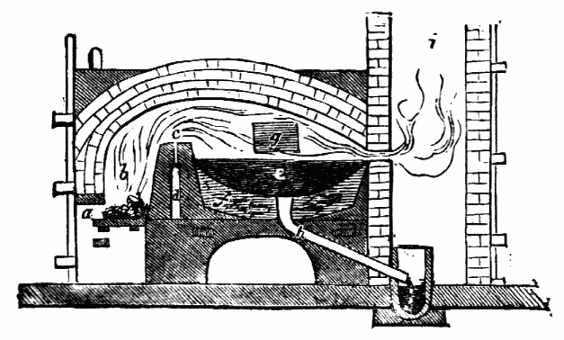
a, b, Grate and fire-place.
c, Bridge.
d, Air-channel.
e, Concave space for ore, resting on a solid bed f, formed of sand and clay.
g, Door for introducing the ore, and abstracting residuary slag.