A CYCLOPÆDIA OF PRACTICAL RECEIPTS, PROCESSES, AND COLLATERAL INFORMATION (continued 46)
Reading edition
HI′ERA-PI′CRA. See Powder of Aloes and Canella.
HIP′POCRAS. An aromatic medicated wine, formerly much used in England, and still employed on the Continent.
Prep. Lisbon and Canary wine, of each 12 pints; cinnamon, 2 oz.; white canella, 1⁄2 oz.; cloves, mace, nutmeg, ginger, and galangal, or cardamoms, of each 1 dr.; bruise the spices, and digest them in the wine for three or four days; strain, and add of lump sugar, 21⁄2 lbs.
HIPPU′RIC ACID. HC9H8NO3. Syn. Acidum hippuricum, L. A compound discovered by Liebig in the urine of the horse, cow, and other graminivora, in which it exists as hippurate of potassium or sodium.
Prep. Concentrate fresh cow’s urine by a gentle heat to about 1⁄10th its bulk, filter from deposit, mix the liquid with excess of hydrochloric acid, and set it aside to crystallise. It may be decoloured by redissolving it in boiling water, and treating it with animal charcoal, or with a little chloride of lime along with some hydrochloric acid, and re-crystallising it.
Obs. Hippuric acid, when pure, forms long, slender, milk-white, square prisms; it is soluble in 400 parts of cold water; it also dissolves in hot alcohol. When strongly heated, it yields benzoic acid, benzoate of ammonia, and benzonitrile, with a coaly residue. The urine of horses or cows, left to itself for some time, or evaporated at a boiling temperature, yields not a trace of hippuric acid, but only benzoic acid. Nitric acid and hot oil of vitriol convert it into benzoic acid. Boiling hydrochloric acid converts it into benzoic acid and glycocoll. With the bases it forms salts, which are called hippurates. See Benzoic Acid.
HIPS. Syn. Heps; Rosa canina (Ph. L.). The fresh fruit of the dog rose (Rosa canina), or wild briar. Used to make a conserve.
HOL′LANDS. Syn. Geneva, Schiedam, Hollands gin, Dutch g. Prep. 1. The materials employed in the distilleries of Schiedam, in the preparation of this excellent spirit, are 2 parts of the best unmalted rye and 1 part of malted bigg, reduced to the state of coarse meal by grinding. About a barrel (36 galls.) of water, at a temperature of from 162° to 168° Fahr., is put into the mash-tun for every 11⁄2 cwt. of meal, after which the malt is introduced and stirred, and, lastly, the rye is added. Powerful agitation is next given to the magma till it becomes quite uniform, when the mash-tun is covered over with canvas, and left in this state for two hours. Agitation is then again had recourse to, and the transparent ‘spent wash’ of a preceding mashing is added, followed by as much cold water as will reduce the temperature of the whole to about 85° Fahr. The gravity of the wort at this point varies from 33 to 38 lbs. A quantity of the best pressed Flanders yeast, equal to 1 lb. for every 100 galls. of the mashed materials, is next stirred in, and the whole is fermented in the mash-tun for about 3 days, or until the attenuation is from 7 to 4 lbs. (sp. gr. 1·007 to 1·004). During this time the yeast is occasionally skimmed off the fermenting wort. The wash, with the grains, is then transferred to the still, and converted into ‘low wines.’ To every 100 galls. of this liquor, 2 lbs. of juniper berries (3 to 5 years old), and about 1 lb. of salt, are added, and the whole is put into the low-wine still, and the fine spirit drawn off by a gentle heat, one receiver only being employed. The product per quarter varies from 18 to 21 galls. of spirit, 2 to 3 o. p.
2. (Best Hollands.) Hollands rectified to the strength of 24° Baumé (sp. gr. ·9125, or about 6 o. p.).
3. (English-made.)—a. From juniper berries (at least a year old, and crushed in the hands), 3 lbs.; rectified spirit, 11⁄2 gall. (or proof spirit, 21⁄2 galls.); digest, with agitation, for a week, and then express the liquor; after 24 hours’ repose, decant the clear portion, add it to good corn spirit, at 2 or 3% overproof, 90 or 100 galls., and mix them well together.
b. From juniper berries, 21⁄2 lbs.; sweet fennel seed, 5 oz.; caraway seed, 31⁄2 oz.; proof spirit, 2 galls.; corn spirit, 90 or 100 galls.
c. As the last, with the addition of Strasburg turpentine or Canadian balsam, 1 lb.
d. To either of the last two or three add a very small quantity of ground cardamoms or horse-radish. Some compounders also add 4 or 5 cloves of garlic, or about 15 gr. of assafœtida, with 1 gr. of ambergris rubbed to a powder with a little white sand or lump sugar. Good plain gin may be advantageously employed in lieu of the corn spirit ordered above, when expense is no object.
Obs. The last four forms, which are only given as examples, produce a very pleasant spirit, if it is kept for some time to ‘mellow.’ Age is one of the principal causes of the ‘creaminess’ of foreign gin, which usually lies in bond for some time before being consumed. The product is, however, much superior if the ingredients are rectified along with 20 galls. of water, and about 14 lbs. of salt, by a gentle heat.
It will be seen from the above that the superior flavour of Hollands spirit depends more on the peculiar mode of its manufacture than on the quantity of juniper berries employed; 2 lbs. of them, when new, being barely equivalent to 1 oz. of the essential oil; and when old, to less than 1⁄2 oz., a quantity wholly insufficient to flavour 100 gallons of spirit. The Dutch distillers, most noted for this liquor, add a little pure Strasburg turpentine and a handful or two of hops to the spirit, along with the juniper berries, before rectification. The former substance has a pale yellowish-brown colour, and a very fragrant and agreeable smell, and tends materially to impart that fine aroma for which the best geneva is distinguished. At Rotterdam sweet fennel seed is commonly added as a flavouring; and at Weesoppe Strasburg turpentine and fennel seeds, or the essential oil of fennel, are frequently substituted for a large portion of the juniper berries.
Schiedam Hollands is considered the best; the next quality is that of Rotterdam; after these comes that of Weesoppe.
Attempts have been made by Mr Robert Moore, and others to introduce into general consumption in this country a home-made liquor, resembling and prepared in the same manner as foreign geneva, “but the palates of our gin-drinkers were too corrupted to relish so pure a spirit.”
HOMŒOP′ATHY. Syn. Homœopathia, L. A medical hypothesis promulgated at the commencement of the present century by the late Dr Hahnemann, of Leipsic, according to which diseases may be cured by the administration of minute doses of medicines capable of producing in healthy persons affections similar to those it is intended to remove. The doctrine that “similia similibus curantur” had long previously been practically acted on, to a limited extent, in certain cases, in legitimate medicine (allopathy, heteropathy), although not verbally recognised as belonging to its system. The administration of infinitesimal doses is an absurdity which homœopathy, however, alone can claim. According to this method, the millionth of a grain is often an excessive dose; whilst billionths and decillionths, quantities so small as to be vastly beyond human perception, form the common doses. This reduces the whole practice of homœopathy to a system of doing nothing beyond regulating the diet and habits of the patient. “All judicious practitioners have long been agreed that there are many cases which are best treated in the manner just mentioned, and in which physic does more harm than good; in which, in short, a sensible physician endeavours to amuse the patient, whilst nature cures the disorder; so that the frequent success of homœopathic treatment may be explained, without admitting the principle upon which it is presumed to be founded.” (Brande.)
HON′EY. Syn. Mel (B. P.), L. The sweet substance elaborated by the domestic bee from the juices of the nectaries of flowers, and deposited in the cells of wax forming the honeycomb.
Var. Pure honey consists of a syrup of uncrystallisable sugar and crystalline saccharine grains, resembling grape sugar.—‘Virgin honey’ is that which flows spontaneously from the comb.—‘Ordinary honey,’ that obtained by heat and pressure. The former is pale and fragrant; the latter darker, and possessing a less agreeable taste and smell.—‘English honey’ is chiefly collected from furze and broom flowers, and is more waxy than that from the South of Europe;—‘Narbonne honey,’ chiefly from rosemary, and other labiate flowers, very fine;—‘Poisonous honey’ is found near Trebizond, in Asia, its toxic effects being due to the bees having collected it from a poisonous plant, the Azalea pontica.
Pur. Honey is frequently adulterated with treacle, potato-sugar syrup, potato farina, starch, and wheat flour. The first may be detected by the colour and odour; the second in the way noticed under Sugar; and the others by the honey not forming a nearly clear solution with cold water, and striking a blue colour with iodine. When it contains wheat flour, and is heated, it at first liquefies, but on cooling it becomes solid and tough. The absence of starchy matter or flour is easily proved by the following test:—Boiled with water for five minutes, and allowed to cool, it should not become blue with iodine water—indicating absence of flour.
Uses, &c. Honey is nutritive and laxative, but rather apt to gripe. It is employed in the preparation of OXYMELS and GARGLES, and also to cover the taste of nauseous medicines, which it does better than sugar. Clarified honey is alone ordered to be used in medicine.
Honey, Clarified. Syn. Refined honey, Strained h.; Mel depuratum (Ph. D.), Mel præparatum, L. The honey is simply melted by the heat of a water bath, and strained whilst hot through flannel (Ph. D.); or—it is melted as last, and the scum removed (Ph. U. S.); or—it is melted with 1-3rd its weight of water, skimmed, strained through flannel, and evaporated until it reaches the sp. gr. 1·261. (P. Cod.) Honey is not to be employed without being desquamated. (Ph. L.)
Obs. Clarified honey is less agreeable than raw honey, and has lost the crystalline character of the latter; but it is less liable to ferment and gripe. The use of copper and iron vessels or implements should be avoided, as honey acquires a dark colour by contact with them. Berlin-ware, stone-ware, or well-silvered or tin copper pans, should alone be used. On the large scale, one or other of the following plans are adopted:—
1. The honey is mixed with an equal weight of water and allowed to boil up 5 or 6 times without skimming; it is then removed from the fire, and after being cooled, brought on several strong linen strainers, stretched horizontally, and covered with a layer of clean and well-washed sand, an inch in depth; the sand is rinsed with a little cold water, and the mixed liquor is finally evaporated to the thickness of syrup.
2. Dissolve the honey in water, as last, clarify with white of egg, and evaporate to a proper consistence.
3. Dissolve in water, add 11⁄2 lb. of animal charcoal to every 1⁄4 cwt. of honey, gently simmer for 15 minutes, add a little chalk to saturate excess of acid, if required, strain or clarify, and evaporate.
4. Honey, 1 cwt.; water, 9 galls.; fresh burnt animal charcoal, 7 lbs.; simmer for 15 minutes, add a little chalk to saturate free acid (if required), strain or clarify, and evaporate as before.
HONEYS. (In pharmacy.) Syn. Melita, L. These are minor preparations, now almost superseded by ‘syrups’ (Syrupi). The mellita of the Ph. L., including two ‘oxymels,’ are only four in number.
Honey of Bo′′rax. Syn. Mel boracis (B. P. Ph., L. E. & D.), L. Prep. (B. P.) Finely powdered borax, 1; clarified honey, 7; mix. Astringent, detersive, and cooling. It is employed in aphthæ of the mouth, excessive salivation, &c. A great improvement would be to dissolve 1 of borax in 1 of glycerin, and then add 6 of honey.
Honey of Col′chicum. Syn. Mel colchici, L. Prep. (Beasley.) Dried colchicum 1 part; water (at 140°), 16 parts; infuse for 12 hours, strain, let it settle, and boil the clear liquor with white honey, 12 parts, to the consistence of a syrup. See Colchicum.
Honey of Liq′uorice. Syn. Mel glycyrrhizatum, L. Prep. (Ph. Hamb.) Honey and a strong infusion of liquorice boiled to a proper consistence. Emollient, pectoral, and laxative.
Honey of Male Fern. Syn. Mel filicis, L. Prep. (Dunglison.) Ethereal extract of male fern, 30 gr.; honey of roses, 4 dr.; mix. In tapeworm.—Dose. One half at bedtime, followed by the remainder in the morning.
Honey of Mercury. Syn. Mel hydrargyri, L. Prep. (Bell.) Mercury, 1 dr.; honey, 1 oz.; triturate till the globules disappear. Allard adds of oil of cloves, 1⁄2 dr. Properties similar to those of mercurial pill. It is chiefly used as an application to ulcers of the throat.
Honey of Ro′′ses. Syn. Mel rosæ (Ph. L. and E.), L. Prep. 1. (Ph. L.) Dried petals of the red rose (the leaves separated), 4 oz.; boiling water, 16 fl. oz.; macerate for 2 hours; lightly press them in the hand, and strain; then add 8 fl. oz. more of boiling water to the roses, macerate for a short time, and again gently express the liquor; to this add the other half; next add to the mixed liquors, honey, 5 lbs.; and evaporate in a water bath, so that, the infusion which was set aside being added, it may become of a proper consistence.
2. (Ph. E.) Dried rose petals, 4 oz.; boiling water, 21⁄2 pints; infuse for 6 hours, and gently squeeze out the liquor; after the impurities have subsided, decant the clear, add of honey, 5 lbs., and evaporate as before, to a proper consistence, removing the scum which forms. Used to make astringent gargles. It must not be boiled in a copper or iron vessel, as they will spoil the colour. The last form is that commonly adopted in trade.
Honey of Squills. Syn. Mel scillæ, L. Prep. 1. Thick clarified honey, 3 lbs.; tincture of squills, 2 lbs.; mix.
2. (Soubeiran.) Dried squills, 1 oz.; boiling water, 3⁄4 pint; infuse 2 hours, strain, add of honey, 12 oz.; and evaporate to a proper consistence. Resembles OXYMEL OF SQUILLS (nearly).
Honey of Verdigris. Egyptiacum.
Honey of Vi′olets. Syn. Mel violæ; L. Prep. From clarified honey, 2 parts; expressed and depurated juice of violets, 1 part. Resembles syrup of violets.
HON′EY DEW. Syn. Ros mellitus, L. A sweetish matter ejected upon the leaves of plants by certain aphides.
HOOP′ING COUGH. See Whooping Cough.
HOPS. Syn. Lupulus (B. P.), L. “The catkins of the female plant of the Humulus lupulus” or common hop. (B. P.) “The dried strobiles.” (Ph. D.) The hops of commerce are the strobiles or catkins (LUPULI STROBILI, L. AMENTA) of the hop plant. The yellow powder or small lupulinic grains or glands (LUPULIN), which are attached to the strobiles, are the portion on which their characteristic qualities chiefly depend.
The hop is tonic, stomachic, and moderately narcotic. It is used in diseases of local debility with morbid vigilance and other nervous derangement, producing sleep where opiates are objectionable. Hops may be used topically as a fomentation or a poultice, as a resolvent or discutient in painful swellings and tumours. The golden dust attached to the scale of the hop is sometimes administered in doses of from 5 to 10 grains. Very freshly dried hops, made into a pillow, procure sleep.
In the choice of hops, care should be taken to select those that have large cones or strobiles, that are the most powerfully odorous and most free from leaves, stems, scaly fragments, and sticks, and which, when rubbed between the hands, impart, in the greatest degree, a yellowish tint and glutinous feeling to the skin. The tightness with which they are packed should also be noticed; as, without being very firmly pressed together, and quite solid they soon spoil by keeping. The finest flavoured hops are the ‘GOLDINGS,’ grown chiefly in middle and east Kent; the ‘WHITEBINES’ of Farnham and Canterbury; and the Worcester hops, grown on the red soils of the vale of the Severn. These are principally employed for the finer class of ales. Mid Kent and Sussex hops are also used for ale, but have an inferior colour and flavour. The best hops are packed in sacks of fine canvas, termed ‘pockets,’ weighing from 11⁄4 cwt. to 13⁄4 cwt. each; and the inferior qualities in coarse ‘bags,’ of about double the size. The former are mostly purchased by the ale brewers, and the latter by the porter brewers. When hops are older than of last season’s growth they are termed ‘yearlings,’—when of the second season’s growth, ‘old,’—and when three years, or older, ‘old olds.’ See Brewing, Extract, Humulin, Lupulin, Tincture, &c.
HOOSE. Young cattle, especially calves, as well as sheep and lambs, are frequently liable to attacks of a species of bronchitis, caused by the presence in the bronchial tubes of minute worms. They are mostly so attacked in autumn.
Treatment. For a calf of six months old give half an ounce of oil of turpentine in two ounces of linseed oil, to be repeated once or twice after an interval of two days. Half this dose may be given to sheep. The mixture should be administered by the mouth, and not by the nostrils, as usually recommended. Calves should additionally be comfortably housed at night, and be fed with a little oil cake and other good food.
HORE′HOUND. Syn. White horehound; Marrubium vulgare (Linn.), L. This herb has long been a popular remedy in chronic pulmonary complaints, especially catarrh, and in uterine and liver affections. Horehound tea (THEA MARUBII, INFUSUM MARUBII) is prepared by infusing 1 oz. of the herb in boiling water, 1 pint, for an hour;—syrup of horehound (SYRUPUS MARUBII), by thickening the infusion of tea with sugar;—candied horehound (MARUBIUM CONDITUM), by mixing 1 pint of horehound juice with 8 or 10 lbs. of white sugar, boiling the mixture to a candy height, and pouring it, whilst warm, into moulds, or small paper cases, well dusted with finely powdered lump-sugar; or by pouring it out on a dusted slab, and cutting it into squares. See Candying.
HORN. For the purposes of the turner and comb-maker, horns of the goat and sheep are preferred on account of their superior whiteness and transparency. For medical purposes, those of the stag (HARTSHORN) are ordered to be employed.
Horn is dyed with the same dyes, and in a similar manner to bones and ivory.
Horn is softened, bent, and moulded, by means of heat and pressure. For these purposes boiling water and a screw press are commonly employed.
Horn is reduced to plates or sheets by sawing it, and then exposing it to powerful pressure between hot iron plates; the pith having been previously removed, and its texture softened by soaking for some days in water, and subsequent boiling in that liquid.
Surfaces and edges may be united or cemented together by softening the horn by the heat of boiling water, placing the parts in contact under strong pressure, and exposing the whole thus arranged to the heat of boiling water.
Horn is stained or party-coloured to imitate tortoise-shell, by a solution of terchloride of gold, for the red portion; nitrate of silver, for the dark brown and black; and nitrate of mercury (hot), or a paste made of red lead, and potash or quicklime, for the brown. When the last is used the horn must be heated and exposed to its action for some hours.
Horn Silver. (Ag. Cl.) A native chloride of silver, which occurs either crystallized in cubes, or as a compact semi-transparent mass.
HORS-D’ŒUVRES. [Fr.] Syn. Assiettes, Fr. Small entrées, as ‘aiguillettes,’ ‘ragouts,’ plates of sardines, anchovies, or other relishes, served at dinner between the leading dishes. ‘Assiettes volantes’ (flying plates) are dishes handed round to the guests, but not placed on the table.
HORSE. Syn. Equus, L. This most useful quadruped belongs to the family Equidæ, distinguished by a single digit and hoof on each foot. The horse can scarcely be said to exist at the present day in its natural wild state, as the so-called ‘wild-horses’ of America and Asia are but the progeny of horses which have escaped from the haunts of civilisation. Of all animals the horse is most useful to man. Independently of its value as a beast of burden and draught, its skin, its hide, intestines, and bones, furnish us with leather, the thongs of whips, gut, grease, bone-black, manure, &c. The excrement, fat, and hoof were included in the Materia Medica of the Ph. L. 1618. The flesh is eaten in some countries, and was formerly esteemed to possess many virtues.
Injuries of a serious character, and even death, are often occasioned by horses running away, or becoming unmanageable. Various methods have been proposed to prevent accidents of this kind, and to place the animal entirely under the power of its rider or driver. In Russia, around the horse’s neck, near the neck strap, is placed a cord with a running knot. To this slip-noose is attached a pair of reins, which always lie thrown over the dashboards, ready to be seized at once. When the horse starts, and becomes unruly, the gentleman takes up this cord, and tightens the horse’s throat, so that he cannot take breath. The most furious horse stops instantly, and will not fall or kick. See Bedding, Bran Mash, Broken Knees, Broken Wind, Clipping, Canker, Catarrh, Choking, Chorea, Cholic, Constipation, Corns, Crib-biting, Curb.
HORSE BALLS. See Veterinary Medicine.
HORSES, Condition Powder for. The principal ingredients were: Fenugreek, liquorice root, resin, brimstone, common salt, nitrate of potash, and a green powder, probably senna. It contained traces of calcium and magnesium carbonates; alumina, silica, and iron.
HORSE POW′ER. This term was first employed by James Watt to express a power capable of raising 33,000 lbs. one foot high per minute. The effective pressure on the surface of the piston was estimated at 7 lbs. to the square inch, and hence the area of the piston, in square inches, multiplied by 7, gave the gross effective moving pressure, and the space passed over by this piston in a minute gave the distance through which the pressure was exerted, or the weight was raised. From these data the horse power was easily calculated. In process of time improvements in the formation of boilers and steam engines increased the effective pressure on the piston, and, consequently, the power of the engine. In modern engines the actual power is commonly from 2 to 4 times greater than the nominal power, which is, however, still retained as the unit of power in commercial calculations.
HORSERAD′ISH. Syn. Armoracia radix. (B. P.). “The fresh root of Cochlearia Armoracia” (B. P.). Horseradish is pungent, acrid, stimulant, and rubefacient. It is also regarded as diaphoretic, diuretic, and antiscorbutic. It forms a useful masticatory in hoarseness, sore throat, and toothache. As a condiment, it provokes the appetite and assists digestion. Reduced to shreds (scraped horseradish), it forms a common and excellent accompaniment to roast beef. The root of aconite or wolfsbane, which somewhat resembles it in appearance, has occasionally been mistaken for it, with fatal results; the two are, however, readily distinguished from each other, as the taste of horseradish is warm and pungent, approaching that of mustard, whilst aconite is bitter, and its odour is earthy and disagreeable, and after a few minutes’ contact with the lips, tongue, and fauces, produces a sensation of numbness, and tingling. See Aconitum Napellus; under which article will be found engravings of the two roots. The root may be kept fresh for some time if buried in sand in a cool place. Horseradish powder is prepared from the roots gathered in November or December, and dried by a gentle heat or exposure to a current of dry air. It is used as a condiment.
HOR′TICULTURE. Syn. Gardening. The art of cultivating gardens. According to Loudon, horticulture differs from agriculture, chiefly in the comparatively limited space over which it extends, and in being conducted by manual labour; whilst the latter is performed jointly by human and animal labour, in fields, or on an extensive tract of land called a farm.
HOR′TUS-SICCUS. See Herbarium.
HOS′PITAL GAN′GRENE. Syn. Phagedæna gangrenosa. L. A species of ulcerating mortification, particularly characterised by its infectious nature, and its tendency to attack wounds and ulcers in crowded hospitals, so that often the most trifling operation cannot be performed with safety. Under its influence the parts are rapidly destroyed, not by the formation of ordinary sloughs, as in common mortification, but by their conversion into an ash-coloured viscid substance interspersed with bloody specks. The treatment is similar to that noticed under Mortification, but here, above all things, thorough ventilation must be established, and persevered in, and, when possible, change of situation sought.
HUILE. [Fr.] Oil; a term applied to various substances and preparations on account of their smoothness, consistence, or real or imaginary emollient or oleaginous nature. See Liqueur, Oil, &c.
Huile Acoustique. Prep. From garlic and bay leaves, of each, 1⁄2 oz.; olive oil, 1⁄2 lb.; boiled together for 15 minutes, and strained. Used in ear-ache and deafness. A little is dropped on cotton wool and placed in the ear.
Huile, Antique. See Oils (Hair).
Huile Liqueureuse. Prep. 1. (De la Rose.) From eau de rose, 1 part; simple syrup, 2 parts; mixed together.
2. (Des fleurs d’oranges.) From orange-flower water and syrup, as No. 1.
3. (De vanille.) From essence of vanilla, 1 dr.; simple syrup, 1 pint.
Obs. The above are kept in small decanters, and used to flavour water, grog, liqueurs, &c., instead of sugar or capillaire; also to perfume the breath. Other flavoured syrups, for the same purposes, are prepared in a similar manner.
HU′MIC ACID. Syn. Ulmic acid. See Humus.
HUMULIN. The name given to a beautiful extract or essence of hops, made as follows:—
A concentrated tincture of hops is prepared by percolation with rectified spirit; the same hops are then exhausted with water; the spirit is removed from the tincture by careful distillation, and the upper aqueous portion is skimmed off, and added to the infusion, which latter is then evaporated to the consistence of a soft extract; the oleo-resinous residuum of the tincture is next added, and well mixed in; after which the whole is put into pots and carefully tied over for sale. The product possesses all the fragrant, tonic, and bitter qualities of the hop in a highly condensed form. See Hops, Lupulin, &c.
HU′MUS. Syn. Ulmin. When wood, or woody fibre, is exposed to the joint action of air and moisture, it suffers eremacausis or decay, and crumbles down into a dark-brown or black powder commonly called ‘mould,’ and to which chemists have given the name of ‘humus.’ In this state it exists in fertile soils, in which it is derived from the decay of plants. A powder of similar composition is produced by the action of powerful chemical reagents on sugar, lignin, &c. When acted upon by dilute boiling solution of caustic potassa, this substance yields a deep-brown solution, from which acids precipitate a flocculent brown substance generally called ‘ulmic’ or ‘humic acid.’ Both bodies require further investigation, as they are supposed to vary exceedingly in composition.
HUNGER. The peculiar sensation arising from the want of food. When severe, it increases to actual pain, the coats of the stomach are acted on by its own juices, the respiration becomes less frequent, the circulation languid, and there is a general diminution of the heat of the body and of the secretions. The return of hunger is accelerated by exercise and labour, and by the exposure of the body to a low temperature. Long fasting is injurious, more particularly to the young and the debilitated. See Appetite, Nutrition, &c.
HUS′BANDRY. The business of the farmer; by some the term is restricted to the joint operations of farming and gardening on the small scale. It is also sometimes used synonymously with agriculture.
HY′ACINTH. In botany, the English name for the genus Hyacinthus. There are numerous varieties of the garden hyacinth, all very beautiful. The bulbs are largely imported from Holland, and are often grown in water contained in suitable glass vessels (hyacinth glasses). In mineralogy, the term is applied to crystallised yellow or brown zircon. See Gems.
HYDRAC′IDS. Syn. Hydrogen acids. A name formerly given to those acids which do not contain oxygen, as hydrochloric, &c. It is still occasionally employed.
HY′DRAGOGUES. Syn. Hydragoga, L. Medicines which cause the removal of water from any of the cavities of the body. Many cathartics, as gamboge, jalap, &c., are classed under this head.
HYDRAS′TIN. The name given to a concentrated remedy much employed by the medical eclectics of America.
Prep. Treat the powdered root of golden-seal (Hydrastis Canadensis) with cold water by percolation; acidulate the infusion with hydrochloric acid; collect the precipitate on a filter; then dry it, dissolve the dried mass in alcohol, filter, and set aside to crystallise.
Prop. Yellow, acicular crystals, insoluble in cold alcohol, ether, and water.—Dose, 3 to 5 gr., 3 to 6 times a day; as a tonic in dyspepsia, inflammation of the stomach, &c.—Obs. According to the most recent investigations, hydrastin contains berberine, and another alkaline called hydrastia or hydrastina.
HYDRASTIS CANADENSIS. Syn. The Golden Seal. This is a small herbaceous perennial North American plant, belonging to the natural order, Ranunculaceæ. The rhizome, which is the officinal part, though yellow in the recent root, becomes of a dark yellowish-brown by age. It contains albumen, starch, fatty matter, resin, yellow colouring matter, sugar, lignin, and various salts; also a peculiar nitrogenous crystallisable substance, to which Dr Durand, the discoverer, proposed the provisional name of hydrastin, which substance will be found described below. The root of the golden-seal, as well as the alkaloids obtainable from it, are largely used in American medical practice, and are stated to possess valuable tonic, aperient, diuretic, and deobstruent powers. They have been employed in dyspepsia, jaundice, and functional disorders of the liver. They are also regarded as one of the best substitutes for quinine in intermittents.
Golden seal has been given in the form of infusion, decoction, tincture, and extract, and the fluid extract is now officinal in the United States’ Pharmacopœia.
HY′DRATES. Compounds of hydroxyl (HO) with other bodies, e.g. KHO—hydrate of potassium. The term hydrate is also given to chemical combinations of water (H2O) with other substances, e.g. C2HCl3O.H2O—hydrate of chloral.
HY′DRIDE. A compound of hydrogen with another radical, e.g. hydride of methyl—CH3H.
HYDRIO′DATE. A name formerly given to the salts now termed iodides. See Iodides.
HYDRIO′DIC ACID. Syn. Iodhydric acid; Acidum hydriodicum, L. An acid compound of iodine and hydrogen. See Iodine.
Prep. 1. By heating iodine in hydrogen, the volume of the gas becomes doubled, and a colourless acid gas is produced; it is, however, never prepared for use by this means. 2. Place 10 parts of potassic iodide in a small retort with 5 parts of water, and add 20 of iodide; then drop in cautiously one part of phosphorus, cut into small fragments, and apply a gentle heat. The gas will be given off abundantly and may be collected, by displacement, in dry bottles.
A solution of hydriodic acid may be prepared by suspending iodine in water, and passing a current of sulphuretted hydrogen through the mixture until the brown colour of the iodine disappears; sulphur is deposited in abundance, and hydriodic acid formed.
HYDRO′BENZANIDE. White crystalline mass, obtained from oil of bitter almonds by treatment with ammonia.
HYDROBRO′MIC ACID. See Bromide.
Hydrobromic Acid. (HBr.) Syn. Hydric Bromide, Hydrogen Bromide.
Prep. This very powerfully acid gaseous body may be prepared as follows:—1. By decomposing bromide of potassium with a concentrated solution of phosphoric acid. 2. By decomposing bromide of phosphorus by means of a small quantity of water.
Hydrobromic acid gas is colourless and non-inflammable; it extinguishes flame. It is extremely irritating to the lungs when breathed. It is very soluble in water.
HYDROBRO′MIDE. Syn. Bromide (which see).
HYDROCAR′BON. A compound of carbon and hydrogen. The hydrocarbons constitute a most important series of organic compounds.
HYDROCHLORIC ACID. (HCl = 36·5.) Syn. Muriatic Acid, Hydric Chloride, Hydrogen Chloride. This important gaseous compound was discovered by Priestly in 1772. In nature it is given off with other gases from active volcanoes, and is occasionally to be met with in the springs and rivers of volcanic districts. When hydrogen and chlorine are mixed in equal volumes, they are without action upon each other if kept in the dark, but if exposed to direct sunlight, chemical combination, accompanied by a loud explosion, instantly takes place between them, the result of their union being the colourless gaseous, intensely sour hydrochloric acid. If, instead of bright sunshine, the mixed gases are exposed to diffused daylight, chemical union also ensues between them, but the process is then a slow and gradual one; the passage through them, however, of the electric spark, or the application of a lighted match or taper instantly causes their explosion and combination.
One volume of chlorine unites with one volume of hydrogen, forming two volumes of hydrochloric acid; no condensation occurs in the act of union.
Hydrochloric acid may also be formed by transmitting moist chlorine through a red-hot porcelain tube; oxygen being at the same time liberated.
Prep. Hydrochloric acid, save for the purposes of illustrative experiment, is never obtained by any of the above processes. An easy mode of procuring it, when required for laboratory use, is to heat the ordinary aqueous solution of the acid in a flask, and to collect the gas, which is given off by displacement. It may also be readily got by introducing pieces of common salt (which should have been previously fused in a crucible at a red-heat and allowed to cool) into a glass retort, and pouring over them about twice their weight of oil of vitriol. The hydrochloric acid, which escapes very abundantly, must be collected either by displacement or over mercury.
Prop. Hydrochloric acid is a colourless gas, very acid to the taste, and irritating to the eyes; and induces coughing even if breathed in small quantities, or when largely diluted. It is very destructive to vegetation, on which account the soda manufacturer is compelled by law to condense and thus prevent the escape of its fumes. It has a specific gravity of 1·261. When subjected to a pressure of 40 atmospheres at 50° F., it becomes a colourless fluid capable of dissolving bitumen, and having a specific gravity of 1·27. It has never been frozen. Hydrochloric acid neither burns, nor supports combustion. The white fumes which it forms when exposed to the air, are due to its condensing the atmospheric moisture, and thus giving rise to a body less volatile than water. This gas is greedily and instantly absorbed by water. A fragment of ice placed in a jar of the gas absorbs it, and becomes immediately dissolved.
Hydrochloric Acid, Solution of. The hydrochloric acid of commerce is a solution of the above gas in water. When exposed to the air it emits grey fumes. Water at 40° F. absorbs about 480 times its bulk of hydrochloric acid, increasing in volume about one third in doing so, acquiring a density of 1·2109, and then containing nearly forty-three per cent. of the acid.
Strength of Solution of Hydrochloric Acid, 77° Fahr. (E. Davy.)
Sp. Gravity.Hydrochloric acid in 100 parts.Sp. Gravity.Hydrochloric acid in 100 parts.
1·2142·431·1020·20
1·2040·401·0918·18
1·1938·381·0816·16
1·1836·361·0714·14
1·1734·341·0612·12
1·1632·321·0510·10
1·1530·301·048·08
1·1428·281·036·06
1·1326·261·024·04
1·1224·241·012·02
1·1122·22
In the laboratory, solution of hydrochloric acid is in constant use. It may be easily prepared from chloride of sodium and sulphuric acid. The retort should be connected with a couple of Woulfe’s bottles; into the first of which a small quantity of water should be poured, to detain any impurities mechanically carried over with the gas; the second bottle should contain four parts of water, and should be placed in a vessel of cold water, as the gas in becoming condensed, disengages a large amount of heat. The gas comes off and is absorbed readily by the water upon applying a gentle heat to the retort.
It is by this last method that solution of hydrochloric acid is obtained in such enormous quantities[347] for the various purposes in which it is used, in the arts and manufactures.
Hydrochloric acid is, in fact, a by-product in the manufacture of carbonate of soda, and is generated during the first stage of the operation, known as the salt-cake process, which consists in the decomposition of salt by sulphuric acid, and is accomplished in a furnace called the salt-cake furnace.
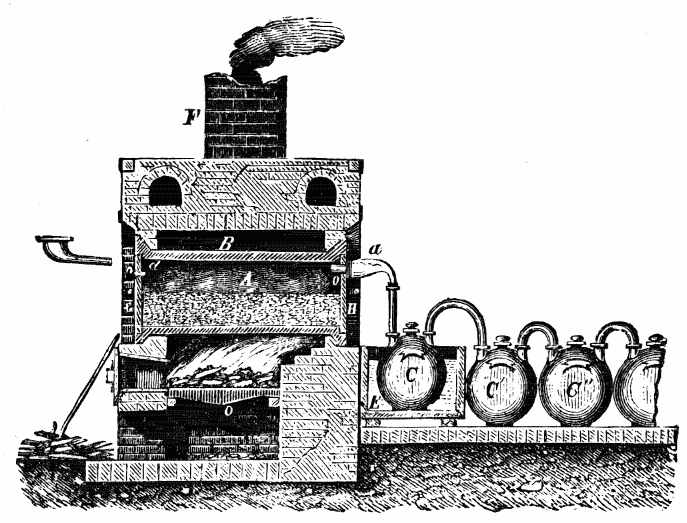
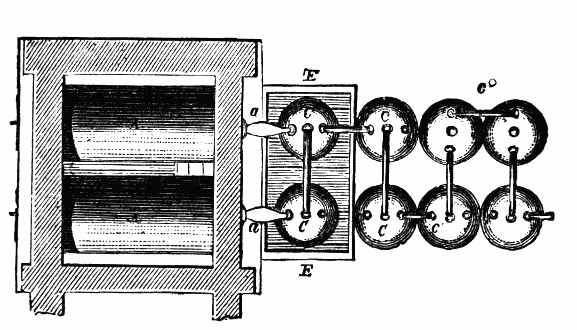
The hydrochloric acid gas which is given off escapes from the furnace through a flue with the products of combustion into high brick towers filled with coke or stones, over which a stream of water trickles down, the whole of the acid vapours are thus condensed, the smoke passing off by a chimney connected with the towers. The diluted acid solution thus formed is concentrated by the aid of the apparatus shown in section in figs. 1, 2, and 3.
This apparatus consists of several cast-iron cylinders, 57 feet long by 27 feet in diameter, closed in the same manner as gas retorts, by lids luted with clay. One of the lids has an opening o, into which is fitted the stoneware or leaden pipe a, conveying the hydrochloric acid to the condensing apparatus. The other, or posterior lid, is also provided with an opening d, through which is passed the tube of a leaden funnel, so that after the retort is filled with salt sulphuric acid may be poured in. The construction of the furnace in which two retorts are usually placed, permits the flame of the fire at O to play round the cylinders before reaching the flue leading to the chimney F. B is an arch over the furnace. The first stage of the operation consists in filling each cylinder with 330 lbs. of salt. The lids or covers are then luted on, and the fire is kindled. The requisite quantity of strong sulphuric acid is next poured into the retort, and the funnel having been withdrawn from D, the hole is covered by a clay plug.
Fig. 1.
As soon as the reaction is over, the 396 lbs. of sulphate of soda produced are removed, and the operation repeated.
The condensation apparatus 1 and 3 is composed of rows of Woulfe’s bottles, partly filled with water, care being taken to place the first pairs of these bottles in a tank of cold water.
The condensation of the last portions of hydrochloric acid gas is effected either by the aid of the coke columns, or in leaden chambers, into which fine jets of cold water are injected on all sides.
“A saturated solution of hydrochloric acid in water has the specific gravity of 1·21; and when heated in a retort, loses at first hydrochloric acid gas, but after a time an aqueous acid distils over, at the ordinary atmospheric pressure, containing 20·22 per cent. of hydrochloric acid, and boiling constantly at 110° C. If the distillation be conducted under diminished pressure, the liquid boils at a lower temperature, and attains a composition which is different for each boiling point; hence the dilute acids thus obtained by boiling the solution of hydrochloric acid gas in water, cannot be considered as definite compounds of hydrochloric acid and water.”[348]
Fig. 2.
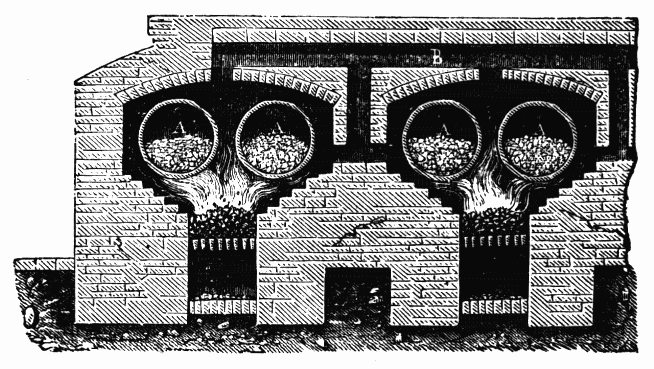
Fig. 3.
Commercial hydrochloric acid is usually of a yellow colour owing to its being contaminated with iron. It also very frequently contains sodium, arsenic, sulphuric and sulphurous acids, and free chlorine.
Pure aqueous solution of hydrochloric acid should leave no residue upon evaporation; it should give no precipitation of ferric oxide when saturated with ammonia, sulphuretted hydrogen should cause no turbidity in it; if diluted with three or four times its volume of water, and chloride of barium be added, no white cloud or precipitate should form in the mixture; nor should the acid, if pure, discolour a fluid made faintly blue with iodide of starch.
Hydrochloric acid is largely consumed in the manufacture of chlorine, sal ammoniac, chloride antimony, glue, phosphorus, in the preparation of carbonic acid for the manufacture of artificial mineral waters, in beet-root sugar works, hydro-metallurgy, and alone, or mixed with nitric acid, for dissolving various metals.[349] See Acids, Effects of Vegetation on, Chlorine.
HYDROCHLORIC ETHER. (C2H5Cl.) Syn. Ethyl Chloride, Chloride of Ethyl. This ether may be obtained either by saturating alcohol with hydrochloric acid gas, and then distilling at a gentle heat, or by distilling a mixture of three parts of oil of vitriol, two of alcohol, and four of fused chloride of sodium; the retort is in either case connected with a tubulated receiver, surrounded by water at a temperature of about 68° Fahr., in which most of the alcohol and water which pass over during the operation become condensed, whilst the ether escapes in the form of vapour through a bent tube, which is inserted into the tubulure of the receiver, and passes to the bottom of a flask kept cool with ice. The liquid which is condensed in the flask must be rectified from calcic chloride.
Hydrochloric ether is a colourless liquid, having a specific gravity at 32° Fahr. of 0·921, and a boiling point of 51·9° Fahr. The specific gravity of its vapour is 2·219. It has an ethereal, penetrating, somewhat garlicky odour. It is sparingly soluble in water, but readily so in alcohol. These solutions fail to give a precipitate with argentic nitrate.
HYDROCYANIC ACID. (HCN HCy.) Syn. Prussic acid, Hydric cyanide, Cyanhydric acid. Hydrocyanic acid was discovered by Scheele; but its nature and chemical properties were first investigated by Gay-Lussac.
Sources. This acid is found in water distilled from the kernels of the apricot, the peach, the plum, and cherry, the leaves of the laurel, and some other shrubs. The kernels of the bitter almond also yield it by distillation, mixed with an essential oil. The juice of the tapioca plant (the Jatropha manihot) likewise contains it. Many nitrogenous substances, when submitted to destructive distillation, also evolve hydrocyanic acid. Crystallised ammonic formiate subjected to heat in a retort yields a vapour which, passed through a red-hot tube, decomposes into this acid and water. Another method by which it may be obtained, consists in sending a current of dry sulphuretted hydrogen gas through a long tube filled with cyanide of mercury; and very recently it has been obtained by the direct combination of nitrogen and acetylene gas, by adding one volume of the former to two of the latter, and passing a series of electric sparks through the mixture, the gases combining without condensation. Lastly, it is yielded when a metallic cyanide or ferrocyanide is decomposed by an acid, this latter being the means by which it is invariably procured.
1. Anhydrous hydrocyanic acid may be prepared by Wöhler’s plan, which is as follows:—A crude potassium cyanide is prepared by fusing eight parts of the dried potassium ferrocyanide with three of potassium carbonate and one of charcoal.
The fused mass is treated with six times its weight of water in a well-closed vessel; the clear liquid is decanted from the iron, which it is the object of this operation to separate, and is poured into a retort: sulphuric acid, diluted with an equal weight of water, is gradually added in the proportion of one part of oil of vitriol to two parts of the cyanide. At first the distillation proceeds spontaneously from the heat developed by the admixture of sulphuric acid with the water. In order to condense the acid, the products are made to pass through a long U-shaped tube, immersed in cold water and filled with calcic chloride, with the exception of the first fourth of the tube, which contains fragments of the crude potassium cyanide; to the bent tube is attached a second delivery tube, which passes to the bottom of a bottle cooled with ice and salt. The calcic chloride in the syphon tube retains the moisture, and the potassic cyanide any sulphuric acid that might chance to pass over, whilst the hydrocyanic acid collects in the anhydrous state in the cooled receiver.
Trautwein recommends it to be prepared by the dehydration of the strong aqueous acid, by means of fused and pulverised chloride of calcium.[350]
⁂ The observance of the greatest care and caution are necessary in the preparation of this most potent poison. The operation is most safely performed in winter. The apparatus should be so arranged as to allow of any vapours given off being carried from the operator by a brisk current of air.
Prop. At ordinary temperatures anhydrous hydrocyanic acid is a colourless liquid, having a specific gravity of 0·7058 at 44·6° Fahr. It is very inflammable, burning with a violet flame resembling that of cyanogen, but somewhat whiter in colour. It is soluble in all proportions in water, the resulting mixture being lighter than that fluid, and miscible with alcohol. It is very feebly acid; potassic cyanide always having an alkaline reaction. Red oxide of mercury is readily dissolved by it, and when added to a solution of argentic nitrate it precipitates white flocculi of cyanide of silver. Anhydrous hydrocyanic acid is an extremely volatile liquid; if a drop be let fall on a glass plate, part of it becomes frozen by the cold produced by its own evaporation.
2. Preparation of aqueous hydrocyanic acid.
a. From hydrated ferrocyanide of potassium.—By heating it in a glass retort with oil of vitriol and water, Everitt states that the best proportions are nearly ten parts of the salt to seven of oil of vitriol (diluted with any convenient amount of water). Adopting these proportions, 422·4 parts of ferrocyanide of potassium yield 81 parts of hydrocyanic acid. The greater part of the hydrocyanic acid passes over at the beginning of distillation, at a temperature a little above 212° Fahr.; and when the residual liquid reaches a higher temperature, the water (which then contains but little hydrocyanic acid) is then carried over. It is therefore necessary to employ a good condensing apparatus, or the hydrocyanic acid which passes over at first will for the most part be dissipated in vapour mixed with the air of the apparatus. This loss may also be obviated by placing water in the receiver. The residue need not be boiled down to dryness; it will be found best to distil off from two thirds to three fourths of the liquid, according to the amount of water present.
It is not necessary to dissolve the ferrocyanide in water previous to adding the sulphuric acid, as it readily dissolves in the water during the process of distillation.
Three conditions are important to be observed in the arrangements of the apparatus:—1. The mixture in the retort should not be allowed to spirt over. 2. It should contain but little air. 3. It should present the greatest possible amount of surface to be cooled.
If sulphate of potassium and prussian blue are spirted over into the distillate, this must be carefully rectified over a small quantity of magnesia, chalk, or carbonate of barium.
b. From cyanide of potassium (without distillation).—To a solution of nine parts of tartaric acid in sixty parts of water, contained in a well-stoppered bottle nearly filled with it, four parts of pure cyanide of potassium are added; the vessel is shaken, frequently dipped into cold water, and then left in the cold for twelve hours; and the aqueous hydrocyanic acid, which contains but a very small quantity of tartrate of potassium, is poured off from the crystallised tartrate.[351] This acid contains 3·6 per cent. of anhydrous hydrocyanic acid.
c. From cyanide of mercury.—126 (accurately weighed) parts of cyanide of mercury are agitated with at least 28 parts of iron filings, in a well-stoppered bottle, containing 49, or rather more, parts of oil of vitriol, diluted with a considerable quantity of water. The agitation is continued until a portion of the liquid taken out is not blackened by sulphuretted hydrogen.
The solution, decanted from the iron and mercury, is then placed in a retort and distilled; the acid coming over at a gentle heat. Excess of iron accelerates the decomposition.
d. From cyanide of silver.—Everitt recommends 200 parts of pure cyanide of silver to be shaken up with 240 parts of hydrochloric acid of specific gravity of 1·129, and when the decomposition is complete, the hydrocyanic acid to be separated from the chloride of silver by decomposition.
This hydrocyanic acid may contain a small quantity of hydrochloric acid, a not very objectionable admixture, since it retards decomposition. It possesses the advantage of definite strength.
Prop. The aqueous is very similar in properties to the anhydrous acid, differing in taste, odour, poisonous and combustible properties, according to its degree of concentration. Like the anhydrous, the aqueous acid decomposes, but not so readily; when perfectly pure, becoming brown, and at last black. As before stated, a little free mineral acid assists to preserve it. It should be always kept in a dark place.
Detection and estimation of hydrocyanic acid and soluble cyanides.—The presence of hydrocyanic acid, indicated by the characteristic smell, which is given off by the contents of the stomach, or of any fluid containing it (provided this is not disguised by any substance of stronger odour) may be confirmed by the following tests:
1. To the filtered suspected fluid add a slight excess of caustic potash, and then a solution containing ferrous and ferric sulphates. If hydrocyanic acid, or a soluble cyanide be present, upon the addition of an excess of hydrochloric acid the liquid turns to a blue colour (more or less intense according to the quantity of acid present), owing to the formation of Prussian blue.
2. Add the suspected fluid solution of nitrate of silver; if hydrocyanic acid be present, a white cyanide of silver is formed, which is nearly insoluble in cold nitric acid, but is soluble in ammonia and cyanide of potash, and which, when heated to redness, gives off the inflammable violet-flamed cyanogen.
3. Acidulate a small quantity of the suspected liquid with a few drops of hydrochloric acid, and place it in a watch-glass; then invert a second watch-glass, moistened with a drop of solution of ammonic sulphide over this. After a few minutes remove the upper watch-glass, and evaporate the liquid to dryness over a water bath; let the dry residue be treated with a drop of a weak solution of ferric chloride. If hydrocyanic acid be present, a blood-red colour is produced, owing to the formation of red ferric hydrocyanide, which may be discharged by chloride of mercury; a reaction which distinguishes it from a similar colour given by meconic acid.
Where large quantities of material have to be examined, it is desirable that the acid should be distilled off by the heat of a water-bath, acidulating the liquid with tartaric acid if it be alkaline. The distillate is then to be tested by any of the above methods.
Antidotes.—Give a scruple of carbonate of potash dissolved in about an ounce of distilled water, and directly afterwards, ten grains of sulphate of iron, also dissolved in the same quantity of distilled water, to which should be added one drachm of tincture of perchloride of iron. Whilst this is being prepared, and subsequently, apply cold affusion to the head and neck, artificial respiration, and, if practicable, give strong coffee and brandy. A more ready remedy is ammonia, given both internally and applied to the nostrils.
Hydrocyanic Acid, Diluted. Syn. Acidum Hydrocyanicum Dilutum. (B. P.) The ‘British Pharmacopœia’ gives the following simple directions for the preparation of this acid:—
Dissolve two and a quarter ounces (avoir.) of ferro-cyanide of potassium in ten fluid ounces of distilled water, then add one fluid ounce of sulphuric acid, previously diluted with four fluid ounces of distilled water, and cooled. Put them into a retort and adapt this to a receiver, containing eight fluid ounces of water, which must be kept carefully cold. Distil with a gentle heat until the fluid in the receiver measures seventeen fluid ounces. Add to this three fluid ounces of the water, or as much as may be sufficient to bring the acid to the required strength of two per cent. by weight.
Prop. Specific gravity, ·997. 100 grains, or 110 minims, precipitated with a solution of nitrate of silver, give a precipitate of cyanide of silver, which when dried, weighs 10 grains. 270 grains rendered alkaline by liquor sodæ, require a 1000 grain measures of volumetric solution of nitrate of silver, before a permanent precipitate begins to form.
Antidotes. See Hydrocyanic Acid.
Hydrocyanic Acid, Scheele’s. Syn. Acidum Hydrocyanicum Scheelii. The original process of Scheele does not yield an acid of uniform strength, and is probably never followed. It is therefore impossible to state precisely what is intended when Scheele’s acid is prescribed, or to understand why it should be preferred by certain physicians to the British Pharmacopœia preparation, which is of a known and definite strength. As prepared by different makers it has been found to contain from three to five per cent. of anhydrous acid. The following is Scheele’s process:—
Mix two ounces of Prussian blue, with six ounces of red precipitate of mercury, and add six ounces of water. Boil for some minutes, constantly agitating; pour the whole on a filter and wash the residuum on the filter with two ounces of hot water, which is to be added to the filtered liquor. Add to this an ounce and a half of clean iron filings, and three drachms of sulphuric acid; shake well and let it settle; then pour the clear liquor into a retort, and distil a fourth part into a receiver well luted and kept cold.
HYDROFLUORIC ACID. (H. F.) Syn. Hydric Fluoride, Hydrogen Fluoride. Prep. 1. From fluor-spar (free from silica and metallic sulphides) and oil of vitriol. The fluor-spar being reduced to fine powder and placed in a leaden retort, is mixed with twice its weight of concentrated oil of vitriol, and on applying heat, an acid and highly acid vapour distils over, which condenses to a liquid if passed into a receiver of the same metal, standing in a freezing mixture at a temperature of 4° Fahr. Louyet has shown that the liquid acid, obtained as above, is not (as once believed) anhydrous.
2. From the double fluoride of potassium and hydrogen. Fremy first renders the salt anhydrous by careful drying; and by the subsequent application of a strong heat, expels the equivalent of hydrofluoric acid contained in it; condensing it into a colourless, mobile, very volatile liquid by the application of a freezing mixture of ice and salt.
3. By decomposing plumbic fluoride by dry hydrogen.
Prop. The strong, aqueous, hydrofluoric acid obtained by the action of oil of vitriol on fluor-spar, is a densely fuming, volatile, colourless liquid, which boils at 60° F., and remains unfrozen at 4°. It combines with water so greedily, and evolves so much heat in doing so, as to give rise to a hissing noise like that produced when a red-hot iron is plunged into cold water. In a concentrated form it has a specific gravity of 1·060. Brought into contact with animal matter of any kind it instantly destroys it, the smallest drop on the skin producing a deep and painful wound; hence the necessity of the greatest care in its preparation. With the exception of platinum, gold, silver, mercury and lead, hydrofluoric acid, when diluted, dissolves the metals, the metal when it undergoes solution, displacing hydrogen. Potassium decomposes the strong acid with explosion.
In both the gaseous and fluid form hydrofluoric acid is largely consumed for etching on glass; and this property constitutes one of its most available and reliable tests. The test may be conveniently applied as follows:—
Cover a small piece of window glass or a watch glass with a thin layer of wax, scraping away a very small portion by means of a sharply pointed instrument, and then expose the glass for a short time to the vapour of the acid, given off when the materials are heated in a small leaden saucer or platinum crucible; on removing the wax with a little turpentine, the marks on the glass caused by the hydrofluoric acid will be distinctly perceived.
HYDROFLUOSILIC′IC ACID. (4HF.SiF4.) Fluoride of silicon and hydrogen. Prep. From powdered fluor-spar, and siliceous sand or powdered glass, of each 1 part; concentrated sulphuric acid, 2 parts; mix in a glass retort, apply a gentle heat, and pass the evolved gas (fluoride of silicon) into water. Decomposition ensues, silica being deposited in a gelatinous state, and hydrofluosilicic acid remaining in solution. This acid liquor, which is a double fluoride of silicon and hydrogen, is used as a test for barium and potassium, with which it forms nearly insoluble precipitates.
HY′DROGEN. (H.) Syn. Hydrogenium, L. An elementary body discovered by Cavendish in 1766. It has been found existing in an uncombined state in the gases evolved from the solfataras of Iceland. Combined with oxygen, it constitutes water, and in this form is extensively distributed through earth, air, and ocean. It is an important constituent of all organised tissues.
Prep. Hydrogen is always obtained for experimental purposes by the deoxidation of water, by one or other of the following methods:—
1. A tube of iron or porcelain (a gun-barrel, for instance) containing a quantity of iron turnings or scraps of iron, is fixed across a furnace, so that its middle portion may be made red-hot; to the one end is attached a retort or other vessel containing water, and to the other a bent tube connected with a pneumatic trough or gasometer. The tube being now heated to redness, and the water in the retort brought into a state of brisk ebullition, the evolved steam suffers decomposition; the oxygen being absorbed by the iron, and the hydrogen escaping into the gas receiver.
2. Sulphuric acid (oil of vitriol), diluted with 6 or 8 times its bulk of water, is poured on granulated zinc (or scraps of iron) placed in a retort or gas bottle; hydrogen is evolved and is collected, as before.
Obs. This is the most convenient method of preparing hydrogen, and the one usually adopted in the laboratory. To ensure the gas being quite pure, distilled zinc is employed, and the gas is passed, first through a concentrated solution of pure potassa, then through a solution of nitrate of silver, and, lastly, through strong oil of vitriol, or over fragments of chloride of calcium. When hydrogen is prepared from crude zinc, it has a slight smell; and when from iron, its odour is often strong and disagreeable.
Prop. Gaseous; colourless; tasteless; odourless (when pure); combustible; sp. gr. ·06935, being 16 times lighter than oxygen gas, and 14·4 times lighter than atmospheric air. 100 cubic inches, at 60° Fahr. and 30 inches of the barometer, weigh 2·1371 (say 2·14) gr.; 1 gr. occupies 46·6 inches. It is very readily inflamed, even by a red-hot wire. It burns with a scarcely visible flame. Mixed with atmospheric air or oxygen, it explodes with extreme violence on the approach of flame, or sudden compression. One measure of hydrogen and 5 of atmospheric air, and 2 of hydrogen and 1 of oxygen, are the proportions that explode with the greatest violence. The combination of hydrogen and oxygen, when mixed, is brought about by the heat of a red-hot solid or a flame, by the electric spark, and by the presence of spongy platinum, the black powder of platinum, clean platinum foil, and some other substances. A jet of hydrogen burnt in oxygen gas, or a jet of these gases (mixed) burnt in the air, with proper precautions, produces a most intense heat. Water absorbs about 2% by volume of hydrogen.
Hydrogen has recently been liquefied and even solidified.
Tests. It is recognised by—its combustibility;—the pale colour of its flame;—producing water only when burnt in air or oxygen;—extinguishing the flame of other bodies; and—exploding when mixed with half its volume of oxygen, and fired.
Uses, &c. Pure and uncombined hydrogen is not employed in the arts. Inhalations of this gas have, however, been occasionally used in medicine. Dr Beddoes recommended them in phthisis. In combination, the uses of hydrogen are almost numberless. Combined with oxygen, it forms water; with chlorine, hydrochloric acid; with fluorine, hydrofluoric acid; with cyanogen, hydrocyanic acid; with carbon, innumerable hydrocarbons; with nitrogen, ammonia; with sulphur, sulphuretted hydrogen—in fact, an enumeration of the valuable compounds which it enters into would occupy many pages of this work. From its extreme lightness it has been used to fill balloons, but coal-gas is now commonly employed for this purpose. On its property of inflaming in contact with spongy platinum is arranged the popular little instrument for the production of instantaneous light (Dobereiner’s Lamp) sold by the philosophical instrument makers. The chemist avails himself of the great heat developed by its combustion in oxygen in the formation of the OXYHYDROGEN BLOWPIPE.
Some of the compounds of hydrogen are noticed below; the others under their respective names.
Hydrogen, Antimo′′niuretted. (SbH3.) Syn. Antimonetted hydrogen, Hydride of antimony, Stibamine; Hydrogenium antimoniatum, L. A gaseous compound of antimony and hydrogen, prepared by dissolving an alloy of antimony with a large excess of zinc in hydrochloric or dilute sulphuric acid. It has never been obtained pure, a variable proportion of free hydrogen being always present. It burns with a bluish-white flame, giving rise to dense fumes of teroxide of antimony, and when conducted through a red-hot tube, or the flame is thrown on a cold surface, as a porcelain plate, metallic antimony is deposited. This gas is a deadly poison when inhaled. See Arsenious acid.
Hydrogen, Arsen′′iuretted. (AsH3.) Syn. Arsenetted hydrogen, Hydride of arsenic, Arsenamine; Hydrogenium arseniuratum, L. A gaseous compound of arsenic and hydrogen.
Prep. Arsenide of zinc (made by fusing together equal weights of zinc and arsenic) is acted upon by strong hydrochloric acid or by sulphuric acid diluted with three parts of water.
Obs. This gas is produced whenever arsenious or arsenic acid, or any of their salts, is in presence of nascent hydrogen. The properties of arsenetted hydrogen are fully described in the tests for ARSENIOUS ACID. This gas is a deadly poison when inhaled.
Hydrogen, Car′buretted. Syn. Carbonetted hydrogen. This term is specially applied to two of the numerous compounds of carbon and hydrogen (CARBIDES OF HYDROGEN, HYDROCARBONS):—
1. Light Carburetted Hydrogen. (CH4.) Syn. Marsh gas, Fire-damp, Gas of the acetates. This is often abundantly disengaged in coal mines, and its combustion occasions those fearful explosions which are so destructive to human life. The mud at the bottom of stagnant pools, on being stirred, suffers bubbles of gas to escape, which, when collected and examined, are found to be a mixture of light carburetted hydrogen and carbonic acid. The latter is easily removed by passing the gas through a solution of caustic potassa or milk of lime.
Prep. (Dumas.) A mixture of acetate of soda (cryst.) and hydrate of potassa (dry), of each 2 parts, and quicklime (in powder), 3 parts, is strongly heated in a flask or retort. The gas in a state of absolute purity is disengaged in great abundance, and may be collected over water.
Prop. Colourless; neutral; nearly inodorous; burns with a yellow flame, producing pure water and carbonic acid; explodes when kindled in contact with air or oxygen.
2. Heavy Carburetted Hydrogen. (C2H4.) See Olefiant Gas.
Obs. Coal gas, OIL GAS, and RESIN GAS, consist, for the most part, of mixtures of these two gaseous hydrocarbons in uncertain proportions, obtained respectively from coal, oil, and resin, by the action of heat, and used for the purposes of illumination. See Gas.
Hydrogen, Oxides of. There are two well-defined compounds of hydrogen and oxygen:—
1. Subox′ide of Hydrogen. (H2O.) Water (which see).
2. Perox′ide of Hydrogen. (HO.) Syn. Hydroxyl, Binoxide of hydrogen, Deutoxide of H., Oxygenated water; Hydrogeniibinoxydum, L. This singular fluid was discovered by M. Thénard in 1818.
Prep. (Odling.) A known quantity of pure hydrochloric acid, diluted with 8 or 10 times its volume of distilled water, is placed in a glass beaker surrounded with ice or a freezing mixture. A quantity of binoxide of barium rather less than sufficient to neutralise the acid is then ground to a fine paste with distilled water, and added gradually to the acid in which it should dissolve without effervescence. Diluted sulphuric acid is next added cautiously, to precipitate the barium, and reproduce hydrochloric acid to act upon a fresh quantity of peroxide. The liquid having been filtered from the insoluble sulphate of baryta, a second proportion of binoxide of barium paste is added gradually, as before. The treatment with sulphuric acid, filtration and addition of binoxide, is repeated 6 or 7 times. Sulphate of silver is then very carefully added, so as exactly to precipitate in the form of chloride of silver the whole of the chlorine. After filtration, pure baryta, first as a paste and then in solution, is cautiously added, to precipitate exactly the sulphuric acid set free from the sulphate of silver. Filtration is again resorted to, and the clear liquid (aqueous solution of peroxide of hydrogen) is placed in a dish over oil of vitriol in vacuo, in order that the water mixed with it may evaporate.
Prop., &c. A colourless, transparent, somewhat syrupy liquid, of sp. gr. 1·452. It has a metallic taste, and corrodes the skin. It is easily resolved into oxygen and water. It mixes freely with water, and becomes more permanent by the dilution. It bleaches organic substances, and acts as a powerful oxidating agent. Under certain circumstances, however, it plays the part of a reducing agent. To the chemist, peroxide of hydrogen and its analogue, binoxide of barium, have been of great service as instruments of research. Binoxide of hydrogen has been applied in the arts to restore the blackened lights of paintings which have become darkened by sulphuretted hydrogen; it is also sold by hair-dressers for bleaching human hair.
Hydrogen, Phosphuret′ted. See Phosphorus.
Hydrogen, Sulphides of. See Sulphur.
HYDROMEL. Syn. Hydromeli, L. An aqueous solution of honey. Prep. (P. Cod.) Honey, 2 oz.; boiling water, 32 oz.; dissolve, and strain. A refreshing and slightly laxative drink; in fevers, hoarseness, sore throats, &c.
HYDROM′ETER. Syn. Areometer, Gravimeter; Hydrometrum, L. An instrument for ascertaining the specific gravities of liquids, and hence their strength, the latter being either in inverse or direct proportion to the former. Hydrometers are of two kinds:—1. Those which are always immersed to the same depth in distilled water, and the liquid to be tried, small weights being used for the purpose, as in Fahrenheit’s and Nicholson’s hydrometers; and 2nd, those which are suffered to rise or sink freely in the liquid, until they come to a state of rest, as in Syke’s, Baumé’s, &c. In both cases a correction must be made for any variation in temperature.
Of the two kinds, the first give the most accurate results, and have the great advantage of being applicable to liquids either lighter or heavier than water, but the second are the readier in practice, requiring less time and less skill to use them. The following are those best known:—
Baumé’s hydrometer or AREOMETER, which is very generally employed on the Continent, consists of two distinct instruments, the one for liquids heavier than water, the other for liquids lighter than that fluid. The first floats at the 0, or ‘zero,’ of the scale, in distilled wafer, at the temperature of 58° Fahr., and each degree, marked downwards, indicates a density corresponding to one per cent. of common salt. The hydrometer for liquids lighter than water is poised so that the 0 of the scale is at the bottom of the stem, when it is floating in a solution of 1 oz. of common salt in 9 oz. of water, and the depth to which it sinks in distilled water shows 10°; the space between these fixed points being equally divided, and the graduation continued upwards to the top of the scale.
The temperature at which these instruments were originally adjusted by Baumé was 12·5° Centigrade (54·5° Fahr.). They are now commonly adjusted in this country at 58° or 60° Fahr. Hence arise the discrepancies observable in the published tables of the “correspondence between degrees of Baumé and real specific gravities.”
Cartier’s hydrometer, which is much used in France for light liquids, has the same point for the zero of its scale as Baumé’s, but its degrees are rather smaller, 30° Baumé being equal to 32° Cartier.
Fahrenheit’s hydrometer consists of a hollow ball, with a counterpoise below, and a very slender stem above, terminating in a small dish. The middle, or half-length of the stem, is distinguished by a fine line across it. In this instrument every division of the stem is rejected, and it is immersed in all experiments to the middle of the stem, by placing proper weights in the little dish above. Then, as the part immersed is constantly of the same magnitude, and the whole weight of the hydrometer is known, this last weight, added to the weights in the dish, will be equal to the weight of fluid displaced by the instrument, as all writers on hydrostatics prove. And accordingly, the specific gravities for the common form of the tables will be had by the proportion—
As the whole weight of the hydrometer and its load, when adjusted in distilled water, is to the number 1000, so is the whole weight when adjusted in any other fluid, to the number expressing its specific gravity.
Gay-Lussac’s alcoholometer is used to determine the strength of spirituous liquors. It, at once, indicates on the stem, the per-centage of absolute alcohol in the liquid examined. The original experiments of Gay-Lussac having been made on liquids at a temperature of 59° Fahr., all examples examined by the alcoholometer, must either be brought to that temperature previous to being tested, or a correction made in the strength found.
Nicholson’s hydrometer is constructed on the same principle as Fahrenheit’s. It has in addition to the small dish for weights above, a little cup attached below, for holding any solid body whose weight in water is required. It is chiefly intended for taking the sp. gr. of minerals.
Richter’s hydrometer resembles, for the most part, Gay-Lussac’s.
Syke’s hydrometer is that adopted by the Revenue authorities in England for ascertaining the strength of spirits, and has been already fully noticed.
Tralles’s hydrometer resembles Gay-Lussac’s (nearly).
Twaddell’s hydrometer is much used in the bleaching establishments of Scotland, and in some part of England. According to this scale, 0 is equal to 1000 or the sp. gr. of distilled water, and each degree is equal to ·005; so that, by multiplying this number by the number of degrees marked on the scale, and adding 1·, the real specific gravity is obtained.
Obs. Hydrometers, unless manufactured with great care and skill, merely afford approximate results; but which are nevertheless sufficiently correct for all ordinary purposes. They also require several ounces of liquid to float them, and hence cannot be used for very small quantities. Those of Fahrenheit, Nicholson, and Sykes are the most accurate, both in principle and application. They are all employed with a tall glass cylinder termed a sample, test, or hydrometer glass, in the way already noticed; but the thermometer for ascertaining the temperature must be covered with a glass case, or arranged with a folding scale to allow of its immersion in corrosive liquids.
Alcoholometers, Elaiometers, Saccharometers, Urinometers, &c., are simply hydrometers so weighted and graduated as to adapt them for testing spirits, syrups, urine, &c. See Alcoholometry, Alonholmetry, Areometer, Specific Gravity, &c.
HYDROM′ETRY. Syn. Areometry. The art of determining the specific gravity of liquids, and hence their strength and commercial value. The instruments used are noticed above; their action depends upon the fact that a floating body displaces a bulk, equal to itself in weight, of the fluid in which it floats, and consequently that a body of a given weight sinks deeper in a lighter than in a heavier fluid. In hydrometric determinations the temperature of the samples must be carefully attended to, for fluids expand as their temperature is increased. The hydrometers used in England are generally adjusted to the standard temperature of 60° Fahr., and when ‘Hydrometer Tables,’ giving the corrections for the variations of the thermometer, are not accessible, the fluids to be examined should be brought to this standard temperature by applying heat directly to the vessel, when the temperature is below the standard, or by surrounding the vessel, with cold water, when it is above the standard. The principal applications of hydrometry are described in different parts of this work. See Acetimetry, Alcoholometry, Chlorometry, Specific Gravity, &c.
HYDROP′ATHY. Syn. Water cure; Hydropathia, L. A mode of curing diseases by the copious use of pure cold water, both internally and externally, together with dry sweating, and the due regulation of diet, exercise, and clothing. This “treatment of diseases undoubtedly includes powerful therapeutic agents, which, in the hands of the educated and honourable practitioner, might be most beneficially resorted to as remedial agents.” (Pereira.)
HYDROPHO′BIA. Syn. Canine madness; Rabies canina, L. A disease which is generally considered as the result of a morbid poison being introduced into the system by the bite of a rabid animal. A clear case of idiopathic or spontaneous hydrophobia has never yet been known to occur in the human subject.
The common symptoms of hydrophobia are great excitability and horror at the sight of water, or the attempt to drink, fever, vomiting, excessive thirst, spitting of viscid saliva, difficult respiration, irregular pulse, convulsions, syncope, delirium, and death.
The whole materia medica has been, unfortunately, unsuccessfully sought without the discovery of a single remedy for this disease, or even a palliative of its severer symptoms. See Curarine.
The treatment of recent bites of venomous animals has been fully explained, and need not be repeated here. To prevent secondary or constitutional effects arising, the use of lemon juice, or arsenical solution, has long been popular. (Graham, and others.) Dr Buchan remarks that “vinegar is of considerable use, and should be taken freely.”
HYDROSULPHU′RIC ACID. See Sulphur.
HYGIENE′. Syn. Hygiene, Fr. Health; its preservation, promotion, and restoration. That department of medicine and civil government which relates to health. See Air, Bath, Exercise, Flannel, Food, Nutrition, Sleep, Ventilation, &c.
HYGROMETER. An instrument for measuring the amount of moisture in the atmosphere.
Amongst the various contrivances for accomplishing this end are Daniel’s dew-point hygrometer; and the wet bulb hygrometer.
By the first, the quantity of moisture in the atmosphere, is determined by noting with a sensitive thermometer, the temperature at which a film of dew mass, to deposit on one of the bulbs of a species of cryophorus, disappears; the tension of the aqueous vapour present in the air at that period, being readily ascertained from tables constructed for the purpose, the corresponding proportion of moisture can thus be readily ascertained.
The wet bulb hygrometer consists of two small thermometers placed side by side, the bulb of them being surrounded by cotton films kept constantly damp by a simple contrivance. According to the rate of evaporation of the bulb so moistened, with the fall of the thermometer to which the moistened bulb belongs, the depression, of course, being greater the further the surrounding atmosphere is from the saturation point, and tables are furnished for determining the degree of saturation for all differences of temperature within the ordinary atmospheric range.
HYOCHO′LIC ACID. C25H40O4. Syn. Glycohyocholalic acid. A compound peculiar to the gall of pigs, discovered by Strecker and Gundelach.
Prep. The fresh gall of pigs is mixed with a solution of sulphate of sodium; the precipitate is dissolved in absolute alcohol, and decolourised by animal charcoal. From this solution ether throws down hyocholate of sodium, which, on the addition of sulphuric acid, yields hyocholic acid as a resinous mass, which is dissolved in alcohol, re-precipitated by water, and dried. When heated with alkaline solutions, glycocine and a new crystalline acid (hyocholalic acid) are formed. When boiled with acids, it yields glycocine and hyodyslysin.
HYOSCY′AMINE. Syn. Hyoscyamia, Hyoscyamina, Daturine, Daturia. An alkaloid obtained from common henbane (Hyoscyamus niger), and also from the thorn apple (Datura stramonium). See Datura.
HYPNOT′ICS. Syn. Hypnotica, L. Agents or medicines which induce sleep, as opium, morphia, henbane, Indian hemp, lactucarium, &c. Agents which prevent sleep are called agrypnotics (Agrypnotica, L.), or anthypnotics (Anthypnotica, L.).
HYPOCHLO′RIC ACID. See Chlorine.
HYPOCHONDRI′ASIS. Syn. Hypochondriacism. The ‘hip’ or ‘hyp,’ the ‘vapours,’ depression of spirits, ‘blue devils.’ This disease chiefly affects persons of the melancholic temperament, and is commonly induced by hard study, irregular habits of life, want of proper social intercourse, living in close apartments, and insufficient out-of-door exercise. The treatment may, in most cases be similar to that recommended for DYSPEPSIA, observing, however, that success depends more on amusing and engaging the mind, and in gradually weaning it from old conceits, than in the mere administration of medicine. When the patient is tormented with a visionary or exaggerated sense of pain, or of some concealed disease, or a whimsical dislike of certain persons, places, or things, or groundless apprehensions of personal danger or poverty, or the conviction of having experienced some dreadful accident or misfortune, the better way is to avoid any direct attempts to alter his opinions, but to endeavour to inspire confidence in some method of relief. Greding mentions the case of a medical man who conceived that his stomach was full of frogs, which had been successively spawning ever since he had bathed, when a boy, in a pool in which he had perceived some tadpoles; and he had spent his life in endeavouring to get them removed. One patient, perhaps, fancies himself a giant; another as heavy as lead; a third a feather, in continual danger of being blown away by the wind; and a fourth a piece of glass, and is hourly fearful of being broken. Marcellus Dentatus mentions a baker of Ferrara who thought himself a lump of butter, and durst not sit in the sun, or come near the fire, for fear of being melted. The writer of this article once knew a man who always put on his coat the wrong side in front, because he conceived his face looked behind him. In such cases it is useless to argue with the patient, as it only causes irritation, and increases the malady. The restoration of the bodily health, and a sudden surprise or change of scene, will often effect a cure.
HYPONI′TRIC ACID. See Nitrogen.
HYPONI′TROUS ACID. See Nitrogen.
HYPOPHOS′PHITES. See Phosphorus.
HYPOPHOS′PHITE. A salt of hypophosphorous acid.
HYPOSUL′PHATE. Syn. Dithionate; Hyposulphas, L. A salt of hyposulphuric acid.
HYPOSUL′PHITE. Syn. Thiosulphate; Hyposulphis, L. A salt of hyposulphurous acid.
HYPOSUL′PHUROUS ACID. See Sulphurous Acid.
HYRA′CEUM. A substance produced by the Cape badger (Hyrax Capensis), and proposed as a substitute for CASTOREUM. Pereira considered it to be inert and useless.
HYSTERICS. Syn. Hysteria, Passio hysterica, L. In pathology, a nervous affection peculiar to women, attacking in paroxysms or fits, preceded by dejection; tears, difficult breathing, sickness, and palpitation of the heart. The treatment of this disease varies with the causes and the symptoms. Bleeding, cupping, and depletives, are generally had recourse to in robust and plethoric habits, and stimulants and tonics in those of a weakly or relaxed constitution. Affusion of cold water and nasal stimulants will frequently remove the fit in mild cases. Exercise, proper amusements and regular hours and diet, are the best preventives. See Draught (Antihysteric and Hydrocyanic), &c.
ICE. Syn. Glacies, L. Water in the solid state. On being cooled, water gradually contracts until the temperature has fallen to 39·9° Fahr., when it begins to expand. At the freezing-point, 32° Fahr., under ordinary conditions, water crystallises or freezes, and in consequence of the continued expansion, the sp. gr. of ice, as compared with that of water at 39·9°, is as ·94 to 1·00. Ice has the peculiar property of reuniting by the contact of adjoining surfaces after having been broken into fragments (REGELATION). Coloured water and salt water, by freezing, produce colourless and fresh ice; and clean solid ice, when thawed, furnishes water equal in purity to that which has been distilled.
The use of ice in the preparation of ICE-CREAMS, ICED-LIQUORS, &c., is noticed elsewhere. The confectioner collects his ice as early as possible during the winter, and stores it in a well-drained well or excavation, somewhat of the form of an inverted sugar-loaf, contained in a small shed or building called an ICE-HOUSE. This building should always be situated on a dry sandy soil, and, if possible, on an eminence. The door should be on the north side, and the roof should be conical and thickly thatched with straw.
In medicine, ice is frequently employed externally in inflammation of the brain, to resolve inflammation, to stop hæmorrhage, to constringe relaxed parts, and an anodyne, to deaden pain. For these purposes it is pounded small, in a cloth, and placed in a bladder or bag of gauze (ICE-CAP, ICE-POULTICE) before applying it. Internally, ice or ice-cold water has been given with advantage in heartburn, typhus, inflammation and spasms of the stomach, to check the vomiting in cholera, and to arrest hæmorrhage, whether bronchial, gastric, nasal, or uterine. Very recently, ice has been proposed as a remedy in the treatment of diphtheria. Small lumps of ice, or a small glassful of pounded ice-and-water, will often temporarily restore the tone of the stomach and nervous system during hot weather, when all other means fail. Ice-creams, taken in moderation, act in the same way.
In the warmer climates of Europe an ICE-HOUSE or an ICE-SAFE (a REFRIGERATOR) is a necessary appendage to every respectable dwelling, not merely for the purpose of pleasing the palate with iced beverages, but to enable the residents to preserve their provisions (fish, meat, game, milk, butter, &c.) in a wholesome state from day to day. In addition to large cargoes of ice imported yearly from Norway, and principally consumed in England, Germany and France, ice is now manufactured to no inconsiderable amount, in these three countries artificially, the principal consumption of the factitious article being by brewers, who use it for the cooling of their worts. The artificial manufacture of ice is effected by the means of the condensation of elastic vapours in machines expressly made for the purpose. In Siebe’s ice-making machine the vapour of ether is made to traverse metallic tubes surrounded with a concentrated solution of common salt, by which it becomes recondensed to the liquid state, to be again utilised in the production of the vapour; the solution of salt becoming at the same time so reduced in temperature, as to convert into ice, water, contained in proper vessels, placed in it. In Carré’s machine the same end is accomplished by means of ammoniacal gas, a solution of calcic chloride being used for absorbing the cold instead of common salt. Reece’s is a modification, (he states an improvement) of Carré’s. Ice machines are also made, in which ice is produced, by bringing water into contact with air, which has been greatly reduced in temperature by cooling it when in the compressed state, and subsequently allowing it to expand. Liquid carbonic and sulphurous acids have likewise been used in the preparation of artificial ice, but not when it has been required in any considerable quantity. See Refrigeration.
Ice, Medicated. Mr Martin, of Weston-super-Mare, writing to the ‘Lancet,’ says:—“Every practitioner has at times to face the difficulties of the scarlatinal throat in young children. It may sadly want topical medication; but how is he to apply it? Young children cannot gargle, and to attempt the brush or the spray fills them with terror. In many cases neither sternness nor coaxing avails. Yet these little ones in almost every case will greedily suck bits of ice. This has long been my chief resource where I could not persuade the child to submit to the sulphurous acid spray. Lately, I have been trying an ice formed of the frozen solution of the acid (or some other antiseptic). Though, of course, not so tasteless as pure ice, the flavour is so much lessened by the low temperature, and probably also through the parched tongue, very little appreciating any flavour, that I find scarcely any complaint on that score from the little sufferers; they generally take to it very readily. The process of making it is very simple. A large test-tube immersed in a mixture of ice and salt is the only apparatus required, and in this the solution is easily frozen. When quite solid a momentary dip of the tube in hot water enables one to turn out the cylinder of ice, as the cook turns out her mould of jelly. I have tried the three following formulæ, all of which answer, although I think I prefer the first.
“1. Sulphurous acid, 1⁄2 dr.; water, 71⁄2 dr.; mix and freeze.
“2. Chlorate of potass, 1 scruple; water, 1 oz.; dissolve, and freeze.
“3. Solution of chlorinated soda, 1⁄2 dr.; water, 1 oz.; mix and freeze.
“However, the form is of secondary importance, as each practitioner can construct his own. Boracic acid, salicylic acid, or any other harmless antiseptic with not too much taste, would doubtless be as useful as those indicated.”
ICE′LAND MOSS. Syn. Cetraria (B. P.), Lichen Islandicus, L. The lichen termed Cetraria Islandicus. It is much employed, both as a nutritious food and as a mild mucilaginous tonic, in catarrh and consumption. It may be purified from its bitter principle by a little cold solution of potassa.
Iceland Moss, Saccharated. Syn. (P. C.), Saccharum lichenis. Iceland moss, 1 lb.; refined sugar 1 lb.; macerate the moss in water to extract the bitterness, express, boil in water for an hour, strain, let settle, decant, add the sugar, evaporate to dryness with a gentle heat, constantly stirring, and finally reduce to powder.
ICES. (In confectionery.) These are commonly composed of cream or sweetened water, variously flavoured, and congealed by ice or a freezing mixture. Sometimes, instead of cream, the materials of a custard are used. The mixed ingredients are placed in a tin furnished with a handle at top, called a ‘freezer,’ or ‘freezing-pot,’ which is then plunged into a bucket containing ice broken small, and mixed with about half its weight of common salt, and is kept in rapid motion, backwards and forwards, until its contents are frozen. As the cream congeals and adheres to the sides, it is broken down with the ice-spoon, so that the whole may be equally exposed to the cold. As the salt and ice in the tub melt, more is added, until the process is finished. The ‘ice-pot,’ with the cream in it, is next placed in a leaden ‘ice-stand,’ is at once surrounded with a mixture of ice and salt, and closely covered over. In this state it is carried into the shop. The glasses are filled as required for immediate use, and should have been previously made as cold as possible.
Plain ice-cream, or CREAM FOR ICING, is commonly made by one or other of the following formulæ:—
1. New milk, 2 pints; yolks of 6 eggs; white sugar, 4 oz.; mix, strain, heat gently and cool gradually.
2. Cream 1 pint; sugar, 4 oz.; mix as above.
3. Cream and milk, of each 1 pint; white sugar, 1⁄2 lb.
Flavoured ice-creams are made by mixing cream for icing with half its weight of mashed or preserved fruit, previously rubbed through a clean hair sieve; or, when the flavour depends on the juice of fruit or on essential oil, by adding a sufficient quantity of such substances. Raspberry and STRAWBERRY ICES are made according to the former method; LEMON, ORANGE, NOYEAU, and ALMOND ICES, by the latter method. In the same way any other article besides cream may be frozen.
Chocolate for icing is made by rubbing 1 oz. of chocolate to a paste with a tablespoonful of hot milk, and then adding ‘cream for icing,’ 1 pint.
Coffee for icing is made of cream for icing, 1 quart, to which a small teacupful of the strongest possible clarified coffee has been added together with 2 oz. of sugar and the yolks of 3 or 4 eggs. See Icing (below).
I′CING. (For cakes.) Syn. Sugar ice. The covering of concreted sugar with which the confectioners adorn their cakes. Prep. Beat the white of eggs to a full froth, with a little rose or orange-flower water; then add gradually, as much finely powdered sugar as will make it thick enough, beating it well all the time. For use, dust the cakes over with flour, then gently rub it off, lay on the icing with a flat knife, stick on the ornaments while it is wet, and place it in the oven for a few minutes to harden, but not long enough to discolour it. It may be tinged of various shades by the addition of the proper ‘stains.’
ID′RIALIN. A fusible, inflammable substance, found associated with the native cinnabar of the mines of Idria, in Carniola. It is extracted from the ore by means of oil of turpentine. It is only slightly soluble in alcohol and ether. When pure, it is white and crystalline.
ID′RYL. A hydrocarbon generally found associated with idrialin.
IGASU′RIC ACID. Syn. Acidum igasuricum, L. An acid associated with strychnine in the St. Ignatius’ bean and in nux vomica. It may be obtained by digesting the rasped or ground beans first in ether and then in boiling alcohol, evaporating the latter decoction to dryness, diffusing the residuum through water, adding a little carbonate of magnesium, again boiling for some minutes, filtering, washing the powder with cold water, and digesting it in alcohol, and filtering. The igasurate of magnesium thus obtained is dissolved in boiling water, the solution decomposed by acetate of lead, and the precipitate (igasurate of lead), after being washed and diffused through distilled water, is decomposed by sulphuretted hydrogen. The solution thus obtained yields crystals (igasuric acid) on being evaporated. It is soluble in both water and alcohol.
IGNI′′TION. In the laboratory this term is commonly applied to the act of heating to redness or luminousness. See Calcination.
ILLICIN. Boil a clear decoction of holly with animal charcoal; let it settle, collect the deposited charcoal, wash it with cold water, dry it, and treat it with boiling alcohol; let the filtered liquid be evaporated to dryness. Febrifuge.—Dose, 6 to 24 gr.
ILLUMINA′TION. The act of illuminating or making luminous. For supplying artificial light to streets and the interiors of houses coal gas and oils and fats are generally employed. These illuminating agents are compounds rich in carbon, upon the presence of which the brightness of their flames depends. Flame is gas or vapour heated to incandescence during the process of combustion. A flame containing no solid particles emits but a feeble light, even if its temperature is the highest possible. Pure hydrogen, for instance, burns with a pale, smokeless flame, though with the production of considerable heat. On the other hand, wax, paraffin, coal-gas, &c., while undergoing combustion, give out considerable light, because their flames contain innumerable solid particles of carbon, which act as radiant points. To give the greatest degree of luminosity to flame, the supply of air must be proportioned to the character of the burning substance, and be insufficient for the instantaneous combustion of the evolved gases; in which case the hydrogen takes all the oxygen, and the larger portion of the carbon is precipitated, and burnt in the solid form, at some little distance within the outer surface of the flame. When the supply of air is sufficient for the immediate and complete combustion of the whole of the combustible matter, no such precipitation takes place, and the flame is neither white nor brilliant. The richest coal-gas, mixed with sufficient air to convert all its hydrogen and carbon into water and carbonic acid, explodes with a pale blue flash; yet the same gas, when consumed in the ordinary way, burns with a rich white flame. Every one must have noticed the effect of a gust of wind upon the flaring gas-jets of a butcher’s shop; the plentiful supply of air causes complete combustion, and so converts the bright white flames into dull blue streaks of fire. When the supply of air is insufficient to cause the combustion of the newly formed solid carbon at the instant of its development, and whilst it is in an incandescent state, the flame becomes red and smoky, and unburnt sooty particles are thrown off. The same occurs when the temperature of any portion of the hydrogen is reduced below that intensity required for the combustion of the newly separated charcoal. Solid bodies, as tallow, oils, and fats, which burn with flame, are converted into the state of gas by the heat required to kindle them, and it is this gaseous matter which suffers combustion, and not the substance which produces it.
The relative value of the ordinary illuminating agents has been accurately determined by Dr Frankland. According to his experiments, the quantities of various substances required to give the same amount of light as would be obtained from 1 gallon of Young’s Paraffin oil are as follows:—
Young’s Paraffin oil1·00gall.
American rock oil[352]1·26”
Paraffin candles18·6lbs.
Sperm22·9”
Wax26·4”
Stearic27·6”
Composite29·5”
Tallow39·0”
The following table exhibits the comparative cost of the light of 20 sperm candles, each burning 10 hours at the rate of 120 gr. per hour; also the amount of carbonic acid produced and heat evolved per hour, in obtaining this quantity of light:—
Cost.
s.d.Carb. acid per hour in cub. feet.Units of heat per hour.
Wax721⁄28·382
Spermaceti68
Paraffin candles3106·766
Tallow2810·1100
Rock oil071⁄23·029
Paraffin oil06
Coal gas041⁄25·047
Cannel gas034·032
These figures prove that coal-gas and the mineral oils are the cheapest and best illuminating agents, producing the largest amount of light with the least development of heat.
The light emitted by incandescent lime (Drummond light, HYDRO-OXYGEN LIGHT, LIME LIGHT, OXYHYDROGEN LIGHT) is intensely brilliant, and is often made use of to enable workmen to continue operations at night. It is obtained by directing the flame produced by the combustion of a mixture of hydrogen (or coal-gas) and oxygen upon a small cylinder of lime. In the improved form of this light the lime is protected from crumbling by a cage of platinum wire, and is caused to rotate slowly by means of clockwork, so as constantly to expose a fresh surface to the flame. When reflected from a ‘parabolic mirror’ in a pencil of parallel rays, the Drummond light has been recognised during daylight at a distance of 108 miles. The lime light produced with coal-gas and oxygen is used for the MAGIC LANTERN and GAS MICROSCOPE.
The most powerful illuminator is the ELECTRIC LIGHT, which is now being subjected to trial in many cities for street illuminations, &c., in place of coal-gas. It is usually produced by the passage of a strong current of electricity between two pencils of hard carbon. The electric light has been successfully applied to lighthouse illumination. Hitherto it has been found too intense and too costly for application to domestic purposes. See Candles, Flame, Gas, Photometry, &c.
ILLU′TATION. See Bath (Mud).
IMAGINA′TION. The influence of the imagination, both in the production and cure of disease, has been long admitted by medical practitioners. It is probably the most powerful therapeutic agent known. “Extraordinary cures have been ascribed to inert and useless means, when, in fact, they were referable to the influence of the imagination.” (Dr Pereira.)