A CYCLOPÆDIA OF PRACTICAL RECEIPTS, PROCESSES, AND COLLATERAL INFORMATION (continued 42)
Reading edition
FUR′NACE. An enclosed fireplace for obtaining a high degree of heat. Furnaces vary much in construction and size, according to the particular manufacture in which they are employed. They may be broadly divided into two classes—WIND-FURNACES and BLAST FURNACES. In the former a high temperature is produced without the aid of bellows by means of a powerful draught. In the latter heated air is blown in through a pipe or pipes at the bottom. For many metallurgic and large chemical operations REVERBERATORY FURNACES are employed. A furnace of this kind is usually long, with a low roof to keep down the flame and hot air upon the ‘hearth’ or space between the fireplace and the flue.[322] For the smaller operations in chemistry, a variety of furnaces have been invented, and the introduction of coal-gas as a fuel by Develle, Griffin, Gore, Fletcher, and others, has wrought a complete change in the arrangements of the laboratory. The GAS-FURNACES of Mr J. J. Griffin are adapted for almost every operation performed by the aid of heat. Those more recently introduced by Mr W. Gore are very compact and portable, and will rapidly produce a ‘white heat,’ without the help of bellows or high chimney, by means of ordinary coal-gas and atmospheric air. The first and smallest size consumes 33 cubic feet of gas (value seven farthings) per hour, and is suitable for assayers, jewellers, analytical chemists, experimentalists, dentists, and others. It is capable of fusing eight ounces of copper or six ounces of cast iron, copper begins to melt in it in about twelve minutes from the time of lighting. The second-sized one consumes about twice that quantity of gas, is suitable for manufacturing jewellers generally, and for a great variety of practical persons who require to melt small quantities of gold, silver, copper, german silver, brass, cast iron, glass, and other substances, or require a small crucible heated to high temperatures. It is capable of melting 45 ounces of copper, or 40 ounces of cast iron, and with its heat up it melts one pound of copper in eight minutes; copper begins to melt in about twenty minutes from the time of lighting.
Fletcher’s[323] Universal Furnaces for high temperatures, which are said to require neither blast nor attention, are intended for laboratory purposes, enamel burning, heating soldering irons, and for jewellers’ and dentists’ work. These furnaces are made in two distinct types; one with a perforated cover to the crucibles and muffles to attain the maximum heat; the other with a slide chimney and a double lid over the crucible.
The power and rapidity of working depend in each case on the length of the chimney used. A furnace with a four-feet chimney will melt a crucible of cast-iron in thirty-five minutes; a furnace with an eight-feet chimney will melt the same quantity of iron in about twenty minutes, starting with the furnace cold. The stove with the side chimney, although more convenient in use, is slower in working, taking about twice as long to obtain the same temperature.
The following are varieties of Fletcher’s Universal Furnace:—
1. Small Laboratory Furnace for crucibles, with nickel-plated burner tubes. This takes crucibles up to 21⁄2 by 21⁄4 inches outside, and with a three-feet chimney, as supplied with the furnace, will, it is stated, melt copper, gold, silver, &c., in about ten minutes, or cast-iron in thirty-five minutes from the time the gas is lighted. Small muffle fittings, with muffles 21⁄4 by 3 by 21⁄2 inches inside, can be supplied with this furnace.
2. Small Crucible Furnace, with fixed chimney. This furnace is more especially designed for gold, silver, copper, &c., and, as sent out with a four-feet chimney and a single lid, is amply powerful, and practically of a very convenient form.
3. Small Muffle Furnace, with three feet chimney. This requires about eighteen inches longer chimney than the small crucible furnace to obtain the same temperature in the same time, owing to a slight loss of heat by radiation from the stoppers.
4. a. Large Muffle Furnace. This is identical in design and construction with the smaller one. The clear working space inside the muzzle is 37⁄8 by 5 inches, by about 3 inches deep. This is recommended as a useful furnace for watch dial enamellers, assayers, photo-enamel burning, and for all purposes where exact temperatures are required not exceeding the fusing point of cast iron.
The burner of this furnace is twice the size of the small laboratory furnace, and requires a gas supply from a pipe and tap of half-an-inch bore. The burner is the same shape as the muffle, and is unfit for crucible work.
b. Extra Large Muffle Furnace 41⁄2 by 33⁄4 by 7 inches clear inside working space. This will take a No. 3 plumbago pot, and with half an inch gas pipe, giving a supply of about 35 feet per hour, will, it is affirmed, melt 3 or 4 lbs. of brass in about 25 minutes, and the same quantity of cast iron in 60 or 70 minutes from the time the gas is first lighted, without the slightest trouble or attention.
5. Ladle Furnace. This takes ladles up to 61⁄2 inches diameter, and will melt 6 or 8 lbs. of zinc in about 15 minutes, or the same quantity of lead, tin, &c., in about half the time. It is said to be a convenient and powerful arrangement for dentists, heating soldering-irons, making granulated zinc, sand baths, &c.
6. Small Laboratory Furnace, complete for crucibles, muffles, ladles, and sand baths.
7. Fletcher’s Injector Gas Furnace (with Blast). This furnace is intended for general purposes, and for the treatment of refractory substances at high temperatures. The patentee states “that it will burn perfectly in the same space any available gas supply from 10 to 50 feet per hour, or more, if required, giving temperatures in exact proportion; and any operation may be repeated at any time by taking a note of the position of the air slide which governs the combustion of the gas.”
Mr Fletcher gives the power of the small furnace as follows:—With an 1⁄2 inch gas supply-pipe, day pressure, starting with the furnace cold, it will melt silver in 3 minutes, cast iron in 8 minutes, cast steel in 25 minutes.
With a supply of 50 feet per hour, the same results are stated to be obtained in a little over half the time, and so on in proportion with a greater or less gas supply. It is also said to work satisfactorily for gold, &c., melting it with a supply of gas too small for any other furnace, and the maximum temperatures obtained are limited, only by the available gas supply and the fusibility of the casing. The highest temperature as obtained by measuring by Wedgwoods’ Pyrometer, is said to be 9000 Fahrenheit. This furnace is stated to be particularly suited for gold and silver melting, and refining, iron assays, and general crucible work, and safe in the hands of the most careless workman. It is adapted for crucibles not exceeding 4 inches by 21⁄4, 5 inches by 31⁄2, 71⁄2 inches by 5. For further information respecting furnaces intended for use in the laboratory and assay office, the reader is referred to ‘Watt’s Dictionary of Chemistry,’ also to ‘Ure’s Dictionary of Arts, Manufactures, and Mines,’ for description of the furnaces employed in the different metallurgical operations; and to the ‘Chemical News’ (June 30th, 1876, and February 2nd, 1877), for a description of a new decomposing furnace. See Assaying, Chimneys, Copper, Crucible, Fuel, &c.
FUR′NISHING. It is essential for the sake of neatness, and for a pleasing effect to the eye, that there should be a harmony of colours, and also a similarity of style, in the main articles of furniture. The tints of the carpet, of the paper or paint of the walls, and of the window-curtains, should be all in harmony in each room; that is, either possess a general resemblance of colour, or various colours in pleasing contrast and harmony with each other. If the preponderating colour of the curtains is scarlet, and the colour of the walls or carpet blue, a most inharmonious and unpleasing effect is produced; but brown and green, or green and gold, will be in harmony, and may, therefore, be placed together. Carpets being the most expensive articles, it is safest to buy them first, and then to let their colour guide us in the tone and style of the curtains, paper-hangings, chair-covers, hearth-rugs, and the various minor articles. It is also economical to buy carpets of the same pattern for several rooms, because in the event of removal to a house with different sized apartments, a piece of one carpet may be taken to alter the size of another.
FUR′NITURE. See French Polishing, Oil, Polish, Varnish, &c.
FURS. Of these the most valuable are Ermine and Sable. Fur skins, when unprepared, or merely dried, go under the name of ‘Peltry.’ (Brande.)
Furs may be preserved from moths and other insects by placing a little colocynth pulp (bitter apple), or spice (cloves, pimento, &c.), wrapped in muslin, among them; or they may be washed in a very weak solution of corrosive sublimate in warm water (10 to 15 gr. to the pint), and afterwards carefully dried. As well as every other species of clothing, they should be kept in a clean, dry place, from which they should be taken out occasionally, well beaten, and exposed to the air, and re-turned.
FU′SEL-OIL. Syn. Fousel oil, Potato-oil, Oil of potato spirit, Grain oil, Grain-spirit oil, Marc-brandy oil, Crude hydrated oxide of amyl. Source. An offensive, strong-smelling oil, produced along with alcohol during the fermentation of grain, potatoes, &c., on the large scale, and which gives the peculiar and disagreeable flavour and odour to raw whiskey. It is found chiefly in the last portion of the spirit which passes over, called the ‘faints,’ to which it imparts its characteristic odour and flavour. By rectifying the faints at a very gentle heat, most of the alcohol and water first pass over together with only a little fusel oil, whilst the latter forms the residuum in the still. Various names (as above) are given to the crude oil thus obtained, according to its source. In each case it essentially consists of hydrated oxide of amyl, but trifling and variable quantities of other organic compounds are mixed with it, which slightly modify its character, more particularly its odour and flavour. The oil of potato spirit is the purest form of crude fusel oil.
Obs. The exertions of the distiller are directed, as much as possible, to lessen the formation of fusel oil during the fermentation of his ‘worts,’ and to eliminate, during the distillation and rectification of his liquors, the greatest possible proportion of that with which they may be contaminated.
Prop., &c. Fusel oil is a nearly colourless volatile liquid, with a rather high boiling point, a durable, penetrating, offensive smell, and an acrid, burning taste; when swallowed, it occasions nausea, giddiness, headache, &c.; in slightly larger quantities, vomiting, delirium, oppressive respiration, and lessened sensibility to pain; its vapour also produces these effects. In quantity, it is a narcotic poison. The greater intoxicating power of whiskey, more especially that from raw grain, than other spirit, is due to the larger quantity of fusel oil which it contains. This appears to be well known to the lower class of whiskey drinkers in these countries, and to the consumers of corn brandy in some of the northern parts of Europe. The last are said to frequently demand to be served with “a glass of good fusel.” In England fusel oil is chiefly used for lamps and varnishes.
Purific. The AMYLIC ALCOHOL (ALCOHOL AMYLICUM) of the Dublin College is thus prepared. Introduce the ordinary fusel oil of the distilleries into a small still or retort, connected with a condenser, and apply heat; as soon as the oil begins to flow over, unmixed with water, the receiver should be changed, and the distillation resumed, and carried nearly to dryness; the product in the second receiver, and the oily matter which separates from the water in the first receiver, are to be reserved for use. It is employed in the preparation of VALERIANATE OF SODA. See Amyl.
FU′SIBLE ALLOY′. Syn. Fusible metal. Prep. 1. Bismuth, 2 parts; lead, 5 parts; tin, 3 parts. Melts in boiling water.
2. (D’Arcet’s.) Bismuth, 8 parts; lead, 5 parts; tin, 3 parts. Melts below 212° Fahr.
3. (Walker.) Bismuth 8, tin 4, lead 5 parts; antimony, 1 part. The metals should be repeatedly melted and poured into drops, until they are well mixed.
4. (Onion’s.) Lead, 3 parts; tin, 2 parts; bismuth, 5 parts. Melts at 197° Fahr.
5. To the last, after removing it from the fire, add of quicksilver (warm), 1 part. Liquid at 172°, solid at 140° Fahr.
Obs. The first four of the above are used to make TOY-SPOONS, to surprise children by their melting in hot liquors. A little mercury may be added to lower their melting points. Nos. 2 and 3 are specially adapted for making ELECTROTYPE MOULDS. The beautiful casts of the French medals known to all electrotypers as Clichée moulds are in the alloy No. 3. The above alloys are also used to form PENCILS for writing on asses’ skin, or paper prepared by rubbing burnt hartshorn into it, &c.; also as a METAL BATH in the laboratory. The last is used for ANATOMICAL INJECTIONS.
FU′SION. Syn. Fusio, L. The liquefaction of solid bodies by the action of heat. The term AQUEOUS FUSION has been applied to the melting of salts in their combined water when heated; and the term IGNEOUS FUSION, to the liquefaction of bodies by heat alone.
The vessels in which substances are fused are formed of various materials and shapes, according to the properties of the solid operated on, and principally with reference to the degree of heat required for its fusion. In every case the containing vessel should be capable of sustaining the proper degree of heat, without either melting or cracking, and should also be unacted on by the substances melted in them. See Crucible, Furnace, &c.
FÜRSTENBALSAM, Bamberger für Frauen—Bamberg Prince’s Balsam for Women. An embrocation for strengthening women after confinement. A hexagonal eau de Cologne bottle containing about 100 grammes of a clear reddish-brown fluid, which is a filtered mixture of equal parts of spirit of lavender (Sp. Lavand. Co.) and spirit of soap, mixed with a little camphor and ammonia. (Hager.)
FUS′TIC. Syn. Fustic wood. Two distinct dye-stuffs are known by this name, but are distinguished by the adjectives ‘old’ and ‘young.’
Fustic, Old. Syn. Bois jaune, Fr. The wood of the Maclura tinctoria. Its decoction dyes woollens yellow of different shades, according to the ‘mordant.’ Alum, tartar, and spirits of tin brighten the tint; acetate and sulphate of iron and common salt darken it; with sulphate of iron it gives olives and browns; with the indigo vat and sulphate of indigo green. These colours are very permanent. Its yellow turns on the lemon when pale, and on the orange when darker. 1 lb. of old fustic will dye 3 to 5 lbs. of wool.
Fustic, Young. Syn. Yellow fustic; Fustet, Fr. The wood of the Rhus Cotinus or Venice sumach. It gives a yellow turning on the green, but its colours are not very permanent. It is chiefly used in combination with other dye-stuffs.
GAL′BANUM. Syn. Gum galbanum; Galbanum (B. P.), L. “A gum-resin derived from an unascertained umbelliferous plant. In irregular tears about the size of a pea, usually agglutinated into masses; of a greenish-yellow colour, translucent, having a strong disagreeable odour, and an acrid bitter taste.” (B. P.) Its properties are similar to the other fetid antispasmodic gum-resins. It ranks between ASSAFŒTIDA and AMMONIACUM.
Galbanum, Strained. Syn. Prepared galbanum; Galbanum colatum, G. præparatum (Ph. L.), L. From crude galbanum, as prepared ammoniacum. Formerly the common practice was to melt it in the dry state, by heat cautiously and quickly applied, and to strain it through a piece of coarse canvas stretched across a wooden frame or ‘horse.’ The ‘strained galbanum’ of the shops is seldom pure. The following forms are current in the trade for its ‘reduction,’ as this species of adulteration is technically termed:—
1. Galbanum (true), 9 lbs.; strain as above, then add, towards the end black resin (clean), 3 lbs.; and when the whole is melted, further add of Venice turpentine, 2 lbs.—Product. 12 lbs.
2. Strained galbanum and black resin, of each 6 lbs.; melt, and add, of strained assafœtida, 2 oz.; Venice turpentine, 3 lbs.—Prod. 141⁄2 lbs.
Galbanum, Facti′′tious Strained. Syn. Galbanum colatum factitium, L. Prep. 1. From black resin, 4 lbs.; melt, and add of Venice turpentine, 2 lbs.; assafœtida, 21⁄2 oz.; oils of juniper and fennel, of each 11⁄2 dr.; water, 1⁄2 pint.
2. As the last, adding soft soap, 5 oz. Sometimes the small and ‘waste’ of the chests are added to the above to improve them.
GALÈNE-EINSPRITZUNG—Galen’s Injection (J. F. Schwarzlose Söhne, Berlin). According to Hager:—Gum Arabic, 25 grammes; water, 65·5 grammes; sugar of lead, 4·5 grammes; tinct. opii with saffron, 5 grammes. According to Schädler:—Sulphocarbolate of zinc, 3 grammes; gum Arabic, 20 grammes; tinct. opii, 2 grammes; water, 100 grammes.
GALL. Syn. Bile; Bilis, Chole, Fel, L. A bitter fluid secreted by the liver; in part flowing into the intestines, and in part regurgitating into the gall-bladder. Its uses in the animal economy appears to be—to separate the chyle from the chyme, to promote digestion of oleaginous substances, and to assist in exciting the peristaltic action of the intestines. The fæces appear to owe their colour chiefly to the presence of bile, since, without, they appear of a dirty pipe-clay colour.
The gall of various animals was formerly used in medicine. From whatever source it was obtained, it was believed to be calefacient, desiccant, detergent, discutient, and parturifacient; but besides these properties, each variety was conceived to possess virtues peculiarly its own. Thus, bear-gall (fel ursi) was reputed anti-epileptic; eel-gall (fel anguillarum), parturifacient; hare-gall (fel leporis), “good in cataract;” and ox-gall (fel bovis), “sovereign against stiff joints, rheumatics, angry ulcers, and stomach colics.” The gall of the bat, goat, hen, hog, partridge, silurus, &c., were also employed as remedies. At the present time ox-gall is the only one used in medicine and the arts.
Ox-gall has been recently reintroduced into medicine by Dr Allnatt and others, and in certain cases of dyspepsia and biliary derangement appears to be a valuable remedy.
Crude ox-gall is extensively employed by the scourers of woollen cloth, clothes renovators, &c. It rapidly extracts grease and oil from textile fabrics without injuring the colour. See Constipation, Dyspepsia, Ox-gall, &c.
Gall, Glass. See Saniver.
GAL′LATE. Syn. Gallas. L. A salt of gallic acid. The alkaline gallates are soluble. They rapidly suffer decomposition in the presence of excess of the base, and the liquor gradually acquires a blackish colour. The gallates of most of the other metallic oxides are insoluble.
GALLEN-MIXTUR FÜR PFERDE—Gall Mixture for Horses (F. Barth, veterinary surgeon, Freibach-by-Altenhofen, Carinthia). A clear decanted solution of 8 parts wood tar in 92 parts common kienöl (ol. pini). (Hager.)
Gallen-Mixtur—Gall Mixture (Ph. Barth, Marburg in Steiermark). The same preparation as the above, coloured with 3⁄4 per cent. of dragon’s blood. (Wittstein.)
Gallen-Tinctur—Gall Tincture (Dr G. Krieger, Garz). 5 parts wood tar, 10 parts water, 30 parts spirit, 1 part corrosive sublimate, and 1⁄20 part rosanilin, mixed with a gentle heat, allowed to deposit, and filtered. (Hager.)
GAL′LIC ACID. H3C7H3O5.Aq. Syn. Acidum gallicum (B. P.), L. “A crystalline acid prepared from galls.” (B. P. L.) It may be also obtained from other vegetable substances. It appears to be a product of the oxidation of tannic acid, and probably does not exist ready formed in recent vegetables.
Prep. 1. (Dumas.) Nut-galls, reduced to powder, are moistened with water, and exposed to the action of the air, in a warm situation (say 70° to 80° Fahr.), for two or three months, adding more water, from time to time, to make up for that lost by evaporation. At the end of the above period the mouldy, dark-coloured mass is strongly pressed in a cloth, and the solid portion boiled in a considerable quantity of water. The solution (filtered whilst hot) deposits, on cooling, crystals of gallic acid, which, after being thoroughly drained and pressed dry between bibulous paper, are purified by boiling them along with about 1⁄6th of their weight of prepared animal charcoal in 8 parts of water, and filtering, &c., as before.
2. (Graham.) A strong infusion or decoction of galls is precipitated with sulphuric acid in the cold; the resulting thick mass is mixed with dilute sulphuric acid (cold), and the liquid expressed; the ‘marc’ is next treated with sulphuric acid diluted with twice its weight of water, and after boiling the mixture for some minutes the whole is allowed to cool; the resulting crystals are purified as before.
3. (Liebig.) A strong aqueous solution of tannic acid (tannin) is added to sulphuric acid as long as a precipitate falls; the powder is collected, washed, and dissolved by the aid of heat in dilute sulphuric acid; the solution, after being boiled for a few minutes, deposits, on cooling, crystals of gallic acid in considerable quantity.
4. (Scheele.) A filtered decoction of galls is exposed for some months in an open vessel; after a time it grows mouldy, and becomes covered with a thick, glutinous pellicle; in two or three months the sides of the vessel and the under portion of the pellicle are found to be covered with small yellow crystals of gallic acid, which are purified as directed above. (See No. 1.)
5. (Ph. D., B. P.) The Dublin contains two formulæ for gallic acid, the one being based on that of Dumas or Scheele, the other on that of Graham or Liebig.—a. From galls (in coarse powder), 1 lb.; water, q. s. to make a stiff paste; a porcelain dish is ordered, and the exposure in the moistened condition is to be continued for 6 weeks; the solution of the first crop of crystals is to be made in 10 fl. oz. of boiling water, and when the filtrate has cooled to 80° Fahr., it is to be poured off from the crystals which have formed, which are then to be washed with ice-cold water, 3 fl. oz., and dried—first in blotting paper, and finally by a steam or water heat. By boiling the undissolved portion of the galls with 45 fl. oz. of fresh water, more crystals may be obtained.
b. Powdered gall-nuts, 1 lb., are steeped for 24 hours in water, 1 pint, and after being placed in a porcelain displacement apparatus, are treated with water, 11⁄2 pint, added in successive portions; oil of vitriol, 5 fl. oz., diluted with an equal volume of water, and allowed to cool, is now added to the percolated infusion, and after thorough admixture the liquid is filtered from the viscid precipitate which forms; oil of vitriol, 5 fl. oz. (diluted as before), is then added to the filtrate, the precipitates, enveloped in calico, are submitted to powerful pressure, and subsequently dissolved in oil of vitriol, 16 fl. oz., previously diluted with water, 56 fl. oz.; the solution is boiled for 20 minutes, and set aside for a week; at the end of this time the deposit which forms is dissolved in three times its weight of boiling water, and the solution treated as before.
Prop. Gallic acid forms small, feathery, and nearly colourless crystals, which have a beautiful silky lustre; that of commerce is usually of a pale-yellow colour; it is soluble in 100 parts of cold water, and in 3 parts of boiling water; it is also soluble in alcohol, and slightly so in ether; the aqueous solution is decomposed by exposure to the air; dissolved in hot oil of vitriol, it forms a deep, rich, red solution, which, when thrown into water, drops the gallic acid, deprived of some of its water. This substance is soluble in the alkalies, and dyes cloth like madder. When strongly heated, gallic acid is converted into metagallic acid, or into pyrogallic acid, according to the manner in which the heat is applied.
Tests. Gallic acid is distinguished from tannic acid by not affecting solutions of gelatin, the protosalts of iron, or the salts of the alkaloids, and by giving a deep bluish-black precipitate with the sesquisalts of iron, which disappears when the liquid is heated. It is distinguished from pyrogallic acid by its inferior insolubility in water, and by its not affecting the solutions of the protosalts of iron. To detect gallic acid mixed with tannic acid, the latter should be removed, either by digesting the substance in ether, or by immersing for some time in its solution a piece of skin depilated by lime, previously to applying the tests.
Pur. Free from colour; decomposed by heat; soluble in water and in rectified spirit. It turns preparations of the sesquioxide of iron, dissolved in water, of a bluish black colour, but throws down nothing from a solution of isinglass.
Uses, &c. The principal use of pure gallic acid is in the art of photography. It has recently been employed in medicine, as an internal astringent, in doses of 3 to 10 gr., thrice a day, or oftener; in hæmorrhage and fluxes, as well as for checking the night sweats in phthisis. Dr Todd says, that in all cases of internal hæmorrhage, or hæmorrhagic tendency, it is the best astringent or styptic we possess. As an external astringent, it is greatly inferior to tannic acid. It has been given in doses of 15 to 30 gr. in tape-worm, “but without any benefit.” (Pereira.)
Purification. Gallic acid, as obtained by either of the above forms, is never quite pure; but it may be rendered absolutely pure by combining it with oxide of lead, and decomposing the compound (gallate of lead) by sulphuretted hydrogen. The sulphuret of lead acts like animal charcoal in removing the colour. (Liebig.) Commercial gallic acid “may be rendered nearly white by dissolving it in 20 times its weight of boiling distilled water, and causing the solution to traverse a stratum of prepared animal charcoal, spread upon a calico filter. When the liquid passes through colourless, it should be evaporated to 1-6th its volume, and then suffered to cool, in order to the separation of the crystallised acid.” (Ph. D.)
GALLIC FERMENTATION. This name has been given to the peculiar process by which tannic acid is converted into gallic acid, under the joint influence of moisture and atmospheric oxygen. According to the researches of M. Antoine Larocque, the peculiar ferment of nut-galls which operates this change also converts sugar into alcohol and carbonic acid, in the same way as yeast does; whilst beer yeast, muscular flesh, and caseous matter change tannin into gallic acid. The similarity of the gallic and vinous fermentation may hence be reasonably inferred.
GALLIUM. A new metal discovered in August, 1875, by means of the spectroscope, by M. Lecoq Boisbaudran, in a specimen of blende from the mines of Pierrefitte, in the Pyrenees. The new element was named gallium in honour of France, the discoverer’s native country.
Gallium gives a spectrum composed of two bands in the violet, one of the bands being brilliant, and of wave length 417, and the other, a feeble one of wave length, 403·3.
The Pierrefitte blende contains one part of gallium in four hundred thousand. It is, however, found much more abundantly in a black blende from Bensberg, on the Rhine, one hundred thousand parts of this latter yielding one part of gallium.
Gallium resembles lead in appearance, but is less blue in colour. Exposed to moist air it tarnishes slightly. It is a little harder than lead, is flexible, malleable, and may be easily cut with a knife. If melted and poured upon glass, it adheres to it, and forms a mirror which is whiter than that caused by mercury. A red heat fails to volatilise it to any appreciable extent, and it is only slightly oxidised at that temperature; therefore it is not tarnished when exposed to the air. Hot nitric acid dissolves it, but the cold acid has scarcely any action on it. It melts at 30·15 C. When once fused, it preserves the liquid condition even for several months at 0° C.,[324] until it is touched by some solid body, or by a piece of solid gallium, when it congeals to a crystalline solid, having a specific gravity of 5·93; when fused it has a specific gravity of 6·08. It crystallises in square octohedra. In properties gallium is more or less intermediate between the metals aluminium and indium.
Chemical reactions of gallium:—The following are the chief reactions of the salts of gallium when in solution. With ammonia they give a white gelatinous precipitate, soluble, but not readily in excess of the precipitant; potash gives a similar precipitate, soluble in excess; acetate of ammonia, on boiling in a solution free from excess of acid, precipitates a basic compound; barium carbonate readily precipitates gallium salts in the cold. A sulphate and a chloride of gallium have already been obtained. These salts are both very soluble; the sulphate is a non-deliquescent substance, the chloride, on the contrary, is excessively so, and decomposed by a large excess of water. Gallium also forms an alum consisting of the double sulphate with ammonium. Gallium alum is a beautifully crystalline body, more soluble in cold than in hot water.
At a meeting of the ‘Academie des Sciences’ in March, 1878, M. de Baubradon stated that he had determined the atomic weight of gallium. The mean of two experiments showed it to be 69·9.
The ‘Comptes Rendus’ for February, 1878 (No. 7), contains a communication from MM. Lecoq de Boisbaudran and E. Jungfleisch, on the extraction of gallium from the ores in which it is found associated with indium.
The following is the process given by the authors:—The blende of Bendsberg is pulverised and then roasted in a Perret furnace, by which treatment the greater part of the indium is volatilised. The residue is treated with sulphuric acid in quantity sufficient to dissolve almost all the zinc, and there is thus obtained a residue which is treated with excess of sulphuric acid.
The persalts of iron present are then reduced by means of metallic zinc, and the filtrate fractionally precipitated with carbonate of sodium; the precipitates are redissolved in sulphuric acid, and the reduction with zinc and the fractional precipitation repeated, the latter operation being in both cases watched by the spectroscope.
The precipitate containing the gallium concentrated in a small bulk, is redissolved in acid, and the excess of the latter reagent removed by evaporation, after which it is boiled with much water. The filtrate separated from the sediment containing titanic acid, which form is treated with sulphuretted hydrogen, then mixed with acetate of ammonium and again treated with sulphuretted hydrogen, which throws down the galliferous sulphide of zinc free from alumina. Again the precipitate is dissolved in sulphuric acid, and the solution fractionally precipitated with carbonate of sodium, which operation, guided as it is by spectral examination, entirely removes the zinc. By once more dissolving in the exactly necessary amount of sulphuric acid, and treating with sulphuretted hydrogen, cadmium, lead, indium and zinc are removed, and the filtrate is then largely diluted with water and boiled. The bulky sub-salt of gallium which separates at this temperature is treated with potash, which leaves iron, indium, &c., undissolved, and the alkaline liquor when treated with sulphuretted hydrogen, and subsequently with sulphuric acid to slight acidity, yields a deposit consisting mainly of sulphide of indium.
The slightly acid liquid is then boiled with much water, and the deposit of sub-salt of gallium thus obtained is dissolved in potash, and the solution subjected to electrolysis, by which means a metallic deposit of gallium is obtained.
It is interesting to note how accurately many of the chemical physical properties to gallium had, previously to its discovery, been predicted by the Russian chemist, Mendelejeff, by reasoning on the so-called “periodic law,” which he thus defines:—“The properties of the simple bodies, as also the properties and constitution of their combinations, are periodic functions of the atomic weights of the elements.”
In 1864 an English chemist named Mr Newlands, observing certain relations existing between the atomic weights of many of the elements, was the first to arrange them in such a manner or serial form as to suggest that when certain gaps were observed in the atomic weights of a series, new elements might be assumed to exist. Guided by this theory, Mendelejeff affirmed that the “periodic law” not only indicates vacancies in the classificatory scheme of the known elements, but enables us to predict the properties of elements as yet undiscovered, and of their compounds. Thus, of one of the vacancies observable in the table of the elements arranged according to his classification, Mendeljeff asserted, that should the element (which he named Eka aluminium) with the corresponding atomic number be discovered, it would possess the following characteristics:—It would most probably, like indium and thallium, be discovered by the aid of spectrum analysis. Gallium, as we have seen, was found by this means. The formula of its oxide would be El2O3; the oxide of gallium is best represented by Ga2O3.
The salts would have the general formula ElX3; the salts of gallium have most probably the general formula GaX3. It will form an alum isomorphous with common alum, this we have seen gallium does. Its salts would be precipitable by barium carbonate; the gallium salts are thrown down by this reagent. It would not oxidise in the air; gallium does not tarnish upon exposure to the air. It would decompose water at a red heat; gallium readily does this at high temperatures. Its specific gravity (and this is very remarkable) would be about 5·9; gallium has a specific gravity of 5·93. Its atomic weight would be about 68; that of gallium is 69·9.
The hypothetical Eka aluminium of Mendelejeff appears therefore to correspond with the gallium of Boisbaudran.
GALLS. Syn. Gall-nuts, Nut-galls; Galla (B. P.); Gallæ (Ph. E.). “Excrescences on Quercus infectoria caused by the puncture and deposited ova of Diplolepis Gallæ tinctoriæ.” The best galls are blueish-black, heavy, and not yet perforated; intensely astringent. They are imported from Aleppo, and are known in commerce as black or blue galls (GALLÆ NIGRÆ, G. CŒRULÆ). The next quality is termed, from their colour, green galls (GALLÆ VIRIDES). Both are gathered before the insect has escaped, and are styptic and powerfully astringent. White galls (GALLÆ ALBÆ) are lighter, less astringent, and inferior.
Uses, &c. Galls are extensively employed in the art of dyeing, and constitute one of the principal ingredients in all the shades of black, and are also employed to fix or improve several other colours. A decoction of galls, to which a little green copperas and gum Arabic has been added, forms common writing ink. In medicine they are used as an astringent, in hæmorrhages and fluxes, in doses of 10 to 20 gr.; and topically, under the form of infusion or decoction, as a gargle in relaxation of the uvula; as an injection in gleet and leucorrhœa; as a lotion or fomentation in flabby ulcers, prolapsus ani, &c.; and as an ointment in piles, watery ulcers, &c. The infusion or decoction is also used as an antidote to poisoning by the alkaloids, and was formerly given as a tonic in intermittents. See Gallic Acid, Ink, &c.
GALL′STONE. Syn. Calculus biliosus, C. cysticus bovinus, L. Formed in the gall-bladder of neat cattle in winter, when they are fed upon dry food. Used as a yellow pigment, and in medicine—Dose, 1 gr.; in dyspepsia and flatulency. Man is also subject to gall-stone, the presence or passage of which is attended with the most acute pain, frequently accompanied with nausea and sickness. In no case should a patient suffering from a paroxysm such as above described delay to seek immediate medical aid. The following treatment is recommended for the benefit of those only who, like emigrants and others, may be unable to obtain professional assistance.
The pain and spasm should be endeavoured to be alleviated by full doses of laudanum, given in soda water. If there be much sickness, the laudanum should be given in the form of an enema. If the paroxysm be excessive, the cautious inhalation of ether or chloroform should be tried. When the pain is of long duration, leeching should be had recourse to. Ice applied freely to the pit of the stomach has sometimes been found to give relief. See Calculus.
GALV′ANIZED IRON. See Iron and Zincing.
GAM′BOGE. Syn. (Camboge; Cambogia, L. B. P.) Gambogia, L. “A gum-resin obtained from Garcinia Morella.” (B. P.) Gamboge is an active hydragogue and drastic purgative, which occasionally proves useful in torpor of the abdominal and pelvic viscera; but which is highly dangerous in an irritable or inflammatory state of the stomach or bowels, and during pregnancy. It is very apt to induce nausea and vomiting. In large quantities it is a violent poison. “The deaths which have occurred from the use of enormous quantities of Morrison’s pills are mainly ascribable to the gamboge contained in those medicines.” (Pereira.)—Dose, 1 to 5 gr., made into pills or mixture, every 4 to 6 hours; in obstinate constipation, in dropsies, in apoplexy and like cerebral affections, and in worms (especially tape-worm), either alone or combined with other cathartics. See Compound Extract of Colocynth.
GAME. The flesh of game is believed to possess strengthening qualities superior to that of poultry. It also contains less fat. Game is tender and easy of digestion, and it has a delicate and marked flavour. It forms a valuable diet for the invalid, by reason of its easy digestibility.
Respecting the choice and preservation of game, Eliza Acton writes—“Buck venison, which is in season only from June to Michaelmas, is considered finer than doe venison, which comes into the market in October, and remains in season through November and December; neither should be cooked at any other part of the year.
“The greater the depth of fat upon the haunch the better the quality of the meat will be, provided it be clear and white, and the lean of a dark hue.
“If the cleft of the hoof, which is always left on the joint, be small and smooth, the animal is young; but it is old when the marks are the reverse of these.[325] Although the haunch is the prime and favourite joint of venison, the neck and shoulder are also excellent, dressed in various ways, and make much-approved pasties. A free current of air in a larder where venison is kept is always a great advantage.
“All moisture should be wiped daily, or even more frequently, from the venison with soft cloths, when any appears upon the surface, and every precaution must be taken to keep off the flies when the venison is not hung in a wire safe. Black pepper thickly powdered on it will generally answer the purpose.
“Hares and rabbits are stiff when freshly killed, and if young the ears tear easily, and the claws are smooth and sharp. A hare in cold weather will remain good for ten or fourteen days; care only must be taken to prevent the inside from becoming musty, which it will do if it has been emptied in the field. Pheasants, partridges, and other game, may be chosen by nearly the same tests as poultry—by opening the bill the staleness will be detected easily if they have been kept too long by the hardness of the bill. With few exceptions game depends almost entirely for the fine flavour and the tenderness of its flesh, on the time which it is allowed to hang before it is cooked, and it is never good when very fresh; but it does not follow that it should be sent to table in a really offensive state.”
Game, Hashed. Ingredients.—The remains of cold game, one onion stuck with three cloves, a few whole peppers, a strip of lemon peel, salt to taste, thickening of butter and flour, one glass of port wine, one tablespoonful of lemon juice, one tablespoonful of ketchup, and one pint of water or weak stock.
Proceed as follows:—Cut the remains of cold game into joints, reserve the best pieces, and put the inferior ones and the trimmings into a stewpan with the onion, pepper, lemon peel, salt, and water or weak stock; stew these for about an hour, and strain the gravy; thicken it with butter and flour; add the wine, lemon juice, and ketchup; lay in the pieces of game, and place them by the side of the fire until they are warmed through, avoiding boiling, otherwise the game will become too hard. Just on the point of simmering serve, and garnish the dish with sippets of toasted bread. Time. Altogether, an hour and a quarter.
⁂ The above recipe applies to any kind of game.
If desirable, the flavour may be varied by adding flavoured vinegars, curry powder, &c.; these, however, cover the gamey taste of the dish, and are, therefore, not to be recommended.
Grouse, to Roast. Ingredients.—Grouse, butter, a thick slice of toasted bread. Mode.—Let the birds hang as long as possible; pluck and draw them; wipe (but do not wash them) inside and out, and truss them without the head, the same as for a roast fowl. Put them down to a sharp clear fire, keep them well basted the whole of the time they are cooking, and serve them on buttered toast, soaked in the dripping-pan, with a little melted butter poured over them, or with bread sauce and gravy. Time. Half an hour; if liked thoroughly done, thirty-five minutes. Seasonable from the 12th of August to the beginning of December. (Mrs Beeton.)
Hare, Jugged. Ingredients.—One hare, a bunch of sweet herbs, two onions, each stuck with three cloves, six whole allspice, half a teaspoonful of black pepper, a strip of lemon peel, thickening of butter and flour, two table-spoonfuls of mushroom ketchup, quarter of a pint of port wine. Mode.—Wash the hare nicely, cut it up into joints (not too large), and flour and brown them; then put them into a stewpan with the herbs, onions, cloves, allspice, pepper, and lemon peel; cover them with hot water, and when it boils carefully remove all the scum, and let it simmer gently till tender, which will be in about 13⁄4 hour, or longer should the hare be very old. Take out the pieces of hare, thicken the gravy with flour and butter, add the ketchup and port wine, let it boil for about ten minutes, strain it through a sieve over the hare, and serve. A few fried forcemeat balls should be added at the moment of serving, or, instead of frying them, they may be stewed in the gravy, about ten minutes before the hare is wanted for use. Do not omit to serve red-currant jelly with it. Time. Altogether, two hours. Seasonable from September to the end of February. (Mrs Beeton.)
Hare, to Roast. Ingredients.—Hare, forcemeat, a little milk, and butter. To be eaten in perfection, the hare must hang for some time. After it is skinned wash it well, and soak it for an hour in warm water to draw out the blood. Make a forcemeat, wipe the hare dry, fill the belly with it, and sew it up. Bring the hind and fore legs close to the body towards the head, run a skewer through each, fix the head between the shoulders by means of another skewer, and be careful to leave the ears on. Put a string round the body from skewer to skewer and tie it above the back. Mode.—The hare should be kept at a distance from the fire when it is first laid down. Baste it well with milk for a short time, and afterwards with butter; and particular attention must be paid to the basting, so as to preserve the meat on the back juicy and nutritive. When it is almost roasted enough, flour the hare, and baste well with butter. When nicely frothed dish it, remove the skewers, and send it to table with a little gravy in the dish, and a tureen of the same. Red-currant jelly must be served with it. If the liver is good it may be parboiled, minced, and mixed with the stuffing; but it should not be used unless quite fresh. Time. A middling-sized hare an hour and a quarter; a large hare one and a half to two hours. (Mrs Beeton.)
Partridges, to Roast. Let the birds hang as long as they can possibly be kept without becoming offensive; pick them carefully, draw and singe them, wipe the insides thoroughly with a clean cloth, truss them with the head turned under the wing and the legs drawn close together, not crossed. Flour them when first laid to the fire, and baste them plentifully with butter. Serve them with bread sauce and good brown gravy; a little of this last should be poured over them. Time. 30 or 40 minutes. In preparing them for the spit the crop must be removed through a slit cut in the back of neck, the claws clipped close, and the legs held in boiling water for a minute, that they may be skinned more easily. (Eliza Acton.)
Pheasant, to Roast. Let it hang as many days as possible without becoming tainted. Pluck off the feathers carefully, cut a slit in the back of the neck to remove crop, then draw the bird in the usual way, and either wipe the inside very clean with a damp cloth, or pour water through it; wipe the outside also, but with a dry cloth; cut off the toes, turn the head of the bird under the wing, with the bill laid straight along the breast; skewer the legs, which must not be crossed; flour the pheasant well, lay it to a brisk fire, and baste it constantly and plentifully with well-flavoured butter. Send bread sauce and good brown gravy to table with it. Time. Three quarters of an hour, a few minutes less if liked very much underdone, five or ten more for thorough roasting, with a good fire in both instances. In season from October to the end of January. (Eliza Acton.)
Rabbit, to Boil. Rabbits that are three parts grown, or, at all events, which are still quite young, should be chosen for boiling. Wash them well, truss them firmly, with the heads turned and skewered to the sides, drop them into sufficient boiling water to keep them quite covered until they are cooked, and simmer them gently from thirty to forty-five minutes; when very young they will require even less time than this. Cover them with rich white sauce mixed with livers parboiled, finely pounded, and well seasoned with cayenne and lemon juice; or with white onion sauce, or with parsley and butter, made with milk or cream instead of water (the livers, minced, are often added to the last of these), or with good mushroom sauce. Time. 30 to 45 minutes. (Eliza Acton.)
Rabbit, to Roast. This is much improved by having the backbone taken out. When this is done line the inside with thin slices of bacon, fill it with forcemeat, sew it up, truss, and roast it at a clear, brisk fire, and baste it constantly with butter. Flour it well soon after it is laid down. Serve it with good brown gravy, and with currant jelly, when this last is liked. Time. 3⁄4 hour to 1 hour; less if small. (Eliza Acton.)
Venison, Haunch of, to Roast. To prepare the venison for the spit wash it slightly with tepid water, or merely wipe it thoroughly with damp cloths, and dry it afterwards with clean ones; then lay over the fat side a large sheet of thickly-buttered paper, and next a paste of flour and water about three quarters of an inch thick; cover this again with two or three sheets of stout paper, secure the whole well with twine, and lay the haunch to a sound, clear fire; baste the paper immediately with butter or clarified dripping, and roast the joint from three hours and a half to four and a half, according to its weight and quality. Doe venison will require half an hour less time than buck. Twenty minutes before the joint is done remove the paste and paper, baste the meat in every part with butter, and dredge it very lightly with flour; let it take a pale-brown colour, and send it to table as hot as possible, with gravy in a tureen and good currant jelly. Time. 31⁄2 to 41⁄2 hours. The kind of gravy appropriate to venison is a matter on which individual taste must decide. (Eliza Acton.)
Venison, Hashed. Ingredients.—The remains of roast venison, its own or mutton gravy, thickening of butter and flour. Mode.—Cut the meat from the bones in neat slices, and, if there is sufficient of its own gravy left, put the meat into this, as it is preferable to any other. Should there not be enough put the bones and trimmings into a stewpan with about a pint of mutton gravy; let them stew gently for an hour, and strain the gravy. Put a little flour and butter into the stewpan, keep stirring until brown, then add the strained gravy, and give it a boil up; skim and strain again, and when a little cool put in the slices of venison. Place the stewpan by the side of the fire, and when on the point of simmering serve. Do not allow it to boil. Send red-currant jelly to table with it. Time. Altogether, an hour and a half. A small quantity of Harvey sauce, ketchup, or port wine, may be added to enrich the gravy.
GAN′GRENE. See Mortification.
GAN′TEINE. A composition used to clean kid and other leather gloves.
Prep. 1. (M. Buhan.) Curd soap (in small shavings), 1 part; water, 3 parts; mix with heat, and stir in of essence of citron, 1 part.
2. (Saponine,—Duvignau.) Soap (in powder), 250 parts; water, 155 parts; dissolve with heat, cool, and add, of eau de javelle, 165 parts, solution of ammonia, 10 parts, and rub the whole to a smooth paste. Patent. A small portion of either of the above is rubbed over the glove with a piece of flannel (always in one direction), until it is sufficiently clean. See Gloves.
GARAN′CINE. See Madder Red.
GAR′DENING. See Horticulture.
GAR′GLE. Syn. Gargarism, Throatwash; Gargarisma, Gargarismus, Gargarismum, L. A liquid medicine applied to the back part of the mouth or upper part of the throat. Gargles are applied by allowing a small mouthful to run as much as possible over the affected part, by holding the head backwards and breathing through it, by which means the liquid is agitated and its action promoted.
Gargles are not to be swallowed. It often happens, however, that patients, either by accident or from negligence, do swallow a certain quantity, notwithstanding the instructions given them to the contrary. Care should therefore be taken to avoid making gargles of such substances as may occasion unpleasant symptoms in small doses, though they may not, perhaps, amount to poisoning.
Gargles usually have for their basis either simple water, or milk, wine, or vinegar, diluted with water, to which, in both cases, sugar, honey, or syrup is generally added. Their other ingredients vary with the indication, but must, in all cases, be either in the liquid form, or soluble in the liquid used as the excipient.
Gargles are commonly dispensed in mixture bottles. The quantity used at a time, under ordinary circumstances, may be about 2-3rds of a wine-glassful.
Gargle. Syn. Gargarisma, G. commune, G. simplex, L. Prep. 1. (St. B. Hosp.) Honey or honey of roses, 11⁄2 fl. oz.; strong vinegar, 21⁄2 fl. oz.; barley water, 1 pint.
2. (St. George’s.) Oxymel, 1 fl. dr.; decoction of barley, 5 fl. dr. In common sore throats, &c. The formulæ of several other hospitals are similar.
Gargle of Ac′etate of Ammo′′nia. Syn. Gargarisms ammoniæ acetatis, L. Prep. (Wendt.) Solution of acetate of ammonia and honey of roses, of each 1 fl. oz.; elder-flower water, 8 fl. oz.; mix. In the ulcerated sore throat of scarlet fever.
Gargle of Acetate of Manganese. Syn. Gargarisma Manganesii Acetatis. Prep. Acetate of Manganese, 1 drachm; water, 7 fluid ounces; clarified honey, 1 oz. The chloride and sulphate of manganese are also used, about 1⁄2 drachm or 2 scruples to 6 oz. of barley water.
Gargle of Ace′tic Acid. Syn. Oxymel gargle; Gargarisma acidi acetici, L. Prep. 1. (St. B. Hosp.) Acetic acid, 1 dr.; oxymel, 2 fl. dr.; water to make up 4 fl. oz.
2. Barley water, 12 fl. oz.; acetic acid, 11⁄2 fl. oz.; honey, 6 dr. Antiseptic. For sore throat.
Gargle of Aluminium Chloride. Syn. Gargarisma Aluminii chloridi. Prep. (Throat Hosp.) Solution of chloride of aluminium 12 minims, water 1 fl. oz. Astringent and antiseptic.
Gargle of Al′um. Syn. Gargarisma aluminis, L. Prep. 1. (Augustin.) Oak-bark (in powder), 1 oz.; water, 11⁄2 pint; boil to a pint, filter, cool, and add, of alum, 1⁄2 dr.; brandy, 2 fl. oz. In inflammation of the mouth and throat.
2. (Cavarra.) Alum, 3 dr.; water, 6 fl. oz.; dissolve. In offensive breath.
3. (Foy.) Alum, 1 dr.; tincture of myrrh, 2 fl. dr.; tincture of bark, 4 fl. dr.; honey of roses, 2 oz.; laudanum, 20 drops; wine, 2⁄3 pint. In scurvy.
4. (Grant.) Alum, 1 oz.; tincture of myrrh, 1⁄2 fl. oz.; peppermint water, 7 fl. oz. In relaxation of the uvula, &c.
5. (Mid. Hosp.) Alum, 1 dr.; honey, 2 dr.; water to make 6 fl. oz. As No. 4.
6. (P. Cod.) Alum, 40 gr.; honey of roses, 1 oz.; infusion of roses, 6 fl. oz. As the last.
7. (Ratier.) Alum, 1 oz.; infusion of red roses and barley water, of each 3 fl. oz.; honey of roses, 2 oz. As No. 4.
8. (Westm. Hosp.) Alum, 1 dr.; dilute sulphuric acid, 1 fl. dr.; treacle, 4 dr.; water to 15 fl. oz.
9. (Ph. Wirtem.) Alum and nitre, of each 3 oz.; cream of tartar, 4 oz.; dilute acetic acid, 4 lbs.; dissolve, evaporate to dryness, and powder the residuum. For use, 1⁄2 oz. of the powder is dissolved in water, 8 fl. oz. Highly recommended in inflammation of the fauces and tonsils. This forms Zobel’s ‘Specific for quinsy,’
Gargle, Antiscorbu′tic. Syn. Gargarisma antiscorbuticum, L. Prep. (P. Cod.) Bitter species, 1 dr.; boiling water, 8 oz.; macerate 1 hour, strain, and add, syrup of honey, 2 oz.; antiscorbutic tincture, 1 oz.
Gargle, Antisep′tic. Syn. Gargarisma antisepticum, L. Prep. (Fr. Hosp.) Decoction of bark, 6 oz.; camphor, 20 gr.; sal-ammoniac, 12 gr. In putrid sore throat, &c.
Gargle, Astrin′gent. Syn. Gargarisma astringens, L. Prep. 1. (Collier.) Tincture of galls, 2 fl. dr.; honey, 1⁄2 oz.; water, 6 fl. oz. In relaxation of the uvula and fauces.
2. (Collier.) Honey, 4 dr.; tincture of myrrh, 3 dr.; powdered alum, 40 gr.; compound infusion of roses, 51⁄2 fl. oz. As the last, and in fetid sore throat.
3. (Sir A. Cooper.) Alum, 2 dr.; decoction of bark, 12 oz.; honey of roses, 11⁄2 oz.
4. (Dr A. T. Thomson.) Infusion of roses, 7 fl. oz.; dilute sulphuric acid, 1 fl. dr.; tincture of catechu, 6 fl. dr.; laudanum, 11⁄2 fl. dr. For relaxation of the uvula. See Gargle of Alum.
Gargle of Bo′′rax. Syn. Gargarisma boracis, L. Prep. 1. (Ellis.) Borax, 1 dr.; tincture of myrrh, 4 fl. dr.; clarified honey, 1 fl. oz.; rose water, 4 fl. oz.
2. (Fr. Hosp.) Borax, 2 dr.; honey or capillaire, 1 oz.; rose water, 7 fl. oz.
3. (Guy’s Hosp.) Borax, 2 dr.; honey of roses, 1 oz.; barley water, 7 fl. oz.
4. (Mid. Hosp.) Borax, 1 dr.; simply oxymel, 2 dr.; water to make 3 fl. oz. The above are used in thrush or aphthous sore mouth, ptyalism, &c.
Gargle of Bromide of Potassium. Syn. Gargarisma potassii bromidi. Prep. (Throat Hosp.) Bromide of potassium, 10 grains; water, 1 fl. oz. Sedative.
Gargle of Cap′sicum. Syn. Gargle of cayenne pepper; Gargarisma capsici, L. Prep. 1. (Dr Griffith.) Tincture of capsicum, 1⁄2 fl. oz.; rose water, 8 fl. oz.
2. (St. B. Hosp.)—a. Capsicum, 3 dr.; common salt, 1 oz.; boiling water, 1 pint; macerate for 12 hours, strain, and add of distilled vinegar, 1 pint.
b. Tincture of capsicum, 1 fl. dr.; compound infusion of roses, 8 fl. oz.
3. (U. C. Hosp.) Tincture of capsicum, 1 fl. dr.; honey, 6 dr.; water to 4 fl. oz. Used in ulcerated sore throat, scarlet fever, &c.
Gargle of Carbolic Acid. Syn. Gargarisma acidi carbolici. Prep. (Throat Hosp.). Carbolic acid, 2 gr.; glycerin, 25 minims; water, 1 fluid ounce. Stimulant and antiseptic.
Gargle of Chlo′′rate of Potas′sa. Syn. Gargarisma potassæ chloratis, L. Prep. (Beasley.) Chlorate of potassa, 1 dr.; honey of roses, 1 oz.; water, 7 oz. Used in malignant sore throat, scarlatina, &c.
Gargle of Chlo′′ride of Lime. Syn. Gargarisma calcis chlorinatæ, L. Prep. From chloride of lime, 1 dr.; water, 1⁄2 pint; agitate together for 10 minutes, filter through linen, and add of simple syrup, 1 fl. oz. Used in putrid sore throat, scarlet fever, &c.
Gargle of Chloride of So′da. Syn. Gargarisma sodæ chlorinatæ, L. Prep. 1. (Copland.) Liquor of chloride of soda, 12 fl. dr.; honey, 1⁄2 oz.; water, 6 fl. oz.
2. (Hosp. Form.) Chlorinated solution of soda, 4 fl. dr.; water to 4 fl. oz. Used as the last.
Gargle of Chlo′′rine Water. Syn. Gargarisma chlorinii, L. Prep. 1. (Fr. Hosp.) Chlorine water, 1⁄2 fl. oz.; syrup, 1 fl. oz.; water, 4-1·2 fl. oz.
2. (Mid. Hosp.) Chlorine water, 2 fl. oz.; distilled water, 10 fl. oz. Use. As the last.
Gargle of Cincho′na Bark. Syn. Gargarisma cinchonæ, L. Prep. 1. From decoction of cinchona, 7 fl. oz.; simple oxymel, 1 fl. oz. Antiseptic and astringent in relaxation, &c.
2. (Acidulated; Gargarisma cinchonæ acidus, L.) Hydrochloric acid, 11⁄2 fl. dr.; honey, 11⁄2 oz.; decoction of bark to make up 8 fl. oz.
Gargle, Com′mon. Syn. Gargarisma commune, L. Prep. 1. (Ed. Hosp.) Water, 6 fl. oz.; nitre, 1 dr.; honey of roses, 1 oz. For ordinary sore throat, &c.
2. (Lond. Hosp.) Alum, 1 dr.; dilute sulphuric acid, 2 fl. dr.; tincture of myrrh, 4 fl. dr.; water to 12 fl. oz.
Gargle of Cy′anide of Mercury. Syn. Gargarisma hydrargyri cyanidi, L. Prep. 1. (Brera.) Cyanide of mercury, 10 gr.; honey of roses, 1 oz.; barley water, 1 pint.
2. (Cullerier.) Cyanide of mercury, 10 gr.; linseed tea, 1 pint. Used in the same cases as mercurial gargle.
Gargle, Deter′gent. Syn. Gargarisma detergens, L. Prep. 1. (P. Cod.) Alcoholised sulphuric acid, 1 fl. dr.; honey of roses, 2 oz.; barley water, 8 oz.
2. (Dr A. T. Thomson.) Nitre, 2 dr.; honey of roses, 4 fl. dr.; infusion of roses, 51⁄2 fl. oz. In inflammatory sore throat.
Gargle, Emol′lient. Syn. Gargarisma emolliens, L. Prep. 1. (Buchan.) Marshmallow root, 1 oz.; figs, 2 oz.; water, 1 quart; boil to a pint and strain. Demulcent, soothing.
2. (Trousseau & Reveil.) Barley water, 8 oz.; honey, 11⁄2 oz. Both are used in inflammatory affections of the throat and mouth.
Gargle of Horserad′ish. Syn. Gargarisma armoraciæ, L. Prep. (Collier.) Compound spirit of horseradish, 1 fl. oz.; honey, 2 oz.; water, 4 fl. oz. A good gargle for scurvy of the fauces and pharynx, vulgarly called the ‘inward scurvy.’
Gargle of Hydrochlo′′ric Acid. Syn. Muriatic acid gargle; Gargarisma acidi hydrochlorici. L. Prep. 1. (Guy’s Hosp.) Hydrochloric acid, 30 drops; honey of roses, 2 oz.; barley water, 6 fl. oz.
2. (Ratier.) Hydrochloric acid, 2 fl. dr.; clarified honey, 2 fl. oz.; barley water, 1 pint.
3. (St. B. Hosp.) Red-rose leaves, 2 dr.; boiling water, 1 pint; hydrochloric acid, 11⁄2 fl. dr.; digest 1 hour, and strain. In inflammatory sore throat, ulcerations of the mouth, scarlet fever, &c.
Gargle of I′odine. Syn. Gargarisma iodinii, L. Prep. 1. Iodine, 10 gr.; iodide of potassium, 12 gr.; rectified spirit and simple syrup, of each, 1 fl. oz.; water, 5 fl. oz. In chronic enlargement of the tonsils, in scrofulous habits.
2. (Dr Ross.) Tincture of iodine, 11⁄2 fl. dr.; tincture of opium, 1 fl. dr.; water, 6 fl. oz.
3. (St. T. Hosp.) Compound tincture of iodine, 2 fl. dr.; water, 5 fl. oz. In ulceration of the tonsils.
Gargle, Mercu′′rial. Syn. Gargarisma hydrargyri, G. mercuriale, L. Prep. 1. (G. hyd. bichloridi.) Corrosive sublimate, 2 to 5 gr.; barley water, 1 pint; honey of roses, 2 fl. oz. For syphilitic ulcers in the throat.
2. (Plenck.) Calomel, 6 gr.; quicksilver, 30 gr.; powdered gum, 3 dr.; syrup of poppies, 1⁄2 oz.; triturate till the globules of metal disappear, and add of decoction of clematis, 26 fl. oz.; honey of roses, 1 oz.; essence of myrrh, 1 dr. (or tincture of myrrh, 1 fl. oz.). In syphilitic and putrid sore throat.
Gargle of Mustard. Syn. Gargarisma sinapis. Prep. (Fleury). Black mustard seed, bruised 4 ounces; salt, 4 scruples; vinegar, 8 scruples; warm water, 7 ounces. Digest and filter.
Gargle of Myrrh. Syn. Gargarisma myrrhæ, L. Prep. 1. (Ainslie.) Tincture of myrrh, 6 fl. dr.; vinegar, 1 fl. dr.; honey of roses, 11⁄2 fl. oz.; barley water, 12 fl. oz.
2. (Ph. Chirur.) Tincture of myrrh, 1⁄2 oz.; honey of roses, 11⁄2 oz.; lime water, 6 fl. oz. In scarlatina and putrid sore throat. See Astringent Gargle, &c.
Gargle of Ni′tre. Syn. Gargarisma salis nitri, G. potassæ nitratis, L. Prep. 1. Nitre, 2 dr.; honey or syrup, 1⁄2 oz.; rose water, 51⁄2 fl. oz.
2. (Brande.) Nitre, 2 dr.; oxymel, 1 fl. oz.; barley water, 7 fl. oz. In inflammatory sore throat. See Common Gargle.
Gargle of Oak-Bark. Syn. Gargarisma corticis quercûs, L. Prep. 1. Oak-bark, 2 dr.; boiling water, 6 fl. oz.; macerate 1 hour, and strain.
2. (Ellis.) Decoction of oak-bark, 1 pint; alum, 1⁄2 dr.; brandy, 2 fl. oz. In chronic sore throat, relaxation of the uvula, &c.
Gargle of Oxide of Manganese. Syn. Gargarisma manganesii oxidi. Prep. (Pareira). Black oxide of manganese, 2 dr.; decoction of barley, 5 fl. oz.
Gargle of Pel′litory. Syn. Gargarisma pyrethri. Prep. 1. Pellitory root, 4 dr.; water, 16 fl. oz.; boil to 8 fl. oz., and add of liquor of ammonia 2 fl. dr.
2. (Swediaur.) Infusion of pellitory, 1 pint; vinegar, 3 fl. oz.; sal-ammoniac, 3 dr. To promote the maturation and healing of throat ulcers.
Gargle of Permanganate of Potash. Syn. Gargarisma Potassæ Permanganatis. Prep. (Throat Hosp.) Solution of permanganate of potash (B. P.), 6 minims; distilled water, 1 fl. oz. Antiseptic.
Gargle of Ro′′ses. Syn. Gargarisma rosæ, G. rosarum, L. Prep. (Kendrick.) Conserve of roses, 3 oz.; boiling water, 16 fl. oz.; infuse 1 hour; add of dilute sulphuric acid, 2 fl. dr., and strain. Antiseptic, astringent; used in several indications.
Gargle of Subacetate of Lead. Syn. Gargarisma plumbi subacetatis. Prep. (Ratier.) Liquid subacetate of lead, 1⁄2 dr.; barley water, 1 lb.; syrup, 1 fl. oz.
Gargle of Turpentine. Syn. Gargarisma Terebinthinatum. Prep. (Geddings.) Oil of turpentine, 2 dr.; mucilage, 61⁄2 fl. oz. In salivation.
Gargle, Spirit. Syn. Gargarisma spirituosum, G. spiritûs vini, L. Prep. 1. (Dr Watson.) French brandy, 1 fl. oz.; water, 1⁄4 pint.
2. (St. George’s.) Proof spirit, 1 fl. oz.; oxymel, 5 fl. dr.; decoction of barley, to make up 6 fl. oz. In relaxations and salivation.
Gargle, Stim′ulant. Syn. Gargarisma stimulans, L. Prep. (Dr Copland.) Infusion of roses, 61⁄2 fl. oz.; dilute hydrochloric acid, 40 drops; tincture of capsicum, 11⁄2 fl. dr.; honey, 3 dr. See Gargle of Capsicum.
Gargle of Tan′nin. Syn. Gargarisma acidi tannici, L. Prep. 1. (Beral.) Tannin, 1 dr.; honey of roses, 2 oz.; rose water, 2 fl. oz.; distilled water, 8 fl. oz.
2. (Jannart.) As the last, but using only half the quantity of tannin. In salivation and aphthous ulcerations.
Gargle of Verd′igris. Syn. Gargarisma æruginus, G. cupri acetatis, L. Prep. (Guy’s Hosp.) Oxymel of verdigris, 4 dr.; honey of roses, 2 oz.; barley water, 31⁄2 fl. oz. Used as a detergent for ulcers in the throat. If swallowed it produces violent vomiting. The addition of 21⁄2 oz. of water to the above produces a gargle sufficiently strong for most cases.
Gargle of Vin′egar. See Gargle of Acetic Acid.
Gargle of Zinc. Syn. Gargarisma zinci, G. z. sulphatis, L. Prep. (Dr Copland.) Sulphate of zinc, 20 gr.; oxymel, 1 fl. oz.; rose water, 7 fl. oz. In aphthous sores, relaxations, ulceration of the tonsils, &c.
GAR′LIC. Syn. Allium, L. The Allium sativum of botanists. It is diaphoretic, diuretic, expectorant, stimulant, and tonic; and externally, irritant, rubefacient, and even vesicant.—Dose, 1⁄2 dr. to 11⁄2 dr.; in enfeebled digestion, chronic diarrhœa, old chronic coughs, atonic dropsies, and worms. An antispasmodic and counter-irritant liniment is made of the juice, which was formerly esteemed in chest diseases and infantile convulsions. A small clove of garlic, or a few drops of the juice, was formerly introduced into the ear in certain forms of deafness. As a condiment its properties resemble those of the onion, than which it is much more powerful.
GAR′NET. In mineralogy, one of the precious stones or gems. The finest specimens of noble garnet (Syrian or Oriental garnet) are brought from Pegu. According to chemical analysis, the garnet is a double silicate of alumina and lime, coloured with iron and manganese.
Garnet, Facti′′tious. See Pastes.
GA′RUM. [L.] A species of pickle or sauce prepared of fish, in a state of incipient putrefaction, strongly salted and seasoned with aromatics. According to Pliny, the Romans used a species of lobster for this purpose.
GAS. Syn. Gaz, Fr. A permanently elastic aëriform fluid. In English the term ‘air’ is now usually restricted to the gaseous mixture forming the atmosphere, but it was formerly used as a synonym for ‘gas.’ The principal gases are the elementary bodies hydrogen, chlorine, oxygen and nitrogen, and the compounds ammonia, carbonic acid, carbonic oxide, carburetted hydrogen, hydrochloric acid, phosphoretted hydrogen, protoxide of nitrogen, sulphuretted hydrogen, and sulphurous acid. See these substances under their respective heads.
Gas. Syn. Coal gas, Illuminating g. The term ‘gas’ is popularly applied to the important mixture of hydrocarbons produced by the destructive distillation of pit-coal, and now employed as a source of artificial light in most of large towns of Europe and America. Although artificial illumination by means of coal-gas was, previous to 1819, used in Great Britain in isolated cases, and had been employed for the occasional lighting up of the mansion of Culrose Abbey in Scotland, by Lord Dundonald, as far back as 1787; and by Murdoch, in 1798, for lighting the foundry of Boulton and Watts in Soho, it does not appear to have been generally adopted in London, and the other large towns of England and Scotland until that year; since which time to the present artificial gas illumination has steadily progressed, and increased to so enormous an extent, that some works are now delivering millions of cubic feet of coal-gas a day. The apparatus used in the manufacture of gas on the large scale consists essentially of a system of closed retorts (a) of cast iron or fire-clay, generally having the form of a flattened cylinder, and arranged in sets of three or five, and heated by the same coal fire, as shown in the accompanying drawing.
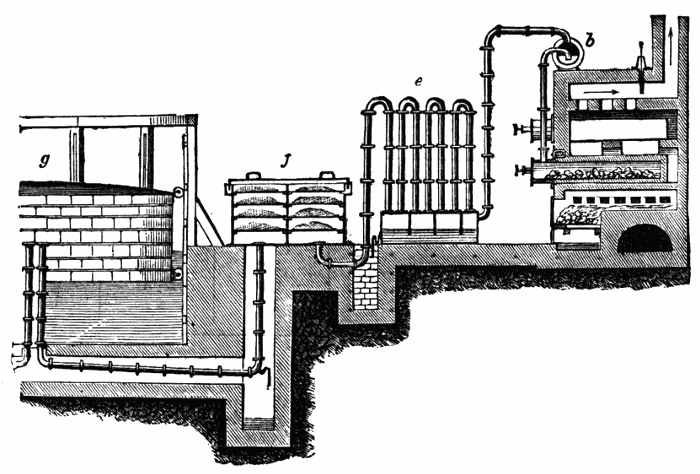
The quantity of coal required to charge each retort is about two bushels, and it takes about four hours for the coal to give off all its gas. When it has done this the resulting coke is removed from the retort, and a fresh charge of coal is thrown into it, the mouth of the retort being then closed with a thick iron plate, and luted with clay. An iron pipe ascends from the upper side of the front of the retort, projecting from the furnace, and after describing a curve at its upper extremity, this iron pipe opens into a much wider tube, called the hydraulic main (b), which latter passes horizontally along the front of the range of furnaces, the tubes from all the retorts dipping into it. The hydraulic main is always kept half full of the water and the tar which condenses from the ascending gas; owing to which arrangement the opening into each retort is effectually closed by a water-valve, and thus permits a fresh charge of coals to be thrown in, and of coke to be withdrawn in any one or more of the retorts, without interfering with the distillation going on in the others.
The aqueous portion of the liquid deposited in the hydraulic main, which is known as the ammoniacal liquor, and forms the principal source of the commercial salts of ammonia, consists principally of solution of carbonate of ammonium, but contains also sulphide, cyanide, and sulphocyanide of ammonium. After it leaves the hydraulic main, the gas passes into the condenser (e), which is composed of a series of bent iron tubes (shown in the plate), these being kept cool either by the large surface they expose to the air, or, if necessary, by means of a stream of cold water applied to the outside.
Any of the volatile hydrocarbons or salts of ammonia escaping condensation in the hydraulic main are arrested in the condensers, but not always; hence it is necessary to afterwards carry the gas through a scrubber (not figured in the plate) or case containing pieces of coke, over which a stream of water being made to trickle, absorbs any remaining ammoniacal vapours. The gas next passes through the lime purifier (f), an iron box fitted with shelves, on which is placed slaked lime, which absorbs the carbonic acid, and part, but not the whole of, the sulphuretted hydrogen contained in the gas. Of the many methods devised for the removal of the sulphuretted hydrogen, none appears to be so successful and economical as that which consists in passing the gas over a mixture of sulphate of iron, slaked lime, and sawdust.
The gas, after it has become purified by the foregoing processes, is passed into the gasometer (g) (part of which is represented in the plate), whence it passes into the mains, by which it is conveyed to the various condensers. Another prejudicial impurity formed in gas is carbon disulphide, which when burned gives rise to small quantities of sulphuric acid, and this in time attacks certain kinds of furniture, as well as the bindings of books.
Dr Angus Smith effects the removal of the disulphide by passing the gas through a solution of plumbic oxide in caustic soda, diffused through sawdust.
The quality of coal-gas is largely dependent upon the temperature employed in its manufacture. If the retorts are insufficiently heated, the result will be the formation of certain easily-condensable hydrocarbons, which not only diminish the bulk of the gas, but cause considerable inconvenience by collecting in and blocking up the pipes. On the contrary, should too much heat be used, the gas becomes partially decomposed by contact with the red-hot retort, and deposits on its sides the substance known as “gas carbon,” thus not only removing to a certain extent the constituent to which the gas owes its illuminating power, but impoverishing its lighting qualities still more, by diluting it with an unnecessary quantity of liberated hydrogen. These latter effects are forcibly illustrated in the following analysis of the gas collected from Wigan cannel coal at different periods of the distillation.
The best gas is said to be produced when the retorts are heated to a bright cherry red.
In 100 Volumes.1st Hour.5th Hour.10th Hour.
Olefiant gas and volatile hydro-carbons13·07·00·0
Marsh gas82·556·020·0
Carbonic oxide3·211·010·0
Hydrogen0·021·360·0
Nitrogen1·34·710·0
“The value of gas as an illuminating agent may be said to depend on the amount of hydrocarbons present, and on the relation which the carbon bears to the hydrogen in these substances. In marsh gas, CH4, which is, practically speaking, non-luminous, the per-centage composition is, carbon 75, and hydrogen 25. In olefiant gas, C2H4, the carbon is 85·7, and the hydrogen 14·3, and the gas possesses a correspondingly greater amount of illuminating value. In acetylene, C2H2, we have a gas of still greater illuminating value, the proportion of carbon to hydrogen being also greater, the per-centage composition being, carbon 92·3, and hydrogen 7·7. In benzol, C6H6, we have the same per-centages; while in naphthalene, C10H8, a still higher ratio between the carbon and hydrogen exists, and a corresponding increased value in light-giving power. It was formerly taken as an axiom that the illuminating value of a mixture of gases was also proportionate to the relation between the carbon and hydrogen, but although this is very good as a rough criterion in practice, the statement must not be accepted as strictly true. The illuminating power of a mixture of gases is known now to depend far more on the nature of the particular compounds present, than upon the absolute proportion between the hydrogen and carbon; for while on the one hand it is possible to have a gas (marsh gas) containing as much as 75·4 per cent. of carbon, and yet which is valueless for illuminating purposes; it is also possible to have a mixture of gases in which the per-centage of carbon is far less, although the illuminating value is much greater.”[326]
Coal gas consists of a mixture of the following bodies:
Marsh gas (light carbonetted hydrogen). Olefiant gas (heavy carbonetted hydrogen). Hydrogen. Carbonic oxide. Nitrogen. Vapours of liquid hydro-carbons. Vapour of bisulphide of carbon.
The yield of gas, and also the illuminating power of the product, vary greatly with different kinds of coal. The average yield may be roughly estimated at 10,000 cubic feet of gas per ton of coal.[327]
Anthracite is by no means suited for a gas coal. The best coals for this purpose are those which are bituminous; they comprise caking coal, parrot coal, and certain varieties of cannel coal. London gas (which is generally deficient in illuminating power) is manufactured principally from Durham and Newcastle coal.
In addition to the elementary composition of the coal, the amount and nature of the volatile matter contained in it is an important factor in its value as a source for gas. It should also yield a small amount of ash, and be as free as possible from sulphur, besides which its ultimate analysis should show a comparatively small proportion of oxygen. If there be an excess of this latter element, the production of the hydrocarbon illuminants will be diminished, since the hydrogen which would go to their formation would unite with the oxygen to form useless water.
The late Charles Mansfield proposed to increase the illuminating power of ordinary coal-gas, and to render water gas or even atmospheric air luminiferous, by passing them through sponges or over trays containing mineral naphtha or benzole; and a patent was taken out for this purpose. The gas so treated imbibes or dissolves a portion of the liquid, and burns with increased brilliancy. The method of saturating the gas with the liquid hydrocarbon is as follows:—“The apparatus consists of a brass reservoir or chamber attached to the end of the gas-pipe, near the burner. This reservoir may be in the shape of an oil-flask, made air-tight, with a screw-joint, or other means of supplying any highly volatile oil, turpentine, or mineral naphtha, and should be kept about half full. Into this reservoir the gas-pipe ascends a little above the surface of the oil; a very small jet-pipe of gas, regulated by a stop-cock, is branched off below this chamber, to supply a minute flame, so as to cause a sufficient evaporation from the oil to unite with the gas in the flask receiver. The whole is, of course, surmounted with the usual burner and lamp-glass.”
The naphthalising of gas did not work well on a large scale. Recently, however, an attempt was made to get up a company in England to work a French patented process, which differed only from that of Mansfield’s in the substitution of another hydrocarbon (probably a petroleum product) for benzol. The chemical and technical journals exposed this invention, and prevented the sinking of capital in a worthless undertaking. On a small scale, simple ‘naphthalisers’ appear to work very well.
The illuminating power of gas, as well as of other sources of light, may be directly ascertained by what is termed the ‘comparison of shadows,’ or indirectly, and more conveniently, by chemical analysis.[328] See Air Gas, Illumination.
GASTROPHAN (Apotheker J. Fürst, Prague). For strengthening the digestion and improving the appetite. Quassia, 30 grammes; orange berries, 15 grammes; galangal, 4 grammes; cardamoms, 2 grammes; star anise oil, 10 drops; orange-peel oil, 10 drops; spirit, 180 grammes; water, 120 grammes; digested and filtered. (Hager.)
GASTROPHILE (Dr Borchard). There are several numbers of this preparation. Soda water, containing common salt, perhaps in some of the numbers mixed with Glauber’s salts.
GAZ′OGENE. [Fr.] Syn. Aërating Machine. A portable apparatus for aërating water and other liquids. Many forms have been given to this instrument, but in all the principle is the same. Powders for generating carbonic acid gas are placed in a separate compartment, and the liquid to be aërated in another. The two compartments are connected by a suitable tube, and a second tube, furnished with a spring tap, affords an exit for the aërated liquid. By the aid of the gazogene, water, wine, ale, &c., may in a few minutes be fully saturated with carbonic acid gas, and so rendered brisk and piquant. By using fruit syrups, manufactured from English and foreign fruits, the most delicious aërated summer beverages can be made, resembling those so much esteemed by travellers in the South of Europe and the sea-board cities of the Western world.
The following are the proportions of soda and acid required for charging gazogenes:
For 2 pints, powdered tartaric acid, 280 grains; bicarbonate of soda, 340 grains.
For 3 pints, powdered tartaric acid, 340 grains; bicarbonate of soda, 420 grains.
For 5 pints, tartaric acid, 620 grains; carbonate of soda, 760 grains.
Put the acid and soda in different coloured papers.
GEDACHTNISS-LIMONADE—Mnemonic Lemonade (manufactured by G. M. Raufer, Vienna). A mixture of 15 parts phosphoric acid, 15 parts glycerin, 70 parts water. (Schädler.)
GEHOR INSTRUMENT. Instrument for deafness (Apotheker F. Brunner, Troppau). A little tube of silver plate, 2 centimètres long and as thick as a straw, with a small mussel-shaped widening at one end, which is wrapped in cotton wool, to be inserted in the ear.
GEHOR LIQUOR, Schweizer—Swiss Cure for Deafness (Raudnitz). Water mixed with a little coarse brandy. (Wittstein.)
GEHOROL—Oil for Deafness (C. Brockelmann, Soest). Provence oil adulterated with sunflower oil and mixed with very small traces of camphor and cajeput, sassafras, and rosemary oils. (Hager.)
GEL′ATIN. Syn. Gelatine; Gélatine, Fr.; Gelatina, L. Animal jelly, obtained by the prolonged action of boiling water on the organic tissue of the bones, tendons, and ligaments, the cellular tissue, the skin, and the serous membranes. Glue and size are coarse varieties of gelatin, prepared from hoofs, hides, skins, &c.; and isinglass is a purer kind, obtained from the air bladders of some other membranes of fish.
Prop., &c. Gelatin is insoluble in cold water, but dissolves with greater or less readiness on the application of heat, according to the source where it is obtained, and in this state forms a tremulous and transparent jelly on cooling; it is insoluble in both alcohol and ether, and is decomposed by the strong alkalies and acids; with tannic acid it forms an insoluble compound of a buff colour, which is the basis of leather; when acted on by cold concentrated sulphuric acid, it yields glycocoll or gelatin sugar; and when boiled with strong alkalies, it yields glycocoll and leucine. Chlorine passed into a solution of gelatin occasions a dense white precipitate (chlorite of gelatin), which ultimately forms a tough, elastic, pearly mass, somewhat resembling fibrin.
Tests. Its aqueous solution is recognised as follows:—1. It gelatinises on cooling. 2. It is precipitated by alcohol. 3. Bichloride of mercury gives a whitish flocculent precipitate. 4. Tannic acid or infusion of galls gives a copious yellowish-white, curdy precipitate, which, on being stirred, coheres into an elastic mass, insoluble in water, and incapable of putrefaction, and which, when dried, assumes the appearance of over-tanned leather. 5. The gelatinising property is destroyed by nitric acid. 6. It is not affected by either alum or acetate of lead. In this respect it differs from chondrin.
Qual. The goodness of commercial gelatin intended for food is readily proved by pouring boiling water over it, and digesting the two together for a short time. If it is pure and wholesome, its colour remains unaltered, and during its solution it continues entirely free from smell. The resulting solution and jelly are also odourless, neutral to test-paper, free from unpleasant taste, and perfectly transparent. If it forms a yellow gluey-looking mass, and evolves an offensive odour, it should be rejected as of inferior quality, and unfit for culinary purposes.
Uses, &c. Gelatin is largely employed as an article of food, as in soups, jellies, &c.; but its value in this respect has been, perhaps, overrated.[329] Animals fed exclusively on gelatin die of starvation. But when mixed with other food, especially with substances abounding in albumen, casein, or fibrin, gelatin may be useful as an aliment, and serve directly to nourish the gelatinous tissues. (Liebig.) Hence gelatin is a fitting substance to form part (but only a part) of the diet of convalescents, as it conveys nutrition directly to these tissues, without tasking the diminished powers of life for its conversion; but its use should be accompanied by a proper quantity of azotised animal food to supply the elements to the blood, for the support and increase of the muscular tissue, or fleshy portion of the body. In France gelatin obtained from bones is employed as a part of the diet in hospitals with the best effect, materially abridging the period of convalescence; but when given alone, all animals soon become disgusted with it, and die if not supplied with other food. (D’Arcet.) See Glue, Isinglass, and below.
Gelatin, Bone. Obtained from crushed bones by boiling with water, or by the action of steam and water successively, either with or without pressure; or by maceration in dilute hydrochloric acid, to extract the phosphate of lime, the remaining gelatinous mass being well washed in cold water, and afterwards dissolved in boiling water in the usual manner. A little carbonate of soda is commonly added to the last water. Gelatin has even been extracted from fossil bones. “A soup was prepared from one of the bones of the great mastodon by the préfet of one of the departments of France.” (Pereira.) Butchers’ meat contains, on an average, 24% of dry flesh, 56% of water, and 20% of bone. The last will yield, by proper treatment, nearly 1-3rd of its weight of dry gelatin, or a quantity equal to about 6% of the meat from which it is cut. This, as well as other varieties of gelatin, is frequently blanched by sulphurous acid or animal charcoal, and tinged of various colours with the ordinary vegetable dyes. Thus, blue is given with sulphate of indigo or the juice of blue berries; green, with the juice of spinach; and red, with juice of red-beet.
Gelatin, French. Syn. Cake gelatin. Gelatin made up into small thin cakes, like the finer sorts of glue. A good deal of it is prepared in Paris from the cuttings of the skins used in making kid gloves and slippers.
Gelatin, Patent. Various qualities of gelatin are manufactured from glue pieces, or cuttings of the hides of beasts and skins of calves, and from inferior isinglass. According to Mr Nelson’s specification, the crude materials, freed from hair, wool, flesh, and fat, after being thoroughly washed and ‘scored,’ are macerated for 10 days in a lye of caustic soda, and are then placed in covered vessels at a temperature varying from 60° to 70° Fahr., until they become tender; they are next washed to free them from alkali, and are then exposed to the vapour of burning sulphur until they acquire a sensibly acid reaction; they are now dissolved in water contained in earthen vessels heated to 150° Fahr., and the solution, after being strained, is put into ‘settling vessels,’ and heated to 100° to 120° Fahr., for 8 or 9 hours; at the end of this time the clear liquor is drawn off, and poured on the ‘cooling slabs,’ to the depth of about 1⁄2 an inch. As soon as the jelly is cold, it is cut into pieces, and washed in water until perfectly free from acid. It is then redissolved in water at about 85°, the solution poured out on slabs as before, and when cold, it is cut up, and, lastly, dried on nets.
According to another specification (Rattray’s Patent) glue-pieces are steeped in water until they begin to putrefy, then washed with water, drained, and put from 12 to 24 hours into water strongly soured with sulphurous acid; they are afterwards washed first with cold water, and then in water at 120° Fahr., and are lastly converted into size by digestion for 24 hours in water at 120° Fahr., the resulting solution being filtered through bags of double woollen-cloth.
Patent gelatins are often sold cut up in imitation of ‘picked isinglass,’ to which, for the preparation of jellies, soups, and blancmanges, they are not much inferior.
Gelatin, Rough. Syn. Gelatine Brut, Fr. From the skulls of oxen, the spongy insides of the horns and ribs, and from several other soft bony parts (deprived of fat), by washing them in water, digesting in an equal weight of hydrochloric acid of 6° Baume, in cold weather, and 4° or 5° in summer, for 10 days, then in acid of only 1° Baume for 24 hours longer; afterwards soaking and washing in successive portions of cold water until all the acid is washed out, adding an ounce of carbonate of soda to the last water. Used to make glue, &c. A similar article is prepared from the bones of sheep. The pieces, after being treated as above, are steeped in boiling water for a few minutes, wiped dry, and shaken together in a bag to remove the internal pellicle; after which they are cut into squares or dice to disguise them, and finally dipped into a hot solution of gelatin to varnish them. In this state the article is called ‘GELATINE BRUT FIN,’ Used to make soup. It keeps better than the cakes of portable soup. When less carefully prepared, it is also used to make glue for fine work. See Bone gelatin.
GELEE (pour le Goitre). See Liniment of Iodide of Potassium.
GELSEMIUM SEMPERVIRENS. Syn. Gelsemium nitridum, Gelsemium sempervirens, Gelsemium lucidum, Anonymus sempervirens, Bignonia sempervirens; Lisanthus sempervirens. The Yellow jasmine, or WOODBINE. The Carolina jasmine.
Different botanists have placed the plant in different natural orders. De Candolle assigns it to the Loganiaceæ; Decaisne to the Apocynaceæ; Chapman to the Rubiaceæ.
The root, which is the only part of this plant employed in medicine, and of which a fluid extract has been introduced into the United States Pharmacopœia, as met with in English commerce occurs in two states; either in packets prepared by the shakers of New Lebanon, which contain the root in small pieces, formed into a compact mass by hydraulic pressure, and in which state it is difficult to powder; or it is simply sold cut up into pieces varying from two to eight inches in length, and one-third to three fourths of an inch in diameter. It is frequently mixed with about half its bulk of long, wiry, pale-brown rootlets.
The so-called gelsemium root consists chiefly of subterranean stem with a small proportion of true root, occasionally a slender piece of the aërial stem may be found intermixed, and is readily distinguished by its purplish colour and hollow centre, and by the silky and tow-like fibre, rendered visible when the epidermis is peeled off (fig. 1 e).
The true root is hard and woody, slightly undulated in outline, very sparingly branched, except in the slender pieces, externally of a pale brown colour, nearly smooth, and furnished with a thin scurfy cuticle, which is slightly cracked longitudinally. When a transverse section is examined with a lens, the bark of the root is seen to be very thin, and to consist of two layers, the inner one being usually almost as pale as the woody portion, and of somewhat soft texture, the outer one is darker and more compact (fig. 1 b, c).
The meditullium, or woody portion of the root occupies nearly its whole diameter, is of a pale yellowish bright colour, the yellow tint becoming much more distinct when the root is wetted. The medullary rays are white and very distinct, and the woody tissue between the rays is very porous, the pores being very small, but visible to the unaided eye, especially when the root is broken instead of cut (fig. 1 d). There is no pith or central cavity in the root. The root has a bitter taste and pleasant flavour, somewhat between those of senega and green tea; this is more readily perceived in the tincture.
The subterranean stem (fig. 1 a) is also furnished with rootlets, but is easily distinguished from the root by the presence of a small, dark coloured, central cavity representing the pith, and by the external surface being rougher, and frequently variegated with dark longitudinal lines, which are the remains of the same purplish cuticle which presents so marked a feature in the aërial stem. The bark is thicker than that of the true root, and the inner layer is usually dark brown. If the subterranean stem is broken slowly and carefully, a thin row of silky fibres projects fully a quarter of an inch from the broken edge. The fibres do not appear when the bark of the root is broken, and thus serve to distinguish the stem of this drug from the root. Experiments as to the relative value of the bark of the root and stem are wanting. The bark of the stem has the same bitter taste as that of the root, and if it be hereafter shown that it is equally active, the above character of scattered strong fibres, taken in conjunction with the flavour of the drug and its porous structure, will serve to distinguish it from all other roots and stems used in materia medica.[330]
Medicinal properties.—The American medical journals record the successful administration of gelsemium in a great number and variety of diseases, including intermittent, remittent, typhoid, and yellow fevers, the irritative fevers of childhood, inflammation of the lungs and pleura, dysentery, rheumatism, and other inflammatory affections, neuralgia, obstinate menstruation, delirium tremens, morbid wakefulness, St. Vitus’ dance, hysteria, epilepsy, spasmodic stricture of the urethra, and gonorrhœa. Dr Hurd, an American physician, reports very favorably of the drug as a cardiac sedative, and considers it more efficient than any other remedy in the palpitation and the difficult breathing that accompany heart disease; and Dr Hill, of Maine, finds it when combined with bromide of potassium useful in irritable bladder.
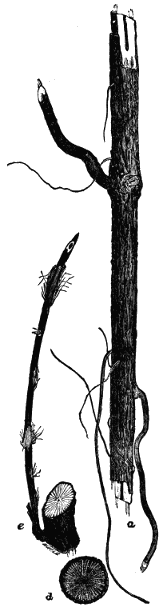
Its principal use, however, in American medical practice has been as a febrifuge. In periodic fevers it has been employed with great advantage, as well as in cases of intermittent fever, which having failed to yield to quinine alone, succumbed, when this latter medicine was combined with gelsemium.
In England gelsemium has been successfully employed for the relief of facial neuralgia, or of the pain caused in the face and jaws by decayed teeth; as well as in obscure nervous affections and severe headaches. It is given principally in the form of tincture; but sometimes in powder in doses of from one to two grains.
The therapeutic action of gelsemium is believed to be due to the sedative effect it exercises on the nervous and arterial systems—hence its power in controlling the nervous irritability so prevalent during fever. In moderate doses it causes a sensation of agreeable langour, accompanied with muscular relaxation; in larger doses, dizziness, dilated pupil, double vision, general muscular debility and prostration; these symptoms being accompanied by a diminution in the force and frequency of the pulse as well as in the respiration. At the same time the patient becomes insensible to pain; but is free from stupor and delirium. These symptoms are said to pass off, after a time, and to be attended with no unpleasant results.
The ‘Lancet’ as well as many of the American medical journals record several cases of poisoning arising from giving an overdose of this drug. The symptoms are a great prostration of nervous energy, accompanied by paralysis of sensation and motion. When death occurs it is probably owing to syncope. The antidotes are, first, an emetic, and after this has acted, stimulants, such as carbonate of ammonia with brandy, or aromatic spirits of ammonia. In cases accompanied with insensibility, recourse should be had to electricity.
Kollock, in the ‘American Journal of Pharmacy’ for 1855, states that he found the root on analysis to yield volatile oil, dry acrid resin, fatty resin, fixed oil, gallic acid, starch, pectic acid, albumen, extractive matter, lignin, gum, a yellow colouring matter, mineral matter (chiefly salts of potassium, calcium, magnesium, iron and silica), and an alkaloid, to which the name gelseminine or gelsemia has been given. Kollock also states that the leaves and flowers contain the same ingredients as the root, although in much smaller quantities.
Eberle, in the ‘American Journal of Pharmacy’ for 1864, says he failed to obtain gelseminine from the root. In a paper contributed to the ‘American Journal of Pharmacy,’ for January, 1870, by Dr Wormley, the author stated that he said he not only succeeded in obtaining pure gelseminine from the root, but also a peculiar acid which he calls gelseminic, or gelsemic[331] acid; which he regards as existing in combination with the gelsemia, forming the gelsemate of gelsemia.
Probably the alkaloid gelseminine may at some future time be introduced into medicine, since it would appear to be the chief ingredient to which the root owes its activity. It is strongly poisonous. Dr Wormley injected one eighth of a grain under the skin of a large cat, which in 40 minutes exhibited great prostration, and died in an hour and a half from the time of the injection of the poison. The properties of the gelseminic acid, the resin, the volatile oil, and other ingredients of the root, have not been fully investigated. See Tincture of gelsemium, GELSEMININE.
In the ‘American Journal of Pharmacy’ for April, 1877, Dr Wormley gives the following directions for the preparations of gelseminic acid, and gelsemine:—A given volume of fluid extract, acidulated with acetic acid, is slowly added with constant stirring to about eight volumes of water; after the separated resinous matter has completely deposited, the liquid is filtered, and the filtrate concentrated on a water bath, to something less than the volume of fluid extract employed. The gelseminic acid is then extracted from the concentrated fluid by ether, after which the liquid is treated with slight excess of carbonate of sodium, and the gelsemine extracted with ether or chloroform. For the extraction of the first of these principles, it is not essential that the liquid should be acidulated, but in the presence of a free acid the results are more satisfactory.
GEMS. Syn. Jewels; Gemmæ, L. “Gems are precious stones, which, by their colour, limpidity, lustre, brilliant polish, purity, and rarity, are sought after as objects of dress and decoration. They form the principal part of the crown jewels of kings, not only from their beauty, but because they are supposed to comprise the greatest value in the smallest bulk; for a diamond, no larger than a nut, or an acorn, may be the representative sign of the territorial value of a whole country, the equivalent in commercial exchange for a hundred fortunes, acquired by severe toils and privations.” “Among these beautiful minerals mankind have agreed in forming a select class, to which the title of gems or jewels has been appropriated; while the term precious stone is more particularly given to substances which often occur under a more considerable volume than fine stones ever do. Diamonds, sapphires, emeralds, rubies, topazes, hyacinths, and chrysoberyls, are reckoned the most valuable gems;—crystalline quartz, pellucid, opalescent, or of various hues, amethyst, lapis lazuli, malachite, jasper, agate, &c., are ranked in the much more numerous and inferior class of ornamental stones.” (Ure.)