A CYCLOPÆDIA OF PRACTICAL RECEIPTS, PROCESSES, AND COLLATERAL INFORMATION (continued 3)
Reading edition
It is open to doubt whether the malarious poison exists in the form of a gas, for the observations of microscopists go to show the extreme minuteness of the germs of disease, which are probably not more than 1⁄70000th of an inch in size, and it is regarded as probable that the real cause of ague is the entry into the circulation of some low forms of spores of fungi, or of some minute animalcules. Ague is always to be met with in places where fungi grow, and is always associated with what Pettenkofer calls “the ground air”—that is, the air contained in the interstices of the soil, no inconsiderable volume of which is drawn into every house which has a fire on the floor which rests on the earth. That animalcules (?) may exist in the blood is evidenced by the discovery of Dr Lewis, who found hair-like worms in the circulation; and whilst considering this point, we must bear in mind that the remedial agents employed to check ague, quinine, arsenic, &c., are drugs capable of destroying animal life, and it is not impossible that they may exercise a beneficial effect in destroying the spores or animalcules to which the disease may be due.
The best means to be employed to combat malarial fevers in any district are thorough and efficient drainage (and it must be remembered that drainage purifies both the ground-air and the ground water) and a supply of wholesome water free from decomposing vegetable matter.
That the adoption of the above means cannot fail to succeed is incontestably proved by the fact, that during the last 200 years, ague in England has diminished to a wonderful extent, in short, as good drainage and a pure water supply have prevailed, there has been a proportionate diminution of paludal poisoning.
During the protectorate of Cromwell great mortality prevailed in London, from the ravages of ague; at that time London was as swampy as the fens of Lincolnshire. See Fever (Intermittent).
Ague-cake. The popular name of a tumour felt under the false ribs on the left side, formed by enlargement and induration of the spleen, following protracted ague; also, sometimes, of indurations of the liver following ague.
Ague-drop. See Drops.
Ague-salt (sŏlt). Disulphate of quinine.
Ague-tree. Sassafras.
Ague-weed. The herb thorough-wort (‘Eupato′′rium perfolia′tum,’ Linn.).
AIG′REMORE (ĕg′r-mor). [Fr.] Pulverised charcoal in the state it is used to make gunpowder.
Attelettes from Soyer.
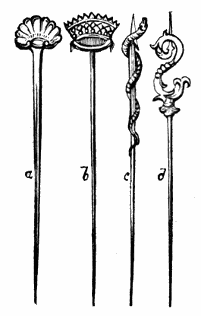
AIGUILLETTE (Attelette). [Fr.] In cookery, a term applied to several small dishes, from the articles of which they consist being mounted on silver needles, or skewers, with ornamental handles or tops. (See engr.) They form one of the varieties of the ‘hors-d’œuvres’ of Soyer; and are commonly served on a napkin. The skewers should be about four inches long, and of the thickness of an ordinary packing needle. The person eating what is served on them takes the head of the skewer between the thumb and fingers of the left hand, and picks it off with his fork. Those noticed by Soyer are—
Aiguillettes à l’Éperlan (smelts);
Aiguillettes aux Huitres (oysters);
Aiguillettes de Filets de Sole (soles);
Aiguillettes de Homard (lobsters);
Aiguillettes de Langue de Bœuf (ox-tongue);
Aiguillettes de Ris de Veau (sweetbread of veal);
Aiguillettes de Volaille à la Jolie Fille (fowl);—
all of which are prepared in a nearly similar manner, merely varying the sauces, &c., to suit the article and palate. See Attelettes, Hors-d’œuvres, &c.
AHORNZUCKER (genuine American maple sugar). For coughs, hoarseness, and all affections of the throat and chest caused by cold. The raw maple sugar as imported. (Hager.)
AILANTHUS. The inner bark of the ailanthus glandulosa, a common tree growing in northern China, said by Dr Dudgeon to have proved very successful in dysentery.
The ailanthus glandulosa is also well known throughout the United States. Professor Hétet, of Toulon, tried the effect of the powdered bark, leaves, and various preparations of the bark or drugs, with the result of their administration being attended with purgative effect—and the discharge of worms.
The powdered bark has been given in small cases of tape-worm in the human subject, with marked success. The dose of the powder found sufficient for the expulsion of the tapeworm was from seven or eight to thirty grains.
AIL′MENT. Pain, indisposition; disease. Its use is generally restricted to the non-acute, and milder forms of disease.
AIR. [Eng., Fr.] Syn. Aer, L. (from αηρ Gr.); Luft, Ger.; Atmospheric Air; The Atmosphere. This name was formerly given to any aëriform body; thus, by the old chemists ammoniacal gas was called alkaline air; oxygen,—dephlogisticated, vital, or empyreal air; carbonic anhydride (carbonic acid), fixed air; hydrogen, inflammable air; heavy carbonetted hydrogen, olefiant gas, heavy inflammable air; nitrogen,—mephitic, phlogisticated, or nitrous air. At the present time the term air is usually restricted to the gaseous envelope surrounding the solid and liquid parts of our globe.
Air, Atmospheric (or simply, The Air). The air chiefly consists of a mechanical mixture of four volumes of nitrogen and one volume of oxygen, or more accurately—
By volume.By weight.
Nitrogen79·176·8
Oxygen20·923·2
——————
100100[12]
We may premise our description of the functions of the constituents of the atmosphere by the following quotation from Mr Blyth’s ‘Dictionary of Hygiène and Public Health’:—“One of the most important properties of air is its power of penetration and its universality. Air is, indeed, present everywhere; there is scarcely a solid, however compact it may appear to be, which does not contain pores, and these pores filled with air. The soil contains no small quantity; indeed, if it were not so the numberless insects, worms, &c., which burrow in its interstices would cease to exist. The most compact mortar and walls are penetrated with it, and water of natural origin contains a large quantity of air in solution. The atmosphere is supposed to extend to a very great height, from 200 to 300 miles; it used to be considered only five (forty-five) miles high, but observations on shooting stars, &c., show that this opinion is erroneous. Owing to the force of gravity, the air is much denser near the earth, and gets more attenuated layer by layer as you ascend. If, then, the atmosphere were possessed of colour, it would be very dark just round the globe, and the tint would gradually fade into space. The air is by no means wholly gaseous; it contains, indeed, an immense amount of life, and small particles derived from the whole creation. In the air may be found animalcules, spores, seeds, pollen cells of all kind, vibriones, elements of contagion, eggs of insects, &c., and a few fungi, besides formless dust, sandy, and other particles of local origin; for example, no one can ride in a railway carriage without being accompanied with dust, a great portion of which is attracted by a magnet, and is, indeed, minute particles of iron derived from the rails. The purest air has some dust in it. There probably never fell a beam of light from the sun since the world was made which did not show, were there eyes to see it, myriads of motes; these, however, generally speaking, are quite innocuous to man—some, indeed, may possibly be beneficial. Another most important property of air is its mobility; on the calmest day and in the quietest room there are constant currents of air which rapidly dilute any noxious odours of gases.”
The chief functions of the oxygen are to maintain respiration and support combustion, while the office of the nitrogen is to dilute the oxygen and control its energy.
Besides nitrogen and oxygen, aqueous vapour, carbonic anhydride, ammonia, and nitric acid are met with in the atmosphere, the last especially during and shortly after thunder storms.
Although, doubtless owing to local conditions, trifling variations may occur in the proportion of oxygen present in the atmosphere, this variation is so trifling that the difference of the amount in air from places separated by very long distances will be found in the second decimal place only; thus, whilst a portion of air taken during a balloon ascent by Mr Green gave on analysis 20·88 per cent. by vol., Dr Frankland found in air collected by himself on the summit of Mont Blanc 20·96 per cent. by vol. A still nearer approximation in uniformity in the amount of oxygen present in atmospheric air is exhibited in the following table, which gives the results of 95 analyses by Regnault on air obtained from nine different localities:—
100from Paris gave in 100 parts, by vol. of oxygen20·913 to20·999
9from Lyons and around gave in 100 parts, by vol. of oxygen20·918 to20·966
30from Berlin gave in 100 parts, by vol. of oxygen20·908 to20·998
10from Madrid gave in 100 parts, by vol. of oxygen20·916 to20·982
23from Geneva and Switzerland gave in 100 parts, by vol. of oxygen20·909 to20·993
15from Toulon and Mediterranean gave in 100 parts, by vol. of oxygen20·912 to20·982
5from Atlantic Ocean gave in 100 parts, by vol. of oxygen20·918 to20·965
1from Ecuador gave in 100 parts, by vol. of oxygen20·960
2from Pichincha gave in 100 parts, by vol. of oxygen20·949 to20·981
——————
Mean of all foregoing20·94920·988
Mean of the Paris specimens20·96
Vapour of water is essential to the respiration of animals and plants, in order that the organs concerned in this operation may be kept in a soft and moist condition.
Carbonic anhydride is evolved during combustion, putrefaction, and fermentation; it is also a product of the respiration of animals, and highly poisonous to them, even when diluted with large proportions of air. This gas is, however, greedily absorbed by plants, which decompose it; they assimilate the carbon and return the oxygen to the atmosphere, ready to be again consumed in supporting the life of the animal world.
Dr Angus Smith has defined a very pure air to be one that contains with 20·99 per cent. of oxygen 0·30 of carbonic acid (anhydride).
This latter varies in amount in the atmosphere of cities, as will be seen upon inspection of the subjoined table, extracted from Dr Smith’s work ‘Air and Rain’:—
Per cent.
Air of Madrid, outside the walls, mean of 12 analyses, by Luna·045
Mean of 12 analyses, within the walls of Madrid, by Luna·051
Mean of 14 analyses, by Angus Smith, in Manchester suburbs·369
In Manchester streets·403
Usual weather·0403
During fogs·0679
De Saussure’s analyses show that there is more carbonic acid on the mountains than in the plains, as might be inferred from the comparative absence of vegetation in elevated positions. Dr Pietra Santa states that the air of hills or mountains, at the height of 2300 feet, is lighter than common air, contains a smaller proportion of oxygen, and is impregnated with a largely increased amount of aqueous vapour. It also contains a large quantity of ozone. He considers such a climate peculiarly soothing to persons suffering from chest diseases.
Dr Angus Smith’s analysis of the air from the mountainous districts of Scotland confirms the above statement of Dr Pietra Santa’s. The heaths and mountains of that country are remarkably healthy localities, and the air from them gave on analysis 20·94 per cent. by vol. of oxygen, and only ·033 of carbonic acid.
Ammonia is derived from the putrefaction of animal and vegetable substances. It is from atmospheric ammoniacal compounds that plants obtain much of the nitrogen which is essential to the formation of many parts of their structure.
Nitric acid, like ammonia, is absorbed, and its nitrogen assimilated, by plants.
In addition to the gases and vapours already enumerated, as well as others which exist in minute quantity, or which are of only occasional occurrence, Pasteur and other investigators have discovered in the air living germs which are capable of exciting putrefaction and fermentation, and which are competent, in some instances, to engender disease when they are injected into the blood of animals. In fact, the spread of infectious diseases, e.g., smallpox, typhus fever, cattle plague, &c., is attributed to the presence in the atmosphere of the germs of such maladies. These germs are believed to be living beings, which develope and multiply at the expense of the tissues of the larger animals into whose systems they have found entrance.
Air, Vitiated. As has been stated in the previous article, the air consists chiefly of two gases, oxygen and nitrogen. In all open places it has a similar composition, as might be concluded from the constant mingling which takes place by the agency of currents continually in movement, although sometimes to an inconsiderable extent only. Dr Angus Smith regards air as very pure when it contains not less than 20·99 per cent. by volume of oxygen, and 0·030 of carbonic anhydride (acid). According as the proportion of the former gas diminishes and that of the latter increases beyond certain limits in the air by which we are surrounded, it becomes more or less deteriorated and unfit to be breathed, particularly as the increased amount of carbonic acid is, in crowded dwellings, assembly rooms, theatres, and confined inhabited spaces, associated with deleterious and putrescent exhalations from the person.
The following tables exhibit the amount of carbonic acid in close places in London.
I.
Per-centage
by volume.
Chancery Court, closed doors, 7 feet from the ground, March 3·193
Same, 3 feet from ground·203
Chancery Court, doors wide open, 4 feet from ground, 11·40, March 5·0507
Same, 12·40 p.m., 5 feet from ground·045
Strand Theatre, gallery, 10 p.m.·101
Surrey Theatre, boxes, March 7, 10·30 p.m.·218
Olympic, 11·30 p.m.·0817
Same, 11·55 p.m.·1014
Victoria Theatre, boxes, March 24, 10 p.m.·126
Haymarket Theatre, dress circle, March 18, 11·30 p.m.·0757
Queen’s Ward, St. Thomas’s Hospital, 3·25 p.m.·052
Edward’s Ward, St. Thomas’s Hospital, 3·30 p.m.·052
Victoria Theatre, boxes, April 4.·076
Effingham, 10·30 p.m., April 9, Whitechapel·126
Pavilion, 10·11 p.m., April 9, Whitechapel·152
City of London Theatre, pit, 11·15 p.m., April 16·252
Standard Theatre, pit, 11 p.m., April 16·320
Dr Angus Smith states that out of 339 specimens of air obtained from various mines he found 35 normal or nearly so, 81 decidedly impure, and 212 exceedingly bad; he also adds that owing to the frequent firing of charges of gunpowder within the mines, and from other causes, the atmosphere is further contaminated with sulphuretted hydrogen, sulphate, carbonate, sulphide, sulphocyanide of potassium, and nitrate of potassium, carbon, sulphur, carbonate of ammonia, organic matter, sand, and sulphurous and arsenious acids.
The air of large cities, which are the seats of manufacturing industry, is always more or less charged with the exhalations given off by chemical and other works. The sulphuric-acid works contribute sulphuric, sulphurous, nitrous, and arsenious acids; copper works, in which pyrites is employed, give off large quantities of sulphurous acid, mixed with arsenic and a little copper; manure works, in many cases, send out compounds of fluorine, besides sulphuric acid; glass works, sulphuric and hydrochloric acids; and alkali works, hydrochloric acid (although in small quantities), which very frequently contains arsenic. Of ammonia, Angus Smith remarks: “It is one measure of the ‘sewage’ of the air; it is the result of decomposition. It is not, in these small quantities, hurtful, so far as we know. The ammonia is in no case free, but combined probably with hydrosulphuric, hydrochloric, and sulphuric acid in towns. In country places it is, at all events partly, united to carbonic acid.
II. London Air.—Carbonic Acid, Metropolitan Railway, November, 1869.
Date.Place. Time of Day.Carbonic Acid, per cent.Oxygen, per cent.
1869. Nov.12.Tunnel between Gower Street and King’s Cross Stations; specimen taken at the open window, first-class carriage.10 a.m.·15020·60
”12.Tunnel between Gower Street and King’s Cross Stations; specimen taken at the open window, first-class carriage.7·30 p.m.·07820·79
”12.Tunnel Praed Street; specimen taken at the open window, first-class carriage.10·30 a.m....20·71
”15.Specimen taken during journey between Gower Street and King’s Cross, first-class carriage, window open.10·15 a.m.·33820·66
”15.Same3 p.m.·15520·70
”15.Same11 p.m.·15020·74
Average·145220·70
Angus Smith.
The Air of Mines (Metalliferous).
Name of Mine, and depth from surface, in fathoms.Description of place, where taken and time when taken.Thermometer, Fahr.Number of Men working in it.Oxygen, per cent.Carbonic Acid, per cent.
Hurst End, 300 ft. beyond a rise, 9 ft. high, 7 ft. wide....2...1·99
Old GangEnd of level...220·58·48
”End of level...2...·28
”(a) Rise 7 ft. high, 132 ft. from current....220·25·39
Grassington(b) End of cross cut, 480 ft. from rise....220·94·06
”End, 480 ft. from rise....219·531·59
”Rise 60 ft. high in shale....219·521·72
”End, 60 ft. from rise....220·471·06
”(c)End, 840 ft. from rise....220·08·94
(a) Air machine. (b) Unusual amount of dust. (c) Crystals were chiefly hexagons.
Angus Smith.
The following table, showing the amount of ammonia present in rain collected at the different places named, is from Dr Smith’s work, ‘Air and Rain.’
Comparative.Ammonia.
That of Valentia (Ireland) taken as 1 or 100.
Ireland, Valentia·1
Scotland, sea-coast, country places, west2·69
Scotland, inland, country places, west2·96
Scotland, sea-coast, country places, average4·10
Scotland, sea-coast, country places, east5·51
England, inland, country places, east5·94
England, sea-coast, country places, west10·55
German specimens10·61
London, 186919·17
Scotland, towns (Glasgow not included)21·22
St. Helen’s25·33
Runcorn25·72
England, towns28·67
Liverpool29·89
Manchester, 186935·33
Manchester, 1869 and 1870, average35·94
Manchester, 187036·54
Glasgow50·55
The effects resulting from breathing an impure atmosphere are necessarily dependent upon the extent of the pollution and other conditions. When the contamination is moderate the first effect is headache, accompanied with lassitude, and a general paleness of the face and skin, owing to a diminution of the red corpuscles of the blood or to their imperfect aëration; the pulse becomes lowered, and at the same time the breathing is accelerated. When in addition to breathing such air from day to day is superadded the misfortune of an insufficiency of food, scrofula and consumption very often follow. Dr Guy has demonstrated the great mortality that is caused by consumption in those trades in which workmen pursue their calling in hot, close, gas-lit rooms, in comparison with those who pass most of their time in the open air. The amount of air required by each person in a room is no less than 2100 feet per hour; when the ventilation does not supply this amount of fresh air, the apartment smells stuffy, the furniture becomes coated with a film of organic matter, unless constantly cleaned, and the carbonic acid becomes increased beyond its normal quantity.
Dr Parkes has shown that bronchitis and consumption are more frequently than not contracted by those who live in an atmosphere of foul air. In the years 1834 to 1847 the proportion of deaths in the ill-ventilated prison of Leopoldstadt in Vienna was 86 per 1000, out of which number 51·4 per 1000 was due to phthisis or consumption; while in the well-ventilated House of Correction in the same city the deaths were 14 per 1000, of which 7·9 were from phthisis; hence 43·5 cases per 1000 of the deaths were clearly traceable to foul air and nothing else.
Mr Noel Hartley, in his valuable little manual, ‘Water, Air, and Disinfectants,’ says: “During the outbreak of cattle plague in 1866, in sheds containing twenty to thirty cows—which the owners kept closed to such an extent that all chinks in the doors and windows were stuffed with straw and matting, under an ignorant belief that thus the plague could be kept out—very frequently the entire stock died in two or three days after the first appearance of disease; while in other cases where animals were housed in a well-cleaned and tidily-kept shed, with a plentiful supply of fresh air, not only did some of them escape the disease altogether, but the deaths were reduced to one third of the number of beasts attacked.”
The large supply of fresh air necessary in hospitals for contagious diseases is fully recognised by medical men, and more especially so in America. Wounds carefully protected from contact with impure air do not suppurate, and organic fluids do not putrefy. On the other hand, in a bad atmosphere sores become unhealthy, and are difficult to heal, erysipelas and hospital gangrene frequently set in, while the best prevention and the best means of cure for such afflictions is the greatest possible exposure to fresh air.
Vitiated air, as a consequence of over-crowding, aids the spread of measles, scarlet fever, and the much to be dreaded smallpox; it brings on ophthalmia, a troublesome inflammation of the eyes, and is not unfrequently the cause of the ricketty and scrofulous condition of children. Although exposure to cold does cause such affections as bronchitis, pneumonia, cold in the head, sore throat, and other affections of the respiratory organs, it is more frequently the case that they are the result of a sudden change of temperature, such as experienced in coming out of a crowded assembly in a close, badly-ventilated building, than by actually cold weather. This is decidedly and strikingly shown by the fact which Dr de Chaumont has quoted, that the British Army when in the Crimea, when lodged in tents during extremely rigorous weather, experienced a wonderful condition of health, such a thing as a cold being an unknown complaint; but when some of the men were placed in huts which were much warmer, and into which there was a smaller circulation of fresh air, the sick rate increased, and coughs and colds began to put in an appearance. Persons who during summer and winter sleep with their windows more or less open cannot endure a night spent in the chamber with the chimney closed and the window shut. A less refreshing sleep occupies the night, and a somewhat feverish sensation is felt next morning.
If in cold weather the window be opened only one inch at the top, the difference in the air in the bedroom is something quite beyond comprehension to those who have not paid attention to these things. See Ventilation.
Air, Analysis of. Priestley’s discovery of oxygen gas in 1774 prepared the way for the knowledge of the real composition of air, which was discovered about the same time by Scheele and Lavoisier. Scheele’s method of operating was by exposing some atmospheric air to a solution of sulphide of potassium. Lavoisier effected the same object by the combustion of iron wire and phosphorus, and subsequently by heating mercury on a flask filled with air for some time, just below its boiling point.
These, however, were but elementary methods, which, however creditable to the ingenuity of the great founders of modern chemistry, not only failed in accuracy, but took no account of the presence and amount of two most important constituents in the atmosphere, viz. carbonic anhydride (acid) and ammonia.
Determination of Aqueous Vapour. To effect this an aspirator must be used (see Aspirator). This instrument is easily made, and is not expensive. The accompanying figure will illustrate the arrangement generally adopted: a is an aspirator made of galvanised iron or sheet zinc. It holds from 50 to 200 litres (from 11 to 44 gallons). By this means a known volume of air is drawn through the tubes marked b, c, d, e, which may be filled with pumice-stone moistened with strong sulphuric acid; but if the carbonic acid is to be estimated as well, b and c are filled with moist hydrate of lime (potash used to be employed, but hydrate of lime is to be preferred, as the potash absorbs oxygen), and d and e as above. Each of the tubes is accurately weighed previously to connecting them with the apparatus.
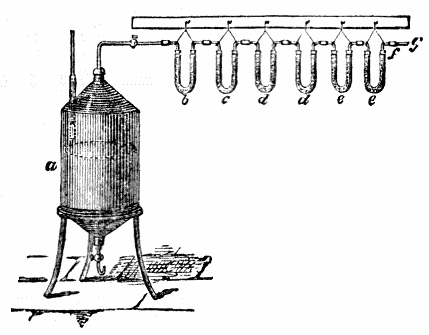
It is imperative to have each of the tubes connected by perfectly air-tight joints. The gain of weight in d and e gives the water in b and c the carbonic acid.
Determination of Carbonic Acid. A better and perhaps more exact means of determining the carbonic acid is that invented by Pettenkofer. It may be briefly described as follows:—Baryta water of definite strength is prepared and accurately standardised by a standard solution of oxalic acid. A portion of this baryta water is then made to act upon a definite quantity of air. It will absorb the whole of the carbonic acid in that air.
The alkalinity of the liquid will in consequence be diminished; it will take less of the oxalic-acid solution than before, which shows so much less caustic baryta, and from which the carbonic acid absorbed may be easily calculated.
The actual Analysis. Two kinds of baryta water may be used, the one containing 7 grammes to the litre, the other three times that strength; 1 c. c. of the stronger = 3 m. grms. of carbonic acid; 1 c. c. of the weaker = 1 m. grm. The baryta water is best kept in the bottle represented below.
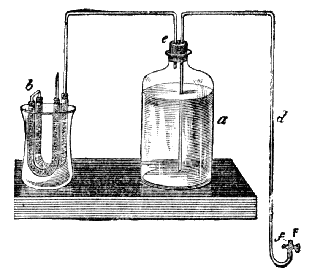
The bottle (a) contains the baryta water. It has an accurately-fitting double-perforated stoppered caoutchouc. The left-hand tube is connected with the tube (b) containing pumice-stone moistened with potash, while the right-hand one is a syphon. When required for use the stop-cock (f) is opened, and suction applied by a glass tube to F. The syphon is thus filled and the stop-cock closed. If a pipette is required to be filled its nozzle is inserted at F, the stop-cock compressed, and the fluid immediately rises into the pipette.
The air entering the bottle as the fluid decreases in a is, of course, thoroughly deprived of its carbonic acid by the tubes at b.
The first thing to be done is to standardise the baryta solution by a solution of oxalic acid, containing 2·8636 grammes of crystallised oxalic acid to the litre.
Thirty c. c. of baryta solution are run into a small flask, and the oxalic acid run in from a Mohr’s burette with float, the vanishing-point of the alkaline reaction being ascertained by delicate turmeric paper. As soon as a drop placed on turmeric paper does not give a brown ring the end is attained.
The actual analysis is performed by filling a bottle of known capacity, with the aid of a pair of bellows, with the air to be analysed, then distributing over its sides 45 c. c. of the baryta water it is left for half an hour. The turbid water is poured into a cylinder, closely secured, and allowed to deposit; then take out 30 c. c. by a pipette of the clear fluid, run in the solution of oxalic acid, multiply the volume used by 1·5, and deduct the produce from the c. c. of oxalic acid used for 45 c. c. of the fresh baryta water. A different method has been suggested by Dr Angus Smith, viz. to measure the carbonic anhydride by the turbidities of the baryta water; this is, in fact, a colorimetric test. For rough approximative results Dr Smith’s process will be found a very useful and convenient one. It depends upon the fact that the amount of carbonic acid in a given quantity of air will not produce a precipitate in a given quantity of lime or baryta water unless the carbonic acid is in excess. The following is one of his tables:—Columns 1 and 2 give the rates of carbonic acid in the quantity of air which will produce no precipitate in half an ounce of lime water. Column 3 is the same as column 2; but 14·16 c. c. (half an ounce) is added to give the corresponding size of the bottle, and column 4 gives the size of the bottle in ounces.
To be used when the point of observation is “no precipitate.” Half an ounce of baryta water contains about ·08 gramme of baryta. Air at 0° C. and 760 millims. Bar.
Carbonic Acid in the Air, per cent.Volume of Air in cubic centimètres.Size of bottle in cubic centimètres.Size of bottle in ounces Avoirdupois.
·031851997·06
·041391545·42
·051111254·44
·06931073·78
·0779933·31
·0870842·96
·0962762·69
·1056702·46
·1151652·29
·1246602·14
·1343572·01
·1440541·90
·1537511·81
·2028421·48
·2522361·29
·3019331·16
·4014281·04
·501125·89
·60923·89
·70822·78
·80620·72
1·005·519·7·70
Mr Wanklyn’s process for the determination of carbonic acid in the atmosphere is as follows:—A solution of carbonate of soda is first made as follows: 4·47 grammes of gently-ignited carbonate of soda are dissolved in one litre of water, giving a solution of such a strength that 1 c. c. contains exactly 1 c. c. of carbonic acid (= 1·97 milligrammes of CO2); a large quantity of baryta water (strength about 0·1 per cent.) is prepared.
If now 100 c. c. of clear baryta water be treated with 1 c. c. of carbonate of soda, just described, a certain degree of turbidity is produced.
If 2 c. c. of the solution be taken another degree of turbidity is produced, and so on. If, then, a bottle capable of holding 2000 c. c. of air, together with 100 c. c. of baryta water, be filled with the sample of air to be tested, there will be a certain depth of turbidity produced by shaking it up. Having got the air to expend itself on 100 c. c. of baryta water the degree is to be found by comparison with another 100 c. c. of baryta water, in which a like turbidity has been induced by means of the standard solution of carbonate.
Every c. c. of soda solution counts for a c. c. of carbonic acid in two litres of air. A consumption of 1 c. c. will correspond to ·05 volumes of carbonic acid per cent. Good air should accordingly not take more than 1 c. c. of soda solution, air which takes already 2 c. c. being already bad.
In order practically to carry out this method of estimating carbonic acid the following apparatus is required:—Several bottles capable of holding 2·210 c. c., and well stoppered (failing bottles of exactly the right capacity Winchester quart bottles will answer); a small pair of bellows; several colourless glass cylinders marked at 100 c. c. capacity—the Nesslerising cylinders will answer for this purpose—a graduated pipette or burette to deliver tenths of a c. c. of solution, the standard solution of carbonate of soda, and the baryta water, which may be of moderate strength.
The testing is managed thus: Winchester quart bottles having been made clean are rinsed with distilled water, and allowed to drain a little. They are then closed with their stoppers, and are ready for use. The operator having provided himself with two or three of these bottles and a small pair of bellows enters the room the air of which is to be tested. The stopper is then removed from one of the bottles, and some air of the room blown through with the bellows, and then the stopper is replaced, and the bottle carried away to be tested.
The testing is done by pouring into the bottle 100 c. c. of clear baryta water, shaking up for two or three minutes, and then pouring out into a cylinder of colourless glass, and observing the depth of the turbidity in various lights and against various backgrounds. The turbidity is to be exactly imitated by means of the standard solution of carbonate of soda. In order to imitate the turbidity produced by a Winchester quart full of good air only 1 c. c. of this solution of carbonate of soda is required.
If 2 c. c. or more than 2 are required, the air is bad and the ventilation is defective.
In place of the first c. c. of solution of carbonate of soda the carbonic acid naturally present in a Winchester quart of good average air may be used, and a little practice and intelligence will suggest the necessary precautions.
Estimation of the Oxygen.—To determine this Angus Smith has recourse to the endiometer. Five or six of Bunsen’s endiometers were used at once and the mixed gases were exploded by means of a powerful battery and a Ruhumkorff’s coil. In his ‘Inorganic Chemistry,’ Miller thus explains the principle upon which the action of the endiometer is based: “By means of the endiometer various gaseous mixtures may be analysed with great exactness. Many different forms of this instrument are in use. One of the most convenient is Hoffmann’s. It consists of a stout syphon tube. (See next figure.) Into the sides of the tube, near the sealed end, two platinum wires (a, b) are fixed for the purpose of transmitting an electric spark through the cavity of the tube. The sealed limb is accurately graduated to tenths of a c. c. or other suitable divisions. Suppose it be desired to ascertain the proportion of oxygen in atmospheric air. The instrument is first filled with mercury, after which a small quantity of air is introduced; the bulk of the air is accurately measured, taking care that the liquid metal stands at the same level in both tubes, which is easily effected by adding mercury, or by drawing off the mercury if needed, through the caoutchouc tube, which is fixed upon the small inlet tube just above the bend, and which is closed by means of a screw tap (c).
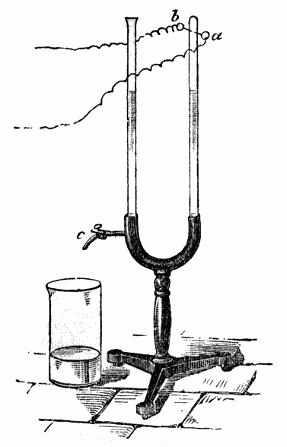
A quantity of pure hydrogen, about equal in bulk to the air, is next introduced, and the bulk of the mixture is then accurately measured. The open extremity of the tube is now closed with a cork, below which a column of atmospheric air is safely included. This portion of air acts as a spring, which gradually checks the explosive force, when the combination is effected by passing a spark across the tube by means of the platinum wires. The mixture is then exploded by the electric spark. The remaining gas now occupies a smaller volume, owing to the condensation of the steam which has been formed. Mercury is, therefore, again poured in the open limb until it stands at the same level in both tubes, and the volume of the gas is measured a third time. One third of the reduction of the bulk experienced by the gas will represent the entire volume of oxygen which the mixture contained. Liebig’s method is as follows. It is based upon the fact that an alkaline solution of pyrogallic acid absorbs oxygen:
1. A strong measuring tube holding 30 c. c., and divided into one fifth or one tenth c. c., is filled to two thirds with the air intended for analysis. The remaining part of the tube is filled with mercury, and the tube is inverted over that fluid in a tall cylinder widened at the top.
2. The volume of air confined is measured—a quantity of solution of potash of 1·4 sp. grf. (1 part of dry hydrate of potash to 2 parts of water), amounting from 1⁄40th to 1⁄50th of the volume of the air, is then introduced into the measuring tube by means of a pipette with the point bent upwards (see drawing), and spread over the entire inner surface of the tube by shaking the latter. When no further diminution of volume takes place the decrease is read off. The carbonic acid is thus removed.
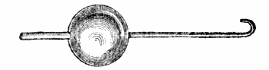
3. A solution of pyrogallic acid containing 1 gramme of the acid in 5 or 6 c. c. of water is introduced into the same measuring tube by means of another pipette similar to the above. The mixed fluid (the pyrogallic acid and the solution of potash) is spread over the inner surface of the tube by shaking the latter, and when no further diminution of volume is observed the residuary nitrogen is measured.
4. The solution of pyrogallic acid mixing with the solution of potash of course dilutes it, causing thus an error from the diminution of its tension; but this error is so trifling that it has no appreciable influence upon the results. It may, moreover, be readily corrected by introducing into the tube, after the absorption of the oxygen, a small piece of hydrate of potash, corresponding to the amount of water in the solution of the pyrogallic acid.
There is another slight error on account of a portion of the fluid adhering to the inner surface of the tube, so that the volume of the gas is never read off with absolute accuracy.
In conducting these endiometric experiments the necessary corrections for temperature and barometric pressure must, of course, be made.
Estimation of the Nitrogen. The amount of this gas is usually determined by deducting the aqueous vapours, oxygen and carbonic acid, from the volume of air examined.
Determination of Ammonia and Organic Matter. These are best determined by drawing a known volume of air through absolutely pure water. To obtain this latter it is best to redistil distilled water, to reject the first portions, then to add an alkaline solution of permanganate of potash, and to discard any portions of the distillate which give the slightest reaction with the Nessler test. The water through which the air is drawn must be kept cool, and afterwards submitted to the proper tests, which will be found under Ammonia and Water Analysis. Mr Blyth says, “Solid bodies such as vibrionic germs, dust, fungi, &c., may be obtained by using an aspirator, and drawing the air either through a drop of glycerine or water. Organic matter may also be obtained by suspending glass vessels filled with ice water, over or in the places to be investigated, and submitted to the microscope. High powers, such as immersion lenses, are requisite for the investigation of germs,” &c.
Of these germs Dr Angus Smith says:—“They may probably be divided into many kinds—the useful and the deleterious, those which promote health and those which bring disease. The idea of any of them bringing health is not founded on anything positive, but we can scarcely imagine these numberless forms to be all useless. The idea that they bring disease is, I think, one well confirmed.” See a paper by the same author “On the Air and Rain of Manchester.” ‘Memoirs of the Literary and Scientific Society of Manchester,’ vol. x. See Air, Vitiated.
AIR-GAS. Air deprived of its carbonic acid and moisture, and then impregnated with the vapours of very volatile fluid hydrocarbons, such as benzine and benzoline, can be used as an illuminating agent. It is requisite, however, to use burners with wide openings, and to apply a low pressure, because if the current be too rapid the flame becomes too much cooled, and is readily extinguished. Apparatus for preparing air-gas have been devised and constructed by Marcus, Mille, Methei, and others.
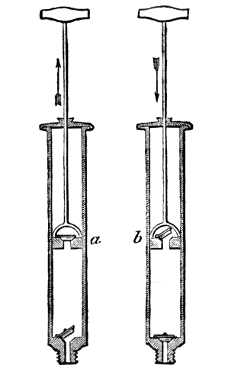
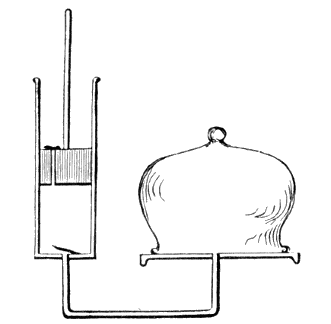
AIR-PUMP. An instrument designed for the removal of air from closed vessels. The simplest form of air-pump is the exhausting syringe, which consists of a cylinder fitted with a stop-cock, and having a valve at the bottom opening inwards. Another valve opening outwards is attached to a piston working inside the cylinder, and by screwing the instrument on to a vessel, and alternately elevating and depressing the piston, all except a very small quantity of residual and comparatively inelastic air is pumped out of the vessel (Figs. a and b). The accompanying figures show relative positions of the valve during (a) the elevation, and (b) the depression of the piston. In the usual and more convenient form of air-pump, a brass tube passes from the bottom of the syringe and terminates in the centre of a disk of brass or glass ground accurately; the vessel from which the air is to be exhausted has its edge very accurately ground, and is mounted upon the plate as shown in the subjoined figure.
Air-pump, Bunsen’s Water. (See figure on page 53.)
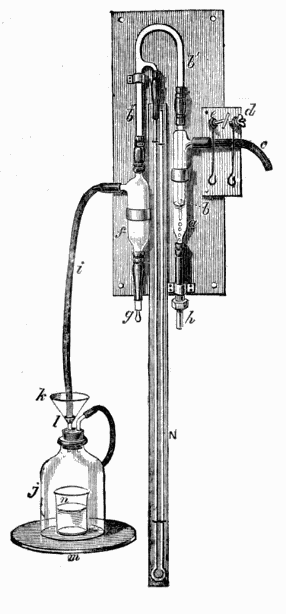
This consists of a wide glass tube, a, into which another tube, b, b′, b′′, passes air-tight. c is an india-rubber tube connecting a with the water supply, d is a clamp to stop the flow of water through c. e is another clamp to regulate the flow, f is a reservoir to prevent any water which may accidentally come over from getting into j. g is a plug to let out any water from f. h is a screw for connecting a air-tight to a piece of tubing, which should pass 32 feet, if possible, below the level of a. i is a piece of strong india-rubber tubing to connect the pump with the vessel to be exhausted. The water rushes in at c and down h, carrying bubbles of air with it till the exhaustion is complete. The figure illustrates a common application of this pump to the rapid filtration of liquids which ordinarily pass through paper with difficulty. a is represented as being about half full of water. k is a funnel fixed air-tight in the india-rubber stopper of the bell-jar j. l is a small cone of platinum foil to prevent the paper filter which fits into it from being broken. m is a plate of ground glass, n is a beaker to receive the filtrate.
Bunsen’s water-air-pump.
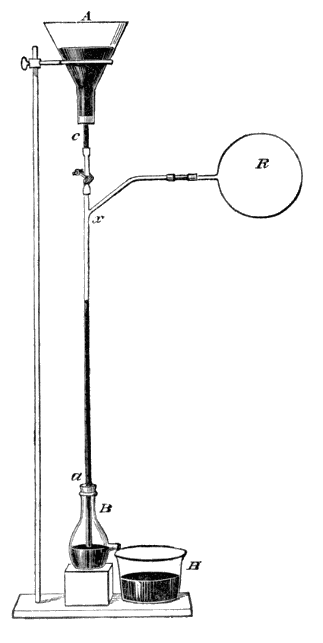
Air-pump, Sprengel’s. This apparatus depends on the principle of converting the space to be exhausted into a torricellian vacuum.
In the subjoined figure, c, d is a glass tube longer than a barometer, open at both ends, and connected by means of india-rubber tubing with a funnel, A, filled with mercury and supported by a stand. Mercury is allowed to fall in this tube at a rate regulated by a clamp at C; the lower end of the tube, c, d, fits in the flask B, which has a spout at the side a little higher than the lower end of c, d; the upper part has a branch at x to which a receiver R can be tightly fixed. When the clamp at C is opened, the first portions of mercury which run out close the tube and prevent air from entering below. As the mercury is allowed to run down the exhaustion begins, and the whole length of the tube from x to d is fitted with cylinders of air and mercury, having a downward motion. Air and mercury escape through the spout of the bulb B, which is above the basin H, where the mercury is collected. It is poured back from time to time into the funnel A, to be repassed through the tube until the exhaustion is complete.
Sprengel’s air-pump.
AIRY’S (Dr.) NATURE’S MEDICAL TREATMENT is the title of a pamphlet which recommends four secret remedies against 166 diseases:
a. The Pain Expeller, a mixture of about 35 parts of tincture of capsicum, 20 parts of diluted spirit, and 20 parts of spirit of ammonia.
b. Sarsaparillian, a fluid extract of sarsaparilla and China root, containing 1 per cent. of iodide of potassium.
c. Pills composed of powdered iron, jalap resin, jalap powder, and marsh mallow powder, made into a mass with some bitter extract. Each pill weighs 0·1 gramme.
d. Calming Pastilles are thick, hard tablets, composed of sugar, with oil of anise, and coloured with liquorice juice. (Hager.)
AKUSTICON (an ear essence). A proved remedy for every kind of ear disease, by Pserhofer. This may be imitated by dissolving in common glycerine one fifth of its weight of fir tar, filtering, and adding a few drops of cajeput oil dissolved in spirit (Hager.)
AL-. [Ar.] An inseparable article equivalent to the English the. It is found in many chemical and other words derived from the Arabic; as alchemy, alcohol, alembic, almanac, &c.
AL′ABASTER. Syn. Albâtre, Fr.; Alabas′ter, Alabastri′tes, Alabas′trum, L. A soft, white species of calcareous and of gypseous stone, used by sculptors. There are several varieties, all of which may be ranged under two heads:—
1. Calca′′reous alabaster; Orient′al, a.; Calc-sin′ter. A sub-variety of carbonate of calcium, formed by the deposition of calcareous particles in the caverns of limestone rocks. It has a foliated, fibrous, or granular structure, and a pure, soft, rich, semi-translucent whiteness, generally agreeably variegated with undulating zones or stripes of various shades of yellow, red, or brown. This variety is that most esteemed by sculptors, and for the manufacture of alabaster ornaments. The ancients used it for ointment and perfume boxes. At the baths of San Filippo (Tuscany), the process of its formation may be examined by the observer. The natural spring of boiling water holds carbonate of lime in solution by means of sulphuretted hydrogen, which, escaping into the air, leaves the lime as a precipitate, which is gradually deposited in a concrete form. (M. Alex. Brogniart.)
2. Gyp′seous or common alabaster; Gypsum. A natural hydrated sulphate of calcium, containing a little carbonate of calcium. That from the quarries of the Paris basin contains about 12% of the latter substance. When calcined or roasted, and powdered, it forms the substance known under the name of Plaster of Paris. The more compact, fine-grained specimens of this variety are, like the preceding one, sculptured into almost numberless articles of ornament and utility, such as vases, clock-stands, statuettes, &c. The inferior kinds only are manufactured into the ‘plaster of Paris’ of the shops. The best specimens are obtained from the lower beds of the gypsum quarries, and are white, and granular, not unlike Carrara marble. It takes a high polish; but from its softness and liability to become discoloured, articles formed of it require more careful treatment than even those of ‘calcareous alabaster.’
Alabaster is wrought, turned, and fashioned, in a nearly similar manner to the softer varieties of marble. The tools resemble those employed for the like operations in ivory and brass. Machinery is now often applied to this purpose.
Alabaster is polished, first with pumice-stone, and then with a paste or pap made of whiting, soap, and milk or water; and lastly, with dry flannel. A better method, however, is to rub it first with dried shave-grass (equisetum), and afterwards with finely powdered and sifted slaked lime formed into a paste with water. The surface is then ‘finished off’ by friction with finely powdered talc or French chalk, until a satiny lustre is produced, or with putty powder, in a similar way to marble.
Alabaster is engraved with tools resembling those employed for other soft minerals. It is etched by covering every part of the surface, except that to be acted on, with a solution of white wax in oil of turpentine (1 to 4), thickened with a little finely powdered white lead, and subsequent immersion in water acidulated with acetic acid or hydrochloric acid, for the calcareous variety; and in spring water, for 20 to 50 hours (according to the effect desired), for the gypseous variety. The varnish is washed off with oil of turpentine, and the etched parts carefully brushed over with finely powdered gypsum.
Alabaster is joined and repaired by means of white of egg, or rice glue, thickened with finely powdered quicklime; or by a paste of newly baked and finely powdered gypsum, mixed up with the least possible quantity of water.
Calcareous alabaster is usually cleaned with a brush and warm soap-and-water, or with tepid water to which a few grains of carbonate of soda or of ammonia have been added; followed in either case by rinsing in clean water. If much discoloured, thoroughly cover the article with a paste of freshly slaked lime and water, and let it remain twenty-four hours; then wash off the paste with soap and water, rubbing hard the stains.
Delicate objects in gypseous alabaster can only be safely cleaned with benzol, or with pure oil of turpentine. If necessary, the surface must be repolished. Grease spots may be removed from either variety with a little benzol or oil of turpentine.
Alabaster is occasionally stained or coloured, and, for the calcareous variety, in a similar way to marble, except that heat is not employed; and for the gypseous variety, in the manner noticed under Plaster OF Paris. The gypseous variety is also bronzed and hardened in a similar way to that adopted for casts in the latter substance.
Obs. Gypseous alabaster is dissolved by water; and the beauty of both varieties is almost irrecoverably destroyed by grease, coloured oils, varnishes, smoke, &c. It is, therefore, unfitted for garden ornaments, or other objects exposed to the rain or weather, unless it be painted or bronzed; and is even then very perishable. Contact with acids, alkalies, and ammoniacal and sulphurous fumes, also injure, and, if prolonged, destroy it. Even an uncorked phial of smelling-salts placed on a mantel-piece beside an alabaster vase will soon destroy its beauty. Thus, all delicate objects in alabaster should be protected by a glass shade.
Alabaster, Orient′al (Factitious). Figures, basso relievos, &c., of considerable hardness and beauty, may be formed by imitating the process adopted at the baths of San Filippo, before referred to.
Proc., &c. Moulds of sulphur are placed either vertically or obliquely in an open tub or cistern, having a freely perforated bottom. Surmounting the whole are two or more pieces of wood in the form of a cross or star. The sulphurous calcareous water, falling on this cross, is scattered into spray or streamlets, and losing the gaseous portion which holds the lime in solution, deposits it in the form of oriental alabaster on the surface of the moulds. In from 1 to 4 months, according to the nature of the article, a sufficiently thick deposit is obtained. The object is then removed from the mould, and trimmed and polished. It is found that the more vertical the position of the mould, the finer is the grain of the resulting deposit. The water of the Spring of San Filippo may be exactly and easily imitated by the chemist; and the whole process offers a new and valuable ornamental art for the amusement and profit of the ingenious and enterprising.
Alabaster, Shand’s Chinese. Carbonate of lime. (Chandler.)
Alabaster Tablets, John Swine’s Chinese. Carbonate of lime. (Chandler.)
ALAMODE′ (ăl-ăh-mōdé). [Fr., à la mode.] According to the prevailing mode or fashion. In cookery, applied to several dishes, but more particularly to one of beef (alamode beef), commonly shortened by the lower class of Londoners into “alamode.” See Beef, Stewing, &c.
ALAN′TINE. [Eng., Fr., Ger.] Syn. Alanti′na, L. A substance identical with inulin, found in the roots of garden angelica (‘angelica archangelica,’ Linn.).
ALBA′TA. [L., Eng.] A name given to several alloys resembling silver. See Alloys, German Silver, &c.
ALBION (Parisian). “Will preserve the skin white and free from wrinkles.” An aromatic water with chloride of lead and calomel suspended in it. (Landerer.)
ALBOLITH. A cement powder prepared by W. Riemann, Breslau. Made with calcined magnesia (obtained from magnesite) and chloride of magnesium. It is recommended for painting walls, stairs, and wooden articles. (Hager.)
ALBU′MEN. [Eng., L.] Syn. Albumin; Albumine, Fr.; Eiweiss, Eiweistoff, Ger. Literally, the white of egg; a peculiar nitrogenous substance which enters largely into the composition of animal bodies. It abounds in the blood, muscles, bones, coagulable lymph, vitreous and crystalline humour of the eye, fluid of dropsy, &c. The white of egg consists of nearly pure albumen dissolved in water.
A substance identical with albumen is found in many vegetables. It enters largely into the composition of all the emulsive seeds. According to Seguin, it exists in considerable quantity in all those vegetables and fruits that afford a vinous liquor without the addition of yeast.
Prep. The white of egg and the serum of blood, when strained through muslin, furnish albumen, in solution, in a sufficiently pure state for all the ordinary purposes of the arts. Pure solid albumen may be prepared as follows:—
1. Agitate strained white of egg with 10 or 12 times its bulk of alcohol, collect the precipitated flocculi on a muslin filter, and suffer it to dry at a temperature not exceeding 120° Fahr.
2. Add a little water to white of egg, mix, filter, exactly neutralise with acetic acid, and then largely dilute with pure cold water; the precipitate which falls may be collected on a filter and washed. Strained serum of blood may be used instead of white of egg, in both the above forms.
Comp., &c. The following is the composition of albumen according to Lieberkühn:—
Carbon53·3
Hydrogen7·1
Nitrogen15·7
Oxygen22·1
Sulphur1·8
——
100·0
Chatin found iodine in the white of egg; it also contains chloride, sulphate, phosphate, and carbonate of sodium, phosphate of calcium, and traces of potassium in it; but, unlike the sulphur, none of these substances form a constituent part of pure albumen, though probably always present in white of egg.
Prop. Pure solid albumen (unaltered by heat) is nearly colourless, inodorous, and tasteless; scarcely soluble in water, but readily so in water, containing an exceedingly small quantity of caustic soda or potash, and in a strong solution of nitrate of potassium. When dried by a gentle heat it shrinks into a translucent horny mass; and when exposed to a sufficient temperature, yields the usual ammoniacal odour and products of animal matter. Its solution (as white of egg) is solidified or coagulated by a heat of from 145° to 165° Fahr., forming a white, opaque mass; when very dilute, on boiling (only) it separates in fine light flocks. When thus coagulated, it is insoluble in water at a less temperature than 302° Fahr. (Wöhler and Vögel), unless alkalised. Ordinary solutions of albumen give precipitates with sulphuric, hydrochloric, nitric, and metaphosphoric acids, with tannin and astringent solutions, and with most of the metallic salts; but are not affected by either acetic acid or tribasic (common) phosphoric acid. Alcohol, in quantity, also precipitates albumen. Strong oil of vitriol turns it black in the cold, but on applying a gentle heat, a gorgeous, red-coloured liquid is produced. Strong hydrochloric acid gives a deep violet-blue solution. White of egg or serum exposed in a thin stratum to the air, dries up into a pale, yellow, gum-like substance, and in this state may be kept for any length of time, retaining its property of redissolving when immersed in slightly warm water.
Tests.—1. Both heat and alcohol (or strong spirit) coagulate it:—2. A solution of perchloride of mercury dropped into a fluid containing albumen occasions a white precipitate:—3. Subacetate of lead acts in the same way. Either of the last two will render turbid a solution containing only the 1-2000th part of fresh white of egg, or the 1-10,000th part of dry albumen:—4. Tannin and tincture of galls give yellow, pitchy precipitates:—5. If dry caustic potash or soda be triturated with either liquid or solid albumen, ammoniacal fumes are evolved, and the mixture on calcination yields ferrocyanide of potassium:—6. Its coagulability by heat, and its incoagulability by acetic acid, distinguish it from casein.
Uses, &c., Independently of its value as an alimentary substance, albumen is largely employed in photography as a glaze or varnish, for fixing colours in calico printing, as a cement, &c., and more particularly as a clarifier for wines, syrups, vegetable solutions, and other liquids. Its efficacy for the last purpose depends on its entangling the impurities in its meshes during coagulation, and either rising to the surface with them as a ‘scum,’ or sinking with them as a precipitate. In France it is prepared on an extensive scale, at the abattoirs, by being spread in thin layers to dry; the source of supply being of course the stream of the blood of the slaughtered animals. When the liquid operated on does not spontaneously coagulate albumen, it is necessary to apply heat to it. In cases of poisoning by the mineral acids, corrosive sublimate, nitrate of silver, sulphate of copper, bichloride of tin, or sugar of lead, the white of egg (or indeed the yolk as well) is one of the best antidotes that can be administered.
Albumen, Flake. Syn. Albumen in powder, Solid a., Soluble a., Planter’s a. Prep. Expose strained white of egg or serum of bullock’s blood, in a thin stratum, to a current of dry air, until it concretes into a solid transparent substance, resembling horn. In this state it may be kept any length of time, or it may be further dried until brittle, and then reduced to coarse powder.
Use. It is extensively employed as a ‘clarifier’ in the sugar plantations of the West Indies, and elsewhere. It is prepared for use by soaking and stirring it with cold water until it is dissolved, when it is whisked to a froth in the usual way, and agitated with the liquid to be clarified.
Albumen, Iodised. 1. To the white of every egg employed add 71⁄2 grains of iodide of potassium dissolved in an equal weight of distilled water. Beat the mixture to a froth, let it stand until insoluble matters have settled, pour the clear portion into a wide-mouthed bottle, and keep in a cool place. 2. Dissolve 50 grains of iodide of potassium and 10 grains of bromide of ammonium in 21⁄2 oz. of distilled water, and add 120 minims of strong liquor ammoniæ. Add this solution to 10 oz. of albumen, let the mixture stand to settle, and filter. This preparation is said to keep good for a long time.
Albumen, Solution of (B. P.). Take of white of one egg; distilled water, four fluid ounces. Mix by trituration in a mortar, and filter through clean tow, first moistened with distilled water. This solution must be recently prepared.
Albumen, Vegetable. This substance, long considered to be a distinct proximate principle peculiar to the vegetable kingdom, has been shown, by recent researches, to be identical with animal albumen. It is particularly abundant in carrots, turnips, cabbages, green stems of peas, and oleaginous seeds.
ALBU′MEN. In botany, the solid, fleshy, or horny substance found in many seeds, between the integuments and the embryo. It is the part that furnishes the flour of the ‘cereals,’ the flesh of the ‘cocoa-nut,’ and the great mass of the seeds of coffee and other vegetables. However poisonous the plants which produce it may be, this substance is never deleterious.
ALBUMENISED PAPER. A French paper highly glazed, having a fine surface, and made by Rive; a German paper having a more uniform texture, and made by Saxe; also a paper by Towgood, are recommended for the preparation of albumenised paper. Positive paper may be albumenised as follows:—Add 15 grains of finely pulverised common salt to the white of every egg used, and whisk until the mixture is entirely converted into a white froth. Allow this froth to stand in a glazed earthenware pan which must be rather larger than the sheets of paper to be albumenised, for about twelve hours. At the end of this pour the clear portion of the liquid into a flat porcelain tray. Mark the inferior side of the paper, slightly damp it, lift it by its ends, and float it carefully on the prepared albumen, keeping its inferior and dry side uppermost. Then raise the paper at each end, and if any air bubbles are seen remove them with a card or brush and replace the paper in the bath. Remove the paper from the bath and suspend it at the corners by clips. Albumenised paper should be kept dry by enclosing it in tin or zinc cases.
ALBUMENOIDS. A term applied to albumen, fibrin, casein, and similar bodies.
ALBU′MENOUS. Syn. Albumino′sus, L.; Albuminé, Abumineux, Fr.; Eiweisstoffhaltig, Ger. Formed of, containing, or having the properties of albumen.
Albuminous Plants. In botany, all plants whose seeds contain albumen in a separate state; as in the cereals, palms, &c.
Albuminous Principles or Substances. Albumen, casein, fibrin, gluten, &c.
ALBURN′UM. [L.] Syn. Alburn*; Sapwood. In botany, the white and softer parts of the wood of exogenous plants, lying between the inner bark and the heartwood. It consists of empty or nearly empty tubes or cells, which gradually acquire solidity by the deposition of resins, tannin, and other products of vegetation, and in time becomes wood. It is through the alburnum that the ascending sap chiefly flows.
ALCARAZ′ZA. [Sp.] A species of porous earthenware, or a vessel formed of it, made in Spain from a light, sandy marl, and but slightly fired. Their value as ‘coolers’ arises from the copious evaporation of the water, which gradually transudes. A similar ware and articles are made in France, under the name of HYGROCERA′MEN; and in England, under the names of POROUS WARE, WATER COOLERS, WINE COOLERS, BUTTER COOLERS, &c. The following are forms said to be used in our potteries:—
Prep. 1. Take of sandy marl, 2 parts; brine, q. s.; make a dough, and then knead in of common salt, in fine powder, 1 part. Bake the pieces slowly, and lightly.
2. Good clay, 2 parts; fine siliceous sand, 3 parts; brine, q. s.; common salt, 1 to 2 parts; as before.
3. Powdered clay, 2 parts; powdered charcoal, 3 parts (by weight); water q. s. to form a stiff dough. The kilning must be so arranged that the heat is applied gradually, and the vessels exposed to a current of hot air; and it must be continued until all the charcoal is burnt out, carefully avoiding over-firing.
AL′CHEMY (-kĭm-). Syn. Al′chymy (-kĭm-); Hermetic Art*; Alchem′ia, Alchym′ia, L.; Alchimie, Fr.; Alchemie, Ger.; Alchimia, It. The romantic forerunner of the modern science of chemistry. An imaginative art or science, having for its objects the discovery of a substance (PHILOSOPHER’S STONE) capable of transmuting the baser metals into gold—a panacea, or universal remedy (ELIXER VITÆ), by which disease and death were to be avoided by its possessor—an alkahest, or universal solvent—a universal ferment; and other like absurdities. A mixed metal formerly used for utensils was also called by this name.
AL′COHOL. C2H6O. [Eng., L.; B. P.] Syn. Al′kohol, Eng., L.; Alcoöl, Alcohol, Fr.; Alkohol, Höchst Rectifieirter Wein-geist., Ger.; Alcoöle, It. A term commonly applied to one kind of spirit—that obtained by the distillation of any fermented saccharine liquid, and forming the characteristic principle of wines, beers, spirits, and other intoxicating liquors.
Etym. Kohol, a Hebrew-Syriac word, is the name given to a preparation of powdered antimony used by Oriental ladies to paint their eyebrows. In course of time this term was applied to other fine powders, and ultimately to highly rectified spirits.
Hist., &c. Although the art of distillation was probably known at a comparatively early age of the world, the preparation of pure rectified spirit is a discovery of modern times. It was not until the 13th century that Raymond Lully first showed the way to concentrate spirit by means of carbonate of potash; after which date pure concentrated spirit gradually rose into note as an article of trade and commerce in Europe. In the 16th century its distillation was in common practice in these countries. (Burns.) By means of chloride of calcium, Dr Black obtained alcohol of sp. gr. 0·800 (about A.D. 1760); and Richter afterwards procured it of a sp. gr. so low as 0·796 at 60° Fahr. (Crell’s ‘Annals,’ 1796.) Lavoisier first demonstrated the composition of alcohol (about 1780). Its analysis was subsequently perfected by M. Saussure, jun., and confirmed by MM. Dumas and Boullay, and Gay-Lussac; and by many others since.
Nat. Hist. Alcohol is peculiar to the organic kingdom, being exclusively produced, in the natural way, by the process of fermentation.
Sources, &c. Dilute alcohol may be procured, by the ordinary process of distillation, from all fermented liquors. When drawn from wine (as in France), it constitutes BRANDY; when from the refuse juice of the sugar-cane, it is called RUM; when from malt, grain, or molasses (as in England), it is called MALT, RAW-GRAIN or MOLASSES SPIRIT; and when from rice or palm-wine, ARRACK. Brandy, rum, Hollands, and whisky, contain only about half their volume of alcohol; and gin much less. When distilled from any of these spirituous liquors, the alcohol contains, besides water, variable quantities of essential oils, ethers, and other flavouring matters, which, by one or more redistillations with charcoal or lime, it for the most part loses, and then becomes commercial spirit of wine. By a further rectification from chloride of calcium, lime, carbonate of potash, or any other substance having a strong affinity for water, the water is retained, and a strong spirit passes over containing not more than 10 per cent. of water. By repeating the process, and using the proper precautions, it may be obtained almost entirely free from water, and is then called absolute or anhydrous alcohol.
Preparation I. Of Absolute Alcohol:—
a. Alcohol (highly rectified spirit), of 85% (sp. gr. ·835 to ·822), is mixed, in a tubulated retort, with about half its weight of fresh-burnt quick-lime, in coarse powder; and the whole, after securely stopping the neck with a cork, and agitation, is allowed to repose for several days. The alcohol is then carefully distilled off, drop by drop, by the heat of a water bath, until the weight of the distillate nearly equals that of the ‘anhydrous alcohol’ in the spirit operated on. The sp. gr. of the product should be ·795 or ·796; but by carefully repeating the process with the distillate and a fresh quantity of lime, and prolonging the last digestion with the latter for several weeks, absolute alcohol of the sp. gr. ·79381 at 60° Fahr. may be easily obtained.
b. (Drinkwater; Fownes.) The strongest rectified spirit of wine is digested in a stoppered bottle for several days, with about half its weight of anhydrous carbonate of potash, in powder, frequent agitation being had recourse to; the alcohol, after repose, is then decanted, and treated with sufficient fresh-burnt quick-lime to absorb the whole of the spirit. After 48 hours’ digestion, the spirit, when distilled, will have the sp. gr. ·793 at 60° Fahr.
c. (Liebig; Ure.) Alcohol of about 90% is saturated with fused chloride of calcium, in powder, and after repose for a few hours in a stoppered bottle, is submitted to distillation as before. The product should nearly equal the quantity of dry alcohol in the sample. Ure recommends equal weights of the spirit and chloride to be taken; and the process to be stopped as soon as about half the volume of the spirit employed has passed over, or the distillate acquires a higher sp. gr. than ·791 at 68°, or ·796 at 60° Fahr.
d. (B. P. 1867.) Take of rectified spirit, 1 pint; carbonate of potash, 11⁄2 ounce; slaked lime, 10 ounces. Put the carbonate of potash and spirit into a stoppered bottle and allow them to remain in contact for two days, frequently shaking the bottle. Expose the slaked lime to a red heat in a covered crucible for half an hour, then remove it from the fire, and, when it has cooled, immediately put the lime into a flask or retort, and add to it the spirit from which the denser aqueous solution of carbonate of potash, which will have formed a distinct stratum at the bottom of the bottle, has been carefully and completely separated. Attach a condenser to the apparatus, and allow it to remain without any external application of heat for twenty-four hours; then applying a gentle heat, let the spirit distil until that which has passed over shall measure 11⁄2 fluid ounce; reject this, and continue the distillation into a fresh receiver until nothing more passes at a temperature of 200° Fahr.
e. (Poggendorff.) Saturate alcohol with caustic potash, then add half its volume of water, and distil at a low temperature.
II. Of Hydrated or Commercial Alcohol:—
a. (Alcohol, Ph. L. 1836.) Take of rectified spirit (sp. gr. 0·838), 1 gal.; chloride of calcium, 1 lb.; proceed as above, and distil 7 pints and 5 fl. oz. Sp. gr. of product 0·815. It contains about 7% of water, by weight, and 5% by volume.
b. (Alcohol, Ph. D. 1826.) Rectified spirit, 1 gal.; pearl-ashes (dried and still hot), 31⁄2 lbs.; mix, digest in a covered vessel, with frequent agitation, for seven days; then decant the clear portion, and add to it of chloride of calcium, 1 lb.; agitate to effect solution, and distil off the spirit until the mixture in the retort begins to thicken. Sp. gr. of product 0·810. It contains about 5% of water, by weight.
c. (Without distillation.) Rectified spirit is agitated, in a closed vessel, with anhydrous carbonate of potash (prepared by heating the salt to redness, and still slightly warm), until the powder sinks to the bottom undissolved; the carbonate is then added in considerable excess, and the agitation repeated at short intervals for some hours or even days; lastly, after sufficient repose, the clear upper portion is decanted.—Obs. If a clean spirit, and pure carbonate of potash (or at least one perfectly free from caustic potash or any other impurity soluble in strong spirit), be used, an alcohol sufficiently pure and free from water for many common purposes may be thus obtained; otherwise the product contains a little potassa, &c., which can only be removed by distillation. For some purposes, however, this would not be objectionable. Sp. gr. about ·812.
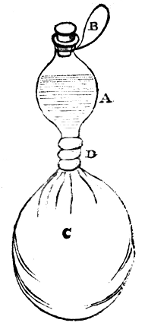
A, A bottle with two necks, the upper furnished with a ground-glass stopper.
B, Loop of cord to hang the apparatus up by.
C, Bladder, containing spirit, filled by means of the bottle A.
D, Neck of bladder accurately secured to the under neck of the bottle A.
III. (Soëmmering.—Varnish-maker’s alcohol.) The bladder of an ox or calf, thoroughly cleansed from fat, and washed and dried, is nearly filled with rectified spirit, and then securely fastened and suspended in any dry situation, at a temperature of about 122° Fahr. In from six to twelve hours, when the heat is properly maintained, the spirit is generally sufficiently concentrated, and in a little time longer is rendered nearly free from water (anhydrous), or of the strength of 96 to 98%.—Obs. The same bladder will serve for more than one hundred operations. If not kept very nearly full, a portion of the spirit escapes through the empty part. To prevent this accident, a bottle with a double neck, of the shape represented in the engr., may be employed; by which means the bladder may be kept constantly full during the process. After the first or second time of using, the bladder gives alcohol sufficiently pure for all ordinary purposes. Before hanging the apparatus up, it is better to enclose it in a coarse potato-netting, to prevent any accident arising from the strain on the neck of the bladder. Soëmmering recommends both the inside and outside of the dry bladder to be smeared over 2 or 3 times with a strong solution of isinglass; but this is not necessary to the success of the process.
IV. Rectified Spirit. (B. P. 1867.) Spiritus Rectificatus. Alcohol with 16 per cent. of water; obtained by the distilling of fermented saccharine fluids. Sp. gr. 0·838.
V. Proof Spirit. (B. P. 1867.) Spiritus Tenuior. Take of rectified spirit, 5 pints; distilled water, 3 pints. Mix. Sp. gr. of product 0·920.
Prop. of Alcohol. Light, transparent, colourless; highly volatile and inflammable, burning with a pale blue and smokeless flame; very mobile; odour, agreeable; taste, strong and pungent; miscible in all proportions with water, with the evolution of heat, and temporary expansion, but ultimate condensation of the mixture, some hours elapsing before the union is complete, and the normal temperature restored. The mixture has a higher sp. gr. than the mean of its constituents; and this is greatest when 54 vols. of alcohol are mixed with 49·77 vols. of water, the resulting compound measuring only 100 volumes. It absorbs water from moist air; dissolves resins, essential oils, camphor, bitumen, soaps, sugar, carbonic and boracic acid, iodine and the iodides, lime, ammonia, soda, potash, the alkaloids, wax and spermaceti (when boiling), all the deliquescent salts (except carbonate of potassa), and various other substances. It curdles milk, coagulates albumen, and (in quantity) separates both starch and gum from their mucilages. It boils, in the air, at 173° Fahr., when in the anhydrous state. When diluted with water its boiling point rises in proportion to the amount of water added. It boils, in vacuo, at 56° Fahr. Every volume of boiling alcohol yields 488·3 vols. of vapour at 212° Fahr. Its sp. gr. is 0·793811 at 60° Fahr., that of its vapour being 1·6133. It has never been frozen; when cooled to -166° Fahr., it acquired the consistence of castor oil, but did not solidify. It contracts by cold; between -15° and +99° Fahr., this occurs with great regularity, at the rate of ·00047 part of its volume for every degree of the thermometer. Its evaporation, like that of ether, produces intense cold. The products of its combustion are carbonic anhydride and water. It acts as a powerful antiseptic on organic substances immersed in it, and is in consequence extensively employed in the preservation of anatomical preparations. With the acids it forms ethers.
Phys. eff. Alcohol is a narcotico-acrid poison. In small doses it occasions excitement and intoxication; in larger ones, delirium, somnolency, coma, apoplexy, and death. It acts as a violent nervous stimulant, and, by abstracting water from the soft tissues of the stomach and primæ viæ, destroys their organisation. It is alike poisonous to all animals;—2 drs. will kill a dog. All strong spirits act in the same way, the effect being proportionate to the state of concentration and the quantity taken. On plants it acts as a rapid and fatal poison.
Ant., &c. Copious internal use of tepid water, with cold affusions to the head and spine, and injection of cold water into the ears. In the absence of vomiting, a strong emetic should be given, or the stomach-pump used. Ammonia may be used as a stimulant, and, added to water just in sufficient quantity to flavour it, is one of the best antidotes. The head should be kept elevated, and bleeding had recourse to, if cerebral congestion threatens.
Tests in cases of death. 1. The odour of the contents of the stomach and ejected matters, and their ready inflammability. 2. The spirit may be separated by digestion with water, filtration, the addition of carbonate of potash, and distillation.
Comp., &c. Its per-centage composition is—
Dumas and Boullay.Brande and Ure.Ure. sp. gr. 0·812.
Carbon52·3752·1847·85
Hydrogen13·0113·0412·24
Oxygen34·6134·7839·91
————————————
99·99100·00100·00
This nearly represents 2 equivalents of carbon, 3 eq. of hydrogen, and 1 of oxygen. The atom of alcohol is now regarded as a multiple of these numbers, and formed by the breaking up of one atom of grape sugar (C13H28O11) into 4 eq. of alcohol, 8 eq. of carbonic acid, and 4 eq. of water. It was formerly regarded as a compound of 1 eq. of olefiant gas, and 1 eq. of water; but it is now generally viewed as HYDRATE OF THE OXIDE OF ETHYLE (C2H5.HO), or a compound of ethylene and water (C2H4.H2O). Grape sugar alone yields alcohol; cane sugar, before it undergoes the vinous fermentation, being first converted into this substance by contact with the ferment.
Purity. The presence of water is shown by the specific gravity (see Alcoholometry); the absence of other foreign matter by the following tests:—
1. Its colour and transparency is not affected by the addition of a little colourless oil of vitriol (Liebig), or by a solution of nitrate of silver, and subsequent exposure for some time to solar light (Vögel), unless either essential oil or organic matter be present, when it assumes a reddish tinge. 2. It should be neutral to test-papers, colourless, leave no residue on evaporation, and be miscible, in all proportions, with water and with ether. 3. Its boiling point should never be less than 170° Fahr.; a lower temperature suggests the presence of wood spirits, or acetone, or one of the ethers. To detect wood spirit (wood naphtha) see Nessler’s Test. For the reverse of this adulteration—the evasion of the duty by the introduction of spirit, under the disguise of naphtha, turpentine, &c.—see those articles.
4. The presence of water in alcohol may be detected, not only by the sp. gr., but also by white anhydrous sulphate of copper burning blue when dropped into it. 5. Potassium placed on alcohol does not take fire, unless a considerable per-centage of water be present.
Tests, &c. 1. It may generally be recognised by its volatility, inflammability, odour, taste, miscibility with water, power of dissolving camphor and resins, and other qualities already described. 2. If a few fibres of asbestos be ‘moistened’ with a saturated solution of bichromate of potash in oil of vitriol, and exposed to the smallest possible portion of hot alcohol vapour, it is almost instantly turned green, owing to the formation of oxide of chromium. In practice, the asbestos may be inserted in the neck of a retort, or even of a bulbed glass-tube containing a few drops of the suspected solution, when the effect occurs as soon as distillation commences. Ether and pyroxylic spirit produce a nearly similar result; but the ‘first’ of these is distinguished from alcohol by its not being miscible with water in all proportions; and the ‘other’ by Nessler’s Test; whilst both may be readily distinguished by their peculiar and characteristic odour. 3. Dissolve 3 pts. crystallised carbonate of soda in 10 pts. water. To this solution add 1 pt. of liquid to be tested, and heat to about 160° Fahr. Lastly, add iodine in small pieces, till it has entirely dissolved, and the liquid has become colourless. If alcohol be present, iodoform will make its appearance on cooling, and sink to the bottom in the form of a yellow powder. As a similar result is obtained with wood spirit, this must be proved to be absent before applying this test.
The only reliable method of proving that a sample is ethylic alcohol is the production of ether, by acting on the suspected liquid with sulphuric acid. See Ether.
Uses. In the arts, alcohol is used by the varnish-maker to dissolve resins; by the perfumer, to extract the odour of plants, and dissolve essential oils, soaps, and other similar substances; by the pharmaceutist, to prepare tinctures and other valuable medicinals; by the instrument-maker, to fill the bulbs of thermometers required to measure extreme degrees of cold; by the photographer, in the preparation of collodion; by the chemist, in analysis, and in the manufacture of numerous preparations; by the anatomist and naturalist, as an antiseptic; and by the physician, for various purposes and applications as a remedy. It is also frequently burnt in lamps, and in parts of the world where it is inexpensive, it is employed in the manufacture of vinegar. Its uses, when dilute, as in the ‘spirituous liquors’ of commerce, are well known. In medicine, it is employed both concentrated (‘alcohol,’ ‘rectified spirit’) and dilute (‘proof spirit,’ ‘brandy,’ ‘gin,’ &c.), as a caustic, irritant, stimulant, tonic, &c. It has also been used in a multitude of other cases, and has been applied to an almost infinite variety of other purposes.
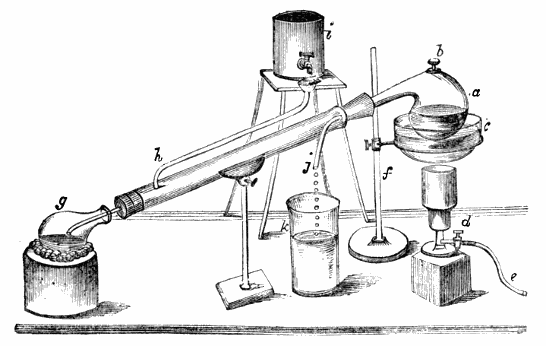
Gen. commentary. The selection of any one of the processes given above for the preparation of alcohol must greatly depend on the convenience or position of the operator. Chloride of calcium, and quick-lime, from their powerful affinity for water, and easy application, are the hygrometric substances most generally employed; but the processes involving the use of the other substances and methods already noticed, have all of them advantages under particular circumstances. Gay-Lussac has recommended the use of caustic baryta instead of lime; and others have employed dry alumina, as an absorbent of the water prior to distillation. Common proof spirit may be concentrated until its sp. gr. falls to about 0·825, by simple distillation in a water bath; at which sp. gr. it contains only about 11% of water, by weight, and is then nearly as volatile as pure alcohol.
A convenient apparatus for the preparation of alcohol, on the small scale, is that figured in the engr., and which will be self-explanatory to every one competent to use it. The tank (i) should be supplied with ice-cold water; and the receiver (g) should be covered with cloths kept continually wet with water of the same temperature. The capsule or basin (c) is a water bath heated by the little gas furnace (d). On the large scale, for commercial alcohol, a copper still, fitted with a glass refrigeratory and receiver, is commonly employed.
By surrounding the capital of a still, or other like apparatus, by a water bath kept at the proper temperature, the alcoholic richness or content of the product may be regulated to the greatest nicety, for any desired strength.
The different statements of chemical authors as to the boiling point, specific gravity, &c., of alcohol, already noticed, may be referred to their having either experimented with samples which have not been absolutely anhydrous, or to their not having made the proper corrections for temperature, and for the different materials of which their vessels and instruments were composed—some probably having been made of glass, and others of brass or some other metal. In some instances the differences are more apparent than real, as in the Tables by Tralles and Lowitz; in the former of which water, at its lowest sp. gr., is taken as the standard. Until recently, the only known source of alcohol was the fermentation of saccharine solutions. Its production by synthesis, though often attempted, is, however, erroneously said to have always failed. It had long been employed as an occasional source of bicarburetted hydrogen (olefiant gas) at a high temperature; but M. Berthelot succeeded in reproducing it, from bicarburetted hydrogen, by agitating the latter, in a closed vessel, with sulphuric acid and metallic mercury (‘Journ. de Chimie Med.,’ 1855, p. 175); and Henry Flennel, nearly thirty years before M. Berthelot’s discovery, found that pure olefiant gas is absorbed by agitation with concentrated sulphuric acid, with the formation of sulphovinic acid, and that by subsequent dilution with water, and distillation, alcohol passes over into the receiver.
ALCOHOLATE. Syn. Alcohate; Alcoholas, L. A salt in which alcohol appears to replace the water of crystallisation, as is the case with certain chlorides, nitrates, &c. Some of them may be formed by simple solution and crystallisation of the salt in alcohol. (Graham.) They are all very unstable, being readily decomposed by water.
ALCOHOLIC. Syn. Alcoholicus, L.; Alcoholique, &c., Fr.; Alkoholisch, Ger. Pertaining to, containing, of the nature of, or made with, alcohol.
ALCOHOLICA. [L.] Syn. Alcoöliques, Fr.; Weingeist-verbindungen, Ger. In pharmacy, liquids containing, or preparations made with, alcohol, as a characteristic ingredient.
ALCOHOLISATION. [Eng., Fr.] Syn. Alcoholisatio, L.; Alcoölisation, &c., Fr.; Alkoholiserung, Ger. In chem. and pharm., the development of the characteristic properties of alcohol in a liquid, or the use of it either as an addition or a menstruum; also the act or process of obtaining alcohol from spirit by rectification.
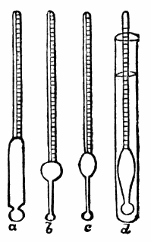
ALCOHOLOM′ETER (-lŏm′-). Syn. Alcohol′meter (hŏl′-; -hŏm′-‡); Alcoholométrum, L.; Alcoölomètre, Alcoömètre, Alcoholmètre, &c., Fr. An instrument or apparatus used in alcoholometry. Alcoholometers are simply ‘hydrometers’ adapted to the densities of alcohol, either concentrated or dilute. Some of these, as Baumé’s, Carter’s, &c., merely indicate the number of degrees corresponding to the state of concentration of the liquid. Others, of a like construction, as those of Richter (a), Tralles (b), and Gay-Lussac (c), have their stems so graduated as at once to indicate the proportion per cent. of alcohol present, either by weight, or by volume, at some standard temperature. (See engr.) A third class, as those of the Abbé Brossard-Vidal, Field, &c. are essentially thermometers, with scales which indicate the boiling points of spirits of different strengths, instead of the common thermometric degrees; whilst to a fourth class belong the alcoholometer of M. Silbermann, which is based upon the known rate of expansion of alcoholic liquors by heat, expressed in alcoholometric degrees; and that of M. Geissler, which depends on the measurement of the tension of the vapour of the liquid, as indicated by the height to which it raises a small column of mercury. In Syke’s hydrometer, used by officers of the Revenue, the scale of the instrument is enormously extended by the use of movable weights, with each of which it becomes, in fact, a separate instrument, adapted to a certain range of specific gravities.
A very convenient alcoholometer for ordinary purposes (d) has been lately produced by some of the instrument makers. It is of the usual form, but its stem on one side exhibits the per-centage richness of the sample in alcohol by volume; and on the other, the per-centage by weight. Thus, both results may be obtained at one trial. This instrument is sometimes called Richter’s alcoholometer, in England. A further improvement, still more recently introduced, is a similar ‘double-scale’ instrument, showing the degrees of Sykes on one side, and carrying a small spirit-thermometer in the bulb, to which a scale is fixed ranging from 35° to 82° Fahr.
ALCOHOLOM′ETRY. Syn. Alcohol′metry (-hŏl′-; -hŏm′-‡); Spirit testing‡; Alcoholme′tria, L.; Alcoölométrie, Alcoömétrie, &c., Fr. In chemistry, the art or process of ascertaining the richness of spirits in alcohol. In commerce, the determination of the quantity of spirit of a certain strength, taken as a standard, present in any given sample of spirituous or fermented liquors. In England, this standard is called “proof spirit.”
Hist., &c. The great importance of being able accurately to determine the strength of spirits in the United Kingdom, on account of the high duties levied on them, has induced the Government authorities, at various times, to investigate the subject. In 1790, the matter was referred to Sir C. Blagden, then Secretary to the Royal Society, who instituted an extensive series of experiments to determine the real specific gravities of different mixtures of alcohol and water. The results of his labours and researches were put forward, with ‘Gilpin’s Tables,’ in 1794, but no practical measures appear to have been taken in consequence. In 1832 a committee of the Royal Society, at the request of the Lords of the Treasury, examined into the accuracy of the Tables, and the construction and application of the instrument (Syke’s hydrometer) now used by the Revenue officers, on which they reported favorably, and declared that they were sufficiently perfect for all practical and scientific purposes. The errors introduced into calculations of the strength of spirits by these tables were found to be quite unimportant in practice, and did not, in any one instance, amount to unity in the fourth place of decimals. This method adapts the specific gravity as the test of the strength of spirits, and is founded on the fact that alcohol is considerably lighter than water, and that (with proper corrections for condensation and temperature) the sp. gr. regularly increases, or decreases, according to the relative proportions in which the two are mixed.
Several other methods of alcoholometry have been proposed, founded upon—the variations in temperature of the vapour of alcohol of different strengths—the heat involved by its admixture with water—its dilatation by heat—the tension of its vapour—the insolubility of carbonate of potash in alcohol—its volatility, boiling point, &c. &c., the more important and useful of which are noticed further on. The method adopted by the Boards of Inland Revenue and Customs is, however, the one which is almost exclusively employed in trade and commerce in Great Britain, not only on account of its simplicity and correctness, but for the purpose of the results exactly coinciding with the results obtained by the Revenue officers.
METHODS OF ALCOHOLOMETRY.
1. Methods based on the specific gravity, or per-centage strength, by VOLUME:—
a. With Sykes’ Hydrometer. Revenue system. The engraving below represents Sykes’ hydrometer, as made by Mr Bate, under the directions of the Commissioners of Inland Revenue and Customs. It consists of a spherical ball or float, with an upper and lower stem, and is made of brass, which (in the more expensive instruments) is usually coated with gold, to prevent corrosion from damp, and the acidity so generally present in spirituous liquors. The upper stem (A) is about four inches long, and is divided into ten parts, each of which contains five subdivisions. There are nine movable weights of the form b, of different sizes, numbered respectively 10, 20, 30, &c., to 90, each of which represents so many of the principal divisions of the stem, as its number indicates. In use, one of these weights is slipped on to the lower stems; and thus, by means of them, the instrument acquires a range of above 500 divisions, or degrees, extending from the Revenue ‘standard alcohol’ (sp. gr. ·825) to water. It is so formed as to give the sp. gr. with almost perfect accuracy, at 62° Fahr. When loaded with the weight 60 it sinks in proof spirit to the line marked (P) on the narrow edge of the stem at 51° Fahr.; and, by further placing the square weight or cap (also supplied with the instr.) on the top of the upper stem, it floats exactly at the same point in distilled water. This weight or cap is found to weigh 43·66 grs., which is practically 1-12th of the total observed weight of the instrument, and its poise 60, and hence shows the difference between the gravity of proof spirit and water, as explained hereafter. The whole is fitted up in a neat mahogany case, accompanied with a thermometer, and a book of tables containing corrections for temperature, &c.—Process. A glass tube of the form of fig. B is filled to about the mark (a) with the sample for examination; the thermometer is then placed in the liquor, and stirred about for two or three minutes (observing not to breathe upon the glass, nor hold it in the hand), and the temperature noted. The hydrometer is next immersed in a similar manner, and gently pressed down in the liquor to the 0 on the stem with the finger; it having been previously loaded with any one of the nine weights that will cause it to float with the surface of the spirit at some point on the graduated part of the scale. The indication at the point cut by the surface of the liquor, as seen from below, added to the number of the weight with which the float is loaded, gives a number which must be sought in the hook of Tables, which is always sold with the instrument. In this book, at the page headed “Temperature as observed by the Thermometer,” and against the part of the column appropriated to the given indication (weight), will be found the strength per cent., expressed in degrees over or under proof, by VOLUME, in whole numbers or decimal parts. In reading off the indication, to ensure accuracy, it is necessary to allow for the convexity of the liquor at the part where it immediately rests against the stem.
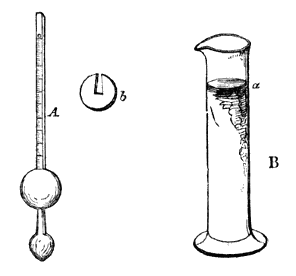
Obs. In an instrument requiring so much care and skill in its manufacture the purchaser should be careful to procure a perfect one. A very slight blow, friction from continual wiping with a rough cloth, and other apparently trivial causes, tend to injure so delicate an instrument. The shape of the weights occasionally vary; some being intended to be attached to the hydrometer at the bottom of the spindle, and others to rest on its top. The first plan is, perhaps, the best, as it tends to make the instrument float with greater steadiness in the liquor; but, at the same time, it renders its adjustment by the maker a matter of greater difficulty.
In employing this instrument, the Revenue officers are instructed to take the nearest degree above the surface of the mercury, when it stands between any two degrees of the thermometer; and the division on the scale of the hydrometer next below the surface of the liquid, when it cuts the stem between any two lines; thus giving the difference in favour of the trader in both cases.
By means of the Table at page 64 the hydrometer indication, or the degrees over or under proof, of the Revenue system, may be converted into ‘real specific gravities,’ by mere inspection; and the corresponding ‘per-centage richness’ in alcohol of any sample may be found, either by WEIGHT or VOLUME.
The specific gravities in this table are such as, on being referred to Gilpin’s Tables, will give the expressions of proof strength answering to the whole indications of the Revenue hydrometer. Intermediate values at fifths of indications may be had by taking proportional differences between the nearest tabular numbers. Thus, to find the specific gravity that should stand opposite to Indication 70·6, we first obtain the difference between the densities standing in a line with Indications 70 and 71 respectively, and then say, as 1 : 0·6 :: ·00192. 00·115, and ·94135 + ·00115 = ·94250, the specific gravity required.
b. With GLASS ALCOHOLOMETERS. That of Tralles, and most others of a like description (as made in England), gave the per-centage strength, by VOLUME, with tolerable accuracy, at the standard temperature of 60° Fahr. Gay-Lussac’s ALCOÖMETRE, which closely resembles that of Tralles, is adjusted for the temperature of 59° Fahr. (15° Cent.). All of these, to give at once accurate results, must, of course, be employed at the ‘normal temperature’ of the instrument. As, however, in practice, the experiment cannot be conveniently performed at any ‘fixed’ temperature but only at that of the atmosphere, it is obvious that certain corrections are constantly required in order to obtain results of any value. Perfect accuracy requires that table for every variation of the thermometer, founded on actual experiments, should accompany each instrument; as, without them, tedious and difficult calculations are necessary, which, in the hurry of the cellar and laboratory, or by persons inexpert at figures, are not easily performed. A series of such Tables were prepared by Gay-Lussac, and, with his instrument, are those which are almost exclusively used in France. For rough purposes, in the absence of Tables or nicer calculations, it may be useful to know that, for commercial spirits, at ordinary temperatures, a variation of—
By Volume,
5°Fahr.is equal to (about)1·00%of Alcohol; or (about)1·794%of Proof spirit.
1°””0·20%”0·359%”
5°Cent.”1·80%”3·229%”
1°””0·36%”0·646%”
By Weight,
5°Fahr.is equal to (about)0·80%of Alcohol; or (about)1·62%”
1°””·16%”·32%”
5°Cent.”1·43%”2·9%”
1°””·28%”·58%”
Table I.—Showing the Densities and Values of Spirits at 60° Fahr., corresponding to every Indication of Sykes’ Hydrometer.
Sykes’ Hydrometer Indication.Strength per cent.Specific Gravity.Per Cents. of Absolute Alcohol.
By Measure.By Weight.
O.P.
067·0·8152095·2892·78
166·1·8171594·7892·08
265·3·8188994·3191·42
364·5·8206193·8490·78
463·6·8225193·3390·07
562·7·8244192·8089·36
661·8·8262292·2988·67
760·9·8280091·7787·99
860·0·8297891·2587·30
959·1·8315190·7486·63
1058·2·8332390·2385·96
1157·3·8349489·7285·30
1256·4·8366189·2184·65
1355·5·8382788·7084·00
1454·6·8399388·1783·33
1553·7·8415387·6782·70
1652·7·8433187·1081·99
1751·7·8450986·5181·26
1850·7·8468085·9580·58
1949·7·8485185·3979·89
2048·7·8502284·8179·19
2147·6·8520584·1978·44
2246·6·8537283·6177·74
2345·6·8553783·0477·07
2444·6·8570082·4776·39
2543·5·8587881·8575·66
2642·4·8605581·2174·92
2741·3·8622980·5974·19
2840·2·8640279·9773·47
2939·1·8657479·3472·75
3038·0·8674578·7172·03
3136·9·8691578·0871·32
3235·7·8709977·4070·54
3334·5·8728276·7169·77
3433·4·8745076·0869·06
3532·2·8762775·4168·32
3631·0·8780974·7267·55
3729·8·8798874·0366·79
3828·5·8817973·2965·98
3927·3·8835572·6065·23
4026·0·8854471·8664·43
4124·8·8871671·1763·68
4223·5·8890170·4362·89
4322·2·8908669·6962·10
4420·9·8926868·9561·32
4519·6·8945168·2160·53
4618·3·8962967·4759·76
4716·9·8982266·6758·92
4815·6·8999765·9358·15
4914·2·9018265·1457·34
5012·8·9036764·3456·52
5111·4·9055163·5455·70
5210·0·9073262·7454·89
538·6·9091361·9454·09
547·1·9110761·0953·23
555·6·9129960·2452·38
564·2·9147959·4351·57
572·7·9166658·5850·73
581·3·9183957·7849·94
U.P.
590·3·9203756·8649·04
601·9·9222855·9648·17
613·4·9240855·1047·33
625·0·9259754·1946·46
636·7·9279853·2245·53
648·3·9298452·3044·65
6510·0·9317651·3643·76
6611·7·9336750·3942·84
6713·5·9358649·3441·86
6815·3·9375848·3140·90
6917·1·9394947·2939·96
7018·9·9413546·2939·04
7120·8·9432745·2038·04
7222·7·9451844·0937·03
7324·7·9470942·9636·01
7426·7·9489941·8234·98
7528·8·9509240·6333·92
7631·0·9528839·4032·82
7733·2·9548438·1031·68
7835·6·9567736·7630·50
7938·1·9587735·3229·24
8040·6·9606833·9028·01
8143·3·9625932·4126·73
8246·1·9645730·7725·32
8349·1·9665129·0823·88
8452·2·9684627·3122·38
8555·5·9704925·3920·77
8659·0·9725423·4119·11
8762·5·9745821·3917·42
8866·0·9766019·4115·78
8969·4·9785717·4614·16
9072·8·9805715·5112·56
9176·1·9826113·5810·97
9279·2·9845211·859·56
9382·3·9865710·048·08
9485·2·988668·286·65
9588·0·990476·835·48
9690·7·992515·254·20
9793·3·994483·803·03
9895·9·996582·311·84
9998·2·99851·997·793
100...1·00000......
This Table {above} has been copied, by permission, from Loftus’s ‘Inland Revenue Officer’s Manual,’ and its correctness verified by W. H. Johnston, Esq., Surveying General Examiner.
Table II.—Table for finding the Specific Gravity of any Spirit at 60° Fahr., when the Specific Gravity at any other Temperature is given.
Water taken as 1000.
Specific gravity.Correction for each degree.Specific gravity.Correction for each degree.
810to820± ·475910to920± ·434
820”830± ·473920”930± ·424
830”840± ·472930”940± ·406
840”850± ·471940”950± ·381
850”860± ·471950”960± ·340
860”870± ·466960”970± ·269
870”880± ·460970”980± ·165
880”890± ·456980”990± ·090
890”900± ·450990”1000± ·084
900”910± ·442
Thus, by making the proper ADDITION to the apparent strength per cent., when the observed temperature is BELOW the normal temperature of the instrument, or a corresponding SUBTRACTION, when it is ABOVE it, the strength of the sample may be determined sufficiently near for all practical purposes.
The following Table, taken from Loftus’s ‘Inland Revenue Officer’s Manual,’ will be found of great value in making these corrections, and has the merit of being easily applied.
An example will show how this Table is to be used.
Example.—If a quantity of spirit is of the sp. gr. 894 at 73°, what will be its sp. gr. at 60°?
Here the sp. gr. being between 890 and 900, we must add ·450 for each degree of temperature between 73° and 60°. The sp. gr. at 60° would, therefore, be 894 + (·450 × 13) = 899·85. When the temperature is below 60°, the correction for each degree must be subtracted. When, however, very accurate results are desired, and the necessary Tables are not accessible, the sample for trial must be brought to the normal temperature of the instrument, in the manner explained under Hydrometry.