A CYCLOPÆDIA OF PRACTICAL RECEIPTS, PROCESSES, AND COLLATERAL INFORMATION (continued 9)
Reading edition
h, Pipe to convey away the liquid metal.
i, Chimney.
Prep. Native antimony is freed from impurities by fusion. The sulphide, after being melted from the gangue, is commonly oxidised by exposure on the concave hearth of a reverberatory furnace, and is then reduced to the metallic state by fusion in crucibles with coal-dust, crude tartar, or some other deoxidising agent. To free the product from iron, it is generally fused, or re-fused, with a little antimonic oxide; and when the ore contains arsenic, iron, or its oxide, and an alkaline carbonate or sulphate, are used in the same way. It is seldom prepared on the small scale. The following formulæ are in use, or are recommended:—
1. On the SMALL SCALE:—
a. From tersulphide of antimony, in coarse powder, 2 parts; iron filings, 1 part; fused together in a covered crucible, at a heat gradually raised to dull redness.
b. From the teroxide or the oxychloride of antimony, fused together, as before, with twice its weight of crude tartar.
c. (Ph. Castr. Ru. 1840.) Sulphide of antimony, 16 parts; cream of tartar, 6 parts; both in powder; throw the mixture, in small quantities at a time, into a vessel (an earthen crucible) heated to redness; when the reaction is over (having closely covered the vessel), fuse the mass, and after a quarter of an hour pour it out, and separate the metal from the slag.
d. From sulphide of antimony, 8 parts; crude tartar, 6 parts; nitre, 3 parts; as last.
e. (Wöhler.) Sulphide of antimony, 10 parts; nitre, 12 parts; dry carbonate of soda, 15 parts; deflagrate together; powder the resulting mass, and wash it thoroughly with boiling water; lastly, smelt the dried residuum with black flux. All the preceding are nearly pure; the impurity, if any, being traces of copper, lead, or iron.
f. (Berzelius.) From metallic antimony, in fine powder, 2 parts; teroxide of antimony, 1 part; fused together. The product will be pure provided the antimony employed is free from lead.
g. (Muspratt.) From antimony, 9 parts; peroxide of manganese, 1 part; fused together; the resulting metal being re-fused with 1-10th of its weight of carbonate of soda.
2. On the LARGE SCALE—commercial:—
a. See above (before 1 a.).
b. From sulphide of antimony, 100 parts; iron (in very small scraps), 40 parts; dry crude sulphate of soda, 10 parts; powdered charcoal, 21⁄2 parts; fused together.—Prod. 60 to 65 parts of antimony, besides the scoriæ or ash, which is also valuable.
c. (Berthier.) Sulphide of antimony, 100 parts; hammerschlag (rough oxide or iron from the shingling or rolling mills), 60 parts; crude carbonate or sulphate of soda, 45 to 50 parts; charcoal powder, 10 parts; as last.—Prod. 65 to 70 parts.
Prop., &c. Bluish-white, lustrous, with a lamellar texture, and a crystalline or semi-crystalline fracture, with fern-leaf markings on the surface, when pure (star antimony); extremely brittle (may be powdered); imparts brittleness to its alloys (even 1-1000th part added to gold renders it unfit for the purposes of coinage and the arts); melts at 809-810° Fahr., or just under redness; fumes, boils, and volatilises at a white heat, and, when suddenly exposed to the air, inflames with conversion into the teroxide, which is deposited in beautiful flowers or crystals; when perfectly pure and fused without contact with air or foreign matter, it bears an intense heat without subliming (Thénard); allowed to cool slowly from a state of perfect fusion, it crystallises in octahedrons or dodecahedrons; tarnishes, but does not rust by exposure to air or moisture at common temperatures; hot hydrochloric acid dissolves it, with the formation of TRICHLORIDE OF ANTIMONY; nitric acid, when concentrated, converts it into ANTIMONIC ACID; and when dilute, into TRIOXIDE OF ANTIMONY. Sp. gr. 6·7 to 6·8.[69]
Tests. Metallic antimony may be recognised by the above properties; its oxide, salts, &c., by the following reactions:—1. Sulphuretted hydrogen gives, with acid solutions, an orange-red precipitate, which is sparingly soluble in ammonia,[70] and insoluble in dilute acids; but readily soluble in pure potassa and alkaline sulphides, and in hot hydrochloric acid with the evolution of sulphuretted hydrogen gas:—2. Sulphydrate of ammonium gives an orange-red precipitate, readily soluble in excess of the precipitant, if this latter contains sulphur in excess; and the liquor containing the re-dissolved precipitate gives a yellow or orange-yellow precipitate on the addition of an acid:—3. Ammonia and potassa, and their carbonates, give (except in solutions of tartar emetic) a bulky white precipitate; that with ammonia and its carbonate being insoluble in excess of the precipitant; that with potassa, readily so; whilst that with carbonate of potassium is only soluble on the application of heat:—4. A rod of zinc throws down metallic antimony, as a black powder, from all its solutions not containing free nitric acid. If the experiment be made with a few drops of a solution of antimony containing a little free hydrochloric acid, and a small platinum dish or capsule be employed, the part covered by the liquid is soon stained brown or blackish, and the stain is irremovable by cold hydrochloric acid, but may be easily removed by warm nitric acid:—5. By ebullition of the acidulated liquid along with copper gauze, foil, or wire, as noticed under ‘Reinsch’s Test.’[71] The peculiar violet-grey of the deposit is characteristic, and may easily be distinguished from that given by arsenical solutions:—6. Mixed with dilute sulphuric acid and poured on some metallic zinc in a gas-generating flask, provided with a small bent tube (see engr.), it yields ANTIMONETTED HYDROGEN (Marsh’s test), recognised by burning with a bluish-green flame, and furnishing dense white fumes which adhere readily to any cold substance (as a porcelain plate) held over it; or, if the plate be depressed upon the flame, a deep black, and almost lustreless spot of metallic antimony; the fumes and spots in both cases being insoluble in water, and in dilute solution of chloride (crude hypochlorite) of soda. On heating the centre of the tube to redness with a spirit lamp, the bluish-green colour of the flame lessens in intensity, and a mirror of metallic antimony, of silvery lustre, forms inside the tube at the ignited part. On passing dry sulphuretted hydrogen through the tube, still heated by a spirit lamp, this mirror assumes a reddish-yellow colour, approaching black in its thicker parts; and by exposure to a feeble stream of hydrochloric acid gas, almost immediately, or in a few seconds, disappears, being carried off by the gas, which, if passed into a little distilled water, yields a solution of chloride of antimony, which may be further submitted to any of the usual tests.[71] If the substance be in the solid state, it must be reduced to powder and dissolved in water; or if insoluble in that menstruum, a solution must be obtained by digestion in either hot hydrochloric or nitrohydrochloric acid, before proceeding to examine it by this method.
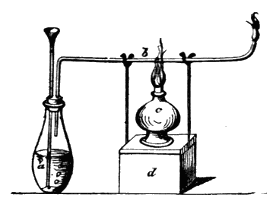
a, Flask containing the suspected fluid, dilute sulphuric acid, and zinc.
b, Small tube, at the one end having an almost capillary orifice, where the gas is inflamed.
c, Spirit-lamp.
d, Support.
Estim. Antimony is generally WEIGHED under the form of tersulphide; but sometimes as antimonious anhydride, and—though more seldom—as pure metal:—
1. A solution being obtained as above, if necessary, it is strongly acidulated with tartaric acid, and the antimony thrown down as a sulphide by a stream of sulphuretted hydrogen. After warming the solution and allowing it to cool, the precipitate (TERSULPHIDE) is collected on a filter, dried, and weighed. A small portion digested in strong hydrochloric acid will completely dissolve if it be the pure sulphide; in which case the quantity of ANTIMONY sought will be equal to 711⁄2% (71·5%) of the weight of the sulphide found (very nearly).[72] Should only part of the precipitate be soluble, a known weight of it may be introduced into a flask, and a considerable quantity of fuming nitric acid added, drop by drop, and afterwards, a little hydrochloric acid, the mixture being digested, at a gentle heat, until the reaction is complete, and the whole of the sulphur is dissolved. The resulting solution diluted with water, strongly acidulated with tartaric acid, and solution of chloride of barium added as long as it disturbs the liquid, yields a precipitate, of which the weight, after it has been thoroughly washed, dried, and gently ignited, multiplied by 136, gives the quantity of SULPHUR in the sample; and which, deducted from the weight of the sulphide first found, gives the quantity of pure ANTIMONY, as before.
2. The quantity of PURE ANTIMONY in commercial samples may be determined by treating them (in powder) with nitric acid, which oxidises the antimony and leaves it in an insoluble state, whilst it dissolves the other metals. The resulting oxide is collected on a filter, washed, dried, ignited in an open porcelain crucible, and weighed—its weight multiplied by ·7898 gives the quantity of pure metal sought.
3. Dissolve a known weight of the sample in hydrochloric acid, immerse a blade of pure metallic tin in the solution, and keep the liquor acidulous, and in a state of gentle ebullition by the heat of a sand bath, when the whole of the ANTIMONY will be precipitated under the form of a black powder, and may be collected, washed, dried, and weighed. This is particularly adapted to alloys of antimony and tin. See Tests (above) and Pur. (below).
Pur. The antimony of commerce generally contains a little arsenic, with variable quantities of iron, lead, sulphur, and tin. These impurities may be thus detected:—
1. (Arsenic.) By fusing the sample, in powder, mixed with about an equal weight of tartrate or bitartrate of potassium, in a covered crucible, for 2 or 3 hours, and placing the resulting button, which is an alloy of antimony and potassium, in a ‘Marsh’s apparatus’ along with a little water, when the disengagement of hydrogen gas will commence, and may be tested in the usual manner. See Arsenic.
2. (Iron.) Dissolve the powdered sample in nitrohydrochloric acid, dilute the solution with a large quantity of cold water, filter, and pass a current of sulphuretted hydrogen through the filtrate as long as it produces a precipitate; again filter, boil the filtered liquor for a few minutes to drive off the sulphuretted hydrogen, and then test it with ferrocyanide of potassium, which will give a blue precipitate if iron be present; or supersaturate the last filtrate with ammonia, and then add hydrosulphydrate of ammonium, when, under like conditions, a black precipitate will be formed.
3. (Lead.) Digest the powdered sample in hot nitric acid, which will dissolve out the LEAD but leave the antimony behind. The whitish powdery residuum may be washed, dried, ignited, and weighed, as above; the clear decanted liquor may now be mixed with the first washings, evaporated to dryness, the residuum re-dissolved in water, and the solution submitted to reagents (see Lead). If lead is found to be present, a solution of sulphate of sodium may be added until it ceases to disturb the liquid, and the resulting precipitate (sulphate of lead) washed, dried, and gently ignited (alone) in a porcelain crucible; the weight of the ignited residuum furnishes a number which, multiplied by ·683, gives the weight of the LEAD sought.
4. (Sulphur.) The solution in nitrohydrochloric acid, when tested with either nitrate or chloride of barium, gives a white precipitate of sulphate of barium, insoluble in both water and acids, which when dried, ignited, and weighed, and the weight multiplied by ·136, gives the quantity of SULPHUR as before. In this case, as with the sulphides (see above), free sulphur maybe removed by digesting and washing the powdered sample in bisulphide of carbon, previous to its solution in the acid, by which the violence of the subsequent reaction will be lessened.
5. (Tin.) Two samples of equal weight are taken; the one is tested for ANTIMONY, as described above; the other is dissolved in a mixture of equal parts of hydrochloric and nitrohydrochloric acid, and a blade of zinc immersed in the solution (see above); the mixed precipitate of tin and antimony which forms is collected on a weighed filter, washed, dried, and weighed. The weight of antimony in the first sample subtracted from that now obtained, leaves a remainder which indicates the quantity of TIN in the original sample.
Phys. eff., &c. Nearly all the salts and preparations of antimony are emetic and cathartic, and in large doses poisonous—occasioning vomiting, profuse alvine dejections, acute colic, and inflammation of the stomach and bowels, often serious, though rarely resulting in death. Tartar emetic and BUTTER OF ANTIMONY are those from which accidents have principally occurred.—Ant., &c. Copious vomiting, if it has not already occurred, should be promoted, and the recently prepared hydrated sulphide of iron administered in considerable doses, followed or accompanied by mucilaginous drinks and diuretics. If much prostration follows, wine and stimulants may be had recourse to. In the absence of hydrated sulphide of iron, a solution of tannin, or decoction of galls; cinchona, or oak bark, or even powdered cinchona, mixed with tepid water, may be administered.
Uses. In the arts, antimony enters into the composition of several useful alloys, as TYPE-METAL, PEWTER, BRITANNIA-METAL, MUSIC-PLATE METAL, &c. It is added to the alloy for concave mirrors, to give them a finer texture; to bell metal, to render it more sonorous; and to various other metals to increase their hardness and fusibility; for the latter purpose it is employed in the casting of cannon balls.
Concluding Remarks. In ‘roasting’ or oxidising the native sulphide of antimony on the bed of the reverberatory furnace, as in the common method before referred to, care must be taken to regulate and gradually raise the heat, which, until towards the end of the process, need not be extreme, and then only should it approach dull redness. Without this precaution much of the undecomposed sulphide will be lost by volatilisation. During the whole time the ‘charge’ should also be well stirred with an iron spatula, to ensure the constant exposure of every part of it to the atmosphere. The process is complete when the whole mass assumes a greyish-white appearance. Earthen crucibles are commonly employed for the subsequent reduction, and after being charged and covered over with ground charcoal, are heated in a reverberatory furnace. The product is the crude metallic antimony of commerce. It is generally REFINED by smelting it with about 1-8th of its weight of the refined sulphide, and about 1-4th of its weight of carbonate or sulphate of soda; but if there be much iron present, more of the sulphide—even 1-4th—may be required; for unless there be sufficient sulphur to combine with the whole of the iron, the arsenic will not be oxidised, but remain as a contamination. When cold, the metal is carefully separated from the slag, and is frequently re-fused with a little fresh carbonate of soda (1 to 11⁄2 part); after which it is cast into pigs, lumps, or ingots. The crude metal, thus treated, commonly yields 94% of REFINED METAL of tolerable purity.
Should lead have been present in the sulphide or ore, it remains after a second, or even a third fusion, although proportionately reduced in quantity; and it can only be completely separated in the humid way. It is, therefore, always desirable to select an ore free from lead.
Antimony, Ash of. Syn. Antimony-ash, Calcined’ antimony*; Ci′nis antimo′′nii, Antimo′′nium calcina′tum*, L. Prepared by roasting the common grey sulphide of antimony on an iron plate set under a chimney, to carry off the fumes. The product is a mixture of teroxide of antimony, with some unburnt sulphide, and a little antimonious acid.
Prop., &c. Ash-grey; emetic in small doses. Used chiefly as a cheap substitute for teroxide of antimony by the manufacturers of tartar emetic; also to make metallic antimony.
Antimony, Butt′er of. See Antimony, Trichloride of.
Antimony, Calx of. Syn. Calx antimo′′nii, L. Sometimes applied to antimony-ash, but more commonly to crude, unwashed diaphoretic antimony.
Antimony, Calx of (Sul′phurated). Syn. Antimo′′nii calx sulphura′ta, L. Prep. (Hufeland.) Calcined oyster-shells, 10 parts; sulphur, 4 parts; crude antimony, 3 parts; powder, mix, and calcine in a luted crucible for an hour. Emetic, resolvent, and alterative.—Dose, 1 to 6 gr.; in gout, rheumatism, scrofula, &c.
Antimony, Ce′ruse of. Syn. Antimo′′nii cerus′sa, L. Prep. (Bate.) As diaphoretic antimony (over which it possesses no advantage), merely using the metal instead of the sulphide.
An old preparation made by igniting antimony in the sun’s rays, by means of a lens, was called ANTIMONII CERUSSA SOLA′′RIS.
Antimony, Chlo′′rides of (klōre′-īdz):—
1. Antimony, Trichloride of. SbCl2. Syn. Terchloride of antimony, Antimonious chloride, Chlo′′ride of antimony, Sesquichloride of a., Butter of a., Cau′stic antimony†, &c.; Antimo′′nii chlori′dum, A. TERCHLORI′DUM, A. bu′tyrum*, &c., L.; Chlorure d’antimoine, Beurre d’antimoine, &c., Fr.; Antimon-chlorid, Spiessglanz-butter, Ger. This is the substance of which common chloride, or butter of antimony, of the shops, is an impure concentrated solution containing free acid.
Prep. 1. Solid, anhydrous:—
a. Pure commercial tersulphide of antimony, in coarse powder, 1 part; concentrated hydrochloric acid, 5 parts; are mixed in a capacious stoneware or glass vessel set under a chimney with a quick draught, to convey away the fumes, the whole being constantly stirred, and, as the effervescence slackens, a gradually increasing gentle heat applied until solution is complete; the resulting liquid is put into a retort, and distilled, until each drop of the distillate, as it falls into the aqueous liquid which has previously passed over into the receiver, produces a copious white precipitate; the receiver is then changed, and the distillation continued, when pure TRICHLORIDE OF ANTIMONY passes over, and solidifies on cooling to a white and highly crystalline mass, which must be carefully excluded from the air.
b. From pure metallic antimony, 2 parts; bichloride of mercury, 5 parts; both in fine powder; mixed and distilled in a retort with a large neck, by a gentle sand-heat, into a suitable receiver. Chemically pure.
2. Liquid:—
a. (Liquor antimonii chloridi, B. P.) Syn. Solution of chloride of antimony.
Prep. Take of black antimony, 1 lb.; hydrochloric acid, 4 pints; place the black antimony in a porcelain vessel; pour upon it the hydrochloric acid, and, constantly stirring, apply to the mixture, beneath a flue with a good draught, a gentle heat, which must be gradually augmented as the evolution of gas begins to slacken, until the liquid boils. Maintain it at this temperature for fifteen minutes; then remove the vessel from the fire, and filter the liquid through calico into another vessel, returning what passes through first, that a perfectly clear solution may be obtained. Boil this down to the bulk of two pints, and preserve it in a stoppered bottle.
Characters and Tests. A heavy liquid, usually of a yellowish-red colour. A little of it dropped into water gives a white precipitate, and the filtered solution lets fall a copious deposit on the addition of nitrate of silver. If the white precipitate formed by water be treated with sulphuretted hydrogen it becomes orange-coloured. The specific gravity of the solution is 1·47. One fluid drachm of it mixed with a solution of a quarter of an ounce of tartaric acid in four fluid ounces of water, forms a clear solution, which, if treated with sulphuretted hydrogen, gives an orange precipitate, weighing, when washed and dried at 212°, at least 22 grains.
b. (Commercial.)—a. Take of ash or calx of antimony, 31⁄4 lbs.; common salt, 2 lbs.; oil of vitriol, 11⁄2 lb.; water, 1 lb.; proceed as before. Prod., 21⁄2 lbs.
c. From roasted sulphide or glass of antimony, 7 lbs.; salt, 28 lbs.; oil of vitriol, 21 lbs.; water, 14 lbs.; as before.
d. From crude sulphide of antimony (powdered), 25 lbs.; strongest commercial hydrochloric acid, 1 cwt.; nitric acid, 31⁄2 lbs.; as before; the product being coloured with a little pernitrate of iron, and made up to the sp. gr. 1·4. The quality is improved, and the process more easily conducted, if the crude antimony is roasted before dissolving it in the acid. The same applies to the other formulæ.
Prop., &c.—a. Solid. When pure, and nearly free from water, it somewhat resembles butter, melts with a gentle heat, and partially crystallises on cooling; is very deliquescent, and quickly passes into an oily liquid when exposed to damp air; very soluble in strong hydrochloric acid; water, according to its quantity, more or less decomposes it. When perfectly pure and anhydrous, it forms a white and highly crystalline mass, rapidly decomposed by air and moisture.—b. Solution. The sp. gr. of the solution of the shops varies from 1·25 to 1·4, in which state it is a transparent fuming yellow liquid (unless when artificially coloured), and extremely acid and caustic. Submitted to distillation, it at first parts with its water and excess of acid, after which the salt itself is volatilised. By changing the receiver as soon as the distillate concretes on cooling, or produces a copious white precipitate on falling into the liquid already passed over, the pure ANHYDROUS TRICHLORIDE may be readily obtained.
Phys. eff., Ant., Lesions, &c. See Antimony.
Uses. In medicine, only externally, and chiefly as a caustic or escharotic to the wounds caused by rabid and venomous animals, and to repress excessive granulations in ulcers. In pharmacy, as a source of both oxychloride and oxide of antimony. The residuum in the retort when corrosive sublimate is used, is sulphide of mercury, and was formerly called CINNABAR OF ANTIMONY.
2. Antimony, Pentachlo′′ride of. Sb2Cl5. Syn. Perchlo′′ride of antimony; Antimo′′nii pentachlori′dum, L. Prepared by passing a stream of chlorine gas over metallic antimony in fine powder, and gently heated. A mixture of TRICHLORIDE and PENTACHLORIDE OF ANTIMONY is found in the receiver, from which the latter may be separated by careful distillation. It is a colourless volatile liquid, forming a crystalline compound with a small quantity of water, but decomposed by a larger quantity.
Antimony, Cro′cus of. Syn. Saff′ron of antimony, Liv′er of a.; Cro′cus antimo′′nii C. metallo′′rum, He′par antimonii, L.; Crocus d’antimoine, Saffran d’a., Fr. Prep. 1. From black sulphide of antimony, and saltpetre, equal parts, deflagrated together by small portions at a time, and the fused mass (separated from the scoriæ) reduced to fine powder.
2. (Ant. crocus, Ph. L. 1788,) Sulphide of antimony, 1 lb.; nitre, 1 lb.; common salt, 1 oz.; as before.
Prop., &c. Its medicinal properties closely resemble those of diaphoretic antimony. It is a mixture of sulphate of potassium, antimoniate of potassium, teroxide of antimony, oxysulphide of antimony, sulphide of potassium, and undecomposed trisulphide of antimony, in variable and undetermined proportions. When repeatedly washed or boiled in water, and dried, it forms the WASHED SAFFRON OF ANTIMONY (C. A. LO′TUS, L.) of old pharmacy, and has then lost its sulphate of potassium, caustic potash, and sulphide of potassium. Formerly used to make tartar emetic. See Antimony, Liver of.
Antimony, Crude. Native sulphide of antimony melted from the gangue.
Antimony, Diaphoret′ic. Syn. Calx of antimony, Calcined’ a., Antimo′′niate of pot′ash, Stib′iated ka′li†, Diaphoretic min′eral†, &c.; Antimo′′nium diaphoret′icum, A. calcina′tum, Calx antimo′′nii, C. a. anglo′′rum†, POTAS′SÆ ANTIMO′′NIAS, Kali stib′icum†, &c., L. var.; Antimoine diaphorétique, Biantimoniate de potasse, Fr. An old preparation with numerous synonyms, of which the first two of the above are those which are now chiefly in use.
Prep. 1. Sulphide of antimony, 1 part; nitre, 3 parts; powder, mix, and deflagrate by spoonfuls in a red-hot crucible, then calcine for half an hour, and when cold powder the residuum.
2. Washed diaphoretic a., W. calx of a.; Antimonium diaphoreticum lo′tum, A. d. ablu′tum (Ph. Bor. 1847), A. calcina′tum (Ph. L. 1788); Antimoine diaphorétique lavé, &c., Fr.:—a. (Ph. L. 1788.) As the last, but the powder is subsequently deprived of soluble matter by repeated washings with water, after which it is collected and dried.
b. (Ph. Bor. 1847.) Metallic antimony, 1 part; nitre, 2 parts; as above, but drying the washed powder at a heat not exceeding 104° F.
Prop., &c. A white or greyish-white powder, without either smell or taste; gently diaphoretic and laxative; its activity greatly depending on the quantity of acid in the stomach.—Dose, 1 to 6 gr., or even 10 gr.; for horses, 1 to 3 or 4 dr. It was formerly in high repute; but is now almost superseded by the present pharmacopœial preparations.
Antimony, E′thiops of. Syn. Æ′thiops antimonia′lis, L. Prep. 1. From metallic mercury, 1 part; sulphide of antimony, 2 parts; triturated together until the globules of the former entirely disappear.—2. Sulphide of antimony, 3 parts; black sulphide of mercury, 2 parts; triturated together for some time. An old remedy in certain skin diseases, still highly esteemed by some provincial practitioners.—Dose, 3 to 5 gr., gradually increased to 20 or 30 gr.
Antimony, Flow′ers of. Syn. Flo′′res antimo′′nii, L.; Fleurs d′antimoine, Fr. Prep. Throw powdered sulphide of antimony, by spoonfuls at a time, into an ignited tubulated retort with a short and very wide neck, until as many ‘flowers’ collect in the receiver as are required. An impure oxysulphide of antimony, with variable portions of trioxide, and undecomposed tersulphide. Emetic in doses of 1 to 3 grains.
Antimony, Flowers of (Ar′gentine). [-ĭn.] Syn. White ox′ide of antimony, Snow of a.†; Antimo′′nii flo′′res argenti′ni, A. nix†, L.; Fleurs argentine d’antimoine, Oxyde blanc d’antimoine, Fr. Prep. Melt metallic antimony in a vessel freely exposed to the air, and furnished with a cool place for the ‘flowers’ to rest on, and collect them as deposited; or, and what is better, heat the metal to a full red or white heat in a covered crucible, and then suddenly expose it to the air, when it will inflame, and the oxidised vapour condense as ‘flowers’ on any cool surface (as a partially inverted wide-mouthed flask) held at a little distance over it. The product is TRIOXIDE OF ANTIMONY in a crystalline form, and received the name of argentine flowers from its silvery whiteness and beauty.
Antimony, Flowers of (Helmont’s). Syn. Flo′′res antimo′′nii Helmon′tii. An old preparation formed by dissolving sulphide of antimony in aqua regia, expelling the free water and acid by heat, and subliming the residuum with an equal weight of sal ammoniac. Violently emetic, even in small doses, and unfit for internal use.
Antimony, Flowers of (Red). Syn. Flo′′res antimo′′nii ru′bri, L. From sulphide of antimony, and sal ammoniac, both in fine powder, mixed and sublimed together. Resembles the last.
Antimony, Ful′minating. See Fulminating Compounds.
Antimony, Glass of. Syn. Vit′rified antimony*, V. ox′ide of a.*, Grey o. of a.*; Antimo′′nii vit′rum, Antimo′′nium vitrifica′tum, A. vitrifac′tum (Ph. L. 1788), Ox′ydum antimonii vitrificatum, &c., L.; Verre d’antimoine, Oxysulfure d’antimoine silicaté, Fr. Prep. (Ph. L. 1788.) Roast sulphide of antimony in a shallow earthen vessel, over a moderate fire, stirring it constantly with an iron rod, until it turns whitish-grey and ceases to emit fumes at a red heat; put the residuum into a covered crucible which it shall only two thirds fill, and expose it to an intense heat (gradually raised), until it fuses, then pour it out on an iron plate. If calcined too much, a little more crude antimony may be added to make it run well.
Comp., Prop., &c. A mixture of sulphide and oxide of antimony contaminated with a little silica and iron. In fine powder it is emetic, in doses of 1 to 3 gr.; but owing to the uncertainty and violence of its operation, is now seldom employed. It has been used as a cheap source of the TEROXIDE by the manufacturers of tartar emetic.
Antimony, Glass of (Cera′′ted). Syn. Antimo′′nii vit′rum cera′tum, L. Prep. (Dr Young & Ph. L. 1746.) Glass of antimony, in very fine powder, 1 oz.; yellow wax, 1 dr.; melt together in an iron ladle, and keep it over a gentle fire free from flame (constantly stirring) for about half an hour, or until it acquires a snuff colour, then pour it out on a piece of white paper (or a plate), and when cold, powder it.—Dose, 2 to 10 gr., in dysentery, &c.
Antimony, Li′ver of. Syn. He′par antimo′′nii, L.; Hépar d’antimoine, Oxysulfure d’antimoine silicaté, Fr. Prep. From sulphide of antimony, 1 part; and dry carbonate of sodium or potassium, 2 parts; melted together, and heated until it acquires the proper colour, and then cooled and powdered.
Comp., Uses, &c. A mixture of trioxide of antimony, sulphide of potassium, carbonate of potassium, and undecomposed trisulphide of antimony. It is chiefly used by farriers, in doses of 1 to 2 dr., as an alterative purge for horses, in greasy heels, &c.; and sometimes by chemists, as a source of the crude oxide. Crocus of antimony, before noticed, sometimes passes under the name, and is sold for it.
Antimony, Ore of. Syn. Antimony-ore. Native sulphide of antimony.
Antimony, Oxide of. The B. P. name for Antimony, Trioxide of (which see).
Antimony, Oxides of. Antimony forms with oxygen three definite compounds, viz the—
Trioxide or antimonious oxideSb2O3
Tetroxide or antimonoso-antimonic oxideSb2O4 or Sb2O3 or Sb2O5
Pentoxide or antimonic oxideSb2O5
Antimony, Trioxide of. Sb2O3. Syn. Teroxide of antimony, Antimonious oxide (B. P. Oxide of antimony, Eng.; Antimonii oxidum, L.). Prep. (B. P.) Take of solution of chloride of antimony, 16 fluid oz.; carbonate of soda, 6 oz.; water, 2 galls.; distilled water, a sufficiency. Pour the antimonial solution into the water, mix thoroughly, let the precipitate settle, remove the supernatant liquid by a siphon, add one gallon of distilled water, agitate well, let the precipitate subside, again withdraw the fluid, and repeat the processes of affusion of distilled water, agitation, and subsidence. Add now the carbonate of soda previously dissolved in two pints of distilled water, leave them in contact for half an hour, stirring frequently, collect the deposit on a calico filter, and wash with boiling distilled water until the washings cease to give a precipitate with a solution of nitrate of silver acidulated by nitric acid. Lastly, dry the product at a heat not exceeding 212°.
Char. and Tests. A greyish-white powder, fusible at a low red heat, insoluble in water, but readily dissolved by hydrochloric acid. The solution, dropped into distilled water, gives a white deposit, at once changed to orange by sulphuretted hydrogen. It dissolves entirely when boiled with an excess of the acid tartrate of potash.
Uses. Chiefly in making tartar emetic and some other salts of antimony; also in the preparation of pulvis antimonialis. Therapeutically, it is a diaphoretic and febrifuge.—Dose, 1 to 4 grains.
Antimony, Pentoxide of. See Antimonic Anhydride.
Antimony, Tetroxide of. Sb2O4 or Sb2O3.Sb2O5. Syn. Antimonoso-antimonic oxide, Antimonious acid. Found natural as Cervantite or Antimony ochre. Prepared by heating antimonic anhydride, by roasting the trioxide or trisulphide, or by the action of excess of nitric acid on finely powdered metallic antimony. Thus prepared, it is a white solid, unalterable by heat; slightly soluble in water, more so in hydrochloric acid.
Antimony, Oxychloride of. SbOCl. Syn. Powder of Algaroth. Thrown down as a white precipitate when trichloride of antimony is poured into water. Continued washing with water deprives it of nearly the whole of its chlorine, and converts it into the trioxide, a change which is more completely effected by aqueous solutions of the alkalies or their carbonates.
Antimony, Oxysulphide of. The compound Sb2O3.2Sb2S3 occurs native as red antimony. Antimony blende, Kermesome, Rothspiessglanzerz, Crocus of antimony, Glass of antimony, and similar preparations, are believed by some authorities to be crude oxysulphides of antimony. See Antimony, Sulphurated.
Antimony, Red. See Oxysulphide of Antimony, before noticed.
Antimony, Reg′ulus of. Syn. Reg′ulus antimo′′nii, L. Metallic antimony obtained by fusion. Alloys formed by fusing antimony with iron, tin, lead, or copper, and a little tartar, were respectively called MAR′TIAL REGULUS OF ANTIMONY (r. antimo′′nii martia′lis, L.), R. A. JOVIA′LIS (L.), R. A. SATURNI′NUS (L.), R. A. VEN′ERIS (L.), &c. (See below.)
Antimony, Ru′by of. Syn. Medic′inal (-dĭs′-) REG′ULUS OF ANTIMONY; Antimo′′nii rubi′nus, Reg′ulus medicina′lis, R. a. m., &c., L. From crude sulphide of antimony, 5 parts; fused with carbonate of potassa, 1 part; and the purified portion separated from the scoriæ. See Liver of Antimony.
Antimony, Saff′ron of. See Crocus of Antimony.
Antimony, Smelt′ed. Syn. Antimo′′nium purifica′tum, L. Crude antimony melted and poured into small conical moulds.—Uses, &c. Same as the ordinary tersulphide.
Antimony, Snow of. See Antimony, Flowers of.
Antimony, Sulphurated. B. P. Syn. Oxysulphuret, or Precipitated Sulphide of Antimony, Golden Sulphide of Antimony. Mix black antimony 10 oz. with solution of soda 41⁄2 pints, and boil for two hours, with frequent stirring, adding distilled water occasionally to maintain the same volume. Strain the liquor through calico, and before it cools add to it by degrees dilute sulphuric acid till the latter is in slight excess. Collect the precipitate on a calico filter, wash with distilled water till the washings no longer precipitate with chloride of barium, and dry at a temperature not exceeding 212° F.—Dose, 1 to 5 grains.
Antimony, Sulphantimonate. Syn. Schlippe’s Antimonial Salt. Mix eight parts of effloresced sulphate of soda, six of black antimony, and three of charcoal, and expose to a red-heat in a covered Hessian crucible till the fused mass ceases to throw up a scum. Boil the residue in a porcelain vessel with one part of sulphur and sufficient distilled water, and set the filtered liquor aside for crystallisation.
Antimony, Pentasulphide of (Sb2S5), is a yellowish-red powder, obtained (1) by passing hydrosulphuric acid gas through a mixture of pentachloride of antimony, water, and tartaric acid; or (2) through antimonic anhydride suspended in water. It is insoluble in water; hot hydrochloric acid decomposes it, producing trichloride of antimony, sulphur, and hydrosulphuric acid. With the more basic metallic sulphides it unites to form a class of salts called sulphantimonates.
Antimony, Trisulphide of. Sb2S3. Syn. Tersul′phide of antimony, Sul′phide of a., Sul′phuret of a., Black s. of a., Sesquisul′phuret of a., &c.; L′antimoine sulfure, Sulfure d’antimoine, &c., Fr.; Schwefel-spiessglanz, Anderthalb, &c., Ger. This is the grey or greyish-black substance commonly known as crude antimony, black antimony, or sulphide of antimony, in commerce, and from which the other compounds of antimony are chiefly obtained.
Nat. hist., Sources, &c. See Antimony.
The crude ore is freed from earthy impurities in the following manner:—The crushed ore is submitted to ‘eliquation’ in order to separate the SULPHIDE from the gangue or earthy matter with which it is contaminated; after which it is remelted and run into ‘loaves’ or large cakes, in which form it is sent to market. Formerly the operation was performed by introducing the ore into large pots or crucibles having a hole in the bottom, and which, after being closely covered, were set in a circle around a suitable furnace, by which they were heated. At the present time the process is commonly conducted in a ‘reverberatory furnace,’ similar to that figured in the engraving.
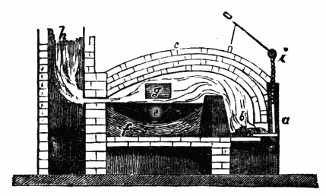
a, b, Grate and fire-place.
c, Bridge.
e, Concave space for ore formed by a solid bed (f) of clay and sand, and having a ‘hole’ near the bottom extending nearly horizontally through the wall of the furnace to ‘run off’ the fused sulphide.
g, Door for introducing ore, and removing residuum.
h, Chimney.
i, Damper, chain, and lever.
Native trisulphide of antimony treated in this way and ground to powder constitutes the BLACK ANTIMONY (ANTIMONIUM NIGRUM), B. P.
Antimony, Trisulphide of (artificially prepared). Saturate an aqueous solution of tartar emetic with hydrosulphuric acid; an orange precipitate will be thrown down. This precipitate, when collected on a filter, washed, and dried, is the pure trisulphide.
Prop., &c. (Native.) Anhydrous, inodorous, insipid, opaque, brittle, easily pulverisable, and of a dark leaden-grey or steel colour; it has a striated crystalline texture, and breaks with a rough spicular fracture; is insoluble in both water and alcohol; soluble, with decomposition, in hot strong acids and alkaline solutions; melts at a red heat, and is partly dissipated in white fumes, leaving an impure grey-coloured oxide mixed with some undecomposed tersulphide (ANTIMONY-ASH). Its powder is black, of peculiar richness, and stains the fingers. Sp. gr. 4·6 to 4·62. The pure precipitated (amorphous) tersulphide is of orange colour; is darkened by a gentle heat, with loss of water, and at a higher temperature passes from the amorphous to the crystalline condition, at the same time that it assumes the colour and appearance of the native sulphide. It dissolves in hot hydrochloric acid, evolving hydrosulphuric acid, and producing a solution of trichloride of antimony.
Pur. The crude commercial sulphide frequently contains lead, iron, copper, and arsenic, and sometimes manganese. Its goodness is commonly estimated by its compactness and weight, the largeness and distinctness of the striæ, and the volatility of its sulphide.
Uses, &c. Chiefly as a source of metallic antimony, and of the oxide in the preparation of other antimonials. Exhibited alone, it possesses little activity unless it meets with acid in the primæ viæ, when it occasionally acts with considerable violence both as an emetic and cathartic.—Dose, 10 to 30 gr., in powder; as an alterative and diaphoretic in rheumatism, gout, scrofula, and glandular affections, and in lepra, scabies, and some other skin diseases. It is a favourite alterative in veterinary medicine, particularly in skin diseases. Farriers and grooms frequently mix a little of it with the food of horses to improve their coat and promote their ‘condition,’—Dose. For a HORSE, 1 to 4 dr., in fine powder, often combined with nitre and sulphur; for CATTLE, 1⁄2 to 1 oz., or even 11⁄2 oz.; DOGS, 5 or 6 to 20 or 30 gr.; HOGS, 20 to 30 gr., twice or thrice daily. According to Dr Paris, it is one of the ingredients in Spilsbury’s Drops. It is also an ingredient in Tisane de Feltz.
Antimony, Tartarated. KSbOC4H4O6.Aq. Syn. Tartarized antimony, Tartar emetic, Emetic tartar, Potassio-tartrate of Antimony, Eng.; Antimonium tartaratum, B. P. Prep. Various methods have been devised for the preparation of this compound, but the following, which is taken from the ‘British Pharmacopœia,’ is to be preferred:—
Take of oxide of antimony 5 oz., acid tartrate of potash in fine powder 6 oz., distilled water, 2 pints. Mix the oxide of antimony and acid tartrate of potash with sufficient distilled water to form a paste, and set aside for 24 hours. Then add the remainder of the water, and boil for a quarter of an hour, stirring frequently. Filter, and set aside the clear filtrate to crystallise. Pour off the mother-liquor, evaporate to one third, and set aside, that more crystals may form. Dry the crystals on filtering paper at the temperature of the air.
Char. and Tests. In colourless transparent crystals exhibiting triangular facets, soluble in water, and less so in proof spirit. It decrepitates and blackens upon the application of heat. Its solution in water gives with hydrochloric acid a white precipitate, soluble in excess, and which is not formed if tartaric acid be previously added. Twenty grains dissolve without residue in a fluid ounce of distilled water at 60°, and the solution gives with sulphuretted hydrogen an orange precipitate which, when washed and dried at 212°, weighs 9·91 grains.
Phys. eff., Doses, &c. Externally tartar emetic acts as a powerful local irritant, causing a pustular eruption, which permanently marks the skin; for this purpose it is used in the form of solution, ointment, or plaster. Internally, in small doses (1⁄16 to 1⁄8, or even 1⁄6 gr.), it acts as a diaphoretic and expectorant; in somewhat larger doses (1⁄6 to 1⁄2 gr.) it excites nausea, and sometimes vomiting, occasioning depression and relaxation, especially of the muscular fibre; in larger doses (1 to 2 or 3 gr.) it acts as an emetic and sudorific (and often as a purge), depressing the nervous functions, and producing a feeling of feebleness, exhaustion, and relaxation, greater than that caused by other emetics; in certain doses (1⁄2 to 3, or even 4 gr.), it is used as a sedative and antiphlogistic, to reduce the force of the circulation, &c.; in excessive doses it acts as an irritant poison, and has in some instances caused death; and even small doses, frequently administered and long continued, have brought on a state of weakness, prostration, and distaste for food, which has led to a fatal termination. It is usually exhibited dissolved in distilled water, either with or without the addition of a little simple syrup. In acute rheumatism, inflammation of the lungs or pleura, chorea, hydrocephalus, and apoplexy, it is said to have been given in doses of 2 to 4, or even 6 gr., with advantage, by Laennec, Rasori, and others; but these extreme doses are not always safe, and cannot be commendable when smaller ones (1⁄4 to 1⁄2 gr., repeated every two hours) appear equally beneficial, and distress the patient less.[73] In doses of 1⁄2 gr. to 3⁄4 gr. each, combined with calomel, it is a powerful and excellent alterative in acute rheumatism and many skin diseases. Of all our sudorifics it is perhaps the most valuable, and the one most generally available. Triturated with 16 to 20 times its weight of sulphate of potassa, it forms an excellent substitute for antimonial powder and James’s powder, as a diaphoretic, in doses of 2 to 4 gr.
Whenever much gastric or intestinal irritation is present, tartar emetic should be avoided, or very cautiously administered, and then combined with an opiate, or some other sedative. It should also be given with caution to children; as, according to Messrs Goodlad and Noble, even in small doses it sometimes acts as a poison on them.
In veterinary medicine it is employed to promote diaphoresis and expectoration, and to reduce arterial action, particularly in fevers, and catarrhal affections, the dose for HORSES being 20 gr. to 1 dr., or even occasionally 11⁄2 dr., in gruel, thrice daily; also sometimes as a diuretic and vermifuge, in doses of 1 to 2 dr., combined with tin-filings, for 2 or 3 successive days, followed by a purge of aloes. The usual dose for CATTLE is 20 gr. to 1 dr.; SHEEP, 5 or 6 to 20 gr.; SWINE (chiefly as an emetic), 2 to 5 or 6 gr.; DOGS (chiefly as an emetic), 1 to 3 gr. It is sometimes, though seldom, used externally, as a counter-irritant, in chest affections, &c.; but its employment thus requires caution.
Pois., &c. That from large doses has been already noticed under ANTIMONY (which see). In poisoning the treatment is the entire disuse of all antimonials, followed by tonics, a light nutritious diet, the use of lemon-juice or ripe fruit, a little wine, warm baths, and mild restoratives generally.
Antimony, Tar′tarised. See Antimony, Tartarated.
Antimony, Vit′rified. See Antimony, Glass of.
ANTI-MIASMATICUM. A disinfecting powder, manufactured first in Berlin in 1866, and described as “prepared by steam.” Quicklime slaked with a solution of sulphate of iron and mixed with turf ashes, also probably containing some carbolic acid. Fluid anti-miasmaticum is a solution of sulphate of iron in impure acetic acid. (Hager.)
ANTIPHLOGIS′TIC (-flo-jĭs′-). Syn. Antiphlogis′ticus, L.; Antiphlogistique, Fr.; Antiphlogistisch, Ger. In medicine, the common epithet of remedies, agents, and treatment (ANTIPHLOGIS′TICS; ANTIPHLOGISTICA, L.), which lessen inflammatory action, or allay the excited state of the system which accompanies it. Of these the principal are bleeding, purging, a low diet, cooling beverages (as water and acidulous drinks), and sedatives generally.
ANTIPSILOTHRON, for preventing loss of hair (Hegewald, Berlin). A brownish-yellow, clear, pleasant-smelling liquid, which consists of a filtered extract of 2·5 grms. of nutgalls, with 50 grms. strong spirit and 30 grms. water; perfumed with several ethereal oils. The liquid is not made turbid by dilution with water. Sold in square bottles containing about 80 grms. The directions strongly recommend the supplementary use of a Swiss “vegetable oil,” which probably Switzerland has never seen. (Hager.)
ANTI-RHEUMATIC DROPS (Roll, Amsterdam). A turbid, dark-brown liquid, which consists of a solution of spirituous extract of aconite in a decoction of couch-grass root, and to which some tincture of opium with saffron and oil of valerian have been added.
ANTI-RHEUMATIC SALVE, Mrs HUNGERFORD’S (Wedecke, Berlin). Recommended for acute and chronic rheumatism, gout, and nervous pains. Camphor, 1 grm.; carbolic acid, 1 grm.; simple cerate, 12 grms. (Schädler.)
ANTISCORBU′TIC (-skor-bū′-). Syn. Antiscorbu′ticus, L.; Antiscorbutique, Fr.; Antiscorbutisch, Gut wider den scharbock, Ger. Good against scurvy. In medicine, an epithet of remedies, agents, &c. (ANTISCORBU′TICS; ANTISCORBU′TICA, L.), used in scurvy. Lemon-juice, ripe fruit, milk, the salts of potassa, green vegetables, potatoes, meal-bread, fresh meat, and raw or lightly boiled eggs, belong to this class.
ANTISEP′TIC. Syn. Antisep′ticus, L.; Antiseptique, Fr.; Antiseptisch, Fäulnisswidrig, Ger. An epithet of substances, agents, &c. (ANTISEP′TICS; ANTISEP′TICA, L.), that impede, arrest, or prevent putrefaction. The principal antiseptics in common use are culinary salt, saltpetre, spices, sugar, vinegar, carbolic acid, creasote, and alcohol; to which may be added intense cold, desiccation, and the exclusion of air. Among ANTISEPTIC MEDICINES, bark, dilute acids, quinine, wine, spirits, camphor, charcoal, and yeast, take the first rank. See Putrefaction, Solutions (Antiseptic), &c.
ANTISPASMOD′IC (-spăz-). Syn. Antispas′tic; Antispasmod′icus, L.; Antispasmodique, Fr.; Krampestillend, Ger. In medicine, an epithet of substances and agents (ANTISPASMOD′ICS; ANTISPASMOD′ICA, L.) which allay spasms and convulsions. It is frequently incorrectly applied to anodynes and narcotics, which soothe pain, but do not repress muscular spasm. Ammonia, assafœtida, bark, camphor, castor, chalybeates, chloral hydrate, chloroform, ether, Indian hemp and cannabine, musk, opium, saffron, and valerian, with many other similar substances, are regarded as antispasmodics.
ANTI-SPASMODIC SYRUP, for hooping-cough (Dessaga, Strasburg). A pleasant syrup, leaving a slightly sharp taste, containing a little carbonate of potash, and faintly coloured with rosaniline. (Hager.)
ANTISUDIN, a remedy for sweaty feet (Mandowski, Annaberg). Powdered alum. (Hager.)
ANTS (ănts). See Ant, Formic Acid, Gardening, Insects, &c.
AORT′A [L., Ger.] Syn. Aorte, Fr. In anatomy, the main trunk of the arterial system, arising immediately from the left ventricle of the heart, and giving origin to all the other arteries of the body, except the pulmonary artery and its ramifications, which permeate the air-vesicles of the lungs.
AP′ATITE (-tīte). In mineralogy, native tricalcium phosphate (phosphate of lime). It is found in Devonshire and Cornwall, and abundantly in Spain, whence it is imported for use as manure, and recently particularly for the manufacture of ARTIFICIAL GUANO. Its powder phosphoresces on burning coals. It differs from phosphorite in not containing fluorine.
Apatite (phosphate of lime of similar constitution to bone-earth, Ca3(PO4)2) is found in every fertile soil, and of which it is an essential ingredient.
APE′′RIENT (ă-pēre′-ĕ-ĕnt; -pĕr′-, as marked by Mayne and Smart, though etym. correct, is less usual). Syn. Aper′itive (-tĭv); Aper′iens, L.; Apéritif, Fr.; Abführend, ÖFFNEND, Ger. In medicine, opening, laxative, gently purgative; usually applied as an epithet to substances and agents (APE′RIENTS; Aperien′tia, Aperiti′va, L.) which, in moderate doses, and under ordinary circumstances, gently, but completely, open the bowels; and in this respect rank between the simple laxatives on the one hand, and the stronger purgatives and cathartics on the other. Among these may be named as examples—Aloes (when combined with soap or aromatics), Castile soap, castor oil, compound extract of colocynth (in small doses), compound rhubarb pill, confection of senna, cream of tartar, Epsom salts, Glauber’s salt, phosphate of soda (tasteless purging salt), pil. rufi, seidlitz powders, cold-water compress over the abdomen, &c. Several of these, in larger doses, become active purgatives or cathartics. See Purgatives, also Draughts, Mixtures, Pills, &c.
A′PIOL (-pe-ōle; or -ŏl). Prep. The soft alcoholic extract of parsley-seed is either digested or agitated for some time with ether; after sufficient repose in a cool place, the ethereal solution is decanted, and the ether removed by distillation; the residuum is purified by solution in rectified spirit, and agitation first with a little litharge, and next with animal charcoal; after which the spirit is removed by distillation from the filtered solution.
Prop., &c. A yellow, oily, non-volatile liquid, having a peculiar smell, and a highly disagreeable taste; soluble in alcohol, ether, and chloroform; insoluble in water; and coloured red by strong sulphuric acid. Sp. gr. 1·078. In small doses it excites the pulse and nervous system; and in larger ones it causes headache, giddiness, vertigo, &c. It is said to be powerfully febrifuge, and has been highly extolled by MM. Joret and Homalle as a substitute for quinine in intermittents.[74] It has also been found useful in intermittent neuralgias and the nocturnal sweats of phthisis. Dose, 5 to 15 drops, in capsules.
A′PIS. [L.] The bee. In entomology, a genus of hymenopterous insects of the family anthoph′ila or mellif′era, section apia′′riæ. (Latreille.) The mouth has two jaws, and a proboscis infolded in a double sheath; the wings are four; the two foremost covering the hinder ones when at rest. The sexes are three—prolific females or queens, unprolific females or workers commonly (termed neuters), and males or drones. The females and working bees have a sting. The honey or hive bee is distinguished from the other species of this genus by having the femora of the posterior pair of legs furnished with a smooth and concave plate on the outer side, and fringed with hair, forming a basket or pocket for the reception and conveyance of the pollen of plants; and also in being destitute of spines at the extremity. The Linnæan genus includes nearly 60 species. See Bee.
Apis Mellif′ica. [Linn.] The honey bee.
APLANAT′IC. In optics, applied as an epithet to lenses, of which the figure, as well as the materials of which they are composed, are such that, with a given index of refraction, the amount of aberration, both chromatic and spherical, is insignificant, or the least that can be possibly obtained. See Aberration, Achromatism, Lens, &c.
APLOTAXIS AURICULATA. Nat. ord., Compositæ. A plant growing in the North Western Himalayas. It was first shown by the late Dr Hugh Falconer to be the source of the Costus Arabicus of the ancients, which Dr Royle had previously identified with the Patchuck or Koot root met with in the Indian bazaars. Dr Irvine states that formerly, when opium was not produced in Rajwarra, this root was extensively smoked as a stimulant. He adds, that it is said to be a narcotic when thus used, and that formerly great quantities went to China for smoking purposes. It is chiefly used as a perfume, as for protection of bales of cloth against insects.
APO-. [Gr.] In composition, from; denoting derivation, separation, opposition, or departure. It is a common prefix in words from the Greek, and is etymologically the same as the latin ab-.
APOC′NYINE (-pŏs′-e-nĭn). Syn. Apocyni′na, L. A bitter, crystallisable substance, found in apŏ′′cynum cannabi′num (Linn.), or the Indian hemp of North America. See Alkaloid.
APOMORPHINE. Syn. Apomorphia. C17H17NO2. A remarkable base, obtained from morphia by Matthiessen and Wright. It is possessed of powerful emetic properties. Introduce into a strong glass tube, closed at one end, 1 part of pure morphia, and 20 parts of pure hydrochloric acid; these should not occupy more than one fifteenth of the tube. Seal the open end, and place the glass tube in another of cast iron, closed with a screw, and heat the whole in an oil-bath at a temperature between 140° and 150° C., during three hours. After cooling, the morphine has been converted into apomorphine, which can be purified as follows:
The tube is opened, and the liquid it contains diluted with water and neutralised by bicarbonate of soda; then an excess of this salt being added, the apomorphine is precipitated with any morphia that may remain. The liquid is decanted, and the precipitate is exhausted with ether or chloroform, which dissolves the apomorphine only. To the ethereal or chloroformic liquor are afterwards added a few drops of hydrochloric acid to saturate the base. Crystallised apomorphine then separates spontaneously, and is deposited on the sides of the vessel. These crystals are washed rapidly with cold water, and purified by crystallisation from boiling water. The apomorphine can be obtained by precipitating a concentrated solution of this hydrochlorate by bicarbonate of soda; the precipitate is white, but turns green rapidly in the air. It should be washed with a little cold water, and promptly dried to avoid this alteration.
AP′OPLEXY (-plĕks-e). Syn. Apoplex′ia, Apoplex′is, L. (from απο-πλησσω, I astound, or strike down, Gr.); Apoplexie, Fr.; Schlagfluss, Ger. A disease so named on account of the suddenness and violence of its attacks.
Symp. Sudden suspension or loss of the powers of sense and motion; the heart continuing to beat and the lungs to act, but generally with difficulty. During the fit the patient usually lies in a state resembling sleep, or the stupor induced by drunkenness. In some cases there is paralysis of one side of the body, and convulsions of the other. In the sanguineous or sthenic variety, or the one which is most common, the pulse is hard and full, the countenance flushed and bloated, and the breathing stertorous; in the serous or asthenic variety, the pulse is feeble, the skin cold, and the countenance pale. “The presence of convulsions is indicative of great danger.” (Dr Cheyne.) In both cases the patient is generally found lying on his back, in a state of complete insensibility, which defies every effort to arouse him; the eyelids almost cover the eyes, which are fixed and devoid of intelligence, whilst the pupils scarcely change their dimensions under the varying influence of light and darkness; the lips are usually purple or very dark; and both the lips and nostrils have generally a slight trembling movement communicated to them by the deep and laborious breathing of the patient.
Treat. In this disease, more than perhaps any other, medical aid should be immediately sought. In the mean time the patient should be placed in an easy posture, in a well-ventilated apartment, and in the sanguineous or sthenic variety, in as erect a position as possible; but in the asthenic variety, when the face is pale, with the head and shoulders only moderately elevated. The neckcloth should be removed, and the clothes loosened, and the head and neck laid bare. Crowding round the patient should be particularly avoided, and a free exposure to fresh air secured in every possible way. When medical aid cannot be immediately procured, blood should be freely taken (say 15 to 20 fl. oz., or more) from the arm, by any person competent to do so; unless the face be pale, and the pulse feeble, when cupping at the back of the neck, or leeches behind the ears, should be substituted for ordinary bleeding. Cold water should be dashed on the head, the legs placed in pretty warm water, and blisters or mustard poultices applied between the shoulders. In the mean time 8 or 10 gr. of calomel may be administered, and its action subsequently promoted by the use of saline purgatives and stimulating clysters. When there is a difficulty of swallowing, a couple of drops of croton oil may be applied to the tongue; or it may be poured on sugar, before placing it in the mouth. Indeed, this mode of relieving the bowels should be adopted in all extreme cases, as soon as possible. Emetics should be carefully avoided. The only exception to this rule is, when the stomach is distended by a heavy undigested meal; when an emetic is hazarded as the less of two evils. Nasal stimulants, as smelling salts or aromatic vinegar, should also be avoided. If the bleeding has not afforded some relief, it may be repeated in from 3 to 5 hours. When these means prove successful, the remainder of the treatment may consist in the administration of mild purgatives and diaphoretics, and the avoidance of stimulating food or drinks, and of other like exciting agents.
Prev., &c. The premonitory symptoms of apoplexy are giddiness, pain and swimming in the head, loss of memory, faltering in speech or using one word for another, diminished sensibility either of body or mind, or both, drowsiness, noises in the ears, specks floating before the eyes, nightmare, frightful dreams, laborious respiration, heavy yet unrefreshing sleep, an inclination to sigh without any moral cause, cramp in the legs at night when there is no irritation of the bowels to account for them, &c. &c. When any of these symptoms occur (especially in “free livers”) aperient medicines and a light diet should be at once had recourse to, and wine, beer, and spirits avoided as the most dangerous poisons. If the symptoms increase or continue, active purgation, a still lower diet, and even bleeding may be had recourse to. Pure air, early rising, regular habits, gentle muscular exercise, and loose, easy clothing, are powerful preventives of apoplexy. By attending to the admonitions of nature, and adopting the simple means which are within the reach of all, it is indisputable that many fatal cases of apoplexy might have been avoided, and a still larger number lessened in severity.
Robust, plethoric persons, with short thick necks, are universally accounted the most liable to apoplexy. In them the fit generally comes on without warning; and when once attacked with this malady they are especially liable to its recurrence. But it must be recollected that the possessor of no particular constitution or temperaments, to whatever class it may belong, enjoys immunity from the attacks of apoplexy—a disease more fatal among Englishmen than the natives of other countries.
Obs. A loss of consciousness exists alike in apoplexy, epilepsy, narcotism from opium and opiates, complete intoxication, and common fainting. These may be distinguished by observing that—in EPILEPSY there are almost always convulsions, and more or less rigidity of the limbs, with (generally) foaming at the mouth and gnashing or grinding of the teeth, and frequently, the utterance of noises often not unlike the barking of a dog; whilst stertor and laborious breathing, as a rule, are absent:—in the stupor produced by OPIUM, MORPHIA, &c., the face is pale, calm, and perspiring, and the respiration is tranquil and without stertor; whilst the patient can, in almost all cases, be temporarily aroused to consciousness and kept awake by being made to walk between two attendants; the odour of opium or laudanum is also frequently perceptible in the breath or ejected matter:—in the insensibility of INTOXICATION the pulse is usually feeble, and the patient may be temporarily roused by violent shouting in the ear, or by the application of nasal stimulants, particularly the common smelling-bottle (if strong); and the breath, and ejected matter (if any), smells of liquor:—in ordinary FAINTING the face and lips are pale, the breathing quiet, the pulse scarcely perceptible, the limbs mobile, and the fit lasts only a few minutes.
Treatment for Horses. Give in the first place a strong stimulant internally, and apply mustard embrocations to the belly and spine. Bleed, should the pulse be small and indistinct.—In the parturient apoplexy of cows. Bleed in the very earliest stage; give salts and croton; diluents; no solid food; let the body and legs be rubbed and clothed; use catheter; apply ice and refrigerants to head and neck; give frequent clysters of linseed gruel; remove milk every hour, and apply rubefacients to the spine.
APOSEP′EDIN (-dĭn). A substance found in putrid cheese, and supposed to be a product of the fermentation of caseine. Mulder and others have shown that it is merely impure leucine.
AP′OSTEME† (-tēme or -tĕm). Syn. Ap′ostem†; Aposte′ma†, L. An abscess or collection of purulent matter in any part of the body.
APPARA′TUS. [L., Eng.; class. pl., appara′tus; Eng. pl., appara′tuses—Webster.] Syn. Appareil, Fr.; Apparat, Geräthschaft, Ger. In technical language, the instruments, utensils, and mechanical arrangements, employed in any operation, experiment, or observation, or in any art or trade.
Apparatus. In anatomy and physiology, a catenation of organs all ministering to one general purpose or function; as the digestive apparatus, respiratory a., &c.
APP′ETITE. Syn. Appeti′tus, L.; Apétit, Fr.; Apetit, Begierde, Esslust, Ger. The natural desire of gratification, whether corporeal or mental. In physiology, the instinctive inclination to perform certain natural functions, as those of digestion and generation; but appr., the natural desire for food. In psychology and philosophy, the APPETITES (pl.) are affections of the mind directed to general objects, as fame, glory, or riches; these when subsequently turned to particular objects, constitute the PASSIONS, as envy, gratitude, revenge, or love. In its common and unqualified sense, the word appetite is confined to the desire for food; and in that sense chiefly concerns us here.
The sensations of hunger and thirst are seated in the stomach, and their recurrence at proper intervals is a necessary consequence of vital action, and is essential to the existence of the body in a state of vigour and health. Any alteration from their normal condition indicates diseased action of the stomach, or of the nervous system or circulation; or it may result from vicious habits. A healthy appetite for food is usually a most certain indication that nature requires a supply; but in the indulgence of this appetite certain regulations should be observed, and a boundary should be put to mere animal gratification. By slowly eating and thoroughly masticating the food, the stomach becomes gradually and equally distended, and the individual feels himself satisfied only after he has taken a quantity sufficient for the nourishment of his body; but, on the contrary, if the food be swallowed rapidly, and without proper mastication, it presses heavily and roughly against the sides of the stomach, and induces a sensation of fulness before a sufficient meal has been made. The consequences are, that hunger soon returns, and the party must either have recourse to food between the usual time of meals, or suffer the consequences of imperfect nutrition. Exercise and labour, within certain limits, promote the healthy functions of the stomach and bowels, through the action of the muscles of the abdomen increasing the peristaltic motion of these viscera. An inordinate appetite in persons leading a sedentary life is generally indicative of the food passing off imperfectly digested, or of the coats of the stomach being relaxed, or even diseased. More food is required in winter than in summer, in consequence of the greater radiation of the heat of the body; and hence the increased appetite which is usually an accompaniment of that season. In persons who lead a more sedentary life in winter than in summer, either no change of this kind occurs, or the reverse is the case; the want of exercise producing a diminution of appetite corresponding to the increase of it that would otherwise result from the seasonal change of atmospheric temperature, or even greater. Deviations of the appetite from the healthy standard, or the normal condition, constitutes DEFECTIVE or DISEASED APPETITE.
Deficiency or loss of appetite (AN′OREXY; ANOREX′IA, L.) generally arises from disordered stomach; but is also frequently symptomatic of other affections, particularly dyspepsia, biliousness, feverishness, and organic diseases of the lungs, stomach, and primæ viæ. It is a common consequence of sedentary life, and of extreme mental anxiety, excitement, or exhaustion. The treatment will necessarily vary with the cause. In simple spontaneous cases the appetite may generally be improved by outdoor exercise, and the occasional use of mild aperients, especially salines and aloetics. When the affection arises from the stomach being loaded with bile and crudities, an emetic in the evening, followed by a stomachic purgative the next morning, with an occasional aperient afterwards, will seldom fail to effect a cure. With heavy drinkers a gradual reduction of the quantity of the strong liquors usually consumed is generally followed by a restoration of the appetite and digestive powers. The change thus gradually effected in the course of 8 or 10 days is often almost magical. The excessive use of liquors—especially of spirits, wine, or beer, or even of warm weak ones, as tea, coffee, soup, &c.—is always prejudicial. Hence drunkards are particularly subject to defective appetite; and teetotallers and water-drinkers to a heartiness often almost approaching voracity. See Bile, Dyspepsia, &c.
Depraved appetite (PI′CA, L.), or a desire for unnatural food, as chalk, cinders, dirt, soap, tallow, &c., when an idiopathic affection or when depending on vicious tastes or habits (as is often the case in childhood), it may be treated by admixing very small doses of tartar emetic or ipecacuanha with the objectionable food or articles. When symptomatic of pregnancy, a plentiful and nutritious diet, including the red meats, with a little good malt liquor or wine, may be adopted with advantage. When symptomatic of chlorosis, to this diet may be added the use of chalybeate tonics, and sea or tepid bathing; when of dyspepsia, a light diet, bitter tonics, free exercise, fresh air, and cold bathing, will generally effect a cure.
Insatiable appetite (CANINE APPETITE, VORACITY; BULIM′IA, L.) is generally symptomatic of pregnancy, or worms, or diseases of the stomach or the viscera immediately connected with it; but sometimes exists as a separate disease, and is even said to be occasionally hereditary. When it occurs in childhood, worms may be suspected, and vermifuges administered. In adults, a common cause is imperfect digestion, arising from stomach complaints or gluttony, when the languor and gnawing pains of disease are mistaken for hunger. In this case the diet should be regulated and the bowels kept gently relaxed with mild aperients, and tonics (as bark and steel), or bitters (as orange-peel and gentian), may be administered. When pregnancy or vicious habits are the cause, the treatment indicated under DEPRAVED APPETITE may be adopted. When the affection is occasioned by acidity in the stomach, an emetic, followed by the moderate use of absorbents or antacids, will generally effect a cure. In those cases depending on a highly increased power of the stomach in effecting rapid and complete digestion, its contractile force and morbid activity may be often allayed by the copious use of salad oil, fat meat, &c., by the cautious use of opiates, or by the use, or freer use, of tobacco (either smoked or chewed, or both). A cathartic daily, with a dose of blue-pill, or mercurial powder, every second or third day, is also often advantageous. 25 or 30 drops of solution of potassa, in broth, twice or thrice daily, has also been recommended. See Bile, Dyspepsia, Worms, &c.
APP′LE (ăp′l). Syn. Ma′lum, Po′mum, L.; Pomme, Fr.; Apfel, Ger.; Appel, Dut.; Aple, Swed. This well-known fruit is the product of the cultivated varieties of pyrus malus (Linn.), or the crab-apple of our hedges; a tree of the nat. ord. Rosaceæ. The date of its amelioration from the wild state is probably very remote, as several kinds are noticed by Pliny in a manner that would lead to the inference of a high antiquity. Pippins, or ‘seedling improved apples,’ are said to have been introduced into this country from the South of Europe towards the end of the 16th century. Don enumerated 1400 varieties of the cultivated apple; there are now probably above 1650. Rennet apples (POMA RENETTIA) are those ordered in the P. Cod. to be used in pharmacy. In botany and composition, the term apple (POMUM) is used to designate any large, round, fleshy fruit, consisting of a ‘pericarp,’ enclosing a tough ‘capsule’ containing several seeds; as love-apple, pine-apple, &c.
The wood of the apple-tree is much used in turnery; that of the crab-tree is generally preferred by mill-wrights for the teeth of mortise-wheels.
The expressed juice of 1 cwt. of ripe apples, after the free acid has been saturated with chalk, yields from 11 to 13 lbs. of a very sweet, but uncrystallisable sugar.
Apples have been analysed by Fresenius, and were found to have the following composition:—
Soluble Matter—
Sugar7·58
Free acid (reduced to equivalent in malic acid)1·04
Albuminous substance0·22
Pectous substances, &c.2·72
Ash0·44
Insoluble Matter—
Seeds0·38
Skins1·44
Pectose1·14
[Ash from insoluble matter included in weights given][0·13]
Water85·04
———
100·00
Love′-apple‡. The tomato.
Mad′-apple‡. The larger Mecca or Bussorah gall. They are also called Dead-sea apples, a. of Sodom, &c. See Galls.
Acid of Apples. Malic acid.
A′PRICOT. Syn. A′pricock†; Armeni′acum ma′lum, Præco′tium, L.; Abricot, Fr.; Aprikose, Ger. The fruit of armeniaca vulgaris (Lamb.; prunus armeniaca, Linn.), a rosaceous tree indigenous in Armenia, Cachmere, &c., and now cultivated in every temperate region of the world. Under the name of præcox it was known in Italy in the time of Dioscorides; but it was not introduced into England until the reign of Henry VIII (A.D. 1540). Its cultivation has since been zealously attended to by our gardeners, and it is now one of the choicest and most esteemed of our wall-fruits, and is particularly valued for desserts. It is reputed to be nutritious, easy of digestion, laxative, and stomachic. The seeds are bitter and saponaceous.
Apricots are principally eaten as gathered; but are also dried, candied, and made into jam. In confectionery, the Brussels and Breda varieties are preferred to the larger and sweeter kinds. See Fruit, Preserves, &c.
Apricots, Briançon′. The fruit of armeniaca brigantiaca (Pers.). Acidulous; seeds or kernels, by expression, yield HUILE DE MARMOTE.
A′QUA (-kwă). [L.] Water.—Aqua destilla′ta or A. DISTILLA′TA, is distilled water; A. FLUVIA′LIS or A. EX FLU′MINE (-ĭn-e), river-water; A. FONTA′NA, spring-water; A. MARI′NA or A. MA′′RIS, sea-water; A. MINERA′LIS, mineral water; A. NIVA′LIS or A. EX NI′VE, snow-water; A. PLUVIA′LIS, A. PLU′′VIA, or A. IM′BRIUM, rain-water, soft water; A. PUTEA′NA or A. EX PU′TEO, well, pump, or hard water.
Aqua. In chemistry and pharmacy, this word was formerly applied to numerous preparations and articles now included under other heads. See Eau, Esprits, Hair-dyes, Liquors, Solutions, Waters, &c.
Aquafor′tis. [L.] Literally, ‘strong water,’ the name given by the alchemists to the acid obtained by distilling a mixture of nitre and sulphate of iron. The word is still commonly employed by mechanics and artists to designate the impure fuming nitric acid of commerce, and is thus also retained in trade. By these parties concentrated nitric acid is called ‘spirit of nitre.’ ‘Double aquafortis’ merely differs from the other in strength. See Nitric acid.
Aqua Amarella. A compound for hair-dyeing; is prepared with sugar of lead, common salt, and water.
Aqua Græ′ca, A. Orienta′lis. See Hair-dyes.
Aqua Mari′na. [L.] The beryl†.
Aqua Mirab′ilis†. [L.] Literally, ‘wonderful water,’ a cordial and carminative spirit distilled from aromatics, and formerly reputed to possess many virtues.
Aqua Re′gia. [L.] Nitrohydrochloric acid, originally so called, by the alchemists, from its power of dissolving gold.
Aqua Toffa′nia. [L.] See Acquetta.
Aqua Vi′tæ†. [L.] Literally, ‘water of life,’ a name familiarly applied to the leading native distilled spirit. Thus, it is whiskey in Scotland, usquebaugh in Ireland, geneva in Holland, and eau de vie or brandy in France. When the term is employed in England, French brandy is understood to be referred to. See Alcohol, &c.
Aqua Vitæ Aromatico-Amara. (F. Bolle, formerly J. B. Claude, Berlin). Galangal ginger, āā, 2 parts; orange berries, European centaury, gentian, cinnamon, angelica, āā, 1 part; alcohol, 30 parts; water, 26 parts. Digest and filter. (Hager.)
AQUARIUM. A tank or vessel made of glass, containing either salt or fresh water, and in which either marine or fresh-water plants and animals are kept in a living state. In principle, the aquarium depends upon the interdependence of animal and vegetable life. The carbonic acid evolved by the animals is decomposed under the influence of solar light by the plants, and the oxygen necessary for the maintenance of the life of the animals is thus eliminated, whilst the carbonic acid essential to the existence of the plants is supplied by the animals. The aquarium, therefore, must be stocked both with plants and animals, and for the welfare of both, something like a proper proportion should exist between them. But even under these conditions the water should be frequently aërated, whether the aquarium contains fresh or salt-water. This may be done by simply blowing through a glass tube which reaches to near the bottom, or, still better, in the following manner:—Take a glass syringe which can be easily worked. Having filled it with water, hold it with the nozzle about two inches from the surface of the water in the aquarium, into which the contents are to be discharged quickly and with a sort of jerk. By this means a multitude of small bubbles are forced down into the fluid. This operation should be several times repeated. A simpler method is to take out a portion of the water from the aquarium and to pour it back again from a height. When, as not infrequently happens, the aquarium is provided with a fountain, this of course ensures a continual change of water; but even where this is the case the joint presence both of plants and animals is advantageous to the health of both. When sea-water cannot be procured for the marine aquarium a substitute for it may be made as follows:—Mix with 970,000 grains of rain-water 27,000 grains of chloride of sodium, 3600 of chloride of magnesium, 750 of chloride of potassium, 29 of bromide of magnesium, 2300 of sulphate of magnesia, 1400 of sulphate of lime, 35 of carbonate of lime, and 5 of iodide of sodium. These all being finely powdered and mixed first, are to be stirred into the water, from which a stream of air may be caused to pass from the bottom until the whole is dissolved. On no account is the water to be boiled, or even to be heated. Into this water, when clear, the rocks and seaweed may be introduced. As soon as the latter are in a flourishing state the animals may follow. Care must be taken not to have too many of these, and to remove immediately any dead ones. The loss that takes place from evaporation is to be made up by adding clear rain-water. The presence of a number of molluscous animals, such as the common periwinkle, is necessary for the consumption of the vegetable matter continually given off by the growing plants, and of the multitudinous spores, particularly of the confervæ, which would otherwise soon fill the water, rendering it greenish or brownish, and turbid. In a fresh-water aquarium the bottom should be covered with a layer of fine sand and shingle, and in this the weeds should be planted. The best for this purpose are valesneria spiralis, anacharis, and chara vulgaris. A few water-snails should also be put in; the best are planorbis, paludina, and amphibia glutinosa. One plant and two or three snails should be used for each gallon of water put into the aquarium.
AQUATINT′A. [L., Fr.] Syn. A′quatint, Eng.; Acquatinta, It. A species of etching on copper, producing an effect resembling a drawing in Indian ink.
A′QUEOUS (-kwe-). Syn. Aquose′*; A′queus, Aquo′sus, L.; Aqueux, Fr.; Wässerig, Wässerhaltig, Ger. Watery; made with, containing, or resembling water. In chemistry and pharmacy, applied to solutions, extracts, &c., prepared with water.
AR′ABESQUE (-bĕsk). [Fr.] In the Arabian manner; more particularly applied to a species of capricious, fantastic, and imaginative ornamentation, consisting of foliage, stalks, plants, &c., to the entire exclusion of the figures of animals. The designs of this class, now so much employed in cloth and leather binding, are produced by the pressure of hot plates or rollers having the pattern engraved on them. See Moresque.
AR′ABIN (-bĭn). C12H22O11. [Eng., Fr.] Syn. Soluble gum; Arabi′na, L. The pure soluble principle of gum acacia.
Prep. Dissolve white gum arabic in pure water, filter the solution, and add alcohol as long as it produces curdiness; collect the precipitate, and dry it by a gentle heat.
Prop. &c. Very soluble in water; basic acetate of lead, alcohol, and ether, precipitate it from its solutions. It is isomeric with crystallised cane sugar. It possesses no practical superiority over the best gum arabic, except its paler colour.
AR′ABLE (ăbl). Syn. Arab′ilis, L.; Arabile, Labourable, Fr.; Pflügbar, Ger. In agriculture, fit for or under tillage or aëration; ploughed.
Arable Land. In agriculture, land which is chiefly or wholly cultivated by the plough, as distinguished from grass-land, wood-land, common pasture, and waste. See Land, Soils, &c.
ARACHIS HYPOGÆA. Syn. Ground Nut Plant. Hab. Cultivated throughout the tropics of the Old and New World. Officinal part. The oil of the seeds (Oleum Arachis, Ground Nut Oil). Obtained by expression. Limpid, clear, light yellow, almost inodorous, or with a faint smell and bland taste. Sp. gr. 0·916.—Prop. and Uses. This oil affords a cheap and excellent substitute for olive oil for pharmaceutical and other purposes.
The following notice, by the Editor of this work, appeared in ‘The Veterinarian’ for October, 1876:—
“Having in the course of my analytical practice had occasion to examine some samples of Marseilles earth-nut cake, I take the opportunity of communicating the results obtained, in the hope of furnishing interesting information respecting a material which is chiefly employed in the sophistication of the more expensive feeding cakes, but which I think might in some instances be with advantage substituted for them.
“Arachis seeds constitute one of the varieties of food termed pulse, and the oil which exists in them to the extent of from 40 to 50 per cent., is rapidly being introduced in the making of soap in this and other countries. It is an article also of the Indian Pharmacopœia.
“By pressure the seeds yield all but about 7 per cent. of their oil, and the material which remains after the expression of the greater part of the oil is sent into commerce as earth-nut or ground-nut cake.
“Sometimes the husks of the seeds are first removed and only the kernels subjected to pressure for the sake of the oil; the cake so produced is called ‘decorticated earth-nut cake,’ at other times the entire seeds are subjected to this treatment, and then the resulting cake is known as ‘undecorticated earth-nut cake.’
“The following table shows the composition in 100 parts of both descriptions of cake, as well as that of linseed cake of first-rate quality; the last analysis being added for the sake of comparison:—
Table showing the Centesimal Composition of Decorticated and Undecorticated Earth-nut Cake and Linseed Cake.
Decorticated Earth-nut Cake.Undecorticated Earth-nut Cake.Linseed Cake.
Moisture9·589·2811·72
Fat and heat producers
Oil7·406·9912·00
Starch digestible fibre, &c.27·6323·6625·29
Indigestible fibre7·8723·8011·79
Ash4·713·456·47
—————————
100·00100·00100·00
“From the foregoing analyses it will be seen that both descriptions of earth nut are exceedingly rich in flesh-formers, and that they contain a moderately large amount of oil. They also possess a sweet agreeable flavour, and are, I believe, very digestible. As these may, I am informed, be bought at from £6 to £8 per ton, it is evident that farmers would do well to give earth-nut cakes a trial in the feeding of their stock.
“Pure linseed cake does not contain starch, but in its stead mucilage. The feeding qualities of starch and mucilage are, however, very similar.”
ARAROBA. Syn. Araroba powder. Bahia powder. Goa powder. The pith or medulla of the stem and branches of a leguminous tree (a species of Centrolobium) growing in Brazil. It is in extensive use amongst the natives of India, who employ it in affections of the skin. It has been applied with success in shingles and ring-worm, in the form of ointment made as follows:—
Araroba in powder20 grains.
Acetic acid10 drops.
Benzoated lard1 ounce.
Dr Attfield found the powder to contain from 80 to 84 per cent. of chrysophanic acid, to which substance its remedial powers are doubtless due. It is now the chief source of this acid.
ARA′TION*. In agriculture, ploughing; culture by ploughing; tillage. Lands in a state of aration’ are those under tillage.
AR′BOR. [L.] A tree. The seventh family of vegetables in Linnæus’s system. In anatomy and chemistry, a term formerly applied to membranes and substances having some real or fancied resemblance to a tree or vegetation. An ar′boret is a little tree; an arborist, or ar′borātor†, is one who studies or cultivates trees.
ARBUTIN. C12H16O7. A substance obtained by Kawalier from the leaves of the red bearberry Arctostophylos uva ursi, and by Zwenger and Himmelmann from the leaves of a species of winter-green, Pyrola Umbellata. It is prepared by precipitating the aqueous decoction of the leaves of either of these plants, with basic acetate of lead, filtering, removing the excess of lead with sulphuretted hydrogen, and either treating the filtrate with animal charcoal and leaving it to crystallise or evaporating and digesting the residue with a mixture of eight parts of ether and one part of alcohol, which dissolves out the arbutin, and deposits it on evaporation in the crystalline state.
ARCA′NUM [L.] Syn. Arcane, Fr.; Geheimnis, Ger. A secret. In alchemy, a term applied to various preparations without any precise meaning. “Arcanum is a thing secret, incorporeal, and immortal, which can only be known to man by experience; for it is the virtue of each thing, which operates a thousand times more than the thing itself.” (Ruland) In ancient medicine and pharmacy; a nostrum. The word is still occasionally used in the plural (ARCA′NA, secrets, mysteries), in the titles of books; as, ‘Arcana of Chemistry,’ a book professing to contain a full exposition of the mysteries of that art.
Among the old chemists, ARCANUM AL′BUM was ‘pulvis Viennensis albus virgineus’ (see Powders); A. BEC′CHICUM, a sweetened aqueous solution of liver of sulphur; A. CORALLI′NUM, red oxide of mercury that had been digested in a solution of potash, washed with water, and then had spirit of wine burnt on it (once a favourite mercurial and escharotic); A. DUPLICA′TUM, sulphate of potash; A. D. CATHOL′ICUM, roots of colchicum and plantain (worn as an amulet against fevers and pestilential diseases); A. LUDEMAN′NI, oxide of zinc; A. TAR′TARI, acetate of potassa; A. VI′TÆ, elixir vitæ; &c.
ARCHE′US (-kē′-ŭs; ăr′*—Mayne). [L.] Syn. Archæ′us, L. A term invented by Paracelsus, and employed by the alchemists and older physicians, to imply the occult cause of phenomena, as well as the sub-causes or agents by which the effects were accomplished. Van Helmont and Stahl ascribe certain vital functions to the influence and superintendence of a ‘spiritus archæus’ or intelligent vital principle. According to others, the powers of ‘Archæus’ were indefinitely extended. He or it was an occult power of nature, the artificer of all things, physician-general to the universe, &c. &c., to the utmost bounds of absurdity and confusion.
From this word comes the adj. Arche′al or Archæ′al, hidden, operative.
ARCH′IL (artsh′-ĭl). Syn. Arch′el*, Or′chil; Archil′la, Orchil′la (ch as k), L.; Orseille, Fr., Ger.; Oricello, It. A violet-red, purple or blue colouring matter or dye-stuff, obtained from several species of lichens, but of the finest quality from roccella tinctoria (DC.), and next from r. fuciformis (DC.).
The archil of commerce is met with as a liquid paste, or as a thin liquid dye or stain of more or less intensity. The ordinary archil or orchil of the shops (ORCHIL-LIQUOR) is under the last form; and is known as either BLUE OR RED ARCHIL—distinctions which arise as follows:—
Prep. 1. Blue archil:—The bruised or coarsely ground lichen is steeped for some time in a mixture of stale urine, or bone-spirit, and lime or milk of lime, or in any similar ammoniacal solution, contained in covered wooden vessels in the cold; the process being repeated until all the colour is extracted.
2. Red or crimson archil:—The materials are the same as for the last variety, but rather less milk of lime is used, and the ‘steep’ is generally made in earthen jars placed in a room heated by steam, technically called a stove. The two kinds merely differ in the degree of their red or violet tint—the addition of a small quantity of lime or alkali to the one, or of an acid to the other, immediately bringing them both to the same shade of colour.
Prop. Archil has a disagreeable putrid ammoniacal odour. Its colouring matter is soluble in water, alcohol, urine, ammoniacal and alkaline lyes, and weak acid liquors; alkalies turn it blue, acids red; alum gives with it a brownish-red precipitate, and solution of tin a red one; the alcoholic solution gradually loses its colour when excluded from the air. Its colouring matter consists chiefly of orcein.
Pur. Archil is frequently adulterated with extract of logwood, or of Lima or Sapan-wood. It may be tested as follows:—1. A solution of 50 or 60 drops of pure archil in about 3 fl. oz. of water slightly acidulated with acetic acid, almost entirely loses its colour, or presents only a yellowish tinge, when heated to ebullition in a flask along with 50 drops of a fresh solution of protochloride of tin made with 1 part of the salt to 2 parts of water:—2. A drop of fluid extract of logwood treated in the same way, gives a distinct violet tint, which resists several hours’ boiling; but when only 3 or 4 per cent. of logwood is present, the boiled liquid has a permanent grey tint:—3. If the boiled liquid retains its red hue, extract of Sapan-wood is present:—4. The boiled liquor, when the archil is pure, re-acquires its colour by exposure to the air, and the addition of an alkali, particularly ammonia; whilst the colour produced by logwood is destroyed only by an alkaline solution of tin, and is restored by acids.
Uses, &c. It is employed to tinge the spirit used to fill the tubes of thermometers, and to stain paper, wood, &c. The aqueous solution stains MARBLE, in the cold, of a beautiful violet colour, of considerable permanence when not exposed to a vivid light. “Marble thus tinged preserves its colour unchanged at the end of two years.” (Dufay.) Its principal use is, however, in dyeing. By proper management it may be made to produce every shade of pink and crimson to blue and purple. Unfortunately, although the hues it imparts to silk and wool possess an exquisite bloom or lustre, they are far from permanent, and unless well managed, soon decay. It is hence generally employed in combination with other dye-stuffs, or as a finishing bath to impart a bloom to silk or woollens already dyed of permanent colours. In using it as a dye it is added to hot water in the required quantity, and the bath being raised to nearly the boiling-point, the materials are put in and passed through it, until the desired shade is produced. A mordant of alum and tartar is sometimes used, but does not add to the permanence of the colour. Solution of tin added to the bath increases the durability, but turns the colour more on the scarlet. (Hellot.) Milk of lime or salt of tartar is added to darken it; acids or solution of tin to redden it. A beautiful crimson-red is obtained by first passing the stuff through a mordant of tin and tartar, and then through a bath of archil mixed with a very little solution of tin. By the proper management of this dye, lilacs, violets, mallows, rosemary flower, soupes au vin, agates, and many other shades may be produced on silk or cloth, either alone or in conjunction with other dyes to modify it. 1⁄2 lb. of solid archil, or its equivalent in a liquid form, will dye 1 to 2 lb. of cloth. Herb-archil, it is asserted, will bear boiling, and gives a more durable tint than the other lichens, especially with solution of tin. (Hellot.) Recently Mr Lightfoot has patented a process for dyeing with archil with the aid of oil, after the manner followed for producing Turkey-red on cottons.
Archil, Facti′′tious:—1. From a mixture of onions (in a state of incipient putrefaction) with about 1-10th to 1-12th their weight of carbonate of potash and some ammonia, fermented together; and adding, after some days, 1-7th to 1-8th of the weight of the potash used in a salt of lead. The details of the process essential to success are, however, now unknown, the secret having died with a relative of the writer of this article.
2. Extract of logwood dissolved in juice of elderberries and putrid urine, with the addition of a little pearlash for the BLUE, and a very little oxalic acid or oil of vitriol for the RED variety. Used to stain wood.
Arch′il, Herb. Roccella tinctoria. See Archil (above), Lichens, and Mosses.
ARE (ăr; āre—Eng.). [Fr.] See Measures.
ARE′CA. [L.] In botany a genus of East Indian trees, of the nat. ord. Palmæ (DC.).
Areca Cate′chu. [L.; Linn.] Syn. Are′ca, A. In′dica, A. Faufel, Be′tel-nut tree. Hab. East Indies. Fruit (BETEL-NUT), astringent and narcotic; husk of fruit (PENANG or PINANG), sialagogue and stomachic; both are used as masticatories; wood and nut yield an inferior or bastard sort of catechu; charcoal of the nut highly esteemed as tooth-powder; also given in tape-worm in doses of 1⁄4 oz. and 1⁄2 oz.; said to be more efficacious in coarse than in fine powder.—Doses for Animals. HORSE, 4 to 6 drachms; CATTLE, 4 to 8 drachms; DOG, 30 grains to 2 drachms.
Areca Globulif′era. [L.] Properties similar to the last.
Areca Olera′cea. [L.; Willd.] Cabbage-palm.
ARENA′CEOUS (ăr-e-). Syn. Arena′ceus, L.; Arénacé, Sablonneux, Fr.; Sandig, Sandartig, Ger. In agriculture, mineralogy, &c., sandy; resembling sand; friable.
ARENA′′RIOUS (-nare′-). Syn. Arena′′rius, L.; Arénaire, Fr. Sandy, arenaceous. In agriculture and botany applied to soils (ARENARIOUS SOILS) in which sand is the prevailing and characteristic ingredient; also to plants that grow in sandy or arid soils.
ARENA′TION. Syn. Saburra′tion; Arena′tio, L.; Arénation, Fr.; Sandbad, Ger. In medicine sandbathing; a practice formerly prevalent, in dropsy, of applying hot sand, either by immersion or otherwise, to the feet, legs, or even the whole body.
ARENOSE′ (ăr-e-nōse’). Syn. Ar′enous*; Areno′sus, L.; Aréneux, Fr. Sandy; arenaceous (which see).
AREOM′ETER (ă-re- or ăr-re-; āre-e—Smart). Syn. Areom′etrum, L.; Aréomètre, Fr. Literally, a ‘measure of lightness’ or ‘rarity,’ originally applied to any instrument for determining the specific gravity of alcoholic and ethereal liquids; but since applied, like the word ‘hydrometer,’ to instruments adjusted to the densities of all liquids. In this country the term is principally confined to the aréomètres of Baumé, on account of their general use by Continental chemists. The relations and equivalents of Baumé’s scales, as now adopted in France, are shown in the first two of the following Tables:—
I.—Corresponding DEGREES of Baumé’s Areometers and REAL SPECIFIC GRAVITIES:—
1. Areometer for liquids LIGHTER than WATER, or Pèse-esprit.[77]
Degrees Baumé.Specific Gravity.Degrees Baumé.Specific Gravity.Degrees Baumé.Specific Gravity.Degrees Baumé.Specific Gravity.Degrees Baumé.Specific Gravity.
101·0000210·9300320·8690420·8202520·7766
110·9932220·9241330·8639430·8156530·7725
120·9865230·9183340·8588440·8111540·7684
130·9799240·9125350·8538450·8066550·7643
140·9733250·9068360·8488460·8022560·7604
150·9669260·9012370·8439470·7978570·7556
160·9605270·8957380·8391480·7935580·7526
170·9542280·8902390·8343490·7892590·7487
180·9480290·8848400·8295500·7849600·7449
190·9420300·8795410·8249510·7807610·7411
200·9359310·8742
2. Areometer for liquids HEAVIER than WATER; Pèse-acide, or Pèse-sirop.[78]
Degrees Baumé.Specific Gravity.Degrees Baumé.Specific Gravity.Degrees Baumé.Specific Gravity.Degrees Baumé.Specific Gravity.Degrees Baumé.Specific Gravity.
01·0000161·1176321·2667471·4476621·6889
11·0066171·1259331·2773481·4615631·7079
21·0133181·1343341·2881491·4758641·7273
31·0201191·1428351·2992501·4902651·7471
41·0270201·1515361·3103511·5051661·7674
51·0340211·1603371·3217521·5200671·7882
61·0411221·1692381·3333531·5353681·8095
71·0483231·1783391·3451541·5510691·8313
81·0556241·1875401·3571551·5671701·8537
91·0630251·1968411·3694561·5833711·8765
101·0704261·2063421·3818571·6000721·9000
111·0780271·2160431·3945581·6170731·9241
121·0857281·2258441·4074591·6344741·9487
131·0935291·2358451·4206601·6522751·9740
141·1014301·2459461·4339611·6705762·0000
151·1095311·2562
II.—Corresponding SPECIFIC GRAVITIES and DEGREES of Baumé’s Areometer for heavy liquids.[78] From the Batavian Pharmacopœia.
Degrees Baumé.Specific Gravity.Degrees Baumé.Specific Gravity.Degrees Baumé.Specific Gravity.Degrees Baumé.Specific Gravity.Degrees Baumé.Specific Gravity.
01000161125321286471485621758
11007171134331298481501631779
21014181143341309491516641801
31022191152351321501532651823
41029201161361334511549661847
51036211171371346521566671872
61044221180381359531583681897
71052231190391372541601691921
81060241199401384551618701946
91067251210411398561637711974
101075261221421412571656722000
111083271231431426581676732031
121091281242441440591695742059
131100291252451454601715752087
141108301261461470611738762116
151116311275
AREOM′ETRY. Syn. Areome′tria, L.; Aréométrie, Fr. The art or operation of ascertaining the specific gravity of liquids, and hence also their strength or commercial value; hydrometry. See Areometer (above), Hydrometry, Specific Gravity, &c.
ARE′CINA. C23H26N2O4. An alkaloid discovered by Pelletier and Comol, in white cinchona bark from Aréca. It is extracted from the bark by the same process as Quinine, viz., by boiling the bark with acidulated water, treating the liquor with lime, and digesting the lime-precipitate in alcohol. The solution filtered at the boiling heat yields a very dark-coloured liquid, which, after a time, deposits the greater part of the aricine in crystals. An additional quantity may be obtained from the mother-liquor by expelling the alcohol by distillation, treating the residue with a slight excess of hydrochloric acid, separating the greater part of the colouring matter by means of a saturated solution of common salts, then throwing down the aricine by ammonia, dissolving the precipitate in alcohol, decolourising with animal charcoal and crystallising.
ARGAMONE MEXICANA (nat. order Papaveraceæ). A tropical American plant, now a common weed growing in almost every part of India. A fixed oil is obtained from the seeds by expression, which has long been employed as an aperient in the West Indies. In half-drachm doses it is said to act as a gentle aperient, and at the same time it allays, apparently by its sedative qualities, the pain in colic. The smallness of the dose, and the mildness of its operation, commend it to the notice of the medical practitioner. Its efficiency is impaired by keeping, the freshly prepared oil proving more active and uniform in its action than that which has been long on hand. It is reported to exercise a well-marked and soothing influence when applied to herpetic eruptions and other forms of skin disease. By the natives of India the expressed yellow glutinous juice of the plant is held in high repute as a local application to indolent and foul ulcers.
ARGENT′INE (-ĭn). Syn. Argenti′nus, L.; Argentin, Fr.; Silberfarben, &c., Ger. Silver-like; pertaining to, resembling, or sounding like silver; argental.
Ar′gentine. (-tĭn). [Eng., Fr.] German silver*. In mineralogy, nacreous carbonate of lime, from its whiteness and silvery lustre.
ARGENT′UM. [L.] Silver. In old chemistry and pharmacy, ARGENTUM, FUGITI′′VUM†, A. MO′BILE† (-ĭl-e), was quicksilver; A. MOR′TUUM†, dead silver, grain-s; A. MUSI′VUM†, mosaic s., silver-bronze; A. NITRA′TUM†, lunar caustic; A. VI′VUM†, quicksilver; A. ZOÖTIN′ICUM†, cyanide of silver; &c.
AR′GIL† (jĭl). Syn. Argil′la, L.; Argile, Fr. Clay or potter’s earth.
ARGILLA′CEOUS (-jĭl-). Syn. Argilla′ceus, L.; Argilleux, Fr.; Thonig, Thonartig, Ger. Clayey; pertaining to, containing, or of the nature of clay or argil. In agriculture, an epithet of soils (ARGILLACEOUS SOILS) of which clay is the principal or characteristic ingredient.
Argil′lo-arena′ceous (-jĭl-). In agr., consisting chiefly of clay and sand.
Argillo-calca′′reous. In agr., consisting chiefly of clay and chalk.
AR′GOL. Syn. Argal*; Tar′tarus cru′dus, L.; Tartre brut, Fr.; Weinstein, Ger. Crude bitartrate of potash, as deposited by wine. That from red wine is RED ARGOL; that from white wine, WHITE ARGOL. See Tartar.
ARM′ATURE (-ă-tūre). Syn. Armatu′′ra, L. In magnetism, a piece of soft iron used to connect the poles of a horseshoe magnet, for the purpose of preventing loss of power.
AR′NICA. [L., Fr., Eng.] Syn. Arnique, Fr.; Arnika, Wolverlei, Ger. In botany, a genus of plants of the nat. ord. Compositæ (DC.). In the Ph. U. S., arnica montana (see below).
Arnica Monta′na. [L.; Linn.] Syn. Arnica, Moun′tain a., M. tobac′co, German leop′ard’s bane; Panace′a lapso′′rum*, L. Arnique, A. des montagnes, Tabac des Savoyards et des Vosges, Fr.; Arnika, Falkraut, &c., Ger. Hab. Meadows of the cooler parts of Europe, North America, and Siberia. It is now cultivated in our gardens. Flowers (ARNICA, Ph. U. S., Castr. Ruth., and Bor.) and leaves, diaphoretic, diuretic, stimulant, and narcotic; in large doses emetic and purgative; root discutient; whole herb diaphoretic, stimulant, and nervine.
Prop., &c. Arnica acts as an energetic stimulant on the cerebro-spinal system, and as an irritant on the stomach and bowels. It is much employed on the Continent, and is given in a great variety of diseases—amaurosis, chlorosis, convulsions, diarrhœa, dysentery, gout, paralysis, rheumatism, &c. It is much used in Germany, instead of bark, in intermittents, putrid fevers, and gangrene. In France it is commonly employed as an excito-tonic in paralysis. It has been greatly extolled, as a restorative, and in bruises and injuries from falls. The Savoyards and inhabitants of the Vosges both smoke and ‘snuff’ the leaves. In England it is little used except by homœopaths. It is said that no animal but the goat will eat this plant. (Thomson.) Its noxious properties chiefly depend on the presence of cytisine.—Dose. Flowers, 5 to 10 gr., in powder, with syrup or honey; root, 10 to 20 gr. It is most conveniently administered under the form of infusion or tincture. Severe abdominal pains and vertigo, and even tetanus and death, have followed excessive doses.
Obs. According to Dupuytren, the emetic action of infusion of arnica depends on minute particles of the down of the plant which remain suspended in it, and which may be removed by filtration. See Infusions, Tinctures, &c.
ARNATT′O, Arnott′o. See Annotta.
AR′NICINE (seen). This name has been applied to two substances—the one discovered by Pfaff; the other by Bastick:—
Arnicine (of Pfaff). The resinous matter extracted by alcohol from the roots and flowers of mountain arnica, and in which their acridity appears to reside.