A CYCLOPÆDIA OF PRACTICAL RECEIPTS, PROCESSES, AND COLLATERAL INFORMATION (continued 26)
Reading edition
5. Cocoa, Caraccas. This is similar to the last, being a mixture of cocoa, sugar, and sago flour. The cocoa used in its manufacture is said to be imported from the Caraccas, on the north coast of South America, and to possess a peculiarly delicious flavour.
The amount of flour or starch in these so-called soluble cocoas frequently exceeds 40 per cent., and the amount of sugar 20 per cent. They have been not inaptly called “soups.”
Within the past year or two a new variety of soluble cocoa has been brought into the market. It is sold under various names, thus, ‘Theobromine, or Concentrated Cocoa,’ ‘Cocoa Essence,’ ‘Cocoatina,’ &c. We have examined many of these varieties, and find them to consist of pure cocoa deprived of about two thirds of its fat. It appears very suitable for people of weak digestion.
Obs. No warm drink that we take approaches cocoa in its nutritive character, because, while performing to a certain extent the exhilarating work of coffee or tea, it presents to the stomach a very considerable quantity of nitrogenous and carbonaceous matter; this advantage is partly due to the fact that cocoa is taken in the form of an emulsion, instead of an infusion or decoction.
Cocoa for the table is readily prepared from the soluble varieties by simply pouring boiling water upon the powder. From cocoa nibs, or flaked cocoa, the beverage is prepared by first pouring boiling water upon them, and then allowing the mass to simmer from 4 to 6 hours. The cocoa must on no account be allowed to boil, for in that case a coagulum will be formed, which cannot be dissolved in water.
COCOA-NUT OIL. A species of vegetable butter obtained from the common cocoa nut—the fruit of Cocos nucifera, the cocoa palm. It is separated from the dried kernel by hydraulic pressure. It contains olein, and a solid fat often used as a candle material. Large plantations of the cocoa palm, connected with Price’s candle company, exist in Ceylon. Cocoa-nut oil is often confounded with cocoa- or cacao-butter, which is the produce of a very different plant, namely, Theobroma cacao. See Cocinic acid, Cocoa, Stearic acid, &c.
COC′CULUS IND′ICUS. Syn. Indian berries, Indian cockles, Levant nut, Louse grains; Bac′ca Orienta′lis, Cocoulus piscator′ius, &c., L. The fruit of the Anamirta paniculata, a shrub which abounds on the sandy shores of Malabar, and several other islands in the Indian Ocean. The kernels should fill at least two thirds of the fruit.
It is a dark, tough, hard, wrinkled berry, about the size of a cherry, and possesses an intensely bitter taste. The berry consists of two parts, the husk and the kernel, the former being hard and difficult to bruise, and the latter soft and containing a large proportion of fatty matter.
Uses, &c. Cocculus indicus is poisonous to all animals, and to most vegetables. It is never employed internally in medicine, but an ointment, formed by mixing the powder with lard, has been used to destroy pediculi and in porrigo. Its active principle is picrotoxin, a peculiar needle-shaped, crystalline substance, possessing all the poisonous properties of the berry in an exalted degree, and of which it contains about 2 per cent. Its effects on the system are, to produce giddiness, convulsions, and insensibility, frequently ending in death. A small portion of the cocculus indicus imported is used by poachers, and a still smaller quantity to destroy vermin, the remaining, and by far the greater part, being employed to adulterate beer and even wine. “In our own analytical experience we have seldom found this substance in beer purchased from a respectable house. We have detected it, however, in beers purchased in the lowest localities in London and elsewhere, but have every reason to suspect that the adulterants had been added by the publican himself, in the form of an extract known in the trade by the name of ‘B. E,’ or black extract.” (Harkness.)
Chemists and druggists are liable to severe penalties if they are found supplying cocculus indicus, or any extract of the same, to brewers or publicans. See Beer, Porter, &c.
COCH′INEAL. Syn. Coc′cus (B. P.), L. Grana fina, Span. The Coccus Cacti (Linn.), an insect found upon the cactuses of Mexico. It is of great value as a dye stuff. The female insects, when matured, are brushed off the plants and dried by artificial heat. The entire insect is used. There are two varieties known in commerce—silver cochineal, which has a purplish-grey or silver-grey colour; and black cochineal, which is smaller, and of a reddish or purplish-black colour. The former is that commonly met with.
Adult. Genuine cochineal has the sp. gr. 1·25. It is commonly increased in weight by slightly moistening it with gum-water, and then rouncing it in a bag, first with sulphate of baryta, and then with finely powdered bone-black. In this way its sp. gr. is raised to 1·35, in consequence of being loaded by about 12% of useless foreign matter.
Herr Durwell, a German chemist, states that he found a sample of cochineal adulterated with sulphate of zinc. He thinks the sophistication was probably effected by immersing the cochineal in sulphate of zinc, and then in an alkali, whereby the white pulverulent aspect of the genuine article was imparted, and the weight increased.
The following is a method which has been given for estimating the value of samples of cochineal:—Grind the samples to be tested to a fine powder, weigh out 2 or 21⁄2 grammes, and boil this amount in a capacious narrow-necked flask, with 750 c. c. of water for 1 hour; filter immediately through dry paper filters, and allow it to cool. To test it 50 c. c. are measured in a flask of that capacity, and poured into another flask of about 200 c. c., and the measuring vessel rinsed with a definite quantity of water, say 10 to 15 c. c. A weak solution of permanganate is then run in from a burette with a glass cock, the flask being shaken after the addition of every 10 c. c. So much permanganate solution is then added that the cochineal extract shall be charged from its original colour to a pink of the faintest shade—almost yellow, in fact, but never reaching a full yellow. This pink shade should be persistent, that is, it should not turn yellow after standing fifteen minutes; and after a little practice it will be found very easy to obtain the tinge, which shows that the colouring matter is almost but not quite destroyed.
When a number of samples are to be compared, arrange an equal number of 200 c. c. flasks and test-tubes on the table, a tube standing in its rack in front of each flask. Then the same number of c. c. of the permanganate solution (which should be, at least, so weak that bulk for bulk of this and the cochineal solution will be required) is run into each flask, taking care to use too little to completely destroy the colouring matter in all.
The flasks are well shaken and allowed to stand for ten minutes. Part of the contents of each is then poured into the corresponding test-tube, and a glance of the tubes as they stand side by side will show which is the least affected by the bleaching liquid. This sample having been selected to serve as a standard, the contents of the test-tube are returned to the flask, and more permanganate solution is cautiously added, until a very faint pink tinge, which a fraction of a c. c. will turn to a full yellow, is obtained. The number of c. c. used having been noted, a fresh trial is made, in which the c. c. required, minus one, are used, the flask agitated, and the last c. c. or part of it, as the whole may not be necessary added.
If the two results agree, the next sample is treated in the same way, and so until all are tested.
A final trial may be made by measuring 50 c. c. of each solution into its flask, running in the permanganate in the ascertained amount into each as quickly as possible, letting the flasks stand ten minutes, and then making a comparison of all in the test-tubes. If the shades are not exactly alike, a pretty good guess can generally be made of the fractions of c. c. required, which should be added, the contents of the tubes being joined to that in the flasks, and a second or third comparison thus made.
This is a rather long description of what is in practice a very simple and good process, the three principal points to be borne in mind being—
1st. To use a weak solution of permanganate.
2nd. To have a very faint pink colour as a standard of comparison.
3rd. To let the liquids remain after agitation together ten or fifteen minutes before comparing them.
Uses, &c. Cochineal is principally used to prepare lake and carmine, and in dyeing. Its colouring principle is freely soluble in water. It imparts every variety of scarlet and crimson to textile fabrics previously prepared with alum, tin, and other mordants. It is also used to colour liqueurs, tinctures, and confectionery. It has been recommended as an antispasmodic and anodyne, in hooping-cough and neuralgia.—Dose, 10 to 60 gr., in powder, confection, or tincture. See Carmine and Carminic acid.
COCIN′IC ACID. Syn. Cocostear′ic acid. A crystalline, fatty acid, obtained by the saponification of COCOA-NUT OIL. See Stearic acid.
COCK-METAL. Syn. Pot Metal. Copper, 20 lbs.; lead, 8 lbs.; litharge, 1 oz.; antimony, 3 oz. Another variety consists of copper, lead, and sometimes a little zinc.
COCKROACH. See Blatta.
COD. Syn. Ga′dus Mor′rhua (Ph. L.), Mor′rhua vulgaris (Linn.), Asel′lus (Pliny), L. A fish common in the seas of the northern hemisphere, from about 40° to 75° of latitude. The flesh forms a most wholesome and excellent article of food. The best fish are very thick about the neck; and, when fresh, are marked by the redness of the gills, freshness of the eyes, and the whiteness and firmness of the flesh. The fish so largely imported from Newfoundland (Newfoundland fish) are cod beheaded, split open, gutted, and salted. They are caught by millions on the ‘Grand Bank.’ Cod-sounds are pickled in brine and also made into isinglass. The spawn is made into CAVIARE, and the liver is both pressed and boiled for its oil (see below).
Cod is generally cooked by boiling it, but is sometimes baked, or cut into slices and broiled or fried. Cod’s head and shoulders with oyster sauce is a favorite dish. Shrimp and anchovy sauce are also good additions.
COD-LIV′ER OIL. Syn. Mor′rhuæ o′leum, B. P.; O′leum jecor′is Asel′li, L.; Huile de Morue, Fr. The oil obtained from the liver of the common cod (oleum e jecore comparatum).
Prep. 1. The livers, being removed from the fish, are piled on layers of fir-twigs placed in tubs perforated at the bottom, and are allowed to remain for a considerable time exposed to the sun and air. As the livers putrefy, the oil runs out and flows through the holes in the tubs into vessels placed to receive it.
2. The partially decomposed livers, cut into pieces, are heated in iron pots without water, and the oil is poured off and set aside to deposit impurities.
3. (Savory.) The livers taken from the fresh fish are carefully washed. The large veins are then divided through their whole length, and any blood in them is carefully rinsed away. The livers are now cut into pieces, again washed and drained, and afterwards placed with a small quantity of water in vessels gently heated by steam. As the heat increases, the oil separates and rises to the surface, from which it is skimmed off; and after well cooling, to allow the deposit of some of the margarin, it is repeatedly filtered through flannel bags and finally through paper. This process gives a fine, clear, straw-coloured oil, having but a slight smell and taste.
4. (Donovan.) The perfectly fresh livers are placed in a metallic vessel and heated with constant stirring to 180° Fahr., by which treatment they break down into a uniform pulpy, liquid mass. This mass is immediately transferred to calico bags, whence the oil drains out; after filtration, while still warm, this oil is sufficiently pure for use.
Obs. Three kinds of cod-liver oil are usually distinguished—the pale yellow, pale brown, and dark brown. The latter is the most impure; its odour and taste are extremely disagreeable. The most conflicting opinions have been expressed by medical men as to the relative value of the light brown and yellow varieties. Ozonised cod-liver oil is said to be prepared by passing oxygen into the oil, and then exposing it to sunlight. Dr Letheby applied the most delicate tests to this much-vaunted remedy, but was not able to detect the slightest trace of ozone.
Prop. and Uses. Cod-liver oil has acquired much reputation for its remedial powers in pulmonary consumption, scrofulous and other glandular affections, chronic gout and rheumatism, certain skin diseases, and several other ailments. It is generally supposed that the iodine and bromine, which are present in minute quantities in this fish, are the substances to which it owes its efficacy. “Dr De Jongh refers its virtues to the presence of both iodine and the elements of the bile. Our own researches lead us to infer that one of its most active constituents is free phosphorus. Good cod-liver oil contains fully ·02 of this substance, as well as about ·09 of phosphoric acid. Now, the marked action of minute doses of phosphorus on the nervous, vascular, and secreting organs, is well known to every experienced surgeon. The difficulty, however, of bringing it into a form adapted for administration has hitherto prevented phosphorus being extensively employed as a therapeutic agent. This obstacle is removed by the employment of cod-liver oil. Nature has here provided a simple remedy, which the ingenuity of man has failed to produce artificially. This opinion is borne out by the facts, that cod-liver oil cures those forms of scrofula and other diseases which do not yield to iodine, and that those varieties of the oil are the most active which contain the most free phosphorus. We, therefore, think it reasonable to conclude, that the efficacy of cod-liver oil depends on the joint action of the minute quantities of iodine, phosphorus, and the elements of the bile which it contains, and not on any one separately; and that no substance, at present known, can be used as a substitute for it.” (Cooley.)—Dose, 1 to 8 dr., in water, syrup, or orange juice; or made into an emulsion with 1 fl. oz. of peppermint water.
M. Duquesnel states that cod-liver oil flavoured with essence of eucalyptol, in the proportion of one part of the essence to a thousand, has neither the taste nor the odour of cod-liver oil. It is taken with facility, only leaving at the back of the mouth and on the tongue the taste of the essence. M. Duquesnel adds that the offensive eructations arising from cod-liver oil are completely corrected.
Cod-liver Oil Jelly. Take of cod-liver oil, 85 parts; isinglass, 3 parts; sugar, 8 parts; water, 4 parts. It forms a semi-transparent jelly of a yellowish-green colour, having a strong odour, but less strong taste of the oil. The advantages of this preparation are—its easy administration, complete retention, and assimilation by the weakest stomach. A teaspoonful is said to be equal to a tablespoonful of the ordinary oil. A lemon flavour may be imparted to it with advantage if desired.
Cod-liver Oil and Lacto-Phosphate of Lime. (Shinn.) Cod-liver oil, 1 pint; oil of bitter almonds, peppermint, and winter green, of each 10 drops; powder of gum Arabic 4 oz.; sugar, 6 oz.; solution of lacto-phosphate of lime (60 gr. to 1 fl. oz.), 61⁄2 fl. oz.; lime water, 61⁄2 fl. oz. Mix the gum and sugar in a capacious mortar, and make a smooth mucilage with the lime water and 3 oz. of the solution of lacto-phosphate of lime. Add the volatile oils to the cod-liver oil, and gradually triturate them with the mucilage, until a perfect emulsion is formed. Finally, add the rest of the solution of the lacto-phosphate of lime, and mix thoroughly. The solution of lacto-phosphate of lime is made by saturating a solution of lactic acid with freshly precipitated phosphate of lime.
Cod-liver Oil with Iodide of Iron. Triturate iodide of iron, with cod-liver oil, 4 gr. to the ounce, until dissolved. Horsley’s patent is as follows:—Dissolve 22 scruples of iodine in a gallon of cod-liver oil, at a temperature of 140° Fahr., in a water-bath. Add to the solution 8 scruples of iron (reduced by hydrogen), and heat to 180° Fahr., until the combination is complete.—Dose, 1 dr. to 1⁄2 oz.
Cod-liver Oil, Phosphorated. (Lancet.) Pure unoxidised phosphorus, 2 gr.; almond oil, 2 oz. Put into a bottle, stoppered, and immerse the same in a water-bath; apply heat until the temperature of the oil is about 180° Fahr., as directed by the B. P., in the preparation of oleum phosphoratum; shake up occasionally, and again put the bottle into the water if necessary, until a perfect solution is obtained; then add about 10 oz. of cod-liver oil, and again immerse in the water-bath; finally, make up the measure with cod-liver oil to 25 oz. One drachm so prepared will contain over the 1⁄100th of a grain of pure phosphorus.
Cod-liver Oil, Emulsion of. Cod-liver oil, 8 fl. oz.; tragacanth, 1 dr.; powdered white sugar, 4 dr.; oil of gaultheria, 9 drops; oil sassafras, 1 drop; oil bitter almonds, 10 drops, water, 8 oz. Dissolve the tragacanth and sugar in water, and strain. Add to this first the essential oils, and then incorporate the cod-liver oil.
Cod-liver Oil and Hypophosphites, Emulsion of. (Canadian ‘Pharmaceutical Journal’). Powder of gum tragacanth, 1⁄2 oz.; glycerin, 3 oz.; water, 9 oz. Rub the tragacanth with the glycerin, and add the water gradually. To this mucilage add the following solution:—Hypophosphite of lime, 41⁄2 dr.; hypophosphite of soda, 21⁄4 dr.; hypophosphite of potash, 21⁄4 dr.; sugar, 3⁄4 lb.; boiling water, 12 oz. Make the admixture gradually with brisk trituration. To this medicated mucilage add the following:—Otto of almonds, bitter, 10 drops; otto of cinnamon, 5 drops; otto of canella, 5 drops; alcohol, 6 oz. The whole will now form a semi-transparent mucilaginous liquid of about 37 fl. oz. in bulk. To this add gradually an equal measure of cod-liver oil, and mix thoroughly. In practice it is advisable to work on small quantities, say half a pint of each in a No. 8 mortar. If care is taken the product will be very satisfactory.
CODE′IA. C18H21O3. Aq. Syn. Code′ine. An alkaloid discovered by Robiquet associated with morphia.
Prep. Dissolve commercial hydrochlorate of morphia in water, and precipitate the morphia with ammonia. Codeia is left in solution, and is obtained in octahedral crystals by spontaneous evaporation. It may be further purified by solution in ether. By the addition of a little water to the ethereal solution and spontaneous evaporation it may be obtained quite pure and in a crystalline state.
Obs. The morphia may be recovered by digesting the precipitate in weak solution of potassa.
Prop., &c. Freely soluble in alcohol and ether; soluble in 80 parts of cold and 17 parts of boiling water. Its solution in the latter, by slow evaporation, yields large, transparent octahedra. With the acids it forms crystallisable salts. These possess the singular property of producing a general and violent itching of the surface of the body when administered internally. The same symptoms frequently follow the exhibition of opium and hydrochlorate of morphia, and are referred to the presence of codeia. The commercial muriate of morphia frequently contains 3% to 4% of codeia.
Tests. It is distinguished from morphia by not becoming blue on the addition of perchloride of iron, nor turning red with nitric acid; and by not being precipitated by ammonia, when dissolved in hydrochloric acid and mixed with a large quantity of water. Unlike morphia, it is insoluble in weak solution of potash, and is soluble in ether. The salts of codeia are known by tincture of galls throwing down a copious precipitate from their solutions; this does not occur with the salts of morphia. It is distinguished from meconia by its aqueous solution showing an alkaline reaction with test-paper.
COFFEE. The seeds or berries of the Coffea arabica (Linn.) or coffee plant; a shrub of the natural order Cinchonaceæ, sub-order Coffeæ, indigenous in the low mountainous districts of Arabia Felix, and largely cultivated in various other parts of the world. About 40 millions of pounds of coffee are annually consumed in this country, and the consumption for the whole world has been estimated at about 600 millions of pounds. The seeds are roasted and ground, and used in the form of a decoction or infusion. The term coffee is applied to the prepared beverage as well as to the seeds. The valuable properties of coffee are mainly due to the presence of the alkaloid CAFFEIA or CAFFEINE.
Payen gives the following as the composition of the coffee-berry:—
Water12·000
Woody tissue34·000
Fixed fatty matters10 to 13·000
Gum, sugar, and vegetable acids15·500
Nitrogenous matter allied to legumin (vegetable casein)13·000
Free caffein0·800
Compound of caffein with potash3.5 to 5·000
Solid fatty essence0·002
Aromatic essential oil0·001
Saline matters6·697
————
100·000
Prep., &c. The finest kind of coffee is that called mocha, from Aden, but that in common use is principally supplied from the British plantations in the West Indies. The selection being made, the berries are carefully roasted in revolving cylinders by a gradually applied heat, until the aroma is well developed and the toughness destroyed. Too much heat is avoided, as the volatile and aromatic properties of the coffee, and, consequently, the flavour, are thereby injured; whilst, on the other hand, if the berries are roasted too little, they produce a beverage with a raw, green taste, very liable to induce sickness and vomiting. When properly roasted, coffee has a lively chocolate-brown colour, and should not have lost more than 18% of its weight by the process. If the loss exceeds 20%, the flavour suffers in proportion. The roasted coffee should be placed in a very dry situation, and excluded from the air as soon as possible. It loses flavour by keeping, and also powerfully absorbs moisture from the atmosphere by reason of its hygrometric power.
Qual., &c. Coffee promotes digestion, and exhilarates the spirits, and when strong, generally occasions watchfulness, but in some phlegmatic constitutions induces sleep. Drunk in moderation, especially if combined with sugar and milk, it is perhaps the most wholesome beverage known. The various qualities that have been ascribed to it by some persons such as dispelling or causing flatulency, removing dizziness of the head, attenuating the blood, causing biliousness, &c., appear to be wholly imaginary. In a medical point of view it has been regarded as a cerebral stimulant and anti-soporific, and as a corrector of opium. As a medicine it should be strong, and is best taken only lukewarm.
Adult., &c. The principal substances used for the purposes of adulteration are caramel, roasted chicory, roasted locust beans, roasted corn, &c. Chicory being now charged with the same amount of duty as coffee, is not considered in a revenue point of view an adulteration; nevertheless, when we contrast coffee with chicory, we at once see the vast superiority of the former over the latter, thus:—
Coffee is the fruit of a tree, whilst chicory is the root of an herbaceous plant, and it is well known that more virtues exist in fruits and seeds than in roots.
Coffee contains three active principles, viz. an essential oil, caffeia, and tannic acid, and these exercise a powerful influence on the system, retarding the waste of the tissues of the body, exciting the brain to increased activity, and exhilarating without intoxicating. Chicory contains none of these constituents.
Coffee exerts on the system highly beneficial physiological effects; chicory possesses medicinal properties, which are not desirable in an article of food.
Chicory, therefore, is very objectionable, and when a dealer sells a mixture of coffee and chicory for pure coffee, as is almost invariably the case, he is guilty of selling an adulterated article, and ought to be punished accordingly.
The adulteration with caramel or chicory may readily be detected as follows:—
1. A spoonful of pure coffee placed gently on the surface of a glass of cold water will float for some time, and scarcely colour the liquid; if it contains caramel or chicory, it will rapidly absorb the water, and, sinking to the bottom of the glass, communicate a reddish-brown tint as it falls. Another method of applying this test is by expertly shaking a spoonful of the suspected coffee with a wine-glassful of cold water, and then placing the glass upon the table. If it is pure, it will rise to the surface, and scarcely colour the liquid; but if caramel or chicory is present, it will sink to the bottom, and the water will be tinged of a deep red as before.
2. The brown colour of decoction or infusion of roasted coffee becomes greenish when treated with a per-salt of iron; and a brownish-green, flocculent precipitate is formed. The colour of chicory is only deepened, but not otherwise altered, and no precipitate is formed, under the same treatment. A mixture of chicory and coffee retains a brownish-yellow colour after the precipitate has subsided, and the liquid appears brownish yellow by refracted light. The addition of a little weak ammonia water aids the subsidence of the precipitate.
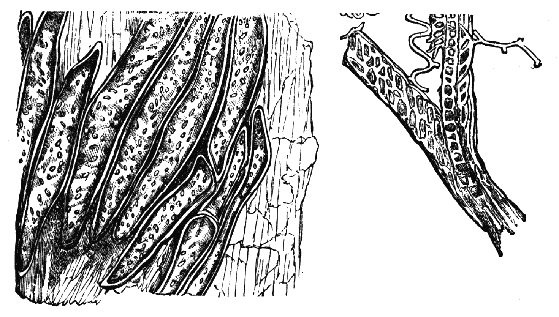
3. Under the microscope (see Chicory) the presence of chicory may be readily detected by the size, form, and ready separation of the cells of the cellular tissue, and by the presence and abundance of the pitted tissue or dotted ducts, which are absent from coffee, and by the size of the spiral vessels, which are very small in coffee. The most characteristic structure, however, and that by which chicory can be easily identified, is the lactiferous tissue. Roasted corn, and other amylaceous substances, may also be detected, in the same way, by the peculiar size and character of their starch grains.
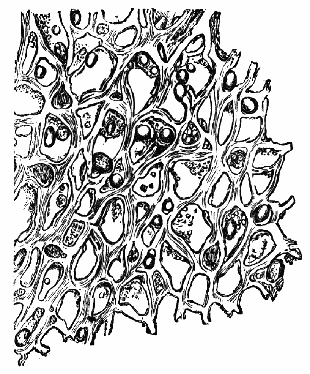
Under the microscope the berry is seen to consist of a hard, tough tissue, that resists even long soaking. The testa covering the berry is made of lengthened cells with oblique markings resting on a thin membrane, almost structureless. These oblique markings of the cells are so characteristic as to render the cells distinguishable from every other tissue. The substance of the berry consists of angular cells, each one of which contains minute drops of oil. This oil is in some measure driven off during the process of roasting, which, however, leaves the structure unimpaired where it is not charred.
Roasted corn, beans, &c., may be detected by the cold decoction striking a blue colour with tincture of iodine. Pure coffee is merely deepened a little in colour by this substance.
4. (A. H. Allen.) The amount of ash in genuine coffee does not exceed 4·5 per cent.; chicory yields 5 per cent. The silica in coffee ash never exceeds 1 per cent., while in chicory it varies from 10-36 per cent. The average soluble ash in coffee is 3·24, while in chicory it is 1·74 per cent. By determining the soluble ash S, the per-centage of pure coffee C may be calculated thus:—
(100 S - 174) C = 2 —————— 3
The density of coffee-infusion is determined by heating the powder with 10 times its weight of cold water, raising the liquid to the boiling point, filtering, and taking the gravity at 15·5° C. Taking the density of pure coffee-infusion at 1008·6, and that of chicory at 1020·6, the per-centage of pure coffee C in the sample may be calculated from the equation
100(1020 - D) C = —————— 12
where D represents the density of the infused sample. The relative tinctorial power of an infusion of a sample of coffee is determined by boiling a given weight with 20 c. c. of water for a few minutes, filtering, and again boiling the residue until thoroughly exhausted. An equal weight of a standard mixture of equal weights of pure coffee and chicory is treated in a precisely similar manner. The standard solution is made up to 200 c. c., that of the sample to 100 c. c.; 10 c. c. of the latter are put into a narrow burette, and some of the standard into a test tube of exactly equal bore. If the tints are exactly the same, the sample consisted of pure coffee; if chicory is present, water must be added to the sample until the tints are the same. Each c. c. of water represents 5 per cent. of chicory. The presence of leguminous seeds or cereals may be detected by boiling the sample with animal charcoal and water, filtering, and testing for starch in the cold liquid with iodine. Neither coffee nor chicory contains starch.
Obs. A few years ago the attention of the scientific world was drawn to the value of roasted coffee leaves, as furnishing materials for a beverage unexcelled in excellence by the coffee berry itself. It appears that the leaves, prepared for use, may be purchased for 11⁄2d. per lb., or packed ready for export at 2d. per lb. “That this preparation contains a considerable amount of the nutritious principles of coffee is evident from the analysis; but as the leaves can only be collected in a good state at the expense of the coffee-bush, it is doubtful whether the coffees produced by the berries be not, after all, the cheapest, as it certainly is the best.” (Jury Report, Exhibition, 1851.) Coffee for the table is best prepared with the aid of a French cafetière, or coffee biggin, furnished with a percolator or strainer, which will permit a moderately rapid filtration. To produce this beverage in perfection, it is necessary to employ the best materials in its preparation—fresh roasted and fresh ground. “At least 1 oz. of coffee should be used to make 3 common-sized coffee-cupfuls, with 1 teaspoonful of freshly roasted and ground chicory. If desired strong, the quantity of both should be doubled.” (Cooley.) Many habitual coffee drinkers cannot tolerate the use of chicory, which is a doubtful improver of coffee. The prevailing fault of the coffee made in England is its want of strength and flavour. The coffee-pot should be heated previously to putting in the coffee, which may be done by means of a little boiling water. The common practice of boiling coffee is quite unnecessary, for all its flavour and aroma is readily extracted by boiling hot water. Indeed, all the “useful and agreeable matter in coffee is very soluble, it comes off with the first waters of infusion, and needs no boiling.” (Ure.) Should prejudice, however, induce the housewife or cook to boil her coffee, it should be only just simmered for a minute, as long or violent boiling injures it considerably.
When coffee is prepared in a common pot, the latter being first made hot, the boiling water should be poured over the powder, and not, as is commonly the plan, put in first. It should then be kept stirred for 4 or 5 minutes, when a cup should be poured out and returned again, and this operation repeated 3 or 4 times, after which, if allowed to repose for a few minutes, it will generally become fine of itself. In all cases, where a percolator is not used, the liquor should be well stirred up several times before finally covering it up to settle for use.
Amongst the various descriptions of coffee pots in use we may mention those of French make, consisting of two cylindrical vessels, the upper having a metal strainer, on which the ground coffee is placed, and through which the clear infusion runs into the lower one; Loysell’s—an apparatus making very good coffee, and as one of the latest, an ingenious and inexpensive coffee pot, known as the “Kaffee Kanne,” devised by Mr Ash, of Oxford Street. Ash’s “Kaffee Kanne” consists of an ordinary biggin, surrounded by a jacket containing boiling water. The coffee is made by percolation in the inner vessel, and being kept at the point of ebullition by the surrounding boiling water, yields a beverage of excellent flavour and aroma.
Coffee is sometimes clarified by adding a shred of isinglass, a small piece of clean eel- or sole-skin, or a spoonful of white of egg. An excellent plan, common in France, is to place the vessel containing the made coffee upon the hearth, and to sprinkle over its surface half a cupful of cold water, which from its greater gravity descends, and carries the ‘foulness’ with it. Another plan sometimes adopted is to wrap a cloth, previously dipped into cold water, round the coffee-pot. This method is commonly practised by the Arabians in the neighbourhood of Yemen and Moka, and rapidly clarifies the liquor, unless a very large quantity of chicory is present. It should be recollected that the use of isinglass, white of egg, and all like artificial finings, remove much of the astringency and vivacity of the liquor.
The French, who are remarkable for the superior quality of their coffee, generally allow an ounce to each large coffee-cupful of water, and they use the coffee both newly ground and freshly roasted. A shred of saffron, or a little vanilla, is frequently added, whilst the percolating coffee-pot is generally employed. When the Parisian uses a common coffee-pot he generally divides the water into 2 parts. The first portion he pours on boiling hot, and allows it to infuse for 4 or 5 minutes; he then pours this off as clear as possible, and boils the grounds for 2 or 3 minutes with the remaining half of the water. As soon as this has deposited the sediment it is decanted, and mixed with the infusion. The object of this process is to obtain the whole of the strength as well as the flavour. The infusion is thought to contain the latter, and the decoction the former; a plausible, but erroneous idea, since both of them were carried off by the first water.
A much better method, and one we can recommend from experience, is to divide the coffee into 2 parts. Boil the first portion in the coffee-pot for 4 or 5 minutes, then add the other portion, and allow it to infuse slowly for about 10 minutes, the coffee-pot lid being kept well closed. This gives a coffee possessing a flavour which even the French cannot excel.
Coffee, Essence of. A highly concentrated infusion of coffee, prepared by percolation with boiling water, gently and quickly evaporated to about 1⁄3rd or 1⁄4th of its bulk, and mixed with a thick aqueous extract of chicory and syrup of burnt sugar, so as to give the whole the consistence of treacle. The proportions of the dry ingredients should be—coffee, 4 parts; chicory, 2 parts; burnt sugar (caramel) 1 part. It should be kept in well-corked bottles in a cool place. This preparation is very convenient for making extemporaneous coffee; but the beverage so made, though superior to much of that sold at coffee-houses, is inferior in flavour, aroma, and piquancy, to that we are accustomed to drink at home. Much of the so-called ‘Essence of Coffee’ is simply treacle and burnt sugar, flavoured with coffee.
Coffee, Searle’s Patent. This is prepared by mixing condensed milk with a very concentrated essence of coffee and evaporating at a low temperature (in vacuo, if possible), until the mixture acquires the consistence of a syrup (coffee syrup), paste (coffee paste), or candy (coffee candy). The last may be powdered (coffee powder, dry essence of coffee).
Coffee, Substitutes for. These are numerous, but are now seldom employed, owing to the cheapness of the genuine article, and the stringency of the revenue laws. Among the principal are the following:—
1. Coffee, Acorn. From acorns deprived of their shells, husked, dried, and roasted.
2. Coffee, Bean. Horse-beans roasted along with a little honey or sugar.
3. Coffee, Beet-root. From the yellow beet-root, sliced, dried in a kiln or oven, and ground with a little coffee.
4. Coffee, Dandelion. From dandelion roots, sliced, dried, roasted, and ground with a little caramel.
5. Coffee, German. Syn. Succory c., Chicory c. From chicory or succory. Used both for foreign coffee, and to adulterate it.
Obs. All the above are roasted, before grinding them, with a little fat or lard. Those which are larger than coffee-berries are cut into small slices before being roasted. They possess none of the exhilarating properties or medicinal virtues of foreign coffee.
COINS. See Medals and Electrotype.
COKE. Charred or carbonised coal. The principle of its manufacture is similar to that of charcoal. There are three varieties of coke:—
1. Kiln-made coke; STIFLED COKE. Made by burning pit-coal in a pile, kiln, or stove. It has a dull-black colour, and produces an intense heat when used as fuel. By condensing the bituminous vapours which are given off during the process, about 3% of tar may be obtained from common coal, and from some strong coal, by careful treatment fully 10% of its weight. The screenings of dust coal, separated from the better kinds of bituminous coal, is the sort commonly used for making coke in ovens.
2. Gas coke; DISTILLED COKE. The cinder left in the gas retorts. Grey; produces a weak heat, insufficient to smelt iron.
3. Shale Coke; MINERAL CARBON. From bituminous shale, burnt in covered iron pots, in a similar way to that adopted for making bone-black; or in piles. Black and friable. Used to clarify liquids, but is vastly inferior to bone-black, and does not abstract the lime from syrups. See Fuel, Pit-coal, &c.
COLCHICIN′A. Syn. Col′chicine. Colchicia. A peculiar principle discovered by Gieger and Hesse in the seeds of the Colchicum autumnale or common meadow saffron. It also exists in the corms or bulbs.
Prep. Macerate the bruised seeds in boiling alcohol, add magnesia, to throw down the alkaloid, digest the precipitate in boiling alcohol, and filter. By cautious evaporation colchicine will be deposited, and maybe purified by re-solution and crystallisation in alcohol.
Prop., &c. Odourless; bitter; soluble in water and alcohol; form salts with the acids. It is very poisonous. 1⁄10th of a grain, dissolved in spirit, killed a cat in 12 hours. It differs from veratria in being soluble in water and crystalline, and in the non-production of sneezing when cautiously applied to the nose. Strong oil of vitriol turns this alkaloid of a yellowish-brown; nitric acid turns it of a deep violet, passing into indigo-blue, green and yellow. It is not used in medicine.
COL′CHICUM. Syn. Mea′dow saf′fron; Colchicum autumnale (Linn.), L. The recent and dried corms or bulbs (colchici cormus), as well as the seeds (colchici semina), are official in the British Pharmacopœia. The corms are ordered to be dug up in the month of July, or before the autumnal bud has projected. The dry coatings having been torn off, cut the corms transversely in thin slices, and dry, at first with a gentle heat, but afterwards slowly increased to 150° Fahr.
Dose (of the corms), 2 to 8 or 9 gr.; (of the seeds), 2 to 7 gr., made into a pill or bolus with syrup or conserve; chiefly, as a specific in gout, to alleviate or check the paroxysm. This drug forms the base of almost all the advertised gout nostrums. It is, however, an active poison, and its administration requires care. “After all that has been said respecting colchicum in gout, and admitting that it rarely fails to allay pain and check a paroxysm, I would record my opinion that he who would wish to arrive at a good old age should eschew it as an ordinary remedy, and consider that he is drawing on his constitution for a temporary relief, with a certainty of becoming prematurely bankrupt in his vital energies.” (Collier.)
Antidotes. An emetic consisting of one scruple of sulphate of zinc dissolved in water, followed by a brisk dose of castor oil, then stimulants, and also charcoal.
COL′COTHAR. See Oxides of Iron.
COLD. Syn. Fri′gus, L. The privation of heat. The term is also applied to the sensation and effects which this privation produces.
When the body of an animal is immersed in an atmosphere at a temperature below the healthy standard, a sensation of coldness is experienced, produced by the passage of the caloric or heat of the body into the colder medium. If this extraction of caloric exceeds the quantity produced by the vital system, the temperature of the body decreases, until it sinks below the point at which the functions of life can be performed. This declination of the heat of the body is gradual; the extreme sensation of coldness changes into a disinclination for voluntary motion; next comes on drowsiness, followed by numbness and insensibility. At this point if the sufferer is not rescued, and remedial measures had recourse to, death inevitably and rapidly ensues.
The prevention of the effects of cold consists in the use of ample food and clothing proportioned to the inclemency of the weather, the exposure to be endured, and the habits of the wearer. The circulation of the blood should be promoted by active exercise, and any disposition to sleep shaken off by increased bodily exertion. The principal endeavour should be to keep the extremities and chest warm, as, if this can be accomplished, no danger need be feared.
In cases of asphyxia produced by intense cold, the patient should be laid in a room remote from the fire, and bathed with cold salt-and-water, or water to which some brandy or vinegar has been added; after which the body should be wiped dry, and friction assiduously applied by the hands of the attendants (warmed); as many operating at once as can conveniently do so. Gentle stimulants should be administered by the mouth, and the bowels excited by some mild, stimulating clyster. The lungs should also be inflated, and an effort made to re-establish the respiration. As soon as symptoms of returning animation are evinced, and the breathing and circulation restored, the patient should be laid in a bed between blankets, and a little wine-and-water administered, and perspiration promoted by heaping an ample quantity of clothing on the bed. Should the patient have suffered from hunger as well as cold, the appetite may be appeased by the administration of a limited quantity of light food, taking especial care to avoid excess, or anything indigestible or exciting, &c. See Asphyxia, Bronchitis, Catarrh, &c.
COLD CREAM. A snow-white, bland ointment, about the consistence of good lard, and an admirable substitute for that excipient where expense is no object, especially for applications about the face. It is commonly sold as a lip-salve and as a healing application to abraded and chapped surfaces generally. The ordinary receipts are given under the head of Cosmetic Cerate (which see). The following produces a superior article.
Prep. (Dr L. Turnbull.) From white wax, 1 oz.; oil of almonds, 4 oz.; rose-water, 2 oz.; borax, 1⁄2 dr.; oil of roses, 5 drops. Melt, and dissolve the wax in the oil of almonds by a gentle heat; dissolve the borax in the rose-water, which is then to be warmed a little and added to the heated oil; lastly, add the oil of roses, stirred.
COL′IC. Syn. Col′ica, L. The belly-ache or gripes. The name is popularly given to all severe griping abdominal pains, without reference to the cause. There are several varieties of this disease, as noticed below.
Colic, Accident′al. Produced by improper food, and poisons. The treatment may be similar to that recommended for bilious or flatulent colic.
Colic, Bil′ious. In this variety the pain is intermittent and transient, accompanied by constipation, nausea, and vomiting. The fæces, if any, are bilious, dark-coloured, and offensive. The common remedies are, a full dose of blue pill, calomel, colocynth, or aloes, followed by a sufficient quantity of Epsom salts or Glauber’s salts. Warm fomentations are also serviceable.
Colic, Flat′ulent. Marked by constipation, and the irregular distension of the bowels by gas, accompanied by a rumbling noise, &c. It is commonly produced by the use of indigestible vegetables and slops. The remedies are, a full dose of tincture of rhubarb combined with a few drops of essence of peppermint. If this does not afford relief, an Abernethy pill may be taken, washed down with a glass of any cordial water, as peppermint, cinnamon, or caraway. When the pain is extreme, warm fomentations to the belly, or a carminative clyster, will generally give relief. The Editor has found castor oil and Collis Browne’s chlorodyne of great benefit in this complaint.
Colic, Paint′er’s. Syn. Plumb′er’s colic, Devonshire c., Lead c.; Col′ica picto′num, L. The dry belly-ache. It is marked by obstinate costiveness, acrid bilious vomitings, violent pains about the region of the navel, convulsive spasms in the intestines, and a tendency to paralysis in the extremities. It is most prevalent in the cider counties, and amongst persons exposed to the fumes of lead. The remedies are the same as for the spasmodic variety. Should these fail, after the bowels have been thoroughly evacuated, small doses of camphor and opium may be administered, and sulphuric beer or sweetened water very slightly acidulated with sulphuric acid, had recourse to as a beverage. Mr Benson, the managing director of the British White-lead Works at Birmingham, says:—“Although during several weeks after the addition of the sulphuric acid to the treacle beer, drank at the works, little advantage seemed to be derived, yet the cases of lead colic became gradually less frequent, and since October of that year, or during a period of fifteen months, not a single case of lead colic has occurred amongst the people.” (‘Lancet.’) See Beer, Sulphuric Acid, and Sulphuric Acid.
Colic, Spasmod′ic. Marked by a fluctuating pain about the navel, which goes away and returns by starts, often leaving the patient for some time. The belly is usually soft, and the intestines may often be felt in lumps, which move about under the hand, or are wholly absent for a time. It is unaccompanied by flatulency. The remedies are warm fomentations, warm clysters, and carminatives, accompanied by small doses of camphor and opium.
Colic, Stercora′ceous. Marked by severe griping pains and constipation of the bowels. The remedies are powerful cathartics, as full doses of calomel, aloes, colocynth, jalap, &c., followed by purgative salts, as sulphate of magnesia, or sulphate of soda.
Colic in Horses. First give the horse a sharp trot, and apply friction over the belly, and follow this up with a drench of warm gruel to which has been added a glass or two of whisky or gin. Should these fail to give relief, let 4 dr. of aloes be rubbed down in a pint of hot water, and when the mixture becomes cool enough, add from thirty to sixty drops of strong solution of ammonia. Where the spasms and distress continue severe, and with little intermission, the physic may be followed in an hour with 2 dr. of tincture of aconite, given with an ounce of spirit of chloroform, in a little water, and repeated every hour; soap and water clysters should be administered every half hour, and friction and hot fomentations applied to the abdomen.
COLLO′DION. Syn. Collo′dium, L., B. P. A viscid fluid formed by dissolving pyroxylin (Schönbein’s gun-cotton) in a mixture of ether and alcohol. In surgery it is used in its natural state, and combined with certain elastic and medicinal substances. In photography it is used in combination with agents that render it sensitive to the action of light.
Collodion. Syn. Plain collodion. The following are the best methods of preparing plain collodion for surgical purposes:—
Prep. 1. (Ph. U. S.) Nitrate of potassa, in powder, 10 oz.; sulphuric acid, 81⁄2 fl. oz.; triturate together in a wedgwood mortar until uniformly mixed; then add of fine carded cotton (free from impurities), 1⁄2 oz.; and by means of the pestle or a glass rod, saturate it thoroughly with the liquor for a period of about 3 or 4 minutes; next transfer the cotton to a vessel containing water, and wash it in successive portions of pure water, with agitation and pressure, until the washings cease to affect litmus paper or a solution of chloride of barium; it is then to be spread out and dried by a very gentle heat, and dissolved by agitation in a stoppered bottle with rectified sulphuric ether, 1 quart, to which rectified spirit (alcohol), 1 fl. oz., has been previously added.
2. (Mialhe.) Nitrate of potassa, 40 parts; concentrated sulphuric acid, 60 parts; carded cotton, 2 parts; proceed as last until the dry cotton is obtained, then take of the prepared cotton, 8 parts; rectified sulphuric ether, 125 parts; mix in a well-stoppered bottle, and agitate it for some minutes; then add gradually, rectified alcohol, 1 part; and continue to shake until the whole of the liquid acquires a syrupy consistency. It may be now passed through a cloth; but a better way to prevent loss is to let it repose for a few days, and then decant the clear portion.
3. (Lauras.) This process only differs from No. 2 in the following particulars:—The cotton is immersed for 12 minutes, then rinsed 2 or 3 times in cold water, and afterwards immersed in a solution of carbonate of potassa, 4 parts, and water, 200 parts. Lastly, it is plunged again into simple water, and dried at a temperature of 77° to 86° Fahr.
4. (B. P.) Pyroxylin, 1 part; rectified spirit, 12 parts; ether, 36 parts; mix the ether and spirit, and add the pyroxylin. Keep in a well-corked bottle.
5. (Parrish.) Thoroughly saturate clean carded cotton, 1⁄2 oz., with fuming nitric acid and sulphuric acid, of each 4 fl. oz., previously mixed and allowed to become cool; macerate for 12 hours; wash the cotton in a large quantity of water; then free it from the water by successive washings in alcohol, and dissolve in ether, 3 pints.
Obs. For success in the manufacture of collodion it is absolutely necessary to avoid the presence of water. The ordinary commercial oil of vitriol, sp. gr. 1·84, may be used. Professor Procter, of Philadelphia, gives preference to the process with the mixed acids (No. 5), and directs that the cotton should be allowed to macerate for four days. In drying the cotton great care should be taken to prevent an explosion.
Uses, &c. In surgery plain collodion is employed as a dressing for wounds, and as a protection to abraded surfaces. On drying, it unites the former closely, and preserves the latter from the action of the air. It is impervious to water, and being transparent, it admits of the progress of the wound being inspected when necessary. Such is its adhesive power, that a piece of cloth cemented with it to the dry palm of the hand will support a weight of 25 to 30 lbs. The parts to which it is applied should be freed from moisture. See Collodions, Coloured, Elastic, Medicated and Vesicating (below).
Collodion, Blis′tering. See Vesicating Collodion.
Collodion, Col′oured. Syn. Collodium tinctum, L. Prep. (Cutan. Hosp.) Collodion, 2 oz.; palm oil, 1 dr.; alkanet root, q. s. to colour (say 15 gr.); digest and decant the clear. Colour bears a greater resemblance to the skin than that of common collodion, whilst it is more flexible; but it is weaker than the latter.
Collodion, Elas′tic. Prep. 1. (Lauras.) Heat together Venice turpentine, 2 parts; castor oil, 2 parts; and white wax, 2 parts; add sulphuric ether, 6 parts; and mix all with the product of No. 3 (above), that is, to the collodion formed with 8 parts of prepared cotton, 125 ether, and 8 alcohol.
2. (C. S. Rand.) Dissolve prepared cotton (No. 5, above), 2 dr., in sulphuric ether, 5 fl. oz.; then add, Venice turpentine, 2 dr., and complete the solution by slight agitation.
Obs. The collodion made by either of the above processes, when applied to the skin, forms a transparent pellicle, more pliable and more difficult to remove than that of ordinary collodion.
Collodion, Flexible. Collodion Flexile. (B. P.) Mix collodion (B. P.), 6 fl. oz., with Canada balsam, 120 gr.; and castor oil, 1 fl. dr., and keep in a well-corked bottle.
Collodion, Hemostatic. Collodion, 10 parts; carbolic acid, 1 part; tannic acid, 1⁄2 part; benzoic acid, 1⁄2 part; all by weight. To be applied with a pencil brush.
Collodion, Iodised. This may be made at one operation; it should be kept two days before being used, but is less reliable if kept for any length of time than the sensitised collodion described below. It is made as follows:—Place 16 grains of gun-cotton in a bottle, add 18 grains of iodide of cadmium in powder, 6 grains of bromide of cadmium in powder, and 11⁄2 oz. of spirits of wine (sp. gr. 0·805). Shake the bottle until the iodide and bromide are dissolved, then add 3 oz. of ether, sp. gr. 0·720, and shake until the cotton is dissolved. After settling for twenty-four hours, decant the clear portion into small well-stoppered bottles.
Collodion, Med′icated. It has been proposed to medicate collodion in several ways, but the practice has not found much favour with the medical profession. The following preparations have been described:—
Collodion, Aconite. From aconite root, by a similar formula to that of Belladonna c. (below).
Collodion, Belladonna. Prep. Macerate select belladonna leaves, powdered, 8 oz., in ether, 12 fl. oz., with alcohol (95%), 4 fl. oz., for six hours. Pack in a percolator, and pour en alcohol till a pint of tincture is obtained; in this dissolve pyroxylin (gun-cotton), 1 dr., and Canada balsam, 1⁄2 oz. Used as a substitute for BELLADONNA PLASTER.
Collodion, Cantharidin. See Collodion, Vesicating.
Collodion, Iodine. Prep. Dissolve iodine and Canada balsam, of each 1⁄2 oz., in collodion, 1 pint. Used as a substitute for IODINE OINTMENT.
Collodion, Morphia. (L′Union Medicale.) Dissolve 1 part of hydrochlorate of morphia in 30 parts of flexible collodion, and apply with a camel-hair brush.
Collodion, Photograph′ic. 1. There are so many methods adopted for preparing photographic collodion, that a large volume might be filled with notices of them. We have retained Mr Hardwich’s forms, which were formerly much esteemed by practical photographers, and appended to them modern formulæ which are now, we believe, in much greater demand, and for which we are indebted to Mr Ernest Spon’s valuable book ‘Workshop Receipts.’
2. Pyroxylin, and iodide of cadmium, or ammonium, of each 15 gr.; ether, 31⁄2 oz.; alcohol, 11⁄2 oz. Place the two first in a dry bottle, then pour on the spirits of wine, shake the mixture well, then add the ether, shake again and let it stand for 12 hours. Decant the clear portion into a wide-mouthed bottle, keep well stoppered, and in the dark. Avoid shaking the bottle when about to use the collodion, and never quite use all the bottle contains, as the sediment which will accumulate at the bottom would spoil the picture. The preparation of a sensitive collodion, whether positive or negative, includes three distinct operations, namely, the formation of the pyroxylin or gun-cotton, the conversion of this into plain collodion, and the final process of iodising the collodion.
Collodion, Plain. Mix in a bottle gun-cotton, 450 gr.; ether, 25 oz.; spirits of wine, 7 oz. Shake these well together, and leave to settle several days. Keep well corked.
Collodion, Pos′itive. (Hardwich.) To form the PYROXYLIN:—Take sulphuric acid, sp. gr. 1·845, at 60° Fahr., 12 fl. oz.; nitric acid, sp. gr. 1·45, at 60°, 12 fl. oz.; water, 31⁄2 fl. oz.; mix, and allow the temperature to fall to 140°; then immerse cotton, 300 grains. (If the cotton is found to gelatinise or dissolve in the acid mixture, the quantity of water is too great, and may be reduced to 3 fl. oz.) The cotton should be well pulled out in pieces, weighing about 30 grains each; and should be left in the acid for about 8 minutes, the vessel being covered over. It is taken out with a glass spatula, squeezed to remove acid, washed for at least 24 hours by a stream of water, then squeezed in a cloth, and pulled out to dry. To form the PLAIN COLLODION:—Shake up the dry pyroxylin, 48 grains, with alcohol, sp. gr. ·805, 11⁄2 fl. oz., and then add ether, sp. gr. ·725, 41⁄2 fl. oz. The solution should be allowed to rest for a week or ten days, when the clear fluid should be decanted from the sediment. To prepare the IODISING SOLUTION:—Take of iodide of ammonium, 11⁄2 dr.; iodide of cadmium, 11⁄2 dr.; bromide of ammonium, 40 grains; powder, and dissolve in alcohol, sp. gr. ·805 to ·816, 10 fl. oz. The collodion is iodised by adding the solution to it in the proportion of 1 part solution to 3 parts collodion. The iodised collodion should be kept for at least six weeks before using. If required for immediate use, add a few drops of an alcoholic solution of iodine, formed by dissolving 5 grains of iodine in 1 fl. oz. of alcohol.
Obs. Mr Hardwich recommends that the cotton, before being converted into pyroxylin, should be cleansed by boiling for two hours in a solution of caustic potassa (2 oz. to the gallon), and by being afterwards repeatedly washed and dried. The purest nitric acid, sp. gr. 1·45, should be employed, but the ordinary commercial sulphuric acid (oil of vitriol) is sufficiently pure for use. To purify the ETHER and to get rid of a certain ozonised principle which would decompose the iodising solution, Mr Hardwich recommends the following process:—Take the best washed ether of commerce and agitate it thoroughly with a small portion of dilute sulphuric acid, and then introduce it into a retort, and distil over one third. The alcohol used is of the strength of that sold for absolute alcohol; it should be pure.
Collodion, Neg′ative. (Hardwich.) To form the PYROXYLIN:—Take of sulphuric acid, sp. gr. 1·845, at 60°, 18 fl. oz.; nitric acid, sp. gr. 1·475, at 60°, 6 fl. oz.; water, 51⁄4 fl. oz.; cotton, 300 grains. Mix, and allow the temperature to fall to 150° Fahr. The weight of the pyroxylin ought to be 375 grains. To form the PLAIN COLLODION:—Take alcohol, sp. gr. ·806, 1⁄2 gallon; ether, sp. gr. ·725, 1 gall.; pyroxylin, 1900 grains. Saturate the pyroxylin with the alcohol, then pour in half a gallon of the ether, agitate for 3 or 4 minutes, and repeat the process in adding the remainder. Decant the clear liquid from the sediment after a week or ten days’ rest. The following forms for IODISING SOLUTIONS are recommended:—a. (Potassium Iodiser.) Iodide of potassium, 135 grains; alcohol, sp. gr. ·816, 10 fl. oz. Powder and dissolve in the alcohol, previously heated to 140°.—b. (Cadmium Iodiser.) Iodide of cadmium, 170 grains; alcohol, sp. gr. ·816, 10 fl. oz. Dissolve in the cold, and filter.—c. (Bromo-iodiser.) Bromide of ammonium, 40 grains; iodide of ammonium, 90 grains; iodide of cadmium, 90 grains; alcohol, sp. gr. ·816, 10 fl. oz. Pulverise and dissolve in the cold. To sensitise the collodion, add to three parts one part of either a, b, or c.
Obs. Most of the practical directions given under the head of POSITIVE COLLODION apply equally to NEGATIVE COLLODION. Nothing but patient and intelligent practice will ever lead to success in preparing collodion for photographic purposes. Although formulæ of undoubted excellence may be used, it continually happens that the results are entirely nugatory from some trifling cause. See Photography.
Collodion, Sensitised. Add to 1 oz. of the plain collodion 6 drams of spirits of wine; 13⁄4 oz. of ether; and 3 drams of iodide and bromide solution (see below). Shake the bottle well; the mixture is then ready, but is improved by being kept four or five hours before using. In hot weather a little more alcohol and less ether; in very cold weather more ether and less alcohol must be used. As sensitised collodion does not keep well, it is better not to mix the plain collodion and the iodide and bromide solution until shortly before required for use.
Iodide and Bromide Solution. Iodide of cadmium 154 grains; bromide of cadmium 54 grains; spirits of wine, 31⁄2 ounces. Pound the iodide and bromide very fine in a mortar, adding the spirit gradually; when the iodide and bromide are dissolved, pass the solution through a filter paper into a bottle. Must be kept in a closely-stoppered bottle.
Collodion, Styptic. Syn. Styptic colloid. (Dr Richardson.) To a saturated solution of tannic acid in alcohol and ether, in equal parts, add as much pyroxylin as the liquid will dissolve.
Collodion, Ves′icating. Syn. Blis′tering collodion, Canthar′idin c.; Collo′dium ves′icans, L. Prep. 1. (Tichborne.) Coarsely powdered cantharides, 6 oz., are placed loosely in a displacement apparatus (provided with a tap to regulate the flow), and treated with ether from methylated spirit, 13 fl. oz., and glacial acetic acid, 2 fl. oz., previously mixed together. After the fluid has passed through, it will be found that the débris has retained by absorption 7 fl. oz., which must be displaced by the gradual addition of methylated spirits of wine, 7 fl. oz. If properly managed, there is not the least danger of the admixture of the spirits with the percolated menstruum, as the animal substance of the flies swells considerably under the prolonged influence of the spirits of wine, so that the same bulk will be insufficient to quite displace the ether. The ethereal solution should be made to measure exactly 15 fl. oz. with a little spirit, and may then be converted into a collodion by the addition of pyroxylin, 1⁄2 oz.
Obs. The glacial acid plays a double part in this preparation. It dissolves the cantharidin, and at the same time gives to the collodion film the essential property of porosity. Ordinary collodion is useless as an excipient, for it produces a tough and contractile film, which really screens the skin from the action of the greater part of the blistering material.
2. (Ilisch.) Cantharidin, 15 gr.; pyroxylin, 20 gr.; rectified ether, 11⁄2 oz.; acetic ether, 1⁄2 oz.; dissolve.
3. (Œttinger.) Ether of cantharides and collodion, equal parts.
Use. Vesicating collodion is used as an irritant. No. 1 was introduced in 1862, and has many advantages over the other two. Mr Tichborne thus described the most effectual method of using it in the ‘Pharm. Journ,’:—“The part upon which the blister is to be raised should be painted with the vesicant to the desired extent, bearing in mind that the blister produced always extends to about one tenth of an inch beyond the margin of the space covered. Care should be taken to give a coating of considerable thickness, and to ensure this result the brush should be passed over and over again, until about 1⁄2 dr. has been used to the square inch, or less when operating upon a tender epidermis. It is desirable to place over the intended blister a piece of oil silk, or, what is still better, a piece of sheet gutta percha, somewhat larger than the surface painted, as this will stop the exhalations of the skin, and so render it moist and permeable. In ten minutes, or a quarter of an hour if the cuticle is hard, the collodion should be wiped off with a little cotton-wool moistened with ether, when the blister will almost instantly rise.”
COL′LOID. See Dialysis.
COLLYR′IUM. [L.] In medicine and pharmacy, a topical remedy for diseases of the eye. Formerly the term collyrium was applied to any medicament employed to restrain defluxions.
Collyr′ium, Dry. Syn. Eye powder; Collyr′ium sic′cum, L. Prep. 1. (Dupuytren.) White sugar, 1 dr.; red oxide of mercury, 10 gr.; oxide of zinc, 20 gr.; mix.
2. (Lagneau.) Sugar candy, 2 parts; nitrate of potassa, 1 part.
3. (Falconer.) Chloride of barium, 1 gr.; sugar candy, 1 dr.
4. (Radius.) Calomel and white sugar, of each 1⁄2 dr.; opium, 10 gr.
5. (Recamier.) Oxide of zinc and sugar candy, equal parts.
6. (Velpeau.) Trisnitrate of bismuth and sugar candy, equal parts.
7. (Wiseman.) Acetate of soda, 10 gr.; powdered opium, 1 gr.; sugar candy, 1⁄2 dr.
Obs. It is absolutely necessary that the ingredients in the above preparations should be reduced to an impalpable powder by careful trituration in a wedgwood mortar. For use, a small pinch is placed in a quill or straw, and blown into the eye previously opened with the fingers. On the whole, they may be regarded as unnecessary preparations, and are unsafe, except in skilful hands.
Collyrium, Liq′uid. See Waters (Eye).
Collyrium, Unct′uous. See Ointments (Eye).
COL′OCYNTH (sĭnth). Syn. Colocynth pulp., Colocynthidis pulpa, B. P. Bit′ter ap′ple, Bitter gourd, Bitter cu′cumber, Peeled colocynth; Coloquint′ida, Colocynth′is (B. P.), L. The decorticated fruit or pulp of the Citrellus Colocynthis (Schrad.—Ph. L.), or Cucumis Colocynthis (Linn.—Ph. E. & D.). It is an acrid, drastic purge and hydragogue, and cannot be given alone with safety; but, in combination with other substances, it forms some of our most useful cathartic medicines.
COLOCYNTH′IN. Syn. Colocynth′ium, L. The bitter, purgative principle of colocynth.
COL′OPHENE. Formed by distilling oil of turpentine with concentrated sulphuric acid. A colourless, viscid, oily liquid; with a high boiling-point; and exhibiting a bluish tint by reflected light.
COL′OPHONY. See Resin.
COLORADO BEETLE. Syn. Doryphera decemlineata. The Colorado potato beetle belongs to the family Chrysomelidæ, and is a native of the eastern slopes of the Rocky Mountains. It measures nearly half an inch in length, and has a tawny or yellowish cream-coloured body, darkly spotted; with wing cases which are marked with ten black longitudinal stripes. It has been gradually migrating eastward toward the more cultivated lands of the Northern states, until it has reached the Atlantic coast. It is now found over all the central and northern parts of the United States east of the Rocky Mountains, as well as throughout Canada, on the potato crops of all of which regions it has committed incalculable ravages. The leaves and stalks are the parts of the potato plant principally attacked; the depredators being, for the most part, the larvæ, of which three broods are said to be produced annually.
In America, we believe, the only means of destroying these insects as well as their eggs and larvæ consists in the application to the plant of the highly poisonous and dangerous pigment, Scheele’s green, a hydrated arsenite of copper. M. Girard recommends in preference to the arsenical salt a liberal use of sulpho-carbonate of potash.
COLOUR BLINDNESS. Syn. Dal′tonism. A curious defect of vision, from which the eye is incapable of distinguishing colours. It is of three kinds:—1. An inability to distinguish any colour properly so called, the person being only able to distinguish white and black, light and shade. 2. An inability to distinguish between the primary colours, red, blue, and yellow, or between these and the secondary or tertiary hues, such as green, purple, orange, and brown. 3. An inability to distinguish nicer shades and hues, as greys and neutral tints. The first form is rare; the second and third are common. Dr George Wilson found that of 1154 persons examined by him in Edinburgh, 65, or 1 in 177, were colour blind; of these, 21 confounded red with green, 19 brown with green, and 25 blue with green.
COL′OURING. Syn. Brandy colouring, Brewer’s c., Spirit c. Car′amel; Essen′tia bi′na, L. Prep. Brown sugar is melted in an iron vessel over the fire until it grows black and bitter, stirring it well all the time, after which water is added, and it is boiled to a syrup. In the making of brandy colouring white sugar is more frequently used.
Obs. Some persons use lime-water to dissolve the burnt sugar. Care must be taken not to overburn it, as a greater quantity is thereby rendered insoluble. The heat should not exceed 430°, nor be less than about 400° Fahr. The process, for nice experiments, is best conducted in a bath of melted tin, to which a little bismuth has been added to reduce its melting-point to about 435°; a little powdered resin or charcoal or a little oil being put upon the surface of the metal, to prevent the oxidisement of the alloy. See Caramel.
COL′OURS. White light from the sun is of a compound nature, and may be decomposed into rays of different colours. Newton distinguished seven PRIMITIVE COLOURS, namely, violet, indigo, blue, green, yellow, orange, and red. Sir D. Brewster is disposed to think that four of these colours are really compound, and that three, namely, blue, yellow, and red, alone deserve the name of primitive. The colours of natural objects are supposed to result from the power possessed by their surfaces of absorbing some of the coloured rays of light, while they reflect or transmit, as the case may be, the remainder of the rays. Thus, an object appears red because it absorbs or causes to disappear the yellow and blue rays composing the white light by which it is illuminated. Black and white are not colours, strictly speaking.
A body is said to be black when it absorbs or quenches a large proportion of all the rays of white light falling upon it. A body is said to be white when it receives the white light, and reflects all the rays with moderate strength. Grey may be regarded as a luminous black or dark white. The names given to colours are far from being satisfactory, for although many thousand shades may be distinguished by a practised eye, it is a question whether there are fifty names which would convey the same idea of shade to any ten colourists in the world. The names taken from natural coloured objects, as indigo, violet, orange, lilac, amber, emerald, &c., are the least objectionable. M. Chevreul has devised an ingenious system of naming and classifying colours. He employs only 6 fundamental names, which are those of the three elementary colours, red, yellow, and blue; and of the three secondary colours, orange, green, and violet. By the direct union of the elementary and secondary colours, 6 tertiary colours are formed. He arranges the twelve colours in a circle, like the spokes of a wheel, commencing with the red, and going to the right, thus:—Red, red-orange, orange, yellow-orange, yellow, yellow-green, green, blue-green, blue, blue-violet, violet, red-violet. The chromatic circle is completed by placing 5 shades between the red and red-orange, 5 between the red-orange and orange; and so on between each of the other couples. This chromatic circle of 72 colours is not imaginary, but actually exists, composed of dyed wools. The shades are distinguished by numbers; thus there are red, 1 red, 2 red, 3 red, 4 red, and 5 red, &c. Each of the 72 shades has, moreover, 20 different degrees of depth, from the lightest that can be discerned from pure white to the most intense depth, approaching to brown and black. These degrees of depth are called tones or tints. The addition of these tones to the chromatic circle brings up the number of tints to 1440. To indicate any one of these tints we have merely to write the number of the shade, and after it the number of the tone, as, for example, 3 blue-violet, 13 tone. By mixing each of the 1440 tints with grey or black, so as to darken it in different degrees, a total of 14,440 colours may be defined. This part of the system is generally regarded as unnecessary. Mr O′Neill, in his valuable ‘Dictionary of Calico Printing and Dyeing’ (to which work we refer the reader for a full account of Chevreul’s classification), gives a long list of colours and coloured bodies, which are pretty well defined in common language with the names of the colours, according to this ingenious system. We select from this list the following examples:—
Amber in mass = 2 orange, 12 tone.
Amethyst = 5 blue-violet, from 3 to 16 tone.
Blood, ox = 1 red, 13 and 14 tones.
Butter = yellow-orange, 2 to 3 tone.
Carrot = orange, 7 tone.
Chocolate in cake = 5 orange, 18 tone.
Emerald = 2 green, 11 tone.
Green, apple = 4 yellow-green, 8 tone.
Isabelle = 1 yellow-orange.
Mauve = 3 violet, 8 tone.
Red-lead = yellow-orange, 20 tone.
Ruby = red, 11 tone.
Yellow, canary = 1 yellow, 6 tone.
For notices of Dyes, Pigments, &c., refer to the principal colours.
Colours, Cake. Syn. Artists’ Colours. These are made by grinding by means of a glass muller and a slab, the respective pigments previously reduced to powder, into a smooth paste with equal parts of isinglass size, and thin gum water. The paste is then compressed into squares as tightly as possible, and dried with a very gentle heat. Old crumbling cake colours should be powdered very finely in a biscuit-ware mortar, sifted through fine muslin, and ground up as above, the gum water being omitted. The powders rubbed up with honey to the consistence of cream constitute moist colours.
Colours, Complement′ary. Syn. Accident′al Colours. Colours are said to be complementary to each other which, by blending together, produce the perception of whiteness. According to Mayer, all colours are produced by the admixture of red, yellow, and blue light, in certain proportions; and by intercepting either one or more of these coloured rays in a beam of light, those which meet the eye will consist of the remaining coloured rays of the spectrum. Thus, by intercepting the red rays in a beam of white light, the remaining yellow and blue rays will produce a green colour; by intercepting the blue rays, the remaining yellow and red will give an orange; and so on of other cases; so that red and green, blue and orange, are COMPLEMENTARY COLOURS. If we look for some time, with one eye, on a bright-coloured object, as a wafer, placed on a piece of paper, and subsequently turn the same eye to another part of the paper, a similarly shaped spot or mark will be seen, but the colour will vary, though it will be always the same under like circumstances. Thus, if the original spot or wafer be of a red colour, the imaginary one will be green; if black, it will be white; the imaginary colour being always complementary of that first gazed upon. The colour so perceived is often called an ACCIDENTAL COLOUR, to distinguish it from the real colour. It is a general maxim in design that “colours look brightest when near their complementary colours.”
Colours, Drug′gists’ Show. See Show Bottles.
Colours, Flame. See Fires (Coloured).
COLTS′FOOT. This popular herb is the Tussilago farfara of Linnæus. It is a demulcent bitter, and is slightly stomachic and tonic. It is much esteemed by the lower classes in coughs, shortness of breath, and other affections of the chest. The leaves form the basis of most of the British herb tobaccos, and have been recommended to be smoked in asthma and difficulty of breathing.—Dose. One or two wine-glassfuls of the tea or decoction (1 oz. to the pint) ad libitum.
COLUM′BIC ACID. See Tantalic Acid.
COLUM′BIUM. See Tantalum.
COMA. A deep, heavy sleep, from which the patient cannot be aroused. See Apoplexy.
COMACHROME FOR DYEING THE HAIR BLACK. Nitrate of silver solution, with pyrogallic acid. (Reveil).
COMBINA′TION. In chemistry, the union of dissimilar substances. The great general laws which regulate all chemical combinations admit of being laid down in a manner at once simple and concise. The laws of COMBINATION BY WEIGHT are as follows:
“1. All chemical compounds are definite in their nature, the ratio of their elements being constant.
“2. When any body is capable of uniting with a second in several proportions, these proportions bear a simple relation to each other.
“3. If a body, A, unite with other bodies, B, C, D, the quantities of B, C, D, which unite with A, represent the relations in which they unite among themselves, in the event of union taking place.
“4. The combining quantity of a compound is the sum of the combining quantities of its components.” (Fownes.)
There is a remarkable relation between the specific gravity of a body in the gaseous state and its chemical equivalent or combining proportion—a relation of such a kind that quantities by weight of the various gases, expressed by their equivalents, or, in other words, quantities by weight which combine occupy, under similar circumstances of pressure and temperature, either equal volumes or volumes bearing a simple proportion to each other. This relation accounts for the law of COMBINATION BY VOLUME discovered by Gay-Lussac, and thus expressed:—
When gases combine, chemical union invariably takes place, either between equal volumes or between volumes which bear a simple relation to each other.
Gerhardt assumes that equal volumes of the elementary gases and vapours, when compared under similar conditions of pressure and temperature, contain the same number of atoms. Consult the chemical works of Fownes, Roscoe, Watts, &c. See Affinity, Atomic Theory, Equivalents, &c.
COMPOUND CHINESE TABLET OF ALABASTER (John Irvine). A cosmetic powder for the skin. It consists of chalk, free from injurious metals. (Chandler).
Compound Chinese Tablet of Alabaster (Shand). Identical in use and composition with the last-mentioned powder.
COMPOUND SUGAR-COATED MAY-APPLE PILLS (Dr Scott). Recommended as “antibilious, cathartic, chemical family pills.” Sugar-coated pills, consisting of bitter extract, powdered podophyllum root, rhubarb, jalap, and pepper. (Hager).
COMPRESSES DESINFECTANTES DE LE PERDRIEL. Charcoal powder incorporated with paper.
CONCENTRATED CASTOR OIL in Capsules of Gelatin (Taylor). 24 gelatin capsules filled with castor oil, containing ·5 per cent. of croton oil. (Hager).
CONCENTRA′TION. The volatilisation of part of a liquid in order to increase the strength of the remainder. The operation can only be performed on solutions of substances of greater fixity than the menstrua in which they are dissolved. Many of the liquid acids, solutions of the alkalies, &c., are concentrated by distilling off their water.
In pharmacy, the term CONCENTRATED is commonly applied to any liquid preparation possessing more than the usual strength. Thus, we have concentrated infusions, decoctions, liquors, solutions, tinctures, and essences, most of which are made of 8 times the common strength. This is generally effected by using 8 times the usual quantity of the ingredients, with a given portion of the menstruum, and operating by digestion and percolation; the latter being generally adopted when the articles are bulky. When the menstruum is water, a little spirit is added, to make the product keep. See Decoction, Infusion, &c.
CON′CRETE. A compact mass or cement, composed of pebbles, lime, and sand, employed in the foundations of buildings. The best proportions have been said to be—60 parts of coarse pebbles, 25 of rough sand, and 15 of lime; but Semple recommends 80 parts of pebbles, 40 parts of river sand, and only 10 parts of lime. The pebbles for concrete should not exceed about 1⁄2 lb. each in weight.
CON′DIMENTS. Substances taken with the food, to season or improve its flavour, or to render it more wholesome or digestible. The principal condiments are COMMON SALT, VINEGAR, LEMON-JUICE, SPICES, AROMATIC HERBS, OIL, BUTTER, SUGAR, HONEY, and SAUCES. Most of these, in moderation, promote the appetite and digestion, but their excessive use tends to vitiate the gastric juice, and injure the stomach.
CONDY’S FLUID (from England). A weak solution of permanganate of soda. (Wittstein.)
CONFEC′TION. Syn. Confectio, L. Anything prepared with sugar; a sweetmeat, or candy. In medicine the name is commonly applied to substances, usually pulverulent, mixed up to the consistence of a soft electuary, with powdered sugar, syrup, or honey. In the ‘London Pharmacopœia’ (1836 and 1851) both CONSERVES and ELECTUARIES are included under this head, though there appears to be some little distinction between them.
In the preparation of confections all the dry ingredients should be reduced to very fine powder, and passed through a sieve, not coarser than 80 holes to the inch; and the pulps and syrups used to mix them up should be perfectly homogeneous, and of a proper consistence. The mixture should be intimate and complete, in order that the characteristic constituents may be equally distributed throughout the mass. The consistence of the newly made confection should be sufficiently solid to prevent a separation of the ingredients, and yet soft enough to allow of it being easily swallowed without previous mastication.
Confections should be preserved in stone jars covered with writing paper, and placed in a cool and not too dry a situation. Without this precaution they are apt to mould on the top. If at any time the mass ferments and swells up, the fermentative process may be arrested by placing the jar in a bath of boiling water, for an hour or two, or until the whole becomes pretty hot; when it should be removed from the heat, and stirred occasionally until cold. Should the sugar crystallise out of the confection, or ‘candy,’ as it is called, the same method may be followed. Or, the mass may be well rubbed in a mortar until the hard lumps of sugar are broken down and a uniform consistence again produced. On the large scale it may be passed through the mill.
As remedial agents, the officinal confections possess little value, and are chiefly used as vehicles for the administration of more active medicines. See Conserves and Electuaries.
Confection of Acorns. Syn. Confec′tio sem′inum quer′cus, L. Prep. (Bories.) Powdered acorns, 3 oz.; red coral and catechu, of each 11⁄2 oz.; confection of dog-rose, 10 oz.; syrup of red roses, q. s. to make a confection.—Dose, 1 dr., every 4 hours; in chronic diarrhœa, &c.
Confection of Almonds. Syn. Almond paste, Conserve of almonds; Confec′tio amyg′dalæ (Ph. L.), Conser′va amygdala′rum (Ph. E.), Confec′tio amygdala′′rum (Ph. D. 1826), L. Prep. (Ph. L.) Sweet almonds, 8 oz.; white sugar, 4 oz.; powdered gum Arabic, 1 oz.; macerate the almonds in cold water, then remove the skins, and beat them with the other ingredients until reduced to a smooth confection. The Ph. E. form is similar. See Powders, Compound Powder of Almond.
Uses, &c. To prepare EMULSION of MILK OF ALMONDS. A little of this paste or powder, triturated with a sufficient portion of water and strained through a piece of calico, forms emulsion of almonds. “This confection will keep longer sound if the almonds, first decorticated (blanched), dried, and rubbed into the finest powder, be mixed with the acacia and sugar, separately powdered, and the mixed ingredients be kept in a well-stoppered bottle.” (Ph. L.) The same effect may be arrived at by simply well drying the blanched almonds before mixing them with the gum and sugar. The addition of even a small quantity of water or syrup causes the confection “to become soon mouldy, or rancid, or both.” (Brande.)
Confection of Al′um. Syn. Confectio alu′minis, L. Prep. 1. (St. B. H.) Alum (in fine powder), 1 dr.; conserve of roses, 6 dr.
2. (Foy.) Alum, 1 dr.; conserve of roses, 1 oz.—Dose, 1 dr., 2 or 3 times a day; in lead colic, and as an astringent in diarrhœa and other affections.
Confection, Aromat′ic. Syn. Aromatic elec′tuary; Confec′tio aromat′ica (Ph. L. & D.), Electua′′rium aromat′icum (Ph. E.), L. Prep. 1. (Ph. L.) Nutmegs, cinnamon, and hay saffron, of each 2 oz.; cloves, 1 oz.; cardamoms, 1⁄2 oz.; prepared chalk, 16 oz.; white sugar, 2 lbs.; reduce the whole to a very fine powder, and keep it in a closed vessel. When wanted for use, mix it with water to the consistence of a confection.
2. (Ph. E.) Aromatic powder (Ph. E.), 1 part; syrup of orange peel, 2 parts; mix.
3. (Ph. D.) Aromatic powder and simple syrup, of each 5 oz.; clarified honey, 2 oz.; powdered saffron, 1⁄2 oz.; mix, and add, oil of cloves, 30 drops.
4. (Commercial.)—a. Hay-saffron, cassia, and turmeric, of each 4 oz.; cardamoms, 1 oz.; starch, 8 oz.; precipitated chalk, 2 lbs.; white sugar, 4 lbs.; oil of nutmeg, 2 dr.; oil of cloves, 3 dr.; reduce the dry ingredients to fine powder, and pass it through a sieve (80 holes); then add the oils, and after well mixing them in, pass the whole through a coarse sieve (about 40 holes to the inch), to ensure perfect admixture.
b. Hay-saffron, 4 oz.; turmeric, 3 oz.; powdered starch, 8 oz.; precipitated chalk, 2 lbs.; white sugar, 4 lbs; oil of cloves and cassia, of each 3 dr.; oil of nutmeg, 2 dr.; essence of cardamoms, 1 oz.; boil the saffron and turmeric in 1 gallon of water, placed in a bright copper pan, for 10 minutes, then, without straining, add the chalk, starch, and sugar; mix well, and continue stirring until the mixture becomes quite stiff, then break it up, dry it thoroughly by the heat of a steam or water bath; next reduce it to fine powder, which must be passed through a fine sieve, as before; the oils and tincture are now to be added, and after being well mixed, and passed through a coarse sieve, it should be placed in a jar or bottle, and bunged up close. Very bright coloured.
Obs. In the wholesale trade this article is kept under two forms—one, in powder, as ordered by the College, and commonly called for distinction sake PULV′IS CONFECTIO′NIS AROMAT′ICÆ; the other, mixed up ready for use. In preparing the latter, it is a common plan to make a strong infusion or decoction of the saffron, and to use it to mix up the other ingredients, adding the aromatics last. (See 4, b.) When the price of precipitated chalk is an objection to its use, prepared chalk may be used instead. There is much anxiety evinced by the wholesale druggists to prepare this confection of a rich colour, without an undue expenditure of saffron, which is generally economised on account of its costliness. This confection is cordial, stimulant, antacid, and carminative.—Dose, 10 to 60 gr., either as a bolus or stirred up with a glass of water; in diarrhœa, acidity of stomach, heartburn, and any like affection, if accompanied by looseness of the bowels. In diarrhœa, English cholera, and flatulent colic, 1⁄4 gr. of powdered opium may be added to each dose. See Powders, Powder of Chalk, Compound.
Confection of Bark. Syn. Confec′tio cincho′næ, L. Prep. 1. Yellow bark and white sugar, of each 1 oz.; capsicum, 1 dr.; simple syrup, 4 oz.
2. (St. B. Hosp.) Yellow bark, 6 dr.; ginger, 1⁄2 dr.; treacle, 31⁄2 oz.—Dose, 1 to 6 dr., where the use of bark is indicated.
Confection of Cas′sia. Syn. Confec′tio cas′siæ (Ph. L.), L. Prep. (Ph. L.) Prepared cassia, 1⁄2 lb.; manna, 2 oz.; prepared tamarinds, 1 oz.; syrup of roses, 8 fl. oz.; mix with heat, and evaporate to a proper consistence.—Dose, 2 dr. to 6 dr.; or more, as a laxative.
Confection of Cat′echu. Syn. Confec′tio cat′echu compos′ita (Ph. D.), L. Prep. (Ph. D.) Compound powder of catechu, 5 oz.; simple syrup, 5 fl. oz.—Dose, 10 gr. to 20 gr.; as an astringent, in diarrhœa, &c.; either alone or combined with chalk.
Confection of Copai′ba. Syn. Confec′tio copai′bæ, L. Prep. 1. (Berton.) Copaiba and powdered cubebs, of each 2 oz.; alum, 1 oz.; opium, 5 gr.; mix well.
2. (Swediaur.) Turpentine, 1 oz.; copaiba, 1⁄2 oz.; mix; add mucilage of gum Arabic, 1 oz.; triturate to an emulsion, and further add, conserve of roses, 4 oz.
3. (Traill.) Copaiba, 2 oz.; oatmeal, q. s. to form an electuary; then add, conserve of roses, 1 oz.
4. (Voght.) Copaiba and powdered cubebs, of each 41⁄2 dr.; yolk of 1 egg; conserve of roses, 1⁄2 oz. All the above are excellent medicines in gonorrhœa.—Dose, 1 to 3 dr., three or four times a day, made into boluses, and covered with the fresh emptied skin of a prune before being swallowed; in gonorrhœa, gleet, &c.
Confection of Cream of Tar′tar. Syn. Confection of bitar′trate of potas′sa; Confec′tio potas′sæ bitartra′tis, L. Prep. 1. Cream of tartar and powdered sugar, of each 1 oz.; simple syrup, 2 oz.; 1 nutmeg, grated.—Dose, 2 dr. to 6 dr.
2. (St. B. Hosp.) Bitartrate of potassa and simple syrup, of each 3 oz.; ginger, 1 dr.—Dose, 11⁄2 dr. to 5 dr. Both are laxatives well adapted for women and children.
Confection of Hem′lock. Syn. Confec′tio co′nii, L. Prep. (Marshall Hall.) Fresh hemlock leaves beaten up with an equal weight of sugar.—Dose, 10 to 20 gr. as a bolus, 2 or 3 times daily, where the use of hemlock is indicated. The confection of other narcotic plants may be made in the same way.
Confection of Hips. Syn. Con′serve of hips, Confection of dog-rose, Conserve of d.-r.; Confec′tio ro′sæ; cani′næ (Ph. L.), Conser′va ros′æ fruc′tûs (Ph. E.), L. Prep. 1. (B. P.) Hips, 1 part; refined sugar, 2 parts; beat the hips in a stone mortar, rub the pulp through a sieve, add the sugar, and mix thoroughly.—Dose, 60 grains or more.
2. (Ph. L.) Fruit of the dog-rose, without the seeds (carpels), 1 lb.; pound it to a pulp, add, gradually, powdered white sugar, 20 oz.; and beat them together until thoroughly incorporated.
3. (Ph. E.) Pulp of hips, 1 part; white sugar, 3 parts; as No. 1.
4. (Wholesale.) Pulped hips, 2 cwt.; fine white sugar, 3 cwt.; incorporate them without applying heat.
Obs. Both this and the confection of red roses have a brighter colour, if made without heat, or touching metallic vessels. On the small scale it is generally made by beating the ingredients together in a marble mortar, but in large quantities by grinding in a mill. Great care must be taken to remove the seeds (carpels) with the hair surrounding them, before pulping the fruit, as they are apt, like the hairs of cowhage, when swallowed, to produce vomiting, itching about the anus, &c. This conserve is slightly laxative, and is principally used for forming pills. It is very apt to candy by keeping.
Confection of Ipecacuan′ha. Syn. Confec′tio ipecacuan′hæ, L. Prep. (Bories.) Ipecacuanha, 12 gr.; sulphur, 20 gr.; orris root, 1 dr.; syrup of mallows and manna, of each 2 oz.—Dose. A teaspoonful, 2 or 3 times daily; in hooping-cough, dyspepsia, &c.
Confection of Iron, Subcarbonate. (St. B. Hosp.) Subcarbonate (peroxide of iron), 1⁄2 oz.; treacle, a sufficient quantity.—Dose, 1⁄2 dr.
Confection of Jal′ap. Syn. Confec′tio jal′apæ, C. j. compos′ita, L. Prep. (St. B. Hosp.) Jalap, 4 dr.; ginger, 1 dr.; bitartrate of potassa, 3 oz.; treacle, 5 oz.—Dose, 1 to 3 dr. as a purgative.
Confection of Kermes. (L. P. 1745.) Strained juice of kermes, 3 lbs.; rose water, 6 fl. oz.; white sugar, 1 lb.; oil cinnamon, 10 gr.
Confection of Mer′cury. Syn. Confec′tio hyrar′gyri, C. mercuria′lis, L. Prep. 1. Stronger mercurial ointment (Ph. L.), 1 part; conserve of roses, 3 parts.
2. (Dr D. Davis.) Mercury and manna, equal parts; treacle, q. s.; triturate until the globules of mercury disappear.
Dose, &c. The same as those of mercurial pill.
Confection of Ni′tre. Syn. Confec′tio potas′sæ nitra′tis, L. Prep. 1. Nitre, 1 part; confection of roses, 6 parts; oil of juniper, a few drops.
2. (St. B. Hosp.) As the last, without the juniper. Both are used in gonorrhœa.
Confection of O′pium. Syn. Confec′tio o′pii (B. P.), Electua′′rium o′pii (Ph. E.), L. Prep. 1. (B. P.) Compound powder of opium, 192 gr.; syrup, 1 oz.
2. (Ph. L.) Powdered opium, 6 dr.; long pepper, 1 oz.; ginger, 2 oz.; caraways, 3 oz.; tragacanth, 2 dr.; reduce to fine powder, and keep it in a closed vessel; for use, add to it by degrees hot syrup, 16 fl. oz. (i.e. 31⁄2 dr. of the powder to each fl. oz. of syrup). It contains 1 gr. of opium in every 36 gr.
3. (Ph. E.) Aromatic powder, 6 oz.; senega, 3 oz.; opium, diffused in a little sherry, 1⁄2 oz.; syrup of ginger, 1 lb. Contains 1 gr. of opium in every 43 gr.
Uses, &c. This confection is intended as a substitute for the once celebrated Mithridate, philonium, and theriaca of the old Pharmacopœias. It is stimulant, anodyne, and narcotic.—Dose, 5 to 30 gr.; in flatulent colic and diarrhœa unaccompanied by fever.
Confection of Or′ange Flowers. Syn. Confec′tio flor′um auran′tii, L. Prep. 1. Orange flowers, 1 part; white sugar, 2 parts; beat together to a confection.
2. (Tadei.) Orange flowers, 1 part; simple syrup, 3 parts; evaporate to a proper consistence. Both are used as agreeable adjuncts or vehicles for other medicines. The first is the best article.
Confection of Or′ange Peel. Syn. Confection of orange, Conserve of orange peel; Confec′tio auran′tii (Ph. L.), Conser′va auran′′tii (Ph. E.), Conser′va aurantio′′rum (Ph. L. 1824), L. Prep. (Ph. L. and E.) External rind of the fresh orange, separated by rasping, 1 lb.; beat it in a stone mortar with a wooden pestle to a pulp, then add white sugar, 3 lbs.; and beat them together until incorporated.
Uses, &c. This confection is an agreeable tonic and stomachic; it is much used as an adjunct to bitter and purgative powders, and as a vehicle for the sesquioxide of iron.
Confection of Pep′per. Syn. Confection of black pepper, Conserve of b. p.; Ward’s paste; Confec′tio piperis (B. P.), C. p. ni′gri (Ph. D. & Ph. L. 1836), Electua′′rium pip′eris (Ph. E.), L. Prep. 1. (B. P.) Black pepper, in fine powder, 2 parts; caraway, in fine powder, 3 parts; clarified honey, 15 parts; triturate.—Dose, 60 to 120 gr.
2. (Ph. L.) Black pepper and elecampane, of each 1 lb.; fennel, 3 lbs.; white sugar, 2 lbs.; reduce to a very fine powder, and keep it in a covered vessel; for use, add it, gradually, to honey, 2 lbs.; and beat the whole to a paste (i. e., 2 oz. of honey to each 7 oz. of powder).
3. (Ph. E.) As the last, but using liquorice powder instead of elecampane, and at once making a confection.
4. (Ph. D.) Black pepper and liquorice root, of each 1⁄2 oz.; refined sugar, 1 oz.; oil of fennel, 1⁄2 fl. oz.; honey, 2 oz.; mix.—Dose, of each of the above, 1 to 3 dr., two or three times daily, for 3 or 4 months; in piles, fistula, &c., unaccompanied with inflammatory symptoms. Or, it may be used as a suppository. It is intended as a substitute for the once celebrated nostrum, ‘Ward’s Paste for the Piles.’
Confection of Pep′permint. Syn. Confectio men′thæ piperi′tæ, L. Green peppermint, 4 oz.; white sugar, 12 oz. Anti-emetic and anti-flatulent; in colic, diarrhœa, &c.; in the form of a bolus, or made into a mixture.
Confection of Res′in. Syn. Confectio resin′æ, L. Prep. (Dr Watson.) Powdered resin, 1 oz.; balsam of copaiba, 1⁄2 oz.; honey, 5 oz.—Dose, 1 to 3 dr.; in piles and gleet. It is best combined with a little confection of orange peel, which effectually covers the taste of the copaiba.
Confection of Ro′ses. Syn. Confection of red roses; Confec′tio ro′sæ (Ph. L. & D.), Conser′va ro′sæ (Ph. E.), Confectio ro′sæ Gal′licæ (B. P.), Conserva r. G. (Ph. L. 1824), L. Prep. 1. (B. P.) Fresh red-rose petals, 1 lb.; white sugar, 3 lbs.; mix as confection of hips.
2. (Ph. E.) Fresh petals, 1 part; sugar, 2 parts.
3. (Ph. D.) a. Fresh petals, 3 oz.; sugar, 8 oz. Or—
b. Dried petals, 1 oz.; water, 2 fl. oz.; macerate for 2 hours; then add refined sugar, 8 oz.; and beat to a mass as before.
Obs. It is astringent and tonic, but is principally used as an elegant vehicle for more active medicines. It keeps well, and does not candy like confection of hips.—Dose, 1 to 2 drs., eaten off a spoon, either alone or combined with chalk; in slight cases of diarrhœa, vomiting in pregnancy, &c. See Conserve.