A CYCLOPÆDIA OF PRACTICAL RECEIPTS, PROCESSES, AND COLLATERAL INFORMATION (continued 33)
Reading edition
The native inhabitants of New Zealand and kindred races suffer largely from scrofula, the prevalence of which disease amongst them has been attributed to their partaking so largely of eel as a common article of diet.
EFFERVES′CENCE. The rapid escape of gas in small bubbles from a liquid. See Draught, Powder, &c.
EFFLORES′CENCE. The spontaneous conversion of a crystalline solid into a dry pulverulent form. Crystals which in a dry atmosphere lose their water of crystallisation, and become crusted over with a mealy powder, are said to be EFFLORESCENT.
EGG. Syn. Ovum, L. A body produced in the females of birds and certain other animals, containing an ′embryo’ of the same species, or body, from which a similar animal may ultimately be produced. The eggs of the common domestic fowl are nutritious and easily digestible; and when lightly cooked by boiling and eaten with a little salt, are admirably adapted as an aliment for the sick and delicate. When boiled hard or fried, they are rendered less digestible, and possess no advantage in this respect over butcher’s meat. A new-laid egg, beaten up in a cup of tea, coffee, or chocolate is an excellent ingredient in the breakfast of a person with a poor appetite, and is very supporting. A glass of wine, beer, or porter, similarly treated, along with a biscuit, has been recommended as a light and nutritious luncheon or supper, well suited to the debilitated and dyspeptic. Raw eggs may be advantageously substituted for cod-liver oil in all the cases in which this last is ordered, occurring in persons with delicate or irritable stomachs. The addition of fresh salad oil vastly increases their medicinal virtues. A fresh egg is said to contain about the same amount of nourishment as 11⁄2 oz. of fresh meat and 1 oz. of wheaten bread, but in a more digestible form.
Composition of the contents of the egg.
Water74·02
Albumen14·08
Oil and fat10·25
Mineral matter1·65
———
100·00
Composition of the white of egg. (Thompson.)
Nitrogenous matter20·40
Fatty matter
Saline matter1·60
Water78·00
———
100·00
Composition of the yolk. (Thompson.)
Nitrogenous matter16·00
Fatty matter30·70
Saline matter1·30
Water52·00
———
100·00
Egg, White of (ALBUMEN OVI), is officinal in the B. P. Yelk of egg (vitellus ovi) is an ingredient in the BRANDY MIXTURE (MISTURA SPIRITUS VINI GALLICI) of the London College. It is also a popular application to chaps, cracked nipples, abrasions, &c., and is largely used to render oleaginous substances miscible with water, in the preparation of emulsions.
The average weight of the new-laid egg of a hen is about 21⁄2 oz., and its sp. gr. is 1·080 to 1·090; the white generally weighs about 11⁄2 oz.; the yolk, a little under 3⁄4 oz.; and the shell and skin, 1⁄4 oz. Dr Prout found that an egg, on being kept for 2 years in a dry situation, lost 5443⁄10 gr., from the evaporation of a portion of its water through the shell. By boiling in water an egg loses from 2% to 3% of its weight.
Choice. The larger end of a new-laid egg feels cold when placed against the tongue. New-laid eggs appear semi-transparent when placed between the eye and a strong light, and have a small and perceptible division of the skin from the shell, which is filled with air. This mode of examination among the trade is called ‘candling.’ When they shake they are stale. The eggs of turkeys and pea-hens are much esteemed for some purposes; those of ducks and geese are coarse and inferior.
Sound eggs will sink if put into a solution, consisting of 1 oz. of salt in 10 oz. of water; in the same solution indifferent ones will float, whilst bad or worthless ones will swim even in pure water.
Pres. Eggs may be preserved for any length of time by excluding them from the air. One of the cleanest and easiest methods of doing this is to pack them with the small end downwards, in clean dry salt, in barrels or tubs, and to place them in a cool and dry situation. We have eaten eggs thus preserved that were more than a twelvemonth old, and that had been for some months on shipboard in a tropical climate, and which yet retained all the peculiar sweetness of new-laid eggs. With a like intention, eggs are placed in vessels containing milk of lime or strong brine, or are rubbed over with butter, lard, or gum water, all of which act by excluding the air. Eggs for keeping should never be laid on their sides, and when kept in the air should be occasionally turned to prevent the yolk attaching itself to the side instead of floating in the albumen. Some persons place the eggs in a netting or on a sieve or colander, and immerse them for an instant in a caldron of boiling water before packing them away. The practice of packing eggs in damp straw, or anything else that can convey a flavour should be carefully avoided. The shells of eggs are porous, and readily admit the passage of gaseous substances, especially of fetid odours. It is from inattention to this point that a large number of the eggs imported from the coast of France have a less delicate flavour than those of our poultry yards. Damp chopped straw, as well as most other organic substances exposed to warmth and moisture, readily ferment or putrefy; and during fermentation a considerable increase of temperature takes place, as any one may readily perceive by examining the common hotbeds in our gardens, which are merely masses of organic matter in a state of decomposition. Eggs, as long as they retain the embryo of the future chick in a vital state, possess in themselves a certain degree of warmth, which tends materially to promote the decomposition of the substances they are packed in, particularly in the presence of moisture.
A correspondent of the ‘Chemical News’ says: “Eggs may be kept fresh for a whole year by subjecting them to the following process. The fresh eggs are carefully placed in a mixture of five kilogrammes of alum, dissolved in five litres of water, heated to from 45° to 50° C., and left in that liquid for from thirty to forty minutes; the eggs are next drained, and in the meantime the solution of alum is heated to boiling-point. The eggs are again immersed in the liquid and kept therein from ten to fifteen seconds; after having been drained and cooled, they are packed in either dry bran, sawdust, cork-dust, sifted ashes, or in cotton-wool.”
M. Durand, of Blois, proposes to preserve eggs by coating them with silicate of soda.
To Preserve Eggs fresh for many weeks.—As the eggs are taken from the nest, brush each one separately with a thin solution of gum Arabic, being careful to leave no portion of the shell uncovered by it. The half of each egg must first be done, and left to become dry before the remainder is touched, that the gum may not be rubbed off any part by its coming in contact while wet with the hand as it is held to be varnished, or with the table when it is laid down to harden.—Eliza Acton.
Eggs to boil in the Shell.—Eggs brought from a cold place and suddenly plunged into boiling water are very frequently liable to crack, and thus to allow of the partial escape of their contents. In winter it will be found a good plan to hold them for an instant over the steam of the saucepan before they are placed in it, which they should be, very gently. By boiling for three minutes, the whites will become in a partially solid state. Exactly five minutes will harden the whites and leave the yolks liquid. Eight or ten minutes will render them hard. Eggs should always be boiled in water sufficient to entirely cover them. They should be boiled 15 minutes for salad-dressings.
Eggs, to Poach.—Take for this purpose a wide and delicately clean pan about half filled with the clearest spring water; throw in a small saltspoonful of salt, and place it over a fire quite free from smoke. Break some new-laid eggs into separate cups, and do this with care, that the yolks may not be injured. When the water boils, draw back the pan, glide the eggs gently into it, and let them stand till the whites appear almost set, which will be in about a minute; then without shaking them move the pan over the fire, and just simmer them from two minutes and a half to three minutes. Lift them out separately with a slice, trim quickly off the ragged edges, and serve them upon dressed spinach or upon minced veal, turkey, or chicken; or dish them for an invalid upon delicately toasted bread, sliced thick and free from crust; it is an improvement to have the bread buttered, but it is less wholesome.
Comparative time of poaching eggs: swan’s eggs, 5 to 6 minutes (in basin, 10 minutes); turkey’s eggs, 4 minutes; hen’s eggs, 3 to 31⁄2 minutes; Guinea fowl’s, 2 to 3 minutes; bantam’s, 2 minutes.
Obs. All eggs may be poached without boiling if kept just at simmering point, but one boil quite at last will assist to detach them from the stewpan, from which they should always be very carefully lifted on what is called a fish or egg slice. There are pans made on purpose for poaching and frying them in good form; but they do not, we believe, answer particularly well. If broken into cups slightly rubbed with butter and simmered in them, their roundness of shape will be well preserved.—Eliza Acton.
Egg, Elas′tic. Take a good and sound egg, place it in strong vinegar, and allow it to remain for 12 hours; it will then become quite soft and elastic. In this state it can be squeezed into a tolerably wide-mouthed bottle; when in, it must be covered with water having a little soda dissolved in it. In a few hours the egg will be restored to nearly its original solidity; after which the liquid may be poured off and the bottle dried, the whole being kept as a curiosity to puzzle one’s friends for an explanation how the egg got there. (‘Parlour Pastime.’)
Egg Flip. Prep. 1. Beer, 1 pint; eggs, 3 in no.; sugar, 2 oz.; nutmeg and ginger, q. s. to flavour; the eggs are broken into one half of the beer, the sugar added, and the whole beaten well together; the mixture is then placed in a clean warmer, and heated over the fire to nearly the boiling-point, and stirred one way all the time, care being taken not to let it either boil or curdle; the other portion of the beer and the spices are then added, and the whole mixed well together.
2. As above, but adding a glass of spirit. Some persons also add a little lemon peel.
Eggs, Packing, for Shipboard. The following plan is now adopted by many firms shipping eggs:—“In the bottom of the box may be placed bran, cut hay, and sawdust. Tear up old newspapers to about 8 or 10 inches square. The paper should be about medium—that is, not too stiff nor too soft. Place one of these pieces of paper on the hand, and on this an egg, on one end; close the lower hand so as to bring the paper up all round the egg; with the other hand crumple the loose corners and edges of the paper down over the other end of the egg; lay another piece of paper on the hand, on which place the same egg, but the other end up; bring up the new paper and crumple down as before. This gives a good cushion to both ends, and a fair one over the centre. Repeat this till you have six thicknesses of paper, reversing the egg each time, and always keeping it on the end. This gives you a ball about 3 to 31⁄2 in. thick by 31⁄2 to 4 in. long. Care should be taken not to press the paper too closely to the egg while covering. Place on one end in the box or basket; place alongside and press them together close enough to prevent their becoming loose in the box, fillings at the ends and on top with crumpled paper.”—J. P.
Egg, Glaire of. Prep. Separate the whites from the yolks, and whisk them to a froth, let them stand 24 hours, and strain them through muslin. Used as a glaze or varnish by bookbinders and others.
Egg, Liquid. Prep. (Jayne.) From lime, 1 bushel (slaked with water); common salt, 2 or 3 lbs.; cream of tartar, 1⁄2 lb.; water, q. s. to form a mixture strong enough to float an egg. Used to preserve eggs, which it is stated it will do for two years, by simply keeping them in it. Simple milk of lime answers quite as well.
Egg Wine. As egg flip, but using equal parts of white wine and water, instead of beer.
ELA′IDINE. A fatty compound of elaïdic acid and glycerin, formed by the action of nitrous acid or nitrate of mercury on olive oil. It is neutral; melts at 90° Fahr.; and is very soluble in ether, scarcely so in alcohol. It is one of the components of CITRINE OINTMENT. By saponification it is resolved into its two constituents.
ELA′IN. See Olein.
ELAIOM′ETER. Syn. Oleom′eter. An instrument for ascertaining the specific gravity of oils. See Hydrometer and Oil.
ELAL′DEHYD. A peculiar crystalline substance which forms in ALDEHYD when kept for some weeks at a temperature of 32° Fahr. It melts into a colourless liquid at about 38°, in which state it is miscible with water, alcohol, and ether. It is isomeric with aldehyd, but its vapour has about three times the density of that substance, whilst it neither combines with ammonia nor comports itself with potassa and solution of silver like aldehyd.
ELAOP′TENE. See Oil (Volatile).
ELAT′ERIN. Syn. Momordicine. The active principle of ELATERIUM. It was discovered by Dr Clutterbuck in 1819, but first obtained in a state of purity in 1830 by the late Mr Hennel.
Elaterin. Syn. Elaterium. (Dr Morries.) Obtained by evaporating tincture of elaterium (made with rectified spirit) to the consistence of thin oil, and throwing it in boiling distilled water. When cold, the crystalline precipitate is collected, and dried with a gentle heat.—Dose, to commence with 1-16th of a grain.
Prep. 1. (Dr Morries.) Elaterium is digested in hot alcohol, the resulting tincture filtered, evaporated to the consistence of thin oil, and then thrown into boiling distilled water. When the whole is cold, the precipitate is collected and purified by redissolving it in alcohol and precipitation by water, as before.
2. (Hennel.) The alcoholic extract of elaterium is digested in ether, and the residuum dissolved in hot alcohol; crystals form as the solution cools.
3. An alcoholic tincture is evaporated to the consistence of a syrup, and thrown into a mixture of equal parts of liquor of potassa and water at a boiling temperature. Almost pure elaterin separates as the liquid cools.
Obs. Elaterin forms delicate, white, silky crystals, having a bitter taste; it is fusible at about 365° Fahr.; tastes bitter; odourless; neutral; insoluble in water; and dissolves readily in hot alcohol. Its medicinal action is similar to that of elaterium, differing only in its greater activity.—Dose, 1⁄16 gr. to 1⁄20 gr.
ELATER′IUM. Syn. Squirting cucumber. In pharmacy, ‘the fresh unripe fruit’ of the wild cucumber, ‘Ecbalium officinarum—Richard,’ Ph. L. (Momordica Elaterium, Linn.). According to present usage, the word is more generally applied to the feculence deposited from the juice of the wild cucumber. It is thus applied in Ph. B. E. & D. See below.)
Elaterium. B. P. Syn. Extract of elaterium, E. of squirting cucumber; Extractum elaterii (Ph. L.), Elaterium (Ph. E. & D.,) L. The feculence of the juice of the above fruit.
Prep. 1. (Ph. L.) Slice wild cucumber before it is quite ripe in the long direction, and strain the juice, very gently expressed, through a fine hair sieve; then set it aside for some hours, until the thicker part has subsided. The thinner supernatant fluid being rejected, dry the thicker portion with a gentle heat. The processes of the other colleges are essentially the same.[272]
2. (Dr Clutterbuck.) The cucumbers (fully ripe) are cut longitudinally, and sprinkling with cold water, and the juice allowed to strain through a fine sieve into an earthenware vessel. The seeds and surrounding pulp are next placed on the sieve, with the split fruit, and washed repeatedly with cold water. The washings being received in the same vessel with the juice, the whole is allowed to repose for a few hours, when the clear portion is decanted and the sediment spread thinly on fine linen, and dried by exposure to the air and a gentle heat avoiding the sunshine or a bright light. Quality very fine. Forty fruits, by this process, yield only 6 gr. of elaterium.
3. (Apothecaries’ Hall.) The fruit, slit into halves, is placed in hempen or horsehair bags, and submitted to slight pressure in a tincture press. The juice, as it runs off, passes through a fine hair sieve into a cylindrical glass jug or jar, where it is allowed to remain for two hours, when the clear supernatant liquor is poured off, and the thick portion containing the sediment is poured on a paper filter, supported on linen, and allowed to drain, after which it is dried by a gentle heat in a stove. The product has a green colour, and constitutes the finest elaterium of commerce. A darker and inferior article is obtained from the liquor, poured from the first sediment by placing it in shallow pans, and allowing it again to deposit.
Prop., &c. Elaterium is sold in thin cakes, and when pure has a pale-gray or greenish-gray colour, floats on water, is easily pulverised by pressure, and forms with rectified spirits a rich, green-coloured tincture. Elaterium obtained as a second deposit (ELATERIUM NIGRUM), is dark and inferior. Alcohol dissolves from 50% to 60% of good elaterium. “When exhausted by rectified spirit, the solution, concentrated, and poured into hot dilute solution of potassa, deposits, on cooling, minute silky, colourless crystals (of ELATERIN), weighing from 1⁄7th to 1⁄4th of the elaterium operated on.” (Ph. E.)
Obs. To procure a fine sample of elaterium it is necessary to remove it as soon as it is deposited, as a heavy mucilage falls down soon afterwards, which materially injures its quality and appearance. English elaterium is the best. The foreign is uniformly adulterated with chalk or starch, and coloured with sap green.
Dose, 1⁄16 gr. to 1⁄2 gr., formed into a pill with extract of gentian and liquorice powder; as a hydragogue and cathartic in dropsies, twice a day, repeated every other day for a week or ten days. Its use must be avoided when there is much debility or any inflammatory symptoms. Larger doses than 1⁄2 gr. of pure elaterium are poisonous. The antidotes are emetics, followed by demulcents, opium, and stimulants.
EL′DER. Syn. Sambucus (Ph. L. & E.), L. A large shrub or small tree belonging to the natural order Caprifoliacæ. It is indigenous in Europe, and has long been valued for its medicinal properties. “The recent flowers of the Sambucus nigra” (Ph. L.) or common elder are regarded as diaphoretic and pectoral, and a distilled water (ELDER-FLOWER WATER; AQUA SAMBUCI) is made of them. The inner bark of the same tree is purgative and emetic, and is used in dropsy; the leaves are purgative; the juice of the fresh berries is made into wine (ELDER WINE), and is largely used to make FACTITIOUS PORT WINE, and to adulterate the real wine. See Waters (Distilled).
ELECAMPANE′. Syn. Inula (Ph. L.), L. “The root of Inula Helenium” (Ph. L.). A plant of the nat. order Compositæ. Tonic, diaphoretic, and expectorant.—Dose, 20 gr. to 1 dr., or more, either in the form of powder or decoction; in catarrh, dyspepsia, &c. It is now seldom used.
ELECTRANODYN. For the cure of neuralgia, headache, migrain, faceache, and apoplectic attacks. As a necklace for children for toothache, as a preventive of quinsy, &c. A tissue paper converted into a nitrogenous material (pyroxylin or düppelpapier) by immersion in a mixture of sulphuric and nitric acid, and containing besides an insignificant proportion of wax and resin. (Hager.)
ELEC′TRIC. Syn. Electrical. Exhibiting the effects of ELECTRICITY when ‘excited’ by friction; pertaining to, derived from, or produced by electricity.
Electric. Syn. Insulator, Non-conductor. A substance which may under ordinary circumstances be readily made to evince electrical properties by friction. Electrics do not transmit, or conduct, electricity; whilst, on the other hand, ANELECTRICS are good transmitters or conductors of electrical action. The most perfect electrics are shell-lac, sulphur, amber, jet, resinous bodies, gums, gun-cotton, glass, silk, diamond, agate, and tourmaline; dry fur, hair, wood, feathers, and paper; turpentine and various oils; dry atmospheric air and other gases, steam of high elasticity, and ice at 0° Fahr. The most perfect anelectrics or conductors are the metals, charcoal, and saline fluids.
Electric Eel. The Gynotus electricus, a fish having the power or giving violent electric ‘shocks’; which power it exerts for killing or stunning its prey. It is an inhabitant of the fresh-water lakes and rivers of the warmer regions of America, Africa, and Asia.
Electrical Machine. An instrument for the excitation and collection of electricity. The term is only applied to contrivances in which friction is the immediate cause of the electrical disturbance; those which act through chemical force, magnetism, or heat, being known by various distinctive names, as ‘voltaic battery,’ ‘electro-magnetic machine,’ ‘induction-coil,’ ‘thermo-electric pile,’ &c.
The electrical machines in common use are composed of a hollow glass cylinder, or circular plate of glass, turning on an axis, and rubbing against two or more leather rubbers covered with silk, the electricity being collected by sharp points fixed in a metal rod standing on a glass pillar. A description of these instruments, however, would be out of place in the present work, which does not aim at giving information that may be easily obtained from other sources.
Cylinder machines are seldom made of greater size than 13 inches by 9, and are about as powerful as an 18-inch plate machine. The latter are commonly made up to 3 and 4 feet diameter, and will, with a suitable condenser, give 15 inch sparks in air.
ELECTRI′′CITY (-trĭs′-ĭt-e). The name given primarily to one of the great forces of nature, and secondarily to that department of physical science which embraces all that is known respecting this particular force. Many theories respecting the nature of electricity have been advanced for the purpose of explaining electrical phenomena. The theory of Dr Franklin supposed the existence of a single homogeneous, imponderable fluid, of extreme tenuity and elasticity, in a state of equable distribution throughout the material world. This fluid is assumed to be repulsive of its own particles, but attractive of all other matter. When distributed in bodies, in quantities proportionate to their capacities or attraction for it, such bodies are said to be in their ‘natural state.’ When we increase or diminish the natural quantity of electricity in any substance, excitation is the result, and the substance, if ‘overcharged,’ is said to be electrified ‘positively,’ or if ‘undercharged,’ ‘negatively.’ These theories, and all others based upon the assumption that electricity is a form of matter, have been found to be inadequate for the elucidation of electrical phenomena.
At the present day, however, two kinds of electric forces are recognised, and distinguished as negative and positive, but they are both assumed to be analogous in principle, and very generally assumed to be simply due to different analogous motions of matter. For a full exposition, however, the reader must refer to some of the especial works on the subject.
ELECTRICITY, Iron reduced by. Gelatin capsules of the size of a 2-grain pill, filled with powdered blacksmith scales (black oxide of iron). (Hager.)
ELECTRO-CHEM′ISTRY. That branch of chemistry which treats of the agency of electricity in effecting chemical changes.
ELECTRO-ETCH′ING. See Etching.
ELECTROL′YSIS. (-trŏl′-e-sĭs). Electro-chemical decomposition. The voltaic current has the power of loosening and separating the constituents of certain compound bodies when these are interposed in the circuit. The substances which are thus susceptible of decomposition are termed electrolytes. They are all binary compounds, containing single equivalents of their components, which are held together by very powerful affinities. The amount of electrical power required to effect decomposition varies greatly with different electrolytes: solution of iodide of potassium, melted chloride of lead, hydrochloric acid, water mixed with a little sulphuric acid, and pure water, demand very different degrees of decomposing force, the resistance increasing from the first-mentioned substance to the last, which latter it has been denied can be decomposed. One of the indispensable conditions of electrolysis is fluidity. When a liquid is electrolysed its components are discharged solely at the limiting surfaces, where, according to the usual figurative mode of speech, the current enters and leaves the liquid, all the intermediate portions appearing quiescent. The terms ‘anode’ and ‘cathode’ have been proposed respectively for the surfaces which are supposed to receive and let out the current of positive electricity. The anode is therefore directly against or opposite the positive pole of the battery, or, according to the improved nomenclature, the positive electrode; and the cathode against the negative pole, or electrode. The bodies which are set free by the action of the current are termed ions; those which go to the anode and appear at the positive electrode being distinguished by the term anions, and those which go to the cathode and appear at the negative electrode by the term cathions. This nomenclature has, however, been but partially adopted, and is making but slow way, if any, many preferring the old terms of electro-positive for anions, and electro-negative for cathions.
The relative decomposing effects produced by the same current in different electrolytes are exactly expressed by the chemical equivalents of the electrolytes. Thus, if a current be made to traverse acidulated water, iodide of potassium, and chloride of lead, these three electrolytes will suffer decomposition at the same time, but by no means to the same extent; for the current which decomposes but 9 parts of water will separate into their elements 166 parts of iodide of potassium and 139 parts of chloride of lead. The electrolysis of metallic salts is now carried out on a large scale in the beautiful arts, which we notice under the general head of Electrotype.
ELECTROMOTIVE ESSENCE (Romershausen). An embrocation for restoring the suspended functions of the skin by stimulating the flow of vital electricity and the functions of the nerves. A solution of oils of turpentine and rosemary in the ninth dilution of alcohol previously coloured red with some vegetable dye. (Reithner.)
ELECTRO-PLA′′TING and GILDING. See Electrotype.
ELECTROPH′ORUS. A simple instrument for exciting electricity, generally used in the chemical laboratory for charging small Leyden jars when gases have to be exploded by the electric spark. To construct it, a plate of tinned iron is made into a circle of about 12 inches diameter; a raised border is then turned up for about half an inch, and the extreme edge is turned outwards over a wire to avoid a sharp border. A mixture of equal parts by weight of shell-lac, Venice turpentine, and resin, is made by gently heating them together with stirring until well fused and thoroughly incorporated. This composition is poured into the plate, to quite fill it, and kept melted until all bubbles have disappeared. Another portion of the instrument, serving the same purpose as the conductor of an electric machine, is a circle of wood, rather smaller than the resinous plate, rounded at the edge, and neatly covered with tin-foil. An insulating handle, formed of a piece of stout glass rod, is cemented into the centre of this wooden disc. Before using the instrument it must be carefully dried and slightly warmed. The resinous surface is excited by beating it obliquely with a folded piece of warm flannel. When this has been done for about a minute, the warm dry cover of the instrument is to be placed upon the resinous plate, and touched with the finger. If the cover is then raised a few inches, and the knuckle approached, a powerful spark of positive electricity will pass; and if the cover be again replaced, touched, and raised, a second spark will pass. This may be repeated many times without again exciting the resinous plate. By receiving the sparks with the knobs of a Leyden jar, a charge strong enough to give a powerful shock, or explode a gaseous mixture, may be rapidly obtained. Other forms have been given to the instrument, but the essential part of every one is a plate of some resinous substance.
ELECTROTYPE. Syn. Electro-met′allurgy, Galvan′o-plas′tic. The art of working in metals by the aid of electricity. Strictly speaking, the term electrotype is only applicable to one branch of ‘electro-metallurgy’—that which relates to the production of copies of engraved plates, medals, coins, and other works—but it is now commonly employed in the sense indicated by our definition. According to this extended signification of the term, the art of electrotype includes ELECTRO-PLATING, and ELECTRO-GILDING.
General Principles.—If a current from a voltaic battery be passed, by means of platinum electrodes, through water to which some sulphuric acid has been added, electrolysis, takes place, hydrogen appearing at the cathode, and oxygen at the anode. If into the acid liquid some crystals of sulphate of copper be now thrown, electrolysis will still go on, but only one of the elements of the water, namely oxygen, will be evolved; for the hydrogen, on being released, will take the place of the copper in the solution, and the copper thus liberated will be deposited on the platinum plate or wire which constitutes the negative electrode. This experiment may be continued until all the copper is extracted from the solution. Let this experiment be repeated with a copper plate for the positive electrode, and it will be found that neither of the gases will be evolved. The hydrogen, as before, will take the place of the copper in the solution; the oxygen, instead of escaping at the anode, will combine with the copper of the electrode and the sulphuric acid to form sulphate of copper. The chemical forces called into action by the current are so beautifully balanced, that in the last experiment the quantity of copper supplied by the positive electrode exactly equals the quantity withdrawn from the solution and deposited upon the negative electrode. The whole art of electrotype consists in applying the metals thus released from their solutions to artistic or useful purposes. To obtain compact and brilliant deposits, many precautions have to be observed. The solutions must be kept saturated, or nearly so; the mould to be copied, or object to be coated, must not be too small, or out of proportion to the size of the zinc plate of the battery; in fine, the power employed must be carefully regulated according to the work to be done. In all arrangements the moulds or objects which receive the deposits act as negative electrodes, and are consequently in connection with the zinc of the battery or generating cell.
Electrotype Processes. Although reguline deposits of many metals can be obtained through the agency of voltaic electricity, we shall only treat of those of copper, silver, gold, and platinum. When copper is deposited, the object is generally to produce a substantial copy of a medal, an engraved plate, or other work of art; but when solutions containing the precious metals are electrolysed, the deposits are nearly always used for covering the surface of inferior metals. We shall notice the operations connected with the deposition of copper, and those relating to electro-plating under separate heads.
1. Deposition of copper:
The moulds or models intended to receive the deposited metals may be formed of various materials. For medals and similar small works, moulds of fusible metal, white wax, stearine, stearic acid, and gutta percha, are commonly used. The first are formed by dropping or pressing the medals to be copied upon the melted metal, taking care that the former are quite cold, and that the surface of the metal is bright or free from oxide. To make a mould in gutta percha, the material must be softened in warm water, and then pressed upon the medal by means of a strong screw press. With the other materials the manipulation is very easy. A ribbon of cardboard or thick paper is placed round the medal, so as to form a rim; the material, which has been melted in an earthen vessel, is then poured on, and allowed to remain until quite cold and hard, when it is cautiously removed. For large works, moulds of plaster of Paris are usually employed; these require to be saturated with wax or tallow, by standing them in a shallow vessel containing these substances in a melted state. For copying seals and small coins, impressions in ordinary sealing-wax may be used as electrotype moulds. Non-metallic moulds must be coated with some substance which has the property of conducting electricity before they can be used as negative electrodes. The substance commonly employed is plumbago or black-lead. It must be in the condition of an impalpable powder. It is rubbed briskly over the surface of the mould (wax, stearine, plaster, &c.) by means of a strong fine camel-hair brush, till the whole presents the well-known black-lead polish. The adhesion of the plumbago may be often promoted by breathing slightly on the mould. To cause it to adhere to sealing wax impressions, the wax may be slightly moistened with spirits of wine, or exposed to the vapour of ether. Delicate moulds and objects, which cannot well be black-leaded, may be covered with a conducting film of silver, by first dipping them in bisulphuret of carbon holding about 1⁄20th part of phosphorus in solution, and then, after a few seconds, immersing them in a weak solution of nitrate of silver, and allowing them to dry in the light. Metallic moulds require no preparation.
The voltaic apparatus used may now be described. The single-cell arrangement, used for small works, is formed on the principle of Daniell’s Constant Battery. It consists of a vessel of glass, earthenware, or wood, containing a smaller cell of thin biscuit ware, or other porous material; a rod or plate of amalgamated zinc, placed within the porous cell, and a wire connecting the zinc with the mould to be copied; the latter being placed in the outer vessel. The annexed figure represents a convenient form of the single-cell:—
The battery arrangement has many advantages over that described above, and should always be employed when large objects are to be electrotyped, or when a number of small moulds are to be operated upon. In this arrangement the copper solution is electrolysed in a separate vessel, termed the decomposition cell, and the current generated by one or more cells of a Daniell’s or Smee’s battery. This arrangement is shown in the following engraving:—
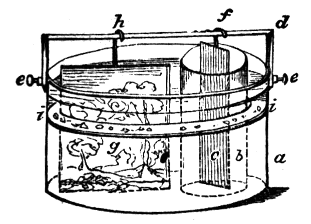
a. An oval vessel of salt-glazed earthenware or wood nearly filled with a saturated solution of sulphate of copper.
b. A porous diaphragm, containing the cylinder or plate of zinc (c), and filled with dilute sulphuric acid.
d. A small bar of brass or copper fastened to the vessel by the binding screws (e, e), and supporting the plate of zinc (c), by the hook of copper wire (f), and the mould (g), by the hook (h).
i. A small shelf or partition to support crystals of sulphate of copper, to keep up the strength of the solution.
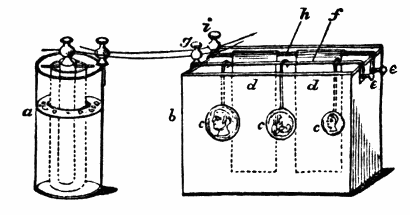
a. A constant battery cell.
b. Decomposition cell, a cubical vessel made of wood or earthenware, and filled with a mixture of 1 part of dilute sulphuric acid (1 acid + 9 water), and 2 parts of saturated solution of sulphate of copper by measure.
c, c, c. Moulds suspended to the brass rod (f), and connected with the zinc or positive element of the battery (a), by means of the screw (g.)
d, d. Pieces of sheet copper suspended on the brass rod (h), and connected with the zinc end of the battery, by means of the screw (i), employed to keep up the strength of the cupreous solution in the decomposition cell.
To connect the moulds with the zinc or positive element, stout copper wires or strips of thin sheet copper are employed. In the case of a non-metallic mould, the wire must lead directly to the plumbagoed surface, or, what amounts to the same thing, the plumbago must be extended to the point of attachment. The connecting wires, and the backs and edges of metallic moulds, must be covered with sealing-wax varnish, or other non-conducting substance, to prevent them receiving the deposit. Before a mould is placed in the copper solution it is advisable that everything should be arranged, so that the immersion may occasion immediate voltaic action. If the connection between the zinc and the mould is not effected until after the immersion, the solution may act chemically on the surface of the mould, and cause the deposit to appear dark and dirty. When a mould has remained in the solution long enough to receive a complete coating of copper, it may be lifted out with impunity for examination. If everything is going on well, the deposited metal will present a brilliant, light, copper-coloured surface. When sufficiently thick, the deposit is removed with care, washed and placed to dry. Electrotype medals may be polished with wash-leather and the plate brush, or bronzed. Various natural objects such as insects, fruits, &c.; small works of art, such as busts and statuettes; chemical vessels, particularly glass flasks and retorts; and numerous classes of articles, may be rendered less fragile by coating them with copper by the electrotype process.
II. Deposition of the precious metals—
The solutions generally employed as electrolytes from which silver and gold are respectively separated, are those of the argento-cyanide and the auro-cyanide of potassium. These compounds are what chemists call double salts; for instance, cyanide of potassium is simply a compound of potassium and cyanogen; but argento-cyanide of potassium is cyanide of silver united with cyanide of potassium. When a solution of this double salt is electrolysed silver appears at one electrode and cyanogen at the other, while a proportionate amount of the simple cyanide of potassium is formed in the solution. But if the positive electrode is of silver, the cyanogen combines with it, and forms cyanide of silver, which unites with the liberated cyanide of potassium, and so keeps up the strength of the solution.
As in the deposition of copper, the apparatus used for plating or gilding may be the single cell or the decomposition cell and battery. The necessity of economising solutions of silver and gold has, however, led to certain modifications in the apparatus. The single-cell arrangement consists, as before (see above), of an outer vessel of glass or earthenware, containing a cell of porous biscuit ware; but the object to be silvered or gilded is placed, with the cyanide solution in the latter, while the zinc is placed in the outer vessel, with the dilute sulphuric acid.[273] The zinc is usually employed in the form of a cylinder, completely surrounding the porous cell. In the battery arrangement the decomposition cell may be of porcelain or glass; the silver or gold employed to keep up the strength of the solution may be in plates, wires, or ingots. For plating small objects, a single cell of a Daniell’s battery will afford ample decomposing power; gilding may be better accomplished by using three such cells. The battery arrangement is much more convenient, effective, and economical than the single-cell arrangement.
On a large scale, electro-plating is carried out in oblong vats, occasionally holding from 200 to 250 gallons of solution. Silver plates connected with a powerful voltaic or magneto-electric battery, are placed at intervals in the vats; they form the positive electrodes, and correspond in extent of surface with the articles to be coated, and face them on both sides. The articles (tea-pots, cruet-frames, forks, spoons, &c.) act as the negative electrodes, and are suspended by copper wires from brass rods laid lengthways over the vats, and connected with the battery. The articles plated are usually formed of nickel silver or German silver, which is chosen on account of its silvery whiteness, a quality of great importance when portions of the coating of noble metal have been worn away by use.
To prepare the articles for plating, they are first boiled in a solution of potassa, to free them from grease; they are then quickly dipped in red nitrous acid, to remove any oxide that may have formed on the surface, and after this well washed in water, to remove every trace of acid. They are then suspended from copper wires, and dipped into a solution of mercury in cyanide of potassium, or some other mercurial solution, and afterwards washed in water, as before. The amalgamation of the surface effected by the last operation promotes the adhesion of the film of silver. The articles having been weighed, are now immersed in the silvering solution, and left until a sufficient amount of silver has been deposited on them. Their condition at any time may be ascertained by weighing a test-object removed from the solution. In some electro-plating establishments the silvering solution is kept constantly stirred by simple mechanical arrangements; in others, continual motion is given to the suspended articles. On being removed from the vats the plated articles are well brushed with brushes of fine brass wire attached to a lathe, and cleaned with fine Calais sand; they are afterwards polished on revolving brushes with rottenstone, then by hand with soft leather and rouge, and, lastly, with the naked female hand. A lasting polish is given to some articles by burnishing with a burnisher formed of highly polished hardened steel, bloodstone, agate, or flint. The process of electro-gilding on the large scale is nearly the same as that of electro-plating or silvering, but, of course, plates of gold are suspended in the solution instead of silver plates.
Various solutions for silvering, plating, and platinising, have been recommended. We give below those generally employed.
1. Solvent solution. Cyanide of potassium, 2 oz; distilled water or rain water, 1 pint; dissolve. Other proportions may be employed. Used as a general solvent for salts of silver, gold, and platinum.
2. Silver solution. Oxide of silver?[274] (not dried), 1 oz.; the solvent solution (No. 1), 1 pint. Used for the single-cell apparatus, its strength being maintained as the deposition proceeds by a fresh supply of oxide from time to time.
Cyanide of silver dissolved in solvent solution (No. 1). This is the solution generally employed for plating with a separate decomposition cell.
3. Gold solution. Add to a pint of No. 1 oxide of gold, 1⁄4 oz. Used in the same manner as the second silver solution.
Cyanide of gold dissolved in solution of cyanide of potassium (No. 1). Used as last.
4. Platinum solution. The double chloride of platinum and potassium, dissolved in solution of caustic potassa. Other solutions have been proposed, but this appears to be decomposed with the greatest ease.
The above sketch of the electrotype art is necessarily very imperfect. For minute details respecting manipulation, the reader is referred to the excellent treatises on the subject that have been written; more particularly to Ernest Spon’s valuable work, entitled ‘Workshop Receipts.’
ELEC′TUARY. Syn. Electuarum, L. Electuaries (ELECTUARIA) are formed of light powders, generally vegetable, mixed up with honey, syrup, or sugar, to the consistence of a stiff paste. In the present Pharmacopœia they are included under the title Confection, but this arrangement is manifestly improper, as the words are not synonymous. In Conserves and Confections the addition of the saccharine matter is in much larger proportion, and is designed to preserve the vegetable matter; in Electuaries, the syrup is designed merely to communicate the required form. (Dr Murray.)
The preparation of electuaries is similar to that of confections and conserves, and the same precautions must be observed to reduce the dry ingredients to very fine powder before adding them to the syrup or other substances used to give them form. Care must also be taken to diffuse the ingredients equally through every portion of the mass, by patient and laborious stirring. The neglect of this point has often led to disagreeable consequences, from some portion of the electuary being nearly inert, while another portion has possessed increased activity. See Confection, Conserve, Linctus, &c.
Electuary of Ac′etate of Potassa. See Conserve.
Electuary of Al′um. Syn. Electuarium aluminis, L. Prep. 1. (Phœbus.) Alum, 1 dr.; extract of logwood, 4 dr.; balsam of Peru, 6 drops; water of sage, q. s. Astringent and antiseptic; in diarrhœa, sponginess of the gums, &c.
2. (St. Marie.) Alum, 1 dr.; catechu and extract of bark, of each 2 dr.; conserve of roses, 6 dr.; simple syrup, q. s.—Dose. A teaspoonful, every 4 hours; in chronic diarrhœa, leucorrhœa, hæmorrhages, &c. See Confection.
Electuary, An′odyne. Syn. Electuarium anodynum, L. Prep. See Confection of Opium.
Electuary, Anti′monial. Syn. Electuarium antimonii, Fr. Prep. Electuary of senna, 1 oz.; guaiacum resin, æthiops mineral, prepared sulphuret of antimony, each 1⁄2 oz.; syrup, q. s.—Dose, 1 dr. to 2 dr. twice a day.
Electuary, Anti-rheumatic. Syn. Electuarium antirheumaticum; Chelsea pensioner. Prep. Guaiacum resin, 1 dr.; rhubarb, 2 dr.; bitartrate of potash, 1 oz.; sulphur, 2 oz.; one nutmeg; mix the powders with 1 lb. of honey. Take two spoonfuls night and morning.
Electuary, Ar′abic. Syn. Electuarium sarzæ compositum, E. Arabicum, L.; Electuaire Arabique, Fr. Prep. From sarsaparilla, 5 oz.; senna and China root, of each, 3 oz.; dried walnut peel, 1 oz. (all in fine powder); honey, q. s.—Dose, 1 to 4 dr. See Traitement Arabique.
Electuary, Aromat′ic. Syn. Electuarium Aromaticum (Ph. E.). This preparation differs from the aromatic confection of the other British colleges, in not containing chalk. It is aromatic and stomachic, but not antacid or absorbent. Confection.
Electuary, Bath. Syn. Electuarium anti-cachecticum, E. Martiale, E. ferri compositum, L. Prep. From blacksmiths’ clinkers, reduced to an impalpable powder, and made into an electuary with honey or treacle, q. s.; afterwards adding powdered ginger and carbonate of magnesia, of each, 1 oz., to every lb. of the mixture.—Dose. A teaspoonful night and morning every day, for 3 or 4 days, and again, after an equal interval, as long as thought necessary; as a chalybeate tonic, and in worms.
Electuary of Bitar′trate of Potas′sa. Syn. Electuarium potassæ tartratis, L. Prep. (Monro.) Cream of Tartar, 1 oz,; powdered ginger and conserve of roses, of each 1 dr.; syrup of orange peel, q. s.—Dose, 1 to 3 dr.; as a hydragogue purge. It is also a useful laxative in common cases. See Confection of Cream of Tartar.
Electuary, Black. Syn. Trousseau’s electuary, Trousseau’s black tonic; Electuarium nigrum, E. ferri tannatis, L. Prep. From sesquichloride of iron, 4 dr.; tannin, 1 dr.; confection of roses, 2 oz.; syrup of orange peel, 1 oz. Tonic and astringent.—Dose, 5 to 30 gr.
Electuary of Black Pep′per. See Confection of Pepper.
Electuary of Burnt Sponge. Syn. Electuarium spongiæ ustæ, L. Prep. (Hulse.) Burnt sponge, 10 gr.; rhubarb, 4 gr.; conserve of roses, q. s. For a dose, to be taken night and morning; in scrofula, glandular swellings, &c. See Confection of Sponge.
Electuary of Cas′sia. Syn. Electuarium cassiæ (Ph. D. 1826.), E. c. Fistulæ (Ph. E.), L. Prep. (Ph. D. 1826.) Fresh cassia pulp and syrup of orange, of each, 1⁄2 lb.; manna, 2 oz.; tamarind pulp, 1 oz.; mix, and evaporate to a proper consistence.—Dose, 2 dr. to 1 oz.; as a gentle laxative for children, or as a vehicle for other cathartics. That of the shops is commonly made with equal parts of tamarind and cassia pulps, mixed with 1⁄8th of manna, and flavoured with a few drops of tincture of orange peel, without any evaporation. See Confection.
Electuary of Cat′echu. Syn. Electuarium catechu, Confectio c., C. japonica, L. Prep. (Ph. E.) Powdered catechu and kino, of each, 4 oz.; cinnamon and nutmegs, of each, 1 oz.; opium (dissolved in a little sherry), 11⁄2 dr.; syrup of red roses (evaporated to the consistence of honey), 11⁄2 pint. See Confection, and below.
Electuary of Cat′echu (Compound). Syn. Electuarium catechu compositum (Ph. D.). See Confections. Both the above are astringent, aromatic, and anodyne.—Dose, 15 gr. to 1 dr., or more; in diarrhœa, dysentery, &c.
Electuary, Cathar′tic. Syn. Electuarium catharticum, L. Prep. 1. Confection of senna, 11⁄2 oz.; flowers of sulphur, 1⁄2 oz.; syrup of roses or of orange peel, q. s.—Dose. A teaspoonful, 3 or 4 times a day, in piles; or, 2 to 3 teaspoonfuls, as a gentle laxative for females, and in skin diseases, gonorrhœa, &c. A mild and excellent medicine. It may be safely given in larger doses.
2. (Brera.) Aloes, 8 gr.; cream of tartar, 2 dr.; honey, q. s. For a dose. In amenorrhœa, attributed to abdominal engorgement.
Electuary, Cephal′ic. Syn. Electuarium cephalicum, E. valerianæ compositum, L. Prep. (Hosp. F.) Valerian root and mistletoe of the oak, of each 1 oz.; honey, 11⁄2 oz.; tincture of henbane, q. s. to make an electuary. In nervous and rheumatic headache, &c.; assisted by an aperient.
Electuary of Char′coal. Syn. Electuarium carbonis, E. carbonii, Confectio c., L. Prep. 1. (Hosp. F.) Confection of senna, 2 oz.; fresh burnt charcoal, 1⁄2 oz.; carbonate of soda, 1⁄4 oz.; syrup of orange peel, q. s.
2. (Radius.) Electuary of senna, 2 oz.; powdered charcoal and carbonate of soda, of each, 1 dr. Both the above are given in obstinate constipation.—Dose, 1 to 3 teaspoonfuls twice a day. See Electuary for the Teeth.
Electuary for Chol′era. Syn. Electuarium anti-cholericum, L. The preparations that come under this name are numerous, including aromatic confection, and several like absorbent or astringent preparations. This name has been given to the American remedy for cholera, noticed at page
Electuary of Cincho′na Bark. Syn. Electuary of bark; Electuarium cinchonæ, L. Prep. 1. From yellow bark and simple syrup, of each 1 oz.; conserve of red roses and confection of orange peel, of each 1⁄2 oz. Tonic and febrifuge.—Dose, 1 to 4 dr.; in debility, agues, &c.
2. (Radius.) Peruvian bark, 1 oz.; syrup of orange peel, q. s. As the last.—Dose, a teaspoonful or more, 3 or 4 times daily. (See below.)
Electuary of Cinchona (Compound). Syn. Electuarium cinchonæ compositum, L. Prep. 1. (Acidulated,—Copland.) Yellow bark, 1 oz.; confection of roses, 1⁄2 oz.; diluted sulphuric acid, 1 dr.; syrup of ginger, 11⁄2 oz.
2. (Astringent,—Saunders.) Powdered Peruvian bark, orange peel, and conserves of roses and hips, of each 6 dr.; crabs’ eyes (or prepared chalk), 2 dr.; syrup of catechu, q. s.—Dose. A teaspoonful, 2 or 3 times daily; in chronic diarrhœa, &c.
3. (With Catechu,—Pierquin.) Peruvian bark, 1 oz.; catechu and balsam of tolu, of each 1 dr.; syrup of comfrey (Symphytum officinale,—Linn.), q. s.—Dose. As the last; in spitting of blood, hæmorrhages, &c.
4. (With Cloves,—Dewees.) Peruvian bark, 2 oz.; cloves, 1 dr. (better, 4 dr.); simple syrup, q. s. A piece the size of a walnut, every hour or two, during the intermission of an ague.
5. (With Iron,—Cadet.) Peruvian bark, 6 dr.; oxide of iron and confection of opium, of each 2 dr.; syrup of cinnamon, q. s.—Dose. A teaspoonful, or more, twice a day; in dropsy of the belly, after the evacuation of the fluid, and as a tonic in debility, accompanied by nervous excitement, &c., in the absence of fever.
6. (Quarin’s.) Red bark, 1 oz.; ammoniated iron, 1 dr.; made into an electuary with equal parts of oxymel of squills and syrup of the ‘five roots’ (diuretic). Tonic, febrifuge, and pectoral.
7. (With Sal-Ammoniac,—P. Cod.) Gray bark, 21⁄4 oz.; hydrochlorate of ammonia, 1 dr.; honey and syrup of wormwood, of each 2 oz. In intermittents occurring in scrofulous subjects.
8. (With Soda,—P. Cod.) Powdered cinchona, 1 oz.; carbonate of soda, 2 dr.; thin mucilage, q. s. to mix. Tonic, febrifuge, and stomachic.—Dose, 2 dr., 2 or 3 times a day; in agues, complicated with acidity and dyspepsia.
9. (With Sulphur,—Cadet.) Peruvian bark, 1 dr.; sulphur, crabs’ eyes (chalk), and spermaceti, of each 2 dr.; extract of opium, 4 dr.; conserve of roses, 4 dr.; syrup of milfoil, q. s. Highly praised in debility from phthisis.—Dose. A teaspoonful, 2 or 3 times a day, assisted with the liberal use of raw or lightly boiled eggs and cod-liver oil.
10. (With Tin,—Cadet.) Peruvian bark 1 oz.; tin filings and valerian root, of each 1⁄2 oz.; syrup of saffron, q. s. In epilepsy, worms, &c.—Dose. A teaspoonful, morning and evening. See Confection of Bark.
Electuary of Copai′ba. Syn. Electuarium copaibæ, L. Prep. 1. Copaiba and powdered cubebs, equal parts; conserves of roses and orange peel, of each (in equal quantities), q. s.
2. (Caspar.) Blanched almonds, 6 dr.; powdered marsh-mallow root, 1 dr.; catechu, 1⁄2 dr.; balsam of copaiba, 3 dr.
3. (Ricord.) Confection of almonds, 1 oz.; copaiba, 1⁄2 oz.; hard extract of rhatany, 3 dr.; syrup of orange peel, q. s. All the above are excellent in gonorrhœa, gleets, &c. The last two agree better with the stomach than most other like preparations.—Dose, 1 teaspoonful, or more (rapidly increased to 2 or 3 dr.), 3 or 4 times daily. See Confection.
Electuary of Cow′hage. Syn. Electuarium dolichos, E. mucunæ, L. Prep. 1. Dip the pods of dolichos in treacle, allow them to drain a moment, and then scrape off the hairs for use.
2. (Chamberlain.) As the last, nearly.
3. (Correa.) Cowhage (the hairs or setæ), 40 gr.; syrup, 1⁄2 oz.
4. (Ellis.) Cowhage (hairs), 1 dr.; honey, q. s.
5. (Guy’s Hosp.) Cowhage (hairs), any quantity, made into an electuary with treacle, q. s. In worms.—Dose. For a child, a teaspoonful; for an adult, a table-spoonful; in the morning, fasting, and at night, for 3 or 4 days; followed by a dose of castor oil, to which a teaspoonful of turpentine may be advantageously added. See Cowhage.
Electuary of Cu′bebs. Syn. Electuarium cubebæ, L. Prep. 1. See Electuary of Copaiba.
2. (Beral.) Cubebs and copaiba, of each 2 oz.; powdered alum, 1 oz.; extract of opium, 5 or 6 gr.; mix.
3. (Bouchardat.) Cubebs, 1⁄2 oz.; copaiba, 1 oz.; sweet spirit of nitre, 1⁄2 fl. dr.; oil of peppermint, 8 or 10 drops; powdered sugar, q. s.
4. (Radius.) Cubebs, 1⁄2 oz.; honey, 1 oz. In gonorrhœa, mucous discharges from the vagina, bladder, &c.—Dose, 1 teaspoonful, afterwards increased to 2 or 3 teaspoonfuls, twice or thrice daily. See Confection of Copaiba, Electuary of C., &c.
Electuary, Demul′cent. Syn. Electuarium demulcens, L. Prep. From spermaceti, syrup of poppies, and syrup of tolu, of each 2 dr.; powdered gum tragacanth, 1 dr.; confection of roses, 6 dr.; nitre, 1⁄2 dr.—Dose. A piece the size of a small filbert, frequently; as a pectoral and demulcent in coughs, hoarseness, &c.
Electuary, Deob′struent. Syn. Electuarium deobstruens, L. Prep. (Copland.) Confection of senna, 11⁄2 oz.; cream of tartar, 1 oz.; sulphur and syrup of ginger, of each 6 dr.; borax, 3 dr.; syrup of poppies, 2 dr.—Dose. A teaspoonful, or more, nightly; in the obstinate constipation of females, painful and suppressed menstruation, &c.
Electuary for Dys′entery. Syn. Electuarium anti-dysentericum (Ph. E. 1744), L. Electuary of catechu, mixed with half its weight of Locatel’s balsam.
Electuary, Emmen′agogue. Syn. Electuarium emmenagogicum, L. Prep. From myrrh, 1 dr.; ammoniated iron, 1 scrup.; syrup of ginger, q. s. to mix.—Dose, 1⁄2 dr. to 1 dr., night and morning; in deficient or suppressed menstruation.
Electuary for Epilep′sy. Syn. Electuarium anti-epilepticum, L. Prep. 1. See Electuary of Cinchona (Comp.), No. 10.
2. (Dr Mead.) Powdered cinchona, 1 oz.; valerian and tin (both in powder), of each, 1⁄2 oz.; syrup, q. s. to mix.—Dose. A teaspoonful, night and morning.
Electuary, Feb′rifuge. See Electuary of Cinchona, &c.
Electuary, Compound Guaiacum. Syn. Electuarium guaiaci compositum. (Mid. H.) Prep. Guaiacum resin, 2 dr.; rhubarb, 1 dr.; sulphur, 2 dr.; nitre, 2 dr.; syrup of poppies, q. s.; mix.—Dose, 1⁄2 dr. to 1 dr.
Electuary of In′digo. Syn. Electuarium indigi, E. pigmenti indici, L. Prep. (Phœbus.) Powdered indigo, 4 dr.; aromatic powder, 1⁄2 dr.; syrup, 1 fl. oz. or q. s. In spasmodic diseases, especially in epilepsy, chorea, and hysteria, and the convulsions of children. It has also been used with advantage in that species of impotence in which strychnia is useful. The above quantity is to be all taken, in divided doses, during the day. To be of permanent advantage, it should be continued for several weeks.
Electuary of Ipecacuan′ha. See Confection.
Electuary of Jal′ap. See Confection.
Electuary of Kermes. Marmelade de zanetti; Electuarium kermetis, E. k. mineralis, L. Prep. From manna, 4 oz.; pulp of cassia and oil of almonds, of each 2 oz.; butter of cacao, 1⁄2 oz.: Kermes mineral, 10 gr.; syrup of marsh-mallow, 3 fl. oz.; syrup of orange flower, q. s. A diaphoretic laxative.—Dose, 1 to 4 teaspoonfuls, or more.
Electuary of Lau′rel Ber′ries. See Confection of Rue.
Electuary, Len′itive. See Confection of Senna.
Electuary, Mahomed’s. Prep. 1. From grocer’s currants, 2 oz.; powdered senna, 1⁄2 oz.; powdered ginger, 1 dr.; finely powdered capsicum and cloves, of each 20 gr.; croton oil, 3 drops; conserve of roses and syrup of saffron, of each in equal parts, q. s. to mix.
2. (Bateman.) Currants, 1 oz.; senna, 1⁄2 oz.; ginger, 1⁄2 dr.; syrup of roses, q. s.; croton oil, 1 drop.—Dose, 1 or 2 teaspoonfuls, early in the morning; in dyspepsia and habitual constipation. The first formulary produces a most useful medicine, particularly for free-livers.
Electuary of Male Fern. Syn. Electuarium felicis maris, L. Prep. 1. Powder of male fern, 3 dr.; conserve of roses, 1 oz.
2. (Radius.) Ethereal extract of male fern, 1⁄2 dr.; honey of roses, 1 oz. The half of either to be taken at night, and the remainder the next morning. In worms.
Electuary, Mustard. Syn. Electuarium sinapis. (Guy’s H.) Prep. Mustard seed, lightly bruised, 1 oz.; sulphur, 2 dr.; syrup of orange peel, 1 fl. oz.—Dose, 1 dr., 3 or 4 times a day.
Electuary of Ni′tre. Syn. Electuarium potassæ nitratis, L. Prep. (Hosp. F.) Nitre, 3 dr.; confection of roses, 2 oz.—Dose. A piece of the size of a filbert, where the use of nitre is indicated. See Confection.
Electuary, Olibanum. Syn. Electuarium olibani. [Fr.] Prep. Olibanum, 1⁄2 oz.; balsam of copaiva, 1⁄2 oz.; conserve of hips, 1 oz.; syrup, q. s.—Dose, 2 dr. twice a day.
Electuary of O′pium. See Confection of Opium.
Electuary, Pec′toral. Syn. Electuarium pectorale, L. Prep. 1. (Ph. E. 1744.) From conserve of roses, 2 oz.; compound powder of tragacanth, 4 dr.; flowers of benzoin, 1 dr.; syrup of tolu, q. s.—Dose. A little, ad libitum.
2. Oxymel of squills, syrup of marsh-mallows, mucilage of gum Arabic, and syrup of tolu, of each 1⁄2 oz.; powdered lump sugar, 2 oz. As the last.
Electuary of Pep′per. See Confection, and above.
Electuary for Piles. Syn. Electuarium hæmorrhoidale, L. Prep. 1. See Confection and Electuary of Pepper.
2. (Dr Copland.) Cream of tartar, 1 oz.; precipitated sulphur (pure), 3 dr.; confection of senna, 2 oz.; syrup of orange peel or ginger, q. s. to mix.
3. (Dr Graves.) Confection of senna and sulphur, of each 1 oz.; balsam of copaiba and cream of tartar, of each 1⁄2 oz.; jalap and ginger, of each 1 dr.; syrup of orange peel, q. s.
4. (Hosp. F.) Confection of senna, 2 oz.; black pepper and precipitated sulphur, of each 1⁄2 oz.; oil of cubebs, 1 dr.; syrup, q. s. The last three are useful laxatives in piles, and by their preventing the accumulation and hardening of the fæces, often remove the affection.—Dose. A teaspoonful, three or four times a day. From the difficulty experienced in procuring pure precipitated sulphur, washed sublimed sulphur may be advantageously substituted.
Electuary of Pomegran′ate Syn. Electuarium granati, L. Prep. 1. From the root-bark, 1 dr.; assafœtida, 1⁄2 dr.; croton oil, 6 drops; conserve of roses, 1 oz.—Dose. A teaspoonful, night and morning.
2. (Radius.) Extract of the root-bark, 6 dr.; lemon juice, 2 fl. dr.; linden water, 3 fl. dr.; gum tragacanth, q. s. to make an electuary. One half to be taken at once; the remainder in an hour. Both are given in tape-worm.
Electuary of Prunes. Syn. Electuarium Prunonum. (Zwelfer.) Prep. Pulp of prunes boiled to a due consistence, 2 lbs.; pure sugar, 1 lb.
Electuary of Resin. See Confection of Resin.
Electuary of Rhubarb. Syn. Electuarium rhei, L. Prep. (Saunders.) Powdered rhubarb, 11⁄2 dr.; sulphate of potassa, 1 dr.; cream of tartar, 4 dr.; pulp of tamarinds, 2 oz.—Dose. A teaspoonful, as a mild stomachic laxative.
Electuary, Compound Saffron. Syn. Electuarium Croci Compositum. Confection d’Hyacinthe, [F.] Prep. Prepared Armenian bole, 8 oz.; levigated crab’s eyes, 8 oz.; cinnamon, 3 oz.; yellow sandal, red sandal, myrrh, of each 1 oz.; dittany of Crete, 1 oz.; all in fine powder. On the other hand, dissolve 11⁄2 lb. of honey in 3 lbs. of syrup of pinks, over a gentle fire, and strain, and when nearly cold stir into it 1 oz. of saffron in powder. Let stand twelve hours, and then stir in carefully the powders first mentioned.
Electuary of Scam′mony. See Confection.
Electuary for Scur′vy. See Conserve (Antiscorbutic).
Electuary of Sen′na. See Confection of Senna.
Electuary of Squills. Syn. Electuarium scillæ, L. Prep. 1. Oxymel of squills, 2 fl. oz.; cream of tartar and powdered sugar, of each 11⁄2 oz.—Dose, 1 to 2 teaspoonfuls, as a laxative and expectorant; in old coughs, &c.
2. (Radius.) Squills, nitre, gum ammoniacum, and tartrate (bitartrate) of potassa, of each 2 dr.; sal-ammoniac, 20 gr.; syrup of cinnamon, q. s.—Dose, 2 dr.; three times a day; in dropsies. See Conserve of Squills.
Electuary of Steel. Syn. Electuarium ferri, E. chalybeatum, L. Prep. 1. (Dr Collier.) Potassio-tartrate of iron, 1⁄2 oz.; confection of roses, 1 oz.; syrup q. s. to mix.
2. (Collier.) Precipitated sesquioxide of iron, 1 oz.; honey, 2 oz.; ginger syrup, 1⁄2 fl. oz. Both the above are tonic and emmenagogue.—Dose. One teaspoonful, thrice a day. See Confection.
Electuary, Stim′ulant. Syn. Electuarium stimulans, L. Prep. From gum ammoniacum (strained), 1 oz.; vinegar of squills, 1⁄2 oz.; mixed with a gentle heat, and spread on leather. Applied to the chest or pit of the stomach, as a mild counter-irritant and antispasmodic; and as a discutient to tumid glands and indolent tumours. It is wrongly called an electuary.
Electuary, Stomach′ic. Syn. Dinner electuary; Electuarium stomachicum, Confectio stomachica, L. Prep. 1. Rhubarb, ginger, and extract of chamomile, of each 1 dr.; confection of orange peel, 4 dr.; syrup q. s.
2. Rhubarb and gentian, of each, 11⁄2 dr.; extract of hops and powdered capsicum, of each 1⁄2 dr.; oil of chamomile, 12 drops; confection of hips and syrup of orange peel, of each 1⁄2 oz.
3. Green peppermint, lump sugar, and confection of orange peel, equal parts.—Dose. A teaspoonful, an hour before a meal. They are all excellent stomachics, and are useful to improve the appetite, and in dyspepsia.
Electuary of Sul′phur. See Confection of sulphur, and below.
Electuary of Sulphur (Compound). Syn. Electuarium sulphuris compositum, L. Prep. 1. Sulphur, 3⁄4 oz.; cream of tartar, 1 oz.; confections of senna and black pepper, of each 2 oz.; syrup of ginger, 1 fl. oz. An excellent medicine in piles.—Dose. A teaspoonful, twice a day.
2. (With Borax.) Flowers of sulphur, 1 oz.; cream of tartar, 11⁄2 oz.; borax, 1⁄2 oz.; confection of senna, 21⁄2 oz.; syrup of orange peel q. s. to mix.—Dose. 1 to 3 teaspoonfuls, in diseases of the uterine organs and lower bowels. See Confection.
Electuary for the Teeth. Syn. Electuarium dentifricum, L. See Tooth Paste, Dentifrice, &c.
Electuary of Tin. See Confection of tin, and below.
Electuary of Tin (Compound). Syn. Electuarium stanni compositum, L. Prep. 1. Powdered tin, 1 oz.; confection of oil of turpentine, 2 oz.
2. (Dr Cheston.) Tin filings, 4 dr.; carbonate of iron (sesquioxide), 1 dr.; conserve of wormwood, 3 dr.
3. (Foy.) Powder of tin, 1 oz.; extract of wormwood and powdered jalap, of each, 1 dr.; compound syrup of chicory, q. s. In worms.-Dose. A tablespoonful, or more, for 2 or 3 successive mornings, fasting; followed by a purge.
Electuary of Tur′pentine. Syn. Electuarium terebinthinæ, L. Prep. 1. (St. B. Hosp.) Common turpentine, 1 oz.; honey, 2 oz.—Dose, 1 to 2 teaspoonfuls; in complaints of the urinary organs, worms, &c.
2. (Radius.) Turpentine, soap, and rhubarb, of each, 1 dr.; syrup of wormwood, q. s.—Dose. Three teaspoonfuls a day; in dropsy, worms, &c.
3. (E. Olei Terebinthinæ,—Copland.) As confection of turpentine,—Ph. D. See Confection.
Electuary, Ver′mifuge. Syn. Electuarium anthelminticum, E. vermifugum, L. Prep. 1. (Bresmer.) Worm-seed and tansy-seed, of each 4 dr.; powdered valerian root, 2 dr.; jalap and sulphate of potassa, of each 11⁄2 to 1⁄2 dr.; oxymel of quills, q. s. to mix.—Dose. A teaspoonful, or more; repeated night and morning, followed by a brisk purge.
2. (Rosenstein.) Worm-seed, 10 gr.; sulphate of iron, 4 gr.; jalap and honey, of each 20 gr. For two doses, as the last. 2 or 3 dr. of confection of senna are often substituted for the jalap and honey.
3. (Foy.) Aloes, 1⁄2 oz.; common salt, 3 dr.; flour, 2 oz.; honey q. s. to form a stiff paste. Used as a suppository in ascarides.
4. Flowers of sulphur, 4 oz.; powdered jalap, 1 oz,; powdered bark, 1 oz.; syrup of buckthorn q. s.—Dose. Two or three teaspoonfuls, every morning early. See Confection and Electuary of Tin, Turpentine, Worm-seed, &c.
Electuary for Worms. See Electuary Vermifuge (above).
EL′EMENTS. Syn. Elementary bodies, Simple b.; Elementa, L. In chemistry, those substances or bodies which have hitherto resisted every attempt which has been made to decompose them, or to resolve them into simpler forms of matter. Earth, air, fire, and water, were regarded by the ancients as simple bodies, of which all others are composed, and they still constitute the ‘four elements’ of the vulgar. The imaginary principles or elements of the alchemists were termed salt, sulphur, and mercury. About sixty-four different kinds of matter are at present recognised as elementary bodies. They are substances having the most diverse characters. The great majority exist in the solid state; bromide and mercury are liquid; while oxygen, hydrogen, nitrogen, and chlorine, are gaseous. About four fifths of the elements are metallic, as instanced by gold, silver, copper, iron, &c.; the remainder are non-metallic, as instanced by carbon, sulphur, phosphorus, &c. A list of the known elements is given under the head of Atomic Weights (which see).
EL′EMI. Syn. Gum elemi; Elemi (B. P.). “A terebinthinate concretion, from an uncertain plant.” (Ph. L.) Mexican elemi is known to be the produce of a species of the genus Elaphrium. Manilla elemi is probably the product of Canarium commune.
Prop., &c. The elemi of commerce is of a pale-yellow colour, brittle without, but soft and tough within; it has a warm bitter taste, and a fragrant aromatic smell, partaking of fennel and juniper. It is only partially transparent even in thin plates, is very fusible, and has a density a little greater than that of water. It contains 121⁄2 per cent. of volatile oil (oil of elemi). It is used to give toughness to lacquers and varnishes, and in medicine in the preparation of ELEMI OINTMENT.
Pur. The elemi of the shops is often adulterated, but more frequently a factitious kind is sold for the genuine gum. This fraud may be detected by exposing the suspected article to heat, along with a little water, when the factitious fragrance of the spurious article evaporates, and the coarse terebinthinate smell of the resin used to adulterate it, or which is sold for it, becomes readily distinguishable.
Elemi, Facti′′tious. Prep. 1. Yellow resin, 8 lbs.; melt, add Canada balsam, 2 lbs; withdraw the vessel from the heat, and further add of oil of juniper, 2 dr.; oil of sweet fennel, 1 dr.; oil of nutmeg, 1⁄2 dr.
2. Yellow resin, 7 lb.; Canada balsam, 1 lb.; juniper oil bottoms, 4 dr.; oil of mace, 3 dr.; mix as before.
EL′EMIN. The crystalline resin of gum elemi.
ELIX′IR. In pharmacy, a name formerly applied to various compound tinctures, and to preparations supposed to contain the quintessence of other substances. (It is still applied to several popular remedies.) The elixirs of the alchemists were solutions employed in their fruitless attempts to transmute the baser metals into gold.
Elixir, Ac′id. Syn. Elixir acidum, L. Prep. 1. (Dippell’s) Sulphuric acid, 1 part, dropped gradually into rectified spirit of wine, 5 parts; placed in a large flask, and afterwards coloured by digestion on animal kermes and saffron, of each 1 part.
2. (Haller’s,—Ph. Sax. 1837.) From sulphuric acid and rectified spirit, of each 1 part; as before.
3. (Vogler’s.) From sulphuric acid and nitrous ether, equal parts, as above. Astringent and antiseptic.—Dose. A few drops, in water.
Elixir of Al′oes. Syn. Compound tincture of aloes; Elixir aloës, L. See Tincture.
Elixir of Aloes (Compound). Syn. Elixir of aloës compositum, L. Prep. (Dr Copland.) Acetate of potassa, inspissated ox-gall, socrotine aloes, and myrrh, of each 2 dr.; hay saffron, 1 dr.; brandy (or proof spirit), 21⁄2 fl. oz.; digest a week, and strain. Stomachic and laxative.—Dose. A teaspoonful, or more; in dyspepsia, constipation, &c.
Elixir, Anti-asthmat′ic. Syn. Elixir anti-asthmaticum, L. Prep. 1. Oil of aniseed, camphor, and balsam of tolu, of each 1 oz.; cochineal, 1 dr.; proof spirit, 1 gal.; digest a week, and filter.
2. As the last, adding powdered opium, 11⁄4 oz.—Dose. A teaspoonful to allay irritation, assisted by an occasional dose of aperient medicine; in asthma, chronic coughs, &c.
3. (Boerhaave’s.) Aniseed, asarabacca, elecampane, liquorice root, orris root, and sweet flag (calamus), of each equal parts; made into a tincture, with brandy.—Dose, 20 to 40 drops.
Elixir Antigoutteux de Villette is a tincture of 100 parts brown cinchona bark, 50 parts poppy petals, 25 parts sassafras, 50 parts guaiacum in 4,000 parts rum, mixed with 2,500 parts syrup of sarsaparilla. (Hager.)
Elixir, Anti-scrof′ulous. Syn. Elixir anti-scrofulosum, L. Prep. 1. (P. Cod.) The ammoniated tincture of gentian. See Tincture.
2. (Desforges.) Guaiacum, 5 oz.; cinchona bark and pellitory of each 3 oz.; cloves, 5 dr.; orange peel and benzoin, of each 2 dr.; hay saffron, 1⁄2 dr.; rectified spirit and brandy, of each 1⁄2 pint; digest a week, and filter. Used as an application to scorbutic gums.
Elixir, Bitter. Syn. Elixir amarum (Ph. Germ.) Prep. Extract of buckbean, extract of orange peel, of each 2 parts; peppermint water, alcohol (68 per cent.), of each 16 parts; spirit of ether (made of 3 parts of alcohol and 1 part of ether), 1 part. Dissolve and mix.
Elixir, Boerhaave’s Asthmat′ic. See Elixir Antiasthmatic (above).
Elixir, Boerhaave’s Vis′ceral. Syn. Elixir Boerhaavii, E. B. viscerale, L. Prep. (Ph. Han.) Aloes, myrrh, and saffron, of each 1 oz.; tartrate of potassa, 2 oz.; alcohol (strongest rectified spirit), 14 oz.; water, 1 oz.; macerate 3 days, and filter. This preparation “has been highly praised in visceral obstruction.” (Dr Griffith.)—Dose, 1 to 3 teaspoonfuls.
Elixir of Celery (Dr Wilkinson’s.) For increasing, preserving, and producing virility. Juniper berries, angelica root, lovage root, of each 1 part; spirit, 12 parts; orange-flower water, rose water, of each 4 parts; spring water, sufficient. Distil 20 parts, and mix the distillate with 12 parts clarified honey. (Hager.)
Elixir, Claude’s. Syn. Elixir Clauderi, L. 1. (Pideret.) Salt of tartar, sal-ammoniac, strained aloes, and myrrh, of each 1 oz.; elder-flower water, 11⁄4 pint, digest, with agitation, for 24 hours, and filter.
2. (Parrish.) Carbonate of potassa, 1 oz.; aloes, guaiacum, myrrh, saffron, and rhubarb (contused), of each 2 dr.; water, 18 fl. oz. Macerate a few days, and decant.—Dose, 1 to 2 teaspoonfuls; in amenorrhœa, constipation, scurvy, visceral obstructions, &c.
Elixir, Cough. Syn. Elixir anti-catarrhale, L. Prep. 1. See Anti-asthmatic Elixir.
2. (Hufeland.) Extracts of blessed thistle and dulcamara, of each 1 dr.; cherry-laurel water, 1 fl. dr.; fennel-water, 1 fl. oz.—Dose, 1 to 2 teaspoonfuls, 3 or 4 times a day. It is a most useful remedy in coughs occurring in nervous, hysterical, or irritable patients. See Elixir of Ipecacuanha, Elixir Lettsom’s, &c. (below).
Elixir, Daffy’s. Syn. Elixir salutis, E. sennæ compositum, Tinctura sennæ composita, L. This is an aromatised and sweetened tincture of senna, to which other cathartics are generally added. Nearly every drug-house has its own formula for this article. The following are those employed in the London trade:—
Prep. 1. East India senna, 11⁄2 lb.; jalap, 5 oz.; coriander seed and aniseed, of each 1⁄2 lb.; rhubarb, 1⁄4 lb.; red sanders wood, 2 oz.; salt of tartar, 2 oz.; treacle, 7 lbs.; rectified spirit of wine, 21⁄2 galls.; water, 31⁄4 galls. All the solids are well bruised, and macerated in the mixed fluids for 14 days, when the whole is pressed, and strained through a flannel bag. It is too glutinous to run through filtering paper.
2. Senna, rhubarb, and aniseed, of each 2 lbs.; jalap and caraways, of each 1 lb.; red sanders wood, 1⁄2 lb.; brown sugar, 7 lbs.; proof spirit, 10 galls.; as the last.
3. Senna, 56 lbs.; aniseed, 7 lbs.; rhubarb (East India), 14 lbs.; coriander seed, 6 lbs.; caraway seed and red sanders wood, of each 5 lbs.; cassia bark and jalap, of each 3 lbs.; proof spirit, 100 galls.; digest for 14 days, press, strain, and add molasses, 84 lbs.; mix well, and either clarify or strain through flannel.
4. For proof spirit in the last two formulæ, equal parts of spirit of wine and water are employed by the smaller houses.
5. (Redwood.) Senna, 1⁄2 lb.; aniseed, caraways, and jalap, of each 1 oz. 2 dr.; juniper berries, 21⁄2 oz.; proof spirit, 6 pints; macerate for 14 days, then add of treacle, 101⁄2 oz.; water, 1 lb. 5 oz.; mix and strain.
6. (Dicey’s.) Senna, 1 lb.; guaiacum shavings, elecampane root (dried), aniseed, caraway seed, coriander seed, and liquorice root, of each 1⁄2 lb.; stoned raisins, 2 lbs.; proof spirit or brandy, 9 quarts; macerate for 10 days.
7. (Swinton’s.) Senna, 1 lb.; jalap, 3 lbs.; coriander seed, caraway seed, liquorice root, and elecampane root, of each 4 oz.; moist sugar, 2 lbs.; rectified spirit of wine and water, of each 1 gal.; as the last.
Obs. Daffy’s elixir is a favorite purge with drunkards, and is a common and very popular remedy in flatulent colic, dyspepsia, diarrhœa, &c.—Dose, 1 to 4 table-spoonfuls, or more.
Elixir de Pepsin Digestif. (Grimault & Co.) For loss of appetite and disordered digestion. Contains pepsine, in quantities not at all proportionate to the price of the article.
Elixir Deslauriers Toni-Febrifuge au Quinquina et Caffé. A tonic febrifuge. Yellow cinchona (Köningschina), 20 grammes; brown cinchona, 8 grammes; powdered coffee beans, slightly roasted, 16 grammes; wine, 250 grammes; sugar, 15 grammes; citric acid, 2·5 grammes. Boil once after standing some time in a warm place, and filter. Add to the filtered liquid 85 grammes sugar and 15 grammes spirit.
Elixir de St. Hubert pour les Chasseurs is a solution of 2 parts carbolic acid in 50 parts spirit. (Casselmann.)
Elixir, Devil’s. Syn. Elixir capsici compositum, L. Prep. From pods of capsicum, and cloves (bruised), of each 1 oz.; ginger and saffron, of each 3 oz.; cantharides, 5 dr.; proof spirit, 7 lbs.; digest for 10 days.—Dose, 1⁄2 dr. to 3 dr., in mixtures. It is stimulating, anti-choleraic, and aphrodisiac.
Elixir of Garlic. Syn. Elixir Allii, L. Prep. From garlic roots (bruised), 80 in no.; rectified spirit, 1 pint; digest, distil to dryness, and repeat the process with the same spirit from fresh roots, a second and a third time; lastly, add camphor, 2 dr. Diaphoretic and pectoral.—Dose. A teaspoonful, twice a day; in asthma, old coughs, diarrhœa from debility, &c.
Elixir, Garus’s. Syn. Elixir Gari, L.; Elixir de Garus, Fr. Prep. 1. Myrrh, 1 oz.; aloes and saffron, of each 1⁄2 oz.; cinnamon, cloves, and nutmeg, of each 1 dr.; proof spirit, 1 quart; digest a week, add water, 5 fl. oz., and distil over 1 quart; to the distillate (alcoolat de Garus) add of syrup of maidenhair, 2 lbs.; orange-flower water, 11⁄2 fl. oz.
2. (Foy.) Compound tincture of saffron, 8 pints; syrup of maidenhair, 10 pints; mix; add caramel, q. s. to colour, dissolved in orange-flower water, 1⁄2 pint.
3. (P. Cod.) Aloes and saffron, of each 1 oz.; myrrh, cinnamon, and cloves, of each 1⁄2 oz.; nutmeg, 1⁄2 dr.; proof spirit, 12 pints; orange-flower water, 16 fl. oz.; macerate 2 days, distil 6 pints, and add to the distillate (alcoolat de Garus), of syrup of capillaire, 71⁄2 pints; and colour with saffron q. s.
4. (Soubeiran.) Socotrine aloes and saffron, of each 1 oz.; myrrh, canella alba, citron, and nutmegs, of each 1⁄2 oz.; spirit (sp. gr. ·923), 20 lbs.; orange-flower water, 16 fl. oz.; macerate as last, distil 10 lbs., and add to the distillate (alcoolat de Garus), of syrup of capillaire, 121⁄2 lbs.; orange-flower water, 8 fl. oz.; with saffron q. s. to colour.
5. (Thierry.) Aloes, myrrh, and saffron, of each 2 dr.; nutmeg, 4 dr.; canella alba and cloves, of each 1 oz.; spirit (·864), 13 lbs.; draw over 12 lbs. of ‘alcoolat,’ add to the residue of the distillation rose water, 10 lbs.; distil 6 lbs., and add as much of this aromatic water to the alcoolat as will raise its sp. gr. to ·890. Then to every 11 lbs. of the above mixed liquor add of simple syrup, 15 lbs.; tincture of vanilla and orange peel, of each 21⁄2 fl. oz.; fresh milk (skimmed), 1 lb.; and tincture of saffron q. s. to colour; digest with agitation for two days, and filter. Used as a stomachic, carminative, and stimulant, in doses of a wine-glassful. That prepared without distillation forms an excellent stomachic purge. With the exception of that from the 2nd formula, the products may be regarded as agreeable cordial liquors rather than medicines. It is much employed on the Continent.
Elixir of Gold. Syn. Elixir aurii, L.; Elixir d’or, Fr. Prep. 1. De la Motte’s Golden Drops.
2. Terchloride of gold, 20 gr.; rectified spirit, 6 fl. dr.; ether, 3 fl. dr.; dissolve.—Dose, 5 to 15 drops, taken in distilled water; in gout, scrofula, nervous diseases, cancer, indurated glands, secondary syphilis, &c. This last preparation is often confounded with the gouttes d’or du Général de la Motte; but the two are evidently distinct articles. See Drops.
Elixir, Haller’s. See Elixir acid (above).
Elixir, Hoffman’s Visceral. Syn. Elixir Hoffmanni, E. H. viscerale, L. Prep. 1. As Elixir of Orange-peel,—Ph. Bor. 1847.
2. Thin outside peel of orange (dried), myrrh, and centuary, of each 2 dr.; extracts of carduus benedictus, cascarilla, and gentian, of each 1 dr.; white wine (sherry), 1 quart. Aromatic and stomachic.—Dose. A dessert-spoonful, or more.
Elixir for Impotence in Males (Dr Ludwig Tiedemann). Prepared from directions given in the Puntsaou from genuine ginseng root. 135 grammes of a dark brown aromatic vinous liquid, prepared by digesting orange berries in wine. The embrocation is an equal quantity of a pleasantly-smelling liquid consisting of spirit with tincture of storax and a small admixture of volatile oils. (Hager.)
Elixir of Ipecac′uanha. Syn. Elixir ipecacuanhæ, L. Prep. (Cadet.) Powdered ipecacuanha and balsam of tolu, of each 4 dr.; flowers of benzoin, opium, and saffron, of each 2 dr.; oil of aniseed, 1 dr.; camphor, 40 gr.; alcohol (rectified spirit), 11⁄2 pint; digest a week and filter.—Dose, 1 to 2 dr., as a stimulant, diaphoretic, expectorant, and stomachic; in chronic coughs, asthmas, and old colds, and in certain forms of deficient appetite, dyspepsia, diarrhœa, &c.
Elixir of Jal′ap. Syn. Elixir jalapæ compositum, L. Prep. From jalap, 4 oz.; scammony, 4 dr.; gamboge, 2 dr.; proof spirit, 1 quart.—Dose, 1⁄2 dr. to 3 dr., as a purgative; especially in worms.
Elixir Karoly pour les Fourrures. A solution of camphor and carbolic acid in strong spirit, mixed with a clear brown acrid tincture, perhaps tinct. pyrethri rosei. (Casselmann.)
Elixir, Lettsom’s. Prep. (Augustin.) Oil of aniseed, 1 dr.; camphor, 11⁄2 dr.; benzoic acid, opium, and saffron, of each 2 dr.; ipecacuanha and balsam of tolu, of each 4 dr.; rectified spirit, 2 lbs.; digest 10 days and filter.—Dose, 5 to 15 drops, for a child; 1⁄2 to 1 teaspoonful, for an adult; in ordinary coughs, hooping-cough, &c.
Elixir of Life, Bitter (Jacob Wolff). For strengthening the constitution. A brandy prepared from 1 gramme aloes, 10 grammes cinnamon, 2·5 grammes sweet flag, 5 grammes angelica root, ·6 grammes cake saffron, 10 grammes caramel, 215 grammes glycerin, 180 grammes spirit, 350 grammes water. (Hager.)
Elixir, Live-long. Syn. Elixir of long life; E. longæ vitæ, L. Prep. 1. See Tincture of Rhubarb and Aloes.
2. (Elixir vitæ Matthioli.) A mixture of several aromatics and stimulants, made with rectified spirit.
Elixir of Myrrh. Syn. Elixir myrrhæ, L. See Tincture of Savine (Comp.),—Ph. L. 1788.
Elixir d’Or. See Elixir of Gold.
Elixir of Or′ange Peel. Syn. Elixir aurantiorum compositum, L. Prep. 1. (Ph. Bor. 1847.) Orange peel, 6 oz.; cinnamon, 2 oz.; carbonate of potassa, 1 oz.; Madeira wine, 4 lbs.; macerate 6 days, express the tincture, and add of extracts of buckbean, cascarilla, gentian, and wormwood, of each, 1 oz.; dissolve, and after repose for subsidence, decant and filter. An excellent aromatic bitter and stomachic.
2. (Moscati.) Orange peel, 1 oz.; cascarilla, 1⁄2 oz.; waters of citron peel and wormwood, and rectified spirit, of each 1⁄2 pint; digest a week. Resembles the last.—Dose (of either). A table-spoonful to a wine-glassful.
Elixir, Parego′ric. Syn. Elixir paregoricum, L. See Tincture of Camphor (Comp.).
Elixir, Paregoric (Scotch). Syn. Elixir paregoricum Scoticum, L. See Tincture of Opium (Ammoniated).
Elixir, Pec′toral. Syn. Elixir pectorale, L. (Ph. E. 1745.) Balsam of tolu, 2 oz.; gum benzoin, 11⁄2 oz.; saffron, 1⁄2 oz.; rectified spirit, 32 fl. oz.; digest in a gentle heat for 4 days and filter.—Dose, 1⁄2 to 1 teaspoonful. (See above.)
Elixir, Pol′ychrest. Syn. Elixir polychreston, L. Prep. (Ph. E. 1745.) Guaiacum (gum), 6 oz.; balsam of Peru, 1⁄2 oz.; rectified spirit, 23 fl. oz.; digest as last, strain, and add oil of sassafras, 2 fl. dr. Pectoral and anti-rheumatic.—Dose, 10 to 60 drops, or more.
Elixir, Paracelsus’s. See Elixir Proprietatis (below).
Elixir Proprieta′tis. [L.] Syn. Paracelsus’s elixir of propriety; Elixir de propriété de Paracelse, Fr. An old preparation, nearly corresponding to the compound tincture of aloes of modern pharmacy, and which is now sold for it. Prep. 1. (Soubeiran.) Tincture of myrrh, 4 oz.; tinctures of aloes and saffron, of each 3 oz. (‘Trait. Pharm.’ 1847.)
2. (Elixir Proprietatis cum Acido.)—a. The last, slightly acidulated with oil of vitriol, and filtered.
b.—Ph. Bor. 1847.—Aloes and myrrh, of each 2 oz.; saffron, 1 oz.; spirit (sp. gr. ·900), 2 lbs.; dilute sulphuric acid (1 to 5), 2 oz.; macerate 4 days, and filter.
3. (Elixir Proprietatis Tartarizatum; E. P. Alkalizatum.) From elixir proprietatis, alkalised with salt of tartar, and filtered. The last two are old preparations, now seldom inquired for in this country, except in places remote from London.
Elixir, Radcliffe’s. Prep. 1. From socotrine aloes, 6 dr.; rhubarb, 1 dr.; cinnamon (cassia), cochineal, and zedoary root, of each 1⁄2 dr.; syrup of buckthorn, 2 fl. oz.; brandy, 11⁄4 pint; digest 10 days and strain.
2. As the last, but substituting proof spirit, 1 pint, and water, 1⁄4 pint, for the brandy. Aromatic, stomachic, and aperient.—Dose, 1 to 4 dr.; in similar cases to those in which ‘Daffy’s Elixir’ is taken.
Elixir of Ro′ses. Syn. Elixir Rosæ, L. Prep. 1. Eau de rose, 2 fl. oz.; spirits of horseradish and scurvy grass, of each 1 fl. oz.; otto of roses, 3 drops; camphor and cochineal (both in powder), 12 gr.; powdered sugar-candy, 1⁄2 oz.; digest, with frequent agitation, for a week, and after repose decant the clear, and strain through a piece of muslin. Used as an elegant application in scurvy of the gums, and also to perfume the breath.
2. (Beasley.) Cinnamon, 3 oz.; ginger, 2 oz.; cloves, 1 dr.; essence of peppermint, 1 oz.; oil of orange peel, 1 dr.; otto of roses, 15 (? 25) drops; rectified spirit, 21⁄2 pints; digest 15 days and filter. Used as a tooth cosmetic.
Elixir Sa′crum. Tincture of aloes and rhubarb.
Elixir Salu′tis. Syn. Elixir of health. The compound tincture of senna of old pharmacy. See Elixir, Daffy’s.
Elixir of Scam′mony. Syn. Elixir scammonii, L. Prep. (Guibourt.) Scammony (pure), 2 dr.; proof spirit, 8 fl. oz.; mix in a suitable vessel, apply heat, set the spirit on fire, and add of sugar, 4 oz.; when the whole is dissolved (melted down), extinguish the flame, and further add of syrup of violets, 2 fl. oz.; mix well, and after sufficient repose decant the clear portion from the dregs. The product should be 12 oz., containing 12 gr. of scammony per oz.—Dose, 1 to 2 dessert-spoonfuls in milk or aromatised water; or made into an emulsion with aromatics; in worms, &c.
Elixir, Squire’s. Prep. 1. (Original Formula.) Aurum musivum, 3 oz.; opium, 2 oz.; camphor, 1 oz.; cochineal, 1⁄2 oz.; sweet fennel, 1⁄4 oz.; tincture of serpentary, 1 pint (old meas.); spirit of aniseed, 1 gal. (old meas.); sugar, 1 lb.; dissolved in water, 1 pint (old meas.); digest 10 days and filter.
2. Powdered opium, 2 oz.; ginger, red sanders wood, and camphor, of each 1 oz.; oil of aniseed, 1⁄2 oz.; oil of sweet fennel, 1⁄2 dr.; tincture of serpentary, 1 pint; proof spirit, 5 pints; water, 1 quart; as last. Stimulant, anodyne, diaphoretic, and pectoral.—Dose, 1 to 2 teaspoonfuls; in chest affections, nervous headaches, &c., in the absence of inflammatory symptoms.
Elixir, Stomach′ic. Compound tincture of gentian was formerly so called.
Elixir, Stoughton’s. Prep. 1. Raisins (stoned and bruised), 1 lb.; gentian root, 3⁄4 lb.; dried orange peel, 6 oz.; serpentary, 1⁄4 lb.; calamus aromaticus, 11⁄2 oz.; cardamoms, 1⁄2 oz.; sugar colouring, 1⁄4 pint; brandy or proof spirit, 2 galls.; digest a week and strain.
2. Tincture of gentian (compound), and brandy or proof spirit, of each 1 quart; tincture of serpentary and syrup of saffron, of each 1 pint; tinctures of aloes and rhubarb, of each 1⁄4 pint; bitter almonds (bruised), 8 in no.; digest as before.
3. (Foy.) Aloes and cascarilla, of each 1 dr.; rhubarb, 4 dr.; gentian, germander, dried orange peel, and wormwood, of each 6 dr.; rectified spirit, 32 fl. oz.; as before. Stimulant, tonic, and stomachic.—Dose, 20 drops to a teaspoonful.
Elixir, Ton′ic. Syn. Elixir roborans. See Tincture of Crown Bark (Comp.,—Ph. Bor. 1847).
Elixir Tonique Antiglaireux de Guillé. A stomachic tonic for diarrhœa. Calumba root, 90 parts; orris root, 60 parts; gentian root, 8 parts; jalap root, 1500 parts; aloes, 13 parts; saffron, 60 parts; sulphate of quinine, 16 parts; tartar emetic, 2 parts; nitre, 16 parts; yellow sandal, 30 parts; syrup prepared from barley sugar, rectified spirit, and water, of each 11,000 parts. Macerate the drugs in spirit for 24 hours, and dissolve the salts in the water. Filter the liquids, mix and leave for 24 hours, then add the syrup, stand and filter next day. (Reveil and Hager.)
Elixir, Tooth. Syn. Elixir dentifricum, L. Prep. 1. (Lefandinière’s.) Guaiacum raspings and cloves, of each 1 oz.; pellitory of Spain and nutmeg, of each 2 dr.; oil of rosemary, 20 drops; bergamotte, 10 or 12 drops; brandy, 1 quart; macerate a fortnight, and filter.
2. Cinnamon, cloves, and nutmeg, of each, 1 dr.; vanilla, 1⁄2 dr.; camphor, 10 gr.; tincture of pellitory, 2 fl. oz.; brandy or proof spirit, 1⁄2 pint; digest as before. See Antiscrofulous and Rose Elixirs (above).
Elixir Valerianatis Ammonici (Goddard). Valerianic acid, 3 grammes dissolved in 40 grammes distilled water and neutralised with ammonium carbonate. Add this to 35 grammes spirit, 50 grammes syrup, 1 drop bitter almond oil, 2 drops oil of orange peel, 30 grammes diluted bitter almond water, 12 grammes tincture of red sandal, 3 grammes tincture of orange peel, 2 grammes burnt sugar, and filter.
Elixir, Vis′ceral. Syn. Elixir viscerale, L. See Elixirs, Boerhaave’s and Hoffman’s (above).
Elixir of Vit′riol. 1. The old name for aromatic Sulphuric Acid (which see).
2. (Mynsicht’s.) See Tincture (Acid Aromatic).
3. (Scourer’s.) Dilute sulphuric acid 1 to 5). Used to scour metals.
4. (Sweet E. of V.; E. Vitrioli Dulci, L.) The old name for aromatic Spirit of Ether (which see).
5. (Virgani’s). Prep. From spirit of sulphuric ether, 2 lb.; aromatic tincture, 3 lb.
Elixir, Woroneje. Capsicum, 1 oz.; nitre, 1⁄2 oz.; sal-ammoniac, 2 dr.; nitro-hydrochloric acid, 2 fl. dr.; vinegar, 11⁄2 pint; native white or rose naphtha, or petroleum, 11⁄2 fl. dr.; olive oil, 1 fl. oz.; oil of peppermint (Mitcham), 15 fl. oz.; strongest rectified spirit, 6 quarts; digest 12 days, with constant agitation, and filter.—Dose, 2 teaspoonfuls every 15 minutes; in cholera, diarrhœa, &c.
ELLAG′IC ACID. HC7H2O4.Aq. When an aqueous infusion of nut-galls is left for some time exposed to the atmosphere, the tannic acid gradually disappears, and is replaced by gallic acid, and an insoluble grey powder, to which the term ellagic acid was applied by Chevreul. It is soluble in alkalies, forming salts, and is precipitated by acids.
ELM. Syn. Ulmus, L. A genus of tree forming the type of the natural order Ulmaceæ. The interior bark of the Ulmus campestris, or common small-leaved elm (Ulmi cortex), is officinal in B. P. This substance is demulcent, diaphoretic, and diuretic, and slightly febrifuge, astringent, and tonic. It has been employed in agues, and as a substitute for sarsaparilla in cutaneous eruptions, but is now little used. The leaves of the elm-tree are reported to be vulnerary. See Decoction and Ulmin.
ELUTRIA′TION. Cleansing by washing. The term is commonly applied to the operation of washing insoluble powders with water, to separate them from foreign matter, or the coarser portion. It is usually performed by grinding or triturating the mass with a little water until reduced to a very fine powder, and this paste is suddenly diffused through a large quantity of water, contained in a deep vessel, from which, after the subsidence of the grosser portion, the liquid is poured into another vessel, and allowed to deposit the fine powder it still holds in suspension. When this has taken place, the clear supernatant liquor is decanted, and the sediment drained and dried. The coarse sediment deposited in the first vessel is now submitted to a fresh grinding and diffusion through water, and the entire operation is repeated until the whole of the pulverisable portion is washed over. The proper length of time for the liquid to remain in the first vessel depends solely on the density of the powder and the degree of fineness required in the product; heavy powders subsiding almost immediately, while light ones often take several minutes to deposit the coarser portion. Sometimes three or more vessels are employed, and the muddy liquor, after remaining a short time in the first, is poured into the next one, and this, in a short time longer, into the third, and so on, until the last vessel is filled, by which means powders of different degrees of fineness are obtained, that deposited in the last vessel being in the minutest state of division. The elutriated paste or moist powder is then drained, and dried. On the small scale the trituration is performed with a stone and muller, or in a mortar; on the large scale, in a mill, driven by either horse or steam power. Antimony chalk, bistre, and other pigments, as well as various other substances insoluble in or unacted on by water, are commonly obtained in the state of an impalpable powder by elutriation, or ‘washing over,’ as it is called by amateurs and operatives.
ELYDOR′IC PAINTING. A method of painting invented by M. Vincent, of Montpetit, in which the pigments are mixed up with an emulsion of oil and water. It is said to add the fresh appearance of water colours, and the finish of miniature painting, to the mellowness of oil colours.
EMBALM′ING. Syn. Mummification. The preservation of the dead bodies of animals. See Putrefaction.
EMBOS′SING. The formation of ornamental figures in relief on cloth, leather, paper, and wood, has now been brought to such perfection as to place this species of decoration within the reach of almost every class of society. Embossed cloth and PAPER are now employed by the bookbinder to cover even the low-priced volumes that pass through his hands; whilst the EMBOSSED LEATHER that encloses the album or ornaments our furniture frequently bears the richest patterns of the arabesque or moresque. Cloth and paper are usually embossed by machinery; leather and wood more frequently by hand labour.
EMBROCA′TION. Syn. Embrocatio, L. A fluid medicine for external and local use. Embrocations do not differ, materially, from liniments and lotions, and are applied in the same manner. (See those preparations, and below.)
Embrocation, Guestonian. Syn. Embrocatio terebinthinæ cum acido L. Prep. (Dr Paris.) Oil of turpentine and olive oil, of each 11⁄2 oz.; dilute sulphuric acid, 3 fl. dr.; agitate together until mixed. Used in rheumatism, &c.
Embrocation, Lynch’s. Olive oil (coloured with alkanet root), 5 fl. oz.; oils of amber, rosemary, and turpentine, of each 1 dr. In bruises, rheumatism, &c.
Embrocation, Roche’s. Prep. 1. (Dr Paris.) Olive oil, mixed with half its weight of the oil of cloves and amber.
2. Olive oil, 2 oz.; oil of amber, 1 oz.; oils of cloves and lemons, of each 1 dr. For hooping-cough.
Embrocation, Ward’s. See Essence.
Embrocation of Cantharides. Syn. Embrocatio Cantharides. (Dr Struve, in hooping-cough.) Prep. Tartarized antimony, 1 scruple; water, 2 oz.; tincture of cantharides, 1⁄2 oz. To be rubbed over the region of the stomach, covering the part afterwards with flannel.
Embrocation of Delphinia. Syn. Embrocatio Delphiniæ. (Dr Turnbull.) Prep. Delphinia, 1 scruple to 1 dr.; rectified spirit, 2 oz.
Embrocation of Quinine. Syn. Embrocatio Quiniæ. (Dr Gustamacchia.) Prep. Sulphate of quinine, 8 to 12 gr.; rectified spirit, 1 oz.
Embrocation of Veratria. Syn. Embrocatio Veratriæ. (Dr Turnbull.) Prep. Veratria, 1 scruple to 1 dr.; rectified spirit, 2 oz.
EMBROID′ERY. Gold and silver fancy work of this description may be cleaned with a little spirit of wine, either alone or diluted with an equal weight of water. Gin is frequently used for the same purpose. The common practice of using alkaline or acid liquors is very injurious, and frequently destroys the beauty of the articles instead of cleaning them.
EM′ERALD. Syn. Smaragdus; Emeraude [Fr.] This beautiful deep-green gem ranks next to the diamond in value. The finest are brought from Peru, but fair varieties are found in Bavaria, Siberia, and India. A fine emerald weighing 4 or 5 gr. is worth as many pounds; one of 10 gr., about £2 per gr.; one of 15 gr., £3 to £4 per gr.; and so on in proportion to the increase in size. One of 24 gr., if of pure water, is worth about £100. According to the analysis of Vauquelin, the purest specimens consists of 65 parts silica, 14 alumina, 13 glucina, 2·56 lime, and 3·50 oxide of chromium, to which last the gem owes its rich green colour. See Beryl, Gems, Pastes, &c.
Emerald Green. See Green Pigments.
EMERY is an impure, amorphous, compact, and opaque variety of corundum, and consists of alumina, with a small per-centage of silica and peroxide of iron. It occurs in Spain, the isles of Greece, and other localities, and derives its name from Cape Emeri, in the island of Naxos. Its hardness is so great, that it scratches and wears down nearly all minerals except the diamond; hence the use of its powder for cutting and polishing glass and various other hard substances. For commercial purposes, the lumps of emery, as taken from the mine, are broken into pieces about the size of a hen’s egg, which are then crushed under stampers, similar to those used for pounding metallic ores. The coarse powder is then sifted through sieves covered with wire-cloth of different degrees of fineness, by which it is sorted into different sizes. In this state it forms the emery of the shops, or flour emery. For delicate purposes, it is afterwards prepared by elutriation.