A CYCLOPÆDIA OF PRACTICAL RECEIPTS, PROCESSES, AND COLLATERAL INFORMATION (continued 19)
Reading edition
BREW′ING. The art of making beer.
The only ingredients allowed by law to enter into the composition of beer are malt, sugar, hops, or any substitute for hops, and water, together with a little yeast.
The apparatus and utensils required under the common system, in brewing beer, are—
1. A copper or boiler capable of holding fully two thirds of the quantity proposed to be brewed; with a gauge-stick to determine the number of gallons of fluid at any given depth therein; and a wooden cover to place over it before the boiling commences, or when not in use. A copper capable of holding not less than 140 galls. is a convenient size for brewing a quarter of malt, and is commonly known as a one-quarter copper.
2. A mash-tub or mash-tun capable of containing one third more than the copper.
3. One or more tuns or vessels, to ferment the beer in.
4. Three or four shallow coolers, to reduce the wort as rapidly as possible to a proper temperature for fermentation.
5. One or two copper or wooden bowls, for baling, &c.
6. A thermometer with a scale reaching from below 32° to a few degrees above the boiling-point of water (say to 225° or 230° Fahr.).
7. A saccharometer, for taking the density of worts and beer.
8. A suitable number of casks (clean and sweet), to contain the beer.
9. One or more large funnels or tunners.
10. Two or more clean pails.
11. A hand-pump of a size proportionate to the brewing.
12. A mill, for crushing the malt. Brewers, for sale, are restricted by law to the use of mills with plain metal rollers.
These articles will vary in value from £10, upwards to many hundreds, or even thousands, according to the extent of the brewing; but the whole of them necessary for a private family may be bought for less than the former amount, as the mill, pump, &c., may then be dispensed with, and the rest may be of the simplest and least expensive character possible. By proper care they will last for 30 or 40 years, and still continue in a useful state.
Preliminary proceedings:—
The malt is chosen according to the intended character of the brewing—pale, amber, roasted, or any mixture of them, as the occasion may require. It is bruised or crushed in a mill (malt-mill) before employing it in brewing, that it may be the more readily acted on by the water. It should not be ground too small, as it would then make the wort thick, and cause it to run with difficulty from the mash-tun. The crushed malt may advantageously lie for a few days in a cool situation, by which it will attract a considerable quantity of moisture from the air, and be the more easily exhausted by the water used in mashing. Pale malt may be used coarser than amber or brown malt. A bushel of good malt should measure 11⁄4 bushel when ground; and a quarter should yield between 91⁄2 and 10 bushels, the quantity slightly varying according to the degree of bruising it has undergone. On the large scale, malt is ground in crushing mills furnished with plain iron rollers; on the small scale, by wooden rollers or mills worked by hand. For private brewing, the malt is generally bought ready crushed or ground, for convenience sake.
The hops, after being taken from the ‘pockets’ or ‘bag,’ are crumbled with the hands ready to be thrown into the copper. For general purposes those grown in Kent, and of the present season, are preferred. For the finer sorts of ale, East Kent hops are commonly used; and when it is intended to keep the liquor for a long time, those known by the names of Country’s, Alton’s, or Farnham hops, are employed.
The quantity of hops required by a given measure of malt varies from 2 lbs. to 22 lbs. per quarter, according to the strength or gravity of the wort, the character of the beer intended to be brewed, and the climate which the beer may have to sustain. Export beer requires, as a rule, an exceptionally large amount of hops to enable it to bear without injury the heat of the country to which it is shipped. The following are the usual proportions:—
Table beer2lbs.1qr.
Mild ale or porter4”1”
Brown stout5”1”
Scotch ale (best)5”1”
Strong ale (ordinary)51⁄2”1”
Strong ale (keeping)8”1”
Bitter ale10 to 14”1”
East India ale (export)12 to 22”1”
When a strong, coarse hop is used, a less quantity suffices for the same strength brewed, but the flavour is always inferior.
The water, which should be clear, and free from all traces of decomposing animal and vegetable matter, must be provided in abundance. Of late years hard water has been preferred by many brewers, on the ground that beer brewed with it is self-fining, and hence requires no artificial clarification either in the vat or cask.
Hard water is also much to be preferred to soft in brewing stock beers; since by its rendering the albuminous matters contained in the mash insoluble, it prevents the fermentation to which these would otherwise give rise, and so assists in the preservation of the beer, and in keeping it free from acidity.
The German brewers, however, who do not brew beverages intended to be kept for any time, on the contrary, employ a soft water, by which means the albuminous substances contained in the malt are rendered soluble, and become diffused throughout the beer, and possibly add in some measure to its nutritive qualities. Hard waters are said to have the property, over soft ones, of enabling the beer to retain more saccharine matter, and hence to improve its flavour and to give it more body. The ales of Burton are pre-eminent for their excellent quality and keeping properties. In the neighbourhood of Burton there are extensive beds of new red sandstone and gypsum, by sinking wells into which the Burton brewers obtain the water from which they make their beers. From the subjoined analyses of Burton well waters it will be seen that this water is a very hard one, and contains, besides other salts, a very large quantity of sulphate of lime.
Analysis of the water used in Messrs Allsopp’s brewery (Dr Böttinger):—
Amount of ingredients in the imperial gallon, represented in grains.
Chloride of sodium10·12
Sulphate of potash7·65
Sulphate of lime18·96
Sulphate of magnesia9·95
Carbonate of lime15·51
Carbonate of magnesia1·70
Carbonate of iron0·60
Silica0·79
———
65·28
Analysis of water from a well at the brewery of Messrs Bass (Cooper):—
Carbonate of lime9·93
Sulphate of lime54·40
Chloride of calcium13·38
Sulphate of magnesia0·83
———
78·54
The whole of the water used in the Burton breweries is obtained from wells, and not from the river Trent, as was at one time erroneously supposed. A factitious Burton water may, it is said, be obtained by adding sulphate of lime and salt to any soft water, in the proportions stated in the above analyses.
Dr C. Graham is of opinion that, although the properties of the Burton well waters are very greatly due to the large quantity of sulphate of lime contained in them, the chlorides of sodium and calcium are also important constituents.
The yeast must be fresh and good; and all the vessels and utensils perfectly sweet and clean. If the latter be neglected, even the most skilful brewing will prove a failure.
Process of brewing:—
1. Mashing:—The ground or bruised malt placed in the mash-tun is macerated for some time in hot water, and the infusion (wort) drawn off from a hole in the bottom, over which a strainer or false bottom is placed, to prevent the malt passing out along with the liquor. During the process of mashing a peculiar principle contained in the malt, called diastase, reacts upon the starch with which it is associated, and converts it into grape-sugar. The more completely this conversion is effected the richer will be the resulting wort in sugar or “saccharine,” and the stronger and more alcoholic the beer produced by its fermentation. It is, therefore, a desideratum with the brewer to mash at the temperature which most fully promotes this important object. The best temperature for this purpose ranges between 150° and 170° Fahr. When more than one mash is made, the first should be something lower than the first-named temperature; the second may be from 175° to 185°; and the third as high as 200° Fahr.
If the first mashing has been rightly conducted, the whole of the starch will be converted into sugar, and the action of the second and third mashings is merely to wash out any of the remaining saccharine matter still existing in the crushed grain.
In practice, as soon as the water in the copper acquires the temperature of 170°, 45 galls. are run into the mash-tun, and 1 quarter of crushed malt gradually added to it. The whole is now thoroughly mixed with the mash liquor, by means of oars, or machinery, the agitation (mashing) being continued for 30 or 40 minutes, when 36 galls. more water from the copper are added, and the whole again well agitated, as before. The mash-tun is now closely covered up, and the mash allowed to repose for about two hours, in order that the diastase may exert its saccharifying power upon the unconverted starch of the malt. At the end of this time the tap is set, and the wort run into the ‘underback.’ It generally amounts to about 50 galls. The second mash is then made with about 60 galls. of water, at 185° F., and the whole process repeated as before. After an hour the liquor is drawn off, and the malt drained ready for the third mash. This time only 35 galls. of water are added at 200° F., and the whole is seldom allowed to stand longer than half an hour. It is then run off, and the malt allowed to drain as dry as possible.
In some cases the worts of the first and second mashes only are used for strong beer; that of the third mashing being kept for table beer, or as liquor to mash a fresh quantity of malt.
Pale malt and mixtures of malt and raw grain should be mashed for a longer time, and at a somewhat lower temperature than brown or high-dried malt.
Instead of making second and third mashes as above described, it has long been the practice in Scotland, and is now becoming common in England, to sprinkle the surface of the grains in the mash-tun with water, at or about the temperature of 180° Fahr., by means of a simple revolving instrument termed a ‘sparger,’ and to let the liquor drain through the goods and run off by the tap with the last portions of the first wort. By this means the whole surface of the grain is continuously and regularly sprinkled with hot water.
When sugar is used it may be either mixed with the malt in the mash-tun, at the time of mashing, or put into the underback, just before setting the taps, and the hot wort run upon it. The proportions of malt and sugar vary according to the quality of the latter, but, on an average, from 170 lbs. to 200 lbs. of good raw sugar may be taken as the equivalent of a quarter of malt.
2. Boiling:—The wort is next transferred from the underback to the copper, and heated to the boiling-point as soon as possible, the object of this expedition being to prevent the formation of acid in the wort, by exposure to the air, before undergoing the changes which take place in the copper. As soon as the boiling of the wort commences the hops are added, and the boiling is continued for about 2 or 21⁄2 hours. A longer boiling is highly objectionable, owing to the extraction of a heavy, resinous bitter from the hop, and the danger of losing the volatile oil upon which the aroma depends. For mild beers the worts are seldom boiled so long; for strong keeping ales, sometimes a little longer. The boiling is known to be completed when the liquor ‘clears,’ as it is called, and albuminous flocks sink to the bottom of the copper.
The hops, strained from each wort, are returned into the copper with the following one.
The average loss by evaporation in the process of boiling varies from 1⁄6th to 1⁄7th of the original bulk of the wort. The gravity increases at the same time in about the ratio of 5 to 4; so that if the gravity be, at first, say 32 lbs. per barrel, it will at the end of the operation have risen to about 40 lbs.
3. Cooling:—The wort, under the common system, is ‘run off’ from the copper into the ‘hop-back,’ through a strainer which keeps back the hops. It is then pumped into large square shallow vessels called ‘coolers,’ where it is freely exposed to a current of air to reduce its temperature as quickly as possible, in order to avoid acidity or ‘souring.’ In 6 or 7 hours, or sooner, the temperature should fall to about 60° Fahr. In warm weather the depth of the liquor in the coolers should not exceed 3 or 4 inches; and in cold weather not more than 5 or 6 inches. As soon as the temperature has fallen to about 60° the liquor is ‘tunned’ and ‘yeasted.’
The loss by evaporation and condensation in the coolers varies from 13 to 18 galls. per quarter.
4. Fermentation:—The cooled wort is next run into the fermenting tuns or vessels (gyle-tuns). In small brewings these may be casks with one of their heads removed; but under any form they must not be more than 2⁄3rds filled. The yeast, previously mixed with a little wort, and kept until the whole has begun to ferment (technically termed ‘lobb’), is now added, and after agitation the vessel is covered up, and kept so, until the fermentation is well established. By this time the temperature has risen from 9° to 15°.
The quantity of yeast employed, and the temperature of the wort when it is added, differ in different breweries and for different kinds of beer. It seldom exceeds 2 lbs. per barrel unless the weather is unusually cold, or the yeast old or stale, when a larger proportion is required. The Scotch brewers generally take only 1 gall. of yeast to fully 4 hhds. of wort.
In England, the temperature at which the yeast is added varies from 55° to 65° Fahr. In Scotland, the common temperature is 51° to 52°. In cold weather the heat may be 5° or 6° higher than in mild and warm weather, and a little more yeast may also be advantageously employed. In cold weather ale is commonly tunned at 60°, porter at 64°, and weaker beers at 65° or 70° Fahr. In ‘warm weather’ strong beer should be 4° or 5°, and other beers 7° or 8° cooler than the ‘heats’ just mentioned. On the small scale, 1 to 11⁄4 pint of yeast may be used to every barrel of strong-beer wort, and 3⁄4 pint to every barrel of mild-beer wort.
The commencement of the fermentation is indicated by a line of small bubbles forming round the sides of the tun, and in a short time extending over the whole surface. A ‘crusty head’ soon forms, and then a ‘fine rocky head,’ followed by a ‘light frothy’ one. At length the head assumes a yeasty appearance, the colour becomes yellowish brown, and a vinous odour is developed. As soon as this last head begins to fall, the tun is skimmed every 2 or 3 hours, until no more yeast is formed. The object of this is, not only to check the violence of the fermentation, but also to remove a peculiar bitterness, with which the first portion of the yeast is impregnated. The beer is then put into casks, or ‘cleansed,’ as it is called. A minute attention to every stage of this process is necessary to secure a fine flavour and a brilliant beverage.
It may be regarded, as a rule, that the lower the temperature, and the slower, more regular, and less interrupted the process of fermentation, the better will be the quality of the brewing, and the less likely to change by age. A little more yeast is required in winter than in summer. When the fermentation becomes slack in the ‘gyle-tun,’ a little more ‘lobb’ is generally added, and the whole is well ‘roused up,’ On the contrary, if the temperature rises considerably, or the fermentation becomes too brisk, the wort is cooled a little and skimmed, or at once cleansed.
5. Cleansing:—This consists in running the beer from the gyle-tun into casks, or other vessels, set sloping, so that the yeast as it forms way work off the one side of the top, and fall into a vessel placed below to receive it. In small brewings the beer is often at once transferred from the gyle-tun to the ‘store-casks,’ which are sloped a little until the fermentation is over, when they are skimmed, filled, and bunged.
The process of cleansing is generally commenced as soon as the ‘saccharine’ in the fermenting wort falls to about 10 lbs. per barrel, a degree of attenuation which it usually reaches in about 48 hours. Some brewers add a little wheat-flour or bean-flour (about 1⁄4 lb. per barrel) to the beer in the gyle-tun, shortly before cleansing, to quicken the discharge of yeast; but it is not clearly ascertained whether such a plan is advantageous, or the contrary.
6. Storing:—As soon as the fermentation is concluded, which generally takes from 6 to 8 days, or longer, the clear liquor is pumped into the store-casks or vats, which are then closely bunged, and deposited in a cool cellar, if not already there, to mature. The preference, which at present exists in most parts of the United Kingdom, is for mild, freshly-brewed malt liquors; the good old or mature-vatted beer being now seldom met with. This, of course, is a source of increased profit to the brewer, as it enables him to turn over his capital more rapidly, and saves the risk and expense attendant on long storage.
7. Ripening:—After a period varying from one to twelve months or longer, according to the nature of the brewing, and the condition of the cellar, the liquor will have become fine, and sufficiently mature for use. During this period the casks, &c., should be occasionally examined to see that there is no leakage, and to open the vent-holes, should any oozings appear at the joints. As equable a temperature as possible should be maintained in the cellar, by ventilation, on the one hand, and the employment of artificial heat on the other, as circumstances and seasonal changes may render necessary.
8. Fining or Clarifying:—Beer which has been badly brewed or badly stored, or which from other causes may be thick or muddy, requires clarifying by artificial means. For a barrel about 1 to 11⁄2 pint of brewer’s finings (isinglass or fish-gelatin dissolved in sour beer) is put into a bucket, and some of the beer being gradually added, the whole is violently agitated with a whisk until a frothy head is formed. The mixture is then thrown into the cask of beer, and well ‘rummaged up,’ after which the bung is replaced, and the liquor allowed to repose for a week or ten days.
Sometimes the above method is found to fail with weak and bad-conditioned beer. When such is the case, the addition of a teaspoonful of sulphuric acid, or a table-spoonful of powdered catechu (previously dissolved in 1⁄2 a pint of boiling water), followed by agitation for a quarter of an hour, will generally cause the ‘finings’ to clarify the liquor; 2 or 3 oz. of tincture of catechu (mixed with a little water) may be used in the same way. A handful of hops, previously boiled for five minutes in a little of the beer, and then added to the barrel, and the whole allowed to stand for a few days, before proceeding to clarify it, will generally have a similar effect, and cause the ‘finings’ to act with certainty. It is the absence of the proper quantity of astringent matter in beer that usually renders them ineffective.
M. Brescius employs tannin for the clarification of beer. To 1000 litres of beer he adds 140 grains of tannin dissolved in 3⁄4 of a litre of water, which is thoroughly stirred up. After three or four days he adds one litre of isinglass or two of gelatin in the proportion of 1 kilo. to 100 litres. The complete clarification requires about eight days.
Gen. commentary. The preceding is a concise account of all the essential operations of the system of brewing at present practised in this country. On the large scale, extensive and costly apparatus and machinery are employed for the purpose. On the small scale, various modifications, of a minor character, or the several processes herein detailed, are frequently adopted according to the circumstances or ingenuity of the operator. The principles and practice of brewing beer are, however, essentially the same under all the conditions here referred to. In Scotland, only one mash is made, and that at a temperature of about 180° Fahr., with one third of the quantity of the water required for the brewing. The ‘mash-tun’ is then covered up for about half an hour, when the wort is drawn off, and the operation of ‘sparging’ begun. This operation is continued until the density of the mixed worts becomes adapted to produce the quality of the ale then under process of manufacture. The ‘gyle-tun’ (fermenting-tun) is set at from 50° to 60° Fahr., the fermentation being continued slowly for fifteen to twenty days; and the ale is not ‘cleansed’ before the degree of attenuation falls to about 1⁄2 lb. per day, and not more than one fourth of the original gravity of the wort remains. Scotch ale is justly celebrated for its superior quality. Its usual original gravity is from 34 to 45 lbs. per barrel.
In Bavaria, a country remarkable for the excellence of its beer, the wort is made to ferment at a low temperature, until all the substances which favour acetification have been rendered insoluble, and have separated from the liquor. The fermentation is conducted in wide, open, shallow vessels, which afford free and unlimited access to atmospheric oxygen; and this in a situation where the temperature does not exceed 45° to 60° Fahr. A separation of the nitrogenous constituents thus takes place simultaneously on the surface, and within the whole body of the liquid. The clearing of the fluid is the sign by which it is known that these matters have separated. The fermentation usually occupies three or four weeks, and is conducted during the cooler portion of the year only, and in a situation removed as much as possible from the influence of atmospherical changes of temperature. The sedimentary yeast (unterhefe), and not the surface yeast (oberhefe), of the Bavarian fermenting backs is employed.
The beers of England and France, as well as most of those of Germany, become gradually sour by contact with the air. This defect, as observed by Liebig, does not belong to the beers of Bavaria, which may be preserved, at pleasure, in half-full casks, as well as in full ones, without suffering any material alteration. This precious quality must be ascribed to the peculiar process employed for fermenting the wort, called by the German chemists ‘untergährung,’ or fermentation from below; and which “has solved one of the finest theoretical problems that had long taxed the ingenuity and patience of both the scientific and practical brewer.” (Liebig.)
The ‘Comptes Rendus,’ lxxvii, 1140-1148, contains a paper by M. Pasteur on the manufacture of an ‘unalterable beer.’ In this communication he states that the liability of beer to turn sour, ropy, &c., is due to the presence of special ferments derived from the air, and from the materials used. By boiling the infusion of malt and hops, cooling out of contact with air, and fermenting with pure yeast[232] in vessels to which only carbonic acid or pure air is admitted, a beer is produced of superior quality, which may be preserved without trouble for any time. Even a partial adoption of these precautions is attended with valuable results. In preparing pure yeast to start with, the author makes use of the fact that oxygen favours the growth of true yeast, but hinders the propagation of the other ferments. Pure yeast being obtained, the beer is afterwards fermented in an atmosphere nearly destitute of oxygen, as its quality is thereby improved. Pure yeast when kept in pure air undergoes no change, even at summer temperature. The mycoderma vini does not, as the author once thought, become changed into beer-yeast on submersion in a nutritive fluid; under these circumstances it acts as an alcoholic ferment, but does not propagate itself.
“In the ordinary fermentation of grape-juice and worts these liquids do not furnish a quantity of alcohol equivalent to the sugar which they contain; and this because a certain portion of the sugar serves for the oxidation of the gluten, and is not transformed like the rest. But wherever the liquor has arrived at the second period of transformation, the product in alcohol ought to be equivalent to the quantity of sugar present, as actually happens in all fermentations (sedimentary) which are not accompanied with a formation, but a disappearance of the yeast. According to Dr Ure, worts furnish, in the Bavarian breweries, from 10% to 20% more alcohol than they do by the ordinary process of fermentation (obergährung), or that excited by the use of ‘oberhefe’ or top-yeast.”
East-India Ale or Pale Ale, for exportation, is brewed from worts of a sp. gr. of from 1·063 to 1·070. For the best varieties, 15 to 16 lbs. of the finest East Kent hops are used to every quarter of pure malt. The pale ale or bitter beer of the publicans is commonly a very weak liquor (mere table beer), highly bittered with the hop, and too often with quassia, wormwood, and other still more objectionable substances. The process now adopted by the great brewers of pale ale at Burton-on-Trent combines all the most admirable points of both the Bavarian and Scotch systems of brewing.
Berlin White ale or Pale beer is brewed from wheat-malt mixed with about 1⁄6th part of barley-malt, the ‘wort’ being boiled with hops, 1⁄2 lb. to the bushel, and slightly fermented with ‘top-yeast,’ at a rather higher temperature.
The desire of evading the duty led to the discovery of its being only necessary to employ 1⁄3rd, or less, of the grain, in the form of malt; this portion being sufficient to convert into sugar, in the process of mashing, the starch of the unmalted grain forming the other part. This plan answers well when the wort is merely intended for the production of ‘grain spirit,’ but beer so made is insipid and inferior in quality to that brewed wholly of malt. Inferior kinds of beer have also been made from other ingredients than barley-malt, among which may be named the grain of the cheaper cereals, bran, potatoes, turnips, beet-root, carrots, parsnips, pea-shells, and other vegetable substances rich in starch and sugar, all of which will produce beer by being mashed with water in the common way, with about 9% or 10% of barley-malt.
One quarter of the best barley-malt yields, by skilful mashing, fully 84 lbs. of ‘saccharine,’ or soluble sweet extractive matter. This concentrated within the compass of one barrel (33 galls.) gives a sp. gr. of 1·234. In the process of mashing about 4⁄7ths of this quantity of saccharine (or 48 lbs.) is generally carried off in the first wort; 2⁄7ths (or 24 lbs.) in the second wort; and 1⁄7th (or 12 lbs.) in the third wort; the strengths of the worts being to each other respectively as 4, 2, 1. The average gravity obtained by the common brewers from malt of current quality ranges from 80 to 81 lbs. Sugar may be used as a partial substitute for malt, with, in most cases, some degree of saving to the brewer, and without injury to the quality of the beer. The kind of sugar to be used will depend on the quality of the beer to be brewed, but it should be remembered that a bad sugar will not, any more than bad malt, yield a sound palatable beer. From 170 lbs. to 200 lbs. of good raw sugar may be taken as the average equivalent of a quarter of malt.
When the process of mashing has been properly conducted, the wort, after leaving the cooler, should not be turned blue by tincture of iodine, or by iodide of potassium mixed with a few drops of nitric acid. If it turns blue some of the starch has escaped conversion into sugar, and is dissolved in the liquor.
By multiplying the decimal part of the number representing the specific gravity of a wort by 360 (the weight in pounds of a barrel of pure water), we obtain the quantity of saccharine per barrel, corresponding to the given sp. gr.; and by dividing the joint weight of saccharine and water, per barrel, by 360, we obtain the specific gravity. Thus—
Suppose a sample of wort to have a specific gravity of 1·055, then—
Decimal of sp. gr. ·055 × 360 = 19·8 lbs. per barrel.
Again, a barrel of wort weighs 379·8 lbs., that is, 360 lbs. for the weight of a barrel of water, and 19·8 lbs. for the weight of saccharine in the water, then—
297·8 ÷ 360 = 1·055 specific gravity.
It is usually stated in works on brewing that certain temperatures must be reached by each variety of beer, during the progress of the fermentation, in order for the liquor to acquire its characteristic flavour. Thus, it is stated that mild beer begins to acquire flavour when the heat of fermentation arrives at 75° Fahr., increases at 80°, and is highest at 90°, but sometimes even reaches 100°. Old ale is said to obtain its best flavour at a temperature not exceeding 75°; and porter at 70° Fahr. In order to reach these temperatures the worts are directed to be set at from 10° to 15° lower, the rise being due to the heat generated during the fermentation. That these statements refer principally to the old methods of brewing is shown by the fact that some of the brewers of Bavaria, Scotland, and Burton-on-Trent produce rich and high-flavoured liquors at temperatures vastly below those above enumerated. Still, however, the fact must not be concealed, that since the introduction of the new German system of brewing into England the general character of its beers, as they reach the consumer, are inferior in strength and flavour to those of a former period. We may now seek almost in vain for the fine vinous, high-flavoured, invigorating old beers vended in our early days by the common publicans and tavern-keepers, of whom the larger majority were their own brewers. Under the new system of chemical brewing, as worked by those huge monopolists, the ‘great brewers,’ the only object appears to be to obtain the largest quantity possible of saccharine out of the quarter of malt, and to convert this into the largest possible quantity of beer, with little regard to flavour or quality, but an excessive one for their own profits. In due course this liquor is forced on their helpless tenants the publicans, who, in their turn, ‘reduce’ and ‘doctor’ the liquor, until, by the time it reaches the consumer, its insipidity and low strength would have led even a brewer’s drayman of the last century to cast it into the kennel.
The best times for brewing are the spring and autumn; as at those periods of the year the temperature of the air is such as to permit of the easy cooling of worts sufficiently low, without having recourse to artificial refrigeration, or to the use of machinery for the purpose. Old ale cannot be conveniently brewed in summer.
Beers are classed by the brewers into—
Small beers—made from worts not exceeding the sp. gr. 1·025, or 9 lbs. per barrel.
Middlings—made from worts of the sp. gr. 1·030 to 1·050, and averaging about 14 lbs. per barrel.
Strong beers—made from worts of the sp. gr. 1·040 to 1·080, extending from about 35 lbs. per barrel upwards.
The densities of the worts employed for different kinds of beer vary considerably, as will be seen by the following table:—
Table of the Densities of Beers.
Description.Pounds per barrel.Specific Gravity.
Burton ale, Class 140 to 431·111 to 1·120
Burton ale, Class 235 to 401·097 to 1·111
Burton ale, Class 328 to 331·077 to 1·092
Ordinary ale25 to 271·070 to 1·075
Common ale211·058
Scotch ale, Class 140 to 441·111 to 1·122
Scotch ale, Class 233 to 401·092 to 1·111
Porter (ordinary)181·050
Porter (good)18 to 211·050 to 1·058
Porter (double){?} to 221·055 to 1·060
Brown stout231·064
Brown stout (best)261·072
Table beer12 to 141·033 to 1·039
Small beer (com.)61·017
Exportation of Beer:—When beer is exported from any part of the United Kingdom, either as merchandise or ships’ stores, the brewer or exporter of such beer is allowed a certain drawback of duty. The amount is proportional to the quantity of malt or sugar inferred to have been used in the brewing of the beer. Thus, if the original specific gravity of the worts from which the beer was brewed were not less than 1·040, a drawback is granted of 4s. 3d. per barrel. This is equivalent to a return of the duty on 11⁄2 bushels of malt, with an allowance of 3d. for licence duty, now charged in lieu of the abolished hop duty. For every additional 5 degrees of specific gravity, from 1040° to 1125° inclusive, a further sum of 5d. per barrel is allowed.
[For further information connected with the above subject the reader is referred to the separate articles—Ale, Beer, Dextrine, Diastase, Fermentation, Malt Liquors, Porter, Saccharometer, Specific Gravity, Wort, Yeast, &c.]
Brewing Uten′sils. The cleansing and preservation of brewing utensils, beer casks, &c., has frequently engaged the attention of practical men and brewers’ chemists. To preserve them sweet they should always be thoroughly cleaned before setting them aside. Contact with soap, or any greasy material, should be carefully avoided. A scrubbing-brush and scalding-hot water are generally sufficient to clean them. Great care should be taken to remove every particle of yeast or fur on the sides and bottom; and after being well drained they should be stowed away in some clean and cold situation, properly exposed to the fresh air. Should they become tainted or mouldy, a strong lye of pearl-ash, common salt, or quick-lime, may be spread over them, scalding hot, with a broom or scrubbing-brush. Washing them with oil of vitriol diluted with about 7 or 8 times its bulk of water, is another excellent and very effective method. Fresh-burnt charcoal has also been employed for the same purpose. In each case the vessels must be subsequently thoroughly washed out with clean water, as before. Steam, assisted by the action of a chain, has been successfully applied to clean casks in several breweries. Bisulphite of lime has, within the last few years, been highly recommended for sweetening and cleaning vats, casks, &c. It is also said to prevent beer from developing acidity. See Casks, Vats, Sporokton, &c.
BRICKS. Brick-making scarcely comes within the province of this work. In connection with hygiene, however, we may call the reader’s attention to the superior advantages of both hollow and waterproof bricks; the first, for ventilation and lightness; the last, for preserving the dryness and integrity of our homes under all the vicissitudes of climate, season, and weather, either on damp soils or dry ones. Workman’s “Patent Waterproof Bricks” received a strong commendatory notice from the Commissioners of the “Great International Exhibition” of 1851.
BRILLIANTINE. 1. Castor oil, 1 part; eau de Cologne, 4 parts. Mix. 2. Honey, 1 oz.; glycerin, 1⁄2 oz.; eau de Cologne, 1⁄2 oz.; spirit of wine, 2 oz. Mix.
BRINE (for Meat). Prep. 1. A nearly saturated solution of common salt, 1 lb.; and saltpetre, 1 oz.; in soft water.
2. To the last add of sugar or treacle, 1⁄2 lb. Bay-salt is recommended when the meat is to be kept for a very long period. Meat preserved in brine that has been used for curing several times is said to become poisonous. See Pickling, &c.
Brine, Red-Cabbage. Red-cabbage leaves steeped in a strong solution of common salt. Used as a test for acids and alkalies.
Brine, Vi′olet. From the petals of the blue violet, as the last. Used as a test for acids.
BRIOCHE PASTE (bre-ōsh′). In cookery, a species of paste, or crust, prepared of eggs and flour, fermented with yeast, to which a little salt, a large quantity of sugar, and about half as much butter as the weight of the flour used, are afterwards added, and well worked in. Used as an addition to soup, and as a casing for lobsters, patties, eggs, &c.
BRISK′NESS. The natural briskness and sparkling of fermented liquors depends on the gradual evolution of carbonic acid gas within the body of the fluid, by the process of fermentation. See Malt Liquors, Porter, Wines, &c.
BRIS′TLES (brĭs′lz). The stiff hair of swine, &c. They are commonly stiffened by immersion for a short time in alum-water; and are dyed by steeping them for a short time in any of the common dyes used for cotton or wool.
BRITAN′NIA METAL. Syn. Tutania. A superior species of pewter, used for teapots, spoons, &c.
Prep. 1. Plate-brass, bismuth, antimony, and tin, equal parts, melted together, and the resulting alloy added at discretion to melted tin, until it acquires the proper degree of colour and hardness.
2. To the first alloy, prepared as in No. 1, add one fifth of its weight of metallic arsenic, before mixing it with the melted tin.
3. Antimony, 1 part; brass, 4 parts; tin, 5 or 6 parts; melted together. See Queen’s Metal (Alloys), Pewter, &c.
4. Tin, 150 parts; copper, 3 parts; antimony, 10 parts.
5. Tin, 461⁄2 parts; copper, 1 part; antimony, 3 parts.
Britannia Metal for Casting. a. Tin, 100 parts; hardening (see below), 5 parts; antimony, 5 parts. b. Tin, 105 parts; copper, 2 parts; antimony, 12 parts.
Britannia Metal (Best) for Handles. Tin, 140 parts; copper, 2 parts; antimony, 5 parts.
Britannia Metal, Hardening for. Tin, 1 part; copper, 2 parts.
Britannia Metal (Best) for Lamps, Pillars, and Spouts. Tin, 75 parts; copper, 1 part; antimony, 33⁄4 parts.
Britannia Metal for Registers. Tin, 25 parts; antimony, 2 parts; hardening, 2 parts.
Britannia Metal for Spinning. Tin, 25 parts; antimony, 1 part; hardening, 1 part.
Britannia Metal (Best) for Spoons. Tin, 20 parts; antimony, 2 parts; hardening, 1 part.
Britannia Metal for Spouts. Tin, 461⁄2 parts; copper, 1 part; antimony, 2 parts.
BRITANNIA SILVER. Under this name there is, or was, offered to the public at Vienna, and probably elsewhere, under the misleading recommendation that it is a perfect substitute for silver, a heterogeneous metallic composition, in the form of spoons, forks, candlesticks, cups, &c. The Britannia silver is sometimes, or always, light, silvered, Britannia metal (an alloy of 86 tin, 10 antimony, 3 zinc, 1 copper; or of 2 copper, 6 zinc, 21 antimony, 71 tin; or of 1·84 copper, 81·90 tin, 16·25 antimony, and 1 zinc). One firm announces that Britannia silver is silver-white throughout, a colour which can only be obtained in similar alloys by the addition of arsenic. Another firm sells candlesticks of inferior packfong as Britannia metal, and another actually sells tinned Bessemer steel-plate cups as guaranteed Britannia silver. (Ackerman.)
BRIT′ISH GUM. See Gum.
BRITISH WINES. See Wines.
BROC′COLI. [Eng., L., Ger.] Syn. Brocoli, Fr.; Broccolo, It. A well-known sub-variety of cauliflower. The qualities, and the mode of dressing broccoli, are similar to those of cabbages, noticed elsewhere. See Vegetables (Culinary), &c.
BROKEN KNEES (in Horses). The wound should first be thoroughly washed, and then sewn up, and fomented with tepid water. Afterwards cold-water dressings containing a little carbolic acid may be applied. Perfect rest is essential, and, where necessary, splints and slings must be had recourse to. After the wound has thoroughly healed blisters are recommended for restoring the hair.
BROKEN WIND (in Horses). Of the many remedies said to be useful in this malady few, if any, appear to exercise any permanent advantage. There is no reason, however, why a horse affected with broken wind should not be made serviceable if the precaution be taken to put him to moderately slow work, if the following precautions be followed. His food should be given him in small quantity and at frequent intervals. The oats should be bruised and the hay cut small, and both be slightly damped before he partakes of them. This dietary may be varied by small doses of carrots or turnips.
The amount of fluids should be restricted, and he should be fed and watered at least an hour before going to work. A mild physic ball should also be occasionally administered.
Dogs suffering from asthma should be subjected to the same treatment. To a full-sized dog ten drops each of ether and tincture of belladonna may be given every hour during an attack of spasm until the breathing becomes easier.
BRO′MA. Prep. 1. Pure cocoa, 1 lb.; sugar and sago-meal, of each 4 oz.; mix. British arrow-root (i. e. carefully prepared potato-starch) is often substituted for the sago.
2. As the last, but using fine wheat flour in lieu of sago-meal. Made into a beverage in a similar way to cocoa.
BRO′MAL. C2Br3HO. A colourless, oily liquid, obtained by the action of bromine on alcohol. Sp. gr. 3·34; boiling point above 212° F. Like chloral it yields a solid hydrate with water. Because of its powerful irritant properties it seems unlikely to prove useful, either as a hypnotic or as an anæsthetic.
BRO′MIDE (-mĭd). Syn. Bro′muret*, Hydrobro′mate*; Bromi′dum, Bromure′tum, Hydrobro′mas, L.; Bromide, Bromure. Fr. A chemical compound of bromine with another radical.
Prop., &c. The soluble bromides give white precipitates with nitrate of silver, acetate of lead, and protonitrate of mercury. That from the first of these is insoluble in dilute nitric acid and in ammonia water unless concentrated; and it has a slight yellowish tinge, changing to a violet on exposure to the light. A few drops of liquid chlorine poured upon a bromide, followed by agitation of the mixture with a little sulphuric ether, furnishes an ethereal solution of bromine. [For the other bromides see the respective bases.]
BRO′MINE (-mĭn), (bromos, a stink). Br. Syn. Brome*; Bro′mium, Bromin′ium, L.; Brôme, Fr. An elementary substance, discovered by M. Balard, of Montpellier, in 1826.
Prep. 1. A current of gaseous chlorine is passed through the uncrystallisable residuum of sea-water called bittern, which then assumes an orange tint, in consequence of bromine being set free from its combinations; sulphuric ether is then agitated with it, and the mixture is allowed to stand, in a close vessel, until the ethereal portion floats upon the surface. This is a solution of crude bromine, and for common purposes the ether may be at once evaporated by a very gentle heat. To render it pure, caustic potassa is added in excess to the ethereal solution, or the latter is agitated with a solution of potassa, by which means bromide and bromate of potassium are formed. The whole is evaporated to dryness, and submitted to a dull red heat. The residuum is next powdered and mixed with pure peroxide of manganese; the mixture having been placed in a retort, sulphuric acid (diluted with half its weight of water) is poured in. Red vapours immediately arise, and condense into drops of bromine, which are collected by plunging the neck of the retort nearly to the bottom of a small receiver containing a little very cold water. The bromine forms a stratum beneath the water, and may be collected and at once put into a stoppered bottle; or it may be further purified by distillation from dry chloride of calcium.
2. Leisler’s patent for a method of obtaining bromine consists in decomposing the lye containing the bromine salt by heating it with hydrochloric acid and bichromate of potash in a leaden still having an earthenware head. The volatilised bromine with the vapour of water is conducted into a receiver containing iron turnings, bromide of iron, which dissolves in the water contained in the receiver, being formed. The bromide of iron so produced is either converted into other metallic bromides by the usual processes, or the bromine is obtained in a separate state from the iodide by treatment with sulphuric acid and bichromate of potash.
3. Large quantities of bromine are extracted from the mother liquor of carnallite, a double chloride of magnesium of potassium occurring in enormous quantities in a bed of clay in the neighbourhood of Stassfurt, near Magdeburg. The mother liquid of the carnallite at 35° B. is first freed as much as possible from the chloride of calcium it contains, by means of refrigeration. It is next evaporated down until it acquires a density of 40° B. Frank says it cannot be concentrated to the above extent, because of a waste of bromine resulting from the formation of hydrobromic acid produced by the decomposition of the lye, owing to its being overheated at the bottom of the pan. Upon being cooled to 25° C. a quantity of chloride of magnesium crystallises out, whilst the remaining liquor contains from 0·3 to 0·5 of bromine as bromide of magnesium. The liquor is then put into a sandstone apparatus such as is used for the preparation of chlorine, and the requisite quantity of manganese and hydrochloric acid being added, steam is poured into the apparatus. After about a quarter of an hour the bromine is evolved in the form of vapour, which becomes condensed by being made to pass through a leaden worm cooled in water, and is finally collected as liquid bromine in Woolff’s bottles.
The crude bromine so obtained is purified by redistillation in glass retorts. It is stated that the sandstone apparatus can be charged six times in 24 hours. In order to free the bromine from the presence of any chloride it is shaken up with a solution of bromide of potassium.
The chlorine unites with the potassium, forming chloride of potassium and liberating an equivalent quantity of bromine in so doing. Dr Frank suggests the use of earthenware worms in preference to leaden ones, these latter being acted upon and corroded by liquid bromine. In Dr Frank’s bromine works at Stassfurt the distillation is conducted in cubic stoneware vessels, having a capacity of about three cubic metres. These vessels are surrounded with belts of iron, in case of the occurrence of fracture. It was found that few stones answered the purpose required of them, as by reason of their porous nature they permitted the chloride of manganese formed during the distillation to ooze through. To remedy this the stones had to be coated with tar, a process which entailed a very serious loss of bromine, from the formation of bromine compounds with the hydrocarbons of the tar, as well as a contamination of the bromine with the tar. Subsequently Dr Frank found in the neighbourhood of Porta Westphalia a stone which answered the purpose without requiring the previous objectionable and expensive preparation with tar.
It seems that the workmen discard the respirators which are provided for their use in the bromine works, and merely tie a cloth over the mouth and nose (sometimes neglecting this precaution) when decanting the bromine.
To lessen the evil effects of the vapours upon the health of the workmen under these circumstances, the building is rendered as airy as possible by being thoroughly ventilated throughout. No workmen afflicted with asthma or with any catarrhal affection are employed, whilst those engaged are strictly prohibited from taking spirituous liquids in any form, a custom which begets an irritability of the mucous membranes, which is found to be exceedingly dangerous; on the contrary, a generous diet, and one consisting of an abundant use of bacon and butter, was found very beneficial.
Bromine is sometimes contaminated with chlorine, iodine, and occasionally bromide of carbon. A small quantity of the bromine agitated with a solution of soda, in such proportion that the fluid is made very slightly alkaline, forms a colourless solution, which, if coloured by the further addition of a small quantity of the bromine, does not become blue on the subsequent addition of a cold solution of starch. This shows the absence of iodine. Chlorine may be detected by adding a small quantity of the suspected bromine to some warm solution of potash in a capsule, evaporating, drying the residue, and distilling with bichromate of potash and sulphuric acid. Bromide of carbon has a higher boiling-point than pure bromine.
Prop., &c. A dark, reddish-coloured, volatile liquid, having an odour intermediate between that of chlorine and iodine, but much more suffocating and offensive. It solidifies at about 19°, and boils at about 145° Fahr. It is slightly soluble in water, more so in alcohol, and abundantly so in ether. Its aqueous solution bleaches like chlorine, but less powerfully. With hydrogen it forms HYDROBRO′MIC ACID; and with the bases, compounds called BRO′MIDES. Its sp. gr. is 2·976; that of its vapour, 5·39.
Tests. It is readily recognised by its colour, odour, and volatility, and by the colour of its vapour; by its giving a yellowish-white precipitate with nitrate of silver, which is turned violet by the action of light; and by its solutions giving an orange or yellow colour to starch, and a red tinge to solution of chloride of gold.
Uses, &c. Bromine possesses very similar medicinal properties to iodine, and has been administered in goitre, scrofula, &c., in the form of an aqueous solution composed of 1 part of bromine to 40 of water, of which 5 or 6 drops is the dose; but it is more usually given under the form of bromide of potassium (which see). The compounds of bromine are also largely used in photography in the manufacture of certain coal-tar colours, and in scientific chemistry the solution has also been used as a lotion. Bromine is a good disinfectant. It is very poisonous; the antidotes, &c., resemble those for iodine. See Bromide, Solutions, &c.
BROMOCHLORALUM (Tilden & Co., New York), for the removal of bad smells, as a disinfectant, and antiseptic. A fluid, sp. gr. 1·43, containing 27·5 per cent. of solid matter. The latter consists of 18·5 per cent. of aluminium chloride, with chalk and a considerable quantity of alkaline salts. Free bromine is not present. (H. En{?}demann.)
BROMOFORM (CHBr3). A colourless liquid obtained by distilling bromide of calcium with alcohol. It has a sp. gr. of 2·90; and boils at 305·6° F., emitting a vapour having a density 8·632. It is somewhat similar in properties to chloroform, but much more irritating; hence it has been rarely employed medicinally.
BROMTHEE—BRAMBLE TEA (?)—is a mixture of 5 parts lime flowers cum bracteis, 5 parts senna leaves, 5 parts acacia flowers, 8 parts cort. frangulæ, and 2 parts sassafras chips. (Hager.)
BROHCHI′TIS (brŏng-kī′). [L.; prim. Gr.] In pathology, inflammation of the mucous lining of the bronchia or smaller ramifications of the windpipe. In its milder form it is popularly called a ‘cold on the chest.’
Symp. The usual symptoms are hoarseness, dry cough, and a slight degree of fever, followed by expectoration of mucus, at first thin, and afterwards thick and copious. In the severer forms there is more fever, cough, and oppression at the chest, &c.
Treatm. It generally yields to small and repeated doses of ipecacuanha and antimonial diaphoretics; a light diet and mild purgatives being at the same time adopted, but in every case it is safer to have recourse to medical aid.
Horses.—Finlay Dun prescribes the following:—Tincture of aconite, inhalation of the vapour of water, ether and belladonna, carbolic acid, sulphurous acid, mash diet, salines, chlorate of potash, the salts of ammonia, chloral hydrate, mustard externally, warm clothing, but cool air. Symptoms very similar to those of bronchitis are frequently caused in calves and young cattle by the presence in the bronchii of threadworms or filaria. The cause is generally removed by the administration of a dose or two of oil of turpentine, given at intervals of a day or two.
BRON′CHOCELE (brŏng′-ko-sēle). See Goitre.
BRONZE. [Eng., Fr., Ger.] Syn. Æs, L.; Bronzo, It. An alloy of tin and copper, remarkable for the exactness of the impressions which it takes by moulding and stamping, as well as for its great durability. It has hence been always extensively employed in the casting of buts, medals, statues, &c. In ancient times, when the manufacture of steel was ill-understood, cutting instruments were commonly made of it. It was also the general material of coins of small value; a use which, of late years, has been revived in several of the states of Europe, and still more recently in the coinage of these realms. Bell-metal, gun-metal, and speculum-metal are mere varieties of bronze.
Prep. On the small scale this alloy is prepared in crucibles; but for statues and larger works on reverberatory hearths. The fusion of the mixed metals is conducted as rapidly as possible under pounded charcoal, and the melted mass is frequently stirred together to produce a perfect mixture before casting.
The proportions of the materials so vary in different castings that it is almost impossible to say precisely what quantities are the best. The following are given as examples:—
a. For Edge-tools:—Copper, 100 parts; tin, 14 parts. When skilfully hardened and tempered this alloy is capable of receiving an edge nearly equal to that of steel.
b. For Gilding:—1. Copper, 82 parts; zinc, 18 parts; tin, 3 parts; lead, 2 parts.
2. From copper, 83 parts; zinc, 17 parts; tin, 2 parts; lead, 1 part.
c. For Medals:—1. Copper, 89 parts; tin, 8 parts; zinc, 3 parts. This alloy assumes a beautiful antique appearance by age, and takes a sharp impression by stamping.
2. (M. Chaudet.) Copper, 95 parts; tin, 4 or 5 parts. This is also excellent for any small castings.
d. For Mortars:—Copper, 93 parts; lead, 5 parts; tin, 2 parts.
e. For Statuary:—1. Copper, 88 parts; tin, 9 parts; zinc, 2 parts; lead, 1 part.
2. Copper, 821⁄2 parts; zinc, 101⁄2 parts; tin, 5 parts; lead, 2 parts. These are very nearly the proportions of the celebrated statue of Louis XV.
3. Copper, 90 parts; tin, 9 parts; lead, 1 part.
4. Copper, 91 parts; tin, 9 parts.
For a gold varnish for bronze objects refer to Brass.
Obs. Several analyses have been made of ancient cutting instruments, from which it appears that the proportion of tin varies from 4% to 15%; a fact which tends to prove that more depends upon the exact mode of tempering the alloy than on the relative proportions of the ingredients. Lead and zinc are inadmissible in bronze for this purpose. One or two per cent. of iron may, nevertheless, be added with advantage. The ancient bronze used for springs contained only 3% to 4% of tin. The edges and lips of bronze mortars must be carefully tempered by heating them to a cherry red, and then plunging them into cold water, as unless so treated they are very apt to be broken in use. See Bell-metal, Brass, Gun-metal, &c.
Bronze′-powder. Syn. Bronze. A name given to various powders having a rich metallic appearance, which they retain when applied on varnish, or when mixed with it, as in surface bronzing.
Prep. 1. Gold-coloured:—a. From Dutch-foil, reduced to an impalpable power by grinding. Cheap and looks well, and is very durable when varnished.
b. From gold-leaf, as the last.
c. Precipitated powder of gold.
d. From verdigris, 8 oz.; tutty powder, 4 oz.; borax and nitre, of each 2 oz.; bichloride of mercury, 1⁄4 oz.; grind them together, make the mixture into a paste with oil, and then fuse it; when cold, roll it into thin sheets or leaves, and grind it as in No. 1.
2. Iron-coloured:—Plumbago, in fine powder.
3. Red:—Sulphate of copper, 100 parts; carbonate of soda, 60 parts; mix, and apply heat until they unite into a mass; then cool, powder, and add of copper filings, 15 parts; again well mix, and keep the compound at a white heat for about twenty minutes; lastly, when cold, reduce the ‘residuum’ to an impalpable powder, wash it in pure water, and dry it.
4. Silver:—Bismuth and tin, of each 1 oz.; melt them together, and add of quicksilver, 1 to 11⁄2 oz.; when cold, powder it.
Obs. The above are used by painters, japanners, &c. See Bisulphide of Tin (Tin), Powders, &c.
BRONZ′ING. The process of giving a bronze-like, or an antique metal appearance, to the surface of copper, brass, and other metals. The following methods are recommended for this purpose:—
1. To the surface of the article, first thoroughly cleaned and polished, evenly apply with a brush the common crocus powder (‘jewellers’ rouge’), previously made into a smooth paste with water. When dry, place it in an iron ladle, or on a common fire-shovel, and expose it over a clear fire for about one minute; lastly, when sufficiently cold, polish it with a plate-brush. This gives a very rich appearance, similar to that on tea-urns; the shade depending on the duration and the degree of heat employed.
2. As the last, but substituting finely powdered plumbago for crocus powder. Equally beautiful, but deeper coloured and more permanent than that produced by No. 1.
3. As the preceding, but employing mixtures of plumbago and crocus in various proportions according to the shade desired.
4. A dilute solution of liver of sulphur (sulphurated potash), or of hydrosulphate of ammonia is applied with a camel-hair pencil to the metal previously slightly warmed; when dry, the surface is either left rough or brushed off. If liver of sulphur has been used, it will be better to wash it first in clean hot water; but without the slightest friction. This gives the appearance of very antique bronze.
5. Verdigris, 2 oz.; and sal-ammoniac, 1 oz.; are dissolved in vinegar, 1 pint; and the mixture is diluted with water until it tastes only slightly metallic, when it is boiled for a few minutes, and filtered for use. Copper medals, &c. (thoroughly clean) are steeped in the liquor at the boiling-point until the desired effect is produced. Care must be taken not to keep them in it too long. When taken out they are carefully washed in hot water, and dried. Effect as the last.
6. Verdigris and vermilion, of each 2 oz.; alum and sal-ammonia, of each 5 oz. (all in fine powder); vinegar, q. s. to form a thin paste. This is spread over the surface of the copper, which is then uniformly warmed by the fire, and afterwards well washed and dried. The tint may be deepened by repeating the process. The addition of a little blue vitriol inclines the colour to a chestnut-brown; and a little borax to a yellowish-brown. Used by the Chinese for copper tea-urns, &c.
7. Sal-ammonia, 1 oz.; cream of tartar, 3 oz.; common salt, 3 oz.; hot water, 1 pint; dissolve; then add of nitrate of copper, 2 oz., dissolved in 1⁄2 a pint of water; mix well, and with it repeatedly moisten the article (placed in a damp situation) by means of a soft brush. Produces a very antique appearance.
8. Salt of sorrel, 1 oz.; sal-ammoniac, 3 oz.; distilled vinegar, 1 quart; dissolve. As the last. Much used for bronze figures.
9. A very weak solution of bichloride of platinum, applied with a hair pencil or by immersion. Used for binding screws, holders, and other small articles of copper and brass.
10. Sulphate of iron and sulphate of copper, of each 1 oz.; water, 1 pint; dissolve; wash the surface of the articles with it; let them dry; then apply a solution of verdigris, 2 oz. dissolved in strong vinegar, 1⁄4 pint; when dry, polish them with a soft brush, and either some plumbago or colcothar. Used for tin castings.
11. The articles (properly cleaned) are either immersed in, or washed over, with a solution of sulphate of copper or of verdigris. In a short time they acquire a coating of pure metallic copper, and are then washed. This only answers with iron and steel goods. It is admirably suited for iron castings.
12. An antique appearance may be given to silver by either exposing it to the fumes of hydrosulphate of ammonia, or immersing it for a very short time in a solution of hydrosulphate of ammonia, or in dilute nitric acid.
Bronzing, Sur′face. A term commonly applied to the process of imparting a bronze-like or metallic appearance to the prominent portions of the surfaces of figures made of paper, wood, plaster of Paris, &c. It is effected by first giving them a coat of oil-varnish or size, and when this is nearly dried, applying, with a ‘dabber’ of cotton, or a camel-hair pencil, any of the ordinary metallic bronze-powders before referred to. Sometimes the powder is placed in a little bag of muslin, and dusted over the surface. The articles should be afterwards varnished.
Paper is bronzed by mixing the bronze-powders up with a little weak gum-water, and burnishing the surface when dry and hard.
Electrotypes, to Bronze. Green. Steep the medal or figure in a strong solution of common salt, or sugar, or sal-ammoniac, for a few days; wash in water, and allow to dry slowly; or suspend it over a vessel containing a small quantity of bleaching powder, and cover over. The length of time it is allowed to remain will determine the depth of colour.
Brown. Add four or five drops of nitric acid to a wine-glassful of water. The object is rubbed over with this gently, and allowed to dry, and when dry subjected to a gradual and equal heat; the surface will be darkened in proportion to the heat applied.
Black. Wash the surface over with a little dilute solution of hydrosulphate of ammonia, and dry at a gentle heat.
BROOM. The common name of the plant spar′tium scopa′′rium. A useful diuretic; of great service in dropsy. See Decoction.
Broom Ashes. From broom-stalks burnt. Formerly used as a diuretic in dropsy.
Broom, Salt of. Obtained by dissolving broom ashes in water, and filtering and evaporating the solution. It consists principally of carbonate of potassa. It was formerly used in dropsy, and as an antacid, &c.
BROSSÉ DE CORAIL. [Fr.] The root of lucerne (medicago sativa), cleaned, dried, and hammered at the end. Used as a tooth-brush.
BROTH. Syn. Jus (coctis carnibus), Jus′culum, L.; Bouillon, Jus, Fr.; Fleischbrühe, Ger. In cookery, the liquor in which flesh has been boiled. Broth is distinguished from soup by its inferior strength and quantity of seasoning, &c. It contains much of the nutriment of the meat. We extract the following from Dr Letheby’s work ‘On Food’:—
“A nutritious broth, containing the albumen of the meat or chicken, may be obtained by infusing a third of a pound of minced meat or chicken in 14 oz. of cold water, to which a few drops (4 or 5) of muriatic acid and a little salt (from 10 to 18 grains) have been added. After digesting for an hour or so, it should be strained through a sieve, and the residue washed with five ounces of water, and pressed, The mixed liquids thus obtained will furnish about a pint of cold extract of meat, containing the whole of the soluble constituents of the meat (albumen, creatin, creatinin, &c.), and it may be drunk cold, or slightly warmed, the temperature not being raised above 100° F., for fear of coagulating the albumen.”
Broth, Scotch. This, which is in very general use amongst the middle and working classes of Scotland, is made as follows:—Put into a pot three quarts of cold water along with a cupful of Scotch barley, and let it boil; add two pounds of neck of mutton. Allow it to stew gently for an hour, skimming occasionally. Then add turnips cut in squares, and onions sliced, and carrots and turnips uncut. The half of a small cabbage chopped in moderately fine pieces may be put in instead of all these vegetables; and leeks may be used instead of onions. Stew the whole for an hour longer. The broth is now ready. Season with salt and serve in a tureen. The meat is served in a separate dish, with the uncut pieces of turnip and carrot and a little of the broth as gravy. Any meat may be employed in the same way. Broths and soups contain the greater part of the saline matter of the meat, the crystalline principles, viz. creatin and creatinin, some of the albumen and fat, and an amount of gelatin, dependent upon the duration of the boiling process. They also contain nearly all the odorous matters of the meat. Cold water extracts from one sixth to one fourth of the solid ingredients of meat. The presence of a large quantity of highly nitrogenous crystalline principles in broths and soups accounts for their restorative powers. These, which are the creatin and creatinin, bear a close resemblance to the thein of tea and coffee, and the theobrominæ of cocoa, in their physiological effects.
Broth is contra-indicated for children at the breast, as it not unfrequently induces sickness, disorders the bowels, and induces fever. The same applies to beef tea. When, however, broth and beef tea are used as clysters in such quantities that can be retained, they act most beneficially. See Boiling, Soup, &c.
BROWN DYE. Every shade of brown may be produced, almost at will, by mixtures of reds and yellows with blues and blacks; or directly by simple dyes. The following are examples:—
a. For Cotton:—
1. Give the goods a mixed mordant of acetate of alumina and acetate of iron, followed by a bath of madder or of madder and fustic. Excess of acetate of alumina turns it on the AMARANTH TINT; the acetate of iron darkens it.
2. First ‘gall’ the goods, then turn them for a short time through the black bath; next give them a mordant of sulphate of copper, then pass them through a decoction of fustic, afterwards through a bath of madder, and again through the solution of sulphate of copper; drain, dry, rinse well, and finish with a boil in soap and water. This gives a CHESTNUT-BROWN.
3. First give the goods a mordant of alum, then a bath of madder, and next a bath of fustic to which a little green copperas has been added. This gives a CINNAMON-BROWN.
b. For Linen:—This varies little from that commonly employed for cotton.
c. For Silk:—
1. One of the above mordants is followed by a bath made by mixing equal parts of the decoctions of logwood, fustic, and Brazil-wood. The shade may be varied by altering the proportions of the decoctions; Brazil-wood reddening, logwood darkening, and fustic yellowing, the tint.
2. Annotta, 4 oz.; and pearlash, 1 lb.; are dissolved in boiling water, q. s.; the silk is passed through it for two hours, then taken out, and squeezed dry; it is next passed through a mordant of alum, and then through a bath of Brazil-wood, followed by another of logwood to which a little green copperas has been added.
d. For Wool:—
1. Boil the cloth in a mixed mordant of alum, common salt, and water, then dye it in a bath of logwood to which a little green copperas has been added. 2 oz. of alum, and 1 oz. of salt, are required for every lb. of wool.
2. Boil the goods in a mordant of alum and sulphate of iron, then pass them through a bath of madder. The more copperas the darker will be the dye. Good proportions are 2 parts of alum and 3 of copperas.
3. Give a mordant of alum and tartar, then pass the goods through a madder bath; next run them through a bath of galls and sumach or logwood to which a little acetate or sulphate of iron has been added.
4. Mordant the cloth as last, dye in a madder bath, remove the cloth, add a little acetate or sulphate of iron, and again pass it through the bath as long as necessary.
5. Give the cloth a light blue ground with indigo, and then a mordant of alum; rinse, and lastly run it through a bath of madder.
6. A mordant of alum and tartar, followed by, first a bath of madder, and afterwards a bath of weld or fustic to which a little iron-liquor has been previously added. In this way every shade, from MORDORÉ and CINNAMON to DARK CHESTNUT, may be produced.
7. Boil fustic-chips, 1 lb., for 2 hours; pass the cloth through the bath for 1 hour; take it out and drain; add of green copperas, 11⁄4 oz.; good madder, 4 oz.; boil for a short time, and again pass the cloth through the bath, until it acquires the proper tint. Bronze-browns, and every similar shade, may be thus given by varying the proportions.
e. The following are called SUB′STANTIVE or DIRECT BROWNS:—
1. Decoction of oak-bark. It dyes wool of a fast brown of various shades, according to the quantity employed. A mordant of alum brightens it.
2. Infusion or decoction of walnut-peels. Dyes wool and silk a brown, which is brightened by alum.
3. Horse-chestnut-peels. A mordant of chloride of tin turns it on the BRONZE; and sugar of lead, on the REDDISH-BROWN.
4. Catechu or Terra Japonica. For cottons. Blue vitriol turns it on the BRONZE, and green copperas darkens it, when applied as mordants. Acetate of alumina as a mordant brightens it. The French colour, CARMELITE, is given with 1 lb. of catechu, 4 oz. of verdigris, and 5 oz. of sal-ammoniac.
5. Sulphate or chloride of manganese. Dissolved in water with a little tartaric acid, it gives the bronze tint called SOLITAIRE. The stuff, after being passed through the solution, is turned through a weak lye of potash, and afterwards through another of chloride of lime, to heighten and fix it.
6. Prussiate of copper. This gives a fine BRONZE or YELLOWISH-BROWN to silk. A mordant of blue vitriol is commonly first given, followed by a bath of prussiate of potash.
BROWN PIG′MENTS. The principal and most useful of these are—umber, terra di Sienna (both burnt and raw), Spanish brown, and some of the ochres. Brown, of almost any shade, may be made by the admixture of blacks with reds and yellows, or with greens, in different proportions. See Bistre, Black, Newcastle,[233] Ochres, Sepia, &c.
Brown, Span′ish. See Ochres.
BROWN PINK. See Yellow Pigments.
BROWN′ING. In cookery, a fluid preparation used to colour and flavour gravies, soups, &c.
Prep. 1. Sugar, 4 oz.; and butter, 1 oz.; are melted in a frying-pan or ladle with about a tablespoonful of water, and the heat is continued until the whole has turned of a deep brown; the heat is then lowered a little, and some port wine (about 1 pint) is gradually poured in; the pan is now removed from the fire, and the mixture well stirred until the roasted sugar is entirely dissolved; it is then put into a bottle, and 1⁄2 oz. each of bruised pimento and black pepper, 5 or 6 shalots (cut small), a little mace and finely grated lemon peel, and 1⁄4 pint of mushroom catsup, added. The bottle is shaken daily for a week, and the clear liquid, after 5 or 6 days’ repose, decanted into another bottle. Rich flavoured, but expensive.
2. As the last, but using strong beer, or water, instead of wine. A glassful of spirit may be added after bottling it.
3. Sugar-colouring, 1 pint; salt, 1⁄4 lb.; mushroom-catsup, 1⁄2 pint; spice, q. s. Excellent for all ordinary purposes.
4. Lump sugar (powdered), 21⁄2 lbs.; salad oil, 1⁄2 lb.; heat as before; then add, of port wine, 1 quart; Cape wine, 3 quarts; shalots, 6 oz.; mixed spice, 4 oz.; black pepper, 3 oz.; mace, 1 oz; salt, 1 lb.; lemon juice, 1 pint; catsup, 1 quart; mix well.
5. Good spirit-colouring or sugar-colouring and mushroom catsup, of each 1 gall.; Jamaica pepper, black pepper, and shalots, of each 4 oz; cloves, cassia, and mace, bruised, of each 3⁄4 oz.; boil in a covered vessel for 5 minutes; digest for 14 days, and strain.
6. Colouring, 3 pints; mushroom catsup, 1 pint; common salt, 3⁄4 lb.; Chili vinegar (strongest), 1⁄2 pint; spice, q. s. Half a pint of British brandy or rum may be added.
Obs. The above are excellent additions to gravies, soups, &c.; and of themselves form most admirable sauces for fish, meat, and game.
Browning (for Gun-barrels). Prep. The following are current formulæ:—
1. Blue vitriol, 4 oz.; tincture of chloride of iron, 2 oz.; water, 1 quart; dissolve, and add aquafortis and sweet spirit of nitre, of each 1 oz.
2. Blue vitriol and sweet spirit of nitre, of each 1 oz.; aquafortis, 1⁄2 oz.; water, 1 pint; as last.
3. Butter of antimony and sweet oil, equal parts; well shaken together. To be applied to the iron previously warmed.
Obs. The above fluids are rubbed on the barrel (previously well polished and cleaned off with whiting to remove the oil), and allowed to remain on for some hours, or until the next day, when they are rubbed off with a stiff brush. The process may be repeated, if necessary. The barrel is next washed in water in which a little pearlash or soda has been dissolved, and afterwards well rinsed in clean water; it is then polished, either with the burnisher, or with a brush and beeswax. Sometimes a coat of tough shell-lac varnish is applied.
BRUCEA (-sh′ă). False cusparia (which see).
BRUCHBALSAM—RUPTURE BALSAM (Dr Tänzer).—No. 1. Compound rosemary cerate, nutmeg cerate, red Johannis oil, yellow wax, of each 1 part; fat, 5 parts. No. 2. Mixture of nutmeg cerate, 50 parts; tallow, butter, of each 10 parts, melted and mixed with 25 parts strongest liquor potassæ. No. 3. Compound rosemary cerate, oil of bayberries, of each 2 parts; nutmeg cerate, 4 parts; red Johannis oil, 6 parts; yellow wax, 3 parts; tincture of myrrh and tincture of aloes, of each 1⁄2 part; tr. opii, 1⁄4 part, melted and heated until the spirit has evaporated. (Hager.)
BRUCHPFLASTER—RUPTURE PLASTER (Krüsi Altherr). A spread plaster, the mass consisting of 5 parts Bergundy pitch and 2 parts turpentine. (Walz and Hager.)
Bruchpflaster—Rupture Plaster (Caspar Menet). Machine-made paper covered with thin gauze, and thinly spread with a mass of 9 parts wax, 3 parts turpentine, and 1 part elemi. (Hager.)
BRUCHSALBE—RUPTURE CERATE (Gottlieb Sturzenegger, Herisau, Canton Appenzell). A mixture of 50 parts fat and 1 part oil of bayberries. (Hager.)
BRUCHE, ruptures cured without medicine, operation, or pain, by Lavedan, chemist. A pelotte containing in it zinc and copper plate on which a solution of the “poudre electrochimique” (common salt) is dropped. (Hager.)
BRU′CIA. C23H26N2O4. Aq. [Eng., Fr.] Syn. Bru′cine; Bru′cina, L. An alkaloid discovered by Pelletier and Caventou, in the bark of bru′cia antidysenter′ica, and afterwards associated with strychnia, in nux vomica.
Prep. Ground nux vomica, or the bark of brucia antidysenterica, is boiled in dilute sulphuric acid, and the resulting decoction mixed with hydrate of lime (in excess); the crude precipitate thus obtained is boiled in alcohol (sp. gr. ·850), and the tincture filtered whilst hot. A mixture of crude strychnia and brucia is deposited as the fluid cools, and the remainder is obtained by evaporation. This is powdered and digested in cold alcohol, which dissolves out the brucia; the solution furnishes crystals on spontaneous evaporation. It may be further purified by recrystallisation from alcohol.
Prop. Soluble in 850 parts of cold, and about 500 parts of hot water; freely soluble in alcohol; added to the dilute acids until they are neutralised, it forms crystallisable salts, easily obtained by evaporation.
Tests. It is distinguished from strychnia, which in many respects it resembles, by its ready solubility in both dilute and absolute alcohol, and its insolubility in ether. With nitric acid it strikes a fine red colour, which is removed by sulphuretted hydrogen and sulphurous acid. Iodic acid, chloric acid, and chlorine, also turn it red.
Professor Sonnenschein has succeeded in converting brucia into strychnia. He says—“Brucia C23H26N2O4 and Strychnia C21H22N2O2 differ apparently considerably in their composition; but the former may easily be converted into the latter. Referring to the formulæ it will be seen that strychnia is produced by combining brucia with 4O, and eliminating 2H2O1 and 2CO2. This is effected as follows:—Brucia is moderately heated with 4 to 5 times its weight of diluted nitric acid, when a red colouration will be produced and gases evolved, which cause in a mixture of barium chloride and ammonia a white precipitate of carbonate of barium.
The red solution is concentrated in a water-bath, super-saturated with potassa, and agitated with ether, which, on spontaneous evaporation, leaves a reddish mass, containing a red colouring matter, a yellowish resin, and an alkaloid which is obtained pure by dissolving in an acid and crystallising. This base has the intensity, bitter taste, and other properties of strychnia, gives the characteristic reactions with potassium chromate, cerium oxide, and sulphuric acid, and yields with chlorine the sparingly soluble compound. The muriate crystallises in fine silky needles, from which 9·20 per cent. of chlorine was obtained.
The conversion of brucia into strychnia is not only highly interesting, but it is likewise of great importance in forensic analysis, proving again that in such cases the employment of oxidising agents is admissible only with great caution. A student who had received for analysis a mixture containing, among other substances, brucia and nitrate of lead, employed the process of Stas and Otto for the separation of the alkaloids, and found strychnia instead of brucia which had been oxidised by the liberated nitric acid.
“If strychnia is heated with a strong base like potassa, soda, or baryta, for some time, in a sealed glass tube placed in a water-bath, a body is obtained which no longer shows the reactions of strychnia, but resembles brucia in its reactions. The experiments on this decomposition, which is likewise of importance in forensic analysis, are not yet concluded.”
BRUISE (brōōze). Syn. Contu′sio, Contu′sum, L.; Contusion, Meurtrissure, Fr.; Brausche, Quetschung, &c., Ger. A contusion; but in popular language applied chiefly to cases in which there is an extravasation of blood owing to the rupture of the minute vessels, with consequent discoloration or tumefaction of the part.
Treatment.—In common cases, sufficiently serious, bruises may be rubbed with a little opodeldoc or soap-liniment; or, if the inflammation be considerable, they may be bathed with a little weak goulard water, or with vinegar and water. In more severe cases leeches may be applied. See Contusion.
Treatment for Animals.—The same as for man.
BRUNS′WICK BLACK. See Varnishes.
BRUNS′WICK GREEN. See Green Pigments.
BRUSHES. Brushes may be best washed in a moderately cold weak solution of borax. They should afterwards be rinsed in cold water and dried.
BRUSTBONBONS—PECTORAL BONBONS (Fr., Stollwerck, Cologne). Carageen, 3 parts; Iceland moss, 2 parts; red poppy petals, 11⁄2 parts; coltsfoot, 1 part; liquorice, 2 parts; marshmallow root, 2 parts; daisy (Bellis perennis), 11⁄2 parts; Souchong tea, 1 part; boiled with 24 parts of water till reduced to half, and the fluid afterwards mixed with refined sugar.
BRUSTGELEE—PECTORAL JELLY (Daubitz, Berlin). A yellowish-brown nearly clear jelly, with a sweet, weak anise, followed by a somewhat bitter taste, made of gelatin, 12 grammes; sugar, 60 grammes; and a herbal infusion, 120 grammes; the latter made from anise, star-anise, Iceland moss, &c.
BRUSTPULVER—PECTORAL POWDER (Beliol, Paris). For chronic pains in the chest. A mixture of 75 parts milk-sugar, 20 parts gum arabic, 5 parts Rochelle salt. (Mayer).
BRUSTSAFT PRAPARIRTER—PREPARED PECTORAL JUICE (Rudolph Büttner, Berlin). For coughs, hoarseness, tightness of the chest, &c. An ordinary pectoral tea made of an infusion of red poppy petals, which is boiled to a syrup with sugar (Hager).
BRUSTSYRUP WEISER MAYERSCHER—WHITE PECTORAL SYRUP (G. A. W. Mayer, Breslau). 4 parts powdered radish extracted with 5 parts water (according to others rose-water), the liquor expressed and filtered. 6 parts of the clear liquor digested with 10 parts of sugar to make a syrup. (Hager.) Frequently nothing but a simple solution of sugar.
Brustsyrup—Pectoral Syrup (Dr Moth). A mixture of syrup of marshmallow, 1000 parts; extract of horehound, 30 parts; oxymel of squills, 50 parts; aq. amygd. amar., 25 parts; aqua. foenic, 100 parts; spirit of ether, 10 parts.
BRUSTWARZEN—MITTEL ZUR HEILUNG WUNDER. Miraculous remedy for healing sore nipples. (From Paris.) A dirty brownish-yellow, somewhat turbid liquid, smelling of vinegar, and with a taste both sour and sweet. A solution of 11⁄4 parts litharge in 100 parts vinegar. (Wittstein.)
Brustwarzen—Mittel Gegen Wunde. Sore nipple preventive. (From Paris.) Acetic acid, 1 part; sugar of lead, 3 parts; camphor, 5 parts; water, 100 parts. (Terreil.)
BRUSTWARZENBALSAM, RIGAER—RIGA’S NIPPLE BALSAM. A mixture of the yolk of one egg with 10 to 12 grammes balsam of Peru.
BRY′ONIN (-nĭn). A peculiar bitter principle extracted from the root of white bryony (bryonia dioica, Jacq.). It is obtained from the dry extract of the expressed juice, by solution in alcohol, filtration, and cautious evaporation.
Prop., &c. A yellowish-white mass. It is a drastic purgative; and, in large doses, poisonous. It enters into the composition of several quack medicines.
BUBBLE-AND-SQUEAK. In cookery, a species of olla podrida variously prepared, as the materials and fancy of the maker dictate.
Prep. (Rundell.) Take slices of cold meat, fry them quickly until brown, and put them into a dish to keep them hot. Then clean the pan from the fat; put in it greens and carrots (previously boiled and chopped small); add a little butter, pepper, and salt; make them very hot, and put them round the beef with a little gravy. Cold boiled pork is a better material for bubble-and-squeak than beef. In either case the slices should be very thin and lightly fried.
BUB′BLE FEVER‡. See Pemphigus.
BU′CHU (-kū). The plant dios′ma crena′ta (which see).
BUCK′BEAN or BOG′BEAN. The menyanthes trifoliata. See Infusions.
BUCKINGHAM’S DYE for the whiskers; manufactured by R. E. Hall & Co., Nashua, N.H. This whisker dye is an ammoniacal solution of nitrate of silver, and consists of 1⁄2 gramme nitrate of silver, 21⁄2 grammes solution of ammonia, and 40 grammes distilled water. (Dr Schacht).
BUCK′THORN. Syn. Rham′nus, L. The rham′nus cathar′ticus (Linn.). Berries (BAC′CÆ RHAM′NI, L.), cathartic; juice of the berries (SUC′CUS R., L.) is officinal in the B. P. See Rhamnine, Syrups, &c.
BUCK′WHEAT. See Wheat.
BUG. Syn. Ci′mex, L.; Punaisé, Fr.; Wanse, Ger. A name popularly and very loosely applied to a vast number of insects that infest houses and plants; in zoology, hemipterous insects of the genus ‘cimex,’ of which there are many hundred species; appr., the bed-bug.
Bug. Syn. Bed′-bug, House′-b., Wall-b., Wall′-louse*, &c.; Ci′mex domes′ticus, C. lectula′′rius (Linn.), L.; Punaise, Fr.; Bettwanze, Häuswanse, Ger. An insect too well known in all the larger towns of Europe and America, and in the huts of squalid poverty everywhere, to require a description here. It is almost the only species of the bug kind that has undeveloped wings. Its introduction to England is believed to have occurred soon after the great Fire of London (A.D. 1666). Human blood appears to be its favourite food; but it will also eat grain, seed, flour, dried paste, size, soft deal, beech, osier, &c. Cedar, mahogany, and the odorous and harder woods are usually avoided by this insect. Aromatics, perfumes, and strong odours generally are unfavorable to its propagation.
Exterm., &c. Various means have been adopted to prevent the accession, and to destroy or drive away, these enemies of “tired nature’s sweet restorer, balmy sleep.” Among the most certain of these is thorough cleanliness and ventilation. The furniture brokers put articles infested with these insects into a room with doors and windows fitting quite close, and subject them to the fumes of burning sulphur or chlorine gas. In the small way poisonous washes are commonly resorted to. For this purpose nothing is more effective than chloride of lime or chloride of zinc; the latter being preferable to the other on account of its being comparatively scentless.
The following mixtures are in common use, or have been recommended for this purpose:—
1. Corrosive sublimate (in powder) and hydrochloric acid, of each 1 oz.; hot water, 3⁄4 pint; agitate them together until the first is completely dissolved. It is applied with a paint-brush, observing to rub it well into the cracks and joints. This is the common ‘bug-wash’ of the shops. It is a deadly poison!
2. As the last, but substituting 2 oz. of sal-ammoniac for the hydrochloric acid.
3. Oil of turpentine, 1 pint; camphor, 2 oz.; dissolve. Very cleanly and effective.
4. Tobacco-water, made by steeping 2 oz. of good shag in 1 pint of warm water for a few hours.
5. Crude pyroligneous acid.
6. Coal-tar naphtha. This, as well as No. 3 (above), should never be used by candle-light, as it is excessively inflammable. When the smell of the common naphtha is objectionable, benzol or benzine may be used instead. The celebrated nostrum vended under the name of ‘Insecticide’ is said to be nothing but benzol.
7. Sulphurated potash (in powder), 6 oz.; soft soap, 1⁄2 lb.; oil of turpentine, 1⁄4 pint or q. s. to make a species of soft ointment. The odour of the last three (Nos. 5, 6, 7) is rather persistent and disagreeable; but they are very effective.
8. Strong mercurial ointment, soft soap, and oil of turpentine, equal parts, triturated together. Rather greasy and dirty.
9. Scotch or Welsh snuff, mixed with twice its weight of soft soap.
10. Sulphur, or squills, in impalpable powder, blown into the cracks or joints, or scattered in a fine cloud, by means of a hollow ball or balloon of vulcanised india rubber filled with it and furnished with a small wooden jet or mouth-piece, or in any other convenient manner. Very cleanly and effective. Dumont’s ‘Patent Vermin Killer,’ as well as the whole host of imitations of it, is of this kind.
Obs. Out of the above list there is ample room for selection. The common practice is to take the bedstead or other piece of furniture to pieces before applying them.
These pests exist only in dirty houses. A careful housewife or servant will soon completely destroy them. The surest method of destruction is to catch them individually when they attack the person in bed. When their bite is felt, instantly rise and light a candle and capture them. This may be troublesome, but if there be not a great number a few nights will finish them. When there is a large number, and they have gained a lodgment in the timbers, take the bed in pieces, and fill in all the apertures and joints with a mixture of soft soap and Scotch snuff. A piece of wicker-work, called a BUG-TRAP, placed at the head of the bed, forms a receptacle for them, and then they may be daily caught till no more are left. Oil-painting a wall is a sure means of excluding and destroying them. It has been asserted that these insects are so fond of narrow-leaved dittany or pepperwort (lepidium ruderale), that if a bunch of it be suspended near their haunts they will settle in it, and may be thus easily captured. It is said to be commonly used as a bug-trap in some of our rural districts. Water, poured boiling from the spout of a kettle into the cracks and joints, is a cleanly and certain remedy, which we have often seen employed; so also is a jet of steam; they are both destructive to all insects, and will be found particularly so to beetles.
The proper time for attacking these pests is early in March, or shortly before they are revived from their dormant state by the warm weather. See Insects.
Bug, Harvest. See Acari.
BU′GLE (bu′gl). An elongated cylindrical glass bead. See Bead.
BUILDING STONES. Amongst the calcareous and magnesian stones used for building many of the fine-grained and porous varieties are liable to split into flakes after a few years’ exposure to the atmosphere, owing to the absorption by the stone of water, which, becoming frozen during severe weather, fractures the stone by its expansion. Brard invented a simple means of ascertaining whether a building stone is liable to this defect, which consists in taking a smoothly-cut block of the stone, one or two inches square, and placing it in a cold saturated solution of sodic sulphate. The temperature of the solution is gradually raised to the boiling point; it is allowed to boil for half an hour, and then the stone is left to cool in the liquid. When cold it is suspended over a dish, and once a day for a week or a fortnight plunged for a few moments into a cold saturated solution of sodic sulphate, and it is then again freely suspended in the air. The sulphate crystallises in the pores of the stone and splits off fragments of it. A similar experiment is made upon an equal-sized mass of stone which is known to be free from this defect. By the comparative weight of these fragments in the two cases the tendency of the stone to the defect in question may be estimated.
A stone that is placed in a building in a position similar to that in which it is found in the quarry, that is, with its seams lying horizontally, is found to resist the weather much more successfully than one that has not been so placed.
BUN. A well-known kind of light, sweet cake.
Prep. 1. Bath-buns:—As 6, but adding a little candied lemon and orange peel, and putting a little grated peel and a few caraway comfits on the top of each.
2. Cross-buns:—Flour, 21⁄2 lbs.; sifted sugar 1⁄2 lb.; coriander seeds, cassia, and mace, of each (powdered) a sufficiency; make a paste with butter, 1⁄2 lb.; (dissolved in) hot milk, 1⁄2 pint; work with three table-spoonfuls of yeast; set it before the fire for an hour to rise, then make it into buns, and set them before the fire on a tin for half an hour; lastly, brush them over with warm milk, and bake them to a nice brown in a moderate oven.
3. Madeira-buns:—Butter, 8 oz.; 2 eggs; flour, 1 lb.; powdered sugar, 6 oz.; half a nutmeg (grated); powdered ginger and caraway seeds, of each 1⁄2 teaspoonful; work well together, then add as much milk as required, and ferment; lastly, bake on tins in a quick oven.
4. Plain buns:—Flour, 2 lbs.; butter, 1⁄4 lb.; sugar, 6 oz.; a little salt, caraway and ginger; make a paste with yeast, 4 spoonfuls, and warm milk, q. s.; as before.
5. Penny-buns:—To the last add of currants, well washed, 1⁄2 lb.; and water, stained by steeping a little saffron in it, q. s., to give a light yellow tinge to them.
6. Rich buns:—Fine flour, 3 lbs; sugar, 1 lb.; butter, 2 lbs. (melted and beat with) rose water, 4 oz.; currants, 1 lb.; yeast, 1⁄4 pint; as before.
Obs. The great secret in producing good buns is the use of sweet yeast and the best currants only, and thoroughly washing these last in a sieve or colander, to remove grit, before adding them to the dough.
BUNION (-yŭn). A species of corn or swelling on the ball of the great toe, resulting from pressure, and irritation by friction. The treatment recommended for corns applies also to bunions; but in consequence of the greater extension of the disease, the cure is more tedious. A bunion may often be effectually stopped and removed by poulticing it, and, at the proper time, carefully opening it with a lancet. See Corns.
BURETTE. A graduated glass vessel employed in volumetric analysis for measuring liquids.
1. The first burette was invented by Gay-Lussac, a drawing of whose instrument is given below.
It rarely, if ever, has a capacity greater than 50 cubic centimetres, and consists of a narrow tube fused on to a wider one. The larger tube is about 33 centimetres long, the graduated portion occupying about 25 centimetres, and its internal diameter measures 15 millimetres; the narrow tube has a diameter of 4 millimetres, which in the upper bent end decreases to 2 millimetres. When used the instrument should be held in the left hand, the bottom part being allowed to lean a little against the chest. The operation is aided by giving the instrument from time to time a slight turn in the direction of its longitudinal axis, thereby placing the curve of the stout alternately in a more vertical, alternately in a more horizontal position. The volume must not be read off before the surface of the liquid has attained a constant height.
2. Geissler’s burette. This instrument differs from Gay-Lussac’s in having the narrow tube inside, instead of outside the wider one. It is found very convenient in use, and is less liable to fracture than Gay-Lussac’s.
3. Mohr’s burette, which can be more easily and readily managed than either of the two preceding ones, is described and figured under Alkalimetry.
Gay-Lussac’s Burette and Geissler’s Burette.
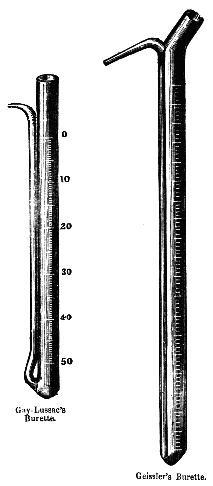
In volumetric analysis the method of taking the readings of the burette is an operation of great importance, requiring considerable method and practice.
The first proceeding is to bring the eye to a level with the fluid, and to adopt a fixed and unalterable standard of what is to be considered the surface.
If you hold a burette partly filled with water between the eye and a strongly illumined wall, the surface of the fluid presents the appearance shown in fig. a. If you hold close behind the tube a sheet of white paper with a strong light falling on it, the surface of the fluid will present an appearance similar to that shown in fig. b.
In both cases you have read off at the lower border of the dark zone, this being the most distinctly marked line. Its distinctness may be heightened by adopting Mohr’s contrivance which consists in pasting on a sheet of very white cardboard a broad strip of black paper, and when reading off holding this close behind the burette in a position to place the border line between white and black from 2 to 3 millimetres below the lower border of the dark zone as shown in figure c.
a. and b.
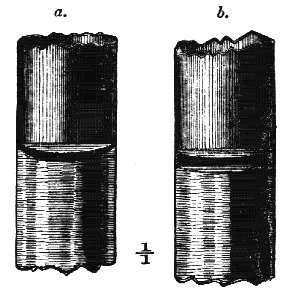
c.
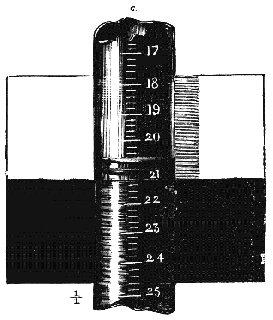
Great care must be taken to hold the paper invariably in the same position, since if it be held lower down, the lower border of the black zone will move higher up.
To test the correctness of the graduation of a burette proceed as follows:—Fill the instrument up to the highest division with water at 60·8° F., then let the cubic centimetres of the liquid flow out into an accurately weighed flask, and determine the weight of these ten cubic centimetres in the usual way; then let another quantity of ten cubic centimetres flow out, and weigh again, and repeat the operation till the contents of the burette are exhausted. If the instrument is correctly graduated, every ten cubic centimetres of water at 60·8° F. must weigh 9·990 grammes.