A CYCLOPÆDIA OF PRACTICAL RECEIPTS, PROCESSES, AND COLLATERAL INFORMATION (continued 13)
Reading edition
Balsam of Umi′′ri. [Nat.] By incision, from the humir′ia floribun′dum (Mart.), or the umiri-plant of Para. It is fragrant, limpid, of a palish-yellow colour, and in its medicinal properties is said to combine those of the balsams of copaiba and Peru.
BALSAM′IC (băl-). Syn. Balsam′icus, Balsa′meus, Balsam′inus, L.; Balsamique, Fr.; Balsamisch, Ger. Of the nature of balsam, or containing or resembling it; bland, soothing, healing; balmy.
BAMBOO′ (-bōō′). [Nat.] Syn. Bambu′sa, L.; Bambon, Fr.; Bambus, Bambusrohr, Indianischer rohr, Ger. The name of several species of the genus ‘bambusa,’ but appr. of b. arundina′cea or ‘common bamboo.’ See Bambusa.
Bamboo′-habit (-hăb-). A species of ‘life-preserver,’ or ‘float,’ used in China and the Indian Archipelago, consisting of four pieces of bamboo tied together so as to form a square.
BAMBU′SA. [Endl.] The bamboo. In botany, a genus of magnificent arborescent grasses, of the nat. order Gramineæ (DC.), having hollow jointed stems, of a hard woody texture, externally coated with siliceous matter, and sometimes secreting a similar siliceous substance (TABASHEER′) in their internal cavities. They are all of rapid growth, and vary in height from 6 to 150 feet.
There, is, perhaps, scarcely any other plant besides the palm which serves for so many purposes useful to man, as the various species of bamboo. Its grain is used for bread; the young shoots are eaten like asparagus, and are also pickled; the smaller stalks are made into walking canes, umbrella and parasol sticks, flutes, &c.; whilst its fibres are manufactured into cloth, and even paper. It is employed extensively in the construction of houses, bridges, masts for boats, domestic furniture, boxes, mats, baskets, utensils of various kinds, fences, water pipes and vessels, quicksilver bottles, &c., and for numerous other purposes connected with everyday life. In localities where ordinary surgical appliances are not at hand, splints, of any required length or size, can be made with very little delay, from the stems of the bamboo. The older and drier stems are to be preferred for this purpose. The genus is confined to the East and West Indies and tropical America. See Cane, Pickles, Tabasheer, &c.
BANA′NA (nā′- or -nah′-). [Nat.] The mu′sa sapien′tum (Linn.), a species of plantain; also its fruit. The Banana contains about 27 per cent. of solid matter, and has nearly the same nutritive value as rice. It is largely consumed in the tropics, where the common allowance for a labourer is 61⁄2 lbs. of the fresh fruit or 2 lbs. of the dry meal, with a quarter of a pound of salt meat or fish. It is sometimes fried in slices and often made into preserves.
Composition of the Pulp of Ripe Bananas (Corenwinder).
Nitrogenous matter4·820
Sugar, pectose, organic acid, and traces of starch19·657
Fatty matter0·632
Cellulose0·200
Saline matter0·791
Water73·900
————
100·000
See Plantain.
BANCOUL, NUTS OF. This nut is the seed of a tree belonging to the Euphorbiaciæ, of which two or three species occur in Ceylon, Cochin-China, New Caledonia, Bourbon, &c. It is composed of a hard and woody endocarp, and of an oily kernel, containing:—
Water5·000
Oil62·175
Nitrogenous matter22·653
Non-nitrogenous matter6·827
Mineral matter3·345
————
100·000
Nitrogen3·625%
This cake, after expression of the oil, contains 9 per cent. of nitrogen, and 4 per cent. of phosphoric acid, and is consequently of high value as a manure. The expressed oil is purgative, but as a lamp-oil it is superior to colza. Unfortunately the kernel forms only 33 per cent. of the entire weight of the nut. Hence, before it can become an article of commerce, it must be decorticated at the place of its birth. (Corenwinder.)
BAND′AGE (āje). Syn. Deliga′tio, Fas′′cia, Liga′men, Ligatu′′ra, Vinctu′′ra, L.; Bandage, Bande, Fr.; Binde, Verband, Ger. In surgery, the fillet, roller, or cloths, used to support parts, to exert pressure on them, or to retain dressings in their proper places.
Bandages are usually formed of long narrow slips of calico or linen, and, occasionally, of flannel, which are generally made into a roll (ROLLER) of moderate size, so as to be the more conveniently handled and applied. They are either SIMPLE, as the cir′cular, the spīral, or the unīt′ing bandage; or COMPOUND, as the T-bandage, suspen′sory b., &c.
The application of bandages, as in the dressing of wounds, ulcers, &c., though of such frequent occurrence, is often very carelessly and badly done. The form and nature of the part, and the object in view, should always receive consideration; as should also the condition of the patient after their application—whether of repose, exercise, or labour. Ordinary ingenuity will supply the rest. The safest, simplest, and most effective means of fastening them is, in most cases, furnished by a common needle and thread or cotton.
Bandage, Mus′tard. A woollen roller soaked in a mixture of the best flour of mustard and warm water, of the consistence of fresh cream, the excess of moisture being expelled by gentle pressure.—Used to envelope the body, or a limb, by repeatedly folding it round the part; in the cold stages of cholera, and in other cases requiring an energetic stimulant. Other medicaments, particularly those of a stimulating and anodyne character, are sometimes applied in the same manner. See Embrocations, Lotions, Poultices, &c.
BANDAN′A. [Ind.] Syn. Bandan′na. A handkerchief, originally from the East Indies, having white spots on a red, blue, or other dark ground. In calico-printing, a ‘discharge style’ in imitation of the Indian bandanas. The fabric, many folds thick, is placed between leaden plates having the pattern cut out of them; hydraulic pressure is then applied, and a clear solution of chloride of lime forced through, followed by a stream of pure water.
BAND′OLINE (-lĭn; -lēne‡). See Fixature.
BANE. Poison; anything deleterious or destructive; a word often found joined to another, in the popular and vulgar names of plants and disease, to denote their character; as BANE′-BERRY, the herb Christopher; BANE′-WORT, deadly-nightshade; SHEEP’S BANE, the rot; &c.
BANG, Bangue (băng′). [Nat.] See Hemp, Indian.
BAN′IAN (băn′-yăn). The fi′cus In′dicus (Linn.), or Indian fig. The fruit and young branches yield one species of gum-lac; and both the juice and bark are used medicinally.
Among sailors, BANIAN′ DAYS are those on which butcher’s meat is not served up at dinner.
BANN′OCK (-ŭk). In Scotland and the northern counties of England, a flat round cake made of oat, rye, or barley meal, baked on an iron plate over the fire, or on the hot hearth.
BARBS. Syn. Lampas, Skew. This occurs in horses from two to four years old, and arises from a little inflammation of the ridges that pass along the palate, above and behind the incisor teeth, occasionally preventing the animal from eating and setting up slight fever. The best treatment is to scarify the enlarged ridges freely with a lancet or penknife, and to give for a time bran mashes, soaked grain, and other soft food.
BAR′BERRY. Syn. Pep′peridge-bush‡, Thorny box′-tree*; Ber′beris, B. vulga′′ris (Linn.), L.; Epine-vinette, Vinettier, Fr.; Berberitze, Ger. A perennial bush or shrub common in woods and hedges. Berries (BAR′BERRIES, PEP′PERIDGES), gratefully acid, cooling, and astringent; used in pastry, but require, according to their degree of ripeness, from one half their weight to an equal weight of sugar. Both bark and berries were formerly esteemed in jaundice, biliary flukes, &c. The crushed berries with water form a refreshing fever-drink. The root dyes a fugitive yellow. See Berberine, Jams, Preserves, &c.
BAREGE (barège, băr-rāzhe’). [Fr.] A light woollen fabric so named from having been first made in the valley of Barèges. Of late years Paris has become celebrated for its barèges; but these are generally woven with the ‘warp’ of silk, and the ‘woof’ of wool. In the common imitations of the shops, the ‘warp’ is generally of cotton.
BAREGINE (barégine). See Glairine.
BARIL′LA. [Eng., Ger., L., Sp.] Syn. So′dæ car′bonas vena′le, L.; Barig′′lia, Baril′lor, Sp., Lev.; Barille, Soude, Fr. The alkaline residuum of the combustion of salsola, salicornia, chenopodium, and other species of the order Chenopodiaceæ. These plants, which are cultivated on the sea-coast for the purpose, are cut down when ripe, dried, and burned in heaps, on iron bars laid across pits dug in the earth. The alkali and saline matter contained in them is thus fused, and flows into the cavity below, forming, when cold, a hard grey or bluish porous mass which is BARILLA.
Comp. Carbonate, sulphate, chloride, and sulphide of sodium, carbonate and sulphate of calcium, alumina, silica, oxide of iron, and imperfectly consumed carbonaceous matter, with a little iodine and bromine. The proportion of soda varies in different varieties:—
Alicant’ barilla; obtained chiefly from several species of salso′la and from chenopo′dium setig′erum (-tĭj′-), &c.; contains from 25% to 40% of carbonate of soda. (Guibourt.)
Cana′′ry b.; from salso′la ka′li. (Loudon.) French barillas:—
a. Narbonne’ b., salicor; from salicor′nia ann′ua or herba′cea; contains 14% to 15% of carbonate of soda.
b. B. of aiguemortes, blanquette; from mixed plants; contains 3% to 8% of carbonate of soda. (Guibourt.)
c. Nor′mandy b., N. soda; from fuci.
Sic′ily barilla (sĭs′-). Principally from salso′la sati′va; furnishes 55% of carbonate of soda. (Fée.)
Good barilla, on the average, contains about 20% of real or available alkali, chiefly under the form of carbonate, besides sulphates, muriates, &c.
Assay. See Alkalimetry.
Uses, &c. Barilla is chiefly used in the manufacture of soap and glass; but the gross quantity imported, though annually increasing, only reached 54,608 cwt. in 1856; whilst the exports of soda in the same year reached to about 1,500,000 cwt., and in 1859 to above 2,000,000 cwt. This enormous quantity was chiefly furnished by our home manufactories.
Barilla is chiefly imported from Spain, Sicily, Teneriffe, and the Levant; but since the introduction of Le Blanc’s process for obtaining soda from common salt, its importance and value has considerably lessened. See Kelp, Soda, &c.
BARIUM. Ba. A metallic radical or element, of which baryta is the chief oxide, and somewhat extensively distributed. First obtained in 1808 by Sir H. Davy. Prepared from baryta by strongly heating it in an iron tube, through which the vapour of potassium is conveyed; the reduced barium being subsequently extracted from the mixed residuum by quicksilver, which is afterwards driven off in a small green-glass retort, in a vapour of mineral naphtha.
Prop., &c. Greyish-white, approaching silver in colour and lustre; decomposes water, and gradually oxidises in the air, with the formation of the ordinary oxide (BARYTA). It is malleable, fusible under a red heat; burns in contact with air with a deep red light, and has the sp. gr. 4·70.
Salts. Barium forms numerous salts, which are all either colourless or white, except a few, whose acids are coloured, as the chromate, manganate, &c. Some of them are soluble in water; one or two only are soluble in alcohol, and that very sparingly; and (with the exception of the sulphate) they are all extremely poisonous. They may be prepared by saturating solutions of the acids with either baryta-water, or carbonate of barium; and some of them may be prepared by double decomposition.
The various soluble barium salts are known by the following reactions, and they are all (except the sulphate) soluble either in water or in dilute hydrochloric acid, except the nitrate and chloride, which are not soluble in aqueous solutions of their respective acids. Their solutions give an immediate heavy white precipitate with dilute sulphuric acid, and with solutions of the sulphates, which is insoluble in dilute acids and solutions of the alkalies and of the salts of ammonia, that with a solution of sulphate of lime being very sensitive, and characteristic:—Hydrofluosilicic acid gives a very characteristic colourless crystalline and quickly subsiding precipitate, only slightly soluble in hydrochloric acid and nitric acid; alcohol, in equal volume, being added, so hastens and completes the reaction, that the filtrate is unaffected by sulphuric acid:—Chromate of potassium gives a bright yellow precipitate in neutral solutions, soluble in hydrochloric acid and in nitric acid, but insoluble in acetic acid:—Caustic potassa or soda (when quite free from carbonate), and caustic ammonia, cause no precipitate, except in highly concentrated solutions:—Alkaline carbonates give a heavy white precipitate with baryta-water or a solution of baryta, and which is all but insoluble in water, and freely soluble in dilute hydrochloric acid:—Heated with proof spirit, or pyroxilic spirit, the barium salts give a greenish-yellow tinge to the flame:—The barium salts, and particularly the chloride, when exposed on a platinum wire to the inner flame of the blowpipe, colour the outer flame yellowish-green:—Insoluble sulphate of barium may be mixed with powdered charcoal, and exposed for a short time to a full red heat, when sulphide of barium will be formed, which is freely soluble in water, and which, after being neutralised with hydrochloric acid, or acetic acid, will yield a solution suitable to the application of the usual tests. The carbonate, and the salts of barium with the organic acids, are all convertible into pure baryta by exposure to a bright red heat.
Baryta is distinguished from lime and from magnesia by its great solubility in hot water, and by the entire insolubility of its sulphate; from strontia, by being precipitated by hydrofluosilicic acid, and by not giving a red colour to the flame of alcohol; from alumina, by its causticity and alkaline reaction, and by not being precipitated from its solution in water by ammonium sulphydrate.
Pois., &c. The sulphate, owing to its insolubility, is the only salt of barium which is not poisonous.—Symp. Nausea, vomiting, pains in the head, ringing in the ears, vertigo, and intermitting cramps and convulsions; the respiration is frequently suspended for several moments, and the pupil is generally dilated. The symptoms, however, often vary, and are not very distinctive.—Treatm., Ant., &c. Vomiting, followed by copious draughts of water soured with sulphuric acid, or sulphate of soda (Glauber-salt) or sulphate of magnesia (Epsom-salt), dissolved in a large quantity of water. When carbonate of barium has been swallowed, a mixture of one of the above sulphates and weak vinegar should be taken after the vomiting, in order that a soluble barium salt may be first formed, on which the alkaline sulphate will act more readily. Subsequent irritation may be soothed by opium or morphia, and antiphlogistics.
Barium, Ac′etate of. Ba(C2H3O2). Syn. Bary′tæ ace′tas, L. Prep. From dilute sulphuric acid, neutralised with carbonate of barium, and the solution evaporated and crystallised. Very soluble in water; insoluble, or nearly so, in rectified spirit.—Uses, Dose, &c. Same as the chloride. It is seldom employed.
Barium, Arse′′niate of. Ba3(PO4)2. Syn. Bary′tæ arse′′nias, L. Prep. A solution of chloride of barium is added to another of arseniate of potassium or sodium, and the precipitate collected, washed, and dried. By dissolving this salt in a solution of arsenic acid, and crystallising, BINARSE′′NIATE OF BARIUM is obtained. Has been recommended in certain skin diseases, and in phthisis complicated with scrofula.—Dose, 1⁄16 to 1⁄4 gr.
Barium, Ar′senite of. Ba(AsO2)2. Syn. Bary′tæ ar′senis, L. Very slightly soluble.—Use, &c. As the last.
Barium, Bromide of. BaBr2. Syn. Ba′′rii bromi′dum, L.; Bromure de baryum, &c., Fr. Prep. Boil a solution of protobromide of iron with moist carbonate of barium, in slight excess; filter, evaporate to dryness, and heat the residuum to redness. By careful evaporation of its aqueous solution it may be obtained in crystals. It is soluble in both alcohol and water, and its physiological properties resemble those of iodide of barium.
Barium, Carbonate of. BaCO3. Syn. Carbonate of Bary′ta; Bary′tæ car′bonas, L.; Carbonate de baryte, &c., Fr.; Kohlensaures, baryt, &c., Ger. A heavy white mass or powder, very nearly insoluble in water, and decomposed by nearly all the acids. It is found in the crude state abundantly in nature, but can only be obtained absolutely pure by adding an alkaline carbonate to a solution of chloride of barium, or by saturating the hydrate with carbonic anhydride, and in either case washing and drying the precipitate. Native carbonate of barium (witherite) is ordered in the pharmacopœias, and is sufficiently pure for making the barium salts, the only purpose to which it is therein applied.
Uses. In pharmacy, &c., chiefly to prepare barium salts. In chemistry, to separate certain metallic oxides when occurring together in solutions. In the arts, as a base for certain delicate colours, as an ingredient in plate-glass, in the manufacture of beet sugar, &c. It is not used in medicine. It is extremely poisonous.
Barium, Bisulphide. This substance may be obtained as a fine yellow-coloured product by shaking a solution of barium chloride with a mixture of ammonium sulphide and carbon disulphide. It is insoluble in alcohol, soluble in water, and rapidly dissolved by slightly acidulated water.
Barium, Chloride of. BaCl2.2Aq. Syn. Chloride of barium; Barii chloridum, L.; Chlorure de baryum, Chlorhydrate de baryte, &c., Fr.; Salzsäure schwererde, Chlorbarium, Ger. Neutralise a hot dilute solution of hydrochloric acid with carbonate of barium, evaporate down, and crystallise. Sulphide of barium can be substituted for the carbonate. If required chemically pure, gaseous hydrochloric acid is transmitted through a concentrated solution of common or impure chloride of barium, as long as a precipitate forms; the resulting crystalline powder, which is nearly the whole of the chloride of barium present, is collected on a filter, and, after draining, is washed repeatedly with small quantities of pure hydrochloric acid, until the washings, diluted with water, and precipitated with sulphuric acid, give a filtrate which, upon evaporation in a platinum capsule or a watch-glass, leaves no residue; the last traces of acid having been removed by a little alcohol applied in a like manner, the powder is at once dried, and then carefully preserved from the air.—Used in analysis.
Prop., &c. Crystals, flat, four-sided tables, colourless and transparent; sometimes double eight-sided pyramids; slightly efflorescent in dry warm air, but otherwise permanent; decrepitate when heated, and lose their water of crystallisation; fuse at a red heat; volatilise at a white heat; insoluble in hydrochloric acid and in alcohol, slightly soluble in rectified spirit, and very soluble in water; water at 60° dissolves 431⁄2% of the crystals, and nearly 37% of the dry salt; and when boiling 75% of the former, and about 66% of the latter; a saturated boiling solution (223° Fahr.) contains 100 parts of water, and 78 parts of the crystallised salt.
The crystals contain 2 atoms of water; and a formula of BaCl2 + 2Aq.
Uses, Phys. eff., &c. In chemistry, it is employed as a test for sulphuric acid and the soluble sulphates. In medicine, it has been employed, both internally and externally, as an alterative, resolvent, and deobstruent, in scrofula, glandular swellings, and enlargements, scirrhous cancer, skin diseases, &c.; and more particularly in the first with marked benefit. In large doses it is poisonous. According to Sir B. Brodie, its action on animals is analogous to that of arsenic. Locally, it acts as an irritant. A very weak solution, used as a lotion, often proves serviceable in herpetic eruptions, and as a collyrium in scrofulous ophthalmia. Dose, 1⁄2 gr. thrice a day, in water, gradually increased to 2 or 3 gr.
Barium, Chlorate of. Ba(ClO3)2. Syn. Chlorate of bary′ta; Bary′tæ chlo′′ras, L. Prep. From a solution of chloric acid neutralised with freshly precipitated carbonate of barium; the resulting solution, after filtration, being crystallised by evaporation.
By passing chlorine through strong milk of hydrate or of carbonate of barium, in the same way as in making chlorate of potassium.
Prop., &c. Soluble in 4 parts of cold water. Used in pyrotechny, and to make chloric acid.
Barium, Ferrocy′anide of. Ba2FeC6N6. Syn. Ba′′rii ferrocyani′dum, L. From pure ferrocyanide of iron digested in baryta water. By careful evaporation, efflorescent prismatic crystals may be obtained, soluble in 41⁄2 parts of water.
Barium, Fluoride of. BaF2. Syn. Ba′′rii fluori′dum, &c., L. A white powder, formed by digesting freshly precipitated carbonate of barium in hydrofluoric acid, in excess.
Barium, Hydrate of. Ba(HO)2. Syn. Hydrate of baryta; Barytæ hydras, L. Prep. By digesting caustic baryta, or barium oxide, with a little water, or igniting gently the crystallised hydrate. It can be obtained crystallised as follows:
1. From a concentrated solution of either nitrate or chloride of barium, precipitated with a rather strong solution of pure potassa, or of pure soda, perfectly free from carbonic acid.
2. A strong solution of sulphide of barium is boiled with successive portions of black oxide of copper, until it ceases to give a black precipitate with a salt of lead; the liquid, after filtration, yields crystals of the hydrate on cooling.
Prop., Uses, &c. Forms a bulky white powder, containing 101⁄2% of water of hydration, which it retains even after ignition. In this state it is soluble in 20 parts of cold water, and in 2 parts of boiling water. The hot saturated solution, as it cools, deposits abundantly columnar crystals (CRYS′TALLISED HYDRATE OF B.), which contain 511⁄2% of water, of which they lose, by drying and ignition, 883⁄4% (= 43⁄4% of their weight), being reduced to the state of the common or amorphous hydrate. Of all the bases it has the strongest affinity for both sulphuric and carbonic acid, and hence its solution (BARY′TA-WATER) and those of its neutral salts (nitrate or chloride) form our most sensitive tests for these substances. Sp. gr. 4·3 to 4·7. The crystallised hydrate is converted into the ordinary hydrate at a gentle heat, and this last fuses at a low red heat without losing its water of hydration, which it only slowly and with difficulty begins to part with at higher temperatures. In chemistry, its uses are, for the most part, similar to those of Barium, Oxide of.
Barium, Iodide of. Ba2I. Syn. Ba′′rii iodi′dum, L.; Iodure de baryum, &c., Fr.
Prep. 1. Dissolve sulphide of barium in water, and add iodine (gradually) in excess; after the reaction is complete, filter, and either evaporate to dryness, or crystallise.
2. Digest freshly precipitated carbonate of barium, in excess, in a hot solution of protiodide of iron; filter and evaporate to dryness; then re-dissolve and crystallise.
3. By saturating hydriodic acid with oxide or carbonate of barium.
Prop., &c. A white or greyish-white mass, or acicular crystals (according to the mode of its preparation); very soluble in water and in alcohol; and decomposed by exposure to the air. It has been highly recommended as an alterative, resolvent, and liquefacient, particularly in scrofula, glandular swellings, chronic inflammations, and the other affections in which chloride of barium and iodine are given.—Dose, 1⁄12th to 1⁄8th gr. (gradually and cautiously increased to 1 gr.), in distilled water, 2 or 3 times a day. Externally, as an ointment (3 or 4 gr., to lard, 1 oz.), as an application to scrofulous swellings. (Biett.) It possesses all the irritant, corrosive, and poisonous properties of the chloride, but in a much more violent degree.
Barium, Nitrate of. Ba(NO3)2. Syn. Nitrate of baryta; Bary′tæ ni′tras, L. Prep. As the acetate or chloride of barium, substituting pure nitric acid for acetic or hydrochloric acid.
Prop., &c. Transparent, colourless octahedrons, which are anhydrous, insoluble in alcohol, and require about 8 parts of cold water, and about 3 parts of boiling water, for solution.
Uses. In chemistry, to prepare baryta, and as a test for sulphuric acid and the soluble sulphates; and in pyrotechny, to give a green tinge to flame.
Barium, Oxalate of. BaC2O4. Syn. Ox′alate of baryta; Bary′tæ ox′alas, L. Prep. By precipitating a barium salt with oxalate of ammonium. Very nearly insoluble.
Barium, Oxide of. BaO. Syn. Baryta, Bary′tes, Cau′stic baryta*, Ox′ide of ba′′rium, Protox′ide of b., Heav′y earth; Baryte, Oxide de barium, Terre pesante†, &c., Fr.; Baryt, Baryterde, Schwererde, &c., Ger. One of the earths discovered by Scheele in 1774.
Sources. Sulphate and carbonate of barium are abundant minerals, forming the ‘vein-stone’ of many lead mines. It is from the latter that baryta and the barium salts are almost exclusively obtained.
Prep. 1. A mixture of carbonate of barium and charcoal (both in fine powder and moistened) is strongly ignited, for some time, in a porcelain, Hessian, or black-lead crucible, and then allowed to cool out of contact with the air, from which it must also be subsequently carefully preserved.
2. (Pure.) Crystallised nitrate of barium is calcined in a capacious covered porcelain or Hessian crucible, at a bright red heat, until red (nitrous) vapours are no longer disengaged, even on raising the temperature; and the residuum, as soon as the temperature has fallen sufficiently, but whilst still warm, is at once transferred to a bottle, as before.
3. M. Rosenthiel’s process is founded upon the decomposition of sulphide of barium dissolved in boiling water by oxide of zinc. Caustic baryta and sulphate of zinc are formed.
Prop. A greyish-white, spongy, earthy-looking mass, fusible only before the oxyhydrogen blowpipe; highly caustic, corrosive, and alkaline, and slaking, like quick-lime, on the addition of water, but with the evolution of more heat.
Barium, Peroxide of. BaO2. Syn. Deutox′ide of barium; Ba′′rii binox′ydum, &c. L.; Binoxide de baryum, &c., Fr. Prep. Pure baryta is heated to full redness in a porcelain tube, and a stream of pure dry oxygen passed over it as long as the gas is absorbed.
Baryta, 4 parts, is heated as above in a platinum crucible, and chlorate of potassium, 1 part, gradually added to it; the chloride of potassium formed along with the binoxide being afterwards washed away with cold water.
Prop., &c. Grey or greyish-white; with water it forms a hydrate, which is slightly soluble in water, and undecomposed by it in the cold. It is interesting chiefly in its relations with peroxide of hydrogen and the oxygenised acids of M. Thénard.
Barium, Phosphate of. Ba(PO4)2. Prep. In a similar manner to the oxalate, which it resembles in being an almost insoluble white powder.
Barium, Sulphate of. BaSO4. Syn. Sulphate of baryta, Heav′y spar, Bolo′′gnian s., Cawk (mi); Bary′tæ sul′phas (Ph. E. & D.), Spa′thium pondero′sum, &c., L.; Sulfate de baryte, Spath pesant, &c., Fr.; Schwefelsaures baryt, Schwerspath, &c., Ger. This salt is found native, often in beautiful tabular crystals, but more frequently in white or reddish-white masses. It is also occasionally prepared artificially, as a pigment and chemical, by decomposing a solution of chloride of barium with dilute sulphuric acid, or with a solution of sulphate of sodium; the resulting precipitate being collected, well washed, and dried.
Prop., &c. When pure, or free from iron, its powder is white. It is insoluble in water, and nearly insoluble in all other menstrua; before the blowpipe it decrepitates, fuses with great difficulty (by which it is distinguished from the sulphates of strontium and calcium), and ultimately melts into a hard, white enamel. Mixed with charcoal, and heated to redness in a covered crucible, it is reduced to sulphide of barium. It is readily decomposed by fusion with alkaline carbonates; also very slightly so by their cold solutions; but ultimately completely, though slowly, by their boiling solutions. Sp. gr. 4·3 to 4·75.
Uses. Chiefly as a pigment (PER′MANENT WHITE), and to adulterate white-lead; for which purposes the native sulphate is commonly well washed, first in very dilute sulphuric acid, and afterwards in pure water, to remove any iron which may contaminate it, and impair its whiteness. It is also used to form sulphide of barium; and, in pyrotechny, instead of the more expensive nitrate.
Barium, Sulphide of. BaS. Syn. Sul′phide of barium, Sul′phuret of baryta; Ba′′rii sulphure′tum, &c., L.; Sulfure de baryum, &c., Fr. Prep. Sulphate of barium, well dried and in fine powder, 3 parts; powdered charcoal or powdered coal, 1 part; the mixture is pressed tightly into an earthen crucible, and the cover being fitted on, it is exposed for 11⁄2 to 2 hours, to a bright red heat; after it has cooled, the black mass thus obtained is powdered, and boiled in water, and the resulting solution allowed to crystallise. Some authorities recommend forming the mixed powders into a stiff paste with oil, or oil of turpentine, before calcination; but this is not at all necessary.
Prop., Uses, &c. Crystals, thin and nearly colourless plates, containing combined water; very soluble in hot water, less so in cold water; and rapidly decomposed by exposure to the air. It is principally used to form the BARIUM SALTS, and in organic analysis. Care should be taken in its preparation to expose the solution to the air as little as possible. Sulphides of a higher grade may be formed by boiling this compound with sulphur; but they possess little practical interest.
Barium, Sulphite of. BaSO3. Syn. Sul′phite of baryta. Prep. By testing a soluble barium salt with sodium sulphite, and washing the precipitate. Insoluble.
Barium, Tartrate of. BaC4H4O6. Syn. Tar′trate of baryta. Prep. Like that of oxalate of barium. White powder. Slightly soluble.
BARK. [Eng., Dan.] Syn. Cor′tex, L.; Écorce, Fr.; Baumrinde, Rinde, Ger. The rind or exterior covering of vegetables, corresponding to the skin of animals. It consists of the—cu′ticle or epiderm′is—cellular substance, containing colouring matter, &c., and—li′ber, the inner or true bark. The last is formed of woody fibre in great quantity, intermixed with cellular tissue. At the commencement of the annual growth of a tree, the bark separates spontaneously from the wood, in order to make room for the new matter forming beneath. It thus increases by yearly layers, and gradually perishes on the outside, owing to distension, from the growth of the interior portion. Its physiological uses are numerous and important. It is the depository of many of the secretions of plants, and it acts as a living filter, separating secretions from each other, and allowing a part of them to pass off horizontally through the medullary processes on their way to the centre of the tree. But its principal offices appear to be to act as a protection to the tender wood, and as a channel for the sap in its descent from the leaves. “True bark only exists in exogens and gymnosperms; in endogens its place is supplied by cortical integuments, which cannot be separated from the adjacent wood, without violence.” (Lindley.)
According to Liebig, the characteristic ingredients found in bark are excrementitious—“substances evidently expelled by the living organism.” True wood yields only ·25% to 2% of ash; whilst the bark of some trees give 6, 10, to 15 times more; and these, like the organic constituents, differ materially in their composition and characters.
The uses of different species of bark in medicine and the arts are well known. Cinchona-bark is invaluable in fevers; OAK-BARK furnishes the tanner with one of the most important materials of his trade; and the tenacious fibres of other varieties are manufactured into cordage and textile fabrics.
Barks should be collected at that season in which they can be most easily separated from the wood, which, with a few exceptions, is late in the spring; because at this time the active principles deposited in their cells are most abundant. Oak-bark, collected in spring, contains four times as much astringent matter as that collected in winter.
Bark. (In medicine.) See Cinchona.
Bark. (In tanning.) See Oak.
Bark, Jes′uit’s. Cinchona-bark.
Bark, Salt of (Essential). See Extracts and Salts.
BAR′LEY. Syn. Hor′deum, L.; Orge, Fr.; Gerste, Ger., Anglo-S. A well-known grain, the produce of several species of the genus hordeum.
Var., Cult., &c. Those principally cultivated in England are—TWO′-ROWED, LONG′-EARED, or COMM′ON BARLEY (hor′deum dis′tichon, Linn.); SPRING′-BARLEY, SQUARE′-B., or BERE (h. vulga′′re, Linn.); and SIX′-ROWED BARLEY, WINTER B., Scotch BERE or BIGG (h. hexas′tichon, Linn.). Put′ney, SPRAT, or BATT′LEDORE B. (h. zeocriton, Linn.), is another species less frequently met with. Of each of the above there are several varieties. In Spain and Sicily, two crops of barley are obtained in a year; but, in countries so far north as Britain, it produces only one, and is a delicate species of grain. In England it is generally adopted as a succession crop on light lands, following turnips or green crops. (Loudon.) The ‘yield’ per acre varies from 28 to 64 bushels, and is usually from 28 to 40 bushels. The average weight per bushel is 50 to 51 lbs.; but the best Norfolk and Essex samples weigh 53 to 54 lbs. per bushel.
Comp. The leading constituents of barley are nearly similar to those of wheat, but it is scarcely so rich in nitrogenised matter. According to Einhof, the ripe SEEDS or GRAINS are composed of—
Meal70·05
Husk18·75
Moisture11·20
———
100·
According to Johnston, average fine BARLEY-MEAL contains—
Starch68·
Albumen, gluten, &c.14·
Fatty matter2·
Ash or saline matter2·
Water14·
———
100·
According to Payen, dried barley possesses the following composition—
Nitrogenous matter12·96
Starch66·43
Dextrin10·00
Fatty matter2·76
Cellulose4·75
Mineral matter3·10
———
100·00
According to Dr Ure, the sp. gr. of English barley is 1·25 to 1·33 (average, 1·235), and the weight of the husk is about 1-6th; that of BIGG, 1·227 to 1·265, and weight of husk, 2-9ths.
The analyses of the following varieties of barley, gave as the composition of the ashes of the grains:—
UnknownChevalier BarleyFrom MoldaviaChevalier Barley
Potash21·1420·7737·557·70
Soda 4·561·060·36
Lime1·651·481·2110·36
Magnesia7·267·4510·171·26
Sesquioxide of iron2·130·511·021·46
Sulphuric acid1·910·790·272·99
Silica30·6832·7324·5670·77
Phosphoric acid28·5331·6938·641·99
Chloride of Sodium1·10 1·471·10
In the ‘Journal of the Agricultural Society’ for 1873 is a report by Messrs Lawes and Gilbert of twenty years’ experiments with barley. The soil of a field at Rothampstead, in which the barley had been grown for twenty years, consisted of heavy loam, with a subsoil of clay resting on chalk, and was previous to the barley being planted almost exhausted by cropping. The produce was found to be greatest during the absence of drought and sudden alterations of temperature, the rather cool but uniform season of 1854 giving the heaviest crops. The yield from farm-yard manure and nitrate of soda was found in dry seasons to be rather larger than that from ammonia salts. Barley manured with phosphates was found to ripen one to two weeks earlier than when the phosphate was omitted.
The average produce per acre of a few of the principal plots is given below. The “ammonium salts” are stated to be a mixture of equal parts of sulphate and chloride; the “alkali salts” consist of the sulphates of potassium, sodium, and magnesium; the “cinerials” consist of alkali salts, plus superphosphate:
KEY: A: Dressed Corn, bushels. B: Straw and Chaff, cwts. C: Total Produce, lbs. D: Corn to 100 Straw. E: Weight per Bushel of Dressed Corn, lbs. F: Produce of second 10 yrs. over or under first 10 yrs, per cwt.
Manures per Acre.ABCDEF
Unmanured.20113⁄4245486·652·3-23·6
Mixed cinerials.271⁄2143⁄8316296·453·4-20·2
Ammonium salts, 200 lbs.321⁄2181⁄2391989·252·1-9·7
Ammonium salts, 200 lbs., and alkali salts.35203⁄4431786·352·8-5·3
Ammonium salts, 200 lbs., and superphosphate.47275⁄8576086·853·5+2·7
Ammonium salts, 200 lbs., and cinerials.461⁄4281⁄2581783·254·0-·3
Rape cake (mean 1300 lbs.)451⁄4267⁄8557187·353·8
Farmyard manure, 14 tons.481⁄4281⁄4593388·554·3+14·8
The authors direct attention to the results obtained by using the cinerial manure alone, as illustrating the unsoundness of the old “mineral theory,” according to which plants were supposed to possess a sufficient source of nitrogen in the atmosphere. They found a greater crop yielded by barley than wheat, when no manures were employed, as well as when cinerials were employed, a fact which they attribute to barley being better able than wheat to supply itself with nitrogen, notwithstanding the deeper roots of the latter. They state that with both wheat and barley the produce is slowly falling off under these circumstances. With ammonium salts alone, and with nitrate of sodium alone, there is much less falling off than when no nitrogenous manure is used. The falling off was least with the nitrate. The nitrate gives a rather larger crop for the same amount of nitrogen supplied, and they found this to hold when both nitrate and ammonia are applied with cinerials. The addition of superphosphate to ammonium salts or sodium nitrate greatly increases the produce; the further addition of potassium, sodium, and magnesium salts they found almost without effect.
The inference was that the barley had obtained an ample supply of potash from the natural soil, but an insufficient supply of phosphoric acid.
When ammonium salts are used alone, and the quantity of ammonia does not exceed 50 lbs. per acre, 3·68 lbs. of ammonia will yield an average increase of 1 bushel of corn and 63 lbs. of straw—total, 115 lbs.; the extremes in 20 years were 2·25-18·05 lbs. When ammonium salts are applied with superphosphate, 2·21 lbs. of ammonia will produce the same result; the extremes were 1·47-5·36 lbs.
Silicate of sodium had been applied for eight years and a half to half the barley plots receiving ammonia; no increase has resulted where ammonia and superphosphate are employed; but on the other three plots an increase had taken place, which, in the case of the plot receiving only ammonia and alkali salts, is very considerable.
The authors think this irregular reaction seems to show that the silicate has not produced its effect by furnishing silica to the crop, but by some reaction upon the plant-food of the soil. The rape cake supplied much more nitrogen than the ammonium salts, and also some phosphates and potash. Rape cake alone gives a better return than either ammonium salts or sodium nitrate applied alone; but when the three manures are mixed with superphosphate, the results for equal amounts of nitrogen show the rape cake to be decidedly inferior. From the above experiments it is inferred that a supply of carbonaceous matter does not increase the crop of barley.
A farm-yard manure containing about 0·64 per cent. of nitrogen supplied far more plant food than any of the other manures. On an average of twenty years it was found that about 8 lbs. of ammonia in the form of dung would produce a bushel of barley, with its equivalent of straw.
In all cases which were comparable it was found that barley appropriates more of the nitrogenous manure than wheat, save with farmyard manure. A large amount of nitrogen applied by manure is not taken up by the crop. Experiments in the barley field proved that large residues from ammonium salts and sodium nitrate show a small but distinct effect upon succeeding crops, the influence extending over many years. From an examination of the drainage waters from lands dressed with the nitrates of ammonium and sodium, the authors conclude that ammonium salts, as well as sodium nitrate, will be more economically applied in the spring than in the winter. Manures containing organic nitrogen are clearly not so liable to loss from drainage.
Experiments were made on the growth of barley after turnips, and also in an ordinary four-course rotation. After growing turnips ten years consecutively with purely cinerial manures, and carting off the produce, the yield of barley was much smaller than in the experimental field, where barley was grown after barley. The turnips, though very small crops, had exhausted the soil of nitrogen to a greater extent than corn crops would have done. On one plot where rape cake had been applied to the turnips, the produce of barley was 81⁄4 bushels more than when none had been used. In the rotation experiments barley was grown after turnips (carted off), and was followed by beans and wheat. In one series all the crops were unmanured; in another the turnips received superphosphate; in a third the turnips received an abundant cinerial and nitrogenous manure.
The mean produce of the six crops of barley obtained in twenty-four years of rotation was as follows:
Character of Rotation.Dressed Corn.Straw and Chaff.
bushels.cwt.
Unmanured continuously383⁄8213⁄4
Superphosphate for turnips only293⁄8161⁄2
Mixed manure for turnips only443⁄8251⁄4
Mean produce of unmanured barley in barley field during the same season211⁄2121⁄8
The unmanured turnips were so very small in quantity, that the barley in the first series was practically grown after a fallow; this barley, however, was a much larger crop than that grown after turnips manured with superphosphate only, the available nitrogen of the soil in this case being exhausted by the turnips.
In the last series the residue of the abundant manure applied to the turnip crop suffices to produce a good crop of barley.
Qual., Uses, &c. Its employment and value as food, and in the manufacture of malt, are well known. It forms good wholesome bread well adapted for persons who live luxuriously; but which, for the abstemious and the delicate, is inferior to that made of wheat, as it is rather less nutritious, and less easy of digestion, and commonly proves laxative to those unaccustomed to its use. Barley-flour and barley-meal are also more perishable than wheat-flour; being very apt to acquire a hot nauseous taste, which even the heat of the oven does not remove. In a medical point of view, barley is regarded as the mildest and least irritating of the cereals. It has always been in high estimation as a demulcent and emollient. The decoction (BAR′LEY-WATER), made with pearl barley, is a common and useful drink in inflammatory diseases, particularly in those of the chest and urinary organs. Among the Ancients, decoctions of barley (κραθη) were the principal aliments and medicines employed in acute diseases.
Barley was extensively cultivated by the Romans and many other nations of antiquity, as well as by the ancient inhabitants of Gaul. The Greeks are said to have trained their athletes on it.
The best tests of the genuineness of barley are its colour, freedom from dust, grit, and insects. The microscope will lead to the detection of any cheaper grains if mixed with it. It is rarely adulterated, although it is said to be extensively used for the purpose of sophisticating wheat, annatto, and roll liquorice.
Barley Starch.
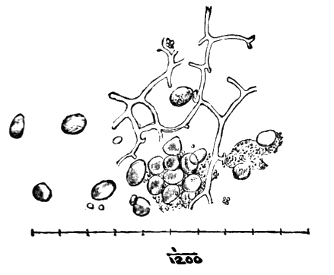
Barley, Cau′stic. Sabadilla.
Barley, Pat′ent. Syn. Fari′na hor′dei, L. Pearl barley reduced to fine powder by grinding in a mill.
Barley, Pearl. Syn. Pearl′ed barley*; Hor′deum decorticatum (B. P.), L.; Orge perlé, Fr.; Perlengraupen, Ger. The seeds of hordeum distichon deprived of the husks. That of commerce is usually made by steaming spring-barley, to soften the skin, then drying it, and grinding it in a mill with the stones set wide apart, so as to round and polish the grains, and to separate the whole of the husk except that left in the furrow of the seed. Scotch pearl-barley and French barley resemble the last, but are smaller, being generally made from winter-barley or bigg. Faro de Orzo is another variety made from sprat-barley. See Barley (above).
Barley, Scotch. Syn. Hulled barley‡, Pot-b.‡; Hor′deum munda′tum, L.; Orge mondé, Fr.; Gerstengraupen, Graupen, Ger. The grains deprived of the husk by a mill, as noticed above, but less completely, and without rounding them.
BAR′LEY SUGAR. See Confectionery, and Sugar.
BARM. See Yeast.
BAROM′ETER (baros, weight; metron, measure). Syn. Weather-glass‡; Barom′etrum, L.; Baromètre, Fr.; Barometer, Wetterglas, Ger. An instrument for measuring the weight or pressure of the atmosphere. It was invented by Torricelli, of Florence, A.D. 1643.
The barometer is made of several forms, but the principle of its construction, with the exception of the aneroid barometer, is the same in each, and essentially consists of a column of fluid (usually mercury) supported in vacuo, in a glass tube, by the pressure of the atmosphere on its surface. The annexed figures exhibit the principal varieties at present known; several of which have been proposed with the view of improving the original instrument, either by increasing its range, or its portability. None, however, equal in simplicity, cheapness, and usefulness, the old forms proposed by Torricelli, and represented by the figs. 1 & 2. To avoid confusion, the graduated scales and cases of the instruments are not shown.
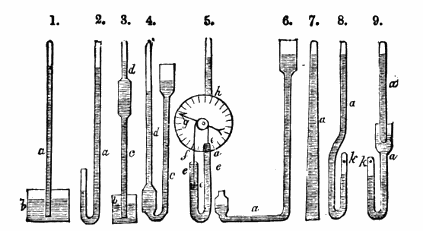
1. Torricelli’s cistern barometer.
2. Torricelli’s syphon barometer.
3. Huygen’s barometer.
4. Huygen’s modified.
5. Wheel barometer.
6. Bernoulli’s syphon barometer.
7. Aminton’s conical barometer.
8. Gay Lussac’s barometer.
9. Gay Lussac’s barometer modified by M. Bunten.
a, Tube containing a column of mercury.
b, Mercurial cistern.
c, A column of mercury supporting another of water, d.
e, e, Weights, one of which floats on the surface of the mercury, and by means of the cord f moves the index g.
h, Graduated dial.
k, Capillary hole drilled laterally to admit air.
The construction of a barometer requires the utmost skill and care of a practised artist, and will therefore be seldom undertaken by the amateur or experimentalist—a fact which renders it unnecessary for us to enter into the details here. In the choice of his instrument the purchaser must greatly depend on the known experience and integrity of the manufacturer; as nothing but lengthened use, and frequent comparisons with other instruments, can possibly prove its excellence. An ordinary barometer, however carefully made, is found to suffer gradual deterioration, from the external air insinuating itself between the mercury and the glass tube, by which the perfection of the vacuum is destroyed. Various plans have been proposed to remedy this inconvenience and source of error. Prof. Daniell forms the bottom part of the tube, to the extent of about
1
⁄
3
rd of an inch, of solid platinum, welded to the glass. This plan has proved completely satisfactory. Dr Ure proposes the use of platinum-foil for the same purpose. Before purchasing an instrument it is as well to ascertain that this has been done. In those called ‘
STANDARD BAROMETERS
’ the scale is movable and adjustable by a delicate screw, so as to enable the observer to bring the lower point or zero (0) of the scale coincident with the surface of the mercury in the cistern. Exact contact is readily effected by making the point, and its image as seen by reflection from the surface of the mercury, to coincide. In this case the cistern is made of glass. Provided the ivory scale be connected with the zero-point with a strip of brass, correction as to temperature is very nearly effected by this simple adjustment. The
WHEEL-BAROMETER
is chiefly serviceable as a domestic or land weather-glass.
Of the many forms of mercurial barometer, that perhaps known as Fortin’s is the best. In this instrument the cistern and the lower portion of the tubes is shown in the annexed figure.
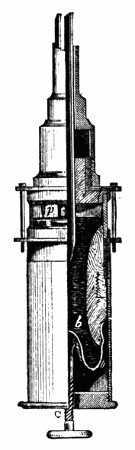
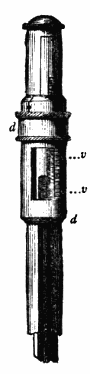
“The cistern is made of boxwood, with a movable leather bottom b b, and a glass cylinder, b, is inserted into it above, all except the glass being encased in brass. In the bottom of the brass box a screw, C, works on the upper end of which the leather rests, so that by elevating or depressing this screw, the bottom of the cistern, and with it the cistern level of the mercury, can also be raised or depressed at pleasure. A small ivory pin, p, ending in a point is fixed to the upper frame of the cistern, and when an observation is made, the surface of the mercury is made to coincide with the point of the pin as the standard level from which the barometric column is to be measured. The tube of the barometer, the upper part of which is shown in the lower figure, is enclosed in one of brass, which has two directly opposite slits in it for showing the height of the column, and on the sides of these the graduation is marked. A brass collar, d, d, slides upon the tube with a vernier, v, v, marked on it for reading the height with the greatest exactness and in which two oblong holes are cut, a little wider than the slits in the brass tube. When a reading is taken the collar is so placed that the last streak of light is cut off by the two upper edges of the holes or until they form a tangent to the convex mercurial curve. By this means the observer is sure that his eye is on a level with the top of the column and that the reading is taken exactly for this point. Fortin’s barometer is generally arranged so as to be portable, in which case the screw, c, is sent in until the mercury fills the whole cistern, by which the air is kept from entering the tube during transport, the leather yielding sufficiently at the same time to allow for expansion for increase of temperature. It packs in a case which serves as a tripod when the instrument is mounted for use. On this tripod it is suspended about the middle, swinging upon two axles at right angles to each other, so that the cistern may act the part of a plummet, in keeping the tube vertical—the position essential to all measurements.”[107]
How to Manage a Barometer.—It is of the first importance to have the instrument hung perfectly perpendicular. This is best effected by means of a plummet line. It should be placed in a good light, but protected from direct sunlight and also from rain. If air should accidentally find its way into a common cistern barometer, it may be got rid of by first fixing the ivory piston, so as to prevent the escape of the mercury, then by means of the screw raising the mercurial column nearly to the top of the tube, then by slowly inverting the instrument and tapping the cistern gently, the air may then perhaps ascend to the cistern and thus escape. In transporting a barometer from place to place it is best to carry it by hand; and if packed it is almost needless to say that the float must be firmly fixed and the mercurial column raised by means of the screw, so as to prevent any escape of the metal.
Reading the Barometer.—The mercury in the cistern must first be brought by means of the screw to the ‘zero,’ and then the vernier must be screwed up so that its horizontal edge forms a tangent to the mercurial curve. The vernier is an instrument for reading off the graduated scale of the barometer correctly to 1⁄100th or 1⁄500th of an inch.
Buchan gives the following description of the vernier and of the method of using it: “It consists (see figures a and b) of a piece similar to the scale of the barometer along which it slides. It will be observed from figure a that ten divisions of the vernier are exactly equal to eleven divisions of the scale, that is, to eleven tenths of an inch. Hence each division of the vernier is equal to a tenth of an inch, together with a tenth of a tenth, or a hundredth, or to ten hundredths, and one hundredth, that is, to eleven hundredths of an inch. Similarly two divisions of the vernier are equal to twenty-two hundredths of an inch, which expressed as a decimal fraction is 0·22 inch, three divisions of the vernier is 0·33 inch, &c. Suppose the vernier set as previously described—that is, having the zero line of the vernier a tangent to the convex curve of the mercury in the column. If the vernier and scale occupy the relative positions as in figure a, then the height of the barometer is 30·00 inches, but if they stand as in figure b, we set about reading it in this way: (1) The zero of the vernier being between 29 and 30, the reading is more than 29 inches, but less than 30 inches, and we obtain the first figure 29 inches. (2) Counting the tenths of an inch from 29 upwards we find that the vernier indicates more than seven tenths and less than eight tenths, giving the second figure seven tenths or 0·7 inch. (3) Casting the eye down the scale to see the point at which a division of the scale and a division of the vernier lie in one and the same straight line, we observe this to take place at line 9 of the vernier; this gives this last figure nine hundredths or 0·09 inch, and placing all these figures in one line we find that the height of the barometer is 29·79 inches. This sort of vernier gives readings true to the hundredth of an inch. If the inch be divided into half tenths or twentieths, and twenty-five divisions of the vernier equal twenty-four divisions of the scale, it follows that the difference of these divisions is two thousandths of an inch.”
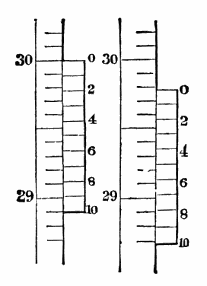
A still more divided vernier is always used with the best barometers, and though a little troublesome to read at first, yet if the method of reading the simpler one just described be understood, the difficulty will be easily overcome.
Uses, &c. The barometer is employed for ascertaining the amount of atmospherical refraction in astronomical calculations, for measuring altitudes, and in prognosticating the weather. For the last purpose, on land, it sometimes proves a false prophet; but at sea, its monitions are highly trustworthy. As a mere weather-glass, the indications, as read off from the scale of the instrument, are generally sufficiently accurate; but in all observations connected with meteorology, altitudes, astronomy, &c., certain corrections must be made; the height of the mercury being influenced both by the size of the tube and by the temperature of the air by which it is surrounded, as well as by variations in the weight or pressure of the atmosphere. (See below.)
Barometrical Corrections:—
1. As to CAPILLARITY:—This applies to all cistern-barometers formed of tubes of very small diameters, owing to the mercury assuming a convex surface in the tube. As the tube increases in diameter, so the depression of the mercury lessens. Hence, the “interior diameter” of a barometer “should, in every case, exceed one-fourth of an inch.” (Brande.) Syphon barometers that have each of their legs of equal size, require no correction, as the depression is equal at both ends.
Table of Barometrical Corrections for Capillarity, from the ‘Encycl. Brit.’
Diam. of Tube.Depression.
·10inch.·1403inch. +
·15”·0863”
·20”·0581”
·25”·0407”
·30”·0292”
·35”·0211”
·40”·0153”
·45”·0112”
·50”·0083”
·60”·0044”
·70”·0023”
·80”·0012”
2. As to TEMPERATURE:—These depend on the expansion of the mercury, and of the scale on which the divisions are marked. The rule for reducing an observed height to the corresponding height at the freezing-point, or 32° Fahr., the usual standard temperature, is—Subtract 1·10000th part of the observed height of the barometer for every degree of Fahr. above 32° at the time of the observation. Or—
(obs. t. - 32) × obs. h. × ·0001 = corr. req.
Measurement of Heights by the Barometer.—When a barometer is at the foot of a mountain, the pressure it sustains is greater than that to which it is subjected at the top, by the weight of the column of air intervening between the top and the bottom.
The height can be obtained from the following table by calculating the number of feet which must have been ascended to cause the observed fall; and then making a correction for temperature by multiplying the number obtained from the table, which may be called A, by the following formula: t is the temperature of the lower and t′ of the upper station:—
1 × ((t + t′ - 64) / ·900) × A.
To lower thebarometerfrom31in. to30=857feet mustbe ascended.
”””30”29=886””
”””29”28=918””
”””28”27=951””
”””27”26=986””
”””26”25=1025””
”””25”24=1068””
”””24”23=1113””
”””23”22=1161””
”””22”21=1216””
”””21”20=1276””
”””20”19=1341””
”””19”18=1413””
A very complex formula is given by mathematicians for finding very nearly the true height of a mountain from barometrical and thermometrical observations made at its base and summit. The following rule by Mr Ellis will be found to give very nearly the same results:—Multiply the difference of the barometric readings by 52,400, and divide by the sum of the barometric readings. If the result be 1000, 2000, 3000, 4000, or 5000, add 0, 0·2, 6, 14, respectively. Subtract 21⁄3rd times the difference of the temperature of the mercury. Multiply the remainder by a number obtained by adding 836 to the sum of the temperatures of the air and dividing by 900. A correction must also be given for latitude, which can be done by the annexed table.
Latitude.Factor.Latitude.Factor.
800·99751351·00090
750·99770301·00265
700·99797251·00170
650·99830201·00203
600·99868151·00230
550·99910101·00249
500·9995451·00261
451·0000001·00265
401·00046
Fortin’s and Gay-Lussac’s barometers are employed for measuring heights. The aneroid can be used for altitudes reaching to 5000 feet. A delicate instrument will register for as small an ascent as 4 feet.
The Barometer as a Weather-glass.—Generally speaking when the mercurial column in the barometer falls, ‘rain’ is indicated, and ‘fair weather’ when it rises. When it continues steady, a continuance of the weather at the time is regarded as the forecast; when low, the weather is generally broken or bad; and when high, it is fair and settled. A storm is usually preceded by a sudden fall in the mercurial column, the violence of the storm being in proportion to the suddenness of the fall. An unsteady barometer indicates an unsettled condition of weather, whilst a gradual change in it indicates the approach of some permanent condition of it. The state and direction of the wind has also to be taken into consideration when studying the changes of the barometer, and forms an important element in the calculations of the meteorologist, each different wind indicating variations of weather. The connection between changes of weather and the pressure of the atmosphere does not seem to have been satisfactorily established.
One of the reasons assigned for the mercurial column in the barometer being lower in wet than in fine weather is that so long as aqueous matter remains in the air in the form of elastic vapour, its tension assists in supporting the barometric column, but that when this aqueous vapour is precipitated in the form of rain, this tension is lost or removed, and the column therefore falls.
The correspondence between wet and fine weather and an elevation and depression of the barometer seems, however, equally, if not more, dependent on the nature of the winds than on the preceding cause. “In western Europe, the south and south-western winds, which are the rain-bringing winds, are warm winds. Now, a column of warm air to be of the same weight as one of cold air must necessarily be higher, but this cannot well be the case in the atmosphere, for no sooner does the warm column rise by its lightness above the surrounding level of the upper surface of the aërial ocean, than it flows over and becomes nearly of the same height as the cold air around it. The interchange taking place less interruptedly, and consequently less slowly, in the higher strata than in those near the ground, it is some time before the equilibrium, thus disturbed, is restored; and meanwhile the barometer keeps low under the pressure of a rarer atmospheric column. On the other hand, the northerly and easterly winds, being comparatively cold and dry, are accompanied by fair weather and a high barometer. It is thus to the warmth, and not to the moisture of these winds, that the pressure is to be ascribed.”[108]
Barometer, An′eroid. An instrument invented, or at least perfected, by M. Vidi, of Paris, in which the pressure of the atmosphere is measured without the employment of a fluid, as in the ordinary barometer.[109] Externally, it somewhat resembles in appearance a carriage clock or a ship’s chronometer; internally, it consists of a small air-tight cylindrical box, formed of thin corrugated copper plates, and partially exhausted of air, the sides of which yield to the pressure of the atmosphere; the effect being regulated by a spring, multiplied by a system of levers, and ultimately recorded by the index on a graduated dial. Compensation for changes of temperature are self-effected, with almost perfect accuracy, by the elastic force of the spring being so adjusted to that of the air in the cylinder, that the loss of force in the one and the increased expansive force of the other shall, independently of changes of atmospheric pressure, preserve the lever in equilibrio.
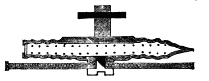
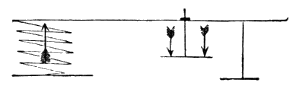
The indications of the aneroid barometer closely correspond to those of the mercurial barometer at ordinary ranges; the differences never exceeding ·01 of an inch. It is so extremely sensitive that an ascent or descent of only a few feet is distinctly indicated by it; whilst its portability adapts it for service in situations for which an ordinary barometer is unfitted. On the other hand, it is liable to move by jerks, and the elasticity of the spring, and consequently the zero-point of the scale, has been found to be sometimes affected by time and a rough journey. On this account it is necessary to compare it occasionally with some standard mercurial barometer, to determine its amount or rate of variation, if any.
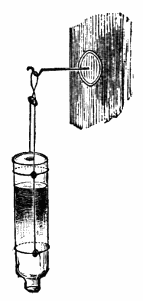
Barometer, Phi′al. This amusing philosophic toy is made by cutting off the rim and part of the neck of a common glass-phial with a file. The phial is then nearly filled with water, either pure or tinged blue or red; and the finger being placed on its mouth, it is inverted, and suspended in a vertical position by means of a piece of twine or wire, when the finger is withdrawn. (See engr.) In dry weather the under surface of the water remains level with the neck of the bottle, or even concave; in damp weather, on the contrary, a drop appears at the mouth and continues enlarging until it falls, and is then followed by another in the same way.
Barometer, Fitzroy. This, which is a very cheap instrument, is made on the syphon principle, but the cistern is formed by the lower limit, which is blown into a bulb.
Barometer, Port′able. The most accurate are those of Gay-Lussac and Bunten, and after them the aneroid. They should be set on universal joints, and well balanced. The common instrument made with a box and leather cistern seldom continues long correct.
Barometer, Wheel. The common form of the instrument having a dial-face and hands.
[For further information in connection with the above subject the reader is referred to the ‘articles’ Aneroid, Atmosphere, Gas, Heights, Steam, Storm-glass, Vapour, Weather, &c.]
BAR′OSCOPE† (-skōpe). [Eng., Fr.] Syn. Barosco′pium, L. A barometer; sometimes applied to the wheel-barometer of Hooke.
BAR′RAS. The concrete resinous exudation from the bark of fir-trees. That from pi′nus marit′ima is called GALIPOT.
BARSE. [Provincial.] The common perch.
BAR′WOOD. A red dye-wood imported from Angola and other parts of Africa. It closely resembles cam-wood and sanders-wood in its colouring matter being of a resinous nature, and scarcely soluble in water. In dyeing this difficulty is obviated by taking advantage of the strong affinity existing between it and the proto-salts of tin and iron. Thus, by strongly impregnating the goods with protochloride of tin, either with or without the addition of sumach, according to the shade of red desired, and then putting them into a boiling bath containing the rasped wood, the colour is rapidly given out and taken up, until the whole of the tin in the fibres of the cloth is saturated, and the goods become of a rich bright hue. In like manner the dark red of bandana handkerchiefs is commonly given by a mordant of acetate of iron followed by a boiling bath of this dye-stuff. See Dyeing, Mordants, &c.
BASALT′ (bă-sŏlt′). [Eng., Ger.] Syn. Basal′tes (-săl′-tēz), L.; Basalte, Fr. In geology, &c., a species of trap-rock, essentially composed of the minerals felspar and augite. It is of a fine compact texture, of a dark-green, grey, or black colour, and usually occurs in regular columns, of which the Giants’ Causeway and the Island of Staffa furnish magnificent examples. It is fusible; and when rapidly cooled forms a dark brittle glass; but when slowly cooled retains its original beauty and hardness almost unimpaired. Messrs Chance, Brothers, of Birmingham, have availed themselves of this property to apply it to decorative and ornamental purposes. Their process is to melt the material[110] in a reverberatory furnace, and, when sufficiently fluid, to pour it into red-hot moulds of sand encased in iron boxes. The corresponding adj. is BASALT′IC (-sōlt′-; BASAL′TICUS, -săl′-, L.; BASALTIQUE, Fr.).
BASE. [Eng., Fr.] Syn. Ba′sis (pl., ba′ses), L., Gr.; Grund, Grundfläche, Ger. In chemistry it was formerly, and is now occasionally, applied to metallic oxides which possess the property of forming salts with acids. The alkaloids are also designated organic bases. In pharmacy, the characteristic or principal ingredient in any medicine or compound preparation; or that on which its qualities or efficacy depends.
BAS′IL (-băz′-). Syn. Sweet bas′il, Cit′ron b.; Basil′icum, L.; Basilic, Fr.; Basilikum, Ger. The oc′ymum (ŏs′-) basil′icum (Linn.), an annual aromatic herbaceous plant, of the nat. ord. Labiatæ (DC.). It is a native of India, but is largely cultivated in every part of Europe as a pot-herb. Leaves strong-scented; popularly reputed emmenagogue; much used to flavour salads, soups, &c., especially in French cookery. Mock-turtle soup derives its peculiar flavour from this herb; as also did the original Fetter-lane sausages, once so highly esteemed by cockney gourmands. In India it is commonly employed as an anodyne in childbirth.
Bas′il (băz′-). Syn. Bas′an; Basane, Fr. A sheep-skin, tanned; particularly one dressed on the grain side, for book-binding.
BASIL′ICON. See Cerates and Ointments.
BAS′KET (băs′-). Syn. Coph′inus (kŏf′-), L.; Panier, Corbeille, &c., Fr.; Korb, Ger. Baskets are generally STAINED or COLOURED with the simple liquid dyes used for straw or wood; and that, for variegated work, the twigs, after being carefully peeled, washed, and wiped dry or slightly air-dried, are stained before being woven. See Osiers, &c.
BASS‡. [Provin.] The linden-tree; also a hassock or mat made of its inner bark. See Bast.
Bassia butyracea. A tree growing in the sub-tropical Himalayas. The seeds yield by expression a concrete oil, known by the name of Fulwa Butter, which does not become rancid by keeping. It is held in high esteem in India as an external application in rheumatic and other painful maladies.
BAS′SORIN (-rĭn). Syn. Bassori′na, L. A substance first noticed, by Vauquelin, in Bas′sora-gum. See Gum, Insoluble, Tragacanthine, &c.
BAST (băst). Syn. Bass (which see). The inner bark of the linden tree or tiel tree; also matting, &c., made of it.
BAS′TARDS (-tărdz). Syn. Bas′tard Sug′ar (shŏŏg′-), Pieces, &c. In sugar-refining, impure or damaged sugar resulting from the heat and chemicals used in the process of manufacture, and which will not pay for purifying.
BA′′SYL (bāse′ĭl). In chemistry, any simple or compound body, acting as a basic radical.
BATATA [Convolvulus batatas, or Sweet Potato]. This is a native of the East Indies, but is now cultivated in all tropical and sub-tropical countries for the sake of its tubers, which are highly esteemed as an article of food. They are eaten either roasted or boiled, and are sweet, wholesome, and nutritious, although somewhat laxative.
In some parts of America the Batata, next to maize, forms the principal diet of the poorer classes. The plant was introduced into England by Sir Francis Drake and Sir John Hawkins; but they do not bear the cold of our winters, and if grown here are raised in hot-houses, where they may be obtained without difficulty varying from 1 lb. to 2 lbs. in weight. They thrive better in the south of Europe. The tubers contain about 32 per cent. of solid matter, 16 of which is starch, 10 sugar, 1·5 albumen, 1·1 gum, 0·3 fat, 2·9 mineral matter. The leaves are used as a boiled vegetable.
BATH (bahth). Syn. Bal′neum, L.; Bain, Fr.; Bad, Ger., Sax. A place for bathing; a vessel or receptacle, natural or artificial, containing or adapted to contain water, and used to bathe in. In architecture and hygiene, a building fitted up for and appropriated to bathing.
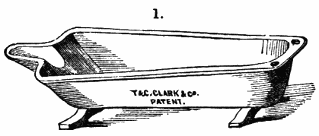
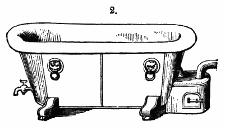
Constr., &c. Here one of the first subjects which must engage our attention is the selection of the material of which the bath is to be formed. For FIXED BATHS polished white marble has always been in favour, owing to its cleanliness and beauty. For this purpose, slabs of sufficient thickness and free from flaws or cracks should be chosen; and they should be securely and properly bedded in good water-tight cement, in a well-seasoned wooden case. The objections to marble, independent of its costliness, are, that it is apt to get yellow or discoloured, and to lose its polish, by frequent and careless use; and that the restoration of its surface to its original purity, is a matter of considerable expense and difficulty. It is also only fitted to contain water with, at the most, soap, weak alkalies or alkaline carbonates, aromatics, or neutral organic principles; and cannot be employed with water medicated, however slightly, with acids, sulphurets, iodine, chlorine, salines (others than those just named), or calorific substances. As a cheaper material thick slabs of Welsh slate are often substituted for marble; but even this substance is attacked by chemicals, though much more slowly. A lining of large Dutch tiles is sometimes used: but here the joints are very apt to leak. For baths adapted to all the requirements of health and disease, and which are at the same time durable and comparatively inexpensive, we must, therefore, seek further. Porcelain, glass, and hard glazed stone-ware have been proposed, and are even sometimes used for baths; but they possess the disadvantages of being fragile, and very liable to crack when filled with hot water in cold weather. Wedgewood-ware is very beautiful and durable; but is expensive, and baths formed of it can only be obtained on special order. Stourbridge-ware, as produced of late years, is the only product of the potter’s art that appears entirely to meet the case; but even this yields in durability to enamelled iron as a material for baths adapted to all liquids and temperatures, and to rough or careless usage. (See engr. 1.) The better qualities of PORT′ABLE BATHS (see engr. 2) are generally made of copper. Stout tinned or galvanised iron, and even stout block-tin thickly covered with waterproof paint or japan, are also employed; but though less expensive than copper, they have the disadvantage of being much less durable. All these substances are, however, readily acted on by chemicals. A durable and cheap portable bath, adapted to all purposes, must, therefore, like a fixed one, be made of one or other of the materials already noticed. For MED′ICATED BATHS large wooden troughs are frequently employed, particularly for acidulated, ioduretted, and sulphuretted baths.
1.
2.
The arrangements for supplying cold and hot water must necessarily greatly depend on circumstances, and the quantity required. For a single fixed bath, or even for two or three of them, the common circulating water-heater or boiler, placed in some apartment on a rather lower level than the bath, is, perhaps, the most convenient; but where this is not attainable the water may be run, by means of a pipe, from a boiler situated on a somewhat higher level. In either case a supply of cold water must also be at hand, and conveyed in a like manner, to enable the bath to be reduced to any required temperature. On the large scale, as in our public baths, where numerous baths are in constant use during the day, the hot water is best supplied from a large cistern somewhere above the level of the bath-rooms, and which is heated by a coil of pipe supplied with high-pressure steam from a boiler situated on a lower level, as the ground floor or basement. The hot and the cold water, conveyed by separate pipes of about 11⁄2 inch diameter, unite in a two-way cock close to the bath, so as to enter it together, by which only one aperture in the end of the bath is required for the purpose. The bath is emptied, and excess of water removed, by a grated aperture in the bottom, also stopped by a cock which, like the former, has handles or keys so placed as to be accessible to the attendant outside the bath-room, as well as to the bather, whilst the danger of overflowing is obviated by a two-inch waste-pipe, opening into the bath at about two inches from the top.
For heating portable baths, so many plans are in use, and have been suggested, and even patented, that the reader cannot possibly be at a loss for one to suit his particular case. A small grate for burning charcoal is the one most commonly adopted; but where attainable, a ring or cross of small inflamed gas-jets, is more cleanly and manageable.
When the bath consists of a wooden tub, or any other deep vessel, a simple and inexpensive apparatus brought out in America, under the title of the ‘Ital′ian bath′-warmer’ (see engr. 3), and made of thin sheet-iron, will occasionally be found useful.[111]
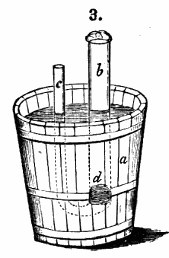
a, Bath-tub.
b, The larger arm of the warming-tube by which the charcoal is introduced, and by which the fumes fly off.
c, The smaller arm to admit air to support the combustion.
d, The fire grate, to support the burning charcoal.
This situation and the minor details connected with the comfort and convenience of the bath, must greatly depend on the character of the building, and the sum to be devoted to the purpose. When possible, the bath-room should always be on the same floor as the bedrooms, of easy access to them, and so situated and arranged, that a plentiful and constant supply of pure water can be ensured, and the waste water removed without trouble or inconvenience. The basement story should always be avoided; for, as observed by Dr Ure, there is a coldness and dampness belonging to it, in almost all weathers, which is neither agreeable nor salubrious.
The ranges of the temperature of water appropriate to the respective baths, according to the common nomenclature, are shown in the following Table:—
Name.Temperature. Fahr.
Cold bath33°to75°
Temperate bath75”82
Tepid bath82”90
Warm bath90”98
Hot bath98”112
Concluding Remarks. The importance, and indeed the absolute necessity of frequent personal ablution, has been already insisted on and explained. But however important and beneficial the use of water in this way may be, the effects arising from the immersion of the body in that liquid, as in the practice of bathing, are far more extensive and complete. What the one does usefully but not completely, the other accomplishes readily, satisfactorily, and perfectly. There is no absolute succedaneum for the entire bath. Its physiological effects are peculiar to itself, and of the utmost importance in pathology and hygiene. The practice of wearing flannel, the daily use of clean linen, the mere washing of the more exposed parts of the body, are but poor attempts at cleanliness, without the occasional, if not frequent, entire submersion of the body in water. Nor should the action of judicious bathing in the promotion of personal comfort and personal beauty be forgotten. Intellectual and moral vigour are also gradually, but materially, influenced and promoted by the beneficial action of bathing on the system; for mind and conscience being linked to matter in the ‘house we live in,’ become perturbed, or lethargic, in almost exact accordance with the fluctuations of our physical health. The neglect of bathing in this country is, to us, an absolute enigma. We are always talking about health, and continually professing to be seeking it; but the practical applications of the principles which we advocate, and the doctrines which we teach, are, unfortunately, the exceptions and not the rule.
Our recommendation of bathing applies chiefly to the warm bath and the tepid bath, which are alike adapted to the delicate and the robust, and to every condition of climate and season. Cold bathing, in this climate, is only suited to the most healthy and vigorous, and can only be safely practised during the warmer months of the year, and in a mass of water sufficient to permit of the heat of the body being maintained by swimming or other active exercise. The plunge and shower baths are partial exceptions to these remarks; whilst sea-bathing, for the reasons given elsewhere, comes under another category. This last, “on account of its stimulative and penetrating power, may be placed at the head of those means which regard the care of the skin; and it certainly supplies one of the first wants of the present generation, by opening the pores, and thereby re-invigorating the whole nervous system.” “Besides its great power in cases of disease, it may be employed by those who are perfectly well, as the means most agreeable to nature for strengthening the body and preserving the health.” Another important advantage which sea-bathing has over bathing in fresh water is, that persons seldom take cold from indulging in it.
For old people, or those of middle age, the cold bath is not to be recommended, or if taken, considerable caution is required in using it. By such persons, also, bathing in very hot weather, or in the sea, should likewise be prudently practised. For these, the warm or tepid sponge-bath will be found the much safer method.
It sometimes happens that, both with the old and young, the cold bath gives rise to headache, palpitation, shortness of breath, loss of appetite, or great languor. Whenever any of these effects are produced, the bath should be at once given up.
The best time for taking a cold hath or for swimming is in the morning, not too early, but when the sun is well up. Immersion is best practised after a light meal, but not immediately following one. After breakfast, from 10 a.m. to noon, are the preferable hours. Should the bather be unable to swim, when going into the sea or into a river, he should keep briskly moving all the time his body is immersed in the water. If in a room bodily friction must be substituted for exercise. A desirable glow may often be produced by rubbing the body with either a rough towel, a flesh-brush, or a pair of horsehair gloves.
The above remarks are meant to apply only to persons in average health.
Weakly and delicate persons, even without any disease about them, would always do well to consult their medical adviser before taking to cold bathing.
We may add, that for bathing to produce its best effects the water should be soft and pure, and good soap sparingly, but regularly, employed whenever the skin requires it. See Ablution and Wash-houses.
The medical and hygienic properties of baths are noticed below, under their respective names:—
Bath. In chemistry, &c., a vessel or apparatus containing some medium in which the vessel holding the substance to be heated is immersed, instead of being exposed to the direct action of the fire; by which means a limited and uniform temperature may be ensured.
The highest temperature that can be given to any substance contained in a vessel placed in another of boiling water, is about 205° or 206° Fahr.; but by adding 1⁄5th part of common salt to the bath, a heat of fully 212° may be obtained. Baths of fusible metal, saturated solutions of salt, sand, and (on the large scale) steam, are also used for the same purpose. A bath of oil may be safely heated to about 500° Fahr. without suffering decomposition, and will be found an exceedingly appropriate and convenient source of heat in many processes. The simplest and most convenient form of water bath is that afforded by raising water to the boiling point in a copper basin placed over a gas lamp, and supporting the vessel to be heated over the basin, by means of a circular hoop of copper resting on the top of the basin. By this means the lower surface of the dish or vessel to be heated is brought in contact with the steam. Copper basins, fitted with a series of concentric copper rings, so as to render the basin capable of supporting dishes of different sizes, are made for this purpose.
For drying many substances an air bath is required. The accompanying cut represents a convenient form of air bath. It consists of a cylindrical copper vessel (A), the cover of which is moveable, and has two apertures, the middle one (E) serving for the escape of vapour, and the lateral one (C) for the insertion of a thermometer. The vessel holding the substance to be heated rests on a ring within the box, supported on a tripod.
A larger air bath, by means of which several small vessels can be heated at once, is seen below.
Air-baths are sometimes surrounded with a jacket, and may be converted into water or oil baths, according as the jacket is filled with either of the fluids. For a Table of Boiling-points, see Ebullition.
An air-bath of constant temperature between 100° and 200° C. has been contrived by Sprengel. It consists of an ordinary hot-water oven made of sheet-lead autogenously soldered, and filled with dilute sulphuric acid boiling at the required temperature.
In order that the temperature may remain constant, the water which distils from the dilute sulphuric acid is condensed and allowed to flow back again into the bath by means of a worm of lead cooled by the atmosphere, or a long vertical metal or glass tube.
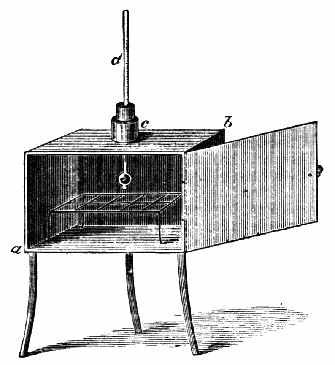
Bath. In medicine, the medium in which the body, or a part of it, is bathed or immersed, for some object beyond that of mere personal cleanliness or enjoyment; the composition, use, or temperature of the medium being generally indicated by some epithet, as in the instances below. When only the last is pointed out, pure water is, of course, intended to be used.
Baths are divided by medical writers into classes, and even minor subdivisions, in a manner which is more ingenious than useful. They are said to be SIMPLE when water or its vapour forms the bath; and COMPOUND when the water or vapour is medicated by the addition of other substances (COM′POUND BATHS; BAL′NEA COMPOS′ITA, L.). The latter class is also subdivided into THERAPEU′TIC BATHS (MED′ICATED BATHS; BAL′NEA MEDICA′TA, B. THERAPEU′TICA, L.); and NUTRIT′IVE BATHS (B. NUTRIEN′TIA, B. NUTRI′′TIA*, B. NUTRITO′′RIA*, L.). Thus, besides the ordinary water and vapour baths, the medical uses of which are hereafter noticed, we have WINE′-BATHS, MILK′-BATHS, SOUP′-BATHS, &c. (used to convey nourishment, or to sustain the body, as in occlusion of the œsophagus, certain diseases of the stomach, &c.); CHLO′′RINE BATHS, SUL′PHUROUS B., MERCU′′RIAL B., &c. (used in skin diseases, syphilis, &c.); AROMAT′IC and CHALYB′EATE BATHS (employed as tonics); and ACID BATHS (sometimes used to remove the effects of mercury).
On the Continent a variety of substances are employed to medicate baths, which are seldom or never so used in this country.
The quantity of any medicinal substance used to medicate a bath, for an adult, may be, in general, for each gallon of water employed, about the same as that which is used to form a half-pint lotion of medium or rather weak strength. Thus; taking the quantity of bichloride of mercury to form the lotion at 5 gr., and that of sulphurated potash at 1⁄2 dr., the quantity required for a bath of 30 to 40 galls. will be about 21⁄2 dr. of the first, and about 13⁄4 oz. of the second of these substances. Much, however, depends on the nature of the case, the length of the immersion, the periods of recurrence, and the intended number of repetitions. In the case of very active remedies it will be safest and best to begin with less than (say 1⁄4 to 1⁄3) the quantity thus indicated.
Medicated baths are, in nearly all cases, taken warm or fully tepid.
⁂ In the following baths the quantity of the ingredients ordered, when not otherwise indicated, is that proper for an ordinary full-sized bath for an adult; viz., from 40 to 60 galls. Those which do not contain volatile substances may be used more than once; and many of them several times by adding a small quantity of fresh ingredients to keep up their strength.
Bath, Acid (ăs′-). Syn. Bal′neum ac′idum (ăs′-), L. See Hydrochloric, Nitric, Nitro-hydrochloric, and Sulphuric Acid Baths (below). Enamelled, hard-glazed, or wooden vessels must be used with all of them.
Bath, Air. Syn. Bal′neum pneumat′icum, L.:—a. (Cold.) Simple exposure of the body, in a state of nudity, for a short time to the atmosphere. Tonic, anodyne, and sedative; in febrile excitement, nervous irritability, and restlessness accompanied by a quick or full pulse, &c. Safe and often very effective. It will frequently induce sleep when all other means fail.
b. (Hot:—Assa, A. suda′tio, L.) An apartment to which dry heated air is admitted. Sometimes the arrangement is such that the air is not inhaled. Stimulant; sudorific; more so than even the vapour bath; produces copious perspiration, being, indeed, the most powerful and certain diaphoretic known. It has been advantageously employed in cholera (for which its advocates state that it is almost a specific), congestive fevers, chronic rheumatism, contractions, stiff joints, paralysis, scaly skin-diseases, dropsical swellings, and most of the cases in which the vapour bath is usually employed. The temperatures are—as a sudorific, 85° to 105° Fahr.; as a stimulant, 100° to 130°. When not inhaled it may be often raised, with advantage, 15° to 25° higher. See Bath, Turkish.
c. (Compressed.) Recommended, by M. Tarberie, in aphonia, &c. It has recently been employed in asthma, phthisis, and some other like diseases, with extraordinary success, at Ben Rhydding.
d. (Rarefied.) Applied locally. Revulsive; resembles CUPPING, DRY (which see).
Bath, Al′kaline. Syn. Al′kalised bath; Bal′neum alkali′num, B. alkaliza′tum, L. Carbonate of potash (salt of tartar), 3⁄4 lb. In itch, prurigo and chronic skin diseases accompanied with dryness and irritation, acute gout, lithic gravel, scurvy, diarrhœa, &c. Scotch soda, 1 lb., is sometimes substituted for the ‘potash’; but is less effective, and is theoretically objectionable.
Bath, Al′um. Syn. Bal′neum alu′minis, L. Alum (in powder, or previously dissolved in hot water), 3⁄4 lb. to 11⁄2 lb., or even 2 lbs. In troublesome excoriations, extensive burns, obstinate vesicular eruptions, diarrhœa, &c.; also in obstinate piles and prolapsus ani. See Bath, Astringent.
Bath, Ammoni′acal. See Hydrochlorate of Ammonia Bath (below).
Bath, Animal. Syn. Bal′neum anima′le, L. The skin or any part of an animal just killed, wrapped round the body or a limb. Once much esteemed; now, happily, disused in this country.
Bath, Antimo′′nial. Syn. Bal′neum antimonia′le, L. Tartar-emetic, 1 to 2 oz. (Soubeiran.) In lumbago and certain skin diseases; also as a counter-irritant.
Bath, Antipso′′ric. Syn. Bal′neum antipso′′ricum, L. See Bath, Sulphuretted (also others).
Bath, Aromat′ic. Syn. Bal′neum aromat′icum, L. Balm, chamomile, lavender, mint, rosemary, sage, thyme, with any other like aromatic herbs (at will), of each a handful, mixed together and steeped in a (covered) pail of boiling or very hot water, for an hour, and then strained, with pressure, into the bath. Sometimes 2 or 3 oz. of sal-ammonia, a 1⁄4 lb. of alum, or 1 lb. of common salt, is also added. Occasionally used in cutaneous affections, chronic rheumatism, diarrhœa, dyspepsia, stiff-joints, &c.; also in debility arising from loss of blood, spermatorrhœa, suppressions, hysteria, hypochondriasis, &c.
The AROMATIC VAPOUR BATH is made by causing the vapour to pass through the herbs.
Baths, Aromatic Malt (J. Hoff, Berlin). Wittstein says these consist of coarsely crushed barley malt at six times its selling value.
Bath, Astrin′gent. Syn. Bal′neum astrin′gens, L. Prep. (Most.) Alum (2 to) 4 lbs.; dissolve in boiling water; and add, whey, 6 or 8 pailfuls, or q. s. In extensive burns, piles, prolapsus ani, &c. See Bath, Alum, Bath, Oakbark, &c.
Bath, Balsamic. Syn. Bal′neum balsam′inum, L. Bordeaux turpentine and tar, of each 2 lbs. (or of tar alone, 3 to 4 lbs.); hot water, 6 or 7 galls.; stir continuously until nearly cold, then add the clear portion to water q. s. to form a bath. In mumps, pruriginous diseases of the skin, eczema, impetigo, &c.
Bath, Barèges (Factitious). Syn. Bal′neum Baretginen′se (Factitium), L. Prep. 1. Crystallised sulphide of sodium, 31⁄2 oz.; chloride of sodium, 11⁄2 oz.; gelatine (dissolved), 4 oz.
2. (Trousseau & Reveil.) Dry sulphide of potassium, 4 oz.; water, 16 oz.; dissolve, and add the solution to the bath; then further add, of sulphuric or hydrochloric acid, 1⁄2 oz., previously diluted with water, 8 oz. In itch, moist skin diseases, chronic diarrhœa, chronic rheumatism, lead colic, &c. See Balls, Waters, &c.
Bath, Benzo′ic. Syn. Bal′neum benzo′icum, L. 1. Benzoin (in powder), 1⁄2 lb.; water (at 90°) q. s. In irritations, hysteria, hypochondriasis, &c. It is also reputed to be feebly aphrodisiac. 2. A common warm bath, with a little powdered benzoin laid on a heated plate near the bather, so that the fumes may be inhaled. Slightly soothing or anodyne; in chronic laryngitis, relaxed uvula, &c.
Bath, Bichlo′′ride of Mer′cury. See Bath, Mercurial.
Bath, Bran. Syn. Bal′neum fur′furis, L. Bran, 5 to 7 lbs.; boiling waters, 2 or 3 galls.; digested together for an hour, or boiled for 15 minutes; the strained liquid being added to the bath. Emollient; in dry and scaly skin disease, and to allay itching and surfacial irritation; also to promote suppuration, &c.
Bath, Bromine. The saline waters of Kreuznach contain bromides. The salts derived from the evaporation of these waters are imported into this country, and are employed in baths. Or the following substitute may be used:—Artificial sea-salt, 11 lbs.; bromide of potassium, 4 oz.; mix, and let the above be added to a bath containing sufficient water for immersion. The bromine bath is more especially used for tumours of every kind. It requires to be continued in for a long time. When the patient does not possess the conveniences for taking the bath, flannels dipped in a strong solution of the salt and wrung out may be applied wet to the abdomen for some hours daily.
Bath, Cam′phor. Syn. Bal′neum cam′phoræ, B. camphoratum, L. Camphor, 3 or 4 dr., coarsely powdered, and placed on a plate heated by boiling water, in the bathroom. Anodyne, anaphrodisiac, and diaphoretic; in spasmodic asthma, chronic cough, relaxation of the uvula, ardor urinæ, nervous irritability, &c.
Bath, Carbon′ic. Syn. Carbon′ic acid bath; Bal′neum carbon′icum, B. ac′idum carbonicum, L.
1. Carbonic acid gas applied, by means of a suitable apparatus, to prevent its being respired. Antiseptic, diaphoretic, and excitant to the vascular system; in amenorrhœa, chlorosis, hysteria, scrofula, cancerous and other ulcers (particularly foul ones), &c.
2. Water, at 50° Fahr., charged with the gas. Powerfully antiseptic and sedative; in foul ulcers, gangrene, &c.
Bath, Chlo′′ride of Ammo′′nium. Syn. Bal′neum ammo′′nii chlori′di, B. ammo′′niæ hydrochlora′tis, L. Sal-ammoniac, 2 to 3 lbs., or even 4 lbs. In chronic inflammations, glandular enlargements and indurations, chronic rheumatism and affections of the joints, leucorrhœa, chilblains, frost-bites, &c.
Bath, Chlo′′ride of Soda. Solution of chlorinated soda, 11⁄2 lb.; water, 30 galls.
Bath, Chlo′′rine. Syn. Bal′neum chlorin′ii, B. chlorina′tum, L. Tepid water to which a little chlorine has been added. Antiseptic, stimulant, and subsequently sedative and antiphlogistic; in itch, foul and gangrenous ulcers, chronic liver affections, &c. Chloride of lime is commonly substituted for chlorine.
2. (Magendie; Wallace.) Chlorine gas (obtained from salt, 11⁄2 oz.; oil of vitriol and water, of each 1 oz.; and black oxide of manganese, 1⁄2 oz. to 1 oz.) diluted with air, at a temperature of 104° to 150° Fahr., and applied, by means of a suitable apparatus, for 10 minutes to 1⁄2 an hour; every possible precaution being taken to prevent it being inhaled. In chronic liver affections, gradually and cautiously increasing the ingredients to three times the above quantity, and decreasing the dilution with air until the gas is used nearly pure.[112]
Bath, Cold. Syn. Balneum frig′idum (-frĭj′-), Frigida′′rium, L.; Bain froid, Fr. Water, fresh, saline, or mineral, at a temperature varying from 33° to about 75°; but usually understood to apply to water between 50° and 70° Fahr. When below 50° it is considered very cold. At a temperature ranging from 60° to about 75° it is commonly used by the healthy and vigorous as a luxury, and for cleanliness.
“The immediate effects of the cold bath are a sensation of cold (speedily followed by one of warmth), contraction of the cutaneous vessels, paleness of the skin, diminution of perspiration, and reduction of the volume of the body. Shivering, and, as the water rises to the chest, a kind of convulsive sobbing, are also experienced. Continued immersion renders the pulse small, and ultimately imperceptible, and the respiration difficult and irregular. A feeling of inactivity succeeds; the joints become rigid and inflexible; pain in the head, drowsiness, and cramps, come on; the temperature of the body falls rapidly; and faintness, followed by death, ensues.” “Its primary effects constitute the SHOCK—its secondary effects, the REACTION or GLOW.”[113] Hence it is that immersion of the body in water below about 65° Fahr. cannot be tolerated for any length of time without such a loss of animal heat as frequently to induce highly sedative and depressing effects, from which the constitution does not readily recover. Water at a temperature of below about 50° Fahr. can only be safely used as a plunge-bath. The sedative effects of sea and mineral waters is much than that of pure water, or of spring or river water.
The cold bath, medically considered, is tonic, stimulant, and restorative, when judiciously taken, and when not too long continued or too often repeated. When beneficial, the patient feels a pleasant glow on the surface of the body immediately following it. If a sensation of coldness or shivering ensues, it acts injuriously, and should not be repeated. The duration of the immersion may vary from 2 to 15 minutes, the precise time depending upon the temperature of the water and the feelings of the bather; the longer period being only proper in fine weather, and when accompanied by swimming or violent exercise.
As a remedial agent, the cold bath is principally recommended to increase the tone and vigour of the system; and is contra-indicated when there is a tendency to apoplexy, or to chronic affections, functional or organic, of the heart, lungs, or kidneys. It should never be taken when the person feels chilly, languid, or depressed; or if drowsiness and shivering follow it.
The temperature of the water of the rivers and the coasts of England ranges, in summer, from 55° to 70 or 72° Fahr.
Bath, Creosote. Creosote, 2 dr.; glycerin, 2 oz.; boiling water, one gall. To be added to 29 galls. of water.
Bath, Douche. See Bath, Shower, Douche, &c.
Bath, Dry. Syn. Bal′neum siccum, L. The immersion of the body in any dry material, as ashes, salt, sand, &c. Earth-bathing, as administered by the once notorious quack, Dr Graham, was of this kind. In the sudatorium or sweating room of the ancients the body was immersed in heated sand.
Bath, Elec′tric. Syn. Bal′neum elec′tricum, L. The patient, placed on an insulated stool, is put in contact, by means of a metallic wire, with the prime conductor of an electrical machine in action. The surface of the body is thus rendered electro-positive, and the surrounding air, by induction, electro-negative. It has been recommended in chronic rheumatism, scirrhous tumours, &c.
Bath, Electro-chemical (of Dr Caplin). This is founded on the supposition that all diseases arise from the presence of mineral, or other extraneous morbific matter, in some organ, or the whole organism, and which is capable of removal by electrolysis. The patient is placed in an appropriately arranged voltaic bath, and there “saturated with the electric fluid.” This “decomposes everything which is foreign to the organism, the vital parts being protected by the law of conservation belonging to every organic production.” These foreign substances are said to be thus carried out of the system by the electric current, and to be “fixed and plated on the copper in the same way, and according to the same law and principle (only reversed), as in the process of electro-plating.”[114]
Bath, Fec′ula. Syn. Bal′neum am′yli, B. fæc′ulæ, L. Potato-starch or wheat-starch, 1 to 4 lbs.; boiling water q. s. to dissolve. Resembles the BRAN-BATH.
Bath, Ferru′ginous. Syn. Chalyb′eate bath; Bal′neum ferrugin′eum, B. Chalybeatum, L. 1. Green sulphate of iron, 1 to 2 lbs. A well-tinned copper, wooden, or japanned bath may be used. In general debility when chalybeates are indicated, and the stomach will not bear iron; also in piles and prolapsus. The stains on the towels used to wipe the patient may be removed by at once soaking them in water acidulated with hydrochloric acid.
2. (Ioduretted.) See Bath of Iodide of Iron.
Bath, Foot. Syn. Pedilu′vium, L. Warm (or hot). Revulsive, counter-irritant; in colds, menstrual and hæmorrhoidal suppressions, rheumatism, stiffness of the ankles, tender feet, &c. A little common salt, flour of mustard, or sal-ammoniac, is often added to render it more stimulant, to prevent ‘taking cold,’ &c. See Feet, &c.