A CYCLOPÆDIA OF PRACTICAL RECEIPTS, PROCESSES, AND COLLATERAL INFORMATION (continued 23)
Reading edition
b. (U.S. Hospital.) Lead plaster and olive oil, of each 8 oz.; white wax, 3 oz.; melt together; add solution of subacetate of lead, 6 oz.; thoroughly incorporate, and then further add, chalk (in fine powder), 5 oz. Cooling and astringent. Useful in inflamed sores, excoriations, piles, &c.
Cerate, Cher′ry-laur′el. Syn. Cera′tum lauro-cerasi, C. calmans, L. Prep. (Roux.) Simple cerate, 1 oz.; cherry-laurel water, 1⁄2 oz. As an application to burns.
Cerate, Cincho′na. Syn. Bark cerate; Cera′tum cincho′næ:, L. Prep. 1. Extract of bark, 2 dr.; simple cerate, 1 oz.
2. (Van Mons.) Simple cerate, 8 oz.; camphor, 11⁄2 dr.; melt together by a gentle heat, then add gradually, decoction of Peruvian bark (concentrated), 1 oz., and triturate until cold. Used as a dressing for ill-conditioned ulcers.
Cerate, Cin′nabar. Syn. Cera′tum ru′brum, C. cinnaba′ris, C. hydrar′gyri sulphure′ti ru′bri, L. Prep. 1. Camphor, 20 gr.; vermilion, 60 gr.; simple cerate, 1 oz. This is Alibert’s “Antiherpetic pommade.”
2. (Ph. Chirur.) Yellow wax and lard, of each 1⁄2 lb.; yellow resin, 1⁄2 oz.; red sulphide of mercury, 1 dr. Used as a common dressing.
Cerate, Cit′rine. See Cerate, Resin, Nitrate of Mercury c.
Cerate, Copai′ba. Syn. Cera′tum copai′bæ, L. Prep. 1. Spermaceti cerate, 3 oz.; melt by a gentle heat, then add, balsam of copaiba, 1 oz.
2. (Dr Houlton.) White wax, 1 oz.; balsam of copaiba, 2 oz.; mix, as last. Both the above have been recommended as topical applications to wounds and ulcers of the rectum, vagina, and urethra; especially in those of a fistulous character; and in piles, &c.
Cerate, Cop′per. Syn. Cupria′ted cerate; Cera′tum cu′pri; C. c. ammonia′ti, L. Prep. (Swediaur.) Simple cerate, 8 parts; melt, and add solution of ammoniuret of copper, 1 part. As a stimulant dressing for indolent ulcers; and in psorophthalmia, &c.
Cerate, Cosmet′ic. Syn. Cold cream, Cerate of Ga′len; Cera′tum cosmet′icum, C. Galeni, Cremor frigida, L.; Pommade en crême, Fr. Prep. 1. Oil of sweet almonds, 1 lb.; white wax and spermaceti, of each 2 oz.; melt, pour the mixture into a marble or wedgwood mortar, which has been heated by standing for some time in boiling water; add, gradually, rose water, 10 fl. oz., assiduously stirring until an emulsion is formed; then further add, oil of bergamot, 1⁄2 oz.; oil of lavender, 1 dr.; and continue the stirring or trituration until the whole has become cold.
2. To the last add otto of roses, 1 dr.; oil of rosemary, 15 drops.
3. Oil of almonds, 5 oz.; spermaceti, 5 dr.; white wax, 4 dr.; rose water, 31⁄2 oz.; balm of Mecca (genuine), 8 drops.
4. As the last, with essence of vanilla, 15 drops; essence of ambergris, 10 drops.
5. (P. C.) White wax, 1 part; oil of almonds, 4 parts; rose water, 3 parts; as before.
6. (Van Mons.) White wax and butter of cacao, of each 1 part; oil of almonds and rose water, of each 4 parts.
Obs. The above are used as agreeable and cooling emollients for irritable surfaces, excoriations, sore nipples, &c. See Cold cream and Ointments.
Cerate, Cro′ton. Syn. Cera′tum croto′nis, L. Prep. (Caventou.) Lard, 5 parts; wax, 1 part; melt, and when nearly cold add croton oil, 2 parts. Used as a counter-irritant; but is apt to affect the bowels.
Cerate, Goulard’s. See Cerate, Lead.
Cerate, Hemlock. Syn. Cera′tum co′nii, L. Prep. (St. B. Hosp.) Spermaceti, 2 oz.; white wax, 3 oz.; melt, and add of hemlock ointment, 12 oz. Used for inveterate cancerous, scrofulous, and other sores.
Cerate, Hon′ey. Syn. Cera′tum mel′is, L. Prep. 1. Simple cerate, 3 parts; honey, 1 part; oil of lemon-grass, 6 drops. Used as cold cream.
2. (Ph. Chirur.) Olive oil, 1⁄2 lb.; wax and lead plaster (or galbanum plaster), of each 4 oz.; melt, and add honey, 1⁄2 lb. As a cooling emollient dressing.
Cerate of Honey with Turpentine. (Paracelsus). Common turpentine, 1 lb.; the yolk of 20 eggs; honey, 1 lb.; beat together the honey and yolk, and add the turpentine, softened by heat.
Cerate, Is′sue. Syn. Cera′tum ad fonticulos, L. As issue plaster, but adding a little almond oil.
Cerate, Kirk′land’s. Syn. Kirkland’s neutral cerate; Cera′tum neutra′le, C. cre′tæ aceta′tis, L. Prep. 1. Lead plaster, 8 oz.; olive oil, 4 oz. melt, sift in chalk, 4 oz.; mix well, then add gradually Goulard’s extract, 1⁄2 oz.; distilled vinegar, 4 oz.; and stir until cold.
2. (Paris.) Lead plaster, 8 oz.; olive oil and chalk, of each 4 oz.; sugar of lead, 3 dr., (dissolved in) distilled vinegar, 4 fl. oz. As a cooling dressing to irritable ulcers and excoriated parts.
Cerate, Lead (Compound). Syn. Gou′lard’s cerate; Cera′tum plum′bi compos′itum (Ph. L.), L. Prep. (Ph. L.) Olive oil, 16 fl. oz.; yellow wax, 8 oz.; melt, remove the vessel from the fire, and when they begin to thicken, add gradually solution of subacetate of lead (slightly warmed), 6 fl. oz.; and stir constantly until the whole is nearly cold; then add camphor, 1 dr., dissolved in olive oil, 4 fl. oz. (by heat), and stir until the cerate is quite cold. Used in similar cases to Kirkland’s cerate (which see). See also Acetate of Lead cerate.
Cerate, Mar′shall’s. Prep. 1. Palm oil and calomel, of each 2 oz.; acetate of lead, 1 oz.; ointment of nitrate of mercury, 4 oz.; triturated together in a wedgwood mortar.
2. (Paris.) Palm oil, 5 oz.; calomel, 1 oz.; acetate of lead, 1⁄2 oz.; citrine ointment, 2 oz.; as the last. Applied to the eyes, &c.
Cerate, mercu′′rial. Syn. Cera′tum mercuria′le, C. hydrar′′gyri, L. Prep. 1. (Guibourt.) Strong mercurial ointment and simple cerate, equal parts.
2. (Ph. L. 1746.) Strong mercurial ointment and yellow wax, of each 6 oz.; lard, 3 oz. Both are used as dressings to venereal ulcers.
3. (Compound; Cera′tum mercuria′le compos′itum, C. hydrar′′gyri, L.) Prep. (Ph. L.) Mercurial ointment (strong) and soap cerate, of each 6 oz.; camphor (in powder), 11⁄2 oz.; triturate together. Alterative and discutient; used to disperse indolent tumours and swellings, and as a resolvent in enlarged joints, &c.
Cerate, Meto′′pium. Syn. Cera′tum meto′′pii, L. Prep. (Dr Barham.) Hog-gum (from Rhus Metopium), and lard, of each 4 oz.; white wax and root of Sweet Aristolochia (powdered), of each 2 oz.; yellow resin, 1 oz.; in stiff joints and rheumatic pains.
Cerate, Mez′ereon. Syn. Cera′tum mez′erei, L. Prep. 1. Extract of mezereon, 1 part; (dissolved in) alcohol, 5 parts; add beeswax, 5 parts; olive oil, 11 parts; melt together, and continue the heat until all the alcohol is evaporated.
2. Green oil of mezereon, 1 part; simple cerate, 20 parts; melt together. Both are used to keep up the discharge from blistered surfaces, and as a stimulant application to indolent sores.
Cerate, Neu′tral. See Cerate, Kirkland’s.
Cerate, Ni′trate of Mer′cury. Syn. Cit′rine cerate; Cera′tum hydrar′′gyri nitra′tis, L. Prep. (St. B. Hosp.) Citrine ointment and simple cerate, equal parts. See Ointments.
Cerate, O′pium. Syn. Laud′anum cerate, An′odyne c.; Cera′tum o′′pii, C. opia′tum, C. anody′num, L. Prep. 1. Tincture of opium and olive oil, of each 2 dr.; simple cerate, 1 oz.; digest with heat until all the spirit and water is evaporated, constantly stirring the mixture all the time.
2. (Gilbert.) Wine of opium, 1 dr.; simple cerate, 1 oz.
3. (Lagneau.) Opium (in fine powder), 1⁄2 dr.; yolk of 1 egg; mix, then triturate it with simple cerate, 1 oz.
Uses. The above are applied to painful swellings, piles, and ulcers, and in chronic ophthalmia, &c.
Cerate, Phosphora′ted. Syn. Cera′tum phospho′ri, C. phosphora′tum, L. Prep. 1. Phosphorus, 6 gr.; simple cerate, 3 oz.; heat together in a phial placed in a water bath, with frequent agitation for 2 hours; and after repose for 10 minutes, pour off the clear portion, and stir it well until cold.
2. (Foy.) Phosphorated ether, 5 parts; simple cerate, 24 parts.—Uses. Both of the above have been recommended as frictions in obstinate cutaneous affections, and in rheumatism of the joints.
Cerate, Pitch. Syn. Ceratum pi′cis Bergundi′cæ, L. Prep. (Beral.) White wax, 3 parts; suet, 4 parts; Bergundy pitch, 6 parts; melted together. A mild stimulant and detergent dressing. See Ointments.
Cerate, Quin′ine. Syn. Cera′tum quiniæ, L. Prep. 1. Sulphate of quinine, 5 or 6 gr.; simple cerate, 1 dr. Applied to the denuded dermis (endermically).
2. Sulphate of quinine and olive oil, of each 1 dr.; simple cerate, 6 dr. As a friction. Both are used in intermittents.
Cerate, Res′in. Syn. Basil′icon, B. cerate, B. ointment, Yellow b., Cit′rine cerate; Cera′tum citri′num (Ph. L. 1788), C. resi′næ fla′væ (Ph. L. 1745), C. resi′næ (Ph. L. 1809 and since), L. Prep. 1. (Ph. L.) Yellow resin and beeswax, of each 15 oz.; melt, add olive oil, 1 pint; strain through a cloth, and stir the mixture until cold.
Obs. The above is the formula of the London College, but the basilicon of the shops is seldom, if ever, made in this manner. The following forms are those commonly used in trade, but the products are much inferior to that made according to the directions in the Pharmacopœia.
2. (Commercial.)—a. Yellow resin, 10 lbs.; beeswax, 2 lbs.; linseed oil, 7 lbs.; melt together, and stir until cold.
b. As the last, but using nut oil instead of linseed oil.
c. Nut oil, 1 gall.; beeswax, 5 lbs.; yellow resin, 14 lbs.
d. Lard (common) and linseed oil, of each 3 lbs.; yellow resin, 9 lbs.; as before.
Uses, &c. This cerate is a mild stimulant, detergent, and digestive application; and as such is employed to dress foul and indolent ulcers, blistered surfaces, burns, &c. For the corresponding preparations of the other colleges, see Ointments.
3. (Compound; Desh′ler’s cerate; Cera′tum resi′næ compos′itum, L.) Prep. (Ph. U. S.) Resin, suet, and beeswax, of each 1 lb.; turpentine, 1⁄2 lb.; flax-seed oil (linseed oil), 1⁄2 pint; as above. Rather more stimulating than resin cerate, but used for the same purposes.
Cerate, Rose. Syn. Lip salve; Cera′tum rosa′tum, L. Prep. (P. C.) Oil of almonds, 16 parts; white wax, 8 parts; alkanet root, 1 part; digest, with a gentle heat, until sufficiently coloured, then strain, and for every ounce of the cerate, add otto of roses, 2 drops. See Lip Salve.
Cerate, Sav′ine. Syn. Cera′tum sabi′næ (Ph. E.; and Ph. L. 1836), L. Prep. 1. (Ph. E.) Beeswax, 1 part; lard, 4 parts; fresh savin (leaves bruised), 2 parts; boil together until the leaves become crisp, then strain, with pressure, through a linen cloth.
2. (Ph. L. 1836.) Lard, 2 lbs.; savin leaves, 1 lb.; beeswax, 1⁄2 lb.; as last.
3. (Ph. L. 1851.) In the B. P. this preparation is included among the OINTMENTS (which see); in trade, however, the old name (Ph. L. 1836) is still generally retained.
Obs. The preparation of this cerate requires caution, as the active principle of the savin, being volatile, is injured by long boiling and a high temperature. The leaves are usually boiled until they are crisp, but as this takes some time, the essential oil, and consequently the odour, is nearly all dissipated. A better plan is to express the juice from the leaves, and to add it to the wax and oil melted together, and just beginning to cool. As usually met with in the shops, this cerate has a lively green colour, and the odour of the fresh plant; but neither of these is derived from the leaves in the common process of making it. The first is caused by the addition of powdered verdigris, and the last by adding a little of the essential oil of savin to the compound when nearly cold. The preparations of the British Colleges have only a very pale green colour, and even that rapidly changes by exposure to the air. A uniform green colour may therefore be regarded as a proof of adulteration; as the unadulterated compound, however, skilfully prepared, is of a dingy green colour, of little intensity; and after it has been made a short time, it fades on the surface, and the under portion becomes streaky and mottled. A greater quantity of colour is obtained from the leaves by long digestion in the fat and wax in earthen vessels, at a moderate heat, than by hasty boiling. In this way a lively green is sometimes produced, but it rapidly changes in the manner just mentioned.
The following forms are those commonly adopted by the wholesale druggists for the manufacture of this cerate:—
4. Lard and suet, of each 6 lbs.; yellow wax, 2 lbs.; melt them together in an earthen vessel; add 2 oz. of distilled verdigris (previously rubbed down smooth in a mortar with an equal weight of sweet oil); strain, whilst hot, into a large earthen pot, and when the whole has cooled a little, add of oil of savin, 1 oz., and stir until cold.
5. Savin leaves, 4 lbs.; yellow wax, 2 lbs.; lard, 8 lbs.; boil until the leaves become crisp; then strain, and add, of green ointment (lively coloured), 5 lbs.; when cooled a little, further add, of oil of savin, 3 dr., and stir briskly until cold. Prod., 131⁄2 lbs.
Uses, &c. Savin cerate and ointment are chiefly employed to keep up the discharge from blisters (perpetual blisters), for which purpose it is preferable to preparations of cantharides. The practice of colouring this cerate with verdigris, which is general in trade, cannot be too severely censured, as its therapeutic action is thereby altered. The copper may be detected by burning down a little in a platinum or Hessian crucible, washing out the ashes with a little dilute nitric acid, placing the liquor in a glass tube, and applying the usual tests. See Copper and Ointments.
Cerate, Sim′ple. Syn. Cera′tum sim′plex, L. Prep. 1. (Ph. E.) Spermaceti, 1 part; white wax, 3 parts; olive oil, 6 parts; melt by a gentle heat, and stir until cold. This preparation is similar to Simple Ointment (Unguentum Simplex), B. P. (which see).
Cerate of Snails. White wax, 3 parts; spermaceti, 3 parts; oil of almonds, 32 parts; mucilage of snails, 24 parts; otto of rose, sufficient to scent it.
Cerate, Soap. Syn. Compound soap cerate; Cera′tum sapo′nis (Ph. L. 1836), C. saponis compos′itum (Ph. L. 1851), L. Prep. 1. (Ph. L.) Boil litharge, 15 oz., in distilled vinegar, 1 gall., until dissolved, stirring continually; then add of Castile soap, 10 oz.; again boil until all the moisture is evaporated; then add, gradually, beeswax, 121⁄2 oz., and olive oil, 1 pint, previously melted together, and stir until nearly cold. Similar to Soap cerate plaster (Emplastrum Cerati Saponis), B. P. (which see).
2. (Wholesale.) Distilled vinegar, 6 galls.; litharge, 5 lbs.; soap, 33⁄4 lbs.; yellow wax, 41⁄2 lbs.; olive oil, 6 pints. Mix as above. Good nut or poppy oil may be used instead of olive oil.
Obs. Unless the instructions contained in the above formulæ are followed in every particular, the process is apt to miscarry. When this is the case, the cerate, on cooling, separates into two portions, and is commonly full of hard, gritty particles. To prevent this, care should be taken to use soap of the best quality. This mishap cannot be got over by long boiling and stirring, as is generally supposed. The only remedy is the addition of a little more soap, previously melted with some water, and again evaporating to a proper consistence. A small quantity of solution of potassa has a similar effect.
The colour and consistence of soap cerate chiefly depends on the length of time it is kept heated after the addition of the oil and wax. As evaporation proceeds, so the colour and consistence increase. Its usual colour is that of a lively, pale chocolate-brown, but occasionally it is much paler. This arises from its containing an undue quantity of moisture. When it has been kept heated for a period beyond that usually adopted, it attains greater hardness, and is then frequently called hard soap cerate (Cera′tum saponis durum); but by over-boiling it is apt to become gritty.
Uses, &c. Soap cerate is resolvent, cooling, and desiccative, and is chiefly employed as a cooling dressing for scrofulous swellings, &c. It may be spread on linen and applied like a plaster. It is sometimes used as a support for fractured limbs, and forms an excellent dressing for soft corns.
Cerate, Spermace′ti. Syn. White cerate, White lip salve, Simple c.; Ceratum sim′plex (Ph. E.), C. album (Ph. L. 1745), C. sperma′tis ce′ti (Ph. L. 1788), C. ceta′cei (Ph. L. 1809, and since), L. Prep. 1. (Ph. L.) Spermaceti, 2 oz.; white wax, 8 oz.; melt by a gentle heat; add, olive oil (warm), 1 pint, and stir with a spatula until they cool.
2. (Ph. E.) See Cerate, Simple.
3. (Ph. D.) The corresponding preparation of the Ph. D. is classed under Ointments, and contains lard.
4. (Commercial.) On the large scale lard or suet is substituted for oil, by which means less wax is required. The following is a good form where a cheap article is wanted, and is that commonly adopted in the wholesale trade:—
Clarified mutton suet, 51⁄2 lbs.; white wax and spermaceti, of each 3⁄4 lb.; as above.
Obs. The materials should be melted by a very gentle heat (that of a water bath is best) in a clean stoneware vessel, and as soon as perfect liquefaction takes place, the heat should be withdrawn, and the fluid cerate strained into a clean vessel, and stirred with a clean wooden spatula until it solidifies. To facilitate the cooling, the vessel may be placed in cold water or in a current of cold air. In this way the product is rendered both whiter and finer than when the liquid mass is allowed to cool by itself. By adding a little flowers of benzoin with the oil, or a little nitric ether when the cerate is about half cold, this, as well as other like preparations, will keep for years without becoming rancid or suffering any material change of condition.
Uses, &c. Emollient and cooling. It is commonly employed as a soft, cooling dressing, as a lip salve, as an application to chaps, chilblains, &c.
Cerate, Sul′phur. Syn. Cera′tum sulphu′ris, C. sulphura′tum, L. Prep. (P. C.) Washed sulphur, 2 parts; cerate of Galen, 7 parts; almond oil, 1 part; mix. In itch, &c.
Cerate, Sul′phide of Mer′cury. Prep. (Swediaur.) Yellow resin, 1⁄2 oz.; yellow wax and lard, of each 1⁄2 lb.; vermilion, 20 gr. As a dressing to unhealthy ulcers. See Cerate, Cinnabar.
Cerate, Tobac′co. Prep. Beeswax, 3 oz.; yellow resin, 1 oz.; olive oil, 6 oz.; tobacco juice, 4 oz.; mix and evaporate to dryness, and when nearly cold, add bergamot, 2 dr. Used to destroy pediculi, &c.
Cerate, Touch. Syn. Cera′tum pro tec′tu, L.; Cerat pour le toucher, Fr. Prep. (Soubeiran.) Spermaceti and yellow wax, of each 1 part; olive oil, 16 parts; melt, add caustic soda, 1 part, and stir until cold. Used in hospitals for practising the touching in accouchements.
Cerate, Turner’s. See Cerate, Calamine.
Cerate, Ver′digris. Syn. Cera′tum æru′ginis, C. cu′pri diaceta′tis, L. Prep. 1. Resin cerate, 19 parts; verdigris (in fine powder), 1 part.
2. (For. Ph.) Wax and resin, of each 6 parts; Venice turpentine, 5 parts; linseed oil, 2 parts; verdigris, 1 part. Used as a mild escharotic and stimulant to fungous ulcers, warts, corns, &c.
Cerate, White. See Cerate, Spermaceti.
Cerate, Zinc. Syn. Cera′tum zinc′i, C. z. oxy′di, L. Prep. 1. Oxide of zinc, 20 gr., spermaceti cerate, 1 oz. Used in sore nipples, excoriations, &c.; and in chronic ophthalmia.
2. (Compound; Cera′tum zinci compositum, L.)—a. To the last add calomel, 10 gr. Used as the last, and in scrofulous ophthalmia.
b. (Mid. Hosp.) Zinc ointment and compound lead ointment, equal parts. Cooling, astringent; in excoriations, and as a dressing for ulcers.
c. (Hufeland.) Oxide of zinc and lycopodium, of each 15 gr.; simple cerate, 1⁄2 oz. In sore nipples, ulcerations of the breast, tetters, &c. It acts best when diluted with half its weight of spermaceti cerate.
d. (U. S. Ph.) Precipitated carbonate zinc, 2 oz.; simple cerate, 10 oz. A substitute for calamine cerate.
CEREB′RIC ACID. A peculiar acid compound, first noticed by M. Frémy, obtained along with oleo-phosphoric acid when the brain and nerves are treated with hot alcohol. It is solid, white, crystalline; freely soluble in boiling alcohol, and forms a solid gelatinous mass with hot water; fusible with decomposition, exhaling a peculiar odour, and leaving much charcoal behind. It has been found also in the yolk of eggs, in seminal fluid, and in pus. With the alkalies it forms insoluble salts termed cerebrates.
CEREB′ROLEIN. When oleo-phosphoric acid is boiled in water, it is resolved into a fluid neutral oil and phosphoric acid, which dissolves. The former is cerebrolein.
CE′RIN, HC27H53O2. (Brodie.) Syn. Cerotic acid. When pure beeswax (bleached) is digested in boiling alcohol for some time, a solution of myricin and cerin is formed. The former is deposited as the liquid cools, and the latter may be obtained by evaporating the decanted portion. Cerin is a white, crystallisable substance, soluble in 16 parts of boiling alcohol; it fuses at 144° Fahr.; and is readily saponified with caustic alkaline lyes. It greatly resembles white wax, of which, indeed, it forms from 70%; to 80%.
CERISIN. A substance obtained from ozokerit or fossil wax, very similar in appearance and properties to white wax, for which it has been proposed as a substitute in pharmaceutical preparations. At present it is chiefly used in the manufacture of candles. Cerisin appears to be one of the paraffins. It differs, however, from ordinary paraffin in not being unctuous to the touch, in being non-translucent and firmer in texture, and in having a higher fusing point. It seems to be intermediate between ordinary paraffin and wax.
CE′RIUM. Ce. A metal discovered in 1803 by Hisinger and Berzelius in the mineral named cerite.
Cerium Oxalate. (Ph. B.) It may be obtained as a precipitate by adding a solution of oxalate of ammonia to a soluble salt of cerium.—Dose, 1 to 2 gr. Given in the vomiting of pregnancy.
CE′ROMEL. Prep. (Van Mons.) Beeswax, 1 oz.; honey, 4 oz.; melt together and stir until cold. An excellent application to irritable ulcers, abraded surfaces, sore nipples, &c.
CERO′TIC ACID. See Cerin.
CESSPOOLS. It may be well to point out that the local authorities of any district in which a cesspool is situated are required by the Public Health Act—1. To see that it is so constructed and kept as to prevent its becoming either a nuisance or detrimental to health. 2. That an examination of any cesspool can be made by the sanitary inspector, or by any officer appointed by the local authority, after notice of entry has been served upon those who are the occupiers of the premises on which it is situated. 3. The local authority may itself undertake the cleansing of a cesspool, or it may enact bye-laws imposing this duty on the occupiers of the premises. 4. If the local authority, after having undertaken the cleansing of a cesspool, fail to do its duty, it becomes liable, after notice from an occupier, for the payment to the said occupier of a penalty not exceeding five shillings a day during default. 5. Any person in an urban district who allows the contents of a cesspool to overflow, or to soak therefrom, incurs a penalty of forty shillings for each offence, and a further charge of five shillings a day for the continuance of the offence after notice. 6. Information of any nuisance under the said Act in the district of any local authority may be given to such local authority by any person aggrieved thereby, or by any two inhabitant householders of such district, or by any officer of such authority, or by the relieving officer, or by any constable or officer of the police force of such district.
It does not come within our province to enter into details as to the best method of building a cesspool.
We may, however, state, that owing to the defective and leaky construction of a cesspool, it very frequently becomes a serious source of dangerous contamination to the wells in the neighbourhood, as well as a ready means of contagion, when it contains the excreta of fever patients. The outbreak of typhoid fever at the west end of London in 1874, the origin of which was traced to the milk supply, was owing to the vessels in which the milk was collected in the country having been washed out with water taken from a well near a cesspool, into which ran the contents of a privy belonging to a house, some of the inmates of which were labouring under typhoid fever.
For a cesspool not to be injurious to health it should be water-tight and ventilated by a shaft; it should never be allowed to overflow; and should be sunk at as great a distance from houses or dwellings as possible.
CE′TIN. C32H64O2. Chevreul applied this name to pure spermaceti. Prep. Dissolve spermaceti in boiling alcohol, and collect the crystals that are deposited as the solution cools. Bright pearly crystals, melting at 120°, and subliming at 670° Fahr. See Spermaceti.
CETRAR′IC ACID. H2C18H14O8. Syn. Cetrar′in. The bitter principle of Iceland moss (Cetraria Islandica). It exists, in the free state, in the cortical portion of the thallus.
Prep. 1. Iceland moss (bruised), 1 part; rectified spirit, 6 parts; boil in a covered vessel for half an hour; express the liquor whilst hot, filter, and distil off the spirit; redissolve the residuum in boiling alcohol, decant the clear, and let the solution cool slowly; lastly, collect the crystals and preserve them out of contact with air.
2. (Herberger.) Iceland moss (in coarse powder), 1 lb.; alcohol (·883), 4 lbs.; boil as before, cool until vapours cease to rise, express the tincture, add hydrochloric acid, 3 dr., (dissolved in) water, 2 oz.; let it rest for a night in a closed matrass; then decant, throw the deposit on a filter, press it in bibulous paper, and whilst still moist wash it with both alcohol and ether; lastly, purify it by digestion in boiling alcohol, as before.
Prop., &c. Pure cetraric acid occurs under the form of minute, shining, acicular crystals; it is intensely bitter, non-volatile, scarcely soluble in water, ether, and cold alcohol; soluble in alkaline solutions forming soluble salts, which give a red colour with the persalts of iron, and a yellow one with acetate of lead. The compounds are called cetrarates.—Dose, 2 to 4 gr. every three hours, as a febrifuge; 1 to 3 gr. thrice daily, as a tonic.
CHA′BERT’S OIL. Syn. Chabert’s empyreumat′ic oil; O′leum empyreumat′icum Chaberti, O. contra tæniam Chaberti, L. Prep. (Ph. Bor. 1847.) From empyreumatic oil of hartshorn, 1 part; oil of turpentine, 3 parts; mix and distil over three fourths only in a glass retort, and keep it in well-stopped bottles. In tapeworm.—Dose, 2 teaspoonfuls in water, night and morning, until 4 to 6 or even 7 oz. have been taken; a cathartic being also administered from time to time.
CHAFING. See Excoriations.
CHAIRS. The black leather work of chairs, settees, &c., may be restored by first well washing off the dirt with a little warm soap and water, and afterwards with clean water. The brown and faded portions may now be retained by means of a little black ink, or preferably, black reviver, and when this has got thoroughly dry, they may be touched over with white of egg, stained and mixed with a little sugar-candy. When the surface is nearly dry, it should be polished off with a clean brush.
CHALK. Syn. Soft carbonate of lime, or Carbonate of calcium, Earthy c. of l.; Cre′ta, L. Chalk is largely used in the arts and manufactures, and in medicine. The natural varieties are remarkable for the fossils which they contain. The COLOURED CHALKS which are used as pigments and for crayons generally contain both clay and magnesia, as well as oxide of iron, and are minerals quite distinct from WHITE CHALK, or CHALK properly so called. The latter is an AMORPHOUS CARBONATE OF LIME. Exposed for some time to a red heat, it is converted into QUICK-LIME; ground in mills and elutriated, it forms WHITING; the same process performed more carefully and on a smaller scale produces the PREPARED CHALK used in medicine. When prepared artificially (by precipitation), it is the PRECIPITATED CHALK of modern pharmacy. (See below.)
Chalk, Black. A variety of drawing slate.
Chalk, Brown. A familiar name for umber.
Chalk, Cam′phorated. Syn. Cretaceous tooth powder, Cam′phorated t. p.; Cre′ta cam′phorata, C. cum campho′ra, L. Prep. 1. Camphor, 1 oz.; add a few drops of spirit of wine, reduce it to a very fine powder, and mix it (perfectly) with precipitated chalk, 7 oz.; lastly, pass it through a clean, fine sieve, and keep it in a corked bottle. These proportions make the strongest “CAMPHORATED TOOTH POWDER” of the shops.
2. Camphor, 1 oz.; precipitated chalk, 15 oz.; as before. These are the best and safest proportions, and those now generally adopted by the West-end perfumers.
3. As either of the above, but using prepared chalk in lieu of precipitated chalk. Less white and velvety, but cleans the teeth better than the softer article.
Uses, &c. Camphorated chalk is much esteemed as a dentifrice; especially by smokers, and those troubled with foul teeth, or offensive breath. It may be scented with a few drops (3 or 4 to each oz.) of otto of roses, oil of cloves, or neroli, or of the essences of ambergris, musk, or vanilla; but care must be taken not to overdo it. When the teeth are much furred or discoloured, it may be mixed with about one seventh of its weight of finely powdered pumice stone (sifted through lawn), which will render it more effective. A little carmine, rouge, light red (burnt ochre), red coral, or rose pink, is also sometimes added to give it a tinge approaching that of the gums. The quantity of camphor (1 to 3 or 4) commonly ordered in certain books is absurdly large, and would render the compound not only unpleasant in use, but actually detrimental to the teeth. See Dentifrices.
Chalk, French. Soap stone or steatite, a soft magnesian mineral, possessing the property of writing on glass. It is used by tailors for marking cloths. Its powder (obtained by scraping) is very soft, velvety, and absorbent of grease. It forms the boot powder of the boot- and shoe-makers.
Chalk Mixture. Syn. Mistura Cretæ, L. Prepared chalk, 1 part; gum arabic (in powder), 1 part; syrup, 2 parts; cinnamon water, 30 parts; mix by trituration.—Dose, 1 to 2 oz., with astringent tinctures and opium. Care should be taken to use the prepared chalk as directed; the precipitated chalk has a crystalline character, and is said to occasion irritation of the bowels. (Squire.)
Chalk, Precip′itated. Syn. Precipitated car′bonate of lime; Cre′ta præcipita′ta, Cal′cis carb′onas præcipita′tum, L. Prep. 1. By adding to a solution of chloride of calcium, any quantity, another of carbonate of soda (both cold), and well washing the precipitate with pure water, and drying it out of the dust.
2. (Ph. D.) Solution of chloride of calcium (Ph. D.), 5 parts; carbonate of soda, 3 parts; (dissolved in) water, 4 parts.
3. (B. P.) Dissolve chloride of calcium, 5 oz.; and carbonate of soda, 13 oz.; each in two pints of boiling distilled water; mix the two solutions, and allow the precipitate to subside. Collect this on a calico filter, wash it with boiling distilled water, until the washing cease to give a precipitate with nitrate of silver, and try the product at the temperature of 212° F.
Uses, &c. It is chiefly employed for making aromatic confection, cretaceous powder, and chalk mixture. That of the shops is seldom pure, the refuse of the soda-water makers (sulphate of lime) being commonly sold for it. When pure it is wholly soluble, with effervescence, in dilute hydrochloric acid. (See below.)
Chalk, Prepa′′red. Syn. Cre′ta (Ph. E. & Ph. L. 1836), Cre′ta prepara′ta (Ph. L. 1851), Cre′ta al′ba (Ph. D.), L. Prep. 1. (Ph. D. 1836.) Rub chalk, 1 lb., with sufficient water, add gradually, until reduced to a smooth cream; then stir this into a large quantity of water, and, after a short interval, to allow the coarser particles to subside, pour off the supernatant water (still turbid) into another vessel, and allow the suspended powder to settle; lastly, collect the chalk so prepared and dry it. In the same way shells are prepared, after being first freed from impurities and washed with boiling water.
2. (Commercial; Whi′ting.) On the large scale the chalk is ground in mills, and the elutriation and deposit made in large reservoirs. It is now seldom prepared by the druggist.
Pur. Almost entirely soluble in dilute hydrochloric acid, provided it contains no sulphate of lime or silica, giving off small bubbles of carbonic acid gas.
Test. The salt formed by dissolving the chalk in hydrochloric acid, if rendered neutral by evaporation to dryness and redissolved in water, gives only a very scanty precipitate on the addition of a saccharated solution of lime, indicating absence of phosphate. (B. P.)
Uses, &c. In medicine, as an absorbent, antacid, and desiccant; in acidity, heartburn, dyspepsia, and other like stomach affections, and in diarrhœa, depending on acidity or irritation; in the latter, generally combined with aromatics, astringents, or opium. It forms a valuable dusting powder in excoriations, ulcers, &c., especially in those of children.—Dose, 10 gr. to a spoonful, in a little water or milk, or made into a mixture with mucilage or syrup.
Chalk, Red. A natural clay containing about 18% of protoxide and carbonate of iron.
CHALYB′EATES. Syn. Chalybea′ta, Ferrugin′ea, L. The medicinal qualities of the preparations of iron are noticed under the name of that metal. Those most frequently employed in medicine are—IRON FILINGS; Quevenne’s iron; the BLACK OXIDE, MAGNETIC OXIDE, and SESQUIOXIDE OF IRON; the AMMONIO-CHLORIDE and SESQUICHLORIDE; the CARBONATE and SACCHARINE CARBONATE; the CITRATE and AMMONIO-CITRATE; the IODIDE, LACTATE, and SULPHATE; the TARTRATE, AMMONIO-TARTRATE, and POTASSIO-TARTRATE OF IRON; and the CHALYBEATE MINERAL WATERS. For the doses, &c., see the respective articles.
CHAM′OMILE. Syn. Anthe′mis, L. The flowers of the Anthemis nobilis (Anthemidis Flores, B. P.). They are bitter, stomachic, and tonic; in dyspepsia, loss of appetite, intermittents, &c. They are an effectual remedy for nightmare; and, according to Dr Schall, the only certain remedy for that complaint.—Dose, 10 gr. to 1⁄2 dr., or more, in powder or made into a tea. Fomentations are also made with it. See Extracts, Oils, Pills, &c.
CHAMPAGNE′. See Wines.
CHAPS. These are too well known to require description. Chapped hands are common amongst persons with a languid circulation, who are continually “dabbling” in water during cold weather. Chapped lips generally occur in persons with pallid, bluish, moist lips, who are much exposed to the wind in dry cold weather; especially in those who are continually moving from heated apartments to the external air. The application of a little COLD CREAM, POMATUM, SPERMACETI OINTMENT, LARD, or any similar article, will generally prevent chaps on the lips, and chaps and chilblains on the hands. Persons employed in oil and tallow works, or about oil, and who have consequently their hands continually in contact with greasy matter, never suffer from these things. A little oil or unguent of any kind, well rubbed on the hands on going to rest (removing the superfluous portion with a cloth), will not only preserve them from cold, but tend to render them both soft and white. See Chilblain.
CHAR (Potted). The flesh of the Salmo Alpinus (Linn.), or trout of the Alps, common in the lakes of Lapland, preserved by the common process of potting.
CHAR′BON-ROUX [Fr.]. See Charcoal, Wood (below).
CHAR′COAL. Charcoal is made by charring organic substances, such as wood, bone, blood, &c., and is, in other words, the fixed residuum of vegetable or animal matter exposed to a high temperature out of contact with atmospheric air.
There are several different varieties of charcoal, the chief of which, however, are wood and animal charcoal.
Charcoal, Animal. Syn. Animal black, Bone black, Ivory black, Carbo animalis. The charcoal obtained by igniting bone in close vessels, but often applied likewise to any charcoal obtained from animal matter.
Commercial. Bones (deprived of their grease by boiling) are broken to pieces, and put into small cast-iron pots, varying from 3⁄8 to 1⁄2 an inch in thickness. Two of these being filled, are dexterously placed with their mouths together and then luted with loam. A number of these vessels are then placed side by side and piled on each other, in an oven resembling a potter’s kiln, to the number of 100 or 150, or even more. The fire is next kindled, and the heat kept up strongly for 10 or 12 hours, according to circumstances, until the process is completed. The whole is then allowed to cool before opening the pots.
A more economical method is by distillation, as under:—
Bones (previously boiled for their grease) are introduced into retorts similar to those used in gas works, and heat being applied, the volatile products are conveyed away by iron pipes to cisterns where the condensable portion is collected. As soon as the process of distillation is finished, the solid residuum in the retorts, while still red hot, is removed through their lower ends into wrought-iron canisters, which are instantly closed by air-tight covers and luted over. These are then raised to the ground by a crane, and set aside to cool.
The bones, having been carbonised, are ground in a mill, and the resulting coarse powder, sorted by sieves into two kinds, one, granular, somewhat resembling gunpowder, for decolorising liquids, and the other, quite fine, to be used as a pigment. The first is sold under the name of animal charcoal; the second as bone or ivory black. The latter and other fine varieties of animal charcoal are fully described under the head of Black pigments.
Uses, &c. This crude animal charcoal possesses the valuable property of taking lime and other saline matter from syrups and other aqueous solutions, especially organic ones, at the same time that it decolours them. Its power as a decoloriser may be tested by adding it to a solution of brown sugar or of molasses, or to water containing 1⁄1000 part of indigo dissolved in sulphuric acid. The test should be made in a small glass tube. By well washing and carefully reburning it, this charcoal may be used any number of times. As a decoloriser and deodoriser, animal charcoal is vastly superior to vegetable charcoal.
Dr Stenhouse has invented a charcoal respirator to cover over the mouth and nostrils of a person going into an infected atmosphere. Charcoal is also used with excellent effect to prevent the escape of noxious vapours and offensive effluvia from the ventilating openings of sewers. The charcoal condenses and oxidises the escaping sewer gas in its pores. Dr Garrod has proposed animal charcoal as a general antidote in cases of poisoning.
Prepared Animal Charcoal. Hydrochloric acid, 1 lb.; water, 1 pint; mix, add bone black, 7 lbs.; make a paste; in 2 or 3 days stir in boiling water, 1 quart; and the next day wash it with fresh water until the washings cease to affect litmus paper or a solution of carbonate of sodium; then collect it in a cloth, and drain, press, and dry it; lastly, heat it to redness, as before. Used to decolour syrups, &c.; and occasionally by the distillers and rectifiers.
The most powerful charcoal is prepared by calcining blood, and well washing the residue, and which is the method of the last ‘London Pharmacopœia.’ The B. P. directs it to be made by burning bones in a closed vessel.
Concluding Remarks. Animal charcoal, however prepared, if intended to be used as a deodoriser or decoloriser, should be kept thoroughly excluded from the air, as by exposure it loses all its valuable properties, and becomes absolutely inert. Freshly burnt charcoal is therefore to be employed whenever it can be obtained.
Charcoal, Wood. Syn. Veg′etable charcoal; Car′bo lig′ni, L. The residue obtained after heating wood without access of air to about 572° Fahr. It is extremely porous, and retains the structure of the wood from which it is derived. It consists essentially of carbon and of the fixed or inorganic matter which exists in wood; but if carbonisation be imperfectly effected, it may contain a sensible amount of hydrogen.
Charcoal burning is effected in the open air in piles or stacks provided with a yielding cover, in pits, in closed chambers of brick or stone, and in iron retorts heated externally like common gas retorts. The latter method is only practised by the manufacturers of pyroligneous acid and gunpowder.
Charcoal for Fuel, &c. The method of pile burning is that which is most extensively practised. Pieces of wood of equal length are piled concentrically round a sort of chimney formed by driving 3 stakes in the ground; those nearest the centre are almost vertical, and the surrounding pieces have a slight but gradually increasing inclination; a second row, and in the case of very large piles even a third, may be stacked in a similar manner one above the other. The pile is covered with turf and soil, and kindled by filling the space within the 3 central stakes with easily inflammable wood, which is ignited. The character of the smoke which issues from vents made in the piles indicates exactly the degrees of carbonisation in different parts. When the charcoal is drawn from the pile it is extinguished by cold water, or if that is not at hand, by charcoal dust or dry soil. In some parts of Sweden the wood is charred in large rectangular stacks, and in China the method of charring in pits is practised.
Charcoal for Gun′powder; Cyl′inder Charcoal. The charcoal employed in the manufacture of gunpowder is burnt in close iron cylinders, and has hence received the name of cylinder charcoal. For this and other nice purposes it is essential that the last portion of the tar and vinegar should be suffered to escape, and the reabsorption of the crude vapours prevented by cutting off the communication between the cylinders and the condensing apparatus; as without this precaution, on the fire being withdrawn, a retrograde movement of the product takes place, and the charcoal is much reduced in quality. Alder and willow are the woods chiefly used for making charcoal at Waltham Abbey. The Dutch white willow, and after that the Huntingdon willow, are said to yield the best charcoal for gunpowder. The charcoal from the cylinders of the pyroligneous acid (wood vinegar) works is also called cylinder charcoal, and is that chiefly used for chemical purposes; but it is inferior to that prepared for gunpowder.
Charcoal for Scientific Purposes. The box-wood charcoal, employed in voltaic electricity, is prepared by putting prismatic pieces of box-wood, about 1 inch long by 1⁄2 inch thick, into a crucible, which is then filled with clean, dry sand, covered up, and exposed to a red heat for about an hour.
Uses, &c. These are numerous and varied. Charcoal is extensively employed as a fuel; and in metallurgy for tempering metals, making steel, &c.; reduced to powder, it is used to surround vessels and bodies required to retain their heat for some time; a coating of charcoal, formed on piles and stakes of wood by charring them, promotes their preservation. Fresh burnt charcoal, in coarse powder, restores tainted meat and putrid water, discolours vegetable solutions, deodorises fetid substances, and withdraws lime from syrups filtered through it. Exposed on trays it is used as a disinfectant and deodoriser in the wards of hospitals and in dissecting rooms, also as a material for water filters.
In medicine, charcoal is principally used as a deodoriser and disinfectant, either in the form of powder or made into a poultice. It has been given internally in dyspepsia, diarrhœa, dysentery, heartburn, agues, constipation, sickness of pregnancy, and various other diseases, with advantage. As a prophylactic of cholera and fevers it is invaluable and superior to all other substances. It forms the best tooth powder known, as it both whitens the teeth and deodorises the breath.—Dose, 10 gr. to a teaspoonful, or more ad libitum. An ointment made with lard and charcoal has been successfully employed in some skin diseases. In all cases, to be useful, the charcoal must be both fresh-burnt and fresh-powdered, and carefully preserved, out of contact with the air, until about to be administered. Fresh carbonised bread forms an excellent charcoal, both for a prophylactic and a tooth powder.
Charcoal varies in its qualities according to the substance from which it is prepared: that of the soft woods (willow or alder) is best for crayons and gunpowder; that of the hard woods for fuel, and for blowpipe supports. That made by a low red heat, not exceeding cherry red, and which has a dull surface, is the most valuable. If the heat be carried much beyond this point, the charcoal acquires a brilliant surface, and deteriorates in quality. Chestnut charcoal is preferred by smiths for forging, as it not only burns slowly, but deadens as soon as the blast ceases. Areca-nut charcoal is preferred as a dentifrice; but the willow charcoal or box-wood charcoal is usually substituted for it by shopkeepers.
Ant., &c. Poisoning or suffocation, resulting from respiring the fumes of burning charcoal, has been already alluded to, and the treatment briefly pointed out. See Carbonic anhydride.
CHAR′GES (for Cattle). See Veterinary Medicine.
CHAR′RING (Surface). The operation by which the surface of wood is carbonised, to prevent its decay from exposure to air and moisture. Stakes and piles are generally thus treated before they are driven into the ground. Casks are charred on the inside by coopers when they are intended to hold water. In both these cases the fire is commonly applied directly to the wood. A new method has, however, been lately employed with apparent success. This consists in washing the wood with the strongest oil of vitriol. In this way not only the outer surface, but the surface of all the cracks and holes, get carbonised, which is not the case when heat is employed. It succeeds admirably with musty casks and vats.
CHATHAM LIGHT. A flash light used for military signals. It is produced by blowing a mixture of pulverised rosin and magnesium dust through the flame of a spirit lamp.
CHEESE. Syn. Ca′seum, Ca′seus, L. The curd of milk compressed into a solid mass. That of commerce is usually salted and dried, and in some varieties it is also coloured and flavoured.
The process of cheese-making is one which is eminently interesting and scientific, and which, in every gradation, depends on principles which chemistry has developed and illustrated. When a vegetable or mineral acid is added to milk, and heat applied, a coagulum is formed, which, when separated from the liquid portion, constitutes cheese. Neutral salts, earthy and metallic salts, sugar, and gum Arabic, as well as some other substances, also produce the same effect; but that which answers the purpose best, and which is almost exclusively used by dairy farmers, is rennet, or the mucous membrane of the last stomach of the calf. Alkalies dissolve this curd at a boiling heat, and acids again precipitate it. The solubility of casein in milk is occasioned by the presence of the phosphates and other salts of the alkalies. In fresh milk these substances may be readily detected by the property it possesses of restoring the colour of reddened litmus paper. The addition of an acid neutralises the alkali, and so precipitates the curd in an insoluble state. The philosophy of cheese-making is thus expounded by Liebig:—
“The acid indispensable to the coagulation of milk is not added to the milk in the preparation of cheese, but it is formed in the milk at the expense of the milk-sugar present. A small quantity of water is left in contact with a small quantity of a calf’s stomach for a few hours, or for a night; the water absorbs so minute a portion of the mucous membrane as to be scarcely ponderable; this is mixed with milk; its state of transformation is communicated (and this is a most important circumstance), not to the cheese, but to the milk-sugar, the elements of which transpose themselves into lactic acid, which neutralises the alkalies, and thus causes the separation of the cheese. By means of litmus paper the process may be followed and observed through all its stages; the alkaline reaction of the milk ceases as soon as the coagulation begins. If the cheese is not immediately separated from the whey, the formation of lactic acid continues, the fluid turns acid, and the cheese itself passes into a state of decomposition.
“When cheese-curd is kept in a cool place a series of transformations takes place, in consequence of which it assumes entirely new properties; it gradually becomes semi-transparent, and more or less soft, throughout the whole mass; it exhibits a feebly acid reaction, and develops the characteristic caseous odour. Fresh cheese is very sparingly soluble in water, but after having been left to itself for two or three years it becomes (especially if all the fat be previously removed) almost completely soluble in cold water, forming with it a solution which, like milk, is coagulated by the addition of the acetic or any mineral acid. The cheese, which whilst fresh is insoluble, returns during the maturation, or ripening, as it is called, to a state similar to that in which it originally existed in the milk. In those English, Dutch, and Swiss cheeses which are nearly inodorous, and in the superior kinds of French cheese, the caseine of the milk is present in its unaltered state.
“The odour and flavour of the cheese is owing to the decomposition of the butter; the non-volatile acids, the margaric and oleic acids, and the volatile butyric acid, capric and caproic acids are liberated in consequence of the decomposition of glycerin. Butyric acid imparts to cheese its characteristic caseous odour, and the differences in its pungency or aromatic flavour depend upon the proportion of free butyric, capric, and caproic acids present.” In the cheese of certain dairies and districts, valerianic acid has been detected along with the other acids just referred to. Messrs Jljenko and Laskowski found this acid in the cheese of Limbourg, and M. Bolard in that of Roquefort.
“The transition of the insoluble into soluble casein depends upon the decomposition of the phosphate of lime by the margaric acid of the butter; margarate of lime is formed, whilst the phosphoric acid combines with the casein, forming a compound soluble in water.
“The bad smell of inferior kinds of cheese, especially those called meagre or poor cheeses, is caused by certain fetid products containing sulphur, and which are formed by the decomposition or putrefaction of the casein. The alteration which the butter undergoes (that is, in becoming rancid), or which occurs in the milk-sugar still present, being transmitted to the casein, changes both the composition of the latter substance and its nutritive qualities.
“The principal conditions for the preparation of the superior kinds of cheese (other obvious circumstances being of course duly regarded) are a careful removal of the whey, which holds the milk-sugar in solution, and a low temperature during the maturation or ripening of the cheese.”
Cheese differs vastly in quality and flavour, according to the method employed in its manufacture and the richness of the milk of which it is made. Much depends upon the quantity of cream it contains, and consequently, when a superior quality of cheese is desired, cream is frequently added to the curd. This plan is adopted in the manufacture of Stilton cheese and others of a like description. The addition of a pound or two of butter to the curd for a middling size cheese also vastly improves the quality of the product. To ensure the richness of the milk, not only should the cows be properly fed, but certain breeds chosen. Those of Alderney, Cheddar, Cheshire, Gloucestershire, Guernsey, and North Wiltshire deserve a preference in this respect.
The materials employed in making cheese are milk and rennet. Rennet is used either fresh or salted and dried; generally in the latter state. The milk may be of any kind, according to the quality of the cheese required. Cows’ milk is that generally employed; but occasionally ewes’ milk is used; and sometimes, though more rarely, that from goats.
In preparing his cheese, the dairy farmer puts the greater portion of the milk into a large tub, to which he adds the remainder, sufficiently heated to raise the temperature to that of new milk. The whole is then whisked together, the rennet or rennet liquor added, and the tub covered over. It is now allowed to stand until completely “turned,” when the curd is gently struck down several times with the skimming-dish, after which it is allowed to subside. The vat covered with cheese-cloth is next placed on a “horse” or “ladder” over the tub, and filled with curd by means of the skimmer, care being taken to allow as little as possible of the oily particles or butter to run back with the whey. The curd is pressed down with the hands, and more added as it sinks. This process is repeated until the curd rises to about two inches above the edge. The newly formed cheese, thus partially separated from the whey, is now placed in a clean tub, and a proper quantity of salt added, as well as of annotta, when that colouring is used, after which a board is placed over and under it, and pressure applied for about 2 or 3 hours. The cheese is next turned out and surrounded by a fresh cheese-cloth, and then again submitted to pressure in the cheese press for 8 or 10 hours, after which it is commonly removed from the press, salted all over, and again pressed for 15 to 20 hours. The quality of the cheese especially depends on this part of the process, as if any of the whey is left in the cheese it rapidly becomes bad-flavoured. Before placing it in the press the last time the common practice is to pare the edges smooth and sightly. It now only remains to wash the outside of the cheese in warm whey or water, to wipe it dry, and to colour it with annotta or reddle, as is usually done.
The storing of the newly-made cheese is the next point that engages the attention of the maker and wholesale dealer. The same principles which influence the maturation or ripening of fermented liquors also operate here. In England, a cool cellar, neither damp nor dry, and which is uninfluenced by change of weather or season, is commonly regarded as the best for the purpose. If possible, the temperature should on no account be permitted to exceed 50° or 52° Fahr. at any portion of the year. An average of about 45° is preferable when it can be procured. A place exposed to sudden changes of temperature is as unfit for storing cheese as it is for storing beer. “The quality of Rochefort cheese, which is prepared from sheep’s milk, and is very excellent, depends exclusively upon the places where the cheeses are kept after pressing and during maturation. Those are cellars, communicating with mountain grottoes and caverns, which are kept constantly cool, at about 41° to 42° Fahr., by currents of air from clefts in the mountains. The value of these cellars as storehouses varies with their property of maintaining an equable and low temperature. Giron mentions that a certain cellar, the construction of which had cost only 480l. (12,000 francs), was sold for 8600l. (215,000 francs), being found to maintain a suitable temperature, a convincing proof of the importance attached to temperature in the preparation of these superior cheeses.” (Liebig.)
It will thus be seen that very slight differences in the materials, in the preparation, or in storing of the cheese, materially influence the quality and flavour of this article. The richness of the milk—the addition to or subtraction of cream from the milk—the separation of the curd from the whey with or without compression—the salting of the curd—the collection of the curd, either whole or broken, before pressing—the addition of colouring matter, as annotta or saffron, or of flavouring—the place and method of storing—and the length of time allowed for maturation, all tend to alter the taste and odour of the cheese in some or other particular, and that in a way readily perceptible to the palate of the connoisseur. No other alimentary substance appears to be so seriously affected by slight variations in the quality of the materials from which it is made, or by such apparently trifling differences in the methods of preparing it.
Var. The varieties of cheese met with in commerce are very numerous, and differ greatly from each other in richness, colour, and flavour. These are commonly distinguished by names indicative of the places in which they have been manufactured, or of the quality of the materials from which they have been prepared. Thus, we have Dutch, Gloucester, Stilton, skimmed-milk, raw-milk, cream, and other cheeses; names which explain themselves. The following are the principal varieties met with in Europe:—
Cheese, Brickbat. From its form; made in Wiltshire of new milk and cream.
Cheese, Cheddar. A fine, spongy kind of cheese, the eyes or vesicles of which contain a rich oil; made up into round, thick cheeses, of considerable size (150 to 200 lbs.).
Cheese, Cheshire. From new milk, without skimming, the morning’s milk being mixed with that of the preceding evening, previously warmed, so that the whole may be brought to the heat of new milk. To this the rennet is added, in less quantity than is commonly used for other kinds of cheese. On this point much of the flavour and mildness of the cheese is said to depend. A piece of dried rennet, of the size of half-a-crown, put into a pint of water over night, and allowed to stand until the next morning, is sufficient for 18 or 20 gallons of milk. In large, round, thick cheeses (100 to 200 lbs. each). They are generally solid, homogeneous, and dry, and friable rather than viscid.
Cheese, Cottenham. A rich kind of cheese, in flavour and consistence not unlike Stilton, from which, however, it differs in shape, being flatter and broader than the latter.
Cheese, Cream. From the “strippings” (the last of the milk drawn from the cow at each milking), from a mixture of milk and cream, or from raw cream only, according to the quality desired. It is usually made in small oblong, square, or rounded cakes, a general pressure only (that of a 2 or 4 lb. weight) being applied to press out the whey. After twelve hours it is placed upon a board or wooden trencher, and turned every day until dry. It ripens in about three weeks. A little salt is generally added, and frequently a little powdered lump sugar.
Cheese, Derbyshire. A small, white, rich variety, very similar to Dunlop cheese.
Cheese, Dunlop. Rich, white, and buttery; in round forms, weighing from 30 lbs. to 60 lbs.
Cheese, Dutch. (Holland.) Of a globular form. 5 to 14 lbs. each. Those from Edam are very highly salted; those from Gouda less so.
Cheese, Gloucester. Single Glo′ster; from milk deprived of part of its cream; Double Glo′ster, from milk retaining the whole of the cream. Mild tasted, semi-buttery consistence, without being friable; in large, round, flattish forms.
Cheese, Green or Sage. From milk mixed with the juice or an infusion or decoction of sage leaves, to which marygold flowers and parsley are frequently added.
Cheese, Gruyère. A fine description of cheese made in Switzerland, and largely consumed on the Continent. It is firm and dry, and exhibits numerous cells of considerable magnitude. Its flavour is peculiar, and is not generally liked by English people.
Cheese, Lincoln. From new milk and cream; in pieces about 2 inches thick; soft, and will not keep over 2 or 3 months.
Cheese, Neufchâtel. A much-esteemed variety of Swiss cheese; made of cream, and weighs about 5 or 6 oz.
Cheese, Norfolk. Dyed yellow with annotta or saffron; good, but not superior; in cheeses of 30 lbs. to 50 lbs.
Cheese, Parmesan. (Parma, &c.) From the curd of skimmed milk, hardened by a gentle heat. The rennet is added at about 120°, and an hour afterwards the curdling milk is set on a slow fire until heated to about 150° Fahr.; during which the curd separates in small lumps. A few pinches of saffron are then thrown in. About a fortnight after making the outer crust is cut off, and the new surface varnished with linseed oil, and one side coloured red.
Cheese, Roquefort. From ewes’ milk; the best prepared in France. It greatly resembles Stilton, but is scarcely of equal richness or quality, and possesses a peculiar pungency and flavour.
Cheese, Slipcoat or Soft. A very rich white cheese, somewhat resembling butter; for present use only.
Cheese, Stilton. The richest and finest cheese made in England. From raw milk to which cream taken from other milk is added; in cheeses generally twice as high as they are broad. Like wine, this cheese is vastly improved by age, and is therefore seldom eaten before it is 2 years old. A spurious appearance of age is sometimes given to it by placing it in a warm, damp cellar, or by surrounding it with masses of fermenting straw or dung.
Cheese, Suffolk. From skimmed milk; in round, flat forms, from 24 lbs. to 30 lbs. each. Very hard and horny.
Cheese, Swiss. The principal cheeses made in Switzerland are the Gruyère, the Neufchâtel, and the Schabzieger or green cheese. The latter is flavoured with melilot.
Cheese, Westphalian. In small balls or rolls of about 1 lb. each. It derives its peculiar flavour from the curd being allowed to become partially putrid before being pressed. In small balls or rolls of about 1 lb. each.
Cheese, Wiltshire. Resembles poor Cheshire or Glo′ster. The outside is generally painted with a mixture of reddle or red-ochre or whey.
Cheese, York. From cream: it will not keep.
Qual., &c. Cheese has been objected to as an article of diet, but without sufficient reason, since it is, when of good quality, eminently nutritious, wholesome, and digestible. Like all other food, cheese digests more readily when well masticated, and the neglect of this precaution is one reason why it frequently disagrees with delicate stomachs. It is rendered more agreeable to many palates by toasting it, but becomes less digestible by that operation. The basis of cheese is casein or coagulated curd, a protein substance; it therefore cannot fail to prove nutritious, provided it is properly digested. Cheese-curd, carefully freed from water and milk by expression, and the addition of salt, is a mixture of casein and butter. It contains all the phosphate of lime and part of the phosphate of soda of the milk. (Liebig.) When taken as a condiment, especially when rich and old, it powerfully promotes the secretion of the saliva and gastric juice, and thereby aids the stomach in performing its proper functions. Rotten cheese is very unwholesome.
We give below the composition of some of the principal varieties of cheese:—
Cheddar.Double Gloucester.Skim.
Water36·6435·6143·64
Casein23·3821·7645·64
Fatty matter35·4438·165·76
Mineral matter4·544·474·96
—————————
100·00100·00100·00
Stilton.Cotherstone.
Water32·1838·28
Butter37·3630·89
Casein24·3123·93
Milk, sugar, and extractive matters2·223·70
Mineral matter3·933·20
——————
100·00100·00
Gruyère.Ordinary Dutch.
Water40·0036·10
Casein31·5029·40
Fatty matter24·0027·50
Salts3·00·90
Non-nitrogenous organic matter and loss1·506·10
——————
100·00100·00
Concluding Remarks.—It is surprising that cheese is not more frequently made an article of domestic manufacture, especially by housewives resident in the country. The operations of cheese-making are all exceedingly simple, and not laborious, and will, in most cases, amply repay the outlay for the milk. Besides, cheese is not unfrequently coloured with stains and pigments which are injurious, and even poisonous, the risk of taking which is not encountered when it is made at home. Several persons have nearly lost their lives from eating cheese coloured with annotta, for instance. This substance, though harmless in itself, is frequently adulterated with red lead, so that the cheesemonger may very innocently introduce a poison, when he only intends to improve the colour of his goods.
When a whole cheese is cut, and the consumption small, it is generally found to become unpleasantly dry, and to lose flavour before it is consumed. This is best prevented by cutting a sufficient quantity for a few days’ consumption from the cheese, and keeping the remainder in a cool place, rather damp than dry, spreading a thin film of butter over the fresh surface, and covering it with a cloth or pan to keep off the dirt. This removes the objection existing in small families against purchasing a whole cheese at a time. The common practice of buying small quantities of cheese should be avoided, as not only a higher price is paid for any given quality, but there is little likelihood of obtaining exactly the same flavour twice running. Should cheese become too dry to be agreeable, it may be used for stewing, or for making grated cheese or Welsh rare-bits.
Cheese, Ap′ple. The pomace or ground apples from the cider press.
Cheese, Dam′son. Prep. From damsons boiled with a little water, the pulp passed through a sieve, and then boiled with about one fourth the weight of sugar, until the mixture solidifies on cooling; it is next poured into small tin moulds previously dusted out with sugar. Cherry cheese, gooseberry cheese, plum cheese, &c., are prepared in the same way, using the respective kinds of fruit. They are all very agreeable candies or confections.
Cheese, Facti′tious Roque′fort. Prep. (Roulle.) The gluten of wheat is kneaded with a little salt, and a small portion of a solution of starch, and made up into cheeses. It is said that this mixture soon acquires the taste, smell, and unctuosity of cheese, and when kept a certain time is not to be distinguished from the celebrated Roquefort cheese, of which it possesses all the peculiar pungency. By slightly varying the process other kinds of cheese may be imitated.
Cheese, Legumin. The Chinese prepare an actual cheese from peas, called “tao-foo,” which they sell in the streets of Canton. The paste from steeped ground peas is boiled, which causes the starch to dissolve with the casein; after straining the liquid, it is coagulated by a solution of gypsum; this coagulum is worked up like sour milk, salted, and pressed into moulds.
Cheese, Toasted. This much relished article is seldom well prepared. The following has been recommended as an excellent receipt:—Cut the cheese into slices of moderate thickness, and put them into a tinned copper saucepan, with a little butter and cream; simmer very gently until they are quite dissolved, then remove the saucepan from the fire, allow the whole to cool a little, add some yolk of egg, well beaten, add spice, make the compound into a “shape,” and brown it before the fire. See Fondue.
CHELSEA PENSIONER. Prep. From gum guaiacum, 1⁄4 oz.; rhubarb, 1⁄2 oz.; cream of tartar, 2 oz.; flowers of sulphur, 4 oz.; nutmegs, 2 in number (all in powder); honey, 11⁄2 lb., or q. s.; made into an electuary by beating them together in a mortar.—Dose, 1 to 2 table-spoonfuls, night and morning, in gout and chronic rheumatism. The name is said to have been given to it from the circumstance of a Chelsea pensioner having cured Lord Amherst with it.
CHEL′TENHAM SALTS. See Salts.
CHEM′IQUE or CHEM′IC BLUE. See Indigo.
CHEROOT. A species of cigar imported from Manilla, in the Philippine Islands, distinguished by extreme simplicity of construction as well as delicacy of flavour. The cigars now so commonly sold as cheroots in England are, for the most part, made of inferior tobacco, and are often much adulterated articles.
CHER′RIES are the fruit of different species of the genus Cerasus. They are regarded as wholesome, cooling, nutritive, laxative, and antiscorbutic. Brandy flavoured with this fruit or its juice is known as cherry-brandy. Morello cherries preserved in brandy are called brandy cherries. See Brandy, Fruit, &c.
CHER′RY LAUR′EL. Syn. Lau′rel. The Cerasus Lauro-Cerasus, a shrub common in every garden in England, and often confounded with the true laurel or Sweet Bay, which does not possess any of its deleterious properties. Leaves, occasionally used instead of bay leaves in cookery. The distilled oil and distilled water are both poisonous. See Oil, Water.
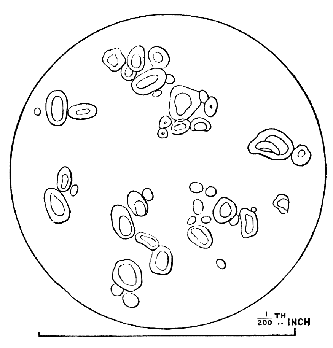
CHESTNUT. Both the horse-chestnut and the edible variety have been employed for the adulteration not only of coffee, but of chicory.
Microscopic view of the chestnut.
CHI′CA. The red colouring matter deposited by a decoction of the leaves of Bignonia Chica in cooling. Used by the American Indians to stain their skin. It is soluble in alcohol, ether, oil, fat, and alkaline lyes, and slightly so in boiling water.
Chi′ca. See Maize beer.
CHIC′ORY. Syn. Wild suc′cory; Cichor′ium Inty′bus (Linn.), L. A plant belonging to the natural order Compositæ. It is indigenous to this and many other countries of Europe, and is extensively cultivated for the sake of its roots, which are sliced, roasted, and ground, to form the chicory of the shops. Nearly 100 millions of pounds are annually consumed in Europe. Much of the chicory used in Britain is of home growth; but still more is imported in a raw state from Holland and other parts of the Continent. A blue dye has been prepared from the leaves of this plant.
The FRESH ROOT OF CHICORY (ra′dix chico′rii re′cens) is reputed to be alterative, attenuant, diuretic, febrifuge, hepatic, resolvent, and tonic; and in large doses aperient. It is now seldom used in medicine, although it appears to possess similar qualities and equal activity to those of dandelion. “An infusion of the root, mixed with syrup, becomes thick; forming the GOMME SACCHO-CHICORICE of Lacarterie.” (Fee.)
Analysis of Chicory (the raw root):—
Moisture77·0
Gummy matter (like pectin)7·5
Glucose, or grape sugar1·1
Bitter extractive4·0
Fatty matter0·6
Cellulose, inulin, and woody matter9·0
Ash0·8
———
100·0
The ROASTED ROOT is prepared by cutting the full-grown root into slices, and exposing it to heat in iron cylinders, along with about 11⁄2% or 2% of lard, in a similar way to that adopted for coffee. When ground to powder in a mill, it constitutes the CHICORY of the grocers (CHICORY COFFEE, SUCCORY C.; RADIX CHICO′RII TORREFAC′TA, R. C. T. CONTRI′TA); so generally employed both as a substitute for coffee and as an adulterant of that article. The addition of 1 part of good, fresh roasted chicory to 10 or 12 parts of coffee forms a mixture which yields a beverage of a fuller flavour, and of a deeper colour than that furnished by an equal quantity of pure or unmixed coffee. In this way a less quantity of coffee may be used, but it should be remembered that the article substituted for it does not possess in any degree the peculiar exciting, soothing, and hunger-staying properties of that valuable product. The use, however, of a larger proportion of chicory than that just named imparts to the beverage an insipid flavour, intermediate between that of treacle and liquorice; whilst the continual use of roasted chicory, or highly chicorised coffee, seldom fails to weaken the powers of digestion and derange the bowels. “There can be no doubt that roasted chicory must, when taken largely, have a tendency to excite diarrhœa.” (Pereira.)
Pur., &c. The ground chicory of the shops, like ground coffee, is almost universally adulterated. Pigments are added to it to colour it, and various vegetable substances to lessen its value. The following articles have been reported to have been detected in roasted chicory, or to have been known to be used to adulterate it:—Venetian red, reddle, and red clay; roasted acorns, beans, carrots, damaged dog-biscuits, damaged bread, damaged wheat, horse-chestnuts, mangel wurzel, parsnips, peas, rye, and sugar; coffee flights (coffee husks), coffina (roasted lupins), Hambro’ powder (roasted peas coloured with reddle), and the marc of coffee; exhausted bark (from the tan yards), logwood dust, mahogany dust, &c. It has also been asserted that the scorched livers of bullocks, horses, and dogs have been applied to the same purpose; but of this there is not sufficient evidence. The only way to avoid being thus cheated or poisoned is to buy the chicory whole, and to grind it at home.
Microscopic appearance of chicory root.
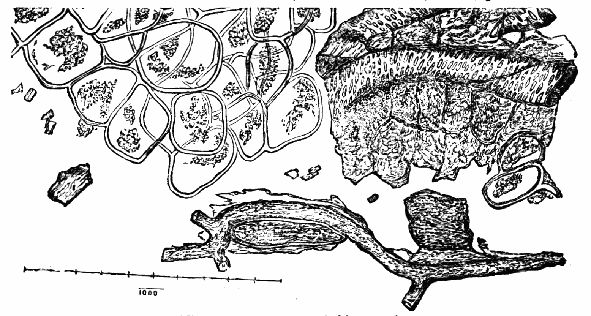
Roasted chicory is highly absorbent of moisture, and should, therefore, be always kept in close vessels (bottles or canisters), the same as coffee. If the lumps become tough or soft, or the powder cakes together, it is unfit for use; but in some cases it may be recovered, by exposing it on a plate in an oven until it again becomes perfectly dry or brittle.
Tests.—1. Powdered chicory thrown on water turns it reddish-brown and rapidly sinks, leaving light impurities either floating or diffused through the liquid.—2. The cold decoction tested with tincture, or solution of iodine, gives a brown colour; if it turns purple, blue, or black, it indicates the presence of roasted peas, beans, rye, or some other like substance, containing starch.—3. Persulphate or perchloride of iron, added in the same way, should not materially affect the liquid; if it turns it bluish or blackish, it indicates the presence of roasted acorns, oak-bark tan, or some other substance containing tannin.—4. Water acidulated with vinegar, digested on the powder, should not be blackened, or even materially darkened, by tincture of galls or a solution of red prussiate of potash; the contrary shows the presence of ferruginous colouring matter.—5. The dry powder, when incinerated, should not leave more than 41⁄2 to 5% of ash, which should be of a greyish or fawn colour; the contrary indicates the presence of reddle, red clay, ochre, or the like.—6. To the above may be added attention to the odour, colour, and appearance, both to the naked eye and under the microscope; by the latter, adulteration may be easily detected. See Coffee.
CHIL′BLAIN. Syn. Per′nio, L. An inflammatory swelling, of a purple or lead colour, produced by the action of cold. Chilblains (PERNIO′NES) exclusively attack the extremities of the body, and are generally confined to the fingers, toes, and heels. The common symptoms are itching and irritation, more or less intense, often accompanied with shooting pains, and tenderness, and tumefaction of the parts. Children, especially those of a scrofulous habit, and elderly persons, are generally the most liable to chilblains. The common cause of chilblains is holding the hands or feet to the fire after exposure to cold. The sudden change of temperature partially destroys the vitality of the minute surfacial vessels, and thus prevents the proper flow of blood through the part. The best preventives of chilblains are woollen socks or stockings, good waterproof shoes, woollen gloves, exercise, and friction. These act by promoting the circulation of the blood in the extremities, and protecting them from vicissitudes of temperature. When chilblains have once formed, the best treatment is friction with stimulants, as spirits of wine and camphor, oil of turpentine, opodeldoc, dilute spirits, camphorated oil, hartshorn and oil, &c. Linnæus recommends bathing the part with dilute muriatic acid, just strong enough to faintly prick the skin. When the inflamed parts have ulcerated, they are commonly called KIBES. In this state they should be dressed with a little resin cerate or elemi ointment. If fungous granulations appear, they must be removed by touching them with nitrate of silver or blue vitriol. See Chaps, &c.
Remedies for Chilblains.—The following have been strongly recommended by different parties, and may all prove useful in their turns, as circumstances and convenience may suggest:—
1. Sulphate of copper, 1 oz.; rosemary water, 1 pint; dissolve.
2. Sal-ammoniac, 1 oz.; vinegar, 1⁄2 pint.
3. Sal-ammoniac, 1 oz.; rum, 1⁄2 pint; camphor, 1 dr. The affected part is wetted with the above night and morning, and when dry is touched with a little simple ointment, cold cream, or pomatum.
4. Soap liniment, 2 oz.; tincture of cantharides, 1 oz.; oil of cajeput, 2 dr.
5. Oil of turpentine, 2 oz.; camphor, 3 dr.; oil of cajeput, 1 dr. The application of the last two is accompanied by gentle friction.
6. (Dr Graves’ Preventive.) Sulphate of copper, 20 gr.; water, 1 oz. As the first three.
7. (Lejeune’s Balsam.) See Chilblain Balsam.
8. (Linnæus’ remedy.) Hydrochloric acid, 1 oz.; water, 11 oz. As No. 3.
9. (Morton’s Liniment.) Calomel and camphor, of each 1 dr.; spermaceti ointment, 4 dr.; oil of turpentine and cocoa-nut oil, of each 2 dr. As No. 5.
10. (Wahler’s Ointment.) Black oxide of iron, bole, and oil of turpentine, of each 1 dr.; resin cerate, 1 oz. For broken chilblains. We have found a mixture of equal parts of calamine cerate and resin cerate answer quite as well. See Cerate, Ointment.
11. (Russian remedy.) The rind of perfectly ripe cucumbers dried, with the soft parts attached. For use they are placed with the inner side, previously soaked in warm water, over the soft parts. (Med. Zeitung.)
12. (Rhein.) Dissolve 1 oz. of tannin in a pint of water, and 74 grains of iodine in 13⁄4 oz. of spirit of wine; the solutions are then mixed, and enough water added to make the whole up to 21⁄2 pints. In applying it, which is best done at bedtime, the mixture is gently warmed over a slow fire; the affected part is dipped into it while still cold, and retained in it till the liquid, on being stirred, feels uncomfortably hot. The vessel is then withdrawn from the fire, and the affected part dried over it. The vessel must be of earthenware or porcelain, and care must be taken not to use too much iodine, especially when abrasions are present.
13. (L′Union Médicale.) Oxide of zinc, 2 parts; tannic acid, 1 part; glycerin, 10 parts; balsam of Peru, 8 parts; camphor, 4 parts.
14. (Swediaur’s Paste.) Bitter almonds, 8 oz.; honey, 6 oz.; powdered camphor and flour of mustard, of each 1⁄2 oz.; burnt alum and olibanum, of each 1⁄2 oz.; yolks of 3 eggs; beat to a paste. To be applied night and morning.
15. (Vance’s Cream.) Ointment of nitrate of mercury, 1 oz.; camphor, 1 dr.; oil of turpentine, 2 dr.; oil of olives, 4 dr.; mix well together. To be applied by gentle friction 2 or 3 times daily.
Obs. All the preceding preparations are intended for chilblains before they break. The liniments of ammonia, camphor, opium, soap, and turpentine, as well as the compound camphor liniment of the British Pharmacopœia, are also excellent preparations for the same purposes.
CHIL′DREN (Care of). See Infancy.
Children (Diseases of). See the respective heads, and Diseases.
CHIL′LIES. See Capsicum, Peppers.
CHIM′NEYS were not introduced into England until the reign of Queen Elizabeth, and for a considerable period the principles of their construction were ill-understood. When the air inside and outside a chimney is at the same temperature, an equilibrium exists; there is no draught in the chimney, because the downward tendency of that within is counteracted by the upward pressure of that without. Let a fire be kindled in the grate; hot air is evolved, the chimney is heated, the air it contains suffers expansion, and a portion is expelled. The chimney now contains a smaller weight of air than it did before; the external and internal columns no longer equibalance each other, the warmer and lighter air is forced upwards from below, and its place is occupied by cold, and consequently heavier air. If the fire continues to burn, and the chimney retains its temperature, the second portion of air is disposed of like the first, and the ascending current continues, so long as the sides of the chimney are hotter than the surrounding air. Should the reverse happen to be the case, as sometimes occurs from sudden atmospheric changes, the column of air within the chimney rapidly contracts in volume, the deficiency is filled up from without, the column of air becomes heavier than one of a corresponding height on the outside of it, or in the apartment, and, obeying the common laws of gravitation, it falls out of the throat of the chimney or fire-place just as a heavy body sinks in water, and has its place occupied by air from above. In this way a descending current, of more or less intensity and duration, is established, and, if there is a fire in the grate, the chimney “smokes,” or, if the grate is empty, perhaps the smoke from neighbouring chimneys finds its way into our apartments. By the judicious arrangement of the fire-place, and the throat and flue of a chimney, an upward current may be constantly ensured so long as there is a fire in the grate, or the air of the apartment is warmer than the external atmosphere.
Count Rumford was the first who scientifically investigated the construction of chimneys. He showed that more heat is obtained from the fire by reflection when the coverings are placed in an oblique position. He also directed that the fire itself should be kept as near to the hearth as possible, and that the throat of the chimney should be constructed much narrower than was then the practice, in order to prevent the escape of so much heated air as happened with wide throats. By contracting the open part of the fire-place immediately over the fire, as by lessening the width of the hobs, or by bringing the throat of the chimney closer to the fire, and by contracting the throat of the chimney itself, within certain limits, any desired amount of draught may be obtained. When the space above the fuel is too small, the throat too near the burning fuel, or the throat itself too contracted, the draught of a common chimney is often too strong, and much fuel and heat is wasted. When the reverse is the case, the draught is commonly too languid, the fire draws badly, a portion of the smoke escapes into the room, and all the usual annoyances of a smoky chimney are suffered. By a proper attention to these conditions a common fire-place may be adapted for the combustion of bituminous or easy burning coal, or of anthracite, and varieties of coal that require a considerable draught. It may even be converted into a wind furnace; whilst the inconvenience of smoky chimneys may be always avoided, and, when existing, easily cured. This is presuming, however, that a sufficient supply of air exists in front of the fire-place (i.e. in the apartment), not only for the combustion of the fuel, but also for the upward current of the chimney. Many chimneys smoke simply from the apartment being so ill-ventilated that the supply here alluded to is not provided. It may be further stated, as a rule, that the greater the length of a chimney the stronger will be the draught. Hence, the chimneys of the upper rooms of a house often smoke, whilst the fires in the rooms beneath them burn pleasantly and vigorously. Such cases are commonly relieved by a chimney-pot or cowl, of which numerous varieties are now before the public. The more crooked or tortuous the course of a chimney the less likely is it to be affected by eddies and gusts of wind from neighbouring buildings or hills. See Fire, Grate, Smoke Prevention, Stove.
CHI′NA. In the purchase of china, glass, and earthenware, care should be taken to select those patterns which in case of breakage can be the most readily matched. Peculiar or rare patterns should be avoided, for if any such be broken, it will generally be found very difficult and expensive, and frequently impossible, to replace them.
China, glass, and earthenware, when very dirty, are best cleaned with finely powdered fuller’s earth and warm water, followed by rinsing in clean water. A little clean soft soap may be added to the water instead of fuller’s earth. See Packing, Porcelain.
CHIN′OIDINE. See Quinoidine.
CHINOLINE BLUE. See Cyanine.
CHINTZ (to Wash). Boil 2 lbs. of rice in two gallons of water till soft; and pour the mixture into a tub; let it stand until it attains a warmth generally used for coloured linens; then put the chintz in it, and wash it with the rice instead of soap, until all the dirt has disappeared. Next boil another 2 lb. of rice, as above, in another two gallons of water, but strain the rice from the water, and mix it in warm water. Wash the chintz in this till quite clean, and afterwards rinse it in the water the rice was boiled in. This will answer the same end as starch, as no wet will affect it, as it will be stiff while it is worn. If a gown, it must be taken to pieces; and when dried, it must be hung as smooth as possible, after which it must be dry-rubbed with a smooth stone, but no iron must be used.
CHIRETTA. Chirata. The entire plant (Ophelia chirata) is employed in medicine. Northern India. The plant is pulled up by the root when the flowers begin to decay, and the capsules are formed. The dried plant, sometimes with, but more commonly without, the root, is the form in which the chiretta is generally met with in commerce. The whole plant is intensely bitter, but is without odour. In its physiological action it bears a great resemblance to gentian. Instead of a constipating, it appears to possess a slightly relaxing effect. It is an excellent stomachic and carminative, and is said to diminish the tendency to acidity, and to be of great service in the dyspepsia accompanying gout. No vegetable alkaloid has been obtained from it. If given in powder, the dose of chiretta is twenty grains. It is, however, more generally given in the form of an infusion or tincture (which see).
CHI′TIN. This name has been given to the hard, insoluble matter forming the shells and elytra of insects. It is obtained by boiling the elytra of the cockchafer with water, alcohol, ether, acetic acid, and alkalies.
CHIT′TICK’S REMEDY. Dr Chittick’s remedy for stone consisted of a fixed alkali, administered in veal broth. (Paris.)
CHLORAL. C2HCl3O. A peculiar liquid first obtained by Liebig, by the action of chlorine on alcohol. The name was intended to express its origin from chlorine and alcohol.
Prep. (Liebig.) Anhydrous alcohol is placed in a tubulated retort, and dry chlorine gas passed through it, at first in the cold, but afterwards with the application of a gentle heat, until the chlorine passes unchanged through the liquor on raising it to the boiling temperature; on cooling, the whole forms a crystalline mass of what was at one time thought to be chloral hydrate, but which subsequent researches have shown to be chloral alcoholate; this is melted by a gentle heat, and agitated with three times its volume of oil of vitriol; on increasing the heat a little, an oily stratum of impure chloral rises to the surface. It is purified by boiling it for some time (to drive off free hydrochloric acid and alcohol), next distilling it with an equal volume of oil of vitriol; and lastly, rectifying it from some powdered quick-lime, the process being stopped as soon as the surface of the lime becomes dry.
Prop., &c. Chloral is an oily liquid, possessing an ethereal smell; it is soluble in alcohol, ether, and water; with a small quantity of the latter it rapidly changes into a semi-solid crystalline mass (chloral hydrate), which is soluble in a larger quantity of water; boils at 201°; sp. gr. 1·502. It is decomposed by the caustic earths and alkalies. By age it is converted into a white, solid, translucent substance (insoluble chloral), which is reconverted by heat and by sulphuric acid into ordinary chloral.
Obs. In operating as above the chlorine is most conveniently introduced by a tube inserted into the tubulature of the retort, and a long tube, bent upwards, should be connected with the beak to convey away the hydrochloric acid gas extricated, and to allow the volatilised alcohol and chloral to condense, and flow back into the retort.
Chloral, Camphorated. Hydrate of chloral and camphor, equal parts. Rub them together in a warm mortar until they liquefy. It forms clear mixtures with oil of turpentine and chloroform, but not with solution of ammonia. It is a counter-irritant, and applied externally it has been found to give relief in rheumatic pains and neuralgia. It should be painted on the affected part with a camel’s-hair brush.
Chloral, Hydrate. C2HCl3O. Aq. Syn. Hydrate of chloral. Prep. “Pass dry chlorine gas, for several days, through absolute alcohol, sp. gr. 0·795, until it becomes a thick viscid liquid of sp. gr. 1·57. At the beginning of the operation the alcohol is well cooled to prevent inflammation and explosion, but towards the end of the operation the alcohol is heated nearly to the boiling point. The resulting liquid, which after a day or two solidifies to a mass of crude chloral hydrate, is agitated with four times its bulk of concentrated sulphuric acid, and the anhydrous chloral which floats on the surface is separated and purified by fractional distillation. The purified anhydrous chloral is placed in a still, mixed with 11 per cent. of water, and distilled over chalk to remove any hydrochloric acid that may be present; the resulting solid distillate is then fused and poured out into shallow vessels to cast into cakes.” (Squire.) The purest chloral hydrate is said to be that which has been crystallised two or three times out of pure bisulphide of carbon.—Prop. White opaque solid, having a pungent odour resembling that of a ripe melon. Soluble in water, glycerin, and alcohol. Gradually volatilises in the air, and may be distilled without decomposition. From 100 gr. dissolved in 1⁄2 fl. oz. of water, well shaken with 1 fl. oz. of solution of potash (B. P.), and allowed to stand for several hours, at least 46 grain-measures of chloroform should separate.
Chloral hydrate may be obtained in crystals by mixing the cake with about half its bulk of chloroform, and putting aside in a cool place. When the crystallisation is complete (which is generally in about 8 or 10 days) the crystals are freed from the mother liquor by a centrifugal machine, and afterwards dried at a gentle heat. The mother liquor may be utilised for future crystallisations.
Uses. An excellent sedative, antispasmodic, hypnotic, anodyne. It has done good service in hypochondriacal and other nervous affections, as well as in the insomnia of the insane, and of dipsomaniacs; also in asthma, hooping-cough, and scarlet fever. It has also the reputation of being an efficient preventive of sea-sickness, especially on short voyages, such as crossing the channel, which can be accomplished during the sleep occasioned by the agent.—Dose, from 10 to 60 gr.
It was introduced into medical practice by Dr Liebreich, of Berlin. Immense quantities are imported into this country from Germany.
CHLORALUM. An impure aqueous solution of chloride of aluminum, sp. gr. 1·15, 1 fl. oz. of the liquid contains 75 grains of anhydrous chloride. Introduced by Professor Gamgee as an antiseptic and disinfectant, for which purposes it is recommended to dilute the article as sold with four times its bulk of water.
CHLO′′RATE. Syn. Hyperoxymu′′riate†, Chlo′′ras, L. A compound in which the hydrogen of chloric acid, HClO3, is replaced by a metal or other basic radical, e.g. KClO3, chlorate of potassium. Chlorates may be prepared by dissolving the hydrate or oxide in chloric acid, and crystallising. The alkaline chlorates, however, are made by passing chlorine into solutions of the hydrate or carbonate of potassium or sodium, boiling the resulting liquid, and separating the chlorate from the chloride, which is also formed by crystallisation. They are very similar to the nitrates, both in their general properties and composition. They are all decomposed at a red heat, metallic chlorides being formed and oxygen gas given off. Like the nitrates, they deflagrate with inflammable substances, but with greater facility and violence. A mixture of this kind will detonate with a slight blow or friction. All the chlorates are soluble in water.
Char., Tests, &c. The chlorates are known by their deflagrating when placed on red-hot charcoal. By evolving a yellow gas when treated with concentrated sulphuric acid, in the cold, which gas also communicates to the liquid a red or yellow tinge. By evolving oxygen gas when heated alone in a test-tube. This test is not characteristic, unless carried a stage further, by dissolving the residual chloride out of the tube, and adding to the filtered solution a few drops of nitrate of silver; then the formation of a white precipitate, insoluble in nitric acid, will show that the salt treated was a chlorate, and not a nitrate. Pure chlorates give no precipitate with nitrate of silver.
CHLORHY′DRIC ACID. See Hydrochloric Acid.
CHLO′′RIC ACID. HClO3. Syn. Hyperoxymuriat′ic acid; Acidum chlo′′ricum, L. An acid discovered by Chenevix, but first obtained in a separate form by Gay-Lussac.
CHLO′′RIDE (-ĭd). Syn. Chlo′′ruret†; Chlori′dum, L. A chemical compound of chlorine with a metal or other basic radical, e.g. NaCl, chloride of sodium; C2H5Cl, chloride of ethyl.
Prep. The majority of the metallic chlorides may be made by simply dissolving the metal or its carbonate, oxide, or hydrate, in hydrochloric acid (previously diluted with about twice its weight of water), and evaporating and crystallising the solution in the usual manner. Zinc, cadmium, iron, nickel, cobalt, and tin, dissolve readily in hydrochloric acid; copper only in strong boiling acid; silver, mercury, and gold, not at all. The insoluble chlorides, as those of silver and mercury, may be readily prepared by precipitating any of their corresponding soluble salts with hydrochloric acid, or a soluble chloride, such as common salt. Anhydrous chlorides are generally prepared by the direct action of chlorine on the bases.
Char., Tests, &c. Most of the metallic chlorides are soluble in water. Many fuse when heated, and volatilise unchanged, but others are completely or partially decomposed at a red heat. All, with the exception of those of the alkali and earth metals, are decomposed at a red heat in a current of hydrogen. They are recognised by the following reactions:—1. Heated with a little peroxide of manganese and sulphuric acid, chlorine is evolved, and easily detected by its colour, smell, and bleaching properties:—2. The soluble chlorides may be readily detected by their solutions, slightly acidulated with nitric acid, giving with a solution of nitrate of silver a white, curdy precipitate (chloride of silver), insoluble in nitric acid, freely soluble in liquor of ammonia, and blackened by the light:—3. The insoluble chlorides may be tested by digesting them in a little liquor of potassa, when a solution of chloride of potassium will be formed, which may be treated as just directed (2); or the chloride may be dissolved in nitric acid, and tested with nitrate of silver as before.
CHLORIM′ETRY. See Chlorometry.
CHLORINA′TED LIME. See Lime.
CHLORINA′TED SO′DA. See Sodium.
CHLO′′RINE. Syn. Chlorin′ium, L.; Chlore, Fr.; Chlor, Ger. An elementary substance discovered by Scheele in 1774, and at first supposed to be a compound body. In 1809 MM. Gay-Lussac and Thénard suggested the probability of it being a simple substance; but it was reserved for Sir H. Davy, shortly afterwards, to demonstrate the truth of the suggestion of these foreign chemists.
Nat. Hist. It exists in nature chiefly in the form of chloride of sodium, which constitutes rock salt when deposited in inland beds, sea salt when dissolved in masses of water. The sea also contains chlorides of potassium, calcium, and magnesium. It is a constituent of several well-known minerals. It has been met with in the air of volcanic districts, combined with hydrogen, as hydrochloric acid.