A CYCLOPÆDIA OF PRACTICAL RECEIPTS, PROCESSES, AND COLLATERAL INFORMATION (continued 10)
Reading edition
Arnicine (of Bastick). Syn. Arnici′na, Arnici′′a (nīsh′-y′ă), L. Prep. 1. (Bastick.) From the flowers, by a similar process to that by which he obtains lobelina. 2. From the flowers (or root), as directed under Aricina.
Prop., &c. Bitter; acrid; crystallisable scarcely soluble in water; soluble in alcohol and ether; forms salts with the acids, the hydrochlorate and one or two others being crystallisable. Its physiological properties and dose have not as yet been accurately determined.
ARO′MA. [L.] Syn. Arome, Fr.; Arom, Geruchstoff, Ger. The characteristic odour of substances, particularly the peculiar quality of plants, and of substances derived from them, which constitutes their fragrance.
AROMA′TA. [L.] See Aromatic.
AROMAT′IC. Syn. Aromat′icus, L.; Aromatique, Fr.; Gewürzhaft, Ger. Fragrant; odoriferous; spicy; applied chiefly to plants and their products (Aromatics, A. plants; Aromat′a, AROMAT′ICA, L.; Aromatiques, ÉPICES, Fr.; Gewurz, Ger.) characterised by their spicy odour or aroma, and warm pungent flavour, and of which allspice, cinnamon, cloves, lavender, pepper, rosemary, sage, &c., are well-known examples. They are all stimulant, carminative, and antiseptic; and from remote antiquity have been regarded as prophylactic and disinfectant.
Aromatic. In medicine, pharmacy, perfumery, &c., applied to substances, simple or compound, characterised by an agreeable odour or carminative properties, or both; as aromatic confection, a. pastilles, a. vinegar, a. bark (CORTEX AROMATICUS, white canella), &c.
AROMATIC SULPHUR-SOAP (Ed. Heger). For cleansing the teeth and mouth. A hard sulphur-coloured soap externally; on cutting, greyish-brown. Composed of soap with 10 per cent. of hyposulphite of soda, perfumed with a scent resembling oil of balm. (Hager.)
AROMATIQUE (Albin Müller, Brünn). Spirit (90 per cent.), 50 grms.; sugar, 45 grms.; extractive matter, 4 grms. (composed of cinnamon, cloves, galangal, zedoary, angelica, anise); water, 81 grms. Sold in wine-bottle-shaped bottles, and recommended for all derangements of the digestive organs. (Hager.)
ARQUEBUSADE′ (ar-ke-bŏŏ-zade′). [Fr.] Primarily, the shot of an arquebuse; but afterwards applied to an aromatic spirit (EAU D′ARQUEBUSADE, Fr.), originally employed as an application to gunshot (arquebuse) wounds.
AR′RACK (Syn. Rack) (arrack′—Brande). [Ind.] Syn. Arac, Arack, Rack‡§; Palm-spirit; Ar′ac′ca, Spir′itus Pal′mæ, S. SUC′CI P., S. ORY′ZÆ*, L.; Arack, Fr.; Arak, Ger. A spirituous liquor imported from the East Indies. The finer qualities are distilled from the fermented juice (toddy, palm-wine) of the cocoa-nut tree, palmyra tree, and other palms; and the other kinds, from the infusion of unhusked rice (rice-beer), fermented with cocoa-nut or palm-juice, either with or without the addition of coarse sugar or jaggery.
Prop., &c. It is colourless or nearly so, but like other spirit, when long kept in wood, gradually acquires a slight tinge, similar to that of old Hollands. The best kinds, when of sufficient age, are pleasant flavoured, and are probably as wholesome as the other spirits of commerce; but common arrack has a strong and somewhat nauseous flavour and odour, depending on the presence of volatile oil derived from the rice, and corresponding to that of corn-spirit. The inferior qualities are hence more heating and apt to disagree with the stomach than the other commercial spirits. In this country it is chiefly used to make punch. When sliced pine-apples are put into good arrack, and the spirit kept for some time, it mellows down and acquires a most delicious flavour, and is thought by many to be then unrivalled for making ‘nectarial punch’ or ‘rack-punch.’
Obs. Batavian arrack is most esteemed; then that of Madras; and next that of China. Others are regarded as inferior. The common par′iah arrack is generally narcotic, very intoxicating, and unwholesome; being commonly prepared from coarse jaggery, spoilt toddy, refuse rice, &c., and rendered more intoxicating by the addition of hemp-leaves, poppy-heads, juice of stramonium, and other deleterious substances.
Arrack, Facti′′tious. Syn. Mock ar′rack, Brit′ish a.; Vauxhall′nec′tar; &c. Prep. Good old Jamaica rum (uncoloured), rectified spirit (54 to 56 o. p.; clean flavoured), and water, of each 1 quart; flowers of benzoin, 1 dr.; sliced pine-apple, 1⁄4 oz. (or essence of pine-apple, 1⁄2 teaspoonful); digest, with occasional agitation, for a fortnight; then add of skimmed milk 1 wine-glassful; agitate well for 15 minutes, and in a few days decant the clear portion.
The crude Indian arrack, when subjected to distillation until it has a sp. gr. ·920, is employed in India, as proof spirit, in the preparation of official tinctures, and for other pharmaceutical purposes. A very useful stimulating application, known in India as toddy poultice, and intended as a substitute for yeast poultice, is prepared by adding freshly drawn toddy to rice flour, till it has the consistence of a soft poultice, and subjecting this to heat over a gentle fire, stirring constantly till fermentation commences.
The light brown cotton-like substance from the outside of the base of the fronds belonging to the Palmyra palm is employed by the Cyngalese doctors as a styptic for stopping the hæmorrhage of superficial wounds.
AR′ROW-ROOT. The common name of maran′ta arundina′cea (Linn.; m. Indi′ca—Tuss.); a plant of the nat. ord. Marantaceæ (Lindl.; Cannaceæ—Endl.). It was originally brought from the island of Dominica to Barbadoes, by Col. James Walker. It has since been extensively cultivated in the West Indies.
Tubers yield true ARROW-ROOT; when fresh and good they contain about 26% of starch, of which 23% may be obtained as arrow-root, and the rest by boiling.
Arrow-root. Syn. Maran′ta, Am′ylum Maran′tæ, Fæc′ula M., L.; Racine Fléchière, Pivot, Fr.; Pfeilwurz, P.-satzmehl, Ger. The starch or fecula obtained from the rhizoma or tubers of maran′ta arundina′cea (Linn.; see above), and which forms the true ‘arrow-root’ of commerce.
Prep. The fecula is extracted from the tubers when they are about 10 or 12 months old, by a process similar to that by which the farina is obtained from potatoes. In Bermuda the tubers, after being washed, are deprived of their paper-like scales and every discoloured and defective part by hand; they are then again washed and drained, and next subjected to the action of a wheel-rasp, the starch being washed from the comminuted tubers with rain-water; the milky liquid is passed through a hair sieve, or a coarse cloth, and allowed to deposit its fecula. This is then allowed to drain, after which it is again carefully washed with clean water, again drained, and, after being thoroughly dried in the air or sun, is at once packed for market. (Cogswell.) In St. Vincent (on the Hopewell Estate), a cylindrical crushing-mill, tinned-copper washing machines, and German-silver palettes and shovels are employed; whilst the drying is effected in extensive sheds, under white gauze, to exclude insects. In Jamaica the washed tubers are generally pulped in deep wooden mortars; machinery being seldom employed in any part of the process.
Prop., &c. A light, dull, dead-white, tasteless, inodorous powder or small pulverulent masses, feeling firm to the fingers, and crackling when pressed or rubbed; viewed by a pocket lens it appears to consist of glistening particles, which are shown by a microscope to be convex, irregular, ovoid or truncated granules, most of them, according to Mr Jackson, being ·0010 of an inch in length, and ·0008 of an inch in breadth; mixed with others varying from about double to only half that size. In its action with boiling water, and its general properties it resembles the other starches; than which, however, it is freer from any peculiar taste and flavour; and thus agrees better with the delicate stomachs of invalids and infants than the ordinary farinas.
West Indian Arrowroot (Maranta Arundinacæa). Scale 1-1000th of an inch.
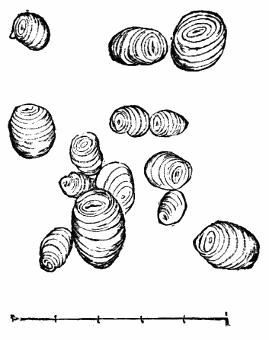
Comp. Similar to that of the other starches.
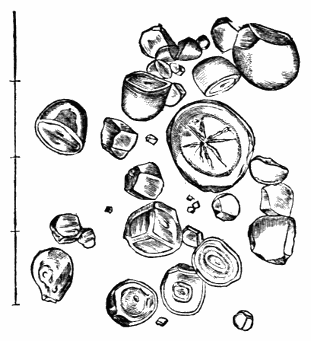
Pur. A large portion of the arrow-root of the shops consists either wholly or in part of the fecula or farina of potatoes or of inferior starches such as cacuma, or East Indian arrow-root, jatropha, or Brazilian arrow-root, canna, or tous les mois; or is more or less mixed with sago-meal or rice-meal: such materials can be readily detected by the microscope. Potato starch is known in commerce as ‘FARINA’ or ‘British arrow-root,’ or simply ‘arrow-root,’ whereas genuine arrow-root is always described as ‘Bermuda,’ ‘St. Vincent,’ ‘St. Kitts,’ or, at least, as ‘West Indian arrow-root.’ The substitution of the inferior farinas for genuine arrow-root is not only fraudulent on account of their inferior value, but is reprehensible in a hygienic point of view; as some of them are offensive to a delicate stomach, and exert of themselves, and still more when carelessly manufactured, a laxative action on the bowels; whereas the effect of true arrow-root is that of a slight and soothing tonic.
Uses, &c. As an agreeable, non-irritable article of diet for invalids and children, in the form of cakes, biscuits or puddings, or boiled with milk or water and flavoured with sugar, spices, lemon-juice, or wine, at pleasure. For young children a little caraway or cinnamon water is to be preferred. It is especially useful in irritation or debility of the stomach, bowels, or urinary organs, and in all cases in which a demulcent or emollient is indicated. It must not, however, be employed to the entire exclusion of other food, as, being destitute of the nitrogenous elements of nutrition, it is incapable alone of supporting life. Arrow-root jelly is prepared by first rubbing the powder up with a very small quantity of cold water, and then gradually adding the remainder boiling, stirring well all the time. Beef tea, veal broth, or milk may be used instead of water. Some persons boil it for a few minutes. This jelly, flavoured with a little genuine port wine and nutmeg, is almost a specific in cases of simple diarrhœa arising from habit or debility.
Obs. Arrow-root is imported in tins, barrels, and boxes, from all the West India Islands; and from Calcutta and Sierra Leone. The best quality was, until recently, solely obtained from Bermuda; but of late equally fine samples have been produced on the Hopewell Estate, St Vincent, and, according to Dr Ure, with the advantage of being prepared with the purest spring water, in profusion, instead of rain water.
In commerce, the word arrow-root is now often loosely used as a generic term to indicate any white, tasteless, and edible starch or fecula.
Arrow-root, Brazil′ian. Cassava-starch or tapioca-meal.
Arrow-root, East In′dian. Curcuma starch; from the tubers of the curcuma angustifolia or narrow-leaved turmeric. The maranta arundinacea is now also extensively cultivated in India under the name of maranta Indica, and the fecula therefrom extensively exported, which might, with equal propriety, be called East Indian arrow-root; but this is not the case in commerce, the whole passing as W. I. arrow-root irrespective of the place of its production.
Arrow-root, Eng′lish. Potato-starch.
Arrow-root, Portland. From the underground tubers of arum maculatum (Linn.) or wake-robin.
Arrow-root, Tahi′ti. Tacca starch or Otaheite salep; from the tubers of tacca oceanica.
Rio, or Manihot Arrow Root. Scale 1-1000th of an inch.
ARSE′′NIATE. Syn. Ar′senate; Arse′′nias, Ar′senas, L.; Arséniate, Fr.; Arse′′niksaure salze, Ger. A salt consisting of AsO4 and a metal or other basic radical; e.g., ammonio-magnesium arseniate, NH4Mg9AsO4.
AR′SENIC (-se-nĭk). As. Syn. Arsenium; Arsen′icum, Arse′nium, L.; Arsenik, A.-metall, Ger. Arsenico, Sp., It. The brittle, grey-coloured metal, or metalloid, which forms the base of the white arsenic and orpiment of commerce. Discovered by Geber in the eighth century, but first accurately described by Brandt (A.D. 1773). The poisonous properties of arsenious acid were not generally known for some centuries after its discovery. As a medicine it was first employed in intermittents in Hungary.
Sources. Arsenic is peculiar to the mineral kingdom. The metallic arsenic of commerce is obtained by roasting arsenical pyrites (MISPICKEL), in earthen tubes, or in tubular earthen retorts; the arsenic sublimes, and sulphuret of iron remains behind. On the small scale it is prepared by sublimation from a mixture of arsenious acid and charcoal or black flux. Combined with oxygen it frequently exists in mineral waters; and, in a larger quantity, in certain rivulets and streams.
Prep. A mixture of arsenious acid, 1 part; and black flux, 2 or 3 parts; is exposed to a low red heat in a Hessian crucible over which is luted a deep empty crucible, or an earthen tube, to receive the metal; the latter being kept as cool as possible. Charcoal or even oil may be substituted for black flux, and a retort of hard glass may be used, with the same result. Or the following method may be used:—White oxide of arsenic, of commerce, 2 dr.; is placed at the sealed end of a hard German-glass tube (1⁄2 × 18 inches), and covered with about 8 inches of dry and coarsely powdered charcoal; the portion of the tube containing the latter is then raised to a red heat, whilst a few ignited coals are placed beneath the oxide to effect its slow sublimation. The sublimed metal gradually attaches itself to the inside of the tube at its cool extremity. A small charcoal furnace similar to that used for organic analysis should be employed, and the process conducted under a flue to carry off any fumes that may escape. The open end of the tube should be loosely closed with a cork.
Prop. Very brittle, so much so that it may be easily powdered in a mortar; lustre highly metallic; colour steel-grey or bluish-white; texture crystalline; crystals rhombohedrons; sublimes, without fusion, at 356 to 360° Fahr., (and slowly at lower temperatures), in close vessels unaltered, but when exposed to the air with conversion into arsenious acid; at a higher temperature, in open vessels, it burns with a pale-blue flame. Its vapour or fumes have a characteristic alliaceous odour; it is slowly oxidised and dissolved by boiling water; but may be preserved unchanged in pure cold water; it rapidly tarnishes in the air, particularly when moist, a black film, consisting of metallic arsenic and arsenious acid forming on its surface; with chlorine, iodine, sulphur, and hydrogen, it unites to form definite compounds. With oxygen it forms acids, but no basic oxide. It combines with the metals in a similar manner to sulphur and phosphorus, the latter of which it resembles in many respects. These compounds are termed AR′SENIDES, formerly Arseniurets. Sp. gr. 5·7 to 5·9; sp. gr. of vapour, 1·0362.
Uses, &c. With copper it forms a white alloy (PACKFONG); and it is added to some other alloys to increase their whiteness, hardness, and fusibility. In medicine it is only used in combination. In the metallic state it is inert; but, from its great affinity for oxygen, it rapidly becomes oxidised and poisonous; and hence acts as a powerful poison when swallowed, or when rubbed on the skin. Its fumes are also highly poisonous. See Arsenious Acid (and below).
Arsenic, Tribro′mide of. AsBr3. Syn. Terbro′mide of arsenic, Sesquibro′mide of a.; Arsen′ici Bromi′dum, L. Prep. Add metallic arsenic, in powder, cautiously and in a very small quantity at a time, to pure bromine, contained in a vessel set in ice or a freezing mixture, until light ceases to be emitted; then cautiously distil into a well-cooled receiver.
Prop., &c. Solid below 68° Fahr.; above it, a yellowish fuming liquid, which boils at 428° Fahr.
Arsenic, Trichlo′′ride of. AsCl3. Syn. Chlo′′ride of a., Arsen′ici terchlori′dum, &c., L. Prep. 1. From a mixture of white arsenic, 1 part; and bichloride of mercury, 6 parts; both in powder, carefully distilled into a well-cooled receiver.
2. Gently boil powdered white arsenic for some time in hydrochloric acid to which a little nitric acid has been added; then concentrate cautiously by evaporation, and distil as before. It is also produced, with the disengagement of heat and light, when powdered metallic arsenic is thrown into gaseous chlorine.
Prop., &c. A colourless, volatile, highly poisonous liquid, decomposed by water into arsenious acid and hydrochloric acid. It has been employed as a caustic in cancer and venereal warts; but its use requires the greatest caution.
Arsenic, Flu′oride of. AsF3. Syn. Arsenic trifluoride, Terflu′oride of arsenic. A fuming volatile liquid, prepared as the bromide.
Arsenic, Trii′odide of. AsI3. Syn. Teriodide of arsenic, Iodide of arsenic; Arsen′ici iodi′dum, A. teriodi′dum, L.; Arsenic iodure, &c., Fr. Prep. 1. From finely-pulverised metallic arsenic, 2 parts; iodide, 11 parts; mixed and gently heated in a bent glass tube, or a suitable retort, until combination is complete; the heat being then raised, and the sublimed iodide collected, and at once put into a well-stopped phial.
2. Arsenic, in fine powder, 1 part; iodine, 5 parts; triturate them together, place the mixture in a small flask or retort just large enough to contain it, and apply a gentle heat until liquefaction is complete, avoiding the formation of iodine vapour; when the odour of iodine is no longer perceptible, and the mass assumes a reddish-yellow colour and crystallises on the sides of the vessel, the operation is complete, without having recourse to sublimation. A very easy and excellent process.
Prop., &c. A deep orange-red, crystallisable solid; soluble in water, and highly volatile and poisonous. Its aqueous solution yields the iodine unchanged by rapid evaporation, but when slowly concentrated and set aside, white pearly plates are obtained, consisting of arsenious acid and the teriodide. As a medicine it combines the properties of both arsenious acid and iodine, but its use requires great caution. It has been successfully employed by Dr A. T. Thomson, Biett, and others, in obstinate skin diseases (lepra, impetigo, herpes, lupus, psoriasis, &c.), and in real or stimulated cancer.—Dose, 1⁄16 to 1⁄12 gr. (in pills or solution), gradually increased to 1⁄6 or even 1⁄3 gr. (A. T. Thomson.) Externally, 21⁄2 gr., to lard 1 oz.; of which 1 dr. may be used at a time. (Biett.)
Arsenic, Disulphide of. As2S2. Syn. Arsenic bisulphide, Bisul′phide of a., Red sul′phide of a., &c., Realgar; Réalgal, Arsenic rouge sulfure, Orpin rouge, &c., Fr.; Rothes schwefelarsenik, &c., Ger. This substance is found native at Solfaterra, near Naples, and in several other volcanic districts; but that of commerce is often prepared by distilling arsenical pyrites, or a mixture of sulphur and white arsenic, &c., in the proper proportions, as noticed under Reälgar and Red Pigments.
Prop., &c. A fusible, volatile substance; scarlet or ruby-red in mass, but orange-red in powder, by which it is distinguished from cinnabar; crystals, oblique rhombic prisms. Sp. gr. 3·3 to 3·6. Its chief use is as a pigment and in pyrotechny to make white fire. The factitious sulphide has not the rich colour of the native mineral, whilst it is much more poisonous. It is improved by re-sublimation.
Arsenic, Trisul′phide of. As2S3. Syn. Tersul′phide of arsenic, Yellow sul′phide of a., Sesquisul′phide of a., Or′piment; A. sesquisulphure′tum, Orpimen′tum, L.; Orpiment, Sulfure jaune d’arsenic, &c., Fr.; Auripigment, Operment, Rauschgelb, Ger. This sulphide, like the last, is found ready formed in nature; and is prepared artificially, by sublimation, from a mixture of arsenious acid and sulphur, as noticed under Orpiment and Yellow Pigments. It also falls as a precipitate when a stream of sulphuretted hydrogen gas is passed through an acid solution of arsenious acid or of an arsenite.
Prop., &c. Golden-yellow crystalline lumps, or a fine golden-yellow powder; crystals, right rhombic prisms; volatile; fusible; very soluble in pure alkalies, by which it is distinguished from sulphide of cadmium; and from trisulphide of antimony by being soluble in hydrochloric acid. The factitious sulphide (KING’S YELLOW) of the shops often contains 80 to 90% of white arsenic; and is, therefore, much more poisonous than the native trisulphide. Sp. gr. (native) 3·44 to 3·60.
Use, &c. As a dye, as a pigment, and as an ingredient in fireworks, and in some depilatories. Silk, woollen, or cotton goods soaked in a solution of pure orpiment in ammonia, and then suspended in a warm apartment or stove-room, rapidly lose their ammonia, and become permanently dyed of a superb yellow colour. The native sulphides (both red and yellow) are much less soluble, and hence less poisonous, than those prepared artificially. They also possess the richest colour; and are, therefore, preferred by artists and dyers. In former times, orpiment, like realgar, was employed in medicine. See Arsenic.
Arsenic, Pentasul′phide of. As2S5. Syn. Sulpharsen′ic acid, &c.; Arsen′ici pentasulphure′tum, &c., L. When a stream of sulphuretted hydrogen is transmitted for some time through a solution of arsenic acid, a precipitate of the PENTASULPHIDE is deposited after some hours’ repose. Its formation is accelerated by boiling the liquid.
Prop., &c. It greatly resembles the tersulphide in its appearance and general properties.
Arsenic, White‡. See Arsenious anhydride.
Arsenic, Yell′ow. Trisulphide of arsenic.
ARSENIC ACID. H3AsO4. Syn. Acidum arsen′icum, L.; Acide arsénique, Fr.; Arsenicsäure, Ger.
Prep. 1. Arsenious acid, in fine powder, 2 parts; concentrated nitric acid, 6 parts; hydrochloric acid, 1 part; mix in a flask or tubulated retort, and digest, with heat, until solution is complete; after repose, decant the clear portion and evaporate, to the consistence of a thick syrup.
2. Dissolve arsenious acid in hot hydrochloric acid, and when the solution is cold add concentrated nitric acid, in small quantities at a time, until red vapours cease to be evolved, then proceed as before.
Prop. Thick syrup, occasionally forming clear transparent crystals, very deliquescent, readily soluble in water, and converted by heat into the anhydrous acid. Extremely poisonous.
Arseniates. Prep. Most of the metallic arseniates may be formed by adding a solution of a soluble salt of the metal to another of an alkaline arseniate, as long as a precipitate falls; which must be collected, washed, and dried. The alkaline arseniates may be prepared by adding the base or its carbonate to a solution of the acid, to alkaline reaction, and then evaporating and crystallising the liquid.
Prop., &c. The arseniates of the alkalies are soluble in water; those of the earths and metals insoluble, except in acids. They are isomorphous with the corresponding phosphates.
Tests. Nitrate of silver added to the solution of an arseniate gives a highly characteristic reddish-brown precipitate, which distinguishes it from arsenious acid. Nitrate of lead gives a white precipitate, and the salts of copper greenish-blue ones. Pure lump-sugar dissolved in an aqueous solution of this acid becomes, in a few hours, of a reddish colour, and afterwards of a magnificent purple. Heated with charcoal it evolves a garlic-like odour, and is reduced to the metallic state. The suspected liquid being treated with sulphurous acid and boiled for a short time, the arsenic acid loses oxygen and is converted into arsenious acid, which may be tested for as such. Sulphuretted hydrogen does not precipitate a solution of arsenic acid, or an acidified arseniate, until after the lapse of several hours; and alkaline and neutral solutions not at all.
ARSENIC ANHYDRIDE. As2O5. Syn. Anhydrous arsenic acid, Arsenic acid; Acidum arsenicum, L.; Acide arsénique, Fr.; Arseniksäure, Ger. Best prepared by igniting the arsenic acid, in a platinum crucible, at a low red heat, as long as water is given off.
Prop. White deliquescent substance, and violent poison, readily soluble in water to the acid.
ARSENIOUS ACID. See Arsenious anhydride.
ARSE′′NIOUS ANHYDRIDE. As2O3. Syn. Ar′senious acid, Ar′senic, White a.; Acide arsénieux, Arsenic blanc, Oxyde, Fr.; Arsenigsäure, Arsenichste s., Ger.; Arsenico bianco, It.; A. blanco, Sp. The arsenic, or white arsenic, of the shops.
Sources. The white arsenic of commerce is principally imported from Germany, where it is obtained in the process of roasting arseniuretted cobalt ores, in making zaffre. At Altenburgh it is procured from arsenical iron pyrites (mispickel); and at Reichenstein from native arsenide of iron. About 900 to 1000 tons are also annually collected at Cornwall, being principally a secondary product of the process of roasting grey copper ore and white mundic. The British arsenic works in that county are perhaps the finest in the world. The usual plan is to roast the powdered ore in muffle-furnaces; by which its arsenic is converted into arsenious anhydride, which escapes as vapour (smelting-house smoke), and passing into the condensing-chambers, is deposited in a pulverulent state, forming the flowers of arsenic, or rough white arsenic, of the smelters, (the giftmehl or poison-flour of the Germans). The crude article obtained in this way is purified by re-sublimation in suitable iron pots or other iron vessels, before it is fit for sale. It then forms a semi-transparent vitreous cake, which gradually becomes opaque, and of snowy whiteness, by exposure to the air, and at length acquires a more or less pulverulent state on the surface.
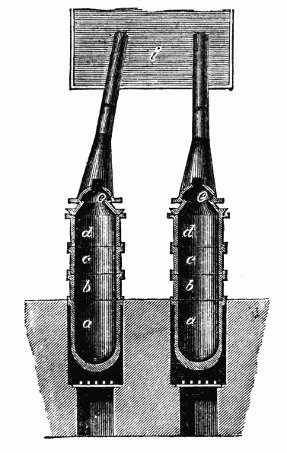
In Silesia the crude arsenious anhydride obtained from arsenical pyrites is refined by sublimation as follows:—For this purpose the cast-iron vessels (a) are employed. Upon these are placed iron rings or collars (b, c, d) and a hood (e), communicating by means of tubes with a series of chambers, of which the first only is shown in i. The flanges of the cast-iron collars and all other joints having been thoroughly luted, the fire is lighted and the heat so increased as to cause the semi-fusion of the arsenious anhydride, which, after cooling, exhibits a peculiarly porcelain-like appearance, at first being as transparent as glass.
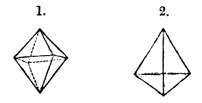
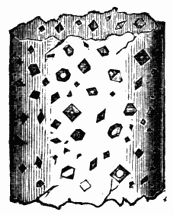
Prop. Crystals (obtained by careful sublimation, or by cooling a boiling aqueous solution), usually transparent, regular octahedrons (fig. 1), but sometimes, though rarely, assume the form of tetrahedrons (see 2). When prepared on the large scale it forms large, glassy, colourless or yellowish-white, transparent or semi-transparent cakes or porcelain-like masses (vitreous arsenious anhydride, glacial a. a.), which soon becomes opaque on their exterior, and often friable and pulverulent; odourless; volatilises at 380° Fahr.; fumes odourless, unless carbonaceous organic matter be present, when they smell strongly like garlic; heated under pressure it liquefies and forms a transparent glass; taste faintly sweetish, with a slight acidity and astringency, not perceived until some minutes after being swallowed. The opaque variety is soluble in 80 parts of water at 59° Fahr., and 7·72 parts of boiling water; but on cooling to 60°, only about one third of this quantity continues in solution. The transparent variety is soluble in 103 parts of water at 59°, and 9·3 parts of boiling water. Both soluble in alcohol, syrups, oils, and spirits, and freely so in alkaline lyes and hydrochloric acid; organic matter generally impedes its solution; solutions redden litmus; heated with organic matter it is reduced to the metallic state. Sp. gr. 3·5 (lowest opaque var.) to 3·8 (highest transp. var.).
Arsenites. True arsenious acid (HAsO2) has never been obtained in a satisfactory condition, but its salts are readily obtained by dissolving arsenious anhydride in a solution of the base, or by double decomposition. They are generally white, nearly all insoluble, except those of the alkalies, and all soluble in acids.
Tests, Detec., &c. Owing to the importance of the subject, and for convenience and facility of reference, the leading tests for the arsenites and arsenious anhydride are noticed alphabetically below; to which a few general remarks on their application, under the various circumstances that occur to the chemist and toxicologist, are appended. When not otherwise stated, it is to be understood that they are to be applied to pure, or nearly pure and colourless solutions of arsenious acid or the arsenites. Ammonio-nitrate of silver gives a well-marked yellow precipitate of arsenite of silver in an aqueous or arsenious anhydride solution which is soluble in ammonia and in dilute nitric acid.
Crystallisation Test.—A very minute quantity of arsenious acid placed in a small tube (arsenic-tube), and heated in the flame of a spirit lamp, gives a crystalline sublimate, which collects on the cooler portion of the tube, and which, when examined by a pocket lens, is found to consist of sparkling octahedral crystals (see engr.)
(Magnified.)
Ellis’s Test.—This is a modification of the ‘nascent hydrogen test,’ in which the suspected gas is passed through a tube containing slips of copper leaf or riband, or still better pure oxide of copper, gently heated; the end of the tube communicating with the atmosphere being drawn to a capillary size, at which the gas may be inflamed and tested, as in ‘Marsh’s Apparatus.’ (See engr.) If arsenic be abundant in the gas, the copper will be almost instantly covered over with a coating of metallic arsenic; and after continuing the heat for a few minutes it will present a beautiful silvery surface, and may then be submitted to further examination.
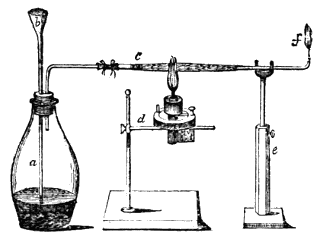
a, Flask containing the suspected fluid, dilute sulphuric acid, and zinc.
b, Funnel.
c, Tube containing the copper-leaf or c.-riband, and heated by the lamp d.
e, Support.
f, Capillary end of tube c, with the gas inflamed.
Lassaigne’s Test. (Adopted by the French Academy.) This consists in passing the gas generated in the suspected liquid, through a solution of nitrate of silver. (See engr.) When arsenic is present black flocculi of metallic silver are deposited, and arsenious acid remains in solution mixed with nitric acid and some arsenide of silver. The filtered liquor, treated with ammonia, will now give a characteristic yellow precipitate of arsenite of silver; or a little dilute hydrochloric acid may be cautiously added to precipitate any remaining nitrate of silver, and the liquid, after filtration, tested for arsenic either in a Marsh’s apparatus, or with any of the liquid tests; or it may be evaporated to dryness, when its arsenious acid will be converted into arsenic acid by the nitric acid present, and will then be found to give the usual brick-red precipitate of arseniate of silver with a solution of the nitrate of that metal. See Marsh’s Test.
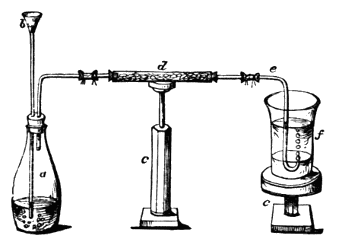
a, Bottle containing dilute sulphuric acid, zinc, and suspected fluid.
b, Funnel for supplying the bottle with acid.
c, c, Supports.
d, Tube filled with asbestos.
e, Bent tube to convey the liberated gas.
f, Glass vessel containing a solution of nitrate of silver.
Marsh’s Test. Some of the suspected liquid is mixed with dilute sulphuric acid until strongly acid, and is then poured upon some pure granulated zinc, or clippings or other small pieces of zinc, previously placed in the apparatus; hydrogen gas is immediately evolved, and, if arsenic be present, unites with it, forming arseniuretted hydrogen gas, which escapes by the aperture b (see engr.), and may be recognised as follows:—
It possesses a garlic-like odour.
It burns with a bluish-white flame and emits a whitish smoke.
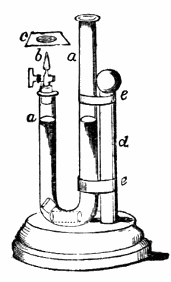
a, a, Bent glass tube, containing dilute sulphuric acid, zinc, and suspected liquid.
b, Stop-cock and jet.
c, Plate of glass to receive the stain.
d, Support.
e, e, Bands to keep the tube upright.
If a piece of window-glass, or a white porcelain plate or saucer, be held a short distance above the flame, a fine pulverulent film of arsenious acid is deposited on it. See (fig.) above.
If the cold plate be held in the flame, so as to slightly impede the combustion of the gas, a blackish-brown deposit of metallic arsenic is obtained, more or less deep, brilliant, and glistening. Both these deposits may be obtained simultaneously by holding nearly vertically over the flame a glass tube about 8 or 10 inches long and 3⁄8ths of an inch in diameter. See (fig.) above.
A solution of arsenious acid may be obtained by letting the flame play upon 3 or 4 drops of water placed on the under side of the piece of glass or china, to which the liquid tests may be then applied. Another plan is to apply drops of the liquid tests to the plate as above, and to let the flame play on them successively.
The true arsenical spot or film is of a blackish-brown colour, and generally of a very deep hair-brown, usually surrounded at the circumference, with a white film of arsenious acid; whilst that of antimony, which in some points is similar, is of a deep black colour, and but feebly lustrous, and, when viewed by transmitted light, appears smoky black; whereas an arsenical spot viewed in the same way appears brown. It is further distinguished from others by—Treated with concentrated nitric acid, it instantly disappears, leaving upon the surface of the liquid traces of the metal, which only dissolve on the application of heat. This solution, gently and carefully heated, leaves a white residuum, which, when cold, gives with a concentrated solution of nitrate of silver a dull-red precipitate of arseniate of silver.—The nitric solution treated with a few drops of sulphurous acid, and subsequently with sulphuretted hydrogen, gives a canary-yellow precipitate of trisulphide of arsenic, which readily redissolves, forming a colourless solution with ammonia.—The arsenical spot, when heated, is turned bright yellow by sulphuretted hydrogen, and is then readily dissolved, as before, by ammonia, and by its bicarbonate; whereas one of antimony is turned of a deep orange-red, or reddish-brown, by sulphuretted hydrogen, is not readily dissolved by ammonia, and is scarcely or not at all affected by bicarbonate of ammonia.—It is freely soluble in and removed by hypochlorite of soda; a reagent which does not affect antimonial spots. Heated by a flame of pure hydrogen an arsenical stain rapidly disappears. A mixed stain of antimony and arsenic does not disappear by the action of the last two reagents, and is shown to contain arsenic by the two first tests above. When hydrochloric acid is present zinc stains are sometimes formed, but they do not resemble those from arsenic. The flame which produces it is very pale blue or bluish-white; whereas antimoniuretted hydrogen burns with a pale green or greenish-yellow flame, and a white smoke, both of which are characteristic.
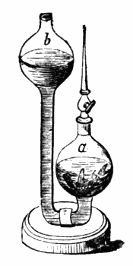
Obs. Marsh’s test is admirable for its simplicity, delicacy, and trustworthiness, as well as for the ease of its application. It is adapted to all liquids, whether colourless or coloured, which are not so glutinous as to inconveniently froth during the extrication of the hydrogen.[79] Various modifications of the original apparatus have been proposed to obviate this difficulty; among which the one chiefly deserving notice is figured in the margin. It consists of a bent tube having two large bulbs blown in it, and fitted with a stop-cock and jet in the usual manner. In this case the grains or fragments of zinc are put into the lower bulb (a). It is, however, worthy of remark, that, with ordinary care and skill, a simple wide-mouthed bottle, furnished with a tube and cock, will often be found to answer quite as well as more costly apparatus; as the fluid is less liable to froth than in a narrow tube. Even a common quinine-phial, or a 4-oz. or 6-oz. medicine phial, fitted with a piece of glass tube of very small bore, or even with a piece of a common tobacco-pipe, for a burner (see engr.), may be used when no more convenient instrument is at hand.
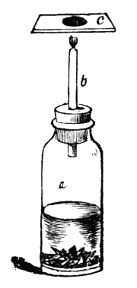
A film of oil placed on the surface of the liquid tends considerably to lessen the frothing.
Objec., precau., &c. Objections have been raised to this mode of testing, from the great frothing which often occurs with organic mixtures, and from antimony and imperfectly charred organic matter also forming crusts somewhat resembling, to the inexperienced eye, those produced by arsenic. But these objections are invalid, because there are easy means of purifying the liquid before testing it, and of discriminating between true arsenical spots or deposits and false ones. Another objection is, that both zinc and sulphuric acid sometimes contain arsenic; but to obviate this difficulty, we have only to use them when perfectly pure; and to test them by means of the apparatus before pouring the suspected liquid into it. Indeed, these objections apply with equal force to all those tests which depend on the production of nascent hydrogen. The precaution necessary to success, and to reliable results, is to set the apparatus with simple zinc, acid, and water, and after it has worked a short time to test the evolved gas for arsenic (as above); when, if no trace of that substance is detected, the suspected fluid, in which the organic matter (if necessary) has been destroyed by any one of the methods hereinafter pointed out, may be added, and the operation continued. Care should also be taken not to light the jet of gas before all the atmospheric air is expelled from the apparatus, as without this precaution an explosion may take place.
Modification of Marsh’s Test.—Davy. This process consists in the use of sodium amalgam instead of zinc and sulphuric acid, both of which are liable to be contaminated with arsenic. Sodium, on the other hand, has never been found to contain arsenic, and mercury only very rarely; but should it exist in that metal, it can be easily removed by digesting the mercury in dilute nitric acid, and afterwards well washing it with water.
One part by weight of sodium to 8 or 10 parts of mercury forms a very good amalgam. The mercury is placed in a test-tube, and the sodium gradually added in small portions; the metals readily combine, forming an alloy, liquid whilst hot, but hard and brittle when cold.
The author uses this amalgam by placing the suspected solution, or solid substance, along with a little water in a test-tube, then adding a small piece of amalgam about the size of a grain of wheat, and quickly covering it with a piece of white filtering paper or the lid of a porcelain crucible moistened with a dilute solution of silver nitrate slightly acidified with nitric acid. If arsenic is present, a dull black or deep brown stain on the paper or porcelain will be developed on the moistened part, owing to the silver being reduced to the metallic state by the arseniuretted hydrogen. The solution may be made by dissolving 20 gr. of nitrate of silver in an ounce of distilled water acidulated with 2 drops of strong nitric acid.
It is advisable to place between the moistened paper or lid and the tube a small disc of bibulous paper, to prevent any particles of the liquid producing minute black spots, and thus interfering with the results. 1⁄1000th part of a grain of arsenious acid in 1 c. c. of distilled water gives a very decided effect in a few moments, but much smaller quantities may be detected, e.g., the 1⁄100000th or even 1⁄1000000th part of a grain in 1 c. c.
This method is applicable not only to arsenic as arsenious acid, but also to other compounds of arsenic, soluble or insoluble in water, e.g., orpiment and realgar, the alkaline arsenates, and even the metal itself if in powder. Organic matter interferes but very little with this method. Antimony, as in Marsh’s process, will produce, with the sodium amalgam, results similar to those of arsenic; this, when brought into contact with the nitrate of silver, forms a black antimonide of that metal.
Fleitmann, however, pointed out that antimoniuretted hydrogen is not evolved from strongly alkaline solution, and, as in this case, the action of the sodium amalgam is to render the mixture quickly alkaline, only a very small quantity of antimony present will be evolved, and by previously rendering the mixture strongly alkaline the evolution of that gas may be almost entirely prevented.
It may be occasionally necessary to determine whether the stains on the paper moistened by the silver solution are due to arsenic or antimony. It is then best to digest the paper-stain in sulphide of ammonium, the metal present being converted into a sulphide, and dissolving in the excess of the alkaline salt, leaving the silver sulphide undissolved; the alkaline solution when evaporated will, in the case of arsenic, leave a bright yellow residue, almost insoluble in hydrochloric acid; whereas in the case of antimony an orange-coloured residue will remain soluble in that acid. Dr Russell observes that hydrogen alone is capable of reducing silver solution to the metallic state, but acknowledges that this action is exceedingly slow. Pellet, on the other hand, maintains that pure hydrogen when passed through solutions of soda and nitrate of silver has no action at the ordinary temperature; but he states that the silver salt which has been fused possesses an alkaline reaction in solution, and hydrogen thus produces a slight precipitate, which can be prevented by adding a drop or two of nitric acid.
Davy, however, found in his experiments only the faintest possible effect of the reducing action of pure hydrogen in solutions of caustic soda and nitrate of silver.
Finally, the author mentions that where paper is used with the silver solution we must not forget that the silver alone will after some time blacken the paper, especially if exposed to light; but this gradual change is very unlike the quick effect produced by arseniuretted or antimoniuretted hydrogen. (‘Chem. News,’ xxxiii, 58-63.)
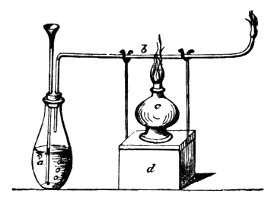
Nascent Hydrogen Test. The apparatus used may be similar to that figured in the engr. The plan followed in the laboratory of Giessen is to heat the long tube through which the gas passes to redness in several parts, to produce distinct metallic mirrors; and then to remove the tube from the hydrogen apparatus and transmit a very feeble stream of dry sulphuretted hydrogen through it, the metallic mirrors being at the same time heated by means of a common spirit lamp from the outer towards the inner border or extremity. If arsenic alone is present, yellow trisulphide of arsenic is formed within the tube; if antimony alone is present, an orange-red or black trisulphide of antimony is produced; and if the mirror consists of both metals, the two sulphides appear side by side, the sulphide of arsenic, as the more volatile, lying invariably before the sulphide of antimony. If dry hydrochloric acid gas be now transmitted through the tube, without application of heat, no alteration will take place if sulphide of arsenic alone is present, even though the gas be transmitted through the tube for a considerable time. If sulphide of antimony alone is present, this will entirely disappear; and if both sulphides are present, the sulphide of antimony will immediately volatilise, whilst the yellow sulphide of arsenic will remain. If a small quantity of ammonia be now introduced into the tube, the sulphide of arsenic is dissolved, and may thus be readily distinguished from sulphur, which perhaps may have separated.
a, Flask containing the suspected fluid, dilute sulphuric acid and zinc. b, Small tube, at the one end having an almost capillary orifice, where the gas is inflamed. c, Spirit-lamp. d, Support.
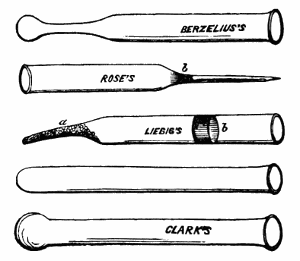
Reduction Test. A small quantity of the suspected sample, in the state of powder, is mixed with twice its weight, or more, of some reducing agent or flux, and the mixture is placed at the bottom of a very small glass tube, and heated in the flame of a spirit lamp for some time, when the arsenic gradually sublimes, and condenses in the cooler portion of the tube, under the form of a metallic crust, mirror, or ring. A common test-tube, if of very small diameter, may be employed; but those known as the reduction tubes of Liebig, Rose, or Berzelius are undoubtedly the most convenient and efficient. (See engr.)
Liebig’s method is by using a mixture of equal parts of dry carbonate of sodium and cyanide of potassium. The suspected substance, perfectly dry and in powder, being first introduced into a Berzelius’ tube, is then covered with 6 times the quantity of this mixture, and so that the whole will not more than half fill the bulb. A very gentle heat is next applied, to expel any adhering moisture from the powder and the tube, after which a strong heat is applied to the bulb, and continued for some time, to effect the entire reduction and sublimation of the arsenical compound.
a, The arsenical mixture.
b, Arsenical ring.
The best fluxes to use are ferrocyanide of potassium dried at 212° F., calcined bitartrate of potassium, cyanide of potassium, and powdered charcoal.
The metallic ring is proved to be arsenical by the properties and tests previously noticed. Should it be imperfectly formed, or masked by decomposed organic matter, the portion of the tube which contains it may be cut off with a file, next coarsely powdered, then reintroduced into another arsenic tube, and the exposure to heat repeated.
The characteristics most simple and well-marked are—
The volatility of the deposit when heated, shown by its escaping from the hotter portion of the tube and condensing on the cooler part higher up or further on.
Its conversion into minute octahedral crystals of arsenious anhydride, when repeatedly chased up and down the tube by the cautious application of the flame of a spirit lamp first to one part, and then to another. The character of these crystals with respect to volatility, lustre, transparency, and form, is so exceedingly well marked that a practised eye may safely identify them, though their weight should not exceed the 1⁄100th or even the 1⁄250th part of a grain. A pocket lens is here serviceable. The form of the crystals is very evident with a microscope of 4 powers. Oxide of antimony never forms octahedrons, but only prisms.
In employing this test, particular care must be taken to avoid soiling the sides of the tube in inserting the mixture, and that the substances operated on are perfectly dry; as unless this is attended to, the experiment does not succeed. The common plan is to introduce the mixture through a small paper funnel or tube extemporised for the purpose. The heat at first should be gentle, and merely sufficient to expel any adhering moisture from the mixture and the inner surface of the tube; after which (except where otherwise ordered) the upper portion of the mixture should be strongly heated, and then the bulb or bottom of the tube exposed to the full flame. After the operation is complete the bulb or lower portion of the tube is usually removed by a file, and the portion containing the deposit hermetically sealed, when it may be preserved, unaltered, for any length of time, ready to be produced as evidence if required.
This test is usually regarded as decisive; as we here actually obtain the arsenic in a solid form, recognisable by the most unequivocal characters.
Reinsch’s Test; Cupro-arsenical Test. The suspected solution is strongly acidulated with hydrochloric acid (1 to 6 or 8), and after being raised to ebullition in a porcelain or glass vessel, a piece of bright and clean metallic copper about 1⁄2 inch long and 1⁄4 inch wide in the form of gauze or foil, but preferably the first, is added, and the whole boiled together. The time required for the ebullition varies according to the strength of the solution; when weak it should be continued for at least a quarter of an hour. When the quantity of arsenic in the suspected liquid is very small, at least half an hour should elapse before the removal of the copper. In solutions containing a notable quantity of arsenic, a few seconds is often sufficient to obtain a coating; but which, for safety sake, may be extended to two or three minutes, or even longer. Liquids rich in organic matter also require longer boiling than those nearly free from it. The coated copper, which has now acquired a characteristic iron-grey colour, is then taken from the liquid, carefully washed in distilled water, in alcohol, and (if greasy) in ether, next dried on blotting-paper, and then either cut into small pieces, or rolled into a small coil or cylinder. It is then heated in a reduction-tube over a spirit lamp, when the metallic arsenic forming the coating is volatilised, and yields a sublimate of minute octahedral crystals of arsenious anhydride; or, if the tube be very small, or any reducing agent be added, a bright metallic ring. When the coating on the copper is sufficiently thick, it may be scraped off with a knife, and heated separately in an arsenic-tube.
This test is invaluable as affording a certain and ready means of abstracting arsenic from its solution, whether pure or mixed with organic matter. The contents of the stomach or other viscera may thus be at once examined, without any tedious preliminary operations. In this way Dr Christison discovered the presence of arsenic upwards of four months after interment; and we have ourselves found it two years and eight months after interment. The coated copper may be preserved unharmed for years. Dr Taylor found that the 1-8th of an inch in one of these deposits that had been kept in paper nearly fourteen years gave a well-marked ring of octahedral crystals when heated.
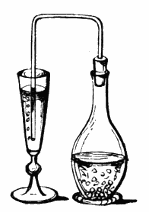
Sulphuretted Hydrogen Test; Sulphur Test. This produces a bright yellow precipitate of trisulphide of arsenic (orpiment) in solutions containing a free acid; but acts slowly and imperfectly on pure and neutral solutions, and does not disturb those that possess an alkaline reaction. The suspected liquid should therefore be slightly acidulated with hydrochloric or acetic acid before applying this test, unless it be already acid, when it is better first to neutralise it with an alkali, and then to add the acid. The transmission of the gas through the liquid (see engr.) should be continued for at least half an hour; when the end of the conducting tube, after being well rinsed in the liquid, is removed, and the glass, lightly covered with a piece of porous paper, set aside in a temperature of about 100° Fahr., until the odour of sulphuretted hydrogen is completely lost. The precipitate is now collected on a small filter, washed with pure water, and dried by a gentle heat. It is then placed in a watch-glass or small capsule, and redissolved in a little liquor of ammonia, which is then again expelled by heat; or it may be at once submitted to confirmatory tests. It is shown to contain arsenic by its ready and perfect solubility in ammonia, and in solutions of the fixed alkalies, their carbonates and bicarbonates, and in alkaline sulphides; by being nearly insoluble in hydrochloric acid, even when concentrated and boiling; and by yielding a metallic mirror when mixed with a flux and submitted to the reduction-test (which see).
Sulphuretted-hydrogen water and sulphydrate of ammonium act in a similar way to gaseous sulphuretted hydrogen; but much less effectively.
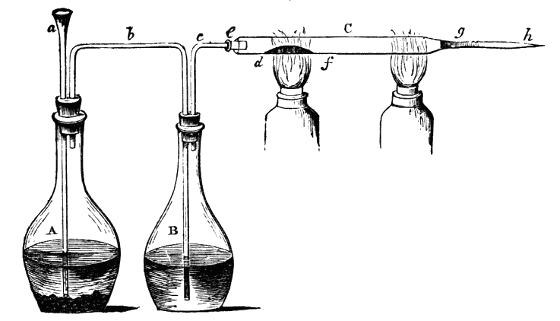
For accuracy, the sulphuretted hydrogen should be washed by passing it through a small bottle containing a little pure water, or dilute sulphuric acid, before allowing it to enter the arsenical liquor. The reduction of the newly precipitated sulphide is generally regarded as the most important part of the investigation, and requires great care and attention. An extremely elegant and sensitive method of effecting this is by heating the mixture in a stream of dry carbonic acid gas. This method has been followed by Drs Babo and Fresenius with the most satisfactory results, and is thus performed:—(A) is a capacious flask for the evolution of carbonic acid, half filled with rather large pieces of solid limestone or marble (not chalk). To one aperture of the doubly perforated cork, a funnel-tube (a) is adapted, which nearly reaches to the bottom of the vessel; to the other aperture a tube (b), by means of which the gas evolved is conducted into a flask of smaller size (B), in which it is washed and dried by concentrated sulphuric acid. The tube (c) conducts the carbonic acid into the reduction-tube (C), which is shortened in the engr., and must be made of difficultly fusible glass. When the apparatus is prepared, the sulphide of arsenic intended for reduction is rubbed in a small basin, previously heated in a water-bath, with about twelve parts of a well-dried mixture consisting of 3 parts of dry carbonate of sodium and 1 part of cyanide of potassium (prepared by Liebig’s method). The mixed powder is then placed on a small strip of card-paper beat into the shape of a gutter, which is next pushed into the reduction-tube up to the point (f), and the tube is turned half round. In this manner the mixture is deposited without soiling any other part of the tube; after which the strip of card-paper is cautiously withdrawn. The reduction-tube is then, by means of the cork (e), fixed in its place; a moderate stream of carbonic acid gas is evolved by pouring hydrochloric acid into the funnel-tube (a), and the mixture carefully dried, by very moderately heating the tube along its whole length, by means of a small spirit lamp. When the gas-stream has become so low that the bubbles pass through the sulphuric acid at intervals of about a second, the spot (k) is heated to redness by means of a spirit lamp. When this point is attained another strong spirit-flame is applied to the mixture, progressing from (d) to (f), until all the arsenic is reduced and volatilised (the first flame at the same time continuing in action at (k)).
The reduced arsenic recondenses at the spot (g), forming a mirror, whilst an exceedingly small portion escapes at the capillary orifice (h), and fills the air with its garlic-like odour. The second spirit lamp is at last slowly advanced towards the other lamp, or the spot (k), so as to drive towards (g) all the arsenic which has adhered to the walls of the wider part of the tube. Both lamps are then removed, the tube closed at the point (h) by fusion, and heat applied, progressing from the point (h) towards (g), to contract the mirror on that side also, which increases its beauty and distinctness. The tube is then cut off at (f), and hermetically closed and sealed. In this state it becomes a permanent evidence which may be referred to in any future proceedings. Neither sulphide of antimony nor any other compound of antimony yields a metallic mirror or ring when treated in this way. Less than 1⁄300 gr. of trisulphide of arsenic thus gives a very distinct and beautiful mirror; and even 1⁄500 gr. a clearly perceptible one.
Voltaic Test. The wires from the opposite poles of a voltaic battery are immersed or brought in contact with a little of the arsenious solution placed in a capsule or on a piece of window glass. If arsenic be present it is developed at the negative pole; and if this be formed of copper wire, it becomes whitened and assumes the appearance of polished steel or silver, in consequence of the formation of arsenide of copper.
Detection of Arsenic in Organic Mixtures. Of the tests those which act by producing coloured precipitates are only applicable, with any degree of certainty, to perfectly limpid and colourless liquors. Those depending on the extrication of arseniuretted hydrogen are partially free from this inconvenience; but even here, if the suspected liquid be more than slightly charged with organic matter, so much frothing ensues, as to render the process nearly unmanageable. In this respect Reinsch’s Test possesses advantages over all others, as it may be applied even to coloured liquids containing a considerable quantity of organic matter, without these being subjected to any preliminary process, and without danger of failure. In some cases also, as with liquids possessing only a slight degree of consistency or colour, the arsenic may be separated, after simple filtration and acidulation with hydrochloric acid, by a stream of sulphuretted hydrogen, in the usual manner. The reduction-test is only applicable to solid arsenious acid, or to compounds of arsenic obtained by means of other tests or processes. In toxicological examinations the poison is almost always to be sought for in mixtures loaded with organic matter, and under other conditions even more embarrassing. Soon after arsenic is swallowed it enters the circulation, contaminates the various tissues, localises itself in certain viscera, and is eliminated in the excretions. Hence it becomes necessary not only to examine the solids and liquids in which it is suspected the poison has been administered, the vomited matter, and the contents of the stomach and primæ viæ, but also, in fatal cases, the stomach itself, the liver, blood, muscles, and more especially the urine.[80] In such cases the stomach is the part first laid open, and a careful examination is made of its contents and coats in order to detect any undissolved particles of the poison, a pocket lens being employed, if necessary, in the search. If any particles, however minute, are found they are carefully collected and submitted to the reduction-test. If the reverse be the case, the stomach (cut into small pieces), together with its contents, is submitted to some further process, to obtain a solution suitable for the application of the usual tests. The liver, also some muscle, and any other portion of the body that may be selected, are likewise separately treated in the same manner. We have here both solid and liquid organic matter to operate on, and the problem for solution is the abstraction of their arsenic in the simplest and most certain manner, and in a form in which its presence may be demonstrated by tests. This subject has long engaged the attention of the most eminent chemists and toxicologists, and various plans have been proposed for the purpose, among which the following appear to be the most valuable and that usually adopted:—
(Reinsch.) Solids (as the stomach, liver, &c.) are cut into small fragments and boiled in a glass vessel with water acidulated with about 1-4th of its volume of hydrochloric acid, until the tissues or fragments are entirely broken down into flakes or grains, when the whole, after filtration, is again heated to the boiling-point, and tested as described under Reinsch’s test (see ANTIMONY). Liquids do not require this preparation.
Reinsch’s test is inapplicable when, as sometimes happens, the arsenic sought after may be in the state of one of the sulphides—either as orpiment or realgar—a not improbable contingency, when it is remembered that, although arsenious anhydride or white arsenic is the form most generally used for criminal or suicidal purposes, the yellow and the red varieties being largely employed in workshops where fireworks are manufactured, have not unfrequently been had recourse to. Again, when the examination of a corpse long buried and disinterred takes place, it must be borne in mind that the arsenious anhydride taken by the deceased has, by the decomposition of the body, become converted into sulphide. In these cases the hydrochloric acid necessary for the performance of Reinsch’s test fails to effect the solution of the sulphide.
Mr Blyth says: “It is found that the post-mortem change into orpiment is never quite complete, so that for the detection of arsenic in solid organic substances, such as the tissues of the body, the best general method is most decidedly to convert the arsenic, if present, into the volatile chloride; and according to Dr Taylor, there is always sufficient arsenic (if present at all) unchanged into sulphide to ensure success. The only necessary caution is that the substance be thoroughly dried, and that the reagents be pure. After drying it is placed in a retort with fuming hydrochloric acid, and slowly distilled by the heat of a sand-bath. The distillate contains chloride of arsenic (if arsenic was present), and may be submitted to further tests.”
Estim. This may be effected in various ways:—
1. Gravimetrically:—Arsenic is usually WEIGHED under the form of arsenate of lead, arsenate of sesquioxide of iron, tersulphide of arsenic, (metallic) arsenic, or (directly) as arsenious anhydride. The last three only, as the more simple and convenient, will be noticed here:—
As trisulphide:—The whole of the arsenic being precipitated by a stream of sulphuretted hydrogen, with the necessary precautions, in the manner already noticed, the precipitate, after being carefully collected, washed, and dried, is purified by redissolving it in pure ammonia water, and evaporating the resulting solution in a weighed watch glass or capsule by the heat of a water-bath. It is then dried at a temperature not above 212° Fahr., and finally weighed. Each grain of the tersulphide so found corresponds to ·80487 gr. of arsenious acid, or ·61 gr. of metallic arsenic.
As (metallic) Arsenic:—Obtained by one of the processes already given. Each gr. represents 1·32 gr. arsenious acid.
As Arsenious anhydride:—Obtained in a weighed capsule or tube, either by the crystallisation or sublimation test. The weight is the answer sought for arsenious anhydride. Each gr. of this is equiv. to ·75758 gr. of metallic arsenic.
Volumetrically. (Method of F. Mohr.) This depends on the fact that an aqueous solution of arsenious acid, or of an alkaline arsenite, when mixed with an excess of saturated solution of pure bicarbonate of soda and a little starch-paste, has its arsenious acid converted into arsenic acid by a solution of iodine. A standard solution of iodine is, therefore, an appropriate arsenim′eter for the above mixture. The solution of iodine is added until the blue starch-reaction just begins to appear, the arsenious solution having been previously exactly neutralised with pure carbonate of soda if acid, or with pure hydrochloric acid if alkaline. The results are accurate when no substance capable of oxidising or decomposing iodine is present in the liquid tested.
Phys. eff., &c. Arsenious anhydride or white arsenic is alike destructive to vegetable and animal life. Seeds soaked in any but a very weak solution of it lose their power of germination, and buds plunged in it become incapable of expanding into flowers. When applied to the leaves, roots, or stems, absorption takes place, and the plant soon perishes. On combustion it evolves the characteristic garlic-like odour of arsenic, and arsenic may be discovered in its substance by chemical tests. According to Jäger, Gilgenkrantz, and Pereira, a few of the lower order of the algæ are occasionally developed in solutions of arsenious acid. To all animals, from the infusoria up to man, arsenic proves deleterious, although in different degrees, the highest susceptibility of its effects existing in man on account of the superiority of his development. In all of them death is preceded by inordinate actions and increased evacuations, especially from the mucous surfaces. Difficult respiration, thirst, vomiting, and convulsions are the leading symptoms which gradually develope themselves as we approach the higher grades of the system. (Jäger.) In very small or therapeutical doses, properly administered, it is a valuable medicine, and acts as a tonic, alterative, and antispasmodic attenuant, and externally as an escharotic. In slightly increased medicinal doses, or long-continued small doses, nausea, vomiting, purging, griping, debility, emaciation, and all the effects of slow-poisoning, occur in succession—a gradual sinking of the powers of life, without any violent symptom; a nameless feeling of illness, failure of the strength, an aversion to food and drink, and to all the enjoyments of life. Redness of the conjunctiva and eyelids, headache and giddiness, spasms, eczematous eruptions, numbness and paralysis of the limbs, and ptyalism, are also frequent and well-marked symptoms of slow poisoning by arsenic. In an excessive or poisonous dose the symptoms are rapid and violent, usually indicating extreme gastro-intestinal inflammation and disorder of the cerebro-spinal system, and often occasioning death in from one to three days. The smallest fatal dose found recorded by Christison is 41⁄2 gr., taken in solution. The subject was a child 4 years old, and death occurred in six hours. 21⁄2 gr. destroyed a robust girl in 36 hours. (Letheby.) 2 gr., in solution, are suspected to have caused the death of a full-grown woman. 2 or 3 gr. may be a fatal dose. (Dr A. Taylor.) Notwithstanding these facts much larger quantities have been taken, under peculiar circumstances, with comparative impunity; and cases are not wanting in which even enormous quantities have produced very trifling effects.
The dose for animals is—Cattle, 5 to 10 grains. Horse, 5 to 10 grains. Sheep, 1 to 2 grains. Pig, 1⁄2 to 2 grains. Dog, 1⁄15th to 1⁄10th of a grain.
Under all circumstances arsenious anhydride is, undoubtedly, one of the most powerful of the mineral poisons; and in whatever form or way it is introduced into the system it exerts the same deleterious influence. In all cases, in sufficient doses, its action is to increase the secretions, diminish the contractility of the voluntary muscles, and to produce convulsions, prostration and death.
Arsenic is a non-accumulative, irritant poison, and exerts no decided chemical or corrosive action on the tissues. (Taylor.)
Pois., &c.—Symp. These sometimes begin to appear within half an hour after the poison has been taken, or even sooner; but much more generally, not until after the lapse of some hours. They usually commence with nausea and distress at the stomach, followed by thirst, often intense, and a sense of burning heat in the bowels; then come on constriction of the œsophagus, violent vomiting, severe colic pains, tenesmus, and excessive and painful purging, the stools being occasionally bloody; but pain, vomiting, &c., do not invariably occur. The pulse is generally quick, small, feeble, and irregular—sometimes scarcely perceptible, and the heart’s action is irregular and tumultuous. The tongue is dry and furred; the respiration difficult and panting; the urino-genital apparatus is often affected; there is pain and difficult micturition, and sometimes entire suppression of urine; faintings, coldness of the limbs, and cold sweats, with other signs of debility, intervene. Itching, and eczematous eruptions of the skin, trembling, painful cramps, and contractions of the extremities, and violent convulsions often follow; and after these, a greater or less prostration of strength, which induces a deceitful calm. At length the heart’s action abates, the skin becomes suffused with a cold clammy sweat, and the sufferer dies from exhaustion. The progress, succession, and precise character of the symptoms are modified by the idiosyncrasy of the individual, the quantity of the poison, and the manner in which it has been taken; and are seldom all present in the same person.
Treatm. If vomiting has commenced it should be promoted by tickling the throat, and administering a large quantity of gelatinous hydrated peroxide of iron, or other appropriate antidote, in divided doses, mixed with a large quantity of warm or tepid water, strongly sweetened with sugar. If vomiting has not commenced, which is rare, it must be excited by administering 15 to 20 gr. of sulphate of zinc, or ipecacuanha (or in the absence of these, a teaspoonful of flour of mustard) in a tumbler of tepid water, and tickling the throat as before. If these means fail in rapidly inducing copious vomiting, the dose must be repeated, or the stomach-pump had recourse to. Altogether as much as 16 to 18 oz. of the hydrated peroxide of iron may be administered. If the poison has been swallowed several hours previously, and hence may have passed the pylorus, a strong dose of castor oil or a purgative clyster may be administered, and, after its action, another clyster containing the antidote. As soon as the stomach and bowels are cleared, diuretics and sudorifics should be given in abundance. Lastly, any remaining irritation must be relieved by demulcent and soothing remedies; or if urgent, by slight general or local bleeding, which cannot be earlier practised without danger; and opium, camphor, and ether, followed by tonics, may be had recourse to, to recruit the system.
Lesions. Redness and inflammation of the whole primæ viæ; and sometimes of the mouth, fauces, and œsophagus, but more usually the contrary. Sometimes also, though seldom, there is no marked appearance of inflammation in the stomach and intestines. The stomach is usually highly injected, and frequently marked with extravasations; lungs gorged with blood; mucous lining of trachea reddened; heart generally flabby, and exhibiting deep red or blackish stains, and the right cavities more or less loaded with blood; the conjunctiva is sometimes very vascular; and redness, extravasation of blood, and effusion of serum is occasionally seen in the brain. The blood is frequently, though not invariably, fluid after death, and dark coloured. Under certain circumstances, the mucous membrane of the stomach and intestines is lined with a multitude of brilliant points or grains, which have been mistaken for arsenious anhydride; but which, according to Orfila, are composed of fat and albumen. Placed on burning coals, they decrepitate on drying, and produce a species of explosion or detonation. These grains are also met with in the stomach of persons who have not been poisoned. Digested in water, the liquid obtained from them does not show the presence of arsenic when submitted to reagents.
Ant. In the order of their assumed efficiency:—Moist peroxide of Iron.—See under the preparations of Iron (Arsenici Antidotum, G.). Hydrated or gelatinous sesquioxide or peroxide of iron (for an adult—a tablespoonful, in water, every 8 or 10 minutes until 12 or 16 oz., or more, have been taken). Hydrated sulphide of iron (as the last). Gelatinous hydrate of magnesia (as the last). Calcined magnesia (taken as the first). Salad or olive oil, or almond oil, and oil or fats generally (ad libitum), are all highly effective in lessening, if not destroying the action of arsenious anhydride.[81] Albumen (white of egg), or liquids containing it (in cold water, ad libitum). Milk, wheat-flour, oatmeal gruel (with water, ad libitum). Lime water, with milk (as the last). Chalk, with milk and water (as the last). Infusion or decoction of bark, or better, of nut-galls (as the last). Sugar or syrup (ad libitum). See Treatm. (above); also the above substances under their respective heads.
Uses, &c. Arsenious anhydride and its compounds are extensively employed in the arts and medicine. It is used by the dyer, it furnishes the artist with several of his most beautiful pigments, and the glass-maker and enameller with a flux or material to whiten and decolour their wares. In agriculture, it is used (in solution) as an anti-smut for seed-wheat; and as an anti-vermin lotion or dipping for sheep and cattle. In small (therapeutical) doses it is a valuable remedy in intermittent fevers, chronic skin diseases (especially lepra and psoriasis), and in several nervous affections (as neuralgia, epilepsy, chorea, tetanus, &c.). It is the active ingredient of the tasteless ague-drop; of Fowler’s and Pearson’s solutions; and in the Tanjore pills, long celebrated in India for the cure of the bite of the cobra di capello and other venomous serpents, as well as of hydrophobia. It has been given in syphilis, chronic rheumatism, typhus, and several other diseases, with more or less advantage. Cautiously administered in phthisis, it frequently restores the appetite and strength and greatly retards, and in some cases arrests, the progress of the disease. It has been recently used to relieve toothache arising from caries. Externally, it is employed in the form of powder, lotion, and ointment, for the cure of cancer. Plunkett’s ointment, Pâte arsénicale, Davidson’s Remedy for Cancer, and several other like preparations, owe their activity to arsenious anhydride. Water in which white arsenic has been steeped has become a favorite cosmetic wash with many ladies, since its assumed property of softening the skin was announced in a certain popular periodical. It is also the prime ingredient in the papier moure, a popular fly paper. Its use, whether internal or external, is, however, attended with considerable danger in unskilful hands, and should, therefore, never be adopted but under proper advice.—Dose, 1⁄20 to 1⁄8 gr., made into pills with crum of bread and lump sugar; or in solution, 3 to 5 or 6 drops, twice or thrice daily, gradually and cautiously increased to 12, or even 15 drops. As a rule, arsenical preparations should be taken soon after a meal, and by no means on an empty stomach. (Dr A. T. Thomson.) The dose should be suspended, or greatly reduced, as soon as the conjunctiva is affected (Hunt); or if dryness of the mouth or throat, or irritation of the stomach or bowels, ensues. Mr Maculloch found the pills more efficacious than the solution; they act differently, and cannot be substituted for one another.
Arsenic is a favorite tonic and alterative with farriers, who often administer it very carelessly to horses, to the serious injury of these animals. It is also a favorite with grooms, who have imbibed the notion that small doses of it contribute to improve the condition of the skin. The best-informed veterinarians, however, either wholly avoid it, or use it with very great caution.[82]—Dose (for a HORSE), 2 to 5 or 6 gr., twice or thrice daily; in farcy or glanders, 10 to 12 gr. In solution it is often employed as a wash or dipping to destroy vermin in cattle and sheep; but its use is not free from danger, particularly to the shepherds or dippers.
Gen. commentary. The necessary length of the preceding article, owing to the great importance of the subject in its relations to toxicology and medical jurisprudence, has left us little space for further remark here. In addition to what has been said on arsenical testing, it may be useful to caution the reader of the absolute necessity of only employing tests and reagents which are themselves absolutely pure; and in which the operator has, by personal examination, failed to detect the slightest trace of arsenic. Commercial sulphuric, nitric, and hydrochloric acids, potash, soda, nitre, iron, and zinc, frequently contain arsenic; from which, however, they may be freed by chemical processes; or they may be purchased in the pure state from respectable dealers in chemicals. But no assurance of the vender should be regarded as a proof of their purity. In all judicial investigations the absence of arsenic in the several tests and reagents, and the apparatus employed, must be demonstrated and sworn to. We may further add, that the results afforded by no single test can be depended on. In matters of such vast importance, the most ample confirmatory evidence must be sought.
Marsh’s, Reinsch’s, Lassaigne’s, the sulphur, and the Reduction Tests, and their modifications, are those now generally preferred by toxicological chemists; each of which, with its confirmatory tests, are amply sufficient for the indisputable identification of arsenic.
Modern toxicologists have abandoned most of the old processes for the detection of arsenic, and have adopted one of two, which have been found more expeditious as well as more certain. These are the tests of Marsh and Reinsch, preferably the latter.
Herapath’s Method is to obtain deposits by Reinsch’s Test on 4 or 5 pieces of No. 13 copper wire; each piece being about 21⁄2 inches long, and previously flattened and planished with a polished hammer for about one half its length. The deposit, with some of the adhering copper, scraped from one of these coated pieces, is sealed up hermetically in a tube for future production. The scrapings from three pieces of wire are separately submitted to the sublimation test in tubes bent in the form of an obtuse V capillary at one end, and about 3⁄10ths of an inch in diameter at the other; the capillary leg being about three times as long as the larger one. The scrapings are placed in the bent part of the tube; and the flame of a small spirit lamp is so applied as to slowly drive the sublimate into the narrower portion of the tube, which is held rather higher than the other. If the deposit so obtained be mercury, it condenses in white shining globules;—if lead or bismuth, it does not rise but melts into a yellowish glass, which adheres to the copper; if tellurium, it falls as a white amorphous powder; if antimony, it does not rise at that low temperature; but if it be arsenic, it sublimes as arsenious anhydride, which condenses as minute octahedral crystals, looking, with the microscope, like very transparent grains of sand. One of these tubes containing the sublimed arsenious anhydride is then sealed up, like the first one, for future production. The capillary part of another tube containing the sublimate is then cut off, and carefully boiled in a few drops (10 to 15) of distilled water; and, when cold, 3 or 4 drops of the resulting solution is poured on a plate of white porcelain, and to this, by means of a glass rod, one drop of solution of ammoniacal sulphate of copper is added. The mixture is then carefully conducted on to a piece of white filtering-paper set on the surface of a smooth, clean, and dry chalk-stone, by which the moisture is absorbed, and the smallest portion of Scheele’s green produced by the test rendered more conspicuous. The ammonio-nitrate of silver test is then applied, in a similar manner, to 3 or 4 drops of the remaining solution; after which the pieces of paper with the spots are dried, and sealed up in separate tubes, as before, observing to exclude the light from that containing the yellow precipitate of arsenite of silver. A stream of sulphuretted hydrogen is then passed through the remaining tube containing the arsenical sublimate, by which the latter is converted into the yellow tersulphide—this too is sealed up. Here are now five tests—the metal, the acid, arsenite of copper, arsenite of silver, and yellow tersulphide of arsenic.
It is now well known that certain soils contain arsenic, either as arsenite of lime or sulphide of arsenic; and which, under favorable circumstances, may permeate or be absorbed by a body, after interment. In judicial investigations following disinterment it is, therefore, necessary to examine portions of the cemetery-earth taken from the grave, as well as from parts more or less distant from it. For this purpose the earth should be thoroughly dried in a water-bath, drenched with pure and concentrated hydrochloric acid, and allowed to stand for twenty-four hours. The mixture is then distilled, and the distillate tested for arsenic by Reinsch’s or Marsh’s test. Should the product of one distillation yield no evidence of arsenic, it should be returned to the retort, if necessary, a second or even a third time, and the distillation repeated.
The practice of employing an alkaline solution of white arsenic as an anti-smut steep for wheat, has lately arrested the attention of chemists. M. Audouard states that he has detected traces of arsenic in the crops raised from seed-wheat thus treated. But that which appears to be likely to prove much more dangerous is the introduction of arsenic into crops by the employment of crude superphosphate of lime as manure—a substance often rich in this poison. Dr Edmund Davy positively states that arsenic, as it exists in artificial manures, is taken up by plants growing where those manures have been applied! He found cabbages and turnips taken from fields manured with superphosphate give unmistakeable evidence of being ‘arseniated.’ These facts have some important bearings; for though the quantity of arsenic which occurs in such manures is not large when compared with their other constituents, and the proportion of that substance which is thus added to the soil must be necessarily small, still plants during their growth, as in the case of the alkaline and earthy salts, take up a considerable quantity of this substance. Further, as arsenic is well known to accumulate in soils, though not an accumulative poison in the animal system, the effects after some time will probably be, that vegetables raised on those continuously so manured will ultimately be found to contain such a proportion of arsenic as will exercise an injurious effect on the health of man and animals. The statement of M. Audouard has been disputed by M. Girardin, because he failed to detect arsenic in corn under the circumstances; and it is also denied by Dr A. S. Taylor, and others; but our own experiments, very carefully performed, confirm the assertions of both Audouard and Davy. The ultimate consequences of pouring into the Thames such enormous quantities of disinfectants contaminated with arsenic, as has been done during the last three or four years, is another matter deserving consideration, and one which has been ably pointed out by Dr Letheby, in his reports as Officer of Health to the City of London.
Dr Lois has found arsenic, often in large quantities, in ordinary brass, and brass utensils; and we have ourselves repeatedly found arsenic in the Britannia-metal, German-silver, and other cheap white alloys at present in such general use.
The preceding facts are recommended to the careful attention of medical jurists.
By an Act of Parliament[83] it is provided—1. That every vender of arsenic shall, before the delivery of the same to the customer, enter in a book or books kept for the purpose, the date of sale, name, and residence of the purchaser, in full, his or her condition or occupation, the quantity so sold, and the purpose or purposes for which it is required, in a form set forth in the schedule to the Act; which form or schedule shall be signed by the vender, and by the said purchaser, unless he be unable to write, when such fact shall be recorded in the said schedule by the vender; and this schedule, when a witness is required to the sale, shall also bear his signature, together with his place of abode:—2. Arsenic is not to be sold to a stranger, unless in the presence of a witness acquainted with both vender and purchaser:—3. No person to sell arsenic unless it be previously mixed with at least 1 oz. of soot or 1⁄2 oz. of indigo to the pound; unless such admixture would be injurious to the object for which it is intended, when not less than 10 lbs. is to be sold at any one time:—4. Penalty for evading the Act, either as vender, purchaser, or witness, £20:—5. Act not to extend to arsenic used in compounding prescriptions nor to the wholesale trade:—6. The word ‘arsenic’ to include ‘arsenious anhydride,’ and the arsenites, arsenic acid and the arseniates, and all other colourless poisonous preparations of arsenic. See Arsenic, Arsenic Acid, Lotions, Pills, Sheep-dipping, Soaps, Solutions, Wheat-steeps, Iron, Potassa, Soda, and other Bases, &c. &c. (also below).
Self-detect′ing Arsenious Anhydride. Prep. (Dr Cattell.)—1. Ordinary white arsenic to which is added a small quantity of a mixture of dry calomel and quick-lime; or of dried sulphate of iron and powdered gall-nuts. The product is white, but immediately turns black when mixed with liquids:—2. As the last, but adding a mixture of thoroughly dried sulphate of iron and ferrocyanide of potassium. Strikes a blue:—3. As last, but using dried phosphate of sodium and dried sulphate of iron. Strikes a green. Proposed as a method of preventing arsenic being used as a poison.
ARSENICAL PIGMENTS, EFFECTS OF. The composition of those substances which are compounds of copper with arsenious, very frequently combined with acetic acid, will be found under Green Pigments, under their respective commercial names of Scheele’s Green, Mineral Green, Emerald Green, and Schweinfurt Green. The purity of tint and durability of these arsenical salts have, not unnaturally, caused them to be employed in many branches of industry, the products of which are everywhere around us, and as the colouring material of these, they are placed in conditions very favorable to their being taken into the stomach or lungs. This will be apparent when we name a few of the materials in which they are employed:—wafers, candles, wall-papers, window curtains, confectionery.
A curious illustration of the risks attending their use may be cited from the ‘Medical Times and Gazette’ of April, 1854, which states that some loaves found to contain arsenic were discovered on inquiry to have got the dangerous intruder from having been allowed to stand on shelves freshly painted a bright green colour. Arsenical-coloured wafers may be pronounced free from danger, so long as they are kept out of the reach of children; and although the arsenical vapours given off by burning a green wax taper would not be sufficient to induce toxic results, the fact of the extreme sensibility of some people to the action of this poison, when taken in by the lungs, renders the use of these tapers a very objectionable one, particularly if they are generally employed in a household. The burning of wax candles, coloured with arsenical green, is, of course, still more strongly to be condemned, because from its superior mass, when compared with the taper, the candle gives off a greater amount of the poisonous fumes. An arsenical taper weighing 17·69 grains was found upon analysis by Mr Bolas, late of Charing Cross Hospital, to contain 0·276 grains of arsenious acid. “A Christmas tree,” says Mr Blyth, “brilliantly illuminated with Christmas candles, may be taken as an extreme instance of the danger likely to arise from this source.” That the employment of arsenical green in the manufacture of sweetmeats was not abandoned in 1873 may be evidenced from a circumstance quoted by Mr Blyth in his interesting work on ‘Hygiène.’ “During the Christmas of 1873 a large cake in which was imbedded a green card labelled “for the bairnies,” was seized in a baker’s shop at Greenock. The card was coated with sugar, and on being submitted to analysis, was found to contain 7·04 grains of arsenious acid.
A curious case, illustrating the effect of arsenical wall-papers, is furnished by Dr Dalzell, of Malvern. He was attending a lady ill with scarlet fever, and during the attack her husband occupied a small bedroom. The first night he slept in it his slumbers were most unrefreshing and disturbed by horrible dreams, and on rising in the morning he felt languid and weak, had lost his appetite, and had a dull headache. Towards the evening these unpleasant symptoms had nearly vanished. On the second night (when he occupied the same dormitory) and on the day following the same disagreeable symptoms returned. He then changed his bedroom, and forthwith they troubled him no more. A servant, who next occupied the chamber, was affected as her master had been. Dr Dalzell suspecting the wall-paper as the cause, examined it, and found it to contain a large quantity of arsenic.
Some little time since Mr Bolas examined a sample of wall-paper containing 27·53 grains of arsenious acid in the square foot, and in this case the pigment was so loosely fixed that the slightest friction was sufficient to detach a portion and diffuse it through the air. Nor is this surprising when we consider how slightly the arsenical colour is attached to the surface of the paper, as well as how easily it may become liberated from it by the desiccation of the air of the room when heated by a fire. This may be exemplified by drawing the sleeve of a black or dark-coloured coat over an arsenical wall-paper, and observing the green deposit that is left on the garment.
After this we shall be prepared for the following statement: “Hamberg drew, by means of aspirators, the air of a room, the walls of which were papered with a very old green paper, through various tubes containing cotton wool and silver nitrate. On examination scarcely any solid particles could be discovered. The cotton-wool was fused with sodium nitrate and carbonate, and gave a little ferric oxide and a trace of arsenic, but the solution of nitrate of silver gave decided evidence of arsenic, as well as of sulphide of silver.” (‘Phar. Jour.’)
Not many years since Professor Fleck showed that the arsenious acid in the Schweinfurt green, when in contact with moist organic substances, and especially starch-sizing, forms arseniuretted hydrogen, which diffuses in the room, and which is no doubt the cause of some of the cases of arsenical poisoning from green papers. So that a contrary condition to a dry atmosphere, viz. a moist or damp one, may also lead to results nearly, if not quite as objectionable, when rooms are papered with arsenical papers. We have Mr Blyth’s word for the assertion, that the most dangerous of the arsenical papers, viz. those covered with a thick, unvarnished, loosely coherent layer of Seheele’s green are most frequently to be met with in our nurseries, where the beds are placed next the wall, and where the attrition of the bedclothes frequently removes portions of the poisonous colouring matter. The fine cupro-arsenical dust which thus becomes diffused through the room, now and then produces in children symptoms resembling those of violent catarrh. Some of the wall-papers of these nurseries have been found to yield 18 grains of arsenious acid in a square foot. It would appear that the use of arsenical pigments is by no means restricted to green wall-papers. Very recently an analytical chemist examined a great number of samples of wall-papers of different colours, and was surprised to find arsenic in most of them. Within the last year the writer examined the pigment which he could disengage without much difficulty from a very small piece of green muslin window curtain, and found it yield a large quantity of arsenic. In Paris alone there are more than 15,000 people who earn their living by making artificial flowers, a quarter at least of these workers being engaged in that branch of the manufacture in which Schweinfurt green is used. From the instances already adduced of the ill effects caused, although in a mild degree, by occasional and accidental exposure to arsenical pigments, we shall be prepared to learn that the danger and the damage to health is very much more intensified when, as in the case of these poor artisans, the workman is constantly handling the deadly material, and incessantly inhaling an atmosphere laden with its particles. Dr Vernois has published a most interesting description, which we subjoin, of the artificial flower-maker at work. He says:—“These greens are formed either from arsenite of copper alone, or mixed in variable proportions with acetate of copper (English green). Arsenical greens are employed to colour different herbs, to tint the fabric destined to prepare the leaves of artificial flowers, as they are painted directly on the leaves or petals of flowers worked on cloths of various textures. For these various purposes they buy the Schweinfurt or the English green (vert Anglaise), either in powder or in aqueous solution, and add to it, according to the effect desired, a certain quantity of Flanders glue, starch, gum, honey, or turpentine. Sometimes it is applied in the dry state, in order to sprinkle it over the things already coloured by the arsenical green. They frequently also, in order to modify the colour, mix with it a certain quantity of chromate of lead or picric acid.
The preparation of herbs is carried on as follows:—The workman plunges into a shallow vessel, containing a sufficiently liquid solution of Schweinfurt green, one or several stalks of natural plants, perfectly dried, and agitates them quickly, seizing them by their roots with a pair of forceps. This operation, which is termed ‘steeping,’ stains the fingers, the arms, the person, and the clothes of the workman, and the surrounding objects are covered with traces of this kind of paint. The plants thus prepared are hung on a line, and there allowed to dry for thirty-four or forty-eight hours. At the end of that time all the stalks are gathered and formed into bundles, which are used finally for bouquets. Often enough, to satisfy some freak of fashion, they are sprinkled with powdered arsenite of copper. This is the powdering. The bouquet-work constitutes one of the principal dangers; for the colouring matter not having been fixed by any mordant, detaches itself in the form of a fine dust, which penetrates the skin of the hands, and which the workman breathes constantly. This danger is still more increased when he handles bouquets covered with arsenical powder. At other times, however, in the manufacture of the plants, the Schweinfurt green is diluted with a sufficient quantity of turpentine. In this way the colour takes a smooth appearance, not altered by contact with water, and does not escape immediately in the form of powder by gentle handling; but when it is thoroughly dry it falls to the ground in little flakes, and may again rise in the air with ordinary dust. Thus the danger is modified, a little retarded, but always exists. There are then in this speciality of the florist the operations of steeping, drying, powdering, and arranging the flowers for bouquets, which in their details place the workman or the purchaser under the more or less direct, and more or less active influence of arsenical salt. This particular industry is exercised under conditions which render it still more injurious; for it is freely practised by a number of poor workpeople, by households living in one or two rooms, ill-ventilated, ill-lighted, and which they never sweep, and of which the floor like the furniture, and like the clothing of the workpeople, is continually impregnated by pigment and covered with arsenical dust. The preparers of the cloth destined for the manufacture of the artificial leaves by the aid of arsenical greens, comprehend the portion of the work most exposed to deleterious action. They use arsenite of copper alone, mixed principally with starch, and in rare instances associated with acetate of copper in variable proportions. Some use eublèe, a mixture of picric acid and of greenish indigo, in which they steep their stuffs. Other manufacturers use fabrics prepared with hot solutions by ordinary dyers. According to the hue which the Schweinfurt dyer wishes to obtain, the workman commences by giving the stuff a yellow shade, by plunging it into a solution of picric acid and pure alcohol. He squeezes it between his fingers, in order to completely impregnate it and dries it. It is this preliminary operation which stains the workman’s fingers yellow. Frequently the latter mixes picric acid by grinding it with the Schweinfurt green, and applies this paste immediately to the fabric. The paste is prepared by kneading the Schweinfurt green, already treated with water, with a solution of starch thick enough, yet sufficiently liquid, to be easily spread on the cloth. During this working up the paste the fingers, arms, and hands of the workman are covered with arsenical solution. This being ready, the workman lays out his stuff, distributes the paste over it, then beats it between his hands, in order to make the colouring matter thoroughly penetrate the cloth. The longer it is beaten the better is the quality of the article. During this operation the skin of the hands and arms is completely impregnated with the solution. Sometimes the cloth, having been touched here and there with arsenical paste, is attached to a hook in the wall, and twisted different ways—wrung as it were. In this way a very uniform colouring is obtained. This process is as bad to the workman as the former. Lastly, a process which is generally practised consists in placing the fabric, stained or not with picric acid, on a wooden table, and distributing on both sides the arsenical preparation with a brush, and then beating the stuff with a thick rubber. In this way the hands and arms of the workman are much less exposed to the paste than in the preceding processes. After the brushing and beating of the fabric comes the drying, to which operation attention must next be directed. Once impregnated with the green colour by whatever process, the pieces in squares of about 1 metre 50 cent. are hung on wooden frames, furnished with teeth, on which the borders of the cloth are transfixed. During this simple operation the workmen stain themselves much. When the stuffs are detached from the squares they are folded, and from every crease falls a fine dust, which may then be carried into the mucous membranes. The workmen then are liable to all the accidents of the manufacturers of flowers, especially in the operations of kneading the paste, or during the beating, brushing, drying, and folding of the cloths. From the hands of the fabricator the fabrics are very often immediately consigned to the manufacturers of artificial flowers, who press them, figure them (that is to say, make the nerves), arm them with a wire, and mount them with flowers. It may be at once understood how much all the manipulations I have just mentioned are liable to develop the arsenical dust. The paste has not been fixed on the stuffs by any mordant; the starch with which it is mixed has given it a very brittle consistence, and has predisposed it to be easily detached from the cloth.
The stamping is effected by putting a certain number of folded pieces one above the other, and submitting them to the pressure of a stamping instrument. Repeated blows of this instrument detach the paste in scales, and cover with dust the fingers and person of the workman. A series of small packets are taken from the stamping press, which contain, strongly pressed together, from twelve to twenty-four leaves. They are passed on to another workman, who is charged with the folding. This operation is performed by holding the little bundle of leaves between the thumb and index finger of the left hand.