A CYCLOPÆDIA OF PRACTICAL RECEIPTS, PROCESSES, AND COLLATERAL INFORMATION (continued 41)
Reading edition
FLU′ORINE. F. Syn. Fluorinium, L. An element that has not yet been isolated, owing to its attacking and combining with every element or compound that at present has been exposed to it, except oxygen. It is presumably gaseous, and of a pale greenish-yellow colour.
FLU′OSILICIC ACID. Syn. Fluoride of silicon and hydrogen; Hydrofluosilic acid. Prep. From powdered fluor spar, and siliceous sand or powdered glass, of each 1 part; concentrated sulphuric acid, 2 parts: mix in a glass retort, apply a gentle heat, and pass the evolved gas into water through a layer of mercury. Decomposition ensues, silica being deposited in a gelatinous state, and hydrofluosilicic acid or fluosilic acid remains in solution. The acid liquor is used as a test for potassium and barium, with whose salts it yields nearly insoluble precipitates.
FLUX. Syn. Fluxus, Fluor, L. In medicine, a term formerly applied to several diseases attended with a copious discharge, as diarrhœa (FLUX), dysentery (BLOODY FLUX), English cholera (BILIOUS FLUX), fluor albus (WHITE FLUX), &c. These terms are still current among the vulgar.
Flux. In metallurgy, &c., a term applied to various substances of easy fusibility, which are added to others which are more refractory, to promote their fusion.
Prep. 1. (Black flux.) Nitre, 1 part; crude tartar or cream of tartar, 2 parts; mix, and deflagrate, by small quantities at a time, in a crucible, heated to dull redness. The product consists of carbonate of potassa, mixed with charcoal in a finely divided state. Used for smelting metallic ores. It exercises a reducing action, as well as promotes the fusion. It must be kept in a dry corked bottle.
2. (Christison’s flux.) Carbonate of soda (cryst.), 8 parts; charcoal (in fine powder), 1 part; heat the mixture gradually to redness. For reducing arsenic.
3. (Cornish reducing flux.) Crude tartar, 10 parts; nitre, 4 parts; borax, 3 parts; triturate together.
4. (Cornish refining flux, White flux.) Crude tartar and nitre, equal parts, deflagrated together. See Black Flux.
5. (Crude flux.) Same as BLACK FLUX, omitting the deflagration. Reducing.
6. (Fresenius’s flux.) Carbonate of potassa (dry), 3 parts; cyanide of potassium, 1 part. For the arsenical compounds.
7. (Liebig’s flux.) Carbonate of soda (dry) and cyanide of potassium, equal parts. As the last. See Arsenious Acid.
8. (Morveau’s reducing flux.) Powdered glass (free from lead), 8 parts; calcined borax and charcoal, of each, 1 part; all in fine powder, and triturated well together. Used as BLACK FLUX.
9. (White flux.) See above.
10. (Fluxes for enamels.) See Enamels.
11. (Various.) Borax, tartar, nitre, sal-ammoniac, common salt, limestone, glass, fluor spar, and several other substances, are used as fluxes in metallurgy.
Obs. On the large scale, crude tartar is employed in the preparation of fluxes; on the small scale, commercial cream of tartar or bitartrate of potassa.
FLY. The common house-fly (Musca domestica) causes considerable annoyance to the person in hot weather, as well as damage to handsome furniture, especially to picture frames, gilding, and the like. The best way to exterminate them is to expose on a plate one or other of the mixtures given under Fly Poison (below). The blow-fly (Musca vomitoria), and other insects, may be kept from attacking meat by dusting it over with black pepper, powdered ginger, or any other spice, or by skewering a piece of paper to it on which a drop or two of creasote has been poured. The spices may be readily washed off with water before dressing the meat.
It is a fact not generally known, that flies will not pass through a netting made of fine silk, thread, or wire, even though the meshes may be an inch apart, unless there is a window or light behind it. This affords us a ready means of excluding these insects from all our apartments which have windows only on one side of them, without keeping the latter closed. It is merely necessary to have an ornamental netting stretched across the opening, when, although flies may abound on the outside, none will venture into the room so protected. If, however, there is a window on the other side of the room, they will fly through the netting immediately. See below.
Fly-blow in Sheep. Oil of turpentine, 3 oz.; oil of amber, 1 oz.; corrosive sublimate, 1 dr. The sublimate must be first dissolved in a pint of whey, and then mixed with the oils.
Fly Papers. Those papers which, a few years ago, were sold about the streets of London by harsh-voiced cries of “Catch ′em alive-oh!” and which might be seen in many shop-windows covered with dead and dying flies, were prepared by rubbing factitious birdlime over sheets of paper. It would be difficult to conceive a more cruel or more offensive mode of catching flies than that of glueing their living bodies to an adhesive surface. A preferable kind of fly-paper is that called ‘PAPIER MOURE,’ which contains a large quantity of arsenic in its substance.[317] This paper is kept wet when in use, and the flies, by sipping the moisture, are poisoned.
Fly Poison. Prep. 1. A strong solution of white arsenic (say 1 dr. to the pint), sweetened with moist sugar, treacle, or honey. Sold under the name of ‘Fly water,’
2. Treacle, honey, or moist sugar, mixed with about 1⁄12th their weight of King’s yellow or orpiment.
Obs. Both the above are dangerous preparations, and should never be employed where there are children.
3. (Redwood.) Quassia chips (small), 1⁄4 oz.; water, 1 pint; boil 10 minutes, strain, and add of treacle, 4 oz. “Flies will drink this with avidity, and are soon destroyed by it.”
4. Black pepper, 1 teaspoonful; brown sugar, 2 teaspoonfuls; cream, 4 teaspoonfuls. See below.
Fly Powder. The dark grey-coloured powder (so-called ‘sub-oxide’) obtained by the free exposure of metallic arsenic to the air. Mixed with sweets, it is used to kill flies.
Fly Water. See Fly Poison (above).
FOG. The influence of very intense foggy weather upon the death-rate is well illustrated by a reference to the Registrar-General’s returns for 1873. From the 8th to the 12th of December of that year an unprecedently thick fog prevailed in London. The mortality in the metropolis for the week ending December 6th was twenty-three persons per thousand; in the week following, during which the fog occurred, the death-rate rose to twenty-seven; and in the week after that, when the full effects of the fog could be estimated, the deaths were found to be thirty-eight in the thousand. In the same periods the deaths from phthisis and diseases of the respiratory organs were respectively 520, 764, and 1112. That this increased death-rate was not the result of the inclement weather by which the fog was accompanied is evidenced by the circumstance that in large provincial towns, where the weather was equally severe, but in which no fog occurred, the increase in the mortality, when compared to London, was slight.
The mean of the deaths registered in London, in the two weeks ending December 20th, showed an increase of 41 per cent. upon the number returned in the first week of the month; whilst during the same date the deaths in seventeen large English towns were only 8 per cent. This fatal fog occurred during the London cattle-show week, and killed a great number of the animals sent for exhibition.
In a specimen of the air of Manchester, obtained during the visitation of that city by a very dense fog, Dr Angus Smith discovered it contained a diminished amount of oxygen when compared with a favorable sample of air.
FOILS. These are thin leaves of polished metal, placed under precious stones and pastes, to heighten their brilliancy, or to vary the effect. Foils were formerly made of copper, tinned copper, tin, and silvered copper, but the last is the one wholly used for superior work at the present day.
Foils are of two descriptions:—white, for diamonds and mock diamonds, and—coloured, for the coloured gems. The latter are prepared by varnishing or lacquering the former. By their judicious use the colour of a stone may often be modified and improved. Thus, by placing a yellow foil under a green stone that turns too much on the blue, or a red one under a stone turning too much on the crimson, the hues will be brightened and enriched in proportion.
Prep. 1. (Crystal, Diamond, or White foil.)—a. This is made by coating a plate of copper with a layer of silver, and then rolling it into sheets in the flatting mill. The foil is then highly polished, or covered with crystal varnish.
b. The inside of the socket in which the stone or paste is to be set is covered with tin foil, by means of a little stiff gum or size; when dry, the surface is polished and the socket heated, and whilst it is warm, filled with quicksilver; after repose for two or three minutes the fluid metal is poured out, and the stone gently fitted in its place; lastly, the work is well fitted round the stone, to prevent the alloy being shaken out.
c. The bottom of the stone is coated with a film of real silver, by precipitating it from a solution of the nitrate in spirit of ammonia, by means of the oils of cassia and cloves.[318] This method vastly increases the brilliancy both of real and factitious gems, and the work is very permanent.
2. (Coloured foils.) The following formulæ produce beautiful coloured effects, when judiciously employed:—
a. (Amethyst.) Lake and Prussian blue, finely ground in pale drying oil.
b. (Blue.) Prussian blue (preferably Turnbull’s), ground with pale, quick-drying oil. Used to deepen the colour of sapphires.
c. (Eagle marine.) Verdigris tempered in shell-lac varnish (alcoholic), with a little Prussian blue.
d. (Garnet.) Dragon’s blood dissolved in rectified spirit of wine.
e. (Vinegar garnet.) Orange lake finely tempered with shell-lac varnish.
f. (Green.)—α. From pale shell-lac, dissolved in alcohol (lacquer), and tinged green by dissolving verdigris or acetate of copper in it.
β. From sesquiferrocyanide of iron and bichromate of potassa, of each 1⁄2 oz.; ground to an impalpable powder, first alone, and then with gum mastic (clean and also in fine powder), 2 oz.; a little pyroxilic spirit is next added, gradually, and the whole again ground until the mass becomes homogeneous and of a fine transparent green. The beauty increases with the length of the grinding. The predominance of the bichromate turns it on the yellowish green; that of the salt of iron on the bluish green. For use it is to be thinned with pyroxilic spirit. (‘Chem.,’ iii, 231.) Used for emeralds.
g. (Red.) Carmine, dissolved in spirit of hartshorn, or in a weak solution of salt of tartar, and a little gum (dissolved) added.
h. (Ruby.)—α. From lake or carmine, ground in isinglass.
β. Lake ground in shell-lac varnish. Both are used when the colour turns on the purple.
γ. From bright lake ground in oil. Used when the colour turns on the scarlet or orange.
i. (Yellow.)—α. Various shades of yellow may be produced by tinging a weak alcoholic solution of shell-lac or mastic, by digesting turmeric, annotta, saffron, or socotrine aloes in it. The former is the brightest, and is used for topazes.
β. From hay saffron digested in 5 or 6 times its weight of boiling water until the latter becomes sufficiently coloured, and a little solution of gum or isinglass added to the filtered liquor. When dry, a coating of spirit varnish is applied.
Obs. By the skilful use of the above varnishes, good imitations of the gems may be cheaply made from transparent white glass or paste; and by applying them to foils set under coloured pastes (FACTITIOUS GEMS), a superior effect may be produced. The pigments employed must be reduced to the finest state possible by patient grinding, as without this precaution transparent and beautiful shades cannot be formed. The palest and cleanest mastic and lac, dissolved in alcohol, and also the palest and quickest drying oil should alone be used when these substances are ordered. In every case the colour must be laid on the foil with a broad soft brush; and the operation should be performed, if possible, at once, as no part should be crossed, or twice gone over, whilst wet. If the colour turns out too pale, a second coat may be given when the first one has become quite dry, but this practice should be avoided if possible.
FOMENTA′TION. Syn. Fomentatio, FOMENTUM, Fotus, L. A liquid, either simple or medicated, used for local bathing. Fomentations are distinguished from lotions chiefly in being applied in a heated state, and in larger quantities, and for a longer period at a time.
Fomentations are chiefly employed to allay pain or irritation, or to promote suppuration or the healthy action of the parts. As the intention is to convey heat, combined with moisture, to the part fomented, the utmost care must be taken to manage the application so as to promote the object in view as much as possible. Flannel cloths wrung out of the hot or boiling liquid, by means of two sticks, turned in opposite directions, form the best vehicles for fomentations. If they are shaken up, and laid lightly over the part, they involve a considerable quantity of air, which, being a bad conductor, retains the heat in them for a considerable time. “In every process of fomenting there should be two flannels, each (say) three yards long, with the ends sewed together, to admit of the boiling water being wrung out of them; and the one flannel should be got ready whilst the other is applied. The fineness or the coarseness of the flannel is not a matter of indifference. The coarser it is the less readily does it conduct heat, and the longer it retains its warmth; therefore it is more efficient for fomenting. White flannel also retains the heat longer than coloured flannel.” (Dr R. E. Griffith.) More harm than good is frequently done by allowing the patient to become chilled during the application. “If only one (flannel) is used, the skin becomes chilled during the time occupied in removing the flannel, soaking it in the water, wringing it out, and reapplying it; but if two are used, one of them is ready, and can be applied the moment the other is taken off, by which means the part is never exposed to the air, no matter how long the fomentation is continued. In some diseases (rheumatism, peritonitis, &c.), the patient is scarcely conscious of a degree of heat which scalds the nurse’s hands. In this case the fomenting flannels should be put in a towel, by which means they may be wrung out without being handled by the nurse, and may be applied far hotter than can be done by any other method.” (Dr J. B. Nevins.)
The quantity of liquid forming a fomentation, as well as the size of the cloths employed, must entirely depend upon circumstances. In some cases (as in slight affections of the face, &c.) the application may be effectually made by holding the part in the steam of the hot liquid, and bathing it continually by means of a sponge or cloth. In some instances 1⁄2 pint to a pint of liquid may be found a sufficient quantity; whilst in others several quarts will be required. Under all circumstances, care must be taken to keep the fomentation as near as possible at the temperature ordered, during the whole time of its application; and, as soon as the operation is finished, to quickly wipe the part dry, and to cover it with ample clothing, in order that the reaction set up may not be prematurely checked.
Fomentations usually consist of simple water, or the decoction of some simple vegetable substance, as chamomiles, elder flowers or mallows; but, occasionally, the leaves and flowers of aromatic and narcotic plants, and saline matter, are employed under this form. The following formulæ are given as examples:—
Fomentation, Acetic. Syn. Fotus aceticus (Paris Codex). Fomentations of vinegar are sometimes prepared with white, with rose, or with aromatic vinegar (Paris Codex) in the proportion of one of vinegar to four of water.
Fomentation, An′odyne. Syn. Fotus anodynus, Fomentatio anodyna, Fomentum anodynum, L. Prep. 1. Simple decoction of poppy-heads.
2. (Hosp. F.) Poppy-heads (without the seeds), 11⁄2 oz.; water, 31⁄2 pints; boil to 21⁄2 pints; add of elder flowers, 3⁄4 oz.; boil to a quart and strain. Used to allay pain.
3. (Pierquin.) Opium, 1 oz.; wine, 1 quart; boil to a pint and strain. Used in severe gouty, rheumatic, neuralgic, and syphilitic pains.
4. Opium, 1 oz.; water, 1 quart; boil to 3⁄4 pint, add pyroligneous acid, 2 fl. oz.; boil for 10 minutes longer, then further add of sherry wine, 3⁄4 pint; and as soon as the whole again boils, strain it for use. Superior to the last, and cheaper.
Fomentation, Antineural′gic. Syn. Fomentatio antineuralgica, L. Prep. 1. (Mialhe.) Acetate of morphia, 2 gr.; acetic acid, 2 or 3 drops; eau de Cologne, 2 or 3 dr.; dissolve. In facial neuralgia.
2. (Trousseau and Reveil.) Cyanide of potassium, 1 dr.; distilled water, 6 fl. oz.; dissolve and keep it in a well-closed bottle in the dark. Used in neuralgia, especially in that of the face (tic douloureux). A compress of lint or soft linen is dipped in it and applied to the part. It must not be used internally or applied to a wounded surface, as it is very poisonous. See Fomentations, anodyne, Nos. 3 and 4 (above), also Fomentation, Stimulant.
Fomentation, Antiseptic. Syn. Fomentatio antiseptica, L. Prep. 1. Decoction of mallows, 4 pints; sal ammoniac, 2 oz.; dissolve, and add of disulphate of quinine, 20 gr., dissolved in camphorated spirit, 4 fl. oz.
2. (Hosp. F.) Decoction of bark, 1 quart; infusion of chamomile, 1 pint; camphorated spirit, 2 fl. oz.; hydrochloric acid, 1 fl. dr. Both are used when there is a tendency to gangrene or putrescence.
Fomentation of Ar′nica. Syn. Fomentatio arnicæ, L. Prep. 1. Flowers of arnica, 1 oz.; water, 3 pints; boil to a quart, and strain. Used in contusions.
2. (Graefe.) Flowers of arnica, 2 oz.; rue (leaves), 1 oz.; boiling water, q. s. to strain 12 fl. oz. of infusion after an hour’s maceration at nearly the boiling temperature. Used in contusions and extravasations, especially as an application to black eyes.
3. (Radius.) Flowers of arnica, 1⁄2 oz.; boiling vinegar, q. s. to strain 6 fl. oz. of infusion, in which dissolve of carbonate of ammonia, 2 dr. Used in œdema of the scrotum.
Fomentation, Aromat′ic. Syn. Fomentatio aromatica, Fotus aromaticus, L. Prep. 1. Sea wormwood, southernwood, and chamomiles, of each 1 oz.; laurel leaves, 1⁄2 oz.; water 5 pints; boil to half gall., and strain. In rheumatism, cutaneous affections, colic, &c.
2. (Augustin.) Rosemary, 1⁄2 oz.; red wine, and water, of each 3 fl. oz.; infuse and strain with expression. In contusions, especially black eyes.
3. (Hosp. F.) Cloves and mace, of each 1 oz.; opium, 20 gr.; red wine (boiling), 1 pint; digest at near boiling for 1 hour, and strain. Used as both the last.
4. (Rideau.) Bay leaves, rosemary, southernwood, and wormwood, of each 1 oz.; water, 2 quarts; boil 5 minutes, and strain. As No. 1.
Fomentation, Astrin′gent. Syn. Fotus astringens, F. roborans, L. Prep. 1. Decoction of oak bark.
2. To each quart of the last add of alum 1 dr.
3. (Ph. Chirur.) Bruised galls, 1 oz.; boiling water, 21⁄2 pints; digest 1 hour, and strain.
4. (Ricord.) Tannin, 21⁄2 dr.; aromatic wine (hot), 1⁄2 pint; dissolve.
5. Bistort and pomegranate peel, of each 2 oz.; sal ammonia, 1⁄4 oz.; red wine, 1 pint.; infuse at a gentle heat. The above are used in hæmorrhages, piles, prolapsus, &c.
Fomentation of Belladon′na. Syn. Fotus belladonnæ, L. Prep. (Ophthalmic Hosp.) Extract of belladonna, 1 dr.; boiling water, 1 pint. Used to dilate the pupil in certain affections of the eye; it is usually applied on the forehead.
Fomentation of Bitter-sweet. Syn. Decoctum dulcamaræ, L. Prep. Bitter-sweet stalks, 10 dr.; water, 11⁄2 pint; boil to a pint, and strain.
Fomentation of Cham′omile. Syn. Fomentatio anthemidis, L. Prep. Chamomiles, 2 oz.; water, 3 pints; boil 10 minutes, and strain with expression. Emollient.
Fomentation, Com′mon. Syn. Fotus communis. (L. 1744.) Prep. Dried southernwood, sea wormwood, chamomile, of each 1 oz.; dried bay leaves, 1⁄2 oz.; water, 5 pints; boil slightly, and strain.
Fomentation, Compound of Hemlock. (Guy’s Hosp.) Syn. Fomentum conii compositum. Prep. Dried hemlock, 2 oz.; dried chamomiles, 1⁄2 oz.; boiling water, 11⁄2 pint; macerate for 2 hours, strain, and press.
Fomentation, Diuret′ic. Syn. Fomentatio diuretica, L. Prep. (Trousseau.) Tinctures of squills and foxglove, of each 2 oz.; hot water, 6 fluid oz.; mix. Applied by lint or linen compresses to the insides of the thighs, in dropsies, when the stomach will not bear diuretics.
Fomentation of El′der Flowers. Syn. Fotus sambuci, L. Prep. From elder flowers, 1 oz.; boiling water, 2 quarts; digest in a hot place for 1 hour, and express the liquor. Emollient.
Fomentation, Emol′lient. Syn. Fomentatio emolliens. L. Prep. 1. Marshmallow root and poppy heads, of each 1 oz.; water, 3 pints; boil to a quart, and strain.
2. (P. Cod.) Emollient herbs, 1 oz.; boiling water, 1 quart; infuse 1 hour, and strain with expression. (See above.)
Fomentation, Foxglove. Syn. Fomentum digitalis. Dried foxglove, 1 oz.; boiling water, 11⁄2 pint; infuse, and strain.
Fomentation of Galls. Syn Fomentum gallæ. Prep. Bruised galls, 1⁄2 oz.; boiling water, 2 lbs.; macerate for an hour and strain.
Fomentation, Narcot′ic. Syn. Fomentatio narcotica, L. Prep. (P. Cod.) Narcotic herbs, 1 oz.; boiling water, 11⁄2 pint; infuse as last.
Fomentation, Poppy. Syn. Fomentum papaveris. As Decoction of Poppies.
Fomentation, Resol′vent. Syn. Fotus resolvens, L. Prep. (Richard.) Fomentation of elder flowers, 8 fl. oz.; liquor of diacetate of lead, 1⁄2 fl. dr.; mix. Used to discuss tumours, &c.
Fomentation, Stim′ulant. Syn. Fomentatio stimulans, L. Prep. 1. Sesquicarbonate of ammonia, 1 oz.; tincture of cantharides, 2 fl. oz.; warm water, 1 pint.
2. Household mustard, 4 oz.; hot water, 11⁄2 pint; mix. Both the above are rubefacient and counter-irritant, and excellent in rheumatism, neuralgia, &c.
Fomentation, Tannin. Syn. Fomentum tannini. (Ricord.) Prep. Tannin, 2 dr.; aromatic wine, 8 oz.
Fomentation, Ver′mifuge. Syn. Fomentatio vermifuga, Fotus anthelminticus, L. Prep. Leaves and flowers of tansy, wormwood, and chamomile, of each 3 oz.; water, 1 quart; boil to 11⁄2 pint, and strain. Applied to the abdomen, &c., in worms.
Fomentation, Wine. Syn. Fotus vinosus (Par. Cod.) Prep. Red wine, 2 pints; honey 4 oz.
FOOD. Syn. Cibus, Materia alimentaria, L. Anything which feeds or promotes the natural growth of organic bodies, by supplying them with materials which, by assimilation, may be converted into the substances of which they are composed; or which, by its decomposition or slow combustion, maintains the temperature, or some other essential condition of life, at the proper standard. The numerous articles employed as food are all compounds; and in many cases they consist of mechanical mixtures or chemical combinations of two or more compounds. Organized matter, or that which has possessed either animal or vegetable life, or which has been produced by living organs, seems to be alone capable of assimilation, to any extent, by the animal system; and hence it is from the organic kingdom that our aliments are necessarily derived. Water, iron, earthy phosphates, chloride of sodium, and other salts, which form the inorganic constituents of the body, though not of themselves nourishing, are also assimilated when taken in conjunction with organic aliments, and then contribute essentially to nutrition. In the animal and vegetable substances employed as food, these inorganic compounds are provided in small but sufficient quantities to meet the requirements of the healthy body, and in this state of combination alone can they be regarded in the light of aliments. A complete consideration of this subject embraces, not only all the substances used as food, but also those things which when taken with them improve their flavour, promote their digestion, and render them more wholesome and nutritive; and also their preparation for the table in its various relations with health and disease.
The following ‘BILLS OF FARE,’ for which we are indebted chiefly to Soyer, Rundell, and others, exhibit the various articles in season at different periods of the year.
First quarter. January.—Poultry and game: Pheasants, partridges, hares, rabbits, woodcocks, snipes, turkeys, capons, pullets, fowls, chickens, and tame pigeons.—Fish: Carp, tench, perch, lampreys, eels, cray-fish, cod, soles, flounders, plaice, turbot, thornback, skate, sturgeon, smelts, whitings, lobsters, crabs, prawns, and oysters.—Vegetables: Cabbage, savoys, colewort, sprouts, leeks, onions, beet, sorrel, chervil, endive, spinach, celery, garlic, scorzonera, potatoes, parsnips, turnips, brocoli (white and purple), shalots, lettuces, cresses, mustard, rape, salsafy, and herbs of all sorts (some dry and some green); cucumbers, asparagus, and mushrooms are also to be had, though not in season.—Fruit: Apples, pears, nuts, walnuts, medlars, and grapes.
February and March.—Meat, fowls, and game, as in January, with the addition of ducklings and chickens.—Fish: As the last two months (cod is not thought so good from February to July, although it is still sold at the fishmonger’s).—Vegetables: The same as the previous months, with the addition of kidney-beans.—Fruit: Apples, pears, and forced strawberries.
Second quarter. April, May, and June.—Meat: Beef, mutton, veal, lamb, and venison (in June).—Poultry: Pullets, fowls, chickens, ducklings, pigeons, rabbits, and leverets.—Fish: Carp, tench, soles, smelts, eels, trout, turbot, lobsters, chub, salmon, herrings, cray-fish, mackerel, crabs, prawns, and shrimps.—Vegetables: As before; and in May, early potatoes and cabbages, peas, radishes, kidney-beans, carrots, turnips, cauliflowers, asparagus, artichokes, and numerous salads (forced).—Fruit: (in June) strawberries, cherries, melons, green apricots, and currants and gooseberries for tarts; pears, grapes, nectarines, peaches, and some other fruit.
Third quarter. July, August, and September.—Meat, as before.—Poultry, &c.: Pullets, fowls, chickens, rabbits, pigeons, green geese, leverets, and turkey poults. Two former months, plovers and wheat-ears (in September), partridges, geese, &c.—Fish: Cod, haddocks, flounders, plaice, skate, thornback, mullets, pike, carp, eels, shellfish (except oysters), and mackerel (during the first two months of the quarter, but they are not good in August).—Vegetables: Of all sorts, beans, peas, French beans, &c.—Fruit: (In July)—Strawberries, gooseberries, pine-apples, plums (various), cherries, apricots, raspberries, melons, currants, and damsons. (In August and September)—Peaches, plums, figs, filberts, mulberries, cherries, apples, pears, nectarines, and grapes. (During the latter months)—Pines, melons, strawberries, medlars, and quinces. (In September)—Morella cherries, damsons, and various plums.
Fourth quarter. October, November, and December.—Meat, as before, and doe venison.—Poultry and Game: Domestic fowls, as in first quarter; pheasants (from the 1st of October); partridges, larks, hares, dotterels (at the end of the month), wild-ducks, teal, snipes, widgeon, and grouse.—Fish: Dories, smelts, pike, perch, halibuts, brills, carp, salmon-trout, barbel, gudgeons, tench, and shellfish.—Vegetables: (As in January), French-beans, last crops of beans, &c.—Fruit: Peaches, pears, figs, bullace, grapes, apples, medlars, damsons, filberts, walnuts, nuts, quinces, services, and medlars. (In November)—Meat, &c.: Beef, mutton, veal, pork, house-lamb, doe venison, and poultry and game as in the last month.—Fish: As the last month.—Vegetables: Carrots, turnips, parsnips, potatoes, skirrets, scorzonera, onions, leeks, shalots, cabbage, savoys, colewort, spinach, chardbeats, chardoons, cresses, endive, celery, lettuces, salad-herbs, and various pot-herbs.—Fruit: Pears, apples, nuts, walnuts, bullace, chestnuts, medlars, and grapes. (In December)—Meat, &c.: Beef, mutton, veal, house-lamb, pork, and venison.—Poultry and Game: Geese, turkeys, pullets, pigeons, capons, fowls, chickens, rabbits, hares, snipes, woodcocks, larks, pheasants, partridges, sea-fowls, guinea-fowls, wild ducks, teal, widgeon, dotterels, dun-birds, and grouse.—Fish: Cod, turbot, halibuts, soles, gurnets, sturgeon, carp, gudgeons, codlings, eels, dories, and shell-fish.—Vegetables: As in last month. Asparagus, &c., forced.—Fruit: As before, except bullace.
Food, Inspection of. The Public Health Act enacts that—
“Any medical officer of health or inspector of nuisances may at all reasonable times, inspect and examine any animal, carcase, meat, poultry, game, flesh, fish, fruit, vegetables, corn, bread, flour, or milk exposed for sale, or deposited in any place for the purpose of sale, or of preparation for sale, and intended for the food of man, the proof that the same was not exposed or deposited for any such purpose, or was not intended for the food of man, resting with the party charged; and if any such animal, carcase, meat, poultry, game, flesh, fish, fruit, vegetables, corn, bread, flour, or milk, appears to such medical officer or inspector to be diseased, or unsound, or unwholesome, or unfit for the food of man, he may seize and carry away the same himself or by an assistant, in order to have the same dealt with by a justice.” (P. H., s. 116.)
“If it appears to the justice that any animal, carcase, meat, poultry, game, flesh, fish, fruit, vegetables, corn, bread, flour, or milk so seized is diseased, or unsound, or unwholesome, or unfit for the food of man, he shall condemn the same and order it to be destroyed, or so disposed of, as to prevent it from being exposed for sale, or used for such food; and the person to whom the same belongs or did belong at the time of sale, or of exposure for sale, or in whose possession, or on whose premises the same was found, shall be liable to a penalty not exceeding £20 for every animal, carcase, or fish, or piece of meat, flesh, or fish, or any poultry or game, or for the parcel of fruit, vegetables, corn, bread, or flour, or for the milk so condemned, or at the discretion of the justice, without the infliction of a fine, to imprisonment for a term of not more than three months.
“The justice who, under this section, is empowered to convict the offender, may be either the justice who may have ordered the article to be disposed of or destroyed, or any other justice having jurisdiction in the place.” (P. H., s. 117.)
“Any person who in any manner prevents any medical officer of health or inspector of nuisances from entering any premises and inspecting any animal, carcase, meat, poultry, game, flesh, fish, fruit, vegetables, corn, bread, flour, or milk exposed or deposited for the purpose of sale, or of preparation for sale, and intended for the food of man, or who obstructs or impedes any such officer or inspector, or his assistant, when carrying into execution the provisions of this Act, shall be liable to a penalty, not exceeding £5.” (P. H., s. 118.)
“Any complaint made on oath, by a medical officer of health, or by an inspector, or other officer of a local authority, any justice may grant a warrant to any such officer, to enter any building, or part of a building in which any such officer has reason for believing that there is kept or concealed any animal, carcase, meat, poultry, game, flesh, fish, fruit, vegetables, corn, bread, flour, or milk which is intended for sale for the food of man, and is diseased, unsound or unwholesome, or unfit for the food of man and to search for, seize, and carry away any such animal, or other article, in order to have the same dealt with by a justice under the provisions of this Act.
Any person who obstructs any such officer in the performance of his duty, under such warrant shall, in addition to any other punishment to which he may be subject, be liable to a penalty not exceeding £20.” (P. H., s. 119.)
FOOL. Cooks give this name to a species of jam made of boiled and crushed fruit, mixed with milk or cream, and sweetened.
Fool, Ap′ple. From the peeled and cored fruit, placed in a jar, with moist sugar, q. s. to render it palatable, and a very little cider or perry; the jar is set in a saucepan of water over the fire, and the heat continued until the apples become quite soft, when they are pulped through a colander, and a sufficient quantity of milk, a little cream, and some sugar, added to bring them to the proper ‘palate.’
Fool, Goose′berry. From gooseberries, as the last. Those which are unripe are generally preferred. These preparations, when nicely made, are very pleasant and wholesome.
FOOT (Human). See Feet.
FOOTS. Coarse moist sugar. The scrapings of the sugar hogsheads, refuse sugar, waste, and dirt, is also sold to the publicans under this name, who use it in the adulteration of their beer; chiefly to make it stand more water, and to impart ‘briskness.’
FORCE′MEAT. Syn. Farce, Stuffing. A species of sausage meat, either served up alone, or employed as an ingredient in other dishes.
Mrs Rundell truly remarks that “at many tables, where everything else is done well, it is common to find very bad forcemeat or stuffing.” To avoid this error, care should be taken to so proportion the ingredients that “no one flavour should predominate; yet if several dishes be served the same day, there should be a marked variety in the tastes of the forcemeats as well as of the gravies. A general fault is, that the tastes of lemon peel and thyme overcome all others; therefore they should only be used in small quantities.” Forcemeats should be just consistent enough to cut with a knife, but not dry and heavy. Herbs are very essential ingredients; and it is the copious and judicious use of them that chiefly gives the cookery of the French its superior flavour. “To force fowls, meat, &c., is to stuff them.” (Mrs Rundell.)
FOR′CING. Horticulturists apply this term to the art of accelerating the growth of plants, so as to obtain fruits or flowers at unusual seasons. Dung-beds, bark-beds, and frames, pits, and houses, with glass roofs, are commonly employed by the gardeners for this purpose.
FORGERIES, PROTECTION FROM. See Paper, Protective.
FORMATE. Syn. Formiate. Salts, in which one atom of hydrogen in formic acid is replaced by a metal or other basic radical. They are best obtained either by direct saturation of the acid, or by double decomposition; most of them are very soluble, and are decomposed by hot oil of vitriol. Formate of ammonium crystallises in square prisms; formate of sodium, in rhombic prisms; formate of potassium is deliquescent, and crystallises with difficulty; the formates of barium, calcium, magnesium, and strontium, form small prismatic crystals; formate of lead assumes the shape of small colourless needles, soluble in 40 parts of water; the formates of cobalt, iron, manganese, nickel, and zinc, are easily crystallisable, whilst that of copper forms very beautiful, large, bright-blue rhombic prisms; formate of silver is less soluble than the salt of lead, and is decomposed at a gentle heat.
FORMIC ACID. HCHO2. Syn. Hydrogen Formiate. An organic acid, obtained by oxidizing many organic substances, and found in the red ant.
Prep. Sugar, 1 part; water, 2 parts; binoxide of manganese, 3 parts; mix in a retort capable of holding fully 10 times the bulk of the ingredients, and add, cautiously, oil of vitriol, 3 parts, diluted with an equal weight of water; as soon as the first violent effervescence has subsided, heat may be applied, and the product collected and purified, as below.
Formate of lead in fine powder is introduced into a long glass tube, one end of which is connected with an apparatus evolving sulphuretted hydrogen, and the other with a receiver. As soon as the salt is entirely decomposed (blackened) a very gentle heat is applied, and the distilled liquid collected; the product is, lastly, boiled for a minute or less, to expel any adhering sulphuretted gas. This furnishes chemically pure formic acid.
From wood spirit, 1 part; bichromate of potassium and sulphuric acid, of each 3 parts; the sulphuric acid, diluted with an equal weight of water, being gradually added last. A portion of wood spirit distils over with the acid, and may be again treated with bichromate of potassium and sulphuric acid, when a fresh portion of formic acid will be produced. This process yields a large product.
Prop., purific., &c. The products of the above processes are limpid and colourless; the stronger ones fume slightly in the air, and possess an extremely penetrating odour. The acid obtained by the second process boils at 209° Fahr., crystallises in brilliant scales below 32°, and has the sp. gr. 1·2353. Its vapour is inflammable, and burns with a blue flame. It is extremely corrosive, and rapidly destroys the texture of living organic substances. The products of the other processes are very dilute, and possess the above properties in only a minor degree. They may all be purified and concentrated by saturating them with pure carbonate of sodium or of potassium, and after subjecting the liquid to a gentle heat for a short time, and liberating the formic acid from the salt by means of dilute sulphuric acid, finally submitting the mixture to distillation, when the hydrated acid will come over perfectly pure.
Formic acid reduces the salts of mercury and silver, and forms salts with the bases termed formiates.
Formic acid is readily distinguished from acetic acid, which in many points it resembles, by heating it with a little solution of oxide of silver or mercury; the metal is reduced, and precipitated in a pulverulent state, while carbonic acid is extricated. The odours of the two acids also vary.
FORMICA. Syn. The Ant. The following are the principal species of the genus Formica. F. flava, the yellow ant. Many careful observers say this species keeps in its nest the Aphis radicans, which when its abdomen is touched by the ant, excretes a saccharine substance on which the ants feed. F. rufa, or large red ant, F. fusca; or brown ant, Polyergus rufescens, and F. sanguinea. These two latter are sometimes called amazon ants, from their pugilistic propensities. They have been known to make regular raids against other species of ants, and to carry off their larvæ and pupæ to their own nests, where they rear the insects that come of them, and afterwards employ them as slaves, causing them to excavate passages, to collect food, to carry larvæ and (so dependent do the masters become on the exertions of their bondsman) even to feed them; it being a well-attested fact that the slave holders would starve if left to themselves. See Ant.
FORMOBENZOIC ACID. (HC7H6O,CHO2). Syn. Formiate of Hydride of Benzoyle. Mandelic acid. When the distilled water of bitter almonds (containing hydrocyanic acid and the essential oil) is boiled with hydrochloric acid, a curious reaction occurs; the hydrocyanic acid is decomposed—into ammonia which unites with the hydrochloric acid, and formic acid which enters into combination with the oil of almonds—producing a new body possessed of acid properties, and termed Formobenzoic acid. On evaporating the solution the acid may be obtained in mixture with ammonia hydrochlorate, from which it may be separated by ether; the ethereal solution deposits it in rhomboidal tables. It has a sour taste and is easily soluble in alcohol. When heated it fuses at a low temperature, emitting an agreeable odour of hawthorn blossoms. (Miller.)
FORM′ULA. [L.] In pharmacy and medicine, a short form of prescription; a recipe. By chemists the term is applied to a grouping of symbols, expressing the composition of a body; thus, HCl (standing for 1 atom of hydrogen united to 1 atom of chlorine) is the formula for hydrochloric acid. A chemical formula is termed empirical when it merely gives the simplest possible expression of the composition of the substance to which it refers. A rational formula, on the contrary, aims at describing the exact composition of molecule, or combining weight of the substance, but stating the absolute number of atoms of such of the elements essential to that object, as well as the mere relations existing between them. The empirical formula is at once deduced from the analysis of the substance, reckoned to 100 parts; the rational formula requires, in addition, a knowledge of its combining quantity, which can only be obtained by direct experiment, by synthesis, or by the careful examination of one or more of its most definite compounds. Thus, the composition of acetic acid is expressed by the formula CH2O, which exhibits the simplest relations of the three elements; if we want to express the quantities of these, in atoms required to make up one molecule of acetic acid, we have to adopt the formula C2H4O2 or HC2H3O2.
FOR′MYL. Syn. Formyle. A hypothetical organic radical, having the composition C2H. Its existence was inferred from the constitution of certain organic compounds which are now referred to the methyl-series. Formic acid was supposed to be an oxide of formyl; and chloroform, the terchloride of formyl.
FOXGLOVE. Syn. Digitalis (B. P.), L. A genus of plants belonging to the natural order Scrophulariacæ. The leaves of the uncultivated ‘Digitalis purpurea,’ or purple foxglove, are officinal in our pharmacopœias. They must be gathered before the terminal flowers have expanded. “The petiole and midrib of the leaf being cut off, dry the lamina.” (Phar. L.) The seeds (DIGITALIS SEMINA), which were ordered, as well as the leaves, in former pharmacopœias, are said to be in many points preferable to them. When good, the leaves are of a dull-green colour, and possess a feeble narcotic odour, and a bitter, unpleasant taste. Both the dried leaves and the powder should be preserved in corked bottles covered with dark-coloured paper, or in well-closed tin canisters, and kept in a dark cupboard; and the stock should be renewed yearly, as age considerably diminishes the medicinal activity of digitalis.
Action, uses, &c. Foxglove is diuretic, sedative, and antispasmodic, and exerts a specific action over the cerebro-spinal system, promoting the functions of the absorbents, and reducing the force of the circulation in a remarkable manner. It is administered in fevers and inflammations, to reduce the frequency of the pulse, and to allay excessive vascular excitement; in dropsy (unless the habit is full and pulse tight and cordy), as a diuretic, either alone, or combined with squills, calomel, salines, or bitters; in internal hæmorrhages, as a sedative, when the pulse is full, hard, and throbbing; in diseases of the heart and great vessels, and in phthisis, to reduce the force and velocity of the circulation; in epilepsy and insanity, to repress vascular excitement; and in spasmodic asthma, scrofula, and several other diseases, with one or other of the above intentions.
The greatest caution is required in the use of foxglove, as its effects accumulate in the system, and the unwary practitioner is occasionally surprised at the sudden demise of his patient, even after he has left off the use of this drug.—Dose, 1⁄2 gr. to 11⁄2 gr., in powder, every 6 hours. See Extract, Infusion, Tincture, &c.
FOX′ING. See Malt Liquors.
FRACT′URE. Syn. Fractura, L. The breaking or disrupture of a bone. When the bone is nearly divided into two parts, it is called a SIMPLE FRACTURE; when the integuments are also lacerated, a COMPOUND FRACTURE; and when the bone is splintered, a COMMINUTED FRACTURE.
FRAGRANT PAIN-CURER (Five-minute). Dr Walter Scott, New York. A remedy to remove all kinds of pain in five minutes. A clear colourless fluid containing ether, 6 grammes; glycerin, 21 grammes; common salt, 3·4 grammes; distilled water, 170 grammes. (Hager.)
FRANK′INCENSE. Syn. Common frankincense; Thus (Ph. L.), L. The turpentine which exudes from the bark of Abies excelsa (Norway spruce fir) and Pinus palustris (pitch or swamp pine), hardened by the air. (Ph. L.) The gum-resin olibanum, which is the produce of the Boswellia thurifera, is the ‘odorous frankincense’ of commerce.
Prepared Frankincense. Syn. Thus præparatum (Ph. L.), L. Prep. (Ph. L.) Frankincense, 1 lb.; water, q. s. to cover it; boil until the resin is melted, and strain through a hair sieve; when the whole has cooled, pour off the water, and keep the frankincense for use. Resembles common resin in its general properties.
FRAX′ININ. Syn. Fraxin; Fraxina, L. A peculiar bitter, neutral, and crystallisable substance, soluble in boiling water, extracted from the bark of Fraxinus excelsior, or common ash. It is febrifuge.
FREC′KLES. These are round or oval-shaped yellowish spots, similar to stains, developed on the skin. There are two varieties—Freckles, or SUMMER FRECKLES, resulting from the action of the sun and heat during the summer season, and disappearing with the hot weather or exposure; and—Cold freckles, which occur at all times of the year. The former are chiefly confined to persons of fair complexion, whilst the latter attack persons of all complexions indifferently, and sometimes assume a lively yellow or greenish colour.
Treatment. Common freckles may generally be removed by the frequent application of dilute spirits, acids or alkaline solutions; the last two just strong enough to prick the tongue. Cold freckles commonly occur from disordered health, or some general disturbance of the system, to which attention should be chiefly directed. In both varieties the solution of bichloride of mercury (Ph. L.), or Gowland’s lotion, will be found a most useful external application. See below.
Freckles, Lotion for. Prep. 1. Bichloride of mercury, 5 gr.; hydrochloric acid, 30 drops; lump sugar, 1 oz.; rectified spirit of wine, 2 oz.; rose water, 7 oz.; agitate together until the whole is dissolved.
2. Petals or leaves of red roses, 1 oz.; hot water, 12 fl. oz.; infuse an hour, and strain, with expression, 1⁄2 pint; add of citric acid, 30 gr.; dissolve, and in a few hours, decant and clear.
3. Rose leaves (dried), 1⁄4 oz.; lemon juice (freshly expressed) and rum or brandy, of each 1⁄4 pint; digest 24 hours, and squeeze out the liquor for use.
4. (Kittoe’s.) Sal ammoniac, 1 dr.; spring water, 1 pint; lavender water or eau de Cologne, 1⁄4 oz; mix. The above are applied with the fingers night and morning, or oftener.
Freckles, Pomade for. Prep. 1. Citrine ointment, 1 dr.; simple ointment, 7 dr.; otto of roses, 3 drops.
2. Elder flower ointment, 1 oz.; sulphate of zinc (levigated), 20 gr.; mix by porphyrization, or by trituration in a wedgwood-ware mortar. Both the above, applied night and morning, are excellent for either cold or summer freckles.
FREEZ′ING MIXTURES. See Ice and Refrigeration.
FRENCH BER′RIES. Syn. Persian berries, Avignon b.; Graines d’Avignon, Fr. The unripe berries or fruit of the Rhamnus infectorius. They are imported from France and Persia; those from the latter country being esteemed the best. Some writers state that the Persian berries are the product of a distinct species, namely, R. amygdalinus. They are chiefly used for dyeing morocco leather yellow. Their decoction dyes cloth, previously mordanted with alum, tartar, or protochloride of tin, of a yellow colour; with sulphate of copper, an olive; and with red sulphate of iron, an olive-green colour.
FRENCH POL′ISH. Several varnishes are used under this name. That most generally employed is a simple solution of pale shell-lac in either methylated spirit or wood naphtha. Sometimes a little mastic, sandarac, or elemi, or copal varnish, is added to render the polish tougher.
Prep. 1. From pale shell-lac, 51⁄2 oz.; finest wood naphtha, 1 pint; dissolve.
2. Pale shell-lac, 3 lbs.; wood naphtha, 1 gall. Methylated spirit (68 o. p.) may be substituted for the naphtha in each of the above formulæ.
3. Pale shell-lac, 5 oz.; gum sandarac, 1 oz.; spirit (68 o. p.), 1 pint.
4. Pale shell-lac, 51⁄2 oz.; gum elemi, 3⁄4 oz.; spirit, 1 pint.
5. Pale shell-lac, 11⁄4 lbs.; mastic, 1⁄4 lb.; spirit, 2 quarts.
6. Pale shell-lac, 21⁄4 lbs.; mastic and sandarac, of each 3 oz.; spirit, 1 gall.; dissolve, add copal varnish, 1 pint, and mix by roughly agitating the vessel. All the above are used in the manner described below.
7. Shell-lac, 12 oz.; wood naphtha, 1 quart; dissolve, and add of linseed oil, 1⁄2 pint.
8. Shell-lac, 1⁄2 lb.; gum sandarac, 1⁄4 lb.; spirit, 1 quart; dissolve, add of copal varnish, 1⁄4 pint; mix well, and further add of linseed oil, 1⁄2 pint. The last two require no oil on the rubber.
Obs. The preparation of French polish is precisely similar to that of other spirit or naphthalic varnishes. Sometimes it is coloured, in order to modify the character of the wood. A REDDISH TINGE is given with dragon’s blood, alkanet root, or red sanders wood; and a YELLOWISH TINGE, by turmeric root or gamboge. When it is simply desired to DARKEN the wood, brown shell-lac is employed to make the polish; and when the object is to keep the wood LIGHT COLOURED, a little oxalic acid (2 to 4 dr. to the pint) is commonly added. These substances are either steeped in or agitated with the polish, or with the solvent, before pouring it on the ‘gums,’ until they dissolve, or a sufficient effect is produced. French polish is not required to be so clear and limpid as other varnishes, and is, therefore, never artificially clarified. See Varnish, and below.
FRENCH POL′ISHING. This process, now so generally employed for furniture and cabinet work, is performed as follows:—The surface to be operated on being finished off as smoothly as possible with glass paper, and placed opposite the light, the ‘rubber’ being made as directed below, and the polish (see above) being at hand, and preferably contained in a narrow-necked bottle, the workman moistens the middle or flat face of the rubber with the polish, by laying the rubber on the mouth of the bottle and shaking up the varnish against it, once, by which means the rubber imbibes the proper quantity to cover a considerable extent of surface. He next encloses the rubber in a soft linen cloth, doubled, the rest of the cloth being gathered up at the back of the rubber to form a handle. The face of the linen is now moistened with a little raw linseed oil, applied with the finger to the middle of it, and the operation of polishing immediately commenced. For this purpose the workman passes his rubber quickly and lightly over the surface uniformly in one direction, until the varnish becomes dry, or nearly so, when he again charges his rubber as before, omitting the oil, and repeats the rubbing, until three coats are laid on. He now applies a little oil to the rubber, and two coats more are commonly given. As soon as the coating of varnish has acquired some thickness, he wets the inside of the linen cloth, before applying the varnish, with alcohol, or wood naphtha, and gives a quick, light, and uniform touch over the whole surface. The work is, lastly, carefully gone over with the linen cloth, moistened with a little oil and rectified spirit or naphtha, without varnish, and rubbed, as before, until dry.
The RUBBER for French polishing is made by rolling up a strip of thick woollen cloth (list) which has been torn off, so as to form a soft elastic edge. It should form a coil, from 1 to 3 inches in diameter, according to the size of the work.
FRES′CO-PAINTING. See Painting.
FRICANDEAU. [Fr.] Among cooks, a ragoût, or fricassée of veal. The same term is also sometimes applied to stewed beef, highly seasoned.
FRICASSEE. [Fr.] A dish prepared by stewing or semi-frying, highly flavoured with herbs, spices, or sauce. Small things, as chickens, lamb, &c., and cold meat, are usually formed into fricassees.
FRIC′TION. In a general sense, the act of rubbing one body against another; attrition.
Friction. In mechanics this is the resistance which the surface of a moving body meets with from the surface of the body on which it moves. To lessen the amount of friction in machines, various unctuous substances, as oil, tallow, soap, black-lead, &c., are used by engineers. These substances act by imparting smoothness to the points of contact, and thus reduce their resistance to each other. The full consideration of the subject belongs to engineering.
Friction. In medicine, friction, whether simple or conjoined with liniments, is a therapeutical agent of considerable power. By it the circulation is promoted in debilitated parts, and medicinal substances (iodine, mercurials, opium, &c.) are made to penetrate the pores of the skin. “The benefit of friction, which consists of motion and heat, whether or not the same be raised by rubbing the body with a coarse cloth or the flesh-brush, has advantages inconceivable and scarcely credible, by which the obstructions of the pores and cutaneous glandules are opened, their stagnating juices broken into small particles, dissolved, and rendered fit to be carried off in perspiration, in the room of which, as my Lord Verulam well observes, new juice will succeed with new vigour to the body; and longevity, saith that great naturalist, is this way most certainly promoted” (Daniel Turner).
Simple friction is performed by the hand alone, or with a piece of flannel, a hair glove, or a flesh-brush. “If it be properly performed—namely, by short, brisk strokes with the tips of the fingers, and with great celerity, when the naked hand is the agent; and if it be continued for an hour or upwards, and repeated several times a day—its influence in reducing swelled glands and swellings of the joints, as well as in alleviating rheumatic pains, is very great; but, besides being well performed, the friction should be continued for (at least) half an hour, in order to render it useful.” (Dr R. E. Griffith.)
Gentle, slow, and equable friction, by producing a continued repetition of an agreeable impression on the nervous system, acts both as an anodyne and hypnotic. For this purpose “the operator should sit by the side of the bed, and introducing the hand under the bedclothes, rub the legs or the arms (or other parts) gently with equally lengthened but slow movements. When the invalid is a child, its influence is more powerful when aided by a monotonous, but a soft tune, which, although it operates upon a distinct sense, yet, by combination, renders the friction more soporific.” (Griffith.)
When the friction is accompanied with the use of any acrid or irritating substance, or is intended to introduce any active remedy into the system, the rubbing should be brisk, and of sufficient force to slightly abrade and inflame the cuticle; and should be continued until the substance, which is usually in the form of an ointment, either wholly or partially disappears, owing to its absorption by the skin. The hand of the operator should, in most cases, be guarded by a glove; otherwise he is likely to share with the patient the effects of the medicine, a result not always agreeable or even safe.
FRIGORIFIC MIXTURES. See Refrigeration.
FRIT. The pulverulent materials of glass, heated until they coalesce without melting. See Enamel, Glass, &c.
FRIT′TERS. Fried batter. A species of pancake, containing fruit, sweetmeats, poultry, meat, or fish.
Prep. 1. (M. Alexis Soyer.) “The following is thirty receipts in one:”—Soak crum of bread, 1 lb., in cold water, q. s.; take the same quantity of any kind of boiled or roasted meat (a little fat), and chop it into fine dice; press the water out of the bread; put into the pan butter, lard, or dripping, 2 oz., with chopped onions, two teaspoonfuls; fry two minutes, add the bread, stir with a wooden spoon until rather dry, then add the meat, and season with salt, 1 teaspoonful, pepper, 1⁄2 do., and a little grated nutmeg if handy; stir till quite hot; then further add two eggs, one at a time, mix very quickly, and pour it on a dish to cool; next roll it into the shape of small eggs, then in flour, ‘egg’ them, and bread-crum them; lastly, fry in abundance of fat to a nice yellow colour, and serve either plain or with any sharp or other savory sauce you fancy. Innumerable dishes can be made in this way; in fact, from everything that is eatable, and at any season of the year—from the remains of meat, poultry, game, fish, vegetables, &c. The same can be done with chopped, dried, or preserved fruits, simply using a 1⁄4 lb. more bread, and sifting powdered sugar and cinnamon over them. Cream may also be used for fruit, or curds.
Fritters are also (and more commonly) fried in ordinary batter, instead of bread-crumbs. “There is no end to what may be done with these receipts.” “They can be ornamented and made worthy the table of the greatest epicure if the bread be soaked in cream, and spirits or liquor introduced into them.” (Soyer.)
2. Mrs Rundell:—a. (Apple fritters.) See Fruit fritters.
b. (Buckwheat fritters, B. cakes, Bockings.) Made by beating up buckwheat flour to a batter with some warm milk, adding a little yeast, letting it rise before the fire for 30 or 40 minutes, then beating in some eggs and milk or warm water, as required, and frying them like pancakes. Buckwheat fritters, when well prepared, are excellent. Made without eggs and served up with molasses, they form a common dish in almost every breakfast in North America.
c. (Curd fritters.) From dried curd, beaten with yolk of egg and a little flour, and flavoured with nutmeg.
d. (French fritters.) Common pancakes, beaten up with eggs, almonds, and flavouring sugar, orange-flower water, and nutmeg, and the paste dropped into a stew- or frying-pan half full of boiling lard, so as to form cakes the size of large nuts, which are cooked till brown.
e. (Fruit fritters.) From the sliced fruits, with rich batter.
f. (Soufflé fritters.) Rich pancakes, flavoured with lemon.
g. (Spanish fritters.) From slices of French rolls soaked in a mixture of cream, eggs, sugar, and spices, and fried brown.
FROG. The esculent variety, in Europe, is the common green or gibbous frog, the Rana esculenta of Linnæus. As an aliment, it is much esteemed on the Continent, the hind legs only being eaten. Its liver is among the simples of the Ph. L. 1618, and was once considered a useful remedy in certain forms of ague.
The Americans eat the bull-frog (the Rana taurina). This variety of the edible frog, which is a native of the Northern States and is much prized as a table delicacy, has been lately introduced into France by the Société d’Acclimatisation. Its flesh, when cooked, is said to have a taste very like that of turtle. In South Africa, a large frog called Matlamétlo is eaten. Frogs are also favourite food with the natives of China and Australia.
FROG OINTMENT or Thrush Mixture. Brown syrup, 90 grammes; verdigris, 6 grammes; strong acetic acid, 10 grammes; solution of perchloride of iron, 2 grammes. (Hager.)
FROST-BITES. When those parts of the body in which the circulation of the blood is most languid are exposed to extreme cold, they quickly become frozen, or, as it is called, ‘frost bitten.’ The fingers, toes, ears, nose, and chin are most liable to this attack. The remedy is long-continued friction with the hands or cold flannel, avoiding the fire, or even a heated apartment.
FROSTBEULENTINCTUR, FROSTBEULENWASSER—Chilblain Tincture, Chilblain Water. Manufactured by a chiropodist of Munich. It is a solution of 2 grammes zinc sulphate in 60 grammes water. (Wittstein.)
FROSTSALBE—Frost Ointment (Wahler, Kupferzell). Mutton tallow, 24; hog’s lard, 24; iron oxide, 4; heat it in an iron vessel, stirring continually with an iron rod until the whole has become black; then add 4 parts Venice turpentine, 2 parts bergamot oil, and 2 parts Armenian bole rubbed smooth with olive oil.
FRUIT. Syn. Fructus, L. Among botanists this is the mature ovary or pistil, containing the ripened ovules or seeds. In familiar language, the term is applied to any product of a plant containing the seed, more especially those that are eatable.
Fruits are extensively employed as articles of diet by man, both as luxuries and nutriment. The fruit of the cereals furnishes our daily bread; that of the vine gives us the well-known beverage, wine, whilst other varieties enrich our desserts, and provide us with some of our most valuable condiments and aromatics. The acidulous and subacid fruits are antiseptic, aperient, attenuant, diuretic, and refrigerant. They afford little nourishment, and are apt to promote diarrhœa and flatulency. They are, however, occasionally exhibited medicinally, in putrid affections, and are often useful in bilious and dyspeptic complaints. The farinaceous fruits (grain), as already stated, furnish the principal and most useful portion of the food of man. The oleo-farinaceous (nuts, &c.) are less wholesome and less easy of digestion than those purely farinaceous. The saccharine fruits, or those abounding in sugar, are nutritious and laxative, but are apt to ferment and disagree with delicate stomachs when eaten in excess. Stone fruits are more difficult of digestion than the other varieties, and are very apt to disorder the stomach and bowels.
As a rule, fruit should never be eaten in large quantities at a time, and only when quite ripe. It then appears to be exceedingly wholesome, and to be a suitable corrective to the grossness of animal food. It also exercises a powerful action on the skin, and is a specific for scurvy in its early stages. Many cutaneous diseases may likewise be removed by the daily use of a moderate quantity of fruit, or other fresh vegetable food. Cases are not uncommon which, after resisting every variety of ordinary medical treatment, yield to a mixed fruit or vegetable diet.
Fruits should be gathered in dry weather, and preferably about noon, because the dew and moisture deposited on them during the night and earlier part of the morning has then evaporated. They should be quite ripe when gathered, but the sooner they are removed from the tree after this point is arrived at, the better. Immature fruit never keeps so well as that which has ripened on the tree; and overripe fruit is liable to be bruised and to lose flavour. The less fruit is handled in gathering the better. Some of them, as PEACHES, NECTARINES, GRAPES, PLUMS, &c., require to be treated with great delicacy, to avoid bruising them or rubbing off the bloom. Some fruit, as a few varieties of APPLES, PEARS, and ORANGES, &c., are gathered before they are fully ripe, in order that they may the better undergo the perils of transit and storage.
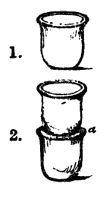
Pres. Ripe fruits are commonly preserved in the fresh state by placing them in a cool dry situation, on shelves, so that they do not touch each other; or by packing them in clean, dry sand, sawdust, straw, bran, or any similar substance, with like care, to preserve them from the action of air and moisture. An excellent plan, commonly adopted for dessert fruit in this country, is to wrap each separately in a piece of clean, dry paper, and to fill small, wide-mouthed jars or honey-pots with them. The filled pots are then packed one upon another (see engr.) in a dry and cold place (as a cellar), where the frost cannot reach them. The space (a) between the two pots may be advantageously filled up with plaster of Paris made into a paste with water. The joint is thus rendered air-tight, and the fruit will keep good for a long time. The mouth of the top jar is covered with a slate. For use, the jars should be taken one at a time from the store-room as wanted, and the fruit exposed for a week or ten days in a warm dry room before being eaten, by which the flavour is much improved.
Fruit is preserved on the large scale for the London market by placing in a cool situation first a layer of straw or paper, and so on alternately, to the height of 20 or 25 inches, which cannot be well exceeded, as the weight of the superincumbent fruit is apt to crush or injure the lower layers. Sometimes alternate layers of fruit and paper are arranged in baskets or hampers, which are then placed in the cellar or fruit-room. The baskets admit of being piled one over the other without injury to the fruit. The use of brown paper is inadmissible for the above purposes, as it conveys its peculiar flavour to the fruit. Thick white-brown paper is the cheapest and the best.
Fruit Essences (Artificial). These remarkable products first attracted attention at the Exhibition of 1851. To speak somewhat generally, they are mixtures of amylic, butyric, pelargonic, valerianic, and other ethers, in alcohol. By judicious mixture, the flavour of almost any fruit can be more or less perfectly imitated. The artificial essences are generally coloured to represent the juice of the fruit from which they are supposed to be derived. The ESSENCE OF JARGONELLE PEAR and the ESSENCE OF APPLE, which are, perhaps, the best of all the artificial essences, are respectively formed from the ACETATE and VALERIANATE OF AMYLE. See Amyle, Essence, &c.
FRU′MENTY. Wheat boiled in water until quite soft, then taken out, drained, thinned with milk, sweetened with sugar, and flavoured with nutmeg. When currants and eggs are added, it forms ‘Somersetshire frumenty,’ Some persons boil the wheat like rice. “Eaten with milk, in the evening, for some time, it will often relieve costiveness.” (Griffith.)
FRY′ING. “The frying-pan is, without doubt, the most useful of all kitchen implements, and, like a good-natured servant, is often imposed upon and obliged to do all the work, while its companion, the gridiron, is quietly reposing in the chimney corner.” “The usual complaint of food being rendered greasy by frying is totally remedied by sautéing the meat in a small quantity of fat, butter, or oil, which has attained a proper degree of heat, instead of placing it in cold fat, and letting it soak while melting.” “According to the (common) mode in which all objects are cooked which are called fried, it would answer to the French word ‘sauté,’ or the old English term ‘frizzle,’ but to fry any object, it should be immersed in very hot fat, oil, or butter.” “To frizzle, sauté, or, as I will now designate it, semi-fry, is to place in the pan any oleaginous substance, so that, when melted, it shall cover the bottom of the pan by about two lines; and when hot, the article to be cooked is to be placed therein. To do it to perfection requires a little attention, so that the pan shall never get too hot. It should also be perfectly clean—a great deal depends on this.” (Soyer.)
According to the writer quoted above, a chop or steak, for frying, should be chosen 3⁄4 of an inch thick, and should “never exceed one inch, nor be less than half an inch, and to be as near as possible of the same thickness all over.” “An ill-cut chop (or steak) never can be but ill-cooked; you can always equalise them (when badly cut) by beating them out with a chopper.”
“The motive of semi-frying food is to have it done quickly; therefore, to fry a whole fowl, or even half (for example), is useless, as it could be cooked in a different way in the same time; but to semi-fry a fowl (in joints or pieces), with the object of having it quickly placed on the table, in order to satisfy a good, and perhaps fastidious appetite, it should be done in a similar way to that practised in Egypt some 3000 years since, and of late years for the great Napoleon—that is, cooked in oil. In France this dish is called ‘Poulet à la Marengo,’ It is related that the great conqueror, after having gained that celebrated victory, ate three small chickens at one meal done in this way, and his appetite and taste were so good, and he approved of them so highly, that he desired that they may always be served in the same way during the campaign.”
“For many objects I prefer the frying-pan to the gridiron; that is, if the pan is properly used. As regards economy, it is preferable, securing all the fat and gravy, which is often lost when the gridiron is used.” “This simple batterie de cuisine” may be employed “equally as well in the cottage as in the palace, or in the bachelor’s chamber as in the rooms of the poor.” (Soyer.)
FUCH′SIN. See Tar Colours.
FUCUS′AMID, FU′CUSINE, and FU′CUSOL. Compounds obtained by Dr Stenhouse from several varieties of FUCUS by treatment with sulphuric acid, as in the preparation of FURFURINE (which see).
FU′EL. Matter used for the production of heat by burning. The principal substances employed as fuel are—ANTHRACITE, CHARCOAL, COAL GAS, COKE, OIL, SPIRIT, PITCOAL, TURF, and WOOD.
The heating power of almost every description of fuel has been determined by the direct experiments of Lavoisier, Regnault, Andrews, and others; the general principle of their methods consisting in the use of an apparatus wherein the entire heat of combustion was absorbed by a known weight of water, the whole arrangement being protected from the influence of external changes of temperature, and the increase of the temperature of the water being known by the simultaneous indication of several delicate thermometers suspended in it. The real value of such determinations is simply relative. The imperfect character of most boiler and furnace arrangements, and the large quantity of fuel which passes into the ‘ash-pit’ unconsumed, together with the irregular ‘draught,’ and the amount of heat absorbed by excess of cold air, result practically in an enormous loss of heating power, even under the most careful management. The mechanical condition of a fuel must be considered in estimating its value. In a series of trials instituted by the Government it was a sine quâ non that the toughness of each kind of coal must be such, for naval use, as to resist, without crumbling, the constant friction in the ship’s hold, at the same time that its ‘fracture’ must be such that it packs into the smallest possible space.[319]
In the chemical laboratory COAL GAS is now generally employed as fuel. It is cheap and manageable, and, with proper apparatus, may be made to supply almost any amount of heat. Where gas cannot be conveniently procured, OIL and SPIRIT are used as fuel for lamps. See Anthracite, Charcoal, Coke, Furnace, Pitcoal, &c., also below.
Fuel, Econom′ical. Various mixtures have been recommended under this name. The following is one of the best:—
Prep. Small coal, charcoal, or sawdust, 1 part; clay, loam, or marl, 1 part; sand, or ashes, 2 parts; water, q. s.; make the mass up wet into balls. For use, these balls are piled on an ordinary fire to a little above the top bar. They are said to produce a heat considerably more intense than that of common fuel, and ensure a saving of one half the quantity of coals, whilst a fire thus made up will require no stirring, nor fresh fuel for ten hours. The quantity of the combustible ingredient in them should be doubled, when they are intended to be used with a very little foundation of coal.
Obs. Of late years simple FIRE-CLAY BALLS have been much used for radiating heat from parlour-grates, and so effecting saving in the consumption of fuel. They are very useful for partially filling up those roomy, old-fashioned, badly-constructed grates, which are still to be found in many private houses.
Peat and TURF, both recent and charred, are commonly used as fuel by the lower classes, in neighbourhoods where they are plentiful. Fir cones or TOPS contain a great quantity of solid woody in addition to the resinous matter, and are well adapted for domestic fires.
Fuel, Prepared. Syn. Compressed fuel, Patent f., Steam f. Many artificial fuels are now in use. The greater number have one character in common—they are composed of small coal cemented by some bituminous matter. The following are the principal kinds:—
Fuel, Aberdare Patent Steam. From the ‘small’ of the South Wales Steam Coal mixed with coal, pitch, and compressed by hydraulic machinery. The pitch is broken up, and thoroughly mixed with the small coal over a furnace, in iron pans, in which shafts with obliquely attached blades are continually revolving. The mixture is afterwards pressed into iron moulds by a force equal to about 21⁄2 tons per inch. The weight of a cubic foot of this excellent fuel is 80 lbs.; the space occupied by 1 ton, 28 cubic feet.
Fuel, Case and Morris’s Patent. From the ‘small’ of the ‘best steam coal,’ ground moderately fine, treated so as to absorb a certain portion of liquid coal tar, and then pressed by machinery into blocks. It is said to occupy less space by about 10% than ordinary coal.
Fuel, Grant’s Patent. This is formed of coal dust, 1 cwt., and coal-tar pitch, 20 lbs., melted together by a heat of 220° Fahr., and moulded into blocks the size of common bricks, under a pressure of 5 or 6 tons. These are, lastly, whitewashed. It is heavier than common steam coal, and is said to go fully one third further, by which facility of transport and economy is combined.
Fuel, Purified Block. This is prepared by the torrefaction of washed coal dust, and is said to possess in a remarkable degree the advantages of both coke and steam coal.
FU′LIGOKA′LI. Prep. (Dr Polya.) Caustic potassa, 1 part; water, q. s.; dissolve; add of wood soot, 5 parts; boil 1 hour, dilute with water, filter, evaporate the filtrate to dryness, and put the product at once into warm, dry bottles.—Dose, 2 to 3 gr., thrice a day, made into pills, which must be coated with gum and kept from the air. (See below.)
Fuligokali, Sulphuretted. Syn. Fuligokali sulphuretum, L. Prep. (Dr Polya.) Caustic potassa, 7 parts; sulphur, 2 parts; water, q. s.; dissolve with heat, add of fuligokali, 30 parts, evaporate to dryness, and preserve it in well-corked dry bottles.—Dose, &c. As the last.
Obs. M. Gibert states that he has tried both fuligokali and sulphuretted fuligokali on his patients at the Hospital Saint-Louis, both internally and externally, with manifest advantage in various obstinate chronic skin diseases. He made a pomade of 30 grammes (say 1 oz.) of lead ointment, and 1 or 2 grammes (say 20 to 25 gr.) of fuligokali, in which he recognised positive resolvent, detersive, and stimulant properties. See Anthracokali.
FULLER’S EARTH. Syn. Cimolia, C. terra, L. A soft, unctious, friable, greenish or yellowish-grey species of clay, containing 53% of silica, 10% of alumina, and about 9% of oxide of iron. After being dug out of the earth it is thoroughly dried in ovens, and then thrown into cold water, where it soon falls to powder, and is purified by the common process of edulcoration or washing-over. It is extensively used to extract oil and grease from cloth in the process of ‘fulling,’ it forms an excellent filtering powder for oils, and is applied as a cooling and healing dressing by the poor to inflamed breasts, excoriations, &c.
FUL′MINATING COMPOUNDS. These are numerous, and are scattered through several distinct classes of bodies. Among the most powerful and dangerous are the chloride and iodide of nitrogen and the fulminates of silver and mercury.
Fulminating An′timony. Syn. Pyrophorus of antimony, L. Prep. Tartar emetic (dried), 100 parts; lampblack or charcoal powder, 3 parts; triturate together, put it into a crucible that it will three fourths fill (previously rubbed inside with charcoal powder), cover it with a layer of dry charcoal powder, and lute on the cover; after 3 hours’ exposure to a strong heat in a ‘reverberatory furnace,’ and 6 or 7 hours’ repose to allow it to cool, &c., cautiously transfer the solid contents of the crucible, as quickly as possible, without breaking it, to a wide-mouthed stoppered phial, where, after some time, it will spontaneously crumble down into a powder.
Obs. When the above process is properly conducted, the resulting powder contains potassium, and fulminates violently on contact with water. A piece the size of a pea introduced into a mass of gunpowder explodes it on being thrown into water, or on its being moistened in any other manner.
Fulminating Bis′muth. Prep. From bismuth, 120 parts; carburetted cream of tartar, 60 parts; nitre, 1 part. Very rich in potassium.—Prop., &c., resemble those of the last. We have been assured that this is the compound used by the late Capt. Warner for some of his secret fusees.
Fulminating Cop′per. Syn. Fulminate of copper. Prep. Digest copper (in powder or filings) with fulminate of mercury or of silver, and a little water. It forms soluble green crystals that explode with a green flame.
Fulminating Gold. Prep. Recently precipitated peroxide of gold is digested in strong liquor of ammonia for 24 hours, and the resulting product is dried in the open air or at a temperature below 180° Fahr., care being taken to avoid the slightest friction, lest it should explode. A deep olive-coloured powder.
Obs. This compound can only be safely made in very small quantities at a time, as without great care it explodes with extreme violence. This is caused by the slightest friction or sudden increase of heat. Its fulminating property may be destroyed by boiling it in pearlash lye, or weak oil of vitriol; and by heating the residuum after washing it in water, pure gold will be obtained.
Fulminating Mer′cury. Syn. Fulminate, Fulminate of mercury. Prep. 1. Mercury, 1 part; nitric acid (sp. gr. 1·375), 12 parts; dissolve, add at intervals, to this solution, alcohol (sp. gr. ·850), 16·3 parts; apply heat till the effervescence and cloud of gas disappears, adding, gradually, on the action becoming violent, 16·3 parts more of alcohol.—Product. 112% of the mercury employed.
2. Mercury, 100 parts; nitric acid (sp. gr. 1·4), 1000 parts (or 740 parts by measure); dissolve by a gentle heat, and when the solution has acquired the temperature of 130° Fahr., slowly pour it through a glass funnel tube into alcohol (sp. gr. ·830), 830 parts (or 1000 parts by measure); as soon as the effervescence is over, and white fumes cease to be evolved, filter through double paper, wash with cold water, and dry by steam (not hotter than 212°) or hot water. The fulminate is then to be packed in 100 gr. paper parcels, and these stored in a tight box or corked bottle.—Product, 130% of the weight of mercury employed.
Prop., &c. Small brownish-grey crystals, which sparkle in the sun; entirely soluble in 130 parts of boiling water, and deposited as the solution cools under the form of beautiful pearly spangles. It greatly resembles fulminate of silver in its appearance and general properties. It explodes violently by both friction and percussion, but unlike the silver-salt, merely burns with a sudden and almost noiseless flash when kindled in the open air.
Obs. The second formula is not only the cheapest, but the best and safest. The first is more expensive and dangerous. There is no little hazard in pouring the alcohol into the nitric solution; for at each effusion an explosive blast takes place; whereas, by pouring the solution into the alcohol, no danger whatever is incurred. This preparation is used for priming the copper percussion caps for fowling-pieces, muskets, &c. Dr Ure, in his first report to the Board of Ordnance, recommended the use of a spirituous solution of gum sandarac, as the best substance for diluting the fulminate, and fixing it in the caps; but in a subsequent report to the same Board, he stated that a solution of mastic in spirit was to be preferred. At the present time the following composition is applied to the interior of percussion caps in quantities varying from ·2 to ·3 of a grain:—Chlorate of potassium, 26 parts; nitre, 30; fulminate of mercury, 12; sulphur, 17; ground glass, 14; gum, 1, making altogether 100 parts. (Watts.)
Caution. Fulminate of mercury should only be dried in small parcels at a time, and these should be placed at a distance from each other. The dreadful explosion which occurred some years ago at Apothecaries’ Hall, and by which Mr Hennel, the talented chemist of the Apothecaries’ Company, lost his life, was occasioned by the spontaneous detonation of this substance.
Fulminating Plat′inum. Syn. Platinum fulminans, L. Prep. By acting on binoxide of platinum with pure ammonia. It is analogous to the gold and silver ammonio-compound.
Fulminating Powder. Syn. Detonating powder; Pulvis fulminans, L. Prep. 1. Nitre, 3 parts; carbonate of potash (dry), 2 parts; flowers of sulphur, 1 part; reduce them separately to fine powder, before mixing them. A little of this compound (20 to 30 gr.), slowly heated on a shovel over the fire, first fuses and becomes brown, and then explodes with a deafening report.
2. Sulphur, 1 part; chlorate of potassa, 3 parts. When triturated, with strong pressure, in a marble or wedgwood-ware mortar, it produces a series of loud reports. It also fulminates by percussion.
3. Chlorate of potassa, 6 parts; pure lampblack, 4 parts; sulphur, 1 part. A little placed on an anvil detonates with a loud report, when struck with a hammer. No. 1 is the substance commonly known as ‘FULMINATING POWDER,’ See Blasting Powder.
Fulminating Sil′ver. Syn. Argentum fulminans, L. Two very distinct compounds are known by this name, the one containing oxide of silver and ammonia, and the other being a true fulminate of silver.
Prep. 1. (Ammonia-compound of silver, Berthollet’s fulminating silver.)—a. Digest oxide of silver (recently precipitated and dried by pressure between bibulous paper) in concentrated liquor of ammonia, for 12 or 15 hours, pour off the liquid, and cautiously dry the black powder in the air, in divided portions. The decanted ammoniacal liquor, when gently heated, yields, on cooling, small crystals, which possess a still more formidable power of detonation than the black powder, and will scarcely bear touching, even whilst under the liquid.
b. Dissolve chloride of silver in strong liquor of ammonia, cautiously add pure potassa (in fragments), and when effervescence ceases, decant the fluid portion, and wash and dry the powder, as before.
2. (Fulminate of silver, Brugnatelli’s fulminating silver; Argenti fulminas, L.)—a. Pour alcohol, 1 oz., on nitrate of silver (in fine powder), 100 gr., previously placed in a capacious flask or beaker glass, and shortly afterwards add strong nitric acid, 1 oz.; as soon as all the powdered nitrate assumes the form of white clouds, add cold distilled water, q. s. to suspend the ebullition, and next collect the powder on a filter, and otherwise proceed as with the ammonia-compound (above).
b. (Fownes.) Metallic silver, 40 to 50 gr.; nitric acid (sp. gr. 1·37), 3⁄4 fl. oz.; dissolve by the aid of a gentle heat, add, whilst the solution is still hot, alcohol, 2 fl. oz., and again apply heat until reaction commences; the fulminate slowly separates from the hot liquid under the form of small, brilliant, white, crystalline plates, which, after being slightly washed with a little cold distilled water, are to be distributed upon separate pieces of filtering paper, in portions not exceeding 1 or 2 gr. each, and left to dry in the air. When dry, the papers are to be folded up, and carefully preserved in a box or bottle. A sixpence and the strongest commercial nitric acid and rectified spirit answer for the above purpose.
c. (Liebig.) Grain silver, 1 part; nitric acid (sp. gr. 1·36 to 1·38), 10 parts; dissolve at a gentle heat, and add the solution to alcohol of 85%, 23 parts; apply a gentle heat till the liquid begins to boil, then remove it from the fire and set it aside to cool; the fulminate of silver is deposited in lustrous, snow-white, acicular crystals, and when washed and dried, equals in weight that of the silver employed.
Prop., &c. The properties of both compounds are very similar. Those of the true FULMINATE OF SILVER (No. 2) need only be considered here. This dissolves in 36 parts of boiling water, but the solution deposits the greater portion of the fulminate as it cools. It is one of the most dangerous substances for which we are indebted to modern chemistry. It explodes with unparalleled violence by friction or percussion, or when strongly heated, or when touched with strong sulphuric acid; the metal is reduced, and a large volume of gaseous matter suddenly liberated. Strange to say, though its explosive tendency is so great that it can be hardly made, handled or kept, with safety, it may, when very cautiously mixed with oxide of copper, be burned in a tube to determine its composition, in a similar manner to that employed in the analysis of other organic substances. Many frightful accidents have happened from the spontaneous explosion of this substance. 1 or 2 gr. are the most that can be exploded with safety in a building or confined space.
Fulminating Zinc. Syn. Fulminate of zinc; Zincum fulminans, Zinci fulminas, L. Prep. From fulminate of silver, zinc filings, and a little water, digested together, as FULMINATING COPPER.
FULMINA′TION. Syn. Fulminatio, L. Detonation. A sudden explosion, accompanied with a loud report and extreme violence. Some chemists, without sufficient reason, have endeavoured to confine the application of the term to the explosion of a fulminate.
FUMIGA′TION. Syn. Fumigatio, Suffumigatio, L. Fumigations (FUMIGATIONES) are vapours of gases extemporaneously extricated for the purpose of destroying contagious or noxious miasmata or effluvia, or to mask unpleasant odours, or to produce a medicinal action on those parts of the body with which they are brought in contact.
Fumigations, for the purpose of obviating or masking unpleasant odours in the sick chamber, must never be employed to the neglect of cleanliness and ventilation; for most of them, instead of purifying the air, actually render it less fit for respiration. The common practice of burning scented paper, pastilles, sugar, juniper berries, benzoin, cascarilla, &c., so as to create an odoriferous smoke, is of this character. As disinfecting agents, they are probably useless, and are relics of an ancient custom of burning frankincense and other odorous substances in vitiated air, to overcome the fetor which is more or less present. The fumes thus diffused through the atmosphere “disguise unpleasant odours; but they accomplish nothing more. The infection remains not only unaltered by the diffusion of the most powerful aromatic vapours, but its deleterious properties are sometimes augmented by them.”[320]
Among the various substances used as DISINFECTING FUMIGATIONS, chlorine, by almost general consent, holds the first place. Dr Carmichael Smyth recommended nitrous acid, which is even now preferred by Dr Christison to chlorine; whilst Prof. Graham regarded the fumes of burning sulphur as more efficacious than either of these substances. The vapours of hydrochloric acid and of vinegar, and the smoke of gunpowder, which once had their advocates, have now justly sunk into disfavour.
No apartment should be submitted to fumigation until it is vacated; as until then its thorough disinfection is impossible, and but little benefit or immunity from contagion is conferred by any aërial disinfecting agent, the presence of which fails to cause discomfort to the patient.
Of all common diseases, scarlet fever appears to be the one most requiring fumigation. For this purpose, chlorine gas or heat should be employed. The infectious matters of certain diseases, especially scarlet fever, are either dissipated or destroyed at a heat slightly above that of boiling water. (Dr Henry.) Contagious diseases are very commonly propagated in this metropolis by persons having their linen washed by laundresses who perform their operations in the same sinks of dirt and misery in which they live. See Cigars (in pharmacy), Disinfectant, Inhalation, &c., and below.
Fumigation, Ace′tic. Syn. Fumigatio acetica, L. The fumes of strong vinegar or acetic acid, obtained by heating the liquid over a lamp, or by sprinkling it on a hot shovel. Aromatic vinegar in this way yields very refreshing fumes, and was formerly thought more efficacious than simple acetic acid.
Fumigation, An′odyne. Syn. Fumigatio anodyna, L. Prep. (Trousseau & Reveil.) Stramonium and sage, equal parts, sufficient to fill a small pipe. Smoked in spasmodic asthma, irritating coughs, &c.
Fumigation, Aromat′ic. See Balsamic fumigation.
Fumigation, Balsam′ic. Syn. Aromatic fumigation; Fumigatio aromatica, F. balsamica, L. Prep. 1. From gum benzoin, either alone or mixed with olibanum or styrax, thrown on hot cinders or a heated shovel.
2. (Dr Dohrn.) Gum olibanum, 4 parts; gum benzoin, styrax, and flowers of roses and lavender, of each 1 part; to be reduced to powder, and used as before.
3. Amber, mastic, and olibanum, of each 3 oz.; benzoin and styrax, of each 1 oz.; camphor, 1 dr. As last. The above are used in hooping-cough, asthma, &c.; a small quantity only being employed at a time.
Fumigation, Belladon′na. Syn. Fumigatio belladonnæ, L. Prep. (M. Schroeder.) From dried belladonna leaves, 1 to 2 dr.; as before. In spitting of blood, asthma, tickling cough, &c.
Fumigation, Chlorine. Syn. Disinfecting fumigation, Guyton-morveau’s f.; Fumigatio chlorinii, L. Prep. 1. (P. Cod.) Common salt, 3 parts; water and sulphuric acid, of each 2 parts; black oxide of manganese 1 part; mix in a shallow vessel, placed in the centre of the apartment. This is used to disinfect unoccupied rooms.
2. Hydrochloric acid and powdered black oxide of manganese mixed in proportions so as to make a thin paste. Used as directed under 1.
3. Chloride of lime, either sprinkled on the floor (if uncarpeted) or (if carpeted) placed about the room in shallow dishes. Used for inhabited rooms, and on shipboard, &c.
4. A solution of chloride of lime (1 oz. of the chloride to each quart of water). Used as the last but more freely.
Obs. Chlorine fumigations, although so popular, and so much relied on by many medical practitioners, are apparently useless in preventing the progress of certain contagious diseases. “In Moscow, chlorine was extensively tried and found unavailing, nay, even injurious, in cholera.” (Dr Pereira.) “At the time that the cholera hospital was filled with clouds of chlorine, then it was that the greatest number of the attendants were attacked.” (Dr Albers.) At the Smallpox Hospital, where chlorine was tried, with the view of arresting the progress of erysipelas, “all offensive smell was removed, but the power of communicating the disease remained behind.” (‘Lond. Med. Gaz.’) Notwithstanding these marked failures, the confidence of many eminent members of the profession continues unabated. “As a fumigating agent, disinfectant and antiseptic, chlorine, I believe, stands unrivalled.” “For destroying miasmata, noxious effluvia, and putrid odours, it is the most powerful agent known.” (Dr Pereira.) Our own experience leads us to the conclusion that chlorine is more useful in neutralising the contagious or morbific matter of fevers (especially of scarlet fevers) and putrid diseases generally, than of the other diseases in which it has been employed.
Fumigation, Hydrochlo′′ric. Syn. Muriatic fumigation; Fumigatio muriatica, F. acidi hydrochlorici, L. Prep. From common salt placed in a cup or saucer, and an equal weight of sulphuric acid poured over it. Now seldom used. It rapidly neutralises ammoniacal fumes.
Fumigation, I′odine. Syn. Fumigatio iodinii, L. Prep. 1. From iodine, 5 to 25 gr., or more, according to extent of surface, placed on a heated iron contained in a box or case in which the limb is enclosed. In the usual skin diseases in which the use of iodine is indicated. Iodine may be readily diffused through the atmosphere by placing a small quantity on a hot plate. Duroy says iodine powerfully arrests putrefaction.
2. (Compound; Fumigatio iodinii composita—Sellers.) Iodine, 20 gr.; red sulphide of mercury, 40 gr.; sulphur, 6 dr.; mix, and divide into 12 powders. One to be used, as the last, 3 times daily; in lepra, psoriasis, &c.
Fumigation, Mercu′′rial. Syn. Fumigatio Mercurialis, L. Prep. (Bouchardat.) Olibanum (in powder), 2 parts; red sulphide of mercury, 3 parts. A little is sprinkled on red-hot coals or a heated shovel held beneath the part; or the fumes are inhaled. Obs. Abernethy used the black oxide of mercury (11⁄2 to 2 dr.), and applied it to the whole body, excepting the head, in a similar way to the sulphur bath, and continued the application for about a quarter of an hour. See Candles, (Mercurial), and No. 2 (above).
Fumigation, Mu′riatic. See Hydrochloric F. (above).
Fumigation, Ni′trous. Syn. Fumigatio nitrosa. Prep. (P. Cod.) Sulphuric acid, diluted with half its weight of water, is placed in a porcelain cup (any shallow vessel of glass or earthenware will do), placed over heated cinders, and small quantities of powdered nitre added to it from time to time.
Obs. Heat causes the gas to be evolved more rapidly, and thus renders the fumes more offensive, without increasing their efficacy. Equal weights of oil of vitriol and water are the proportions usually employed, 1⁄4 oz. of nitre is said to be sufficient for a small room. (Dr Bateman.) The vessel containing the ingredients should be placed in an elevated position in the centre of the apartment.
Dr Carmichael Smith, who introduced nitrous acid gas as a fumigation (1799), received a reward of £5000 from Parliament for publishing his formula.
Fumigation, Sulphu′rous. Syn. Fumigatio sulphurosa, F. sulphuris, L. Prep. 1. The gas produced by burning sulphur, sulphurous anhydride, or, as Mr Keates has suggested, by burning bisulphide of carbon.
To guard against the danger arising from fire, when sulphur is burnt for the purposes of fumigation, the operator is advised to proceed as follows:—Having closed the fireplace, windows, &c., of the apartment to be disinfected, procure a common pail or a large earthenware pan, and place it in the centre of the room; then into the middle of the pail or pan put upside down an ordinary flower-pot. Then pour water into the pail or pan (as the case may be) until it nearly reaches to the top of the inverted flower-pot. Now stand on the flower-pot a plate or saucer of earthenware or common crockery, sufficiently large to hold the quantity of sulphur required; place this quantity of sulphur in the plate or saucer, and put on it a few live coals; then close the door of the apartment, and leave it undisturbed for six or eight hours. At the expiration of this time the door may be opened, as well as the windows, the barricade being at the same time removed from the fireplace; a thorough draught of air being thus established, the sulphurous smell will soon disappear. During the fumigation all articles within the room should be spread out so as to expose as great a surface as possible. “The cubic space to be thus disinfected should be calculated by multiplying the length, height, and breadth together, and taking an ounce and a half of sulphur for every 100 cubic feet. For a small bedroom one pound of sulphur would be sufficient. Indeed, eighteen ounces would suffice for a room measuring 12 ft. × 10 ft. × 10 ft.”[321]
2. Flowers of sulphur, 7 parts; nitre, 4 parts; benzoin and olibanum, of each 2 parts; camphor, 1 part; pressed into the bowls of tobacco-pipes, and lighted with a quick-match. See Bath and Disinfectant.
Fumigation, Tar. Syn. Fumigatio picea, Suffumigatio picis liquidæ, L. Prep. 1. Vegetable tar, 1 part; water, 7 or 8 parts; mix, and let it simmer in an open vessel set over a spirit lamp placed near the centre of the apartment.
2. (Sir A. Crichton.) Norway tar, 1 lb.; powdered carbonate of potash, 1⁄2 oz. or 1 oz.; mix, and heat it as last. The potash is added to neutralise any volatile acid. Formerly highly thought of in bronchitis and pulmonary consumption.
Fumigation, Tooth′ache. Syn. Fumigatio odontalgica, F. anti-neuralgica, L. Prep. 1. From henbane seeds, powdered and thrown into a basin of boiling water, and the affected part held in the steam. Sometimes a little of the seed is placed on a heated iron spoon, and the part exposed to the fumes.
2. (Beasley.) A popular remedy is to throw henbane seed on hot cinders, inverting a cup over them to receive the smoke and empyreumatic oil produced. The cup is then filled with hot water, and the steam conveyed to the affected side of the mouth.
FU′′MING LIQUORS. See Ammonium Sulphydrate, Arsenic Trichloride, Tin Bichloride, &c.
FUNG′I. In botany, a natural order of cellular plants, producing their fructification in the air; growing in or upon decaying or living organic substances, and nourished through their vegetative structure called the spawn or mycelium. Fungi have very variable properties. Some are medical, others edible, others are deadly poisons. The various diseases of plants known as blight, mildew, rust, smut, vine-mildew, potato-disease, ergot, &c., are either caused by or accelerated by the agency of fungi. See Agaric, Mushroom, &c.