A CYCLOPÆDIA OF PRACTICAL RECEIPTS, PROCESSES, AND COLLATERAL INFORMATION (continued 24)
Reading edition
Prep. Strong hydrochloric acid is poured on half of its weight of finely-powdered peroxide of manganese, previously placed in a glass flask or retort; chlorine gas is immediately evolved, even in the cold, but much more rapidly on the application of a gentle heat, and is collected in clean, dry bottles by displacement. The tube conducting the gas is so arranged as to reach to the bottom of the bottle, and the chlorine, being heavier than the air, displaces the latter without mixing with it. The bottle is known to be full by the gas, easily perceived by its green colour, overflowing the top of the vessel. The bottle is then closed up with an accurately fitting stopper, previously greased, and an empty one put in its place, which is subsequently treated in like manner. To free the gas entirely from hydrochloric acid it is passed through a wash bottle containing a small quantity of water; and to render it quite dry it is passed over fused chloride of calcium. When the presence of moisture is no object chlorine may be collected over warm water, or, what is better, a saturated solution of common salt, in the pneumatic trough. The mercurial trough cannot be employed, as the chlorine rapidly acts upon the metal, and becomes absorbed.
Commercial.—From oil of vitriol and water, of each 7 parts, cautiously mixed, and allowed to cool; chloride of sodium (common salt), 4 parts, mixed intimately with peroxide of manganese, 3 parts. The dilute acid is placed in a retort or other generating vessel, and the powder added. The gas comes off slowly at first, but the application of a gentle heat causes it to rush forth in large quantities. Of late years, owing to the general demand for bleaching agents, numerous new methods and suggestions for obtaining chlorine have been patented, of which the following are the most important.
1. Elliott. By this method the reconversion of the chloride of manganese to peroxide was attempted as follows:—The manganese residues left in the still are first heated to dryness. They are then roasted in a current of steam, the result being the formation of hydrochloric acid (which is condensed), and a residue consisting of a mixture of protoxide and peroxide of manganese.
2. Gatty. In this process the manganese residues, after evaporation to a suitable consistence, are mixed with nitrate of soda, and the nitrate of manganese and chloride of sodium formed, when dried, are strongly heated in an iron retort, the fumes of nitric acid which come off being employed in the manufacture of sulphuric acid. The residue in the retort, consisting of peroxide of manganese, being lixiviated, yields the peroxide in a pure state:
Mn(NO3)2 + 2(NaCl) + O2 =
MnO2 + 2NaCl + 2(NO3).
3. Hoffman. This process consisted in the regeneration of the manganese by means of soda waste. In this process the chloride of manganese is, by the addition of the yellow ley obtained from the lixiviation of soda waste, converted into sulphide of manganese. The precipitate so obtained consists of
Sulphide of manganese55·00
Sulphur40·00
Protoxide of manganese5
———
100·00
This is dried and then calcined, the sulphurous acid evolved being conducted into the sulphuric acid chamber.
The residue, which has the following composition—
Sulphate of manganese44·50
Peroxide of manganese18·90
Protoxide of manganese36·60
———
100·00
—is next mixed with nitrate of soda and heated to 300° C., yielding sulphate of soda and nitrate of manganese, the latter, however, being at once decomposed into peroxide of manganese, and nitrogen peroxide, thus:—
a.MnSO4 + 2NaNO3=Mn(NO3)2 + Na2SO4.
b.Mn(NO3)2=MnO2 + 2NO2.
After the mass has cooled, the sulphate of soda is washed out, the residue yielding, according to the inventor, a material equal to native peroxide of manganese.
4. Schlösing. Manganese is acted upon with a mixture of hydrochloric and nitric acids, the degree of concentration of the acids being so regulated by the addition of water that the mixture yields only chlorine, whilst protonitrate of manganese is formed; this salt being calcined yields peroxide of manganese and nitric acid. The nitric acid aids the oxygen of the air in decomposing the hydrochloric acid.
The following equation will explain the successive stages of the reaction:—
a.2HCl + 2HNO3 + MnO2=Cl2 + Mn(NO3) + 2H2O.
b.Mn(NO3)2=MnO2 + 2NO2.
c.2NO2 + H2O + O=2HNO3.
5. Vogel. By decomposing chloride of copper by heat. The chloride in the crystalline state is mixed with half its weight of sand and heated in earthenware retorts to 200° to 300° C., yielding chlorine gas, while the remaining protochloride of copper is reconverted into perchloride by the action of hydrochloric acid.
According to Laurens the reaction is as follows:—
a.2CuCl2=Cl2 + 2Cu22Cl2.
b.Cu2Cl2 + 2HCl + O=H2O + 2CuCl2.
6. MacDougal, Rawson, and Shanks. This is effected by decomposing chromate of lime by means of hydrochloric acid, the result being the formation of chloride of chromium, chloride of calcium, and the evolution of free chlorine; thus
2CaCrO4 + 16 HCl=Cr2Cl6 + 2CaCl2 + 8H2O + Cl6
158 parts of chromic acid yield 106 parts of chlorine. The chloride of chromium is again precipitated with carbonate of lime, and by ignition converted into chromate of lime. Only three eighths of the chlorine contained in the hydrochloric acid is given up, whilst manganese yields one half.
7. Hargreaves proposes to evaporate a solution of protochloride of iron to dryness, and then to heat the dried substance in a current of air, at a temperature of about the melting point of zinc, by which means perchloride of iron and free chlorine would be obtained. Thielbierge’s suggestion consists in passing air over protochloride of iron, and so giving rise to peroxide of iron and chlorine. This, like Hargreaves’ proposition, possesses the disadvantage of furnishing the chlorine very largely diluted with air and nitrogen.
8. Jessie de Mothney. This chemist has proposed a continuous process which is as follows:—Peroxide of manganese either alone or mixed with lime is put into a retort, which, when heated to redness, has a current of hydrochloric acid gas passed into it. A disengagement of chlorine and steam takes place, and there remains in the retort a mixture of undecomposed peroxide of manganese with chlorides of manganese and calcium. The retort containing the undecomposed peroxide and chlorides being still kept at a red-heat, air or oxygen is passed over them, the result being that the manganic chloride is decomposed at once.
The chlorine liberated by this last operation is conveyed into vats containing a mixture of lime and manganous oxide, which substances have been previously formed by the decomposition of the manganous chloride by lime, the soluble chloride of calcium having been run off. Sesquioxide of manganese and hypochlorite of calcium are formed in the vats, and these two, reacting on each other, give rise to peroxide of manganese and chloride of calcium. With fresh hydrochloric acid this latter product yields more chlorine for use in the chambers. Magnesia may be substituted for lime.
9. Dunlop. This process, which may be regarded as the first practical method for utilising the whole of the exhausted manganese residues, and rendering them capable of reapplication in the production of chlorine, was devised by Mr Dunlop in 1855, since which time it has been in use in the alkali works of the Messrs Tennant, at St. Rollox, Glasgow. The operation consists in precipitating the chloride of manganese in the still liquor by carbonate of calcium; the resulting manganese carbonate being decomposed by heat. The liquors are previously mixed with a little milk of lime, which frees them from ferric oxide, alumina, and silica.
Being allowed to stand until these and all other insoluble matters are precipitated, the clear solution containing the chloride of manganese is mixed with finely divided chalk, when the following reaction ensues:—
MnCl2 + CaCO3=MnCO3 + CaCl2.
The resulting milky liquid is then run into large iron boilers, through each of which passes horizontally an iron shaft furnished with a number of projecting arms. This shaft having been put into revolution so as to keep the contents of the boilers agitated, steam is admitted into them under a pressure of from two to four atmospheres, and by the combined effects of heat and pressure the decomposition of the manganese chloride by the calcium carbonate is accomplished in about four hours. The manganese carbonate is then allowed to subside, the calcium chloride solution is drawn off, the precipitate carefully washed, and thrown up in heaps on an inclined surface to drain. When partially dried the carbonate of manganese is placed in small low wagons, made of sheet-iron, supported on rollers, and slowly drawn through a furnace by means of a chain. The furnace holds forty-eight of these little wagons. The furnace is 50 feet long, 12 feet wide, and 10 feet high. “A fire-brick flue runs down the centre of the bottom of the furnace, and is connected at the far end with two return metal pipes, which lie on each side of the flue. A uniform heat at about 660° F. is maintained in the furnace, in which four lines of rails are laid for the small wagons to run along. The half-dried substance loses all its moisture and part of its carbonic acid as the wagons pass along the first line of rails, and as they return down the second line a further escape of carbonic acid ensues, and eventually the expulsion of all the acid, and the peroxidation of the manganese is completed during the passage of the wagons on the third and fourth lines.” The operation lasts about forty-eight hours, the substance gradually changing in colour from white to brown, and lastly to black.
The ends of the furnace are closed by loose hanging doors, so as to ensure the entrance of a sufficient supply of air. The fire-place is situated below the floor of the furnace, and requires very careful watching. The resulting product is a mixture of oxides of manganese, and contains about 72 per cent. of peroxide of manganese.
9a. A. Dunlop. Another process designed by Mr Dunlop, and also in use at Messrs Tennant’s, is as follows:—Nitrate of sodium (Chilian nitre) and chloride of sodium are decomposed by being heated in cast-iron cylinders with sulphuric acid. The gaseous products are made to pass through leaden Woulff’s bottles containing sulphuric acid, which absorbs the nitric peroxide formed, and allows the passage of the chlorine into the chambers. The reaction may be represented by the following equation:—
NaCl + NaNO3 + H2SO4=Cl + NO2 + Na2SO4 + H2O.
The sulphuric acid charged with nitric peroxide is used in the manufacture of chamber acid.
10. Weldon. a. The process by which the greater part of the chlorine employed in the manufacture of bleaching compounds is now obtained and which has hitherto proved the most practical is that of Mr Walter Weldon. We have the authority of Mr Kingzett, in his work on ‘The Alkali Trade,’ for the statement, that out of 90,000 tons of bleaching powder made in Great Britain in 1874, 50,000 were procured by Weldon’s method; and turning to the Continent we find the process largely adopted in Germany, France, and Belgium. The utilisation and regeneration of the residual product left in the still after the evolution of the chlorine which it will be presently seen is accomplished by the above process, is not the only advantage accruing from it, since it has also been the means of removing an extensive source of contamination of many of our streams and rivers, into which the then useless chloride of manganese was thrown previous to Mr Weldon’s invention. It is true that the only waste product formed in the course of the operations, viz., chloride of calcium, is got rid of by being run into the nearest waters, but it is stated by the Rivers Pollution Commission, beyond making these harder, no other objectionable effect is caused by it.
Mr Weldon’s process is based upon the fact, that if protoxide of manganese be suspended in a solution of chloride of calcium, and an excess of lime be added, the protoxide will become readily converted into peroxide if air be forced into the liquor. It had long been known that it was possible to convert into a peroxide the protoxide of manganese obtained by treating the residual still liquors with an equivalent of lime, but all attempts to reduce this knowledge to practical account had proved unsuccessful until Mr Weldon attempted it.
Mr Weldon made the important discovery, that whilst protoxide of manganese is by itself, when treated in the wet way with air, only capable of being converted into peroxide, at the greatest, to the extent of one half; the addition to the protoxide so treated of a certain quantity of lime converted the whole of it into peroxide in less than a twentieth the time required to peroxidise half the protoxide if lime were absent. It will be seen that it is the employment of an excess of lime which constitutes the success of Mr Weldon’s process, which is as follows:—
The residual liquors remaining in the still after the chlorine has been evolved by the action of hydrochloric acid on peroxide of manganese, and in which chloride of manganese is by far the predominating constituent, are run into a receptacle termed the neutralising well, which is usually six feet in depth by twenty in diameter. In this well the free hydrochloric acid of the still-liquor is neutralised by the addition of limestone or chalk, which at the same time serves to decompose the soluble ferric and aluminic chlorides present in the liquid, and to precipitate them as insoluble oxides. During this process the contents of the well are kept in a state of brisk agitation by means of a suitable stirrer. After this treatment the now neutral liquor consists of chlorides of manganese and calcium in solution, of a small quantity of suspended ferric and aluminic oxides and chalk. It additionally contains also in suspension a by no means small quantity of sulphate of lime, derived from the sulphuric acid always present in varying amount in the commercial hydrochloric acid used.
From the neutralising well the liquor is pumped to a height of some forty feet into tanks, called the chloride of manganese settlers, in which after from two to four hours it deposits the solid matters suspended in it, the supernatant clear liquor assuming a pale rose-coloured appearance.
The next operation is to draw off by means of syphons, which can be lowered or raised in the settlers to any desired level, this clear liquid, containing the chlorides of manganese and calcium, into a vessel called the oxidizer; this latter being an iron cylinder, of from eight to twelve feet in diameter, and from twenty-two to thirty-five feet deep. Two pipes go down nearly to the bottom of the oxidizer; the larger one being used for conveying a blast of air from a blowing engine, and the smaller for the injection of steam. The introduction of steam is only had recourse to in case the liquor when drawn into the oxidizer should not have the requisite temperature, viz. 130° or 140° Fahr. Immediately above the oxidizer a reservoir containing milk of lime is placed. A great deal depends upon the careful preparation of the milk of lime, since on the degree of fineness in which the lime is added to the manganese chloride in solution depends the rapidity with which it acts in the oxidizer. The milk of lime is kept constantly agitated, to ensure its being of uniform consistency, and should contain from 15 lbs. to 20 lbs. of hydrate of lime in every cubic foot of the mixture.
A charge of the clear liquor having been drawn into the oxidizer, and raised if necessary to the requisite temperature, the blowing in of air is begun, whilst at the same time the milk of lime is run into the oxidizer as rapidly as possible, the flow of milk of lime being only discontinued when a sample of the filtrate drawn off, by means of a tap placed near the bottom of the oxidizer, ceases to give the manganese reaction when mixed with a solution of bleaching powder. This reaction consists in the production of a purple colour caused by the formation of permanganate of calcium. More milk of lime is then added, when the contents of the oxidizer are found to consist of a thin white mud, composed of a solution of calcium chloride, holding in suspension a mixture of protoxide of manganese and lime. The injection of air being continued the white mud rapidly becomes darker in colour, and soon changes into a thin black mud composed of solution of calcium chloride, holding in suspension certain compounds of peroxide of manganese partly combined with protoxide of manganese, but chiefly with lime, which compounds Mr Weldon terms “manganites.” Mr Weldon suggests that the manganites so formed may be regarded as salts in which the basic radical is calcium or manganese, and the acid radical MnO3; and may be represented by the formulæ CaMnO3, and MnMnO3; and possibly also CaMnO2 (MnO2)2. “The quantity of lime which has to be put into the oxidizer before the filtrate from a sample of its contents ceases to yield the manganese reaction varies very considerably. Recently precipitated protoxide of manganese dissolves very appreciably in neutral solution of chloride of calcium, its solution therein comporting itself with reagents exactly like solutions of manganese salts. It dissolves also in solution of oxychloride of calcium, that is to say, in solution of chloride of calcium containing dissolved lime; its solution in oxychloride of calcium not giving the ordinary manganese reactions.”
“Hence even if all portions of the lime added to the chloride of manganese in the oxidizer were capable of acting on chloride of manganese equally readily, manganese could not cease to be so in solution as to be detectible by ordinary reagents, until more than an equivalent of lime had been added—that is to say, until enough had been added not only to decompose all the chloride of manganese, but also to form a certain quantity of oxychlorate of calcium. It is never the case, however, that all portions of the lime used are capable of acting on the chloride of manganese with equal readiness. The lime used always contains a larger or smaller proportion of particles coarser than the rest, which coarser portions cannot of course act so rapidly as the finer ones; and as the decomposition of the chloride of manganese requires to be completed as quickly as possible, those portions of the lime which will not act upon it instantly are scarcely allowed time to act upon it at all.
“These coarser portions of the lime thus contribute very little to the decomposition of the manganese, though they afterwards dissolve completely in the hot solution of chloride of calcium, and then play their full part in the reactions which take place during the subsequent blowing. The proportion of lime which thus does not act on the chloride of manganese varies with the source of the lime, and with the manner in which it is prepared, so that the quantity of lime which has to be added to a charge of chloride of manganese liquor in the oxidizer, before the filtrate from a sample of the resulting mixture ceases to become coloured on the addition of solution of bleaching powder, varies from about 1·1 to 1·45 equivalent.
“The further quantity of lime which is added after that point has been reached is now usually so much as to raise the total quantity to about 1·5 to 1·6 equivalents, being from one half to six tenths in excess of the quantity which actually takes part in the decomposition of the chloride of manganese.”[239]
As previously stated, Mr Weldon found that if only so much lime is employed as is necessary to precipitate the manganese, not more than half the protoxide of manganese will be converted into the peroxide, and that even this result will be accomplished very tardily. And, as has been already mentioned, a greater and more rapid yield of protoxide can only be obtained by using a larger proportion of lime. Any excess, however, of lime over that absolutely required for the peroxidation of the protoxide of manganese must be sedulously avoided, since a superabundance of lime leads to the formation of compounds that are not readily peroxidised. Should such compounds be formed, it is necessary to destroy them, and this may be done by the addition of a fresh quantity of chloride of manganese. The objectionable compounds in question are lime and protoxide of manganese, which are known in the process under the name of “bases;” and the reason why it is desirable to prevent as much as possible their formation will become evident when it is remembered that they cannot furnish chlorine when treated with hydrochloric acid, but that they merely dissolve in this latter.
The injection of air into the oxidizer, which constitutes the blowing operation, varies from two to four hours.
The quantity required to be blown in is chiefly dependent upon the depth of the oxidizer, and upon the amount of protoxide of manganese contained in a given volume of the charge.
The greater the depth of this latter the more rapidly does the peroxidation take place; and the greater the number of molecules of protoxide in a given volume of the charge, the larger is the total surface presented to the action of injected air, and consequently the greater is the proportion of the oxygen absorbed.
“In one instance 175,000 cubic feet of air were blown in during five hours, and of the oxygen contained in this, 14·8 per cent. (equal to rather more than 4 cwt.) was absorbed in the production of 22 cwt. of peroxide of manganese.”[240]
The expenditure of mechanical power in forcing the air into the oxidizer averages between seven and eight horse-power for every 100 lbs. of peroxide of manganese obtained. In theory, to produce the quantity of chlorine contained in a ton of bleaching powder containing 37 per cent. of chlorine, 1020 lbs. of peroxide of manganese would be required; but it is found in practice that instead of this quantity of peroxide giving the above result, 1100 lbs. are needed.
“The consumption of lime averages 14 cwt. per ton of bleach. By this process 1 ton of bleach is made, using 2832 lbs. of hydrochloric acid, generated by the decomposition of 47·5 cwt. of salt, viz. a quantity which theoretically yields 3334 lbs. of hydrochloric acid. There is therefore a loss of acid of 15 per cent. The loss of manganese varies from 4 to 10 per cent. The whole of the lime is lost, and two thirds of the total chlorine (in combination with calcium) contained in the acid used.[241]
When sufficient air has been blown into the oxidizer, the contents which consist of a solution of chloride of calcium, holding in suspension peroxide and protoxide of manganese and lime, are run into one of a range of settling tanks placed below the level of the oxidizer. These tanks are known as mud settlers. In these the manganese mud is left to deposit until about half its volume has become clear. It generally requires 3 or 4 hours to deposit. The clear part, which consists of chloride of calcium, being then decanted by means of a swivel-pipe, is usually thrown away. The mud remaining in the settlers, which contains in a cubic foot from 4 lbs. to 5 lbs. of peroxide of manganese, is now in a fit condition to be placed in the still, where it is to be exposed to the action of the hydrochloric acid. The stills, which are made of slabs of hard siliceous sandstone or of Yorkshire flagstones, and are usually in the shape of an octagonal prism, are about 8 feet square, and 10 feet in depth. Mr Kingzett says “the new Weldon stills are polygonal in shape, about 12 feet across, and 7 feet to 8 feet deep.” Contrary to the course formerly followed, when native manganese was used in the Weldon process, the still is charged with hydrochloric acid first, and the manganese mud is run in upon the acid in a small, steady stream, the flow of which can be regulated by a stopcock. Steam being carefully admitted into the still at the same time, the mud dissolves very rapidly in the acid, and the chlorine is evolved in an even current, the force and flow of which is dependent upon and can be very accurately regulated by the admission of the mud.
The time occupied before the reaction between the acid and the manganese is completed varies in different works from two to six hours. At the end of this time the contents of the still are run off into the well placed below it, and are afterwards submitted to the various operations already described, which we have seen to accomplish the regeneration of the residue and effect its reconversion into peroxide of manganese. The process is a continuous one, and theoretically the original quantity of manganese should be capable of being used over and over again for an unlimited number of operations. In practice, however, there is always found to be a loss of a small per-centage of manganese, arising from some of the chloride of manganese being carried down by the sulphate of lime and the ferric and aluminic oxides in the settlers, and not being thoroughly recovered when the deposit is washed; for, though an exhaustive washing of the precipitated matters could be easily managed, the bulk of the wash waters would render the recovery of the chloride of manganese from them a non-paying affair. This loss of chloride varies according to the statements of different manufacturers from 2 to 10 per cent.
It is stated that not only is the chlorine yielded by Mr Weldon’s process of very pure quality, and the bleaching powder manufactured from it very high of strength and excellence; but that over from 20 to 25 per cent. more bleach is obtained from a given quantity of hydrochloric acid, when artificial peroxide of manganese is used instead of the native. This advantage is chiefly owing to the artificial manganese (of the manganese mud) from its physical condition being much more accessible than the native form of manganese to the action of the hydrochloric acid, and from its dissolving in the acid so much more readily and thoroughly, and neutralising as much as from 95 to 99 per cent. of it, a much larger amount than the native ores are capable of neutralising.
Again, the bleaching powder produced by the above process stands not only very high in point of strength, but varies very little in the amount of chlorine it contains, as may be gathered from the following table, which shows the average strength for thirteen consecutive weeks of the bleaching powder made at six large and different manufactories:—
Factory.
Week.I.II.III.IV.V.VI.
1st36·937·836·736·336·636·6
2nd36·136·836·736·235·137·4
3rd36·538·036·636·137·237·9
4th35·937·135·936·236·837·1
5th35·836·936·036·336·537·8
6th36·037·036·235·936·537·2
7th36·536·036·336·635·836·8
8th36·336·836·336·335·037·1
9th36·436·336·835·735·237·0
10th36·536·736·336·036·237·6
11th36·836·836·235·936·037·2
12th36·835·935·635·636·137·2
13th36·735·235·936·136·937·5
Spite of the expensive plant required to work Mr Weldon’s process, it is said to possess very decided advantages over the old methods as far as regards cost of production.
In connection with Mr Weldon’s process may be mentioned Mr Valentin’s modification of it, for which a provisional patent was taken out by this latter gentleman. Instead of adding more lime, after the neutralised still liquors have been precipitated by an equivalent of lime, as is done in the above process, Mr Valentin adds a solution of potassium ferricyanide, and air being blown in, the peroxidation of the manganese is effected much more quickly than in Mr Weldon’s process. It was also calculated that, by Mr Valentin’s method, bleaching powder could be produced at a cost of about ten shillings per ton less than when made by Mr Weldon’s.
For the successful working of Mr Valentin’s process it is necessary that the ferricyanide should be recovered, not only because of its cost, but also because its presence gives rise to the production of cyanogen compounds, which would enter the chamber with the chlorine. Hitherto no economical plan for the recovery of the salt has been devised, and consequently Mr Valentin’s proposed modification of Mr Weldon’s process has failed to be adopted.
b. A second process for obtaining chlorine, called “the magnesia process,” has been devised by Mr Weldon. In the previous method, or “lime process,” two thirds of the chlorine contained in the hydrochloric acid, as we have seen, is lost, passing away in the form of waste chloride of calcium.
In the “magnesia process” all the chlorine is utilised, the acid employed being made to yield the whole of its gas in the free state. The regeneration of the manganese peroxide being likewise accomplished, and the process being a continuous one, theoretically no loss of material should take place.
Beyond the employment of liquor pumps, no machinery is requisite for carrying out the operation, which, being very simple in its details, requires the employment of little skilled and, consequently, expensive labour. Further, the inventor claims for it the production of bleaching powder at a less cost per ton than by any other process. The “magnesia method” is worked as follows:—
The spent liquors of the still, consisting of chloride of manganese and free hydrochloric acid, are neutralised with magnesite, or, as it is sometimes called, Greek stone—a very pure native form of carbonate of magnesia. Sometimes the magnesite is calcined, and the magnesia thus obtained used instead.
The neutralisation may be effected either in the still itself, or in a well made of cast iron. The liquid is next pumped into the settlers, in which it deposits its ferric and aluminic oxides and sulphate of lime. The clear liquor containing the chlorides of manganese and magnesia is then run into an iron evaporating pan, where it is concentrated by boiling until it reaches a temperature of between 300° and 320° F. At this point the magnesium chloride begins to be decomposed by the water, and hydrochloric acid is given off. When it has reached the above degree of concentration, it is conveyed into a muffle furnace. This furnace is divided into two compartments, separated by an iron door, which can be opened or shut by means of a pulley placed outside. The desiccation of the mass which is accompanied with the evolution of a little chlorine and a large amount of hydrochloric acid, having been completed in one of the divisions of the furnace, it is broken up by constant stirring into thin cakes and raked into the second division, where it is gently heated with access of air; when the operation is complete the residue which left the first compartment as a mixture of manganese and magnesium chloride becomes converted into manganate of magnesia (MgMnO3), its chlorine having been driven off partly in the free state and partly as hydrochloric acid. “As long as water is present in the furnace hydrochloric acid is evolved, and as the main evaporation takes place in the first division of the furnace, it is chiefly hydrochloric acid that is there generated. In the second division it is chiefly chlorine which is evolved, but it is, of course, mixed with some hydrochloric acid. It is, indeed, doubtful whether much manganese chloride is decomposed by the water so long as there remains any chloride of magnesium, as this body is far more readily decomposable.”[242]
It is stated that all the manganese is not converted into peroxide in the furnace, but that a certain portion of it is left as protoxide; which, with the magnesia, constitutes the useless “bases.” The completion of the process is known when portions of the cake drawn from time to time from the furnace cease to indicate any increase in the quantity of peroxide of manganese.
The finely-divided black powder—manganate of magnesium—thus obtained, after leaving the furnace and when sufficiently cold, is ready for the stills—where, in contact with hydrochloric acid, it is again employed in the generation of chlorine.
The chlorine leaves the furnace mixed with much hydrochloric acid, nitrogen, and air. The gaseous mixture is drawn by a chimney draught through the coke towers, as in the making of salt-cake. By this contrivance the hydrochloric acid is recovered, yielding a solution strong enough to react upon fresh manganese in the still. The diluted chlorine may be made to ascend leaden towers, where it comes in contact with a shower of milk of lime, which absorbs the gas and forms ordinary bleaching liquid, whilst sometimes it is employed in the production of potassium chlorate.
We have seen that the chlorine yielded by the “magnesia process” is partly in the concentrated, and partly in the dilute condition. The ratio of strong chlorine generated in the still to that of weak chlorine produced in the furnace may be anything between one to one, and one to about four, at pleasure.
“When working so as to obtain strong chlorine and weak chlorine in about equal proportions, the quantity of the liquor to be boiled down per ton of total bleaching powder made was about 105 cubic feet. As the proportion of the weak chlorine increased, the quantity of liquor to be boiled down diminished until, when the proportion of the weak chlorine to that of the strong became as four to one, the quantity of liquor to be boiled down per ton of total bleaching powder made was only about 40 cubic feet.”[243]
11. (Deacon.) As we have already seen, Vogel proposed to obtain chlorine by the decomposition by heat of cupric chloride, and to reconvert the resulting cuprous chloride into the cupric salt by treatment with hydrochloric acid.
Chlorine may be produced by passing a mixture of gaseous hydrochloric acid and air over heated bricks or other porous substances, a reaction which Oxland unsuccessfully attempted to turn to account for the production of chlorine for manufacturing purposes. The cause of failure appears to have been the great heat necessary to effect the decomposition of the acid atmospheric oxygen.
In the late Mr Deacon’s process both Vogel’s and Oxland’s methods are combined. He discovered that to be able to generate chlorine and water from gaseous hydrochloric acid and air, a very much lower temperature than that employed by Oxland was necessary, and he found that this diminished temperature could be attained, if the gas and air to be decomposed were passed over porous bricks saturated with a solution of sulphate of copper, and heated to a temperature of 700° to 750° F.
Beyond this point he found the heat ought not to be carried; for at 800° the cupric chloride formed begins to volatilise, and to condense in the cooler parts of the apparatus (presently to be described), thereby interfering with the draught through it, and delaying the working, since its removal becomes necessary. It was found that below 400° the reaction does not take place. Experience has demonstrated that the best temperature to effect this decomposition is 625° F.
The hydrochloric acid obtained either from a soda furnace or evolved from an aqueous solution is immediately mixed with a quantity of air containing an excess of oxygen over that required for liberating all the chlorine from the evolved hydrochloric acid, and passed through heated U-shaped tubes of cast-iron, from which the gaseous mixtures obtain the necessary temperature. The original plant was so contrived that the heated gases were conveyed from the U-shaped tubes into a series of nine towers made of iron or other suitable material. Entering by a pipe at the bottom of the first tower, and passing on to the second, the gases came into contact with a series of ordinary agricultural drain pipes of small bore arranged with vertical spaces, these pipes being saturated with a solution of sulphate of copper and sulphate of soda, it being subsequently found that this latter addition increased the efficacy of the copper sulphate, as well as its power to resist decomposition. From the first two towers of the series the mixed gases traversed the remaining ones, where they encountered small pieces of common brick, fire brick, or burnt clay also impregnated with the copper and soda sulphates, after reacting upon which they passed out of the apparatus, called the ‘decomposer,’
In the more recently made decomposers we believe the nine towers were abolished, and one chamber substituted for them, the drain-pipes being at the same time abandoned for pieces of brick and clay marbles.
A decomposer upon this latter principle is said to have been in use for several months at a factory in Berlin, and to have worked perfectly satisfactorily. After leaving the decomposer, the gaseous mixture, which now consists of chlorine, water, nitrogen, unconsumed oxygen, and undecomposed hydrochloric acid, after being cooled, is passed through water, by which means it is deprived of its hydrochloric acid.
It is next made to ascend a tower, where, meeting with a stream of sulphuric acid running over coke, it is deprived of its water. The chlorine (diluted with nitrogen and oxygen) is now ready for the lime chamber.
One great objection urged against the adoption of the above process, viz., that in consequence of the large volume of the evolved gases enormously large chambers for the preparation of the bleaching would be necessitated, seems to have been met by passing the gas through a series of chambers, in which the first contains nearly finished bleaching powder; the second, lime in a less saturated condition; and so on, until the last chamber contains merely slaked lime.
The following table, exhibiting the amount of chlorine contained in different batches of bleaching powder made by Deacon’s process, is extracted from ‘Chemistry, Theoretical, Practical, and Analytical,’ published by Mackenzie:—
Strength. Strength.
July1436·0July2234·3
”1534·8””36·5
””36·1”2436·8
”1736·4””37·5
””36·0”2536·1
”1837·2””36·7
””37·9””36·8
”1937·2”2636·2
””37·0””36·9
”2037·9”2736·9
””36·7””35·5
”2136·0”2837·2
””35·3””37·0
””37·7””36·75
Writing on this process in his late work, ‘The Alkali Trade,’ Mr Kingzett says:—“The process bearing Mr Deacon’s name was first brought before the public at the British Association Meeting in 1870.
“It excited at that time much attention, and indeed for some period it was doubtful whether it would not rival or even displace the Weldon process. Further experience, however, discovered difficulties in the practical working of this beautiful method, which exercise a deteriorating influence on its value, and lessen its applicability. Although several plants have been erected in connection with this mode of manufacturing chlorine, most of them have been since abandoned, and at the present time most of the chlorine is manufactured according to the process of Mr Weldon.”
Dr Jurisch, in a communication to ‘Dingler’s Polytechnic Journal,’ 1876, remarks that when Deacon’s process was first taken up within a short time by more than twelve English and two German establishments, the view was generally entertained that the balls of clay steeped in solution of copper would ensure an uninterrupted production of chlorine gas for a year or two, if not longer. Before many months had elapsed complaints were heard of the action of the balls. He, therefore, undertook to determine what can be the cause of these balls declining so rapidly in their efficacy. His conclusion is, that the true cause of this speedy decrease in the decomposition is due to sulphuric acid, which passes through the interstices of the clay-balls mixed with the other gases. This injurious action, according to Hasenclever and Sartori, is probably to be explained by the following reaction:—The vapour of sulphuric acid in contact with sulphate of alumina at a dull red-heat, as is found in the balls, is resolved into sulphurous acid, watery vapour, and oxygen; the sulphurous acid thus formed is reoxidised at the expense of the free chlorine, is again decomposed, and thus keeps up a destructive circulation in the apparatus, which reduces or totally checks the chlorine.[244]
Prices of Bleaching Powder (Clapham).
In1805£12000per ton.
”18108400”
”18158000”
”18204700”
”18252700”
”18302300”
”18322100”
”18352300”
”18402100”
”18461800”
”185013150”
”185510150”
”185713100”
”18601100”
”186810120”
Prop., Uses, &c. Chlorine is a gas possessing a yellowish-green colour, and a pungent, suffocating odour. It is one of the heaviest substances that are gaseous at ordinary temperatures, being nearly 21⁄2 heavier than atmospheric air; sp. gr. 1·47. It is soluble to a considerable extent in water, that liquid at 60° Fahr. absorbing about twice its volume. It is non-inflammable, but its union with some of the elements is attended with the phenomena of combustion; thus, phosphorus, copper leaf, powdered antimony and arsenic, and several other substances thrown into chlorine immediately inflame. Under a pressure of 4 atmospheres it is condensed into a yellow, limpid liquid. Moist chlorine gas cooled to 32° Fahr. condenses into yellow crystals, containing 351⁄2 parts of chlorine and 90 parts of water. The most remarkable property of chlorine is its power of destroying almost all vegetable and animal colours, and the putrid odour of decomposing organic matter; hence its value as a bleaching agent, and as a disinfectant and fumigator. When first proposed as a bleaching agent by Berthollet, it was used much the same way as sulphur is now in bleaching woollen goods; afterwards a solution of the gas in water was employed, but the final improvement was Tennant’s patent of combining the gas with lime to form “chloride of lime.” With the bases chlorine forms an important series of compounds called chlorides.
Tests. Free chlorine is readily distinguished from other gases by its colour, suffocating odour, and bleaching properties. The aqueous solution dissolves gold leaf, and with nitrate of silver gives a white, curdy precipitate.
CHLORINE STILLS. The accompanying figure represents a section of one of the earlier forms of still used in the preparation of chlorine.
Fig. 1.
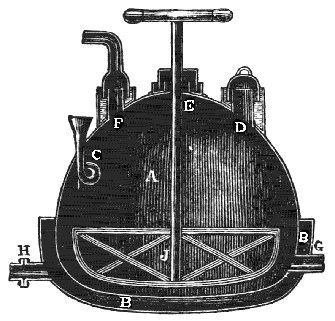
These stills were sometimes made of strong sheet lead, the lower part of which was enclosed in a jacket of cast iron, into which steam was forced, by which means the contents of the still were heated. The steam was injected from an ordinary boiler through the pipe H, and the materials, after the decomposition had been completed, were drawn off by the pipe G. The four openings, C, D, E, F, were secured by water lutes, capable of bearing a pressure greater than that required in the chamber where the saturation took place. In some cases the lower half of the still was made of cast iron, and fitted into a groove made in the upper part, the two sections being united by means of a strong cement. In the latter case the heating of the still was effected by a naked fire applied to the bottom. Into the orifice C the said materials employed were introduced, whilst the acid was poured through the opening F. The gas evolved passed off through the pipe E to the purifier and chamber, where it was absorbed by the lime, and converted into bleaching powder, and the shaft of the agitator passed up through D.
The use of the leaden stills survived for a longer time in France than in this country. In some parts of Germany large glass globes with long necks were employed, in which the chlorine was generated from a mixture of hydrochloric acid and manganese. But these were only applicable in cases where comparatively small quantities of bleaching powder were to be manufactured. When the chlorine is obtained from a mixture of manganese, common salt, and sulphuric acid, the apparatus, being required to withstand a greater heat, is made entirely of metal.
Fig. 2.
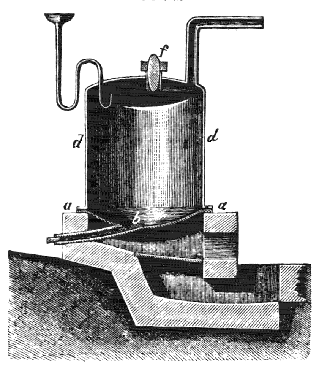
In fig. 2. a a represents a shallow iron pan, fitted with the tube b, for the purpose of emptying the contents of the leaden cylinder d d. This iron vessel serves as the lower part of the cylinder d d, the top of which is provided with an opening for a funnel syphon tube, for the introduction of the acid, and another opening, f, for the manganese. The entire apparatus stands on a flue leading from the furnace.
Fig. 3.
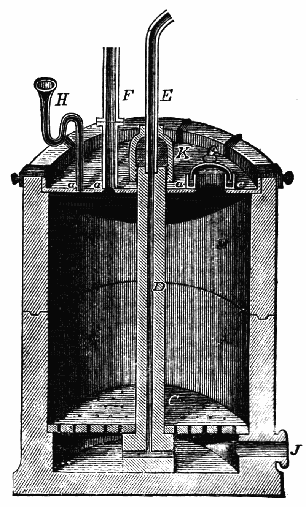
The foregoing drawing represents a vessel for the manufacture of chlorine on a large scale, and is extensively used in Germany.
It consists of a cylindrical vessel of sandstone, the lower half of which, A, is carved out of a single block; the upper half, B, also of one piece, fits into the lower by means of a grooved joint, the two parts being united by means of a cement made of clay and boiled linseed oil. About six inches from the bottom the cylinder widens by 2 inches, and the rim thus formed carries a perforated bottom, C, upon which the manganese is deposited in large lumps. The tube D, likewise of stone, passes beneath the perforated bottom, and is at the other end joined to the steam-tube E. The steam must therefore, when introduced, enter the cylinder through the perforations of the false bottom. The top of the cylinder is closed by a lead cover, K, which is fastened down by means of iron clamps; this lid has an aperture, G, and the tubes E, F, H, pass through it; tube E serves, as already stated, for the introduction of the steam; tube F is for the delivery of chlorine; the bent tube, H, which ends in a funnel, for the introduction of the hydrochloric acid; and the opening G for throwing the lumps of manganese into the cylinder. The solution of manganese chloride, resulting from the action of the hydrochloric acid upon the manganese, is removed through I, which is kept closed by a wooden stopper whilst the reaction proceeds.
See also, under Chlorine, the description of Weldon’s stills, and of Deacon’s apparatus.
CHLORITE. A salt in which the hydrogen of chlorous acid, HClO2, is replaced by a metal or other basic radical. See Chlorous Acid.
CHLOROCHROMIC ACID. CrOCl. Syn. Chlorochromic anhydride. Prep. Bichromate of potassium, 3 parts; common salt, 31⁄2 parts; are intimately mixed together, put into a glass retort, and oil of vitriol, 9 parts, added; heat is next applied and maintained as long as dense, red vapours are given off. The product in the receiver is a heavy, deep-red liquor, greatly resembling bromine in appearance. Water resolves it into hydrochloric and chromic anhydride.
CHLORODYNE. See Patent Medicines.
Chlorodyne (Dr Browne’s). Acid muriat. conc., 5 parts; ether, chloroform, tinct. cannab. Ind., tinct. capsici, of each 10 parts; morphia, prussic acid, of each 2 parts; oil of peppermint, 1 part; syrup, 50 parts; tinct. hyoscyami, tinct. aconiti, of each 3 parts.
Chlorodyne, English. A filtered mixture of 5 grammes tinct. aromat., 4 grammes tinct. opii simp., 1 gramme morph. mur., 10 grammes aq. amygd. amar., 80 grammes syrup of liquorice, 1 gramme extract of liquorice, 40 grammes 90 per cent. spirit of wine, 5 drops oil of peppermint, 10 drops ether, 30 drops chloroform.
CHLOROFORM. CHCl3. Syn. Terchloride of formyle, Formyl-chloride; Chloroformyl, Trichloromethane, Chloroformum, L. A remarkable fluid discovered by Liebig in 1830, and independently by Soubeiran in 1832, and carefully examined in 1834 by Dumas. In 1842 its action upon animals was investigated by Dr M. Glover, and in 1847 it was introduced to the medical profession as an anæsthetic agent by Dr Simpson of Edinburgh.
It was first obtained by the action of caustic alkali upon chloral, but it is more easily prepared by distilling alcohol or wood spirit with chloride of lime. It may also be procured from wood spirit, acetone, oil of turpentine, and several essential oils, as well as from amylic alcohol, acetic acid, tartaric acid, and phenol; when these different bodies are severally subjected to the action of chloride of lime. When chlorine is made to act on marsh gas, or when chloral is treated with an alkali, chloroform is also produced.
Prep. 1. Chloride of lime (in powder), 4 lbs.; water, 12 lbs.; mix in a capacious retort or still, add of rectified spirit, 12 fl. oz., and cautiously distil as long as a dense liquid, which sinks in the water it passes over with, is produced; separate this from the water, agitate it with a little sulphuric acid, and, lastly, rectify it from carbonate of barium.
2. Chloride of lime, 4 lbs.; water, 10 pints; rectified spirit, 1⁄2 pint; proceed as last, using a spacious retort that the mixture will only 1-3rd fill, and the heat of a sand bath. When ebullition commences remove the fire as quickly as possible, lest the retort be broken by the suddenly increased heat, and let the solution distil into a receiver as long as there is nothing which subsides, the heat being restored if it be at all needed. Add to the distilled liquid four times as much water, and shake the whole well together; next cautiously separate the heavier part as soon as it has subsided, and to this add chloride of calcium, broken into fragments, 1 dr.; and shake occasionally during an hour; finally, let the fluid again distil from a glass retort into a glass receiver.
3. Hydrate of lime, 1 part, is suspended in cold water, 24 parts, and chlorine passed through the mixture until nearly the whole of the lime is dissolved; hydrate of lime, q. s. just to restore the alkaline reaction of the liquid, is then added; and, afterwards, rectified spirit of wine or wood spirit, 1 part, is mixed in; the whole, after repose for 24 hours in a covered vessel, is cautiously distilled as before.
4. (B. P.) Take of chlorinated lime 10 lbs.; rectified spirit, 30 fluid ounces; slaked lime, a sufficient quantity; water, 3 gallons; sulphuric acid, a sufficient quantity; chloride of calcium in small fragments 2 oz.; distilled water, 10 fluid ounces. Place the water and the spirit in a capacious still, and raise the mixture to a temperature of 100° F. Add the chlorinated lime, and 5 lbs. of the slaked lime, mixing thoroughly. Connect the still with a condensing worm, encompassed by cold water, and terminating in a narrow-necked receiver; and apply heat so as to cause distillation, taking care to withdraw the fire the moment that the process is well established. When the distilled product measures 50 fluid ounces the receiver is to be withdrawn. Pour its contents into a gallon bottle, half filled with water; mix well by shaking, and set it at rest for a few minutes, when the mixture will separate into two strata of different densities. Let the lower stratum, which contains crude chloroform, be washed by agitating it in a bottle with 3 fluid ounces of the distilled water. Allow the chloroform to subside, withdraw the water, and repeat the washing with the rest of the distilled water, in successive quantities of 3 oz. at a time. Agitate the washed chloroform for five minutes in a bottle with equal volume of sulphuric acid, allow the mixture to settle, and transfer the upper stratum of liquid to a flask, containing the chloride of calcium, mixed with 1⁄2 oz. of slaked lime, which should be perfectly dry. Mix well by agitation. After the lapse of an hour connect the flask with a Liebig condenser, and distil over the pure chloroform by means of a water bath. Preserve the product in a cool place in a bottle furnished with an accurately ground stopper. The lighter liquid which floats on the crude chloroform after its agitation with water, and the washings with distilled water, should be preserved and employed in a subsequent operation. Sp. gr. 1·456.
Prop., &c. Liquid; transparent; colourless; odour fragrant, ethereal, and apple-like; taste ethereal, sweetish, but slightly acrid; soluble in 2000 parts of water; mixes in all proportions with alcohol and ether; dissolves (readily) bromine, camphor, caoutchouc, gutta percha, iodine, oils, resins, wax, and several other like substances; boils at 141·8° Fahr.; kindles with difficulty; burns, when strongly heated, with a greenish flame; and communicates a dull, smoky-yellow colour to the flame of alcohol. Sp. gr. 1·48 (1·497, Miller); density of vapour 4·2. The vapour has the remarkable property of rendering a person breathing it temporarily insensible to pain.
Chloroform is frequently adulterated with alcohol and ether; and owing to careless manipulation, is also sometimes contaminated with other substances, as chloral, hydrochloric acid, free chlorine, aldehyde and certain chlorinated oils. These latter compounds are not only the most objectionable and prejudicial of the impurities found in chloroform, but if present in it to any appreciable extent, they render its anæsthetic administration not only inefficient, but frequently absolutely dangerous. These deleterious chlorinated oily compounds may be removed by agitation with strong sulphuric acid, or by distillation from it. Chloroform made from wood spirit is said to be more impure than that from alcohol. When pure it is free from colour, and of a pleasant odour. It is not perfectly soluble in water; and does not turn the colour of litmus red. Rubbed on the skin it quickly evaporates, scarcely leaving any odour. Dropped into water, it falls to the bottom and remains bright and limpid; but if it contain alcohol the surface of the drop becomes opaline. If the same experiment be made with diluted sulphuric acid, sp. gr. 1·44, the drop of pure chloroform will fall to the bottom; but that which contains spirit, if not shaken, will float or remain suspended in the acid solution. When contaminated with heavy hydrocarbon oils, a drop evaporated from the palm of the hand leaves behind a strong smell. Hydrochloric acid and free chlorine are detected by the ordinary tests.
Mr Shuttleworth, writing to the ‘Canadian Pharmaceutical Journal,’ says:—“In regard to the restoration of chloroform which has become spoiled, I would recommend that the chloroform be well agitated with a dilute solution of hyposulphite of soda.
“It should then be separated by means of a glass funnel from the supernatant liquid, and again washed; this time with simple water. After being separated the chloroform should be passed through filtering paper to free it from traces of moisture, when it will be found much improved and comparatively sweet, good enough in any case for external use.
“There are, of course, certain other impurities of chloroform which the hyposulphite will not remove. These are of a more stable character, and as they possess a higher boiling point than chloroform, may be separated by distillation, or by treatment with sulphuric acid in the usual manner.”
Uses, Action, &c. Chloroform is anodyne, antispasmodic, sedative, stimulant, and anæsthetic. In small doses (5 to 12 or 15 drops, in water, mixed with a little syrup or mucilage) it is employed in spasmodic disorders, and as a stimulant and diaphoretic. It is now chiefly used as an anæsthetic to produce insensibility to pain during surgical operations. The dose for inhalation is 1 fl. dr., which is repeated, in a few minutes, if no effect is produced, until 3 fl. dr. have been thus exhibited; the effects being carefully watched, and the source of the chloroform vapour removed as soon as a sufficient degree of anæsthesia is produced, or any unpleasant symptoms develop themselves.
Chloroform in large doses depresses the heart’s action, and causes profound coma, and death. It is therefore dangerous in all cases complicated with diseases of the heart or brain, or any visceral affections of a congestive character.
The treatment of asphyxia from chloroform is—the horizontal position, cold affusion to the head and spine, artificial respiration, and, if possible, either the application of electricity, or the inhalation of protoxide of nitrogen or oxygen gas, largely diluted with atmospheric air.
Concluding Remarks. The preparation of chloroform is not unattended with danger, and frequently miscarries in careless or inexperienced hands. This arises chiefly from the violent reaction which immediately follows the application of the heat. The common plan is attended with danger of explosion, or of the liquid in the still being forced over into the receiver, owing to the extraordinary rapidity with which the vapours are eliminated, and the ingredients, in consequence, swell up. A method which is successfully adopted on the large scale is to employ a very broad and shallow capsule-shaped still, having a flat rim round it, with a head or capital furnished with a corresponding rim at its lower part. In use, a flat, endless band of vulcanised india rubber is placed between the two rims, which are then held air-tight together by means of small, iron clamps. The application of heat is also delayed for some time after the admixture of the spirit with the other ingredients, and the process is interrupted as soon as the first violence of the reaction has subsided, by which time the whole product of chloroform will have passed over into the receiver. If the distillation is continued beyond this point, the remaining product is water. On the small scale, a very capacious, flat-bottomed retort or cucurbit should be employed. A similar condenser may be used to that noticed under ether.
CHLOROFORMIC ANODYNE (George Harley) is said to be an alcoholic tincture of opium with prussic acid and chloroform.
CHLOROHYPONITRIC GAS (NOCl) and CHLORONITROUS GAS (N2O2Cl4 are two peculiar compounds, formed when nitric acid and hydrochloric acid are mixed.
CHLOROMETER. Syn. Chlorim′eter. An instrument or apparatus employed in chlorometry. The chlorometers in common use are graduated measures and tubes precisely similar to those used in ACIDIMETRY, ALKALIMETRY, &c.
CHLOROMETRY. Syn. Chlorim′etry. The estimation of the available chlorine in the bleaching powder of commerce, which is valued and sold in this country by its per-centage of that element. The plans generally adopted are applicable to the so-called chlorides of soda and potassa, as well as to the ordinary bleaching powder, chloride of lime. Most of them depend on the oxidising effect of water when undergoing decomposition through the action of chlorine.
Dalton’s Process. The test solution is prepared as follows:—Pure protosulphate of iron (previously dried by strong pressure between the folds of cloth or bibulous paper), 78 gr., are dissolved in distilled water, 2 oz., and a few drops of hydrochloric or sulphuric acid added. This quantity of protosulphate requires for complete peroxidation just the quantity of oxygen liberated by 10 gr. of chlorine; in other words, the solution exhibits the indirect effect produced by exactly 10 grains of the bleaching element.
Exactly 50 gr. of the sample of chloride of lime to be examined are next weighed, and well mixed in a glass or wedgwood mortar with tepid water, 2 oz.; and the mixture poured into a graduated tube or chlorometer. The tube is next filled up to 0, or zero, with the washings of the mortar, and the whole well mixed, by placing the thumb over the orifice and shaking it. The solution of chloride of lime, thus formed, is next gradually and cautiously added to the solution of sulphate of iron, previously noticed, until the latter is completely peroxidised, which may be known when it ceases to be affected by a solution of red prussiate of potash. When a drop of the latter test, placed upon a white plate, ceases to give a blue colour on being touched with the point of a glass stirrer or rod dipped in the liquor under examination, enough of the solution of the chloride has been added. The number of measures thus consumed must now be carefully read off from the graduated scale of the chlorometer, from which the richness of the sample may be estimated as follows:—As 100 of the chlorometer divisions contain exactly 50 gr. of the chloride under examination, each measure will contain only 1⁄2 gr., and, consequently, the number of measures consumed will represent half that number of grains of the chloride examined; and the weight of the chloride thus used will have contained 10 gr. of chlorine—the constant quantity of that substance required to peroxide the test solution of sulphate of iron. Thus:—If 80 measures of the liquor in the chlorometer have been consumed, this quantity will represent 40 gr. of chloride of lime, and 10 gr. of chlorine. By dividing 1000 by this number, the per-centage of chlorine will be obtained. In the present instance this would be—
1000 —— = 25% 40
Crum’s Process. Equal weights of water and hydrochloric acid are mixed together, and cast-iron borings digested in the diluted acid until saturation is complete; a large excess of iron being purposely employed, and the liquid kept at the heat of boiling water for some time. One measure of the solution, marking 40° on Twaddell’s scale (sp. gr. 1·200), is then mixed with an equal quantity of acetic acid (sp. gr. 1·048). This forms the test-liquid. When mixed with 6 or 8 parts of water it is quite colourless, but chloride of lime occasions the production of peracetate of iron, which gives it a red colour.
The above proof-solution is next poured into 12 two-oz. vials, of exactly equal diameters, to the amount of 1⁄9th of their capacity; these are filled up with bleaching liquid of various strengths; the first at 1⁄12th of a degree of Twaddell, the second 2⁄12ths, and so on up to 12⁄12ths of 1°. They are then well corked up, and, after agitation, arranged side by side on a tray, furnished with holes to receive them. (See engr.) To ascertain the strength of an unknown sample of bleaching liquor, the proof-solution of iron is put into a phial, exactly similar to the 12 previously used, and in precisely the same proportion (1⁄9th). The phial is then filled up with the bleaching liquor, well shaken, and placed beside that one of the 12 already prepared which it most resembles in colour. The number on that phial expresses the strength of the sample under examination, in twelfths of a degree of Twaddell’s hydrometer.
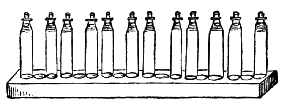
Obs. The preceding method is admirably suited for weak solutions, such as are employed for bleaching textile fabrics, and is well adapted (from its simplicity) to the purposes of practical men. Indeed, it is quite astonishing to see with what ease and accuracy it is applied by unlettered operatives. This gives it great practical value. It has been for some time in extensive use in the bleaching houses of Scotland.
Table exhibiting the quantity of Bleaching Liquid, at 6° on Twaddell’s scale (sp. gr. 1·030), required to be added to a weaker liquor, to raise it to the given strengths. Adapted from Mr Crum’s table by Mr Cooley.
Strength of Sample in 1⁄12°.Required Strength.Proportions required.
Given Sample.Liquor at 6°.
Parts.Part.
Water.8⁄12°81
1”91⁄41
2”111
3”131⁄21
4”171
5”231
6”351
7”711
Water.6⁄12°111
1”131⁄21
2”171
3”231
4”351
5”711
Water.4⁄12°171
1”231
2”351
3”711
Water.3⁄12°231
1”351
2”711
According to Mr Crum, the range of strength within which cotton is “safe” is very limited. A solution at 1° of Twaddell’s scale (sp. gr. 1·005) is not more than safe, while one at 1⁄2° is scarcely sufficiently strong for the first operation on stout cloth, unless it is packed more loosely than usual.
Gay-Lussac’s Indigo Process. One part of the best indigo is dissolved in 9 parts of strong sulphuric acid by the aid of a gentle heat; this solution is then mixed with distilled water, in such proportion that 1 volume of chlorine gas shall exactly decolour 10 volumes of this solution. Each measure so decoloured is called a degree, and each degree is divided into fifths. 5 gr. of the best chloride of lime, dissolved in 500 gr. measures of water, possess the above power, and indicate 10° or proof; or in other words, will decolour 10 times its volume of the indigo solution.
Obs. This method of chlorometry is objectionable, and liable to error, from the indigo solution altering by keeping. When, however, the proper precautions are used, it may be safely trusted for weak bleaching liquors.
Arsenious Acid Process. This depends on the conversion, by oxidation, of arsenious acid into arsenic acid, in the presence of chlorine and water.
To prepare the test-liquor, pure arsenious acid, 100 gr., are dissolved in about 4 fl. oz. of pure hydrochloric acid (free from sulphurous acid), and the solution diluted with water until, on being poured into a graduated 10,000 grains-measure-glass, it occupies the volume of 7000 grains measure marked on the scale. Each 1000 grains measure of this liquid now contains 14·29 gr. of arsenious acid; corresponding to 10 gr. of chlorine, or 1⁄10th gr. of chlorine for every division or degree of the scale of the chlorometer.
100 gr. of the chloride of lime to be examined are next dissolved in water as before, and poured into a tube graduated up to 2000 grains measure. The whole is now well shaken, in order to obtain a uniformly turbid solution, and half of it (1000-grains-measure) transferred to a graduated chlorometer, which is, therefore, thus filled up to 0°, or the zero of the scale, and contains exactly 50 gr. of the chloride of lime under examination; whilst each degree or division of the scale contains only 1⁄2 gr.
1000 grains measure of the arsenious acid test-liquor are now poured into a glass beaker, and a few drops of solution of sulphate of indigo added in order to impart a faint but distinct blue colour to it; the glass is then shaken so as to give a circular movement to the liquid, and whilst it is whirling round, the chloride-of-lime solution from the chlorometer is gradually and cautiously added, until the blue tinge given to the arsenious acid test-liquor is destroyed; care being taken to stir the mixture well during the whole process, and to stop as soon as the decolorisation is completed.
Let us suppose now that, in order to destroy the blue colour of the 1000 grains measure of the arsenious acid test-liquor, 90 divisions or degrees of the chloride-of-lime solution have been employed. These 90 divisions, therefore, contained the 10 gr. of chlorine required to destroy the colour of the test-solution; and since each division represents 1⁄2 gr. of chloride of lime, 45 gr. of chloride of lime (10 gr. of chlorine) were present in the 90 divisions so employed, from which the per-centage strength may be ascertained. For—
45 : 10 : : 100 : 22·22
The chloride of lime examined, therefore, contained 221⁄4 per cent, (nearly) of chlorine.
Obs. This method is extremely simple and trustworthy when properly employed; but to ensure accuracy, certain precautions must be adopted. Instead of pouring the test-liquor into the solution of the sample (as in alkalimetry), the solution of the sample must be poured into the test-liquor.
Vogel found that in a normal solution of arsenious acid that had been prepared for using in the above process, half the quantity of the arsenious acid became oxidised to arsenic acid in the course of about a year. He therefore recommends that the standard solution, if kept for some time, should be tested by a magnesium salt. The formation of a precipitate would show the solution had undergone such a change, as to render it unfit for volumetric estimations.
Penot’s Process. This is a modification of the previous process. For the arsenious acid solution arsenite of soda is substituted, and for the indigo solution a colourless iodised paper, which is turned blue by the smallest quantity of free acid. The paper is prepared in the following manner:—1 gram of iodine, 7 grams of carbonate of soda, 3 grams of starch, and a quarter of a litre of water are mixed. When the solution becomes colourless it is diluted to half a litre; in this fluid, white paper is soaked. The arsenical fluid is prepared by dissolving 4·44 grams of arsenious acid, and 13 grams of crystallised carbonate of soda in 1 litre of water. This solution is added by means of a burette to the solution of chloride of lime intended to be tested (10 grams of the sample to 1 litre) the completion of the reaction being known by the paper remaining uncoloured.
Lunge says that the same piece of moist iodine test paper may be made use of repeatedly, since the spots produced by testing usually disappear after about twenty-four hours if exposed to the air. The paper must, however, be kept away from dust.
Wagner’s Process. This method is based upon the fact that a solution of chloride of lime separates the iodine from a weak (1 to 10) and slightly acidified iodide-of-potassium solution, the iodine being quantitatively estimated by means of hyposulphite of soda:—
Iodine 21, yield Iodine of sodium, 2NaI,
Hyposulphite ofTetrathionate of sodium, Na2S4O6,
soda, 2Na1SO3Water, 5H2O.
+5H2O,
The test is performed as follows:—100 c. c. =1 gram of bleaching-powder solution, obtained by dissolving 10 grams of chloride of lime in 1 litre of water, are mixed with 25 c. c. of solution of iodide of potassium acidified with dilute hydrochloric acid. The resulting clear, deep brown-coloured solution is treated with hyposulphite of soda solution until quite colourless. The hyposulphite of soda solution is composed of 24·8 grams of that salt to 1 litre of water; 1 c. c. of this solution neutralises 0·0127 grams of iodine, and 0·00355 grams of chlorine.
Otto’s Process. This method is based upon the following data. Two molecular weights of protosulphate of iron when brought into contact with chlorine, in presence of water, and free sulphuric acid, give one molecule of persulphate of iron, and two molecules of hydrochloric acid, the process consuming one molecule of chlorine. Two molecules of crystallised sulphate of iron = 556, correspond to 71·0 of chlorine, or in other terms 0·7839 grams of the crystallised sulphate correspond to 0·1 gram of chlorine.
Bunsen’s Process. This consists in adding iodide of potassium to the bleaching-powder liquor, acidulating the mixture with hydrochloric acid, and running the solution of arsenite of soda into it till only a yellow tint shows itself. A little starch paste is now added, and the arsenite solution cautiously introduced drop by drop, till the blue colour just disappears. The solutions must all be standardised. To preserve the starch paste Mohr advises the addition to it of a little chloride of zinc.
Mr Davies uses glycerin as a solvent for the arsenious acid. He prepares a standard solution as follows:—13·95 grains of arsenious acid in 40 c. c. of glycerin and fitted up to 1 litre. Every c. c. corresponds to 0·1 grain of chlorine. Indigo sulphate solution is used as an indicator, and the bleaching liquor is run into the glycerin solution until the blue colour of the latter is changed to a brownish yellow.
Dr Ure’s as follows:—Liquor of ammonia, of a known strength, tinged with litmus, is added to a solution of a given weight of the chloride under examination, until the whole of the chlorine is neutralised, which is known by the colour being destroyed. From the quantity of ammonia consumed the strength of the sample is estimated.
The value of bleaching powder is estimated in England, America, and Germany by degrees corresponding to the per-centage of available chlorine contained in a sample of chloride of lime by weight; but in France the degrees denote the number of litres of chlorine gas at 0° c. and 760° Mm. Bar., which 1 kilo of bleaching powder can evolve. In the following table the chlorometrical degrees of France and England are contrasted:—
French.English.
6320·02
6520·65
7022·24
7523·83
8025·42
8527·01
9028·60
10031·80
10533·36
11034·95
11536·54
12038·13
12539·72
12640·04
The per-centage may be calculated by multiplying the French degrees by the coefficient 0·318.
CHLOROCARBONIC ACID. (COCl2). Syn. Phosgene Gas, Carbonic oxydichloride. This compound may be produced by the direct combination of equal volumes of carbonic oxide and chlorine gases under the influence of sunlight (whence its name of “phosgene gas”), when the mixture gradually becomes colourless, and contracts to half its original volume. Chlorocarbonic acid has a peculiar pungent smell, and fumes strongly when exposed to moist air, the moisture of which it decomposes, producing at the same time hydrochloric and carbonic acids.
It is sometimes employed in chemical research for the removal of hydrogen from organic compounds, and the substitution of carbonic oxide, or its elements for the hydrogen.
CHLOROPHYLL. The green colouring matter contained in the leaves, stalks, unripe fruit, and juices of most plants.
CHLORO′SIS. Syn. Green sickness. A disease which principally affects young unmarried females.
Symp. Languor, listlessness, fatigue after the least exercise, palpitation of the heart, flatulency, indigestion, acidity of stomach and bowels, constipation (generally), appetite for unnatural food, general debility, &c. As the disease advances, the skin at first pale, assumes a peculiar greenish tint, the respiration becomes affected, the feet and legs swell, and various organic affections of the viscera ensue. During the early stages of this disease the catamenia are usually pale and scanty, and return at irregular intervals, and as it progresses they disappear altogether.
Treat. This should be tonic and restorative. That recommended under Anæmia may be adopted with advantage. See also Appetite, Atrophy.
Chlorosis, Electuary for—Female Electuary. A greenish-black thick syrup, consisting of sugar, bayberries, carbonate of iron, iron filings, and water. (Buchner.)
Chlorosis Powder—Female Powder—consists of a mixture of anise, sugar, and 14 per cent. of iron filings. (Wittstein.)
Chlorosis Powder—Female Powder, according to Schott and Strauss, is a mixture of violet root, gum Arabic, and a tasteless green powder with 33 per cent. of steel filings. According to Hager, it is composed of 2 parts ferri pulvis, with 3 parts powdered sweet-flag root.
Chlorosis Powder—Female Powders. Steel filings, starch powder, and knot grass, of each 1 part, Florentine orris root, 4 parts.
Chlorosis Powder—Female Powders. A mixture of 1 part steel filings and 2 parts of a vegetable powder composed of gum Arabic, Florentine orris, knot grass, &c. (Egb. Hoyer.)
Chlorosis Water (Dr Ewich) contains in 10,000 parts 11 of sodium carbonate, 9 of sodium chloride, 11⁄2 sodium sulphate, 7 calcium carbonate, and 1·2 iron carbonate with an excess of carbonic acid. (Hager.)
CHLOROUS ACID. HClO2. Syn. Acidum chloro′sum, L. Prep. From chlorate of potassium, 4 parts; arsenious anhydride, 3 parts; nitric acid, 12 parts; (diluted with) water, 4 parts; heated together in a glass flask, furnished with a bent tube, and placed in a water bath. It must be collected in the same way as chlorine, or passed into water, when it forms a solution of chlorous acid.
Prop., &c. Chlorous acid is a greenish-yellow gas, non-condensable by a freezing mixture of salt and ice, but liquefiable by extreme cold. The aqueous solution undergoes gradual decomposition, yielding chloric acid and chlorine. Chlorous acid possesses powerful oxidising and bleaching properties; with the bases it forms salts called CHLORITES. These are all soluble in water, and bleach like the acid. They may be recognised by the evolution of chlorous acid gas when acted on by an acid. The use of the arsenious acid is to deoxidise the nitric acid employed in the process. Tartaric acid, or other deodorising agent, may be substituted for it.
CHOC′OLATE. Syn. Chocola′ta, L.; Chocollati, Mexican; Chocolat, Fr. A beverage or paste made from the roasted seeds of the Theobroma Cacao, or Cocoa. Strictly speaking, the term “chocolate” is applicable to all genuine preparations of cocoa, but it is now generally used to distinguish those which contain sugar, and, commonly, flavouring substances. Of late years great attention has been paid to the manufacture of chocolate in England; our principal makers now import the finest descriptions of cocoa, and produce varieties of the manufactured article which are scarcely inferior to those of their French rivals. The different kinds of cocoa, and the processes of roasting, sweating, &c., are described under Cocoa, to which article we refer the reader also for particulars respecting the chemistry of chocolate.
Prep. The cocoa nibs[245] are ground in a mill consisting of stone or metal rollers, which are usually heated either by charcoal fires or by steam, so as to soften or melt the natural fat.[246] The warm, smooth paste which passes from the mill is then placed in a mixing mill, and incorporated with refined sugar, and usually vanilla or other flavouring substance. The trituration is continued until the whole paste is converted into an entirely homogeneous mass, which is finally shaped, by means of suitable moulds, into various forms, as blocks, loaves, tablets, lozenges, &c.
Obs. Chocolate, prepared as above, without the addition of aromatics, is known in the trade as PLAIN CHOCOLATE. The Spaniards flavour it with vanilla, cloves, and cinnamon, and frequently scent it with musk and ambergris. With these additions it is termed Spanish chocolate. In general, they add too large a quantity of the last four articles. The Parisians, on the contrary, use little flavouring, and that principally vanilla. They employ the best kinds of cocoa, and add a considerable quantity of refined sugar. So prepared, it is called French chocolate.
Proportions. 1. French Chocolate:—The proportions used for the best description are said to be—2 beans of vanilla, and 1 lb. of the best refined sugar, to every 3 lbs. of the choicest cacao nuts.
2. Spanish Chocolate:—The following forms are said to be commonly adopted:—
a. Caracas cocoa, 11 lbs.; sugar (white), 3 lbs.; vanilla, 1 oz.; cinnamon (cassia), 1⁄4 oz.; cloves, 1⁄2 dr.
b. Caracas cocoa, 10 lbs.; sweet almonds, 1 lb.; sugar, 3 lbs.; vanilla, 11⁄4 oz.
c. Caracas cocoa, 8 lbs.; island cocoa, 2 lbs.; white sugar, 10 lbs.; aromatics, as above.
d. Island cocoa, 7 lbs.; farina, q. s. to absorb the oil. Inferior.
3. Vanilla Chocolate. Syn. Chocolat à la vanille, Fr. A variety of French or Spanish chocolate highly flavoured with vanilla. The following proportions have been recommended:—
a. Caracas cocoa, 7 lbs.; Mexican vanilla, 1 oz.; cinnamon, 1⁄2 oz.; cloves, 3 in no.
b. Best chocolate paste, 21 lbs.; vanilla, 4 oz.; cinnamon, 2 oz.; cloves, 1⁄2 dr.; musk, 10 gr.
Obs. The vanilla used in making chocolate is reduced to powder by rubbing it with a little sugar before adding it to the paste.
Pur., &c. The chocolate commonly sold in England is prepared from the cake left after the expression of the oil, and this is frequently mixed with the roasted seeds of ground peas, and maize or potato flour, to which a sufficient quantity of inferior brown sugar, or treacle and mutton suet, is added to make it adhere together. Inferior sweet almonds are also employed in the same way.
Since the above paragraph was written there has been a vast improvement in English chocolates, though the cheaper sorts of certain makers are still much adulterated. Genuine chocolate should dissolve in the mouth without grittiness, and should leave a peculiar sensation of freshness; after boiling it with water the emulsion should not form a jelly when cold, for if it does starch or flour is present. The presence of animal fat may generally be detected by a cheesy or rancid flavour. See Cocoa.
Qual., &c. Chocolate is nutritive and wholesome if taken in moderation, but is sometimes apt to disagree with weak stomachs, especially those that are easily affected by oily substances or vegetable food. When this is the case, by adopting the simple plan recommended under Butter, chocolate may generally be taken with impunity, even by the dyspeptic. The quantity of aromatics mixed with the richer varieties of chocolate improve the flavour, but render them more stimulant and prone to produce nervous symptoms and head complaints.
Chocolate is taken in the solid form, or made into a beverage; or, combined with sugar, is made into various articles of confectionery.
Chocolate for the Table is prepared by slicing or scraping very finely the required quantity into a jug, and adding to it a small quantity of boiling water. This is worked into a thin, smooth paste, and the jug immediately filled up with boiling milk-and-water. A froth is produced by the same means that eggs are beaten up. The operation of “milling,” performed by rapidly twirling a notched cylinder of wood in the emulsion, raises the froth very quickly. Sugar may be put in with the scraped chocolate, or added afterwards at pleasure.
Chocolate should never be made for the table before it is wanted, because beating it again injures the flavour, destroys the froth, and separates the body of the chocolate, the oil of the nut being observed, after a few minutes’ boiling, or even standing long by the fire, to rise to the top. This is one of the principal reasons why chocolate offends the stomach.
Preparations of chocolate, intended either as nutritious articles of food for convalescents, or as vehicles for medicine, are common among the pharmacopœial and magistral formulæ of the Continent. The following are a few examples:—
Chocolate, Aromat′ic. Prep. (Weiglebt.) Cocoa beans and sugar, of each 16 oz.; cinnamon, 1⁄2 oz.; cloves, 2 dr.; cardamoms and vanilla, of each 1 dr.
Chocolate, Car′rageen. See Chocolate, White (Nos. 1 and 2).
Chocolate, Chalyb′eate. Syn. Ferrugin′eous chocolate; Chocola′ta chalybea′ta, C. Mar′tis, L. Prep. 1. (Trousseau.) Spanish chocolate, 16 oz.; carbonate of iron, 1⁄2 oz.; mix, and divide into 1-oz. cakes. One at a time; in anæmia, amenorrhœa, chlorosis, &c.
2. (Pierquin.) Iodide of iron, 2 dr.; chocolate, 16 oz. For 1⁄2-oz. cakes; as above, and in scrofulous and glandular affections.
Chocolate, Guarana′. Syn. Paullin′ia chocolate; Chocola′ta paulin′iæ, C. guaran′æ, L. Prep. From guarana and white sugar, of each 1 oz., triturated together, and afterwards thoroughly mixed with good plain chocolate, 18 oz. Recommended as a restorative in debility, chlorosis, and other diseases of debility, especially those of a nervous character.
Chocolate, Ice′land Moss. Syn. Chocola′ta cetrar′iæ island′icæ, C. lichen′is, L. Prep. 1. (P. C.) Simple chocolate (P. C.), 32 parts; sugar, 29 parts; dried jelly of Iceland moss, 11 parts; mix.
2. (Cadet.) Chocolate, 4 lbs.; sugar, 2 lbs.; Iceland moss (freed from its bitter, and powdered), 11⁄2 lb.; tragacanth and cinnamon, of each 4 oz.; water, q. s.; to be beaten in a warm mortar, or ground with a muller on a warm slab to a paste. Recommended in pulmonary affections, general debility, weakness of stomach, &c. See Cocoa (Iceland Moss).
Chocolate, Pur′gative. Syn. Chocola′ta pur′gans, C. cathar′tica, L. Prep. 1. Jalap, 1 oz.; chocolate, 9 oz.; mix, and divide into 1-dr. cakes.—Dose, 1 to 2 cakes, as a purge.
2. Jalap, 2 oz.; calomel and sugar, of each 1 oz.; triturate together, then add chocolate, 20 oz.; for 1-dr. cakes.
3. Scammony, 2 dr.; chocolate, 3 oz.; for 1 dozen cakes. The last two are given in worms.—Dose (for an adult), 1 cake, taken fasting.
Chocolate, Sal′ep. Syn. Sal′oop chocolate; Chocola′ta cum sal′ep, L. Prep. 1. (P. C.) Chocolate, 16 oz.; powdered salep, 1⁄2 oz.
2. (Cadet.) Cacao paste and sugar, of each 1 lb.; powdered salep, 1 oz. Arrowroot chocolate and tapioca chocolate are made in the same manner. (See below.)
Chocolate, Sim′ple. Syn. Hygien′ic c., Homœopath′ic c.; Chocola′ta, C. sim′plex, C. salu′tis, L.; Chocolat de santé, Fr. Prep. (P. C.) Caracas and Maragnan cocoa, of each 96 lbs.; sugar, 160 lbs.; cinnamon, 1 oz. (to 2 oz.); triturated together in the usual manner, and formed into cakes or powder.
Chocolate, Vanil′la. Syn. Chocola′ta cum vanil′la, L. Prep. 1. (P. C.) Chocolate (plain,—P. C.), 16 oz.; vanilla, 1⁄2 dr.
2. (Cotterau.) Cocoa paste, 6 lbs.; sugar, 10 lbs.; vanilla, 11 dr.
See forms previously given.
Chocolate, Ver′mifuge. Syn. Chocola′ta vermifu′ga, L. See Chocolate, Purgative (Nos. 2 and 3, above).
Chocolate, White. Syn. White cocoa, Car′rageen c.; Chocola′ta cum chon′dro, Pas′ta caca′o cum chon′dro, P. c. c. lichen′e carraghen′o, L. Prep. 1. As Iceland moss chocolate, but employing carrageen moss.
2. (Ph. Dan.) Roasted and decorticated cocoa seeds (reduced to a subtile mass in a warm iron mortar) and powdered white sugar, of each 2 lbs.; powdered carrageen (debitterised), 3 oz.
3. (Cottereau.) Sugar, 6 lbs.; rice flour, 13⁄4 lb.; potato starch and butter of cocoa, of each 1⁄2 lb.; gum Arabic 1⁄4 lb. (dissolved); tincture of vanilla, 1⁄2 fl. oz.; boiling water, q. s.; triturate to a stiff paste. The above are highly nutritious, and are recommended as articles of diet for convalescents and debilitated persons.
CHOKE-DAMP. Syn. Aft′er-damp. The term applied by miners to carbonic anhydride (carbonic acid) and other irrespirable gases and vapours evolved in mines. See Carbonic Acid, Fire Damp, Ventilation, &c.
CHOKING. Threatened choking may occur either in the gullet or swallow—or in the windpipe. If in the gullet press down the tongue with the handle of a spoon, and pass the fingers down without any hesitation, when the substance may generally be dislodged or pulled up. When it is small, and has got out of reach, it may mostly be removed by filling the mouth with liquid and swallowing it at a gulp, or by swallowing a large piece of bread. Foreign bodies thus swallowed generally pass harmlessly through the bowels.
If the choking occur in the windpipe or trachea, it is usually dislodged by the paroxysm of coughing which accompanies the act. Should it fail to be so, and a sense of suffocation ensues, accompanied with blueness of countenance and difficulty of breathing, place the patient, and follow the directions given in the article “Suspended animation,” while a medical man is immediately sent for.
Treatment for Horses or Cattle.—Remove any foreign body by hand, as directed above, or have recourse to the probang. It may perhaps be necessary to call in a veterinary surgeon, in case the above methods fail, to extract the obstruction by cutting into the gullet.
CHOLAGOGUES. Medicines which promote a flow of bile.
CHOLALIC ACID. C24H40O5. Syn. Chol′ic acid. A non-nitrogenous acid existing in bile. It is best prepared by boiling the resinous mass precipitated by ether from an alcoholic solution of ox bile with a dilute solution of potassa, for 24 to 36 hours, till the amorphous potassa salt that has separated begins to crystallise. The dark-coloured soft mass is then removed from the alkaline liquid, dissolved in water, and hydrochloric acid added. A little ether will cause the deposition of the CHOLALIC ACID from this solution in crystals. With sulphuric acid and solution of sugar it strikes a purple-violet colour; this constitutes Pettenkofer’s test for bile.
CHOLE′IC ACID. Syn. Tauro-cholalic acid. A peculiar conjugated compound of cholalic acid with a substance called taurine, which contains both nitrogen and sulphur. In combination with soda, choleic acid constitutes a principal ingredient in bile.
CHOL′ERA. This word, which, from its derivation, can be only applied correctly to a bilious affection of the stomach and bowels, has been of late years very loosely extended to a malignant disease, the most marked characteristic of which is a total suspension of the functions of the biliary organs.
Cholera, En′′glish. Syn. Com′mon cholera, Bil′ious c.; Chol′era mor′bus, L. A disease characterised by bilious vomiting and purging, accompanied by more or less pain and debility. Diarrhœa is the most common precursor of the disease, and ought to be attended to without delay, particularly if the weather be warm. Cholera most frequently occurs towards the end of the summer and early in the autumn, when the increased heat of the sun stimulates the liver to an inordinate secretion of bile, by which the whole system becomes overloaded with it. Among secondary and accidental causes are sudden changes of temperature, checked perspiration, and the use of indigestible food, and food and beverages in a state of incipient decomposition. It is usually accompanied by fever, thirst, and severe colic, and sometimes by cold sweats, extreme debility, feeble pulse, &c., under which the patient sinks in 24 hours.
Treat. In most cases this complaint is not dangerous, and yields to proper treatment in a few days. As soon after the commencement of the attack as possible, some mild aperient should be administered. Opiates may be employed, both topically and by the mouth. Jeremie’s solution is stated to be very efficacious in the diarrhœa which so generally precedes cholera. A teaspoonful or two of laudanum, rubbed over the region of the stomach and bowels, is a simple application which will generally allay the pain. 10 to 20 drops of laudanum, mixed with a table-spoonful of good brandy, or a few grains of cayenne pepper, may also be taken every hour if the pain is severe. Should the stomach reject the medicine, or the vomiting be apparently increased by drinking warm diluents, a few spoonfuls of ice-cold water, or of a mixture of lemon-juice and water, may be taken instead, until the sickness abates. Dr Copeland recommends spirit of turpentine in violent attacks, both internally and as an external application in the form of warm epithems. When the violence of the symptoms has abated, tonics and bitters (as calumba, gentian, orange-peel, &c.) may be advantageously had recourse to. Calumba, in the form of a weak infusion, conjoined, if necessary, with aromatics, is, perhaps, the most valuable agent we possess for the after-treatment of the disease. See Diarrhœa.
Cholera, Malig′nant. Syn. Asiat′ic cholera, Epidem′ic c, Blue c, Pestilen′tial c, Spasmod′ic c.; Chol′era Asiat′ica, C. asphyx′ia, C. malig′na, L. This fearful disease first became known in this country in the autumn of 1831. The attack usually begins with sickness and purging; this discharge, however, is not bilious, as in ordinary cholera, but a thin, colourless fluid, like rice-water; at the same time there is great prostration of strength, and cold, clammy sweats. In a short time dreadful cramps assail the extremities and afterwards the abdomen; the body becomes bent, the limbs twisted, the countenance cadaverous, the pulse almost imperceptible, and the eyes sunken; the patient sinks into a state of apathy, and unless a favorable change speedily takes place, soon expires from exhaustion. When there is a reaction the pulse gradually returns, the natural warmth of the body is restored, and the spasms and difficulty of breathing give way. Frequently, however, the reaction is accompanied by fever closely resembling typhus, and which often terminates fatally in from four to eight days. The symptoms of epidemic cholera are not always of this terrible character.
Treat. In giving a few of the many remedies that have been recommended for this terrible disease, we may preface the list, by urgently counselling the sufferer to lose no time in sending for a medical man, in case of being attacked by this appalling malady.
1. (American Remedy.) Equal parts of maple sugar and powdered fresh-burnt charcoal, made into a stiff paste with lard, and divided into pieces the size of a filbert.—Dose. One, occasionally, swallowed whole.
2. (Austrian Specific.) The proportions of the ingredients in the following formulæ are founded on Mr Herapath’s analysis of this celebrated preparation, and are given in the nearest available whole numbers:—
a. Sulphuric acid (sp. gr. 1·845), 20 gr.; nitric acid (sp. gr. 1·500), 12 gr,; sugar and gum, of each 15 gr.; distilled or pure soft water, q. s. to make the whole weigh exactly 1 oz.
b. Sulphuric acid, 3 dr.; nitric acid, 2 dr.; simple syrup, 6 dr.; water, q. s. to make the whole weigh exactly 10 oz. A single drop of essential oil of lemon may be added.
Doses, &c. One table-spoonful is ordered to be taken in water, on the first appearance of premonitory symptoms, followed by the free use of very cold water. In half an hour a second dose is to be taken. This (as asserted) is generally sufficient to arrest the progress of the disease. A table-spoonful is then to be added to a pint of cold water, and drunk ad libitum. In more obstinate cases it is said that 4 or 5 doses are generally required to effect a cure. When collapse sets in, double doses are ordered to be given, and to be repeated after every attack of vomiting until the sickness and cramp abate. After the vomiting abates the doses are still to be repeated until 5 or 6 doses are retained by the stomach. Should quiet sleep or drowsiness come on, it is not to be interfered with. The free use of cold water or soured water is to be allowed until perspiration sets in and the warmth of the body returns. According to the report, the use of warm liquors, wines, spirits, &c., must be carefully avoided as so much poison.
Obs. A bottle of the above remedy was handed to the late Mr Wm. Herapath by the superintendent of the Birmingham police, who had received it from the head of the Austrian police, as being in general use in Austria, under the sanction of the medical department of the government, and being found to act almost as a specific in cholera. In 1831-2 it was first tried on some criminals with perfect success, and soon afterwards with similar results on thousands of the general public. In 1849 the Austrian government ordered its use in the public establishments of the empire, since which not a single case of failure had occurred in which it had been fairly tried.
3. (Mr Buxton’s Remedy.) From dilute sulphuric acid (spirit of vitriol), 25 drops; water, 1 fl. oz. For a draught; as the last.
4. (College of Physicians and Board of Health; for Premonitory Diarrhœa.) Chalk mixture, 1 oz.; aromatic confection, 10 to 15 gr.; tincture of opium, 5 to 15 drops; to be repeated every 3 or 4 hours, or oftener, if required, until the looseness is arrested.
5. (Dr Graves’s Astringent Pills.) Acetate of lead, 20 gr.; opium, 1 gr.; conserve of roses, q. s.; for 12 pills.—Dose. One every 1⁄2 hour or hour, at first; then one every two hours.
6. (Homœopathic Preventive.) Camphor, 1 dr.; rectified spirit, 6 dr.; dissolve, and preserve it in a well-corked bottle.—Dose. 2 drops on a lump of sugar, sucked as a lozenge two or three times a day.
7. (Homœopathic Remedy.) As the last, repeating the dose every 10 or 15 minutes, followed by draughts of ice-cold water, until the symptoms abate.
8. (Mr Hope’s Remedy.) (a.) Red nitrous acid, 2 dr.; peppermint water or camphor julep, 1 oz.; tincture of opium, 40 drops; mix.—Dose. One to two teaspoonfuls in a cupful of thin gruel every 3 or 4 hours.
b. Spirit of wine, 1 oz.; spirit lavender, 1⁄4 oz.; oil of orizinanum, 1⁄4 oz.; compound tincture benzoin, 1⁄2 oz.; spirits camphor, 1⁄4 oz.—Dose, 20 drops on moist sugar. To be rubbed outwardly also.
9. (Liverpool Preventive Powders.) Bicarbonate of soda, 20 gr.; ginger, 10 gr.; for a dose. One to be taken in a glass of water after breakfast and supper daily.
These powders are said to have been used with good effect among the workmen in the mining and manufacturing districts during a former visitation of cholera.
10. (Police Remedy; Mr B. Child’s Remedy.) Rectified sulphuric ether and tincture of opium, of each 30 drops; for a dose for an adult; especially during the earlier stages.
11. (Mr Ross’s Astringent Pills.) Each pill contains 1 gr. of nitrate of silver, made up with crum of bread, q. s.—Dose. One pill, to be repeated after the interval of half an hour or an hour, should the symptoms continue unabated.
12. (Russian Remedy.) Sumbul, in the form of tincture, concentrated essence, in decoction, in cold infusion, and in powder in the form of pill.—Doses. Tincture, from 20 to 60 drops; essence, from 5 to 10 or 20 drops; in a little camphor julep or plain water. The physicians of Moscow and St. Petersburg ascribe to the virtues of this drug the saving of thousands of lives during the last epidemic. See Sumbul.
13. (Dr Stevens’ Saline Powders.) Bicarbonate of soda, 1⁄2 dr.; common salt, 20 gr.; chlorate of potassa, 7 gr.; for a dose.
14. (Sir M. Tierney’s Remedy.) Cajeput oil, in doses of 20 to 30 drops, every two or three hours. The oil excites the nervous system and equalises the circulation. The late Sir M. Tierney and others prescribed it frequently, it is said, with considerable success.
15. (Common Remedies of the Shops.) These generally consist of chalk mixture, with a little laudanum, and some aromatic or carminative, as cassia, cinnamon, cardamoms, nutmeg, or peppermint. In a few, some astringent, as tincture of catechu, or extract of logwood, is added.