A CYCLOPÆDIA OF PRACTICAL RECEIPTS, PROCESSES, AND COLLATERAL INFORMATION (continued 4)
Reading edition
c. From the SPECIFIC GRAVITY. The temperature having been taken by a thermometer, and the specific gravity ascertained by any of the usual methods, but preferably by means of an accurate glass hydrometer, it merely becomes necessary to refer to Table I, where, against the number expressing the specific gravity, the alcoholic content per cent., by volume, of the sample examined, will be found for 60° Fahr., subject to the corrections just referred to, when the temperature is either above or below this point.
If the precise specific gravity sought cannot be found in the Table, the difference between it and the next greater specific gravity must be taken for the numerator of a fraction, having for its denominator the difference between the greater and the next less specific gravity in the table. This fraction, added to the per-centage of alcohol in the fourth column of the table, opposite the greater sp. gr., will give the true per-centage sought. Thus, the sp. gr. ·96051 is not in the table, and the next greater number is ·96068; the former must, therefore, be deducted from the latter, and the difference (17) put as the numerator of the fraction, having for its denominator 191, the difference between ·96068 and ·95877. The fraction (17⁄191) ·089, so found, added to the per-centage strength opposite ·96068 in the third column, gives 33·989 as the true per-centage of alcohol in the given sample.
The per-centage by volume may be converted into per-centage by weight, by multiplying the former by ·793811, the sp. gr. of absolute alcohol, and dividing the product by the sp. gr. of the sample. The quotient is the number of pounds of alcohol in 100 pounds of the given spirit. Thus:—Suppose 1000 grains by measure of alcohol to weigh 950·92 grains, and to contain (see Table I) 40·63 per cent. by volume of absolute alcohol, what per cent. by weight does the sample contain?
·793811 × 40·63 = 32·25254093, and this product divided by ·95092 = 33·917, the true per-centage by weight of absolute alcohol in the sample.
2. Method based on the specific gravity, or per-centage strength by WEIGHT:—
The specific gravity is ascertained and the Table used in precisely the same manner as in the “method by volume,” already described.
The per-centage by weight may be converted into per-centage by volume, by multiplying the former by the sp. gr. of the sample, and dividing the product by the sp. gr. of absolute alcohol. This is merely the reverse of the operation described above.
Obs. The preceding methods of alcoholometry, as well as all others depending on the sp. gr. refer to UNSWEETENED SPIRITS only; and are inapplicable to those holding sugar in solution, or any other organic matter capable of altering the sp. gr. For sweetened spirits, fermented worts, wine, beer, &c., one or other of the following processes must be adopted:—
3. Other methods, adapted to either SWEETENED or UNSWEETENED SPIRITS, Tinctures, Fermented Liquors, &c.—
a. By DISTILLATION as originally proposed by M. Gay-Lussac. 300 parts of the liquor under examination (measured in a graduated glass tube) are placed in a retort or small still, and a quantity exactly equal to one third (i.e., 100 parts), carefully drawn over; a graduated glass tube[13] being used as a receiver, and the operation stopped as soon as the distillate reaches the hundredth degree. The ‘alcoholic strength’ of the distilled liquor is then ascertained by any of the usual methods, and the result divided by three, when the per-centage of alcohol in the original liquor is at once obtained. If, from want of attention, more than 100 parts should be distilled over, the number which expresses the relation of the volume of the distilled product to the original bulk of the liquor tested, must be employed as the divisor. Thus, if 106 parts of liquor have distilled over (instead of 100), containing 33% of alcohol, the 300 must be divided by 106, which gives 2·83, and the 33% by this 2·83, which gives 11·66%, the true proportion of alcohol in the original liquor. The strength at ‘proof’ may be calculated from this in the usual way.
To ensure accurate results, the acidity (if any) of the liquor must be neutralised with carbonate of sodium, prior to distillation. It is also advisable to add 8% or 10% of common salt to the liquor in the retort or still; this, by raising the boiling point, causes the whole of the spirit to pass over into the receiver before the distillate has reached the required measure. This applies more particularly to weak liquors. With those of greater strength (as the stronger wines), it is better to distil over 150 parts, and divide the result by 2 instead of 3. To liquors stronger than 25% by volume of alcohol, or above 52% to 54% under proof, add about an equal volume of water to the liquor in the still, and draw over a quantity equal to that of the sample tested; when the alcoholic strength of the distillate gives, without calculation, the true strength sought. To liquors stronger than 48% to 50% (14 to 12 u. p.), add thrice their bulk of water, and do not stop the process until the volume of the distillate is double that of the sample tested, when the per-centage obtained must also be doubled. In each case a proportionate quantity of salt is employed.
Revenue Method. The following is the method adopted in the Inland Revenue and Customs Laboratories for the estimation of the per-centage of alcohol in wines, liqueurs, &c. A measure flask is filled up to a mark on its neck, with the wine, which is then carefully transferred to a distilling flask or retort, the traces of wine remaining in the former vessel being rinsed out with small quantities of distilled water, and the rinsings added to the wine in the latter vessel. About two thirds of the contents of the retort are then distilled over into the clean measure flask, and made up to the original bulk with distilled water, at the same temperature as the sample was previous to distillation. The strength is then taken by Sykes’ hydrometer, and this (if u. p.) deducted from 100, gives the per-centage of proof spirit in the wine. Thus:—
Strength of distillate = 74·6 u. p. = 25·4 per cent. proof spirit.
b. From the Temperature of the Vapour, as originally proposed by Gröning. The bulb of a thermometer is thrust through a cork into the head of the still, or other vessel employed, and the temperature of the vapour in which it is immersed being noted, is sought in the following table:—
Table III.—Showing the Alcoholic Content, by Volume, of Boiling Spirits, and of their Vapour, from the Temperature of the latter, as observed by a Thermometer. By Gröning.
Temperature of the Vapour. Fahr.Alcoholic content of the Distillate per cent.Alcoholic content of the Boiling Liquid per cent.Temperature of the Vapour. Fahr.Alcoholic content of the Distillate per cent.Alcoholic content of the Boiling Liquid per cent.
170·09392189·87120
171·89290192·06818
172·09185194·06615
172·8901⁄280196·46112
174·09075198·65510
174·68970201·0507
176·08765203·0425
178·38550205·4363
180·88240207·7282
183·08035210·0131
185·07830212·000
This method is admirably adapted to the purposes of the distiller and rectifier, as it furnishes a ready means of approximately determining the strength of the spirit passing over, at every part of the process of distillation, as well as that of the wash left in the still.
c. From the BOILING POINT, as originally proposed by M. l’Abbé Brossard-Vidal. This method is founded on the fact, that the boiling points of mixtures of alcohol and water, unlike water alone, are scarcely disturbed by the addition of saline, saccharine, or extractive matter within certain limits. It hence offers a ready means of determining the proportion of alcohol present in spirits, wines, fermented liquors, &c., with sufficient accuracy for all ordinary purposes. In applying it, a thermometer, with a large bulb and a narrow bore, and a movable scale graduated from 180° to 212° Fahr., is usually employed. Before using it as an alcoholometer, it is set, with its bulb immersed, in a small metallic boiler (brass or copper) containing distilled water, which is then raised to the boiling-point, and the 212° of the scale accurately adjusted on a level with the surface of the mercury, should it vary from that point. This is necessary on account of variations of atmospheric pressure causing corresponding variations of the boiling-points of liquids. It is then ready for several hours’ operations, and, generally, for an entire business day, without further adjustment. The little boiler is next filled with the liquor to be examined, and the lamp again lighted. The temperature as shown by the scale of the instrument at the commencement of full ebullition being ascertained, may be sought in one of the following Tables, against which the alcoholic content of the liquor will be found (nearly).
Table IV.—Exhibiting the BOILING POINTS of Mixtures of Alcohol and Water of the given strengths. By Gröning.
Boiling point. Fahr.Alcohol per cent. by volume.Boiling point. Fahr.Alcohol per cent. by volume.
205·345179·9655
199·2210179·4260
195·815178·765
192·3820177·6270
189·5025176·5475
187·1630175·4680
185·35174·9285
183·3840174·290
182·1245173·1495
181·5850172·100
Table V.—Showing the BOILING POINTS of ‘under proof’ spirit. By Dr Ure.
Boiling points. Fahr.Per-centage strength.Corresponding Sp. Gr.
178·5Proof.·9200
179·7510·U.P.·9321
180·420·”·9420
182·130·”·9516
183·440·”·9600
185·650·”·9665
189·60·”·9729
191·870·”·9786
196·480·”·9850
202·90·”·9920
Obs. This method does not answer well with spiritous liquor above ‘proof,’ owing to the variations of their boiling point being so slight as not to be easily observed with accuracy; but with liquors under ‘proof,’ and particularly with wines, beer, and other fermented liquors, due care being observed, it gives results closely approximating to those obtained by distillation, and sufficiently accurate for all ordinary purposes. In testing strong alcoholic solutions it is, therefore, proper to dilute them with twice their bulk of water; and commercial spirits, with an equal bulk of water; the results obtained being doubled or tripled as the case may be.
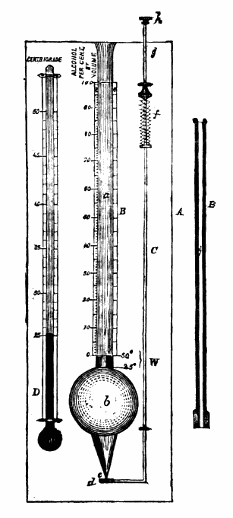
d. From the EXPANSION of the LIQUID when heated: Silbermann’s DILATATOMETER. The expansion of alcohol between 0° and 212° Fahr. is triple that of water; and between 77° and 122° Fahr. it is much greater. Between -14° and -98° Fahr. the rate of expansion is about the ·00047th part in volume for every degree of Fahrenheit’s scale. The measurement of this expansion has been proposed as a new and ready method of alcoholometry, adapted to nearly all spirituous and fermented liquors. Silbermann’s instrument, which is based on it (see engr.), simply consists of a flat brass or ivory plate (A), on which are fixed a mercurial thermometer (D) graduated from 22° to 50° Cent. (= 77° to 122° Fahr.); and the DILATATOMETER (B), which is a glass pipette open at both ends. A valve of cork, or vulcanised india rubber, closes the tapering end (c); this valve is attached to a movable rod (C) which is fastened to the supporting-plate, and connected with a spring (f) and a handle (g) bearing a four-threaded screw, by which the lower orifice of the pipette can be opened or closed at will. In use, the pipette is filled with the liquor under examination, to a little above the zero point (0) on the scale. This is effected by suction, by means of a little piston of leather (i), which fits tightly in the long and wider limb of the pipette; the valve (d) being previously opened by turning the knob (h). The proper quantity of liquor being introduced, and the lower end closed, the piston is moved up and down two or three times, for the purpose of drawing the air-bubbles and absorbed air out of the liquid, the presence of which would vitiate the results of the trial. To allow the piston to be withdrawn without any shock, or the danger of dividing the column abruptly, the rod attached to it is made hollow throughout. In using it the operator applies the ball of his forefinger to the top of the piston-rod (E), in order to create a vacuum as he raises it; and then withdraws it, to readmit the air when he thrusts it down or removes it from the tube. The excess of liquid (if any) in the pipette is then run off until its upper surface is exactly level with the zero (0) of the scale, at 25° C., to which it is raised by immersion in a water bath of that temperature, as observed by the thermometer; which is done by very cautiously turning the rod which depresses the valve. The whole apparatus is now again immersed in the water bath; and, held by the upper portion of the plate, kept in gentle motion with the hand, until the temperature rises to exactly 50° C., when the coefficient of expansion is obtained, and hence also the proportion of alcohol—the scale of the instrument being so graduated, from actual experiments previously made upon mixtures of known composition, as to give, at once, the per-centage of alcohol by VOLUME (nearly).[14]
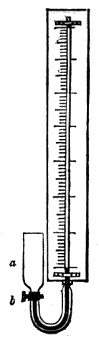
e. From the TENSION of the VAPOUR:—Geissler’s ALCOHOLOMETER. This method, for which we are indebted to M. Geissler, of Bonn, depends on the measurement of the tension or elastic force of the vapour of the liquid, as indicated by the height to which it raises a small column of mercury. The spirit, wine, or other liquor, of which it is desired to ascertain the strength, is put into the little flask (a), which, when completely filled, is screwed on to the curved glass-tube which contains the mercurial column (which is inverted for the purpose), and is closed by the stop-cock (b). The instrument (see engr.) is then placed erect, and the flask and lower part of the tube immersed in a water bath, as in the previous method. The number, on the graduated scale of the instrument corresponding to the height of the mercury, at the boiling point of the liquor under examination, gives the per-centage of alcohol by VOLUME (nearly).
This method furnishes approximative results with great facility and expedition; and, with proper care, these do not vary more than 1⁄3 to 1⁄2 of 1%, from those obtained by distillation. We find, that by having the diameter of the part of the tube at which the surface of the mercury is acted on by the vapour a little larger than that of the longer limb, and by previously abstracting the air from the sample, as in Silbermann’s method, or even by agitation and exposure in an open vessel, the two may be made to correspond almost exactly.
f. From the DIFFERENCE between the sp. gr. BEFORE and AFTER ebullitiom:—Taberié’s method and ŒNOMETER. The sp. gr. of the sample is first accurately determined by any of the usual methods. It is next carefully evaporated, in an open vessel, to one half its volume. The residuum, when cold, is made up with pure water to exactly its original measure at its original temperature, and the sp. gr. again ascertained. The difference between the two being due to the spirit originally present, furnishes the means of calculating a new sp. gr., from which the per-centage richness of the sample may be obtained by mere inspection of the Tables. The observed sp. gr. is the true one, whenever the liquor, after ebullition and restoration to its original volume, has the same sp. gr. as water (i. e., 1·000), at 60° Fahr. Taberié employs a peculiar instrument, which he calls an œnometer; but its use is not essential to his method of alcoholometry. The results are, of course, only approximative, though sufficient for all ordinary purposes. Prof. Mulder, however, says that he prefers it to any of the previous methods; and that the results, with care, are almost as accurate as those obtained by distillation.
g. By means of CARBONATE OF POTASH:—
g. a. (Brande’s Method.) The liquor for trial is poured into a long, narrow glass tube (graduated centesimally), until the vessel is half-filled, and, after the solution of about 12% or 15% of a strong solution of subacetate of lead, or a little finely powdered litharge, is agitated until the colour is entirely, or nearly removed. Anhydrous carbonate of potash, in powder, is next added, until it sinks undissolved, even after prolonged agitation of the liquid. The whole is now allowed to repose for a short time, when the alcohol is seen floating on the top of the aqueous portion of the liquid in a well-marked stratum. Its quantity, read off by means of the graduations of the tube, and doubled, gives the per-centage richness of the sample in alcohol, by volume.
This process answers well with cordials, wines, and the stronger ales; but with very weak liquors it is not to be relied on. The whole operation may be performed in two to five minutes, and (with these exceptions) furnishes very reliable approximative results. In most cases the decolouring part of the process may be omitted. The alcohol thus separated has a sp. gr. of from ·8061 to ·8118, and contains 3% or 4% of water; but for ordinary purposes it may be regarded as pure alcohol.
4. Alcoholometry of MINUTE QUANTITIES of liquid. When only a few drops, or a quantity too small for the application of the preceding methods, can be obtained, an organic analysis may be had recourse to, and the quantity of absolute alcohol calculated from that of the resulting carbonic anhydride and water; care being previously taken to free the sample from other volatile bodies, if it contains any of them.
Gen. commentary. The duties on spirits in England are charged on the number of proof gallons they contain, which is ascertained by gauging or weighing the spirit, and then trying its strength by Sykes’ hydrometer. The per-centage of proof spirit multiplied by the number of gallons gives the net amount of proof spirit to be charged.
‘Proof strength’ is an arbitrary standard, adopted for the purpose of facilitating calculations, for which it is well suited; although pure alcohol would, for this purpose, be more simple. As defined by Act of Parliament, 58 Geo. III, c. 28, “proof spirit” is such “as shall, at the temperature of 51° of Fahrenheit’s thermometer, weigh exactly twelve thirteenth parts of an equal measure of distilled water.”
Taking, therefore, water at 51° Fahr. as unity, the sp. gr. of “proof spirit” at 51° Fahr. is 12⁄13 of 1·000 or ·92308. When such spirit is raised to the temperature of 60° Fahr., its density is ·91984.
Spirit at “proof” contains very nearly equal weights of absolute alcohol and water; the exact proportions according to recent experiments are:—
By Weight.By Volume.Sp. gr. at 60° Fahr.
Bulk before admixture.Bulk after admixture and condensation.
Alcohol. Water.Alcohol. Water.
100·00 + 103·08100·00 + 81·80175·23·91984
49·24 + 50·7657·06 + 46·68100·00
The standard alcohol of the Revenue authorities, and that on which Gilpin’s Tables are founded, is a spirit of the sp. gr. ·825 at 60° Fahr., which is said to contain, by weight, 89% of pure alcohol of ·796; and 92·6% of alcohol, by volume, which corresponds to about 62·5 o. p.
It is of great importance to the spirit dealer to be able to estimate correctly the number of ‘proof gallons’ in any quantity of his commodities, or in the whole or any portion of his stock, as disagreeable errors frequently result from ignorance on this point. Calculations of this kind are extremely simple. Thus, when we find, by the hydrometer, that a given sample of spirit is 10 per cent. over-proof, it means, that 100 gallons of such spirit contain as much alcohol as 110 gallons of proof spirit.
In over-proof spirit, the per-centage o. p. always represents the quantity of water which the given spirit requires to reduce it to proof. By adding this per-centage over-proof to 100, we obtain a number which, multiplied by any number of gallons, and divided by 100, gives the exact number of proof gallons which is contained in any quantity of the spirit referred to. Thus:—A puncheon of rum gauged at 91 galls., and shown by the hydrometer to be 21 o. p., contains—
21 o. p. of sample added to 100121
No. of gallons of rum91
———
11011
No. of gal. of proof-spirit = 11011 / 100 = 110·11
In like manner when a spirit is said to be 11 u. p., or under-proof, it means that 100 gal. of such spirit contains 11 gal. of water, and 89 gal. of ‘proof spirit.’ By deducting the per-centage under-proof from 100, we not only obtain the number of proof gal. contained in 100 gal. of such spirit, but, as in the last case, a factor which multiplied by any number of gal., and divided by 100, gives the exact number of ‘proof gallons’ contained in any quantity of the given strength. Thus:—An ullage brandy piece containing 45 gal. of spirit at 10 u. p., would have the proof value of—
Per cent. u. p. of sample 10, subtracted from 10090
No. of gall45
———
4050
Quantity of proof spirit = 4050 / 100 = 40·50
Or exactly 401⁄2 gallons.
The strength of absolute alcohol (sp. gr. ·7938) is estimated at 751⁄4% over-proof. It therefore contains 1751⁄4% of ‘proof spirit,’ whilst proof spirit (sp. gr. ·91984) contains 57·06% of ‘absolute alcohol,’ both being by measure or volume. Thus—
(meas. of alc. × 1751⁄4) / 100 = equiv. meas. of pf. spt.
And—
(meas. of pf. spt. × 57·06) / 100 = equiv. meas. of abs. alc.
From which we derive the ‘constant multipliers’ 1·7525 (or roughly 13⁄4), and ·5706, applicable to any number of volumes or gallons. For—
meas. of alc. × 1·7525 = equiv. meas. of pf. spt.
and—
meas. of pt. spt. × ·5706 = equiv. meas. of alc.
To ascertain what quantity of a spirit at any given strength is equiv. to or contains 100 lbs. of absolute alcohol, we have only to divide the constant number 2207·7 by the proof value per cent. of such spirit.[15] Thus—for a spirit 12 u. p.—this would be
100 - 12 = 88% of proof spirit;
and—
2207·7 / 88 = 25·1 gal. (nearly).
That is, 251⁄10 gal. of such spirit would contain 100 lbs. of absolute alcohol.
By removing the decimal point one place to the right, we have the equiv. measure of 1000 lbs. By removing it one, two, or three places to the left, we have it respectively for 10 lbs., 1 lb., and 1⁄10 lb.; from which the equiv. for all other weights may be easily obtained.
By reversing the above operation, the measure of alcohol corresponding to any given weight of spirit, at any strength, may also be easily found.
The weight of 1 gal. of absolute alcohol being 7·938 lbs.; that of 1 gal. of proof spirit, 9·2 lbs,; and that of the ‘alcohol’ in 1 gal. of proof spirit, 4·53 lbs.; the weight of any number of gallons or volumes of either, and their equivalents, may be easily found. Thus:—
gallons of alc. × 7·938=lbs. weight of alc.
gallons pf. sp. × 9·2=lbs. w. of pf. spt.
and—
gallonsof alc. × 16·121=lbs. weight of pf. spt.
”pf. spt. × 4·53=content in lbs. weight of alc.
In these cases a knowledge of the first four rules of decimal fractions is necessary, or, at least, advantageous; as the Excise officers carry their calculations to two figures of decimals, or 1⁄100ths. Their plan is to reject the third decimal figure when less than 5; but to carry 1 to the next figure on the left hand, when it exceeds 5. Thus, 5·432 is set down as only 5·43; but 5·437 is written 5·44. In the delicate chemical processes of the laboratory, even greater accuracy is observed.
Formerly, spirit was said to be 1 to 3, 1 to 4, &c., over-proof, by which it was meant that 1 gal. of water added to 3 or 4 gals. of such spirit would reduce it to ‘proof.’ On the other hand, 1 in 5, or 1 in 8, under-proof, meant that the 5 or 8 gals., as the case might be, contained 1 gal. of water, and the remainder represented the quantity of ‘proof spirit.’ This method of calculation has now long given way to the ‘centigrade system,’ which not only admits of greater accuracy, but is quite as simple. It should be adopted by every spirit-dealer in England, from being that which is employed by the Revenue officers, whose ‘surveys’ it is absolutely necessary that the trader should understand, in order that his own estimation of his stock and his business calculations should correspond with theirs.
Several other methods of alcoholometry, besides those already noticed, have been adopted at various times, but the majority of them possess so little accuracy as to be quite inapplicable to the purposes of trade, and of the laboratory. Thus, the strength was at one time estimated by what was called the ‘proof.’ A little of the spirit was poured upon a small quantity of gunpowder, contained in a spoon or saucer, so as just to moisten it, and was then inflamed. If at the end of the combustion the gunpowder took fire, the spirit was held to be ‘above proof,’ if it only languidly fizzed away, or slowly burnt, the spirit was said to be ‘proof,’ but if the gunpowder failed to ignite, the spirit was esteemed ‘below proof.’ Hence arose the terms ‘proof’ and ‘proof spirit,’ which have since been adopted by Act of Parliament. Another method was that of dropping oil into the spirit; if the oil floated, the spirit was considered to be ‘under proof,’ if it sunk, it was rated as ‘proof’ or ‘over-proof.’ The ‘gunpowder test’ is quite fallacious; for, if a certain quantity of a spirit is capable of firing the gunpowder, a little excess of a spirit 20% or 25% stronger will often fail to do so, so much water being formed as to prevent the ignition. The ‘Preuve d’Holland’ test, of the French, or the ‘BEAD,’ is still frequently employed by persons unacquainted with the use of the hydrometer. It consists in shaking the spirit in a phial, and observing the size, number, and duration of the bubbles or beads, as they are called. The larger and more numerous these are, and the more rapidly they break and disappear, the stronger the spirit is presumed to be. This method is unreliable, as the presence of sugar or acid, even in minute quantities, will sometimes give to a weak sample the appearance of one many degrees stronger. Lovi’s beads are also often employed to ascertain approximately the strength of spirit, when a hydrometer is not at hand.
The insufficiency of most of the methods of alcoholometry here referred to, throws us back on the Revenue System (Sykes’ hydrometer), or on the specific gravity for unsweetened spirits. For sweetened spirits, as cordials, wines, beers, &c., there are none of the tests which give such accurate results as the distillation test, previously described as the Revenue Method.
The spirituous liquors of commerce being sold by measure, and not by weight, the methods of alcoholometry which give the results, per cent., by volume, are those we have chiefly explained. In the laboratory, the method by weight is that most generally employed in delicate processes and in analyses. By weight, the per-centage of alcohol remains the same for all temperatures, for the same sample; whilst by volume, the per-centage varies with the temperature of the liquid. This variation explains the cause of many of the sudden apparent decreases and increases, which occur in large stocks of spirits. Persons purchasing spirits during very warm weather, and paying for them according to their apparent quantity and strength, lose considerably by selling the same spirit when the weather becomes colder, without being conscious of such loss from the hydrometer. The reason of this is obvious, for, whilst the relative proportions of the alcohol to the water continue the same, the sp. gr. and the volume alter with the temperature; the latter being increased by warmth, and decreased by cold, in exact opposition to the former. Accuracy requires, in all cases, that a spirituous liquor should be tested for its strength at the temperature at which it was measured; and measured at the same temperature at which its strength was determined.
A consideration of these facts has led some of the great houses to introduce the system of weighing their spirits, instead of measuring them, the weight of an imperial gallon at 60° Fahr. being taken as the standard gallon. This is the method adopted by the Inland Revenue, at all distilleries, for assessing the duty, and will be readily understood by the following example:—
Cwts.qrs.lbs.
Gross weight of full cask=13227
Tare=225
——————
Net weight of spirit=11022
or 1254 lbs. Let us suppose the hydrometer indication to be 43·0, the weight per imperial gallon would be 8·903 lbs. (see Table VI), and 1254 ÷ 8·903 = 140 gallons.
Table VI.—Table for determining the Weight per Gallon of Spirits by Sykes’ Hydrometer.
A = Indication on Sykes’ Hydrometer. B = Weight per Gallon. A B A B A B A B A B 0 8·145 8 8·509 6 8·878 4 9·264 2 9·667 2 8·157 21 8·512 8 8·881 6 9·267 4 9·671 4 8·161 2 8·516 42 8·885 8 9·271 6 9·674 6 8·164 4 8·519 2 8·889 63 9·275 8 9·678 8 8·168 6 8·523 4 8·892 2 9·279 84 9·682 1 8·171 8 8·526 6 8·896 4 9·283 2 9·686 2 8·174 22 8·530 8 8·899 6 9·286 4 9·690 4 8·178 2 8·533 43 8·903 8 9·290 6 9·694 6 8·181 4 8·537 2 8·907 64 9·294 8 9·698 8 8·185 6 8·540 4 8·911 2 9·298 85 9·702 2 8·188 8 8·544 6 8·914 4 9·302 2 9·706 2 8·191 23 8·547 8 8·918 6 9·305 4 9·710 4 8·195 2 8·551 44 8·922 8 9·309 6 9·714 6 8·198 4 8·554 2 8·926 65 9·313 8 9·718 8 8·202 6 8·558 4 8·929 2 9·317 86 9·722 3 8·205 8 8·561 6 8·933 4 9·321 2 9·726 2 8·208 24 8·565 8 8·936 6 9·324 4 9·730 4 8·212 2 8·568 45 8·940 8 9·328 6 9·733 6 8·215 4 8·572 2 8·944 66 9·332 8 9·737 8 8·219 6 8·575 4 8·947 2 9·336 87 9·741 4 8·222 8 8·579 6 8·951 4 9·340 2 9·745 2 8·225 25 8·582 8 8·954 6 9·344 4 9·749 4 8·229 2 8·586 46 8·958 8 9·348 6 9·753 6 8·232 4 8·589 2 8·962 67 9·352 8 9·757 8 8·236 6 8·593 4 8·965 2 9·356 88 9·761 5 8·239 8 8·596 6 8·969 4 9·360 2 9·765 2 8·242 26 8·600 8 8·972 6 9·363 4 9·769 4 8·245 2 8·603 47 8·976 8 9·367 6 9·773 6 8·249 4 8·607 2 8·980 68 9·371 8 9·777 8 8·252 6 8·610 4 8·984 2 9·375 89 9·781 6 8·255 8 8·614 6 8·987 4 9·379 2 9·785 2 8·258 27 8·617 8 8·991 6 9·382 4 9·789 4 8·262 2 8·620 48 8·995 8 9·386 6 9·792 6 8·265 4 8·624 2 8·999 69 9·390 8 9·796 8 8·269 6 8·628 4 9·002 2 9·394 90 9·800 7 8·272 8 8·631 6 9·006 4 9·398 2 9·804 2 8·275 28 8·635 8 9·009 6 9·401 4 9·808 4 8·279 2 8·639 49 9·013 8 9·405 6 9·812 6 8·282 4 8·642 2 9·017 70 9·409 8 9·816 8 8·286 6 8·646 4 9·021 2 9·413 91 9·820 8 8·289 8 8·649 6 9·024 4 9·417 2 9·824 2 8·292 29 8·653 8 9·028 6 9·420 4 9·828 4 8·296 2 8·656 50 9·032 8 9·424 6 9·832 6 8·299 4 8·660 2 9·036 71 9·428 8 9·836 8 8·303 6 8·663 4 9·039 2 9·432 92 9·840 9 8·306 8 8·667 6 9·043 4 9·436 2 9·844 2 8·309 30 8·670 8 9·046 6 9·440 4 9·848 4 8·313 2 8·674 51 9·050 8 9·444 6 9·852 6 8·316 4 8·677 2 9·054 72 9·448 8 9·856 8 8·320 6 8·681 4 9·058 2 9·452 93 9·860 10 8·323 8 8·684 6 9·061 4 9·456 2 9·864 2 8·326 31 8·688 8 9·065 6 9·459 4 9·868 4 8·330 2 8·692 52 9·069 8 9·463 6 9·872 6 8·333 4 8·695 2 9·073 73 9·467 8 9·876 8 8·337 6 8·699 4 9·076 2 9·471 94 9·880 11 8·340 8 8·702 6 9·080 4 9·475 2 9·884 2 8·343 32 8·706 8 9·083 6 9·479 4 9·888 4 8·347 2 8·709 53 9·087 8 9·483 6 9·892 6 8·350 4 8·713 2 9·091 74 9·487 8 9·896 8 8·354 6 8·716 4 9·095 2 9·491 95 9·900 12 8·357 8 8·720 6 9·098 4 9·495 2 9·904 2 8·361 33 8·723 8 9·102 6 9·498 4 9·908 4 8·364 2 8·727 54 9·106 8 9·502 6 9·913 6 8·368 4 8·730 2 9·110 75 9·506 8 9·917 8 8·371 6 8·734 4 9·114 2 9·510 96 9·921 13 8·375 8 8·737 6 9·117 4 9·514 2 9·925 2 8·378 34 8·741 8 9·121 6 9·517 4 9·929 4 8·382 2 8·745 55 9·125 8 9·521 6 9·934 6 8·385 4 8·748 2 9·129 76 9·525 8 9·938 8 8·389 6 8·752 4 9·132 2 9·529 97 9·942 14 8·392 8 8·755 6 9·136 4 9·533 2 9·946 2 8·395 35 8·759 8 9·139 6 9·537 4 9·950 4 8·399 2 8·763 56 9·143 8 9·541 6 9·955 6 8·402 4 8·766 2 9·147 77 9·545 8 9·959 8 8·406 6 8·770 4 9·151 2 9·549 98 9·963 15 8·409 8 8·773 6 9·154 4 9·553 2 9·967 2 8·412 36 8·777 8 9·158 6 9·557 4 9·972 4 8·416 2 8·781 57 9·162 8 9·561 6 9·976 6 8·419 4 8·784 2 9·166 78 9·565 8 9·981 8 8·423 6 8·788 4 9·170 2 9·569 99 9·985 16 8·426 8 8·791 6 9·173 4 9·573 2 9·989 2 8·429 37 8·795 8 9·177 6 9·576 4 9·994 4 8·433 2 8·799 58 9·181 8 9·580 6 9·998 6 8·436 4 8·802 2 9·185 79 9·584 8 10·003 8 8·440 6 8·806 4 9·189 2 9·588 100 10·007 17 8·443 8 8·809 6 9·192 4 9·592 2 8·446 38 8·813 8 9·196 6 9·596 4 8·450 2 8·817 59 9·200 8 9·600 6 8·453 4 8·820 2 9·204 80 9·604 8 8·457 6 8·824 4 9·207 2 9·608 18 8·460 8 8·827 6 9·211 4 9·612 2 8·464 39 8·831 8 9·214 6 9·615 4 8·467 2 8·835 60 9·218 8 9·619 6 8·471 4 8·838 2 9·222 81 9·623 8 8·474 6 8·842 4 9·226 2 9·627 19 8·478 8 8·845 6 9·229 4 9·631 2 8·481 40 8·849 8 9·233 6 9·635 4 8·485 2 8·853 61 9·237 8 9·639 6 8·488 4 8·856 2 9·241 82 9·643 8 8·492 6 8·860 4 9·245 2 9·647 20 8·495 8 8·863 6 9·248 4 9·651 2 8·498 41 8·867 8 9·252 6 9·655 4 8·502 2 8·871 62 9·256 8 9·659 6 8·505 4 8·874 2 9·260 83 9·663
⁂ For further information in connection with Alchoholometry see Alcohol, Beer, Brewing, Distillation, Ebullioscope, Hydrometer, Hydrometry, Liqueurs, Malt-Liquors, Organic Substances, Saccharine, Specific Gravity, Spirit, Sugar, Syrups, Tinctures, Wine, Wort, &c. &c.
ALCOHOL; EFFECTS OF ALCOHOLISM. Without entering into the controversy as to whether the moderate consumption of alcohol, or its total disuse, is the more conducive to personal health and comfort—whether, as Dr Anstie and others have asserted it acts, when prudently taken, as a food—or whether, as other medical authorities contend, even its moderate use is a disturbing factor in the human economy—there need be no qualification of the assertion, that when the drinking of spirituous liquids of any kind is indulged in to excess, the habit, if persisted in, must sooner or later terminate in impaired health, serious disease, and premature death.
A powerful array of facts could be brought in support of this statement. For instance, in Nelson’s statistics we find it mentioned that—
A temperate person’s chance of living is—An intemperate person’s chance of living is—
At20=44·2years.At20=15·6years.
”30=36·5””30=13·8”
”40=28·8””40=11·6”
”50=21·25””50=10·8”
”60=14·285””60=8·9”
The average duration of life after the commencement of habits of intemperance is—
Amongmechanics, working and labouring men18years.
”traders, dealers, and merchants17”
”professional men and gentlemen15”
”females14”
Again, Dr Dickinson, writing “on the morbid effects of alcohol in persons who trade in liquor,” gave the results of an examination of 149 traders in liquor, as compared with 149 persons of various trades. The general results were diseases of the liver much more common in those who dealt in alcoholic drinks. In the lungs tubercle affected sixty-one persons of the alcoholic, forty-four of the non-alcoholic.
Tubercle in the brain, liver, kidneys, spleen, bowels, mesenteric glands, and peritoneum were twice as common in the alcoholic as in the non-alcoholic. The verdict, therefore, is unavoidable that alcohol (in excess) engenders tubercle in the brain, inflammations, atrophy, hæmorrhages; in the heart and vessels atheroma, hypertrophy, and other affections, were all more common in the alcoholic than in the non-alcoholic series. The evidence in kidney disease did not appear so conclusive, but some forms of kidney disease appear to be increased. The author sums up thus:—“Alcohol causes fatty infiltration and fibroid encroachment; it engenders tubercle, encourages suppuration, and retards healing; it produces untimely atheroma, invites hæmorrhage, and anticipates age. The most constant fatty change, replacement by oil of the material of epithelial cells and muscular fibres, though probably nearly universal, is most noticeable in the liver, the heart, and the kidney.”
Alcohol also seems to be the cause of special diseases, besides those more common and generally known ones, delirium tremens, alcoholism, &c. Of these we may mention one recorded by M. Galezowski, a peculiar affection of the eyes, which the doctor found very prevalent during the siege of Paris in 1870-1. In the five months of the siege fifty patients were affected by it, whilst during the twelve months preceding the siege only nineteen were to be found. Dr Galowski ascribed the malady to the habit of taking alcoholic drinks in the morning fasting. A peculiar kind of palsy has also been referred to alcoholic poisoning.
The following table, compiled by Dr Joseph Williams, lends support to the fact that an indulgence in alcohol is either the cause of insanity, or that it tends to its increase:
Total admission.Proportion caused by intemperance.
Charenton855134
Bicêtre and Salpêtrière2012414
Bordeaux15620
Turin, 1830-3115817
Turin, 1831-3639076
Gard2094
United States551146
Palermo1899
Caen6016
Dundee144
M. Parchappe16746
M. Batten28854
——————
5019940
Commenting on these figures, Mr Walter Blyth remarks, “There may be another explanation of the fact that many mad people have been great drinkers. A large proportion of those subject to insanity are driven by their morbid minds to drink; so that it may be that insanity causes drink, and not drink causes insanity.”
Many medical writers who are no advocates for the total abandonment of alcohol limit its consumption, in healthy people, to one or two fluid ounces a day, in the form of wine, beer, or spirits and water; two fluid ounces is, we believe, the quantity apportioned daily to every able-bodied seaman in the Royal Navy. Any slight habitual departure from this standard—even when the evidences of excess are not perceptible to others—all authority, historical, pathological, and physiological (unless it be given as a medicine), shows to be injurious. The researches of Anstie, Parkes, and Count Wollowicz, appear to prove that any quantity of alcohol exceeding an ounce and a half taken by an adult showed itself in the urine, a circumstance which these writers look upon as tending to show that the system has taken more alcohol than can be used in the body itself. In slight doses the action of alcohol is to produce a sedative effect upon the nerves, to redden slightly the lining membrane of the stomach, and to stimulate the secretion of the gastric juice.
Thus, in small doses alcohol may, and doubtless does, promote appetite. In excess, however, all these effects are turned to evil, and then ensue an inflammatory condition of the stomach, compression of the gland ducts from thickening of the tissue around them, excessive mucous secretion, and great loss of appetite. When carried into the circulation it greatly increases the force of the heart’s action, and at the same time paralyses, as it were, the restraining nervous supply to the arteries and small vessels, so that they can no longer oppose themselves to the blood-current, but dilate. This action in a small degree, occurring in persons of a weak and languid circulation, is no doubt beneficial; on the other hand, when in excess, it is most dangerous, and is a cause of the greater part of the diseases of the heart and great vessels.
“There appears to be a slight fall of temperature with moderate doses of alcohol, a very decided fall with excessive doses; the muscular and nervous systems are transitorily stimulated, and may do more work when small doses are given in cases of fatigue, but in other cases there is a marked torpor of the nervous and a want of co-ordination of the muscular system.”—Blyth.
Notwithstanding the researches of Percy, Strauch, Masing, Lallemand, Duroy, Parkes, Dupré, Anstie, Thudichum, and others, there is still a considerable divergence of opinion as to how alcohol is eliminated from the body. By some of the authorities just named it is affirmed to be eliminated as aldehyd, by others as carbonic acid; as to the latter, the experiments of Dr E. Smith show that the carbonic acid is decreased when brandy and gin are drunk, and increased by rum.
The only probable supposition, which facts support, tends to show that the alcohol is turned into acetic acid in the body, some of which unites with potash and other bases, and some is destroyed. All are pretty well agreed that in the form of spirits alcohol as a food is valueless, but that in the form of beer and wine it is possessed of a slight dietetic power, naturally varying with the amount and nature of the different substances held in solution in these beverages.
The imports of spirits into this country, in the seven years from 1850 to 1857, amounted to 70,740,980 gallons; whilst the imports in the seven years following, viz. from 1857 to 1864, were 78,016,071 gallons, showing an increase of 7,305,091 gallons. The population has, however, increased in the time, and a deduction on that account, as well as correction on one or two other heads, are required; still, that there is an increase is indisputable.
As respects France, a considerable increase in the consumption of spirits has taken place of late years, as the following table by M. Husson will illustrate:
The Mean Consumption of Spirits for each Inhabitant.
Litres. Litres.
From1825to18308·96yearly.·024daily.
”1831”18358·74”·023”
”1836”184010·15”·026”
”1841”184511·14”·031”
”1846”185011·03”·030”
”1851”185414·25”·039”
In the United States, during the period from 1807 to 1828, the average was 27 litres for every inhabitant, which is even greater than the highest of the two sets of figures just quoted.
The demoralisation of the French army during the late Franco-Prussian war has been also unanimously ascribed to the excessive consumption of spirituous liquids.
The following results of an inquiry instituted in 1870 by the Massachusetts Board of Health into the comparative sobriety of different nations are gathered from an able paper which appeared in the ‘Medical Times and Gazette’ of April 15th, 1872, by Dr Druitt, in which he dissects and summarises the results in question. Dr Druitt writes:
“Highest in the scale of temperance come the Turks and Arabs; next the Iberians, Levantines, Greeks, and Latin races; lower down the Japanese, Scandinavians, Belgians, and the Irish Celt; lowest of all the so-called Anglo-Saxon of either continent.”
Professor Levi contributes to our knowledge on this subject by giving the following statistics:—In 1860 the committals for drunkenness in England and Wales were 88,000, and in 1870 134,000, an increase of 50 per cent.
In Manchester the increase from 1860 to 1870 was 375 per cent., or computed according to the increase of population 35·3 per cent. In London drunkenness is in the proportion of 5·43 per 1000, in Leeds 7·40, in Manchester 31·13, and in Liverpool 42·82. It must, however, be remembered that these figures are based on mere committals, which greatly depend on the activity of the police, and the noisy or quiet character of the drunkard.
We quote the following from Dr Blyth’s work on ‘Hygiene,’ without, however, attempting either to endorse or controvert what he says on the subject.
“Whether is Alcohol necessary or not. All experience, both at home and abroad, shows by facts that cannot be disputed that a person can do quite as hard work without alcohol as with it; and probably as the limits between moderation and excess are easily passed, and as the generality of mankind, even without intending it, err on the latter side, the result is that a comparison between total abstainers and even temperate men generally terminates in favour of the former. It would appear that total abstainers live longer, are better citizens, and can do more work than the rest of mankind. The figures of the “United Kingdom Temperance and General Provident Institution” go far to prove the above. This insurance society is divided into two sections. One section consists of abstainers, the other of persons selected as not known to be intemperate. The claims for five years anticipated in the temperance section were £100,446, but the actual claims were only £72,676. In the general section of the anticipated claims were £196,352; the actual claims no less than £330,297. In war the march of 2000 miles in his War of Independence by Cornwallis and his troops (1783), the Maroon war of Jamaica, the 400 miles’ march of an English army across the Desert from Komer, on the Red Sea, a march of 1000 miles in the Kaffir war, experiences at sieges, in action, in hot, temperate, and cold climates, where abstinence was either forced through circumstances or followed, shows to every unprejudiced mind that soldiers endure more fatigue, are healthier, and fight better, without stimulants than with them; and this fact is endorsed by every commander of the present day.
The excess and abuse of spirits, as before remarked, lost the French their military prestige in the Franco-German war. In very hot and very cold climates the Indian observers and the Arctic explorers all unite in condemning its (that is, the use of alcohol) use in the slightest excess, or even in moderate doses. It does not warm the body in cold climates, and the reaction that follows the exciting of the circulation is followed by a dangerous depression; whilst in hot it combines with the climate, and quickly produces disease.”
ALCOHOLIC DRINKS, EFFECTS OF. In addition to the serious injury to health caused by an excessive or imprudent indulgence in spirituous stimulants (see previous article), even a moderate and not injudicious use of them may often be attended with very disagreeable consequences—a more or less mild or modified form of poisoning, in fact—if the beverages themselves are, as very frequently happens, contaminated, either accidentally or intentionally, with certain objectionable ingredients. These ingredients are described under the articles Beer, Wines, and the various SPIRITS, such as Gin, Brandy, Absinthe, &c. Of spirit drinking it may be observed, that this dangerous practice is intensified by what is to be feared is the too prevalent custom of taking them undiluted, or “neat,” as it is termed. There is no doubt that they constitute the very worst form of alcoholic drinks, and shorten the lives of those who indulge in them to excess more summarily than any other intoxicating potion. The greatest and most ineradicable drunkards are almost always found to be spirit drinkers.
Liebig remarked that less bread was consumed in families where beer was drunk, and there seems to be little doubt that the different species of beer, including porter and ale, when pure and free from adulteration, act, although in a small degree, as food. Probably there are some who will agree with, whilst others will dissent from, Benjamin Franklin, who said “there was more sustenance in a penny loaf than in a gallon of beer.” The starchy extractive matters of the beer no doubt perform the same function in the animal economy that sugar does. It is well known that those who drink freely of beer mostly become corpulent, as witness the portly forms of draymen. The hop contained in the beer has doubtless tonic and stomachic qualities. We can speak with less certainty about the free acids contained in malt fluids. It is very certain that some people cannot drink a glass of beer without experiencing rheumatic pains in the joints, which effect is generally ascribed to the acidity of the beer; but which is really supposed to be due to the decreased elimination of urea and pulmonary carbonic acid from the system caused by the alcohol of the beer.
The heavy low-priced beers occasion drunkenness of a peculiarly violent and savage kind, a fact which strongly favours the inference that this form of intoxication is due to some toxic agent, used as an adulterant. Of wines, the clarets and subacid wines are undoubtedly antiscorbutic in properties, and light wines as beverages are preferable to the stronger. Port, sherry, beer, stout, and ale are almost universally condemned in cases where there is a tendency to gout. The light clarets and Rhine wines are far more desirable beverages when this is the case, and the German wines are said to be valuable drinks in many lithic affections. It seems probable that the ethers and the vegetable salts, together with the sugar contained in wines, perform the most important part in the human economy.
It has been proposed to introduce the red subacid wines as drinks for our sailors, because of their antiscorbutic qualities. Some of the alcoholic drinks prepared in India frequently cause temporary madness.
ALCOHOLISM. Alcohol; EFFECTS OF ALCOHOLISM.
AL′COHOLS. In chemistry, a term applied to compounds possessing a composition, formulæ, and chemical properties similar to those of ordinary alcohol. They form a series presenting an unmistakable symmetry, and differ from one another by well-marked gradations, as shown below:—
Methyl-alcohol (wood spirit).CH4O
Ethyl-alcohol (ordinary alcohol)C2H6O
Amyl-alcohol (füsel-oil)C5H12O
Capryl-alcoholC8H18O
Cetyl-alcoholC16H34O
&c., &c.
Alcohols. In commerce, pure spirits of a greater strength than about 58 o. p. (sp. gr. 8335), or containing more than about 85% by WEIGHT, or 90% by VOLUME, of pure alcohol, are commonly so called.
Alcohols. In perfumery, rectified spirit of wine, or commercial alcohol, holding essential oils or other odorous matters in solution.
Alcohols. In Fr. pharmacy, alcoholic tinctures and essences.
ALCOOLATIFS (alcoölatifs). [F.] Syn. ALCOHOLATI′VA, L. In Fr. pharmacy, alcoholic solutions of liniments, embrocations, &c., whether made by distillation, maceration, or solution.
ALCOOLATS (alcoölats). [Fr.] In Fr. pharmacy, spirits; applied by Béral, Henry and Guibourt, and others, to medicated distilled spirits.
ALCOOLATURES (alcoölatures). [Fr.] Syn. Alcoholatu′′ra, L. In. Fr. pharmacy, alcoholic tinctures, elixirs, &c. M. Béral confines the term to vegetable juices preserved by alcohol.
ALCOOLES (alcooölés). [Fr.] Tinctures; the ‘teintures alcoholiques’ of the Fr. Codex.
ALCOOLIQUES (alcoöliques). [Fr.] Syn. Alcohol′ica, L. In Fr. pharmacy, alcoholic or spirituous solutions. (Béral.)
AL′CORNINE (-nĭn). [Eng., Fr.] Syn. Alcor′nocine (-sĭn); Alcor′neum, Alcorni′na, L. A crystallisable substance, apparently intermediate between fat and wax, discovered by Biltz, in alcornoco bark.
ALCORNO′CO. Syn. A.-bark; Alcornoque, Fr.; Alkornoc, A.-rind, Ger. The bark of an unknown tree of South America. It is astringent and bitter, and has been highly extolled as a specific in phthisis; but appears to possess little medicinal virtue. The bark of the young branches of the cork tree (quercus suber), used in tanning, is also sometimes called alcornoco-bark; but possesses none of the characters of the former article.
AL′DECAY. The galls on the leaves of myrobalanus chebula (Gaertn.), a forest-tree of Bengal. Equal to the best oak-galls.
AL′DEHYD (-hīd). [al-(cohol)-dehyd (rogenatus).] C2H4O. Syn. Hydrated oxide of acetyle; Hydrate of othyle*; Hydroxide of O.* Literally, dehydrogenated alcohol. In chemistry, a peculiar ethereal liquid, first obtained in a pure form by Liebig, from alcohol. It is produced under various circumstances, particularly during the destructive distillation of certain organic matters, and in several processes of oxidation. The following are the most convenient methods of preparing it:—
Prep. 1. (Liebig.) Sulphuric acid, 3 parts; is diluted with water, 2 parts; and as soon as the mixture has cooled, alcohol of 80%, 2 parts, is added; and, subsequently, peroxide of manganese (in fine powder), 3 parts. The whole, after agitation, is then distilled at a very gentle heat, from a spacious retort into a receiver surrounded with ice, the connection between the two being perfectly air-tight. The process is continued until frothing commences, or the distillate becomes acid which generally occurs when about one third (3 parts) has passed over. The distillate is next agitated in a retort, with about its own weight of fused chloride of calcium, in powder; after which about one half only is drawn over at a very gentle heat (85° to 90° Fahr.), by means of a water bath. This rectification is repeated in a precisely similar way. The last distillate is ANHYDROUS ALDEHYD only slightly contaminated with foreign matters.
2. (Liebig.) Aldehyd-ammonia, 2 parts, is dissolved in an equal weight of distilled water; and, after being placed in a retort, sulphuric acid, 2 or 3 parts, previously diluted with rather more than its own weight of distilled water, and allowed to cool, is added. The whole is now distilled, by means of a water bath, into a receiver surrounded with ice, or (preferably) a freezing-mixture, the temperature of the bath at first being very low, and the operation being stopped as soon, or rather before the water begins to boil. The distillate is then placed in a retort connected with a well-cooled receiver, as before; and after all the joints are made perfectly tight, powdered fused chloride of calcium, in weight equal to that of the liquid in the retort, is added through the tubulature. The heat produced by the hydration of the chloride causes the distillation to commence, after which it is carried on, by means of a water bath, at a temperature ranging from 80° to 82° Fahr. This rectification being very carefully repeated, the last distillate is PURE ANHYDROUS ALDEHYD.
Prop., &c. Limpid, colourless, ethereal, neutral, inflammable; mixes in all proportions with alcohol, ether, and water; odour peculiar, penetrating, and, when strong, exceedingly suffocating, the vapour, in quantity, producing spasmodic contraction of the thorax; boils at 72° Fahr. (70°—Ure, 5th ed.); sp. gr. ·790 at 60°, and ·800 at 32° Fahr.; sp. gr. of vapour, 1·532; by exposure to air it is gradually converted into acetic acid, and speedily so under the influence of platinum-black; heated with caustic potash, a brown substance resembling resin (ALDEHYD-RESIN) is formed; gently heated with protoxide of silver, or its solutions, metallic silver is deposited on the inner surface of the vessel, in a uniform and brilliant film, whilst ALDEHYDATE OF SILVER remains in solution; heated with hydrocyanic acid it yields ALANINE. By age, even in close vessels, it passes into one or more isomeric compounds (ELALDEHYDE; METALDEHYDE), with change of properties. Aldehyde for experiments should, therefore, be always recently prepared; and it must be kept in a well-stopped bottle, in a very cold place, and preferably in ice.
Obs. Aldehyd is important for its assumed position in the acetyl-series, and the part which it plays in the process of acetification, &c. The word is now also commonly employed, by chemists, as a generic term for any organic substance which, by assimilating two atoms of hydrogen, yields, or would yield, a compound having the composition or properties of an alcohol; or which, by taking up one atom of oxygen, yields an acid. Many of the essential oils (as those of almonds, cinnamon, and cumin) are composed principally of bodies which may thus be called aldehyds. One of the most valuable properties of these substances, is their strong tendency to combine with the bisulphites of ammonium, potassium, and sodium; and by which they may be separated from complex mixtures.
AL′DEHYD-AMMO′NIA (-hĭd-). An ammonia-compound of aldehyd, discovered by Döbereiner and Liebig.
Prep. (Liebig.) Aldehyd (of process No. 1, above) is mixed with an equal volume of ether,[16] in a flask surrounded with ice, or (what is better) a freezing-mixture; and is then saturated with dry gaseous ammonia. The crystals which soon form, after being washed with ether, and dried by means of bibulous paper and a short exposure to the air, are pure aldehyd ammonia.
Prop., &c. It smells like a mixture of turpentine and ammonia; melts at 165° to 170°; volatilises, unchanged, at 212° Fahr.; decomposed by exposure to the air; very soluble in water; soluble in alcohol, and more or less so in most other menstrua, except ether; acids decompose it. With sulphuretted hydrogen it forms thialdine.—Use. Chiefly to make pure aldehyd (which see).
AL′DER (awl′-). Syn. Al′der-tree; Al′nus (ăl-), L.; A. glutino′sa (Gaertn.); Betu′la alnus, Linn.; Aune, Aulne, Fr.; Erle, Ger. A well-known English tree, chiefly growing in moist grounds near rivers. Its wood is used for hurdles, for various articles of turnery and furniture, and when converted into charcoal, for making gunpowder; it possesses considerable durability under water; but is otherwise of little value. Bark and leaves very astringent, and reputed vulnerary; decoction used as a gargle in sore throat, and, in double the dose of cinchona, as a febrifuge in agues; bark and sap used in dyeing and tanning. The following belong to different nat. orders and genera to the preceding:—
Alder, Black. Syn. Win′ter-berry; Pri′nos verticilla′tus, Linn. A tree growing in the United States of America. Bark febrifuge, tonic, and astringent; berries tonic and emetic. (Bigelow.) It has been much recommended in dropsies, diarrhœa, intermittents, &c. Dose (of the dried bark), 1⁄2 to 1 dr., 3 or 4 times a day.
Alder-tree, Black. Syn. Berry-bearing alder-tree; Rham′nus fran′gula, Linn. A large shrub found in the woods and thickets of England, &c. Wood, BLACK DOG′WOOD; bark, bitter, emetic, purgative; used to dye yellow; root-bark, a drastic purgative; berries, purgative, emetic; unripe berries yield SAP-GREEN; charcoal of the wood esteemed the best for gunpowder.
ALE. Syn. Barley Wine*; Aile, Fr.; Weiss-bier, Ger.; Ael, Eale, Sax.; Cerevis′ia alba, C. lupula′ta, A′la*, Al′la*, L. Pale-coloured beer, prepared from lightly dried malt, by the ordinary process of brewing. The ale of the modern brewer is manufactured in several varieties, which are determined by the wants of the consumer, and the particular market for which it is intended. Thus, the finer kinds of Burton, East India, Bavarian, and other like ales, having undergone a thorough fermentation, contain only a small quantity of undecomposed sugar and gum, varying from 1 to 5 per cent. Some of these are highly ‘hopped,’ or ‘bittered,’ the further to promote their preservation during transit and change of temperature. Mild or sweet ales, on the contrary, are less attenuated by lengthened fermentation, and abound in saccharine and gummy matter. They are, therefore, more nutritious, though less intoxicating, than those previously referred to.
In brewing the finer kinds of ale, pale malt and the best East Kent hops of the current season’s growth, are always employed; and when it is desired to produce a liquor possessing little colour, very great attention is paid to their selection. With the same object, the boiling is conducted with more than the usual precautions, and the fermentation is carried on at a somewhat lower temperature than that commonly allowed for other varieties of beer. For ordinary ale, intended for immediate use, the malt may be all pale; but, if the liquor be brewed for keeping, and in warm weather, when a slight colour is not objectionable, one fifth, or even one fourth of ‘amber malt’ may be advantageously employed. From 41⁄2 lbs. to 6 lbs. of hops is the quantity commonly used to the quarter of malt, for ‘ordinary ales,’ and 7 lbs. to 10 lbs. for ‘keeping ales.’ The proportions, however, must greatly depend on the intended quality and description of the brewing, and the period that will be allowed for its maturation.
The stronger varieties of ale usually contain from 6 to 8% of ‘absolute alcohol,’ ordinary strong ale, 41⁄2 to 6%; mild ale, 3 to 4%; and table ale, 1% to 11⁄2%; (each by volume); together with some undecomposed saccharine, gummy, and extractive matter, the bitter and narcotic principles of the hop, some acetic acid formed by the oxidation of the alcohol, and very small and variable quantities of mineral and saline matter. For the adulterants of ale, see Porter. See Beer, Brewing, Fermentation, Malt-liquors, &c.
Ale, Dev′onshire White. A liquor once generally drunk, and still in demand, in the neighbourhood of Kingsbridge and Modbury, Devon.
Prep. Ordinary ale-wort (preferably pale) sufficient to produce 1 barrel, is slowly boiled with about 3 handfuls of hops, and 12 to 14 lbs. of crushed groats, until the whole of the soluble matter of the latter is extracted. The resulting liquor, after being run through a coarse strainer, and become lukewarm, is fermented with 2 or 3 pints of yeast; and, as soon as the fermentation is at its height, is either closely bunged up for ‘draught,’ or is at once put into strong stoneware bottles, which are then well corked and wired.
Obs. White ale is said to be very feeding, though apt to prove laxative to those unaccustomed to its use. It is drunk in a state of effervescence or lively fermentation; the glass or cup containing it being kept in constant motion, when removed from the mouth, until the whole is consumed, in order that the thicker portion may not subside to the bottom.
Ales, Med′icated. Syn. Bryt′oles; Brutolés, Fr.; Cerevis′iæ Medica′tæ, L. In pharmacy, ale prepared by macerating medicinal substances in it, either at the ordinary temperature of the atmosphere, or when heated; infusions and decoctions, in which ale or beer is employed as the menstruum. The old dispensatories enumerate several medicated ales; such as CEREVISIA OXYDOR′CICA, for the eyes; C. ANTI-ARTHRIT′ICA, for the gout; C. CEPHAL′ICA, for the head; C. EPILEP′TICA, against epilepsy; &c. Preparations of this kind are now seldom ordered by the faculty, and their use is chiefly confined to the practice of empirics, and to domestic medicine. Bark, rue, savine, antiscorbutic plants, aromatic bitters, and stomachics, are the substances most commonly administered in this way. Ale in which wormwood, gentian, orange-peel, and the like, have been steeped, taken warm early in the morning, is much esteemed as a restorative tonic by drunkards and dyspeptics. See Beer, Purl, &c.
ALE′BERRY. A beverage made by boiling ale with spice, sugar, and bread-sops; the last commonly toasted. A domestic remedy for a cold.
ALE′GILL (g hard). Ale or beer flavoured or medicated by infusing the leaves of ground ivy in it; pectoral, stomachic, and nervine.
ALE′WIFE. The clupea serrata, an American species of herring. Its proper name is a′loof, although the established pronunciation and common orthography is ale-wife.
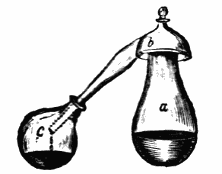
ALEM′BIC. Syn. Moors′head†; Alem′bicus, L.; Alambic, Fr.; Destillirkolben, Ger. An old form of distillatory vessel usually made of glass or earthenware, but sometimes of metal. The body (a) which holds the liquid for distillation is called the CU′CURBIT; the upper part (b) the HEAD or CAP′ITOL; (c) is the RECEIVER. It is still employed in the laboratory, in the distillation of articles that are apt to spurt over into the neck of the common retort, and thus vitiate the product.
ALEUROM′ETER. Syn. Aleuromètre, Fr. An instrument for determining the quantity and quality of gluten in wheat-flour, invented by M. Boland. It essentially consists of a hollow copper cylinder, about 6 inches long, and 3⁄4 of an inch internal diameter. This tube has two principal parts; the one, about 2 inches long, is closed at the lower end, forming a kind of cup, into which the gluten is placed; it screws into the remainder of the cylinder. The cup being charged with a sample of gluten, and the upper part of the cylinder being screwed on, it is exposed in an oven, or (preferably) in an oil bath, to a temperature of 350 to 380° Fahr.[17] From the length of the tube the gluten occupies in swelling, as measured by a graduated scale, its quality is determined. The ‘crude gluten’ of good wheat-flour augments to four or five times its original volume, when thus treated; but that from bad flour does not swell, becomes viscid and semi-fluid, and generally gives off a disagreeable odour; whilst that of good flour merely suggests the smell of hot and highly baked bread.
AL′GA. (-gă). [L.] Sea-weed. A common name of grass-wrack (‘zostera marina’—Linn.), though not one of the algæ.
AL′GÆ. (ăl′-jē). [L. pl.] Syn. Al′gals; Algæ (DC.), Al′gales (Lindl.), L.; Algues, Varech, Fr.; Alge, Meergrass, Seegrass, Ger. Sea-weeds. In botany, an order of Thallogens living in water or very moist places, nourished throughout their whole surface by the medium in which they live, having no distinct axis of vegetation, and propagated by zoöspores, coloured spores, or tetraspores. Linnæus defines them—“plants, the roots, leaves, and stems of which are all in one.” The algæ consist either of simple vesicles lying in mucus, or of articulated filaments, or of lobed fronds formed of uniform cellular tissue. Those that vegetate in salt water are popularly called SEA-WEEDS (fu′ci, L.) and LA′VER (ulvæ, L.); those found in fresh water CONFER′VÆ. One of their divisions (the Zoöspermeæ) comprehends the lowest known forms of vegetable life, being merely adhering cells, emitting, at maturity, seeds or sporules having a distinct animal motion. In Oscillatorias, the whole plant twists and writhes spontaneously; and Zymenas actually copulate like animals. Some of the Algæ possess great beauty. In the lower grades the colour is green; in the higher, red or purple.
Prop., Uses, &c. None of the Algæ are poisonous. Several are nutritious, emollient, and demulcent, from containing mucilage (carrageenin), starch, sugar (mannite), and a little albumen; and are hence used as esculents. The ash from the dried weed varies in different varieties from 9% to fully 25%; and contains variable quantities of potassa, soda, lime, magnesia, iron, manganese, and silica, with sulphuric acid, phosphoric acid, chlorine, and a little iodine and bromine. (Schweitzer; Forchhammer; Gödechens.) Sea-weeds, their charcoal, and their ashes, have been long regarded as alterative and resolvent; and anti-phthisic virtues have been attributed to them by Laennec and others. They were formerly much given in scrofulous affections and glandular enlargements; but their use is now almost superseded by that of iodine and its preparations. Dr Stenhouse has proposed some of the algæ as furnishing an economical source of mannite. The sea algæ are used for manure; their ashes form KELP.
The following table, showing the results of several analyses of different kinds of algæ, and illustrating the very large amount of nitrogen contained in them, is from Mr Walter Blyth’s excellent dictionary of ‘Hygiene and Public Health.’
Kinds of Algæ.Water.Dry matter.Per cent. Nitrogen in dry matter.Protein contained in dry matter.
Chondrus crispus, bleached, from Bewlay Evans.17·9282·081·5349·587
Chondrus crispus, unbleached, Ballycastle.21·4778·532·14213·387
Gigastina mamillosa, Ballycastle.21·5578·452·19813·737
Chondrus crispus, bleached, second experiment.19·7980·211·4859·281
Chondrus crispus, unbleached second experiment.19·9680·042·51015·687
Laminaria digitata, or dulse tangle.21·3878·621·5889·925
Rhodomenia palmata.16·5683·443·46521·656
Porphyra laciniata.17·4182·594·65029·062
Iridæa edulis.19·6180·393·08819·300
Alaria esculenta.17·9180·092·42415·150
From the above, we learn the important fact that the sea-weeds found on our coasts are amongst the most nutritious of vegetable substances, and that they, when dry, are even richer in nitrogenous matter than either oatmeal or Indian corn in the same state. The following are the chief varieties of algæ which are used as food by the dwellers on our coasts as well as on the continent:—Porphyra laciniata and VULGARIS, called laver in England, stoke in Ireland, and slouk in Scotland. Chondrus crispus, called carrageen or Irish moss, and also pearl-moss, and sea-moss. Laminaria digitata, known as the sea-girdle in England, tangle in Scotland, and red-ware in the Orkneys; and Laminaria saccharina, Alaria esculenta, or bladder-lock, called also henware, and honey-ware by the Scotch. Ulva latissima or Green Laver—Rhodomenia palmata or dulse of Scotland. Under the name of “marine sauce” the Laver was esteemed a luxury in London, where it may now occasionally be met with in the shops of provision merchants. The employment of the Chondrus crispus or Carrageen in the form of an aliment for consumptive and weakly persons, would seem from the analysis of it given above to be fully justified. In preparing the algæ for food, they must be soaked in water to remove the saline matter, and where they are possessed of a bitter flavour this may be removed by adding a little carbonate of soda to the water. They should then be stewed in water or milk till they are tender. The best flavourings are pepper and vinegar. See Jelly.
ALGARO′BA. Syn. Ca′′rob-tree, St. John’s Bread; Cerato′nia Sil′iqua, Linn. A leguminous tree of southern Europe, Palestine, and part of Africa. Pods (ALGAROBA BEANS), used for food, and to improve the voice; they contain a sweetish, nutritious powder, and are supposed to have been the ‘locusts’ on which St. John fed in the wilderness; their decoction has been used as a pectoral in asthma and coughs.
Algaroba or Algarovil′la. The astringent pods of prosopis pallida, p. siliquastrum, and Inga Marthæ (South American trees), bruised and more or less agglutinated by the extractive exudation of the seed and husks. They are used in tanning, for which purpose they have been strongly recommended; indeed that of Chili, and of Santa Martha (New Carthagena), is said to possess “four times the power of good oak bark” (Ure); and in dyeing are only inferior to oak-galls.
ALGONTINE. A mouth and tooth wash. An aqueous solution of nitrate of potassium, aromatised with oil of peppermint, tincture of myrrh, and tincture of cinnamon.
ALGOPHON (Bernhard, Salzburg). For pains in decayed teeth. A solution of ethereal oil of mustard (2 grms.) in spirit of cochlearia (30 grms.), coloured green by saffron and litmus. (Wittstein.)
AL′IMENT. [Eng., Fr.] Syn. Alimen′tum, L.; Nahrung, Speise, Ger. Food; nutriment; anything which nourishes or supports life.
ALIMENT′ARY Syn. Alimenta′′rius, L.; Alimentaire, Fr.; zur Nahrung gehörig, Ger. Pertaining to food or aliment; nutrimental; nourishing.
Alimentary Canal′. Syn. Alimentary duct; Cana′lis Alimenta′′rius, L. In anatomy, the cavity in the bodies of animals into which the food is taken for the purpose of being digested; the whole passage or conduit extending from the mouth to the anus. In some of the lower animals this is a simple cavity, with only one opening; when the same aperture which admits the food also gives egress to the excrementitious matter. In others it is a true canal, with both a mouth and an outlet. Another step, and we find this canal is divided into a stomach and intestines. In the higher grades, a mouth, pharynx, and œsophagus precede the stomach. Birds have one or two sacculi or crops added to the œsophagus. The stomach of the ruminants consists of four sacs or parts, each of which may be regarded as a separate stomach; that of the bottle-nose whale contains no less than seven of such sacs. The part below the stomach, forming the intestines, is also variously subdivided, complicated, and connected. In man, these subdivisions are termed—DUODENUM, JEJU′NUM, IL′EUM, CÆ′CUM, CO′LON, and REC′TUM; the lower end or orifice of the last being called the A′NUS. The existence of an alimentary canal is said to be the only true characteristic of an animal. Plants have no common receptacle for their food, nor canal for carrying away effete matter; but every animal, however low in the scale of being, possesses an internal cavity which serves it as a stomach.
Alimentary Sub′stances. Syn. Aliments; Mate′′ria alimenta′′ria, L. Substances employed as food.
ALIMENTA′TION. [Eng., Fr.] Syn. Alimenta′tio, L.; Nahrhaftigkeit, Ger. The act, process, power, or state of nourishing, or being nourished.
AL′IZARI. [Tur., ali-zari.] The commercial name of madder in the Levant.
ALIZARIN. C10H6O3 . 2H2O. Syn. Lazaric Acid. A red colouring matter obtained from madder.
Prep. 1. Exhaust madder with boiling water, and precipitate the decoction by sulphuric acid. Wash the precipitate, and, while yet moist, boil it with a concentrated solution of hydrate of aluminum in hydrochloric acid, and mix the solution with hydrochloric acid; red flakes of impure alizarin deposit. Dissolve this precipitate in alcohol or in dilute ammonia, and treat the solution with hydrate of aluminum. Boil the aluminum compound thus formed with carbonate of sodium, and, after freeing it from resinous impurities by digestion with ether, decompose it with hot hydrochloric acid. Wash the alizarin thus separated, dry it by simple exposure to air, and purify it by repeated crystallisation out of alcohol.
2. Sublime on a paper an alcoholic extract of madder. This method yields the purest alizarin.
Props. Red prisms; sublimes at 419° F.; odourless, tasteless, and neutral to test-paper; sparingly soluble in water, even at the boiling temperature; soluble in alcohol and ether; not decomposed by hydrochloric acid; dissolved, without decomposition, by strong sulphuric acid; soluble in solutions of the alkalies and their carbonates; acids precipitate alizarin from its alkaline solutions in orange-coloured flakes; alumina decolorises an alcoholic solution of alizarin, forming a red lake.
ALIZARIN, ARTIFICIAL. C14H8O4. This colour was first obtained by Graebe and Liebermann in 1869 from anthrachinon, an oxidation product of anthracen, this latter being a substance which is formed during the destructive distillation of coal-tar. These chemists converted anthracen into antichinon by means of nitric acid.
The crude anthracen is previously purified by treatment with benzoline (petroleum spirit), aided by heat, and by being subjected to the action of the centrifugal machine to fusion, and to sublimation.
According to the original method of preparing alizarin, the anthrachinon was first converted into a dibromide of anthrachinon by treatment with bromine, and this bromated compound, by further treatment either with caustic potash or soda at a temperature of 180° to 200° C., converted into alizarin-potassium (or alizarin-sodium if caustic soda has been used), from which the alizarin is set free by means of hydrochloric acid.
Alizarin is now procured from anthrachinon by treatment at a temperature of 260° C., with concentrated sulphuric acid of 1·84 sp. gr., the anthrachinon being converted into a sulpho-acid; this acid is next neutralised with carbonate of lime, the fluid decanted from the deposited sulphate of lime, and carbonate of potash added to it, with the object of throwing down all the lime. The clear liquid is then evaporated to dryness, the resulting saline mass is converted into alizarin-potassium by heating it with caustic potash. From the alizarin-potassium thus obtained the alizarin is set free by the aid of hydrochloric acid.
In another method the preparation of anthrachinon is avoided, and anthracen employed directly, by first converting it, by means of sulphuric acid and heat, into anthracen sulphonic-acid. After having been diluted with water, the solution of this acid is treated with oxidising agents (peroxides of manganese, lead, chromic acid, nitric acid), and the acid fluid is afterwards neutralised with carbonate of lime. When peroxide of manganese has been used, the manganese is also precipitated as oxide. The oxidised sulpho-acid having been previously converted into a potassium salt, the latter being heated with caustic potash, alizarin is obtained. The details of these two processes will be found set forth in the terms of the patent taken out by Messrs Caro, Graebe and Liebermann, further on.
The following method of preparing alizarin from anthracene paranaphthalene and their homologues is by Girard. The material used is that which distils between 290° and 360°; it is purified by distillation and pressure, the portion which passes over, between 300° and 305°, being collected separately. This mixture is treated with potassium chlorate and hydrochloric acid, whereby it is converted into tetra-chlorinated products. These are oxidised either by nitric acid in the water bath, or by a metallic oxide (red or brown oxide of lead), and sulphuric or acetic acid. In the first place a mixture of dichloranthraquinine and chloride of chloroxyanthranyl are obtained. These substances are treated in presence of a metallic oxide (oxide of zinc, oxide of copper, or litharge), with an alcoholic solution of sodium acetate. The metallic oxide removes the last atom of chlorine from the sodium chloroxyanthranilate, and converts it, like the dichloranthraquinine, into alizarin. The purification is effected by means of benzine, petroleum, &c., which dissolve out the foreign matters, and by successive precipitation from the alkaline solutions by mineral acids. The foreign matters may also be separated by means of a little alum, when it is necessary to work with neutral potash or soda salts.
Another method for the preparation of alizarin has been patented by Dale and Schorlemmer. It is as follows: 1 part of anthracen is boiled with 4 to 10 parts of strong sulphuric acid, then diluted with water, and the solution neutralised with carbonate of calcium, barium, potassium, or sodium. The resulting sulphates having been removed by nitration or crystallisation, the solution is heated to between 180° and 260° with caustic potash or soda, to which a quantity of potassium nitrate or chlorate has been added, about equal in weight to the anthracen, as long as a blue-violet colour is thereby produced. From this product the alizarin is separated in the usual way by precipitation with an acid. Several other patents have been taken out for the preparation of artificial alizarin.
The specification of Messrs Caro, Graebe, and Liebermann, and dated June 25th, 1869, was the first which was taken out in England. We quote it here because it enters more fully into detail than any of the others.
“Our invention is carried into effect by means of either of the two processes which we will proceed to describe.
“In the one process we proceed as follows—We take about one part by weight of anthraquinone and about three parts by weight of sulphuric acid of about specific gravity of 1·488, and introduce the same into a retort, which may be made of glass, or porcelain, or of any other material not easily acted upon by sulphuric acid, and the contents are then to be heated up to about 260° Centigrade, and the temperature is maintained until the mixture is found no longer to contain any appreciable quantity of unaltered anthraquinone. The completion of this operation may be ascertained or tested by withdrawing a small portion of the product from time to time, and continuing the operation at the high temperature until such product upon being diluted with water is found to form a substantially perfect solution, thereby indicating that the anthraquinone has become either entirely or in greater part converted into the desired product. The products thus obtained are then allowed to cool, and are diluted with water; carbonate of lime is then added in order to neutralise and remove the excess of sulphuric acid contained in the solution; the mixture is then filtered, and to the filtrate carbonate of potash, or carbonate of soda, by preference in solution, is to be added until carbonate of lime is no longer precipitated; the mixture is then filtered, and the clear solution is evaporated to dryness, by which means the potash or soda salts of the sulpho-acids of anthraquinone are obtained, and which are to be treated in the following manner:—We take about one part by weight of this product, and from two to three parts by weight of solid caustic, soda, or potash; water may be added or not, but by preference we add as much water as is necessary to dissolve the alkali after admixture; we heat the whole in a suitable vessel, and the heating operation is continued at a temperature of from about 180° to 260° Centigrade, for about one hour, or until a portion of the mixture is found upon withdrawing and testing it to give a solution in water, which being acidulated with an acid, for example, sulphuric acid, will give a copious precipitate of the colouring matters. The heating operation having been found to have been continued for a sufficient time, the resulting products are then dissolved in water, and we either filter or decant the solution of the same, from which we precipitate the colouring matters or artificial alizarin, by means of a mineral or organic acid, such, for example, as sulphuric or acetic acid. The precipitated colouring matters thus obtained are collected in a filter or otherwise, and after having been washed may be employed for the purpose of dyeing and printing, either in the same way as preparations of madder are now used or otherwise.
“In carrying out our other process we proceed as follows:—We take about one part by weight of anthracene and about four parts by weight of sulphuric acid of specific gravity of about 1·848, and the mixture being contained in a suitable vessel, is heated to a temperature of about 100° Centigrade, and which temperature is to be maintained for the space of about three hours; the temperature is then to be raised to about 150° Centigrade, which temperature is to be maintained for about one hour, or until a small portion of the product when submitted to the two subsequent processes hereinafter described is found to produce the desired colouring matters; we then allow the result obtained by this operation to cool, and dilute it with water, by preference in the proportion of about three times its weight. To the solution thus obtained we add for every part of anthracene by weight which had been employed in the previous operations, from about two to three parts by weight of peroxide of manganese, preferring to employ an excess, and we boil the whole strongly for some time, and in order fully to ensure the desired degree of oxidation the mixture may be subsequently concentrated, and by preference be evaporated to dryness, and the heat be continued until a small portion of the oxidised product, when submitted to the subsequent processes hereinafter described will produce the desired colouring matters. We then neutralise and remove the sulphuric acid contained in this mixture, and at the same time precipitate any oxides of manganese that may be held in solution, by adding an excess of caustic lime, which we use by preference in the form of milk of lime, and we add the same until the mixture has an alkaline reaction. We then filter, and add to the filtrate carbonate of potash or soda, until there is no further precipitation of carbonate of lime. The solution is then filtered and evaporated to dryness, and we thus obtain the potash or soda salts of what we call the sulpho-acids of anthraquinone.
“In effecting the conversion of the oxidised products thus obtained into colouring matters, or into what we call artificial alizarin, we proceed as follows:—We take one part by weight of this product, and from two to three parts by weight of solid caustic soda or potash, and water may be added or not, but by preference we add as much water as may be necessary to dissolve the alkali. After admixture we heat the whole in a suitable vessel, and continue the heating operation at a temperature of about 180° to about 260° Centigrade for about one hour, or until a portion of the mixture is found to give a solution in water, which upon acidulation with an acid, for example, sulphuric acid, is found to give a copious precipitate of the colouring matters. The heating operation having been found to have been continued for a sufficient time, we then dissolve the product in water, and either filter or decant the solution of the same, from which we precipitate the colouring matters or artificial alizarin by means of a mineral or organic acid, such, for example, as sulphuric or acetic acid. The precipitated colouring matters thus obtained are collected on a filter or otherwise, and after having been washed may be employed for the purpose of dyeing and printing, either in the same way as preparations of madder are now used or otherwise.
“Instead of acting upon anthracen by means of sulphuric acid of the density before mentioned, fuming sulphuric acid may be employed, but we prefer to use the ordinary kind before described.
“In order to effect the process of oxidation, before referred to, other oxidising agents may be used in the place of the oxide of manganese, before mentioned, such, for example, as perioxide of lead, or chromic, nitric, or other acids capable of effecting the desired oxidation may be employed.”
Mr W. H. Perkin’s patent is similar in principle to that of Messrs Caro, Graebe, and Liebermann, and is dated only one day later.
The following is an outline of a patent taken out in France in May, 1869, by MM. Brœnner and Gutzkon, for the manufacture of artificial alizarin. One part of anthracen is heated with two parts of nitric acid, sp. gr. 1·3 to 1·5. The anthraquinone thus produced is washed and dissolved at a moderate heat in sulphuric acid. Mercuric nitrate is now added, which converts the anthraquinone into alizarin, The mass thus formed is dissolved in an excess of alkali, which precipitates the oxide of mercury, and retains the colouring matters in solution. The alkaline liquor is decanted and neutralised with sulphuric acid, and the precipitate thus formed is washed and collected. If not quite pure the treatment with alkali must be repeated. (The complete specification of this patent is published in the ‘Moniteur Scientifique,’ vol. xi, p. 865.)
In England a large quantity of artificial alizarin is manufactured by the process of Mr Perkin, and is used as a substitute for madder and madder extract, in Turkey red dyeing and topical styles. The largest makers of artificial alizarin on the continent are Messrs Gessert Frères, of Ebelfort, Messrs Maister, Lucius and Co., of Hæchst, near Frankfort, and the Badische Anilin und Soda Fabric, Mannheim.
The following recipes for printing with artificial alizarin are extracted from Mr Crookes’ ‘Practical Handbook of Dyeing and Calico Printing’:
Reds.
5 lbs. alizarin paste (10 per cent.);
16 lbs. thickening;
1 lb. acetate of alumina, at 15° Tw.;
1⁄2 lb. acetate of lime, at 25° Tw.
Pinks.
The above diluted with 2 or 3 parts of thickening.
For double printing, when deep red is printed on first, the goods must be steamed one hour before the second printing takes place. After the second printing the goods are again steamed for one hour, and aged for twenty-four hours; they are then passed through one of the following baths, at from 120 to 140 F., remaining in the bath not longer than 1 to 11⁄2 minute:—
250 gals. water;
60 lbs. chalk;
3 lbs. tin crystals.
Or, 250 gals. water;
40 lbs. chalk;
10 lbs. arseniate of soda.
The goods are then washed, and cleaned as follows:—
Take, for 10 pieces of fifty yards each,—
1st. Soaping at 120° F., 3 lbs. soap;
1⁄4 lb. tin crystals.
2nd. Soaping at 160° F., 3 lbs. soap;
3rd. Soaping at 175° F., 3 lbs. soap.
Wash between each soaping.
Red for Mosaics.
8 lbs. alizarin paste (10 per cent.);
10 quarts thickening;
91⁄2 oz. nitrate of alumina, at 23° Tw.;
19 oz. acetate of alumina, at 15° Tw.;
13 oz. acetate of lime, at 25° Tw.
Or, 10 lbs. alizarin paste (10 per cent.);
10 quarts thickening;
13 oz. nitrate of alumina, at 23° Tw.;
19 oz. acetate of alumina, at 15° Tw.;
16 oz. acetate of lime, at 25° Tw.
Another Red without Oil.
81⁄2 lbs. alizarin paste (10 per cent.);
91⁄2 lbs. acetic acid, at 12° Tw.;
31⁄2 lbs. wheat flour;
5 pints water.
Boil well and stir till cold; then add—
1 lb. acetate of lime, at 29° Tw.;
2 lbs. nitrate of alumina, at 23° Tw.;
3 lbs. hyposulphite of lime, at 13° Tw.
Purple.
3 lbs. alizarin paste (10 per cent.);
10 quarts purple thickening;
6 oz. pyrolignite of lime, at 18° Tw.;
12 oz. acetate of lime, at 25° Tw.
The printed goods are steamed for an hour or two, and then aged from twenty-four to thirty-six hours. They are then padded in the chalk and arseniate of soda bath; after which they are washed and soaped in a single soap-bath without tin crystals; and, if needful, cleaned in a weak solution of bleaching powder.
Thickening for Reds.
12 lbs. wheat starch;
40 quarts water;
4 quarts acetic acid, 99 Tw.;
11⁄4 lbs. gum tragacanth;
2 lbs. olive oil.
Boil well together, and stir till cold.
Thickening for Purple.
10 lbs. starch;
27 quarts water;
3 quarts acetic acid;
11⁄8 lbs. gum tragacanth;
2 lbs. olive oil.
Boil well together, and stir till cold.
The mordants in the above recipes are prepared as fellows:
Acetate of Alumina.
Stir 30 lbs. of hydrate of alumina into six quarts of acetic acid, warm, filter, and reduce to the specific gravity required.
The hydrate of alumina is prepared by dissolving 72 lbs. of alum in 100 gals. of water, and 62 lbs. soda in 100 gals. of water. The two solutions are mixed, this precipitate is washed eight times by decantation, collected on a filter and pressed. It must be dissolved on the filter before it gets dry.
Nitrate Of Alumina.
2 lbs. nitrate of lead;
2 lbs. alum;
2 quarts water.
Dissolve and filter off the liquid from the precipitate, and dilute to proper standard.
The reds are turned more yellow by nitrate than by acetate of alumina, and when the former is used more acetate of lime is taken in addition.
Acetate of Lime.
A solution of acetate of lime at 25° Tw. contains 25 per cent. of acetate of lime; generally 1⁄10th of the weight of alizarin paste is required; but with a fresh quantity of alizarin it is safer to ascertain, on a small scale, the amount needed.
Brown.
131⁄4 lbs. alizarin paste (15 per cent.);
9 quarts thickening;
2 lbs. nitrate of alumina, at 29° Tw.;
15 oz. acetate of alumina, at 19° Tw.;
15 oz. red prussiate potash, dissolved in
water;
1 lb. 1 oz. acetate of lime, at 29° Tw.
To obtain a yellower shade, for every quart of mixed colour, 1 oz. bark liquor, at 30° Tw., may be added.
Old spoiled red colours may be advantageously used for browns by adding per quart, 3⁄4 oz. to 1 oz. red prussiate, dissolved in water.
ALKALI. Syn. Alkali, Fr.; Langensalz, Ger. This word has been used in various senses, but is now usually applied to four substances only, viz. the hydrates of potassium, sodium, lithium, and ammonium (the latter being supposed to exist in the aqueous solution of ammonia). In a more general sense it is applied to the hydrates of barium, strontium, and calcium, which, for the sake of distinction, are called the alkaline earths. The following properties are characteristic of the alkalies:—(1) They are soluble in water, the alkalies proper more so than the alkaline earths. (2) They change the hue of many vegetable colouring matters; thus, they turn reddened litmus blue, yellow turmeric brown, and syrup of violets and infusion of red cabbage green. (3) They neutralise the strongest acids. (4) They precipitate most of the heavy metals from solutions of their salts as hydrates or oxides. (5) They saponify the fixed oils and fats. (6) They exert a caustic or corrosive action on animal and vegetable substances.
ALKALI ACTS. The principal alkali Act is the 26 and 27 Vict., c. 24, amended by 37 and 38 Vict., c. 43, the amended Act having come into operation in 1875.
Every alkali work must be carried on so as to ensure the condensation of not less than 95% of muriatic acid evolved therein; and it must be so condensed that in each cubic foot of air, smoke, or chimney gases, escaping from the works into the atmosphere, there is not contained more than one fifth part of a grain of muriatic acid. Penalty for first conviction, £50; for second and other offences, £100, or less (26 and 27 Vict., c. 124, s. 4; 37 and 38 Vict., c. 43, s. 4).
The owner of every alkali work is also bound “to use the best practicable means of preventing the discharge into the atmosphere of all other noxious gases arising from such work; or of rendering such gases harmless when discharged.”
The noxious gases are defined to be sulphuric acid, sulphurous acid (except that arising from the combustion of coals), nitric acid, or other noxious oxides of nitrogen, sulphuretted hydrogen and chlorine (37 and 38 Vict., c. 43, ss. 5 and 8).
The owner is liable for any offence against the Alkali Acts, unless he prove that the offence was committed by some agent, servant, or workman, and without his knowledge, in which case the agent, &c., is liable (26 and 27 Vict., c. 124, s. 5).
Every alkali work must be registered; penalty for neglect £5 per day (ibid., s. 6).
Powers are given to owners to make special rules for the guidance of their workmen (ibid. s. 13).
ALKALIM′ETRY. Syn. Alkalime′tria, L.; Alcalimétrie, Fr. In chemistry, the estimation of the strength of the commercial alkalies; the art or process of determining the quantity or proportion of pure caustic alkali, or of its carbonate, in any given sample or simple solution. It is the reverse of ‘acidimetry,’ and it should be understood that it does not apply to alkalies occurring under any other form or condition than those just mentioned. Alkalimetric assays are now also frequently and conveniently extended to the estimation of the alkaline earths and their carbonates, as hereafter noticed.
Alkalimetrical processes. These, like those of ‘acidimetry,’ are for the most part founded on—the capacity of the bases to saturate acids—the estimation of the quantity of dry carbonic acid liberated from a given weight of an alkaline carbonate under the influence of a stronger acid; and, in the case of the pure alkalies, the sp. gr. of their solutions. From any one of these results the exact amount of alkali, or of alkaline carbonate, present in a sample, is easily found or calculated. These processes are, indeed, precisely similar to those described under Acidimetry; but here the unknown quantity sought is the alkali, instead of the acid.
Assay. The SAMPLE is drawn from as near the centre of the cask containing the alkali as possible, and at once placed in a wide-mouthed bottle, which is then closely corked up and numbered. Before proceeding to the assay, the contents of the bottle are thrown on a piece of dry paper, the lumps crushed small, and the whole reduced to coarse powder as rapidly as possible. The number of grains required for the trial are then at once weighed, placed in a phial or small glass tube, and agitated with about 1⁄2 oz. of hot water. After a short time allowed for repose, the clear liquid is poured off into a beaker-glass or other vessel in which the trial is to be made. This process is repeated with a second and a third quantity of water, or until nothing soluble remains, shown by the last washings not affecting the colour of turmeric paper. The greatest care must here be taken not to waste the smallest portion of the liquid, which would render the results inaccurate.
To the solution in the beaker-glass a little solution of litmus is added, unless the acid is tinted with it when it is unnecessary. The solution is now heated until near its boiling point, and a piece of white paper or porcelain put behind it, to better show up the changes of colour. The alkaline solution is now treated with the standard test-acid, which is poured carefully from an alkalimeter or Mohr’s burette, until the solution, after turning a purple red, suddenly assumes a pink colour. Neutralisation being thus effected, the operator allows the sides of the alkalimeter or burette to drain, and then either ‘reads off’ the number of divisions which have been consumed, or (if using the test-acid by weight) determines the quantity by again weighing the alkalimeter. The common practice is to allow two drops (= 1⁄5th of an alkalimetrical division by VOLUME, or 2 gr. by WEIGHT) for over-saturation, which is, therefore, deducted from the ‘observed quantity’ of the test-liquor employed.