A CYCLOPÆDIA OF PRACTICAL RECEIPTS, PROCESSES, AND COLLATERAL INFORMATION (continued 34)
Reading edition
Emery Cakes are formed by melting emery flour with a little beeswax, and after thorough admixture, forming it into solid lumps of suitable sizes. Used to dress the edges of buff and glaze wheels.
Emery Cloth is prepared by brushing the surface of thin cotton cloth over with liquid glue, and sifting the emery powder over the surface while still warm.
Emery Paper is made in the same way as emery cloth. Both are used either with or without oil, in the same way as glass paper.
Emery Sticks are made of pieces of wood in the same way, and are used for the same purposes, as emery paper.
Emery Stones are formed of emery, of the requisite coarseness, mixed with about half its weight of good Stourbridge loam, and water q. s. to make a stiff paste, which is forced into metallic moulds by a powerful press. The pieces, when thoroughly dry, are exposed in a muffle for a short time to a temperature just under a full white heat. In this way ‘discs’ and ‘laps’ are generally made. For ‘wheels,’ only 1⁄4th of loam is used. Another method, applicable for ‘cutting stones’ generally, is to press the flour emery, previously moistened with water, into moulds, with strong pressure, as before, without any other addition, and then to fire it at nearly a full white heat.
EMETIA. Syn. Emetin, Emetina. A feebly basic or alkaloidal body, existing in and forming the active principle of ipecacuanha.
Prep. 1. (Medicinal—Emetic Extract.)—a. Ipecacuanha (in coarse powder) is digested first in ether, and then in rectified spirit for 3 or 4 days; the alcoholic tincture is next expressed and evaporated (distilled) to dryness; the residuum is dissolved in distilled water, and the solution precipitated with acetate of lead; the precipitate is then diffused through distilled water, in a tall glass vessel, and sulphuretted hydrogen is passed through it, to throw down the lead; after which the liquor is decanted, filtered, evaporated to the consistence of a thick syrup, and spread in a thin layer on warm plates of glass, and allowed to dry in a current of warm air, or by a gentle heat in a stove. The maceration in ether is frequently omitted.
b. Ipecacuanha, 1 part; rectified spirit (·835), 7 parts; make a tincture, distil off the spirit, dissolve in cold distilled water, 5 parts; filter the solution, and evaporate, &c., as before. Inferior to the last.
c. (P. Cod.) As the last, nearly.
Obs. Medicinal or impure emetia is brownish, red, deliquescent, and emetic in doses of 1⁄4 to 1⁄2 gr.
2. (Pure.)—a. Ipecacuanha (in coarse powder), 1 part, is digested for 24 hours in distilled water, 10 parts; together with calcined magnesia, added in slight excess; the deposit is then thrown on a filter, washed carefully with very cold water, and dried; it is next dissolved in rectified spirit and neutralised with dilute sulphuric acid; the filtered solution is decoloured with animal charcoal, again filtered, and again precipitated by digestion with magnesia; the last deposit forms a colourless solution with rectified spirit, which, by gentle evaporation, gives up its emetia as a yellowish white pulverulent mass, which may be rendered perfectly white by redissolving it in alcohol, &c., as before. The process is rendered easier by first digesting the powdered ipecacuanha in ether.
b. (P. Cod.) Alcoholic extract of ipecacuanha, 1 part; water, 10 parts; dissolve, filter; add calcined magnesia, 1 part; evaporate to dryness, wash the product on a filter with very cold water, 5 parts; dry it again, and dissolve it in boiling alcohol; evaporate the filtered tincture to dryness, redissolve the residuum in a little water, acidulate (slightly) with dilute sulphuric acid, decolour with animal charcoal, filter, precipitate with liquor of ammonia, and dry the precipitate by a gentle heat.
c. (Ph. Suec. 1845.) Powdered ipecacuanha, 1 part; water, acidulated with sulphuric acid, 6 parts; digest, filter; add lime, 1 part, and evaporate to dryness over a water bath; the residuum is then exhausted with boiling rectified spirit, and otherwise treated as in the last formula.
Prop., &c. Pure emetia is white, pulverulent, inodorous, and bitter; fusible at 122° Fahr.; very soluble in alcohol and boiling water, but only slightly so in ether, oils, and cold water. It restores the blue colour of reddened litmus, and partially neutralises the acids, forming scarcely crystallisable salts. It is reddened by nitric acid, and this red colour is deepened by ammonia. Tincture of iodine produces a reddish precipitate in an alcoholic solution of emetia. With tincture of galls this solution behaves like morphia; but, unlike the last substance, the salts of iron produce no change of colour in it. These reactions, combined with its emetic properties, are sufficient for its identification.—Dose. White and pure emetia is emetic in doses of 1⁄20 to 1⁄16 gr. The large doses ordered in certain pharmaceutical compilations, evidently in error of the difference between the strengths of the pure and the impure or medicinal emetia, have, in several cases which have been reported on, produced very serious consequences.
The ‘Journal de Pharmacie et de Chemie,’ for September, 1875, contains a new process for the extraction of emetia, by M. A. Glenard. This process is based upon the combined use of lime and ether. It consists in treating with ether a suitably prepared powder, or an extract of ipecacuanha and lime, or the precipitate formed upon adding an excess of lime to a solution obtained by treating ipecacuanha in the cold with water acidulated by sulphuric acid. Either of these mixtures, or the precipitate, when treated with ether, will yield all the alkaloid it contains.
The alkaloid may be obtained from the ethereal solution by distilling it to dryness, and treating the residue with acidulated water, or by at once shaking the solution with acidulated water. A more or less acid aqueous liquid is thus obtained, which upon the addition of ammonia, yields the emetine almost colourless, and much more pure than that produced by the process ordinarily employed.
Preparation of Crystallised Hydrochlorate and Pure Emetine.—When water, acidulated with hydrochloric acid, is employed to remove the emetine from the ether, an acid solution is obtained, which, when sufficiently concentrated by evaporation, forms a nearly colourless, solid, crystalline mass. This mass is formed of extremely delicate needles, formed in bundles that radiate around a central point, and form small spheres with an embossed surface, resembling mulberries in appearance. Upon pressing these crystals in a cloth the more or less coloured mother liquid runs off, and the crystals redissolved in water give a colourless solution, from which a fresh crystallisation of perfectly pure hydrochlorate of emetine can readily be obtained.
The production of this crystallised hydrochlorate of emetine is worthy of notice, since it does not accord with what has been stated by different authors, who have all considered emetine to be incapable of forming crystallisable salts. It is especially interesting in that it furnishes a convenient and certain method of obtaining perfectly pure emetine, for which it is only necessary to precipitate a solution of the hydrochlorate with an alkali. But it is important to observe that ammonia does not precipitate all the emetine of the hydrochlorate, and that the precipitate is less in proportion as the salt is more acid.
It might appear from this that emetine is soluble in hydrochlorate of ammonia. But the author finds that it is the result of a decomposing action exercised by the emetine upon the hydrochlorate of ammonia, as is shown by the following two experiments. If a little dry powdered emetine be placed in a glass containing a solution of hydrochlorate of ammonia, it may be observed to agglomerate and become transformed into a soft resinoid mass, at the same time the disengagement of ammonia may be recognised, and the resinoid mass gradually undergoes a kind of metamorphosis, and becomes white and crystalline. Again, if emetine in powder be suspended in water, and solution of hydrochlorate of ammonia be gradually added, the emetine is dissolved, and upon evaporation of the solution crystals of double hydrochlorate of emetine and ammonia is obtained.
The author believes the decomposition of hydrochlorate of ammonia by an organic alkali to have been hitherto unobserved. It does not appear, however, that emetine is alone in this action, as the author has observed that quinine, under similar conditions, behaves in the same manner.
Zinoffsky (‘Jour. de Pharm. d’Anvers,’ xxix, 490) gives the following process for the quantitative determination of emetia:—Treat fifteen grams of powdered ipecacuanha with alcohol of 85 per cent., acidified with a few drops of sulphuric acid, so as to form a volume of 150 cubic centimètres. Filter, and after expelling the alcohol from 100 cubic centimètres of the liquid by distillation, add to the residue a titrated solution of iodo-hydrargyrate of potassium until a filtered portion ceases to be affected by this reagent. The number of cubic centimètres of iodo-hydrargyrate multiplied by 0·0189 (0·0001 of the equivalent of emetine) gives the quantity of emetine contained in ten grains of the root.
A normal solution of iodo-hydrargyrate is obtained by mixing aqueous solutions of 13·546 grams of bichloride of mercury, and 49·8 of iodide of potassium, adding water to make one litre. One cubic centimètre of this solution precipitates 0·0001, or 0·00005 of an equivalent of alkaloid.
Wine of ipecacuanha can be titrated by the same process.
Composition of Emetine and its Hydrochlorate.—These substances dried at 110° C., gave upon analysis results corresponding with following centesimal composition:
Emetine.Hydrochlorate of Emetine.
Carbon72·2563·00
Hydrogen8·618·15
Nitrogen5·364·75
Oxygen13·7811·64
Chlorine12·46
From these figures the author has constructed the following formulæ:
Emetine: C30H22NO4. Hydrochlorate of Emetine: C30H22NO4HCl.
Preparation and Composition of Emetine (J. Lefort and F. Wurtz, ‘Comptes Rendus,’ lxxxiv, 1299). When ipecacuanha is dissolved in water, and a concentrated solution of potassium nitrate added, a thick mass is produced, consisting of emetine nitrate. It is washed with water, dissolved in alcohol, and the solution poured into milk of lime. The mixture is evaporated to dryness, and digested with ether, which dissolves out the emetine, leaving it as a yellowish mass on evaporation. On dissolving this mass in sulphuric acid, and pouring the solution into dilute ammonia, the alkaloid is obtained as a white precipitate, which is dissolved in alcohol, from which it separates in minute radiate groups of needles. By analysis it gave numbers leading to the formula C28H40N2O3.[275]
Pure emetine nitrate was prepared, and was found to have the formula C28N2H40O5NOH; this in conjunction with Glenard’s results, shows that emetine does not form basic salts.
EMET′ICS. Syn. Vomits, Anacathartics; Anacathartica, Emetica, Vomitoria, L. Medicines which induce vomiting. The principal emetics are ipecacuanha and tartarised antimony, and their preparations; and the sulphates of zinc and copper. Of these the first is commonly employed either in substance or infused in wine (ipecacuanha wine), when it is merely wished to evacuate the contents of the stomach, when that organ is in a disordered state or overloaded with food; and is the one most adapted in ordinary cases for children and females. Tartar emetic (tartarated antimony) (dissolved in water) and antimonial wine, either alone or combined with ipecacuanha, are preferable at the commencement of fevers and other inflammatory disorders, in consequence of the nausea, relaxation, and depression of the muscular power and circulation which commonly follow their use. When poison has been taken, sulphate of zinc is generally preferred as an emetic, on account of the promptness and completeness of its action, and its effects ceasing as soon as it is ejected from the stomach. Sulphate of copper is employed in the same cases as sulphate of zinc, but its action is more violent and disagreeable, whilst its intense metallic taste is a great objection to its use. 25 to 30 gr. of either of the above sulphates are dissolved in 3 or 4 fl. oz. of warm water, and a fourth of the solution is given every ten minutes, until copious vomiting ensues. In the absence of other substances, when an immediate emetic is required, a teaspoonful of flour of mustard (an article always at hand), stirred up with half a pint of warm water, and drank at a draught, will generally act easily and effectively, and relieve the stomach before other remedies can be obtained and applied.
The operation of emetics is powerfully promoted by drinking copiously of diluents, especially of warm or tepid water. The latter, in fact, is itself an emetic, when taken in quantity. Its use will also prevent that dreadful straining and retching which makes emetics so much dreaded by the nervous and delicate.
The timely administration of an emetic at the commencement of fevers and other inflammatory affections will frequently cause copious diaphoresis, and produce a cure, or at least greatly mitigate the severity of the symptoms. Dropsies have also been cured by vomiting; and swelled testicle, bubo, and other glandular swellings, have occasionally been dispersed by the action of emetics. Visceral obstructions, in both sexes, have also yielded to the same treatment. Small and repeated doses of emetics are frequently administered, with advantage, to produce nausea, in many diseases of the lungs and stomach. Certain chronic and obstinate diseases, as rheumatism and asthma, are sometimes relieved by emetics, when every other line of treatment has failed.
Emetics should be avoided in plethoric habits, in hernia, pregnancy, and whenever visceral inflammation is suspected. They should also be given with great caution to young children and females, and to the nervous and delicate. In such cases, wine or powder of ipecacuanha should alone be employed.
Emetic Cups. Syn. Antimonial cups; Pocula emetica, Calices vomitorii, L. Small cups made of metallic antimony. Wine left in them for 10 or 12 hours becomes emetic.
Emetic Tartar. See Antimony, Tartarated.
EM′ETINE. See Emetia.
EMMEN′AGOGUES. Syn. Emmenagoga, L. Medicines which are considered to have the power of promoting the menstrual discharge when either retained or suspended. There are, probably, few remedies which exert this specific power on the uterus, the majority of repeated emmenagogues acting rather by their influence on the system generally, or on parts contiguous to the uterus, than in the uterus itself. Among the substances usually arranged under this class are—aloes, black hellebore, birthwort, borax, cubebs, ergot, gamboge, gin, iodide of potassium, iodine, madder, mercurials, the peppers, rue, savine, stimulants (generally), stimulating diuretics, stinking goosefoot, stinking orache, wine, &c.
Of the above, ergot and madder are the only articles which exercise a direct power on the uterus, and that rather in increasing its expulsive energy than in promoting the menstrual function, though they are advantageously employed for the latter purpose. Several of the other substances named are drastic purgatives, or possess cerebro-spinal properties, or local powers of irritation, by which they increase the pelvic circulation, or produce excitement in the neighbouring parts, in many cases of a dangerous and irreparable character. Hence many writers on pharmacology deny the existence of emmenagogues.
To ensure the successful administration of this class of medicines, the system must be previously prepared for their use by invigorating it, if there is either relaxation or debility; and an opposite course should be pursued when there is an undue degree of arterial action. In the majority of cases, the restoration of the discharge is rather attributable to a proper regulation of the system than to any specific power in the medicine administered.
EMOLL′IENTS. Syn. Emollientia, L. In pharmacy and therapeutics, demulcents of an oleaginous, saponaceous, or emulsive character, applied to surfaces (generally external), to soften and relax the fibres. See Demulcents.
EMUL′SIN. Syn. Synaptase. An azotised substance, forming a large proportion of the white pulp of both bitter and sweet almonds. It is yellowish-white, soluble in cold water, and coagulated by heat and alcohol. Its most remarkable property is its action on amygdalin by which the volatile oil of almonds and hydrocyanic acid, with other products are formed. It has never been obtained in a state of purity.
EMULSINES. See Emulsion.
EMUL′SION. Syn. Emulsio, L. A milky fluid, formed by the mechanical admixture of oil and water, by means of some other substance that possesses the power of combining with both. The emulsions of the Pharmacopœia are in the ‘British Pharmacopœia’ included in the class Misturæ (which see).
In the preparation of emulsions, the oily or resinous ingredients are usually suspended by means of mucilage of gum arabic, almonds, or yolk of egg. 1 dr. of the first, made with equal parts of gum and water; 1 oz. of the second (usually 26 in number); and one in no. of the last, will form 2 dr. of any oil into an emulsion with about 1 oz. of water, gradually added. In some cases, instead of the above substances, a little liquor of potassa is employed, by which a saponaceous emulsion is formed. In all cases the mucilage or other viscid substance should be put into the mortar before anything else. The oil or resinous matter may then be very gradually rubbed in, taking care not to add it more quickly than it can be subdued by the pestle; and if, during this part of the manipulation, the mixture should begin to assume a breaking or curdling appearance at the edges, a few drops of water must be immediately incorporated with it, before adding the remainder of the oil. From the want of this precaution, it is common for an emulsion suddenly to lose its tenacious consistence in the mortar, and it is then in vain to endeavour to restore it. After the oil is thoroughly incorporated, some care is requisite to avoid separating it again by too hasty an effusion of the water or other fluid of the mixture. If any alcoholic or acid liquid is to be added, it must be at the very end of the process. Indeed, the addition of an acid liquid, even a slightly acescent syrup, will often entirely destroy an emulsion. Mixtures of copaiba are frequently spoiled by the addition of spirit of nitric ether; a misfortune which might be avoided by first diluting it with one or two parts of water.
An excellent method of preparing emulsions of resins and gum-resins, is to put the article into a marble or wedgwood mortar, and to pour over it about 4 times its weight of rectified spirit, which is then to be ignited, and the mixture triturated until an equal consistence is obtained. The liquid is then to be added gradually, and the whole patiently triturated or shaken until cold. Yolk of egg or mucilage may be added to the fluid resin or gum-resin, if desired, as in the common method, but an excellent emulsion may be made without them.
The presence of soluble salts in an emulsion is apt to occasion the separation of the oleaginous portion. Spirit produces the same effect in those which are made with yolk or mucilage; and acids in those made with an alkali. The addition of these substances to emulsions should be therefore avoided as much as possible. Emulsions of wax, spermaceti, oil of turpentine, and balsam of copaiba, are the most readily and completely formed with yolk of egg. Volatile oils are more readily made into emulsions if mixed with an equal volume of some simple fixed oil, before proceeding to operate on them. Scammony is generally formed into an emulsion with milk; and resin of jalap, with almonds and water.
In a paper read before the American Pharmaceutical Association by Mr Gregory, the author recommends the use of powdered gum instead of mucilage in the preparation of emulsions. He thinks that three drachms of acacia in fine powder are necessary to emulsify one ounce of any of the volatile oils, and that a little less (about two drachms) will answer for the fixed oils and balsams, and that to this quantity of gum four drachms and a half of water must be added (no more and no less), and that either the water or the oil may be added first to the gum, but it is quickest to add the oil the first; and well triturate before adding the water. Less gum can be made to yield a good result by a careful operator, but, as a general practical working rule, it may be said that three drachms are necessary for one ounce of oil.
The following formulæ, for certain emulsions, are merely given here for examples. Various others will be found under Mixture, Lotion, Wash, &c.
Emulsion of Al′monds. Syn. Milk of almonds, Almond mixture; Emulsio amygdalæ, Mistura a., L. Prep. 1. Blanched almonds, 1 oz.; beat them to a smooth paste, add, gradually, water, 1⁄2 pint; and when the whole is thoroughly incorporated, strain through a piece of gauze.
2. As the last, adding sugar, 1 oz.; or syrup (either simple or flavoured), 11⁄2 fl. oz. See Emulsion of Oil of Almonds (below).
Emulsion of Assafœt′ida. Syn. Emulsio Assafœtidæ, Mistura a., L. Prep. (Duclow.) Assafœtida, 1 oz.; powdered gum, 2 oz.; oil of almonds, 31⁄2 fl. oz.; water, 6 fl. oz. Antispasmodic.—Dose, 1 to 2 table-spoonfuls; in hysterical affections, &c.
Emulsion of Cam′phor. Syn. Emulsio camphoræ, E. camphorata, Mistura camphoræ (Ph. E.), L. Prep. 1. (Ph. Castr. Ruth. 1840.) Camphor, 1⁄2 dr.; triturate with milk, 1⁄2 fl. oz., gradually added; then further add of water, 71⁄2 fl. oz.
2. (Ph. E.) Camphor, 20 gr.; lump sugar, 1⁄2 oz.; triturate together, and add of blanched almonds, 1⁄2 oz.; again triturate, then gradually add of water, 1 pint. Stimulant, antispasmodic, and diaphoretic.—Dose, 1 fl. oz. to 2 fl. oz.
Emulsion of Cas′tor Oil. Syn. Emulsio olei ricini, Mistura o. r., L. Prep. 1. Castor oil, 1 oz.; thick mucilage, 11⁄2 oz.; syrup of orange peel, 1 fl. oz.; water, 6 fl. oz.
2. As the last, but using milk instead of water.—Dose. One third; as an aperient for females who object to taking the unprepared oil.
Emulsion of Copai′ba. Syn. Emulsion of capivi; Emulsio copaibæ, Mistura c., L. Prep. 1. Balsam of copaiba and syrup of orange peel, of each 2 oz.; yolks of 5 eggs; milk, 14 fl. oz.
2. (Beral.) Copaiba and mucilage, of each 2 oz.; water, 12 fl. oz.—Dose, 1⁄2 oz. to 1 oz., 2 or 3 times a day; where the use of copaiba is indicated.
Emulsion of Cubebs. Syn. Emulsio cubebæ. (Dublanc.) Prep. Essence of Cubebs, 4 oz.; mucilage, 4 oz. Mix them.
Emulsion of Gum. Syn. Emulsio acaciæ, Mistura acaciæ (Ph. E.), L. Prep. From sweet almonds (blanched), 10 dr.; white sugar, 5 dr.; mucilage, 3 fl. oz.; water, 1 quart. Demulcent. In coughs, &c., ad libitum.
Emulsion of Indian Hemp. Syn. Emulsio Cannabis Indicæ. (Mr Bromfield.) Prep. Rub 1 scruple of extract of Indian hemp in warm water with 1 fl. dr. of olive oil; then add gradually, still triturating the mixture, 4 dr. of mucilage of acacia and 71⁄2 oz. of distilled water.
Emulsion of Oil of Almonds. Syn. Emulsio olei amygdalæ, L. Prep. From oil of almonds, 3 dr.; thick mucilage and simple syrup, of each, 5 dr.; rose water, 1 fl. oz.; distilled water, 3 to 4 fl. oz. An elegant and efficient substitute for almond milk. See Emulsion of Almonds (above).
Emulsion, Pancreatic. See Pancreatin.
Emulsion of Peru′vian Balsam. Syn. Emulsio balsamica, E. balsami Peruviani, L. Prep. 1. As emulsion of copaiba.
2. (Hosp. F.) Balsam of Peru, 1⁄2 oz.; oil of almonds, 6 dr.; powdered gum, 1 oz.; triturate together, and add, gradually, rose water, 4 fl. oz.—Dose, 1 or 2 table-spoonfuls; in old asthmas, chronic coughs, winter coughs, &c.
Emulsion of Poppies. Syn. Emulsio papaveus. Prep. Poppy seeds, 2 drachms; water, 8 oz. Make into an emulsion and strain.
Emulsion of Raw Meat. (Yvon.) Raw meat 250 grammes; sweet almonds, 75 grammes; bitter almonds, 5 grammes; white sugar, 80 grammes. After blanching the almonds beat them up with the rest of the ingredients in a marble mortar until a rose-coloured uniform paste is obtained. This may be easily made into an emulsion with water, and will not unmix for 24 hours. It can be made still more nourishing by the addition of the yolks of two eggs, and by the substitution of milk for water. This emulsion is frequently prescribed by continental physicians.
Emulsion of Resin of Jalap. Syn. Emulsio purgans cum resinæ jalapæ. (Par. Pharm.) Prep. Resin of jalap, 8 gr.; white sugar, 1 oz.; orange-flower water, 2 dr.; water, 4 oz. Triturate the resin with a little of the sugar, add gradually half the yolk of an egg, triturate for a long time, then add gradually the rest of the sugar and the water.
Emulsion of Scam′mony. Syn. Emulsio scammonii, Mistura s. (Ph. E.), L. Prep. 1. (Ph. E.) Resin of scammony, 7 gr.; new milk, 3 fl. oz. For a dose.
2. (Planche.) Aleppo scammony, 7 gr.; sugar, 2 dr.; new milk, 3 fl. oz.; cherry-laurel water, 5 drops. For a dose. Purgative; in torpor of the intestines, dropsy, worms, &c. The formula of the Paris Codex is similar.
Emulsion of Spermace′ti. Syn. Emulsio cetacei, Mistura c., L. Prep. As emulsion of wax. Demulcent.
Emulsion of Tur′pentine. Syn. Emulsio terebinthinæ, Mistura t., L. Prep. 1. Chio turpentine, 2 dr.; white sugar, 1 oz.; yolk of 1 egg; milk of almonds, 4 fl. oz. In gleets.—Dose, 2 table-spoonfuls, 3 or 4 times a day.
2. (Clossius.) Venice turpentine, 11⁄2 dr.; yolk of 1 egg; peppermint water, 41⁄2 fl. oz. (See below.)
Emulsion of Oil of Turpentine. Syn. Emulsio olei terebinthinæ, Mistura o. t., L. Prep. (Carmichael.) Rectified oil of turpentine, 1 fl. oz.; yolk of 2 eggs; emulsion of almonds, 4 fl. oz.; syrup of orange peel, 2 fl. oz.; spirit of lavender, 4 fl. dr.; oil of cinnamon, 5 or 6 drops.—Dose, 1 fl. oz., twice or thrice a day; in nephritic pains, and that variety of ophthalmia termed iriditis. (See above.)
Emulsion of Wax. Syn. Emulsio ceræ, E. ceræ albæ, Mistura c., Lac c., L. Prep. (Guibourt.) White wax, 1 oz.; powdered gum, 11⁄2 dr.; water, 24 fl. oz.; simple syrup, 4 fl. oz.; put the syrup and gum into a warm mortar, add the wax, and triturate with a warm pestle until united; then add the water (warm) gradually, and continue the agitation till the whole is quite cold. Demulcent. Ad libitum.
ENAM′EL. A species of vitreous varnish, coloured with metallic oxides, applied in a thin stratum to brightly polished metallic surfaces (copper or gold), on which it is fused by the flame of a lamp urged by the blowpipe, or by the heat of a small furnace.
The basis of all enamels is a highly transparent and fusible gloss, called ‘frit,’ ‘flux,’ or ‘paste,’ which readily receives a colour on the addition of metallic oxides. It may be made by one or other of the following formulæ:
Prep. 1. Red lead, 16 parts; calcined borax, 3 parts; powdered flint glass, 12 parts; powdered flints, 4 parts; fuse in a Hessian crucible for 12 hours, then pour it out into water, and reduce it to a powder in a biscuit-ware mortar.
2. Tin, 3 parts; lead, 10 parts; mix, calcine in an iron pot at a dull cherry-red heat, and scrape off the oxide as it forms, observing to obtain it quite free from undecomposed metal; then reduce it to fine powder by grinding and elutriation. In this state it is known among enamellers as ‘flux’ or ‘calcine.’ 4 parts of this ‘calcine’ are next mixed with an equal weight of pure sand or powdered flints, and 1 part of sea salt, or other alkaline matter; the mixture is then partially fused in a Hessian crucible, by which it undergoes semi-vitrification.
3. (Chaptal.) Lead and tin, equal parts; calcine as above, and take off the mixed oxides or ‘calcine’ and ground flints, of each, 1 part; pure carbonate of potash, 2 parts; and proceed as before.
4. (Wynn.) Flint glass, 3 oz.; red lead, 1 oz.; as last.
5. (Wynn.) Red lead, 18 parts; borax (not calcined), 11 parts; flint glass, 16 parts; as last.
6. (Wynn.) Powdered flints, 10 parts; nitre and white arsenic, of each, 1 part; as last.
Obs. The precise qualities of the products of the above processes depend greatly upon the duration and degree of heat employed. By increasing the quantity of sand, glass, or flux, the enamel is rendered more fusible, and the opacity and whiteness is increased by the addition of oxide of tin. The use of borax should be avoided, or it should be used sparingly, as it is apt to make the enamel effloresce and lose colour.
Enamel, Black. Prep. 1. Calcined iron (protoxide), 12 parts; oxide of cobalt, 1 part; mix, add an equal weight of white flux, and fuse as before.
2. (Clouet.) Pure clay, 3 parts; protoxide of iron, 1 part. A fine black.
3. Peroxide of manganese, 3 parts; zaffre, 1 part; mix, and add it, as required, to white flux.
Enamel, Blue. Prep. 1. White ‘frit’ or ‘flux,’ coloured with oxide of cobalt.
2. Sand, red lead, and nitre, of each 10 parts; flint glass or ground flints, 20 parts; oxide of cobalt, 1 part, more or less; depending on the desired depth of colour.
Enamel, Brown. Prep. 1. Manganese, 5 parts; red lead, 16 parts; flint powder, 8 parts; as before.
2. (Wynn.) Manganese, 9 parts; red lead, 34 parts; flint powder, 16 parts.
3. Red lead and calcined iron, of each, 1 part; antimony, litharge, and sand, of each, 2 parts. To be added in any required proportion to white ‘frit,’ according to the colour desired. A little oxide of cobalt or zaffre is frequently added to alter the shade.
Enamel, Green. Prep. 1. ‘Flux’ or ‘frit,’ 2 lbs.; black oxide of copper, 1 oz.; as before.
2. As the last, but adding red oxide of iron, 1⁄2 dr. Less decisive.
3. Copper dust and litharge, of each 2 oz.; nitre, 1 oz.; sand, 4 oz.; ‘flux’ or ‘frit,’ q. s.
4. From transparent ‘frit,’ any quantity; oxide of chromium, q. s. to colour. Colour superb; it will stand a great heat; in common hands, however, it frequently turns on the dead-leaf tinge.
5. Transparent ‘flux,’ 5 oz.; black oxide of copper, 20 to 40 gr.; oxide of chromium, 2 gr. Resembles the emerald.
6. From blue and yellow enamel mixed in the required proportions.
Enamel, Ol′ive. Prep. Blue enamel, 2 parts; black and yellow enamel, of each, 1 part. See Enamel Brown.
Enamel, Or′ange. Prep. 1. Red lead, 12 parts; red sulphate of iron and oxide of antimony, of each, 1 part; flint powder, 3 parts; calcine together, powder, and melt with ‘flux,’ 50 parts.
2. (Wynn.) Red lead, 12 parts; oxide of antimony, 4 parts; flint powder, 3 parts; red sulphate of iron, 1 part; calcine, then add ‘flux,’ 5 parts, to every 2 parts of this mixture.
Enamel, Pur′ple. Prep. 1. ‘Flux’ or ‘frit,’ coloured with oxide of gold, purple precipitate of cassius, or peroxide of manganese.
2. Sulphur, nitre, green vitriol, antimony, and oxide of tin, of each, 1 lb.; red lead, 60 lb.; mix, fuse, cool, powder, and add rose copper (red oxide), 19 oz.; zaffre, 1 oz.; crocus martis, 11⁄2 oz.; borax, 3 oz.; and of a compound formed of gold, silver, and mercury, 1 lb.; fuse, stirring the melted mass with a copper rod all the time, then place it in crucibles, and submit them to the action of a reverberatory furnace for 24 hours. This is said to be the purple enamel used in the mosaic pictures in St. Peter’s at Rome.
Enamel, Red. Prep. 1. ‘Paste’ or ‘flux,’ coloured with the red oxide or protoxide of copper. Should the colour pass into the green or brown, from the partial peroxidation of the copper, from the heat being raised too high, the red colour may be restored by the addition of any carbonaceous matter, as tallow, or charcoal.
2. By tinging the glass or ‘flux’ with the oxide or salts of gold, or with the purple precipitate of cassius. These substances produce shades of red, inclining to crimson or purple of the most exquisite hue. The enamel often comes from the fire quite colourless, and afterwards receives its rich hue at the lamp.
3. (Wynn.) Sulphate of iron (calcined dark), 1 part; a mixture of 6 parts of ‘flux’ (No. 5), and 1 of colcothar, 3 parts. Dark red.
4. (Wynn.) Red sulphate of iron, 2 parts; ‘flux’ (No. 1), 6 parts; white lead, 3 parts. Light red.
Enamel, Rose-col′oured. Prep. Purple enamel (or its elements), 3 parts; ‘flux,’ 90 parts; mix, and add silver leaf or oxide of silver, 1 part, or less.
Enamel, Transpa′′rent. The ‘frit’ or ‘flux’ described above.
Enamel, Vi′olet. Prop. 1. Purple enamel, 2 parts; red enamel (No. 2), 3 parts; ‘frit,’ 6 parts.
2. Saline or alkaline ‘frit’ or ‘flux,’ any quantity; peroxide of manganese, q. s. to colour. As the tint depends on the metal being at the maximum of oxidation, contact with oily or carbonaceous substances should be particularly avoided.
Enamel, White. Prep. 1. ‘Calcine’ (from 2 parts of tin and 1 part of lead), 1 part; fine crystal glass or ‘frit,’ 2 parts; manganese, a few grains; powder, mix, melt, and pour the fused mass into clean water; again powder, and fuse, and repeat the whole process 3 or 4 times, avoiding contamination with smoke, dirt, or oxide of iron. A fine dead white.
2. Washed diaphoretic antimony, 1 part; fine glass (free from lead), 3 parts; mix, and proceed as before. Very fine.
3. Lead, 30 parts; tin, 33 parts; calcine as before, then fuse 50 parts of this ‘calcine’ with an equal weight of flints, in powder, and 100 parts of salt of tartar. A fine dead white enamel.
Obs. For white enamel, the articles must be perfectly free from foreign admixture, as this would impart a colour. When well managed, either of the above forms will produce a paste that will rival the OPAL.
Enamel, Yellow. Superior yellow enamels are less easily produced than those of most other colours; they require very little flux, and that mostly of a metallic nature. The following come highly recommended by experienced artists:—
Prep. 1. From ‘frit’ or ‘flux,’ fused with oxide of lead, and a little red oxide of iron.
2. Lead, tin, ashes, litharge, antimony, and sand, of each 1 oz.; nitre, 4 oz.; mix, fuse, and powder; and add the product to ‘flux’ or ‘frit,’ q. s.
3. White oxide of antimony, alum, and sal-ammoniac, of each 1 part; pure carbonate of lead, 1 to 3 parts, or q. s. (all in powder); mix, and expose them to a heat sufficiently high to decompose the sal-ammoniac. Used as the last. Very bright coloured.
4. (Wynn.) Red lead, 8 oz.; oxide of antimony, and tin, calcined together, of each 1 oz; mix, and add of ‘flux’ (No. 5), 15 oz.; mix well and fuse.
5. Pure oxide of silver added to the metallic ‘fluxes.’ The salts of silver are also used, but are more difficult to manage. If a thin film of oxide of silver be spread over the surface of the enamel to be coloured, exposed to a moderate heat, then withdrawn, and the film of reduced silver on the surface removed, the part under will be found tinged of a fine yellow. (Clouet.)
Enamelling of Cast-Iron. Wagner in his ‘Chemical Technology’ gives the following account of this process:—The surface of the cast-iron to be enamelled is first carefully cleaned by scouring with sand and dilute sulphuric acid, next a somewhat thickish magma, made of pulverised quartz, borax, feldspar, kaolin and water is brushed over the clean metallic surface as evenly as possible, and immediately after a finely powdered mixture of feldspar, soda, borax, and oxide of tin, is dusted over, after which the enamel is burnt in by the heat of a muffle. In France an enamel is applied which consists of 130 parts of flint glass, 201⁄2 parts of carbonate of soda, and 12 parts of boric acid fused together, and afterwards ground to a fine powder.
It would appear, however, from the statements contained in a paper read by Mr Tatlock, F.R.S.E., F.C.S., that the enamel used for iron vessels is frequently of a less harmless kind than that described by Wagner. Mr Tatlock states that in some instances the milk-white porcelainous enamel, with which cast-iron cooking vessels are now so commonly prepared, has a composition such as to render it highly objectionable, on account of the facility with which it is acted upon by acid, fruits, common salt, and other ordinary dietetic substances, by which means lead, and even arsenic, are dissolved out in large quantity during cooking processes.
Mr Tatlock gives the analysis of three samples of enamel from the interior of three cast-iron pots obtained from different manufacturers. These iron vessels were all employed for cooking:—
No. 1. per cent.No. 2. per cent.No 3. per cent.
Silica61·0042·4042·00
Alumina8·002·886·06
Oxide of iron1·102·044·04
Lime3·020·160·78
Magnesia0·280·100·21
Oxide of leadabsent25·8918·48
Potash5·617·996·46
Soda20·6714·6719·25
Phosphoric acidtracetracetrace
Arsenious acid0·020·421·02
Carbonic acid0·30absentabsent
Boraxabsent3·451·70
—————————
100·00100·00100·00
—————————
Total bases38·5853·7355·28
The author showed that it was not so much on account of the presence of large proportions of lead and arsenic that the enamels are so dangerous, but because they are so highly basic in character, that they are acted upon with facility by feebly acid solutions, the lead and arsenic being thereby easily dissolved out.
He demonstrated that the ratio of the bases to the silica in No. 1 was 1 to 1·58; in the No. 2, as 1 to 0·79; and in the No. 3, as 1 to 0·76. A one per cent. solution of citric acid boiled in the No. 1 did not affect it in the slightest, while in the case of the No. 3, the glassy surface of the enamel was at once roughened and destroyed, and lead dissolved out to such an extent as to give immediately a dense black precipitate with sulphuretted hydrogen. He thought that no enamel was fit to be used unless it were totally unaffected by boiling with a one per cent. solution of citric acid, which was a very moderate test, and gave it as his opinion that either the use of such poisonous ingredients as lead and arsenic in large quantity should be entirely abandoned, or that the composition otherwise of the enamel should be of such a character as to ensure that none of the poisonous substances could be dissolved out, in the circumstances under which the enamelled vessels are used.
ENCAU′STIC. See Painting (Encaustic).
ENDEMIC. Indigenous. Peculiar to a district. Those are called endemic diseases, which are produced by causes more or less local. The word is often confounded with epidemic.
ENE′MA. Syn. Clyster; En′ema (pl. Enem′ata), L. A medicine, usually liquid (sometimes gaseous), thrown into the rectum or lower bowels.
Clysters usually consist of some weak glutinous or mucilaginous fluid, to which the active ingredients are added; or a decoction or infusion is made of the medicaments, which is then used, either alone, or after the addition of a little gum, starch, or sugar. The proper vehicle for astringent vegetable matter, metallic salts, and the mineral acids, is pure water. Oleaginous and resinous substances are made into emulsions before being employed for enemas. In all cases the fluid is administered warm. The quantity of fluid forming a clyster, for an adult, may vary from 1⁄2 to 3⁄4 pint; that for an infant within a month old, should be about 1 fl. oz.; for a child of one year, about 21⁄2 fl. oz.; from one to seven years, from 3 or 4 fl. oz.; and from seven to twelve or fourteen, 6 or 7 fl. oz.; after that age to puberty, 1⁄2 pint may be employed.
The quantity or dose of the active ingredients in a clyster should be 4 or 5 times as great as that of the same medicines when taken by the mouth; as it is generally regarded that the susceptibility of the rectum is only 1⁄5th that of the stomach, and that to exert a like absorbent action it occupies 5 times as long as the latter viscus. The dose, and the interval between its repetition, should, therefore, be proportionately increased. Narcotics, as opium, tobacco, &c., should, however, be given in only twice or thrice the quantity that would be exhibited in the usual manner.
Enemata are usually administered by means of a syringe, bladder, or elastic bag, furnished with a rectum tube; but many ingenious and elegant pieces of mechanism, adapted for self-administration, are made by the instrument makers. Great care should be taken to avoid injuring the coats of the rectum by the use of a rough or improperly shaped pipe, or one that is too long. The extremity of the pipe or tube should also be perfectly smooth and well rounded (rather spherical than pointed), and in using it no force should be employed. A neglect of this point often produces very serious consequences, especially in young children.
Tobacco smoke may be administered by means of a double pair of bellows, supplied with air from a small funnel under which the herb is burning,—and gaseous matter, by connecting the rectum tube with a small gasometer, exerting a trifling pressure on the confined gas.
The number of substances employed in the preparation of enemata is very great. The following are some of them, arranged according to their effects:—
1. (Anodyne and Narcotic.) Opium, henbane, &c., are employed to allay spasms of the bowels, stomach, uterus, bladder, &c.
2. (Aperient or Cathartic.) Aloes, colocynth, senna, various purging salts, gruel, decoction of marshmallows, decoction of linseed, warm water, &c., are commonly employed to promote the peristaltic action of the bowels, or to destroy worms.
3. (Demulcent and Emollient.) Decoction of starch, gum, isinglass, glue, &c., either alone or combined with opium, are used to protect the coats of the intestines, and to allay irritation; and also to restrain diarrhœa, especially when combined with astringents, as logwood, catechu, or oak bark.
4. (Nutrient.) Animal jelly, soups, broths, milks, &c., are frequently used as injections to convey nourishment to the body.
5. (Sedative.) Tobacco infusion or smoke, and tartar emetic (in solution), are employed to relax the powers of the body, to remove spasms, depress the circulation, and to produce syncope.
Enemata or clysters are now very frequently employed in our large towns, especially among the higher classes; but a great prejudice exists among many persons against their use, arising from a fastidious and mistaken delicacy. The introduction of improved apparatus of late years, by which the administration of these remedies is attended with less difficulty and exposure than formerly, has removed much of the repugnance which previously existed.
Clysters are invaluable when it is necessary to evacuate the bowels as speedily as possible, and when the stomach will not bear the administration of a purgative by the mouth, as well as in cases requiring a direct medication of the lower bowels, as in dysentery, colic, &c. As a mere laxative, an injection of tepid water, milk-and-water, or water gruel, will generally be found sufficient. By the addition of 1 or 2 table-spoonfuls of common salt, Epsom salts, salad oil, or molasses, to this laxative enema, it will form an excellent purgative one, which will, in most cases, induce a full discharge. In all cases, the patient should be directed to retain the injection for as long a time as possible, and not to attempt to empty his bowels immediately after the reception of the medicine. “In irritation of the bladder, rectum, or uterus, an anodyne injection or enema often affords much relief. In diseases of the lower bowels, clysters are also of almost indispensable utility, as also in the dislodgment of ascarides seated in the rectum; nor are they less beneficial in those cases of sudden sinking of the powers of life where deglutition is impossible, and yet a prompt stimulating impression is requisite to save the patient; under such circumstances, clysters of some of the diffusible stimuli have proved of the greatest benefit.”
The injection of large quantities of liquid matter into the bowels, as well as the constant use of clysters (even of warm water only), is deemed by the highest medical authorities to be injurious, and occasionally dangerous. The practice should not, therefore, be allowed to grow into a habit. The bowels continually accustomed to a stimulant cease to act without one. The same remarks apply to aperients taken by the mouth.
The following formulæ embrace the whole of the enemas (ENEMATA) of the ‘British Pharmacopœia,’ as well as a few others in common use:—
Enema of Albu′men. Syn. Enema albuminis, L. Prep. (Ricord) Infusion of linseed, 12 oz.; whites of 2 or 3 eggs; mix. In chronic diarrhœa, and as a nutritient clyster in debility from stomach diseases. The reason for rejecting the yolks of the eggs is not very obvious, as the preparation is much more effective with them.
Enema of Al′oes. Syn. Enema aloës (B. P.), L. Prep. From aloes, 2 scrup.; carbonate of potassa, 15 gr.; mucilage of starch, 1⁄2 pint. In ascarides, atonic amenorrhœa, &c. It should not be employed when irritability of the rectum, bladder, or genitals, exists; nor in piles, or when there is a tendency to prolapsus ani or prolapsus uteri.
Enema, An′odyne. See Enema of Opium.
Enema, Antispasmod′ic. Syn. Enema antispasmodicum, L. Prep. From tincture of assafœtida, 3 fl. dr.; laudanum, 30 to 60 drops; water gruel or barley water, 1⁄2 pint. In spasmodic affections of the bowels. (See below.)
Enema of Assafœt′ida. Syn. Fetid clyster, Antispasmodic c.; Enema assafœtida (B. P.), E. fœtidum (Ph. E. & D.), L. Prep. 1. (B. P.) Assafœtida, 30 gr.; water, 4 oz.; rub together until mixed.
2. (Ph. E.) To cathartic enema (Ph. E.), add of tincture of assafœtida, 2 fl. dr.
3. (Ph. D.) Warm water, 12 fl. oz.; tincture of assafœtida, 2 fl. dr.
4. (St. B. Hosp.) Assafœtida, 2 dr.; yolk of an egg; barley water, 7 fl. oz. Stimulant, antispasmodic, and carminative. An excellent remedy in hysteria, flatulent colic, hooping-cough, infantile convulsions, worms in the lower bowels, &c. See Enema Hooping-cough.
Enema, Astrin′′gent. Syn. Enema astringens, L. Prep. 1. Tincture of catechu, 1 fl. oz.; barley water, 9 fl. oz.
2. Extract of rhatany, 2 dr.; syrup, or made starch, 2 oz.; water, 7 fl. oz.
3. Decoction of galls, oak-bark, pomegranate, or other like astringent substance, 3 or 4 fl. oz.; water or barley water, 6 or 7 fl. oz.
4. (Hosp. F.) Electuary of catechu, 2 dr.; water and lime water, of each 41⁄2 fl. oz. In diarrhœa, &c., arising from a relaxed condition of the coats of the lower bowels; and in fissures of the anus, &c.
Enema of Bark. Syn. Enema Cinchonæ. Decoction of bark is used.
Enema of Belladonna. Syn. Enema Belladonnæ (Ratier.) Prep. Belladonna, 10 gr.; water, 6 oz.; infuse.
Enema of Cam′phor. Syn. Enema camphoræ, L. Prep. 1. Camphor liniment, 4 fl. dr.; yolks of 2 eggs; water gruel, 7 fl. oz.
2. Camphor, 1 dr.; rectified spirit, 2 dr.; triturate till dissolved, then add, gradually, of simple syrup, 1 oz.; when thoroughly incorporated, further add of thin gruel, 7 fl. oz. Anodyne, antispasmodic, and diuretic. In difficult or obstructed micturition.
Enema of Cas′tor Oil. Syn. Enema olei ricini, L. Prep. 1. (Hosp. F.) Castor oil and mucilage, of each, 1 oz.; gruel, 1⁄2 pint.
2. Castor oil, 1 oz.; liquor potassa, 2 fl. dr.; triturate, and add of honey, 1 oz.; when mixed, further add of hot gruel, 1⁄2 pint; and agitate until cool enough to be administered.
Enema, Cathar′tic. Syn. Purgative clyster; Enema catharticum (B. P., Ph. E. & D.), E. laxativum, E. purgativum, L. These have been already alluded to. By increasing the quantity of the active ingredients, a mild laxative or aperient clyster is converted into an active purgative or cathartic one.
Prep. 1. (Ph. E.) Senna, 1⁄2 oz.; boiling water, 16 fl. oz.; infuse an hour, then add of Epsom salts, 1⁄2 oz.; sugar, 1 oz.; when dissolved, further add of olive oil, 1 oz.; and mix them by agitation.
2. (Ph. D.) Epsom salts, 1 oz.; olive oil, 1 fl. oz.; mucilage of barley. 16 fl. oz. Same as enema of sulphate of magnesia, B. P., except that in the latter mucilage of starch is substituted for mucilage of barley.
3. (Ph. D. 1826.) Manna, 1 oz.; compound decoction of chamomile, 1⁄2 pint; dissolve, and add, of olive oil, 1 oz.; Epsom salts, 1⁄2 oz.
4. Compound decoction of mallows, 1⁄2 pint; Epsom salts, 3⁄4 oz.; sweet oil, 2 fl. oz.; mix, as above.
Obs. The above are employed in all ordinary cases where the use of an immediate cathartic is indicated.
Enema of Cevidina. Syn. Enema Cevidinæ (Soubeiran.) Cevadilla, 2 dr.; water, 10 oz.; boil to 7 oz.; strain and add milk, 8 oz. To destroy ascarides.
Enema of Chlo′′ride of Lime. Syn. Enema chloridi calcis, E. antiputrescens, L. Prep. 1. Chloride of lime, 10 gr.; tepid water, 1 fl. oz.; triturate, then add of barley water, or plain tepid water, 7 fl. oz.
2. (Pereira.) Chloride of lime, 10 to 15 gr., added to a common enema. As a deodoriser, when the alvine evacuations are unusually fetid.
Enema of Chloride of Soda. Syn. Enema Sodæ Chlorinatæ. Prep. Labarraque’s solution, 24 drops; decoction of mallows, 16 oz.
Enema of Chloride of Sodium. Syn. Enema Sodii Chloridi. Prep. Common salt, 1 oz.; barley water, 1⁄2 pint; olive oil, 1 oz.
Enema for Col′ic. Syn. Enema anticolicum, L. Prep. From oil of cajeput or peppermint, 15 drops; dissolved in sweet spirit of nitre, 60 drops; laudanum, 35 drops; infusion of chamomile, 1⁄2 pint.
Enema of Col′ocynth. Syn. Enema colocynthidis (Ph. L.), L. Prep. 1. (Ph. L.) Extract of colocynth, 1⁄2 dr.; soft soap, 1 oz.; triturate, and add of water, 1 pint.
2. (Ph. L. 1836.) As the last, but using compound extract of colocynth.
3. (Guy’s Hosp.) Colocynth pulp, 1 dr.; water, 3⁄4 pint; boil so as to strain 1⁄2 pint; and add of common salt, 1⁄2 oz.; syrup of buckthorn, 1 fl. oz. An efficient enema in colic and obstinate constipation, in the absence of spasms and inflammatory symptoms.
Enema, Com′mon. Syn. Enema commune, L. Gruel or barley water, either with or without the addition of a little common salt or oil, are generally so called. The first are simply laxative; the latter, purgative. Decoction of mallows, linseed tea, or water gruel, are also commonly used as the vehicle.
Prep. 1. (St. Bar. Hosp.) Barley water, 1 pint; common salt, 1 oz.; dissolve.
2. (Guy’s Hosp.) Water gruel, 10 to 15 fl. oz.; common salt, 1 oz.
3. (U. C. Hosp.) Water gruel, 8 to 12 fl. oz.; salt, 1 oz.; linseed oil, 2 fl. oz.
Enema of Copai′ba. Syn. Enema copaibæ, L. Prep. 1. From balsam of copaiba, 2 dr.; liquor opii sedativus, 15 drops; yolk of egg, q. s.; barley water, 71⁄2 fl. oz.
2. (Collier.) To the last add, of extract of opium, 1 gr.; oil of turpentine, 4 fl. dr.
3. (Velpeau.) Copaiba, 2 dr.; laudanum, 20 drops; yolk of 1 egg; water gruel, 8 fl. oz. In ascarides, gonorrhœa, and some affections of the lower bowels and bladder, when the stomach rejects the balsam.
Enema of Creosote. Syn. Enema Creosoti. (Dr Wilmot.) Creasote, 1 dr.; decoction of starch, 12 oz. In epidemic dysentery.
Enema of Croton Oil. Syn. Enema Olei Crotonis. (Sundelin.) Prep. Croton oil, 2 to 4 drops; linseed oil, 2 oz.; gruel, 4 oz.
Enema of Cubebs. Syn. Enema Cubebæ. (Velpeau.) Prep. Decoction of mallow, 10 oz.; powdered cubebs, 6 dr.
Enema, Domes′tic. Syn. Enema domesticum, L. This name has been applied to an enema of warm water, either with or without the addition of a little sugar, honey, or milk. The effect is laxative.
Enema, Emoll′ient. Syn. Enema emolliens, E. demulcens, L. Prep. From decoction of linseed, barley, or starch, 1 pint; linseed or olive oil, 1 oz. Soothing and laxative; in excoriations of the lower bowels. 20 to 40 drops of laudanum may be added when there is much pain or looseness.
Enema of Ergot. Syn. Enema Ergotæ. (Boudin.) Prep. Infuse 1 dr. of ergot in 8 oz. of hot water and strain.
Enema, Feb′rifuge. Syn. Enema febrifugum, L. Prep. 1. (Collier.) Water gruel, 12 fl. oz.; sugar, 1 fl. oz. In low fevers.
2. (Brande.) Vinegar, 2 fl. oz.; infusion of chamomile, 5 or 6 fl. oz. In typhus.
Enema, Fe′tid. See Enema of Assafœtida.
Enema of Galls and Opium. Syn. Enema Gallæ et Opii. (Dr Ryan.) Prep. Decoction of galls, 8 oz.; tincture of opium, 1⁄2 dr.
Enema for Hoo′ping-cough. Syn. Enema pertussiculaire, L. Prep. 1. See Enema Assafœtida.
2. (M. Reiken). Assafœtida, 8 gr.; yolk of 1 egg; water, 1⁄2 pint.
Obs. This quantity is sufficient for 10 or 12 clysters for children under 1 year; 5 or 6 for those under 3 years; and 2 or 3 for those under 7. Two clysters are prescribed daily in hooping-cough. According to M. Reiken, this is more successful in removing hooping-cough than any other remedy. To ensure success, it should not be administered until the feverish symptoms have passed. M. Reiken sometimes uses an ointment of assafœtida as well as the clyster.
Enema of Ipecacuanha. Syn. Enema Ipecacuanhæ. (U. C. Hosp.) Ipecacuanha root (bruised), 1 dr.; boiling water, 8 oz. Macerate for an hour and strain.
Enema, Lax′ative. See Enemas (Cathartic, Common, &c.).
Enema of Lead. Syn. Enema plumbi, L. Prep. (Dr Newbold.) Acetate of lead, 6 gr.; tepid distilled water, 6 fl. oz. In strangulated hernia; repeated in two or three hours.
Enema of Morphia. Syn. Enema Morphiæ. (Beera.) Prep. Morphia, 1 gr.; oil of almonds, 1 oz. Triturate and add infusion or decoction of linseed, q. s.
Enema, Nitrate of Silver. Syn. Enema Argenti Nitratis. (Boudin.) Prep. Nitrate of silver, 1 to 3 gr.; distilled water, 5 oz.
Enema, Nu′trient. Syn. Feeding clyster; Enema nutriens, L. Prep. 1. Strong beef tea, 12 fl. oz.; thickened a little with arrow-root or hartshorn shavings.
2. (M. Nasse). Strong meat soup, 3⁄4 pint; dilute hydrochloric acid, 1⁄2 fl. dr.
3. Yolks of 2 eggs; brown sugar and salad oil, of each 1 oz.; mutton broth, 12 fl. oz. To nourish the body, when aliments cannot be taken or retained by the stomach.
Enema, Oi′′ly. See Enema (Emollient).
Enema of O′pium. Syn. Enema opiatum, E. opii (B. P. and Ph. L.), E. opii vel ANODYNUM (Ph. E.), L. Prep. 1. (B. P.) Mucilage of starch, 2 fl. oz.; tincture of opium, 1⁄2 dr.
2. (Ph. E.) Starch, 1⁄2 dr.; water (boiling), 2 fl. oz.; mix, and when cool enough add of tincture of opium, 1⁄2 to 1 fl. dr.
3. (Ph. D. 1826.) Laudanum, 1 dr.; warm water, 6 fl. oz.
Obs. The above are the orders of the colleges, but in practice the quantity of laudanum is frequently doubled; this should, however, be done with great care. Opium clysters are used in dysentery, colic, cholera, and various painful affections of the intestines, bladder, &c. The bowels should be emptied before their administration, and in inflammatory complaints they should not be used for the first 48 hours. Clysters containing opium, even in small quantities, are dangerous remedies for young children; yet there are cases in which they sometimes succeed when every other remedy has failed. This is particularly so in the low chronic diarrhœa of infancy and early childhood. A case of this kind occurred in the family of the writer. The family medical attendant, as well as the physician he consulted, abandoned the little sufferer to apparently inevitable death, as beyond the reach of further assistance. A small opium clyster was given, and the child recovered.
Enema of Ox-gall. Syn. Enema fellis, E. f. bovis, L. Prep. (Dr Allnatt.) Fresh ox-gall, 2 fl. oz.; water gruel, 8 fl. oz.
2. (Dr Clay.) Ox-gall, 2 fl. oz.; water, 4 or 5 fl. oz. To soften indurated fæces, and in costiveness arising from deficiency of bile.
Enema of Percyanide of Iron. Syn. Enema Ferri Percyanidi. Prep. Triturate 5 gr. of Prussian blue, with 2 oz. of water; to be used daily, increasing the dose if necessary. An American remedy for ascarides.
Enema of Pop′pies. Syn. Enema papaveris, L. Prep. 1. Decoction of Poppies.
2. Poppy-heads (with the seeds), 5 dr.; water, 3⁄4 pint; boil to 12 fl. oz., and strain. Anodyne; as a substitute for opium clyster.
Enema, Pur′gative. See Enema Cathartic.
Enema of Quinine. Syn. Enema Quiniæ. Sulphate of quinine, 5 to 15 gr.; decoction of starch, 6 oz.
Enema of Rue. Syn. Enema Rutæ. Prep. Confection of rue, 20 to 60 gr; thin gruel, 6 oz. to 8 oz.
Enema, Sim′ple. Barley water, rice water, thin-made starch, and decoction of mallows, are frequently so called, from being used either for simple laxative enemas, or as the vehicle for more active substances.
Enema of Soap. Syn. Enema saponis, L. Prep. (St. B. Hosp.) Soft soap, 6 dr.; hot water, 1 pint; dissolve. To soften indurated fæces, &c.; and as a detergent in certain ulcerations of the rectum.
Enema of Soot. Syn. Enema Fuliginis. Wood soot, 4 oz.; water, 11⁄2 pints; boil to a pint.
Enema of Starch. Syn. Enema amyli, L. See Enema Simple (above).
Enema, Stim′ulant. Syn. Enema Stimulans, L. The ordinary cathartic clysters are often so called. The following belong to a different class:—
Prep. 1. Tincture of capsicum, 1 fl. oz.; barley water or thin arrow-root, 1⁄2 pint; mix. In cholera, especially the cold stages.
2. To the last add, of ether, 2 fl. dr.; laudanum, 30 drops.
3. Decoction of poppies, 1⁄2 pint; tincture of capsicum, 3 fl. dr.; oil of nutmeg, 10 drops. In diarrhœa.
Enema of Tobac′co. Syn. Enema tabaci (Ph. L. E. & D.), Infusum tabaci (Ph. D. 1826), L. Prep. 1. (B. P.) Tobacco leaf, 20 gr.; boiling water, 8 oz.; infuse half an hour, and strain.
2. (Ph. E.) Tobacco, 15 to 30 gr.; boiling water, 8 fl. oz.; as last.
3. (Ph. D.) Tobacco, 1 scrup.; boiling water, 8 fl. oz.
4. (Ph. L. 1836.) Tobacco, 1 dr.; boiling water, 1 pint.
Obs. Tobacco clyster is used in strangulated hernia, obstinate constipation, retention of urine, &c. It is violently depressing and relaxing; producing fainting, and even death, when improperly or injudiciously administered. “It is not to be forgotten that 2 dr., 1 dr., and even 1⁄2 dr., of tobacco, infused in water, have proved fatal.” “The cautious practitioner, therefore, will not use more than 15 or 20 gr.” (Pereira.) Three parts of Virginia tobacco are equal to seven parts of any other kind. (Davy.)
Enema of Tur′pentine. Syn. Turpentine clyster; Enema terebinthinæ (Ph. L.), E. olei t., L. Prep. 1. (B. P.) Oil of turpentine, 1 oz.; mucilage of starch, 15 oz.
2. (Ph. L.) Oil of turpentine, 1 fl. oz.; yolk of 1 egg; triturate together, then add of decoction of barley, 19 fl. oz.
3. (Ph. E.) As the last, but using simple water instead of barley water.
4. (Ph. D.) Oil of turpentine, 1 fl. oz.; mucilage of barley, 16 fl. oz.
5. (Dr Neligan.) Oil of turpentine, 1⁄2 fl. oz.; syrup of garlic, 1 fl. oz.; barley water, 6 or 7 fl. oz. In ascarides, and as an antispasmodic and purgative in colic, obstinate constipation, calculus, peritonitis, tympanitis (DRUM-BELLY), &c.
Enema, Ver′mifuge. Syn. Enema anthelminticum, E. vermifugum, L. Prep. 1. Castor oil, 1 oz.; mucilage, 3⁄4 oz.; decoction of the root of male fern, 7 fl. oz. In worms, especially tape-worm.
2. (Collier.) Oil of turpentine, 1 fl. oz.; olive oil (warm), 1⁄2 pint. In ascarides.
3. (Dr Darwall.) Tincture of sesquichloride of iron, 1 dr.; water, 7 or 8 fl. oz. In ascarides, especially when occurring in childhood; the quantity used being proportionately lessened. See Enemas of Aloes, Assafœtida, Turpentine, &c.
Enema of Vinegar. Syn. Enema acetici. (Brande.) Prep. Vinegar, 2 oz.; infusion of chamomile, 4 oz. In typhus fever.
Enema of Wine. Syn. Enema vinosum, L. Prep. From sherry wine and hot water, of each 7 fl. oz. In suspended animation. Sometimes a wine-glassful of brandy is added.
ENERGY, relative values of Food as sources of. Chemists and physiologists, although they agree that muscular power is derived from the action of the oxygen supplied during respiration upon the digested portions of the food, differ in their conclusions as to whether the nitrogenous or non-nitrogenous principles of the food, form the chief source of this power or not. The opinion of Liebig, Playfair, Ranke, and others, that the oxidation and metamorphosis of the nitrogenous tissue is the fountain of muscular force has of late years been contested, and on the opposite view adduced, viz. that it is principally to the oxidation of the carbonaceous or non-nitrogenous constituents of the food, that animal dynamic power is due.
This latter view has received support from the experiments of Frankland, Lawes, and Gilbert (from their observations on the feeding of cattle), Edward Smith, Meyer, Pettenkofer, Voit, Wislicenus, Fick, Parkes, and others.
The data upon which it is based are those derived from the observation of the amount of heat generated by the combustion of a definite quantity of food out of the body; which, it is affirmed with certain deductions, represents the quantity of heat evolved by the oxidation of the same food within the body; and as heat is the equivalent of muscular force or energy, that aliment which, in burning, gives off the most heat, must, it is supposed, necessarily be the richest in the production of animal motive power. Of course these conditions will, amongst others, be very considerably modified by the extent to which the processes of the animal economy, such as digestion, assimilation, &c., can liberate the elements of the food so as to become available as sources of this energy.
Were these processes perfect, all the carbon of the carbonaceous, as well as that of the nitrogenous constituents of the diet, after deducting the carbon which passes off as urea (one part of dry nitrogenous matter yielding about a third of its weight of urea) would be utilised and converted into heat-producing power. But even under these circumstances a considerable portion of this thermotic power would be expended in sustaining the internal movements of the body, such as respiration and the heart’s action, which it has been computed are daily maintained by a force capable of raising 600,000 pounds a foot high.
No wonder if, with such varying factors introduced into the problem, physiologists and physicists should differ so widely in their calculations; and that, whilst one inquirer believes that food practically yields only about half the force which, according to theory, it actually contains; another estimates it at only one fifth.
The following table by Dr Frankland shows the amount of force which different foods yield when burned. The results agree very closely with those theoretically given by Playfair and others.
Energy developed by one gramme, or one ounce of the following substances, when oxidised in the body.
Name of SubstancePer cent. of Water1 gramme will equal kil.-metres of energy.1 ounce will equal foot-tons of energy, or in other words, would raise the under-given number of tons, 1 foot high.[276]
Beef (lean)70·560455·0
Veal (lean)70·949645·3
Ham (lean, boiled)54·471164·9
Bread crumb44·091083·0
Flour...1627148·5
Ground rice...1591145·3
Oatmeal...1665152·0
Pea meal...1598146·0
Potatoes73·042238·5
Carrots86·022020·0
Cabbage88·517816·2
Butter...3077280·9
Egg (white of)86·324422·3
Egg (yolk)47·01400127·0
Cheshire cheese24·01846168·5
Arrowroot...1656151·3
Milk87·026624·3
Sugar (lump)...1418129·5
Ale (Bass’ bottled)88·432830·0
Porter (Guinness’ stout)88·445541·5
“A table of this kind,” says Dr Parkes, “is useful in showing what can be obtained from our food, but it must not be supposed that the value of food is in exact relation to the energy which it can furnish. In order that the force shall be obtained, the food must not only be digested and taken into the body properly prepared, but its energy must be developed in the place and in the manner proper for nutrition. The mere expression of potential energy cannot fix dietetic value, which may be dependent on conditions in the body unknown to us. For example, it is quite certain, from observation, that gelatin cannot take the place of albumen, though its potential energy is little inferior, and it is easily oxidised in the body. But, owing to some circumstances yet unknown, gelatin is chiefly destroyed in the blood and gland-cells, and its energy, therefore, has a different direction from that of albumen. So also of the potential energy, it is quite possible that all is not usefully employed. The tables of energy give broad indications, and can be used in a general statement of the value of a diet; but at present they do not throw light upon the intricacies of nutrition.”
ENFLURAGE. See Pommade.
ENGRA′′VING. The art of producing designs or figures on metal, wood, &c., by incision or corrosion, usually for the purpose of being subsequently printed on paper, calico, or other materials. The mechanical operations of the engraver do not come within the province of this work. Several of the materials which he employs in his trade will, however, be found noticed under their respective heads.
There is this important difference between engraving on metal plates and wood-engraving: in the former all the lines and dots that are to print black are hollowed out with a graving-tool, or ‘bitten in’ by acid; in the latter all the parts that are to appear white in the impression are cut away, and the lines which produce the imprint are left on the face of the block.
Casts of wood-blocks, or ‘stereos.’ are often used instead of the original blocks when a great number of impressions is required. To produce them stucco moulds are prepared, and from these the casts in type metal are taken. The casts are usually about 1⁄8 in. thick, and have to be screwed upon wooden blocks to bring them to the height of the types which are printed with them. As soon as one cast is worn out another may be taken, and the original block is thus preserved in the state in which it left the engraver’s hands.
For the reproduction of engraved metallic plates the ELECTROTYPE PROCESS is commonly employed. Woodcuts are also copied, though less frequently, by this process. The mode by which the postage-stamp plates are multiplied is as follows:—240 ‘queen’s heads’ or stamps (a pound’s worth) are engraved on one steel plate. This plate is then hardened, and an impression of it taken on a softened steel roller. This roller, in its turn, is also hardened, and softened steel plates being passed under it, an impression precisely like that of the original plate is produced on each of them. These plates are then hardened and employed for printing the penny postage stamps for sale. They last a long time; and when they are worn out they are destroyed, and their place is supplied by fresh ones, which are produced by the cylinder before referred to, which continues ready to supply any number that may be required. Bank-note plates are reproduced in the same manner. See Electrotype, Etching, &c.
Engravings, to Clean. Place the engraving on a smooth board, and cover it thinly with finely powdered and very clean common salt. Next squeeze lemon-juice upon the salt so as to dissolve a considerable portion of it. Now elevate one end of the board so that it may form an angle of about forty-five or fifty degrees. Next pour on the engraving boiling water from a tea-kettle until all the salt and lemon-juice are washed off. The engraving will then be found to be perfectly clean and free from stains. Care must be taken to dry it on the board or on some smooth surface very gradually. It will acquire a yellow tint if dried by the sun or before a fire.
Engravings, to Mount. Strain thin calico on a frame, then carefully paste on it the engraving, so as to be free from creases; afterwards, and when dry, give the engraving two coats of thin size (made by putting a piece of glue the size of a small nut into a small cupful of hot water); finally, when this dries, varnish the engraving with a varnish known as ‘white hard.’
ENTERI′TIS. See Inflammation of the Bowels.
ENTOZO′A. Parasitic animals which infest the bodies of other animals. See Worms.
ENTRY, Powers of. The Public Health Act thus defines the power of any local authority to enter into premises whereon a nuisance is supposed to exist; and the conditions under which this power is to be exercised.
“The local authority or their officer shall be admitted to any premises for the purpose of examining as to the existence of a nuisance thereon, or of enforcing the provisions of any Act in force within the district requiring fireplaces and furnaces to consume their own smoke at any time between the hours of nine in the forenoon and six in the afternoon, or in the case of a nuisance arising in respect of any business, then at any hour when such business is in progress or is usually carried on.
“Where under the Public Health Act a nuisance has been ascertained to exist, or an order of abatement or of prohibition has been made, the local authority or their officer shall be admitted from time to time into the premises between the hours aforesaid until the nuisance is abated or the works ordered to be done are completed, as the case may be.
“Where an order of abatement or prohibition has not been complied with or has been infringed, the local authority or their officer shall be admitted from time to time at all reasonable hours or at all hours during which business is in progress or is usually carried on into the premises where the nuisance exists, in order to abate or remove the same.
“If admission to premises for any of the purposes of this section is refused, any justice on complaint thereof on oath by any officer of the local authority (made after reasonable notice in writing of the intention to make the same has been given to the person having custody of the premises) may, by order under his hand, require the person having custody of the premises to admit the local authority or their officer into the premises during the hours aforesaid; and if no person having custody of the premises can be found, the justice shall, on oath made before him of that fact, by order under his hand, authorise the local authority or their officer to enter such premises during the hours aforesaid.
“Any order made by a justice for admission of the local authority or their officer on premises shall continue in force until the nuisance has been abated, or the work for which the entry was necessary has been done.
“Any person refusing to obey a justices’ order for admission of the local authority or their officers is liable to a penalty not exceeding five pounds. Power of entry at reasonable times is given to the medical officers of health and inspector of nuisances to inspect food, &c. Penalty for obstruction, five pounds and under.”
ENURE′SIS. See Urine.
EPHESTIA ELETELLA—The Chocolate Moth. The larvæ of this moth frequently cause serious damage to cocoa, flour, or biscuits when these are stored. Professor Huxley proposes to guard against the ravages of the insect by the adoption of the following precautions—
1. Have no cocoa stored in any place in which biscuits are manufactured.
2. Lead up all biscuit puncheons as soon as they are full of the freshly-baked biscuit.
3. Coat puncheons with tar after they are leaded up, or at least work lime-wash well into the joints and crevices.
4. Line the bread-rooms of the ships with tin, so that if the Ephestia has got into a puncheon it may not infest the rest of the ship.
5. If other means fail, expose the woodwork of puncheons to a heat of 200° F. for two hours, or they might be destroyed by driving into the puncheon a stream of carbonic oxide, and afterwards exposing it well to the air. Weevils in biscuit have frequently been exterminated by this method, and there appears to be no reason why this treatment should not be equally efficacious for getting rid of the larvæ of the Ephestia Eletella.
EPHIAL′TES. See Nightmare.
EPIDEM′IC. Common to many people. In pathology, an epidemic disease (EPIDEMIC; EPIDEMY) is one which seizes a number of people at the same time and in the same place, but which is not dependent on any local cause, but on some extraordinary condition of the air. When a disease is peculiar to a people or nation, and appears to depend on local causes, it is said to be ‘ENDEMIC’ or ‘ENCHORIAL,’ Thus, Asiatic cholera may be taken as an example of the first, and the agues of low countries, and the goitre of the Alps, as examples of the other.
Epidemics may be divided into indigenous and exotic. Amongst the former may be included scarlet fever, measles, hooping-cough, influenza, typhoid; whilst the latter embrace such as are imported, viz. Asiatic cholera, plague, &c.
No year passes without the prevalence of an epidemic of one kind or the other in this country.
The following enactments for the prevention of epidemic diseases are now in force:—
“Whenever any part of England appears to be threatened with, or is affected by, any formidable epidemic, endemic, or infectious disease, the Local Government Board may make, and from time to time alter and revoke, regulations for all or any of the following purposes, viz.:—
“(1) For the speedy interment of the dead; and—
“(2) For house-to-house visitation; and—
“(3) For the provision of medical aid and accommodation, for the promotion of cleansing, ventilation, and disinfection, and for guarding against the spread of the disease;—
“and may by order declare all or any of the regulations so made to be in force within the whole or any part or parts of the district of any local authority, and to apply to any vessels as well as arms or parts of the sea within the jurisdiction of the Lord High Admiral of the United Kingdom, or the Commissioners for executing the office of the Lord High Admiral for the time being, for the period in such order mentioned, and may by any subsequent order abridge or extend such period.” (P. H., s. 134.)
“All such regulations, &c., made by the Local Government Board are to be published in the ‘London Gazette,’ and such publication is to be held as conclusive evidence.” (P. H., s. 135.)
“The local authority of any district within which, or part of which, regulations so issued by the Local Government Board are declared to be in force, shall superintend and see to the execution thereof, and shall appoint and pay such medical or other officers or persons, and do and provide all such acts, matters, and things as may be necessary for mitigating any such disease, or for superintending or aiding in the execution of such regulations, or for executing the same, as the case may require. Moreover, the local authority may from time to time direct any prosecution or legal proceedings for or in respect of the wilful violation or neglect of any such regulation.” (P. H., s. 136.)
“The local authority and their officers shall have power of entry on any premises or vessel for the purpose of executing or superintending the execution of any regulations so issued by the Local Government Board as aforesaid.” (P. H., s. 137.)
“Whenever, in compliance with any regulation so issued by the Local Government Board as aforesaid, any poor-law medical officer performs any medical service on board any vessel, he shall be entitled to charge extra for such service, at the general rate of his allowance for services for the union or place for which he is appointed, and such charges shall be payable by the captain of such vessel on behalf of the owners thereof, together with any reasonable expenses for the treatment of the sick.
“Where such services are rendered by any medical practitioner who is not a poor-law medical officer, he shall be entitled to charges for any service rendered on board, with extra remuneration on account of distance, at the same rate as those which he is in the habit of receiving from private patients of the class of those attended and treated on shipboard, to be paid as aforesaid. In case of dispute in respect of such charges, such dispute may, where the charges do not exceed twenty pounds, be determined by a court of summary jurisdiction; and such court shall determine summarily the amount which is reasonable, according to the accustomed rate of charge within the place where the dispute arises for attendance on patients of the like class as those in respect of whom the charge is made.” (P. H., s. 138.)
“The Local Government Board may, if they think fit, by order authorise or require any two or more local authorities to act together for the purposes of the provisions of this Act relating to prevention of epidemic diseases, and may prescribe the mode of such joint action, and of defraying the costs thereof.” (P. H., s. 139.)
“Any person who—
“(1.) Wilfully violates any regulation so issued by the Local Government Board, as aforesaid; or,
“(2.) Wilfully obstructs any person acting under the authority or in the execution of any such regulation shall be liable to a penalty not exceeding five pounds.” (P. H., s. 140.)
EPIGAS′TRIC. In anatomy, pertaining to the EPIGAS′TRIUM, or the part of the abdomen over the stomach.
EPILEP′SY. Syn. Falling sickness; Epilepsia, Morbus caducus, L. The popular name of this disease arises from the patient, when attacked by it, suddenly falling to the ground. The other leading symptoms consist of convulsions, stupor, and, generally, frothing at the mouth. It comes on by fits, which after a time go off, leaving a certain amount of lassitude and drowsiness behind. Sometimes certain peculiar symptoms precede the attack. Among these, a sensation of coldness or of a current of cold air from the extremities of the body towards the head (AURA EPILEPTICA), palpitation, flatulency, stupor, and an indescribable cloud or depression, are the most common. The occurrence of these symptoms are not, however, uniform, even in the same patient; but it generally happens that the party falls down suddenly, and without the slightest warning.
Epilepsy is often symptomatic of other affections, as excessive irritation of the primæ viæ from worms, indigestible or noxious food, or poison; or it depends on local injuries, particularly those of the head, accompanied with lodgments of water on the brain, tumours, pressure, &c. Violent affections of the nervous system, sudden frights or fits of passion, violent mental emotions, the sudden suppression of old evacuations, and, in childhood, difficult teething, are also common causes of sympathetic epilepsy. Occasionally it arises from mobility of the sensorium, induced by plethora, or by excessive debility. In such cases the treatment must be energetically directed to the removal of the exciting cause.
When epilepsy occurs as an idiopathic or primary affection, or when it cannot be referred to any apparent cause, more especially when the attack commences about the age of puberty, and the fits are frequent, it is generally hereditary, and there is great danger of its terminating either in apoplexy, or lunacy, or imbecility.
The treatment of idiopathic epilepsy is principally directed to the improvement of the general health, and the diminution of nervous irritability by sedatives and tonics. Among the first, camphor, ether, henbane, hemlock, musk, oil of cajeput, opium, and morphia, and, more recently, hydrocyanic acid, have been principally relied on. Among the second, bark, cascarilla, quinine, strychnia, valerian, the sulphate of iron, zinc, and copper, arsenious acid, and nitrate of silver, have each their zealous advocates. The objection against the last preparation is the danger of its disfiguring the patient, by tinging the skin of a permanent dull, leaden hue. In cases accompanied with plethora, a low diet, daily out-of-door exercise, and the frequent use of aperients, with occasional blistering, cupping, and other depletive measures, are indicated; whilst in those marked by inanition and debility, an entirely opposite course must be adopted. When the disease is complicated with syphilis, a mild course of mercury may be given; and when with scrofula, iodine, iodide of potassium, or cod-liver oil, assisted by sea-bathing, will be proper.
Among other methods of treatment may be mentioned the administration of an active emetic or purgative, twice weekly, in the morning, when the stomach is empty. The first has now few supporters; but the second is said to be often productive of great benefit.
During a fit of epilepsy the only thing that can be done for the patient is to prevent the sufferer injuring himself, and to loosen every part of his dress that presses on his head, neck, or chest. When premonitory symptoms occur, a brisk emetic, a large dose of laudanum and ether, a cold plunge or shower bath (when not contra-indicated), or anything else which gives a sudden shock to the system or raises its tone, frequently prevents the accession of the fit.
Epilepsy more commonly attacks children than adults, and boys than girls. “Its returns are frequently periodical, and its paroxysms commence more frequently in the night than in the day, being somewhat connected with sleep. It is sometimes counterfeited by street impostors in order to excite the charity of the passers-by.
For Animals. All animals are subject to attacks of epilepsy, more particularly dogs and pigs. The animal seized with the fit loses the senses of sight and hearing, and falling down exhibits the same symptoms as those which accompany the disease in human beings. Cattle, although they bellow greatly during an attack, rarely die from it; but it not infrequently suffocates dogs, and is in them a not unusual cause of sudden death. The fit, which lasts from ten to fifty minutes, when it passes off, leaves the animal dull, and is apt to return. Epileptic fits are a frequent accompaniment of distemper in dogs. They are often induced in cattle by tough and indigestible food, and in these as well as in dogs, by intestinal worms. Hot weather and excitement, especially in dogs, are a frequent cause of an epileptic fit. By energetic treatment after the first attack the further course of the malady may often be arrested. The best treatment is to give, when the fit is over, a brisk purge, with an ounce of oil of turpentine in horses or cattle, and twenty to forty drops in dogs. If the disease is caused by worms give the medicines ordered in such cases.
EPISPAS′TICS. See Blister and Vesicant.
EP′ITHEM. Syn. Epithema, L. Any external liquid medicine for local application; as an embrocation or lotion. Some writers confine the term to those preparations which are intended to be applied by means of a cloth dipped into them. See Liniment, Lotion, &c.
Epithem, Astrin′′gent. Syn. Epithema astringens, L. Prep. 1. Powdered ice, 7 dr.; powdered catechu, 1 dr.; mix.
2. (Brera.) Powdered bole and rhatany, of each 1 oz.; vinegar of roses, q. s. to form a paste. Both are applied to the nostrils and forehead to stop bleeding at the nose.
Epithem, Gly′′cerin. Syn. Epithema glycerinæ, L. Prep. (Mr Startin.) Glycerin, 1 oz.; rose water and lime water, of each 3 or 4 fl. oz.; powdered gum tragacanth, q. s. to form a thin mucilage. In scalds, burns, and excoriations.
Epithem, Vermifuge. Syn. Epithema vermifugum, L. (Hoffmann). Wormwood and centaury, beaten up with aloes and colocynth, and applied over the belly.
Epithem, Vesica′ting. Syn. Epithema vesicatorium, L. Prep. 1. (Alibert.) Rye or barley meal, made into a paste with vinegar, and 30 to 40 gr. or more of powdered Spanish flies sprinkled over the surface.
2. (Ph. L. 1746.) Spanish flies (in fine powder) and wheat flour, equal parts, made into paste with vinegar, q. s. As a blister.
Epithem, Vol′atile. Syn. Epithema volatile, E. ammoniæ, L. Prep. (Ph. L. 1764.) Common turpentine and water of ammonia, equal parts. An excellent counter-irritant; either with or without the addition of a little olive oil.
EPIZOOTIC DISEASES. These are diseases which attack different species of domestic animals in the same manner that epidemics do man. These maladies ravage large tracts of country, frequently causing great mortality amongst the various animals inhabiting the localities visited by them; different animals being assailed by different forms of epizootic disease.
For instance, there is the rinderpest, or plague peculiar to cattle, the typhoid or gastric fever which prevailed so largely amongst horses in this country in 1854, and 1861 and 1862; the smallpox of sheep; the diphtheria affecting oxen, sheep, goats, and pigs; the influenza of horses, and the charbon of pigs. Dogs, cats, tame and wild birds, fish,[277] silkworms and bees, each suffers from a special variety of epizootic disease.
Epizootic diseases are met with in most European countries. They are very common in Russia, where they commit great devastation amongst the horned cattle, 400,000 of which are said to die annually from their ravages. Of epizootics, Mr Finlay Dun says:—“They extend at the same time over large tracts of country, attack in a similar manner great numbers of animals, tend to assume a typhoid form, and withstand badly all depletive treatment. They depend upon some general causes as yet unknown, but which it has usually been thought sufficient to term “atmospheric;” but are always most common and fatal amongst animals breathing impure air, densely crowded, badly fed, or exposed to cold winds; and are generally prevented or robbed of their virulence by guarding against such debilitating causes, and maintaining a high standard of health.”
EQUISE′TIC ACID. In chemistry, a substance identical with ACONITIC ACID (which see).
EQUIV′ALENT. (Equivalency.) In modern chemistry, the equivalent of a body is that weight of it which will exactly replace in a compound 1 atom of hydrogen or 1 atom of either of the other monivalent elements (see Table, below).
Monivalent elements are those which replace one atom of hydrogen in chemical combinations in the ratios of their atomic weights.
One atom of a divalent, trivalent, tetrivalent, pentivalent, and hexivalent element replaces respectively, or is equivalent to, two, three, four, five, or six atoms of hydrogen or of any other monivalent element. (For further information on this subject consult the works on chemistry by Fownes, Miller, Kay-Shuttleworth, &c.)
Table of the Elements, arranged according to their Equivalency.
Monivalent.Divalent.Trivalent.Tetrivalent.Pentivalent.Hexivalent.
HydrogenOxygenBoronCarbonNitrogenSulphur
FluorineBariumGoldSiliconPhosphorusSelenium
ChlorineStrontium TinVanadiumTellurium
BromineCalcium TitaniumArsenicTungsten
IodineMagnesium ThoriumAntimonyMolybdenum
CæsiumZinc NiobiumBismuthOsmium
RubidiumDidymium Tantalum Iridium
PotassiumLanthanium Zinconium Ruthenium
SodiumYttrium Aluminium Rhodium
LithiumGlucinum Platinum Chromium
ThalliumCadmium Palladium Manganese
SilverMercury Lead Iron
Copper Cobalt
Nickel
Uranium
Cerium
ERB′IUM. According to Prof. Mosander, the substance usually called yttria is a mixture of the oxides of three metals—yttrium, erbium, and terbium, which differ in the character of their salts, and in some other important particulars. The first is a powerful base; the others, very weak ones. The latter are separated with extreme difficulty, and possess no practical importance.
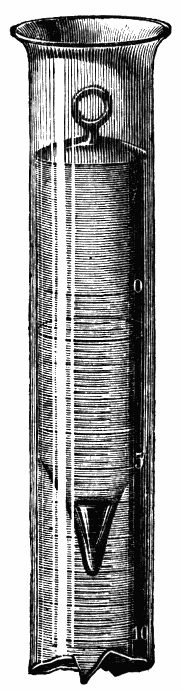
ERDMAN’S FLOAT. This useful little instrument, invented as its name implies, by Erdman, is used to ensure accuracy in the readings of Mohr’s burette.
It is in the form of an elongated glass bulb, loaded with a globule of mercury at the bottom, the same as a hydrometer, and with a glass hook at the top, by means of which it can be placed in or removed from the liquid in the burette at pleasure. The float has a circular mark scratched by a diamond, running round the middle, which, when the instrument is placed in the fluid in the burette, should correspond with the graduation or degree on the burette at which the fluid stands. The actual height of the fluid in the burette is of no consequence, since, if the operation be commenced with the line on the float opposite the 0 gradation on the burette, the same proportional division is always maintained. It is most essential that, when the fluid is being drawn off, the float should accompany it in its descent without wavering, and that the circular mark upon it should always be parallel to the graduations of the burette. Another condition is, that when the float has been pressed down in the fluid of the closed burette it should slowly rise again. A correspondent in Liebig’s ‘Annalen der Chemie und Pharmacie’ for April, 1875, states that Erdman’s floats generally become lined internally with a green or yellow layer, from the oxidation of the mercury, and are thus rendered opaque and consequently useless. He proposes to place the mercury in a distinct cell, hermetically sealed from the upper part of the float which carries the circular mark. He has had floats of this construction in use for years.[278] See Burette.
EREMACAU′SIS. Slow burning; decay. This expression was applied by Liebig to the peculiar decomposition which moist organic matter undergoes, when freely exposed to the air, by the oxygen of which it is gradually burned or destroyed, without any sensible elevation of temperature. See Putrefaction.
ER′GOT. Syn. Ergot of rye, Spurred rye, Horned r., Cockspur r., Obstetrical r. Ergota (B. P.), L. The diseased seeds of Secale cereale (Linn.), or common rye.
Ergot of rye deteriorates greatly by age, being subject to the attacks of a description of acarus resembling the cheese mite, but much smaller, which destroys the whole of the internal portion of the grain, leaving nothing but the shell, and a considerable quantity of excrementitious matter. To prevent this the ergot should be well dried, and then placed in bottles or tin canisters, and closely preserved from the air. The addition of a few cloves, or drops of the oil of cloves, or strong acetic acid, or a little camphor, or camphorated spirit of wine, will preserve this substance for years in close vessels. M. Martin proposes to steep the dry ergot in strong mucilage, and then to dry it on a sheet of white iron. This operation he repeats once or oftener, and finally preserves the prepared and thoroughly dried ergot in a well-corked glass flask. (‘Jour. de Chimie Méd.’) The wholesale druggists generally keep it in well-covered tin canisters or tin boxes.
H. Ducros (‘Zeitschr. des Oesterr. Apoth. Ver.,’ 1876-8), on the strength of many years’ experience, recommends powdered wood-charcoal for the preservation of ergot of rye.
The ergot is placed in a wide-mouth stoppered bottle, and covered with a thick layer of the powdered charcoal. Whenever it is required for use some of the ergot is transferred to a piece of paper, and freed from the adhering charcoal by blowing and rubbing. What is not required is returned to the bottle.
N. B. Gionovié (‘Zeitschr. des Oesterr. Apoth. Ver.,’ 1876, 126) states he has used the following process with the best success. A small quantity of ether is dropped on the ergot contained in a bottle, and the latter closed with a well-fitting stopper. The addition of ether is repeated every time the bottle is opened.
Ergot of rye is much used to restrain uterine hæmorrhage, and to accelerate the contraction of the uterus in protracted labour. It is also much used as an emmenagogue.—Dose. To facilitate labour, 20 to 30 gr., either in powder or made into an infusion; repeated at intervals of 20 or 30 minutes until 3 or 4 scruples have been taken. In other cases (leucorrhœa, hæmorrhages, &c.) the dose is 5 to 12 gr., three times daily, for a period not longer than a week or ten days at a time.
M. Tancret states that he has succeeded in obtaining an alkaloid from ergot of rye, which he names ergotinine. The isolation of ergotinine is said to be attended with great difficulty, owing to its great tendency to undergo spontaneous changes, a short contact with the air being sufficient to decompose it; a circumstance which may perhaps help to explain the rapid change that the powder ergot experiences. Professor Dragendorff, however, refuses to admit that ergotinine is the active principle of ergot, or that it is a distinct chemical substance. He ascribes the therapeutic power of the drug mainly to sclerotic acid, which body, after various unsuccessful attempts, he has obtained from ergot, with certain other determinate compounds, by the following process:—“Very finely powdered ergot is exhausted with distilled water, the solution concentrated in vacuo, and the residuary liquid mixed with an equal volume of 95 per cent. alcohol. This causes the precipitation of a peculiarly shiny substance (scleromucin), together with a portion of the salts, and the greater part of the suspended fatty matter. The mixture having been allowed to stand on ice for twenty-four to forty-eight hours, it is filtered, and the filtrate mixed with a further quantity of 95 per cent. alcohol, sufficient to precipitate all the sclerotic acid in combination with the bases (chiefly as calcium sclerotate). The separation of the precipitate is promoted as before, by placing the mixture on ice for some days. This causes the deposited mass, which has a brownish colour, to adhere firmly to the walls of the vessel, so as to permit the supernatant liquid to be easily poured off. The precipitate is kneaded with alcohol of 80 per cent., and immediately thereafter dissolved in a sufficient quantity of 40 per cent. alcohol, when the remainder of the scleromucin and another large portion of the foreign salts are left behind. The filtered liquid is now mixed with absolute alcohol, whereby sclerotic acid is precipitated in conjunction with certain bases and other substances. The impure product, when carefully dried over sulphuric acid, was found on analysis to contain 8·5 per cent. of potassium, about 0·36 per cent. of calcium, 4·3 per cent. of sodium, 2·74 per cent. of phosphoric acid, or altogether 12·9 per cent. of ash.
“The greater part of these admixtures may be removed, and the sclerotic acid obtained free, by adding before the final precipitation with absolute alcohol a considerable quantity of hydrochloric acid (for every 100 c. c. of solution 5-6 gm. of the acid, sp. gr. 1·100), allowing to stand at ordinary temperature for a few hours, and then proceeding to precipitate. In this manner the amount of ash may be brought down to 3 per cent., and by repeated solution, addition of acid, and precipitation, it may further be reduced to less than 2 per cent. or 3 per cent. A more complete purification is difficult and hazardous, because every addition of hydrochloric acid causes the decomposition of a small quantity of sclerotic acid, while at the same time a portion of the latter is lost by remaining in solution.
“The resulting product, although not chemically pure, is nevertheless physiologically pure, as it always produces constant and identical results, no matter from what sample of (good) ergot it was obtained.
“Good ergot contains about 4 to 4·5 per cent. of the acid, although samples are met with which contain scarcely 1·5 to 2 per cent.”[279]
Frogs are stated to have been thrown into a state of palsy by the hypodermic injection of 0·02 to 0·04 gram of sclerotic acid.
See Decoction, Extract, Infusion, Oil, Tincture, &c.
ER′GOTIN. Syn. Ergotina, L. Prep. 1. (Bonjean’s.) Powdered ergot is exhausted with cold water, by displacement, and the resulting solution is heated in a water bath to about 200° Fahr., and filtered; the filtered liquor is then evaporated to the consistence of a syrup, and when cold, is treated with rectified spirit, in considerable excess, to precipitate its gummy matter; after repose, the clear portion is decanted, by the heat of a water bath, to the consistence of a soft extract. Prod. 15%. According to M. Bonjean, this preparation possesses all the ‘hæmostatic’ without any of the ‘poisonous’ qualities of ergot. It has a reddish-brown colour, a bitter taste, and an odour somewhat resembling that of roasted meat. Its aqueous solution is red, limpid, and transparent.—Dose, 4 to 10 gr., either made into a pill or dissolved in water.