A CYCLOPÆDIA OF PRACTICAL RECEIPTS, PROCESSES, AND COLLATERAL INFORMATION (continued 11)
Reading edition
The thumb of the right hand presses the edges quickly and sharply so as to separate the leaves one from another, as you separate the leaves of a book recently bound. During this process still more dust escapes. Then comes the figuring, which by reason of successive blows applied to each leaf covers the body of the operator with the same pulverulent material. Fixing a wire to the leaves at their lowest part by the aid of gum follows that operation.
Then the leaves are arranged together in dozens, and passed to the bouquet manufacturers, who mount them. From thence they go to the milliners, who adapt them to different articles of dress, and sell them to the public. Through all this series of transformations there are the same manipulations, the same production of dust, the same action on the skin and mucous membrane, only in a decreasing degree, from the first preparer to the milliner. There is, however, a process of preparing the cloth which diminishes notably the severity and frequency of the evils of the Schweinfurt green. It is that which immediately after the drying of the stuffs submits them at once to the “calendrage.” This operation causes the arsenical paste to penetrate mechanically into the fibres of the stuff, and gives it a smooth and glazed aspect, which only permits imperfectly the production of the arsenical dust. This process renders the successive workings of the cloth less injurious, but it would be an error to consider it as inoffensive. During the action of the press, and especially during the separating and the fixing of the flowers, a notable quantity of the toxic dust is still produced. However well prepared the fabrics may be, you have only to tear it, to detach the coating under the form of a palpable powder.
It is only necessary to add that the waxing of the leaves, after they have been separated and figured, and before putting them into bouquets, constitutes a protecting envelope against the effects of the powdered coating for workmen who then handle them, as well as for women who wear them; but this film of wax is only applied, comparatively speaking, to a small number of leaves, for it alters the green and vivacity of its colour.
In the preparing of the stuffs in the process of drying, Dr Vernois says:—A new condition and serious results appear. The multiplicity of sharp points fixed in the wooden squares inevitably pricks and scratches the skin of the workmen. An inoculation of the arsenical salt immediately takes place, as if it had been practised experimentally. The skin irritates and inflames, a vesicle first, then a large pustule covers the orifice of the prick, and undergoes all the stages of inflammation, which produces suppuration and often gangrene, below which a deep and painful ulceration is developed—all the more tedious to heal as the inoculation is renewed from day to day.
The action of picric acid mixed with the paste can only augment and aggravate the irritation of the wounds. If the ulcerations are numerous the workmen may absorb the arsenious acid and be liable to serious results. I have seen a certain number of workmen with glandular enlargements under the armpits, and the hands in such a state that they were obliged to come to the hospital, where they were only cured after one or several months of treatment. The aspect of the hand was then characteristic to the greenish-yellow tint of all the skin, and especially of the palmar aspect of the hands. To the greenish crust under the nails was nearly always added a yellow colour of the nails, produced by the repeated contact with picric acid.
When we add a generally diffused erythema, then a series of black points, or of inflamed pustules, and sometimes a whitlow, we shall have a faithful representation of the evils which most frequently present themselves in the preparers of stuffs, for artificial flowers tinted with Schweinfurt green.
Amongst the endeavours to counteract the evils entailed upon the workers in this branch of industry may be mentioned the attempt to substitute chrome for Schweinfurt green, as the less poisonous of the two substances, and the ingenious process of M. Bérard-Zenzilin, which consists in directly incorporating the arsenical colouring matter with a specially prepared collodion.
AR′SENIDE. Syn. Arsen′iuret; Arseniure′tum (-i-ū-), L.; Arséniure, Fr. A combination of arsenicum with a metal (including hydrogen), in definite proportion.
AR′SENITE (-nīte). Syn. Ar′senis, L.; Arsenite, Fr.; Arsenigsäure salz, Ger. A salt of arsenious acid.
ART. [Eng., Fr.] Syn. Ars (gen., ar′tis; pl., ar′tes), L.; τεχνη, (tech′ne), Gr.; Kunst, Ger. Primarily, strength, power, and hence also mental strength, skill; the application of knowledge or power to effect a desired purpose; the power or ability of doing something not taught by nature or instinct; practical skill guided by rules. Science is knowledge—Art, practical skill in applying this knowledge. Art is applied science; whilst SCIENCE is knowledge obtained by observation, experience, and ratiocination. This distinction is nowhere more fully seen than within the domain of chemistry, where knowledge, deduction, great power of generalisation, and great expertness are necessary elements of success. Art has filled the world with luxuries, conveniences, and comforts; and art—the ARTS—useful or fine—are the safest and surest civilisers of our race. See Science.
ARTESIAN WELL. A cylindrical perforation bored vertically down through one or more strata of the earth till it reaches a porous bed of gravel containing water, this fluid being placed under such incumbent pressure that it rises up the perforation either to the surface, or to a convenient height for the operation of a pump. When they rise to the surface these wells are called spouting or flowing. The name of these wells is taken from Artois, a province in the Departement du pays de Calais, where their use was revived. They have been in use for a long time in Italy and in the East. The accompanying drawing represents the manner in which rain may be supposed to distribute itself when it falls upon a portion of the surface of our globe. The figure represents a geological section, showing the succession of the different strata.
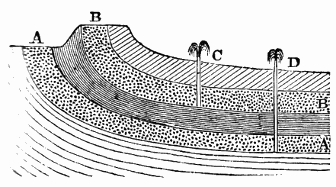
The figure is supposed to represent two beds, A, B, more porous, and consequently more absorbent than the rocks by which they are interstratified. The condensed dews and rains falling upon the distant hills pass rapidly by the outcrops of the strata to the lower levels, until the entire mass becomes thoroughly saturated with water. Supposing two such beds as are represented in the section to exist, fully charged with water, it is evident that if we bored down into them through the rocks as represented at C, D, the water would rise through those wells or borings, and spring out in the form of a jet to such a height above the surface as is due to the height of the hills from which the water has been obtained. The fountain derived from B would necessarily flow as much higher as that derived from the bed A, as is the height of B above A.
For particulars as to the modes of constructing artesian wells, the reader is referred to ‘Traité sur les puits Artesiens,’ by M Gamier, and to ‘Considérations Géologiques et physiques sur la théorie des puits forcés, ou fontaines Artésiennes,’ by M. le Vicomte Hericart de Thury, and to ‘Rudimentary Treatise on Well-digging, Boring, &c.,’ by J. G. Swindell, and also to Ure’s ‘Dictionary of Arts, Manufactures and Mines,’ edited by Mr Robert Hunt.
ARTHANI′TINE (-tĭn). [Eng., Fr.] Syn. Artaniti′ne; Arthaniti′na, L. A peculiar substance first obtained by M. Saladin, by the action of alcohol on the tuberous stems of the herb arthrani′ta, or sow-bread. It is acrid, colourless, and crystalline, and imparts its acridity to the plant.
AR′TICHOKE. Syn. Cin′ara, Cyn′ara; Scol′ymus, L.; Artichaut, Fr.; Artischocke, Ger. The cynara scoly̆̆mus (Linn.), a thistle-like perennial plant of the nat. ord. Compositæ (DC.). Hab. Southern Europe; but now extensively cultivated in our gardens, for its ‘bottom,’ or the sweet fleshy receptacle of its flowers, which is eaten as a pot herb. These are soaked in brisk boiling in water, stalk-ends uppermost, until tender; and take 1⁄2 to 1 hour according to their age. Sometimes they are preserved in brine (PICKLED ARTICHOKES); and also after depriving them of the ‘choke’ and spiny hairs and blanching them by immersion in boiling water, by drying in the sun (DRIED ARTICHOKES; CULS D’ARTICHAUT, Fr.), by which they retain their flavour for some time. Infusion of the flowers, used with rennet.
As an esculent the artichoke resembles asparagus in its general properties; but it is said to be more nutritious, and even more diuretic.
Artichokes, Jeru′salem. The helianthus tuberosus (Linn.), a perennial plant of the sun-flower family, and quite distinct from the preceding. Hab. The Brazils. The appellation “Jerusalem” is believed to be a corruption of the Italian word girasole—“a sunflower,” to which botanical family the plant belongs. It is cultivated in England for culinary purposes. Roots (tubers) resemble the artichoke in flavour; but are considered far from wholesome, being apt to produce flatulence and dyspepsia. They are diuretic, and impart the odour of turpentine to the urine. They are cooked by boiling (15 to 25 minutes, according to size), or frying; in the former case served with melted butter. They are also served mashed, like turnips. The flowers yield a volatile oil resembling that of turpentine.
Composition of the Jerusalem artichoke from an analysis by Payen, Poisot, and Fevry:—
Nitrogenous matter3·1
Sugar14·7
Inulin1·9
Pectic Acid0·9
Pectin0·4
Cellulose1·5
Fatty matter0·2
Mineral matter1·3
Water76·0
———
100·0
From the above it will be seen that this esculent contains no nitrogen.
ARTIFICIAL FOODS. See Farina.
ASARABAC′CA (ăs-ă-). Syn. As′arum, A. Europæ′um: (Linn.), Nar′dus monta′na*, &c., L.; Asaret, A. d’Europe, Cabaret, Azarum C., Nard sauvage, Oreille d’homme, &c., Fr.; Hazelwurtzel, Ger. The ασαρον of Dioscorides, a small round, hard, stemless, hardy herbaceous plant, bearing chocolate-coloured flowers; and of the nat. ord. Aristolochieæ (DC.). It grows freely in central France, and is found in woods and shady places in Lancashire, Westmoreland, and other parts of England. Hab. Europe, between 37° and 60° latitude.—Root & rhizome (AS′ARI RA′DIX) has a pepper-like odour and an acrid taste:—Leaves (A. FO′LIA) less odorous, though bitter-tasted, acrid, and aromatic; formerly officinal in the pharmacopœias:—Whole plant (ASARABACCA of the shops) nauseant, emetic, and purgative. Before the introduction of ipecacuanha it was the common emetic (6 to 9 of the green leaves in whey); but, owing to the violence of its action, it has long fallen into disuse. Its common name in France (CABARET, or public-house plant) is said to have arisen from its frequent employment to relieve the stomach of those who had drunk too hard. It is now almost solely used as a sternutatory or errhine, and is probably one of the best.
According to Gräger[84], asarabacca contains three volatile, oily principles, which may be obtained by distillation with water:—Volatile oil (o′leum as′ari):—As′arite, an odourless, tasteless, and crystalline solid; fusible and volatilisable, yielding white and very irritating fumes:—As′arum-cam′phor, differing chiefly from the last in being precipitated, by water, from its alcoholic solution in cubes or six-sided prisms, instead of delicate flexible needles. Also a brownish, bitter, crystallisable principle (AS′ARINE, AS′ARUM-BIT′TER), which is soluble in alcohol.
Uses, Dose, &c. Dried leaves, 20 to 30 gr., or root, 10 to 12 gr.; as a purge or emetic. As an errhine—leaves, 3 to 5 gr.; root, 1 to 3 gr.; in powder, snuffed up the nose every day, or every other day, at bedtime. It excites irritation and a copious watery discharge, more or less muculent, which frequently continues to flow for several days, and occasionally proves highly useful in certain affections of the brain, eyes, mouth, nose, ear, and throat, on the principle of counter-irritation. It has been found “particularly serviceable in cephalalgia (headache), obstinate headache, chronic ophthalmia (inflammation of the eyes), and some other lethargic affections.” (Dr A. T. Thomson.) In dimness of sight (especially that arising from fatigue or congestion), deafness, and slight paralytic affections of the mouth, tongue, lips, or eyelids, not of a serious organic character, and particularly in chronic earache, it also sometimes affords relief after other remedies have failed. It constitutes the basis of several Cephalic snuffs, Asarabacca-snuff, Baron McKinsey’s medicinal powder (or SNUFF), and several other like nostrums, which are much extolled by their venders, and sold at marvellously high prices. See Patent Medicines, Powders, Snuffs, &c. (also below).
AS′ARIN (-rĭn). C20H26O5. Syn. Asarone. A species of stearopten, discovered by Görtz, in asarabacca. It has an aromatic taste and an odour resembling camphor, and is said to be emetic. It is probably a mixture of asarum-camphor and some partially oxidised volatile oil. (See above.)
As′arine (of Gräger). Syn. Asari′na, L. The crystallisable bitter principle of asarabacca, noticed above. It is said to greatly resemble cytisine.
AS′ARITE (-rīte). See Asarabacca.
ASBES′TOS. Syn. Asbes′tus (ασβεστος, incombustible, unconsumable, Gr.), Amianth′us, La′pis A., &c., L.; Asbeste, Amiante, Fr.; Asbest, Steinflachs, Ger. In mineralogy, a soft, fibrous substance, composed of flexible or elastic filaments which, in their most highly developed form, greatly resemble those of flax or silk, and which bear exposure to a very considerable degree of heat without suffering decomposition. It has been proposed to clothe our firemen in dresses of asbestos; but without freedom of respiration could be insured in a heated and poisonous atmosphere, this envelope would be of little service. Gloves are sometimes made of it, for holding red-hot crucibles. It is also used as a filtering medium for corrosive liquids. A kind of felt made of asbestos is now used as a substitute for wire gauze to support beakers, retorts, &c., over lamps.
Var. Of these there are several; as Am′ianth or ELAS′TIC ASBESTOS, LIG′NIFORM A., MOUNTAIN-CORK, M.-LEATHER, M.-WOOD, &c.; varying from a grey, brown, or green colour, to pure white, and from extreme flexibility and softness, to rigidity and hardness, as indicated by the respective names.
ASCARIS LUMBRICOIDES. A parasite belonging to the genus entozoa, commonly known as the round worm, and found in the intestines of man, the horse, the ox, the pig, and some other of the lower animals. It is of a greyish-red colour and in size and general appearance like the common earthworm.
Children are very frequently infested by them. Their usual habitat is the small intestines. But they are occasionally found in the stomach, and have been known to transport themselves into the gall-ducts, frontal sinuses, nostrils, and mouth. The males are smaller than the females and much more rare. The females produce eggs in great numbers, but it is doubtful if the young are ever developed in the intestine in which the parent worm dwells.
It is probable that the ova gain access to the intestines of the animals of which they eventually become the pests from various outer sources. They are said to be very frequent in persons who partake much of raw leaves and roots. Dr Paterson, of Leith, noticed that families who drank certain water from a well supplied from a dirty pool, which contained various vermiform animalcules, were much infested with this particular species of intestinal worm; whilst others in the same street, who had recourse to a different water supply, entirely escaped. For medicinal treatment, see Worms.
ASCARIS MYSTAX. A parasitic round worm infesting the cat. It has been also occasionally found in man.
ASH. Syn. Frax′inus, L.; Frêne, Fr.; Esche, Ger. The popular name of several species of valuable hardy trees bearing apetalous flowers (except in the ‘flowering ash’), belonging to the nat. ord. Oleaceæ (DC.), and gen. Fraxinus; but appropriately the—
Ash. Syn. Comm′on ash; Frax′inus, F. excel′sior (Linn.), F. apet′ala (Lamb.), F. or′nus (Scop.), L.; Frêne, F. commun, Fr.; Gemeine esche, Ger. A large tree common to our woods and hedges; timber (ASH or ASH-WOOD) used by carpenters, cabinet-makers, and machinists, and much esteemed for its great toughness and elasticity; bark febrifuge, diuretic, resolvent, and tonic; has been successfully exhibited in agues; seeds acrid, bitter, and diuretic; leaves purgative, diuretic, and febrifuge; sometimes used instead of senna. In southern Europe it exudes an inferior kind of MANNA, and its medicinal properties are much greater than in our climate.—Dose. (Leaves) 1⁄4 oz. to 11⁄2 oz. (made into an infusion), as a purge; seeds, 1 dr., as a diuretic, &c.
Ash, Flow′ering. Syn. Man′na-ash; Frax′inus or′nus (Linn.), L. A small tree of southern Europe. Yields MANNA. The ‘round′-leaved flowering-ash’ (Cala′brian-ash; FRAX′INUS ROTUNDIFO′′LIA, Lamarck) is a smaller variety of the preceding, and a native of Calabria and the Levant. Said to yield the best MANNA. The ‘small′-leaved flowering-ash’ (FRAX′INUS PARVIFO′′LIA, Lam.) is another manna-yielding species, indigenous to Asia Minor.
ASH. Ashes (which see).
ASH-BALLS. The ashes of land-plants, especially ferns, damped and made into balls. Used as a substitute for soap in washing, and in cleaning paint.
ASH′ERY. [Amer.] A place where potash or pearlash is made or kept.
ASH′ES. (-ĭz). [Eng. pl.] Syn. Ash; Ci′nis, L.; Cendres (pl.), Fr.; Asche, Ger. The remains of anything burned. In antiquity, the remains of a body consumed on the funeral pyre; and hence, figuratively, the remains of the dead. The word, in English, has properly no singular; although ‘ash’ is very commonly heard; and is now almost exclusively used in composition, as in pearlash, potash, soda-ash, &c.
Ashes. In commerce, the residuum of the combustion of vegetable substances containing either carbonate of potassium (‘land-plants’), or carbonate of sodium (‘marine plants’), and from which the commercial alkalies are obtained. Their value depends upon their richness in ‘alkali,’ which is determined in the manner explained under ALKALIMETRY. The word is also commonly employed as a general term for the crude carbonates of potash of commerce (which see).
Ashes of Plants. See following page, on which will be found a table giving the chemical composition of the ashes of a few well-known plants used as food for men and animals. See also Manures, Plants, Vegetation, &c.
A careful determination of the ash of different substances is of great use to the analyst, by enabling him to detect adulteration; for instance, almost every plant on being burnt yields a very constant amount of ash, and not alone the quantity is constant, but the different proportions of the various components are also, within certain limits, tolerably unvarying. Many plants have the power of extracting from the soil certain elements; for instance, the ash of the tobacco contains lithium; tea, manganese; seaweed, iodine. It seems by no means improbable that by the examination of the ashes of plants by means of the spectroscope new elements may be discovered. Appended is a short list of the amount of ash, contained in a few important substances:—
Total Ash.
Cayenne pepper,from5 to 6per cent.
Chicory”5”
Cocoa”3 to 4”
Coffee”4”
Flour”·7 to 1·5”
Mustard”3 to 4·5”
Pepper”4·3 to 5”
Rice”5”
Tea”5·6”
Turmeric”5 to 6”
The ashes of plants are employed by the agriculturist according as the nature and proportion of the different salts they contain is suited to the soil and to the crops it is desired to raise. M. Soulange Bodin says that ashes hold the middle place between stable-dung and pasture manure. They act mechanically by dividing soils that are too compact, hygroscopically by absorbing moisture, and they appear to have an action similar to lime in accelerating the decomposition of the mould. They also probably exercise a stimulating effect on the soil. In the case of low-lying lands they are particularly suited for very damp clayey soils. In Picardy the ashes of turf are made use of; in England, the low countries and the north of France, coal ashes are employed.
Peas.Beans.Red Clover.Sainfoin.Wheat Grain.Straw.Barley.Oats.Turnip Root.
Potassa42·4336·7218·4431·9029·7610·5120·0717·7023·70
Soda3·270·142·79...5·261·034·563·8414·75
Lime5·7312·0635·0224·302·885·911·483·5411·82
Magnesia5·926·0011·915·0311·061·257·457·333·28
Sesquioxide of Iron0·440·650·980·610·230·070·510·490·47
Sulphuric acid6·234·283·913·280·112·140·791·1016·13
Silica1·741·524·033·222·2373·5732·7338·482·69
Carbonic acid4·381·6312·9215·200·22.........10·47
Phosphoric acid29·9233·745·829·3548·215·5131·6926·469·31
Chloride of potassium.........6·24.........0·92...
Chloride of sodium...3·264·130·78............7·05
——————————————————
Total amount99·96100·0099·9599·9699·9699·9999·9899·9699·93
Per-centage of dry ash in dry substance2·602·907·876·372·05...2·502·506·00
Per-centage of ash in the fresh substance2·242·546·775·651·81...2·252·270·75
Turnip Leaves. Beet Root. Carrot Root. Potatoes. Lettuce Leaves and Stalks. Olive-tree Wood. Hops. Hay. Clupea Sprouts.
Potassa11·5621·6837·5525·4122·3720·6024·8811·9317·23
Soda12·433·1312·63...18·50......1·071·19
Lime28·491·909·762·3410·4363·0221·5914·7623·57
Magnesia2·621·793·784·175·682·314·695·303·01
Sesquioxide of Iron3·020·526·740·502·82...1·752·750·28
Sulphuric acid10·363·146·344·713·853·097·270·20...
Silica8·041·400·763·6411·863·8219·7153·43...
Carbonic acid6·1815·2315·15.........2·17......
Phosphoric acid4·851·658·3710·389·384·7714·476·3443·52
Chloride of potassium.........12·40...1·09.........
Chloride of sodium12·4149·514·91Trace15·09...3·422·2711·19
——————————————————
Total amount99·9699·9699·99100·0099·99100·0099·95100·00100·00
Per-centage of dry ash in dry substance16·4011·325·124·86...0·585·956·97...
Per-centage of ash in the fresh substance1·971·020·77............6·15...
Coal ashes, when mixed with excrement, besides disinfecting the latter, make an excellent manure.
ASPAR′AGIN (-ă-jĭn). C4H8N2O3. [Eng., Fr.] Syn. Althe′ine, Aspar′amide, Mal′amide*; Asparagi′na, Asparagi′num, L.; Agédoïle, Fr.; Spargelstoff, Ger. A peculiar azotised principle discovered by Vauquelin and Robiquet in asparagus, and since found in the potato, marsh-mallow, liquorice, climbing vetch, and several other plants. Many plants which do not naturally contain it may be made to yield it by growing them in dark damp cellars; whilst many which only normally contain it in very small quantities are found to yield much more when allowed to vegetate in the same manner.
Prep. 1. From ASPARAGUS-SPROUTS:—The expressed juice, after being heated to the boiling-point (to coagulate albumen) and carefully skimmed and filtered, is evaporated, at a gentle heat, to a syrupy consistence, and then abandoned to spontaneous evaporation in a warm dry atmosphere for several days; the resulting crystals being purified by cautious washing with very cold water or very strong alcohol, re-solution, and re-crystallisation.
The following are cheaper and more convenient processes.
2. From MARSHMALLOW-ROOT:—a. The root (chopped small, or grated) is macerated for several days in milk of lime, in the cold; the filtered liquid precipitated with carbonate of ammonium, and the clear solution evaporated in a water-bath, and otherwise treated as before.
b. From the expressed juice, 2 parts; milk of lime, 1 part; agitated well together; the liquid portion, after some hours, being decanted, filtered, and evaporated, &c., as before.
3. From the ETIOLATED SHOOTS OF VETCHES:—The expressed juice of the young shoots when from 2 or 3 to even 12 or 15 inches long, is gently simmered for 8 or 10 minutes, to coagulate the albumen; and, after straining or clarification, the clear liquid is gently evaporated to the consistence of a thin syrup, and set aside to crystallise, as before. The resulting brown crystals are purified by washing with very cold water, re-solution in boiling water, and re-crystallisation, as in No. 1; or, and what is better, the hot liquid, before evaporation to a syrup, is digested for a short time with a little pure animal charcoal in coarse powder, and then filtered, when large and beautifully white crystals are obtained by the first operation.[91] An excellent and very economical process.
Prop., &c. Crystals brilliant, transparent, colourless, right rhombic prisms; neutral to test-paper; non-basic; having a faint, cooling, and scarcely nauseous taste; scarcely soluble in cold water; freely soluble in hot water; insoluble in strong alcohol and ether; solution unaffected by alkaline sulphurets, oxalate of ammonia, acetate of lead, or infusion of galls; triturated with quick-lime, ammonia is evolved; heated to 212° Fahr. the crystals lose two equiv. or 12% of water; heated with water under pressure in a closed vessel, or boiled along with an acid or an alkali, or dissolved in a saccharine liquid and then submitted to fermentation it is converted into ammonium and aspartic acid; aqueous solutions of asparagin and aspartic acid treated with a current of nitrous acid evolve pure nitrogen, with the formation of malic acid which remains in solution. It was called asparamide under the impression that it is aspartite of ammonia minus 1 atom of water; and malamide, for similar theoretical reasons.
Uses. It is sedative and diuretic.—Dose, 1 to 6 gr.; in dropsies, heart-affections, &c.
ASPAR′AGUS. [L., Eng.] In botany, a genus of low, spiny plants, with scale-like leaves, many of which are shrubs and climbers, of the nat. ord. Asparageæ (DC.).; Liliaceæ (Lindl.). The following species, which is that best known in England, is, however, an exception to this description, as it is neither climbing nor spinose.
Asparagus Officina′lis. [Linn.; L.] Syn. Aspar′agus, Comm′on a., Gard′en a.; Spar′agus§, Spar′row-grass§, Sper′age†§; Asperge, Fr.; Spargel, Ger. A well-known perennial plant, and one of the oldest and most delicate of our culinary vegetables.—Young shoots, from the underground eyes (TURIO′NES ASPAR′AGI, L.), the asparagus of our tables; diuretic; communicate a peculiar fœtid odour to the urine, and, when eaten in excess, occasion bloody urine and accelerate fits of gout; formerly esteemed emmenagogue and aphrodisiac.—Root (RA′DIX ASPAR′AGI, L.), properties resemble those of the young shoots, but stronger; one of the five ‘greater aperient roots’ (RAD′ICES APERIEN′TES QUIN′′QUE MAJO′′RES, L.) of old pharmacy. The tops and roots, though no longer officinal in the British Pharmacopœias, are both occasionally employed as popular remedies in dropsy and stone—the first being eaten in the usual way at table; and the second made into an infusion or decoction (1⁄2 oz. to the pint), taken ad libitum.
As an article of food, asparagus, in moderation, is both wholesome and nutritious. It is cooked by simply boiling it rather quickly until tender, like the other soft green vegetables; and is either served up plain, or on toast with melted butter or sauce Hollandaise in a boat (Soyer; Rundell.) When very small and green, it is frequently dressed and served like green-peas, the tender portion of each shoot being cut into bits of equal size, and about 1-3rd of an inch long. (Miss Acton.)
Choice, &c. “The large grass is generally preferred; although the smaller has the fullest flavour for a dish.” (Soyer.) Unlike other plants, the asparagus officinalis has not produced a single well-marked permanent variety by cultivation.[92]
Asparagus Petræ′a. [L.] Syn. Rock′-aspar′agus; Corruda; Aspar′agus acutifo′′lia, L,; Corrude, Fr. Resembles the last in its general qualities; but is said to contain more asparagin.
ASPAR′AMIDE (-mĭd). See Asparagin.
ASPAR′TIC ACID. HC4H6NO4. Syn. Malam′ic acid; Acidum aspar′ticum, L.; Acide aspartique, Fr. An acid first obtained, by Plisson, from asparagin, by boiling it along with hydrate of lead or of magnesia. Its salts are called ASPAR′TATES (Eng., Fr.; ASPAR′TAS, L. sing.) See Asparagin.
AS′PEN (-pĕn). Syn. Asp*, Trem′bling pop′lar‡; Pop′ulus trem′ula (Linn.), L.; Tremble, Fr.; Aespe (äspe), &c. Ger. A large tree, of the nat. ord. Amentaceæ; (DC.), not uncommon in the moist woodlands of England, and found native on many of the Scottish mountains. It derives its name from the trembling motion of its leaves, which, owing to the peculiar flattening of the leafstalks, are agitated by the slightest impulse of the air. Bark and leaves contain POP′ULIN associated with SAL′ICIN. Both bark and leaves have been used with advantage in strangury and intermittents.
ASPHALT′ (-fălt′). Asphaltum.
ASPHALT′UM. [L., prim. Gr.] Syn. Asphalt′, Compact bitumen, Mineral pitch, Jew’s pitch, Foss′il bitu′men, Vit′reus b., &c.; Asphal′tus, Bitumen fos′sile (-e-le), B. Juda′icum, B. sol′idum, B. vit′reum, Mu′mia†, M. minera′lis*, &c., L.; Asphalte, Bitume massif, B. solide, Poix juive, &c., Fr.; Asphalt, Erdpech, Judenpech, &c., Ger. A black, hard, brittle, and glossy variety of bitumen found on the shores of the Dead Sea (hence called La′cus Asphalti′tes), on and near the shores of the Great Pitch Lake of Trinidad, and as a mineral product in various other parts of the world.
Prop., &c. Melts without decomposition, and, when pure, burns without residue. It is distinguished from other varieties of bitumen by its more difficult fusibility, and by its fracture being clean, conchoidal, and vitreous. Distilled by itself it yields about 36% of a peculiar bituminous oil (crude PETROLENE), together with combustible gases, traces of ammonia and water. To anhydrous alcohol it yields 5% of a yellow resin, soluble in rectified spirit and ether; by digesting the residuum in ether, a further 70% of a brownish-black resin is obtained, which is freely soluble in the volatile oils and in about 5 times its weight of mineral naphtha. The portion (25%) left undissolved by ether is very soluble in the oils of turpentine and petroleum. These three resinous principles dissolve altogether, when digested, in the oils of anise, rosemary, and turpentine, and in the fixed oils. (John.) According to others, asphaltum consists almost entirely of asphaltene. (Boussingault.) Paranaphthaline has been found in some varieties. (M. Laurent.) Average sp. gr. 1 to 1·68. By friction it affords negative electricity. It is soluble in oil of turpentine, benzole, mineral and coal-tar naphtha, the fixed oils, solutions of the caustic alkalies, and several other liquids, by the aid of heat.
Sources. That of commerce is chiefly obtained from the shores of the Dead Sea; but much of that of the shops is a spurious article of the most worthless character. A short time since some specimens of the purest and most beautiful description, from the Great Bitumen Lake of Trinidad, were given us by our respected and venerable friend, the late Earl of Dundonald, who stated that the supply of both liquid and indurated bitumens, of every grade of quality, was unlimited from that source; but that owing to injudicious importations of inferior kinds (those most easily shipped), a prejudice had been created against them in the London market. Our personal investigations have since confirmed the accuracy of these statements.
Uses. The finer varieties are chiefly used as a ‘glazing colour’ by artists, and in the manufacture of black varnishes and japans. The inferior kinds are applied to the same purposes as ordinary solid bitumen. The Egyptians used it in embalming under the name of MU′MIA; and the Babylonian builders are said to have employed it, as a cement, in lieu of mortar. It is, however, doubtful whether the hard semi-vitreous variety of bitumen, properly termed ‘asphaltum,’ was that which was thus employed; its present hardness being probably due to time. As a medicine it is stimulant; and it was formerly used as an ingredient in certain plasters and ointments. See Bitumen, Pitch, &c. A mixture of asphalt, chalk, sand, ground sandstone, &c., is used as a pavement for making water-tight tanks and covers, as a coating for gas and water pipes, and for various other similar purposes. Sometimes the pitchy residue obtained by distilling off the more volatile portions of gas tar is employed to replace the asphalt in the foregoing mixture; the product is called artificial or gas-tar asphalt.
Asphaltum, Facti′′tious (-tĭsh-′ŭs). Syn. Asphal′tum facti′′tium, L. That of the shops, when not an inferior kind of true asphaltum, is commonly made from the bottoms of Barbadoes tar, and other mineral bitumens, by heating them until quite hard. Sometimes a little Scio turpentine, balsam of copaiba, or even common resin, is added. Colour, hardness, &c., inferior to those of native asphaltum.
Asphaltum, Liq′uid. Syn. Prepared’ asphaltum; Asphal′tum liq′uidum, L. Prep. 1. Scio turpentine, 2 oz.; melt; add asphaltum (in powder), 1 oz.; mix, cool a little, and reduce with hot oil of turpentine.
2. (Wilson’s.) Asphaltum, 1⁄2 lb.; melt; add of hot balsam of copaiba, 1 lb.; and, when mixed, thin it with hot oil of turpentine. Both are used as ‘black japan’ or ‘varnish,’ and as a ‘glazing colour’ by artists.
ASPHYX′IA (-fĭk′-sh′ă; -fĭks′-e-ă‡). [L., Gr.] Syn. Asphyx′y‡ (-e), Eng.; Asphyxie, Fr.; Pulslosigkeit, Scheintod, Gr. Literally, absence of pulse; hence, a fainting fit; apparent lifelessness. Its use is now generally confined to a suspension of vitality from some cause interrupting respiration, but in which life is not actually extinct, and may, under favorable circumstances, be revived.
Asphyxia is commonly divided into four varieties by nosologists:—
1. Asphyxia algida:—Cause. Exposure to intense cold.—Symp. Countenance pale, livid, and shrivelled; limbs rigid.
2. Asphyxia elec′trica:—Cause. Stroke of lightning or electricity.—Symp. Countenance pale, limbs flexible, blood incoagulable.
3. Asphyxia mephit′ica:—Cause. Inhalation of irrespirable gases or fumes.—Symp. Countenance pallid, lips wan, &c.
4. Asphyxia suffocatio′nis:—Cause. Suffocation or strangulation, as from drowning, hanging, &c.—Symp. Countenance turgid and livid.
Treatm., &c. No general rules can be given exactly suitable to each variety. Whenever it is possible to procure medical aid, it should, of course, be immediately sought, as the delay of even a single minute may render it unavailing. In the treatment of suspended animation the principal object is to effect a restoration of the respiratory and circulatory functions; the former of which has been arrested by the external condition of the patient; the latter by the contact of morbidly carbonised blood with the capillary vessels of the lungs. The first thing to be attempted is the restoration of warmth by active friction with the warm hands, flannels, &c.; the second, the re-establishment of natural respiration by an available means, of which, perhaps, none is simpler or better than alternate pressure and its relaxation, applied to the thorax and abdomen, so as to induce expiration first, and inspiration immediately afterwards, by the natural action and elasticity of the ribs and diaphragm. Cold water may also be suddenly dashed on the face and general surface previously warmed by the frictions, in the hope of inducing a more decided inspiration. If these measures fail, artificial respiration should be promptly had recourse to. (Dr Marshall Hall.) The warm bath, and slight electrical shocks, or continued streaming electricity, may also be applied.
See Charcoal, Cold, Drowning, Hanging, Respiration (Artificial), Sewers-gas, Strangulation, Suffocation, &c.
ASPHYX′IATED. Syn. Asphyxia′tus, L.; Asphyxié, Fr.; Asphyktisch, Scheintodt, &c., Ger. Affected with or labouring under asphyxia. (See above.)
ASP′IC†. Spike lavender or French lavender; also the male lavender, spica nardi, or pseudo-nardus of old writers.
Aspic. In cookery, “savory jelly extracted from the succulence of meat.” (Soyer.)
Prep. (Miss Acton.) Calf’s feet, 2 in no.; veal, 4 lbs.; ham, 3 lb.; onions, 2 (large); carrots, 3; water, 1 gall.; boil 5 or 6 hours, or until reduced to less than one half, strain, and when cold, put the jelly into a stew-pan with the whites of 4 eggs well beaten, a large bunch of savoury herbs, 3 blades of mace (in shreds), a teaspoonful of white peppercorns, and salt, q. s.; keep it well stirred until pretty hot, then let it gently simmer for about 15 minutes, and, after settling, pass it through a jelly-bag till quite clear. After cooling a little, it is fit for use; or it may be allowed to cool and be at any time remelted. French cooks commonly flavour it with tarragon-vinegar, added after clarification.
Uses, &c. “Cold poultry, game, fish, plovers’ eggs, truffles, and various dressed vegetables, with many other things often elaborately prepared, and highly ornamental, are moulded, and served in it, especially at large déjeûners and similar repasts. It is also much used to decorate raised pies and hams, and for many other purposes.”[93]
ASPIRATOR. An apparatus for drawing a stream of air through a tube or other vessel. There are several forms of aspirator; that invented by Brunner is perhaps one of the most convenient. It consists of two equal cylindrical vessels placed one above the other, and communicating by tubes which can be opened or closed, so that when the water has run from the upper to the lower vessel, the apparatus turning for the purpose on a horizontal axis may be inverted so as to bring the empty vessel to the bottom and the full one to the top; the water may then again be made to flow without the trouble of refilling. See Air, Analysis of.
ASS (ăss). Syn. As′inus, L.; Ane (âne), Fr.; Esel, Ger. The e′quus as′inus (Linn.), a well-known animal found almost everywhere.
ASSAFŒTIDA. [L. and Eng.] Syn. Assafetida, Devil’s dung, Eng.; Assafœtida gummi, L.; Stinkasand, Stinkender asand, Teufels-dreck, Ger. A gum resin exuded from the excised root of narthex assafœtida (B. P.); from ferula assafœfida, and probably from ferula Persica. It yields its virtues to alcohol, and forms a clear tincture, which becomes milky on the addition of water. It is imported into Europe from Persia, viâ Bombay, in cases, mats, and casks.
Comp. Assafœtida contains from 4 to 5% of a peculiar volatile oil, and from 50 to 60% of resin of a whitish colour, turning rose-red and reddish-brown by exposure to the air, and giving a greenish solution with concentrated sulphuric acid. Brande resolved this resin into two others—one soluble in ether; the other insoluble in that menstruum.
Pur. The assafœtida of the shops is generally in masses of a whitish, reddish, or violet hue, formed principally of adhering tears or grains, possesses a peculiar fœtid, alliaceous odour, and forms an emulsion with water in all proportions. Hot sulphuric acid blackens it and forms a dark blood-red liquid, sulphurous fumes being evolved. This solution diluted with water, and then saturated with potassa, has a blue colour, which is most visible by reflected light. Digested first in alcohol, and afterwards in weak spirit-and-water, the residuum should not exceed 16%. Sp. gr. 1·325 to 1·330. It is frequently adulterated with inferior gums, and with chalk, clay, sand, &c. The purest and best is that which is clear, of a more or less pale-red colour, full of white tears, and very fœtid.
Prop., Uses, &c. Assafœtida is stimulant, antispasmodic, emmenagogue, expectorant, aphrodisiac, and anthelmintic, and is the most powerful of all the fœtid gum-resins. It is administered with advantage in several uterine diseases, hysteria, chorea, flatulent colic, hooping-cough, infantile convulsions, spasmodic asthma, and some other affections of a spasmodic and convulsive character.—Dose, 5 or 6 to 30 gr.; in pills, or preferably made into an emulsion; as an enema, 2 dr., with warm water, q. s.—Dose for Animals. Similar to Assafœtida. Some oriental nations esteem it highly as a condiment. The Brahmins use it against flatulence, and to correct the coldness of their vegetable food. In Persia the leaves of the plant are eaten as salad; and the root, after being roasted. In cookery it is now frequently employed as a substitute for garlic. “I am assured by an experienced gastronome that the finest relish which a beef-steak can possess may be communicated by” (slightly) “rubbing the gridiron on which the steak is to be cooked with assafœtida.”[94]
ASSAFŒTIDA, PREPARED. As Ammoniacum, prepared.
ASSAMAR. A substance described by Reichenbach, and found by him in the crust of bread. It possesses the faculty of retarding tissue metamorphosis.
ASSAY′ (-sā). Syn. Essai (anc., asaie), Fr. Prüfung, &c., Ger. Literally, a ‘trial’ or examination. In chemistry, the determination, by any chemical means, of the richness of a substance in its essential material or more valuable ingredient; more particularly applied to quantitative analyses of the commercial alkalies, bleaching-powder, oxide of manganese, ores, and other like articles that are employed on the large scale. In docimacy and metallurgy the determination of the quantity of metal in any ore, alloy, or other metallic compound, particularly in the ‘dry way,’ or by the process of cupellation; and more especially of the quantity of pure gold, or pure silver, contained in coin, bullion, and the commercial alloys and ores of these metals. The substance assayed*. See Assaying, &c.
ASSAY′ING. Syn. Assay′, Doc′imacy (dŏos′-) Docimas′tic art; Coupellation, Fr.; Abtreiben auf der capelle, Ger. The art of assay, or of determining the quantity of gold and silver in ores and alloys of these metals, in the ‘dry way,’ or by cupellation. It differs from chemical analysis in merely furnishing the quantity of the precious metal contained in the sample examined; instead of the nature and proportions of all, or any, of the ingredients in the compound, at the will of the operator.
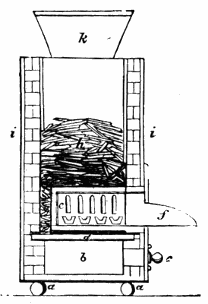
a, a, Rollers on which the furnace rests.
b, Ash-pit.
c, One of the ash-pit dampers.
d, Grate supporting the muffle-plate.
e, Muffle containing the cupels.
f, The mouth-plate, upon which, during use, is piled ignited pieces of charcoal, by which the mouth of the furnace is closed, and heated air made to pass over the cupels.
h, Interior of furnace containing charcoal.
i, i, Walls of the furnace.
k, Moveable chimney for regulating the draught.
Materials, Appar., &c. These are—furnace, muffle, cupels, charcoal, &c., all of which must be provided and properly arranged for use before an assay can be made:—
The FUR′NACE employed at the Royal Mint and at Goldsmiths’ Hall, London, is figured in section in the above fig., and has the following dimensions:—Total height, 21⁄2 feet; from the bottom to the grate, 6 inches; grate, muffle-plate, and bed of loam that covers it, 3 inches; space between the grate and the bottom of the funnel or chimney, 211⁄2 inches; funnel, 6 inches. A furnace of any other shape and size may be employed, provided it affords a sufficient heat, and allows of the easy introduction of the muffle.
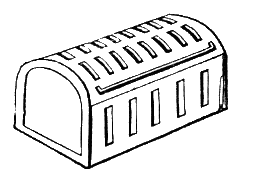
The MUFF′LE (mŭf′l) is a vessel made of clay (see engr.), and furnished with an opening to admit of the introduction of the cupels, and the complete inspection of the process. It is placed on the muffle-plate (see above), by which it is introduced into the furnace.
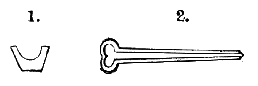
The CU′PEL (kū′-pĕl) is a small, porous, shallow crucible, usually made of bone ashes or burnt horn. The powder (slightly moistened with water) is placed in a circular steel mould, and after being pressed down tight, is finished off with a rammer having a convex face of polished steel, which is forcibly struck with a mallet, until the mass becomes sufficiently hard and adherent. The newly formed cupel is then carefully removed and exposed in the air for a fortnight or three weeks to dry. Fig. 1 represents a cupel in section, and fig. 2 the tongs used for charging it. The best weight for cupels ranges between 180 and 200 gr. Those used at the Royal Mint are made of the calcined cores of ox-horns.
Proc. of Ass. The muffle, with the cupels properly arranged on the ‘muffle-plate,’ is placed in the furnace, and the charcoal added and lighted at the top by means of a few ignited pieces thrown on last. After the cupels have been exposed for about half an hour, and have become white-hot, the lead (see below) is put into them by means of the tongs. As soon as this becomes bright red and ‘circulating,’ as it is called, the specimen for assay, wrapped in a small piece of paper or lead-foil, is added. The fire is now kept up strongly until the metal enters the lead and circulates well, when the heat, slightly diminished, is so regulated that the assay appears convex and more glowing than the cupel itself, whilst the ‘undulations’ circulate in all directions, and the middle of the metal appears smooth, with a margin of litharge which is freely absorbed by the cupel. When the metal becomes bright and shining, or, in technical language, begins to ‘lighten,’ and prismatic hues suddenly flash across the globules, and undulate and cross each other, followed by the metal becoming very brilliant and clear, and at length fixed and solid (called the ‘brightening’), the separation is ended and the process complete. The cupels are then drawn to the mouth of the muffle, and allowed to cool slowly. When quite cold, the resulting ‘button,’ if of silver, is removed by the pliers or tongs from the cupel, and after being flattened on a small anvil of polished steel, with a polished steel hammer, to detach adhering oxide of lead, and cleaned with a small hard brush, is very accurately weighed. The weight is that of the pure silver; and the difference between the weight of the alloy before cupellation, and that of the button of pure metal, represents the proportion of alloy in the sample examined. (See below.) In the case of gold, the ‘button’ has to undergo the subsequent operations of quartation, parting, and annealing, before it is weighed, as described under that metal.
Assayer’s weights, &c. The materials used in assaying are accurately weighed in a balance of the most susceptible description; and the weights are given in terms of the ‘notation’ employed by assayers. The ‘fineness,’ ‘richness,’ or ‘degree of purity’ of gold is expressed in carats. Pure gold is spoken of as 24 carats fine; and any other sample containing in 24 parts only 12, 18, 22, &c., parts of pure gold, is said to be of as many carats fine. Every carat is nominally divided into 4 ‘assay-grains,’ each assay-grain into ‘quarters,’ and each quarter into ‘eighths’ (= 1⁄32 carat), giving 768 “reports” for gold. On this system fractional alloys are commonly spoken of as of so many ‘carats and thirty-seconds fine.’ The real quantity taken for assay, technically termed the ‘assay-pound,’ is, however, very small, generally either 12 gr. or 6 gr., which makes each assayer’s eighth-grain, or “report,” equal to either the 1⁄64 or 1⁄128 gr. Troy, as the case may be. The nominal assayer’s gold carat is 12 gr. The “journey-weight of gold” is 15 lbs. Troy (= 701 sovereigns = 1402 half-sovereigns).
The ‘fineness,’ ‘richness,’ or ‘purity’ of silver was formerly expressed in pennyweights; but is now generally reckoned in 1000ths, which admits of greater accuracy. Pure silver was said to be silver of 12 pennyweights.” If it contained 1, 2, or 3 parts of alloy, it was termed “silver of 11, 10, or 9 pennyweights,” as the case might be. Every assayer’s pennyweight was nominally divided into 24 gr., and hence gave 288 fine grains, or ‘reports,’ for silver. The fineness of specimens containing odd grains was given in pennyweights and fine grains. The ‘assay-pound’ for silver, on this system, may be 24 Troy gr., when 2 real grains are equal to 1 ‘fine pennyweight,’ and 1⁄12 real gr. equal to 1 ‘fine-grain.’ In the decimal method pure silver is = 1000. The usual weight of silver taken for the ‘assay-pound,’ when the fineness is reckoned in 1000ths, is 20 Troy gr., every real grain of which represents 50⁄1000th of fineness; and so on of smaller divisions. The mint “journeyweight of silver” is 60 lbs. Troy (=3920 shillings, or a like value in other denominations).
Ratio. Cupellation, which is the distinctive and most important operation in assaying gold and silver, is founded upon the feeble affinity which these metals have for oxygen, in comparison with copper, tin, and other cheaper metals; and on the tendency which these latter metals have to oxidise rapidly in contact with lead at a high temperature, and to sink with it into any porous earthen vessel, in a thin, glassy or vitriform state. The conditions essential to the success of the process, and which are found in the precious metals, are—that “the metal from which we wish to part the oxides must not be volatile;” and that “it should also melt and form a button at the heat of cupellation; for otherwise it would continue disseminated, attached to the portion of oxide spread over the cupel, and incapable of being collected.”[95]
Concluding Remarks. The art of assaying requires very great care, skill, and experience, for its due exercise; and from the costliness of the precious metals, and their general employment for coin, jewelry, plate, &c., is of the utmost importance both to individuals and governments. Such is the extreme delicacy of the operation of cupellation that, without the requisites alluded to, it is more likely to fail than to give reliable results. An assay is thought to be good when the ‘button’ or ‘bead’ separates readily from the cupel, has a round form, with a brilliant upper surface, and the lower one granular and of a dead metallic lustre. When the upper surface is ‘dead’ and ‘flat,’ too much heat has been employed; and in the case of silver, some of the metal may have been lost by fuming or absorption. When the bead adheres to the cupel, or is spongy, variegated, or has scales of litharge still adhering to it, either too little heat has been used, or the process has been stopped before the assay was complete. The remedy is re-exposure to heat in the cupel, adding a little powdered charcoal or a few small pieces of paper, and continuing the heat until the metal ‘brightens’ and ‘circulates’ freely. The lead employed must be absolutely pure, or that technically called ‘poor lead,’ and, for this purpose, is commonly prepared by the reduction of refined litharge mixed with some carbonaceous matter, by heat; but, according to the late T. H. Henry, “lead reduced from the litharge of commerce usually contains from 10 to 15 dwt. of silver per ton.” These remarks apply equally to gold and silver.
The process of assaying by the cupel, however skilfully conducted, gives much less accurate results, especially with silver, than the method of chemical analysis, often termed ‘humid’ or ‘volumetrical assay,’ whilst it is, in all cases, much more troublesome and expensive, and with compounds containing only small quantities of the precious metals, is not to be depended on. See Gold, Silver; also Carat, Cupellation, Parting, Liquation, Quartation, Refining, &c. (and below).[96]
Assay of the Touch. The fineness of JEWELRY, and of small quantities of GOLD which it is either impossible or inconvenient to assay according to the usual method, is generally determined by means of touch-needles and touch-stones. The former are made in sets, containing gold of different degrees of fineness, and differently alloyed with copper and silver. The latter are usually of black basalt; but pieces of good black pottery answer the purpose very well. The mode of using them is to mark the stone with the sample under examination, and to compare its appearance, hardness, colour, &c., with that produced by one or more of the needles. When the two are similar, the quality or ‘fineness’ is considered to be the same. The marks are then further examined by heating the ‘touch-stone’ to redness, and moistening the strokes with aquafortis, when the appearance resulting from oxidation, &c., differ according to the nature and quantity of the alloy. A nearly similar method is sometimes adopted with SILVER; but the characteristics are scarcely so distinct with the metal. (See above.)
Hu′mid Assaying, Humid Assay. Terms applied to the estimation of the quantity of gold and silver in ores and alloys in the moist way, more especially by the method known as volumetrical analysis. See Gold (Estim.), Silver (Estim.), Volumetrical Analysis, &c.
ASSIMILA′TION. [Eng. Fr.] Syn. Assimila′tio, L.; Aneigung, Verähnlichung, &c., Ger. In physiology, the conversion of food into nutriment, and finally into the substances which compose the bodies of animals and plants; the function of nutrition.
ASTHEN′IC. Syn. Asthen′icus, L.; Asthénique, Débile, Fr.; Schwach, Ger. Weak; debilitated. In pathology, an epithet of diseases (ASTHEN′IC DISEASES) accompanied by great and well-marked debility.
ASTHEN′OPY. Syn. Astheno′pia, L. In pathology, incapacity to keep the eyes fixed on near or small objects for any length of time without confusion of vision. The common causes are over-exertion of the eyes, particularly by artificial light, or by a very brilliant one, or during convalescence; congestion of the ocular vessels; debilitating discharges or indulgences; and general nervous debility, however produced. It “appears to consist in weakness of the apparatus by which the eye is adjusted for the vision of near objects;” and along with this “there is an irritable state of the retina, connected in some manner with a tendency to internal congestion of the eyes.”[97] The treatment may consist of rest to the eyes, and ablution of them in cold water, with such other efforts to restore their tone and the general health as are noticed under Amaurosis. The prospect of complete cure, when the cause is not removable, is unfavorable; but even when confirmed the disease is not likely to end in blindness. The use of convex spectacles of very low power will generally be found serviceable. See Eye, Spectacles, Vision, &c.
ASTH′MA (ăst′mă[98]). [Eng., Ger., L., Gr.] Syn. Asthme, Fr.; Engbrüstigkeit, Ger. In pathology, a well-known disease coming on by fits, and characterised by shortness and difficulty of breathing, accompanied by a wheezing sound, cough, stricture and tightness of the chest, with other like symptoms. These gradually increase until the patient can no longer remain in a recumbent position, being, as it were, threatened with immediate suffocation; and they generally terminate, after the lapse of a few hours, in copious expectoration. The attack usually commences towards evening, and the symptoms increase in urgency during the night—often occurring suddenly after the first sleep—until at length, on the approach of morning, a remission takes place, and, in all probability, the patient, worn out and exhausted, falls into a sound sleep. On awaking in the morning he still feels the ‘tightness’ at the chest, breathes with some difficulty, which is increased by moving, and cannot lie in bed unless his head and shoulders are greatly raised. After a repetition of the fits for some nights, they at length moderate, and after more considerable remissions, pass off at last, leaving the patient in his usual state of health for a time, or until fresh exciting causes produce a return of the disease. For an evening or two previous to the fit the patient generally feels drowsy, indolent, and low-spirited, and experiences a sensation of fulness about the stomach, with headache, general uneasiness, and indigestion—these are the premonitory symptoms.
Asthma is principally confined to the later periods of life, and appears in many cases to be hereditary. It is generally severest in the heat of summer, or in the foggy or damp or windy weather of winter. The fits vary in duration from two to several hours. Sometimes copious expectoration commences early, which has led to the division of asthma, by nosologists, into two kinds—dry, nervous, or spasmodic asthma (ASTHMA SIC′CUM, L.) and humid a. (A. HU′MIDUM, L.).
The exciting causes of asthma are exposure to sudden changes of temperature, particularly from heat to cold; unwholesome effluvia, hard drinking, heavy meals, indigestion, violent exercise, and cold, damp, foggy, and sometimes windy weather.
Treatm. A dry, warm, and airy situation as a residence should, if possible, be sought. The use of flannel next the skin, and tepid or warm bathing is also advantageous. The bowels should be kept regular by mild aperients, and the stomach preserved in order by the adoption of a light and wholesome diet; particularly avoiding excess in either eating or drinking. The severity of the paroxysm may be generally lessened by adopting the sitting posture, and inhaling the vapour of hot water or of an infusion of chamomile. Small doses of camphor, ether, and opium, frequently repeated, may also be tried. The inhalation of the vapour of a little tar liquefied by heat is said to often produce considerable relief. The fumes arising from the slow combustion of porous paper dipped in a solution of nitre, and dried, have also been recommended. “The fumes of a piece as big as one’s hand being placed on an earthenware plate, and ignited, presently become sensible throughout the room; and within a quarter of an hour their influence in many cases is rendered evident, in clearing the passages and gradually opening the air tubes.” “Of calming vapours that of chloroform is, however, the one likely, in respect of its soothing power, to supersede all others. Inspired in moderate quantity, far less than is requisite to produce general insensibility, it has been found of singular efficacy in allaying, at once, the spasmodic distress of an asthma-fit. But it is a remedy too potent and subtle to be entrusted to the discretion of the patient himself.” (Dr Watson); unless, indeed, he well understands its properties and nature, and has some friend near him to restrain his using it too freely—a thing he is, unfortunately, often tempted, by the urgency of the symptoms, to do. “Bleeding is an imprudent operation in every species of asthma” (Dr Bree); and has often proved highly injurious, especially in elderly persons. It is only in full plethoric habits, or when the paroxysms are very severe, and attended with signs of congestion of the lungs and brain, indicated by lividity of the countenance, stupor, extreme dyspnœa, &c., that blood should be taken; and then only by ‘cupping’ between the shoulders, or by leeches to the chest. Emetics and active purgatives must also be avoided during the paroxysm; at which time costiveness may be best removed by an aperient clyster containing assafœtida. At other times, emetics (of ipecacuanha) and diaphoretics, followed by mild purgatives, may be administered with advantage; indeed, an emetic, taken a few hours before an impending fit, will frequently prevent its accession. Dyspeptic symptoms must be treated in the usual manner. “Chalk and opium will astonish the asthmatic, by the excellence of their effects when the irritation proceeds from dyspepsia of the first passages only.” (Dr Bree.) The same authority also states that vinegar, separately administered, counteracts the flatulence and distension of the stomach.
Various other remedies have been recommended for asthma; among which are the smoking of tobacco and stramonium. In using the latter herb, the root and lower parts of the stem are chopped up and placed in the bowl of a common tobacco-pipe, and a few whiffs are occasionally taken. Drinking at the same time should be avoided. Lately lobelia inflata (Indian tobacco) has been highly extolled in asthma, in doses of—tincture, 20 or 30 drops, to 2 teaspoonfuls—powder, 5 to 15 or 20 gr.; taken at the commencement or shortly before the accession of the fit, and repeated after the interval of an hour, if nausea or expectoration does not intervene. Sir John Floyer is said to have been cured of an asthma of 60 years’ standing, at the age of 80, by the constant use of very strong coffee. Sir John Pringle adopted the same remedy with great success. He remarks, “One quality occurred to me which I have observed of that liquor (coffee), confirming what you have said of its sedative powers. It is the best abater of periodic asthma which I have seen. The coffee used ought to be the best Mocha, newly burnt, and made very strong immediately after grinding it. I commonly order an ounce for one dish, which is to be repeated with fresh coffee after the interval of a quarter or half an hour; and which I direct to be taken without milk or sugar.”[99]
Very recently cigars and cigarettes of datura tatula, Linn.—a peculiar species of stramonium—have been prepared by Messrs Savory and Moore; and are strongly recommended by Drs Watson, Latham, Fergusson, and many other physicians of eminence, as the very best remedy yet introduced for asthma.
A change of diet and habits, and particularly a change of residence, will often produce a marked improvement in asthmatic patients, and even effect a cure, when medicines have failed. The use of bark and bitters, or mild chalybeate tonics (when not contra-indicated), tends to improve the tone of the system, and may be adopted, in nearly all cases, with perfect safety. See Bath, AIR (Compressed), Cigars, Datura, &c.
Treatment for Horses. Ether and belladonna; chlorodyne; inhalation of chloroform; or amyl nitrite; subcutaneous injection of morphine or atropine; arsenic; and regular digestible diet.
Asthma, Grind′er’s. See Melanosis.
ASTHMA CURE. 1. (Dr Aubrée, Ferte Vidame, Eure et Loire, France.) Decoction of senega (10 parts of the root), 250 parts; iodide of potassium, 50 parts; extract of opium, 4 parts; simple syrup, 500 parts; weak spirit, 200 parts. Coloured with some cochineal tincture. (Hager.)
According to a later analysis by Schröppel, this remedy is thus composed:—Iodide of potassium, 9 parts; French lactucarium, 1 part; water, 288 parts; simple syrup, 48 parts; chloric ether, 11⁄2 part.
2. (Kubale, Klitschdorf, near Bunzlau.) This is a solution of iodide of potassium, bromide of potassium, and sugar in water, strongly coloured with a cochineal tincture containing alum. It is supplied in six bottles, numbered 1 to 6, No. 1 being the weakest, and No. 6 the strongest in the iodide and bromide. In No. 3, for example, we found:—Iodide of potassium, 5 grms.; sugar, 21⁄2 grms.; alum, 1⁄3 grm.; cochineal colouring matter, 1⁄2 grm.; water, 200 grms. (Hager.)
ASTHMA TEA (Dr Orleïn). Recommended for difficulty of breathing, dry coughs, loss of sleep, loss of appetite, &c. Liquorice, 8 parts; marshmallow root, 6 parts; Iceland moss, 5 parts; a sort of buckbean, 2 parts; horehound, 2 parts. (Schädler and Selle.)
ASTHMATIC PASTILLES (S. Kittel’s, now Daniel White & Co., New York). Set fire to the pastilles and inhale the smoke. An analysis found in 100 parts:—Nitrate of potash, 20·1 parts; impure resin of scammony, 3·5 parts; gum and sugar, 35· parts; charcoal, plant-stems, and leaves, 40·7 parts. (Dr Fleck.)
ASTRIN′GENT (-trĭnje′-). [Eng., Fr.] Syn. Astrin′gens, L.; Zusammenziehend, Ger. That straitens or causes wrinkling or constriction. In pharmacology, an epithet of substances or agents (ASTRIN′GENTS; ASTRINGEN′TIA, L.) which constrict animal fibre and coagulate albuminous fluids, and thereby obviate relaxation and check excessive secretion or discharges. In modern use, the word, both as an adj. and subst., is chiefly applied to internal remedies, those of a like character, employed externally, being usually termed ‘styptics,’ ‘desiccants,’ &c.
The principal astringents are—alcohol, alum, chalybeates (generally), sulphate of copper, sulphate and perchloride of iron, acetate and diacetate of lead, lime, bichloride of mercury, nitrate of silver, vegetable astringents (see below), acetate, carbonate, chloride, oxide, and sulphate of zinc, &c. See Desiccants, Styptics, Tonics, &c.
Astringents, Min′eral. See Astringent (above).
Astringents, Veg′etable. Of these the principal are—alkanet, bistort, catechu, the cinchona barks and their alkaloids, dragon’s blood, French or red rose, galls, kino, logwood, mastiche, oak-bark, red sanders wood, rhatany, tormentil, tannic acid, gallic acid, and areca nut. (See above.)
Astringent Prin′ciple. A term formerly restricted to tannin; but now commonly applied to the astringent matter of any vegetable.
ATMOM′ETER. Syn. Atmidom′eter; Atmom′etrum, &c., L.; Atmomètre, &c., Fr. In chemistry and meteorology, an instrument for measuring the rate of evaporation from a humid surface. It is of very simple construction, and possesses some practical value. It consists of a long glass graduated tube divided into inches, having attached to the bottom a hollow ball made of porous earthenware, similar to that used in water bottles. When used, water is poured in at the top until it rises to the zero point of the scale. The outside of the porous ball being always covered with dew, the more rapidly the evaporation takes place, the more quickly will the water fall in the tube.
AT′MOSPHERE (-fēre). Syn. Atmosphe′′ra, L.; Atmosphère, Fr.; Atmosphäre, Dunstkreis, Ger. Primarily, a ‘vapour-sphere,’ appr., the assemblage of respirable gas and aëriform vapours which surround the earth; fig., any surrounding medium or influence.
Comp., Chem. prop., Pur., Uses, &c. See Air (Atmospheric).
Mechanical properties of the atmosphere:—
Colour:—The prevailing colour of the atmosphere is blue; at considerable elevations this blue tint is lost, and the sky appears deep black. The prevalence of blue is referred to the greater facility with which the blue and violet rays are reflected, whilst the glowing tints of morning and evening are conceived to arise from the red rays possessing greater momentum than the other rays of the spectrum.
Density:—The density of the atmosphere diminishes with the distance from the earth’s surface, and this is the duplicate ratio of the altitude. Thus, if at a given altitude the density of the air is only one half what it is at the level of the sea, at twice that elevation it possesses only one fourth that density. On this fact depends the application of the barometer to the determination of the elevation or depression of any point above or below the level of the sea, taken as a standard.
Density of the Atmosphere at Different Elevations. By Prof. Graham.
Height above the level of the Sea in miles.Volume of Air.Height of the Barometer.
0·130
2·705215
5·4147·5
8·11583·75
10·82161·875
13·52532·9375
16·2364·46875
Height, &c.:—If the density of the air were uniform throughout its whole extent, the height of the atmosphere, measured by a corresponding column of mercury, would be barely 51⁄4 miles. As, however, its density decreases with the distance from the earth’s surface, its real height must be considerably greater. Kepler found that the reflection and refraction of the sun’s rays by the atmosphere, producing twilight, ceases when that luminary descends 18 degrees below the horizon, whence it is calculated that the atmosphere cannot have a greater altitude than 45 miles. On the other hand, there is reason to believe that it cannot be much less than this sum. “With a good air-pump air may be rarefied 300 times; supposing this to be the utmost limit to which rarefaction can be carried, the atmosphere would still extend to an altitude of above 40 miles.” Whether, in a state of extreme tenuity in which its grosser properties are lost, it extends indefinitely into space, was formerly a subject of controversy. That its boundaries are limited, and that it belongs exclusively to our earth appears almost certain. “We are warranted in concluding that the atoms of air are not infinitely divisible, and consequently that the atmosphere has a limit; and the limit must be situated at that height above the earth where the gravitation of the atoms is just equal to the force of their repulsion.”[100] Under ordinary circumstances the mercury of the barometer falls about one inch for every 1000 feet of elevation.
Pressure:—The weight or pressure of the atmosphere is shown by the rise of water in the barrel of the common ‘lifting pump’ and the suspension of the mercurial column in the tube of the barometer. The last affords a ready means of determining the actual pressure of the air, the column of mercury, and the column of air by which it is suspended, resembling two weights in equilibrio, at the opposite extremities of the same balance. The mean height of the barometer at the level of the sea, in England, is 28·6 inches (= about 331⁄2 feet of water); and as a cubic inch of mercury weighs 3425·92 gr., or ·48956 lb., it follows that the weight of a column of mercury whose base is a square inch is 14·6 lbs. avoirdupois. The pressure of the atmosphere is not merely downwards, but is equally diffused in all directions, and exerts a most powerful effect in the economy of organic beings. On the surface of the body of an adult of ordinary size (say = 15 sq. feet, or 2160 inches), it amounts to the enormous weight of 31,536 lbs., which is not sensible, only because it is balanced by the force of the elastic fluids in the interior of the body. Were this equilibrium to be suddenly destroyed, the consequence would be, either that the body would be instantly torn to pieces with explosive violence, or that it would be crushed under the overwhelming weight that would suddenly fall upon it. Even the comparatively slight variations of atmospheric pressure which occur with changes of wind, weather, and season, exercise a perceptible effect on the functions of life.
Mean pressure of the Atmosphere at the level of the Sea, in different latitudes, at 32° Fahr., expressed in inches of mercury.
Lat.Height (inches).Lat.Height (inches).Lat.Height (inches).
0°29·93040°30·019541⁄2°29·926
1029·9754530·0006029·803
2030·0644929·9786429·606
3030·108511⁄229·5516729·673
Temperature:—The temperature of the atmosphere, independently of changes arising from variations of latitude and season, diminishes, like its density, with its elevation. In general, every 100 yards of ascent causes the temperature to fall 1° Fahr. See Air (Atmospheric), Epidemics, Ventilation, &c.
Atmosphere. In engineering and pneumatics, the pressure of a column of mercury at 0° Cent. or 32° Fahr., which is 76 centimètres or 29·9218 inches high, at the mean level of the sea in latitude 45°, taken as a standard of that exerted by other elastic fluids. In practice this is assumed to be 15 lbs. to the square inch, under a barometrical pressure of 30 inches. Thus, steam or air condensed so as to exert a pressure of 30 lbs. per sq. inch is said to be of two atmospheres; at 45 lbs., of three atmospheres, &c.
AT′OM (-ŭm). Atomic Weight, Atomic Theory. Syn. At′omus, L.; Atome, Fr.; Atom, Untheilbare THEILCHEN, Ger.
Atomic Weight. When the elements unite chemically, they invariably do so in the proportions by weight represented by the numbers attached to them in the following table, or in multiples of these proportions. Dalton accounted for this law by supposing that the constituent particles of matter are indivisible, and believed that, if it were possible to place such particles in the balance, their relative weights would be found to correspond with the numbers given in the table.[101] In other words, the term atom, which is derived from the Greek ατομος, indivisible, is applied in modern chemistry to the smallest quantity by weight of an element which is capable of existing in a chemical compound, hydrogen being taken as unity.
Name.Symbol.Atomic weight.Atomic volume.
ALUMINUMAl27·5
AntimonySb122
ArsenicAs751⁄4
BariumBa137
BismuthBi208
BoronB11
BROMINEBr801
CadmiumCd1122
CæsiumCs133
CALCIUMCa40
CARBONC12
CeriumCe92
CHLORINECl35·51
ChromiumCr52·5
CobaltCo58·8
COPPERCu63·5
DidymiumD96
FLUORINEF191
GlucinumG14
GoldAu196·7
HYDROGENH11
IndiumIn74
IODINEI1271
IridiumIr198
IRONFe56
LanthanumL92
LEADPb207
LithiumLi7
MagnesiumMg24
MANGANESEMn55
MERCURYHg2002
MolybdenumMo92
NickelNi58·8
NiobiumNb97·6
NITROGENN141
OsmiumOs199
OXYGENO161
PalladiumPd106·5
PHOSPHORUSP311⁄4
PlatinumPt197·4
POTASSIUMK39
RhodiumRh104
RubidiumRb85·5
RutheniumRu104
SeleniumSe791
SILICONSi28·5
SILVERAg108
SODIUMNa23
StrontiumSr87·5
SULPHURS321
TantalumTa137·5
TelluriumTe128
ThalliumTl204
ThoriumTh231·5
TinSn118
TitaniumTi50
TungstenW184
UraniumU120
VanadiumV51·2
YttriumY68
ZINCZn652
ZirconiumZr90
Atomic Volume. The volume or space occupied by the atomic weights of gases at a temperature of 60° F., and under a pressure of 30 inches of the barometer, compared with that occupied by one part by weight of hydrogen under the same conditions.
In the same table the most important elements are distinguished by the largest type, those next in importance by medium type, and those of rare occurrence, or of which we know but little, by the smallest type.
ATOMIC WEIGHTS. See Atom.
ATON′IC. Syn. Aton′icus, L.; Atonique, Fr.; Atonisch, Schlaff, Ger. Weak; debilitated; deficient in tone or strength. In pathology, applied to diseases or conditions of the body (ATONIC DISEASES; ATONY) in which debility is the leading feature. In pharmacology, ATONICS are agents which relax or lower the tone of the system.
AT′ONY. Syn. Ato′nia, L.; Atonie, &c., Fr., Ger. In pathology, loss of tone, relaxation, morbid diminution of vital energy or power; commonly applied to debility of any kind.
AT′ROPHY (-fe). Syn. Atro′phia, L.; Atrophié, &c., Fr.; Atrophie, Ger. In pathology, wasting or emaciation, with loss of strength, and unaccompanied by fever or other sensible cause; defective nutrition; decline.
Classif., Causes, &c. It is either local, as in the case of a limb which is small, imperfectly developed, or withered; or general, affecting the whole body. Gen′eral atrophy appears to depend on deficient nutrition, arising from a want of due balance between the functions of assimilation and absorption, or from profuse evacuations draining off the materials necessary for the support of the body. In the former case only may it be regarded as an independent disease. Lo′cal atrophy commonly arises from some cause which lessens the normal circulation of blood in the part; or from a diminution of the nervous influence, as in paralysis. General atrophy is most frequent in infancy, childhood, and old age. In the first two it may be often traced to bad nursing, worms, or a scrofulous taint; and not unfrequently to continually inhaling impure or damp air. In adults, the causes are impaired digestion and imperfect action of the chyliferous organs, and sometimes diseased action of the liver. In many cases it results from the use of tobacco.
Treatm. This consists in a close attention to diet (which should be liberal and nutritious), exercise, clothing, ventilation, warmth, &c., with gentle stimulants, and chalybeate tonics where not contra-indicated; and, in the case of adults, the moderate use of pure generous wine or malt-liquor. Among special remedies, both in this disease and anæmia, may be mentioned pure sweet cod-liver oil, which seldom fails to arrest or greatly retard the progress of the disease, and in very many cases effect an entire cure. When this affection is symptomatic of any other disease, as worms, stomach or liver complaints, &c., the removal of the latter must of course be first attempted. See Anæmia, Chlorosis, Tabes, &c.
ATRO′′PIA (trōpe′y′ă). C34H23NO6. [L.; B. P.] Syn. At′ropine (-pin; sometimes atro′pĭne‡), Eng., Fr.; Atropi′na, Atro′′pium*, L. An alkaloid discovered by Brandes in at′ropa belladon′na or deadly nightshade.
Prep. 1. (B. P. Process.) Take of belladonna-root, recently dried, and in coarse powder, 2 lbs.; rectified spirit, 10 pints; slaked lime, 1 oz.; diluted sulphuric acid, carbonate of potash, of each a sufficiency; chloroform, 3 fl. oz.; purified animal charcoal, a sufficiency; distilled water, 10 fl. oz. Macerate the root in 4 pints of the spirit, for 24 hours, with frequent stirring. Transfer to a displacement apparatus, and exhaust the root with the remainder of the spirit by slow percolation. Add the lime to the tincture placed in a bottle, and shake them occasionally several times. Filter, add the diluted sulphuric acid in very feeble excess to the filtrate, and filter again. Distil off three fourths of the spirit, add to the residue the distilled water, evaporate at a gentle heat, but as rapidly as possible, until the liquor is reduced to one third of its volume and no longer smells of alcohol; then let it cool. Add very cautiously, with constant stirring, a solution of carbonate of potash so as nearly to neutralise the acid, care, however, being taken that an excess is not used. Set to rest for six hours, then filter, and add carbonate of potash in such quantity that the liquid shall acquire a decided alkaline reaction. Place in a bottle with the chloroform; mix well by frequently repeated brisk agitation, and pour the mixed liquids into a funnel furnished with a glass stop-cock. When the chloroform has subsided, draw it off by the stop-cock, and distil it on a water-bath from a retort connected with a condenser. Dissolve the residue in warm rectified spirit; digest the solution with a little animal charcoal: filter, evaporate, and cool until colourless crystals are obtained.
2. Expressed juice of belladonna is evaporated over a water-bath to the consistence of an extract, and then triturated in a marble or porcelain mortar with a strong solution of caustic potassa; the resulting mass is digested and well agitated for some time, at the temperature of 75° to 80° Fahr., with benzole, q. s.; and, after repose, the benzole-solution is carefully separated, and its volatile hydrocarbon is distilled off by the heat of a water-bath; the residuum in the retort is now exhausted with water acidulated with sulphuric acid, and the resulting ‘acid-solution,’ after filtration, precipitated with carbonate of soda; the precipitate is crude ATROPIA, which is collected on a filter, pressed between folds of bibulous paper, and dried; after which it is purified by one or more re-solutions, in alcohol, and crystallisations, which may or may not be modified in the manner noticed. The proportion of potassa should be about 1 dr. to every quart of the expressed juice. An excellent and economical process. The product is 0·3 to 4% of the weight of the plant from which the juice has been obtained.
3. (Mein and Liebig.) Belladonna-root (fresh-dried and coarsely powdered) is exhausted by alcohol (sp. gr. 0·822); slaked lime (1 part for every 24 of the dried root employed) is then added to the tincture, and the whole digested, with agitation, for 24 hours; sulphuric acid is next added, drop by drop, to slight excess, and, after filtration, rather more than one half the spirit is removed by distillation; a little water is now added to the residue, and the remainder of the alcohol evaporated as quickly as possible by a gentle heat; after again filtering, the liquid is reduced by further evaporation to the 1⁄12th part of the weight of the root employed, and a concentrated solution of potassa dropped into the cold liquid (to throw down a dark greyish-brown matter), carefully avoiding excess or rendering the liquid in the slightest degree alkaline; in a few hours the liquid is again filtered, and carbonate of potassa added as long as a precipitate (ATROPIA) falls; after a further interval of from 12 to 24 hours, this precipitate is collected and drained in a filter, and after pressure between folds of blotting-paper, dried by a very gentle heat. It is purified by making it into a paste with water, again squeezing it between the folds of blotting-paper, drying it, re-dissolving it in 5 times its weight of alcohol, decolouring it with pure animal charcoal, distilling off greater part of the alcohol, and evaporation and crystallisation by a very gentle heat; or only about one half the spirit is distilled off, and 3 or 4 times its volume of water gradually agitated with it, the resulting milky liquid being then heated to boiling, and allowed to cool very slowly, when nearly the whole of the ATROPIA crystallises out after a few hours. The same may be effected by at once agitating 6 or 8 volumes of water with the alcoholic solution, and setting aside the mixture for 12 to 24 hours, by which time the crystallisation will be completed. This process originated with Soubeiran, was improved by Mein, and subsequently, with slight modifications, adopted by Liebig. The product is about 0·3% of the weight of root operated on.
4. (Bouchardat and Cooper.) The filtered tincture is precipitated with iodine dissolved in an aqueous solution of iodide of potassium, the resulting ioduretted hydriodate of atropia, decomposed by zinc-and-water, the metallic oxide separated by means of carbonate of potassa, and the alkaloid thus obtained dissolved in alcohol and crystallised.
5. (Mr Luxton.) The dry leaves of belladonna are gently boiled for 2 hours in distilled water just sufficient to cover them, and the resulting decoction is strained through a coarse cloth into a large precipitating jar; this process is repeated with a second quantity of distilled water, and the two decoctions mixed; concentrated sulphuric acid is now added in the proportion of 2 dr. to every pound of leaves operated on, by which the vegetable albumen of the decoction is precipitated, and the liquid becomes clear and sherry-coloured; the clear liquor is now decanted or syphoned off, and, if necessary, filtered; the filtrate is now decomposed by either passing a stream of gaseous ammonia through it, or by suspending in it a lump of carbonate of ammonia. The effect is that the liquid turns black, and crystals of ATROPIA are slowly formed and deposited. At the expiration of a day or two, the supernatant mother-liquid is removed with a syphon, and the crystals thrown on a filter to drain and dry.[102] It may be purified by re-solution and crystallisation. 1 lb. of leaves yields 40 gr.; or at the rate of fully ·57%.
6. (Rabourdin.) To the crystallised juice of the plant (previously heated to coagulate its albumen, filtered, and allowed to cool), 1 quart, is added of caustic potassa 1 dr., and afterwards of chloroform 1 oz.; the whole is then agitated well, and after half an hour’s repose, the supernatant liquor is poured from the discoloured chloroform, which, after being washed with distilled water as long as it gives any colour to that liquid, is placed in a small retort, and the chloroform distilled off by the heat of a water-bath; the residuum is dissolved in a little water acidulated with sulphuric acid, and precipitated with carbonate of potassa, in slight excess; the precipitate is redissolved in alcohol, and the solution, by spontaneous evaporation, yields crystals of ATROPIA.
7. (Ure.) From the expressed juice of the fresh, or the watery extract of the dry plant, by treating it with caustic soda, in slight excess, and then agitating the mixture with 1½ times its volume of ether; the ATROPIA taken up by the ether is again deposited after repose for some time, and is then purified by repeating the treatment with fresh ether as often as necessary.
8. Freshly precipitated hydrate of magnesia is added to the coagulated and filtered expressed juice, and the mixture evaporated to dryness, as quickly as possible, in a water-bath; the residuum is pulverised and digested in strong alcohol, and the clear liquid allowed to evaporate spontaneously. The crystals may be purified by repeated re-solutions in alcohol.
Prop., Tests, &c. The crystals obtained from hot concentrated solutions, colourless, transparent, silky prisms; from solutions in dilute spirit, silky needles, like those of disulphate of quinine. It is colourless; has a bitter, acrid, and somewhat metallic taste; dissolves in 200 parts (300 parts—Thomson) of cold and 50 to 54 parts of boiling water, in 11⁄2 parts of cold alcohol, and in 25 parts of cold, and 6 parts of boiling ether; it has an alkaline reaction, fuses at about 194° Fahr., is slightly volatile at common temperatures, and freely rises in vapour at 212° Fahr.; at higher temperatures it volatilises with partial decomposition; with the acids it forms salts, of which several are crystallisable.
Tests.—1. Nitric acid forms with it a yellow solution:—2. With cold sulphuric acid it gives a colourless solution, which becomes red only when heated:—3. Aqueous solutions of atropia and its salts are—a, turned red by tincture of iodine—b, gives a citron-yellow precipitate with terchloride of gold—c, a flocculent whitish precipitate with tincture of galls, and—d, a yellowish-white one with bichloride of platinum:—4. Heated with caustic potassa or soda, it suffers decomposition, and ammonia is evolved:—5. A weak solution cautiously applied to the eyelid or conjunctiva, produces dilation of the pupil lasting for several hours.
Pur., &c. Alkaloid prepared from the root of atropa belladonna. Crystals; white, in the form of prisms; soluble in water and rectified spirit. It leaves no ash when burned with free access of air (B. P.).
Phys. eff. It is a very powerful narcotico-acrid poison.[103] Its effects are similar to those of belladonna, but considerably more powerful. “A very minute (imponderable) quantity applied to the eye is sufficient to dilate the pupil.” (Pereira.) The 1⁄12 to 1⁄10 gr. often causes very serious effects in the human subject. The 1⁄6th of a grain accelerates the pulse, affects the brain, causes dryness of the throat, difficulty of deglutition, dilation of the pupil, dimness of sight, giddiness, strangury, numbness of limbs, sense of formication in the arms, rigidity of thighs, depression of pulse, and sometimes feebleness or loss of voice. These symptoms continue for from 12 to 24 hours. In larger doses death ensues.
Ant., &c. These may be similar to those described under Belladonna and Alkaloid.
Uses. Chiefly as an external agent, as a substitute for belladonna, to cause dilation of the pupil; and as a local anæsthetic or anodyne, especially in facial neuralgia. Internally, it has been occasionally given in hooping-cough, chorea, and a few other nervous diseases.—Dose, 1⁄30 gr., gradually increased to 1⁄20, or, occasionally, even 1⁄15 gr. in solution, or made into a pill with liquorice powder and honey, or syrup, or used endermically; for a collyrium, 1 gr. to water 1 oz., a few drops only being applied to the eye at a time, the greatest caution in each case being observed. It is also employed to make the sulphate. In dispensing it a single drop of acetic acid, or dilute sulphuric acid, will be found to facilitate and ensure its perfect solution. See Belladonna and Belladonine.
Atropia, Sul′phate of. Syn. Atro′pia sul′phas, L. Prep. (B. P.) Take of atropia, 120 gr.; distilled water, 4 fl. dr.; diluted sulphuric acid, a sufficiency.
Mix the atropia with the water and add the acid gradually, stirring them together until the alkaloid is dissolved and the solution is neutral. Evaporate it to dryness at a temperature not exceeding 100°.
Characters and Tests.—A colourless powder, soluble in water, forming a solution which is neutral to test-paper, and when applied to the eye dilates the pupil as the solution of atropia does. It leaves no ash when burned with free access of air.
Intended for external application. It is a powerful poison.
Uses, &c. The same as those of the pure alkaloid.—Dose, 1⁄25 to 1⁄20 gr., either in solution or pills; 1 to 3 gr. to water 1 fl. oz., as a collyrium, of which a few drops seldom fail to produce full dilation of the pupil in about a quarter of an hour; 1 to 2 gr. to lard 1 dr. forms an excellent ointment in neuralgic affections.
Obs. Sulphate of atropia (which is intended for external use only) is rather difficult to crystallise, as it has a tendency to assume an amorphous or gum-like condition. It is more soluble than the pure alkaloid; and, like it, is a terrific poison.
ATROPIA, VALERIANATÈ. The Paris Codex directs this salt to be prepared as follows:—Dissolve valerianic acid in ether, and add atropia just sufficient to saturate the acid. Let the ether evaporate.
ATROP′IC ACID. Syn. Acidum Atrop′icum, L. The name given by Richter to a volatile crystallisable substance, possessing acid properties, found in atropa belladonna or deadly nightshade. In many respects it resembles benzoic acid, from which, however it is distinguished by not precipitating the salts of iron.
ATROPI′NA, At′ropine. See Atropia.
AT′TAR. See Otto and Volatile Oils.
ATTELETTES (-lĕts′). [Fr.] In cookery, small skewers, generally of silver, with ornamental heads. The term is also applied to small dishes (ENTRÉES, &c.) in which the articles are mounted on attelettes. Small fish, as smelts, are often served in this way. See Aiguillette.
ATTEN′UANT (-ū-ănt). Syn. Atten′uans, L.; Atténuant, Fr.; Verdünnend, Ger. That makes thin, or less dense or viscid; diluting. In medicine, applied to remedies (ATTEN′UANTS, SPANÆM′ICS) which are supposed to act by thinning, diluting, or impoverishing the blood.
ATTENUA′TION. Syn. Attenua′tio, L.; Atténuation, Fr.; Verdünnung, Ger. A thinning or diminishing; a reducing in consistence. In medicine, see the adj. (above); in brewing, the decrease of the density of worts during fermentation, arising from the gradual conversion of their ‘saccharine’ (sugar) into alcohol. See Brewing, Distillation, Worts, &c.
ATTRAC′TION. [Eng., Fr.] Syn. Attrac′tio, L.; Anziehung, Ger. The power that draws together matter and resists its separation. That force which attracts bodies towards the centre of the earth, and which keeps on its surface those that are movable, is called GRAVITY, or the attraction of gravitation. It is exerted at sensible, often at immense, distances, and determines the figure and motions of the planets and comets, and causes the descent of heavy bodies to the ground. This force it is which confers the property of weight upon matter.
That force which unites particles of the same kind of matter, so as to cause them to assume the condition of solid or liquid masses, e.g. particles of chalk to form a mass of chalk, particles of water to form a mass of water, is called COHESION, or the ATTRACTION OF COHESION. That force which binds together different substances without changing their properties, as when paint sticks to wood, ink to paper, &c., is called ADHESION, or the ATTRACTION OF ADHESION. Capillary attraction is a modification of adhesion, and is characterised by being exerted between liquids and the internal surfaces of tubes and pervious bodies. The absorption of water by a sponge, the ascent of oil in the wick of a lamp, are examples of this power. The CHEMICAL FORCE or AFFINITY differs from all other kinds of attraction in being exerted between definite and constant quantities (atoms) of matter, usually of dissimilar natures, and producing combinations possessing properties different from those of their components. (See Affinity.) This force, as well as cohesion and adhesion, is exerted at distances so small as to be immeasurable.
The terms ELEC′TRIC ATTRACTION and MAGNET′IC ATTRACTION are employed in physics to denote phenomena which we imperfectly understand, and which operate between bodies at sensible distances, and simulate those of the attraction of gravitation.
ATTRI′′TION (trĭsh′-ŭn). [Eng., Fr.] Syn. Attri′′tio, L.; Abreibung, Aufreibung, Ger. In mechanics, the wearing away of parts by friction. In medicine, a graze, abrasion, or solution of continuity of the cuticle, or the act which causes it. In surgery, the crushing or tearing away of any exterior portion of the body by violence. See Abrasion, Anti-attrition, Friction, &c.
AURANTIA′CEÆ (-she-ē). [Lat.; DC.] The orange tribe. In botany, an extensive and important natural order of exogenous trees and shrubs, found exclusively in the temperate and tropical parts of the Old World, and unknown in a wild state in America. The fruit is pulpy, succulent, sub-acid, and eatable, and separated into cells by membranous partitions, and is covered with a leathery aromatic skin or rind. Some of the genera embrace plants of great beauty and utility. A few of the Indian species are climbers. The genus CIT′RUS, which includes the orange, lemon, citron, lime, bergamot, and shaddock, is that best known in Europe.
AURAN′′TIIN (-she-ĭn). Syn. Hesperidin; Auran′tine* (-tĭn), Eng., Fr.; Aurantii′na, &c., L. The bitter principle of the peel of oranges and lemons.
Prep. The exterior or yellow peel of the Seville orange (carefully separated from the white matter, and air-dried) is steeped in hot water, and the filtered liquor gently evaporated to dryness.
Prop., &c. It possesses the bitter properties of the peel without any of its glutinosity or fragrance, and is said to agree better with delicate stomachs. It may be taken in water either with or without the addition of a little sugar or capillaire, or dissolved in wine.
AU′′RIC (aw′- or awr′-). Syn. Auri′cus, L. Of or relating to gold, or containing it, or formed from it.
AURIF′EROUS. Syn. Au′′rifer, Aurif′erus, L.; Aurifère, Fr.; Goldhaltig, Ger. In, mineralogy, that yields or contains gold; as auriferous sand, a. quartz, &c.
AURIPIGMEN′TUM†. [L.] Literally, paint of gold; appr., native orpiment. See Arsenic.
AURO-CHLO′′RIDES (klōre′-īdz). Compounds of terchloride of gold with chlorides of other bases. They may be prepared by mixing the terchloride of gold with the chloride of the base, in atomic proportions, and setting aside the solution to crystallise.
Prop., &c. Most of the auro-chlorides crystallise in prisms, dissolve in both alcohol and water, have an orange or yellow colour, and are decomposed at a red heat.
AURO-CY′ANIDES (ĭdz). In chemistry, compounds of cyanide of gold with cyanides of other bases. They may be formed in a similar manner to the auro-chlorides. Auro-cyanide of potassium is much used in electro-gilding.
AURORA BOREALIS. This luminous phenomenon, which is occasionally seen in our own country on clear frosty nights, and much more frequently and vividly by the dwellers in more northern latitudes, has been supposed to have an electrical origin, and to be occasioned by the passage of electricity through the rarefied strata of the upper regions of the atmosphere from the poles towards the equator. But physicists look upon this explanation as unsatisfactory, and inadequate to account for the effects produced. The hypothesis, however, seems to derive some support from the following fact:—
If one of Gassiot’s vacuum tubes be brought near to a powerful electrical machine, both while the machine is in motion and for some time after, flashes of light may be seen passing from the wire at one end of the tube to the other extremity, which flashes bear a great resemblance to the auroral rays. The great doubt, however, is whether the conditions necessary to the production of the aurora are similar to those prevailing during this experiment, a doubt not lessened by the difficulty of satisfactorily accounting for the rarefied state of the atmosphere which is assumed to exist.
The forms which the aurora assumes are very varied and of great beauty; there appears, however, to be some general similarity in its aspect at the same locality. Its appearance is briefly as follows:—A dingy aspect in the heavens in a northernly direction is usually the precursor of the aurora; and this gradually becomes darker in colour, and assumes the form of a circular segment surrounded by a luminous arch, and resting at each end on the horizon. This dark segment presents the appearance of a thick cloud, and is frequently seen as such in the fading twilight, before the auroral light manifests itself. The density of this segment must, however, be very inconsiderable, as stars may sometimes be seen shining brightly through it.
This dark segment is bounded by a luminous arch of a blueish-white colour, which varies in breadth from 1 to 6 diameters of the moon, having the lower edge sharply defined, and the upper edge only when the breadth of the arch is small. This arch may be considered to be a part of a luminous ring, elevated at a considerable distance above the earth’s surface and having its centre corresponding with some point near the north pole. The preceding description indicates the general features of the appearance of the aurora borealis; but several auroras have been described which presented striking peculiarities. Sometimes the phenomenon assumed the form of one or more curtains of light, depending from dingy clouds whose folds were agitated to and fro as if by the wind. Sometimes this curtain appeared to consist of separate ribbons of light, arranged side by side in groups of different lengths, and attaining their greatest brilliancy at the lower edges. In this country the aurora borealis seldom assumes the distinctness and brilliancy which characterise its appearance in northern latitudes, but the description thus given indicates the type to which such appearance of the meteor more or less approaches. During the winter that prevails in the northern hemispheres the inhabitants of the arctic zone are deprived for months together of the sun’s light, and their long dreary night is relieved by the light emanating from this beautiful meteor, which shines with great frequency and brilliancy in those regions.
A remarkable connection has been observed between the aurora and the earth’s magnetism, the magnetic needle showing great disturbance during a display of the aurora. The arches of the aurora most commonly traverse the sky at right angles to the magnetic meridian, though deviations from this direction are not rare. Sir J. Franklin found that the disturbance of the needle was not always proportionate to the agitation of the aurora, but was always greater when the quick motion and vivid light were observed to take place in a hazy atmosphere. The aurora is most frequent and vivid in high latitudes, towards either pole, but the meteor is not confined to these parts, as Dr Hooker states that one of the most brilliant displays he ever witnessed was under the tropical sky of India; and other observers have recorded instances of its appearance in the equatorial districts of the globe.
The attitude of the aurora varies considerably; there appears to be little doubt, however, that it frequently occurs at small elevations. Both Franklin and Parry record instances where it appeared below the level of the clouds, which they describe as having been hidden behind the masses of its light, and as reappearing when the meteor vanished. It would seem that there are two distinct kinds of aurora one dependent upon local causes, as in the cases last given, while in the other causes are probably cosmical, and the auroral effects are seen at very distant points of the earth’s surface.
AURORA POMADE. For promoting the action of the skin. Cocoa butter with orris.
AUTOG′ENOUS (tŏj′-). Syn. Autoge′′neal; Autog′enus (tŏj′). L. Self-generating or affecting; acting without the aid of foreign matter. In anatomy, &c., developed from distinct and independent centres; as parts or processes. Among metallists, it denotes a method of joining metals by fusing the parts in contact, by means of a flame of hydrogen, or of a mixture of hydrogen and common air, without the intervention of a fusible alloy or solder. Lead, and even ordinary hard solders, are, however, sometimes so employed, and the name, though improperly, retained.
AUTOMAT′IC. Syn. Automati′cus, Autom′atus, L.; Automatique, Fr.; Automatische, Ger. Self-acting or self-moving, or that seems to be so; mechanical; of or resembling an automaton. In physiology, involuntary, applied to functions which are performed without the operation of the will; as the movements in respiration, the contractions and dilations of the heart, the persistent contraction of the sphincters, &c. In mechanics, &c., moving and acting from concealed machinery; also, as applied to machinery, self-regulating and directing, within the limits prescribed by its author, though moved by external power. To the last class belongs the self-acting machinery of our flax and cotton mills, our engineering establishments, &c.; in which the elemental powers are made to animate, as it were, millions of complex organs, infusing into forms of wood, iron, and brass, an agency resembling that of intelligent beings. The manufactures in which such machinery is employed are termed the AUTOMATIC ARTS.