A CYCLOPÆDIA OF PRACTICAL RECEIPTS, PROCESSES, AND COLLATERAL INFORMATION (continued 2)
Reading edition
In liquors undergoing the vinous fermentation, a portion of the newly formed alcohol is invariably acetified whenever the temperature rises above 51° Fahr.; and at a higher temperature, this proceeds with a rapidity often highly injurious to the quality of the liquor. In this way there is frequently a useless loss of the alcohol, which is rendered more apparent by the incipient, and sometimes the actual, souring of the liquor.
ACETIM′ETRY. Syn. Acetom′etry; Acétométrie, Fr.; Acetime′tria, &c., L. The art or process of determining the quantity of pure acetic acid in vinegar, or in any other liquid. The plans generally adopted for this purpose are—
I. From the saturating power of the acid, as in the common methods of acidimetry:—
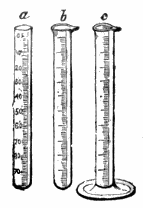
1. The molecular weight of commercially pure bicarbonate of potash, in crystals, being 100, whilst that of absolute acetic acid is 60, it is evident that every ten grains of the bicarbonate will exactly equal 6 grains of the acid. To apply this practically, we have only to exactly neutralise 100 gr. of the vinegar or solution under examination with the bicarbonate, observing the usual precautions; then, as 10 is to 6, so is the number of grains used, to the per-centage strength required. In this, as in other like cases, it is convenient to form a test-solution with the bicarbonate, by dissolving it in sufficient water to fill the 100 divisions of any simple form of ‘acidimeter,’ as a, b, or c; when the quantity of the solution, and, consequently, of the salt used, may be read off at once from the graduated portion of the tube. Still greater accuracy may be obtained by dissolving the bicarbonate in exactly 1000 gr. of distilled water contained in a ‘Schuster’s alkalimeter,’ previously very carefully weighed; in which case each grain of the test-solution will indicate 1⁄10th of a grain, or 0·1% of absolute acetic acid, whilst every 10 grains will be equal to 1 grain, or 1%.
The test-solution may also be prepared from bicarbonate of soda, or from the carbonates of soda or potash, care being taken that the quantity of the salt dissolved be in proportion to its molecular weight.
2. (Brande.) A small piece of white marble, clean and dry, is weighed, and then suspended by a silk thread in a weighed sample (say 100 or 1000 grs.) of the vinegar or acid under examination; the action being promoted by occasionally stirring the liquid with a glass rod, until the whole of the acid is saturated, as shown by no further action on the marble being observable on close inspection. The marble is then withdrawn, washed in distilled water, dried and weighed. The loss in weight which it has sustained will be nearly equal to the acetic acid present, or strictly, as 50 (marble) to 60 (absolute acetic acid). The only precautions required are, to avoid striking the piece of marble with the rod whilst stirring the solution, or causing loss of substance in it after its withdrawal; and to allow ample time for the action of the acid on it. If the sample consists of strong acid, it should be diluted with twice or thrice its weight of water before suspending the marble in it.
3. (Ure.) 100 grains of the sample under examination is slightly reddened with tincture of litmus, and ammonia of the sp. gr. 0·992 is added drop by drop (from an acetimeter holding 1000 water-gr. measure, divided into 100 divisions) until precise neutralisation is effected, indicated by the blue colour of the litmus being restored. The number of the divisions of the acetimeter used, multiplied by 60, and the first two right-hand figures of the product cut off as decimals, gives a number which represents the exact quantity of absolute acetic acid in the sample. In practice, it is found more convenient to keep the test-ammonia ready tinged with litmus.
The mode of estimating the per-centage of acetic acid in beers, when finding their original gravities, is a slight modification of the above. A test-solution of ammonia is prepared of such a strength that a given bulk of it will exactly neutralise one per cent. of absolute acetic acid in an equal bulk of beer, so that, if 100 fluid grains of the solution are sufficient to neutralise the acid in 1000 fluid grains of beer, such beer contains one tenth per cent. of acid. A solution of ammonia, diluted with distilled water until it has the sp. gr. ·9986 at 60°, is of the exact strength required.
An acetimeter holding 1000 grains, and graduated downwards to 100 equal divisions, is filled to 0 of the scale with the test-ammonia, which is then added, drop by drop, to 1000 measured grains of the beer, until neutralisation takes place. Every division of the acetimeter (corresponding to ten fluid grains), so emptied, indicates ·01 per cent. of acetic acid in the beer. The progress of the neutralisation is tested from time to time with a slip of reddened litmus paper, which should be suffered to become faintly blue before ceasing to add the ammonia. By this method the exact per-centage of absolute acetic acid in any sample may be accurately determined. The only precaution necessary is to be certain that the ‘test-ammonia’ has the required sp. gr. (·9986). Test-solutions may also be prepared with pure potash or pure soda.
II. From the specific gravity of the liquid after it has been neutralised with hydrate of lime:—
Common hydrate of lime (freshly slaked lime), in powder, is added gradually to the sample under examination, until it is saturated, when the sp. gr. of the resulting clear solution of acetate of lime is taken by Taylor’s ACETIMETER. This instrument is so adjusted and graduated as to float at the mark on the stem called ‘proof,’ in a solution containing 5% of absolute acetic acid (No. 24 vinegar). For vinegars stronger than proof small weights are provided, each of which indicates an additional 5 per cent. To ascertain the per-centage of real acid, 5% must therefore be added to the acetimeter number. Thus, without being loaded, the instrument, floating at the ‘proof mark,’ indicates a vinegar of 5%; with one weight, a vinegar of 10%; with two weights, 15%, and so on. According to this system of notation, each 5% is called a ‘vinegar.’ An acid of 10% is said to contain two vinegars; one of 15%, three vinegars, &c. It is also common to speak of the degrees of the acetimeter as proof or over-proof. Thus, No. 24 vinegar is said to be proof; one of 5 acetimeter degrees, 5 over-proof; one of 10 degrees, 10 over-proof, &c. For malt and wine vinegars, which contain gluten and mucilage, this method is not strictly accurate, as a portion of these substances escapes precipitation by the lime, and consequently alters the specific gravity. A small weight marked ‘M’ is generally supplied with the acetimeters for trying such vinegars.
III. From the specific gravity:—
The sp. gr. of the sample (carefully determined by any of the usual methods) is sought in one of the following Tables, when the corresponding per-centage content of acetic acid is at once seen.
This method furnishes reliable results only with pure, or nearly pure solutions which do not contain much above 50% of glacial acid, or which have a sp. gr. not higher than 1·062. It is also more to be depended on for weak solutions than strong ones. By carefully diluting a strong acid with an equal weight, or twice or thrice its weight of water, and allowing the mixture to again acquire its normal temperature, the sp. gr. may be taken as a guide in all cases in which great accuracy is not required. When such dilution is made it only becomes necessary to multiply the indication furnished in the Tables by 2, 3, or 4, as the case may be. As, however, authorities are not agreed as to the precise sp. gr. of the monohydrate or glacial acid, and of its solutions, extreme accuracy must not be expected by this method.
Table I.—Adapted to the Specific Gravities of common vinegar. By Messrs J. and P. Taylor.
sp. gr. per cent.
1·0085contains of anhydrousor real acetic acid5
1·0170””10
1·0257””15
1·0320””20
1·0470””30
1·0580””40
Table II.—Exhibiting the quantity of ABSOLUTE or GLACIAL ACETIC ACID (HC2H3O2), in acetic acid of successive strengths. By Mr Cooley.
Absolute Acetic Acid, per cent.Sp. Gr.Absolute Acetic Acid, per cent.Sp. Gr.Absolute Acetic Acid, per cent.Sp. Gr.Absolute Acetic Acid, per cent.Sp. Gr.
Pure acid or
1001·0630741·0732481·0582221·0311
991·0648731·0728471·0568211·0292
981·0663721·0721461·0557201·0275
971·0677711·0718451·0553191·0264
961·0685701·0713441·0544181·0253
951·0696691·0711431·0535171·0241
941·0704681·0708421·0525161·0229
931·0708671·0702411·0518151·0218
921·0715661·0701401·0513141·0200
911·0721651·0693391·0502131·0173
901·0726641·0692381·0492121·0172
891·0729631·0685371·0482111·0161
881·0730621·0679361·0473101·0150
871·0731611·0675351·0460091·0131
861·0732601·0672341·0449081·0121
851·0733591·0665331·0439071·0102
841·0734581·0662321·0425061·0085
831·07343571·0653311·0413051·0071
821·0735561·0645301·0402041·0057
811·0738551·0641291·0392031·0042
801·0743541·0632281·0380021·0025
791·0742531·0628271·0364011·0012
781·0740521·0616261·0352001·0000
771·0739511·0610251·0341or Pure water.
761·0736501·0602241·0330
751·0731491·0593231·0320
Concluding remarks. Before applying the above processes, account should be taken of any mineral acid which may be present in the sample, such being not unfrequently added to vinegar to impart artificial strength; and in those depending on the sp. gr., gum, gluten, &c., must also be allowed for. The methods depending on the saturating power of the acid will be found appropriate to acetic acid of all strengths, when unadulterated with the mineral acid. The method based on the sp. gr. is also very convenient, and is sufficiently accurate for distilled vinegars and for pure acids of moderate strength.
It is found that the decimal fraction of the sp. gr. of pure or nearly pure vinegar is doubled by its conversion into acetate of lime. Thus, 1·0085 in vinegar becomes 1·0170 when converted into a solution of acetate of lime. In malt vinegar, however, 0·005 may be deducted from the sp. gr. for mucilage and gluten. The quantity of foreign matter present in vinegar may therefore be approximatively ascertained, by deducting the decimal of the sp. gr. of the solution of acetate of lime from double that of the decimal part of the sp. gr. of the vinegar. Thus:—the sp. gr. of a sample of vinegar being 1·014, and after saturation with hydrate of calcium 1·023, the sp. gr. of the pure vinegar would be 1·009, and that due to foreign matter ·005. For—
·028 - ·023 = ·005
and—
1·014 - ·005 = 1·009
The reason why proof-vinegar is called, in commerce, No. 24, is that 1 fl. oz. of it requires exactly 24 gr. of pure anhydrous carbonate of soda to neutralise it. Weaker vinegars are represented in the same ‘notation’ by the Nos. 22, 20, 18, &c., according to their respective strengths estimated by their saturating power.
ACETINE. An essence for the removal of corns. Concentrated vinegar (1·04 sp. gr.) slightly tinged with fuchsine, 15 grms. (Hager.)
ACETINE, HOCHSTETTER’S. Prepared by J. C. F. Witte, Berlin. A remedy for corns, warts, and hard skin. Diluted vinegar, coloured with blue carmine, 16 grms. (Schälder.)
ACETOLATS. [Fr.] Syn. Esprits acétiques. In French pharmacy, medicated vinegars obtained by distillation.
ACETOLES. [Fr.] In French pharmacy, medicated vinegars obtained by maceration.
ACETOUS FERMENTATION. See Acetification.
ACETUM. [L.] Vinegar.
ACETYL. Syn. Acetyle. A name originally given to a hypothetical body, having the formula C2H3, and regarded by Berzelius as the radical of the acetates and their congeners. The acetyl of Gerhardt (C2H3O) is, however, according to that chemist, the true radical of the acetates. Williamson, in order to remove the confusion of terms occasioned by the application of the same name to compounds of different composition, proposed the title of othyl for the radical C2H3O.
ACHAR. See Pickles.
ACEIILE′INE (-kĭl-). A peculiar bitter principle obtained from achillé a millefolium (Linn.), or yarrow.
A′CHOR, (-kŏr). [Gr.] See Scald-head.
ACHROMAT′IC (ăk-ro-). Syn. Achromatique, Fr. In optics, devoid of colour; bodies that transmit light without decomposition, and consequently, without the formation of coloured rings or fringes; applied to compound lenses, prisms, &c., and to instruments fitted with them.
ACRO′MATISM. Syn. Achromatisme, Fr. In optics, the state of being achromatic; the absence of coloured fringes in the images of objects seen through a lens or prism.
Light is not homogeneous, but decomposable by refraction, absorption, or reflection, into coloured rays of unequal refrangibility. A ray of white light, in passing through a glass prism, is entirely separated into the coloured rays forming the ‘prismatic spectrum,’ and when it passes through a lens, an analogous resolution into coloured rays still occurs, though not so readily observed, and that to an extent often incompatible with distinct vision. Now, if a convex lens be regarded as a number of prisms united by their bases round a common centre, and a concave lens, as a similar number of prisms with their apices in contact, the action of lenticular and prismatic glasses on light will be reduced to a common principle. A beam of light thrown on a simple converging lens not only suffers refraction at the spherical surface (SPHERICAL ABERRATION), but the different coloured rays of which it is composed, from the causes mentioned, being unequally bent or refracted, diverge from their original course (CHROMATIC ABERRATION), forming as many foci on the axis of the lens as there are colours, and fall separately, instead of together, on the eye or object which receives them. Hence arise the coloured fringes or halos that surround objects viewed through ordinary glasses, and which form the great impediments to the construction of perfect lenses. This effect, like the refractive power and focal distance, varies in degree in different diaphanous substances.
The correction of the chromatic aberration of lenses is commonly effected by combining two, or more, made of materials possessing different ‘dispersive’ powers. Thus, the spectrum formed by flint glass is longer than that formed by crown glass, for the same deviation. When the two are combined, so as to form a compound lens, the one tends to correct the ‘dispersion’ of the other. On this principle ACHROMATIC GLASSES are generally formed in this country. A convex lens of crown glass is combined with a weaker concave lens of flint glass, the latter counteracting the dispersion of the former, without materially interfering with its refractive power. The resulting combination is not absolutely achromatic, but is sufficiently so for all ordinary purposes. According to Dr Blair, a compound lens perfectly achromatic for the intermediate, as well as for the extreme rays, may be made by confining certain fluids, as hydrochloric acid, between two lenses of crown glass. In order to produce nearly perfect achromatism in the object-glasses of telescopes, microscopes, cameras, &c., a concave lens of flint glass is commonly placed between two convex lenses of crown or plate glass, the adjacent surfaces being cemented with the purest Canada balsam, to prevent the loss of light by reflection from so many surfaces.
Obs. The production of perfect achromatism in lenses is a subject not less fraught with difficulty than with practical importance to the astronomer, the mariner, the microscopist, and the photographer; and it has hence engaged the attention of the leading mathematicians and artists of Europe up to the present time. All the larger object-glasses lately manufactured are said to consist of only two lenses; the resulting achromatism proving sufficiently exact for all useful purposes. Those of recent production have come chiefly from the workshops of Dollond, of London, and the opticians of Bavaria and Switzerland. The achromatism of prisms depends upon the same principles, and it is effected in the same way as that of lenses.
ACIC′ULAR. Needle-shaped; slender or sharp pointed; spicular; in botany, applied to leaves, and in chemistry, to crystals. The last are also sometimes termed ACIC′ULÆ.
ACID, Syn. Acidum, L.; Acide, Fr.; Acido, Ital.; Säure, G. In familiar language, any substance possessing a sour taste. In chemistry, substances are said to be acid, or to have an acid reaction, when they are capable of turning blue litmus red. In chemistry, also, the term acid is applied to a very large class of compounds containing hydrogen (hydrogen salts), and in which one or more atoms of that element may be replaced by an equivalent quantity of a metal or other basic radical; e.g.—
1. The one atom of hydrogen in hydrochloric acid (HCl) may be replaced by sodium, producing the salt sodium chloride (NaCl).
2. The one atom of hydrogen in nitric acid (HNO3) may be replaced by silver, producing the salt silver nitrate (AgNO3).
3. One atom of hydrogen in acetic acid (HC2H3O2)[6] may be replaced by the basic radical ammonium (NH4), producing the salt ammonium acetate (NH4C2H3O2).
Acids which, like those mentioned in the foregoing examples, contain one atom of replaceable hydrogen are called monobasic; those which contain two such atoms (e.g. sulphuric acid, H2SO4; tartaric acid, H2C4H4O6),[7] dibasic; those which contain three such atoms (e.g. phosphoric acid, H3PO4; citric acid, H3C6H5O7),[7] tribasic; and so on with acids of higher basicity. Acids of greater basicity than unity are frequently termed polybasic.
Besides containing replaceable or basic hydrogen, acids are further characterised by the property of combining with alkaloids to form salts; e.g.—
Sulphuric Acid.Quinia.
H2SO4+ 2C24H24N2O2=
Quinia Sulphate.
(C20H24N2O2)2 . H2SO4
Acetic Acid.Morphia.
HC2H3O2+ C17H19NO3=
Morphia Acetate.
C17H19NO3 . HC2H3O2
Dibasic Acids. See Acid.
Fatty Acids. Acids separable from fats or oils; e.g. stearic acid, oleic acid, butyric acid, &c.
Inorganic Acids. Same as Mineral Acids (which see).
Mineral Acids. Acids chiefly or wholly derived from the mineral kingdom. In medicine, sulphuric, hydrochloric, and nitric acids, are commonly so called.
Monobasic Acids. See Acid.
Organic Acids. Acids formed by, or derived from organic substances; e.g. acetic acid, tartaric acid, uric acid, &c.
Polybasic Acids. See Acid.
Pyro-acids. Acids resulting from the decomposition by heat of other acids, e.g. gallic acid, when heated, yields pyro-gallic acid.
Tribasic Acids. See Acid.
ACIDIFICA′TION. [Eng., Fr.] Syn. Acidifica′tio, L. In chemistry, the act, process, or state of acidifying, or of making, becoming, or impregnated with acid.
ACIDIM′ETER. Syn. Acidom′eter; Acidime′trum, &c., L.; Acidimètre, Fr. An instrument or apparatus employed in acidimetry.
The ordinary acidimeters of the chemist are small tubes, constructed to hold exactly 1000 grains of distilled water, at 60° Fahr., within the limits of their scale, which is accurately graduated into 100 divisions. They are used to contain the alkaline solutions (TEST-LIQUORS, NORMAL or STANDARD SOLUTIONS) employed in the following processes.
Beaumé’s Acidimeter, and others of the same class, are HYDROMETERS, and are described under that ‘head.’
ACIDIM′ETRY. Syn. Acidom′etry; Acidime′tria, &c., L.; Acidimétrie, Fr. The estimation of the strength or quantity of acid, in a free state, contained in any liquid. It is the reverse of ‘alkalimetry.’ Acidimetrical assays are understood to refer to the relative strengths of the same acids (i. e., the quantity of real acid of the same kind contained in the solutions examined), and not to the comparative strengths of acids of different composition or names.
Acidimetrical processes. These are founded chiefly on the capacity of the acids to saturate the bases; and, in some of the liquid acids, on the specific gravity.
a. Volumetrically:—
1. The sample of the acid to be examined (100 gr., or any convenient aliquot part thereof) is placed in a suitable glass vessel, and if it be one of the stronger acids, diluted with six or eight times its weight of water, or if solid (as oxalic, or citric acid), dissolved in a like quantity. This liquid is then exactly neutralised with an alkali.
This point is usually determined, by the addition of a small quantity of litmus solution, which turns just blue when the solution is neutralised, but when a carbonate is used for the alkaline solution, the acid must be boiled a short time after each addition to expel the carbonic acid. The quantity of the alkaline solution consumed for this purpose represents an equivalent quantity of acid, and thus gives us the acid content of the sample under examination. The common practice is to dissolve one equivalent of the alkaline test in grains or grammes in water, and to make up the solution to exactly 1000 parts by measure (i. e., 1000 ‘water-grains’ or grammes), so as to accurately fill the 100 divisions of an acidimeter; when the quantity, in grains or grammes, of the sample tested, bears the same proportion to the equivalent number of the acid under examination, that the number of acidimeter divisions of the test-liquor consumed bear to the per-centage of acid sought. Thus:—suppose 50 gr. of a sample of sulphuric acid take 25 acidimeter divisions (300 parts or water-grains measure) of the test-liquid to neutralise it, what is its content of real acid?
The equivalent of sulphuric acid is 49 (half its atomic weight); so, by the rule of proportion,
50 : 49 :: 25 : 241⁄2
It therefore contains 241⁄2 parts of real sulphuric acid, in 50.
If the 1000 parts or grain-measures, instead of the number of the acidimeter divisions, be taken for the calculation, it will, of course, be necessary to point off the first right-hand figure of the result as a decimal. Thus; repeating the above example—
50 : 49 :: 250 : 24·5
Or, since the equivalent of the test-liquid is 100, it will bear the same proportion to the equiv. of the acid examined as the number of the acidimeter divisions of the test-liquid consumed in neutralising 100 gr., do to the per-centage sought. Thus:—50 gr. of hydrochloric acid take 45 acidimeter divisions to effect neutralisation, what is its real strength?—The equiv. of hydrochloric acid is 36·5: therefore—
100 : 36·5 :: 45 : 16·425%
and, since only 50 gr. (instead of 100 gr.) were examined—
16·425 × 2 = 32·85%
Some operators prefer employing 100 gr. instead of the equivalent weights of the given tests in making their test-solutions, in which case each gr. or 1000th part represents 1⁄10th, and each acidimeter degree 1 gr. of the alkali or carbonate employed; when a similar proportion will obtain to that first above given.
In technical analysis it is more convenient if the number of acidimeter divisions of the ‘test-liquid’ consumed express the per-centage strength of the acid, without further calculation. For this purpose the number of grains of the acid taken for the assay should correspond to the equivalent number of such acid (see Table I, below); or to some convenient aliquot part of it, as the 1⁄2, 1⁄4, 1⁄5, or 1⁄10th; the per-centage answer, in the last case, being doubled, quadrupled, &c., according to the aliquot part taken. The reason of this is obvious.
For the test-solutions, ammonia, and the dry and crystallised carbonates and bicarbonates of potash and soda, are used, and are made by dissolving in water their constituents except ammonia, of which 1000 grains, or one litre, of solution of specific gravity 0·992 contains exactly one equivalent.
53 grains (or grammes) of pure anhydrous carbonate of soda, prepared by gradually heating to redness the crystallised salt, constitute one equivalent (half the atomic weight), and 69 grains (or grammes) of pure dry carbonate of potash. Of the crystallised salt 143 grains of carbonate of soda will be required, and 84 grains (grammes) of the crystallised bicarbonate of soda, and 100 of the crystallised bicarbonate of potash. Occasionally solutions containing in one thousand parts, 50 of pure carbonate of lime or chalk, or 28 of pure caustic lime, are used.
Besides these, a process known as Kiefer’s is practised, and an ammoniacal solution of oxide of copper is employed as the ‘test-liquor,’ and the ‘point of neutralisation’ is known by the turbidity observed as soon as the free acid present is completely saturated.
The normal solution or test-liquor is prepared by adding to an aqueous solution of sulphate of copper, pure ammonia water, until the precipitate, which at first forms, is just redissolved, carefully avoiding excess. Or better, by adding a rather strong solution of sulphate of copper, to a quantity of a rather strong solution of ammonia containing exactly 17 gr., or one equiv. of pure ammonia, as long as the precipitate which forms is redissolved on agitation; the resulting liquid being afterwards diluted with pure distilled water, until it accurately measures 1000 water-grains, or fills 100 divisions of an acidimeter, at 60° Fahr. In either case, the strength of the resulting ‘test-solution’ must be carefully determined by means of standard sulphuric acid, and adjusted, if necessary.
This method answers well with all the stronger acids (excepting oxalic acid), even when dilute; and it has the advantage of not being affected by the presence of a neutral metallic salt with an acid reaction, as sulphate of copper, or of zinc.
Besides this process a solution of lime in sugar may be used, as proposed by M. Peligot, and made as follows:—
Pure caustic lime is carefully slaked by sprinkling with water, and 50 grains (or grammes), made up by water to a milky solution, and 100 grains of pure sugar candy dissolved in 1000 grains of water, are added, and the whole well shaken. It is allowed to settle in a closed bottle, and the clear solution poured off and diluted, until 1000 grains neutralise exactly 100 grains of pure hydrochloric acid of sp. gr. 1·1812. Of course it only answers with acids whose calcium salts are readily soluble in water.
b. Gravermetrically:—
The test-liquors or standard solutions of the above methods are made up so as to weigh exactly 1000 grains, instead of to ‘measure’ 100 acidimeter divisions. Every grain of the test-liquor thus represents 1⁄10th gr. of alkali; and every 10 gr., 1 gr. of alkali; or respectively, 1⁄10th per cent. and 1 per cent. The vessel used for containing the solutions is carefully weighed whilst empty, and 1000 gr. being placed in the opposite scale, the test-solution, containing exactly one equivalent of base, is poured in, and the whole made up with distilled water (if necessary) so as to restore the balance to an equilibrium. After the process of neutralisation, the acidimeter, with its contents, is again placed in the scales; its previous weight still remaining there. The number of grains required to restore the equilibrium of the balance (i.e., the loss of weight), gives the exact weight of the test-liquor consumed. In all other respects the process is the same as in the ‘volumetrical method’ already described.
Another method for estimating the strength of the sample of acid is by weighing the amount of carbonic acid expelled during saturation. (Method of Fresenius and Will.) This depends on the weight of gaseous carbonic acid which a given weight of the acid-sample under examination is capable of expelling from pure bicarbonate of soda (or of potash), which is estimated by the loss of weight in the acidimeter, or apparatus, after the gas, rendered perfectly dry by passing through sulphuric acid, has escaped into the air.
Table I.—Weights of the respective acids equivalent to the given weight of the principal bases, hydrogen being taken as unity.
17gr.of pure ammonia.[8]are exactly neutralised by51 Acetic acid (anhydrous).
31”anhydrous soda.[9]60 Acetic acid (crystallised or glacial).
40”hydrate of soda.[9]99 Arsenious acid (dry).
53”dry carbonate of soda.[10]35 Boracic acid (anhydrous).
143”crystallised carbonate of soda.[11]62 Boracic acid (crystallised).
84”crystallised bicarbonate of soda.22 Carbonic acid (dry).
47”anhydrous potassa.[9]67 Citric acid (crystallised).
56”hydrate of potassa.[9]85 Gallic acid (dried at 212°).
69”dry carbonate of potassa.[10]94 Gallic acid (crystallised).
100”crystallised bicarbonate of potassa.1271⁄2 Hydriodic acid (dry or gaseous).
50”pure chalk or pure marble.27 Hydrocyanic acid (anhydrous).
28”pure caustic lime.361⁄2 Hydrochloric acid (dry or gaseous).
37”hydrate of lime (fresh).1091⁄2 Hydrochloric acid (liquid, sp. gr. 1·162).
44”dry carbonic acid (when the bicarbonate of potassa or soda is used for testing in the process of Fresenius and Will).1661⁄2 Iodic acid.
22”dry carbonic acid (when a dry carbonate is used).54 Nitric acid (anhydrous).
671⁄2 Nitric acid (liquid, sesquihydrated, sp. gr. 1·5033 to 1·504).
72 Nitric acid (liquid, binhydrated, sp. gr. 1·486).
90 Nitric acid (liquid, sp. gr 1·42).
36 Oxalic acid (anhydrous).
63 Oxalic acid (crystallised).
72 Phosphoric acid (anhydrous).
81 Phosphoric acid (glacial).
50 Succinic acid (dry or anhydrous crystals).
59 Succinic acid (ordinary crystals).
40 Sulphuric acid (anhydrous).
49 Sulphuric acid (liquid, monohydrated, sp. gr. 1·8485).
75 Tartaric acid (crystallised).
12 Tannic acid (carefully dried).
Oper. A determined amount of the acid under examination is accurately weighed into the flask A (see engr.); and if it be a concentrated acid, or a solid, it is mixed with or dissolved in 6 or 8 times its weight of water. The little glass tube (e) is then nearly filled to the brim with pure bicarbonate of soda, in powder, and a fine silken thread is tied round the neck of the tube, by means of which it can be lowered down into the flask (A), so as to remain perpendicularly suspended when the cork is placed in the latter; the cord being held between the cork and the mouth of the flask. The flask (B) is next about half filled with oil of vitriol, and the tubes being arranged in their places, as represented in the engr.; and time having been allowed for the mixture of acid and water to cool completely, after the increase of heat caused by mixing, the whole apparatus is very accurately weighed. The cork in the flask (A) is then slightly loosened, so as to allow the little tube containing the bicarbonate of soda to fall into the acid, and is again instantly fixed AIR-TIGHT in its place. The evolution of carbonic acid now commences, and continues until the acid in the flask (A) is neutralised. When this takes place, which is easily seen by no bubbles being emitted on shaking the apparatus, the flask (A) is put into hot water (120° to 130° Fahr.), and kept there, with occasional agitation, until the renewed evolution of gas has completely ceased. The little wax stopper is then taken off the tube (a), the apparatus taken out of the hot water, wiped dry, and suction applied, by means of a perforated cork, or a small india-rubber tube, and the mouth, to the end of the tube (d), until the sucked air no longer tastes of carbonic acid. The whole is then allowed to become quite cold, when it is replaced in the balance (the other scale still containing the original weights), and weights added to restore the equilibrium.
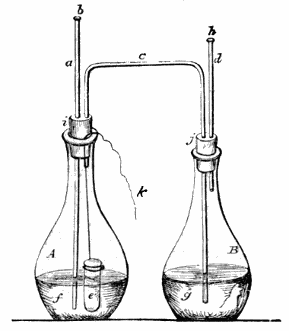
(A) A wide-mouthed flask, capable of holding 21⁄2 to 8 oz., containing sample for trial (f).
(B) Ditto, capable of holding 11⁄2 to 2 oz., partly filled with oil of vitriol (g).
(a, c, d) Tubes fitting air-tight in the flasks by means of the corks (i) and (j).
(b) Piece of wax fitting air-tight on the end of a.
(e) Small tube capable of holding about 1 drachm of powdered bicarbonate of soda or potash.
(h) Open end of the tube (d).
(k) Silk cord fastened to the tube (e).
The loss of weight represents the exact quantity of dry carbonic anhydride, or anhydrous carbonic acid gas, that has been expelled from the bicarbonate of soda, by the action of the acid in the sample examined.
The quantity of real acid it contained is then deduced by the following calculation:—One equivalent of gaseous carbonic anhydride, or anhydrous carbonic acid (= 44) bears the same proportion to one equivalent of the acid in question, as the amount of the carbonic anhydride expelled does to the amount of the acid sought. Thus, suppose a dilute sulphuric acid expels 3 gr. of carbonic anhydride, the arrangement is—
44 : 49 :: 3 : 3·349
Consequently the sample operated on contained 3·5 (nearly) grains of true sulphuric acid.
Instead of the above calculation, we may multiply the weights of the respective acids required to expel 1 gr. of carbonic acid (as exhibited in the following table) by the number of gr. of dry carbonic acid evolved during the above operation. The product represents the per-centage strength, when 100 gr. of the acid have been examined. When only 50, 25, 20, or 10 gr. have been tested, this product must, of course, be doubled, quadrupled, &c., as the case may be.
Table II.
Multipliers.
Acetic acid (anhydrous)1·159
Acetic acid (hydrated or glacial)1·364
Citric acid (crystallised)1·523
Hydrochloric acid (dry or gaseous)·829
Hydrochloric acid (sp. gr. 1·16)2·478
Nitric acid (anhydrous)1·227
Nitric acid (sp. gr. 1·5)1·523
Nitric acid (sp. gr. 1·42)2·045
Oxalic acid (crystallised)1·432
Sulphuric acid (anhydrous)·909
Sulphuric acid (sp. gr. 1·8485)1·114
Tartaric acid (anhydrous)1·500
Tartaric acid (crystallised)1·705
Even this easy calculation may be avoided, in technical analysis, by simply taking for the assay such a weight of the respective acids as is capable of disengaging exactly 10 gr. of dry carbonic acid from the bicarbonate. In this case, the loss of weight in grains, from the operation, multiplied by 10, at once indicates the exact per-centage strength sought. The proper weight of any acid to be taken to give per-centage results is found by simply dividing ten times the equiv. of that acid by 44. For, taking sulphuric acid as an example,
as— 44: 49 :: 10 : 11·1318
or 11·13 nearly.
On this principle are obtained the weights to be taken, as given in—
Table III.
Grains.
Acetic acid (anhydrous)11·59
Acetic acid (hydrated or glacial)13·64
Citric acid (crystallised)15·23
Hydrochloric acid (dry or gaseous)8·29
Hydrochloric acid (sp. gr. 1·16)24·78
Nitric acid (anhydrous)12·27
Nitric acid (sp. gr. 1·5)15·23
Nitric acid (sp. gr. 1·42)20·45
Oxalic acid (crystallised)14·32
Sulphuric acid (anhydrous)9·09
Sulphuric acid (sp. gr. 1·845)11·14
Tartaric acid (anhydrous)15·00
Tartaric acid (crystallised)17·05
2. A convenient modification of the preceding method of acidimetry consists in using the common apparatus figured in the margin and employing fused chloride of calcium to dry the evolved carbonic acid gas, instead of concentrated sulphuric acid. The mode of conducting the process and obtaining the results is precisely the same as in that last explained, and need not, therefore, be repeated. In this case, however, suction must be applied to the small tube (g), instead of (d) in the accompanying engraving.
Obs. These methods, though apparently complicated, are not difficult to perform, when once well understood. The application of heat after the completion of the operation is indispensable, as, if it were neglected, from 0·3 to 0·4 of a gr. of carbonic acid would be retained in the liquid. The bicarbonate of soda must be pure, and perfectly free from any neutral carbonate or sesquicarbonate of soda. To ensure this, the bicarbonate of commerce is reduced to a uniform powder, put into a glass jar, and covered with its own weight of cold distilled or rain water, and allowed to stand for twenty-four hours, with frequent stirring. It is then placed upon a funnel, the tube of which is stopped with loose cotton, so as to allow the lye to drain off. It is next washed several times with small quantities of cold distilled or rain water, and after being dried by pressure between some sheets of blotting-paper, without the aid of heat, is kept for use in a well-closed glass bottle. Before use, it may be tested to ascertain its purity. If pure, it neither reddens turmeric paper, nor gives a brick-red precipitate with a solution of bichloride of mercury. Pure bicarbonate of potassa may be used instead of bicarbonate of soda; but in either case it is always proper to use an excess, so as to leave some undecomposed carbonate after the operation has ended. The presence of a little sodium chloride or sulphate in the bicarbonate will not interfere in the least, but the absence of every trace of neutral carbonate is a sine quâ non.
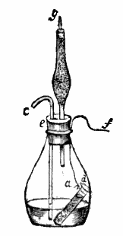
(a) Wide-mouthed flask, containing the sample for examination, hermetically stopped by the cork (e) and supporting the tubes (b) and (c).
(b) Bulbous tube, containing fragments of fused chloride of calcium, terminating in a capillary tube (g).
(c) Bent tube, reaching nearly to the bottom of the flask (a).
(d) Small tube containing bicarbonate of soda.
(e) Cork fitting bottle (a), and the tubes (b) and (c), hermetically.
(f) Silken thread, suspending the small tube (d).
The two above methods of estimating the amount of acid are only superior to the generally used methods first described, when the presence of colouring matter interferes with the reaction of the litmus used to show the point of neutralisation.
Observations. When great accuracy is required in conducting the neutralisation of the solution in estimating volumetrically with litmus as an indicator, it is proper to prepare and keep standard solutions of sulphuric acid and oxalic acid, with which occasionally to try the alkaline test-liquor. The only difficulty in the process is to avoid over-saturation of the acid-sample. Great care must be taken not to exceed the precise point of neutralisation of the acid. After adding each portion of the test-liquor, the solution should be well stirred up, and as soon as the effervescence becomes languid the greatest caution must be observed in adding more. The proper point is arrived at when the liquor ceases to redden litmus, and does not alter the colour of turmeric paper; if it turns the latter brown, too much of the test-liquid has been added, and the operation becomes useless. Towards the end of the experiment, when great precision is required, a gentle heat may be applied, in order to expel the free carbonic acid in the liquor; but otherwise this is unnecessary. The peculiar soapy odour gradually acquired by the liquor as it nears saturation will materially assist the operator when testing vinegars, and some of the other vegetable acids. A good method is to tint either the acid-sample or the test-liquid with a few drops of litmus, as noticed under Acetimetry; when the reddish shade will gradually deepen into ‘purple,’ or the purple into ‘red,’ as the point of saturation is approached; and the blue colour will be perfectly restored as soon as this point is reached. Dr Ure recommends keeping the ammonia-test ready tinged with litmus, and the same applies to other test-liquors.
In commerce, the strength of acids is frequently reckoned with reference to a standard, termed 100 acidimetric degrees. This is taken from the circumstance that 91 gr. of commercial oil of vitriol, of a sp. gr. of 1·845, exactly saturate 100 gr. of dried carbonate of soda. An acid requiring only 35, 50, or any other number of grains of the carbonate to saturate it, is in like manner termed of so many degrees strong; the number of grains representing in each case an equal number of degrees. This method originated with the French chemists, and though only conventional, and principally confined to commercial purposes, is especially adapted to practical men but little conversant with chemistry, yet very ready in retaining or calculating anything on the centesimal scale, from its similarity to monetary language and reckoning.
ACID′ITY. Syn. Acid′itas, L.; Acidité, Fr.; Säure, Ger. In chemistry, the state of being acid. In physiology, &c., the impression given to the organs of taste by tart or acid substances. Sourness. See Fermentation, Malt-liquors, Wines, &c.
Gas′tric Acidity. Acidity of the stomach; a common and well-known symptom of weak or disordered digestion.
Treat., &c. Small doses of absorbents or antacids, three or four times daily, to which some tonic bitter, as calumba, cascarilla, chamomile, gentian, or orange-peel, may be added. Stomachic stimulants, as capsicum, ginger, mustard, or wine, &c., taken with, or after, meals, are also useful. The diet should be light and nutritious; and acescent vegetables, over-ripe fruit, and weak new beer or other liquors avoided as much as possible. The bowels should be kept regular, but not open, by the occasional use of mild aperients, as rhubarb, aloes, castor oil, senna, or mercurial pill, or compounds containing them. Excessive looseness or diarrhœa may be checked by a few doses of carbonate of soda, chalk-mixture, or astringents.
In INFANCY this affection is usually accompanied by restlessness, continual crying, drawing up of the legs forcibly towards the body, hiccups, vomiting, diarrhœa, sour eructations, griping pains, green stools, and debility; often followed, when the irritation is considerable, by convulsions. The treatment consists in relieving the bowels of all offending matter by a few doses of rhubarb-and-magnesia. The looseness or diarrhœa may be checked by a few small doses of carbonate of soda or chalk mixture; or better, in an infant which is fed by lime-water (1 or 2 fl. oz.) mixed with as much milk. Two or three drops of caraway, cinnamon, dill, or peppermint water, on sugar (not with the food) will tend to promote the expulsion, and prevent the undue generation of gases. The flatulence usually disappears with the acidity. The occasional administration of 1 to 3 gr. of quicksilver-with-chalk (‘grey powder’), will frequently remove the complaint, and prevent its recurrence, when all other means fail. The diet of both nurse and infant should be carefully regulated.
See Antacids, Dyspepsia, &c.
Treatment for Horses. Alkalies, their carbonates and bicarbonates; alterative doses of aloes with alkalies; chalk, carbonate of magnesia; mineral acids; bismuth, arsenic, nux vomica, or strychnia.
ACIDS, EFFECTS OF, ON VEGETATION. This subject has been ably investigated of recent years by Dr Angus Smith and Mr Rothwell, and the practical importance of their labours is shown by the circumstance that an Act of Parliament passed in 1875 renders it penal for the proprietors of alkali works to condense not less than 95 per cent. of the hydrochloric acid evolved in the process of manufacturing ‘soda,’ also to allow air, smoke, or chimney gases to escape into the atmosphere containing more than one fifth of a grain of hydrochloric acid per cubic foot. Every owner of an alkali work is likewise required to ‘use the best practical means of preventing the discharge into the atmosphere of all other noxious gases arising from such work, or of rendering such gases harmless when discharged.’
The injurious effects of acids on vegetation are indicated chiefly by the shrivelled-up appearance which the leaves of herbage, trees, &c., exhibit in the vicinity of chemical works in which the condensation of noxious gases (hydrochloric acid, sulphurous acid, sulphuric acid, sulphuretted hydrogen, nitric acid, and oxides of nitrogen and chlorine) is not effectually carried out. According to Mr Rothwell, ‘in fields exposed to acid vapours handfuls of dead grass may be pulled up in the spring, smelling strongly of the vapour, and that trees, under similar influences, become bark-bound.’
The following is a list of trees arranged in the order of their susceptibility. (Rothwell.)
Forest Trees. Larch, spruce fir, Scotch fir, black Italian poplar, Lombardy poplar, ash, oak, elm, birch, alder, sycamore.
Fruit Trees. Damson, greengage, Halewood plum, Jacob plum, pears, apples, cherries.
Shrubs, Evergreens, and Wild Plants. British laurels, Portugal laurels, Aucuba Japonica, Barberry evergreen, hazel, guelder rose, sloe thorn, hawthorn, raspberries, gooseberries, blackberries, gorse, hollies.
Farm Crops. Potatoes, mangel, white clover and rhubarb, red clover, trefoil, rye-grass, wheat, oats, barley, common turnips, swedes.
Second list of Plants affected by Noxious Vapours, mixing the classes according to the effects produced on each.
I. Fern—only in the summer.
Scotch firs, spruce, and larches—a little in winter.
Clover (white and red), trefoil, rye-grass, poplars, hawthorn, potatoes—receive damage in winter to roots.
II. Wheat receives some damage in winter.
Oats in May, when in the grass state, soon receive damage.
Barley, mangel, common turnips, rhubarb.
III. Laurels (British and Portugal), aucubas, yews, holly, gorse—receive damage in winter, but more in summer.
Old grass meadows and pastures receive much damage in winter.
IV. Ashes, oaks, hazels, horse-chestnuts, walnuts, Spanish chestnuts, sloe thorn.
V. Swedish turnip and cabbages, damson, other fruit trees, beech, elm, birch, alder, sycamores.
ACIDULÆ. [L. pl.] In medicine, mineral waters rich in carbonic acid.
ACIDULATED. Syn. Acidulatus, L.; Acidulé, Fr. Blended or flavoured with an acid; made slightly sour. See Kali (Acidulated), Drops, Lozenges, &c. In chemistry, the addition of an acid to a neutral or alkaline liquid until it reddens blue litmus paper.
ACIDUM. [L.] An acid.
ACNE. [Syn. Pimpled Face.] There are two forms of this affection. 1st. In young persons of both sexes; generally in phlegmatic habits. The disease shows itself by hard pimples, with a small black spot on the apex, unaccompanied with redness or inflammation at first, but after a while they become red and inflamed, and sometimes suppurate, with a greasy look of the skin between them. In this form of acne the black spots should be picked out with a needle or a small pair of tweezers. A long piece of thick matter, like a worm, is extracted; but is no worm. Afterwards wash the face with water in which a small piece of Quillar bark has been steeped, or with bitter almond emulsion, or borax, one drachm, water 4 oz. When there is no inflammation, use Eau de Cologne, or a few drops of oil of rosemary dissolved in spirit of wine, taking a small dose of magnesia in the morning, or milk of sulphur daily. When the pimples are very sluggish the cautious application of tincture of iodine, or of ointment of nitrate of mercury, will be found serviceable.
2nd. Arises from intemperance. In this case a gradual change of habits is essential. The use of soap should be avoided, and recourse had to warm fomentations of slippery elm, or thin oat gruel. The following should be applied to the pimples:—Cold cream, 1 oz., Goulard’s extract 20 drops, mixed together; or lemon juice diluted, or solution of borax in water. The internal administration of the mineral acids combined with bitter tonics, or small doses of iodide of potassium, will be found effectual.
Treatment. Fomentations, poultices, chloride of zinc solution externally; sulphur and alteratives internally.
ACOLOGY. Syn. In medicine, the doctrine of, or a discourse on, remedies or the materia medica.
ACONITE. (-nite). Syn. Acon′itum, L.; Aconit, Fr.: Akonitum, Eisenhut, Sturmhut, Ger. Monkshood; wolfsbane. In botany, a genus of exogenous plants. Nat. ord., Ranunculaceæ; Sex. syst., Polyandria Trigynia. They are characterised by showy purple or yellow helmet-shaped flowers growing in panicles, deeply cut leaves, and perennial (usually) tap-shaped or tapering roots. The whole plant is highly poisonous, the roots being more poisonous than the leaves. In medicine and materia medica, the plant Aconitum Napellus (which see).
Symptoms. Numbness and tingling in the mouth and throat, which are parched; followed by giddiness, dimness of sight, and (sometimes) delirium, but seldom complete coma; there is numbness and tingling of the limbs, a loss of power in the legs, (in some cases) frothing at the mouth, severe abdominal pains, nausea, vomiting, and diarrhœa; tremors or twitchings of the voluntary muscles, (sometimes) convulsions (in animals, but not in man); sharp cries; pupil (generally) dilated, very rarely contracted; pulse fitful and sinking; skin cold and livid; difficulty of breathing; general prostration; loss of sensation or feeling, insensibility, general trembling, fainting, and sudden death. The eyes are often glaring; and, in some cases, the patient is completely paralysed, yet retains consciousness to the last. The case generally proves fatal in from 1 to 8 hours. If it last beyond this period there is hope of recovery. (Fleming.)
Antidotes. Ammonia, or brandy, with artificial respiration if necessary: cold affusion and friction, with warm towels to the back and limbs. See Alkaloids.
ACONITE LEAVES (B. Ph.). Syn. Aconiti folia, L. The fresh leaves and flowering tops of aconitum napellus, Linn., gathered when about one third of the flowers are expanded, from plants cultivated in Britain.
Char. Leaves smooth, palmate, divided into five deeply cut wedge-shaped segments; excizing slowly, when chewed, a sensation of tingling. Flowers numerous, irregular, deep blue, in dense racemes.
Prep. Extractum aconiti.
ACONITE ROOT. (B. Ph.). Syn. Aconiti radix, L. The dried root of aconitum napellus. Imported from Germany, or cultivated in Britain, and collected in the winter or early spring before the leaves have appeared.
Prep. Aconitia, the active principle; Linimentum Aconiti, 1 ounce to 1 fluid ounce; Tinctura Aconiti, 541⁄2 grains to 1 fluid ounce.
Char. Usually from one to three inches long, not thicker than the finger at the crown, tapering, blackish-brown, internally whitish. A minute portion, cautiously chewed, causes prolonged tingling and numbness.
ACONITI FOLIA. See Aconite Leaves.
ACONITI RADIX. See Aconite Root.
ACONITIA. C30H47O7N. (B. P.) Syn. Aconitia, L. An alkaloid obtained from aconite.
Take of
Aconite root, in coarse powder, 14 pounds.
Rectified spiritof each a sufficiency.
Distilled water
Solution or ammonia
Pure ether
Diluted sulphuric acid
Pour upon the aconite root three gallons of the spirit, mix them well, and heat until ebullition commences; then cool and macerate for four days. Transfer the whole to a displacement apparatus, and percolate, adding more spirit, when requisite, until the root is exhausted. Distil off the greater part of the spirit from the tincture, and evaporate the remainder over a water bath until the whole of the alcohol has been dissipated. Mix the residual extract thoroughly with twice its weight of boiling distilled water, and when it has cooled to the temperature of the atmosphere, filter through paper. To the filtered liquid add solution of ammonia in slight excess, and heat them gently over a water bath. Separate the precipitate on a filter, and dry it. Reduce this to coarse powder, and macerate it in successive portions of the pure ether with frequent agitation. Decant the several products, mix and distil off the ether until the extract is dry. Dissolve the dry extract in warm distilled water acidulated with the sulphuric acid; and, when the solution is cold, precipitate it by the cautious addition of solution of ammonia diluted with four times its bulk of distilled water. Wash the precipitate on a filter with a small quantity of cold distilled water, and dry it by slight pressure between folds of filtering paper.
Characters and Tests. A white, usually amorphous, solid, soluble in 150 parts of cold, and 50 of hot water, and much more soluble in alcohol and in ether; strongly alkaline to reddened litmus, neutralising acids, and precipitated from them by the caustic alkalies, but not by carbonate of ammonia or the bicarbonates of soda or potash. It melts with heat, and burns with a smoky flame, leaving no residue when burned with free access of air. When rubbed on the skin it causes a tingling sensation, followed by prolonged numbness. It is a very active poison.
ACONITIA, CRYSTALLISED. C27H40NO10. Exhaust the root of wild aconite, carefully picked and powdered, with very strong alcohol, to which 1 per cent. of tartaric acid has been added. Distil at a gentle heat, and sheltered from the air, to recover the alcohol. Treat the extract with water to separate all the fatty and resinous matters. The solution which contains the aconite in the state of acid tartrate is first shaken with ether to remove colouring matters, and then the alkaloid is set free by the addition of alkaline bicarbonate, until the cessation of effervescence. A fresh treatment with ether of this alkaline solution removes the alkaloid, which crystallizes upon the concentration of the ethereal liquid, with an addition of petroleum spirit. The crystals are colourless tables, rhombic or hexagonal, according to the modifications produced principally in the acute angles. Crystallized aconitia is soluble in alcohol, ether, benzine, and chloroform; insoluble in petroleum oils and glycerine.
Aconitia Nitrate, Crystallised. Crystallised aconitine q. s.; nitric acid, sp. gr. 1·442, q. s. Saturate the nitric acid with the aconitine and evaporate. Voluminous crystals are easily obtained (from ‘Formulæ for New Medicaments adopted by the Paris Pharmaceutical Society’).—‘Pharm. Journal.’ Owing to the decomposition which this alkaloid undergoes in the animal organism, as well as to its liability to decompose during the process of evaporation, and exposure to the air, it often becomes extremely difficult, if not impossible, to obtain it in a separate state in conducting a post-mortem examination. The physiological effects seem to furnish the most prominent and characteristic evidence of its presence in such cases, or at any rate these may serve as a valuable guide to the toxicologist.
Uncrystallised aconitia is sometimes contaminated with delphinia, as well as with aconella, another constituent of aconite root. For the dissection of these see Alkaloids. One fiftieth of a grain of aconitia is stated to have killed a dog.
Antidotes. See Aconite.
ACONITIC ACID. (Identical with Pyrocitric Acid.) An acid extracted by Peschier from aconitum napellus, and by Bracconnot from equisetum fluviatile. It exists in these plants chiefly in the form of aconitate of calcium.
Properties. A white, colourless, semi-crystalline mass.
ACONITINA. See Aconitia.
ACONITINE. See Aconitia.
ACONI′TUM. [L.] Aconite. The pharmacopœial name of aconitum napellus(see below).
Aconitum Ferox. (Ind. P.) Habitat. Temperate and sub-Alpine Himalaya, at 10,000 to 14,000 feet elevation, from Gurhwal to Sikkim.
Officinal part. The dried root (Aconiti ferocis Radix), in common with those of other Himalayan species, viz., aconitum napellus, a. palmatum, and a. luridum, constitutes the drug well known in the bazaars of Upper India under the Hindostani name of Bish or Bikh.
It occurs in the form of tuberous roots of a more or less conical form, from two to three inches in length, and from half an inch to one inch in thickness at their upper end. They have usually a shrunken appearance, and are covered with a dark shrivelled bark; fracture shining and resinous; sometimes waxy, varying in colour from pale to deep brown. Some specimens are white and spongy; and these, it is asserted, are superior in activity to the more compact kinds. Inodorous; taste at first slightly bitter, leaving a peculiar sense of numbness on the tongue and fauces. Active principle, aconitia.
Medical Properties and Uses. Similar to those of aconitum napellus of Europe. Preparations. This root may be advantageously used for the manufacture of aconitia, the proportion of this alkaloid being much larger than in the European drug; and also for the preparation of Linimentum Aconiti. From its greater activity, however, it is unsuited for the preparation of this tincture, which is intended for external use.
Aconitum Hetorophyllum. (Ind. P.) Habitat. Western temperate Himalaya, at 8000 to 13,000 feet elevation; from Indus to Kumaon. Officinal part. The dried root (Aconiti heterophylli Radix). Ovoid tuberous roots, tapering downwards to a point, from one to one and a half inches or more in length, and from three eighths to half an inch in thickness. The surface, which is covered with a thin greyish epidermis, is slightly wrinkled longitudinally, and marked here and there with root scars. It is inodorous, and of a bitter taste, devoid of acridity. Does not contain aconitia. It may be readily distinguished from other roots sold in the bazaars under the same vernacular name (Atis) by its characteristic bitterness. Properties. Tonic and antiperiodic. It may be administered internally with safety, as it contains no poisonous principle. Therapeutic uses. In convalescence after debilitating diseases, and in intermittent and other paroxysmal fevers, it has been found an efficient remedy. Doses. Tonic, 5 to 10 grains thrice daily; antiperiodic, 20 to 30 grains of the powdered root every three or four hours, irrespective of the presence of pyrexia.
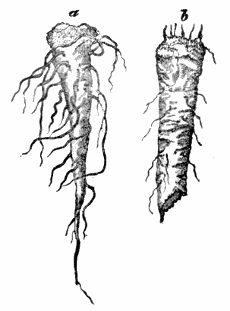
Aconitum Napell′us. [Linn.] Syn. Aconi′tum, Ph. L., E., & D.; Aconitnapèl, chaperon de moine, Fr.; Eisenhut, Blauersturmhut, Ger. Early blue wolfsbane, or deadly aconite. Hab. Various parts of Europe; grows wild in England, flowering in June and July. The fresh and dried leaves (ACONITI FO′′LIUM), Ph. L. & E. The root (ACONITI ra′dix), Ph. L. & D. This is the species of aconite ordered in the pharmacopœias, and commonly used in medicine. When chewed it imparts a sensation of acrimony, followed by a pungent heat of the lips, gums, palate, and fauces, which is succeeded by a general tremor and chilliness. The juice applied to a wound or the unsound skin affects the whole nervous system. Even by remaining long in the hand, or on the bosom, it produces unpleasant symptoms. Fatal cases of poisoning, by eating the root in mistake for horseradish, have been common of late years. The two roots may be, however, easily distinguished from one another; when scraped aconite emits an earthy, and horseradish its well-known pungent odour. Moreover, the shape of the roots is very different. In the accompanying figure a represents aconite root, and b horseradish root.
The leaves should be gathered as soon as the flowers appear. The root should be taken up in autumn. When the whole plant is employed, it should be gathered as soon as the flowers begin to open. The strength (richness in aconitia) varies considerably with the time of the year. 1 oz. of the fresh root contains 1⁄4 to 3⁄4 gr. of aconitia; 1 lb. of the dried English root contains from 12 to 36 gr. (Herapath). The leaves possess the greatest activity just before flowering; the root, after it. The root is at all times fully six times as strong as the leaves or herb. The wild plant contains much more aconitia than that which is cultivated. The herb, and all its preparations, lose their efficacy if long kept. The powder, more particularly, cannot be relied on. Mr Holmes says it is difficult to find in a commercial sample of aconite root one root in a dozen, which upon fracture appears sound and in good condition.
Properties, Antidotes, &c. See Aconite.
Tests, &c. See Aconite.
Uses, &c. In small doses aconite is narcotic, powerfully diaphoretic, and sometimes diuretic; in larger ones, the symptoms are similar to those produced by aconitia. It acts as a powerful sedative on the heart’s action, and destroys sensibility without disturbing the mental faculties. It has been given in chronic rheumatism, gout, paralysis, scirrhus, scrofula, cancers, venereal nodes, epilepsy, amaurosis, intermittents, &c.; but its exhibition requires the greatest possible caution. As a topical benumber it has been used with great advantage in painful affections depending on increased sensibility of the nerves. Externally it “is most valuable for the cure of neuralgic and rheumatic pains. In neuralgia, no remedy, I believe, will be found equal to it. One application of the tincture produces some amelioration; and after a few times’ use, it frequently happens that the patient is cured. In some cases, the benefit appears almost magical. In others, however, it entirely fails to give permanent relief.” “I do not think that in any (case) it proves injurious.” “When it succeeds, it gives more or less relief at the first application. When the disease depends on inflammation, aconite will be found, I think, an unavailing remedy.” “In rheumatic pains, unaccompanied with local swelling or redness, aconite is frequently of very great service.” (Pereira, iii, 691.) Dose, of the powder, 1 to 2 gr., gradually increased to 6 or 8. Dr Stocrk was the first who gave wolfsbane internally, about the year 1762. It has since been successfully employed in Germany in cases of chronic rheumatism, gout, &c., some of which were of long standing and had resisted every other remedy. In England it has been less extensively used.
Aconitum Panicula′tum. Panicled wolfsbane; a species formerly ordered in the Ph. L.; and, with a. napellus, also in the Ph. U. S. It is less active than the officinal species.
A′CORN. Syn. Glans. quer′cus, L. The seed or fruit of the oak. In the early ages of the world, acorns probably formed one of the principal articles of the food of man. (Ovid, Met., i, 106; Virgil, Georg., i, 8; &c.) In modern times, during periods of scarcity, they have been consumed as food on the Continent. Besides starch, they contain a peculiar species of sugar, which crystallises in prisms, and is unfermentable; they also contain tannic and gallic acids. Mannite and dulcose are the substances which it most nearly resembles. (M. Dessaignes.) During the autumn, acorns are said to be sometimes poisonous to cattle and sheep. Supposed cases of so-called acorn poisoning are best treated by withdrawing the supply of acorns, or removing the animals from the pastures on which the acorns fall, and by the administration of aperients, alkalies, and stimulants.
AC′ORUS CAL′AMUS. See Sweet Flag.
ACOTYLE′DONS (-ko-te-lē′-). Syn. Acotyle′dones (dŏn-ēz; L., prim. Gr.), Jussieu; Acotylédons, Fr.; Ohne samenlappen, Ger. In botany, plants whose seeds are not furnished with distinct cotyledons or seed-lobes. Acotyledonous plants form one of the two great divisions of the vegetable kingdom, according to the natural system. They are remarkable by increasing chiefly in length, by additions to their end; and not by addition to the outside, as in Exogens; nor to the inside, as in Endogens. They are also termed Asex′ual and Flowerless Plants, and answer to the Cryptogamia of the Linnean system. See Acrogens, Cellulares, Thallogens, &c.
ACOUS′TICS (-kow′-). The science of audition and sound; that branch of physics which treats of their cause, nature, and phenomena. The doctrine of the production and transmission of sound is termed Diacous′tics; that of reflected sound Catacous′tics.
Acoustics. In medicine, remedies employed to relieve deafness. See Deafness and Drops, Acoustic.
ACQUETTA. [It., Little Water.] Syn. Aqua Toffana; A. Toffania; Acquetta di napoli della Toffana, It. A celebrated poison, prepared by an Italian woman named Toffano, or Tophana, and in great request in Rome about the middle of the 17th century. The composition of this poison has been a matter of frequent controversy. Pope Alexander VII, in his proclamation, described it as “aquafortis distilled into arsenic.” This would produce a concentrated solution of arsenic acid. The Emperor Charles VI, who was governor of Naples during Toffano’s trial, declared to his physician, Garelli, that it was arsenic (arsenious acid) dissolved in aqua cymbalariá. According to Gerarde this cymbalarià was an aquatic species of pennywort, highly poisonous. The only objection to the latter statement is the smallness of the dose, regard being had to the comparative insolubility of arsenious acid; but if the woman Toffano prepared two poisons, as is probable from history—one, a single dose of which was fatal, and another, of which the dose required repetition, and which was more gradual in its activity—the discrepancy will be at once removed.
AC′RID. Syn. Ac′er, Ac′ris, L.; Acre (âcre), Fr.; Beissend, Scharf, Ger. In chemistry and medicine, sharp, pungent, acrimonious. Acrid substances are such as excite a sensation of pungency and heat when tasted, and which irritate and inflame the skin; as mustard, turpentine, cantharides, &c.
ACRIDITY. Syn. AcretÉ, Fr.; Acritudo, L. The quality of being acrid.
AC′RIMONY. Syn. Acrimo′nia, L.; Acrimonié, Acreté, Fr.; Scharfe, Ger. In medicine and chemistry, the quality or property of inflaming, irritating, corroding, dissolving, or destroying other bodies.
ACROGENS. Syn. Acrogenæ, L.; Acrogènes, Fr. In botany, acotyledonous or cryptogamic plants, in which stems and leaves, or an organisation approaching leaves, are distinguishable; which have stomates or breathing spores on their surface, are propagated by spores, and increase by the growth of the stem at the point only. Ferns and club-mosses are examples of this class of plants.
ACROLEIN. Syn. Acrylic Alcohol. This substance occurs amongst the products of decomposition when glycerine or any of its compounds is subjected to ordinary distillation. It derives its name from its violently irritant effect upon the mucous membranes of the eyes and respiratory organs. It is best prepared by the process of Redtenbacher (see ‘Leibig’s Ann.,’ xlvii, 114), by distilling in a capacious retort, a mixture of glycerine with phosphoric anhydride, or with hydric-potassic sulphate (the acid sulphate or bisulphate of potash); the vapours must be condensed in a properly cooled receiver, which is luted on to the retort and provided with a tube opening into a chimney having a good draught. The distilled liquid separates into two layers, the upper one consisting of acrolein, and the lower one of an aqueous solution of the same substance mixed with a quantity of acrylic acid. This distillate, after digestion with finely powdered litharge, with the object of neutralising the acid, must be rectified by the heat of a water bath: the acrolein so obtained must be submitted to a second rectification from calcic chloride. All these operations must be conducted in vessels filled with carbonic anhydride (carbonic acid) because acrolein becomes rapidly oxidized when exposed to the air.
Acrolein is a clear colourless liquid, lighter than water, boiling at about 125° F. It has great refracting power and a burning taste; when pure it is neutral to test paper.
AC′ROSPIRE (-spire). Syn. Acrospi′ra, L.; Plumule, Fr.; Blattkeim, Ger. The shoot or sprout of a seed, when it begins to grow; the part of a germinating seed termed the plume, or plumula.
When the growth of a seed begins to be developed, the germ, from which the stem originates, shoots forth under the form of a delicate curved fibre, which, gradually bursting its covering, makes its appearance at the end of the seed. The fibrils of the radicle first sprout forth from the tip of the grain; a white elevation appears, that soon divides into three or more radicles, which rapidly grow larger, and are succeeded by the plumula, which peeps forth at the same point, in the form of a pale green leaflet, which, twisting thence beneath the husk to the other end of the seed, ultimately bursts its prison-house, and becomes a perfect leaf. See Germination and Malting.
ACTINIC RAYS. See Actinism.
ACTINISM. Syn. Actinic Rays; Chemical Rays. A term given to a supposed principle accompanying the heat and light of the sunbeam. Actinic rays chiefly exist beyond the violet extremity of the solar spectrum, and are characterised by the power of exciting chemical change, e.g., the decomposition of certain silver salts (in photography); the combination of a mixture of chlorine and hydrogen, &c. The so-called vital functions of animals and plants are also greatly influenced by the actinic or chemical rays.
ACTINOGRAPH. An instrument for registering the intensity of the chemical influence (actinism) of the sun’s rays.
ACT, TOWNS IMPROVEMENT CLAUSES, 1847 (10 & 11 Vict., c. 34), The following provisions of this Act are incorporated in the Public Health Act, 1875, and refer exclusively to urban districts:—
1. With respect to naming the streets and numbering the houses.
2. With respect to improving the line of the streets and removing the obstructions.
3. With respect to ruinous or dangerous buildings.
4. With respect to precautions during the construction and repair of sewers, streets, and houses.
5. With respect to the regulation of slaughter houses.
Notices for alterations under the 69th, 70th, and 71st sections, directions under the 73rd section, and orders under the 74th section of the said Towns Improvement Clauses Act, may, at the option of the urban authority, be served on owners instead of occupiers, or on owners as well as occupiers, and the cost of works done under any of these sections may, when notices have been so served on owners, be recovered from owners instead of occupiers; and when such cost is recovered from occupiers, so much thereof may be deducted from the rent of the premises where the work is done as is allowed in the case of private rates under the Act.
AC′TUAL. Real, effectual, absolute; as opposed to that which is merely virtual or potential. In surgery, a red-hot iron, or any other heated body, used as a cautery, is termed the ACTUAL CAUTERY; whilst a caustic or escharotic so employed is called the POTENTIAL CAUTERY.
ACTUAL CAUTERY. See Actual.
ACUTE′. Syn. Acut′us, L.; Aigu, Fr.; Heftig, Hitzig, Spitzig, Ger. Sharp, pointed, sensitive. Applied to the senses, as acute hearing, eyesight, &c. In pathology, diseases exhibiting violent symptoms, and whose course is short, are said to be acute diseases.
ADAPTER. In chemistry, a tube placed between two vessels (commonly a retort and receiver) for the purpose of uniting them or increasing the distance between them, so as to facilitate the condensation of vapour in distillation. (See figure.)
ADDER’S TONGUE. Syn. Common adder’s tongue; Ophioglos′sum vulga′tum, Linn. A perennial plant, of the natural order Filices (DC.), growing wild in England. It is found in our woods and pastures, and flowers in May and June. It was once used to form a celebrated traumatic or vulnerary ointment and is still highly esteemed among rustic herbalists.
ADEPS. Syn. Lard. See Adeps præparatus, Fat, and Lard.
ADEPS BENZOATUS. Syn. Benzoated Lard.
ADEPS PRÆPARATUS. Syn. Axunge; Prepared Lard.
ADHE′SION (-hē-zhün). Syn. Adhæ′sio, L.; Adhesion, Fr.; Anhängung, Arxlebung, Ger. The act or state of sticking or being united.
Adhesion. In physics, the force with which bodies remain attached to each other when brought into contact; e.g., ink adheres to paper, paint adheres to wood, &c. It differs from ‘cohesion’ in representing the force with which different bodies cling together; whereas cohesion is the force which unites the particles of a homogeneous body with each other, e.g., particles of iron cohere and form a mass of iron; particles of water cohere and form a mass of water, &c.
Adhesion. In pathology, the morbid union, from inflammation, of parts normally contiguous but not adherent.
Adhesion. In surgery, the reunion of divided parts, by the adhesive inflammation; as when incised wounds heal by what is termed the ‘first intention.’
ADHE′SIVE. Syn. Adhæsi′vus, L.; Adhésif, Fr.; Adhäsive, Verwachsend, Ger. In pharmacy, &c., having the quality or property of sticking or adhering. Hence adhe′siveness.
AD′IPOCERE (-sēre). Syn. Grave-wax‡; Adipoce′′ra, L.; Adipocire, Fr.; Fetewachs, Ger. A substance resembling a mixture of fat and wax, resulting from the decomposition of the flesh of animals in moist situations, or under water. It is chiefly margarate of ammonium. Lavoisier proposed to produce this substance artificially, for the purposes of the arts. Attempts have since been made to convert the dead bodies of cattle (carrion) into adipocere, for the purposes of the candle-maker and the soap-boiler, but without success. Besides, dead animal matter can be worked up more profitably than in making artificial adipocere.
Hatchettine or rock-fat is sometimes called ‘adipocere’; and bog-butter is a substance nearly similar to it.
AD′JECTIVE. Syn. Adjecti′vus, L.; Adjectif, Fr. In dyeing, depending on another, or on something else; applied to those colours which require a base or mordant to render them permanent. See Dyeing.
AD′JUVANT. [Eng., Fr.] Syn. Ad′juvans, L.; Aidant, &c., Fr. Assistant; helping. (As a substantive—) In prescriptions, see Prescribing (Art of).
ADULTERATION. Strictly speaking, this term ought only to be applied to the practice of adding substances to articles of commerce, food or drink, for the purposes of deception or gain, but a wider interpretation is frequently placed on the word than the definition given by magistrates and analysts, these latter often regarding accidental impurity, or even, in some instances, actual substitution as acts of adulteration.
The following definition of an adulterated substance has been adopted by the Society of Public Analysts—
A substance shall be deemed to be adulterated—
A. In the ease of food or drink:
1. If it contain any ingredient which may render such article injurious to the health of a consumer.
2. If it contain any substance that sensibly increases its weight, bulk, or strength, or gives it a fictitious value, unless the amount of such substance present be due to circumstances necessarily appertaining to its collection or manufacture, or be necessary for its preservation, or unless the presence thereof be acknowledged at the time of sale.
3. If any important constituent has been wholly or in part abstracted or omitted, unless acknowledgment of such abstraction or omission be made at the time of sale.
4. If it be an imitation of or sold under the name of another article.
B. In the case of drugs:
1. If when retailed for medical purposes under a name recognised in the ‘British Pharmacopœia’ it be not equal in strength and purity to the standard laid down in that work.
2. If when sold under a name not recognised in the ‘British Pharmacopœia’ it differs materially from the standard laid down in approved works on materia medica, or the professed standard under which it is sold.
Limits. The following shall be deemed limits for the respective articles referred to:
Milk shall contain not less than 9·0 per cent., by weight, of milk solids, not fat, and not less than 2·5 per cent. of butter fat.
Skim Milk shall contain not less than 9·0 per cent. by weight, of milk solids not butter fat.
Butter shall contain not less than 80 per cent. of butter fat.
Tea shall not contain more than 8·0 per cent. of mineral matter, calculated on the tea dried at 100° C., of which at least 3·0 per cent. shall be soluble in water, and the tea as sold shall yield at least 30 per cent. of extract.
Cocoa shall contain at least 20 per cent. of cocoa fat.
Vinegar shall contain not less than 3 per cent. of acetic acid.
The practice of fraudulent adulteration has been indulged in for centuries. In every civilised state there have been enactments against it. The Romans had their inspectors of meat and corn. In England an Act to prohibit adulteration was passed as early as 1267, and penalties against it were in force in 1581, 1604, 1836, 1851. In 1822, Accum published a work having the sensational title of ‘Death in the Pot,’ and in 1855 appeared Dr Hassall’s book, ‘Food and its Adulterations.’ The information conveyed in these works, added to the revelations of the ‘Lancet’ Sanitary Commission, and the contributions to scientific literature on the subject of food by Letheby, Pavy, Parkes, Blyth, and others, together with the published evidence given before the House of Commons Commission appointed to carry out an inquiry into the subject, roused public attention to such a degree as to lead to the passing by the legislature of the Adulteration Acts.
The sophistications may be divided into several distinct classes:
1. To give weight or volume, such as water added to butter, plaster of paris to flour, &c.; red earths to annatto, sand to tea-leaves, &c.; water to milk, &c.; all these, therefore, are substitutions of worthless or very cheap articles which take the place of the real.
2. To give a colour which either makes the article more pleasing to the eye, or else disguises an inferior one, e.g., Prussian blue, black lead, &c., to green teas; annatto to cheese, &c.; arsenite of copper to sweetmeats, &c.
3. Substitutions of a cheaper form of the article, or the same substance from which the strength has been extracted put in the place of the real, e.g., tea mixed with spent leaves, &c.
4. A very small class where the adulteration is really added with no fraudulent intent, but to enhance the quality of the goods sold—alum to bread in small quantities.
The following, according to Blyth (‘Dic. of Hygiène’), is a list of articles most commonly adulterated, with the names of the substances used in their sophistication:—
Aconitia with other alkaloids, e.g., delphinia, aconella, &c.
Ale, common salt, Cocculus indicus, grains of paradise, quassia, and other bitters, sulphate of iron, alum, &c.
Allspice, mustard husks.
Anchovies, other fish, and colouring matters, e.g., Armenian bole, Venetian red, &c.
Annatto, all sorts of starch, soap, red ferruginous earths, carbonate and sulphate of lime, salts, &c.
Arrowroot, various other fecula, such as sago, tapioca, potato, and others.
Balsam of Copaiba, turpentine and fixed oils.
Beef (Potted), Armenian bole.
Bismuth, carbonate of lead, sometimes arsenic (this latter is an impurity not intentional).
Bloaters (Potted), Armenian bole.
Brandy, water, burnt sugar, &c.
Bread, potatoes (mashed), alum, inferior flour, &c., &c.
Butter, water, salt, colouring matter, lard, tallow, and other fats.
Cajuput Oil, copper, camphor dissolved in oil of rosemary, and coloured with copper as a substitute.
Calamine, coloured sulphate of baryta.
Calomel, sulphate of baryta, chalk, white precipitate, white lead, pipe-clay, &c., &c.
Calumba, tinged bryony root, root of Frasera Walteri, and others.
Camboge, starch, &c.
Camphor, a substitution of Borneo camphor has been made.
Cantharides, golden beetle, artificially coloured glass, &c.
Carbonate of Lead, sulphate of baryta, sulphate of lead, chalk, &c., &c.
Carmine (Cochineal), sulphate of baryta, bone black, &c.
Cassia (Senna), leaves of Solenostemma argel, and other foreign leaves.
Castor Oil, other oils, often small quantities of croton oil.
Cayenne, ground rice, vermilion, Venetian red, turmeric.
Champagne, gooseberry and other wines as substitutes, different colouring matters, &c.
Cheese, annatto, bole (Armenian), and other colouring matters.
Chicory, colouring matters, such as ferruginous earths, and burnt sugar, Venetian red, &c., and different flours, such as wheat, rye, beans, &c., and sometimes sawdust.
Cider, lead (as an impurity, not intentional).
Cigars, substitutions of hay and other rubbish, inferior tobacco, leaves sometimes darkened by some brown vegetable dye.
Cinnamon, cassia, clove stalks, and different flowers.
Claret, brandy, and substitution of inferior wines.
Cloves, clove stalks.
Cocoa and Chocolate, cheaper kinds of arrow-root, such as Tous les mois and East Indian, animal matter, corn, sago, tapioca, &c.
Coffee, chicory, roasted wheat, rye flowers, and colouring matters, such as burnt sugar, &c.
Cod-liver Oil, other oils mixed with it.
Colocynth (Compound Extract of), the extract is not unfrequently made with the pulp and seeds.
Confectionery, injurious colouring matters, such as arsenite of copper, chromate of lead, &c.
Confection, Aromatic (Aromatic Chalk Powder), expensive ingredients omitted, turmeric substituted for saffron, &c., &c.
Copal, gum dammar, resin, &c.
Curry-powder, red lead, ground rice, salt.
Cusparia Bark, the bark of Strychnos Nux Vomica is said to have been substituted.
Custard and Egg Powder, turmeric, chrome yellow, and different flours.
Elaterium, starch, flour, chalk, &c.
Epsom Salts, chloride magnesium, chalk, &c.
Ether, alcohol.
Flour, other and inferior flours, as the flour from rice, bean, Indian corn, potato, &c., sulphate of lime, alum.
Gelatine, salt and sugar.
Gin, water, sugar, capsicum, flavouring matters of different kinds, turpentine, alum, tartar.
Ginger, turmeric, and husks of mustard, flour from wheat, sago, &c.
Guaiacum Resin, other resins.
Honey, flour, cane sugar, &c.
Hops, Cocculus indicus, grains of paradise, &c., &c.
Iodide of Potassium, water, carbonate of potash, chlorides of soda and potash, iodate of potash, iodine, &c.
Iodine, water, plumbago, charcoal, black oxide of manganese, &c.
Ipecaquanha, other roots, extraneous woody fibre; when in powder, chalk, flour, &c., have been added.
Isinglass, gelatine.
Jalap, raspings of guaiacum, false jalap root, &c.
Lard, carbonate of soda, salt, potato, flour, and lime.
Lemon Juice, a mixture of sugar and water, acidulated with sulphuric acid, has been substituted.
Liquorice, rice, chalk, gelatine, and different flours.
Magnesia, Magnesia Sulphate, lime, carbonate of magnesia.
Magnesia, Carbonate, lime, sulphate, &c., &c.
Marmalade, apple, or turnip pulp.
Mercury, lead, tin, zinc, bismuth, &c.
Mercury Green Iodide of, red iodide of
Mercury Red Oxide of, brick-dust, red lead, &c.
Mercury Ammoniated (WHITE PRECIPITATE), chalk, carbonate of lead, plaster of Paris, &c., &c.
Milk, water.
Mustard, turmeric, wheat flour.
Myrrh, gum bdellium, and other gum resins.
Oatmeal, barley flour, rubble.
Opium, stones, sand, clay, vegetable extracts, sugar, treacle, water, &c.
Pareira Root, different roots substituted.
Pepper, linseed meal, different flours, mustard husks, &c.
Pickles, salts of copper, acetate of copper.
Porter and Stout, sugar, treacle, water and salt.
Potash, carbonate, sulphate, and chloride of potash, lime, iron, and alumina.
Potash, Acetate of, sulphates, and chlorides of potash.
Potash, Carbonate of, sulphates, and chlorides of potash.
Potash, Bicarbonate of, carbonate of potash.
Potash, Citrate of, sulphates of potash.
Potash, Chlorate of, chloride of potassium.
Potash, Tartrate of, tartrate of lime.
Potash, Nitrate of, sulphate or chloride of potassium.
Preserves, salts of copper.
Quinine, sulphate of lime, chalk, magnesia, cane-sugar, sulphate of cinchonine, &c.
Rhubarb, turmeric, and inferior varieties substituted for Turkey.
Rum, water, cayenne, burnt sugar.
Sago, potato flour.
Sauce, treacle, salt, cochineal, Armenian bole, and other colouring matters.
Scammony, chalk, starch, guaiacum, jalap, dextrin, &c.
Senega, guiseng, gillenia.
Senna, leaves of cynanchum argel.
Sherry, sulphates of potash, soda, brandy, burnt sugar, &c.
Snuff, carbonate of ammonia, glass, sand, colouring matter, &c.
Soda, Bicarbonate, carbonate and sulphate of soda.
Soda, Carbonate, sulphate of soda.
Soda, Phosphate of, phosphate of lime.
Spices, colouring materials, substitutions, and different flours.
Squills (Powdered), wheat flour.
Sugar (Moist), sand, flour, &c.
Sulphur, sulphurous acid (as an impurity).
Sulphuric Acid, lead, water, arsenic, hydrochloric acid, &c.
Tapioca, mixing inferior starches with the pure tapioca.
Tea, sand, iron filings, exhausted tea leaves, foreign leaves; and in green teas, black lead, Prussian blue, China clay.
Tobacco, inferior tobacco, water.
Turmeric, yellow ochre, carbonate of soda, or potash.
Uva Ursi (Bearberry Leaves), leaves of red whortleberry, and others.
Vinegar, sulphuric acid, and metallic impurities.
Wines, water, jerupiga, bitartrate of potash, substitution of inferior wines, brandy, spirits, and various other matters.
Zinc, Oxide of, chalk, carbonate of magnesia.
“The Sale of Food and Drugs Act” has now supplemented several Acts which were passed during the present century for the prevention of adulteration. An Act prohibiting the mixture of injurious ingredients with intoxicating liquors remains unrepealed, as do also one or two statutes relating to trade frauds as for example the Adulteration of Seeds Act, 1809. These latter have not been incorporated in “the Sale of Food and Drugs” Act.
Æ (ē). [L.] For words sometimes written with this initial diphthong, and not found below, look under E.
ÆGI′RINON (-jī′-). [Gr.] See Ointment.
ÆGYPTI′ACUM† (-jĭp-tī′-). [Lat.] Syn. Unguen′tum Ægyptiacum, L. Oxymel or liniment of verdigris. The name originated with Hippocrates, who is said to have learned its composition in Egypt.
ÆOL′IPILE (-pĭle). A hollow ball of metal, having a slender neck with a very small orifice, contrived to exhibit the conversion of water into steam by the action of heat, and to account for the natural production of winds. It was known to the ancients, is mentioned by Vitruvius, and was studied by Descartes and others. It has been used in surgery to produce eschars, in the same cases as moxas; the effect of the steam being limited by means of a piece of perforated pasteboard. When filled with alcohol, and the jet of vapour inflamed, it is sometimes employed as a blowpipe. M. Soyer used an apparatus of this kind to supply the heat in his portable furnace. The liquid, however, which he employed was camphine.
A′ER, (ā′-ĕr). [L. prim. Gr.] Air.
A′ERATED (ā′-ĕr-rāte-ĕd). In chemistry, &c., impregnated with carbonic acid. See Alkali, Lemonade, Waters, Mineral.
AE′′RIAL (ā-ēre′-e-ăl). Belonging to the air or atmosphere; produced by, consisting of, depending on, or partaking of the nature of the air.
AERIFICA′TION (ā-ĕr-e-). Syn. Aërifica′tio, L.; Aérification, Gazéification, Fr. In chemistry, the conversion of a body into gas.
A′ERIFORM (ā′-ĕr-). Syn. Aëriform′is, L.; Aériforme, Gazéiforme, Fr. Luftformig, &c., Ger. In chemistry, air-like, gaseous.
AEROL′OGY. Syn. Aërolo′gia, L.; Aérologie, Fr., Ger. In physics, a discourse or treatise of the air. In physiology and hygiène, the doctrine of the air, more especially with regard to its salubrity and action on organised beings.
AEROM′ETER. Syn. Aërome′trum, L.; Aéromètre, Fr. An instrument used in aërometry.
AEROM′ETRY. Syn. Aërome′tria, L.; Aérométrie, Fr.; Luftmesskunst, &c., Ger. In chemistry and physics, the art of measuring gases, and of determining their densities.
AERONAUT′ICS. Syn. Aéronautique, Fr. The art of sailing in, or of navigating the air. See Balloons.
AEROPHO′BIA. [L.] Syn. Aérophobie, Fr. In pathology, a dread of air (wind); a common symptom in hydrophobia, and occasionally present in hysteria and phrenitis.
AEROSTAT′ICS. Syn. Aérostat′ica, L.; Aérostatique, Fr. That branch of pneumatics which treats of air, and other elastic fluids, in a state of rest.
AEROSTA′TION. [Eng., Fr.] Syn. Aërosta′tio, L. The art of weighing the air; aërial suspension and navigation. See Balloons.
ÆRU′GO (ē-). [L.] The rust of brass, bronze, or copper; verdigris.
ÆSCULIN. C21H24O13. A crystalline fluorescent substance existing in the bark of the horse-chestnut (æsculus hippocastanum) and of other trees of the genera Æsculus and Paria. In the above-named sources Æsculin is associated with another fluorescent body called Pariin.
Æ′′THER. See Ether.
ÆITHE′′REA (-thēré-). [L. pl.] Ethers.
ÆSTHET′ICS (ēz-). Syn. Æsthet′ica, L. Medicines or agents which affect sensation. See Anæsthetics and Hyperæsthetics.
ÆTHIOPS. See Ethiops.
AFFEC′TION. [Eng., Fr.] Syn. Affec′tio, L. In pathology, a term nearly synonymous with disease.
AFFINITY. Syn. Chemical affinity; Affinitas, L.; Affinité, Fr.; Verwandtschaft, Ger. If oil and water be shaken together they produce no change upon one another, as is proved by their separating into two layers with their properties unaltered, when the mixture is allowed to remain at rest for a short time. Such bodies are said, in chemical language, to have no affinity for one another. If iodine and metallic mercury be rubbed together in a mortar they will unite in definite proportions by weight, and form a combination possessing properties totally distinct from those of its constituents. Thus, iodine is a greyish, metallic-looking solid, convertible into a violet vapour by heat, perceptibly soluble in water, and capable of producing a blue compound with starch. Mercury is a metallic, silvery-looking liquid. The product of their union (biniodide of mercury) is a scarlet powder, destitute of metallic lustre, convertible into vapour by heat, without the production of violet fumes, insoluble in water, and incapable of developing a blue colour with starch. Again, the greenish-yellow and intensely poisonous gas, chlorine, unites in definite proportions by weight with the soft, wax-like, and highly poisonous metal sodium to produce the white crystalline solid chloride of sodium (common salt), a compound which, except in very large quantities, is not only not poisonous, but actually beneficial to health.
Such combinations are called chemical compounds, and the force which binds their constituents together is distinguished from all other attractive forces by the term affinity or chemical affinity. Bodies united by affinity are also said to have united chemically.
Affinity is in most cases exerted between different substances, in which respect it resembles adhesion; but bodies united by adhesion, e.g. ink to paper, paint to wood, &c., unlike those united by affinity, suffer no change of properties.
Affinity is exerted at immeasurable distances, therefore substances to be submitted to its influence must be brought into (apparently) actual contact. This condition is frequently fulfilled by the vaporisation, fusion, or solution of one or more of the bodies to be submitted to its action.
In many instances substances which have no affinity for one another at ordinary temperatures manifest this power when heated.
Whenever chemical union takes place, heat is invariably evolved; conversely, the decomposition of a chemical compound is always accompanied by an apparent loss of heat or reduction of temperature.
Finally, the most striking phenomena characteristic of, and accompanying, chemical affinity are, development of heat, change of properties, and union in definite or constant proportions by weight.
AFFUSION. In chemistry, the washing of a precipitate, &c., for the purpose of removing soluble matters. In medicine, affusion is of three kinds:—
1. Lotions, which consist in washing a part of the body with a sponge or rag soaked in a liquid.
2. Aspersions, which consist in throwing a liquid drop by drop, like rain, upon the body.
3. Shower baths, which consist in allowing a number of small streams of water to fall from a height upon the surface of the body. If the water fall from a considerable height, affusion is then termed douche by the French.
AFT′ER-DAMP. Syn. Choke-damp. Carbonic acid gas resulting from explosion of air and fire-damp (light carbonetted hydrogen) in coal mines.
AFT′ER-PAINS. Those following childbirth. The only remedy is patience; they may, however, be frequently alleviated by small doses of morphia or liquor opii sedativus. Heated cloths and warm fomentations are sometimes useful, particularly if assisted by moderate but sufficient pressure on the abdomen, by means of a broad bandage. They seldom follow with severity the first birth.
Treatment for Animals. Remove clots from parts, raise the hind-quarters. Give clysters of linseed tea, lukewarm, and laudanum or belladonna extract. Syringe out parts with Condy’s fluid considerably diluted. Give internally belladonna, opium, or chloroform. Draw away milk.
AFT′ER-WASH (wŏsh). In the art of the distiller, the liquor in the still after the spirit has been drawn over.
AG′ARIC. [Eng., Fr.] Syn. Agar′icum, Agar′icus, L.; Blätterschwamm, Pilz, Schwamm, Ger. In botany, a genus of fungi, of numerous species, embracing the mushrooms and champignons. Of these plants, some are edible; others poisonous. The term is also commonly applied to the boletus found on oaks (TOUCHWOOD), and on larches (MALE AGARIC). See Mushrooms.
Fly-agaric. Syn. Fly mush′room; Agar′icus musca′′ria, Linn.; Amani′ta m. One of the most narcotic and poisonous of our fungi, producing, in small doses, intoxication and a pleasing species of delirium; for which purpose it is commonly employed in Kamschatka. (Hooker.) It possesses the singular property of imparting an intoxicating quality to the urine, which continues for a long time after taking it. This secretion is, therefore, commonly saved by the natives during a scarcity of the fungus. “Thus, with a few amanitæ, a party of drunkards may keep up their debauch for a week;” and the intoxication so produced is capable of “being propagated through five or six individuals.” (Langsdorff.) Water in which it has been boiled is poisonous; but the boiled fungus itself is inert. The liquid from it is used as a fly-poison; whence the name mushroom is derived. It may be known by its rich orange-red colour in autumn.
AG′ATE (-āte, -ĕt‡). [Eng., Fr.] Syn. Acha′tes (-kā′-tēz), L. A semi-pellucid uncrystallised species of quartz, remarkable for its hardness, variety of colour, and susceptibility of receiving a high polish. It is an aggregate of various siliceous minerals, of which chalcedony appears generally to be the base. Carnelian, jasper, amethyst, and other similar minerals, often enter into its composition. The colours are often delicately arranged in stripes, bands, or clouds. Those which take an angular form, as the Scotch pebble, are called FORTIFICATION AGATES. It is the least valuable of the precious stones, and is chiefly made into rings, seals, beads, burnishers, &c., on account of its hardness. Its powder is used for cleansing and polishing iron, brass, &c., and to sharpen edge-tools.
AGEING LIQUOR. Dissolve 3 lbs. of chlorate of potash in 4 galls. of boiling water. Add 20 lbs. of powdered white arsenic to 20 lbs. of solution of caustic soda at 60° Tw., and boil until the arsenic is completely dissolved. Add the latter solution to the former, with stirring, until the mixture stands at 28° Tw.
AG′NAIL. See Whitlow.
AGRYPNOT′ICS (-grĭp-). Syn. Anthypnot′ics (-hĭp-); Agrypnot′ica, Anthypnot′ica, L. In medicine and pharmacology, agents or substances which prevent sleep; as tea, coffee, digitalis, vinegar, &c.
A′GUE (-gŭ). Ague may be defined as febrile phenomena occurring in paroxysms, and observing a certain regular succession, characterised by chill, abnormal heat, and unnatural cutaneous discharge, which prove to be a temporary crisis and usher in a remission. These phenomena are developed in an uninterrupted series or succession more or less regular, which pass into each other by insensible stages. Ague is paludal fever, and has always been observed to prevail in marshy moist districts, and in low, swampy humid countries, in which seasons of considerable heat occur.
The neighbourhood of marshes, or of a district which has been at some recent time under water; the banks of extensive lakes, and the shores of rivers and seas where the water flows sluggishly, and in some places stagnates; shallow rivers; extensive level tracts of forest land, where moisture is always present; and the surface of the land constantly covered with excavation from the ground,—these are the terrestrial physical conditions, in which marsh and littoral fevers are almost universally to be found, although it must be admitted that there are some marshy districts in which the disease does not show itself.
In these latter localities the effects of the miasmatic poison, show themselves in cholera or typhus. No precise knowledge of the nature and source of this subtle poison which, in default of a better name we call malaria, has yet been acquired; indeed it has yet to be proved that malaria has a distinct existence. Science has as yet been unable to discover the presence of any poisonous principle in the air of ague on other regions.
Ague may exist without any alteration of structure being set up; but in the milder forms of this fever a greater number of organs and tissues are morbidly altered than perhaps in any other form of disease. The parts so affected are the liver, spleen, lungs, heart, brain, and the serous and mucous membranes of the body generally. Within certain limits, the specific action of the malarial poison may be said to be in the inverse ratio of the intensity of the fever which attends its action. The affections of the liver and spleen also vary greatly according to the locality in which the patient is attacked; for instance, whilst in some parts of India the spleen is the organ principally involved, in other districts of the same continent it is the liver. In England, under proper medical treatment, the patient usually recovers without any manifest derangement either of structure or impairment of function of any organ or tissue. The liver may, however, become affected if the patient suffering from the disease has been neglected for any length of time.
Notwithstanding the opinions of Finke and Professor Colin, there appears to be considerable ground for the supposition that ague may be caused by drinking marsh and surface water. In an interesting paper on the ‘Indian Annals’ for 1856, Mr Bettington, of the Madras Civil Service, says:—“It is notorious that the water produces fever and affections of the spleen.” In confirmation of this assertion, he brings forward what seems to be some remarkably strong evidence. He cites cases of villages placed under the same conditions as to marsh-air in some of which fevers were prevalent, whilst in others they were absent; and he found on inquiry that whilst the latter villages were supplied with pure water, the inhabitants of the former had to drink marsh or mullah water, full of vegetable débris. In one village there were two sources of supply—a spring and a tank, the first fed by surface, and the other by marsh water. Those only who partook of the tank water were attacked by fever. Again, in Tulliwaree the fever was so universal that scarcely any inhabitant escaped it. In this village Mr Bettington caused a well to be dug, and the result was that the fever disappeared. Similar cases have occurred in this country. Twenty years ago Mr Blower, of Bedford, directed the attention of medical men to a case that occurred in a village, in which ague had nearly disappeared when a well was dug; and to another instance which occurred in the village of Houghton. In this parish almost the only family which escaped ague was that of a farmer; the members of this family partook of well water; whilst those who did not escape the disease drank ditch water.
In the ‘Indian Annals’ for 1867 is a paper by Dr Moore, confirming the opinion that ague may be produced by the causes already stated, and M. Commaille (‘Rec. de Mêm. de Med. Mil.,’ Nov., 1868) states that in Marseilles, paroxysmal fevers, formerly unknown, have made their appearance, since the water supply to that city has been drawn from the Marseilles Canal.
In his report for 1870 Dr Townsend, the Sanitary Commissioner for the central provinces of India, states that the natives of India hold an opinion that the use of river and tank water during rainy seasons (when the water always contains an increased quantity of vegetable matter) will almost always cause ague. Boudin (‘Traité de Géographie et de Statistiques Médicale,’ 1857, t. i, p. 142), records an extraordinary case. Eight hundred soldiers, in good health, embarked in three vessels to pass from Bona, in Algiers, to Marseilles, in the year 1834. They all arrived at Marseilles the same day. In two vessels there were 680 men, without a single sick one amongst them. In the third vessel, the Argo, there had been 120 soldiers; 13 died during the short passage, and of the 107 survivors no less than 98 were disembarked suffering from all forms of paludal fevers. We may presume that the diagnosis was correct, since Boudin himself examined the men. When the vessels started the crew of the Argo had not a single sick man aboard. The crew and soldiers of all the boats were exposed to the same atmospheric conditions. The influence of air must, therefore, be excluded. There is no mention of food, but it has never been suggested that food has ever been concerned in the production of malarious fever. It was a very different matter, however, with the water supply. In two of the vessels the water was good, whilst the Argo had been supplied with marsh water, which was offensive to the smell, as well as unpalatable. This latter was supplied to the soldiers, whilst the crew drank uncontaminated water. Amongst those who deny that marsh water is the cause of ague must be quoted Professor Colin. The professor, who is regarded as an authority on intermittent fever, in his work De l’Ingestion des Eaux Marécageuse comme cause de la Dysenterie et des Fièvres intermittentes,’ instances numerous cases in Algiers and Italy in which impure marsh water gives rise to indigestion, diarrhœa, and dysentery, but in no case to intermittent fever; and he states that in all his observations he has never met with an instance of ague having such an origin. Without contesting the case of the Argo, he views it with considerable suspicion, and doubts whether Boudin is correct in his details. Finke also states that, in Hungary and Holland, marsh-water is daily drank without causing any ill-effects. The inhalation of the fumes of oxide of zinc appears to produce in workers of this metal a variety of ague termed by Shackrah “brass ague,” and by Dr Greenhow, “brass-founder’s ague.” The symptoms of the malady are tightness and oppression of the chest; with indefinite nervous sensations, followed by shivering, an indistinct hot stage, and profuse perspiration. These attacks, however, are not periodical.