A CYCLOPÆDIA OF PRACTICAL RECEIPTS, PROCESSES, AND COLLATERAL INFORMATION (continued 5)
Reading edition
In testing solutions of the PURE or CAUSTIC ALKALIES, the colour, on neutralisation, suddenly changes from blue to pink or red, without any intermediate vinous or purple colour being produced.
The quantity of test-acid used gives the absolute or per-centage composition of the sample examined, according to the constitution of the test-acid used.
Standard Acids. The various test-acids in use as described below, each being used by different operators as they think best.
The most convenient test-acid, or normal solution, both for commercial and chemical assays, is perhaps dilute sulphuric acid, which, when intended to be used VOLUMETRICALLY, has the sp. gr. 1·032 at 60° Fahr., and contains in 100 alkalimetrical divisions 1000 water-grains measure, or 1 litre, exactly 49 gr. (or grammes) of sulphuric acid; and when intended to be used GRAVIMETRICALLY, or by weight, has the sp. gr. 1·033, and contains in 1000 gr. (or grammes) weight exactly 49 gr. (grammes) of sulphuric acid; and, in both cases, consequently corresponds to 1 equiv. of every other base. These dilute acids are easily prepared by mixing 1 part of the concentrated acid with 11 or 12 parts of distilled water; the precise quantity depending on the strength of the acid employed, and must be so arranged that 1000 grains shall exactly neutralise 1000 grains of water containing 53 grains of pure anhydrous sodium carbonate.
This acid (as well as all those hereafter mentioned) may be kept faintly tinged with litmus, which is often more convenient than tinging the alkaline solution at the time of making the assay.
It will at once be seen that every alkalimeter division of the first of the above acids, and every 10 gr. of the second, represent the 1⁄100th part, or 1% of alkali whenever the equivalent weight[18] of the latter is taken for the assay. Every 1-10th part of an alkalimeter-division (or every drop), and every grain weight (when a Schüster’s alkalimeter is employed) then respectively represents the 1⁄10 of 1%; and the result sought is obtained without the necessity of any calculation.
This is obvious—for if the equivalent of a pure alkali or of its carbonate (i. e. one of 100%) requires an equiv. (100 alkalimeter-divisions, or 1000 gr.) of test-acid to saturate it, an alkali or alkaline carbonate of 75%, 50%, or 25%, will respectively require only 75, 50, or 25 divisions, or 750, 500, or 250 gr.; and so of other strengths in proportion. The only precaution necessary is always to take the standard weight for the assay answering to the equiv. of the denomination of the per-centage result sought. Thus, in testing a carbonate of potash, we may either wish to determine its per-centage richness in ‘dry carbonate,’ or in ‘pure potassa,’ the latter being usually the case. To obtain the first, we must take 69 gr. for the assay; and to obtain the second, 47 gr. With CAUSTIC ALKALIES, or mixtures containing them, the weight, in grains, taken for the assay, must always correspond to the equiv. of the pure base. See Table II, at the end of this article.
In commercial assays, when 100 gr. (or some aliquot part thereof) are taken for trial, the per-centage result is obtained from the number of alkalimeter-divisions, or the number of grains, of the test-acid consumed, by the common Rule of Proportion. Thus:—A crude sample of potash having taken 90 alkalimeter-divisions of test-acid to neutralise it, would contain—
100 : 47 :: 90 : 42·30%
or nearly 421⁄3 per cent. of pure potassa. If only 50, 25, or 20 gr. are tested, the result must, of course, be double, quadruple, &c., as the case may be. Or the third term of the proportion may be multiplied by the denominator of the fraction representing the aliquot part. This, in the case of 50 gr. (repeating the above example), would be—
10 : 47 :: 45 × 2 : 42·30%
as before; but even these easy calculations may be simplified, as is shown below.
One of the advantages, and not the least, attending the use of test-acids corresponding to equivalents, is, that by means of the simple Rule of Three, the per-centage quantity of alkali may be found whether 100 or any other number of grains have been submitted to trial. For—The weight of the sample tested (in grains) bears the same relation to the equivalent weight of the alkali under examination, that the number of alkalimeter-divisions or of the grains of test-acid consumed do to the per-centage of alkali sought. Thus, with a sample of 33 gr. of pearlash taking 35 alkalimeter-divisions or 350 grains (every 10 gr. being = 1%) of test-acid for neutralisation, this would be—
33 : 47 :: 35 : 49·85%
or nearly 50 per cent. of pure potassa. By substituting the equiv. of the dry carbonate of potash (69), for that of pure potassa used above, the quantity of that article corresponding to the same weight of the pure alkali may be at once found. Repeating the last example this will be—
33 : 69 :: 35 : 73·18%
or nearly 731⁄4 per cent. The same applies to all the alkaline bases and their carbonates.
For commercial purposes, there is used, amongst others, an empirical solution, as a test-acid for potassa, soda, and ammonia, to save the necessity of calculation.
This is dilute sulphuric acid having a sp. gr. of about 1·071; 100 alkalimeter-divisions (1000 water-grains measure) exactly saturate 100 gr. of pure potassa, or 113 gr. of anhydrous carbonate of soda. The number of measures consumed, read off by mere inspection from the scale of the alkalimeter, gives the exact per-centage of alkali in the sample examined, for POTASH; and by multiplying it by ·66, that for SODA also. By employing ·362 as the multiplier, it gives the like result for AMMONIA. In fact, occasionally, in order to save the necessity of any calculation, two ‘test-acids’ are frequently employed—the one for potash and the other for soda.
These are made by diluting sulphuric acid to a sp. gr. of near 1·071 and 1·086 respectively; 1000 grains, by measure, of the first neutralising exactly 100 grains of pure potassa, or 113 of pure anhydrous soda carbonate, and the latter neutralising exactly 100 grains of pure soda, or 171 gr. of pure anhydrous sodium carbonate.
There is another system of preparing standard acids by means of a Faraday’s alkalimeter. A strong acid is prepared by diluting sulphuric acid to a sp. gr. of 1·1268 at 60°, and 455·7 grains exactly neutralise 100 of anhydrous carbonate of soda.
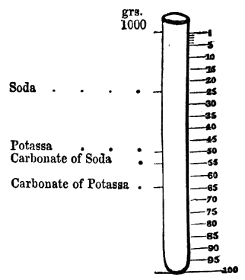
The glass tube here referred to, and known as Faraday’s ALKALIMETER, is graduated centesimally, in the usual manner; but opposite the numbers 22·1, 48·62, 54·43, and 65, are cut the words ‘soda,’ ‘potassa,’ ‘carbonate of soda,’ and ‘carbonate of potassa,’ to indicate the quantity of the test-acid to be employed for each of these substances. (See engr.) It is used by pouring the test-liquor into it until it reaches the line marked against the alkali, or carbonate, under examination, the remaining divisions being filled up with pure water, and the whole well mixed by placing the thumb on the orifice of the tube and shaking it well. The measure of the resulting dilute acid must then be very carefully observed, and more water added, if required, to bring it up to the zero (0) or 1000 gr. on the scale; careful agitation being again employed as before. The test-acid thus prepared is then added, with the usual precautions, to the sample until exact neutralisation is effected. The quantity consumed for this purpose, read off from the graduated scale, expresses the exact per-centage of the pure ALKALI, or of its CARBONATE, as the case may be, contained in the sample examined, provided 100 gr. have been taken for the assay.
Another method sometimes used is that of M. Mohr, and practised as follows:—The alkaline solution, slightly coloured blue with litmus, is strongly super-saturated with a standard acid (sulphuric or oxalic) of known strength, supplied from an alkalimeter in the usual manner; the last traces of carbonic anhydride being removed by boiling, shaking, blowing into the flask, and, finally, sucking out the air. A standard solution of caustic soda (of a strength exactly corresponding to that of the test-acid already used) is now cautiously added, drop by drop, until the colour, rendered yellowish-red by the acid, just appears of a light blue. The difference between the quantity of the solution of the test-alkali and of the test-acid consumed, expresses the exact quantity of acid neutralised by the alkali, and hence also its strength.
Besides the above methods, the alkaline carbonates are analysed, by the loss of carbonic anhydride (carbonic acid) they suffer, by being decomposed by a strong acid. The best method in use is that of MM. Fresenius and Will, and depends on the same principle, and is performed in a similar manner and in a similar apparatus to that described under Acidimetry; the only difference being that here the uses of the small tube (e) is dispensed with, and that the alkali is tested under the form of carbonate, instead of bicarbonate.
Oper. The smaller flask (B) is about half filled with concentrated sulphuric acid, and the sample of alkali, in solution (under the form of carbonate), being placed in the larger flask (A), water is added until it is about one third full. The tubes are then fitted into the apparatus quite air-tight; the end of the tube (b) is fastened with a piece of wax, and the whole is very carefully weighed. The apparatus is now removed from the scales, and a perforated cork, or a small piece of india-rubber tube, being temporarily applied to the end of the tube (h), a few bubbles of air are sucked out of the flask (B) by means of the lips; the consequence of which is, that on removing the mouth the acid in (B) ascends to a certain height in the tube (c). If in a short time this little column of liquid maintains its height in the tube, it is a proof that the apparatus is perfectly air-tight, and as it should be. Suction is now again cautiously applied to the tube (h) and a little of the acid in (B) made to flow over into the flask (A), the quantity being proportionate to the vacuum produced by suction, and capable of being regulated at will. No sooner does the acid come into contact with the carbonate in the flask (A) than the evolution of carbonic acid commences, and this, from the construction of the apparatus, having to pass through the concentrated sulphuric acid, is rendered quite dry before it can escape by the tube (d) into the atmosphere. Whenever the effervescence flags, a little more acid is sucked over, until the whole of the carbonate is decomposed; after which an additional quantity is made to pass into (A), so as to raise the temperature considerably, for the purpose of expelling all the gas absorbed by the fluid during the operation. As soon as this is effected, the wax is removed from the aperture (b), and suction applied to (h), until all the carbonic acid in the apparatus is replaced by atmospheric air. The whole is now allowed to cool, and (together with the piece of wax removed) is again accurately weighed. The loss of weight gives the exact amount of dry carbonic anhydride, or anhydrous carbonic acid, which was contained in the specimen, from which the weight of PURE ALKALI is readily estimated, as every 22 gr. of dry carbonic acid gas evolved represents exactly 31 gr. of pure SODA, 47 gr. of pure POTASSA, &c. &c.; these numbers being the equivalents of the respective substances from which the per-centage strength may be found by the rule of proportion, as before explained.
Thus, in the case of a 100-gr. sample of carbonate of soda which has lost 151⁄4 gr. of carbonic acid, by the assay, this would be—
22 : 31 :: 151⁄4 : 21·48%
or nearly 211⁄2 per cent. of pure soda. If 53, the equiv. of anhydrous carbonate of soda, be taken, instead of 31 (the eq. of pure soda), the answer would have been, in the terms of that substance, 36·748%, or nearly 363⁄4 per cent. When an aliquot part of 100 gr. has been taken for the assay, either the result, or the third term of the proportion, must, of course, he multiplied by the denominator and divided by the numerator of the fraction representing such aliquot part.
By multiplying the weight of carbonic anhydride lost, by the numbers opposite the names of the respective alkalies and their carbonates in the second column of the following Table the equivalent per-centage value of the carbonates examined may be obtained in terms corresponding to the various denominations named therein, when 100 gr., or any aliquot part of 100 gr., have been tested; the result, in the latter case, being, of course, multiplied as before.
By taking certain standard weights for the assay, the quantity of carbonic acid evolved may be made to furnish the per-centage strength or value of the specimen in the terms of either the pure or carbonated alkalies, whether in their anhydrous or hydrated state. The numbers in the second column of the following Table represent the quantity in grains and decimal parts of each of the substances named in the first column, equivalent to one grain of carbonic anhydride. These numbers, as already mentioned, may be employed as factors for converting any numbers representing grains of that acid into the equivalents of these substances, true to 4 places of decimals; and further, they furnish us with the data for determining the exact number of grains which must be tested, so that the loss of weight in carbonic anhydride shall at once give us the per-centage richness of the sample in the terms of the denomination for which it is taken. The numbers in the third column of the Table, formed by simply moving the decimal point of the numbers in the second column one figure further to the right, indicate the weights to be taken for the assay, so that the loss of weight, reckoned in tenths of a grain, exactly represents the per-centage strength in the terms sought. The weights corresponding to the numbers in the fifth column give the same results, provided the loss of weight is reckoned in quarter-grains; those in the sixth column effect the same when the loss of weight is reckoned in half-grains; whilst those in the last column require that the gas eliminated should be counted in grains, and are simply the numbers in the second column of the Table multiplied by 100, or reproduced by moving the decimal point two figures to the right.
Table I.—Multipliers and Standard Weights for the Principal Alkalies and their Carbonates. (Cooley.)
NAMES, &c.Factors or Multipliers for converting the weight of carbonic acid expelled into real strengths.Quantity (in grains) to be taken, so that the per-centage value of the sample tested shall be shown in the terms of any of the denominations given, by the weight of the evolved Carbonic Acid reckoned—
In tenths of a grain.
Whole numbers and decimals.Nearest common numbers.in quarter-grains.in half-grains.in grains.
Ammonia (pure, gaseous)·772737·72773⁄4191⁄3385⁄8773⁄0
Carbonate of ammonia (neutral, anhydrous)1·7727317·727173⁄4445⁄16885⁄81771⁄4
Carbonate of ammonia (neutral, crystallised)1·977319·773193⁄4497⁄16987⁄81973⁄4
Sesquicarbonate of ammonia (translucent)2·681826·8182613⁄16671⁄101341⁄102681⁄5
Bicarbonate of ammonia (crystallised)3·590935·909359⁄108913⁄161795⁄83591⁄10
Potassa (anhydrous)2·136421·364211⁄2531⁄21072133⁄8
Hydrate of potassa2·5454625·455255⁄11635⁄81271⁄42541⁄2
Carbonate of potassa (anhydrous)3·136431·364313⁄8781⁄21573131⁄2
Carbonate of potassa (granulated)3·772737·727371⁄2943⁄101885⁄83771⁄4
Carbonate of potassa (crystallised)3·954539·545395⁄8991983951⁄2
Bicarbonate of potassa (crystallised)4·545445·454451⁄21133⁄42271⁄24541⁄2
Soda (anhydrous)1·409114·09141⁄10351⁄4701⁄2141
Hydrate of soda1·818218·182181⁄5451⁄291182
Carbonate of soda (anhydrous)2·409124·091241⁄10601⁄41201⁄2241
Carbonate of soda (crystallised)6·565·651621⁄2325650
Sesquicarbonate of soda (dry; theoretical)2·909129·091291⁄10721⁄2145290
Sesquicarbonate of soda (Ph. L., 1836)3·727337·273371⁄4931⁄41861⁄2373
Sesquicarbonate of soda (average commercial)3·795437·95438947⁄81893⁄43791⁄2
Bicarbonate of soda (crystallised)3·818238·182381⁄5951⁄2191382
Lithia (pure, anhydrous)·68186·818613⁄16171⁄20341⁄10681⁄5
Baryta (pure, caustic)3·477334·773344⁄5867⁄81737⁄83473⁄4
Lime (pure, caustic)1·272712·727123⁄4313⁄4635⁄81271⁄4
Magnesia (pure, anhydrous)·909099·09191⁄11223⁄4451⁄291
In this ingenious method of alkalimetry it is absolutely necessary that the whole of the alkali in the specimen tested should be in the state of neutral carbonate. If a sample of potash contains any caustic alkali (as the potashes and pearlash of commerce generally do), Fresenius and Will direct it, previously to being tested, to be triturated with its own weight of pure quartzose sand, and about one third of its weight of carbonate of ammonia; and the resulting mixture, placed in a small iron capsule, or a porcelain crucible, to be moistened with water, and exposed to a gentle heat until it becomes quite dry, and all the ammonia is expelled. If the sample contains any bicarbonate or sesquicarbonate, it must be heated to dull redness before being placed in the apparatus and tested. In the case of crude soda (particularly soda ash), the proportion of carbonate of ammonia should be equal to at least one half the quantity operated on. With both alkalies, if the sample contains sulphides, sulphites, or hyposulphites, the same method is to be followed, except that solution of ammonia, instead of water, is to be employed for moistening the powder. To remedy the error which would arise from the apparent amount of carbonic anhydride liberated during the assay, being swelled by the disengagement of ‘sulphuretted hydrogen’ or sulphurous acid from these substances, a small quantity of neutral (i. e. yellow) chromate of potash may be added to the alkaline solution in the flask (A); by which they will be converted into sulphates, sulphur, and water, which will remain in the apparatus, the carbonic acid only being evolved. “As most sorts of soda of commerce contain one or other of the substances (just) named, and as it is far more simple to add at once some chromate of potassa to the soda solution, than to test the latter for either of the three salts, it is always advisable to make it a rule, in the examination of SODA, to add some chromate of potassa.” (Fresenius.)
If the sodium or other carbonate under analysis contains much chloride, the addition of more sulphuric acid than necessary must be avoided, and the carbonic anhydride expelled by gently heating over a warm bath, and not by the addition of excess of acid.
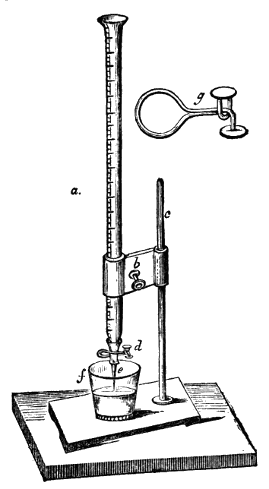
To obviate the difficulties, and to give greater precision and delicacy to volumetrical assays, the instrument known as Mohr’s ALKALIMETER, or Mohr’s BURETTE, and which is figured in the margin, may be employed. By means of it the test-acid in the graduated tube (a) may be added to the alkaline solution in (f), in any quantity at a time, however minute, by merely pressing the handles of the clamp (d) with the thumb and finger. The terminal tube (e) has its lower orifice very small, and it is connected with the burette by means of a small piece of vulcanised india-rubber tube, on which the clamp (d) acts. (See engr.) The inner cylindrical part of the arm (b) is lined with cork, to prevent injury to the glass burette, and to hold it the more firmly.
Generally the alkali in the specimen examined may be in either the caustic or carbonated state, or it may consist of any mixture of caustic alkali, or carbonates; but it is absolutely necessary for accurate results, that it should be free from sulphides, sulphites, and hyposulphites, as sulphuric acid acts upon these substances as well as on carbonates. The presence of chlorides does not interfere with the accuracy of the assay, unless a higher degree of heat is employed than that necessary for the expulsion of the absorbed carbonic acid. The SODA-ASH of commerce generally contains all these substances besides common salt, sulphate of soda, and insoluble matter, which do not interfere. Rough samples of POT-ASHES and PEARL-ASH also generally contain some sulphides, though not a large quantity. Various plans have been proposed to avoid this source of error. The best is that of MM. Fresenius and Will, given above, in which the value of the carbonates is estimated by their yield of carbonic anhydride.
The difference between an assay of a sample of the unprepared alkali and of another which has been treated as above, indicates the quantity of impurities contained in them under the forms just referred to. The presence of these substances in the commercial alkalies may be detected by the following tests:—
Sulphides. The addition of sulphuric acid causes the evolution of an odour like that of rotten eggs. The sample in solution yields a black precipitate with acetate of lead. But the most delicate test is the splendid violet-blue colour with nitro-prusside of sodium.
Sulphites and Hyposulphites. A solution of the alkali, insufficient for saturation, being added to sulphuric acid tinged reddish yellow with bichromate of potash, occasions a greenish tinge (owing to the formation of oxide of chromium), when these are present. Hydrochloric acid added to a clear solution, after some time, causes a turbidity and odour of sulphurous anhydride.
Chlorides yield a copious curdy precipitate with nitrate of silver, soluble in ammonia, and reprecipitated by excess of nitric acid.
The amount of pure caustic alkali in a sample of alkali is best determined by Fresenius’s method, as follows:—The total amount of pure alkali, both caustic and carbonated, expressed in per-cents. of carbonate of soda or carbonate of potassa, is ascertained by any of the usual methods. The apparent quantity of alkali per cent. is then determined, without previous treatment of the sample with carbonate of ammonia, by the method of Will and Fresenius (p. 86). The difference between the results indicates the per-centage of dry caustic alkali present; or if the volumetric method be in use, it can be often fairly estimated by adding the first portions of the test-acid very gradually to the sample, carefully observing the effect. When the effervescence at length commences the weight or measure of the test-liquor expended shows the quantity of pure caustic alkali under treatment (nearly). The result depends upon the fact, that little or no carbonic-acid gas is expelled from the liquid on the addition of the test-acid, until the caustic portion is very nearly neutralised.
The quantity of WATER or MOISTURE, per cent., present in an alkaline carbonate, is indicated by the loss of weight which 100 gr. suffer on gentle ignition in a loosely-covered iron dish or platinum crucible. So also with samples containing caustic alkali, except that here the water of hydration (= 1 equiv. = 9) is not expelled from the ‘caustic’ portion, and must therefore be determined by calculation.
Other matters deserving the serious attention of the operator are—hitting the exact point of neutralisation, and—preparing the test-acids of the proper strength. The method of effecting the former correctly has been already referred to in this article, and is also fully noticed under Acetimetry and Acidimetry.
Test-acids may be very simply prepared by gradually diluting concentrated sulphuric acid with water until it is reduced to the proper strength; the dilution being made in a glass vessel containing a ‘hydrostatic bead’ exactly corresponding to the desired specific gravity of the dilute acid. When the proper point is reached, and the mixture has again acquired the normal temperature of 60° Fahr., the bead rises from the bottom of the vessel, and floats about indifferently in the middle of the liquid. The sp. gr. may then he carefully ascertained by means of an hydrometer or a specific gravity bottle; after which the strength must be accurately determined by means of a standard solution of either pure anhydrous carbonate of soda or pure caustic soda. An acid of any given strength or saturating power may also be prepared in the following manner:—49 parts of commercial sulphuric acid (oil of vitriol), sp. gr. 1·825, contain nearly 40 parts or 1 equiv. of anhydrous sulphuric acid; if we, therefore, wish to prepare a dilute acid containing in every 1000 grains weight, or measure, exactly 1 equiv. of hydrated sulphuric acid, we have only to make 49 gr. of such acid up to 100 gr. weight or measure with pure water. After it has recovered the proper temperature, its sp. gr., or rather its saturating power, must be carefully tried, and, if necessary, readjusted. As, however, it very often happens that the oil of vitriol employed is not so strong as that above referred to, it is better first to test its strength with pure anhydrous carbonate of soda, and to calculate the quantity required by the Rule of Proportion. Every 53 gr. of the dry carbonate are equal to 40 gr. of ‘dry sulphuric acid.’ Suppose we find the oil of vitriol to contain only 72% of hydrated acid, then—
100 : 40 :: 72 : 55·55
or, instead of only 40 gr., fully 551⁄4 gr. will be required, which are to be made up with water to 1000 gr., as before. Finally, the diluted acid must be very carefully re-tested, and if found correct, at once put into a well-stoppered bottle, and labelled, for use. Too much care cannot be taken to ensure the test-liquid, whether for alkalies or acids, being of the proper strength, of which the specific gravity alone is an insufficient proof. In practice, so small a quantity only of test-acid as that referred to above is, of course, seldom made; but as any larger quantities are mere multiples of the smaller one, the necessary proportions to be employed are easily calculated. The common plan is to prepare one or more gallons or quantities of 10 lbs. each, and to preserve the liquid in stoppered green glass ‘Winchester-quart bottles,’ so that it may be always ready for use.
Although, as may be inferred from the text, sulphuric acid is generally used as the standard acid, yet oxalic acid in pure crystals is recommended by M. Mohr, and answers admirably, and is prepared and used exactly in the same manner.
Table II.—Alkalimetrical Equivalents.
Grains.are equivalent toGrains.
22 Carbonic anhydride (dry).17 Ammonia (pure or gaseous).
63 Oxalic acid (crystallised).431⁄2 Carbonate of ammonia (neutral, hydrated).
49 Sulphuric acid (liquid, monohydrated, sp. gr. 1·8485).59 Sesquicarbonate of ammonia (Ph. L.; translucent, hydrated).
75 Tartaric acid (crystallised).79 Bicarbonate of ammonia (crystallised).
1000 Dilute sulphuric acid (sp. gr. 1·033).47 Potassa (anhydrous).
56 Hydrate of potassa (pure caustic potassa).
Water—gr. measure.69 Carbonate of potassa (anhydrous).
1000 Dilute sulphuric acid (sp. gr. 1·032).83 Carbonate of potassa (granulated, commercial).
87 Carbonate of potassa (crystallised).
100 Bicarbonate of potassa (crystallised).
31 Soda (anhydrous).
40 Hydrate of soda (pure caustic soda).
53 Carbonate of soda (anhydrous).
143 Carbonate of soda (crystallised).
84 Bicarbonate of soda (crystallised).
831⁄2 Sesquicarbonate of soda (average commercial).
84 Bicarbonate of soda (crystals, or cryst. powder, free from moisture).
15 Lithia.
24 Hydrate of lithia.
37 Carbonate of lithia.
761⁄2 Baryta (pure, caustic).
851⁄2 Hydrate of baryta.
981⁄2 Carbonate of baryta.
28 Lime (pure, caustic; i. e. quick-lime).
37 Hydrate of lime (slaked lime).
50 Carbonate of lime (chalk; marble).
20 Magnesia (pure, calcined).
42 Carbonate of magnesia (dry, neutral).
481⁄2 Carbonate of magnesia (ordinary commercial).
52 Stronia (pure, caustic).
61 Hydrate of strontia.
74 Carbonate of strontia.
ALKALOID. Syn. Vegetable Alkali, Organic Base; Alkaloïdes (pl., -IDES, or -IDÆ), L.; Alcaloïde, Alcali organique, Fr. In chemistry, a name commonly given to any proximate principle of vegetable origin possessing alkaline or basic properties, however feeble. In its most extended sense the term embraces all organic bases, whether obtained from the animal or vegetable kingdom, or produced artificially. The alkaloids form a numerous and important class of bodies. They exist in nature nearly always in the form of salts, the acid being often, like themselves, peculiar to the plant, or class of plants, in which they are found; whilst the medicinal activity of the latter, in most cases, almost entirely depends on their presence.
Prep. The following general methods of procuring the alkaloids will be found applicable to such as full directions are not given for under their respective heads:—
1. (When the base is insoluble in water, non-volatile, and existing in the plant in an insoluble form.) The bruised plant is boiled or macerated in water acidulated with hydrochloric or acetic acid, and the liquor, after filtration, is neutralised with an alkali (ammonia, potassa, lime, or magnesia); the resulting precipitate is purified by re-solution in dilute acid, digestion with a little animal charcoal, and subsequent crystallisation, or re-precipitation with an alkali; or the first precipitate is purified by dissolving it once, or, if necessary, several times, in boiling alcohol, which yields the pure alkaloid either on cooling or by evaporation.
2. (When the base is insoluble in water, and non-volatile, but existing in the plant as a soluble salt.) The bruised or sliced plant is boiled or macerated in water, and the filtered liquor precipitated and otherwise treated as before.
3. (When the base is soluble in water, and non-volatile.) An infusion made with very dilute acid, hydrochloric or acetic, is concentrated by a gentle heat; and the residual liquor treated with potassa (or concentrated solution of ammonia) and ether conjointly; after repose, the ethereal solution is decanted and evaporated. For those alkaloids which are insoluble in ether (as morphia and cinchonia), the previous process may be adopted.
4. (When the base is both soluble in water and volatile.) The vegetable, in a bruised or divided state, or its extract, is alkalised with potassa and distilled; the distillate is neutralised with dilute oxalic or sulphuric acid, and carefully evaporated to dryness; the residuum is next digested in alcohol, and the resulting tincture agitated with potassa and ether, the former being in quantity just sufficient to seize on all the acid; lastly, the ethereal solution thus formed, on careful evaporation, leaves the alkaloid nearly pure. It may be further purified by cautious distillation.
As some of the alkaloids are soluble in excess of the alkaline precipitant, over-saturation should be carefully avoided; or the precipitant may be used under the form of carbonate or bicarbonate. When lime and magnesia are employed, they are boiled for a few minutes with the solution.
Props. Alcoholic or aqueous solutions of the alkaloids generally exhibit an alkaline reaction with vegetable colours. Like the alkalies, also, they combine with acids to form salts which, when dissolved in water, are capable of producing the ordinary phenomena of saline double decomposition. Their taste is usually intensely bitter.
The majority of the natural alkaloids contain carbon, hydrogen, nitrogen, and oxygen, and are, at ordinary temperatures, solid, and not volatile without decomposition. Some natural alkaloids contain carbon, hydrogen, and nitrogen only; these are, for the most part, liquid at ordinary temperatures, and can be distilled without decomposition. The greater number of the artificial alkalies are composed of carbon, hydrogen, and nitrogen; some, however, contain oxygen in addition. Alkaloids have also been obtained artificially, in which nitrogen is replaced by phosphorus, arsenic, antimony, or bismuth. Most of the alkaloids, as they are obtained in the free state, correspond in function to ammonia, NH3, rather than to the fixed alkalies; that is to say, they form salts by direct union with acids, without elimination of water or any other substance. In order to make them strictly comparable to the fixed alkalies, they require, like ammonia, the addition of water (H2O) to their formulæ; they may then be considered as hydrates of compound radicles analogous to ammonium.
Physiological action. The alkaloids generally possess great medicinal power; some of them act with terrific energy, and are the most violent poisons with which we are acquainted. Perfectly pure aconitia is about 200 times more poisonous than arsenic, and at least 50 times more poisonous than ordinary medicinal prussic acid. The greater number act on animals in the same way as the plants which produce them, provided they are given in proportionately small doses. Many of them, when judiciously administered, are most valuable medicines.
Pois., Ant., &c. Some of the alkaloids act as narcotic or stupefying poisons; others are classed with the narcotico-acrid poisons, or those which produce both narcotism and irritation of the parts they touch. The general symptoms produced by opium and its preparations may be taken as an example of the former; those from aconite and strychnia, of the latter. In large doses of the greater number, narcotism predominates; in smaller ones, irritation; they are rarely coexistent.—Treatm. No common antidote to the effects of this class of substances has yet been discovered. The only safe treatment, of at all general application, is to immediately clear the stomach by means of a strong and quick-acting emetic (as sulphate of zinc), or the stomach-pump, and to administer copious and continued draughts of astringent vegetable solutions (as of tannin, nut-galls, oak-bark, or what is always at hand—very strong tea or coffee). These may be followed by or combined with a smart purge of castor oil, as soon as the stomach is thoroughly cleared of the poison. M. Bouchardat strongly recommends a solution of iodine, 3 gr., and iodide of potassium, 6 gr., in pure water, 16 fl. oz., in cases of poisoning by OPIUM, ACONITE, COLCHICUM, DEADLY NIGHTSHADE, HEMLOCK, NUX VOMICA, &c., or by the alkaloids obtained from them—ACONITINE, ATROPIA, COLCHICINA, CONIA, MORPHIA, STRYCHNIA, &c., or their salts; but not where foxglove or digitalin has been taken. The stomach having been well emptied by an emetic, the solution is to be given by wine-glassfuls for some time; the vomiting being still encouraged during the early part of the administration of the antidote. In the case of narcotics (as opium, morphia, &c.), this is to be followed by the free use of a strong infusion of coffee. According to Dr Garrod, purified animal charcoal is an ‘excellent antidote’ to many of the alkaloids, including those above enumerated, when taken in poisonous doses; as it not merely absorbs them, but, for the most part, renders them inert. To be serviceable it should be recently prepared and fresh-burnt; and should be given in doses of about an ounce at a time, diffused in warm or tepid water, and frequently repeated. The vomiting which follows its use, owing to the warm water, proves advantageous; but after a sufficient time may be lessened by employing less water, or cooler or even cold water. Drowsiness, if present, may be combated by the subsequent use of strong coffee or tea, as before. We have seen this plan succeed in several cases.—Lesions. These, like the symptoms, vary. In some cases there are redness and inflammation of the stomach and intestines, and turgescence of the vessels of the lungs and brain; in others, these appearances are either slight or wholly wanting. Wherever there has been much cerebral disturbance, traces of congestion are usually discernible.
Detec., Tests, &c. The identification of the pure alkaloids is extremely simple; but their detection, when combined with organic and colouring matters, is a task of considerable difficulty. One or other of the following plans may be adopted for this purpose:—
1. (Merck.) The matter under examination is digested, for several hours, with concentrated acetic acid, added in sufficient quantity to produce a strongly acid reaction; the fluid portion is then strained from the insoluble matter, and the latter being washed with water acidulated with acetic acid, the mixed liquors are gently evaporated to dryness in a water bath; the residuum of the evaporation is boiled first with rectified spirit, and next with rectified spirit acidulated with acetic acid; the mixed liquors are again evaporated, the residuum redissolved or diluted with distilled water, and carbonate of soda or potassa added to feebly alkaline reaction, and the whole, after evaporation to the consistence of a syrup, set aside to repose for 24 hours; it is now again diluted with water, filtered, and the insoluble portion washed with cold distilled water, and digested with concentrated acetic acid; this last solution is diluted with distilled water, and decoloured with pure blood-charcoal (if it be necessary); the fluid, either at once, or after cautious evaporation, may then be tested for the alkaloids, in the usual manner. The charcoal previously used should also be tested in the way described below. This method answers admirably with all the NON-VOLATILE ALKALOIDS, and may be applied to the stomach and viscera, and their contents, and to food, &c., in cases of poisoning.
2. (Stas.) The suspected matter, in a finely divided state, is digested, at 160° to 165° Fahr., with twice or thrice its weight of strong alcohol acidulated (according to the quantity) with 1⁄2 dr. to 2 or 3 dr., or more, of pure oxalic or tartaric acid. After a sufficient time, and when the whole has become quite cold, it is thrown on a filter, and the undissolved portion, after being squeezed dry, is washed with strong alcohol. The mixed and filtered alcoholic liquids are then evaporated at a temperature not exceeding 95° Fahr., and, if no insoluble matter separates, the evaporation is continued nearly to dryness;[19] but if fatty or other insoluble matter separates during the process of concentration, the concentrated fluid is passed through a moistened filter, and the filtrate evaporated nearly to dryness, as before. The residuum is next digested with absolute alcohol, in the cold, the insoluble portion, after filtration, washed with alcohol, and the mixed filtrates again evaporated in the air, or in vacuo. The acid residue is now dissolved in a little distilled water, and bicarbonate of soda added as long as effervescence ensues. To this mixture 4 or 5 times its volume of ether is added, and after lengthened agitation (the bottle or tube being held in a cold wet cloth), the whole is allowed to repose for a short time. A little of the supernatant ether is now removed to a small glass capsule or watch-glass, and allowed to evaporate spontaneously.[19] When this leaves oily streaks upon the glass, which gradually collect into a small drop, which emits, when gently heated, a disagreeable, pungent, and stifling odour, the presence of a LIQUID VOLATILE BASE or ALKALOID is inferred; whilst a solid residue or a turbid fluid with small solid particles floating in it, indicates a NON-VOLATILE SOLID BASE.[20] In either case the blue colour of reddened litmus is permanently restored by the residuum. If no residuum is left on the capsule, some solution of pure soda or potassa is added to the liquid, the whole well agitated for several minutes, and the ether (after repose) decanted; an operation which is repeated with fresh ether a second, third, and even a fourth time. The base, or bases (if any are present), will now be found in the mixed ethereal solution, which is, therefore, tested as before. The presence of an alkaloid being detected, the mixed ethereal solutions are allowed to evaporate spontaneously, care being taken, if a volatile alkaloid be present, to neutralise the liquid with an acid before the final evaporation. The last residuum is then tested for the particular alkaloid present, as before.[21]
This method, according to Stas, answers well for all the ALKALOIDS which are soluble in ether; including—ACONITIA, ANILINE, ATROPIA, BRUCIA, CODEIA, COLCHICINA, CONIA, DELPHIA, EMETINA, HYOSCYAMINE, MORPHIA (?), NICOTIA, PETININE, PICOLINE, SOLANINE, STRYCHNIA, VERATRIA, &c. By means of it Stas found nicotia in the heart-blood of a poisoned dog. With such alkaloids as are, however, only very sparingly soluble in ether (as morphia for instance), the result must, necessarily, be doubtful. To detect these, as well as all the alkaloids which are insoluble in ether, it is, therefore, necessary, as directed by Otto, to add to the alkaline fluid left by the decantation of the ether, sufficient solution of soda to dissolve the morphia, &c. (if any has separated), and after the expulsion of the last traces of the ether by a gentle heat, to add a concentrated solution of hydrochlorate of ammonia, and to allow the mixture to repose for some time in the open air. When MORPHIA is present, it separates under the form of small crystals.[22] Or the alkaline liquor may be diluted with distilled water, and treated with charcoal, and this with alcohol, in the manner noticed under method 4 (below).
4. (Graham and Hoffmann—slightly modified.) 2 or 3 oz. of purified animal charcoal are digested in about 1⁄2 gal. of the (neutral or only slightly acid) aqueous fluid under examination, with frequent agitation, for 10 to 12 hours, or longer. The liquid is then filtered, and the charcoal left on the filter is washed twice with cold distilled water. The charcoal is then boiled for 1⁄2 an hour with about 1⁄2 a pint of rectified spirit of 80 or 90%; the ebullition being conducted in a flask having a very long tube, open at both ends, fitted air-tight through the cork, to prevent loss of the alcohol by evaporation. The spirit, which now contains the alkaloid (if any was present in the original liquor), is next filtered whilst hot, and the filtrate is submitted to distillation until the whole of the alcohol is removed. A small quantity (commonly a few drops) of solutions of potassa is then added to the residual aqueous liquor, followed by 1 to 2 fl. oz. of pure ether, after which the whole is well agitated for several minutes, and allowed to repose for a short time. Lastly, the supernatant ether is decanted, and allowed to evaporate spontaneously, when the residuum (if any) left in the capsule may be tested by reagents, as before.
This method was devised for the detection of STRYCHNIA and NUX VOMICA in malt-liquors; but it is equally applicable to the detection of ANY ALKALOID which is soluble in ether. The CHARCOAL TEST may also be employed to detect alkaloids which are insoluble in ether; but then the base must be sought in the aqueous residuum obtained by the evaporation of the alcohol.[23]
The presence of the alkaloids and their salts, in clear solutions, may be thus determined:—
I. (Fresenius).—1. The solution is rendered very slightly alkaline with dilute solution of potassa or soda, added drop by drop:—
a. No precipitate is formed; total absence of the alkaloids. (See 4, below.)
b. A precipitate is formed:—solution of potassa or soda is added, drop by drop, until the liquid exhibits a strong alkaline reaction:—
α. The precipitate redissolves; absence of Brucia, Cinchonia, Narcotina, Quina, Strychnia, and Veratria; probable presence of Morphia.
β. Precipitate does not redissolve, or not completely; probable presence of one or more of the first six of the above-named alkaloids:—the fluid is filtered from the precipitate, mixed with either bicarbonate of soda or of potassa, gently boiled nearly to dryness, and treated with water. If it dissolves completely; absence of morphia; an insoluble residue indicates Morphia.
2. The precipitate 1. b. β. is washed with cold distilled water, dissolved in a slight excess of dilute sulphuric acid, neutralised with a saturated solution of bicarbonate of soda, and allowed to repose a few hours:[24]—
a. No precipitate; absence of Cinchonia, Narcotina, and Quina:—the solution is gently evaporated nearly to dryness, and treated with cold water:—if it dissolves completely, pass on to 4; if there is an insoluble residue, it may contain Brucia, Strychnia, or Veratria. (See 3.)
b. A precipitate:—the filtered fluid is treated as directed at 2 a.; the precipitate is washed with cold distilled water, dissolved in a little hydrochloric acid, ammonia is added in excess, and subsequently a sufficient quantity of ether, agitation being had recourse to:—
α. The precipitate formed by the ammonia redissolves completely in the ether, and the clear fluid separates into two layers; absence of Cinchonia; probable presence of Quina or Narcotina.
β. The precipitate produced by the ammonia does not redissolve in the ether, or not completely; probable presence of Cinchonia, and perhaps also of Quina or Narcotina. The filtered liquid may be tested for these alkaloids as at a.
3. The insoluble residuum after the evaporation of the solution 2. a., or of the filtrate 2. b., is now dried in a water bath, and digested with absolute alcohol:—
a. It dissolves completely; absence of strychnia; probable presence of Brucia, Quina (?), or Veratria:—the alcoholic solution is evaporated to dryness, and, if quina has been already detected, the residue is divided into two portions, one of which is tested for Brucia, the other for Veratria.
b. It does not dissolve, or not completely; probable presence of Strychnia, and perhaps also of Brucia and Veratria:—the filtered fluid is divided into two portions, and tested separately as at a.
4. The original liquid 1. a. may contain Salicine, a proximate vegetable principle closely allied to the alkaloids:—a portion is boiled with hydrochloric acid for some time; the formation of a precipitate shows the presence of Salicin. (See 2, below.)[25]
II. (Larocque and Thibierge.) Terchloride of gold is recommended, by these writers, as a more decisive test for the alkaloids than the ‘double chloride of gold and sodium’ commonly employed for this purpose. The following are the colours of the precipitates which it produces with the aqueous solution of their salts:—Brucia, milk-brown, passing into coffee-brown, and lastly chocolate-brown:—CINCHONIA, sulphur yellow:—MORPHIA, yellow, then bluish, and lastly violet; in this last state the gold is reduced, and the precipitate is insoluble in water, alcohol, the caustic alkalies, and sulphuric, nitric, and hydrochloric acid; it forms with aqua regia a solution which is precipitated by protosulphate of iron:—QUINA, buff-coloured:—STRYCHNIA, canary-yellow:—VERATRIA, pale greenish-yellow. All these precipitates, with the exception mentioned, are very soluble in alcohol, insoluble in ether, and only slightly soluble in water. Those with morphia and brucia are sufficiently marked to prevent these alkalies from being mistaken for each other; and those with brucia and strychnia are, in like manner, easily distinguishable.
III.—Mr Wanklyn discriminates the different alkaloids from the estimation of the ammonia they evolve. His process is as follows:—A small flask with a lateral tube, and connected with a Liebig’s condenser, is charged with about 25 c. c. of an alkaline solution of permanganate potash made by dissolving 200 grammes of caustic potash and 8 grammes of crystallised permanganate of potash in 1 litre of water. A minute quantity of the alkaloid carefully and accurately weighed is now introduced, and the mixture slowly distilled. The most satisfactory results are obtained by treating from 1 to 5 milligrammes of the alkaloid in this way, but quantities so small as 1⁄10th of a milligram will in skilled hands give accurate results. The ammonia is formed in the distillate by Nesslerising it, as described under Water analysis. For all practical purposes the poisonous alkaloids may be divided into four classes:
(a) Those which yield from 5 to 2 per cent. of ammonia.
(b) Those which yield from 2 to 3 per cent. of ammonia.
(c) Those which yield from 3 to 5 per cent. of ammonia.
(d) Those which yield a larger quantity than 5 per cent., e.g.
I.
NH3 per cent.
Solanine yields half its nitrogen as Ammonia0·98
II.
Morphia yields half its nitrogen as Ammonia2·98
Codeine, ditto, ditto2·87
Papaverine, ditto, ditto2·50
Veratria, ditto, ditto2·87
III.
Atropia yields all its nitrogen as Ammonia5·73
Narcotine, ditto, ditto4·11
Strychnia yields half its nitrogen as Ammonia5·09
Brucine, ditto, ditto4·32
Aconite, ditto, ditto3·50
Coneine, ditto, ditto4·60
IV.
Nicotine yields half its nitrogen as Ammonia10·49
IV. Dr Guy, as well as others, have made researches, having for their object the determination of the exact temperature at which the poisonous alkaloids melt and sublime. A very minute speck of the substance is placed on a porcelain plate or copper disc, and a square or oval of microscope-covering glass is placed over it, supported by a thin ring of glass or any other convenient substance.
Heat is then applied to the plate or copper, and the temperature, as indicated by a thermometer at which the substance fuses or volatilises, is carefully noted.
Fahr.Cent.
Cantharidine sublimes as a white vapour without change of form or colour.212°100°
Sublime.Melt.
Fahr.Cent.Fahr.Cent.
MorphineSublime, melt and yield carbonaceous residue.330°165°340°171°
Strychnine345°174°430°224°
Melt.Sublime.
Fahr.Cent.Fahr.Cent.
AconitineMelt, change colour, sublime, and deposit carbon.140°60°400°204°
Atropine150°66°280°138°
Veratrine200°93°360°182°
Brucine240°116°400°204°
Digitalin310°154°310°154°
Picrotoxin320°160°320°160°
Solanine420°215°420°216°
Selmi’s method of extracting poisonous alkaloids in forensic investigations. The alcoholic extract of the viscera, acidified and filtered, is evaporated at 65° C., the residue taken up with water, filtered to separate fatty matters, and decoloured by means of basic acetate of lead, leaving the solution in contact with the air for 24 hours. It is then filtered, the lead precipitated by means of sulphuretted hydrogen, and the solution after concentration repeatedly extracted with ether. The ethereal solution is then saturated with dry carbonic anhydride, which generally causes a precipitate of minute drops adhering to the sides of the vessel, and containing some of the alkaloids. The ethereal solution is then poured into a clean vessel, mixed with about half its volume of water, and a current of carbonic anhydride passed for about twenty minutes, which may cause the precipitation of other alkaloids not precipitated by dry carbonic anhydride. Usually the whole of the alkaloids present in the ether are thrown down by these means, but if not, the solution is dehydrated by agitation with Barium oxide, and then a solution of tartaric acid in ether added to the clear liquid, taking great care not to employ excess of acid. This throws down any alkaloid that may remain. In order to extract any alkaloids that may still remain in the viscera, they are mixed with Barium hydrate and a little water, and then agitated with purified amylic alcohol; the alkaloids may subsequently be extracted from the alcohol by agitation with very dilute sulphuric acid.
A knowledge of the different solubilities of the alkaloids will be found an important auxiliary in their analysis. The following is a summary of the relative solubility of the most important of them. The figures denote the number of parts of the liquid required for their solution:—
Absolute alcohol.—Strychnine insoluble; brucine soluble.
Amylic alcohol.—Solanine (1061); digitalin sparingly soluble; morphine (133); strychnine (122); veratrine, brucine, atropine, aconitine, and picrotoxin, freely soluble.
Benzol.—All the poisonous alkaloids, except solanine, are soluble in benzol.
Chloroform.—Solanine (50,000); morphine (6550); strychnine (8); the rest freely soluble.
Ether.—Solanine (9000); morphine (7725); strychnine (1400); aconitine (777); brucine (440); veratrine (108); atropine, picrotoxin,[26] and digitalin, very soluble.
Water (cold).—Strychnine (8333); veratrine (7860); morphine (4166); aconitine (1783); solanine (1750); brucine (900); atropine (414); picrotoxin (150); digitalin very soluble.
The principal Alkaloids and their Salts, in the state of powder, or with ‘conia’ and ‘nicotia,’ in the state of an oily looking liquid, may be thus distinguished:—
1. a. The powder is treated with nitric acid:—It is coloured red; probable presence of Brucia, Delphia, Morphia, or commercial Strychnia. If the reddened acid becomes violet on the addition of ‘protochloride of tin,’ it is Brucia; if it becomes black and carbonaceous, it is Delphia. If the powder is fusible without decomposition, and strongly decomposes iodic acid, it is Morphia; if it is not fusible without decomposition, and does not decompose iodic acid, it is Strychnia.
b. If instead of a red, the powder strikes a green colour with nitric acid, it is Solania; if it is insoluble in ‘ether,’ and not reddened by ‘nitric acid,’ it is Emetia; if soluble in ether, not reddened by ‘nitric acid,’ but melts and volatilises when heated, it is Atropia; if it is thus affected by ether or nitric acid, but does not volatilise, it is Veratria. (See 2, below.)
2. a. The powder, or (with ‘conia and nicotia’) concentrated liquor, is treated with a drop or two of concentrated sulphuric acid:—A red colour is produced; probable presence of Brucia, Nicotina, Salicine, or Veratria. If the reddened mixture has at first a roseate hue, turning deep red on the addition of nitric acid, it is Brucia; if the original substance moistened with solution of potassa evolves the odour of tobacco, it contains Nicotine; if the red colour produced by the acid is permanent and of an intense blood-hue, and the powder agglutinates into lumps like resin, it is Salicine; if the colour is at first yellowish, changing to blood-red, and ultimately to crimson and violet, it is Veratria.
b. If instead of the substance being ‘reddened’ by strong sulphuric acid, no particular action ensues in the cold, it contains either Conia or Strychnia; if a small fragment of bichromate of potassa being now dropped in, produces a rich violet colour, it is Strychnia; if the original matter on being heated, or treated with solution of potassa, evolves a penetrating, disagreeable odour, somewhat analogous to that from ‘hemlock,’ or to a mixture of those from tobacco and mice, it is Conia.
“Reactions with ceroso-ceric oxide. This oxide exhibits characteristic colours with several alkaloids, especially with STRYCHNINE. When strong sulphuric acid is poured upon strychnine, and then a small quantity of ceroso-ceric oxide added, a fine blue colour is produced, similar to that which strychnine exhibits with potassium bichromate, but much more permanent. The blue colour gradually changes to cherry-red, and then remains unaltered for several days. This reaction is capable of detecting one part of strychnine in a million parts of liquid. Brucine similarly treated acquires an orange-colour, gradually changing to yellow; MORPHINE, olive-brown, finally brown; NARCOTINE, brown cherry red, finally wine-red; CODEINE, olive-green, finally brown; QUININE, pale-yellow; CINCHONINE and THEINE remain colourless; VERATRINE becomes reddish-brown; ATROPINE, dingy yellowish-brown; SOLANINE, yellow at first, finally brownish; EMETINE, brown; COLCHICINE, first green, then dirty brown; ANILINE, after a long time, acquires a blue colour extending from the edges inwards; CONINE becomes light-yellow. Piperine colours the sulphuric acid blood-red, and is turned dark-brown, almost black by the cerium oxide” (Sonnenschein).
“Reactions with picric acid. This acid is a very good precipitant for alkaloids, affording a very delicate test for many of them, and may perhaps also serve for separating them one from another. The precipitation takes place even in solutions containing a large excess of sulphuric acid, and is sometimes complete. Precipitated are, BRUCINE, STRYCHNINE, VERATRINE, QUINIDINE, CINCHONINE, and most of the opium alkaloids; not precipitated, MORPHINE, ATROPINE (English), PSEUDO-MORPHINE, CAFFEINE, and all glucosides” (Hager).
The presence of one or more of the alkaloids being shown by any of the preceding methods, a portion of the original clear solution or powder, or of the precipitates or filtrates above referred to, must be treated with their characteristic tests, as given under the individual notices of these articles, so as to set at rest all doubt as to their identity. No single test must ever be relied on as a positive proof. The presence of Brucia, Morphia and Strychnia may be determined in substances which after being mixed with the salts of these alkaloids have undergone the acetous, vinous, or putrefactive fermentation, as shown by Orfila, MM. Larocque and Thibierge, and many other eminent chemists and toxicologists, and confirmed, in numerous cases, by our own experiments. Opium and morphia may thus be readily detected in beer, wine, soup, and milk. A paper by Professor Dragendorf in the ‘American Chemist’ for April, 1876, may be consulted with advantage.
Concluding Remarks. It is a singular fact that none of the organic bases found in plants have yet been formed artificially, although several analogous substances have been thus produced. Closely allied to the alkaloids there also exists an extensive series of neutral proximate principles, which differ from those substances chiefly in the absence of basic properties, and in most of them being destitute of nitrogen. They are usually bitter, and, like the alkaloids, generally represent the active properties of the plants in which they are found; whilst some of them possess considerable medicinal energy. Of this kind are asparagin, elaterin, gentianin, picrotoxin, salicin, &c. These two classes of bodies, though actually distinct, are frequently confounded. See Alkali, Organic Bases, Poisons, Proximate Principles, Vegetables, Nomenclature, &c.; also the individual alkaloids under their respective heads.
ALKALOIDS OF ACONITE. The nature of the active principle of aconite root does not appear to have been satisfactorily determined. Messrs Groves, Wright, and Williams contend that the Aconitum napellus yields an active crystalline alkaloid, which they distinguish as Aconitine, and to which they assign the formula C33H43NO12; they add that additionally the root contains more or less of another active alkaloid, which they term Pseudaconitine, and which is represented by the formula C36H49NO11; they also assert that the extract of the roots contains varying quantities of certain decomposition products resulting from the saponification of the above bases by the acids, which are produced by the breaking up of part of the aconitine. The name of these decomposition products is Aconine and Pseudaconine. Of Aconitum ferox they report that it yields a comparatively large quantity of Pseudaconitine and a small quantity of Aconitine. They further affirm that the so-called aconitine of commerce is a mixture of true aconitine and pseudaconitine with variable quantities of their alteration products, aconine and pseudaconine, and of certain amorphous unnamed alkaloids.
Messrs Paul and Kingzett contest the accuracy of these deductions, and dispute the correctness of the formula given to aconitine. Dr Paul doubts whether the alkaloid to which the active properties of the root are ascribed has ever yet been obtained in an isolated condition. He thinks it probable that the substance obtained from aconite root was to a great extent a salt of an acid, like aconitic acid. For further information the reader is referred to the ‘Pharmaceutical Year Book’ for 1873, 1874, 1875, 1876, and 1877.
AL′KANET. Syn. Anchu′sa, L.; Orcanette, Fr.; Orkanet, Ger.; Or′chanet*, Dyer’s al′kanet, D. bu′gloss*. The anchu′sa tincto′′ria (Willd.; lithosper′mum tincto′′rium—Linn.), a deciduous herbaceous plant, with a perennial, dark blood-red root. Hab. Asia Minor, Greece, Hungary, &c. It is also largely cultivated in the neighbourhood of Montpellier. The dried root (ALKANET ROOT; RADIX ANCHUSÆ, R. A. TINCTORIÆ) is chiefly imported from the Levant. It contains a beautiful blood-red colour, which it freely gives out to oils, fats, wax, spirits, essences, and similar substances, by simply infusing it in them, and is consequently much employed to colour these articles. Wax tinged with it, and applied on warm marble, stains it of a rich flesh-colour, which sinks deep into the stone, and possesses considerable durability. Its spirituous tincture also imparts a deep red to marble.
Prop., &c. The colouring matter of alkanet was regarded by Pelletier as a fatty acid (ANCHUSIC ACID); but it has since been shown to be a species of resin (ANCHUSINE, PSEUDO-ALKANNINE, P.-ALKANIUM). According to Dr John, good alkanet root contains 51⁄2 per cent. of this substance. Anchusine melts at 140° Fahr.; is scarcely soluble in water, to which it only imparts a dirty red colour, but is very soluble in alcohol, oils, and acetic acid. Alkalies turn it blue. It is found wholly in the root-bark. In selecting this article, the smaller roots should therefore be chosen, as they possess more bark than the larger ones, in proportion to their weight. Exposure to ammoniacal fumes, or even handling it much with the fingers, changes its red to a crimson or purplish hue.
Uses, &c. It is much employed by druggists and perfumers to colour oils, lip-salves, plasters, pomatums, &c.; by varnish-makers, to tinge their varnishes and lacquers; by statuaries to stain marble; by dairy-farmers, to colour cheese; by wine-merchants and bottlers (in the form of tincture), to stain beforehand the corks of their port-wine bottles, in order to imitate the effects of age, and as colouring and flavouring for factitious port wine; and by dyers, and others. A species of crimson rouge was formerly prepared from it (hence its name).
ALLANTO′IC ACID. See Allantoin.
ALLAN′TOIN. C8H6O6N4. Syn. Allanto′ic acid*, Amniot′ic a.† Am′nic a.†; Allantoï′na, L. A substance discovered by Vauquelin and Buniva in what they imagined to be the liquor amnii of the cow, and hence named by them amniotic acid. It was afterwards shown by Dzondi and Lassaigne to exist in the fluid of the allantoïs, and not of the amnios. It has since been produced artificially by Wöhler and Liebig.
Prep. 1. The allantoïc fluid of the fœtal calf is evaporated to 1-4th or 1-5th of its volume, and then set aside for some time. The crystals thus obtained are purified by re-solution, digestion with animal charcoal, and re-crystallisation.
2. (Wöhler and Liebig.) Uric acid, 1 part; is dissolved in water, 20 parts; and freshly precipitated and well-washed binoxide of lead is added to the solution until the colour ceases to change; the liquid is next filtered while hot, evaporated until a pellicle forms on the surface, and then set aside to crystallise; the crystals being purified as before.
Prop., &c. Small, but very brilliant prismatic, transparent, colourless crystals; tasteless; neutral; soluble in 160 parts of cold water, and in much less at 212°; nitric acid converts it into ALLANTURIC ACID; oil of vitriol resolves it into ammonia, carbonic acid, and carbonic oxide; hot concentrated solutions of the caustic alkalies change it into ammonia and oxalic acid.
ALLANTOX′ICUM. [L.] Syn. Allantox′icum, L. (prim., Gr.). The poison developed, during putrefaction, in sausages made of blood, liver, &c. “It often proves speedily fatal.” (Kraus.)
ALLGEMEINE FLUSSTINCTUR (Sulzberger, Salzungen). For the relief of a number of diseases, among which are cholera and sea-sickness. Aloes, 1 part; spirit of wine, 2 parts. (Spau.)
ALLIA′CEOUS (-sh′us). Syn. Allia′ceus, L.; Alliacé, Ailiacé, Fr.; Knoblauchartig, &c., Ger. Garlick-like; an epithet applied to substances having the odour or properties of garlic or onions.
Alliaceous Plants. Chives, garlic, leeks, onions, rocambole, shallots, &c.
ALLIGA′TION. Syn. Alliga′tio, L. In commercial arithmetic, a rule for ascertaining the price or value of mixtures, and for determining the proportions of the ingredients that must be taken to produce mixtures of any given price, value, or strength. The first is called ALLIGATION ME′DIAL; the second, ALLIGATION ALTERN′ATE. Its principles and applications are explained under Mixtures (Arithmetic of).
ALLOP′ATHY. Syn. Allopa′thia, L. (from ἁλλος, other, different, and παθος, affection or disease, Gr.); Allopathie, Fr. In medicine, the method of curing disease by the use of remedies which tend to produce a condition of the system, either differing from, opposed to, or incompatible with the condition believed to be essential to the disease it is sought to cure. It is commonly employed to distinguish the ordinary system of medical practice from homœopathy (which see). Hence (an) ALLOP′ATHIST, and the corresponding adjective ALLOPATH′IC (allopath′icus, L.).
ALLOT′ROPY. Syn. Allot′ropism; Allotro′pia, Allotropis′mus, L. Literally, a difference in character; another form of the same substance. In chemistry, a term invented, by Berzelius, to express the state or condition, or the change of character, assumed by certain substances at different temperatures, or under different treatment, whilst their nature and composition continue the same. It more particularly relates to colour, hardness, solubility, texture, &c. Boron, carbon, silicon, iron, sulphur, and phosphorus, afford striking examples of the changes here referred to.
ALLOX′ANTIN. C8H4N4O7.3H2O. A crystallisable substance, first obtained by Dr Prout from uric acid.
Prep. 1. Uric acid, 1 part; is boiled in water, 32 parts; dilute nitric acid being added until solution is complete; the resulting liquid is evaporated to 2⁄3rds its volume, and then set aside for 10 or 12 hours; the crystals, which are deposited, are purified by re-solution and crystallisation.
2. Sulphuretted hydrogen gas is passed, in a full stream, through a moderately strong aqueous solution of alloxan, in the cold. The alloxantin, which is deposited as a crystalline mass, is purified by draining, cautious washing with cold water, re-solution in boiling water, and re-crystallisation. The impure mother-liquor from which crystals of alloxan have separated, if diluted with water, may be used for this purpose.
Prop., &c. Crystals, small colourless, transparent, four-sided, oblique rhombic prisms; scarcely soluble in cold water; solution reddens litmus; with baryta water it gives a characteristic violet-coloured precipitate, which disappears on heating; and with nitrate of silver a black precipitate of that metal; the crystals are reddened by ammoniacal vapours.
ALLOY′. Syn. Alliage, Fr.; Legirung, Vermischung durch schmelzen, Ger. In coinage, a compound of the precious metals with another, or others, of less value; also the least valuable metal, or metals, in such compounds. In chemistry and metallurgy, combinations of the metals with each other usually obtained by fusion. When mercury is one of the component metals, the compound is termed an AMALGAM.
Prep., &c. No General rules can be given for this purpose. Alloys of metals differing greatly in fusibility, are commonly made by adding the more fusible one, either in the melted state, or in small portions at a time, to the other melted, or heated to the lowest possible temperature at which a perfect union will take place between them. The mixture is usually affected under a flux, or some material that will promote liquefaction, and prevent volatilisation and unnecessary exposure to the air. Thus, in melting lead and tin together, for solder, resin, or tallow is thrown upon the surface; in tinning copper, the surface is rubbed with sal ammoniac; and in combining some metals, powdered charcoal is used for the same purpose. Quicksilver combines with many metals in the cold, forming AMALGAMS.
Comp. The following Table exhibits the composition of the more important compounds of this class:—
Table of the principal Alloys.[27]
Names.Combining metals.
AlbataSee German Silver.
AmalgamsMercury and other metals.
Bath-metalCopper and zinc.
Bell-metalCopper and tin.
BrassCopper and zinc.
Britannia metalTin with antimony, copper, and bismuth.
BronzeTin and copper.
Bronze aluminiumCopper and aluminium.
Cannon-metalTin and copper.
Dutch goldCopper and zinc.
Fusible metalBismuth, lead, and tin.
German silverCopper, nickel, and zinc, with, sometimes, a little iron and tin.
Gold (standard)Gold with copper.
Gold (old standard)Gold with copper and silver.
Gun-metalSee Cannon-metal.
Mosaic goldCopper and zinc.
Or-moluCopper and zinc.
Pewter (common)Tin and lead.
Pewter (best)Tin with antimony, bismuth and copper.
Pot-metal, Cock-metalCopper and lead, with, sometimes, a little zinc.
Queen’s metalTin with antimony, bismuth, and copper.
Shot-metalLead with a little arsenic.
Silver (standard)Silver and copper.
SolderTin and lead.
Speculum-metalTin and copper, and arsenic.
Stereotype-metalLead, antimony, and bismuth.
Tombac, Red TombacCopper and zinc.
TutaniaSee Britannia metal.
Type-metalLead and antimony.
White copper (Packfong; Whitetombac)Copper and arsenic.
Prop., &c. Alloys generally possess characteristics unshared by their component metals. Thus, copper and zinc form brass, which has a different density, hardness, and colour to either of its constituents. Whether the metals tend to unite in atomic proportions, or in any definite ratio, is still undetermined. The evidence afforded by the natural alloys of gold and silver, and by the phenomena accompanying the cooling of several alloys from the state of fusion, goes far to prove that such is the case. (Rudberg.) The subject is, however, one of considerable difficulty, as metals and metallic compounds are generally soluble in each other, and unite by a simple fusion and contact. That they do not combine indifferently with each other, but exercise a species of elective affinity not dissimilar to other bodies, is clearly shown by the homogeneity and superior quality of many alloys in which the constituent metals are in atomic proportions. The variation of the specific gravity and melting-points of alloys from the mean of those of their component metals, also affords strong evidence of a chemical change having taken place. Thus, alloys generally melt at lower temperatures than those required for their separate metals. They also usually possess more tenacity and hardness than the mean of their constituents.
Matthiessen found that when weights are suspend to spirals of hard-drawn wire made of copper, silver, gold, or platinum, they become nearly straightened when stretched by a moderate weight; but wires of equal dimensions composed of copper-tin (12% of tin), silver-platinum (36% of platinum), and gold-copper (84% of copper), scarcely undergo any permanent change in form when subjected to tension by the same weight.
The same chemist gives the following approximative results upon the tenacity of certain metals and wires hard drawn through the same gauge (No. 23):
Breaking strain for:
lbs.
Copper 25-30
Tinunder7
Lead”7
Tin-lead (20% lead)about7
Tin-copper (12% copper)”7
Copper-tin (12% tin)”80-90
Gold 20-25
Gold-copper (8·4% copper) 70-75
Silver 45-50
Platinum 45-50
Silver-platinum (30% platinum) 75-80
On the other hand, their malleability, ductility, and power of resisting oxygen is generally diminished. The alloy formed of two brittle metals is always brittle; that of a brittle and a ductile metal, generally so; and even two ductile metals sometimes unite to form a brittle compound. The alloys formed of metals having different fusing-points are usually malleable whilst cold, and brittle whilst hot. The action of the air on alloys is generally less than on their simple metals, unless the former are heated. A mixture of 1 part of tin and 3 parts of lead is scarcely acted on at common temperatures; but at a red heat it readily takes fire, and continues to burn for some time like a piece of bad turf. In like manner, a mixture of tin and zinc, when strongly heated, decomposes both moist air and steam with almost fearful rapidity.
The specific gravity of alloys is never the arithmetical mean of that of their constituents, as commonly taught; and in many cases considerable condensation or expansion occurs. When there is a strong affinity between two metals, the density of their alloy is generally greater than the calculated mean; and vice versâ, as may be seen in the following Table:—
Alloys having a density—
Greater than the mean of their constituents:—Less than the mean of their constituents:—
Copper andbismuth,Gold andcopper,
”palladium,”iridium,
”tin,”iron,
”zinc,”lead,
Gold andantimony,”nickel,
”bismuth,”silver,
”cobalt,Iron andantimony,
”tin,”bismuth,
”zinc,”lead,
Lead andantimony,Nickel andarsenic,
Palladium andbismuth,Silver andcopper,
Platinum andmolybdenum,Tin andantimony,
Silver andantimony,”lead,
”bismuth,”palladium,
”lead,Zinc andantimony.
”tin,
”zinc.
“Every alloy,” says Dr Ure, “is, in reference to the arts and manufactures, a new metal, on account of its chemical and physical properties. A vast field here remains to be explored. Not above sixty alloys have been studied by chemists, out of many hundreds which may be made, and of these very few have yet been practically employed. Very slight modifications often constitute very valuable improvements upon metallic bodies.” See Analysis, Assaying, Brass, Bronze, Electrotype, German Silver, Gold, Metals, Specific Gravity, &c.
ALL′SPICE. See Pimento.
ALLU′′VIAL. (-l’ōōv′-yăl). Syn. Allu′′vious*; Allu′′vius, L.; d′Alluvion, Fr. In geology, applied to partial deposits of mud, sand, gravel, &c., left by rivers and floods upon land not permanently submerged beneath water; in agriculture, applied to soils so formed or deposited.
ALLU′′VIUM. [L., Eng.] Syn. Alluvion, Fr.; Anflössung, Anschwemmung, Ger. In geol. and agr., alluvial deposit or soil. See Soils, &c.
AL′LYL (-lĭl). C3H5. In chemistry, the radical of the essential oils containing sulphur, as those of assafœtida, garlic, horseradish, mustard, onions, &c., which are either sulphides or sulphocyanides of allyl. Its probable existence was first shown by Captain Reynolds, who succeeded in producing several of its derivatives. It has since been obtained, in a separate state, by the action of sodium upon iodide of allyl. It is an oily substance with a high boiling point.
Allyl, Sulphide of, (C3H5)2S; obtained (artificially) by acting on sulphocyanide of allyl with sulphide of potassium. See Oil of Garlick.
Allyl, Sulphocy′anide of, C3H5CNS; obtained by submitting iodide of allyl to the action of sulphocyanide of potassium; or by gently heating a mixed alcoholic solution of sulphide of allyl and bichloride of mercury, with sulphocyanide of potassium. See Oil of Mustard (Volatile).
AL′MOND (ah′-mŭnd). Syn. Amyg′dala (also -US, -UM*), L.; Amande, Fr.; Mandel, Ger., Dut., Dan., Swed. The ‘almond-tree’ (amyg′dalus commu′nis—Linn.; Ph. L., E., and D.; Amandier—Fr.), a tree of the nat. ord. Rosaceæ, indigenous to Persia, Syria, and the north of Africa; but also extensively cultivated in southern Europe. The almond-tree is about the size of the peach-tree, which it much resembles in appearance. It is incapable of ripening its fruit in this country, and is, therefore, only grown here for the sake of its beautiful vernal flowers. There are several varieties, of which the most important are the sweet and the bitter, so named from the flavour of the seed or kernel. These, for the most part, resemble each other in appearance. De Candolle (‘Prodromus,’ ii, 530) gives five varieties of this species:—A. AMA′′RA (bitter-almond); A. DUL′CIS (sweet-a.); A. FRAGILIS (tender-shelled a.); A. MACROCAR′PA (large-fruited a., pista′chio a., sultana a.); A. PERSICO′ÏDES (peach a.).
Almond, Per′sian. The peach.
AL′MONDS. Syn. Amyg′dalæ, L.; Amandes, Fr.; Mandeln, Ger. The seed or kernels of the almond-tree. They are met with in commerce both in the shell (AMYG′DALÆ CUM PUTAM′INE, -ĭn-e, L.), and shelled (AMYGDALÆ, L.). In the retail shops, most commonly in the latter form. Those rancid, broken, or worm-eaten should be rejected.
Almonds, Bitt′er. Syn. Amyg′dalæ ama′′ræ, L.; Amygdala amara, Ph. E.; Amandes Amères, Fr.; Bittere mandeln, Ger. A variety imported from Mogadore, chiefly characterised by possessing the bitter flavour, and when rubbed with water, the odour of peach-kernels. They are also smaller and thicker than the sweet almond.
Uses, &c. Bitter almonds are used to relieve the flavour of sweet almonds, to clear muddy water, and to flavour confectionery, liqueurs, &c. By pressure, they yield their bland oil (OIL OF ALMONDS; O′LEUM AMYG′DALÆ, L.); the resulting cake (BITTER-A. CAKE; PLACEN′TA A. AMARÆ, L.) is distilled for the volatile oil (ESSENTIAL OIL OF A.; O. A. A., L.), and is afterwards again pressed into cakes (A.-CAKE), and used to fatten pigs, and for other purposes. Bitter almonds are now seldom employed in medicines, although it is said that they have cured ‘intermittents’ when bark had failed (Bergius), and that their emulsion has been found useful in pulmonary and dyspeptic affections, hooping-cough, and asthma; and externally as a lotion in acne. (Thomson.) In large quantities they are poisonous, and even in the smallest quantities have been known to produce nettle-rash (urticaria) and other unpleasant symptoms. They have long been in repute as an antidote to intoxication. The ancient bacchanals chewed them at their orgies, to lessen the effects of wine, and to enable them to take it in larger quantities with impunity.
Almonds, Blanched′ (blăncht′-). Syn. Amyg′dalæ decortica′tæ, L. Almonds from which the husk or seed-coat has been removed. This is effected by soaking them for a short time in warm water, until the skin can be easily removed by pressure between the thumb and forefinger. They are then peeled, rinsed in cold water, drained, and dried. When intended for the table, the last is effected by wiping them with a soft towel; but when they are intended to be powdered, or kept, they are dried by a very gentle heat in a stove, or in the sun.
Almonds, Burnt′. Syn. Roasted almonds; Almond coffee. Used to colour and flavour liqueurs and confectionery; and formerly, as a substitute for coffee.
Almonds, Guia′na. (ghe-āh′-nă; g hard). Brazil-nuts.
Al′monds, In′dian. The fruit of terminalia catappa (Linn.). They are oleaginous, and nutritious; and are used as a substitute for almonds.
Almonds, Ja′va (jāh′-). The nuts or kernels of canarium commune (Linn.). They are eaten, made into bread, and pressed for their oil.
Almonds, Sweet′. Syn. Almonds; Amyg′dalæ, L.; A. dulces, Ph. D.; Amygdala, A. Jordan′ica, Ph. L.; A. Dulcis, Ph. E., & Ph. L. 1836; Amandes, Amandes douces, Fr.; Süsse mandeln, Ger. These are the well-known dessert or table fruit of the name, and are the kind always referred to when ‘almonds’ (simply) are spoken of or ordered.
Comm. var.—1. Jor′dan Almonds, which are the finest, and are imported from Malaga. Of these there are two kinds; the one, above an inch in length, flat, and with a clear brown cuticle, sweet, mucilaginous, and rather tough; the other, more plump, and pointed at one end, brittle, but equally sweet with the former.—2. Valen′tia a. (which come next in quality) are about 3⁄8ths of an inch broad, not quite an inch long, round at one end, and obtusely pointed at the other, flat, of a dingy brown colour, with a dusty cuticle.—3. Bar′bary and Ital′ian a., which resemble the latter, but are generally smaller and less flattened.—4. A variety, of medium quality, imported in baskets from Spain.
Uses, &c. Sweet almonds are nutritive, emollient, and demulcent; but frequently disagree with weak stomachs. The husk is apt to occasion indigestion and nausea. Owing to a peculiar idiosyncrasy of some habits, dyspepsia, diarrhœa, œdematous swelling of the face, and urticaria (nettle-rash), sometimes, though seldom, follow the use of unblanched almonds. Blanched almonds do not produce these inconveniences, and, therefore, should be preferred for the table. In medicine, almonds are employed chiefly under the form of emulsion, confection, &c., and to suspend oily substances in water. Their uses for dietetical purposes are well known. Preparations of them are also employed as cosmetics. The cake left after expressing the oil (ALMOND-CAKE) is used for washing the skin, which it is said to render beautifully soft and clear. See Almond Paste, &c.
AL′NIGHT† (awl′-). A cake of wax with a wick in the midst. The forerunner of, and a rude form of the modern dumpy night-lights called MORTARS.
AL′OE (ăl′-o). Syn. Al′oë (-o-ē), L., Fr. (or ALOÈS), Ger., Ital., Sp., Belg., Dan., Dut., Swed. The aloe-tree. In botany, a genus of plants of the nat. ord. Liliaceæ (DC). The species, of which there are several, are succulent plants or small trees with endogenous stems, and stiff, fleshy, hard, pointed leaves, abounding in a purgative principle (ALOES), which is obtained from them by either evaporating the expressed juice or the decoction. They are all natives of warm climates, and most of them are indigenous to southern Africa.
Hist. , aehleem (aloe-trees), were known to the sacred historians; and both the plant and the inspissated juice are described by Dioscorides[28] and Pliny.[29]
Uses, &c. In Africa, the leaves of the Guinea aloe are made into ropes, fishing-lines, bow-strings, stockings, hammocks, &c. The leaves of another species are used to catch and hold rain-water. The expressed juice and decoction are also used by the natives as a distaff. (Vide infrà.) Comparative trials, made in Paris, of the strength of cordage and cables formed of hemp, and of the aloe from Algiers, are said to have shown the great superiority of the latter. Fabroni obtained a fine violet colour from the recent juice of the aloe, which has been proposed as a dye for silk.[30]
American Aloe. The agave Americana (Linn.) is a plant unconnected with the preceding, and belonging to the nat. ord. Bromeliaceæ. It is found in all parts of tropical America, and is largely cultivated on the shores of the Mediterranean; and less frequently, as an exotic plant in this country. It grows to the height of about 20 feet, and takes many years to produce its gigantic and magnificent pyramid of flowers; shortly after which it perishes, exhausted, as it were, by its efforts in bestowing its rare beauty on the floral world. The vulgar belief is that it blossoms only once in a century; but, as stated by the late Mr Loudon, it flowers sooner or later according to the culture bestowed on it. Its sap yields a kind of honey (AGAVE HONEY), and by fermentation an intoxicating liquor (PULQUE); desiccated juice, mixed with wood ashes, is used as soap, and lathers either with sea or fresh water; leaf-fibre, used as hemp to make thread and twine.
AL′OE-RESIN. Syn. Resi′na Al′oës, L. The resinous matter deposited by a decoction of aloes as it cools.
Prep. (Ph. L. 1746.) Boil aloes, 1 part, in water, 8 parts, and allow the decoction, strained whilst hot, to repose until the next day; then wash the deposited RESIN, and dry it by a gentle heat. It is probably a mixture of aloine and oxidised extractive.
AL′OES (-ōze). Syn. Bitt′er Aloes‡; Al′oë (-o-ē), L.; Aloès, Suc d’Aloès, Fr.; Aloe, Glausinde Aloe, Ger.[31] The inspissated juice or extract of several species of aloe.
Comp., Prep., &c. Aloes is a complex resinous substance containing a body called aloin, which is its active or purgative principle. It is completely soluble in boiling water, and in alcohol or rectified spirit. The decoction deposits an impure resin or resinoid on cooling.
Phys. eff., Uses, &c. Aloes is a warm stimulating purgative, in doses of 3 to 10 gr.; whilst even 1 or 2 gr. seldom fail to produce one motion without pain or inconvenience. It is considered highly serviceable in hypochondriacal, hysterical, and dyspeptic affections, particularly in phlegmatic habits, and in cases arising from deficiency of bile. As an emmenagogue, and a vermifuge, few medicines are more valuable. It acts on the large intestines, and principally on the rectum; and, therefore, should be administered with caution, or only in small doses, where there is a tendency to prolapsus or piles, and in cases where uterine stimulants (as in pregnancy, &c.) would be improper. “It is remarkable with regard to it, that it operates almost to as good a purpose in a small as in a large dose; and one or two grains will produce one considerable dejection, and twenty grains will do no more, except it be that in the last dose (case) the operation will be attended with griping, &c. It is one of the best cures for habitual costiveness.” (Cullen.) Many of the effects complained of arise from its slow solubility in the primæ viæ, and may be obviated by administering it in a liquid form, or in a solid form combined with soap, which renders it freely soluble in the juices of the stomach.
Aloes is more frequently taken than, perhaps, any known purgative. It enters into the composition of a majority of the aperient medicines prescribed by the faculty, and forms the principal ingredient of nearly all the advertised purgative, antibilious, and universal pills of the nostrum-mongers. The fact of aloetic pills not acting until about 8 to 10 hours after being swallowed—so that if taken on retiring to rest at night they do not generally disturb the patient before the usual time of rising in the morning—has contributed more than anything else to make such remedies popular with parties whose habits or business avocations would be otherwise interfered with.
Aloes is also extensively used in veterinary practice. It is the most valuable and reliable purgative for the horse of the whole materia medica; but is less to be depended on for cattle, sheep, and hogs. Barbadoes aloes is the best for this purpose. Cape aloes are, however, often employed, when 1-4th more must be given.—Dose (of the former), for a HORSE, 4 to 8 dr.;[32]—CATTLE, 3 to 6 dr. (followed by a purging drench);—HOGS, 5 to 15 gr.;—SHEEP, 15 to 30 gr.;[33]—DOGS (small ones), 10 to 30 gr., (middle-sized) 20 to 44, or even 60 gr., (large) 3⁄4 to 1 dr., or even 2 dr.
Aloes is also used in dyeing; and as a colouring matter in stains, lacquers, and varnishes. Aloes, and several of its preparations, are likewise extensively employed to adulterate porter.
Var. These, arranged in the order of their reputed medicinal value, are—Socotrine, Hepatic, Barbadoes, Cape, &c.; and alphabetically, as given below:—
Aloes, Barba′does. Syn. Aloes in Gourds; Al′oë Barbaden′sis, L., Ph. L. & E. Imported from Barbadoes and Jamaica, usually in gourds; sometimes in boxes. The best is the inspissated juice of the cut leaf of aloë vulga′′ris; an inferior quality is prepared from the decoction.—Char., &c. Opaque, lustreless, of a liver colour, a little tending to black, with a bitter nauseous taste, and a very disagreeable odour, especially when breathed on; powder a dull olive-yellow. It is the ‘hepatic’ aloes of most continental writers, and said to be the Αλοη of Dioscorides. It is more active than the other varieties of aloes; but is also more apt to occasion hæmorrhoids, and to gripe, than any of them.
Aloes, Cab′alline (-līne.) Syn. Fœt′id aloes, Horse a.; Aloë caballi′na, A. Guinien′sis, L.; Aloès Caballin, Fr. From aloë In′dica (O’Shaughnessy); or from aloë spica′ta by long and careful boiling. (Lindley.) Used only by farriers. Scarcely known in English commerce.
Aloes, Cape. Syn. Aloë Capen′sis, A. lu′cida (Geiger), L. Imported from the Cape of Good Hope, and obtained from aloë spica′ta, and other Cape species. Odour stronger and even more disagreeable than that of Barbadoes aloes; colour deep greenish-brown; appearance shining and resinous; fracture generally glassy; powder a lively greenish-yellow; almost completely soluble in boiling water, decoction paler than that of other kinds. It is weaker than Barbadoes or even hepatic aloes, and is more apt to gripe, &c., than the latter. A finer kind, known as ‘Bethelsdorp aloes,’ imported from Algoa Bay, is more of a liver colour, and softer than the preceding, and hence often called Cape hepatic-aloes.
Aloes, Hepat′ic. Syn. Bombay’ Aloes*, East-India a.*, Liver-coloured Socotrine a.*; Aloë hepat′ica, Ph. L. & D.; A. In′dica, Ph. E. Imported from Bombay and Madras. It is usually said to be obtained from “uncertain species of aloes;” but it is almost certain that it is “the juice of the Socotrine aloes plant which has been solidified without the aid of artificial heat.”[34]—Char., &c. “Opaque, of a liver colour, bitter taste, and an unpleasant odour.” (Ph. L.) It is less odorous, darker coloured, and more opaque than Socotrine aloes; its powder has also a duller colour, and weak spirit leaves much undissolved matter. Its decoction on cooling frequently deposits a yellow powder. The finer and brighter varieties of hepatic aloes are commonly sold for ‘Socotrines,’ and their medicinal virtues are nearly similar. (See below.)
Aloes, In′dian (various);—1. Deep brown or black, very opaque, and less soluble than ordinary aloes. Scarcely known in commerce.—2. Several varieties ranging in character from ‘Cape aloes’ to ‘hepatics,’ and occasionally to ‘Barbadoes,’ obtained from several species.
Aloes, Mo′cha (-kăh). Syn. Aloë de Mochâ, L. Imported from Muscat. An inferior kind of Indian aloes. (Christison.) It is obtained from the same plant as produces genuine hepatic aloes. (Lindley.) It holds an intermediate position between ‘Cape’ and ‘hepatics,’ but contains much impurity; the latter often amounting to upwards of 25%. Some specimens are, however, of excellent quality. When melted and ‘doctored,’ it is sold for Barbadoes, hepatic, and even Socotrine aloes.
Aloes, Soc′otrine (-trĭn; sŭk′-‡). Syn. Soc′otorine aloes, Smyr′na a., Tur′key a.; Aloë Socotri′na, Ph. L.; Aloë, Ph. L. 1836; A. Socotri′na, Ph. E. “The juice of the cut leaf of uncertain species hardened by the air.” (Ph. L.) Genuine Socotrine aloes is generally supposed to be obtained from aloë spica′ta; but is referred by De Candolle to a distinct species, a. Socotri′na; and by Martius, also to a. purpuras′cens. Formerly this variety was brought from the Island of Socotra or Zocotora (hence the name), by way of Smyrna and Malta; but it is now chiefly obtained from Bombay and Madras.—Char., &c. Colour garnet red to golden red; smell peculiar and aromatic, not unlike a decaying russet apple, especially when fresh-broken, or breathed on, or warmed; taste permanently and intensely bitter; fracture conchoidal; softens in the hand, and becomes adhesive, yet retains considerable brittleness; powder bright golden-yellow colour; central portions of the lumps often soft, especially when first imported. “It is brittle, bitter, of a reddish-brown colour, and an aromatic odour. Light permeates thin recently broken laminæ.” (Ph. L.) “In thin pieces, translucent and garnet red; almost entirely soluble in spirit of the strength of sherry. Very rare.” (Ph. E.)
Socotrine aloes are always preferred for medicinal purposes, and are the only variety used in perfumery, varnishes, and other nice purposes in the arts.
Aloes, Strained. Syn. Melted Aloes; Aloë cola′ta, L. Proc. 1. The aloes are melted in a copper pan, by the heat of steam or a water bath, and are then pressed through a strong hair or wire sieve, and allowed to cool.
2. As above, but with the addition of about twice its weight of water; the decoction being strained and evaporated.
Obs. Mocha, Indian, and other common aloes, treated in this way and coloured, are frequently sold for melted or strained ‘Socotrines’ and ‘hepatics.’ The colouring matter usually employed is the precipitated carbonate of iron (sesquioxide), or Venetian red, in very fine powder, with, sometimes, a little annatto. This fraud is not readily detected by mere inspection, by those unaccustomed to these matters; and hence the impunity with which it is perpetrated.
The object in melting aloes is to deprive it of the foreign matters, as sand, leaves, pieces of wood, &c., which the commoner kinds generally contain in large quantities. The action of the heat drives off much of their nauseous smell, at the same time that it deepens their colour, and renders their appearance more translucent and resinous, to the disguise of their original nature. The operation, on the large scale, is usually carried on at night, in consequence of the horribly nauseous fumes evolved, which may be smelt at a great distance, and contaminate the clothes of those engaged in it for a long time afterwards.
AL′OES HEMP. A plant growing in Peru, the East and West Indies, and Mexico (A. Americana, A. vivapara, A. fœtida, &c.), where the leaf is cultivated for its fibre, which is generally of a yellowish-white colour, and used for rope-making.
AL′OES WOOD. Syn. Al′oe-wood; Eaglewood; Agal′lochum (-kŭm), Lig′num al′oës, L. agal′lochi, L. a. ve′′ri, L. aq′uilæ, L. aspal′athi, L.; Agalloche, Bois d’aloès, Fr.; Aloeholz, Ger.; Calam′bac, Calam′bouc, Ind.; Xylo-al′oës†. A name applied to the wood of alöex′ylon agal′lochum (Lam.), a leguminous tree of Cochin China; and, though apparently less correctly, to that of aquila′′ria agallochum and a. ova′ta (Lour.), trees of tropical Asia, belonging to a different nat. order. Both are highly fragrant and aromatic; used in fumigations and pastilles, and occasionally by cabinet makers and inlayers. The essential oil of the wood, dissolved in spirit, was regarded by Hoffmann as one of the best cordials and invigorants known. The same has also been said of a tincture of its resin.
The same name and synonyms are popularly applied to the resin of the above woods (ALOES-WOOD RESIN), of which there are two varieties:—the one, light and porous, and filled with a highly fragrant resinous substance; the other, denser and less resinous. It is an oily concretion in the centre of the tree, the result of disease, which gradually hardens, and, in time, kills it. It is highly fragrant, and is said to be nervine, cephalic, cardiac, and stimulant. The powder is regarded as tonic and astringent. Of all perfumes this is said to be the one most esteemed by oriental nations.
ALOE′TIC. Syn. Aloët′icus, L.; Aloétique, Fr. Of or belonging to aloes. In medicine, pharmacy, &c., applied to any preparation containing aloes as a characteristic ingredient; made or obtained from aloes. Substantively, an aloetic medicine.
AL′OIN (-o-ĭn). C17H18O7. [Eng., Fr.] Syn. Al′öin; Aloï′na, L. The Messrs T. & H. Smith, of Edinburgh, have applied this name to a crystalline substance, which they assert to be the pure cathartic principle of aloes. Their process is to evaporate to the consistence of a syrup, in vacuo, a solution obtained by exhausting a mixture of aloes and sand, with cold water, and then to set it aside for a few days. The resulting dark crystalline mass is purified by pressure between folds of bibulous paper, and repeated crystallisation from hot water. Barbadoes aloes are commonly used for the purpose; but soft or semi-liquid Socotrine aloes, or the unevaporated Socotrine-aloes juice, is probably its best source. Tilden gives the following process for the preparation of aloin:—The aloes crushed small is to be dissolved in nine or ten times its weight of boiling water acidified with sulphuric acid. After cooling and standing for a few hours, the clear liquid is decanted from the resin, and evaporated. The concentrated solution deposits a mass of yellow crystals, which can be purified by washing, pressure, and recrystallisation from hot spirit. After several recrystallisations the aloin is obtained in the form of beautiful yellow needles, which are pretty soluble in water and in alcohol, but soluble with difficulty in ether.—Dose, 1 to 2 gr.
ALOPE′CIA (-sh′ă). [L.] Syn. Al′opecy, Fox′-evil; Alopécie, Fr.; Fuchsraude, Ger. In pathology, baldness from disease, often extending to the beard and eyebrows; as distinguished from ‘calvities,’ or ordinary baldness arising from attenuation of the scalp or defective nutrition. See Baldness.
ALPAC′A. A species of Llama, popularly known as the Peruvian Sheep, an animal intermediate between the camel and sheep, having long silky hair, nearly as fine as that of the Cashmere goat. It was introduced to the British manufacturers in 1834, when only 5700 lbs. of it was imported; but it soon became an important article of commerce, the quantity imported having gradually risen to above 21⁄4 millions of lbs. in 1853; whilst the price has risen from about 9d. to 2s. 7d. the lb., in the same time. The name is also given to fabrics woven from the wool of this animal; and to others in fine wool, made in imitation of them. The gigantic factory, &c., erected at Saltaire, Yorkshire, in 1852, for this manufacture, covers about 12 acres of land. See Llama.
ALPENKRAUTER-BRUST-TEIG (Grablowitz, Gras). Pectoral cakes of Alpine herbs. Gum arabic, 100 parts; sugar, 200 parts; extract liquorice, 1 part; saffron, 1⁄8th part. Each box contains 48 lozenge-shaped yellowish cakes. Made into a mass with decoction of marsh mallow. (Hager.)
ALPENKRAUTER GESUNDHEIT’S LIQUEUR (Rudolph Bohl). Medicinal liqueur of Alpine herbs. A bottle containing 350 grammes of a liqueur which is an extract of star anise, cassia, frangula bark, centaury, chicory, gentian, and a little aloes. (Hager.)
ALPENKRAUTER-MAGENBITTER (Hauber). Stomachic bitters of Alpine herbs. A brown liqueur of bitter, spirituous, and slightly aromatic flavour, containing in 100 parts: oil of anise, 0·5; oil of cloves, 0·5; aloes, 1·5; alcohol, 40; water, 50. 157 grammes in each bottle. (Wittstein.)
ALPHA-ORSELL′IC ACID. See Orsellic Acid.
ALPINE ROSE SOAP, SWISS. A preservative against syphilitic infection (G. A. Sarpe, Zurich). A glass cylinder corked and sealed, about 2 inches long, and containing a hard brownish-grey mass weighing 12 grammes, prepared thus:—Ammonia, 1 part; sublimate, 3 parts; tannin, 2 parts; chloride of lime, 24 parts; Castile soap, 190 parts; oil of cloves, 1 part; spirit of wine, q. s. (Hager.)
AL′QUIFOU (-ke-fōō). Syn. Black lead-ore, Potter’s ore. A native sulphide of lead used by potters to give a green glaze to coarse wares.
ALSTONIA SCHOLARIS. (Ind. Ph.) Habitat. Common in forests throughout India.—Officinal part. The bark (Alstoniæ cortex). It occurs in thick, irregular, more or less contorted pieces, easily broken. It consists of a rough greyish epidermis, investing a buff or pale cinnamon-coloured bark; internally, still lighter in colour, and of a spongy texture, having a very bitter taste, but devoid of odour.—Properties. Astringent, tonic, anthelmintic, antiperiodic—Therapeutic uses. In chronic diarrhœa and the advanced stages of dysentery; also as a tonic in debility after fevers, and other exhausting diseases.—Dose. 3 to 5 grains, either alone or combined, in bowel affections, with small doses of ipecacuanha and extract of gentian.—Preparations. Tincture of Alstonia (Tinctura Alstoniæ). Take of alstonia bark, bruised, 21⁄2 ounces; proof spirit, 1 pint. Macerate for seven days in a closed vessel, with occasional agitation; filter, and add sufficient proof spirit to make 1 pint. Or prepare by percolation, as Tincture of Calumba.—Dose, 1 to 2 fluid drachms.
Alstonia, Infusion of. (Infusum Alstoniæ.) Take of alstonia bark, bruised, 1⁄2 an ounce; boiling water, 10 fluid ounces. Infuse in a covered vessel for an hour and strain.—Dose. From 1 to 2 fluid ounces twice or thrice daily. A good serviceable tonic.
AL′TERATIVE (awl′-tĕr-ă-tĭv). Syn. Al′terant*; Al′terans (ăl′-), L.; Altérant, Altératif, Fr. In medicine, having power to alter; applied to substances and agents which occasion a change in the habit or constitution, and thus re-establish the healthy functions of the body, or any part of it, without producing any sensible evacuation or other obvious effect.
ALTERATIVE EXTRACT, or GOLDEN MEDICAL DISCOVERY (Dr Pierce, Buffalo), for the cure of all severe, acute, chronic, or long-standing coughs, inflammations, hoarseness, scrofulous, and syphilitic diseases. A clear light-brown fluid, 220 grms., composed of 15 grms. purified honey, 1 grm. extract of lettuce, 2 grms. laudanum, 100 grms. of proof spirit tasting of fusel oil and wood spirit, and 105 grms. water. (Hager.)
AL′TERATIVES (-tĭvz). Syn. Alteran′tia, L.; Altératifs, &c., Fr. Alterative medicines or agents. The preparations of mercury and iodine, when properly administered, are the most useful members of this class; and are those which are now the most generally employed.
ALTHE′IN (ăl-thē′-ĭn). Syn. Althæ′ina, L. The name given by Braconnot to a substance identical with asparagin, which he discovered in the ‘marsh-mallow’ (althæ′a officina′lis, Linn.).
ALTHOFF WATER (aqua mirabilis), for torpid ulcers. Wine vinegar, 750 parts; sulphate of copper, 100 parts; potash, 25 parts; ammonia, 30 parts; salt of sorrel, 8 parts; French brandy, 375 parts. Digest for a few days in a glass vessel and distil to dryness from a glass retort. (Wittstein.)