A CYCLOPÆDIA OF PRACTICAL RECEIPTS, PROCESSES, AND COLLATERAL INFORMATION (continued 6)
Reading edition
AL′UDEL (-ū-). In chemistry, a pear-shaped glass or earthen pot open at both ends, formerly much used for connecting other vessels in the process of sublimation. A number of them joined together are still employed for the distillation of quicksilver, in Spain.
AL′UM K2SO4.Al2(SO4)3.24Aq. Syn. Pot′ash-alum, Sul′phate of aluminum and potassium, Common alum; Alu′men, A. potas′sicum, L.; Alun, Sulfate d’alumine et de potasse, Fr.; Alaun, Ger.; Alume, Ital.
The principal alum-works in England, until recently, were those of Lord Glasgow, at Hurlett and Campsie, near Glasgow, and those of Lords Dundas and Mulgrave, at Whitby, Yorkshire (est. 1600); but those of Mr Spence, at Manchester, and at Goole (Yorkshire), and of Mr Pochin, at Manchester, are now among the largest, if they be not actually the largest in the world. There are also extensive alum-works at and near Newcastle-on-Tyne; but none of importance, that we know of, in any other part of these realms.
Nat. hist. Alum is found native in some places (NATIVE ALUM), either effloresced on the surface of bituminous alum-schist (Göttwigg, Austria); or united with the soil in the neighbourhood of volcanoes (Solfatara, Naples); when it may be obtained by simple lixiviation and evaporation, a little potash being commonly added to convert the excess of sulphate of alumina present into alum. It is also found in certain mineral waters (East Indies).
Sources. The alum of commerce is usually obtained from schistose pyritic clays, commonly termed alum-ores, aluminous shale, a.-schist, &c.; and from alum-rock, a.-stone, or alunite. At La Tolfa, Civita Vecchia, where the best Roman-alum is produced, the source is stratified alum-stone. On the Continent, and in Great Britain, it is generally pyritaceous clays, volcanic aluminous ores, aluminous shale, or alum-slate. These minerals contain sulphide of iron, alumina, bitumen or carbon, and frequently a salt of potassium. Of late years large quantities of alum have been prepared on the banks of the Tyne from aluminous clay.
Prep. The manufacture of alum is technically said to be conducted according to the natural process when prepared from alum-schist or alum-ore; and according to the artificial process when made by acting on clay with sulphuric acid, and adding a potassium salt to the resulting lixivium. The manufacture of alum and of sulphate of alumina from such materials as contain only alumina, to which consequently sulphuric acid and alkaline salts have to be added, has come largely into practice in England. The materials employed are, in addition to clay, cryolite or Greenland spar, a fluoride of aluminum and soda; bauxite, a hydrate of alumina, of more or less purity; and slag. The following are the details of these processes:—
a. From ALUM-ORE, ALUMINOUS SCHIST, or SHALE, &c.:—
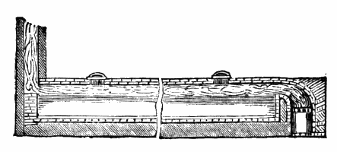
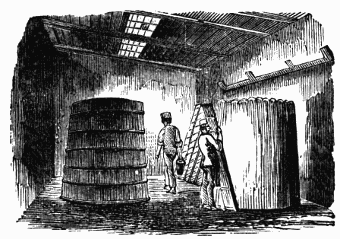
1. The mineral (alum-ore, a.-schist, &c.) is placed in heaps, and moistened from time to time with water, when it becomes gradually hot, and falls into a pulverulent state. This decomposition commonly occurs either wholly, or partially, on the floor of the mine. If the ore does not possess this property on mere exposure to air and moisture, it is broken into pieces and laid upon a bed of brushwood and small coal, to the depth of about four feet, when the pile is fired and fresh lumps of the alum-mineral thrown on, until the mass becomes of considerable height and size. The combustion, as soon as established, is conducted with a smothered fire, until the calcination is complete; care being taken to prevent fusion, or the disengagement of either sulphurous or sulphuric acid, from contact between the ignited stones and the carbonaceous fuel.[35] To promote these ends the pile, at the proper time, is ‘mantled’ (as the workmen call it) or covered with a layer of already calcined and exhausted ore, in order to protect it from high winds and heavy rains; as also to moderate the heat, and let it proceed gradually, so that the sulphur present may not be lost or wasted by volatilisation. The roasting is finally checked by a thicker ‘mantling,’ and the whole allowed to cool. By this time the pile has usually lost about one half its bulk, and become open and porous in the interior, so that the air can circulate freely through the mass; the latter, in dry weather, as the heap cools, being usually promoted by sprinkling a little water on it, which, by carrying down some of the saline matter, renders the interior still more open to the atmosphere. The whole, when cold, or nearly cold, is, if necessary, still further exposed to the action of air and moisture. The time required to calcine the heap properly, including that taken by the burned ore to cool, varies, according to its size and the state of the weather, from three to nine, or even twelve months. The residuum of the calcination is next placed in large stone or brick cisterns, and edulcorated with water, until all the soluble portion is dissolved out; the solution is then concentrated in another stone cistern, so made that the flame and heated air of its reverberatory furnace sweep the whole surface of the liquor. (See engr.) The evaporation is continued until it just barely reaches the point at which crystals are deposited on cooling; when it is run off into coolers. After the sulphate of iron, always present, has been deposited in crystals, the mother-liquor, containing the sulphate of aluminum, is run into other cisterns, and a saturated solution of chloride of potassium, or of sulphate of potassium, or (sometimes) impure sulphate or carbonate of ammonium, or a mixture of them,[36] is added until a cloud or milkiness ceases to be produced on addition of more.[37] It is next allowed to settle and get thoroughly cold, and the supernatant ‘mother-liquor’ being drawn off with a pump or syphon, the precipitate, which is alum in the form of minute crystals (technically termed ‘flour’), is well drained, and subsequently washed by stirring it up with a little very cold water, which is then drained off, and the operation repeated a second time with fresh water. A saturated solution of the pulverulent alum (‘flour’) is next formed in a leaden boiler, and the clear portion is run or pumped off, while boiling hot, into crystallising vessels, called roaching casks (see engr.), the staves of which are lined with lead, and nicely adjusted to each other. After the lapse of a week or ten days, the hoops and staves of these ‘casks’ are removed, when a thick crust of crystallised alum is found, which exactly corresponds in form and size to the interior of the cask. A few holes are then made in the sides of this mass, near the bottom, to allow the contained mother-liquor to drain off, after which the whole is broken up and packed in casks for sale. Sometimes the alum thus obtained, or the lower portion of it, is washed with a little very cold water, and, if discoloured, or small or slimy, is purified by a second crystallisation.
2. As ammonia-alum (Spence’s process; see below), but using a potash-salt as the precipitant, either wholly or in part, instead of ammonia; and, in the latter case, supplementing the deficiency of potash with ammonia, as there explained.
b. From ALUMINOUS CLAY and OIL OF VITRIOL:—
1. Clay, free or nearly free from carbonate of lime and oxide of iron, is chosen for this purpose. It is moderately calcined (in lumps) in a reverberatory furnace, until it becomes friable; great care being taken that the heat be not sufficient to indurate it, which would destroy its subsequent solubility. It is next reduced to powder, sifted, and mixed with about 45% of its weight of sulphuric acid (sp. gr. 1·45), the operation being conducted in a large stone or brick basin arched over with brickwork. Heat is then applied, the flame and hot air of a reverberatory furnace being made to sweep over the surface of the liquor. The heat and agitation are continued for 2 or 3 days, when the mass is raked out and set aside in a warm place for a few weeks (6 to 8), to allow the acid the more perfectly to combine with the clay. At the end of this time the newly-formed sulphate of alumina is washed out, the solution evaporated until of a sp. gr. of about 1·38 (1·24 for ‘ammonia-alum’), and the salt of potash added. The remaining operations resemble those above described. Good alum may be produced by this process at about two thirds the cost of rock or mine alum.
2. (Process of Mr Pochin.) Fine China clay is heated in a furnace, and mixed with a suitable proportion of sulphuric acid; the latter being considerably diluted with water, in order to moderate its action, which would otherwise be far too violent. The mixture is then passed into cisterns furnished with movable sides, where, in a few minutes, it heats violently and boils. The thick liquid gradually becomes thicker, until it is converted into a solid porous mass; the pores being produced by the bubbles of steam which are driven through it, owing to the heat resulting from the reaction of the ingredients on each other. This porous mass (ALUM-CAKE; CONCENTRATED ALUM) appears perfectly dry, although retaining a large amount of combined water. It also contains all the silica of the original clay, but in such a state of fine division, that the whole appears homogeneous; whilst it imparts a dryness to the touch which can scarcely be given to pure sulphate of alumina. From this substance a solution of pure sulphate of alumina is easily obtainable by lixiviation, and allowing the resulting solution to deposit its silica before using it, but for many purposes the presence of the finely divided silica is not objectionable. The sulphate of alumina solution so obtained is adapted to all the purposes in dyeing for which alum is now employed; the sulphate of potash or of ammonia in the latter being an unnecessary constituent, and one merely added to facilitate the purification and subsequent crystallisation of the salt. To obtain ALUM from the porous alum-cake, the proper proportion of acid having been used in its preparation, or subsequently added, it is only necessary to precipitate its concentrated solution with a strong solution of a salt of potash, or of ammonia, or a mixture of them, and to otherwise proceed as before.
Ratio. In the above process the sulphide of iron of the shale or schist is converted by atmospheric oxygen into sulphate of iron and sulphuric acid; the sulphuric acid decomposes the clay, setting silica free, and producing sulphate of aluminum. The sulphate of iron is mostly got rid of by concentrating the solution of the mixed sulphates, and the mother-liquors are converted into alum by the addition of the salt of potassium. When chloride of potassium is used, it yields chloride of iron and sulphate of potassium, the latter combining with the sulphate of aluminum, and the former remaining behind in the mother-liquor. See Alums (in Chemistry).
Comp. Potassium alum has the formula K2SO4.Al2(SO4)3.24Aq.
c. From Cryolite.
1. (Thomson’s method.) Decomposition of cryolite by ignition with carbonate of lime. From the ignited mass the aluminate of soda is obtained by lixiviation with water, and into the solution carbonic acid gas is passed, when there result precipitated hydrated gelatinous alumina and carbonate of soda, which remains in solution. If it be desired to obtain the alumina as an earthy compact precipitate, bicarbonate of soda is used instead of carbonic acid. While the clear liquor is boiled down for the purpose of obtaining carbonate of soda, the precipitated alumina is dissolved in dilute sulphuric acid; this solution is evaporated for the purpose of obtaining sulphate of alumina (the so-called concentrated alum), or the solution after having been treated with a potassa or an ammonia salt is converted into alum.
2. (Sauerwein’s method.) Decomposition of cryolite by caustic lime by the wet way. Very finely ground cryolite is boiled with water and lime, the purer the better, and as free from iron as possible, in a leaden pan. The result is the formation of a solution of aluminate of soda, and insoluble fluoride of calcium (lime). When the fluoride of calcium has deposited, the clear liquid is decanted, and the sediment washed, the first wash-water being added to the decanted liquor, and the second and third wash-waters being used instead of pure water at a subsequent operation. In order to separate the alumina from the solution of aluminate of soda, there is added to the liquid while being continuously stirred very finely pulverised cryolite in excess, the result of the decomposition being alumina and fluoride of sodium, (soda). When no more caustic soda can be detected in the liquid, it is left to stand for the purpose of becoming clear. The clarified solution of fluoride of sodium is then drawn off, and the alumina treated as above described. The solution of fluoride of sodium having been boiled with caustic lime yields a caustic soda solution, which having been decanted from the sediment of fluoride of calcium is evaporated to dryness. Recently the fluoride of calcium occurring as a by-product has been used in glass-making.
3. The decomposition of cryolite by sulphuric acid yields sulphate of soda convertible into carbonate by Leblanc’s process, and sulphate of alumina free from iron. This method of decomposing cryolite is, however, by no means to be recommended, as owing to the liberation of hydrofluoric acid, peculiarly constructed apparatus are required, whilst the sulphate of soda has to be converted into carbonate.
d. From Bauxite. This mineral, occurring in some parts of Southern France, in Calabria, near Belfast, and in other parts of Europe, consists essentially (viz. 60 per cent.) of hydrate of alumina, more or less pure. In order to prepare alums and sulphate of alumina from it, the mineral is first disintegrated by being ignited with carbonate of soda, or with a mixture of sulphate of soda and charcoal; in each case the lixiviation of the ignited mass yields aluminate of soda, from which, by the processes already described under “Cryolite,” alum, or sulphate of alumina, and soda are prepared.
e. From blast-furnace slag. Lürmann recommends the slag to be decomposed by means of hydrochloric (muriatic) acid. From the resulting solution of chloride of aluminum the alumina is precipitated by carbonate of lime, any dissolved silica being precipitated at the same time. The alumina is dissolved in sulphuric acid, leaving the silica.
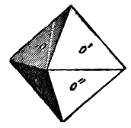
Prop. Alum crystallises in regular octahedrons, often with truncated edges and angles; (see engr.); and sometimes in cubes, but only when there is a deficiency of acid in its composition, with the alkali in slight excess of the proper quantity. (Löwel.)[38] It is slightly efflorescent in dry air: soluble in 18 parts of cold water, and in rather less than its own weight of boiling water; tastes sweet, acidulous, and very astringent; is styptic; and reddens litmus. When heated it melts, loses its water of crystallisation, and becomes white and spongy (DRIED ALUM); a strong heat, short of whiteness, decomposes it, with the evolution of oxygen and a mixture of sulphuric and sulphurous anhydride; calcined with carbonaceous matter it suffers decomposition, and furnishes a pyrophoric residuum (Homberg’s pyro′phorus). Ignited with alkaline chlorides, hydrochloric acid is liberated; which also occurs when their concentrated solutions are boiled together. Ammonia precipitates pure hydrate of aluminum from potassium alum; but only a subsulphate from the simple sulphate of alumina. Sp. gr. 1·724; but, when containing ammonia, often so low as 1·710.
Tests, &c. It is easily recognised by its crystalline form, its taste, and by its complete solubility in water. Its aqueous solution gives a white gelatinous precipitate soluble in excess; a platinum wire moistened with the solution imparts a violet colour to the blowpipe flame; and chloride of barium gives a white precipitate insoluble in nitric acid.
Pur. When pure, its solution is not darkened by tincture of galls, sulphuretted hydrogen or ferrocyanide of potassium; neither does it give any precipitate with solution of nitrate of silver. Heated with caustic potassa, or quick-lime, it does not evolve fumes of ammonia.
Adult., &c. The principal impurity, and one which renders alum unfit for the use of the dyer, is iron. This may be readily detected by the blue precipitate it gives with ferrocyanide of potassium, or the black precipitate with sulphide of ammonium, which are very delicate tests.[39] Lime, another very injurious contamination, may be detected by precipitating the alumina and iron (if any) with ammonia, and then adding oxalate of ammonia to the boiled and filtered liquid. The liquid filtered from the last precipitate (oxalate of lime) may still contain magnesia, which may be detected by the white precipitate caused on the addition of an alkaline phosphate. Common alum frequently contains ammonia, from urine, or the crude sulphate of the gas-works, having been employed in its manufacture. Powdered alum is frequently adulterated with common salt, in which case it gives a white curdy precipitate with nitrate of silver, turning black by exposure to the light.
Phys. eff. &c. In small quantities alum acts as an astringent; in larger doses as an irritant. It acts chemically on the animal tissues and fluids, is absorbed, and has been discovered in the liver, spleen, and urine (Orfila), the last often becoming acid (Kraus). Externally, it is astringent. The almost general use of alum by the English bakers is one of the most fertile sources of dyspepsia and liver and bowel complaints in adults; and of debility and rickets in children. Bad teeth and their early decay is another consequence of the daily use of alum in our food. The bone matter (phosphate of lime) of bread, instead of being assimilated by the system, is either wholly, or in part, converted into a salt of alumina, which is useless and incapable of appropriation. When alum has been taken in poisonous doses an emetic should be given, followed by warm diluents and demulcents, containing a little carbonate of soda; and subsequently by a purgative.
Uses, &c. The applications of alum in the arts and manufactures are numerous and important. It is used to harden tallow and fats; to render wood and paper incombustible; to remove greasiness from printers’ blocks and rollers; to prepare a paper for whitening silver and silvering brass in the cold; to help the separation of the butter from milk; to purify turbid water; to dress skins; to fix and brighten the colours in dyeing; to make lake and pyrophorus, &c., &c. It is also extensively used for clarifying liquors, and for many other purposes connected with the arts and everyday life. In medicine, alum is used as a tonic and astringent, in doses of 5 to 20 gr.; as a gargle (1 dr. to 1⁄2 pint of water); and as a collyrium and injection (10 to 15 gr. to 6 oz. of water). In lead colic, 1⁄2 to 1 dr. of alum (dissolved in gum-water), every 3 or 4 hours, is said to be infallible. Powdered alum is frequently applied with the tips of the fingers, in cases of sore throat and ulcerations of the mouth, &c. A teaspoonful of it is said to be one of the very best emetics in croup. (Dr Meigs.) Alkalies, alkaline carbonates, lime, magnesia, acetate of lead, astringent vegetables, &c., are incompatible with it.
Gen. commentary. In addition to the particulars of its manufacture given above, we may add, that the plan of getting rid of the ferric salts there referred to has to some considerable extent been successfully replaced by that of precipitating the alum, instead of the sulphate of iron, by adding alkaline matter to the lixivium. The crystalline precipitate is purified by draining, re-solution, and re-crystallisation; whilst the sulphate of iron and Epsom-salts contained in the mother liquor are obtained by subsequent evaporation and crystallisation; after which a fresh crop of alum may be got from it, by the use of an alkaline precipitant, as before.
In estimating the strength of his solution the alum-maker takes as a standard a measure or sp. gr. bottle capable of holding exactly 80 pennyweights of distilled water. The excess of the weight of liquor, in pennyweights, over 80, or that of water, is called so many ‘pennyweights strong.’ Thus one of 90 pennyweights (90 dwt.) is said to be ‘10 dwt. strong,’ or simply, ‘one of 90 dwt.’ These numbers correspond to 21⁄2 degrees of Twaddle’s hydrometer, and may easily be found by dividing Twaddle’s degrees by 2·5 or 21⁄2; or by multiplying them by 4, and pointing off the right-hand figure of the product for a decimal. The result is in alum-makers’ pennyweights.
By a patent now expired (Weisman’s, 1839) the ferric salts are precipitated by the addition of a solution of ferrocyanide of potassium (prussiate of potash); after which the supernatant clear liquor, which is now a solution of nearly pure sulphate of alumina, is decanted, and evaporated for future operations, until it either forms, on cooling, a concrete mass, which is moulded into bricks or lumps, for the convenience of ‘packing,’ or until it is sufficiently concentrated to be converted into ALUM by the addition of a salt of potash or of ammonia in the usual manner. The product, in each case, is perfectly free from iron. By a like addition of the ferrocyanide to a solution of ordinary sulphate of aluminia or alum, the dyer may himself easily render them free from iron, or iron-alum; when, as mordants for even the most delicate colours, they are equal to the very best Roman alum.
Another process has been patented (Barlow & Gore, 1851) for the manufacture of alum from the ash or residue of the combustion of Boghead-coal, which, though hitherto regarded as almost valueless, actually contains about 30% of alumina. It has not, however, been found a convenient material for the purpose.
By the latest and most approved processes the least possible quantity of boiling water or liquor is employed for making the solutions, so that they may crystallise without evaporation, and thus economise fuel; and the mother-liquors of previous operations are constantly employed for this purpose, when possible. Nor is anything which is convertible to use, from the drainage of the heaps, to the liquor and slime of the roaching casks, allowed to be wasted.
By whatever process, or from whatever materials alum is obtained, it is absolutely necessary for the successful and economical conduct of its manufacture, that the precise composition of the mineral or minerals employed should be exactly known. This can only be determined by actual analysis, which should be extended to several parts of the same bed, and particularly to the upper and lower strata, which frequently differ in composition from each other, and thus require different treatment, or may be most advantageously employed in combinations with each other. The necessity of this will be seen by reference to the composition of the following minerals, of which the top contains a larger proportion of iron-pyrites than the bottom, and the two require to be mixed, to equally diffuse the sulphuric acid generated by the calcination, &c., to which they are subjected.
The following is the per-centage composition of certain alum shales:—
Whitby, Yorkshire. (Richardson.)
Top rock.Bottom rock.
Sulphide of iron (pyrites)4·208·50
Silica52·2515·16
Protoxide of iron8·496·11
Alumina18·7518·30
Lime1·252·15
Magnesia·91·90
Oxide of manganesetracestraces
Sulphuric acid (SO3)1·372·50
Potassa·13traces
Soda·20traces
Chlorinetracestraces
Coal4·978·29
Water2·88·00
Loss4·60(?)
——————
100·100·
Campsie, near Glasgow. (Ronalds.)
Top rock.Top rock.Bottom rock.
Sulphide of iron (pyrites)40·5238·489·63(?)
Silica15·4015·4120·47(?)
Protoxide of iron......2·18
Alumina11·3511·6418·91(?)
Lime1·402·22·40
Magnesia·50·322·17
Oxide of manganese·15...·55
Sulphuric acid......·05
Potassa·90...1·26
Soda......·21
Carbon or bituminous matter27·65(?)28·80(?)
Coal......8·51
Water......8·54
Loss2·13(?)3·131·59(?)
—————————
100·100·100·
Alum-rock, or alum-stone, is a species of impure alunite, and is not of very common occurrence. That of Tolfa, near Civita Vecchia, according to Klaproth, consists of—
Silica56·5
Alumina19·
Sulphuric acid (SO3)16·5
Potassa4·
Water3·
Loss1·
———
100·
which exhibits an excess of about 3% of sulphuric acid, and about 14% of alumina, more than are requisite to form alum with the 4% of potassa; proportions which, therefore, require to be supplemented with a potassium salt during the process of manufacture. The alum-stone of Mont d’Or contains, according to Cordier, 1·4% of oxide of iron.
The presence of lime in alum-ore is most prejudicial, owing to its affinity for sulphuric acid being greater than that of either alumina or iron. Ores containing it in any quantity are, therefore, unfitted for the manufacture of alum. Magnesia is also prejudicial; but in this case the sulphate of magnesia left in the mother-liquors is not wholly valueless, as it may be crystallised and sold as ‘Epsom-salt,’—a thing which is actually done in some English alum-works.
The potash-salt employed by the alum-makers is either the sulphate or the chloride—chiefly the latter; its sources being the waste liquor of soap-works, saltpetre refineries, and glass-houses. Wood-ashes, although rich in potash, do not answer well unless freed by lixiviation from the large amount of carbonate of lime which is always present in them.
The ammonia-salt used in making alum is generally the crude sulphate prepared from the ammoniacal liquor of gas-works, or that from the manufacture of sal-ammoniac by the destructive distillation of animal matter. Both these liquors may be used without previous conversion into sulphate of ammonia whenever there is an excess of sulphuric acid in the aluminous solution.
Soda-salts are seldom, if ever, used as precipitants in the manufacture of alum, on account of the easy solubility of the resulting SODA-ALUM—a property which unfits them for this purpose. See Alums, Ammonia, Dyeing, Mordants, Potash, Sulphuric Acid, &c. (also below).
Alum, Ammonia. (NH4)2SO4 . Al2(SO4)3 . 24 Aq. Syn. (Alumen; Alum; B. P.), Alu′men Ammonia′tum, L.; Alun d’ammoniaque, A. ammoniacal, Fr. This is an alum in which the sulphate of potassium is replaced by an equivalent of sulphate of ammonium. It is prepared by adding crude sulphate of ammonium to solution of sulphate of aluminum; or gas-liquor, putrid urine, &c., to the acid-sulphate.
Much of the common alum, especially that prepared on the Continent, contains both potassium and ammonium; and recently enormous works for its manufacture have been established in England. As an astringent, and as a source of alumina in dyeing, it resembles potash-alum (i. e. ordinary alum). It may, however, be readily distinguished from the latter by the fumes of ammonia which are evolved when it is moistened and triturated, or heated, with caustic potassa or quick-lime; and by the residuum of its exposure to a white heat being pure alumina. See Alum (antè).
Alum, Basic. A variety of alum found native at Tolfa. On calcination and subsequent lixiviation it yields ordinary alum. A like substance falls as a white powder, when newly precipitated alumina is boiled in a solution of alum.
Alum, Baumé’s. Alum-white. See White Pigments.
Alum, Dried; Alum, Burnt. Syn. Alu′men us′tum, A. exsicca′tum (B. P.); Alun Sec, Fr.; Gebrannter alaun, Ger.; Alume calcinato, Ital. Alum deprived of its water of crystallisation by heat.
Prep. Take of alum, 4 oz. Heat the alum in a porcelain dish or other suitable vessel, till it liquefies, then raise and continue the heat, not allowing it to exceed 400°, till aqueous vapour ceases to be disengaged, and the salt has lost 47 per cent. of its weight. Reduce the residue to powder, and preserve it in a well-stopped bottle.
Prop., &c. Similar to those of common alum, but it is rather more astringent, and is less soluble. When moistened, or placed in contact with water, it resumes its water of crystallisation with evolution of heat.—Dose, 10 to 20 gr.; in colic (especially painters’ colic), hæmoptysis, &c. It is chiefly used as an escharotic, to destroy ‘proud flesh,’ &c. It must be kept in a stoppered bottle.
Alum, Chrome. See Alums (in Chemistry).
Alum, I′ron (-ŭrn). Syn. Alu′men Fer′ricum, Sul′phas fer′ri et potas′sæ, Fer′ri perox′idi potassio-sul′phas, &c., L.
Comp. K2SO4 . Fe2(SO4)3.24Aq.
Prep. Take of peroxide of iron, 9 lbs.; sulphuric acid 14 lbs.; dissolve, dilute the mixture with water, q. s., and add of potassium sulphate, 10 lbs.; evaporate, and crystallise.
Prop., &c. Crystals, beautiful octahedrons of a pinkish or pale violet colour. It is strongly recommended, by Dr Tyler Smith, as a chalybeate tonic, and has been used by him, at St. Mary’s Hospital with marked success. It has also been used as a mordant, in dyeing black.—Dose, 1⁄2 gr. to 5 gr.
Alum, Ro′man. Syn. Red alum*, Roach A., Roche A., Rock A.*; Alu′men Roma′num, A. ru′brum, A. ru′peum, &c., L.; Alun Romain, A. de roche, Fr.; Alume di rocca, It. In small fragments, covered with a reddish powder (ALUMEN RUBRUM VE′′RUM); originally imported from Civita Vecchia, where it occurs native. It is much esteemed by dyers from being nearly free from iron-alum. That now sold for it in England is ordinary alum coloured with Venetian red, Armenian bole, or rose-pink (ALUMEN RUBRUM SPU′′RIUM). This is done by shaking the fragments in a sieve over a vessel of hot water, and then stirring them up with the colour, until the surface is uniformly tinged with it. In genuine roach-alum the colour not only covers the surface, but also partially pervades the substance of the crystals. The name was formerly also applied to a pure white variety of alum, prepared at Tolfa; but it is now, in English commerce, exclusively given to common alum artificially coloured.
Alum, Saccharated. Alum, 6 oz., white lead 6 drms., sulphate of zinc 3 drms., sugar 11⁄2 oz. Mix the ingredients reduced to powder into a paste, with vinegar and white of egg. Used in eye waters and cosmetic washes.
Alum, So′da. Syn. Sulphas aluminæ et sodæ, L. Comp. Na2SO4 . Al2(SO4)3 . 24Aq. An alum in which the potassium sulphate of common alum is replaced by a like salt of sodium. It does not occur in commerce. (Vide suprà et infrà.)
ALUM-EARTH. Alumina.
ALUM MOR′DANTS. In dyeing, mordants having for their basis either common alum or the acetate or sulphate of aluminum. See Alums and Mordants.
AL′UM-ROOT. Syn. Amer′ican san′icle; Heu′chera (Ph. U. S.), L. The root of heuchera America′na (Linn.), a plant of North America. It is powerfully styptic and astringent; and is used chiefly as an external application in cancer.
ALUM-WHITE. See White Pigments.
AL′UMS. Syn. Alu′mina (pl. of alu′men), L. In chemistry, a term applied to a series or group of salts having potassium alum for their type, which they resemble in crystalline form and constitution.
It is found that the aluminum of common alum may be replaced by any other metal having a like nature, without affecting the leading characteristics of the salt; and further, that in the newly formed compound, as in potassium-alum, the second sulphate may also be replaced under the like conditions. All the alums crystallise in octahedrons or cubes, and they all contain the same number of molecules of water. The alums of commerce (or alums proper) all contain aluminum sulphate and an alkaline sulphate.
Prep. All the alums may be made by mixing together solutions of the respective sulphates in equivalent proportions, when crystals may be obtained by evaporation in the usual manner. The presence of sulphuric acid, in slight excess, assists their crystallisation.
AL′UMED (al′ŭmd). Mixed or impregnated with alum. In dyeing, mordanted with alum.
ALU′MEN (-l′ōō-). [L.] Alum; the pharmacopœial name of alum. (See above.)
ALUMINIUM. Syn. Aluminum (which see).
ALUMINOUS. In mineralogy, of, resembling, or containing aluminum. In chemistry, containing or obtained from alum.
ALUMINUM. [Eng., Fr., L.] Syn. Aluminium, Eng., Fr., L.; Alumium, Ger. A metallic radical or element very abundantly distributed, united with silica. Discovered by M. Wöhler, who succeeded in obtaining it as a grey metallic powder (A.D. 1827); and later (1845), under the form of globules exhibiting the leading characteristics of the metal. In 1854, M. Dumas announced to the ‘Academy of Sciences,’ that M. St. Clair Deville had procured pure aluminum from clay, and exhibited several specimens of considerable size and beauty. The result was a general impression that it might be easily obtained in any quantity, and ultimately at a reasonable price; expectations which have been only partly, though to a great extent fulfilled, owing to the expense and trouble of the process, notwithstanding recent improvements.
Prep. (M. Deville; A.D. 1854-59.)—A quantity of chloride of aluminum, varying from 200 to 300 grammes (say from 6 to 10 oz.), is introduced into a wide glass or porcelain tube, between two plugs of asbestos to retain it in position, and a current of hydrogen (thoroughly dried by passing first through concentrated sulphuric acid, and then through a tube containing fused chloride of calcium) passed over it; a gentle heat being at the same time applied to the part of the tube containing the chloride, to drive off any free hydrochloric acid which might have been formed by the action of the air upon it. A small porcelain boat, containing sodium, is now introduced at the other extremity of the glass tube, which is then again closed; and when the sodium is fused, the chloride is sufficiently heated to cause its vapour to come into free contact with it. A powerful reaction ensues, with the evolution of much heat, and this continues as long as any undecomposed sodium remains to act on the passing vapour. The mass in the boat, which is now a mixture of the double chloride of aluminum and sodium, in which small globules of the newly reduced metal are suspended, is allowed to cool in the hydrogen; after which it is treated with water, to remove the soluble double chloride. The residuum, consisting of small globules of aluminum, is, lastly, reduced to a solid button or mass, by fusion, at a strong heat, under a layer of the fused double chloride of aluminum and sodium.
On a large scale two cast-iron cylinders are employed, instead of the glass or porcelain tube just referred to; the anterior one of which contains the chloride of aluminum, and the posterior one a tray holding the sodium, of which 10 or 12 lbs. are commonly operated on at once. These cylinders are united by means of a smaller intermediate one, filled with clean scraps of iron, which serve to separate iron, free hydrochloric acid, and chloride of sulphur, from the vapour of the chloride of aluminum, as it passes through them. During the passage of the vapour of the chloride this smaller cylinder, or tube, is kept heated to from 400° to 600° Fahr.; but the two other cylinders are only very gently heated, since the chloride is volatilised at a comparatively low temperature, and the reaction between it and the fused sodium, when once commenced, usually generates sufficient heat for the completion of the process.
Occasionally a mixture of the double chloride of aluminum and sodium, 40 parts; chloride of sodium 20 parts; fluor spar, 20 parts; each separately dried, powdered, and then blended together; sodium, in small pieces, 71⁄2 to 8 parts, are used instead of the last.
It is likewise made from a mixture of cryolite and fused chloride of potassium, of each, in powder, 5 parts; sodium, 2 parts; a cast-iron crucible being employed; the resulting minute globules being collected and fused to a button under a layer of the double chloride of aluminum and sodium.
Prop., &c. Aluminum, when quite pure, closely approaches silver in appearance, except in being rather less white and lustrous than that metal. Ordinary specimens, called pure, have a slight bluish tint or tin-white colour, with a perfect lustre, but far inferior to that of pure silver. Sp. gr. 2·56, which by hammering may be raised to 2·67. It is both ductile and malleable; fuses at a temperature between the melting-points of zinc and silver; is not affected by either damp or dry air, or by oxygen at ordinary temperatures, or by water whether cold or boiling; even steam, at a red heat, is only slowly decomposed by it. It is not acted on by nitric acid, however concentrated, unless boiling, and then very slowly; nor by dilute sulphuric acid, sulphuretted hydrogen, and the sulphides, or even the fused hydrates of the alkalies. It is, however, readily dissolved by hydrochloric acid, with the evolution of hydrogen, even in the cold; and by a concentrated mixture of nitric and sulphuric acid. It is feebly magnetic, conducts electricity about eight times better than iron, and is more electro-negative than zinc. Commercial specimens, owing to the presence of iron and silicon, and often zinc, usually slowly tarnish in damp air, and possess the other properties described above in a somewhat diminished degree.
In a finely divided state, particularly in the state of powder or minute scales in which it was originally obtained, when heated to redness, it catches fire and burns with great rapidity in the air, and in oxygen gas with intense brilliancy, the product in each case being alumina.
Aluminum unites with the other metals, forming ALLOYS, of which some promise to be of great value in the arts. An alloy of 100 parts of aluminum with 5 parts of silver may be worked like the pure metal, but is harder and susceptible of a finer polish, whilst its property of not being affected by sulphuretted hydrogen and acids remains unimpaired; even 3% of silver is said to be sufficient to impart to it the full brilliance and colour of pure silver. An alloy containing 10% of gold is softer and scarcely so malleable as the pure metal. With 8% of iron, or 10% of copper, it still remains tough and malleable; but a larger proportion of either of these metals renders it brittle.
The presence of 2 or 3% of zinc destroys its ductility and malleability, and also impairs its colour and lustre; whilst less than even 1⁄4% of bismuth renders it brittle in a high degree. Small quantities of aluminum added to other metals change their properties in a very remarkable manner. Thus, copper alloyed with 10%; of aluminum has the colour and brilliancy of gold, is harder than bronze, very malleable, and may be worked at high temperatures easier than the best varieties of iron; and with 20% is quite white, and closely resembles silver. With more than 12% of aluminum the alloy is harder, but brittle. The alloy formed of 100 parts of silver with 5 parts of aluminum is as hard as the silver of our coinage, whilst the other properties of the latter metal remain unaltered.
Uses. The valuable properties of aluminum adapt it to numerous applications in the arts and everyday life. Hitherto these have been very limited, owing to its comparatively high price; which, notwithstanding it has fallen considerably, is still sufficient to prevent its general or even extensive application. The ‘eagles’ of the French army have been made of it, as well as certain articles of jewelry, plate, &c., as brooches, bracelets, chains, spoons, and other ornamental and useful objects. Owing to its low sp. gr., it has been used as a suitable material for the minute decimal weights of chemists, for military helmets, trumpets, &c. A few cornet-à-pistons, for which its lightness and sonorousness admirably adapt it, have actually been made of it. Its power of resisting oxygen, sulphuretted hydrogen, moisture, &c., would render it invaluable as a coating to metals, particularly iron and lead, to protect them from rust or corrosion, did not its price intervene. As an internal coating for water-pipes, cisterns, &c., no other substance, except gold and platinum, is so well adapted. In chemistry, capsules, tubes, &c., either made of or coated with it, may be often advantageously substituted for those of platinum.
In addition to what has been said above, it may be observed that, in preparing aluminum, the chief care should be to avoid accidents or failure by the employment of too high a temperature, and to avoid the product being contaminated with other metals or with carbon. To ensure the purity of the metal is a matter of the greatest difficulty, owing to the facility with which foreign matters are taken up, during the process, from the materials of which the apparatus is composed; and from the substances from which it is prepared being seldom absolutely pure. Indeed, it is not too much to assert that chemically pure aluminum has not yet been obtained; and that even a very close approximation to it is of very rare occurrence. Whenever a copper boat is used to hold the sodium, the product is always contaminated with copper. Chloride of aluminum always contains some of the chlorides of iron and silicon, both of which are volatile, and probably takes up a further portion from the porcelain or earthenware used to form the apparatus. Sodium also is seldom uncontaminated with carbon or some compound of it; in which case, and likewise when it is not carefully freed from the naphtha in which it has been preserved, the product always contains carbon. The crucible, whether of porcelain or iron, in which the final fusion is made, also contributes to contaminate the metal. Hence the inferior whiteness and brilliancy of commercial specimens of aluminum; a metal which, in its absolutely pure state, may be reasonably inferred to be as superior in the above respects to silver as silver is to tin. Commercial aluminum contains from 88 to 94 per cent. only of pure aluminum, and from 1 to 4 per cent. of iron, 1⁄2 to 3 per cent. of silicon, and from 1 to 6 per cent. of copper.
Aluminum salts are generally colourless, soluble, and crystallise with difficulty, and are distinguished as follows:—
Tests.—1. Ammonia and the alkaline carbonates throw down a bulky white precipitate (hydrate of aluminum) from solutions of its salts, which is insoluble in excess of the precipitant.—2. Pure potassa and soda throw down white gelatinous precipitates, freely soluble in excess of the precipitant; from which the hydrate of aluminum is reprecipitated by chloride of ammonium, even in the cold:—3. Phosphate of ammonium gives a white precipitate—4. Iodide of potassium produces a white precipitate, passing into a permanent yellow:—5. Sulphuretted hydrogen gives no precipitate:—6. Sulphydrate of ammonium precipitates alumina from these solutions:—7. Bisulphate of potassium, added to concentrated solutions, gives a precipitate of octahedral crystals of alum:—8. At a red heat its salts part with some of their acid; at a white heat, most of it, if not all:—9. Aluminum compounds, ignited on charcoal before the blowpipe, and afterwards moistened with a solution of nitrate of cobalt and again strongly ignited, give an unfused mass, which, on cooling, appears blue by day, and violet by candlelight; a test, however, which is inapplicable to fusible compounds of aluminum, and such as are not free, or nearly free, from other oxides.
Aluminum, Acetate of. Syn. Acetate of Alumina. Prep. Pure hydrate of aluminum is digested, to saturation, in strong acetic acid, in the cold; and the resulting solution, after being filtered or decanted, is either evaporated by a very gentle heat to a gelatinous, semi-solid consistence (its usual form), or is preserved in the liquid state. By spontaneous evaporation it may be obtained in long, transparent crystals.
Red liquor. From alum, in powder, 4 parts; warm water, q. s. to dissolve; acetate of lead, in powder, 3 parts; the solution and mixture being effected by lengthened agitation in a tub or other wooden vessels, and the clear liquid, after repose for a sufficient time, decanted or drawn off from the sediment.
From alum, 2 parts; (dissolved in) warm water, q. s.; solution of pyrolignite of lime (20° Baumé), 3 parts; as before, but allowing a longer time for the subsidence of the precipitate, and taking more care in the decantation than when acetate of lead is employed.
By decomposing a solution of crude sulphate of alumina with neutral or monobasic acetate of lead.
Prop. Its characteristic property is the feeble affinity existing between its acid and base, which, when it is used as a mordant, is counterbalanced by that of the fibres of the cloth or yarn to which it is applied. In other respects it resembles the other simple salts of alumina.
Uses, &c. In dyeing and calico printing, as a mordant. In medicine, properly diluted, in chronic diarrhœa; and, mixed with syrup of poppies, in slight cases of hæmoptysis (spitting of blood). It has been employed by M. Gannal as an injection to preserve animal bodies, which it will do for years.—Dose, 1⁄2 to 1 dr. daily, in divided portions, taken in thin mucilage or syrup, or in barley-water; as an injection, 10 to 20 gr., to water, 4 to 6 fl. oz., in gonorrhœa, leucorrhœa, &c.
Aluminum, Chloride of. Al2Cl6. Syn. Sesquichlo′′ride of Aluminum; Alumin′ii Chlori′di, &c., L. Prep. A thick paste made of dry precipitated alumina, lampblack, and oil, is strongly heated in a covered crucible until all the organic matter is carbonised. The residuum is transferred to a porcelain tube fixed across a furnace, one end of which is connected with another tube containing dry chloride of calcium, and the other end with a small tubulated receiver. The porcelain tube is then heated to redness, whilst chlorine, dried by passing through the chloride-of-calcium tube, is transmitted through the apparatus. In one or two hours, or as soon as the tube is choked, the whole is allowed to cool, and the newly-formed SESQUICHLORIDE collected and preserved in mineral naphtha for use.
On the large scale:—Chlorine, dried as before, is passed over a mixture of pure clay, lamp-black, and coal-tar, contained in an iron retort, similar to that used in the manufacture of coal-gas (previously ignited by means of a suitable furnace), and connected with a cool chamber accurately lined with tiles of earthenware. The vapours of the SESQUICHLORIDE condense in this chamber, as a yellowish crystalline mass, which is collected and preserved as before.
Prop., &c. It is volatile at a dull red heat; excessively greedy of moisture; and very soluble, with decomposition, hydrochloric acid and alumina being formed. Once dissolved, it cannot be again recovered. Its chief use is in the preparation of aluminum.
Obs. Although alumina, like magnesia, is freely soluble in hydrochloric acid, the sesquichloride of aluminum contained in this solution cannot be obtained in the anhydrous state, or even the solid form, by its evaporation; the chloride suffering decomposition, with the formation of hydrochloric acid, which is volatilised, and alumina, which is left behind.
Aluminum, Ni′trate of. Al2(NO3)6. Syn. Nitrate of Alumina; Alu′minæ Ni′tras, L. Prep. Similar to that of the acetate and citrate. Its concentrated acid solution deposits rhombic crystals, containing 18 equiv. of water.
Aluminum, Oxide of (Al2O3), and Hydrate of (Al2(HO)6). Syn. Alumina.
Prep. Aluminum is precipitated as a hydrate from solutions of aluminum salts on the addition of an alkali or alkaline carbonate; and this precipitate, after being thoroughly washed and dried, on ignition loses its water and becomes anhydrous. The following are the best formulæ for the purpose:—
Alum is dissolved in about 20 times its weight of distilled water, and the solution is dropped slowly into pure solution of ammonia, until the latter is nearly but not entirely saturated, when the whole is set aside for some time. The clear supernatant liquid is then decanted, and the precipitate is carefully and thoroughly washed three or four times with tepid distilled water; after which it is collected on a filter, again well washed with water, and, lastly, pressed and dried between bibulous paper, either without heat, or at a temperature not higher than 120° Fahr. The product is pure hydrate of ammonium, and is converted into anhydrous alumina by exposure to a white heat in a covered crucible. The residuum, after ignition, is pure ANHY′DROUS ALUMINA, or SESQUIOX′IDE OF ALUMIN′UM.
A solution of alum is slowly added to a solution of carbonate of ammonia, avoiding excess; and the resulting precipitate, after being washed and pressed, is dried at a heat of from 120° to 180° Fahr.
Prop., &c. A soft white powder. The hydrate is freely soluble in the acids and in solution of caustic potassa and soda (from which it is precipitable by sal ammoniac); when anhydrous (as after ignition), it is scarcely acted on by acids, and when perfectly indurated, or crystallised, it is wholly insoluble; but on ignition with alkalies, alkaline ALU′MINATES are formed, and the alumina is then readily dissolved by acids, forming salts, which are mostly colourless, non-volatile, and soluble; they have a very astringent and somewhat sweetish taste, redden litmus paper, and lose their acids by ignition. Its most remarkable, or rather useful property, is its strong affinity for the fibres of organic bodies, as cotton, flax, silk, wool, &c., which are capable of taking it from its salts; and also for organic colouring matters. Hence its great use in dyeing, and in bleaching liquids and the preparation of lakes. Hydrate of aluminum agitated or digested with liquids containing vegetable colouring matter, combines with the latter, and either entirely, or to a great extent, removes it from the solution.
Moist precipitated alumina, dried at a heat between 70° and 80°, contains above 58% of water; dried at 212° Fahr., about 32% of water.
Estim. Aluminum is weighed as oxide, after ignition. The solubility of the moist or recently precipitated hydrate in solution of ammonia enable us to separate it from the ALKALINE EARTHS which, when present, are thrown down with it.
Uses, &c. The moist hydrate is used in several processes in the arts. It is the base of cobalt-blue, the lake-pigments, &c. In medicine, it is employed as an antacid and astringent, in acidity of the stomach, cholera, diarrhœa, and dysentery; in which it is said to be superior to the other absorbent remedies. (Ficinus.) It has also been highly recommended in the vomiting and diarrhœa of infancy. (Durr; Neumann; Weese; &c.)—Dose. Children 3 to 10 gr.; adults, 5 or 6 to 20 or even 30 gr., three to six times daily, suspended in water, by mucilage or simple syrup.
Aluminum, Sil′icate of. Al2(SiO2)3. Syn. Sil′icate of Alumina. A substance which, in its hydrous form, is the chief and characteristic ingredient of common clay; and which also occurs, in combination, in several other important and abundant minerals.
Aluminum, Sul′phate of. Al2(SO4)3. Syn. Sesquisul′phate of Alumina, Neutral s. of a., Alu′minæ sul′phas, A. sesquisul′phas, L. Prep. 1. Saturate dilute sulphuric acid with hydrate of aluminum, gently evaporate, and crystallise.
2. (Crude, commercial.) By mixing clay and oil of vitriol, in the way described under Alum. The product is the ‘concentrated Alum’ of the dyers.
Prop. Its crystals are needles and thin pearly plates; soluble in 2 parts of water; taste astringent, and somewhat sweetish; reaction acid; a full red heat expels its acid, leaving a residuum of pure alumina; with the sulphates of potassium, sodium, and ammonium, it forms alum.
Uses, &c. In the arts, chiefly as a substitute for alum; the sulphate of potassium in the latter, being found to be an unnecessary and costly ingredient, only useful to purify the salt from iron, by forming a compound of easy crystallisation; an object that may be effected with greater certainty by cheaper methods. In medicine, as a wash for foul and ill-conditioned ulcers; and as an astringent and antiseptic injection. M. Gannal has successfully employed a solution of this salt to preserve animal bodies, by throwing it into the arteries. Even an enema of 1 quart of it, or an injection of a like quantity into the œsophagus, will suffice to preserve a body for several weeks. The mineral called Al′unite or Alu′minite, found near Newhaven (Sussex), is a native subsulphate or basic sulphate (DISUL′PHATE) of alumina.
Aluminum, Sulphide of. Al2S3. Syn. Sul′phide of Aluminium, &c. A substance best obtained by passing the vapour of bisulphide of carbon over pure alumina, at a bright red heat. It is instantly decomposed by water, with the evolution of sulphuretted hydrogen. See Aluminum (above).
Aluminum Tann′ate. Syn. Tannate of Alumina, Eng.; Alu′minæ tann′as, L. Prep. Take of pure hydrate of aluminum (dried at 90° Fahr.), 1 part; tannic acid (dried at 212°), 2 parts; triturate them together for some time, adding just sufficient water to bring them to the consistence of a syrup, and carefully evaporate to dryness at a heat not higher than 120° Fahr.; lastly, reduce the residuum to powder.
Uses, &c. A combination of certain constitution, which is said to have been found very useful in obstinate vomiting and diarrhœa, in dysentery, and particularly in hæmoptysis, hæmorrhage, &c.—Dose, 3 to 12 or 15 gr.
Aluminium Bronze. See Bronze Aluminium.
AL′VINE (-vĭn). Syn. Alvi′nus, L.: Alvin, Fr. Of or from the belly or intestines; relating to the intestinal secretions.
AMABELE. Consists of crushed millets. See Millet.
AM′ADOU (-ăh-dōō). Syn. German tinder, Touch′wood, Pyrotech′nic sponge, Spunk‡§, Surgeon’s Ag′aric, A. of the oak, &c.; Agar′icus quer′cûs, A. quer′nus, A. Chirurgo′′rum, Fun′gus quer′cûs, &c., L.; Amadou, Agaric Amadouvier, Fr.; Zunderschwamm. Ger. A soft, spongy, combustible substance, being the prepared flesh of bole′tus fomenta′′rius (Linn.), an indigenous species of fungus found on the oak, birch, and a few other trees (REAL AMADOU or OAK-AGARIC); for which b. ignia′′rius (Linn.), a like fungus, found on the willow, cherry, plum, and other trees, is frequently substituted.
Collec., Prep., &c. The outer bark of the fungus (collected in Aug. or Sept.) having been removed with a knife, the inner spongy substance is carefully separated from the woody portion lying below, and after being cut into slices, is well beaten with a mallet until sufficiently soft and pliable. Sometimes it is first boiled in water, in order to separate the epidermis and porous parts, and to free it from soluble matter; after which it is beaten as before. In this state it is used in surgery, &c. To complete its manufacture for TINDER, it is soaked once, or oftener, in a strong solution of saltpetre (RED AMADOU; BROWN A.); or in a thin paste made of gunpowder and water, which is thoroughly forced into the pores (BLACK A.); after which it is dried, and well rubbed to free it from loose matter. The first is the more cleanly; the last the more combustible.
Uses, &c. A light brown or reddish-brown substance. In surgery, pharmacy, &c., it is used to stop local bleeding, to spread plasters on, as a compress, and for other like purposes. When covered with resin-plaster it forms an excellent article for the protection of abraded surfaces. A small piece thus prepared, of a circular shape, having a round hole cut in the middle, the size of the apex of the corn, is one of the very best corn-plasters known; as from its great softness it at once protects the part from pressure, and removes the cause. As a material for shoe-socks it is superior to all other substances. The amadou for surgical purposes must not contain nitre.
AMAL′GAM. [Eng., Ger.] Syn. Amal′gama, L.; Amalgame, Fr. In chemistry and metallurgy, an alloy containing quicksilver; more particularly one in which that metal plays a conspicuous part. Medallists improperly apply this term to all soft alloys.
Mercury unites with many of the metals by mere contact; and with some of them, as gold, silver, tin, and lead, in certain proportions, without losing its fluidity. In a few cases, as with potassium, this union is attended with considerable violence, and with the production of light and heat.
Prep. Most of these compounds may be formed by agitating or rubbing the mercury with the other metal, or metals, in the state of filings or small fragments, either with or without heat; or with the easily fusible metals, by adding it to them in the melted state; care been taken, in both cases, that the heat be not sufficient to volatilise the mercury.
Prop., Uses, &c. Some amalgams are solid, and not unfrequently crystalline; others are fluid. Of the latter several crystallise after a time, becoming solid; being, probably, merely solutions of the solid amalgams in excess of mercury. The amalgams of gold, silver, tin, zinc, &c., are extensively employed in gilding, silvering and dentistry, and in other useful arts and manufactures.
Amalgam, Ammonium. An unstable compound produced when a globule of mercury is placed in a small cavity formed in a piece of sal ammoniac, and the negative pole of a powerful galvanic battery is brought into contact with the metal, and the positive pole, with the ammoniacal salt. In a few seconds the new compound (ammonium amalgam) of the consistence of butter is formed. On withdrawing the influence of the battery, the whole returns to its former condition. By putting an amalgam of sodium into the moistened cavity of the sal ammoniac, similar results are obtained. The phenomena attending the formation of this new substance have been urged as evidence of the existence of the theoretical basic radicle AMMONIUM.
Amalgam, Elec′trical. Prep. 1. Take zinc and grain-tin, of each, 1 oz.; melt them in an iron ladle, remove it from the fire, and add of mercury (hot), 3 oz.; stir the whole well together with an iron rod, pour it into a well-chalked wooden box, and agitate it violently until cold; or, instead of this, it may be briskly stirred until cold, and then powdered. It should be preserved in a corked glass bottle.
2. (La Baumé.) Zinc, 2 oz.; grain-tin, 1 oz.; bees’ wax, 1⁄2 oz.; melt, add of mercury, 6 oz., and otherwise proceed as before. Preferred by some to all other mixtures.
3. Zinc, 2 oz.; mercury, 5 oz.
Use. To cover the cushions of electrical machines. A little of the powder is poured on a piece of paper, crushed smooth with a flat knife, and then spread thinly on the surface of the cushion or rubber, previously slightly smeared with tallow; or the powder may be rubbed down with a little tallow, prior to the application of it.
Amalgam, Gild′ing. Syn. Amalgam of gold.
Prep. Take of grain-gold, 1 part; mercury, 8 parts; put them into a small iron saucepan, or ladle, and apply a gentle heat, using a smooth piece of iron as a stirrer; when the solution or combination is complete, pour it out on a clean plate or smooth stone slab.
Use. To gild brass, copper, &c., in the common process of wash or fire-gilding. A less proportion of gold than the above is used when a thin and cheap gilding is required; as by increasing the quantity of the mercury the same weight of the precious metal may be extended over a much larger surface.
Amalgam, Sil′vering.—a. For METALS. Syn. Amalgam of silver. Prep., Uses, &c. As the last, but substituting silver for gold.
b. For GLASS. Prep. 1. Lead, tin, and bismuth, of each, 1 oz.; bees’ wax or resin 1⁄4 oz.; melt, skim off the dross, cool to the lowest point at which the mixture will remain liquid, and add of quicksilver 10 oz.; mix well with an iron rod.
2. Lead and tin, of each, 1 oz.; bismuth, 2 oz.; quicksilver, 4 oz.; as the last.
Uses, &c. For silvering the insides of hollow glass vessels, globes, convex mirrors, &c. The glass being thoroughly cleaned and dried, is carefully warmed, and the amalgam, rendered fluid by a gentle heat, is poured in, and the vessel turned round and round, so as to bring the metal into contact with every part which it is desired to cover. At a certain temperature it will be found to readily adhere to the glass. The excess is then poured out, and the vessel set aside to cool.
Amalgams, Tooth. See Dentistry and Tooth-cements.
Amalgam, Var′nisher’s. Prep. Melt grain-tin, 4 oz., with bismuth, 1 oz.; add quicksilver, 1 oz., and stir till cold; then grind it very fine with white-of-egg or with varnish, and apply the mixture to the figure or surface with a soft brush. It is used in several of the ornamental trades.
Amalgamating Salts. Boil a solution of pernitrate of mercury with excess of equal parts of powdered persulphate and perchloride of mercury, and decant the liquid portion of the result for use. Chiefly used for amalgamating the zinc plates of galvanic batteries, also as a substitute for mercury in gilding by the amalgam process.
AMAL′GAMATED. Syn. Amalgama′tus, L.; Amalgamé, Fr. Compounded or blended with quicksilver; formed into an amalgam.
AMALGAMA′TION. [Eng., Fr.] Syn. Amalgama′tio, L.; Verquicken, Ger. The act or process by which an amalgam is formed; hence loosely, the mixing or blending of different things. In the art of the refiner, the operation of separating gold and silver from their ores by means of mercury.
AM′ANDINE (-dēne). Prep. 1. (Transparent.)—a. Fine new white or pale honey, 4 oz.; white soft-soap (prepared from lard and potassa), 2 oz.; mix thoroughly in a marble mortar, adding 1 or 2 teaspoonfuls (if necessary) of solution of potassa, until a perfectly homogeneous paste or cream is produced; then rub in, by degrees, and very gradually, of oil of almonds, 7 lbs. (or q. s.), previously mixed with essential oil of almonds, 1 oz.; essence (oil) of bergamot, 3⁄4 oz.; oil of cloves, 1⁄2 oz.; and balsam of Peru, 3 dr. The product, which should have a rich, transparent, jelly-like appearance and behaviour, is, lastly, put into pots for use or sale.
b. (G. W. S. Piesse.) Simple syrup, 4 oz.; white soft-soap (see above), 1 oz.; oil of almonds, 7 lbs. (previously scented with—); essential oil of almonds and bergamot, of each 1 oz.; oil of cloves, 1⁄2 oz.; the whole being mixed, &c., as before. Both the above are of very fine quality. Glycerin, in the proportion of about 1⁄2 oz. to each lb. of the products, added with the soap, improves their softening quality.
2. (Opaque.)—a. From white potash-soap and gum-mucilage (thick), of each 3 oz.; new white honey, 6 oz.; and the yelks of 5 large eggs; well mixed together, and afterwards intimately blended first, with oil of almonds (scented as before, or at will), 2 lbs.; and afterwards, with thick pistachio-milk (made of the fresh-peeled nuts and rose-water), 5 fl. oz.
b. From almond-paste, honey, white potash-soap, and glycerin, of each. 1 oz.; yelk of 1 egg; oil of almonds, 1⁄2 pint (holding in solution—); essential oil of almonds, 1 dr.; balsam of Peru, 1⁄2 dr.
Uses, &c. To whiten and soften the skin, and to prevent it chapping. A small portion, about half the size of a filbert, with a few drops of warm water, produces a very white and rich lather, with which the hands and face are lightly rubbed, and the skin, in a short time, gently wiped with a small napkin, whilst the water on it is still milky.
The manufacture of AMANDINE is a matter of some difficulty and labour. The details essential to success are given under Emulsines. It is sometimes coloured, which is done by infusing or dissolving in the oil, before using it, a little—spinach-leaves, for GREEN; and palm-oil, or annatto, for YELLOW and ORANGE. A beautiful SCARLET or CRIMSON tinge may be given to it by a little liquid rouge or carmine (ammoniacal), added just before removing it from the mortar. See Emulsines, Olivine, Paste, &c.
AMANI′TA MUSCA′′RIA. The fly-agaric or fly-mushroom. See Agaric.
AMANITINE. Syn. Amanitina, L. The name given by Letellier to the poisonous principle of amani′ta muscaria, and some other species of fungi. It is brown, uncrystallisable, and soluble.
AMARA. [L.] In medicine and pharmacology, the bitter tonics.
AMARANTH. Syn. Amaranth′us, L.; Amarante, Fr. The flower love-lies-bleeding (amaranthus caudatus—Linn.). In poetry, an imaginary flower that never fades. (Milton.) In chromatics, a colour inclining to purple.
AMARYTH′RINE. A bitter principle found, in certain lichens, associated with erythrine (which see).
AMASI. This, the native name given by the natives of Central Africa to sour milk, which they prepare by adding to the new milk, a small quantity of milk previously allowed to become sour. The milk thus acidified is considered by them far more wholesome than new milk.
AMAUROSIS. Syn. Gutta serena, Suffusio nigra. A diminution or total loss of sight, arising from paralysis of the retina or optic nerve.
AM′BER. Syn. Elec′tron, Gr.; Elec′trum, Suc′cinum (Ph. D.), L.; Ambre, Succin, Fr.; Bernstein, Ger.; Lynx-stone†, La′pis lyn′cis†, L. A well-known yellowish, semi-transparent, fossil resin, of which trinkets and the mouth-pieces of pipes are commonly made.
Nat. hist., &c. Amber is found in detached pieces on the sea-coast, and is dug up in diluvial soils. That of commerce comes chiefly from the southern coasts of the Baltic, where it is cast ashore between Königsberg and Memel; and from Ducal Prussia, Saxony, Poland, Sicily, and Maryland (U.S.), where it is dug out of beds or mines. It has also been found on the shores of Norfolk, and small pieces are occasionally dug up in the gravel pits round London. It is probably an antediluvian resin; and when found on the coast, is supposed to be disengaged, by the action of the sea, from neighbouring beds of lignite or fossil coal. Much diversity of opinion for a long time prevailed amongst naturalists and chemists as to the origin of amber, some referring it to the vegetable, others to the mineral, and some even to the animal kingdom; its natural history and analysis affording something in favour of each. The vegetable origin of amber has, however, been recently shown by various facts, and is now generally admitted. According to Sir David Brewster, its optical properties are those of an indurated vegetable juice. (‘Ed. Phil. Journ.,’ ii.) Insects and fragments of vegetables are frequently found imbedded in it; and this in a manner which could only have occurred when the resin was a viscid fluid. Microscopical researches have led to the conclusion that it is the production of some species of pine, closely allied to the pinus balsamea. (‘Entom. Trans.,’ i & ii.)
Manuf. Amber is WORKED in a lathe, POLISHED with whiting and water or rottenstone-and-oil, and FINISHED OFF by friction with flannel. During the operation the pieces often become hot and electrical, and fly into fragments; to avoid which they are kept as cool as possible, and only worked for a short period at a time. The workmen are said to often suffer considerably from electrical excitement. Amber is JOINED and MENDED by smearing the surface of the pieces with linseed or boiled oil, and then strongly pressing them together, at the same time holding them over a charcoal fire, or heating them in any other convenient way in which they will not be exposed to injury. The commoner varieties are HARDENED and rendered CLEARER, either by boiling them in rape oil for about 24 hours, or by surrounding the pieces with clean sand in an iron pot, and exposing them to a gradually increasing heat for 30 or 40 hours. During this process small fragments are kept in the sand at the side of the pot, for the purpose of occasional examination, lest the heat be raised too high, or be too long continued.
Prop., &c. Hard; brittle; tasteless; glossy; generally translucent, but sometimes opaque, and occasionally, though rarely, transparent; colour generally yellow or orange, but sometimes yellowish-white; becomes negatively electric by friction; smells agreeably when rubbed or heated; fracture conchoidal and vitreous or resinous; soluble in the pure alkalies, and, without decomposition, in oil of vitriol, which then becomes purple; insoluble in the essential and fixed oils without long digestion and heat; soluble in chloroform; melts at about 550° Fahr.; burns with a yellow flame, emitting at the same time a peculiar fragrant odour, and leaving a light and shiny coal. By dry distillation it yields inflammable gases, a small quantity of water, a little acetic acid, a volatile oil (OIL OF AMBER; O′LEUM SUC′CINI, L.) at first pale, afterwards brown, thick, and empyreumatic, and an acid (SUCCIN′IC ACID; ACIDUM SUCCIN′ICUM, L.); with residual charcoal 12 to 13%. Sp. gr. 1·065 to 1·09, but usually about 1·070. It cannot be fused without undergoing more or less chemical change.
Ident. Amber may be known from mellite and copal, both of which articles are occasionally substituted for it, by the following characteristics:—1. Mellite is infusible by heat, and burns white:—2. A piece of COPAL, heated on the point of a knife, catches fire, and runs into drops, which flatten as they fall:—3. Amber burns with spitting and frothing, and when its liquefied particles drop, they rebound from the plane on which they fall (M. Haüy):—4. Neither mellite nor copal yields succinic acid by distillation; nor the agreeable odour of amber when burnt; nor do they become so readily electric by friction.
Uses. It is chiefly made into mouth-pieces for pipes, beads for necklaces, and other ornaments and trinkets. It is also used as the basis of several excellent varnishes. In medicine, it was formerly given in chronic coughs, hysteria, &c.—Dose (of the powder), 10 to 60 gr.
Remarks. The finer sorts of amber fetch very high prices. A piece 1 lb. in weight is said to be worth from 10£ to 15£. 5000 dollars a few years since were offered in Prussia for a piece weighing 13 lbs., and which, it was stated by the Armenian merchants, would fetch from 30,000 to 40,000 dollars in Constantinople. It is more valued in the East than in England; and chiefly on account of the Turks and other Orientals believing it to be incapable of transmitting infection. In the royal cabinet, Berlin, there is a piece weighing 18 lbs., supposed to be the largest ever found. The coarser kinds alone are employed in medicine, chemistry, &c.
Amber, Ac′id of* (ăs′-). Succinic acid.
Amber, Bal′sam of. Syn. Bal′samum suc′cini, L. The thick matter left in the retort after the rectification of oil of amber; and which it resembles in its properties.
Amber, Facti′′tious (-tĭsh′-). Syn. Suc′cinum facti′′tium, L. Mellite, copal, and anime, have each been substituted for amber, especially for small fragments of it. Recently an imitation has been produced by acting on gutta percha with sulphur, at a high temperature, which, either alone or in combination with copal, is said to have been extensively passed off for genuine amber.
Amber, Liq′uid†. See Liquid-ambar.
Amber, Oil of. See Oils.
Amber, Re′sin of. See Pyrétine.
Amber, Salt of. Succinic Acid.
Amber, Sol′uble. Prep. Fragments of amber are cautiously heated in an iron pot, and as soon as it becomes semi-liquid, an equal weight of pale boiled linseed-oil, previously made hot, is very gradually stirred in, and the whole thoroughly blended. Used as a cement for glass and earthenware, and thinned with oil of turpentine to make varnishes. It will keep any length of time if preserved from the air.
AMBER-CAM′PHOR. See Pyrétine (Crystalline).
AM′BER DRINK†. Amber-coloured malt liquor.
AM′BER-SEED. Musk-seed (which see).
AM′BER-TREE. The popular name of a species of anthospermum, an evergreen shrub, of which the leaves, when bruised, emit an agreeable odour.
AM′BERGRIS (-grĭs; grēse‡). Syn. Grey amber*; Ambragri′′sea (grĭzh′-e-ă), L.; Ambregris, Fr.; Ambra, Ambar, Ger. An odorous, solid substance, found floating on the sea in tropical climates, and in the cæcum of the cachalot or spermaceti whale (physeter macrocephalus). It has been supposed by some to be a morbid secretion of the liver or intestines, analogous to biliary calculi; but according to Mr Beale, it consists of the mere indurated fæces of the animal, perhaps (as suggested by Brande and Pereira) somewhat altered by disease. “Some of the semifluid fæces, dried with the proper precautions, had all the properties of ambergris.” (Beale.) It is occasionally found in masses weighing from 60 to 225 lbs.
Prop., &c. Solid, opaque, ash-coloured, streaked or variegated, fatty, inflammable; remarkably light; highly odorous,[40] particularly when warmed, cut, or handled—the odour being peculiar and not easily described or imitated, of a very diffusive and penetrating character, and perceptible in minute quantities; rugged on the surface; does not effervesce with acids; melts at 140° to 150° Fahr. into a yellowish resin-like mass; at 212° flies off as a white vapour; very soluble in alcohol, ether, and the volatile and fixed oils. It appears to be a non-saponifiable fat, analogous to cholesterine. Sp. gr. 0·780 to 0·926.[41]
Pur. From the high price of genuine ambergris it is very frequently, if not nearly always, adulterated. When quite pure and of the best quality, it is—1. Nearly wholly soluble in hot alcohol and ether, and yields about 85% of ambreine:—2. It almost wholly volatilises at a moderate heat, and when burnt leaves no notable quantity of ashes; a little of it exposed in a silver spoon melts without bubble or scum; and on the heated point of a knife it is rapidly and entirely dissipated:—3. It is easily punctured with a heated needle, and on withdrawing it, not only should the odour be immediately evolved, but the needle should come out clean, without anything adhering to it (Normandy):—4. The Chinese are said to try its genuineness by scraping it fine upon the top of boiling tea. “It should dissolve (melt) and diffuse itself generally.” Black or white is bad. The smooth and uniform is generally factitious.[42]
Uses, &c. It is highly prized for its odour, which is found greatly to improve and exalt that of other substances; hence its extensive use in perfumery. In medicine it was formerly given as an aphrodisiac, in doses of 3 to 10 gr. “A grain or two, when rubbed down with sugar, and added to a hogshead of claret, is very perceptible in the wine, and gives it a flavour, by some considered as an improvement.” (Brande.)
Ambergris Facti′′tious. An article of this kind, met with in the shops, is thus made:—Orris-powder, spermaceti, and gum-benzoin, of each, 1 lb.; asphaltum, 3 or 4 oz.; ambergris, 6 oz.; grain-musk, 3 dr.; oil of cloves, 1 dr.; oil of rhodium, 1⁄2 dr.; liquor of ammonia, 1 fl. oz.; beaten to a smooth hard mass with mucilage, and made into lumps whilst soft. This fraud is readily detected.
AM′BREINE (-bre-ĭn). Syn. Ambrei′na, L.; Ambreine, Fr.; Ambarstoff, Ger. The fatty, odorous principle of ambergris.
Prep. Digest ambergris in hot alcohol (sp. gr. 0·827) until the latter will dissolve no more, then filter. The AMBREINE will be deposited as the solution cools, in an irregular crystalline mass, which may be purified by recrystallisation in alcohol.
Prop., &c. Melts at about 90°; volatilises at 212° to 220° Fahr.; nitric acid converts it into AMBREIC ACID. It closely resembles cholesterine.—Prod. 85%.
AMBRETTE′ (-brĕt′). [Fr.] Musk-seed.
AMBROSIA, RING’S VEGETABLE (Tubbs, Peterborg, U.S.). A liquid with a sediment, containing 1 per cent. of lead. (Chandler.)
AMEISEN BALSAM. Von Dr Livingstone (Ahnelt, Charlottenburg). Balsam of ants. Castor oil, 72 grms.; balsam of Peru, 2 grms.; bergamot, 5 drops. (Hager.)
AMERICAN PILLS (A. H. Boldt, Lexington). For full-blooded, corpulent persons, and for those of sedentary habits, for irregular menstruation, and against contagious diseases. Made of scammony, rhubarb, and soap. (Schädler.)
AMERICAN MEDICINES, Dr SAMPSON’S (New York). Two kinds of pills of coca:—No. 1. 85 pills composed of coca extract and coca powder, and each pill containing about 0·006 grm. of a morphia salt. No. 2. 50 pills, also of coca, and each containing 0·05 grm. of powdered iron. Both kinds are rolled in lycopodium. (Hager.)
AMERICAN PILLS FOR ASTHMA. Gilded pills made of gum ammoniacum.
AMERICAN SCHAMPOO-FLUID FOR PROMOTING THE GROWTH OF THE HAIR. Spirit of wine and rum, with some carbonate of ammonia and potash.
AMERICAN DROPS FOR TOOTHACHE (Majewsky, Warsaw) have been found of various composition. Some which profess to have taken a prize at the Vienna Exhibition were composed of French brandy, containing common salt, and coloured with cochineal. The first was a spirituous solution of an ethereal oil with some oil of cloves, coloured rather reddish; No. 2 was a similar solution with some oil of peppermint and tincture of rhatany; and No. 3 was merely a diluted solution of No. 2. (Hager.)
AMERICAN UNIVERSAL BLOOD-PURIFYING HERB TEA (Dr Kuhr), for women’s diseases, hysteria, nervous debility, epilepsy, stomachic complaints, asthma, hæmorrhoids, gout, rheumatism, worms, and much besides. White horehound, marsh mallow, liquorice wood, and sassafras, of each, 10 parts; anise, coriander and fennel, of each, 5 parts; red poppy petals, 4 parts; lavender flowers, 2 parts; senna, peppermint, millefoil flowers, and valerian root, of each, 1 part. (Kuhr and Selle.)
AM′ETHYST (-thĭst). Syn. Purple rock-crystal; Améthyste, Fr.; Amethys′tus, L. A beautiful sub-species of quartz or rock crystal, of a violet-blue colour of varying intensity, in great request for cutting into seals, brooches, and other like articles of ornament. It was known and prized in the earliest ages of antiquity. Among the ancients, cups and vases were made out of this mineral; and it was an opinion of the Greeks and Persians, that an amethyst bound on the navel would counteract the effects of wine, and that wine drank out of an amethystine vessel would not intoxicate. See Gems.
Amethyst. In chromation, dyeing, &c., a rich variety of deep violet colour. Hence, AMETHYST′INE (ĭn), &c.
Amethyst, Orient′al. A rich violet-blue variety of transparent, crystallised corundum.
AM′IANTH (-e-ănth). Syn. Amianth′us, Amian′tus, L.; Amiante, Fr. The whiter and more delicate varieties of asbestos, particularly those which possess a satiny lustre.
AM′IDIN (-e-dĭn). [Eng., Fr.] Syn. Am′ydine; Amidi′na, L. A substance noticed by Saussure in starch-paste, when long kept. According to Caventou, it is formed at once by the action of boiling water on starch. It forms the interior substance of the starch-grains, and its properties are intermediate between those of starch and gum. It is, indeed, the soluble part of starch, of which a perfect solution can only be obtained by prolonged ebullition in a large quantity of water.
AMID′OGEN. NH2. Literally, the generator of amides; in chemistry, the name given by Kane to an hypothetical body, composed of two atoms of hydrogen and one of nitrogen. It forms AMIDES by combining with other bodies.
Amidogen Ba′ses. In chemistry, ‘amines’ in which only one equiv. of hydrogen is replaced by an organic radical; and hence called PRIMARY MON′AMINES.
AMMONIA. NH3. Syn. Ammonia gas, Ammoniacal gas, Anhydrous ammonia, Terhydride of nitrogen; Ammoniaque, Fr.; Ammoniak, Ger. At the present day the ammonia of commerce is chiefly prepared from the ammoniacal liquor of the gas-works and the manufactories of ivory black, animal charcoal, &c. Lant or stale urine is also an important source of ammonia. In these places a large quantity of crude ammoniacal liquor is produced; to which either sulphuric or hydrochloric acid is added, by which it is converted into a salt, which may be obtained nearly pure by evaporation, and one or more crystallisations, and, in the case of the hydrochlorate and carbonate, subsequent sublimation. Other sources and processes have been sought out and occasionally adopted for the preparation of the principal salts of ammonia (its sulphate, carbonate, and hydrochlorate); some of which have been patented, but few of them have got into general use, or have been carried out on the large scale. For many years the manufacture of ammonia and its compounds has incessantly engaged the attention of European chemists.
Many unsuccessful attempts have been made to directly convert the nitrogen of the atmosphere into ammonia. Of these we may mention one which consisted in passing a mixture of nitrogen, carbonic oxide and steam over red-hot hydrate of lime, whereby ammonia and carbonic acid are formed. A plan for the indirect application of atmospheric nitrogen in the preparation of ammonia was suggested by Margueritte, in which it was proposed that cyanide of barium should be prepared, and its nitrogen converted into ammonia by the aid of a current of superheated steam at 600° C. According to the description of this process in a patent, not, however, in practice, native carbonate of baryta is calcined with about 30% of coal-tar, for the purpose of rendering the mass porous as well as more readily converted into caustic baryta at a lower temperature. The carbonaceous mass is, after cooling, placed in a retort, and kept at a temperature of 300° C., while air and aqueous vapour are forced in, the result being the formation of ammonia in considerable quantity, and carbonate of baryta, which is again used.
Ammonia is evolved from ball soda while cooling; during the formation of cyanogen and cyanide of potassium in blast furnaces; and the formation of sal-ammoniac in the process of iron smelting.
Ammonia, in a state of combination, is found, in variable quantities, among the saline product of volcanoes, in sea and rain water, in bituminous coal, in urine, in guano, and in the atmosphere, especially that of large towns. The minute stellated crystals sometimes found on dirty windows in London, and other populous cities, consist of sulphate of ammonia. It is also found in clayey and peaty soils, and in minute quantity in good air and water. (Brande; Fownes; Letheby.) In the free state it exists in the juices of some plants, and in the living blood of animals, and it is freely developed during the decomposition of azotised vegetable substances, and during the putrefaction of animal matter.
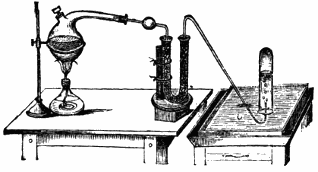
Prep. A mixture of fresh hydrate of lime with an equal weight of sal ammoniac (both dry and in fine powder) is introduced into a glass flask or retort, the beak of which communicates with one end of a U-shaped tube filled with small fragments of recently burnt quick-lime, and from which extends another glass tube, about 18 inches long, having its further end bent up ready to be placed under a gas-jar, on the shelf of a mercurial pneumatic trough. (See engr.) The joints being all made air-tight by collars of india rubber, heat is applied by means of a spirit-lamp, and as soon as the air contained in the apparatus is expelled, the gas is collected for use. It cannot be dried by means of chloride of calcium. Powdered quick-lime may be substituted for the hydrate in the above process; in which case the evolved gas is anhydrous, but a much greater heat is then required for its liberation.
Comp. Ammonia is a compound of 3 volumes of hydrogen, and 1 vol. of nitrogen, condensed into two volumes; and by weight of 82·35 parts of nitrogen, 17·65 parts of hydrogen, or, in other words, of one atomic weight of nitrogen and three of hydrogen, having the formula NH3.
Prop. Gaseous, colourless, invisible; highly pungent, acrid, irritating and alkaline; irrespirable, unless very largely diluted with air; extinguishes combustion; burns slowly in oxygen; sp. gr. 0·589; 100 cub. inches weigh 18·26 gr. Under a pressure of 6·5 atmospheres, at 50° Fahr., it forms a transparent, colourless liquid of the sp. gr. 0·731; at 60° Fahr. this liquid expanded into 1009 times its volume of ammoniacal gas; at -40° Fahr., and the ordinary atmospheric pressure, it forms a subtle colourless liquid, which at -103° Fahr. freezes into a white, translucent, crystalline substance. (Faraday.) It is highly basic; all its salts are either volatilised or decomposed at, or under, a red heat—those with a volatile acid sublime unchanged—those with a fixed acid lose their ammonia. It is decomposed into its elements by transmission through a red-hot tube; and when in contact with metallic oxides or spongy platinum, at the same temperature, the newly evolved hydrogen unites with the oxygen of the oxide or of the atmosphere, forming water. Water at 50° Fahr. absorbs 670 times its volume of this gas, and the solution has the sp. gr. 0·875. Its concentrated aqueous solution boils at 130°, and freezes at -40° Fahr.
Tests, &c. Ammonia is recognised by—1. Its pungent odour:—2. By turning vegetable blues green, and vegetable yellows brown; but which soon regain their previous colours, especially on the application of heat:—3. By producing dense white fumes when brought in contact with those of hydrochloric acid:—4. By the Nessler test (see Water, Quantitative and Qualitative Analysis of):—5. If a saturated solution of arsenious acid is mixed with a solution of nitrate of silver (strength 2%) a trace of ammonia causes the formation of try-argentic arsenite:—6. Böttger says a very delicate test for ammonia is afforded by an aqueous solution of carbolic acid. On adding to a liquid containing the smallest quantity of ammonia, or an ammoniacal salt, a few drops of this solution, and then a small quantity of a filtered solution of chloride of lime, the liquid becomes green, especially when warmed.
Phys. eff., &c. Inhaled, undiluted with air, it is an irritant poison, producing spasms of the glottis, convulsions, and death; even when diluted it acts as a powerful acrid, and local irritant; applied to the skin it causes vesication. The use of the pungent odour of common ‘smelling salts,’ in syncope, headache, &c., is well known. Largely diluted with air, it has been recently highly extolled in chronic hoarseness, asthma, &c.; and as an antidote to the fumes of bromine, chlorine, and hydrocyanic acid. (Smee.)
Ant., &c. The vapour of acetic acid or common vinegar, freely inhaled. It may be produced by sprinkling a little on a piece of hot iron, as a heated shovel. If bronchial inflammation follows, it must be treated by purgatives and a low diet; and, if severe, and the patient be plethoric or robust, by venesection or cupping.
Uses. Ammonia is employed in numerous processes in chemistry and the arts; but chiefly in the form of ‘liquor of ammonia,’ ‘spirits of hartshorn,’ &c., and in combination, under the form of salts. In its pure or gaseous state it possesses little practical interest.
Ammonia, Solution of. Syn. Solution of ammonia, Liquor ammoniæ, Ammonium hydrate, Ammonia, Eng.; Ammoniaque liquide, Dissolution d’ammoniaque, Esprit de sal ammoniac, Fr.; Atzender ammonium-liquor, Salmiak-geist, Ger.; Liquore di ammoniaco, Ital. Ammonia gas readily dissolves in water, one volume of water absorbing about 670 volumes of ammonia, much heat being liberated, and the solution increases greatly in volume.
This solution is regarded in two very different lights; firstly and most generally as simply a solution of gaseous ammonia, a view rendered most probable by its general physical and by many chemical reactions; by a few, however, it is looked upon as a solution of ammonium hydrate.
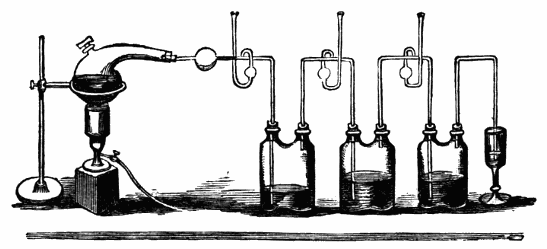
Prepared by distilling, in a tubular retort, equal parts of sal ammoniac, hydrated lime, or slaked lime and water, and passing the gas evolved through a set of Wolff’s bottles partially filled with water, as in the figure above.
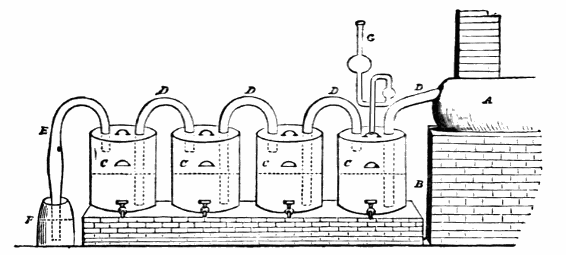
A, Cylindrical Iron Retort.
B, Furnace for ditto.
C C C C, Stoneware Receivers.
D D D D, Connecting Pipes.
E F, Waste Pipe and Receiver.
G, Safety Tube.
Commercially this article is prepared on the large scale, from a mixture of about equal parts of fresh-slaked lime and sal-ammoniac or sulphate of ammonia, which is heated in an iron cylinder or retort connected with a set of ‘refrigerators,’ the latter consisting of a row of stoneware bottles with double necks, containing water, and kept very cold. The general arrangement of the apparatus used in this manufacture is exhibited above, and with the accompanying references, will be easily understood. The ‘condensers,’ when in use, are surrounded with cloths (not shown in the engr.) kept wet with very cold water, whilst constant current of cold air is commonly made to pass over them. The pipe (D) leading from the retort is also several feet long, and is advantageously passed through a wooden screen in order that the radiated heat of the retort and brickwork of the furnace may be intercepted as much as possible.
Two different methods of proceeding are adopted in this process. In the one the dry pulverulent ingredients are mixed together, and the resulting gas distilled over into the water placed in the receivers. In the other the lime is made into a ‘pap’ with water, and the ammonia-salt, in coarse powder, being added, the whole is rapidly blended together, before closing the retort, and applying heat. In either case a proportionate quantity of water is put into the condensers, and the operation is nearly similar; but the latter method requires the least heat, and so far as the receivers and refrigerators are concerned, is, perhaps, the one most easily managed. It is that which is always, and necessarily followed, when sulphate of ammonia is employed.
Prop., Uses, &c. Highly pungent, caustic, and alkaline; lighter than water, and presenting in a liquid form most of the characteristics of pure ammonia. When strongest has a sp. gr. of ·875, and contains about 39 per cent. of ammonia, but the usual strong ammonia of commerce has a sp. gr. of but ·88. The liquor ammonia fortior, B. P., has a sp. gr. of about ·893, and contains 32·5 per cent. of ammonia, while the liquor ammoniæ B. P. has a sp. gr. of about ·940, and contains about 10 per cent. of ammonia. As a medicine it is antacid, diaphoretic, rubefacient, stimulant, and counter-irritant; and is used in various affections in which these remedies are indicated. As a vesicant it is superior to cantharides, and as a caustic it is used with advantage in the bites of rabid animals, especially those of serpents and insects. Its vapour is a common nasal stimulant in faintings, epilepsy, &c. In its concentrated form it is a corrosive poison.—Dose, 5 to 25 drops, in cold water, or milk and water. It enters into the composition of several valuable external remedies, and is in constant employment in the chemical laboratory, both as a reagent and for the preparation of other compounds.
Ant., &c. When the fumes have been inhaled, the patient should be exposed to a current of fresh air; and when the liquid has been swallowed, vinegar or lemon-juice mixed with water may be administered; followed by an emetic, or, on its failure, by the stomach-pump.
Estim. The quantity of gaseous ammonia in pure water of ammonia is easily determined from the specific gravity of the liquid, or from its saturating power. When impure or mixed with other substances, a given weight of the sample is placed in a small retort, the end of which is made to dip into a vessel containing dilute hydrochloric acid. A strong solution of caustic potassa is then poured into the retort, and heat applied by means of a small spirit lamp. When all the ammonia is distilled over, the acid solution is evaporated to dryness, by the heat of a water bath, and the residuum (chloride of ammonium) weighed. Each grain of the chloride thus found represents ·31804 gr. of pure ammonia; 53·5 parts of the former being equivalent to 17 of the latter. If the article for examination be a solid substance (as a salt), it may be dissolved in water, or in dilute acid, before being put into the retort.
In accurate experiments in the laboratory, ammonia is usually WEIGHED either as chloride of ammonium (see above), or as ammonio-bichloride of platinum (NH4Cl, PtCl2); every gr. of the latter representing ·07614 gr. of pure ammonia. Sometimes, though rarely, the quantity of ammonia is determined from the volume of nitrogen eliminated from it, of which 14 gr. represent 17 gr. of ammonia.
Concluding remarks, Patents, &c. Whatever form or process may be adopted for the preparation of liquid ammonia, it is absolutely necessary to keep the receivers as cool as possible, by means of snow, ice, or a current of very cold water, for the purpose of promoting the absorption of the gas, and to prevent its loss. On the small scale, the glass receivers or bottles may be most conveniently surrounded with ice, or a freezing mixture, and two, or more of them, should be furnished with safety-tubes, to prevent accidents. On the large scale, a capacious oblong retort, usually of iron (but sometimes, though seldom, of lead), with a large opening or tubulature conveniently situated for inserting the ‘charges,’ and withdrawing the residuum of the distillation, is employed. The tubulature, or opening, is closed by means of a large and accurately ground iron stopper, or with a door secured by screws, as the case might be. The stopper is well greased before insertion, and is removed by means of a powerful lever. Should it become so firmly fixed that it cannot be displaced in the usual manner, a cloth moistened with cold water, and carefully wrapped round it, without touching the neck of the retort, will generally cause it to contract sufficiently to enable the operator to remove it with facility. Sometimes a large iron kettle, with a moveable and accurately fitting lid secured in its place like that of a ‘Papin’s digester,’ and having a large and long tubulature in its centre, is employed instead of a retort, over which it has the advantage of exposing a larger opening for the removal of the residuum of the process. In either case the distillatory vessel is imbedded in sand supported by fire-brick, and is not exposed directly to the heat of the furnace. Before commencing the distillation the joints are all well luted, to avoid leakage. An excellent plan is to pass the gas, as it leaves the retort, through a silver or pewter ‘worm’ or ‘refrigerator’ set in a tub supplied with a stream of very cold water; by which it will be sufficiently cooled before it reaches the ‘receivers’ to obviate the necessity of any further attention to them than keeping the cloths wrapped round them constantly moistened with cold water. The lower end of the ‘worm’ should be connected, by means of a balloon-shaped ‘adopter,’ with the ‘still,’ and the upper end with the first ‘receiver,’ the use of the balloon being to intercept any volatilised ammonia-salt that might be accidentally driven over by the heat being too high, or too suddenly raised.
The heat should be gradually applied, and very gradually raised, to prevent any of the sal ammoniac or sulphate being volatilised undecomposed; and even towards the end of the process it should not even approach redness.
The lime is best ‘slaked’ and ‘papped’ with about 4 parts of water; as a lower heat is then required to expel the gas, and it passes over more easily and fully than when less water is employed. This is absolutely necessary when the sulphate is the ammonia-salt used; as otherwise the residuum of ‘sulphate of lime’ would become so hard that it could not be easily removed from the retort.
The gas being wholly expelled from the retort, or other distillatory vessel, it is disconnected from the receivers, and (when sal ammoniac has been employed) the heat is raised sufficiently high to fuse the residual chloride of calcium, which is then at once baled or poured out. Glass retorts often suffer fracture at this point; but if they escape now, it generally happens that they are broken when heat is applied for a second operation. Hence, according to Prof. Muspratt, it is rare to find a retort, even when carefully handled, that will stand two operations.
When crude sulphate of ammonia is employed it is advisable to have only a little water in the first receiver, which is placed there merely to purify the gas which passes through it, and to retain any traces of volatile empyreumatic or oily matter which may be carried over with it.
Pure solution of ammonia is most easily obtained from ‘sal ammoniac,’ but crystallised sulphate of ammonia, often crude, is more commonly employed, on account of its lower price.
The preparation of pure solution of ammonia admits of no other improvements than such as merely affect the form of the apparatus employed to produce it; and hence, unlike the ammonia-salts of commerce, has been little meddled with by inventors and patentees. Among the plans having for their object the production of an ammoniacal solution, more or less concentrated, fitted for many of the purposes of the arts, and for the preparation of salts, but not for chemical and medical use, besides those of Reece, Spence, Crane and Jullien, &c., already noticed, may be mentioned—
1. That of Watson (Patent dated 1838) in which gas-liquor mixed with a proper quantity of fresh-slaked lime is distilled from a spacious retort or still into a receiver containing cold water, until much steam passes over with the gas, when the strong alkaline liquor forming the distillate, and called the first portion, is drawn off. The distillation is then continued, when a weaker and impurer solution is obtained, called the second portion. The first portion is then reintroduced into a retort or still with a small quantity of fresh lime, and the distillation repeated. The product the patentee calls the first portion of the second distillation. The latter is a strong ammoniacal liquor sufficient for all the purposes of scouring, cleaning, conversion into commercial ammonia-salts, &c. It may be further purified by a third distillation; the second portion of each operation being transferred again to the still with the next fresh charge of gas-liquor.