A CYCLOPÆDIA OF PRACTICAL RECEIPTS, PROCESSES, AND COLLATERAL INFORMATION (continued 45)
Reading edition
b. The paper filter, with its contents, is next suspended for some time over concentrated sulphuric acid (oil of vitriol) contained in a wide-mouthed bottle or jar, by means of a thread attached to the cork or stopper, care being taken to exclude the external air. The exposure in this way is continued until the guano ceases to diminish in weight, which is ascertained by weighing it at intervals after the first 3 or 4 hours. When this point is arrived at, the filter and its contents are very carefully weighed. The difference between its present weight and its original weight (before the desiccation in a), taken in grains, gives the gross quantity of water per cent.
c. The dried guano from b is next placed in a weighed, smooth crucible or capsule, and exposed to a low red heat until all the organic matter is completely destroyed, and the whole is reduced to a white ash, which is weighed as soon as it has become cold. This weight, in grains, gives the gross weight per cent. of non-volatile matter (fixed alkaline and earthy chlorides, phosphates, and sulphates); the total loss of weight by combustion denotes the gross per-centage of combustible and volatile matter (urea, uric acid, ammoniacal salts, and organic matter). The latter should not be less than 55 to 60%.
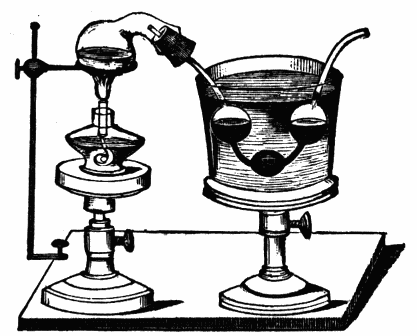
2. a. A second 100 gr. of the guano, selected as before, is distilled along with about 75 gr. of fresh-slaked quicklime, and a little water, in a small matrass connected with a tubular, triple bulb-condenser, containing cold distilled water, and immersed in a basin of ice-cold water. (See engr.) The condenser is charged by plunging one of its extremities into the water, and sucking at the other, until the liquid reaches the level indicated in the margin. A very gentle heat only, cautiously increased, need be employed. After the process is over, the strength of the solution of ammonia found in the condenser is tested, either by taking its density in a small specific-gravity bottle, or by determining its saturating power in the manner described under Alkalimetry. This furnishes the per-centage of ready formed ammonia sufficiently accurate for all ordinary purposes, provided proper care is taken.
When extreme accuracy is required, the condenser is charged with a weighed quantity of dilute hydrochloric acid of a known strength, instead of water, and after the process is over, this is tested as before. The quantity of ammoniacal test-liquor (see Alkalimetry) now taken to saturate it, deducted from what it would have taken before the exposure in the condenser, gives the per-centage sought.
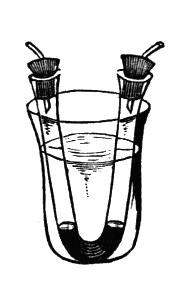
Another method, giving very accurate results, is to use a rather strong hydrochloric acid (sp. gr. about 1·13) for the condenser; after the operation is over, the contents of the latter are poured into a glass or porcelain capsule, a solution of bichloride of platinum is added, in excess, and the whole is then gently evaporated to dryness; the residuum is rubbed to powder, and exhausted with a mixture of two measures of alcohol and one measure of ether; the undissolved portion is next dried at a heat not exceeding 212° Fahr., and weighed. The weight, in grains, of the ammonia chloride of platinum thus obtained, multiplied by ·0763, gives the per-centage of ready-formed ammonia, as before. When hydrochloric acid is used for the condenser, a simple U-tube and beaker glass may be employed, if a bulb-condenser is not at hand. (See engr.) The advantages resulting from the use of acid instead of water for the condenser is, that with the former no ammonia can possibly escape being absorbed, whilst little care is required to keep the condenser cool.
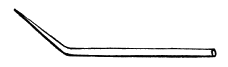
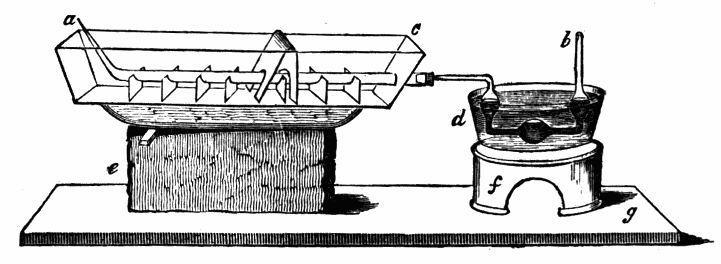
b. 25 gr. of the guano are next weighed, and after being slightly moistened with a little dilute hydrochloric acid, are thoroughly dried by the heat of boiling water; the dried sample is then mixed in a warm unglazed porcelain mortar with 10 times its weight of a mixture of 2 parts of quicklime to 1 part of hydrate of soda (both quite dry). This mixture is introduced into a combustion tube of hard Bohemian glass, about 16 or 18 inches long, and 3⁄4 of an inch in diameter (see engr.) The mortar is rubbed out with a little of the soda-lime mixture, which is also introduced into the tube with that already put there; a little plug of ignited asbestos is then loosely placed over the whole, and the tube is immediately connected with a tubular bulb-condenser, containing moderately strong hydrochloric acid, great care being taken that the joints are made air-tight, which may be determined by the operator sucking a few bubbles out of the apparatus. If, after suction, the liquid remains at a higher level in the furthest bulb (b), it is a sign that the connection is sound. This being done, heat is applied to the combustion-tube, by means of spirit-lamps; or, more conveniently, by means of the furnace now usually employed in organic analysis (see engr.) The tube is next gradually surrounded with red-hot charcoal, by shifting by degrees the screen (c), and adding more charcoal, so as to gradually expel the ammonia. The disengagement of gas should take place uninterruptedly, but not too rapidly, in order that the acid may not ascend into the combustion-tube and spoil the experiment. The non-condensable volatile matters which pass off furnish a key to the progress of the operation. The heat is at length increased to a full red. When gas ceases to be evolved, and the mixture in the tube has become quite white, the experiment is at an end. The point (a) of the combustion-tube is broken off, and the ammonia which remains in the tube is expelled by sucking gently at the extremity (b) of the bulb-condenser. The latter is then disconnected with the apparatus, and emptied into a glass or porcelain capsule, in order to be tested, as directed under 2, a. The quantity of ammonia, in grains, thus found, multiplied by 4, gives the WHOLE QUANTITY of AMMONIA per cent., both actual and potential, producible from the sample of guano examined.
c. The quantity of ready-formed ammonia (see 2, a) deducted from the quantity last found (see 2, b) gives the quantity of LATENT or POTENTIAL AMMONIA that will be slowly developed by the decomposition of the guano in the soil, and become available for the food of plants. This is the most valuable product of this substance as a manure, and can only be obtained in quantity from well-preserved, dry guano.
3. a. A third quantity of 100 gr. of the guano, selected as before, is triturated and digested for some time with 12 times its weight of hot distilled water, and the whole being thrown on a filter, the undissolved portion is washed with a little warm distilled water; the solution and ‘washings’ are then mixed together, and acidulated with nitric acid; a solution of pernitrate of iron is next added, and afterwards solution of ammonia, in excess; the liquid is next heated for a short time, and the bulky reddish-brown precipitate is collected, washed with hot water, dried, ignited, and weighed. The weight, in grains, less the weight of the peroxide of iron in the pernitrate consumed, gives the weight of PHOSPHORIC ACID present in the soluble phosphates contained in the sample. The pernitrate of iron is made by direct solution in hot strong nitric acid, of twice as much pure iron wire as there is phosphoric acid suspected to be present in the liquid. A slight excess will not alter the result. The number of grains of metallic iron used to form the solution, multiplied by 1·4286, gives the weight of the peroxide of iron which is to be deducted from the gross weight of the precipitate.
b. The filtrate and ‘washings’ left from 3 a are mixed, and treated with a little oxalate of ammonia to throw down any lime, and then carefully evaporated to dryness and ignited; the residuum of the ignition, when cold, after being carefully weighed, is treated with the smallest portion of water that will dissolve it; the solution is acidified with hydrochloric acid, and a solution of bichloride of platinum added, in excess; some strong alcohol is next poured in, the precipitate carefully collected on a filter, washed with rectified spirit, dried at 212° Fahr., and weighed. The weight, in grains, multiplied by ·1940, gives the per-centage of POTASSA sought.
c. The weight of the potassa multiplied by 1·852, and deducted from the weight of the ignited residuum in 3 b already found (see above), gives the quantity of CHLORIDE OF SODIUM or COMMON SALT (nearly).
4. a. The insoluble residuum from 3 a, dried, and ignited, or the ash from 1 c, is digested for 10 or 12 hours in 600 times its weight of water (to which a little common salt or sal-ammoniac may be added), after which the whole is thrown upon a filter; a solution of chloride of barium is then added to the filtrate as long as a precipitate (if any) forms; the latter is collected, washed, dried, ignited, and weighed. The weight, in grains, multiplied by ·5843, denotes the quantity of GYPSUM or SULPHATE OF LIME which has been used to adulterate the sample.
b. The insoluble residuum last left on the filter is digested for some time in warm dilute hydrochloric acid; the whole is then thrown upon a filter, and the undissolved portion (SILICA or SAND, with, perhaps, a trace of ALUMINA) is washed, dried, ignited, and weighed. It should not weigh more than 3 to 31⁄2 gr. (3 to 31⁄2%).
c. The filtrate and ‘washings’ from b are next mixed together; the mixed liquid is acidified with dilute sulphuric acid and heated until all the hydrochloric acid is expelled, and the whole reduced to a soft pasty mass; rectified spirit is now poured in, and after active stirring for some time, the mixture is thrown on a filter, and the solid portion washed with a little more rectified spirit; it is then dried, ignited, and weighed. The weight, in grains, multiplied by ·7650, gives the quantity of PHOSPHATE OF LIME per cent. required.
d. The filtrate from c is diluted with water, and after being boiled for a few minutes, ammonia is added in slight excess, followed by a solution of sulphate of magnesia (previously mixed with as much sal-ammoniac as will prevent ammonia producing a precipitate in it), slowly dropped in as long as it disturbs the liquor; the whole is now allowed to rest for 10 or 12 hours, when the precipitate is collected on a filter, and washed with water alkalised with ammonia, as long as the filtering liquid is rendered turbid by chloride of barium; it is next dried, submitted to intense ignition for some time in a covered platinum crucible, and, when cold, carefully weighed. The weight, in grains, multiplied by ·6429, indicates the per-centage of PHOSPHORIC ACID in the insoluble phosphates (phosphates of lime, magnesia, &c.) in the sample examined.
5. A fourth 100 gr, of guano is weighed, and exhausted by trituration and digestion with hot water (see 3 a); the solution is evaporated to dryness by a gentle heat, and the residuum of the evaporation, after being weighed, is powdered and enclosed in a stout phial with 8 times its volume of alcohol, sp. gr. ·825 (63 o. p.); the plant is next securely corked and guarded, and exposed for some time, with agitation, to the heat of 212° Fahr., the whole is then allowed to cool, the contents of the phial filtered, the undissolved portion washed with hot alcohol, and both the filtrate and the ‘washings’ gently evaporated to dryness, and weighed. This gives the richness of the sample in UREA, one of the most valuable constituents of the best guano. Its presence is “a certain proof of its entire soundness.” (Ure.)
6. a. Another 100 gr. of the guano is taken, and, after being exhausted with water, is dried at 212° Fahr., and weighed; it is then digested with heat in 20 times its weight of borax-water (containing 1% of borax), or in a solution of caustic potassa, and after a time the whole is thrown on a weighed filter, washed with a little cold distilled water, dried by a heat not higher than that of boiling water, and again carefully weighed. The loss, in grains, indicates the proportion per cent. of URIC ACID.
The accuracy of the result may be verified by adding dilute hydrochloric acid, in slight excess, to the filtrate, collecting the bulky, crystalline precipitate of uric acid which forms, washing it carefully with a little rectified spirit, drying it, and weighing it, as before. This weight, which in general is a very little under that denoted above, is the more accurate of the two. The precipitate is shown to be uric acid by its assuming a rich crimson colour when treated with a little nitric acid, which turns to a rich purple (murexide) when it is moistened with ammonia water.
b. The quantity of uric acid last obtained, multiplied by 1·1012, gives the per-centage of URATE OF AMMONIA.
Obs. Amongst the numerous constituents of guano, none are so valuable in an agricultural point of view as the three substances referred to in the last two sections. Indeed, almost all the ammonia furnished by this substance to the soil, after the latter, manured with it, has been exposed to the air and rain, is derived from the slow decomposition of urea, or urate of ammonia. It is these substances from which the store of latent, or, as Dr Ure terms it, potential ammonia, is derived. The ammonia existing in the guano under the form of carbonate, or of soluble salts (ready formed ammonia), is either soon dissipated in air or is washed away by heavy rains, and, therefore, forms the least valuable and durable portion of this manure. It may be even added artificially, a matter almost impossible with the former. An assay, therefore, for the latent ammonia, or the urea, or the urate of ammonia, any one of them singly, at once furnishes us, as we have already hinted, with evidence of the quality of the guano examined, without the expense and trouble of a complete analysis of this substance. Urea and uric acid are only to be found in the very best samples of guano, and their presence is a positive proof of entire soundness and superior quality. The other valuable portions of guano are potassa and phosphoric acid (phosphate of lime chiefly); the rest are of little importance. (See 2 c, above.)
GUARANA (Grimault & Co., Paris). 12 migrain powders, each weighing 1·75 grammes, consisting of guarana, but perhaps also containing an admixture of cocoa seeds, neither prepared nor roasted. (Hager.)
GUARANA′. Syn. Paullinia, Brazilian cocoa. An alimentary and medicinal substance prepared from the seeds of Paullinia sorbilis, a Brazilian tree. The dried seeds, deprived of their aril, are pounded and kneaded into a mass, which is afterwards made into oblong or rounded cakes (GUARANA BREAD). These cakes are used as we use chocolate—mixed with water and sugar, and drank as a beverage. In Brazil this beverage is largely consumed, both on account of its nutritive qualities, and for its stomachic, febrifugal, and aphrodisiac effects. See Chocolate, &c., also below.
GUARANINE′. A crystalline substance discovered by M. Martius in guarana. It appears to be identical with caffeine, the active principle of coffee and tea.
GUD′GEON. The Cyprinus gobeo (Linn.), a small fresh-water fish, common almost everywhere. The white is considered the best. It was formerly used in medicine.
GUM. Syn. Gummi, L. The general term for an important class of vegetable products. Gums are more or less soluble in cold water, but insoluble in alcohol, ether, and oils. They are obtained from certain plants in amorphous masses; most of them exude spontaneously, or on puncturing the bark. The most perfect type of this class is the substance called GUM ARABIC, or GUM ACACIA. The gums are employed as demulcents in medicines, and are used as cements, and for giving stiffness and gloss to textile fabrics. Among the vulgar the term is often incorrectly applied to the resins and gum resins.
Gum Acacia. Syn. Gum Arabic; Acaciæ gummi (B. P.); G. arabicum, G. acacia, Acacia (Ph. L.), L. “From various species” (of Acacia) “yielding gum” (Ph. L. & E.), chiefly Acacia arabica and A. vera. “Whitish or yellowish, transparent or cracked on the surface, and opaque; brittle; it dissolves freely in water.” (Ph. L.) It is scentless, and may be bleached by exposure to the sun and air, at the temperature of boiling water. Sp. gr. 1·355. (Ure.) The pure soluble principle of gum Arabic is termed ARABIN (which see). Barbary or Morocco gum, Gum Senegal, and East India gum, are inferior commercial varieties of the same substance from other species of Acacia (see below).
Powdered gum Arabic (PULVIS ACACIÆ) is frequently adulterated with flour or farina, or with Senegal or other inferior gums. The first may be detected by agitating a little of the powder with cold water; the pure gum dissolves rapidly, whilst the starch or flour falls to the bottom of the vessel. Or, a little of the powder may be mixed with boiling water, and when cold, tested with tincture of iodine; if it contains starch or flour, the paste will assume a blue colour. If it contains cherry-tree gum or tragacanth, it will be only partly soluble in cold water, and the paste will be partly coloured, and more or less interspersed with gelatinous clots.
For the detection of dextrin in gum Arabic Hager finds that when some of the adulterated article is placed in a glass dish, with vertical sides, and a solution of ferric chloride, density 1·48, diluted with an equal volume of water, is poured over it until the grains are just covered, in the course of a minute or so that particles of gum Arabic will adhere to the bottom of the vessel, whilst the grains of dextrin do not.
Much of the white gum Arabic of the shops is formed by bleaching gum Senegal, by what is called ‘Picciotto’s process.’ The gum is dissolved in water, and sulphurous acid gas passed through the solution. The liquid is afterwards boiled to expel the sulphurous acid, a little of which, however, still remains behind. To obtain the gum in a still whiter state, carbonate of baryta is added, and after agitation the mixture is filtered; it is afterwards shaken with gelatinous alumina, again filtered, and evaporated. The product (BLEACHED GUM) is very white, but lacks the peculiar toughness and adhesiveness of the best gum acacia.
Gum, Barbary. Syn. Morocco gum. An inferior product, consisting of a mixture of several Acacia gums. It is exported from Mogador.
Gum, Bassora. A solution of yellowish gum brought from the neighbourhood of Bassora. It differs from most gums in being nearly insoluble in water. The plant yielding it is believed to be a species of Mimosa. It contains the principle BASSORIN, which also exists in gum tragacanth.
Gum, Bleached. See Gum Arabic (above).
Gum, Brit′ish. Syn. Dextrin, Starch gum. Starch converted by the action of acids, diastase, or heat, into a soluble substance resembling gum.
Prep. 1. Malt (crushed small), 1 lb.; warm water, 2 galls.; mix, heat the whole to 145° Fahr., add of potato starch 5 lbs., raise the heat to 160° or 165° Fahr., and mash for about 25 minutes, or until the liquid becomes thin and clear; it must then be instantly run off, and raised to the boiling point to prevent the formation of sugar; after boiling for 3 or 4 minutes the whole must be filtered, and evaporated to dryness by a steam heat.
2. By exposing dry potato starch, in a stove, to a heat of about 400° Fahr. Yellow and inferior.
3. (M. Payen.) Dry starch, 1 ton, is moistened uniformly with concentrated nitric acid, 41⁄2 lbs. (diluted with), water, q. s., and the paste or dough is made up into small bricks or loaves, and dried in a stove; it is next reduced to coarse powder, and exposed in a stove-room for some time to a current of air at 160° to 165° Fahr.; it is next ground, sifted, and exposed, as before, to a heat of about 228° Fahr.; it is, lastly, ground, and passed through the ‘bolting machine.’ Very white and superior. This process has been patented in France by M. Henzé.
4. (Pinel.) Water, 100 galls., nitric acid, 1⁄2 gall., and hydrochloric acid, 1⁄2 pint, are mixed together, and so much potato starch is mixed as will form a thin paste; in two hours the liquid is drained off, and the solid matter is made up into lumps, which are dried by a gentle heat in a stove-room; they are next coarsely pulverised, and the powder is exposed on three successive days to the respective temperatures of 100°, 150°, and 190° Fahr.; the whole is then sifted, and, lastly, exposed to a heat ranging from 300° to 350° Fahr. Darker coloured than the last. To give it the appearance of gum Arabic, it is made into a paste with water containing 1% of nitric acid, and after being spread on copper plates in layers 3⁄4 to 1 inch thick, it is exposed to a stove heat ranging from 240° to 300° Fahr.
Prop., &c. White; insipid; transparent; friable; soluble in cold water, and in dilute spirit; insoluble in alcohol and ether; its solution yields a precipitate with acetate of lead. Iodine commonly turns commercial dextrin blue, but does not affect the colour of pure dextrin. It is distinguished from ordinary gum by its right-handed polarization of light, and by yielding oxalic but not mucic acid, when treated with nitric acid.
Dextrin is nutritive, emollient, and agglutinant. In France it is largely employed by the pastry-cooks and confectioners, and in medicine as a substitute for gum. The French surgeons also commonly employ it as a ‘stiffening’ for the splints used for fractured limbs. In this country it is chiefly used as a fine dressing for muslins, silk, and other textile fabrics, and in calico printing. Recently it has been made up into tear-like masses, and sold for gum Arabic, to which, however, it is vastly inferior as an agglutinant. See Dextrin.
Gum, Cherry-tree. Syn. Fruit-tree gum, Plum-tree g.; Gummi cerasi, G. pruni, L. An exudation from the stems of cherry, plum, and some other of the Rosaceæ. It is only partly soluble in water. It contains CERASIN (which see).
Gum, East India. This product, which consists of inferior kinds of gum acacia, is chiefly exported from Bombay, having been previously conveyed there from the coast of Arabia. It varies greatly in quality. Some samples are quite unfitted for making gum-water.
Gum, Insoluble. See Bassora Gum, Cherry-tree Gum, and Gum Tragacanth.
Gum, Seed. Syn. Gummi seminum, L. A species of soluble gum extracted from the seed of the flax (linseed), quince, &c.
Gum, Senegal. This product, which is largely exported from Portendie, Sierra Leone, and the French settlements on the Senegal, ranks next in quality to gum acacia, and for many purposes, as calico-printing for instance, it answers equally well. The transparent and light-coloured pieces are frequently picked out and sold as gum Arabic.
Gum Trag′acanth. Syn. Tragacanth, Gum dragon; Gummi tragacantha, G. draconis, Tragacantha (Ph. L.), L. The gummy exudation of the Astragalus verus, hardened by the air. When digested in water, it swells considerably, a portion is dissolved, and the whole combines to form a thick mucilage. It is totally soluble in boiling water, when some change is supposed to take place in it; a great portion, however, afterwards separates. Sp. gr. 1·384. It is chiefly employed in calico-printing, and by shoemakers and lozenge-makers; by the latter to give toughness to the saccharine mass.
Powdered tragacanth is often adulterated with flour of starch, and not unfrequently with the commoner varieties of gum Arabic. According to M. Planche, a mixture of pulverised tragacanth and gum Arabic forms, with water, a thinner mucilage than the same quantity of either of these gums alone. This fraud may be detected as follows:—Make a mucilage of the suspected gum, and add thereto a few drops (2 or 3 to the dr.) of alcoholic tincture of guaiacum, taking care to stir it all the while. If the sample contains any gum Arabic, the mixture, in the course of a few minutes, assumes a fine blue colour, whilst it does not change colour if the gum tragacanth is pure, 5% of gum arabic can be thus detected. When the quantity is very small, one to four hours may elapse before the colour is developed. Starch and flour are detected in the manner noticed under Gum Arabic.
Gum, Turkey. Various qualities of gum acacia are sold under this name.
GUM RES′INS. Syn. Gummi resinæ, L. Vegetable products in which the properties of gum and resin are combined. They are partly soluble in water, and partly in alcohol. Many of them form a species of emulsion when triturated with the former fluid. The principal gum resins are AMMONIACUM, ASSAFŒTIDA, BDELLIUM, GALBANUM, GAMBOGE, MYRRH, OLIBANUM, OPOPONAX, SAGAPENUM, and SCAMMONY.
GUN BAR′RELS. See Browning.
GUN COT′TON. See Pyroxylin.
GUN MET′AL. An alloy containing 90·5% of copper and 9·5% of tin, used for casting pieces of ordnance (erroneously termed ‘brass guns’), also those parts of machinery which are subjected to considerable friction. See Alloys, Bronze, Stereo-metal, &c.
GUN′POWDER. This substance is a mechanical mixture of saltpetre, charcoal, and sulphur. It is seldom prepared on the small scale.
Prep. The saltpetre having been trebly refined, by boiling, skimming, filtering, and crystallising, is melted into cakes, which are then brushed to remove any adhering grit or dirt, broken into pieces with a mallet, ground to a fine powder in a mill, and sifted through a fine bolting sieve of brass wire. The charcoal is that of the alder or willow, and is carefully burnt, as already described, and is then reduced to powder. The sulphur is refined by distillation, and ground to the same fineness as the charcoal and saltpetre. The ingredients are weighed out in the proper proportions, and mixed together in a machine consisting of a wooden drum, having a shaft passing through its centre, to which numerous ‘flyers’ in the shape of knife-blades are attached, the drum and flyers revolving in a contrary direction. When mixed, the charge is carried to the ‘incorporating mill,’ where it is ground under vertical iron ‘mill-stones,’ with a small quantity of distilled water, until the ingredients are thoroughly incorporated. The product of this operation is then pressed into a hard cake, which is next broken into pieces, granulated by means of sieves, and after being ‘glazed’ by friction, and the dust separated, is dried, with proper precautions, in a stove heated to about 130° by steam pipes.
The proportions of saltpetre, charcoal, and sulphur, used for different kinds of powder, differ very slightly. In ‘sporting powders’ the proportion of saltpetre is generally from 1 to 3% greater than in the Government powders. In ‘miners’ powders’ it is about 10% less, an excess of sulphur being used. The following are the proportions adopted by European powers:
Saltpetre.Charcoal.Sulphur.
England751510
France7512·512·5
Austria751510
Prussia7513·511·5
Russia73·7813·5912·63
Spain76·4710·7812·75
Sweden76159
(Capt. Jervis-White Jervis.)
Obs. The quality of gunpowder is best estimated by actual trial of its power and cleanliness in use. It should be dry, hard, and free from dust; the grains should be of a uniform size, and glossy, and the colour a dark-grey or brownish-grey, not perfectly black. A very little placed on a piece of paper and fired should instantly explode with a flash, and neither leave an appreciable residue on the paper nor burn it. Dried by the heat of boiling water, or in vacuo, it should not lose more than 1⁄2 to 1% of its weight. Damp powder rapidly ‘fouls’ the gun. Gunpowder, containing more than 7% of water, does not recover its strength by simply drying it. The sp. gr. ranges between 1·795 and 1·800.
Karolyi succeeded in analysing the gases of gunpowder which had been fired in conditions closely resembling those which occur in artillery practice. For this purpose he enclosed a charge of powder in an iron cylinder of such strength that it just burst when the powder was fired by means of the electric spark. This charged cylinder was suspended in a hollow spherical bomb, from which the air was exhausted before firing.
After the explosion had been produced, the gases and the solid residue of the powder were submitted to analysis. The results obtained were the following:[343]
1. Composition of the Powder used.
Ordnance Powder.Small Arms Powder.
Nitre 73·7877·15
Sulphur 12·808·63
Charcoal.Carbon10·8811·78
Hydrogen0·380·42
Oxygen1·821·79
Ash0·310·28
——————
99·97100·05
2. Products of Combustion by Weight.
Ordnance Powder.Small Arms Powder.
Gaseous.Nitrogen9·7730·5810·0634·18
Carbonic anhydride17·3921·79
Carbonic oxide2·641·47
Hydrogen0·110·14
Sulph. hydrogen0·270·23
Marsh gas0·400·49
Solid.Ammonic sesquicarbonate2·6869·252·6665·14
Potassic sulphate36·9536·17
Potassic carbonate19·4020·78
Potassic hyposulphite2·851·77
Potassic sulphide0·110·00
Charcoal2·572·60
Sulphur4·691·16
Loss.0·17 0·68
100·00 100·00
3. Products of Combustion by Volume in 100 of Gas.
Ordnance Powder.Small Arms Powder.
Nitrogen37·5810035·33100
Carbonic anhydride42·7448·90
Carbonic oxide10·195·18
Hydrogen5·936·90
Sulphuretted hydrogen0·860·67
Marsh gas2·703·02
It will be seen from the above figures that in addition to the generation of a considerable amount of carbonic anhydride (carbonic acid) by the combustion of gunpowder, there is liberated at the same time a large quantity of solid matter, in the form of sulphate and carbonate of potash, sulphide of potassium, sulphur, charcoal, &c. This will explain why the air of mines is so prejudicial to the health of the miner, particularly when he is engaged in blasting operations, these being carried on in a more or less confined space. See Air, vitiated.
Gunpowder, Schultze. The subjoined account of Schultze gunpowder is a transcription of a report communicated to the editor of the ‘Field’ newspaper by Mr F. Toms, A.I.C., F.C.S. After referring to a previous communication on the same subject Mr Toms proceeds as follows:—I have carried out some further experiments, with the aid (by Dr Frankland’s kind permission) of apparatus more suited to my requirements than that previously at my disposal; and I now proceed to lay before you the results of these experiments, and the conclusions to which they have led me, respecting the powders formerly received and the new Schultze powder, with a sample of which you have since favoured me.
The main constituent of the Schultze gunpowder, as you are aware, is wood fibre, which, having first been purified, is then subjected to the action of strong nitric acid (intensified by mixture with sulphuric acid), and thus is converted into a kind of nitro-cellulose or pyroxylin, the ordinary form of which is gun-cotton. The wood fibre undergoes no change in appearance by this treatment; but a change takes place in its chemical composition, which may thus be exemplified:
Cellulose (unconverted cotton or wood fibre).Nitro-cellulose (cotton or wood fibre treated with nitric acid).
Carbon6 parts6 parts.
Oxygen5 parts5 parts
Hydrogen10 parts7 parts or more.
Nitroxyl (NO2)none3 parts or less.
It will thus be seen that the sole difference between gun-cotton or Schultze powder and ordinary cotton or wood fibre is, that some of the hydrogen is abstracted and has its place supplied by nitroxyl—a substance contained in nitric acid, and composed of one part of nitrogen united with two parts of oxygen. Under the most favorable circumstances, it is possible to replace three of the ten parts of hydrogen by three of the nitroxyl, when the substance produced is explosive, and is called from its composition tri-nitro-cellulose. This is the purest form of gun-cotton. If weaker acid is used, less hydrogen is displaced, and the product is called di-nitro-cellulose or mono-nitro-cellulose, according as it contains two or only one part of nitroxyl. These derivatives are either feebly explosive or not explosive at all. Such are the compounds known as photographic collodion and soluble gun cotton—the latter name distinguishing it from pure gun-cotton, which is not soluble in a mixture of ether and alcohol.
The Schultze powder contains both the explosive and the non-explosive varieties of nitro-cellulose.
If the wood fibre, after being carefully purified according to the method described in Schultze’s patent of 1864, were thoroughly desiccated and allowed to cool out of contact with air, and then dipped in acid of the strength mentioned in the specification, there seems no theoretical reason why an explosive powder containing at least 90% of true tri-nitro-cellulose should not be produced. As, however, I find on experiment that nothing like that per-centage is arrived at, I can only conclude that, in order to moderate the violence of the explosion, the Schultze Company secure the formation of a large per-centage of “soluble” or less explosive nitro-compounds by merely air-drying their wood.
If this supposition be generally true, it seems probable that the sample of Schultze powder supplied by Messrs Blissett may owe its extra explosive force to exceptional care being taken, during the interval between the drying and the dipping, to prevent the absorption of moisture—with the addition, perhaps, of an increased length of exposure to the action of the acid.
That some such variation of the ordinary procedure was carried out seems evident from the different proportions of soluble and insoluble gun-cotton in the specimens of Schuitze powder supplied by Messrs Blissett and Messrs Bland; for it was found that on the washed wood fibre from each being submitted to the action of a mixture of alcohol and ether, about one half of the former powder and two thirds of the latter were dissolved out. This shows that while the “Blissett” specimen contained about one half its weight of insoluble or explosive nitro-cellulose, the “Bland” contained only about one third—a difference which confirms the result obtained by analysis as stated below.
The soluble gun-cotton, ordinarily non-explosive, may, however, be rendered explosive by saturating it with bodies rich in oxygen, which promote the decomposition and complete the combustion of the fibre. Nitre is used for that purpose, because it parts with its oxygen readily; and nitrate of baryta is also used, because, being more stable than the nitre, it renders the combustion more gradual than would be the case if nitre were alone employed. When both are used, the nitre, I should think, would start, and the nitrate of baryta continue and finish the combustion of the powder. The amount used is, I suppose, the result of calculation and experiment; but a powder containing little true tri-nitro-cellulose should require more of these salts than one containing much tri-nitro-cellulose; and an excess of the salts would lower the rate of burning of the powder.
I will now give my analysis in full of the three powders, viz.—(1) the ordinary powder issued last season, being part of a supply obtained from Messrs Bland, gunmakers, of the Strand; (2) some powder furnished by Messrs Blissett, of Holborn, and alluded to in their letter in the ‘Field’ of Jan. 19th last, as having damaged a gun made by them; and (3) some of the new powder of 1878, as used at the ‘Field’ trial of explosives in May last.
1877 Bland’s.Blissett’s.1878 Trial or New.
Moisture, per cent.2·182·392·97
Extracted by water.Nitrate of baryta, per cent.21·5016·5922·32
Nitrate of potash, per cent.11·4610·466·47
Yellow coloured organic substance, trace of chlorides, &c., undetermined
Insoluble in water.The converted wood fibre (nitro-cellulose) then remaining contained the following per-centage of mineral matter5·06·02·95
The converted wood fibre (after allowing for extraneous mineral matter) possessed the following per-centage composition. I place for comparison Professor Abel’s determination of the composition of tri-nitro-cellulose, and two of the impurities found along with it, in a parallel column.
Bland’s.Blissett’s.Trial or New.Tri-nitro- Cellulose.Impurities.
Carbon28·7528·0728·1224·2429·2030·50
Hydrogen3·493·653·542·36—2·91
Nitrogen10·8015·6011·6614·1411·85—
Oxygen56·0652·6856·6859·26——
These powders exploded at a temperature of about 190° C. (374° F.), the different samples varying but slightly. Pure gun-cotton is stated by Professor Abel to explode at 150° C. (302° F.); and black powders are said, by different authorities, to explode at various temperatures between 500° and 600° F., according to the variation in their composition and manufacture.
In addition to the difference in chemical composition of these Schultze powders, I would point out that there is a difference in density—the Blissett being heaviest, the Bland next, and the New the lightest of the three. I think this fact also has some bearing on the violence of the explosion. In black powders, I believe, a dense powder, speaking generally, is stronger than a lighter one; and the Schultze patent states that hard woods make more explosive powders—not, I take it, because the composition is thereby altered, but because a denser powder is produced. It would appear to me, from the above analyses, that the new trial powder should contain rather more explosive force than the Bland variety, though considerably less than the Blissett. The result may, however, be modified by the difference in density of the powders; and your practical experiments will show how far this agrees with the results of the shooting.
I have hitherto only spoken of the explosive force of the powder; now I will touch on another point—its tendency to spontaneous decomposition. Knowing that, in the case of gun-cotton, its stability is injured by a small proportion of resin and other organic impurities, and by the presence of free mineral acids. I did not expect to find this powder (made from a less pure kind of cellulose, from which also it must be somewhat difficult to wash all traces of acid) equal in stability to gun-cotton; and on subjecting the three kinds of Schultze powder to the Government ‘heat test’ of 150° F. (with a minimum of 10 minutes’ duration), it was found that the
New or Trial (1878) Powder stood the test 12 m.
‘Bland’s’ sample stood the test 8 m.
‘Blissett’s’ sample stood the test 7 m.
This shows that the ‘new’ powder is very stable, as it stood the test for two minutes beyond the Government minimum, while the other two samples were a good way below it. The officials at Waltham Abbey would accept no gun-cotton which did not stand the test for ten minutes; and I have seen the best gun-cotton stand it for fifteen.
Whether the loose granulated condition of the Schultze powder, when stored, is sufficient to neutralise this inferiority in purity, and render a sample of Schultze, which only stands the test of seven minutes, as little liable to spontaneous combustion as gun-cotton which stands the test for ten minutes, there is at present no evidence to show.
To carry out this ‘heat test’ properly, some practice is required; so, in order to put the matter beyond doubt, I called in the assistance of my friend Mr Arthur Linnell, F.C.S., chemist to the Gun-Cotton Company, Stowmarket, a gentleman who uses the test daily, and who carried out the above three experiments strictly after the manner adopted by himself and by the Government officials.
In addition to Mr Linnell’s experiments, I noted that the aqueous extract of ‘Blissett’ was very faintly acid; that when heated in a chest at 195° F. moist blue litmus was very quickly reddened.
I think this serious defect (want of stability) is due to want of care in the washing; and I base this opinion on the following facts:
(1) The ‘Bland’ and ‘Blissett’ samples (the powders of least stability) are of a deeper tint than the ‘new’ (due to the soluble yellow impurity before mentioned). By continued washing in warm water they become pale, like the more carefully prepared new powder, and the yellow substance is dissolved away. Hence the lighter colour of the ‘new’ (and most stable) indicates it has less of this organic impurity.
(2) Sulphuric and nitric acids are used in the dipping of the powder, but should be entirely washed out, as they promote spontaneous decomposition. If left in, the sulphuric acid will, when the salts are added, decompose the nitrate of baryta, forming insoluble baric sulphate and free nitric acid.
On experiment I ascertained that the abnormally large quantity of mineral matter or ash (5 and 6 per cent.) found in the insoluble part of the ‘Bland’ and ‘Blissett’ powders is due to baric sulphate, and I think the acidity of the aqueous extract is due to the nitric acid thus set free.
Had this baric sulphate been present in the new powder, I should have thought it was purposely formed in all to prevent access of moisture; but, not finding this substance in this carefully prepared sample, I attribute its presence in the other cases to carelessness on the part of the workmen.
I should state that all these powders consisted of a granulated and consolidated pulp. This improvement must, I think, have considerable advantages over the sawdust form previously adopted by the Schultze Company in as much as it facilitates a more thorough purification being carried out, and produces a more homogeneous and equal powder. It is possible, too, that working with pulp may be of advantage, inasmuch as the company may now, by varying the pressure in forming the cake, obtain grains of any required density.
In conclusion, I may say that, in my opinion the most difficult task which the Schultze Company have had to encounter is that of obtaining uniformity of strength in their explosive; and the ‘Blisset’ sample of their powder may he looked upon as an experimental batch in which (by altering the mode of procedure in some such manner as I have indicated) they made a powder with a large per-centage of tri-nitro-cellulose, thus producing a more rapidly burning substance, and consequently a more violent explosion.
Taking all things into consideration, I think the Schultze Company, in manufacturing a nitro-explosive which gives the uniformity of shooting power shown in your recent experiments, have worked out a most troublesome problem with remarkable success. The difficulty of obtaining such results is evidenced by the fact that so many inventions of a somewhat similar character have been abandoned for sporting purposes from a deficiency in this respect.
But, however difficult it may be to manufacture a powder giving uniform shooting, it is evidently possible, with suitable care to produce (as the ‘new’ Schultze shows) a wood powder which is perfectly safe and stable, as far as spontaneous decomposition is concerned. The company, therefore, if they have not already done so, ought to take means to prevent powder of the low stability of the ‘Bland’ and ‘Blissett’ samples being again issued from their works.
P.S.—Since writing the above I have examined cursorily a sample of the ‘Dittmar’ wood powder, an American variety of ‘Schultze,’ used by Captain Bogardus in some of his recent shooting competitions. The powder is somewhat darker in tint, and of slightly larger grain, than the Schultze. In density it is intermediate between ‘Bland’s’ and the ‘new’ powder; and the charge in a twenty-bore cartridge was forty-two grains. This powder would seem to be made from solid cubes of wood (not a pulped mass like the present ‘granulated’ Schultze, or of sawdust splinters like the old so-called ‘cube’ Schultze). It contains no nitrate of baryta, but has a small quantity of nitrate of potash and soda. Possessing, as it would seem, therefore, a much smaller proportion of oxidizing salts than the English Schultze, it should contain, to make up for this loss of force, a larger proportion of explosive pyroxylin; but this is a point I have not experimentally determined. (‘Field,’ August 3rd, 1878, No. 1336, p. 143.)
Gunpowder, White. Syn. Blasting powder. Prep. 1. See Blasting Powder, No. 3.
2. Yellow prussiate of potash and white sugar, of each 1 part; chlorate of potassa, 2 parts; powder each separately, and mix them well, but carefully, with a bone or wooden knife. It may be granulated like gunpowder, by making the powder into a paste with a little water, and pressing the mass through a parchment sieve.[344]
GUN′JAH. See Hemp (Indian).
GUT. Syn. Fishing gut, Silkworm g. This is obtained from the Bombyx mori (Linn.) or silkworm caterpillar. Prep. The silkworms, when just ready to spin, are steeped in strong vinegar for 12 hours in warm weather, or 2 or 3 in cold weather, and are then broken in half, and stretched out as far as possible on a board, furnished with slits or pegs to hold them; in this state they are allowed to dry in the sun or a warm place.
Obs. Used by anglers. The worms may be known to be going to spin by refusing food, and by having a fine silken thread hanging from the mouth.
GUT′TA PERCHA. The concrete juice of the Isonandro Gutta, a tree growing only in the Malayan Archipelago, and of other species of the same genus. The stem of the gutta-percha tree grows to the diameter of 5 or 6 feet, and on being notched yields a milky juice, which, after exposure to the air for some time, solidifies, forming the gutta percha of commerce. It arrives in this country in irregular blocks of some pounds in weight, usually containing a large portion of impurities in the form of pieces of wood, stones, and earth. To prepare this crude product for manufacturing into useful articles, the blocks are first cut into slices, and then torn into shreds. These are softened by hot water, and kneaded in a ‘masticator,’ the stones, earth, and other impurities, being gradually washed away by water. After several hours the gutta percha is found to be kneaded into a perfectly homogeneous mass, which is rolled or drawn into sheets, bands, or tubes, as required.
Prop., &c. Gutta percha is a tough, inelastic substance, becoming soft and plastic at 212° Fahr., at which temperature two pieces may be firmly welded together. It is one of the best insulators of electricity, is impervious to moisture, and resists the action of acids and alkalies to a great extent. Its best solvents are benzol, chloroform, bisulphuret of carbon, rectified mineral naphtha, and rectified oil of turpentine. All these dissolve it readily. According to the analysis of Payen, the purified gutta percha of commerce consists of 75 to 828 of chemically pure gutta percha, which is insoluble in ether and alcohol, and a white and a yellow resin, soluble in boiling alcohol.
Uses. These are numerous and varied. No substance, perhaps, with the exception of caoutchouc, has been ‘tortured’ to so many different purposes. Its perfect plasticity when warm, and its capability of receiving the most delicate impressions, render it invaluable in many cases where india rubber would be useless. Beautiful mouldings, picture frames, and a number of ornamental articles, are made from it. To the chemist and photographer it is of great use as a material for making bottles, carboys, photographic baths, and voltaic battery cells. One of the most important uses to which it has been applied is for enclosing the metallic wires used for telegraphic purposes. Its indestructibility by water, its plasticity, and high insulating power, have rendered it particularly valuable for this purpose. At the International Exhibition of 1862 the Gutta Percha Company exhibited one mile of covered wire perfectly insulated, which was hardly thicker than common sewing cotton. Gutta percha may be rolled into thin transparent sheets, which, being perfectly impervious to moisture, are well adapted for surgical purposes. Again, a solution of gutta percha in chloroform forms an excellent dressing for incised wounds, and a protection for abraded surfaces, burns, &c. It is used in the same way as collodion.
Gutta Percha, Purified. Dr Cattell, of London, has succeeded in purifying gutta percha so perfectly from all extraneous matter, that it presents the appearance of ivory. The raw material is dissolved in a certain solvent, and the solution most carefully filtered until it leaves on evaporation the gutta percha in a pure milk-white condition.
GYP′SUM. This is native sulphate of lime. When baked, to deprive it of water, and ground, it forms plaster of Paris. Gypsum is an excellent manure for certain soils.
HAARBALSAM, Vegetabilischer—Vegetable Hair Balsam (Joh. Andr. Hauschild, Leipsic). A decoction of burdock root, containing a little spirit and coloured green with indigo. (König.) Hager analysed a turbid brownish fluid, which deposited a brown precipitate on standing, and when filtered consisted of a decoction of burdock root with 20 per cent. of spirit.
Haarbalsam Mailandischer—Mailand’s Hairbalsam (Kreller, Nuremberg). Beef marrow, 40 parts; cinchona extract, 5 parts; balsam of Peru, 1 part; storax, 1 part; oil of bergamot, 1 part; oil of lemons, 1⁄2 part. (Hager.)
Haarbalsam Ostindischer—East Indian Hairbalsam (Dr Ayer). Contains sugar of lead, sulphur, glycerin, oil of lavender, and water.
Haarbalsam (J. F. Sehwarzlose Söhne, Berlin). A brownish-yellow spirituous aromatic fluid, having nearly the composition of eau de Cologne, with liquid storax, carbonate of potash, and a fat—perhaps derived from cantharides. (Hager.)
Haarbalsam (A. Marquart, Leipsic). A mixture of 83 grammes water perfumed with eau de Cologne, with 12 grammes glycerin, 4·25 grammes milk of sulphur, and 1·2 gramme lead nitrate.
HAD′DOCK. A small sea-fish, allied to the cod, and esteemed an excellent article of food. It is the Gadus æglefinus of Linnæus. Split, smoked, and dried, it is common in the smaller shops of London.
HÆMATEM′ESIS. In pathology, vomiting of blood. See Stomach Affections.
HÆM′ATITE. Syn. Hematite. In mineralogy, one of the most important iron ores. Two kinds are distinguished, the red, which is an anhydrous peroxide of iron, and the brown, which is the hydrated peroxide.
HÆMATOCRYS′TALLIN. A crystalline substance obtained by the action of oxygen and afterwards carbonic acid on the ‘clot’ of blood.
HÆMATOS′IN. Syn. Hæmatin, Red pigment of blood. The red colouring principle of the blood. It is not known in a state of purity. It differs from the other animal principles in containing, as an essential ingredient, the sesquioxide of iron.
HÆMATOX′YLIN. A principle obtained by Chevreul from common logwood (Hæmatoxylon campechianum), and on which its colour appears to depend.
Prep. 1. Infuse logwood chips in water, at a temperature of about 130° Fahr., for 12 hours, filter, and evaporate to dryness in a water bath; digest the residuum in rectified spirit for 24 hours, again filter and evaporate; then add a little water; again gently evaporate and set aside the solution in a cold place that crystals may form; these must be washed in rectified spirit and dried.
2. Digest powdered hard extract of logwood in rectified spirit, and proceed as last.
3. Powdered logwood is mixed with sand and digested for several days in pure ether; the resulting liquid is filtered, evaporated to a syrup, and set aside to crystallise.
Prop., &c. Brilliant reddish-white or straw-yellow crystals, soluble in boiling water, forming an orange-red solution which turns yellow as it cools, but resumes its former colour on being heated. Alkalies in excess change its colour successively into purple, violet, and brown; acids brighten it; with the metallic oxides it forms compounds having a blue, purple, or violet colour.
HÆMOP′TYSIS. In pathology, spitting of blood. It generally arises from extreme fulness of the blood-vessels of the lungs, or the rupture of blood-vessels, as a consequence of ulceration; but sometimes it is induced by excessive exertion or external violence. Depletion, aperients, acidulous and astringent drinks, and nauseants, are the usual remedies. Acetate of lead, in small doses, has been recommended for this affection. When this substance is given, it should be accompanied with a sufficient quantity of free acetic acid, to prevent its being converted into the poisonous carbonate of lead in the system.
HÆM′ORRHAGE. Syn. Hemorrhage; Hæmorrhagia, L. A bleeding or flow of blood. Bleeding may be divided into active, passive, and accidental.—Active hæmorrhage is that arising from a full state of the vessels, or plethora.—Passive hæmorrhage, from general debility of the system, and of the blood-vessels in particular.—Accidental hæmorrhage, from external violence, as blows, wounds, &c. The first generally requires depletion, and the second the usual treatment to establish the general health and vigour of the body. The bleeding from wounds, if extensive, should be arrested by tying the ruptured blood-vessels; or where this cannot be done, and in less important cases, by the application of styptics, as creasote, sulphate of iron, infusion of galls, compound tincture of benzoin, &c.
HAIR. Syn. Capillus, Pilus, L. The hair of the human head has continually formed a subject for the chisel of the sculptor, the pencil of the artist, and the lay of the poet. Nor is this surprising, since all the features of the face, as well as the head it covers, derive from it additional finish and unequalled grace. The hair is, indeed, one of the greatest auxiliaries of personal beauty, and imparts to it some of its principal charms. All nations, in all ages of the world, have been unanimous in their admiration of luxuriant and flowing or gracefully arranged hair.
Of all organic substances, hair is the one least liable to suffer spontaneous change. It is also less affected by aqueous liquids than most other substances. Hence its value in various branches of the useful arts.
The preservation of the hair of the head, independently of its connection with personal beauty, is a matter of the utmost importance in relation to hygiene. In other parts of this work, we have referred to its management under various conditions, but a few observations may be added here.
When the hair is in a weakly state, and either falls off or grows feebly, frequently cutting it will be found of the greatest service. “In the arrangement of the hairs, on the surface of the body, it might be inferred that little existed to excite attention; but this is not the fact, if we are to judge by the careful investigations to which the subject has given rise. The hair-tubes are not placed perpendicularly, but obliquely, in the skin; hence the direction of the hairs, after their escape from the tubes, is in the same sense inclined towards the surface; and the ‘set’ of the hair, from the root to the point, is governed by a law as precise as that which regulates any other of the secondary vital functions. Thus, on the head, the hair radiates from a single point, the crown, to every part of the circumference, making a gentle sweep, behind towards the left and in front to the right. The direction of this sweep is naturally indicated on the heads of children, and is that in which the hair is turned,” (Eras. Wilson.) The same occurs on the face and other parts of the body. In making our toilet, this natural arrangement of the hair should be interfered with as little as possible. Combing it or banding it in an opposite direction to that which it naturally assumes, is highly prejudicial to its healthy growth, and if long persevered in, leads to its premature and rapid decay. The practice now common among ladies, of throwing the hair from the forehead towards the back of the head, is of this reprehensible character.
In addition to our remarks elsewhere, we may here observe, that all the various systems proposed for strengthening or restoring the hair depend for their efficacy upon simple excitation or stimulation of the skin. Friction with the hair-brush, and the use of the ordinary hair-oils, pomades, and washes, are of this kind. The various advertised nostrums for reproducing or restoring the hair are either stimulants or rubefacients of more or less activity, or are emollients, which are directed to be applied by friction, in such a manner as to set up a considerable amount of irritation. When the affection depends on the languid circulation of blood in the part, this treatment often succeeds; but when the hair-bulbs are withered or decayed, or the scalp much attenuated, the restoration of the hair is an impossibility. See Baldness.
HAIR COSMETICS. Under this head are included all preparations which are used for beautifying, preserving, or restoring the hair. These are fully described in different parts of this work, and we shall here merely name the principal heads under which they will be found. The hard pomatums used for keeping the hair, moustache, and whiskers, in form, and sometimes to colour them at the same time, are noticed under Cosmetique; the mucillaginous preparations for stiffening the hair, under Fixature; the compounds for removing superfluous hairs, under Depilatory; the applications for the cure and prevention of baldness, under Pomades and Washes; and those employed to cleanse or beautify the hair under the last two heads, and under Hair Dyes and Oils.
HAIR DYES. Syn. Tinctura cappillorum, L. The practice of dyeing the hair is of great antiquity; and though not so common as formerly, it is still far from infrequent at the present day. The numerous preparations vended for this purpose have generally a basis of lead or silver. Bismuth, pyrogallic acid, and certain astringent vegetable juices, are also occasionally thus employed. The following list embraces all those of any value:
Prep. 1. Litharge, 1 part; fresh-slaked lime and starch, of each 2 parts; all in fine powder, and perfectly dry; mix, and keep the compound in well-corked bottles. This powder is to be made into a thin paste or cream with water (for black), or milk (for brown), and applied to the hair (previously freed from grease with soap and water, and dried), by means of a sponge or brush, or the fingers; observing to rub it well into the roots, and to pass a comb for some time through it, to ensure its coming in contact with every part. The whole must be then covered with a moist leaf of cotton wadding, or some brown paper several times doubled and well damped with hot water, and allowed to remain so for 3 or 4 hours, or even longer; or an oil-silk cap, or a bladder, may be worn, the object being simply to prevent the evaporation of the moisture. After a sufficient time has elapsed, the powder may be removed by rubbing it off with the fingers, and afterwards washing it out with warm soap-and-water. A little pomatum or hair-oil will restore the usual gloss to the hair. Another method of operating is to apply the cream or paste as before, and then to keep rubbing it about the hair with a brush as long as may be required, occasionally adding a few drops of hot water to preserve the whole moist. In this way the action of the dye is facilitated, and the process concluded in a much shorter time.
2. Lime (slaked in the air), 2 parts; carbonate of lead (pure white lead), 1 part; mixed and applied as the last.
3. (Aqua Orientalis.) From grain silver, 2 dr.; steel filings, 4 dr.; nitric acid, 1 oz.; soft water, 11⁄2 fl. oz.; digested together, the solution being afterwards diluted with water, 31⁄2 fl. oz., and filtered. Applied by means of a fine-toothed comb, or a half-worn tooth-brush to the hair, previously well cleaned with soap and water, and dried.
4. (Argentan tincture.) From nitrate of silver, 1 dr.; eau de rose, 1 fl. oz.; nitrate of copper, 2 gr., or q. s. to impart a slight greenish tint. Used as the last.
5. (Dr Cattell.) Nitrate of silver, 11 dr.; nitric acid, 1 dr.; distilled water, 1 pint; sap green, 3 dr.; gum arabic, 11⁄4 dr.; digest together. Used as No. 3.
6. No. 1 Solution. Gallic acid, 71⁄2 gr.; acetic acid, 20 min.; distilled water, 1 fl. oz.
No. 2 Solution. Nitrate of silver, in crystals, 301⁄2 gr.; distilled water, 1 fl. oz.; ammonia sufficient to form the precipitate formed at first.
7. (Chestnut hair dye.) “We have met with the following, but do not guarantee it:— Permanganate of potash gives the hair a beautiful chestnut-brown colour, varying according to the strength of the solution of the salt. A good formula is permanganate of potash, 1 dr.; powdered gum Arabic, 2 dr.; rose water, 3 oz.; mix. Apply carefully with a tooth brush so as to avoid staining the skin. (‘Chemist and Druggist.’)
8. (Hair restorer.) This is in reality a dye. Sulphur, 45 gr.; acetate of lead, 20 gr.; glycerin, 1⁄2 oz.; water to make up 10 oz.
9. (Golden hair dye, Aureoline.) A solution of peroxide of hydrogen in water; containing from 3 to 6 per cent. of the peroxide.
10. (Brown hair dye.) Acetate of lead, 2 dr.; hyposulphate of soda, 1 dr.; rose water, 14 oz.; glycerin, 2 oz. Dissolve the acetate of lead and the hyposulphite in separate portions of the rose water; filter separately, mix the solutions, and add the glycerin.
11. (A harmless hair dye. Dr Hager.) Ten parts of subnitrate of bismuth, and 150 parts of glycerin are mixed in a glass vessel and heated in a water bath; solution of potash is then added in small portions, and with continued agitation, until a clear solution has been obtained, to which a concentrated solution of citric acid is added until merely a slight alkaline reaction is observed. Enough orange-flower water is added to make the whole liquid weigh 300 parts; the addition of a small quantity of a solution of an aniline colour completes the preparation.
12. (Chevallier.) Fresh-slaked lime, 5 dr.; water, 11⁄2 oz.; mix, strain through gauze, and pour the milk into a four-ounce bottle. Next dissolve sugar of lead, 5 dr., in water, 3 fl. oz.; add to this solution, dry slaked lime, 1 dr., stir well together, wash the precipitate with a little soft water, drain off the water, then add it to the milk of lime in the bottle, and shake the whole well together, and again before use. Applied as No. 1; but it acts much more quickly.
13. (Delcroix.) From acetate of lead, 2 oz.; prepared chalk, 3 oz.; quicklime, 4 oz.; each in an impalpable powder. Used as No. 1.
14. (Eau d’Afrique—Hopekirk.)—a. Nitrate of silver (cryst.), 11⁄2 dr.; distilled water, 2 fl. oz.; dissolve, and pour the solution into the bottles labelled ‘Solution No. 1,’—b. Liquor of potassa, 3 dr.; sulphydrate of ammonium, 7 dr.; water, 1 fl. oz.; mix, and pour the liquid into the bottles labelled ‘Solution No. 2,’ For use, the hair is moistened by means of a small-toothed comb or tooth-brush, with the Solution No. 1, either alone or diluted with a little water; care being taken to avoid touching the skin, if possible. After the lapse of 8 or 10 minutes the Solution No. 2, diluted with at least 5 times its measure of water, is applied in the same manner, and any spots on the skin removed by rubbing them with the corner of a napkin wetted with the liquid. The skin is then sponged clean with a little warm water, and wiped dry, and the hair is arranged with the comb as usual. It is better to avoid rubbing it or washing it for a few hours. Sometimes the process is reversed, and the liquid No. 2 applied first. In this way the stains on the skin are more readily removed, but the dye is less permanent than when the other plan is adopted.
15. (Eau d’Egypte.) Resembles No. 4 (above).
16. (Essence of Tyre.) Resembles the last.
17. (Grecian water.) Resembles No. 3, or 4.
18. (Dr Hanmann.) Litharge, 275 gr. (say 1 part); quicklime, 1875 gr. (or 63⁄4 parts); hair powder (or starch), 930 gr. (or 31⁄2 parts): all in fine powder. Used as No. 1.
19. (Hewlet’s.) Resembles Spencer’s (No. 28).
20. (Instantaneous.) Moisten the hair first with a solution of nitrate of silver in water (1 to 7 or 8), and then with a weak solution of sulphydrate of ammonium. The colour of the hair, unaltered by the silver solution, instantly turns black when moistened with the sulphuret. See Eau d′Afrique.
21. (La Forest’s.) See Washes.
22. (Orfila’s.) From litharge, 3 parts; quicklime, 2 parts; starch, 1 part. The original form for this article is as follows:—Sulphate of lead, 4 parts; dry fresh-slaked lime, 5 parts; water, 30 parts; boil 1 hour, collect the paste on a piece of calico, and apply it in a similar manner to No. 1.
23. (Pomade dye.)—a. Nitrate of silver, 1 part; nitric acid, 2 parts; iron filings, 2 parts; mix, and let them stand together for 4 or 5 hours, then pour them on oatmeal, 2 parts; next add, lard, 3 parts; and mix well together.
b. From nitrate of silver and cream of tartar, of each 1 dr.; liquor of ammonia, 2 dr.; dissolve, add of lard, 4 dr.; and mix well together.
24. (Poudre d’Italie.) Resembles Orfila’s (No. 22.)
25. (Pyrogallic stain.) A weak solution of crude pyrogallic acid. Another article sold under this name is prepared by distilling nutgalls (coarsely powdered) in a retort, dissolving the solid acid which sublimes in a little hot water, and after mixing this with the acid liquid which also passes over, adding a little rectified spirit. The floating oil is then separated and the solution filtered.
26. (Redwood.) Litharge, 2 oz.; slaked lime and powdered starch, of each 1 oz.; liquor of potassa, 2 dr.; water, q. s. to form a thick cream. Used as No. 1.
27. (Redwood.) Liquor of potassa and distilled water, of each 1 pint; mix, and pass sulphuretted hydrogen through the liquid until it is saturated. Of this solution take 20 oz.; liquor of potassa, 4 oz.; mix, and label it ‘Solution No. 1,’ Next dissolve nitrate of silver, 1 dr., in distilled water, 2 oz.; and label the liquid ‘Solution No. 2,’ Used in the same manner as No. 8 and 20.
28. (Spencer’s.) From sap green, 1⁄2 dr.; nitrate of silver, 1 dr.; hot water, 1 oz. Applied as No. 3.
29. (Tincture of walnut.) A strong tincture of the shells of green walnuts, scented with oil of lavender.
30. (Ure.) Litharge, fresh-slaked lime, and bicarbonate of potassa, mixed in various proportions, according to the shade of colour desired. Used like No. 1.
31. (Warren’s.) From litharge, 1 oz.; white lead, 2 oz.; quicklime (in fine powder), 16 oz.; mix, sift through lawn, and at once bottle the mixture. Used like No. 1. Mixed with water, it is said to dye the hair black; with milk, brown.
32. White lead, 1 oz.; fresh slaked lime, 11⁄2 oz.; litharge and oxide of bismuth, of each 1⁄2 oz.; water, 1 pint; mix, boil 15 minutes, with frequent agitation, cool, pour it into a bottle, add of solution of ammonia, 1⁄4 fl. oz., shake the whole frequently for some hours and the next day pour off the liquid portion from the white sediment which forms the dye. Used like No. 1. It is applied for 8 or 10 minutes for a brown; 30 minutes, or longer, for a black. For the first, it is washed off with water containing a little common soda.
33. The juice of the bark or shell of green walnuts, applied with a sponge. (Paulus Ægineta.)
34. A leaden comb used daily is said to darken the hair, but we have known persons persevere in its use for months without any perceptible change occurring. Premature baldness is a frequent consequence of its use.
Obs. It is right to inform the reader that all those compounds which contain nitrate of silver stain the skin as well as the hair. These stains may be removed, when quite recent, by rubbing them with water containing a little sulphydrate of ammonium (see above) or iodide of potassium in solution; but as this is attended with some trouble and inconvenience, the best way is to avoid the necessity of doing so. The hair-dressers adopt the plan of smearing hard pomatum over the skin immediately surrounding the hair, to protect it from the dye. By very skilful manipulation, and the observance of due precautions, the hair may be thoroughly moistened with the above fluids, without touching the adjacent skin, but this can only be done, in the case of the hair of the head, by a second person. This has led to a preference being given by many to the compounds containing lead, as the colouring matter formed in them does not stain the skin. The hue given by the latter (when pale) is very apt to possess an unnatural redness, but all the shades of colour given by the preparation of silver are rich and unexceptionable. Pyrogallic acid, and the juice of walnuts, also stain the skin, although less intensely and permanently than nitrate of silver.
The detection of dyed hair is often a matter of importance in medico-legal research. The presence of silver may be shown by digesting the hair in a little weak chlorine water or hydrochloric acid, when the resulting chloride of silver may be dissolved out with liquor of ammonia, and submitted to the usual tests. Hair containing lead, when digested in dilute nitric acid, gives a solution of nitrate of lead, in which form it is readily detected. See Lead and Silver.
All the preceding compounds are for dyeing living hair (human); horse-hair, bristles, &c., and other dead hair, may be readily stained by steeping them in any of the ordinary liquid dyes, more especially those employed for wool and silk. See Pomades, Washes, &c.
HAIRWASH, Golden, or Auricomus, is a clear inodorous fluid, which is said to dye hair blond or yellowish red, and really does so. Sold in bottles containing 250 grammes. When exposed to the air the fluid decomposes with time. This hair-dye is an aqueous solution of hydroxyl contaminated with traces of baryta, and can be prepared as follows:—17 parts crystallised caustic baryta and 3 parts potassium chlorate, intimately mixed in fine powder, are melted by a gentle heat. The mass must be washed with cold water to remove the potassium chloride, and the residue shaken in the cold with a solution of 8 parts glacial phosphoric acid in 25 parts water, the whole being cooled with ice. When the peroxide of barium is decomposed, the fluid should be decanted from the precipitate. (Hager.)
HALL MARKS. The ‘Hall Marks’ on articles in gold and silver not only inform us of their fineness, but furnish us with other important particulars.
The Hall Mark (proper) denotes the place of manufacture or assay, being an anchor, for Birmingham; a dagger or 3 wheat sheaves, for Chester; Hibernia, for Dublin; castle and lion for Edinburgh; castle with 2 wings, for Exeter; tree and salmon with a ring in its mouth, for Glasgow; leopard’s head for London; 3 castles, for Newcastle-on-Tyne; a crown, for Sheffield; and five lions’ heads and a cross, for York.
The Duty Mark is the head of the Sovereign, showing that the duty is paid.
The Date Mark is a letter of the alphabet, which varies every year, and with the different companies, thus: the Goldsmith’s Company of London have used from 1716 to 1755, Roman capital letters; from 1756 to 1775, small Roman letters; from 1766 to 1795 old English letters; from 1796 to 1815, Roman capital letters, from A to U, omitting J; from 1816 to 1835, small Roman letters, a to u, omitting j; from 1836, old English letters.
The Standard Mark for gold is, for England, a lion passant; Edinburgh, a thistle; Glasgow, a lion rampant; Ireland, a harp crowned. For silver, a figure of Britannia. If under 22 carats, gold has the figures 18.
The Manufacturer’s Mark is the initials of the maker, as S. H., W. T., C. E., &c.
HAL′OGENS. In chemistry, a name given by Berzelius to chlorine, bromine, iodine, and fluorine. These elements unite with metals to form compounds called ‘haloid salts.’
HAMBURGH POWDER. The material known under this name is used to adulterate chicory. It is composed of roasted and ground peas, coloured with Venetian red.
HAMS. These are usually prepared from the legs of bacon pigs, but those of the sheep are also sometimes used for the same purpose. Smoked ham is strong eating, and rather fit for a relish than for diet, and should be particularly avoided by the dyspeptic and by convalescents.
Choice. A sharp knife thrust under the bone should have a pleasant smell when withdrawn. The recently cut fat should be hard and white, the lean fine-grained, and of a lively red. Those short in the hock are the best.
Curing. An ordinary sized ham requires nearly three weeks, if wet salted, and about a month if dry salted, to cure it perfectly. At the expiration of this time they are ready for smoking. Mutton hams should not lie in pickle longer than 12 or 14 days.
Cooking. Hams should be put into the water cold, and should be gradually heated. A ham of 14 lbs. will take about 4 hours, one of 16 lbs. will take 61⁄2 hours, and one of 20 lbs. about 51⁄2 hours, to dress it properly. “If it is an old ham, it should be soaked for 12 hours previously.” (Soyer.)
Pres. Most grocers and dealers in hams enclose them, after being smoked, in canvas, for the purpose of defending them from the attacks of the little insect, the Dermestes lardarius, which, by laying its eggs in them, soon fills them with its larvæ; or maggots. This troublesome and expensive process may be altogether superseded by the use of pyroligneous acid, applied by means of a painter’s brush.
HANDS. Dirty and coarse hands are no less the marks of slothfulness and low breeding, than clean and delicate hands are those of cleanliness and gentility. To promote the softness and whiteness of the skin, mild emollient soaps, or those abounding in oil, should alone be used, by which means CHAPS AND CHILBLAINS will generally be avoided. The coarse, strong kinds of soap, or those abounding in alkali, should for a like reason be rejected, as they tend to render the skin rough, dry, and brittle. The immersion of the hands in alkaline lyes, or strongly acidulated water, has a like effect. When the hands are very dirty, a little good soft soap may be used with warm water, which will rapidly remove oily and greasy matter. Fruit and ink stains may be taken out by immersing the hands in water slightly acidulated with oxalic acid or a few drops of oil of vitriol, or to which a little pearlash or chloride of lime has been added; observing afterwards to well rinse them in clean water, and not to touch them with soap for some hours, as any alkaline matter will bring back the stains, after their apparent removal by all the above substances, except the last. The use of a little chloride of lime and warm water, or Gowland’s lotion, imparts a delicate whiteness to the skin; but the former should be only occasionally used, and should be well washed off with a little clean water to remove its odour. Glycerine employed in the same manner renders the skin soft, white, and supple. The use of a little sand or powdered pumice stone with the soap will generally remove the roughness of the skin frequently induced by exposure to cold. The hands may be preserved dry, for delicate work, by rubbing a little club moss (LYCOPODIUM), in fine powder, over them. A small quantity of this substance sprinkled over the surface of a basin of water will permit the hand to be plunged to the bottom of the basin without its becoming wet.
HANG′ING. In cases of suspended animation from hanging, the assistance must be prompt and energetic. The body on its discovery should be instantly relieved from the state of suspension and all pressure about the throat. The remedial treatment chiefly consists, in the severer cases, in cupping the temples or opening the jugular vein, and so relieving the head of the blood which is accumulated in its superficial veins in consequence of strangulation. When the body is cold, friction, and the other means used for restoring the animal heat in drowned persons, should be resorted to. See Asphyxia and Drowning.
HARD′NESS. Compactness; solidity; the power of resisting abrasion. Mineral substances are frequently distinguished and identified by their relative hardness. This is ascertained by their power to scratch or be scratched by one another. A valuable table on this subject will be found in the article on Gems.
HAR′MALINE. Syn. Harmalina. An alkaloid, forming yellow-brown crystals, discovered in the seeds of Peganum harmala. It has a bitter astringent and acrid taste, is soluble in alcohol, and forms yellow, soluble salts with the acids. It has been proposed as a yellow dye. By oxidation it yields another compound (harmine), which is a magnificently red dye-stuff, easily prepared and applied. The seeds are produced abundantly in Southern Russia.
HAR′NESS POLISH. See Blacking, &c.
HARTS′HORN. Syn. Cornu cervi, C. Cervinum, Cornu (Ph. L.) L. The “horn of the Cervus elephas” (Ph. L.) or stag.
Hartshorn, Burnt. Syn. Cornu ustum (Ph. L.), Cornu cervi ustum, L. Prep. (Ph. L. 1836.) Burn pieces of harts’ horns until perfectly white, then grind and prepare them in the same way as directed for prepared chalk.
Obs. Finely powdered bone-ash is usually sold for burnt hartshorn, and possesses exactly the same properties.—Dose, 10 to 30 gr., or more 2 or 3 times a day, in rickets, &c
Hartshorn Shavings. Syn. Hartshorn raspings; Rarura cornu cervi, Ramenta c. c., L. Obtained from the turners. Boiled in water, it yields a nutritive jelly. Used by straw-plait workers to stiffen bonnets, &c.
HATCH′ING. See Incubation.
HATS. Those should be chosen possessing a short, smooth, fine nap, and a good black colour; and sufficiently elastic to resist ordinary wear and tear, without breaking or giving way. The HAT BRUSH for daily use should be made of soft hairs, but a stiffer one should be employed occasionally, to lay the nap smooth and close. Grease may be removed by means of porous brown paper, and pressure with a hot iron.
HAY-FEVER. Syn. Hay-asthma, Catarrhus æstivas. Dr Aitken defines this affection as “a variety of asthma or catarrh, occurring generally during the summer months, especially during the inflorescence of the hay crop, or during the drying or conversion of the newly-mown grass into hay, in May and June.” The disease is distinguished by extreme irritation of the eyes, nose, and the whole of the air-passages, these symptoms giving rise in succession to troublesome itching of the eyes and nose, frequent paroxysms of sneezing, with copious discharge from the nostrils, pricking sensation in the throat, cough, tightness of the chest and difficulty of breathing, accompanied sometimes with, and sometimes without, great mucous expectoration. The inhalation of the powder of ipecacuanha sets up similar symptoms with some persons.
Dr Aitken’s definition of hay-fever seems to point to what is pretty generally accepted as its cause, viz. the inhalation of minute and impalpable emanations from certain grasses given off during the period of their flowering and subsequent conversion into hay. This supposition as to the origin of this disease derives support from the circumstance, that it always takes place during the hay season, and at no other; and also that it may be cured by the avoidance of hay-fields and hay-stacks. “Hence going to the sea-coast, and especially to those parts of the coast that are barren of grass, offers a means of protection; and when this cannot be done, such persons obtain refuge in some measure from the cause of irritation, by remaining within doors and shutting out as much as possible the external air during the hay-crop.”[345]
Furthermore, those whom the disease attacks are not particularly subject to catarrh at other times.
Treatment.—Numerous remedies have been proposed and employed for hay-asthma. Dr Elliotson suggests the mild fumigation of the patient’s apartment by means of the solutions of the chlorides of lime or soda; and further advised the sufferers using a smelling bottle containing one or the other of the chlorides. He also employed with success the sulphate of quinine and iron. Mr Gordon recommends the tincture of Lobelia inflata, with the use of the cold shower-bath. Tincture of nux vomica is also said to have been used with good results, as also has Fowler’s solution of arsenic, with very decided advantage, by Dr Mackenzie.
These potent remedies, however, should only be administered under the supervision of a qualified medical practitioner. An esteemed medical friend assures us he has employed the new remedy, Quinetum (the alkaloid of the East India red bark), with the happiest effects. He gives four grains of the quinetum three times a day. The use of an ori-nasal respirator of cotton wool has also been suggested. Great relief has, we know, in a great number of cases, been experienced by snuffing from a smelling bottle containing the following ingredients:— Pure crystallised carbolic acid, 1 dr.; sesquicarbonate of ammonia, 1 oz.; wood charcoal, 1 oz.; oil of lavender, 1⁄2 dr.; compound tincture of benzoin, 1⁄2 oz.; all reduced to fine powder, and thoroughly mixed.
HEAD′ACHE. Syn. Cephalalgia, L. In pathology, pain in the head. The symptoms of this very general complaint are too well known to require any description. According to pathologists, headache arises either from a sympathy with the stomach and chylopoietic (chyle-forming) viscera, or from a weakness or exhaustion of the power of the encephalon. The former may be called SYMPATHETIC HEADACHE, and the latter NERVOUS HEADACHE. When it attacks only one side of the head it is called HEMICRANIA. The treatment of the first form should consist in restoring the healthy action of the stomach, by the administration of aperients, and by the use of proper food and exercise; or when that viscus is overloaded with undigested food, by the exhibition of an emetic. For this purpose 1⁄4 to 1⁄2 an oz. of ipecacuanha wine may be taken in a cupful of warm water, which will generally relieve the stomach, especially if its action is assisted by drinking copiously of warm water. Headache is a common accompaniment of indigestion and stomach disease, and in general it will be found that whatever will remove the one will also cure the other. Nervous headaches are relieved by nervous tonics and stimulants, as bark, cascarilla, calumba, and gentian, camphor, ammonia, ether, and wine, the latter in a state of considerable dilution. A cup of strong coffee or strong green tea often acts like a charm in removing this species of headache. Small doses of tincture of henbane have also often a like effect. 20 or 30 drops of laudanum, or, preferably, half that number of liquor opii sedativus, may be taken with advantage as an anodyne, and to induce sleep. Amongst popular remedies may be mentioned ‘nasal stimulants,’ as snuff (cephalic), smelling salts, and aromatic vinegar, the use of which is familiar to every one; and local applications, as very cold water, ether, vinegar, strong spirits, Cologne water, &c., all of which are rubbed over the part of the head affected, with the fingers, or a linen rag dipped in them is laid thereon instead. Pressure on the head has also been used with advantage. Silence, darkness, and repose, are powerful remedies, alike suitable to every variety of headache; and change of air, scene, and occupation, are especially beneficial to those resulting from excessive mental anxiety or exertion. Blisters are extensively applied behind the ears in cases of violent headache.
Headache is often symptomatic of other diseases, especially those of the inflammatory and nervous kind, rheumatism, &c. In all these the primary disease should be sought out and attempted to be cured. In many cases these attacks rapidly yield to a few doses of compound decoction of sarsaparilla containing a little iodide of potassium. Headache in pregnancy may generally be removed by proper attention to the bowels; observing to assist their action, should they require it, by the use of some mild aperient, as castor oil, lenitive electuary, seidlitz powders, &c. When the constitution is very robust, blood may be taken. Headache in bed may frequently be relieved by washing the head with cold water, and discontinuing the use of a nightcap, at the same time preserving the feet warm by wearing worsted socks or stockings.
HEAD′ING. Syn. Beer heading, Cauliflower H. Prep. 1. Alum and green copperas, equal parts, in fine powder.
2. Alum, copperas, and common salt, equal parts.
Used by brewers to make their beer keep its head or froth.
HEALTH. That state of the living body in which all its functions are duly performed. See Hygiene.
HEALTH, GOOD—Gut-Heil (Aust). A liquor containing the extractive matters of calamus root, rhubarb, cinnamon, orange peel, &c., with 35 per cent. of sugar. (Hager.)
HEAR′ING. See Deafness, Ear, &c.
HEART′BURN. Syn. Cardialgia, L. Anxiety and pain about the region of the stomach, generally attended by a sense of gnawing and heat; hence its popular name. Faintness, nausea, and eructation of a thin, acidulous, watery liquid, especially in the morning, are common symptoms of this complaint. The usual causes of heartburn are excess in eating and drinking, the use of improper food, and sedentary habits. A good remedy is a teaspoonful of carbonate of magnesia, or carbonate of soda, in a glass of peppermint or cinnamon water, to which a little powdered ginger may be added with advantage. This dose may be taken 2 or 3 times daily until the disease is removed. Articles of food that easily undergo fermentation should at the same time be avoided, and a dry diet had recourse to as much as possible. Soda water, toast-and-water, and weak spirit-and-water, are the most suitable beverages in this complaint.
HEAT. Syn. Caloric; Caloricum, L. The consideration of this subject belongs to physics and chemistry. Much useful information, in connection with it, will, however, be found in this work under the heads Ebullition, Evaporation, Expansion, Refrigeration, &c.
HEAVY SPAR. Native sulphate of barium. See Baryta.
HED′ERIN. Syn. Hederina, L. From the decoction of the ground seeds of ivy (Hedera helix), boiled in water, along with a little slaked lime or magnesia, the precipitate being afterwards digested in rectified spirit, and the filtered tincture evaporated. Febrifuge and sudorific.
HEIGHT, Average of Man. The ‘Boston Journal of Chemistry’ gives the following particulars of the average height of man:—“The Yankee would appear to be the tallest of civilised men, if we may trust some statistics given in foreign journals as the result of the measurement of over half a million men. The mean height of the American Indian is 67·934 inches; of the American white man, 67·672; Scotch, 67·066; English, 66·575; Russian, 66·393; French, 66·277; Mexican, 66·110.” If the Yankee carries off the palm as the tallest of men, he also does so for his tallest tales; but if weight were introduced into the calculation, we think our Transatlantic cousins would rank last.
HEIGHTS. The following table, calculated by Regnault, gives the temperature at which water boils at the corresponding heights of the barometric column. The figures have been confirmed by direct observation.
Boiling Points of Water at different Pressures.
Boiling Point. Deg. Fahr.Barometer. Inches.Boiling Point. Deg. Fahr.Barometer. Inches.Boiling Point. Deg. Fahr.Barometer. Inches.
18416·67619521·12420626·529
18517·04719621·57620727·068
18617·42119722·03020827·614
18717·80319822·49820928·183
18818·19619922·96521028·744
18918·59320023·45421129·331
19019·99220123·93721229·922
19119·40720224·44121330·516
19219·82220325·01421431·120
19320·25420425·46821531·730
19420·68720525·99221632·350
HEL′ENIN. See Inulin.
HELIOG′RAPHY. See Photography.
HEL′LEBORE. Syn. Black hellebore; Helleborus (Ph. L.), L. “The rhizome and root” of “Helleborus niger” (Ph. L.) or black hellebore. It is alterative and emmenagogue, in small doses (2 to 8 gr.); and a drastic hydragogue purgative and anthelmintic in larger ones (10 to 20 gr.) See White Hellebore.
HELLEBOR′IE. Syn. Soft resin of hellebore. An odourless, acrid substance, extracted by alcohol from black hellebore, and on which, according to Vauquelin, the activity of that drug depends.
HEM′LOCK. Syn. Conii Folia (B. P.); Conium (Ph. L. E. & D.), L. In pharmacy, “the fresh and dried leaf of the wild herb Conium maculatum,” or spotted hemlock. The first is used to make the extract; the last, the tincture and powder.
Hemlock is a powerful narcotic acrid poison, occasioning stupor, delirium, paralysis, convulsions, coma, and death. In small doses it is anodyne, alterative, resolvent, antispasmodic, and anaphrodisiac, and has been exhibited in cancer, dropsy, epilepsy, rheumatism, scrofula, syphilis, and other diseases.—Dose, 3 or 4 gr. of the powder, twice or thrice daily, until some obvious effect is produced.
Hemlock, whether in leaf (conii folia) or powder (pulvis conii) rapidly deteriorates by keeping. When good, the powder, triturated with solution of potassa, exhales a powerful odour of conia.
In cases of poisoning by hemlock, the treatment is similar to that noticed under Aconite. See Conia, Extract, Tincture, &c.
HEMP. Syn. Cannabis, L. In botany the typical genus of the natural order Cannabinaceæ. The common hemp, from the fibres of which cordage is made, is the species Cannabis sativa. The fruit of this plant (hemp seed) is demulcent and oleaginous. It is said that the plumage of bullfinches and goldfinches fed on it for too long a time, or in too large a quantity, changes from red and yellow to black.[346]
Hemp, Indian. Syn. Hashish, Cannabis Indica. This plant, now so largely used in medicine, is a variety of Cannabis sativa, or, perhaps, the same simply rendered more active by climate. The parts employed in Asia for the purposes of intoxication, and in Europe as medicine, are the herb or leaves and the resin. The ‘gunjah’ sold in the bazaars in the East Indies is the plant, just after flowering, dried, and pressed together. ‘Bang,’ ‘bhang,’ ‘subjee,’ or ‘sidhee,’ consists of the larger leaves and capsules without the stalk. The concrete resinous exudation from the leaves, stems, and flowers, is called ‘churrus,’ and in this country ‘resin of Indian hemp.’ ‘Hashish’ seems to be a general term for the preparation of hemp.
Dr Preobraschensky, has lately subjected hashish to a chemical analysis, and states that he has found an alkaloidal body, not only in the commercial substance, but also in the flower-tops of the hemp itself, and the pure extract prepared from it, which was recognised as nicotine.
Indian hemp is anæsthetic, anodyne, exhilarant, antispasmodic, hypnotic, and narcotic. In the East it is commonly used as an intoxicant, either by smoking it, like tobacco, or swallowing it. The inebriation produced by it is of an agreeable or cheerful character exciting the party under its influence to laugh, dance, sing, and to commit various extravagancies. It also acts as an aphrodisiac, augments the appetite for food, and, in some cases, occasions a kind of reverie and catalepsy. In this country its action is less marked. It has here been chiefly administered under the form of alcoholic or resinous extract. See Extract of Indian Hemp.
HEN′BANE. Syn. Hyoscyami Folia (B. P.); Hyoscyamus (Ph. L. E. and D.), L. In pharmacy, “the fresh and dried stalk-leaf of the biennial herb, Hyoscyamus niger” (Ph. L.), or common biennial or black henbane. The first is used for preparing the extract; the last, for the powder and tincture.
Henbane is anodyne, hypnotic, antispasmodic, and sedative. It differs from opium in not being stimulant, and by not confining the bowels; and hence may be administered in cases in which that drug would be improper. In large doses it acts as a powerful narcotic poison, producing obscurity of vision, dilatation of the pupils, delirium, phantasms, coma, &c.—Dose, 3 to 10 gr., in powder. It is usually given in the form of extract or tincture. The antidotes, &c., are the same as those noticed under Opium.
HEN-COOPS, Fumigator for. Consisted wholly of coal-tar.
HE′PAR. Syn. Liver. A name given by the older chemists to various combinations of sulphur, from their brownish or liver colour; as ‘hepar antimonii,’ ‘hepar sulphuris,’ &c. See Antimony (Liver of), Potassium (Sulphide), &c.
HERBAR′IUM. [Eng., L.] Syn. Hortus siccus, L. A collection of dried specimens of plants; hence called HORTUS SICCUS, or dry garden. Plants for the herbarium should be gathered on a dry day, and carried home in a tin-box (‘VASCULUM’), or other convenient receptacle which will preserve them fresh for a time. Those which have collected moisture in their leaves should be allowed to dry, their stalks being placed in water to keep them alive. Plants with very thick, succulent leaves or stems must be killed by immersion in hot water before they can be safely placed in the drying press. The press consists simply of a few stout boards with a screw—or, still better, a number of heavy weights, bricks, or stones—for pressing them together. The specimens of plants, when all superficial moisture has been removed, are placed between layers of bibulous paper (BOTANICAL PAPER), care being taken that the parts of each are arranged in a natural manner. The sheets containing the specimens are then placed between the boards, and pressure is applied. This must be very gentle at first, and should be gradually increased as the plants become dry. The paper is changed every day or every second day, and the damp sheets are dried for use at a future time. When properly dried, the specimens are placed on sheets of writing paper, and fixed by a few stitches of thread, a little gum, or strips of gummed paper. The name of the genus and species, and the locality where found, &c., are then marked beside each. Camphor or a little corrosive sublimate may be used to preserve herbaria from the ravages of insects. The preparation of an herbarium offers an almost endless source of amusement to the ingenious, whilst the specimens so collected, if well preserved, are almost as useful to the botanist as the living plants.
HERBS. Syn. Herbæ, L. The collection and drying of herbs for medicinal purposes and perfumery are noticed under Vegetable Substances.
Amongst cooks, several aromatic herbs, either fresh or dried, are used for seasoning. “In many receipts is mentioned a bunch of sweet herbs, which consists, for some stews and soups, of a small bunch of parsley, two sprigs of thyme, and one bayleaf; if no parsley, then of four sprigs of winter savory, six of thyme, and one bayleaf.” (Soyer.)
HER′NIA. See Rupture.
HER′RING. A well-known small sea-fish, belonging to the family of Clupeidæ, a branch of the order Malacopterygii. As an article of food, herrings are of a vast importance to a large proportion of the population of Europe. When recently caught and dressed by broiling or boiling, they are wholesome and agreeable; but if fried, or long kept, they become strong and oily, and are then apt to offend the stomach. The preparation of salted and dried of smoked herrings (bloaters, red herrings) furnishes employment for thousands, both in these countries and Holland. Real Yarmouth bloaters and Dutch herrings are highly esteemed by many as a relish. Salted herrings are said to be diuretic. The pickle was formerly used in clysters, dropsies, &c. M. Soyer calls this fish “the poor man’s friend,” and tells us that, after being “cleaned and scaled, and the head removed,” it should be “opened in the back, and the gut taken out.” Also that “the way to ascertain if a herring is too salt is to take the fish in the left hand, and pull out a few of the fins from the back, and to taste them. You may thus find out the quality and flavour. This plan is adopted by the large dealers.”
HESPER′IDIN. A peculiar substance obtained from the white portion of the rind of oranges, lemons, &c. It forms crystalline silky needles, is odourless, tasteless, fusible, soluble in alcohol and ether, less soluble in water. Hesperidin is a glucoside.
HIC′COUGH (hĭk′-ŭp). Syn. Hiccup; Singultus, L. A convulsive motion of the diaphragm and parts adjacent. The common causes are flatulency, indigestion, acidity, and worms. It may generally be removed by the exhibition of warm carminatives, cordials, cold water, weak spirits, camphor julep, or spirits of sal-volatile. A sudden fright or surprise will often produce the like effect. An instance is recorded of a delicate young lady that was troubled with hiccough for some months, and who was reduced to a state of extreme debility from the loss of sleep occasioned by it, that was cured by a fright, after medicines and topical applications had failed. A pinch of snuff, a glass of iced soda water, or an ice-cream, will also frequently remove this affection.