A CYCLOPÆDIA OF PRACTICAL RECEIPTS, PROCESSES, AND COLLATERAL INFORMATION (continued 36)
Reading edition
Etching Fluids. 1. (For COPPER.)—a. From ‘aquafortis,’ 21⁄2 fl. oz.; water, 5 fl. oz.; mix.
b. To the last add of verdigris, 1 oz.; water, 21⁄2 fl. oz.; dissolve. For light touches.
c. (Eau forte,—Callot and Piranesi.) Alum, sal-ammoniac, sea salt, and verdigris, of each 4 oz.; vinegar (pyroligneous acid), 8 fl. oz.; water, 16 fl. oz.; mix, dissolve, boil for 1 or 2 minutes in a glazed or stoneware vessel, cool, and decant the clear portion. Used as the last.
d. Water acidulated with sulphuric acid. Used in the process of electro-etching.
2. (For STEEL.)—a. From iodine, 1 oz.; iron filings or wire, 1⁄2 dr.; water, 4 fl. oz. It must be kept in a stoppered bottle, until required for use.
b. From iodine, 3 dr.; iodide of potassium, 1 dr.; proof spirit, 1 fl. oz.; water, 2 fl. oz. As the last.
c. (Mr Turrel.) Pyroligneous acid, 4 fl. oz.; alcohol (rectified spirit), 1 fl. oz.; mix, and add of nitric acid or double aquafortis (sp. gr. 1·28), 1 fl. oz.
d. From hydrochloric acid, 5 parts; water, 95 parts; mix, and add the liquid to a solution of chlorate of potassa, 1 part, in water, 50 parts.
e. A solution of common salt. Used in the process of electro-etching.
Etching Ground. Syn. Etching varnish. Prep. 1. Beeswax, 5 parts; linseed oil, 1 part; melted together.
2. (Callot’s Hard varnish, Florentine v., Florence v.) From linseed oil and mastic, equal parts, melted together.
3. (Callot’s Soft varnish.) From linseed oil, 4 oz.; gum benzoin and white wax, of each 1⁄2 oz.; boil to two thirds.
4. (Lawrence.) White wax, 2 oz.; black pitch and Burgundy pitch, of each 1⁄2 oz.; melt, add by degrees, of powdered asphaltum, 2 oz.; and boil together, until a piece, when thoroughly cold, will break by being bent double 2 or 3 times between the fingers; next pour it into warm water, make it into small balls, and place each of them in a piece of taffety for use.
Obs. The preceding compositions are applied to the surface of the plates, previously made sufficiently warm to melt them easily, their even diffusion being promoted by dabbing them with a wad of cotton. Those that are white are then generally blackened on the surface by skilfully passing them over the smoky flame of one or more candles, by which the marks of the etching point on the bright metal are rendered the more visible.
E′THER. Syn. Oxide of ethyl. Described under Ethyl, Oxide of. Several substances are known under the name of ethers besides the true ethers or salts of ethyl, and are given below.
Ether of Canthar′ides. Syn. Æther cantharidalis, L. Prep. (Œttinger.) From powdered cantharides, 1 part; ether, 2 parts; digested together for 3 or 4 days, and the tincture expressed. Used as a vesicant, &c.
Ether, Chlo′′ric. This name was applied by Dr T. Thomson to the CHLORIDE OF OLEFIANT GAS, or ‘Dutch liquid,’ and afterwards, by Guthrie and Silliman, to CHLOROFORM, which they took for an alcoholic solution of chloride of olefiant gas. It now forms one of the synonyms of chloroform. The medicinal ‘CHLORIC ETHER’ of the shops is a solution of chloroform, 1 part, in rectified spirit 8 parts; of which the dose is 20 or 30 drops in water, as an antispasmodic and anodyne. See Chloroform.
Ether, Chlorinet′ted. Formed by the action of dry chlorine on pure ether. When the action is long continued, a heavy, oily product (BICHLORINETTED ETHER), smelling like fennel, is formed. By the still further action of chlorine, aided by sunlight, a white, crystalline substance (PENTACHLORINETTED ETHER), a compound resembling sesquichloride of carbon, is obtained.
Ether, Cu′′preous. Syn. Tinctura cupri chloridi ætherea, L. Prep. (Van Mons.) Sulphate of copper, 6 parts, and chloride of barium, 5 parts, are triturated together, and the mixture digested in ether, 3 or 4 parts, until all the chloride of copper is dissolved.—Dose, 2 to 5 drops; in epilepsy, &c.
Ether, Methy′lic. Syn. Oxide of methyl, Wood-ether, Methyl-ether; Æther methylicus, L. Prep. From wood spirit, 1 part; concentrated sulphuric acid, 4 parts; mix in a retort, apply heat, pass the evolved gas (methylic ether) through a little strong solution of potassa, and then collect it over mercury. See Methyl.
Ether, Spirits of Nitrous. See Spirits.
Ether, Washed. Syn. Æther lotus, L. Ordinary ether, agitated first with 2 or 3 times its volume of distilled water, and a few grains of carbonate of potassa, or a few drops of milk of lime; and after decantation, again agitated with a like quantity of water only. Used for inhalations. For other purposes the washed ether is afterwards digested on chloride of calcium, to deprive it of retained water.
E′THERIN. Syn. Camphor of oil of wine. A volatile, white, crystalline substance, deposited by light oil of wine when left in a cold situation for some time. It is isomeric with etherole, and received its name from the assumption of its being the base of the ethereal compounds. According to this hypothesis, ether is a hydrate of etherin. Etherin forms brilliant prisms and plates; is tasteless; soluble in alcohol and ether; fuses at 230° Fahr., and boils at 500° Fahr.; and is a little lighter than water. The crystals are purified by pressure between the folds of bibulous paper, solution in ether, and evaporation.
E′THEROLE. The yellowish, oily liquid, forming the residual portion of light oil of wine, after it has deposited its etherin. It is lighter than water; is freely soluble in both alcohol and ether; and has a rather high boiling-point. See Etherin and Oil of Wine.
ETHION′IC AC′ID. Prep. An alcoholic solution of the crystals of sulphate of carbyle is diluted with water, the whole neutralised with carbonate of baryta, the filtered liquid evaporated by a very gentle heat to a small bulk, and a large quantity of alcohol added; the precipitate (ethionate of baryta) is treated (cautiously) with dilute sulphuric acid (avoiding excess), by which the baryta is withdrawn, and ethionic acid left in solution.
Prop., &c. Ethionic acid closely resembles sulphovinic acid. It is decomposed by heat. Its salts (ethionates), however, differ completely from the sulphovinates. They are all soluble in water, and are said to be anhydrous. The ethionates of ammonia, potassa, and soda crystallise readily; those of lead, baryta, lime, and the other earths are uncrystallisable. See Isethionic Acid, and below.
ETHION′IC ANHY′DRIDE. Prep. Pure and dry olefiant gas is passed over anhydrous sulphuric acid (‘sulphuric anhydride’) contained in a U-shaped tube.
Prop., &c. When thus produced, it is in white, milky crystals, which speedily deliquesce in the air, giving rise to ethionic acid. It is similar in appearance, and probably identical with, ‘sulphate of carbyle,’ which results from the absorption of the vapour of anhydrous sulphuric acid by absolute alcohol.
E′THIOPS. Syn. Æthiops, L. A name given by the older chemists to several black powders on account of their colour, and still occasionally employed in medical works.
Ethiops, Graphi′tic. Syn. Ethiops of plumbago; Æthiops graphiticus, L. From plumbago, 2 parts; quicksilver, 1 part; triturated together until the globules disappear.—Dose, 5 to 10 gr.; in herpes, and some other obstinate skin diseases.
Ethiops, Martial. Black oxide of iron, prepared by keeping iron filings under water, and occasionally shaking them. It is washed with water, dried as quickly as possible, and preserved from the air, to prevent further oxidation. Formerly much esteemed as a tonic.
Ethiops, Min′eral. Syn. Ethiops mineral; Æthiops mineralis, Hydrargyri sulphuretum cum sulphure, L. Black sulphuret of mercury, with excess of sulphur.
(Tyson’s.) Oxide of mercury (prepared by decomposing calomel with an equivalent proportion of liquor of potassa to which a little liquor of ammonia has been added) and flowers of sulphur, equal parts, triturated together. This is recommended as an efficient substitute for the old and uncertain preparation commonly sold under the name of Ethiops mineral. It is, however, of more than double the usual strength, and should therefore be taken in proportionate doses. See Mercury (Sulphide).
Ethiops, Veg′etable. Syn. Æthiops vegetabilis, Pulvus quercûs marinæ, L. Bladder wrack (Fucus vesiculosus), burned in a close vessel till it becomes black and friable. Used in bronchocele, scrofula, &c. Like burnt sponge, it owes its virtues to the presence of a very minute quantity of iodine.—Dose, 20 gr. to 1 dr., or more, made into an electuary with honey or sugar.
E′THYL. C2H5. Syn. Ethyle. The hydrocarbon assumed to be the radical of the ether-compounds (ethyl-series). A body containing carbon and hydrogen in the proportions indicated by the formula of ethyl, 2(C2H5), has been obtained by exposing dry iodide of ethyl in sealed tubes for several hours to the action of finely divided zinc, at a temperature of from 320° to 338° Fahr. In this reaction the iodine of the iodide of ethyl combines with the zinc, and the hydrocarbon supposed to be ethyl is set free. On opening the sealed tubes and allowing the gas (which is a mixture of the ‘ethyl’ and certain secondary products) to pass into a freezing mixture, the temperature of which is kept below -9° Fahr., the ‘ethyl’ condenses to a colourless, mobile liquid. Hitherto no compound ether has been produced from the ‘ethyl’ thus prepared.
According to the beautiful theory of Liebig, ethyl is a ‘salt-basyle,’ forming ‘haloid salts’ with chlorine, iodine, and bromine; its oxide is ether, and the hydrate of this oxide alcohol. The compound ethers may be compared with ordinary salts in which the metal is replaced by the radical ethyl.
Ethyl, Oxide of. (C2H5)2O. Syn. Ether, Sulphuric ether, Æther (B. P.), Æther sulphuricus (Ph. E. D. & U. S.), Æ. rectificatus, Æ. vitriolicus, Æ. spiritus vitrioli dulois, L. A colourless, highly volatile, fragrant, inflammable liquid, obtained by distilling a mixture of sulphuric acid and alcohol. It was not known before the 13th century.
Prep. There are two methods employed for the preparation of ether. The one is by mixing the whole of the ingredients at once, and immediately subjecting them to distillation at a proper temperature; the other is by adding the alcohol in a slender streamlet to the acid, previously heated to the etherifying point. The former, though less economical, is the one more generally employed.
1. Rectified spirit, 3 lbs.; sulphuric acid, 2 lbs.; carbonate of potassa (previously ignited), 1 oz.; pour 2 lbs. of the spirit into a glass retort, add the acid, and place the vessel on a sand bath, so that the liquor may boil as quickly as possible, and the ether, as it forms, pass over into a well-cooled receiver; continue the distillation until a heavier fluid begins to pass over, then lower the heat, add the remainder of the spirit, and distil as before; mix the distilled liquors together, pour off the supernatant portion, add the carbonate of potassa, and agitate occasionally for one hour; finally, distil the ether from a large retort, and keep it in a well-stoppered bottle. Sp. gr. ·750.
2. The strongest oil of vitriol, 3 parts, are mixed with alcohol, q. s. (about 2 parts at ·830) to reduce its sp. gr. to 1·780; an object which may be easily obtained by distilling off some of the ether if required. The still or retort is then connected with a vessel full of alcohol, of at least 90%, by means of a small syphon tube, furnished with a stop-cock; the longer limb of which should be of glass, and so arranged that it just dips into the mixture of acid and alcohol. Heat is next applied, and the contents of the still raised to the boiling-point as rapidly as possible, and as soon as full ebullition commences the stop-cock of the syphon is cautiously turned, so as to allow the alcohol to flow down in such a manner as to keep the boiling liquid exactly at the same level; or, in other words, to supply a quantity of alcohol exactly equal to that of the liquid which distils over. By careful manipulation the whole of the alcohol which enters the retort passes over as ether and water, and this decomposition proceeds for some time, and would continue for an unlimited period did not the sulphuric acid ultimately become too weak to form ether, from the gradual absorption of the superfluous water contained in the alcohol. Were it convenient or practicable to use absolute alcohol, a given weight of sulphuric acid of the proper strength, would maintain the power of producing ether for an indefinite period. In practice, the quantity of alcohol that may thus be etherified is twice or thrice as much as by the common process, while neither sulphurous acid, sulphovinic acid, nor sweet oil of wine is generated, and the residual liquid of the distillation continues limpid, and has only a pale-brown colour. This is termed the ‘continuous,’ or ‘Boullay’s’ method. (This process is similar to that given in the B. P.)
3. Alcohol of 90%, five parts are mixed with oil of vitriol, 9 parts, in a vessel of copper or iron immersed in cold water; the mixture is next introduced into a still or retort, and raised to a state of ebullition as rapidly as possible, as before. A fresh quantity of alcohol, equal in bulk to the liquid distilled over, is then added to the liquid in the still, and distillation again had recourse to. As much concentrated alcoholic solution of potassa as will give it a perceptible alkaline reaction is next added to distilled liquor, which is then rectified by the heat of a water bath, as long as the ether which distils over has the sp. gr. ·720 to ·725 at 80° Fahr. Instead of the potassa, a little milk of lime may be used, along with its own bulk of water. By allowing the product to stand for some days over chloride of calcium or quicklime, and again rectifying it along with one of these substances, perfectly pure ether may be obtained.
Obs. The mixture of alcohol with sulphuric acid requires some caution. It is best done by introducing the alcohol into a suitable vessel, and imparting to it a rapid whirling motion, by which a considerable conical cavity is formed in the centre, and into which the acid may be gradually poured with perfect safety. The mixed fluids should be brought to a state of rapid ebullition, as quickly as possible, as without this precaution much of the alcohol distils over before the liquor acquires the proper temperature for etherification. On the small scale, a tubulated retort, connected with a Liebig’s condensing tube, and two globular receivers surrounded with a freezing mixture, or ice-cold water, may be employed as the distillatory apparatus. The second receiver should be connected with the first one by means of a bent glass tube, reaching nearly to the bottom of the former; and the whole of the joints should be securely luted, as soon as the expanded air has been allowed to escape. We have employed the following convenient little apparatus for the preparation of small quantities of ether, and it will be found very suitable for the distillation of most other highly volatile liquids, and particularly for boiling mixtures of alcohol and organic acids. By connecting the neck of a flask or digester containing volatile fluids with the lower instead of the upper end of the refrigerator, ebullition may be carried on without loss, as the vapour will be condensed, and run back into the vessel from which it has distilled.
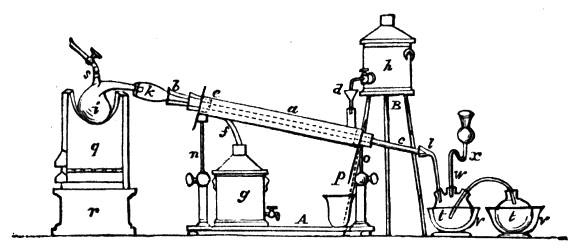
a. Condenser tube.
b, c Glass tube.
d. Funnel by which cold water runs in from the water bottle h.
e. Pipe by which water escapes through f into the bottle g.
i. Retort.
k. Adapter, connecting the retort with the condenser.
l. Adapter, connecting the condenser with the bottles t, t.
A. Wooden tressel, with movable arms n, o, for supporting and adjusting the heights of the condenser.
B. Wooden stool for supporting the water bottle.
q. Furnace.
r. Support for the furnace.
p. Gutter for carrying off water that overflows the funnel d, and preventing its escape along the pipe c.
s. Leg of syphon connected with bottle containing alcohol.
t, t. Glass globes, placed in the basins v, v, and surrounded with pounded ice or ice-cold water.
w. Safety tube, containing a little mercury at x.
For the rectification of ether, a water bath is employed along with the above simple refrigerator, and the receivers surrounded by ice or a freezing mixture.
Chem. comp., &c. Ether is generally regarded as the oxide of ethyl, and alcohol as the hydrate of this base. This view is borne out by analysis, which proves that ether differs from alcohol by the elements of water. Recent experiments have also shown that the relation existing between the two compounds is—if alcohol be expressed by the formula C2H6O, the true formula of ether will be (C2H5)2O. We cannot describe these experiments here, but we may remark that ether cannot be made to combine with water directly, nor can alcohol be converted into ether by the abstraction of water, pure and simple, without the aid of other substances.
The compound ethers may be compared to ordinary salts in which the metal is replaced by a radical termed ethyl, having the formula C2H5. This view is, of course, in accordance with the theory which regards ether as the oxide of ethyl.
According to theory, 1 equivalent, or 46 parts of absolute alcohol, should produce 1 eq., or 37 parts, of pure ether; but in practice, the greatest product obtained by operating according to Boullay’s method, which produces more ether than any other, does not exceed 33½ parts for the preceding quantity of alcohol, or 71·5%. A mixture of 9 parts of oil of vitriol, and 5 parts of alcohol of 90%, ceases to produce ether after 31 parts of such alcohol have been added.
The most economical method of etherification is that known as the continuous ether process, or the process of Boullay. When this is adopted, the retort or flask should be fitted with a sound cork, perforated by an aperture to receive a thermometer, and the application of the heat, and the flow of alcohol, should be so managed, that a temperature of 300° Fahr. and a state of rapid and violent ebullition (points of essential importance) are maintained.
Prop., Uses, &c. Pure ether is a colourless, transparent, and very limpid fluid, having a penetrating and agreeable smell, and a burning, sweetish taste; its evaporation produces the sensation of extreme cold; when prevented, a sensation of heat is experienced. Its specific gravity varies between ·712 and ·724. If it contains water it begins to crystallise in brilliant white plates when cooled to -24° Fahr., and become a white crystalline mass at -46° or -47° Fahr.; but if absolutely pure, ether cannot be solidified by any degree of cold that can be produced, it remaining fluid when placed in contact with solid carbonic acid, at a temperature of about -148° Fahr. Boils at 96° or 97° Fahr.; is very combustible; is soluble in about 10 parts of distilled water, and mixes with alcohol in all proportions. It abstracts corrosive sublimate, terchloride of gold, sesquichloride of iron, and many of the alkaloids, from their watery solutions, and is hence invaluable in analysis and pharmacy. It readily dissolves the volatile and fixed oils, and most fatty matters, as well as sulphur and phosphorus in small quantities. By exposure to light and air it absorbs oxygen, and water and acetic acid are gradually formed. It is decomposed by exposure to a high temperature. Its evaporation occasions intense cold. The greatest degree of cold yet produced (-166° Fahr.) has resulted from the admixture of ether with solid carbonic acid. Ether is powerfully stimulant, narcotic, and antispasmodic, and externally refrigerant, if allowed to evaporate, or stimulant and counter-irritant if its evaporation is prevented, and is used in various diseases. Applied to the forehead by means of the fingers or a strip of linen, it generally relieves simple cases of nervous headache. In pharmacy it is largely employed in the preparations of tinctures alkaloids, spirits, &c.; and in chemistry is invaluable in organic analyses. Its principal commercial application is as a solvent for pyroxyline, in the manufacture of collodion. It is also employed as a solvent of resins, india rubber, &c., in the preparation of varnishes, and for several other useful purposes.—Dose, 20 drops to 2 fl. dr.; in water or wine. Excessive doses of ether produce intoxication resembling that from alcohol, and require similar antidotes. Sulphuric ether is said to be taken largely in the north of Ireland as a stimulant, particularly in Antrim. Shortly before the discovery of chloroform, it was found that when the vapour of ether was inhaled it gradually produced insensibility to pain. It was therefore employed as an anæsthetic in surgical operations. Having been found less efficient than chloroform, and more troublesome to administer, its use for this purpose has been abandoned.
Tests. Ether may be recognised by its volatility, odour, taste, sparing solubility in water, admixture with alcohol in all proportions, great inflammability (burning with a yellowish-white flame), and its power of dissolving fats and resins. Its further identification can only be effected by ultimate analysis.
Pur. The ether of the shops generally contains alcohol, water, or acetic acid, and sometimes all of them. Its usual specific gravity fluctuates between ·733 and ·765. Exposed to the air, it volatises entirely. It turns litmus paper red; sometimes very slightly, and occasionally even not at all. 1⁄2 fl. oz. mixes completely with 1⁄2 pint of water. Pure ether should, however, be neutral to test-paper, although seldom so. When shaken in a minim measure with half its volume of concentrated solution of chloride of calcium, its volume should not lessen. 10 fluid ounces of water should only dissolve 1 fluid ounce of ether, and remain transparent.
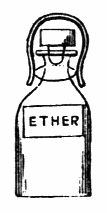
Preserv. Ether rapidly evaporates at common temperatures when kept in corked bottles, and even in bottles secured with ground-glass stoppers and tightly tied over with bladder and leather; it also becomes sour by age. To prevent this waste, the stoppers should fit accurately, and the bottles should be placed in as cool a situation as possible. Bottles furnished with ground-glass caps, as well as stoppers, are frequently employed. (See engr.) Dewar’s ‘ether phial’ is formed on a similar principle. We have seen bottles of ether accurately stoppered, tied over with bladder, and thickly coated with wax, which have yet become quite empty by a voyage to the tropics, though they still appeared to be as closely secured as when they were first filled.
Caution. The vapour of ether is very inflammable, and when mixed with atmospheric air, it forms a violently explosive mixture. The density of this vapour is 2·586, that of air being 1; hence it rapidly sinks, and frequently accumulates in the lower parts of buildings, especially cellars which are badly ventilated, in the same way as water does. The only remedy is thorough ventilation. Many serious accidents have arisen from this cause, for no sooner is a light carried into an apartment where such vapour is present than an explosion takes place.
Ethyl, Acetate of. C2H5C2H3O2 Syn. Acetate of oxide of ethyl, Acetic ether, Pyroligneous ether; Æther aceticus, L. A compound discovered by the Count de Lauraguais in 1759.
Prep. 1. Acetate of potassa, 3 parts (or an equiv. quant. of acetate of soda), alcohol (85%), 3 parts, oil of vitriol (strongest), 2 parts, are mixed together and distilled, by the heat of a sand bath, from a glass or earthenware retort into a well-cooled receiver; the distillate is agitated with a little water to remove undecomposed alcohol, and then digested first with a little chalk to remove acidity, and afterwards with fused chloride of calcium, to absorb water; it is, lastly, rectified by a gentle heat.
2. Rectified spirit (sp. gr. ·84), 50 parts, acetic acid (sp. gr. 1·075), 33 parts, are mixed together, and oil of vitriol (strongest), 10 parts, added; the distillation is continued until 65 parts have passed over, and the distillate, after digestion for some hours on a little dry carbonate of potassium, is rectified as before, the first 50 parts only being kept for use.
Prop., &c. Acetic ether is colourless, and bears a considerable resemblance to ordinary ether, but it has a much more agreeable and refreshing odour. It boils at 165° Fahr.; has a sp. gr. of ·89 at 60° Fahr., dissolves in about 7 parts of water; and mixes in all proportions with alcohol and ether. It is decomposed by alkalies and the strong acids.
Acetic ether is diaphoretic, stimulant, antispasmodic, and narcotic.—Dose, 1⁄2 to 2 fl. dr.; in similar cases to those in which sulphuric ether is employed, and especially in nervous and putrid fevers, spasmodic vomitings, and diseases of the bowels and stomach, arising from debility, and not of an inflammatory character. Its principal consumption is in the manufacture of British brandy.
Ethyl, Benzoate of. C2H5C7H5O2. Syn. Benzoic ether, Benzoate of ether, B. of oxide of ethyl; Æther benzoicus, L. Prep. Alcohol (sp. gr. ·830), 4 parts; benzoic acid (cryst.), 2 parts; concentrated hydrochloric acid, 1 part, are distilled together; as soon as the product turns milky when mixed with water, the receiver is changed, and the liquid that distills over collected; to this liquid water is added, and the supernatant ether is decanted, and boiled with water, and a little oxide of lead (to separate benzoic acid); it is, lastly, freed from water by allowing it to stand over chloride of calcium.
Prop., &c. A colourless oily liquid, slightly heavier than water, and possessing an aromatic odour and taste. It boils at 410° Fahr., and is miscible with alcohol and ether.
Ethyl, Bromide of. C2H5Br. Syn. Æther hydrobromicus, L. A volatile, ethereal liquid, discovered by Serullas.
Prep. Bromine, 8 parts; alcohol, 32 parts; dissolve, place the mixture in a retort, add of phosphorus, 1 part, and distil by a gentle heat as soon as the liquid becomes cold. The ether is separated from the distillate by the addition of water.
Prop., &c. A very volatile liquid, with a penetrating taste and smell; boiling at 105° Fahr., and heavier than water.
Ethyl, Bu′tyrate of. C2H5C4H7O2. Syn. Butyric ether, Pine-apple oil; Æther butyricus, L. Prep. By passing hydrochloric acid gas into an alcoholic solution of butyric acid, and purifying the product from free acid.
Commercially, from crude butyric acid saponified with caustic potassa or baryta, and the resulting soap distilled along with alcohol and oil of vitriol.
Uses. Crude butyric ether forms the ‘pine-apple oil’ of commerce, and when largely diluted with rectified spirit, the ‘pine-apple essence’ so much employed as a flavouring substance by confectioners, liqueuristes, &c. It imparts a delicious flavour to sweetmeats, rum, arrack, punch, &c. The Germans add it to common rum, to form the flavouring for their ‘pine-apple ale.’
Ethyl, Carbonate of. (C2H5)2CO3. Syn. Carbonic ether, Carbonate of oxide of ethyl; Æther carbonicus, L. Prep. Fragments of potassium are added to oxalic ether, gently warmed, as long as bubbles of gas are formed; the excess of metal is removed from the semi-solid mass, some water added, and the whole distilled. The carbonic ether floats on the surface of the liquid in the receiver, and is collected, dried by contact with chloride of calcium, and rectified along with some potassium or sodium, till it ceases to yield acetate of potassa when acted on by caustic potassa.
Prop., &c. Colourless, limpid, and aromatic; tastes pungent and burning; boils at 259° to 260° Fahr. It greatly resembles oxalic ether. It is decomposed by alkalies.
Ethyl, Chlo′ride of. C2H5Cl. Syn. Light Hydrochloric e., Chloride of ethyl; Æther hydrochloricus, L. A highly volatile compound, formed of ethyl and chlorine.
Prep. Rectified spirit of wine is saturated with dry hydrochloric acid gas in the cold, and the product is distilled in a retort connected with a Wolfe’s apparatus, the first bottle of which should be two thirds filled with tepid water (70° to 75° Fahr.), and the remainder surrounded with a mixture of ice and salt. To render it perfectly anhydrous, it must be digested on a few fragments of fused chloride of calcium.
A mixture of oil of vitriol, 3 parts, and alcohol, 2 parts, is poured upon common salt (dried), 4 parts; and the whole distilled as before.
Prop., &c. This ether has a sweetish taste; is soluble in about 15 parts of water, and miscible in all proportions with alcohol; boils at 54° Fahr.; burns with a flame edged with green; is neutral to test paper; and does not affect a solution of nitrate of silver. Sp. gr. ·921, at 32° Fahr.—Dose, 10 to 30 drops, as an antispasmodic and a powerful diffusible stimulant. Owing to its extreme volatility it can only be taken dissolved in spirit.
Ethyl, Cy′anide of. C2H5CN. Syn. Æther hydrocyanicus. L. Prep. Cyanide of potassium and sulphovinate of baryta, equal parts, are mixed and distilled in a glass retort by a moderate heat. The product separates into two strata; the lighter one is impure hydrocyanic ether; this is decanted and agitated with 4 or 5 times its bulk of water at 120° to 140° Fahr., and the operation is repeated with about 2 parts of water; the ether is again decanted, and placed in contact with chloride of calcium for 24 hours, and then rectified.
Prop., &c. It boils at 190° Fahr. Sp. gr. ·788. In its therapeutical effects it resembles hydrocyanic acid, but is less active. Its odour is, however, more penetrating and offensive.—Dose, 2 to 6 drops, in mucilage or emulsion; in obstinate or convulsive coughs, gastrodynia, hysterical affections, &c.
Ethyl, Cy′anate of. C2H5CNO Syn. Cyanic ether, Cyanate of oxide of ethyl. Prep. By distilling a dry mixture of cyanate of potassa and sulphovinate of potassa in nearly equivalent proportions. A mixture of cyanic and cyanuric ethers passes over into the receiver. By distilling this mixture the two are readily separated; that which passes over by the heat of a water bath being the first, and the residuum in the retort the second.
Prop., &c. An ethereal, very mobile liquid, boiling at 140° Fahr.
Ethyl, Cyan′urate of. (C2H5)3C3N3O3. Syn. Cyanurate of oxide of ethyl. Prep. See Cyanic Ether.
Prop., &c. Tasteless, inodorous, colourless, transparent, needles and prisms; fusing at 185° Fahr.
Ethyl, I′odide of. C2H5I. Syn. Æther hydriodicus, L. Prep. Phosphorous, 4 parts, alcohol (sp. gr. ·84), 70 parts, and iodine, 100 parts, are gradually and cautiously mixed together, and distilled.
Prop., &c. A colourless liquid, possessing a strong ethereal odour, and boiling at 158° Fahr.; sp. gr. 1·92. It is reddened and decomposed by exposure to air and light.
Ether, Methy′lic. Syn. Oxide of methyl, Wood-ether, Methyl-ethyl. See Methyl.
Ether, Muriatic (Heavy). Syn. Æther muriaticus ponderosus, L. Prep. Alcohol, of 80 to 85%, is saturated, in the cold, with chlorine gas, water is next added, and the oily fluid that separates collected and washed with water, as long as any of it is dissolved.
Prop., &c. Heavy muriatic ether is a volatile, oily, colourless liquid, boiling at about 245° Fahr., and heavier than water. Its precise constitution is undetermined. This ether enters into the composition of the SPIRITUS MURIATICO-ETHEREUS, a remedy occasionally used on the Continent.
Ethyl, Nitrate of. C2H5NO3. Syn. Nitric ether, Nitrate of oxide of ethyl; Æther nitricus, L.
Prep. Nitric acid (sp. gr. about 1·375), 50 parts; nitrate of urea, a little (say 2 or 3 parts); dissolve, add alcohol, 50 parts, and distil with the usual precautions, until 7-8ths of the whole (of the liquid portion) have passed over; agitate the distillate with a little water to separate the ether, and preserve the heavier portion.
Prop., &c. Nitric ether possesses an agreeable sweetish taste and odour; it is insoluble in water; the alcoholic (but not the aqueous) solution of potassa decomposes it rapidly; sp. gr. 1·112. Its vapour is very apt to explode when strongly heated, and therefore a small quantity only should be prepared at a time.
Ethyl, Nitrite. C2H5NO2. Syn. Nitric ether, Hyponitrous ether, Nitrite of ether, Nitrite of oxide of ethyl, Hyponitrite of E.; Æther nitrosus, Æ. hyponitrosus, L. This is a compound, of which ‘sweet spirit of nitre’ is an impure alcoholic solution.
Prep. 1. Starch (potato farina), 1 part; nitric acid (sp. gr. 1·30), 10 parts; mix in a capacious retort, connected with a wide tube, 2 or 3 feet long, bent at right angles, and terminating near the bottom of a two-necked bottle, containing a mixture of alcohol (of 85%), 2 parts, and water, 1 part, and surrounded with a freezing mixture, pounded ice, or very cold water; the other neck of the bottle being connected by a long glass tube with a good refrigerator or condenser. All elevation of temperature must be avoided. The heat of a water bath only must be cautiously applied to the retort. The gas liberated passes into the alcohol, causing the ether to distil in a gentle stream. The tube connecting the retort and bottle must be cooled by means of rag or moist paper, kept wetted with ice-cold water; as, if the temperature of the tube and the alcohol rises only a little, the latter becomes spontaneously hot, and boils violently, by which the product is vitiated. This process is very productive and economical, and yields pure nitrous ether.
2. A mixture of oil of vitriol, 8 parts, and alcohol, 9 parts, is poured upon crystallised nitrate of ammonia, 11 parts, contained in any suitable distillatory vessel connected with a well-cooled receiver. Nitrous ether gradually distils over on the application of a gentle heat. An admirable process, but more expensive than the preceding. Even a common fire may be employed without danger, as the liberation of the ether proceeds gradually, and not almost instantaneously, as in operating in the usual way. Sulphate of ammonia is left in the retort. The product is scarcely inferior to that of the last formula.
3. Rectified spirit, 46 fl. oz.; pure nitric acid (sp. gr. 1·500), 7 fl. oz.; put 15 fl. oz. of the spirit, with a little clean sand, into a quart matrass, fitted with a cork, and a safety tube reaching to within an inch of the spirit, and a second tube leading to a refrigeratory. Fill the safety tube with pure nitric acid, then add through it, gradually and cautiously, 31⁄2 fl. oz. of the acid. When the violent action that ensues is nearly over, gradually add the remaining portion of the acid, 1⁄2 fl. oz. at a time, and at intervals. Agitate the ether that distils over, first with a little milk of lime, till it ceases to redden litmus paper, and then with half its volume of concentrated solution of chloride of calcium. The pure hyponitrous ether thus obtained should have a density of ·899.
4. (Mr John Williams.) Nitrite of ethyl is best made by passing nitrous acid gas into alcohol.
The nitrous acid gas is prepared by acting upon such bodies as starch, copper, mercury, or arsenious acid with nitric acid. The alcohol is generally recommended in the text-books to be diluted with half its bulk of water; this, however, I consider a decided mistake. The alcohol should be as concentrated as possible, even absolute alcohol is preferable. The main points to be attended to are that the current of nitrous acid gas should be slow and steady, so as to give time for the reaction to proceed properly, and that the vessel containing the alcohol should be kept as cool as possible; in this way much of the production of bye-products will be avoided, and the gas can be passed through the alcohol, as long as it continues to be absorbed.
The resulting liquid is anything but pure; it contains much nitrite of ethyl, some aldehyde, acid—it is even stated to contain malic acid. In fact it is well known that the reaction between the nitrous acid, and such products as alcohol, however pure, is not sharp, but is always accompanied by secondary products.
From the crude alcoholic solution obtained by the method I have described, the pure nitrite of ethyl can be obtained without difficulty. Nitrite of ethyl is an extremely volatile liquid; it boils at about 61° F., whereas aldehyde boils at 90° F., and alcohol at 180° F. Taking advantage of this fact, we are enabled to separate it from the crude liquid by distillation. Some precautions are, however, necessary, to ensure the purity of the product. The flask containing the crude product is placed in a water bath, and connected by bent tubes with several other flasks and bottles. The first tube should be passed into a small empty flask, this will condense most of the alcohol which may pass over during the operation. Then a second bent tube passes into a second flask containing a little water; this condenses any alcohol which may not have been stopped in the first flask, together with free acid, and nearly all the aldehyde.
From this wash bottle a third tube proceeds into a somewhat shallow flask, containing a strong solution of caustic potash; the gas, however, is not allowed to pass through this alkaline liquid, but simply over the surface. In this way the last portion of the aldehyde is absorbed, and the potash solution gradually assumes an amber colour. From this vessel, the gas (for such at the ordinary temperature of the laboratory, the nitrite of ethyl is—in very cold weather it would be necessary to gently warm the different flasks) is passed through a tube charged with anhydrous chloride of calcium to absorb moisture, and the pure and dry nitrite of ethyl thus produced, finally passes into alcohol, which readily absorbs it.
It is only necessary to note the weight of the alcohol used for absorbing the gas, and its weight at the end of the operation, to know the strength or per-centage of nitrite of ethyl which must be in solution. Thus, if 9 oz. of alcohol becomes 10 oz., it is evident we have a solution of 10 per cent.; if it becomes 12 oz., then the strength must be 25 per cent., and so on. Ordinary spirits will answer for condensing the nitrite of ethyl, but it is better to use absolute alcohol, as it is very desirable to avoid the presence of water in any form. The solutions made with weaker spirit soon turn acid; those made with absolute alcohol, on the other hand, keep a long time. It is very true the very strong solutions of 50 and 25 per cent. show traces of acidity when tested with moistened litmus paper, but the 10 per cent. solution is quite neutral.[283]
One point I have not mentioned; it is that the distillation must be conducted at the very lowest possible temperature; in fact, the water in the water-bath should only be kept gently warm, and the process should be continued only so long as the conducting tubes feel cool to the touch; when they become warm the distillation should be discontinued. By passing the gas into a tube in a freezing mixture, instead of into alcohol, the pure nitrite of ethyl is readily obtained in a liquid form; it is, however, necessary to seal the tube, otherwise the very volatile liquid would soon be lost.
Prop., &c. Pure nitrous ether has a pale-yellow colour, an agreeable odour of apples, and boils at 62° Fahr.; sp. gr. ·947 at 60° Fahr. Commercial nitrous ether contains aldehyde, boils at 70° Fahr., has a more or less suffocating odour combined with that of the pure ether, has a sp. gr. of ·886 at 40° Fahr., and turns brown when mixed with alcoholic solution of potassa, while the latter remains unaltered. It also acidifies by age, whilst pure nitrous ether remains neutral. They are both very inflammable, and burn with a white flame. Ordinary nitrous ether dissolves in about 48 parts of water, and mixes in all proportions with alcohol and sulphuric ether.
Nitrous ether is refrigerant, diaphoretic, and diuretic, but is seldom employed alone, though, when largely diluted with alcohol (sweet spirits of nitric, spirit of nitric ether), it is a common remedy in several diseases. It is also used to flavour malt spirit, in imitation of brandy (British brandy), although for this purpose it is vastly inferior to acetic ether. See Spirits (Medicinal).
Ethyl, Œnanthate of. Syn. Œnanthic ether, Pelargonic ether, Œnanthate of oxide of ethyl. Prep. 1. The oil obtained towards the end of the distillation of fermented liquors, especially wines, consists, in a great measure, of the crude ether. It is purified by agitation with a weak solution of carbonate of potassa, freed from water by a few fragments of chloride of calcium, and then re-distilled.
Prop., &c. Œnanthic ether is colourless; lighter than water; boils at about 500° Fahr.; and has a powerful, intoxicating vinous odour, resembling that of an empty wine cask or bottle that has been exposed to the air for some time. It is very sparingly soluble in water, but freely soluble in alcohol. Its sp. gr. is ·862. As obtained by distillation, it is united with a little ŒNANTHIC ACID. 2200 imperial gallons of wine (about 35 hogsheads) only yielded 21⁄5 lbs. of the mixed oil.
Ethyl, Oxalate of. (C2H5)2C2O4. Syn. Oxalic ether, Oxalate of oxide of ethyl; Æther oxalicus, L. Prep. Alcohol and dry oxalic acid, equal parts, are digested together in a glass flask furnished with a very long glass tube of small bore, so that the spirit, volatilised by the heat, may be condensed, and flow back into the flask. After 6 or 8 hours the process is generally complete, and the liquid contains merely a trace of free acid, from which it may be separated.
Prop., &c. A colourless, oily liquid, slightly heavier than water, boiling at 363° Fahr., only slightly soluble in water, and having an aromatic smell. Alkalies decompose it. Sp. gr. 1·09.
Ethyl, Sulphate of. (C2H5)2SO4.
Prep. The vapour of pure anhydrous sulphuric acid is passed (with the usual precautions) into perfectly anhydrous ether; the resulting syrupy liquid is agitated with a mixture of 4 volumes of water, and 1 volume of ether, and after repose the upper stratum, which is an ethereal solution of the sulphate of ethyl, is decanted, and the oxide of ethyl volatilised by a very gentle heat. The colourless liquid forming the residuum is the true sulphuric ether or sulphate of ethyl just referred to. It is a very unstable compound, and cannot be distilled without suffering decomposition.
Ethyl, Valerianate of. C2H5C5H9O2. Syn. Valerianic ether, Valerate of oxide of ethyl; Æther valerianicus, L. Prep. By passing dry hydrochloric acid gas into an alcoholic solution of valeric acid. It is a fragrant, volatile liquid, lighter than water, having a high boiling-point, and a rich fruity odour, said to closely resemble that of butyric ether or pine-apple oil. It is used to flavour liqueurs, &c.
ETHYL′AMINE. NH2(C2H5). Syn. Ethyl-ammonia. One of the bases of the ethyl-series, obtained by substituting one atom of hydrogen in ammonia NH3 by ethyl C2H5.
EUCALYP′TIN. A peculiar substance existing in Botany Bay kino. A substance exuded by several species of the Eucalyptus. It has been employed medicinally in diarrhœa.
EUCALYPTOL. See Eucalyptus.
EUCALYPTUS. The Eucalypti, of which there are many species, belong to the natural order Myrtaceæ, and are natives of Australia, where they are known under the names of “gum-trees,” or as “stringy-bark trees.” The most interesting and important characteristic of these plants is the power they undoubtedly possess of correcting, if not of removing, the pestilential exhalations which are regarded as the origin of the fevers that occur in marshy localities. This discovery is due to M. Ramel, and was made by him in 1856.
M. Gimbert, amongst other cases, cites one of a farm, twenty miles from Algiers, the atmosphere surrounding which was of a very pestilential character. In the spring of 1867 13,000 eucalyptus trees were planted on the farm, and M. Gimbert states that since then not a single case of fever has taken place, the freedom from disease occurring the same year the plants were placed in the ground, and the good effects commencing whilst the trees were only two or three mètres in height.
The following is extracted from ‘Les Mondes’ (1876):—“Between Nice and Monaco there is a locality so unhealthy that the Paris, Lyons, and Mediterranean Railway Company have been obliged to change every two or three months the watchman at a crossing there.
“Plantations of the eucalyptus have been formed there, and at present the same watchman has resided there for several months with his family without experiencing the least inconvenience.”
Again:—“In the Campagna, about three miles from Rome, there stand some deserted church buildings and a monastery, the latter having been abandoned because of the mortality amongst the monks caused by the noxious exhalations. Some six years since a company of French trappists, having obtained permission from the Italian Government, planted the grounds in and around the monastery with eucalyptus trees, and the result is stated to have been so total an immunity of the building from fever, although situated in the worst part of the Campagna, that the monastery is now tenanted, the health of the occupants being, it is said, unimpaired.”
The writer in the ‘Pharmaceutical Journal,’ who contributes this statement, adds:—“Whether this grand result has been obtained through the efficacy of the extract of the eucalyptus taken each morning with their cup of black coffee, or whether it is to be attributed to the effects of the plantations, I leave to scientific men to determine.”[284]
It seems very probable that the effects above described are due to the eucalyptus having such extensive and far-spreading roots, which suck up and appropriate the moisture of the surrounding soil, the presence of which, aided by heat, giving rise to vegetable decomposition, is believed to be the cause of malarial poisoning.
The avidity of the plant for water is very great; it has been computed that one tree will absorb ten times its weight of moisture from the soil.[285] It is most likely owing, at any rate in very large measure, to this cause, rather than to the supposed antiseptic and disinfecting odours exhaled by its leaves, that the salubrious effects of the eucalyptus are due. The blue gum tree, or Eucalyptus globulus (so distinguished because of the rounded form of the lid which covers its unexpanded flower bud), has been successfully introduced into Asia, Africa, and Southern Europe. If, as asserted, it can only exist in a climate where the temperature is never lower than the freezing point, its domestication (save in hot-houses) is impossible in our own country.
Eucalyptus Globulus (from the ‘Archiv der Pharm.,’ 1873, p. 129.)
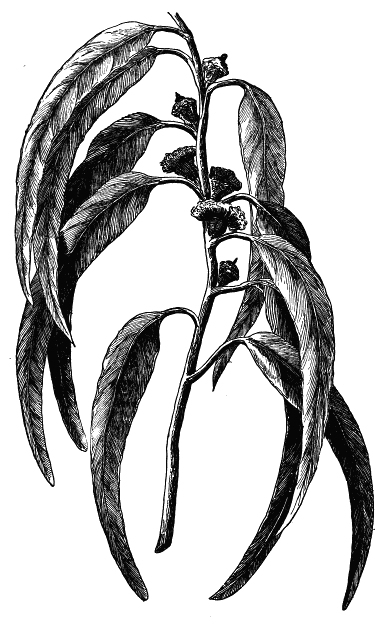
The Eucalyptus globulus is a very rapidly-growing tree, and attains to great proportions. “In some cases it has been known to attain the colossal dimensions of 350 feet in height and a 100 in circumference.”[286]
This magnitude is entirely out of proportion to the size of the seed, which is very minute; so minute that it has been computed one pound weight of the seed could produce 162,000 trees. Various preparations of the leaves and bark of the eucalypti have been introduced into medicine, which will be found under the respective pharmaceutical preparations. They were asserted to be specially serviceable in intermittent fevers and bronchitis. The idea that their efficacy in the former class of disease was due to the presence in the barks of the eucalypti of an alkaloid similar to, if not the same as, quinine, has been shown to be an erroneous one, from the experiments of the Government chemist of Ootacamund (Mr Broughton), who, after a most careful chemical analysis, failed to discover either quinine, quinidine, cinchonine, cinchonidine, or the least trace of any one of the cinchona alkaloids.
When the leaves of the Eucalyptus globulus are held to the light they reveal the presence of little semi-transparent dots, which are found to be receptacles for a volatile oil, that may be obtained in large quantity by submitting the plant to aqueous distillation.
This volatile oil has been examined by Cloez, who found it to consist chiefly of a substance allied in chemical characters to camphor, which substance he named eucalyptol.[287] Any therapeutic power possessed by the eucalyptus may be referred to this substance, since, as just stated, it cannot be due to a bark alkaloid.
Before finishing our notice of the reputed curative effects of the eucalyptus we may mention that Dr Gimbert employs the leaves instead of lint for dressing wounds and fetid ulcers, and says he has found them, when thus used, excellent deodorisers; that another method of employing the leaves of the eucalyptus consists in having them made into cigarettes, which are reported to be useful in asthma and bronchial complaints. Lastly, let us state that another species of eucalyptus exudes a very astringent substance, which, from its appearance and properties, being so analogous to kino, has been denominated Botany Bay kino. (See Eucalyptin.)
The essential oil of eucalyptus, which, according to the species of the plant from which it is obtained, varies in colour from light yellow to light blue, is now largely employed as a diluent for the more delicate volatile oils used in perfumery.
Many species of the eucalyptus yield excellent timber, possessed of great hardness and durability, and little affected by moisture. This timber has the power of resisting the attacks of insects. The wood of the eucalyptus is also very rich in potash. The maple and the elm, which are regarded as yielding a large per-centage of this substance, afford only about half as much as can be obtained from the eucalyptus, this latter tree yielding 21 per cent. of potash.
The barks of different species have also been advantageously utilised for paper making, as well as for tanning.
In this country eucalyptus seeds are reared in a greenhouse. They may be sown in a mixture of loam, peat, and ordinary soil, with a sprinkling of sand on the surface.
The following directions for the cultivation of the eucalyptus in England were communicated to the ‘Medical Times and Gazette’ of 1873 by Mr Bennett Stanford, of Pyt House, Tisbury:—“I have successfully reared from seed two dozen of these trees, and they are now growing well out of doors. I obtained the seed five years ago from South Australia, and forced it in a hothouse; in one year it was four feet high, and now, in its fifth year, it is growing rapidly in a sheltered position in the park, having attained a height of thirty feet. The first three years the tree must be taken under cover in the winter, and the fourth and fifth years should be protected for several feet up with wisps of hay or straw. When the trees are kept indoors in winter it should be in an orangery or very high greenhouse, with plenty of light and a little water.”
EUCHLO′′RINE. A bright-yellow gas, prepared by gently heating chlorate of potassa with hydrochloric acid. It is probably a mixture of chlorous acid and free chlorine. Prof. Stone, of Manchester, has found Euchlorine of a great service as an aerial disinfectant.
EUGLENÆ. These are ciliated infusorial animalcules inhabiting ponds and water-tanks. Sometimes they abound in water in quantities so enormous as to impart to that fluid a blood-red appearance. The principal species are the Euglena viridis and the Euglena pyrum. Their presence is supposed to indicate the existence in the water in which they are found, of decaying animal and vegetable matter upon which they are believed to feed.
EUPHOR′BIUM. Syn. Gum euphorbium; Euphorbium (Ph. E.), L. The concrete resinous juice of the Euphorbia canariensis, and other species of the same genus. It is a powerful acrid, purgative, rubefacient, sternutatory, and vesicant, and the violence of its action has led to its disuse.
EU′PIONE. An ethereal liquid forming the chief portion of the light oil of wood-tar, and which also exists in the tar obtained during the destructive distillation of animal substances, and in the fluid product of the distillation of rape oil. It is separated from these substances by agitating them with oil of vitriol, or a mixture of oil of vitriol and nitre, and subsequent cautious distillation. Pure eupione is tasteless, exceedingly thin, limpid, and aromatic; boils at 116° Fahr.; and is the lightest fluid known; sp. gr. ·655. It is very inflammable, burns with a very bright flame, and gives a transient greasy stain to paper. It is isomeric with hydride of amyl. Other volatile hydrocarbons of like origin are often confounded with eupione by chemical writers.
EUPYR′ION. Any contrivance for obtaining instantaneous light; as a lucifer match, &c.
EVAC′UANTS. Syn. Evacuantia, L. Medicines which augment the secretions or excretions. Cathartics, DIAPHORETICS, DIURETICS, EMETICS, ERRHINES, EXPECTORANTS, and SIALOGOGUES, belong to this class.
EVAPORA′TION. The conversion of a fluid into vapour by means of heat, diminished atmospheric pressure, or exposure to a dry atmosphere. Evaporation is had recourse to—1. For the vapour as a source of heat or power, as in the case of steam-boilers, &c.;—2. To separate volatile fluids from impurities or other bodies, which are either fixed or less volatile;—3. To recover solid bodies from their solutions, as in the preparation of extracts, chemical salts, &c.;—4. To concentrate or strengthen a solution by the expulsion of some of the fluid matter that forms the menstruum;—5. To purify liquids by the dissipation of the volatile matters which may contaminate them.
It is found that, under ordinary circumstances, evaporation is confined to the surface of the heated liquid, and is therefore slower or quicker, in proportion to the extension of that surface. Hence has arisen the adoption of wide, shallow vessels for containing fluids during their exposure to heat for this purpose. Evaporation proceeds most rapidly when a current of air (especially hot and dry air) is made to pass over the surface of the fluid; as, in this ease, the vapour is prevented from resting upon the surface, and impeding the process by its pressure. For a similar reason, liquids evaporate more rapidly in vessels partially covered than in open ones. In the former case the cool incumbent air condenses and throws back a portion of the vapour, which thereupon, besides its cooling action, offers mechanical resistance to the diffusion of the vaporous particles as they arrive at the surface of the liquid. In the latter case these obstacles are avoided, and the impetus of the vapour pouring forth from a contracted orifice (or pipe), not only readily overcomes the pressure of the atmosphere, but offers less surface for its cooling action, until it has passed much beyond the points at which it can exert any influence on the fluid from which it has escaped. In this way the chemical action of the atmosphere on the liquid operated on is also considerably lessened. On the small scale, shallow capsules of glass, wedgwood-ware, porcelain, or metal, are commonly employed as evaporating vessels, and these are exposed to heat by placing them over a lamp, or naked fire, or in a water bath, or sand bath, according to the temperature at which it is proper to conduct the process. On the large scale, high-pressure steam is usually employed as the source of heat. The term ‘spontaneous evaporation’ is applied to the dissipation of a fluid by mere exposure in open vessels, at the common temperature of the atmosphere, and without the application of artificial heat. The celerity of this species of evaporation wholly depends on the degree of humidity of the surrounding air, and differs from the former, in which the rate of evaporation is proportionate to the degree of heat at which the process is conducted, and the amount of pressure upon the surface of the liquid. Evaporation ‘in vacuo’ (as it is called) is conducted under the receiver of an air-pump, or in an attenuated atmosphere, produced by filling a vessel with steam, by which means the air is expelled, when all communication with the external atmosphere is cut off, and the vapour condensed by the application of cold. Fluids are also evaporated in air-tight receivers over sulphuric acid, by which they are continually exposed to the action of a very dry atmosphere. When such a receiver is connected with an air-pump in action, evaporation proceeds with increased rapidity, and intense cold is produced. It appears, from the experiments of Dr Ure, that “if the bottom of a pan, and the portion of the sides immersed in a hot fluid medium (solution of chloride of calcium, for example), be corrugated, so as to contain a double expanse of metallic surface, that pan will evaporate exactly double the quantity of water, in a given time, which a like pan, with smooth bottom and sides, will do, immersed equally deep in the same bath. If the corrugation contain three times the quantity of metallic surface, the evaporation will be threefold in the above circumstances. But if the pan, with the same corrugated bottom and sides, be set over a fire, or in an oblong flue, so that the current of flame may sweep along the corrugations, it will evaporate no more water from its interior than a smooth pan of like shape and dimensions placed alongside it in the same flue, or over the same fire.”
In the laboratory, steam heat is now almost exclusively employed. Copper, or tinned, glazed, or silvered coppered pans, boilers, and stills, are surrounded by a ‘jacket’ of cast iron, and high-pressure steam admitted between the two. By due management of the supply-cock, a range of temperature may be thus obtained extending from about 90° to 325° Fahr.
It is found that, under ordinary circumstances, 10 square feet of heated surface will evaporate fully 1 lb. of water per minute; and that a thin copper tube exposing 10 feet surface will condense about 3 lbs. of steam per minute, with a difference of temperature of about 90° Fahr. This is equal to 30° Fahr. per lb.; and, consequently, the heat of the steam employed to produce the evaporation should be 212° + 30° = 242° Fahr.
An attention to the facts and principles thus briefly explained above will be found of great value in the laboratory.
EXCIP′IENT. See Prescription.
EXCI′TANTS. See Stimulants.
EXCORIA′TIONS. Syn. Sprays, Chafings.
In surgery and pathology, superficial injuries or affections of the skin, consisting of the removal of the scarf-skin or cuticle, accompanied with more or less irritation and slight inflammations. When arising from rough friction or attrition, they are more commonly called abrasions. Young children are very apt to be chafed under the arms, behind the ears, between the thighs, and in the wrinkles and folds of the skin generally, unless great attention is paid to cleanliness, and wiping the skin perfectly dry after washing them. Whenever there is a tendency to excoriations of this kind, either in adults or children, a little finely powdered starch, or violet powder, applied by means of a puff, or a small bag of muslin, once or twice a day, will generally remove them, and prevent their occurrence in future. Mild unguents, as cold cream, or spermaceti cerate or ointment, may also be used with advantage. The preference should, however, be given to the remedies first named, from their not soiling the linen. See Abrasion.
EXCRETA. The excrementitious matter evacuated from the bowels varies of course in composition and quantity according to the food from which it is derived.
Berzelius found a sample analysed by himself to yield about seventy-five per cent. of water, the remainder being made up of alimentary waste, and biliary matter. A large amount of phosphates of calcium and magnesium was found in the ash remaining after the incineration of the solid matter. A specimen of fæcal matter examined by Playfair yielded 15 per cent. of nitrogen and 45 per cent. of carbon. Marcet states that he has obtained from excrement a crystallisable body possessing an alkaline reaction; to which he gives the name excretin; also a fatty substance, which he terms excretolic acid. To excretin he assigns the formula C78H156SO2; the composition of the acid has not been determined.
Hinterberger has succeeded in getting excretine (excretin), free from sulphur, and gives as its simplest formula C20H36O; which shows a close resemblance to cholesterin, C26H44O.
But cholesterin is less easily dissolved in vinegar than excretin, and the solution deposits crystals which, when viewed by the microscope, are found to be beautiful silky six-sided prisms, while the excretin solution yields round masses.
Treated with bromine, excretin gave a crystalline body having the formula C20H34Br2O; but the author did not succeed in preparing a chlorinated compound of excretin.
In the excreta of carnivorous animals no excretin has been discovered, although a substance resembling it has been found. Cholesterin has been obtained from the fæces of the crocodile, but no urates; whilst the excreta of the boa contain urates, but are destitute of cholesterin.
The fæces of animals that live on vegetables contain neither excretin, butyric acid, nor cholesterin.
The excreta of birds and serpents, which mixed with the secretion from the kidneys, are discharged from the animals by the cavities, are very similar to urine, and consist chiefly of alkaline urates and earthy phosphates.
The excrements of insects consist mainly of the remnants of the tissues, animal or vegetable which they have swallowed as food, mixed with constituents of the urine, provided the insect has no special urinary organs.
Briéger examined the fæces of healthy persons, and of convalescents, and found in addition to acetic, butyric, and isobutyric acids, small quantities of phenol and indol, and a new crystallisable body, which he terms skatol (skatos, fæces). It crystallises in irregular-dentate shining plates, resembling indol, which by frequent recrystallisation from hot water, can be obtained snow white. Skatol forms the chief constituent of the volatile aromatic components of human fæces. Fæces of dogs (whether fed on meat or bread diet) contained no skatol, but indol, and in addition a yellow oil, with a revolting and peculiarly irritating smell.
Briéger has not yet been able to analyse this yellow oil, although it forms the chief volatile constituent of dogs’ fæces. He has repeatedly obtained it from distillation from human pathological fluids. In the pancreas after putrefaction, and in the fæces of typhus patients, no skatol was found. The author considers skatol identical with the substance which Secretan obtained by the decomposition of egg albumen under water for six months.
Skatol injected under the skin of rabbits, passes out in the urine as a substance yielding colouring matter. Skatol is believed by the author to be the substance in human urine which, according to Jaffé, yields a red or violet colour on the addition of hydrochloric acid and chloride of lime.
Phenol, the author finds, is a constant component of human fæces. The above results show that specific products of decomposition are normal components of intestinal digestion.[288]
Liebig calculated that the daily average amount of fæcal matter passed by a man is 51⁄2 oz; Lawes says that it averages in healthy male adults, 4·2 oz; Parkes estimates it (in Europe) at 4 oz. on the average; Letheby at 2·784, and Frankland at 3 oz. In India, a native on the average excretes as much as 12 oz., this increase over the above quantities being due to the large proportion of rice and farinaceous food of which the Hindoos’ diet consists.
The daily average amount of urine excreted by a human being has been given by Lawes at 46 oz.; Parkes places it at 50 oz. by measure for each male adult; Letheby at 31·851, and Frankland at nearly 40 oz. by measure. According to Parkes’ figures a population of a thousand persons, would thus void daily 156 lbs. of solids, and 260 gallons of urine; or 25 tons of fæces, and 91,250 gallons of urine per annum; whilst according to Letheby, from the same number of people, the daily discharge would be 2266 lbs. avoirdupois of urine and 177·5 lbs. of fæces.
Messrs Lawes and Gilbert estimate the manurial value of the urine and fæces together at 6s. 8d. per annum for every individual, which corresponds to a yearly produce of about 10 lbs. of ammonia; but Messrs Hoffman, Witt, and Thudichum assess it at 8s. 6d. for a mixed population of both sexes and of all ages, which they say represents about 13 lbs. of ammonia.
Fæcal matter decomposes much more rapidly when mixed with urine than it would otherwise do, ammonia and fetid gases being given off in considerable quantities. Should much water be also present, and the temperature moderately high, light carburetted hydrogen, carbonic anhydride, nitrogen, and sulphuretted hydrogen are likewise evolved.
Unless human excreta be effectually as well as speedily removed from the dwellings, streets, &c., of a community, that community will assuredly pay the penalty of their neglect in the shape of health seriously endangered and deteriorated. If this be so with healthy evacuations, the peril becomes considerably intensified when the excreta are discharged by patients labouring under contagious or many other diseases. See Urine, Sewage.
EX′ERCISE is essential to the healthy performance of the functions of both body and mind. Without it, the stomach acts feebly, the bowels become inactive, and the circulation of the blood languid and imperfect; the chest contracts, the respiration becomes impeded, the brain is insufficiently supplied with pure arterial blood, the mind grows lethargic, the complexion assumes a sickly and effeminate hue, and the features generally lack the energy and expression which they possess in perfect health. With exercise, the bodily functions are performed with vigour and regularity, the constitution is thereby strengthened, and the attacks of disease repelled. By exercise the mind too is excited to healthy action, its gloomy reveries are dispelled, and the fair face of creation is presented to the mind’s eye in its proper hues. It robs undue mental exertion of half its injurious effects upon the body, whilst it stimulates and directs it in its proper course. It improves the temper, and humanises the character. The disposition is refined, the passions restrained, violent emotions checked, the habits improved, and the personal charms promoted under the stimulus of judicious exercise.
To females, bodily exercise is even more necessary than to males. The disposition and education of females are such as tend to produce habits of sloth and indolence to a greater degree than in the other sex. Hence to them exercise is doubly important—it is inseparable from health. The more retiring dispositions of females lead them almost unconsciously into habits of inactivity, which, above all, they should endeavour to shake off and avoid. By so doing—by replacing habits of indolence and inactivity by liveliness and moderate exercise, the development of the body will be promoted, additional grace and elegance imparted to its natural movements, and the enjoyments arising from both mental and bodily health increased, whilst disease and deformity will be prevented by the removal of their cause.
The necessity of exercise exists equally in every grade of society and age of life. Those who are engaged in sedentary employments or in-door occupations, should particularly seek refreshing out-door exercise during the periods of relaxation from their diurnal duties. To the studious and delicate of both sexes, this is absolutely necessary to preserve the health and vigour of the body.
In infancy, exercise of a suitable kind should be almost the constant occupation of the little beings that claim our protection and care. It should, however, be always borne in mind, that the muscular exercise of very young children must be of the gentlest class. Prejudice and ignorance frequently induce nurses and parents to teach their children to walk, as they falsely call it, and thus their feeble limbs are urged to make premature efforts to totter along, before the bones and muscles have acquired sufficient strength to support the body in an erect position. From this course the legs and joints frequently become bent and misshapened, and severe injuries are often inflicted on the head and body by blows and falls. It should never be forgotten, that crawling and rolling are their first modes of progression, and require the least exertion. Next comes the sitting posture; from this the child gradually advances to the erect one; then to walk by slight assistance; and, lastly, to walk safely alone. All this should come naturally, and never be promoted, further than by laying the infant on the carpet or floor, for the full exercise of its little strength. As soon as a healthy child is able to walk instead of crawl, its own disposition induces it to do so. The faculty of imitation, the spirit of enterprise, and the pride of doing what others do, present even in infancy, is rather apt to lead the infant to over-exertion than the contrary. The practice of constantly ‘dolling’ children in the arms is most prejudicial to the early development of their feeble powers.
It is injudicious to take an infant out during the hottest part of the day in summer; such a proceeding tends to enervate and depress, rather than to strengthen him. Whenever he goes out his head should be protected from the direct rays of the sun by means of a large brimmed hat made of cotton or straw and an umbrella. The neglect of these precautions frequently gives rise to the disordered stomach, sickness, and diarrhœa, so prevalent during very hot weather. During other periods of the day, the weather being favorable and the locality healthy, an infant cannot be too much out of doors, especially during teething.
Infants of three or four months’ old may, under certain precautions, be sent out into the open air during the winter. They must be well wrapped up; they should be carried in the nurse’s arms, and not consigned to a perambulator; they should never go out in foggy nor wet weather; if the wind be neither in the east nor the north-east there will be no objection to their being sent out on a clear frosty day. Spring is a trying period for infants and children, because of the prevalence of east winds; hence the necessity of seeing that they are well and warmly clad when sent out during this season. There is much less danger of a child taking cold during the autumn than the spring, as in autumn the winds frequently blow from the south, or warm quarter.
In childhood the exercise should be regulated according to constitution and age; avoiding inactivity, on the one hand, and excessive exercise on the other. The out-door plays and pastimes of BOYS will generally be found sufficient, and in some cases will even require to be curbed, to prevent fatigue and the overtasking of the young frame. With girls it is frequently difficult to find sufficient exercise without trespassing on the prejudices of the ignorant, or the routine of their daily education. With them walking, and some healthy amusement, as skipping, hooping, or the like, should be indulged in for some hours daily. When this is impossible or inconvenient, they may be habituated to the practice of the more simply and cleanly portion of the domestic duties. In the performance of the latter, the health will be promoted, whilst the care and attention which is always due by a female to herself and others, at all periods of her life, will become an easy acquisition, and assist the cultivation of the best feelings of her nature.
In youth exercise matures and promotes the development of the frame; and in manhood it is equally necessary, as already noticed, to keep it in healthy action. In age it will be found to assist the vital functions, and put off decay. In fact, to all—young, old, rich, and poor, physical exercise is essential to the permanent enjoyment of health.
In a medical point of view, “exercise, employed moderately, has a tonic and stimulating influence on the system, and is calculated to prove beneficial in a great variety of complaints. Used immoderately, it exhausts both the mental and bodily powers, and produces great debility.” (Pereira.) Well-directed exercise favours the preservation of the general health, by calling into direct action the majority of the organs of the body; and it also acts powerfully on the skin, by stimulating its functions, increasing its temperature, awakening its tone, and subjecting it to a current of atmosphere favorable to its respiratory offices. But to be beneficial in the highest degree, exercise must be accompanied by feelings of present interest and enjoyment. The mind must direct and go with it; to ensure its full benefits, the “soul must be present.”
“During convalescence, properly regulated exertion is highly serviceable; but it should never be carried so far as to produce exhaustion, and should be pursued for some time in doors, before it be attempted in the open air; the latter, at first, should always take place in a carriage, that can be opened or closed at will; the patient may then attempt short walks in the open air; but, in all cases, it is of importance that he is not unduly fatigued, as, otherwise, injury instead of benefit will be the result. One of the most serious errors, committed with regard to exertion, is that of permitting a convalescent to sit up too frequently, or for too long a time, under the mistaken notion of giving him strength. A patient should never be allowed to sit up longer than is agreeable to his feelings, and never so long as to produce a sense of fatigue.” (Dr R. E. Griffith.)
The physiological effects of exercise have been studied by numerous scientific observers. The carefully conducted experiments of Dr Edward Smith have satisfactorily demonstrated that during bodily exertion the circulation of the blood through the lungs is much increased in velocity, that these latter inspire air and eliminate carbonic anhydride in quantities proportionate to the exercise taken, and that these quantities show an enormous increase over the amounts of these gases inhaled and exhaled during a state of rest.
Adopting the recumbent position as unity, Dr Edward Smith has given the following table, illustrating the quantities of air inhaled during various forms of exercise:
Lying position1·
Sitting1·18
Standing1·33
Singing1·26
Walking 1 mile per hour1·90
Walking 2 miles per hour2·76
Walking 3 miles per hour3·22
Walking and carrying 34 lbs.3·50
Walking and carrying 62 lbs.3·84
Walking and carrying 118 lbs.4·75
Walking at 4 miles per hour5·
Walking at 6 miles per hour7·
Riding and trotting4·05
Swimming4·33
Treadmill5·50
Since a man takes into his lungs 480 cubic inches of air per minute, in walking four miles an hour he draws in 2400 cubic inches, and if six miles 3260 cubic inches a minute.[289]
Dr Smith estimated the amount of carbonic anhydride evolved under differing conditions, and found that—
Carbonic acid exhaled per minute in grains.
During sleep4·99
Lying down, and almost asleep (average of three observations)5·91
Walking at the rate of 2 miles an hour18·10
Walking at the rate of 3 miles an hour25·83
Working at the treadmill, ascending at the rate of 26·65 feet per minute (average of three observations)44·97
The relative amounts of carbonic anhydride eliminated from the lungs during periods of rest and exercise have also been investigated by Pettenkofer and Voit. The following table, which gives the results of their experiments, also records the quantities of oxygen absorbed, and of water and urea excreted at the same time:—
Absorption of Oxygen in Grammes.Elimination in Grammes of—
Carbonic Acid.Water.Urea.
Rest-day.708·9911·5828·037·2
Work-day.954·51284·22042·137·0
Excess on work-day (with exception of urea)246·6372·71214·10·2
If the quantities in the above table be converted into ounces it will be found that nearly 83⁄4 oz. more oxygen were absorbed and 13 oz. more of carbonic anhydride eliminated by the lungs during a work-day than during a rest-day.[290] It must be stated that during the work-day an interval of rest was taken, and that the labour was by no means excessive.
Hirn and Speck appear to have conclusively proved that the formation of the carbonic anhydride occurs in the muscles, and that it is rapidly carried off from them. In short, this latter result seems essential for the development of muscular energy. At any rate it is found that if the respiratory movements be in any way interfered with during exercise, and the elimination of carbonic anhydride in any degree checked, the muscular power rapidly diminishes.
An examination of Pettenkofer and Voit’s table shows that exercise gives rise to the escape of a large amount of water from the body, and to a slightly diminished quantity of urea.
Since the accumulation of the superfluous carbon supplied by the food gives rise to morbid and diseased states of the body,[291] we shall now be enabled to understand why deficient exercise should be a source of physical ill-being, and why, on the contrary, the proper use of the muscles should be so essential a condition for the maintenance of health, since it is in them that the great formation of the eliminated carbon is effected. We shall also not fail to see why, since during exercise the excretion of water is so largely increased, the blood necessarily becomes less diluted and richer in quantity.
Whilst insufficiency of exercise gives rise to a weak action of the heart, and very frequently to fatty degeneration of that organ, exercise that is not excessive, although it increases the beats of the heart from ten to thirty beyond this acceleration, and imparting greater force to the pulsations, does not interfere with their regularity. Furthermore, muscular exercise, by considerably augmenting the flow of the blood through the whole body, the heart included, exercises a most beneficial function, “since it causes in all organs a more rapid outflow of plasma and absorption—in other words, a quicker renewal. In this way also it removes the products of their action, which accumulate in organs, and restores the power of action to various parts of the body.”[292]
Palpitation, enlargement, and valvular disease of the heart result from excessive or injudicious exercise. Wherever, therefore, fatigue or embarrassment of the heart shows itself rest must be had recourse to. Persons having weak hearts suffer greatly in ascending mountain or other heights.
The effect of exercise upon the kidneys is to diminish the quantity of water, as well as the chloride of sodium and other chlorides in the urine. As we have seen, the urea is very slightly lower; but after much exertion the uric acid is increased. There is also a slight increase in the amounts of sulphates and carbonic anhydride. Parkes could find no alteration in the phosphates. The diminution of water and the chlorides is due to the excretion of these by the skin, the function of which is greatly augmented by exercise. No urea escapes by the skin, but many acids (probably fatty ones) are liberated by that organ. Speck has shown that during exercise the amount of fluid is nearly double what it is when the body is quiescent.
This escape of fluid by perspiration doubtless affords an explanation of a diminution in the quantity of the excreta from the bowels. The fæces exhibit no decrease in nitrogen.
Exercise increases the growth of the muscles, making them at the same time harder, and also causing them to obey more readily the behests of the will. Prolonged or excessive exertion, without sufficient rest, has been found to interfere with their nutrition, and to cause them to become soft.
There is a tolerably general impression that much exercise tends to cripple the development of the mental faculties, and this idea is said to have received support from the circumstance that the athletes at our universities seldom signalise themselves in contests of learning. But this fact, it has been suggested, may be explained by the athletic exercise being indulged in to such an extent as to leave no time for cultivating the mind. If an illustration were required to prove that great bodily energy is quite consonant with mental vigour it might be found in the life of the late Professor Wilson, of Edinburgh. On this point Dr Parkes says: “Considering that perfect nutrition is not possible except with bodily activity, we should infer that sufficient exercise would be necessary for the perfect performance of mental work.”
As regards the changes that take place in the muscles during exercise Dr Parkes writes: “The chief changes that take place in the muscles during action appear to be these: there is a considerable increase of temperature (Helmholtz), which, up to a certain point, is proportioned to the amount of work; it is also proportioned to the kind, being less when the muscle is allowed to shorten than if prevented from shortening (Heidenhain); the neutral or alkaline reaction of the tranquil muscle becomes acid from para-lactic acid and acid potassium phosphate; the venous blood passing from the muscles becomes much darker in colour, is much less rich in oxygen, and contains much more carbonic acid (Sczelkow); the extractive matters soluble in water lessen, those soluble in alcohol increase (Helmholtz, in frogs); the amount of water increases (in tetanus, J. Ranke), and the blood is consequently poorer in water; the amount of albumen in tetanus is less, according to Ranke, but Kühne has pointed out that the numbers do not justify the inference.”
Liebig stated that the creatin is increased (but this was an inference from old observations on the extractum carnis of hunted animals, and requires confirmation). Sarokin has stated the same fact in respect to the frog. The electro-motor currents show a decided diminution during contraction.
That great molecular changes go on in the contracting muscles is certain, but their exact nature is not clear; according to Ludimar Hermann there is a jelly-like separation and coagulation of the myosin, and then a resumption of its prior form, so that there is a continual splitting of the muscular structure into a myosin coagulum, carbonic acid, and a free acid, and this constitutes the main molecular movement. But no direct evidence has been given of this.
The increased heat, the great amount of carbonic acid, and the disappearance of oxygen, combined with the respiratory phenomena already noted, all seem to show that an active oxidation goes on; and it is very probable that this is the source of the muscular action. The oxidation may be conceived to take place in two ways—either during rest oxygen is absorbed and stored up in the muscles, and gradually acts there, producing a substance which, when the muscle contracts, splits up into lactic acid, carbonic acid, &c.; or, on the other hand, during the contraction an increased absorption of oxygen goes on in the blood, and acts on the muscles, or on the substances in the blood circulating through the muscles. The first view is strengthened by some of Pettenkofer and Voit’s experiments, which show that during rest a certain amount of storage of oxygen goes on, which no doubt in part occurs in the muscles themselves.
Indeed, it has been inferred that it is this stored-up oxygen, and not that breathed in at the time, which is used in muscular action. The increased oxidation gives us a reason why the nitrogenous food must be increased during periods of great exertion.
An increase in the supply of oxygen is a necessity for increased muscular action; but Pettenkofer and Voit’s observations have shown that the absorption of oxygen is dependent on the amount and action of the nitrogenous structures of the body, so that, as a matter of course, if more oxygen is required for increased muscular work, more nitrogenous food is necessary. But, apart from this, although experiments on the amount of nitrogenous elimination show no very great change on the whole, there is no doubt that, with constant regular exercise, a muscle enlarges, becomes thicker, heavier, contains more solid matter, and, in fact, has gained in nitrogen. This process may be slow, but it is certain; and the nitrogen must either be supplied by increased food, or be taken from other parts.
So that, although we do not know the exact changes going on in the muscles, it is regarded as certain that regular exercise produces in them an addition of nitrogenous tissue.
Whether this addition occurs, as usually believed, in the period of rest succeeding action, when in some unexplained way the destruction which it is presumed has taken place is not only repaired, but is exceeded (a process difficult to understand), or whether the addition of nitrogen is actually made during the action of the muscle, must be left undecided for the present.
The substances which are thus oxidised in the muscle or in the blood circulating through it, and from which the energy manifested as heat or muscular movement is believed to be derived, may probably be of different kinds. Under ordinary circumstances the experiments of Fick and Wislicenus and others, and the arguments of Traube, seem sufficient to show that the non-nitrogenous substances, and perhaps especially the fats, furnish the chief substances acted upon. But it is probable that the nitrogenous substances also furnish a contingent of force. The exact mode in which the energy thus liberated by oxidation is made to assume the form of mechanical motion is quite obscure.
There seems little doubt that the exhaustion of muscles is chiefly owing to two causes—first and principally to the accumulation in them of the products of their own action (especially para-lactic acid); and secondly, from the exhaustion of the supply of oxygen. Hence rest is necessary, in order that the blood may neutralise and carry away the products of action, so that the muscle may recover its neutrality and its normal electrical currents, and may again acquire oxygen in sufficient quantity for the next contraction.
In the case of all muscles these intervals of action and of exhaustion take place, in part even of the period which is called exercise; but the rest is not sufficient entirely to restore it. In the case of the heart the rest between the contractions (about two thirds of the time) is sufficient to allow the muscle to perfectly recover itself.
The foregoing remarks on the effects of muscular exercise will have prepared us for the inference which statistics abundantly support, viz. that, other conditions being favorable, the healthiest occupation is that which consists in the practice (of course within reasonable limits) of manual labour in the open air.
The Rev. Professor Haughton, in his work entitled ‘A New Theory of Manual Labour,’ has drawn up a table (which we append) of the amount of force expended during various kinds of work. It represents the number of tons lifted one foot per diem:—
Labouring Force of Man.
Kind of Work.Amount of Work.Authority.
Pile-driving312tons lifted 1 foot.Coulomb.
Pile-driving352”Lamaude.
Turning a winch374”Coulomb.
Porters carrying goods, and returning unladen325””
Pedlars always loaded303””
Porters carrying wood up a stair, and returning unloaded381””
Paviours at work352”Haughton.
Military prisoners at shot drill (3 hours), and oakum-picking and drill310””
Shot drill alone (3 hours)160·7””
Professor Haughton has devised a formula by means of which a certain amount of walking exercise may be made to represent its equivalent in manual labour. He points out that walking on a level surface is equivalent to raising one twentieth part of the weight of the body through the distance walked.
When ascending any height, the whole weight of the body is, of course, raised through the ascent. The formula is—
(W + Wl) × D ——————— 20 × 2240
where W is the weight of the person; Wl the weight carried (if any); D the distance walked in feet; 20 the co-efficient of traction; and 2240 the number of pounds in a ton. The result is the number of tons raised one foot. To get the distance in feet 5280 must be multiplied by the number of miles walked.
Supposing a man to weigh 150 lbs. with his clothes, by the employment of the above formula we should arrive at the following results:—
Kind of Exercise.Work done in tons lifted 1 foot.
Walking 1 mile17·67
Walking 2 miles35·34
Walking 10 miles176·7
Walking 20 miles353·4
Walking 1 mile and carrying 60 lbs.24·75
Walking 2 miles and carrying 60 lbs.49·5
Walking 10 miles and carrying 60 lbs.247·5
Walking 20 miles and carrying 60 lbs.495
From the above data something like a rough approximation may be formed of the daily amount of exercise requisite for a healthy male adult.
Since 500 tons lifted a foot is extremely hard work, the number of miles corresponding to this extreme amount of labour would, if persevered in, be objectionable.
Dr Parkes, regarding 300 tons lifted a foot as an average day’s work for a healthy man, thinks that walking exercise equivalent to half that amount should be taken daily. This, or a 150 tons, represents a nine miles’ walk. He, however, qualifies the suggestion by adding “that, as there is much exertion taken in the ordinary business of life, this amount may be in many cases reduced;” and concludes by saying, “It is not possible to lay down rules to meet all cases, but probably every man with the above facts before him could fix the amount necessary for himself with tolerable accuracy.”
For muscular exercise to be safe and efficient, it must be taken under certain conditions and precautions. We have noticed the evil effects of immoderate bodily exertion on the heart. The lungs are no less seriously affected by an excessive indulgence in it, which shows itself in spitting of blood and in congestion of the pulmonary vessels. Congestion of the lungs brought on by overtaxed bodily strength very frequently causes the death of horses in the hunting field.
These facts, therefore, not only point to the importance of avoiding undue or extreme exertion,[293] but also to the necessity of ensuring the full and uncramped play of the respiratory organs during exercise, and the consequent removal of any impediment in the way of tight clothing that in any manner interferes with their freedom of exercise. Laboured respiration and sighing are indications of pulmonary congestion, and counsel temporary rest and abstention from exercise.
The great augmentation in the excretion of carbon which leaves the lungs in the form of carbonic anhydride during exercise has been already referred to. As this carbon is derived from the food, it follows that in the intervals of exercise an increase of carbonaceous diet is necessary. For this purpose physiologists prefer the fatty to the amylaceous varieties of diet. It has been already stated why at the same time the nitrogenous food must be increased during periods of great exertion. There seems little doubt that water is the best drink that can be taken during moderate as well as great exercise.... It is best taken in small quantities and frequently. Spirits are decidedly prejudicial, and indispose to bodily exertion. They are hurtful because they lessen the exhalation of carbonic anhydride from the lungs. Trainers never allow them, and but very little wine or beer.
The thirst that not unfrequently accompanies exercise is due to the great escape of water from the skin which has been already alluded to. This liberation of moisture, being also accompanied, as already explained, by a large excretion of the chlorides and, perhaps, by other salts. Dr Parkes advises the use of an additional supply of chloride of sodium to the diet of those taking much exercise; he suggests that probably potassium chloride and phosphate might be added with advantage.
The evaporation from the skin has the effect of reducing the bodily temperature and rendering it equable. This temperature, however, falls very rapidly after exertion is over; and hence at this time it is always advisable to guard against the chance of a chill by covering the body over. Flannel forms the best protection. Keeping the skin clean by daily ablution greatly aids in the escape of fluid during exercise.
The large amount of carbonic anhydride given off by the lungs during bodily exercise explains the advantages of open air exercise, and why walking in the fresh air produces such excellent effects in some forms of dyspepsia. This increased exhalation of carbonic anhydride also points to the importance of thorough ventilation when indoor exercise is taken, particularly by large bodies of men or women, as in riding schools and on the treadmill. The mortality amongst miners, whose labour is performed in confined and ill-ventilated spaces is very great. According to Mr Simon, with the exception of those who work in the well-ventilated mines of Durham and Northumberland, the 300,000 miners in England break down prematurely from bronchitis and pneumonia, caused by the atmosphere in which they are compelled to work.
EXPAN′SION. All substances, solid, liquid, and gaseous, when chemical change does not take place, expand by heat, and contract by cold. In some of them this property occurs in a greater degree than in others, but is constant for the same substance under the same circumstances. The chemist avails himself of this property in the construction of his thermometer; the wheelwright, in fixing on the tire of his wheels; the engineer, in restoring to the perpendicular the leaning walls of buildings, &c.
This expansion by heat is of great importance in the manufactures, as allowance has to be made of it in every purpose where metals are employed.
The following is a list of the expansion of the chief metals, &c., when heated from 32° to 212° Fahr., or from 0° to 100° Cent.:—
Substance.Expansion.
In bulk.In length.
Glass1 in 3841 in 1150
Platinum1 in 3771 in 1311
Steel1 in 3091 in 926
Iron1 in 2821 in 846
Gold1 in 2271 in 682
Copper1 in 1941 in 582
Brass1 in 1791 in 536
Silver1 in 1751 in 524
Tin1 in 1721 in 516
Lead1 in 1171 in 351
Zinc1 in 1131 in 340
Of the liquids, they expand as follows, when heated from 0° to 100° Cent., or from 32° to 212° Fahr.:—
Mercury1 in 55 in bulk.
Water1 in 21 in bulk.
Gases practically all expand alike; that is to say, for every degree Fahrenheit a gas expands 1⁄491 of its bulk at 32°, and for every degree Centigrade 1⁄273 of their volume at 0°C.
An example will show the importance of this. Suppose an iron bar, connecting two sides of a building, and of a length of about 85 feet. The increase in length by heat of this bar would make it 1 inch longer in summer than in winter; and it would, if no allowance be made, pull or thrust the walls to this extent each year.
EXPEC′TORANTS. Syn. Expectorantia, L. Medicines that promote the secretion of the trachial and bronchial mucus. According to Dr Good, true expectorants are “those medicines which rather promote the separation of the viscid phlegm with which the bronchiæ are loaded, than simply inviscate and dilute it; though these are also treated as expectorants by many writers.” Ammoniacum, antimonials, assafœtida, the balsams of Peru and tolu, benzoic acid, benzoin; the fumes of vinegar, tar, and several of the volatile oils; garlic, ipecacuanha, the oleo-resins, squills, tartarised antimony, and the smoke of tobacco and stramonium, are among the principal substances commonly called expectorants. Tartarised antimony, squills, chlorine, and ammoniacal gases, have also been used (diluted) to provoke the coughing and favour the expulsion of foreign bodies from the air-passages; and also to favour the expectoration of mucus, pus, and membranous concretions, when the local irritation is not sufficiently great. (Schwilgue.) Expectorants are commonly employed in pulmonary complaints and affections of the air tubes, attended by a vitiated state of the mucus, or an imperfect performance of the natural functions of the secretory vessels. “Of all classes of the materia medica, none are more uncertain in their action than expectorants.” (Pereira.) The act of ejecting matter from the chest is called EXPECTORATION.