A CYCLOPÆDIA OF PRACTICAL RECEIPTS, PROCESSES, AND COLLATERAL INFORMATION (continued 32)
Reading edition
DROP. See Measures.
DROPS, CHOLERA—CHOLERATROPFEN (A. Bastler, Vienna). Oils of anise, cajeput, and juniper berries, of each 20 parts; spirit of ether, 60 parts; tincture of cinnamon, 120 parts; Haller’s acid elixir, 5 parts.—Dose, 30 to 50 drops. (Wittstein.)
DROPS (Confectionery). These are confections of which the principal basis is sugar. They differ from lozenges chiefly in the ingredients being combined by the aid of heat. Occasionally they are medicated.
Prep. Double refined sugar is reduced to powder, and passed through a hair sieve (not too fine), and afterwards through a gauze sieve, to take out the fine dust, which would destroy the beauty of the drop. It is then put into a clean pan, and moistened with any favorite aromatic, as rose or orange-flower water, added slowly, stirring it with a paddle all the time, from which the sugar will fall as soon as it is moist enough, without sticking. The colouring (if any) is next added, in the liquid state, or in very fine powder. A small, polished copper, or tinned-copper pan, furnished with a lip, is now one half or three parts filled with the paste, and placed over the fire, or over the hole of a stove, or preferably on a sand bath, and the mixture stirred with a little bone or glass spatula until it becomes liquid. As soon as it almost boils, it is taken from the fire, and if it is too moist, a little more powdered sugar is added, and the whole stirred, until it is of such a consistence as to run without too much extension. A tin plate, very clean and smooth, and very slightly oiled, being now ready, the pan is taken in the left hand, and a bit of bright iron, copper, or silver wire, about 4 inches long, in the right. The melted sugar is next allowed to fall regularly on the tin plate, the wire being used to remove the drop from the lip of the pan. In two or three hours afterwards the drops are taken off with the blade of a knife, and are at once put into bottles or tins. On the large scale, ‘confectionery drops’ are moulded by a machine consisting essentially of two metal rollers covered with hollows. A sheet of the warm and soft composition, on being passed between the rollers, is at once converted into a batch of symmetrical drops, the upper and lower halves being moulded by the corresponding hollows of the upper and lower rollers. See Candying, Confection, Essence, Stains (Confectioner’s), Sugar Plums.
The following are a few of the principal confectionery drops kept in the shops:—
Drops, Acid′ulated. Syn. Acid Drops. Prep. Tartaric acid, 1⁄2 oz., dissolved in a very little water, is added to each lb. of sugar, as above; with essence of lemon, orange, or jargonelle pear, to flavour, as desired.
Drops, Chocolate. Prep. Chocolate, 1 oz., is reduced to fine powder by scraping, and added to powdered white sugar, 1 lb.; when the mixture is made into drops, as above, care being taken to avoid heating it a second time.
Drops, Cof′fee. Prep. A clarified, concentrated infusion of coffee, 1 oz., is used for each lb. of sugar.
Drops, Fruit. These are prepared according to the general description. (See above.) The flavouring essences (volatile oils or essences of lemon, orange, citron, raspberry, jargonelle pear, &c.) not being added until the sugar is melted, to avoid, as much as possible, loss by evaporation. The colouring matter may be any of the transparent ‘stains’ usually employed for cakes, jellies, and confectionery. In this way are made the majority of the first-class fruit drops and bon-bons of the sugar-bakers. In some cases the plan is varied by adding the clarified concentrated juice, or jelly of the fruit to the sugar. One variety of raspberry and currant (red and black) drops are made in this way.
Drops, Ginger. Prep. From essence or tincture of ginger, as above. An inferior kind is made in the way described under Candy, Ginger.
Drops, Jargonelle′. Fruit drops flavoured with essence of jargonelle pear (SOLUTION OF ACETATE of AMYLE).
Drops, Lem′on. Acidulated drops flavoured with essence of lemon. They are usually stained with an infusion of turmeric. (See above.)
Drops, Pep′permint. From the whitest refined sugar, flavoured with English oil of peppermint or its spirituous solution (essence of peppermint), or with peppermint water.
Drops, Rasp′berry. See Drops, Fruit (above.)
Drops (Med′icated). Syn. Guttæ, L. This term is commonly applied to compound medicines that are only taken in small doses. At the present time they are almost exclusively confined to empirical and domestic medicine. The plan of directing liquids to be measured by dropping is objectionable, because the drops of different fluids vary in size, and are also further influenced by the size of the bottle and the shape of its neck, as well as the quantity of liquid it is poured from. See Essence, and below.
Drops, Acoust′ic. Syn. Acoustic balsam; Guttæ acousticæ, Balsamum acousticum, L. Prep. 1. Oil of almonds, 1 oz.; laudanum and oil of turpentine, of each 1 dr.; mix. For hardened wax, and to allay pain.
2. Tinctures of benzoin, castor, and opium, of each, 1 fl. oz.; essential oil of assafœtida, 5 drops. As the last, and in deafness arising from debility of the organism.
3. (Baumé’s.) Tinctures of ambergris, assafœtida, castor, and opium, of each, 1 oz.; terebinthinated balsam of sulphur and oil of rue, of each, 15 drops. In atonic deafness.
4. (Bouchardat.) Compound spirit of balm, 21⁄2 dr.; oil of almonds, 5 dr.; ox-gall, 10 dr.; cresote, 10 or 20 drops. In cases complicated with hardened wax, fetid discharges, &c.
5. (Dr Hugh Smith.) Ox-gall, 3 dr.; balsam of Peru, 1 dr. In fetid ulcerations of the ear. One or two drops of the above are poured into the ear; or a piece of cotton wool moistened therewith is introduced instead. The last is the safest plan.
6. Glycerin, either alone or diluted with water. In deficiency of the natural secretions of the ear; used in sufficient quantity to moisten the first passages. See Deafness, Glycerin.
Drops, A′gue. Prep. White arsenic, 1⁄2 gr.; hot water, 1 oz.; dissolve.—Dose, 1⁄2 to 1 teaspoonful, twice a day. See Solution (Arsenite of Potassa).
Drops, An′odyne. Syn. Guttæ anodynæ, L. The solutions of acetate and hydrochlorate of morphia are commonly vended in the shops under this name.
Drops, Ant′acid. Syn. Guttæ antacidæ, L. Prep. (U. C. Hosp.) Liquor of potassa, 3 fl. oz,; powdered myrrh, 1 oz.; triturate together until thoroughly incorporated, add of liquor of ammonia, 1 fl. oz., mix well, place the mixture in a stoppered bottle, and the next day decant the clear portion. Antacid, tonic, and stomachic.—Dose, 10 to 20 drops, or more, in water.
Drops, Antihyster′ic. Syn. Guttæ antihystericæ, L. Prep. Cyanide of potassium, 2 gr.; rectified spirit, 5 fl. dr.; syrup of orange flowers, 3 fl. dr.—Dose, 10 drops to 1⁄2 teaspoonful, when the attack is expected, and repeated occasionally as required; in hysterical affections, gastrodynia, &c.
Drops, Antiscorbu′tic. Syn. Guttæ antiscorbuticæ, L. Prep. 1. Expressed juice of water-cress, 2 fl. oz.; salt of tartar, 1 oz.; agitate together occasionally for a few hours, and in 2 or 3 days decant.—Dose, 12 or 15 drops, to a teaspoonful, twice a day, in a cupful of new milk.
2. Citrate of potassa, 4 dr.; ammonio-citrate of iron, 2 dr.; water, 10 fl. dr.—Dose. As the last, in water.
3. (Green’s Antiscorbutic Drops.) Merely a disguised solution of corrosive sublimate. Most of the other ‘antiscorbutic’ and ‘anti-venereal drops’ advertised by quacks have a like composition.
Drops, Antiscrof′ulous. Syn. Guttæ antiscrofulosæ, L. Prep. 1. Iodine, 10 gr.; iodide of potassium, 1 dr.; water, 1 fl. oz.
2. (Augustin.) Chlorides of iron and barium, of each, 1⁄2 dr.; distilled water, 1 fl. oz.—Dose, 10 to 30 drops, 2 or 3 times a day.
Drops, Antispasmod′ic. Syn. Guttæ antispasmodicæ, L. Prep. Tinctures of castor, valerian, and assafœtida, of each, 2 dr.; tincture of capsicum and balsam of Peru, of each, 1 dr.; camphor, 20 gr.; acetate of morphia, 3 gr.—Dose, 10 to 20 drops, as required.
Drops, Bateman’s. See Drops, Pectoral.
Drops, Battley’s. See Liquor Opii Sedativus.
Drops, Bitter. Syn. Guttæ amaræ, L.; Gouttes amères, Fr. Prep. From nux vomica (rasped), 1 lb.; liquor of potassa, 1⁄2 fl. oz.; bistre, 1 dr.; compound spirit of wormwood, 32 fl. oz.; digest 10 days, express the tincture, and filter. A most unscientific preparation; said to be tonic and stomachic.—Dose, 1 to 8 drops in water or any bitter infusion. In large doses it is poisonous.
Drop, Black. Syn. Armstrong’s black drop, Lancaster’s b. d., Quaker’s b. d., Toustall’s b. d., Braithwaite’s genuine b. d.; Gutta nigra, L. This celebrated preparation was originally prepared nearly a century and a half ago by Edward Toustall, a medical practitioner in the county of Durham, and one of the Society of Friends. The formula passing into the possession of a relative of his (John Walton, of Shildon), was found among his brother’s papers, and, by the permission of Thomas Richardson, of Bishop’s Wearmouth, one of his executors, was handed to Dr Armstrong, who subsequently published it in his work on typhus fever.
Prep. 1. (Original formula.) Opium (sliced), 1⁄2 lb.; good verjuice, 3 pints; nutmegs, 11⁄2 oz.; saffron, 1⁄2 oz.; boil them to a proper thickness; then add, of sugar, 1⁄4 lb., and yeast, 2 teaspoonfuls. Set the whole in a warm place, near the fire, for 6 or 8 weeks, then place it in the open air until it becomes of the consistence of a syrup; lastly, decant, filter, and bottle it up, adding a little sugar to each bottle. To yield two pints of strained liquor.
2. (Acetum Opii, L.—U. S.) Opium, 8 oz.; nutmeg, 11⁄2 oz. (both in coarse powder); saffron, 1⁄2 oz.; distilled vinegar, 24 fl. oz.; digest on a sand bath with a gentle heat for 48 hours, and strain; digest the residuum with an equal quantity of distilled vinegar for 24 hours; then put the whole into a percolator, and return the filtered liquid as it passes until it runs clear; afterwards pour on the material, fresh distilled vinegar until 48 fl. oz. of filtered liquor shall be obtained; in this dissolve sugar, 12 oz., and gently evaporate the whole to 52 fl. oz.
3. (Wholesale.) Opium, 10 oz., and distilled vinegar, 1 quart, are digested together for about a fortnight, and after sufficient repose the clear portion is decanted. This is the form commonly adopted by the wholesale trade in England.—Dose, 5 to 10 drops. It is usually considered to be of fully 4 times the strength of laudanum.
Drops, Carmin′ative. Syn. Guttæ carminativæ, L. Prep. (Radius.) Oil of mace, 1 dr.; nitric ether, 3 dr.—Dose, 6 to 10 drops on sugar; in flatulent colic, &c.
Drops, Cham′omile. See Essence.
Drops, Dalby’s. See Patent Medicines (Dalby’s Carminative).
Drops, Durande’s. Syn. Guttæ ætheris terebinthinatæ, L. Prep. (M. Durande.) Rectified sulphuric acid, 3 parts; oil of turpentine, 1 part.—Dose, 20 to 30 drops, or more; in the passing of gall-stones.
Drops, Dutch. Syn. Haerlem drops, Turpentine drops; Balsamum terebinthinæ, L. The genuine or imported ‘Dutch Drops’ is the residuum of the rectification of oil of turpentine. It is also prepared by distilling resin, and collecting the product in different portions. At first a white, then a yellow, and lastly a red oil, comes over. The last is the balsam. The article commonly sold under the name in this country is prepared by one or other of the following formulæ:—
1. Oil of turpentine, tincture of guaiacum, and sweet spirit of nitre, of each 1 oz.; oils of amber and cloves, of each 15 drops.
2. Balsam of sulphur, 1 part; oil of turpentine, 5 parts. This last is the form most generally employed. They are all regarded by those who use them as detergent, diuretic, stimulant, and vulnerary.
Drops, Female. Syn. Emmenagogue drops; Guttæ emmenagogæ, L. Prep. (Brande.) Compound tincture of aloes and tincture of valerian, of each, 2 fl. oz.; tincture of sesquichloride of iron, 1 fl. oz.—Dose. A teaspoonful in water or chamomile tea; in obstructed menstruation, &c.
Drops, Fit. Syn. Soot drops; Tinctura fuliginis, Guttæ f., L. Prep. From wood-soot, 2 oz.; sal-ammoniac, 1 oz.; salt of tartar, 1⁄2 lb.; soft water, 4 lbs.; digest a week and filter. Reputed antispasmodic, and also useful in scurvy and certain skin diseases.—Dose. A teaspoonful or more, occasionally, in water.
Drops, Golden. Syn. De la Motte’s g. d.; Bestucheff’s nervous tincture; Guttæ aureæ, L.; Elixir d’or, Gouttes d’or du Général Lamotte, Fr. Prep. 1. (Original.) Chloride of iron (obtained by distilling iron pyrites with twice its weight of corrosive sublimate), 3 oz.; alcohol, 7 oz,; expose the mixture in a closely stoppered bottle to the rays of the sun until it becomes decoloured.
2. Chloride of iron, 1 part; alcohol and ether, of each, 3 parts. These drops have the remarkable property of losing their yellow colour in the sun, and recovering it in the shade. They are taken in gout, hypochondriasis, and nervous complaints, in doses of from 10 to 60 drops.
Drops, Hooping-Cough. Syn. Guttæ anti-pertussicæ, L. Prep. 1. (Dr Graves.) Tincture of assafœtida and compound tincture of camphor, of each 1⁄2 fl. oz.; compound tincture of bark, 5 fl. oz.—Dose. A teaspoonful, 2 or 3 times a day.
2. (Potestates Succini.) Oil of amber, 1 oz.; carbonate (not sesquicarb.) of ammonia, 1⁄2 oz.; strongest rectified spirit (alcohol), 1⁄2 pint; digest 3 or 4 days, and decant the clear portion.—Dose, 10 drops to 1 dr., applied as a friction.
Drops, Infantile. Several anodyne, carminative, and absorbent preparations, which pass by this name, will be found under Mixtures, &c.
Drops, Jes′uits’. Syn. Elixir antivenereum, L. Prep. 1. Gum guaiacum, 7 oz.; balsam of Peru, 4 dr.; root of sarsaparilla, 5 oz.; rectified spirit of wine, 1 quart; digest for 14 days.
2. (Quincy.) Copaiba, 1 oz.; gum guaiacum, 2 dr.; oil of sassafras, 1 dr.; salt of tartar, 1⁄2 dr.; rectified spirit, 5 fl. oz.; digest a week.
3. (Walker’s.) Copaiba, 6 oz.; gum guaiacum, 1 oz.; chio turpentine and salt of tartar, of each, 1⁄2 oz.; cochineal, 1 dr.; rectified spirit, 1 quart; digest a week. See Comp. Tincture of Benzoin.
Drops, Kœchlin’s. Prep. (Augustin.) Solution of ammonio-chloride of copper and mercury, 1 fl. dr.; water, 10 fl. dr. In obstinate venereal affections, scrofula, &c.—Dose. A teaspoonful after each meal.
Drops, Lav′ender. Syn. Red drops; Guttæ lavendulæ, L. The same as compound tincture of lavender.
Drops, Life. Syn. Salmon’s drops of life; Guttæ vitæ, L. Prep. Tincture of castor, 8 fl. oz.; antimonial wine and water, of each 1 lb.; opium, 3 oz.; saffron, 1⁄2 oz.; cochineal, camphor, and nutmegs, of each 2 dr.; digest for 10 days and filter. Anodyne and diaphoretic.—Dose, 20 to 60 drops.
Drops, Mercu′′rial. Syn. Guttæ hydrargyri bichloridi, L. Prep. 1. Bichloride of mercury, 2 gr.; hydrochloric acid, 3 drops; rectified spirit and distilled water, of each, 1⁄2 fl. oz.—Dose, 12 to 20 drops.
2. Bichloride of mercury, 2 gr.; sal-ammoniac, 3 gr.; compound decoction of sarsaparilla, 2 fl. oz.—Dose. A teaspoonful.
3. (Sir A. Cooper.) Corrosive sublimate, 1 gr.; dilute hydrochloric acid, 1⁄2 dr.; dissolve, and add tincture of bark, 2 fl. oz.—Dose. As the last. They are all taken 2 or 3 times daily, as alteratives in scrofula, syphilis, cancer, &c. It should not be measured in a metal spoon.
Drops, Norris’s. An aqueous solution of tartar emetic, mixed with spirit of wine, and coloured.
Drops, Odontal′gic. Syn. Tooth-ache drops; Guttæ odontalgicæ, L. Prep. 1. (Dr Blake.) Alum (in fine powder), 1 dr.; sweet spirit of nitre, 7 fl. dr.; agitate together occasionally for an hour.
2. (Dr Copland.) Powdered opium and camphor, of each 10 gr.; oils of cloves and cajeput, of each 1 dr.; highly rectified spirit and sulphuric ether, of each 1⁄2 fl. oz.
3. (Cottereau.) A saturated ethereal solution of camphor, to which a few drops of liquor of ammonia is added.
4. (Dr R. E. Griffith.) Wine of opium, Hoffman’s anodyne, and oil of peppermint, equal parts. Used as a friction on the cheek or gum, as well as applied to the teeth.
5. (Perry’s.) A concentrated ethereal tincture of camphor and pellitory.
6. (Righini.) Creosote, 6 dr.; rectified spirit, 4 dr.; tincture of cochineal, 2 dr.; oil of peppermint, 1⁄2 dr.
7. Camphor, 2 dr.; rectified spirit, 1 oz.
Obs. The above are applied to the tooth with a camel-hair pencil, or a little wad of lint or cotton wool is moistened with them, and placed in or against the tooth.
Drops, Pectoral. Syn. Bateman’s p. d.; Guttæ pectorales, L. Prep. 1. Paregoric, 10 fl. oz.; tincture of castor, 4 fl. oz.; laudanum, 1 fl. oz.; tincture of saffron or of cochineal, 1⁄2 fl. oz.; oil of aniseed, 15 drops.
2. Castor, 1 oz.; oil of aniseed, 1 dr.; camphor, 5 dr.; cochineal, 11⁄2 dr.; opium, 3⁄4 oz.; treacle, 1 lb.; proof spirit, 1 gal.; digest for a week.
3. (Phil. Coll. of Pharm.) Camphor, catechu, powdered opium, and red sanders wood, of each 2 oz.; oil of aniseed, 4 fl. dr.; proof spirit, 4 old wine-gallons; digest 10 days, and filter.—Dose. A teaspoonful, or more, in coughs, colds, hoarseness, &c., assisted by an aperient.
Drops, Rheumat′ic. Syn. Guttæ rheumaticæ, L. Prep. 1. Iodide of potassium, 1 dr.; tincture of guaiacum, 2 fl. oz.; dissolve.—Dose, 20 to 30 drops. In both chronic and occasional rheumatism, assisted with the copious use of lemon juice.
2. (Lampadius.) Bisulphuret of carbon and ether, of each 2 fl. dr.—Dose, 6 to 12 drops, on sugar, or in milk.
3. (Wutzer.) Bisulphuret of carbon, 1 fl. dr.; alcohol, 2 fl. dr.—Dose. As No. 2. The last two are sudorific, alterative, resolvent, and emmenagogue, and, besides rheumatism, have been used with advantage in amenorrhœa, in some cutaneous affections, in glandular swellings, &c.
Drops, Rousseau’s. See Wine of opium (by Fermentation.)
Drops, Sed′ative. Syn. Guttæ sedativæ, L. The solutions of acetate and hydrochlorate of morphia, black drop, Rousseau’s drop, and Battley’s liquor opii sedativus, are frequently sold under this name by the druggists. The anti-hysteric drops (antè) is also an excellent sedative.
Drops, Spilbury’s. Prep. 1. (Dr Paris.) From bichloride of mercury, gentian root, and dried orange peel, of each 2 dr.; precipitated sulphuret of antimony and red sanders wood, of each, 1 dr.; proof spirit, 16 fl. oz.; digest ten days and strain.
2. Levigated crocus metallorum (‘crocus of antimony’), 6 dr.; corrosive sublimate, 45 gr.; red sanders, 1⁄2 dr.; gentian root and dried orange peel, of each 2 dr.; brandy (or equal parts of rect. sp. and water), 16 fl. oz.; digest as before.—Dose, 5 to 30 drops; as an antiscorbutic, &c.
Drops, Steel. See Tincture of Sesquichloride of Iron.
Drops, Ton′ic. Prep. (Collier.) Elixir of vitriol, 2 fl. dr.; tincture of calumba, 6 fl. dr. A teaspoonful three times daily, in a wine-glassful of cold water.
Drops, Torrington’s. See Tincture of Benzoin (Comp.).
Drops, Van Swieten’s. An aromatised solution of corrosive sublimate.
Drop, Ward’s White. Prep. From quicksilver, 4 oz.; nitric acid, 16 fl. oz.; dissolve, add sesquicarbonate of ammonia, 7 oz.; evaporate and crystallise; then dissolve the resulting salt by the heat of a sand bath, in 4 times its weight of rose-water. Very poisonous.—Dose, 5 to 15 drops, as an antiscorbutic, antivenereal, &c.
Drops, Worm. Syn. Guttæ anthelminticæ, G. vermifugæ, L. Prep. 1. Creosote, 1 dr.; oil of turpentine, 7 fl. dr.—Dose. A teaspoonful, 3 or 4 times a day.
2. (Peschier.) Oil of male-fern, 3 fl. dr.; rectified oil of turpentine, 5 fl. dr. As the last; in tapeworm.
3. (Schwartz’.) Barbadoes tar, 1 fl. oz.; tincture of assafœtida, 11⁄2 fl. oz.—Dose, 30 to 40 drops, three times a day; in tapeworm.
DROPS (Scouring). Prep. 1. Oil of turpentine and oil of lemons, equal parts. Both of the ingredients should have been recently distilled or rectified.
2. Oil of lemon bottoms, 13⁄4 lb.; oil of turpentine, 1 quart; mix well, and distil by the heat of a sand bath, until 3 pints have come over, or as long as the distillate is clear, pale, and sweet. Used to remove paint, grease, &c., from cloth.
DROPSY. Syn. Hydrops, L. An unnatural collection of aqueous fluid in any part of the body. Dropsy has received different names, according to the part of the body affected by the disease. When it occurs in the cellular membrane it is called ANASARCA; when in the cavity of the abdomen, Ascites; in the cavity of the cranium, HYDROCEPHALUS; in the scrotum, HYDROCELE; in the uterus, HYDROMETRA; and in the chest, HYDROTHORAX. Dropsy is mostly a symptom of extreme debility and a broken-down constitution, and frequently follows lengthened attacks of exhausting chronic diseases.
The treatment of dropsy, perhaps, more than any other disease, depends upon the circumstances with which it is connected, and, more especially, upon those which have caused it. The acute inflammatory forms of dropsy generally require depletion. In most other cases, tonics may be advantageously administered. To promote the absorption of the accumulated fluids, diuretics are commonly resorted to. Confirmed dropsy (especially HYDROCEPHALUS and HYDROTHORAX), occurring in patients either much debilitated by previous disease or of a bad habit of body, is seldom curable.
DROWNING. The cause of death from submersion in water is the entire seclusion of air from the lungs, by which the aëration of the venous blood is prevented. In consequence of this deprivation of air, venous blood circulates through the arterial system, whilst the pulmonary vein ceases to convey oxygenated blood to the heart. Under ordinary circumstances, in the course of 4 or 5 minutes after the access of air has been cut off, life becomes extinct. Many cases have, nevertheless, occurred of persons being submerged for 15 or 20 minutes, and even longer, and where perfect insensibility has existed, in which recovery has taken place.
Prev. The specific gravity of the human body is less than that of water, so long as the lungs are partially filled with air; and this difference is sufficient to keep the body floating with the mouth and nostrils free for respiration, provided the face is turned upwards by throwing the head back on the shoulders, by which the weight of the head is sustained by the water. When a person throws himself into the water, the body rises rapidly to the surface and assumes nearly the erect position, the upper part of the head, down to a little below the eyes, remaining above the surface of the water. This arises from the greater density of the legs and thighs compared to that of the chest, which acts as a species of float or buoy to the rest of the body. In this situation the head may be thrown back, so that the face may form the exposed portion, as before mentioned, when respiration may be carried on without inconvenience in still water, and regularly, but sufficiently, so as to sustain life for some time, even in a rough sea. The adoption of this simple precaution would have saved thousands of valuable lives.
Another point which should be remembered by every person in danger of drowning is, that there is always a considerable amount of residual air in the lungs, in a nearly deoxidised state, and that if this air is expelled by two or three forced inspirations, and a deep inspiration is then taken, a larger quantity of vital air will be introduced into the lungs, and the blood will continue aërated for a proportionally longer time; and consequently, a longer period will elapse before another inspiration will be required. If we prepare ourselves by taking two or three forced inspirations, and then take a full inspiration, we may remain for 11⁄2 or 2 minutes before a second attempt at respiration need be made. This is the plan adopted by the pearl fishers, and other divers who are remarkable for remaining beneath the surface of the water for some time. A person in danger of shipwreck, or expecting immediate submersion, in any other situation, should have recourse to this expedient, which would prevent the dreadful effects of attempting respiration whilst under water.
Treat. The first object is the restoration of the animal heat. For this purpose, the wet clothes should be removed, and the body, after being well dried, surrounded with warm air. In the absence of a warm-air bath, the body may be laid between well-heated blankets, and bottles of hot water applied to the feet and armpits. Gentle friction with warm flannel or the hands should also be assiduously employed. Meanwhile attempts should be made to excite respiration artificially; and when the apparatus is at hand, slight shocks of electricity should be kept up at the same time. On the appearance of returning life, such as sighing or convulsive twitching, a vein may be opened. The throat may be tickled with the finger or a feather, to excite vomiting, and a teaspoonful of warm water administered. If the power of swallowing exists, a table-spoonful of warm wine or brandy and water may be given. Even if no symptom of returning animation appear, these means of recovery should be persisted in for three or four hours.
In the treatment of this species of asphyxia, nasal stimulants, as ammonia, aromatic vinegar, &c., should be avoided, as well as the injection of tobacco smoke, both of which have been found highly prejudicial. The practice of holding the body with the head downwards, which is sometimes adopted by the vulgar and ignorant, under the idea of allowing the water to run out by the mouth, is still more dangerous and absurd. The supposition that water is inhaled by drowning persons instead of air is perfectly fallacious. The peculiar mechanism of the glottis, or upper portion of the windpipe, is such as to prevent, by the spasmodic closure of the epiglottis, the entrance of more than a very trifling and accidental quantity of water, which is altogether too insignificant to produce any very injurious effects. See Asphyxia.
DRUGS. Substances used in medicine, sold by druggists, and compounded by apothecaries and physicians. Our continental neighbours, wiser than ourselves, not merely require that persons engaged in selling and dispensing drugs and pharmaceutical preparations shall be fully qualified by previous education and training for the task, but also that the various articles they sell and use shall be commercially pure and of the proper quality. In the United States of America this subject has also engaged the attention of the government and legislature. Under the Act of the 26th June, 1848, inspectors were appointed to examine the quality of imported articles of this class before allowing them to pass the Customs for home use. An abridged copy of the order addressed to the “collectors and other officers under this act” is appended, and will be useful to the reader, as assisting to establish a standard by which the value of the substances named therein may be estimated.
Treasury Department, June 4th, 1853.
The following articles are to be entitled to entry when ascertained by analysis to afford the per-centages as under, viz.:—
Aloes, 80% of pure aloetic extract.
Assafœtida, 50% of its peculiar bitter resin, and 3% of volatile oil.
Cinchona Bark,[264] 1% of pure quinine, or 2% of the several alkaloids, as quina, cinchona, quinidine, aricine, &c.
Benzoin, 80% of benzoin resin.
Do. 12% of benzoic acid.
Colocynth, 12% of colocynthine.
Elaterium, 30% of elaterine.
Galbanum, 60% of resin.
Do. 10% of gum, and 6% volatile oil.
Gamboge, 70% of pure gamboge resin, and 2% of gum.
Guaiacum, 80% of pure guaiacum resin.
Gum Ammoniacum, 70% of resin, and 18% of gum.
Jalap,[265] 11% of pure jalap resin.
Myrrh, 30% of pure resin, and 50% of gum.
Opium, 9% of pure morphia.
Rhubarb,[266] 40% of soluble matter.
Sagapenum, 50% of resin, 30% of gum, and 30% of volatile oil.
Scammony, 70% of pure scammony resin.
Senna, 28% of soluble matter.
Medicinal leaves, flowers, barks, roots, extracts, &c., not specified above, must be, when imported, in perfect condition, and of as recent collection and preparation as practicable.
Pharmaceutical and chemical preparations, whether crystallised or otherwise, used in medicine, to be pure and of a proper consistence and strength, as well as of perfect manufacture, conformably with the standard authorities named in the Act; and must, in no instance, contain over 3% of excess of moisture or water of crystallisation.
Essential or volatile oils, and expressed oils used in medicine must be pure and of the standard sp. gr. noticed and declared in the dispensatories named in the above Act.
“Patent” or “Secret Medicines” are by law subject to the same examination as other medicinal preparations, and cannot be permitted to pass the Custom-house for home consumption, but must be rejected and condemned, unless the special examiner is satisfied, after due investigation, that they are fit and safe to be used for medical purposes.
An appeal from the examiner to the collector to be admitted within 10 days.
James Guthrie, Secretary to the Treasury.
DRUM′MOND LIGHT. See Light (Artificial).
DRUNK′ENNESS. See Abstinence, Intemperance, &c.
DRY′ERS (Painter’s). Prep. 1. Litharge (best) ground to a paste with drying-oil. For dark colours.
2. From white copperas and drying oil; as the last.
3. From sugar of lead and drying oil. The last two are for pale colours.
4. From white copperas and sugar of lead, of each 1 lb.; pure white lead, 2 lbs. For ‘whites,’ and opaque light colours, greys, &c.
Dryers are employed, as the name implies, to increase the drying and hardening properties of oil paints. A little is beat up with them at the time of mixing them with the oil and turpentine for use.
DRY′ING. See Desiccation, &c.
DRY′ING-OIL. See Oils.
DRY-ROT. A peculiar disease that attacks wood, and renders it brittle and rotten. It is generally caused by dampness and the subsequent development of the spores of fungi, particularly those of Merulius lacrymans and vastator and Polyporus destructor. The dry-rot principally attacks ‘ill-seasoned’ timber, and more particularly that of ships and badly ventilated buildings.
Prev. Various means have been proposed to prevent the attacks of dry-rot and to arrest its progress when it has commenced, among which the process called ‘Kyanizing’ (Kyan’s patent) is that most generally known and most extensively adopted. It consists in immersing the timber in a bath of corrosive sublimate. The process termed ‘Paynizing’ (Payne’s patent) consists in first filling the pores with a solution of chloride of calcium, under pressure, and next forcing in a solution of sulphate of iron, by which an insoluble sulphate of lime is formed in the body of the wood, which is thus rendered nearly as hard as stone. Wood so prepared is now largely employed in our public works and railways. Sir W. Burnett’s process (patented in 1836) consists in impregnating the timber with a solution of chloride of zinc. Mr J. Bethell’s process (patented in 1838) consists in thoroughly impregnating the wood with oil of tar containing creasote and a crude solution of acetate of iron, commonly called ‘pyrolignite of iron.’ The impregnation is effected in a strong cylindrical vessel, connected with a powerful air-pump, so that in the first instance a vacuum being formed, and subsequently a pressure of several atmospheres applied, the liquid may as much as possible be forced into all the pores of the wood. The above processes for ‘seasoning’ preserve the timber not only from dry-rot, but from the influence of the weather and the attacks of insects and worms.
“The construction of air-drains or passages around wood-work to be preserved is, where the method is applicable, a great aid to the preservation of wood. Dry-rot is both prevented in new buildings and cured in old ones by filling up the spaces between the floor-joists with ‘tank-waste’ from alkali works. This can also be applied to the ends of beams resting in walls.”—Chemical News.
DUB′BING. Prep. 1. By boiling the waste cuttings of sheep-skins in crude cod oil. 2. Black resin, 2 lb.; tallow, 1 lb.; crude cod oil or train oil, 1 gall.; boil to a proper consistence. Used by the curriers to dress leather, and by shoemakers and others to soften leather, and to render boots and shoes waterproof.
DUBOISIA MYOPOROIDES. (Nat. order, Solanacæ.) A small tree growing in Australia, New Caledonia, and New Guinea. The leaves have been used in Brisbane and Sydney as a substitute for atropine, and extract of belladonna; to both of which Mr Tweedy believes them to be superior in prompt and energetic action. Mr Tweedy further states that, in every case in which he has used duboisia to produce dilatation of the pupil of the eye, its action has been beneficial, and he is induced to conclude, more advantageous than that of atropine. According to Dr Ringer, duboisia, besides causing dilatation of the pupil, quickens the pulse, parches the tongue, stops the secretions of the skin, and induces headache and drowsiness. He also reports that it is antagonistic in its action to muscarine, and produces tetanus after the lapse of some hours or days.
For an account of the botanical properties of the plant, the reader is referred to a paper by Mr E. M. Holmes in the ‘Pharmaceutical Journal’ for March 9th, 1878; and to the ‘Lancet’ of March 2nd, 1878, for some experiments on its physiological effects by Messrs Ringer and Tweedie. The Duboisia myoporoides was introduced into medical practice by Dr Bancroft, of Brisbane.
Since the above has been written, Mr Gerrard has obtained a powerful alkaloid from an extract of the leaves of the Duboisias, very similar in chemical properties to aconite, and possessed of the same physiological qualities as the extract.
DUCK. See Poultry.
DUCTIL′ITY is the property of being drawn out in length without breaking. See Metals.
DULCAMA′RA. See Nightshade (Woody).
DUMB′NESS. Syn. Aphonia, L. As speech is an acquired and imitative faculty, persons who are either born deaf or become so in early infancy are also, necessarily, dumb. The first step in treating dumbness must therefore be directed to the removal of the deafness on which the imperfection rests. The exertions of modern philanthropists have, however, been so far successful in such cases as to enable the deaf-mute to converse with those around him by signs. Those interested in the subject may consult an admirable treatise on ‘Deaf-dumbness,’ by M. E. Hubert-Valleroux, of which an excellent translation appeared in the ‘Medical Circular,’ vol. ii, for 1853. See Deafness.
DUMPLINGS, Norfolk. Mix half a pound of flour with half a teaspoonful of baking powder and a pinch of salt; make into a little dough with cold water; fall into small balls, put them into boiling water immediately, and boil for twenty minutes.
DUNGER—MANURE (Boutin, Paris). A bluish-green fluid, containing about 190 grammes of solid matter per litre. The residue consists of sulphates of copper, iron, magnesia, and soda, sal ammoniac, nitrates of potash and soda, common salt, and none or a mere trace of phosphoric acid. The blue deposit which separates on standing is ultramarine. (Keller, Karmrodt, and Nessler.)
DUNG′ING. Syn. Cleansing. One of the principal processes in the arts of calico printing and dyeing, its object being to free the cloth from loose matters, which would interfere with the dyeing. After the thickened mordants have been applied to the fabric and properly fixed, it is necessary to remove the now useless thickening matter, together with the excess of mordant, which has not come into actual contact with the cloth. Formerly a bath formed of cow-dung, diffused through hot water (130° to 212° Fahr.) was always used to wash away these loose matters; but now various manufactured substances are successfully employed for the purpose. The best dung substitutes are the arsenite and arseniate of soda, the silicate of soda, and phosphate of lime. Experience proves that, in the case of these substitutes, a final rinse in cow-dung before dyeing is advantageous. A process very similar to ‘dunging’ is employed after dyeing, to clear and give purity to the undyed parts. This subsequent process is distinguished by the term ‘clearing.’ Cow-dung has been used in ‘clearing’ operations, but its employment is not to be recommended. Bran scalded and mixed with water is employed for certain goods, but bleaching powder is the most generally used ‘clearing agent.’
DUST, ATMOSPHERIC. When a ray of sunlight is admitted into a dark room, or an electric beam is transmitted through a glass tube, myriads of little motes are revealed, which move and dance about in all directions.
In ordinary daylight these minute particles are invisible. Nevertheless, they are always more or less present in the atmosphere wherever (except under special conditions) this permeates, and they constitute that more or less attenuated, impalpable, generally dry, or dessicated form of matter which we denominate dust.
As with every inspiration we take into our bodies more or less of this suspended material, the study of the composition and characters of the different substances which compose it is one possessed of paramount interest, both for the pathologist and sanitarian.
Amongst solid, inorganic matters found in the open air are silica, peroxide of iron, silicate of alumina, carbonate and phosphate of lime, sand, carbon, chloride of sodium, and metallic iron. These, of course, are of telluric origin, and are carried into the atmosphere by strong currents and winds, which latter have the power of transporting dust to great distances, e.g. red sand from the interior of Africa has been found in the sails of ships 600 or 800 miles distant from the African coast, whilst particles of carbon, sand, and dried mud, ejected to great heights from volcanoes into the air, have been transported over still greater distances.
Some doubt appears to prevail as to whether all dust storms originate on the earth, it having been conjectured that some of the solid matters found in the atmosphere may be of meteoric origin, and may have entered it from the realms of space. The chloride of sodium (which the chemist knows is so omnipresent that he cannot heat an ordinary platinum wire in a Bunsen burner without indications of its presence) is derived from the spray of the sea, lifted and diffused into the air by the wind; the iron dust from the rails over which railway trains are constantly passing; the silica, amongst other sources, from the traffic over macadamised thoroughfares.
The organised and organic substances contained in the external air are very numerous. The animal kingdom is the source of the wings of moths, butterflies, and other insects, spiders’ legs and webs, hair, wool, epithelium, and eggs, many of these bodies being mere débris.
The vegetable kingdom contributes spores, pollen, cells, cotton fibre, and the germs of vibriones and monads. Besides these are many living creatures, brought by the agency of monsoons and cyclones from extensive deserts. Showers of sand derived from these wastes occur in different parts of Europe. Ehrenberg submitted the sand obtained during seventy of these showers to microscopic examination, and found, in addition to sand and oxide of iron, numerous organic forms, amongst which 194 Polygastrica, 145 Phylolithariæ, besides Polythalmia, &c. Silvestre found four species of diatoms and living infusoria in the sand obtained from a dust shower in Sicily in 1872. But, besides the presence of these organisms in the external air, which may be regarded exceptional, it contains, under ordinary conditions, numerous living creatures, some brought into it from the earth by the force of winds, others growing in it. More than 200 forms—rhizopods, tardigrades, and Anguilulæ—have been found in it by Ehrenberg. So tenacious of life are these latter that, even if dried, they will retain their vitality for months, and even years.
Of the organisms found in the air the following are the most important:—1. Extremely small, round, and oval cells, which, that they may be rightly examined by the microscope, require a power of 600 or 1000 diameters. They are found sometimes growing together and sometimes cleaving, when they present an appearance like the figure 8. Sulphuretted hydrogen in the air is said to stimulate their growth and carbolic acid to check it. Although existing in the open air, they are by far more abundant in the atmosphere of dirty prisons. They are also met with in the sweat of the prisoners inhabiting these localities. Observers believe they increase rapidly by cleavage. No ill effects have been traced to them.
“To the same class, perhaps, of these round and oval cells the bacteria and monads, which have been described as gathered from the air, must be assigned; the development of these cells into vibriones and rod-like bacteria, though asserted, has not yet been definitely proved, and, indeed, Burden-Sanderson’s observations rather throw doubt on the statement that true bacteria exist in the air.
“2. Spores of fungi are not infrequent in the open air; they occur most commonly in the summer (July and August); they are not in this country more frequent with one wind than another; the largest number found by Maddox in ten hours was 250 spores; on some days not a spore can be found. Maddox leaves undetermined the kind of fungus which the spores developed under cultivation; the spores were pale or olive coloured and oval, probably from some form of smut. Angus Smith found in water through which the air of Manchester was drawn innumerable spores. Mr Dancer has calculated that in a single drop of the water 250,000 fungoid spores as well as mycelium were present; but as the water was not examined for some time there may have been growth. Mycelium of fungus seems uncommon in the air, but is sometimes found.
The cells of the Protococcus pluvialis are not uncommon, neither, perhaps, are those of other algæ. On the whole the experiments of Maddox show that in his locality (near Southampton) it is incorrect to speak of the air being loaded with fungoid spores; they can be found, but are not very numerous.”[267]
Amongst other suspended matters are minute fragments of dried horse droppings, derived from the original substance, reduced to powder by the traffic, and carried by aerial currents into the atmosphere. In the ‘Chemical News’ for October, 1871, Professor Tichborne gives the results of some analyses of the street dust of Dublin. Some dust taken from the top of a pillar 134 feet high contained 29·7 per cent. of organic matter, whilst that collected from the street consisted of as much as 45·2 per cent. This organic matter was principally composed of comminuted stable manure; it was capable of acting as a ferment, and was possessed of deoxidising powers sufficient to reduce nitrate to nitrite of potash.
This evidence of the presence of suspended known matters in the air has led some pathologists to conjecture that certain formless substances found in it, undeterminable by the microscope, may in reality be disease germs, which, being transported through long distances by the wind, may also be the means of spreading certain maladies from one locality to another. In this manner cholera has been supposed to have been propagated from India, the particles of the dried excreta of cholera patients being supposed to be the carriers of the formidable disease; this hypothesis of its origin, however, is not yet, at any rate, universally accepted. “In the case of smallpox and scarlet fever the distance to which the ‘contagions’ spread by means of the air is certainly inconsiderable.”[268]
Hitherto we have spoken only of the nature of the dust occurring in the external air. The composition of that met with in confined spaces is, of course, largely influenced by surrounding conditions and circumstances; for instance, in indifferently ventilated apartments, in addition to the substances already enumerated, the dust of the confined air has been found to contain small particles of food, bits of the hair of human beings, domestic animals, and feathers of birds, as well as of coals, cinders, charred wood, linen, cotton, and wool fibres, varieties of epithelium, and certain round cells resembling nuclei.
In the apartments of the sick it is additionally charged with a very large quantity of organic matter.
The spores of the Tricophyton and Acorion have been discovered in and seem peculiar to skin hospitals. In that taken upon two occasions from the ward of St. Louis (the Skin Hospital of Paris), and submitted to examination, one specimen was found additionally to contain 36 per cent. and in the other 46 per cent. of organic matter.
“The scaly and round epithelia found in most rooms are in large quantity in hospital wards, and probably in cases where there is much expectoration and exposure of pus or puriform fluids to the air the quantity would be still larger.”[269]
The investigation of the air of a cholera ward in 1849 by Britain and Swayne, at Clifton, revealed the presence of bodies resembling fungi; minute scales of variolous matter have been found by Bakewell in smallpox wards, and cells of pus and epithelium in the sheds and stables of animals affected with cattle disease and pleuro-pneumonia. Dr Watson detected in the air of a ward for consumptive patients at Netley, together with pus cells, bodies bearing a great resemblance to the cells met with in tuberculous matter, these latter not being discoverable in the open air or in the rooms of non-consumptive persons; whilst Rainy, examining the air of the cholera ward at St. Thomas’s Hospital, found bacteria in it, besides fungi. The presence of these bodies was, however, detected in the open air.
The atmosphere of mines, workshops, manufactories, and rooms in which handicraft of any kind is carried on, is more or less laden with small particles of substances employed in the arts, manufactures, and various industries. The nature of these floating substances, as well as a list of the diseases, together with the amount of mortality they produce, will be found under the article “Trades, certain, their effects on Health.”
Dr Wynter Blyth gives the following instructions for collecting atmospheric dust for examination:—
“The most simple way to obtain the emanations from a sick room for microscopical observation is to suspend a common water bottle from the ceiling filled with iced water. The moisture of the air condenses, and brings with it organic matters; or the moisture may be gathered which adheres to panes of glass in cold weather; or a bottle may be taken containing some distilled water, absolutely free from impurities of any kind, and filled several times with the air of the place. The water may then be submitted to microscopical and chemical examination.
“Metallic dust, such as iron, may be attracted by a magnet. The most usual and successful way is, however, by aspiration, either by an aspirator made for the purpose [see Aspirator], or by means of an ordinary cask, by which a considerable volume of air is drawn through a small quantity of distilled water, glycerin, or other liquid. The indirect way for the organic matter, &c., mentioned above, viz., analysis of the rain water, and the obvious way of collecting the dust, by carefully sweeping it off shelves, &c., may be also enumerated.
“Examination of dust. The dust obtained by any or all of these methods should now be examined microscopically and chemically. Low powers should be used at first, and then (if looking for germs) the highest that can be obtained. If the dust is in any quantity it can be submitted to chemical examination, but a knowledge of what class it belongs to—animal, mineral, or vegetable—is sufficient for most purposes.”[270]
DUST-BIN. A dust-bin on any premises may become a nuisance and a peril to health if certain precautions are not observed with respect to it.
It should have a tolerably tight-fitting cover, and one that is waterproof also, if, especially as it ought to be, the dust-bin is situated in the open air. The bottom should never be the bare earth, but one that is properly bricked or tiled. It should be lime-washed occasionally, in summer time the most frequently. Only dry refuse, such as ashes and the sweepings of rooms, &c., should be thrown into it.
On no account should fragments of vegetable or animal nature be put in, such as fishbones, potato parings, cabbage stalks, dirty or discarded pieces of apparel, or bits of rags or dusters. These should be at once burnt on the kitchen fire; the best kind of stove for consuming these is that known as the kilnhouse. Meat bones should be got disposed of as soon as possible, as they frequently give rise to unpleasant and offensive odours. Finally, the dust-bin should not be too large. If too capacious, it acts as a guile for servants not to have it cleaned out as often as it should be, the frequent removal of its contents being a most essential condition toward the preservation of health.
DUSTING. This very important branch of household labour is sometimes very inefficiently performed. Very frequently the dust of an apartment is not removed, but merely disturbed or driven from one place to settle down on another.
It should always as much as possible be got rid of by means of a duster or a brush and dust-pan.
As the dust should adhere to the former, this should from time to time be taken out into the open air and shaken. During the time a room is being dusted the furniture should be collected in as small a space as possible, and enveloped in the dusting-sheet. The dusting-sheet on its removal should be carefully folded together, taken into the air and shaken. The furniture may then be dusted and returned to the proper places.
A duster should never be rubbed over furniture standing close to a wall, or a dirty mark on the wall-paper will be the result. The same caution applies to mantel-pieces, where the paper may soon be spoilt by the act of dusting, unless contact with the duster be avoided.
DUTCH DROPS. The dark-coloured residue left by the dry distillation of turpentine. (Hager.)
DUTCH GOLD. See Alloy.
DUTCH LIQ′UID. See Olefiant Gas.
DYE′ING. The act of tinging or colouring absorbent materials by impregnating them with solutions of colouring matters or dye-stuffs. The colouring matters which impart their tints without the intervention of other substances are called ‘substantive colours’; while those which require such aid are called ‘adjective colours.’ The bodies employed to fix and develop the latter class are called ‘mordants.’ The exact way in which dye-stuffs act upon fibrous materials has not yet been investigated as fully as it deserves; the generally received opinion is that the fibre has a chemical affinity for the colouring matter in the case of substantive dyes, and likewise for the mordant, which, in its turn, has an affinity for the colouring matter of adjective dyes. Another opinion is that the fibres have pores, which, when expanded by heat or chemical agents, admit particles of colouring matter. However this may be, it is certain that different materials ‘take’ dyes in different proportions; thus, silk and wool take the coal-tar dyes in the most perfect manner, but cotton requires the intervention of a most powerful mineral or animal mordant. Wool takes the colouring matters of most dye-stuff so well that the deepest tints can readily be produced. Silk and COTTON are dyed with greater difficulty, whilst LINEN shows still less disposition to take dyes. The operations which take place in dyeing are ‘mordanting,’ ‘ageing,’ ‘dunging,’ ‘dyeing,’ and ‘clearing.’ The first of these operations is noticed under Mordant. After the fabric has been mordanted, it is generally hung up in a room through which a current of steam and air is passing, by means of which the union between the fibre and the mordant is quickened very considerably. This exposure to moist air is the step in the process to which the term ‘ageing’ is applied. The operations of ‘dunging’ and ‘clearing’ are noticed above (see Dunging). The ‘dyeing’ proper, which follows the ‘dunging,’ is effected by running the fabric through the solution of the dye-stuff, the colour being modified more or less by the nature of the mordant used. Under the names of the different colours the means used to dye such colours are minutely described. See Black Dye, Blue Dye, &c.
The following particulars respecting the production of the more common colours may prove interesting to the reader, who merely requires some general information on the subject:—
Black is usually produced by logwood or galls with an iron mordant. Common black silks are dyed with logwood and fustic, iron being used as a mordant. The best silks are dyed black on a blue ground. Woollen goods are first dyed blue with indigo, and afterwards with sumac, logwood, and green or blue copperas. Cotton and linen goods are dyed black in a very similar manner.
Blue is commonly produced from indigo, either in the form of sulphate or in aqueous solution. Prussian blue, with a persalt of iron or tin as a mordant, gives a very splendid dark blue. Of late several blues of novel shades have been produced from coal-tar.
Red is obtained in various shades by using cochineal, safflower, lac-dye, madder, or logwood, with a tin mordant.
Purple. Until the last few years the dyer was dependent for his purples on orchil or cudbear, but he has now at his disposal the magnificent series of aniline, or coal-tar, colours, ranging from the most delicate violet, or ‘mauve,’ to the full crimson-purple, known as ‘magenta.’ See Purple Dye.
Yellow. The most important yellow dyes are made from quercitron, fustic, turmeric, arnotto, and French and Persian berries. For further information, see Bleaching, Calico-printing, &c.
DYER’S SPIRITS. See Tin Mordants.
DYES. See Dyeing, and the names of the principal colours.
DYE-STUFFS. The colouring materials used in dyeing are so called. The more important of them are noticed under the respective names.
DYNAMITE. Nobel’s dynamite consists of a mixture of 75 parts of nitroglycerin incorporated with 25 parts of an infusorial earth known as ‘kieselghur,’ found at Luneburgh, and consisting of the fossil shells of infusoria. Kieselghur is almost pure silica. Dynamite is in regular use on the Continent for mining operations, and its manufacture and transport appear to be subject only to reasonable precautions. If ignited in the open air, or even when loosely packed, it burns quietly away, with the evolution of a small quantity of nitrous acid. Although the first cost of dynamite is four times that of gunpowder, it is said to be really only half as expensive, since it possesses eight times the explosive power of the latter; added to which the labour of boring blast-holes is avoided. It also possesses the advantage of not being impaired in efficiency by damp.
When required for use the dynamite is rammed into a thick paper cartridge, into which a fusee is passed, by means of which it is ignited. Although dynamite when once made may be comparatively harmless until exploded at will; that great risk is incurred in its manufacture may be inferred from the fact that, upon two occasions the manufactory on the Continent in which it is prepared has been twice entirely destroyed. On the occasion of the last accident it was impossible to learn the cause of the disaster, since every one in the building was blown to atoms.
Diralin is said to be a mixture of nitroglycerin with sawdust or wood-pulp as used in paper-mills, the two latter substances having been previously treated with nitric and sulphuric acids.
DYNAMOM. (Dr Momma Düsseldorf.) A galvano-electric curative apparatus. A small capsule of horn, containing a disc secured to a pedicel. On the disc a number of sharp needles are fixed. By gently moving the apparatus, and afterwards withdrawing it, artificial pores are produced in the skin by punctures which are not very painful. These are then to be rubbed with a certain oil, probably containing cantharides. (Wittstein.)
DYS′ENTERY. Syn. Bloody flux; Dysenteria, L. A disease arising from inflammation of the mucous membrane of the large intestines, and characterised by stools consisting chiefly of blood and mucus, or other morbid matter, accompanied with griping of the bowels, and followed by tenesmus. There is generally more or less fever, and the natural fæces are either retained or discharged in small, hard balls (scybala). The common causes of this disease are marsh miasma, improper diet, excessive exhaustion, and fatigue, and, above all, exposure to the cold and damp air of night after a hot day.
Treat. The common dysentery of this country generally gives way to gentle aperients (castor oil or salts-and-manna), to cleanse the bowels, followed by mild opiates or morphia, to allay irritation. The chronic symptoms, which frequently hang about for some time, are best combated by mild tonics and vegetable bitters (bark, calumba, cascarilla). Occasionally, chalybeates (ammonia-citrate of iron, lactate of iron, wine of iron, saccharine carbonate of iron) will be found useful during convalescence. Throughout, the diet should be light and nutritious.
The contagious dysentery, of camps and hot climates, is a severe and often fatal disease, in which the preceding symptoms are complicated with remittent or typhoid fever. Its treatment is tedious and difficult, and depends chiefly on judiciously meeting the several symptoms as they develop themselves. Aperients, diaphoretics, and nauseants, followed by tonics, are the remedies generally relied on. The febrile symptoms must be treated according to their inflammatory or putrid tendency. This variety of the disease frequently gives rise to organic diseases of the abdominal viscera, dropsy, &c. It is regarded by some as contagious, but without sufficient reason.
DYSMENNORHŒ′A. See Menstruation.
DYSPEP′SIA. [L.] Syn. Dyspep′sy, Indigestion. This complaint pervades every rank of society, and is, perhaps, of all others, the most general. Few indeed are there who wholly escape it, in one or other of its forms. The common symptoms of dyspepsia are—want of appetite, sudden and transient distensions of the stomach, frequent eructations, heartburn, stomachic pains, occasional vomiting, and, frequently, costiveness or diarrhœa. Sometimes the head is affected, and dimness of sight, double vision, muscæ volitantes, and slight vertigo, are experienced, along with a multitude of other symptoms, depending on a derangement of the functions of the nervous system.
The causes of dyspepsia are numerous. In the higher ranks of society it is a common consequence of over-indulgence in the luxuries of the table, of late hours, or of the want of proper exercise, both of body and mind. In the studious, and those who lead a sedentary life, it is usually caused by excessive mental exertion or anxiety, or by the fatigues of business, and the want of sufficient bodily exertion and of pure air. In the lower orders of society it generally results from inebriety, or a deficiency of proper food and clothing, bad ventilation, &c.; and is not unfrequently occasioned by the physical powers being over-taxed, especially soon after meals.
The treatment of dyspepsia depends less on medicine than on the adoption of regular habits of life. Moderation in eating, drinking, and the indulgence of the passions; early rising, due exercise, and retiring to rest at an early hour, will do much to restore the tone both of the stomach and nerves. Excessive study and mental exertion should be avoided, and recourse should frequently be had to society and amusements of a lively and interesting character. If the bowels are confined, mild aperients should be taken, and if diarrhœa is present, antacids and absorbents may be had recourse to with advantage. The stomach may be strengthened by the use of mild bitters, tonics, and stimulants, and sea bathing, or the shower or tepid bath, may be taken, when convenient, to strengthen the nervous system. When dyspepsia is a secondary or symptomatic disease, the cause should be sought out, and the treatment varied accordingly. Among the aperient medicines most suitable to dyspepsia may be mentioned—Epsom salts, phosphate of soda, and Seidlitz powders, each of which should be taken largely diluted with water. An occasional dose of the ‘Abernethy Medicines’ (which see) has also been recommended. Among antacids, are the bicarbonates and carbonates of potassa and soda, either of which may be taken in doses of half a teaspoonful dissolved in water; or, if the spirits are depressed, one or two teaspoonfuls of spirit of sal volatile will be more appropriate; and in cases accompanied by diarrhœa, a little prepared chalk. As bitters, the compound infusion of orange peel, or of gentian, are excellent. As tonics, small doses of bark, or of sulphate of quinine, to which chalybeates may be added, if there is pallor of countenance, or a low pulse, with no disposition to fever or headache.
When dyspepsia is complicated with hysteria, hypochondriasis, or chlorosis, the treatment noticed under those heads may be conjoined to that above recommended. When it depends on constipation, or a deficiency of bile, the mildest and most effective of all remedies will be found supplied in inspissated ox-gall. “In all cases of incipient constipation, ox-gall is a remedy of undoubted efficacy; and even in protracted cases, when hope has almost fled—but where evidences of strangulation are not unequivocally manifested—it should never be omitted by the practitioner. In habitual or chronic constipation, accompanied by indigestion, clay-coloured stools, and a feeling of oppression after food has been taken, it acts with almost specific certainty. When, however, the liver begins to assume its healthy action, its employment should be discontinued, and it will then produce all the symptoms of regurgitation of bile into the stomach. This state will be readily recognised as a favorable omen of returning power.” (Dr Allnatt.)
DYSPNŒ′A. Difficulty of breathing. It is generally symptomatic of some other affections. When it occurs in persons of a nervous or irritable habit of body, perfect quiet, a semi-recumbent posture, fresh air, and some small doses of ether, ammonia, or opium, will generally effect a cure. Those of a full habit require aperients and depletion. To prevent attacks of the kind, excess in eating and drinking, and the use of stimulants, should be avoided.
DYSU′′RIA. [L.] Syn. Dys′ury. Difficult urination. It is generally symptomatic of disease of the kidneys, bladder, or urethra. The treatment depends on the exciting cause.
EAR (Inflamma′tion of). Syn. Otitis, L. This affection, when it attacks the internal part of the ear, is generally accompanied with confusion of sound, deafness, and more or less fever. It is most frequent among children, and is commonly produced by exposure to draughts of cold air, and, occasionally, by foreign matters, as cherry-stones, insects, &c., having got into the external ear. In such cases, the removal of the offensive matter, and due attention to warmth and cleanliness, with a dose of laxative medicine, will be all the treatment required. The pain may generally be relieved by throwing warm water into the ear by means of a syringe, and fomenting the surrounding parts with decoction of poppy-heads and chamomile flowers. Should this treatment not succeed, a drop or two of laudanum, with one drop of oil of cloves and a little oil of almonds, may be dropped in the ear, and a piece of cotton wool introduced afterwards. Cases of acute inflammation of the internal ear are occasionally met with in adults, which assume a very serious character, and demand the most careful treatment. See Deafness.
Earache. Pain in the ear may arise from various causes, amongst which, in the absence of organic disease, cold, and that peculiar derangement of health popularly called ‘nervousness,’ are the most common. In the one case, the proper remedy is warmth; in the other, the attention should be directed to the restoration of the body to the healthy standard.
Earache, Simple Cure for. Take a common, tobacco-pipe, place a wad of cotton in the bowl, drop upon it 8 or 10 drops of chloroform, and cover with another wad of cotton; place the stem to the affected ear, then blow into the bowl, and in many cases the pain will cease almost immediately.—Amer. Journ.
EARTHS. In chemistry, a group of metallic oxides. The principal earths are baryta strontia, lime, magnesia, alumina, berylla or glucina, yttria, zirconia, and thoria. The first four are termed ALKALINE EARTHS; the remainder, together with the oxides of the very rare metals erbium, terbium, norium, cerium, lanthanum, and didymium, constitute the EARTHS PROPER.
The term earth was very loosely applied by the older chemical and pharmaceutical writers, and the practice is still common among the vulgar at the present day. Thus, ABSORBENT EARTH (chalk); ALUMINOUS E., ARGILLACEOUS E. (alumina); BOLAR E. (bole); BONE-E. (phosphate of lime); FULLER’S E. (an absorbent clay); HEAVY E. (baryta); Japan e., or terra Japonica (catechu); SEALED E. (bole), &c., are names even now frequently encountered both in trade and in books.
EARTHEN-WARE AND GLASS, to prevent the Cracking of. When quite new, all vessels of glass and earthenware should be laid to soak in cold water, and after some hours, this water, covering the vessels, should be gradually heated to the boiling point. It is a good plan to place a little hay on the top of the water.
Glass and earthenware vessels thus treated are far less liable to crack when subjected to the heat of boiling water than it would otherwise be.
EARTH-NUT. See Arachis Hypogœa.
EAU. (Fr.) Water. This word, like its English synonym, is applied to numerous substances, differing in their composition, sensible properties, and uses, of which the following are a few useful examples:—Eau douce, fresh or river water; Eau de mer, sea or salt water; Eau de fontaine, Eau de source, spring water; Eau de puits, well or pump water; Eau de rivière, river water; Eau distillée, distilled water; Eau de rose, rose water; Eau de vie, brandy; Eau de Cologne, Cologne water; Eau d’Hongrie, Hungary water; Eau bénite, holy water; Eau forte, aquafortis; Eau de savon, soapsuds; Eau de senteur, scented water, &c.
Eau Athenienne. (Hte. Bourgeois, Paris.) Pour nettoyer la tête et enlever les pellicules—for cleaning the head and removing scurf. An alcoholic solution of potash-soap, with some solution of potash and aromatic oil. (Dr P. Goppelsröder.)
Eau Berger for Dyeing the Hair. Two fluids for consecutive application. No. 1 is a solution of 1·3 grammes sulphate of copper, ·25 grammes nitrate of nickel, 30 grammes distilled water, 4 grammes ammonia. No. 2 is a solution of calcium sulphide, made by passing sulphuretted hydrogen into milk of lime until it ceases to be absorbed, and then filtering from the excess of lime. (W. Engelhardt.)
Eau Capillaire Progressive, pour rétablir la coleur naturelle des cheveux et de la barbe. Formule rationelle, succès garanti. Progressive hair-wash for restoring the natural colour of the hair and beard. Formula rational, success guaranteed (Dr R. Brimmeyer, chimie-pharmacien, Echternach, Luxembourg). (Schädler.)
Eau d’Afrique, for dyeing the Hair Black. Three fluids to be consecutively applied. No. 1 is a solution of 3 parts nitrate of silver in 100 parts water. No. 2 is a solution of 8 parts sodium sulphide in 100 parts water. No. 3 is a solution of nitrate of silver like No. 1, but perfumed. (Reveil.)
Eau d’Atirona. An elegant fluid cosmetic soap, by the use of which all imperfections of the skin will be easily and painlessly removed. It consists of 25 grammes of a spirituous tincture of cinnamon and cloves, 4 grammes soda soap, and a drop of peppermint oil. (Wittstein.)
Eau de Bahama. A black dye for the hair. It is a solution of sugar of lead perfumed with oil of anise, and containing flowers of sulphur in suspension. (Reveil.)
Eau de Beauté, Eau de Paris sans pareille, or Eau de Princesses (August Renard, Paris); with a German title, “Rhümhehst bekanntes cosmetisches Wasser genannt Prinzessen-Wasser.” The well-known and renowned cosmetic called Princesses’ Water.’ To experience the brilliant effects of this marvellous fluid we need only, after washing, habitually pass a small sponge moistened with the fluid gently over the skin, and allow it to dry without rubbing. By so doing our complexion will remain white, smooth, clear, and soft, even to extreme old age. Those, however, who are troubled with freckles, heat-spots, or any other eruption should use the water several times a day as directed. They need suffer no longer from any defect of the skin. Princesses’ Water when shaken is a milk-white fluid contained in an oval bottle with a long neck, which holds 125 grammes. On standing it deposits a white precipitate. It is made from 2·5 grammes calomel, ·45 grammes corrosive sublimate (so altered by the added perfume that the usual tests do not reveal it), and 122 grammes orange-flower water.
Eau de Botot. A mouth wash. Tincture of cedar wood, 500 grammes; tincture of myrrh and tincture of rhatany, of each 125 grammes; peppermint oil, 5 drops. (Winkler.)
Eau de Capille (Kamprath & Schwartze). A hair dye. A mixture of 16 grammes glycerine, 8 grammes hyposulphite of soda, 1 gramme sugar of lead (or an equivalent quantity of Liq. Plumbi subacet.), about 2 grammes precipitated sulphur and 130 grammes water, perfumed with a small quantity of eau de Cologne. (Hager.)
Eau de Charbon, Dr Chattam’s (A. Ahnelt, Charlottenburg, the African traveller). A prophylactic and specific against syphilis. 150 grammes of a slightly red fluid, consisting of a watery solution of carbolic acid coloured with aniline and perfumed with 1 drop peppermint oil and 8 drops chloroform dissolved in 20 grammes spirit. (Hager.)
Eau de Cythère. A hair dye. A solution of 4 parts chloride of lead and 8 parts crystallised hyposulphite of soda in 88 parts distilled water. (Hager.)
Eau de Docteur Sachs. For promoting the growth of the hair, preventing its turning grey, for protecting the scalp from all injurious influences, and for preserving it in a state of purity and health. A solution of castor oil in spirit containing picrotoxin. (Dr C. Schacht.)
Eau de Fée—Fairy Water. A natural hair wash (Lattke, Chemiker, Kiel). Recommended as a preparation consisting solely of harmless vegetables. It consists mainly of a strong solution of nitrate of lead. (Himly.)
Eau des Fées—Fairy Water. A hair wash. A solution of 11⁄4 parts lead sulphite in about 3 parts sodium hyposulphite, 73⁄4 parts glycerin, and 88 parts water. According to the directions for use, more than three bottles of 120 grammes of the Fairy Water should not be used before the hair has been treated with Eau de Poppée, and, to raise it to the highest possible degree of beauty, with Huile régénératrice d’Hygie. (Hager.)
Eau de Hebe. For freckles. To be applied with a small sponge in the evening and washed off in the morning. Lemons, cut small, digested in a closed flask with distilled vinegar, lavender vinegar, oil of lemon, and rosemary, and filtered.
Eau de Java Anticholerique is a solution of camphor and carbolic acid in spirit. (Casselmann.)
Eau de la Floride. A colourless fluid with a greenish-yellow deposit consisting of sugar of lead, 50 parts; flowers of sulphur, 20 parts; distilled water, 1000 parts. (F. Eymael.)
Eau de Lechelle may be replaced by a filtered mixture of 200 parts aqua aromatica, 300 parts aqua dest., 10 parts acid. carbol., 10 parts ol. thymi, 20 parts acid. tannic.
Eau de lys de Lohse (Lohse formerly—before the French war—Lohsé, Berlin). A cosmetic consisting of 2 grammes zinc oxide, 2 grammes prepared talc, 4 grammes glycerin, and 200 grammes rose water. (Schädler.)
Eau de Mont Blanc. A hair dye. A solution of nitrate of silver.
Eau de Naples. Neapolitan washing solution. A mixture of 12 parts borax, 100 parts distilled water, 50 parts rose water, 1 part camphor, 4 parts tinct. benzoin. (W. Hildwein.)
Eau de Quinine—Glycerin Hair Wash, with Extract of Peruvian Bark (A. Heinrich, Leipzig). For removing scurf and strengthening the hair. 2 grammes balsam of Peru, 6 grammes castor oil, 60 grammes rum, 35 grammes water, 5 grammes tincture of red cinchona. (Hager.)
Eau de Vienne. A hair dye from Paris. Two fluids, one of which is a solution of nitrate of silver in ammoniacal water, and the other a solution of pyrogallic acid.
Eau Dentifrice de Mallard. Star anise, common anise, cinnamon, cloves, of each, 8 parts; guaicum wood, 10 parts; brown cinchona, 6 parts; rose leaves, 5 parts; nutmegs, 2 parts, are placed in a displacement apparatus and percolated with 3 parts cochineal; 12-15 parts water, 1000 parts sp. vini; sp. gr. ·860. The tincture is displaced with water and 1000 parts are mixed with 7 parts of a mixture of peppermint oil, spirit of scurvy grass, and tinct. of benzoin, allowed to stand and filtered.
Eau Dentifrice des Cordillères. An Indian recipe. 360 parts strong spirits, 330 parts water, 21⁄2 parts extract of red or yellow cinchona, 1 part oil of cinnamon, 2 parts oil of cloves, 3 parts oil of anise, 5 parts oil of peppermint. (Hager.)
Eau Ecarlate—Scarlet Water. (Bürdel). For renovating red linen and woollen fabrics. Oxalium, 25 parts; soda, 16 parts; potash, 5 parts; water, coloured with cochineal and slightly perfumed, 1000 parts. (Sauerwein.)
Eau Lajeune. A hair dye. An elegant pasteboard box, in which are three bottles of fluid and two bone-handled tooth-brushes. No. 1 contains a clear fluid consisting of pyrogallic acid 1·5 gramme, ·3 gramme colouring matter of alkanet, 17·5 grammes spirit of wine, 27 grammes water. No. 2 is filled with a thick brown fluid, which from decomposition has produced a deposit sometimes brown, sometimes grey. This partly-decomposed fluid was originally a mixture of silver nitrate, 3·5 grammes; ammonia, 4·5 grammes; gum arabic or some similar mucilage, 2·5 grammes; distilled water, 23 grammes. No. 3, labelled “Fixateur,” contains 7·5 grammes fluid, consisting of ·5 gramme sodium sulphide, 7 grammes distilled water. The directions for use, translated into various languages, say—Dissolve 10 grammes subcarbonate of soda in half a litre of warm or cold rain water, and with this wash the grease from the hair. Afterwards rinse it in clear water, and dry it thoroughly with a cloth. Pour one part of fluid No. 1 into a saucer, and with brush No. 1 apply it to the roots of the hair. Allow it two or three minutes to dry, then rub the hair with an old linen cloth to remove the superfluous moisture. Next repeat the operation, using fluid and brush No. 2, and without waiting wash the hair with warm or cold soapy water. This hair dye is quite harmless, and leaves no marks on the skin behind it. To use it for the Beard.—The process is the same as that for the hair, except that instead of the soda solution, ordinary soap is to be used to cleanse the beard from grease. It often happens that when the user of the dye has not taken ordinary care in cleansing the hair, the latter becomes of a false and unnatural tint. In this case the Fixateur should be used. A small sponge should be moistened with this and passed over the hair, which will make the colour natural and glossy. The Fixateur as well as the sponge must only be used in this way. It may be employed two days after the first operation without it being necessary to dye the hair anew. (Hager.)
Eau Medicinales are either simply watery solutions (HYDROLÉS, HYDROLATURES, SOLUTIONS PAR L′EAU), or distilled water (EAUX DISTILLÉES); or they are vinous or alcoholic tinctures or solutions of essential oils, aromatics, or more active drugs. See Cordials, Hair Dyes, Perfumery, Spirits, Tinctures, Waters, &c.
Eau Tonique de Chalmin is a perfumed solution of tannin.
Eau Tonique Parachûte des Cheveux. To prevent the falling off of the hair. Macerate some pieces of violet root for some days in 120 grammes rose water, filter, and add to the fluid 2 decigrammes sulphate of iron, 3 drops vinegar, 1·3 gramme each of tincture of benzoin and balsam of Peru, 7·5 grammes Provence oil, and 10 drops oil of bergamot. (Dr Casselmann.)
Eau Virginale (Chable). Lead acetate, zinc sulphate, of each 1 part; distilled water, 28 parts; eau de Cologne, 12 parts. Dissolve and mix; allow to stand for a month and filter. A spoonful mixed with a glass of water to be used as a vaginal injection. (Reveil.)
Eaux, in perfumery, are solutions of the fragrant essential oils in spirit, as eau de Cologne, eau de bouquet, &c.; or they are distilled waters, largely charged with the odorous principles of plants, as eau de rose, eau de fleurs d’oranges, &c.
Eaux, of the liqueuriste, are aromatised spirits or cordials.
EB′LANINE. The yellowish-red, crystallisable, solid substance, which is left behind in the retort, when wood spirit is rectified from quicklime. It is insoluble in water, and sublimes without fusion at 273° Fahr.
EBONITE. The only difference between this and vulcanite, consists in the colouring materials used. See Caoutchouc.
EB′ONY. The wood of the Diospyrus Melanoxylon, an East Indian tree, of the natural order Ebenaceæ. Two other species of the same genus, namely, Diospyrus Ebenus and D. Ebenaster, yields respectively Mauritius ebony and the BASTARD EBONY of Ceylon. Pale-coloured woods are stained in imitation of ebony (FACTITIOUS EBONY), by washing them with or steeping them in a strong decoction of logwood or of galls, and, when dry, washing them over with a solution of sulphate or acetate of iron. They are then rinsed in clean water, and the process is repeated, if required. The wood is lastly polished or varnished.
EBRI′ETY. See Intoxication.
EBULLI′′TION. The state of boiling, or the agitation of a liquid arising from its rapid conversion into vapour by heat. Ebullition occurs in different liquids at very different temperatures, such temperatures being called their ‘boiling-points.’ Under the same circumstances the boiling-points are constant, and by observing them the chemist is often able to distinguish liquids which much resemble each other. The boiling-point of the same liquid may, however, vary considerably under different circumstances. The causes which induce variation are increased or diminished atmospheric pressure, the greater or less depth of the liquid, and the character of the containing vessel. Thus boiling water is colder by some degrees when the barometer is low, in bad weather, or at the top of a hill, than when the barometer is higher, in fine weather, or at the bottom of a valley or mine. There is a very simple and beautiful experiment, illustrative of the effect of diminished pressure in lowering the boiling-point of a liquid. A little water is made to boil for a few minutes in a flask or retort placed over a lamp, until the air has been expelled, and the steam issues freely from the neck. A tightly fitting cork is then inserted, and the lamp at the same moment withdrawn. When the ebullition ceases, it may be renewed at pleasure for a considerable time by the affusion of cold water, which, by condensing the vapour within, occasions a partial vacuum. Liquids in general boil from 60° to 140° lower than their ordinary boiling-points when heated in vacuo.
The following table furnishes very exact information respecting the effect of increasing pressure upon the boiling-point of water:—
Boiling water contained in a deep vessel is hotter than that in a shallow one, on account of the greater resistance in the one case than the other to the escape of the steam. It is also found that fluids boil at a lower temperature and more quietly in vessels with rough and spicular surfaces, than in those with smooth or polished ones. The boiling-point of water, as marked on the scale of the thermometer, is 212° Fahr., but in glass vessels, under common circumstances, it varies from 212·254° to 215·6°; whilst in perfectly pure and smooth glass vessels water may be heated to 221° Fahr. without boiling. That the elevation of the boiling-point in this case is due to the nature of the surface, may be at once demonstrated by throwing into water, about to boil in a glass matrass, a little iron filings or coarsely powdered glass, when ebullition will commence with almost explosive violence, at the same time that the temperature of the fluid will sink about 2° Fahr.
Table I.—Boiling-points of Water at different Pressures. By Mr C. Greville Williams.
Boiling-point ° Fahr.Barometer Inches.Boiling-point ° Fahr.Barometer Inches.
18416·67620023·454
18517·04720123·937
18617·42120224·441
18717·80320325·014
18818·19620425·468
18918·59320525·992
19018·99220626·529
19119·40720727·068
19219·82220827·614
19320·25420928·183
19420·68721028·744
19521·12421129·331
19621·57621229·922
19722·03021330·516
19822·49821431·120
19922·96521531·730
The boiling-point of water contained in ordinary vessels may be raised considerably above 212° Fahr., by the addition of saline matter, as will be seen in the following table, extracted from Mr C. G. Williams’s excellent ‘Handbook of Chemical Manipulation,’—
Table II.—Boiling-points of Saturated Solutions of various Salts at the ordinary Atmospheric Pressure. By C. G. Williams.
Name of Salt.Boiling-point.
Chloride of calcium355°Fahr.
Acetate of soda256”
Nitrate of soda246”
Sal-ammoniac236”
Common salt224”
Cream of tartar214”
The above solutions are suitable for chemical baths. With the exception of the first, they furnish in their boiling-points temperatures, as nearly as can be obtained, 10° above each other. They were chosen by Mr Williams because, in ‘fractionating’ volatile substances, it is usual to separate the distilled products by differences of temperature equal to 10° Fahr. In long operations it is found inconvenient to employ a saturated saline solution for a bath (by which the highest temperature would be obtained), as the constant evaporation of the water induces the crystallisation of the salt. It is hence usual to keep it considerably below that point.
The following table, compiled chiefly from the pages of Dr Miller’s ‘Elements of Chemistry,’ gives the boiling-points of several interesting substances.
Table III.—Boiling-points of various Liquids at the ordinary Atmospheric Pressure.
Name of Substance.Boiling-point.
Liquid carbonic acid-108°Fahr.
Liquid sulphurous acid+ 17·6”
Chloric ether51·9”
Aldehyd69·4”
Ether94·8”
Bisulphide of carbon118·5”
Bromide145·4”
Wood spirit149·9”
Alcohol (sp. gr. ·815)173·1”
Benzol176·8”
Dutch liquid184·7”
Acetic acid243·1”
Sulphur (melted)609·”
Mercury662·”
EBUL′LIOSCOPE. Syn. Ebullition alcoholometer, Thermo-alcoholometer. “This instrument is essentially a thermometer, and its application to alcoholometry is based upon the fact that the boiling-point of a spiritous liquid is scarcely altered by the presence, within certain limits, of the substances which may be dissolved in it, and which, by increasing its specific gravity, render the ordinary alcoholometers or hydrometers useless for the purpose of indicating its alcoholic richness. The ebullioscope was invented by the Abbé Brossard-Vidal, of Toulon, and in its original form consisted of a spirit-lamp surmounted by a small boiler, into which a large cylindrical glass bulb was plunged, having an upright stem of such calibre that the quicksilver contained in them, by its expansion and ascent when heated, raised before it a little glass float in the stem, which was connected by a thread with a similar glass bead, hanging in the air. This thread passed round a pulley, which, turning with the motion of the beads, caused an index to move along a graduated circular scale, which represented on its face the per-centage of absolute alcohol in spirituous liquors of different boiling-points. This form of the apparatus being found inconvenient and liable to get disarranged, various improvements were made in it by MM. Conaty, Lerebour, and others. The modification of the instrument now in use, and known as Field’s Patent Alcoholometer, was made by the late Dr Ure, and can scarcely be improved on. It consists of a thermometer having a very minute bore and a large bulb, similar to that employed to determine the height of mountains from the boiling-point of water, but instead of thermometric degrees being marked upon the scale the per-centage under proof is placed on the left-hand side of the stem, and the per-centage content of proof spirit on the right-hand side. These commence at 178·5° Fahr., the temperature at which ‘proof spirit’ boils, and which here forms the bottom of the scale. The succeeding number are based upon the boiling-points of mixtures of alcohol and water. The little boiler being charged, and about a teaspoonful of salt (35 gr.) being added, to prevent loss of alcohol by evaporation, the thermometer is set in its place, and the spirit-lamp lighted. When the mercury begins to rise out of the bulb of the thermometer, the ‘damper-plate’ is pushed in a little way, to moderate the heat. The eye is now kept steadily on the instrument, and as soon as the liquor boils freely, and the mercury becomes stationary in the stem, the indication is carefully noted, and the damper-plate pushed home to extinguish the flame.
“The ebullioscope is adjusted to the mean boiling-point of water under an atmospheric pressure of 29·5 inches. When the pressure is either higher or lower, both water and alcohol boil at a somewhat different temperature, to meet which a barometrical equation is attached to the thermometer by means of a small subsidiary scale. It is therefore necessary, prior to commencing the operation of testing any liquor, to charge the little boiler with pure water only, and to fix the thermometer in its place. When the water boils freely, the mercury becomes stationary in the stem, exactly opposite the true barometrical indication at the time. Should this be against the line 29·5, no correction will be required; but should it stand at any other line, above or below, then the various boiling-points will bear reference to that boiling-point only. In the latter case, the boiling-point of the water on the barometrical indicator must be set against the boiling-point of the liquid on the scale, when opposite the line—29·5 will be found the true strength. Thus:—the barometer being at 30 inches, and the indication or boiling-point being 72 u. p., 30 on the indicator must be placed against 72 u. p. on the thermometer, when against the line of 29·5 will be seen 69·6 u. p., the real strength of the sample tested.
“When a spirit is stronger than the ‘excise proof,’ its boiling-point varies too little with its alterations of strength to render the ebullioscope of much practical value. To make it applicable to the stronger spirits, it is therefore necessary to dilute them with exactly their own bulk of pure water before testing them, and then to double the resulting indication, as suggested by Dr Ure. Our own plan is always to do this when the spirit is stronger than 20 u. p.
“By means of the ebullioscope the alcoholic content of beer, wines, and spirits, of every variety and class, may be readily determined with sufficient accuracy for all practical purposes; and by methods which we shall hereafter point out, the amount of saccharine extractive, or sugar, in cordialised spirit, malt liquors and wines, may also be ascertained.
“The ebullioscope (Field’s Alcoholometer) employed by us in numerous and extensive investigations connected with public hygiène, was made by Mr Long, of Little Tower Street, and is an instrument which should be in the hands of every wine and spirit merchant and licensed victualler, as well as every private gentleman who feels interested in the quality of the liquors in his cellar. The instrument is accompanied by a useful little pamphlet of directions and tables, which has been very accurately got up, as we understand, by the late Dr Ure, expressly for Mr Long.” (A. J. Cooley.)
ECHINOCOCCUS HOMINIS. This creature, which is the larva of the Tinæa Echinococcus, is a very common parasite infesting man, and has been found in the human lungs, heart, kidneys, liver, spleen, ovaries, breasts, membrane of the throat, and the bones. The disease to which it gives rise is of a very long and painful nature, frequently terminating fatally, and one in which no remedies have hitherto been found of any avail. The part of the human economy most frequently attacked by the ravages of the Echinococcus is the liver, in the substance of which it gives rise to the formation of a hydatid tumour. This tumour is composed of a thick-walled cyst or bag, within which is another of a much more delicate texture. “This latter membrane is the mother-sac of the Echinococcus embryo” (Huxley), and corresponds with the germinal membrane of Professor Goodsir. It is studded with innumerable transparent cells, varying as extremes of measurement from 1⁄10000th to 1⁄3000th of an inch. It is the seat of development of innumerable Echinococci, and to this membrane, in a fresh hydatid tumour, they are found connected by a delicate membrane, either singly, or more commonly in clusters, the number of individuals on the cluster varying from 10 to 100 or more, as shown in the annexed woodcut.”[271]
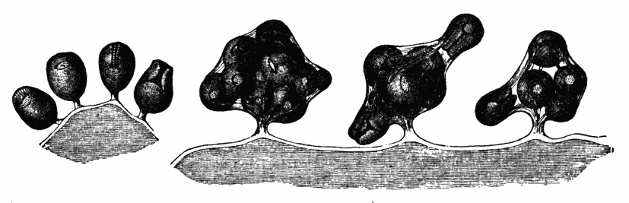
The size of the embryo varies from 1⁄18th to 1⁄20th of a line to 1⁄10th to 1⁄18th, according as it is elongated or contracted. Fig. 2 represents two Echinococci. In the one the head is drawn within the vehicle, and in the other it is extruded.
Fig. 2.
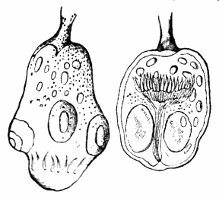
Fig. 3.
Fig. 3 represents a transverse view of an echinococcus; S S are suctorial discs; the hooklets may be seen encircling a membranous disk.
Fig. 4.
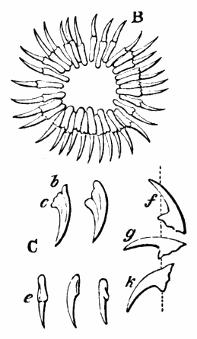
In Fig. 4 we have a representation of the circlet of these hooklets, B, which are thirty-four in number; C gives various views of separate hooklets; b is the base; c the central extremity; e the hooklets viewed upon their concave or inferior border. The dotted lines connecting f, g, k, represent the outer surface of the neck, and runs through the fixed point of the three hooks which move upon the central fixed process, as on the pivot.
The inhabitants of Iceland are said to suffer severely from the effects of the Echinococcus Humanus; it has been computed that a sixth of the population of the island are attacked by it.
ECLECTIC REMEDIES. These are medicines chiefly employed by a sect of American practitioners, self-styled “Eclectics.” The medicinal properties appended to each of these preparations are those ascribed to them by the Eclectics themselves.
Apocynin. From the roots of Apocynum and Rosœmifolium. Given in jaundice, hepatic torpor, and constipation.—Dose, 1⁄2 to 2 gr.
Asclepedin. From Asclepias tuberosa. Expectorant, diaphoretic, and tonic.—Dose, 1 to 5 grains three times a day.
Baptistin. From Wild Indigo. Given in liver affections.—Dose, 1⁄4 to 1⁄2 grain.
Barosmin. From Buchu. Diuretic, alterative, antispasmodic.—Dose, 2 to 4 grains.
Caulophyllin. From Caulophyllum thalictroides. Tonic and alterative, acts on the uterus.—Dose, 1⁄4 to 1 grain three times a day; as a parturient, 2 to 4 grains.
Cerasein. From the Cerasus virginiana. Given as a substitute for quinine when this latter is inadmissible.—Dose, 5 to 10 gr.
Cimicifugin. Syn. Macrotin. From Black Snakeroot. Tonic, alterative, nervine, antiperiodic, and in chorea.—Dose, 1 to 6 gr.
Cornine. From Cornus Florida (Dogwood). Antiperiodic.—Dose, 10 grains.
Eupatorine. From Eupatoreum purpureum. Diuretic.—Dose, 3 to 5 grains.
Euphorbin. From Euphorbia corollata. Emetic, cathartic, expectorant, and vermifuge.—Dose, 1 grain or less.
Gelsemin. From Gelsemium sempervirens. Given in pneumonia, hysteria, and dysmenorrhœa.—Dose, 1⁄4 to 2 grains. This must not be confounded with the powerful alkaloid, Gelsimia.
Geranin, or Geraniin. From Geranium maculatum. Astringent.—Dose, 1 to 5 gr.
Hamamelin. From Hamamelis Virginica (Witch hazel). Astringent.—Dose, 5 grains.
Hydrastin. From Hydrastis Canadensis. Tonic.—Dose, 3 to 5 grains. This must not be confounded with the alkaloid Hydrasta.
Iridin. From the Blue flag. Alterative, sialagogue, anthelmintic.—Dose, 1⁄2 to 5 gr.
Inglandin. From Butter-nut. Given in chronic hepatic disorders and constipation.—Dose, 2 to 4 gr.
Leptandrin. From Leptandra Virginica. Given in liver affections, chronic dysentery, diarrhœa, and typhus.—Dose, 2 to 4 gr.
Lycopin. From Lycopus Virginicus. Given in hæmorrhage, diabetes, and dysentery.—Dose, 2 to 3 grains.
Myricin. From Myrica cerifera. Stimulant, astringent, and antispasmodic.—Dose, 2 to 10 grains.
Populin. From Populus tremuloides. Tonic and febrifuge.—Dose, 4 to 8 grains.
Prunin. From Wild Cherry Bark. Stimulant, tonic, and expectorant.—Dose, 1 to 2 gr.
Rumin. From Rumex crispus. Action like rhubarb.—Dose, 3 grains.
Sanguinarin. From Sanguinaria Canadensis. Hepatic and alterative.—Dose, 1⁄2 to 2 grains.
Stillingin. From Stylingia sylvatica. Given in bronchitis and laryngitis. Used externally as a stimulant. Internally, 1 drop with mucilage.
EDELENZIANWURZELSAFT—Noble Gentian-root Juice—Enzian Extract—Extract of Gentian. A water-clear, colourless Schnapps, which contains much fusel oil and has had some of the spirit removed, distilled from gentian plant. (Hager.)
EDIBLE EARTHS. There seems little reason to doubt that the inhabitants of many countries, especially during famine and in times of scarcity, use certain kinds of earth as food. In Spain, a particular kind of earth known as bucaro is eaten; the Russian peasant partakes of his rock-flour; the Thuringian of his rock-butter; the Swede, of his bergmehl or mountain meal; the native of Java of an earth known as teneampa; the Hindoo, of the so-called Patna earth; and the Persian of a species of soil known as Gheli Giveh.
Mr Molvar has analysed an earth, eaten by the poorer classes of the Neograd district in Hungary, and finds it has the following composition:—
Carbonic acid40·357
Lime51·488
Magnesia0·110
Volatile matter5·545
Ferrous oxide0·158
Alumina2·272
As the volatile matter seemed to be the probable means of nourishment, it was subjected to a special examination, and was found to contain, besides empyreumatic substances, 0·067 water, and 0·010 nitrogen.
Dr Schmidt, a German chemist, gives the following as the composition of 100 parts of the air-dried powder from the coast of the White Sea:—
Water given off at 100° C0·260
Given off at a low red heat0·835
Alumina40·797
Ferric oxide0·310
Magnesia0·618
Limetraces
Soda1·829
Potassa9·845
Silicic acid, trace of fluorine, and loss45·506
This earth is eaten by the Laplanders, who mix it with the flour of which they make their bread.
The Persian edible earth called Gheli Giveh contains:—
Magnesic carbonate66·963
Calcic carbonate23·634
Sodium chloride3·542
Sodic sulphate0·293
Sodic carbonate0·598
Magnesic hydrate1·311
Ferric oxide0·092
Alumina0·227
Silicic acid0·765
Water combined at 120°1·153
Hydroscopic moisture1·422
The ‘Chemical News’ (xxxvi, 202) contains the analysis by Mr Paterson Muir of a clay from Mackenzie County, South Island, New Zealand, which is largely eaten by sheep. It consists of:—
Silica61·25
Alumina17·97
Ferric oxide5·72
Lime1·91
Magnesia0·87
Sodium chloride3·69
Potassium chloridetrace
Water7·31
Organic matter1·77
———
100·49
See Animalculæ.
EDULCORA′TION. The affusion of water on any substance for the purpose of removing the portion soluble in that fluid. Edulcoration is usually performed by agitating or triturating the article with water, and removing the latter, after subsidence, by decantation or filtration. It is the method commonly adopted to purify precipitates and other powders which are insoluble in water. The washing-bottle is a most useful instrument for the edulcoration of precipitates. In its simplest form, it is a bottle fitted with two bent glass tubes, one drawn to a fine point and reaching to the bottom of the bottle, the other only entering the cork a few inches. By blowing down the latter tube, the water is forced out of the former in a fine stream. See Wash-bottle.
EEL. Syn. Anguilla, L. A family of fishes belonging to the ‘apodal’ section of the malacopterygii. At least three species of eels are found in this country—the ‘sharp-nosed,’ the ‘broad-nosed,’ and the ‘snig.’ The first, which is common in streams and lakes, attains the greatest size—sometimes 25 lbs. or even 30 lbs. The ‘snig’ is considered superior to other kinds for the table. As articles of food, eels are said to be laxative and far from wholesome. The fat (EEL FAT; ADEPS ANGUILLÆ, OLEUM A.) is among the simples of the Ph. L. 1618, and was formerly considered ‘good against stripes,’ and is even now used by the vulgar as a friction for stiff joints. For the table, eels are generally dressed by stewing, frying, baking, or potting, which is done in the usual way, the fish being cut into pieces 2 or 3 inches long, and melted butter, onions, sweet herbs, and anchovy sauce, added at will. The CONGER EEL is a distinct and gigantic species of the same family. Its flesh is coarse and oily, but is much esteemed by the inhabitants of the southern coast of Devon, on which it abounds.
Letheby states the following to be the composition of the Eel:
Nitrogenous matter9·9
Fat13·8
Saline matter1·3
Water75·
———
100·0
Payen’s analysis differs from the above, in giving a larger proportion of nitrogenous matter, and a still greater quantity of fat.