A CYCLOPÆDIA OF PRACTICAL RECEIPTS, PROCESSES, AND COLLATERAL INFORMATION (continued 31)
Reading edition
There is a trap door 8 inches square about 14 inches above the upper edge of the furnace, and on a level with the iron floor of the chamber, for disinfectants. Carbolic acid and sulphur are used; the former is placed on a flat plate, the latter is sprinkled over the floor. These are used as the last, and after that has been the clothes are fit to be used without danger to any one.
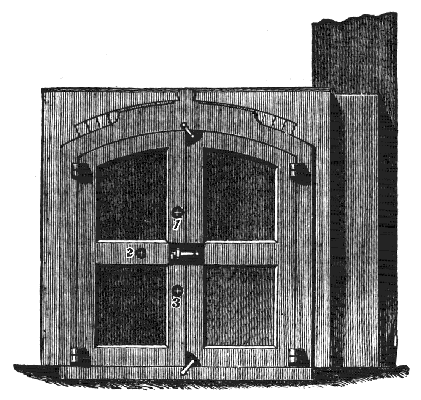
Elevation plan (fig. 5) shows the front of the chamber with the doors closed; the openings (Nos. 1, 2, and 3) are for inserting the long thermometer, which is pushed into the clothing to be disinfected; they correspond with the three trays. The thermometer can be withdrawn and examined without allowing much cold air to enter; plugs fit into these three openings when not used for the thermometer.
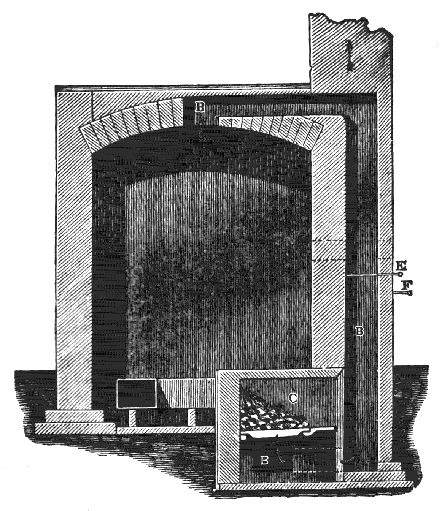
Section.—The chamber is shown about the centre of its depth; the foul-air shaft (B) passes along the roof down the side wall, and beneath the fire (C); the opening where the fixed thermometer is placed is marked with dotted lines. The damper for the foul-air shaft (E) is represented as shut, and the damper for the chimney (F) is also shut.
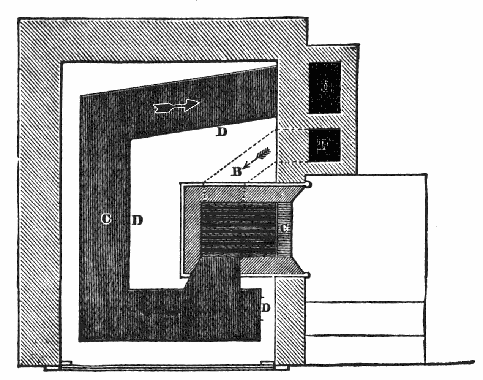
The ground plan shows the flue beneath the iron plates, which form the floor of the chamber, the dotted lines showing the foul-air flue (B), as it passes beneath the fire. In the flue (C) there are openings at D, D, D, for the purpose of cleaning it.
Another form of disinfecting chamber is that invented by Dr Esse, of Berlin, and employed in that city. The apparatus consists of two iron cylinders, one fitted within the other, with a space between, into which steam under pressure is introduced. The outer cylinder is surrounded with wood and the top with felt, to prevent the escape of heat. The articles to be disinfected are put in at the top of the inner cylinder, the inside of which soon becomes heated up by the surrounding steam. A pulley is used to lift the lid of the inner cylinder, around which the clothes are hung on pegs, not being allowed to touch the side of the cylinder. At the top of the inside cylinder is a brass box pierced with holes at the bottom, which dips a little way down, through which the air from the interior can rise. In this box the bulb of a thermometer being placed, the temperature of the inner chamber can be registered.
When the steam condenses in the space between the cylinders it is carried off by means of a valve, which is lifted when the water reaches a certain point in the condenser. In an hour’s time the temperature of the interior cylinder can be raised to 235° Fahr.
For heating mattresses another apparatus has been devised by Dr Esse. It consists of an iron case with a spiral steam pipe in the centre, the steam inside the pipe being compressed to two atmospheres.
Dr Ransome has invented, for the use of the Nottingham hospital, a gas stove in the form of an iron box, well packed with a non-conducting material, which surrounds the outside. A channel leads to the interior of the box, and inside this channel gas is kept burning in such a manner by a modification of Kemp’s regulator, that the temperature of the box shall range day and night between 235° and 255° Fahr.
An apparatus put to great use by the Holborn District Board during the epidemic of smallpox in 1871 was one made by Fraser’s patent. Mr Fraser’s disinfecting chamber consists of an oven or receptacle made of brick, with doors in front. Situated on the lower portion of this chamber is a covered furnace connected with flues, by means of which the interior space is heated to the desired temperature. By a particular arrangement the air laden with the noxious vapours given off by the tainted clothing is conveyed into the furnace, and so consumed. Belonging to the apparatus is a covered truck or cart, fitted with doors and dampers, and provided inside with racks and shelves for holding the materials to be purified, which are thus brought from the infected dwelling and placed, truck and all, inside the chamber. The infected materials, as well as the truck containing them, are then heated to the necessary point, disinfection being assisted by sulphurous acid gas, or some other material adapted for the purpose. When the process is finished the carriage with its contents is drawn back to the house from which they were originally taken, and the purified articles are restored to the owners. It will be seen that by this arrangement the vehicle is disinfected as well as the clothes it contains.
DISLOCA′TION. Syn. Luxation; Dislocatio, L. The forcible displacement of a bone from its socket, either by violence or disease. The latter happens when the textures forming the joint have been destroyed by some independent organic affection. “A considerable share of anatomical knowledge is required to detect the nature of these accidents; and it is much to be lamented that students neglect to inform themselves sufficiently on the subject.” (Sir A. Cooper.) In common cases the bones may be frequently replaced by forcibly extending the limb. This should be done as early as possible, and before inflammation sets in. The latter should be combated by aperients, local bleeding, refrigerant lotions, &c. Dislocations frequently exist without the fact being suspected, the swelling and inflammation being referred to other causes.
DISPLACE′MENT. See Percolation.
DISTEM′PER. A disease among dogs, usually characterised by a running from the nose and eyes, and a short dry cough; followed by wasting of the flesh, and loss of strength and spirits. At length the brain suffers, and fits, paralysis of the extremities, or convulsions come on. Laxatives and emetics are the best remedies. If there is much diarrhœa, astringents may be afterwards given. The violence of the fits may be mitigated by the administration of antispasmodics, and by the warm bath. The distemper is a contagious disease, and is generally fatal to weakly and very young dogs. Fits in the advanced stages of the disease are seldom followed by recovery. Impatience of light, red eyes, obstinate diarrhœa, spasmodic twitchings, a yellow colour of the skin, and a pustular eruption, are also bad symptoms.
Distemper Powders (Blane’s). The basis of these is said to be ‘aurum musivum,’ or bisulphide of tin. That of another advertised nostrum is a mixture of mercury and chalk, with a little rhubarb and ipecacuanha.
DISTILLA′TION. The evaporation and subsequent condensation of the vapour of fluids, by means of a still and refrigerator, or other similar apparatus. Dry distillation is a term applied to the distillation of substances per se, or without the addition of water or other volatile fluid. Destructive distillation is the distillation of substances at temperatures sufficiently high to decompose them, by which their elements are separated, or evolved in new combinations. Fractional distillation is the separation of substances having different boiling-points, by distilling the mixture with a gradually increasing heat, and collecting the products which come over at different temperatures in separate receivers. See Hydrocarbon, Still, &c.
Distillation. The art of the distiller; the manufacture of spirituous liquors as practised on the large scale.
The process of distillation, as carried on in the distilleries of Great Britain, may be divided into four general operations, viz.—1. The mashing, or formation of a saccharine infusion from certain vegetable matters, as malt, barley, oats, rye, &c. 2. The cooling of this wort or liquor. 3. The fermentation, or process by which the sugar of the cooled wort is converted into alcohol. 4. The separation of the spirit so formed by means of a still and refrigerator. By the first operation the materials for the formation of the alcohol are obtained; by the second, they are brought to a temperature most favorable to the transformation that takes place in the third, after which it only remains to free the product of the last operation from the foreign matter with which it is associated; this is done in the fourth, which, correctly speaking, constitutes the only part of the process which can be called distillation.
The general principles of the first three of the preceding operations are noticed in the articles Brewing, Fermentation, &c. It will there be seen that the amylaceous or starchy matter of the grain is first ‘saccharified,’ and afterwards converted into alcohol, and that certain precautions are necessary to render the process successful and economical. In many of the distilleries of Great Britain molasses and analogous saccharine substances are employed, in which case the vegetable principle (sugar) essential to the formation of alcohol is already present, and merely requires simple solution in water of a proper temperature, to be ready to be subjected to immediate fermentation. In general, however, the sources of spirit in England are the various kinds of grain; barley, rye, maize, and rice are those commonly employed. These are ground and mixed with bruised malt, in various proportions, and are mashed in a similar manner to malted grain. The fermentation is carried on until the density of the liquor ceases to lessen or ‘attenuate,’ which is determined by an instrument called a saccharometer. When this point is arrived at, the ‘wash’ is submitted to distillation, to prevent the access of the acetous fermentation, which would lessen its alcoholic value.
During the process of distilling off the spirit of the fermented ‘wash’ or ‘wort’ a hydrometer is employed to ascertain the ‘strength’ of the liquor that passes over. As soon as this has fallen to a certain point, the operation is stopped, and the ‘spent wash’ removed. The spirits obtained by the first distillation are generally called ‘low wines,’ and have a specific gravity of about ·975. By rectification or ‘doubling,’ a crude milky spirit, abounding in oil, at first comes over, followed by clear spirit, which is received in a separate vessel. The process is continued until the alcoholic content of the distilled liquor has considerably diminished, when the remaining weak spirit that distils over, called ‘faints,’ is caught separately, and mixed with the low wines preparatory to another distillation. The strongest spirit passes over first, and the condensed liquor gradually becomes weaker, until it ceases to contain alcohol. By receiving in separate vessels any given portion of the product, spirit of any required strength, within certain limits, may be obtained. The same object is more conveniently effected by surrounding the top of the capital of the still with a water bath, of a temperature corresponding to that of alcoholic vapour of the strength it is desired to obtain. Thus, if we keep the temperature of the water at about 198° Fahr., we shall obtain proof spirit; if at 192°, a spirit 20 o. p.; and so on for other strengths.
It is found from experience, and is readily accounted for by theory, that the lower the temperature at which the distillation is conducted, the stronger will be the product, and the less quantity of oil or other volatile matter will come over along with it. To promote this, it has been proposed to carry on the process in vacuo, but on the large scale this has never been adopted. The distillation of the wash is usually performed in a separate set of stills to those employed for the rectification of the low wines. For very strong and tasteless spirit, a third and even a fourth rectification is employed, conjointly with other methods, to abstract the water and to remove any foreign matter that vitiates its odour or flavour. A portion of soap is generally put into the still with the wash, to prevent excessive frothing.
We have said that the processes of mashing, &c., in the distillery are similar to those adopted in brewing beer. We may add that, as richness in alcohol, and not flavour, is the object aimed at in the distiller’s wash, not only is a large quantity of unmalted grain employed, but the process of boiling the wort with hops is omitted altogether. The wort is commonly ‘set’ at 70° Fahr., and the fermentation and attenuation of the liquor pushed as far as possible by large and repeated doses of the best ‘top-yeast’ of the porter brewers.
It often happens that raw spirit prepared from damaged grain is contaminated with a highly acrid and volatile fatty substance, which is powerfully intoxicating and irritating to the eyes and nostrils, and possesses an odour very similar to that of an alcoholic solution of cyanogen. This may be got rid of by dilution with water and skilful rectification, when most of it passes over with the first and last ‘runnings,’ the intermediate portion being less loaded with it. Another plan is to filter the spirit successively through 6 or 7 separate vessels containing pine or willow charcoal before rectifying it. In some distilleries the contaminated spirit is well agitated with a considerable quantity of olive oil, and after repose decanted, diluted with water, and rectified as before. The ordinary corn oil or fusel oil of raw spirit is generally, for the most part, intercepted by a self-regulating bath arranged between the still-head and the refrigeratory.
The quantity of spirit obtained from various substances, and even from pure sugar, depends upon the skill with which the several operations are conducted. By theory, pure sugar should yield 51% of alcohol; but in practice 11·925 galls. of proof spirit is the largest quantity which has yet been obtained from 112 lbs. of sugar. By the revenue authorities this weight of sugar is estimated to afford 111⁄2 galls. of proof spirit. The average product is, perhaps, about 1 gall. of spirit of this strength for every 10 lbs. of sugar. According to Harmstädt, 100 lbs. of starch yield 35 lbs. of alcohol, or 7·8 galls. of proof spirit; and 100 lbs. of the following grains produce the accompanying quantities by weight of spirit of sp. gr. ·9427, or containing 45% of pure alcohol:—wheat, 40 to 45%; rye, 36 to 42%; barley, 40%; oats, 36%; buckwheat, 40%; maize, 40%; the mean being 3·47 galls. of proof spirit. It is found that a bushel of good malt yields 2 galls. of proof spirit, and that the largest quantity of proof spirit obtained from raw grain, mashed with 1⁄5 or 1⁄6 of malt, does not exceed 22 galls. per quarter.
The distiller is allowed to produce worts from any substance, and at any specific gravity, provided such gravity can be correctly ascertained by the saccharometer approved of by the Board of Inland Revenue. He is not, however, allowed to mash and distil at the same time. See Alcohol, Brandy, Fermentation, Fusel Oil, Gin, Still, &c.
DISTOMATA. A genus of fluke-like parasites infesting men and the higher vertebrate animals. The egg is about the 1⁄280th of an inch long and 1⁄270th inch wide.
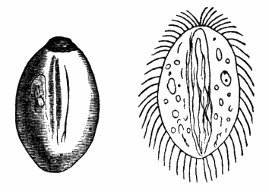
The embryo is frequently met with in sewage water, from which, if it be removed and placed in pure or distilled water, it soon dies. The embryo which does not become a distoma gives rise to a progeny (gradually formed from germ-cells within it) consisting sometimes of one, but much more often of a number of bodies of various forms and structures, each of which possesses powers of movement and locomotion. But the creatures of this second development are not distomata; neither are the offspring to which they in their turn give rise. Like their immediate progenitors, this offspring produce in their interior germ-cells which develop into minute worms having tails, and displaying great vivacity when placed in water. These latter alone exhibit the characters of true distomata. “These cercaria now either become enclosed, like a chrysalis in a pupa state, or they penetrate into the bodies of soft animals, become encysted and parasitic. It appears probable that the distomata enter the human intestinal canal as cercaria, and then pass into the biliary passages.”[260]
A case is on record of two distomata having been extracted from the foot of a woman, into which it has been surmised they gained an entrance as cercaria whilst the woman was bathing.
It is thought that shell-fish, as well as uncooked fish when eaten, may be the means of introducing these parasites into the human system. The embryos of the Distomata hepaticum swim about and live in water, which may probably, when drunk, be the means of conveying them into the bodies of men and sheep. The ailments and symptoms to which these pests give rise depend upon the particular organ or portion of the body in which they establish themselves.
In man they are a frequent cause of hæmaturia and dysentery. In sheep they occasion fearful mortality, giving rise to the disease known as ‘the rot,’ and killing thousands of flocks annually.
“The number of species affecting men are usually enumerated as nine—viz. Fasciola hepatica, Distoma crassum, D. lanceolatum, D. ophthalmobium, D. heterophyes, Bilharzia hæmatopia, Tetrastoma renale, Hexathrydium renarum, and H. pinguicola.”[261]
DISTORTIONS. In treating of this subject we shall confine ourselves to those distortions which are preventable—or rather, we may say, of two out of the three which will be discussed, which are voluntary.
One very common form of bodily distortion is crooked or curved spine. It is mostly met with in young girls of from ten to sixteen years of age; and first shows itself either in the elevation of one shoulder above the other, or in a growing out of one of the shoulder blades, or of one side of the bosom beyond the other. The elevated shoulder is generally the right one. At the same time the right side of the chest is unnaturally high, and rounded; whilst the opposite or left shoulder and chest are on the contrary depressed and concave. Very frequently these conditions are accompanied by a projection of the left hip, and a curving inwards of the loins on the right side. With persons so afflicted the spine presents an appearance that has not inaptly been compared to a long italic f.
Spinal curvature arises from a weakened state of the muscles, ligaments, and bones of the backbone. It is most frequently met with in those whose occupation compels them to stand the greater part of the day; as well as in persons who pass many hours at the desk or at needlework. Spinal curvature is also common in young fragile girls acting as nursemaids, and as such unduly subjected to carrying heavy infants on one side. Amongst the children of the poor, those of tender years are much too frequently put to this objectionable form of drudgery. Any one’s recollections of a walk through a poor neighbourhood will enable them to call to mind many instances they must have seen of smaller babes being nursed by larger ones. Those subjected to too long standing, no doubt because the posture affords them relief, unconsciously contract the habit of frequently standing on the right leg—of standing at ease on it, as it is called—and at the same time of bending the left knee a little; and since this position causes the right shoulder to be raised, and the left side of the pelvis to be thrown out of its place, it will be evident from what has been already said that, if persisted in, it will end in distorting the spine in the manner above indicated.
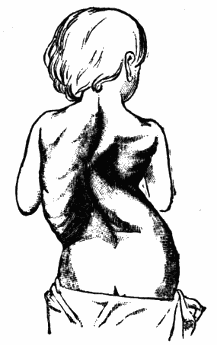
The same results will also follow in those other cases, such for instance as in too long an application at the desk or at the needle, as well as the carrying for an undue length of time a heavy child in the arms; these all being occupations in which one side of the body is subjected to an undue and unequal strain over the other.
“Why one-sided postures should cause distortion must be evident, when it is considered that the intervertebral substance is compressible to such an extent that an adult man of middle stature loses about an inch of his height after having been in the erect posture during the day, and does not regain it till after some hours of rest. Since the united thickness of the intervertebral substance in an adult man is about 3·875 inches, we see that they lose nearly one fourth by compression, which they do not recover till after some hours of rest. But if the weight of the body falls unequally on the spine day after day, it must be evident that they will become compressed on one side more than the other; and that if their elasticity be impaired, and the muscles and ligaments be weak, and the bones soft, as they are in young persons who have not a sufficiency of fresh air, wholesome food and active exercise, this lateral distortion will become permanent.[262]
Another cause tending to distortion of the spine is the foolish habit of using corsets, a practice which contributes to weaken the dorsal muscles. When the shoulders are continually supported by a corset, the dorsal muscles upon which the support ought to fall have their functions usurped by the corset, and hence fail to receive their proper development, and consequently lose their power; the result being an inability on the part of the body to support itself without the corset, and a sinking and bending of the spine when it is removed. In boys, who never wear corsets, spinal curvature is rarely met with. In girls, who do, it is constantly to be found. To guard against spinal distortions, bad and awkward positions of the body should, wherever possible, be prohibited. Amongst the prejudicial postures indulged in by the young, we have already mentioned the habit of standing on one leg and of carrying heavy loads on one side of the body.
To these may be added the habit of lying crooked in bed, and that of young girls spending a long time in a constrained position in dressing their own hair. Every one-sided motion may lead to distortion if it be frequently repeated, and the tendency once existing, the evil grows day by day. The use of corsets should be strenuously discountenanced. The early detection of spinal distortion is a matter of considerable importance. Hence the advisability of mothers, nurses, governesses, and other guardians of children or young girls, frequently examining the bodies of their charges to note if they present any of the peculiarities we have indicated at the commencement of this article. Should any of these develop themselves, aid should immediately be sought of a skilful medical practitioner.
Dr Lewis Sayre, in his work ‘Spinal Disease and Spinal Curvature’ says:—“The great object in the treatment of Pott’s disease is to maintain rest of the affected part by such means as will not debar the patient from the benefits of fresh air, sunlight, and change of scene. The patient should not be permitted to assume the upright position before he has been fitted with some artificial support capable of removing all pressure from the bodies of the diseased vertebræ. This object may be obtained by straightening the spinal column in such a manner that the weight of the body is borne by the transverse processes and not by the bodies of the vertebræ.” Acting on these principles, Dr Sayre partially envelopes the patient in a jacket of plaster of Paris, surrounding the body from the pelvis to the axillæ.
Although Dr Sayre’s work is almost entirely devoted to a much more serious affection of spinal curvature than that treated of here—viz. posterior angular curvature, in which actual disease of the bones of the vertebræ is concerned—his treatment is no less applicable to the milder form of distortion to which our remarks have been directed. Dr Sayre himself states that 300 cases have been treated by his method with very signal success, and very many eminent surgeons bear testimony to the soundness of the principles concerned in it. For the details of its application consult the author’s work before alluded to.
Serious as are the effects very frequently arising from spinal curvature, amongst which may be included lameness, lung disease, and inability to perform the functions of maternity; still worse results in addition to the two last of these ensue in the case of a persistence in another form of distortion, which is none the less dangerous because it is voluntary. The distortion to which we refer is that caused by the practice of tightlacing.
Foremost among the conditions absolutely essential for the preservation of health and bodily well-being, is the due performance of the function of the lungs, heart, liver, kidneys, stomach and other important organs. The object of the ribs within which most of these organs are more or less wholly contained is to protect these latter from external pressure, and therefore injury; as well as to allow them unimpeded and unrestricted action. To ensure this freedom of movement for the parts and organs within the ribs, it will be evident that every possible obstacle tending in any degree to compress them, or circumscribe their limits should be especially avoided.
Instead of the avoidance of such dangers, however, what course do the silly votaries and dupes of that most senseless and remorseless of all tyrants—Fashion—pursue? One the very reverse; and which is opposed, not only to personal comfort and common sense, but, since it mars nature’s outlines, to symmetry and our proper canons of the grace of the female figure. By means of corsets, tight stays, and other implements of torture the ribs are pressed inwards to such an extent that all the conditions we have insisted on as essential to health are imperilled, and eventually become overthrown. Now, this mischievous and unnatural pressure exerted on the stomach pushes that organ out of its proper position, and in doing so forces the diaphragm also out of its place; a disturbance which so curtails the space in which the movements of the lungs and the heart are performed, that if the pernicious custom be persevered in these latter organs become seriously and incurably diseased. The liver also shares in the damage inflicted, and frequently becomes incapable of discharging its office. The very much larger number of young women than of young men who die of consumption is undoubtedly referable to the fact that a large proportion of the majority are the victims of tightlacing. Nor is it difficult to understand why this should be, since we know that if the lungs are prevented exercising their full powers of expansion, unnaturally diminished function will set up disease in them, which, if there be a predisposition, will probably be consumption. This cause also, by preventing the blood becoming properly oxygenated, gives rise to a large class of disorders due to impurity of the vital fluid. Organic disease of the heart is by no means an uncommon contingency if tightlacing be persevered in; for that organ is not allowed room to beat, nor the blood to circulate. One effect of this is seen in frequent fainting fits.
Again, tightlacing not infrequently stops the growth and arrests the development of a young girl’s mammæ, thus seriously incapacitating her from suckling her babe when she becomes a mother. It also indirectly has a very prejudicial effect upon health by preventing its votaries from taking sufficient walking exercise; free bodily movement with accompanying expansion of the lungs becomes impossible with those encased in a vice of unyielding armour, such as constitutes pestilent stays and corsets. Amongst the minor evils wrought by the baleful custom, we may mention indigestion (for the pressure of the stays weakens the stomach, and sets up this troublesome complaint), with its accompaniments of flatulence, heartburn, pain in the chest, &c. Constipation is also another of its attendant ills; so also are bad breath and a red nose.
“I recollect Dr A. Todd Thomson, in his excellent lectures, relating a case he had attended where a young lady appeared to be dying from the evil effects of tightlacing. He cut open her stays and she gradually came to herself. If the worthy doctor had not quickly done what he did, she would soon have been a corpse! Dr Thomson has kindly favoured me with the following interesting particulars of the case for publication:[263]—‘Some years since I was requested to hasten to a house not far from my own to see a lady who had fallen from her chair in a fit whilst eating her dinner. On being ushered to the drawing room of the house where the circumstance had taken place, I saw a lady lying upon a sofa, apparently dead, and several ladies hanging over the couch in great distress. I found little appearance of life except that the temperature of the body was natural; the pulse had ceased to beat, and no respiratory action could be detected. On laying my hand over the region of the heart, I felt that the stays were extremely tightly laced; and conceiving that the suspension of animation arose from that cause, I requested a penknife to be given me, with which I instantly ripped down the stays and gown. In an instant the chest dilated, on the binding matter giving way, which was almost like splitting an overbraced drum; and in a few seconds respiration recommenced and animation returned. In this case the waist was drawn in to a degree that gave a complete hour-glass appearance to the figure, and prevented the descent of the diaphragm, whilst the blood could not circulate, or be renewed in the lungs from the general obstruction of many of the cells and smaller tubes. The quantity of residual air also in the lungs was too small; and this was still diminished by the warmth of some soup, which the lady was eating when she fell from the chair, dilating the gas in her stomach, and consequently pressing that enlarged organ upwards on the lungs. Had I not lived close by, the time necessary to get medical aid from a greater distance might have rendered it unavailable.’ The above narrative by Dr Thomson is valuable not only as illustrating the dangers arising from tightlacing, but also as emphasizing the rationale of its action as stated by ourselves. In the present article we have explained why it is the use of corsets is to be deprecated. We hope we have succeeded in showing how imperatively the abandonment of stays is called for.
Another variety of distortion is that brought about by wearing tight boots and shoes, or boots and shoes constructed upon false principles; for, a boot or shoe may be productive of considerable inconvenience to the wearer, as well as the cause of a certain amount of twisting out of place of the bones of the foot, without necessarily being too small. Amongst the consequences arising from the adoption of tightly fitting or badly constructed boots or shoes may be mentioned the following:—Considerable bodily discomfort, and pain in walking; corns and bunions; growing in of the nails; chronic enlargement of the base of the great toe; caries or ulceration of the bones of the feet; and flat feet. That these are not altogether minor evils may be inferred when it is stated that, in order to obtain relief from the effects of a bunion, partial amputation of the foot has been sometimes found necessary; that the first attacks of gout mostly seize the joint of the ball of the great toe when that joint has become weakened by displacement following the use of faulty boots and shoes; and that a flat foot interferes with the proper performance of walking.
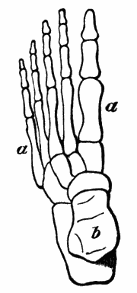
The above figure (No. 1) represents the skeleton of the foot with the bones which form it in their natural position, and in which they are admirably adapted for executing the various movements required of them.
It will be seen to consist of twenty-six bones, fourteen of which constitute the toes; the remaining twelve bones enter into the formation of what are termed the tarsus and metatarsus.
The five long bones (a) are the metatarsal bones. The toes form joints with the fore part of these metatarsal bones. The remaining seven are the tarsal bones; b, which is one of these, is named the astragalus, and being gripped on each side by a continuation from the bones of the leg called the malleolus, thus forms the ankle-joint.
Fig. 2.
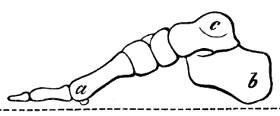
Fig. 2 gives a representation of the inner aspect and side view of the foot. It will be seen that it is an arch resting in front on the anterior heads of the five metatarsal bones, a, but chiefly on that of the great toe, and on the calcaneum or heel (b) behind.
The astragalus, c, forms the key-stone of the arch. This arch, which supports the superincumbent weight of the body, retains its curved form by means of strong ligaments or bands, which unite the bones which compose it into a compact but withal flexible mass. The arch, owing to the pressure thrown upon it from above, becomes flattened when the foot is resting on the ground; but when this pressure is removed and the foot hangs free, the curvature of the arch increases. In front of the metatarsal bones are placed the toes, which are connected with the metatarsal bones by joints. The great toe has one joint; each of the smaller ones has two.
Fig. 3.
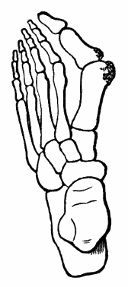
Fig. 3 depicts the skeleton of a foot with the bones thrown out of their natural position, the contortion being the result of wearing tightly fitting or unscientifically constructed boots or shoes. The following extracts from Dr Hermann Meyer will best illustrate how nature’s simple mechanical arrangements must be thwarted when coverings for the feet are permitted to be constructed which can give rise to distortions such as those represented in Figure 3. Dr Meyer says “the great toe plays by far the most important part in walking; because when the foot is raised from the ground with the intention of throwing it forwards, we first raise the heel, then rest for a second on the great toe, and in lifting this from the ground the point of it receives a pressure which impels the body forwards. Thus, in raising the foot the whole of the sole is gradually, as it were, ‘unrolled’ up to the point of the great toe, which again receives an impetus by contact with the ground.
Fig. 4.
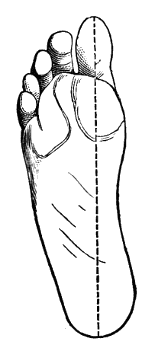
Fig. 5.
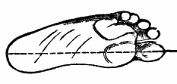
The great toe ought, therefore, to have such a position as will admit of its being unrolled in the manner described; that is to say, it must so lie that the line of its axis, when, carried backwards, will emerge at the centre of the heel; and this is its position in the healthy foot. The sole of an almost sound foot is given in Fig. 4, and the true position of the great toe is indicated by the dotted line. This relation is still better brought out in Fig. 5, which represents the well-preserved foot of a child about two years old. The line drawn through both figures is that in which the foot unrolls itself from the ground. The smaller toes, however, are by no means without their uses. In standing they rest on the ground and give lateral support to the foot; while in walking they are bent in a peculiar manner, so that they are firmly pressed against the ground; and here too they support the foot laterally. The first joint is strongly bent upwards, while the second is hollow above. This peculiar curvature enables the toe in a measure to lay hold of the ground as with bird’s claws.”
Dr Meyer then proceeds to show how the application of these principles is entirely disregarded in the manufacture of our boots and shoes, and to demonstrate that their neglect gives rise to the objectionable consequences we have before alluded to. As boots and shoes are at present constructed, the foot is made to adapt itself to the sole, not the sole to the foot. This pernicious system must be abandoned if we wish to preserve our feet, as well as our personal comfort.
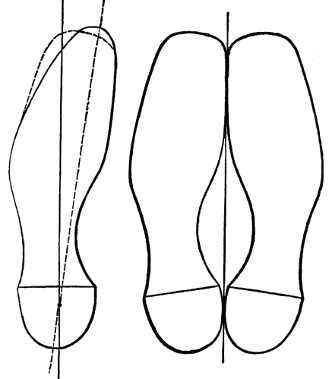
“A sole,” says Dr Meyer, “is of the proper construction when a line (see Fig. 6, c d) drawn at half the breadth of the great toe distant from, and parallel to, the inner margin of that toe shall, when carried backwards, pass through the centre of the heel. In the usual form of a sole this line passes out of the inner margin of the heel (see Fig. 7). If, then, the preservation of the primary straight line is, as has been already shown, the principal point in the formation of a proper sole, it follows that, if it be thought desirable to have pointed shoes, the pointing must be effected from the outer side, as indicated in the annexed Fig. 8. In a pair of shoes made on these principles, placed side by side with the heels in contact, the inner margins of the front part of the foot are also brought close together” (Fig. 9).
Dr Meyer’s pamphlet contains the following strictures on ‘High heels’ to boots and shoes: “It is usual, in all shoes of even moderate strength, to make the heel a little higher by means of what is called the heel-piece. These heel-pieces are generally of some little use, especially in dirty weather, and we cannot wholly deny their right to existence. But at the same time they ought to be as low as possible, and heels an inch thick, as is at present very commonly the case, have very serious disadvantages indeed.
“The weight of the body is by this means thrown in a disproportionate ratio on the toes, the joints of which are consequently overstrained. Moreover, with a high heel the sole is so oblique in its direction that the foot must be constantly gliding forwards and forcibly pressing the toes into the point of the shoe. The toes, therefore, even when the shoe is sufficiently long, are subjected to the same injuries and disfigurations as if it were too short, and the effects are doubly hurtful when the form of the sole is also incorrect. High heels, especially if they are also very small; are peculiarly liable to wear obliquely, and so the shoe gets trodden on one side; they must, therefore, be peculiarly favorable to origin of flat-foot.
Fig. 6. and Fig. 7.
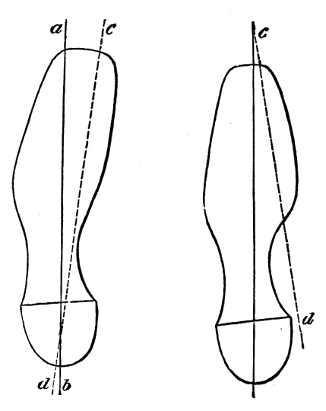
Fig. 8. and Fig. 9.
High and small heels are therefore quite unsuitable. The heel-piece ought to be as low and broad as possible.”
Further and more explicit knowledge on this subject may be obtained from Dr Meyer’s excellent little pamphlet entitled ‘Procrustes ante portas,’ very ably translated into English by Mr J. T. Craig, L.R.C.E., under the title of ‘Why the Shoe Pinches.’
DIURE′SIS. See Urine.
DIURET′ICS. Syn. Diuretica. Medicines which promote the secretion of urine. The principal diuretics are—aqueous fluids, which act by increasing the watery portion of the blood, and—substances which promote the action of the kidneys. Most of the first produce copious diuresis if the skin is kept cool. Among the last are acetate, bitartrate, and nitrate of potassa; oils of juniper, turpentine, cajeput, and copaiba; dilute spirit, and sweet spirits of nitre; decoction of common broom, &c.
DIVIDIVI. An astringent substance imported from Jamaica. It contains above 5% of tannin; whilst gall-nuts contain less than 3·5%, and the best oak-bark only 1·35%. Hence its value in tanning.
DOBEREINER’S LAMP. A portable apparatus for obtaining instantaneous light by the action of a jet of hydrogen on a small piece of spongy platinum.
DOCHMIUS DUODENALIS. An intestinal parasitic worm. Its length is from 1⁄3 to 1⁄2 an inch and its breadth about 1⁄60th of an inch. It is furnished with hooklets. It is found in the duodenum, the ileum, and the jejunum of man, and Greisinger seems to have pretty conclusively established that it is the cause of the disease so prevalent in Egypt, and known as the Egyptian chlorosis. Anemia, dysentery, and hemorrhoids and liver diseases are also frequently caused by it amongst the natives of Arabia, Brazil, and Northern Italy. In India it is also stated to give rise to some very alarming maladies. Leuchart affirms that it obtains an entrance into the system through drinking impure water.
DOC′IMACY or DOCIMAS′TIC ART. See Assaying.
DOG. The effect of medicines on dogs is much the same as on man; but there are some striking exceptions to this rule. Thus, whilst the dog can take a dose of aloes six or eight times as large as that given to man, the administration of half as much calomel or oil of turpentine would be productive of serious injury to the animal. The idea usually entertained, therefore, that medicines may be given to dogs in doses equalling those taken by man requires considerable modification. Dogs have a short and straight alimentary canal, in consequence of which purgative medicines act more quickly upon them than they do on other veterinary subjects. The facility with which dogs can be made to vomit is also another peculiarity possessed by them. Vomiting may be produced by their swallowing nauseous or unpalatable matters, as well as from their eating various sorts of grass. A good plan to prevent dogs vomiting their medicines is to keep the head well raised for an hour after the administration; and this may be easily accomplished by attaching a chain or cord to the collar, and fixing it at the requisite height, to any object. The kidneys are acted upon with much more difficulty than with the horse, whilst the skin seems nearly, if not altogether incapable of being affected. We give below a list of medicines for dogs; premising that the doses required vary considerably according to the strength, size, and age of the dog, all of which should always be duly taken into account. The doses prescribed in the following formulæ are for moderately large dogs:—
Physic Balls and other Purgative Medicines:—
1. Barbadoes aloes, 8 oz., antimonial powder, 1 oz., ginger, 1 oz., palm oil, 5 oz.; beat together into a mass.—Dose. From 1⁄2 dr. to 2 dr. every 4 or 6 hours, till the bowels are relieved. (Youatt.)
2. The same, with the addition of 1 oz. of calomel. He directs from 45 gr. to 2 dr. for a dose. (Clater.)
3. Aloes, 1⁄2 dr. to 2 dr. made into a ball with syrup of ginger.
4. Aloes, 1⁄2 dr. to 11⁄2 dr., calomel, 2 to 5 gr., syrup to form a ball; in inflammation of the bowels, and in worms. (Blaine.)
5. Cape aloes, 1⁄2 dr. to 1 dr., calomel, 2 to 3 gr., oil of caraway, 6 drops, syrup to form a ball. (M′Ewen.)
6. Calomel, 12 gr., aloes, 3 dr., opium, 1 gr., syrup q. s. to form a mass, for 4, 6, or 8 balls; one every 4 or 5 hours till the bowels are relieved. (Blaine.)
7. Croton oil, 1 drop, Castile soap, 20 gr., conserve to form a ball.
8. Castor oil, 3 parts, syrup of buckthorn, 2 parts, syrup of poppies, 1 part.—Dose. From 1 to 2 tablespoonfuls.—Mr Youatt’s purge. [Mr Clark says syrup of buckthorn for dogs should be made with treacle, and the spices omitted.]
9. Epsom salts, from 1 to 4 dr., wrapped in tissue paper, dividing the doses into convenient-sized packets.
10. In costiveness with inflammation: 1⁄2 oz. to 2 oz. castor oil. (Mr Spooner.)
Alterative Balls and Powders:—
1. Sulphur, 21⁄2 lb.; nitre, 1⁄2 lb.; Æthiops mineral, 4 oz.; linseed meal, 1⁄2 lb.; palm oil, 1 lb., or as much as may be required; beat together, and keep in a jar for use.—Dose, from 2 scruples to 11⁄2 or 2 dr. (Clater.)
2. Ethiops mineral, 20 to 40 gr.; cream of tartar, 20 to 40 gr.; nitre, 5 to 10 gr.; night and morning, made into a ball with butter. (Spooner.)
3. Tonic Alterative. Mercurial pill, 1 dr.; aloes 2 dr.; myrrh, benzoin, balsam of Peru, of each 11⁄2 dr.; to be divided into 10, 15, or 20 pills: one every evening, for the yellows, after aloes and calomel. (Blaine.)
4. Alterative Powder. Æthiops mineral, 2 to 5 gr.; cream of tartar, 4 to 10 gr., tartarised iron, 1 to 3 gr., once a day. (Clater.)
5. To give a fine skin. Give a table-spoonful of tar made up with oatmeal. (Mayer.)
Astringent Balls, &c.:—
1. Catechu, 11⁄2 dr.; sulphate of quinine, 20 gr.; opium, 5 gr.; ginger, 1 dr.; conserve of roses, q. s. to form a mass, to be divided into 8, 6, or 4 balls. (Blaine.)
2. Prepared chalk, 2 oz.; powdered gum Arabic, 1⁄2 oz.; powdered catechu, 1⁄2 oz.; powdered oak bark, 1⁄2 oz.; powdered ginger, 1⁄4 oz.; opium, 15 gr.; palm oil, 1 oz.; beat well together.—Dose, 1⁄2 dr. to 2 dr., morning, noon, and night, in the advanced stage of distemper. (Clater.)
3. Opium, 5 gr.; catechu, 2 dr.; gum Arabic, 2 dr.; ginger, 1⁄2 dr.; syrup of poppies, q. s.; divide into 12, 9, or 6 balls: in diarrhœa. (Blaine.)
4. Myrrh, 1 dr.; ipecacuanha, 1 scruple; opium, 3 gr.; chalk, 2 dr.; carbonate of iron, 1 dr.; as No. 3. (Blaine.)
5. In obstinate cases: Alum, 1 dr.; chalk, 2 dr.; opium, 6 gr.; resin, 3 dr.; into 4, 6, or 8 balls.
6. In diarrhœa, after 1 to 4 dr. of Epsom salts; prepared chalk, 1 to 3 scruples; catechu, 5 to 10 gr.; opium, 1⁄4 to 2 gr.; twice a day. (Spooner.)
Cough Balls in Asthma, &c.:—
1. After a few emetics. Calomel, 3 gr.; foxglove, 3 gr.; cream of tartar, 1 dr.; antimonial powder, 12 gr.; honey to form 6 boluses. One twice a day. (Blaine.)
2. Digitalis, 20 gr.; antimonial powder, 40 gr.; nitre, 2 dr.; sulphur, 3 dr.; palm oil, 3 dr., or q. s. Divide into 10, 15, or 20 balls, according to the size of the dog, morning and night, interposing an emetic every third or fourth day. (Clater.)
3. In old cases. P. squill, 1⁄2 gr. to 1 gr.; gum ammoniac, 5 gr.; balsam of Peru, 8 gr.; benzoic acid, 1 gr.; balsam of sulphur to form a ball.
4. Extract of hemlock, 1⁄2 dr.; extract of henbane, 10 gr.; p. digitalis, 20 gr.; conserve of roses to form a mass. Divide into 8, 10, or 6 balls. One night and morning. (Blaine.)
Distemper Medicines:—
1. Turbeth mineral, 1 to 3 gr.; assafœtida, 1⁄2 dr.; aloes, 20 gr.; soap, 10 gr.; syrup of poppies to form a ball. To be preceded by an emetic, and given every third day.
2. After an emetic, give a physic ball; and afterwards the following, two or three times a day:—Antimonial powder, 2, 3, or 4 gr.; nitre, 5, 10, or 15 gr.; ipecacuanha, 2, 3, or 4 gr.; form a ball. If the disease proceed to the debilitating stage, give the Tonic Ball No. 2; in the putrid or malignant stage give the Astringent Ball No. 1. (Blaine.)
3. After the Emetic Powder No. 1 (which should be repeated every 3rd or 4th day) give the Cough Ball No. 2, from 1⁄2 dr. to 2 dr. in weight. And if the dog lose flesh, give equal parts of the cough ball and the Tonic Ball (No. 1). In the more advanced stages give the tonic alone; or the astringent ball if diarrhœa comes on. (Clater.)
4. Give a third of a paper of James’s powder mixed with butter, and afterwards warm broth or milk. In 2 hours, another third; and if this neither vomit nor purge, give the other third at the end of 4 hours. (Daniel.)
5. Blaine’s distemper powders, which are sold in packets, with directions for use.
6. Camphor, 3 to 5 gr.; charcoal, 10 gr.; opium, 1 gr.; aromatic confection, q. s. to form a ball.—In the malignant stage, with diarrhœa.
7. Antimomal powder, 2 to 4 gr.; nitre, 5 to 10 gr.; digitalis, 1⁄4 to 2 gr. Afterwards the Tonic Pills No. 4. (Spooner.)
Poudre Kusique: a French nostrum. Mix 45 gr. of nitre, 45 of sulphur, and 1 charcoal. Divide into 3 doses. Give 1 for 2 successive mornings, and the third on the 4th morning, mixed with lard or butter, or in milk. For a large dog a second packet (of 3 powders) may be required. (Habert.)
Another French nostrum. Hemel’s Powder is of a similar kind.
8. A strong solution of salt, to the amount of 1⁄2 pint daily.
9. Powdered tin, sulphur, gunpowder, of each 1 oz.; lard sufficient to form a mass. The size of a nutmeg to be given twice or thrice a week.
10. Physic Ball No. 11.
11. 1⁄4 oz. to 1 fl. oz. of cod-liver oil twice a day, according to size.
12. Emetics, gentle laxatives, milk diet, and from 5 to 15 gr. of chlorate of potash twice a day. (Finlay Dun.)
Worm Medicines:—
1. Carbonate of iron, 1⁄2 oz.; Æthiops mineral, 1 dr.; gentian, 1 oz.; ginger, 1⁄2 oz.; levigated glass, 1 oz.; palm oil, 9 dr.; beat well together.—Dose, from 3⁄4 to 2 dr. (Clater.)
2. As much very finely-powdered glass as will lie on a sixpence, mixed with butter (Blaine). Mr Youatt says from 1⁄2 dr. to 1 dr.; powdered glass, with a little ginger, made into a ball with lard.
3. Aloes, sulphur, prepared hartshorn, and juice of wormwood, made into a mass; the size of a hazel nut to be given three times a week, fasting, wrapped in butter. (Daniel.)
4. Tin filings, or pewter filings, 1⁄2 dr. to 1 dr., with butter or lard.
5. Jalap, 10 to 15 gr.; calomel, 2 to 3 gr. mixed with butter; no cold liquid should be allowed. (White.)
6. Cowhage, 1⁄2 dr.; iron filings, 4 dr.; conserve q. s. to form a mass, to be divided into 4, 6, or 8 balls; one every night and morning; and afterwards the purgative No. 4. (Blaine.)
7. Epsom salts, 1 oz.; common salt, 1 dr.; give a small or large teaspoonful daily.
8. Give green walnut leaves boiled in milk. (Mayer.)
9. From 1⁄2 dr. to 2 dr., according to size. Betel nut in coarse powder, made into a ball.
10. For Tapeworm.—Oil of turpentine, 1⁄2 dr., mixed with yolk of egg; for very large dogs, 2 scruples. Some writers prescribe larger doses (1 to 2 dr.), but these sometimes prove fatal. (Blaine.) 2 to 6 dr. of cusso according to size.
11. For Tapeworm.—Oil of turpentine and olive oil, of each 1⁄2 oz.; mix, and give carefully; 3 or 4 hours after give 1 oz. castor oil. But see No. 9. (White.)
12. For Stomach Worms.—Give the emetic powder (see further back) and afterwards a physic ball.
13. Threadworms.—These are destroyed by an aloetic clyster.
Ointments and Lotions for the Mange:—
N.B.—An alterative ball should be given daily and a physic ball occasionally. Bleeding is sometimes prescribed.
For Scabby Mange.—Sulphur, 4 oz.; sal ammoniac, 1⁄2 oz.; aloes, 1 dr.; Venice turpentine, 1⁄2 oz.; lard, 6 oz.; mix. After four applications, wash well with soap and water. (Blaine.)
2. Horse turpentine and palm oil, each 1⁄2 lb.; train oil, 1⁄2 pint. Melt together, and while cooling, stir in 3 lbs. of flowers of sulphur. (Clater.)
3. Aloes, 2 dr.; hellebore, 1⁄2 oz.; sulphur, 4 oz.; lard or train oil, 6 oz. (McEwen.)
4. Sulphate of zinc, 1 dr.; snuff, 1⁄2 oz.; white hellebore, 1⁄2 oz.; sulphur, 4 oz.; aloes, 1⁄4 oz.; soft soap, 6 oz. (Blaine.)
5. Charcoal powder, 2 oz.; sulphur, 4 oz.; salt of tartar, 1 dr.; Venice turpentine, 1⁄2 oz.; lard, 6 oz.
6. For Red Mange.—Add 1 oz. of strong mercurial ointment to 6 oz. of either of the above.
7. Charcoal, 1 oz.; chalk, 1 oz.; sugar of lead, 1 dr.; white precipitate, 2 dr.; sulphur, 2 oz.; lard, 5 oz. (Blaine.)
8. Wash for Red Mange.—Corrosive sublimate, 20 gr.; spirit of wine, 2 dr.; dissolve and add milk of sulphur, 1⁄2 oz.; lime-water, 1⁄2 pint. Apply by means of a sponge. (Clater.)
9. For Ulcerated Mange.—Ointment of nitrated quicksilver, 2 dr.; sugar of lead, 20 gr.; flowers of sulphur, 1⁄2 oz.; lard, 1 oz.; mix. (Blaine.)
Fleas:—
1. Rub the skin with the powdered resin and bran.
2. Let the dog sleep on deal shavings.
3. Scotch snuff steeped in gin. (Meyer.) (This requires caution.)
4. Oil of aniseed. (Finlay Dun.)
5. Persian insect powder.
DOG-BALLS (A. H. Bôldt, Genf). Hard pills, weighing 15 grammes, of irregular shape and unequal size, composed of aloes with 1⁄3 of gentian, and covered with a brown powder containing liquorice root. (Hager.)
DOORS. Much annoyance is sometimes experienced from the creaking of doors. This may be prevented by rubbing a little soap or a mixture of tallow and black-lead on the hinges; or by applying to them with a feather a little sweet oil once or twice a year. The trifling trouble and expense (a penny or two a twelvemonth) will be amply repaid by their noiselessness and greater durability. To prevent the noise of doors slamming, a small piece of vulcanised india rubber, cork, or leather may be placed so as to receive the shock.
DOSE. In medicine the quantity taken or prescribed at one time. The doses of medicaments vary with the sex, age, temperament, constitutional strength, habituation, and idiosyncrasies of individuals. Different circumstances, especially of climate, exercise an important influence on the activity of medicines. Thus, the inhabitants of England and the northern countries of Europe bear much larger doses in their own climates than when they remove to warmer latitudes. Warmth, indeed, appears to promote the action of most medicaments, whilst cold acts in a contrary way. Nor does the same rule apply to all medicines. Calomel, for instance, is generally borne better by children than by adults; while opium affects them more powerfully, and requires the dose to be diminished considerably below that indicated by mere calculation or analogy with other medicines.
Prescribers ought not to forget that the action of medicines is not simply proportioned to the amount, but that each remedy has a dose below which it either produces no effect or one contrary to that which we desire it to produce. Dr Paris remarks, “that powerful doses are disposed to produce local rather than general effects;” and Dr Barlow gives it as his opinion that “practitioners often err, especially in the treatment of chronic maladies, from requiring an obvious effect from each dose administered.” Adult women are said to require only three fourths the full dose for men. The following rules and tables have been framed chiefly with reference to age; but, as Dr R. E. Griffith correctly observes, “no scheme can be devised, founded on age alone, to which there are not many exceptions.”
I. Formula of Dr Young.
For children under 12 years, the doses of most medicines must be diminished in the proportion of the age to the age increased by 12. Thus, at 2 years, the dose will be 1-7th of that for an adult.
2 for —————— = 1-7th. 2 + 12
II. Posological Table of Gaubius.
For an adult, suppose the dose to be 1, or 1 drachm (60 grains).
Under1yearwill require1⁄12 or 5 grains.
”2years”1⁄8 or 8 grains.
”3””1⁄6 or 10 grains.
”4””1⁄4 or 15 grains.
”7””1⁄3 or 1 scruple.
”14””1⁄2 or 1⁄2 drachm.
”20””2⁄3 or 2 scruples.
”21to 60, the full dose, or 1 or 1 drachm.
Above this age an inverse gradation must be observed.
III. Posological Table of Phoebus.
Age—Years80655025-40 201612852
Doses5⁄83⁄47⁄817⁄83⁄45⁄8 1⁄23⁄81⁄4
”Months12621
Doses1⁄51⁄81⁄151⁄24
DOUCHE. [Fr.] Syn. Douche bath. A species of bath much employed by hydropathists, both for the relief of local affections, and to give a healthy stimulus to the whole system. The douche consists of a single jet of cold water, varying in size from the thickness of a quill to that of a man’s arm; it is projected with great force, either from above, below, or on one side, upon a particular part of the body. See Bath (Shower).
DOUGLAS′ DISINFECTING POWDER. A mixture of sulphite of calcium, chalk, and carbolic acid, or of sulphite and carbonate of lime.
DOVER’S POWDERS. See Powder.
DRAB DYE. 1. (For cotton.) For 40 lbs. Boil 6 lbs. of fustic; scald 21⁄2 lbs. of Lima wood and 2 lbs. of sumach. Decant into a wooden vessel, capable of containing 100 gallons; reduce with cold water to handling heat; enter, 6 turns; wring out; sadden with 8 ounces of copperas; 4 turns; wring out again, and give 4 ounces of bluestone.
2. (For silk.) For 100 yards. Boil 4 lbs. of fustic and 6 ounces of logwood, 21⁄2 ounces of cudbear, 11⁄4 ounce of copperas. Cool to 200° Fahr.; enter, winch 20 minutes; air out; repeat; then take a little of the liquor out of the boiler, dissolve the copperas, reduce it to handling heat with water, and give one or two shots through it, as the pattern requires; one water out of the saddening; then give a warm but weak sour to clear the colour, wash in two waters, and dry.
3. (For Wool.) Dark drab. For 50 lbs. 7 lbs. of fustic, 8 ounces of madder, 4 ounces of cudbear, 2 lbs. of alum, 8 ounces of tartar. Enter between the cold and 160° Fahr.; after heating up boil from 10 to 30 minutes; wash in two waters. All dark shades of this may be slightly prepared with chrome; wash in two waters.
4. (For wool.) Light drab. For 56 lbs. 4 lbs. of fustic, 13⁄4 lb. of alum, 4 ounces of madder, 4 ounces of tartar, 31⁄2 ounces of cudbear. Work as for dark drab.
DRACONINE. Syn. Dra′cine, Red resin of dragon’s blood. A peculiar vegetable principle discovered by M. Melandre in dragon’s blood.
Prep. Dragon’s blood is dissolved in alcohol, the solution filtered, concentrated, and precipitated with cold water; the red, spongy precipitate is well washed, neutralised with dilute sulphuric acid, again liberated by means of an alkali, and well washed with water.
Prop., &c. Draconine has a fine red colour; is tasteless, inodorous, and flexible; it fuses at 131° Fahr. The smallest quantity of carbonate of lime in filtering paper may be detected by sulphate of draconine, the yellow colour instantly turning red.
“DRAGEES AU LACTATE DE FER.” (Gélis & Conté.) 100 grammes of lactate of iron made into 2,000 very small pills with powder and mucilage of marshmallow, and coated with eleosaccharate of anise. (Reveil.)
DRAGEES DE COPAHU DE FORTIN. 30 grammes balsam of copaiba made into 72 dragées, with 1·2 grammes calcined magnesia, and coated first with gum arabic and then with sugar. (Reveil.)
DRAGEES DE CUBEBE AU COPAHU. Cubebines (Labelonye). 2 parts balsam of copaiba, 2 parts extract of cubebs, 1 part yolk of egg, with sufficient liquorice powder to make a mass, which is divided into oblong pills, each weighing 7 decigrammes. These are dried and coated with white or raw sugar. (Hager.)
DRAGEES DE POUGUES. (Garnier.) Chloride of calcium, 50 parts; chloride of magnesium, 50 parts; chloride of iron, 10 parts; dissolved in water and precipitated with sodium carbonate. The precipitate is washed, pressed, and mixed with 100 parts bicarbonate of soda. Of this mixture 25 parts are made into a mass with 475 parts of a paste of sugar, peppermint, oil, and mucilage. The mass is then divided into dragées weighing 5 decigrammes, which are coated with gum and sugar. (Reveil.)
DRAGON’S BLOOD. Syn. Sanguis draconis, L. A rich red-coloured resin, obtained from various species of the genus Calamus. Its colour, in the lump, is a dark brownish-red; in powder, bright red. It is friable, breaks with a shining fracture, and has a sp. gr. not higher than 1·196 or 1·197. When pure, it readily dissolves in alcohol, ether, and oils, yielding rich red, transparent solutions. Adulterated and factitious dragon’s blood is only partly soluble, and lacks the rich colour of the genuine article. Dragon’s blood is chiefly used to tinge varnishes and lacquers.
Dragon’s Blood, Factitious. Prep. 1. Shell-lac, 4 lbs.; melt, remove from the fire, and add, Canada balsam, 6 oz., and gum benzoin, 2 oz.; mix well, stir in red sanders wood, 11⁄2 lb., and Venetian red, 3⁄4 lb. (both in fine powder); and form the mass into sticks.
2. As the last, omitting the red Venetian.
DRAINS. The salubrity of a dwelling-house is largely dependent upon the sound condition, the unimpeded outlet from, and the proper construction and position of, its drains, supplemented by like conditions in the various house-pipes which run from the sinks and closets into them.
The sense in which we shall use the term “drain” is that defined by the Public Health Act of 1875:—“‘Drain’ means any drain of, and used for the drainage of one building only, or premises within the same curtilage, and made merely for the purpose of communicating therefrom with a cesspool or other like receptacle for drainage, or with a sewer into which the drainage of two or more buildings or premises occupied by different persons is conveyed.”
There can be no doubt that the almost universal system pursued with regard to house drainage is radically irrational and dangerous. As the drains lead into the main sewer or cesspool it is most important that the house-pipes which communicate with the drains should be so connected with them and arranged, as to remove all risk of the foul air of the sewers passing into them through the drains, and thus (should the pipes be imperfect) escaping into and defiling the atmosphere of the house—a very possible contingency for two reasons, first, because the traps connecting the pipes with the drains may be defective, and, second, because the aspiratory power of the warm house is constantly tending to draw air (the sewer air) through the water in the water trap. Instead of making the connection, as is now so universally done, between the sink and closet and other pipes and the drain, by means of a water trap, underneath the basement, this junction should be effected outside the house. The drains should, therefore, always terminate outside, and not under the house; and wherever practicable all house-pipes should be carried outside, and not inside, or between the walls of any dwelling, the objections to which have been already stated. In cases, however, in which this arrangement is impossible of execution, and a pipe can only be carried through the house from the front to the rear, it is far better to take it above the basement than underneath.
The interposition of the water in the trap at the point of union between the house-pipe and the drain is not alone sufficient to effect the necessary amount of disconnection between them. There must be thorough ventilation and communication with the outer air at the point of junction, otherwise there is danger that the emanations from the sewer may find their way into the house, as in the former case.
A great number of methods have been devised for disconnecting the house-pipes and the outside drains, the simplest of which consists in placing the trap just outside the house, in opening the drain on the side of the trap the furthest from the house, and in carrying up from it a four-inch pipe to as great a height as is convenient. By this means any noxious gas that might escape from the drain is diverted from the house, and ascends into and diffuses into the superincumbent atmosphere.
In the arrangement of the house-pipes it is desirable not to carry the pipes which convey away the sink water and the waste water into the closet-soil pipes, but, wherever it can be managed, to let them discharge over a grating into the drain trap. Where we have to deal with soil or water-closet pipes, or with a pipe formed by the junction of these with the waste-water pipe (if such an arrangement is unavoidable), it is most important that there should be complete disconnection between the pipe and the drain by means of one of the many ventilating contrivances so well known to sanitary engineers.
The best material for the manufacture of drain pipes is hard, well-burnt, smooth, and glazed earthenware; bricks and porous earthenware are particularly ill adapted for the purpose; so also are iron pipes, unless they are thoroughly cemented inside.
In the laying of drain pipes care should be taken to place them on concrete, in loose soils, and on well-worked puddled clay, in the case of clay soils. When they are laid in very loose soils it is sometimes necessary, besides employing concrete, to additionally use even piling for the depth of a foot. Leakage and consequent soakage of the soil are sure to take place sooner or later if the drain pipes are not laid on a good foundation, as they are when the drains are badly and carelessly joined.
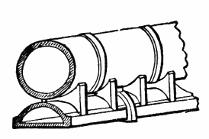
Messrs Brooke, of Huddersfield, have invented a combined drain and subsoil pipe, the latter, on which the drain pipe rests, being perforated, carries off the subsoil water. This contrivance is adapted for wet soils.
When junction pipes are required for uniting the drain pipes those known as “oblique junctions” only should be used. The junctions known as “square junctions” should be avoided, as they are always sure to become blocked up.
With respect to the fall of drain pipes Dr Parkes says, “one in forty-eight is frequently given, or three quarters of an inch in every yard; a fall of one in sixty-five in drains of six inches diameter, and one in eighty-seven in drains of eight inches diameter, will give a velocity of 220 feet per minute.
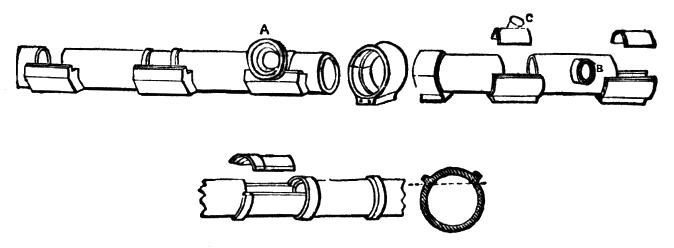
In order that drain pipes may be properly cleaned it is desirable to have them so made that they can be opened at intervals by means of lids or caps. The following cuts represent a few of the many kinds of pipes adapted for this purpose.
In addition to this method of cleansing them, drain pipes should be regularly flushed out at least once a month. House pipes are usually cleaned out by means of a flexible bamboo, or by jointed rods fitted with screws and rollers, which serve to loosen sediment. A frequent examination of all house pipes and traps should be made, and every joint and bend of the former well looked to. Unfortunately, however, they are so frequently covered in, that this is impossible.
Where it can be done all skirting boards and covers under which the pipes and traps are concealed should be removed. When, however, this cannot be managed the following plan of examination into their condition may be followed:—Pour water down the pipe, and observe if there be any smell; if there be, the pipe is full of foul air, and requires ventilation; or else the trap is defective, and the bad smell is due to sewer gas. Or, instead of pouring down water, a lighted candle or a piece of smouldering brown paper may be held over the entrance of the pipe, or the grating over a trap, when the air will be driven back. If the condition of the pipe be tested by throwing water down it, it should be noticed whether the water runs away at once or whether it is checked in its progress. This is all that, under the circumstances, can be done inside the house; but though an examination of the pipe is precluded inside, it may be possible to remove the earth on the outside, and so to get down to and open the drain with which the pipe communicates. Under these circumstances water mixed with lime should be poured down the house pipe; if the milky-looking water is long in making its appearance, and runs only in driblets, the drain requires flushing; if the milky-looking water is much coloured and mixed with dirt, then the pipes and trap are foul, or there is a sinking or depression in some part of the drain where the water is lodging.
Afterwards a pailful of lime and water should be poured down the pipe, which should be afterwards flushed by pouring water down it until the water flows off nearly clear.
Referring to the construction and position of the pipes which carry off the waste water, soil, &c., from our houses into the drains, Dr Parkes writes—“Builders are always anxious to conceal tubes, and thus carry them inside the walls, or in the case of hollow walls, between the two. The consequence is that any escape of air must be into the house. I have known a case in which the leakage of a closet pipe carried down in a hollow wall constantly contaminated the air of a house. It would be infinitely better to run the pipes at once through the wall to the outside. Few persons have any idea of the carelessness of plumbers’ work—of the bad junctions, and of the rapidity with which pipes get out of order and decay. When a leaden pipe carrying water is led into a water-closet discharge pipe, it is frequently simply puttied in, and very soon the dried putty breaks away, and there is a complete leakage of gas into the house. Even if well joined the lead pipe will, it is said, contract and expand, and thus openings are at last formed. Dr Fergus, of Glasgow, has directed particular attention to this in the case of lead closet pipes, which become easily perforated, and which have only a limited duration of wear.” See Traps, Sewers.
DRAUGHT. Syn. Haustus, L. A single dose of liquid medicine, usually dispensed in one-and-a-half-ounce or two-ounce phials. Draughts are almost exclusively extemporaneous compounds, and differ from ‘mixtures’ only in containing one dose; whereas mixtures contain several. The latter have now very generally superseded draughts among all but the higher classes, when the dose is to be frequently repeated. Draughts possess the advantages of extreme convenience, and, from only one phial being opened at a time, of preserving the preparation better than when it is exposed to the air by the frequent removal of the cork. They are usually taken from a wine-glass, which they about 2⁄3rds fill.
In the preparation of draughts the same precautions are observed as are pointed out under Mixture; regard being had to the increased volume of the dose. The ingredients of a six-ounce mixture, for example, containing (say) 12 doses, may be equally distributed among a dozen draught phials, after which each may be filled up with distilled water, or any other simple vehicle. In most cases a little syrup may be advantageously added. In many instances no addition will be required, the doses of each form of preparation being the same.
The following are useful formulæ, which will serve as examples for others of the class. The number might be easily multiplied, and, indeed, might be extended so as to include 3⁄4ths of the whole materia medica; but such a plan would lead to useless repetitions, and occupy much space. See Mixture, Prescribing, &c.
Draught, Abernethy’s. See Abernethy Medicines and Mixture.
Draught, Ace′tate of Ammo′′nia. Syn. Haustus ammoniæ acetatis, L. Prep. 1. (St. B. Hosp.) Solution of acetate of ammonia, 4 fl. dr.; water to make 11⁄2 fl. oz.
2. (Dr Paris.) Camphor mixture, 11⁄2 fl. oz.; liquor of acetate of ammonia, 4 fl. dr.; antimonial wine, 20 drops; mix. As a refrigerant and diaphoretic in febrile affections; taken late in the evening.
Draught, Ac′etate of Potas′sa. Syn. Haustus potassæ acetatis, L. Prep. (Mid. Hosp.) Acetate of potassa, 30 gr.; bicarbonate of potassa, 20 gr.; peppermint water, 1 fl. oz. Diuretic, antacid, and laxative.
Draught, Ammoni′acal. Syn. Haustus ammoniacalis, H. ammoniæ, L. Prep. (Brande.) Liquor of ammonia, 20 to 30 drops; compound tincture of cardamoms and tincture of gentian, of each 1⁄2 fl. dr.; campho-mixture, 11⁄2 fl. oz. An aromatic absorbent and stomachic; in heartburn, acidity, low spirits, &c.
Draught, An′odyne. Syn. Haustus anodynus, L. Prep. 1. Tincture of opium, 15 drops; pimento water and syrup of poppies, of each 2 dr.; water, 1 fl. oz.
2. (Copland.) Nitre, 6 gr.; laudanum, 12 drops; compound spirit of ether, 1 fl. dr.; syrup of poppies, 2 fl. dr.; camphor mixture, 9 fl. dr.
3. (Ellis.) Tincture of opium, 15 to 25 drops; syrup of poppies, 2 fl. dr.; spirit of cinnamon, 1 fl. dr.; distilled water, 11⁄2 fl. oz.
4. As the above, but substituting a like quantity of solution of either acetate or hydrochlorate of morphia in lieu of the laudanum. All the above are given as soothing draughts to allay pain and produce sleep, especially the last thing at night. No. 4 is to be preferred if there are febrile symptoms present.
Draught, Antac′id. Syn. Haustus antacidus, L. Prep. 1. Bicarbonate of soda, 20 gr.; tincture of calumba, 3 fl. dr.; tincture of hops, 1 fl. dr.; syrup of orange peel, 2 fl. dr.; water, 6 fl. dr. To improve the appetite in heartburn and dyspepsia; taken 1 hour before a meal.
2. Liquor of ammonia, 16 drops; syrup of saffron, 2 fl. dr.; infusion of gentian, 3 fl. dr.; water, 7 fl. dr. As the last, taken occasionally, especially in debility, low spirits, &c.
3. (Collier.) Compound tincture of cardamoms, 1 fl. dr.; solution of bicarbonate of magnesia (fluid magnesia), 9 fl. dr.; simple syrup, 2 fl. dr. Twice a day; in dyspepsia, heartburn, &c., especially in gouty patients.
4. (A. T. Thomson.) Magnesia, 1 dr.; peppermint water, 11⁄2 fl. oz.; tincture of orange peel, 1 fl. dr. In dyspepsia, &c., with acidity or diarrhœa.
5. As No. 1, but using bicarbonate of potassa for bicarbonate of soda. In acidity, diarrhœa, &c., accompanied by great irritability of the coats of the stomach.
6. Prepared chalk, 30 gr.; spirit of nutmeg and tincture of opium, of each 12 to 20 drops; syrup of saffron, 3 dr.; cinnamon water, 1 fl. oz. In acidity, with extreme looseness of the bowels.
Draught, Anti-arthrit′ic. Syn. Haustus anti-arthriticus, L. Prep. 1. Tincture of colchicum seeds (L.), 1⁄2 fl. dr.; syrup of orange peel, 21⁄2 fl. dr.; water, 1 fl. oz. In gout; taken over-night, followed by another in the morning.
2. (Brande.) Wine of colchicum, 1⁄2 fl. dr.; carbonate of magnesia, 15 gr.; cinnamon water, 1⁄2 fl. oz.; water, 1 fl. oz. As the last.
3. (Sir C. Scudamore.) Magnesia, 18 gr.; Epsom salts, 11⁄2 dr.; vinegar of colchicum, 1 fl. dr.; simple syrup, 1 fl. dr.; cinnamon water, 9 fl. dr. As the last.
4. (Sir H. Halford’s Gout Preventive.) Compound infusion of gentian, 11⁄2 fl. oz.; tincture of rhubarb, 1 fl. dr.; bicarbonate of potassa, 15 gr.
Draught, Anti-asthmat′ic. Syn. Haustus anti-asthmaticus, L. Prep. Vinegar of squills, 1⁄2 fl. dr.; ipecacuanha wine, 15 drops; cinnamon water, 11⁄2 fl. oz. Expectorant. One to be taken three times daily during the attack.
Draught, Anti-emet′ic. Syn. Haustus anti-emeticus, L. Prep. 1. Juice of 1 lemon; liquor opii sedativus, 10 drops (or laudanum, 15 drops); ether, 20 drops; simple syrup, 2 dr.; water, q. s.
2. (Haustus anti-emeticus Riverii,—P. C.) Bicarbonate of potassa, 30 gr.; lemon juice, 4 dr.; syrup of lemon, 1 oz.; water, 3 oz.; mix quickly, and tie down the cork. To check nausea and vomiting. This is best given effervescing.
Draught, Anti-hyster′ic. Syn. Haustus anti-hystericus, L. Prep. Cyanide of potassium, 1 gr.; lettuce water (distilled), 2 fl. oz.; syrup of orange flowers, 11⁄2 oz.; water, 51⁄2 fl. oz.; for 6 draughts. One to be taken when the fit is expected, and a second in half an hour. Should the fit come on, the dose may be repeated at intervals of about 15 minutes until 3 or 4 have been altogether administered. The symptoms, however intense, are generally either at once arrested, or greatly alleviated by this treatment.
Draught, Antilith′ic. Syn. Haustus anti-lithicus, L. Prep. 1. (Venables.) Borax, 8 gr.; bicarbonate of soda, 10 gr.; aerated water, 8 fl. oz. For a draught; in red gravel.
2. (Dr Paris.) Carbonate of soda, 12 gr.; tincture of calumba, 1 fl. dr.; infusion of quassia, 1 fl. oz.; water, 3 fl. dr. In dyspepsia and gravel, attended with the lithic-acid diathesis.
Draught, Anti-neural′gic. Syn. Haustus anti-neuralgicus, H. narcotinæ, L. Prep. (Jeston.) Narcotine, 2 gr.; diluted sulphuric acid, 20 drops; infusion of roses, 11⁄2 fl. oz. One every 2 hours in the intermissions of neuralgia.
Draught, Antisep′tic. Syn. Haustus antisepticus, L. Prep. (Dr Collier.) Decoction of yellow bark, 1 fl. oz.; tincture of opium, 5 drops; spirit of pimento and water, of each 2 fl. dr. In putrid fevers, gangrene, &c.
Draught, Antispasmod′ic. Syn. Haustus antispasmodicus, L. Prep. 1. (Dr Collier.) Tincture of castor, 1 fl. dr.; sulphuric ether, 10 drops; peppermint water, 11 fl. dr.; mix. In hysteria, and that species of irregular muscular action dependent on debility.
2. (Dr Gregory.) Fetid spirit of ammonia, 1⁄2 to 1 fl. dr.; camphor mixture, 10 fl. dr.; syrup of saffron, 1 fl. dr. In cases complicated with low spirits, debility, &c.
3. (A. T. Thomson.) Musk mixture, 14 fl. dr.; liquor of ammonia, 16 drops; tincture of castor, 1 fl. dr.; syrup of poppies, 1⁄2 fl. dr.; mix. Three or four times daily, in hysteria and convulsive affections, after the bowels have been well cleared by some aperient.
4. (A. T. Thomson.) Oil of aniseed, 10 drops; magnesia, 20 gr.; tincture of senna, 2 fl. dr.; peppermint water, 10 fl. dr.; mix. In flatulence and spasms of the stomach.
Draught, Ape′′rient. Syn. Haustus aperiens, L. Prep. 1. (Paris.) Infusion of senna, 1 fl. oz.; tincture of senna, tincture of jalap, and syrup of senna, of each 1 fl. dr.; tartrate of potassa, 1 dr.; mix.
2. (Ryan.) Epsom salts, 4 dr.; tincture of senna, 11⁄2 fl. dr.; syrup of ginger, 1 fl. dr.; spirit of sal-volatile, 20 drops; infusion of senna, 11⁄2 fl. oz.
3. (Thomson.) Tartrate of potassa, 3 dr.; tincture of senna and syrup of saffron, of each 1 dr.; infusion of senna, 11⁄2 oz. The above are good aperients, and in their composition and action resemble the ordinary “black draught.”
4. (Effervescing A. D.)—a. (Dr Barker.) Bisulphate of potassa, 73 grs.; carbonate of soda, 72 gr.; water, q. s.; dissolve the two in separate glasses, mix the solutions, and drink whilst effervescing, in the same way as soda water.
b. (W. Cooley.) Bicarbonate of soda, 1 dr.; potassio-tartrate of soda, 2 drs.; dissolve in about 1-3rd of a glassful of cold water; and pour it on another like quantity of water, holding in solution tartaric acid, 40 grs., and syrup of orange peel, 11⁄2 fl. dr.; and drink it instantly.
c. (Paris.) Potassio-tartrate of soda, 2 dr.; bicarbonate of soda, 40 grs.; dissolve, and add lemon juice, 1 or 2 tablespoonfuls.
d. (Young.) Cream of tartar, 3 dr.; carbonate of soda, 21⁄2 dr.; throw them into a soda-water bottle three parts filled with cold water, cork immediately, and wire down the cork. The last three are examples of factitious effervescing Seidlitz water, and are good saline aperients. The method of taking them may be varied by mixing the dry ingredients (in fine powder) on a piece of paper, and throwing the mixture suddenly into a tumbler 2-3rds filled with water, and drinking the liquid whilst effervescing. See Cathartic D. (below.)
Draught, Ap′petite. See Draught, Dinner.
Draught, Aromat′ic. Syn. Aromatic antacid, draught; Haustus aromaticus, L. Prep. 1. Aromatic confection, 1 dr.; spirit of sal-volatile, 1⁄2 dr.; syrup of saffron, 2 drs.; pimento water, 9 fl. dr. Excellent in dyspepsia, with acidity, and in diarrhœa, preceded by an aperient.
2. (H. arom. cum rheo.—St. B. Hosp.) Aromatic confection, 1 dr.; infusion of rhubarb and cinnamon water, of each, 6 fl. dr. In diarrhœa and dyspepsia, especially when there is acidity and deficiency of bile.
Draught, Astrin′′gent. Syn. Haustus astringens, L. Prep. 1. Tannin, 3 gr.; rectified spirit, 1 fl. dr.; simple syrup, 2 fl. dr.; water, 6 fl. dr.
2. (Dr Paris.) Chalk mixture, 11⁄2 fl. oz.; tincture of catechu, 1 fl. dr.; laudanum, 15 drops.
3. (Thomson.) Extract of logwood, 12 gr.; tincture of catechu, 1 fl. dr.; cinnamon water, 15 fl. dr. The above are excellent remedies in diarrhœa (preceded by a purgative), and in dysentery, &c. One may be taken after each motion.
Draught, Black. See Mixture.
Draught, Cam′phor. Syn. Haustus camphoræ, L. Prep. (Guy’s Hosp.) Camphor, 6 gr.; rectified spirit, q. s. to powder; white sugar, 1 dr.; mucilage, 3 dr.; water, 11⁄2 fl. oz. Anodyne and diaphoretic, &c.
Draught, Cas′tor Oil. Syn. Haustus olei ricini, L. Prep. (Guy’s Hosp.) Castor oil, 4 dr.; yelk of egg, q. s. (2 in no.); simple syrup, 1 fl. dr.; cassia or cinnamon water, 1 fl. oz. Aperient.
Draught, Cathar′tic. Syn. Haustus catharticus, L. The following are given as additions to those under Aperient d., and other heads:—Prep. 1. (Dr Thomson.) Tartrate of potassa, 5 dr.; tincture of senna, 1 fl. dr.; infusion of senna, 141⁄2 fl. dr.; syrup of saffron, 1⁄2 fl. dr.; mix. In acute diseases, taken early in the morning.
2. (Thomson.) Epsom salts and manna, of each 2 dr.; infusion of roses, 14 fl. dr.; dilute sulphuric acid, 10 drops. In inflammatory affections, and to check vomiting in low fevers.
3. (Thomson.) Carbonate of magnesia, 1 dr.; powdered rhubarb, 20 gr.; peppermint water, 12 fl. dr. In dyspepsia, attended with costiveness and acidity, taken an hour before dinner.
4. (Thomson.) Castor oil, 5 fl. dr.; powdered gum, 20 gr.; rose water, 1 fl. oz.; compound tincture of lavender, 8 drops; syrup of poppies, 1 fl. dr. In colic and calculus. The above differ from aperient draughts simply in their greater strength.
Draught, Chalk. Syn. Haustus cretæ, L. Prep. 1. Powdered gum, chalk, and simple syrup, of each 1 dr.; aromatic water (as that of caraway, cinnamon, nutmeg, pimento, or peppermint), 11⁄2 fl. oz.
2. Chalybeated c. d.; Haustus cretæ et ferri, L.—Paris.) Chalk mixture, 7 fl. dr.; compound mixture of iron, 3 fl. dr.; sesquicarbonate of ammonia, 5 or 6 gr. In diarrhœa, particularly in that arising from debility and anæmia.
3. (C. d. with rhubarb; Haustus cretæ cum rheo, L.)—a. Chalk mixture (see above), 11⁄2 fl. oz.; powdered rhubarb, 12 gr.
b. (Lond. Hosp.) Powder of chalk with opium, 12 gr.; rhubarb, 15 gr.; syrup of saffron and compound tincture of cardamoms, of each 1 fl. dr.; caraway water, 10 fl. dr. In heartburn, dyspepsia, and certain forms of diarrhœa.
Draught, Chlo′′rine. Syn. Haustus chlorinii, L. Prep. (Copland.) Chlorine water, 1⁄2 fl. dr.; water, 11⁄2 fl. oz.; mix, and add of syrup of poppies, 1⁄2 fl. dr. One every 6 hours; in the worst form of typhus fever, and other putrid diseases, &c.
Draught, Cit′rate of Ammo′′nia. Syn. Haustus ammoniæ citratis, H. a. sesquicarbonatis effervescens, L. Prep. (Guy’s Hosp.) Sesquicarbonate of ammonia, 20 gr.; water, 1 fl. oz.; dissolve, and add of lemon juice, 1⁄2 fl. oz. An agreeable, cooling, saline draught in febrile cases.
Draught, Cit′rate of Potas′sa. Syn. Haustus potassæ citratis, L. Prep. From carbonate of potassa, 24 gr. (or bicarbonate, 29 gr.); water, 1 fl. oz.; dissolve, and add of lemon juice, 5 fl. dr. As the last. 20 gr. of citric acid may be used instead of the lemon juice.
Draught, Col′chicum. See Draught Anti-arthritic.
Draught, Copai′ba. Syn. Haustus copaibæ, L. Prep. (St. B. Hosp.) Balsam of copaiba, 1⁄2 fl. dr.; mucilage (thick), 4 fl. dr.; pimento water, 3 fl. dr.; water, 5 fl. dr. In gonorrhœa, &c.
Draught, Cough. See Mixture.
Draught, Diaphoret′ic. Syn. Haustus diaphoreticus, L. Prep. 1. (Collier.) Infusion of serpentary, 11⁄2 fl. oz.; tincture of serpentary, 1 fl. dr. Tonic and diaphoretic.
2. (Thomson.) Sesquicarbonate of potassa, 20 gr.; fresh lemon juice, 4 fl. dr.; tartrate of antimony, 1⁄6 gr.; water, 11 fl. dr.; syrup of poppies, 1 fl. dr. Antifebrile and diaphoretic.
3. (Thomson.) Liquor of acetate of ammonia, 6 fl. dr.; camphor mixture, 10 fl. dr.; nitrate of potassa, 10 gr.; syrup of tolu, 1⁄2 fl. oz. Anodyne and diaphoretic. All the above are used in inflammatory affections.
Draught, Din′ner. Syn. Appetite draught; Haustus dictus ante cibum. Prep. 1. Tinctures of cascarilla, hops, and rhubarb, of each 1 fl. dr.; spirit of sal-volatile, 1⁄2 fl. dr.; tincture of capsicum, 20 drops; syrup of orange peel, 2 dr.; water, 11⁄2 fl. oz.
2. Compound tincture of gentian, 1⁄2 fl. oz.; sal-volatile, 1⁄2 a teaspoonful; cinnamon water, 1 fl. oz.; compound tincture of cardamoms, 1 teaspoonful. Either of the above to be taken an hour before a meal.
Draught, Diuret′ic. Syn. Haustus diureticus, L. Prep. 1. (Collier.) Tincture of jalap, 2 fl. dr.; vinegar of squills, 1 fl. dr.; peppermint water, 10 fl. dr.; mix.
2. (Copland.) Acetate of potassa, 1⁄2 dr.; infusion of quassia and cinnamon water, of each 6 fl. dr.; vinegar of squills and sweet spirits of nitre, of each 1⁄2 fl. dr.
3. (Thomson.) Nitre, 8 gr.; tincture of digitalis, 16 drops; infusion of roses, 13 fl. dr.; syrup of roses, 1 fl. dr.
4. (Turner.) Nitre and powdered gum, of each 15 gr.; almond mixture, 11⁄2 fl. oz. The above are used as diuretics in dropsy; the last, also in scurvy, and in the incontinence of urine of children.
Draught, Donovan’s. Syn. Draught of hydriodate of arsenic and mercury; Haustus hydriodatis arsenici et hydrargyri, L. Prep. (Donovan.) Liquor of hydriodate of arsenic and mercury (Donovan’s), 2 fl. dr.; distilled water, 31⁄2 fl. oz.; syrup of ginger, 1⁄2 fl. oz.; mix for 4 draughts. One, night and morning; in lepra, lupus, psoriasis, and some other obstinate cutaneous affections. It must not be allowed to touch anything metallic.
Draught, Efferves′cing. Prep. (Lond. Hosp.) Sesquicarbonate of soda, 30 gr.; water, or peppermint water, 11⁄2 fl. oz.; syrup of orange peel, 2 fl. dr.; tincture of calumba, 1⁄2 fl. dr.; tartaric or citric acid, 25 gr.; add the acid last, and drink whilst effervescing. Stomachic, tonic, and anti-emetic; in acidity, dyspepsia, &c. (See antè.)
Draught, Emet′ic. Syn. Haustus emeticus, L. Prep. 1. Sulphate of zinc, 15 gr. to 30 gr.; water, 9 fl. dr.; dissolve. In cases of poisoning, and at the commencement of an attack of ague.
2. (Copland.) Ipecacuanha, 30 gr.; sesquicarbonate of ammonia, 20 gr.; tincture of capsicum, 30 drops; oil of chamomile, 10 drops; mint water, 2 fl. oz. As a stimulant emetic in cases of poisoning by laudanum or other narcotics.
3. (Guy’s Hosp.) Antimonial wine, 2 fl. dr.; ipecacuanha wine, 6 fl. dr.; water, 4 fl. dr. For unloading the stomach in ordinary cases.
4. (Mid. Hosp.) Tartar emetic, 1 gr.; ipecacuanha, 20 gr.; syrup, 2 fl. dr.; water, 10 fl. dr. As the last.
5. (Dr Pickford.) Sulphate of zinc, 20 gr.; sulphate of magnesia, 4 dr.; water, 13⁄4 oz. When it is also desired to act rapidly on the bowels.
6. (Rodier.) Sulphate of copper, 10 gr.; water, 2 fl. oz. In poisoning by laudanum.
7. (Sprague.) Ipecacuanha, 30 gr.; sesquicarbonate of ammonia, 20 gr.; tincture of capsicum, 1 fl. dr.; peppermint water, 3 fl. oz. In poisoning by narcotics.
8. (A. T. Thomson.) Ipecacuanha, 20 gr,; ipecacuanha wine, 2 fl. dr.; water, 10 fl. dr. For unloading the stomach, in ordinary cases.
9. (Trousseau.) Ipecacuanha, 8 gr.; syrup of ipecacuanha, 1 fl. oz.; water, q. s. for 4 draughts. One every 10 minutes, until vomiting occurs.
Draught, E′ther. Syn. Haustus æthereus, L. Prep. (Neligan.) Sulphuric ether, 1 fl. dr.; spermaceti, 3 gr.; rub together (expertly), and add of peppermint water, 10 fl. dr. An excellent stimulant and antispasmodic, febrile symptoms being absent.
Draught, Expec′torant. Syn. Haustus expectorans, L. Prep. 1. (Collier.) Mixtures of ammoniacum and almonds, of each 6 fl. dr.; tincture of squills, 12 drops. In hoarseness, chronic coughs, &c.
Draught, Hen′bane. Syn. Haustus hyoscyami, L. Prep. 1. Tincture of henbane, 30 to 60 drops; syrup of saffron, 1 fl. dr.; water, 10 fl. dr. Anodyne and soporific. Used to allay nervous excitement, and induce sleep, when laudanum is inadmissible.
2. (Henbane and Squills d.; Haustus hyoscyami cum scillâ, L.—Dr Bree.) Extract of henbane, 3 gr.; tincture of squills, 10 drops; dilute nitric acid, 6 drops; water, 11⁄2 fl. oz. Anodyne and expectorant; in asthmas, chronic coughs, &c.
Draught, Hydrocyan′ic. Syn. Haustus hydrocyanicus, L. Prep. 1. (Donovan.) Cyanide of potassium, 1 gr.; syrup of lemons, 1⁄2 fl. oz.; distilled water, 71⁄2 fl. oz. For 8 draughts. One for a dose.
2. (Dr S. Dickson.) Medicinal Hydrocyanic acid (L.), 15 drops; liquor of ammonia, 20 drops; syrup of orange flowers (or simple syrup), 3 fl. dr.; water, 81⁄2 fl. oz.; mix, and divide into 6 draughts. One—2 or 3 times a day; in gastrodynia, and all those nameless nervous and hysterical affections arising from excessive irritability, mental anxiety, &c. In a case that came under our notice, in which life was an absolute burden to the patient, relief was afforded by the first draught, and 4 or 5 effected a comparative cure, although almost every other remedy had been tried in vain.
Draught, Laennec’s. Syn. Laennec’s contra-stimulant draught; Haustus contrastimulans, L. Prep. From tartar emetic, 2 grs.; syrup of poppies, 2 fl. drs.; orange-flower water, 11⁄2 fl. oz. Every two hours in pneumonia, &c.
Draught, Lax′ative. Syn. Haustus laxans, L. Prep. 1. See Draughts, Aperient.
2. (Dr Copeland.) Infusion of senna and compound infusion of gentian, of each 6 fl. dr.; sulphate of potassa, 20 to 30 gr.; extract of taraxacum, 30 to 40 gr.; compound tincture of cardamoms, 11⁄2 fl. dr. Aperient, stomachic, and alterative.
Draught, Mor′phia. Syn. Haustus morphiæ, L. Prep. (Brera.) Morphia, 1⁄4 gr.; syrup of poppies, 1 fl. dr.; water, 11 fl. dr. Two or three drops of acetic acid may be advantageously added. At bed-time, as a soporific.
Draught, Narcot′ic. Syn. Haustus narcoticus, H. opiatus, L. Prep. 1. (St. B. Hosp.) Laudanum, 12 to 20 drops; syrup of red poppies, 1 fl. dr.; pimento water, 3 fl. dr; water, 1 fl. oz. To induce sleep in slight cases, when fever is absent.
2. (A. T. Thomson.) Camphor mixture, 11⁄2 fl. oz.; laudanum, 35 drops; sulphuric ether and syrup of saffron, of each 1 fl. dr. In intermittent headache.
3. (Thomson.) Carbonate of ammonia, 15 gr.; fresh lemon juice, 1⁄2 fl. oz.; water, 1 fl. oz.; spirit of nutmeg, 1 fl. dr.; syrup of orange peel, 1⁄2 fl. dr.; tincture of hemlock, 10 drops. In diseases of increased irritability.
4. (Thomson.) Carbonate of potassa, 20 gr.; fresh lemon juice, 1⁄2 fl. oz.; peppermint water, 1 fl. oz.; laudanum, 25 drops; syrup of tolu, 1⁄2 fl. dr. To procure sleep in the majority of diseases. (See above.)
Draught, Nux Vom′ica. Syn. Haustus nucis vomicæ, L. Prep. (Dr Joy.) Nux vomica (in fine powder), 3 gr.; powdered gum, 2 dr; compound tincture of cardamoms, 1 fl. dr.; cinnamon water, 10 fl. dr. Diuretic, narcotic, stimulant, and tonic; in paralysis, impotence, debility, &c., unaccompanied by inflammation of the nervous centres. See Strychnine.
Draught, Refri′′gerant. Syn. Haustus refrigerans, L. Prep. 1. Carbonate of potassa, 20 grs.; syrup of orange peel, 1 fl. dr.; spirit of nutmeg, 1⁄2 fl. dr.; water, 11⁄2 fl. oz.
2. (Thomson.) Nitre, 12 gr.; almond mixture, 11⁄2 fl. oz.; syrup of tolu, 1 fl. oz.
3. (Collier.) Carbonate of potassa, 20 gr.; antimonial wine, 20 drops; syrup of orange peel, 1 fl. dr.; tincture of orange peel, 1⁄2 fl. dr.; water, 11⁄2 fl. oz.; mix, and add a large table-spoonful of lemon juice. In inflammatory diseases, &c.
Draught, Saline′. See Draught, Effervescing, &c.
Draught, Stomach′ic. See Draught, Dinner, &c.
Draught, Ton′ic. Syn. Strengthening draught; Haustus tonicus, L. Prep. 1. (Collier.) Disulphate of quinine, 2 gr.; tincture of orange peel, 1 fl. dr.; diluted sulphuric acid, 5 drops; laudanum, 10 drops; infusion of cascarilla, 11⁄2 fl, oz. In pyrosis, &c., 1 hour before dinner.
2. (A. T. Thomson.) Infusion of yellow bark, 11⁄2 fl. oz.; compound tincture of cinchona, 1 fl. dr.; powdered cinchona, 40 gr.; syrup of orange peel, 1 fl. dr. In intermittents and acute rheumatisms.
3. (Thomson.) Infusion of cascarilla, 11⁄2 fl. oz.; tincture of cascarilla and ginger, of each 1 fl. dr. In dyspepsia, arising from intemperance.
4. (Walton.) Infusion of cascarilla, 9 fl. dr.; tinctures of rhubarb and ginger, of each 1 fl. dr.; syrup of saffron, 1⁄2 fl. dr.; ammonio-citrate of iron, 6 gr.; tincture of capsicum, 5 drops. In anæmia, and debility accompanied by paleness and relaxation.
Draught, Ver′mifuge. Syn. Haustus vermifugus, H. anthelminthicus, L. Prep. (M. Levacher.) Castor oil, 4 dr.; oil of turpentine, 2 dr.; mint water, 2 fl. oz.; syrup, 1 fl. oz.; powdered gum, 2 dr.; for an emulsion. In tapeworm.
DRAW′INGS. Chalk and pencil drawings may be fixed so as not to suffer from slight abrasion, by washing them with skimmed milk, or with water holding in solution a little isinglass or gum. When the first is used, great care must be taken to deprive it of the whole of the cream, as the latter substance would cause the drawing to look streaky. An easy way of applying these fluids is to pour them into a shallow vessel, and to lay the drawing flat upon the surface of the liquid; after which it should be gently removed and placed on white blotting paper, in an inclined position, to drain and dry.
DRENCHES. Syn. Drinks. In veterinary practice, these terms are applied to liquid medicines or mixtures which are administered to horses and neat cattle, and chiefly to the latter. A drench for a HORSE should not be less than half a pint, nor more than a quart; about a pint is, perhaps, the best quantity; that for a COW or OX should measure about a quart, and not more than about 5 half pints. See Veterinary Medicine.
DRES′SING. In the industrial arts, a preparation of gum, starch, size, &c., employed in stiffening or “finishing off” textile fabrics and paper. In surgery, the term is appropriated to any application to a wound or sore, made by means of lint, linen, or leather. Simple dressing is simple cerate or spermaceti cerate. Among cooks, the stuffing of fowls, pork, veal, &c., is commonly called ‘dressing.’
DRIERS. Driers are substances employed to facilitate the drying of paints. The driers most commonly employed are sugar of lead, litharge, and white copperas. Either of these when well ground, and mixed in small proportion with paints, very materially hastens their drying. Indeed, some colours will not dry without them. Red lead is also well adapted for a drying agent, and in cases where its colour does not preclude it, is much used. The best drier is sugar of lead. Its cost, however, is somewhat higher than that of the other driers. It is important to bear in mind that in the finishing coats of delicate colours driers are not generally had recourse to, as they have a slight tendency to injure the colour. A drying property may be imparted to linseed oil by boiling it with drying substances; it then becomes a very useful vehicle for some purposes. See Oils, Drying.
DRIFFIELD OILS.—For the prevention of gangrene and for healing incised and other wounds, bruises, sprains, swellings, and external inflammations. A dusky brownish-green clear oil, consisting of olive oil, digested with wormwood, savin, and arnica, and afterwards perfumed with a mixture of oils of rosemary, thyme, and juniper, 1 pint (474 grammes). (Hager.)
DRINKS (Summer). See Beer, Ginger, Lemonade, Sherbet, &c.
DRINK, CORDIAL (Dr Cherwy). A herbal lemonade to heal all chronic and scrofulous diseases. It contains 115 grammes water, 15 grammes spirit, 2 grammes potassium iodide, 5 grammes bitter almond water, 10 grammes sugar, and 3 grammes burnt sugar. (Hager.)
DRIPPING TO CLARIFY. Put the dripping into a stewpan over the fire, and let it boil, and as it does so, skim it carefully. When it boils pour it into a basin, in which you have previously put a little cold water. It must stand till cold. It is then to be taken out of the water. The dripping will now be in the form of a cake, at the bottom of which will be found adhering little pieces of meat, skin, &c. These must be scraped off, and the dripping will have been purified. Another method is to mix boiling water with the dripping, to stir well, let it get cold, and then to take it out and scrape it as above.