A CYCLOPÆDIA OF PRACTICAL RECEIPTS, PROCESSES, AND COLLATERAL INFORMATION (continued 28)
Reading edition
COW-POX. [Variola Vaccina.] A disease affecting the udder in cows. The treatment consists in fomenting the udder and applying poultices of spent hops, giving laxative and saline medicines, and in drawing off the milk with a teat-syphon.
COWS. See Dairy.
CRAB. See Shell-fish.
CRACKNELS. Small, brittle cakes or biscuits, made by first boiling and then baking paste. Prep. To flour, 1 pint, add a little grated nutmeg, the yolks of 2 eggs, 2 or 3 spoonfuls of rose-water, and cold water, q. s. to make a paste; then roll in butter, 1⁄2 lb., and make it into shapes. In one hour put them into a kettle of boiling water, and boil them until they swim, then throw them into cold water; take them out; and when dry, bake them on tins. Those of the shops contain less butter, and the rose-water is omitted.
CRACK′NUTS. Thin and sweet cakes or wafers. Prep. 1. Flour, 1 lb.; sugar, 3⁄4 lb.; melted butter, 1⁄2 lb.; 6 or 7 eggs, well beaten; make a paste with a glassful of raisin wine and a little water; add caraways, roll it out as thin as paper, cut it into shapes with a tumbler, wash the pieces with the white of egg, and dust them over with powdered sugar.
2. As the last, but using 1⁄2 lb. more flour.
CRAMP. See Spasms.
CRAPE is cleaned by rinsing it in ox-gall and water, to remove the dirt; afterwards in pure water, to remove the gall; and lastly, in a little gum-water, to stiffen and crisp it. It is then clapped between the hands until dry.
CRAY-FISH. See Shell-fish.
CRAY′ONS. Colouring substances made up into small cylinders or any other convenient form for use in writing or drawing.
Crayons, Draw′ing. Prep. 1. Spermaceti, 3 oz.; boiling water, 1 pint; agitate together till they form a species of emulsion; add bone ash, 1 lb. (or more, previously reduced to an impalpable powder), and colouring matter, q. s. to give the proper tint; reduce the whole to a perfectly homogeneous paste, and form it into crayons.
2. Pipeclay and the finest prepared chalk, equal parts; or pipeclay alone, q. s.; colouring, a sufficient quantity; make them into a paste with pale mild ale.
3. White curd or Castile soap, cut into thin shavings, 1 oz.; boiling water, 1 pint; dissolve, and when cold, add gradually as much rectified spirit of wine as will render the liquid barely transparent. With this fluid make equal parts of the finest elutriated clay and chalk into a stiff paste, adding colouring matter, q. s., as before. For common qualities, the spirit of wine may be omitted, but the mass will then dry more slowly.
4. Curd soap, 11⁄2 oz.; gum Arabic, 1⁄2 oz.; boiling water, 11⁄4 pint; dissolve, and use it as the last. General Lomet uses a similar mixture to work up the softest varieties of hematite, with which he thus forms superior red crayon.
5. (Process of the Brothers Joel, of Paris.) Shell-lac, 3 parts; spirit of wine, 4 parts; oil of turpentine, 2 parts; dissolve, add pure clay, 6 parts; colouring matter, q. s.; form the mass into crayons, and dry them by a stove heat.
6. Pale shell-lac, 5 parts; wood naphtha, 12 parts; dissolve, and with this fluid mix up the colouring powder, previously stirred up with an equal weight of fine pale-blue clay; dry by a stove heat, as before. When this process is well managed, it produces crayons equal to those of the best Parisian houses.
Obs. The composition may be formed into crayons by simply rolling it on a slab; but to ensure their solidity the manufacturers generally employ a metallic cylinder of 2 or 3 inches in diameter, with one end open and the other firmly secured to a perforated plate, having holes of the same size as the intended crayons. The crayon composition, in the state of a stiff paste or dough, is introduced into the open end, and is forced down and through the holes, by means of a small plug or piston, that exactly fits the inside of the cylinder, and which is driven by the equable motion of a small screw. The pieces that pass through the holes are then cut into lengths and dried.
The substances employed as colouring matters for crayons are very numerous, and their choice offers a wide field for the skill and fancy of the artist. The pigment having been selected, it may be reduced to any shade or tint by admixture with other pigments, and by ‘dilution’ with a proper quantity of elutriated or prepared chalk. As, however, crayon colours do not admit of being mixed together at the time of using them, like liquid colours, it is usual to make 3 to 6 different shades of each colour, so as to enable the artist at once to produce any effect he chooses.
Crayons, Black. From prepared black-lead, ivory-black, lamp-black, &c. Black chalk and charcoal are frequently made into crayons by simply sawing them into suitably sized pieces. They may then be put into a pipkin of melted wax, and allowed to macerate for an hour; after which they should be taken out, drained, and laid on a piece of blotting paper to dry. Drawings made with these crayons are very permanent, and if warmed slightly on the wrong side, the lines will adhere, and become almost as durable as ink.
Crayons, Blue. From indigo, smalts, Prussian blue, verditer, &c.
Crayons, Brown. From umber (raw and burnt), terra di Sienna (raw and burnt), Cullen’s earth, brown ochre, &c.; and some peculiar shades, from a mixture of black, carmine, and either of the above colours.
Crayons, Green. From a mixture of king’s yellow, or yellow ochre, with blues.
Crayons, Purple. From any of the more brilliant blues, mixed with carmine, lake, or vermilion.
Crayons, Red. From carmine, carminated lakes, vermilion, hematite, and any of the earthy or mineral colours commonly used as pigments. Crayons of red chalk may be prepared in the manner pointed out for crayons of black chalk.
Crayons, White. From pure clay and chalk.
Crayons, Yellow. From king’s yellow, Naples yellow, orpiment, yellow ochre, &c.
Crayons, Lithograph′ic. Prep. 1. Tallow-soap, 7 parts; white wax, 6 parts; melt by a gentle heat, and add lamp-black, 1 part; keep it melted with constant stirring, for 20 or 30 minutes, then let it cool a little, and cast it into moulds.
2. White wax, 4 parts; shell-lac and hard tallow-soap, of each 2 parts; lamp-black, 1 part; as last.
3. Spermaceti, white wax, and hard tallow-soap, of each equal parts; lamp-black, q. s. to colour.
Obs. Some makers melt the soap, wax, and lamp-black in an iron ladle, over a brisk fire, and allow the mixture to blaze for a few seconds before adding the shell-lac, which is no sooner thoroughly incorporated than the heat is increased until the mass again kindles, when it is at once removed from the fire and stirred until it is cool enough to be poured into the moulds. This method leads to trouble and loss, without any corresponding advantage. These crayons are used to draw designs upon lithographic stones.
Crayons for Writing on Glass. Prep. 1. From French chalk, cut into suitable pieces. Marks made with these crayons, when obscured or rubbed out, may be several times revived by simply breathing on the glass.
2. (Brunquelle.) Spermaceti, 4 parts, tallow, 3 parts, wax, 2 parts, are melted together in a cup; and red lead, 6 parts, and carbonate of potassa (in fine powder), 1 part, stirred in; the mass is kept melted and stirred for about half an hour longer, then poured into glass moulds (tubes) of the thickness of a common pencil, and cooled as rapidly as possible. The mass may be screwed up and down in the tube, and cut to a point with a knife. A crayon is thus obtained which will readily write upon clean, dry glass.
CREAM. Syn. Crem′or, C. lac′tis, Flos lac′tis, L. The oleaginous portion of milk, which collects in a thin stratum upon the surface, when that fluid is left undisturbed for some time. By violent agitation, as in the process of churning, the fatty globules unite together, forming butter; whilst the liquid portion, consisting of caseum, serum, and a little butter, constituting the residuum, is called butter-milk. This separation is effected the most readily when the cream has become partially sour and coagulated by being kept a few days, a change which occurs in consequence of the conversion of some of the sugar of the serum into lactic acid, which precipitates the caseous matter contained in the small portion of the milk with which the cream is mixed. On these simple facts chiefly depend the successful manufacture of butter. The cream intended for churning should therefore be kept until it turns slightly sour, and assumes the condition above referred to, as then the butter will readily ‘come.’ If churned while quite sweet the operation will be tedious, and will frequently fail. When this happens the dairy maids declare the milk is ‘charmed’ or ‘bewitched,’ and reluctantly proceed with the operation. The addition of a little rennet or vinegar is the proper remedy in this case, and will cause the almost immediate separation of the butter.
When cream is suspended in a linen bag, and allowed to drain, it gradually becomes drier and harder, by the separation of the liquid portion, and then forms what is known by the name of cream cheese. By the application of slight pressure the separation of the whey is more completely effected, and the product is not only better, but will keep longer.
Qual. Cream, in a dietetic point of view, may be regarded in the same light as butter, as it is converted into butter in the process of digestion. On this account much cream should never be taken at once by persons of delicate stomachs. In eating cream with fruit persons are hardly aware of the large quantity they consume, until they find it disagree with the stomach, when the condiment is blamed for the indiscretion of those who take it.
Mr Wanklyn gives the following as the composition of six different samples of cream:—
1.2.3.4.5.6.
Water72·2071·266·3660·1753·6250·00
Fat19·0014·118·8733·0238·1743·90
Milk, Sugar, Casein, and Ash.8·8014·714·776·818·216·10
A quart of good cream generally yields from 13 oz. to 15 oz. of commercial butter.
Mr Blyth says: “The analysis of cream is conducted on exactly the same principle as that of milk; but the cream must be weighed, not measured; and smaller quantities may be evaporated to dryness in order to estimate the water, if the ratio of water to the solids not fat is such that adulteration may be suspected; for this ratio, although occasionally disturbed by some of the casein rising with the fat, is practically the same as in milk.” Mineral adulterations, such as carbonate of magnesia, will be detected, if present, in the ash. See Milk, Butter, &c.
Cream, Al′mond. Prep. From sweet almonds, 2 oz.; bitter almonds, 4 in no.; blanched and beaten in a mortar to a smooth paste, adding a teaspoonful of water to prevent oiling; and afterwards a pint of cream, and enough powdered lump sugar to sweeten; the whole is then whisked to a froth, the glasses filled with the liquor, and some of the froth placed on the top of each. Some persons add the juice of a lemon.
Cream, Bran′dy. Prep. To the last add the yolks of 6 eggs; heat it gently over the fire until it thickens, keeping it well stirred, then farther add two or three glassfuls of brandy, and pour it into small cups or shallow glasses.
Cream, Burnt. Prep. Cream, 1 quart; cassia, a small stick; peel of half a lemon; boil for 5 minutes, cool a little, take out the spice, and add the yolks of 9 eggs, and sugar, q. s. to sweeten; stir until cold, put it into a dish, strew pounded sugar over it, and bake it until brown.
Cream, Choc′olate. Prep. Chocolate, scraped fine, 1 oz.; thick cream, 1 quart; sugar (best), 6 oz.; heat it nearly to boiling, then remove it from the fire, and mix it well; when cold, add the whites of 8 or 10 eggs; whisk rapidly, and take up the froth on a sieve; serve the cream in glasses, and pile up the froth on the top of them.
Cream, Cof′fee. Prep. 1. As the last, omitting the chocolate, and using a pint of the strongest made coffee.
2. Add a teacupful of very clear, concentrated, made coffee to 1 pint each of clarified calf’s feet jelly and good cream; sweeten with lump sugar, give it one boil up, and pour it into shapes or glasses when nearly cold.
Cream, Cold. See Cosmetic, Cerate and Granulated Cream (below).
Cream, Costorph′in. After a village near Edinburgh, where it is commonly made. Prep. The milk of 3 or 4 consecutive days, together with the cream, are allowed to remain until sour and coagulated; the whey is then drawn off, and fresh cream added. It is eaten with sugar and fruit, especially with strawberries and raspberries.
Cream, Dev′onshire. Prep. 1. (Devonshire raw cream.) From sour cream mixed with an equal quantity of fresh cream, and sweetened with sugar. Eaten with fruit.
2. (Devonshire scalded cream, D. clouted c.) The milk of yesterday is set in a polished, shallow, brass pan, over a clear fire free from smoke, and gradually heated until very hot, care being taken not to let it boil; when the undulations on the surface look thick, and form a ring round the top of the fluid, the size of the bottom of the pan, it is removed from the fire and allowed to cool; the next day it is skimmed off for sale. Used with either tea or coffee, and excellent with both; it is also eaten with sugar and fruit, and is made into butter. See Cream (above).
Cream, D’Illotte’s. Syn. Crystallised cream, Vegetable c. The ingenious manufacturer whose anagrammatic powers have converted his patronym of Elliott into one less familiar to vulgar English ears, prepares this really elegant hair cosmetic as follows:—Oil of almonds, 3 oz., and spermaceti, 1⁄2 oz., are melted together; and bergamot, neroli, and verbena, of each 5 drops, and huile au jasmin, 10 drops, are then stirred in, and the mixture is at once poured into small, wide-mouthed bottles, to crystallise. If preferred harder, 1⁄2 dr. more spermaceti may be used, but the precise quantity to produce the best crystalline appearance depends greatly on the season of the year, more being required in winter than in summer.
Cream, Facti′′tious. Syn. Mock cream. Prep. 1. Beat 3 eggs, with 2 oz. of sugar, and a small piece of butter, until the combination is complete; then add warm milk, 1 pint; put the vessel into another containing hot water, and stir it one way until it acquires the consistence of cream.
2. Arrowroot, 1 spoonful; wet it with a little cold milk, then add, gradually, boiling milk, 1⁄4 pint; mix well, and further add, of fresh butter, 1 oz.; sugar, 11⁄2 oz.; cold milk, 3⁄4 pint; and continue stirring until the whole is quite cold.
Cream, Ice. See Ice.
Cream, Fruit. Prep. From pulped or preserved fruit, 1 lb.; cream, or good raw milk, 1 quart; sugar q. s.; boil for 1 minute; cool, and add a glassful of brandy. A froth is raised on these creams with a chocolate mill. It is taken off and placed on a hair sieve, and some of it, after the glasses are filled with the cream, placed on the top of each. The expressed juice of raspberries, of currants, and several other kinds of fruit, also make delicious creams. In winter, raspberry jelly, jam, or syrup may be used. A glass of good brandy improves these creams.
Cream, Fur′niture. See Polish.
Cream, Gran′ulated. Syn. Granulated cold cream. Prep. (Owen.) Almond oil, 6 oz., white wax and spermaceti, of each 2 oz., are melted together, and a little otto of roses added; the liquor is then poured into a large Wedgwood-ware or marble mortar, previously warmed, and containing 11⁄2 to 2 pints of warm water; brisk agitation with the pestle is then had recourse to, until the oleaginous portion is well divided, when the whole is suddenly thrown into a vessel containing a gallon or two of clean cold water; lastly, the granulated cream is thrown on a muslin filter; and as much water as possible is shaken (gently) out of it; after which it is put up for use.
Cream, Lem′on. Prep. From cream, 1 pint; yolks of 3 eggs; powdered sugar, 6 oz.; the yellow rind of 1 lemon (grated), with the juice; mix, apply a gentle heat, and stir until cold. If desired white, the whites of the eggs should be used instead of the yolks.
Cream, Or′ange. Similar to lemon cream, but using oranges.
Cream, Pis′′tachio. From the kernels of pistachio nuts, as almond cream.
Cream, Rasp′berry. See Cream, Fruit.
Cream, Sat′urnine. Syn. Crem′or plum′bi Aceta′tis, L. Prep. (Dr Kirkland.) Cream, 1 oz.; solution of diacetate of lead, 1 dr.; mix. Cooling, sedative, and astringent; a useful application in certain cases to irritable ulcers, sore nipples, &c. It is poisonous.
Cream, Scotch Sour. Prep. (Gray.) Skimmed milk is put over night into a wooden tub, with a spigot at the bottom, and this tub is put into another filled with hot water; in the morning the small tub is taken out and the thin part of the milk (‘wigg’) drawn off until the thick, sour cream begins to come. This process requires practice as to the heat of the water; when it succeeds, skimmed milk yields nearly one half of this cream, which is eaten with sugar as a delicacy; it is only distinguishable from cream by its taste, and sells for double the price of fresh milk.
Cream, Stone. Syn. Cream blancmange. Prep. From isinglass, 1⁄2 oz., dissolved in boiling water, a teacupful, adding cream, 1 pint, and sugar, 4 oz.; stirred until nearly cold, and then poured over fruit or preserves, placed on the bottom of glass dishes.
Cream, Tarax′acum. Syn. Crem′or tarax′aci, L. Prep. (Dr Collier.) From washed dandelion roots (sliced), sprinkled with spirit of juniper, and then pressed for their juice.—Dose. A table-spoonful twice or thrice daily, as a stomachic and tonic, in dyspepsia, &c.
Cream, Vanil′la. Prep. 1. Boil a stick of vanilla (grated), and isinglass, 1⁄2 oz., in milk, 1 pint, until the latter is dissolved; strain, add sugar, 6 oz., and cream, 1 pint; stir till nearly cold, then pour it into moulds like blancmange.
2. Cream and strong isinglass jelly, of each 1 pint; sugar, 6 oz.; essence of vanilla, 1⁄4 oz.; mix as before.
Cream, Vel′vet. Prep. As the last, but, instead of vanilla, flavour with the rind and juice of a lemon, and about a teacupful of white wine.
Cream, Whipped′. Prep. From the whites of 12 eggs; cream, 1 quart; pale sherry, 1⁄2 pint; essence of musk and ambergris, of each, 10 drops; essences of lemon and orange peel, of each, 3 or 4 drops; whisk to a froth, remove the latter on to a sieve, fill the glasses with the cream, and then pile the froth on the top of them.
CRE′ASOTE. See Kreasote.
CRE′ATINE. See Kreatine.
CREAT′ININE. See Kreatinine.
CRÉME. [Fr.] Syn. Cream. This name is applied to several compound spirits and cordial liquors, especially by the French liqueuristes, who pride themselves on the superior quality and cream-like smoothness of their manufactures. Like the cordials of the English, they are mostly dilute spirit, aromatised, and sweetened. See Liqueurs.
CREME DE BEAUTÉ. A cosmetic consisting of an emulsion of bitter and sweet almonds.
CREN′IC ACID. A brown substance discovered by Berzelius in certain mineral waters. It is a modification of HUMUS, and is produced by the decay of vegetable matter.
CRESYLIC ACID. C7H8O. Syn. Cresol, Kresylic acid, Kresol. One of the homologues of carbolic acid, found in coal tar. Cresylic, like carbolic acid, is a useful disinfectant.
CRIB-BITING.—The use of deal or any unseasoned wood for the manger may induce this habit in horses. To remedy it the stable fittings should be of iron. As the habit very frequently arises from acidity of stomach in horses, the administration of chalk or other antacids has been recommended.
CRICK′ETS. These insects may be destroyed by putting Scotch snuff into their holes, or by placing some pieces of beetle wafers for them to eat.
CRINUM ASIATICUM. (Ind. Ph.) Habitat. Low humid localities in Bengal, the Concans, and other parts of India; also cultivated in gardens; Ceylon, the Moluccas, and Cochin China.—Officinal part. The fresh root (Crini Radix); bulbous, with a terminal stoloniferous fusiform portion issuing from the crown of the bulb; emits an unpleasant narcotic odour; readily dried in a stove, and reducible to powder after desiccation.—Properties. Emetic; in small doses nauseant and diaphoretic.—Therapeutic uses. Analogous to those of squill.
Juice of Crinum (Succus Crini; Infusum Crini, Beng. Ph.). Take of the fresh root of crinum, 1⁄2 an ounce; cold water, 2 ounces. Bruise the root in a stone mortar, gradually adding the water. Strain, with pressure, through calico.—Dose. From 2 to 4 fluid drachms, every twenty minutes, until the desired effect is produced.
Syrup of Crinum (Syrupus Crini). Take of the fresh root of crinum, sliced, 8 ounces; boiling water, 1 pint; refined sugar, 1 pound. Macerate the root in the water for two hours, bruise in a mortar, press through calico, add the sugar, and dissolve with the aid of gentle heat.—Dose. About 2 fluid drachms, repeated as required. Used as a nauseant and emetic for children.
CROTON CHLORAL. Syn. Butyl chloral. A colourless oleaginous liquid, having an odour somewhat like that of ordinary chloral; insoluble in water. Croton chloral may be prepared by the process of Krämer and Pinner, who were the first to obtain it. A current of chlorine gas is passed into aldehyd during twenty-four hours. At the commencement of the operation the action is very energetic; so much so that it is necessary to surround the vessel containing the aldehyd with a refrigerating mixture, and it is only towards the end that the temperature is raised to 100° C. Large quantities of hydrochloric acid are generated during all the time the chlorine is acting on the aldehyd. The resulting product is submitted to fractional distillation, and the liquid passing over between 163° and 165° C. is croton chloral. Croton chloral is the hydride of trichlorcrotonyl (C4H2Cl3OH), or the aldehyd of crotonic acid (C4H5OOH) in the radical of which three atoms of hydrogen have been replaced by three atoms of chlorine. Like ordinary chloral, croton chloral combines with water to form a crystallised hydrate which is the substance used in medicine. Croton chloral hydrate occurs in white nacreous spangles. It is very slightly soluble in cold water, more so in warm, and extremely soluble in alcohol. A convenient solvent for it is glycerin, in which it dissolves much more easily than in water. The dose of the hydrate as a hypnotic is from 8 to 15 grains, for neuralgia 5 grains are given three times a day. Dr Liebreich, who first introduced croton chloral to the notice of the medical profession, says he has failed to discover that it exercises any hurtful effects on the stomach and other organs. On the contrary, Dr Worms asserts that he finds it not so generally tolerated as ordinary chloral, and Gay affirms that it is more uncertain in its narcotic effects.
CRO′TON OIL. Syn. Oleum croto′nis (B. P.), O. tiglii (Ph. L. & D.), L. The “oil expressed from the seeds of Croton tiglium” or purging croton. This oil is a drastic purgative, and a powerful local irritant and rubefacient. Rubbed on the skin, it produces a pustular eruption, and frequently purges. In this way (diluted with thrice its weight of olive oil) it is occasionally used as a counter-irritant.—Dose (as a purge), 1 to 2 drops; in obstinate constipation, lead colic, &c.
The residuum from which the oil has been expressed is sometimes used in veterinary practice under the name of croton cake, or croton farina; but as the amount of oil it contains varies greatly, it is irregular and uncertain in its effects.
CROUP. Syn. Cynan′che laryn′′gea, C. suffoca′tiva, C. trachea′lis, L. An inflammatory disease affecting the larynx and trachea.
Symp. A permanently laborious and suffocative breathing, accompanied by wheezing, cough, a peculiar shrillness of the voice, and more or less expectoration of purulent matter, which continually threatens suffocation. There are two varieties, acute croup and chronic croup. The latter is very rare.
Treat. Bleeding by leeches or cupping, over the region of the trachea, should be immediately had recourse to, when the symptoms are urgent; or violent local irritants, as pieces of lint dipped in strong acetic acid, or blisters, may be applied to the same part. In weakly subjects of irritable constitution bleeding should be avoided. Dr Larroque recommends repeated vomiting in the croup of children; and M. Marotte and M. Boudet have adopted this plan with great success. The treatment consists in making the patient attacked with croup vomit a great number of times within the day, so as to detach the pseudo-membrane from the larynx nearly as fast as it is formed. For this purpose M. Marotte employs one or other of the following formulæ:—
1. Tartar emetic, 11⁄2 gr.; syrup of ipecacuanha, 1 oz.; water, 2 oz.
2. Impure emetine, 3 gr.; syrup of ipecacuanha and water, of each 11⁄2 oz.
These draughts are administered by spoonfuls every ten minutes, until there has been a sufficient number of vomitings. In this manner he says he has been always able to make the patient expectorate a certain quantity of false membrane. This treatment is accompanied by the use of small doses of calomel, leeches to the throat, and blisters to the nape of the neck; but it is the opinion of M. Marotte that the vomitings alone effect the cure. Out of 25 cases that occurred at the Hôpital des Enfans[Enfants], the only authenticated case of cure among all these was effected by emetics. (M. Boudet.)
The croup is a very dangerous disease, and medical aid should be immediately sought wherever it can be procured. It is principally confined to infancy, or to children under 9 years of age; but occasionally attacks adults. One of our early friends, a young medical practitioner of great promise, died of it prematurely, after only about 20 hours’ illness.
CROWDIE. Mix the liquor in which a leg of mutton has been boiled with half a pint of oatmeal, and two onions cut very fine; and add pepper and salt. Make the oatmeal into a paste with a little of the liquor over the fire, stir in the remainder of the ingredients, and let them boil gently for twenty minutes. This forms a very nutritious and cheap dish.
CROWING, IN CHILDREN. Syn. Childcrowing. Spurious croup. Spasmodic croup. This very formidable disorder almost always occurs during teething. It comes on in paroxysms. In the intervals between the spasms the respiration is quite natural; but during the attack there is great difficulty of breathing accompanied with a crowing noise, and with violent struggling on the part of the little sufferer. Convulsions and faintness also sometimes occur. In his ‘Advice to a Mother’ Mr Chavasse prescribes the following treatment:—
“The first thing, of course, to be done is to send immediately for a medical man. Have a plentiful supply of cold and hot water always at hand, ready for use at a moment’s notice. The instant the paroxysm is on the child, plentifully and perseveringly dash cold water upon his head and face. Put his feet and legs in hot salt-mustard-and-water, and if necessary place the child up to his neck in a hot bath, still dashing water upon his face and head. If he does not quickly come round, sharply smack the back and buttocks. As soon as a medical man arrives, he will lose no time in thoroughly lancing the gums, and in applying appropriate remedies. During the intervals, great care and attention must be paid to the diet. If the child be breathing a smoky, close atmosphere, he should be immediately removed to a pure one. Indeed in this disease there is no remedy equal to a change of air—to a dry bracing neighbourhood. Even if it be winter, change of air is the best remedy, either to the coast or to a healthy farmhouse. In a case of this kind where it is not practicable to send a child from home, then let him be sent out of doors during the greater part of every day; let him, in point of fact, almost live in the open air. I am quite sure from an extensive experience that, in this disease, fresh air, and plenty of it, is the best and principal remedy.”
CRU′CIBLE. Syn. Melting Pot; Crucibulum, L.; Creuset, Fr. A vessel used by metallurgists and chemists for holding substances whilst they are exposed to a high temperature. The crucibles commonly used for fusing metals are formed of clay, or a mixture of plumbago and clay. For certain purposes, crucibles of platinum, gold, silver, iron, porcelain, and lime, are employed.
Crucibles, Earth′en. Syn. Clay crucibles. From fire-clay, mixed with silica, coke, burnt clay, or other infusible matter.
Manuf. The materials, having been ground and kneaded, are generally moulded by hand upon a wooden block of the shape of the cavity of the crucible. Another method of shaping a crucible consists in ramming the ingredients into a suitable mould, formed of steel or gun-metal. (See engr.)
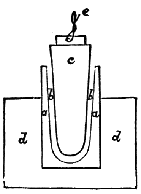
a a. External steel mould.
b b, Clay or composition for forming the crucible.
c, Internal steel mould.
d d, Wooden stand.
e, Cord or chain to withdraw the internal mould or plug.
Small crucibles are sometimes formed by pouring ‘slip,’ that is, clay mixed with sufficient water to give it the consistence of cream, into porous moulds, made of a species of stucco. A series of these moulds are placed upon a table and filled with the semifluid composition. By the time the whole (say 50 or 60) are filled, the ‘slip’ may be poured out of the one first filled, leaving only a very small quantity behind to give the requisite thickness to the bottom. The second and third may then be treated in the same way, until the whole number have been attended to. In each mould a perfect crucible is formed, by the abstraction of the water of that portion of the ‘slip’ in immediate contact with the stucco, and the crucible is either thicker or thinner in proportion to the time this absorbent action has been allowed to go on. 70 or 80 crucibles may thus be easily made in less than 15 minutes. The moulds and their contents are next placed in a stove or slow oven. In a short time, from the contraction of the clay in drying, the crucibles may be removed, and the moulds, as soon as they have become dry, may be again filled; by care they will last for years.
Earthen crucibles are used both in the burnt and unburnt state. Small crucibles are generally kiln-burnt before they are used, but the large Stourbridge clay ‘casting-pots,’ which are extensively employed in brass foundries, are never previously burnt.
The following kinds of earthen crucibles are much used in the arts:—
Crucibles, Cornish. From Teignmouth clay, 1 part; Poole clay, 1 part; sand from St. Agnes’s Beacon, Cornwall, 2 parts. When smaller and less refractory crucibles are needed, the same mixture is employed, with the addition of an eighth part of China clay, or Kaolinite from St. Austell. These crucibles are generally made round, and of two sizes, of which one fits into the other; the larger being 3 inches in diameter at the top, and 31⁄2 inches high outside measure. They are coarse in grain, and of a greyish-white colour, spotted with dark specks. They are always kiln-burnt. Of all crucibles, none are more generally useful for metallurgical experiments.
Crucibles, Hessian. From a mixture of equal weights of Almerode clay and sand. They are generally triangular in shape, so that the melted metal may be conveniently poured out from each corner. They are usually sold in ‘nests’ of six crucibles, fitting one in another. In the character of their body, and in composition and qualities, they closely resemble the Cornish.
Crucibles, London. From a very refractory clay. They have a reddish-brown colour, and are close in grain. They are exceedingly useful in assaying, as they resist the action of fused oxide of lead much better than most clay crucibles. Being very liable to crack, they require to be used with care.
White Fluxing-pots. From a peculiar kind of foreign clay. They are manufactured by the Patent Plumbago Crucible Company, and are much esteemed by metallurgists, being well moulded and very refractory. They have a smooth surface, and withstand the action of fluxes satisfactorily.
Crucibles, Stourbridge-clay. From Stourbridge clay, 4 parts; burnt clay, obtained by pounding and grinding old glass pots, 2 parts; pipe-clay and coke-powder, of each 1 part.
Anstey’s Patent. From Stourbridge clay, 2 parts; hard gas-coke (previously ground and sifted through a sieve of 1⁄8th-inch mesh), 1 part.
Obs. These crucibles of Stourbridge clay are made large enough to hold forty pounds or more of melted brass. They are only dried, and not baked. For use they are warmed, placed on the furnace, bottom upwards, the burning coke gradually heaped round them, and the firing continued until they acquire a fully red heat. They are then quickly taken out of the furnace, and put in again with the mouth upwards. If placed in the furnace with the mouth upwards at first, they are sure to crack. After they have been once used and allowed to become cold they are worthless.
Crucibles, Plat′inum. These are indispensable instruments in the laboratory of the analytical chemist. They are chiefly employed in the ignition of precipitates, and in the fusion of silicates with carbonated alkalies to render them soluble, a preliminary step to their analysis. The most ordinary form of the platinum crucible is that of a cup with a flat bottom. They are always provided with lids, which are sometimes so constructed that they may be used, when separated from the crucibles, as capsules for ignitions and evaporations. Platinum crucibles are not acted on by carbonated alkalies at a high temperature, but they are liable to be seriously damaged by the caustic alkalies. Precipitates of the more reducible metals must never be ignited in these crucibles, as the reduction of the metals would infallibly destroy the vessels.
Crucibles, Gold, are exceedingly useful for many operations, on account of the way which they stand caustic and carbonated alkalies, and nitric acid, which destroy platinum or silver crucibles respectively. Their drawbacks are their great expense and ready fusibility.
Crucibles, Silver. These are much used for fusions of alkalies, being much less acted on than platinum crucibles, and also for water analyses, from their cheapness and light weight. They are easily destroyed, however, by acids.
Crucibles, Plumba′go. Syn. Graphite c., Blacklead c., Blue pots. From graphite, ground and sifted, mixed with sufficient refractory clay to render it plastic. They are shaped by hand on an ordinary potter’s wheel, or by moulds of metal like that figured above under the head of Crucibles, Earthen.
Prop., &c. Good blacklead crucibles, even when of the largest size, support the greatest and most sudden alternations of temperature without cracking, and may be used after repeated heating and cooling. Their surface, within as well as without, may be made very smooth, so that particles of melted metal will not hang about the sides. They are now almost universally used for melting the precious metals.
Crucibles, Por′celain. These beautiful vessels are now made in Germany and France of all shapes and sizes. They are formed of the most exquisitely white, thin, and hard porcelain, which does not crack when heated, and which is but little acted on by the most energetic chemical reagents. For some operations they supersede platinum crucibles, particularly in the ignition of the precipitates of the more reducible metals. They do not retain colouring matter, and are not porous. Their covers are excellently adapted for delicate cases of testing, the whiteness of the porcelain showing the changes of colour in a single drop of liquid most distinctly.
Crucibles, Iron. Used chiefly for preparing common reagents, as sulphide of iron, calcic chloride, &c., and also for preparing pure caustic potassa from the nitrate.
CRUMP′ET. A sort of muffin or tea-cake, very light and spongy. Prep. From flour, 2 lbs., made into a dough with warm milk-and-water, adding a little salt, 3 eggs (well beaten), and 3 teaspoonfuls of yeast, mixed to the consistence of thick batter; after standing before the fire for a short time, to rise, it is poured into buttered tins, and baked slowly to a fine yellow. For the table, crumpets are toasted lightly on both sides, buttered, piled on a hot dish, and cut into halves.
CRUST. The paste with which pies, tarts, &c., are made, or covered.
1. (Fine.) From flour, 1 lb.; sugar, 1⁄4 lb.; melted butter, 1⁄2 lb.; 3 eggs; milk, q. s. Requires little baking.
2. (Raised crust, for meat pies, &c.) As the last, but using 6 oz. of lard for the butter, and 2 instead of 3 eggs.
3. (Short.) From flour, 1 lb.; butter and sugar, of each 2 oz.; eggs, 2 in no.; made into a stiff paste.
Obs. The quality is improved if the whole or a portion of the butter is employed in the way directed under Puff paste. For further information hereon, consult the cookery books of Acton, Beeton, Rundell, and Soyer.
CRY′OLITE (3NaF1AlF3). A native double fluoride of aluminium and sodium, found in large quantities in Greenland, employed in the manufacture of alum, and also as a source of metallic aluminium.
CRYOPH′ORUS. See Refrigeration.
CRYS′TAL. A solid body, having a regular geometrical form. The plane surfaces by which a crystal is bounded are termed faces; these intersect in straight lines or edges; and these again meet in points, and form angles. The axis of a crystal is an imaginary line passing through its centre, and terminating either in the middle of two faces or of two edges, or in two angles; and axes terminating in similar parts of a crystal are named similar axes. When the axes of a crystal are properly chosen, and placed in a right position, the various faces are observed to group themselves in a regular and beautiful manner around these axes, and to be all so related to them as to compose a connected series, produced according to definite laws. The multitudinous forms of crystals have been distributed by mineralogists and chemists into six primary classes or systems, distinguishable from one another by the relative positions and lengths of the three axes about which the planes or faces are arranged; while the different figures of any particular system are distinguishable by the arrangement of the planes in respect to the axes. Thus, the cube or hexahedron, the rhombic dodecahedron, and the octahedron all belong to the regular system, which is characterised by 3 equal axes cutting one another at right angles. But in the cube each plane cuts 1 axis, and is parallel to 2 axes; in the dodecahedron each plane cuts 2 axes, and is parallel to a third; while in the octahedron each plane cuts the 3 axes. The names and definitions of the six crystalline systems are given below:—
1. Regular system.The 3 axes equal and rectangular.
2. Square prismatic s. 2 equal axes.The 3 axes unequal, and rectangular.
3. Right prismatic s. All unequal.
4. Rhombohedral s.The 3 axes equal, but not rectangular.
5. Oblique prismatic s. 1 axis rectangular to 2.The 3 axes not equal, and not rectangular.
6. Doubly o.p.s. None rectangular.
CRYSTALLISATION. The act or process by which crystals are formed. The frequent reference to this subject in the pages of this work, and the constant employment of the process of crystallisation in the manufacture of salts, &c., in the laboratory, seem to point out the necessity of a few explanatory remarks thereon under this head. When fluid substances are suffered to pass with adequate slowness to the solid state, or when solutions of solids are slowly concentrated by evaporation, or the solvent powers of the menstruum, gradually lessened by cooling, the ultimate particles of matter frequently so arrange themselves as to form regular geometrical bodies, familiarly known by the name of crystals. This wonderful property, which is possessed by a great variety of substances in the mineral kingdom, and by nearly all saline bodies, is resorted to for many useful and important purposes in the chemical arts. It is by means of crystallisation that the majority of salts are obtained in a state of purity; for in the act of passing into the crystalline state, the foreign substances with which they are united are left behind in the mother-liquor.
Salts are crystallised, either by allowing their hot and saturated solutions to cool slowly, or by simply evaporating the menstrua as long as crystals form. In the first case the liquid is commonly evaporated until a pellicle appears on the surface, when the vessel is set aside in some sheltered situation until cold, at which time the crystals are collected, and the process repeated for fresh crystals. In the second case the crystals are usually removed from the liquid as soon as they are deposited. The first method is adopted for those salts that are considerably more soluble in hot than in cold water, as carbonate of soda, Epsom salts, &c.; the last method, for those that possess nearly equal solubility in both cases, and also for many salts which are not required in handsome crystals; thus common salt and chromate of potash are crystallised in this way. Many of the alkaloids, and their salts, are obtained in crystals, by allowing their solutions (generally alcoholic or ethereal) to evaporate spontaneously. By repeating the processes of solution and crystallisation two or three times with the same body, the crystals obtained by the last operation will usually be found to be quite pure.
Many solids may be readily obtained in a crystalline state by melting them and allowing them to cool very slowly. Thus, iodide of sulphur is crystallised by melting it in a flask placed in a salt-water bath, and allowing it to remain in the water until the whole becomes cold. Sulphur and many metals are crystallised by pouring them, in a state of fusion, into a hot vessel having a plug in the bottom, which is withdrawn as soon as the surface becomes cool, when the liquid portion runs out, and leaves the under surface in the form of a mass of agglomerated crystals. Perfectly pure wax, stearine, and spermaceti have a very pleasing appearance when treated in this way.
CRYS′TALLOID. See Dialysis.
CU′BEBIN. A peculiar substance obtained from cubebs.
Prep. From cubebs (from which the oil has been expelled by distillation), by digestion in alcohol, evaporating the resulting tincture to one fourth, filtering, and then evaporating the remaining fluid almost to dryness. The residuum is left in a cold place until it assumes a semi-crystalline appearance, when it is thrown on a filter, and the fluid portion (the ‘cubebine’ of M. Cassola) allowed to drain off. In 24 hours the substance left on the filter is dissolved in 4 times its weight of boiling alcohol (sp. gr. ·90), the solution allowed to deposit its undissolved resin (still maintaining it near the boiling temperature), after which the clear portion is decanted. The crystals deposited as the liquid cools are cubebin. It is purified by redissolving it in boiling concentrated alcohol, and the addition of a little boiling water and animal charcoal, when long, white needles will be deposited if the solution is allowed to cool very slowly.
Prop., &c. It is insoluble in water, and nearly so in cold alcohol, but very soluble in boiling alcohol. It strikes a fine crimson colour with sulphuric acid, which remains unaltered for some hours; a property which distinguishes it from piperin. Its physiological action has been but little studied. According to Dr Görres, this for the most part resembles that of cubebs.
CU′BEBS. Syn. Cubeb pepper; Cubeba (B. P. & U. S.), Cubebæ (B. P.), L. The immature and stalked fruit of Piper cubeba or Cubeba officinalis. Cubebs are stimulant, stomachic, and aromatic, like the other peppers; they are also diuretic, and appear to possess a specific influence over the urino-genital organs.—Dose, 10 to 20 gr., in affections of the bladder and prostate gland, and in gleet and leucorrhœa; 1 to 3 dr., in the early and inflammatory stages of gonorrhœa, in piles, &c. They may be taken in water, milk, or bitter ale.
CU′CUMBER. The fruit of the Cucumis sativus (Linn.). Used as a salad vegetable. It is somewhat indigestible, but when properly dressed, with plenty of oil, it may be eaten without the slightest fear of evil consequences. The practice of pouring off the natural juice extracted from the cucumber by salt cannot be too strongly condemned. See Elaterium.
CUD′BEAR. Syn. Persio. A dye-stuff obtained from Lecanora tartarea and other lichens, by a process nearly similar to that used in making ARCHIL. The lichen is watered with stale urine or other ammoniacal liquor, and suffered to ferment for 3 or 4 weeks, after which the whole is poured into a flat vessel, and exposed to the air until the urinous smell has disappeared, and it has assumed a violet colour. It is then ground to powder. Its use is confined to a few cases of silk dyeing, where it is employed to yield shades of ruby and maroon; upon wool it gives deep-red shades. The colours produced by it are very fugitive. Like archil, there are two varieties of this dye-stuff—BLUE CUDBEAR and RED CUDBEAR. See Archil.
CULM. In mineralogy, a slaty kind of ANTHRACITE, occurring in Wales and North Devon. The term is also applied to any impure, shaly kind of coal.
CU′MARIN. See Coumarin.
CU′MIN. Syn. Cymini semina, Cyminum, L. The fruit (seed) of Cuminum cyminum. It is carminative and aromatic, like the caraway and anise. See Plaster.
CU′MINOL. A colourless, transparent oil, of powerful odour. It exists with CYMOL in OIL of CUMIN. See Cymol.
CU′PELLATION. The process of assaying gold and silver and their alloys by means of the CUPEL. See Assaying.
CUP′PING. This method of topical bleeding is performed as follows:—
The skin being softened by means of a sponge and warm water, and the hair and other extraneous substances being previously removed, one of the small bell-like glasses (CUPPING-GLASSES; CUCURBITU′LÆ), having the air contained in it rarefied by being passed over the flame of a spirit-lamp, is immediately applied to the part. From the formation of a partial vacuum beneath the cup, the pressure of the air on the surrounding surface causes that portion immediately under the cup to swell, and the vessels to become turgid. When this has taken place the cup is removed, and several incisions are instantly made by means of a scarificator, an instrument containing numerous lancets, which, by means of a spring, make a number of incisions at the same moment; the depth of these incisions being regulated by means of a screw which protrudes or withdraws the lancets, according to the vascularity of the part, or the quantity of blood to be abstracted. The cupping glass is now again applied. When a sufficient quantity of blood has been collected in the cup, it is removed by gently introducing the nail of one of the fingers under the upper edge, by which means, air being allowed to enter, the cup becomes detached. The part being washed with warm water to remove any clots of blood, another cup is applied as before, and the operation continued until a sufficient quantity of blood is withdrawn. Sometimes, especially when applied to the scalp, the cups fill so rapidly with blood as to become detached almost immediately on being applied. This method of local bleeding is frequently called ‘CUPPING WITH SCARIFICATIONS,’
When cupping-glasses are applied without the use of the lancet or scarificator, the operation is called ‘DRY CUPPING,’ and is much used to cause a speedy irritation of the skin and reaction, for the relief of oppressive breathing, local pains, &c. To obtain the full benefit from this operation, the cups should be suffered to remain upon the part until they cause an exudation of a small quantity of serum, or a considerable amount of irritation of the part. Dry cupping has been found extremely beneficial in poisoned wounds; as it acts not only by abstracting the poison, but also, by the pressure the glasses exercise on and around the part, in preventing the absorption of it.
Obs. For the operation of cupping, a basin of hot water, sponges, and clean, soft towels, should be provided. In clumsy hands, cupping is occasionally a severe and painful operation; but this is not the case with the skilful operator. A good cupper does not exhaust much of the air in the cup before applying it, but simply passes its mouth rapidly over the flame of the lamp. When it is held over the flame even for a few seconds, the compression of the edge of the cup upon the skin is so great, that it checks the flow of the blood to the scarified part. A good cupper also removes the cup without spilling the contents, and completes the whole operation quickly and neatly. There are, however, few persons, who are not professional cuppers, who are sufficiently expert to exhaust the air in the cup by means of the common lamp; although it is by far the best. A good plan is to rarify the air in the cup by means of a small cone of paper, dipped in spirits of wine, or strong brandy; this is ignited and thrown in the cup, which is instantly to be applied to the proper spot. Where cupping-glasses and the scarificator are not to be had, wine-glasses, or any very small tumblers, may be substituted for the first; and small incisions by means of a thumb lancet will answer the purpose of the other.
The cicatrices of the scarification leave permanent marks on the skin; on which account, when blood is to be drawn from the head or neck, the glasses should be applied behind the ears, and a portion of hair removed in such a manner that the part may be covered by what remains.
A most convenient cupping apparatus is manufactured by Mr Bigg, the eminent surgical instrument maker of Leicester Square, consisting of cups and an exhausting syringe, so arranged that the use of the spirit-lamp is rendered unnecessary, and the operation of cupping may be performed nearly as expertly by an inexperienced nurse as by the most accomplished professional operator. It is invaluable in places remote from town.
CURAR′INE. Syn. Curaria. The vegeto-alkaline base of curara, urari, woorara, woorali, or wourali, the arrow-poison of Central America.
In physiological effects curarine is antagonistic to strychnia, a fact which has led to its being proposed as an antidote for the latter poison. Curarine is also said to have been employed in Germany in the treatment of hydrophobia with such success that the patient to whom it was administered recovered. It is a most potent poison, and should not be allowed to come into contact with the fingers.
CURB. In horses. An enlargement at the back of a horse’s hock caused by injuring a ligament in this region. See Sprain.
CURCU′MIN. The yellow colouring matter of turmeric, obtained by digesting the alcoholic extract of the powder in ether, and evaporating the clear ethereal solution to dryness. A brownish-yellow mass, yielding a bright-yellow powder. It is scarcely soluble in water, but very soluble in both alcohol and ether. Boracic and hydrochloric acids redden it; alkalies turn it reddish brown.
CURD. Coagulated casein. See Cheese.
CUR′RANTS. The currants of our garden are varieties of the Ribes rubrum and Ribes nigrum. (Linn.) The first includes RED CURRANTS and WHITE CURRANTS; the fruit of both of which are gently acidulous, cooling, and wholesome. The juice makes excellent wine. The fruit of the last (BLACK CURRANTS, QUINSY-BERRIES) is aperitive, and has been used in calculous affections; the juice is made into wine, jellies, jams, lozenges, &c. The young leaves are used as a substitute for tea; one or two buds, or half a small leaf, impart to black tea the flavour and fragrance of green. The currants of the grocers (Zante currants) are a small variety of dried grapes. The word “currant” is a corruption of Corinth, whence the fruit originally came.
CUR′RY. Syn. Currie. A noted dish in Indian cookery, much esteemed throughout the East. Curries are simply stews, of which rice usually forms a characteristic ingredient, highly flavoured with fried onions and curry powder, to which sliced apples and lemon juice are sometimes added. They are made from every variety of fish, meat, poultry, game, &c., according to the fancy of the parties.
To make a Dish of Curry.—Cut an onion into slices and fry it with an apple, finely chopped, in two ounces of dripping; then add slices of cold meat; mix a dessert-spoonful of curry powder and one of flour in half a pint of water; pour it over the meat, and shake the whole over the fire till it boils.
Cur′ry Powder. Prep. (Kitchener.) From coriander-seed, 1⁄4 lb.; turmeric, 1⁄4 lb.; cinnamon-seed, 2 oz.; cayenne, 1⁄2 oz.; mustard, 1 oz.; ground ginger, 1 oz.; allspice, 1⁄2 oz.; fenugreek-seed, 2 oz.; all dried thoroughly, pounded in a mortar, rubbed through a sieve, and mixed together.
The famous Ceylon curry powder is said by Dr Balfour to have the following rather indefinite composition:—A piece of green ginger, two fragments of garlic, a few coriander and cumin seeds, six small onions, one dry Chili, eight peppercorns, a small piece of turmeric, half a dessert-spoonful of butter, half a cocoa-nut, and half a lime. For it to be in perfection the powder should be made the day on which it is cooked.
Obs. The above must be regarded as merely a substitute for Indian curry powder, which contains many ingredients not to be obtained in England. It should be kept in a bottle closely corked or stoppered. The curry powder sold at the present time consists of coriander-seed, turmeric, cayenne, fenugreek-seed, and a large proportion of sago-flour.
CUS′CONINE. See Aricine.
CUSPA′′RIA. Syn. Cusparia bark (B. P.), Angostu′′ra b.; Cor′tex angostu′′ræ, C. cuspa′′riæ, Cusparia (Ph. L. and E.), L. “The bark of Galipea cusparia” (Ph. L.), or Galipea officinalis (Ph. E.). A valuable drug, imported directly or indirectly from South America.—Dose, 10 gr. to 30 gr., as a tonic, stomachic, and febrifuge, in similar cases to those in which Cascarilla, Calumba, and Cinchona, are commonly given.
Characters.False Angostura.True Angostura.
FormThick, rugous, rolled upon itself. Edges cut perpendicularly.Flat or rolled up, little wrinkled, edges bevelled.
ColourBrown, or greenish-yellow, presenting protuberances or excrescences, produced by the great development of the corky layer, which has a still more yellow colour.Greyish-yellow.
TasteVery bitter.Bitter.
Reaction with Nitric Acid.Red colour when dropped upon the bark.Yellow colour.
Angostura or cusparia bark has fallen into comparative disuse, in consequence of nux vomica or false angostura bark having formerly, in several instances, been mistaken for it, and administered with fatal results. The leading characteristics of these two barks have been pointed out by M. Gibourt. (See previous table.)
CUSPAR′IN. Syn. Angostu′′rin, Angostu′′ra. The bitter principle of Cusparia-bark. It is neutral; crystallises in tetrahedrons; is easily fusible; soluble in rectified spirits, in acids, and in alkaline solutions. It is precipitated of a whitish colour by tincture of galls.
CUS′TARD. A composition of milk, or cream, and eggs, sweetened with sugar, and variously flavoured. Custards may be cooked either in the oven or stew-pan.
Prep. 1. (Soyer.) Milk (boiling), 1 pint; sugar, 2 oz.; thin yellow peel of half a lemon; mix, and set it aside for a short time; then take eggs, 4 in no., beat them well in a basin; add, gradually, the milk (not too hot), pass the mixture through a colander or sieve, and fill the custard cups with it; these are then to be placed over the fire in a stew-pan, containing about one inch of hot water, and left there for 12 minutes, or till sufficiently set. The above is for PLAIN CUSTARDS; but it forms a good basis to receive any of the usual flavouring ingredients, as fresh or stewed fruit, peels, essences, orange-flower water, brandy, or other spirits, &c.
2. (Rundell.) As the last, but using cream instead of milk, or equal parts of the two, with 2 additional eggs. Very rich; like the last, any suitable flavouring matter may be added to it.
3. (Almond Custards,—Rundell.) As either of the above, adding blanched sweet almonds, 4 oz.; bitter do., 6 in no.; beaten to a smooth paste.
4. (Baked Custards,—Rundell.) From cream, 1 pint, with 4 eggs; flavoured with mace, nutmeg, and cinnamon, and add a little white wine, rose-water, and sugar; bake in cups.
5. (Coffee Custards,—Soyer.) Hot milk and strong-made coffee, of each 1⁄2 pint; sugar, 2 oz.; dissolve, and add it, gradually, to 4 eggs (well beaten), and proceed as in No. 1. Chocolate custards and cocoa custards are made in the same way.
6. (Cold Custard, for invalids,—Dewees.) 1 egg; sugar, a tablespoonful; beat well together; and add, gradually, constantly stirring, cold water, 1⁄2 pint; rose water, 2 teaspoonfuls; and a little grated nutmeg. An agreeable and nutritious demulcent. A wine-glassful every 2 or 3 hours, or ad libitum.
7. (Lemon Custards,—Rundell.)—a. As No. 1 (nearly), using a little more lemon peel. In the same way orange custards are made, but using orange peel.
b. From candied lemon peel and lump sugar, of each 2 oz., beaten in a mortar quite fine, and added to either No. 1 or No. 2. Orange and citron custards may be made in the same manner. A little orange-flower water, or marsala, or sherry, may be also added at pleasure. They are best baked.
8. (Orange Custards.) As above, No. 7, a and b.
9. (Rice Custards,—Rundell.) Boil 1⁄2 a cupful of the best ground rice in a pint of milk until dissolved, then mix it with a quart of cream; flavour with nutmeg, mace, and a little brandy, and put it into a cup or a dish.
CUTCH. See Catechu.
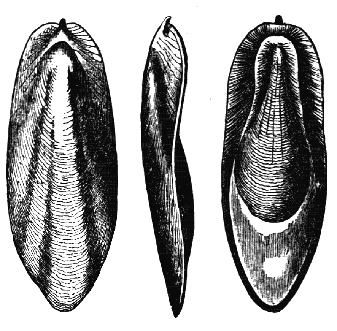
CUTTLE-FISH. The bone or skeleton of the Sepia officinalis of Linnæus, or common cuttle-fish (CUTTLE-FISH BONE; OS SE′PIÆ), is used by the law-stationers to erase ink-marks from paper and parchment, an application familiar to most schoolboys of the present generation. Reduced to powder (PUL′VIS SE′PIÆ), it forms a valuable dentifrice and polishing powder, and is used for forming the moulds for small silver castings.
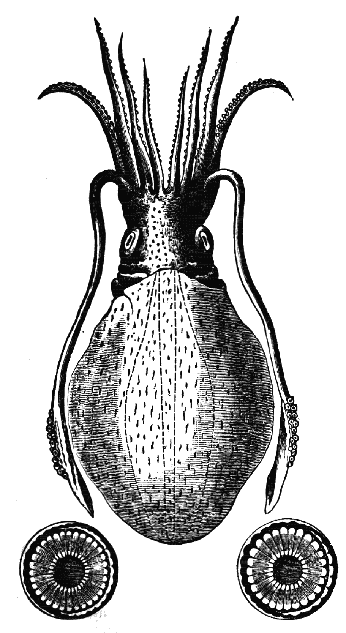
The Sepias, which inhabit the seas of all quarters of the globe, like the other cephalapoda, are carnivorous. They are able to exercise considerable locomotive powers, by means of their tentaculæ or arms which surround the mouth, and which are usually provided with numerous suckers. Head downward, they walk on these arms at the bottom of the ocean. The sepias are also fleet swimmers; effecting their progress through the water either by making the expansion of their skin perform the same office as fins; or by the forcible projection of water from the cavity of their mouths, the reaction accompanying which operation drives them rapidly through the water in a different direction. They are provided sometimes with eight, and sometimes with ten tentaculæ, and have naked bodies. The black fluid which the animal is capable of ejecting from its ink-sac, when pursued by its enemies, was formerly employed in the manufacture of the pigment called from its source “sepia.”
CUTS. These are incised wounds of greater or less extent, and must be treated accordingly. The divided parts should be drawn close together, and held so with small pieces of strapping or adhesive plaster stretched across the wound. If the part is covered with blood, it should be first wiped with a damp sponge. When the wound is large and it is much exposed, a good method is to sew the parts up. The application of a little creasote or a spirituous solution of creasote will generally stop local bleeding, provided it is applied to the clean extremities of the wounded vessels. A good way is to place a piece of lint, moistened with creasote, on the wound, previously wiped clean, or to pour a drop or two of that liquid on it. An excellent method is to cover the part with a film of collodion. Friar’s balsam, quick-drying copal varnish, tincture of galls, copperas water, black ink, &c., are popular remedies applied in the same way. A bit of the fur plucked from a black beaver hat is an excellent remedy to stop the bleeding from a cut produced by the razor in shaving. A cobweb is said to possess the same property.
CY′ANATE. Syn. Cy′anas, L. A salt in which the hydrogen of cyanic acid is replaced by a metal or other basic radical.
CYAN′IC ACID. HCNO. Syn. Acidum cyan′icum, L. Prep. 1. Cyanuric acid, deprived of its water of crystallisation, is distilled in a retort, and the product collected in a well-cooled receiver.
2. (Liebig.) A current of sulphuretted hydrogen gas is passed through water in which cyanate of silver is diffused, the process being suspended before all the cyanate of silver is decomposed.
Prop., &c. Cyanic acid is a limpid, colourless liquid; it reddens litmus; is sour to the taste; possesses a modified sulphurous odour, similar to that which is always perceived when any of its salts are decomposed by an acid; it forms salt with the bases called CYANATES; when in contact with water it suffers decomposition in a few hours, and is converted into bicarbonate of ammonia; it cannot be preserved for any time, as shortly after its preparation it spontaneously passes into a white, opaque, solid mass, to which the name CYAMELIDE has been given. By distillation this new substance is reconverted into cyanic acid.
CY′ANIDE. Syn. Cyan′uret; Cyan′idum, Cyanure′tum, L. The compound formed by the union of cyanogen with a metal or other radical. See Cyanogen, Hydrocyanic Acid, and the respective bases.
Cyanide, Al′kaline. Syn. Crude cyanide of potassium and sodium. Prep. (R. Wagner.) Dry ferrocyanide of potassium, 4 parts, dry carbonate of soda, 1 part, are melted together in an iron crucible at a red heat, and continually stirred until the iron rod comes out covered with a white crust, when the heat is withdrawn, and after a few moments’ repose the supernatant liquid portion is poured out on a clean iron slab. This crude mixed cyanide is quite as useful as the more expensive one of Liebig, and is equally fit for technical applications, as electrotyping, gilding, silvering, &c. See Potassium, Cyanide of.
CY′ANINE. A base discovered by Mr G. Williams in CHINOLINE BLUE. See below.
Cyanine, I′odide of. Syn. Chin′oline blue. The action of iodide of amyl upon chinoline gives rise to iodide of amylchinoline. Addition of excess of soda to an aqueous solution of this iodide produces a black resinous precipitate, which dissolves in alcohol with a magnificent blue colour. This precipitate is the IODIDE OF CYANINE, or CHINOLINE BLUE. Many attempts have been made to use it in dyeing; they have, however, failed on account of the instability of the colour.
CYAN′OGEN. CN or Cy. A highly important compound radical or quasi element, discovered by M. Gay Lussac in 1815.
Best obtained by carefully igniting dry cyanide of mercury in a small retort, and collecting the gas over mercury.
Prop., &c. A colourless gas, possessing a pungent and peculiar odour, resembling that of peach-kernels or prussic acid; under a pressure of about 4 atmospheres, at a temperature of 45°, it assumes the liquid form (Faraday), and this fluid again becomes gaseous on withdrawal of the pressure; water absorbs nearly 5 times its bulk of cyanogen at 60° Fahr., and alcohol about 23 times its volume; with hydrogen it forms hydrocyanic acid, and with the metals a most interesting and important class of bodies called cyanides or cyanurets; when kindled, it burns with a beautiful purple flame, carbonic acid and nitrogen being evolved. Sp gr. 1·806. See Hydrocyanic acid, &c.
Forms a bromide and iodide when the cyanide of mercury is distilled with bromine or iodine, and which are colourless, volatile, highly poisonous solids; and two isomeric chlorides, one a very volatile liquid, prepared by passing chlorine over moist cyanide of mercury, and the other in white volatile needles, prepared by exposing aqueous hydrocyanic acid to chlorine in sunshine.
CYANU′′RIC ACID. H3C3N3O3. Syn. Pyro-u′′ric acid†. A peculiar acid, discovered by Scheele. It is a product of the decomposition of the soluble cyanates by dilute acids, or of urea by heat, &c.
CY′DER. See Cider.
CY′DONINE. The peculiar gum of quince seed. It resembles bassorin in most of its properties.
CY′MIDINE. An oily base, homologous with aniline, obtained by the action of iron filings and acetic acid on nitro-cymol.
CY′MOL. A peculiar hydrocarbon found in oil of cumin, in admixture with cuminol. The two bodies are separable in a great measure by distillation, cymol being the most volatile portion of the oil.
CYNAPINE. An alkaloid obtained from Æthusa cynapium, or fool’s parsley. It possesses no practical interest.
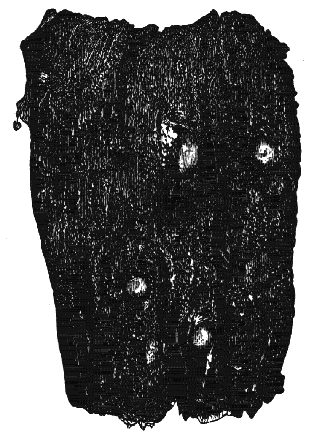
CYSTICERCI. These parasites are embryo tænia or tapeworm, infesting the bodies of men and different animals. One variety of the cysticerci has its habitat in the organisms of men, pigs, oxen, horses, camels, sheep, and roe-deer; another in the muscles and internal organs of cattle; a third is found in cattle, sheep, horses, the reindeer, squirrels, certain kinds of monkeys, and occasionally in man; whilst a fourth—the Cystercus cellulosæ—is more especially met with in measly pork. Professor Gamgee believes that probably 5 per cent. of the pigs in Ireland are affected with this last cystercus.
The following figure represents a piece of measly pork infested with cysticerci. Professor Leuckart seems to have shown pretty conclusively that man may become infested with a certain form of tapeworm by partaking of imperfectly cooked veal or beef, infested with the second variety of the parasite.
CYST′INE. C3NH7SO2. Syn. Cyst′ic oxide. Obtained from cystic oxide calculi (in powder) by digestion in solution of ammonia. By spontaneous evaporation the ammoniacal solution deposits small, colourless crystals of cystic oxide. It forms a saline compound with hydrochloric acid, and is decomposed by the strong alkalies.
CY′TISINE. A purgative bitter principle, extracted from the Cytisus Laburnum (Linn.), or common laburnum, and some other plants.
DAGUERRE′OTYPE. See Photography.
DA′′HLIA DYE (dāle′-y′ă). The shade of colour which is commonly termed ‘dahlia’ is a reddish lilac. It is produced by combining a blue or purple with red when a compound colour is used. Upon wool and silk it can be obtained directly by means of archil or cudbear, either alone or ‘blued’ by a small quantity of sulphate of indigo. Upon cotton indifferent shades of dahlia are obtained by macerating in sumac liquor, working in tin solution, and dyeing in logwood mixed with some red wood.
DA′′HLINE. A species of fecula obtained from the tubers of the dahlia. It is identical with inuline. It is not employed in the arts.
DAIR′Y. The place where milk is kept, and cheese and butter made. The best situation for a dairy is on the north side of the dwelling-house, in order that it may be sheltered from the sun during the heat of the day. Ample means should be provided to ensure ventilation, and at the same time to exclude flies and other insects. The temperature should be preserved, as much as possible, in an equable state, ranging from 45° to 55° Fahr. To lessen the influence of external variations of temperature, the walls should be double, or of considerable thickness, and the windows provided with shutters or doors. In summer the beat may be lessened by sprinkling water on the floor, which will produce considerable cold by its evaporation. Dairies built of mud or ‘cob’ are preferred in the West of England; and this preference arises from the uniform temperature they maintain, on account of the great thickness of the walls, and their being very bad conductors of heat. In large dairy-farms, where butter and cheese are made, the dairy is generally a separate building, and divided into 3 or 4 apartments; one of which is called the ‘milk-room,’ a second the ‘churning-room,’ a third the ‘cheese-room,’ containing the cheese-press, &c.; and a fourth the ‘drying-room,’ where the cheeses are placed to dry and harden. To these may be added a scullery, furnished with boiler, water, &c., for scalding and cleaning the dairy utensils.
Cleanliness is very essential in all the operations of the dairy, and in none more so than in the milking of the cows. The hands and arms of the milkmaid should be kept scrupulously clean, and should be well washed with soap and water after touching the udder of a sick cow, as without this precaution the sores may be conveyed to the healthy ones. The milk-cans should be scalded out daily, and, as well as all the other dairy utensils, should be kept clean and dry. Before placing the milk on the shelves of the dairy it should be strained through a hair sieve or a searce covered with clean cheese-cloth, as by this precaution any stray hairs that may have fallen into the milk-pail will be taken out.
The average produce of a milch cow, supplied with good pasturage, is about 3 gallons daily from Lady-day to Michaelmas, and from that time to February about 1 gallon daily. Cows of good breed will be profitable milkers, to 14 or 15 years of age, if well fed. See Butter, Cheese, Cream, &c.
D’ALBESPYRE’S BLISTERING TISSUE. Lard and ship’s pitch, of each 1 part; resina flav. and yellow wax, of each, 4 parts; finely powdered cantharides, 6 parts; melted together, and spread over taffety.
DAMAS′CUS BLADES. See Steel.
DAMENPULVER—Ladies’ Powder (J. Pohlmann, Vienna). A face powder composed of 14 parts white lead, 7 of talc, 1 of magnesia, coloured with carmine and perfumed with volatile oil.
DAMMAR. A resin employed in mounting many microscopic objects; such as teeth, hair, hard bone, and most tissues which have been previously hardened by treatment with alcohol and chromic acid. Dammar is prepared for use as follows:—
a. Gum dammar, 1⁄2 oz.; oil turpentine, 1 oz.; dissolve and filter.
b. Gum mastic, 1⁄2 oz.; chloroform, 2 oz.; dissolve and filter. Add solution a to solution b. (Dr Klein.)
If allowed to become thick by drying, dammar may be used as luting.
DAMP, under any form, should be avoided. A humid atmosphere or situation is one of the commonest causes of agues, asthmas, rheumatism, and numerous other diseases.
Damp Linen is very injurious, and should be especially avoided. In travelling, when it is expected that the bed has not been properly aired, a good plan is to sleep between the blankets. To ascertain this point the bed may be warmed, and a cold, dry, glass tumbler immediately afterwards introduced between the sheets, in an inverted position. After it has remained a few seconds, it should be examined, when, if it is found dry, and undimmed by steam, it may be fairly presumed that the bed is well aired; but if the reverse should be the case, it should be avoided. When it is impossible to prevent the use of damp linen, as articles of dress, the best way to obviate any ill effects is to keep constantly in motion and avoid remaining near the fire, or in a warm apartment, or in a draught of cold air until sufficient time has elapsed to allow of the escape of the moisture. The effect of evaporation is the reduction of the temperature of the body; hence the depressing action of damp linen.
Damp Walls. Ivy planted against the sound wall of a house is said to exclude dampness. If a wall is already damp, ivy planted against it will, when grown up, cause it to become dry, provided the brickwork is sound and the dampness does not arise from moisture attracted upwards from the foundation. Sometimes, when ivy is propagated from flowering branches, it will not adhere to a wall at all; the way to get over this difficulty is to cut it back to near the surface of the ground. The young wood which will then form will take hold and cling immediately to almost anything.
The following is said to be a good application for damp walls:—Dissolve 3⁄4 lb. of mottled soap in 1 gallon of water. This composition is to be laid over the brickwork steadily and carefully with a large thick brush, but not in such a manner as to form a froth or lather on the surface. It must be allowed 24 hours to dry on the walls. Now mix 1⁄2 lb. alum with 4 gallons of water; let it stand 24 hours, and then apply it over the coating of soap. The operation must be performed in dry weather.
DAM′SON. A species of small black plum, much used in the preparation of tarts, &c. Damsons are rather apt to disagree with delicate stomachs, and also to affect the bowels. See Plum.
DAN′CING. The practice of dancing as an amusement or exercise must be almost as old as the human race itself. Yet, notwithstanding its antiquity and prevalence amongst all nations, both barbarous and refined, the propriety and advantages of its cultivation are of a very questionable character. In a hygienic point of view it can claim no preference, as an exercise, over the more simple ones of walking and running; whilst, from the associations it frequently induces, and the heated and confined atmosphere in which its votaries commonly assemble to indulge in it, it becomes the fertile parent of immorality and consumption. A celebrated cyclopædist has, perhaps harshly, but truthfully, defined dancing to be “a silly amusement for the idle and thoughtless.”
DANDELI′ON. Syn. Piss-a-bed; Tarax′acum (Ph. L. E. & D.), L. A common British plant of the natural order Compositæ. It is known among botanists by the names Taraxacum officinale, T. dens leonis, and Leontodon Taraxacum (Linn.). Its root (Taraxaci Radix, B. P.) is employed in medicine, being diuretic and tonic. It is roasted and used as coffee, and when mixed with an equal weight of foreign coffee constitutes the article once so much puffed under the name of ‘dandelion coffee.’ A similar mixture prepared with chocolate forms the ‘dandelion chocolate’ of the shops. The blanched leaves are used in salads, and the inspissated juice, extract, and decoction are employed in medicine, and are considered as detergent, aperitive, and deobstruent. Ground roasted dandelion root cannot now be sold under the name of ‘dandelion coffee’ or mixed with coffee unless it has previously paid the chicory duty. See Decoction, Extract, &c.
DANDRIFF. This is a scaly disease affecting the head, and giving rise to the formation of the small troublesome particles known as scurf. A serviceable application is two drachms of borax dissolved in a pint of camphor water; the head to be washed with this lotion once or twice a week, or much benefit may also be derived by washing the head with tepid water, agitated with a piece of quillar bark until a strong lather is produced; or with water containing salt of tartar, in the proportion of two drachms of the salt to a pint of tepid water. As a general rule, the use of soap is to be discountenanced.
DAN′IELL’S BATTERY. See Voltaic Electricity.
DAPH′NIN. A peculiar bitter principle, discovered by Vauquelin in the Daphne mezereum or mezereon. It is procured by separating the resin from the alcoholic tincture of the bark by evaporation; afterwards, diluting the residue with water, filtering, and adding acetate of lead. A yellow substance falls down, which, when decomposed by sulphuretted hydrogen, yields daphnin, under the form of small, colourless, transparent, radiated needles. It is bitter; volatile; sparingly soluble in cold water; freely soluble in hot water, and in alcohol and ether. It possesses basic properties. See Mezereon.
DARNEL. The powder of the seed of the Lolium temulentum, a poisonous grass, is not unfrequently found mixed with the flour of wheat, oats, and other cereals, and when these latter, under these circumstances, are partaken of as food, they give rise to more or less alarming symptoms of poisoning, which are thus enumerated by Dr Pareira:—Headache, giddiness, languor, ringing in the ears, confusion of sight, dilated pupil, delirium, heaviness, somnolency, trembling convulsions, paralysis, and great gastro-intestinal irritation. One of the most specific signs of poisoning by darnel seeds is said by Seeger to be the trembling of the whole body. Dr Taylor mentions a case in which thirty persons who had partaken of bread containing darnel seeds were violently attacked with the above symptoms; and another case is on record of sixty persons in a prison at Cologne being similarly attacked from the same cause. Hassall states that the flour of the darnel seed presents the following appearance under the microscope:—“The starch corpuscles are polygonal, and resemble in this respect those of rice. They are, however, much smaller, and frequently united into compound grains of various sizes, the larger grains consisting of some fifty or sixty starch corpuscles.” The structure of the testa is very different from that of either rice or oat, or indeed any of the other cereal grains. It is formed of three coats or membranes. The cells of the outer coat form but a single layer, and, contrary to the arrangement which exists in the oat, their long axes are disposed transversely, in which respect they resemble rice. The fibres of the husk of rice and the cells of the testa of Lolium are, however, very distinct in other respects. In the former the cells are long and narrow, forming fibres, while in the latter they are but two or three times as broad.
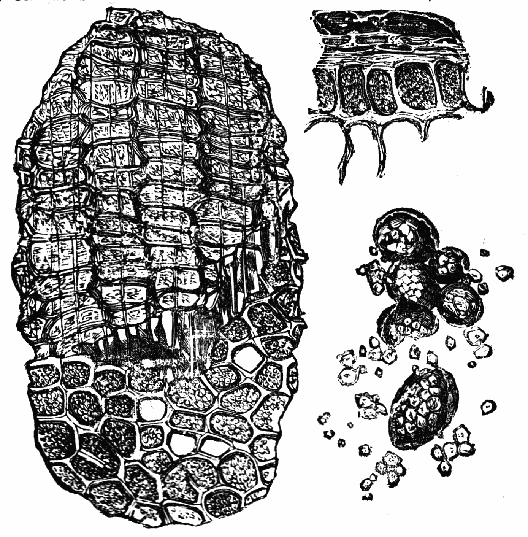
The cells of the second coat, which are ranged in two layers, follow a vertical disposition, an arrangement which is contrary to that which obtains in all the other cereal grains with the exception of rice. The cells of the third coat form but a single layer, and resemble those of other grains.
DATU′RA. Syn. Thorn-apple; Stramo′nium (Ph. L. E. & D.), L. A genus of plants belonging to the nightshade order, or ‘Atropaceæ,’ The species Datura Stramonium is an important medicinal plant, the leaves and seeds being officinal in B. P. It is anodyne and sedative, but not hypnotic, though it will often induce sleep by relieving pain. It affects the constitution in much the same way as belladonna.—Dose, 1 to 4 or 5 gr., in asthma, gout, headache, neuralgic and rheumatic pains, &c. In spasmodic asthma smoking the leaf often gives instantaneous relief, but must be exhibited with care, as the whole plant is intensely poisonous. No antidote is known. Another species, namely, Datura tatula, is now preferred for cigars or cigarettes. Cigars are made from Datura Stramonium more frequently than from Datura tatula. They are recommended for asthma. See Asthma, Cigars (Stramonium), Daturia (below).
DATU′RIA. Syn. Datu′rine, Daturin′a, Hyoscy′amine. An organic alkali, discovered by Geiger and Hesse in Datura Stramonium or thorn apple. It occurs also in Hyoscyamus niger or henbane. It is best obtained from the seeds. Daturia dissolves in 280 parts of cold and 72 parts of boiling water; it is very soluble in alcohol, less so in ether. It tastes bitter, dilates the pupil strongly, and is very poisonous. It may be sublimed unaltered, and may be obtained in prismatic crystals by the addition of water to its alcoholic solution. With the acids it forms salts, which are mostly crystallisable.
DAVIDS-THEE—David’s Tea (B. Fragner, Prague). Recommended as a domestic remedy for chronic catarrh of the lungs and air passages, and especially for tuberculosis. A mixture of equal parts of great centaury, hyssop, chervil (Scandix odorata), white horehound, milfoil, Iceland moss, and carduus benedictus.
Davids-Thee, Echter Karolinenthaler—Genuine Karolin’s Dale David’s Tea (Kràl). Recommended for the same diseases as the preceding. A mixture of white horehound, milfoil, Iceland moss, great centaury, and ground ivy. According to a communication from a Bohemian apothecary the original prescription reads thus:—Herba cerefolii (Scandicis, chervil), hb. centaurii minoris (lesser centaury), hb. marrub. (horehound), flor. millefol. (milfoil flowers), lichen. Isl., of each 6 parts; hb. hyssopi, 3 parts; hb. cardui benedicti, 2 parts. (A. Selle.)
DEAD, DISPOSAL OF. As every dead body during the process of the decomposition it undergoes gives rise to products that are not only in the highest degree offensive, but in an especial sense dangerous to the health and lives of a community, the disposal of the dead in a manner best calculated to ensure, with the removal of the corpse from amongst the survivors, the least injurious consequences of its subsequent decay, becomes a problem of supreme importance to the sanitarian.
Probably amongst the nations of antiquity the Romans, with their eminently practical minds, and as we may infer from their other enlightened sanitary arrangements, were the only ancient people who were not guided either by superstitious or religious ideas in the disposal of their dead, at one time burned, but afterwards buried them. The Greeks practised cremation, the Egyptians embalmment (previously disembowelling the body), under the belief that after the lapse of many thousands of years the soul would return to its earthly mansion. The Hebrews sometimes burned their dead, and sometimes interred them. Amongst the ancient Hindoos the body was got rid of sometimes by cremation, sometimes by being cast into the Ganges, or other sacred river, and sometimes by exposure, until eaten by vultures. The Icthyophagi, or fish-eaters, appear to be the only people of antiquity who disposed of their dead by throwing them into the sea.
Amongst modern civilised nations interment is the method almost universally adopted for disposing of the dead.
Embalmment has been of late years occasionally practised in America, and was frequently adopted during the late civil war in many cases, since it afforded the means of sending the bodies of the slain to surviving relatives at long distances. Sir Henry Thompson’s advocacy of cremation was the means of causing the establishment in England a few years back of a society for its introduction; but neither here nor in Germany, where it has occasionally been employed, has the practice being adopted, save in a very few instances, most of which seem to have been merely experimental. In Calcutta cremation is still practised to some extent by the native population; the process being very effectively carried out by a French company, which has been established for some years. We may mention here an important modification of the ordinary form of interment proposed by Mr Sydney Hadden. Mr Hadden’s proposal is to dispense with the coffin, and to place the corpse instead in a large wickerwork receptacle filled with flowers, then inter it.
Of the three modes of disposal of the dead, viz. by burial, by burning, and by consignment to the sea, the first, as we have already said, is the almost invariably prevalent custom amongst civilised communities. That in a sanitary point of view it is less to be commended than either of the other methods is, we think, not difficult of demonstration. When a body is burned the resulting gaseous products of combustion, which most probably consist mainly of carbonic acid, carbonic oxide, and nitrogen, diffuse harmlessly into the atmosphere, and there remains behind only the calcined bones which formed the skeleton. An experiment by Sir Henry Thompson has shown that cremation may be performed without giving rise to odour of any kind at a comparatively small expense, and within a very moderate space of time. He burned a body weighing 227 lbs. in fifty-five minutes by placing it in a cylindrical metallic vessel seven feet long and six feet in diameter, previously heated to incandescence. The evolved gases were made to pass over a large surface of strongly heated fire-bricks, which formed part of the furnace in which the metallic vessel was placed. The furnace and its fittings were designed by Dr Siemens. The remaining ashes weighed about 5 lbs. In his pamphlet ‘On Cremation,’ Sir Henry Thompson has proposed that the custom, if adopted, should be carried out in the following manner: “When death occurs, and the necessary certificate has been given, the body is placed in a light wood shell, then in a suitable outside receptacle preparatory to removal for religious rites or otherwise. After a proper time has elapsed it is conveyed to the spot where cremation is to be performed. There nothing need be seen by the last attendant or attendants than the placing of a shell within a small compartment, and the closing of the door upon it. It slides down into the heated chamber, and is left there an hour until the necessary changes have taken place. The ashes are then placed at the disposal of the attendants.” Sir Henry suggests that, previous to the burning of any corpse, proper officers appointed for the purpose should examine into and certify as to the cause of death, and if satisfied that it has resulted from natural events, that they should give the certificate he alludes to.
Sir Henry Thompson proposes that the functions of the officers appointed for this purpose should be the same as those of the medicins verificateurs, who are medical inspectors appointed by the municipality of Paris and the other large cities, whose duty consists in visiting each house where a death occurs, in assuring themselves that the person is really dead, and that there are no suspicious circumstances attending the demise.
In Paris alone there are more than eighty of such medical functionaries.
Burial by casting the corpse into the depths of the sea possesses the great advantage over ordinary interment of removing it from near the habitation of man, whilst the sea water, by its antiseptic properties, would be as little favorable to the dissemination of noxious putrescent compounds as cremation is. On the contrary, if the dead are disposed of by the ordinary method of burial, the objectionable effects arising from their decomposition in the earth are, under the most favorable conditions, only partially overcome; and the reason is obvious, since whilst deep-sea burial prevents animal decay altogether, and burning destroys the body, which, if not got rid of, would become putrid; burial in the earth permits its slow and lengthened decomposition to go on unchecked, and to thus very frequently become a source of contamination and danger to health.[251]
The atmosphere in the vicinity of graveyards and cemeteries is notoriously unhealthy, whilst water taken from wells situated near them is often so impure as to be wholly unfit for drinking. Several instances are on record in which the disturbance of an old graveyard has frequently been the means of disseminating disease. But although the disposal of the dead by means either of cremation or by consignment of the body to the deep caverns of the ocean are methods, in a hygienic point of view, immeasurably superior to earth-burial, there are, we think, certain obstacles to their adoption, even to a limited extent, by civilised communities, at any rate, for many years to come.
“Both cremation and deep-sea burial are open to the objection, that should the proposed officers appointed to inquire into the circumstances attending death have been mistaken in their verdict, as for instance in overlooking, or not suspecting a case of secret poisoning, not only would the murderer escape detection, but a sense of possible immunity from punishment might act as an encouragement to others who were equally guilty minded. The proposal that the stomach should be preserved, and kept for a certain time, and, in case of suspicion justifying it, examination, would in many instances fail to lead to detection, since, if certain alkaloids had been employed, they would have to be searched for, not in the stomach, but in the tissues of the dead body. Again, an obstacle to the universal adoption of deep-sea burial would be, in the case of vast continents, the difficulty of transmission from their interior, of the corpse, to the shore. But even if these objections against cremation and sea-burial could be overcome (and possibly they may be eventually), there would still remain the invincible repugnance of the survivors to what sentiment and feeling will persist in regarding as cruel indignity and irreverence toward the dead.
“Yet the eventual disposal of our frames is the same in all cases; and it is probably a matter merely of custom which makes us think that there is a want of affection, or of care, if the bodies of the dead are not suffered to repose in the earth that bore them.
“In reality, neither affection nor religion can be outraged by any manner of disposal of the dead which is done with proper solemnity and respect to the earthly dwelling-place of our friends. The question should be placed entirely on sanitary grounds, and we shall then judge it rightly.
“What is the use of preserving for a few more years the remains which will be an object of indifference to future generations? The next logical step would be to enshrine these remains in some way so as to ensure their preservation, and we should return to the vast burial mounds in Egypt.
“At present the question is not an urgent one, but if peace continue, and if the population of Europe increase, it will become so in another century or two.
“Already in this country we have seen, in our own time, a great change; the objectionable practice of interment under and round churches in towns has been given up, and the population is buried at a distance from their habitations. For the present that measure will probably suffice, but in a few years the question will again inevitably present itself.”[252]
Since however, for the reasons above specified, earth-burial seems to be the only means of disposing of the dead likely to prevail for many years to come, the question arises as to how its attendant evils can be as much as possible minimised. The following suggestions, that may assist to effect this, are offered:—As quickly as possible after death the body should be covered with sawdust, to which carbolic acid has been added, a precaution which not only prevents the escape of fetid gases, but also of putrescent fluids from a badly jointed coffin. Charcoal, although an excellent disinfectant, from its colour, could not out of consideration for the feelings of the relatives or friends, be used until the coffin with its contents had been screwed down.
It is always desirable (save for some special reason) that the corpse should be interred within three or four days of the demise. If a body has to be kept above ground for some time, Mr Herbert Barker recommends a thin layer of sawdust and sulphate of zinc to be placed over it, in the proportion of two parts of the former to one of the latter. The coffin should be made of a material impervious to the air, and of such strength as to withstand the pressure of the overlying earth.
Mr Wynter Blyth, in his ‘Dictionary of Hygiène,’ recommends a coffin described by Mr Baker in his evidence before the sanitary commission. “The body being first of all placed in a common shell, this shell is placed in the coffin; the interval between the two is filled with common pitch, and then the outside coffin is coated over with pitch; so that it is as perfectly air-tight as a leaden shell. If desired a glass can be placed so as to leave the face exposed to the view of a jury when necessary with regard to the interment.
“The advantages of deep over shallow burying are obvious. The greater the mass of superincumbent earth into which the gaseous products of decomposition diffuse, the better the chance of their absorption and removal by the soil, and the less risk of their consequent escape into the contiguous atmosphere, as well as of the danger of contamination to the water of wells, &c. The depth of the grave varies in different countries. In Austria it is 6 ft. 2 in.; in Hesse Darmstadt, from 5 ft. 7 in. to 6 ft. 6 in.; Munich, 6 ft. 7 in.; Stuttgard, 6 ft. 6 in.; Russia from 6 ft. 10 in. In our country the practice is generally to make the depth about 6 feet, but then coffins may be placed one on the other, so that, as an actual fact, they often very closely approach the surface. The regulations followed at Stuttgard are much to be commended. In the cemeteries there the space allotted for each grave is an oblong piece of land 10 feet in length and 5 feet broad. In France the graves vary in depth from 11⁄4 metres (4·921 feet) to 2 metres (6·561 feet). They are 8 decimètres (2·264 feet) in breadth, and distant the one from the other from 3 to 4 decimètres (11·911 inches to 1·132 feet.)” (Blyth.)
To render a cemetery therefore as little prejudicial as possible to a community, not alone should deep burial be enforced, but only one body should be permitted to be deposited in a grave, at least, till after the lapse of some years. Some sanitary authorities recommend the use of quicklime or charcoal, advising them to be thrown into the grave previous to its being closed. Of the two, charcoal is the preferable disinfectant, although it does not entirely prevent putrefaction, nor the evolution of bad-smelling gases. No more efficient means of absorbing organic matters, and carbonic acid given off by the decaying corpse in the earth, can be devised than that of rapidly growing trees and shrubs in abundance around the graves.
For the funereal cypress and yew, which are slowly growing trees, why should a needless sentiment prevent the substitution of the much more sanitary and less sombre-looking eucalyptus in countries where this plant will flourish?
Old burial-grounds which have become offensive may be best disinfected by covering the ground with fresh earth to the depth of several inches, and by planting it with trees and sowing it with grass seed. Twenty-six city graveyards covering a superficial area of about 48,000 square yards, and in which, according to moderate calculation, there were not less than 48,000 tons of human remains, were successfully dealt with in this manner.
In the case of church vaults they should be first opened, a quantity of quicklime thrown into them, and thus freely exposed to the external air. The coffins should then be rearranged crossways like bricks in a building, and filled in with dry earth or masons’ rubbish, mixed with about 5 or 10 per cent. of vegetable charcoal. The vaults should next be ventilated by means of an upcast and downcast shaft of the size of a rain-water pipe, and the whole should then be closed in. In 1860, two hundred and fifty vaults in seventy-one city churches were thus disinfected.[253] These vaults contained the coffins and remains of at least 11,000 dead bodies, which, previous to the adoption of the above measures, were very offensive.[253] When bodies are removed from the vaults to other places, Dr Letheby recommends them to be in closed coffins and in cases containing an abundant supply of carbonate of lime powder.