A CYCLOPÆDIA OF PRACTICAL RECEIPTS, PROCESSES, AND COLLATERAL INFORMATION (continued 25)
Reading edition
16. (Dr Beaven’s Preventative and Remedy.) The Preventative.—Sulphite of magnesia, 2 dr.; sulphurous acid, 2 oz.; water, 2 oz.; tincture of capsicum, 1⁄2 oz. Mix and dissolve, a teaspoonful night and morning.
The Remedy.—Sulphite of magnesia, 2 dr., sulphurous acid, 2 oz.; water, 2 oz.; tincture of capsicum, 1⁄2 oz.; sulphate of morphia, 2 gr. Mix and dissolve; a teaspoonful every half hour until relieved.
CHOLERA MEDICINE. The expressed juice of dandelion and milfoil mixed with brandy spirit. (Dr Horn).
CHOLES′TERIN. C26CH44O.H2O. This substance is found in the bile, brain, nerves, blood, &c., and forms the principal ingredient of biliary calculi (gall-stones).
Note.—The remedies containing astringents are the most efficacious.
CHOL′IC ACID. Syn. Glyco-cholal′ic acid. A peculiar acid, existing as cholate of sodium, and associated with choleic acid in the bile. It is a conjugate compound of cholalic acid with a nitrogenised substance called glycocin.
CHON′DRIN. Gelatin obtained from cartilage. It differs from ordinary gelatin in being precipitable by acetic acid, alum, and acetate of lead.
CHOREA. [Syn. St. Vitus’s Dance.] A spasmodic disease affecting children and young persons, especially girls, between eight and sixteen years of age. It is caused by a debilitated condition of the nervous system, as well as by brain disease, scrofula, imprudent diet and worms.
The treatment recommended is the regulation of the bowels by mild purgatives. If the disease can be traced to worms, these should be removed by the proper remedies. If worms are not the cause, recourse should be had to the cold, or shower-bath. The hot hip-bath will be found serviceable in some cases. Where there is paleness of the skin any of the iron preparations will prove of great use, the bowels being kept regular. The best preparations of iron are either the tincture of the perchloride, or nitrate, or the citrate of iron and quinine. Some practitioners recommend arsenic—five drops of the solution (for an adult) twice a day after meals; others valerianate of zinc.
Treatment for the Horse and other Animals.—Similar to the above.
CHRISTOFIA is a stomachic brandy or wine made of 1500 parts white wine, 20 parts cinnamon, 10 parts cloves, 60 parts bitter almonds, digested several days; 300 parts of sugar and 500 of spirit are then added, and the whole filtered. (Hager).
CHROMACOME. For dyeing the hair black. This is said to be prepared from harmless vegetable materials, but really consists of pyrogallic acid and nitrate of silver.
Chromacome. This is a French preparation which “contains nothing injurious to health.” This hair dye consists of two fluids. The first, “Le chrômacome, teinture supérieure de William W. A. T., No. 1, Bonn,” weighing about 45 grammes, is tincture of galls. The other, No. 2, is a solution of acetate of iron with a little nitrate of silver. When grey hair is moistened first with No. 1, then with No. 2, it becomes blackish-brown or black.
CHRO′MATE. Syn. Chro′mas, L. A salt in which the hydrogen of (hypothetical) chromic acid, HCrO4, is replaced by a metal or other basic radical.
Chromates:—
Prep. The insoluble chromates, as those of barium, zinc, lead, mercury, silver, &c., may be made by mixing a soluble salt of those bases with neutral chromate of potassium. The first three are yellow; the fourth brick-red; and the fifth reddish-brown, or ruby red when crystallised. The soluble chromates may all be made by direct solution of the base in the acid, or by double decomposition. The chromates of commerce are prepared from either chrome ore or chromate of potassium.
Prop., Uses &c. The chromates are characterised by their yellow or red colour, the latter predominating when the acid is in excess; and except those with the alkaline bases, they are, for the most part, insoluble in water. Both the chromate and the bichromate of potassium are extensively used in dyeing and calico-printing. The former is employed in conjunction with sulphuric acid in the laboratory as an oxidising agent and in the manufactory for bleaching sperm oil. The bichromate of ammonium and potassium are used in photography.
They are readily recognised by the following tests:—
On boiling a chromate in hydrochloric acid mixed with alcohol, chromic acid is first set free, and then decomposed, forming a green solution of chloride of chromium. Sulphuretted hydrogen and sulphurous acid effect similar changes. With acetate of lead the chromates give a yellow precipitate; with nitrate of silver, a reddish-brown; with nitrate of mercury, a red one.
CHROME ALUM. See Alums.
CHROME GREEN. See Green Pigments.
CHROME IRON. See Iron.
CHROME RED. See Red Pigments.
CHROME YELLOW. See Lead, Chromate of.
CHROMIC ACID. See Chromic Anhydride.
CHRO′MIUM. Cr. A metal discovered in native chromate of lead by Vauquelin in 1797. It is found in the state of oxide, combined with oxide of iron, in some abundance, in the Shetland Islands, and elsewhere; as chromate of lead it constitutes a very beautiful material.
Prepared in an impure condition as a white, very infusible, hard metal, by igniting the oxide with charcoal, at a white heat, in a lime crucible.
Chromous Chloride. CrCl2. Syn. Protochloride. Prep. Ignite the chromic chloride in a current of dry hydrogen. A white, foliated mass, soluble in water (evolving much heat), and yielding a blue solution, which absorbs atmospheric oxygen with astonishing rapidity, acquiring a deep-green colour, and passing into the state of oxychloride of chromium. It is the most powerful reducing or deoxidising agent known.
Chromic Chloride. Cr2Cl6. Syn. Sesquichloride. Prep. Pass dry chlorine over a mixture of sesquioxide of chromium and charcoal, heated to redness, in a porcelain tube. The chloride collects as a sublimate, of a peach or violet colour, in the cool part of the tube.
Dissolve chromic oxide in hydrochloric acid and evaporate to dryness; the residue is chromic chloride. It forms a dark green mass, containing water, which is evolved by igniting at a temperature of 400°, turning a purplish red.
Chromium Oxides:—
Chromous Oxide. CrO. Syn. Protoxide of chromium. This oxide has not yet been obtained in a satisfactory manner, but the hydrate is prepared by the addition of potassium hydrate solution to a solution of chromous chloride or sulphate. A brownish-red powder, speedily passing to a deep foxy-red, with disengagement of hydrogen, and forming pale blue-coloured salts with the acids, which absorb oxygen with avidity, whilst the metal passes into a higher state of oxidation.
Chromic Oxide. CrO3. Syn. Sesquioxide. Prepared by igniting potassium bichromate at a red heat and well washing the residue, and as hydrate by cautiously adding equal parts of hydrochloric acid and alcohol or sugar to a boiling solution of chromate of potassa in water, in small portions at a time, until the red tint disappears, and the liquid assumes a green colour; pure ammonia, in excess, is next added, and the precipitate which subsides is collected and washed with water.
Prop., &c. The anhydrous oxide is a rich crystalline, green powder, insoluble in both water and acids; fused with borax and glass, it imparts a beautiful green colour.
The hydrate is soluble in the acids and in alkaline lyes; with the first it forms salts which have a green or purple colour. These compounds may be made by direct solution of the hydrate in the dilute acids. Chromic sulphate combines with the sulphates of potassium and ammonium, giving rise to salts (CHROME ALUMS) which crystallise in magnificent octahedrons of a deep claret colour. The finest crystals are obtained by spontaneous evaporation.
These salts of chromium are the most important, the chromous salts being seldom met with, and are best recognised by the following reactions:—Caustic alkalies precipitate the hydrate, easily soluble in excess of the precipitant. Ammonia the same, but the precipitate is nearly insoluble. The carbonates of potassium, sodium, and ammonium throw down a green precipitate of carbonate and hydrate, slightly soluble in a large excess. Sulphuretted hydrogen causes no change.—Sulphydrate of ammonium precipitates the hydrate of a bluish-green colour.
Chromic Anhydride. CrO3. Syn. Chromic acid, Anhydrous chromic acid, Chromic trioxide. Prep. By conducting gaseous fluoride of chromium into a silver or platinum vessel, the sides of which are just moistened with water, and the aperture covered with a piece of moist paper, the anhydride will be deposited under the form of red, acicular crystals, which will nearly fill the vessel. When the process is skilfully conducted, the product is of exquisite beauty and chemically pure. The fluoride referred to above is obtained from fluor spar, 3 parts; chromate of lead, 4 parts; fuming (or the strongest) sulphuric acid, 5 parts; mixed cautiously in a silver or leaden retort. A red-coloured gas is evolved, which acts rapidly on glass, forming fluosilicic acid gas, and upon water forming hydrofluoric acid and chromic anhydride. The moisture of the atmosphere is sufficient to effect the decomposition last referred to; the former substance escaping as gas, and the latter being deposited in small crystals.
It is also prepared nearly pure by adding a cold saturated solution of potassium bichromate to once and a half its bulk of pure strong sulphuric acid. As the liquor cools, the anhydrous chromic acid is deposited under the form of brilliant crimson-red prisms; the mother-liquor is then poured off, and the crystals, placed between two tiles of glass or porcelain, are submitted to strong pressure for some time, under a bell-glass or jar, when the anhydride will be found sufficiently dry. It may be deprived of a little adhering moisture by placing it over sulphuric acid for a short time in vacuo.
Commercially, it is prepared by one of the two following processes:—
To a saturated solution of chromate of potassium, 100 parts, add oil of vitriol (sp. gr. 1·845), 49 parts; and let the whole cool. This is the common process. The product contains sulphate of potassium, but this does not much interfere with its value as a bleaching agent.
From chromate of barium, decomposed by concentrated nitric acid. The anhydrous chromic acid is separated from the nitrate of barium by decantation, or, which is still better, by filtration through glass or asbestos. It is then evaporated to dryness, when the nitric acid is volatilised, and pure chromic anhydride left behind. The volatilised nitric acid may be condensed, and again used for the same purpose. The only precautions necessary to ensure the purity of the anhydrous chromic acid prepared by this plan are—to use a sufficient quantity of nitric acid and to take care that the nitric acid is sufficiently concentrated and pure.
Prop., &c. Forms ruby-red anhydrous prisms, very soluble in water, with formation of true chromic acid, and extensively manufactured for the purpose of oxidising and bleaching substances.
CHROME IRON-STONE. Syn. Chrome Iron-ore. FeO.Cr2O3. This, which is the principal ore of chromium, corresponds in composition to brown oxide of chromium and to the magnetic oxide of iron; part of the iron, however, is generally displaced by the isomorphous metal magnesium, and part of the chromium by aluminium.
Chrome iron-stone is often met with in the form of octohedral crystals. Acids fail to dissolve it, and it cannot be fused in the furnace, but when heated it absorbs oxygen from the air. This oxidation may be effected very readily if the chrome ore reduced to very fine powder be mixed with a carbonate of one of the metals of the alkalies or alkaline earths, a chromate of the base being formed.
CHRYSENE. C18H12. A hydrocarbon found by Laurent in crude anthracene. It occurs in bright yellow, glistening scales. It may be obtained colourless by heating the yellow crystals with hydriodic acid and amorphous phosphorus to 240°. It cannot be sublimed without decomposition. Chrysene is very slightly soluble in cold alcohol, ether, benzene, and glacial acetic acid. In carbon disulphide it dissolves somewhat more readily. Its melting point is from 248° to 250°, and it boils at a temperature beyond that which can be registered by the mercurial thermometer.
CHRYSOPHANIC ACID. See Rhein.
CHYLE. Syn. Lymph. This is the name given to the nutritious milky fluid generated during digestion, and absorbed from the intestines by a set of vessels called the lacteals, which carry it to the thoracic duct, whence it is immediately conveyed into the circulation.
CHYME. The pulpy mass formed by the food in its first great change, in the process of digestion.
CIDER. Syn. Cyder; Pomaceum, L. Cider is the fermented juice of the apple, and is a very ancient beverage. Pliny calls cider and perry the “wine of apples and pears.”
The attention of the cider farmer should be first directed to the culture of the apple tree. The situation most appropriate for an orchard is one on rising ground, rather dry than moist, and unexposed to sea air or high winds. The soil should be strong, but not too heavy, and should be rich in the alkaline and earthy bases, especially the phosphates. The selection of the proper varieties of the apple for grafting is also a point on which particular care should be taken. It is found that the juices of different kinds of apples vary in the quantity of saccharine matter which they contain, as well as in other particulars that influence the quality and flavour of the cider prepared from them. As a general rule, those varieties should be chosen that yield a juice rich in sugar, and contain no undue amount of acid, and which, after the period of active fermentation is past, furnishes a liquor which clarifies itself and keeps well. This quality of the juice may generally be determined from its specific gravity. The heaviest and clearest is the best, other points being equal. The specific gravity of the juice of the different varieties of apple varies from 1·060 to 1·100.
Cider apples are classed under three heads—bitter, sweet, and sour. The first are the best; their juice has the greatest specific gravity, is the richest in sugar, ferments the most freely, clarifies spontaneously the quickest, and keeps the best after fermentation. They contain a minute quantity of extractive matter which is not present in other apples. The juice of sweet apples ferments tumultuously, clears with difficulty, and the resulting cider does not keep so well as that produced from the first variety. The juice of sour apples contains less sugar and more acid than the other two, and consequently not only produces the weakest, but the worst cider; it, however, “fines” well, although it “stores” badly. Sour and “rough-tasted” apples are usually preferred by farmers for making cider. This preference, which is very decided in the West of England, may be readily accounted for. The sour and rough-tasted apples contain less sugar and more malic acid than some of the other varieties, and the presence of this acid impedes the conversion of the alcohol of the cider into vinegar; a change which their rude mode of operating renders otherwise inevitable. But cider made with such apples never equals in quality that prepared at a low temperature, from fruit abounding in sugar, provided equal skill is exercised in the manufacture as in the process of converting malt-worts into beer.
The process of making cider varies in different places, but in every case essentially consists of the collection of the fruit, the expression and fermentation of the juice, and the storing and management of the fermented liquor.
The collection of the fruit should not be commenced before it has become sufficiently mature, and should be performed with greater care than is commonly bestowed upon it. The apples, after being gathered, are usually left for 14 or 15 days in a barn or loft to mellow, during which time a considerable portion of the mucilage is decomposed, and alcohol and carbonic acid developed. If this “ripening” is allowed to go too far, loss arises, notwithstanding the vulgar prejudice in its favour. The spoiled apples are then separated from the sound ones, as they not only impart a bad flavour to the cider, but impede its spontaneous clarification.
The expression of the juice is the next step in the process of cider-making. The apples are crushed or ground in mills consisting of two fluted cylinders of hard wood or cast-iron, working against each other. The common practice is next to sprinkle the pulp with 1⁄6th to 1⁄4th of its weight of spring or river water, and then to allow it to remain in tubs or wooden cisterns for 12 or 14 hours, during which time incipient fermentation commences, and the breaking up of the cells of the membrane takes place, by which the subsequent separation of the juice is facilitated. This plan, though general among cider manufacturers, is prejudicial to the quality of the future liquor; as not only is a portion of the newly formed alcohol lost, but the skins and pips often impart to it a disagreeable flavour. By employing more efficient crushing machinery this system of vatting is rendered quite unnecessary. A machine furnished with a revolving circular rasp, similar to that used in making potato starch, is admirably adapted to this purpose.
The pulp of the crushed or ground apples is now placed on a kind of wicker frame, or in hair-cloth or coarse canvas bags, and after being allowed to drain into suitable tubs or receivers, is subjected to powerful pressure, gradually applied, in the cider press. The liquor which runs off first is the best, and is usually kept separately; whilst that which follows, especially the portion obtained by much pressure, tastes of the pips and skins.
The expressed juice or “must,” obtained as above, is next put into clean casks with large bung-holes, and freely exposed to the air and the shade, where they are placed on “stillions,” with flat tubs under them to catch the waste. They are now constantly attended to and kept quite full, in order that the yeast, as it forms, may froth over and be carried off from the surface of the liquor. After 2 or 3 days for weak cider, and 8 or 10 days for strong cider, or as soon as the sediment has subsided, the liquor is “racked off” into clean casks, which have been (according to the common practice) previously sulphured with a cooper’s match. The casks containing the “racked cider” are then stored in a cellar, shaded barn, or other cool place, where a low and regular temperature can be ensured, and are left to mature or ripen. By the following spring the cider is commonly fit for use, and may be “re-racked” for sale.
The marc, or pressed pulp, is generally again sprinkled with 1⁄3 or 1⁄2 its weight of water, and re-pressed. The resulting liquor, when fermented, forms a weak kind of cider (cider moil, water moil), which is reserved for domestic use in the same way as table-beer. The refuse-pulp (apple-marc, pomace, pommage, apple cheese) is used as food for pigs and store cattle, and is very acceptable to them.
The storing and management of cider are matters of vast importance to the cider farmer, the factor, the wholesale dealer, and the bottler. The principles by which these should be directed are precisely similar to those which are explained under the heads Brewing, Fermentation, and Malt Liquors; and which, indeed, refer, with slight modifications, to all fermented liquors.
Preparatory to bottling cider it should be examined, to see whether it is clear and sparkling. If not so, it should be clarified in a similar way to beer, and left for a fortnight. The night before it is intended to put it into bottles the bung should be taken out of the cask, and left so until the next day, and the filled bottles should not be corked down until the day after; as, if this is done at once, many of the bottles will burst by keeping. The best corks should alone be used. Champagne bottles are the variety generally chosen for cider. It is usual to wire down the corks, and to cover them with tinfoil, after the manner of champagne. A few bottles at a time may be kept in a warm place to ripen. When the cider is wanted for immediate use, or for consumption during the cooler portion of the year, a small piece of lump sugar may be put into each bottle before corking it; or, what is the same thing in effect, the bottles may be corked within 2 or 3 hours after being filled. In summer, and for long keeping, this practice is, however, inadmissible. The bottled stock should be stored in a cool cellar, when the quality will be greatly improved by age. Cider for bottling should be of good quality, sound and piquant, and at least a twelvemonth old. When out of condition it is unfit for bottling.
Qual., &c. Cider, when of good quality, and in good condition, is doubtless a very wholesome liquor. Cider consumers, living in the cider districts, appear to enjoy almost an immunity from cholera, and often from other diseases which are common in other parts of the kingdom. At the same time, however, it is right to mention, that the dry colic or belly-ache (colica pictonum) is far from uncommon in these districts, but is wholly confined to those who drink early, hard, or inferior cider, made from harsh, unripe fruit. We believe that, in most cases, it may be referred to the acid of the common cider having acted on the lead, pewter, or copper of the articles or utensils with which it has come in contact, and of which it has dissolved a very minute portion. The best cider contains from 8% to 10% of absolute alcohol; ordinary cider from 4% to 6%.
Concluding Remarks. Much of the excellence of cider depends upon the temperature at which the fermentation is conducted; a point utterly overlooked by the manufacturers of this liquor. Instead of the apple-juice, as soon as it is expressed from the fruit, being placed in a cool situation, where the temperature should not exceed 50° or 52° Fahr., it is frequently left exposed to the full heat of autumn. In this way much of the alcohol formed by the decomposition of the sugar is converted into vinegar by the absorption of atmospheric oxygen, and thus the liquor acquires that peculiar and unwholesome acidity known in the cider districts by the name of “roughness.” When, on the contrary, the fermentation is conducted at a low temperature, nearly the whole of the sugar is converted into alcohol, and this remains in the liquor, instead of undergoing the process of acetification. The acetous fermentation, by which alcohol is converted into vinegar, proceeds most rapidly at a temperature of about 90° Fahr., and at lower temperatures the action becomes gradually slower, until at 46° to 50° Fahr. no such change takes place. (Liebig.) It is therefore evident that if the saccharine juice of apples, or any other fruit, is made to undergo the vinous fermentation in a cool situation, less of the spirit resulting from the transformation of the sugar will be converted into acetic acid, and, consequently, more will be retained in an unaltered state in the liquor, to improve its quality, and by its conservative and chemical action to preserve it from future change. This is the principal cause, other circumstances being alike, of the difference in the quality of the cider made by persons living in the same district. The one has probably a cooler barn and cellar than the other to store his liquor in, and is more careful to keep the pulp and juice cool during the early part of the process. In Devonshire the pressing and fermentation are conducted in situations where the temperature varies little from that of the external air, and fluctuates with all its changes; the result is that Devonshire cider, of the best class, will rarely keep more than 4 or 5 years, and seldom improves after the second or third year; whilst the cider of Herefordshire and Worcestershire, where these operations are more carefully attended to, will keep for 20 or 30 years.
When the pressing the apples for the juice is deferred until late in the season, it sometimes happens that the fermentation is sluggish. Though the juice has been set on the old system, in November or December, the working hardly commences until March. At this time the cider is sweet; it now rapidly becomes pungent and vinous, and is soon ready to be racked for use. If the fermentation still continues, it is again racked into a clean cask that has been sulphured; or two or three cans of the cider are put into a cask, and a brimstone-match burned in it. The cask is then agitated, after which it is nearly filled with the cider. By this process the fermentation is checked, and the cider in a short time becomes fine. Great care must be taken that the sulphuring be not overdone, as it is apt to impart a slightly unpleasant flavour to the liquor. If, on the first operation, the fermentation is not checked, the process of ‘racking’ is repeated, until the liquor becomes clear, and is continued from time to time, till the cider is in a quiet state and fit for drinking.
A common practice in Devonshire is to add a stuff called ‘stum,’ sold by the wine-coopers, or an article called ‘antiferment,’ sold by the druggists, for the purpose of checking the fermentation, but a much better plan is that described above.
To improve the flavour of weak cider, or to render ordinary cider more vinous, various plans are followed by the cellarmen and bottlers. An excellent one is to add to each hogshead 11⁄2 gall. of good brandy or rum, with 2 oz. of powdered catechu (dissolved in water), 10 lbs. of good moist sugar or honey, 1⁄2 oz. each of bitter almonds and cloves, and 4 oz. of mustard seed (all in powder). These must be well ‘rummaged’ into the liquor, and the whole occasionally stirred up for a fortnight, after which it must be allowed to repose for 3 or 4 months, when it will usually be found perfectly ‘bright,’ and no bad substitute for foreign wine. Should this not be the case, the liquor must be ‘fined’ with a pint of isinglass finings, or a dozen eggs, and allowed to rest for a fortnight. If the cider is preferred pale, the catechu must be omitted, and instead of isinglass, a quart of skimmed milk is to be used as ‘finings.’ When desired of a pinkish tint, 1 oz. of cochineal (in powder) may be added instead of the catechu.
About 13 cwt. of November apples commonly yield one hogshead of cider. In Devonshire about 6 sacks or 24 bushels are the common quantity for the hogshead of 63 galls.
The best cider made at the present day is that of Normandy, Herefordshire, and New Jersey (U.S.), and next that of Devonshire and Somersetshire. See Antiferment, Fermentation, &c.
Cider, Champagne. This name is given in the United States of America to a fine, pale variety of cider, much used for bottling, which has a great resemblance to inferior champagne. The best variety comes from New Jersey. The name is also applied in this country in a similar manner. The following is a good form for a ‘made’ cider of this class:—
Prep. Good pale vinous cider, 1 hhd.; proof spirit (pale), 3 galls.; honey or sugar, 14 lbs.; mix well, and let them remain together in a temperate situation for 1 month; then add orange-flower water, 3 pints; and in a few days fine it down with skimmed milk, 1⁄2 gall. A similar article, bottled in champagne bottles, silvered, and labelled, is often sold to the ignorant for champagne.
Cider, Made. An article under this name is made in Devonshire, chiefly for the supply of the London market, it having been found that the ordinary cider will not stand a voyage to the metropolis without some preparation. The finest quality of ‘made’ cider is simply ordinary cider racked into clean and well-sulphured casks; but the mass of that which is sent to London is mixed with water, treacle, and alum. The cider sold in London under the name of Devonshire cider would be rejected even by the farmers’ servants in that county.
Cider, Raisin. This is made in a similar way to raisin wine, but without employing sugar, and with only 2 lbs. of raisins to the gall., or even more, of water. It is usually fit for bottling in 10 days, and in a week longer is ready for use.
CIDER SPIRIT. See Brandy.
CIGAR. Syn. Segar; Cigarre, Fr.; Cigarro, Span. A small roll of tobacco-leaf used for smoking. The leaf is stalked or stripped of its midrib, and damped before it passes into the hands of the cigar-roller. The envelope or skin is cut from a smooth, unbroken leaf, and is quickly rolled round sufficient tobacco to form the inside. To secure the loose end of the envelope a small quantity of paste, coloured brown with chicory, is generally used. Only those who have had great practice can make cigars of a good shape. A full account of the manufacture of cigars does not come within the scope of this work. Although cigars of British make cannot compete in point of flavour with those manufactured in tobacco-growing countries, they have obtained a high degree of favour from the excellent manner in which they are made, and from their comparative cheapness. For information respecting the adulteration of cigars, and the influence of their use upon health, see Tobacco.
CIGARS. (In pharmacy.) Syn. Med′icated cigars, M. cigarettes′. The administration of medicinal agents in the form of cigars is of recent introduction, and as yet in only very limited use. The medicinal substance, if of a suitable description, as the leaves of plants, is made up into small rolls, like cheroots, and then smoked in the usual manner. In some cases, common cigars, or paper cigars (cigarettes), are medicated by moistening them in a preparation of the article to be administered. When the narcotic property of the tobacco would prove injurious, it is first exhausted by soaking and washing it in water.
Cigars, Aromatic. Syn. Aromatic cigarettes; Cigarettæ aromat′icæ, L.; Cigarettes aromatiques, Fr. Aromatic spices, lavender flowers, &c., made into cigarettes. Smoked for their odour; and in tooth-ache, face-ache, &c. See Cigars, Scented.
Cigars, Arsenical. Syn. Cigarr′æ arsenicales, L. Prep. Dissolve arseniate of soda, 1 part, in water, 30 parts; dip white, unsized paper into the solution, and form it into small rolls, 3 or 4 inches long. Used in pulmonary consumption; 4 or 5 whiffs as many times a day.
Cigars, Balsamic. Syn. Balsamic cigarettes; Cigarræ balsamicæ, Cigarettæ b., L. Thick, unsized paper is soaked in a solution of saltpetre and dried; after which it is brushed over first with tincture of cascarilla, and when again nearly dry, with compound tincture of benzoin; in about half an hour it is cut into pieces (11⁄2 × 4 inches), and rolled into cigarettes. Used in hoarseness, loss of voice, asthma, &c.
Cigars, Belladonna. Syn. Belladonna cigarettes; Cigarettæ belladonnæ, L. Prep. 1. Belladonna leaves made into cigarettes of 1 dr. each.
2. (Compound—C. b. compos′itum.) From belladonna leaves, 4 parts; moistened with tincture of opium (Ph. L.), 1 part; dried and made into 1 dr. cigarettes, as before.
Used as an anodyne and antispasmodic, in troublesome coughs, hooping-cough, toothache, sore throat, tic douloureux, &c.
Cigars, Camphor (Raspail, Paris). A remedy for various chest diseases, such as catarrh, hoarseness, loss of voice, coughs, spasms, hooping-cough, phthisis; also, if the saliva be swallowed, for heartburn, pains in the stomach, and gastritis. They consist either of a straw or quill filled with broken camphor, or of a bone or horn mouthpiece, furnished at the outer end with a little capsule for the camphor. (Wittstein.)
Cigars, Cam′phor. Syn. Camphor cigarettes; Cigarett′æ campho′ræ, L.; Cigarettes de camphre, Fr. Prep. 1. Bibulous paper, moistened with 2 or 3 drops of essence of camphor, and rolled into cigarettes. For use they are loosely placed in a tubular cigar-holder.
2. (Raspail.) These are made by loosely filling a quill or large straw with small fragments of camphor, closing the open end with a little cotton wool or bibulous paper, and piercing the closed end with a pin, to allow the passage of air.
Obs. Both the above are used unlighted by drawing the air through them into the mouth, which then becomes very slightly charged with the vapour of camphor. In cold weather the vaporisation is promoted by holding the cigarette for a few minutes in the warm hand. The homœopathists regard them as prophylactic of cholera, and the common people hold them to possess the same virtue in reference to contagious diseases generally, but especially typhus and scarlet fever. They should not be employed oftener than 3 or 4 times a day.
Cigars, Hen′bane. Syn. Cigarr′æ hyoscy′ami, L. From henbane leaves, as directed under Belladonna Cigars.
Cigars, Indian Hemp. The plant is made into cigarettes, which are used in asthma. They must be used with caution.
Cigars, Mercu′′rial. Syn. Cigarr′æ mercuria′les, L. Prep. (Paul Bernard.) Ordinary cigars are deprived of their narcotic properties by soaking them in water, and are then wetted with a weak solution of corrosive sublimate, to which a little opium is generally added. The proportion may be, of corrosive sublimate, 1 gr.; rectified spirit, 20 drops; dissolve; add laudanum, 15 drops; with this solution 6 cigars are to be equally moistened to within about 11⁄2 inch of the mouth end, and then set aside to dry.
Used by persons afflicted with syphilitic affections of the throat and palate, as a convenient method of mercurial fumigation. For those accustomed to the use of tobacco, mild cigars, undeprived of their nicotine, may be employed for the purpose.
Cigars, Scent′ed. Syn. Perfu′′med cigars; Cigarr′æ aromat′icæ, L. Prep. 1. By moistening ordinary cigars with a strong tincture of cascarilla, to which a little gum benzoin and storax may be added. Some persons add a small quantity of camphor, or of oil of cloves or cassia.
2. By soaking the tobacco, of which the cigars are to be made, or the cigars themselves, for a short time in a very strong infusion of cascarilla, and then allowing them to dry by a very gentle heat.
3. By simply inserting very small shreds of cascarilla bark between the leaves of the cigar or in small slits made for the purpose.
Obs. The above yield a very agreeable odour when smoked; but are said to intoxicate quicker than unprepared cigars of equal strength and quality. They lose much of their fragrance by age.
Cigars, Stramo′′nium. Syn. Datu′ra cigars; Cigarræ stramo′′nii, L. From the leaves of Datura stramonium, or preferably those of the eastern species, Datura tatula. See Asthma, Datura.
CINCHONA BARKS. Syn. Cinchonæ cortex; Peruvian bark; Jesuit’s bark. The native names are quinquino and quina, quina. Of the nearly forty different known species of cinchona trees, the barks of about a third are employed, some either directly in medicine, but by far the larger number as sources of quinine and the other cinchona alkaloids. The original habitat of the genus Cinchona is the Andes, where it is found at a height of between 3000 and 12,000 feet above the sea, growing mostly in patches, distributed amongst the palms, plantains, and other tropical trees that form the vast forests, for the most part clothing the eastern slopes of the Cordilleras, and extending from 10° north to about 19° south latitude. In this district there is always an abundance of moisture and a mean temperature of about 62°. In 1853 the Dutch government introduced the cinchona into Java, and in 1861 the East Indian government, following their example, introduced it into British India, where it is now acclimatised, large plantations of it growing on the Neilgherries and in the valleys of the Himalayas. The cinchona is now also successfully cultivated in Ceylon and Jamaica.
The method followed in the collection of the bark by the Peruvians is a very wasteful and destructive one, and consists either in stripping the bark from the trees when they have attained a sufficient age, or in felling the tree a little above the roots. If the latter method be adopted, the roots give out a growth of suckers, which yield a good bark. The bark is never removed during the rainy season.
Previous to being stripped off, the bark is sometimes cleaned with a brush, and then peeled off in pieces varying from 15 to 18 inches long, and from 4 or 5 in width. The thinnest pieces, which are derived from the branches or the trunks of small trees, are dried in the sun, and thus acquire the well-known quill-like form. The larger trunks yield the flat specimens, which are submitted to a kind of pressure as they are being dried. The inferior specimens being rejected, the dried barks (mostly of the same kind) are sewed in canvas, and thus conveyed to the nearest depôt, from whence, previous to being shipped, they are enclosed in another envelope of fresh hide, the package being then known under the name of a seron.
Structure of Cinchona Barks. A few general observations on the structure of the bark of cinchona will be appropriate here. The epidermis is only found on the youngest bark, before it has attained sufficient age for medicinal use; it is then replaced by the corky layer. In most species this cracks, and is easily separable, but in some it is firmly attached to the internal layers. These are composed of the middle layer of the bark or mesophlæum, formed of parenchyma, and the innermost layer endophlæum, or liber. The middle layer disappears in some barks, which are thus wholly composed of liber. This is a means of distinguishing them. The liber is traversed by medullary rays, which project into the mesophlæum. It is, therefore, composed of woody fibres (prosenchyma) and soft parenchyma.
The arrangement of the woody fibres, their colour, size, and shape, give a special character to the cinchona barks.
As compared with other barks, the fibres of the liber are shorter and more loosely arranged, being for the most part separate or united into very short bundles. The fibres, therefore, are easily isolated; they are spindle-shaped, sub-quadrangular, rarely exceeding 1-10th of an inch in length, usually straight, and are very brittle, the cavity of the cell of which each is composed being reduced by secondary deposits to a fine canaliculus. This short and loose fibrous structure is not found in other barks.
In some cinchona bark a system of lactiferous vessels is found between the liber and mesophlæum.[247]
The parenchyma of the barks abounds in starch and oxalate of lime, or else contains a soft brown deposit.
The ‘British Pharmacopœia’ divides the cinchona barks into the three classes of—
1. Yellow Cinchona Bark. Syn. Cinchonæ flavæ cortex. The Cinchona Calisaya of Weddell.
2. Pale Cinchona Bark. Syn. Cinchonæ pallidæ cortex. The bark of Cinchona officinalis; var. Condaminea of Hooker. This bark is also known under the name of Crown-bark, from its having formerly been used by the royal family of Spain.
3. Red Cinchona Bark. Syn. Cinchonæ rubræ cortex. The Cinchona succirubra of Pavon.
The therapeutic properties of the cinchona barks are due to the following alkaloids:—
Quinia, or quinine, having the composition C20H24N2O2.
Quinidia, or quinidine, having the composition C20H24N2O2.
Cinchonia, or cinchonine, having the composition C20H24N2O.
Cinchonidia, or cinchonidine, having the composition C20H24N2O.
Quinamina, or quinamine, having the composition C20H24N2O2.
Besides the above, an alkaloid, which has been named Paracina, has been obtained from the bark of the Cinchona succirubra; whilst in those barks which contain only small portions of the more active constituents above named there have been found two alkaloids, named respectively Aricia and Cusconia, which have lately been accurately investigated by Hesse, who has determined their chemical constitution (Liebig’s ‘Annalen und Berichte der Chemische Gesselschaft in Berlin’).
The following Prospectus of the principal Species of Cinchona is from Flückiger and Hanbury’s ‘Pharmacographia,’
Species (excluding Sub-species and Varieties) according to Weddell.Where figured.Native Country.Where cultivated.Product - Cinchona Barks.
I. Stirps Cinchonæ officinalis—
1. Cinchona officinalis, Hook.‘Bot. Mag.,’ 5364Ecuador Loxe, PeruIndia, Ceylon, JavaLoxa, or Crown Bark, Pale Bark.
2. Cinchona macrocalyx, Pav.Howard, ‘N. Q.’Peru—Ashy Crown Bark. The sub-speciesC. Palton affords an important sort called Palton Bark, much used in the manufacture of quinine.
3. Cinchona lucumæfolia, Pav.Howard, ‘N. Q.’Ecuador, Peru—Carthagena Bark, confounded with Palton Bark, but is not so good.
4. Cinchona lanciolata, R. and P.Howard, ‘N. Q.’Peru—Columbian Bark. Imported in immense quantities for manufacture of quinine. The soft Columbian Bark is produced by Howard’s var. oblonga.
5. Cinchona lancifolia, Mutis.Karst., tab. 11, 12New GranadaIndiaDitto.
6. Cinchona amygdalifolia, Wedd.Wedd., tab. 6Peru, Bolivia—A poor bark, not now imported.
II. Stirps Cinchonæ Rugosæ—
7. Cinchona Pityrensis, Wedd.Karst., tab. 22 (G). TrianeNew Grenada, PopayanIndiaPitayo Bark. Very valuable; used by makers of quinine. It is the chief source of quinidine.
8. Cinchona rugosa, Pav.Howard, ‘N. Q.’Peru—Bark unknown, probably valueless.
9. Cinchona Mutisii, Lamb.Howard, ‘N. Q.’Ecuador—Bark, not in commerce, contains only aricine.
10. Cinchona hirsuta, R. and P.Wedd., tab. 21Peru—
11. Cinchona Carabayensis, Wedd.Wedd., tab. 19Peru, Bolivia—Bark, not collected.
12. Cinchona panudiana, How.Howard, ‘N. Q.’PeruIndia, JavaA poor bark, yet of handsome appearance; propagation of tree discontinued.
13. Cinchona asperfolia, Wedd.Wedd., tab. 20Bolivia—Bark not collected.
14. Cinchona umbelluliferæ, Pav.Howard, ‘N. Q.’Peru—Bark not known as a distinct sort.
15. Cinchona glandulifera, R. and P.Howard, ‘N. Q.’Peru—Bark not known as a distinct sort.
16. Cinchona Humboldtiana, Lamb.Howard, ‘N. Q.’Peru—False Loxa Bark, Jaen Bark. A very bad bark.
III. Stirps Cinchonæ Micranthæ—
17. Cinchona Australis, Wedd.Wedd., tab. 8South Bolivia—An inferior bark, mixed with Calisaya.
18. Cinchona scrobiculata, H. and B.Wedd., tab. 8Peru—Bark formerly known as Red Cusco Bark or Santa Anna Bark.
19. Cinchona Peruviana, How.Howard, ‘N. Q.’PeruIndia
20. Cinchona nitida, R. and P.Howard, ‘N. Q.’PeruIndiaGrey Bark, Huanuco, or Lima Bark.
21. Cinchona micrantha, R. and P.Howard, ‘N. Q.’PeruIndiaChiefly consumed on the Continent.
IV. Stirps Cinchonæ Calisayæ—
22. Cinchona Calisaya, Wedd.Wedd., tab. 9Peru, BoliviaIndia, Ceylon, Java, Jamaica, MexicoCalisaya Bark, Bolivian Bark, Yellow Bark. The tree exists under many varieties; bark also very variable.
23. Cinchonaelliptica, Wedd., tab. 9Peru, Carabaya—Carabaya Bark. Bark scarcely now imported. C. cuneura, Miq. (flower and fruit unknown), may perhaps be this species.
V. Stirps Cinchonæ ovatæ—
24. Cinchona purpurea, R. and P.Howard, ‘N. Q.’Peru, Huamalies—Huamalies Bark, not now imported.
25. Cinchona rufinervis, Wedd.Howard, ‘N. Q.’Peru, Bolivia—Bark a kind of light Calisaya.
26. Cinchona succirubra, Pav.—EcuadorIndia, Ceylon, Java, JamaicaRed Bark; largely cultivated in British India.
27. Cinchona ovata, R. and P.Howard, ‘N. Q.’Peru, BoliviaIndia (?), Java (?).Inferior brown and grey barks.
28. Cinchona cordifolia, Mutis.Karst., tab. 8New Granada, Peru—Columbian Bark (in part). Tree exists under many varieties; bark of some used in manufacture of quinine.
29. Cinchona Tucujensis, Karst.Karst., tab. 9Venezuela—Maracaibo Bark.
30. Cinchona pubescens, Vahl.Wedd., tab. 16Ecuador, Peru, Bolivia—Areca Bark (Cusco Bark from var. Pelletieriana). Some of the varieties contain aricine. C. caloptera, Miq., is probably a variety of the species.
31. Cinchona purpurascens, Wedd.Wedd., tab. 18Bolivia—Bark unknown in commerce.
The cinchona barks vary greatly in the amount of alkaloids they contain and in their proportion to each other, these being dependent upon the species or varieties, and many other circumstances. Of the alkaloids, quinia and cinchonia were till lately the most abundant, but since the introduction of cinchona cultivation into India, cinchonidia has been found in very large quantity. Royle says:—“Good Calisaya bark usually contains from 5 to 6 per cent. of quinia,” but actually South American calisaya containing such an amount of quinia is rare in the market. Some barks, however, derived from cinchonas cultivated in India, such as C. Calisaya, var. Ledgeriana, and some varieties of C. officinalis, yield even a still higher per-centage of quinine.
The South American crown, or loxa bark, is very variable, and contains chiefly cinchonia.
Red bark also varies considerably, yielding from 3 to 10 per cent. of alkaloids, of which quinia forms only a small fraction, whilst generally cinchonidia is predominant. The development of the alkaloids is greatly influenced by cultivation, but particularly by the “renewing process,” which, applied to the C. succirubra, trebles the amount of quinine in the bark.
In addition to the alkaloids already mentioned, the cinchona barks contain the following acid principles:—Kinic acid, Cincho-tannic acid, and Quinovic or Chinovic acid. The quinovic acid is accompanied by an amorphous bitter substance, named Chinovin or Quinovia, which is present in much greater proportion than the acid, of which generally there are only traces. A description of these bodies will be found by referring to them under their respective names. Cinchona-red is another amorphous substance which is the body to which the red hue of the cinchona barks is due. It is produced when cincho-tannic acid is boiled with dilute sulphuric acid, sugar being formed at the same time.
When fused with potash, proto-catechinic acid is formed. Cinchona red dissolves sparingly in alcohol, freely in alkaline solutions, but neither in water nor ether. Thick red bark contains it to the amount of more than 10 per cent.
Cinchona red is the product of the oxidation of cincho-tannic acid, and is contained largely in South American red bark, because this is the product of old trees; but sparingly in Indian red bark, because this is always collected from trees not more than fourteen years old.
Medicinal Properties of the Cinchona Barks. The therapeutic effects of the cinchona barks are doubtless due to the alkaloids they contain; but spite of their variability of composition in this respect, which has been shown to be very great, they are very extensively employed in medical practice in the forms of powder, decoction, tincture, and extract.
Dr de Vrij, the eminent quinologist, is of opinion that the therapeutic effects of bark are chiefly due in part to the alkaloids, and in part to the cincho-tannic acid they contain; and as red Indian bark is rich in both these constituents, he considers it the best suited for medical practice. See Quinetum.
Garrod says:—“Given in small doses, bark causes an increase of appetite, especially in weak patients, and at the same time improves the condition of the muscular system; hence the improvement of the blood and general health. It may, therefore, be well designated a tonic.
Its power in bracing up the system is also seen in the check given to the colliquative sweating occurring in extreme debility. The pulse is not quickened by the use even of large doses of quinine, although it is frequently made stronger, nor does bark itself, in the majority of cases, increase the heart’s action.
Bark also produces a peculiar influence upon the nervous system, which is exhibited in the extraordinary power it possesses of arresting the progress of certain diseases characterised by a periodical recurrence of their symptoms, as ague, the different forms of neuralgia, and certain inflammatory affections; how this effect is produced is at present unknown. Bark acts likewise as an astringent, and this property, combined with the tonic and antiperiodic powers, is often of much therapeutic value.”
For the method of estimating the alkaloids in cinchona bark, see Quinometry, Quinine, Quinidine, Quinoidine, Quinicone, Quinamine, Cinchonine; also the different pharmaceutical preparations of Cinchona bark.
CINCHONIDINE. Syn. Cinchonidia. C20H24N20. This cinchona alkaloid is isomeric with cinchonine. It occurs in large, shining striated, rhombic prisms, which are anhydrous. It dissolves in ·76 parts of ether and 20 of spirit of wine. The solutions are fluorescent, but do not answer to the chlorine and ammonia tests.
“The great powers and activity of this alkaloid have only of late been appreciated. As a protoplasm-poison, and probably in every other physiological action, it comes next to quinine and quinidine, and decidedly above cinchonine.”[248]
If it is chemically pure, cinchonidine belongs to the non-fluorescent alkaloids.
CINCHONINE. Syn. Cinchonia. C20H24N2O. This alkaloid abounds most in the paler varieties of the cinchona barks. It occurs in clear, colourless, four-sided prisms, which are soluble in 30 parts of water, and in about 400 parts of ether and 120 of spirits of wine. With acids it forms soluble salts, which do not fluoresce in solution, and are turned lightish brown-yellow by the chlorine and ammonia tests. Of its salts, the hydriodate is readily soluble in water, and still more so in alcohol, whether dilute or strong. Cinchonine may be prepared from its sulphate or disulphate in the same way as quinine.
Cinchonine, Sulphate of. Syn. Cinchoniæ sulphas. (Ph. U. S.) Take of the mother-water remaining after the crystallisation of sulphate of quinia in the process for preparing that salt a convenient quantity, solution of soda, alcohol, diluted sulphuric acid, animal charcoal in fine powder, each a sufficient quantity. To the mother-water add gradually with constant stirring solution of soda, until the liquid becomes alkaline. Collect on a filter the precipitate formed, wash it with water, and dry it. Then wash it with successive small portions of alcohol to remove other alkaloids which may be present, mix the residue with 8 times its weight of water, and having heated the mixture, add gradually diluted sulphuric acid until it is neutralised and becomes clear. Then boil the liquid with animal charcoal, filter it while hot, and set it aside to crystallise. Lastly, drain the crystals and dry them on bibulous paper. By evaporating the mother-liquid more crystals may be obtained.
CINCHO-TANNIC ACID. This acid is precipitated from a decoction of bark by acetate of lead, after the decoction has been freed from cinchona red by means of magnesia.
If the cincho-tannate of lead thus formed be decomposed by sulphuretted hydrogen, and the solution carefully evaporated in vacuo, the acid may be obtained as an amorphous, hygroscopic substance, readily soluble in water. A ferric salt added to a solution of this acid imparts a greenish colour to it.
Cincho-tannic acid is very soluble in water, but not in acids. Therefore a concentrated watery infusion (1 to 4) of Indian bark gives a precipitate upon the addition of strong hydrochloric acid. By this means a rough estimation may be formed of the amount of cincho-tannic acid in a sample of bark.
CINCHOVATINE. The substance known under this name does not exist as an alkaloid, sui generis. It is nothing more than quinidine, or cinchonidine, or a mixture of both.
CINNABAR. Syn. Native Vermillion. This compound, which is one of the most abundant of the ores of mercury, is a product of considerable importance in the arts, and some portions of it are sometimes sufficiently pure in colour to be used after mere levigation. Generally, however, the factitious kind is employed. See Vermilion.
CINNAMEIN. C16H14O2. Syn. Oil of balsam of Peru. A volatile oil existing in balsam of Peru.
CINNAMIC ACID. HC9H7O2. A colourless, transparent, crystalline substance, obtained from oil of cinnamon, liquid storax, balsam of Peru, and balsam of tolu. It is freely dissolved by alcohol, but nearly insoluble in water. At 248° Fahr. it fuses, and at 560° Fahr. it sublimes unchanged. Distilled with dichromate of potassium and sulphuric acid it is converted into benzoic acid. Its salts are called cinnamates.
CINNAMON. Syn. Cinnamon Bark; Cinnamomi cortex (B. P.), L. The inner bark of shoots from the truncated stock of the Cinnamomum Zeylanicum, imported from Ceylon, and distinguished in commerce as Ceylon cinnamon. The best is obtained from branches about three years old.
Used in medicine as a carminative and astringent, chiefly as an adjuvant to other medicines, e.g. with chalk, in diarrhœa.—Dose, 10 to 20 grains.
Obs. Owing to the high price of this drug it has become a general practice to substitute the bark of cassia (Cassia; Cortex cinnamomi cassia) for it, which so closely resembles it in flavour that the uninitiated regard them as the same. Cassia, however, is not only thicker and coarser than cinnamon, but its fracture is short and resinous, and its flavour is more biting and hot, whilst it lacks the peculiar sweetish taste of cinnamon. The thickness of cinnamon seldom exceeds that of good drawing paper.
CISTERNS. See Tanks.
CITRATE. A salt in which the hydrogen of citric acid is replaced by a metal or other basic radical.
CIT′RIC ACID. H3C6H5O7,H2O. Syn. Acid of lemons, Concrete a. of l.; Ac′idum limo′nis, Acidum cit′ricum (B. P.), L.; Acide citrique, Fr.; Citronensaüre, Ger. An acid peculiar to the vegetable kingdom. It is obtained in large quantity from the juice of lemons and other fruits of the genus Citrus; it is also found in gooseberries, currants, cranberries, whortleberries, cherries, &c.; and Dr Wright has lately found it in great abundance in unripe mulberries, in conjunction with malic acid.
When currants or gooseberries are employed as a source of citric acid, they are first subjected to pressure, and the juice so obtained from them is then fermented. The fermented liquor is next submitted to distillation, and the alcohol collected.
The residue in the retort containing the citric acid is saturated with chalk, and the resulting citrate of lime is decomposed by means of sulphuric acid.
100 lbs. of the fruit are said to yield 10 lbs. of spirit and 1 lb. of acid.
Prep. The citric acid manufacture consists in separating it from the mucilage, sugar, and other foreign matter with which it is combined in the juice of lemons and limes.
1. (Ph. L. 1836,—Scheele’s process.) Take of lemon juice 4 pints; prepared chalk, 41⁄2 oz.; diluted sulphuric acid, 271⁄2 fl. oz.; distilled water, 2 pints. Add the chalk by degrees to the lemon juice, made hot, and mix well; set by, that the powder may subside, and afterwards pour off the supernatant liquor. Wash the precipitated citrate of lime frequently with warm water; then pour upon it the diluted sulphuric acid, mixed with the distilled water, and boil the whole for 15 minutes in glass, stoneware, or lead; press the mixture strongly through a linen cloth, and filter it. Evaporate the filtered liquor with a gentle heat, and set it aside, that crystals may form. To obtain the crystals pure, dissolve them in water a second and a third time; filter each solution, evaporate, and set it apart to crystallise.
2. (Ph. L. 1851.) Merely placed in the materia medica.
3. (Ph. E. 1841.) Similar to that of Ph. L. 1836, except that the washed citrate of lime is ordered to be squeezed in a powerful press, and that the filtered solution of citric acid is ordered to be tested with nitrate of baryta, and if the precipitate is not nearly all soluble in nitric acid, to add a little citrate of lime to the whole liquor, till it stands this test.
4. (Ph. D. 1826.) Same as that of Ph. L. 1836.
5. (Ph. D. 1851.) Included in the materia medica.
6. (P. B. 1867.) Differs from the process of the Ph. L. 1836 in some unimportant detail only.
7. (Dr Price.) The crude juice is saturated with ammonia, potassa, or soda (carbonates), or with the ammoniacal product distilled from gas-liquor; chalk, 150 parts, or hydrate of lime, 90 parts, are then added for every 192 parts of citric acid contained in the liquor, and the whole stirred well together; heat is next applied, and the ammonia distilled into another quantity of lemon juice; the citrate of lime thus obtained is then decomposed with dilute sulphuric acid, and the whole process conducted as before. When potassa or soda is used the distillation is omitted, and the expressed liquor, after filtration, used to decompose fresh lemon juice.
8. (Ordinary manufacturing process.) To crude lemon or lime juice, mixed with water, is added ground chalk; the precipitate is washed to free it from the impurities dissolved in the water, and afterwards decomposed by sulphuric acid. If the citric acid is not sufficiently white, it is decolorised by digestion with animal black.
9. (Kuhlman.) This chemist proposes saturating the hot lemon juice as far as possible with very finely divided barium carbonate, and afterwards completing the neutralisation with barium hydrate or sulphide. The precipitated barium citrate is then to be washed, and decomposed with the requisite quantity of sulphuric acid. The advantage of barium over lime as a precipitant is the more ready crystallisability of the citric acid from the solution thus obtained. Sulphate of baryta is absolutely insoluble in solution of citric acid, whilst sulphate of lime is not; and the presence of the latter impedes the crystallisation of the acid.
Obs. If the lemon or lime juice be allowed to ferment a short time, the mucilage and other impurities will, to a certain extent, separate and subside. See Concluding Remarks.
Prop., Uses, &c. Citric acid forms rhomboidal prisms, which are clear, colourless, odourless, sour, and deliquescent in a moist atmosphere. It is an agreeable acid, at once cooling and antiseptic. It is much used in medicine as a substitute for lemon juice, and to form effervescing draughts, citrates, &c.
17 gr. citric acid, in crystals, or
1
⁄
2
fl. oz. of lemon juice, are equivalent to—
25gr.bicarbonate of potash;
20”carbonate of potash;
15”carbonate of ammonia;
20”bicarbonate of soda;
35”carbonate of soda.
The bicarbonate of potassa is that generally preferred for making saline draughts with citric acid; and when flavoured with a little tincture of orange peel and simple syrup, or syrup of orange peel alone, it forms a most delicious effervescing beverage. Citric acid in pure crystals or in lime juice is much used by the calico-printer, being the best known ‘resistant’ for iron and alumina mordants.
Pur. Citric acid is frequently met with adulterated with tartaric acid; the fraud is easily detected by dissolving the acid in a little cold water, and adding to the solution a small quantity of acetate of potash. If tartaric acid be present, a white, crystalline precipitate of cream of tartar will be produced on agitation. When pure it is devoid of colour, is entirely, or almost entirely, decomposed by heat. It is soluble in water and in spirit, and what is thrown down from its watery solution by acetate of lead is dissolved by nitric acid. No salt of potassium precipitates anything with citric acid except the tartrate. When a few drops of a solution of citric acid are added to lime water, a clear liquid results, which, when heated, deposits a white powder, soluble in acids without effervescence. By the action of nitric acid citric acid is converted into oxalic acid.
When the crystals of citric acid are very deliquescent, the presence of free sulphuric acid may be suspected. This latter may be detected with facility by dissolving the citric acid in a little water, strongly acidifying the solution with hydrochloric acid, and adding chloride of barium, when, if sulphuric acid be present, an insoluble precipitate of sulphate of barium will fall down after a short time. Oxalic acid is sometimes present in citric acid, the cause of its presence being explained further on. To test for it proceed as follows:
Dissolve a small quantity of the citric acid in water, and add to the solution an excess of ammonia; acidify with acetic acid, filter, and test the filtrate with calcium sulphate.
Estim. See Acidimetry and Lime juice.
Tests. See above.
Concluding Remarks. The preparation of citric acid has now become an important branch of chemical manufacture, from the large consumption of this article in various operations in the arts. In conducting the different steps of the process some little expertness and care are, however, necessary to ensure success. The chalk employed, which should be dry, and in fine powder, is added to the juice from a weighed sample, until the latter is perfectly neutralised, and the quantity consumed is exactly noted. The precipitated citrate of lime is next thoroughly washed with water, and the sulphuric acid, diluted with 6 or 8 times its weight of water, whilst still warm, is poured upon it, and thoroughly mixed with it. The agitation is occasionally renewed for 8 or 10 hours or longer, when the solution of citric acid is poured off, and the residuum of sulphate of lime thoroughly washed with warm water, the washings being added to the liquid acid. This last is then poured off from the impurities that may have been deposited, and evaporated in a leaden boiler, over the naked fire, or by high-pressure steam, until it acquires the gravity of 1·13, when the process is continued, at a lower temperature, until a syrupy aspect is assumed, and a pellicle appears on the surface of the liquor. Without great care at this part of the process the whole batch may be carbonised and spoiled. At this point the concentrated solution is emptied into warm and clean crystallising vessels, set in a dry apartment, where the thermometer does not fall below temperate. At the end of 4 days the crystals are found ready for removal from the pans. They are thoroughly drained, redissolved in as little water as possible, and after being allowed to stand for a few hours to deposit impurities, again evaporated and crystallised.
The acid of the second crystallisation is usually sufficiently pure for the market; when this is not the case a third, or even a fourth, crystallisation must be had recourse to. The mother-liquors from the several pans are now collected together, and a second or third crop of crystals obtained from them, by evaporation as before.
A frequent cause of difficulty in obtaining crystals from the solutions is the employment of too little sulphuric acid to decompose the whole of the citrate of lime; the consequence of which is that a little of that salt is taken up by the free citric acid, and materially obstructs the crystallisation. Forty parts of dry sulphuric acid are required to decompose 50 parts of chalk. Commercial sulphuric acid (oil of vitriol) is usually of the sp. gr. of 1·845, and it therefore requires 49 lbs. of this acid for every 50 lbs. of chalk employed in the process. In practice it is found that a very slight excess of sulphuric acid is preferable to a preponderance of undecomposed citrate of lime.
The first crop of crystals is called ‘brown citric acid,’ and is chiefly sold to the calico-printers. Sometimes a little nitric acid is added to the solution of the coloured crystals, for the purpose of bleaching them, but in this way a minute quantity of oxalic acid is formed. A more general plan is to bleach the citrate of lime by covering it with a weak solution of chloride of lime, exposing it in shallow vessels to the sun’s rays, and rewashing it before decomposing it with sulphuric acid. A safer plan is to dissolve the crude citric acid, digest with animal charcoal, and again concentrate the solution to the crystallising point.
When the aqueous solution of citric acid obtained, as already described, is concentrated by boiling in an open evaporating pan, the acid is not only liable to suffer partial decomposition by its long exposure to the air, but it not unfrequently acquires a brown colour from the carbonisation those portions of the liquid undergo which are in contact with the bottom of the pan, which being heated by high-pressure steam frequently reaches a temperature exceeding 200° F. This latter result is brought about in consequence of the slight movement in the dense acid liquor in the pan. To remedy the loss and inconvenience arising from the employment of the open evaporating pan, some years back Mr Pontifex devised an apparatus which effects the evaporation of acid liquor in vacuo (and therefore out of contact with air), and at a temperature never exceeding 130 F°. Moreover, in Mr Pontifex’s boiler the time necessary for the concentration of the citric-acid liquor is diminished to about an eighth, and as the strong ebullition keeps the liquid in constant motion its charring is entirely prevented.
Mr Row says that lemon juice may be purified to a great extent by diluting it with water until it contains about 12 oz. of acid to the gallon, and then filtering from the flocculent precipitate of mucilage thus thrown down. The citrate of lime obtained from juice so treated is comparatively pure.
Good lemon juice yields about 61⁄2% of crystallised lemon acid; 2 galls. yield fully 1 lb. of crystals. See Lemon juice, Lime juice. &c.
CIT′RON. The fruit of the citron tree (Citrus medica) is acidulous, antiseptic, and antiscorbutic; it excites the appetite, and stops vomiting; and, like lemon juice, has been greatly extolled in chronic rheumatism, gout, and scurvy. Mixed with cordials, it is used as an antidote to the manchineel poison.
Citron, Oil of. See Oil.
Citron Peel. This is prepared in the same way as candied orange and lemon peel, which it for the most part resembles.
Citron. Syn. Lem′on colour. The term applied to a pale and delicate shade of yellow. See Yellow Dyes, &c.
CIT′RONELLE. See Liqueurs and Oils (Lemon-grass).
CITRUS. A genus of plants belonging to the natural order Aurantiaceæ, the species of which yields useful fruits. From Citrus Aurantium, and its varieties, all the various descriptions of sweet oranges are obtained. The species C. Bigaradia or vulgaris yields the bitter or Seville orange; C. Limonum and its varieties, yield the lemons; C. Limetta is the source of the lime; C. medica of the citron; C. Decumana of the shaddock; C. paradisi of the forbidden fruit; C. Pampelmos of the Pampelmoose; and C. japonica of the kumquat.
Citrus Bergamia. (Ind. Ph.) Syn. The Lime tree. Habitat. Commonly cultivated in India and other tropical countries.—Officinal part. The fruit (lime) closely resembles the lemon, but is smaller, with a smoother, thinner rind, and of somewhat less fragrant odour. Its juice (lime juice) has the same pungent acid taste, and contains the same ingredients as lemon juice, though in somewhat different proportions, that of the citric acid being larger and that of the mucilage less in quantity. Much of the article imported into England under the name of lemon juice is obtained from the lime.—Properties and Uses. Very similar to those of the lemon, the juice being equally refrigerant and antiscorbutic; indeed, it is preferred by many tropical practitioners.
The fresh juice of the lime is procurable in almost every portion of the tropics, and is considered more effectual than preserved lemon juice.
Lime juice may be advantageously employed in the manufacture of citric acid, the proportion of this acid being larger than in lemon juice.
CIV′ET. Syn. Civet′ta Zybeth′um, L. A perfume obtained from the civet cat (Viverra civella, Linn.), a fierce, carnivorous quadruped, somewhat resembling a fox, found in China and the East and West Indies. The civet is secreted in a sort of pouch between the anus and the sexual organs. “Several of these animals have been brought into Holland, and afford a considerable branch of commerce, especially at Amsterdam. The civet is squeezed out in summer every other day, in winter twice a week; the quantity procured at once is from 2 scruples to 1 drachm or more.”
Civet is frequently adulterated with spermaceti and butter, and a similar substance to civet, but of a darker colour, obtained from the polecat. When pure it has an odour intermediate between that of musk and ambergris, but less refined; a pale-yellow colour; an acrid taste; and the consistence of honey. It is used in perfumery.
CLAIRET. See Liqueur.
CLAR′ET RAGS. Syn. Tournesol en drapeau, Fr.; Bezet′ta cœru′lea, L. 1. Pieces of clean linen coloured with Auvergne—or ground archil.
2. Pieces of linen dipped into the juice of mulberries, blood-red grapes, lees of red wine, &c. Used to colour jellies, confectionery, the rind of cheeses, &c.
CLARIFICATION. The act of clearing or making bright; commonly applied to the process of ‘clearing’ or ‘fining’ the liquids by chemical means, instead of by filtration. The substances used for this purpose are popularly known as ‘clarifiers’ or ‘finings.’
The substances employed in the clarification of liquids operate by either mechanically embracing the feculous matter, and subsiding with it to the bottom of the vessel, or by inducing such a change in its nature or bulk that it subsides by its own density, in each case leaving the liquor transparent. Albumen, gelatin, the acids, certain salts, blood, lime, plaster of Paris, alum, heat, alcohol, &c., serve in many cases for this purpose. The first is used, under the form of white of egg, for the clarification of syrups, as it combines with the liquid when cold, but on the application of heat rapidly coagulates and rises to the surface, carrying the impurities with it, forming a scum which is easily removed with a skimmer. It is also much used for fining wines and liqueurs, particularly the red wines and more limpid cordials. Gelatin, under the form of isinglass, dissolved in water or weak vinegar, is used to fine white wines, beer, cider, and similar liquors that contain a sufficient quantity of either spirit or astringency (tannin), to induce its precipitation. Sulphuric acid is frequently added to weak liquors for a similar purpose, either alone or after the addition of white of egg or gelatin, both of which it rapidly throws down in an insoluble form. A pernicious practice exists among some unprincipled manufacturers of using certain salts of lead and potash to clear their liquors; especially those that are expected to sparkle in the glass, as ‘cordial gin,’ &c. For this purpose a little sugar of lead, dissolved in water, is first mixed up with the fluid, and afterwards a little more than half its weight of sulphate of potassa, also dissolved in water, is added, and the liquor is again ‘roused’ up. By standing, the sulphate of lead, formed by this mixture, subsides, and leaves the liquor clear. Bullock’s blood is used in the same way as isinglass or white of eggs, for fining red wines, beer, and porter. Lime, alum, alcohol, acids, and heat, act by curdling or coagulating the feculencies, and thus, by increasing their density, induce their subsidence. Plaster of Paris acts, partly like the above, and partly like albumen, or gelatin, by developing and forcing down the suspended matter. Sand is often sifted over liquors (especially cordials and syrups), for the simple purpose of acting by its gravity, but appears to be quite useless, as it sinks too rapidly. The juices of plants are clarified by heat, which coagulates the albumen they contain. Marl or clay is frequently used to clear cider and perry. A strip of isinglass is generally employed to clarify coffee. See Wine, Brewing, Cordials, Coffee, Finings, Infusion, &c.
CLAY. Clay is formed from the disintegration of felspathic rocks, by the combined action of air and water. Its plasticity, when moist, and its capability of being made hard by heat, are properties which render it available for many useful purposes. The purest kind of clay is kaolin, or China clay, which consists almost entirely of silicate of aluminum. It is found in China; but a precisely similar substance is obtained from deposits in Cornwall and some parts of France. Pipe-clay, a white clay nearly free from iron, is found in large quantity in the island of Purbeck. Potter’s clay is found in many parts of Britain; that of Devonshire and Dorsetshire is much valued. Brick clay contains varying proportions of iron; hence the different colours of the bricks used in different countries. See Aluminum, Fuller’s earth, Ochre, &c.
CLEAN′ING. In domestic economy the best way to clean a house is to keep it clean by a daily attention to small things, and not allow it to get into such a state of dirtiness and disorder as to require great and periodical cleanings. Some mistresses, and also some servants, seem to have an idea that a house should undergo regular cleanings, or great washing and scrubbing matches, once every three or six months, on which occasions the house is turned almost inside out, and made most uncomfortable. All this is bad economy, and indicates general slovenliness of habits. (Chambers.) For hints upon cleaning, see Carpets, Clothes, &c.
CLEAN′LINESS. See Ablution, Bathing, and Sickness.
CLIPPING (Horses). Some horses should be worked in autumn in cloths, or with their coats on, as, on account of the extra sweating thus caused, they will be in better condition for the hunting season. Such horses should be clipped or shaved. The horse’s coat should be fully set before it is clipped. Those horses which sweat much in autumn should be singed. Singeing cannot be begun too early. The fresh growth must be removed every week. Singeing may be best accomplished by means of gas.
CLOTHES. Economy and cleanliness require due attention to be paid to every article of clothing, but more especially to those which are the most exposed to dirt and the weather. The following remarks, having reference chiefly to woollen articles, may prove useful to the reader:—If very dusty, hang them on a horse or line, and gently beat them with a cane; then lay them on a clean board or table and well brush them, first with a stiff brush, to remove the spots of mud and the coarsest of the dirt, and next with a softer one, to remove the dust and to lay the nap properly. If clothes are wet and spotted with dirt, dry them before brushing them, and then rub out spots with the hands. The hard brush should be used as little as possible, and then with a light hand, as it will, if roughly and constantly employed, soon render the cloth threadbare. Spots of tallow-grease on the clothes may be taken off with the nail, or, if that cannot be done, have a hot iron with some thick brown paper, lay the paper on the part where the grease is, then put the iron upon the spot; if the grease comes through the paper put on another piece, till it ceases to soil it. Moths may be prevented attacking clothes by putting a few cloves or allspice into the box or closet with them. See Balls, Clothes, and Scouring, &c.
CLO′′THING. In our changeable climate great care should be taken to clothe the body effectually; for when the skin is chilled the blood is determined in increased and injurious quantity to the internal organs, causing colds and inflammations. The ordinary materials for clothing are cotton, linen, woollen, and silk. Cotton is generally employed for undergarments, for which its softness and warmth render it well adapted. Linen is not nearly so warm, but it keeps its colour better; it is more expensive, and although it wears much longer, it is not so economical as cotton. Woollen garments are, in cold and variable climates, almost essential to comfort; the warmth obtained by wearing flannel next the body is very beneficial, and the slight stimulating effect arising from its roughness tends to keep the skin in healthy action.
The practice of dressing infants in long clothes is a very objectionable one, for besides being injurious to health it cramps the action of the legs, the feet, and the toes, and by so doing prevents their proper and healthy development.
An infant should be so clothed as to combine sufficient warmth with perfect freedom of the limbs; hence his garments should be loose instead of tight, more particularly round his waist.
In the selection of winter clothes for children, if for in-door wear, choice should be made of a dark woollen frock, and of stockings in preference to socks. The stockings should be of merino, and made to draw above the knees and fastened to the dress with a loop and tape instead of garters, which are very objectionable.
A child’s out-of-door attire in winter should additionally comprise a warm and properly-lined coat, made of cloth or some woollen fabric. It should button close to the chin and cover his neck. Mr Chavasse says, for this latter purpose a woollen neckerchief or scarf is preferable to furs. It is very important that the child’s feet and legs should be kept warm, but not too warm. In infancy and childhood—in summer as well as winter—the wearing of flannel next the skin is more necessary, and beneficial even, than when practised by adults.
CLOVE. Syn. Caryoph′yllum (B. P.), L. The flower-buds of the Ciryophyllus aromaticus (Linn.), or clove tree collected before they open, dried, and smoked. Cloves are aromatic, stimulant, carminative, and stomachic; and, according to some, possess febrifuge properties. They are chiefly used as an adjuvant in compound medicines. A few cloves kept in a closet or box prevent moths or mould attacking furs, woollens, &c.
It is a common practice to adulterate this spice in the same manner as cinchona bark. Cloves from which the oil has been distilled are dried and rubbed between the hands, previously moistened with a little sweet oil, to brighten their colour, after which they are mixed up with fresh spice for sale.
Cloves, Mother of. The unripe fruit of the clove tree; they are frequently imported preserved (preserved mother of cloves), and are reputed stomachic and antispasmodic.
Cloves, Oil of. Syn. O′leum caryoph′ylli (B. P.), L. This possesses similar virtues to the unexpanded flower-buds, and is esteemed as a remedy for the tooth-ache. Used to flavour liqueurs and confectionery. Sp. gr. 1·055-1·060.
M. Jacquemin recommends the following as a very delicate test for the presence of carbolic acid when used as an adulterant for oil of cloves. One drop of the suspected oil is mixed with a small trace of solution of aniline by means of a glass rod, and then shaken with 5 or 6 c. c. of distilled water. By the addition of a few drops of sodium hypochlorite to the mixture the characteristic blue coloration due to carbolic acid will be developed in a few minutes, whereas with the pure oil nothing but the purplish-violet colour of aniline will be perceived. Stirring or shaking must be avoided after the addition of the hypochlorite.
CLYS′TERS. See Enema.
COAL. The varieties of this valuable substance may be conveniently described under the three heads Anthracite, Lignite, and Pit-coal (which see). See also Fuel.
COAL-TAR. Coal-tar, one of the products of the destructive distillation of the coal employed in the manufacture of gas, is a very complex substance, consisting of various hydrocarbons, acids, and bases, together with certain resinoid and empyreumatic substances. The principal hydrocarbons yielded by coal-tar on distillation are: benzol, toluol, propyl, naphthalin, and anthracin; of these the first three are fluids, and the last two solids; the most important acids are: carbolic, cresylic, phlorylic, and nosolic; the chief bases are: aniline, chinoline, and lepidine. The quantity as well as the quality of the tar obtained from the distillation of coals varies considerably with the kind of coal used, as well as with the temperature at which the distillation is carried on, the yield of tar being smaller at very high temperatures than when lower ones are employed. Coal-tar, from its antiseptic properties (due chiefly to the carbolic acid it contains), is painted on wood to preserve the latter from decay when exposed to wind and weather. Mixed with coal-dust, saw-dust, and peat-dust, it forms a useful artificial fuel, and when incorporated with pebbles makes an excellent artificial asphalt for pavements. The chief value of coal-tar, however, consists in its being the source of those brilliant dye-stuffs, the coal-tar colours. These, together with the naphtha obtained from its distillation, have converted coal-tar from a worthless and unwelcome waste product of gas manufacture—for the removal of which from their premises the gas makers were formerly only too glad to pay—into a very considerable and important branch of profit and revenue.
The different constituents of the tar are separated from each other by distillation, the various products so obtained being further purified by various processes.
See Tar Colours, Naphtha, Benzol, Anthracene, &c.
CO′BALT. Co. Syn. Reg′ulus of cobalt; Cobalt′tum, L. A metal discovered by Brandt, in 1733. It generally occurs in the same ore as nickel, and the separation of the two metals is a task requiring great patience and expertness. Speiss cobalt and cobalt glance are the ores from which the metal is commonly extracted.
Prep. 1. Dissolve oxide of cobalt in hydrochloric acid, and pass sulphuretted hydrogen gas through the solution, until all the arsenic is thrown down; filter, and boil with a little nitric acid, then add carbonate of potassium, in excess, and digest the precipitate in a solution of oxalic acid, to remove any oxide of iron; wash and dry the residuum (oxalate of cobalt), and expose it to great heat, in a covered crucible lined with charcoal; the product is pure metallic cobalt.
2. Mix equal parts of oxide of cobalt or roasted Cornish cobalt ore, and soft soap, and expose them to a violent heat in a covered crucible.
3. Pass hydrogen gas over oxide of cobalt strongly heated in a porcelain tube.
Prop., Use, &c. Cobalt is a white, brittle metal; unchanged in the air; feebly acted on by dilute hydrochloric and sulphuric acids; has a high melting-point, and is strongly magnetic; sp. gr. 8·5. It is seldom employed in the metallic state, from the great difficulty of reducing its ores, but its oxide (black oxide) is largely employed in the arts. It forms salts with the acids, which are interesting from the remarkable changes of colour which they exhibit. See Ink, Smalts, Zaffre, and below.
Char., Tests. Solutions of the salts of cobalt are known as follows:—1. Ammonia gives a blue precipitate, slightly soluble in excess, giving a brownish-red colour.—2. Potassa gives a blue precipitate, turning to violet and red when the solution is heated.—3. Carbonate of ammonium and carbonate of sodium give pink precipitates; that from the former is soluble in excess.—4. Cyanide of potassium gives a yellowish-brown precipitate, soluble in excess; and the clear solution, after being boiled, is unaffected when mixed with hydrochloric acid.—5. Sulphuretted hydrogen produces no change in acid solutions.—6. Sulphydrate of ammonium gives a black precipitate in neutral solutions.—7. Melted with borax, before the blowpipe, it gives a bead of a magnificent blue colour, almost verging on black, if much is present. Phosphate of sodium and ammonium give a similar bead; but the colour is less intense.
Cobalt, Ac′etate of. Co(C2H3O2)2. Prep. From the carbonate or protoxide and acetic acid. It forms a sympathetic ink which turns blue when heated.
Cobalt, Arseniate of. Co32AsO4, 8H2O. A hydrated native tricobaltous arseniate of cobalt, known as “cobalt bloom.”
Cobalt, Car′bonate of. CoCO3. Prep. By adding an alkaline carbonate to a solution of the nitrate or sulphate. A pale peach-coloured powder, soluble in acids. It contains some hydrate.
Cobalt, Chlo′′ride of. CoCl2. Syn. Hydrochlo′′rate of c., Mu′′riate of c. Prep. By dissolving the carbonate or protoxide in hydrochloric acid; the solution deposits deep rose-red crystals on standing, which contain water. By evaporating the solution by heat, anhydrous blue crystals of the chloride are obtained. Both of them yield a deep rose-red solution with water, which is turned green by a little acid. This solution forms a well-known sympathetic ink, the traces of which become blue when heated. If the solution contains either chloride of iron or chloride of nickel, the traces become green. (Klaproth.) The addition of a little nitrate of copper to the above solution forms a sympathetic ink, which by heat gives a very rich greenish-yellow colour. (Ure.) The addition of a very little common salt makes the traces disappear with greater rapidity, on the withdrawal of the heat. In each case, when the paper is laid aside, moisture is absorbed, and the writing once more disappears. If, however, much heat has been used the traces become permanent.
Cobalt, Ni′trate of. Co(NO3)2. Prep. As the last, substituting nitric for hydrochloric acid; it forms deliquescent crystals.
Cobalt, Ox′alate of. CoC2O4. Prep. As the acetate, from oxalic acid and the carbonate or protoxide; or by double decomposition.
Cobalt, Ox′ides of. Of these there are two, the protoxide and the sesquioxide; besides an acid compound of cobalt and oxygen, to which the name cobaltic acid has been given.
1. Cobalt, Protox′ide of. CoO. Syn. Oxide of cobalt, Grey o. of c., Black o. of c., Cobalt black. Prep. 1. By precipitating a solution of sulphate of chloride of cobalt with carbonate of sodium, and washing, drying, and igniting the powder which subsides.
2. By boiling powdered bright-white cobalt ore (from Cornwall) in dilute nitric acid, and adding a solution of carbonate of potassium, very gradually, until the clear liquor, after the impurities have settled, becomes of a rose colour; and then as long as a precipitate falls; wash and dry it as before.
Prop., &c. A grey powder, turning black on exposure to the air; strongly basic; and forming salts with the acids, having a fine red tint. It is remarkable for the magnificent blue colour it communicates to glass, and by this character its presence may be readily detected before the blowpipe; the substance to be examined being fused with borax on a loop of platinum wire. Used to make blue colours for painters, stains and glazes for enamellers, glass-melters, potters, &c. In medicine it has occasionally been given as a remedy for rheumatism.
2. Cobalt, Sesquiox′ide of. Co2O3. Syn. Perox′ide of Cobalt. A black, insoluble, neutral powder, obtained by mixing solutions of cobalt and of chloride of lime; or, by heating the protoxide to redness in an open vessel.
Cobalt, Phos′phate of. Co3(PO4)2. Prep. As the acetate, substituting phosphoric for acetic acid. An insoluble purple powder, which, when heated along with eight times its weight of gelatinous alumina, produces a blue pigment (COBALT BLUE, COBALT ULTRAMARINE), almost equal in beauty to ultramarine. (See below.)
Cobalt, Sul′phate of. CoSO4. By boiling sulphuric acid on the metal, or by dissolving the oxide in the acid. It forms reddish crystals, soluble in 24 parts of water.
Cobalto-Ultramarine. A fine blue pigment, prepared by mixing freshly precipitated alumina, 8 parts, with phosphate or arseniate of cobalt, 1 part; drying the mixture, and then slowly heating it to redness. By daylight the colour is pure blue, but by artificial light it is violet. See Blue pigments.
COCA. Erythroxylon Coca. This plant is grown largely in Peru and Bolivia. The Bolivian coca is said to be much superior to the Peruvian. The best kind is believed to come from the province of Yungas, and the most inferior description from Peru. The consumption of Coca in Peru, Bolivia, and in some of the provinces of the Argentine Confederation is enormous. In small doses it is supposed to act as a stimulant and to aid digestion; in large ones it is said to possess dangerous narcotic properties. The mountaineers in South America state they are enabled to reach high elevations without difficulty of respiration, and to stave off the feeling of hunger by chewing the leaves during their ascents. “Good quality coca should have its leaves unbroken, of a medium size, bright green in colour, and of an odour somewhat combining that of hay and chocolate. The taste is bitter, and when masticated, coca is said to yield easily to the teeth. Infused in hot water, it has a beautiful green colour, which, however, is much darker from inferior leaves. An infinite number of varieties are recognised between the best and the lowest quality, which has a disagreeable smell and a colour resembling roasted coffee. The leaves are also bent and broken, scarcely a whole leaf being found amongst them.”[249] The statements as to the effects of coca are conflicting, as will be seen from what follows:—Sir R. Christison, writing to the ‘British Medical Journal,’ April 29th, 1876, states he was hardly sensible of the fatigue of two mountain descents made from Ben Vorlich after chewing coca leaves. That, as a consequence of his doing so, hunger and thirst were suspended for a long time, but that eventually appetite and digestion were unaffected. He made trial during the first descent of 60 grains, and of the second, undertaken eight days after, of 90 grains of coca.
Mr Dowdeswell, in a communication to the ‘Lancet,’ May 6th, 1876, says that, contrary to the experience of Sir R. Christison, he found no decided effects produced after consuming nearly a pound of the leaves, which were taken in all forms and at all hours for nearly a month. They failed to produce the slightest excitement, not giving rise even to the feeling of buoyancy and exhilaration which is experienced from mountain air or a draught of spring water.
In the ‘Canadian Pharmaceutical Journal’ for August, 1877, there is a paper by Mr Shuttleworth, wherein results the opposite to those of the last-named gentlemen are recorded. Mr Shuttleworth states that the members of a club established at Toronto for the purpose of playing at La Crosse, a very violent and fatiguing pastime, were almost unanimous in ascribing their invariable success over their numerous adversaries to the use of coca leaves during their contests; their opponents not employing the plant. The antagonists of the club were men of stronger build and physique as well as more accustomed to out-of-door pursuits, and were besides trained players.
The same writer says that in South America care is taken to procure the leaves in as fresh a state as possible, and that many writers have ascribed the want of effect to old leaves.
The ‘British Medical Journal’ of March 10th, 1877, contains a communication from Dr T. McBean, who states that he has found the administration of coca leaves useful in typhoid fever, as well as in other febrile diseases.
CO′COA (kō′-ko). Syn. Caca′o. An alimentary substance formed of the roasted seeds of the Theobroma Cacao, a tree belonging to the natural order Byttneriaceæ. This definition is equally applicable to chocolate, but we commonly class the preparations containing sugar and flavouring substances under that head, and the unsweetened and cheap preparations under COCOA. The cocoa-seed or berry must not be confounded with the cocoa-nut, which is the fruit of a palm (Cocus nucifera). The cocoa tree is a native of Mexico, and is now more or less extensively grown throughout Central America, Brazil, Peru, Venezuela, Caraccas, Ecuador, Grenada, Demerara, Essequibo, Guayaquil, and Surinam; with some of the West India Islands, foremost among which stands Trinidad. It has also been introduced with more or less success into Africa, the Mauritius, Madagascar, Bourbon, the East Indies, Australia, and the Philippine Islands. The following is a list of the principal kinds of cocoa, in the order of their commercial value:—Caraccas, Surinam, Trinidad, Grenada, Jamaica, Dominica, Guayaquil, Venezuela, Bahia, Brazil, St. Lucia. It seems probable that some of the highest kinds of cocoa do not find their way into this country, but are consumed by the inhabitants of Spain.
Prep. The pods containing the seeds are gathered when ripe, and after having lain for a day and a night are opened, and the seeds, which are taken out by hand, are submitted to what is termed the sweating process. They are first placed on a sloping floor or in baskets, so that the chief part of the pulp in which they are enveloped may drain off, and are then shut up in a close box, and left for 24 to 48 hours, according to the season and weather, after which they are turned out in the sun to dry. Upon a nice performance of the sweating process, which may be likened to malting, the value of the cocoa greatly depends. When quite dry, the seeds are packed in barrels or bags, and are ready for shipment. The process of roasting is effected in a metal cylinder, with holes at each end, through which the vapour generated is allowed to escape. When the aroma is sufficiently developed the seeds are cooled, and then passed to a ‘kibling mill,’ which removes the husks and skins from the ‘nibs’ (see below).
Prop., Constituents, &c. Cocoa, when unadulterated, forms a wholesome and highly nutritious beverage. Its active principle is theobromine, an alkaloid greatly resembling caffeine, the active principle of coffee and tea. A peculiar concrete oil, called cocoa-butter, or, more correctly, butter of cacao, is another important constituent, forming more than half the weight of the seed. The presence of about 20% of albumen gives to cocoa its nutritive character.
Average composition of cocoa seeds.—(Wanklyn.)
Per cent.
Fat (cocoa butter)50·00
Albumen, fibrine, and gluten18·00
Starch10·00
Gum8·00
Colouring matter2·60
Water6·00
Theobromine1·50
Ash3·60
Loss0·30
100·00
Dr Letheby calculated that a pint of cocoa made with 1 oz. of ground nibs would contain the following proportions of nutritious matters:—
Nitrogenous matters96·2grains
Patty matter218·8”
Gum, sugar, and extractive65·6”
Mineral matters17·5”
———
Total extracted398·1
Adult. Much of the cheap stuff sold as genuine cocoa is shamefully adulterated. Out of 68 samples of cocoa and chocolate examined by the ‘Lancet’ commission, 39 contained coloured earthy substances, as reddle, Venetian red, umber, &c. To some, chalk or plaster of Paris had been added, for the purpose of increasing the weight. Many of the samples consisted of sugar and starch, with only sufficient cocoa to impart a flavour. Cocoas containing a moderate amount of arrow-root or other starch must not be considered adulterated articles, for it is impossible to render cocoa soluble, or rather emulsive, without the addition of some diffusible substance.
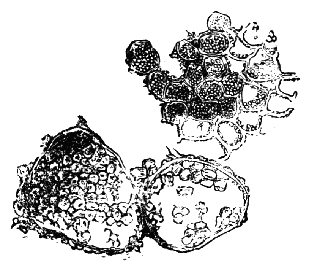
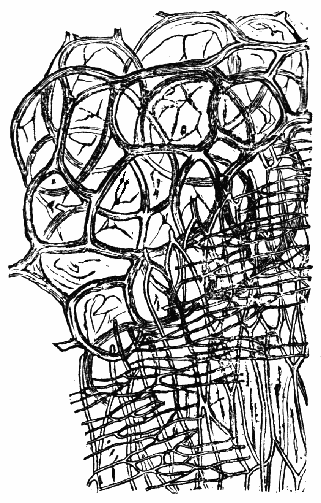
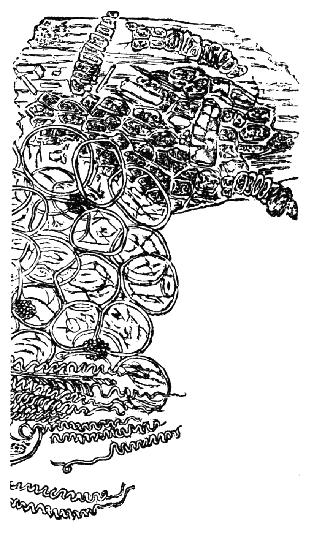
By an examination of the ash the presence of any mineral adulterant may be detected. Mr Blyth says the amounts of ash in genuine cocoa should never exceed 5 per cent. The seed of the cocoa consists of husk and seed proper. Under the microscope the husk exhibits on its surface a number of tubular fibres, filled with granular matter and minute corpuscles. It consists of three membranes; the first being a single layer of elongated cells; the second (forming the chief portion of the husk) of angular cells, enclosing mucilage, and also containing a few spiral vessels and woody fibres. The third membrane is very thin and delicate, and is made up of small angular cells containing minute globules of fat. The seed is composed of minute cells containing starch. The starch corpuscles are very small, with a trace of inulin. (See cuts on previous page.)
Cocoa, Flake. This is formed by grinding the nibs in a mill, consisting of two cones, working one inside the other. Pure flake cocoa is not a diluted or amalgamated article; in other words, it contains no sugar, and but a trace of starch.
Cocoa Nibs. The bruised, roasted seeds, freed from husk and membrane. They ought to be of a dull-red or greyish colour, but are frequently given a bright-red colour by a coating of Venetian red.
Cocoa, Sol′uble. From cocoa nibs and substances which are readily soluble or diffusible in water, ground together. Sugar and sago or arrow-root are the diluents used by respectable makers, but all kinds of starches, coloured with Venetian red, are used for the trashy articles which are sold to the poor. No form of cocoa is really soluble, but by the addition of easily diffusible substances an article is produced which is capable of forming an emulsion with boiling water. The following are the principal varieties of the so-called soluble cocoa:—
1. Cocoa, Granulated. From cocoa nibs and sufficient sugar and arrow-root to keep the fatty particles from forming a pasty mass. As it is impossible to granulate the nibs without the admixture of some other substance, those makers who declare that their granulated cocoas are perfectly pure do not act honestly towards their customers.
2. Cocoa, Homœopathic. A kind of soluble cocoa prepared with arrow-root, but without sugar.
3. Cocoa, Iceland-moss. From cocoa and Iceland moss, freed from its bitter principle, cetrarine. This form of cocoa was introduced by Messrs Dunn and Hewett, and is said to form a very valuable article of diet for invalids.
4. Cocoa, Maravilla. This is stated to be “the perfection of prepared cocoa.” It consists of cocoa, sugar, and sago flour, the last two being in great excess.