A CYCLOPÆDIA OF PRACTICAL RECEIPTS, PROCESSES, AND COLLATERAL INFORMATION (continued 21)
Reading edition
CAL′OMEL. See Mercury (Chlorides of).
CALOTRO′PIS PROCE′RA., CALOTRO′PIS GIGAN′TEA., (Ind. Ph.). Syn. Mudar.—Habitat. One or other of these species, everywhere in India.—Officinal part. The root-bark, dried (calotropis cortex). Small flat or arched pieces, brownish externally, yellow-greyish internally, peculiar smell, and mucilaginous, nauseous, acrid taste. Its activity appears to reside in a peculiar extractive matter named mudarine.—Properties. Alterative tonic; diaphoretic, and, in large doses, emetic.—Therapeutic uses. In leprosy, constitutional syphilis, mercurial cachexia, syphilitic and idiopathic ulcerations, in dysentery, diarrhœa, and chronic rheumatism, it has been used with alleged benefit.
Powder of Mudar. (Pulvis Calotropis.) Take of the roots of mudar, collected in the months of April and May from sandy soils, a sufficiency; carefully remove, by washing, all particles of sand and dirt, and dry in the open air, without exposure to the sun, until the milky juice contained in it becomes so far inspissated that it ceases to flow on incisions being made in it. The bark is then to be carefully removed, dried, and reduced to powder. Preserve in well-corked bottles.—Dose. As an alterative tonic, 3 grains, gradually increased to 10 grains or more, thrice daily. As an emetic, from 1⁄2 to 1 drachm.
CAL′OTYPE. See Photography.
CALUM′BA. Syn. Calumbæ Radix, B. P. Calum′ba-root; Kalumb, Hind. The root of a plant of Eastern Africa, extensively used in medicine as a stomachic and mild tonic. Dose, 10 to 20 grains, three or four times a day. The botanical name of this plant is Jateorhiza palmata, or Cocculus palmatus. See Calumbine (below); also Infusions and Tinctures.
CALUM′BA WOOD. This wood, which is used as a tonic by the Cingalese, is not the produce of the true calumba plant, but of Menispermum fenestratum. It contains the alkaloid BERBERINE (which see).
CALUM′BINE. Syn. Calom′bine, Calum′bina. A bitter substance discovered by Wittstock in calumba root.
Prep. 1. Digest calumba root (in coarse powder) in water acidulated with acetic acid; express, filter, boil to one half, again filter, add carbonate of calcium, in slight excess, and evaporate to dryness in a water bath; reduce the residuum to powder, and digest it in boiling alcohol; the latter will deposit crystals of CALUMBINE on cooling.
2. (Wittstock.) Evaporate tincture of calumba root (made with rectified spirit) to dryness; dissolve the residuum in water, and agitate the solution with an equal bulk of ether; after repose for a short time, decant the ethereal portion, distil off most of the ether, and set the liquid aside to crystallise.
Prop., &c. Impure calumbine occurs as a yellow-brown mass; when pure, it forms rhombic prismatic crystals or delicate white needles; it is only slightly soluble in alcohol, ether, and water; 40 parts of boiling rectified spirit take up only 1 part of calumbine. Its best solvent is acetic acid; it is also soluble in acidulated and alkalised water. Neither nut-galls nor metallic salts affect its solution. Concentrated sulphuric acid dissolves it, and assumes first a yellow, and then a red colour. Its properties indicate that weak vinegar or sour wine would be the best menstruum for extracting the medicinal virtues of calumba root. Dose, 1 to 3 gr. twice a day as a tonic and stomachic, in dyspepsia, debilitated stomach, bilious vomiting, &c.; and in the later periods of dysentery and diarrhœa.
CALX. This term was formerly applied to the residuum of the combustion of any substance; or to any substance which had been exposed to a strong heat. See Calcination, Lime, &c.
CAMBOGE′. See Gamboge.
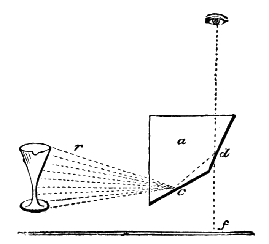
CAM′ERA LU′CIDA. [L. and Eng.] When a ray of light (r) falls upon a quadrangular glass prism (a), it is bent by two reflections (at c and d), and thrown upwards where it may be received by the eye, to which it will appear described on the table or sheet of paper (f) placed to receive it. The point of a pencil used to trace any object on the paper can also be seen, and by its means the picture can be easily copied. When the prism is mounted on a stand, and a thin brass plate with a small hole through it for the eyepiece adjusted thereto, it forms the CAMERA LUCIDA of the opticians. The image may be magnified or lessened by placing a lens so as either to intercept the rays before they strike the prism, or before they reach the eye. An ingenious person will readily be able to set up this instrument, than which a more useful one cannot exist.
CAM′ERA OBSCU′′RA. [L. and Eng.] An optical instrument for producing upon a screen the image of a field of view more or less extensive. It was invented by Baptista Porta in the 16th century. The principles and construction of the camera obscura may be thus described:—A convex lens (B) is placed in a hole admitting the light into a darkened box or chamber (A), which, falling on a white ground (D), produces an inverted picture of every object within its range. The image thus formed may be restored to its natural position, by allowing the rays of light to pass through two lenses instead of one, or by receiving the rays on a mirror placed at an angle of 45°, when the image will be thrown on the floor in its original position. The picture may be viewed through an oblong aperture cut in the box, or the experiment may be performed in a darkened room, by placing the lens in a hole in the shutter, and allowing the image to fall on the wall, or on a sheet of white paper stretched to receive it.
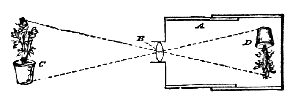
In the simplest form, when intended for taking views or portraits, the image is thrown upon a mirror placed at an angle of 45°, and resting on the bottom of the box, by which means it is thrown upwards against a plate of glass, also placed at a similar angle. On this is laid a piece of semi-transparent tracing paper, on which the object is distinctly seen painted, and may be traced out with a pencil. When the camera is used in photography, slides are provided to retain the sensitive paper in the proper position in the box or dark chamber to receive the image, and the whole apparatus is adjusted with screws, and slides of the most delicate description. Achromatic glasses are also employed. See Photography.
CAM′PHINE. The name given by the trade to rectified oil of turpentine when sold for burning in lamps, in order that purchasers may not be aware of the inflammable character of the liquid. Since the introduction of the hydro-carbon oils from coal, shale, and petroleum, camphine has been little used for burning. To rectify the turpentine, it is passed in vapour through a solution of caustic potash, soda, or lime; or through sulphuric acid.
CAM′PHOR. C10H16O. Syn. Cam′phire, Lau′rel Cam′phor; Campho′ra, B. P. A crystalline substance found in many plants; though only obtained in large quantities from two, namely, Camphora officinarum and Dryobalanops aromatica. The first, commonly known as the laurel camphor tree of China and Japan, yields the camphor of commerce; the latter, the Sumatra or Borneo camphor, and the peculiar fluid known as liquid camphor.
It is found that several of the essential oils, by carefully distilling off about one third their volume, yield a species of camphor. By collecting this, and redistilling the remainder of the oil 2 or 3 times, a farther quantity of camphor may be obtained. Oil of rosemary, treated in this way, yields about 10% of camphor; oil of sweet marjoram the same; oil of sage yields 13%; oil of lavender, 25%. By keeping the oils loosely corked, and in a cool place, they produce a larger portion of this camphor. Aniseed camphor is the congealable portion of oil of aniseed, separated from the liquid oil, which it resembles in odour and flavour.
Camphor, Am′ber. See Pyretine (Crystallised).
Camphor, Com′mercial (Crude). The produce of the laurel camphor tree, brought to Europe chiefly from China and the island of Formosa, in the form of greyish grains, aggregated into crumbling cakes.—Prep. The Chinese and Japanese extract the camphor by cutting the wood into small pieces, and boiling it with water in iron vessels, which are covered with large earthen capitals or domes, lined with rice straw. As the water boils, the camphor is volatilised along with the steam, and condenses on the straw.
Cam′phor, Commercial (Refined). Syn. White camphor; Campho′ra, B. P. Prep. 100 parts of crude camphor are mixed with 2 parts each of quick-lime and animal charcoal, both in powder, and the mixture is placed in a thin, globular, glass vessel, sunk in a sand bath. The heat is then cautiously applied, and the vessel gradually and carefully raised out of the sand as the sublimation goes on. When the process is complete, the subliming vessel is removed and allowed to cool.
Obs. The whole process of refining camphor requires great care and experience to ensure its success. If conducted too slowly, or at a heat under 375° Fahr., the product is found to be flaky, and consequently unsaleable, without remelting or subliming. An improvement on the common method is simply to sublime the above mixture in any convenient vessel furnished with a large and well-cooled receiver, and to remelt the product in close vessels under pressure, and to cool the liquid mass as rapidly as possible.
Prop., &c. A white, semi-crystalline solid, very volatile at common temperatures; freely soluble in alcohol, ether, bisulphuret of carbon, benzol, oils, and acetic acid, and sufficiently so in water (about 11⁄4 gr. to 1 oz.), to impart its characteristic smell and taste; 100 parts of alcohol (sp. gr. ·806) dissolve 120 parts of camphor; concentrated acetic acid dissolves twice its weight of camphor; average sp. gr. ·990. It fuses at 347°, boils at 400° Fahr., and when set fire to, burns with a bright flame. It evaporates slowly at ordinary temperatures, and crystallises on the inside of bottles. While floating on water it undergoes a curious rotatory movement.
Uses, &c. Camphor is sedative, narcotic, anodyne, diaphoretic, and anaphrodisiac. Dose, 2 to 10 gr. in the form of pill or bolus, or made into an emulsion with yolk of egg, mucilage, or almonds. In overdoses it is poisonous. The best antidote is opium or wine, preceded by an emetic. It is also used externally in ointments, liniments, and embrocations.
Camphor is frequently put into wardrobes and clothes-trunks, to keep away insects; it is used to make the white stars and fire of the pyrotechnist; and by the varnish-maker to increase the solubility of copal and other gums. Mixed with six times its weight of clay, and distilled, it suffers decomposition, and yields a yellow, aromatic, volatile oil, smelling strongly of thyme and rosemary, which is much used by the wholesale druggists and perfumers to adulterate some of the more costly essential oils, and by the fancy soap-makers to scent their soaps.
Camphor may be beaten in a mortar for some time, without being reduced to powder, but if it be first broken with the pestle, and then sprinkled with a few drops of rectified spirit of wine, it may be readily pulverised. By adding water to an alcoholic or ethereal solution of camphor, this drug is precipitated under the form of an impalpable powder of exquisite whiteness.
Tests. Pure camphor is entirely soluble in rectified spirit, oils, and strong acetic acid; a fragment placed on a heated spoon or in a warm situation will wholly disappear, and the evolved fumes will be highly fragrant (camphoraceous), and be free from an acid or terebinthinate odour. In an alcoholic solution of natural camphor ammonia gives but a slight precipitate, which is dissolved on shaking the mixture; a similar solution of artificial camphor under the like treatment gives a flocculent precipitate, which remains undissolved. See Camphor, Factitious (below).
Camphor, Facti′′tious. Syn. Hydrochlorate of tur′pentine, Hydrochlorate of camphene, Artificial camphor. Prepared by passing dry hydrochloric acid gas into pure oil of turpentine, cooled by a freezing mixture or pounded ice. After a time a white, crystalline mass is formed, which must be drained, and dried by pressure between folds of bibulous paper. It may be purified by solution in alcohol.
Prop., &c. It has a camphoraceous taste and odour; burns with a greenish, sooty flame, and when blown out evolves a terebinthinate odour; heated a little above the boiling-point of water, slight fumes of hydrochloric acid gas are perceptible.
Camphor, Hydrochlo′′rate of. Syn. Mu′′riate of camphor; Campho′ræ hydrochlo′′ras, L. By passing hydrochloric acid gas over camphor, in small fragments, until it ceases to be absorbed.
Camphor, Liq′uid. Syn. Camphor oil; O′leum campho′ræ, L. A pale yellowish, limpid fluid, which exudes from Dryobalanops aromatica, a tree growing in Sumatra and Borneo, when deep incisions are made in the trunk. It is supposed that the crystalline Sumatra camphor (see below) is deposited from this fluid. The liquid camphor has somewhat the odour of CAJEPUT OIL, and might, no doubt, be beneficially employed for the same purpose. It is sometimes imported into Europe.
Camphor, Monobromated. C10H15O1Br. Coarsely powdered camphor is introduced into a flask of about ten times the capacity of the amount it is intended to prepare. A fine stream of bromine is then allowed to fall upon the powder with continual agitation; the addition of bromine ceases when the camphor is liquefied. A large long abductor tube is then fitted to the flask, and the other end plunged into an alkaline solution, which will absorb the vapour that would otherwise incommode the operator. The flask is placed in a water bath that is raised to ebullition, when the reaction soon commences. This is at first rather active, there being an abundant evolution of hydrobromic gas, and some vapour of bromine and undecomposed camphor. The liquid, which is at first dark brown in colour, acquires an amber colour and the evolution of gas suddenly slackens. The operation should be carried out at a temperature between 80° and 90° C. The amber-coloured liquid that remains in the flask solidifies upon cooling, and appears then as a slightly citrine-coloured friable mass. It is purified by treating it several times with boiling 90° to 95° alcohol, filtering the liquor, and leaving it to crystallise. The crystals are to be dried in the air upon unsized paper.
Dr Bourneville advises monobromated camphor to be administered either in the form of pills, made up with conserve of roses, or of a mixture rubbed up with mucilage of gum arabic and syrup. He gives it in doses varying from twelve to thirty centigrams daily. Where it cannot be taken by the mouth he injects the following solution subcutaneously:—Monobromated camphor 3 gr., alcohol 35 gr., glycerin 22 gr.
Camphor, Nitrate of. Syn. Camphor oil; O′leum campho′ræ facti′′tium, L. Prepared by dissolving camphor in nitric acid, in the cold.
Camphor, Sul′phite of. From camphor and sulphurous acid gas, as hydrochlorate of camphor.
Camphor, Suma′tra. Syn. Bor′neo camphor, Hard c., Dragon’s brain perfume. Obtained from Dryobalanops aromatica, being found in natural fissures or crevices of the wood. It resembles ordinary camphor in most properties, but its odour is not of so diffusible a nature. This kind is not seen in European commerce.
CAMPHOR CAKES. See Balls (Camphor).
CAMPHOR′IC ACID. H2C10H14O4. Syn. Acidum camphor′icum, L. Prep. From camphor, 1 part; and nitric acid (sp. gr. 1·33), 4 parts; distilled together in a glass retort, with a gradually increasing heat, until vapours cease to be evolved; the camphor that has volatilised is then added to that in the retort, along with 4 or 5 parts more of nitric acid, and the process repeated again and again, until 20 parts of acid have been consumed, when crude camphoric acid crystallises out of the remaining liquor on cooling. The crystals are purified by washing with cold distilled water, solution in boiling water, and evaporating the solution until a pellicle forms; crystals of pure camphoric acid are formed as the liquid cools.
Prop., &c. Small, colourless, lamellar or acicular crystals; acid; bitter; fusible at 158° Fahr.; sparingly soluble in water; soluble in alcohol; alcoholic solution not precipitated by water, which distinguishes camphoric acid from benzoic acid. Its salts are called CAMPHORATES. The soluble camphorates may be made by digesting the carbonate or hydrate of the metal in a hot solution of the acid, and the insoluble camphorates by double decomposition. By distillation, camphoric acid yields a colourless, crystalline, neutral substance, which has been improperly called anhydrous camphoric acid.
CAM′WOOD. This dye-stuff resembles Brazil wood in its properties, and is used in a similar manner.
CAN′ADA BALSAM. Syn. Bal′samum Canaden′se, Terebinth′ina Canaden′sis, L. A thick, viscid oleo-resin obtained from the Abies balsamea (Lindley), a tree of common growth in Canada and the State of Maine. It is much employed as a medium for mounting microscopic objects. When pure it is perfectly transparent, has an agreeable odour (not terebinthinate), and is wholly soluble in rectified oil of turpentine, with which it forms a beautiful glassy and colourless varnish, much used for preparing a semi-transparent copying paper.
A mixture of 3 parts of Canada balsam and one of wax, if added to pile masses, is said to have the effect of binding together the component parts of the mass, and of keeping the piles made from it soft and in good shape.
Canada Balsam, Facti′′tious. Syn. Balsamum Canadense Facti′′tium, L. Prep. 1. Yellow resin, 3 lbs.; oil of turpentine, 1 gall.; dissolve, and add essence of lemon, 2 dr.; oil of rosemary, 11⁄4 dr.
2. To the last add of nut oil, 1 pint. Both are sold in the shops for Canada balsam.
CAN′DIES. See Candying.
CAN′DLES. Candle-making, once a rude and noisome trade, has, since the researches of Chevreul and Branconnot into the nature of the fats, developed into one of the most important branches of scientific industry, the progressive improvements in which, accompanied by a corresponding cheapening and immensely increased efficiency in one of our chief means of artificial illumination, have added greatly to the comfort and enjoyment of every civilised community. Candles are either dipped, moulded, or rolled. The cheaper sorts of tallow candles are formed by the first process, and wax candles by the last; all the other kinds are moulded. The moulds are tubes of pewter, well polished on the inside, eight or more being fitted into a frame, the upper part of which forms a trough to receive the melted candle material. When in the moulds the candles are inverted; in other words, the bottom of each mould corresponds to the top of the candle. The wick passes through a small hole at the lower extremity of the tube, and is held in the axis by a little bar placed across the top. At the factories of Price’s Patent Candle Company the frames of moulds are ranged close together in long benches, and are filled with hot candle material from cars running along little railways above them. When quite cold the candles are withdrawn. The plan of pulling them out one by one with the aid of a bodkin has been superseded at the factories above mentioned, by the ingenious device of blowing them out with compressed air.
The wicks of ordinary tallow candles are made of the rovings of Turkey skein-cotton, 4 or more of which, according to the intended thickness of the wick, are wound on a reel, from which they are again run off, and cut into the proper lengths. Of late years the wicks of the best candles have been made in such a way that they do not require snuffing. This object is effected by causing the wick to bend over, and its end to fall outside the flame, where it is exposed to the oxygen of the air. This bending over is variously brought about.—1. By twisting the wick with one strand shorter than the rest, which, being slightly stretched during the moulding of the candle, contracts again and bends the wick when the fat melts. 2. By plaiting the cotton into a flat wick, which naturally takes the required curve. Such a wick is generally dipped in a solution of borax, which preserves it from being acted upon by the flame except at its extreme point at the edge of the flame. A very fine wire is sometimes included in the plaited wick. 3. In Palmer’s patent two-wicked candles, which were formerly much used in lamps, the wicks are saturated with subnitrate of bismuth ground up with oil; they are then twisted tightly round a wire, which is withdrawn after the candle is moulded. In burning, the ends gradually untwist and stand out of the flame on either side. Other devices are said to be employed.
The wicks of candles should be free from knots and inequalities, as well as from adhering particles of cotton, the presence of all of which are the cause of the “guttering” one frequently sees in a burning candle. The finer the thread of which the wick is composed the more complete will be the combustion of the melted fatty material. Unless the above precautions are attended to, in selecting the wick, it will not be so entirely consumed as it ought to be.
Candles, Com′posite. Mould candles formed of a mixture of the hard fatty acid obtained from palm oil and the stearine of cocoa-nut oil. They were introduced in 1840. Other compositions are occasionally used, such as a mixture of spermaceti and hard white tallow, to which a little bleached resin is added.
Candles, Med′icated. These have been proposed as a convenient means of diffusing the active principles of certain volatile substances through the atmosphere, and for complete and partial fumigations. They are seldom employed in England.
Candles, Mercu′′rial. From the red sulphide or the grey oxide of mercury mixed with wax, and a wick of cotton inserted therein. Recommended by Mr Colles for partial mercurial fumigation. They are burnt under a glass funnel with a curved neck, the upper orifice of which is directed to the diseased part.
Candles, Par′affin. From the beautiful translucent substance paraffin (which see). These candles surpass all others in elegance, and are entirely free from odour and greasiness. The light produced by 98 lbs. of paraffin candles is equal to that of 120 lbs. of spermaceti, or 138 lbs. of wax, or 144 lbs. of stearic, or 155 lbs. of the best composite candles (Letheby). They are sometimes delicately tinted with red, mauve, violet, crimson, and rose colour. Aniline colours will not dissolve in paraffin. Stearic acid, however, is a solvent for them, and accordingly when the candles are tinted with the coal-tar colours these are previously dissolved in the stearic acid, always mixed with the paraffin. This insolubility of the aniline colours in paraffin has been suggested as a test for the purity of this hydrocarbon, and of its freedom from stearic or other fatty acids. For colouring paraffin candles black the paraffin is heated nearly to the boiling point with anacardium shells or nuts, which dissolve readily in the heated paraffin. The Belmontine Candles of Price’s Patent Candle Company are formed of the paraffin of Rangoon tar.
Previous to the paraffin being made into candles, it is necessary that it should be purified and bleached. Many processes for effecting these ends have been devised. In the works of Price’s Candle Company the method known as “Hodge’s” is had recourse to. This consists in first freeing the crude paraffin from the coarser impurities, melting it, casting it into cakes, and allowing it to cool sufficiently slowly, so as to form well-defined crystals. The cakes are then placed upon a bed of some porous and absorbent material, and subjected to a temperature not sufficient to melt the paraffin, but only the liquid hydrocarbons and other more easily fused bodies, the latter running off from between the crystals of the paraffin, and being absorbed by the porous substance upon which the paraffin rests. This process is repeated until the removal of the liquid hydrocarbons from the solid paraffin has been satisfactorily accomplished. If it be requisite to subject the paraffin to further purification, the following method is frequently adopted. The paraffin, previously melted by steam, is placed in a tank, with from 5 to 10 per cent. of strong sulphuric acid, and the mixture agitated for some hours by means of air (the time depending on the quality of the paraffin), the sulphurous acid fumes resulting from the reaction being carried off by a suitable contrivance. After the agitation is completed, the paraffin, after being allowed to stand for some time, is decanted into a suitable vessel containing animal charcoal, with which it is digested for some hours. Upon the subsidence of the charcoal the paraffin is drawn off if at all turbid, and is passed through a funnel heated by means of a steam jacket.
Another method, the invention of Messrs Fordred, Lambe, & Sterry, for the decolorisation of the paraffin employed in candle manufacture, consists in digesting the paraffin at a temperature of 230° F. with about 12% of powdered fuller’s earth. Of late this process has supplanted the charcoal one; and it may be employed, no matter by what means the previous purification of the paraffin has been carried out. The paraffin and fuller’s earth are to be well agitated together, and when the latter has fallen down the clear paraffin is decanted from it. The inventors affirm that their process answers quite as well if marl clay, or any other similarly constituted and equally abundant natural substance be substituted for fuller’s earth; and that no matter which of these bodies is employed, they may be re-used, and any adhering paraffin be removed by washing with agitation, or by other suitable contrivances.
Messrs Smith & Field’s patent for the removal of the colouring matters of the paraffin consists in the employment of silicite of magnesium. The patentees state that the successful issue of the operation depends not only upon the careful preparation of the salt used, but upon its being dried at a temperature of as exactly as possible 212° F. The careful preparation before insisted on of the magnesium salt, which is procured by the double decomposition of magnesium, sulphate, and sodium silicate, includes its thorough washing from adhering sodium sulphate previous to its desiccation. If this precaution be neglected, the porosity of the silicate will be impaired, and its bleaching effect more or less interfered with; and further, the patentees state that if the washed silicate be heated to redness, its decolourising power will also be lost.
It appears that the paraffin employed in making the candles consists of a mixture of paraffins having different melting points. The following are the melting points of some of the chief varieties of paraffin:—
ParaffinfromBoghead coalat45° to 52° C.
””Brown coal”56° C.
””Peat”46·7° C.
””Rangoon oil or tar”61° C.
””Ozokerit”65·5° C.
Paraffin candles contain from 5{?} to 15 per cent. of stearin, this addition being made for the purpose of diluting the paraffin as well as for raising the melting point of the paraffin where this is low. The stearin, moreover, serves to preserve the rigidity of the candle in the candlestick, and to prevent its bending out of the upright position. Paraffin candles are always moulded, but previous to this being done the moulds must be heated to a temperature above the melting point of the paraffin; this may vary from 60°, 70°, and 87° C., according to the paraffin employed. The moulds having been filled with the melted paraffin are, after one or two moments only, plunged into cold water, when the candle immediately becomes solid. Unless this were done the candle would be spoilt, owing to the crystallisation of the paraffin. A thin wick is required for paraffin candles.
Candles, Spermace′ti. From spermaceti (which see). These are very delicate in appearance, but rather expensive. They burn well, but as the melting point of spermaceti is low, 120° Fahr., they will not bear carrying about in the hand without guttering. They are generally adulterated with stearic acid or hard white tallow.
In candle-making “spermaceti is usually mixed with 3 per cent. of wax or paraffin to destroy its highly crystalline structure; it is moulded in the usual way with plaited wicks that require no snuffing. Occasionally the spermaceti candles are cast without any admixture of wax, the moulds being raised to a higher temperature just as with stearic acid. Some manufacturers, in order to make the spermaceti appear like wax, use gamboge to give the desired tint; such candles are known as transparent wax.”[236] Spermaceti candles are largely consumed in India.
Candles, Stear′ic. Under this head we may place the various sorts of candles moulded from the hard fatty acids of both animal and vegetable origin. The principal sources whence British manufacturers derive their acids are tallow, palm oil, and cocoa-nut oil. The processes employed for separating them are generally described under Stearic Acid. Candles formed of the fatty acids can now be prepared so as to imitate and almost rival those of wax and spermaceti; and they are quite as cheap as the nearly obsolete mould candles formed of common tallow. They are extremely hard; they do not grease the hands, and they burn away brightly and steadily, without giving off any offensive odour. Uncoloured, they are snowy white, but a yellow tint is frequently given them by gamboge.
Candles, Tal′low. From ordinary tallow or from tallow which has been freed from much of its oleic acid by pressure. These have so unpleasant an odour and are so apt to gutter, that they will probably ultimately disappear from use. They are, however, sold at so low a price, that among the lower classes they must long retain their hold. For dip candles the wicks are immersed in melted tallow, and after rubbing with the hands are placed straight and allowed to harden, after which they are arranged upon the “broaches” ready for dipping. For mould candles the last operation is omitted. Great care is taken to select a cotton that yields the least possible quantity of ash after burning.
In the process of “dipping,” the “dipping cistern” being filled with tallow of a proper temperature from the boiler, one of the broaches covered with wicks is placed upon the end of the “dipping beam,” and pressed down gently into the melted fat; it is then withdrawn, the bottoms of the candles just touched against a board placed on one side of the cistern for the purpose, and the frame removed to the rack. This operation is repeated until the candles acquire a sufficient size, when they are finally cooled, sorted, weighed, and strung in pounds for sale.
The mould candles once in common use were made of the finer kinds of tallow only; a mixture of 3 parts of sheep, with 1 part of ox suet, being preferred. See Wax.
Candles, Wax. These are most frequently made by pouring melted white wax on to the wicks, which are hung upon frames and covered with metal tags at the ends to protect the cotton from the wax in those parts. The frames are made to turn round, and melted white wax is poured first down one wick, and then the next, and so on. When the wicks have been subjected to this operation once and have become sufficiently cooled, they have a second, and then a third coat given them, until they are of the required thickness. The candles are next rolled into proper shape on a marble slab or wooden board. The conical top is moulded by properly-shaped tubes, and the bottoms are cut off and trimmed. Wax candles are now seldom moulded, but if so the same processes are followed as for stearic and paraffin candles. The large altar candles, which frequently weigh from thirty to forty pounds, are made by hand.
Wax Tapers. These, which are of various degrees of thickness, are not made of pure wax, but of wax (usually vegetable wax) and tallow, the latter being added to give them flexibility. When they are required to be coloured, resin and turpentine are added to the tallow. For further particulars, consult Wagner’s ‘Chemical Technology,’ “Candle-making.”
CANDLE NUTS. The kernels of the alearites triloba, the candleberry tree, a plant growing in most tropical countries. The nuts when dried, and stuck upon a reed, are used by the natives of the Polynesian Islands as a substitute for candles. They contain a large amount of pure palatable oil, which is sometimes used by artists as a drying oil. After the expression of this oil the cake has been used as a food for cattle; also as a manure.
The following is the composition of the nuts:—
Shells.
Water3·71
Organic matter89·90
Mineral matter6·39
Kernels.
Water5·27
Fat62·97
Cellulose28·99
Mineral matter2·79
Ash of Kernel.
Lime18·69
Magnesia6·01
Potash11·33
Phosphoric acid29·30
CAN′DLESTICKS. Metallic, earthenware, and porcelain candlesticks, snuffers, and snuffer-stands, are recommended to be cleaned by pouring boiling hot water on them (previously placed in an earthen pan), and, after wiping them quite dry with a cloth, to clean them with a piece of wash leather; those made of silver, or of plated copper, may be finally polished with a little plate powder; those of white metal, with a little whiting or fine chalk, and those of brass, with a little rotten-stone or one of the polishing pastes. For articles of this kind, made of bronze and papier maché, the water should be used only hot enough to melt the tallow, and they should be only gently dabbed or rubbed off with a very soft cloth or leather. The common practice of placing candlesticks before the fire to melt off the grease is injudicious, as the solder or japan about them is almost certain to be injured. Hence the common annoyance of damaged or “crippled” candlesticks in houses where there are careless servants.
CAN′DYING. When the object is simply to form a confection or sweetmeat, imbued with the aroma, flavour, or medicinal property of any substance, candies are generally prepared by simply boiling lump sugar with a sufficient quantity of the infusion, decoction, tincture, expressed juice, or sometimes even the powder of the particular article, until a portion taken out and cooled becomes quite solid, when it is either poured out on a marble slab, or into tin, marble, or paper moulds, dusted with powdered lump sugar.
When the object is to preserve the form and character of the vegetable in the candy, the substance is boiled in water until soft, and then suspended in concentrated syrup (in the cold), until they become transparent; after which they are either dried in a current of warm air, or in a stove, at a heat not exceeding 120° Fahr. The syrup must be kept fully saturated with sugar by reboiling it once or twice during the process.
Another method occasionally employed by confectioners for almonds and the like is to put the substances into a syrup boiled until it forms a small thread between the opening fingers, and to stir the whole until it is nearly set. See Sugar Boiling.
The following are the principal candied articles kept at the shops:—
Candied Al′monds. From blanched almonds, roasted and halved.
Candied Angel′ica. Prep. 1. From the root. Boil the fresh roots (after slicing them and removing the pith) in water, to deprive them of part of their bitterness and aroma; then drain them and put them into syrup boiled to a full candy height, and boiling hot; let them remain until nearly cold, when they may be taken out and carefully dried.
2. From the stems. From the tender stems, stalks, and midribs of the leaves, as last. Used as a sweetmeat and dessert. It is said to be cordial, stomachic, tonic, and aphrodisiac.
Candied A′pricots. From the fruit, scarcely ripe, either whole or cut into quarters, immersed in the syrup (hot), without any further preparation.
Candied Cit′rons. From the peels.
Candied Erin′go. From the roots, slit and washed.
Candied Gin′ger. From the roots of green ginger.
Candied Hore′hound. From a strong decoction or infusion of the root, and lump sugar, 1 pint to 8 or 10 lbs. may be used. Boil the mixture to a candy height, and pour it whilst warm into moulds or small paper cases well dusted with finely powdered lump sugar; or pour it on a dusted slab and cut it into squares.
Candied Lem′on Peel. As Candied Citron.
Candied Or′ange Flow′ers. From the flowers deprived of their cups, stamina, and pistils (2 oz. to each lb. of sugar), as Candied Almonds, but poured out on a slab.
Candied Or′ange Peel. From the peel of the Seville orange, or common orange, as Candied Citron.
Candied Su′gar. See Sugar Boiling. The following are articles of a more special character.
Candy, Car′away. 1. From caraway seeds (in fine powder), 1⁄2 oz.; sugar, 1 lb.
2. Oil of Caraway, 1 dr.; sugar, 1 lb.
Candy, Diges′tive. Syn. Live-long candy. Prep. 1. Rhubarb and bicarbonate of soda, of each 1 dr.; ginger, 1⁄2 dr.; cinnamon, 20 gr. (all in fine powder); heavy magnesia, 1 oz.; powdered sugar, 2 oz.; mucilage of tragacanth, q. s. to form a lozenge mass; to be divided into small squares of 18 or 20 gr. each.
2. As the last, but adding finely powdered caraways, 1 dr.; oil of caraway, 15 drops; and sugar, 1 oz. Both are used as heartburn and digestive lozenges.
Candy, Gin′ger. Prep. 1. From ginger (in coarse powder), 3 oz.; boiling water, 11⁄4 pint; macerate in a warm place for 2 hours, strain, add lump and moist sugar, of each 5 lbs., and boil to a candy.
2. Ginger (in very fine powder), 1 oz.; powdered sugar, 2 lbs.; syrup, q. s. to make a paste. Stomachic and carminative.
For various sweetmeats which might come under the head of Candy, see Confections, Drops.
CANKER. This disease consists in a depraved condition of that part of the sensitive foot of the horse which secretes the horny frog and sole. It mostly occurs in coarsely-bred animals, and is the result of filth, damp, and bad ventilation. The treatment consists in first removing all loose horn, and allowing all pent-up matter to escape; the exuberant granulations must be carefully cut away, and the parts then washed with a tepid lotion of sulphate or chloride of zinc; after drying the surface dust it with oxide of zinc; apply tow dipped in a mixture of tar and lime, and “keep it in firm contact with the parts by means of a leather sole or strips of hoop iron underneath a shoe lightly tacked on. Dress in this manner daily, keeping up the dry pressure for a week.” (Finlay Dun.)
CAN′NON METAL. See Gun Metal.
CANTHAR′IDES. Syn. Spanish flies, Blistering f., Lyt′tæ; Canthar′is, B. P. The Cantharis vesicatoria of Latreille, commonly known as the Spanish fly, is an insect of the order Coleoptera; it abounds in the south of France, Spain, and Italy; and has spread into Germany and the south of Russia. When alive it exudes a strong fetid and penetrating odour.
Pur., &c. These insects should be preserved in well-closed bottles or tin canisters. The addition of a few drops of oil of cloves, or of strong acetic acid, or even of a few cloves in substance, will preserve them unchanged for a length of time in closed vessels. The best proof of their goodness is the smell. The powder is constantly adulterated. The plan of the wholesale druggists is to sort out the most worthless flies for powdering, and to compensate for their deficiency of vesicating power by adding 1 lb. of euphorbium to every 12 or 13 lbs. of flies. When a superior article is required, liquorice powder is added (4 or 5 lbs. to every 14 lbs.), along with about 1 lb. of euphorbium, and sufficient blue black or charcoal to turn the yellow of the liquorice to a greenish colour. The best mode of detecting this adulteration is by the microscope. It should be borne in mind that only those flies which have attained their full growth possess blistering properties. The immature or undersized insects are destitute of epigastric power.
Ant. An emetic of sulphate of zinc, followed by the stomach-pump, if necessary. The vomiting may be promoted by copiously drinking warm bland diluents, such as broth, linseed tea, milk, &c. Friction on the spine, with volatile liniment and laudanum, and the subsequent administration of draughts containing musk, opium, and camphorated emulsion, have been strongly recommended.
Tests. By the microscope very minute particles may be discovered in the stomach and intestines, on a post-mortem examination. Orfila thus found particles of cantharides in a body that had been interred nine months.
Uses, &c. Spanish flies are used externally to raise blisters, and internally as a stimulant and diuretic, generally in the form of tincture. In excess they produce strangury, bloody urine, satyriasis, delirium, convulsions, and death. See Tinctures, Vesicants, &c.
CANTHARI′DIN. C5H12O2. Isomeric with picrotoxin. This substance is found in, and is the vesicating principle of, the Spanish fly, Chinese blistering fly, and other coleopterous insects. Prep. Pulverised cantharides are allowed to remain in contact for 24 hours with twice their weight of chloroform, in a displacement apparatus. The chloroform is then drained off, and finally displaced by alcohol, and the solution is left to evaporate. The cantharidin crystallises out, saturated with green oil. In order to purify the cantharidin it is laid on bibulous paper, which absorbs the greater part of the oil, and then crystallised out of a mixture of alcohol and chloroform. (Procter.)
Prop. Prismatic crystals, melts at 200° C., volatilises in white fumes, which strongly irritate the eyes, nose, and throat, and condenses in rectangular prisms. Cantharidin is insoluble in water, but soluble in alcohol, ether, chloroform, acetic acid, and in the fixed and volatile oils. Its solution in any of the liquids above mentioned possesses vesicating properties, which, however, is not exhibited by solid cantharidin.
CAOUT′CHOUC. Syn. India rubber, Elastic gum. India rubber is the concrete juice of the Ficus elastica, Siphonia elastica, the Urceola elastica, and many other tropical plants. The fresh milky juice is spread over moulds of unbaked clay, and is then exposed to the heat and smoke of a fire, or torches, to dry it, whence it derives its dark colour. Successive coats of juice are laid on, and the operation of drying repeated until the bottles acquire sufficient thickness. When it has become thoroughly hard and dry, the clay is beaten out. In this form it is commonly imported.
Prop., &c. The general properties of india rubber, as well as its numerous applications, are well known. The fresh juice has a cream-like appearance and consistence, is coagulated by heat, and is miscible with water, alcohol, and wood naphtha; sp. gr. 1·012 to 1·041; it yields from 18% to 45% of solid caoutchouc, either by heat or evaporation. By excluding it from the air it may be preserved unchanged for a considerable period.
Solid caoutchouc has a sp. gr. ranging between ·919 and ·941; it melts at 248° Fahr. into a viscid mass, which does not again harden on cooling; it is unaltered by chlorine, hydrochloric acid, sulphurous acid, fluosilicic acid, ammonia, caustic alkaline lyes (even when boiling), and most similar substances; nitric acid and sulphuric acid act on it only by long contact when concentrated. Some specimens of caoutchouc are harder than gutta percha itself, and equally inelastic, whilst others never perfectly solidify, but remain in a condition resembling that of birdlime or printers’ varnish.
The best solvents of caoutchouc are rectified sulphuric ether (which has been washed with water to remove alcohol and acidity), chloroform, bisulphide of carbon, a mixture of bisulphide of carbon and absolute alcohol (94 of the first to 6 or 7 of the last), and caoutchoucin. All these liquids dissolve india rubber rapidly in the cold, and leave it unaltered on evaporation. The first two are, however, too expensive to be generally employed. The others have a disagreeable odour, but are much cheaper than the rest, and possess the advantage of leaving the film of caoutchouc in a firmer and stronger condition than other solvents. Pyrogenous oil of turpentine is another cheap and good solvent. Benzol, rectified mineral or coal-tar naphtha, crude petroleum, and oil of turpentine dissolve india rubber by long digestion and trituration (with heat), otherwise they merely form with it a glutinous jelly that dries very slowly and imperfectly, leaving it much reduced in hardness and elasticity. The fats and fixed oils also readily dissolve caoutchouc (with heat), forming permanently glutinous solutions or pastes; so also do most of the volatile oils, but the solutions with the majority of them dry with difficulty.
One of the most remarkable properties of india rubber is the great amount of heat which is disengaged during its condensation by pressure or in the exercise of its elasticity. During the process of kneading the raw caoutchouc in the “masticators,” the cold water thrown in to reduce the temperature soon becomes boiling hot. When no water is added, a temperature so high is often reached as to occasion the melting of the rubber. This is particularly the case during the process of “dry kneading” with quick-lime. A tube 21⁄4 inches in diameter, impactly secured, was subjected to a force of 200 tons. The result was a compression amounting to 1-10th; great heat was evolved, and the excessive elasticity of the substance caused a fly-wheel weighing five tons to recoil with alarming violence. Mr Brockedon states that he succeeded in raising the temperature of an ounce of water 2° in about fifteen minutes by collecting the heat evolved by the extension of a small thread of caoutchouc. He refers this effect to the change in specific gravity, and contends that the heat thus produced is not due to friction, because the same amount of friction is occasioned in the contraction as in the extension of the substance, and the result of this contraction is to reduce the caoutchouc thus acted upon to its original temperature.
The edges and surfaces of india rubber are readily and perfectly joined by mere contact and intense pressure. On the small scale the edges may be moistened with ether, naphtha, oil of turpentine, or some other solvent, or by long boiling in water, and immediately pressed tight together and held in contact for some time.
Elastic tubes are readily formed of india rubber by cutting it into uniform slips of proper thickness and winding them round rods of polished glass or metal, so that the edges are in close contact or “overlapping.” A piece of tape is then wound round outside it, and the whole boiled in water for 2 or 3 hours, after which time the edges will be found to be sufficiently adherent. A better plan is to immerse the “rubber” in a mixture formed of bisulphide of carbon, 95 parts, and rectified spirit, 5 parts, until it swells into a pasty mass, which may then be moulded into any desired form or passed through the die of a tubing machine. For chemical purposes, brewing, &c., vulcanised india-rubber tubing has now taken the place formerly occupied by the unprepared material.
The once celebrated “Mackintoshes” are made by spreading two or more coats of a paste made of caoutchouc and rectified coal-tar naphtha over the surface of the stuff or cloth, and, when it has become partially dry, pressing two such surfaces evenly together by passing the goods between a pair of cylinders or rollers. The articles are then placed in a stove room for the composition to harden, and to remove the odour of the naphtha. Of late years vulcanised or mineralised rubber (coloured) has been used for this purpose, and being spread on the outside of the stuff instead of the inside forms an ornamental and thoroughly waterproof material.
India-rubber thread is prepared by stretching it (previously cut into coarse filaments) to 5 or 6 times its length in boiling water or hot air, in which state it is allowed to cool slowly. This process is repeated again and again until it reaches 16,000 or 17,000 times its original length, when it is glazed by agitating it with powdered sulphur or French chalk. This thread is readily joined or “pieced,” as it is called, by paring the ends obliquely with a pair of scissors or a knife, and then pressing the clean ends strongly together with the fingers. When the coarse filaments from the cutting machine are simply stretched with the moistened thumb and finger in the act of “reeling” to about 8 or 9 times their length, they are said to be “inelasticated,” and are ready to be made into elastic braces, elastic web, and other like elastic tissues and fabrics in the braiding machine.
Caoutchouc, Vul′canised. Syn. Vulcanised india rubber, Mineralised i. r., Sulphuretted i. r. The discovery of the singular action of sulphur and the mineral sulphides on caoutchouc was made by Mr Charles Goodyear, of New York, in 1842, at which date the manufacture of vulcanised india rubber may be said to have commenced. In 1843 Mr Thomas Hancock patented a process for vulcanised india rubber in these countries, founded on that of Mr Goodyear. A sheet of caoutchouc immersed in melted sulphur absorbs a portion of it, and at the same time undergoes important changes in many of its leading characteristics. So prepared, it is no longer affected by changes of temperature; it is neither hardened by cold nor softened by any heat insufficient to destroy it. It loses its solubility in the solvents of ordinary caoutchouc, whilst its elasticity is greatly augmented, and has become permanent.
The same effect is produced when sulphur is kneaded into caoutchouc in a masticator, or by means of powerful rollers, as well as when common solvents (naphtha, spirit of turpentine, &c.) are charged with a sufficient amount of sulphur in solution to become a compound solvent of the rubber. In these cases articles may be made of any required form before heating them for the change of condition technically termed “vulcanisation.” It is necessary, however, for this purpose that the form should be carefully maintained both before and during the exposure to the heat.
“A vulcanised solid sphere of 21⁄2 inches in diameter, when forced between two rollers 1⁄4 inch apart, was found to maintain its form uninjured. In fact, it is the exclusive property of vulcanised caoutchouc to be able to retain any form impressed upon it, and to return to that form on the removal of any disturbing force which has been brought to act upon it.” (Brockedon.)
Caoutchouc combines with from 12% to 15% of sulphur; the quantity of sulphur added to the naphtha paste should not, therefore, exceed 10% or 12% of its weight.
The temperatures for vulcanisation by the common method range from 320° to 330°; and the period required is one hour or more, according to the temperature. A much lower temperature is, however, sufficient if the duration of the exposure is much extended or the compound mass is softened with any of the common solvents of india rubber.
The process of sulphuring, or mineralisation, is differently conducted in different manufactories. Under Mr Burke’s patent, oxysulphide or amorphous sulphide of antimony (formed by decomposing a solution of crude antimony in a lye of potash or soda with hydrochloric acid) is employed. This powder he combines with either india rubber or gutta percha, or mixtures of them, by kneading in a “masticator” for 2 or 3 hours, and after strong compression in a mould whilst still warm, he exposes the mass to a steam heat ranging from 250° to 280° Fahr. The block, so prepared, is afterwards cut into sheets, &c. The advantages possessed by the product are that it possesses no unpleasant odour, nor does the sulphur effloresce on its surface, as in ordinary vulcanised india rubber.
Under Mr Christopher Nickel’s patent (1849) 1 part of sulphur is kneaded with 6 parts of caoutchouc, and then pressed into moulds, as before. He also vulcanises rubber by exposing it in a cylinder heated in a steam jacket to the fumes of sulphur or to sulphuretted gases, given off from a retort connected with the apparatus. The rubber thus prepared he next subjects to hydraulic pressure in moulds, at a temperature ranging between 220° and 250° Fahr.
Small articles or sheets of india rubber may be extemporaneously vulcanised at common temperatures by simple immersion, for a minute or two, in a mixture of bisulphide of carbon, 971⁄2 parts, and protochloride of sulphur, 21⁄2 parts; after which they must be well washed first in weak alkaline lye, and next in pure water. Mr Parkes employs 100 instead of 971⁄2 parts of the bisulphide. This method is termed “cold sulphuring.”
An excellent method of vulcanisation, recommended by Mr Parkes, particularly applicable to small articles, consists in immersing them for about 3 hours in a close vessel containing a solution of polysulphide of potassium at 25° Baumé (sp. gr. 1·197), and of the temperature of 240° Fahr. It is afterwards washed in an alkaline lye, then in pure water, and dried.
Among the many applications of vulcanised india rubber those connected with its elasticity and its enormous contractile power when extended are particularly striking. Under Mr E. Smith’s patent, “torsion springs” for roller blinds, door springs, clock springs, carriage springs, &c., are made of it. Mr Hodges, in another patent, has availed himself of the same property as a new mechanical power. Short lengths of caoutchouc, which he terms “vulcanised power purchases,” are successively drawn down from or lifted to a fixed bearing, and attached to any weight which it is required to raise; when a sufficient number of these power purchases are fixed to the weight, their combined elastic force lifts it from the ground. Thus, 10 purchases of the elastic strength each of 50 lbs. raise 500 lbs. Each purchase is 6 inches long, and contains about 11⁄2 oz. of vulcanised caoutchouc. These 10 purchases, if stretched to the limit of their elasticity (not of their cohesive strength), will lift a weight exceeding 650 lbs.
The same principle has been applied to relieve and equalise the strain on ships’ cables, especially where several boats are towing one vessel; and as a projectile force. A number of power purchases, attached to the barrel of a gun constructed to project harpoons, will exert a power, if suddenly relieved, proportioned to their aggregate forces. By similar contrivances balls may be projected 200 yards or more, and a charge of No. 4 shot can be thrown 120 yards. A bow, in which the string alone is elastic (the reverse of the usual form), has been contrived which throws a 30-inch arrow 170 yards.
The last great improvement in the manufacture of caoutchouc is the discovery that by continuing the process of vulcanisation for a longer time at an increased heat and under pressure, a hard black substance is obtained, which can be turned in a lathe like ebony. This substance has already been applied to an extraordinary number of uses. See Vulcanite.
An exceedingly useful combination of cork and india rubber has lately been introduced. See Kamptulicon.
Caoutchouc, Facti′′tious. See Oil, Consolidated.
CAOUT′CHOUCIN. An extremely light fluid obtained by distilling india rubber.
Prep. (Barnard’s patent process.) A highly volatile fluid, discovered by Mr Barnard. India rubber or caoutchouc, as imported, cut into small lumps, containing about 2 cubic inches each, is thrown into a cast-iron still, connected with a well-cooled worm-tub (any flat vessel with a large evaporating surface will do, the entire top of which can be removed for the purpose of cleaning it out); and heat is applied in the usual way, until the thermometer ranges to about 600° Fahr., when nothing is left in the still but dirt and charcoal. The dark coloured fetid oil which has distilled over is next rectified along with 1⁄3rd its weight of water, once or oftener; and at each rectification becomes brighter and paler, until at about sp. gr. ·680 it is colourless, and slightly volatile. The product is then shaken up with nitro-hydrochloric acid, or chlorine, in the proportion of a 1⁄4 of a pint of the acid to 1 gallon of the liquid. To enable the dirt to be the more easily removed from the bottom of the still, common solder, to the depth of about 1⁄2 an inch, is thrown in.—Prod. 80%.
Prop., &c. Mixed with alcohol, caoutchoucin dissolves gums and resins, especially copal and india rubber, at the common temperature of the atmosphere, and it speedily evaporates, leaving them again in the solid state. It mixes with the oils in all proportions. It has been used in the manufacture of varnishes, and for liquefying oil paints, instead of turpentine. It is very volatile, and requires to be kept in close vessels. According to the researches of Himly, Gregory, and Bouchardat, the caoutchoucin of Barnard consists of several liquids, some of which have the composition of olefiant gas, and others that of oil of turpentine.
CA′′PERS. The flower buds of various species of Capparis, particularly C. spinosa, caper tree, preserved in vinegar. They are chiefly imported from Spain, Italy, and the south of France, where the caper tree is largely cultivated for the purpose. The flower-buds are picked daily, and thrown into a cask of strong pickling vinegar, until it becomes full, when it is sold to the dealers by the collector. The former sort them into different sizes by means of copper sieves, in a similar way to that adopted for lead shot and gunpowder. In this way they are divided into nonpareilles, capuchins, capotes, seconds, and thirds, of which the former, or smallest, are regarded as the best; but much depends upon the quality of the vinegar.
The bright green colour of capers, so much valued by the ignorant, arises chiefly from the presence of copper derived from the sieves used in sorting them. In many cases, copper coin, as sous and halfpence, are added for the purpose. Thus the eye is gratified at the sacrifice of the stomach, and an insidious poison introduced into the system, simply to give an unnatural appearance to a condiment which tastes better without it. See Copper.
CAPILLAIRE′. [Fr.] Simple syrup, or a concentrated solution of sugar in water, flavoured with orange-flower water, or some other similar aromatic. The name was originally given to a mucilaginous syrup, prepared by adding to an infusion of maiden-hair (Adiantum capillus Veneris) some sugar and orange-flower water.
CAP′NOMOR. See Kapnomor.
CAP′RIC ACID. HC10H19O2. Syn. Ru′tic acid; Acidum cap′ricum, L. An acid discovered by Chevreul, and obtained by decomposing caprate of barium with dilute sulphuric acid, or primarily by the saponification of butter or cocoa-nut oil, when it appears combined with butyric, caproic and caprylic acids. It is also procured by acting upon oleic acid or oil of rue with nitric acid.
Obs. When butter is saponified with caustic potassa or soda, and the resulting soap decomposed by adding an acid, in excess, and distilling the mixture, the four acids above named pass over into the receiver, in combination with water. The mixed acids may be separated by saturating them collectively with baryta, and by taking advantage of the unequal solubility of the newly formed barium salts. The less soluble portion (equal to about 1⁄20th of the dry mass) contains capric and caprylic acid; the larger and more soluble portion, butyric and caproic acid. On the same plan the two groups are resolved into their separate acids. These acids are deprived of their uncombined water by means of chloride of calcium. It is advisable to employ the term rutic acid, as the older term is easily confounded with caproic and caprylic.
Prop. Capric or rutic acid crystallises in fine needles, which fuse at 86° Fahr., giving out an odour resembling that of a goat. It is sparingly soluble in boiling water.
Prep. (Miller.) Castor oil is saponified by means of potassa or soda, and afterwards an excess of the hydrated alkali is added, amounting to one half the oil used. The mass is heated in a retort, and an oily liquid covered with water distils over. This oily liquid, which is the octylic alcohol, is rectified several times with potassa until the residue is no longer coloured brown.—Prop. A colourless liquid, of powerful aromatic odour; insoluble in water, but dissolving readily in acetic acid, ether, and alcohol. Its boiling point is 356° Fr., its sp. gr, ·823. The caprylate of ethyl, erroneously termed caprylic ether, is a colourless liquid, with an agreeable odour of pine-apples.
CAPSAICIN. Until the researches of Mr Thresh proved to the contrary the active principle of the capsicum fruit, or cayenne pepper, and the one to which it was thought it owed its acrid and pungent properties, was believed to be an alkaloid, and was named capsicine in consequence. Mr Thresh succeeded in obtaining an alkaloid from the capsicum, but this was entirely wanting in acridity and pungency. Its discoverer states that capsaicin occurs only in the pericarp of the fruit. The details of the process by which it may be obtained are given in the ‘Year Book of Pharmacy’ for 1876-77, from which it will be seen that the substance may also be procured by preparing a strong tincture of capsicum, and submitting it to dialysis. Capsaicin when cautiously heated to 138° F., melts to a transparent oily fluid, and if then allowed to cool rapidly, it becomes solid, assuming a crystalline condition in doing so. It volatilises at 240° F., without suffering decomposition. Strong nitric acid acts violently on it, decomposing and dissolving it. The crystals dissolve very readily in ether, amylic, alcohol, acetic ether, benzine, and fixed oils, and still more readily in alcohol, and in rectified and proof spirit. In turpentine and carbon disulphide it dissolves much more slowly. It is not affected by boiling for some considerable time in dilute sulphuric acid, and the acid liquor shows no signs of glucose.
A specimen of capsaicin which Mr Thresh believes to have been in a pure condition was sent to Dr Flückiger’s laboratory for analysis, and Dr Buri, by whom the combustion was made, reports that it gave the following composition:—C19H14O2, a result which Mr Thresh found to agree very fairly with some capsaicin derived from a specimen fruit obtained from a different source from that sent to Dr Flückiger. Administered internally in doses of the 1⁄25th of a gram, capsaicin gave rise to violent griping and purging; and when a lotion consisting of one part diluted with forty of glycerin and spirit was placed on the arm, it soon gave rise to such pain, and caused so much inflammation, that the lint which was wetted with the solution had to be removed very shortly after being applied.
CAP′SICUM. [L. and Eng.] Syn. Chil′i, Red pepper. A genus of plants belonging to the natural order Solanaceæ, species of which yield the fruits which are used to form Cayenne pepper and Chili vinegar. The officinal capsicum of B. P. is the fruit of the species C. fastigiatum. See Pepper, Tinctures, Vinegars.
CAP′SULES. This term is now commonly applied to small egg-shaped or spherical vessels, in which medicines are placed, for the purpose of covering their nauseous taste at the time of swallowing them. They are commonly made of gelatin, mixtures of sugar and gelatin, or animal membrane.
Capsules, Gel′atin. Prep. 1. By dipping the bulbous extremity of an oiled metallic rod into a strong solution of gelatin. When the rod is withdrawn, it is rotated, in order to diffuse the fluid jelly equally over its surface. As soon as the gelatinous film has partially hardened, it is removed from the mould and placed on pins, furnished with suitable heads, and fixed on a cork table. When sufficiently dry, the capsules are placed upright in little cells, made in the table to receive them, and the liquid with which they are to be filled is then introduced by means of a small glass tube. They are next closed by dropping some of the melted gelatin on the orifice of each. Six parts of gelatin, and one part sugar, are now the common proportions.
2. (Simonin.) Oval balls of wax, of the requisite size, are prepared by pouring wax, into a wooden mould, consisting of two parts, and arranged for the reception of a row of these balls. These are afterwards stuck on iron needles, affixed to rods of convenient size, in rows. The balls are now uniformly coated all at once by dipping in the usual manner, then removed from the needles, and are next placed with the needle holes downwards, on a gently heated plate, when the wax flows out, and a round capsule is left behind.
Cap′sules, Gel′atin and Su′gar. Prep. (Giraud.) Gelatin, 6 parts; solution of gum and simple syrup, of each 1 part; water, 5 parts; melt in a water bath, remove the scum, and proceed as before.
Capsules, Glut′en. These, which form the subject of a French patent, are said to be formed of the gluten of wheat flour, a substance which is insoluble, although softened, by water. We have placed these capsules for twenty-four hours in warm water, and found them, at the expiration of that time, still unbroken, the enclosed medicine being completely enveloped. The mode of preparation is kept secret.
Capsules, Mem′branous. Syn. Organ′ic capsules. From gut-skin moistened and stretched over an oiled bulb of glass or metal, and filled in the common way. These have been patented, but they do not appear to be an improvement on the common capsule of gelatin.
Obs. The common capsules usually hold about 10 or 12 gr. of balsam of copaiba. Those of the shops in nine cases out of ten, are filled with adulterated copaiba, and at least 4-5ths of them are filled with train oil or linseed oil, to which a few drops only of the balsam are added.
Balsam of copaiba (capivi) and oil of cubebs, or a mixture of them, castor oil and cod-liver oil, are the substances most usually administered in this way. Baccæ copaiferæ factitiæ are officinal in the Ph. Castr. Ruth. Ratier has proposed to grease them and administer them per anum. Ricord has strongly recommended capsules of copaiba, coated with extract of rhatany, as much superior to the common ones of copaiba alone, in the treatment of gleet and gonorrhœa. They may be easily prepared by either of the following methods:
1. By immersing, for an instant, the common capsule in a mixture of extract of rhatany (newly prepared from the root), 3 parts; syrup of moist sugar, 1 part; mucilage of gum Arabic, 1 part; melted together in a water bath.
2. By forming the bodies of the capsules with the above mixture or composition, instead of with gelatin, and then following the same manipulations as for the manufacture of the common gelatin capsules.
These capsules are said to sit well upon the stomach, the tone of which they contribute to improve, and to act with greater certainty than those made of copaiba and gelatin alone.
CAR′AMEL. A dark-brown substance obtained by heating sugar. It is formed during the roasting of all materials containing sugar, such as coffee and malt. It is much used for colouring soups, wines, spirits, and other liquids.
Caramel, Crude. Syn. Spirit colouring, Burnt sugar. Prep. From cane sugar, by heating it to from 410° to 428° Fahr., as long as aqueous vapour is formed; dissolving the product in water, and concentrating the solution by evaporation.
Caramel, Pure. Prep. 1. (Graham.) Crude caramel, obtained as above, is placed on a parchment-paper dialyser. The undecomposed sugar and certain intermediate compounds diffuse out with considerable facility, and what ultimately remains on the dialyser possesses five times the colouring power of the original crude caramel, weight for weight. See Dialysis.
2. (Peligot.) Add strong alcohol to a filtered aqueous solution of crude caramel until it ceases to produce a precipitate; collect the precipitate, which is caramel, on a filter, wash with alcohol, and dry. Graham recommends that the product should be dissolved and precipitated four or five times, or till the mass thrown down, from being plastic at first, becomes pulverulent.
3. (J. J. Pohl.) Cane sugar is heated in a spacious metallic vessel by means of an oil bath to 410° or 419° Fahr. as long as aqueous vapours escape, the mass being occasionally stirred with a spatula. The mass is then finely powdered and digested with alcohol for two or three hours; the digestion is repeated until the fluid no longer tastes bitter.
Prop. A solution containing 10% of purified caramel is gummy, and forms a tremulous jelly on standing. Evaporated in vacuo, it dries up into a black shining mass soluble in water; but if the solution be evaporated to dryness by the heat of a water bath, the whole matter is rendered insoluble in hot or cold water. A very small proportion of caramel suffices to give a rich sepia tint to water.
CAR′AT. A weight of 4 grains used in weighing diamonds, which are spoken of as of so many carats weight. Among assayers, a carat is a weight of 12 grains; but more commonly a proportional weight or term, representing the number of parts of pure gold in 24 parts of the alloy; pure gold being spoken of as of 24 carats fine. It is commonly the 24th part of the “assay pound,” and is nominally subdivided into 4 assay grains, and these again into quarters. See Assaying.
CAR′AWAY. Syn. Caraway seed; Se′mena carui, L.; Carui, B. P. The fruit of the Carum Carui (Linn.), an umbelliferous plant, common in England and other parts of Europe. These fruits, commonly called “seeds,” form an agreeable and useful aromatic and carminative, and are especially esteemed in the flatulent colic of children. They are also largely employed as an adjuvant or corrective in various officinal preparations; and as a flavoring ingredient in cakes, biscuits, cordials, confectionery, &c. See Essences.
CARBAZOT′IC ACID. See Picric Acid.
CARBOL′IC ACID. H.C6H5O. Syn. Phenylic acid, Phenic acid, Phenol, Phenylic alcohol, Hydrate of phenyle, Hydrated oxide of phenyle. A powerful antiseptic substance obtained from coal-tar oil.
Prep. Crude, heavy coal oil is agitated with milk of lime, allowed to stand, and the aqueous portion separated from the undissolved oil and decomposed by hydrochloric acid. The oily liquid obtained is purified by distillation.
1. Crude coal oil is distilled in a retort furnished with a thermometer, and the portion which passes over when the heat ranges between 300° and 400° Fahr., is collected apart, and mixed with a hot saturated solution of caustic potassa; after standing for some time, a semi crystalline pasty mass forms, from which the supernatant liquid is decanted; the pasty mass is now agitated with a small quantity of water until dissolved; the solution thus formed separates into two portions, the denser of which contains carbolate of potassa; this being separated by decantation, is decomposed by hydrochloric acid. The solution of carbolic acid which rises to the surface is digested with chloride of calcium, to remove water, and purified by distillation; the distillate, by refrigeration, furnishes crystals of the acid, which must be drained, dried, and preserved from the air.
2. From salicylic acid. Mix intimately together equal weights of salicylic acid and powdered glass; introduce the mixture into a good German retort, and heat on a sand bath, gradually raising the heat till it becomes red hot at the bottom. The vapour is condensed in any convenient receiver. If the materials are perfectly dry, it solidifies to a mass of crystals as soon as it condenses, but if there be a trace of water present it remains liquid. The slower it distils over the lighter will be the colour, while if a high temperature be employed it comes over nearly black. It may be rendered colourless and anhydrous by rectification over quick-lime.
Of late years the manufacture of carbolic acid has increased to a great extent, and is generally found in a pale yellow clear solution, instead of as a dark hazy liquid. The pure anhydrous acid is in long, colourless, prismatic crystals, often, however, on keeping turning a beautiful pink, rose, or crimson, and which rapidly deliquesce in moist air, becoming converted into a colourless refractive liquid, having a faint odour of roses and tar. At 95° F. they become an oily liquid, having an odour and taste like creosote. Sp. gr. 1·065, boiling point 370° F. Exposed to the air the crystals absorb moisture and liquefy. The acid is slightly soluble in water, but freely soluble in glycerin, alcohol, and ether. Carbolic acid is poisonous, and is a powerful antiseptic.
Tests.—About a grain of hypochlorite of calcium, added to a little aqueous solution of carbolic acid, placed in a test-tube, produces after agitation, the addition of a few drops of ammonia, and the application of a gentle heat, a bright blue colour with a tinge of green. One drachm of the acid if pure completely dissolves on being shaken with half a pint of warm water.
Uses. The extraordinary antiseptic properties of carbolic acid have long been known, but its extended use has been delayed, owing to the difficulty experienced in obtaining it in considerable quantities. It is now, however, principally owing to the labours of the late Dr F. Crace Calvert, produced on a large scale, and this chemist has proposed its application to many valuable purposes. As a medical agent it seems to have all the useful properties of creosote in an exalted degree, with some peculiar actions of its own, and is being applied with marked success in the Manchester Royal Infirmary and similar institutions, in cases of chronic diarrhœa, obstinate vomiting (even after creosote has failed), and as a disinfecting wash for ill-conditioned ulcers and gangrenous sores. It has been said to have been used with marked success internally as a remedy for hooping-cough. It has also been applied successfully in cases of foot-rot, a disease which annually carries off large numbers of sheep. It has been employed for the preservation of gelatin solutions and preparations of size made with starch, flour, and similar materials, and of skins and other animal substances. It appears to act strongly as an antiferment, and Dr Calvert states that it is one of the most powerful preventives of putrefaction with which he is acquainted. Commercial creosote is frequently nothing more than hydrated carbolic acid.
Professor Lister, of Edinburgh, adopting the germ theory of putrefaction, and regarding the putrid discharge from wounds as the result of the presence of atmospheric organisms which find a suitable nidus in the decomposing animal tissue exposed by the wound, seeks to exclude the access of these germs by the use of antiseptics, particularly of carbolic acid, the destructive action of which on living organisms is well known. He applies to the wounds dressings of gauze previously prepared with carbolic acid, additionally using as a lotion the acid, well diluted with water; whilst during the dressing of the wounds and the performance of surgical operations carbolic acid is diffused in the form of spray into the surrounding atmosphere with the object of destroying the germs floating in it.
Antidotes.—Calcined magnesia, or bicarbonate of soda, in milk after short intervals. In the absence of these, chalk, soap and water, or the plaster from the ceiling. Olive oil additionally. More than fifty per cent. of the carbolic acid manufactured is used for the purpose of preparing the following pigments and dye materials:—
1. Picric acid. 2. Phenyl brown. 3. Grenat soluble. 4. Coralline. 5. Azuline. These will be found described under Tar colours.
CAR′BON. C. Syn. Carbo′nium, Car′bo, L.; Charbon, Fr.; Kohlenstoff, Ger. An elementary or simple non-metallic solid body, very widely diffused through nature. Its purest and rarest form is that of the diamond. Nearly pure, it occurs very abundantly in the forms of graphite and anthracite. In combination with oxygen, as carbonic acid, it exists in the atmosphere and in the waters of most springs, also in limestone, marble, chalk, and dolomite. Combined with hydrogen, it enters largely into coal, peat, and lignite. It is an essential constituent of organic matter, and hence it has been termed the “organic element.” Charcoal, lamp-black, and coke, are more or less pure forms of carbon. By strongly igniting lamp-black in a covered crucible the element is obtained sufficiently pure for most chemical purposes.
It is best obtained purest by burning a jet of pure olefiant gas in an atmosphere of pure chloride, collecting the amorphous carbon deposited, and igniting in vacuo at a red heat.
Forms several chlorides, sulphides, &c., of which the following are the chief:—
Carbon, Protochloride of. Obtained from the sesquichloride by subliming it repeatedly through a tube filled with fragments of glass heated to redness. A transparent colourless liquid, with aromatic odour.
Carbon, Sesquichloride of. C2Cl6. Obtained by exposing Dutch liquid with chlorine, in a glass vessel, to the direct rays of the sun, taking care to renew the chlorine as long as it is absorbed. The liquid is ultimately converted into the sesquichloride of carbon, which is a white crystalline, volatile substance.
Carbon, Tetrachloride of. Syn. Bichloride of Carbon. It may be obtained by passing chlorine (desiccated by being made to pass through a tube wetted with strong sulphuric acid), through a bottle containing bisulphide of carbon, and afterwards through a porcelain tube, wrapped in sheet copper, and filled with fragments of broken porcelain, maintained at a red heat, by a charcoal or gas furnace, and condensing the product in a bottle surrounded by ice. A mixture of tetrachloride of carbon and chloride of sulphur is thus obtained. By shaking this mixture with solution of potash, the chloride of sulphur is decomposed and dissolved, whilst the tetrachloride of carbon separates, and falls to the bottom. The upper layer having been poured off, the tetrachloride may be purified by distillation.
Tetrachloride of carbon is a colourless liquid, having a sp. gr. 1·6, and boiling at 172° F. It is insoluble in water, but dissolves in alcohol and ether. Its vapour, diluted with air, is employed as an anæsthetic.
Carbon, Oxychloride of. COCl2. Syn. Chlo′rocarbon′ic acid, Phosgene gas, Chloride of carbonyl. Equal measures of carbonic oxide and chlorine are exposed to the direct rays of the sun; they combine, and become condensed to half their volume. It is a colourless, suffocating gas, which is immediately decomposed by water into carbonic and hydrochloric acids.
Carbon, Sulphide of. CS2. Syn. Bisulphide of carbon, Carbon disulphide, Sulphuret of carbon. Bisulphide of iron (iron pyrites), 5 parts, and fresh dry charcoal, 1 part, are heated together in a stoneware retort, furnished with a glass tube, having the end bent, and passing nearly to the bottom of a bottle or receiver filled with pounded ice. The bisulphide of carbon collects at the bottom of the receiver, and is then purified from adhering moisture and sulphur by distilling it, at a low temperature, from fused chloride of calcium.
By passing the vapour of sulphur over fragments of charcoal, heated to bright redness in a porcelain tube, and collecting the product as before.
Sulphide of carbon is best manufactured by means of Peroncele’s apparatus figured in the accompanying drawing.
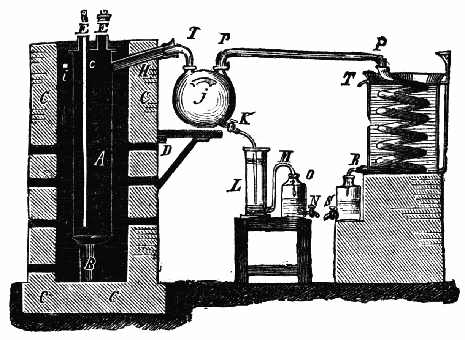
A is a fire-clay gas retort supported on the fire-clay block B; E and E are openings, one being that of a porcelain tube firmly cemented into the cover of A, serving for the introduction of sulphur; the other opening is for the introduction of pieces of coke, with which before the operation commences the retort is filled. The vapours of the sulphide of carbon pass through the tubes H and I into the vessel J, wherein part of the sulphide is condensed, and flows through K into the flask L, filled with water, thence through M into O, finally being run off by the tap N. Any vapours not condensed in J pass through P P into the worm T, the condensed sulphide being collected in S. The crude sulphide is rectified by redistillation over zinc or perchloride of mercury by means of a steam or water bath. If the perchloride is employed it should remain in contact with the crude sulphide for at least 24 hours before redistillation.
Prop., Uses, &c. A colourless, pungent, fetid liquid, having the sp. gr. 1·27. It is exceedingly volatile, boiling at 118·5° Fahr., and has never been frozen. It is highly inflammable, burning with a pale-blue flame, and giving off sulphurous and carbonic-acid gases. It freely dissolves sulphur and phosphorus, and by spontaneous evaporation deposits the first in beautiful crystals. The solution of phosphorus is much used in electrotyping objects, which are coated with a conducting film by its means. Its refractive power is remarkably high, and on this account it is employed to fill hollow lenses for spectroscopes and other optical instruments. It produces intense cold by its evaporation. A spirit thermometer, having its bulb covered with cotton, if dipped into this fluid and suspended in the air, rapidly sinks from 60° to 0°, and if put into the receiver of an air-pump it will fall to -81° Fahr. A mixture of sulphide of carbon and solid carbonic anhydride forms almost the most powerful frigorific agent known. Sulphide of carbon is now prepared on the large scale, and extensively employed as a solvent.
It is thus used for extracting from the cake of fruits and seeds the oil remaining in them after they have been submitted to pressure. The sulphide is subsequently separated from the oil by distillation. In Algiers it is used for obtaining the essential oils contained in the rose, jessamine, and lavender. It is also employed for dissolving the fat from bones, and from the crude wool. Furthermore, it is an excellent solvent for caoutchouc, as well as for the ordinary resins.
Its vapour is employed by agriculturists to kill the larvæ infesting grain. Latterly, it has been employed as a disinfectant.
a. Carbon Bisulphide as an Antiseptic. By P. Zöller (‘Deut. Chem. Ges. Berl.,’ ix, 1080-1084). The author has continued his experiments on this subject with the object of determining (1) the minimum quantity of bisulphide required, and (2) whether articles of food preserved by means of it are fit for human consumption.
As regards the first point, he found that meat of all kinds, and even entire animals, in quantities up to 20 kilograms, kept perfectly well for several weeks in vessels of sheet zinc, into which 5 grams of carbon bisulphide had been introduced, the meat being either simply hung on hooks or wrapped in cloths and laid on perforated shelves in the vessels. Probably a smaller quantity of the bisulphide would suffice. Meat also kept well for 62 days in a vessel in which carbon bisulphide was liberated by introducing potassium xanthate and dilute sulphuric acid. Freshly baked bread, vegetables, and fruits of all kinds (asparagus, radishes, young beans, cucumbers, strawberries, raspberries, currants, cherries, peaches, apricots, lemons, &c.), and juices of fruits kept perfectly well in glass vessels, into which carbon bisulphide has been introduced, in the proportion of 5-10 drops for each litre of capacity.
Bread, vegetables, and fruit thus preserved are fit to eat after simple exposure to the air, and cannot be distinguished by taste or other qualities (except a slight loss of colour in some fruits) from fresh bread, &c. Meat retains even after exposure to air the disagreeable odour of carbon bisulphide. But besides this odour, which disappears on boiling or roasting, the meat has a slight smell of the volatile fatty acids and the taste of game. To most people, however, this taste is not unpleasant. The presence of fatty acids is to be attributed to decomposition taking place in the interior of the meat, and not preventable by the carbon bisulphide, the function of which is merely to kill germs present in the air or on the surface of substances submitted to its influence.
b. By Hugo Schiff (‘Deut. Chem. Ges. Ber.,’ ix, 828). Cocoons of silkworms which had been killed by exposure to the vapours of carbon disulphide underwent no change during six months’ keeping in flasks in the laboratory. The bodies of some pigs which had been used for physiological experiments were put into a stoppered vessel with a few c. c. of carbon disulphide in 1869, and have been perfectly preserved without decomposition. The same result was obtained with a lizard 35-45 centimetres long, which had been suffocated accidentally in 1869, and was bottled whole. In this case a small quantity of liquid collected at the bottom of the vessel, and the green hue of the skin became a dirty greyish green, but not the slightest putrefaction occurred. Similar results were obtained with the intestines of poultry immersed in water in 1872 with a little carbon disulphide, in a bottle with a greased stopper; with a lump of beef weighing 200 grams; and with the body of a finch killed with paraconine. The beef yielded a normal flesh fluid, and was eaten by a dog without hesitation even after several months.
Purification.—1. It is stated that the odour of sulphide of carbon can be readily removed by allowing it to stand over mercury or corrosive sublimate for some time, and then redistilling.
2. The following method by Kern is stated by him to be the best for purifying sulphide of carbon:—The impure product is well mixed in a tall glass vessel with some lead nitrate, and with a small quantity of metallic lead. When the salt turns dark the liquid is poured into another vessel with a fresh quantity of the lead salt; and so on until the salt remains nearly white while mixed with the liquor. The sulphide of carbon is then placed in a retort, and distilled over into a well-cooled receiver.
3. M. Yvon proposes a process which consists in adding copper turnings to the sulphide; no slaking is necessary. The sulphide soon becomes nearly colourless, and loses its usually unpleasant odour. Miller says reduced copper produces the same result.
Carbon sulphide is employed therapeutically in doses of 2 drops, gradually increased to 5, as a sudorific in rheumatism. It is also dropped (40 to 50 drops) on the part, to promote the reduction of strangulated hernia. Externally, it is employed in liniments for rheumatic pains.
CAR′BONATE, a salt in which the hydrogen of (hypothetical) carbonic acid (H2CO3) is replaced by a metal or other basic radical.
Prep., &c. The processes by which the commercial carbonates and many others are prepared are described under the respective bases. Most of the earthy carbonates are found abundantly in nature. In general the salts of this class may be formed by adding an alkaline carbonate to a salt of the metal in solution by double decomposition.
Prop. The carbonates of the alkalies are soluble in water; those of the other bases are for the most part insoluble, except the water is highly charged with carbonic acid. From most of them carbonic anhydride or anhydrous carbonic acid can be easily expelled by heat.
Tests. The carbonates are easily distinguished by the following reactions:—They dissolve with effervescence in hydrochloric acid and in most other acids; in some cases a gentle heat is required to promote the disengagement of the gas.—The gas evolved in the last, passed into lime water and baryta water, occasions white precipitates, which redissolve in acids with effervescence, and after the solution has been boiled are not reprecipitated by liquor of ammonia.—Chloride of calcium and chloride of barium give white precipitates in solutions of the neutral alkaline carbonates, but in solutions of the alkaline bicarbonates only after ebullition; and the precipitates are readily soluble with effervescence in acetic acid.
Estim. The quantity of the metal in an alkaline or earthy carbonate may be easily determined by the ordinary volumetric methods of alkalimetry (which see), and the quantity of carbonic acid, by the method of Fresenius and Will (see Alkalimetry). The apparatus figured on next page, or preferably that shown in the article on Alkalimetry, may be used instead of the more complicated contrivance of the German chemists.
A weighed sample of the carbonate to be examined is placed in the flask a along with a little water, and the small tube, b, filled with either sulphuric or hydrochloric acid, is carefully introduced. The cork, with its chloride of calcium tube, d, is then fitted to the flask, and the whole apparatus very accurately weighed.
On inclining the apparatus the acid escapes over the side of the small tube, and mixing with the liquor in the flask, expels the carbonic acid of the carbonate, which is then dried by passing over the chloride of calcium. After effervescence has ceased heat should be applied to the bottom of the flask, until it be filled with steam, to expel the carbonic gas it contains. The loss of weight gives the weight of the carbonic acid gas that was contained in the sample. The quantity of carbonic acid in the carbonates of the metals that do not contain water may be determined by heating them to redness in a platina crucible.
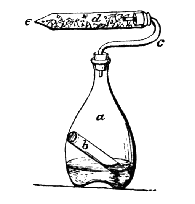
a, Flask containing the sample of carbonate for examination, stopped by a closely fitting cork, through which passes the bent tube c.
b, A small tube, sufficiently long to maintain a slanting position without falling, filled with sulphuric or hydrochloric acid.
c, A bent tube, connecting the flask with d.
d, Horizontal tube, filled with small fragments of fused or dried chloride of calcium, with a fine orifice at the extremity e.
CARBONIC ACID. H2CO3. True carbonic acid has not yet been obtained in any satisfactory condition, although the solution of carbonic anhydride (often called carbonic acid), or anhydrous carbonic acid, is generally regarded as such. It forms with bases an important series of salts, called the carbonates, by double decomposition.
CARBONIC ANHYDRIDE. CO2. Syn. Carbonic acid, Carbon dioxide, Fixed air, Choke damp; Acide carbonique, Fr.; Kohlen säure, Ger. A compound formed by the chemical union of carbon and oxygen.
Hist. Van Helmont recognised carbonic acid as a peculiar gas. Dr Black, in 1757, proved that it was a constituent of limestone, and gave it the name of fixed air; he also showed that the causticity of alkalies depended on its absence. Bergmann first described it as an acid, applying to it the term aërial acid. Lavoisier, in 1776, established its true nature, and gave it the name it now bears. Faraday, in 1823, by pressure at an extremely low temperature, reduced carbonic acid to a liquid, and a few years later Thiloria and Brunel obtained it in the solid form.
Nat. Hist. Carbonic acid is a constituent of the atmosphere, its presence being essential to the existence of vegetable life on the globe. It issues from the earth in many situations, as the Grotto del Cane in Italy, the Valley of Poison in Java, and near the Lake of Laach in Germany. It gives to many mineral springs their sparkling brilliancy, and is held in solution by all natural waters. Combined with the bases, lime and magnesia especially, it exists in large quantities in the crust of the earth. It is the chief product of combustion, and one of the products of fermentation. It is always being exhaled by animals in the process of respiration, and in smaller quantities by plants at night or in the shade. It forms the terrible “choke-damp” or “after-damp” of the coal mines. It is the gas disengaged during the effervescence of soda water and other aërated drinks, and the cause of the freshness of newly-drawn beer.
Prep. Hydrochloric acid, 1 part, diluted with water, 4 or 5 parts, is poured upon fragments of white marble, previously placed in a suitable generating apparatus.[237]
Carbonic acid is rapidly evolved, and may be collected, with some loss, over water in the pneumatic trough. If required dry, the gas must be passed over fragments of fused chloride of calcium, placed in a large tube, or through a small quantity of concentrated sulphuric acid, and collected by displacement or over mercury.
From oil of vitriol, 1 part; water, 6 parts; and chalk or whiting, 11⁄4 part; mixed in a suitable vessel, applying agitation.
Prop. Under ordinary conditions carbonic acid is a colourless, non-inflammable, irrespirable gas, possessing a slightly pungent odour, and an acidulous taste. Water absorbs its own volume of this gas, and by pressure may be made to take up enormous quantities, forming carbonated or aërated water. Its sp. gr. is 1·520; hence it may be poured from one vessel to another like water. By a pressure of thirty atmospheres at 32° Fahr. it is liquefied, the pressure required decreasing as the temperature gets lower. At -94° Fahr. it solidifies into a vitreous transparent mass.
Carbonic acid, even when greatly diluted with air, cannot be inhaled without insensibility following. An atmosphere containing more than its natural quantity of gas (1 part in 2500 parts by measure) acts upon the system as a narcotic poison; hence the danger of over-crowded rooms. It is a non-supporter of combustion, at once extinguishing a lighted candle, gas-jet, or even a piece of burning phosphorus, when these are placed in a jar of the gas.
Tests. It feebly reddens litmus paper, extinguishes the flame of a burning taper, and forms a white precipitate in aqueous solutions of lime and baryta, which is soluble in acetic acid. By the last test a very small quantity of this gas may be easily detected in the atmosphere of rooms, &c. A lighted candle is generally used to test an atmosphere suspected to contain carbonic acid: but it is found that air that will support combustion will contain sufficient of this gas to cause insensibility.
Ant., &c. The patient should be immediately removed into the open air, and placed on his back with the head slightly raised. Cold water should be dashed over the body, hot water or mustard poultices applied to the feet, and ammonia (carefully) to the nostrils. Brandy-and-water and other stimulants may be administered. Continued friction on the surface of the body is also very useful. If the patient has ceased to breathe artificial respiration should be attempted. This may be done by gently pressing down the ribs, and forcing up the diaphragm, and then suddenly withdrawing the pressure. The inhalation of air, mixed with very little chlorine gas, has also been recommended. Wells, cellars, or other underground apartments, containing carbonic acid in poisonous quantities, may be freed from this gas by pumping it out in the same way as water, observing to allow the suction hose to fully reach the floor or bottom of the place. Fresh slaked lime or milk of lime, copiously thrown in, will have a like effect, by absorbing the gas. Free ventilation, whenever it can be established, is, however, not only the cheapest, but the most efficient remedy. See Asphyxia.
CARBON′IC OXIDE. CO. Syn. Protoxide of carbon, Carbon monoxide, Ga′seous oxide of carbon; Oxy′dum carbon′icum, L. A gaseous compound of carbon and oxygen, containing less oxygen than is contained in carbonic acid.
Prep. 1. From carbonic acid gas passed over fragments of charcoal, heated to redness in a tube of porcelain or iron.
2. From crystallised oxalic acid, gently heated with 5 or 6 times its weight of strong sulphuric acid in a glass retort.
3. From ferrocyanide of potassium in fine powder, and 8 or 10 times its weight of concentrated sulphuric acid, heated together in a glass retort.
Obs. All the processes except the last give a mixture of carbonic acid and oxide. It is therefore necessary to pass the gas through a caustic alkaline solution or milk of lime to deprive it of carbonic acid. It may then be passed over dried chloride of calcium, to deprive it of moisture. It may be collected either over mercury or water, as the latter absorbs very little of this gas.