A CYCLOPÆDIA OF PRACTICAL RECEIPTS, PROCESSES, AND COLLATERAL INFORMATION (continued 20)
Reading edition
BURG′LARIES. The common precautions of locks and bolts, alarum-bells and fire-arms, are frequently found useless in preserving houses from burglars; but a light in the upper part of the house, or a small dog on the ground-floor, with the means of running into a place of safety from its enemies, has been seldom known to fail. A combination of the two would undoubtedly be doubly effective. The bark of the dog and the fear of detection by the approach of the light would deter the majority of rogues of common pluck and feeling. A dog out of doors, and consequently accessible, however large and fierce, is easily pacified or silenced by men of the class referred to.
BURLS, REMOVAL OF, from Cloth and Wool. Introduce the wool or the woollen goods into 100 litres of sulphuric acid at 6° B., in which 500 grams of alum and 250 grams of salt have been dissolved. Work in this bath for one or two hours, drain in the centrifugal, and hang up at 100° to 120°. Wash for an hour and a half in clear water, treat for two hours with fuller’s earth, soda and lime, and wash again for two hours. Sulphuric acid is adapted only for whites and indigo blues. For coloured goods solutions of chloride of tin, and chloride of manganese at 6° B., are recommended.
BURNS[234] and Scalds.[235] Treatm. When the injury is superficial and slight, a little creosote may be applied to the part. If a scald, the vesicle should be first pierced with a needle, or what is better, snipped with a pair of scissors, and the water which it contains should be then gently squeezed out. When creosote is not procurable, a liniment formed of equal parts of soft soap, basilicon ointment, oil of turpentine, and water, may be used instead. When the part feels very hot and painful, a poultice may be applied, on the surface of which a few drops of creosote, or of the liniment, should be spread with a knife. This treatment will generally succeed in allaying the pain. It may be followed by a dressing of zinc ointment, or any other like simple emollient or unctuous preparation. Creosote, contrary to what is commonly asserted, produces scarcely any smarting or pain; whilst it rapidly removes the burning sensation, and the charred surface soon assumes a dry scabby appearance, which, by dressing with simple ointment, soon comes off and leaves the part beneath in a sound and healthy state. If a poultice be applied it is best to keep it on until the next day. Plunging the part into very cold water immediately after the receipt of an injury of this kind will frequently prevent any further remedy being required. Flexible collodion painted over a burn forms a good protective envelope. In all cases cooling laxatives should be administered; and the diet should be rather low until the inflammatory symptoms subside.
Treatment for Animals. Carbolic dressing, exclusion of air, cotton wool, linseed oil and lime water.
BURNING-GLASS. See Lens.
BUTEA FRONDOSA, Roxb. (Ind. Ph.) Syn. Bengal Kino Tree. Habitat. Common all over India.—Officinal part. The inspissated juice obtained from the stem by incision (Buteæ Gummi, Kino Bengalensis, Bengal kino). It occurs in the form of irregular shining fragments, seldom as large as a pea; more or less mixed with adherent pieces of greyish bark; of an intense ruby colour and astringent taste; soluble, but not freely so, in water and in alcohol. Its astringency is due to the presence of tannic and gallic acids.—Prop. & Uses. Similar to those of kino, for which it has been found an efficient substitute.—Prep. Same as those of kino.
BUTTER. [Eng., Ger.] Syn. Buty′rum, L.; Beurre, Fr.; Buter, Butera, Sax. The fatty matter obtained from cream by churning it.
Manuf. The process of making butter by the common operation of churning is extremely simple, and is well known. The chief objects to attend to are maintaining a proper temperature, and a certain degree of exposure to the air. Extreme cleanliness must also be observed; the churn and other utensils being frequently scalded out with water. When the butter is ‘come,’ it should be put into a fresh-scalded pan, or tub, which has been standing in cold water, cold water poured on it, and after it has acquired some hardness, it should be well beaten with a flat board until not the least taste of the butter-milk remains, and the water, which must be often changed, becomes quite colourless and tasteless. A little salt may then be worked into it; after which it may be weighed and made into ‘forms,’ which should then be thrown into cold water contained in an earthen pan provided with a cover. In this way nice and cool butter may be obtained in the hottest weather.
At Dumbarton the newly separated butter is put into a clean vessel, and a corn sickle is drawn several times crosswise through it, to extract any hairs that may adhere to it. This operation is performed in very cold spring water, and is followed by thoroughly washing it therein. 10 oz. of salt are now added to every stone-weight of the butter, and well mixed in.
In Devonshire the milk is generally scalded in copper pans over a charcoal or wood fire, and the cream collected as soon as it rises, or, and more frequently, when the whole has got cold. It is then churned in the usual way. On the small scale the butter is commonly obtained from this cream by patiently working it with the hand in a shallow pan or tub. Without care the cream is apt to absorb some of the fumes from the charcoal, which impart a peculiar taste to the butter. This is the reason why some of the Devonshire butter has a slight smoky flavour. It may be removed by thorough washing in cold water. Of late years, in the large dairy-farms of Devonshire, covered flues, with openings to receive the bottoms of the pans, have superseded open fires, by which the danger of contamination from the fumes is removed.
Choice. Fresh butter has a pleasant odour and is of an equal colour throughout its substance. If it smells sour, the butter-milk has not been well washed out; and if it is streaked or veiny, it is probably mixed with stale butter or lard. A good way to try butter is to thrust a knife into it, which should not smell rancid and unpleasant when withdrawn. Rancid and stale butter, when eaten in quantity, is capable of producing dangerous symptoms.
Pur. The cheaper kinds of butter are frequently adulterated with common wheat-flour, oatmeal, pea-flour, lard, and is sometimes mixed with suet and turnips, as well as with a large quantity of salt and water. The trick is concocted between the Irish factors and the London dealers. The higher priced article is seldom mixed with anything beyond an excess of salt and water, notwithstanding the assertions of alarmists to the contrary. The presence of lard may be detected by the flavour and paleness of the colour. A little of the sample adulterated with the other substances named, if melted in a glass tube or phial, will separate into strata, which are very marked when cold.
Quantitative Analysis of Butter.—1. The following process for the analysis of butter, by Mr A. H. Allen, is extracted from the ‘Chemical News’ (xxxii, 77):—The Society of Public Analysts has adopted 80·00 per cent. as the lowest limit of fat contained in a genuine butter.
The amount of water is best ascertained by heating 5 grams of the butter in a small weighed beaker to a temperature of about 110° or 120° C. for an hour or so. Some chemists merely heat the butter on a water bath. According to the author’s experience, perfect drying is next to impossible at that temperature.
The dried butter is next treated in the beaker with anhydrous ether, or commercial benzoline. The former liquid is expensive and inconveniently volatile, while it must be used in a perfectly anhydrous condition (to avoid solution of the salt), and except when boiling has but a limited solvent power for butter, especially when adulterated. Benzoline dissolves fat more readily than ether; it does not volatilise so rapidly at ordinary temperatures, it is always anhydrous and has the advantage of low price. The “benzoline” employed by the author is made by redistilling the commercial article from a retort immersed in a bath of boiling water. About one third of the original bulk usually comes over readily at 100° C., and has a gravity of 0·689.
On warming the beaker containing the benzoline the dry butter readily dissolves. The liquid is poured on a small dry filter and washed with warm benzoline, the filtrate being collected in a small wide beaker. If the filter had been previously weighed, its increase of weight, after careful drying, will of course give the quantity of curd and salt in the 5 grams of butter taken. Except in cases in which extreme accuracy is desired, it is preferable to scrape the residue off the filter and weigh it separately.
The error (owing to imperfect removal) only amounts to one or two tenths per cent. of the butter taken. As the salt is accurately estimated afterwards, the loss falls on the curd. The salt may be determined by careful ignition of the filter and residue, the incombustible matter consisting almost wholly of common salt, while the curd is ascertained by loss of weight. This method is not to be recommended; for without great care some of the salt will be volatilised and lost, the error causing the amount of curd to appear excessive.
Ignition also renders any further examination of the curd an impossibility. A far preferable plan is to return the weighed curd and salt to the filter, and to wash them with cold water. The filtrate is made up to 100 c. c., and the salt is estimated in a half of it by titrating with decinormal nitrate of silver. The remaining portion of the solution can be employed for the estimation of sugar, if desired. This is effected by inverse titration with Fehling’s copper solution, in the same way as grape sugar. The estimation of sugar may sometimes be of interest, as a means of ascertaining whether the aqueous portion of the butter consisted of mere water or of serum of milk. In other words, the estimation of the sugar may furnish a means of ascertaining whether an excess of water in the butter is due to insufficient removal of the butter-milk, or to subsequent incorporation of water. Every 0·001 gram of milk sugar represents about 0·022 of average milk serum.
The residue insoluble in cold water usually consists almost wholly of casein. If, however, the butter has been adulterated with mashed potatoes, flour, or other starchy matters—said to be occasionally employed—they will be found here. The presence of starch in the residue will, of course, be readily indicated by treating it with hot water, and testing the cooled liquid with solution of iodine. By pressing out a small portion of the butter between two slips of glass, so as to obtain a thin film, and observing it under the microscope (or by observing the caseous residue after treatment with cold water), the nature of the starch may be ascertained.
The solution of the fatty matter in benzoline is evaporated at 100° C. till it no longer decreases in weight. The average proportion of fatty matter in butter is about 85 per cent. If less than 80 per cent. the butter must be considered adulterated. It is evident that a careful estimation of the per-centage of fatty matter would often render separate estimations of the water, curd, and salt unnecessary; for unless the sum of the three latter constituents exceeded 20 per cent. the butter could not be considered as adulterated, unless by an admixture of other fats.
An easy and rapid method of estimating the fat in the undried butter is therefore a great desideratum; but unfortunately no satisfactory method is at present known. The indirect estimation of the fat, by subtracting the sum of the per-centages of water, curd, and salt from 100·00, ought to agree with the direct estimation of fat within 0·5 per cent., and the variation is often much less.
2. Dr Dupré adopts the following method: About 5 grams of the dry filtered butter fat are weighed in a small strong flask; 25 c. c. of a normal alcoholic soda solution are added; the flask is closed by means of a well-fitting cauotchouc stopper, firmly secured by a piece of canvas and string, and heated in a water-bath for about an hour. When cool the flask is opened, the contents—which are semi-solid—carefully liquefied by heat, and washed into a flask with hot water. This flask is now heated for some time on a water-bath to expel the alcohol, some more hot water is added, and 25 c. c. of diluted sulphuric acid somewhat stronger than the alkali used, are run in. The contents are allowed to cool, and the acid aqueous solution below the cake of fatty acids is passed through a filter. The fatty acids in the flask are washed by hot water in the manner recommended by Dr Muter, i.e., each time allowed to cool; all the washings are passed through a filter.
The author uses no cambric, but passes everything through paper. With care scarcely any of the fatty acid will find its way into the filter. After the washing with water is completed and the flask drained, he washes any fatty acid that may be on the filter into the flask by means of a mixture of alcohol and ether on a water bath, and finally dries the fatty acids in the flask at a temperature of 105° C. The drying can be done readily if the melted fat is now and then shaken briskly, so as to subdivide the water as much as possible. In this way the acids when once in the flask are not taken out until their weight has been taken, thus reducing the risk of loss to a minimum. Meanwhile the acidity of the aqueous filtrate and washings is estimated by decinormal soda solution. Subtracting from the amount required to the proportion necessary to neutralise the excess of acid added in decomposing the soap, the rest represents the soluble fatty acids contained in the butter taken, and on the assumption of its being butyric acid, we can, of course, calculate the amount of this acid present. When once the equivalent of the soluble acids present in butter is fairly determined, this, of course, will have to be substituted for that of butyric acid. The results thus obtained are very accurate, and the process is very simple in execution.
The author has satisfied himself by repeated experiments that the alkalinity of the alcoholic soda solution by itself is not altered by the process. The author places no reliance on the specific gravity test, as he finds that mutton dripping, and other fats likely to be used as adulterants of butter, may acquire a specific gravity above ·911 by being strongly and repeatedly heated. He thinks, however, that any sample of butter below ·911 may safely be pronounced adulterated.
In a subsequent note Dr Dupré states that he has effected the saponification, decomposition of the soap, and the washing and drying of the fatty acids at ordinary temperature, thus still further reducing the risk of breaking up the higher into lower acids. The saponification is readily effected by using a sufficiency of alcoholic soda. Between four and five grams of the dry butter fat were shaken up for several minutes with 100 c. c. of normal alcoholic soda. The butter soon dissolves, but after a time the solution gelatinises to a clear transparent mass. (The temperature of the laboratory at the time of these experiments ranged between 22° and 50°.) This jelly is now allowed to stand over night, during which time the smell of butyric ether, very strong at first, entirely disappears. In one of the experiments the alcohol was allowed to evaporate spontaneously before the acid was added; in the other (made with a different sample of butter) the soap was dissolved in about half a litre of water, and at once decomposed by the addition of hydrochloric acid.
The fatty acids which separated in white curdy masses were thoroughly washed on a filter with cold water, about four litres, dried in vacuo over oil of vitriol, and weighed. The results of experiment show that butter fat yields the same proportion of insoluble fatty acids when saponified with or without the aid of heat.
3. Mr Gatehouse. Rapid Method of Detecting the Adulteration of Butter with other Fats. The following comparative method is based upon the insolubility of potassium stearate in alkaline solutions when the stearate has been produced at high temperatures:
Before applying the test it is essential to remove all curd, butter-milk, and salt, by washing with hot water or dissolving in ether. Twenty grains of the butter are placed in a large test-tube one third full with water boiled thoroughly and allowed to stand till the fat separates. The fat is either dissolved in ether, and after evaporation saponified, or the lower layer of the liquid is drawn off by a pipette as follows:—A thin glass tube is drawn out to a fairly fine point and bent at the top to an obtuse angle. Whilst the butter is still liquid this nozzle is inserted into the bottom of the test-tube, placing the finger over the upper end to prevent any liquid from getting in till it reaches the bottom. When fairly cold the liquid may be withdrawn by a pipette attached to the tube. This process can be repeated till the washings are free from chlorides.
The saponification is effected by heating the purified butter with 1⁄3-1⁄2 of its own weight of pure solid potassium hydrate (purified by alcohol) to a temperature above 420° F.; applying the heat gently at first, and when the frothing ceases, heating it more strongly, till no further apparent action occurs. The ultimate temperature during saponification must be kept above 400° for some minutes, otherwise the sterate formed will be soluble instead of insoluble in the alkaline solution.
If the butter is pure, the colour of the residue will be at the utmost light yellow, but should the butter be adulterated to any extent, it may be almost black. Too much reliance must not, however, be placed on the colour.
After allowing the tube and its contents to cool, the mass is boiled with successive portions of distilled water till 6 oz. (or 200 c. c.) altogether have been used. If the butter is pure, a portion of this solution poured into a test-tube will present only a faint opalescence; if, on the other hand, the butter is impure, a decided opacity will be perceived, the degree depending upon the amount of adulteration.
The amount of adulteration in any sample is determined by first obtaining pure butter and adding to separate portions of it known per-centages of lard, &c. Each of these can be saponified as stated above; they are then corked up in tubes of equal diameter and labelled with the per-centage of lard they contain. On comparing them it will be seen that 2 per cent. of lard can be clearly indicated.
When a butter is analysed all that is wanted is to saponify, make up to the correct strength, and after cooling pour into a test-tube and compare with the specimen tubes.
4. Dr Redwood. The Determination of the Melting Points of Butter and other Fats. The apparatus in the form best suited for general use consists of a basin, two small beakers, and a thermometer. The author uses an enamelled iron basin about six inches in diameter, and three and a half inches deep. In this is placed a beaker four and a half inches deep and three inches in diameter, and within this beaker is placed another much smaller one, supported by its projecting rim on a disk of tinplate or copper, the outer edge of which rests on the mouth of the larger beaker. Some mercury is put in the smaller beaker to the depth of about an inch, and cold water into the larger beaker, so that its surface shall be half an inch or an inch higher than that of the mercury.
A small drop of the fat which has been previously melted and heated to several degrees above its melting-point, but has been allowed to cool again to near its setting point, is put on the surface of the cold mercury. This is best done by means of a thin glass rod about one eighth of an inch in diameter, the end of which has been rounded off in the blow-pipe flame.
It is important that the drop should be very small, and its temperature when placed on the mercury not much above its melting point, for if it be too hot it will spread over the surface of the mercury, which is not desirable.
If the rounded end of the rod be slightly dipped into the melted fat, and then brought to the surface of the mercury, a small hemispherical particle will attach itself there and speedily congeal, becoming more or less opaque in doing so. The weight of one of these hemispherical masses, which should not be more than the eighth of an inch in diameter, will be from 1⁄50 to 1⁄10 of a grain. Having placed the drop of fat upon the mercury, the bulb of a thermometer, with sufficiently minute graduations, is introduced into the mercury and hot water poured into the basin. The heat is thus communicated to the contents of the small beaker slowly through the water in the larger beaker, and the rise of temperature in the mercury may be easily regulated, and should take place at the rate of about one degree per minute.
The mercury, by virtue of its comparatively good conducting power, acquires a uniform temperature throughout, which is indicated by the thermometer, and at the same time communicated to the fat. The fat when the temperature approaches its melting point becomes partially transparent, and if the stem or elongated bulb of the thermometer be now brought up against it, the moment fusion takes place the liquid fat will run into the channel formed by the repulsion of the mercury and the outside of the thermometer tube. This process presents the following advantages:—
1. The heat-conducting power of the mercury, on which the fat is placed, ensures the equalisation of the temperature as indicated by the thermometer, and at the same time communicated to the fat.
2. The direct contact of the fat with the mercury, without the intervention of a bad conducting medium, such as glass, ensures a more immediate and correct indication of the temperature at which liquefaction takes place than would otherwise occur.
3. The minuteness of the quantity of fat operated upon reduces to a minimum the time occupied in its melting, and thus facilitates the determination with exactness of its melting point.
4. The time occupied in preparing small tubes and charging them with the fat is saved, and several experiments in succession may be easily and rapidly made with the same apparatus. The author observed that in butter as well as other fats, such as tallows, there were at least two melting points, dependent upon the way in which the fat had been previously subjected to the action of heat, and that they may differ in butter to the extent of 3° or 4° F.; the low melting point being that of the fat after it has been heated to several degrees above its first melting point, and the higher melting point being that of fat which has been previously melted to the lowest possible temperature, and then immediately allowed to congeal.
5. Professor Wanklyn carefully weighs one gram of butter, and heats it in a platinum dish of the size shown in the accompanying figure, from four to six hours or even more—in short, until it ceases to lose weight. The loss of weight is the water, which should be calculated and expressed in per-centages.
Fat. The dried butter is now to be heated with ether (the ether should be made to boil by floating the dish in hot water). Several successive portions should be taken, the whole passed through a filter, the filter well washed with ether, and the filtrate evaporated to dryness and weighed.
Caseine and Ash. The residue from which the fat and water have been extracted is now to be taken, carefully weighed, then burned down to a low red heat; the residue remaining is the ash, the loss the caseine.
Butter-analysing dish.
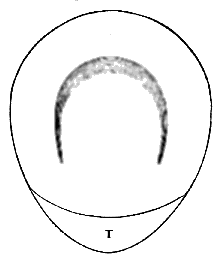
The amount of ash, practically speaking, is the salt, but if there be any doubt as to its composition, the chlorine maybe estimated by a volumetric solution of nitrate of silver, and further examined.
The following table shows the composition of a few genuine and other butters, examined according to the same, or at least to a similar process to the one described:—
Fat.Ash, principally Salt.Water.Caseine.Quality.
Fresh Devonshire butter.82·71·116·216·2Good.Wanklyn.
Normandy butter.82·11·816·116·1””
Jersey butter.78·4918·52810·4452·536”Angell and Hehner.
Normandy butter.82·6432·9159·3055·137”
Butter from Ventnor.86·2806·6003·8313·289Found to be adulterated with foreign fat.”
Butter from London.87·501·55923·9816·880Adulterated with water.”
”47·1192·68942·3587·834Adulterated with water, and contains an excess of curd.”
6. A Method of Detecting Meat Fats in Butter. Mr Horsley, writing to the ‘Chemical News,’ September, 1874, says:—“My starting point is, that fresh butter is permanently soluble in methylated ether, sp. gr. 0·730 at the temperature of 65° Fahr. But with the view of seeing if any other substance it may contain could be precipitated from it, I took, say, 20 or 25 grains of fresh butter, placed it in a small test-tube, and poured over it one drachm of methylated ether, and on corking the tube it readily dissolved after a few minutes’ agitation. I then added 30 drops of methylated alcohol, 63° o. p., and agitated again, but nothing was precipitated. I, therefore, made another experiment with 15 grains of butter and 10 grains of prepared mutton fat, dissolved them in 1 drachm of ether first, and added 30 drops of alcohol, when in less than half an hour the fat was precipitated in a room heated to 68° Fahr. Next, in order to see the effects upon mixtures of known fats, such as lard, beef, mutton, and tallow fats properly melted together in proportions of 60 grains of butter and 40 of fat, and stirring till cold, I found that each of them could, by a similar procedure, be precipitated in a few minutes. In one case, that of mutton, I filtered off the ethereal liquid, and collected the residue, and obtained as much as 30 per cent. of what had been used; so that there is no longer any doubt about easily detecting fatty adulterations in butter. Lastly, I would observe that crystallisation of butter, out of the ethereal solution at a lower temperature than 65°, must not be mistaken for the fats precipitated by alcohol alluded to, as the butter, besides being so much lighter, occupies the upper layer, and is different in character and easily remelted by the application of the warm hand for a minute or so.
“Further experiments have proved that half an hour suffices to effect the full precipitation of fats from the ethereal solutions by the addition of 20 drops or so of alcohol to the drachm of ether, containing not more than 25 grains of the adulterated butter; after which the tube should be agitated and its contents projected on to a small double filter, washed with a little alcohol, and the residue whilst moist scraped off, and transferred to a watch-glass to dry. In this way loss by melting and absorption into the paper is obviated.
“The following were the proportions of fats I recovered, viz.—
Lard60per cent.
Mutton fat75”
Beef fat95”
The precipitated mutton fat is powdery, and white as snow. Lard and beef are more adherent and greasy; for that reason mutton makes the firmest compound.”
7. On the Cooling of Fats. At a meeting of the University of Edinburgh Chemical Society, held on March 13th, 1878, a paper on the above subject was read by Mr Treharne, M.B.C.M., wherein the author states:—“If equal bulks of the fats of mutton, beef, pork, and butter, and palm oil be heated to 100° C. in small flasks fitted with a thermometer through the cork, and then allowed to cool by radiation under the same conditions for each, temperature is found to fall regularly to a certain point (which is different for each of the facts above named) and then to rise to a certain turning point. These turning points are approximately as follows:—
ForMuttonfat40°C.
”Beef”28·5°C.
”Pork”26·5°”
”Butter”23·5°”
”Palm oil 21·0°”
The extent of the rise in temperature is different in each fat, being greatest in that of mutton, and least in that of butter and palm oil. The extent of the rise is also greater within certain limits the greater the quantity of fat employed; but as a rule the turning point is pretty constant for the same fat. There is also a little difference in the turning points and the extent of rise according to the part of the carcase from which the fat has been taken. If temperature and time be taken as co-ordinates, and the rate of cooling be represented by curves, these latter will be characteristic of the respective fats. A mixture of equal parts of mutton and butter fats does not give a curve intermediate between those of its two components; but is such as to indicate that less heat is given out on cooling (to 20° C say) than in the case of butter, which, compared with mutton fat, gives off very little heat.”
For further information on the subject of ‘Butter’ the reader is referred to a Report by Mr Bell—the principal of the Chemical Laboratory at Somerset House—to the Board of Inland Revenue, included in a return made to the House of Commons in 1876.
Preservation. 1. Melt the butter in a stoneware or a well-glazed earthen pan set in a water bath at a heat not exceeding 180° Fahr., and keep it heated, skimming it from time to time until it becomes quite transparent; then pour off the clear portion into another vessel, and cool it as quickly as possible by placing the vessel in very cold water or ice. This is the method employed by the Tartars who supply the Constantinople market. In this state it may be preserved perfectly fresh for 6 or 9 months, if kept in a close vessel and a cool place. This is the plan so strongly recommended by M. Thénard. Mr Eaton states that butter melted by the Tartarian method, and then salted by ours, will keep good and fine-tasted for two years.
2. Saltpetre and white sugar, of each 1 oz.; best Spanish great-salt (or Cheshire large-grained salt), 2 oz.; all in very fine powder; mix thoroughly, and add 1 oz. of this mixture to every lb. of butter, and thoroughly incorporate them together. The butter thus prepared is then to be tightly pressed into clean glazed earthenware vessels (or well-seasoned casks), so as to leave no vacuities. This plan is recommended by Dr Anderson, who declares that “butter so prepared will keep in a cool place for years; and will bear a voyage to the East Indies, if packed (stowed) so as not to melt.” It does not taste well before it has stood for three or four weeks, after which it acquires a rich marrow-like flavour, which no other butter ever possesses. A good method to preserve the butter from the air is to fill the pots to within an inch of the top, then to lay on it some coarse-grained salt to the depth of a 1⁄4 to 1⁄2 an inch, and lastly to cover each pot with a slate, plate, or other flat article. The salt by long keeping runs to brine, which forms an air-tight layer on the top of the butter, and may at any time be very easily removed by turning the pot on one side.
3. Fresh butter, 21 lbs.; salt, 1 lb.; saltpetre, 1 oz. These are the common proportions for the best salt butter of the shops.
4. Fresh butter, 18 lbs.; salt, 1 lb.; saltpetre, 11⁄2 oz.; honey or fine brown sugar, 2 oz. Superior to No. 3.
Concl. Remarks. It may be useful to know that rancid butter may be restored, or, in all cases, greatly improved, by melting it in a water bath with some fresh-burnt and coarsely powdered animal charcoal (which has been thoroughly freed from dust by sifting), and straining it through clean flannel. A better and less troublesome method is to well wash the butter first with some good new milk, and next with cold spring water. Butyric acid, on the presence of which rancidity depends, is freely soluble in fresh milk.
The turnip-flavour arising from the cows being fed on turnips or cabbages is said to be removed by one or other of the following methods:—1. When the milk is strained into the pans put to every 6 galls. 1 gal. of boiling water.—2. Dissolve 1 oz. of nitre in a pint of spring water, and put a 1⁄4 pint of the solution to every 15 galls. of milk.—3. Keep back a 1⁄4 pint of the sour cream when you churn, and put it into a well-scalded pot, into which you are to gather the next cream; stir that well, and do so with every fresh addition. Each of these methods come on good authority, but we are bound to say that our own experience does not confirm their constant success. We have found that the addition of a handful of salt to the water used to wash the butter is as good a plan as any.
Butter, Ancho′vy. From anchovies (boned and beaten to a paste), 1 part; butter, 2 parts; spice, q. s.
Butter-colouring (from Paris). A mixture of 40 per cent. of chrome yellow with some fat coloured with annatto. (Flückiger and Weil.)
Butter, Clar′ified. Fresh butter melted in a water bath, allowed to settle, and the clear portion poured into an earthenware basin or pot, set in cold water, so as to cool it as quickly as possible, without allowing it to crystallise. It keeps a long time without becoming rank. See Butter, No. 1 (antè).
Butter, Hon′ey. Fine Narbonne honey, 2 to 4 oz.; mixed with good butter, 1 lb. Used as a delicacy for children, and by the sick and aged.
Butter, Lem′on. See Butter, Orange.
Butter, Melt′ed. This well-known sauce may be prepared of excellent quality as follows:—Beat up about 1 oz. of fine flour with 4 oz. of butter, in the cold, until they are evenly and thoroughly mixed, then add 4 or 5 table-spoonfuls of hot milk, put the whole into a small saucepan, and continue shaking it, all in one direction, until it simmers very gently; lastly, remove it from the fire, and pour it into the butter-boats for use. These last should be filled with hot water, and then emptied and wiped dry, before putting the melted butter into them. See Sauces.
Butter, Or′ange. Prep. 1. From 6 eggs, 2 oz. of powdered sugar, and 4 oz. of butter, well beaten together with a little orange-flower water. Sometimes 1 or 2 oz. of blanched almonds, or of almond-paste, is added.
2. Butter, 1 lb.; syrup of orange peel, 4 oz. Both are eaten as a delicacy. Lemon butter, is made in a similar manner.
Butter of An′timony*‡. Trichloride of antimony.
Butter of Caca′o. See Co′coa, and Co′coa-nut Oil.
Butter of Nut′megs. Collected from the surface of the water in the still, after the distillation of the essential oil of nutmegs.
Butter of Ro′ses. Obtained by distilling damask roses. It separates slowly from the water in the receiver. It has little smell, and is hence used to dilute the odour of musk, ambergris, and civet.
Butter of Wax. Prepared by distilling bees′-wax. A factitious kind is also made.
Butter of Zinc*‡. Chloride of zinc.
Butter Powder (from the Adler-Apotheke Emmerich on the Rhine). Bicarbonate of soda. (Dr U. Kreusler.)
Butter Powder (Lemmel, Schleswig-Holstein). An impure bicarbonate of soda, coloured with turmeric. (Hirschberg.)
Butter Powder, Schuhrer’s (Emil Schührer, Mutzschen, Saxony). This, it is claimed, will considerably increase the yield of butter, shorten the process of churning, and yield a product which will be firm even in the height of summer, well-flavoured, of a handsome colour, and of excellent commercial value. It consists of a tolerably pure commercial bicarbonate of soda, with 1⁄2 per cent. of powdered turmeric. (Dr Peters.)
Butter Powder, Tomlinson’s (Tomlinson & Co., Lincoln, England). Ordinary bicarbonate of soda, coloured with 3⁄4 per cent. of annatto. (Dr Karmrodt.)
Butter-preservative Paste (from Spaa). Consists of common salt, 52 parts; nitre, 23 parts; syrup, 5 parts. (Wittstein.)
BUTTERINE. A substance known under this name, and intended as a substitute for butter, is imported into this country from New York.
Of butterine Dr Campbell Brown remarks:—“In general appearance, taste, and consistence, it is very similar to ordinary butter; but notwithstanding that its solidifying point is lower than that of some butters, it retains much of the peculiar crumbly texture and fracture of dripping.
“It softens at 78° F., and melts at 86°. When heated and slowly cooled it obscures the thermometer at 62° and solidifies at 60°. It contains—
Water11·25to8·5
Salt1·03”5·5
Curd0·57”0·6
Fat87·15”85·4
——— ———
100·00 100·00
“The fat consists of oleine, palmitine, margarine, a trace of stearine, and about 5 or 6 per cent. of butter. When dissolved in about four times its weight of ether, and allowed to evaporate spontaneously, it does not deposit any fat until more than half of the ether has passed off, and if the temperature is not below 60° the deposit is not solid.
“The first deposit when dried fuses at 108°; the second deposit fuses at 88°, and solidifies at 64°.
“Under the microscope butterine does not appear to consist of acicular crystals of fat, but of irregular masses, containing a few butter globules, particles of curd, and crystals of salt. With polarised light the irregular crystalline structure is beautifully seen, and is clearly distinguishable from butter which has been melted and recongealed. When old and rancid it acquires the odour and taste of dripping, but it keeps longer undecomposed than butter. When fresh it is a wholesome substitute for real butter. No one can reasonably take exception to its sale.
“Butterine may be detected by the following characters:—
“1. Its crumbly fracture.
“2. Its loss of colour when kept melted for a short time at 212°.
“3. The behaviour of its ethereal solution.
“4. Its action on polarised light.”
The ‘American Chemist’ for 1876 contains an interesting paper by Mr Henry Mott on the manufacture of artificial butter, which is too lengthy for insertion here.
BUTTER-MILK. The liquid that remains after the butter is separated from the cream.
Qual., &c. Butter-milk left from the churning of sweet cream is not only very delicious, but exceedingly wholesome and nutritious. It is eaten with fruit, puddings, and cakes, and is said to possess the property of allaying the nervous irritability induced by excessive tea-drinking. It is an admirable beverage in rickets, diabetes, and many stomach affections. An American physician has recently asserted that it induces longevity. See Milk.
BUTTONS. See Brass, Gilding, &c.
BU′TYRATE. [Eng., Fr.] Syn. Bu′tyras, L. A salt in which the hydrogen of butyric acid is replaced by a basic radical.
Butyrate of Barium. Prep. Saponify butter with a boiling solution of caustic alkali, and decompose the resulting soap by adding a solution of tartaric acid; filter and distil; neutralise the distillate with hydrate of barium, and evaporate; the first crystals that form are caprate of barium; the next, caproate of barium; and the last, butyrate of barium. This salt is very soluble in water, and hence is easily separated from the others.—Use. Chiefly for making butyric acid.
BUTYRIC (-tĭr′-). Syn. Butyr′icus, L.; Butyrique, Fr. Of or from butter.
BUTYRIC ACID. HC4H7O2. Syn. Acidum Buty̆̆r′icum, L.; Acide butyrique, Fr.; Buttersäure, Ger. An oily acid, first obtained by Chevreul from butter.
Prep. From butyrate of barium or magnesium, by adding sulphuric acid in quantity not quite sufficient to decompose the whole of the salt; the clear liquid, filtered and distilled, yields butyric acid, from which the water may be removed by digestion with chloride of calcium.
Prop. A thin colourless liquid, of pungent rancid odour, and sour taste, miscible with water and alcohol. It boils and distils unchanged at 327° Fahr. Sp. gr. ·963. See Ethers.
BU′TYRIN (-in). [Eng., Fr.] An oily substance existing in butter, and of which it forms the characteristic portion. It was discovered by Chevreul.
Prep. Keep clarified butter in a porcelain vessel, at a heat of 66°, for some days; carefully collect the oily portion which separates, mix it with an equal weight of alcohol of the sp. gr. ·796, and agitate it frequently for 24 hours; after repose pour off the clear portion, and evaporate it; treat the oily residuum with a little carbonate of magnesium, to remove free acid, and wash off the butyrate of magnesium, thus formed, with water; lastly, heat the remaining fatty matter in alcohol, filter, and evaporate, by a gentle heat; the residuum is butyrin.
BUXINE (-ĭn). A substance detected by M. Faure in bux′us semper′virens, or the common box-tree.
CABBAGE. Syn. Bras′sica, L.; Chou, Fr.; Kohl, Ger. This common esculent, and all its numerous varieties, are merely cultivated specimens of the wild sea-cabbage of our coasts (bras′sica olera′cea, Linn.), one of an extensive and valuable genus of plants belonging to the nat. ord. Cruciferæ. After the potato, the cabbage is doubtless more extensively used by the masses of the people than any other fresh vegetable. When young, and properly dressed, it forms an agreeable and wholesome addition to animal food, the grossness of which, it is said, it tends to correct. It should be eaten only when fresh gathered and fresh cooked; and the unconsumed portion, as well as the water in which it has been boiled, should be at once thrown away. Persons troubled with a weak digestion, or who have a tendency to flatulence, diarrhœa, or worms, would do well to avoid them. Their use is particularly serviceable in scurvy, and in numerous skin diseases.
It has been asserted that cabbages, cauliflowers, broccoli, celery, and several other culinary vegetables, may be preserved in a fresh state for some time, by cutting them so that they may have about two inches of stem left below the leaves, scooping out the pith as far down as a small knife will reach, and then suspending them perpendicularly by means of a cord, in an inverted position, in some cool situation, and daily filling up the bottom part of the stem with clean cold water. In this way it is stated that a supply of green vegetables may be readily obtained during a severe winter, and on ship-board. Other methods, including those usually adopted with the same object, are noticed under Vegetables (Culinary).
Cabbages, broccoli, &c., are dressed by simply throwing them into boiling water, and simmering them until tender. A few minutes is sufficient for this purpose. A pinch of salt of tartar, or of carbonate of soda, is commonly added to the water, to preserve the green colour of the vegetables.
CACHOU AROMATISE (kăshoo ărŏmătēzā). [Fr.] A mouth-lozenge intended to sweeten and perfume the breath. Preparations of this description are much used by smokers and bacchanals. The form under which they are generally prepared for sale is that of 11⁄2 to 2 gr. pills, neatly silvered. Originally they were composed chiefly of catechu and sugar, flavoured and perfumed with the stronger aromatics; but at the present day the catechu, from which they derive their name, is not unfrequently omitted. Their preparation is described elsewhere. See Breath, Lozenges, Pastils, &c.
CAD′MIUM. Cd. [Eng., L.] Syn. Klapro′thium. A metal discovered by Stromeyer and Hermann, in the ores of zinc.
Prep. 1. (Stromeyer.) The cadmo-zincic ore is dissolved in an excess of dilute sulphuric or hydrochloric acid by heat; a stream of sulphuretted hydrogen is passed through the solution, the resulting precipitate (sulphide of cadmium) dissolved in nitric acid, and the solution evaporated to dryness; the residuum is dissolved in water, the solution precipitated with carbonate of ammonium in excess, and the precipitate (carbonate of cadmium) collected, mixed with charcoal, and heated to redness in a crucible apparatus so arranged as to condense the fumes; the cadmium sublimes.
2. (Wollaston.) A solution of the ore obtained as above is placed in a platinum capsule, and a piece of metallic zinc is plunged into it. In a short time the cadmium is precipitated, and attaches itself to the sides of the capsule, when it is collected, washed, and dried.
3. (Herapath.) When zinc is obtained by distilling its ores, per descensum, the first portion of the metallic fumes evolved burn with a brownish flame, and deposit oxide of cadmium, which is subsequently reduced by distillation with charcoal. Thousands of pounds of cadmium are yearly wasted at the zinc works which might be easily collected in a similar manner.
Prop., &c. Resembles tin in most of its physical properties, being white, soft, and malleable. Sp. gr. 8·61. Stromeyer gives its melting point as 442° Fahr., but Dr Wood, an American chemist, states that the metal requires for its fusion nearly the same heat as lead, and gives it as about 600° Fahr. It volatilises at a somewhat higher temperature, giving off orange-coloured, suffocating fumes, which, when inhaled too freely, leave a disagreeable, sweetish, styptic sensation upon the lips, and a persistent brassy taste in the mouth, with constriction of the throat, heaviness in the head, and nausea. The alloys of cadmium are said to be brittle by almost all who have treated of them, but Wood found that many were extremely tenacious, as, for instance, the combination of 2 parts of silver and 1 part of cadmium, which is perfectly malleable and very strong. The amalgam of equal parts of cadmium and mercury is also highly malleable. Like bismuth, cadmium has the property of promoting fusibility in certain alloys; thus, a remarkable fusible metal may be formed by melting together cadmium 1 to 2 parts, lead 2 parts, and tin 4 parts.
Tests. Its ores and salts are recognised as follows:—1. Mixed with carbonate of sodium, and exposed on a charcoal support to the reducing flame of the blowpipe, the charcoal becomes almost instantly covered with a reddish-yellow incrustation of oxide of cadmium, commonly forming a circle or zone.—2. Caustic soda and potassa give a white precipitate (hydrated oxide) in solutions containing cadmium, insoluble in excess of the precipitant.—3. Ammonia gives a similar white precipitate, freely soluble in excess.—4. The alkaline carbonates give white precipitates (carbonate of cadmium), insoluble in excess.—5. Sulphuretted hydrogen, and sulphydrate of ammonium, give a bright yellow precipitate (sulphide of cadmium), which is insoluble in dilute acid, alkalies, sulphides, and cyanide of potassium, but readily soluble in both hydrochloric acid and nitric acid, especially with heat.—6. The salts of cadmium are readily distinguished from those of arsenic, by the precipitated sulphide being insoluble in ammonia, and soluble in hydrochloric acid, and being capable of sustaining a white heat without subliming.
Cadmium, Car′bonate of. CdCO3. Syn. Cad′mii car′bonas, L. From a solution of sulphate or chloride of cadmium, and an alkaline carbonate; the precipitate being collected, washed, and dried by a gentle heat. A white powder.
Cadmium, Chlo′′ride of. CdCl2. Syn. Hydrochlo′′rate of cadmium, Mu′′riate of cadmium; Cad′mii chlori′dum, Cad′mii hydrochlo′′ras, L. Prep. 1. (Pure.) By dissolving carbonate or oxide of cadmium in hydrochloric acid, and crystallising by gentle evaporation. Prismatic crystals; very soluble in water.
2. (Turner.) By exposing the product of the last process to heat. Amorphous.
3. From crude cadmium or its oxide, and hydrochloric acid, as last.
Cadmium, I′odide of. CdI2. Syn. Hydri′odate of cadmium; Cad′′mii iodi′dum, C. hydrio′das, L.
Prep. (Crookes.) Cadmium in filings 1 part, pure iodine 2 parts, are to be placed together in a capacious flask, with alcohol sufficient to cover them. Action commences at once, attended with considerable evolution of heat; when it ceases, heat the mixture till it is colourless; then filter from a few grains of cadmium which will remain undissolved, evaporate and crystallise.
Uses. In photography this salt has lately been employed with great success for iodizing collodion. Being very stable, it is not decomposed, and the collodion iodized with it preserves its sensitiveness undiminished during many months. (See Collodion.) In medicine it is used occasionally as a substitute for iodide of lead.
Cadmium, Ox′ide of. CdO. Syn. Protox′ide of cadmium; Cad′mii oxy′dum, L. Prep. 1. (Hydrated.) From sulphate or chloride of cadmium, and a solution of caustic alkali; observing to well wash and dry the precipitate. A white powder, freely soluble in acids.
2. (Anhydrous.) By igniting the hydrated oxide, or the carbonate or nitrate of cadmium. That from the first two has a pale brown colour; that from the nitrate has a dark brown tint and a semi-crystalline appearance. The former has been proposed to be used as a pigment.
Cadmium, Sul′phate of. CdSO4. Syn. Cad′mii sul′phas, Cad′mium sulphu′ricum, Klapro′thrium sulphu′ricum, L. Prep. 1. From carbonate or oxide of cadmium and dilute sulphuric acid, as the chloride.
2. (Cottereau.) Oxide of cadmium, 1 oz.; sulphuric acid, q. s.; dissolve, evaporate, and crystallise.
3. (Pereira.) Sulphuric acid, 61⁄2 parts; water, 15 parts; mix; add cadmium, 7 parts; dissolve, evaporate to dryness, redissolve in water, filter, and evaporate by a gentle heat, so that crystals may form.
Prop., &c. Efflorescent, rectangular, prismatic crystals; very soluble in water; tastes astringent. It is about 4 times as strong as sulphate of zinc, and is used in similar cases. Dose, 3 to 10 gr. Externally (1⁄2 to 3 or 4 gr. to water, 1 oz.); in specks of the eye, opacity of the cornea, chronic ophthalmia, &c. As an ointment, 10 to 12 gr. to lard, 1 oz.
Cadmium, Sul′phide of. CdS. Syn. Cadmium yellow. This occurs native as Greenock′ite. It may be prepared artificially, either by fusing its elements together, or by passing a stream of sulphuretted hydrogen through a solution of the chloride, nitrate, or sulphate. When prepared artificially, it is of a bright yellow or orange colour, and is of great value to the artist. It has been used in making fireworks. See Fires, Coloured.
Cadmium, Yellow. See Cadmium, Sulphide of (above), and Yellow Pigments.
CÆSALPINA (GUILANDINA) BONDUCELLA. (Ind. Ph.) Habitat. Tropical portions of both hemispheres.—Officinal part. The seeds (Bonducellæ semina, Bonduc seeds); of a somewhat irregular sub-spherical or ovoid form, usually from 5⁄8 to 6⁄8 of an inch in diameter, smooth, hard, and lead-coloured, and contain an amylaceous white nucleus, having a bitter taste. They contain a fixed oil, resin, and a bitter principle.—Properties. Tonic and antiperiodic.—Therapeutic uses. In intermittent fevers; also in debility, and other cases requiring tonics.—Dose, 10 to 15 grains twice daily.
Compound Powder of Bonduc (Pulvis Bonducellæ compositus). Take of bonduc seeds, deprived of their shells and powdered, 1 oz.; black pepper, powdered, 1 oz. Mix thoroughly, and keep in a well-stoppered bottle.—Dose, 15 to 30 gr., three times a day.
CÆSIUM. [Eng., L.] Cæ. A metal belonging to the alkaline group, discovered by Bunsen in the mineral water of Durckheim by means of SPECTRUM ANALYSIS (which see), and so named by him from cæsius, greyish-blue, the colour of its characteristic ray.
CAFFE′IC ACID. Syn. Chloroge′nic acid. A white powder, discovered by Runge in coffee, in which it exists in combination with potassium (caffeiate of potassium), and caffeine, and is then very soluble in alcohol. Pfaff states that the aroma of coffee is dependent on the volatilisation, or, rather, the decomposition of this acid.
CAFFE′INE. C8H10N4O2. Syn. Caffe′ina, Théine, Guaranine. A peculiar nitrogenised principle, discovered by Robiquet in coffee. It is, moreover, the essential principle of tea, of Paraguay tea, and of Guarana, infusions of which are used as beverages in different parts of the world. The proportion of caffeine to the pound was found by Liebig to be as stated below in the six descriptions of coffee named:—
Martinique32grains.
Alexandrian22”
Java22”
Mocha20”
Cayenne19”
St Dominique16”
In Hyson tea it exists in the proportion of from 2·5 to 3·4 per cent.; and in gunpowder tea from 2·2 to 4·1. In Paraguay tea, or maté as it is called in Brazil, and in Guarana, it exists in the proportion of ·13 per cent.
Prep. 1. Coarsely powdered raw or unroasted coffee is boiled in water, and subacetate of lead added to the filtered decoction to throw down the extractive and colouring matter; the excess of lead is next precipitated with sulphuretted hydrogen, and the liquid filtered and evaporated by a gentle heat; the residuum is dissolved in boiling water, the solution agitated with freshly burnt animal charcoal, filtered, evaporated, and crystallised. By redissolving the product in hot alcohol, it may be obtained in white, shining, silky filaments, as the solution cools.
2. (H. J. Versman.) Quick-lime, 2 lbs.; water, q. s. to form a hydrate; raw coffee (bruised), 10 lbs.; mix, put it into a displacement apparatus, and cause alcohol of 80% to percolate through the mixture, until the fluid obtained no longer contains caffeine; the mass in the percolator is then roughly ground to powder, mixed with a fresh quantity of quick-lime, and the process of percolation repeated with fresh alcohol, as before. The spirit is next distilled from the mixed tinctures in a retort, and the residuum washed with a little warm water to remove the oil; the evaporation is then gently conducted until a crystalline mass is obtained, which is further freed from adhering oil by pressure between folds of blotting paper. It is purified by redissolving it in boiling water or hot alcohol, &c., as before.
3. (A. Vogel.) An extract of powdered coffee is made with commercial benzol; this being distilled off, leaves an oil and caffeine behind; the oil is then removed by a little ether or by hot water, from which latter liquid the alkaloid crystallises on cooling.
4. From a hot infusion of tea-leaves by treatment with subacetate of lead and sulphuretted hydrogen, as in process 1 (above).
5. (F. V. Greene.) Powdered guarana is intimately mixed with three times its weight of finely divided litharge, and the mixture boiled in distilled water, the ebullition being continued until, on allowing the temperature to fall below the boiling point, the insoluble portion is found to subside rapidly, leaving the supernatant liquid clear, bright, and without colour. The quantity of distilled water required will be found to be about a pint for every fifteen grams of the guarana used in the experiment, and as the boiling has to be continued for several hours before the desired and all essential separation mentioned above takes place, water must be added from time to time to supply the place of that lost by evaporation. When cool, the clear liquid is decanted upon a filter, and when it has passed through, which it will be found to do with facility, the precipitate is to be transferred to the filter, and washed with boiling water, the washing to be continued as long as yellowish precipitates are produced with either phosphomolybdic acid solution, auric, or platinic chloride. A stream of sulphuretted hydrogen gas is now passed through the filtrate to remove the small quantity of lead that has been dissolved, and the sulphide thus formed separated by filtration. The solution is evaporated on a water bath to expel the excess of sulphuretted hydrogen, filtered to remove a trace of sulphur, finally evaporated to the crystallising point, and the caffeine which crystallises out in cooling removed from the mother liquor and pressed between folds of bibulous paper. After being thus treated the crystals will be found to be perfectly white. On diluting the mother liquor with distilled water, filtering, and evaporating, a second crop of crystals are obtained, which are also perfectly white, after being pressed as above. The crystals are now dissolved in boiling dilute alcohol, filtered, and the solution set aside to crystallise by spontaneous evaporation. The resulting crystals of caffeine are perfectly pure and colourless.
6. (O. Caillol and P. Cazeneuve.) The following is a process for the rapid preparation of caffeine:—Black tea is thoroughly softened with four times its weight of hot water; a quantity of calcium hydrate equal to that of tea used is then added, and the whole evaporated on a water-bath to perfect dryness. The dry residue is exhausted with chloroform in a displacement apparatus, and the chloroform recovered from the percolate by distillation. The residue left in the retort is a mixture of caffeine and a resinous substance containing chlorophyll. On treating it with hot water, filtering and evaporating the filtrate on a water bath, the caffeine is obtained in perfectly white crystals.
Prop., &c. Soluble in 100 parts of cold water; freely soluble in hot water and in water acidulated with an acid; slightly soluble in cold alcohol; it fuses at 352° Fahr., tastes slightly bitter, and possesses feeble basic properties. With the sulphuric and hydrochloric acids it forms crystallisable compounds. The salts of caffeine may be made by dissolving it to saturation in the dilute acid, and evaporating the solution by a very gentle heat. It forms splendid double salts with bichloride of platinum and terchloride of gold.
Uses. Caffeine has been recommended in those pains that affect only one side of the head (hemicrania); in doses of 1 to 3 gr. Its physiological action is very trifling, notwithstanding all that has been said to the contrary. Mr Cooley took 20 gr. daily of pure caffeine, for above a month, without experiencing any other effect than a very slight elevation of spirits after each dose, similar to that produced by a small quantity of spirits of sal volatile. It has been used lately with doubtful success as an antidote to the poisonous effects of opium. See Coffee, Tea, &c.
CAFFE′ONE. A brown, aromatic oil, formed during the roasting of coffee.
CAJ′EPUT OIL. See Oils (Volatile).
CAKES. A species of fancy bread or trifle familiar to every one.
Before proceeding to the actual operation of cake-making, the various materials which are to enter into their composition undergo a certain amount of preparation. For this purpose every article is got ready about an hour previously to its being wanted, and is placed before the fire, or upon a stove, that it may become gently heated. Without these precautions it is impossible to produce good cakes. The flour is thoroughly dried, and warmed. The currants are nicely washed in a hair sieve, wiped dry in a cloth, and then set before the fire. Before use they are dusted over with a little flour. The sugar is rubbed to a fine powder, and passed through a sieve. The eggs are well beaten in a basin, and strained. The butter is melted by being placed in a basin set in hot water, and is afterwards well beaten up with a little warm milk. The lemon peel is cut very thin, and beaten in a mortar to a paste or powder, with lump sugar; or for common purposes, it is grated. The caraways, ginger, and other flavouring ingredients are preferred in the form of fine powder, or are made into an essence, by digesting them in spirit of wine; the first is the most common method. The milk and water is made lukewarm. When all these things are ready and have stood a sufficient time, they are put into a pan, one after another, in the proper order, and well beaten together, by which the lightness of the cakes is considerably increased.
In plum cakes, as well as in some other varieties, a little yeast may be added after the butter, and the mass allowed to rise a little, and then again well kneaded, by which not only less butter and eggs may be used, but the products will be both lighter and more wholesome. Good stale bread, well soaked in hot milk or water, and then beaten to a paste, and passed through a fine sieve, forms an excellent thing to mix up the ingredients with, and produces a very light and nutritious cake. Cakes “wetted up” with milk are richer, but do not keep so well as those without it; they get stale sooner, and then in that state are far from agreeable to the palate. A kind of flour prepared from maize or Indian corn has been recently introduced to the notice of cooks, but it is better adapted for puddings than for cakes. See Corn-flour.
Cakes are preferably baked on flat tins or in little “tin shapes,” which should be first well buttered.
Cakes should be kept for store in tin canisters; wooden boxes, unless very well seasoned, are apt to give them an unpleasant taste. Brown-paper linings and wrappers should be avoided for the same reason. See Biscuits, Bread, Bun, Icing, Stains, &c.
Cakes, Al′mond. Prep. 1. From sweet almonds (blanched and beaten to a smooth paste), flour and powdered sugar, of each 1⁄2 lb.; 7 eggs, and the outside peel of 4 lemons (shredded small). The almonds, sugar, lemon peel, and eggs, are beaten together, until as white as sponge paste; the flour next worked in, and the paste put into buttered moulds, and baked in a slack oven, with 8 or 10 thicknesses of white paper under them and one or two over them.
2. Almonds, 1 lb.; sugar, 1⁄2 lb.; rose water or orange-flower water, 1⁄4 pint; flour, 3⁄4 lb.; 3 eggs; as above. Some persons ice these cakes.
Cakes, Ban′bury. Prep. From butter and dough fermented for white bread, of each 1 lb., as in making puff paste, then rolled out very thin, and cut into oval or triangular pieces, or other shapes. On these are placed a mixture of currants and moist sugar, equal parts, wetted with a little wine or brandy, and the paste being closed up, they are placed on a tin with the closed side downwards, and baked. A little powdered sugar, flavoured with candied peel (grated), or essence of lemon, is sifted over them as soon as they come out of the oven. In the common cakes of the shops the brandy is omitted, and lard is used for butter, but less of it.
Cakes, Bath. Prep. From butter, 1⁄2 lb., flour, 1 lb., 5 eggs, and a cupful of yeast; when risen, add powdered sugar, 4 oz., and caraways, 1 oz. Bake them on tins.
Cakes, Cheese. Prep. 1. Curdle some warm new milk with rennet, drain the curd in a linen bag, and add 1⁄4 of its weight, each, of sugar and butter, 6 eggs, some grated nutmeg, and a little orange flower or rose water.
2. (Almond Cheese Cakes.) To the above add as much blanched almonds, beaten to a smooth paste, as there is butter, and an equal weight of macaroni.
3. (Lemon Cheese Cakes.) To the first form add lemon peel (grated fine), or essence of lemon, q. s.
Cakes, Di′et. Syn. Diet bread. Prep. 1. Dissolve sugar, 1 lb., in milk, 1⁄2 pint; add 6 eggs, and whisk the mixture to a full froth, then cautiously stir in flour, 1 lb., beat it for 3⁄4 hour, and immediately bake it in a quick oven. It may be baked whole or divided into small cakes.
2. From fine flour and powdered sugar, equal parts; 6 eggs; and the juice and rind (grated) of 1 lemon.
Cakes, Drop. Prep. Eggs, 1 dozen; rosewater, 1 table-spoonful; powdered sugar, 1⁄2 lb.; fine flour, 1⁄2 lb.; and caraways, 1⁄2 oz. Drop it on wafer paper, and bake as before.
Cakes, Gin′ger. Prep. Sugar, 1 lb.; powdered ginger, 4 oz.; flour, 2 lbs.; water, 1 pint; butter, 1⁄2 lb.; candied orange peel, 8 caps (grated).
Cakes, Lem′on. Prep. Flour and sugar, of each 1 lb.; eggs, 1 dozen; grated peel and juice of 4 lemons; whisk the eggs to a bright froth; then gradually add the rest.
Cakes, Marl′borough. Prep. Beat 8 eggs and 1 lb. of pounded sugar 3⁄4 hour; then add fine flour, 1 lb.; and caraway seeds, 2 oz.
Cakes, Plain. Prep. 1. From flour, 4 lbs.; currants, 2 lbs.; butter, 1⁄2 lb.; caraway seeds, 1⁄4 oz.; candied lemon peel (grated), 1 oz.; yeast, 1⁄4 pint; milk, q. s. Let it rise well before baking.
2. Baker’s dough, 2 lbs.; currants, 1 lb.; butter, 1⁄4 lb.; 3 eggs; milk (hot), 1⁄4 pint.
3. (Rundell.) Baker’s dough, 4 lbs.; butter and moist sugar, of each 1⁄4 lb.; caraway seeds, a small handful. Well work it together, pull it into pieces the size of a golden pippin, and work it together again. This must be done three times, or it will be in lumps, and heavy when baked.
4. (Rich) Equal weights of flour, butter, sultana raisins, eggs, currants, and brown sugar, mixed up with milk, and seasoned with candied peel, nutmeg, &c., and baked in a quick oven. This resembles “pound cake.”
Cakes, Plum. Prep. 1. (Good.) From butter, 1⁄2 lb.; dry flour, 3 lbs.; Lisbon sugar, 8 oz.; plums and currants, of each 3⁄4 lb.; and some pimento, finely powdered; to be “wetted up” with 3 spoonfuls of yeast, and a Winchester pint of new milk (warmed); bake on a floured tin half an hour.
2. (Excellent.) From fresh butter, sifted sugar, flour, and currants, of each 1 lb.; 18 eggs; powdered spices, 2 oz. (viz. cloves, mace, cinnamon, nutmeg, and allspice); sliced almonds, 4 oz.; raisins (stoned and chopped), 1⁄2 lb.; and a large glass of brandy; bake in a hot oven. When sufficiently baked let the oven cool, and afterwards put in the cake and allow it to remain for several hours to dry. (Rundell.)
3. (Rich.) Take fresh butter and sugar, of each 1 lb.; flour, 11⁄2 lb.; currants, 2 lbs.; a glass of brandy; sweetmeats and peels, 1 lb.; sweet almonds, 2 oz.; 10 eggs; allspice and cinnamon, of each 1⁄4 oz.; bake in a tin hoop in a hot oven for 3 hours, and put 12 sheets of paper under it to keep it from burning. (Mackenzie.)
Cakes, Port′ugal. Prep. From flour, powdered sugar, and fresh butter, of each 1 lb.; 10 eggs; currants, 1⁄2 lb.; and a little white wine; bake in small tins only half filled.
Cake, Potato. A pound of cold potatoes, a quarter of a pound of flour or oatmeal, half a gill of warm milk (with a quarter of an ounce of yeast dissolved in it), a little salt and butter. Mash the potatoes, add the other ingredients, roll out the paste an inch and a half or two inches thick, place it in a greased tin, and bake it.
Cakes, Pound. Prep. 1. As plum cake; but using 1 lb. each of all the ingredients except the spices.
2. Using equal parts of sugar, flour, currants, and sultana raisins, and half that quantity each of butter, brandy, and candied peel, with spices as required.
Cakes, Queen. Prep. From about 1 lb. each of dried flour, sifted sugar, washed currants, and butter, with 8 eggs; the whole beaten for an hour, made into a batter, and baked in little tins, teacups, or saucers, only half filled. A little fine sugar is frequently sifted over them. Nutmeg, mace, and cinnamon are also sometimes added.
Cakes, Rat′ifia. Prep. Beat 1⁄2 lb. of sweet and 1 oz. of bitter almonds, in fine orange, rose, or ratifia water; mix in 1⁄2 lb. of pounded sugar; add the whites of 4 eggs (well beaten); set it over a moderate fire in a preserving-pan; stir it one way until it is pretty hot, and when a little cool form it into small rolls, and cut it into thin cakes; shake some flour lightly on them, give each a light tap, put them on sugar papers, sift a little sugar on them, and put them into a very slack oven.
Cakes, Rout. Prep. From flour, 2 lbs.; butter, sugar, and currants, of each 1 lb.; 3 eggs; 1⁄2 pint of milk; 2 glasses of white wine; and 1 glass of brandy; drop them on a tin plate, and bake them.
Cakes, Savoy. Prep. From flour and sifted sugar, of each 1 lb.; 10 eggs; and the rind of a lemon (grated); form a batter by degrees, put it into moulds, and bake in a slack oven.
Cake, Seed. Prep. 1. (Plain.) From flour, 1⁄4 peck; sugar, 1⁄2 lb.; allspice, 1⁄4 oz.; melted butter, 1⁄2 lb.; a little ginger; milk, 1⁄2 pint; yeast, 1⁄4 pint; add seeds or currants; and bake an hour and a half.
2. (Good.) To the preceding add of butter and sugar, of each 1⁄2 lb., and wet it up with milk previously mixed with 6 eggs.
3. (Rich.) Take of flour, 11⁄2 lb.; butter and sugar, of each 1⁄2 lb.; 8 eggs; 2 oz. of caraway seeds, 1 grated nutmeg, and its weight in cinnamon. Bake 2 hours in a quick oven.
4. (Scotch.) Nine eggs; sugar and butter, of each 1⁄2 lb.; mix well together, then add a little cinnamon, nutmeg, and cloves; 1⁄4 oz. of caraway seeds; 1⁄2 lb. of candied citron; 1⁄4 lb. of candied orange peel; 1⁄2 lb. of blanched almonds (pounded fine); flour, 3 lbs.; and brandy, 1⁄4 pint.
Cakes, Shrews′bury. Prep. From flour, 3 lbs.; sugar, 1 lb.; a little cinnamon and nutmeg; 3 eggs; a little rose water; and melted butter enough to make it into a dough.
Cakes, So′da. Prep. 1. From flour, 1 lb.; bicarbonate of soda, 1⁄4 oz.; sugar and butter, of each 1⁄2 lb.; make a paste with milk, and add candied orange, lemon, or citron peel, or the fresh peels grated, q. s. to flavour.
2. To flour, 1 lb.; sugar and butter, of each 2 oz.; candied peel, 1⁄2 oz.; sesquicarbonate of soda, 3 dr.; milk, q. s.
Obs. An equal weight of carbonate of magnesia, used instead of the soda, also makes good cakes. Both are suitable to delicate stomachs, especially in dyspepsia, with acidity.
Cakes, Sponge. Prep. From 8 eggs; lump sugar, 3⁄4 lb.; flour, 1⁄2 lb.; water, 1⁄4 pint; the yellow peel of a lemon; mix as follows:—Put the lemon peel into the water; when about to make the cake, put the sugar into a saucepan, pour the water and peel on it, and let it stand by the fire to get hot. Break the eggs into a deep earthen vessel that has been made quite hot; remove from the heat, whisk for a few minutes; make the sugar and water boil up, and pour it very gradually boiling-hot over the eggs; continue to whisk them briskly until they become thick and white; add the flour (quite warm), stir it lightly in, put the paste into tins lined with white paper, and bake them immediately in a moderately hot oven.
Cakes, Tea. Syn. Benton Cakes. Prep. From flour, 1 lb.; butter, 4 oz.; and milk, q. s.; bake on a hot hearth or slow oven plate.
2. To the last add 2 table-spoonfuls of yeast.
Cakes, Tip′sy. Prep. Small sponge cakes steeped in brandy, and then covered with grated almonds and candied peel; or almonds (cut into spikes) are stuck in them. They are commonly piled on a dish, surrounded with a custard, and covered with preserves drained as dry as possible.
Cakes, Wigg. Prep. From 1⁄2 pint of warm milk; 3⁄4 lb. of fine flour; and 2 or 3 spoonfuls of light yeast. Afterwards work in 4 oz. each of sugar and butter; make it into cakes, or wiggs, with as little flour as possible, add a few caraway seeds, and bake them quickly.
Cakes. (In medicine.) Cakes have been used as a form of administering medicinal substances to children, but have not been extensively employed in this country for the purpose, unless by quacks and in domestic practice. In preparing them the active ingredients are added in such proportions to the common materials of a sweet cake that one or two, as the case may be, are sufficient for a dose. See Gingerbread, Worm-cakes, &c.
CALA′BAR BEAN. Syn. Physostigmatis Faba. The seed of Physostigma venenosum. The plant is a native of Western Africa, where the bean is used as an ordeal poison. The bean itself is about the size of a large horse-bean, with a very firm, hard, brittle, shining coat of a brownish-red, pale chocolate, or ash-grey colour. It has an irregular kidney shape, with flat surfaces and a rounded border, which is for the most part boldly curved, and there marked with a broad furrow, with the central raised raphe in the centre, and ending at one extremity in the microphyle. The kernel consists of two cotyledons. It yields its properties to alcohol, and imperfectly to water. Calabar bean has been used in cases of strychnia poisoning and tetanus, as well as in epilepsy and St. Vitus’s dance. The dose of the powdered bean, according to Royle, is one to four grains. Locally applied it produces contraction of the pupil.
Until the researches of Harnack and Witkowsky the Calabar bean was supposed to owe its activity, when internally administered, to the presence of a powerful alkaloid called esernia or physostigma. These chemists, however, have lately succeeded in discovering in the bean, in addition to eserina, another very potent alkaloid, to which they have given the name calabaria or calabarine.
Calabarine appears to exert a physiological action antagonistic to that of eserine, and since the commercial preparations of the drug consist, according to the above chemists, of mixtures of the two alkaloids in varying proportions, the discordant effects frequently observed to follow the administration of any of the various preparations of the bean, admit of ready explanation. Wherever eserine predominated it appeared to suppress the effects of calabarine; on the other hand, if this latter preponderated, the paralysing effect on the spinal cord otherwise exercised by eserine would fail to be produced.
The necessity of having preparations of calabar free from calabarine, in cases where the drug is administered for tetanus, will be apparent when it is stated that calabarine itself induces the disease.
We quote the following from ‘New Remedies’ for June, 1877:—
“The well-known manufacturing chemist, E. Merk, in Darmstadt, has heretofore prepared and sold a substance which was supposed to be the only active principle of calabar, and which he called calabarine, but which was really eserine or physostigmine. He now accepts and confirms the results of Harnack’s and Witkowsky’s researches, and has put both of the active principles upon the market labelled with their correct name, viz. ‘Physostigmin’ (or eserine, being the same substance which he formerly sold as calabarine), and ‘Calabarin,’ distinguished by the addition of Harnack’s name (Harnack’s ‘Calabarine’). The attention of physicians and pharmacists is particularly directed to the change of appellations.”
Calabar bean is a powerful poison. The antidotes are:—Diffusible stimulants; the hypodermic injection of the 1⁄50th of a grain of sulphate of atropia, to be repeated if necessary at the end of two hours; and artificial respiration. See Eserine.
CAL′AMINE. See Zinc (Carbonate of).
CALCINA′TION. The operation of burning or roasting any solid body to expel its more volatile parts, as the conversion of chalk into lime by the expulsion of carbonic anhydride. The roasting of the ores in the first stage of the Welsh process of copper smelting and in the Silesian mode of extracting zinc is technically termed CALCINATION.
The method of conducting the process of calcination depends on the nature of the body operated on. Many substances, for delicate experiments, are calcined over a spirit lamp in a platinum spoon or crucible; others, in iron vessels or earthen crucibles, placed in a common furnace. When the action of the air proves injurious, as in the manufacture of charcoal, the process is performed in close vessels or chambers. In some cases the fuel is mixed with the articles, and they are both burnt together, as in the manufacture of lime, the roasting of ores, &c. The process of drying salts, or driving off their water of crystallisation by heat, is also frequently called CALCINATION; thus we have calcined copperas, alum, &c.
CAL′′CINER. A reverberatory furnace used for the calcination of metallic ores, particularly those of COPPER and ZINC (which see).
CAL′CIUM. [Eng., L.] Ca. The metal of which LIME is an oxide. Though it is a chemical curiosity when isolated, it is one of the most abundant substances in nature, forming a very large portion of the crust of the earth. It occurs in combination with fluorine as fluor-spar; with oxygen and carbonic acid as chalk, limestone, and marble; and with oxygen and sulphuric acid as gypsum. The metal was first obtained from lime by Sir H. Davy in 1808; but little was known of its properties until Dr Matthiessen formed it by the electrolytic decomposition of the chloride of calcium.
Prep. 1. By the action of a powerful voltaic current upon a paste of pure lime in contact with mercury, as in the original method of preparing barium.
2. By the electrolysis of chloride of calcium in a state of fusion.
3. (Caron.) Fused chloride of calcium in powder, 300 parts; distilled zinc, finely granulated, 400 parts; sodium, in small pieces, 100 parts; the whole placed in a crucible and heated to redness in an ordinary furnace. The action is very feeble at first, but after some time zinc flames arise. The heat must now be moderated to prevent the volatilisation of the zinc, but at the same time it must be maintained as high as possible. When the crucible has remained in this state for about a quarter of an hour it may be withdrawn. On cooling, a metallic button will be found at the bottom. This alloy of zinc and calcium, which generally contains from 10 to 15% of the latter metal, must be placed in a coke crucible and heated until the whole of the zinc is driven off. The alloy should be in pieces as large as possible. When proper precautions have been observed a button of CALCIUM is obtained, only contaminated with the foreign metals contained in the zinc.
Prop., &c. The metal belongs to the group which includes BARIUM, STRONTIUM, and MAGNESIUM; it is of a light yellow colour; is rather harder than lead, and very malleable. It melts at a red heat. It tarnishes in a day or two, even in dry air, and in contact with moist air it breaks up like ordinary lime. Its sp. gr. is 1·55.
Tests. Salts of calcium in solution produce a white precipitate with carbonate of ammonium; it becomes far less voluminous on heating the solution, and dissolves very readily in hydrochloric acid. Sulphuric acid, when added to concentrated solutions, gives an immediate white precipitate; if the solution is not concentrated, the precipitate may separate gradually, in minute crystals; and if it is very dilute, no precipitation will take place, because sulphate of lime is soluble in about 500 times its weight of water. With neutral solutions, even when very dilute, oxalate of ammonium gives a copious white precipitate, soluble in most dilute acids.
Calcium, Acetate of. Add prepared chalk to acetic (or purified pyroligneous) acid till fully saturated; filter and evaporate, that crystals may form. Diuretic. Dose, 10 to 20 grains.
Calcium, Acid Phosphate of. Syn. Superphosphate of lime, Soluble Acid Phosphate. CaH4,2PO4. This may be procured by treating bone-earth with two thirds of its weight of oil of vitriol, as in the preliminary stage of the extraction of phosphorus. It is extensively used as a manure for turnips.
Calcium, Bibasic Phosphate. Ca2H2P2O8 + 3H2O. Dissolve 608 grams of crystallised calcium chloride in 1000 grams of distilled water, and add gradually to this solution 1000 grams of sodium phosphate, dissolved in 10,000 grams of water. Allow the precipitate to deposit, and wash it five or six times with 10 litres of water each time; drain the precipitate on a moistened cloth. As soon as its consistence permits, detach from it irregular pieces, and place them to dry in the open air upon filtering paper; the spontaneous desiccation is sufficiently rapid.
From ‘Formulæ for New Medicaments adopted by the Paris Pharmaceutical Society.’
Calcium, Bro′mide of. CaBr2. Syn. Cal′cii bromi′dum, L. Prep. (Magendie.) To a solution of bromide of iron add hydrate of calcium in slight excess; filter, evaporate to dryness, redissolve in water, and again filter, and evaporate.
Calcium, Carbonate of. See Chalk.
Calcium, Chlo′′ride of. CaCl2. Syn. Cal′cii chlori′dum (B. P.). Prep. Hydrochloric acid and water, of each 10 fl. oz.; chalk, 5 oz.; evaporate the solution until the salt becomes solid, and dry the residue at about 400° F.
It is obtained in solution as a residuum in making several preparations of ammonia, as the liquor and carbonate, and in making carbonic acid by the action of hydrochloric acid on marble. The residuum is concentrated and set aside to crystallise, or evaporated to dryness.
Prop., Uses, &c. This salt crystallises in colourless, striated, hexagonal prisms, terminated by very acute points. It is very soluble in alcohol and water, the latter even at 32° dissolving more than its own weight, and at 60° three or four times its weight of this salt. When heated, the crystals undergo watery fusion. When dissolved in water, they produce great cold; and hence are frequently employed as an ingredient in FREEZING MIXTURES. These crystals contain nearly half their weight of water. They are very deliquescent, passing readily into the liquid state, and forming what used to be called oleum calcis, or oil of lime. The anhydrous chloride is hard and friable; slightly translucent; totally and readily soluble in water, and, like the crystallised salt, very deliquescent. In the laboratory chloride of calcium, either fused or merely dried, is continually used for drying gases and for absorbing the water from ethereal and oily liquids in organic analysis. The unfused is now generally preferred for this purpose, as it is more porous than the fused. The salt is also used in the rectification of alcohol, and to form a bath for heating stoneware stills and other apparatus liable to be cracked on the sand bath. As a chemical reagent it is employed chiefly in detecting certain organic acids. As a medicine it has been given in some scrofulous and glandular diseases. Dose, 10 to 20 gr. See Solutions.
Calcium, Flu′oride of. CaF2. Syn. Hydroflu′orate of lime. This occurs native as the mineral called fluor-spar. It is found in beautiful crystals in the lead mines of Alston Moor and Derbyshire, and in the concretionary crystalline masses known as Blue John or Derbyshire spar at Castleton. It may be prepared by the action of hydrofluoric acid upon lime, as directed under Barium, Fluoride of.
Calcium Hypophosphite. CaP2H4O4. Mix milk of lime (1 in 5) in porcelain capsule placed in a sand bath, with half its weight of phosphorus in small pieces, and heat it to ebullition, operating in the open air or under a chimney with a good draught. Spontaneously inflammable phosphuretted hydrogen is given off, the vapour of which should be avoided. Add from time to time a little warm water, to replace that which has evaporated. Discontinue the heat when the phosphorus has disappeared—that is, when inflammable bubbles cease to be produced. If the phosphorus remain in excess, add more milk of lime, and continue the heat until the complete disappearance of the metalloid. Allow the liquor to cool and then filter; then saturate it with a current of carbonic acid gas to eliminate any excess of lime remaining uncombined. Filter again, and concentrate the liquor in a water bath to dryness, keeping the temperature below 100° C., to avoid detonations. Preserve the salt from the air in well-closed bottles.
From ‘Formulæ for New Medicaments adopted by the Paris Pharmaceutical Society.’
Calcium, I′odide of. CaI2. Syn. Hydri′odate of lime; Cal′cii iodi′dum, Calcis hydrio′das, L. Prep. 1. (Magendie.) From a solution of protiodide of iron and hydrate of calcium, as directed under iodide of barium.
2. Dissolve lime or carbonate of lime in hydriodic acid.
Prop., Uses, &c. It is a deliquescent salt, easily soluble in water, and has a bitterish taste. It has been used in scrofulous affections, internally, in doses ranging from 1⁄8 to 2 gr., thrice daily, and externally in ointments containing 2 dr. or less to the oz.
Calcium, Lactophosphate. This product ought not to be employed except in the state of solution in water or in syrup. In the pasty or solid state its solubility varies, and it is always an indefinite compound.
Solution. Bibasic phosphate of lime, 17 grams; concentrated lactic acid, as little as possible; distilled water, 964 grams. Suspend the phosphate carefully in the distilled water, add the lactic acid, allow solution to go on for some minutes, and filter.
From ‘Formulæ for New Medicaments adopted by the Paris Pharmaceutical Society.’
Calcium, Oxide of. See Lime.
Calcium, Phosphate of. Syn. Calcis phosphas (Ph. B.). Digest bone-ash, 4 oz., in hydrochloric acid, 6 fl. oz., diluted with a pint of water, until it is dissolved.
Filter the solution, if necessary; add water, 1 pint, and afterwards solution of ammonia (Ph. B.), 12 fl. oz., or a sufficient quantity, until the mixture acquires an alkaline reaction, and having collected the precipitate on a calico filter, wash it with boiling distilled water as long as the liquid which passes through occasions a precipitate when dropped into solution of nitrate of silver acidulated with nitric acid. Dry the washed product at a temperature not exceeding 212° F.
Calcium, Phos′phide of. Syn. Phosphu′ret of lime; Cal′cii phosphure′tum, C. phosphi′dum, L. Prep. By passing the vapour of phosphorus over lime (in small fragments) heated to redness in a porcelain tube. A brownish substance, supposed to be a mere mechanical mixture of phosphide and phosphate of calcium. Thrown into water, it suffers instant decomposition, and phosphuretted hydrogen gas escapes.
Calcium, Sulphides of. Calcium forms with sulphur at least three different compounds:—
1. Calcium, Protosul′phide of. CaS. Prep.—a. From sulphate of lime, exposed at a high temperature to a stream of hydrogen gas.—b. From dried gypsum, 25 parts; lampblack or finely powdered charcoal, 4 parts; calcined together at a strong heat in a covered crucible.
2. Calcium, Bisulphide of. CaS2. Prep. From sulphur and quick-lime, equal parts; water, q. s.; slake the lime, add the sulphur, and boil until a solution is obtained, which on cooling deposits crystals.
3. Calcium, Pentasulphide of. CaS5. Prep. As the last, but increasing the quantity of sulphur, and continuing the boiling for a longer period. Little is known about it.
4. Calcium, Sulphate of. See Gypsum.
5. Calcium, Commercial Sulphuret of. Syn. Commercial sulphide of calcium. Prep.—a. As 1, b (above).
b. Sulphur, 1 part; hydrate of lime, 3 parts; water, 21⁄2 pints; boil it until it solidifies on cooling, then pour it out on a cold marble slab, and when solid break it into pieces and preserve it in a well-corked bottle.
c. (Guibourt.) Quick-lime, 7 parts; sulphur, 4 parts; mix, and heat the compound for about 2 hours in a covered crucible.
d. (Cottereau.) Quick-lime, 2 parts; sulphur, 1 part; water, 5 parts; as 4, b (above).
Obs. The precise composition of the last three preparations is uncertain. They are acrid, caustic, stimulant, and diaphoretic. Dose, 1 to 3 gr. Sulphide of calcium has been used as a depilatory by applying it made into a paste with water, and washing it off in about 1⁄4 of an hour. Made into an embrocation, it has been strongly recommended in gout, scabies, &c. Its solution yields pure sulphur on the addition of hydrochloric acid.
CALCULA′TIONS (Useful). 1. To find the Value of a Dozen Articles. Take the price in pence as shillings, and if there are any farthings in the price, add threepence for each. Thus 2s. 8d., or 32 pence per yard, is £1 12s. per dozen.
2. To find the Value of One Hundred Articles. For every farthing take as many pence and twice as many shillings. Thus, 11⁄4d. each is—5d., and 10s. = 10s. 5d. per hundred.
3. To find the Value of a Pound at any price per Ounce. Take the price in farthings as shillings, and divide by three. Thus, 51⁄4d. per ounce is 21 farthings; taken as shillings, 21 ÷ 3 = 7s. per pound.
4. To find the Value of an Ounce at any price per Pound. Take the shillings as farthings, and multiply by three. Thus, at 6s.—6 × 3 = 18 farthings, or 41⁄2d. per ounce.
Obs. By reversing Nos. 1 and 2, the price of a single article or pound may be found from the price per dozen or hundred. For several other calculations, useful in domestic economy, chemistry, &c., see Brewing, Decimals, Equivalents, Measures, Per-centage, Weights.
CAL′CULUS. Syn. Stone. In medicine, a hard concretion formed within the animal body by the deposition of matters which usually remain in solution. The concretions most commonly found are those formed in the kidneys or bladder, and termed urinary calculi, and those formed in the gall-bladder or biliary ducts, which are called biliary calculi. Urinary calculi are in most cases composed of substances which are constituents of healthy urine, such as uric acid, urate of ammonia, and the phosphates of lime and magnesia; they are, however, sometimes composed of substances which are met with in unhealthy urine, such as oxalate of lime, cystine, &c.
Biliary calculi, or gall-stones, usually contain from 50 to 80 per cent. of cholesterin, a crystallisable fatty body, constituting a never failing ingredient in healthy bile, the rest of the concretion being made up of biliary resin and colouring matter, with a small quantity of inorganic salts.
Calculus or stone in the bladder, which is a prevalent disease in Norfolk, both among men and sheep, has been attributed to the use of the hard water of the district.
Both of these give rise to very painful symptoms, and may even threaten life. See Cholesterin.
CALEFACIENTS. Applications that excite warmth.
CAL′ENDAR. Syn. Calenda′rium, L.; Calen′drier, Fr. A table of all the days of the year, arranged in the order of days and weeks, to which are generally added certain astronomical indications and dates of great civil and religious events. The most remarkable calendars are the Hebrew calendar, the calendar of the Greeks, the Roman, or Julian calendar, the Gregorian calendar (now adopted by all Christian peoples except the Greeks and Russians), and the French Republican calendar, which, having remained in force about thirteen years, was abolished by Napoleon I on the 1st of January, 1806.
Calendar, Perpet′ual. A table which furnishes the general indications necessary to construct a calendar for any year, and to resolve, without error, many difficulties connected with the verification of dates.
CAL′ENDERING. The process of finishing by pressure the surface of linen or cotton goods. It is usually performed by passing the fabric between cylinders pressed together with great force. It is necessary that one of the cylinders, at least, shall be of a material combining considerable hardness with a slight degree of elasticity; for this purpose the paper cylinder is used. It is made by forcibly compressing a number of circular discs of thick pasteboard, each with a square hole in the centre, upon an iron axis, so as to form a solid cylinder, which is turned perfectly smooth and true in a lathe. The paper cylinder usually works against a hollow roller of copper or iron, heated by steam or metallic heaters. Before the final rolling in the calendering machine the fabric is lightly smoothed by passing over warm cylinders. Cotton goods are starched, and a fictitious appearance of stoutness is sometimes given to them by employing starch thickened with plaster of Paris, porcelain clay, or a mixture of these. Watering is a beautiful effect, produced by means of a hot cylinder with a pattern raised upon it. Glazing is produced by combined rubbing and pressure, the rollers being made to move with unequal velocities, so that one side of the fabric is rubbed as well as pressed by the roller whose surface moves with the greater speed. A copper cylinder is preferred for glazing, and is made so hot that if the machine stops it burns the goods. The old method of glazing consisted in burnishing the surface of the fabric with a polished flint.
CAL′ICO. See Cotton.
Cal′ico Printing. The art of producing figured patterns upon calico by means of dyes and mordants topically applied by wooden blocks, copper plates, or engraved cylinders. The goods are either directly printed in colour, or receive their patterns by being run through a colouring matter or mordant, when the dye is only produced upon that portion of the ground previously prepared for it. Of late this system of dyeing has been extended to silk and woollens.
The mordants are thickened with some glutinous substance, as flour, starch, or gum, to render them adhesive and to prevent their spreading.
The following are the principal styles of calico-printing, each requiring a different method of manipulation:—
In the madder, fast colour, or chintz style, the mordants are applied to the white cloth, and the colours are brought out in the dye bath. This is the method commonly followed for “permanent prints.”
In the padding or plaquage style, the whole cloth is passed through a bath of some particular mordant, and different mordants are afterwards printed on it before submitting it to the dye bath. By this means the colour of the ground and pattern is varied. Like the last, it is much used for gown pieces, &c.
In the reserve or resist-paste style, white or coloured figures are produced by covering those parts with a composition which resists the general dye afterwards applied to form the ground of the pattern. In this style the dye bath is indigo, or some other substantive colour.
The discharge, or rongeant style, is the reverse of the preceding; it exhibits bright figures on a dark ground, which are produced by printing with acidulous or discharge mordants after the cloth has been passed through the colouring bath.
Steam-colour printing consists in printing the calico with a mixture of dye extracts and mordants, and afterwards exposing it to the action of steam.
Spirit-colour printing is a method by which brilliant colours are produced by a mixture of dye extracts and solution of tin, called by the dyers “spirits of tin.”
Pigment printing consists in applying such colours as ultramarine, magenta, or aniline purple, to the cloth, and fixing them by such agents as casein, albumen, or solution of india rubber. This style of printing has been developed to a great extent since the introduction of the splendid mauves and purples obtained from aniline.
For further information on this subject the reader is referred to Ure’s ‘Dictionary of Arts, Manufactures, and Mines,’ Calvert’s ‘Dyeing and Calico Printing,’ edited by Stenhouse and Groves; Wagner’s ‘Clinical Technology,’ and Crooke’s ‘Practical Handbook of Dyeing and Printing,’ where he will find the several processes of calico printing fully treated on, and most ably and accurately described. To enter largely into the subject in this work might amuse the reader, but would be of no practical value; as calico printing is an art only practised on the large scale, and by men who obtain their whole knowledge of it in the laboratories and printing rooms of the factories.