A CYCLOPÆDIA OF PRACTICAL RECEIPTS, PROCESSES, AND COLLATERAL INFORMATION (continued 18)
Reading edition
BRANDRETH’S PILLS, much used as a purging pill in North America, consist of gamboge, podophyllin, the inspissated juice of pokeberries, saffron adulterated with turmeric, powdered cloves, and peppermint oil. Gamboge is stated to be present in Brandreth’s pills on the authority of two American druggists and one dealer. The action of the pills does not, however, correspond with that ingredient, for in two persons five pills produced no loose stools. (Hager.)
BRAN′DY. Syn. Spir′itus Gal′licus, S. vi′ni Gal′lici (-sī; B. P.), A′qua vi′tæ†*, L.; Eau-de-vie, Fr.; Branntwein, Cognac, Ger.; Bran′dywine†. A well-known spirituous liquor obtained by the distillation of the wine of grapes. The name is also often, though improperly, given to the spirit distilled from other liquors, and particularly from the fermented juice of fruits; but in this case usually with some qualifying epithet.
When first distilled, brandy, like other spirituous liquors, is colourless (WHITE BRANDY), and continues so if kept in glass or stoneware; but if stored in new oak casks, as is usually the case, it gradually acquires a yellowish tint from the wood (PALE BRANDY). The deep colour that this spirit frequently possesses when it reaches the consumer is imparted to it by the addition of a little burnt sugar (caramel). Catechu, or terra japonica, in powder or solution, is also sometimes added to give a roughness to the spirit. The original intention was merely to imitate the appearance acquired by brandy from great age, when kept in wood; but in process of time the thing has come to be overdone. The natural colour which the spirit receives from the cask, however long it may be kept in it, never exceeds a light amber tint, about equal to that of pale Jamaica rum. Nothing, however, will now please the public taste but a spirit of lively and full ‘brandy-colour,’ as it is called. The consequence is that more colouring is commonly added than is compatible with a rich appearance or a very fine flavour.
The brandies most esteemed in England are imported from France, and are those of Cognac and Armagnac, the preference being generally given to the former. The brandies of Rochelle and Bordeaux come next in quality; while those obtained from Portugal, Spain, and Italy are very inferior.
The constituents of pure brandy are alcohol and water, together with small quantities of a volatile oil, acetic acid, acetic ether, œnanthic ether, colouring matter, and tannin. It is from the presence of the two ethers that the spirit derives its characteristic smell and flavour. The amount of absolute alcohol in brandy varies from 45 to 55 per cent. When first imported it is generally 1 or 2 over-proof, but its strength decreases by age, and by the time it is taken from the bonded store for sale, it is seldom stronger than 3 or 4 under-proof. Pure brandies of the best quality, even when new, seldom exceed proof, and are generally a little below it. The reason of this is that they are but slightly rectified, as redistillation tends to injure the ethereal oils, upon which the flavour of the brandy depends.
The quality and flavour of the brandy imported from France vary, and often considerably, from that which is drunk at the best tables on the Continent; this principally arises from it being prepared, or, as it is technically termed, ‘made up,’ for the London market; which means lowering it by the addition of plain spirit, colouring, &c. This is done to any extent desired by the English purchaser, and the quantity and prices of the substances so added are regularly set out in the invoice. The strength at which foreign brandy is sold in England varies from proof to 33 under-proof. In large quantities, and from bond, the strength, of course, depends much upon the age and quality of the spirit; a fine old brandy being, perhaps, 15 or 17 u. p., while one of the last year’s vintage, of a commoner quality, may be as strong as 2 u. p., or even 1 u. p. These matters are familiar to every experienced brandy dealer.
In France there are several varieties of brandy, which are known by names descriptive of their qualities, source, and strengths:—
“Eau-de-vie supérieure” is obtained from pale white wines by skilful distillation, and is remarkable for its rich and delicate flavour. It forms the finest variety of Cognac brandy, both ‘white’ and ‘pale,’ of the English drinker, being seldom artificially coloured. Its deepest tint, though long kept in wood, never exceeds a pale amber; and hence, even when thus coloured, it is frequently called ‘white brandy’ by the uninitiated.
“Eau-de-vie ordinaire,” or common brandy, is distilled from inferior or spoilt white or red wines; average sp. gr. about 0·9476 (from 22 to 27 u. p.). It forms the ‘ordinary brandy’ of the taverns and hotels; and, after being ‘made up’ with plain spirit to 1 or 2 u. p., a very large portion of that which is exported.
Of each of the above varieties there are numerous degrees of qualities, which are further increased in number by their admixture, and by the addition to them of plain spirit.
“Eau-de-vie de marc.” From the lees of sour, damaged, and inferior red wines, the marc or cake of grapes, &c., distilled by a quick fire, to drive over as much essential oil and flavouring matter as possible. Coarse flavoured and inferior. Used chiefly to mix with other brandy, or to flavour plain spirit.
“Eau-de-vie seconde.” The weak spirit that passes over, after the receiver has been changed. Very weak and inferior.
“Eau-de-vie à preuve d’Hollande.” Sp. gr. ·941 to ·942 (18 to 20 u. p.). The common strength at which brandy is retailed in France, and that at which it stands the ‘proof’ or ‘bead.’
“Eau-de-vie à preuve d’huile.” Sp. gr. ·9185 (about 23° Baumé, or 11⁄4 o. p.); pure, olive oil just sinks in it. It is the strongest brandy kept for retail sale in France.
“Eau-de-vie forte.” From common brandy distilled at a low temperature. It answers to our spirit of wine. Sp. gr. ·839 (38° Baumé, or 55° o. p.).
“Esprit de vin” is brandy or spirit, carefully rectified to ·861 (28° Baumé, or 42 o. p., and upwards).
Pur., &c. The method of determining the strength of brandy is explained under ‘Alcoholometry,’ Of the large quantity of this liquor consumed in England, we can assure the reader that a small fraction only escapes adulteration. Pure French brandy is indeed an article quite unattainable by the small consumer. The brandy of our shops and taverns is not only systematically ‘lowered’ a little (with spirit of wine or British brandy) by the wholesale dealer, but it undergoes a like process, but to a much greater extent, at the hands of the retailer. The only method to obtain perfectly pure brandy is either to take it direct from the bond store, or to buy it of some known respectable party, and to pay a price that offers no inducement to dishonesty. When this cannot be done, British brandy had better be at once purchased, by which money will be saved, and a more wholesome article obtained.
French brandy, as already noticed, is commonly ‘lowered’ with water, malt brandy, and spirit of wine, by which its original flavour is more or less weakened and injured. This species of adulteration is best detected by the palate. Another, and no very uncommon fraud practised by the retailers, is to reduce their brandy with a large quantity of water. As a natural consequence their liquor suffers so greatly in flavour, and its deficiency in alcohol becomes so apparent, that they soon see the necessity of either abandoning the nefarious practice, or resorting to others of a less harmless character to disguise it. The latter alternative is commonly adopted. An excess of burnt sugar is immediately introduced into the spirit, followed by sundry portions of cayenne pepper, grains of paradise, horse-radish, acetic ether, &c., to give it a pungency and ‘make-believe strength’ that “passes muster” with the petty consumer. This fraud may be detected by gently evaporating a little of the suspected liquor in a spoon or glass capsule, when the acrid matter, colouring, and sugar will be left behind, and may be readily detected by their flavour, sweetness, glutinosity, &c. A little perfectly pure brandy evaporated in a similar manner (on a watch-glass, for instance), merely leaves a trifling discoloration on the surface of the glass. Genuine French brandy always reddens blue litmus paper, from containing a little acetic acid; the old coloured varieties are also blackened by a solution of a persalt of iron. Another test for caramel (burnt sugar) is, let a small quantity of the brandy be well shaken with one sixth of its volume of white of egg, and the precipitate formed allowed to deposit, or be removed by filtration; the clear liquid ought to be colourless. Should caramel be present, however, it will retain its colour. Sometimes brandy is contaminated with a small quantity of lead or copper derived from the apparatus or utensils with which it has been prepared or measured. Sugar of lead has also sometimes been used by the ignorant dealer to clarify it. The presence of these highly deleterious substances may be detected in the following manner:—
1. Copper:—a. A small piece of clean polished iron or steel immersed in the suspected liquid for a short time (with agitation) becomes coated with a film of metallic copper, when that metal is present. To facilitate the precipitation of the metal, the sample under examination may be slightly acidulated with a few drops of pure acetic acid. Minute traces of copper may sometimes be detected on the surface of the iron with a lens, which would be passed over unnoticed by the naked eye.
b. (Böttger.) A little of the brandy is to be agitated with a few drops of pure olive oil. The latter will acquire a green colour if copper be present.
2. Lead:—a. Hydrosulphuric acid and sulphide of ammonium produce a black precipitate or discoloration in brandy containing lead.—b. A solution of sulphate of soda (Glauber-salts), or water soured with sulphuric acid, produces a heavy white precipitate, which turns black when moistened with sulphide of ammonium.
3. Methylated spirit is detected by rubbing a little of the suspected brandy on the hands, and then drawing a long breath with the hands over the mouth. The peculiar odour of the methylated spirit, if present, then becomes evident. This is a test, however, requiring practice and experience.
4. To determine the Alcoholic Strength.—Put 100 c. c. of the brandy into a small retort, or into a flask, with a lateral tube, and distil to dryness, or nearly so, condensing the distillate by means of a suitable receiver, and let the alcohol by means of the processes detailed under ALCOHOLOMETRY. The brandy may be roughly tested for fusel oil by burning a little of it in a dish, and depressing over the flame a saucer or other cold piece of porcelain. If a black stain is left, some of the lower alcohols are very probably present, and should be looked for by distilling half a pint of the spirit, and examining the later for heavier products. The vinic alcohol being the most volatile comes over first, the heavier fusel oil remaining until the later stages.
Concluding Remarks. In the ‘trade,’ the addition of water (‘liquor’) to spirit is technically called ‘reducing,’ whilst absolute adulteration is known under the questionable name ‘improving.’ Both of these operations have now been so long practised with impunity as to form the leading qualifications demanded in a cellarman.
The following formulæ for ‘reducing’ brandy are those of two large wholesale dealers, who consider themselves much more honest than their brethren in the same line:
1. Cognac brandy (10 u. p.), 20 galls.; British brandy (17 u. p.), 5 galls.; water, 41⁄2 galls. Strength of mixture, 25 u. p.
2. To 72 galls, of full-flavoured French brandy (5 u. p.) are added 10 galls, of spirit of wine (58 o. p.); 25 galls. of water, and 1 pint of good colouring. The whole is then well ‘rummaged up,’ and allowed to stand for two days, when it is fit for use. Strength of mixture, 22 u. p.
A liqueur, sold in London under the name of “brandy improver,” or “brandy essence,” consists of a thin sugar syrup, flavoured with acetic ether and essence of cayenne, and coloured with burnt sugar. It is said to heighten the true Cognac flavour, and restore lost alcoholic strength.
Brandy, British. Syn. Malt Brandy, &c. For a long time this liquor was distilled from spoiled wine and the dregs of wine, both British and foreign, mixed with beer-bottoms, spoiled raisins, and similar substances. Malt and molasses spirit were afterwards employed, as at the present day, for the purpose; but it was long considered as “an unpardonable and wicked misuse of these articles.” Modern experience, however, has proved that pure malt spirit is, in this country, the most convenient, if not the best kind, to form the basis of an imitation brandy.
Prep. 1. To 12 galls. of malt spirit (finest and flavourless) at proof, add, of water, 5 galls.; crude red tartar or wine-stone, 3⁄4 lb. (previously dissolved in 1 gall. of boiling water); acetic ether, 6 fl. oz.; French wine-vinegar, 2 quarts; French plums (bruised), 5 lbs.; sherry wine-bottoms, 1⁄2 gall.; mix in a sherry or French-brandy cask, and let them stand for about a month, frequently ‘rummaging up’ the liquor with a stick; next draw over 15 galls. of the mixture from a still furnished with an agitator. Put the ‘rectified spirit’ into a clean, fresh-emptied Cognac-brandy cask, and add of tincture of catechu, 1 pint; oak shavings, 1 lb.; and spirit colouring, 1⁄2 pint; agitate occasionally for a few days, and then let it repose for a week, when it will be fit for use. Prod., 15 galls, of BRANDY, 17 u. p. Age greatly improves it.
2. Malt spirit (as before), 99 galls.; red tartar (dissolved), 7 lbs.; acetic ether, 1⁄2 gall.; wine-vinegar, 5 galls.; bruised raisins or French plums, 14 lbs.; bitter-almond cake (bruised and steeped for twenty-four hours in twice its weight of water, which must be used with it), 1⁄4 lb.; water, q. s.; macerate as before, and draw over, with a quick fire, 120 galls. To the distilled spirit add a few lbs. of oak shavings; 2 lbs. of powdered catechu (made into a paste with hot water), and spirit-colouring q. s.; and ‘finish’ as in the last. Prod., 120 galls, of spirit, fully 17 u. p. Equal in quality to the last.
3. Clean spirit (17 u. p.), 100 galls; nitrous ether, 2 quarts; cassia buds (ground) 4 oz.; bitter-almond meal, 5 oz.; orris-root (sliced), 6 oz,; powdered cloves, 1 oz.; capsicum, 11⁄2 oz.; good vinegar, 3 galls.; brandy colouring, 3 pints; powdered catechu, 2 lbs.; full-flavoured Jamaica rum, 2 galls. Mix in an empty Cognac ‘piece,’ and macerate for a fortnight, with occasional stirring. Prod., 106 galls., at 21 or 22 u. p.
4. Malt spirit (17 u. p.), 100 galls.; catechu, 2 lbs.; tincture of vanilla, 1⁄2 pint; burnt sugar colouring, 1 quart; good rum, 3 galls.; acetic or nitrous ether, 2 quarts. Mix as the last.
5. Clean spirit (17 u. p.), 89 galls.; high-flavoured Cognac, 10 galls.; oil of cassia, 2 dr.; oil of bitter almonds, 3 dr.; powdered catechu, 1 lb.; cream of tartar (dissolved), 11⁄4 lbs.; Beaufoy’s concentrated acetic acid, 1⁄2 gall.; sugar colouring, 2 to 3 pints; good rum, 1 gall. When the above mixtures are distilled, the French brandy, colouring, and catechu, should be added to the distilled spirit.
6. To plain spirit (coloured), at 17 u. p., add a little tincture of catechu, and a sufficient quantity of eau-de-vie de marc, or of the oil distilled from wine-lees, to flavour it.
Obs. The oil referred to in the last formula is obtained by distillation from the lees of wine, either dried and made up into cakes, or in their wet state, mixed with about 7 or 8 times their weight of water. This oil should be kept dissolved in alcohol, as it is otherwise apt to lose its flavour. Brandy from any part of the world may be very closely imitated by distilling the oil from the lees of the wines produced in that particular district. Where black tea is cheap, as in the United States of America, it is very commonly employed to impart the roughness of brandy to the coloured spirit, and the subsequent addition of a little ‘flavouring’ greatly improves it. A really good article of cider-spirit thus treated forms a passable ‘mock brandy.’ In conclusion, we may remark that, as the strength and quality of ingredients frequently vary, and success depends greatly on skill in manipulation, much must be left to the experience, judgment, and discretion of the operator. In all cases he must recollect that a certain degree of ‘age’ is absolutely necessary to give a high character to any spirit. Indeed, to age in the one case, and its absence in the other, may be referred the reasons why French brandy and British brandy, apart from mere shades of flavour, so materially differ.
The production of a flavoured British spirit closely resembling French brandy is a subject well worthy of the attention of the ingenious chemist, rectifier, and cellarman, as a matter of profit; and of the amateur, as affording an interesting field for useful and amusing experiment.
Brandy, Car′away. A species of cordial commonly prepared as follows:—1. Caraway-seeds (bruised), 4 oz.; lump sugar, 2 lbs.; British brandy, 1 gall.; macerate a fortnight, occasionally shaking the bottle.—2. Sugar, 1 lb.; caraways (bruised), 1 oz.; 3 bitter almonds (grated); spirit-colouring, 1 oz.; plain spirit or gin (22 u. p.), 1⁄2 gall.; as before. Some persons omit the colouring.
Brandy, Cher′ry. Prep. 1. Brandy and cherries (crushed), of each 1 gall.; let them lie together for 3 days, then express the liquor, and add 2 lbs. of lump sugar; in a week or two decant the clear portion for use.
2. To the last add 1 quart of raspberry juice, and 1⁄2 a pint of orange-flower water. Both the above are excellent.
3. Treacle, 1 cwt.; spirit (45 u. p.), 41 galls.; bitter almonds (bruised), 1 lb. (or more or less to taste); cloves, 1 oz.; cassia, 2 oz.; macerate a month, frequently stirring. This is the article now commonly vended in the shops and at stalls for cherry brandy.
4. German cherry juice 15 galls.; pure rect. spirits, 20 galls.; syrup, 5 galls.; oil of bitter almonds, 1 drachm.
Obs. Equal part of fully ripe Morello cherries and black cherries produce the richest cordial. Some persons prick each cherry separately with a needle instead of crushing them; in which case they retain them in the liquor, and serve up a few of them in each glass. The plan named in the first formula is, however, that usually adopted. On the small scale, the fruit is commonly bruised between the fingers. A portion only (if any) of the stones in the cherries should be crushed, to impart a nutty flavour. See Liqueurs.
Brandy, Ci′der. From cider and perry; also from the marc of apples and pears fermented. It is very largely manufactured in the United States of America and Canada, where it may be purchased for about 2s. 1d. a gallon. See British Brandy (above).
Brandy, Dant′zic. From rye, ground with the root of calamus aromaticus. It has a mixed flavour of orris and cinnamon.
Brandy, Guern′sey. Beet-root spirit flavoured.
Brandy, Lem′on. Prep. 1. Fresh lemons (sliced), 1 dozen; brandy, 1 gall.; macerate for a week, press out the liquor, and add of lump sugar, 1 lb.
2. Proof spirit, 7 galls.; essence of lemon, 3 dr.; sugar, 5 lbs.; tartaric acid, 1 oz.; (dissolved in) water, 2 galls.; turmeric powder or spirit-colouring, a dessert-spoonful; as before. Sometimes milk is added to the above, in the proportion of 1 quart (boiling hot) to every gallon.
Brandy, Malt. See British Brandy.
Brandy, Or′ange. As lemon brandy, but employing oranges.
Brandy, Pale. This article has been already referred to. (See p. 337.) That of the gin-shops and publicans is generally a spurious article, made by mixing together about equal parts of good brown French brandy, clean spirit of wine, and soft water, and allowing the whole to stand until the next day to ‘fine down.’ If the first is 9 u. p., and the second 58 o. p., the product will be 17 u. p. Any deficiency of strength is made up by adding a little more spirit of wine.
Brandy, Pat′ent. The article so much bepuffed under this name, by certain houses, is merely very clean malt-spirit mixed with about 1-7th of its bulk (or less) of strong-flavoured Cognac, and a little colouring.
Brandy, Peach. From peaches, by fermentation and distillation. Much used in the United States, where peaches are very plentiful, and consequently cheap. A cordial spirit under the same name is prepared as follows:—
1. From peaches, sliced and steeped in twice their weight of British brandy or malt-spirit, as in making cherry brandy.
2. Bitter almonds (bruised), 3 oz.; proof spirit (pale), 10 galls.; water, 3 galls.; sugar, 5 or 6 lbs.; orange-flower water, 1⁄2 a pint; macerate for 14 days. Add brandy-colouring, if required darker.
Brandy, Rais′in (rā′zn). See Spirit (Raisin).
Brandy, Rasp′berry (răz′-). From raspberries, as directed under Cherry brandy. Sometimes a little cinnamon and cloves are added. The only addition, however, that really improves the flavour or bouquet is a little orange-flower water, a very little essence of vanilla, or a single drop of essence of ambergris.
Brandy, White. See Brandy (p. 337) and Pale brandy (antè).
BRASS. Syn. Æs, Æ′′ris metal′lum, L.; Airain, Laiton, Cuivre jaune, Fr.; Erz, Messing, Ger.; Bræs, Sax. A well-known alloy of copper and zinc.
Prep. Brass is now generally manufactured by plunging copper, in slips, into zinc melted in the usual manner. The former metal rapidly combines with the fluid mass, and the addition is continued until an alloy somewhat difficult of fusion is formed, when the remainder of the copper is at once added. The brass thus obtained is broken into pieces, and remelted under charcoal, and a proper addition of either zinc or copper made, to bring it up to the colour and quality desired. It is next poured into moulds of granite. Before being submitted to the rolling-press for reduction to thin plates it undergoes the operation of annealing.
The proportions of the metals forming this alloy are varied according to the desired colour, and the purposes to which it is to be applied. The following formulæ are founded chiefly on analyses of standard brasses and yellow metals, made expressly for this work. Small fractions are omitted; the nearest whole numbers being generally taken:—
a. Fine Brass:—1. Copper, 2 parts; zinc, 1 part; either combined, as explained above, or the two metals separately melted, suddenly poured together, and united by vigorous stirring.
2. Copper, 7 parts; zinc, 3 parts. Bright yellow; malleable.
3. Fine copper, 4 parts; zinc, 1 part. Deeper coloured than the last; an excellent and very useful alloy.
b. Malleable Brass:—1. Copper, 33 parts; zinc, 25 parts; as before.
2. Copper, 3 parts; zinc, 2 parts. These alloys are malleable whilst hot.
c. Red Brass. This name is commonly applied to all those alloys which do not contain more than 18 to 20% of zinc. In the deeper-coloured foreign varieties (RED TOM′BAC) the per-centage of copper occasionally amounts to 88, 90, or even 92%.
d. Yellow Brass. See Fine Brass (above).
e. Button-brass:—1. Copper, 8 parts; zinc, 5 parts. This is the ‘PLATIN’ of the Birmingham makers.
2. Yellow brass, 16 parts; zinc, 2 parts; tin, 1 part. Paler than the last.
3. Copper, 25 parts; zinc, 20 parts; lead, 3 parts; tin, 2 parts. Pale; used for common buttons.
f. For fine Castings:—1. As fine brass, according to the colour desired. (See above.)
2. Copper, 62 parts; zinc, 35 parts; lead, 2 parts; tin, 1 part.
3. Copper, 60 parts; zinc, 36 parts; tin, 4 parts. Both the last two are rather pale and brittle.
4. Copper, 90 parts; zinc, 7 parts; tin, 2 parts; lead, 1 part. Rich deep colour.
5. Copper, 91 parts; zinc, 5 parts; tin, 3 parts; lead, 1 part; as the last.
g. For Gilding:—1. As fine brass (above).
2. Copper, 64 parts; zinc, 32 parts; lead, 3 parts; tin, 1 part.
3. Copper, 82 parts; zinc, 18 parts; tin, 3 parts; lead, 1 part.
h. For Solder:—1. Fine brass, 12 parts; zinc, 6 parts; tin, 1 part; melted together.
2. Brass, 2 parts; zinc, 1 part; as before.
3. Brass, 3 parts; zinc, 1 part. Very strong. Used for soldering tubes and other like purposes requiring great strength. The above alloys form the ‘HARD SOLDER’ of the braziers. For certain purposes a little silver is added to them, when the compound receives the name of ‘SILVER-SOLDER,’
i. For Turning:—1. Fine brass, 98 parts; lead, 2 parts; melted together.
2. Copper, 61 parts; zinc, 36 parts; lead, 3 parts.
3. Copper, 65 parts; zinc, 33 parts; lead, 2 parts.
j. For Wire:—1. Copper, 72 parts; zinc, 28 parts; the resulting alloy being subsequently properly annealed.
2. Copper, 64 parts; zinc, 34 parts; as before.
3. To the last add of lead, 2 parts.
Anal. This may be briefly described as follows:—
a. 100 gr. of the alloy is digested in nitric acid. The insoluble portion is peroxide of tin, every 74 gr. of which, when washed and dried, contain 58 gr. of metallic tin.
b. Sulphuric acid is added to the nitric solution as long as a white precipitate falls; after a time the precipitate is collected on a filter, washed with a mixture of water and alcohol, and ignited in a porcelain crucible. Every 152 gr. of the residuum represents 104 gr. of metallic lead.
c. The liquid filtered from the precipitate of sulphate of lead is treated with a stream of sulphuretted hydrogen; the precipitate is collected on a filter, washed with water mixed with a little sulphuretted hydrogen, dried, and digested in pure nitric acid until the sulphur which separates acquires its natural full yellow colour; the resulting solution is next diluted with water, and reprecipitated with potassa, the whole being boiled until the precipitated oxide of copper becomes of a deep brown or black; it is then collected on a filter, washed, dried, ignited in a platinum crucible, and weighed therein immediately after it becomes cold. Every 40 gr. of oxide of copper thus obtained represents 32 gr. of pure copper.
d. The liquid poured from the precipitate of sulphide of copper is boiled for about a minute, when it is precipitated with a solution of carbonate of sodium; the whole is then boiled for a few minutes, and the precipitated oxide of zinc collected, washed, dried, and ignited. Every 40 gr. of this oxide contains 32 gr. of metallic zinc.
Concluding Remarks. In the adoption of his formula the operator should be entirely led by the object he has in view. The larger the proportion of copper, the deeper will be the colour, and the greater the density, and, within certain limits, the toughness of the alloy. Zinc lessens the specific gravity and colour. Tin gives it hardness and grain; whilst lead toughens it, and renders it fitter for turning. These facts are known to every experienced brass-founder. See Alloys, Copper, Mosaic Gold, Prince’s Metal, Tombac, &c.
BRASS BATH (FOR ELECTRO-PLATING). For steel, wrought and cast iron, and tin; using ordinary cyanide of potassium. Dissolve together in 14 pints of distilled or rain water:—Bisulphite of soda, 7 oz.; cyanide of potassium (containing 75 per cent. of real cyanide), 17 oz.; carbonate of soda, 34 oz.
To this solution add the following, made up to 31⁄4 pints of water:—Acetate of copper, 41⁄2 oz.; neutral protochloride of zinc, 31⁄2 oz.; the two liquors become colourless when mixed. Ammonia must not be used for brass electro-plating baths for iron, especially for solutions worked in the cold.
BRASS BATH (FOR ELECTRO-PLATING). For zinc. Pure or rain water, 41⁄2 gallons; bisulphite of soda, 241⁄2 oz.; cyanide of potassium (containing 75 per cent. of cyanide), 35 oz. To this add the following solution:—Water, 9 pints; acetate of copper and protochloride of zinc, each 121⁄2 oz.; liquid ammonia, 14 oz.
The filtered bath is colourless, and gives, under the action of the battery, a brass deposit of a very fine shade, varying from red to green, by increasing the proportion of copper or that of zinc.
BRASS′-COLOUR. Syn. Brass-pigment, B.-bronze. Prep. 1. Grind copper filings, or the precipitated powder of copper, with a little red ochre. Red-coloured.
2. Gold-coloured brass, or Dutch leaf, reduced to a very fine powder. Yellow or gold coloured.
Obs. Before application these powders are mixed up with pale varnish, no more being worked up at once than is wanted for immediate use. They are also applied by dusting them over any surface previously covered with varnish to make them adhere.
BRASS-PASTE. Prep. 1. Soft soap, 2 oz.; rotten-stone, 4 oz.; beaten to a paste.
2. Rotten-stone made into a paste with sweet oil.
3. Rotten-stone, 4 oz.; oxalic acid (in fine powder), 1 oz.; sweet oil, 11⁄2 oz.; turpentine, q. s. to make a paste.
Obs. The above are used to clean brass-work, when neither varnished nor lacquered. The first and last are best applied with a little water; the second with a little spirit of turpentine or sweet oil. Both require friction with soft leather. See Brass-work, Pastes, &c.
BRASS PLATING. By simple dipping. A colour resembling brass is given to small articles of iron or steel by a long stirring in a suspended tub containing the following solution:—Water, 1 quart; sulphate of copper, and protochloride of tin crystallised, about 1-5th of an oz. each. The shades are modified by varying the proportions of the two salts.
BRASS-STAIN. Prep. 1. Sheet-brass (cut into small pieces) is exposed to a strong heat for 2 or 3 days, then powdered, and again further exposed in a like manner for several days; the whole is then reduced to fine powder, and exposed, a third time, to heat, testing it occasionally, to see if it be sufficiently burnt. When a little of it, fused with glass, makes the latter swell and froth up, the process is complete. It imparts to glass a green tint, passing into turquoise.
2. Equal parts of plate-brass and sulphur are stratified together in a crucible, and calcined, until they become friable; the whole is then reduced to powder, and exposed to heat as before. This imparts a calcedony red or yellow tinge to glass by fusion; the precise shade of colour being modified by the mode of using it.
Obs. The common practice in the glass-houses is to conduct the calcination by exposing the metal, placed on tiles, in the leer or annealing arch of the furnace; a plan both convenient and economical.
BRASS′-WORK. Articles of brass and copper, when not varnished or lacquered, may be cleaned and polished with sweet oil and tripoli, rotten-stone, or powdered bath-brick, applied with friction on flannel, and ‘finished off’ with leather; due care being taken to ensure the absence of anything gritty, which would scratch and disfigure the surface of the metal. A strong solution of oxalic acid in water gives brass a fine colour. Vitriol and spirits of salts make brass and copper very bright, but the polish thus obtained soon tarnishes, and the articles consequently require more frequent cleaning. A strong lye of roche alum and water also improves the appearance of brass. In all cases where acids or saline matter has been used, the metal should be at once well rinsed in clean water, and then wiped dry, and finally dry polished with soft leather.
Brass inlaid-work may be cleaned with tripoli and linseed oil, applied by a rubber of felt or leather; the whole being afterwards thoroughly rubbed off, and then finished with clean soft leather. The ornaments of a French clock, and similar articles, are said to be best cleaned with bread-crumb, carefully rubbed, so as not to injure the wood-work. Ormolu candlesticks, LAMPS, and BRANCHES, may be cleaned with soap and water. Lacquered and GILDED ARTICLES are spoiled by frequent rubbing, and by acids and alkaline leys.
1. A fine colour may be given to BRASS ORNAMENTS, when not gilt or lacquered, with a little sal-ammoniac, in fine powder, moistened with soft water. The articles must be afterwards rubbed dry with bran and whiting. Another plan is to wash the brass-work with a strong lye of roche alum (1 oz. to water 1 pint), and after rinsing it in clean water and drying it, to finish it off with fine tripoli. These processes give to brass the brilliancy of gold. See Brass-paste.
2. A gold varnish for giving a beautiful gilding to brass and bronze objects is prepared from 16 grams of shell-lac, 4 grams of dragon’s blood, 1 gram of turmeric-root, and 332 grams of rectified spirit of wine. The varnish is thinly stroked over the surface with a sponge, the metal being warmed over a small coal fire.
The surface at first appears dull, but soon after it appears as if most beautifully gilded. The ready-prepared spirituous varnish must be preserved in well-stoppered vessels.—Dingler’s Journal.
BRASS′ING. Syn. Brass-coating. 1. Copper-plates and copper-rods may be covered with a superficial coating of brass by simply exposing them, in a heated state, to the fumes given off by melted zinc at a high temperature. The coated plates and rods are rolled into thin sheets or drawn into wire. The spurious gold wire of Lyons is said to be made in this way.
2. Vessels of copper may be coated with brass, internally, by filling them with water strongly soured with hydrochloric acid, adding some amalgam of zinc and cream of tartar, and then boiling the whole for a short time. This plan may be usefully applied in certain cases to copper boilers in laboratories, and to other purposes.
3. By the electrotype (which see).
BRAUNETINCTUR—QUINSY OR BROWN TINCTURE (Netsch, Rauschau), an embrocation for the larynx, is a mixture of 3 parts oil of cloves and 1 part creosote. (Hager.) According to Leimbach 1 part creosote with 3 parts of a spirituous tincture of cochineal perfumed with oil of cloves.
BRAWN. A boar or its flesh. When young, the horny parts feel moderately tender. If the rind is hard, it is old. (Mrs Rundell.) Also in cookery, the flesh of the boar, or of swine, collared so as to squeeze out as much of the fat as possible, boiled, and pickled.
Brawn, Mock. Prep. (Mrs Rundell.) Take the head and belly-piece of a young porker, well saltpetred; split the head and boil it; take out the bones and cut it to pieces; then take 4 ox-feet, boiled tender, and cut them in thin pieces; lay them in the belly-piece with the head cut small; roll it up tight with sheet tin, and boil it 4 or 5 hours. When it comes out set it up on one end, put a trencher on it (within the tin), press it down with a heavy weight, and let it stand all night. The next morning take it out of the tin and bind it with a fillet, put it in cold salt-and-water, and it will be fit for use; it will keep a long time, if fresh salt-and-water are put into it about once every four days.
BRAXY. Inflammation of the bowels in sheep, chiefly affecting young sheep. It is most frequent during winter, and occurs in exposed wet localities. The symptoms are restlessness, thirst, tenderness along the spine or belly, and constipation.
Treatment. Bleed early, and give 3 oz. castor oil; 8 grains of calomel; 1⁄2 oz. of laudanum; 3 oz. treacle; beat up with two eggs, and mixed with about 6 oz. of warm water; let this be repeated in half doses every six hours.
This should be combined with clysters and hot fomentations to the belly. If, after two days, no benefit should be derived, give thrice daily, 5 grains of calomel, 20 grains of carbonate of ammonia, and 11⁄2 dram of laudanum, in gruel. The animal should be removed to a shed or sheltered place.
BRAZIL NUTS. The particular tree yielding these nuts (the Bartholetia excelsa) is a native of Brazil, whence the nuts are exported to the yearly annual amount of about 60,000 bushels.
When the kernels of the nuts are submitted to pressure they yield an oil in great repute for domestic purposes and for export, each pound of the nuts yielding nine ounces of the oil, valued at two shillings the pound. According to Martius, this oil consists of 74 per cent. of eldein, and 26 per cent. of stearin. The finely laminated inner bark of the trunks is also a valuable article of commerce, especially adapted for the caulking of ships and barges, and is worth about eighteen shillings the cwt.
The following analysis by Corenwinder gives the composition of the kernels taken from the nuts when in a fresh condition:
Water8·00
Oil65·60
Nitrogenous matters15·31
Non-nitrogenous organic matters7·39
Phosphoric acid1·353·70
Lime, potash, silica, &c.2·35
———
100·00
BRAZIL′-WOOD (-zēle′-). Syn. Brazil‡; Lig′num brazilien′se, L.; Bois de Brésil, Fr. A dye-stuff furnished by several species of trees of the genus cæsalpin′ia, and much used in dyeing various shades of red. The usual practice is to boil it for some hours in hard spring-water, and to keep the resulting decoction for some time, or until it undergoes a species of fermentation; as it is thus found to yield more permanent and beautiful colours than when employed fresh. The following are examples of its application:—
a. For Cotton:—
1. The goods are first boiled in a bath of sumach, next worked through a weak mordant of solution of tin, and then run through the Brazil bath lukewarm. This gives a bright red.
2. The goods are alumed, rinsed, next mordanted with solution of tin, rinsed again, and then turned through the Brazil dye bath. This gives a rose colour.
b. For Linen:—This, for the most part, is similar to that adopted for cotton.
c. For Silk:—The goods, after being alumed in the same way as wool, but at a lower temperature, are rinsed, and passed through the Brazil-wood bath lukewarm.
d. For Wool:—The goods are first steeped or boiled in a weak mordant of alum and tartar, for 1 hour, and then allowed to lie in the cold liquor for 2 or 3 days, with frequent moving about; they are lastly boiled in the Brazil-wood bath for about 1⁄2 an hour.
Obs. The shades of colour given with Brazil-wood may be modified by varying the strength of the bath, the mordant, &c. The addition of a little alum turns it on the purple. A little alkali added to the bath, or passing the goods, after being dyed, through water holding a little alkali in solution, produces what is called false crimson. A deep crimson is obtained by adding a little logwood to the Brazil-wood bath. 1 lb. of Brazil-wood, 1⁄2 oz. of alum, and 2 oz. of tartar, are sufficient to dye from 20 to 28 lbs. of cotton, according to the depth of shade required. See Dyeing, Red Dyes, &c.
BRAZI′LIN. Syn. Breze′′lĭne, Sapan′ĭne. The colouring matter of Brazil-wood. It forms small orange-coloured needles, soluble in both water and alcohol. Alkalies turn it violet; acids, yellow. Bolly has shown it to be identical with the colouring matter of Sapan-wood.
BRA′′ZING. The operation of uniting pieces of copper, brass, iron, &c., by means of hard solder.
Proc. The edges, after being filed or scraped quite clean, are covered with a mixture of hard solder and powdered borax, made into a paste with water. The whole is then allowed to dry, and is afterwards exposed, in a clear fire, to a heat sufficient to melt the solder. See Autogenous, Soldering, Solders, &c.
BREAD (brĕd). Syn. Pa′nis, L.; Pain, Fr.; Brod, Ger.; Brood, Dut.; Bröd, Dan., Swed.; Breod, Sax. Loaves or cakes made from ground corn, and constituting the staple article of food of all civilised nations.
This important article of food is made of the flour of different cereal grains, but only those that contain gluten admit of conversion into light or spongy bread. In this respect wheat-flour is superior to all others. When this flour is made into a paste or dough with water, and the dough, previous to baking, is left for some time in a moderately warm place, a state of fermentation comes on, owing to the sugar of the flour gradually undergoing the process of conversion into alcohol, in every respect similar to that which takes place during the fermentation of wine and beer. In this process a large quantity of carbonic acid gas is liberated, and the toughness of the dough preventing its escape, the whole mass becomes puffed up and spongy, and a light porous paste is formed, the porosity of which is still further increased by the heat of the oven. The natural process of fermenting the dough just described is, however, tedious and uncertain, whilst the dough has a tendency to run into the acetous fermentation, and to acquire a sour and disagreeable taste, by which it is rendered less nutritious and less easy of digestion. This has led to the use of a ferment which produces a similar condition more speedily, and with greater certainty. Leaven or dough was originally employed for this purpose, and the bread so made was hence called LEAVENED BREAD. At the present time barm or yeast is almost universally used for this purpose. All that is essential to make a loaf of bread is to add a proper quantity of yeast to the dough, and to allow it to remain for a short time in a warm place, and as soon as it rises or becomes spongy, to subject it to the process of baking.
In preparing his dough, the modern baker takes a part of the water needed for the batch, and having rendered it tepid or lukewarm (80° to 90° Fahr.) by the addition of boiling water, dissolves his salt in it, and adds the yeast, together with a portion of the flour. With these he forms a thin dough, which he sets aside in a moderately warm place provided for the purpose, and technically called the ‘kneading trough,’ ‘prover,’ or ‘tryer,’ where it soon begins to ferment and swell up. This process is called ‘setting the sponge,’ and according to the proportion the water in it bears to the whole quantity that is to be used, it receives the name of ‘whole,’ ‘half,’ or ‘quarter sponge.’ Here the sponge heaves and swells, and ultimately the surface bursts and subsides, and if not checked swells again and again in a similar manner and would continue to do so until the whole of the ‘saccharine matter’ was destroyed, and the dough had become sour. The baker is careful, however, to stop it before it has communicated a sourness to the mass. After the first, or, at the furthest, after the second or third ‘dropping of the sponge,’ he adds the remaining quantity of flour, water, and salt, necessary to form the ‘batch,’ and then kneads the whole until it becomes sufficiently tough and elastic to bear the pressure of the hand without adhering to it. The ‘dough’ is now left to itself for a few hours, during which the fermentation still goes on. The inflated mass is then again kneaded, cut into pieces, weighed, and shaped into loaves. In an hour or two these unbaked loaves swell up to nearly double their former size, and are then placed in the oven and baked. During this operation they continue for a time to increase in size, in consequence of the dilation of the pent-up gas by the heat. At length the fermentation is checked, and the dough becomes too solid to admit of further alteration.
Such are the principles and practice of the art of baking. The operations are precisely the same on both the small and the large scale, and therefore need not be separately described.
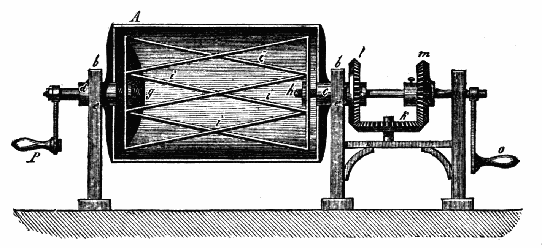
The kneading of the dough by hand is not only a very laborious process, but it is unhealthy and additionally objectionable on account of its being uncleanly. Added to this, the uniform quality of the dough is not to be depended upon. Although it is impossible to perform by machinery any labour which absolutely requires the touch of the human hand, bread-kneading machines have been introduced wherever the making of only one and the same kind of bread is required. Amongst the numerous kinds of machines devised for bread-making, is Clayton’s. (See cut.)
The constituents of the dough are placed in the cylinder, A, mounted in the framework, b b, and provided with hollow axles, c and d, turning in their bearings at e. The interior of the cylinder is fitted with the framework, f, which may be made to revolve by the aid of the axles, g and h. The two halves of this framework are connected together by the diagonal knives i, i, which, when the machinery revolves, work up the dough; the trough or outer cylinder revolves in the opposite direction to the revolution of the framework. The crank, o, is connected with the axle of the trough or outer cylinder, the crank, p, with that of the inner framework; as the two cranks are turned in opposite directions, they impart opposite movements to trough and framework. The revolving of the machinery may be performed by one man by the aid of one crank, since the axle, h, of the crank, o, which is fitted to the inner frame by means of the hollow axle-tree, and revolves along with it, carries a conically shaped wheel, m, fitted to the wheel k, which, being connected with l, causes the trough also to revolve; when therefore the wheel m turns towards the right, the wheel t will revolve towards the left. Another kneading machine is that of Mr Stevens. It is employed at the Holborn Union, where more than 5000 lbs. of bread are made every week by one man and two boys.
Adult. The adulteration of both flour and bread is carried to a fearful extent, more especially in London. The baker’s flour is very often made of the worst kinds of damaged foreign wheat; and other cereal grains, and particularly beans, are mixed with them in grinding them into flour. In this capital no fewer than six distinct kinds of wheaten flour are brought into the market—fine flour, seconds, middlings, fine middlings, coarse middlings, and twenty-penny flour.
Among the principal substances which have been proved to have been used to adulterate wheat-flour and bread are the following:—
**Alum.
*Ammonia (Sesquicarbonate).
**Beans.
*Bone dust.
*Chalk.
Clay.
Copper (Sulphate).
Lime (Sulphate from the soda water makers).
*Magnesia (Carbonate).
*Plaster of Paris.
*Potash (Carbonate and bicarbonate).
**Potatoes.
**Rice.
**Soda (Carbonate and sesquicarbonate).
*Starch (Potato).
**Water (in excess).
Zinc (Sulphate).
Of these substances, those marked thus (*) are very frequently used; and those marked thus (**) almost universally so.
In the absence of chemical analysis the unalumed loaf may be roughly distinguished from the alumed one by the following characteristics: it is neither so white, so bulky, nor so symmetrical; it bites shorter, and it is free from the sour taste which accompanies the presence of alum. Again, unalumed bread a day or two old will be found to crumble with great readiness; alumed bread, however old, crumbles, on the contrary, with difficulty.
According to Mr Accum, the smallest quantity of alum that can be employed with effect to produce white, light, and porous bread, from the inferior kinds of flour commonly used by the bakers, is from 3 to 4 oz. to a sack of flour weighing 280 lbs. But Dr P. Markham states that the ordinary bread of the London baker is made of one sack or 5 bushels of flour; 8 oz. of alum; 4 lbs. of salt; 1⁄2 gall. of yeast; and about 3 galls. of water. Our own analyses, extending to many hundred samples of London bread, as well as those of other chemists, show that even this large quantity of alum is often very much exceeded by the bakers.
Alkaline substances, as the carbonates of ammonia, soda, and potash, are often employed to realise the important consideration of producing light and porous bread from spoiled, or, as it is technically called, sour flour. The first salt becomes temporarily converted into a gaseous state during the operation of baking, causing the dough to swell up in minute bubbles, which thus render it light and porous; the salt itself being at the same time, for the most part, volatilised. Alum is added, not only with a like intention, but also to enable the dough to carry more water. There are several instances of convictions on record of millers and bakers having used gypsum, chalk, and pipeclay in the manufacture of their goods. A gentleman lately writing from the North of England says that he found in one sample of flour which he recently examined upwards of 16% of gypsum; and in another, 12% of the same earth.
A few years since it was discovered that some of the bakers in France and Belgium added blue vitriol to their dough to make it take more water, in the same way as the English baker uses alum. 1 oz. of this sulphate was dissolved in a quart of water, and a wine-glassful of this solution added to the water necessary to make about 50 4-lb. loaves. This enormous crime was soon detected, and deservedly caused the ruin of its heartless perpetrators.
Exam. The following are the methods employed for the discovery of the principal sophisticants of bread, and as the chief of these, and the one most difficult of identification is alum, we have given prominence to the processes now generally adopted for the detection of this article:—
1. Alum:—a. (Robine and Parisot.) About 1⁄4 lb. of the suspected bread (somewhat stale or dry) is reduced to crumbs, macerated for 2 or 3 hours in cold water, and then squeezed through a clean piece of white linen. The liquid is next evaporated to dryness at a steam-heat, the residuum redissolved in a little hot water, and the solution filtered. Liquor of ammonia or a solution of sal-ammoniac, and a solution of chloride of barium added to the filtered liquid, give a white precipitate when ALUM is present.
When nearly the whole of the alum has suffered decomposition in the loaf, as is frequently the case, the following process is required:—
b. (M. Kuhlman.) 4 or 5 oz. of bread are reduced to ash, which is powdered and treated with nitric acid, the mixture evaporated to dryness, and about 1 oz. of hot water added. A little caustic potassa is added to the last solution (unfiltered), the whole boiled a few minutes, and passed through a filter. The filtrate is next tested with a solution of sal-ammoniac, and the whole again boiled for 2 or 3 minutes. If a precipitate forms it is alumina; every 50 gr. of which are equivalent to 332 gr. of crystallised alum.
c. The suspected sample is wetted with a weak solution of logwood, or, preferably, of cochineal. Pure bread is only slightly stained by this solution; bread containing alum strikes a lavender, lilac, or purple colour, according to the quantity of the adulterant present. If it acquires a pearl-grey or bluish tint, some alkali (potash, soda, or ammonia) is present.
d. (J. A. Wanklyn.) 100 grams of bread are incinerated in a platinum dish, capable of holding the whole quantity at once. The incineration is managed at a comparatively low temperature, and takes some four or five hours; the platinum dish being heated by means of a large Bunsen burner, abundantly supplied with air. It is well to continue the ignition until the bread-ash is nearly completely burnt, and it is advisable to weigh the dish containing the ash. The weight of the ash should not sensibly exceed 2 grams. The ash having been obtained is then moistened with 3 c. c. of pure strong hydrochloric acid, and then some 20 to 30 c. c. of distilled water is added, and the whole is boiled, filtered, and the precipitate washed several times with boiling water. In this manner a precipitate consisting of a silica, together with some unburnt carbon, is left on the filter, whilst the filtrate contains the phosphates. The precipitate, which, after being burnt, consists of silica, is weighed. The filtrate is mixed with 5 c. c. of ammonia (sp. gr. 0·880), whereby it is rendered powerfully alkaline and opaque, owing to the precipitation of the phosphates. It is finally mixed gradually with some 20 c. c. of strong acetic acid, and as the acid is being poured in, it is to be observed that the liquid is alkaline and opaque, until some 5 c. c. of the acid have been added; that when about 10 c. c. have been added the liquid is acid and much clearer, and that at least 10 c. c. of strong acetic acid are added after the establishment of a distinctly acid reaction. The liquid is then boiled and filtered, and the precipitates, consisting of phosphates of alumina and iron, well-washed with boiling water, ignited and weighed. The last step is the determination of the iron in the weighed precipitate, and this is accomplished either by reduction and titration with standard solution of permanganate in the well known manner, or else by a colour process, viz., by trituration with ferrocyanide of potassium. Having ascertained the amount of iron in the precipitate of mixed phosphates, it is only necessary to calculate it into phosphate of iron, and to subtract the weight of phosphate of iron from the total weight of the mixed phosphates, and the difference is the phosphate of alum yielded by 100 grams of the bread. The following results have been obtained by applying the above-described process to samples of bread presumed to be free from alum:—
From 100 grams of Bread.
Bread-ash. Silica.Precipitate insoluble in acetic acid.
Grams.Grams.Grams.
A1·408...0·010
B1·378...0·006
C1·7300·0180·010
D1·6200·0320·014
E......0·012
(1)F1·3830·0300·012
(2)F1·3240·0250·014
The precipitate insoluble in acetic acid contained in every instance a large proportion of iron, but in some cases at least did not wholly consist of phosphate of iron. On deducting the quantity of phosphate of iron from the total phosphates insoluble in acetic acid, there remains a residue of some five or six milligrams. It would therefore appear that unalumed bread is liable to contain a minute trace of alumina, which, expressed as phosphate of alumina (Al2O3PO5), equals five or six milligrams per 100 grains of bread, or 0·005 per cent. If the alum corresponding to this phosphate be calculated, it will be seen that 100 grams of unalumed bread may appear to contain 0·022 grams of alum; or expressed on the 4-lb. loaf, there may appear to be 6 grams of alum in it. This agrees very fairly with Dr Dupré’s observation.
e. (J. C. Thresh.) The author states that this process requires only a few hours, and quotes experiments, showing the accuracy of the results:—
Take 1250 gr. of bread (from middle of loaf) or flour, and char thoroughly in a platinum dish or on foil over a gas lamp. Powder the char and mix it with sufficient pure strong hydrochloric acid to make a thin cream. Boil gently for a few minutes, then add 100 c. c. of water, and continue the ebullition a few minutes longer. Dilute to 150 c. c., stir well, and filter off 120 c. c., which will contain the alumina from 1000 gr. of the bread or flour. To this filtrate add a slight excess of solution of ammonia, boil for a few seconds. Then let the precipitate subside, and decant the supernatant fluid. Add boiling water to the sediment, and again set aside to settle, and decant the clear fluid. Pass the fluids through a small filter to collect any particles of the precipitate which may have been suspended therein, and throw the filtrate away. Now add to the partially washed precipitate about a gram of pure caustic potash (or soda), warm, and pass the solution through the same filter employed for the previously decanted fluids. Wash the filter with hot water, to which a little KHO may be added, and proceed to precipitate the alumina in the filtrate by adding a few drops of dilute phosphoric acid and excess of pure acetic acid. Heat the solution and precipitate to the boiling point, and then wash the latter by decantation and filtration. Finally dry, ignite, and weigh. The weight of the resulting Al2PO4 in grams, multiplied by 400, will give the amounts of ammonia alum in grains present in one pound of the bread or flour.
f. (Mr Crookes.) The bread of which at least 500 grains should be taken is first to be incinerated on a platinum or porcelain dish, until all volatile organic matter has been expelled, and a black carbonaceous ash remains. The temperature must not be raised much beyond the point necessary to effect this. Powder the coal thus obtained and add about thirty drops of oil of vitriol, and heat until vapours begin to rise; when sufficiently cool, add water, and boil for ten minutes. Filter and evaporate the filtrate until the fumes of sulphuric acid begin to be evolved, when 10 gr. of metallic tin and an excess of nitric acid must be added, together with water, drop by drop, until action between the acid and metal commences. When all the tin is oxidised, add water, and filter. Evaporate the filtrate until fumes of sulphuric acid are again visible, when more water must be added, and the liquid again filtered if necessary. To the clear solution now add tartaric acid, then ammonia in excess, and sulphide of ammonium. Evaporate the liquid containing the precipitate suspended to it, in a dish, until all the smell of sulphide of ammonium has disappeared. Filter, evaporate to dryness, and ignite to get rid of the organic matter. Powder the black ash, boil it in moderately strong hydrochloric acid, filter, add a crystal of chlorate of potash, and boil for a minute. Now add chloride of ammonium and ammonia, and boil for five minutes. If at the end of that time any precipitate is observed, it will be alumina. From the filtered solution, if oxalate of ammonia be added, the lime will be precipitated; and if to the filtrate from this, ammonia and phosphate of soda be added, the magnesia will come down.
Dr Dupré is of opinion that no baker should be fined in whose bread the amount of alumina found corresponds with less than 10 grains of potash alum in the 2-lb. loaf, unless there is direct evidence of adulteration by alum independent of the result of analysis.
Mr Crookes says, “By treatment with a trace of alum, flour with a doubtful soundness is endowed with soundness. For this purpose a proportion of alum is required which does not exceed 20 grains to a 4-lb. loaf.
2. Copper:—a. Moisten the suspected bread with a few drops of a solution of ferrocyanide of potassium. It will assume a pinkish-brown colour if copper be present.
b. A little of the bread may be steeped in hot water, or, better still, in water soured with a little nitric acid, and the clear liquor squeezed or poured off, and tested with ferrocyanide of potassium, as before.
3. Magnesia:—Bread adulterated with magnesia, on digestion in hot water acidulated with sulphuric acid, furnishes a liquid which gives a white precipitate when tested with a solution of either carbonate of potassa or of carbonate of soda, especially on boiling.
4. Soda; Potassa:—Hot water after digestion on the ashes or charcoal turns turmeric paper brown. The liquid may be evaporated to dryness, redissolved in distilled water, slightly acidulated with hydrochloric acid, and tested with bichloride of platinum. If a yellow crystalline precipitate forms, either at once or after some hours, it is potash; otherwise the alkali present is soda.
5. Chalk, WHITING, BURNT BONES, plaster of Paris, and similar substances are easily detected by calcining a little of the flour or bread in a clean open vessel, when the amount of ash left will indicate the quantity of adulteration. The quantity of the ash left by genuine bread or flour is very trifling indeed, about 2%.
Microscopic Characters of Bread. When bread is placed under the microscope, starch cells, broken up into angular masses, or greatly enlarged, and stringy masses of gluten are usually visible; besides these, when a microscope of high power is employed, bacteria of the rod-shaped variety may frequently be detected, the source of these being, probably, the yeast. Great caution and diligent observation are necessary to guard against the falling into the serious error of mistaking the many curious forms the broken-up wheat starch presents for adulterants. By practice and the constant examination of the characters of unadulterated bread, combined with a practical knowledge of the appearance different starch grains present, after being more or less changed in shape by cooking, the microscopist may identify rice-flour, bean-flour, and Indian millet. Barley flour and potatoes, however, are very difficult of detection. There is very little difference in the shape of the barley-starch granule and that of the wheat, and in the process of bread-making the potato granules are so changed as to confuse all their distinctive characters. Bone-dust and a few other mineral adulterations may be detected by the microscope.
Concluding Remarks. A number of processes are used by cooks and confectioners to make the different varieties of fancy bread, cakes, puddings, &c., which vary according to the peculiar characteristic it is desired to communicate to them; but none of these articles properly belong to the trade of the common baker. Thus, some kinds of cakes and pastes are made to eat ‘short,’ as it is called, or are rendered less tenacious, and a species of brittleness imparted to them by the addition of starch, rice-flour, or sugar. In pastry a similar effect and peculiar lightness is produced by butter or lard, whilst in some articles white of egg, gum water, isinglass, and other adhesive substances, are added to produce an exceedingly light and porous mass.
The chief varieties of bread at present in use in this country are known according to their shapes, as—Bricks, Coburg, Cottage, Batch, French rolls, and Rye bread. These vary in their quality, chiefly according to the flour of which they are formed, and their various flavours depend upon the heat of the oven in baking. The best WHITE BREAD is made from the purest wheat-flour; ordinary WHEATEN BREAD, of flour containing a little of the finest bran; SECONDS, from flour containing a still larger proportion of bran; and common HOUSEHOLD BREAD, from flour produced by grinding the whole substance of the grain, without any separation of the bran. The last variety is undoubtedly the most wholesome and nutritious, although that least frequently used. Symnel-bread, MANCHET or ROLL-BREAD, and French bread are varieties made of the purest flour, from the finest wheat, a little milk being usually added for rolls, and butter and eggs for choicer purposes. Several other minor kinds of bread are also made, varied by the addition of sundry trifles, as sugar, currants, and other palatable ingredients. The Scotch shortbread is made from a very thick dough, to which butter, sugar, orange-peel, and spices are added, according to the taste of the maker.
In the manufacture of white bread from damaged or inferior flour a large quantity of alum is employed by the fraudulent baker, as already noticed; but with the ‘best flour’ no alum is required. The utmost beauty, sponginess, and sweetness may be given to bread without the addition of one particle of alum, provided the best materials alone enter into its composition. As such materials are seldom employed by the bakers, the usual practice is to introduce 4 or 5 oz. of alum to every sack of flour, or about 1 oz. to each bushel; and very frequently fully double this quantity of alum is employed. But even this enormous quantity is often not the whole of the alum present in common bread; for the miller, in order to cheat the baker, puts in the ‘doctor,’ in the shape of 4 to 6 oz. of alum to the sack, whilst the baker, unconscious of this victimisation, subsequently uses a double dose of alum in order to cheat his customers.[229] The method of detecting this pernicious adulteration has been already explained. The proper quantity of salt is 4 lbs., and never more than 5 lbs., to the sack, or 1 lb. per bushel. One sack of the best flour, with 4 or 5 lbs. of salt, yields about 360 lbs. of good bread; and a sack of seconds, 345 to 350 lbs. of bread; each being moderately baked. If the loaves are well-baked or over-baked, the product will be from 345 to 350 lbs. only; but if they are slack-baked or under-baked, from 370 lbs. to 385 lbs. of crumbling bread may be obtained from 1 sack of good white flour.
The attention of chemists has, at various times, been directed in search of some method to rectify or lessen the effects of bad harvesting and improper storage on grain, so that a damaged or inferior article might be rendered serviceable, and available for human food. Prof. E. Davy recommends the addition of 1⁄4 oz. of carbonate of magnesia to about every 3 lbs. of sour, melted, heated, and similarly damaged flour. This substance materially improves the quality of the bread, “even when made from the worst new seconds flour;” whilst it is said to be perfectly harmless; and the bread so prepared, for temporary use, is certainly unobjectionable. What effects would arise from the daily consumption of such bread for several months has not been determined; but it is doubtful whether it would prove salutary. Indeed there are sufficient reasons for condemning the adoption of such bread in the general diet of a people for any very lengthened period.[230] Our own experiments in bread-making, extending over a long period of years, lead us to prefer carbonate or bicarbonate of soda for the purpose. Theoretically, the corresponding salts of potassa would be preferable. A mixture of equal parts of the bicarbonates of potassa and of soda will, perhaps, ultimately be found to be more useful than either substance used separately.
In times of scarcity and famine various substances, besides the flour of the cereals, have been made into bread, or have been mixed with it, in order to lessen the quantity of the former required by the people. For this purpose, almost every amylaceous vegetable at once plentiful and cheap has, in its turn, been eagerly appropriated. Acorns, beech-mast, the leguminous seeds, numerous starchy bulbous roots, and similar substances, have been employed, either in the form of meal, or made into an emulsion or jelly, which has been used instead of water to form the flour of bread-corn into a dough. At such times bran, the most nutritious and valuable portion of the grain, although usually rejected as worthless, has been retained in the flour, and has even been added to it in excess. Birkenmayer, a brewer of Constance, during a period of scarcity, succeeded in manufacturing bread from the farinaceous residue of beer (brewer’s grains). 10 lbs. of this substance, rubbed to a paste, with 1⁄2 lb. of yeast, 5 lbs. of ordinary meal, and a handful of salt, produces 14 lbs. of BLACK BREAD, which is said to be “both savoury and nourishing.” The nutritious quality of brewer’s grains is shown by their extensive employment at the present day as food for pigs and cattle, and particularly for milch cows. In like manner Iceland, Carragheen, and other mosses, have been made into bread, either alone, or mixed with flour or meal. They are used, in the first case, in the state of meal, in the same way as flour; in the second case, 7 lbs. of moss are directed to be boiled in 10 or 12 galls. of water, and the resulting glutinous liquid or jelly to be employed to make 70 lbs. of flour into dough, which is then fermented and baked in the usual way. It is said that flour thus produces fully double its weight of good household bread. A simpler plan is to mix 1 lb. of lichen meal with 3 or 4 lbs. of flour; the bitterness of the lichen having been first extracted by soaking it in cold water. Bread so prepared has of late been highly recommended for the delicate and dyspeptic. The modern baker is in the habit of mixing large quantities of potatoes with his bread, whenever he can purchase them at paying prices. Mealy potatoes are selected, and are carefully mashed or pulped, and the dry flour is worked into this pulp or dough, which is then mixed with the sponge in the usual manner. For inferior bread, equal weights of potato pulp and dry flour are often used. Bread so prepared eats ‘short,’ and is deficient in sponginess, and in that fine yellowish-white tint which forms one of the characteristics of pure wheaten bread, More recently, rice boiled with water to a jelly has got into very extensive use among the bakers. A ‘sponge’ is made with a portion of the jelly thickened with some flour, and the whole process is conducted in the ordinary manner, except that the fermentation is generally more slowly conducted and allowed to proceed for a longer period. Flour so treated yields fully 50% more bread than when merely mixed up with yeast and water. This constitutes the process of Messrs Morian, Martin, and Journet, of Paris, which was tested, a few years since, at Marylebone Workhouse. The experiment succeeded, but the only result to the public has been, that the common bakers have adopted the plan, and now very generally surcharge their bread with such an excess of water that, in many cases, it only possesses two thirds the amount of nourishment which it did before the publication of the system just referred to. Unfortunately, the cupidity of dishonest tradesmen appears to be continually impelling them to avail themselves of the exertions of philanthropists and the discoveries of science, in order to increase their profits, regardless alike of the quality of their commodities and the health of their customers. Bread containing an excess of water rapidly becomes sour and mouldy, and is apt to disorder the digestive functions of those who eat it.
From the experiments of Dr Colquhoun, it appears that the starch of flour is partially converted into sugar during the process of fermenting and baking the dough, and thus contributes to the sweetness of the bread. He proposes to add to the flour, arrow-root, the farina of potatoes, and similar amylaceous substances, made into a jelly with hot water, for this purpose. Dr Percival has recommended the addition of salep with the same intention. 1 oz. of salep, dissolved in 1 quart of water; 2 lbs. of flour; 80 grs. of salt; and 2 oz. of yeast, gave 3 lbs. 2 oz. of good bread. The same weight of materials, without the salep, gave only 23⁄4 lbs. If too much salep is added, it gives its peculiar flavour to the bread.
In reference to the above substitutions, and to the relative quantity of bread produced from any given weight of flour, the reader should remember that the mere increase of the weight or bulk of the product does not carry with it a corresponding increase of the nutritive elements contained in the flour. These remain the same in all cases; and just in proportion as the product, in bread, is greater, will be the decrease in the value of such bread as food. So also with potatoes, rice, and other farinaceous and pulpy substances used as substitutes for wheat-flour. Their poverty in nitrogenous matter, or flesh-formers, is so great, that the greatly increased quantity required as food to support the body, apart from mere inconvenience, more than compensates for their apparent low price. Thus, good wheaten bread, at 2d. per lb., is more than twice as cheap as potatoes at 1d.; for, assuming 2 lbs. of the first as a day’s food, 10 lbs. of the last will be required for the same purpose; and even this large quantity will scarcely effect the desired object. Liebig has demonstrated that, regard being had to the nutritive power of wheat, it is, under all ordinary circumstances, the cheapest article of food provided by nature for man.
We have not entered into particulars respecting oven management, because, on the large scale, it is thoroughly understood by every practical baker. For the instruction of the busy housewife, however, we may state that the oven should always be sufficiently heated before the bread is put into it, in order that the gas contained in the cells of the ‘sponge’ may be expanded as rapidly as possible by the heat, and the resulting light mass quickly rendered sufficiently solid to prevent its subsequent collapse. The heat should also be maintained at nearly the same temperature during the whole of the time the bread is submitted to its action. In general, with ordinary kitchen ovens properly heated, 30 minutes’ baking is sufficient for one-pound loaves and cakes; and 15 minutes in addition for every pound after the first for larger ones. Thus, a 1 lb. loaf requires 1⁄2 hour; a 2 lb. loaf 3⁄4 hour; and a 4 lb. loaf, 11⁄4 hour.
It is the common ambition of the English baker to give that peculiar tint to the crust of his bread in the process of baking which is so highly esteemed by connoisseurs, and so successfully produced by the Viennese and Parisians. It has been long known at Vienna that if the hearth of an oven be cleaned with a moistened wisp of straw, the crust of bread baked in it immediately afterwards presents a beautiful yellow tint. It was thence inferred that this peculiarity depends on the vapour, which being condensed on the roof of the oven, falls back on the bread. At Paris, in order to secure with certainty so desirable an appearance, the hearth of the oven is generally laid so as to form an inclined plane, with a rise of about 11 inches in 3 feet; and the arched roof is built lower at the end nearest the door, as compared with the further extremity. When the oven is charged the entrance is closed with a wet bundle of straw. By this arrangement the steam is driven down on the bread, and a golden-yellow crust is given to it, as if it had been previously covered with the yolk of an egg.
Pure wheaten bread is one of the most wholesome articles of food, and has been justly termed the ‘staff of life,’ and a certain proportion of it should be taken at every meal.
New and Stale Bread.—As has been just stated, bread which has been kept for 24 hours after baking is more digestible, and therefore preferable to that which has been newly baked. This latter exhibits a well-known elastic appearance, and possesses a certain degree of moisture which renders its taste more agreeable to most persons than bread which has been kept for a day or two, and has become firmer and drier in appearance, and which is commonly termed stale. It is very generally supposed that this change in properties in bread which has been kept for a few days, is owing to the loss of water.
This, however, is not the case. The crum of newly baked bread when cold contains about 45 per cent. of water, and that of stale bread contains almost exactly the same proportion.
The difference in properties between the two is due simply to difference in molecular arrangement. Boussingault found that a loaf which had been kept for six days, though it had become very stale, had not lost more than 1 per cent. of its weight when new. The same loaf was then placed in the oven for an hour, and at the end of that time it had acquired all the properties and appearance of new bread, although during the second baking it lost 31⁄2 per cent. of water. In another experiment a portion of bread was allowed to become stale when enclosed in a tight case, to prevent loss of water by evaporation; it was then heated, and was thus restored to the condition of new bread; these effects were produced alternately, many times in succession, upon the same piece of bread; a heat of about 131° F. was found to be sufficient to convert stale into new bread. Every person who has seen a thick slice of stale bread toasted may have satisfied himself that the crum has during this operation been converted into the same condition as that of new bread.
Fungi. When bread has been kept a few days and has become stale, certain species of fungi show themselves in it: these are the penicillium glaucum, which is the green mould of cheese; the fermentum cerivisiæ or yeast fungus; the oidium auriantiacum or orange-red mould; the puccinia graminis and others. Excess of salt added to the bread prevents the development of these fungi.
Diseases arising from the employment of unsound Flour and Bread.—The flour may be ergotised or grown, and fermenting from the presence of fungi. All the poisonous symptoms of ergot are induced from continuously partaking of bread made with ergotised flour. Dry gangrene is one of the most virulent forms of poisoning caused by partaking of ergotised bread. Severe intestinal derangement is an accompaniment of the milder forms of poisoning. Ergot is more frequently present in rye flour than in wheat. Fermenting bread is a fertile source of dyspepsia, whilst acid bread causes diarrhœa. This latter malady is also caused by the presence in bread of the oidium aurantiacum. Professors Varnell and Tuson state that mouldy oats, the mould being caused by a fungus (the aspergillus), have given rise to paralytic symptoms in horses, so that the presence of these fungi in oats used for making bread should always be regarded with considerable caution.
It has not been demonstrated that the acarus so common in flour has had any injurious effect when eaten. When well fermented and baked bread is very easy of digestion. It should never be eaten until it has stood at least 24 hours after being taken out of the oven. When newer, bread is apt to disagree with the stomach, frequently producing indigestion, biliousness, diarrhœa, dyspepsia, and other like ailments. Bread prepared from meal containing the whole of the bran is the most nutritious and digestible, and should alone be given to children and growing persons, and eaten by the dyspeptic and delicate. Young infants should never be fed upon bread. See Aleurometer, Alum, Flour, Wheat, &c.
Bread, Aërated. The best description of unfermented bread is that manufactured by the process of Dr Dauglish. The method of manufacture has this advantage:—During the whole of the operation neither the flour nor the dough comes into contact with the flesh of the workman. For a full description of the method of preparing this article, see Watts’ ‘Dic. of Chemistry.’ See Bread, Unfermented.
Bread, Amer′ican. From American barreled flour. “14 lbs. of American flour will make 211⁄2 lbs. of bread; whereas the best sort of English flour produces only 181⁄2 lbs. of bread.” (Mrs Rundell.) This arises from the superior quality of the wheat used in its production; and also from its being kiln-dried before grinding, by which much water is driven off.
Bread, Bee. The matter collected by bees to form the bottom of the hive. It resembles a mixture of resin and wax. Its fumes were formerly thought to be anti-asthmatic.
Bread, Bran. 1. From the whole meal, without sifting out any of the bran.
2. By adding about 3 oz. of bran to every lb. of ordinary flour.
Bread, Cassava, is made from the root of the manihot, by first expressing the juice, then grinding the residue into a coarse meal, and baking it in the form of cakes upon thin iron plates. When steeped in oil, and flavoured with cayenne, and slightly broiled upon a gridiron, it is not unpalatable.
Bread, Extemporaneous. See Bread, Unfermented.
Bread, French. Prep. 1. From fine flour, as the best white bread. For the better kinds, and for those intended for rolls and small fancy bread, the sponge and dough is commonly wetted with milk and water, and, occasionally, a very little butter is added. “When the rolls or small fancy loaves have lain in a quick oven about a quarter of an hour, turn them on the other side for about a quarter of an hour longer. Then take them out and chip them with a knife, which will make them look spongy, and of a fine yellow; whereas rasping takes off this fine colour, and renders their look less inviting.”
2. French Soup-bread. From fine flour, but employing fully double the usual quantity of salt. It is baked in thin loaves, so as to be nearly all crust, by which means it becomes more soluble in hot soup.
Bread, Hick’s Pat′ent. This is ordinary bread baked in an oven so arranged that the vapours arising during the process are condensed in a suitable receiver. The condensed liquor is a crude, weak spirit, produced during the fermentation of the dough, and possesses little commercial value; indeed, insufficient to pay for the expenses attending its collection. Besides which, the bread prepared under this patent was rejected by the vulgar, who flocked to the shops of the neighbouring bakers, who professed to sell their bread with “the gin in it.”
Bread, Household. This name is commonly given to bread made with flour from which only the coarser portion of the bran has been removed; and to bread prepared from a mixture of flour and potatoes. The following are examples:—
1. (Rev. Mr Haggett.) Remove the flake-bran from flour, 14 lbs.; boil the bran in 1 gall. of water until reduced to 7 pints; strain, cool, and knead in the flour, adding salt and yeast as for other bread. Very wholesome.
2. Flour, 7 lbs.; mealy potatoes (well mashed), 3 lbs.; as before. Objectionable for the reasons already given.
Bread, Leav′ened. (lĕv′-). Using leaven instead of yeast, and in the same way. About 1 lb. to each bushel of flour is usually sufficient. The more leaven used, the lighter the bread made with it will be; and the fresher and sweeter the leaven, the less sour will it taste. Leaven, except among the Jews and sailors, is now superseded by yeast.
Bread, London White. The common proportions of the London bakers are—Flour, 1 sack; common salt, 41⁄2 lbs.; alum, 5 oz.; yeast, 4 pints; warm water for the sponge (about), 3 galls. The process has been already noticed.
Bread, Paris White. The following has been handed to us as the plan commonly adopted by the Paris bakers for their best white bread:—On 80 lbs. of the dough (before the yeast was added) from yesterday’s baking, as much lukewarm water is poured as will be required to make 320 lbs. of flour into a rather thin dough; as soon as this has risen, 80 lbs. are taken out and reserved in a warm place as leaven for the next day’s baking; 1 lb. of dry yeast, dissolved in warm water, is then added to the remaining portion, and the whole lightly kneaded; as soon as it has sufficiently risen, it is made into loaves, and shortly afterwards baked; the loaves being placed in the oven without touching each other, so that they may become crusty all round.
Bread, Unfermented. Syn. Extemporaneous bread. Prep. 1. From Jones’s patent flour. Very wholesome and excellent; indeed, when skilfully made and baked, almost equal to French bread.
2. From Sewell’s patent flour. Slightly inferior to the last.
3. To each lb. of flour add, separately, 11⁄4 dr. of bicarbonate of soda, and 1 dr. of tartaric acid (both perfectly dry, and in very fine powder); rub them well together with the hands until thoroughly incorporated; then form the whole into a dough with water, as quickly as possible, and at once bake in a quick oven. About 8 or 9 oz. of water are required for every lb. of flour. Answers well when expertly managed.
4. Flour, 1 lb.; bicarbonate of soda, 1 dr.; mix; make a dough with water, q. s., to which 1 dr. of hydrochloric acid (commercial) has been added, and further proceed as before.
5. Whiting’s Patent bread:—This closely resembles the last. The proportions are—Flour, 7 lbs.; carbonate of soda and hydrochloric acid, of each 1 oz.; water, 23⁄4 pints. This method was suggested by Dr Henry in 1797, and was patented by Dr Whiting in 1836. If the proportions be not observed, or the mixture be not perfect, the quality of the bread suffers. The action of the acid on the soda forms common salt in the loaf.
6. Ammoni′acal bread:—Carbonate of ammonia, 3⁄4 to 1 oz.; cold water, q. s.; dissolve, add of flour, 7 lbs.; and make a dough, which must be formed into loaves and baked immediately, as before.—Obs. To ensure success the carbonate should be recent, and free from bicarbonate, the presence of which is known by its being white and powdery, and of inferior pungency. If any of the last salt be present, the bread will have a yellowish colour, and a slightly alkaline or urinous flavour. The process answers best for small loaves, cakes, and fancy bread. By employing pure carbonate of ammonia instead of the commercial sesquicarbonate, the process succeeds admirably, and the resulting bread is most wholesome. A late writer recommends the use of bicarbonate of ammonia, but evidently does so in ignorance, as in practice it is inapplicable, as the author verified by numerous carefully conducted experiments.
7. It has been at various times proposed to knead the dough with water highly charged with carbonic acid, on which Dr Ure observes that “the resulting bread will be somewhat spongy.” He states that he endeavoured to make bread in this way, but never could succeed in producing a light spongy loaf. The quantity of gas in the water is much too trifling for the purpose, and the greater part of it escapes in the process of making the dough, even though all the materials be well cooled, and the operation conducted in a cold place. The only way of obviating the difficulty is to conduct the kneading in a trough under considerable atmospheric pressure, and at a very low temperature, by means of machinery, as is done by Dr Dauglish, whose method is now protected by letters patent. This method is not, however, adapted either to domestic use or the small scale.[231]
Obs. Unfermented bread has been strongly recommended as being more wholesome, and generally better adapted to bilious and dyspeptic patients, than fermented bread. It must, however, be confessed, that the unfermented bread commonly met with has a slight ‘raw-grain’ taste, which is very disagreeable to some persons. But this taste is not necessarily present, being chiefly dependent on bad manipulation, the use of inferior flour, and insufficient baking. The process of fermentation doubtless modifies the condition of the starch and gluten of the dough, and renders them easier of digestion. This species of bread is sadly adulterated with a variety of indescribable messes. See Biscuits, Bread (antè), Flour, Gingerbread, &c.
Bread Fruit (Artocarpus incisa, nat. order Graminaceæ). The tree yielding the bread-fruit is a native of Central America, the South Sea Islands, and the Islands of the Indian Archipelago. It is principally composed of starch, sugar, and water, every 100 parts containing 80 of water. The fruit is gathered when the starch is in a mealy condition; it is then peeled, wrapped in leaves, and baked by placing it between hot stones. It then has the taste of sweetbread.
The natives of the countries where this fruit is found practise a method for preserving it, which consists in allowing the nitrogenous parts of the fruit to putrefy in water-tight pits. They thus obtain a mass resembling soft cheese in consistence, and this, when required to be eaten, is baked in the same manner as the fresh fruit.
BREAK′FAST (brĕk′-). Syn. Jentaculum L.; Déjeûner, Déjeûné, Fr.; Frühstück, Ger. The first meal of the day; or the food served at it.
The morning meal—the ‘early bit’ of the Germans—is perhaps the most important one of the day. According to Erasmus Wilson, it is usually “taken at eight or nine.” The proper time for the purpose must, however, depend upon that at which the party rises. About an hour, to an hour and a half, after leaving the bed, will generally be found the most appropriate time for breakfast, and appears to be the one pointed out by nature, and the most conducive to health. By that time the powers of the system have fully recovered from the inactivity of sleep, and the functions of the stomach and other viscera have again come into full play. The appetite is excited and seeks appeasing, and both instinct and reason direct us to the social board. If abstinence be now prolonged, the physical and mental energies, unsupported by the supply of food which indirectly gives them birth, gradually lessen, and incipient exhaustion ensues. The fluids of the stomach and the smaller intestines begin to act upon the coats of those viscera instead of on the food, and an unpleasant feeling of hunger or a loss of appetite comes on, with all its depressing consequences. When breakfast cannot be taken within a reasonable period after rising, the gap should be filled up by chewing a crust, a biscuit, or the like. A raw egg or two, sucked from the shell, or broken into a teacup and drank, will be found most valuable for this purpose. Raw milk, cheese, salted food, and other indigestible matter, should be particularly avoided at this early period of the day.
The articles of food to be chosen for the breakfast-table must depend entirely on the state of the health, the occupations, &c., of those assembled round it. Coffee appears to be, by common consent, the favourite beverage. For the delicate, the bilious, and the young, it should neither be taken too strong, nor very weak, and should be softened down with milk or cream, and well sweetened with sugar. Tea is more apt to affect the nerves and stomach than pure unchicoried coffee. Green tea, taken thus early in the day, often acts as an absolute poison, though a slow one. We have seen severe fits of vomiting and exhaustion follow its use.
The solid food for breakfast should be easy of digestion, and nutritious. Females, children, and persons leading a sedentary life, should confine themselves to a sufficient quantity of good meal-bread with only a moderate quantity of butter, to which an egg, or a small rasher of mild bacon, may be advantageously added. For very young children there is no better breakfast, where it agrees with them, than scalding-hot new-milk poured on sliced bread, with a slice or two of bread and butter to eat with it. Parties engaged in active occupations may extend their exploits somewhat farther, and add to this bill of fare a little ham or cold meat. When an undue time will elapse before the luncheon or dinner, and particularly during the colder season of the year, the broiled leg of a fowl, an under-dressed mutton chop, or a little tender beef-steak, will be found, by the parties last referred to, most useful; nay, in many cases, invaluable. But excess must be particularly avoided. The object is to take enough food to maintain the system in full energy and vigour, and particularly to avoid offending the stomach by overloading it; a misfortune easily effected at the breakfast table. Old commercial travellers—men wise in the mysteries of life and its enjoyments—are scrupulously careful to make a good, but not a heavy breakfast, before commencing the arduous duties of the day. See Déjeûner, Meals, &c.
Breakfast Pow′der. Syn. Rye′-coffee, Dillen′ius’s c., Hunt’s Econom′ical breakfast powder, &c. Rye, roasted along with a little fat, after the manner of coffee. It was once sold at 2s. 6d. the lb., and was formerly extensively used as a substitute for foreign coffee, of which it is one of the cheapest and best. Since the reduction of duty on coffee it has nearly fallen into disuse, unless it be by the grocers to adulterate that article.
BREAST (Sore). See Nipples.
Breast Pang. Syn. Angina pectoris. Symptoms.—A sudden pain occurring in the parts covered by the breast-bone and the throat, accompanied with a feeling of suffocation, and the apprehension of immediate death. The pain sometimes extends down the arms and through the back. Summon a medical man without a moment’s loss of time. Pending his speedy arrival give a drachm of ether with one third of a grain of acetate of morphia. Apply hot applications to the chest and stomach; likewise friction to the chest, back, and sides with spirits. If the relief be only partial, the dose of ether may be repeated after twenty minutes.
BREATH (Fetid). Scarcely anything is more disagreeable or disgusting than a stinking breath. Various means have been proposed to remove this annoyance, depending principally on the administration of aromatics, which by their odour smother it for a time; but these require continual repetition, and are liable to interfere with the functions of digestion. The real cause of stinking breath may generally be traced to a diseased stomach, or to decayed teeth. When the former is the case, mild aperients should be administered; and if these do not succeed, an emetic may be given, followed by an occasional dose of the Abernethy-medicines. When rotten teeth are the cause, they should be thoroughly cleansed, and then ‘stopped,’ or if this is impracticable, they should be removed. When this is impossible or inconvenient, the evil may usually be lessened by keeping them scrupulously clean. Dirty teeth also often cause the breath to smell; and hence the use of the tooth-brush should be a daily habit. Occasionally rinsing out the mouth with a little clean water to which a few drops of solution of chloride of lime, or of chloride of soda, has been added, is often an effective method. Mouth-washes of Condy’s fluid, and also of carbolic acid, both very greatly diluted, form useful remedies; as do also chlorate of potash and tannic acid in the form of mouth-washes. As a tooth-powder, fresh-burnt charcoal, and particularly areca-nut charcoal, is without comparison the best. Lozenges, such as the following, have been strongly recommended to sweeten and purify the breath:—Gum-catechu, 2 oz.; white sugar, 5 oz.; orris powder, 1 oz.; neroli, 5 or 6 drops; make them into a paste with mucilage, and divide the mass into very small lozenges. 20 or 30 drops of oil of cloves may be substituted for the orris and neroli, at will. One or two may be sucked at pleasure. When the breath of a child or infant, usually so sweet and fresh, smells unpleasantly, it indicates stomach derangement of some sort. Very frequently it is indicative of worms. See Cachou Aromatisé, Pastils, &c.