A CYCLOPÆDIA OF PRACTICAL RECEIPTS, PROCESSES, AND COLLATERAL INFORMATION (continued 16)
Reading edition
An important precaution to be observed in making asphalt pavements or roads is to boil the bitumen which is employed thoroughly, so as to expel the water and volatile oils, which if allowed to remain are found to render the mastic more liable to be affected by the extremes of heat and cold, as well as less able to stand the wear and tear of traffic.
Claridge’s Process. This consists in fusing the blocks of mastic in a suitable boiler, similar to that seen in fig. 1, and in adding a quantity of mineral tar, in the proportion of 1 lb. to every cwt. of the mastic. The tar is first fused in the boiler, 56 lbs. of the mastic are then introduced, and the whole repeatedly stirred so as to prevent the formation of a deposit. When the contents of the boiler are melted, the cauldron is covered over for a quarter of an hour, after which the remainder of the mastic is added, and its fusion proceeded with as before, the process being repeated until the boiler is full, allowing an interval of from ten to fifteen minutes between each operation.
When the mastic is sufficiently fluid it will drop freely from the stirrer, and jets of light smoke are observed to issue from it. If stiff mastic be required, the proportion of tar is lessened, and a quantity of coarse grit or river sand, to the amount of 20 or 30 lbs. to the cwt., is added.
1.
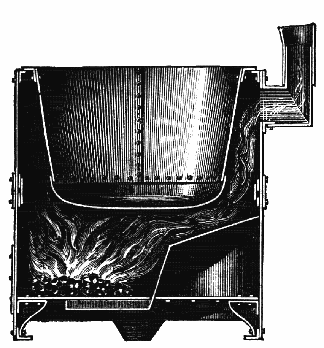
In laying the asphalt the greatest attention and care must be paid to the preparation of a solid and dry foundation.
This is usually accomplished by removing or ramming the loose earth, and placing upon the bed a layer of coarse sand mixed with powdered limestone, in the proportion of seven parts of the former to one of the latter, and the whole is pressed or beaten solid; upon this a second layer of finer materials is laid compacted and levelled; the bed thus prepared is allowed to dry before coating it with mastic.
Fig. 2 shows the manner in which ordinary asphalting is laid down. In this figure C is the bed of coarse concrete, B the second and finer layer of the same material, and A the superior layer of asphalt.
2.
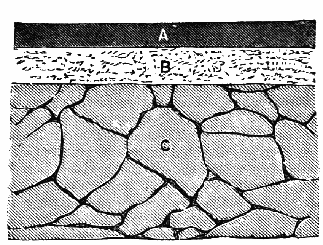
The base or concrete must be perfectly dry when the mastic is poured on, or the work will be a failure, for the moisture will be converted into steam, which, issuing through the fluid mastic, will cause the formation of holes in the latter or blister it, and ultimately the surface will crack. To counteract in some measure the evil arising from the formation of steam, fine cinder dust is sifted over the bed of concrete previous to the application of the mastic.
When asphalting suspension bridges, a sheet of canvas is usually spread over the concrete.
In asphalting damp places, such as cellars and foundations, a brick invert is always laid in asphalt beneath the concrete. This is done by placing the bricks in rows, at the proper depth and slope, and pouring a coating of asphalt about a quarter of an inch thick upon them. Before the mastic solidifies, the bricks are separated a little by passing a knife between them, thus affording the mastic an opening by which to seal up more thoroughly the connection. The concrete is afterwards laid upon this bed, and the layer of mastic upon this in the usual way. The thickness of the layer of mastic varies according to the attrition to which it is to be subjected; but the usual depth is from a quarter to one and a quarter inch.
Artificial Asphalt. This is prepared from coal tar by distilling off the volatile oils which hold the tar in solution, the result being that a kind of fatty pitch is left, which must be boiled until a sample, when cooled, becomes nearly solid. The operation may be accomplished in the open air, but if this means of evaporation be adopted, the process is attended with a very unpleasant odour, and the volatile oils are dissipated. These volatile oils are used for the preparation of varnish, for lubricating machinery, and for the manufacture of a superior kind of lampblack. They have also been employed to increase the illuminating power of coal-gas, which purpose they accomplish by imparting their vapours to gas passed over them when they are placed in shallow vessels. Various forms of patent apparatus have been designed for this purpose.
When it is required to collect the oils, the coal tar is placed in a retort made of sheet iron, with a convex bottom, which is placed immediately over a fire. The products of the combustion after striking the bottom of the retort circulate round it, then proceed under a second boiler to heat the tar contained in it, and from which the retort is replenished when necessary. This vessel, when three quarters full, contains nearly 24 cwts. of tar; it should be perfectly embedded in masonry; the capital itself by which the volatile products escape should be surrounded with materials that are bad conductors of heat, such as ashes. But for this precaution the volatile oils would become condensed, and fall back into the evaporating vessel.
The volatile oils are collected by being made to pass through a tube cooled by a current of water, this tube running in a direction the reverse of that pursued by the vapours, and terminating in a closed vessel, which acts as the receptacle for the oils. A tube branching from the boiler conducts the uncondensed products outside the building in which the distillation is conducted.
When the tar has been boiled sufficiently long to give it the requisite consistence, it is removed by means of a pipe into a third hemispherical boiler of cast-iron. To prepare the bituminous mastic directly from this fatty pitch, the latter is kept in a state of fusion, and chalk in sufficient quantity is then added. If the chalk be previously heated, ground to a coarse powder, and sifted, the mixture is effected more rapidly and satisfactorily.
The asphalt becomes the more solid the greater the proportion of chalk added; on the other hand, it becomes less elastic and more brittle. The asphalt is moulded as follows:—A long table is covered with cast-iron plates, surrounded with a framework, which is subdivided into eight or ten equal compartments by means of rules of about six inches in height, introduced vertically into grooves formed at equal intervals in the long sides of the frame. The eight or ten moulds obtained by this means are coated internally with a paste composed of sixty parts of water and forty of chalk. This compound prevents the mastic adhering to the sides of the mould, and ensures its being easily detached.
Two barrels, or 9 cwts. of tar, lose by distillation one fourth of their weight, the loss consisting of 1 cwt. 3 qrs. 15 lbs. of volatile oils, and 1 qr. 13 lbs. of water.
Sometimes ground or fine sand enters into the composition of asphalt in proportions equal to the chalk; but in some cases only half as much sand as chalk is used.
In the manufacture of asphalt it is very important that the contents of the cauldron should be stirred during fusion, not only to prevent the tar adhering to the bottom, and so getting burnt, but to ensure the ingredients being brought into intimate combination, and a homogeneous and smooth compound being produced.
As soon as the whole is thoroughly incorporated, the proper consistence attained, and the vapours of the volatile oils and water come off in very minute quantities, the asphalt is run off into the moulds before described, and when sufficiently set may be removed, and is ready for use.
Dr G. H. Smith has patented a process for making artificial asphalt, waterproof concrete, &c., which promises to become of great value in the construction of sea walls, docks, and harbour works, &c. Dr Smith’s invention consists in filling up the interstices of any porous substance, such as brick, burned or unburned clay, soft stones, plaster of Paris, &c., with pitch or tar which has been boiled to such a consistence that the pores or cells of the material used are completely filled with solid matter when cold.
Other hydrocarbons, resins, or gums may be used instead of pitch or tar; but it is essential that the saturating substances, though naturally fluid or semifluid, can be so changed by boiling that they lose their fluidity when cold; or they must be, though hard under all ordinary temperatures of the atmosphere, capable of reduction by heat or otherwise to a fluid condition, so that they will penetrate the porous materials.
The asphalto-bitumen mine of the Val de Travers, in the Canton of Neufchâtel, is said to be the richest and most extensive in the world of its particular class. The calcareous bitumen which it yields contains 20% of nearly pure bitumen, and 80% of carbonate of lime; and it has a sp. gr. (2·115) approaching that of ordinary bricks.
The ‘Val de Travers Company,’ and the ‘Bastenne and Gaujac Company,’ are, it is said, those which have hitherto been the most successful in laying down asphalto-pavements. See Asphaltum, Petroleum, &c.
Bitumen, Elastic. Syn. Min′eral caou′tchouc (kōō′-chŏŏk), El′aterite. A rather rare species of bitumen, differing chiefly from the other solid varieties in being elastic.
Bitumen, Liq′uid. Petroleum.
BITU′MINOUS. Syn. Bitutmĭno′sus, L.; Bitumineux, Fr.; Erdpechig, Ger. Of bitumen, or resembling or containing it.
BIX′EINE (-e-ĭn). The red colouring-principle of annotta. It is obtained by treating bixine with liquid ammonia, with subsequent free contact of air.
Prop., &c. When pure, a rich deep-red powder, soluble in alcohol and in alkalies, and turned blue by sulphuric acid. It appears to be oxidised bixine.
BIXIN. The red resinous colouring matter of annatto. Bolley and Mylius prepare it by digesting the dried alcoholic extract of annatto with ether; repeatedly treating the least soluble portion (which contains the greater part of the colouring matter) with hot ether; dissolving the remainder in alcohol; precipitating the alcoholic solution with lead acetate; decomposing the washed precipitate with sulphuretted hydrogen; extracting the colouring matter therefrom by hot alcohol; and precipitating the alcoholic solution with water.
BIX′INE (-ĭn). The yellow colouring-principle of annotta.
Prep. A solution of annotta is precipitated with a solution of acetate of lead; the precipitate, after having been washed in cold water, is decomposed by sulphuretted hydrogen; the decanted liquor or filtrate yields crystals by cautious evaporation.
Prop., &c. Yellowish white, turning full yellow by exposure to air; soluble in water, and freely so in alcohol and in alkaline solutions; by oxidation it is converted into bixeine. For a correct knowledge of both of these substances we are indebted to M. Preisser.
BLACK. Syn. A′ter,[189] Ni′ger, L.; Noir, Fr.; Schwarz, Ger.; Blac, Blæc, Sax. In dyeing, &c., of the colour of lamp-soot, or of night; subst., a black colour.
Black Ash. The waste lye of the soapmakers is evaporated in large iron boilers, the salt separated as it falls down, and then heated in a reverberatory furnace, until it is partially decomposed and fused, when it is run into iron pots to cool. It is used in the manufacture of alum and common soap.
Black Col′ours (kŭl′-). See Black Pigments.
Black Draught. See Mixture, Senna (Compound).
Black Drop. See Drops, Patent Medicines, &c.
BLACK DYE. Syn. Teinte noire, Fr.; Schwarze farbe, Ger. The following are the processes and materials now commonly employed in dyeing black:—
a. For Cotton:—
1. The goods, previously dyed blue, are steeped for about 24 hours in a decoction of gall-nuts or sumach, then drained, rinsed in water, and passed through a bath of acetate of iron for a quarter of an hour; they are next again rinsed in water, and exposed for some time to the air; after which they are passed a second time through the bath, to which a little more iron-liquor is previously added. The whole process is repeated, if necessary, according to the intensity of the shade of black desired.
2. The goods are steeped in a mordant of acetate of iron, worked well, and then passed through a bath of madder and logwood for 2 hours. Less permanent than No. 1.
Obs. About 2 oz. of coarsely powdered galls, or 4 oz. of sumach, are required for every pound of cotton, in the process of galling. The first should be boiled in the water, in the proportion of about 1⁄2 gal. of water to every lb. of cotton. The sumach-bath is better made by mere infusion of that dye-stuff in very hot water.
3. (For 10 lbs. of cloth.) The goods are put into a boiling bath made of 3 lbs. of sumach, and allowed to steep, with occasional ‘working,’ until the liquor is perfectly cold; they are next passed through lime water, and, after having drained for a few minutes, immediately transferred to and worked for an hour in a warm solution of 2 lbs. of copperas; after free exposure to the air for about an hour they are again passed through lime water, and, after draining, ‘worked’ for an hour in a bath made with 3 lbs. of logwood, and 1 lb. of fustic; they are then ‘lifted,’ and 1⁄4 lb. of copperas being added, they are returned to the bath, ‘worked’ well for about 30 minutes, and finished. Good and deep.
Obs. Instead of copperas iron-liquor may be used, observing to take 11⁄2 pint of the latter (of the ordinary strength) for every lb. of the former ordered above.
b. For Flax and Linen:—
This, for the most part, closely resembles that employed for cotton; but, in some cases, a mordant of iron-liquor, or of copperas, followed by passing the goods through lime-water, and exposure to the air, precedes the dye-bath.
c. For Silk:—
Silk goods are dyed much in the same way as woollens, but the process is conducted with less heat:—
1. A bath of nut-galls is given for 12 to 36 hours, occasionally working the goods therein; they are next taken out, rinsed, and well aired, after which they are passed for a few minutes through a bath containing sulphate of iron, and are then again drained, rinsed, and aired. The steep in the nut-gall bath may be repeated, if necessary, followed, as before, by the iron-bath previously replenished with a little fresh copperas. The whole quantity of galls to be taken for 1 lb. of silk varies with their quantity from 1⁄2 to 3⁄4 lb., that of the copperas (for the first bath), from 3 to 4 oz.
2. (For 1 cwt. of silk.) Boil 22 lbs. of bruised Aleppo galls, for 2 hours, in 90 to 100 galls. of water, observing to add boiling water from time to time, to compensate for that lost by evaporation; to the clear bath add 32 lbs. of copperas, 7 lbs. of iron-filings, and 21 lbs. of gum; digest with agitation for 1 hour, and when the ingredients are dissolved, pass the silk (previously prepared [‘galled’] with 1⁄3rd of its weight of gall-nuts) through the bath for about an hour; then rinse and air it well; next leave it in the dye-bath for 6 to 12 hours; and this immersion or steep may be repeated, if necessary, at will. This is said to be the process commonly adopted for velvet at Genoa and Tours.
3. (For 5 lbs. of silk.) Turn the goods for an hour through a mordant formed of 1 lb. of copperas and 2 oz. of nitrate of iron (dyer’s), with sufficient water; after rinsing in cold water and airing them, ‘work’ them for an hour in a decoction made of 5 lbs. of logwood and 1 lb. of fustic; then lift them from the bath, add 2 oz. of copperas, reimmerse, and ‘work’ them well for 10 or 15 minutes longer; lastly, rinse, air, and finish. A full deep black.
4. (For 5 lbs.) For the mordant use 1⁄2 lb. of copperas; rinse, and air; for the ‘dye-bath,’ a decoction of 4 lbs. of logwood to which 1⁄2 pint of stale urine has been added; after ‘lifting’ the goods add 2 oz. more of copperas to the bath, and work for 15 minutes, as before. A good black. By adding 2 oz. of dyer’s nitrate of iron to the mordant the same ingredients will give a deep black; and by substituting a little white soap for the urine, and omitting the addition of copperas to the logwood-bath, it will give a blue-black. The last may also be produced by first dyeing the goods deep blue as with ‘prussiate,’ and omitting the urine and soap, in which case one half only of the logwood will be required.
d. For Wool:—
To produce a good permanent black on wool or woollen goods, they must be first dyed of a deep blue in the indigo-vat, or, more cheaply, by the Prussian-blue process. When the goods are coarse or common, and price is an object, they are generally ‘rooted’ instead of being ‘blued.’ This consists in giving them a dun or brown colour with the husks of walnuts or the roots of the walnut-tree, or with other like cheap astringent substances.
1. (For 1 cwt. of wool.) Good logwood-chips, 20 lbs., and Aleppo-galls, 18 lbs.; are inclosed in a coarse bag, and boiled with water, q. s., for 5 or 6 hours; 1⁄3rd of this decoction is then transferred into another copper, with verdigris, 2 lbs., and a sufficient quantity of water having been added, the goods (previously dyed dark blue) are passed through the liquor for two hours, at a heat slightly below the boiling-point. The goods are next lifted and drained, another 1⁄3rd of the decoction of logwood and galls, with copperas, 9 lbs., added to the boiler, after which the fire is lowered, and as soon as the copperas is dissolved, the cloth is returned to the bath, and again well ‘worked’ for at least an hour. It is then taken out, thoroughly aired, and the remaining 1⁄3rd of the decoction added, with sumach, 20 lbs. The whole is then brought to a boil, and sulphate of iron, 2 lbs., together with a pailful of cold water, thrown in; after which the goods are put in a third time, and ‘worked’ for one hour; they are then taken out, rinsed, aired, and again passed through the bath for another hour. After being thoroughly rinsed, the goods are at once either ‘fulled,’ dried, and folded, or are further softened and beautified by passing them for 15 minutes through a hot weld-bath (not boiling), when they are rinsed, &c. (but not ‘fulled’), as before. A beautiful though expensive dye. With management the above quantities of the ingredients will dye 11⁄4 or even 11⁄2 cwt. of wool.
2. (For 1 cwt.) The cloth (previously dyed blue) is ‘galled’ with 5 lbs. of nut-galls, and then dyed in a bath made with 30 lbs. of logwood, to which about 5 lbs. of copperas has been added; after which it is rinsed, aired, and ‘fulled,’ as before. This is said, by Lewis, to be the usual proportions and plan adopted by the English dyers.
3. (For 1 cwt.) Make a bath, as before, with fustic, 2 lbs.; logwood, 5 lbs.; and sumach, 10 lbs.; work the (blued) cloth for 3 hours at the boiling heat, or near it; lift it out, add sulphate of iron, 101⁄2 lbs., and when dissolved, pass the cloth through it for 2 hours; rinse, air well, and again pass the goods through the bath for an hour; lastly, rinse until the water runs clear. Inferior to the last, but less expensive.
4. (For 1 cwt., without previous blueing or ‘rooting,’)—a. Work the goods at about 200° Fahr. for 1 hour, in a bath made with 6 to 7 lbs. of cam-wood; lift, add 61⁄2 lbs. of copperas, and again work the goods for an hour, after which withdraw the fire, and allow them to steep for 10 or 12 hours; next drain and rinse them, and work them in a second bath made with 60 lbs. of logwood for 11⁄2 hour; lift, add 3 lbs. of copperas, and again work for an hour; lastly, rinse, air, and finish:—b. The goods are first worked, for about two hours, in a bath of 3 lbs. of fustic, in which 5 lbs. of bichromate of potash and 4 lbs. of alum have been dissolved; after exposure to the air for about an hour and thorough rinsing they are worked for a second two hours in a bath made with 45 lbs. of logwood, 31⁄2 lbs. of barwood or cam-wood, and 3 lbs. of fustic; they are then lifted, and 3 lbs. of copperas having been added to the bath, are again immersed and worked for half an hour to an hour.
5. (For 10 lbs. of wool or w. cloth.) Work the goods for 1⁄2 an hour in a bath of 1⁄2 lb. of cam-wood; lift, add 7 or 8 oz. of copperas, and after working them for 20 minutes, withdraw the fire, and leave them in the liquor for 10 or 12 hours; next rinse them in cold water, drain, and then work them for an hour in a bath made with 5 lbs. of logwood, to which 1 pint of urine has been added; lift, add 4 oz. of copperas, work them for half an hour longer, and, lastly, wash and dry them.
6. (For 7 lbs.) Take of galls (bruised), 1⁄4 lb.; logwood chips, 11⁄2 lb.; for the bath; boil or work the goods for 2 hours, take them out, add of copperas, 1⁄4 lb.; and when it is dissolved, work the goods through the liquor for at least 2 hours, keeping the bath nearly boiling; again take them out, wash, and air; then add 1 oz. more of copperas to the bath, and pass the cloth through it for another hour; lastly, air, rinse, and finish.
7. (For 5 lbs.) For the first bath—bichromate of potash, 8 oz.; alum, 6 oz.; fustic, 4 oz.; for the second bath—logwood, 4 lbs.; barwood and fustic, of each 4 oz.; to which add, after the lift, copperas, 4 oz.; the process being conducted as in 4, b. This, as well as the two formulæ immediately preceding it, is particularly suited to articles of dress dyed in the small way, at home. When the articles are only re-dipped, as it is called, a proportionately smaller quantity of the ingredients may be taken.
Concluding Remarks. In dyeing black, particularly on wool, it is absolutely necessary to take the goods out of the dye-bath several times, and to expose them to the air. This is called “airing” them, and is done to allow the oxygen of the atmosphere to act upon the ingredients of the dye, and especially on the iron; as without this action of the air a good colour cannot be produced. The usual proportions employed by the dyers of England are 5 lbs. each of galls and copperas and 30 lbs. of logwood for every cwt. of cloth; but these weights are frequently increased for choice goods, just as they are always lessened for common ones. The other astringent substances used as substitutes for galls in dyeing black are taken in quantities proportionate to their respective strengths, that of good Aleppo gall-nuts being referred to as a standard.
The German wool-dyers usually commence their process with a mordant of Salzburg vitriol (3 parts) and argol (1 part); and after exposure of the goods in a cool place for 24 hours, work them in a bath of logwood (5 to 6 p.) and fustic (2 p.); after which the bath is restored by the addition of verdigris (1⁄4 p.) dissolved in vinegar and the goods again worked through it for about 1⁄2 an hour. This is for 20 parts weight of wool or cloth.
Black marinos are usually mordanted (hot) with about 1⁄10th of their weight of copperas, and then aired for 24 hours; after which they are dyed in a boiling bath made with about 1⁄2 their weight of logwood with the addition of about 2% of argol or tartar.
As black is the shade most commonly attempted by amateur dyers, it may be here necessary to call their attention to what is said on mixed fabrics in our article on DYEING; since an inattention to this point will inevitably cause the failure of their efforts.
According to Muspratt, a mixed fabric of silk and woollen may be dyed black by one process, as follows:—Work the goods an hour in a solution of 8 oz. each of tartar and copperas, and wash out; work for 15 minutes in a decoction of 4 lbs. of logwood; lift, add 1 oz. of bichromate of potash, work for 1⁄2 an hour, and dry. And a mixed fabric of cotton, silk, and woollen:—Steep for six hours in a bath made of 2 lbs. of sumach; then work for an hour in a solution of 6 oz. each of tartar, sulphate of copper, and copperas; wash, and work 1⁄2 an hour in a decoction of 4 lbs. of logwood; lift, add to the bath 1 oz. of copperas; work ten minutes, wash, and dry. If a very deep black be required, 1 lb. of bark is to be added with the logwood. See Dyeing, Mordants, &c.
BLACK JACK. This term is applied to burnt sugar, which is used to colour beverages, and more particularly for the adulteration of coffee. It is also known under the name of “coffee refined,” and as such is vended in tin canisters. It is moreover employed to give colour to vinegar, brandy, and rum. Butter, with which water has been largely incorporated, is also known as “Black Jack.” See Caramel.
BLACK LEAD (lĕd). See Plumbago.
BLACK PIG′MENTS. Syn. Pigmen′ta ni′gra, L. The principal black pigments of commerce are obtained by carbonising organic substances (particularly bones), by exposure to a dull red heat, in covered vessels out of contact with the air; or by collecting the soot formed during the combustion of unctuous, resinous, and bituminous matters. Artists and amateurs also prepare, on the small scale, a variety of blacks, many of which are not procurable at the colour-shops. This they effect either by the carbonisation of substances not usually employed for the purpose, or by simply reducing to powder certain mineral productions selected on account of the peculiar shades of colour which they respectively possess. Some of the last might, however, be more appropriately classed with browns. The following list embraces most of these articles:—
Black, An′imal. Bone-black.
Black, Aniline. See Tar Colours.
Black, Beech′. Carbonised beech-wood.
Black, Blue′. Vine-twigs dried and then carefully carbonised, in covered vessels, until of the proper shade. That of the ancients was made of wine-lees. Pit-coal, carefully burnt at a white heat, then quenched in water, dried and well-ground, forms a cheap, good, and durable blue-black, fit for most ordinary purposes. See Frankfort-black.
Black, Bone′. Syn. I′vory-black (of commerce); Car′bo os′sis, Os us′tum ni′grum, E′bur u. n. (vena′le), &c., L.; Noir d’os, &c., Fr.; Knochenschwartz, &c., Ger. Carbonised bones reduced to powder. That of commerce is usually the residuum of the distillation of bone-spirit. Inferior to true ivory-black; having a slight, but peculiar reddish tinge, from which the latter is quite free. Besides its use as a pigment, it is extensively employed in making blacking, as a material for the moulds of founders, as a clarifier and bleacher of liquids, &c. See Ivory-black and Charcoal, Animal.
Black, Cas′sel, Cologne′-Black. Ivory-black.
Black, Coal′. See Blue-black and Newcastle-black.
Black, Composi′′tion (zĭsh′-ŭn-). The selected portion of the residuum of the process of making prussiate of potash from blood and hoofs. Used both as a pigment and to decolour organic solutions, which it does better than bone-black.
Black, Cork′. Spanish-black.
Black, Flo′′rey, Florée d’Inde. The dried scum of the dyer’s wood-bath. A superior blue-black.
Black, Frank′fort, Noir de Francfort. From vine-twigs dried, carbonised to a full black, and then ground very fine. An excellent black pigment; also used by the copper-plate printers to make their ink. See Blue-black.
Black, Harts′horn. Resembles ivory-black, which is now usually sold for it. It was formerly prepared by carbonising the residuum of the distillation of spirit of hartshorn.
Black, I′vory. Syn. Car′bo eb′oris, E′bur us′tum ni′grum, L.; Noir d′ivoire, &c., Fr.; Elfenbeinschwartz, Kohle von elfenbein, Ger. From waste fragments and turnings of ivory, by careful exposure in covered crucibles, avoiding excess of heat or over-burning. The whole having been allowed to become quite cold, the crucibles are opened and their contents reduced to fine powder. For the first quality only the richest coloured portion of the charcoal is selected, and this, after being powdered, is ground with water on porphyry, washed on a filter with warm water, and then dried. A very rich and beautiful black. It is brighter than even peach-stone black, and is quite free from the reddish tinge of bone-black. With white-lead it forms a rich pearl-grey. See Bone-black.
Black, Jamai′ca (-mā′-). Sugar-black.
Black, Lamp′. Syn. Fuli′go lucer′næ, F. pi′nea, &c., L.; Noir de fumée, &c., Fr.; Kienruss, &c., Ger. Prep. 1. (On the small scale.) A conical funnel of tin-plate furnished with a small pipe to convey the fumes from the apartment, is suspended over a lamp fed with oil, tallow, coal-tar, or crude naphtha, the wick being large and so arranged as to burn with a full smoky flame. Large spongy, mushroom-like concretions of an exceedingly light, very black, carbonaceous matter, gradually form at the summit of the cone, and must be collected from time to time. The funnel should be united to the smoke-pipe by means of wire, and no solder should be used for the joints of either.
2. (Commercial.) On the large scale, lamp-black is now generally made by burning bone-oil (previously freed from its ammonia), or common coal-tar, and receiving the smoke in a suitable chamber. In the patented process of Messrs Martin and Grafton the coal-tar is violently agitated with lime-water until the two are well mixed, after which it is allowed to subside, and the lime-water having been drawn off, the tar is washed several times with hot water. After subsidence and decantation it is put into stills, and rectified. The crude naphtha in the receiver is then put into a long cast-iron tube furnished with numerous large burners, underneath which is a furnace to heat the pipe to nearly the boiling point. Over each burner is a sort of funnel which goes into a cast-iron pipe or main, which thus receives the smoke from all the burners. From this main the smoke is conveyed by large pipes to a succession of boxes or chambers, and thence into a series of large canvas bags arranged side by side, and connected together at top and bottom alternately. Fifty to eighty of these ‘bags’ are employed; the last one being left open to admit of the escape of the smoke, which has thus been made to traverse a space of about 400 yards. As soon as the bags contain any considerable quantity of black they are removed and emptied. The black deposited in the last bag is the finest and best, and it becomes progressively coarse as it approaches the furnace.
Obs. The state of minute division in which the carbon exists in good lamp-black is such as cannot be given to any other matter, not even by grinding it on porphyry, or by ‘elutriation’ or ‘washing over’ with water. On this account it goes a great way in every kind of painting. It may be rendered drier and less oily by gentle calcination in close vessels, when it is called burnt lamp-black, and may then be used as a water-colour; or its greasiness may be removed by the alkali-treatment noticed under Indian ink. It is the basis of Indian ink, printer’s ink, and most black paints.
Russian lamp-black is the soot produced by burning the chips of resinous deal. It is objectionable chiefly from being liable to take fire spontaneously when left for some time moistened with oil.
Black, Manganese′ (-nēze′-). Native binoxide of manganese. Durable and dries well.
Black, New′castle. From the richer-looking varieties of pit-coal by grinding, and elutriation. Brown black or, in thin layers, deep brown. It is, perhaps, “the most useful brown the artist can place on his palette; being remarkably clear, not so warm as Vandyke-brown, and serving as a shadow for blues, reds, and yellows, when glazed over them. It seems almost certain that Titian made large use of this material.” See Blue-black (antè).
Black, Opor′to. Carbonised wine-lees.
Black, Pa′ris, Noir de Paris. From turner’s bone-dust, treated as for ivory-black. Works well both in oil and water. It is commonly sold for real ivory-black, and for burnt lamp-black.
Black, Peach-stone. From the stones or kernels of peaches, cherries, and other similar fruits, treated as for ivory-black. A bright, rich black; works well with oil; with white-lead and oil it makes old grey.
Black, Pit′coal. Newcastle-black.
Black, Prus′′sian (prŭsh′-ăn). Composition-black.
Black, Rice′. Rice-charcoal. Inferior.
Black, Rus′′sian. See Lamp-black.
Black, Soot′ (sŏŏt′-). The soot of coal-fires, ground and sifted. Used in common paint, and to colour whitewash; with Venetian-red and oil, it makes chocolate-colour; also used to make grey mortar.
Black, Span′ish. From cork-cuttings carbonised, as bone-black. Resembles Frankfort-black, but works softer.
Black, Sug′ar (shŏŏg′-). Carbonised moist sugar. Has little body, but for washing drawings is equal in mellowness to Indian ink and bistre.
Black, Sun′derland. Newcastle-black.
Black, Tur′ner’s. Paris-black.
Black, Vine′-twig. Frankfort-black.
Black Wheat′ (hwēte′-) Carbonised wheat. It has a good colour, a full body, and dries hard and quickly with oil.
BLACK′BERRY. The popular name of ru′bus frutico′sus (Linn.) or the common ‘bramble.’ Fruit (BLACK′BERRIES; MÛRES DE RONCE, Fr.), antiscorbutic and wholesome, but in excess apt to sicken; twigs used in dyeing black; root astringent, formerly used in hooping-cough.
Blackberry, Amer′ican. The ru′bus villo′sus (Ait.). Root astringent and tonic; officinal in the Ph. U. S.
BLACK PUDDING. A pudding made of the blood of the pig, mixed with groats and fat. It contains about 11 per cent. of nitrogenous matter.
BLACK′ING. Syn. Cirage (des bottes), Noir (pour les souliers), Fr.; Schwärze, Schuhschwärze, Ger. An article too well known to require description.
Hist., &c. Blacking, and other polishes for leather, were undoubtedly in common use among the ancients; but the compound to which we now more particularly apply the name is of comparatively modern invention. The latter appears to have been first introduced into England from Paris, during the reign of Chas. II, but was not in common use among the masses of our population much before the middle of the 18th century.
The general and still increasing use of blacking as a polish for boots and shoes by all classes of the inhabitants of civilised countries, has given an extent and importance to its manufacture which a stranger to the subject would scarcely be led to suspect. The princely establishments of some of the firms who compound this sable article cannot fail to have arrested the attention of the passenger through the streets of this great metropolis; whilst the enormous fortune acquired by one of their late members, and, for the most part, bequeathed by him for purposes of charity and philanthropy, has invested both the donor and his craft with an interest and notoriety which they did not previously possess. At the present time the consumption of blacking is greater than at any former period; and of this, as of many other articles, England is the principal manufactory for the world, alike distinguished for the extent of her trade and the excellent quality of this product of her industry. In truth, England excels all other nations in the manufacture of common shoe-blacking; and perhaps in no other country is an equal attention paid to the cleanliness and appearance of the external clothing of the feet.
Prep. I. Liquid Blacking:—
1. Take of bone-black, 16 parts; treacle, 12 parts; oil of vitriol, 3 parts; sperm oil,[190] 2 parts; gum-arabic, 1 part; strong vinegar, or sour beer, 48 to 50 parts[191] (all by weight); place the bone-black in a capacious wooden, stone-ware, or enamelled iron vessel,[192] add the oil, and rub them well together; next gradually add the treacle, and actively and patiently grind or rub the mass, after each addition, until the oil is perfectly killed, and finally for some time afterwards, to ensure complete admixture; then cautiously dilute the vitriol with about three times its bulk of water, and add it, in separate portions, to the former mixture, observing to stir the whole together, as rapidly as possible, on each addition of the acid, and for some minutes after the whole is added, so as to render the mass thoroughly smooth and homogeneous; let it stand, covered over, for two or three days, or longer, stirring it, in the mean time, for 15 or 20 minutes daily; lastly, having dissolved the gum in the vinegar, add the solution gradually to the rest, and stir the whole together briskly for some time, and again daily for 3 or 4 days. It may be further diluted, at will, with a little more vinegar or beer, or with water; but unnecessary or excessive dilution should be avoided, as the richness and quality of the blacking become proportionately reduced. If all the ingredients (except the vitriol) be made hot before admixture, the shining quality of the product will be greatly improved, and the process may be shortened.[193]
2. Ivory-black, 16 parts; treacle, 8 parts; oil of vitriol, 4 parts; (diluted with) water, 2 parts; oil, 2 parts; gum-arabic, 1 part; soft water (for the final dilution, instead of vinegar), 64 parts; mixed, &c., as before. Excellent.
3. As the last; but taking only 6 parts of treacle, 1 part of oil, and omitting the gum-arabic. Good. A commoner article of liquid blacking does not sell.
4. (Bryant and James’s India-rubber Liquid Blacking. Patent dated 1836.) Take of india rubber (in small pieces), 18 oz.; hot rape oil, 9 lbs. (say 1 gall.); dissolve; to the solution add of ivory-black (in very fine powder), 60 lbs.; treacle, 45 lbs.; mix thoroughly; further add of gum-arabic, 1 lb., dissolved in vinegar (No. 24), 20 galls.; reduce the whole to a perfect state of smoothness and admixture by trituration in a paint-mill; throw the compound into a wooden vessel, and add, very gradually, of sulphuric acid, 12 lbs.; continue the stirring for 1⁄2 an hour, repeating it daily for 14 days; then add of gum-arabic (in fine powder), 3 lbs.;[194] again mix well, and repeat the stirring for 1⁄2 an hour daily for 14 days longer, when the liquid blacking will be ready for use or for bottling. The quality is very excellent; but this, probably, does not depend on the presence of the india rubber, but on the general correctness of the proportions, and the care and completeness with which they are mixed.
5. (Without Vitriol.) Take of ivory-black (in very fine powder), 2 lbs.; treacle, 11⁄2 lb.; sperm oil, 1⁄4 pint; mix, as before; then add of gum-arabic, 1 oz.; (dissolved in) strong vinegar, 1⁄2 pint; mix well; the next day further add of good vinegar, or strong sour beer, 3 to 4 pints (or q. s.); stir briskly for a 1⁄4 of an hour, and again once a day for a week. Excellent. A cheaper, but inferior article, may be made by the reductions and omissions noticed above.
6. From paste-blacking (see below), by reducing it with sufficient vinegar, sour beer, or water, to give it the liquid form.[195]
II. Paste Blacking:—
1. Qualities from good to super-excellent may be made from any of the preceding formulæ, by simply omitting the final dilution with the vinegar, sour beer, or water, therein ordered at the end of the process.
2. (Bryant and James’s India-rubber Paste Blacking.—Patent dated 1836.) Of india-rubber oil, ivory black, treacle, and gum-arabic, the same as for their liquid blacking (see I, 4, above), but dissolving the last in only 12 lbs. (say 5 quarts), instead of 20 galls. of vinegar; grinding to a smooth paste in a colour-mill, and then adding of oil of vitriol, 12 lbs. as before. The mass is to be stirred daily for a week, when it will be fit for use, or potting.[196] Excellent.
3. Ivory-black, 1 cwt.; treacle, 28 lbs.; rape oil (or other cheap oil), 1 gall.; mix, as before; then add of oil of vitriol, 21 lbs.; (diluted with) water, 2 galls.; mix them quickly and thoroughly by forcible stirring with a strong wooden spatula, and as soon as admixture is complete, but whilst still fuming, put the cover on the tub, and leave it till the next day, when (without further stirring) it will be fit for use or sale.[197] Good ordinary. Used for packets and tins.
4. As the last; but adding with the ivory-black, &c., 14 to 28 lbs. of coal-soot[198] (sifted), omitting one half of the oil, and diluting the vitriol with an extra gall. of water. Inferior. Chiefly used for 1d. and 1⁄2d. packets.[199]
5. (German Blacking). Ivory-black, 1 part; treacle, 1⁄2 part; sweet oil, 1⁄8 part; mix, as before; then stir in a mixture of hydrochloric acid, 1⁄8 part; oil of vitriol, 1⁄4 part (each separately diluted with twice its weight of water before mixing them). This forms the ordinary paste-blacking of Germany, according to Liebig.
6. (Without Vitriol.) As I, 5 (antè); but with the omission of the last 1⁄2 gall. of ‘vinegar.’
Concluding Remarks.—To produce a first-rate article of blacking it is absolutely necessary that the ingredients be of the best quality, and used in the proper proportions; and that the order of their admixture, and the general manipulations, be conducted under ordinary circumstances, in the manner described in the first of the above formulæ. The proportions of the treacle and the oil (the most expensive of the ingredients) should not be stinted; and, indeed, that of the latter may be safely increased in quantity, without materially affecting the polish, and with manifest advantage as far as the softness and durability of the leather to which it is applied is concerned. The manipulations required in the manufacture of both paste-blacking and liquid blacking are essentially the same; the difference between the two articles, when the same materials are used, depending entirely on the quantity of liquid added. Thus, as noticed before, by diluting paste-blacking with water, vinegar, or beer-bottoms, it may be converted into liquid blacking of a nearly similar quality; and, by using less fluid matter, the ingredients of liquid blacking will produce paste blacking. One thing must, however, be observed, and that is, that the ivory-black used for liquid blacking should be reduced to a much finer powder than for paste blacking; as, if this is not attended to, it is apt to settle at the bottom, and to be with difficulty again diffused through the liquid. Persons who object to the use of blacking containing oil of vitriol may employ formula I, 5, or II, 6 (above). The vitriol, however, greatly contributes to promote the shining properties of the blacking; and, in small quantities, or in the proper proportion, is not so injurious to the leather as some persons have represented; as it wholly unites itself to the lime of the bone-phosphate contained in the ivory-black, and is thus neutralised, insoluble sulphate of lime, and an acid phosphate or superphosphate, being formed. It is the latter that gives the acidity to a well-made sample of blacking, and not the sulphuric acid originally added to it. In this way the larger portion of the ivory-black is reduced to a state of extremely minute division, and with the other ingredients forms a strongly adhesive paste, which clings to the surface of the leather, and is susceptible of receiving a high polish by friction when in a scarcely dry state. This is the reason why lamp-black should never be employed for blacking to the exclusion of the necessary proportion of bone-black, as it has no earthy base to absorb or neutralise the acid, which, if left in a free state, would prove very hurtful to the leather. Oil of vitriol is now employed in the manufacture of all the more celebrated and expensive blackings; and that simply because no other substance is known so efficient, and so little injurious to the leather. In the common blackings of Germany, hydrochloric acid is often used to the entire exclusion of oil of vitriol; but blacking so prepared possesses several disadvantages from which that of England is free. In the best German blackings only a small portion of this acid is used, as may be seen by reference to formula II, 5 (above). The addition of white-of-egg, isinglass, and similar articles[200] to blacking, always proves injurious, as they tend to stiffen the leather and to make it crack, without at all improving its polishing properties. Even gum-arabic, in quantity, is on this account objectionable. Oil has an opposite tendency, and, as already stated, the quantity commonly used may be increased with advantage. Resin oil should be particularly avoided.
Dr Ure has recommended the use of a little copperas[201] in blacking; with the object, we presume, of striking a black with the tan in the leather; but except with new, or nearly new leather, this effect would not occur, whilst its presence, if not objectionable, would otherwise be useless.
The only improvement that has been introduced in the manufacture of blacking since the early days of the celebrated Day & Martin is, a few hours after the conclusion of the mixture of the ingredients (but before adding the vinegar, if any), to simmer the whole very gently, for about 8 or 10 minutes, observing to stir it assiduously all the time. The fire must then be withdrawn, and the pan covered over until it is quite cold, when half an hour’s lusty stirring will finish the process.[202] In this way a degree of maturity and brilliancy will be imparted to the product, which, without the application of heat, it would take months to acquire, if, indeed, it ever reached it.
As it is generally more convenient to measure than to weigh liquids, it may be useful to remind the reader that, in round numbers,
1gal. ofoilweighs91⁄4lbs.
1”sour beer”101⁄4”
1”vinegar”10”
1”water
We may here further remark that the blackings of different houses vary considerably in some of their properties; as also do those of even the same maker by age. Some blackings dry off rapidly and give a very brilliant polish with very little labour; whilst others take a little longer to ‘dry off,’ and somewhat more labour to polish them. The former are best adapted to hasty use, and when a very brilliant surface is desired; the latter when depth of polish, without extreme brilliancy, satisfies the wearer. The first best meets the requirements of fashionable life; the last those of the middle classes and pedestrians exposed to dirt, mud, and the various vicissitudes of travelling and weather. To the one belong the ‘blackings’ of Everett, Day & Martin, &c.; to the other, those of Warren, Bryant & James, and most of the smaller manufacturers, with nearly all the paste-blacking of the more respectable shops. Time, however, equalises the qualities of these two classes. Blackings which are crude, moist, and oily lose these properties, and become drier and more brilliant by age. The practice of several of the first-class West-end boot and shoe makers is never to use a blacking which they have not had in their stock at least a twelvemonth.
Blacking, both liquid and paste, should be stored in a cool and moderately dry cellar; and when in use should be kept corked or otherwise excluded from the air. Exposure or desiccation destroys most of its best qualities.
The present annual value of the blacking consumed in the United Kingdom is estimated at 562,500l., or about 41⁄2d. per head for the whole population; while the collective yearly value of that exported is about 35,000l.
[See Balls, Blacking, Bone-black, Boots and Shoes, Leather, Sulphuric Acid, &c.; also below.]
Blacking, Automat′ic. Syn. Self-shi′′ning blacking, Span′ish Japan, &c. Prep. 1. Gum-arabic, 4 oz.; treacle or coarse moist sugar, 11⁄2oz.; good black ink, 1⁄4 pint; strong vinegar, 2 oz.; rectified spirit of wine and sweet oil, of each 1 oz.; dissolve the gum in the ink, add the oil, and rub them in a mortar or shake them together for some time, until they are thoroughly united; then add the vinegar, and lastly the spirit.
2. Lamp-black, 3⁄4 oz.; indigo (in fine powder), 1 dr.; put them in a mortar, or basin, and rub them with sufficient mucilage (made by dissolving 4 oz. of gum in 1⁄4 pint of strong vinegar) to form a thin paste; add very gradually of sweet oil, 1 oz.; and triturate until their union is complete, adding toward the end the rest of the mucilage; then further add of treacle, 11⁄2 oz.; and afterwards, successively, of strong vinegar, 2 oz.; rectified spirit, 1 oz.; lastly, bottle for use.
3. Mix the whites of 2 eggs with a table-spoonful of spirit of wine, 2 large lumps of sugar (crushed), and sufficient finely powdered ivory-black to give the required colour and thickness, avoiding excess.
Obs. The above are chiefly used for dress boots and shoes. The first two are applied to the leather with the tip of the finger, or a sponge, and then allowed to dry out of the dust. The third is commonly laid on with a sponge or soft brush, and when almost dry or hard may have its polish heightened with a brush or soft rubber, after which it is left for a few hours to harden. It may also be used to revive the faded black leather seats and backs of old chairs. They all possess great brilliancy for a time; but are only adapted to clean, dry weather, or indoor use. They should all be applied to the leather as thinly as possible, as otherwise they soon crack off.
Blacking, Har′ness. Good glue or gelatine, 4 oz.; gum-arabic, 3 oz.; water, 3⁄4 pint; dissolve by heat; add of treacle, 6 oz.; ivory-black (in very fine powder), 5 oz.; and gently evaporate, with constant trituration, until of a proper consistence when cold; when nearly cold put it into bottles, and cork them down. For use, the bottle may be warmed a little to thin it, if necessary. Does not resist the wet.
2. Mutton suet, 2 oz.; bees-wax (pure), 6 oz.; melt, add of sugar candy (in fine powder), 6 oz.; soft soap, 2 oz.; lamp-black, 21⁄2 oz.; indigo (in fine powder), 1⁄2 oz.; when thoroughly incorporated, further add of oil of turpentine, 1⁄4 pint; and pour it into pots or tins.
3. Bees′-wax, 1 lb.; soft soap, 6 oz.; ivory-black, 1⁄4 lb.; Prussian blue, 1 oz.; (ground in) linseed oil, 2 oz.; oil of turpentine, 1⁄2 pint; to be mixed, &c., as before.
Obs. The above are used by laying a very little of them on the leather, evenly spreading it over the surface, and then polishing it by gentle friction with a brush, or a soft-rubber. The last two are waterproof. Numerous compositions of the class are vended by the saddlers and oilmen, but the mass of them are unchemical mixtures, badly prepared, and cause disappointment to those who use them. Such is not the case with the products of the above formulæ, if we may rely on the statements of those who have employed them for years. The last two are suitable for both harness and carriage leather. See Balls, Heel, &c.
BLADD′ER. Syn. Ves′ica, L.; Vessie, Fr.; Blase, Blatter, Ger. In anatomy, &c., a thin membranous sac or bag, in an animal, serving as a receptacle for some secreted fluid; appr., the urinary bladder. See Calculus, Inflammation, Rupture, &c.
Bladd′ers. (In commerce.) The better qualities of these articles are prepared by cutting off the fat and loose membranes attached to them, and washing them first in a weak solution of chloride of lime, and afterwards in clear water; they are then blown out and submitted to strong pressure by rolling them under the arm, by which they become considerably larger; they are next blown quite tight, dried, and tied up in dozens. Commoner qualities are merely emptied, the loose fat removed, and then blown out, and strung up to dry. Used chiefly by druggists and oilmen to tie over pots, bottles, and jars, and to contain pill-masses, hard extracts, and other similar substances; also in surgery, to cover wounds, sore heads, &c.—Obs. Bladders should never be purchased unless perfectly dry and air-tight; as, if the reverse be the case, they will neither keep nor prove useful, but will rapidly become rotten and evolve a most offensive odour. If purchased whilst damp, they should be at once hung up in a current of air, so as to dry as soon as possible.
BLAIN* (blāne). A boil; a sore; a pustule.
BLANC (blŏng). [Fr.] In cookery, a dish which, according to Mrs Rundell, is formed of grated bacon and suet, of each 1 lb.; butter, 1⁄2 lb.; 2 lemons; 3 or 4 carrots (cut into dice); 3 or 4 onions; and a little water; the whole being simmered for a short time, with or without the addition of a glass of sherry or marsala, before serving.
BLANCH′ING. Syn. Candica′tio, Dealba′tio, &c., L.; Blanchiment, &c., Fr.; Bleichen, &c., Ger. A whitening, or making white; a growing white. In some cases it means decortication. See Almonds, Bleaching, Decoloration, &c.
Blanching. In cookery, an operation intended to impart whiteness, plumpness, and softness, to joints of meats, poultry, tongues, palates, &c. It is usually performed by putting the articles into cold water, which is then gradually raised to the boiling point, when they are at once taken out, plunged into cold water, and left there until quite cold. They are subsequently removed and wiped dry, ready for being dressed.
Obs. The operation of blanching meat, although it renders it more sightly according to the notions of fashionable life, at the same time lessens its nutritive qualities, by abstracting a portion of the soluble saline matter which it contains, especially the phosphates, and thus deprives it of one of the principal features which distinguish fresh meat from salted meat. Animal food, before being dressed, may be washed or rinsed in cold water without injury, provided it be quickly done; but it cannot be soaked in water at any temperature much below the boiling-point without the surface, and the parts near it, being rendered less nutritious. Washing meat when first received from the butcher is, indeed, a necessary act of cleanliness; but soaking it for some time in water is unnecessary, and for the reasons stated should be avoided.
Strong acetic acid (concentrated vinegar) poured on or rubbed over hard lean meat gradually renders it soft and gelatinous. Ordinary household vinegar has the same effect, but in a less degree. Tough meat thus treated for a short time before dressing it becomes more tender and digestible, though somewhat less nutritious; whilst the taste and flavour of the vinegar is removed by the heat subsequently employed in dressing it.
BLANCMANGE′. (blo-mŏngzh′‡.) Syn. Blancmanger (blŏng-mŏng-zhā), Fr. Literally, white food; in cookery, a confected white jelly. It is commonly prepared by simmering 1 oz. of isinglass, 2 or 3 oz. of lump sugar, and a little flavouring,[203] in about a pint of milk, until the first is dissolved, when the whole is thrown into a jelly-bag, and the strained liquor is allowed to cool and solidify; it is next remelted by a gentle heat, and, when nearly cold, poured into moulds, which have been previously rubbed with a little salad oil and then wiped out again.
Obs. Good gelatine, or strong calves’ feet jelly, is often substituted for the isinglass. At other times the jelly is made with about 1⁄2 pint of water (instead of milk), when 1⁄2 pint of almond-milk, or of cream, is added to the remelted jelly. Sometimes ground rice or arrow-root is employed in lieu of isinglass, when the product is called RICE-BLANCMANGE, or West-Indian b., as the case may be. Transpa′′rent blancmange[204] is merely clarified isinglass-jelly, flavoured. See Cream (Stone), Isinglass, and Jelly.
BLANQUETTE′ (blang-ket’). [Fr.] In cookery, a species of white fricasee. It is also the name of a delicate species of white wine, and of a particular sort of pear.
BLAST′ING. In civil and military engineering, the disruption of rocks, &c., by the explosion of gunpowder, or other like material.
BLAST′ING POWDERS (Melville and Callow’s). Prep. 1. (Powder No. 1.) Chlorate of potassa, 2 parts; red sulphuret of arsenic, 1 part; to be separately carefully reduced to powder, and lightly mixed together, scrupulously avoiding the use of iron instruments, percussion, much friction, the slightest contact with acids, or exposure to heat.
2. (Powder No. 2.) Chlorate of potassa, 5 parts; red sulphuret of arsenic, 2 parts; ferrocyanide of potassium (prussiate of potash), 1 part; as No. 1.
3. (Powder No. 3.) Chlorate of potassa and ferrocyanide of potassium, equal parts.
Obs. These compounds are not permanently injured by either salt or fresh water, merely requiring to be dried to regain their explosive character. They possess fully eight times the force of ordinary powder. One of their advantages, especially to the underground miner, is the very trifling amount of smoke produced by their explosion. On the other hand, the extreme facility with which they explode by attrition, contact with a strong acid, and a slight elevation of temperature, render them unsuited to most of the purposes of ordinary gunpowder. On this account they should only be prepared in small quantities at a time, and with the utmost caution. Mr Callow, the inventor of them, lost several of his fingers, and was rendered a cripple for life, by an explosion of the kind referred to, which occurred only a few weeks after the sealing of his patent. A straw, or small strip of wood, only slightly wetted with oil of vitriol, and applied to a small heap of the powder, produces instantaneous explosion. Captain Wynand’s ‘Saxifragine’ is composed of nitrate of baryta, 76 parts; charcoal, 22 parts; and nitre, 2 parts. Schultze’s wood-gunpowder is composed of granulated wood treated with a mixture of nitric and sulphuric acid, afterwards impregnated with a solution of nitre. M. Bäudish has invented a method by which this wood-gunpowder may be compressed into a solid substance, exerting great power and free from danger by transport. Lithofracteur, a white blasting powder used in Belgium, is a substance similar to gun-cotton.
Messrs Nenmayer and Fehleisen’s haloxylin is composed of charcoal, nitre, and yellow prussiate of potash. See Gun-cotton, Gunpowder, Mining, &c.
BLATTA ORIENTALIS. The common cockroach, originally imported from the East, belongs to the family of orthopterous insects; and may be classed amongst the most offensive and objectionable of domestic pests. It is extremely voracious, not only devouring all kinds of provisions, but attacking and consequently destroying silk, flannel, and even cotton fabrics, in the absence of anything more eatable. The cockroach is nocturnal in its habits, and exceedingly active and swift of movement. Its flattened form enables it to insinuate itself easily into crevices, and so to escape detection. The American cockroach (Blatta Americana) is larger than the above. A still larger species (Blatta gigantea) is found in the West Indies where it is known by the name of the drummer. It is so called from the tapping noise it makes on wood, the sound so produced, when joined in by several of the creatures (as it usually is) being sufficient to destroy the slumbers of a household.
Cockroaches may be poisoned by means of wafers made of red lead, or caught by smearing a piece of wood with treacle, and floating it on a broad basin of water. When the fires and lights are extinguished they issue from their holes, and fall into the basin in their efforts to reach the bait. The chinks and holes from which they come should also be filled up with unslaked lime, and some lime should also be sprinkled about the ground.
Old Gerrard says they avoid any place in which the leaves of the mullein are strewn about.
The Blatta Orientalis, which was formerly supposed to possess remedial powers, and was hence employed in medicine by the more ancient therapeutists, has lately found advocates for his readmission into the animal materia medica. He is reported, when made into a tincture, to act as a diuretic, and to yield a crystalline body possessed of similar properties, but in a more concentrated form. Some of the American journals report that he may be given in the form of powder or infusion (from 15 to 30 gr.) 3 or 4 times a day, in dropsy, and to increase the secretion of urine as well as of perspiration.
BLEACH′ING, (blēche′-). Syn. Deälba′tio (-sh′o), Insola′tio,[205] &c., L.; Blanchiment, Blanchissage, Fr.; Bleichen, Ger. The process by which the colour of bodies, natural or acquired, is removed, and by which they are rendered white or colourless. It is more particularly applied to the decolorisation of textile filaments, and of cloths made of them.
Hist. Bleaching is a very ancient art, as passages referring to it in the earlier sacred and profane writers fully testify. It had probably reached a high degree of excellence among the inhabitants of the first Assyrian empire, and was certainly practised in Egypt long before the commencement of written history. We may fairly assume that fine white linen formed part of the “raiment,” which, together with “jewels of gold, and jewels of silver,” and “precious things,” Abraham sent as presents to the beautiful Rebekah and her family,[206] fully three centuries and a half before the Exodus. Subsequently, in Scripture, we have special mention of “fine linen, white and clean.” Herodotus, the earliest Greek historian, tells us, that the Babylonians wore “white cloaks;”[207] and in Athenæus we read of “shining fine linen,” as opposed to that which was “raw” or unbleached.[208] At this early period, and for many centuries afterwards, the operations of washing, fulling, and bleaching were not distinctly separated. The common system of washing followed by drying in the sun, adopted by the ancients, is a process which of itself, by frequent repetition, decolorises the raw materials of textile fabrics, and thus must inevitably have taught them the art of ‘natural bleaching’ of a character similar to that practised in Europe up to a comparatively very recent period. And this appears, according to the authority of ancient authors, to have been the case. Washing or steeping in alkaline and ammoniacal lyes, or in milk of lime, followed by exposure in the sun, formed the chief basis of their system; whilst woollens, then as now, were treated with soap and fuller’s earth, or with potter’s clay, marl, Cimolian earth, or other like mineral. Urine was highly esteemed among them; and we are told that in the time of the emperor Vespasian,[209] and undoubtedly long before it, cloths were sulphured. Indeed, according to Pliny, sulphuring was often had recourse to in ordinary washing, as well as in the bleaching process.[210]
Bleaching continued to be practised with no essential change of its principles until the discovery of chlorine, to which we shall presently refer. In the last century Holland obtained the best name for bleaching. The process passed then to Ireland and Scotland, and thence into England. It was even customary to send goods from this country to be bleached in Holland. The first attempt to vie with Holland was made, in Scotland, in 1749.
The first steps towards the modern or chemical system of bleaching were the investigations of Berthollet on chlorine, in 1784, but which were not communicated to the French Academy until the year 1787. The knowledge of the use of chlorine as a bleacher was soon afterwards brought to this country by the Duke of Gordon, and by Prof. Copeland of Aberdeen, and through them was practically applied by Messrs Milnes of that place. About the same time James Watt, a correspondent of Berthollet, successfully introduced its use in the neighbourhood of Glasgow, and then generously laid a statement of the results before the Manchester manufacturers. In enforcing the importance of the new substance and process on these gentlemen, he was ably followed and seconded by Dr Henry. In 1798, Mr Charles Tennant, of Glasgow, obtained a patent for a new bleaching liquor prepared by saturating lime water with chlorine; and another, in 1799, for dry chloride of lime, a substance which is still preferred as a bleacher to all other preparations of chlorine. The new or continuous process of bleaching, as it is called, and that which is at present in general use in all the chief bleach-works of Lancashire, was introduced by Mr David Bentley, of Pendleton, and patented by him in 1828.
Proc. Bleaching is commonly said to be natural when exposure to light, air, and moisture forms the leading part of the process; and to be chemical when chlorine, chloride of lime, sulphurous acid, or other like substances are employed. In some cases, as with linen, the two processes are combined. The subject requires to be noticed under separate heads, depending on the material operated on:—
I. Bleaching of Cotton:—Cotton is more easily bleached, and appears to suffer less from the process than most other textile substances. On the old plan it was first (1) thoroughly washed in warm water, to remove the weaver’s paste or dressing; then (2) ‘bucked’ or ‘bowked’ (boiled) in a weak alkaline lye, or in milk of lime, to remove colouring, fatty, and resinous matters, insoluble in simple water; and after being (3) again well washed, was (4) spread out upon the grass, or bleaching ground, and freely exposed to the joint action of light, air, and moisture (technically called ‘crofting’). The operation of ‘bucking’ in an alkaline lye, washing, and exposure was repeated as often as necessary, when the goods were (5) ‘soured’ or immersed in water acidulated with sulphuric acid, after which they (6) received a final thorough washing in clean water, and were (7) dried, finished, and folded for the market. From the length of the exposure upon the bleaching ground this method is apt to injure the texture of the cloth; and from the number of operations required is necessarily expensive and tedious. It is therefore now very generally superseded by the system of chemical bleaching briefly described below.
In the CHEMICAL SYSTEM of bleaching the goods are ‘washed’ and ‘bucked’ as on the old plan, then submitted to the action of a weak solution of chloride of lime, and afterwards passed through water soured with hydrochloric or sulphuric acid, when they have only to be thoroughly washed, and to be dried and finished, for the entire completion of the process.
The new or continuous process, before referred to,[211] is the method of chemical bleaching at present in the most general use; and, indeed, it has nearly superseded all other methods. In this system the pieces, previously tacked together endwise so as to form a chain, are drawn, by the motion of rollers, in any direction, and any number of times, through every solution to the action of which it is desired to expose them, and this entirely and completely under the control of the operator.
The following Table exhibits an outline of the several operations in the improved form of the continuous process as practised by Messrs McNaughten, Barton, and Thom, at Chorley, and in most other large bleach-works:—
1. Preliminary operations:—a. The ‘pieces’[212] are separately stamped with the printer’s name, a solution of silver, or sometimes coal-tar, being employed for the purpose.
b. They are tacked together endwise either by hand or a machine, so as to form one continuous piece of 300 to 350 yards in length, according to the weight of the cloth.
c. They are singed.[213]
d. They are crushed into a rope-like form by drawing them through a smooth aperture,[214] the surface of which is generally of glass or porcelain—the rope-form being given them to enable the water and other liquids to penetrate the goods more easily, and to allow them to be laid in loose coils in the kiers.
2. The pieces are bucked or boiled in milk of lime[215] for 12 to 14 hours,[216] followed by rinsing or cleansing in the washing-machine.
3. They are soured in water acidulated with hydrochloric acid,[217] and again washed; similar machines being employed for each.
4. They are bucked or boiled for 15 or 16 hours in a solution of resinate of soda,[218] and then washed as before.
5. They are chemicked by being laid in a wooden, stone, or slate cistern, when a solution of chloride of lime[219] is pumped over them, so as to run through the ‘goods’ into a vessel below, from which it is returned on them by continued pumping, so that the cloth lies in it for 1 or 2 hours; it is then washed.
6. They are bucked or boiled, for 4 or 5 hours, in a solution of 1 lb. of crystallised carbonate of soda, dissolved in 5 galls. of water, to every 35 lbs. of cloth; and washed.
7. They are again ‘chemicked,’ as before; and washed.
8. They are soured in very dilute hydrochloric acid;[220] and then left on ‘stillages’[221] for 5 or 6 hours.
9. They are, finally, thoroughly washed, well squeezed between rollers, dried over steam-heated tin-cylinders, starched or dressed, and finished.
This is the usual process for good calicos, Muslins, and other light goods, are handled rather more carefully; whilst for commoner ones the sixth and seventh operations are generally omitted. The whole usually occupies 5 days; but by using Mr Barlow’s high-pressure steam kiers, it may be performed in two days. Yarns, &c., may be bleached in a similar manner by first looping the skeins together.
Obs. According to the most reliable authorities, the strength of cotton-fibre is not impaired by its being boiled for two hours in milk of lime, under ordinary pressure, out of contact with the air; nor, according to the bleachers, even by sixteen hours boiling at the strength of 40 lbs. per 100 galls. It is said that lime is less injurious than ‘soda.’
Solution of caustic soda, sp. gr. 1·030, does not injure it, even by boiling under high pressure; but, in practice, soda-ash, or carbonate of soda, is used, and this only in the second bucking, and in the third, if there be one. The strength now never exceeds 25 lbs. of the crystals to the 100 galls., and is usually less.
Experiments have shown that immersion for 8 hours in a solution of chloride of lime containing 3 lbs. to the 100 galls., followed by souring in sulphuric acid of the sp. gr. 1·067, or for 18 hours in acid of 1·035, does not injure it.
By the improved method of previously treating the goods with lime or alkalies, little chloride of lime is required. Indeed, it is said that where 300 lbs. were formerly employed, 30 to 40 lbs. only are now used. At the same time it is right to mention, that though a solution at 1⁄2° Twaddle is usually regarded as the best and safest strength, yet in some bleach works, particularly for inferior and less tender goods, this is greatly increased, even up to 5°, the period of immersion being proportionately reduced, as it is not safe to expose the goods long to the action of such powerful solutions. With the higher strengths they are passed rapidly through the liquid with the calender, sufficient time only being allowed to soak them thoroughly; then immediately through the acid or souring, followed by washing as before.
In Scotland and Ireland the washing is generally performed by wash-stocks; whilst in Lancashire, dash-wheels, or washing machines with squeezers, are almost always used for the purpose.
Cotton loses about 1-20th of its weight by bleaching.
II. Bleaching of Linen:—Linen may be bleached in a similar way to ‘cotton,’ but the process is much more troublesome and tedious, owing to its greater affinity for the colouring matter existing in it in the raw state. Under the old system, several alternate buckings with pearlash or potash and lengthened exposure on the field, with one or two sourings, and a final scrubbing with a strong lather of soft soap, constituted the chief details of the process. In this way a high degree of whiteness, though not an absolutely pure or snow white, was ultimately produced. Grass-bleaching or crofting is still extensively used for linen; but it is more generally employed only for a limited time, and in combination with a modification of the system at present almost universally adopted for cotton goods; whilst, in some cases, crofting is omitted altogether, and the bleaching conducted wholly by the latter process. The following Tables exhibit the outlines of the new system as at present practised in Ireland and Scotland:—
a. For plain sheetings:—
1. They are bucked for 12 or 15 hours in a lye made with about 1 lb. of pearlash (or soda-ash) to every 56 lbs. of cloth, and washed.
2. Crofted for about 2 days.
3. Bucked in milk of lime.
4. Turned, and the bucking continued, some fresh lime and water being added; and washed.
5. Soured in dilute sulphuric acid at 2° Twaddle.
6. Bucked with soda-ash for about 10 hours, and washed.
7. Crofted, as before.
8. Bucked again with soda-ash, as before.
9. Crofted for about 3 days.
10. Examined, the white ones taken out, and the others again bucked and crofted.
11. Scalded or simmered in a lye of soda-ash of about only 2-3rds the former strength, and washed.
12. Chemicked, for 2 hours, at 1⁄2° Twaddle, washed, and scalded.
13. Again chemicked, as before.
14. Soured for 4 hours, as in No. 5; washed, and finished.
This occupies 13 to 15 days, according to the weather.
b. For shirtings, &c.:—As the preceding, but with somewhat weaker solutions.
c. For goods to be subsequently printed:—
1. Bucked in milk of lime for 10 or 12 hours.
2. Soured in dilute hydrochloric acid of 2° Tw., for 3 to 5 hours, and washed.
3. Bucked with resinate of soda for about 12 hours.
4. Goods turned, reboiled as before, and washed.
5. Chemicked at 1⁄2° Tw., for 4 hours.
6. Soured at 2° Tw., for 2 hours, and washed.
7. Bucked with soda-ash for about 10 hours, and washed.
8. Chemicked as in No. 5.
9. Soured, as at No. 6, for 3 hours; washed, and dried.[222]
Obs. The chief difficulty in bleaching linen arises from the fact that its colouring matter is insoluble in acid or alkaline solutions until it has been long acted upon by light, air, and moisture, as in the common process of grass-bleaching. Chlorine hastens the operation; but, unfortunately, it can only be employed towards the end of the process; as when earlier used, the colour of the raw cloth becomes set, and irremovable. To obviate this difficulty Mr F. M. Jennings, of Cork, has lately[223] introduced the joint use of an alkali and an alkaline hypochlorite (chloride) in the place of the ordinary chloride of lime. He prepares a bath of solution of soda at 5° Twaddle, which he raises by the addition of chloride of soda (or of potash) to 6 or 7°, and in this he steeps the cloth (after the first bucking and souring) for some hours, heat, or constant squeezing between rollers, being had recourse to, to facilitate the action. Souring and washing follow, when the goods are again put into the alkaline and chloride bath, as before; after which they are soured, and bucked again with soda. These last three operations are repeated until the cloth is almost white, when crofting for one half to one fourth the time required by the usual method renders it fit for the final bucking, and finishing. Indeed, it is said that if the process be very carefully managed it renders crofting unnecessary.
Raw linen loses about 1-3rd of its weight in bleaching.
III. Silk:—Silk is usually bleached by first steeping it, and then boiling it in solutions of white soap in water, after which it is subjected to repeated rinsings, a little indigo-blue, or archil, being added to the last water to give it a pearly appearance. When required to be very white (as for gloves, stockings, &c.), the goods are cautiously submitted, for 2 or 3 hours, to the action of the fumes of burning sulphur, and then finished by rinsing, as before.
Obs. Boiling or sulphuring is not required for the white silk of China. Raw silk loses from 4 to 5 oz. per lb. by bleaching.
IV. Wool:—In bleaching raw wool it is first deprived of the yolk or peculiar natural varnish with which it is covered. For this purpose it is steeped and stirred for about 20 minutes in rather warm water (135°—140° Fahr.), either with or without the addition of 1-4th part of stale urine; after which it is placed in baskets to drain, and soon afterwards thoroughly rinsed in a stream of water, when it is again allowed to drain, and it is hung up to dry. The further operations depend on circumstances, wool being sometimes whitened in the fleece, or in the yarn, but still more frequently and extensively not till woven. When it is intended to send it in the first two forms white to market, it is hung up or spread out, whilst still wet, and sulphured (see below); after which it is either at once rinsed for some time in cold water, or is previously treated with a very weak bath of soft soap.
In the case of woollen fabrics the operations of purifying or whitening the wool, beyond the removal of the yolk, are, for the most part, mixed up with the weaving and working of it. The pieces leave the hands of the weaver of a dingy grey colour, loaded with oil, dirt, and dressing. They then pass to the fulling-mill, where they are treated with fuller’s earth and soap, often preceded with ammonia or stale urine, after each of which they are well washed out or scoured with cold water, and are then ready for the dyer. When it is intended to obtain them very white, or to dye them of a very delicate shade, they are commonly sulphured; after which they are washed or milled in cold water for some hours, a little finely ground indigo being added towards the end, to increase their whiteness; an addition also made when the cloth is sufficiently white without the sulphuring process.
The usual mode of SULPHURING woollen goods is to hang them up on pegs or rails, or, in the case of fleece-wool, to spread it about, at the upper part of a close, lofty room or chamber, called a sulphur-stove. In each corner of this room is set a cast-iron pot containing sulphur, which, after the introduction of the goods, is set on fire, when the door at the lower part of the chamber is shut tight and clayed. This is commonly done over-night; and by the morning, the bleaching being finished, the goods are removed, washed, and azured.
Sulphuring, unless very skilfully managed, imparts a harsh feel to woollen goods, which is best removed by a very weak bath of soap-and-water (lukewarm); but the action of soap in part reproduces the previous yellowish-white tinge. Milling with cold, or lukewarm water, tinged with indigo, is the best substitute.
Obs. Raw wool loses from 35 to 45% of its weight by scouring, and 1 to 2% more in the subsequent operations of the bleacher; the loss being in direct proportion to the fineness of the staple.
⁂The above are the four principal applications of the art of bleaching; but, in technical language, the words bleaching, bleacher, bleachery, bleach-works, &c., when employed alone, are understood to have reference only to cotton and linen. This has arisen from the enormous extent of these manufactures, and from the process of bleaching them forming a business entirely distinct from that of weaving, dyeing, or printing them. The following, with the exception of the first, are of comparatively minor importance and interest:—
V. Materials for Paper:—Old rags for the manufacture of paper, and paper-pulp, are now almost universally bleached with chlorine or chloride of lime; the former being generally used in France, and the latter in England. The process usually consists in (1) boiling in an alkaline lye to remove grease and dirt, (2) washing, (3) pressing, (4) deviling or tearing up the pressed cake into fine shreds or pulp, (5) chemicking, with agitation, for about an hour, in a clear solution of chloride of lime,[224] followed by (6) washing, (7) souring with dilute hydrochloric acid at 1 or 2° Tw., or treatment with a solution of some antichlor, or both, and (8) a final washing and pressing. For the common kinds of paper, the operations included in No. 7 are omitted; but unless the whole of the lime-salt be removed from the pulp, the paper made of it is liable to turn brown and become rotten by age. In some cases rags are bleached before being divided and pulped. Cotton-waste is bleached in a similar way to rags.
In France, the chlorine, in a gaseous form, is passed from the generators into the bleach-cisterns containing the pulp, which in this case must be fitted with close covers.
VI. Printed Paper, as Books, Engravings, Maps, &c.—These when stained or discoloured may be whitened by (1) wetting them with pure clean water, (2) plunging them into a dilute solution of chloride of lime, (3) passing them through water soured with hydrochloric acid, and then (4) through pure water until every trace of acid be removed. This process may be further improved by further dipping them into a weak solution of some antichlor, and again washing them, before finally drying them. It is only rare and valuable original works or specimens of art that are worth this treatment, which, owing to the very nature of paper, requires considerable address to manage. In many cases a sufficient degree of renovation may be effected by simply exposing the articles, previously slightly moistened, to the fumes of burning sulphur, followed by passing them through a vessel of pure water.
VII. Straw, Straw-plait, and articles made of them, are, on the large scale, usually bleached by (1) a hot steep or boil in a weak solution of caustic soda, or a stronger one of soda-ash, followed (2) by washing and (3) by exposure to the fumes of burning sulphur. To effect the last, the goods are suspended in a close chamber connected with a small stove, in which brimstone is kept burning. On the small scale, a large chest or box is commonly employed. A piece of brick, or an old box-iron heater, heated to dull redness, is placed at the bottom of an iron crock or earthen pan, a few fragments of roll sulphur thrown on, the lid instantly closed, and the whole left for some hours. Care should be taken to avoid inhaling the fumes, which are very deleterious as well as disagreeable and annoying. Straw goods are now also frequently bleached by the use of a weak solution of chloride of lime, or of water strongly soured with oxalic acid or even oil of vitriol, followed by very careful rinsing in clean water; but here, as in the former case, the natural varnish, dirt, grease, &c., must be first removed by alkalies or soap, to enable the chlorine or acid to act on the fibres.
VIII. Wax. Wax is bleached by first melting it at a low temperature in a cauldron, from whence it is allowed to run out by a pipe at the bottom into a capacious vessel filled with cold water.
This vessel is fitted with a large wooden cylinder, which turns upon its axis; and the melted wax falls upon this cylinder. The surface of the cylinder being always wet, the wax does not adhere to it, but becomes solid, assuming the form of ribbons as it does so, and in this shape becoming distributed through water in the tub. The wax is then removed and placed upon large frames stretched upon linen cloth, which are supported about 18 inches above the ground, and erected in a situation exposed to the air, dew, and sun. The several ribbons thus placed on the frame should not exceed an inch and a half, and they ought to be so moved about from time to time as that each part may be equally exposed. If the weather be favorable the wax will become white in a few days. It is again remelted, formed into ribbons, and exposed as before. These operations are continued in until the wax is completely bleached, after which it is melted and run into moulds.
Concluding Remarks. The theory of bleaching, notwithstanding the giant strides of chemistry during the last 20 years, remains still unsettled; and hence the processes employed are still, for the most part, empirical. It appears probable that chlorine acts by uniting with the hydrogen of the water, or of other compounds present, or probably with that of both, and that it is the oxygen thus liberated, and whilst in the nascent state, that is the true operative agent. Hence bleaching by chlorine, or by the hypochlorites, may be regarded as an oxidation of the colouring matter; but whether the chlorine or the oxygen effects this oxidation is of little practical importance—the result being the same—the destruction of the compound, and the removal of the colour that depends on its existence. It is doubtful whether the bleaching power of sulphurous acid is due to it as an oxidising or a deoxidising agent; but the last is probably the case, with a like destruction of the compound constituting the colouring matter. It may, however, be supposed that sulphurous acid acts as an oxidiser, as it appears to do when it decomposes sulphuretted hydrogen; or it may act by simply altering the compound by inserting itself, a view receiving some support from the fact that wool whitened by sulphuring may be restored to nearly its previous colour by merely treating it with soap or alkalies.
The bleaching power of light depends on its actinic or chemical rays, which, like chlorine, appear to act as an oxidising agent.
Chlorates, chromates, chromic acid, manganates, &c., have been proposed as bleaching agents for textile filaments and fabrics, but without success or practical advantage. Immersion in water more or less strongly impregnated with sulphurous acid has, however, been successfully substituted for the common sulphuring process, particularly for silk.
To avoid the injury of the goods by sparks, and by drops of water highly saturated with sulphurous acid falling from the roof, Mr Thom has invented a method of passing them rapidly through, or keeping them in constant motion in the sulphuring chamber. His apparatus is constructed on the principle of the washing-machine, the fumes of burning sulphur being used instead of water.
M. Tessie du Motay has proposed a new method for bleaching. He takes about equal parts of permanganate of soda and sulphate of magnesia, and dissolves them in lukewarm water. The tissues, previously freed from grease, are to be plunged into this bath until they are covered with a brown coating. They are then to be placed in a bath of sulphuric acid at 4 per cent., and rinsed after the brown matter is removed. They may be finally passed through sulphurous acid. Mr Ramsay’s method consists in sprinkling with water equal parts of chloride of lime and sulphate of magnesia, when hydrochlorate of magnesia is formed. It may be remarked that none of the more modern methods of bleaching have been found, when reduced to practice, to be cheaper, better, or more advantageous to work than those sanctioned by long experience and use.
[Further information in connection with bleaching will be found under the heads Actinism, Blanching, Calico-printing, Charcoal, Chlorides (Bleaching), Chromates, Chromic Acid, Hypochlorites, Hypochlorous Acid, Light, Rinsing, Spots and Stains, Sulphuration, Washing, &c.; also under Bones, Engravings, Fat, Feathers, Horn, Ivory, Oil, Paper, Printed Books, Rags, Sponge, Straw-plait, Tallow, Wax, &c.[225]]
Bleaching Liq′uid. Solution of chloride of lime.
Bleaching Pow′der. Chloride of lime.
Bleaching Salts. The commercial hypochlorites.
BLEAR′-EYE (blēre′-ī). Syn. Lippitu′do, L.; Chassie, Lippitude, Fr. An exudation of a puriform matter from the margins of the eyelids, which are red, tumid, and painful; and frequently, during the night, glued together by the discharge.
Treatm. Mild astringent collyria, as those of sulphate of zinc or alum (6 or 8 gr. to 1 oz. of water). An ointment formed of 1 part of the ointment of nitrate of mercury (Ph. L.), diluted with 11 parts of sweet washed lard, may be advantageously applied nightly, by means of a camel-hair pencil, the smallest quantity possible only being used. Excess in eating and drinking should be avoided, and some aperient medicine taken.
BLEAK (blēke). Syn. Blay‡, Bley‡, (blā). The cypri′nus albur′nus (Linn.), a small river-fish, the scales of which are used in making artificial pearls (which see).
BLEB. A vesicle or blister. In some states of general derangement of health this arises spontaneously. It should be treated in the same way as scalds.
BLEED′ING (blēde′-). In the sense of a flow or loss of blood, see Hæmorrhage; in that of bloodletting, see Cupping, Leeching, Venesection, &c.
Bleeding Piles. Take every morning aperient doses of milk of sulphur, then a small teaspoonful of confection of black pepper every day. Wash externally with a sponge and cold water. Apply compound gall. ointment to the piles if external.
Bleeding from the Air Passages and Lungs. Let the patient at once go to bed, and keep perfectly quiet, avoiding movement of any kind as much as possible. Administer dilute acids in frequently repeated doses, with five drops of tincture of digitalis. The bowels should be kept open by means of Epsom salts in infusion of roses. Give iced drinks and let solid ice be sucked. Mustard plasters may be applied to the chest. A morphia lozenge may now and then be sucked gradually away, as well as a small piece of sal prunella. The cough must be allayed by the administration of small doses of morphia in gum water or barley water. All food should be taken cold.
The treatment that we have indicated in the last two forms of hæmorrhage is intended for the exclusive guidance of emigrants or of others so placed as to be unable to summon prompt medical aid. Wherever this can be obtained no time should be lost in at once seeking it.
Bleeding from the Nose. Apply cold water containing ice, if obtainable. It should be so applied to the nose as to cause a shock. A cold piece of metal, such as a key, placed on the naked back sometimes stops the hæmorrhage. If neither of the above means succeed inject with a syringe a solution of alum or sulphate of zinc (ten grains to the ounce), or snuff up the nostrils some gallic acid, powder of pomegranate, kino, or catechu, mixed with starch. A plug of lint may also be dipped in either of the above solutions, or rolled in the powders, and pushed up the nostrils, or some tincture of perchloride of iron, properly diluted and applied on a piece of lint, may be tried.
Bleeding from the Stomach. Syn. Hematemesis. In this case the blood is vomited usually in clots of a dark colour. It should be noticed whether it comes from the back of the nose or throat. The treatment consists in perfect repose in bed, and in the administration of dilute sulphuric acid in infusion of roses, with saline aperients. If these fail to give relief, tannin and krameria may be tried, and small doses of laudanum or five grains of alum may be given every four hours. If in pain, add to it 1⁄4 grain of acetate of morphia. All food and drinks should be taken cold, the latter iced. Pernitrate of iron in from 10 to 30 minim doses is a valuable remedy.
BLENDE (blĕnd). A name applied to several minerals; appr., zinc-blend, or native sulphuret of zinc—the black jack of miners.
BLIGHT (blīte). See Mildew, and Plants (Diseases of).
BLIND′NESS (blīnd′-). Syn. Ablep′sia, Cæ′citas, &c., L.; Aveuglement, Cécité, Fr.; Blindheit, Ger. Deprivation or want of sight.
Blindness may be congenital, or born with a person; or it may arise from accident, external violence, or disease. In the latter it may frequently be relieved by medical and surgical treatment. See Amaurosis, Cataract, Eyes, Ophthalmia, Vision, &c.
Blindness, Day. Syn. Night′-sight; Ny̆̆ctalo′pia, L. A disease of the eye in which vision is painfully acute or more or less extinct in a strong light, as that of day; but clear and pleasant in the dusk of evening and at night. Its chief causes are excessive exposure of the eyes to the direct influence of very strong or glaring light, or to heat, or both of them together; and is often one of the sequelæ of ophthalmia (which see).
Blindness, Night. Syn. Day′-sight; Hemeralo′pia, L. An affection of the eye, the reverse of the preceding, in which objects are clearly seen only in broad daylight. In the beginning of the complaint the patient continues to be able to see, though less clearly, for a short time after sunset, and even by moonlight, and perhaps distinctly by bright candle light; but after a short time this power is lost. It most frequently occurs in hot climates, and low latitudes at sea. Its chief causes are fatigue and exposure of the eyes to the glare of the tropical sun, probably coupled with gastric derangement. In some cases it is congenital, and is then generally incurable. The treatment consists in avoiding exciting causes, and endeavouring to restore the tone of the stomach, and the general health, by the usual methods. The eyes at the same time should be topically medicated by the frequent use of cold water, or mild astringent collyria. See Ophthalmia (Chronic).
BLIS′TER. Syn. Pap′ula, Pus′tula, L.; Pustule, Vessie, &c., Fr.; Blase, Blatter, Ger. A bladder or vesicle caused by the deposition of serous fluid between the cuticle and the derma or true skin, occasioned by the application of a vesicant, or by a burn, scald, or friction.
Blister. Syn. Vesicato′′rium, L.; Epispastique, Vesicatoire, Fr.; Blasen-pflaster, B.-stoff, Ger. A substance which vesicates or raises blisters; in pop. lang., a vesicating plaster or similar application.
The use of blisters is very ancient, and appears to date back long prior to the time of Hippocrates. Indeed, their value as cutaneous stimulants and counter-irritants appears to have been recognised by the medical faculty of all nations down to the present time. It is a principle sufficiently established with regard to the living system, that where a morbid action exists, it may often be removed by inducing an action of a different kind, as a state of excitement or irritation, in the same or a neighbouring part. In this way is explained the utility of blisters in local inflammation and spasmodic action, and it is this principle which regulates their application in pneumonia, gastritis, hepatitis, phrenitis, angina, rheumatism, colic, spasmodic affections of the stomach, &c.—diseases in which they are employed with the most marked advantage. A similar principle exists with respect to pain; exciting one pain often relieves another. Hence blisters frequently give relief in neuralgia, toothache, and other like painful affections. Lastly, blisters, by their operation, communicate a stimulus to the whole system, and raise the vigour of the circulation. Hence, in part, their utility in fevers of the typhoid kind, though in such cases they are used with still more advantage to obviate or remove local inflammation.