A CYCLOPÆDIA OF PRACTICAL RECEIPTS, PROCESSES, AND COLLATERAL INFORMATION (continued 15)
Reading edition
Beet, Sea. Syn. Be′ta marit′ima, L. Said to be the best variety for dressing as spinach.
Beet, White. Syn. Be′ta al′ba, B. vulga′′ris a., B. ci′cla, L.; Bette blanche, Poirée, &c., Fr. A sub-variety of the red beet. Root white, and hence preferred for making sugar; that with a purple crown being the most esteemed.
Obs. The preceding varieties of beet resemble each other in their general properties. They are all antiscorbutic, detergent, emollient, and nutritious; and their roots contain about 8% of sugar, which, by proper treatment, may be obtained from them of excellent quality. The grated root is sometimes used to dress blisters and foul ulcers. When sliced, and dried in a malt-kiln, a very palatable beer may be brewed with it. The leaves of each variety are dressed and eaten like spinach. The roots, for the table, after being carefully washed, are dressed whole—neither scraped nor cut—and, according to their size and age, require from 1 to 4 hours’ simmering or baking. They are mostly served in slices, cold, intermingled with other winter salad vegetables. See Brewing, Cattle, Salads, Sugar, &c. (also antè).
BEET ROOT. See Beet.
BEE′TLE (bē′tl). Syn. Scar′ab†*, Scar′abee†* (-bē); Scärabæ′us, L.; Escarbot, Scarabeé, Fr.; Käfer, Ger.; Betel, Sax. In zoology, the common name of an extensive genus of insects (scarabæ′us, Linn.), of numerous species. It is also popularly applied to all coleopterous insects, or such as have hard or shelly wing-cases, especially to those of a dark or obscure colour. The common pests of our kitchens and basement floors which pass familiarly under the name of beetles, black beetles, or cockroaches, belong to the order orthoptera, and not to the coleoptera or beetle tribe, as the name implies. See Insects, &c.
Black Beetle; Domes′tic beetle. See Blatta, Cockroach, &c.
Blis′tering Beetle. See Cantharides.
BELL. Syn. Campa′na,[128] Campan′ula,[129] No′la*,[130] Tintinnab′ulum,[131] L.; Cloche, Clochette,[132] Grelot,[133] Fr.; Glocke, Schelle, &c., Ger.; Bell, Bella, Belle, Sax. A hollow vessel or body, usually of cast metal, with a wide cup-like mouth expanding outwards, so formed as to emit sound when suspended and struck with a hard substance. The word is also applied, either alone or in composition, to substances having the figure of a bell; as bells (of flowers), bell-animal, b.-flower, b.-glass, &c.
Form, Manuf., &c. Bells of “the common and well-known shape, with a thick lip or sound-bow, are the most effective known instruments for producing a loud and musical sound, such as you want when you erect a large public clock, or put up a peal of church-bells.” “After trying a number of experiments, at Messrs Warner’s, I am quite satisfied that there is nothing to be gained by deviating materially from the established proportions of the best old bells.”[134] This view is borne out by the researches of the Government commissioners[135] who visited the Paris Exhibition, who report, that among the ‘founders’ of France and Belgium, there are no traditions of the art, nor any discoveries or appliances of modern science, tending to the improvement of bells, or to provide efficient substitutes for them; nor is there any known improvement on the established mode and usual material (BRONZE or BELL-METAL) for casting them. Sir C. Barry, indeed, according to Mr Dennison, “seemed rather impressed with the merits of cast-steel bells;” but both Prof. Wheatstone and Mr Dennison differ from him in opinion. Undoubtedly some cast-steel bells, of small size, have been produced, capable of yielding sounds of extraordinary clearness and richness, but, in most cases, owing to the difficulty in giving the peculiar molecular condition to the metal essential to a high degree of sonorousness, their tones are comparatively harsh and disagreeable. Well-annealed glass offers a cheaper and better material than steel for large bells up to a certain size, whilst its tones are exquisite. As the depth of the tone of a bell depends chiefly upon the dimensions and weight of the sound-bow, it appears likely that by directing our experiments to the increase of these, and the diminishing of the thickness of the metal in the other parts, the quantity of metal required to produce large bells might be very greatly reduced. The sound of an Indian gong that may be easily held suspended by the hand is always rich and usually as loud and deep as a bell of ordinary construction which it would take several men to lift. The Chinese often use bells made of porcelain. Small hand-bells for the toilet and boudoir are often made of silver, and then yield tones which are remarkably soft, clear, and pleasing. The tongue, clapper, or hammer, of bronze bells should be of iron; and steel bells, of bronze. Glass and porcelain bells require the striking part of the tongue to be of box-wood, the proper weight being given by a ball of iron cast on the rod immediately above it, and a similar one screwed on the end of the rod immediately below it. In all cases the hammer-head, preferably globular, should strike the bell near the verge, and should be free from projections or asperities.
The casting, &c., of bells is essentially similar to that of other articles in bronze, of corresponding size, and particularly of cannon. See Bell-metal, Bronze, &c.
BELL′-METAL. Syn. Æs CAMPANA′′RUM, L.; Métal de cloche, Fr.; Glockengut, Glockenspeise, Ger. The alloy, usually bronze, of which bells, &c., are made.
The composition of bell-metal varies considerably, as may be seen below:—
1. (Standard.) Copper, 78 parts; tin, 22 parts;[136] fused together and cast in the manner described under Bronze. The most sonorous of all the alloys of copper and tin. It is easily fusible, and has a fine compact grain, and a vitreous-conchoidal and yellowish-red fracture. According to Klaproth, the finest-toned Indian gongs have this composition.
2. (Founder’s Standard.) Copper, 77 parts; tin, 21 parts; antimony, 2 parts.[137] Slightly paler and inferior to No. 1.
3. Copper, 80 parts; tin, 20 parts.[138] Very deep-toned and sonorous. Used in China and India for the larger gongs, tam-tams, &c.
4. Copper, 78 to 80 parts; tin, 22 to 20 parts. Usual composition of Chinese cymbals, tam-tams, &c.
5. Copper 75 (= 3) parts; tin, 25 (= 1) parts.[139] Somewhat brittle. In fracture, semi-vitreous and bluish-red. Used for church and other large bells.
6. Copper, 80 parts; tin, 101⁄4 parts; zinc, 51⁄2 parts; lead, 41⁄4 parts. English bell-metal, according to Thomson. Inferior to the last; the lead being apt to form isolated drops, to the injury of the uniformity of the alloy.
7. Copper, 68, parts; tin, 32 parts.[140] Brittle; fracture conchoidal and ash-grey. Best proportions for house-bells, hand-bells, &c.; for which, however, 2 of copper, and 1 of tin, is commonly substituted by the founders.
8. Copper, 72 parts; tin, 261⁄2 parts; iron, 11⁄2 part. Used by the Paris houses for the bells of small clocks or pendules.
9. Copper, 72 parts; tin, 26 parts; zinc, 2 parts. Used, like the last, for very small bells.
10. Copper, 70 parts; tin, 26 parts; zinc, 2 parts. Used for the bells of repeating watches.
11. Melt together copper, 100 parts; tin, 25 parts. After being cast into the required object, it should be made red hot, and then plunged immediately into cold water in order to impart to it the requisite degree of sonorousness. For cymbals and gongs.
12. Melt together copper, 80 parts; tin, 20 parts. When cold it has to be hammered out with frequent annealing.
13. Copper, 78 parts; tin, 22 parts. This is superior to the former, as it can be rolled out. For tom-toms and gongs.
14. Melt together copper, 72 parts; tin, 26 to 56 parts; iron, 1·44 part. Used in making the bells of pendules or ornamental Parisian clocks. For clock-bells.
Concluding remarks. Castings in bell-metal are all more or less brittle; and, when recent, have a colour varying from a dark ash-grey to greyish-white, which is darkest in the more cupreous varieties, in which it turns somewhat on the yellowish-red or bluish-red. The larger the proportion of copper in the alloy, the deeper and graver the tone of the bells formed of it. The addition of tin, iron, or zinc, causes them to give out their tones sharper. Bismuth and lead are also often added to modify the tone, which each metal affects differently. The addition of antimony and bismuth is frequently made by the founder to give a more crystalline grain to the alloy. All these additions are, however, prejudicial to the sonorousness of bells, and of very doubtful utility. Rapid refrigeration increases the sonorousness of all these alloys. Hence M. D’Arcet recommends the ‘pieces’ to be heated to a cherry-red after they are cast, and after having been suddenly plunged into cold water, to be submitted to well-regulated pressure by skilful hammering, until they assume their proper form; after which they are to be again heated and allowed to cool slowly in the air. This is the method adopted by the Chinese with their gongs, &c., a casing of sheet-iron being employed by them to support and protect the pieces during the exposure to heat. In a general way, however, bells are formed and completed by simple casting. This is necessarily the case with all very large bells. Where the quality of their tones is the chief object sought after, the greatest care should be taken to use commercially pure copper. The presence of a very little lead or any similar metal greatly lessens the sonorousness of this alloy; whilst that of silver increases it. This last metal has been detected in many old church bells remarkable for the richness of their tones—articles of silver plate having been cast into the crucibles of the founders, as votive offerings, by the pious Christians of former ages.
The specific gravity of a large bell is seldom uniform throughout its whole substance; nor can the sp. gr. from any given proportion of its constituent metals be exactly calculated owing to the many interfering circumstances. The nearer this uniformity is approached, or in other words, chemical combination is complete, the more durable and finer toned will be the bell.
In general it is found necessary to take about 1-10th more metal than the weight of the intended bell, or bells, in order to allow for waste and scorification during the operations of fusing and casting. See Bell, Bronze, Copper, &c.
BELLADON′NA (-dŏn′ă), [It., Sp., Port.; Eng., L., Ger.;[141] B. P.] Syn. Dead′ly night′shade, Dwale; Belledame, Belladonne, &c., Fr.; Tödtlicher Nachtschatten, Tollkersche, Tollkraut, Wolfskirsche, &c., Ger.; At′ropa letha′lis*, Sola′num furio′sum*, S. letha′le*, S. mania′cum*, S. melanocer′asus†, &c., L., Bot. var. Literally, fair lady; in materia medica, botany, &c., the usual name (adopted from the Ital.) of at′ropa belladonn′a (Linn.), an indigenous, poisonous, perennial, herbaceous plant, of the nat. ord. Solanæ (DC); Solanaceæ, Endl., (Lind.). It flowers in June and July, and its drooping, purple blossoms are common ornaments of our hedges and wastes where the soil is calcareous. It is supposed to be the ‘insane root’ of Shakespeare.[142]
The parts of this plant used in medicine and pharmacy are the “fresh leaves and branches to which they are attached; also the leaves separate from the branches, carefully dried, of atropa belladonna; gathered, when the fruit has begun to form, from wild or cultivated plants in Britain” (B. P.).
Prop., Uses, &c. Every part of this plant contains ATRO′PIA, and is consequently highly poisonous. Every part, except the berries, is fœtid when bruised, and of “a dark and lurid aspect, indicative of its deadly narcotic quality.”[143] Its berries, which are of a glossy violet-black, and of the size of a small cherry, are sweet-tasted, and not at all nauseous. Children and tired travellers and soldiers, allured by their beauty and the absence of disagreeable flavour, have frequently been induced to eat them; but in all cases poisoning, often fatal, has followed the indulgence.[144] Belladonna is, however, in qualified hands a safe and most valuable medicine. Its chief use is as an anodyne, antispasmodic, sedative, and discutient, and particularly to diminish sensibility and allay pain and nervous irritation in a variety of diseases—neuralgia, arthritic and migratory rheumatic pains, painful ulcers, cancer, spasmodic rigidity, strictures, and contractions (especially of the bladder and uterus), angina pectoris, iritis, epilepsy, chorea, hooping-cough, hysteria, mania, fevers, phthisis, asthma, &c.; also as a prophylactic of scarlet-fever,[145] hydrophobia, and salivation, as a resolvent in enlarged and indurated glands (particularly when painful), as an agent to produce dilation of the pupil during surgical examinations and operations, &c., &c. It is employed both internally and externally, and in various forms, as is noticed under its ‘preparations’ elsewhere. Dose. Of the powder, 1⁄2 to 1 gr. twice a day, gradually and cautiously increased until dryness of the throat or dilation of the pupil occurs, or the head is affected.
Pois., &c. Belladonna and its preparations are poisonous to all animals, but very much more so to the carnivora than to the herbivora. It also acts as a poison on vegetables.
Treatm. Ant., &c. These may be the same as those employed in poisoning by aconite, atropia, and opium. The stomach must be cleared as soon as possible, followed by active purgation. Unfortunately emetics have scarcely any action, and, therefore, must be given in large doses, assisted by tickling the fauces, &c. If copious vomiting does not rapidly follow, the stomach-pump may be had recourse to. When the poison has been removed from the stomach, copious and continued draughts of astringent vegetable solutions (weak decoction of galls or oak-bark, or strong coffee or green-tea), should be persisted in for some time; followed by like draughts of water soured with any mild vegetable acid (as vinegar, lemon-juice, citric or tartaric acid, &c.) Detec. The contents of the stomach or vomited matter may be searched for the berries, leaves, seed, or portions of the root; all of which are easily recognisable. The usual physiological and chemical tests of atropia may also be applied to these and to the organic liquids supposed to contain the poison. See Alkaloid, Atropia, Extracts, Ointments, Tinctures, Vegetable Juices, &c.
BELLADONNINE. Syn. Atropia, which see.
BELL′Y (-e). The abdomen (which see).
BELTS. In their connection with health and disease, see Bandage, Dress, Stays, &c.
BENEDICTINE’S HEALING-PLASTER (Hauber). 35 grammes of a dark brown plaster, prepared by digesting together 1 part litharge with 2 parts olive oil until they become blackish-brown, then adding 4 parts yellow wax, containing the heat for a short time, and then pouring out. (Wittstein.)
BENGAL′ (-gawl′). A thin fabric of silk and hair interwoven, originally from Bengal.
Ben′gal Light. A firework used as signals. See Fires (coloured).
Ben′gal Stripes. Cotton cloth, woven with coloured stripes, orig. from Bengal; gingham.
BEN′JAMIN†*. Benzoin.
BEN′ZENE. See Benzol.
BEN′ZINE (-zĭn). Benzol.
BEN′ZOATE (-zo-āte). [Eng., Fr.] Syn. Ben′zoäs, L. A salt in which one atom of benzoic acid is replaced by a metal or other basic radical. The benzoates may, in general, be easily prepared by either neutralising the acid with the base, or by double decomposition. Most of them are more or less soluble in water, and crystallisable. Those of the alkalies and ammonia are very soluble, and rather difficult to crystallise. See Benzoic Acid and the respective bases.
BEN′ZOENE*. See Tuluole.
BENZO′IC ACID (-zō′-ĭk). HC7H5O2 Syn. Flowers of benzoin′; Hy′drated ben′zoyl; Acidum benzo′icum (B. P.); Acide benzoïque, Fleurs de benjoin, &c., Fr.; Benzoesäure, &c., Ger. A substance which is commonly stated to be the characteristic constituent of the two balsams. Pure oil of bitter almonds suffers gradual conversion into this acid by exposure to the air.
Prep. The acid of commerce is principally obtained from gum-benzoin, either by sublimation (dry way), or by dissolving it out by means of an alkali, or an alkaline earth in the form of a salt (moist way); but chiefly by the first method.
1. By SUBLIMATION:—
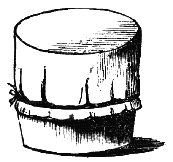
a. Good benzoin, crushed small or in the state of coarse powder, is placed in a cylindrical iron pot with a flat bottom, and from 8 to 9 inches in diameter, so as to form a layer of from 1 to 2 inches deep. The open end of the pot is next covered with a sheet of soft and loose blotting-paper,[146] which is attached to the rim with paste. A cone, cap, or cylinder formed of strong thick paper (cartridge paper), open at its lower end, is then placed over the top of the pot, including the blotting-paper; and this is also attached with paste and string. The apparatus, thus prepared, is then placed on a sand bath,[147] and exposed for 4 to 6 hours to a gentle and uniform heat. It is next removed from the sand bath, and, when it has sufficiently cooled, inverted, and the string detached, when crystals of benzoic acid are found in the paper cone. If, owing to want of care in manipulating, the product is either coloured or empyreumatic, it must be enveloped in several folds of bibulous paper, then submitted to powerful pressure, and afterwards resublimed. The simple form of apparatus figured in the engraving answers well on the small scale, and is that recommended by Dr Mohr.
b. (Ph. D. 1850.) The subliming pot is ordered to be of sheet-iron. It is to be fitted into a circular hole in a sheet of pasteboard, and a collar of tow interposed between it and the flange, so as to produce a nearly air-tight junction. The paper receiver or cap is to be cylindrical, open at one end and about 18 inches high, with a diameter at least twice that of the pot; and it is to be secured in an inverted position on the pasteboard, and fastened to it by slips of paper and flour-paste. A couple of inches of the pot is to be passed through a corresponding hole in a plate of sheet-tin, which is to be kept from contact with the pasteboard by the interposition of a few corks; and a heat[148] only just sufficient to melt the benzoin is to be applied for at least six hours.
c. (Process adopted at Apothecaries’ Hall, London.) The best gum-benzoin is put into an iron pot, set in brickwork over a suitable small fire-place (or flue),[149] and communicating by a conical metal neck, with a wooden box (technically termed a ‘house’) lined with white blotting-paper, as a receiver for the flowers. A piece of fine muslin, or of bibulous paper, is interposed between the top of the subliming-pot and the receiver, to prevent the sublimate falling back into the former. The sublimation is conducted rather rapidly, and the acid condenses in beautiful white, soft, flexible crystals, which are at once ready for the market. When the process is conducted more slowly, the product is proportionately scaly.
Obs. Good samples of benzoin yield from 10 to 12%, or even 121⁄2%, of ‘flowers’ or ‘acid of the first sublimation.’ This, after being pressed in blotting-paper and again sublimed, gives 81⁄2 to 10% of nearly pure benzoic acid. The loss arising from a second sublimation is thus so great that the utmost care should be taken to avoid its necessity.
2. In the MOIST WAY:—
a. (Ph. D. 1826; Scheele’s Process.) Equal parts of benzoin and hydrate of lime, in fine powder, are intimately mixed together and boiled for about an hour, with 40 parts of water; the liquor, after filtration, is evaporated to 1⁄5th, and the lime saturated with hydrochloric acid; the benzoic acid crystallised out as the liquor cools, and is then either washed with very cold water, and dried by a gentle heat, or it is dried and sublimed in the manner already explained. The product of the sublimation is extremely white and pure.
Obs. An economical and productive process; but, to ensure success, a perfect mixture of the dry ingredients must be first made; as otherwise the benzoin runs into a solid mass in the boiling water, and the operation fails. Prod. “1 lb. of (gum) benjamin yields 1 oz. 6 dr. 2 scr. of flowers.” (Gray.)[150]
b. (Process of Stoltze.) The benzoin is dissolved in 3 times its weight of alcohol, the solution introduced into a retort, and a solution of carbonate of soda in weak spirit-and-water, is gradually added, until all the free acid present is neutralised; water, equal to about twice the weight of the benzoin employed, is next poured in, and the alcohol removed by distillation. The floating resin is now skimmed off the residual liquid and washed with a little water, and the washings added to the contents of the retort, which will deposit crystals of benzoate of soda on cooling, and more by subsequent evaporation. From this salt the benzoic acid is obtained by saturating the alkali with an acid (as the hydrochloric), and by subsequent sublimation of the crude precipitated crystals.
3. Other Methods:—
a. Ordinary hippuric acid is very gently boiled, for about 15 minutes, in nitric acid[151] (sp. gr. 1·42); water is then added, and the solution allowed to cool and crystallise. The crystals are collected on a filter, washed with a little very cold water, dried by pressure in bibulous paper, and lastly, purified by sublimation, as before.
b. From the urine of horses, cows, and other graminivorous animals, in a similar way to that by which hippuric acid is obtained, only allowing the urine to acquire a slight degree of putridity before evaporation, which last should be effected by a heat slightly under that of ebullition. The crude acid thus obtained is purified as previously directed.
Obs. Large quantities of benzoic acid are said to be obtained in this way on the Continent; but, owing to the process being clumsily conducted, it is generally of inferior quality, and hence unsaleable. It may, however, by skilful purification, be rendered quite equal to that obtained from gum benzoin.[152]
Prop. When obtained by sublimation benzoic acid forms soft, light, feathery, white, flexible crystals, which are transparent or semi-transparent, with more or less of a mother-of-pearl lustre; when by slowly cooling its aqueous solution, or by precipitation from a solution of a benzoate, it forms either thin plates or scales, or a dazzling white crystalline powder. It is inodorous when cold,[153] but acquires a faint balsamic odour when gently warmed; fuses at about 212° Fahr., and begins to sublime freely at a temperature a little above it, but does not boil until heated to about 460°; burns with a bright yellow flame; is very soluble in alcohol, dissolves in about 200 parts of cold water, and about 25 parts of boiling water; resists the action of ordinary nitric acid even when boiling; and forms salts (BEN′ZOATES) with the bases. Sp. gr. 0·667. Its vapour, which is very suffocating and irritating, has a density of 4·27. Added to fat and fatty substances it either prevents, or greatly retards, the accession of rancidity.
Test, &c. It may be recognised—1. By its physical properties (appearance, fusibility, volatility, odour, &c.) already enumerated:—2. By its ready solubility in solutions of the alkalies; and by being precipitated from these solutions, on the addition of one of the stronger acids, under the form of a dazzling white powder, which is only sparingly soluble in cold water:—3. By its neutral salts with the alkalies, or its neutral solution in an alkali, giving a bulky, flesh-coloured precipitate with perchloride of iron, which is insoluble in water:—4. By its solution not being precipitated by acetate of lead until after neutralisation with a fixed alkali, when the acetate produces a white, flocculent precipitate:—5. By a mixture of alcohol, ammonia, and solution of chloride of barium, neither disturbing a solution of the free acid, nor that of one of its salts with the alkalies.
It is chemically distinguished from cinnamic acid by not yielding essential oil of almonds when it is distilled with oxidising agents, as chromic acid or a mixture of bichromate of potassium and sulphuric acid; and from succinic acid, by its different deportment with sesquichloride of iron (Test 3, antè), and with a mixture of alcohol, ammonia, and solution of chloride of barium (T. 5, antè).
Estim.—1. By weighing it as benzoic acid, obtained either by precipitation, or by very careful sublimation in a glass apparatus:—2. By neutralising its alcoholic or aqueous solution, by the usual method of acidimetry:—3. By precipitating its neutral solution with acetate of lead, or with sesquichloride of iron, and weighing the carefully washed and dried precipitate either as benzoate of lead, or as ferric benzoate.
Pur., &c. White crystalline silky plates and needles, have an aromatic odour. Solubility in cold water, 1 in 300; in boiling water, 1 in 12; in spirit, 1 in 4. Also soluble in caustic alkalies and lime. Borax considerably increases its solubility in water; 1 of benzoic acid and 1 of borax are soluble in 100 of water. It sublimes without residue when heated. It is sometimes met with adulterated with hippuric acid, which may be easily detected by its altered form, by its diminishing solubility in cold water, and by its exhaling an odour of tonquin-beans, and afterwards of hydrocyanic acid, when sublimed. The presence of succinic acid may be readily detected by its greatly increased solubility in cold water; that of sugar, not only by its increased solubility, and partial volatility, but also by the odour of caramel being evolved on the application of sufficient heat, and the residuum being black and carbonaceous; that of camphor, by its peculiar odour when gently heated. Spermaceti, specially prepared for the purpose, is also an occasional adulterant, easily detected by its insolubility and other well-known properties. All these substances either destroy or lack the proper crystalline form of benzoic acid, which is one of the best proofs of its purity. They also greatly increase its sp. gr.
Uses, &c. Its chief use in medicine is as a stimulant and expectorant. It is an ingredient in the compound tincture of camphor (paregoric elixir) of the pharmacopœia.—Dose, 10 to 30 gr., dissolved in water by the aid of a little ammonia or potassa; in old coughs, &c.
BENZOIC AL′COHOL. A peculiar oily fluid, discovered by M. Cannizzaro, and obtained by the action of an alcoholic solution of potassa on pure oil of bitter almonds.
BENZOIN′, B. P. (-zoyn′; zō′-ĭn). Syn. Gum-benzoin*‡, Ben′jamin†*, Gum-b.†*; Benzöi′num, L., B. P.; Benjoin, Fr.; Benzöe, Ger. The balsamic resin exuded from incisions made in the stem of the styrax benzoin, a native of Sumatra, Java, Borneo, Laos, and Siam. Several varieties of benzoin are in the market; two only, however, are chiefly used in medicine, one in agglutinated masses, the other (from Siam), in tears, being the purer and having the stronger odour.
Prop., &c. Odour agreeable, and somewhat like that of vanilla, but more balsamic; fracture conchoidal; lustre greasy; sp. gr. 1·063 to 1·092. It fuses at a gentle heat and exhales white fumes, which, on condensation, are found to be benzoic acid contaminated with a little volatile oil. Alcohol dissolves the larger portion of it, ether much less, and the volatile and fixed oils only a little. It contains from 9% to 18, or (occasionally) nearly 20%, of benzoic acid, according to the quality. It burns with an agreeable odour. The resin and its alcoholic solution strike a bright red colour with oil of vitriol, and a green colour with chloride of iron.
Benzoin has occasionally been sold by fraudulent dealers after its benzoic acid has been removed by the wet method. When the gum has been thus treated it will not show the agglutinated tears, upon fracture, which commonly distinguishes it when intact.
Uses, &c. It is chiefly employed in perfumery, and as an ingredient in incense, fumigating pastilles, &c.; also in court-plaster, in certain cosmetics, and to scent the varnish used for snuff-boxes, walking-sticks, &c. As a medicine, its general effects resemble those of the other true balsams, and of benzoic acid.—Dose, 5 or 6 to 20, or even 30 gr., in powder, and usually in combination with some other remedy; chiefly in chronic pulmonary and bronchial affections, when occurring in torpid habits, and unaccompanied by inflammatory symptoms or gastric irritation. Also as a fumigation in the same diseases, hooping-cough, &c. Like benzoic acid, it is used to prevent rancidity in ointments, pomades, and other fatty preparations.
BENZOINUM. See Benzoin.
BEN′ZOL (-zōle). C6H6. [benz(oin)-oleum.] Syn. Ben′zene*, Ben′zĭne, Ben′zōle*, Hydrĭde of phe′ny̆̆l*, Phe′ne†, &c.; Benzo′leum, L.; Benzine, Fr.; Benzöl, Ger. A peculiar ethereal hydrocarbon discovered, by Faraday, among the products of the destructive distillation of whale oil and other organic substances (A.D. 1825); and subsequently shown, by Mitscherlich, to form the principal ingredient in the distillate procured by the action of heat on a mixture of benzoic acid and hydrate of lime. In 1849, Mr C. B. Mansfield[154] discovered its presence in coal-tar naphtha, from which the benzol of commerce is now chiefly, if not wholly, obtained.
Prep. 1. Pure:—a. A mixture of benzoic acid, 1 part; fresh-slaked lime, 3 parts; is submitted, in a coated glass or earthenware retort, to a heat slowly raised to redness; the oily portion of the resulting distillate is then separated from the water, and carefully rectified, with the proper precautions, at a temperature not exceeding 190° Fahr. The product is usually stated to be pure benzol; but to ensure this it may be submitted to one refrigeration and rectification, in the manner and at the temperature noticed below.
b. From good commercial benzol, agitated with 1-4th or 1-5th of its weight of concentrated sulphuric acid, and, after repose and decantation, rectified at a temperature under 195° Fahr.; the resulting distillate is exposed to a temperature below[155] 32° Fahr., and the mass of crystals that form are thrown on a funnel, kept at the same temperature, to drain, after which they are pressed between folds of bibulous paper,[156] and then allowed to liquefy by simple exposure, in a close vessel, to the ordinary temperature of the atmosphere. The product, after rectification at a temperature not exceeding 190,° is nearly pure benzol. It may be rendered absolutely pure by repeating the refrigeration a second and a third time, followed by a final rectification at 180-185° Fahr.
2. Commercial:—By submitting light coal-tar naphtha to distillation, either at once, or after it has been agitated with a little oil of vitriol, and decanted, care being taken that the temperature does not exceed 200° Fahr.
A drawing and description of the apparatus invented by Mansfield for the preparation of benzol from coal-tar naphtha is given below.
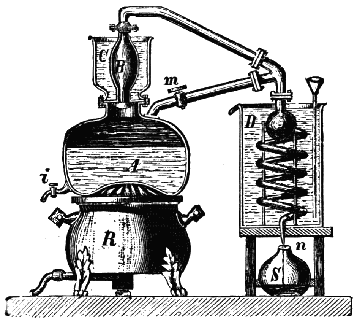
A is the still placed on a furnace R; C is filled with cold water. As soon as the oil in the still boils, the vapours are condensed in B, and flow back into A; this continues until the water in C has been heated to a certain temperature, when the vapours are condensed in the cooler D, the liquid flowing at n into the carboy S. As soon as the water in C begins to boil, all the substances contained in the coal-tar naphtha and volatile at 212° Fahr. are condensed and collected in S. A very pure benzol is obtained by this apparatus. By opening the tap m, the hydrocarbons which boil over 212° Fahr. can be rectified. The stopcock i is used for opening the still.
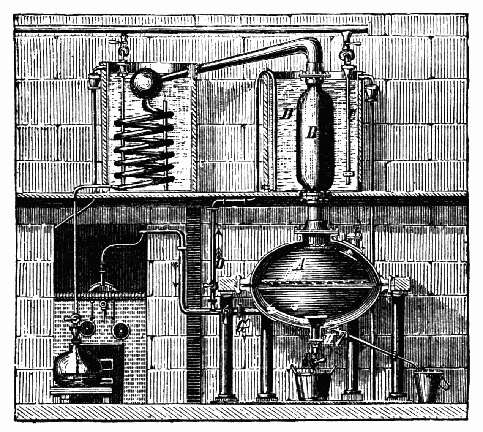
In the benzol works the apparatus shown below is employed.
A is the still, B the condenser, C a water-tank. At the commencement of the operation the water in C is heated by means of the steam-pipe D which communicates with the steam boiler. The tube G is attached to the still; i is a contrivance for filling, b for emptying it. The condensed water is carried off by means of H. By freezing benzol and pressing the solid substance obtained, it may be rendered quite pure.
Prop. Pure benzol is a clear, colourless, very mobile liquid, having a strong, characteristic, and rather agreeable ethereal odour. It is neutral to test-paper; exceedingly volatile at all temperatures; insoluble in water; miscible with alcohol and with ether; highly inflammable; burns with a brilliant flame, emitting clouds of smoke, which rapidly condense and fall as a shower of fine sooty, carbonaceous matter; boils at 176° Fahr.;[157] solidifies, at 32°, to a snowy white camphor-like mass, or when very slowly refrigerated, to beautiful transparent cruciform leaflets, which aggregate together into forms resembling fern-fronds; remelts at 40-1° Fahr.; and when solidifies burns, like camphor, without previous fusion. Sp. gr. ·850;[158] sp. gr. of vapour, 2·770.[159] It is unaffected by the ordinary hydrated acids, and has no action on the alkaline metals. Highly concentrated nitric acid readily dissolves it, and from this solution nitrobenzol is precipitated on the addition of water. Its vapour is dangerously inflammable, and, when mixed with the air, is highly explosive. Its solvent power extends over a numerous list of substances. Commercial benzol has a less agreeable odour, and not unfrequently a slight colour, with other modifications of the properties just enumerated, depending on the relative amount of impurities contained in it.
Pur.—1. It should be colourless, without action on either litmus or turmeric paper, and have the boiling-point, sp. gr.,[160] &c. already indicated:—2. A few drops thrown on a slip of glass or a piece of white paper should rapidly and entirely evaporate by simple exposure to the air without leaving a stain behind, or evolving any disagreeable or foreign odour:—3. Agitation with a little sulphuric acid should not discolour it:—4. It should not perceptibly lose weight or volume by agitation with a little cold water.
Detec.—1. From the physical and other properties already enumerated:—2. By converting it into aniline and then testing it accordingly. For this purpose a little of it is dissolved in concentrated nitric acid, and the nitrobenzol thus formed is precipitated by the addition of water. The fluid is then agitated with ether, to dissolve out the nitrobenzol, and the resulting ethereal solution is mixed with an equal bulk of alcohol and hydrochloric acid and a little granulated zinc at once added. Hydrogen is evolved, and by its action the nitro-compound is converted into aniline. The liquid is next alkalised with potassa in excess, and the alkaline fluid agitated with ether. The ethereal solution, on evaporation, leaves a residue (aniline), which, after the addition of a little water, may be tested with a few drops of solution of chloride of lime, when a characteristic purple colour will be developed, provided the original liquor was benzole, or contained it. In this way very minute traces of benzol may be detected.
Uses, &c. In its impure or commercial form, chiefly as a solvent for gutta percha and india rubber; but it leaves the first in a spongy, friable state, and the latter glutinous or sticky, unless heat is applied to it for some time; also as a solvent in the manufacture of varnishes, as a diluent in lieu of oil of turpentine, for oil-paints, as a material for the production of artificial light, &c., &c. In the pure or nearly pure form it is largely employed in the laboratory and in chemical analysis as a solvent of many resins,[161] mastic, wax, camphor, fat, the fixed and essential oils, sulphur, phosphorus, iodine, several of the alkaloids,[162] &c., &c. Under the name of BENZINE and BENZINE-COLLAS it has been recently extensively vended for the removal of spots of grease, paint, &c., from woven fabrics, which it does most readily and completely, without detriment to the material. As a source of artificial light it has been the subject of innumerable applications and patents. It may be burned in a ‘wickless’ lamp, provided a proper cap-burner be employed. Alcohol or pyroxilic spirit containing 1-3rd, or even 1-4th of it, burns with a rich white flame. Air driven through it becomes sufficiently inflammable to serve as illuminating gas; whilst ordinary coal-gas by merely passing over it yields a flame of greatly increased brilliancy; but in all these applications the greatest possible care is necessary to prevent accidents.[163] See Naphtha (Coal-tar).
Benzol, Nitrate of. See Nitro-Benzol.
BENZOLINE. A product of the fractional distillation of American rock oil. If used for burning purposes, care should always be taken to use a sponge lamp, so as to ensure the benzoline vapour (which is extremely inflammable) being well diluted with air when burnt.
BENZOYL. C7H5O. The radical of an extensive series of compounds, of which the hydride, C7H5OH (essential oil of bitter almonds), and benzoic acid, HC7H5O2 are the most important members.
Benzoyl, Hy′dride of. C7H5OH. Syn. Essence of bitter almonds, Essential oil of bitter almonds, Volatile oil of bitter almonds.
Prep. 1. The crude oil of bitter almonds is agitated with a moderately dilute solution of protochloride of iron which has been previously mixed with fresh hydrate of lime in excess, and the whole, after having been placed in a retort connected with a suitable receiver, is subjected to distillation. The oil passes over mixed with water, from which it is easily separated after repose. By subjecting it to a second agitation and distillation with a fresh mixture of the protochloride and hydrate, and, after careful separation from the water which distils over with it, allowing it to remain for some hours in contact with fragments of fused chloride of calcium, to free it from all traces of adhering water, the product will be nearly chemically pure, provided the whole process has been conducted with as little access of air as possible.
2. (Liebig.) Agitate the crude oil of bitter almonds with mercuric oxide in slight excess, and, after a few days’ contact, rectify the oil from a little fresh oxide. The product is quite pure when the process is properly managed. The bicyanide of mercury thus formed may be either employed as such, or reconverted into oxide of mercury and hydrocyanic acid.
Prop., &c. A rather thin, colourless liquid, of great refractive power and characteristic and agreeable odour; soluble in 35 parts of water; miscible in all proportions with alcohol and ether; it boils at 356° Fahr.; on exposure to the air it rapidly absorbs oxygen, and becomes converted into a mass of crystallised benzoic acid; heated with solid hydrate of potassa hydrogen is evolved, and benzoate of potassium formed; with the alkaline bisulphites it forms beautiful crystalline compounds. Its flame, and that of its vapour, is bright but very smoky. Sp. gr. 1·043. It differs from the crude or common oil of bitter almonds chiefly in the absence of hydrocyanic acid, and consequently in not being poisonous. It has hence been proposed as a substitute for the crude oil as a flavouring ingredient in cookery, confectionery, liqueurs, &c.; but is unfitted for the purpose, owing to the rapid deterioration it suffers unless it be kept absolutely excluded from the air.
Formiate of Hydride of Benzoyle. See Formobenzoic Acid.
BER′BERINE (-een).[164] C20H17NO4. [Eng., Fr.] Syn. Bar′berĭne*, Ber′berite* (of Thomson); Berberi′na, L. A substance discovered by Buchner and Herberger in the root of the common barberry shrub (ber′beris vulga′ris, Linn.); and subsequently, by Bödecker, in calumba-root; and more recently by Mr Perrins, in the calumba-wood (menispermum fenestratum) of Ceylon, which contains a considerable quantity of it.
Prep. 1. A soft watery extract of the root, or of the wood, is digested in rectified spirit, with trituration, as long as anything is taken up; the resulting tincture, after repose, is filtered, and the alcohol gradually distilled off until the residuum has the consistence of a thin syrup. The crystals which form as the liquid cools are drained in a funnel, washed with a few drops of ice-cold water, pressed dry in bibulous paper, and then purified by solution and crystallisation, first in rectified spirit, and next in distilled water.
2. By digesting the root, or the wood (coarsely powdered) in rectified spirit, and then proceeding as before.
Prop. Berberine may be classed with the azotised colouring substances; or, from its composition and its possessing feeble basic properties, with the alkaloids. It crystallises in fine needles, or in stellated prisms, which are yellow, odourless, very bitter-tasted, neutral to test-paper, and contain 12 equiv. of water. At 212° Fahr. it acquires a red colour; but recovers its normal yellow on cooling. A much higher temperature decomposes it, yellow vapours being evolved. It is freely soluble in boiling water and in alcohol, from either of which solutions it may be readily obtained in crystals. It requires 500 parts of water at 60° to dissolve it, and very much more at lower temperatures. Its solutions are yellow; that in alcohol appears green by reflected light. The concentrated mineral acids destroy it. Its salts are more or less soluble.
Uses, &c. Chiefly in medicine, in similar cases to those in which the use of calumba-root is indicated. It has been highly recommended in dyspepsia and heartburn, in disturbed action of the liver, and, combined with iron (lactate, phosphate, or hyposulphite), in chlorosis, anæmia, &c. According to M. Altin, it is an effectual remedy for the mucal, colourless diarrhœa, and the derangement of the urinary secretions which commonly follow cholera.—Dose, 3 to 10 gr.; in larger doses it proves laxative. See Calumba, &c.
BERENIZON (Dr Charles Wortley). A preparation for promoting the growth of the hair. Balsam of Peru 3 grammes, castor oil 3 grammes, tinct. cinchona 4 grammes, spirit 85 grammes, rosewater 40 grammes. (Schädler.)
BERG′AMOT. Syn. Bergamo′ta, L.; Bergamote, Fr.; Bergamotte, Fr., Ger. The bergamot-lemon, or fruit of cit′rus ber′ga′mia; also sometimes, colloquially, the fragrant oil obtained from its rind. See Oils (Volatile).
BERGBALSAM—MOUNTAIN BALSAM (of G. Schmidt, Berlin). Recommended for hemorrhoids, want of appetite, headache, constipation, &c. Rhubarb 2 parts, cortex frangulæ 10 parts, milfoil flowers (Achillea millefolium) 1 part, tansy 1 part, crystallised soda 11⁄2 parts; be digested for some hours in warm water, the fluid expressed made up to 26 parts, 30 parts of sugar dissolved in it, and lastly mixed with 17 parts of rectified spirit. (Hager.)
BER′RY (bĕr′-re). Syn. Bac′ca (pl. bac′cæ, -sē), L.; Baie, Fr.; Beere, Ger. Any small succulent or pulpy fruit containing several naked seeds or granules. In botany, an indehiscent pericarp or seed-vessel, pulpy, many-celled, and many-seeded, the seeds being naked, and for a time connected by a slender membrane, from which they become detached at maturity, and then remain dispersed through the pulp. It is distinguished by its figure, &c., into several varieties.
The leading berries employed in domestic economy and the arts are noticed in their alphabetical places (which see).
BER′YL (bĕr-rĭl). Syn. Aquamarine′ (rēne); A′qua-mari′na, Beryl′lus, L.; Aigue-marine, Béril, Fr.; Beryll, &c., Ger.; Smaragd, It. A beautiful mineral, which, in its richer forms, is classed with the gems. It is usually of a green colour of various shades, passing into honey-yellow and sky-blue. It is allied in composition to the emerald; but occurs in much larger crystals than that gem, and owes its colour to oxide of iron instead of oxide of chromium. According to Gmelin its composition is—Silica, 68·7%; alumina, 17·6%; glucina, 13·4%; red oxide of iron, ·24%. Other (previous) authorities state that it contains fully 14% of glucina, 2% of lime, and 1% of oxide of iron.
The finest beryls come from Dauria on the frontiers of China, from Siberia, and from Brazil. Some of gigantic size have been found in the U.S., at Ackworth and Grantham, New Hampshire, and at Royalston, Mass. One of these measured 32 × 22 × 15 inches, and weighed 2900 lbs.; another, 12 × 24 × 45 inches, and weighed 1076 lbs.
Apatite or Saxony beryl, chrysolite or pierre d’asperge, coloured fluor-spar, and even natural crystals of phosphate of iron, are often worked up by the lapidaries and passed off as beryls, or false beryls, emeralds, topazes, &c. See Gems, Pastes, &c.
BERYL′LA*. See Glucinum, Oxide of.
BERYL′LIUM*. See Glucinium.
BETAINE. C5H11NO21. An alkaloid occurring in the juice of the mangold-wurzel. Scheibler prepares it as follows:—The expressed juice of the mangold-wurzel, strongly acidulated with hydrochloric acid, is mixed with a solution of sodium phosphotungstate;[165] the resulting precipitate containing albumen, colouring matter, woody fibre, and a small quantity of the base, is filtered as quickly as possible, and the filtrate, mixed with a fresh quantity of the precipitant, is left to itself for eight or ten days. It then gradually deposits on the bottom and sides of the vessel a crystalline precipitate, which is rinsed with a little water and treated with milk of lime, whereby insoluble calcium phosphotungstate is produced, while the betaine remains in solution. The filtered liquid freed from lime by carbonic acid, and evaporated, leaves impure betaine, which may be purified by recrystallisation from alcohol, with help of animal charcoal.
A hydrochlorate, a sulphate, an aurochloride, and a platinic chloride of betaine have been prepared.
BE′TEL (bē′tl). [Eng., Ger.] Syn. Be′tle, Be′tel-tree, B. pepper-tree; Bétel, Fr.; Wasserpfeffer, &c., Ger.; Pi′per be′tel (Linn.), Chavica betle (Miquel), L. A climbing plant of the nat. ord. Piperaceæ, common in India and the East. Its leaves, which somewhat resemble those of the citron, are bitter, stomachic, tonic, stimulant, and sialogogue.
Betel. A common masticatory in the East, where it is chewed in the same way as tobacco is by Europeans and Americans, but much more generally, being regarded by the Malays, Sumatrans, &c., as an absolute necessary of life. It is commonly formed by dividing areca-nuts[166] into four or six equal parts or slices, one of which is rolled up, with a little chunam,[167] in a sirih or leaf of the piper-betel,[168] and then constitutes a ‘quid’ ready for use.
Prop., &c. Betel, in those accustomed to its use, produces a species of pleasing excitement or intoxication, stimulates the action of the salivary glands, stomach, and kidneys, corrects acidity, diminishes cutaneous perspiration, restrains excessive discharges, increases the power of physical exertion and endurance, moderates the effects of climate, and appears to act as a general tonic on the system. It darkens the teeth, and tinges the saliva as well as the mouth and lips of a bright red colour. In those unhabituated to its use it causes giddiness, astringes and excoriates the mouth and fauces, and temporarily deadens the sense of taste. The Indians conceive that it preserves and fastens the teeth, cleanses and strengthens the gums, sweetens the breath, cools the mouth, assists respiration, and acts as a general aphrodisiac on both sexes. Peron states that he preserved his health during a long and very trying voyage by the habitual use of betel, whilst his companions, who did not use it, died mostly of dysentery.[169]
BE′TEL-NUT. Syn. Are′ca-nut; Nux are′cæ cat′echu, N.-be′tel, &c., L. The seed of the catechu-palm (are′ca, cat′echu, Linn.), divested of the husk or fibrous pericarp. The whole fruit (ARECA-NUT of commerce) is about the size of a small egg; the husked nut is of the size of a large nutmeg. The whole fruit is remarkable for its narcotic or intoxicating power. It has, however, been thought doubtful whether its intoxicating effect is not owing to the piper-leaf in which it is wrapped when eaten (chewed), rather than to any special property of its own. See Areca Catechu.
BETTNASSEN, Remedy for Incontinence of Urine (prepared by Dr Kirchhoffer, in Kappel by St. Galle). Thirty powders, each consisting of 2 grammes ferri carbonas, 4 grammes ergotæ pulv., ·03 grammes extract. sem. strychni. aquos. The prescription for the embrocation runs—Spirit serpylli 120 grammes, tinct. sem. strychni. 60 grammes, liq. ammon. 15 grammes. (Hager.)
BET′ULINE (-ū-lĭn; bē-tū). [Eng., Fr.] Syn. Betuli′na, L. A crystalline substance obtained from the bark of the white birch (be′tŭla al′ba, Linn.).
BE′ZOAR (-zōre). [Eng., L. indecl.; prim. Pers.[170]] Syn. Be′zoar-stone; Bezoär′dus, La′pis bezoär′dicus, &c., L.; Bézoar, Bézoard, Fr.; Bezoarstein, Ger. The name of preternatural concretions found in the stomach, intestines, &c., of certain animals, and formerly supposed to possess the most extraordinary antidotal power and medicinal virtues. So far, indeed, did this belief extend, that other substances regarded as antidotes were called BEZOAR′DICS†, or otherwise named after them; whilst the adj. BEZOAR′DIC† (bĕz-) and BEZOAR′TICAL† (bézoardique, Fr.; bezoar′dicus, L.), came to be synonymous with antidotal. Certain bezoars were once valued at even ten times their weight in gold. They were not only taken internally, but also worn as amulets. They have, however, long since fallen into disuse in this country.
Among the leading bezoars of old medicine are—
Bezoar, Ger′man. Syn. Be′zoär German′icum, B. capri′num, L. From the Alpine goat.
Bezoar, Hu′man. Syn. B. hom′inis, L. Falsely stated to be found occasionally in man.
Bezoar, Microcos′mic. Syn. B. microcos′micum, L. Human urinary calculi.
Bezoar, Mon′key. Syn. B. sim′æ, La′pis s., L. From certain species of ape or monkey, obtained by giving an emetic.
Bezoar Occiden′tal. Syn. West′ern b.; B. occidenta′le, L. Found in the fourth stomach of the chamois or wild goat of Peru, &c.; or, according to others, of a species of antelope.
Bezoar, Orien′tal. Syn. East′ern b.; B. orienta′le, Lapis b. orienta′lis, L. From the fourth stomach of ca′pra æga′grus, a species of goat inhabiting the mountains of Persia, &c.
Bezoar, Ox. Syn. B. bovi′num, L. From the ox, and other bovine animals.
Bezoar, Por′cupine. Syn. B. hys′tricis, B. hys′tricus, La′pis h., L. porci′nus, &c., L. Said to be found in the gall-bladder of the Indian porcupine. Chiefly from Malacca. Has an intensely bitter taste, which it imparts to water.
Bezoar, West′ern. See Occidental Bezoar (antè).
Of the preceding, those from the stomach of ruminants vary in size from that of a bean to that of a hen’s egg, and have a composition and appearance closely imitated by the following formula, the product of which is commonly sold for them:—
Bezoar, Facti′′tious. Prep. From pipe-clay, or clay and chalk, equal parts, made into a stiff paste with ox-gall; a little hair or wool being added, and the resulting mixture pressed by the hands into small masses of a flattened spheroidal or egg-like form. These give a yellow tint to paper rubbed with chalk, and a green one to quick-lime, which tests are used for genuine bezoars. Like the latter, they are antacid or absorbent, which is probably the only virtue they possess.
Amongst ‘chemical bezoars’ now obsolete even on the Continent were—
Bezoar, Ar′gentine†; B. luna′′re, L. Made by distilling butter of antimony with a solution of nitrate of silver. Once highly esteemed in epilepsy and head diseases.
Bezoar, Min′eral; B. minera′le, L. Powder of algaroth deflagrated with nitre in a red-hot crucible, and then well washed with water. Once used as a diaphoretic. Other similar preparations were B. JOVIA′LE (from tin), and B. MARTIALE (from iron).
Bezoar, Sat′urnine, B. of lead; B. satur′ni, L. Made by distilling a mixture of oxide of lead, butter of antimony, and nitric acid. Once highly esteemed in diseases of the spleen.
BHAURTA. In Indian cookery, a dish made of mashed potatoes and onions, strongly spiced with capsicum, and sometimes also with curry-powder, shaped in a mould, and then slightly baked.
BIBAS′IC. Syn. Bibas′icus, L.; Bibasique, Fr. In chemistry, having two bases, or two atoms of the base or basic radical in its composition. See Acid, Nomenclature, Salt, &c.
BIB′ERON (bĭb′-rōng). [Fr.] A sucking-bottle or ‘artificial mother.’ See Bottles.
BI′BIRINE (bē′-). See Bebeerine.
BIB′ULOUS (-ū-). Syn. Bib′ulus, L.; Spongieux, Fr. Absorptive; spongy.
BICAR′BONATE. A salt in which only half the hydrogen in (hypothetical) carbonic acid (H2CO3) is replaced by a metal, e.g. bicarbonate of sodium, NaHCO3.
BICE (bīse), Syn. Blue bice. See Blue Pigments.
Bice, Green. See Green Pigments.
BICKEL′SCHER THEE, for constipation, flatulence, hemorrhoids, loss of appetite, stomach complaints, and similar diseases. Cassia lignea and anise, of each 3 parts; cumin and fennel seed, each 4 parts; senna leaves, 20 parts; to be bruised together. (Selle and Hager.)
BI′DERY (bē′-). Syn. Vi′dry. An alloy of which the chief seat of the manufacture is the city of Bider′, near Hyderabad, India. It was first brought under the notice of the British public at the International Exhibition of 1851, where many articles made of it were greatly admired for the elegance of their forms, and the gracefulness of their engraved and enchased patterns.
Prep. 1. Zinc, 31 parts; copper and lead, of each 2 parts; melted together, with the usual precautions, under a mixture of resin and beeswax, to prevent oxidation.[171]
2. (Dr Heyne.) Copper, 8 parts; lead, 2 parts; tin, 1 part; melted together, as before. For use, the resulting alloy is remelted, and to every 3 parts of it 16 parts of zinc are added.
Prop., &c. Colour between that of pewter and zinc; does not corrode by exposure to air or damp; yields little to the hammer, and can only be broken by extreme violence. It possesses a convenient degree of fusibility, above that of zinc and tin, but much lower than that of copper. For the turner it is usually cast in moulds of baked clay; but otherwise in moulds of iron or other hard metal. The beautiful black colour which the finished articles possess is imparted by dipping them into a solution of sal-ammoniac, saltpetre, sea-salt, and blue vitriol. See Brass, Bronze, Pewter, &c.
BIDET′ (bĭd-ĕt′; -ā′—Fr.). An article of bedroom furniture conveniently formed for laving the lower part of the body. Besides the value of its use as an instrument of personal cleanliness and health, it offers a ready means of medicating the parts, often highly serviceable in piles, prolapsus, affections of the scrotum and prostate gland, strangury, ischuria, suppressed or difficult menstruation, &c. See Ablution, Baths, &c.
BIELEFELDER TROPFEN—BIELEFIELDER DROPS (Bansi). A spirituous extract of wormwood, unripe oranges, rhubarb, cascarilla, cloves, and gentian. (Hager.)
BIEN′NIAL (bī-ĕn′-y′ăl). Syn. Bien′nis, L.; Biennal, Bisannuel, De deux ans, Fr.; Zweijährig, Ger. Occurring once in, or lasting, two years. In botany and gardening, applied to plants that do not produce flowers and seed until the second year or season of their growth, and which then die; subst., a biennial plant.
The existence of the biennials, like that of the annuals, may be prolonged by art; indeed, many of them, by carefully removing the flowers ere the seed-vessels begin to form, may be made to bloom a second season, and even for several seasons following, like perennials. See Annuals, Flowers, Plants, &c.
BIFF′IN. A baked apple, flattened by pressure.
Prep. The apples are placed in a cool oven 6 or 7 times in succession, and flattened each time by gentle pressure, gradually applied, as soon as they are soft enough to bear it; after which they are taken out, and as soon as cold put on clean dishes or glass plates. The sour or tart variety of apples is the best for baking. If the process be well managed, the appearance of the prepared fruit is very rich and the flavour delicious.
BIL′BERRY. The whortleberry.
Bilberry, Bear’s. Uva ursi.
BILE. Syn. Bi′lis,[172] Cho′le,[173] Fel,[174] L.; Bile, Fiel, Galle, Fr.; Galle, &c., Ger. A bitter fluid secreted by the liver, from venous blood; in part flowing from the intestines, and in part regurgitating into the gall-bladder. Its composition is of a very complex character; and its uses in the animal economy appear to be—to separate the chyle from the chyme, to promote the digestion and assimilation of oleaginous substances, and to assist in exciting the peristaltic action of the intestines. The fæces appear to owe their colour chiefly to the presence of bile; as, without it, they possess a dirty pipe-clay colour. Several of the substances which enter into its composition, or which are formed from those which do so, are noticed elsewhere, under their respective names. Its analysis, detection, and uses in the arts are given under Gall.
Bile (of Animals). See Gall.
BILE, Bil′iousness. Under these terms are popularly included all those slight affections of the stomach usually accompanied with derangement of the head and bowels, apparently arising from excess of bile. Persons subject to attacks of this description should be particularly careful to avoid excess in both eating and drinking, and should more especially shun those articles of food and those liquors which, from experience, they find are apt to disagree with them. A mutton chop, slightly under-dressed, is an excellent article for the breakfast, or the lunch, of bilious patients; and good beef or mutton, either broiled or roasted, so that the gravy be retained, is better for dinner than many dishes apparently more delicate. These, with fresh game and venison, form a good variety from which to choose a bill of fare. New beer and porter should be particularly avoided, as well as boiled meat, stews, soups, greasy or rich puddings, much butter or fat, and most articles of pastry, as they are very indigestible, and, by overtasking the powers of the stomach, very apt to derange it. Strong cheese,[175] salads (particularly cucumbers), over-ripe or unripe fruit, new bread and rolls, cabbages and green vegetables, and especially peas, beans, nuts, almonds, and the like, are also objectionable for parties with delicate stomachs or a bilious tendency. The bread eaten by such persons should be perfectly free from alum, and preferably prepared with meal retaining the whole of the bran in it; and should be two days, or at the least one day old. The quantity of animal food per day, except for the laborious, should be limited to from 6 or 8 to 12 oz.; and warm slops of all kinds, except moderately strong tea and coffee, should be taken as seldom as possible, and, in general, avoided altogether. Even cocoa and chocolate prove injurious to the delicate and bilious. Out-door exercise and plenty of fresh air are essential to the health of such persons. Those who indulge in them freely are never attacked with affections of this kind, unless it be after gluttonising or heavy drinking. Above all things heavy and late suppers should be abandoned; indeed, the better plan is to take nothing more than a hard biscuit, or dry crust, after tea.
In general, attacks of bile may be prevented by the exercise of moderate judgment and temperance in living; and in those hitherto subject to them by the occasional use of an aloetic, mercurial, or saline aperient; and they may be generally rapidly removed by an emetic, followed by a dose of castor oil, Epsom salts, or Seidlitz powder. A tumbler of pure cold water taken on retiring to rest, and another (or even two) on rising in the morning, will often remove both the tendency and the fit, when all the usual remedies have failed. See Abernethy Medicines, Antibilious, Dyspepsia, Stomach Affections, &c.
BILHARZIA HÆMATOBIA. A fluke-like parasite. It is bisexual. The body of the male is thread-shaped, round, white, and flattened anteriorly. The female is thin and delicate. This creature was discovered in the portal vein and bladder of man by Bilharz, of Cairo, after whom it was named. It is especially prevalent in those who dwell by the banks of the Nile, and is also very frequently met with amongst the inhabitants of the Cape of Good Hope. It is the cause of very serious disturbance in the human economy, and not infrequently of death.
The main symptoms of the disease this dangerous parasite sets up are those which point to derangement of the urinary organs; but its effects are not confined to these, since there seems little room to doubt that it is the chief cause of the dysentery so prevalent in Egypt, the eggs of the diatoma being found deposited within the intestinal vessels, or beneath the exudations of the swollen mucous membrane. Dr Harley has found the ova in the urine of persons affected with hæmaturia at the Cape of Good Hope. When death ensues from the presence of this parasite the post-mortem appearances are various. In the bowels, congestion, deposits upon the mucous membrane, and extensive ulcerations, degeneration and atrophy of the kidneys, dependent upon an infiltrated state of the ureters, and blocking of the portal vein, due to the presence of myriads of the parasites, are some of the most important pathological changes.
BIL′IARY AFFECTIONS (-yăr-e). See Bile (antè), Calculi, Jaundice, Liver, &c.
BI′LINE (-lĭn). Syn. Bili′na, L. This name has been loosely applied to two substances:—1. Bile, or pure bile, freed from the mucus of the gall-bladder, and gently evaporated to dryness. A gummy pale yellow mass, white when powdered:—2. Tauro-cholalic or choleic acid. See Gall, &c.
BIL′IOUS (-yŭs). Syn. Bilio′sus, L.; Bilieux, Fr.; Gallig, Gallicht, &c., Ger. Pertaining to, caused by, full of, or having excess of bile. See Bile, Biliousness.
BILIPH′EINE (-e-ĭn). Cholepyrrhine.
BILIV′ERDINE (-dĭn). A green colouring matter, identical with chlorophyll, found in bile, and in the green dejections of children.
BILL OF FARE. In cookery, domestic economy, &c., a list of things ready dressed or prepared for the table (CARTE, C. D’UN RESTAURANT, MENU, &c., Fr.); also a list of articles of food in season. For Tables of the latter, see Food.
BI′NARY. Syn. Bina′′rius, L.; Binaire, Fr. Consisting of two parts. In chemistry, compounded of two elements, or of two bodies performing the function of elements.
BINOC′ULAR (-ū-). Having two eyes. In optics, of or with two eyes, as binoc′ular vĭ′′sion; or formed with two eye-pieces or tubes, so as to be used with two eyes, as a b. mi′croscope, b. tel′escope, &c.
BIRCH. Syn. Be′tula, L.; Bouleau, Fr.; Birke, Ger. The common name of trees of the genus be′tula; appr., b. al′ba (Linn.), or white birch; also its wood. See Betuline, and below.
Birch, Black. Syn. Cher′ry b., Sweet b., Mount′ain mahog′any; Betulen′ta, L. A forest tree of N. America. Wood used for cabinet work; bark yields a volatile oil similar in odour and taste to that of gualtheria; juice obtained by tapping, saccharine, and yields BIRCH-SUGAR.
Birch, White. Syn. Birch, (or) Common b.; Be′tula, L. A tree found in the woods of England. Wood neither very hard nor durable; leaves formerly used in itch and dropsy; bark febrifuge, yields a pyroligneous oil by distillation. See Oils (and above).
BIRD[176] [Eng., Sax.] Syn. A′vis, L.; Oiseau, Fr.; Vogel, Ger. Any fowl or animal of the feathered kind. In fashionable and gourmandic cant, appr. a partridge. See Birds (below).
BIRD′LIME. Syn. Vis′cus, L.; Glu, Fr.; Vogelleim, Ger. Prep. The middle bark of the holly (gathered in June or July) is boiled for 6 to 8 hours in water, or until it becomes quite soft and tender; the water is then drained off, and it is placed in a heap, in a pit underground (commonly on layers of fern), and covered with stones. Here it is left to ferment for 2 or 3 weeks, and watered, if necessary, until it assumes a mucilaginous state. It is next pounded in a mortar until reduced to a uniform mass, which is then well kneaded with the hands in running water, until all the refuse matter is worked out. It is, lastly, placed in an earthen vessel, and covered with a little water; in which state it may be preserved from season to season. In about a week it is fit for use.
Prop. Greenish coloured: very gluey, stringy, and tenacious; when air-dried, brittle and pulverisable, but capable of gradually assuming its previous viscosity when moistened.
Uses. To cover twigs to catch birds, and other small animals. It is said to be discutient, but is now never employed in medicine.
Obs. Birdlime may also be made from mistletoe berries, the young shoots of the elder, the bark of the wayfaring-tree, and some other vegetables, by a similar process to that above described. Should any of it stick to the hands it may be removed by means of a little oil of turpentine.
A kind of factitious birdlime is made by boiling linseed oil either with, or without, a little yellow resin, until it forms a viscid, stringy paste when cold. This is chiefly used, spread on paper or cloth, to catch insects. See Fly-papers, &c.
BIRDS. Syn. A′ves, L. Birds, besides their value as food, play an important part in the economy of organic nature, and particularly in that of the vegetable kingdom. They are the best friends of the agriculturist and the gardener; and their presence, in numbers, appears essential to keep down the innumerable races of insects that prey upon our cereals, fruits, and culinary vegetables. M. Florent Prevost, who has for fifty years presided over the Natural History Museum of Paris, and who has, like the ancient Roman augurs, examined the entrails and stomach of fowls with scientific curiosity, avers, as the result of his long experience, that birds, of whatever sort, are an unmitigated blessing to the farmer, and that the detritus and organic particles found by inspection of them in whole hecatombs, which, by the assistance of the Royal Forest Rangers, he has sacrificed on the altar of utility, show an immense preponderance of insect corpuscula in their digestive organs, whilst the traces of cereal or other valuable products are infinitesimal in comparison. It is found that even sparrows, rooks, and owls—three of the feathered tribe the most persecuted by the farmer—are, in reality, the faithful and vigilant conservators of his fruits and crops. In one of the smaller states of Germany, where, owing to public rewards being given to their destroyers, the whole race of sparrows were exterminated, the crops failed to such an alarming extent that it became necessary to offer large premiums for the reintroduction of these useful birds from other parts. In some of the agricultural districts of France, where the destruction of small birds has been carried on with relentless activity for years, insects have so prodigiously multiplied as to attack everything green around them. Even the forest trees are, in many cases, denuded of leaves by them, and are rapidly perishing. Venomous species of caterpillars, previously scarcely known except to entomologists, have now become common; and cases of children losing their lives from attacks of them whilst birdnesting have been published in newspapers.[177] In our own country the extension of sparrow-clubs—associations disgraceful to the boasted intelligence of the nineteenth century—threatens similar results. Already the gardener finds his fruit-crops lessening year by year; and that many of them, particularly of the smaller and sweeter fruits, have become so precarious, that they now scarcely pay for cultivation. In our own neighbourhood, where small birds have for some years been destroyed by bushels at a time, it is almost impossible to raise a currant, gooseberry, cherry, or plum; whilst seedling flowers and culinary vegetables often entirely disappear on the first night after being planted, or are so completely deprived of the succulent portion of their leaves and stems, that the remaining skeleton of network in a few days withers and dies. But this is not all—the columns of our diurnals bring us continual reports of failing grain-crops in the neighbourhoods in which these bird-clubs have existed for any length of time, and that even on land previously remarkable for its fertility.[178] Did this loss fall only on the benighted beings who so wilfully cast back the blessings of an all-wise protecting Providence, it would be a just retribution; but, unfortunately, it affects the whole nation, and threatens, ere long, unless arrested by legislation, to prove a national calamity. The only apparent remedy for the evil, at present, is the diffusion of information tending to show that the farmer and the gardener, in destroying small birds, destroy their best friends.
[For further information respecting birds, see Aves, Bird (antè), Game, German Paste, Nests (Edible), Poultry, Putrefaction, Taxidermy, Trussing, &c.]
BIRKENBALSAM—BIRCH BALSAM (Dr Friedreich Lengiel). A cosmetic against wrinkles, small-pock marks, freckles, mole spots, red noses, acne, &c. 5 grammes water glass, 2 grammes potash, 1 gramme soap, 5 grammes gum arabic, 10 grammes glycerin, 400 grammes water. (Schädler.)
BIS′COTIN. [Fr.] A small biscuit. In cookery, &c., a species of confection made of eggs, flour, marmalade, and sugar, variously compounded and flavoured according to the taste of the operator.
BIS′CUIT (-kĭt). [Eng., Fr.] Syn. Buccella′tum, Pa′nis bis coc′tus, L.; Swieback, Ger.; Biscotto, It.; Bizcocho, Sp. Literally, ‘twice-baked,’ appr., a well-known variety of hard, dry, unleavened bread, made in thin flat pieces. Those prepared for seamen (SEA′-BISCUITS, CAP′TAIN’S B.[179]) are composed of flour and water only. When made of fine flour and a few caraway seeds are added, they are commonly called Ab′erne′thy biscuits. Fancy biscuits generally contain a little sugar and butter, to which almonds, caraways, mace, ginger, lemon, and other articles, technically called ‘flavourings,’ are frequently added.
Prep. On the small scale, biscuits are made by forming the flour and water into a dough by the common process of hand-kneading, occasionally assisted with a lever, as in making ordinary bread. The dough is then rolled into a sheet, and cut into pieces of the desired size and form. These, after being stamped, are exposed to the heat of a moderately quick oven, when a few minutes (12 to 18, according to their size) are sufficient to bake them.
On the large scale, the whole manual process, from preparing the dough to the point at which the newly-made biscuits are ready for baking is now generally performed by machinery. The articles so prepared are commonly known in trade as ‘MACHINE-MADE BISCUITS,’ and are not only much cheaper, but of fully equal quality to those ‘made by hand.’ In the bakehouses of her Majesty’s Victualling Yards at Deptford, Gosport, and Plymouth, the ingenious machinery invented by Mr T. T. Grant is employed. These establishments are said to be capable of producing annually above 8000 tons of sea-biscuits, at a saving of upwards of 12,000l. a year, from the cost that would have been incurred for the purpose on the old system. Under the latter it is stated that wages, and wear and tear of utensils, cost about 1s. 6d. per cwt. of biscuit; whilst under the new system the cost is only 5d.
The allowance of biscuit to each seaman in the royal navy is 1 lb. per day; or, on the average, six biscuits.
Biscuits Depuratifs (Olivier) are made with meal, milk, and sugar. Each biscuit contains 1 centigramme corrosive sublimate. (Foy.)
Biscuits, Fancy. The varieties of these are almost innumerable. In a printed list now before us we observe the names of upwards of one hundred different kinds. These are produced by varying the number and proportions, of the ingredients used in their composition, and the form and size in which they are turned out of hand. They are further modified by the relative heat of the oven, as well as the length of time they are allowed to remain in it. It would, therefore, be waste of space to give particular directions for the preparation of each. The proportion of butter and sugar, or either of them, may be from 1 oz. and upwards, to flour, 1 lb.; according to the degree of richness desired. In a few cases milk, or eggs, or both, are introduced. The ‘flavourings’ embrace a wide range of substances—bitter almonds, caraways, cassia, cinnamon, ginger, mace, nutmeg, lemon, orange-peel, orange-flower water, essence of peach kernels, vanilla, &c., &c.; many of which give their name to the biscuit.—Ar′row-root biscuits are usually made of equal parts of arrow-root and flour; MEAT′-BISCUITS, from about 1 part of lean meat (minced small and pulped) beaten to a dough with about 2 parts of flour, and a little seasoning, no water being added;[180] SODA BISCUITS, by adding 1 to 2 dr. of carbonate of soda to each lb. of flour. In most other cases, the mere inspection of the biscuit will convey to the experienced biscuit-baker and cook sufficient information to enable him to produce an exactly similar one, or at least a very close imitation. The richest kind of SPONGE-BISCUITS, as we are informed, are made as follows:—Add the whites and yelks of 12 eggs, previously well beaten, to 11⁄2 lb. of finely powdered sugar, and whisk it until it rises in bubbles, then add 1 lb. of the finest pastry-flour, and the grated rind of 2 lemons. Put it into ‘shapes,’ sift a little sugar over them, and bake them in buttered tin moulds, in a moderately quick oven, for nearly half an hour.[181]
Biscuits Purgatifs (Caroz). Each biscuit contains 2 decigrammes scammony. (Reveil.)
Biscuits Purgatifs (Sulot). Each biscuit contains 6 decigrammes scammony.
Biscuits Purgatifs et Vermifuges (Ferd. Gräf, Aschbach) contain 1⁄4 gramme resina scammonii in each.
Biscuits Purgatifs et Vermifuges au Calomel (Sulot). There are 3 decigrammes of calomel in each. (Reveil.)
Biscuits Vermifuges à la Santonine (Sulot.) Each biscuit contains 5 centigrammes of san tonin. (Reveil.)
Biscuits, dev′iled, in cookery, are captain’s biscuits (or any similar kind) buttered on both sides, peppered well, and then covered on one side with a slice of good cheese formed into a paste with made mustard; the whole being seasoned with a little cayenne pepper is, lastly, grilled. Chopped anchovies, or essence of anchovies, is a good addition.
BISMUTH. Bi. Bismuth, Etain de glace, Fr.; Bismuth, Wismuth, W.-metall, Ger. One of the metals.
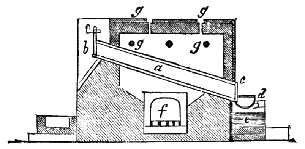
Bismuth furnace in section.
a, Eliquation-tube.[182]
b, End at which it is charged.
c, End from which the metal flows.
d, Receiving-pan.
e, Water-trough.
f, Grate, &c.[183]
g, g, Draught-holes.
Sources. Bismuth occurs in the mineral kingdom in the metallic state (NA′TIVE BISMUTH), and in combination with sulphur (BIS′MŬTHĬNE), and with oxygen (B. O′CHRE, &c.). That of commerce is mostly imported from Saxony, where it is chiefly obtained from native bismuth by the simple process of eliquation. The ore, sorted by hand from the gangue, and broken into pieces of about the size of nuts, is introduced into the ignited iron pipes of the furnace (see engr.) until these latter are filled to about one half their diameter and to three fourths of their length. From these the liquefied metal is allowed to flow into iron pans containing some coal-dust, and from these into a trough of water, in which it is granulated and cooled. It is subsequently remelted and cast into moulds so as to form ‘bars’ varying in weight from 25 to 56 lbs. each. In this state it usually contains a small admixture of arsenic, iron, lead, and sulphur; from the first of which it may be freed by exposure for some time, under charcoal, at a dull red heat. It is best obtained in a pure condition by heating to redness, in a covered crucible, a mixture of oxide, or subnitrate of bismuth, with half its weight of charcoal.
Prop. Colour greyish-white with a reddish tint; crystalline; very brittle (may be powdered); melts at about 480° Fahr., and does not re-solidify until cooled to 6 or 7° below this point; it volatilises at a strong heat, and, in close vessels, the fumes condense unchanged in crystalline laminæ; little acted on by the air, but when exposed to it at a high temperature burns with a faint blue flame, emitting yellow fumes which condense into a yellow pulverulent oxide; when slowly cooled, in large masses, it forms large cubic crystals or octahedrons of great beauty; nitric acid, somewhat dilute, dissolves it freely. It is highly diamagnetic. Sp. gr. 9·8 to 9·83, which, by careful hammering, may be increased to 9·8827. A bar of bismuth, when heated from 32° to 212°, expands exactly 1⁄710 in length.
Uses, &c. Bismuth enters into the composition of STEREOTYPE-METAL, SOLDER, PEWTER, FUSIBLE METALS, and several other alloys. Added to other metals it renders them more fusible. An alloy of tin, nickel, bismuth, and silver is said to hinder iron from rusting. A mixture of bismuth, lead, and tin is much employed for taking impressions from dies, forming moulds, and for other purposes.
Bismuth salts are usually insoluble, or decomposed by any quantity of water into free acid and a basic salt. They are nearly all colourless, and, except the chloride, more volatile. They are easily recognised by the following reactions:—
Their saturated or concentrated solutions giving a white precipitate on dilution with water:—Sulphuretted hydrogen blackens them, or gives a black precipitate:—The nitric solution is unaffected by the addition of sulphuric acid:—Chromate of potassium gives a yellow precipitate, which differs from that from lead, by being soluble in nitric acid, and insoluble in potassa.
Von Kobbell takes a mixture of potassium iodide and flowers of sulphur in equal proportions, and heats the whole on charcoal before the blowpipe; the production of bright scarlet, very volatile bismuth iodide ensues, even when only traces of bismuth are present.
For a method of volumetrically estimating bismuth, consult a paper by Mr Pattison Muir, in the ‘Journal of the Chemical Society,’ April, 1876.
Bismuth, Car′bonate. (Ph. B.) Mix nitric acid, four fluid ounces, with three fluid ounces of distilled water, and add in successive portions purified bismuth, in small pieces, two ounces. When effervescence has ceased apply for ten minutes a heat approaching ebullition; then decant the solution from any insoluble matter. Evaporate to two fluid ounces, and add this in small quantities at a time to a cold filtered solution of six ounces of carbonate of ammonia, in two pints of distilled water, constantly stirring. Collect precipitate on a calico filter; wash till washings pass tasteless. Remove water by slight pressure of the hands, and dry at a heat not exceeding 150°.—Dose, 5 to 20 grains.
Bismuth, Chlorides of:
Basic Chlo′′ride. Bi3Cl8. Syn. Subchlo′′ride of bismuth, Pearl′-powder; Bismu′thi subchlori′dum, L. Prep. A dilute solution of hydrochloric acid is dropped into another of bismuth (prepared by dissolving that metal in nitric acid); and the resulting precipitate, after being well washed in pure water, is dried in the shade.—Prop., Uses, &c. Similar to those of the subnitrate.
Chlo′′ride. BiCl3. Syn. Terchlo′′ride of bismuth. Prep. A mixture of corrosive sublimate, 2 parts; bismuth, 1 part; (both in powder) is exposed to heat until all the ‘mercury’ present is expelled, after which it is at once put into bottles. A greyish-white, granular substance.
Bismuth, Nitrates of:
Basic, Nitrate. BiONO3. Syn. Pearl-white, Bismuth subnitrate; Bismuthi subnitras, B. bismuthi nitras, L.; Blanc de Fard, B. d’Espagne*, &c., Fr.; Perlweiss, Schminkweiss, &c., Ger. Prep. Bismuth, 1 oz.; nitric acid, 11⁄2 fl. oz.; distilled water, 3 pints; mix 1 fl. oz. of the water with the acid, and dissolve the bismuth in the mixture; throw the solution into the remainder of the water, and, after repose, pour off the supernatant liquor, drain the powder that has subsided on a linen cloth, wash it with distilled water, and dry it with a gentle heat.
Prop. A pearly white, inodorous powder, insoluble in water, but freely soluble in nitric acid; long exposure to a strong light turns it greyish. When prepared from a neutral solution, it consists of very fine microscopic crystalline laminæ; but when prepared from acid solutions, with less water, the crystals are acicular, and more silky and lustrous. When moistened it exhibits an acid reaction with litmus paper.
Pois., &c. Like the other salts of bismuth, it causes vomiting, purging, giddiness, cramp, insensibility, &c. No certain antidote is known. The treatment may consist of an emetic, followed by the copious use of emollient drinks, as weak broth, barley water, milk and water, &c.; and subsequently, when necessary to prevent inflammation, by a low diet and aperients.
Uses, &c. In medicine, as a sedative, an astringent, or tonic, and an antispasmodic, in chronic affections of the stomach unaccompanied by organic disease of that organ, and apparently of a nervous character; particularly in gastrodynia, troublesome sickness and vomiting, pyrosis or waterbrash, and generally in gastro-intestinal affections attended with fluxes; also in intermittent fever, spasmodic asthma, &c.—Dose, 5 to 10, or even 20 gr.
Externally, made into an ointment with 4 parts of lard, it has long been employed in certain chronic skin diseases. Under the name of PEARL-WHITE it is commonly used by ladies as a cosmetic; but it is stated that it injures the skin, producing, after a time, paralysis of its minute vessels, rendering it yellow and leather-like—an effect which, unfortunately, it is usually attempted to conceal by its freer and more frequent application. In very large doses it is poisonous.
Both the basic nitrate and the basic chloride of bismuth pass under the names of PEARL-WHITE and PEARL-POWDER, owing to their extreme whiteness and beauty. That of the druggists, however, is usually the former; that of the perfumers usually the latter, but not unfrequently both.
Bismuth Powder, for beautifying the skin and removing freckles. (From North America.) Consists of calcium carbonate, with much clay, and is free from injurious metals. (Chandler.)
Bismuth, Purified. (Ph. Br.) Put bismuth, 10 ounces, and 1 ounce of powdered nitrate of potash, into a crucible, and heat them until both are fused. Continue the heat, constantly stirring, for fifteen minutes, or till the salt has solidified into a slag above the metal. Remove the salt, add nitrate of potash, 1 ounce, to bismuth in crucible, and repeat the process. Pour the fused bismuth into a suitable mould, and let it cool.
Nitrate. Bi(NO3)3. Syn. Neutral nitrate, Ternitrate. Purified bismuth (in small fragments), 2 oz.; nitric acid, 6 oz.; dissolve with heat, adding more acid, if necessary, to effect entire solution of the metal; to the resulting solution add half its volume of distilled water, filter through powdered glass, and evaporate until crystals form.
Use. Chiefly in chemistry, and as a source of the pure oxide and the subnitrate.
Bismuth Oxides:—
Bismuthous Oxide. Bi2O3. Syn. Teroxide of bismuth, Protoxide of bismuth. From either the neutral or the basic nitrate, by exposure, in a crucible, to gentle ignition. Pure. A straw-yellow powder, of rather difficult solubility.
Hy′drated:—By gradually dropping an acid solution of bismuthous nitrate into a concentrated solution of potassium hydrate perfectly free from carbonic acid, and washing and drying the resulting precipitate. Pure. A rich-looking white powder.
Prop., &c. Fuses at a high temperature, and then acts as a powerful flux on siliceous matter without itself imparting colour, a property of which the enameller and gilder has long availed himself. Like the basic nitrate, it has been used as an antispasmodic and as a cosmetic. Sp. gr. 8·211 to 8·355.
Bismuthic Oxide. Bi2O5. Syn. Bismuthic anhydride, Bismuthic acid. Suspend teroxide of bismuth in a strong solution of potassa, and pass chlorine through the mixture until decomposition is complete; treat the powder with dilute nitric acid (to remove any undecomposed teroxide), after which wash it in cold water, and dry it.
Prop., &c. A reddish powder, soluble in water. Its salts, of which little are known, are called BIS′MUTHATES. When heated it loses oxygen, and a bismuthate of bismuth is formed.
Bismuthous Sulphide. Bi2S3. This compound occurs native (BIS′MŬTHĬNE), and may be easily prepared artificially by either fusing its elements together, or by passing sulphuretted hydrogen through a solution of nitrate of bismuth.
Bismuthous Valerianate. Syn. Bismu′thi valeria′nas, L. Prep. An acid solution of nitrate of bismuth is decomposed with a solution of valerianate of soda in water containing a little free valerianic acid; the precipitate is carefully washed in distilled water, and dried in the shade. Recommended as superior to the subnitrate in some forms of gastrodynia, dyspepsia, intermittents, &c.—Dose, 2 to 6 gr., or more.
BIS′TRE (-ter). [Eng., Fr.] Syn. Bister, Ger. Prep. 1. The most compact, best coloured, and well-burnt portions of the soot of beechwood, or of peat,[184] are selected, reduced to powder and sifted through a very fine lawn sieve. It is then digested in clear warm water for several hours, with frequent stirring; after which it is allowed to settle, when the liquid portion is decanted from the sediment. This process is repeated a second, and even a third time. The paste is next poured into a tall narrow vessel, which is then filled with pure cold water, and well agitated. The grosser parts only are now allowed to subside,[185] and the supernatant liquor, containing the finer portion of the BISTRE in suspension, is poured off into another vessel, where it is left to deposit its contents. The deposit is next collected, and carefully dried and powdered; or it is only partially dried, and at once made into cakes with gum-water or isinglass-size, and then allowed to dry and harden for sale.
2. (Dr MacCulloch.) The tar-like liquid obtained from the dry distillation of wood is again carefully distilled until all volatile matter has passed over, and a brittle, pitch-like residuum is obtained, which is either brown or black according to the time and temperature employed; after which the heat is still further prolonged, but with increased care, until the brittle substance becomes pulverulent and carbonaceous. It is then ground and elutriated with pure cold water, as before.
Uses, &c. As a water colour to tint drawings, in the same way as Indian ink, to which it is esteemed superior when the subjects are intended to be afterwards tinted with other colours. It occupies the same place among water colours that brown-pink does in oil.
According to Dr MacCulloch, bistre from wood-tar, when carefully prepared, has great depth and beauty of colour, with all the fine properties of sepia; but that if the whole of the oils and acids have not been removed by the process, it is apt to collect in little flocks which interfere with its use.
BITES and STINGS. Syn. Mor′sūs (-SŪS, sing.) et Ic′tūs (-TŬS, s.), L. The treatment of the bites of non-venomous and non-rabid animals is the same as that of ordinary lacerated or punctured wounds, as the case may be; that of the bites and stings of venomous and rabid animals, serpents, insects, &c., often require, in addition, the use of special antidotes to destroy the virus or to prevent its absorption, or to neutralise its effects when absorbed and to promote its elimination from the system.
The bites and stings of ANTS, BEES, WASPS, HORNETS, and similar insects common to this climate may be treated by washing the part with spirit of hartshorn or dilute liquor of ammonia or eau de luce, or a weak solution of chloride of lime. Should considerable inflammation ensue, and the part become much swollen, a thing that rarely occurs, leeches may be applied, and a cooling purgative given. The stings of venomous reptiles may be similarly treated, excepting that the strength of the solutions of ammonia, chloride of lime, &c., should be stronger than in the former case, so as to produce some pain and smarting. In cases where the venom is of a very poisonous description, the wound should be first well washed with water of ammonia, and afterwards seared with lunar caustic in every part, including the interior and deep-seated portions. In extreme cases the surface of the wound, both internal and external, may be removed with the knife; or, in the case of a small joint, as a finger, the injured portion may be amputated. Prior to the use of the washes or caustic, dry-cupping or suction with the mouth may be had recourse to with great advantage. A ligature placed on the limb, above the wound, as soon as possible after the accident, will impede the absorption of the poison whilst the other treatment is in progress. A similar plan may be followed after the bite of a dog supposed to be mad. It has, indeed, been lately asserted by one of our most celebrated veterinarians that he and his colleagues have been repeatedly bitten by dogs that have afterwards been proved to be mad, but from having fearlessly applied caustic to the parts they have escaped uninjured.
The poison inserted by the stings and bites of several venomous reptiles is so rapidly absorbed, and of so fatal a description, as frequently to occasion death within a very short space of time, and before any remedy or antidote, under ordinary circumstances, can be applied. But even in these extreme cases it is probable that absorption, and consequently the rapidity of the action of the poison, might be considerably impeded or lessened by the immediate application of a ligature above the part, as before described, the patient accompanying the treatment by swallowing a large quantity of liquid, by which partial plethora would be produced, and the functions of the absorbents for a time nearly-suspended. A few minutes thus gained would permit of the application of appropriate antidotes, by which the poison might be neutralised before it would become necessary to remove the ligature, whilst the kidneys would be in full action. Unfortunately, these wounds are generally inflicted in parts of the world where precautionary measures are seldom thought of, and generally at times when people are least prepared to meet them, as well as so suddenly and unexpectedly as to stagger even those observers who may be in no absolute danger themselves. Such is the bite of the East Indian CO′BRA DI CAPEL′LO, against which two Asiatic (arsenical) pills are often prescribed by the Hindoos; but which are generally scarcely swallowed before the poison of the serpent has rendered the patient a stiffened corpse. Eau de luce, a favorite remedy in India, when liberally employed both internally and externally, is said to prove sometimes more successful. The bite of the PUFF-ADDER is of a similar, or even a more fatal description than that of the cobra. When the venom of any of these animals or of a rabid dog is once fully absorbed into the system, there appears to be no treatment that can save the patient. A bottle of Madeira wine or 1⁄2 a pint of brandy or rum diluted with twice its weight of water, drank in two doses about 3 or 4 minutes apart, is a popular remedy in India in such cases. Its effect is to impede absorption.
The secret antidote so long successfully employed by Mr Underwood, the ‘snake-king’ of Australia, for the bites of the WHIP-SNAKE and the DIAMOND-SNAKE, two of the most venomous of that region, is now positively asserted to be the common male fern (polypo′dium fi′lix mas, Linn.). Of the powdered root, or preferably, of the green leaves of this plant nearest the root, he prepares a sort of decoction, or broth, which he takes or administers liberally. A more convenient preparation would, perhaps, be a tincture prepared by digesting 1 oz. of the dried, or 3 oz. of the fresh leaves (bruised), in a pint of proof spirit or strong brandy or rum for a fortnight; as in this state it could be kept for any length of time, if well corked, without deterioration.
For Horses and Cattle. Mr Finlay Dun recommends ammonia solution; solution of caustic potash; carbolic acid; prussic acid and chloroform.
[See Hydrophobia, Poisons, Snake-bites, Stings, Venom, Wounds, &c.[186]]
BITT′ER. [Eng., Ger.] Syn. Ama′′rus, L.; Amer, Fr. Tasting like wormwood, quassia, or other similar vegetables; subst., a bitter plant, bark, or root (= AMA′′RUM, L.; see below).
Bitter App′le‡. Colocynth.
Bitter Cup. A cup or tumbler formed by the turner out of quassia wood. Liquor, by standing in it a short time, becomes bitter and stomachic. They are now common in the shops.
Bitter Earth*. Magnesia.
Bitter Herbs. See Bitters (infrà) and Species (Bitter).
Bitter Salt†, Bitter Pur′′ging-salt. Sulphate of magnesia.
Bitt′er-sweet. Woody nightshade.
Bitt′er-wort‡ (-wŭrt). Gentian.
BITT′ERN. The ‘mother-water’ or ‘bitter liquor’ of salt-works from which the chloride of sodium (sea-salt) has been separated by crystallisation.
Bittern. An intoxicating poisonous mixture sold by the brewers’ druggists, composed of 1 part each of extract of quassia and powdered sulphate of iron, with 2 parts of extract of cocculus indicus, 4 parts of Spanish liquorice, and about 8 parts of treacle; the liquorice being first boiled with a little water until dissolved, and the solution evaporated to a proper consistence before adding the other ingredients. Used by fraudulent brewers and publicans to impart a false bitter and apparent strength to their liquors.
BITT′ERS (-ĕrz). Syn. Ama′′ra, &c., L. Vegetable bitters are commonly regarded as tonic and stomachic, and to improve the appetite when taken occasionally and in moderation. The best time is early in the morning, or half an hour or an hour before a meal. An excessive, or a too prolonged use of them, tends to weaken the stomach, and to induce nervousness. They should not be taken for a longer period than about 8 or 10 days at a time, allowing a similar period to elapse before again having recourse to them.
Among the most useful and generally employed bitters are—calumba, cascarilla, chamomiles, gentian, hops, orange peel, quassia, and wormwood.
Bitters. In the liquor-trade, a compound prepared by steeping vegetable bitters, and some aromatics as flavouring, in weak spirit, for some 8 or 10 days; a little sugar or syrup being subsequently added to the strained or decanted tincture. In that of the taverns and gin-shops the menstruum is usually gin, or plain spirit reduced to a corresponding strength. Bran′dy-bitters and WINE′-BITTERS are prepared in a similar way with common British brandy, or some cheap white wine (Cape or raisin), as the case may be. Each maker has usually his own formulæ, which he modifies to suit the price and the palate of his customer.—This class of liquors has been justly charged with being the fertile cause of habitual intemperance, of disease, and even of death! Their occasional use as tonics or stomachics is also objectionable, owing to the trash, and even deleterious substances, which so frequently enter into their composition. See Liqueurs.
BITU′MEN. [Eng., L.] Syn. Bitume, Fr.; Erdpech, Erdtheer, &c., Ger. A term of a very comprehensive character, and, in general, very loosely applied, including a variety of inflammable mineral substances, consisting of varying proportions of hydrocarbons, having a strong smell and differing in consistence, all the varieties being found in the earth, of which asphaltum, naphtha, and petroleum may be mentioned as examples.
Asphalt is very extensively disseminated throughout Europe, Asia, and America. Considerable quantities are exported from the West Indian Islands, and from the Dead Sea, in Judæa; hence its commercial name, ‘Jewish bitumen,’ or ‘Jew’s pitch.’ The different kinds vary greatly in quality, according to the amount of earthy matter and other impurities contained in them; they may all, however, be reduced to a state of equal purity by boiling or macerating them in hot water, by which means the earthy and siliceous matters are more or less completely removed. These latter fall to the bottom of the vessel, and the bitumen rises to the surface, or forms clots on the sides of the boiler, when it is skimmed off, and thrown into a large cooler, where more water separates. At the Seyssel and Bechelbronn bitumen works the bitumen so obtained is thrown into large cauldrons and boiled for some time, by which means the volatile products and water accompanying it are driven off, and the remaining sand and impurities fall to the bottom of the cauldron, leaving the purified asphalt in the form of a thick fatty pitch, in which state it comes into the market or is applied to various purposes. In the following table we give the composition of a few bitumens:
Carbon, per cent.Hydrogen, per cent.Oxygen, per cent.Nitrogen per cent.
Viscous bitumen of Bechelbronn88·012·0——
Virgin bitumen of Bechelbronn88·011·0—1·0
Liquid bitumen from Hatten, Lower Rhine88·011·6—0·4
Solid bitumen of Coxatambo, near Cuença, in Peru88·79·71·6
Annexed is a table of the analysis of several asphalts, centesimally represented:—
Bitumen of Bastennes.Bitumen of Pont de Chateau, Auvergne.Bitumen of Abruzzi.Bitumen of Monastier, Haute Loire.
Crude.Pure.Crude.Pure.
Oily matters, Bitumen20·0————7·0
Carbon, Bitumen3·776·1377·577·6481·83·5
Hydrogen—9·419·67·868·4—
Nitrogen—12·6612·41·021·0—
Oxygen—0·58·358·8—
Water—————4·5
Gas and vapour—————4·0
Quartz sand and mica76·3————60·0
Clay————Ferrug. 21·0
Ashes—1·80—5·13——
——————————————————
100·0100·0100·0100·0100·0100·0
The solid bitumens are now extensively employed in the manufacture of bituminous mastic or cement and similar compositions, which are used for the lining of water-cisterns, and for various other hydraulic purposes; as also for roofs, floors, roads, pavements, &c. For the last purpose the native varieties of ‘asphaltic rock,’ consisting of a mixture of bitumen and calcareous earth, when tempered with a proper quantity of crushed granite, or calcareous sand or gravel, is found to be the most substantial and durable. The plan followed in laying down such pavements in Paris, where they have been the most extensively adopted, is—The ground having been made uniformly smooth, is edged, in the usual manner, with curb-stones rising about 4 inches above its level, and then covered, to the depth of 3 inches, with concrete (made with about 1-6th part of good hydraulic lime), which is well pressed upon its bed, the surface being subsequently smoothed over with a very thin coating of hydraulic mortar. On this, when perfectly dry,[187] the ‘bituminous mastic,’ rendered semi-fluid by being cautiously heated in a suitable iron cauldron,[188] is evenly spread over so as to form a layer three quarters of an inch, or for less solid work, half an inch thick. Some coarse sand is lastly sifted over and pressed down on the surface, when the work is complete; and in a few days the pavement becomes sufficiently compact and solid to be thrown open to foot passengers.