A CYCLOPÆDIA OF PRACTICAL RECEIPTS, PROCESSES, AND COLLATERAL INFORMATION (continued 14)
Reading edition
Bath, Gelat′inous. Syn. Bal′neum gelatino′sum, B. gelatin′ii, L. Gelatin or fine Salisbury glue, 3 or 4 lbs.; dissolved in boiling water, 2 galls., or q. s.; and added to a warm bath. At the ‘Hospital for Cutaneous Diseases’ 8 lbs. of patent size are used for a bath of 30 to 35 galls. Emollient; formerly, but erroneously, considered nutritive. Used in skin diseases; generally combined with sulphur. See Bath, Barèges.
Bath, Glyc′erine (glĭs′). Syn. Bal′neum Glycerin′ii, B. g. compos′itum, L. Glycerine, 2 lbs.; gum arabic (dissolved), 1 lb. Used as a soothing emollient, in itching, dryness, irritation, and hardness of the skin, &c. Where expense is an object, 3 or 4 lbs. of good honey, and 1 oz. of salt of tartar, form an excellent substitute for the glycerine.
Bath, Hem′lock. Syn. Bal′neum co′nii, L. 1. Dried hemlock-leaves (or herb), 4 to 6 handfuls; water, 1 gall.; infuse 2 hours, and strain. The part to be immersed in, or bathed with, the warm infusion, observing not to apply it if the skin is unsound; or it may be added to the water of a bath in the usual manner. In gout, cancer, chronic rheumatism, and certain skin diseases.
2. (Cut. Hosp.) Extract of hemlock, 2 oz.; starch, 1 lb.; boiling water, 1 gall.; dissolve. For a bath of about 30 galls. As the last.
Bath, Hip. Syn. Coxælu′vium, L. Usually warm; sometimes fully warm, or somewhat hot. In inflammatory, spasmodic, and chronic affections of the abdominal and pelvic viscera; in suppressed and painful menstruation, hæmorrhoids, strangury, prolapsus, ischuria, &c.; also as a substitute for a full bath, when this last is contra-indicated by some affection of the lungs, heart, brain, or great vessels. Like full baths, it may be often advantageously medicated. See Bidet.
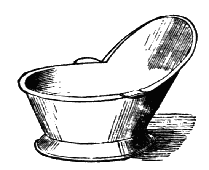
Bath, Hot. Syn. Bal′neum cal′idum, Calda′′rium, L.; Bain chaud, Fr. Usual temperature, 98° to 106° Fahr.
The hot bath has a remarkably tranquillising effect upon the nervous system, producing a strong tendency to quietude and sleep. It also acts as a powerful antispasmodic, and by determining the blood to the surface of the body tends to relieve visceral inflammation and congestion. In chronic affections arising from the action of cold and damp and from exhausted energy, in stiff joints, rheumatism, neuralgia, diarrhœa, and numerous other affections, its effects are often rapid and remarkable. At high temperatures it strongly stimulates the arterial system, and arouses nervous energy and vital action, producing excessive excitement and turgescence, followed by copious perspiration, which has been often found successful in cholera, paralysis, &c. If the immersion be too long continued, or the bath be injudiciously employed, lassitude, debility, and somnolency ensue, and the good effect of the bath is more or less lost. In these cases violent throbbing and painful distension of the vessels of the head, with a distressing feeling of suffocation and anxiety, are premonitory symptoms of impending apoplexy, an accident which sometimes, though seldom, follows its improper use.
Bath, Hydrochlo′′rate of Ammonia. See Bath, Chloride of Ammonium.
Bath, Hydrochlo′′ric Acid. Syn. Muriat′ic acid bath; Bal′neum hydrochlo′′ricum, B. acidum h., B. muriat′icum, &c., L. Commercial hydrochloric acid, 1 to 3 lbs. (in chronic liver affections); or 3 to 6 fl. oz. (in prurigo and lichen).
Bath, Hydrosul′phuretted. Syn. Bal′neum hydrosulphure′tum, L.—1. A tepid sulphuretted bath, with the addition of hydrochloric acid, 2 or 3 fl. dr., immediately before immersion. In rheumatism, chronic skin diseases, hooping-cough, and certain forms of paralysis:—2. A tepid bath to which 3 to 6 fl. oz. of (liquid) hydrosulphate of ammonia is added immediately before use. Used as the last. It often acts almost as a specific in hooping-cough and certain breath ailments.
Bath, I′odine of I′ron. Syn. Bal′neum fer′ri iodi′di, L. Prep. (Pierquin.) Iodide of iron, 1⁄2 oz. to 2 oz. In amenorrhœa, leucorrhœa, chlorosis, scrofula, &c.; gradually increasing the quantity of the iodide until 4 oz., or more, is used for a bath.
Bath, I′odine. Syn. Bal′neum iodin′ii, L.:—1. Iodine, 3 to 5 dr.; dry siliceous sand, 2 oz.; triturated together until reduced to fine powder, and then agitated with the water of a tepid bath for 10 or 15 minutes. 2. (Cutan. Hosp.) Iodine, 4 dr.; liquor of potassa, 4 oz.; water, 2 pints; dissolve; for a bath of 30 galls. In skin diseases complicated with scrofula, glandular enlargements, amenorrhœa, &c.
Bath, Io′duretted. Syn. Io′durated bath, I′odised b., Compound iodine-b., &c.; Bal′neum iodure′tum, B. iodura′tum*, B. potas′′sii superiodi′di, &c., L. Lugol, the leading authority on this subject, employs this bath of the different strengths, &c., shown in the following tables:—
a. For Adults:—
Degree.Iodine.Iodide of Potassium.Water for the bath.
dr.dr.gal.
12 to 21⁄24 to 550
22 to 34 to 660
33 to 31⁄26 to 775
b. For Children:—
Age.Iodine.Iodide of Potassium.Water.
gr.gr.gal.
4 to 730 to 3660 to 729
7 to 1148 to 7296 to 14418
11 to 1472 to 96144 to 19231
⁂ The dry ingredients of the first Table are to be dissolved in a pint of water, and of the second, in 1⁄2 pint of water, before adding them to the bath.
In scrofulous affections and the other cases in which the external use of iodine or the iodides is indicated. Enamelled ware, stoneware, or wooden vessels must be employed.
Bath, Lime. Syn. Bal′neum cum cal′ce, L. Lime, 3 lbs.; slaked, and added to the bath. In gout, lithic diathesis, itch, &c. See Bath, Vapour.
Bath, Mercu′′rial. Syn. Antisyphilit′ic bath; Bal′neum mercuria′le, B. hydrar′gyri bichlori′di, B. antisyphilit′icum, &c., L.; Bain mercuriel, B. antisyphilitique, &c., Fr. Bichloride of mercury, in fine powder, 1 to 3 dr., hot water, 1 pint; agitate together until solution is complete, before adding them to the bath, the ‘water’ of which (contained in an enamelled or wooden vessel) must be soft (rain) and pure. At the ‘Cutan. Hosp.’ hydrochloric acid (= 1⁄3rd the weight of the chloride) is commonly added; and at the ‘Fr. hospitals,’ an equal, or rather more than an equal weight, of sal-ammoniac. These additions facilitate the solution of the chloride, and retard its decomposition by any slight impurity in the water forming the bath.
Uses, &c. In syphilitic affections, either with or without skin disease; in chronic rheumatism, swelled joints, and chronic skin diseases generally, where the use of mercury is indicated, and the remedy is rejected by the stomach; especially in these affections in women and children (for the last, proportionately reduced in strength and quantity). Also used in it, and to destroy pediculi on the body.
Bath, Met′al. See Bath (in Chemistry), Fusible Metal, &c.
Bath, Mud. Syn. Bal′neum lu′teum, B. lu′ti, L. Mud-bathing (ILLUTA′TION) was common among the ancients. The slime of rivers, and the mud on the sea-shore, were especially prized for this purpose. The Tartars and Egyptians still employ baths of this description in hypochondriasis, scrofula, and scurvy. At Franzenbad, in Germany, an acidulous species of black bog-earth found there, is beaten up with warm water to a semi-liquid consistence, and used as a bath. This is said to render the skin satin-like and soft; and to be useful in debility, and in paralytic affections of a gouty origin. In France, hot dung (DUNG BATH) is occasionally used in rheumatism; and in Poland, in syphilis. The husk of grapes and the refuse of olives, after undergoing a partial fermentation, have been successfully employed in France against acute rheumatism.[115]
Bath, Muriat′ic. See Bath, Hydrochloric Acid.
Bath, Mus′tard. Syn. Bal′neum sina′pis, L.:—1. Flour of mustard, 2 lbs.; warm water, 1 gall.; make a thin soup; in fifteen minutes pour it into a coarse linen bag or cloth, and press out the liquid, which is to be stirred up with the bath. In cholera, diarrhœa simulating cholera, &c.; also to cause reaction; the patient remaining in the bath until a somewhat painful sense of burning and irritation is experienced:—2. Flour of mustard, 3 to 8 oz.; as before. Used as a gentle stimulant to excite the skin, and promote its healthy action, &c.
Bath, Ni′tro-hydrochlo′′ric. Syn. Ac′id bath‡ (ăs′-), Nitro-muriat′ic b.*, N. a. b.*; Bal′neum nitro-hydrochlo′′ricum. B. ac′idi (ăs′-), B. a. nitro-hydrochlo′′rici, B. a. nitro-muriat′ici*, &c., L.:—1. Water slightly acidulated with the acid, so that its sourness to the taste is about that of common vinegar. According to Ainslie, 1 oz. of acid is sufficient for 1 gall. of water.[116] Other formulæ in use are—
2. (Cutan. Hosp.) Nitric acid, 11⁄2 lb.; hydrochloric acid, 1 lb.; for a bath of 60 to 70 galls.
3. (Soubeiran.) Nitro-hydrochloric acid, 4 to 16 fl. oz.; according to the case.
4. (Dr Scott.) Nitric acid, 2 fl. oz.; hydrochloric acid, 3 fl. oz.; water, 5 fl. oz.; mix. 11⁄2 to 2 fl. oz. to each gall. of water for a general bath; 3 fl. oz. to the gall. for a foot, knee, or sponge bath.
Uses, &c. In its weaker forms, in skin-diseases depending on disordered liver; in others, chiefly in liver complaints, and to relieve the pain on the passing of gall-stones. It must be contained in an enamelled or wooden vessel, and may be used as a hip, knee, or foot-bath; a knee-bath being the one generally adopted in England. Dr Scott, of Bombay, who first brought this bath into notice, once plunged the Duke of Wellington up to his chin in one, in India, and thus cured him of a severe hepatic affection. In its stronger form it causes tingling and pricking of the skin, and a peculiar taste in the mouth, and affects the gums and salivary glands, often producing plentiful ptyalism, without which, indeed, its advocates regard its action as incomplete. Time of application, 15 to 20 minutes daily, for a fortnight or three weeks; and afterwards, every second or third day.
Bath, Oak-Bark. Syn. Bal′neum quer′cûs, B. quer′ci, L. Oak-bark, 3 or 4 handfuls for a child; 10 to 15 for an adult; made into a decoction, and strained with pressure into the bath. In hæmorrhoids, prolapsus, leucorrhœa, hernia, diarrhœa, ill-conditioned and bleeding ulcerations, &c. Drs Elaesser, Eberle, and Fletcher have successfully employed it in the intermittents of infancy and childhood, tabes mesenterica or scrofula, &c. It has also proved useful in phthisis.
Bath, Oil. Syn. Bal′neum oleo′sum, L. Olive or other oil (hot), strongly aromatised with the oils of cassia, cloves, nutmegs, cedron, and juniper; and digested for a week on ambergris and vanilla, of each (bruised), about 10 gr. to the gallon. Used, in the East, to anoint the body, as a preservative against the plague and other contagious diseases; also as a full bath or hip-bath, the immersion being for 15 to 30 minutes.
Bath, Pneumat′ic. See Bath, Air.
Bath, Saline′ (Gelatinous). Syn. Bal′neum sali′no-gelatino′sum, L.; Bain de Plombières, Fr. Prep. Common salt and Flanders glue, of each 2 lbs.; water, 1 gall.; dissolve separately, and add the solutions to the bath. In scrofula, &c.
Bath, Salt. See Bath, Saline, Bath, Sea, &c.
Bath, Sand. Syn. Bal′neum are′næ, L.; Bain de sable, Fr. See Bath (in Chemistry), Bath, Dry, &c.
Bath, Sea. Syn. Bal′neum mari′num, L.; Bain marin, Fr. Immersion in the sea or in recent sea water (temperate, tepid, warm, or hot). Owing to the saline matter which it contains, it possesses stimulant, alterative, and resolvent properties, superadded to those of pure water at the corresponding temperature. When taken, in summer, on our coasts, the reaction and glow follow more speedily and certainly than after a common water bath; and it may be taken with greater safety, and for a longer period. It often proves very serviceable in diseases accompanied with debility, in phthisis, scrofula, glandular enlargement, &c. A warm or hot sea-water bath is one of the most restorative imaginable; often removing the effects of fatigue and exposure—exhaustion, stiff joints, cramps, rheumatism, &c.—like a charm. Unless under sanction of a medical man, boys and girls should never be allowed to bath in the sea after the end of September. See Bath (above), Waters, &c.
Bath, Sea. (Factitious). Syn. Bal′neum mari′num facti′′tium, L. Artificial sea-water, or rather a substitute for sea-water, for this purpose, is commonly prepared by adding about 3% of common salt to ordinary water.[117] The following are, however, more serviceable imitations:—
1. As above, with the addition of 1 dr. of iodide of potassium to every 3 or 4 galls. of water.
2. (Cutan. Hosp.). Common salt, 8 lbs.; sulphate of magnesia, 2 lbs.; chloride of calcium, 1 lb.; water, 50 to 60 galls.
3. Salt, a handful; water, a pailful; flour of mustard, 1 oz. For a foot-bath.
Bath, Show′er. Syn. Implu′′vium, Bal′neum pen′sile, &c., L.; Douche, Fr. Similar in its effects to the cold bath or plunge-bath; but without many of its advantages. It is less alarming to nervous persons, and less liable to produce cramp, than immersion in cold water; whilst the reaction or glow follows more speedily and certainly. It is considered the best and safest mode of cold bathing, and is often highly serviceable in nervous affections. A good plan is to allow the water to remain in the bedroom all night, by which any undue degree of coldness is removed. Tepid water may be commenced with; and at first, in extreme cases, the patient may stand in hot or warm water at the time of taking the bath. The reaction following its use is greatly promoted by friction of the surface with dry rough towels.
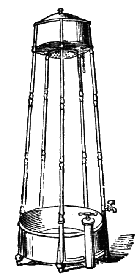
Bath, Soap. Syn. Bal′neum sapo′nis, L. White soap, 2 to 3 lbs.; water, 3 quarts; dissolve by heat, and add it to a warm bath. Detergent, lubricating, and discutient; in itch and other skin diseases, &c.
Bath, Spon′′ging (spŭnje′-). This title explains itself. In the sponging bath exercise and ablution are combined, and its employment by persons of sedentary habit is highly advantageous.
Bath, Sulphur. Syn. Bal′neum sul′phuris, L. 1. Flowers of sulphur, 1⁄2 to 1 lb.; water, a pailful; mix, agitate occasionally for 12 to 24 hours, and then add the whole to an ordinary bath. Useful in various mild, but obstinate, skin diseases. Its occasional employment, even in health, seldom fails to render the skin soft, smooth, and delicate. Soap may be used with it.
2. (Compound; B. s. compos′itum, L.)—a. (Cutan. Hosp.) Precipitated sulphur, 2 lbs.; hyposulphite of soda, 1⁄2 lb.; water, 1 gall.; dissolve, and add of sulphuric acid, 1 dr. One pint to every 30 galls. of water. In various skin diseases (see below).
b. See Bath, Sulphuretted.
Bath, Sul′phurous. Syn. Sul′phurous acid bath; Bal′neum sulphuro′sum, B. sul′phuris‡, L. From sulphur, 1⁄2 oz., sprinkled on a hot plate placed under or near the patient; the proper precautions being taken as directed under CHLORINE BATH. In itch, lepra, psoriasis, &c. Cleanly, but seldom used, chiefly on account of the number of baths required to prove serviceable. See Bath, Sulphuretted.
Bath, Sul′phuretted. Syn. Bal′neum sulphuret′um, B. sulphura′tum, B. sulphu′′reum, &c., L.; Bain sulfuré, &c., Fr. 1 Sulphurated potash, 1 oz.; for every 10 or 12 galls. of water employed. Sometimes sulphurated soda, or (in the Ger. hosp.) suphurated lime, is the sulphur-salt employed. 1⁄2 dr. of sulphuric acid is also occasionally added to the bath; but this increases its fœtor, without adding much, if anything, to its curative power; whilst, without care, the evolved gas may impede respiration.
2. (Gelatinous; Gelat′ino-sul′phurous b.; B. s. gelatino′sum, L.) Flanders glue, 11⁄2 to 2 lbs.; dissolved and added to a ‘sulphuretted bath.’ Recommended, by Dupuytren, as a substitute for the ‘Barèges bath.’
Obs. The sulphur or sulphuretted bath, under any of its forms, is a powerful remedy in almost every description of skin disease. Leprosy, the most obstinate of all, has been completely cured by it; the common itch requires only one or two applications to eradicate it entirely; all the scurfy and moist skin affections, local irritation, pimples, inflammatory patches, &c., speedily yield to its influence; scrofula, and, indeed, all those affections in which the warm or vapour bath is serviceable, also derive powerful assistance from the sulphur bath.
Bath, Tem′perate. Syn. Bal′neum tempera′tus*, L.
Bath, Tep′id. Syn. Bal′neum tep′idum, B. egel′idum, Tepida′′rium, L.; Bain tiède &c., Fr. Approaches the warm bath in its hygiènic and medical properties; and is, perhaps the one best adapted for the mere purposes of personal cleanliness. In the spacious public tepid baths of London, swimming may be safely indulged in even in cold weather.
Bath, Tum′ble. An obsolete form of the shower bath.
Bath, Turk′ish. Syn. Bal′neum tur′cicum, L. A hot vapour bath or sweating bath, with massing or shampooing, ending with a warm bath or warm ablutions and friction. The Egyptian, Persian, and Russian baths are essentially similar. In the Anglo-Turkish bath, recently introduced to this country, hot dry air wholly takes the place of vapour. See Bath, Air (antè).
Bath, Turpentine. Syn. Bal′neum terebinthina′tum, L. Prep. (Dr T. Smith.) Camphine (rectified oil of turpentine), 1⁄4 to 1⁄2 pint; Scotch soda, 2 lbs.; oil of rosemary, 1⁄2 dr.; for an adult. It calms the pulse, softens the skin, and renders the perspiration freer.
Bath, Va′pour. Syn. Dew′-bath*; Bal′neum va′poris, B. ro′′ris†, As′sa suda′tio, A. vapora′tio, Vapora′′rium*, L.; Bain de vapeurs, Fr. The vapour of hot water, either pure or medicated.
The simplest form of vapour bath is, perhaps, produced by placing some wet cloths, or sprinkling a little water on two or three heated bricks, laid under a chair on which the patient is seated; both the patient and whole apparatus being covered with a sheet or blanket, or, better still, a spacious waterproof cloak, to keep in the heated vapour. A large lump of quick-lime, set in a pan or an old iron pot and sprinkled with a little water, or else wrapped up in a thick coarse towel which has been previously soaked in water, may be substituted for the hot bricks; and often advantageously so. The slaking of the lime and the consequent evolution of vapour may be kept up or renewed, when necessary, by sprinkling on a little more water. This forms the “POOR MAN’S VAPOUR BATH” of the French. Dr Serres has suggested, as something apparently original, that a lump of quick-lime, wrapped in a wet cloth and covered with a dry one, be placed on each side of the patient;[118] and the whole being covered up allowed to remain until copious perspiration is established. It must, however, be recollected that by none of these minor contrivances can the temperature of the vapour, and its supply, be regulated, as in a perfect bath, even a portable one, such as is shown in the engraving.
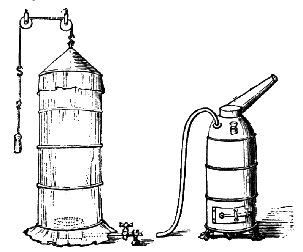
The following are the temperatures, &c., of this bath:[119]—
Temperature of Vapour, Fahr.
Breathed.Not breathed.
Tepid vapour bath90° to 100°96° to 106°
Warm vapour bath100 to 110106 to 120
Hot vapour bath110 to 130120 to 160
Uses, &c. It is one of the most powerful diaphoretics known, and is almost specific in nearly all those cases wherein warm or hot bathing proves advantageous. It is one of the most certain agents existing in cases of chronic rheumatism, contracted muscles and tendons, stiffness of joints, indurations, dysentery, diarrhœa, suppressions, &c. Instances are numerous in which the lame have thrown aside their crutches and the bedridden have again mixed with the world after a few applications of this bath. It is no uncommon thing to hear a patient start and shriek with agony before entering the bath, and to receive his congratulations and thanks on his coming out. They often exclaim—“It is wonderful. I could not have believed it!”[120]
Bath, Warm. Syn. Bal′neum cal′idum, B. calid′ulum, B. Therma′le, Therm′a, &c. L., Bain thermal, B. chaud, &c., Fr. A bath at a temperature equal, or nearly equal, to that of the human body.
The sensations attendant upon immersion in a warm bath are most delicious. Its first effect is to increase the circulation of the blood, and to determine it to the skin. After a few minutes an agreeable and universal increase of heat is experienced; the face and head are generally soon bedewed with perspiration; a pleasing and prevailing calm, both mental and physical, follows; and after remaining in it some 12 or 15 minutes the effect is of the most refreshing and happy character.
The idea that the warm bath is relaxing is erroneous. It is only so where persons remain in it too long, or take it too frequently. Nor are those who indulge in it more liable to take cold than others. On the contrary, they are less liable, unless they wilfully expose themselves, insufficiently clad (particularly about the neck and chest), to draughts of cold air.[121]
As a remedial agent, the warm bath is adapted to general torpor of the system, liver and bowel complaints, hypochondriasis, hysterical affections, morbid suppressions, dryness of the skin, nearly all cutaneous and nervous diseases, chronic rheumatism, &c. As a tonic or stimulant after excessive fatigue, great mental excitement, or physical exertion, it is unequalled, and furnishes one of the most wholesome, and at the same time luxurious sources of refreshment we are acquainted with. “To those who are past the meridian of life, who have dry skins and begin to be emaciated, the warm bath for half an hour, twice a week, I believe to be eminently serviceable in retarding the advances of age.” (Darwin.) The healthy longevity of the late Duke of Wellington, after a period of exposure and trials equal to the entire life of many individuals, has been by some, and we think correctly, mainly attributed to the free and constant use of the warm bath. A warm bath frequently gives great relief to infants suffering from griping or flatulence. See Bath (antè), &c.
Bath, Wa′ter. Syn. Bal′neum a′quæ, B. Aquo′sum, B. ma′′riæ, B. ma′′ris, L.; Bainmarie, Fr. A water bath; in chemistry and cookery, applied to a bath of hot or boiling water. See Bath (in chemistry), Bainmarie, &c.
BATH′ING (bāthé-). See Bath.
BATH METAL. A species of brass having the following composition:—
1. Zinc, 3 parts; copper, 16 parts; melted together under charcoal.
2. Fine brass, 32 parts; spelter, 9 parts. See Brass and Alloys.
BATH PIPE. See Pipes.
BATH, VICHY (ARTIFICIAL). Bicarbonate of soda, 17 oz.; water, 60 galls.
BATHS and WASH′HOUSES. See Bath.
BATTER. Ingredients beaten together so as to form a semi-fluid mass. In cookery, a semi-fluid paste, which becomes hard in dressing, formed of flour, and milk or water, or a mixture of them, enriched and flavoured with eggs, butter, and (frequently) spices, currants, &c., at will. Used for frying vegetables, fillets, &c., and as a material for fritters and pancakes; also to form puddings, which are either baked alone, or under meat; and to cover various articles during the operation of cooking them. Miss Acton gives the following formulæ:—1. (For the Frying-pan.) Butter, 2 oz.; boiling water (nearly) 1⁄4 pint; mix, and stir in, gradually, of cold water, 3⁄4 pint; when quite smooth, mix it by degrees, very smoothly with fine dry flour, 3⁄4 lb.; adding (for fruit) a small pinch of salt (but more for meat or vegetables); just before use, stir in the whites of two eggs (or the white and yelk of one), and fry until light and crisp. In humble cookery the eggs may be omitted.
2. (For Puddings.) Eggs (yelk and white), about 4 in no.; flour, 1⁄2 lb.; milk, q. s.
Obs. When fruit, &c., are added, the batter must be made thicker than when none is used, to prevent it sinking. When sufficiently dressed it should cut smoothly and not stick to the knife. Eggs increase its firmness.
BATT′ERY. In frictional electricity, a series of Leyden jars so arranged as to admit of being charged and discharged together. See Electricity, &c.
Battery. In electro-chemistry, galvanism, &c., a pair, or series of pairs, of ‘excited’ metallic plates, so arranged as to act in unison, producing an electrical current by chemical decomposition.
BAUME (Baumé). See Areometer.
Baume Nerval. See Ointments.
BAUXITE. A ferruginous aluminic hydrate containing 55·4 per cent. of alumina and 44·5 of ferric oxide. It is met with in roundish masses in the crystalline limestone of Baux (hence its name) near Arles, in France. Bauxite is one of the sources of alum.
BAY. See Sweet Bay.
BAY ESSENCE. Bay Rum. This compound, which is largely employed as a perfume in America, and is one of the articles of the United States’ Pharmacopœia, is, when genuine, imported from the West Indies, where it is said to be prepared by distilling rum, with the leaves of the bayberry tree. More than three fourths, however, of the bay rum consumed is undoubtedly an imitation of the imported essence, and is a mechanical mixture of the volatile oil of the bayberry tree, rum, and spirit; sometimes with the addition of aromatic spices and various colouring matters. The volatile oil from which this last preparation is made is frequently adulterated to a large extent.
Mr Rother, an American chemist, states that in one sample alone he found about fifty per cent. of fixed oil. The imported rum is far superior in point of fragrance to the artificial. When mixed with water the genuine essence remains clear, whilst the imitation almost always becomes turbid or milky.
Mr Rother finds the following formula to yield a satisfactory product, and one much stronger in aroma than the imported perfume:
Oil of bayberry tree and ml xx.1 fl. oz.
Jamaica rum1 pint o.m.
Strong alcohol4 pints o.m.
Water3 pints o.m.
Mix the rum, alcohol, and water, then add the oil; mix, and filter.
Bay Rum. One of the highly valued American head-washes, pleasant in use, cooling and cleansing, and promoting the growth of the hair. It is prepared by distilling rum from the leaves of Myrica acris (called “Bayberry” in America).
BDEL′LIUM (dĕl′-yŭm). The commercial name of two gum-resins:—
Bdellium, Af′rican. Syn. Bdellium, Africa′num, L. From the heudola′tia africa′na (Guillem.), a terebinthaceous tree, of Senegal.
Bdellium, In′dian. Syn. In′dian myrrh, False m.; Bdellium (of Scripture); Bdellium in′dicum, L. From am′y̆̆ris commiph′ora (Roxb.), or balsamoden′dron Roxbur′gii, a terebinthaceous tree of India.
Prop., &c. Once considered slightly deobstruent; sometimes used as a pectoral and emmenagogue, and, externally, as a stimulant and suppurative. It is now seldom met with in this country.
BDELLOM′ETER (dĕl-). Syn. Mechan′ical leech; Bdellom′etrum, L.; Bdellomètre, Fr. In surgery, a contrivance combining the principle of the cupping-glass, scarificator, and exhausting-syringe in one small instrument.
BEACH’S (Dr) Specific against Hemorrhoids and Stomach Complaints of all kinds. A tin box containing about 160 grammes of a fine sulphur-yellow powder, and imbedded in it a vial with 40 grammes of a brown clear fluid. The powder is a mixture of 7 parts of washed flowers of sulphur, 21⁄2 parts cream of tartar, 1⁄6 part of an inferior kind of rhubarb, finely powdered. The drops consist of a solution of brown sugar in strong spirit, with traces of various ethers. (Hager.)
BEAD (bēde). Syn. Glob′ulus, sphær′ula, &c., L.; Grain (de collier), &c., Fr.; Bethe, Perle, &c., Ger. A little ball or spheroid pierced for stringing; any very small globular body‡; a bubble (‡ or tech.). A number of the first mounted on a thread or ribbon form a ‘string of beads’ or ‘chaplet.’
Materials, Manufac., &c. Beads are often formed of coral, gems, jet, pearls, porcelain, rock-crystal, &c.; but much more frequently of white and coloured glass. The mode in which these last are produced is as follows:—Glass tubes, appropriately ornamented by colour, reticulation, &c., are drawn out in various sizes, and from 100 to 200 feet in length. These tubes are cut into two-feet lengths, and then, by means of a steel knife, divided into pieces having, as nearly as possible, the same length as diameter. The resulting small fragments or cylinders are next well stirred with a mixture of sand and wood ashes, in order to prevent the closure of the perforations and their adhering together during the subsequent part of the process. They are then placed in a revolving cylinder and gradually heated until they become sufficiently spherical. They are next sifted from the sand and ashes, sorted into sizes, first by means of sieves, and afterwards by hand, and are lastly either put up in weighed parcels or strung by women and children for the market.
The manufacture of coral, gems, jet, and minerals generally, into beads, belongs to the lapidary.
Uses. Chiefly to form necklaces, bracelets, and other articles of personal ornament; by milliners to decorate head-dresses, &c.; and for other like purposes. They are also employed among Catholic and Mohammedan nations for devotional purposes; and among savage tribes in lieu of money. They are still sometimes worn as amulets. See Bugle, Coral, Glass, Paste, Pearls, &c.
Beads, Jum′ble (bēdz). The dried seeds of a′brus precatōr′ius (Linn.) or Jamaica wild liquorice. Hard and indigestible; accounted cephalic and ophthalmic by the vulgar.
Beads, Lo′vi’s. Syn. Specif′ic-grav′ity beads. Small hollow spheres of glass carefully adjusted and numbered, in sets, intended to supersede the hydrometer in determining the density of fluids. They are used by dropping them into the liquid, in succession, until one is found that exhibits indifference as to buoyancy, and will float under the surface at any point at which it may be placed. The number on this ball indicates, in thousandths, the sp. gr. sought. They are particularly serviceable in the hurry of the commercial laboratory, and have the advantage of being applicable to very small quantities of liquid; but their use, of course, requires the same precautions, and the results obtained the same corrections for deviations from the normal temperature, as with other instruments. See Hydrometer, Specific Gravity, &c.
Bead. Syn. Bead′ing‡. In architecture, cabinet-work, &c., any small moulding or continued projection of which the vertical section is semicircular.
Bead (of Liquors). [Tech.] The small bright iridescent bubbles, possessing some slight degree of permanence, which form on the surface of alcoholic liquors of sufficient strength, when agitated. See Alcoholometry, Proof, &c. (also below).
BEAD′ING. In the liquor-trade, anything added to commercial spirits to cause them to carry a ‘bead’ and to hang in pearly drops about the sides of the glass or bottle when poured out or shaken. The popular notion being that spirit is strong in proportion as it ‘beads,’ the object is to impart this property to weak spirit, so that it may appear to the eye to be of the proper strength. Various formulæ are current among the ‘knowing ones’ of the trade, most of which are unscientific, and many of them absolutely ineffective. The following are those now usually employed:—
Prep. 1. Oil of sweet almonds and oil of vitriol, of each 1 oz.; rub them together in a glass, porcelain, or wedgewood-ware mortar or basin, adding, by degrees, of crushed lump-sugar, 1 oz.; continue the trituration until the mixture becomes pasty, then add, gradually, sufficient rectified spirit (strongest) to render the whole perfectly liquid; pour it into a quart bottle, and wash out the mortar twice, or oftener, with a little fresh spirit, until about 1 pint of rectified spirit has been employed, adding the washings each time to the bottle; lastly, cautiously shake the bottle (loosely corked) until admixture appears complete, and then set it aside in a cool place. For use, this compound (after agitation) is thrown into a two-gallon can or measure, which is then filled, from a tap, with the spirit to be ‘beaded,’ when the whole is thrown into the cask, and the measure washed out by refilling it and returning it two or three times; after which the contents of the cask are well ‘rummaged up,’ Gin is usually ‘fined’ a few hours afterwards; but it is better not to add the ‘finings’ for two or three days. Other spirits are allowed to become ‘fine’ by simple repose. According to Mr Hartley, and others, this quantity is “sufficient for 100 galls. of any spirit;” but it is more commonly used for a puncheon of 80 to 85 gallons.
2. Oil of vitriol, 2 to 3 oz.; rectified spirit, (strongest), 1 pint; cautiously agitate them together in a loosely corked quart bottle; in 2 or 3 hours add another pint of rectified spirit, and again agitate. It will be fit for use in a week; as before.
3. Sulphuric ether, 1⁄2 lb.; strongest rectified spirit, 1 quart; mix. May be used at once, as before; but if otherwise, should be kept, like the last, closely corked, and in a cool place.
4. Soapwort-root (saponaria officinalis), bruised or rasped small, 1 lb.; rectified spirit and water, of each 1⁄2 gall.; macerate in a corked jar, with occasional agitation, for 8 or 10 days, strain with pressure, and, after a few days’ repose, decant the clear portion. Used as before.
Obs. The above are not injurious when employed for ‘beading,’ since the quantity employed is much too small to injure the wholesomeness of the liquor. The fraud consists in their being used to disguise the presence of 10 to 12% of water, which is thus sold at the price of spirit. Beyond a certain degree of dilution they fail, however, to produce the intended effect, the bubbles becoming ‘soapy,’ and without the requisite permanence. The addition of a little powdered white sugar (1⁄2 oz. to 11⁄2 oz. per gall.) increases the efficacy of all of them. This may be dissolved in the water, if any is added at the time; but its effect on the hydrometer must be recollected. See Alcoholometry, Gin, Spirit (Management of), &c.
BEAK′ER (bēke′-). Syn. Beak′er-glass. In chemistry, a beaked cup or glass, more or less of the tumbler-pattern, used to collect precipitates and to heat liquids in.
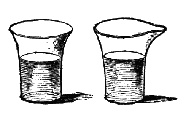
BEAL* (bēle). Syn. Bouton, Pustule, Fr. A pimple or pustule; a small inflamed tumour.
BEAM (bēme). See Balance, Scales, &c.
BEAM′-TREE. Syn. White beam-tree. The ‘pyrus aria’ or wild pear. Wood, hard, compact, and tough; used for axle-trees, naves and cogs of wheels, &c.
BEAN (bēne). [Sax., Eng.] Syn. Fa′ba, L.; Fève, Fr.; Bohne, Ger. The general name of leguminous seeds, as also of the plants which produce them; appr., fa′ba vulgār′is (Mönch.[122] vĭcia faba, Linn.) or common GAR′DEN-BEAN, phase′olus multiflōr′us (Willd.) or SCARLET-RUNN′ER,[123] and ph. vulgaris (Sav.), French bean, KID′NEY-B., or HAR′ICOT (-ko),[124] with their varieties, all of which are annuals cultivated in our gardens—the first chiefly for its seeds—the others both for their green pods and ripe seed. The name is also often popularly applied, as an appellative, to the fruit or seeds of other plants which, in size and appearance, resemble common beans, as noticed below.
Those principally cultivated in our gardens are the small Lis′bon, Sand′wich, Span′ish, Tokay′, Wind′sor, and Maz′agan (from north Africa), with almost innumerable sub-varieties of each. The exquisite perfume of beans in blossom is referred to by the poet Thomson:—
“Arabia cannot boast a sweeter gale.”
Preparations including their fragrant principle are highly prized in modern perfumery.
Qual., &c. The pods eaten in the green state, properly dressed, are regarded as antiscorbutic and wholesome; but are apt to produce flatulence, unless combined with spices. In the dried or ripe state they are rather difficult of digestion, and very apt to distend the stomach and intestines with wind. This objection does not exist, to the same extent, to their use in the form of flour or meal. The amount of nutritious nitrogenous matter in beans rather exceeds that in wheat, and independently of a disposition to produce constipation in some habits, and being rather less easy of digestion, they must be considered nearly as wholesome as that cereal. The London millers and bakers use immense quantities of bean flour to adulterate their flour and bread.
This sophisticant may be detected by the appearance it presents under the microscope. The meshes of cellulin are very much larger than those of the fourth coat of wheat, with which it has been sometimes confounded, and the starch grains present a totally different appearance. They are oval or reniform, or with one end slightly larger; they have no well-defined hilum or rings, but many have a deep central longitudinal cleft running in the longer axis, and occupying two thirds or three fourths the length, but never reaching completely to the end; this cleft is sometimes a line, sometimes a chasm, and occasionally secondary clefts abut upon it at parts of its course; sometimes, instead of a cleft, there is an irregular-shaped depression. If a little liquor potassæ be added the cellulin is seen more clearly. If the flour be added to a little boiling water, the smell of bean becomes evident.
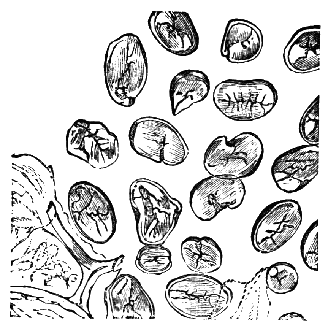
Green beans (pods or legumes) are cooked by simply throwing them into boiling water, and simmering them until quite tender, taking the precaution of removing the lid of the saucepan, a ‘pinch’ of salt of tartar, or a little common salt, being usually added to preserve their green colour. Young and small ones take from 12 to 18 minutes—large or older ones longer. The first are merely ‘topped and tailed’ with a knife before being dressed; the others require also the ‘side strings’ to be drawn off, and to be cut obliquely into pieces of a lozenge form, or else to be split lengthwise into strips, and then divided once across. Old ones never boil tender. Windsor beans, and other “shelled beans,” take 15 to 30 minutes according to age. These last are sometimes skinned after being dressed. All of them are commonly ‘served up,’ or eaten, with melted butter. Beans, although rich in nitrogenous, are deficient in carbonaceous constituents; hence it is curious to note how almost invariably they are when eaten combined with some substance rich in carbon. The Hindoo, for instance, mixes lentils with rice and ghee or a form of clarified butter. In Yucatan and throughout the whole of central Africa, where a black bean is extensively used as food, they are well boiled in water, and eaten with pepper, salt, and pork. In this country, beans and bacon always appear at table together, and have done so for centuries. See Leguminosæ, Pulse, &c. (also below).
Bean, Algaro′ba. See Algaroba.
Bean, Earth. American earth-nut.
Bean, French; Horse-bean; Kidney-bean; &c. See Bean (antè).
Composition. (Einhof.)
Kidney beans.Field beans.
Water23·015·6
Albumenoid bodies23·611·7
Starch, sugar, gum, &c.44·758·3
Oil and fat0·72·
Husk7·010·0
Salts (ash)1·04·4
——————
100·100·
Bean, St. Ignatius’s. The poisonous seed of the fruit of Igna′tia amār′a, Linn.; stry̆̆ch′nos Igna′tii, Berg.; a tree indigenous to the Philippine Islands.—Prop., Uses, &c. Similar to those of nux vomica. Contains Strychnine (which see).
BEAR (bare). Syn. Ur′sus, L.; Ours, Fr.; Bär, Ger.; Bera, Sax. In zoology, a Cuvierian genus of the ‘plantigrade carnivora,’ of several species, found both in the Old and New World. Those generally known under the name are omnivorous or frugivorous. The skin of the American black bear (ursus America′nus, Pallas) was formerly highly prized, and fetched an extravagant price. The brown bear (u. arc′tos, Linn.) supplies the Kamschatkans, and some other northern races, with many of the necessaries, and even the comforts of life. The fat or grease (BEAR’S GREASE; AD′EPS UR′SI, L.) of all the common species has long been highly esteemed for promoting the growth of the human hair; but apparently without sufficient reason. The mass of that sold under the name in England is simply hog’s lard or veal fat, or a mixture of them, variously scented and slightly coloured. The quantity annually consumed in Great Britain, and exported, is estimated at many tons; being a larger quantity than all the bears at present procurable in Europe would supply, if slaughtered and stripped of their fat.
BEAR′BERRY, Bear’s Bil′berry, &c. See Uva Ursi.
BEAR’S GREASE. See Bear (above), Hair Cosmetics, Marrow, Pomades, &c.
BEARD (bēerd). [Sax., Eng.] Syn. Bar′ba, L.; Barbe, Fr.; Bart, Ger., Dan.; Baard, Dut. The hair of the lips and chin; but appr., only the last—that on each lip being distinguished, in toilet-nomenclature, by a separate name. In popular botany and zoology, any beard-like appendage; the ‘awn’ of corn or grass; the ‘gills’ or breathing organs of oysters and other bivalves, &c.
Beard-cultivating Pomade, Royer’s (Royer & Co., Berlin). An ointment of 1 part pulv. cinchon. rub., and 11⁄2 parts of a hair pomade containing wax. (Hager.)
Beard-cultivating Tincture (Bergmann, Rochlitz). A spirituous extract of some agreeable bark, mixed with a little oil of rosemary and thyme. (Wittstein.)
Beard-cultivating Tincture, Royer’s (Royer, Berlin). 10 grammes kitchen salt, 150 grammes French brandy, fictitious and fuselly, and 2 grammes tincture of mace. (Schädler.)
Beard Tincture, American (Teinture americaine pour la barbe), for dyeing the beard black. Three fluids. No. 1, nitrate of silver solution; No. 2, tincture of galls; No. 3, sodium sulphide solution.
BEARD′ED. Syn. Barba′tus, L.; Barbu, Fr.; Bartig, Ger. In anatomy, botany, and zoology, having a beard, or a beard-like appendage; prickly, barbed, jagged; awned.
BEA′VER, (bē′-) Syn. Cas′tor, L.; Castor, Bièvre, Fr.; Biber, Ger. The fi′ber cas′tor (Linn.), an animal belonging to the rodentia of Cuvier, and remarkable for the great ingenuity which it exercises in the construction of its lodges or habitations. Hab. Europe and America. Those of the former are burrowers; those of the latter, builders. The fur has long been employed in the manufacture of the best quality of hats (BEAVER HATS). The fat was officinal in the Ph. L. 1618. Castor (CASTO′′REUM) is obtained from this animal.
BE′BEERINE (bēbe′-ĕr-in‡). C19H21NO3. [Eng., Fr.] Syn. Bi′birine (bē′-bĕr-ĭn); Bebeeri′na, Bibiri′na, &c., L. A peculiar alkaloid, discovered by Dr Rodie, in the bark and seeds of the beeberu, bibiri, or green-heart tree (nectan′dra Rodiæ′i, Schomb.), of British Guiana; and since minutely examined by Maclagan and Tilley, and by Von Planta.
Prep. 1. That of commerce, which generally contains some sipirine (—? altered bebeerine), and a little lime, is generally first obtained in the form of sulphate, by a process analogous to that employed in the preparation of sulphate of quinine; and from this salt it is precipitated by the addition of ammonia or an alkali.
2. (Pure.) By precipitating the sulphate with ammonia, washing the precipitate with very cold water, and triturating it, whilst still moist, with fresh hydrated oxide of lead; next drying the mixture by a gentle heat, exhausting the residuum with alcohol, distilling off the alcohol, and treating the last residuum with ether; the ethereal solution on evaporation leaves pure bebeerine, under the form of a white or yellowish-white, resinous-looking substance, which is pure white when powdered.
Prop., &c. Amorphous; uncrystallisable; non-volatile; bitter-tasted; inodorous; unalterable in the air; very slightly soluble in water; very soluble in alcohol; less so in ether; reaction alkaline; when quite pure, melts at 355° Fahr., and on cooling forms a vitreous or semi-vitreous mass (Winckler); at a higher temperature it suffers decomposition; ignited on platinum-foil, it burns without leaving any carbonaceous residue; neutralises acids forming uncrystallisable salts, most of which are soluble in water.—Prod. From the bark, 1·5 to 1·75%; dried seed, 2·5% (nearly).
Use, &c. Bebeeru-bark has been proposed and occasionally employed as a substitute for cinchona bark, and bebeerine for quinine, in the usual cases; but whether as a tonic, febrifuge, or antiperiodic, they appear less powerful and certain than these last.—Dose, 2 to 12 gr. or more. (See below.)
Sul′phates of Bebeerine. Of these there are two, both of which are obtained in a similar manner to the Ph. E. formula for sulphate of quinine, and merely differ in the amount of acid finally left in combination with the alkali:—
1. Sulphate. Syn. Neu′tral sulphate of bebeerine; Bibiri′næ sul′phas, &c., L. Easily soluble in water. Contains 86·4% of bebeerine, and 13·6% of sulphuric acid.
2. Subsul′phate. Syn. Bas′ic sulphate of bebeerine, Disul′phate of b.; Biberi′næ subsul′phas, &c., L. Soluble in alcohol; sparingly soluble in water unless acidulated. Contains 90·8% of bebeerine, and 9·2% of sulphuric acid. This is the sulphate of bebeerine of commerce, and the one usually employed in medicine. It is generally met with in thin brownish-yellow scales, which are formed in a similar manner to those of ammonio-citrate of iron.—Dose. As a tonic, 1 to 3 gr.; as a febrifuge or antiperiodic, 5 to 20 gr.; in similar cases to those in which disulphate of quinine is employed.
BECH′AMEL (bĕsh′-ă-mĕl‡[125]). Syn. Béchamel, Fr. In French cookery, a fine white sauce, essentially consisting of concentrated veal gravy or veal consommé and cream, with or without flavouring. See Sauces.
BE′CHIC* (-kĭk). Syn. Be′chous†; Be′chicus (bĕk′-‡), L.; Béchique, Fr.; Hustend, &c., Ger. In medicine, &c., of or for a cough; pectoral; also subst., applied to remedies (BE′CHICS; BE′CHICA, L.) used to relieve cough.
BED. [Eng., D., Sax.] Syn. Lit, Couche, Fr.; Bett, &c., Ger.; Cubi′le, Lec′tus, Lec′tulus, Graba′tus, &c., L. A couch; that in or on which we sleep; that on which anything is generated, deposited, or rests.
Bed curtains and valances are both unnecessary and objectionable as bed appendages, and as such should be discarded. Before making the bed in the morning the blankets and sheets should be stripped off and allowed to remain for an hour or two in a current of air, on the back of a chair or some other convenient support. If it does not rain, or is not too damp, they are best placed near the window. The night dress which has been slept in should be exposed in the same manner; and on going to bed it would be found a good plan, when removing the inner vest which has been worn during the day, to turn it inside out, and to hang it over the footboard of the bed. Under ordinary conditions the sheets should be changed every week. When it is remembered that on an average a third of a human being’s existence may be said to be passed in bed, the importance of his dormitory being kept scrupulously clean will be self evident. Every bedroom should therefore be well swept out each day, and the floor diligently scrubbed once a week. With the exception of a small strip beside the bed, the room should contain no carpet; a piece of New Zealand matting, being less able to retain dust, is preferable to carpeting. The door and windows of the bed-chamber should be kept more or less open during the day, so as to ensure a thorough draught of air through the room, and all slops and contents of chamber utensils should be immediately removed. No plants should be allowed in the bedroom.
There is no better form of mattress than one made of horsehair, both for children and adults. The pillows should also be made of the same material. Both pillows and mattress should be taken to pieces once a year, and their contents well ventilated by exposure to the air. When a child is ricketty, weak in the neck, inclined to stoop, or at all crooked, a pillow is best dispensed with. Cotton sheets have two advantages over linen ones—they are more absorbent, and feel less cold. In cases of sickness the comfortable construction of the patient’s bed, as well as the adoption of such means as shall ensure as much as possible its efficient ventilation, are matters of primary import. Hence because it permits of a more thorough circulation of air than any other kind, the horsehair mattress calls even more imperatively for adoption than in health. It may be placed upon the feather or wool bed, and should it be found too rough, or causing any discomfort, one or two blankets may be placed over it. The straw palliass should at the same time be removed. Both sheets and pillow cases should be frequently changed, more especially in fevers. If the patient perspire very profusely, fresh sheets and pillow cases should be supplied every twenty-four hours. If soiled by evacuation of any kind, it is most important that they should be changed at once, and so with the night dress. In all cases of eruptive and other fevers, and contagious diseases, all articles of wearing apparel (underclothing, as well as sheets, pillow cases, handkerchiefs, &c.) should when removed be placed in a vessel and covered with water.
In the articles on “air” and “vitiated air” the evil effects of ill-ventilated dormitories have been adverted to. Every bedroom should if possible contain an enclosed fireplace having free access to the chimney. Failing this a series of little holes about the size of a shilling should be bored in the lower part of the door, and the upper sash of the window should be opened to the extent of two or three inches.
[On the connection of BEDS and BEDDING with comfort and health, see Cotton, Damp, Feathers, Linen, Sleep, Ventilation, Vermin, &c.; also below.]
1.
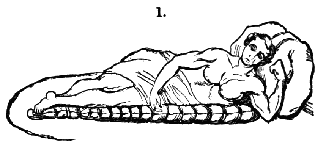
2. (Opened.)
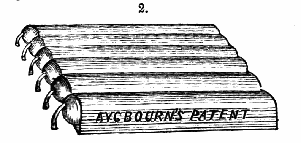
3. (Closed.)
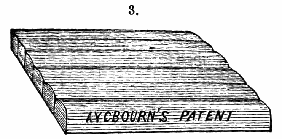
Bed, Air. Beds, pillows, cushions, &c., when properly constructed and inflated with air, are clean, luxurious, and healthy substitutes for those in common use. For this purpose the air-proof part should be formed of separate cells or tubes, arranged in ridges (see engr.), or in any similar manner to admit of free ventilation; and in the case of beds, or of cushions for the sick, two or three folds of flannel, or blanket, or of any loose porous fabric, should be placed between them and the under sheet or the person of the sleeper or patient. Without this precaution, discomfort and restlessness, excessive warmth and perspiration and even bed-sores, are apt to follow their use by invalids, when badly constructed. To obviate these objections to articles of this class commonly sold, a new one has been produced under the name of the ‘Incom′parable bed’ (Aycbourn’s Patent), which is thoroughly applicable to all purposes—domestic, medical, naval, or military—and superior to any feather, flock, or spring bed, however good or carefully made up. This bed consists of an outer case made of ordinary bed-ticking divided internally into numerous separate cells, into each of which is placed a suitably constructed bag, which may be either wholly or partially filled with air or water; the latter either hot or cold. (See engr. 2, 3.) It is incapable of bursting, and is very agreeable to lie on. It retains its shape, saves the time, trouble, and wear and tear ordinarily bestowed or produced by servants in daily tossing about one of down or feathers, is easily washed and kept clean, allows all the ventilation essential to health, and is so portable that it may be easily packed in a carpet-bag. In almost an instant it may be converted into six, or more, separate life-preservers; and what is equally important it will stand any climate. Hitherto the use of air-beds and water-beds has been almost exclusively confined to the upper and wealthy classes, and to hospital practice; but the moderate prices[126] at which Aycbourn’s beds, cushions, &c., are sold, place these luxuries, and in many cases—absolute necessities—within the reach of the masses of the people.
Bed, Water. Water-beds, cushions, &c., are chiefly employed for patients labouring under bed-sores, paralysis, spinal affections, &c., or who are the subjects of active surgical treatment in which equable support for the body or a limb is absolutely necessary. Their construction and use are similar to those previously noticed, except that, instead of being inflated with air, they are filled with water, either warm or tepid. For the bedridden, and for long-continued use generally, they are much inferior to air-beds. See Air-bed (above).
Bed. Syn. Stra′tum, L.; Strate, &c., Fr.; Schicht, &c., Ger. In geology, a mineral layer, seam, or stratum, thick or thin.
Bed. In horticulture, a small plot of land, usually raised a little above the general surface, in which flowers, or other plants, are raised or grown.
BEDDING, PURIFICATION OF. To be efficiently disinfected, bedding must be taken to pieces and subjected to dry heat. This last condition can only be satisfactorily carried out in large ovens or disinfecting chambers. Any local authority may provide a proper place and necessary appliances for the disinfection of bedding. Any local authority may direct the detention of bedding, clothing, &c., which have been exposed to infection, and may give compensation for the same.
Any person giving, lending, selling, transmitting or exposing bedding, clothing, rags, &c., which have been exposed to infection, is liable to a penalty not exceeding £5.
Bedding or Litter. The following is from Col. Fitzwygram’s useful work, ‘Horses and Stables,’ “One great item in a horse’s comfort, and consequently in his aptitude to carry flesh, is a good bed. Every horse should be bedded down at mid-day. As regards economy of straw, it is essential not to give the horse a chance of eating it. With this view no fresh straw should be placed within his reach. The fresh straw should be brought in first, and put not merely at the bottom, but also in rear of the stall; then the old litter should be brought in and put at the top and in front. The horse will not readily eat at, and by the following morning the new straw will have become somewhat tainted, and may then be mixed and dried along with the rest. Again, great care should be taken in the morning to thoroughly shake up and cleanse the bedding from dung; and any parts which may have become rotten should be thrown out. Good straw rapidly deteriorates if these precautions are not taken. On the other hand careless servants often throw away along with the bad parts much good bedding which might be dried and used again. Bedding should be taken up, and turned over at least twice in each forenoon, so as to expose every part to the drying and purifying influence of the sun and air. It is, however, a mistake to expose it over-much to the action of a very hot sun, as it makes it too dry and brittle.” See Horse.
BED′EGUAR (-e-gahr). Syn. Bédéguar (or GAR), Fr. Sweet-briar sponge (which see).
BEE (bē). Syn. Hive-bee, Hon′ey-b. (hŭn′-), Domes′tic b.; A′pis, L.; Abeille, A. mellifique, &c., Fr.; Biene, Honigbiene, &c. Ger. The a′-pis mellif′ica (Linn.; Ph. L., E., & D.), one of the hymenop′tera best known and most useful to man. [Those desirous of studying the habits and economy of bees are referred to the works of Huber and Latreille; and for their management to Mr Cobbett’s little book on the subject.] See Apis, Hive, Honey, Wax, &c.
BEE′-BREAD. The pollen of flowers collected by bees as food for their young.
BEE′-GLUE, Syn. Prop′olis, L., Fr. The resinous matter with which bees cement the combs to the hives, and close up and repair the cells.
BEECH (bēche). Syn. Beech′-tree; Fa′gus, L; Hétre, H. commun, Fr.; Buche, Gemeine b., Ger. The fa′gus sylvat′ica (Linn.), a magnificent English forest-tree, of the nat. ord. Amentaceæ (DC.). Fruit (BEECH′-MAST, B.-NUTS), used to feed swine, and, sometimes, in obstinate headaches, and in gravel complaints; yields oil by expression; inner bark occasionally used in hectic fevers. Wood (BEECH, B.-WOOD), handsome and very hard, but brittle and perishable, and particularly liable to become worm-eaten; its durability is increased by steeping it, when fresh-hewn, for some time in water; chiefly used by cabinet-makers, coach-builders, millwrights, and turners; and, sometimes, by coopers; also burnt for charcoal.
BEEF (bēfe). Syn. Chaire de bœuf, Du bœuf, Fr.; Rindfleisch, &c., Ger.; Bu′bula, Ca′′ro bo′vis, &c., L. The flesh of bovine animals, generally; but ordinarily only that of the domestic ox, cow, or bull.
Qual. Good beef is highly wholesome and nutritious; and is well adapted to persons of good appetite, or that labour or take much exercise. For the delicate, especially those suffering from debility, partial anæmia, amenorrhœa, and similar ailments, it is, perhaps, superior to every other kind of animal food. If cooked so as to be left full of gravy, it sits lightly on the stomach, and its fat proves even more digestible than that of either veal or mutton.
It has been proved that under-done beef is one of the causes of tapeworm.
Choice. Ox-beef is known by having a fine smooth, open grain, a lively and agreeable red colour, and a tender texture, with the fat of a pleasing pale whitish-yellow or but slightly yellow, and the suet white and hard. When fine and well fed, the flesh is inter-grained or marbled with fat.—Cow-beef has a closer grain than ox-beef, and the lean is of a deeper red.—Bull-beef is closer still, the fat dark, hard, and skinny, the lean of a deep coarse red, and it has a strong smell and flavour.—Heifer beef resembles ox-beef, except in being smaller, often an advantage; but it lacks the rich flavour of the flesh of full-grown oxen.
Joints, Managem., &c. Beef is CURED, SALTED, and DRESSED, in all the ways common to the other meats; the only care necessary being in the selection of the appropriate joint or part. The ribs, sirloin, rump, and veiny piece are the proper joints for ROASTING or BAKING. The buttock or round, edge-bone, second round or mouse-buttock, brisket, flank, shoulder or leg-of-mutton piece, and the clod, those generally BOILED, STEWED, or SALTED. The choicest STEAKS are cut from the middle of the rump; the next best from the veiny piece, or from the chuck-rib. In summer, excellent ones may also be cut from the shoulder. In France, steaks cut from the sirloin (without bone) are preferred to all others, and are exceedingly delicate and tender. The neck may be either stewed or boiled, and is much used to make soup and gravy. In the country, the round, when fine, and well hung, is also often roasted or baked.
According to Miss Acton, “the finest part of the sirloin is the chump-end, which contains the larger portion of the fillet; of the ribs, the middle ones.”
Beef is in season during the whole year, but is finest—when it is most relished—during the winter months, when, owing to the temperature of the air, it may be ‘hung’ a long time, and thus increased in tenderness and flavour. See Ox, Baking, Boiling, Essences, Roasting, Salting, Tea, &c. (also below).
Beef, Alamode′. Syn. Bœuf à la mode, Fr. The true ‘beef à la mode’ is made as follows; and is not a mere kind of rich stew, such as is daily sold under the name in the ‘cook-shops’ of London:—
1. (M. Alexis Soyer.) Rump, sirloin, or rib of beef (about) 12 lbs.; lard it through with 10 or 12 long pieces of fat bacon; put it into an earthen pan with a calf’s foot, 4 onions, 2 carrots (sliced), a bunch of parsley, 2 bay leaves, 2 sprigs of thyme, 2 cloves, 1⁄2 teaspoonful of pepper, 1 do. of salt, 4 wine-glassfuls of sherry, 4 do. of water, and 1 lb. of streaky bacon (cut into small squares); place on the cover, make it air-tight round the edges with a little flour-paste, and expose it in a moderate oven for about 4 hours. Dish up with the vegetables and bacon placed tastefully round it, the gravy (skimmed) being poured over all. Or it may be eaten cold, in which case the pan should not be opened until the whole has thoroughly cooled.
2. (Mrs Rundell.) Rump of beef (or any part of the beef which will stew well), 3 or 4 lbs.; trim it, and cut off the fat; add several sorts (according to taste) of sweet herbs chopped very fine, a little shalot, and a great deal of spice (cayenne, white pepper, allspice, cloves, and mace; or mixed spices), and put them, with vinegar, into a saucer that has been rubbed with garlic; add fat bacon cut into long slips; lard the beef regularly on both sides, and rub it over with the herbs and spices; next flour it, and add a small piece of butter, and a pint of water; bake it in an oven until thoroughly ‘done,’ then strain the gravy, and serve it up with pickles on the top. Excellent either hot or cold.
Obs. Miss Acton—a high authority in these matters—tells us, that 7 or 8 lbs. of beef, thus treated, takes 4 to 5 hours to dress it properly; and that if a stew-pan be used, it should be as nearly the size of the meat as possible, the whole being allowed to simmer very gently, and the meat turned when half done. She also states that “veal dressed in this way is even better than beef;” but, of course, it takes less time in cooking.
Beef, Col′lared. Prep. 1. (Miss Acton.) The piece of beef is rubbed with a little coarse sugar, and set aside for two or three days; it is then slightly salted (about 1 oz. of salt, containing a little saltpetre, to each lb. of meat); and allowed to rest 8 to 10 days; the bones and tougher skin are next removed, and the under side is sprinkled thickly with parsley and other savoury herbs (shred small), after which it is very tightly rolled up, secured with a cloth, and bound as closely as possible with broad tape. A piece of 8 lbs. will require about 5 hours’ gentle boiling, and should be placed, in the same state, whilst still hot, under a heavy weight, or in a press, for a few hours. The ribs, or (better) the thinnest part of the flank, is generally selected. The last should be ‘hung’ in a damp place for a day or two before curing it.
2. (Mrs Rundell.) From stewed shin of beef and ox-tail, re-stewed with a glassful each of wine and ketchup, and some of the old broth, and then poured into moulds. Sweet herbs, sliced eggs, and pickles, may be added at will.
Beef, Dutch, Hung Beef. The round, rump, veiny-piece, or thick flank, cured, for 10 or 12 days, with dry salt to which a little saltpetre and some sugar and black pepper has been added; and afterwards ‘hung’ for use. It eats well if boiled tender with greens or carrots. If to be grated or shred, as Dutch, and eaten as a relish on bread and butter, then cut a lean bit, boil it till extremely tender, and while hot put it under a press. When cold, fold it in a sheet of paper, and hang it in a very dry place. It will then keep two or three months.
Beef, Pott′ed. See Potted Meats, &c.
Beef, Spiced (spīst’). Salted beef when spices (usually black pepper and allspice) have been added to the salt, &c., used in curing it. See Beef, Collared (above).
Beef Tea. An extract manufactured at Berlin, which contains the nutritive matter of the flesh in the highest state of potency. A pale blood-red(!) jelly, which will not keep long, and after a time passes into a state of odorous putrefaction. (A. Buchner.)
BEER (bēre). Syn. Bière, Fr.; Bier, D., Ger.; Birra, It.; Cerevi′′sia (-vĭzh′-’ă), Cervi′′sia (Pliny), C. Lupula′ta* (i.e. hopp′d or modern b.), Vi′num Anglic′anum*, V. hordea′ceum* (-sh′ŭm), Zy′thum* (or -THUS*; ζὑθος, Gr.), &c., L.; Bere, Beere, Sax.; Bir, W. An aqueous infusion of malted grain which, after being boiled with hops, has undergone the vinous fermentation; malt-liquor. The word BEER is now the common generic term for all fermented malt-liquors, and, indeed, for all other beverages prepared by a process of brewing. Whenever the term is used in a special sense, it is with a descriptive prefix, as, for example, spruce beer, ginger beer, &c.
Hist. Ale and wine are fabled to have been invented by Bacchus; the former, in Egypt, where the soil and climate would not permit of the cultivation of the grape. Herodotus ascribes the origin of the art of brewing to Isis, the wife of Osiris, and notices zythum ζὑθος, a beer obtained from barley. Malt-liquor was undoubtedly employed as a beverage in the fifth century before Christ; and, probably, very much earlier. Xenophon distinctly alludes to it in his famous retreat (B.C. 401). Aristotle speaks of ‘beer drunkenness,’ and Theophrastus calls it ‘barley-wine.’ The Romans learned the art of brewing from the Egyptians, and gave the liquor thus made the appropriate name of cerevisia (quasi Cererisia), from its being the product of corn, the gift of Ceres. The most celebrated beer of ancient times was the Pelus′ian pota′tion, so named after a town at the mouth of the Nile where beer was prepared in great perfection. The use of beer was likewise known to the ancient Gauls and Germans, and probably also to most other ancient nations inhabiting the temperate zone. Pliny says “Zythum is made in Egypt, ce′lia and ce′′ria in Spain, and many other sorts (of beer) in Gaul.” In our own country, ale was early known and valued as a beverage. The art of its preparation appears to have been obtained either from the Romans or the Saxons. According to Verstegan, “This excellent and healthsome liquor, beere, anciently called ale, as of the Danes it yet is, was of the Germans invented and brought into use.” Alehouses are mentioned in the laws of Ina, king of Wessex (A.D. 680). Alebooths were regulated by law, A.D. 728. By the beginning of the 13th century ale was drunk generally in England. By a statute of James III, of Scotland, it was made a capital offence to mix wine with beer (A.D. 1482). In 1492, a licence was granted to a brewer at Greenwich to export 50 tons of that “ale” called “beer” or “bere;” the distinction between the two apparently being, that the latter was flavoured with wormwood or other bitters; whereas ale was not. Ale was originally made from barley-malt and yeast alone, and those who put in anything else were held to sophisticate the liquor. Hops were introduced A.D. 1524; and to this date modern, or hopp′d beer, may be traced.
By statute of James I the “ale” called “bere” was taxed, and “one quart of the best thereof” ordered to be sold for a penny (A.D. 1610). Alehouses were first licensed in 1621, and during the reign of Charles II were, together with all malt-liquor, placed under the control of the Excise (A.D. 1660). By the Statutes 1 & 4 Will. IV (1834), previous enactments respecting malt liquors and their sale were reduced to their present form. Beer is now the common beverage in all European countries where the vine is not a subject of rustic husbandry.
Qual. Pure malt-liquor which has undergone sufficient fermentation is perhaps, when taken in moderation, one of the most wholesome beverages that can be drunk. Ale is the most nutritious variety, and, when moderately mature, is the one best adapted to the debilitated and delicate; but good porter, owing to being less rich in extractive and gummy matter, and from being slightly astringent from high-dried or scorched malt being used in its preparation, occasionally agrees better with bilious constitutions and the dyspeptic. Much, however, depends on acquired taste and habit. The most wholesome, and perhaps the least exceptionable beverages obtained from malt, are those known as East-India, Scotch, and Bavarian ales, when honestly prepared and not highly ‘bittered’ with the hop, as is, unfortunately, now so general. A late writer has described good beer as nutritious, from the sugar and mucilage which it contains; exhilarating, from its spirit; and strengthening and narcotic, from its hops. Pereira says, “Beer is a thirst-quenching, refreshing, intoxicating, and slightly nutritious beverage.” Its effects, when taken injudiciously, or in excess, for the most part resemble those of other intoxicating liquors—disease, misery, and crime; and these in direct proportion as it deviates from the true standard of purity and excellence.
All medical authorities agree in discountenancing the use of beer for infants and children. Water or milk with the child’s meals are the best beverages for them.
Var. The numerous varieties of malt liquor met with in commerce may be resolved into two great classes—ALE and PORTER. Ale of all kinds is brewed chiefly from pale malt, and is generally of a light amber colour. Pale ale is manufactured from the finest and lightest dried malt, and the choicest hops, the latter in excess. Mild ale differs from pale ale in being sweeter, stronger, and almost free from the flavour of the hop. Bitter ale or BITTER BEER has, as a rule, less body than pale ale, and is more highly hopped. Table beer is a weak liquor commonly containing three or four times the proportion of water usually present in ordinary beer or ale. Porter differs from ale chiefly in its being artificially coloured by the use of roasted malt, which also imparts to it a peculiar bitter flavour. In point of strength it stands about midway between light and strong ales, although frequently brewed of a strength very slightly above that of table beer. Stout, BROWN STOUT, &c., are simply richer or stronger descriptions of porter, and may be said to have nearly the same relation to the higher qualities of mild ale that porter holds with regard to pale ale or bitter beer. In London, PORTER is called BEER; and, indeed, in all parts of the kingdom, the prevailing beverage of this kind consumed by the masses, of whatever class, commonly goes by the name of beer.
The two great classes of malt liquor above referred to, are, independently of mere differences of strength, excellence, and commercial value, practically subdivided into an almost infinite number of varieties. Every county, every town, and almost every brewer, is distinguished by the production of a different-flavoured beer, readily perceived, and highly appreciated by their respective votaries. These differences may be traced to—variations in the quantity and quality of the materials employed in their manufacture—the temperature of the water used for mashing—the duration of the boiling—the temperature at which the fermentation is conducted, and the extent to which it is carried, together with numerous other circumstances, which, though usually of an accidental and uncertain character, are nevertheless sufficient to affect the flavour and quality of a brewing. Among these, those depending on the condition of the building, the locality, the apparatus, the water, the management, &c., are not the least important. In general, however, when the same quantity and quality of materials are employed, and the same time allowed for the maturation of the liquor, the chief causes of this diversity will be found to depend on the water used in the brewing, and the method followed in the preparation of the malt. Thus, Bavarian, Scotch, and Burton ales differ in style from other ales chiefly from being fermented at a lower temperature, and from the water employed in the brewing being that usually denominated ‘hard,’ whilst porter and stout differ from all these because they are brewed from a mixture of pale and roasted malt. It is from causes like these, though apparently trivial, that the many varieties of malt liquor met with, at the present day, originate.
The per-centage in English beers of malt extract (dextrin and sugar glucose) is least in bitter, and highest in the sweet ales. The hop extract (lupulin and hop resin) is in much smaller amount.
The alcohol varies considerably, as does also the free acidity.
The albuminous matter in most beers does not average more than 0·5 per cent.
The salts, which consist of alkaline chlorides and phosphates, and some earthy phosphates, average 0·1 to 0·2 per cent. Ammoniacal salts are found in small quantities. Caramel and assamar are found in the dark beers and porters. Carbonic acid is always more or less present. The average is 0·1 to 0·2 parts by weight per cent., or about 13⁄4 cubic inches per ounce. Volatile and essential oils are also present.
Parkes says, “Adopting means numbers; one pint (20 oz.) of beer will contain—
Alcohol1ounce.
Extractive (dextrin), sugar, &c.1·2”(534 grains).
Free acid25grains.
Salts13”
The following beer analyses are given by Professor Wanklyn:
Bass’s bottled bitter ale contains in 100 cubic centimètres:
5·3grams ofalcohol.
5·52”organic residue.
0·36”ash.
A sample of draught ale, costing 2d. per pint in London, contained in 100 cubic centimètres:
4·7grams ofalcohol.
5·8”organic residue.
0·32”ash.
A sample of London porter in 100 cubic centimètres contained:
3·3grams ofalcohol.
3·45”organic residue.
0·30”ash.
“A large number of analyses recently made show that in the various classes of malt liquor sold in London there is a variation in the amount of alcohol contents from 3·87 to 8·41 per cent. of absolute alcohol by weight, these two extremes corresponding to ·98 and 2·18 fluid ounces of absolute alcohol in the pint of beer. The amount of extract varies from 2·16 to 13·32 per cent. by weight, or from ·73 to 2·77 ounces per pint of beer, as will be seen from the accompanying table.
Kind of Malt Liquor.Specific Gravity.Per-centage ofOriginal Gravity of Wort.Malt, per barrel.Con. vols., per pint.
AlcoholExtractAcetic Acid.Alcohol, fl. oz.Extract ounces.Acid, grains.
Burton ale (Allsopp’s)1040·388·2513·32·321121·634·502·162·7729·12
Bass’s barley wine1032·318·4111·75·231114·784·252·182·4220·77
Edinburgh ale1006·634·413·58·191048·381·771·12·7216·73
Guinness’s stout1015·516·816·17·241078·062·881·741·2521·32
Truman, Hanbury, & Co.’s porter1013·164·025·12·241051·331·901·031·0121·27
Whitbread’s porter1014·044·285·15·181054·112·001·091·0315·97
Hoare’s porter1012·994·185·04·181052·421·941·061·0315·95
Perry’s ale1006·483·873·65·141045·821·690·980·737·97
“The relative proportions of alcohol and extract in beer will also have some influence on its fitness in a medical point of view for certain persons; and in some instances thin dry beer, that has had the fermentation carried so far as to reduce the amount of extract to a minimum, may be very preferable to beer containing a larger amount of extract. In this respect some samples of the Prestonpans’ beer are remarkable for the small proportion of extract they contain.
“In regard to the nutritive value of beer, over and above the stimulant and tonic actions due to the alcohol and to the bitter principle of the hop, it is worth notice that a pint of pale ale contains from 1⁄2 an ounce to an ounce of solid extract, while mild and old ale contain from 11⁄10 to 23⁄4 ounces in the pint.
“The amount of free acid in British beer appears to be uniformly larger than in the Viennese and Bavarian beer recently introduced here, and sometimes it is very much larger. This free acid is represented in the tables as acetic acid; but there is reason to believe that beer probably contains lactic acid or other fixed acids, together with a substance analogous to glucic acid, which, according to Graham, Hoffmann, and Redwood, appears to be produced in the fermentation of beer wort, as practised in this country.
“There appears to be great differences in the quality of beer sold by publicans at a given price. Thus, for instance, the variation in the pale ale sold at fourpence per pint is from 4·08 to 7·10 per cent. of alcohol, and from 3·22 to 7·53 per cent. of extract; in the mild ale sold at twopence per pint it is from 4·43 to 5·62 per cent. of alcohol, and from 5·01 to 5·56 per cent. of extract; and in old ale sold at fourpence per pint it is from 6·20 to 8·31 per cent. of alcohol, and from 4·56 to 6·2 per cent. of extract. These differences represent respectively 1·58, ·27, and ·49 bushels of malt per barrel of beer. From the great alcoholic strength of some kinds of old ale they partake more of the nature of wine than of beer, in the usual sense of this term. They are, in fact, quite equal in that respect to most of the cheaper wine imported from the Continent, while in flavour and general character old ale, such as that brewed at Burton-on-Trent and in Scotland, is far superior to any wine of the kind referred to, which can be sold here at a price even double that of the best old ale. This kind of ale, however, is but rarely sold by publicans.”—Dr Paul.
Materials, Manuf., &c. See Malt, Hops, Brewing, &c.
Purity. The leading characteristics of good beer are transparency, a fine colour, an agreeable semi-vinous flavour, and the property of remaining for several hours exposed in a glass or cup without becoming ‘flat’ or insipid. If the materials used were good, if the brewing was skilfully conducted, if the liquor has been carefully stowed in perfectly sweet casks or vessels, in a suitable cellar, for a sufficient time, and has not been tampered with, this will almost always be the case. Hence colour, transparency, and flavour, and the power of resisting exposure, are tests of the purity and quality of beer, which should not be lightly treated. There are none more simple and effectual; and, together with a good ‘palate,’ and a close observance of its effects on the head and on the stomach, will readily distinguish pure and wholesome beer from ‘doctored’ and inferior liquor. If, therefore, we find a sample of beer possessing the above qualities and in good condition, and on testing it for its alcohol and saccharine matter, find these substances in such quantities as fairly to represent the amount of malt which should have been used in the brewing of such a liquor, we may, in the absence of proof to the contrary, infer it to be pure; because the object for which adulteration is practised—the saving of malt and hops—did not exist in this case. To demonstrate the purity of beer requires an elaborate and troublesome analysis, which can only be performed by those accustomed to chemical operations. Good and pure beer should contain nothing but what exists in the malt, the hops, and the water, from which it is brewed, or which is produced from them in the processes of ‘mashing,’ ‘fermentation,’ and ‘maturation.’
Adulteration. Until the year 1862 nothing was allowed to enter into the composition of beer but malt and hops; and the Act 56 Geo. III, cap. 58, imposes a penalty of £200 on any “brewer, dealer, or retailer of beer,” who “shall receive, or have in his possession, or use, or mix with, or put into any worts or beer any molasses, honey, liquorice, vitriol, quassia, cocculus indicus, grains of paradise, Guinea-pepper, or opium, or any extract or preparation of these substances, for, or as a substitute for, malt or hops;” and a further penalty of £500 on any “druggist, or vender of, or dealer in drugs, or chemist, or other person whatever,” who shall “sell, send, or deliver to any licensed brewer,” &c., any of the above materials. However, by the Act 25 Vic., cap. 22, s. 20, so much of the above is repealed as relates to hops. This Act provides that—
“On and after the 16th Sept., 1862, so much of an Act passed in the 56th year of the reign of King George the Third, cap. 58, and of an Act passed in the 7th and 8th years of the reign of King George the Fourth, cap. 52, and of any other Act relating to the revenue of excise, as imposes any excise penalty upon any brewer of, or dealer in, or retailer of beer, for receiving into, or having in his possession, or using or mixing with any worts or beer, any article for, or as a substitute for hops, or as prohibits the sale of any such article to the said persons, shall be, and is hereby repealed: provided always, that nothing herein contained shall be construed to extend to repeal any such penalty or prohibition so far as regards any article which may be used as a substitute for malt, notwithstanding that it may be also a substitute for hops.”
Prior to this an Act (10 Vic., c. 5) had been passed allowing brewers to use sugar under certain restrictions.
As the law now stands, a brewer may use hops, quassia, wormwood, gentian, or any other simple bitter; but he is forbidden to use any substitute for malt, such as unmalted grain, sugar in a liquid state, molasses, or any substance which would give pungency or intoxicating properties to the beer, such as cocculus indicus, grains of paradise, tobacco, &c. It is a well-known and authenticated fact, that beer is commonly and sometimes dangerously adulterated. The cupidity of fraudulent brewers and publicans frequently induces them to introduce other ingredients than malt and bitters into their liquors, with a view of giving them a false appearance and strength. Thus, to give pungency—capsicum, grains of paradise, ginger, &c., have been added; to give intoxicating properties—opium, cocculus indicus, tobacco, &c.; as a substitute for malt—molasses, treacle, colouring, honey, &c.; to impart a false appearance of age—sulphuric acid, alum, green vitriol, glycerin, mustard, &c.; to remove acidity—pearlash, soda, chalk, &c.; and to impart a frothy head—alum, foots, table-salt, &c.
The publicans generally ‘reduce’ their strong beer with water (which they call ‘liquor’), and add treacle, together with a mixture of copperas, salt, and alum (termed ‘heading’), to make it bear a frothy head. The cheap beer sold in many of the low taverns of London is made by dividing the contents of two butts between three butts, filling them up with water, and adding a bladder of porter-extract (technically termed ‘P. E,’) to each. This ‘P. E,’ is a mixture of powdered cocculus, Spanish juice, caramel, capsicum, &c., boiled up with treacle and water to the consistence of a thin extract, and then put into bullocks’ bladders.
Exam., Tests, &c. The analysis of beer, both qualitative and quantitative, as already noticed, is a matter of considerable difficulty. We shall therefore defer its consideration until we come to the article Porter, as that description of beer, on account of its colour, is not only the one most difficult to examine, but also the one most frequently adulterated. See Ale, Brewing, Hops, Malt, Porter, &c.
Beer, Am′ber. Syn. Amber. A liquor, formerly much drank in London, brewed from a mixture of 3 parts of amber malt, and 1 part of pale malt, with about 6 lbs. of hops to the quarter. It was generally ‘tapped’ within a few days after it had done ‘working,’ and was chiefly used mixed with bitters, or made into ‘Purl,’
Beer, Wheat′en, Wheat′-malt Beer. See Mum.
⁂ Besides malt liquor, or BEER properly so called, a somewhat similar beverage, though of inferior quality, may be prepared from any vegetable substance rich in starch and sugar, as noticed in our article on Brewing. Certain summer beverages also pass under the name; but in both the cases referred to, the name of the characteristic ingredient, or that of the vegetable employed, is always conjoined; as in pea-shell beer, potato-beer, ginger-beer, &c. Examples of some of these are given below:—
Beer, Gin′ger. Syn. Cerevis′ia (-vĭzh′-) ZINGIB′ERIS, C. zingibera′ta*, C. cum zingib′ere* (-ĕr-e), L. Prep. 1. Lump-sugar, 1 lb.; good unbleached Jamaica ginger (well-bruised), 1 oz.; cream of tartar, 3⁄4 oz. (or tartaric acid, 1⁄2 oz.); 2 or 3 lemons (sliced); boiling water, 1 gall.; macerate, with frequent stirring, in a covered vessel, until barely lukewarm, then add of yeast, 11⁄2 or 2 oz. (about 2⁄3rds of a wine-glassful), and keep it in a moderately warm place, to excite a brisk fermentation; the next day rack or decant the liquor, and strain it through a jelly-bag or flannel; allow it to work for another day, or two, according to the weather; then skim it, again decant or strain, and put it into bottles, the corks of which should be ‘wired’ down.
2. Good white sugar, 18 to 24 lbs.; lemon-juice or lime-juice, 1 quart; finest Narbonne honey, 1 or 2 lbs.; bruised Jamaica ginger, 11⁄2 lb.; pure soft water (that has been boiled, and then allowed to settle), q. s. Boil the ginger in 3 galls. of the water for half an hour; then add the sugar, the juice, and the honey, with sufficient water (see above) to make the whole measure 181⁄4 galls., and strain the mixture as before. When the liquor has become almost cold, add the white of 1 egg, and 1⁄2 fl. oz. of essence of lemon, and strongly agitate the cask or vessel for about half an hour. After standing 3 to 6 days, according to the state of the weather, bottle it, and place the bottles on their sides in a cellar, just as is done with wine or beer. It will be ready for use in about 3 weeks, and will keep good for several months. If wanted for immediate use, about 1⁄2 pint of yeast may be added, as in formula 1; but then it will not keep so well, or be quite so transparent and free from deposit. The lemon juice and essence of lemon may be replaced, at will, by cream of tartar (in powder) or tartaric acid, 4 oz.; and lemons (sliced) 11⁄2 to 2 doz.; added with the sugar, &c.; but the original formula is preferable.—Prod. 18 galls. = 24 doz. 1⁄2-pint bottles, or 30 doz. ordinary sized ones.
3. Extemporaneous:—a. Into each bottle put concentrated essence of ginger, 1 drop; simple syrup or capillaire, 1⁄2 oz. (or in lieu of them, syrup of ginger and simple syrup, of each a dessert-spoonful); and fill with aërated soda-water at the ‘bottling machine,’ in the usual way. Very superior.
b. Into each bottle put two or three lumps of sugar, fill them to the proper height with pure water, throw in (quickly) an effervescing ginger-beer powder, and instantly cork the bottle, and secure the cork with wire.
Use. As a cooling and refreshing drink in warm weather; and as a restorative after hard drink, fatigue, &c.
Obs. The products of all the above formulæ, if well managed, are excellent; those of No. 2, and 3a., of the very finest description, much stronger and superior to nine tenths of that sold for the best in the shops. They are often called, by way of distinction, Limo′′niated Ginger-beer, Imperial G.-b., &c. Cheaper articles are made by omitting some of the ingredients, and particularly a portion of the sugar. The ginger-beer vended at 1d. and 2d. a bottle, with that known as Ginger Pop, Impe′′rial Pop, &c., are generally made with moist sugar (1⁄2 to 3⁄4 lb. to the gall.), and merely flavoured with a little coarse ginger. No. 2, made with 2 lbs. of sugar to the gall. may be kept 2 years, if not bottled for six months, and well-stored; and with 3 lbs. to the gall., for 4 years, when it forms a splendid article (GINGER-CHAMPAGNE).
Beer, Pine. See, Beer Spruce.
Beer, Spruce. Syn. Cerevis′ia (-vĭzh′-) ABI′ETIS, C. abieti′na, C. abiet′ica*, L. Prep. 1. Sugar, 1 lb.; essence of spruce, 1⁄2 oz.; boiling water, 1 gall.; mix well, and when nearly cold, add of yeast 1⁄2 a wine-glassful; and the next day bottle like ginger-beer.
2. Essence of spruce, 1⁄2 pint; pimento and ginger (bruised), of each 5 oz.; hops, 1⁄2 lb.; water, 3 galls.; boil the whole for 10 minutes, then add of moist sugar, 12 lbs. (or good treacle, 14 lbs.); warm water, 11 galls.; mix well, and, when only lukewarm, further add of yeast, 1 pint; after the liquid has fermented for about 24 hours, bottle it.
Prop., Uses, &c. Diuretic and antiscorbutic. Regarded by some persons as an agreeable ‘summer-drink,’ and often found useful during long sea-voyages. When made with lump-sugar it is called WHITE SPRUCE-BEER; when with moist sugar or treacle, BROWN SPRUCE-BEER. An inferior sort is made by using less sugar, or more water. If made with 11⁄4 to 11⁄2 lb. of lump-sugar per gall., and without yeast, in a similar manner to that described under Ginger-beer (No. 2), it may be kept a twelvemonth or longer in a moderately cool place.
Beer, Sugar. Syn. Cerevis′ia (-vĭzh′-) sac′chari, L. From moist sugar (1 to 2 lbs. to the gall.) and a little hops; as treacle-beer.
Beer, Trea′cle (trē′kl-). Syn. Cerevis′ia fæ′cis sac′chari, &c., L. Prep. 1. From treacle or molasses, 3⁄4 to 2 lbs. per gall. (according to the desired strength); hops, 1⁄4 to 3⁄4 oz.; yeast, a table-spoonful; water, q. s.; treated as below.
2. Hops, 11⁄2 lb.; corianders, 1 oz.; capsicum-pods (cut small), 1⁄2 oz.; water, 8 galls.; boil for 10 or 15 minutes, and strain the ‘liquor’ through a coarse sieve into a barrel containing treacle, 28 lbs.; then throw back the hops, &c., into the copper, and reboil them, for 10 minutes, with a second 8 galls. of water, which must be strained into the barrel, as before; next ‘rummage’ the whole well with a stout stick, add of cold water 21 galls. (sufficient to make the whole measure 37 galls.), and, after again mixing, stir in 1⁄2 a pint of good fresh yeast; lastly, let it remain for 24 hours in a moderately warm place, after which it may be put into the cellar, and in two or three days ‘bottled,’ or ‘tapped’ on ‘draught.’ In a week it will be fit to drink. Very superior.—Prod. 1 barrel, or 36 gallons. For a stronger beer, 36 lbs., or even 1⁄2 cwt., of treacle, may be used. It will then keep good for a twelvemonth.
Obs. A wholesome drink; but one apt to prove laxative when taken in large quantities. See Brewing, Beer, Ginger, Powders, &c.
BEERS. (In pharmacy.) Syn. Cerevis′iæ (-vĭzh′-e-ē) medica′tæ, L. The general nature and preparation of these articles have been already noticed.[127] They are little employed in this country. The ingredients should be so proportioned that from 1⁄4 to 1⁄2 a pint may form the proper dose. The following are examples:—
Beer, Antiscorbu′tic. Syn. Cerevis′ia antiscorbu′tica, L.; Sapinette′, Fr. Prep. 1. (P. Cod. 1839) Scurvy-grass and buds of the spruce-fir, of each 1 oz.; horse-radish root, 2 oz. (all fresh, and bruised or sliced); new ale or beer, 31⁄2 pints (say, 1⁄2 gall.); macerate 4 days, press, and strain for use.
2. (Ph. Castr. Ruth. 1840.) Horse-radish (fresh), 4 lbs.; juniper berries, 3 lbs.; root of calamus aromaticus and buds of pinus abies, of each 1 lb.; ginger, 1 oz.; syrup (of brown sugar), 6 lbs.; beer, 120 lbs. (say, 12 galls.); macerate 4 days, or until it ferments, then decant, strain, and add of cream of tartar, 1⁄2 lb.; tincture of mustard (flour of mustard 2 oz., to proof spirit 12 oz.), 5 lbs. (say, 1⁄2 gall.). In scurvy, &c.
Beer, Cincho′na. Syn. A′gue-beer, Bark′-beer; Cerevis′ia cincho′næ, &c., L. Prep. 1. Bruised cinchona-bark, 1 oz.; proof spirit or brandy, 2 oz.; mix; the next day add of new beer, 1 quart, and in 3 days decant or filter.—Dose, 2 or 3 wine-glassfuls.
2. (Mutis.) Cinchona, 4 oz.; sugar, 2 lbs.; boiling water, 5 pints; when lukewarm, ferment with a little yeast, as for ginger-beer.—Dose, 1 or 2 wine-glassfuls.
3. (Ph. Ferrara.) Bruised Peruvian bark, 11⁄2 oz.; cinnamon, 2 dr.; nutmeg (rasped), 7 dr.; sugar, 25 oz.; yeast, 2 oz.; water, 5 pints; mix, ferment, decant, and strain, as before.—Dose, 3 or 4 wine-glassfuls. They are all administered during the intermission of ague.
Beer, Pipsissewa. Syn. Cervis′ia chimaph′ile, &c., L. Prep. (Dr J. Parrish.) Pipsissewa (chimaphila umbellata), 1⁄2 lb.; water, 1 gall.; boil, strain, add of sugar, 1 lb.; powdered ginger, 1⁄4 oz.; yeast, q. s.; and ferment, stain, and bottle, as for ginger-beer. In scrofulous affections; especially of the joints.—Dose. Half a tumblerful. It is a favorite remedy with some American practitioners.
Beer, Sarsaparil′la. Syn. Lis′bon di′et-beer, Span′ish Jarave; Cerevis′ia sar′zæ, C. sarsaparil′læ, Infu′sum s. para′tum fermentatio′ne, &c., L. Prep. 1. Compound extract of sarsaparilla, 11⁄2 oz.; hot water, 1 pint; dissolve, and when cold, add of good pale or East-India ale, 7 pints.
2. Sarsaparilla (sliced), 1 lb.; guaiacum-bark (bruised small), 1⁄4 lb.; guaiacum-wood (rasped), and liquorice root (sliced), of each 2 oz.; aniseed (bruised), 11⁄2 oz.; mezereon root-bark, 1 oz.; cloves (cut small), 1⁄4 oz.; moist sugar, 31⁄2 lbs.; hot water (not boiling), 9 quarts; mix in a clean stone jar, and keep it in a moderately warm room (shaking it twice or thrice daily) until active fermentation sets in, then let it repose for about a week, when it will be fit for use.
Obs. It is said to be superior to the other preparations of sarsaparilla as an alterative or purifier of the blood, particularly in old affections. That usually made has generally only one half the above quantity of sugar, for which treacle is often substituted; but in either case it will not keep well; whereas, with proper caution, the products of the above formulæ may be kept for one, or even two years. No yeast must be used.—Dose. A small tumblerful 3 or 4 times a day, or oftener.
Beer, Stomach′ic. Syn. Med′icated purl; Cerevis′ia stomach′ica, L. Prep. (Dr Quincy.) Centaury-tops and Roman wormwood, of each 4 handfuls; gentian root (bruised), 2 oz.; the yellow peels of 6 Seville oranges; Spanish angelica-root and Winter’s lard, of each (bruised) 1 oz.; new ale, or beer, 3 quarts (say, 1 gall.); digest for a few days, as before. One or two wine-glassfuls early in the morning, and an hour before a meal.
Beer, Sulphu′′ric Acid. Syn. Sulphuric lemonade; Cerevisia acidi sulphu′′rici, C. anticol′ica, L. Prep. 1. Treacle beer, or other weak mild beer or ale, to which a little concentrated sulphuric acid has been added, in the proportion of about 1 dr. to every 8 or 10 pints; the whole being well agitated together, and allowed a few hours to settle.
2. Treacle, 14 lbs.; bruised ginger, 1⁄2 lb.; coriander, 1⁄2 oz.; capsicum and cloves, of each 1⁄4 oz.; water, 121⁄2 galls.; yeast, 1 pint; proceed as for ginger-beer, and when the fermentation is nearly over, add of oil of vitriol, 11⁄2 oz. (diluted with 8 times its weight of water), and of bicarbonate of soda, 11⁄2 oz. (dissolved in a little water). It is fit to drink in 3 or 4 days.
Uses, &c. It is taken with great benefit by workers in lead, especially by those employed in white lead works; also in cases of lead colic, poisoning by lead or its salts, &c. A tumblerful twice or thrice daily. It is both harmless and wholesome.
Beer, Tar. Syn. Cerevis′ia pi′cis, C. p. liq′uidæ, L. Prep. (Duhamel.) Bran, 2 pints; tar, 1 pint; honey, 1⁄2 pint; water, 6 pints; mix, and gently simmer together for 3 hours; when lukewarm add of yeast, 1⁄2 pint; let it ferment for 36 hours, and strain. Pectoral, anti-asthmatic, anti-phthisic, &c.—Dose. One wine-glassful before each meal, in bronchial and chest diseases, and incipient consumption. See Beers (In Pharmacy; above).
BEES′WING. The second or pseudo-crust so much admired in port and a few other wines, and which forms in them only when kept for some time after the first or true crust has formed. It consists of minute, glittering, floating particles or lamellæ of tartar, purer, and freer from astringent matter, than that deposited in the first crust. See Crust, Wines, &c.
BEET (bēte). Syn. Be′ta, L.; Biet, D.; Bette, Fr.; Beete, Mangold, M.-kraut, Ger.; Bietola, It. The common name of plants of the genus ‘beta,’ and the nat. ord. Chenopodæ (DC.). There are said to be only two distinct species cultivated—beta vulgār′is and b. horten′sis—each of which occurs in several varieties; those of the first, and which we have chiefly to consider, producing a large fleshy root (BEET′-ROOT, MAN-GOLD-R.; RA′DIX BE′TÆ, L.; BETTERAVE, Fr.; ROTHE RÜBE, &c., Ger.), which is both sweet and succulent; those of the other, only succulent leaves. The varieties most useful, and now the most extensively cultivated in England, are of comparatively recent introduction; field-beet, the mangold-wurzel of the Germans, having been only brought under the notice of our agriculturists towards the end of the last century.
Beet, Field. See Beet, Hybrid (below).
Beet, Hy′brid. Syn. Common beet, Field′-b.; Be′ta Hy′brida, B. vulgar′′is, h.; L.; Bette commune, Betterave c., Racine d’abondance, R. de disette, &c., Fr.; Mangold, M.-wurzel, Mangel-w., &c., Ger. A variety of beta vulgaris (Linn.), and that usually cultivated by English farmers. Root red on the outside, white inside; chiefly grown as winter-food for cattle, being vastly superior to turnips. It has been used in Germany as a substitute for bread in times of scarcity. Leaves dressed and eaten like spinach.
Beet, Red. Syn. Cu′linary beet, Garden b., Beet′-radish, Beet′-rave, &c.; Be′ta ru′bra, B. vulg′′aris r., L.; Betterave, &c., Fr.; Rothe rübe, &c., Ger. Root tender, well-flavoured, and of a rich red colour throughout, and hence much used in salads, pickles, and cookery; also made into a conserve, jam, or confection. The kinds most esteemed for salads are the small red and the yellowish-red varieties of Castelnaudari.