A CYCLOPÆDIA OF PRACTICAL RECEIPTS, PROCESSES, AND COLLATERAL INFORMATION (continued 12)
Reading edition
AUTOPSY. Literally, personal observation or examination; ocular view. The term, however, is now applied, rather loosely, to a post-mortem investigation. A post-mortem may be performed with the object of endeavouring to ascertain the cause of death in a medico-legal inquiry, or in the furtherance of the study of pathology. It is also a preliminary to embalmment, and is sometimes had recourse to as a means of saving the child when a woman dies in full pregnancy.
In France no post-mortem examination is permitted to take place until at least 24 hours after death, this delay being enforced as a safeguard against the possibility of the body operated upon being still alive. In England no post-mortem can be made without the consent of the friends of the deceased, unless by warrant from a coroner; although in many public institutions this consent is dispensed with. Whenever, however, a prisoner dies in gaol an inquest and post-mortem are held on the body.
An autopsy is to be discouraged in cases where a person has died from infectious disease; but should the law require it to be undertaken, disinfectants both during and after the operation should be liberally had recourse to.
AUTUMNAL FEVER. This term is chiefly employed by American medical writers to designate typhoid fever, because of its prevalence in the autumn.
AUXILION. A packet of small plasters for the painless and radical cure of corns. Each plaster is to be worn for about a week, and then the horny pustule is to be removed with a sharp knife. The plaster is a compound of 1 part of resin plaster and 2 parts of lead plaster, and is likely to promote the removal and solution of the thick skin of the corns. (Hager.)
AVA. Syn. Kava-kava. The native names of the root, a species of piper, the piper methysticum, cultivated in Tahiti, Hawaii, the Society and Tongan Islands, the natives of which make it into an intoxicating drink. It is said to have been used in France with excellent effect in gonorrhœa; and a tincture of it has been strongly recommended both for external and internal administration in gout. “For medicinal purposes it is used in the form of infusion,” a drachm of the scraped root being macerated in a quart of water for five minutes. Its action appears to vary with the amount taken; in small doses it is generally stated to act as a stimulant and tonic, but when taken in large doses it produces an intoxication which differs from that caused by alcohol, in being of a silent and drowsy nature accompanied by incoherent dreams” (‘Pharmaceutical Journal,’ August 19th, 1876, which consult for further information.’)
AVE′NA. [L.] The oat; oats.
AVE′NIN (-nĭn). Syn. Avena′ine* (ăv-e-) Aveni′na, &c., L.; Avénine, &c., Fr. A nitrogenous compound, analogous to, and probably identical with, casein, obtained from oats, and on which its nutritiveness chiefly depends.
Prep. The grain, reduced to the state of powder or meal, is washed on a sieve, and the milky liquid, after being allowed to deposit its starch, is heated to about 200° Fahr., to coagulate the albumen; when cold, acetic acid is added as long as a white powder falls, which is AVENIN; this is collected on a filter, drained, and dried by a gentle heat.
AVEN′TURIN, Avant′urin (-ū-rĭn; -vŏng-tōō—Knowles and Smart). [Eng. Fr.] A beautiful iridescent variety of rock crystal, minutely spangled throughout with yellow scales of mica (AVENTURIN, A. QUARTZ). A variety of felspar (A. FELSPAR) of somewhat similar appearance is found in the Continent and the Peninsula, of which the finer kinds are called A. ORIENTALE and PIERRE DE SOLEIL by the lapidaries. Both varieties are now imitated by the glass and porcelain manufacturers. See Glass, Glaze, Paste, &c.
A′VIARY (-ve-). Syn. Avia′′rium, L.; Volière, Fr.; Vogelhaus, Vogelhecke, Ger. A place for keeping birds; generally applied to an enclosed space or building in which birds are kept, or bred, on account of their rarity, plumage, or song; and not for food.
Situa., &c. For exotic birds, a place should be selected where the temperature can be maintained at a proper degree throughout the year, and which is well protected from the weather. This is commonly done by choosing a space attached to the summerhouse or hot-house. When the aviary is only intended for birds of climates similar to our own, any part of the open garden may be chosen, and a portion closed in, either with trellis-work or wire-work, or netting; care being taken to provide, in some easily accessible portion of it, full protection from vicissitudes of weather and season. Nor must cleanliness, and due ventilation and protection from foul air or noxious fumes, be left unattended to.
AVIGNON′ BERRIES (ăv-veen-yong). French berries.
AV′OIRDUPOIS′ (ăv-ĕr-du-pois′). The common weight of 16 oz. or 7000 gr. to the lb., used in these realms for all kinds of goods, except jewelry and the precious metals, and medicines in dispensing, or as ordered in the ‘British Pharmacopœia’ of 1867.
AX′IS. [L., Eng., Fr.] Syn. Axe, Fr.; Achse, Ger. Primarily, that on or around which anything acts or performs; an axle or axle-tree. In anatomy, that on or around which any organ or part rests, gravitates, or centres. In astronomy, the diameter on or about which a celestial body revolves. In botany, part or parts about which particular organs are arranged; an imaginary line passing from the base to the apex of a pericarp &c. In crystallography, imaginary lines passing through the central points of a crystal, and about which the molecules or particles of matter composing it may be conceived to be symmetrically built up. In geology, the centre of a mountain-group. In mechanics, the straight line, real or imaginary, about which any body oscillates or revolves. See Crystal, &c.
AX′LE, Ax′le-tree (ăks′l). Syn. Essieu, Fr.; Axe (am rade), &c., Ger. In mechanics, the pin, rod, or material line, on which a wheel, &c., turns. See Anti-attrition, Friction, &c.
AX′UNGE (-ŭnje). Syn. Axun′gia, L. Primarily, ‘wheel-grease,’ the lard or fat of an animal; restricted in pharmacy to hog’s lard.—Axungia cura′ta, A. PREPARA′TA, is prepared or washed hog’s lard (which see).
AYER’S PILLS. Sold in long wooden boxes, each containing 25 pills, covered with sugar and starch, and composed of pepper, colocynth, gamboge, and aloes. (Hager.)
AZADIRACHTA INDICA. (Ind. Ph.) Nim or Margosa Tree. (Ind. Ph.) Habitat. Common throughout India; often cultivated in gardens. Officinal parts.—1. The bark (Azadirachtæ cortex, Nim bark). It varies much in appearance, according to the size and age of the tree producing it. The bark from the trunk of a tree above three or four years of age is covered with a thick scaly epidermis, and varies in thickness from 1⁄4 to 1⁄2 inch. That from the smaller branches is smooth, of a dullish purple colour, marked by longitudinal lines of ash-coloured epidermis, from 1⁄8th to 1⁄12th of an inch apart. The inner layer of the bark, of a whitish colour in the fresh state, is powerfully bitter, far more so than the outer dark-coloured layer, which, however, possesses a greater amount of astringency. It contains a crystallisable principle (margosine) and an astringent principle (catechin).—2. The fresh leaves (Azadirachtæ folia, Nim leaves).—Properties. Bark astringent tonic and antiperiodic; leaves stimulant.—Therapeutic uses. In intermittent and other paroxysmal fevers, in general debility, and convalescence after febrile and other diseases, the bark has been employed with success. The leaves form a useful application to ulcers and skin diseases when a mild stimulant is required.—Dose. Of the powdered bark, a drachm three or four times a day.
Preparations. Decoction of Nim Bark (Decoctum Azadirachtæ). Take of the inner layer of nim bark, bruised, 2 oz.; water, a pint and a half. Boil for 15 minutes, and strain whilst hot.—Dose. As an antiperiodic, from 11⁄2 to 3 fl. oz., every second hour previous to an expected paroxysm. As a tonic, 1 or 2 fl. oz. twice or thrice daily. As this decoction soon decomposes in hot weather, it should be prepared fresh for use when required.
Tincture of Nim Bark (Tinctura Azadirachtæ). Take of the inner layer of nim bark, bruised, 21⁄2 oz.; proof spirit, 1 pint. Macerate for seven days in a closed vessel, with occasional agitation; strain, press, filter, and add sufficient proof spirit to make 1 pint. It may also be prepared by percolation in the same manner as Tincture of Calumba, q. v.—Dose. From 1⁄2 to 2 fl. dr. as a tonic.
Poltice of Nim Leaves (Cataplasma Azadirachtæ). Take of fresh nim leaves a sufficiency; bruise and moisten with tepid water. A good stimulant application to indolent and ill-conditioned ulcers. Should it cause pain and irritation, as it sometimes does, equal parts of rice-flour and linseed-meal may be added. The bitter oil of the seeds is held in high repute by the natives as an anthelmintic, and as an external application in rheumatism. It is also said to be an insecticide.
AZOERYTH′RYN (-rĭth′-rĭn). A substance obtained, by Kane, from archil. It is insoluble in alcohol, ether, and water; but is very soluble in alkaline lyes, to which it imparts a port-wine colour.
AZO′IC. Syn. Azöot′ic; Azo′icus, Azöot′icus, &c., L. Lifeless; wholly destitute of organic life. In geology, &c., applied to strata which do not contain organic remains.
AZOLIT′MIN (ăz-o-lĭt′-mĭn). A dark-red substance obtained, by Kane, from litmus, of which it forms a large portion of the colouring matter. It is insoluble in alcohol, and in water unless alkalised.
AZ′OTE* (ăz′ōte; a′-zōte). [Eng., Fr.] Syn. Azo′tum*, L.; Azot*, Ger. Nitrogen (because it is unfit for respiration, i.e. destroys life).
AZOT′IC. Syn. Azot′icum, L.; Azotique, Fr.; Azotisch, Ger. Of or like azote, or containing it or formed from it; irrespirable; destructive to life.—Azotic Acid† is nitric acid; A. GAS†, nitrogen.—Azo′tous acid† was nitrous acid.
AZ′OTISED (-tīzd). Syn. Nitrogenised, Containing azote or nitrogen; a common epithet of nitrogenous substances used as food.
AZ′URE (ăzh′-ūre; ā′zhure—Knowles, Smart, Walker). Syn. Cæru′leum, L.; Azur, Fr.; Hellblau, Himmelblau, Ger. In dyeing and painting, sky-blue; also the name of one or more pigments which possess this colour. See Blue Dyes, Blue Pigments, Smalts, Ultramarine, &c.
AZ′URE-STONE. Lapis lazuli.
AZ′URITE (-īte). In mineralogy, lazulite; blue malachite; sometimes, lapis lazuli (the name being, unfortunately, very loosely applied by different writers).
AZ′YMOUS† (-e-mŭs). Syn. Az′ymus, L. Unleavened; unfermented; as sea-biscuit. Unleavened bread was formerly termed AZ′YME† (-e-me) and AZ′YMUS† by theologists.
BAB′LAH. The rind or shell of the fruit of mimosa cineraria. According to Dr Ure, it contains a considerable quantity of gallic acid, some tannin, a red colouring principle, and an azotised substance, and is the article imported from the East Indies and Senegal under the name of NEB-NEB.—Used as a cheap dye-stuff for various shades of drab and grey.
BAC′CA (băk′-ă). [L.; pl., bac′cæ, băk′-sē.] A berry.
BACK. [D., bak, a bowl or cistern.] Syn. Bac. In brewing, a large, open, flat reservoir or cistern; commonly that in which wort is cooled. In distillation, the vessel into which the wort is pumped from the coolers, in order to be ‘worked’ with yeast. The LIQUOR-BACK in a brewery, distillery, or rectifying house is the water reservoir or cistern.
BACKS. In the leather trade, the thickest and stoutest portion of the hide, used for sole-leather.
BACON (bā′-kn). [W., baccun, prob. from Ger., bache, a wild sow; “old Fr., for dried flesh or pork”—Craig.] The flesh of swine salted and dried, and subsequently either smoked or not. The term is usually restricted to the sides and belly so prepared; the other parts of the animal having distinctive names. Sometimes, though rarely, the term is extended to the flesh of bears, and of other like animals, cured in a similar manner.
Qual., &c. When bacon has been properly prepared from young and well-fed animals, and is neither ‘stale’ nor ‘rusty,’ it forms a very wholesome and excellent article of food, especially adapted for a light or hasty meal, or as a relish for bread or vegetables. For persons with a weak stomach, and for invalids, great care should be taken to cook it without injuring its flavour, or rendering it indigestible. This is best effected by cutting it into slices of moderate thickness, and carefully broiling or toasting it; avoiding dressing it too hastily, too slowly, or too much. The common practice of cooking it in almost wafer-like slices, until it becomes brown and crisp, renders it not merely indigestible, but also a most fertile source of heartburn and dyspepsia. Fried bacon is remarkably strong, and is hence more likely to offend the stomach than when it is broiled, or preferably toasted before the fire; the last being, of all others, the best way of dressing it so as to preserve its delicacy and flavour. Gourmands, however, often esteem, as ‘une bonne bouche,’ bacon dressed in the flame arising from the dropping of its own fat.
Choice. Good bacon has a thin rind, and an agreeable odour, the fat has a firm consistence and a slightly reddish tinge; the lean is of a pleasing red colour, is tender, and adheres, whilst raw, strongly to the bone. When the fat is yellow, it is either ‘rusty’ or becoming so, and should be avoided. The streaky parts are not only those which are most esteemed, but are the most wholesome.
Bacon should be broiled or toasted in front of the fire. The rashers should be in thin slices, and the rind should be removed. The melted fat from the bacon should never be wasted. To partake of all broiled meats in perfection they should be served up as soon as they are taken off the gridiron.
BACTERIUM (Bacterion, a little rod). Since the publication of the researches of Professor Cohn, of Breslau, upon the nature of this organism, the idea previously entertained by Ehrenberg and others as to its animal origin has been long abandoned, and microscopists now very generally regard it as belonging to the vegetable kingdom. It is probably one of the lowest and most simple forms of vegetable or animal life, and consists of an envelope more or less enclosing protoplasm—the nitrogenous substance from which the cell nucleus is formed. Dr Lionel Beale very carefully crushed a very large bacterium while under observation by the microscope, and when the external membrane was ruptured the protoplasm was seen to escape, and to exhibit what Dr Beale regards as vital movement. In form, bacteria may be either globular, rod-shaped, egg-shaped, or filamentous. Cohn has described a variety presenting the appearance of beaded chains, or aggregations.
Bacteria vary considerably in size, some being as much as 1⁄3000th of an inch in length, whilst others are less than 1⁄10000th, and are only visible by the aid of a glass of very high power, such as the 1⁄50th of an inch objective. Dr Beale says, “The germs from which the little particles spring are far more minute and more difficult to identify. They appear as minute specks, the largest of them exhibiting a circular outline, and probably being spherical. The smallest are too minute to be discerned with the highest magnifying powers at our command. If a specimen of fluid in which these particles are rapidly growing and multiplying be carefully examined, many points will be observed to appear from time to time. After watching with great care for a considerable time a given spot I have assured myself that new particles actually come into existence; and that one does not, after intently watching for a time and concentrating the attention upon a certain space, merely see one coming into view one after another, as star after star. The material in which the minute germs of bacteria are imbedded, and which, at least in part, consists of formed material produced by the bacteria, is much softer than the matter of which the capsule of fungi consists. It is, perhaps, almost as soft as mucus. I believe that even the most minute bacterium germ is surrounded by a layer of such soft formed matter, in which very minute particles of bioplasm (protoplasm) divide and subdivide before they attain even the 1⁄100000th of an inch in diameter. When, therefore, bacteria in an early stage of development dry, it is not possible to identify them. When moistened, the dry mass swells up, and the bioplasm in the soft mucus-like matter grows, each particle producing a fresh investment of formed material, and then if the conditions are favorable, the germs either at once divide and subdivide for a time, or grow into perfect bacteria, which move freely and grow and multiply in this more advanced stage of development.”
Bacteria increase by bisection, and when the surrounding conditions are favorable their rate of production is marvellous. It has been computed that an individual bacterium will generate nearly 17,000,000 of its fellows within twenty-four hours. The very probable vegetable origin and nature of bacteria insisted upon by Professor Cohn not only appears to derive great support from his researches into the metamorphoses they undergo during development, &c., but also from their behaviour with certain chemical reagents. For instance, it was found that boiling them in solution of potash had no effect, and also when treated with sulphuric acid and iodine they deported themselves somewhat as cellulin does under like circumstances; although from their extreme minuteness any changes that take place in their tissue are very difficult to observe. Another remarkable analogy presented between bacteria and plants is the manner in which they both assimilate the elements of which they are built up; for they derive their nitrogen not from previously existing albuminous compounds, but from ammonia.
They may be made to develop themselves in any fluid if the fluid contains an organic substance in which carbon is present, a nitrogenous substance which need not be organic, and a phosphate. They appear to derive their carbon by the decomposition of almost any substance, containing this element except carbonic acid, and they will obtain their nitrogen from a nitrate, the nitrate becoming reduced to the state of a nitrite. A knowledge of these facts will of course indicate the method to be followed if we wish to obtain bacteria. All that we have to do is to prepare a liquid that fulfils the conditions just stated. Dr J. Burdon Sanderson gives the following formula for one:—Phosphate of potassium 1⁄2 per cent., sulphate of magnesium, 1⁄2 per cent., dissolve in water having a trace of phosphate of calcium in suspension, and then add a per cent. of tartrate of ammonium, and boil the mixture. If properly boiled the liquid will be free from bacteria; but the contact of almost any organic substance, for example, a drop of water, a pinch of hay, a morsel of meal, &c., will cause their appearance.
The tenacity of life exhibited by the bacteria is extremely great. Dr Beale says, “Extreme dryness does not destroy them, and they withstand a temperature far below the freezing point; and that under adverse circumstances they remain dormant, and are not destroyed by a degree of heat which is fatal probably to every other living organism.” Bastian says that the germs of bacteria are destroyed at a temperature of 160° F., but others are of opinion that under certain circumstances these germs are not killed at 212°, and that they may increase and multiply after having been exposed to this degree of heat. Professor Tyndall indeed has shown that in one experiment heating for a quarter of an hour at a temperature of 230° F. was insufficient to destroy them, whilst in another the five minutes’ exposure of an atmosphere containing them to the incandescence of the voltaic current failed to kill them.
Cohn relates that manufacturers of pots of preserved peas at Lubek have since 1858 been obliged to cook them in a solution of 28 per cent. of salt, at a temperature of 226° F., to prevent the putrefaction of their contents, as in warm years nearly half the pots were found to be spoiled. In experiments made in conjunction with Dr Hare, Cohn found that in infusions boiled for less than fifteen minutes organisms were, without exceptions, developed. Somewhat lower temperature proved fatal to the great majority of bacteria. Those that survived were all found to belong to the genus Bacillus, and among bacilli to the species Bacillus subtilis.
The experiments of Drs Ferrier and Burdon Sanderson would seem to show that bacteria do not nominally exist in the fluids and tissues of the body, but that their presence in the animal fluids may be traced to external surface contamination with ordinary water, the extent of their development being in proportion to the amount of the contamination. They contend that different varieties of water possess different degrees of what they term the ‘zymotic power.’ They examined the waters supplied by the several London water companies, and they found them to consist of varying degrees of bacterian impurity. They assert that all except freshly distilled water teems with invisible germs of bacteria. Writing of the universality of the presence of bacteria and bacterian germs, Dr Beale remarks:—“It would be difficult to say where bacterium germs do not exist. In air, in water, in the soil adhering to tiny particles of every kind, in every region of the earth, from the poles to the equator, they are found. In the substance of the tissues—nay, in the cells of almost all plants, and in the interstices of the tissues of many animals—bacteria germs exist. I know not what part of the body of man and the higher animals is entirely destitute of particles which under favorable circumstances develop into bacteria. Upon the skin and the surface of the mucous membranes they exist in profusion, and they abound in the mouth and in the follicles and glands.”
Dr Eberth, of Zurich, states that he has found on ordinary sweat small oval-shaped bacteria which are frequently united in strings of two or three, and endowed with rather active movements. The author thinks that they very likely conduce to produce certain chemical modifications of sweat.
Drs Ferrier and Sanderson appear to have satisfactorily proved that fungi are not developed from microzymes, and that their apparent association is one of juxtaposition only. They give the following reasons for adopting this conclusion:—(1) The quick appearance of torula cells in Pasteur’s solution whenever it is exposed to the air, and the rapid development and luxuriant fructification of the higher form (penicillium) show that so far as the chemical composition of the liquid is concerned, there exist in it all the conditions favorable to the process. (2) When precautions are taken to prevent contamination by impure surfaces or liquids, the development which ends in penicillium goes on from first to last without the appearance of microzymes. (3) Whenever it is possible to impregnate the test-liquid with microzymes, without at the same time introducing torula cells or germs, the development of the former begins and continues by itself without any transformation into the latter. Thus fungi are not developed, notwithstanding the presence of microzymes in the same liquid in which, microzymes being absent, but air having access, they appear with the greatest readiness. As we have already seen the germs of bacteria exist largely in air; the experiments of Hiller, of Berlin, would seem to negative the theory of Ferrier and Sanderson, as they tend to show that bacteria have little influence on putrefaction.
We are indebted to Dr Lionel Beale for these illustrations, which are taken from his very interesting work on ‘Disease Germs.’
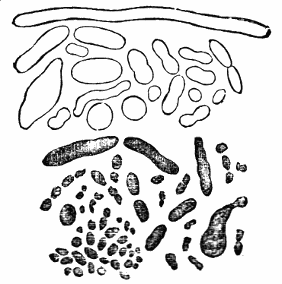
Hiller’s experiments tend to show that putrefaction is independent of the presence of bacteria, that bacteria can develop in liquids such as urine without producing its decomposition, and that the degree of their development and the rate of their multiplication depend upon the amount of assimilable material.
The following is the definition given to the word ‘microzyme’ (which occurs above) by its originator, Dr Sanderson: “I proposed the word ‘microzyme’ as a convenient general term for the first organic forms which present themselves in organic nitrogenous liquids when about to undergo spontaneous decomposition.”
From the experiments of Béchamp it appears that under some circumstances the mother of vinegar, a conglomeration of microzymes, can be transformed into bacteria, and under other circumstances into a cellular ferment which can excite normal alcoholic fermentation in cane sugar. Subsequent researches have shown that the converse of this is also true, and that the cellular ferment may be transformed into microzymes and bacteria.
A mixture of starch and yeast kept at a temperature of 24° to 35° soon liquefies, and the yeast undergoes remarkable changes. The cells swell, become transparent, and gradually disappear. Myriads of microzymes of great agility spring into existence, then vibrios appear, and as these increase the microzymes diminish. The vibrios in their turn are succeeded by myriads of bacteria, and finally the bacteria disappear, leaving nothing but microzymes, single or coupled together. During these changes a small quantity of gas is disengaged, no butyric acid is formed, and but little acetic or lactic acids.
As then the mother of vinegar when changed into bacteria becomes lactic or butyric ferment, and when transformed into cellular matter becomes alcoholic ferment, and as beer yeast becomes lactic or butyric ferment when reduced to microzymes, vibrios, or bacteria, it is evident that the property of being a ferment of any particular nature does not depend essentially upon the nature of the ferment, but upon its organisation or structure.
A contributor to the ‘Medical Times and Gazette’ of February 2nd, 1878, advances the opinion that many of the bacteria are only parts of a plant which has other forms and other modes of growth and propagation when not confined to the living organism or to fluids, and regards the bacterium as a transitional or provisional and not as a permanent form, but an abnormal phase of life thrust upon the plant by accident.
BACTERIA AS ORIGINATORS OF DISEASE.—The researches of many eminent microscopists and physiologists afford abundant evidence of the presence of bacteria in the blood of persons affected with various infectious diseases. For instance, Core and Feltz, of Strasbourg, found a linked bacterium in the blood of those attacked with septicæmia, typhoid, and puerperal fevers. The same investigators also discovered bacteria in the blood of patients suffering from scarlet fever; this blood when injected into the veins of rabbits set up a feverish disease that proved fatal.
Again, in the blood of man and the sheep attacked with smallpox, a bacterium of the globular or sphere-shaped variety was found by Keber, Hallier, and Zurn.
Bacteria have also been found in the blood during measles, and in the splenic apoplexy of sheep and cattle. They have likewise been identified in diphtheritical exudations both from the kidneys and womb, as well as in the blood during an attack of rheumatic fever, and they are undoubtedly present in the same fluid during many feverish disorders. Drs Lewis and Cunningham failed to discover them in the blood of cholera patients. Professors Cohn and Koch stand prominently forward as the advocates of the germ theory of disease by bacteria. Professor Cohn divides the bacteria into groups, genera, and species, and assigns to each species a different function.
For instance, he considers the ferment of contagion to be due to the presence of a variety of the sphere-shaped bacterium—one of his groups. He divides the whole group into three—the chromogen, zymogen, and pathogen, the bacteria of pigmentation, of fermentation, and of contagion, respectively. He says those organisms are exceedingly minute, darkish or coloured granules, so small as to be immeasurable. They frequently present the appearance of beaded chains or the form of aggregations. They are motionless and are occasionally found with the Bacterium termo in putrefying organic liquids.
Messrs Chauveau and Sanderson have discovered a bacterium in vaccine lymph which believers in the germ theory class among the pathogen bacteria, and which they have named the Micrococcus vaccinæ. Amongst the pathogen bacteria they also include the Micrococcus dipthericus and Micrococcus septicus, the former found in the epithelium of certain organs during certain forms of pyæmia, and the latter in the miliary eruption of typhus, pyæmia, and other diseases. The chromogen or pigmentary bacteria have occasionally been the means of working miracles. Several instances of bread exuding blood, under supernatural circumstances, are related by Rivola. Ehrenberg found this colour on some bread in the house of a patient who had died of cholera, and he ascertained the pigment to be due to the presence of the Monas prodigiosa, small round bodies which Professor Cohn classes with the micrococci, a variety of the sphere-shaped bacterium.
The recent investigations of Koch were directed to the cause of splenic fever, and Cohn on examining his specimens found that they were examples of Bacteria of the species called Bacillus anthracis, which seems to present little or no difference to the Bacillus subtilis of hay infusions. Koch found that bacilli increase with enormous rapidity in the blood, and in the fluid of tissues of living animals, by developing in length and dividing transversely. The animals employed were chiefly mice, and a small incision being made at the root of the tail, as minute a drop as possible of the fluid containing the bacilli was injected into the system. The spleen invariably became enormously swollen, and filled with a large number of crystalline-looking rods of varying size, never exhibiting movement or spore formation; they increased in numbers solely by division. The number of bacilli found in the blood varies in different animals; thus in the guinea-pig it was enormous, sometimes exceeding that of the blood-corpuscles; in the rabbit much smaller, so that sometimes several drops had to be examined before any were found, in the mouse often nil. In the blood of dead animals or other suitable fluids the bacilli grow to very long straight leptothorax-like filaments (within certain limits of temperature, and with the presence of air), while the formation of numerous spores goes on at the same time.
Kohl believes that it is to the presence of the spores that the occurrence of splenetic fever appears to be referable. When living, inoculation with them always produced the disease; but if killed, as by drying, or a high temperature, inoculation failed; it was necessary either that living spores should be present, or that the filaments should be capable of generating spores, in order that the disease should be propagated by inoculation.
Koch tried whether the poisonous bacilli spores could gain entrance through the digestive organs, but found that mice and rabbits could eat them with impunity. Koch draws attention to the similarity of splenic fever to typhus and cholera. He says it presents analogies to typhus in its dependence on soil-water, its preference for low grounds, its sporadic occurrence throughout the year, and its development into an epidemic in the late summer and autumn. Like cholera, again, he says, it is connected with soil-water, and it also agrees with cholera in the point which has been so well made out by Pettenkofer, that on board ship an interval of three or four weeks is sufficient to prevent its further development.
Hence Koch is disposed to hope that the contagium of typhus and cholera may still be discovered in the form of some Schizophyte or spheroidal bacterium, though practical observers have hitherto sought for them in vain.
Many pathologists, however, refuse to accept the accuracy of these deductions, and regard the presence of bacteria in the blood and tissues during disease as of no significance; whilst they deny that it is satisfactorily proved that they are the cause of disease.
Dr Lionel Beale says:—“Changes in the processes of digestion are soon followed by the multiplication of bacteria in every part of the alimentary canal, and within a few hours countless millions may be developed. They multiply in the secretions under certain circumstances, almost as soon as these are formed, and I have adduced evidence to show that bacteria germs exist even in healthy blood. In the very substance of some cells I have seen them, and in many cases in which little granules have been discerned in connection with bioplasts. There is reason to believe that some of them are really bacteria germs, passive as long as the higher life is maintained in its integrity, but ready to grow and multiply the instant a change favorable to them, and adverse to us, shall occur.”
And again he remarks:—“Bacteria prey upon morbid structure, and upon the substances resulting from the death of bioplasm (protoplasm). We ought not, therefore, to be surprised at their existence in disease. They are found in great numbers amongst pus-corpuscles which have ceased to live, and they grow and multiply with great rapidity in fluids which contain disease germs, as soon as these begin to lose their specific powers and to undergo decomposition.” See Germs.
BAD′′GER (băj′-ĕr). Syn. Me′les, L.; Blaireau, Fr.; Dachs, Ger. The ur′sus me′les (Linn.), one of the plantigrade carnivora, a burrowing nocturnal animal, common in Europe, Asia, and North America. Since the extirpation of the bear, the badger is the sole representative of the ursine family in our indigenous zoology. Its habits are “nocturnal, inoffensive, and slothful; its food consists of roots, earth-nuts, fruits, the eggs of birds, insects, reptiles, and the smaller quadrupeds; its noxious qualities are consequently few and of slight moment, and by no means justify the exterminating war unintermittently waged against it.” (Brande.) Its “muscular strength is great, its bite proverbially powerful; and a dog must be trained and encouraged to enter willingly into combat” with it. (Id.)
Uses, &c. The flesh of the badger is prized as food; the skin used for pistol furniture; the hair made into brushes. The American badger is commonly called the GROUND-HOG. The Cape badger produces HYRACEUM (which see).
BAD′IANE (-e-ăhn). [Fr.] Syn. Bad′ian, B.-seed. Star-anise seed.
BADI′′GEON (bă-dĭzh′ōne; băd′-e-zhŭn‡, or bă-dĭj′ŭn‡—Smart). Among operatives and artists, any cement used to fill up holes and to cover defects in their work. Among statuaries, a mixture of plaster and free-stone is commonly used for this purpose; among joiners and carpenters, a mixture of sawdust and glue, or of whiting and glue; and among coopers, one of tallow and chalk. The name is also given to a stone-coloured mixture used for the fronts of houses, and said to be composed of wood-dust and lime, slaked together, stone powder, and a little ochre, umber, or sienna; the whole being mixed up with weak alum water to the consistence of paint, and laid on in dry weather.
BAEL. [Nat.] Syn. Indian bael, Bel*; Bael, B. in′dicus, Be′la, B. in′dica, L. The œg′le marmelos (Correa; cratæva m., Linn.) one of the Aurantiaceæ (DC.). Dried half-ripe fruit imported from the E. Indies, under the name of Indian bael. Astringent and refrigerant; highly extolled in chronic dysentery, diarrhœa, English cholera, and relaxations generally. It is also used in bilious fevers, hypochondriasis, melancholia, &c. Root-bark, stem-bark, and expressed juice of the leaves, particularly the first, also used in the same cases in India. Ripe fruit fragrant and delicious; used, in the E. I., as a warm cathartic, and regarded as a certain cure for habitual costiveness. Mucus of the seeds used by painters as size; also as a cement. Unripe fruit used to dye yellow. It is generally administered under the form of DECOCTION or EXTRACT (which see).
BAGASSE′ (-găs′). [Fr.] The dry refuse stalks of the sugar cane as they leave the crushing-mill.—Used as fuel in the colonial sugar-houses.
BAGG′ING. The cloth or materials of which bags or sacks are made. In agriculture, applied to a method of reaping corn by a chopping, instead of a drawing cut. See Rats, &c.
BAHIA POWDER. See Araroba.
BAHR’S NON-POISONOUS MEDICAL SNUFF. A snuff largely advertised in the Berlin journals, composed chiefly of powdered galls. (Hager.)
BAIN-MARIE. [Fr.] In old chemistry, a water bath; also, sometimes, a sand bath. In cookery, a shallow vessel containing heated water, in which saucepans, &c., are placed, when it is necessary either to make them hot, or to keep them so, without allowing them to boil. It is extremely useful in making sauces, warming soups and small dishes, and when dinners are delayed after they are ready to be served.
BA′′KING (bāke′-). Syn. Action de cuire au four, Fr. The process of cooking, or of heating, drying, and hardening any substance in an oven or kiln, or by the rays of the sun; the art or trade of a baker‡; also technically, a batch or ovenful, or the quantity baked at once (= FOURNÉE, Fr.).
In cookery, baking is, perhaps, of all others, the cheapest, most convenient, and best way of dressing dinners for small families, where a good domestic oven is at hand. Though the flavour of baked meat is generally considered barely equal to that of the same parts roasted, there are some joints and dishes to which it appears particularly suitable. Among these may be mentioned legs and loins of pork, legs and shoulders of mutton, fillets of veal, &c. A baked pig, if it has been occasionally basted, and the heat has not been too great, eats equal to a roast one. Geese and ducks treated in the same way are also excellent. A baked hare which has been basted with raw milk and butter also eats well; and so do various pieces of beef, especially the buttock. Cooks tell us that this last should be sprinkled with a little salt for a day or two before dressing it, and after being washed is preferably baked, along with about a pint of water, in a glazed earthen pan tied over with writing paper, ‘three or four times thick.’ A baked ham is said to be preferable to a boiled one; to be tenderer, fuller of gravy, and finer flavoured. It should be soaked in water for about an hour, wiped dry, and covered with a coarse thin paste or batter. Ordinary dishes require similar treatment in baking to that given them when roasted.
For domestic use, where the kitchen-range does not include a really good oven, the portable articles known as a ‘Dutch-oven,’ and an ‘American oven,’ form an excellent substitute, admirably adapted for small joints, poultry, &c., all of which, when these utensils are skilfully employed, possess a delicacy and flavour fully equal to the same when roasted; whilst not more than one half the fire is required for the purpose. According to Miss Acton they also “answer excellently for delicate sweet puddings, and for cakes.” See Bread, Cakes, Roasting, &c.
Baking Pow′der. See Powders.
Baking Powder, American. For making light pastry. Tartaric acid and chalk. (Reichardt.)
Baking Powder, Borwick’s German, is an artificial fermentation powder, compounded with coarse maize-flour. (Gädike.)
Baking Powder, Goodall’s, is a compound of 2 parts of rice flour with 1 part of a mixture of tartaric acid and bicarbonate of soda. (K. Boschan.)
Baking Powder or Yeast Powder, Professor Horsford’s (Cambridge, U.S.). This is a powder supplied in two packets. The one contains an acid phosphate of lime and magnesia made up with a certain quantity of flour, and the other is bicarbonate of soda, with a little chloride of potassium.
BAL′ANCE. As in the process of what is termed gravimetric analysis the chemist has to determine the weights of the different substances employed as well as found, it will be self-evident that for his results to be trustworthy the balance he employs must be perfectly accurate and reliable.
The accompanying drawing, from Roscoe, represents a common form of chemical balance.
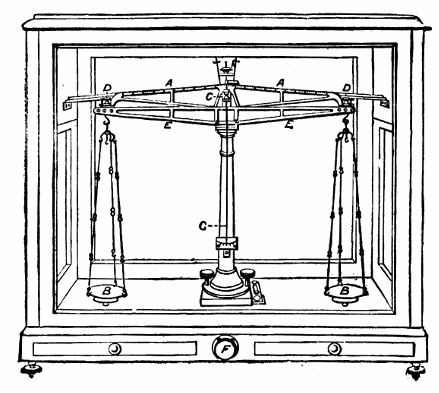
The apparatus consists of a perforated brass beam (AA), vibrating about its centre, at which is fixed a triangular knife-edge of agate (C); this rests upon a horizontal agate plane attached to the upright brass pillar. To each end of the beam light brass pans (BB) are hung, each pan being suspended by an agate plane, upon an agate knife-edge fixed on the end of the beam at DD. This arrangement is rendered necessary in order to reduce as much as possible the friction of the edges on their supports, which friction, if unchecked, would seriously impair the sensibility of the balance.
In order to prevent the agate edges being worn away by constantly rubbing on the agate planes, the beam and the ends (DD) are supported by the brass arm (EE), when the balance is not in use, so that the agate surfaces are not in contact. The beam and pans are released when required by turning the handle (F). The movement of the brass arm (EE) is accompanied by means of a rod descending through the upright brass pillar, and resting on a simple eccentric, by the turning of which by the handle (F) it may be gradually raised or lowered. The substance to be weighed (held by a tube, watch glass, &c.) is placed in one of the pans, and weights added one by one in the other, until the beam is in equilibrium: this is ascertained by the long pointer(G) oscillating to an equal distance on each side of the central mark or index, this latter being subdivided into equal spaces, so that the oscillations can be measured. A spirit level is also a necessary appendage to the instrument, since it enables the operator to place the beam on an exactly horizontal level.
The beam of the balance is generally graduated into decimals. This saves the trouble of placing a weight on the scale, since it enables the operator to weigh the milligramme and its fractions by suspending a centigramme rider or hook on or between the indicated points of a graduated line.
The balance is enclosed in a glass case, which serves not only to protect it from dust, but to allow of the weighing being carried on away from the outer air, in which the prevalence of draughts proves a source of considerable annoyance to the weigher. The front of the scale case generally consists of three parts, viz. a fixed centre piece and two lateral frames or doors, all of course of glass. It is of importance that the air inside the balance case should be perfectly dry, since a humid atmosphere would not only affect the weight of many hygroscopic substances when placed in the pans, but likewise be liable to attack the instrument itself. To guard against these casualties a small beaker containing oil of vitriol, or chloride of calcium, or freshly-burnt lime, should be kept in the case. A balance capable of weighing 70 or 80 grammes in each scale will be found to meet the needs of most chemists.
Fresenius says, “The ACCURACY of a balance depends upon the following conditions:
“a. The fulcrum must be placed above the centre of gravity of the beam.
“b. The suspension points of the scales must be on an exact level with the fulcrum.
“c. The beam must be sufficiently strong and inflexible to bear without bending the greatest weight that the construction of the balance admits of.
“d. The arms of the balance must be of equal length; i.e. the points of suspension must be equidistant from the fulcrum or point of support.
“The SENSIBILITY or DELICACY of a balance depends upon the following conditions:
“a. The friction of the edges upon their supports must be as slight as possible.
“b. The centre of gravity must be as near as possible to the fulcrum.
“c. The beam must be as light as possible.”
The following are the tests given by the same authority for the accuracy and sensibility of a balance:
“1. The balance is in the first place accurately adjusted, if necessary, either by the regulating screws, or by means of tinfoil, and a milligramme weight is then placed in one of the scales. A good and practically useful balance must turn distinctly with this weight; a delicate chemical balance should indicate the one tenth of a milligramme with perfect distinctness.
“2. Both scales are loaded with the maximum weight the construction of the balance will admit of; the balance is then accurately adjusted, and a milligramme added to the weight in one scale. This ought to cause the balance to turn to the same extent as in 1. In most balances, however, it shows somewhat less on the index.
“3. The balance is accurately adjusted should it be necessary to establish a perfect equilibrium between the scales by loading the one with a minute portion of tinfoil (this tinfoil must be left remaining upon the scale during the experiment); both scales are then equally loaded, say with about fifty grammes each, and if necessary the balance is again adjusted (by the addition of small weights, &c.). The load of the two scales is then interchanged, so as to transfer that of the right scale to the left, and vice versâ. A balance with perfectly equal arms must maintain its absolute equilibrium upon the interchange of the weights of the two scales.
“4. The balance is accurately adjusted; it is then arrested, subsequently set in motion, and again allowed to recover its equilibrium; the same process should be repeated several times. A good balance must invariably reassume its original equilibrium.
“A balance of which the end edges afford too much play to the hook resting upon them, so as to allow the latter slightly to alter its position, will show perceptible differences in different trials. This fault, however, is possible only with balances of defective construction.
“A balance to be perfectly useful for the purposes of quantitative analysis must stand the first, second, and last of these tests. A slight inequality of the arms is of no great consequence, since this may be readily and completely remedied by the manner of weighing.” See Weights.
Balance, Hydrostat′ic. See Specific Gravity.
Balance, Tor′sion. A delicate instrument, invented by Coulomb, for measuring the intensities of the electrical and magnetic forces.
BALD′NESS (bawld′-). Syn. Cal′vitas, Calvi′′ties (vĭsh′-e-ēz), L.; Calvitie, Chauveté, Fr.; Kahlheit, Kahlkopf, Kahlköpfigheit, Ger. Primarily, absence or loss of any natural covering; appr., destitution or loss of hair, more especially of that of the top and fore-part of the head. In botany, absence of beard or awn.
Grey hair and baldness dependent on old age are natural consequences of man’s infirmity, and must be regarded as evidence of failing vigour, rather than in the light of a disease. Premature loss of hair may be induced by various causes. It is common after severe fevers, and is frequently caused by external pressure, friction, or violence, and by such other local actions and conditions which, when long continued, interrupt the normal functions of the skin. Persons with a consumptive, scorbutic, scrofulous, or syphilitic taint, or of a general bad habit of body, frequently lose their hair early. In these cases it probably arises from debility or paralysis of the cutaneous vessels, and the consequent insufficient nutrition of the hair-bulbs. When it occurs in persons under the middle age, and apparently enjoying good health, it may be often traced to the pernicious practice of constantly wearing a hard non-ventilating hat, or to disordered stomach, habitual smoking or hard drinking, irregular habits, or late hours. Excessive anxiety or grief, and intense study and thoughtfulness, also tend to promote the early decay of the hair. The natural baldness of the aged, and frequently the premature baldness of earlier years, arises from the gradual attenuation of the scalp, which ultimately becomes too thin to afford room for the performance of the functions of the hair-producing organs, and too scantily supplied with blood for their due nutrition and support.[104]
Treatm. The baldness of senility and that arising from the permanent injury or destruction of the hair-bulbs, admit of no cure, notwithstanding the daily assurances of advertising impostors to the contrary. In other cases, when a disposition to baldness exists, shown by the hair falling off in large quantities, or ceasing to grow with its usual vigour and rapidity, the frequent but gentle use of the hair-brush, and of any bland stimulating oil, pomade, or wash, if adopted in time, will generally prove sufficient to arrest the progress of decay, and, very frequently, to restore the hair to its pristine condition. The head may be advantageously washed in cold water, at least once a day; or what is better, a shower bath may be taken on rising in the morning. Should this plan not succeed, the head, or the upper part of it, may be shaved, and a wig, or a scalp, adopted for a time. The effect of keeping the hair closely cropped or shaved is to make it grow thicker, stiffer, and stronger, and this often when all other means fail.
Among more active and less common remedies for baldness may be mentioned—mild streaming electricity, stimulant fomentations, cantharidised, ioduretted, phosphoretted, &c., oils and lotions, a night-cap that, without pressing injuriously on the head, lifts, as it were, the scalp into its natural position, &c., all of which are noticed elsewhere.
The celebrated John Wesley recommended rubbing the part morning and evening with a raw onion until it became red, and then applying a little honey. The vendors of Rowland’s ‘Macassar Oil’ recommend the head to be rubbed with a towel (or hair-brush), until somewhat red, each time before applying their nostrum; and the advice is certainly good, as independent of the stimulus thus given to the skin, and the increased flow of blood through the minute vessels of the scalp, it is rendered more absorbent and sensitive to the action of medicaments. At the same time the reader must be cautioned against placing any reliance on external applications, unless he assists their action by due attention to diet, exercise, ventilation, and such other matters as tend to promote the general health and vigour of the body.
The substances usually employed to medicate hair-cosmetics, the general management of the hair, and the formulæ for various applications to promote its growth, preservation, and beauty, are noticed in the articles Hair, Hair-cosmetics, Pomades, Oils, Washes, &c., to which the reader is referred.
BALEEN′ (-lēne′). [Fr. baleine.] The fisher’s name for whalebone.
BALL (bawl). [Eng., Ger., Swed.] Syn. Balle, Boule, Fr.; Bal, Bol, Dau.; Glob-u-lus, Pi′la, L. In commerce, veterinary medicine, perfumery, &c., applied to various substances made up into a globular, spheroidal, or even a cylindrical form, as ash-balls, horse-balls, soap-balls, &c.
BALLOON′ (-lōōn’). Syn. Ballon, Fr., Ger. Any hollow spherical body of which the sides are extremely thin or attenuated in comparison with its diameter or bulk. In aërostatics, a machine or apparatus for elevating and sustaining bodies in the air. In chemistry, a globular glass-receiver, with either one or two necks (= GROS RÉCIEIENT, Fr.; GROSSE R., Ger.). In pyrotechny, a hollow case or ball of pasteboard filled with fire-works or combustibles, which explodes in the air on being fired from a mortar.
Balloon. In aërostation, a bag or hollow pear-shaped vessel, made of varnished silk or other light material, and inflated with some gas or vapour lighter than the air, as hydrogen, carburetted hydrogen, heated air, &c., so as to rise and float in the atmosphere. When filled with gas it is called by way of distinction an AIR-BALLOON (aérostat, &c., Fr., lufball, luft-schiff, &c., Ger.); when with heated air, a FIRE-BALLOON or Montgolfier b. (ballon à feu, &c., Fr.).
In the early days of aërostation, and indeed for some years afterwards, balloons were inflated with hydrogen gas, obtained by the action of sulphuric acid and water on iron filings or small fragments of iron; but this method of filing them ultimately gave place to the cheaper and more convenient supply afforded by the gas-light companies. Of late years, the coal-gas furnished by the gas-works has been generally, if not solely, used for the inflation of balloons.
The principles of ballooning may be referred to the well-known difference in the specific gravity of bodies, and to the physical properties of the atmosphere. Pure hydrogen, weighed at the level of the sea, is about 16 times lighter than common air; but when prepared on the large scale, and containing water, and other impurities, it is only from 7 to 11 times lighter than the atmosphere. A globe of atmospheric air of 1 foot in diameter, under like circumstances, weighs 1⁄25 lb.; a similar globe of hydrogen (reckoning it only as 6 times lighter than common air, will, therefore, have an ascensional force of 1⁄30 lb.). Now, the weight of the body of air which a balloon displaces must exceed the gross weight of the balloon and all its appendages, in order for the latter to ascend in the atmosphere. The difference of the two weights expresses the ascensional force. The aërostatic power of balloons is proportional to their dimensions, in the ratio of the cubes of their diameters. Thus, it appears that a balloon of 60 feet diameter filled with common hydrogen will ascend with a weight of nearly 7000 lbs., besides the gas case; whilst one of only 1½ foot in diameter will barely float, owing to the less proportionate volume of gas to the weight of the case containing it. In round numbers the buoyancy of a balloon may be reckoned as equal to 1 oz. for every cubic foot of hydrogen it contains, less the weight of the case and appendages. The carburetted hydrogen supplied by the gas-works is much heavier than hydrogen gas, and consequently much less buoyant, for which due allowance must be made. That which possesses the least illuminating power is the lightest, and consequently the best adapted for aërostation.
The fabric of which the cases of air-balloons are made is strong thin silk, covered with an elastic varnish of drying oil or india rubber, or, what is better, a solution of india rubber in either chloroform or bisulphide of carbon; the netting is of strong light silk or flaxen cord; and the car of basket-work. Fire-balloons, on the small scale, are generally made of silver-paper, and are inflated with the fumes of burning spirit of wine, by means of a sponge dipped in that liquid, and suspended just within the mouth of the apparatus.
Owing to the increasing rarity of the atmosphere as we ascend from the earth’s surface, balloon cases are made very much larger than is required to contain the necessary quantity of gas, to allow for its expansion as it rises into a rarer medium. A cubical foot of gas measured at the level of the sea occupies a space of two feet at an elevation of 31⁄2 miles.
The following Table will prove useful to the amateur aëronaut or balloonist:—
Table showing the relations between the diameters, surfaces, and capacities of spheres.
Diameters.Surfaces.Cubical contents.
13·141·523
212·5674·188
328·27414·137
450·26533·51
578·5465·45
10314·159523·6
15706·91767·1
201256·64189·
251963·58181·
302827·14137·
405026·33510·
See Atmosphere, Gas, Hydrogen, Parachute, Varnish, &c.
BALLOON′ING‡. Syn. Balloon′ry†*. The act, art, or practice of ascending or travelling in balloons; aërostation. A BALLOON′IST‡ is an aëronaut (particularly an amateur or enthusiastic one).
BALLS. The application of this term in commerce, perfumery, veterinary medicine, &c., has been already noticed. (See Ball.) The following may be inserted here:—
Balls, Al′mond (ah′-mŭnd). Syn. Boules d’amande, Fr. Prep. 1. Spermaceti, 4 oz.; white wax (pure) 8 oz.; oil of almonds, 1 pint; melt them together in a glazed earthenware-vessel, by the heat of a water bath, and when the mixture has cooled a little, add essential oil of almonds, and expressed oil of mace, of each 2 dr.; stir assiduously until it begins to cool, and then pour it into the moulds, which may be ounce-gallipots with smooth bottoms (very slightly warmed), when it will form beautiful hemispherical cakes. Very fine.
2. Hard clarified suet, 11⁄4 lb.; white wax, 1⁄4 lb.; ess. oil of almonds, 11⁄2 dr.; oil of cloves (or of pimento), 1⁄2 dr.; as before.
Uses, &c. To soften the skin, and in winter to prevent chaps and chilblains. Sometimes these balls are coloured, which is done whilst the mixture is in the liquid state. A rich pink or red may be given by a little alkanet-root or dragon’s blood; a yellow, by palm oil or annotta; a blue, by a little finely powdered indigo; and a green, with spinage (steeped in the oil before use), or a few grains of verdigris. The most appropriate tint for them is a pale yellow or amber.
Balls, Barèges (-rāzhe’). Syn. Boules de Barèges, Fr. Prep. 1. Extract of soap-wort, 3 oz.; good glue or gelatin, 11⁄2 oz.; water, 4 oz.; dissolve with heat, and add of sulphide of calcium, 6 oz.; common salt, 1 oz. (both in powder); mix thoroughly, and form the mass into balls weighing 21⁄2 oz. each, adding a little powdered gum, if required, to thicken it, and using powdered starch to roll them in.
2. Gelatin, 8 oz.; sulphide of calcium, 12 oz.; common salt, 2 oz.; water, q. s.; after solution and admixture, add carbonate of soda and Castile soap, of each (in powder), 21⁄2 oz. One ball is added to the water of a bath for an adult, to be used as a substitute for that of Barèges.
Balls, Bitter. Prep. 1. Powdered gentian, 2 lbs.; extract of gentian, 1 lb.; grains of paradise (ground), 1⁄2 lb. syrup, q. s.; mix with heat, and divide into half-pound rolls. For ALE.
2. To the above add of Spanish-juice, 11⁄2 lb.; previously softened with a little boiling water For PORTER and STOUT. Both are used by fraudulent brewers; and by publicans in reducing their beer.
Balls, Black′ing. Prep. 1 (Bailey’s). Gum-tragacanth, 1 oz.; water, 4 oz.; dissolve, add of sugar candy, 4 oz.; and afterwards, ivory-black and Prussian blue (in very fine powder), of each 2 oz.; neat’s foot oil, 2 fl. oz.; thoroughly incorporate, and evaporate by a gentle heat, constantly stirring, until of a proper consistence, then pour it into oiled moulds.
2. Gum-arabic, moist sugar, and ivory-black, of each 1⁄2 lb.; lamp-black, 1⁄4 lb.; glue (melted with a little water), 2 oz.; water, 1 quart, or q. s.; neat’s foot oil, 1⁄4 pint; as before.—Used by the shoemakers, harness-makers, &c., to blacken and polish leather. See Balls, Heel.
Balls, Breech′es. See Balls, Scouring.
Balls, Bronze. See Balls, Copying.
Balls, Cam′phor. Syn. Cam′phor-cakes, Chap′-balls‡, Chil′blain b.‡, &c.; Glob′uli camphora′ti, Placen′tæ camphora′tæ, &c., L. Prep. 1. Spermaceti and white wax, of each 2 oz.; almond or olive oil, 1⁄4 pint; melt together by a gentle heat, add of camphor (in small pieces), 1 oz.; when dissolved, stir until partly cold, and then pour it into moulds, as directed under ALMOND-CAKES (above).
2. Clarified suet, 1 lb.; spermaceti and white wax, of each, 3 oz.; camphor, 2 oz.; as before.
3. Spermaceti cerate (Ph. L.), 1 lb.; spermaceti, 2 oz.; camphor, 11⁄2 oz.; as before.
4. To either of the above add of balsam of Peru, 1⁄4 to 1⁄2 oz.; and, after solution, either strain the mixture through muslin, or allow it to settle, and decant the clear portion from the dregs.
Use, &c. A popular preventive of chapping and chilblains. A little is well rubbed into the skin, previously washed clean and wiped dry. Some persons add colour and scent; but they are generally sold without either. The only suitable colours are amber, pink, or yellow. The best perfumes are allspice, ambergris, cassia, cloves, mush, nutmeg, rondoletia, vanilla, and violets. See Balls, Almond (antè).
Balls, Clothes. See Balls, Scouring.
Balls, Contrayer′va. Syn. La′pis contrayer′væ, Glob′uli c., L. Compound contrayerva-powder made into balls with gum-water. An obsolete preparation, once in great repute as a stimulant, tonic, diaphoretic, and absorbent.
Balls, Cop′ying. These have a similar composition to ‘heel-balls’ (see below). For BLACK, the best colouring matter is lamp-black or plumbago with about half its weight of indigo; for a BRONZE-COLOUR, bronze-powder is substituted; and for a mellow BROWN, burnt terra di Sienna. These should be all in very fine powder. The semi-fluid mass is poured into small flat cylindrical moulds—paper pill-boxes answer the purpose well.—Used by artists and amateurs to copy inscriptions, monumental brasses, and other slightly raised or sunken patterns; the ball being rubbed over the paper previously laid flat on the design, and held securely in its place. They are sometimes rendered more permanent by damping the wrong side with a sponge dipped in water, strong spirit, or oil of turpentine; or by passing the wrong side over a hot iron held with the face upwards.
Balls, Cosmet′ic. See Savonettes, &c. (also above).
Balls, Cream. See Savonettes, Soap Balls, &c.
Balls, Dog. See Dogs.
Balls, Gas′coign’s. Syn. Glob′uli Gascoig′nii, L. Gascoign’s powder made up into small balls with thin mucilage. See Powders.
Balls, Heel. Prep. 1. (Ullathorne’s.) Bees’ wax, 1 lb.; suet, 4 oz.; melt together, and stir in of ivory-black (very finely powdered), 4 oz.; lamp-black (sifted), 3 oz.; gum arabic and sugar-candy, of each (in very fine powder) 2 oz.; and, when thoroughly mixed and partly cold, pour the composition into tin or leaden moulds.
2. To the last add of resin, 3 oz.; oil of turpentine, 2 oz.
3. Hard suet and bees’ wax, of each 4 oz.; powdered gum, sugar candy, and Venice turpentine, of each 1 oz.; ivory-black and lamp-black, of each 2 oz.; as before.
4. Suet and bees’ wax, of each 4 oz.; lamp-black and brown sugar, of each 8 oz.; common size, 5 oz.; melt together and stir until incorporated.
Uses, &c. Employed to black leather, and more especially by shoemakers for the edges of the soles; the ball being first rubbed on, and the part afterwards smoothed over with a burnisher or polished iron tool gently heated. Also used by artists to copy inscriptions, basso relievos, &c. To produce a good article, the gum, colouring matter, and sugar, must be in the state of extremely fine powder, and the mixture very carefully made; no lumps being left. Some persons dissolve the gum in a little water, and then stir the mixture over the fire until it acquires the proper consistence for moulding (as in No. 4, above); but the first is accounted the best method.
Balls, Horse. See Veterinary Medicine, &c.
Balls, Martial. Syn. Glob′uli martia′les, L. Prep. 1. Those of the P. Cod. consist of tartarised iron mixed with aromatics, and made up into small globular masses.
2. (Boules de Nancy.) Equal parts of iron filings and red tartar, in fine powder, made into balls with proof spirit or brandy. Both are used as chalybeate tonics, either in the form of pills or dissolved in hot water. Seldom employed in England.
Balls, Physic. (Vet. Med.) See Masses.
Balls, Poultry. See Poultry.
Balls, Scent. See Pastils (Toilet), Perfumery, Pomambra, Scents, &c.
Balls, Scouring. Syn. Breech′es balls, Clothes b., Carpet b., &c. Prep. 1. Curd soap (sliced), 1 lb.; water, 2 oz.; melt in a water bath, or a glue-pot, and when cooled a little, add ox-gall and oil of turpentine, of each, 51⁄2 oz.; mix well and roll or mould the mass into balls or cakes.
2. Fuller’s earth, 2 lbs.; curd-soap, 1 lb.; beat to a stiff paste with ox-gall, q. s.
3. Soft soap and fuller’s earth, equal parts, beat up with a little oil of turpentine, and either with or without a little essence of lemons.—Obs. The above are used to remove paint, grease, and dirt from cloth, carpets, &c. The spot, first moistened with hot water, is rubbed with the cake, and allowed to soak a few minutes, or to become nearly dry, when it is well rubbed with a little warm water and a brush or piece of woollen cloth, and afterwards rinsed in clean water, and finally rubbed dry and smoothed off with a piece of dry cloth or a dry brush. The last formula produces the composition so commonly vended about the streets of London in penny cakes.
4. Whiting and pipe-clay, equal parts; water, q. s. Used for soldiers’ belts, trousers, &c.
5. Pipe-clay, 2 lbs.; fuller’s earth, 1 lb.; whiting, 1⁄2 lb.; water, q. s.
6. Bath brick, 1 lb.; pipe-clay, 2 lbs.; soft soap, 1⁄4 lb.; ox-gall, 1⁄2 pint.
7. To the last add of pumice-stone, in very fine powder, 6 oz.—Obs. The last four are used for cloth and leather, especially for drab and light-coloured coats, trousers, leather breeches, belts, and gloves. Rose pink, yellow ochre, umber, Irish slate, or other like colouring matter, may be added to produce any desired tint. White pepper, cloves, &c., are also occasionally added to drive away moths and insects; and orris root, or essence of bergamot or of lemon-grass, as perfume.
Balls, Sweet. See Balls, Scent (antè).
Balls, Tan. The muddy sediment of tan-pits made into balls or lumps.—Used by the poor for summer fuel.
Balls, Wash. See Savonettes, Soap, &c.
BALM (bahm). Syn. Bal′samum, L.; Baume, Fr.; Balsam, Ger. Primarily, balsam (of which it is a contraction); formerly and still popularly applied to anything assumed to be soothing, healing, or genial in its action, particularly if also aromatic or fragrant; but chiefly to medicines and liqueurs, supposed to possess these properties. See Balsams, Liqueurs, Quack Medicines, &c.
Balm. Syn. Com′mon balm, Gar′den b.; Melis′sa, L.; Baume, Mélisse, Fr. The melis′sa officina′lis (Linn.), an aromatic perennial herb, a native of the south of Europe, but commonly cultivated in our gardens. It is reputed to be diaphoretic, diuretic, emmenagogue, exhilarating, nervine, and stomachic; and under the form of infusion (BALM-TEA) has long been a popular remedy in hypochondriacal, hysterical, and nervous affections, and in amenorrhœa and chlorosis. It is still sometimes ordered as a drink in fevers and in hypochondriasis.
Balm of a Thousand Flowers. Chandler says this is a thick yellow emulsion, free from injurious metallic ingredients.
Balm of White Lilies, for preserving and beautifying the skin (H. A. Hoadley, New York). This, also according to Chandler, is a red-coloured water containing a large quantity of chalk in suspension, but with no injurious metallic ingredient.
BAL′SAM (bawl′-săm; -sŭm‡§—Knowles, Walker). [Eng., Ger.] Syn. Bal′samum (băl′-), L.; Baume, Fr. Originally, any strong-scented oleo-resinous vegetable juice or exudation, of about the fluidity of treacle, and supposed to possess medicinal virtues. In modern chemistry and pharmacy, any vegetable production which is either semi-liquid, or which naturally becomes concrete, and which contains either benzoic acid, or cinnamic acid, combined with resin and aromatic essential oil. Several of the substances popularly termed balsams contain no benzoic acid, and are consequently now classed with the turpentines. This distinction, however, is far from being universally adopted, and a late high authority defines balsams to be “Exudations from plants, which are liquid or soft solid, and consist of a substance resembling a resin, either combined with benzoic acid, or with an essential oil, or both.” (Brande.)
The leading properties of the true natural balsams are—Insolubility in water, almost entire solubility in alcohol, and partial solubility in ether and in the volatile and fixed oils; the possession of a powerful, and generally, an agreeable odour, a hot, resinous or terebinthinate taste, and the usual stimulant and tonic properties of the milder turpentines. Distilled with water, ethereal oil and some acid pass over, and the residuum consists chiefly or entirely of acid-resin.
The TRUE BALSAMS, as those of benzoin Peru, styrax, and tolu, and the celebrated Chinese varnish-balsam, contain either benzoic or cinnamic acid. Among those falsely termed balsams, are copaiba, opobalsam, Japan lac-varnish, and some of the turpentines.
The following list includes most of the substances, natural and artificial, which pass, or have passed, under the name of balsams:[105]—
Balsam, Acous′tic. See Drops.
Balsam, Amer′ican†. Balsam of Peru.
Balsam, An′odyne. Syn. Sooth′ing balsam; Bal′samum ano′dynum (-dĭn-), B. tranquil′lans, L.; Baume anodin, B. tranquille, B. tranquillisant, &c., Fr. Prep. 1. (Bate’s.) See Patent Medicines.
2. (Guy’s.) A vulnerary balsam invented by Guy, of Caliac, once in great repute, but now obsolete. It consisted of aloes, amber, ammoniacum, balsam of Peru, bdellium, caranna, castor, galbanum, labdanum, myrrh, olibanum, storax, tacamahaca, and Venice turpentine, digested in alcohol.
3. (B. TRANQUILLANS, P. Cod.) Fresh leaves of belladonna, henbane, night-shade, tobacco, poppy, stramonium, of each two ounces; dried leaves of costermary, rosemary, rue, and sage, of each half an ounce; dried tops of wormwood, hyssop, sweet marjoram, peppermint, buckbean, and thyme, of each half an ounce; flowers of lavender and elder, of each half an ounce; olive oil, fifty ounces. Heat the green plants in the oil gently until all their water is dissipated; keep on the fire until the oil becomes of a green colour, and whilst still hot, mix in the other plants, carefully dried, and cut up. Digest for twelve hours on a water bath, strain, and filter.
4. (Baume tranquille de Chomel.) Henbane, hound’s tongue, and tobacco, of each 1 lb.; white wine, 3 pints; boil down to a quart; press, strain, and add to the hot ‘strained liquor’ of olive oil, 1 quart, and again boil.
Balsam, Ap′oplexy. Syn. Bal′samum apoplec′ticum, B. ad apoplec′ticos (Ph. E. 1744), L. Prep. 1. Amber, civet, musk, Peruvian balsam, and some volatile oils, made into a balsam.
2. (Ph. E. 1744) Expressed oil of nutmeg, 1 oz.; liquefy by a gentle heat, and stir in of the oils of cloves, lavender, and rosemary, of each, 1⁄2 dr.; oil of amber, 10 drops; balsam of Peru, 1 dr. Both were formerly used to anoint the head and nostrils of apoplectic patients, and were believed to be of great efficacy.
Balsam, Asiat′ic†. Balm of Gilead.
Balsam, Bate’s. See Balsam, Anodyne.
Balsam, Berlin, for burns, cuts, bruises, and wounds of every kind, sores and ulcers, frost-bites, &c. Chloride of lime with impure glycerine.
Balsam Bilfinger, for rheumatism and gout. Black soap, 25 grms.; water, 40 grms.; spirit of wine, 10 grms.; camphorated spirit, 10 grms.; liquor ammoniæ caustic, 20 grms.; tinct. capsici, 5 grms. (Schädler.)
Balsam, Brazilian. Balsam of copaiba.
Balsam, Calaba′. Syn. Tacamaha′ca. A fragrant resinous substance produced by calophyl′lum cal′aba, or Santa Maria tree.
Balsam, Cam′phor. Syn. Cam′phorated balsam; Bal′samum camphora′tum, &c., L. Prep. 1. As camphor-liniment, Ph. L.
2. (B. Ace′ticum c., Sanchez’s Gout-b.:—Pelletier.) Curd-soap and camphor, of each 5 drs.; oil of thyme, 2 scru.; acetic ether, 5 oz.; digest together in a stoppered bottle until the solids are dissolved. Recommended as an efficacious anodyne liniment in certain forms of rheumatism and gout.
Balsam, Can′ada. See Turpentines.
Balsam, Cana′ry. A volatile oleaginous substance obtained by distillation from draco-ceph′alum Moldavi′cum.
Balsam, Carpa′thian. Riga Balsam.
Balsam, Cephal′ic. (Saxon.) Syn. Bal′samum cephali′cum Saxon′icum, L. A liquid preparation obtained from the essential oils of amber, lavender, marjoram, nutmeg, pennyroyal, rue, sage, &c., distilled together. Once in high repute; but long disused in England.
Balsam, Chil′blain. See Liniments.
Balsam, Chi′na Varnish. The aromatic varnish-like exudation of au′gia sinen′sis, used by the Chinese as a varnish or lacquer, for which purpose it is, perhaps, unequalled. It is highly fragrant, and abounds in benzoic acid.
Balsam, Command′er’s†. Compound tincture of benzoin.
Balsam, Copalm′. Liquid-ambar.
Balsam Egyp′tian. Balm of Mecca.
Balsam, Eye, Augsburg. Red oxide of mercury, ·75 grm.; extract of belladonna, ·5 grm.; tincture of opium, ·5 grm.; fatty substance, 7 grms. (Hager.)
Balsam, Eye (Müller, Berlin). Red oxide of mercury, 5 parts; opium, 3 parts; unsalted butter, 100 parts.
Balsam, Eye, (Müller’s Widow, Berlin). Red oxide of mercury, ·2 grm.; unsalted, unusually rancid, butter, 10 grms.
Balsam, Fe′male. Syn. Bal′samum embryo′num, A′qua e., L. An obsolete preparation made by digesting misletoe, civet, musk, and several other aromatics, in a mixture of wine and various medicated waters, and submitting the whole to distillation. Formerly taken both internally and externally, as a tonic for both fœtus and mother; and particularly to prevent abortion, &c.
Balsam, Fri′ar’s. Compound tincture of benzoin.
Balsam, Gen′oa. Locatelle’s balsam.
Balsam, Glyc′erin (glĭs′-). Syn. Bal′samum gly̆̆ceri′næ, L. Prep. To white wax and spermaceti, of each, 1 oz.; almond oil, 1⁄2 lb.; melted together, add of glycerin, 2 oz.; balsam of Peru, 1⁄2 oz.; and stir or agitate until nearly cold. 12 or 15 drops of otto of roses may be substituted for the balsam.—Used to soften and whiten the skin, and to prevent chaps and chilblains.
Balsam, God′bold’s Vegetable. See Patent Medicines.
Balsam, Goulard’s′. Syn. Bal′samum Goular′dii, B. satur′ni, L.; Baume de Goulard, Fr. Prep. (Van Mons.) Acetate of lead (in fine powder, and quite dry) is triturated, for some time, with hot oil of turpentine, in a heated mortar, or until no more will dissolve; after repose, and whilst still hot, the clear portion is decanted. Recommended as a useful application to foul and painful ulcers, and to scalds and burns.
Balsam, Green. Syn. Bal′samum vir′ide, &c., L.; Baume vert, Fr. Prep. 1. Linseed-oil, 6 lbs.; gum-elemi, 1 lb.; heat them together; add of powdered verdigris, 3 oz., or q. s. to impart a rich green colour, and, after repose, decant the clear portion.
2. Linseed oil strongly coloured with verdigris. Both were formerly much used by surgeons as detergents. ‘Green-oil’ or ‘oil of elder-leaves’ is now commonly sold for it.
A natural balsam, brought from Peru, and produced by chlorox′ylon verticilla′tum, is also popularly called GREEN BALSAM (of Peru).
Balsam, Guaiacum. (Ph. Lond. 1745.) Guaiac, 1 lb.; balsam of Peru, 3 dr.; rect. spirit, 2 pints.
Balsam, Gurgun′ (-gōōn’) Syn. Gurgi′na balsam, Wood-oil (of India). From dipterocar′pus tri′nervis, and other species, by applying a slow fire to a notch or wound made in the trunk. Has a mixed smell of copaiba and naphtha. Properties and dose similar to those of balsam of copaiba. Sp. gr. ·962 to ·964. See Copaiba and Wood-oil.
Balsam, Hill’s, of Honey. See Patent Medicines.
Balsam, Hungarian. Syn. Bal′samum Hungar′icum, L. A terebinthinate exudation from the extremities of the branches of pi′nus pumil′io (Willd.) or mountain-pine. It is also obtained by pressure from the ‘cones’ of the same tree.
Balsam, Ioduretted. See Liniments.
Balsam, Japan Varnish. Syn. Japan lacq′uer. Exudes from incisions made in the trunk of melanorrhœ′a usitatis′sima, according to Wallich; or stagma′′ria, avernicif′lua according to Lindley. It constitutes the celebrated lac-varnish of the Japanese. It differs from that of China, and from the true balsams, in not containing benzoic acid. It is extremely acrid and irritant; and even its fumes affect the eyes and respiration.
Balsam†, Jews′. Balm of Gilead.
Balsam of Life, Professor Cook’s. Recommended especially for toothache and skin diseases. Borax, 20 parts; boiling water, 250 parts; camphor, 11⁄2 part. (Hager.)
Balsam, Locatelle’s′. Syn. Locatel′li’s balsam; Bal′samum Locatel′li, B. Lucatel′li, B. Ital′icum, B. Genofe′væ, &c., L. var. Prep. 1. (Original Formula.) Olive oil, 6 oz.; yellow wax, 4 oz.; sherry wine, 5 fl. oz.; red sanders (in very fine powder), 4 dr.; simmer them together until the moisture is nearly evaporated, then add of Strasburgh turpentine, 6 oz.; balsam of Peru, 2 dr.; strain through linen, and stir until nearly cold.
2. (Ph. E. 1744.) Olive oil, 24 fl. oz.; yellow wax, 1 lb.; melt, and add of Venice turpentine, 11⁄2 lb.; and, when cooled a little, further add, powdered dragon’s blood, 1 oz.; balsam of Peru, 2 oz.; and stir until cold.
3. (Ph. L. 1746.) Olive oil, 16 fl. oz.; Venice turpentine and yellow wax, of each 1⁄2 lb.; red sanders, 6 dr.
Uses, &c. A once highly esteemed pectoral, and still occasionally used, by the lower classes, in phthisis and chronic coughs (mixed with an equal weight of conserve of roses), and as a mild stimulating ointment.—Dose, 1⁄2 dr. or more.
Balsam, Mercu′′rial†. Ointment of nitrate of mercury.
Balsam, Metz’s. Syn. Bal′samum vir′ide Meten′sium, L.; Baume vert de Metz, Fr. Prep. (Guibourt.) Linseed oil and olive oil, of each 6 oz.; oil of laurel-berries, 1 oz.; common turpentine, 2 oz.; melt by a gentle heat, and add of verdigris 3 dr.; aloes, 2 dr.; sulphate of zinc, 11⁄2 dr. (all in powder); mix well, strain or pour the liquid into a bottle, and add oil of juniper, 4 dr.; oil of cloves, 1 dr. Used on the Continent as a common detergent dressing to wounds and ulcers.
Balsam, Mex′ican†. Balsam of Peru.
Balsam, Nat′ural†. That which exudes from plants, as opposed to those formed by art.
Balsam, Ner′vine. See Ointments.
Balsam, Odontal′gic. See Drops.
Balsam, Opodel′doc. See Opodeldoc (French).
Balsam, Pec′toral. Syn. Bal′samum pectora′le, L.; Baume pectoral, Fr. Prep. 1. Tincture of tolu and compound tincture of benzoin, of each, 2 oz.; rectified spirit, 4 oz.; mix. Dose, 1⁄2 to 1 teaspoonful, night and morning; in chronic coughs, hoarseness, &c.
2, 3. See Balsam of Honey, B. of Horehound, &c.
Balsam, Persian†. Friar’s Balsam.
Balsam, Peru′′vian. See Balsam of Peru.
Balsam, Poly′chrest. Syn. Elixir Polychreston. (E. 1745.) Guaiacum, 6 oz.; balsam of Peru, 1⁄2 oz.; rectified spirit, 32 oz. Digest in a sand bath for 4 days, and add oil of sassafras, 2 dr.
Balsam, Poser’s (E. Gross, Breslau), for chronic and local rheumatism. A yellow liquid, composed of:—Oil of rosemary, 4 grms.; camphor, 10 grms.; tincture of ants, 15 grms.; tincture of cantharides, 5 grms.; spirit of wine, 90 grms.; tincture of saffron, 10 drops. (Hager.)
Balsam, Potsdam (aromatic balsamic perfume). Liquid storax, 4 grms.; cloves, 2 grms.; oil of cloves, 3 grms.; oil of cassia, 1 grm.; oils of bergamot, lemon, and lavender, āā, 2 grms.; oil of curled mint, 1⁄4 grm.; rectified spirit, 200 grms.; macerate and filter. (Hager.)
Balsam, Riga. (rē′-). Syn. Carpa′thina balsam; Bal′samum carpath′icum, B. lib′ani, &c., L.; Baume de Carpathes, Fr. A pellucid white fluid obtained by careful distillation from the young shoots of pi′nus cem′bra (Linn.) or Siberian stone-pine. It much resembles oil of juniper; and, like that article, is powerfully diuretic. It is regarded as vulnerary, and is highly esteemed by some in sprains and bruises. The bottoms of oil of juniper are commonly sold for it in the shops. The spirit distilled from pine-tops (spiritus turionum pini) is also frequently, although incorrectly, called BIGA BALSAM.
Balsam, Sanchez’s Gout. See Balsam, Camphorated.
Balsam, Sooth′ing. See Balsam, Anodyne.
Balsam, St. Genevieve. Thick turpentine, 5 parts; olive oil, 30 parts; bees’ wax, 25 parts; spermaceti, 5 parts; camphor, 1 part; red sanders, 4 parts.
Balsam, St. John Long’s (liniment), used for application to the chest in cases of phthisis, is a thick emulsion composed of:—Turpentine, 25 parts; yolk of eggs, 50 parts; concentrated vinegar, 5 parts; rose water, 15 parts; and a few drops of essence of lemon.
Balsam, Stomach′ic (-măk′-). Syn. Bal′samum stomach′icum, L.; Baume stomachique, Fr. Prep. (Ph. Slesv.-Hols. 1831.) Oils of cloves, mace, wormwood, and peppermint, of each 1 dr.; balsam of Peru, 2 dr.; oil of nutmeg, 2 oz.; mix. 1 to 5 or 6 drops, on sugar, or dissolved in spirit.
Balsam, Syr′ian. Balsam of Mecca.
Balsam, Thibaut’s. See Patent Medicines.
Balsam, Tooth′ache. See Drops, &c.
Balsam, Traumat′ic. Compound tincture of benzoin.
Balsam, Tur′key. Syn. Tur′key balm. The distilled oil of the dracocephalum moldavicum.
Balsam, Tur′lington’s. See Patent Medicines.
Balsam, Univer′sal. Syn. Bal′samum universa′le, L. Prep. (Ph. Slesv.-Hols. 1831.) Rape oil (recent), 11⁄2 lb.; yellow wax, 1⁄2 lb.; acetate of lead (in fine powder), 3 oz.; powdered camphor, 1⁄2 oz.; melted together; observing to triturate the acetate with a small portion of the oil before adding it to the mixture, and not to add the camphor until the heat is reduced a little.—Obs. This name has also been given to ‘compound cerate of lead,’ and even to ‘cerate of acetate of lead.’
Balsam, Vervain’s†. Compound tincture of benzoin.
Balsam, Wound. Several vulnerary preparations have been so called; but FRIAR’S BALSAM (comp. tinct. of benzoin) is that usually intended.
Balsam of Acou′chi. A yellowish aromatic liquid, of a terebinthinous nature and consistence, obtained from the wounded branches and shoots of the icica heterophylla (DC.). It is highly esteemed as vulnerary by the Caribs of Guiana. (Lindley.)
Balsam of Alpi′nus. Balm of Gilead; because Prosper Alpinus wrote a learned (?) treatise on it.
Balsam of Am′ber. Syn. Bal′samum succini, L.; Baume d’ambre, Fr. The article to which this term is usually applied has been already noticed. Oil of amber was also formerly so called; and the same name has been given to the following and other like preparations by their inventors:—
1. (Radius.) Oil of amber, 4 fl. oz.; oil of myrrh, 2 fl. oz; oil of turpentine, 1 fl. oz.; mix with a gentle heat.
2. (Bate.) See Balsam Anodyne. They are all stimulant and antispasmodic, and are used either internally or as a friction, like oil of amber.
Balsam of Arcæ′us. Syn. Bal′samum Arcæ′i, L.; Baume d’Arcæus, Fr. A digestive ointment formerly in great repute, and still much employed on the Continent. It is now superseded in England by the comp. elemi ointment of the Pharmacopœias. In the original formula, boiling water, 4 parts, were ordered to be stirred in.
Balsam of Can′ada. See Turpentines.
Balsam of Cloves. Syn. Aromat′ic balsam of cloves; Bal′samum caryophyl′li, L. Prep. (Bories.) Oil of cloves and oil of nutmeg, of each 1⁄2 dr.; spirit of juniper berries, 3 oz.; mix. Rubefacient and diuretic.—Used chiefly as a stimulating friction. Internally, 1⁄2 to 1 teaspoonful.
Balsam of Copai′ba. See Copaiba.
Balsam of Fern. Oil of male fern.
Balsam of Fiovaren′ti. Syn. Bal′samum Fiovaren′ti, L. Prep. (P. Cod.) Venice turpentine, 16 oz.; amber, elemi, galbanum, myrrh, styrax, and tacamahaca, of each 3 oz.; aloes, 1 oz.; bay-berries, 4 oz.; cinnamon, cloves, galangal, ginger, nutmegs, and zedoary, of each 11⁄2 oz.; dittany of Crete, 1 oz.; rectified spirit, 8 lbs.; macerate a week and distil off 7 lbs. The distilled spirit constitutes this notable preparation of, professedly, many virtues. It is reputed aromatic, diuretic, antispasmodic, and stimulant. One of its applications is as a collyrium—a drop or two being rubbed on the palm of the hands, which are then held to the eyes, so as to cover, without touching them—in chronic ophthalmia, conjunctivitis, &c.
Balsam of Gil′ead. See Balsam of Mecca.
Balsam of Gua′iacum (gwā-yă-). Syn. Bal′samum guai′aci, B. guaiaci′num, L. Prep. (Ph. L. 1745.) Gum-guaiacum, 1 lb.; balsam of Peru, 3 dr.; rectified spirit, 1 quart; digest 10 days and filter. Diaphoretic, arthrodynic, and anodyne.—Dose, 30 to 60 drops, in milk or water; in agues, rheumatism, &c. Externally, reputed also anti-suppurative.
Balsam of Honey. Syn. Pec′toral balsam, P. b. of honey; Bal′samum mel′lis, B. pectora′le, B. p. mellis, L.; Baume de miel, &c., Fr. Prep. 1. Balsam of tolu, 1 lb.; honey (finest), 21⁄2 lbs.; rectified spirit, 1 gall.; turmeric, 1 oz.; make a tincture.
2. To the last, before maceration, add of powdered opium, 2 oz.
3. (Hill’s.) See Patent Medicines. Uses, &c. A good pectoral in colds, tickling chronic coughs, hoarseness, &c., when unaccompanied with fever.—Dose. For an adult, 1⁄2 to 1 teaspoonful, twice or thrice a day; an occasional dose of some mild aperient being also taken. Tincture of balsam of tolu, or a mixture of the tinctures of tolu and benzoin, is frequently sold in the shops under the name of ‘balsam of honey.’ See Pectoral Balsam, &c.
Balsam of Hore′hound. Syn. Bal′samum marru′bii, L. Prep. 1. Extracts of horehound and liquorice, of each 2 oz.; hot water, 1⁄2 pint; dissolve, and when cold, add of paregoric, 3⁄4 pint; oxymel of squills, 6 oz.; tincture of benzoin, 2 oz.; honey, 10 oz.; and, after thorough admixture, strain through flannel.
2. (Ford’s.) See Patent Medicines.
Uses, &c. A popular pectoral.—Dose, &c., same as of BALSAM OF HONEY (above).
Balsam of Houmi′′ri. [Nat.] From humir′ia balsamif′era, or the houmiri-tree of Guiana. It resembles ‘balsam of umiri’ produced by another tree of the same genus. (See below.)
Balsam of Lead. See Balsam, Goulard’s.
Balsam of Life. Syn. Balm of life; Bal′samum vi′tæ, L.; Baume de vie, Elix′ir de vie, &c., Fr. Several compound medicines have been called by this name. Those of Gabius, Hoffman, and Turlington, are noticed under Patent Medicines (which see). The following are distinct preparations:—
1. Baume de vie externe:—Soap liniment, 2 parts; oil of turpentine, 1 part; mix. Stimulant and rubefacient. Used with friction.
2. Baume de vie purgatif; Elixir de vie:—a. (Briett.) Socotrine aloes and saffron, of each, 2 drs.; rhubarb, 6 drs.; liquorice-root, 1 oz.; proof spirit or brandy, 1⁄2 pint; digest a week, and filter.
b. (Original Swedish formula.) Aloes, 9 drs.; agaric, gentian, rhubarb, saffron, theriaca, and zedoary, of each 1 dr.; proof spirit or brandy, 1 quart. A mild stomachic purge.—Dose. 1 to 6 drs. Tincture of rhubarb-and-aloes (Ph. E.) is commonly substituted for it. See Elixirs.
Balsam of Liq′uorice. See Patent Medicines.
Balsam of Mec′ca. Syn. Balm of Gil′ead, B. of Mec′ca, Opobal′sam (-bawl′-), Jews’ balsam†, Oil of b.†, &c., Eng.; Bal′samum (băl′-) Gileaden′se, B. è Mec′ca, Opobal′samum (-băl′-) &c., L.; Baume de la Mecque, B. de Mecca*, B. de Judée, Opobalsamum, &c., Fr. Bal′samum Ægypti′acum†, B. Alpi′ni†, B. Antiquo′′rum Genui′num†, B. Asiat′icum†, B. Syri′acum†, O′leum Bal′sami†, &c., L. A fragrant oleo-resinous substance, obtained from balsamoden′dron gileaden′se (Kunth.; amy′ris gileaden′sis, Linn.; a. opobal′samum, Forsk), a middle-sized tree of the nat. ord. Terebinthacæ (DC.), growing in Arabia Felix, Asia Minor, and Egypt. It is the BALM of the Old Testament, and the βἁλσαμον of Theophrastus and Dioscorides. It is chemically classed with the turpentines.
Prop., &c. When fresh it is turbid and whitish, but becomes by degrees transparent, of a rich golden colour, and slightly thicker; and by exposure, eventually solid. It possesses a penetrating and delicate fragrance; tastes sharp, bitter, spicy, and somewhat astringent; is not entirely soluble in rectified spirit, but dissolves more or less completely in both the fixed and volatile oils, which then assume the fragrance of the balsam. A drop let fall on hot water spreads itself over the whole surface, like a film of oil, and again contracts on the water cooling. This, with its fragrance, is the common test of its genuineness in Turkey. The inferior qualities, or those of commerce, are generally opaque and thick, rapidly resinifying and turning of a dull yellow by age. When applied to the skin it causes redness and swelling. It was formerly regarded as possessing the most varied and exalted virtues, particularly as an antiseptic, stimulant, vulnerary, and nervine; and its fumes were supposed to prevent barrenness. It is still highly prized in the East as a cosmetic and perfume; and is said to be unequalled for giving a healthy glow to the complexion and promoting the growth of the hair. Its medicinal qualities are intermediate to those of the aromatic turpentines and balsam of tolu.—Dose. From 3 to 6, or even 10 or 12 drops.
Obs. According to Bruce, and others, the best balm of Gilead is a spontaneous exudation from the tree; a second quality is obtained by cutting the bark with an axe, and receiving the juice which exudes in a small earthen bottle. A large branch is said to produce not more than 3 or 4 drops a day; and even the most resinous trees seldom yield more than 60 drops daily. Hence its scarcity and costliness. Both varieties are held in such high estimation by the Turks and Egyptians, that none of them are exported as an article of commerce. That which is sent to England is obtained by boiling the leaves and young twigs of the balsam tree in water, and is rejected by the Orientals as worthless. Most of that sold in the shops of England is entirely spurious (see below).
The cosmetics recently so much advertised as ‘balm of Mecca’ do not contain even a trace of this article; nor do we believe that there is a single drop of the genuine balm to be purchased in London.
The following formulæ are current in the trade for Fac′′titious Balm of Mecca:—
1. Gum-benzoin (bright, coarsely powdered), 4 oz.; liquid styrax (finest), 3 oz.; balsam of tolu, 2 oz.; Canadian balsam, 11⁄2 pint; are mixed together in a flask, and exposed (closed) to the heat of a water bath, with frequent agitation, until the liquid is saturated; when cold, the clear portion is decanted, and a sufficient quantity of the oils of lemon, cassia, rosemary, nutmeg, and vanilla, added to give it a strong aromatic odour.
2. From gum-benzoin and balsam of Peru, of each 1 oz.; vanilla and nutmeg, of each (cut small) 1 dr.; Canadian balsam, 1⁄2 pint; digested as before, and some essential oils added to the decanted liquid.
Balsam of Nut′meg. Syn. Bal′samum myris′ticæ, B. nucis′tæ. L. Prep. (Ph. Bor. 1847.) Expressed oil of nutmeg (—? mace), 3 oz.; olive oil, 1 oz.; yellow wax, 1⁄2 oz.; melt them together by a gentle heat, pour the mixture into paper moulds, and, when cold, cut the mass up into cakes.
Balsam of Peru’ (rōō′). Syn. Peru′vian balsam; Bal′samum Peruvia′num (Ph. L., E., and D.), L.; Baume du Pérou, B. Peruvien, Fr.; Peruvianischer balsam, Ger. A balsam obtained from Myroxylon Pereiræ (Myrospermum of Sonsonate). It exudes from the trunk of the tree after it has been scorched and removed. From Salvador, in Central America. B. P.
Prop., &c. A chocolate-coloured or a reddish-brown liquid, of the consistence of treacle, possessing a bitterish, rather pungent taste, and an agreeable aromatic odour somewhat similar to that of a mixture of vanilla and benzoin. It is reputed stimulant, tonic, and expectorant, and has long been a popular remedy in chronic asthma, catarrh, and other pulmonary affections, debility, &c. It is now, however, principally used as an ingredient in pomades, hair-oils, lip-salves, and other cosmetics, in which it is only inferior to ‘balm of Mecca,’ and in compound perfumery. It is also used to scent lozenges, pastils, and chocolate and liqueurs; for these last, chiefly as a substitute for ‘vanilla’ when it is scarce and dear.—Dose, 10 or 12 to 30 gr. (even 1 dr. is sometimes given), either on sugar, or made into a bolus with liquorice powder, or into an emulsion with honey, mucilage, or yolk of egg.
Pur., Tests, &c.—1. The sp. gr. should not be lower than 1·15; nor higher than 1·16:—2. Ether dissolves it readily and completely:—3. Soluble in 5 parts of rectified spirit:—4. It should undergo no diminution in volume when agitated with water:—5. 100 gr., by its benzoic or cinnamic acid, should saturate not less than 71⁄2 gr. of pure crystallised carbonate of soda:—6. Sulphuric acid converts it into resin, artificial tannin, or charcoal, according to the quantity employed; if, on adding water, a brittle resin is not formed, some fixed oil (probably castor oil) is present:—7. Treated with nitric acid, some hydrocyanic acid is formed, benzoic acid sublimes, and the residual matter is artificial tannin:—8. The alkalies and their carbonates form with it a thickish semi-crystalline mass, which, on being treated with sulphuric acid, deposits a peculiar resinous matter, with crystals of benzoic and cinnamic acid:—9. If a few drops are distilled, and, when iodine is added to the distillate, an explosion results, it has been adulterated with ‘copaiba’:—10. The genuine balsam contains about 61⁄2% of benzoic (cinnamic) acid:—11. (Hager). If two or three cubic centimètres of balsam of Peru be shaken with five or six cubic centimètres of petroleum spirit, the mixture separates upon being allowed to stand into a black-brown layer, and a limpid and colourless or slightly yellowish layer, and is easily decanted. If the balsam be adulterated, this latter layer is turbid and coloured, while the viscous residue which separates is more fluid, which renders decantation more difficult. Sometimes the brown residue is pulverulent.
Obs. Balsam of Peru was formerly very generally adulterated, and often entirely factitious; but, owing to its present reduced price, this is now only confined to a few of the most unprincipled venders. The following formulæ for this purpose are still extant in the trade:—
Balsam of Peru, Facti′′tious:—From gum-benzoin (in coarse powder), 3 lbs.; dissolved in the least possible quantity of rectified spirit, and then mixed with balsam of tolu, 1 lb.; and liquid styrax, 2 oz.; subsequently adding of rectified spirit, q. s.
Balsam, Reduced Peruvian:—1. Balsam of Peru, 3 lbs.; balsam of tolu, 2 lbs.; rectified spirit, q. s. to reduce it to a proper consistence:—2. Balsam of Peru, 3 lbs.; gum-benzoin (dissolved in a little rectified spirit), 1 lb.; as before. It is occasionally met with largely adulterated with liquid styrax.
Balsam of Rackasi′ri. Syn. Balsam of Rakasi′ra; Bal′samum Rackasiri, B. Racazzi′ræ, B. Rhadasi′ri. A species of balsamic turpentine, said to be obtained from the bursera balsamifera (Pers.), an Indian tree of the natural order Terebinthaceæ. It has a slightly bitter taste, adheres to the teeth when chewed, and, when heated, smells like balsam of tolu. It has been extolled as possessing the virtues of copaiba in an exalted degree. The nostrum vended under the name of BALM OF RACKASIRI by certain quacks, simply consists of English gin, coloured, sweetened, and aromatised.
Balsam, Saturnine. (Bate.) Acetate of lead 40 oz.; oil of turpentine 12 oz. Digest for some days.
Balsam of Soap. Soap-liniment.
Balsam of Soap (Ethe′′real). Syn. Bal′samum sapo′nis æthe′′reum, L. Prep. (Cottereau.) Castile soap (powdered) and camphor, of each 1 dr.; oil of thyme, 10 drops; acetic ether, 1 oz.; dissolve in a close vessel with the aid of a gentle heat, and decant the clear portion. Used as an embrocation or liniment in gout, rheumatism, &c.
Balsam of St. John’s Wort. See Oils.
Balsam of Sto′′rax. Liquid-ambar or styrax.
Balsam of Sul′phur. See Oils.
Balsam of Sul′phur, Anisated. (Ph. Edin. 1722). Originally made by digesting one part of sulphur; three of turpentine; and four of oil of aniseed. A mixture of one part of oil of aniseed with three or four of balsam of sulphur is usually sold for it.
Balsam of Sul′phur with Turpentine. Digest one part of sulphur with three of oil of turpentine till dissolved. Similar compounds were formerly made with sulphur and Barbadoes tar, and with the empyreumatic oils of amber, benzoin, &c.
Balsam of Syri′acum. See Balsam of Mecca.
Balsam of Tolu′ (-l′ōō). Syn. Tolu’ bal′sam*; Bal′samum toluta′num (Ph. L., E., & D.), B. de To′lû, L.; Baume de Tolu, Fr.; Tolutanischer balsam, B. von Tolu, &c., Ger. Balsam flowing from the incised trunk of “myrosper′mum toluif′erum.” (B. P.) The tree which produces it is a native of the mountains of Tolu, Turbaco, &c., in South America.
Prop., Uses, &c. When first brought over it is soft and tenacious, but by age and careless keeping becomes hard, and even brittle, somewhat similar to resin. It is perfectly soluble in alcohol and in ether, and gives out its acid (benzoic or cinnamic) to water. Its odour is fragrant, though less powerful than that of either styrax or balsam of Peru; and it has a pleasant sweetish taste. It softens under the teeth, melts readily, and burns with an agreeable odour. As a medicine it is a stimulating expectorant, and, as such, is employed in chronic bronchial affections unaccompanied with inflammatory action. It has long been a popular pectoral. Syrup of Tolu is an agreeable and common adjunct to pectoral mixtures, and, with Tolu lozenges, is often serviceable in tickling coughs. It is also used by confectioners, perfumers, &c., and in fumigating pastils.—Dose, 5 to 20, or even 30 gr., dissolved in spirit, or made into an emulsion.
Pur. This is shown by its perfect solubility in rectified spirit, forming a transparent tincture, and by its odour. When adulterated it has a weaker smell, is only partially soluble in alcohol, and the tincture formed with that fluid is opaque. The presence of colophony (or lac), according to Ulex, may be detected by the balsam, instead of dissolving in sulphuric acid, swelling up, blackening, and disengaging sulphurous fumes.[106] Castor oil may be detected in the way noticed under Balsam of Peru.
Balsam of Tolu, a Factitious, was formerly met with in trade, made of equal parts of orange-lac and white sugar, reduced to a proper consistence with rectified spirit, and ‘brought up’ with some tincture of benzoin, and a few drops of the oils of cassia and nutmeg dissolved in a little essence of vanilla.
Balsam of Tur′pentine (-tīne). Syn. Bal′samum terebin′thinæ, L. A name formerly given to Strasburgh, Venice, and other like turpentines.
Balsam of Tur′pentine (Emollient). Syn. B. terebinthina′tum, L. Prep. Olive oil, 6 oz.; oil of turpentine, 2 oz.; yellow wax, 1 oz.; balsam of Peru, oil of nutmeg, and camphor, of each 2 dr. A stimulant emollient; in contusions, ulcerations, engorgements, nephritic pains, &c.