Chapter VII · (continued 2)
Reading edition
This new flow of royal favour wonderfully revived the cardinal's hopes, and as vividly excited the fears of the Boleyn party. To have this formidable man residing so near them as Richmond was too perilous to be thought of. Some fine morning the king might suddenly ride over there, and all be undone. Henry was, therefore, besieged with entreaties to remove him farther from the Court, and to such a distance as should prevent the possibility of an interview. They prevailed, and Wolsey received an order through his friend Cromwell to go and reside in his archbishopric of York. To the cardinal, who felt a strong persuasion that if he could but obtain an interview with the king all would be set right, this was next to a death-warrant. He entreated Cromwell to obtain leave for him to reside at Winchester, but this was refused, and the Duke of Norfolk, Anne's uncle, sent Wolsey word that if he did not get away immediately into the North he would come and tear him in pieces with his teeth. "Then," said Wolsey, "it is time for me to be gone."
Delighted with their metropolitan, the clergy of York waited upon him in a body, and begged that he would allow himself to be installed in his cathedral, according to the custom of his predecessors. Wolsey, after taking time to consider of it, consented, on condition that it should be done with as little splendour as possible. No sooner, however, was this news divulged than the noblemen, gentlemen, and clergy of the county sent into York great quantities of provisions, and made preparations for a most magnificent feast. But this was suddenly prevented by a very unexpected event. On the 4th of November, only three days before the grand installation was to come off, the Earl of Northumberland, accompanied by Sir William Walsh and a number of horsemen, arrived at Cawood. Wolsey, believing in good news, went out to receive the Earl with a cheerful countenance; and, observing his numerous retinue, he said, "Ah! my lord, I perceive that you observe the precepts and instructions which I gave you, when you were abiding with me in your youth, to cherish your father's old servants." He then took the earl affectionately by the hand, and led him into a bed-chamber. There he no doubt expected to hear good tidings; but the earl, though greatly affected and embarrassed, laid his hand on the old man's shoulder, and said, "My lord, I arrest you of high treason." Wolsey was struck dumb, and stood motionless as a statue. He then bowed to the order, and prepared for his journey. On his way to London he was seized with dysentery at Sheffield Park, the mansion of the Earl of Shrewsbury. The attack left him so weak that he was glad to accept the hospitality of Leicester Abbey, where the abbot, at the head of a procession of the monks, with lighted torches, received him. He was completely worn out, and being lifted from his mule, said, "I am come, my brethren, to lay my bones amongst you." The monks carried him to his bed, where he swooned repeatedly; and the second morning his servants, who had watched him with anxious affection, saw that he was dying. He called to his bedside Sir William Kingston, and amongst others, addressed to him these remarkable words:—"Had I but served God as diligently as I have served the king, he would not have given me over in my grey hairs. But this is the just reward that I must receive for my diligent pains and study, not regarding my service to God, but only to my prince. Let me advise you to take care what you put in the king's head, for you can never put it out again. I have often kneeled before him, sometimes three hours together, to persuade him from his will and appetite, but could not prevail. He is a prince of most royal courage, and hath a princely heart; for, rather than miss or want any part of his will, he will endanger one half of his kingdom." On the 29th of November, 1530, thus died Thomas, Lord Cardinal Wolsey, one of the most extraordinary characters that was ever raised up and again overthrown by the mere will of a king, and who unconsciously contributed to one of the most extensive revolutions of human mind and government which the world has known.
In following the story of Wolsey to its close, we have a little overstepped the progress of affairs. As soon as the great man was out of the way, a ministry was formed of the leading persons of the Boleyn party. The Duke of Norfolk, Anne's uncle, was made President of the Council, Brandon, Duke of Suffolk, Lord Marshal, and the Earl of Wiltshire, the father of Anne Boleyn, had a principal place. Sir Thomas More, unfortunately for him as it proved, was made Lord Chancellor instead of Wolsey, a promotion which he reluctantly accepted. Amongst the king's servants, Stephen Gardiner, who had been introduced and much employed by Wolsey, still remained high in the king's favour, and occupied the post of his secretary. Gardiner, a bigoted Catholic, and afterwards one of the most bloody persecutors of the Reformers, now, however, in trying to promote the wishes of the king for the divorce, unconsciously promoted the Reformation.
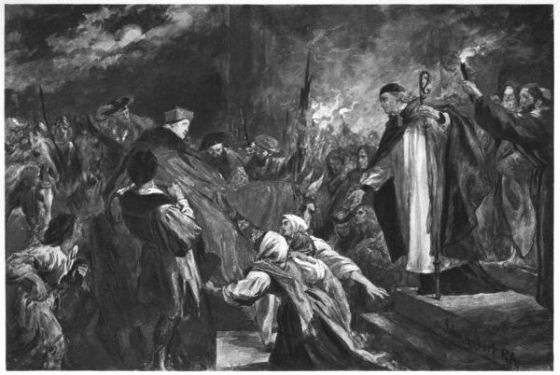
CARDINAL WOLSEY AT LEICESTER ABBEY.
From the Painting by Sir John Gilbert, R.A., P.R.W.S. At the Victoria and Albert Museum, South Kensington.
The king, returning from the progress which he had made to Moore Park, and to Grafton, remained one night at Waltham. Gardiner and Fox were lodged in the house of a Mr. Cressy, a gentleman of good family. After supper the conversation turned on the grand topic of the day—the king's divorce, and Gardiner and Fox detailed the difficulties that surrounded it, and the apparent impossibility of getting the Pope to move in it. A grave clergyman, the tutor of the family, of the name of Thomas Cranmer, after listening to the discourse, was asked by Fox and Gardiner what he thought of the matter. At first he declined to give his opinion on so high a matter, but being pressed, he said, he thought they were wrong altogether in the way they were seeking the divorce. As the Pope evidently would not commit himself upon the subject, his opinion was that they should not waste any more time in fruitless solicitations at Rome, but submit this plain question to the most learned men and chief universities of Europe: "Do the laws of God permit a man to marry his brother's widow?" If, as he imagined, the answers were in the negative, the Pope would not dare to pronounce a sentence in opposition to the opinions of all these learned men and learned bodies.
On the return of the Court to Greenwich, Fox and Gardiner related this conversation to the king, who instantly swore that "the man had got the right sow by the ear," and ordered him instantly to be sent for to Court. Cranmer, on his arrival, maintained his opinion in a manner which wonderfully delighted Henry, and raised his hope of having at length hit on the true mode of solving the difficulty.
Agents were despatched to obtain the required opinion from the different universities, both in England and on the Continent, well provided with that most persuasive of rhetoricians—money. At his own universities, however, Henry found no little opposition. On the Continent, where Henry's menaces had no weight, his purse was freely opened; and the universities of Bologna, Padua, and Ferrara, as well as many learned men, were prevailed on to take the view that Henry wished. In Germany his agents were far less successful. Both Protestants and Catholics in general condemned his proposed divorce; and Luther and Melanchthon said he had much better follow the example of the patriarchs, and take a second wife, than put away the first without any crime on her part. From France and its fourteen universities Henry expected much more compliance, but he was disappointed. From Orleans, Toulouse, and Bourges, and from the civilians of Angers, doubtful decisions were procured, but the theologians of the last city maintained the validity of the existing marriage. The answers from other universities were either not received or were suppressed.
The scheme of Cranmer had not worked particularly well; the opinions of the universities were for the most part either adverse, or were forced, and those of learned men more opposed than coinciding. There needed a more determined spirit than that of Cranmer to break the way through the wood of embarrassments in which they were involved, and the right man now stepped forward in Thomas Cromwell, the former secretary of Wolsey. He sought an interview with Henry, and determined, according to his own phrase, "to make or mar," thus addressed him:—"It was not," he observed, "for him to affect to give advice where so many wise and abler men had failed, but when he saw the anxiety of his sovereign, he could no longer be silent, whatever might be the result. There was a clear and obvious course to pursue. Let the king do just what the princes of Germany had done, throw off the yoke of Rome; and let him, by the authority, declare himself, as he should be, the head of the Church within his own dominions. At present England was a monster with two heads. But let the king assume the authority now usurped by a foreign pontiff, an authority from which so many evils and confusions to this realm had flowed, and the monstrosity would be at an end; all would be simple, harmonious, and devoid of difficulty. The clergy, sensible that their lives and fortunes were in the hands of their own monarch—hands which could be no longer paralysed by alien interference—from haughty antagonists would instantly become the obsequious ministers of his will."
Henry listened to this new doctrine with equal wonder and delight, and he thanked Cromwell heartily, and had him instantly sworn of his privy council.
No time was lost in trying the efficacy of Cromwell's daring scheme. To sever that ancient union, which had existed so many ages, and was hallowed in the eyes of the world by so many proud recollections was a task at which the stoutest heart and most iron resolution might have trembled; but Cromwell had taken a profound survey of the region he was about to invade, and had learned its weakest places. He relied on the unscrupulous impetuosity of the king's passion to bear him through; he relied far more on the finesse of his own genius. With the calmest resolution, he laid his finger on one single page of the statute-book, and knew that he was master of the Church. The law which rendered any one who received favours direct from the Pope guilty of a breach of the Statute of Præmunire, permitted the monarch to suspend the action of this Statute at his discretion. This he had done in the case of Wolsey. When he accepted the legatine authority, the cardinal took care to obtain a patent under the Great Seal, authorising the exercise of this foreign power. But Wolsey, when he was called in question for the administration of an office thus especially sanctioned by the Crown, neglected to produce this deed of indemnity, hoping still to be restored to the royal favour, and unwilling to irritate the king by any show of self-defence. There lay the concealed weapon which the shrewd eye of Cromwell had detected, and by which he could overturn the ecclesiastical fabric of ages. He declared, to the consternation of the whole hierarchy, that not only had Wolsey involved himself in all the penalties of Præmunire, but the whole of the clergy with him. They had admitted his exercise of the Papal authority, and thereby were become, in the language of the Statute, his "fautors and abettors."
Dire was the dismay which at this charge seized on the whole body of the clergy. The council ordered the Attorney-General to file an information against the entire ecclesiastical body. Convocation assembled in haste, and offered, as the price of a full pardon, £100,000. But still greater were the amazement and dismay of the clergy, when they found that this magnificent sum was rejected unless Convocation consented to declare, in the preamble to the grant, that the king was "the protector and only supreme head of the Church of England." By the king's permission, however, the venerable Archbishop Warham introduced and carried an amendment in Convocation, by which the grant was voted with this clause in the preamble:—"Of which church and clergy we acknowledge His Majesty to be the chief protector, the only and supreme lord, and, as far as the law of God will allow, the supreme head." The wedge was introduced; the severance was certain: the perfect accomplishment of it only awaited another opportunity for an easier issue. The northern convocation adopted the same language, and voted a grant of £18,840.
Henry, under the guidance of Cromwell, now procured an act to be passed by Parliament, abolishing the annates, or first-fruits, which furnished a considerable annual income to the Pope, and another abrogating the authority of the clergy in Convocation, and attaching that authority to the Crown. Feeling that in this struggle he should need the friendship of Francis, he proposed a new treaty with France, which was signed in London on the 23rd of June, 1532; and the more to strengthen the alliance the two monarchs met between Calais and Boulogne. Great preparations were made on both sides, and Henry begged Francis to bring his favourite mistress with him. This was as an excuse for Henry to bring Anne Boleyn, who was now created the Marchioness of Pembroke, and without whom he could go nowhere. It is said that Francis, during the interview, had urged Henry to wait no longer for the permission of the Pope, but to marry the Marchioness of Pembroke without further delay; but it is quite certain that another counsellor was more urgent, and that was—Time. It was high time, indeed, that the marriage should take place if they meant to legitimatise her offspring, for Anne Boleyn was with child. Accordingly, the marriage took place on the 25th of January, 1533. The ceremony, however, was strictly private. In fact the marriage was kept so secret that it was not even communicated to Cranmer, who had just returned from Germany, and taken up his abode in the family of Anne Boleyn. Cranmer, whilst in Germany, had married, Catholic priest as he was, the niece of Osiander, the Protestant minister of Nuremberg. This lady he had brought secretly to England, and was now living a married priest, in direct violation of the Church that he belonged to.
Archbishop Warham was now dead, and Henry nominated Cranmer to the vacant primacy. He was consecrated Archbishop of Canterbury on the 30th of March, 1533, and he was immediately ordered to proceed with the divorces. The new primate, therefore, wrote on the 11th of April, a formal letter to the king, soliciting the issue of a commission to try that cause, and pronounce a definite sentence. This was immediately done; and Cranmer, as the head of this commission, accompanied by Gardiner, now Bishop of Winchester, the Bishops of London, Lincoln, Bath, and Wells, with many other divines and canonists, opened their court at Dunstable, in the monastery of St. Peter, six miles from Ampthill, where the queen resided. On the 12th of May Cranmer pronounced Catherine contumacious, and on the 23rd, he declared her marriage was null and invalid from the beginning. On the 28th, in a court held at Lambeth, the archbishop pronounced the king's marriage with Anne Boleyn to be good and valid. On the 1st of June, being Whit Sunday, Anne was crowned with every possible degree of pomp and display.
Henry, notwithstanding his separation from Rome, was anxious to obtain the sanction of his marriage by the Pope; but, instead of that, Clement fulminated his denunciations against him over Europe. He annulled Cranmer's sentence on Henry's first marriage, and published a bull excommunicating Henry and Anne, unless they separated before the next September, when the new queen expected her confinement. Henry despatched ambassadors to the different foreign courts to announce his marriage, and the reasons which had led him to it; but from no quarter did he receive much congratulation.
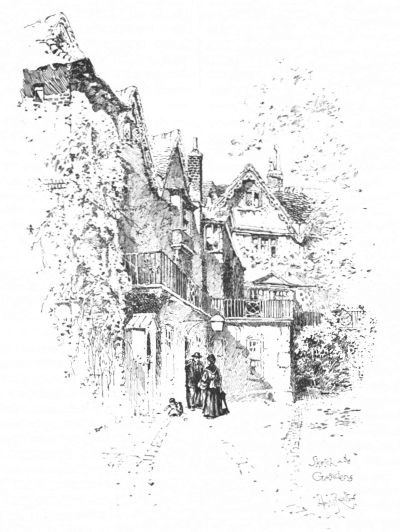
THE TOWER OF LONDON: SKETCH IN THE GARDENS.
However sincere and earnest the two principals in this contest, the Pope and Henry, might be, there were at work in the Court of England and the Court of Rome parties really more powerful than their principals, who were resolved that the two desiderata to this pacification never should be yielded. Cromwell and his party commenced an active campaign in Parliament for breaking beyond remedy the tie with Rome, and establishing an independent church in this country. This able man, who for his past services was now made Chancellor of the Exchequer for life, framed a series of bills, and introduced them to Parliament, soon after the Christmas holidays. These included an act establishing the title of the king as supreme head of the English Church, and vesting in him the right to appoint to all bishoprics, and to decide all ecclesiastical causes. Payments or appeals to Rome were strictly forbidden by the confirmation of the Annates Act, the Act against "Peter Pence," and that "in Restraint of appeals" whereby the whole Roman jurisdiction in England was decisively repudiated.
By a further bill, the marriage of Catherine—strangely enough at the very moment that Henry had conceded its final decision at Rome—was declared unlawful, and that of Anne Boleyn confirmed. The issue by the first marriage was declared illegitimate, and excluded from the succession, and the issue of the marriage of Anne was made inheritable of the crown, and that only, and any one casting any slander on this marriage, or endeavouring to prejudice the succession of its issue, was declared guilty of high treason, if by writing, printing, or deed, and misprision of treason if by word. Thus was a new power established by the Crown; every person of full age, or on hereafter coming to full age, was to be sworn to obey this act. Not only new powers were thus created, but a new crime was invented; and though this statute was swept away in the course of a few years, yet it is a remarkable one, for it became the precedent for many a succeeding and despotic government.