Chapter XVIII · (continued 3)
Reading edition
When this treaty was sent home, James was struck with consternation. He had pledged himself to Charles and Buckingham not to communicate any of their proceedings to the Council; but the present responsibility was overwhelming and he therefore opened his difficulty to the Council. After making what the Secretary of the Council calls "a most sad, fatherly, kind, wise, pious, manly, stout speech as ever was heard," the lords of the Council came to the conclusion, though reluctantly and with fear, that the prince's honour must be maintained and the oath to keep the treaty taken. This, however, was only the public treaty; James kept the private one to himself and swore to it separately.
Having got the English Court, as they supposed, thus secured, both the Pope and the Spaniard raised their heads still higher and showed that they meant to exact the utmost possible concession. In Spain the Papal dispensation for the marriage was already in the hands of the nuncio, but he refused to deliver it till the King of England, according to his oath, had obtained the repeal of the penal Statutes by Parliament; while in England James refused to go a step farther till the marriage was celebrated and the first instalment of the dower paid. When the king's resolve was known, it was conceded that the marriage should at once take place, but that the princess and the dower should remain in Spain till the stipulated indulgence to the English Catholics was obtained from Parliament. James refused this, and sent word that the marriage must be celebrated and the prince bring home his bride, or come without the wedding: this brought the Spaniards down a little. The ambassadors in London assured James that a royal proclamation would satisfy them, but he replied that a proclamation without the added sanction of Parliament was no law; that, however, he would issue an order for Catholic indulgence under the Great Seal. This they were obliged to be satisfied with; but when it came, to the Lord Keeper Williams, he refused to put the Great Seal to it, as a most dangerous act, without precedent.
As there was no prospect of a speedy settlement, Charles, who had probably grown tired of a princess surrounded by such a hedge of difficulties and delays, desired his father to send him an order for his recall. It would appear as if the prince had planned the mode of his retreat, for the preparations for the marriage of the Infanta proceeded, on the understanding that she was to continue in Spain till spring. James was apparently occupied in preparing grand wedding presents for the bride, and a small fleet to bring her home. This, if carried out, must have been very onerous to him; for he had already made doleful representations to Charles and Buckingham, of the exhaustion of his treasury by his remittance of five thousand pounds, and three thousand pounds for their "tilting stuff," &c. At Madrid the marriage articles were signed and confirmed by oath, the Infanta assumed the title of Princess of England, and had a Court formed of corresponding importance.
Never was the marriage so far off. Charles and Buckingham had resolved to steal away and abandon the whole affair. They felt that they were regularly entrapped through their folly; and other causes rendered a speedy exit necessary. Buckingham—vain, empty, and sensual—had given way without caution or control to his licentiousness and love of parade. To make him more fitting for the companion of his son, James had raised him to the rank of duke since his departure. His extravagance, his amours, his haughty bearing, and unceremonious treatment of both his own prince and the grandees of Spain, astonished all Madrid. He introduced the very worst people, men and women, into the palace, and would sit with his hat on when the prince himself was uncovered. His behaviour in the presence of the King of Spain was just as irreverent, and the minister Olivarez was so incensed at his insolence that he detested him. He had the soul of an upstart lackey under the title of a duke, and was never easy unless he could outshine all the grandees at the Spanish Court. He was perpetually importuning the king to supply orders, jewels, and money. Georges and garters were sent over in numbers to confer on different courtiers, and the constant cry of Buckingham's letters was "Jewels, jewels, jewels." He represented how rich the Spaniards were in jewels, and how poor those looked which they themselves already had. He described the prince as quite mean in his appearance, compared with the Spanish splendour. "Sir, he hath neither chain nor hatband, and I beseech you consider first how rich they are in jewels here; then in what a poor equipage he came in; how he hath no other means to appear like a king's son; how they are usefullest at such a time as this, when you may do yourself, your son, and the nation honour; and lastly, how it will neither cost nor hazard you anything. These reasons, I hope, since you have already ventured your chiefest jewel, your son, will serve to persuade you to let loose these more after him:—first, your best hatband, the Portugal diamond, the rest of the pendent diamonds to make up a necklace to give his mistress, and the best rope of pearl, with a rich chain or two for himself to wear, or else your dog must want a collar, which is the ready way to put him into it. There are many other jewels, which are of so mean quality as deserve not that name, but will save much in your purse, and serve very well for presents."
The prince quite aware that he had entangled himself in engagements that he could only keep at the risk of his father's crown, and Buckingham equally aware of the hatred which he had excited in a proud and vengeful nation, the two agreed to put the most honest possible face on the matter, and get away. Charles, therefore, presented his father's order for their return, and pledging himself to fulfil the marriage according to the articles; nay, appearing most eager for its accomplishment before Christmas, they were permitted to take their leave, loaded with valuable presents. The king gave the prince a set of fine Barbary horses, a number of the finest pictures by Titian and Correggio, a diamond-hilted sword and dagger, and various other arms of the richest fashion and ornament. The queen gave him a great many bags of amber, dressed kid-skins, and other articles; and Olivarez also presented him with a number of fine Italian pictures and costly articles of furniture. In return, Charles gave the king diamond-studded hilts for a sword and dagger, to the queen a pair of rich earrings, and to the Infanta the string of pearls recommended by Buckingham, to which was attached a diamond anchor, as an emblem of his constancy. He affected the utmost distress at leaving his bride even for a short time only, and the princess ordered a Mass for his safe journey home.
Never did appearances look more real, never were they more hollow. The Spaniards had endeavoured by every act, into which the sacred name of religion had been dragged, to make the most of their advantage in the presence of the prince, and to extort terms beyond the original contract; they were, therefore, properly punished. But nothing could justify the deep and deliberate falsehood, and repeated perjury of a young Protestant prince, whose conduct stamped a deep stain on his country and on Protestantism itself. The Protestants had long and loudly denounced the jesuitry of the Catholics, and asserted that no faith could be put in their most solemn engagements. Here, however, was a voluntary surrender of the pure and lofty morality of Protestantism, a willing abasement of its honour to the level of the worst Catholic duplicity. We shall see that the whole of Charles's conduct was lamentably in keeping with this unprincipled beginning.
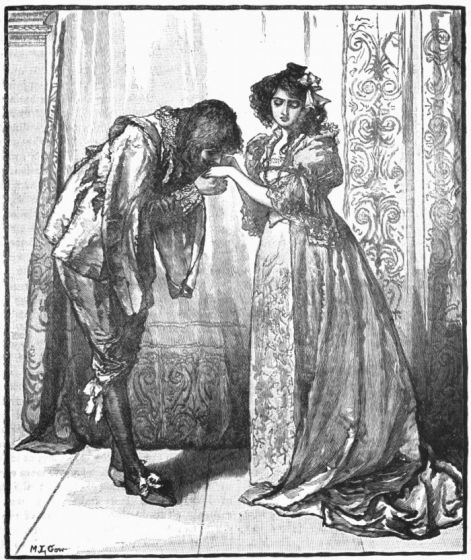
PRINCE CHARLES'S FAREWELL OF THE INFANTA. (See p. 496.)
Buckingham was impatient to be in England, from news which he had received that certain courtiers were busily at work in endeavouring to undermine his credit with the king. Behind him he left nothing but detestation, which Olivarez, the chief minister, took no pains to conceal. When the prince and he set out they were attended by the king himself, and a brilliant assemblage of the nobles, who added to the prince's presents a number of fine Andalusian horses and mules. They halted for several days at the Escurial, where they were splendidly entertained, and then the king rode on with them as far as Campillo. The parting of the affianced brothers-in-law was of the most affectionate kind, and the king ordered a column to be erected on the spot, as a lasting monument of it. So Charles rode on, attended by several nobles and entertained most honourably at their castles. He visited the cell of a celebrated nun at Carrion, who was held to be a saint, and to whom Donna Maria had given him a letter.
Arrived at the port where the English fleet was waiting for him, he no sooner stepped on board than he laughed at the credulity of the Spaniards, called them fools, and wondered at his easy escape from them. They landed at Portsmouth on the 5th of October, and there and all the way to and through London their reception was one piece of exultation at the safe return of the prince from the clutches of the dreaded Spaniards. The country resounded with the ringing of bells, the firing of cannon, the whizzing of fireworks, and the shouts of the people. The clergy, without waiting for royal orders, put up thanksgiving in the churches for the prince's happy arrival.
Meanwhile, the prince's perfidy was awaking the Spaniards from a trance of astonishment to a tempest of rage. From Segovia, he had sent back Clerk, a creature of Buckingham's, to the Earl of Bristol. Calculating that the Papal dispensation would by that time have arrived, Clerk was to hand to Bristol an order from the prince not to present the proxies left in his hands—which were to be given up immediately after the delivery of the dispensation—till he received further orders from home. The reason alleged by Charles was that he feared on the marriage by proxy the Infanta would retire into a convent. The idea was so absurd that Bristol saw at once that it was a mere pretence to break off the match. As his honour as well as the honour of the nation was implicated, he at once hastened to the king and laid the doubts of the prince before him. The astonishment of the king may be conceived. He had fixed the 29th of November for the espousals, the 29th of December for the marriage: orders for public rejoicings were already issued, a platform covered with tapestry was erected from the palace to the church, and the nobility had been summoned to attend. He gave Bristol every assurance that the princess should be delivered to the English without delay, and Bristol despatched these assurances in all haste to James. Meanwhile, the Countess Olivarez communicated privately to the Infanta the prince's message, at which she laughed heartily, saying that she never, in all her life, had a mind to be a nun, and thought she should hardly turn one now merely to avoid the Prince of Wales.
Only four days before the one appointed for the espousals, three couriers on the heels of each other arrived from England, bearing from James the message that he was perfectly willing for the marriage to proceed, on condition that the King of Spain pledged himself, under his own hand, to take up arms for the restoration of the Palatine and to fix the day for hostilities to commence. At an early period of the negotiation, Philip had declared that on the completion of the agreement for the marriage, he would give James a carte blanche regarding the affairs of the Elector Palatine, and whatever terms James required, he pledged himself to accede to. Now he repeated that although he could not in honour proclaim war against his nephew the Emperor—being engaged as mediator between him and the Palsgrave, at the instance of James—yet he would pledge himself in writing never to cease, by intercession or by warfare, till he had restored the Palatine to his hereditary dominion. Bristol and his fellow ambassador thought this assurance amply satisfactory; they sent off a messenger in hot haste, bearing their assurances that all possible difficulty was removed; and they went on putting their households into velvet and silver lace, to do honour to the marriage ceremony, as if it were really to take place. Bristol wrote more earnestly to the king, reminding him that the honour of king, prince, and ambassadors was most solemnly pledged; that the matters of the Palsgrave had been treated of separately, and that his majesty had always represented to Bristol himself that he regarded the marriage as a certain pledge of the Palatine's restoration. He added that the prince and my lord duke had also acted entirely on that opinion during their stay there. Charles and Buckingham, in fact, seem to have taken very little trouble about the ex-King and Queen of Bohemia.
But all was in vain; the prince had determined not to complete the marriage. It was believed that the view which he had had of the Princess Henrietta at Paris had, even before his reaching Spain, changed his intentions; and a courier brought from James an order for Bristol not to deliver the proxy till Christmas, "because that holy and joyful time was best fitting so notable and blessed an action as the marriage." When we add that the proxy was well known to the king and prince to expire before Christmas, we can duly estimate this awful language of hypocrisy. The King of Spain saw at once that he had been imposed upon; he gave instant orders to stop the preparations for the marriage, for the Infanta to drop the title of Princess of England, which she is said to have done with tears, and to return to her usual state. The fury of indignation against the English in Spain may readily be conceived.
The Earl of Bristol had acted too much the part of a faithful and honourable servant of the Crown to escape the censure of such a Court, and the vengeance of such a man as Buckingham. He had not hesitated, in spite of the remonstrances of the prince, to represent to James, during their sojourn in Madrid, the disgraceful conduct of that despicable libertine. James had the folly or the wickedness to show to the favourite these letters, and Bristol received his recall. The ambassador wrote to James requesting a remittance sufficient to bear him home, having pledged all his lady's jewels, and incurred a debt of fifty thousand crowns for Prince Charles, so that he had not funds even for his journey.
It does not appear that James or Charles took any notice of this most reasonable appeal; but Philip not only exonerated Bristol from any share in the disgraceful proceedings, but warned him of the danger which threatened him at home, and offered to make him one of the most distinguished men of his own realm, if he would take up his abode in Spain. Bristol, however, declined the noble offer, saying that he would rather lose his head in England, conscious as he was of innocence, than live a duke or Infantado in Spain with the imputation of treason, which was sure in such a case to be cast on him. Though he was ordered to quit Spain without delay, he was instructed to travel slowly, and on his landing he was commanded to retire to his house in the country, and consider himself a prisoner. The malicious Buckingham did his best to have him committed to the Tower, but the Duke of Richmond and the Earl of Pembroke opposed this injustice with effect.
James had got his baby Charles and his dog Steenie home again, but he soon found that they had involved him in troubles and debts, which very much abated the pleasure of their company. They had brought home neither wife nor her much desired money; on the contrary, they had spent his last shilling, increased his debts, thrown away the greater part of his jewels, had left the cause of his daughter and son-in-law in a worse position than before, and now were vehement to engage him in a war with Spain. Under the gloomy oppression of these embarrassments, he lost even his appetite for hunting and hawking, shut himself up alone at Newmarket, and wrote to the Palatine, recommending him to make his submission to the Emperor; to offer his eldest son, who was to be educated in England, to him for his daughter; to accept the administration of his hereditary territory, and to allow the Duke of Bavaria the title of Elector for life. Under the advice of Charles and Buckingham the Palsgrave positively declined any such arrangement.
The only resource now was to call a Parliament, but this was a step which had rarely brought him satisfaction. Before doing this he took the opinion of the Privy Council during the Christmas holidays on these points:—Whether the King of Spain had acted sincerely in the negotiations for the marriage? and whether he had given sufficient provocation to call for war? The Council unanimously supported the idea of the King of Spain's sincere dealing, and a majority declared that there was no just cause for war.
This result, so hostile to the wishes of Buckingham, filled him with chagrin, and his wrath fell with especial weight on Williams the Lord Keeper, and Cranfield the Treasurer. These men had been his most servile creatures; they were, in fact, altogether his creatures; but during his absence they had seen such evidence of displeasure in the king towards him, that they imagined his power was about at an end and they were emboldened to oppose him. But his fierce displeasure and the symptoms of even growing popularity which showed themselves round him, terrified them and they made the most humble submission.
On the 2nd of February, 1624, Williams wrote a most abject letter to Buckingham, begging him to forgive his past conduct, "to receive his soul in gage and pawn:" they were reconciled. People who before hated Buckingham now looked upon him as a patriot, for having broken off the Papist match, and for seeking to punish Spain by war. The heads of the Opposition in the House of Commons, the Earl of Southampton, the Lord Say and Sele, and others came over to him; and through Preston, a Puritan minister and chaplain to the prince, he was brought in favour with many other members of the country party. Buckingham and Charles assured James that the demand of war with Spain was the only cry for him, as nothing would so readily draw money from the Commons. Accordingly, though trembling and reluctant, James summoned Parliament, which met on the 19th of February.
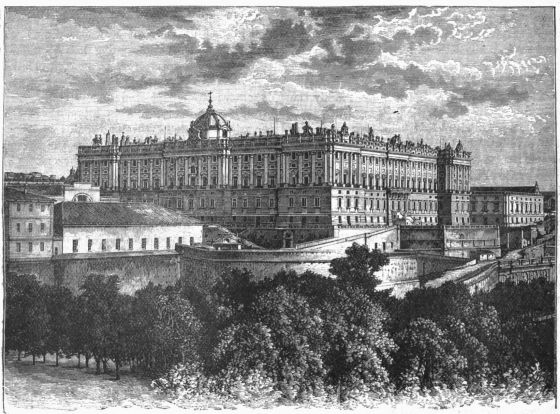
THE ROYAL PALACE, MADRID. (From a photograph by Frith, Reigate.)
He opened it in much humbler tones than ever before. He expressed a great desire to manifest his love for his people. He then informed them that he had long been engaged in treaties with different countries for the public good, and had actually sent his son and the man whom he most trusted to Spain, and all that had passed there should be laid before them; and he asked them to judge him charitably, and to give him their advice on the whole matter. One thing he begged to assure them of, that in everything, public and private, he had always made a reservation for the cause of religion; and though he had occasionally relaxed the penal statutes against Catholics a little, yet as to suspending or altering any of them, "I never," he exclaimed, "promised or yielded; I never thought it with my heart or spoke it with my mouth!" And this notwithstanding that on the 20th of July previous, he had sworn in the Spanish treaty to procure the abolition of all those laws from Parliament; a fact notorious not only to Charles, Buckingham, and Bristol, but to all the Lords of the Council, and the Spanish ambassadors still in London. He concluded by begging them to remember that time was precious, and to avoid all impertinent and irritating inquiries.
On the 24th of February, a conference of both Houses was held at Whitehall, at which Buckingham went into the detail of the journey of the prince and himself to Spain. Bristol was prohibited from attending Parliament, and the duke gave his own version of the affair. According to him—for he produced only such despatches as had been in a private conference with the Lord Keeper Williams deemed safe; "his highness wishing," says Williams, "to draw on a breach with Spain without ripping up of private despatches"—the Spaniards behaved in a most treacherous manner. He asserted that after long years of negotiation the king could bring the court of Spain to nothing; that the Earl of Bristol had merely got from them professions and declarations; that though the prince had gone himself to test their sincerity, he had met with nothing but falsehood and deceit; and that as to the restitution of the Palatinate, he had found it hopeless from that quarter.
Perhaps no minister bronzed in impudence by years of crooked dealing ever presented such a tissue of base and arrant fictions to the Commons of England. The despatches, had they been produced, would have covered the king, the prince, and the favourite, with confusion. Bristol could have proved, had he been allowed, that he had actually completed the treaty when the prince and Buckingham came and put an end to it. So indignant were the Spanish ambassadors at this shameful misrepresentation of the real facts, that they protested vehemently against the whole of the statement, and declared that had any nobleman in Spain spoken thus of the King of England, he should have paid with his head for the slander.
Buckingham was not only defended but applauded. The prince during the whole time stood at his elbow, and aided his memory or his ingenuity. Coke declared that Buckingham was the saviour of his country; and out of doors the people kindled bonfires in his honour, sung songs to his glory, and insulted the Spanish ambassadors. The two Houses, in an address to the Throne, declared that neither the treaty with Spain for the marriage, nor that for the restitution of the Palatinate, could be continued with honour or safety.
Of all things James dreaded war: he complained of his poverty, his debts, of his desire of quietness at his years; but he had not the resolution to resist the importunities of Buckingham and the prince, backed by a strong cry from the deluded people, especially as he saw no other mode of obtaining the money so necessary to him. In addressing Parliament, he stated candidly the many reasons against the war; the emptiness of his exchequer and the impoverished condition of his allies; that Ireland would demand large sums, and the repairs of the navy more; and then he put to them these questions—whether he could with honour engage in a war which concerned his own family exclusively? and whether the means would be found for prosecuting it vigorously?
A deputation from both Houses answered these queries by calling for war, and offering to support him in it with their persons and fortunes. This address was read by Abbot, the Archbishop of Canterbury, who but six months before had most reluctantly sworn to the Spanish treaty. This was, indeed, a triumph to the archbishop, but did not make the singularity the less of putting an address for war into the hands of a clergyman; and one, moreover, who had so lately fallen into great difficulty on account of his own accidental shedding of blood. When the archbishop came to the passage where James was congratulated on "his having become sensible of the insincerity of the Spaniards—" "Hold!" exclaimed the king; "you insinuate what I have never spoken. Give me leave to tell you that I have not expressed myself to be either sensible or insensible of their good or bad dealing. Buckingham hath made you a relation on which you are to judge, but I never yet declared my mind upon it."
James, indeed, knew very well to the contrary; the Spaniards had been too grasping, and had thus overshot themselves, but they meant to complete the marriage; and it was a most unjustifiable thing in James to go to war with them on the ground of their insincerity, if he did not believe in its existence. But James was desirous that as Buckingham had so strenuously called for war to avenge his own petty, private piques, he should bear the blame of it.
James told them plainly that if he went to war he should demand ample advances, and when five days afterwards the question of supplies came on, he demanded seven hundred thousand pounds to commence the war with, and an annual sum of one hundred and fifty thousand pounds towards the liquidation of his debts. The amount startled the Commons, in spite of their magniloquent offer to support him with life and fortune; but Buckingham and the prince, who were as mad for war as they had before been for their foolish adventure, let the Commons know that a much less sum would be accepted, and they voted three hundred thousand pounds for the year, which the king consented should be put into the hands of the treasurers appointed by the House, who were to pay money only on a warrant from the Council of War. James also agreed that he would not end the war without their consent. The vote was accompanied by another address, vindicating Buckingham from the censures of the Spanish ambassadors, and then the king issued a proclamation announcing that both the treaties with Spain were at an end.
Thus was James, after twenty years of peace, except in the character of an ally of his son-in-law, launched into a war. The Spaniards ridiculed the idea; for on the authority of Gondomar, they had conceived not only a very contemptible idea of James, but that the kingdom was poor, torn with religious factions, and feeble from the timid and vacillating character of the king. Only one peer, the Earl of Rutland, had the good sense to oppose the vote for the war.
The restraint of the desire to please Spain during the negotiations for the marriage being removed, the Houses of Parliament indulged their old hatred of the Catholics by uniting in a petition to the king to renew their persecution. James again protested that he never intended to abolish those laws, and would never consent to the insertion of a clause in any treaty whatever, binding him to an indulgence of Catholics. And Charles also bound himself by an oath, that "whenever it should please God to bestow upon him any lady that were Popish, she should have no further liberty but for her own family, and no advantage to any recusants at home."
Accordingly a proclamation was issued, ordering all missionaries to quit the kingdom by a certain day under penalty of death; judges and magistrates were ordered to enforce the laws as aforetime; the Lord Mayor was enjoined to arrest all persons coming from Mass in the houses of the ambassadors, and the bishops were called upon to advise the king how the children of the Papists might be brought up Protestants. The Commons called on every member to name all Catholics holding office in his town or county, and prepared a list of them, which they sent to the Lords; but the Lords declared that before they could unite in a prayer for the dismissal of any one, they must have evidence of his guilt; and thus the vindictive scheme fell to the ground.
The Commons, checked in this quarter, turned their attention to their more legitimate prosecution of jobbers and holders of injurious patents. They presented a list of eleven such grievances to the king, who replied that he had his grievances too: they had encroached on his prerogatives; they had condemned patents of unquestionable usefulness; and had been guided in their quest after them by lawyers, who, he would say it to their faces, were in the whole kingdom the greatest grievances of all; for where a suit was of no benefit to either litigant, they made it so to themselves. But this did not prevent them from flying at high game. Buckingham had never forgiven Cranfield, Earl of Middlesex and Lord Treasurer, for turning against him in his absence; and the Opposition party, with whom the duke was now connected, took the lead in prosecuting him on a charge of bribery, oppression, and neglect of duty. James was indignant at this attack, but had not resolution enough to ward it off; though he told Buckingham that he was a fool, and making a rod for his own breech, and Charles that he would live to have his bellyful of impeachments. Cranfield was condemned to a fine of fifty thousand pounds, to be imprisoned during his majesty's pleasure, and for ever excluded from office, from Parliament, and the verge of the Court. Williams, the Lord Keeper, had also a narrow escape. Notwithstanding his cringing at the feet of Buckingham, the favourite had by no means forgiven him; petitions against him were presented to the Committee of Inquiry, but he again sued humbly to Buckingham, and having had the opportunity during the Session of doing him a service, the duke let him off with the proud remark, "I shall not seek your ruin, but I shall cease to study your fortune."
Buckingham and Charles now persuaded the king to change his foreign policy. They sent envoys all over Europe to engage the different powers by any argument and by rich presents to co-operate in the war against Spain and Austria for the restitution of the Palatinate. To Sweden, Denmark, and the Protestant States of Germany, they urged the necessity of reducing the power of the Catholic princes on the Continent. Promises of liberal subsidies were added, and the concurrence of these States was pledged. It was a more difficult matter to influence the Catholic countries of France, Venice, and Savoy to a war which was actually aimed at the existence of their own religion. But the ancient enmity of these States against Austria prevailed over their religious scruples, and they undertook to assist indirectly, by making a show of hostilities against Spain, so as to prevent her from giving effectual aid to Austria, and by allowing soldiers to be raised within their territories, as well as by furnishing money.
With Holland they had effected a league, and undertaken to send troops to resist the invasion of Spain and Austria, when the news of a frightful tragedy, perpetrated by the Dutch in the East, upon the English there, arrived in England. This was what has become so well known in history as the massacre of Amboyna.
Since the Dutch had enjoyed their long truce with Spain, they had been zealously colonising and trading to the East. Besides Batavia, they laid claim to all the Spice Islands in the Indian Archipelago, from which they had expelled the Portuguese. On one of these islands, Amboyna, the English East India Company had, in 1612, established a small settlement, to trade with the natives for cloves. The Dutch compelled them to retire, but in consequence of a treaty in 1619, the English had returned thither, and established a settlement at Cambello. In the whole population there were only about twenty English and about thirty Japanese, whilst there were two hundred Dutch soldiers besides other Dutchmen in the Civil Service. Yet on pretence of a conspiracy between the English and Japanese to surprise the garrison and expel the Dutch, in 1623 the latter seized Captain Towerson and nine other Englishmen, nine Japanese, and one Portuguese, and after torturing them into a confession, cut off their heads.
The horror with which the news of this atrocious deed was received, threatened to ruin Buckingham's plans. But the English minister made a strong complaint on the subject; the States made humble apologies and promises of ample redress, and thus it was contrived for the moment to smooth over the difficulty. It was the more readily done because the unpopular Spaniards had already laid siege to Breda; and six thousand troops were despatched from England to enable Prince Maurice of Orange to cope with the able Spanish general Spinola. Spinola carried Breda in defiance of the Dutch and English; and the Prince of Orange, hearing that Antwerp had been left without a sufficient garrison, marched thither to surprise it but with equally ill success. To obtain fresh men and money, Count Mansfeldt, the Palatine's old auxiliary general, came over to England in the autumn. He was promised twenty thousand pounds a month, and twelve thousand Englishmen were pressed into his service. With these he set sail, to reach as soon as possible his army of French and German mercenaries on the borders of the Palatinate. But the French, who had agreed to allow this force to pass through their territory, refused, on account of their disorderly character; for they were the scum of their own country, and several, on their march through it, had been hanged for their outrages. Mansfeldt conducted them to the island of Zealand, but there also the authorities were averse from their landing; and while remaining cooped up in small miserable transports, in bad weather, and on a swampy shore, they began to perish of fever. Five thousand of them had died before they reached the borders of the Palatinate, and the united force was still too feeble to accomplish anything. Maurice of Orange, meanwhile, having done nothing at Antwerp, retired into winter quarters, and soon after died at the Hague; whereupon the Earl of Southampton and other English officers returned home. Such was the miserable result of the campaign into which James had been hurried by the folly of Charles and Buckingham.
The melancholy thoughts of James were diverted from dwelling on these wretched affairs by the prospect of the marriage of Charles and Henrietta Maria, the youngest sister of the King of France.
It was a curious fact that at the time of Charles's looking out for a wife from one of the principal houses of Europe, the prospect of an English royal marriage was made gloomy by the most awful reflections to both France and Spain. The last Spanish Queen of England was Catherine of Aragon, who had found such a tyrant in the sanguinary Henry VIII., and suffered divorce and severe usage; the last French queen was Margaret of Anjou, who had been driven from the country after the most heroic endeavours to maintain her husband on the throne. Besides these sombre memories, the question presented formidable difficulties from the temper of the English people regarding Popery. Politically the alliance was attractive, and this is generally all-sufficient in regal matrimony. But it was singular that the present marriage with a French princess was followed by similar and even more fearful results than the former. Henrietta Maria married Charles only to engage in a similar contest for the retention of the throne as Margaret of Anjou, and not only to see her husband deposed but put to death.
Charles is supposed by many to have been struck by the young Princess of France at his visit to the French Court on his way to Spain, and to have gone there prepared to break off the match. It is probable, however, that the thought of Henrietta came back more strongly upon him after he found himself disappointed in Donna Maria of Spain; for independently of the other difficulties already related attending Charles's Spanish courtship, it is very likely that he was not extremely fascinated by the Infanta. On the way to Spain, Henrietta, as seen by him, was merely a girl of little more than fourteen years of age, of short stature, and visible but for a brief space. The impression which she left could not be very vivid; but the Queen of France, the elder sister of Donna Maria, was extremely beautiful and, as Charles himself said in his letters to his father at the time, had so much struck him as to inspire him "with a greater desire to see her sister." There can be little doubt that Charles was disappointed in his expectation, for he was of that romantic turn that had he been strongly fascinated by the lady, he would have broken through all difficulties for her sake. But at the Court of Spain he met with another queen, the sister of Louis of France and of Henrietta, who not only cast the Infanta into the shade by her beauty and grace, but actually suggested to Charles the more desirable union with her sister of France. The rigid etiquette of the Spanish Court prevented much intercourse between Charles and the queen; she dared not even converse with him in French without express permission, and one opportunity to do so having been obtained, she begged him never to speak to her again, for that it was the custom in Spain to poison all gentlemen who were very marked in their attentions to the queen. But she seized that one opportunity to say that "she wished he would marry her sister Henrietta, which indeed he would be able to do, because his engagement with the Infanta would be certainly broken."
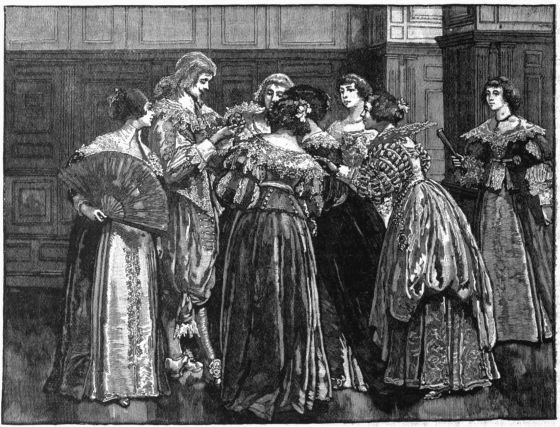
THE LADIES OF THE FRENCH COURT AND THE PORTRAIT OF PRINCE CHARLES. (See p. 506.)
On the other hand, there was a decided desire in the French Court for this alliance, despite past experience. Mary de Medici, the queen-mother of France, had acquired a predominating influence in the government of her son, Louis XIII., by means of her clever and intriguing almoner Richelieu, who soon mounted into vast power in the State. She entertained a strong hope of effecting a marriage for her daughter with the heir of England, and was no doubt early informed of the probability of the failure of the Spanish courtship. It was soon conveyed to Charles by the English ambassador at Paris, that Henrietta had said, "The Prince of Wales need not have gone so far as Madrid to look for a wife." This following the suggestion of the Queen of Spain, left no doubt of the wishes of the Court of France, and the bait seems to have been soon taken. Buckingham would certainly promote the idea to spite the Spaniards; and Henry Rich, Lord Kensington, appeared in Paris before the Spanish match was formally broken off, to open the subject to the queen-mother.
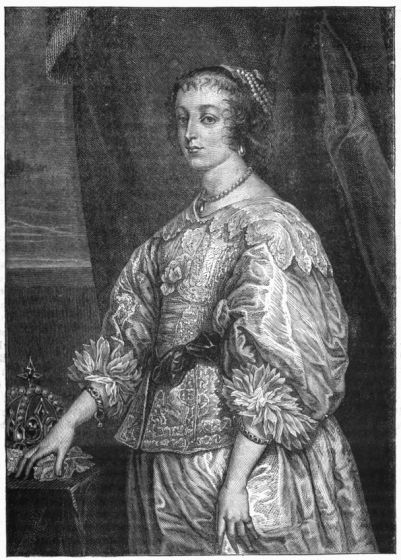
HENRIETTA MARIA.
Mary de Medici, though extremely anxious for the marriage, played the part of the politician well under Richelieu, and gave no decided encouragement to the hints of the English envoy, till he assured her plainly that the match with Spain was positively broken off. Even then, she told Lord Kensington that "she could not consider the matter seriously, as she had received no intimation of such proposal from the King of England, and that the princess could not make advances; she must be sought." On this, Kensington spoke out with authority, and received a favourable answer. It is asserted that a great sensation was excited at the French Court, and the ladies crowded round Lord Kensington to have a view of the prince's portrait, which he carried in a locket; and the locket was soon privately borrowed by the princess and kept for a good long observation, she expressing her satisfaction with the looks of her royal lover. Kensington, by his courtly assiduity at Paris and his letters to Charles, endeavoured to create a strong personal interest in the prince and princess towards each other. Hay, Earl of Carlisle, one of James's favourites, a handsome, empty fop, who prided himself on adorning his person with lace and jewels to the amount of forty thousand pounds, was sent as a formal ambassador for the marriage negotiation, the real conductor of it still being Kensington. A miniature portrait of Henrietta was sent to Charles, who appeared to be enraptured with it.
So far all went well. But notwithstanding the anxious desire for the marriage on the part of the French Court, it was not likely that so crafty a diplomatist as Richelieu would make an easy bargain for the English. The portion of the princess was settled at eight hundred thousand crowns. She was pledged to renounce all claims for herself and her descendants on the crown of France. Then came the question of religion. James and Charles had lately bound themselves by the most solemn oaths that a Catholic wife of the prince should have indulgence in that respect only for her own private worship; and that no toleration whatever should be extended to the English Catholics on account of such a marriage. But this was not likely to pass. The Pope Urban, in the first place, was extremely unfriendly to the match. He expected little good from a prince who had shown such duplicity in the Spanish courtship; and he predicted that the alliance, if effected, would be disastrous; being fully informed by the seminary priests who were in England, secretly prosecuting the support of Catholicism, of the determined temper of the people on that score, and assured by them that if the king dared to relax the penal laws he would not be king long; and if he did not soften their rigour, the Pope argued, what prospect of happiness could there be for a Catholic queen? He was, therefore, averse from granting a dispensation.
Under these circumstances the negotiation appeared for some time at a stand. On the part of the English people, the opposition was scarcely perceptible. They saw that they were pretty certain to have a Catholic queen; the Stuart family did not incline to stoop to the alliance of any further petty Protestant princes; the experiment of the Palatinate was not encouraging. The people, therefore, were far more disposed to receive a daughter of great Henry IV., who had been a Protestant at heart even when he had yielded the profession of his faith to political necessity, than a grand-daughter of Philip II., who had rendered his memory so odious in England and all over the world by bloody persecutions of the Protestants. On the part of the French, however, the proceedings every day seemed involved in growing difficulties.
Richelieu, who, up to the time of the breaking off the Spanish match, was most compliant, now insisted on the concession to the Catholics of all the advantages stipulated for by Spain. He declared that it would be an affront to his sovereign to offer less. James, despite his recent oath, signed a paper, promising indulgence to the Catholics, which Kensington and Carlisle assured Richelieu was quite sufficient; but it had no effect on the astute French minister. "We did sing a song to the deaf," wrote the ambassadors, "for he would not endure to hear of it." In vain did they remind him that the French Court had promised that if they gave toleration to the Catholics, it would send soldiers to the Palatinate, and unite their interests with those of England entirely. Richelieu did not deny this, but contended that the security was not sufficient; they must have an actual treaty. Meanwhile Lord Nithsdale, a Catholic, was sent post haste to Rome, to make promises of favour to the English Catholics in order to procure the dispensation.
At length the French Court agreed to accept the secret agreement of James, which was to the effect that the English Catholics should enjoy a greater freedom of religion than had been guaranteed by the Spanish contract. This was signed by James, Charles, and the Secretary of State, on the 8th of November, and Louis placed his signature on the 12th to the treaty of marriage. By this treaty it was provided, not indeed expressly, as many historians have asserted, that the children of the marriage should be brought up Roman Catholics till their thirteenth year, and that they should remain under the queen's care till that age; a stipulation amounting very much to the same thing; for though Charles chose to construe the article in his own way, the mother used her opportunity thus guaranteed to fix the Catholic faith firmly in the hearts of her sons, as was too well and too disastrously shown in the end.
If the English Court thought the difficulties all surmounted, they were vastly mistaken; for the French ministers now expressed themselves as not satisfied with James's secret engagement. It was, they contended, too vague, and they called upon him to specify precisely the indulgences which he intended towards the Catholics. At this proposition Carlisle expressed his astonishment, and wrote to James in a tone of unequivocal indignation. He advised the king to make no further concessions; feeling sure that if he were firm, the French would give way rather than hazard the failure of the match. But to preach firmness to James was to expect solidity from a mist. He was alarmed at the obstinacy of the Pope; at the declaration of Philip of Spain, that he held the marriage contract with Charles as still valid, from a private agreement between the prince and himself; and at the strenuous efforts made by Philip to bring the Court of France to this persuasion. To complete his dismay, the Huguenots of France, just at this moment, made a rising under the leadership of Soubise. They demanded a better observance of the edicts in favour of the Protestants, seized the Isle of Rhé, near La Rochelle, placed it in a state of defence, sent out a fleet to range the coast, and vowed not to lay down their arms till their demands were granted. James consented to add these express stipulations to his secret bond—That all Catholics imprisoned on account of their religion, since the rising of Parliament, should be liberated; that all fines levied on recusants since that period should be repaid; and that for the future they should suffer no interruption to the free exercise of their religious faith.
All obstacles on the part of the French Court were now removed, and the young princess prepared for her journey to England. But the Pope continued his opposition, still presaging misfortune from the marriage, and refusing to deliver the dispensation. The patience of the queen-mother was exhausted; the ministers of France proposed to proceed on a dispensation from the ecclesiastic authorities in their own realm; but to this James demurred, lest the validity of the marriage might hereafter be called in question. At length the Pope was satisfied by an oath taken by Louis, binding himself and his successors to compel James and his son, by all the power of France if necessary, to keep their engagement. The dispensation was delivered by Spada, the Papal Nuncio; the Duke of Chevreuse, a prince of the House of Guise, and a near relative of James and Charles, through the Queen of Scots, was appointed proxy by Charles, and Buckingham was ordered to go over and receive the bride. But James was destined not to see the completion of the marriage, after all his trouble through nine years of matrimonial negotiations.
On the 13th of March, 1625, he returned to Theobalds from the hunt with an illness upon him, which was regarded as the tertian ague, but which soon developed itself as gout in the stomach. He had long been so thoroughly undermined in constitution by his habits of eating and drinking, that it required no fierce attack of sickness to carry him off. He had always had a strong repugnance to doctors and physic, but now the Court physicians were hurried to his bedside. At this moment appeared the mother of Buckingham with an infallible specific—a plaster and a posset obtained from an Essex quack. These were pronounced marvellous in the cure of ague, and though the physicians protested against their use, they were applied. They did not delay, if they did not accelerate the catastrophe. On the eleventh day of his illness, James received the Sacrament. Williams, bishop and Lord Keeper, preached his funeral sermon, and said that, having told the king "that holy men in holy orders in the Church of England doe challenge a power as inherent in their functions, and not in their person, to pronounce and declare remission of sins to such as being penitent doe call for the same, he had answered suddenly, 'I have ever believed there was that power in you that be in orders in the Church of England, and therefore I, a miserable sinner, doe humbly desire Almighty God to absolve me my sinnes, and you, that are His servant in that high place, to affoard me this heavenly comfort.' And after the absolution read and pronounced, he received the sacrament with that zeal and devotion, as if he had not been a fraile man, but a Christian cloathed with flesh and blood."
On Sunday, the 27th of March, the fourteenth day of his illness, Charles was hastily called before daylight to go to him, but before he reached the chamber the king had lost the power of speech. He appeared extremely anxious to communicate something to him but could not, and soon after expired. He was in the fifty-ninth year of his age, and the twenty-third of his reign. Two only of his seven children, three sons and four daughters, Charles and the ex-queen of Bohemia, survived him.