Chapter XX
Reading edition
THE REIGN OF CHARLES I. (continued).
Visit of Charles to Scotland—Laud and the Papal See—His Ecclesiastical Measures—Punishment of Prynne, Bastwick, and Burton—Disgrace of Williams—Ship-money—Resistance of John Hampden—Wentworth in the North—Recall of Falkland from Ireland—Wentworth's Measures—Inquiry into Titles—Prelacy Riots in Edinburgh—Jenny Geddes's Stool—The Tables—Renewal of the Covenant—Charles makes Concessions—The General Assembly—Preparations for War—Charles at York—Leslie at Dunse Hill—A Conference held—Treaty of Berwick—Arrest of Loudon—Insult from the Dutch—Wentworth in England—The Short Parliament—Riots in London—Preparations of the Scots—Mutiny in the English Army—Invasion of England—Treaty of Ripon—Meeting of the Long Parliament—Impeachment of Strafford—His Trial—He is Abandoned by Charles—His Execution—The King's Visit to Scotland.
Having reduced the refractory members of the Church and of Parliament in England to silence for the present, Charles determined to make a journey into Scotland, there to be crowned, to raise revenue, and to establish the Anglican hierarchy in that part of his dominions. For the latter purpose he took Laud with him. He reached Edinburgh on the 12th of June, 1633, where he was received by the inhabitants with demonstrations of lively rejoicing, as if they were neither aware of the character and views of the monarch, nor remembered the consequences of the visit of his father. On the 18th he was crowned in Edinburgh by the Archbishop of St. Andrews; but Laud did not let that opportunity pass without giving them a foretaste of what was coming. "It was observed," says Rushworth, "that Dr. Laud was high in his carriage, taking upon him the order and managing of the ceremonies; and, for instance, Spotswood, Archbishop of St. Andrews, being placed at the king's right hand, and Lindsey, Archbishop of Glasgow, at his left, Bishop Laud took Glasgow and thrust him from the king with these words:—'Are you a Churchman, and want the coat of your order?'—which was an embroidered coat, which he scrupled to wear, being a moderate Churchman—and in place of him put in the Bishop of Ross at the king's right hand."
This question of the embroidered robes of the Roman hierarchy, with the high altar, the tapers, chalices, genuflections, and oil of unction, was introduced into Parliament, and forced on the reluctant Scots. They had voted supplies with a most liberal spirit, and laid on a land tax of four hundred thousand pounds Scots for six years; but when the king proposed to pass a Bill authorising the robes, ceremonies, and rites just mentioned, there was a stout opposition. Lord Melville said plainly to Charles, "I have sworn with your father and the whole kingdom to the confession of faith in which the innovations intended by these Articles were solemnly abjured." And the Bishop of the Isles told him at dinner that it was said amongst the people that his entrance into the city had been with hosannas, but that it would be changed, like that of the Jews to our Saviour, into, "Away with him, crucify him!" Charles is said to have turned thoughtful, and eaten no more. Yet the next day he as positively as ever insisted on the Parliament passing the Articles, and, pointing to a paper in his hand, said, "Your names are here; I shall know to-day who will do me service and who will not."
Notwithstanding this, the House voted against it by a considerable majority, there being opposed to it fifteen Peers and forty-five Commoners; yet the Lord Register, under influence of the Court, audaciously declared that the Articles were accepted by Parliament. The Earl of Rothes had the boldness to deny this and to demand a scrutiny of the votes; but Charles intimidated both him and all dissentients by refusing any scrutiny unless Rothes would arraign the Lord Register of the capital crime of falsifying the votes. This was a course too perilous for any individual under the circumstances. Rothes was silent, the Articles were ratified by the Crown, and Parliament was forthwith dissolved on the 28th of June.
Having thus carried his point with the Parliament, Charles took every means, except that which had brought upon him so much odium in England—namely, imprisoning and prosecuting the members who opposed him—to express his dissatisfaction with them. He distributed lands and honours upon those who had fallen in with his wishes, and treated the dissentients with sullen looks, and even severe words, when they came in his way. They were openly ridiculed by his courtiers, and dubbed schismatics and seditious. Lord Balmerino was even condemned to death for a pamphlet being found in his possession complaining of the king's arbitrary conduct in these concerns; but the sentence was too atrocious to be executed.
Charles and Laud erected Edinburgh into a bishopric, with a diocese extending even to Berwick, and richly endowed with old Church lands, which were obtained from the noblemen who held them. A set of singing men was also appointed for Holyrood Chapel; and Laud, who had been made a Privy Councillor, preached there in full pontificals, to the great scandal of the Presbyterians. Thence Charles and his apostle made a tour to St. Andrews, Dundee, Falkland, Dunblane, etc., to the singular discomfort of Laud amongst the rough fastnesses of the Highlands.
Immediately after this, Charles posted to London in four days, leaving Laud to travel more at leisure. No doubt both master and man thought they had made a very fine piece of work in this forcing of the Scottish consciences: they were destined in a while to feel what it actually was, in rebellion and the sharp edge of the axe.
Scarcely had they reached London, when they heard the news of the death of Archbishop Abbot, and Charles was thus enabled to reward Laud for all his services in building up despotism and superstition by making him Primate, which he did on the 6th of August, 1633. It was a curious coincidence that about the same time Laud received a second offer of a cardinal's hat, and he seems to have been greatly tempted by it. He says that he acquainted his majesty with the offer, and that the king rescued him from the trouble and danger; for, he adds, there was something dwelling in him which would not suffer him to accept the offer till Rome was other than she was. To have accepted a cardinal's hat was to have gone over to the Church of Rome, and the Church of England was for him a much better thing now he was Primate.
There undoubtedly did at this precise time take place an active private negotiation between the courts of Rome and England on this topic. The queen was anxious to have the dignity of cardinal conferred on a British subject. Probably she thought that the residence of the English cardinal at London would be a stepping-stone to the full restoration of Catholicism. Towards the end of August, immediately after Laud's elevation to the Primacy, Sir Robert Douglas was sent to Rome as envoy from the queen, with a letter of credence, signed by the Earl of Stirling, Secretary of State for Scotland. His mission was this proposal of an English cardinal, as a measure which would contribute greatly to the conversion of the king. To carry out this negotiation, Leander, an English Benedictine monk, was despatched to England, followed soon after by Panzani an Italian priest.
From the despatches of Panzani we find that there existed a strong party at the English court for the return to the allegiance of Rome, amongst whom were Secretary Windebank; Lord Chancellor Cottington; Goodman, Bishop of Gloucester; and Montague, Bishop of Chichester. He was informed that none of the bishops except three—those of Durham, Salisbury, and Exeter—would object to a purely spiritual supremacy of the Pope, and very few of the clergy.
Douglas was followed to Rome by Sir William Hamilton, to prosecute this secret business, but it all came to nothing, for the king, who was sincere in his attachment to the English Church, was not likely to listen to any proposal for submitting again to the yoke of Rome; and the Pope, on his part, would not comply with Charles's request to exert his influence with Catholic Austria for the restoration of his sister and her son in the Palatinate so long as they continued Protestants. Laud was therefore relieved from his temptation to receive the cardinal's hat by the resolve of the king to yield not one jot of his spiritual or political power; and a Scottish Catholic named Conn being at Rome, was mentioned as candidate for the purple instead. He came to England and was graciously received, not only by the queen, but the king too. He resided in England three years, but without the cardinal's hat, and was succeeded by Count Rossetti as the Pope's envoy. The rumours of the offers of the scarlet hat to Laud, and the residence of these Papal envoys in London, excited the jealousy of the people and added immensely to Charles's unpopularity; for no one felt sure of his real faith.
As Laud, however, could not array himself in scarlet as a cardinal, he determined to make the Anglican Church as Popish, and himself as much of a Pope, as possible. Before reaching the Primacy he had gone a good way. The spoliation of the Church by Henry VIII. and Edward VI., and their greedy nobility, had deprived it of the means of keeping the ecclesiastical buildings in repair. The Catholic Church in England had devoted the property of the Establishment to three objects: one, to the maintenance of the clergy and religious orders; the second, to the maintenance of the buildings of the churches and cathedrals; and the third to the support of the poor. Thus the patrimony of the poor was swallowed up by the aristocracy, and the maintenance of the poor thrown upon the country; and fixed there by the 43rd of Elizabeth. The patrimony of the public for the maintenance of Church buildings being equally shared by the Russells, Villierses, Seymours, Dudleys, and a thousand other Court leeches, neither Charles nor Laud, with all their stickling for the Church, dared to call upon them to disgorge their prey; but a proclamation was issued to the bishops for the repairs of all the churches and chapels, and they were to levy the necessary rates on the parishioners at large, and to exert the powers of the ecclesiastical courts against all such as resisted.
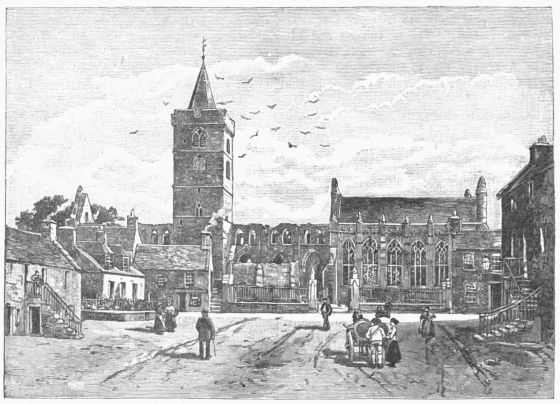
DUNBLANE IN THE 17TH CENTURY.
This excited a serious ferment amongst the people, which was greatly increased by the general opinion that these repairs should be done out of the tithes which they paid either to lay or clerical personages. Laud carried matters with far too high a hand to pay the slightest regard to these complaints, and he proceeded to consecrate such churches as were thus repaired, with all the splendid ceremony of Catholicism, as if they had been desecrated by their neglect.
He obtained a commission under the Great Seal for the repair of St. Paul's Cathedral. The judges of the prerogative courts, and their officials throughout England and Wales, were ordered to pay into the chamber in London all moneys derived from persons dying intestate, to be applied to the restoration of this church. The clergy were called on by the bishops in their several dioceses to furnish an annual subsidy for this object. The king contributed at various times ten thousand pounds, Sir Paul Pindar four thousand pounds, and Laud gave one hundred pounds a year. He was bent on making St. Paul's a rival of St. Peter's; and as more money became necessary, he summoned wealthy people into the High Commission Court on all possible pleas, and fined them heavily; so that there was a plentiful crop of money and of murmurs against the Primate, who was said to be building the church out of the sins of the people.
Laud had obtained for his devoted adherents Windebank and Juxon, Dean of Westminster, the posts of Secretary of State and of Clerk of the King's Closet respectively; thus, as Heylin observes, the king was so well watched by his staunch friends that it was not easy for any one to insinuate anything to Laud's disadvantage; and the Primate went on most sweepingly in his own way. He put down all evening lecturing, evening meetings, and extemporary praying. He re-introduced in the churches painted glass, pictures, and surplices, lawn-sleeves, and embroidered caps; had the communion-tables removed, and altars placed instead, and railed in; and he carried his innovations with such an arbitrary hand that many who might have approved of them in themselves were set against them. The stricter reformers complained of the looseness with which the Sabbath was kept, and the Lord Chief Justice Richardson and Baron Denham issued an order in the western circuit to put an end to the disorders attending church-ales, bid-ales, clerk-ales, and the like. But no sooner did Laud hear of it than he had the Lord Chief Justice summoned before the Council and severely reprimanded as interfering with the commands of King James for the practice of such Sunday sports, as recommended in his Book of Sports, and since confirmed by Charles.
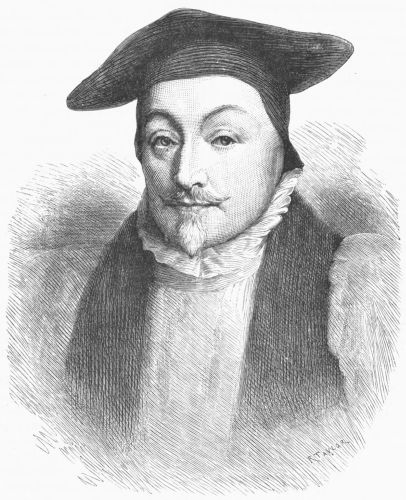
ARCHBISHOP LAUD.
The country magistrates, who had seen the demoralisation consequent on these sports and Sunday gatherings at the ale-houses, petitioned the king to put them down; and the petition was signed by Lord Paulet, Sir William Portman, Sir Ralph Hopeton, and many other gentlemen of distinction. But they were forestalled by the agility of Laud, who procured from the king a declaration sanctioning all the Sunday amusements to be found in the Book of Sports, and commanding all judges on circuit, and all justices of the peace, to see that no man was molested on that account. This declaration was ordered to be read in all parish churches by the clergy. Many conscientious clergy, who had seen too much of the dissolute riots resulting from these rude gatherings on Sundays, refused to read the declaration, and were suspended from their duties, and prosecuted to such a degree that they had no alternative but to emigrate to America.
This dictation of Laud extended over the whole kingdom, into Wales, Scotland, and Ireland. Charles was urged to issue proclamation after proclamation interfering in things entirely beyond the range of his episcopal jurisdiction, such as regulating the price of poultry and the retailing of tobacco. In Ireland, Wentworth, now made Lord Deputy, went hand-in-hand with him. That he might the better interfere in all kinds of matters Laud was appointed in 1634 Chief of the Board of Commissioners of the Exchequer, and—on the death of Weston, Lord Portland—the Lord High Treasurer. He then got his friend Juxon made Bishop of London, and in about a year surrendered to him the Treasurership, to the surprise and murmuring of many, for Juxon, till the primate brought him forward, was a man of no mark whatever. Lord Chancellor Cottington, who had been a fast friend of Laud's, and calculated on the white staff of the Treasurer, now fell away from Laud, and many noblemen who had had an eye to it began to prophesy what the end of his career would be. But the University of Oxford, going the whole way with him in his advances towards Popery, styled him "His Holiness Summus Pontifex, Spiritu Sancto effusissime plenus, Archangelus et nequid minus!" And Laud accepted all this base adulation, and declared that these revolting titles were quite proper, because they had been applied to the popes and fathers of the Romish Church. In fact, he desired to be the pope of England.
And in this great Papal authority he was fain to stretch his coercing hand over the churches wherever they were. He procured an order in Council to shut the English factories in Holland, and compel the troops serving there to conform to the Liturgy of the Church of England. Most of the merchants and many of these soldiers had gone thither expressly to enjoy their own forms of religion; but no matter, they must conform. And says Heylin, "The like course was prescribed for our factories in Hamburg, and those farther off, that is to say in Turkey, in the Mogul's dominions, the Indian islands, the plantations in Virginia, the Barbadoes, and all other places where the English had any standing residence in the way of trade." This order was to be carried into the houses and establishments of all ambassadors and consuls abroad.
William Prynne was a young graduate of Oxford, originally from Painswick, near Bath, but now an outer barrister of Lincoln's Inn. He was a thorough Puritan, grave, stern in his ideas, and rigid in his morals, a man who was ready to sacrifice reputation, life, and everything, for his high ideal of religious truth. He was persuaded that much of the dissoluteness of the young men around him arose from the debasing effect of frequenting the theatres; and in that he was probably correct, for the theatres were not in that age, nor for long after, fitting schools for youth. He therefore wrote (1632) a volume of a thousand pages against the stage, called "Histriomastix." He stated that forty thousand copies of plays had been exposed for sale within two years, and were eagerly bought up; that the theatres were the chapels of Satan, the players his ministers, and their frequenters were rushing headlong into hell. Dancing was, in his opinion, an equally diabolical amusement, and every pace was a step nearer to Tophet. Dancing made the ladies of England "frizzled madams," polluted their modesty, and would destroy them as it had done Nero, and led three Romans to assassinate Gallienus. He went on to attack everything that Laud had been supporting—Maypoles, public festivals, church-ales, music, and Christmas carols: the cringings and duckings at the altar which Laud had so much fostered, and all the silk and satin divines, their pluralities, and their bellowing chants in the Church.
Laud had made two vain attempts to lay hold on this pestilent satirist, but the lawyers had defeated him by injunctions from Westminster Hall. But the third time, by accusing him more exclusively of reflecting on the king and queen by his strictures on dancing, he obtained an order for the Attorney-General Noye to indict him in the Star Chamber. There he was condemned to be excluded from the bar and from Lincoln's Inn, to be deprived of his University degree, to pay a fine of five thousand pounds, to have his book burnt before his face by the hangman, to stand in the pillory at Westminster and in Cheapside, at each place to lose an ear, and afterwards to be imprisoned for life. This most detestable sentence was carried into effect in May, 1634, with brutal ferocity, although the queen interceded earnestly in his favour, and the nation denounced the barbarity in no equivocal language.
Prynne, undaunted, nay, exasperated to greater daring by this cruelty, resumed the subject in his prison, whence he issued a tract (1637) styled "News from Ipswich," in which he charged the prelates with being the bishops of Lucifer, devouring wolves, and execrable traitors, who had overthrown the simplicity of the Gospel to introduce the superstitions of Popery. He had found in prison a congenial soul, Dr. Bastwick, a physician, who had written a treatise against the bishops, called "Elenchus papismi et flagellum episcoporum Latialium," for which he had been condemned to pay a fine of one thousand pounds to the king, to be imprisoned two years, and to make recantation. He now, that is in 1636, wrote a fresh tract: "Apologeticus ad præsules Anglicanos," and (in 1637) the "Litanie of John Bastwick, doctor of physic, lying in Limbo patrum," in which he attacked both the bishops' and Laud's service books.
A third person was Henry Burton, who had been chaplain to Charles when on his journey to Spain; but being now incumbent of St. Matthew's, in London, he had preached against the bishops as "blind watchmen, dumb dogs, ravening wolves, anti-Christian mushrooms, robbers of souls, limbs of the beast, and factors of antichrist."
These zealous religionists, whom the cruelties and follies of Laud and his bishops had driven almost beside themselves, were condemned in the Star Chamber to be each fined five thousand pounds, to stand two hours in the pillory, where they were to have their ears cut off, to be branded on both cheeks with the letters S.L., for "seditious libeller," and then imprisoned for life.
This sentence, than which the Spanish Inquisition has nothing worse to show, was fully executed in Old Palace Yard, on the 30th of June, 1637. Prynne from the pillory defied all Lambeth, with the Pope at its back, to prove to him that such doings were according to the law of England; and if he failed to prove them violators of that law and the law of God, they were at liberty to hang him at the door of the Gate House prison. On hearing this the people gave a great shout; but the executioner, as if incited to more cruelty, cut off their ears as barbarously as possible, rather sawing than cutting them. Prynne, who is said to have had his ears sewed on again on the former occasion, had them now gouged out, as it were; yet as the hangman sawed at them he cried out, "Cut me, tear me, I fear thee not. I fear the fire of hell, but not thee!" Burton, too, harangued the people for a long time most eloquently; but the sun blazing hotly in their faces all the time, he was near fainting, when he was carried into a house in King Street, saying, "It is too hot! Too hot, indeed!"
This most disgraceful exhibition made a terrible impression on the spectators, of whom the king was informed that there were one hundred thousand; whilst the executioner sawed at the ears of the prisoners they assailed him with curses, hisses, and groans. Both Charles and Laud were unpleasantly surprised at the effect produced; and to remove the sufferers from public sympathy, they determined to send them to distant and solitary prisons, far separate from each other—to Launceston, Carnarvon, and Lancaster. But the king and his high priest were still more amazed and alarmed when they found on the removal of the prisoners the crowds were equally immense, and that they went along from place to place in a kind of triumph. To attend Burton from Smithfield to two miles beyond Highgate, there were again at least one hundred thousand people, who testified their deep sympathy, and threw money into the coach to his wife as she drove along. Money and presents were also offered to Prynne, but he refused them. Gentlemen of wealth and station pressed to see and condole with the prisoners, whom they honoured and applauded as martyrs. When Prynne reached Chester, on his way to Carnarvon, one of the sheriffs, attended by a number of gentle men, met him, invited him to a good dinner, discharged the cost, and gave him some hangings to furnish his dungeon with in Carnarvon Castle.
This popular demonstration still more startled Laud, who summoned the sheriff, as well as the other gentlemen, before the High Commission Court at York, where they were fined in sums varying from two hundred and fifty pounds to five hundred pounds, and condemned to acknowledge their offence before the congregation in the cathedral and the Corporation in the town hall of Chester. The prisoners themselves were ordered to be removed farther still, and accordingly Bastwick was sent to the Isle of Scilly, Burton to the Castle of Cornet in Guernsey, and Prynne to that of Mount Orgueil in Jersey. But the king and archbishop had now roused a spirit, by their cutting off of ears, which would be satisfied ere long with nothing less than their whole heads.
To stop the outcry against their cruelties, they next determined to gag the press. An order was therefore issued by the Star Chamber, forbidding all importation of foreign books, and the printing of any at home without licence. All books on religion, physic, literature, and poetry must be licensed by the bishops, so that all truths unpleasant to the Church would thus be suppressed. There were to be allowed only twenty master printers in the kingdom, except those of his majesty and the universities; no printer was to have more than two presses nor two apprentices, except the warden of the Company. There were to be only four letter-founders; and whoever presumed to print without licence was to be whipped through London and set in the pillory. All this time the High Commission Court kept pace with the Star Chamber in its prosecutions and arbitrary fines, under pretence of protecting public morals.
Laud soon had delinquents against the atrocious order for gagging the press. In about six months after the infliction of the sentence on Prynne and his associates, he cited into the Star Chamber John Lilburne and John Warton, for printing Prynne's "News from Ipswich" and other books called libellous (1638). The accused refused to take the oath proposed to them, protesting against the lawfulness of the court. Being called up several times, and still obstinately refusing, they were condemned to be fined five hundred pounds apiece, Lilburne to be whipped from the Fleet to the pillory, and both to be bound to their good behaviour. Lilburne was one of the most determined of men. He continued to declaim violently against the tyranny of Laud and his bishops whilst he was standing in the pillory and undergoing his whipping. He drew from his pockets a number of the very pamphlets he was punished for printing, and scattered them from the pillory amongst the crowd. The court of Star Chamber being informed of his conduct, sent and had him gagged; but he then stamped with his feet to intimate that he would still speak if he could. He was then thrown into the Fleet, heavily ironed and in solitude.
To complete Laud's attacks on all persons and parties, there lacked only an onslaught on the episcopal bench, and there he found Williams, formerly Lord Keeper, and still Bishop of Lincoln, for a victim. Williams, with all his faults, had been a true friend of Laud's at a time when he had very few, and the wily upstart had declared that his very life would be too short to demonstrate his gratitude: but he took full occasion to display towards him his ingratitude. From the moment that Laud was introduced to the king, Williams could ill conceal his disgust at the clerical adventurer's base adulation. But Laud continued to ascend and Williams to descend. Williams having lost the seals, retired to his diocese, where he made himself very popular by his talents, his agreeable manners, his hospitality, and still more by his being regarded as a victim of the arbitrary spirit of the king and of Laud. Williams, who had a stinging wit, launched a tract at the head of the Primate, called the "Holy Table," in which he unmercifully satirised Laud's parade of high altars and Popish ceremonies. The Primate very speedily had him in the Star Chamber, where he received private information that if he would give up to Laud his deanery of Westminster, that disinterested prelate would let the prosecution slip. Williams refused, and then commenced one of the most disgraceful scenes in history. Laud, Windebank, and the king were determined to force the deanery and a heavy fine from him. They browbeat his witnesses; threw them into prison to compel them to swear falsely; removed Chief Justice Heath to put in a more pliant man; and at length, through the medium of Lord Cottington, induced Williams, from terror of worse, to give up the deanery and pay a fine of ten thousand pounds. His servants and agents, Walker, Catlin, and Lunn, were fined three hundred pounds apiece, and Powell two hundred pounds.
This being done, Laud uttered a most hypocritical speech, professing high admiration of the talents, wisdom, learning, and various endowments of Williams, and his sorrow to see him thus punished, declaring that he had gone five times on his knees to the king to sue for his pardon. But even so Williams was not destined to escape. The officers who went to take possession of his effects, found amongst his papers two letters from Osbaldeston, master of Westminster School, in one of which he said that the great leviathan—the late Lord Treasurer, Portland—and the little urchin—Laud—were in a storm; and in the other, that "there was great jealousy between the leviathan and the little meddling hocus-pocus."
This, which was no crime of Williams, but of Osbaldeston, was, however, made a crime of both. Williams was condemned on the charge of concealing a libel on a public officer, and fined eight thousand pounds more, and to suffer imprisonment during the king's pleasure. The chief offender, Osbaldeston, could not be found; he had left a note saying he was "gone beyond Canterbury;" but he was sentenced to deprivation of his office, to be branded, and stand opposite to his own school in the pillory, with his ears nailed to it. He took good care, however, not to fall into such merciless hands.
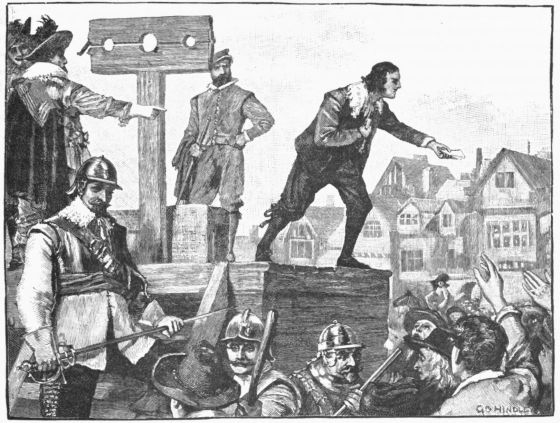
JOHN LILBURNE ON THE PILLORY. (See p. 556.)
Besides those means of raising a permanent revenue for the Crown, independent of Parliament, which we have already detailed—as tonnage and poundage, the fees on compulsory knighthood, and the resumption of forest lands,—there was discovered another which was owing to the ingenuity of Attorney-General Noye. The landed proprietors had been much alarmed by the rumours that the king would lay claim to the greater part of every county in England except Kent, Sussex, and Surrey, but the whole public was struck with consternation at the additional project of the Attorney-General. As he had been always of a surly and morose disposition, he carried this ungracious manner with him into his apostacy. Formerly he had acted like a rude ill-tempered patriot, now he was the more odious from being at once obsequious to the Crown, and coarsely insolent to those whose rights he had invaded.
In the Records of the Tower he discovered writs compelling the ports and maritime counties to provide a certain number of ships during war, or for protecting the coasts from pirates. It was now declared that the seas were greatly infested with Turkish corsairs, who not only intercepted our merchantmen at sea, but made descents on the coast of Ireland and carried off the inhabitants into slavery. The French and Dutch mariners, it was added, were continually interrupting our trade, and making prizes of our trading vessels. It was necessary to assert our right to the sovereignty of the narrow seas, which, it was contended, "our progenitors, Kings of England, had always possessed, and that it would be very irksome to us if that princely honour in our time should be lost, or in anything diminished."
But the real cause was that Charles was at that time, 1634, engaged in the treaty with Spain to assist it against the United Provinces of Holland, on condition that Philip engaged to restore the Palsgrave. Noye's scheme was highly approved and supported by the Lord Keeper Coventry. On the 20th of October, 1634, a writ was issued by the Lords of the Council, signed by the king, to the city of London, commanding it to furnish before the 1st of March next, seven ships, with all the requisite arms, stores, and tackling, and wages for the men for twenty-six weeks. One ship was to be of nine hundred tons, and to carry three hundred and fifty men; another of eight hundred tons, with two hundred and sixty men; four ships of five hundred tons, with two hundred men each; and one of three hundred tons, with one hundred and fifty men. The Common Council and citizens humbly remonstrated against the demand as one from which they were exempt by their charters, but the Council treated their objections with contempt, and compelled them to submit.
In the spring of 1635 similar writs were issued to the maritime counties, and even sent into the interior, a most unheard-of demand; and instructions were forwarded to all parts, signed by Laud, Coventry, Juxon, Cottington, and the rest of the Privy Council, ordering the sheriffs to collect the money which was to be levied instead of ships, at the rate of three thousand three hundred pounds for every ship. They were to distrain on all who refused, and take care that no arrears were left to their successors. The demand occasioned both murmuring and resistance. The deputy-lieutenants of some inland counties wrote to the Council, begging that the inhabitants might be excused this unprecedented tax; but they were speedily called before the Council, and severely reprimanded. The people on the coasts of Sussex absolutely refused to pay, but they were soon forced by the sheriffs to submit. Noye died before this took place, and squibs regarding him were publicly placarded, saying that his body being opened, a bundle of proclamations was found in his head, worm-eaten records were discovered in his stomach, and a barrel of soap, alluding to the enforcement of the monopoly on that article, was found in his paunch.
To put an end to all murmurs or resistance, Charles determined to have the sanction of the judges, knowing that he could not have that of Parliament. He therefore removed Chief Justice Heath on this and other accounts, and put in his place the supple Sir John Finch, lately conspicuous as Speaker of the Commons. The questions submitted to the judges were whether, when the good and safety of the realm demanded it, the king could not levy this ship-money, and whether he was not the proper and sole judge of the danger and the necessity. Finch canvassed his brethren of the Bench individually and privately. The judges met in Serjeant's Inn on the 12th of February, 1636, when they were all perfectly unanimous except Croke and Hutton, who, however, subscribed, on the ground that the opinion of a majority settled the matter.
To obtain this opinion, Charles had let the judges know through Finch, that he only required their decision for his private satisfaction; but they were startled to find their sanction immediately proclaimed by the Lord Keeper Coventry in the Star Chamber, order given that it should be enrolled in all the courts at Westminster, and themselves required to make it known from the Bench on their circuits through the country. Nor was this all, for Wentworth, now become a full-fledged agent of despotism, contended that "since it is lawful for the king to impose a tax towards the equipment of the navy, it must be equally so for the levy of an army; and the same reason which authorises him to levy an army to resist, will authorise him to carry that army abroad, that he may prevent invasion. Moreover, what is law in England is also law in Ireland and Scotland. This decision of the judges will, therefore, make the king absolute at home, and formidable abroad. Let him," he observed, "only abstain from war a few years, that he may habituate his subjects to the payment of this tax, and in the end he will find himself more powerful and respected than any of his predecessors."
Such were the principles of Wentworth, ready on the smallest concession to grant a dozen other assumptions upon it, and such the counsellors, himself and Laud, who encouraged the already too fatally despotic king to his destruction. The judges were, for the most part, equally traitorous to the nation, and preached the most absolute doctrines and passed the most absolute sentences. Richard Chambers, the London merchant, who had already suffered so severely for resisting the king's illegal demands, also refused payment of this, and brought an action against the Lord Mayor for imprisoning him for his refusal. But Judge Berkeley would not hear the counsel of Chambers in his defence; and afterwards, in his charge to the grand jury at York, described ship-money as the inseparable flower of the Crown. But they were not so easily to override the rights of the people of England. There were numbers of stout hearts only waiting a fitting opportunity to unite and crush the spirit of despotism now growing so rampant. One of the most distinguished of these patriots was John Hampden, a gentleman of Buckinghamshire, whose name has become a world-wide synonym for sturdy constitutional independence. He determined not only to resist the payment of ship-money, but to try the question, so as to make known far and wide its illegality. He consulted his legal friends, Holborne, St. John, Whitelock, and others, on the best means of dealing with it, and encouraged by his example, thirty freeholders of his parish of Great Kimble, in Buckinghamshire, also refused payment. No sooner, therefore, had Charles obtained the opinion of the judges, than he determined to proceed against Hampden in the Court of Exchequer. The case was conducted for the Crown by the Attorney-General, Sir John Banks, and the Solicitor-General, Sir Edward Littleton. The sum at which Hampden was assessed was only twenty shillings: the trial lasted for twelve days before the twelve judges, that is, from the 6th to the 18th of December, 1637.
It was argued on the part of the Crown that the practice was sanctioned by the annual tax of Dane-gelt, imposed by the Saxons; by former monarchs having pressed ships into their service, and compelled the maritime counties to equip them; and that the claim on the part of the king was reasonable and patriotic, for if he did not exercise this right of the Crown, in cases of danger, before the Parliament could be assembled serious damage might accrue. The Crown lawyers ridiculed the refusal of a man of Mr. Hampden's great estates to pay so paltry a sum as twenty shillings; and declared that the sheriffs of Bucks ought to be fined for not putting upon him twenty pounds. But it was replied upon the part of Hampden, that the amount of the assessment was not in question, it was the principle of it. Nor could the Dane-gelt give evidence in the case, the imperfect accounts to be drawn on the subject from our ancient writers being too vague and uncertain. Moreover, the practice of monarchs before or after Magna Charta could not establish any law on the subject, for Magna Charta abrogated any arbitrary customs that had gone before, and strictly and clearly forbade them afterwards. No breach of that great Charter could be pleaded against it, for it was paramount and perpetual in its authority. Again, various statutes since, and last of all the Petition of Right, assented to by the king himself, made any such taxation without consent of Parliament illegal and void; while the very asking of loans and benevolences by different monarchs was sufficient proof of this, for if they had the right to tax, they would have taxed, and not borrowed. The most arbitrary prince that ever sat on the English throne—Henry VIII.,—when he had borrowed, and was not disposed to repay, did not consider his own fiat sufficient to cancel the debt, but called in Parliament to release him from the obligation. They reminded the judges of Edward I.'s confirmation of the charters, and of the statute De Tallagio non concedendo. As to the plea of imminent danger from foreign invasion, as in the case of the great Armada, as the Crown lawyers had mentioned, such cases, they argued, were next to impossible; notices of danger, as in the instance of the Armada itself, being obtained in ample time to call together Parliament. In this case there was no urgency whatever to forestall the measures of Parliament; for neither the insolence of a few Turkish pirates, nor even the threats of neighbouring States, were of consequence enough to warrant the forestalling of the constitutional functions of Parliament.
The Crown lawyers, baffled by this unanswerable statement, then unblushingly took their stand on the doctrine that the king was bound by no laws, but all laws proceeded from the grace of the king, and that this was a right which all monarchs had reserved from time immemorial. Justice Crawley declared that the right of such impositions resided ipso facto in the king as king, that you could not have a king without these rights—no, not by Act of Parliament. "The law," said Judge Berkeley, "knows no such king-yoking policy. The law is an old and trusty servant of the king's; it is his instrument or means which he useth to govern his people by. I never read or heard that Lex was Rex, but it is common and most true that Rex is Lex." The pliable Finch said, "Acts of Parliament are void to bind the king not to command the subjects, their persons, and goods, and, I say, their money, too, for no Acts of Parliament make any difference." Certainly they made no difference to him; and if these base lawyers could have talked away the rights of the people of England, they would have done it for their own selfish interests. When Holborne contended that it was not only for themselves, but for posterity, that they were bound to preserve the constitution intact, Finch testily exclaimed, "It belongs not to the Bar to talk of future governments; it is not agreeable to duty to have you bandy what is the hope of succeeding princes, when the king hath a blessed issue so hopeful to succeed him in his crown and virtues." But Holborne replied, "My lord, for that whereof I speak, I look far off—many ages off; five hundred years hence!"
But all the judges were not of like stamp. Hutton and Croke, who had dissented when the opinion of the judges was first taken, now made a bold stand against the illegal practice. As the ruin of a judge who thus dared to act in upright independence was pretty certain at that time, we may estimate the degree of virtue necessary to such decision, and the noble self-sacrifice of Lady Croke, who bade her husband give no thought to the consequences of discharging his duty, for that she would be content to suffer want, or any misery with him, rather than he should do or say anything against his judgment and conscience.
The case was not decided till the Trinity Term, the third term from the commencement of the trial, when, on the 12th of June, 1638, judgment was entered against Hampden in the Court of Exchequer. But even then five of the judges had the courage to decide for Hampden, though three of them did this only on technical grounds, conceding the main and vital question. The decision of this most important trial was apparently in favour of the king, and there was, accordingly, much triumphing at Court; but in reality, it was in favour of the people, for it had been so long before the public, and the arguments of Hampden's counsel were so undeniable, those of the Crown so absolutely untenable, and opposed to all the history of the nation, that the matter was everywhere discussed, and men's opinions made up that, without a positive resistance to such claims and such doctrines as had here been advanced, the country was a place of serfdom, and the bloodshed and the labour of all past patriots had been in vain. It was accordingly found that people were more averse than ever from paying these demands; and even the courtly Clarendon confesses that "the pressure was borne with much more cheerfulness before the judgment for the king than ever it was after." Lord Say made a determined stand against it in Warwickshire, and would fain have brought on another trial like that of John Hampden; but the king would not allow another damaging experiment; and events came crowding after it of such a nature, as showed how deep the matter had sunk into the public mind.
The course which matters were taking was exceedingly disgusting to the ministers of King Charles—Laud and Wentworth. The latter had been appointed Lord President of the North, where he had ruled with all the overbearing self-will of a king. The Council of the North had been appointed by Henry VIII., to try and punish the insurgents concerned in the Pilgrimage of Grace, and it had been continued ever since on as lawless a basis as that of the Star Chamber itself. In fact, it was the Star Chamber of the five most northern counties of England, summoning and judging the subjects without any jury, but at the will of the Council itself. Wentworth had risen from a simple baronet to be Privy Councillor, baron and viscount, and President of the North, with more rapidity than Buckingham himself had done. On accepting this last office, his power and jurisdiction were enlarged, and he displayed such an unflinching spirit in exercising the most despotic will, that on difficulties arising in Ireland, he was, without resigning his Presidency of the North, transferred thither, where Charles had resolved to introduce the same subjection to his sole will as in England and Scotland.
When the unfortunate expedition to Cadiz had been made, and the king feared the Spaniards would retaliate by making a descent on Ireland, he ordered the Lord-Deputy, Lord Falkland, to raise the Irish army to five thousand foot and five hundred horse. There was no great difficulty in that, but the question how they were to be maintained was not so easy. Lord Falkland, who was one of the most honourable and conscientious of men, called together the great landed proprietors, and submitted the matter to their judgment. These, who were chiefly Catholics, offered to advance the necessary funds on condition that certain concessions should be made to the people of Ireland. These were, that, besides the removal of many minor grievances, the recusants should be allowed to practise in the courts of law, and to sue the livery of their lands out of the court of wards on their taking the oath of Allegiance without that of Supremacy; that the Undertakers on the several plantations should have time to fulfil the conditions of their leases; that the claims of the Crown should be confined to the last sixty years, the inhabitants of Connaught being allowed a new enrolment of their estates; and finally, that a parliament should be held to confirm these graces, as they were called.
Delegates were sent to London to lay these proposals before the king, and on the agreement to pay one hundred and twenty thousand pounds by instalments in three years, Charles readily granted these articles of grace, amounting to fifty-one. But meanwhile, a rumour of these concessions having got out, the Irish Established Church had made a great opposition, and though the parliament was called, nothing was done, nor did Charles intend to do more than get the money. As Lord Falkland was the last man in the world to be a party to anything so dishonourable, he was recalled, and Wentworth was sent over, in the July of 1632, to do the work.
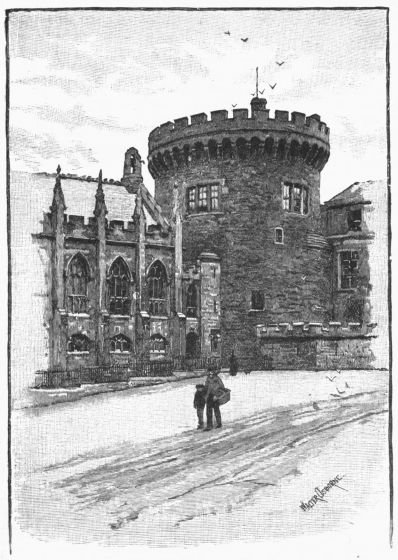
THE BIRMINGHAM TOWER, DUBLIN CASTLE.
Wentworth's arrival in Ireland was tantamount to a revolution there. He introduced all the regulations of the English Court at the Castle, assumed a guard like the king, which no Deputy before him had done, and carried himself with a haughty demeanour which made the Irish lords stand amazed. The only good which he effected was in putting down the multitude of minor tyrants, but then he combined all their tyranny and oppressions in himself. He was ready to bear any amount of odium, because he trusted to the king's support. His object was to raise a large permanent revenue, and Wentworth soon informed Charles that if this was to be done, there must be an end to making grants to needy English nobles, who absorbed what should flow to the Crown. Charles had promised such grants to the Duke of Lennox, the Earl of Arundel, and others; but on learning Wentworth's views, Secretary Windebank wrote, at the king's command, that Wentworth was at liberty to refuse them these grants, provided that he took "the refusing part" on himself.
As a first measure to raise money, he informed Charles that it would be necessary to call a Parliament. The king, who had found Parliaments too much for him, and was endeavouring to live without them, heard the proposal with consternation, and warned Wentworth against such an attempt; but the Lord Deputy informed him that he had a plan by which he could manage them, and Charles wrote to him, consenting, but still warning. "As for that hydra, take good heed, for you know that here I have found it as well cunning as malicious. It is true that your grounds are well laid, and I assure you that I have a great trust in your care and judgment; yet my opinion is, that it will not be the worse for my service though their obstinacy make you to break them, for I fear they have some ground to demand more than it is fit for me to give."
Wentworth knew that very well, but meant to grant nothing of the kind. He sent out a hundred letters of recommendation in favour of the return of candidates on whom he could rely, and procured a royal order for the absent peers to send blank proxies, which he might fill up as he pleased. These were considerable in number, and consisted chiefly of Englishmen who had obtained their estates or titles from Charles or his father. Thus he secured a majority; and on opening Parliament he informed the members that he meant to hold two Sessions—one for the benefit of the king, the other for redressing the grievances of the people. Had the Irish noticed what had been going forward in England, they would have augured no good from such an arrangement, and might have followed the example of the English Commons, who would always insist on stating their grievances before parting with their money. But the unfortunate Irish listened to the dulcet tones of the Lord-Deputy, who assured them that if they put their trust in him and the king they would have the happiest Parliament that had ever sat in that kingdom. He talked of the misfortunes which had happened to the English Parliament through distrusting the king—he himself having been one of the chief actors in these distrusts—and on his assuring them that he was anxious to hasten to the second Session and the removal of all their grievances they voted him out of the fulness of their confidence six subsidies of larger amount than had ever been granted before.
But when they came to the second Session, awful was the astonishment, and terrible the consternation, of the liberal granters of subsidies. The shameless trickster coolly informed them that of the fifty-one graces promised them by the king, very few were of a kind which he, who knew the circumstances of the country, could grant. In vain they reminded him of his promises, and called on him to fulfil them. He gave them menaces instead of promises, launched at them the most biting sarcasms, and made them appear a set of criminals rather than deceived and insulted legislators. His majority carried everything as he pleased, and after passing a few insignificant graces, he negatived the bulk of them, including all the important ones, and dismissed the Parliament.
He had been equally successful with the Convocation. He obtained from it eight subsidies of three thousand pounds each, but he then refused to grant the conditions promised. It was the settled plan of the king, supported by Laud, to conform both the Scottish and Irish Churches to the English, and Wentworth was the most unscrupulous agent in such a work that they could have. The Irish prelates informed him that their Church was wholly independent of that of England, had its own Articles, of the Calvinistic class, and owed no obedience to the See of Canterbury. He insisted, however, that they must admit the Thirty-nine Articles of England; it was not necessary to parade them before the people, but they must be admitted, and the old Irish Articles might quietly die out. The prelates set about to frame a new code of ecclesiastical discipline; but to his surprise, he learned that they had rejected the English Articles and retained their own. He sent for the Archbishop and the Committee, upbraided the Chairman with suffering such a proceeding, took possession of the minutes, and ordered Archbishop Ussher himself to frame a canon authorising the English Articles. Ussher's production, however, did not satisfy him; he therefore drew up a form himself, and sent it to the Convocation, commanding that no debate should take place, but the Articles should be at once adopted, and informing them that every one's vote should be reported to him. Only one member of the whole Convocation dared to vote against his will; the rest submitted, but with the utmost indignation.
Having thus with a high hand carried his measures—refused the confirmation of the graces, conformed the Irish to the English Church in one Session, and obtained such an amount of money as would not only pay off the debts of the Crown, but would supply for some years the extraordinary demands of the Government, he wrote exultingly to England, declaring that the king was as absolute in Ireland as any king in the world, and might be the same in England if they did their duty there. He boldly demanded an earl's coronet, on account of these services, which, however, Charles deferred for awhile, thinking that he should hold such a man to his work rather by the hope than the possession of high preferment. Wentworth was so delighted with his overruling the Irish Parliament, that he proposed to the king to merely prorogue and not dissolve it, as being the most convenient instrument for effecting his further designs on the country. But Charles would not listen to it, remarking that parliaments were like cats, they ever grew cursed with age, and it was better to put an end to them early, young ones being most tractable. He thanked him for what he had done, and especially for saving him from the odium of breaking his promise about the graces.
How little did this bold bad man see that, whilst he was serving the king's worst purposes, he was preparing his own destruction. In fact, though he had stunned the Irish for a moment by the audacity of his bearing, he had struck deep into their souls a resentment that no man, however powerful or subtle, could withstand. He was, however, only on the threshold of the sweeping changes which he contemplated in that country, for he was resolved to reduce it to a condition of absolute dependence on the Crown. He was not content with forcing the English Articles on the Irish Church, but he refused to the Catholics every relief that Charles had pledged himself to in order to get their money. Instead of abolishing, as promised, the oppressive power of the court of wards, he gave them a more virulent activity. The Catholic heir was still obliged to sue out the livery of his lands, and before he could obtain them, to take the oaths of Allegiance and Supremacy. To obtain his rightful property, he was thus compelled to abjure his religion. But he entertained a still more gigantic design, which was to seize on the fee simple of the greater part of Ireland, on pretence of defective title.
We have seen that in the reigns of Elizabeth and James the titles of the great landed proprietors both in Connaught and Ulster had been called in question, and those monarchs had pretended to renew them on condition of certain payments. These conditions had been repeatedly fulfilled by the proprietors, but not by the Crown. Charles, in 1628, amongst the other benefits promised, had engaged to ratify these titles; but Wentworth showed him the folly of doing that while by alarming them on the point he might draw immense sums from them, or get possession of the lands. To this proposal Charles consented, and the experiment was begun with Connaught. Wentworth proceeded (1635) at the head of a commission, to hold an inquisition in every county of Connaught. He opened his proceedings at Roscommon, where he summoned a jury of "gentlemen of the best estates and understandings," that more weight might attach to their decisions if favourable, or that, if adverse, he might levy heavy fines upon them. He assured the jury that his majesty merely meant to ascertain the condition of all titles, in order that if defective he might render them legal. It was on this plea that the freeholders had been wheedled into the surrender of their deeds and patents by Elizabeth and James; but Wentworth added another alarming fiction. He contended that Henry III., reserving only five cantreds to himself, had given the remainder to Richard de Burgh, to be holden of him and his heirs of the Crown, and that those tenures had now descended to the present king, by the marriage of the heirs of De Burgh with the royal line. According to this the king was the rightful owner of every acre of land in Ireland. He assured the jury, therefore, that it was their best interest to give a general verdict for the king, as he could without their consent establish his right, and if compelled to do that in opposition to them, the result might be much worse for them. By these means he induced the juries in Roscommon, Sligo, Mayo, Clare, and Limerick, to return a verdict in favour of the Crown, but the people of Galway stoutly resisted. They declared that the title of the king, through Edward IV., from Richard de Burgh, could not be proved; there was a hiatus in the genealogy. They were all Catholics, and were the more resolute from having been so shamefully deluded in the matter of wardship. Wentworth was rather glad to be able to make an example of them, and he therefore fined the sheriff one thousand pounds for returning so obstinate and perverse a jury, and dragged the jury into his Star Chamber, the chamber of the Castle, and fined them four thousand pounds apiece. He fell with especial vindictiveness on the old Earl of Clanricarde, and other great landowners of Galway, and set about to seize the fort of Galway, march a body of troops into the country, and compel it to submit to the king's will. The proprietors, disbelieving that the king could know of or sanction such infamous breaches of faith and acts of oppression, sent over a deputation to Charles to lay the matter before him. But the king received them with reproaches, declared his full approval of the proceedings of the Lord-Deputy, and sent them back to Ireland as State prisoners. The old Earl of Clanricarde, whose son had been the head of the deputation, died soon after receiving the news of this conduct of the monarch, and Wentworth wrote to Charles that he was accused of being the cause of his death. "They might as well," he remarked haughtily, "impute to me the crime of his being threescore and ten." He was still busily pursuing other noblemen with the same rancour—the Earl of Cork, Lord Wilmot, and others—when the Catholic party in England, who had a friend in Queen Henrietta, made their complaints heard at Whitehall. Laud, who was acting as outrageously himself in England, informed Wentworth of it, and even hinted more caution, observing that if he could find a way to do all those great services without raising so many storms, it would be excellently well thought of. But Wentworth was as little disposed to avoid storms as his adviser himself. He proceeded in the same autocratic style both towards the public and individuals. It had been the original intention to return to the proprietors three-fourths of their lands, and retain one-fourth for the Crown, amounting to about one hundred and twenty thousand acres, which were to be planted with Englishmen, on condition of yielding a large annual income to the Crown. But now it was resolved to retain a full half of Galway as a punishment of its obstinacy, and Wentworth was proceeding with the necessary measurements, when his career proved at an end.
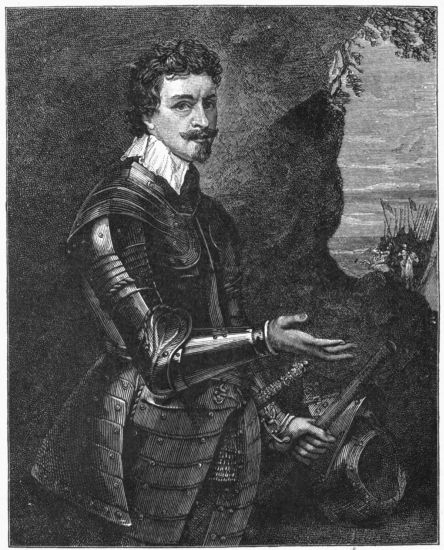
SIR THOMAS WENTWORTH (EARL OF STRAFFORD).
(After the Portrait by Vandyke.)
The individual acts of injustice which he perpetrated were done at the suggestion of his profligate desires or personal revenge, with the most unabashed hardihood. He had seduced the daughter of Loftus, the Lord Chancellor of Ireland, wife of Sir John Gifford, and wanted to confer a good post on her relative Sir Adam Loftus. Such an opportunity soon occurred by an inadvertent expression of Lord Mountnorris, Vice-Treasurer of Ireland. It happened one day that Annesley, a lieutenant in the army, accidentally set a stool on the foot of the Lord-Deputy, when he was suffering from the gout. This Lieutenant Annesley had some time before been caned by Wentworth in a paroxysm of passion, and Mountnorris hearing the incident of the stool mentioned at the table of Chancellor Loftus, said, "Perhaps Annesley did it as his revenge, but he has a brother who would not have taken such a revenge." This being repeated to Wentworth, he treated the observation as a suggestion to Annesley to perpetrate a more bloody revenge; and though he dissembled his resentment for some time, he then accused Mountnorris, who was also an officer in the army, of mutiny, founded on this expression. Wentworth attended the court-martial to overawe its proceedings, and obtained a sentence of death against Mountnorris. The sentence was too atrocious to be carried into execution, but it served Wentworth's purpose, for he cashiered Mountnorris and gave his office to Loftus. Much as the Irish had suffered before, this most lawless act excited a loud murmur of indignation throughout the land; but Wentworth had secured himself from any censure from the king by handing him six thousand pounds as the price of the transfer of Mountnorris's treasurership to Sir Adam Loftus.
The resentment of the Irish was becoming so strong against Wentworth, that the king thought it safest for him to come to England for a time; but he soon returned thither, with the additional favour of the monarch, where he remained till summoned by Charles to assist him by his counsels against the Scots. But the fatal and memorable year 1640 was at hand, to close the story of his tyrannies. We must now retrace our steps, and bring up the conflicts of Scotland with the same blind and determined despots to that period.
The storm against the despotism of Charles had broken out in that country. From the moment of his visit to Edinburgh with his great apostle Laud, he had never ceased pushing forward his scheme of conforming the Presbyterian Church to Anglican episcopacy. He had restored the bishops on that occasion, given them lands, erected deans and chapters, and Laud had consecrated St. Giles's Church as a Cathedral. As he could not persuade the Scottish Peers to submit to the liturgy as used in England, which his father had attempted in vain before him, he consented that a liturgy should be drawn up by four Scottish bishops, who were also to form a code of ecclesiastical canons. They were to introduce into the latter some of the acts of the Scottish assemblies, and some more ancient canons, to make the whole more palatable. These laws and the liturgy were afterwards revised by the Archbishop of Canterbury and the Bishops of London and Norwich, and Charles ordered the amended copies to be published and preserved.
None but a monarch so foolhardy as Charles would have dared such an experiment on the Scots who had resisted so stoutly his father, and had driven his grandmother from the country for her adhesion to Popery. The people received the publication of the canon with unequivocal indications of their temper; and when, therefore, the first introduction, of the liturgy was fixed for the 23rd of July, 1637, in St. Giles's Church, they went thither in crowds, to give a characteristic reception. The archbishops and bishops, the Lords of Session, and the magistrates went in procession, and appeared there in all their official splendour. This display, however, so far from imposing on the people of Edinburgh, only excited their wrath and contempt, as the trumpery finery of the woman of Babylon. A considerable riot ensued, during which a woman named Jenny Geddes is said to have thrown a stool at the bishop's head. The story is, however, supported by indifferent evidence.
But it was not merely the base multitude, the nobility were as violent against the new Liturgy as the people, and came to high words with the bishops and their favourers amongst the clergy. Four ministers—Alexander Henderson, of Leuchars; John Hamilton, of Newburn; James Bruce, of Kingsbarns, and another—petitioned the Council on the 23rd of August, to give them time to show the anti-Christian and idolatrous nature of this ritual, and how near it came to the Popish mass, reminding them that the people of Scotland had established the independence of their own Church at the Reformation, which had been confirmed by Parliament and General Assemblies, and that the people, instructed in their religion from the pulpit, were not likely to adopt what their fathers had rejected as contrary to the simplicity of the Gospel. But the Bishop of Ross, Laud's right-hand man, replied for the Council that the liturgy was neither superstitious nor idolatrous, but according to the formula of the ancient Churches, and they must submit to that or to "horning," that is, banishment. Still the Council delayed, and the people were pretty quiet during the harvest time, but that over, the news having arrived of a peremptory message from the king, commanding the enforcement of the liturgy, and the removal of the Council from Edinburgh to Linlithgow, thence in the following term to Stirling, and for the next to Dundee, the people flocked into Edinburgh, and, incensed at the idea of their ancient capital being deprived of its honours as the seat of government, they became extremely irritated, attacked the bishops when they could see them, and nearly tore the clothes from the back of the Bishop of Galway. He escaped into the Council House, and the members of the Council in their turn sent to demand protection from the magistrates, who could not even protect themselves.
For greater security the Council removed to Dalkeith, and the Marquis of Hamilton recommended to Charles to make some concessions; but far from giving way, a more positive order for the enforcement of the obnoxious liturgy arrived from the king. But it was found impossible to enforce it: the Earl of Traquair was summoned up to London, sharply questioned as to the causes of the delay, and was sent back with more arbitrary commands. On the 18th of October these were made known, and fresh riots took place, Traquair and two of the bishops nearly losing their lives. The king then consented to the petitioners above mentioned being represented by a deputation personally resident in Edinburgh. The object was to induce the crowds of strangers to withdraw to their homes, when it was thought the people of Edinburgh alone might be better dealt with; but the advocates of the people seized on the plan, and converted it into one of the most powerful engines of opposition imaginable.
At the head of these able politicians, and the contrivers of this profoundly sagacious scheme, were the Lords Rothes, Balmerino, Lindsay, Lothian, Loudon, Yester, and Cranstoun. Balmerino had been severely treated by Charles, and had thus become hardened into the most positive opponent of the episcopal movement. In his possession in 1634 was a copy of a petition to the Scottish Parliament, too strong in its language even for the Scottish dissentients to present. He had, under pledge of strictest secrecy, lent this to a friend. For this he was committed to prison, and at the instigation of Spottiswood, Archbishop of St. Andrews, it was resolved to prosecute him for high treason, and a verdict was procured against him. But the people were so enraged that they assembled in vast crowds, vowing to murder both the jurors who had given the verdict and the judges who had accepted it. Government was alarmed, and the king was reluctantly induced to grant Balmerino a pardon. From that moment he became the champion of the people.
He and his colleagues the nobles, the gentry, the Presbyterian clergy, and the inhabitants of the burghs, formed themselves into four "Tables" or Committees, each of four persons, and each Table sent a representative to a fifth Table, a Committee of superintendence and government. Thus in the capital there were sitting five Tables or Committees, to receive complaints and information from the people, and decide on all these matters. Throughout the country were speedily established similar Tables, with whom they corresponded. Thus, instead of that mere representation of the petitioners which the king contemplated as an expedient for getting rid of the immediate pressure of the people, one of the most perfect and most powerful systems of popular agitation was organised that the world had ever seen. There was the most instant attention to the suggestions of the people by the provincial Tables, and the most prompt and respectful consideration of their reports by the Tables in the capital. A permanent government of the people was, in fact, erected, to which the public looked with the utmost confidence, and by which step its whole weight was brought to bear on the unpopular government of the king.
The formidable nature of this novel engine of the popular will was quickly perceived by the Court; and Traquair was ordered to issue a proclamation declaring the Tables to be unlawful, commanding all people to withdraw to their own homes, and menacing the penalties of treason against all who disobeyed. This proclamation was made by Traquair at Stirling, on the 19th of February, 1638; but it was disregarded. The Tables had procured early information of the forthcoming proclamation, and had summoned the provincial Tables from all parts to assemble in Edinburgh and Stirling. These cities were thus crowded with the very life and soul of the whole agitation. They had already risen in their demands as they perceived their strength, and had ceased to petition for time and some trifling alterations in "the buke." They demanded the formal revocation of the liturgy, the canons, and the Court of High Commission. Now, no sooner had the herald read the royal proclamation than the Lords Hume and Lindsay read a counter proclamation, saw it affixed to the market cross, and copies sent to Edinburgh and Linlithgow, to be read and publicly placarded there.
Traquair, who had clearly foreseen these consequences, and in vain warned the king to avoid them by timely concession, wrote to Hamilton, informing him of what had taken place, and that there was no power in the kingdom capable of forcing the liturgy down the people's throats; that they would receive the Mass as soon. His words received a speedy confirmation. The Tables determined to publish a Solemn Covenant between the people and the Almighty to stand by their religion to the death. Their fathers, at the time of the Reformation, had adopted such an instrument. The great nobles of the time had sworn to maintain the principles of Wishart and Knox, and to defend the preachers of those doctrines against the powers of Antichrist and the monarchy. James had sworn to adhere to this confession of faith, with all their households and all classes of people, in the years 1580, 1581, and 1590. The name of Covenant was thus become a watchword to the whole nation, which roused them like a trumpet. This document had been composed by Alexander Henderson, one of the four ministers who had petitioned, and Archibald Johnstone, an advocate, the legal adviser of the party; and had been revised by Balmerino, Loudon, and Rothes.
This famous document began by a clear exposition of the tenets of the Reformed Scottish Church, and as solemn an abjuration of all the errors and doctrines of the Pope, with his "vain allegories, rites, signs, and traditions." It enumerated the anti-Christian tenets of Popery—the denial of salvation to infants dying without baptism; the receiving the Sacrament from men of scandalous lives; the devilish Mass; the canonisation of men; the invocation of saints; the worshipping of imaginary relics and crosses; the speaking and praying in a strange language; auricular confession; the shaveling monks; bloody persecutions; and a hundred other abominations. All these were made as great offences against the Anglican hierarchy, which was fast running back into those "days of bygone idolatry." The various classes—"noblemen, barons, gentlemen, burgesses, ministers, and commons"—bound themselves by the Covenant to defend and maintain the reformed faith before God, His angels, and the world, till it was again established by free Assemblies and Parliaments, in the same full purity and liberty of the Gospel as it had been heretofore.
On the 1st of March, 1638, the church of St. Giles, which had witnessed so lately the hasty flight of the bishops, was thronged with the Covenanters of all ranks and from all parts of the country. The business was opened by a fervent prayer from Henderson, and then the people were addressed in a stirring harangue by the Earl of Loudon, the most eloquent man in Scotland. The effect was such that the whole assembly rose simultaneously, and with outstretched arms, amid torrents of tears, swore to the contents of the Covenant. That done, they turned and embraced each other, wept, and shouted aloud their exultation over this great victory, for such they felt it, in the united energy and religious dedication of the nation.
Dispersing to their various homes, the delegates carried the fire of this grand enthusiasm with them. Over moor and mountain it flew, across the green pastoral hills of the South, through the dark defiles of the Highlands, and to the sea-swept isles. Thousands continued to pour into the capital to add their signatures to the Covenant; and in every parish on the Sunday the people streamed to listen to the fiery harangues from the pulpits, and to give in their names, with the same tears, emotions, and embraces as in Edinburgh. It was soon found that, except in the county of Aberdeen, the Covenanters outnumbered their opponents in the proportion of one hundred to one.
Nor did these determined reformers readily admit of any dissent or lukewarmness. Where they found any opposed or inert, they roused them by threats, and often by blows and coercion. Some they threw into prison, and some they set in the stocks for refusing to sign. The Catholics were those who principally stood aloof; but these were not calculated at a thousand in all Scotland. Of such they entered the names in a list, and made calculations of their property, with a view to confiscation. In Lanark and other places the contending factions came to blows before the lists were filled up. Active subscriptions were levied for the maintenance of the Cause, and before the end of April there was scarcely a single Protestant who had not signed the Covenant. The bishops had fled to England, and all Scotland stood ready to fight for its faith.
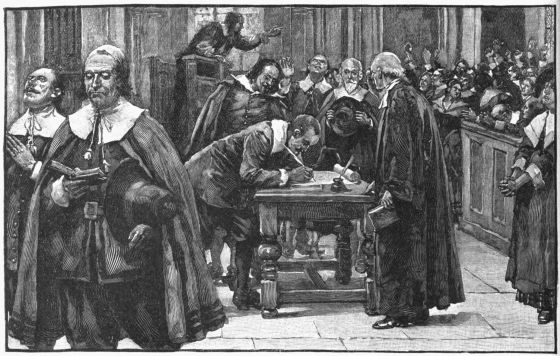
THE PEOPLE SIGNING THE COVENANT IN ST. GILES'S CHURCH, EDINBURGH. (See p. 567.)
Here was a spectacle which would have shown the folly of his career to any other monarch; but all reason or representation was wasted on Charles. Traquair entreated him, before plunging into war, to listen to the counsels of his most experienced Scottish Ministers; but Charles seldom listened to anything except his own self-will, or any person except his fatal counsellors, Laud and Wentworth. He is said on this occasion to have consulted with a small council of Scotsmen living in England, which had been formed by James on his accession to the English throne, and in accordance with their advice and in opposition to that of the Council in Scotland, he resolved on suppressing the Covenant by force.
In May he sent the Marquis of Hamilton to Scotland, with orders to endeavour to soothe the people by assuring them that the liturgy and canons should only be exercised in a fair and gentle manner, and that the High Commission Court should be so remodelled as to be no grievance. If these promises did not satisfy them, as Hamilton must have known they would not, for Charles's promises were too notorious to be of any value, he was to resort to any exercise of force that he thought necessary.
On the 3rd of June he arrived at Berwick, and sent to the nobility to meet him at Haddington; but no one appeared except the Earl of Roxburgh, who assured him that anything but a full revocation of the canons and liturgy was hopeless. On reaching Dalkeith he was waited on by Lord Rothes, who, on the part of the Covenanters, invited him to take up his abode in Holyrood as more convenient for discussion.
Hamilton objected to enter a city swarming with Covenanters, where the castle was already invested by their guards. These, it was promised him, should be removed and the city kept quiet, on which he consented; and on the 8th of June he set forward. But he found the whole of the way, from Musselburgh to Leith and from Leith to Edinburgh, lined with Covenanters, fifty thousand in number. There were from five to seven hundred clergymen collected; and all the nobility and gentry assembled in the capital, amounting to five thousand, came out to meet and escort him in. All this he was informed was to do him honour, but he felt that its real design was to impress him with the strength of the Covenant party.
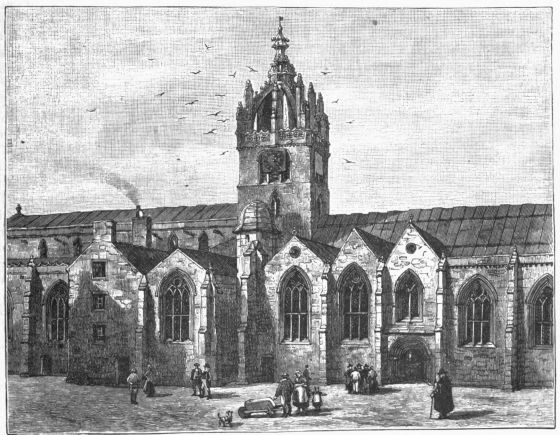
ST. GILES'S CHURCH, EDINBURGH, IN THE 17TH CENTURY.
Being settled in Holyrood, Hamilton received a deputation of the heads of the League, and asked them what they required to induce them to surrender opposition. They replied that in the first place they demanded the summons of a General Assembly and a Parliament. They then renewed the guard at the castle, and doubled the guards and watches of the city. The preachers warned the people to be on their guard against propositions. They informed the marquis that no English Service Book must be used in the royal chapel, and they nailed up the organ as an "abomination to the Lord." They then waited on Hamilton, requesting him and his officers to sign the Covenant, as they hoped to be regarded as patriots and Christians. The ministers whom the oppressions of Wentworth had chased out of Ulster to make way for the Anglican service were in Edinburgh, inflaming the people by their details of the cruelties and broken promises of Charles and his Lord-Lieutenant in Ireland.
Hamilton saw that it was useless to publish Charles's proclamation, but wrote advising him to grant them their demands, or to lose no time in appearing with a powerful army. Charles replied desiring him to amuse the Covenanters with any promises that he pleased, so that he did not commit the king himself. He was to avoid granting an Assembly or Parliament, but he added, "Your chief end being now to win time, they may commit public follies until I be ready to suppress them." The marquis, therefore, endeavoured to spin out the time by coaxing and deluding the Covenanters. He promised to call a General Assembly and a Parliament, and redress all their grievances. When pressed too closely, he declared that he would go to London himself and endeavour to set all right with the king; but this was part only of the plan of gaining time whilst Charles was preparing a fleet and army. But the Scots were too wary to be thus deceived. They had information that troops were being raised in England, and they too made preparations. At the same time they waited on the marquis, professing the most unabated loyalty, but resolute to have free exercise of their religion. Hamilton promised to present their address to the king, and set out on the 4th of July for England. He informed Charles of the real state of the country, and that the very members of the Privy Council were so infected by the Covenant that he had not dared to call them together. But Charles was not to be induced to take any effective measures for pacifying the public mind of Scotland. His instructions to the marquis were to amuse the people with hopes, and to allow of the sitting of a General Assembly, but not before the 1st of November. He was even to publish the order for discharging the use of the Service Book, the canons, and the High Commission Court, but was to forbid the abolition of bishops, though the bishops were for the present not to intrude themselves into the Assembly. They were, however, to be privately held to be essentially members of the Assembly, and were to be one way or other provided for till better times.
These half measures were not likely to be accepted, but they would serve Charles's grand object of gaining time, and the marquis arrived with them in Edinburgh on the 10th of August. Three days after his arrival the Covenanters waited upon him to learn how the king had received their explanations, and the marquis assured them with much grace and goodness; but when they heard that the bishops were not to be abolished, they treated his other offers with contempt, and Hamilton once more proposed to journey to England to endeavour to obtain a full and free recall of all the offensive ordinances. Before taking his leave, as a proof of his earnestness, he joined with the Earls of Traquair, Roxburgh, and Southesk, in a written solicitation to his Majesty to remove all innovations in religion which had disturbed the peace of the country. By the 17th of September Hamilton was again at Holyrood. On the 21st he received the Covenanters and informed them that he had succeeded; that the king gave up everything; that an Assembly was to be called immediately, and a Parliament in the month of May next; and that the king revoked the Service Book, the Book of Canons, the five Articles of Perth, and the High Commission. The Covenanters were about to express their unbounded satisfaction and loyal gratitude, when the marquis added that his Majesty only required them to sign the old confession of faith as adopted by King James in 1580 and 1590. This single reservation broke the whole charm; their countenances fell, and they declared that they looked upon this as an artifice merely to set aside their new bond of the Covenant.
In all Charles's most solemn acts the cloven foot showed itself. Even when seeming most honest, there was something which awoke a distrust in him. He was not sincere, and he had not the art to look so. In any other monarch the positive assurance that the innovations on the religion of Scotland should be abandoned, would have settled the matter at once; but Charles had so utterly lost character for truth and good faith that it was believed throughout the country that he was still only deluding them, and seeking time ultimately to come down resistlessly upon them. And we know from his own correspondence preserved in the Strafford Papers that it was so. These words addressed to Hamilton, "Your chief end is to win time, that they may commit public follies, until I be ready to suppress them," are an everlasting proof of it. Besides, they had ample information from friends about the Court in England that this was the case, and that in a few months the king meant to visit them with an irresistible force. The people of England were suffering too much from the same species of oppression not to sympathise warmly with the Scottish patriots, and keep them well informed of what was going on there. We find it asserted in the Hardwicke State Papers that the Government was very jealous of the number of people who went about England selling Scottish linen, and it was recommended to open all letters going between the countries at Berwick.
The Covenanters therefore determined to hold together and be prepared. On the 22nd of September, 1638, the Marquis of Hamilton caused the royal proclamation to be read at the market-cross at Edinburgh, abandoning the Anglican Service and the High Commission Court; but as it required subscription to the old confession of faith, there was no rejoicing on the occasion. There were two particulars in this proclamation which fully justified the Scots in refusing to comply with it. It stated that the vow of the Covenant was unauthorised by Government, and therefore illegal; and it professed to grant a pardon for that act to all who signed the confession, which would have acknowledged that the nation had been guilty of a crime in accepting the Covenant, a thing they were not likely to admit, for in that case they could not have refused the re-admission of the very liturgy against which they were at war. They therefore published a protest against the proclamation, founded on these reasons.
The marquis having obtained the signature of the Lords of the Secret Council to the new bond, which Charles had previously signed, though it contained many clauses repugnant to Arminianism, issued the proclamation for the meeting of the Assembly in Glasgow on the 21st of November, 1638, and for that of the Parliament on the 17th of May, 1639. In a few days afterwards, the Council published an act discharging the Book of Common Prayer, the Book of Canons, etc., and called for the subscription of all his Majesty's subjects. The municipal bodies, the ministers, and the people hastened to thank the Council, and to express their joy at the revocation of the obnoxious orders, but they refused to sign the confession.
The marquis wrote to Charles, informing him of the determined spirit of the people, and advising him to hasten his military preparations. He also represented to him the protests of the bishops against the holding of the Assembly; but the king bade him persist in holding it, so that he might not appear to break faith with the public and thus precipitate matters, but to counteract the effect of the Assembly by sowing discord amongst the members, and protesting against their tumultuary proceedings.
But the Scots did not give Hamilton much time for such machinations before the meeting of the Assembly. They were warned by a trusty correspondent—notwithstanding the waylaying of the post was carried into effect—that vigorous preparations were being made to invade Scotland. There were arms for twenty thousand men, including forty pieces of ordnance and forty carriages; but the writer did not believe they would get two hundred men for the service, such was the desire of all parties—nobles, gentry, and people—for their success, which if obtained, he said, would lead many of all ranks to settle in Scotland for freedom of conscience. He added that Wentworth had made large offers of assistance to the king from Ireland, but that the Irish were themselves so injured that he doubted whether any considerable help would be had from Wentworth against them; yet if Charles could muster sufficient force, they might expect no terms from him but such as they would get at the cannon's mouth.
At the end of October the Earl of Rothes demanded from Hamilton a warrant citing the bishops as guilty of heresy, perjury, simony, and gross immorality, to appear before the approaching Assembly. The marquis refused, on which the Presbytery of Edinburgh cited them. Charles had ordered, as a sign of his favour, the restoration of the Lords of Session of Edinburgh, but on condition of their signing the confession of faith. Nine out of the fifteen were induced with much difficulty to sign, but from that moment they were in terror of their lives from the exasperation of the people.
When Hamilton arrived on the 17th of November in Glasgow to open the Assembly, he found the town thronged with people from all quarters, evidently in intense excitement. The Tables had secured the most popular elections of representatives to the Assembly, sending one lay elder and four lay assessors from every Presbytery. The marquis therefore found himself overruled on all points. In his opening speech he read them the king's letter, in which Charles complained of having been misrepresented, as though he desired innovations in laws and religion; and to prove how groundless this was, he had granted this free Assembly, for settling all such matters to the satisfaction of his good subjects. He then of himself protested against the foul and devilish calumnies against his sacred Majesty, purporting that even this grant of the Assembly was but to gain time whilst he was preparing arms to force on the nation the abhorred ritual. The marquis, whilst he was making these solemn asseverations, being well assured, as were most of his hearers, that the king was all the while casting cannon and ball, and mustering soldiers for this "foul and devilish purpose," the Assembly must have been perfectly satisfied that no good was to be expected but from their own firmness. They at once proceeded to elect Alexander Henderson as their Moderator, and Hamilton protested as vigorously against it, but in vain. They next elected as clerk-register Archibald Johnstone, the clerk of the Edinburgh Tables, against which Hamilton again protested with as little effect, Johnstone declaring that he would do his best to "defend the prerogative of the Son of God."
Defeated on these important points, the marquis the next day entered a protest against the return of lay members to the Assembly; and the proctor on behalf of the bishops added their protest, declining the authority of the Assembly, which he contended ought to be purely ecclesiastical. James had, in fact, put the lay members out of the Assembly, and the king therefore treated this original constitution of the Assembly, as settled at the Reformation, as an innovation, turning the charge of innovation on the Covenanters. The marquis would then have read the protests of the bishops with which he was furnished; but the Assembly declined to hear them, and repeated that they would pursue the charges against the bishops so long as they had lives and fortunes. On this Hamilton dissolved the Assembly, and the same day wrote a most remarkable letter to Charles, which appears to leave little ground for the suspicions of the royal party that he was secretly inclined to the Covenant. He informed the king that he had done his utmost, but to no purpose, with that rebellious nation. He seemed to apprehend danger to his life, and that this might be the last letter he should ever write to his Majesty. He blamed the bishops for persuading the king to bring in the English liturgy and canons in so abrupt and violent a manner; that their pride was great, their folly greater. He gives the king his opinion of the character and degrees of the trustworthiness of the different Ministers, and bids him beware of the Earl of Argyle, whom he declares to be the most dangerous man in the State; so far from favouring episcopacy, as had been supposed, that nobleman wished it abolished with all his soul. This was immediately afterwards, as we shall see, made clear by Argyle himself. Hamilton then proceeded to instruct the king how best to proceed to quell what he deemed not merely a contest for religion, but an incipient rebellion. It was to blockade the ports, and thus cut off all trade, by which the burghs, the chief seats of the agitation, lived. As fast as these burghs felt their folly and returned to their allegiance, they should be restored to favour, and their ports opened, which would make the rest anxious to follow. He said he had done his best to garrison the castle of Edinburgh, though it was in a precarious state, but that the castle of Dumbarton might be readily garrisoned by troops from Ireland. If he preserved his life, which he seemed to doubt, he would defend his post to the utmost, though "he hated the place like hell," and as soon as he was free of it would forswear the country. He recommended his brother to the king's favour and his children to his protection if they lived; and to these, if they did not prove loyal, he left his curse. His daughters, he desired, might never marry into Scotland.
The marquis clearly saw the dreadful conflict which was approaching, and his tears and emotion on dismissing the Assembly struck every one with that impression. But the Assembly had no intention of dispersing. Like the Commons of England, they entertained too high an estimate of their right, and of their duty in such a crisis. They therefore passed a resolution declaring the Kirk independent of the civil powers, and the dissolution of the Assembly by the Royal Commissioner illegal and void. They said that if the Commissioner should see fit to quit the country, and leave the Church and kingdom in that disorder, it was their duty to sit; and that they would continue to sit till they had settled all the evils which came within their lawful and undoubted jurisdiction.
Laud, in reply to Hamilton, lamented that fear of giving umbrage to the Covenanters too soon had too long delayed the means to crush them. He thanked him for having conveyed the bishops to Hamilton Castle to protect them, and trusted that his own life would yet be preserved from the diabolical fury of the Scots. What Hamilton had foreseen in the meantime had come to pass. The Earl of Argyle declared plainly in the Council that he would take the Covenant and sanction the Assembly. Accordingly, though not a member of it, he took his place in the Assembly as their chief director; and thus encouraged, they proceeded to abolish episcopacy for ever, to deprive all the bishops, and to excommunicate the greater part of them and all their abettors. Charles, and James before him, had completely conferred all the power of Parliament on the bishops, making eight of them the Lords of the Articles, with authority to choose eight of the nobles, and these sixteen having power to choose all the rest, so that all depended on the bishops, and they, again, on the king. This effectually ranged the nobles against them. The Marquis of Hamilton, notwithstanding his fears, was permitted quietly to withdraw to England, whence he was soon to return against them at the head of the fleet. The people received the news of the proceedings of the Assembly with transports of joy, and celebrated the downfall of episcopacy by a day of thanksgiving. Charles, on the other hand, issued a proclamation declaring all its acts void, and hastened his preparations for marching into Scotland.
But the Covenanters were not the less active on their part, and everything tended to a civil war, the result of Charles's incessant attacks on the liberties of the nation. They made collections of arms, and as early as December they received six thousand muskets from Holland. These had been stopped by the Government of that country, but Cardinal Richelieu had suddenly shown himself a friend, by ordering the muskets as if for his own use, receiving them into a French port, and thence forwarding them to Scotland. However impolitic it might appear for France to assist subjects against their prince, it must be remembered that Charles had managed to create nearly as strong a feeling against him in Louis and his minister Richelieu as in his own subjects. He had set the example by assisting the Huguenots against their prince, and had provoked France by defeating its plan of dividing the Spanish Netherlands between that country and Holland. The present opportunity, therefore, was eagerly seized to make Charles feel the error he had committed. Richelieu, moreover, ordered the French Ambassador in London to pay over to General Leslie, one of Gustavus Adolphus's old officers, who had been engaged by the Assembly, one hundred thousand crowns. This last transaction, however, was kept a profound secret, for the Scots, when advised to seek the assistance of France and Germany, had indignantly refused, saying the Lutherans of Germany were heretics, and the people of France Papistical idolaters; that it became them to seek support from God alone, and not from the broken reed of Egypt. The preachers thundered from the pulpits against the bishops, and the determination of the king still to force them on the country; and they refused the Communion to all who had not signed the Covenant. The Tables called on the young men in every quarter of the country to come forward and be trained to arms, and the Scottish officers who had been engaged in the wars in Germany flocked over and offered their services for the support of the popular cause. The nobles contributed plate to be melted down, the merchants in the towns sent in money, and an army of determined men was fast forming.