Chapter II · (continued 2)
Reading edition
The plenipotentiaries found all their labours wonderfully smoothed by the desire of Louis to see the soil of France as soon as possible clear of the English army. The French King agreed to almost everything proposed, never intending to fulfil a tithe of his contracts. A truce for seven years was concluded at Amiens. The King of France agreed to pay the King of England 75,000 crowns within the next fifteen days; and 50,000 crowns a year during their joint lives, to be paid in London. Apparently prodigal of his money, it was at this time that Louis paid 50,000 crowns for the ransom of Queen Margaret. To bind the alliance still more firmly, Edward proposed that the dauphin should marry his eldest daughter, Elizabeth, which was readily assented to. To testify his great joy in the termination of this treaty, Louis sent 300 cart-loads of the best wines of France into the English camp, and proposed, in order to increase the feeling of friendship between the two monarchs, that they should have a personal interview before Edward's departure.
The treaty being signed, Gloucester and some others of the chief nobility who were averse from the peace, and therefore would not attend the meeting of the kings, now rode into Amiens to pay their court to him, and Louis received them with that air of pleasure which he could so easily put on, entertained them luxuriously, and presented them with rich gifts of plate and horses.
Thus was this singular treaty concluded, and each monarch thought most advantageously to himself. Edward had paid off the Duke of Burgundy for neglecting to fulfil his agreement as to the campaign, and he now sent the duke word, patronisingly, that if he wished, he would get a similar truce for him; to which Burgundy sent an indignant answer. Edward had, moreover, got a good round sum of money to pay his army, and a yearly income of 50,000 crowns for life. Like Charles II. afterwards, he did not trouble himself about the disgrace and disadvantage of having made himself a pensioner of France. Besides this, he had arranged to set his eldest daughter on the French throne after Louis' decease.
The people were very much of the French king's opinion, that their own monarch had been sadly over-reached. The army, which on its return was disbanded, promoted this feeling everywhere. The soldiers came back disappointed of the plunder of France, and accordingly vented their chagrin on the king and his courtiers, who for their private emolument had sold, they said, the honour of the nation. As to the general terms of the peace, the people had good cause to be satisfied. It was much better for the nation to be left at liberty to pursue its profitable trade than to be year after year drained of its substance to carry on a useless war. But the real cause of discontent was the annual bribe, which bound the king and his court to wink at any proceedings of France on the Continent against our allies and commercial connections, and even to suffer intrusions on our own trade, rather than incur the danger of losing the pay of the French king.
Edward endeavoured to silence these murmurs by severity. He sent amongst the people spies who reported any obnoxious language, and he punished offenders without mercy. At the same time, he extended an equally stern hand towards all disturbers of the peace; the disbanded soldiers having collected into hordes, and spread murder and rapine through several of the counties. Seeing, however, that the general discontent was such that, should some Wat Tyler or Jack Cade arise, the consequences might be terrible, he determined to ease the burdens of the people at the expense of the higher classes. He therefore ordered a rigorous exaction of the customs; laid frequent tenths on the clergy; resumed many of the estates of the Crown; and compelled the holders of estates to compound by heavy fines for the omission of any of their duties as feudal tenants. He moreover entered boldly into trade. Instead of permitting his ships to lie rotting in port—since he had no occasion for them as transport vessels,—he sent out in them wool, tin, cloth, and other merchandise, and brought back from the ports of the Levant the produce of the East. By these means Edward became the wealthiest monarch of Europe, and while he soon grew popular with the people, who felt the weight of taxation annually decreasing, he became equally formidable to those who had more reason to complain.
But however generally prosperous was the remainder of Edward's reign, it was to himself filled with the deepest causes of grief and remorse. The part which his brother Clarence had taken, his allying himself to Warwick, with the design to depose Edward and secure the crown to himself, could never be forgotten. He had been named the successor to the Prince of Wales, the son of Henry VI., and, should anything happen to Edward, might assert that claim to the prejudice of his own son. Still further, Clarence had given mortal offence to the queen. Her father and her brother had been put to death in Clarence's name. Her brother Anthony, afterwards, had narrowly escaped the same fate from the orders of Clarence. He had been forward in the charge of sorcery against her mother, the Duchess Jacquetta. Scarcely less had he incensed his brother Richard of Gloucester, the vindictive and never forgiving, by his opposition to his marriage with Anne of Warwick, and to sharing any of Warwick's property with him. Clarence was immensely rich, from the possession of the bulk of Warwick's vast estates, and he seems to have borne himself haughtily, as if he were another Warwick. He was at the head of a large party of malcontents, those who hated and envied the queen's family, and those who had been made to yield up their valuable grants from the crown under Henry VI. Clarence himself was one of the reluctant parties thus forced to disgorge some of his lands, under the act of resumption, on Edward's return from France. While brooding over this offence, his wife Isabella of Warwick died, on the 22nd of December, 1476, just after the birth of her third child. Clarence, who was so extremely attached to her that he was almost beside himself at the loss, accused, brought to trial, and procured the condemnation of one of her attendants, on the charge of having poisoned her.
Directly after this, January 5th, 1477, the Duke of Burgundy fell at the battle of Nancy, in his vain struggle against the Duke of Lorraine, backed by the valiant Swiss. His splendid domains fell to his only daughter, Mary, who immediately became the object of the most eager desire to numerous princes. Louis of France disdained to sue for her hand for the Dauphin, but attacked her territories, and hoped to secure both them and her by conquest. There had been some treaty for her by the Archduke Maximilian, of Austria, for his son during the late duke's life; but now Clarence aroused himself from his grief for the loss of his wife, and made zealous court, on his own account, to this great heiress. Her mother, Margaret, the sister of Clarence, favoured his suit warmly, but the idea of such an alliance struck Edward with dismay. Clarence already was far too powerful. Should he succeed in placing himself at the head of one of the most powerful states on the Continent, and with his avowed claims on the English crown, and his undisguised enmity to Edward's queen and family, the mischief he might do was incalculable.
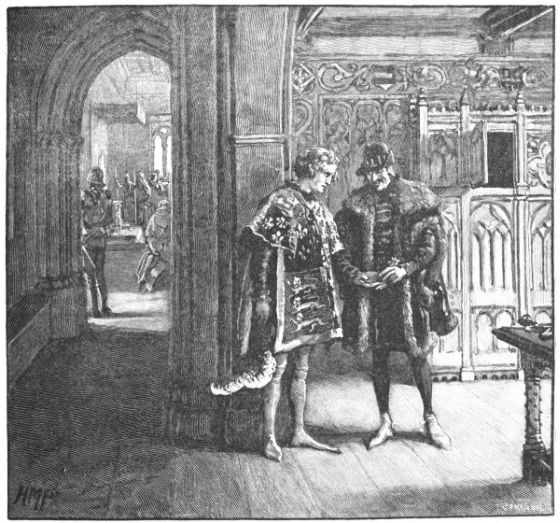
LOUIS XI. AND THE HERALD. (See p. 38.)
Edward, therefore, lost no time in putting in his most decided opposition. In this cause he was zealously seconded by Gloucester. But if ever there was a choice of a rival most unfortunate, and even insulting, it was that put forward by Edward against Clarence, in the person of Lord Rivers, the queen's brother. This match was rejected by the court of Burgundy with disdain, and only heightened the hatred of the queen in England—an odium which fell heavily on her in after years. She was now regarded as a woman who, not content with filling all the chief houses of England with her kin, aimed at filling the highest Continental thrones with them. The result was that Edward succeeded in defeating Clarence without gaining his own, or rather his wife's, object.
From this moment Clarence became at deadly feud with Edward and all his family. The king, the queen, and Gloucester, united in a league against him, which, where such men were concerned—men never scrupling to destroy those who opposed them—boded him little good. The conduct of Clarence was calculated to exasperate this enmity, and to expose him to its attacks. He vented his wrath against all the parties who had thwarted him, king, queen, and Gloucester, in the bitterest and most public manner; and on the other side, occasions were found to stimulate him to more disloyal conduct. They began with attacking his friends and members of his household. John Stacey, a priest in his service, was charged with having practised sorcery to procure the death of Lord Beauchamp, and being put to the torture was brought to confess that Thomas Burdett, a gentleman of Arrow, in Warwickshire, also a gentleman of the duke's household, and greatly beloved by Clarence, was an accomplice. It was well understood why this confession was wrung from the poor priest. Thomas Burdett had a fine white stag in his park, on which he set great value. Edward in hunting had shot this stag, and Burdett, in his anger at the deed, had been reported to have said that he wished the horns of the deer were in the stomach of the person who had advised the king to insult him by killing it. This speech, real or imaginary, had been carefully conveyed to the king, and he thus took his revenge. Thomas Burdett was accused of high treason, tried, and, by the servile judges and jury, condemned, and beheaded at Tyburn.
Clarence had exerted himself to save the lives of both these persons in vain. They both died protesting their innocence, and the next day Clarence entered the council, bringing Dr. Goddard, a clergyman, who appeared on various occasions in those times as a popular agitator. Goddard attested the dying declarations of the sufferers; and Clarence, with an honourable but imprudent zeal, warmly denounced the destruction of his innocent friends. Edward and the court were at Windsor, and these proceedings were duly carried thither by the enemies of Clarence. Soon it was reported that, having for many days sat sullenly silent at the council-board, with folded arms, he had started up and uttered the most disloyal words, accusing the queen of sorcery, which she had learned of her mother, and even implicating the king in the accusation.
The fate of Clarence was sealed. The queen and Gloucester were vehement against him. Edward hurried to Westminster; Clarence was arrested and conducted by the king himself to the Tower. On the 16th of January a Parliament was assembled, and Edward himself appeared as the accuser of his brother at the bar of the Lords. He charged him with a design to dethrone and destroy him and his family. He retorted upon him the charge of sorcery, and of dealing with masters of the black art for this treasonable purpose; that to raise a rebellion he had supplied his servants with vast quantities of money, wine, venison, and provisions, to feast the people, and to fill their minds at such feasts with the belief that Burdett and Stacey had been wrongfully put to death; that Clarence had engaged numbers of people to swear to stand by him and his heirs as rightful claimants of the throne—asserting that Edward was, in truth, a bastard, and had no right whatever to the crown; that to gain the throne, and support himself upon it, he had had constant application to the arts for which his queen and her mother were famous, and had not hesitated to poison and destroy in secret. As for himself—Clarence—he pledged himself to restore all the lands and honours of the Lancastrians, when he gained his own royal rights.
To these monstrous charges Clarence made a vehement reply, but posterity has no means of judging of the truth or force of what he said, for the whole of his defence was omitted in the rolls of Parliament. Not a soul dared to say a word on his behalf. Edward brought forward witnesses to swear to everything he alleged; the duke was condemned to death; and the Commons being summoned to attend, confirmed the sentence. No attempt was made to put the sentence into execution, but about ten days later it was announced that Clarence had died in the Tower. The precise mode of his death has never been clearly ascertained. The generally received account is that of Fabyan, a cotemporary, who says that he was drowned in a butt of Malmsey wine.
Edward now again gave himself up to his pleasures, and would have been glad, in the midst of his amorous intrigues, to have forgotten public affairs altogether. But for this the times were too much out of joint. It was not in England alone that the elements of faction had been in agitation. Nearly the whole of Europe had witnessed the contentions of overgrown nobles and vassal princes by which almost every crown had been endangered, and the regal authority in many cases brought into contempt. The changes consequent on the accession of Henry IV. we have fully detailed; those storms which raged around the throne of France we have partially seen; but similar dissensions betwixt the Electors of Germany and the Emperor Sigismund prevailed; the Netherlands were divided against each other; and Spain was equally disturbed by the conspiracies of the nobles against the crown. Edward of England, as if sensible of the weakness of his position, strove anxiously to strengthen it by foreign alliances. Though his children were far too young to contract actual marriages, he made treaties which should place his daughters on a number of the chief thrones. Some of these contracts were entered into almost as soon as those concerned in them were born. Elizabeth, the eldest, was affianced to the Dauphin of France; Cecilia, the second, to the eldest son and heir of the King of Scotland; Anne, to the infant son of Maximilian, Archduke of Austria, and husband of Mary of Burgundy; Catherine, to the heir of the King of Spain. His eldest son was engaged to the eldest daughter of the Duke of Brittany. On the other hand, all these royal negotiators appear to have been equally impressed with the precarious character of Edward's power, and were ready at the first moment to annul the contracts.
That subtle monarch, Louis of France, never from the first moment seriously meant to adhere to his engagement; and in a very few years all these anxiously-planned marriages were blown away like summer clouds. Edward was not long in suspecting the hollowness of the conduct of Louis XI. Though repeatedly reminded that the time was come to fetch the Princess of England, in order to complete her education in France, preparatory to her occupying the station assigned to her there, Louis took no measures for this purpose; and when Edward remonstrated on the subject, threatened to withdraw the payment of the annual 50,000 crowns. Edward boiled with indignation, and vowed, amongst his immediate courtiers that he would hunt up the old fox in his own cover if he did not mind. But that wily prince was not so easily dealt with. He saw with chagrin the proposed alliances betwixt Edward and his dangerous neighbours, the Duke of Brittany and Maximilian of Austria, now, through his wife, the ruler of Burgundy. Edward, in his resentment at the threat of Louis to withdraw his annual payment, made offers of closer union with Maximilian and Mary of Burgundy, and engaged, on condition that they should pay him the 50,000 crowns which he now had from Louis, to assist them against that monarch. But Louis was not to be out-manœuvred in this manner; he was a profounder master in all the arts of diplomatic stratagem than Edward. He, therefore, made secret and tempting advances to Maximilian and Mary, one article of which devoted the Dauphin to their infant daughter, despite of her engagement to the English heir. At the same time he stirred up sufficient trouble in Scotland to occupy Edward for some time.
The circumstances of Scotland were at this time very favourable to the mischievous interference of Louis. James III. was a monarch far beyond his age. He was of a pacific and philosophic turn. Surrounded by a rude and ignorant nobility, he conceived an infinite contempt for them, and was not politic enough to conceal it. They were received at court with coldness and neglect, while they saw men of science and letters admitted to the king's most intimate conversation. To avenge their slighted dignity, they stirred up the king's two brothers, the Duke of Albany, and the Earl of Mar, to rebellion. James, however, showed that, though pacifically disposed, he did not lack energy. He seized Mar and Albany, and confined them—Mar in Craigmillar Castle, and Albany in that of Edinburgh. Albany managed to escape, and made his way, by means of a French vessel, to France. Mar, who was of a vehement temper, was seized in his prison with fever and delirium. He was, therefore, removed from Craigmillar to a house in the Canongate, at Edinburgh, where, having been bled, he is said on a return of the paroxysm to have torn off his bandages while in a warm bath, and died from loss of blood. The incident was suspicious; but public opinion, for the most part, exonerated the king from the charge of any criminal intention; and even when he was afterwards deposed, no such charge was preferred against him by the hostile faction.
It was at this crisis that Edward—roused to indignation by the conduct of the French king, who neglected to fetch the Princess of England, and withdrew his annual payment of the 50,000 crowns, and still more by tracing Louis' hand in Scottish affairs—invited over Albany from Paris, promising to set him on the throne of Scotland. Albany, smarting with his brother's treatment, was but too ready to accept the proposal. Edward launched reproaches against the King of Scotland for his perfidy in listening to Louis of France, whilst under the closest engagements with himself. Three years' payments of the dowry of Edward's daughter, Cecilia, had already been paid to the Scottish monarch, and yet he had thrown constant obstacles in the way of a marriage agreed upon between the sister of James and the Earl Rivers, the brother-in-law of Edward. In reply to Edward's reproaches, James flung at him the epeithet of reiver, or robber, alluding to his seizure of the English crown.
Edward despatched an army to the borders of Scotland, under his brother Gloucester and Albany. He engaged to place Albany on the throne of James, and, in return, Albany, who was believed already to have two wives, was to marry one of Edward's daughters. With upwards of 22,000 men Gloucester and Albany reached Berwick, which speedily surrendered, though the castle held out.
James, to meet this formidable attack, summoned the whole force of his kingdom to meet him on the Burghmuir, near Edinburgh, and at the head of 50,000 men advanced first to Soutra, and thence to Lauder. But sedition was in his camp. Edward and Albany had opened communications with the discontented nobles. Albany, at the treaty of Fotheringay, where the Scottish scheme was made matter of compact, had assumed the title of Alexander, King of Scotland, and the adhesion of the principal chiefs of Scotland was confirmed by the impolicy of James, who had not only given to his favourite Cochrane, the architect, the bulk of the estates, along with the title of the Earl of Mar, but now placed him in command of the artillery, and permitted him to excite the envy and indignation of the great barons by the splendour of his appointments. Cochrane was, therefore, put to death by a band of conspirators, headed by Archibald Douglas, Earl of Angus, known, therefore, as Archibald "Bell-the-Cat."
Albany and Gloucester quickly followed the conspirators to the Scottish capital, and there appeared now every prospect of the crown being placed on the head of Albany; but this was suddenly prevented by a new movement. The whole body of the Scottish nobles had joined in the destruction of the favourites, but there was a strong party of them who contemplated nothing further. The loyalty of this section of the aristocracy being well known to Angus and his friends, they had not ventured to communicate to them their design of deposing James. The moment that this became known to them, they quitted Edinburgh, collected an army, and planted themselves near Haddington, determined to keep in check any proceedings against the king. At the head of this loyal party were the Archbishop of St. Andrews, the Bishop of Dunkeld, the Earl of Argyll, and Lord Evandale. They called on all loyal Scots to gather to their standard, and, being posted betwixt Edinburgh and the English border, threw Gloucester and his adherents into considerable anxiety as to their position. Albany, Gloucester, and the insurgent lords were glad to come to an accommodation. It was agreed that James should retain the crown; that Albany should receive a pardon and the restoration of his rank and estates; that the money paid by Edward as part of the dowry of Cecilia should be repaid by the citizens of Edinburgh, and that Berwick and its castle should be ceded to England. Gloucester thereupon marched homeward, and Albany laid siege to the castle of Edinburgh, where the Earls of Atholl and Buchan still detained the king. He soon compelled them to capitulate, and James being now in the hands of Albany, the two brothers, in sign of perfect reconciliation, rode together on the same horse to the palace of Holyrood, and slept together in the same bed. The treason of Albany, however, only hid itself in his bosom for a season.
The Scottish difficulty being settled, Edward now turned his attention to Louis of France. Whilst the Scottish campaign had been proceeding, an occurrence had taken place which raised Edward's wrath to its pitch. Mary of Burgundy had one day gone out hawking in the neighbourhood of Bruges, when her horse, in leaping a dyke, broke his girths, and threw her violently against a tree. She died in consequence, leaving three infant children, one of whom, Margaret, was a little girl two years old. Mary herself was only twenty-five at the time of her death. No sooner did Louis hear of this, than he immediately demanded the infant Margaret for his son the Dauphin, totally regardless of the long-standing engagement with Edward for the Princess Elizabeth. Maximilian of Austria, the father of Margaret, was strongly opposed to the match, seeing too well that Louis only wanted to make himself master of the territories of the children. Louis, however, had intrigued with the people of Ghent, and they would insist upon the alliance. Margaret was delivered to the commissioners of Louis, who settled on her the provinces which he had taken from her mother. The French, who regarded this event as bringing to the kingdom some very fine territories, without the trouble and expense of a conquest, received the infant princess with great rejoicings.
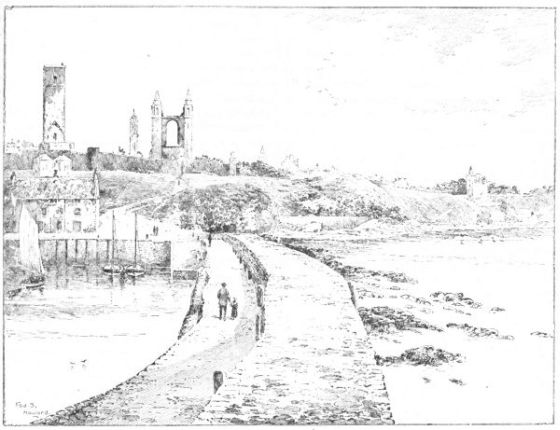
ST. ANDREWS FROM THE PIER.
The rage of Edward knew no bounds. He had been so often warned, both by his courtiers and by Parliament, that the crafty Louis would play him false, that he now vowed to take the most consummate vengeance upon him. The best means of inflicting the severest punishment on the King of France engrossed his whole soul, and occupied him day and night. This violent excitement, operating upon a constitution ruined by sensual indulgence, brought on an illness, which, not attended to at first, soon terminated his existence. He died on the 9th of April, 1483, in the twenty-third year of his reign and the forty-first of his age. The approach of death awoke in him feelings of deep repentance. He ordered full restitution to be made to all whom he had wronged, or from whom he had extorted benevolences. But such orders were not likely to receive much attention from Gloucester, who became the source of power. Immediately after his death he was exposed on a board, naked from the waist upwards, for ten hours, so that the lords spiritual and temporal, and the Lord Mayor and aldermen of London, might see that he had received no violence. He was then buried in Westminster Abbey, with great pomp and ceremony.
Edward IV. was a man calculated to make a great figure in rude and martial times. He was handsome, lively of disposition, affable, and brave. So long as circumstances demanded daring and exertion in the field, he was triumphant and prosperous. Rapid in his resolves and in his movements, undaunted in his attacks, he was uniformly victorious; but peace at once unmanned him. With the last stroke of the sword and the last sound of the trumpet he flung down his arms, and flew to riot and debauchery. Ever the conqueror in the field, he was always defeated in the city. He never could become conqueror over himself. By unrestrained indulgence he destroyed his constitution, and hurried on to early death. Whether in the battle-field or in the hour of peace, he was unrestrained by principle, and sullied his most brilliant laurels with the blood of the young, the innocent, and the victim incapable of resistance. He was magnificent in his costume, luxurious at table, and most licentious in his amours. As he advanced in years he grew corpulent and unhealthy. He had the faculty of never forgetting the face of any one whom he had once seen, or the name of any one who had done him an injury. There was no person of any prominence of whom he did not know the whole history; and he had a spy in almost every officer of his government, even to the extremities of his kingdom. By this means he was early informed of the slightest hostile movement, and by a rapid dash into the enemy's quarters he soon extinguished opposition. Such a man might be a brilliant, but could never be a good monarch. He attached no one to his fortunes; therefore all his attempts to knit up alliances and his other projects failed; and his sons, left young and unprotected, speedily perished.
His children were Edward, his eldest son and successor, born in the Sanctuary in 1470; Richard, Duke of York; Elizabeth, who was contracted to the Dauphin, but who became the queen of Henry VII.; Cecilia, contracted to James, afterwards IV. of Scotland, but married to John, Viscount Wells; Anne, contracted to the son of Maximilian of Austria, but married to Thomas Howard, Duke of Norfolk; Bridget, who became a nun at Dartford; and Catherine, contracted to the Prince of Spain, but married to William Courtney, Earl of Devonshire.