Chapter XX · (continued 2)
Reading edition
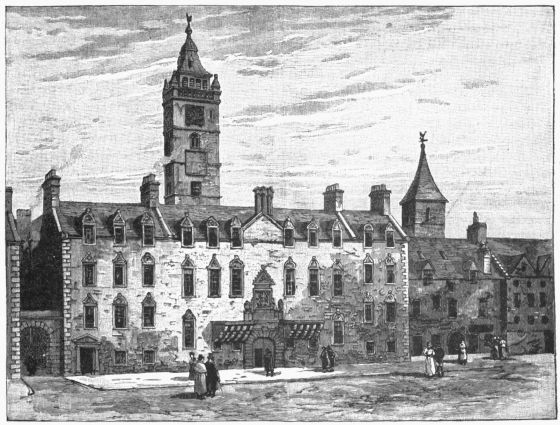
THE OLD COLLEGE, GLASGOW, IN THE 17TH CENTURY.
Charles, on his part, was not the less busy preparing for the campaign, and he was persuaded by many of the courtiers that he had only to appear, to pacify the Scots. If we are to believe Clarendon, the Treasury was in a flourishing condition, a most unlikely circumstance, considering the unpopular mode of raising funds without a Parliament; and we are assured of the contrary by a letter of the Earl of Northumberland, addressed to Wentworth in January, 1639. He says, "I assure your lordship, to my understanding, to my sorrow I speak it, we are altogether in as ill a posture to invade others or to defend ourselves as we were a twelve-month since, which is more than any one can imagine that is not an eye-witness of it. The discontents here at home do rather increase than lessen, there being no course taken to give any kind of satisfaction. The king's coffers were never emptier than at this time, and to us that have the honour to be near about him, no way is yet known how he will find means either to maintain or begin a war without the help of his people." Cottington wrote to Wentworth in the same strain.
So far from consulting Parliament, Charles had not even opened his difficulties to his Council. He was now compelled to do the latter, and on this occasion Laud was found entreating for peaceful measures. It is probable that he had taken a more rational view of the belligerent temper of the Scots, and saw more danger in the king's attempt to coerce them, than he generally discerned in pushing on arbitrary counsels. His advice was rejected, and the rest of the Council acquiesced in the determination of the king. By the beginning of the year 1639, Charles had named his generals and officers, had issued orders to the Lords-Lieutenant to muster the trained bands of their several counties, and the nobles to meet him at York on the 1st of April with such retinues as belonged to their rank and fortune. To procure money he suspended the payment of all pensions, borrowed where he could, and judges, lawyers, and the clergy were called upon to contribute from their salaries and livings in lieu of their personal service. The clergy were in general extremely liberal. They considered that the cause was their own, and that if the Presbyterians of Scotland became triumphant, the Puritans of England might deal in similar fashion with the Church of England. Laud, moreover, ordered the names of all clergymen who refused to be returned to him. The queen also lent her aid by calling on the Catholics to assist, reminding them that aid given to the king in this emergency was the most likely means to securing future advantages to themselves. When the knowledge of the queen's circular letter to the Catholics became known to the Puritans, they were greatly scandalised; and the Catholics responding readily to the call, and holding a meeting in London presided over by the Pope's Nuncio, tended to strengthen their opinion of the papistical bias of Charles and his Church.
The king, on his part, sought to take advantage of the ancient antipathies between the two kingdoms, and issued proclamations calling on all good subjects to resist the attempts of the Scots, who were contemplating, he asserted, the invasion and plunder of the kingdom and the destruction of the monarchy. But he found this was an empty alarm. The reformers of England knew too well that the cause of the Scots and their own were identical; that the purpose of the king was to destroy the constitutional rights and freedom of religion in both kingdoms alike. The Scottish nobles, as well as the English public, rejected all attempts to divide them in this Cause. There was a time when they could be bought by the money of England, which had been freely and successfully employed by the Tudors. But Charles had little money to give; and to the honour of the Scottish peers, when other temptations were tried, for the most part the sacred cause of their religion triumphed over them. They exhorted one another to stand fast by the Covenant. The most intimate communication between the Scottish and English reformers was maintained by pamphlets secretly circulated, by emissaries traversing all classes and all quarters. The earliest information of the movements of the Court was transmitted; and before Charles commenced his march towards York, General Leslie, the elected Commander-in-Chief, took the initiative, and surprised the castle of Edinburgh, on the 21st of March, at the head of a thousand musketeers, and without losing a single man. The next day, Saturday, the castle of Dalkeith was given over by Traquair, with all the regalia and a large quantity of ammunition and arms. It was thought that Traquair had shown great timidity, to surrender so strong a castle almost without a blow; but he complained of having been left alone, without countenance or advice. The Earls of Rothes and Balmerino took the castle, and conveyed the regalia safely to the castle of Edinburgh. The following day, Sunday, did not prevent even Scotsmen and Covenanters from seizing the castle of Dumbarton. The governor was surprised on his return from church, and threatened with instant death if he did not surrender the keys to the provost of the town, a zealous Covenanter. Stirling was in the hands of the Earl of Mar, who had taken the Covenant; and of all the royal fortresses, only Carlaverock, the least important, remained in the hands of the Crown. The Marquis of Huntly, who had undertaken to hold the Highlands for the king, was overpowered or entrapped by Leslie and Montrose, who at the head of seven thousand men compelled the reluctant professors of Aberdeen to accept the Covenant, when Leslie returned to Edinburgh, carrying Huntly with him. The Earl of Antrim, who was to have invaded the domains of Argyle from Ireland, was unable to fulfil his engagement, and thus every day brought the news of rapid disasters to Charles on his march towards York. Hamilton, who had been despatched with a fleet, appeared in the Forth on the 13th of April. He had five thousand troops on board, and was expected to secure Leith, the port of Edinburgh, and overawe if he could not take the capital; but he found the place strongly fortified, and twenty thousand men were posted on the shores to hinder his landing. All classes, from the noble to the peasant, had been labouring industriously to repair fortifications and throw up batteries, and ladies had carried materials for them. The marquis saw no chance of effecting a landing, and therefore disembarked his men on the islands in the Forth, to prevent them from perishing in the ships, for they were landsmen, and had been hastily pressed into the service, and were both sickly and mutinous. No prospect was ever more discouraging; even Wentworth could not send him the small aid of five hundred musketeers in time, and strongly advised Charles to avoid coming to an engagement with his raw levies against the enthusiastic Scots and their practical generals, but to garrison Berwick and Carlisle to prevent incursions, and wait till the next year if necessary.
Charles arrived at York on the 19th of April, and proceeded to administer to the lords who there awaited him with their followers, an oath of allegiance, binding them to oppose all conspiracies and seditions, even if they were veiled under the pretence of religion. The Lords Say and Brooke declined to take the oath, saying they were willing to accompany their sovereign from loyalty and affection; but that, as they were ignorant of the laws and customs of Scotland, they could not undertake to say that the Scots were rebels, or the war was just. Charles with indignation ordered them to be arrested, but the Attorney and Solicitor-Generals on being consulted declaring that there was no ground for their prosecution, they were dismissed with the royal displeasure and desired to return home. Nor had the king much more satisfaction with the lords who had taken the oath, for they qualified it by signing a paper stating in what sense they took it. To perform an act calculated to please the people whom he was leaving behind, at York he issued a proclamation, revoking no less than thirty-one monopolies and patents, pretending that he had not discovered before how grievous they were to his subjects; but the real fact was, that most of them had been granted to Scotsmen who had now forfeited his favour.
On leaving York he complimented the Recorder, who had paid him the most fulsome flattery, and the municipal authorities, by telling them that he had there experienced more love than he ever had in London on which he had showered so many benefits. At Durham by the bishop and clergy, and at Newcastle by the corporation, he was magnificently entertained, and at every halting-place fresh quotas of horse and foot came in. "But," remarks Clarendon, "if there had been none in the march but soldiers, it is most probable that a noble peace would have quickly ensued, even without fighting; but the progress was more illustrious than the march, and the soldiers were the least part of the army, and the least consulted with. For," he adds, "the king more intended the pomp of his preparations than the strength of them." The certain proof, he might have added, of a very foolish king, as Charles was. But the "ifs" which Clarendon summons up on this occasion to explain the want of success are amusing. "If the war had been vigorously pursued, it had been as soon ended as begun." "If he had been duly informed of what was going on in Scotland," of course he would have known. "If the whole nation of Scotchmen had been entirely united in the rebellion, and all who stayed in the Court had marched in their army, the king or kingdom could have sustained no damage by them; but the monument of their presumption and their shame would have been razed together, and no other memory preserved of their rebellion but in their memorable and infamous defeat." That is, there would have been no Scottish traitors about him to keep him misinformed. This is just as true as the treasury being well furnished, for we know that Hamilton and Traquair kept the king punctually informed of everything the whole time. "If," however, Charles had more wisely chosen his generals,—but Arundel, his general, was a man, says this veracious historian, "who had nothing martial about him but his presence and his looks, and therefore was thought to be made choice of for his negative qualities. He did not love the Scots; he did not love the Puritans; which good qualities were allayed by another negative—he did love nobody else." The lieutenant-general, the Earl of Essex, was too proud and uncompromising, and the Earl of Holland, general of the horse, was just no general at all, "a man fitter for a show than a field." Yet, says Clarendon, "If the king himself had stayed at London, or, which had been the next best, kept his court and resided at York, and sent the army on its proper errand, and left the matter of the war solely to them, in all human reason his enemies had been speedily subdued." With such generals as Arundel and Holland—for Essex was a brave commander, though, as afterwards appeared, no great tactician—it is not so easy to see that. But Clarendon might have safely reduced all his "ifs" into one—if Charles had been a wise king he would not have got into a quarrel with his subjects at all.
With such generals, and an army of raw levies, hastily dragged reluctantly from the plough and the mattock, to fight in a cause with which they had no sympathy, and encumbered by heaps of useless nobles and gentry, Charles marched on to Berwick, and encamped his forces on an open field called the Birks. He had besides the garrison of Berwick three thousand two hundred and sixty horse, and nineteen thousand six hundred and fourteen foot. But, on the other hand, Leslie, says Clarendon, had drawn up his forces on the side of a hill at Dunse, so as to make a great show. "The front only could be seen, but it was reported that Leslie and the whole army were there; and it was very true, they were all there indeed—but it was as true that all did not exceed the number of nine thousand men, very ill armed, and mostly country fellows, who were on the sudden got together to make that show." Leslie, he informs us, had so dispersed his knot of ragamuffins, with great herds of cattle on the hills around, that it was naturally supposed that there was a large army, the bulk of it concealed behind the hill; and he assures us that had the royal army pushed forward the whole illusion would have vanished.
This account is as thoroughly opposed to all the credible historians of the time, Rushworth, Nalson, Burnet, Baillie, and the letters of distinguished persons engaged, as the whole array of "ifs." We are assured that Leslie had pitched his camp at Dunglas, and twelve thousand volunteers had crowded to his standard. The preachers everywhere called on their hearers to advance the cause of God and the Kirk. Those in the camp wrote and disseminated letters to the same effect. One demanded that every true Scot should go forward to extort a reasonable peace from the king, or to do battle with his and their common enemies, the prelates and papists of England. Another denounced the curse of Meroz on all who did not come to the help of the Lord, and of His champions. Another ironically bade those who would not fight for God and their country to bring spades and bury the saints whom they had abandoned to the swords of the Amalekites. They had chosen for the motto on their banners the words, "For Christ's Crown and the Covenant," and over every captain's tent waved the arms of Scotland and these words. Soldiers therefore flocked in on all sides to the sacred standard, and by the time that Leslie marched for Dunse Hill his army numbered nearly twenty thousand men, many of them new to arms, but all enthusiastic patriots. Twice a day they were summoned by sound of drum to drill and to sermon; and when they were not listening to the exciting harangues of the ministers, they were solacing themselves with singing psalms and reading the Scriptures, or with extempore prayer. "Had you lent your ear," says one of them, "and heard in the tents the sounds of some singing psalms, some praying, some reading Scripture, you would have been refreshed. For myself, I never found my mind in better temper than it was. I was as a man who had taken leave from the world, and was resolved to die in that service without return. I found the favour of God shining upon me, and a sweet, meek, humble, yet strong and vehement spirit leading me all along."
Leslie was joined by the Earl of Montrose, who had been posted at Kelso, and the first of their proceedings was to issue proclamations, declaring that they had no intention to invade England if their reasonable demands were granted; and that their only object was to obtain from the king the confirmation of his promises for the free enjoyment of their religion. Whatever was done in the Scottish camp was freely circulated in the royal camp, for they had plenty of friends there, and the strength, the spirits, and resolution of their army were abundantly set forth daily.
It was the fortune of the Earl of Holland to lead the way first against them. He passed the Tweed near Twizel, where the English army had crossed to the battle of Flodden, and advanced towards the detachment of the army near Kelso. He had with him the bulk of the horse and about three thousand infantry. As if no enemy had been in the country, he trotted on with his horse, till he found himself on the hill of Maxwellhaugh, above Kelso, and not only saw the tents of the enemy, but his way barred by an advanced post of one hundred and fifty horse and five or six thousand foot. He then discovered that his foot and artillery were three or four miles behind. On this he sent a trumpet to the enemy, commanding them not to cross the Border, to which they replied by asking whose trumpet that was, and being told the Earl of Holland's, they said the earl had better take himself off; which it appears he lost no time in doing, and rode back to the general camp without striking a blow. The Scots, when they saw him retreating, sent after him a number of squibs and letters of ridicule, which were speedily circulated through the English army. The generals wrote letters to Essex, Holland, and Arundel, entreating them to intercede with the king that matters might be accommodated without bloodshed. Essex is said to have sent on their letters to the king without a word of reply to their messengers. Arundel and Holland were more gracious.
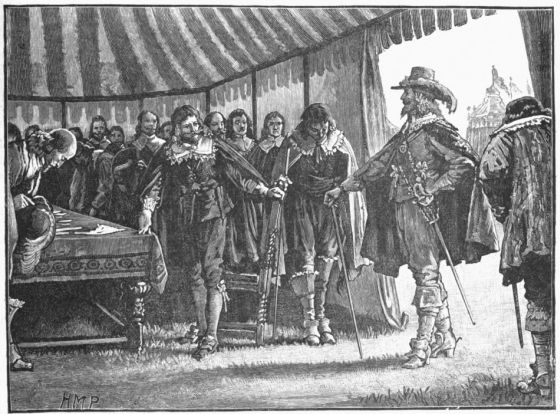
CHARLES AND THE SCOTTISH COMMISSIONERS. (See p. 578.)
During this marching and countermarching it was that Leslie had posted his army on Dunse Hill, opposite Charles's camp, and the king, who had hitherto despised the Scottish force, now felt alarmed at their close proximity, and the hasty retreat of Holland. He blamed Lord Arundel for giving him no notice of the approach of the rebels, Arundel blamed the scout-master, and the scout-master blamed the scouts. There were earthworks suddenly thrown up to protect his camp and intimation given that overtures would be listened to. Accordingly, on the 6th of June, 1639, the Earl of Dunfermline, attended by a trumpet, arrived in the royal camp, bearing a humble petition to his majesty, entreating him to appoint a few suitable persons to confer with a deputation from the Scots, so that all misunderstandings might be removed, and the peace of the kingdom preserved. The petition was received, for besides the ill-success of Holland, the ill-success of Hamilton and his fleet was notorious; and it was, moreover, rumoured that the mother of Hamilton, a most zealous covenanter, had paid him a visit on board his vessel, and that he was much disinclined by her persuasions to press the Scots closely. There were daily rumours of a descent from Ireland, on the other hand and of a rising of the Royalists in the Highlands under Lord Aboyne, son of the Earl of Huntly, which rendered the Covenanters more desirous of an accommodation. On the part of the Crown the Earls of Essex, Holland, Salisbury, and Berkshire, Sir Henry Vane, and Mr. Secretary Coke, were appointed commissioners; on that of the Covenanters the Earls of Rothes and Dunfermline, the Lord Loudon, and Sir William Douglas, sheriff of Teviotdale. To these afterwards, much to the displeasure of the king, were added Alexander Henderson, late moderator of the assembly, and Johnstone, the clerk-register. They met in Arundel's tent; but before they could proceed to business, the king suddenly entered, and telling the Scottish commissioners that as he understood they complained that they could not be heard, he had determined to hear them himself, and he demanded what it was they wanted. The Earl of Rothes replied simply, to be secured in their religion and liberty. Loudon made some apology for the boldness of the proceedings of the Scots, but Charles cut him short, telling him that he could admit of no apologies for what was past, but that if they came to implore pardon, they must put down what they had to say in writing, and in writing he would answer them.
This was Charles's peculiar style, by which the negotiation appeared likely to come to a speedy end; but the Scots were firm, and adhered to their old sound principle, declaring that they had sought nothing but their own native rights, and the advancement of his majesty's service, and desired to have those severely punished who had misrepresented them to the king. Some historians assert that Hamilton at this juncture came into the camp from the Forth, and strongly advised the king to close with the Scots; though Clarendon affirms that he did not arrive till after the agreement was signed, and found much fault with it. However this may be, after much debate, and several attempts to overreach the Scots, which their caution defeated, it was agreed that the king should ratify all that had been done by his commissioner, which was next to nothing, though he would not recognise the acts of what he called the pretended General Assembly. But the main and only important concession was that all disputes should be settled by another Assembly, to be held on the 6th of August, and by a Parliament which should ratify its proceedings, to be held on the 20th of August, when an act of oblivion should be passed. Both parties were to disband their armies; the king's forts were to be restored, with all the ammunition; the fleet was to be withdrawn; Scottish merchant vessels and goods were to be returned; and the honours and privileges of the subjects replaced. The king resisted, however, any mention of episcopacy in the agreement; for he was as resolved as ever to reinstate the bishops. And indeed, that same duplicity guided him in this as in other actions of his life, being determined to break the whole agreement on the first possible opportunity. The Covenanters strongly suspected as much; and when Charles, before returning, invited fourteen of the leaders to meet him in Berwick, they had the fear of the Tower before their eyes, and declined the honour, and sent as their commissioners the Earls of Loudon, Lothian, and Montrose. Charles represented that it had been his intention to proceed to Edinburgh, and hold the Parliament in person, but that fresh instances of "the valyance of the godly females" deterred him; his chief officers not being able to show themselves in the streets of Berwick without insult from these good women.
What Charles had failed to do in the Convention at large, he managed to effect to a certain degree with the nobles. Loudon and Lothian were said to be greatly softened by the king's conversation, but Montrose was won over altogether.
The two armies were disbanded on the 24th of June, and the Earl of Traquair was appointed the king's commissioner in Scotland, Hamilton firmly declining to return thither. Charles reached London on the 1st of August, and one of the first things which he did was to write to the Scottish bishops, telling them that he would never abandon the idea of reinstating them, and would in the meantime provide for their support. He forbade them to present themselves at the approaching Assembly or Parliament, as that would ruin everything; but he advised them to send in a protest against the infringement of their rights, and get it presented by some mean person, so as to create not too much notice. Such was Charles's perfidious conduct, at the very moment that he was promising the Covenanters the contrary. Accordingly the bishops fixed themselves in the vicinity of the borders, some at Morpeth, some in Holy Island, some in Berwick itself, keeping up a correspondence with their adherents in the Scottish capital, and ready to rush in again on the first favourable chance.
If we are to believe Clarendon, however, "The king was very melancholy, and quickly discovered that he had lost reputation at home and abroad, and those counsellors who had been most faulty either through want of courage or wisdom—for at that time few of them wanted fidelity—never afterwards recovered spirit enough to do their duty, but gave themselves up to those who so much had outwitted them, every man shifting the fault from himself." On the contrary, he says, "The Scots got so much benefit and advantage by it, that they brought all their other mischievous devices to pass with ease, and a prosperous gale in all they went about." They declared that "they did not intend by anything contained in the treaty, to vacate any of the proceedings which had been in the late General Assembly at Glasgow, by which all the bishops were excommunicated, and renewed all their menaces against them by proclamation, and imposed grievous penalties on all who should presume to harbour any of them, so that by the time the king came to London, it appeared plainly that the army was disbanded without a peace being made, and the Scots in more reputation and equal inclination to affront his majesty than ever." The fact was, that whilst Charles was pretending to concede, meaning to revoke when he had the power, the Scots were conscious of their advantage and did not mean to allow him to do so. They were earnest and outspoken in their resolves, and therefore Charles seized a paper in which they published what had really been promised in the treaty, and had it burned by the common hangman.
The Assembly was opened on the 12th of August in Edinburgh, and in spite of what Charles had assured the bishops, they were given up in the instructions to Traquair, for he meant to resist the abolition of the bishops, and to restore them when he had the power, but endeavoured to make political capital out of this concession. Traquair was to obtain, if possible, the admission of fourteen ministers into Parliament instead of the bishops, or, if that were not possible, as many lay members whom the king was to appoint, and who were to choose the lords of the articles. By these perpetual finesses, Charles continually sought to withdraw the concessions that he made, as though those whom he tried to overreach were not as wide awake as himself. He thought, if he could select the Lords of the Articles, and fourteen others devoted to him, he could revoke in the Parliament what he gave up in the Assembly—the characteristic of short-sighted cunning.
The bishops presented their protest to the Commissioner, which, without being read, was to serve as a proof of their not having yielded up their claims; and the commissioner, finding the Covenanters firm to all their demands—for every member of the Assembly before entering it had sworn to support all the acts of the Assembly of Glasgow—gave the royal assent to all the proceedings, and the news of the overthrow of episcopacy was received with shouts of acclamation by the people.
The Parliament of Scotland met on the day appointed, the 20th of August. There the Covenanters displayed their determination not to stickle for small matters, but to destroy the scheme by which that body had been made dependent on the royal will. They would no longer admit the bishops nor the Lords of the Articles whom the bishops had chosen, and who selected the topics, under the direction of the Crown, which should or should not come before the House. They proposed that the lesser barons, the commissioners of the shires, should take the place of the bishops, and that the Lords of the Articles should be selected from men of each estate, by those estates themselves. In order not to appear obstinate, they permitted the Commissioner to name the Lords of the Articles for this once, not as an act of right, but of grace, from themselves. They then decreed that all acts in favour of episcopacy should be rescinded; that patents of peerage should for the future be granted to none but such as possessed a rental of ten thousand marks from land in Scotland; that proxies should never again be admitted; and that the fortresses of Edinburgh, Stirling, and Dumbarton, should be entrusted to none but Scotsmen.
These measures would have completely enfranchised Scotland from the shackles of the Crown, and Traquair, unable to avoid the necessity of ratifying them, prorogued the Parliament to the 14th of November, so that he could receive the instructions of the king. Charles, to get rid of the demands of the Covenanters altogether, prorogued it for six months. The members, who saw the intention, protested against the prorogation under circumstances so vital to the country, but obeyed after naming a deputation to go to the king on the subject. This deputation, headed by the Lords Loudon and Dunfermline, on arriving at Whitehall were refused audience, because they had not come with the sanction of the royal Commissioner; and Traquair was immediately summoned to court to answer for having conceded so much to the Scots. He had, indeed, conceded nothing but what Charles himself had instructed him to do but the king was angry because he had not been able to recover in Parliament, as he had vainly hoped, what was lost in the Assembly.
Traquair, who was aware that having implicitly followed these instructions would avail him little with the king in his mortification, thought of an expedient to divert Charles's anger into another channel. He had discovered a letter addressed by the Covenanters to the King of France, complaining of the miserable condition of Scotland through the attempts of the king to root out the religion of the people; of his having violated the late treaty at Berwick, and dissolved Parliament contrary to the will of the states and to all national precedent, and entreating him to mediate in their favour. This letter was signed by seven lords, and addressed Au Roi. The letter had been publicly declined by Louis, but privately answered, though in very cautious terms.
The production of this letter had all the effect that Traquair hoped for. The wrath of the king was immediately turned on the Covenanters, and Traquair deepened the impression by assuring the king that nothing but war would pacify the Covenanters, and declaring this discovery to be a perfect justification.
The Scots demanded an opportunity of vindicating themselves, and requested leave to send up deputies for that purpose. It was granted, and Dunfermline and Loudon were sent up. No sooner did they arrive than Loudon, whose name was one of those appended to the intercepted letter, was instantly seized and brought before the Council. The letter being addressed simply Au Roi, which was the manner from subjects to their own sovereign, and not as from foreigners, it was deemed treasonable on that ground, if on no other. Loudon asserted that the letter had been written before the pacification at Berwick, and, not being approved, had never been sent, but the contents contradicted that statement; and, moreover, William Colvill, who had carried it to the French court, was in London, and was taken prisoner. Loudon thereupon insisted on his safe conduct, and demanded liberty to return, contending that, if he had done anything wrong, it was in Scotland and not there that he ought to be interrogated. But the king sent both him and Colvill to the Tower.
The Covenanters were greatly incensed at the seizure of their envoy, and demanded his release, but Charles signed a warrant for his execution and was prevented from putting him to death only by the solemn declaration that if he did Scotland was lost for ever. After this it became plain that nothing could avert a conflict between the infatuated king and the Scottish people. Charles's object was to obtain funds; that of the Scots to divide the king's attention by exciting discontent nearer home. England itself had abundant causes of dissatisfaction. The disuse of Parliaments, the continued illegal levying of taxes by the king's own will, the rigorous and ruinous prosecutions in the Star Chamber and the High Commission Court, the brandings, scourgings, and mutilations of such as dared to dispute the awful tyranny of the Government, portended a storm at home ere long, and the Scots found many well-wishers and friends amongst the English patriots. These were everyday drawing into their ranks men of the highest position and the most distinguished talents. The Earls of Essex, Bedford, and Holland were secretly connected with them; the Lord Say, Hampden, Pym, Cromwell, and other men of iron nerve and indomitable will, were watching with deep interest movements in the North so congenial to their own.
Whilst the king was pondering on the means of raising money, an event took place which for the moment promised to present him with a considerable sum. A Spanish fleet of seventy sail was discovered by the Dutch admiral, De Witt, off the Land's End. As it was bearing troops from Spain to Flanders, which were hard pressed by the Dutch, De Witt followed it up the Channel, firing guns to harass its rear, but still more to awake the attention of Van Tromp, who was lying off Dunkirk. The two celebrated Dutch admirals were soon in full chase of the Spaniards. Sixteen of the ships, having four thousand troops on board, bore away with all speed for the coast of Flanders, but the rest fled for shelter into the Downs. Charles sent the Earl of Arundel to inquire of Oquendo the Spanish admiral, what was his destination, being apprehensive lest the fleet might be intended for a descent on Ireland, or in aid of his disaffected subjects of Scotland.
Oquendo satisfied Arundel that they were really on their way to Flanders, and demanded the protection of Charles as a friendly king. Charles was willing to grant it for a consideration, and the sum of one hundred and fifty thousand pounds was the price named in ready cash. For this Charles was to send the Spanish fleet under protection of his own to Flanders; but the two Dutch admirals, having now no less than one hundred sail, from continued fresh arrivals, attacked the Spaniards in the English roads, sank and burned five of the largest vessels, drove twenty-three more on shore, and pursued the rest across the Channel, suffering only ten of them to escape. All this time the English admiral lay near at hand, but made no movement in protection of the Spaniards. The English people on shore beheld the destruction of the Spanish fleet with the utmost exultation, the memory of the great Armada being yet so strong amongst them; but Charles had lost his much desired money, and with the loss had acquired an immense amount of foreign odium. To have suffered the vessels of a friendly Power, which had fled to him for shelter, to be attacked and chased from his own harbour, lowered him greatly in the estimation of Continental nations.
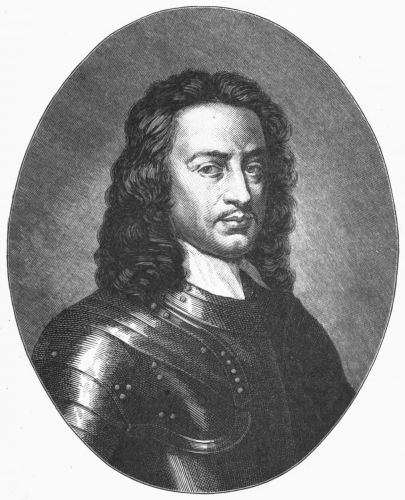
JOHN HAMPDEN. (From an Engraving by Houbraken.)
At the time of this untoward occurrence Charles had sent for Wentworth from Ireland, to assist him by his counsels as to the best mode of dealing with his difficulties at home, and the Scots in the North. Wentworth had overridden all obstacles in Ireland, and had forced an income out of the reluctant people there; he was thought, therefore, by Charles the only man whose wisdom and resolution were equal to the crisis. Wentworth had strongly advised Charles not to march against the Scots, knowing that the king's raw levies would have no chance against them; and he had gone on actively drilling ten thousand men, to prepare them for the campaign, which he felt must come, even after all seemed settled at Berwick.
Clarendon, who is a regular Royalist and inclined to see more virtues in Wentworth than other historians of the time, is yet obliged to sketch this picture of the enmities which he justly provoked:—"He was a man of too high and severe deportment, and too great a contemner of ceremony, to have many friends at court, and therefore could not but have enemies enough. He had two that professed it, the Earl of Holland and Sir Henry Vane." Besides having said that "the king would do well to cut off Holland's head," he had insulted the Earl in various ways. He had done all he could to prevent Sir Henry Vane from being made secretary in place of Sir John Coke, whom the king removed on his return from Scotland; but, worse still, Charles now creating him Earl of Strafford, nothing would satisfy him but that he must be also made Baron of Proby, Vane's own estate, from which he himself hoped to derive that title. "That," continues Clarendon, "was an act of the most unnecessary provocation that I have known, and though he contemned the man with marvellous scorn, I believe it was the loss of his head. To these a third adversary, like to be more pertinacious than the other two, was the Earl of Essex, naturally enough disinclined to his person, his power, and his parts." This enmity in Essex, we are told, was increased by Wentworth's insolent conduct to Lord Bacon, for whom Essex had a friendship; and he openly vowed vengeance. "Lastly, he had an enemy more terrible than all the others, and like to be more fatal, the whole Scottish nation, provoked by the declaration he had procured of Ireland, and some high carriage and expressions of his against them in that kingdom." Moreover, Wentworth had no friend in the queen, from his persecution of the Catholics in Ireland, and was continually thwarted by her.
But all these councillors could devise no way to raise funds but by the old and irritating mode of ship-money, for which writs to the amount of two hundred thousand pounds were immediately issued, and this bearing no proportion to the requirements of a campaign against the Scots, they advised Charles to call together a Parliament. To this he demurred; but when they persisted in that advice, he ordered a full Council to be called, and put to it this question:—"If this Parliament should prove as untoward as some have lately been, will you then assist me in such extraordinary ways as in that extremity should be thought fit?"
Charles was thus bent on extraordinary ways, and the Council promised him its support. Wentworth returned to Ireland, being not only created Earl of Strafford, but made Lord-lieutenant of that country. He promised to obtain a liberal vote from the Irish Parliament, which it was thought might act as a salutary example for England. Accordingly, no one daring to oppose his wishes, he obtained four subsidies, with a promise of more if found necessary. The English Parliament was delayed till this was effected, and was then summoned for the 13th of April. To assist the king and council in what was felt to be a critical emergency, Wentworth, now Strafford, returned, though suffering from a painful complaint. He left orders for the immediate levy of an army of eight thousand men, and Charles took measures for the raising in England of fifteen thousand foot and four thousand horse, which he thought would serve to overawe Parliament; and, what is singular, the order for the raising of these troops and providing artillery and ammunition was signed by Laud, so little had he an idea of an archbishop being a minister of the Prince of Peace. Before the arrival of Strafford, Charles read to the Council the account of the liberal subsidies and the loyal expressions which Strafford had put into the mouths of the enslaved Irish Commons. This he did at the request of Strafford himself, to prove not only the loyalty of the Irish, but his own popularity there, in spite of the assertions of his being hated in that country.
When the king met the Parliament on the 13th of April he had not abated one jot of his high-flown notions of his divine right, and of the slavish obedience due from Parliament. The Lord Keeper Finch formerly Speaker of the House but now more truly in his element as a courtier, made a most fulsome speech, describing the king as "the most just, the most pious, the most gracious king that ever was." He informed them that for many years in his piety towards them he had taken all the annoyances of government from them, and raised the condition and reputation of the country to a wonderful splendour; that, notwithstanding such exemplary virtues and exhibitions of goodness, some sons of Belial had blown the trumpet of rebellion in Scotland, and that it was now necessary to chastise that stiff-necked people; that they must therefore lay aside all other subjects, and imitate the loyal Parliament of Ireland in furnishing liberal supplies; that had not the king, upon the credit of his servants and out of his own estate, raised three hundred thousand pounds, he could not have made the preparations already in progress; and that they must therefore grant him tonnage and poundage from the beginning of his reign, and vote the subsidies at once, when his Majesty would pledge his royal word that he would take into his gracious consideration their grievances. And all this attempt to get the supplies before the discussion of grievances, from sturdy commoners who had never yet given way to force or flattery!
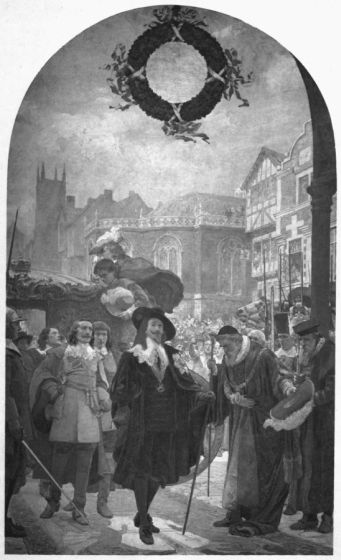
VISIT OF CHARLES I. TO THE GUILDHALL.
From the Wall Painting in the Royal Exchange, by Solomon J. Solomon, A.R.A
Charles then produced the intercepted letters of the Scottish lords to the King of France, to show the treason of the Scots and the necessity of taking decisive measures with them. But the Commons were not likely to be moved from their settled purpose by any such arguments. They elected Serjeant Glanvil as Speaker, and proceeded first and foremost to the discussion of the grievances of the nation. Amongst their old members—though the brave Sir John Eliot had perished in prison, and Sir Edward Coke, who by his later years of patriotism had effaced the memory of the arbitrary spirit of his earlier ones, was also dead—there were Oliver Cromwell, now sitting for Cambridge, Pym, Hampden, Denzil Holles, Maynard, Oliver St. John, Strode, Corriton, Hayman, and Haselrig. There were amongst the new ones, Harbottle Grimston, Edmund Waller, the poet, Lord George Digby, the son of the Earl of Bristol, a young man of eminent talent, and other men destined to become prominent. Sir Benjamin Rudyard and Grimston delivered speeches recommending at once courtesy and respect towards the Crown, but unflinching support of the rights of the people. Harbottle Grimston described the commonwealth as miserably torn and massacred, all property and liberty shaken, the Church distracted, the Gospel and professors of it persecuted, Parliament suspended, and the laws made void. Sir Benjamin Rudyard protested that he desired nothing so much as that they might proceed with moderation, but that if Parliaments were gone, they were lost. A remarkable feature of this Parliament was the number of petitions sent in by the people. These were poured in against ship-money and other abuses, as the Star Chamber and High Commission Court, from the counties of Hertford, Essex, and Sussex. After these matters had been warmly debated for four days, for the king had many advocates in the House, on the 17th Mr. Pym delivered a most eloquent and impressive speech, in which he narrated the many attacks on the privileges of Parliament and the liberty of the subject, and laid down the constitutional doctrine "that the king can do no wrong," thus bringing the conduct and counsels of his ministers under the direct censure of the House, and loading them with the solemn responsibility—an awful foreshadowing of the judgments to come on Laud and Wentworth. From that point the debate turned on the arbitrary treatment of the members of the Commons, and orders were issued for a report of the proceedings of the Star Chamber and the Court of King's Bench against Sir John Eliot, Mr. Holles, and Mr. Hampden, to be laid on the table of the House. The conduct of the late Speaker Finch, in adjourning the House at the command of the king, was declared unconstitutional.
The king could no longer restrain his impatience, and summoned both Houses before him in the Banqueting Hall. There the Lord Keeper Finch, in the presence of Charles, recalled their attention to the necessity of voting the supplies, and repeated the king's promises. He endeavoured to excuse the raising of ship-money as a necessity for chastising the Algerine pirates who infested the seas, and again recommended the liberal example of the Irish Parliament. The only effect produced by this was a most vivid and trenchant speech the next day by Waller, in which he told the House that the king was personally beloved, but that his mode of extorting his subjects' money was detested; and that neither the admiration of his majesty's natural disposition, nor the pretended consent of the judges, could ever induce them to consent to such unconstitutional demands. He then severely castigated the conduct of the bishops and clergy who preached the divine right of monarchs to plunder the public at their own pleasure. "But," said he, "they gain preferment by it, and then it is no matter, though they neither believe themselves nor are believed by others. But since they are so ready to let loose the consciences of their kings, we are bound the more carefully to provide against this pulpit law, by declaring and enforcing the municipal laws of this kingdom."
This again roused the king, who went down to the Lords, and read them a sharp lesson on their not supporting him in his just demands of supplies from the Commons. Thereupon the Lords sent for the Commons to a conference on the 29th of April, and recommended them to pass the votes and take the king's word for the redress of grievances; but the Commons resented their intruding their advice about money matters as an infringement of the privileges of the House; and on the 1st of May, the Lords, through the Lord Keeper, disclaimed any intention of encroaching on any of the well-known rights of the Commons, but that the Lords had felt bound to comply with the request of the king. The Commons returned to their debate on ship-money, and on Saturday, the 2nd of May, Charles sent a message by Sir Henry Vane, now Secretary of State and Treasurer of the Household, desiring an immediate answer regarding the supplies. Lord Digby reminded the House that the demand was that of a hasty and immediate answer to a call for funds to involve the nation in a civil war with the Scots, a people holding the same religion and subjects of the same king as themselves. The debate was continued for two days, Clarendon accusing Vane of deliberately keeping from the House the fact entrusted to him, that the king, though asking for twelve subsidies, would consent to take eight.
But it was not so much the amount as the principle involved in the subsidies which was the question; for, on the 4th of May, Charles sent Vane again with the remarkable offer to abolish ship-money for ever, and by any means that they should think fit, on condition that they granted him twelve subsidies, valued at eight hundred and fifty thousand pounds, to be paid in three years, with an assurance that the House should not be prorogued till next Michaelmas. This was a mighty temptation: here was the direct offer of at once getting rid of one of the monster grievances for ever; but it did not escape the attention of the more sagacious that, by accepting the bargain, they were conceding the king's right to set aside the most established laws, to force his own notions of religion on his subjects, and to make war on them if they refused. They rejected the snare, and maintained the debate for some hours against all the arguments of the Court party. On rising, they informed Vane that they would resume the debate the next morning at eight o'clock; but Sir Henry, seeing very well how it would terminate, assured the king in Council that he was certain that the House would not grant him a penny for the war against the Scots.
On this Charles adopted one of his stratagems. Early in the morning he sent for Glanvil the Speaker, before the Commons had assembled, and detained him at Whitehall, so that the Commons without him could not vote against the supplies, nor protest against the war; and suddenly hastening to the House of Lords, he sent for the Commons and dismissed them. In doing this, he praised the peers at the expense of the Commons, and declared that as to the liberties of the people which the Commons made so much talk of, they had not more regard for them than he had.
This was the last Parliament which Charles was ever to dissolve, and the folly of his conduct became speedily palpable. The Parliament had only sat about three weeks, having met on the 13th of April, and being now dissolved on May 5th. By this hasty act the king had put himself wholly on the army. Had he allowed the Commons to vote against the supplies, many would have sympathised with him; now he had only himself to blame. His enemies rejoiced, exceedingly, and his friends deplored the deed with gloomy auguries.
The king was made to feel his mistake, on applying to the City of London for a loan and receiving a cool and evasive answer. The Scots were greatly elated. They had their agents in close though secret communication with the leaders of the opposition, and now saw the king deprived of the means of effectually contending with them, and felt that they had numerous friends of their cause in England. The passion of the king only increased their advantages. He issued a proclamation declaring why he had dismissed the Parliament, charging the Commons with malice and disaffection to the State, and with designing to bring government and magistracy into contempt; and he gave fresh proofs of his vindictive feeling by arresting a number of the members the day after the dissolution. The public had not forgotten the cruelty practised on their faithful servant Sir John Eliot, and they now saw Sir John Hotham and Mr. Bellasis committed to the Fleet, Mr. Crew, afterwards Lord Crew, to the Tower, and the house of Lord Brooke forced, and his study and cabinets broken open in a search for papers.
To add to the general exasperation, Laud, who had summoned Convocation previous to the meeting of Parliament, continued its sessions after the dissolution, contrary to all custom; and its sitting was employed to pass a series of seventeen new canons of the most offensive and slavish kind. The public excitement was so great against the innovation that the Lord Keeper Finch and some of the judges had to furnish a written opinion declaring the right of Convocation to sit after the close of Parliament, and a new commission was issued with the usual words, "during the Parliament," altered to "during our pleasure." But a guard of soldiers was deemed necessary to protect the sittings, in which the clergy first voted six subsidies to the king, and then passed to the canons, one of which ordered that every clergyman once a quarter should instruct his parishioners in the divine right of kings, and the damnable sin of resisting authority. Others fulminated the most flaming intolerance of Catholics, Socinians, and Separatists. All clergymen and graduates of the universities were called on to take an oath declaring the sufficiency of the doctrines and discipline of the Church of England, in opposition to Presbyterianism and Popery.
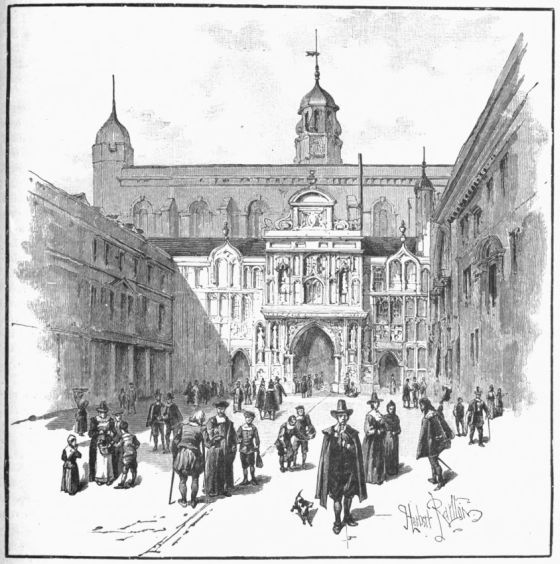
GUILDHALL, LONDON, IN THE TIME OF CHARLES I.
On the publication of these canons, great was the ferment in the country, and petitions and remonstrances from Northampton, Kent, Devon, and other counties, were sent up against them. The code was most ungracious as regarded the Catholics, who had just presented to the king, at the suggestion of the queen, fourteen thousand pounds. The queen remonstrated against it, and the king gave orders to Laud to desist from further annoyance in that direction. But anger and discontent were spreading throughout the country, from the outrageous measures to raise money. Fresh writs of ship-money were issued, and many victims were dragged into the Star Chamber for refusal to pay, and fined, so that their money was obtained by one process or the other. The names of the richest citizens were picked out in order to demand loans from them. Bullion, the property of foreign merchants, was seized at the Mint, and forty thousand pounds were extorted for its release; and bags of pepper on the Exchange were sold at whatever they would fetch. It was next proposed to coin four hundred thousand pounds' worth of bad money; but the merchants and other intelligent men came forward and drew such a picture of the ruin and confusion that such an act would produce, that the king was alarmed, and gave the project up. The Council, however, hit upon the scheme of purchasing goods at long credit, and selling them at a low price for ready money. All this time large sums of money were levied throughout the land by violence, for the support of the troops collected for the campaign against the Scots. Carts, horses, and forage were seized at the sword's point; and whoever dared to represent these outrages to the king was branded as an enemy to the Government. The Corporation of London was dealt with severely, because it showed no fondness for enforcing the king's arbitrary demands. The Lord Mayor and sheriffs were cited into the Star Chamber for remissness in levying the ship-money; and several of the aldermen were committed to prison for refusing to furnish the names of such persons in their wards as were able to contribute to Charles's forced loans. Strafford said things would never go right till a few fat London aldermen were hanged.
These desperate measures inflamed the public mind beyond expression, and greatly strengthened the league of the discontented with the Scots. All except the insane tyrants who were thus forcing the nation to rebellion, could see tempests ahead; and the Earl of Northumberland, writing to a friend, said, "It is impossible that all things can long remain in the condition they are now in: so general a defection in this kingdom hath not been known in the memory of man." The disaffection began to find expression, and, according to Clarendon, inflammatory placards were scattered about the City and affixed on gates and public places, denouncing the king's chief advisers. Laud, Strafford, and Hamilton, were the marks of the most intense hatred, and the London apprentices were invited, by a bill posted on the Royal Exchange, to demolish the episcopal palace at Lambeth and "haul out William the fox."
The train-bands assembled and kept the peace by day, but at night a mob of five hundred assembled and attacked Lambeth Palace, and demolished the windows, vowing that they would tear the archbishop to pieces. In a couple of hours the train-bands arrived, fired on them, and dispersed the multitude. Laud got away to Whitehall, where he remained some days, till the damages were repaired and the house was fortified with cannon. Another crowd, said to be two thousand in number, entered St. Paul's, where the High Commission Court sat, tore down the benches, and cried out, "No bishop! no High Commission!" A number of rioters were seized by the train-bands and lodged in the White Lion Prison; but the prison was forced open by the insurgents, and their associates released all but two, a sailor and a drummer, who were executed, according to some authorities; according to others, only one was thus disposed of.
The king was greatly alarmed at this outbreak. He removed the queen to Greenwich, as she was near her confinement, and placed a strong guard over the palace with sixteen pieces of cannon; nor was he easy till he saw a force of six thousand men at hand.
The time for the meeting of the Scottish Parliament had now arrived, and Charles sought to prevent it by another prorogation; but the Scots were not to be put off in any such manner. The king had for some time been treating them like a nation at war; he had prohibited all trade with Scotland, and his men-of-war had been ordered to seize its merchantmen, wherever found. The Scots therefore met on the 2nd of January, set aside the king's warrant of prorogation on the plea of informality, and the members took their seats, elected a president, an officer hitherto unknown, and passed the new Acts. They then voted a tax of ten per cent. on all rents, and five per cent. on interest of money to open the inevitable campaign; and, before rising, appointed a Committee of Estates for the government of the kingdom till the next meeting of Parliament. This Committee was to sit either at Edinburgh or at the place where the headquarters of the army should be, and a bond was entered into to support the authority of Parliament, and to give to the statutes which it had passed or should pass the same force as if they had received the royal assent.
But they had not waited for Parliament to take the necessary steps for organisation of the army. They had retained in full pay the experienced officers whom they had invited from Germany, and the soldiers who had disbanded at the pacification of Berwick returned with alacrity to their colours in March and April. Leslie was still commander-in-chief, and determined to reduce the castle of Edinburgh before marching south. It was in vain that Charles issued his proclamations, warning them of the treasonable nature of their proceedings; they went on as if animated by one spirit, and determined not only to strike the first blow, but to advance into England instead of waiting to be attacked at home.
Charles, on his part, was far from being so early ready or so well served. His plans for the campaign were grand. He proposed to attack Scotland on three sides at once—with twenty thousand men from England, with ten thousand from the Highlands under the Marquis of Hamilton, and with the same number from Ireland under Strafford. But his total want of funds prevented his progress, and the resort to the lawless practices which we have related for raising them, was alienating the hearts of his English subjects from him in an equal degree. It was not till the month of July, and the loan of three hundred thousand pounds by the Lords, that he dared to issue writs for the number of forces. Thus the Scots were ready for action when the king was only mobilising an army.
In the appointment of commanders gross blunders were committed. The Earls of Essex, Holland, and Arundel were set aside, and this, with personal affronts to Essex, tended to throw these officers into the interest of the opposition. Essex and Holland were at undisguised hostility with Strafford, and as he was to take a leading part in the campaign, they were kept out of it to oblige him. The Earl of Northumberland was appointed commander-in-chief instead of Arundel, but was prevented by a severe illness from acting; and Strafford was desired to leave Ireland in the charge of the Earl of Ormond, and take the chief command, which he consented to do, but nominally only as lieutenant to Northumberland. Lord Conway was made general of the horse, partly because he had been born a soldier in his father's garrison of Brell, and had held several subordinate commands; but still more from the causes which put incompetent generals at the head of our armies in later times—Court influence.
On the 29th of June Leslie collected his army at Chouseley Wood, near Dunse, his former camp, and drilled them there three weeks. He had entrusted the siege of the castle of Edinburgh to a select party, and had the pleasure soon after this period to hear of its surrender to his officers. Meanwhile, Conway was advancing northward, and soon gave evidence of his gross incapacity, by writing in all his despatches to Windebank, the Secretary of State, "that the Scotch had not advanced their preparations to that degree, that they would be able to march that year." But the king, Clarendon says, had much better information, and ought to have distrusted the vigilance of such a commander. Moreover, his soldiers displayed a most decided aversion to the service. They were evidently leavened with the same leaven of reform as the Parliament. They wanted to know whether their officers were Papists, and would not be satisfied till they saw them take the Sacrament. "They laid violent hands," says May, "on divers of their commanders, and killed some, uttering in bold speeches their distaste to the cause, to the astonishment of many, that common people should be sensible of public interest and religion, when lords and gentlemen seemed not to be."
Strafford was so well aware of the readiness of the Scots, and the unreadiness and disaffection of the English soldiery, that he issued strict injunctions to Conway not to attempt to cross the Tyne, and expose his raw and wavering recruits in the open country between that river and the Trent, but to fortify the passage of the Tyne at Newburn, and prevent the Scots from crossing. The Scots, however, did not leave him time for his defences. On the 20th of August, Leslie crossed the Tweed with twenty thousand infantry and three thousand cavalry. He had been strongly advised to this step by the leaders of the English opposition themselves, and "the Earls of Essex, Bedford, Holland, the Lord Say, Hampden, and Pym," says Whitelock, "were deeply in with them." No sooner were the Scots on English ground, than the preachers advanced to the front of the army with their Bibles in their hands, and led the way. The soldiers followed with reversed arms, and a proclamation was issued by Leslie that the Scots had undertaken this expedition at the call of Divine Providence, not against the people of England, but against the "Canterbury faction of Papists, Atheists, Arminians, and Prelates." God and their consciences bore them witness that they sought only the peace of both kingdoms by putting down the "troublers of Israel, the fire-brands of hell, the Korahs, the Balaams, the Doegs, the Rhabshakehs, the Hamans, the Tobiahs, the Sanballats of the times," and that done, they would return with satisfaction to their own country.
On the 27th of August they arrived at Heddon-law, near Newburn, on the left bank of the Tyne, and found Conway posted on the opposite side, between Newburnhaugh and Stellahaugh. The Scots kindled that night great fires round their camp, thus giving the English an imposing idea of its great extent; and we are told that numbers of the English soldiers went over during the night amongst them, and were well received by them, for they assured them that they only came to demand justice from the king against the men who were the pest of both nations. The next day the Scots attempted to ford the river, but were driven back by a charge of six troops of horse; these horse were, however, in their turn repulsed by the discharge of artillery, and a second attempt of the Scots succeeded. "As for Conway," says Clarendon, "he soon afterwards turned his face towards the army, nor did anything like a commander, though his troops were quickly brought together again, without the loss of a dozen men [the real loss was about sixty], and were so ashamed of their flight, that they were very willing, as well as able, to have taken what revenge they could upon the enemy."
This was not true, for though "our whole army made the most shameful and confounding flight that was ever heard of," they had no chance of taking revenge with such a commander, being only about four thousand five hundred altogether, horse and foot, while the Scots were twenty-six thousand strong. Moreover, the English had no heart for the work, while the Scots were resolute as one man, and commanded by officers who had grown grey in the service of the victorious Swede, the great Gustavus Adolphus. When the English forces reached Newcastle, they did not feel able to defend it against such an army, and they fled on to Durham. The Scots could scarcely believe their eyes when they found Newcastle evacuated.
The retreating English army, under the panic-stricken Conway, meantime dared not even stop at Durham, but continued their flight to Darlington, where they met Strafford coming up with reinforcements. He was suffering from gout and stone, and in a marvellously bad humour at the late scandalous disaster; and he must have seen enough of the demoralisation of Conway's troops, for he turned back with him to Northallerton, where Charles was lying with the bulk of his army. Altogether, Charles had now twenty thousand men and sixty pieces of cannon wherewith to face the Scots; but the disaffection became so manifest, the desertions so frequent, and the whole condition of the force so unsatisfactory, that though Strafford professed to speak with contempt of the Scots, he assured Charles that it would require two months to put his army into fighting order. They therefore fell back upon York, intending to entrench a camp under its walls, and to send the cavalry to Richmond or Cleveland to guard the passes of the Tees.
The Scots had meanwhile taken unopposed possession of Newcastle, Durham, Shields, Tynemouth, and other towns, and were masters of the four northern counties of England, without having lost twenty men. In this position it has been matter of wonder that they did not still advance, and drive the king before them; but those writers who have thus imagined have greatly mistaken the whole business. The object of the Scots was not, as of old, to annoy and devastate, much less to conquer England; it was simply to force from the king and his evil ministers the recognition and the guarantee of their just national rights. They had advanced into England with this plain declaration; they had attempted not to fight except so far as to force their way to the king's presence. To this they were, in fact, now come. They had achieved a vantage-ground from which to treat, and, though strongly posted, and possessed of the whole country north of the Tees, they had refrained from all ravages and impositions on the people with whom they had no quarrel, paying for whatever they needed. To have done otherwise, would have broken faith with the people of England, who were seeking the same redress of grievances as themselves, and have at once roused the jealousy of the English public, who would have regarded them as invaders instead of friends, and thus strengthened the hands of the king. The Scots knew perfectly well what they were about, and how best to obtain their just demands. They now therefore sent Lord Lanark, Secretary of State for Scotland, and brother of the Marquis of Hamilton, to present the petition of the Covenanters to the king, who was plainly in a strait and therefore compelled to listen to it. They respectfully repeated their pacific designs, and implored the king to assemble a Parliament, and by its wisdom to settle peace between the two kingdoms. This was precisely what the people of England were earnestly seeking, and demonstrates the perfect concert between the leaders of the two nations. To assemble a Parliament was of all things the last which Charles was disposed to consent to, but he was in no condition to refuse altogether. He therefore took three days to consider their request, and on the 5th of September returned to Lord Lanark the answer, that he would assemble a great council of English Peers in York to settle the matters in dispute between them, and that he had already summoned this Assembly for the 24th of that month. By this means Charles endeavoured to escape the necessity of calling a Parliament, but his hesitation did not avail him. All parties were too much interested to let this opportunity slip. Twelve peers—Bedford, Essex, Hertford, Warwick, Bristol, Mulgrave, Say and Sele, Howard, Bolingbroke, Mandeville, Brooke, and Paget—presented a petition, urgently representing the necessity of a Parliament, and describing the sufferings of the nation from the lawlessness of the soldiers, the damage done to trade by the arbitrary levies on merchants, and the danger of bringing in wild Irish troops. The citizens of London prepared a similar one, which Laud endeavoured to quash, but in vain; they obtained ten thousand signatures, and despatched some of the Aldermen and members of the Common Council to present it at York. The gentry of Yorkshire presented another, detailing their sufferings from the support of the army, and their cry, too, was for a Parliament. Strafford, who was desired to present it, endeavoured to persuade them to leave the prayer for a Parliament out, on pretence that he knew the king meant to call one; but they would on no account omit it. Thus pressed on all sides, Charles was reluctantly compelled to promise, and on the meeting of the great council of Peers on the 24th, announced to them that he had issued the writs for the meeting of a Parliament on the 3rd of November.
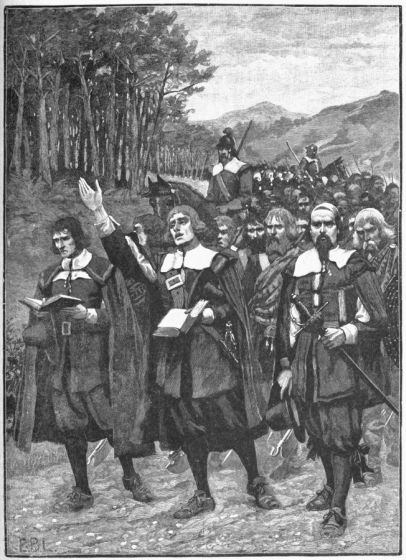
ADVANCE OF THE COVENANTERS ACROSS THE BORDER INTO ENGLAND. (See p. 587.)
The Scots had comprised their demands under seven heads, the chief of which were the full and free exercise of their religion; the total abolition of episcopacy; the restoration of their ships and goods; the recall of the offensive epithet of traitors; and the punishment of the evil counsellors who had created all these troubles. The Lords, delighted at the prospect of a Parliament, saw no difficulty in coming to terms with the Scots. They named sixteen of their own body to meet with eight Commissioners of the Covenanters at Ripon, to negotiate the terms of a peace, and sent a deputation of six other lords to London, to raise for the king a loan of two hundred thousand pounds, on their own securities. Charles would have drawn the Conference from Ripon to York, where his army lay, but the Scots were too cautious to be caught in such a snare. They represented the danger of their putting their Commissioners into the power of an army commanded by Strafford, one of the very incendiaries against whom they were complaining, and who termed them rebels and traitors in the Parliament in Ireland, and had recommended the king to subdue and destroy them. The Conference was opened at Ripon, but got no further from the 1st to the 16th of October, than the settlement of the question of the maintenance of the Scottish army till all was concluded. Charles offered to leave them at liberty to make assessments for themselves, but this they declined, as looking too much like plundering; and it was finally agreed that they should retain their position in the four northern counties, and receive eight hundred and eighty pounds for two months, binding themselves to commit no depredations on any party; and the time for the meeting of Parliament approaching, the Conference was adjourned to London on the 24th.
The last Parliament had been called the Short Parliament; this was destined to acquire the name of the Long Parliament, never to be dissolved till it had dissolved the monarchy—the most memorable Parliament that ever sat. "The Parliament," says Clarendon, "met on the 3rd of November, 1640. It had a sad and a melancholie aspect upon the first entrance, which presaged some unusual and unnatural events. The king himself did not ride with his accustomed equipages, nor in his usual majesty to Westminster, but went privately in his barge to the Parliament stairs, and so to the church, as if it had been a return of a prorogued or adjourned Parliament. There was likewise an untoward, and, in truth, an unheard of accident, which broke many of the king's measures, and infinitely disordered his service beyond a capacity of reparation."
This was the defeat in the City of the man on whom he had fixed as Speaker of the Commons, Sir Thomas Gardiner, the Recorder of London, a lawyer on whom Charles greatly calculated for managing the House. But that very morning he learned that Gardiner had been thrown out as one of the four members, and he was so confounded that it was afternoon before he could go to the House. There Lenthall, a bencher of Lincoln's Inn, was immediately elected Speaker, and Charles, believing him well affected to the Church and State, when two days afterwards he was, according to custom, presented to him, confirmed the choice, which he afterwards most bitterly repented. But it was not only in the case of the Speaker that the king was doomed to see himself disappointed. The whole body of the House was of a new character and spirit. "There was," says Clarendon, "observed a marvellous elated countenance in most of the members of Parliament before they met together in the House. The same men, who six months before were observed to be of very moderate tempers, and to wish that gentle remedies might be applied without opening the wound too wide and exposing it to the air, and rather to excuse what was amiss than too strictly make inquisition into the causes and origin of the malady, talked now in another dialect both of things and persons. Mr. Hyde, who was returned to serve for a borough in Cornwall, met Mr. Pym in Westminster Hall some days before the Parliament, and conferring together on the state of affairs, Pym told Hyde that 'they now must be of another temper than they were the last Parliament; that they must not only sweep the house clean below, but must pull down the cobwebs which hung on the tops and corners, that they might not breed dust, and so make a foul house hereafter. That they had now an opportunity to make their country happy by removing all grievances, and pulling up the causes of them by the roots, if all men would do their duties;' and used much other sharp discourse to the same purpose, by which it was discerned that the warmest and boldest counsels and overtures would find a much better reception than those of a more temperate allay, which fell out accordingly."
Charles opened Parliament, as usual, by promising freely redress of grievances on the granting of the necessary subsidies, and called on the two Houses to abandon all suspicions, and put confidence in him; but, after fifteen years of constant struggle and constant breaches of faith, this was impossible. The Commons saw the certainty at length of achieving their objects, not from any goodwill towards constitutional freedom in the king, but from the stringent necessity in which he had placed himself. His creeping into Parliament, as it were, by the back door, instead of coming there in the usual state, showed that he was anxious and depressed, and his advisers were in an equal state of terror. His latest hope—the selection of the Speaker—had failed him, and he saw the Commons commence their work by passing altogether over the question of supplies, and falling in ominous earnestness on the grievances.
On the fourth day of their session they proceeded from acts to deeds. They passed an order that those victims of the Star Chamber, Prynne, Bastwick, and Burton, whose horrible mutilations had revolted the whole civilised world, putting the Reformed Church of England on a par with persecuting and murdering Rome in her worst days, should be sent for from their distant prisons, and called on to state by whose authority they had been thus mutilated, branded, and imprisoned. This order spread a wonderful joy amongst the Reformers everywhere. The three lopped and tortured men were welcomed with acclamations at all places on their journey, and on the 28th of November they entered London attended by hundreds of carriages, and by five thousand people on horseback, both men and women, all wearing in their hats and caps bays and rosemary, and followed by great multitudes, with boughs and flowers, and strewing flowers and herbs as they passed. This was a change from the day when Laud pulled off his cap at the passing of Prynne's horrible sentence, and thanked God for it. The House of Commons, after hearing their statement, voted them damages to the amount of six thousand pounds to Burton, and five thousand pounds each to Prynne and Bastwick, which was to be paid by Archbishop Laud and his associates in the High Commission and Star Chamber.
But they did not stop there; from compensating the sufferers they passed on to the punishment of the oppressors. The Committee of Religion proceeded to inquire into the loose lives of the clergy, their cruelties towards the Puritans, and their introduction of papistical ceremonies. "Their first care," says May in his "History of Parliament," "was to vindicate distressed ministers, who had been imprisoned or deprived by the bishops, and all others who in the cause of religion had been persecuted by them. Many of those ministers were released from durance and restored to their livings, with damages from their oppressors. Many doctors and divines that had been most busy in promoting the late church innovations about altars and other ceremonies, and therefore most gracious and flourishing in the State, were then questioned and committed, inasmuch as the change, and the suddenness of it, seemed wonderful to own, and may serve worthily as a document to all posterity, quam fragili loco starent superbi—how insecure are the proud." On the 18th of December, Denzil Holles was sent to the Upper House to demand the impeachment of Laud. On hearing this the Archbishop rose, and, with his usual warmth declaring his own innocence, was proceeding to charge his accusers with various offences, when he was promptly called to order by the Earl of Essex and the Lord Say, and was stopped by the House and consigned to the Usher of the Black Rod. He apologised, and obtained leave, under surveillance of the gentleman usher, to fetch some papers from his house, necessary to his defence; and after remaining in the custody of the Black Rod for ten weeks he was committed to the Tower (February 24, 1641).
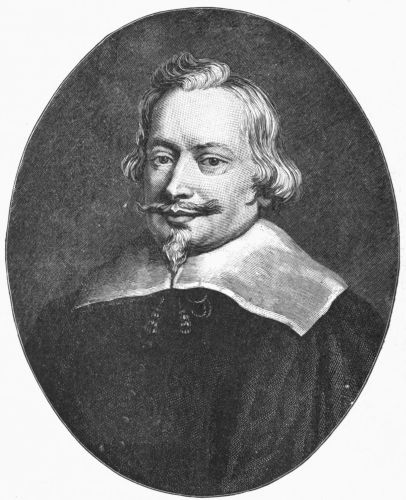
JOHN PYM. (From an Engraving by Houbraken.)
But the Commons had been all this time more deeply engaged in securing the most daring and dangerous offender of all, the Earl of Strafford. Laud, who was generally in London, was more safely within their power at any moment; but Strafford was left in the North, where he was lieutenant-general of the army, Lord President of the Council of the North, and could at any instant slip away to Ireland, where he had still more authority, and a considerable army. Laud, once caged, could wait; but Strafford must be both secured and promptly dealt with. His own friends in London, and his own sagacity, sufficiently apprised Strafford of the danger which awaited him if he came to town. He represented to the king that it were much better on all accounts that he should remain where he was; that in London he should by his presence remind the opposition of their enmity towards him; and that he would only further embarrass the king's affairs if he came, whilst he could be of service with the army, and, if necessary, escape to Ireland, where he might do the king real service. But Charles, who felt his weakness without Strafford, in whose judgment and power of overruling men he had the highest faith, would not hear of it, but insisted on his coming to London: and pledged himself to guarantee his safety, reminding him that he was King of England, and that Parliament should not touch a hair of his head. Strafford was rather bound to obey as a subject and servant of the Crown, than assured of his safety by those solemn pledges. He went to town, and on the third day after his arrival he was arrested, and placed in the custody of the Keeper of the Black Rod.
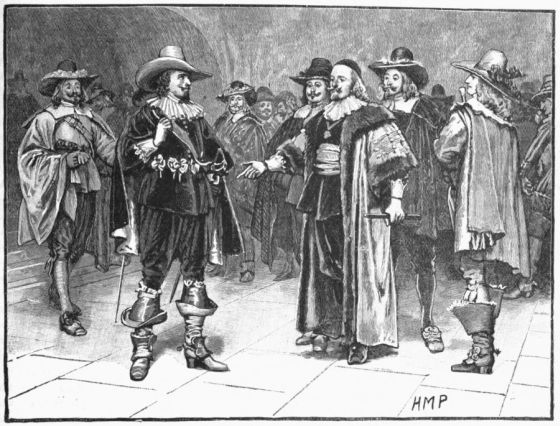
ARREST OF THE EARL OF STRAFFORD. (See p. 593.)
On the 11th of November, 1640, assuming an outward air of unconcern, Strafford went to take his seat in the House of Lords. The Earl of Northumberland, writing to the Earl of Leicester on the 13th, declared that "a greater and more universal hatred was never contracted by any person than he has drawn upon himself, yet he is not at all dejected." Before he appeared in the House, the impeachment had been carried thither from the Commons. Strafford at once hastened to meet his enemies. Baillie, who was one of the Scottish commissioners, gives this striking account of his arrest:—"He calls rudely at the door: James Maxwell, Keeper of the Black Rod, opens. His lordship, with a proud, gloomy countenance, makes towards his place at the board head; but at once many bid him avoid the House, so he is forced in confusion to go back till he is called. After consultation, being called in, he stands, but is commanded to kneel, and on his knees to hear the sentence. Being on his knees he is delivered to the Keeper of the Black Rod, to be prisoner, till he was cleared of these crimes the House of Commons had charged him with. He offered to speak, but was commanded to be gone without a word. In the outer room James Maxwell, required him, as prisoner, to deliver his sword. When he had got it, he cries with a loud voice for his man to carry my Lord-lieutenant's sword. This done, he makes through a number of people towards his coach, all gazing, no man capping him, before whom, that morning, the greatest of England would have stood uncovered, all crying, 'What is the matter?' He said, 'A small matter, I warrant you.' They replied, 'Yes, indeed, high treason is a small matter.' Coming to his place where he expected his coach, it was not there, so he behoved to return the same way, through a crowd of gazing people. When at last he found his coach, and was entering, James Maxwell told him, 'Your lordship is my prisoner, and must go in my coach;' so he behoved to do." In a few days he was committed to the Tower, and the Commons proceeded to deal with those next in degree. But Windebank, Secretary of State, and Finch the Lord Keeper, fled from the reach of their vengeance.
This, then, was the marvellous state of affairs at this moment. "Within less than six weeks," says Clarendon, "these terrible Reformers had caused the two greatest councillors of the kingdom—Laud and Strafford, whom they most feared, and so hated—to be removed from the king, and imprisoned under an accusation of high treason; and frightened away the Lord Keeper of the Great Seal of England and one of the principal Secretaries of State into foreign kingdoms for fear of the like, besides preparing all the Lords of the Council, and very many of the principal gentlemen throughout England, who had been sheriffs and deputy-lieutenants, to expect such measure of punishment from their general votes and resolutions as their future demeanour should draw upon them for their past offences." And thus ended the ever memorable year 1640, in which the Parliament had secured the ascendency after fifteen years' determined struggle with the present king, and many more with his father; had humbled the proud and obstinate monarch; imprisoned his two arch-counsellors; impressed a salutary terror on the whole royal party; and initiated changes of the most stupendous kind.
The House of Commons commenced the year 1641 with an endeavour to secure annual Parliaments, and succeeded in obtaining triennial ones. They proposed that the issuing of the writs should take place at a fixed time, and to prevent the Crown from defeating this intention, they demanded, in case the king did not order the writs at the regular time, it should be imperative on the Lord Keeper or Lord Chancellor to do it; in case they neglected it, it should become the duty of the House of Lords to do so; if the Lords failed, then the sheriffs, and if the sheriffs neglected or refused, the people should proceed to elect their own representatives without any writs at all. To frustrate in future any hasty prorogations, by which the House of Commons was liable at any moment to be stopped by the Crown, they proposed that the king should not have power to prorogue or dissolve Parliament within fifty days of its meeting without its own consent.
At one time Charles would have resented so bold a measure most indignantly, and would have dissolved the audacious body at once; but now he condescended to reason with them in a far different tone. He protested against the measure as a direct encroachment on his prerogative, by which sheriffs and constables were to be endowed with powers that hitherto had been only kingly; but he was fain at last to give way, and the Bill, so far as regarded triennial Parliaments, was passed, and a Bill securing the Houses from hasty prorogation followed in May. By that act Charles tied up his hands from dissolving Parliament at all without its own consent, so that he could no longer defeat its measures as he had done. Thus a real and most momentous infringement on the prerogative was made, being brought about by the king's resistance to the cession of just rights. In obstinately claiming the people's privileges, he was driven to forfeit his own. He was now in a dilemma. The army of the Scots still lay in the North, and both the English Commons and the Scottish Commissioners in London were in no hurry to have it disbanded. Whilst it lay there well supported by Parliamentary allowance, the king and his friends were overawed and powerless, and both parties, the Commons of England and the Covenanters of Scotland, were the better able to press their claims and support each other. Both parties were bent on abolishing or reducing episcopacy.
The Scottish Commissioners exerted themselves with the leaders of the English Commons to move for the total abolition of episcopacy in England, and the establishment of Presbyterianism; but this led only to the development of a variety of views in the Commons. Some of the members favoured the Scottish proposal, and of these were the supporters of the petition with fifteen thousand signatures, brought in from London by Alderman Pennington, called the "root and branch petition." Others, as the Lords Wharton, Say, and Brooke, preferred the still more levelling system of the Independents. On the other hand, some of the most prominent Reformers—the Lords Digby and Falkland, and Selden and Rudyard—were opposed to the extinction of the bishops. Digby compared the London petition to a comet portending nothing but anarchy, and with its tail pointing to the North, meaning that it was a Scottish comet; and Lord Falkland was for relieving the bishops of their temporal cares, but not removing them from the Church altogether. The question was warmly debated for two days, but the fate of the bishops was deferred awhile by that of Strafford.
All being prepared, Strafford was brought from the Tower on the 22nd of March, 1641, and placed before the tribunal appointed to try him in Westminster Hall. He had been about three months in prison, and meanwhile a deputation had arrived from Ireland. They brought a petition, calling on the Commons of England to join them in obtaining his condign punishment. They enumerated their grievances and sufferings from his lawless violence under sixteen heads. The Commons welcomed the deputation, as may be supposed, and to obtain full evidence of Strafford's doings in Ireland, not only accused his most active instrument—Sir George Ratcliffe—of high treason, too, but almost every one of his willing subordinates, and secured all of them that they could, and kept them in readiness to be questioned, by which means they also prevented them from doing mischief with the army. The Scottish Commissioners were equally vehement in demanding justice against him for having counselled the king to put down their religion and government by force, and for offering to supply an army of Irish for the purpose. Thus all three kingdoms were arrayed against the common enemy.
After much debate, it had been concluded that the trial should take place in Westminster Hall, before the Lords and Commons. The Earl of Arundel was appointed to preside as Lord High Steward. On each side of the throne was erected a cabinet, where the king, queen, and Prince of Wales could sit without being seen, these cabinets having trellis work in front, and being hung with arras. Before the throne ran lines of seats for the peers, and woolsacks for the judges, and on each side of the peers were ranged seats for the Commons, who consented to sit uncovered there. Near them were the Scottish and Irish deputies, and there was a desk or dock enclosed for the prisoner and his counsel. One-third of the Hall was left open to the public, the rest being defended by a bar; and there was a gallery near for ladies, which was crowded by those of highest rank. There was an intense interest, indeed, felt by all classes, and the hall was daily so crowded, that Mr. Principal Baillie, minister of Kilwinning, whom we have already mentioned, says in the quaint manner of his time, "We always behoved to be there before five in the morning: the house was full before seven."
Strafford was brought from the Tower guarded by a hundred soldiers, who filled, with the officers, six barges; and on landing at Westminster he was received and conducted forward by two hundred of the train-band. All cross streets and entries were occupied by a strong force of constables and watchmen, placed there as early as four in the morning. The king, queen, and prince arrived about nine o'clock, and about the same time the prisoner was conducted into the Hall. On his appearance the porter demanded of the Usher of the Black Rod whether the axe should be borne before him; but the Usher said no, the king had expressly forbidden it.
The bishops did not appear amongst the lords, for their presence had been strongly objected to by the House of Commons, on the plea that the canons forbade their taking part in any trial which involved bloodshed—"clericus non debet interesse sanguini." But the real fact was that they were supporters of Laud, and Williams, of Lincoln, very adroitly volunteered a motion as from the prelates themselves, that they should be excused. The Commons had objected to those who had been made peers since Strafford had been impeached, as they were his avowed friends. All, except Lord Lyttelton, who had been made a baron and Lord Keeper in the place of the fugitive Finch, refused to comply and took their seats; and so says Clarendon, might the bishops, too, had they had the same spirit.
All being ready, the impeachment was read, consisting of twenty-eight capital articles, and then Strafford's reply to it, which filled two hundred sheets of paper. This occupied the first day. The court rose about two o'clock, and the prisoner was reconducted to the Tower. This was the routine of each day during the trial, which lasted eighteen days. On entering the court at nine o'clock, Strafford made three obeisances to the Earl of Arundel, the High Steward, two of which might be interpreted as intended for the king and queen, though they were not at first visible, nor during the whole time were supposed to be so; but the interest of the proceedings quickly made the king impatient of the trellis work, and, according to Baillie, he pulled it down with his own hands. "It was daily the most glorious assembly," continues Baillie, "that the isle could afford; yet the gravity was not such as I expected. After ten, much public eating, not only of confections, but of flesh and bread; bottles of beer and wine going thick from mouth to mouth without cups, and all this in the king's eye.... There was no outgoing to return, and often the sitting was till two, three, or four o'clock at night."
As Strafford went and came, the crowd conducted themselves towards him with forbearance and courtesy, and he returned their greetings with humility and politeness. Few of the lords at first returned his obeisances, and the managers, thirteen in number, showed him no favour. When the Lord Steward ordered the Committee of Management to proceed on the second morning, Pym opened the case with an eloquent charge, commencing with these words:—"My lords, we stand here by the commandment of the knights, citizens, and burgesses, now assembled for the Commons in Parliament, and we are ready to make good that impeachment whereby Thomas, Earl of Strafford, stands charged in their name, and in the name of all the Commons of England, with high treason. This, my lords, is a great cause, and we might sink under the weight of it, and be astonished with the lustre of this noble assembly, if there were not in the cause strength and vigour to support itself, and to encourage us. It is the cause of the king; it concerns his majesty in the honour of his government, in the safety of his person, in the stability of his crown. It is the cause of the kingdom: it concerns not only the peace and prosperity, but even the being of the kingdom. We have that piercing eloquence, the cries, and groans, and tears of all the subjects assisting us. We have the three kingdoms, England, and Scotland, and Ireland, in travail and agitation with us, bowing themselves, like the hinds spoken of in Job, to cast out their sorrows. Truth and goodness, my lords, they are the beauty of the soul, they are the perfection of all created natures, they are the image and character of God upon the creatures. This beauty, evil spirits and evil men have lost; but yet there are none so wicked, but they desire to march under the show and shadow of it, though they hate the reality of it. This unhappy earl, now the object of your lordships' justice, hath taken as much care, hath used as much cunning, to set a face and countenance of honesty in the performance of all these actions. My lords, it is the greatest baseness of wickedness, that it dares not look in its own colours, nor be seen in its natural countenance. But virtue, as it is amiable in all aspects, so the least is not this, that it puts a nobleness, it puts a bravery upon the mind, and lifts it above hopes and fears, above favour and displeasure: it makes it always uniform and constant to itself. The service commanded to me and my colleagues, is to take off those vizards of truth and uprightness, which hath been sought to be put upon this cause, and to show you his actions and intentions in their own natural blackness and deformity."