Chapter XIX
Reading edition
REIGN OF CHARLES I.
Accession of Charles—His Marriage—Meeting of Parliament—Loan of Ships to Richelieu—Dissolution of Parliament—Failure of the Spanish Expedition—Persecution of the Catholics—The Second Parliament—It appoints three Committees—Impeachment of Buckingham—Parliament dissolved to save him—Illegal Government—High Church Doctrines—Rupture with France—Disastrous Expedition to Rhé—The Third Parliament—The Petition of Right—Resistance and Final Surrender of Charles—Parliament Prorogued—Assassination of Buckingham—Fall of La Rochelle—Parliament Reassembles and is dissolved—Imprisonment of Offending Members—Government without Parliament—Peace with France and Spain—Gustavus Adolphus in Germany—Despotic Proceedings of Charles and Laud.
Within a quarter of an hour after the decease of James, Charles was proclaimed by the Knight-Marshal, Sir Edward Zouch, at the court-gate at Theobalds. He was in his twenty-fifth year, and so far as the admission of his title and the substantial prosperity of the kingdom were concerned, few monarchs have mounted the throne with more favourable auspices. But though there was entire submission to his right to reign, and the state of parties was such that no immediate change of executive was needed, yet there were at work feelings and principles which required the nicest wisdom to estimate their nature and their force, and the most able policy to deal with them. The battle between prerogative and popular rights had to be fought out, and it depended on the capacity of the monarch to perceive what was capable of modulation, and what was immovable, whether the result should be success or ruin. Charles was equally prepared by his father's maxims, his father's practice, and his habit of favouritism, to convert one of the grandest opportunities in history into one of the most terrible of its catastrophes. The first thing which augured ill for him was his continuing in the post of chief favourite and chief counsellor, the vain, incapable, and licentious Buckingham. The next matter to which Charles turned his attention was his marriage with the Princess Henrietta Maria, sister of Louis XIII. of France, the contract for which was already signed. The third day after his accession, he ratified the treaty as king which he had signed as prince. The Pope Urban, as we have stated, seeing that he could not prevail on the royal family of France to give up the marriage with the heretic prince of England, at length had, through his nuncio, delivered the breve of dispensation.
Louis of France, the queen-mother, the bride, Gaston Duke of Orleans, and the Duke of Chevreuse, Charles's proxy, signed the document with the English ambassadors, on the 8th of May, 1625, and the marriage took place on a platform in front of the ancient cathedral of Notre Dame on the 11th. The Duke of Buckingham arrived to conduct the young queen to England, attended by a numerous and splendid retinue of English nobility. The showy and extravagant upstart appeared at the French Court in a style which threw even the monarch into the shade. He wore "a rich white satin uncut velvet suit, set all over, suit and cloak, with diamonds, the value whereof," say the Hardwicke Papers, "is thought to be worth fourscore thousand pounds; besides a feather made with great diamonds, with sword, girdle, hatband, and spurs with diamonds, and he had twenty-seven other suits, all rich as invention could frame or art fashion." His conduct was as devoid of modesty as his dress, and threw discredit on the king who could entrust his honour and his counsels to such a man.
The king, queen, and queen-mother, accompanied by the whole Court, set out to conduct the young fiancée to the port where she should embark for England. The procession was made as gorgeous and imposing as possible, and at each halting place the Court was amused by a variety of pageants and entertainments drawn from a past age. One alone of these deserves remark, being afterwards deemed ominous—a representation of all the French princesses who had become queens of England. They presented a group distinguished by their misfortunes, the only one necessary to complete the number being herself yet a spectator, the girlish Henrietta, little more than fifteen years of age, who was destined to exceed them all in calamity. The king was, however, seized with an illness, which compelled him to discontinue the journey, and at Compiègne the queen-mother was also taken so ill as to detain the procession a fortnight at Amiens. There the queen and queen-mother took leave of Henrietta. Charles, during the delay at Amiens, had been awaiting his Buckingham. No sooner did that most impudent of libertines reach the French Court than he had the audacity to fall in love with the Queen of France, the beautiful Anne of Austria. He lost no opportunity of pressing his insolent suit on the way in the absence of the king, and had the presumption to imagine that his daring passion was returned. No sooner did he reach Boulogne, than pretending that he had received some despatches of the utmost importance, he hurried back to Amiens, where the French procession yet remained, and rushing into the bed-chamber of the queen, threw himself on his knees before her, and, regardless of the presence of two maids of honour, poured out the infamous protestations of his polluted passion. The queen repulsed him with an air of deep anger, and bade him begone in a tone of cutting severity, the reality of which, however, was doubted by Madame de Motteville, who recorded the occurrence.
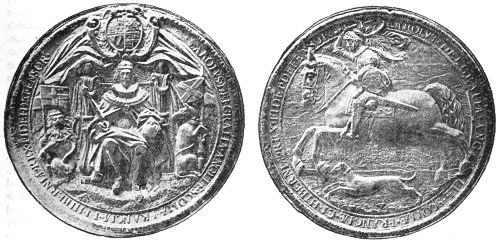
GREAT SEAL OF CHARLES I.
The sensation excited by this unparalleled circumstance in the French Court was intense. The king ordered the arrest of a number of the queen's attendants, and dismissed several of them. Yet Buckingham, on reaching England, does not appear to have received any serious censure from his infatuated master, for this breach of all ambassadorial decency and etiquette; and in spite of the resentment of the French king and Court, continued to maintain all the character of a devoted lover of the French queen.
On the 23rd of June the report of ordnance wafted over from Boulogne announced the embarkation; and on Sunday evening the queen landed at Dover, after a stormy passage. Mr. Tyrwhitt, a gentleman of the household, rode post haste to Canterbury to inform Charles, who was at Dover Castle by ten o'clock the next morning to greet his bride. Henrietta Maria was at breakfast when the king was announced, and instantly rose, and hastened downstairs to meet him. On seeing him, she attempted to kneel and kiss his hand, but he prevented her, by folding her in his arms and kissing her. She had studied a little set speech to address him with, but could only get out so much of it as, "Sire, je suis venue en ce pays de votre majesté, pour être commandée de vous"—"Sire, I am come into your majesty's country to be at your command"—but at that point she burst into tears.
Charles was delighted with the beauty and vivacity of the young queen. They set out for Canterbury, and on their way thither were met on Barham Downs by the English nobility; pavilions being pitched there for the purpose of the refreshment of the royal pair, and the introduction of the queen to her court. After the wedding, at which the celebrated English composer, Orlando Gibbons, performed on the organ, the royal cavalcade took its way to Gravesend, and thence ascended the Thames, so as to avoid the city, in which the plague was then raging.
On the 28th of June, the day after the arrival of the queen in London, Charles met his first Parliament. The king had not yet been crowned, but he appeared on the throne with his crown on his head. He ordered one of the bishops to read prayers before proceeding to business, and this was done so adroitly, that the Catholic members were compelled to remain during the heretical service. They betrayed great uneasiness, some kneeling, some standing upright, and one unhappy individual continuing to cross himself the whole time.
Charles was not an eloquent speaker, and, moreover, was afflicted with stammering; but he plunged boldly into a statement which it was very easy for the two Houses to understand. He informed them that his father had left debts to the amount of seven hundred thousand pounds; that the money voted for the war against Spain and Austria was expended, and he therefore called upon them for liberal supplies. He declared his resolution to prosecute the wars which they had so loudly called for with vigour, but it was for them to furnish the means.
As he was beginning his reign, and had not plunged himself into very heavy debt, or preached up, like his father, the claims of the prerogative, he had a right to expect a more generous treatment than James. But, notwithstanding the éclat of a new reign, and the usual desire on such occasions to stand well with the throne, the Commons displayed no enthusiasm in voting their money. There were many causes, even under a new king, to produce this coolness. Charles had won their popularity by abandoning the Spanish match, but he had now neutralised that merit by taking a Catholic queen from France. To please the Commons and the public generally, he should have selected a wife from one of the Protestant houses of Germany or the Netherlands; but for this he had displayed no desire. In the second place, he had retained the hated Buckingham in all his former eminence, both as a minister of the Crown, and as his own associate. Besides, they had no faith in his abilities, either as a commander or a statesman, and beheld with disgust his reckless extravagance and the unconcealed infamy of his life at home. No talent whatever had been shown in the war in Germany for the restoration of the Palatinate; and, therefore, the Commons, instead of voting money to defray the late king's debts and to carry on the war efficiently, restricted their advances to two subsidies, amounting to about one hundred and forty thousand pounds, and to the grant of tonnage and poundage, not for life as aforetime, but merely for the space of one year.
But still more apprehensive were they on the subject of religion. The breach with Spain had naturally removed any delicacy on the part of the Spaniards to conceal the treacherous concessions, in perfect contradiction to the public professions of both the late and the present king, which had been made on that head. It was now freely whispered that the like had been made to France, and the sight of the crowd of priests and Catholic courtiers who had flocked over with the queen, and the performance of the Mass in the king's own house, led the zealous Reformers to believe that there was a tacit intention on the part of the king to restore the Catholic religion.
What rendered the Commons more sensitive on this point were the writings of Dr. Montague, one of the king's chaplains and editor of his father's works. In a controversy with a Catholic missionary, he had disowned the Calvinistic doctrines of the Puritans with which his church was charged, and declared for the Arminian tenets of which Laud was the great champion. This gave much offence; he was accused of being a concealed Papist, and two Puritan ministers, Yates and Ward, prepared a charge against him and laid it before Parliament. Montague denied that he was amenable to Parliament and "appealed unto Cæsar." Charles informed the Commons that the cognisance of his chaplains belonged to him, and not to them. But they asserted their right to deal with all such cases, and summoned him to appear at the bar of the House, where they bound him in a bond of two thousand pounds to appear when called for.
Charles endeavoured to direct their attention to the state of the finances, showing them the inadequacy of their votes, the fitting out of the navy amounting alone to three hundred thousand pounds. He was beyond all indignant at the grant of tonnage and poundage for only one year, seeing that his predecessors from the time of Henry VI. had enjoyed it for life; and the Lords threw out that part of the vote for this reason, so that he had no Parliamentary right to collect it at all. To make matters worse, instead of attending to the pleading of Lord Conway, the Chief Secretary, for further grants, they presented to the king, after listening to four sermons one day and taking the Sacrament the next, a "pious petition" praying him—as he valued the maintenance of true religion and would discourage superstition and idolatry—to put in force the penal Statutes against Catholics.
To this demand Charles could only return an evasive answer. He had recently bound himself by the most solemn oaths to do nothing of the kind; and under the sanction of the marriage treaty with France, the Mass was every day celebrated under his own roof, and his palace and its immediate vicinity swarmed with Catholics and their priests. Nay, he had, just before summoning Parliament, been called on by France to send a fleet in virtue of this treaty to assist in putting down the Huguenots. Soubise, the General of the Huguenots, still retained possession of La Rochelle and the island of Rhé, and their fleet scoured the coasts in such force that the French fleet dared not attempt to cope with it. Richelieu, therefore, requested Charles to give Louis assistance. Charles delayed until he received news, which proved to be premature, that peace had been concluded with the Huguenots. Thereupon he concluded that the ships might be sent without danger. Accordingly, though the affairs of the English fleet had been wofully misconducted ever since Buckingham had been Lord Admiral, he mustered seven merchant vessels, and sent them with the Vanguard, the only ship of the line that was fit for sea, under the command of Admiral Pennington, to La Rochelle. The destination of the fleet was declared to be Genoa, but on reaching Dieppe, the officers and crew were astonished to receive orders to take on board French soldiers and sailors, and proceed to La Rochelle to fight against the Protestants. They refused to a man, and notwithstanding the imperative commands of the Duke of Montmorency the Lord Admiral of France, they compelled their own admiral to put back to the Downs.
On this ignominious return, Pennington requested to be permitted to decline this service, and his desire was much favoured by the remonstrances of the Huguenots, who sent over an envoy, entreating the king not to give such a triumph to Popery as to fight against the Protestants. Charles, with that fatal duplicity which he had learned so early under his father, sent fair words to Soubise, the Duke of Rohan, and the other leaders of the Huguenots; but Buckingham, by speaking out more plainly, exposed the hollowness of his master. He assured the navy that they were bound by treaty, and fight they must for the king of France. Both officers and owners of the ships declared that as they were chartered for the service of the king of England, they should not be handed over to the French without an order from the king himself. Thereupon Buckingham hastened down to Rochester, accompanied by the French ambassador, who offered to charter the vessels for his Government. Men, owners, and officers, refused positively any such service.
Disappointed by this display of true English spirit, Charles ordered Secretary Conway to write to Vice-Admiral Pennington in his name, commanding him that he should proceed to Dieppe and take on board as many men as the French Government desired, for which this letter was his warrant. At the same time Pennington received an autographic letter from Charles, commanding him to make over the Vanguard to the French admiral at Dieppe, and to order the commanders of the seven merchant ships to do the same, and in case of refusal to compel them by force. All this appears to have been imposed on Pennington as a matter of strict secrecy; and that officer had not the virtue to refuse so degrading a service. The fleet again sailed to Dieppe: the men must have more than suspected the object; and when Pennington made over the Vanguard, and delivered the royal order to the captains of the seven merchant vessels, they declined to obey, and weighed anchor to return home. On this Pennington, who proved himself the fitting tool of such a king, fired into them, and overawed all of them except Sir Ferdinand Gore, in the Neptune, who kept on his way, disdaining to disgrace himself by such a deed. The French were taken on board and conveyed to La Rochelle. But that was all that was accomplished; for the English seamen instantly deserted on reaching land, and many of them hastened to join the ranks of the Huguenots, the rest returning home overflowing with indignation and spreading everywhere the disgrace of the royal conduct.
In the whole of this transaction the headstrong fatality of Charles was conspicuous, and foreboded the miseries that were to follow. In the midst of the public excitement from this cause, the Parliament met at Oxford on the 1st of August. The result was as might have been expected. On the king demanding the restoration of the vote of tonnage and poundage, negatived by the Lords, or that other subsidies should be granted in lieu of it, the Commons refused both. In reply to the king's inquiry how the war was to be carried on, they replied that they must first be satisfied against whom the war was really to be directed. They complained that the penal statutes against the Papists were not enforced as promised, and proceeded to their favourite avocation of attacking public grievances. On this topic Coke came forward with an eloquence and a boldness which astonished the Court. With an unsparing vigour worthy of his earlier years—but in a much better cause than that in which his abilities were then often exercised—he denounced the new offices created, the monopolies granted, and the lavish waste of the public money, all for the benefit of Buckingham and his relations. He insisted that the useless pensions which had been recently granted should be stopped till the late king's debts were paid, and that a system of strict economy should be substituted for the now extravagant expenditure of the royal household. Others followed in the same strain, denouncing the odious practice of selling offices, of which Buckingham and his mother were the chief vendors.
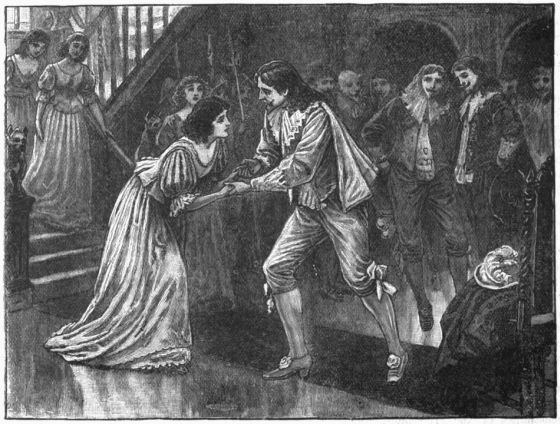
CHARLES WELCOMING HIS QUEEN TO ENGLAND. (See p. 509.)
A third party showed that they were armed with dangerous matter by the still disgraced and restrained Earl of Bristol. They charged Buckingham with his mal-administration of affairs, with his incompetency as Lord High Admiral, and with having involved this country in an unnecessary war with Spain, merely in revenge of a private quarrel with the Spanish minister, Olivarez. They demanded an inquiry into that affair. One of the members of the House venturing to defend the Government, and condemning the licence of speech against the Crown, was speedily brought upon his knees and compelled to implore pardon at the Bar. Sir Robert Cotton, the founder of the Cottonian Library, applauded the wisdom and spirit of the House in thus summarily dealing with this unworthy member; and after giving a description of the conduct of the late favourite, Somerset, and of the follies and crimes of favourites of former reigns, as the Spencers, the Gavestons, the Poles, and others, pronounced Buckingham as far more insolent, mischievous, and incompetent than any of them.
The favourite, thus rudely handled, was quietly enjoying himself at Woodstock; but the king made him aware of the necessity of defending himself. He hastened to town, and delivered in his place in the Peers, a statement of the accounts of the navy, and a stout denial of any personal motives in the quarrel with Spain. He clearly showed that he felt whence the danger came, and alluding to the Earl of Bristol, said, "I am minded to leave that business asleep, but if it should awake, it will prove a lion to devour him who co-operated with Olivarez."
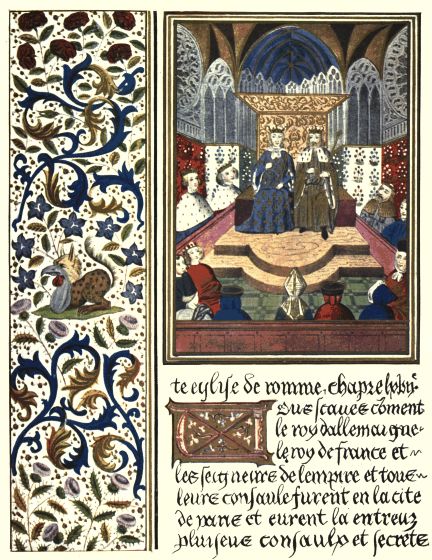
From the Froissart MS. in the British Museum. Reproduced by André & Sleigh, Ld., Bushey, Herts.
ILLUMINATED PAGE, WITH BORDERING.
THE ILLUMINATION SHOWS THE EMPEROR OF GERMANY, WENCESLAUS, AND CHARLES VI OF FRANCE SITTING IN COUNCIL (PROBABLY IN THE CATHEDRAL OF RHEIMS) TO DEVISE MEANS FOR TERMINATING THE SCHISM IN THE ROMAN CHURCH IN THE FOURTEENTH CENTURY.
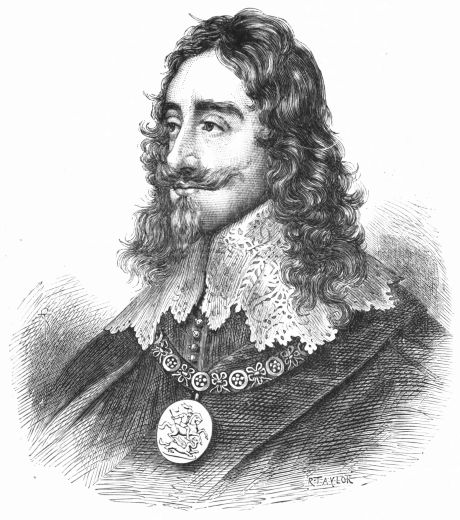
CHARLES I.
To cut short these awkward debates, the king sent word to the Commons that as the plague was already in Oxford, it was necessary to make quick work, and that they should finish the grant of supplies. He offered to accept for the present forty thousand pounds; but the House refused even this, saying that if that was all that was necessary, it might readily be raised by a loan to the Crown. This put the king beyond his patience, and he menaced them with a speedy dissolution; adding if they were not afraid of their health, he would take care of it for them, by releasing them from the plague-invaded city, and find some means of helping himself. The Commons were not in a temper to be intimidated; on the contrary, they went into a most warm and spirited debate on the king's message, and appointed a committee to prepare a reply. In this they thanked him for his care of their health, and of the religion of the nation, and promised supplies when the abuses of the Government were redressed; and they called upon him not to suffer himself to be prejudiced against the greatest safeguard that a king could have—the faithful and dutiful Commons—by interested persons. Before they had time, however, to present this address, Charles dissolved the Parliament, which had only sat in this Oxford Session twelve days.
Thus deprived of all the necessary funds for a war, none but so infatuated a monarch as Charles would have persisted in plunging into it. War had not yet been proclaimed against Spain; it was neither necessary nor expedient; on the contrary, every motive of political wisdom warned him to peace in that quarter, if he really wished to be at liberty to prosecute the interests of the Elector and the Protestant cause. But led by the splenetic imbecility of Buckingham, so far was he from seeing the folly of a war with Spain, that he was soon pushed into one with France. In fact, he took every step which would have been avoided by a wise prince, and speedily involved himself in a labyrinth of inextricable difficulties. Spain quieted and even soothed; France cultivated with the object of obtaining its influence and aid in the recovery of the Palatinate; and the Protestants of Germany sympathised with, if not aided substantially in their severe struggle against Austrian bigotry, Charles might have eventually restored his sister and her husband to their old estate, and have won a place in the European world superior to any king of his time. Instead of this, he took the surest means to exasperate his own people and his most powerful neighbour that his worst enemies could have suggested.
To raise money for the prosecution of the war against Spain, he ordered the duties of tonnage and poundage to be levied, notwithstanding they were not voted by the Peers. He issued writs of Privy Seal to the nobility, gentry, and clergy, for loans of money, and menaced vengeance if they were not complied with. All salaries and fees were suspended, and to such a strait was he reduced by his efforts to man and supply the fleet, that he was obliged to borrow three thousand pounds from the corporations of Southampton and Salisbury to enable him to meet the expenses of his own table.
At length the fleet was ready to sail with a force of ten thousand men; the English fleet consisted of eighty sail, and the Dutch sent an addition of sixteen sail. In weight and armament of ships such a force had scarcely ever before left an English port. But formidable as was this naval power, it was rendered perfectly inert by the same utter want of judgment and genius which marked all the measures of Buckingham. Its destination was to have been kept secret, so that it might take the Spaniards by surprise; but it was well known, not only to that nation, but to the whole Continent. In spite of this, such a force, in the hands of a Drake or a Nottingham, might have struck a ruinous blow at the Spanish navy and seaports; but Buckingham, for his own selfish purposes, appointed to the command Sir Edward Cecil, now created Viscount Wimbledon, a man who had, indeed, grown grey in the service of the States of Holland, but only to make himself known as most incompetent to such an enterprise. He was, moreover, a land officer, whilst the admiral to whom the command regularly fell, in case the Lord High Admiral himself did not take it—Sir Robert Mansell, Vice-Admiral of England—had a high reputation and the confidence of the men as an experienced officer.
On the 3rd of October this noble but ill-used fleet sailed from Plymouth, and took its way across the Bay of Biscay, where it encountered one of its storms, and received considerable damage, one vessel foundering with a hundred and seventy men. The admiral had instructions to intercept the treasure ships from America, to scour the coasts of Spain, and destroy the shipping in its harbours. But instead of doing that first which must be done then if at all—attack the ships in the ports—he called a council, and was completely bewildered by the conflicting opinions given. The conclusion was to make for Cadiz and seize its ships, but the Spaniards were already aware of and prepared for them. Instead of keeping, moreover, a sharp watch for the Plate ships, Wimbledon let several of them escape into port, which of themselves were thought, says Howell, rich enough to have paid all the expenses of the expedition. There was still nothing to prevent a brave admiral from attacking the vessels in harbour; but more accustomed to land service, the commander landed his forces, and took the Fort of Puntal. Making next a rapid march towards the bridge of Suazzo, in order to cut off the communication between the Isle de Leon and the mainland, his soldiers discovered some wine cellars by the way and became intoxicated and incapable of preserving order. Alarmed at this circumstance, their incapable leader conducted them back to the ships. Not daring to attack the port, he determined to look out for the treasure ships. But while cruising for this purpose, a fever broke out on board the vessel of Lord Delaware; and as if it were his intention to diffuse the contagion through the whole fleet, the admiral had the sick men distributed among the healthy ships. A dreadful mortality accordingly raged through the whole fleet. No Plate ships could be seen, for they appear to have been aware of their enemies and held away towards the Barbary coast; and after waiting fruitlessly for eighteen days, Wimbledon made sail again for England. No sooner did this imbecile quit the coast than fifty richly laden vessels entered the port of Lisbon. On landing at Plymouth, with the loss of a thousand men in this most ignominious voyage, the people received the admiral with hisses and execrations.
Meanwhile Charles, who was in straits with his Parliament and subjects, was compelled to try again the more than dubious resort to Parliament for money. To prepare the way for any success with the Commons, he was obliged to do that which must certainly embroil him with his French allies, and add fresh fuel to the fire of domestic discord which consumed him. Certainly never had any man a more arduous part to play, and the king had rendered his position all the harder by the imprudence of his measures; for nothing is easier than for men, by their folly or absurd resentments, to knit themselves up into a web of difficulties. He now resolved to break his marriage oath to France, and persecute the Catholics to conciliate the Protestants. Orders were accordingly issued to all magistrates to put the penal laws in force, and a commission was appointed to levy the fines on the recusants. All Catholic priests and missionaries were warned to quit the kingdom immediately, and all parents and guardians to recall their children from Catholic schools, and young men from Catholic colleges on the Continent. But worse than all, because personally insulting and irritating to the higher classes, who constituted the House of Peers, and who hitherto had exhibited much forbearance, he accepted the advice of his Council that the Catholic aristocracy should be disarmed.
Certainly no proceedings could indispose the House of Peers to the king more than such as these; but meanwhile Charles was active in endeavouring by other measures to win a party there. The Earl of Pembroke had for some time made himself head of the Opposition, and on great occasions brought with him on a vote no less than ten proxies, Buckingham himself being only able to command thirteen. He prevailed on Pembroke to be reconciled to the favourite; and at the same time in order to punish the Lord Keeper Williams who had quarrelled with Buckingham and had told him that he should go over to Pembroke, and labour for the redress of the grievances of the people—he dismissed him and gave the Great Seal to Sir Thomas Coventry, the Attorney-General.
To manage the Commons, and to prevent the threatened impeachment of Buckingham, when the judges presented to him the lists of sheriffs Charles struck out seven names and wrote in their places seven of the most able and active of the leaders of Opposition in the Commons, the most determined enemies of the favourite:—Sir Edward Coke, Sir Thomas Wentworth, Sir Francis Seymour, Sir Robert Philips, Sir Grey Palmer, Sir William Fleetwood, and Edward Alford. As this office disqualified them from sitting in Parliament, the king thus got rid of them for that year; but Coke contended that though a sheriff could not sit for his own county he could for another, and got himself elected for the county of Norfolk, but did not venture to take his seat.
All these measures, it will be seen, were dictated not by a desire to conciliate, but to override the Parliament, and therefore could not promise much good to a mind of any depth of penetration. Parliament was summoned for the 6th of February, 1626, and the 2nd was appointed for the coronation. With the knowledge of a discontented people, Charles went to meet his Parliament, and this consciousness would, in a monarch capable of taking a solemn warning, have operated to produce conciliation, at least of tone; but Charles was one of that class of men who illustrated the striking words of the Latin fatalist "Whom God intends to destroy He first drives mad." Accordingly, he opened the sitting with a curt speech, referring them to that of the new Lord Keeper Coventry, which was in the worst possible taste. He said, "If we consider aright, and think of the incomparable distance between the supreme height and majesty of a mighty monarch, and the submissive awe and lowliness of loyal subjects, we cannot but receive exceeding comfort and contentment in the frame and constitution of this highest Court, wherein not only prelates, nobles, and grandees, but the commons of all degrees have their part; and wherein that high majesty doth descend to admit, or rather to invite, the humblest of his subjects to conference and council with him."
Of all language this was, in the temper of the Commons, the most adapted to incense them. Such talk of the condescension of the Crown, at the moment when they were entering on a desperate conflict against its abuse of the prerogative, only the more stimulated their resolution to their task. They immediately formed themselves into three committees: one of religion, a second of grievances, and a third of evils. They again, by the Committee of Religion, canvassed the subject of Popery; resolving to enact still severer laws against it, as the origin of many of the worst evils that afflicted the nation. They summoned schoolmasters from various and remote parts of the kingdom, and put searching questions to them, as to the doctrines which they held and taught to their scholars; and every member of the House was called upon in turn to denounce all persons in authority or office, known to them as holding the tenets of the ancient faith. In fact, in their vehement zeal for religious liberty, the zealots of the House were on the highway to extinguish every spark of toleration, and to convert the House of Commons into an inquisition, instead of the bulwark of popular right.
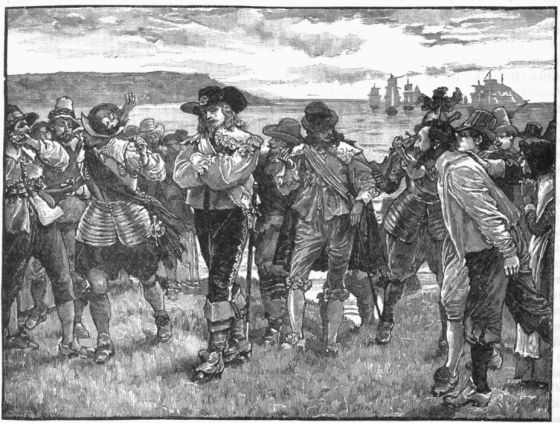
RECEPTION OF VISCOUNT WIMBLEDON AT PLYMOUTH. (See p. 515.)
They again summoned Dr. Montague to redeem his bail, and receive punishment on account of his book, in which they charged him with having admitted that the Church of Rome was the true Church, and that the articles on which the two churches did not agree were of minor importance. Laud advocated the cause of Montague at Court, for he was of precisely the same opinions, and urged the king and Buckingham to protect him. But both Charles and the favourite saw too many difficulties in their own way to care to interfere in defence of the chaplain. They left him to his fate, and he would have been no doubt severely dealt with, had not higher matters seized the attention of the House, and caused the offending Churchman to be overlooked.
This was the impeachment of Buckingham. The Committee of Grievances had drawn up, after a tedious investigation, a list of sixteen grievances, consisting of such as had so often been warmly debated in the last reign. Of these the most prominent, in their opinion, were the practice of purveyance, by which the officers of the household still collected provisions at a fixed price for sixty miles round the Court, and the illegal conduct of the Lord Treasurer, who went on collecting tonnage and poundage though unsanctioned by Parliament. They charged the maintenance of these evils to the advice and influence of a "great delinquent" at Court; who had, moreover, occasioned all the disgraces to the national flag, both by land and sea, which had for some years occurred, and who ought to be punished accordingly.
The time was now actually arriving of which James had warned his son and Buckingham, when they urged the impeachment of the Earl of Middlesex, but choosing to forget all that, Charles sent down word to the House that he did not allow any of his servants to be called in question by them, especially such as were of eminence and near unto his person. He remarked that of old the desire of subjects had been to know what they should do with him whom the king delighted to honour, but their desire now appeared to be to do what they could against him whom the king honoured. That they aimed at the Duke of Buckingham, he said, he saw clearly, and he wondered much what had produced such a change since the former Parliament; assuring them that the duke had taken no step but by his order and consent; and he concluded by requesting them to hasten the question of Supply, "or it would be worse for them."
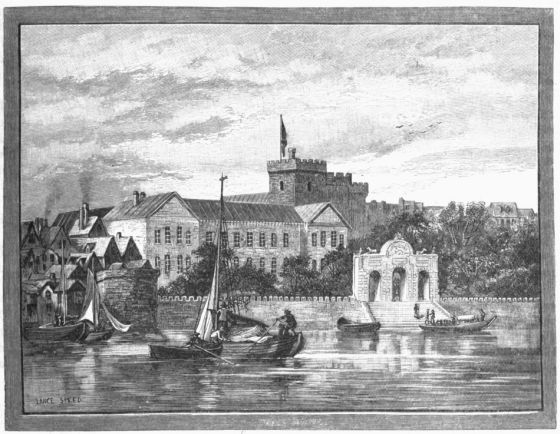
YORK HOUSE (THE DUKE OF BUCKINGHAM'S MANSION).
On the 29th of March he repeated the menace; but the Commons went on preparing their charges against Buckingham, declaring that it was the undoubted right of Parliament to inquire into the proceedings of persons of any estate whatever, who had been found dangerous to the Commonwealth, and had abused the confidence reposed in them by the Crown.
Seeing them bent on proceeding, Charles sent down to the House the Lord Keeper to acquaint them with his majesty's express command that they should cease this inquiry, or that he would dissolve them; and Sir Dudley Carleton, who had been much employed as ambassador to foreign states, and had recently returned from France, warned them not to make the king out of love with parliaments, and then drew a most deplorable picture of the state of those countries where such had come to be the case. In all Christian countries, he said, there were formerly parliaments; but the monarchs, weary of their turbulence, had broken them up, except in this kingdom; and now he represented the miserable subjects as resembling spectres rather than men, miserably clad, meagre of body, and wearing wooden shoes.
This caricature of foreigners, had it been true, was the very thing to make the Commons cling to their freedom, and keep their affairs in their own hands; and as such arguments had no effect. Charles summoned the House to the bar of the Lords, and there addressed to them a most royal reproof, letting them know that it depended entirely on him whether he would call and when he would dismiss Parliament, and, therefore, as they conducted themselves so should he act. Their very existence depended, he assured them, on his will.
This was language which might have done in the mouth of Henry VIII., who by the possession of the vast plunder of the Church had made himself independent of parliaments and trod on them at his pleasure; but the times and circumstances were entirely changed. The Commons had learned their power and the king's weakness, and would no longer tolerate the insolence of despotism. They returned to their own House, and, to show that they were about to discuss the king's speech in a spirit which admitted of no interruption or interference, they locked the door and put the key in the hands of Sir John Finch, their Speaker. This ominous proceeding struck terror into the king, and a conference with the Upper House was proposed and accepted. There Buckingham endeavoured to smooth down the royal speeches and messages into something like a bearable and constitutional shape, and to defend his own conduct. But by this time the Committee of Evils, Causes and Remedies, had come to the conclusion that the only mode of preventing the recurrence of such mal-administration as Buckingham had been guilty of was to impeach and punish him. The House accordingly passed a resolution to that effect on the 8th of May.
As if Charles were actually inspired by madness, at this moment, when he needed all the assistance of the Peers to screen his favourite from the impeachment of the Commons, he made a direct attack on their privileges. Lord Arundel, the Earl Marshal, had given some offence to Buckingham, and was well known to be decidedly hostile to him. As he possessed six proxies, it was thought a grand stroke of policy to get him out of the House at the approaching impeachment; and a plea was not long wanting. Arundel's son, Lord Maltravers, had married a daughter of the Duke of Lennox without consent of the king, and as Lennox was of blood-royal, this was deemed offence enough to involve Arundel himself. He was charged with not having prevented it, but he replied that the match had been made unknown to him; that it had been secretly planned between the mothers of the young people. This was not admitted, and Arundel was arrested by a royal warrant and lodged in the Tower. The real offender, if real offence there were, was Maltravers, but it was Arundel's absence which was wanted. The Lords, however, took up the matter as an infringement of their privileges; they passed a resolution that "no lord of Parliament, the Parliament sitting, or within the usual times of privilege of Parliament, is to be imprisoned or restrained, without sentence or order of the House, unless it be for treason or felony, or for refusing to give surety for the peace."
They sent an address to Charles demanding Arundel's immediate liberation; he returned an evasive answer: they sent a second address; Charles then ordered the Attorney-General to plead the royal prerogative, and to declare the Earl Marshal as personally offensive to the king and as dangerous to the State. The Peers would not admit the plea, but passed a resolution to suspend business till their colleague was set at large; and after a contest of three months the king was forced to yield, and the Earl Marshal resumed his seat in the House amid cheers and acclamations.
But this most imprudent conflict with the Peers had another and still more damaging result. The Earl of Bristol, who had been so unjustly and ungraciously received, or rather, not received, on his return from his Spanish embassy, to enable Buckingham and Charles to maintain their charge against Spain, had remained an exile from Court and Parliament, but not without keeping a watchful eye on the progress of events. He was not a man to sit down quietly under misrepresentation and injury; and now, seeing that the Peers had roused themselves from their subserviency, and were prepared to take vengeance on the common enemy, he complained to the House of Peers that, as one of their order and possessed of all their privileges, his writ of summons to Parliament had been wrongfully withheld. To have withstood this demand at this moment might have led to a dangerous excitement. The writ was therefore immediately issued, but Bristol at the same time received a private letter, charging him on pain of the king's high displeasure not to attempt to take his place. The earl at once forwarded the letter to the Peers, requesting their advice upon it, on the ground that it affected their rights, being a case which might reach any other of them, and demanding that he might be permitted to take his seat in order to accuse the man who, to screen his own high crimes and misdemeanours, had for years deprived a peer of the realm of his liberty and right.
This alarming claim of the earl's struck both the king and Buckingham with terror; and to prevent, if possible, the menaced charge, the Attorney-General was instantly despatched to the Lords to prefer a plea of high treason against Bristol. But the Peers were not thus to be circumvented. They replied that Bristol's accusation was first laid and must be first heard; and that without the counter-charge being held to prejudice his testimony. Bristol, thus at liberty to speak out, proceeded to town and to the House of Peers in triumph, his coach drawn by eight horses, caparisoned in cloth of gold or tissue; and Buckingham, as if to present a contrast of modesty, a quality wholly alien to his nature, drove thither in an old carriage with only three footmen and no retinue.
Bristol charged him with having concerted with Gondomar to inveigle the Prince of Wales into Spain, in order to procure his conversion to Popery prior to his marriage with the Infanta; with having complied with Popish ceremonies himself; with having, whilst at Madrid, disgraced the king, his country, and himself, by his contempt of all decency and the vileness of his profligacy. He stated that "As for the scandal given by his behaviour, as also his employing his power with the King of Spain for the procuring of favours and offices, which he conferred on base and unworthy persons, for the recompense and hire of his lust—these things, as neither fit for the Earl of Bristol to speak, nor, indeed, for the House to hear, he leaveth to your lordships' wisdoms how far it will please you to have them examined." He went on to charge him with breaking off the treaty of marriage solely through resentment, because the Spanish ministers, disgusted with his conduct, refused any negotiation with so infamous a person; and declared that, on his return, he had deceived both king and Parliament by a most false statement. All this the earl pledged himself to prove by written documents and other most undeniable evidence.
Instead of Buckingham attempting to clear himself as an innocent man so blackened by terrible charges would, it was sought to deprive the testimony of Bristol of all value by making him a criminal and a traitor to the king whilst his representative in Spain. Charles went so far as to send the Lord Keeper Coventry, a most pliant courtier, to inform the Lords that he would of his own knowledge clear the duke, the duke himself reserving his defence till after the impeachment by the Commons. Charles not only guaranteed to vindicate Buckingham, but accused Bristol of making a direct charge against himself, inasmuch as he himself had been with Buckingham all the time in Spain, and had verified his narrative on his return. The Peers passed this royal charge courageously by; and Charles then ordered the cause between Bristol and Buckingham to be removed from the Peers to the court of King's Bench; but the Lords would not permit such an infringement of their privileges. They put these questions themselves to the judges—"Whether the king could be a witness in a case of treason? And whether, in Bristol's case, he could be a witness at all, admitting the treason done with his privity?" The king sent the judges an order not to answer these questions, and in the midst of these proceedings the charges against Bristol were heard, and answered by him with a spirit and clearness which were perfectly satisfactory to the House. The charges against him amounted to this:—That he had falsely assured James of the sincerity of the Spanish Cabinet; had concurred in a plan for inducing the prince to change his religion; that he had endeavoured to force the marriage on Charles by delivering the procuration; and had given the lie to his present sovereign by declaring false what he had vouched in Buckingham's statement to be true. These were so palpably untenable positions that the House ordered Bristol's answer to be entered on the journals, and there left the matter.
But now the impeachment of Buckingham by the Commons was brought up to the Lords. It consisted of thirteen articles; the principal of which were that he had not only enriched himself with several of the highest offices of the State which had never before been held by one and the same person, but had purchased for money those of High Admiral and Warden of the Cinque Ports; that he had in those offices neglected the trade and the security of the coasts of the country; that he had perverted to his own use the revenues of the Crown; had filled the Court and dignities of the land with his poor relations; had put a squadron of English ships into the hands of the French, and on the other hand, by detaining for his own use a vessel belonging to the King of France, had provoked him to make reprisals on British merchants; that he had extorted ten thousand pounds from the East India Company; and even charged him with being accessory to the late king's death, by administering medicine contrary to the advice of the royal physicians.
Eight Managers were appointed by the Commons to conduct the impeachment—Sir Dudley Digges, Sir John Eliot, Serjeant Glanville, Selden, Whitelock, Pym, Herbert, and Wandsford. Digges opened the case, and was followed by Glanville, Selden, and Pym. While these gentlemen were speaking and detailing the main charges against him, Buckingham, confident in the power and will of the king to protect him, displayed the most impudent recklessness, laughing and jesting at the orators and their arguments. Serjeant Glanville, on one occasion, turned brusquely on him, and exclaimed, "My lord, do you jeer at me? Are these things to be jeered at? My lord, I can show you when a man of a greater blood than your lordship, as high in place and power, and as deep in the favour of the king as you, hath been hanged for as small a crime as the least of these articles contain."
Sir John Eliot wound up the charge, and compared Buckingham to Sejanus; as proud, insolent, rapacious, an accuser of others, a base adulator and tyrant by turns, and one who conferred commands and offices on his dependants. "Ask England, Scotland, and Ireland," exclaimed Sir John, "and they will tell you whether this man doth not the like. Sejanus's pride was so excessive, as Tacitus saith, that he neglected all counsel, mixed his business and service with the prince, and was often styled Imperatoris laborum socius. My lords," he said, "I have done. You see the man: by him came all evils; in him we find the cause; on him we expect the remedies."
The direct inference that if Buckingham was a Sejanus the king was a Tiberius, and a rumour that Eliot and Digges had hinted that in the death of the late king there was a greater than Buckingham behind, transported Charles with rage, and urged him on to another of those acts of aggression which ultimately brought him to actual battle with his Parliament. He had the two offending members called out of the House as if the king required their presence, when they were seized and sent to the Tower. This outrage on the persons of their fellow members and delegated prosecutors came like a thunder-clap on the House. There was instantly a vehement cry of "Rise! rise! rise!" The House was in a state of the highest ferment.
Charles hurried to the House of Lords to denounce the imputations cast upon him, and to defend Buckingham; and Buckingham stood by his side whilst he spoke. He declared that he had punished some insolent speeches, and that it was high time, for that he had been too lenient. He would give his evidence to clear Buckingham, he said, in every one of the articles, and he would suffer no one with impunity to charge himself with having any concern in the death of his father. But all this bravado was wasted on the Commons: again with closed doors they discussed the violation of their privileges, and resolved to proceed with no further business till their members should be discharged. In a few days this was done, and the House passed a resolution that the two members had only fulfilled their bounden duty.
On the 8th of June, Buckingham opened his defence in the House of Lords. In this he had been assisted by Sir Nicholas Hyde. He divided the charges against him into three classes: such as were unfounded in fact; such as might be true, but did not affect him; and lastly, those in which he had merely been the servant of the king or of the Executive. In all the circumstances which could be proved, he simply acted in obedience to the late or the present king, with one exception, the purchase of the office of Warden of the Cinque Ports, which he admitted that he had bought, but which he thought might be excused on the ground of public utility. As to the grave charge of the delivery of the king's ships to the French admiral, he did not mean to go into it, not but that he could prove his own innocence in the affair, but that he was bound not to reveal the secrets of the State; and he pleaded a pardon which had been granted by the king on the 10th of February, that is, four days after the opening of the present Parliament.
Thus Charles had kept his word: he had allowed the duke to throw the total responsibility of his deeds on himself, and he had granted him a pardon by anticipation to forestall the conclusions of Parliament. This defence by no means satisfied the Commons, and they proceeded to reply; but in this they were stopped short by the king, who the very next day sent a message to the Speaker, desiring the House to hasten and come at once to the subject of Supply, or that he would "take other resolutions." The Commons set themselves, without loss of time, to prepare a remonstrance in strong terms, praying for the dismissal of the favourite; but whilst employed upon it, they were suddenly summoned to the Upper House, where they found Commissioners appointed to pronounce the dissolution of Parliament. Anticipating this movement, the Speaker had carried the resolutions of remonstrance in his hand, and before the Commissioners could declare Parliament dissolved, the Speaker held up the paper and declared its contents. The Lords, on this, apprehending unpleasant consequences, sent to implore Charles to a short delay, but received the king's energetic answer—"No, not for one minute!"
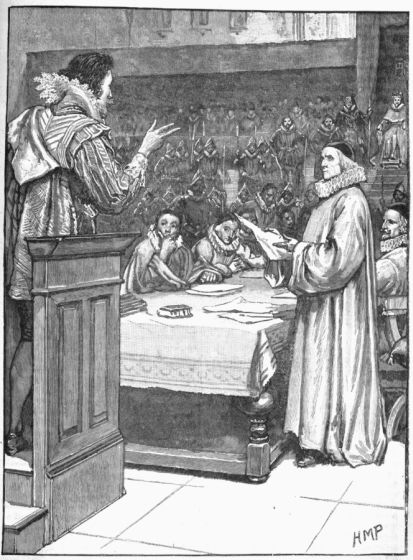
TRIAL OF BUCKINGHAM. (See p. 520.)
Charles was left by his own wild devices to try how his fancied right divine would furnish him funds to discharge his debts at home and his obligations abroad. That he was not insensible to his danger, or to the price which he had paid for the support of his favourite, is made plain to us by Meade, the careful chronicler of the time. "The duke," he says, "being in the bed-chamber private with the king, his majesty was overheard, as they say, to use these words: 'What can I do more? I have engaged mine honour to mine uncle of Denmark and other princes. I have, in a manner, lost the love of my subjects, and what wouldst thou have me do?' Whence some think the duke meant the king to dissolve the Parliament." But however he might feel this, he was in no disposition to take warning; the spirit and the inculcations of his father worked in him victorious over any better instincts. No sooner had he dismissed Parliament, than he seized the Earl of Bristol, and Arundel, the Earl Marshal, and thrust Bristol into the Tower. This bit of petty spite enacted, he set about boldly to do everything that the Commons had been striving against. The Commons had published their remonstrance; he published a counter-declaration, and commanded all persons having that of the Commons to burn it, or expect his resentment. He then issued a warrant, levying duties on all exports and imports; ordered the fines from the Catholics to be rigorously enforced, but offering to compound with rich recusants for an annual sum, so as to procure a fixed income from that source. A Commission was issued to inquire into the proceeds of the Crown lands, and to grant leases, remit feudal services, and convert copyholds into freeholds, on certain charges. Privy seals were again issued to noblemen, gentlemen, and merchants, for the advance of loans, and London was called on to furnish one hundred and twenty thousand pounds; and as if the king already feared that his arbitrary acts might produce disturbance, he ordered the different seaports, under the plea of protecting the coasts, to provide and maintain during three months a certain number of armed vessels, and the lord-lieutenants of counties to muster the people, and train troops to arms to prevent internal riot or foreign invasion.
At the moment that the king was thus daringly setting both Parliament and the country at defiance, came the news that a terrible battle had been fought at Lutter between the Austrians under Tilly, and the Protestant allies under Charles's uncle, the King of Denmark; that the allies were defeated and driven across the Elbe; all their baggage and ammunition lost, and the whole circle of Lower Saxony left exposed to the soldiers of Ferdinand. This was the death-blow to the cause of the Elector Palatine. But Charles seized the occasion to raise money by a fresh forced loan on a large scale, on pretence of the necessity of aiding Protestantism, and as if to make the lawless demand the more intolerable, the Commissioners were armed with the most arbitrary powers. All who refused to comply with this illegal demand, this body was authorised to interrogate on oath, as to their reasons, and who were their advisers, and they were bound by oath never to divulge what passed between them and the Commissioners.
Charles issued a proclamation, excusing his conduct by alleging that the necessities of the State did not admit of waiting for the reassembling of Parliament, and assuring his loving subjects that whatever was now paid would be remitted in the collection of the next subsidy. He also addressed a letter to the clergy, calling on them to exhort their parishioners from the pulpit to obedience and liberality. But such were the relative positions of king and Parliament, that people were not very confident of any speedy grant from that body, and the good faith of both Charles and his favourite had become so dubious, that many refused to pay. The names of these were transmitted to the Council, and the vengeance of the Court was let loose upon them. The rich were fined and imprisoned, the poor were forcibly enrolled in the army or navy, that "they might serve with their bodies, since they refused to serve with their purses." In vain were appeals made to the king against this intolerable tyranny; he would listen to no one. Amongst the names of those who suffered on this occasion, stand those of Sir John Eliot and John Hampden, as well as of Wentworth, soon to become the staunch upholder of Absolutism.
In towns the people did not conceal their indignation at these proceedings. "Six poor tradesmen at Chelmsford stood out stiffly, notwithstanding the many threats and promises made them;" and the Londoners loudly shouted, "A Parliament! a Parliament! No Parliament no money!" Still Charles went on in his mad course; no voice, mortal or immortal, could even for a moment break the spell of his delusion. Those judges and magistrates who were averse from enforcing the detestable orders were summarily dismissed. Sir Randolph Carew, the Chief Justice of the King's Bench, must give way to the more pliant Sir Nicholas Hyde, the adviser of Buckingham. But the lawyers in general were ready enough to break the laws by order of the Court, and the clergy were still more so. Laud was now advanced, for his Absolutist and Popish predilections, to the see of Bath and Wells, and sent forth a circular to the clergy enjoining them to preach up zealously the advance of money to the Crown, as a work meriting salvation. He openly advocated a strict league and confederacy between the Church and State, by which they might trample upon all schism, heresy, and disloyalty. There was no lack of time-servers to second his efforts. Roger Mainwaring, one of the king's chaplains, a true high-priest to the golden calf, with the most shameless prostitution of the pulpit, declared before the king and Court at Whitehall, that the power of the king was above all courts and parliaments; that parliament was but an inferior kind of council, entirely at the king's will; that the king's order was sufficient authority for the raising of money, and that all who refused it were guilty of unutterable sin and liable to damnation. He insulted the Scriptures by dragging them in to prove all this, and would have sold, not his own soul only, but the souls of the whole nation to obtain a bishopric. He had his desire; and the success of such religious toadyism inflamed the clergy in the country with a like abjectness. One Robert Sibthorpe, vicar of Brackley, in an assize sermon preached at Northampton, declared that even if the king commanded people to resist the Law of God, they were to obey him, to show no resistance, no railing, no reviling, to be all passive obedience. To demonstrate the Scriptural soundness of his doctrine, he quoted this verse of the Book of Ecclesiastes (viii. 4.): "Where the word of a king is, there is power: and who may say unto him, What doest thou?"
Abbot, the Archbishop, was applied to, to license the printing of this sermon; but the old man, who had always had a Puritan leaning, which his high post alone prevented him from more fully demonstrating, declined to do it. In vain the king insisted: the archbishop was suspended and sent to his country house; and Laud, who was hankering earnestly after the Primacy, licensed the sermon. Sibthorpe did not fail of his reward; he was appointed chaplain in ordinary, and received a prebend in Peterborough, and the goodly living of Burton Latimer. Andrew Marvell designated these model Churchmen as "exceedingly pragmatical, intolerably ambitious, and so desperately proud that scarcely any gentleman might come near the tails of their mules." The subserviency of the clergy was not one of the least evils which a tyrannic court fostered. The people saw more clearly than ever that the Church under such circumstances would become the staunch ally of despotism; and many even of its own honourable members, in the higher walks of life, shrank away from it and joined the ranks of the Puritans, for no other reason than that they were resolute for the liberty of the subject.
The state of feeling on both sides of the Channel meanwhile hastened an open rupture. The French were highly incensed at the treatment of the queen's retinue, who, having become an intense nuisance, were packed off to Paris. Thereupon the most sinister reports were spread among the people, who eagerly imbibed the idea that their princess was a victim in the hands of her heretic husband; and they were ready to avenge themselves on England or on the Protestants of their own country. On the other hand, Charles ascribed his disasters, the defeat of his brother-in-law's allies in Germany, and his consequent unpopularity at home, to the failure of Louis of France in giving the aid which he had promised. Through this default Charles considered that he had sunk a million of money, ten thousand soldiers, and lost the favour of his people. In these ideas he was strengthened by the emissaries of the French Protestants; and very soon Devic and Montague were despatched by Charles to concert measures with the Huguenots, and Soubise and Brancard were received at London as their envoys. It was finally determined that Charles should send a fleet and army to La Rochelle, which the Duke de Rohan should join with four thousand men. It was rumoured that it was planned for a Protestant state to be established between the Loire and Garonne, at the head of which Buckingham should be placed. That there was some great scheme of the kind is certain, for Charles, in dismissing ambassadors from his uncle the King of Denmark, said that he kept his full design from them; "for," he remarked, "I think it needless, or rather hurtful, to discover my main intent in this business, because divulging it, in my mind, must needs hazard it."
Meanwhile France, on its side, had not been inactive. Richelieu had listened not only to the discontent of the French at the concessions made by Bassompierre, the French ambassador, in the matter of the number of the queen's religious advisers, but to the urgent entreaties of the Pope's nuncio, who had never ceased, since the expulsion of Henrietta's priests, to call on Louis to avenge that insult to the Church, and had concluded a treaty with Spain, for mutual defence and for the punishment of England. They regarded the fleet preparing in the English ports, on the pretence of chastising the Algerines and giving aid to the Palsgrave, as really destined against France and Spain, and they planned not only a defence of their own coasts but a descent on the shores of England. It was agreed that Spanish ships should be received in French ports and French ones in those of Spain.
The English, on their part, swept the ships of all nations from the sea, on the plea that they might contain Spanish goods. Letters of mark were issued, and no nations were spared by the cruisers, not even those in alliance with England. The Hanse Towns, the Dutch States, and even the King of Denmark, had to make zealous remonstrances. Louis of France had not confined himself to remonstrances even before signing the treaty with Spain, but had laid an embargo on all English ships in French harbours. But now orders were issued by both the French and English Courts for the suspension of commercial intercourse between the two nations.
On the 27th of June, 1627, the English fleet sailed out of Portsmouth. It consisted of forty-two ships of war, thirty-four transports, and carried seven regiments of infantry, of nine hundred men each, a squadron of cavalry, and a numerous body of French Protestants, altogether about seven or eight thousand men. That it might this time succeed, the Duke of Buckingham took command of it, for in his self-conceit he attributed former failures to his not being on the spot in person, to give the troops the advantage of his consummate genius and experience; the whole of his military genius, if he had any, being yet to be discovered, and the whole of his experience amounting to having seen soldiers on parade. His plans were kept so secret—even from the friends with whom he was to co-operate—that arriving on the 11th of July before La Rochelle, the inhabitants refused to permit him to land. It was in vain that Sir William Beecher and their own envoy Soubise entreated them to receive those who were come as their allies and defenders: the people distrusted Buckingham, and declared that they would make no hostile demonstration against Louis till they had consulted the other churches and got in their harvest. This displayed a dreadful want of management on the part of the English; and Buckingham, thus shut out by those whom he came to support, turned his attention to the neighbouring isles of Rhé and Oléron, which the Huguenots had some time ago surrendered to their king. He decided to invade Rhé, and made his descent the very next day, on the 12th of July. His sudden diversion in this direction took Toyras, the governor of the island, by surprise; the small force with which he attempted to prevent their landing was defeated; but Buckingham, loitering on the shore for four or five days, in landing the remainder of his troops, allowed Toyras to convey the provisions, wine, and ammunition on the island into the strong citadel of the town of St. Martin. A small fort called La Prée lay in Buckingham's path, but he did not stay to take that, but pushed on to St. Martin. The castle stood on a rock overlooking the town and bay, and experienced officers were struck with great misgivings at the sight of it. Buckingham talked of taking it by a coup de main, but Sir John Burroughs, an officer who had acquired a real knowledge of war and sieges in the Netherlands, shook his head and pronounced the place next to impregnable, and that an attempt to storm it would be a useless waste of lives. It was then determined to invest the place in force; but Burroughs was equally dissatisfied with the unscientific construction of the trenches and batteries which were prepared. Buckingham, instead of benefiting by the counsels of this experienced officer, reprimanded him with a sternness which silenced more compliant men. In a few days a shot silenced altogether the honestly officious Burroughs, and the duke went on with his siege only to find that, as that officer had predicted, the fort defied all his efforts.
The news of this attack on France spread consternation amongst the allies of the Palsgrave; the prince himself, the States of Holland, and the King of Denmark, all hastened to express their astonishment and dismay at this rupture between the two great powers who should have enabled them by their united efforts to re-conquer the Palatinate. They would not admit Charles's representation of his obligation to support the French Protestants as of sufficient moment to induce him to destroy the hopes of Protestantism in Germany, and of his own sister and brother-in-law. They begged to be permitted to mediate between the two crowns: Denmark sent ambassadors instantly to Paris, to use its influence for that purpose with the French Court; and the Dutch deprived of their commissions all English officers in their service, who had joined the expedition to La Rochelle.
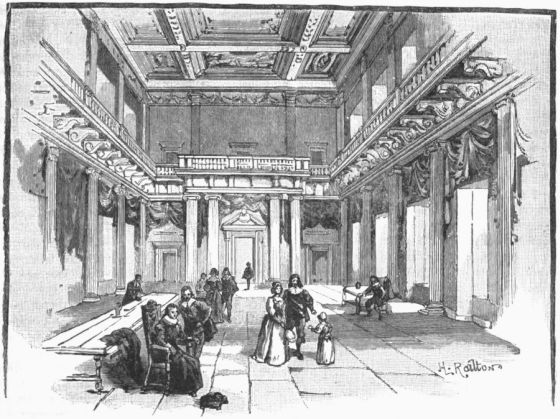
INTERIOR OF THE BANQUETING HOUSE, WHITEHALL.
But they could not move Charles. He wrote to Buckingham, congratulating him on the success of his attempt on Rhé, which was yet no success at all; promising him fresh reinforcements and provisions, and exhorting him to prosecute the war with vigour and to listen to no proposals of peace. He applauded a proclamation which Buckingham had prepared, to assure the French Protestants that the King of England had no intention of conquest, his sole object being to compel the King of France to fulfil his engagements towards the French Protestants into which he had entered with them; that, despite these engagements, he had not dismantled Fort Louis, in the vicinity of La Rochelle; but, on the contrary, had endeavoured to surprise the town and reduce it by force to comply with his own religious demands. Charles, however, ordered Buckingham to make an alteration in the manifesto, so that instead of the defence of the Protestants being the sole cause of his coming, it should be the chief cause, and allow him to put forward other reasons for his hostilities as occasion might require.
With this proclamation in his hand, the Duke de Rohan made a tour amongst the Huguenot churches in the south of France, where the people listened to him with enthusiasm, and all who dissented from the vow to live and die with the English liberators were denounced as traitors. Rohan was empowered to raise forces and advance to the support of La Rochelle; but La Rochelle was in no haste to declare itself, for Richelieu had marched an army into the neighbourhood, and kept it in check. It was the last to hoist the flag of revolt, and it was for the last time.
But all this time Buckingham was experiencing the truth of the warnings of Burroughs: no impression whatever was made on the citadel of St. Martin. Charles's promised reinforcements did not arrive. He wrote to explain the causes of the delay—being the difficulty of obtaining mariners, and the slowness of the Commissioners of the Navy; but he assured him that the Earl of Holland was preparing to bring out fresh forces. On the 12th of August there was a rumour of an attempt to assassinate Buckingham by a Jesuit, with a thick three-edged knife; but a real wound was inflicted on his reputation by a French flotilla bursting the boom which he had drawn across the harbour, despite his fleet, and throwing provisions into Fort St. Martin, in spite of himself. This disaster produced violent altercations between his ill-managed army and fleet. The army charged the misfortune to the sheer negligence of the fleet, and the fleet only answered by loud clamours for pay, having, it appeared, received nothing the whole time.
Under these circumstances Buckingham displayed all the wavering confusion of mind which characterises an inefficient commander. One day he was ready to comply with the written requisition of the officers of the army to abandon the siege; the next, he determined to stay and assault the place. This miserable vacillation was ended by the arrival of the Earl of Holland on the 27th of October, with fifteen hundred men; and the La Rochelle folk sending eight hundred more, it was resolved to make a general assault on the place. On the 6th of November this assault began, but the cannonade produced no effect on the adamantine works and solid walls of the fort; the slaughter of the troops on all sides was terrible, and the attempt was abandoned. Buckingham then wished himself safe on board his fleet; but unfortunately for him and his army, Marshal Schomberg had now posted himself with a strong force on the island between him and his vessels. He had occupied and garrisoned Fort la Prée, which Buckingham had so imprudently left in his rear, and compelled him now to defile his army along a narrow causeway across the marshes, connecting the small island of Oie with that of Rhé. Nothing could demonstrate more forcibly the utter incompetence of Buckingham for military command than thus suffering the enemy to land and lodge in the line of his retreat. Schomberg now attacked the defiling troops in the rear with his ordnance, and the cavalry. The cavalry was thrown into confusion, and the pressure and disorder on the causeway became frightful; the artillery played upon them with dreadful effect, and numbers were pushed off into the bordering bogs and salt pits and suffocated. The destruction soon amounted to twelve hundred men, and twenty pairs of colours were taken. There was no want of bravery exhibited by either Buckingham or his men. Courage, it has been well said, was the sole qualification for a general which he possessed; he was the last to leave the beach; and the men once off the causeway, turned resolutely and offered battle to Schomberg. But that prudent general was satisfied to let them go away, which they prepared to do, to the consternation of the people of La Rochelle, who had risen on the strength of their promises, and were now exposed to a formidable army under the command of Gaston, Duke of Orleans, and Schomberg.
A really good general, though he had suffered serious loss, would still have thrown himself into La Rochelle and, with the sea kept open by his fleet for supplies, might have done signal service in defence of the place. But Buckingham was no such general. He determined to withdraw, contemplating another enterprise equally impossible to him as the taking of the citadel of St. Martin. He had an idea of the glory and popularity of recovering Calais, and communicated this notable project to the king. Charles was charmed with the project, and as he had assured Buckingham that he had done wonders, and almost impossibilities on the island of Rhé, so he anticipated an equally splendid result: this in any other man, except Charles, would have looked like bitter irony. In the eyes of the more sensible officers of the fleet and army, the notion of attempting the surprise of Calais with a reduced and defeated force, and under such a general, was scouted as madness. Buckingham turned the prows of his fleet homewards, and arrived towards the end of November. The fleet and army were indignant at the disgraceful management of the campaign; the people at home were equally so at the waste of public money, and the ruin of national honour; but Charles received Buckingham with undiminished affection, and took to himself the blame of the failure of the expedition, because he had not been able to send sufficient reinforcements and provisions. But he speedily received an impressive reminder of the consequences of this scandalously managed attempt. The people of La Rochelle sent over envoys to represent to him their condition, in consequence of listening to his promises; the French were beleaguering their town, and the most terrible fate awaited them if they were thus deceived and abandoned. Charles gave them comfortable words, and entered into a solemn engagement to stand by them so long as their forts could resist the enemy, and to make no peace without the guarantee of all their ancient liberties.
But how were these grandiloquent words to be redeemed? He had exhausted all the resources of his arbitrary exactions, and had incurred an additional amount of unpopularity by seizing and imprisoning numbers of those who refused to submit to a forced loan; and when they demanded a fair hearing through the exercise of the Habeas corpus, they were told that the king's command superseded that. The Crown lawyers, in fact, vaunted the royal will as the supreme law, whilst Selden, Coke, and the constitutional lawyers referred them to Magna Charta, which had been thirty times confirmed by the kings, and thus aroused a wonderful feeling of popular right in the kingdom.
Whilst such was the state of public feeling, the usual pressure for money rendered it necessary to adopt some means of raising it. Besides the requirements of the home government, the proposed aid to the people of La Rochelle made immediate funds necessary. To attempt extorting supplies by the modes which had so exasperated the public, was a course which all reasonable men regarded with repugnance and apprehension. Charles himself would have braved any danger rather than that of meeting Parliament, with all its remonstrances and demands of redress of public grievances; but his Council urged him to make another trial of the Commons, and he consented. The writs were issued on the 29th of January, 1628, for the assembling of Parliament on the 17th of March. Yet in the course of that very week the king proceeded to repeat the conduct which Parliament had so strongly condemned, and which must render its meeting the more formidable. He required one hundred and seventy-three thousand four hundred and eleven pounds for the outfit of the expedition to La Rochelle, and instead of waiting for a grant from Parliament, he ordered the money to be raised by a Commission from the counties, and that within three weeks. With that irritating habit which he had inherited from his father, he added a menace, saying that if they paid this tax cheerfully, he would meet his Parliament; if not, "he would think of some more speedy way."
Conduct so restless and insulting on the very eve of the opening of Parliament raised the wildest ferment in the public: the Commissioners shrank in terror from their task, and Charles hastened to revoke the Commission, saying that "he would rely on the love of his people in Parliament." This was on the 16th of February, but like Pharaoh, Charles repented himself of his momentary concession, and on the 28th he issued an order to raise the money which the counties had refused, by a duty on merchandise. The merchants were, however, not a whit more willing to submit to an illegal imposition, nor more timid than the counties. The ministers trembled before the storm, and anticipated certain impeachment; the judges pronounced the duty illegal, and once more Charles recalled his order.
What rendered the public more sensitive to these acts of royal licence was, that a number of foreign troops were about to be brought into the kingdom, on the plea of employing them against France, but which the people saw might be turned against themselves or their representatives. They were, therefore, worked up to a pitch of extreme excitement, and bestirred themselves to send up to the House of Commons a body of such men as should not be readily intimidated. Never before had Parliament assembled under such favourable circumstances. Daring as had been the king's assaults on the public liberties, this had only served to rouse the nation to a resolute resolve to withstand his contempt of Magna Charta at all hazards. Westminster elected one Bradshaw, a brewer, and Maurice, a grocer. Huntingdon sent up a far more remarkable man, one Oliver Cromwell, the first time that he had been returned to Parliament by any place. There was a general enthusiasm to turn out all such members as had been inert, indifferent, or ready to betray their trusts out of terror or a leaning towards the Court. When the members assembled the House was crowded; there were four hundred such men as had rarely sat in any English Parliament before. Both county and town had selected such brave, patriotic, and substantial freeholders, merchants, and traders, as made sycophants and time-servers tremble. They were no longer the timid Commons who had formerly scarcely dared to look the lords or even the knights in the face; they were well aware of their power, and in wealth itself they were said to be three times superior to the House of Peers. In running his eye over them, a spectator would see such men as Cromwell, Hampden, Selden, Pym, Hollis, Eliot, Dudley Digges, Coke, Wentworth (soon to apostatise), and others, with intellects illumined by the study of the orators, lawgivers, and philosophers of republican Greece, animated with the great principles of Christianity, and with resolutions like iron. Many of these men had been attended to London by trains of their neighbours, sturdy freeholders and substantial shopkeepers, more numerous than the retinues of any lords, such was the intense expectation of what might ensue, and the prompt resolve to stand by their representatives. And they were not deceived, for this third Parliament of Charles I. marked itself out as one of the grand land-marks of English history.
The king was conscious that if he hoped to gain his chief object from them—money—he must curb his haughty temper and assume a conciliating manner. He therefore, just before the opening of the Session, liberated seventy-eight gentlemen who had been imprisoned for refusing to pay the forced loan; he let the Earl of Bristol out of the Tower, though he lay under an impeachment for high treason; accorded the same favour to Bishop Williams, whom Buckingham had caused to be lodged there; and restored Archbishop Abbot, who had been suspended for refusing to license Sibthorpe's base sermon. But when he had made these concessions to popular opinion, Charles could not command his inveterate habit of threatening, and so spoilt all. In his opening speech he said:—"I have called you together, judging a Parliament to be the ancient, speediest, and best way to give such supply as to secure ourselves and save our friends from imminent ruin. Every man must now do according to his conscience; wherefore, if you, which God forbid, should not do your duties in contributing what this State at this time needs, I must, in discharge of my conscience, use those other means which God hath put into my hands, to save that which the follies of other men may otherwise hazard to lose. Take not this as threatening—I scorn to threaten any but my equals—but as an admonition from him that, both out of nature and duty, hath most care of your preservation and properties."
This was followed by an equally impolitic speech from the Lord Keeper Coventry, who informed the Commons that the king had come to Parliament, not because it was at all necessary, not because he was destitute of other means, but because it was more agreeable to the goodness of his most gracious disposition. And then he unwisely enough added, "If this be deferred, necessity and the sword may make way for others. Remember his majesty's admonition; I say, remember it."
Surely if the veriest novices in government had been set to talk to Parliament, they could not have done it in a more insane, blundering style. If the Commons had had as little tact as the king and his minister, there would have been hard words hurled back again, and the Parliament would have not been many days ere it ceased to exist. But the Commons had men as profound as these were shallow. They took all patiently, and set about quietly to determine on the question of Supplies. They came to the resolution to offer ample ones—no less than five subsidies, the whole to be paid within one year—but they tagged this simple condition to them, that the king should give them a guarantee against any further invasion of their rights.
As we have already stated, during the past year many gentlemen had been imprisoned for refusing to pay the demands of the king made without sanction of Parliament. Five of them had been, at their own request, brought before the King's Bench by writ of Habeas corpus, and their counsel demanded that, as they were charged with no particular offence, but merely committed at the particular command of the king, they should be discharged or admitted to bail; but both were refused. The question was now discussed by the House, and it was resolved that no subsidy should pass without a remedy granted against this royal licence. "It will in us be wrong done to ourselves," said Sir Francis Seymour, "to our posterity, to our consciences, if we forego this just claim and pretension."
"We must vindicate what?" demanded Wentworth; "new things? No; our ancient, legal, and vital liberties, by enforcing the laws enacted by our ancestors; by setting such a stamp upon them that no licentious spirit shall dare henceforth to invade them." In the repeated debates which followed, Sir Edward Coke particularly distinguished himself, old as he was, by his powerful and undaunted speeches. He called upon the members to stand by the ancient laws, and was seconded by other members, who narrated the breaking of those laws by the abuses of raising money by loans, by benevolences, and privy seals; by billeting soldiers, by imprisonment of men for refusing these illegal demands, and by withholding from them the benefit of Habeas corpus. In vain were the speakers warned by the Court party to beware of distrusting the king, who had been driven to these measures by necessity, and by others, who declared that such was the king's goodness that it was next only to that of God. But Coke cried out, "Let us work whilst we have time! I am absolutely for giving supply to his majesty, but yet with some caution. Let us not flatter ourselves. Who will give subsidies if the king may impose what he will? I know he is a religious king, free from personal vices, but he deals with other men's hands, and sees with other men's eyes."
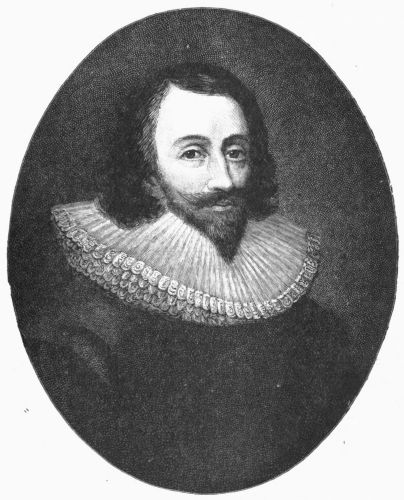
SIR JOHN ELIOT. (From the Port Eliot Portrait.)
This was approaching the subject of the favourite, which even the boldest were afraid of touching, but which Coke soon after entered upon plainly, and with all courage.
On the 8th of May the House passed the four following resolutions, without a dissentient voice even from the courtiers—1st, That no freeman ought to be restrained or imprisoned, unless some lawful cause of such restraint or imprisonment be expressed; 2nd, That the writ of Habeas Corpus ought to be granted to every man imprisoned or restrained, though it be at the command of the king or Privy Council, if he pray for the same; 3rd, That when the return expresses no cause of commitment or restraint, the party ought to be delivered or bailed; 4th, That it is the ancient and undoubted right of every free man, that he hath a full and absolute property in his goods and estates, and that no tax, loan, or benevolence ought to be levied by the king or his ministers, without common consent by Act of Parliament.
It was clear, from these resolutions, that unless Charles chose to forego his illegal practices of raising money without consent of Parliament, and of imprisoning subjects without any warrant but his own will, he must abandon all idea of the five subsidies; but his necessities were too great, and the difficulties in the way of continuing to plunder people at his pleasure too formidable to allow him lightly to give up the tempting offer. The Lords were less determined than the Commons, and this gave him some encouragement. The matter was argued in the Commons on his behalf by the Attorney-General and the King's Counsel, but they found the leading members of the House too strong in their knowledge of constitutional law to be moved from their grand propositions. In the course of the debate the interference of Buckingham was felt, and the brave Sir John Eliot did not let that pass without criticism. "I know not," he said, "by what fatality or importunity it has crept in, but I observe in the close of Mr. Secretary's relation, mention made of another in addition to his majesty, and that which hath been formerly a matter of complaint, I find here still—a mixture with his majesty, not only in business, but in name. Let me beseech you, sir, let no man hereafter within these walls take this boldness to introduce it."
On the 28th of May the Commons presented to his majesty their celebrated Petition of Right; a document destined to become celebrated, a confirmation of Magna Charta, and the origin of the Bill of Rights secured in 1688, on which rests all the fabric of our present liberties. This Petition was based on the four resolutions. It commenced by reminding the monarch of the great statutes passed by some of the most illustrious of his ancestors, which he had been so long and pertinaciously outraging; that the statute De Tallagio non concedendo, made in the reign of Edward I., provided that no tallage nor aid could be levied by the king without consent of Parliament; that by another statute of the 25th year of Edward III., no person could be compelled to make any loan to the king without such sanction; such loans being against reason and the charters of the land. There could be no dispute here—the king stood palpably convicted, and had he acted in ignorance, could do so no longer. It then went on: "And by other laws of this realm, it is provided that none shall be charged by any charge or imposition called a benevolence, nor by such like charge; by which statutes before mentioned, and the other good laws and statutes of the realm, your subjects have inherited this freedom, that they should not be compelled to contribute to any tax, tallage, aid, or other like charge, not set by common consent in Parliament: yet, nevertheless, of late, divers commissions, directed to sundry commissioners, in several counties, with instructions, have issued, by pretext whereof your people have been in divers places assembled, and required to lend certain sums of money unto your majesty; and many of them, upon their refusal to do so, have had an unlawful oath administered unto them, not warrantable by the laws and statutes of this realm, and have been constrained to become bound to make appearance and give attendance before your Privy Council in other places; and others of them have therefore been imprisoned, confined, and sundry other ways molested and disquieted; and divers other charges have been laid and levied upon your people in several counties, by lords-lieutenant, commissioners for musters, justices of peace, and others, by command or direction from your majesty or your Privy Council, against the laws and free customs of this realm."
The Petition next set forth that divers persons refusing to pay these impositions had been imprisoned without cause shown, and on being brought up by Habeas Corpus to have their cause examined, had been sent back to prison without such fair trial and examination. From this it proceeded to the fact that numbers of soldiers had been billeted in private houses, contrary to the law, and persons tried by martial law in cases where they were only amenable to the common law of the land; and moreover, officers and ministers of the king had screened soldiers and sailors who had committed robberies, murders, and other felonies, on the plea that they were only responsible to military tribunals. All these breaches of the statutes, the Petition prayed the king to cause to cease, as being contrary to the rights and liberties of the subject, as secured by the laws of the land.
The Petition was so clear, and the statutes quoted were so undeniable, that Charles was puzzled what to do. To refuse the prayer of the Commons was to forfeit the five tempting subsidies; to admit it simply and fully was to confess that he had hitherto been altogether wrong, and to leave himself no loop-hole of excuse for the future. Instead, therefore, of adopting the established form of saying, in the old Norman words, "Soit droit fait comme il est désiré," he wrote at the foot of the petition this loose and most absurd assent—"The king willeth that right be done according to the laws and customs of the realm; and that the statutes be put in due execution, that his subjects may have no cause to complain of any wrongs or oppressions, contrary to their just rights and liberties, to the preservation whereof he holds himself in conscience as well obliged as of his own prerogative."
This left the matter precisely where it was, for the king had always contended that he did nothing but what was warranted by his prerogative. The House felt this, and at once expressed their grievous disappointment. To add to their chagrin, Charles sent a message to them, informing them that he should dissolve Parliament on the 11th of June, it now being the 5th. A deep and melancholy silence pervaded the House, which locked the doors to prevent interruption, and debated the matter in all earnestness. A second message from his majesty, commanding them not to cast or lay aspersions on any minister of his majesty, added greatly to the concern of the House. On the day but one before Sir John Eliot had urged the necessity of a "declaration" to his majesty, showing the decay and contempt of religion, and the insufficiency of his ministers, the Chancellor of the Duchy of Lancaster had styled Sir John's speech "strange language," and had declared that if Sir John went on, he would go out; upon which the House told him plainly to take himself off. This had brought down the king's second message. The debate went on amid tears and deep emotion from strong and long-practised men; as if they perceived that the great crisis of the nation was come, and foresaw the bloodshed and misery which were to follow if they stood firm to their knowledge of the right; the slavery and degradation of England if they did not.
Sir Robert Philips, interrupted by sobs and weeping, said:—"I perceive that towards God and towards man there is little hope, after our humble and careful endeavours, seeing our sins are many and so great. I consider my own infirmities, and if ever my passions were wrought upon, it is now. This message stirs me up, especially when I remember with what moderation we have proceeded." These earnest and religious men feared that God was hardening the heart of the king as he had done that of Pharaoh, in order to punish the nation for its backslidings and wickedness. "Our sins," said Sir John Eliot, "are so exceeding great, that unless we speedily turn to God, God will remove Himself farther from us. You know with what affection and integrity we have proceeded hitherto, to gain his majesty's heart; and, out of the necessity of our duty, were brought to that course we were in: I doubt a misrepresentation to his majesty hath drawn this mark of his displeasure upon us. I observe in the message, amongst other sad particulars, it is conceived that we were about to lay some aspersions upon the Government. Give me leave to protest that so clear were our intentions, that we desire only to vindicate these dishonours to our king and country. It is said also as if we cast some aspersions on his majesty's ministers; I am confident no minister, how dear soever, can——"