Chapter XVI
Reading edition
THE PROGRESS OF THE NATION IN THE SIXTEENTH CENTURY.
The Tudors and the Nation—The Church—Population and Wealth—Royal Prerogative—Legislation of Henry VIII.—The Star Chamber—Beneficial Legislation—Treason Laws—Legislation of Edward and Mary—Elizabeth's Policy—Religion and the Church—Sketch of Ecclesiastical History under the Tudors—Literature, Science, and Art—Greatness of the Period—Foundation of Colleges and Schools—Revival of Learning—Its Temporary Decay—Prose Writers of the Period—The Poets—Scottish Bards—Music—Architecture—Painting and Sculpture—Furniture and Decorations—Arms and Armour—Costumes, Coins, and Coinage—Ships, Commerce, Colonies, and Manufactures—Manners and Customs—Condition of the People.
The century of which we have just traced the events was a period marked by vast progress and by changes which were the springs of still more wonderful progress in after ages. Though the character of the Tudors was absolutely despotic, no dynasty since the days of Alfred and Magna Charta wrought out such revolutions in the constitution of England. These revolutions were partly effected by the very efforts of the Tudor monarchs to establish their own power and gratify their own self-will, but were due also to the fact that the Tudor despotism was essentially popular, and encouraged manifestations of the national will. These revolutions extended not only into the political constitution of the nation, but into its religious one; into its literature, its philosophy, and its morals; and that simply because the spirit of the age was of that tone and strength that, though outward powers could agitate it, nothing but its own momentum could direct its tendency. Henry VII., with an indifferent title, succeeded to the crown, because the nation was weary of the conflicts of the York and Lancaster monarchs, and longed for peace, which his disposition promised. Cold, cautious, and penurious, he took care not to raise a fresh race of powerful barons in place of that which the Wars of the Roses had destroyed, but hoarded up money; and beyond the injustice practised in its collection, left his people to pursue their trades and their agriculture, and thus renew their strength. Henry VIII.—violent, passionate, sensual, and intensely arbitrary, but fond of parade, and in his youth boastful of his prowess—gratified the pride of the nation, whilst he ruled it with a rod of iron. In the gratification of his lusts he did not hesitate to renounce allegiance to that great spiritual power which for above a thousand years had ruled haughtily over Europe and all its kings and warriors. By this act he set free for ever the mind and conscience of England. In vain did he endeavour to bind the nation in a knot of his own making. Though he hurled his fiercest terms against those who claimed a universal liberty which he intended only for himself, he had broken the mighty spell of ages—a power and a mystery before which the world had bowed in impotent awe; and no chains which he could forge, no creed which he could set up, no hierarchy which he could frame, could possess more than the strength of the fire-scorched flax against the will of the enfranchised people. The moment that Henry perished, the soul of the nation showed itself alive. The very Reformers around his throne, who had cowered beneath the fell and deadly ire of the tyrant, rose, with Cranmer at their head and, under the mild auspices of the religious Edward, gave free vent to the spirit and the doctrines of the Reformation. The return of theologic despotism under Mary only added force to the spirit of reform, by showing how terrible and bloody was the animus of ancient superstition. The fires of Smithfield lit up the dark places of spiritual tyranny to the remotest corners of the nation, and gave the blow to the tottering Bastille of restringent faith in Great Britain. Elizabeth, with all the self-will of her father, lived to see both in people and Parliament, a spirit that made her lion-heart shrink with awe, and own, however reluctantly, a power looking already gigantically down upon her own. She felt more than once, in the pride of her might, the terror of that national will which, in less than half a century from her death, shattered the throne of her successor, and gave to the world the unheard-of spectacle of a king decapitated for treason to his people.
The grand underlying impulse of the forward movement of this age was that of the general progress of the world in knowledge—knowledge of its rights and of the force inherent in popular association. The restoration of classical literature, and especially of the Greek, had rekindled the lofty and independent sentiments of antiquity; but still more, the knowledge of the doctrines, principles, and promises of the Bible, which had been disseminated among the people by the Reformers, had spread like a flame amongst them, and had given them totally new ideas of human prerogative and dignity. Henry VIII., after being induced to make public the Scriptures, saw so clearly their effect that he withdrew the boon as far as was possible, and pronounced the severest penalties on any of the common people who should consult that Divine fountain of truth and freedom. Throughout the civilised world, far even beyond the countries in which the Reformation had established itself, the stimulating boon of this knowledge was diffused, and gave a perilous and uneasy feeling to the most slavish nations and the most despotic sovereigns.
But in England many other causes had co-operated to raise the power and condition of the people. The long civil wars had, by the time of the accession of Henry VII., reduced the old nobility to a mere fragment. Such extraordinary specimens of baronial wealth and dominion as the Warwicks, Beauchamps, and Shrewsburys, no longer existed. In the first Parliament of Henry VII., the peers amounted to only twenty-eight; in that of Henry VIII. they had risen only to thirty-six. With their extinction had lapsed their vast estates to the Crown, and this property had in part been sold to defray the costs by which the throne had maintained its straggles against various claimants and their factions. Henry VII., as we have said, carefully kept down this haughty class to the limits into which it had fallen. His son, Henry VIII., like him, pursued the policy of Edward IV., who had established a system of fine and recovery to cut off entails; and by liberal use of attainders, with their consequent forfeitures of title and estate, made the nobility entirely subservient to the Crown, which augmented its wealth and power on their ruin. By conferring their estates in part on new aspirants to the peerage from the families of the lesser gentry, and in many cases—as in those of Wolsey and Cromwell—from the ranks of the common people, he divided the aristocracy against itself, and thus added fresh influence to the throne.
This predominance of the Crown once established, Henry VIII. proceeded to a still more startling blow at a power hitherto equal and often paramount to that of the Crown—the Church. To the terror and astonishment of the whole of Papal Christendom, he stretched his hand not only against the supreme rule, but the vast property of that august and time-honoured institution. In 1532 he abolished the annates, or first-fruits, before that time paid to the court of Rome—an act in itself proclaiming his independence of that court. In the following year he declared by Act of Parliament that his subjects might discuss the claims and condemn the acts and opinions of the Pope without incurring any charge of heresy. Another year, and he caused himself to be proclaimed "Supreme head of the Church" in his own realms, and prohibited not only all payments to the Pope, but all appeals to or recognition of his authority. In 1535, the very next year, he confiscated the property of the lesser monasteries; and this course, once begun, never stopped, till he had made himself master of all the vast demesnes of the monasteries, the collegiate churches, hospitals, and houses of the order of the Knights of St. John of Jerusalem; the bulk of which he appropriated to his own use, turning adrift 150,000 monks, priests, and nuns into the world. So daring a sweep of ecclesiastical property, power, and privilege never was made by any other man or in any other era of the world; and nothing could have emboldened even this impious and lawless monarch to so astounding a deed but the clear consciousness that the spirit of the age was with him.
By this unexampled stroke Henry made himself master of 644 convents, 90 colleges, 2,374 chantries and free chapels, and 110 hospitals; the whole of which property, with trifling exception, was speedily conveyed to the vast swarm of hungry upstarts—the Russells, the Brownes, the Seymours, and the like—who rapidly bloomed into aristocratic greatness, and constituted an impregnable barrier against any restoration of this affluent but corrupt ecclesiastical princedom.
These new men, in their turn, were compelled to subdivide a portion, more or less, among their followers, to establish their own position; and other large areas of lands were sold in minor amounts to the successful merchants and traders, so that by this means there grew up again a new power in the country—that of small but sturdy freeholders, who, at once independent of the Crown and the aristocracy, soon made their might felt in the community, and added to the House of Commons that popular infusion of authoritative life which speedily electrified the Government by its tone, and prostrated it by its measures.
That a large number of such men of substance, whose wealth was the produce of industry, existed at the period, is an indication that the nation had grown rich by trade, and had also advanced in population. When we talk of the England and other countries of Europe of former ages, we are scarcely aware of what extremely different countries they were, both in regard to the cultivation of their lands, the arts, aspects, and habits of their cities, their general knowledge, their polish of speech, and their amount of population. It will scarcely be credited that at the close of the Wars of the Roses, the whole population of England and Wales did not exceed two millions and a half—far less than the present population of London. But in 1575, that is, in the seventeenth year of Elizabeth, the men fit to bear arms alone amounted to 1,172,674, and the entire population to not less than 5,000,000. Harrison, in his "Description of England" at this time, says that "Some do grudge at the great increase of people in these days, thinking a necessary herd of cattle far better than a superfluous augmentation of mankind. They laid," he says, "the cause upon God, as though He were in fault for sending such increase of people, or want of wars that should consume them; affirming that the land was never so full." So little did they comprehend that the multitude of people, properly employed, were the strength and wealth of the nation.
But we shall have occasion to notice that with this wealth and strength there also existed much poverty, owing to the derangements of society in the days of Henry VIII., and to the great tendency to leave the land in pasture to supply the growth of wool necessary for the large demand for the Netherlands and the rapidly increasing one at home, where the manufacture of both coarse and fine cloths had been growing from the time that Edward III., at the instigation of his queen Philippa of Hainault, invited the weavers of fine woollens over from that country. Still the rise in the value of all kinds of articles of life, including wages, during the whole of this period, is a proof of the enlarged demand for skilled workmen, and the capacity to pay much more than formerly, which could only be the case with augmented means in the bulk of the population. At various times, as in 1496 and 1514, Acts were passed with the vain object of keeping down wages—attempts which, though they show little progress in political economy, prove with equal clearness that employers were more numerous than they had been in proportion to labour. In 1500 the wages of a master mason were 6d. a day; in 1575 they were doubled; and in 1590 they had reached 1s. 2d. The wages of common labourers had risen from 6d. a day to 10d. In 1511 the salary of a domestic priest was £3 6s. 8d. a year; in 1545 it had risen to £4 14s. 6d. In 1544 the wages of sailors were advanced from 5s. per month, in the Royal navy, to 6s. 8d., and all other trades and professions exhibited the similar advance of payment.
This, of course, was the result of the like advance in the prices of provisions, rents, and clothing—another proof that the people had become not only more numerous, but more luxurious, and, therefore, demanded better diet and accommodation. Wheat, the staple of the people's food, had advanced from 3s. 4d. a quarter in 1485 to 17s. in 1589; £2 2s. in 1596; and £1 7s. in 1599. It is true the price of wheat varied a great deal in this period, but except in a very few seasons it never approached the low price of the previous century; and in 1587, a year of scarcity, it rose to £5 4s. In 1500 a dozen pigeons were 4d., in 1541 they were 10d., in 1590 they were 1s., and in 1597, a year of scarcity, 4s. 3d. In 1500 a hundred eggs could be had for 6d., in 1541 they were 1s. 2d., and in 1597 they were 3s. A good fat goose in 1500 was only 4d., but in 1541 it was 8d., in 1589 it was 1s. 2d. A fat sheep in 1500 was 1s. 8d., in 1549 from 2s. 4d. to 4s., and in 1597, the dear year, it could not be had under 14s. 6d. In 1500 an ox could be purchased for 11s. or 12s., in 1541 its price had advanced from £1 to £2; in 1597 a single stone of beef was 2s., and a whole fat ox upwards of £5.
In "Stafford's Dialogue," published in 1581, all the speakers agree in respect to this advance of prices in their time. "I am fain," says the capper, "to give my journeymen twopence in a day more than I was wont to do, and yet they say they cannot sufficiently live thereon." "Such of us," says the knight, "as do abide in the country, still cannot, with £200 a year, keep that house that we might have done with 200 marks but sixteen years past. Cannot you, neighbour," he adds, addressing the farmer, "remember that within these thirty years I could in this town buy the best pig or goose that I could lay my hand on for 4d., which now costeth 12d., a good capon for 3d. or 4d., a chicken for 1d., a hen for 2d., which now costeth me double and triple the money? It is likewise in greater ware, as in beef and mutton. I have seen a cap for 13d. as good as I can get now for 2s. 6d.; of cloth ye have heard how the price is risen. Now a pair of shoes costs 12d., yet in my time I have bought a better for 6d. Now I can get never a horse shoed under 10d. or 12d., when I have also seen the common price was 6d."
This steady advance of prices of all articles is a sufficient test of the progress of the nation in general wealth, and in notions of comfort and style of living; for though undoubtedly a vast mass of pauperism existed during this period, no people could go on paying higher and higher rates for everything, who had not the means of doing so. A poor nation might have suffered distress or scarcity, but could not have raised the means of living to such a degree as is here shown, if they had not had the money to purchase on such a scale.
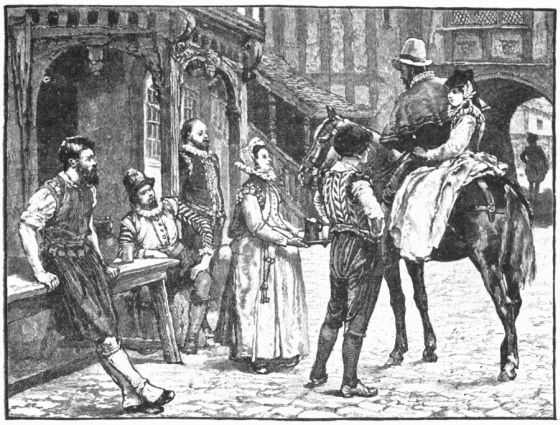
TOWN AND COUNTRY FOLK OF ELIZABETH'S REIGN.
But we have abundant other evidence, with some degree of detail, of the progress of wealth in the splendour maintained by the Court, in the cost of dress, jewellery, horses, and household establishments, in the amount of taxation and revenue, in the extent of shipping and foreign commerce, and in the rank and influence which the nation had assumed in Europe. We now proceed to notice these tokens of advance.
The Tudors were a race who had the highest possible idea of their power and prerogative. Under Henry VIII. especially the sentiment of Louis XIV. of France was thoroughly realised though the phrase was not yet coined, "L'état? c'est moi!"—"I am the State." If he did not actually annihilate the Constitution, he reduced it to a mockery and a mere machine, which moved only at his will. Yet in truth, paralysed as the nation appeared then under the terror of the axe and the gallows, its spirit only waited: it was never extinguished, and under his successors it showed itself again unmistakably. It has been asserted that the people in the time of Henry VIII. were most cowardly, for that he had no means of maintaining his arbitrary course against them, as he had no standing army. But this is not altogether true, for though he had no actual standing army, he had such authority over the minds of both aristocracy and people, that—as we have seen on all occasions in which the people revolted, chiefly on account of religion, and when they were instigated and supported by the Roman Catholic nobles—he speedily mustered sufficient forces to put them down. In contemplating the strange mystery of the base submission of the Parliament and people to the reckless caprices and bloodthirsty despotism of Henry VIII., we must ever bear in mind that the whole nation was rent into two most antagonistic parts by the schism in religion. The Roman Catholics feared the loss of their estates, the Protestants were eager to secure them. Of the few noblemen remaining in the country from the sanguinary decimation of the civil wars, some of the wealthiest were still staunch Roman Catholics, and were watched with greedy eyes by the host of poor but ambitious adventurers who were ready to second every scheme of spoliation meditated by the monarch. When the ancient Church was going to the ground, with all its proud establishments and enormous estates, the nobles who belonged to it felt the very earth shaking under their feet, and saw no means of safety but in the most implicit obedience. On the other hand, the numerous swarm of courtiers—whose only law was the word of the prince, and their only real creed the belief in plunder and in the acquisition of the lands of nobles, prelates, abbots, and chantries, as the reward of subservience—were ever ready to rush to arms or to the execution of the most fierce and unconstitutional orders of the king. No mercy was shown by the members of families to one another, where the terror of the monarch and the hope of his favour intervened. And at that day, when the country swarmed with vagabonds, who had no home and no ties, who had been increasing ever since the abolition of villenage, there was no difficulty in mustering numbers of soldiers, where there was the chance of liberal pay and more liberal plunder.
This state of things, this facility of drawing forces to the field on the shortest notice, and on the most certain basis, was particularly provided for by Henry VII. He took care to save money by all means, and to hoard it, so that though no man was more reluctant to spend, and none ever incurred so much odium by his parsimony where the military fame of the nation was concerned; yet he gained at least the reputation of ample means, and the credit for a disposition to punish promptly and severely any disloyalty or adverse claims on his Crown. He moreover passed two statutes for the purpose of bringing his nobles and dependents rapidly to his standard on any emergency. By the Acts 2 Henry VII. c. 18, and 19 Henry VII. c. 1, every one who possessed an office, fee, or annuity, by grant from the Crown, was required to attend the king whenever he went to war, under penalty, in case of failure, of forfeiture of all such grants. There were, of course, certain exemptions. Some obtained the king's licence, for an equivalent consideration, to remain at home, and such as could prove any disqualifying infirmity were excused. The clergy, as a matter of course, were exempt, also the judges and principal officers of the law; and by the latter Act this privilege was extended to the members of the king's Council, to such persons as had bought their patents for a certain sum, and to all persons under twenty and above sixty years of age. The exemptions extended to comparatively a small number of persons, the fear of forfeiture applied to the majority. To render this more effectual, Henry VII. was rigorous in prohibiting a large array of retainers by the nobles, whilst he was strenuous to enforce the attendance of the feoffees of the Crown. This process was carried farther by Henry VIII. by the free use of attainders, by which, at will, he struck down the most wealthy and exalted nobles, and appropriated their demesnes; so that eventually there was not a foot of land in the kingdom nor an individual life which was not held at the king's mercy.
But still more than by the passing of attainders were the lives, liberties, and property of the nobles submitted to the will of the king, by the institution of the Court of the Star Chamber. This court set aside all other courts at will, and by abandoning the use of juries in it, laid Magna Charta and the life and fortune of every man, at the foot of the throne. From the moment, in fact, that this court was formally erected by the 3 Henry VII., c. 1, there was an end of the Constitution, the privilege of Habeas Corpus was suspended, and Parliament legislated in vain. The king was the State, and ruled in this arbitrary court by the officers of his Privy Council. This court was so called from the stars which ornamented the ceiling of the room in which it met.
Henry VII., in his original enactment, plainly avowed his reason for establishing this court to be, that he might reach and punish such persons as by one means or another escaped sentence in the ordinary courts, through the bribery or "remissness" of juries, and check the evils of "maintenance," or the overriding of justice through the assistance of a powerful neighbour, and the granting of "liveries" for the same purpose. The court was, therefore, directed against the licence of the nobility, and though arbitrary was at first popular. It consisted in its original form of the Chancellor, Treasurer, and Keeper of the Privy Seal, or any two of them, with a bishop and a temporal lord of the council and the chief justices of the King's Bench and Common Pleas, or two other justices in their absence. Ultimately it developed into a mere gathering of privy councillors, and its jurisdiction at first accurately defined, and for the most part beneficial, became extremely vague and was exercised at haphazard.
In the reign of Henry VII. the privilege of benefit of clergy was greatly modified. This privilege, which originally exempted all clergymen from the authority of lay tribunals, had become extended to all such laymen as could read, and were therefore capable of becoming "clerks." To restrict this abuse, Henry VII., in 1488, enacted that such privilege should be allowed to laymen only once; and afterwards—when a man had murdered his master—a statute was passed to deprive all murderers of their lords and masters of benefit of clergy. Where it was admitted, the culprit, if a layman, did not entirely escape punishment, for he was burnt with a hot iron in the brawn of the left thumb.
The statutes in this reign were drawn up in English, and printed as they came out, by De Worde, Pynson, and Faques, a signal step in progress towards a public knowledge of the laws.
Under Henry VIII. the principle of arbitrary government arrived at its culmination. The freedom from restraint which his father had prepared for him, the passionate and imperious nature of this prince led him to exercise to the utmost. By the means which we have described—terror of death to those who offended, and participation in the spoils of nobles and the Church, and hope of new honours to those who served him regardless of law or conscience—he put himself above all control of Parliament or statute, and ruled as royally, according to his own fancy, as any Eastern despot. Out of this monstrous evil came, nevertheless, much good to the nation. By his own daring act he broke up the ancient system of the Church, with its accumulated wealth, superstitions, and abuses, and cleared the ground for a new and more liberal state of things. By the distribution of this property he founded a new and influential class of freeholders, and enabled the affluence of trade to flow into land, and to give to the mercantile class a new status and influence. His motive was his own selfishness, but the result was the public good.
Among the useful Statutes which he passed may be mentioned the Statute of Uses and the Statute of Bankruptcy. By the former he put an end to a most mischievous practice of conveying property for the use of certain parties or corporate bodies, which had been introduced to evade the Statute of Mortmain. So many secret modes of conveyance, so many legal fictions had been introduced into the transfer of this property, that it was difficult to ascertain the real owner; and creditors thus became defrauded, widows were deprived of their dowers, and husbands of their estates, by the courtesy. But the great feudal lords also were defrauded of their dues on wardships, marriages, and reliefs. By an Act of the twenty-seventh year of his reign (1536), it was decreed that whoever was found in the possession of such property should be deemed its bonâ-fide owner, and liable to the charges leviable upon it. By this means the dubious and fraudulent practice of uses was abolished, and the lawyers were compelled to resort to the more tangible theory of trusts. The nature of the tenure still remained the same, for the use was but a trust; but it was simplified, and brought more into the region of common sense and common observation.
By the preamble to the Statute of Bankruptcy, we find that the progress of commerce had led to frauds. Men by means of credit got the property of others into their hands and absconded with it. In the 34 and 35 of Henry VIII., therefore, it was enacted that the Chancellor or Keeper of the great seal, with the Lord Treasurer, Lord President, Privy Seal, and others of the privy council, and chief justices, or any three of them—the Chancellor, Keeper, President, or Privy Seal being one—should have power to constitute a court, before which, on complaints from a party aggrieved, they should summon the defaulter, should take possession of all his property, should hear all necessary evidence on oath, and should make a distribution of his effects amongst the creditors according to their claims. Persons concealing effects of the offender were to forfeit double their value; and claimants making fraudulent claims were to forfeit double the amount demanded.
This was the first outline and foundation of our court and law of bankruptcy, the main principles of which are still in force, but considerably modified by the greater development of the action of trade, and a spirit of increased enlightenment and humanity. The bankrupt is no longer treated necessarily as a criminal, but as one who has suffered from misfortune; and where he is innocent of dishonest conduct, is discharged from such obligations as he has no means of fulfilling, and the way opened for future enterprise.
But the laws of Henry were rarely so rational or innocent as these. We have seen, in tracing the events of his reign, that, to stop the mouths of his subjects regarding his many criminal deeds, the cruel calumnies on and divorces of his wives, followed by their execution, and the perpetration of fresh marriages equally revolting, he was continually creating new species of treasons, and loading the Statute book with the most atrocious specimens of legislation which ever disgraced the annals of any nation, Christian or pagan.
The first of these extraordinary enactments was the Statute 25 Henry VIII., c. 22, passed on the occasion of his divorce of Catherine of Aragon, and his marriage of Anne Boleyn. In this he declared that any one who dared to write, print, or circulate anything to the prejudice of this marriage, or the queen herself, or the issue of such marriage, should be guilty of high treason. The same was to be the fate of any one who endeavoured to dispute this alliance by advocating the validity of the former marriage with Catherine, and every one was to take an oath to obey this Act fully; and if any refused to take such oath, they were to be also guilty of misprision of treason. As, however, the tyrant could not prevent people from thinking and speaking their minds in private, next Session he got from his pliant Parliament a fresh Act, forbidding all persons to speak or even think a slander against the king; for if they thought, they could have the oath put to them, and must either deny their very thought, or be found guilty of treason.
But by the twenty-eighth year of his reign the fickle despot had cut off the head of this very queen, against whom nobody had on any account been allowed to whisper the slightest fault, on peril of their lives (1536). The marriage with her, as well as that with Catherine, was declared void, and never to have been otherwise; the issue of both was pronounced illegitimate, and the same penalties were enacted against every one who called in question the tyrant's marriage with Jane Seymour. Thus, on every occasion that this Royal sensualist thought fit to destroy or divorce a wife and marry another, did he compel the whole of his subjects to swear and forswear at his pleasure. In a Statute of the thirty-first of his reign, c. 8, he clearly enunciated that doctrine of Divine right which the Stuarts, his successors, upheld to their perdition. It is worthy of note, too, that by abolishing the authority of the Pope, to serve his own selfish ends, he let loose the human mind from its long thraldom, and prepared the way—a necessary sequence—for that political rebellion which was certain to be assumed by a people who had once triumphed in a religious one. Thus was political freedom the consequence of this lawless monarch's attempt to crush it, as much as the Reformation was that of his rejection of the Papacy for the gratification of his passions.
It is needless to follow Henry VIII. through the still repeated progress of those contradictory oaths as he slew or wedded fresh wives. It was the same in the divorce of Anne of Cleves, on the decapitation of Catherine Howard; but growing perfectly frantic with wrath and shame on finding himself married to an unchaste woman whom he had proclaimed an angel, he went a step farther, and denounced the terrors of high treason against any woman who should dare to marry him if she had been incontinent before marriage, and against all such persons as should know of this and should not warn the king in time. When to these hideous Statutes we add that of 31 Henry VIII., c. 14, which abolished all "Diversity of opinions," and that of 34 and 35 Henry VIII., c. 1, for the "Advancement of true religion and abolishment of the contrary," we have exhibited the most perfect example of what a man may become by the intoxication of unlimited power.
Besides particular laws, Henry VIII. erected two new courts of justice—the Court of the Steward of the Marshalsea, for the trial of all treasons, murders, manslaughters, and blows by which blood was shed in any of the palaces or houses of the king during his residence there; and the Court of the President and Council of the North. This latter court was established in the thirty-first year of his reign to try the rioters who had risen against his suppression of the lesser monasteries; but it included all the powers vested in the king's own Council, and not only decided such civil cases as were brought before it, but was armed with authority, by secret instructions from the Crown, to inquire into presumed illegalities, and to bring before it alleged offenders against the prerogatives of the king. Such oppressive use was made of it by Strafford in the time of Charles I., that it was abolished in the sixteenth year of that monarch's reign.
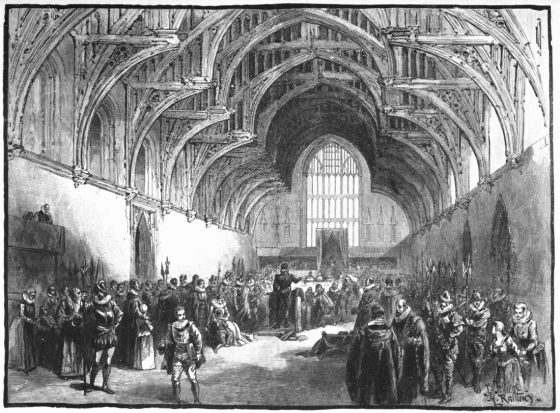
STATE TRIAL IN WESTMINSTER HALL IN THE TIME OF ELIZABETH.
To the honour of Edward VI. and his counsellors, all these arbitrary Acts of his father were repealed by him: the law of treason was restored to its state under the Statute of 25 Edward III.; religion was again set free, and proclamations by the king in council were declared to have no longer the force of Acts of Parliament. A few years, however, introduced Queen Mary, and a reversal of the State religion and all its laws. That dreadful persecution which we have narrated, and which is one of the darkest spots in the history of the world, was carried on to force the human mind into its former thraldom; and an attempt was made by the Spanish power which was then introduced to restore arbitrary rule by a singular suggestion. Charles V. presented, through his ambassador, a book to the queen, in which the principle was laid down that as she was the first queen regnant, none of the limitations which had been set to the prerogative of her ancestors the kings of England, applied to her, but to kings only; and that by consequence she was free and absolute. This book Mary showed to Gardiner, and asked his opinion of it, which was that it was a pernicious book, and could work her no good. Thereupon Mary threw the book into the fire; and Gardiner, on the plea of defining and establishing her authority, brought in an Act which, giving her the same powers as the kings before her possessed, consequently restrained her within the same limits.
Mary confirmed the Act of her late brother, confining the law of treason to the Statute of the 25th of Edward III.; nor does she seem to have created fresh treasons, except in one instance—making it treasonable to counterfeit not merely the coin of the realm, but also such coins as circulated there by Royal consent.
On the accession of Elizabeth the Reformed religion was once more restored; and, like her father, she was not only declared supreme head of the Church, but she assumed all his claims of supreme authority in the State. She frequently told her Parliament that it existed entirely by her will and pleasure; and when the members entered on matters disagreeable to her, she snubbed them in language which sounds oddly enough in these days of high Parliamentary privilege. By the very first Statute passed in her reign, she proceeded to set up a new Court, ignored everything like Magna Charta and the right of jury, making her own will the entire law, and placing every subject, with his life and property, at her mercy. This was the Court of High Commission, which assumed all the pretensions of the Star Chamber, but was directed more especially to ecclesiastical affairs. The queen was empowered to appoint by letters patent, whenever she thought proper, such persons, being natural-born subjects, as she pleased, to execute all jurisdiction concerning spiritual matters, and to visit, reform, and redress all errors, heresies, schisms, abuses, offences, &c., which by any ecclesiastical authority might be lawfully ordered or corrected. The Reformers were only too eager to put this formidable engine into her hands, because it was to crush the Romish hierarchy; but they did not reflect that it could on occasion be employed against themselves, as Laud and Strafford afterwards demonstrated to their children. This inquisitorial court was armed with authority to employ torture to effect the necessary confessions, and its jurisdiction was extended to the punishment of breaches of the marriage vow, and all misdemeanours and disorders in that state. It was, therefore, sanctioned in forcing its operations into the very bosom of social and domestic life.
Elizabeth, indeed, was fully as arrogant and despotic as her father; and nothing but her lion-like resolution, her choice of able and unscrupulous ministers, and the cunning of her Government, could have enabled her to maintain her sway so successfully as she did. The homage due to her sex no doubt also contributed essentially to this result. Yet not all these circumstances could prevent her from perceiving that her power was silently and even rapidly waning before that of the people. She frequently had to tell persons that they dared not have done or said certain things in her father's time. She had repeatedly to concede the point to the pertinacity of her Parliament; especially so when, towards the end of her reign, the House of Commons called so boldly upon her to abolish the monstrous list of monopolies which had been granted to her favourites, commencing from the seventeenth year of her reign. Amongst these monopolies were those for the exclusive sale of salt, currants, iron, powder, cards, calf-skins, felts, poledavy (a kind of canvas), ox shin-bones, train-oil, lifts of cloth, potash, anise-seed, vinegar, sea-coal, steel, aqua-vitæ, brushes, pots, bottles, saltpetre, lead, accidences (or books of the rudiments of Latin grammar), oil, calamine stone, oil of blubber, glasses, paper, starch, tin, sulphur, new drapery, dried pilchards; the exportation of iron, ham, beer, and leather; the importation of Spanish wool and Irish linen; such an astonishing list, in fact, that when it was read over in the Commons in 1601, but two years before her death, a member in amazement asked, as already stated, whether bread was not of the number.
These grants had been obtained from her by her courtiers through the weak side of the woman; but in the expenses of her government, considering the aid she had to render to her Protestant allies in Scotland, France, and the Netherlands, and the enemies she had to contend with, necessitating costly armaments and navies, her administration shows most favourably. She would never incur debt, but paid off that incurred by her predecessors, Edward and Mary. Instead of debasing the coin, like her father, she increased its purity; and the annual outlay of her government averaged only about £65,000 per annum.
In fact, the more we recede from the personal history of Elizabeth, and approach her great political measures, the more we perceive the true evidences of her glory. She was courageous, beyond the power of a world in arms to terrify her; she was moderate in her demands on her subjects, though vain in her person and showy in her court; shrewd in her choice of ministers, though weak in her indulgence of favourites; she was ambitious of the reputation of her country; and she rendered to the labouring people their birthright in the land, which her father had stripped them of in levelling the monastic institutions by enacting the Poor Law, the celebrated Statute of the forty-third of her reign (1601), on which yet rests the whole fabric of parochial right to support in age and destitution. In nothing did she display her sagacity so much as in her repeated declaration that money in her subjects' purse was as good as in her own exchequer. It was better, for there it would be growing tenfold in the ordinary augmentation of traffic, ready to yield the State proportionate interest on any real emergency.
The great struggle between the Papacy and the growing Protestant forces was nearly ended, but complete and terrible as was the overthrow of the ancient hierarchy in England and Scotland, it came at last with a rapidity which astonished even the friends of the change. From the time of Richard II. hatred of the Papacy had been afloat among the people, and even in his day had availed to shake the throne, and fill the public mind with prognostics of Papal decay. Yet reign after reign had passed, and the Church had not only maintained its position, but had seemed to crush with a successful hand the Protestant schismatics. The fires which consumed the more daring advocates of the new opinions seemed to scare the rest into obscurity. The triumphant Church of Rome still presented a front of determined strength, and lorded it over the land with a magnificence which seemed destined to endure for ever.
Henry VII. was a firm upholder of the Roman Catholic hierarchy. "He advanced churchism," says Bacon; "he was tender of the privileges of sanctuaries, though they did him much mischief; he built and endowed many religious foundations, besides his memorable hospital of the Savoy; and yet he was a great alms-giver in secret, which showed that his works in public were rather dedicated to God's glory than his own." The fact was that Henry VII. was too cautious a man to become a reformer. He was too fond of money to risk its loss by the most distant chance of an unsuccessful enterprise, and he was too recently placed on the throne of a vanquished dynasty to venture on so bold a measure of ecclesiastical revolution had he been thus inclined, which he was far enough from being. On the contrary, his ministers were almost all great and able churchmen. Cardinals Bourchier and Morton, Archbishops Deane and Warham, were the accomplished churchmen who conducted the governmental affairs of Henry; and when the public outcry against the worldly and dissolute lives of the clergy, both secular and regular, became too loud to be disregarded, these clerical ministers of the king endeavoured with one hand to reduce the corruption by advice and remonstrance, and to check the progress of heresy by the stake and fagot. Henry VII. permitted this mode of extinguishing opinion by destroying the entertainers of it. In the ninth year of his reign Joan Boughton was burnt in Smithfield, and this auto-da-fé was followed by that of William Tylsworth, at Amersham, whose daughter was compelled to set fire to the pile which destroyed her father, and that of Laurence Guest at Salisbury. In addition to the victims of these odious crimes, many persons were burnt in the cheek, imprisoned, and otherwise cruelly treated. These atrocities so far from diminishing the heresy, only excited the abhorrence of the people and weakened their attachment to the Church.
Henry VIII. continued the persecuting practices of his father with unabated rigour. In his earlier days he appeared determined to do honour to the Church beyond most of his predecessors. He raised up and created in Cardinal Wolsey such a colossus of ecclesiastical pomp and greatness as the world had rarely seen. In 1513 Wolsey was made Bishop of Tournay, in France; in 1514, Bishop of Lincoln and Archbishop of York; in 1515, the king's almoner, Cardinal, and Lord High Chancellor of the kingdom; in 1518 he became the Pope's legate à latere and Bishop of Bath and Wells; in 1521, he was made Abbot of St. Albans; in 1523, Bishop of Durham, in exchange for the bishopric of Bath and Wells; and in 1529, Bishop of Winchester, in exchange for that of Durham. Besides these dignities, he had pensions from the King of France, the Emperor of Germany, the Pope, and other princes. The whole power of the kingdom was in his hands; for Henry, so far from being jealous of his greatness, only felt himself the greater for having a servant who in pride and splendour rivalled the greatest monarchs. The state which Wolsey kept would lead us to infer that the Church had reached a higher pitch of power and grandeur than ever in this country. His palaces were more gorgeous, and filled with more evidences of enormous wealth, than those of kings. His retinue of servants and attendants, many of the latter being nobles or the sons of nobles, was inconceivable. It was only at Hampton Court that the whole train of his servants and the crowd of his visitors, including the nobility and ambassadors of foreign courts, could be suitably lodged and entertained. For a long course of years the whole government of England was in his hands. The king did nothing without him; and as prime minister and Lord Chancellor of England, Archbishop of York, and chief judge in the court of Star Chamber, there was no man or his estate that was not in his power. His revenues from a hundred sources were immense, and such was the magnificence of his position and influence, that he might well forget himself and utter the famous words of unparalleled egotism—"Ego et rex meus."
Who could have deemed that the Papal Church was near its end as the State religion of England, whilst the king thus honoured its dignitaries? The very greatness of Wolsey hastened the fall of the Church as well as of himself. The arrogance, the rapacity, and the frequent injustice of the proud minister made for him and his Church deadly enemies. "For," says Strype, "he disobliged not only the inferior sort by his pride and haughty behaviour, but by laying his hands upon the rights, privileges, and profits of the gentry and clergy, he made them his implacable enemies too. He took upon him to bestow benefices, though the real right of patronage lay in others. He called all offending persons before him, whether of the laity or clergy, and compelled them to compound as his officers thought fit."
But in spite of all his grandeur, Wolsey was but the creature of the most violent and capricious of men. A single word and he fell headlong, assuredly shaking in his fall the great hierarchy of which he had seemed the most gorgeous pillar and ornament; for the whole system was corrupt and rotten to the core. The wealth of the monastic orders had especially demoralised them. Both the regular and secular clergy were accused of not only spending their time in taverns and gambling-houses, but of abandoning in such resorts the very costume which distinguished them from the laity, of wearing daggers, gowns, and hoods of silk and embroidery, and of letting their hair grow long and fall on their shoulders. The interiors of the monastic houses were described as dens of licentiousness, both in monks and nuns. We have it, on the evidence of one of the letters of reproof addressed by Archbishop Morton to the Abbot of St. Albans, that that famous abbey was filled with every species of vice and sensuality. He further charges them with cutting down the woods, wasting and embezzling the property of the Church, stealing the plate, and even picking out the jewels from the shrine of the patron saint.
Whilst such was the corruption of the clergy, these infatuated men fell to quarrelling amongst themselves. The most remarkable circumstance, moreover, in this schism, is the very question which in these latter days has furnished such a fiery theme of discussion in both Romanist and Protestant Churches—the Immaculate Conception of the Virgin.
With the blind tenacity which often induces falling bodies to assert their prerogatives with arrogant obstinacy, the Church, in the fourth year of Henry VIII., commenced a daring opposition to the Government, in defence of the benefit of clergy. Henry VII., as we have stated, had limited this much abused privilege, by his Statute ordering such laymen as claimed it under charge of murder, to be burnt in the brawn of the thumb with the letter M. Henry VIII. had a Bill introduced into Parliament for the purpose of still further limiting this mischievous right, and denying benefit of clergy to all murderers and robbers whatever. This the clergy opposed in Parliament and preached against in the pulpit. The Lords and Commons were unanimously in favour of the Bill as well as the people, but the clergy determined not to yield. Whilst the public mind was in a ferment on this subject, a tailor of London, of the name of Hunne, was brought into conflict with the incumbent of his parish, on account of mortuary dues. Being sued in the spiritual court, with a boldness which marked the rising spirit of the times and which the clergy ought to have noted seriously, he took out a writ of Præmunire against his prosecutor, for appealing to a foreign jurisdiction, the spiritual court, still under the authority of the Pope. Enraged at this audacity they put the tailor into prison on a charge of heresy, and there he was discovered hanging dead. A coroner's inquest found the officers of the prison guilty of murder, and it appeared that the Bishop of London's chancellor, the sumner, and bell-ringer had perpetrated the crime. This threw the deepest odium on the clergy, and alienated the people from them; yet they did not cease to prosecute their claim of privilege, and after much contest, Wolsey prayed the king to refer the matter to the Pope. But even then Henry showed that he was tenacious of his power, and gave a striking foretaste of what he would one day do. He replied, "By permission and ordinance of God, we are King of England; and the king of England in times past hath never had any superior but God only. Therefore know you well that we will maintain the right of our crown, and of our temporal jurisdiction, as well in this as in all other points, in as ample a manner as any of our progenitors have done before our time."
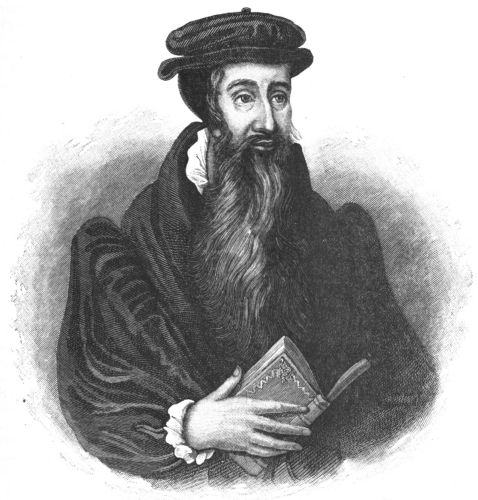
JOHN KNOX. (From a Portrait of the Period.)
Whilst Edward VI. thoroughly established Protestantism, Mary as completely reinstated Popery, and with a series of horrors which for ever stamped terror and aversion of Roman Catholic ascendency deep on the spirit of the nation. The number of persons who died in the flames in that awful reign, for their faith and the freedom of conscience, is stated to have been 288; but Lord Burleigh estimated those who perished by fire, torture, famine, and imprisonment at not less than 400. Besides these, vast numbers suffered cruelly in a variety of ways. "Some of the professors," says Coverdale, "were thrown into dungeons, noisome holes, dark, loathsome and stinking corners; others lying in fetters and chains, and loaded with so many irons that they could scarcely stir. Some tied in the stocks with their heels upwards; some having their legs in the stocks, with their necks chained to the wall with gorgets of iron; some with hands and legs in the stocks at once; sometimes both hands in and both legs out; sometimes the right hand with the left leg, or the left hand with the right leg, fastened in the stocks with manacles and fetters, having neither stool nor stone to sit on to ease their woful bodies; some standing in Skevington's gyves [commonly called "Skevington's daughter"]—which were most painful engines of iron—with their bodies doubled; some whipped and scourged, beaten with rods, and buffeted with fists; and some having their hands burned with a candle to try their patience, and force them to relent; some hunger-pined, and some miserably famished and starved." The leading Reformers fled out of the kingdom, chiefly to Frankfort and to Switzerland; and 800 or more lived to become the heads of the restored Church under Elizabeth; amongst these were Poynet, Bishop of Winchester; Grindal, afterwards Bishop of London, and finally Primate of England; Sandys, afterwards Archbishop of York; Ball, Bishop of Ossory; Pilkington, afterwards Bishop of Durham; Bentham, afterwards Bishop of Lichfield; Scorey, Bishop of Chichester, and afterwards of Hereford; Young, afterwards Archbishop of York; Cox, afterwards of Ely; Jewel, afterwards of Salisbury; Coverdale, the translator of the Bible, Bishop of Exeter; Horn, Dean of Durham; Knox, the apostle of Scotland; and Foxe, the martyrologist. Besides these eminent men, there were Sir John Cheke, the famous Greek scholar, Sir Anthony Cooke, and Sir Francis Knollys, afterwards Elizabeth's vice-chamberlain.
On Elizabeth's accession to the throne she was by no means disposed to go so far as her brother Edward had gone, much less as far as the refugees—who now flocked back again from Geneva—would have carried her. They had imbibed the rigid independent notions of Calvin and Zwinglius, and that probably before their departure from England—a circumstance which there is little doubt directed their course to Switzerland, for the Reformers who resorted to Frankfort were much nearer to her standard—a standard very much the same as that of her father. She renounced all allegiance to the Pope and the Church of Rome, though she hesitated to declare herself the supreme head of the Church till it was conferred on her by Parliament. She issued orders to restrain the zeal of the Protestants, who began to pull down the images, and to restore the service to its state in King Edward's time. She gave directions that a part of the service should be read in English, and forbade the elevation of the Host; but at the same time she suspended all preaching.
Parliament, on meeting, passed an Act asserting the supremacy of the Crown over the Church, revived the Acts of Henry VIII. which abolished the power and jurisdiction of the Pope in England, and authorised the use of King Edward's Book of Common Prayer, with some alterations, chiefly in the Communion Service. Thus they cast off the Roman Catholics who would not conform, but did not go far enough for the more zealous Reformers. The oath of Supremacy was presented to the bishops, and it had the effect of clearing the Church of all but Kitchen of St. Asaph. The inferior clergy, however, were not so firm, and only six abbots, twelve deans, twelve archdeacons, fifteen heads of colleges, fifty prebendaries, and eighty rectors refused compliance. The monks returned to secular life, but the nuns mostly went abroad. The clergy were ordered to wear the habits in use in the latter part of King Edward's time; and their marriages, against which the queen showed a strong repugnance, were put under stringent regulations. The press also was laid under the most rigorous restrictions, and no book was to be printed or published without the licence of the queen, or of six of her privy council, or of her ecclesiastical commissioners, or the two archbishops, the Bishop of London, the chancellors of the universities, and the bishop and archdeacons of the place where it was produced. All persons were commanded to attend their parish churches under severe penalties. In 1562 the articles of religion of King Edward were reduced from forty-two to thirty-nine. In 1571 they underwent a further revision, and were made binding on the clergy before they could be admitted to orders.
Like her father, the longer she lived the more resolute she became to enforce her own dogmas on the whole body of her subjects. In the twenty-third year of her reign the penalty for non-attendance of the Established Church was raised to £20 per month. In the same year another Act was passed, declaring it high treason to attempt to draw any one to the Church of Rome; and the persons thus drawn were equally guilty of treason, and all their aiders, abettors, and concealers were made guilty of misprision of treason. These arbitrary laws against the freedom of opinion went on increasing in severity. In 1585 an Act was passed which made traitors of all Jesuits and other Popish priests who had been ordained abroad, and of all subjects whatever educated in Papal seminaries who did not immediately return home and take the oath of supremacy. The receivers of any such persons were declared felons without benefit of clergy. Whoever sent money to any foreign Jesuits or priests was liable to Præmunire; and parents sending their children to school abroad without licence from her Majesty were liable to a penalty of £100. Fresh Acts were added in 1581 and 1593, the former to make void all conveyances of property by Popish recusants, with the object of escaping the penalties imposed upon them, and to decree that the penalty of £20 a month for non-attendance at church should be levied by distress to the extent of all the offenders' goods and two-thirds of their lands; the latter ordered all Popish recusants above sixteen to repair to their proper places of abode, and never more to go more than five miles from them without special licence from the bishop of the diocese or lieutenant of the county, under penalty of forfeiture of their goods and of the profits of their lands for life; those having no goods or lands to be deemed felons.
But if the atrocities committed by the Roman Catholics in the reign of Mary, and the fears of their recurrence should the Papists regain the power, afforded some plea for these persecutions, what is to be said of the same rigours applied to the Reformers, who simply desired to form their religious opinions on the Bible—the Divine charter of Humanity? Thousands of these, from the earliest days of the Reformation, had claimed this privilege as their birthright; and many of those who came back from the Continent on the termination of the Marian persecution, were surprised and discouraged to find themselves equally excluded with the Catholics from the exercise of their own judgments by a Protestant queen. They were required to attend the preaching of those against whose doctrines they protested, and suffered the same monstrous fines if they absented themselves. Instead of that "glorious liberty of the gospel" which they had promised themselves, they had to accept with all homage the cut out and prescribed pattern of opinion dictated by an autocratic woman, who made a desperate stand against the removal of images from the churches, and practised many Popish ceremonies in her own private chapel. Instead of the form of service which the English refugees had established at Geneva, in which there were no Litany, no responses, and scarcely any rites or ceremonies, they were commanded to adopt a form which appeared to them little removed from Popery. The Genevan refugees—who, from their demand for the utmost purity and primitive simplicity in worship, were styled Puritans—would, had they been permitted, have planted a church far more like the church as it came to exist in Scotland than that which was established for England. They opposed the claims of the bishops to a superior rank or authority to the presbyters; they denied that they possessed the sole right of ordination, and exercise of church discipline; they objected to the titles and dignities which had been copied by the Anglican Church from the Roman, of archdeacons, deans, canons, prebendaries; to the jurisdiction of Spiritual Courts; to an indiscriminate admission of all persons to the Communion; to many parts of the liturgy, and of the offices of marriage and burial, including the use of the ring in marriage; they repudiated set forms of prayers, and the use of godfathers and godmothers, the rite of confirmation, the observance of Lent and holidays, the cathedral worship, the use of the organ, the retention of the reading of apocryphal books in church, pluralities, non-residence, the presentation to livings by the Crown, or any other patron, or by any mode but the free election of the people.
But in that age no conception of religious liberty was entertained. The Puritans were as resolute in their ideas of conformity to their notions as Elizabeth was to hers; and had they had the power, would have used the same compulsion. Knox exhibited that spirit of exclusiveness to the extreme in Scotland, even calling for the deposition of the queen as a "Jezebel" and "an idolatress," because she would not adopt his peculiar tenets and view of things. The Puritans exhibited the same spirit long after in America for the exercise of their faith. In fact, the great and divine principle of the entire liberty of the gospel was too elevated to be arrived at suddenly after so many ages of spiritual despotism, and required long and earnest study of the spirit and example of Christ. Severe struggles, bloody deaths, and incredible sufferings in those who came to see the truth, had to be undergone before the battle of religious freedom was fought out, and all parties could admit the plain fact which had revealed itself to Charles V. after his abdication of the throne, when he amused himself with clock making—that as no two clocks can be made to go precisely alike, it is folly to expect all men to think precisely alike. "Both parties," says Neal, in his "History of the Puritans," "agreed too well in asserting the necessity of a uniformity of public worship, and in using the sword of the magistrate for the support and defence of their respective principles, which they made an ill use of in their turns whenever they could grasp the power in their hands. The standard of uniformity, according to the bishops, was the queen's supremacy, and the laws of the land; according to the Puritans, the decrees of provincial and national synods, allowed and enforced by the civil magistrate: but neither party were for admitting that liberty of conscience and freedom of profession which is every man's right as far as is consistent with the peace of the civil Government he lives under." Heresy was, in fact, punished by the Government as a purely political offence.
Elizabeth, having the power, compelled all those clergymen who conformed sufficiently to accept livings and bishoprics, not only to conform but more or less to persecute their brethren. Even men like Parker and Grindal, naturally averse from compulsion, were obliged to do her bidding, till Grindal rebelled and was set aside; but their places were supplied by Sandys, who had himself fled from Popish compulsion, and by Whitgift, who rigorously enforced the laws. Sandys actually sentenced the anabaptists who, in 1575, were burnt at the stake by order of the queen—for to this pass it came: Hammond, a ploughman, being burnt at Norwich in 1579, and Kett, a member of one of the universities, in the same place, ten years afterwards, under Elizabeth.
Such was the state of the Protestant Church at the termination of the period we are now reviewing. The queen discouraged preaching and instruction of the people, allowing many bishoprics, prebends, and livings to be vacant, and receiving their incomes. She declared that one or two preachers in a county was enough, probably fearing the prevalence of the more advanced opinions. Parker in his time had been ordered to enforce strict compliance with the rubric, and numbers of the most eminent and eloquent clergymen resigned their livings and travelled over the country, and preached where they could, "as if," says Bishop Jewell, "they were apostles; and so they were with regard to their poverty, for silver and gold they had none." Being, however, continually brought before the authorities and fined and otherwise punished, they determined to break off all connection with the public churches, and form themselves into an avowed separate communion, worshipping God in their own way and being ready to suffer for His sake. Here, then, commenced the great cause of Nonconformity, and the formation of all those sects which from time to time have since appeared, each claiming—and justly—the right to worship God and to regulate their particular church as seems conformable to their understanding of the Scriptures. These separate assemblies, however, were stigmatised as conventicles, and from this time many were the laws passed to put them down, as we shall hereafter find. Among the Nonconformists a most zealous and resolute sect arose called Brownists, from Robert Brown, a preacher in the diocese of Norwich, a man of good family, and said to be a relative of Lord Burleigh. His followers soon acquired the name of Independents, which they afterwards changed for that of Congregationalists, from their denial of all ecclesiastical dignities and authority whatever, asserting that each congregation constitutes a complete church, with the right to nominate their own minister and conduct their own affairs. This body of Christians, at this day so extensive and respectable, of course felt the especial weight of the persecution of the Established Church, with which it refused to hold the slightest communion; yet to such a degree did it flourish—a proof of the onward spirit of the time, that Sir Walter Raleigh declared in Parliament that there were before the death of Elizabeth not less than 20,000 members of that body in Norfolk, Essex, and the neighbourhood of London.
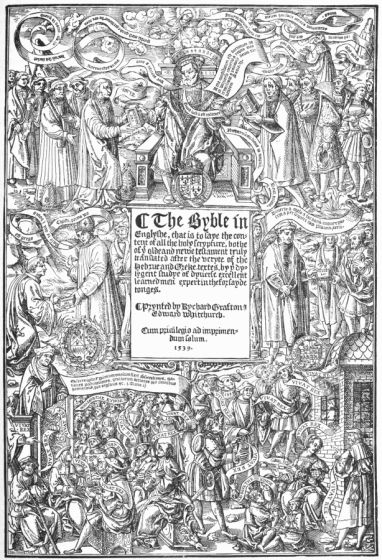
REDUCED FACSIMILE OF THE TITLE-PAGE OF THE GREAT BIBLE, ALSO CALLED CROMWELL'S BIBLE.
In the narration of the struggles of this period in Scotland we have sufficiently traced the persecution of the Protestants by the Romish Church—the martyrdom of Patrick Hamilton, George Wishart, Walter Mill, and others; the murder of Cardinal Beaton, and the final triumph of Knox and his compeers, from which period the organisation of the Protestant Church of Scotland went on rapidly. In 1560 the Lords of the Congregation entered Edinburgh in arms; and Parliament assembling, abolished for ever the Pope's jurisdiction, abolished the celebration of Mass, and authorised "The Confession of the Faith and Doctrine believed and professed by the Protestants of Scotland." An Act also was passed to pull down all cloisters and abbey-churches still left standing: and the Church, not waiting for any further enactment of the Parliament or Crown, went on exercising its own proper functions as an independent church, governed, not by the State, but by presbyteries, synods, and general assemblies. In 1580 the General Assembly, after having at various times diminished the power and rank of bishops, declared that episcopacy was unscriptural and unlawful—a dictum which the Parliament fully ratified in 1592, establishing the Presbyterian Church as the national one, with general assembly, provincial synods, presbyteries, and kirk sessions. In 1597 the Parliament admitted certain representatives of the clergy to seats in it, to which the General Assembly assented at its next meeting; and thus was completed the system of Church government in Scotland at that time.
The sixteenth century produced as great a revolution in Literature and Science as in religion. We still look back to this era for some of the greatest names and greatest works which have adorned and enlightened not only our own country, but the whole civilised world. When we enumerate Sir Thomas More, Lord Surrey, Roger Ascham, Spenser, Sir Philip Sidney, Shakespeare, Marlowe, Bacon, Buchanan, Gawin Douglas, Dunbar, and Sir David Lyndsay, we remind our readers that we are moving amid a constellation of genius, than which Time has scarcely any brighter. But in the two words Shakespeare and Bacon, we pronounce the names and glorious births of dramatic and philosophic genius, which have placed England on the summit of intellectual fame, by works never surpassed before or since in any nation, and by discoveries in science and art which have flowed from the "Novum Organum" of Bacon as from an eternal and ever-strengthening fountain. True it is both men belong, by their works, rather to the succeeding period than to the present; but Bacon had, long before the death of Elizabeth, sketched out the plan of his immortal work, though he had not dared to publish it; and Shakespeare had not only written his poems, but had also written and acted in many of his most brilliant and original plays. By these great writers the English language was established as a classical language; and though it has since extended and connected itself with the progress of knowledge and most astonishing and varied discoveries, we can produce no purer, no stronger, nor more eloquent specimens of it than from the pages of Shakespeare, which continue to be read and listened to on our stage, the genuine speech of Englishmen—somewhat quaint occasionally, but always musical to the ear, familiar to the sense, and animating to the spirit.
The violent changes and spoliations of the Reformation did not check the foundation of new colleges and seminaries of learning—the fountains, under a more liberal order of things, certain to produce noble results. Even Henry VIII., in his wholesale destruction of endowed property, and though college property was included in the Acts which he procured from his obsequious Parliament, for the most part spared the resources of education. His reign was distinguished by the foundation, in Oxford, of Brazenose College, in 1509, by Sir William Smith, Bishop of Lincoln, and Sir Richard Sutton, of Prestbury, in Cheshire. Old Richard Fox, Bishop of Winchester, who had been prime minister of Henry VII., and still was of the council of his son, in 1516 founded Corpus Christi. The only exception to Henry VIII.'s patronage of the colleges occurred in those founded by Wolsey—his Cardinal College at Oxford, and his college at Ipswich, which both fell with him. In 1545 Henry himself founded Christ Church instead of that of Wolsey, which he then dissolved. In 1554 Trinity College was founded on the basis of Durham College by Sir Thomas Pope. In 1555 Sir Thomas White, alderman and merchant tailor of London, founded St. John's College, on the site of Bernard College. These were in the reign of Queen Mary. In Elizabeth's time rose Jesus College, in 1571, from funds furnished by Dr. Hugh Price, and augmented by the queen herself.
In Cambridge three colleges arose during the reign of Henry VII.—the only educational endowments of any note during that period. In 1496 John Alcock, Bishop of Ely, founded Jesus College. In 1505 Margaret Countess of Richmond, mother of Henry VII., founded Christ's College, and also in 1511, very shortly before her son's death, St. John's College. In 1519 Edward Stafford, Duke of Buckingham, commenced the College of Magdalene; but as he was executed for high treason in 1521, Lord Audley, the Lord Chancellor, completed it. Henry VIII. founded Trinity College in 1546, and at the same time four new professorships in the university; namely, for theology, law, Greek, and Hebrew. Henry was proud of his learning, and had the good sense to support, with all the imperative force of his character, the new study of Greek, when it was violently assailed by the Church and professors. Dr. Caius founded the college named after him, and popularly pronounced "Keys," on the basis of the old hall of Gonville, in 1558—the only extension of Cambridge University under Queen Mary. Sir Walter Mildmay founded Emmanuel College in 1584, and in 1598 Sidney-Sussex College was founded by Lady Frances Sidney, widow of Ratcliffe, Earl of Sussex.
The universities of Scotland were greatly extended during this period. That of Aberdeen was founded in 1494 under the name of King's College, James IV. having procured a bull for that purpose from Pope Alexander VI., though the bishop was the main benefactor. In 1593 Marischal College, in the same university, was erected by George, Earl Marischal. At St. Andrews the college of St. Leonard's was established in 1512 by Archbishop Stuart and John Hepburn, prior of the metropolitan church. This was afterwards united with that of St. Salvator (founded in 1456), and together bore the name of the United College. St. Mary's, in the same university, was founded, in 1537, by Beaton. In 1582 James VI. founded the University of Edinburgh. In 1591 Elizabeth founded in Dublin the University of Trinity College.
Contemporaneous with these colleges and universities rose a great number of grammar-schools, designed to extend the knowledge of Latin to the mass of the people. Among the magnificent endowments, since too much withdrawn, by the influence of wealth, from the poor and the orphan, for whom they were designed, and devoted to the use of the affluent, for whom they were not designed, we may name St. Paul's School, London, founded by Dean Colet in 1509; Christ's Hospital, London, founded by Edward VI. in 1553, the year of his death; Westminster School, established by Elizabeth, 1560; and Merchant Taylors School, founded by that guild in 1561. In Scotland the High School of Edinburgh was founded by the magistrates of that city in 1577.
It is a curious fact that the revival of the Greek language and literature was coincident with the Reformation. Widely opposed as the spirit of Christianity and of the Greek mythology are, yet in one particular they are identical, in breathing a spirit of liberty and popular dominance which were not long in showing their effects in Great Britain. The Scriptures were now translated and made familiar to the people, at least by means of Puritan preachers, who were thus proclaiming that God had made of one blood all the nations of the earth, and that He was no respecter of persons; thereby laying the foundations of eternal justice in the public mind, and teaching, as a necessary consequence, that the end and object of all human government was not the good of kings or nobles, but of the collective people. The poets, the historians, the dramatists, and the philosophers of republican Greece were made to bring all the force of their fiery eloquence, their glowing narratives, and their subtle reasoning to bear upon the same theme; presenting not only arguments for general liberty and a popular polity, but examples of the most sublime struggles of a small but glorious people against domestic tyrants and the vast hordes of barbarism without, of noblest orators thundering against the oppression of the mighty, of awful tragedians steeping their stage in the imaged blood of tyrants and of traitors, of patriots perishing in joy for the salvation of their country.
It was not to be wondered at that on the bursting of these novel elements like a sudden and strong torrent into the arena of human life, there should arise a fearful struggle and combat between the old intellectual ideas and the new. The two-fold inundation pouring from the hills of Palestine and of Greece, and in united vastness deluging Europe, threatened to destroy all the old land-marks of the schoolmen, and to drown Duns Scotus and Aquinas along with the owls and bats of the monkish cells and dream chambers. It was soon seen that this new language was the language of the very book from which the Reformers drew their words winged with the fire of destruction to the ancient slavery of popular ignorance and popular dependence on priests and Popes, and no time was lost in denouncing it as a gross and new-fangled heresy. It was a heresy from which not only freedom in Church but in State was to spring; the seed from which grew, in the next age, our Hampdens, Marvels, Pyms, Prynnes, Cromwells, and Miltons.
Yet it is only due to Henry VIII., to his ministers Wolsey, Fox, and More, and to other eminent dignitaries—amongst them Cardinal Pole in Queen Mary's reign—to state that they were zealous advocates and promoters of the Greek learning. The very first public school in which Greek is said to have been taught in England was the new foundation of Dean Colet, St. Paul's school, where the celebrated scholar William Lilly, who had studied in Rhodes, was the master. Wolsey introduced it into his new colleges, and Henry VIII. being at Woodstock, and hearing of a furious harangue made at Oxford against the study of the Greek Testament in the University, immediately ordered the teaching of it, and established a professorship of it also in Cambridge.
Notwithstanding, a violent opposition arose against the study of Greek in consequence of the authority it gave to the doctrines of the Reformers, rendering an appeal to the original text invincible. Erasmus informs us that the preachers and declaimers against his edition of the Greek Testament really appeared to believe that he was by its means attempting to introduce some new kind of religion. The book was prohibited in the University of Cambridge, and a heavy penalty decreed for any one found with it in his possession. Erasmus attempted to teach the Greek grammar of Chrysoloras there, but a terrible outcry was raised against him, and his scholars soon deserted his benches. As the contest went on, however, the Universities, both here and abroad, became divided into the factions of the Greeks and Trojans, the Trojans being those who were advocates for Latin, but not for Greek. The Greeks, however, victorious, as of old, expelled the works of the famous Duns Scotus from the schools; they were torn up and trodden under foot; and the King sent down a Commission which altogether abolished the study of this old scholastic philosophy which had had so long and absolute a reign.
Yet the new knowledge appears for some time after the first excitement to have made less progress in the schools than at Court and amongst the aristocracy. On the surface, therefore, the age appeared a very learned one. All the chief churchmen on both sides of the question in the reigns of Henry VIII. and Edward VI.—Wolsey, Fox, Gardiner, Cranmer, Ridley, Tunstall, Cardinal Pole—were men of great acquirements. Henry was a fine scholar, and, despite his harsh treatment of his wives and children, gave to the latter educations perhaps superior to those of any princes or princesses of the time. Edward was steeped in learning, to the injury of his overtaxed constitution. Mary and Elizabeth were both accomplished linguists, speaking Latin, French, and Spanish fluently; and Elizabeth adding to these Greek and Italian, with a smattering of Dutch and German. Mary was studiously instructed in the originals of the Scriptures, and made a translation of the Latin paraphrase of St. John, by Erasmus, which was printed and read as part of the Church service, till it was ordered to be burnt by herself in her own reign with other heretical books. She was deeply read in the fathers, and in the works of Plato, Cicero, Seneca, Plutarch, and selected portions of Horace, Lucan, and Livy. Elizabeth was a poetess of no mean pretensions and, besides her knowledge of the classical and modern languages, read by preference immense quantities of history. Roger Ascham, the teacher of Lady Jane Grey, said that "numberless honourable ladies" of the time surpassed the daughters of Sir Thomas More, but that none could compete with the Princess Elizabeth; that she spoke and wrote Greek and Latin beautifully; that he had read with her the whole of Cicero, and great part of Livy; that she devoted her mornings to the New Testament in Greek, select orations of Isocrates, and the tragedies of Sophocles, whilst she drew religious knowledge from St. Cyprian and the "Common-places" of Melanchthon; that she was skilful in music, but did not greatly delight in it.
With such examples, no wonder that there were such learned ladies at Court as Lady Jane Grey, Lady Tyrwhit, Mary Countess of Arundel, Joanna Lady Lumley, and her sister Mary the Duchess of Norfolk—all learned in Greek and Latin, and authoresses of translations from them; the two daughters of Sir Thomas More, and the three daughters of the learned Sir Anthony Cooke—one of them the wife of the all-powerful statesman Burleigh, another the mother of the illustrious Francis Bacon, and the third, Lady Killigrew, a famous Hebrew scholar, as well as profound in Latin and Greek. It is extraordinary that learning, which had been so ardently taken up by these accomplished women, should have languished in the schools and amongst the people. Yet such was the fact, and is explained by the violent and continual changes which were taking place in Church and State. A great part of the reign of Henry VIII. was engrossed by the conflict with the Court of Rome regarding his divorce from Catherine, and then by his stupendous onslaught on the monastic and cathedral property. As no man at the Universities could tell where promotion was to come from in the Church under a king who equally took vengeance on Romanist and Protestant who dared to differ from him, and as it was equally uncertain whether, in some new fit of anger or caprice, he might not suppress the colleges as he had suppressed monasteries, ministers, and chantries, it is not surprising to hear Latimer exclaim, "It would pity a man's heart to hear what I hear of the state of Cambridge. There be few that study divinity, but so many as of necessity must furnish the college."
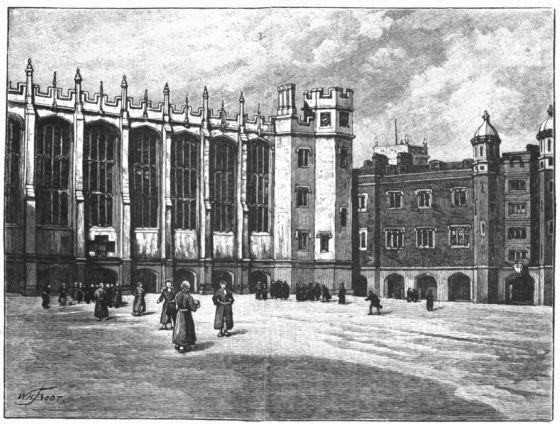
CHRIST'S HOSPITAL, LONDON (1899).
Under Edward VI. things became far worse. Then it was a scramble amongst his courtiers who should get the most of the property devoted to religion or learning. Bishoprics, good livings, the rest of the monastic lands which yet remained with the Crown did not suffice. These cormorants clutched at the University resources. They appropriated exhibitions and pensions, and, says Warton, in his "History of English Poetry," "Ascham, in a letter to the Marquis of Northampton, dated 1550, laments the ruin of grammar-schools throughout England, and predicts the speedy extinction of the universities from this growing calamity. At Oxford the schools were neglected by the professors and pupils, and allotted to the lowest purposes. Academical degrees were abrogated as anti-Christian. Reformation was soon turned into fanaticism. Absurd refinements, concerning the inutility of human learning, were superadded to the just and rational purgation of Christianity from the Papal corruption." He adds that the Government visitors of the University totally stripped the public library, established by Humphrey, Duke of Gloucester, of all its books and manuscripts; and Latimer, in one of his sermons about that time, declared his belief that there were then 10,000 fewer students than there had been twenty years before.
Classical literature did not fare better during the persecuting reign of Mary, though Cardinal Pole was a warm friend of the introduction of Greek, notwithstanding the use made of it by the Protestants. When he urged Sir Thomas Pope to establish a professorship of that language in his new college of Trinity, Sir Thomas replied, "I fear the times will not bear it now. I remember, when I was a young scholar at Eton, the Greek tongue was growing apace, the study of which is now a-late much decayed." Nor was it likely when Elizabeth discouraged preaching even, saying that "one or two preachers in a county was enough," that Classical studies would be much encouraged. In fact, nothing could be lower than the condition into which both learning and preaching had fallen in Elizabeth's Church. The Bishop of Bangor stated that he had but two preachers in all his diocese. Numbers of churches stood vacant, according to Neal, where there was no preaching, nor even reading of the homilies for months together, and in many parishes there could be found no one to baptise the living or bury the dead; in others, unlearned mechanics, and even the gardeners of those who had secured the clerical glebes and income, performed the only service that there was. But no doubt this afforded good scope to the Puritans, who had now the Bible in English, Cranmer's, Coverdale's, and Parker's, or the Bishops' Bible; and these zealous men, despite the crushing penalties, would find constant opportunities of diffusing their knowledge. In Oxford there were only three divines in 1563 who were considered able to preach a sermon, and these three were Puritans. The knowledge of the Classics was fallen so low that all that Archbishop Parker required of the holders of his three new scholarships in Cambridge, in 1567, was that they should be well instructed in grammar and be able to make a verse. The classical qualifications in the two Universities were below contempt.
It is a satisfaction to turn from this humiliating state of things to the great lights of genius and learning which were burning brightly amid this thick darkness. Here there meets us the illustrious constellation of names of More, Ascham, Puttenham, Sidney, Hooker, Bacon, Barclay, Skelton, Sackville, Heywood, Surrey, Wyatt, Spenser, Shakespeare, Marlowe, and others—names which cast a lustre over this period, and in whose blaze all its faults and failings are forgotten.
Of the prose writers Sir Thomas More (b. 1480, d. 1535) is one of the earliest and most famous. He was equally remarkable for the suavity of his manners, his wit, his independence of character, and the eloquence and originality of his writings. We have seen how he served and was served by Henry VIII. Erasmus, who stayed some time at his house, says, "With him you might imagine yourself in the academy of Plato. But I should do injustice to his house by comparing it to the academy of Plato, where numbers and geometrical figures, and sometimes moral virtues, were the subjects of discussion. It would be more just to call it a school, and an exercise of Christian religion. All its inhabitants, male and female, applied their leisure to liberal studies and profitable reading, although piety was their first care. No wrangling, no angry word was heard in it, no one was idle; every one did his duty with alacrity, and not without a temperate cheerfulness."
More's chief work is his "Utopia," and it may be pronounced the first enunciation of a system of Socialism since the Apostolic age. It may surprise many, but More, in fact, was the forerunner of Proudhon and Fourrier. His "Utopia" describes an island in which a commonwealth is established completely on Socialistic principles. No one is allowed to possess separate property; because such possession produces an unequal division of the necessaries of life, demoralising those who become inordinately rich and, in a different direction, depraving and degrading those who are obliged to labour incessantly. What is remarkable, More in his imaginary commonwealth admits the fullest toleration of religious belief, though he fell so far in practice as to join in the persecutions of his time. His principles were too noble for his practice; yet with this one flaw he was one of the most admirable men who ever lived. His "Utopia" was written by him in Latin, but was translated into English in 1551, afterwards by Bishop Burnet, and in 1808 by Arthur Cayley. In addition to this, he wrote a life of Richard III., and various compositions in Latin and English, besides a number of letters which have been published in his collected works. As a specimen of the prose style and state of the language in the early part of the reign of Henry VIII., we may quote a short passage from a letter to his second wife, Alice Middleton, in 1528, on hearing that his house at Chelsea was burnt down:—
"Maistress Alyce, in my most harty wise I recommend me to you; and whereas I am enfourmed by my son Heron of the losse of our barnes and of our neighbours also, with all the corne that was therein, albeit (saving God's pleasure) it is grit pitie of so much good corne loste; yet sith it hath liked Hym to sende us such a chaunce, we must and are bounden, not only to be content, but also to be glad of His visitacion. He sente us all that we have loste; and sith He hath by such a chaunce taken it away againe, His pleasure be fulfilled. Let us never grudge thereat, but take in good worth, and hartily thank Him, as well for adversitie as for prosperite; and peradventure we have more cause to thank Him for our losse than for our winning; for His wisdome better seeth what is good for us than we do our selves. Therefore I pray you be of good chere, and take all the howshold with you to church, and there thanke God, both for what He hath given us, and for that He hath taken from us, and for that He hath left us, which, if it please Hym He can encrease when He will. And if it please Hym to leave us yet lesse, at His pleasure be it. I pray you to make some good insearche what my poore neighbours have loste, and bid them take no thought therefore; for an I shold not leave myself a spone, there shal no poore neighboure of mine bere no losse by any chaunce happened in my house. I pray you be with my children, and your howshold mery in God."
Latimer (b. 1470, d. 1555) was the son of a Leicestershire farmer, and rose to be Bishop of Worcester, and to the far higher rank of a martyr for his faith. He has been pronounced by writers of this age as a good but not a great man. To our mind he was a very great man. Not in worldly wisdom, for he was simple as a child; but he was a genius, true, racy, and original. He was made, as his sermons show, for a preacher to the people rather than to princes, though to them he bore a bold and unblenching testimony. But to the people he was a prophet and an awakener. He had been amongst them; he knew their deepest feelings, their most secret thoughts their language and their desires; and he addressed them from the pulpit with the loving and picturesque familiarity which he used at their firesides. There is occasionally much rudeness in his discourses, his images are often bizarre, his allusions grotesque; but there is a life that kindles, there is a poetry that warms, a spirit that arouses, a bold aggressive truth which must have made his hearers look into their souls and think. We take a short passage from a sermon preached before Edward VI. in 1549—twenty-one years after the composition of More just given, and yet how much more old-fashioned is the language. After telling the king that so plain was his preaching that it had been called seditious, and that his friends, with tears in their eyes, assured him he would get into the Tower, he says:—"There be more of myne opinion than I. I thought I was not alone. I have now gotten one felowe more, a companyon of sedytyon, and wot ye who is my felowe? Esaye the prophete. I spake but of a lytle preaty shyllynge; but he speaketh to Hierusalem after another sorte, and was so bold to meddle with theyr coine (Isaiah i. 22). Thou proude, thou covetous, thou hautye cytye of Hierusalem, argentum tuum versum est in scoriam; thy sylver is turned into what? into testyiers. Scoriam—into drosse. Ah, sediciouse wretch, what had he to do wyth the mynte? Why should not he have lefte that matter to some master of policy to reprove? Thy sylver is drosse, it is not fine, it is counterfeit, thy sylver is turned, thou haddest good sylver. What pertayned that to Esaye? Mary, he espyeth a piece of divinity in that policie; he threatened them God's vengeance for it. He went to the rote of the matter, which was covetousness. He espyed two poyntes in it: that eythere it came of covetousnesse, whych became hym to reprove; er els that it tended to the hurte of the pore people, for the naughtyness of the sylver was the occasion of dearth to all thynges in the realme. He imputeth it to them as a great cryme. He may be called a mayster of sedicion in dede. Was this not a sidicyouse varlet to tell them thys to theyr beardes, to theyr face?"
Amongst writers of this age who tended to purify and perfect the language were Sir Thomas Wilson, and Puttenham, who wrote the "Art of English Poesy," which was published in 1582. Wilson (b. 1520, d. 1581) wrote his "Art of Rhetorique" thirty years before, only three years later than the sermon of Latimer's just quoted; yet what an advance in both style and orthography:—"What maketh the lawyer to have such utterance? Practice. What maketh the preacher to speake so soundly? Practice. Yea, what maketh women go so fast awai with their wordes? Marie, practice, I warrant you. Therefore in all faculties, diligent practice and earnest exercise are the only thynges that make men prove excellent."
Contemporary with More was Sir Thomas Elyot (b. 1495, d. 1546), whose treatise called "The Governor" is a fine example of vigorous English. Cranmer and Ridley were not less distinguished for their fine style than for their liberal principles; and Roger Ascham (b. 1515, d. 1568), the instructor of Lady Jane Grey and Queen Elizabeth, was equally famed for his caligraphy, his musical talents, his proficiency in the new learning—Greek—for his classical Latin, and his English composition. To relieve the severities of study he practised archery, and wrote his "Toxophilus, the Schole of Shootinge," to recommend that old English art. In it he strongly advocated the old English language, and the abstinence from foreign terms, a recommendation which succeeding generations wisely declined, to the vast enrichment of the language. But Ascham was a genuine Englishman, and advised his countrymen to follow the counsel of Aristotle, and "speak as the common people do, but think as wise men do." His next principal work was the "Scholemaster: a plaine and perfite way of teaching children to understand, write, and speak the Latin tong"—a work which has become more known than any other of his, because in it he mentions his visit to Lady Jane Grey at Bradgate Park, near Leicester, where he found her deep in Plato's "Phædo" while the rest of the family were hunting. But besides these works he wrote on the affairs of Germany; and Latin poems, Latin letters, and his celebrated Apology for the Lord's Supper, in opposition to the Mass.
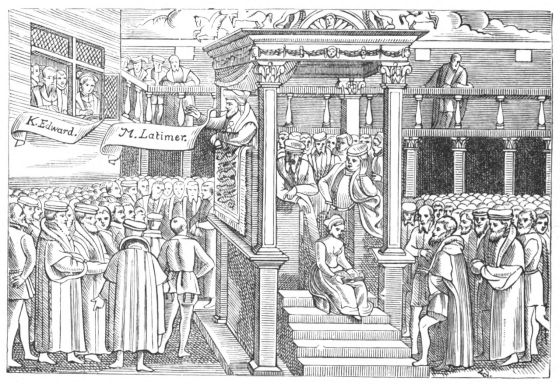
LATIMER PREACHING BEFORE EDWARD VI. (From a Woodcut in Foxe's "Martyrs," 1563.)
As a prose writer Edmund Spenser (b. 1553, d. 1599), the author of the "Faerie Queene," must be mentioned for his "View of the State of Ireland," which contained many judicious recommendations for the improvement of that country, and presents in its serious statesmanlike views a curious contrast to the allegorical fancy of his great poem. But far greater as prose writers of the latter portion of this period stand forth Sir Philip Sidney and the "judicious Hooker." Sir Philip Sidney (b. 1554, d. 1586), who was celebrated as the most perfect gentleman of his time, or as, in the phrase of the age, "the Mirror of Courtesy," was killed at the age of thirty-three at Zutphen. Yet he left behind him the "Arcadia," a romance; the "Defence of Poesie," and various minor poems and prose articles, which were published after his death. The person and writings of Sidney have been the theme of unbounded panegyric. He was a gentleman finished and complete, in whom mildness was associated with courage, erudition mollified by refinement, and courtliness dignified by truth. He is a specimen of what the English character was capable of producing when foreign admixtures had not destroyed its simplicity, or politeness debased its honour. In his own day he was the object of the most enthusiastic praises, and has been lauded in the most vivid terms by writers of every period since. Near his own times Nash, Lord Brooke, Camden, Ben Jonson, Naunton, Aubrey, Milton, and Cowley, were his eulogists; Wordsworth and the writers of our own day are equally complimentary. Perhaps, after so continuous and high-toned a hymning, a modern reader, taking up his "Arcadia" for the first time, would find it stiff, formal, and pedantic. He might miss that fervid spirit which animates the fictions of the great masters of our own age, and wonder at the warmth of so many great authorities upon what failed to warm him. In fact, it must be confessed, that it is a noble specimen of what pleased the taste of the time in which it was written. It displays imagination, though often on stilts instead of on wings, and breathes the spirit which animated its author, of a refined nature, a chivalrous temperament, a generous heart, and the instincts of the perfect scholar. Of that period it is a noble monument; in this it is a unique work of art, which, however, strikes us as fair, mild, and antiquated. "The Defence of Poesie," with much of the same mannerism, is worthy of a poet, and of a man whose life was the finest poem, from its generous patronage of talent, its high literary taste, and the hero's death, in the very agonies of which he gave from his own scorched lips the draught of cold water to the dying soldier at his side.