Chapter XIX · (continued 2)
Reading edition
Eliot was interrupted by Sir John Finch, the Speaker, who had for some time been more and more sidling away to the favour of the king, starting up and exclaiming, "There is a command laid upon me, to interrupt any that shall go about to lay an aspersion on the ministers of State." This was a clear infringement of the privilege of Parliament, which the House was not disposed to pass by. Sir John, thus snubbed, sat down, and there remained a significant silence for some minutes. Then Sir Dudley Digges rose and said, "Unless we may speak of these things, let us arise, and begone, or sit still and do nothing." There was another deep silence, at length broken by Sir Nathaniel Rich, who said, "We must now speak, or for ever hold our peace. For us to be silent when king and kingdom are in this calamity, is not fit. The question is, whether we shall secure ourselves by our silence—yea or no? Let us go to the Lords and show our dangers, that we may then go to the king together with our representation thereof." Prynne, Coke, and others, spoke to the same effect, and Coke was so overwhelmed with his feelings, grown old as he was, at the Bar, on the Bench and in the House, that he was obliged to resume his seat.
The House resolved itself into a committee for more freedom of discussion, and put Mr. Whitly into the chair. Finch, the Speaker, begged leave, as he was quitting the chair, for half an hour's absence. The House knew very well that he only wanted to run off and tell the king what was going on, but they let him go, and away he bustled to Whitehall. The House then passed an order, declaring that no man should leave the House under penalty of being committed to the Tower. Then Mr. Kirton rose, and declaring that the king in himself was as good a prince as ever reigned, said "it was high time to find out the enemies of the Commonwealth, who had so prevailed with him, and then he doubted not but God would send them hearts, hands, and swords, to cut all their throats." He added that the Speaker to desire to leave the House as he had done, was unprecedented, and to his mind ominous. Sir Edward Coke once more endeavoured to say what he had not been able to say before, but which must be said, and none so proper as this veteran statesman to say it. "I now see," he observed, "that God has not accepted our humble and moderate carriages and fair proceedings; and I fear the reason is that we have not dealt sincerely with the king, and made a true representation of the causes of all these miseries. Let us take this to heart. In the time of Edward III. had Parliament any doubt as to naming men that misled the king? They accused John of Gaunt, the king's son, Lord Latimer, and Lord Neville, for misadvising the king; and they went to the Tower for it. And now, when there is such a downfall of the State, shall we hold our tongues? Why," continued he, "may we not name those who are the cause of all our evils?" And he added, "Let us palliate no longer; if we do, God will not prosper us. I think the Duke of Buckingham is the cause, and till the duke be informed thereof, we shall never go out with honour, nor sit with honour here. That man is the grievance of grievances! Let us set down the causes of all our disasters, and they will all reflect upon him. As to going to the Lords, that is not via regia; our liberties are now impeached; we are deeply concerned; it is not via regia, for the Lords are not participant with our liberties. It is not the king but the duke that saith, 'We require you not to meddle with state affairs, or the ministers thereof.' Did not his majesty, when prince, attend the Upper House in our prosecution of Lord Chancellor Bacon and the Lord Treasurer Middlesex?"
The secret was out; the word was spoken! The name at which Charles and the duke had trembled, lest it should come into discussion, was, in spite of threats and messages, named; and the naming, and the charging with all the disgraces and miseries of the nation, were received with sudden and general acclamation of "Yea! yea! 'Tis he! 'tis he!" The day was come that James had so solemnly warned both Charles and Buckingham of—when they should have their bellyful of impeachments; having, as Coke now reminded them, themselves set the ball rolling. Aldred, in the letter just quoted, says:—"As when one good hound recovers the scent, the rest come in with full cry, so one pursued it, and every one came home and laid the blame where he thought the fault was, on the Duke of Buckingham, to wit." The duke was speedily accused of treachery and incapacity, both as High Admiral and Commander-in-Chief. All the disgraceful failures, at Cadiz, at La Rochelle, on the Isle of Rhé, and even in Germany, were charged upon his evil counsels or worse management.
Selden proposed a declaration to his majesty under four heads, expressive of the dutiful devotion of the House, of the violation of the nation's liberties, of the intentions of the House, and of the interference of the duke to prevent inquiry. He declared that all this time they had been casting a mantle over the accusation made against Buckingham, and that it was time to revert to that. "At this moment," says Aldred, "as we were putting the question, the Speaker, having been, not half an hour, but three hours absent, and with the king, returned, bringing this message—that the House should then rise—being about eleven o'clock—adjourn till the morrow morning, and no committees to sit, or other business to go on in the interim."
The next day the House met, when Finch apologised for his absence, and his going to the king, declaring that he had communicated nothing but what was to the honour of the House; and wishing that his tongue might cleave to the roof of his mouth before he spoke a word to the disparagement of any member. He informed them that his majesty had no desire to fetter their deliberations, so that they did not interfere with his ministers, and added words of courtesy from the king. The Commons observed that they had no intention of charging anything on the king, but must insist on inquiring when necessary into the conduct of his ministers; and the words of Mr. Kirton being found fault with, which intimated a hope that all those found guilty might have their throats cut, the House resolved that "he had said nothing beyond the bounds of duty and allegiance, and that they all concurred with him therein."
On the following day they went into committee, and commenced their labours of inquiry into the proceedings of the executive. They examined Burlemachi, a foreign speculator, as to a commission which he was alleged to have, for engaging and bringing into this kingdom troops of German horse. He confessed to such warrant, and to having received thirty thousand pounds for this purpose; one thousand of these horse being, as he admitted, already raised and armed, and waiting their passage in Holland. "And the intention of bringing over these mercenaries," said one of the members, "is to cut our throats, or to keep us in obedience!" Another member declared that twelve of the commanders were already arrived, and had been seen in St. Paul's. The House next fell upon a new scheme of excise, which it was proposed to levy without consent of Parliament, and voted that any member who had any information regarding this new imposition and did not disclose it, was an enemy to the State, and no true Englishman.
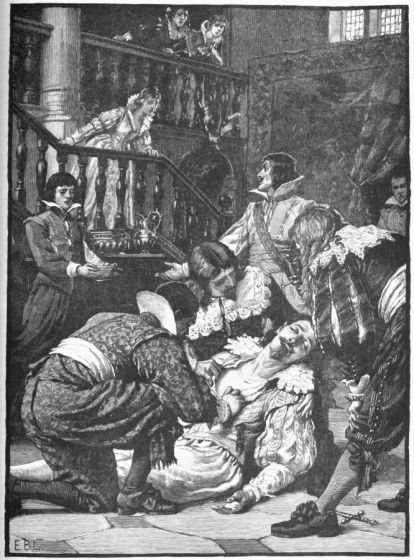
ASSASSINATION OF THE DUKE OF BUCKINGHAM. (See p. 535.)
The danger which was obviously approaching Buckingham in the proceedings of this Committee alarmed the king; and the same day, the 7th of June, he commanded the Commons to meet him in the House of Lords, and then observing that he thought he had given a full and specific answer to their Petition of Right, but as they were not satisfied, he desired them to read the Petition again, and he would give them an answer which should satisfy them. Taking his seat on the throne, this was done, and he then ordered the former answer to be cut off, and the following, in the established form, to be inscribed—"Let right be done as is desired." "Now," he added, "I have performed my part; wherefore, if this Parliament have not a happy issue, the sin is yours. I am free of it."
Thus was passed the Petition of Right, the most important document since the acquirement of Magna Charta. The rejoicing for this conquest, this assurance of quieter days and secure firesides, sped through the City, and thence over the kingdom, and was everywhere demonstrated by acclamations, ringing of bells, and bonfires. On the 10th of June, three days afterwards, the king, as if pleased with this public expression of satisfaction, sent Sir Humphrey May to inform the House of Commons that he was graciously pleased that their Petition of Right, with his answer, should be recorded not only on the journals of Parliament, but in those of the courts of Westminster, and should, moreover, be printed for his honour and the content of the people. On the 12th the Commons showed their content by voting the king the five subsidies, and hastening to pass the Bill for five other subsidies granted by the clergy.
But the exultation over this great triumph did not prevent the Commons from pursuing their labours of inquiry into abuses. They obtained a judgment from the Lords against Dr. Mainwaring for his encouragement of kingly absolutism in his sermons, and censured Laud and Neale of Winchester, for licensing similar sermons; they then came to Buckingham himself, and voted a strong remonstrance against his undue influence and unconstitutional doings, which was presented by the Speaker to the king. The House felt itself highly aggrieved by a speech which the favourite was reported to have made at his own table—"Tush! it makes no matter what the Commons or Parliament doth; for without my leave and authority, they shall not be able to touch the hair of a dog." Buckingham protested that he had never uttered such words, and called upon the House of Lords to demand that the members of the Commons who had thus reported it should be called in to prove it; but the duke was forced to content himself with entering his protest on the journals of the Lords.
The Commons not having voted the tonnage and poundage, calculated that the king would not hastily dissolve the House, and therefore prayed him to remove Buckingham from his counsels, as the author of so many calamities; and they took the opportunity to remind him that tonnage and poundage could not be collected without their consent, as the king's concession of the Petition of Right testified. This called forth Charles again as hotly as ever. Though he had admitted, in granting this Petition, that no kind of duty could be imposed without consent of Parliament, he now sought to except the tonnage and poundage from this condition. He therefore, on the 26th of June, suddenly went to the House of Lords, and summoned the attendance of the Commons. The action had been so impromptu, that the Lords had no notice of it, and neither he nor they had time to robe themselves, when the Commons at nine o'clock in the morning made their appearance. All unrobed as he was, Charles seated himself on the throne, and lectured the Commons on their already beginning to put false constructions on his passing the Petition of Right. "As for the tonnage and poundage, it is a thing I cannot want, and was never intended by you to ask, nor meant by me, I am sure, to grant." And he called on them, but more especially the Lords, who were the judges, to take notice of what he declared his meaning to be when he granted the Petition.
The mischief had been done by former Parliaments granting this impost, now called customs duties, for life; and though Parliament had never altogether surrendered the power of voting it, nor had voted it for life to Charles, he had come to consider it as merged into a matter of prerogative, and not to be affected by his general concession just made. The Commons, however, meant nothing less than that this, as well as every other grant of taxes on the subject, should be void without their assent. Here, therefore, as so often afterwards, they found themselves just where they were with the king as matter of dispute, though they had settled the question as matter of right. No man was ever so hard as Charles I. to be made to see what he did not like. He therefore gave his assent to the subsidies, and prorogued the Parliament till October; and, as if to mark how far he was from intending to submit to what he had thus so solemnly in the face of the whole nation bound himself to, he proceeded to reward the men who had so shamefully advocated absolute power in him. He made bishops of both Montague and Mainwaring, and promoted Sibthorpe to coveted livings.
The king's attention was soon drawn from the battle with the Commons to the demands of the unfortunate people of La Rochelle upon him. He had solemnly pledged his honour to assist them, and they now sorely needed it. Since Buckingham left them to their fate, La Rochelle had been invested by the French army under the king and Richelieu, and the besieged loudly called on the King of England to succour them according to his promise. The Earl of Denbigh was despatched thither with a numerous fleet, yet had done nothing; but having shown himself before the town for seven days, returned, to the great mortification of the Rochellais. Denbigh had been raised to his rank and title simply for marrying a sister of Buckingham's, and the people murmured loudly at the fleet being put into such incompetent hands. The hatred of the duke rose higher and higher, and on the same day that he was pronounced by the Commons the cause of all these national calamities, his physician, Dr. Lambe, was murdered by a mob in London, and a placard was affixed on the walls in these words:—"Who rules the kingdom?—The king. Who rules the king?—The duke. Who rules the duke?—The devil. Let the duke look to it, or he will be served as his doctor was served." A doggerel rhyme was in the mouths of the common people:—
"Let Charles and George do what they can, The duke shall die like Dr. Lambe."
The king was extremely concerned when the placard was shown him, and added double guard at night; but the duke treated the whole with contempt, and prepared to proceed himself with the fleet to relieve La Rochelle. Charles went with him to Deptford to see the ships, and is reported to have said to Buckingham on beholding them, "George, there are those who wish that both these and thou may perish; but we will both perish together, if thou dost." Buckingham proceeded to Portsmouth, where he was to embark. Clarendon relates that the ghost of Buckingham's father had appeared to an officer of the king's wardrobe three times, urging him to go to his son and warn him to do something to abate the hatred of the people, or that he would not be allowed to live long. Since the demonstrations in London, it needed no ghost to show his danger. But he was never gayer than on the eve of the verification of the omens and the menaces.
The duke, on the 23rd of August, rose in high spirits, even dancing in his gaiety, and went to breakfast with a great number of his officers. Whilst he was at breakfast, M. Soubise, the envoy of the people of La Rochelle, went to him, and was seen in earnest private conversation. It is supposed that Soubise had come to the knowledge of certain negotiations between England and France, in which, though both monarchs showed every tendency to listen to an accommodation, neither had yet ventured to propose it; but that it was the object of Buckingham rather to treat than to fight when he got to La Rochelle. At that very moment Mr. Secretary Carleton had arrived from the king with instructions to Buckingham to open by some means a communication with Richelieu, and thus, as it were, accidentally to bring about a treaty. Probably Soubise had acquired hints of these things, for both he and many other Frenchmen about Buckingham appeared greatly discontented, and vociferated and gesticulated energetically. The duke, it is said, had been endeavouring to persuade Soubise that La Rochelle was already relieved, which he was too well informed to credit.
The duke now prepared to go out to his carriage, which was waiting at the door, and as he went through the hall, still followed by the French gentlemen, Colonel Friar whispered something in his ear. He turned to listen, and at the same moment a knife was plunged into his heart, and there left sticking. Plucking it out, with the word "Villain!" he fell, covered with blood. His servants, who caught him as he was falling, thought it was a stroke of apoplexy, but the blood, both from the wound and his mouth, quickly undeceived them. Then an alarm was raised; some ran to close the gates, and others rushed forth to spread the news. The Duchess of Buckingham and her sister, the Countess of Anglesea, heard the noise in their chamber, and ran into the gallery of the lobby, where they saw the duke lying in his gore. He was only in his six-and-thirtieth year.
The first suspicion fell upon the French, and they were in great danger from the duke's people; but when a number of officers came rushing in, crying out, "Where is the villain? Where is the butcher?" a man stepped calmly forward, saying, "I am the man—here I am!" He had quietly withdrawn into the kitchen as soon as he had done the deed, and might have escaped had he so willed. On hearing him avow the murder the officers drew their swords, and would have despatched him, but were prevented by the Secretary Carleton, Sir Thomas Morton, and others, who stood guard over him till a detachment of soldiers arrived and conveyed him to the Governor's house.
The assassin turned out to be John Felton, a gentleman by birth and education, who had been a lieutenant in the army during the expedition to the Isle of Rhé. He had thrown up his commission because he could not obtain the arrears of his pay, and had seen another at the same time promoted over his head. He had, therefore, most likely, a personal grudge against the duke, but had also been led on by religious fanaticism. He was a stout, dark, military-looking man, from Suffolk; but according to his own account, was first excited to the deed by reading the remonstrance of the Parliament against the duke, when it seemed to him that that remonstrance was a sufficient warrant for the act, and that by ridding the country of him he should render a real service to it. He described himself as walking in London on Tower Hill, when he saw a broad hunting-knife on a cutler's stall, and that it was suggested to him instantly to buy it for this purpose.
At Portsmouth one of the royal chaplains was sent to him in his dungeon, where he lay heavily ironed; but Felton, supposing the chaplain sent to draw something from him, rather than for his consolation, said, "Sir, I shall be brief with you; I killed him for the cause of God and my country!" The chaplain, to mislead him, told him what was not true, that the surgeons gave hopes of his life; but Felton promptly replied, "That is impossible! I had the power of forty men, assisted by Him who guided my hand." On being removed to London, the people crowded to see him, showering blessings on him as the deliverer of his country; and one old woman at Kingston said, "Now, God bless thee, little David!" meaning that he had killed Goliath. Felton was lodged in the Tower, and threatened with the rack to make him confess his accomplices, but he steadfastly replied that he had no accomplices or abettors but the remonstrance of the Commons. The Earl of Dorset went to see him, accompanied, as reported, by Laud, and menaced him with the rack if he would not reveal his colleagues. Felton replied, "I am ready, but I must tell you that I will then accuse you my lord of Dorset, and no one but you." Charles urged his being racked, but the judges, who saw better than he did the spirit that was abroad, refused to sanction it, declaring that torture, however used, had always been contrary to the law of England. Felton gloried in his deed, but at length, through the exertions of the clergy, came to confess that he had been misled by a bad spirit; yet it has been doubted whether he ever really abandoned inwardly the persuasion of having done a great and patriotic deed. When the Attorney-General on the trial lauded the virtues, the abilities, wisdom, and public services of Buckingham to the skies, Felton, on being asked what he had to say why judgment should not be passed on him, replied that if he had deprived his majesty of so faithful a servant as Mr. Attorney-General described, he was sorry, and extending his arm exclaimed, "This is the instrument that did the deed, let it be cut off for it!" He was hanged at Tyburn, and then gibbeted at Portsmouth, the scene of his crime.
In place of the duke, the Earl of Lindsay was ordered to take command of the expedition for the relief of La Rochelle, and he was accompanied by Walter Montague, the second son of the Earl of Manchester, who was to open a negotiation with Richelieu. Montague was already a Catholic at heart, and afterwards became so avowedly, and was made commendatory Abbot of Pontoise, and a member of the Council of Anne of Austria. No doubt it was from this known tendency that he had been chosen for this mission. For five days the fleet manœuvred before La Rochelle, and after two ineffectual, and probably rather pretended than actual, endeavours to force an entrance, returned to Spithead. Montague, meanwhile, had been introduced to Louis, had hurried back to London, and was on the point of returning, when the news came of the surrender of La Rochelle. This event put an end to the dreams of a Protestant State in France, and greatly consolidated the power of that country. To the Rochellais it was a terrible lesson against putting faith in English kings. When they were prevailed upon to surrender their peace and prosperity to the promises of protection and religious liberty, the town contained fifteen thousand souls; when they opened their gates to their own sovereign, they were reduced to four thousand. All this misery was the work of Charles and Buckingham.
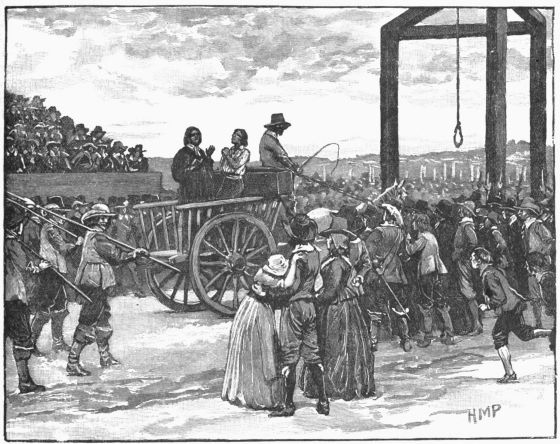
TYBURN IN THE TIME OF CHARLES I.
This event had greatly grieved the Protestants in England, and it was whilst the public was brooding over these matters, and over fresh acts of arbitrary oppression in the Star Chamber and Court of High Commission, as well as by the continued levy of tonnage and poundage and other duties, that Charles called together Parliament. It had been prorogued to the 20th of October, but met on the 20th of January, 1629. The king sent the Commons a message, desiring them to proceed to vote the tonnage and poundage without delay, this having been neglected by the Parliament in the last Session; but the House insisted on going first into the grievances. These were two-fold—such as related to the constitution, and such as affected the faith of the nation. Charles had not only persisted in the enforcement of revenue without Parliament, and dared to tamper even with the Petition of Rights after he had granted it, but had issued a new edition of the Articles of the Church, into which he had introduced a clause to suit the intentions of himself and his great ecclesiastical adviser, Laud. The Commons agreed to take the religious question first, declaring that the business of the kings of this earth should give place to the business of the King of Heaven.
Popery and Arminianism were the things which the Puritans held in almost equal horror. In reference to Popery they inquired what was the reason that the laws regarding it were relaxed? and why out of ten individuals who had been arraigned for receiving ordination in the Church of Rome, only one had been condemned, and the execution of that one respited? Two Committees were appointed to inquire of the judges on what grounds they had refused to receive evidence tendered against the recusants at their trial, and of the Attorney-General by what authority he had discharged the persons in question, on their giving bail for their re-appearance. Every member was bound to give all the information to the House in his power regarding the relaxation of the penal laws, and all attempts or warrants to stay proceedings against the Papists.
But the growth and favour of Arminianism in high places was the most absorbing subject of animadversion. Laud, now Bishop of London, was bent not only on introducing Arminianism to its fullest extent, but ceremonies and rites merging fast into Catholicism. Therefore the Puritans declared the heresy of Arminianism to be the spawn of Popery. Laud had notions of Church government as absolute as Charles had of civil government. All the promotions by him were of Arminian clergymen. Montague was become Bishop of Chichester, Mainwaring was a bishop, and all those who meant to get preferment saw plainly that they must profess Arminianism, and the love of gorgeous ceremonies and plenty of surplices.
There were difficulties, however, for the Articles drawn up in 1562, under Elizabeth, stated:—"The Church hath power to decree rites and ceremonies, and hath authority in matters of faith." Mr. Pym called upon the House to take a covenant for the maintenance of their religious rites, which were in danger; and both he and others denounced the introduction of idolatrous ceremonies into the Church by Charles and others. Sir John Eliot protested vehemently against the introduction of the new clause into the Articles. He called on the House to enter not a mere resolution but a "vow" on its Journals against it, which was done; namely, "that the Commons of England claimed, professed, and avowed for truth, that sense of the Articles of Religion which were established in Parliament in the thirteenth year of Queen Elizabeth, which by the public acts of the Church of England, and by the general and current exposition of the writers of that Church, had been declared unto them, and that they rejected the sense of the Jesuits, Arminians, and all others wherein they differed from it."
The king sent the House a message, desiring them to leave matters of religion, and proceed to pass the vote for tonnage and poundage. This led to a sharp debate between the Court party and the Opposition. The courtiers lauded the goodness of the king, and the enlargement of their liberties which he had granted; but Mr. Coriton replied bluntly, "When men speak here of neglect of duty towards his majesty, let them know we know no such thing, nor what they mean. I see not how we neglect the same. I see it is all our heart's desire to expedite the Bill of tonnage and poundage in due time. Our business is still put back by their messages, and the business in hand is God's. And his majesty's things are certainly amiss, and every one sees it; but woe be unto us if we present not the same to his majesty!" On the 2nd of February the House, instead of the vote of tonnage and poundage, presented to the king "an apology" for delaying that Bill, and containing a complaint of his majesty's encroaching on the orders and privileges of their House by three messages in two days, urging them to change inconveniently the orders of their proceedings. Charles replied by a message through Secretary Coke that he was as zealous for the faith as they were, but must again think it strange that the business of religion should be an obstruction to his business. He once more desired them to pass the vote for the tonnage and poundage, adding one of his mischievous and most impolitic threats, of quickening them by other means if they did not.
The House, resenting this ill-advised message, went on discussing the affairs of the Church. Mr. Kirton, who had in the last Session talked of cutting the throats of all traitorous Ministers, now declared Laud and Neale, Bishop of Winchester, to be at the bottom of all the troubles that were now come upon them and their religion. On the 11th of February, in the Committee on Religion, Oliver Cromwell made his first appearance as a speaker in that House, a circumstance of great mark, seeing what the honourable member afterwards grew into. He said, "He had heard by relation from one Dr. Beard that Dr. Alabaster had preached flat Popery at Paul's Cross, and that the Bishop of Winchester had commanded him, as his diocesan, that he should preach nothing to the contrary. Mainwaring, so justly censured in this House for his sermons, was by the same bishop's means preferred to a rich living. If these are the steps to Church preferment, what are we to expect?" Whereupon the Committee ordered Dr. Beard to be written to by Mr. Speaker, to come up and testify against the bishop; "the order for Dr. Beard to be delivered to Mr. Cromwell." After severe animadversions on Neale, who, Mr. Kirton said, had leaped through many bishoprics, but always left Popery behind him, the House passed to the consideration of the Petition of Right.
Selden called the attention of the House to this subject, and showed that though Charles had promised that the Petition of Right should be printed, and that the king's printer had struck off fifteen hundred copies of that document, the king had sent for and destroyed them, and had then had printed and circulated another copy, from which the king's assent was removed, his first evasive answer restored, and his sophistical explanation at the close of the Session, that it did not apply to tonnage and poundage, introduced. This flagrant violation of his word and of all the forms of Parliament, struck the House with ominous doubts of ever binding the king by any law or by any principle. They summoned the king's printer to their bar, and demanded by what authority he had thus substituted a false for the true Petition. He replied that the day after the Session the Attorney-General had sent for him, and forbade him to publish the copy printed, as did also the Earl of Worcester, Lord Privy Seal; and that he was sent for again to Court, furnished with the new copy, and ordered to print and publish it in that form.
The House was in the highest state of indignation and astonishment. Such a deliberate falsification of a document passed by the House and ratified by himself, branded the king as capable of any act of duplicity, and went to destroy all confidence in not merely his word but his most solemn legislative act. The chief speakers of the Commons expressed their horror and disgust at the deed in no measured terms. Selden exclaimed, "For this Petition of Right, we see how it has been invaded since our last meeting. Our liberties of life, person, and freehold have been invaded; men have been committed contrary to that Petition. No man ought to lose life or limb but by the law, and hath not one lately lost his ears by order of the Star Chamber? Next, they will take away our arms, and then our legs, and so our lives. Let all see we are sensible of this. Evil customs creep in upon us: let us make a just representation thereof to his majesty."
The case of a merchant and member of the House, Mr. Rolles, was then related. His goods had been seized by the officers of the Customs for refusing to pay the rates demanded, though he told them that whatever was declared due by law, he would discharge. This case, amongst a multitude of others, threw the House into a great ferment. "They knew the party was a Parliament man," said Sir Robert Philips; "nay, they said if all the Parliament was with him, or concerned in the goods, they would seize them just the same."
The king, perceiving the storm he had raised, sent word by Secretary Coke to stay further debate on that case till three o'clock the next day, when he would speak with both Houses at Whitehall. Accordingly, meeting them there, Charles, after complimenting the Lords at the expense of the Commons, then said, addressing the members of the Lower House, "The complaint of staying men's goods for tonnage and poundage may have a short and easy conclusion. By passing the Bill as my ancestors have had it, my past actions will be concluded, and my future proceedings authorised. I take not these duties as appertaining to my hereditary prerogative. It ever was, and still is, my meaning, by the gift of my subjects to enjoy the same. In my speech of last Session I did not challenge them as right, but showed you the necessity by which I was to take them, till you had granted them, assuring myself that you wanted only time, and not good will. So make good your professions, and put an end to all questions arising from the subject."
These assertions were in direct contradiction to his declaration in that very speech which we have already quoted, that the tonnage and poundage was a thing that Parliament had nothing to do with. But the concession gratified the Commons; still they did not grant the Customs duties, but employed themselves strenuously in calling to account those who had been concerned in furthering or executing the king's illegal orders. They summoned to their bar Acton, the Sheriff of London, who had seized the goods of Rolles and other merchants, and sent him to the Tower. They summoned also the officers of the Customs who made the seizure, who pleaded the king's warrant, and also his own express command; and the king declared, through Secretary Coke, that he would defend them. This caused loud outcries in the House, but did not check their proceedings, for they sent messages to the Chancellor and Barons of the Exchequer, who excused themselves by saying all those aggrieved had their remedy at law. Thus they did not attempt to justify their proceedings.
On the 25th of February, two days later than these determined inquisitions, showing that the Commons were assuming high and most ominous ground, the Committee of Religion presented to the House a report, entitled "Heads of Articles agreed upon, and to be insisted on by the House." In these they complained that the bishops licensed books in favour of Popery, and suppressed books opposed to Popery; that such books as those of Mainwaring and Montague should be burnt, and some better order taken for the licensing of books. They demanded that candlesticks should be removed from the communion-tables, which were now impiously styled high altars; that pictures, lights, images, should be taken away; and crossing and praying towards the East forbidden; that more learned, pious, and orthodox men should be put into livings, and that better provision should be made for a good minister in every parish.
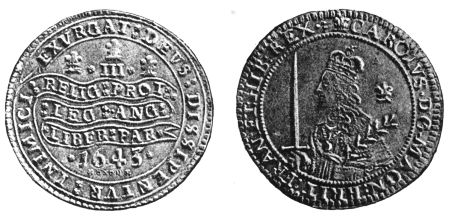
BROAD OF CHARLES I.
Again Charles sent them an order to adjourn to the 2nd of March, which they did, but only to assemble on that day in the same resolute and unbending spirit. Sir John Eliot immediately denounced Neale of Winchester, as a rank abettor of Arminianism, and thence passed on to the Lord Treasurer Weston, whom he declared to be his grand supporter in it. This Sir Richard Weston had been seeking his fortune at Court many years, and had nearly spent a private fortune of his own before he obtained any promotion. At last he got employed as ambassador to Archduke Albert in Flanders, and afterwards to the court of Germany, in which he discharged his trust so well that on his return he was made Chancellor of the Exchequer, and a few months before the death of Buckingham, Charles had removed the Earl of Marlborough from the office of Lord Treasurer, and given it to him. Weston was highly elated, and devoted himself with all his ardour to succeed to the place of favourite which Buckingham had held. But though Charles showed him much favour, and eventually made him Earl of Portland, he allowed Weston to succeed to the arbitrary offices and public odium of the duke, but not to the ascendency which Buckingham had possessed over him.
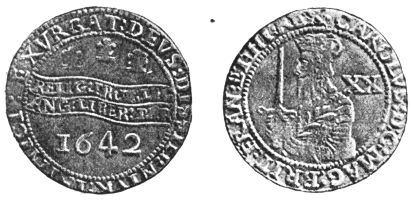
THREE POUND PIECE OF CHARLES I.
Sir John Eliot now pointed out Weston's criminal subservience to the worst designs of the king. "In his person," he said, "all evil is concentrated, both for the innovation of religion, and the invasion of our liberties. He is now the great enemy of the Commonwealth. I have traced him in all his actions, and I find him building on those grounds laid by his master, the great duke. He secretly is moving for this interruption; and from this fear they go about to break Parliament, lest Parliament should break them."
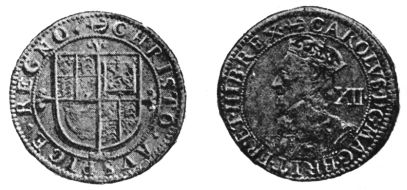
BRIOT SHILLING OF CHARLES I.
This was tender ground, and Sir John Finch the Speaker, who was a regular courtier, immediately said he had a command from his majesty to adjourn the House till the following Tuesday week. Several members declared the message to be vexatious and out of order, for that adjournment was a function of their own; but since the Speaker had delivered the message and that was sufficient, they would settle a few matters, and do as his majesty desired. Sir John Eliot produced a remonstrance addressed to the king against levying tonnage and poundage, and desired the Speaker to read it; but he refused, saying the House was adjourned by the king. Eliot then desired the Clerk of the House to read it, but he also refused, and so Sir John read it himself; but the Speaker refused to put it to the vote. Selden then told the Speaker that if he would not put the question to the vote, they would all continue sitting still. The Speaker, however, declared that he had his majesty's command immediately to rise when he had delivered the message; whereupon he was rising, but Holles, the son of the Earl of Clare, and Valentine, who had placed themselves on each side of him for the purpose, held him down in his chair. He made a great outcry and resistance: several of the courtiers rushed to his assistance, but Holles swore that he should sit as long as they pleased. The doors were locked, and there was a scuffle and blows, but the Opposition members compelled the Speaker to continue sitting, notwithstanding his struggles, tears, and entreaties.
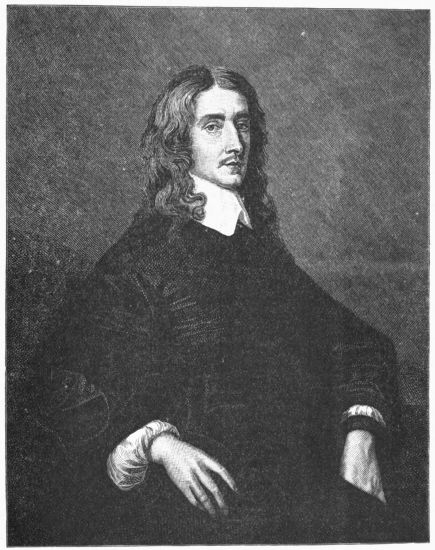
JOHN SELDEN. (From the Portrait by the Elder Mytens.)
Selden delivered an address to the imprisoned Speaker on his duties and his obedience owed to the House which sat under the Great Seal, and had power of adjournment as the king had that of prorogation. Sir Peter Hayman told him that he blushed at being his kinsman, that he was a blot on his family, and would be held in scorn and contempt by posterity; and concluded by recommending that if he would not do his duty, he should be brought to the bar of the House, dismissed, and another chosen at once in his place. Mr. Holles proceeded to read the following set of resolutions, which were loudly cheered, and assented to by the House, namely:—1, That whoever shall seek to bring in Popery, Arminianism, or other opinions, disagreeing from the true and orthodox Church, shall be reputed a capital enemy to this kingdom and Commonwealth; 2, Whoever shall advise the taking of tonnage and poundage, not being granted by Parliament, or shall be an actor or instrument therein, shall be reputed a capital enemy to this kingdom and Parliament; 3, Whatever merchant or other person shall pay tonnage and poundage, not being granted by Parliament, shall be reputed a betrayer of the liberties of England, and an enemy to the same.
Whilst these extraordinary scenes were acting, the king had come down to the House of Lords, but not finding the Speaker there as he expected, sent a messenger to bring away the sergeant with his mace, without which there could be no House. The doors were locked, and the messenger could get no admittance. Charles then sent the Usher of the Black Rod to summon the Commons to his presence, but he could no more obtain an entrance than the messenger. On hearing this, in a transport of rage, the king ordered the Captain of the Guard to break open the door; but this catastrophe was prevented by the House just then adjourning to the 10th of March, according to the king's message.
On the 10th of March the king went to the House of Lords, and, without summoning the Commons, proceeded to dissolve Parliament. He then addressed the Lords, complaining grievously of the conduct of the Commons, which compelled him at that time to dissolve Parliament. He expressed much comfort in the Lords, and conceded that there were in the Commons many who were as dutiful and loyal subjects as any in the world, but that they had some "vipers" amongst them that created all this trouble. He intimated that these evil-disposed persons would meet with their rewards, and bade the Lord Keeper do as he had commanded. Then the Lord Keeper said, "My lords, and gentlemen of the Commons, the king's majesty doth dissolve this Parliament;" though the Commons, with the exception of a few individuals, were not there, nor represented by their Speaker.
This question of the right of the Commons to determine their own adjournment, and to deny to the king the right of preventing the Speaker from putting any question from the Chair, was a vital one, and hitherto undetermined. If the king could at any moment adjourn the Commons as well as prorogue Parliament altogether, and could decide what topics should be entertained by the House, there was an end of the existence of the Commons as an independent branch of the Legislature: it sunk at once into the mere creature of the Crown. There was a great battle for this as for other popular rights, and the determined conduct of the members showed that things were coming fast to a crisis. But at this moment Charles was as resolved to conquer the Parliament, as Parliament was not to be conquered.
No sooner did this unprecedented scene with the Speaker take place, than he adopted measures to punish those most prominently concerned in it. The compulsory detention of the Speaker took place on the 2nd of March; on the 5th he issued warrants to arrest the "vipers"—Eliot, Selden, Holles, Valentine, Hobart, Hayman, Coriton, Long, and Stroud—and commit them to the Tower or other prisons. Stroud and Long were not immediately caught, but on the issue of a proclamation for their apprehension they surrendered. The houses of Eliot, Holles, Selden, Long, and Valentine were forcibly entered, their desks broken open, and their papers seized. On the first day of Michaelmas term they were brought into court, and ordered to find bail, and also to give security for their good behaviour. They were all ready to give bail, but all positively refused to give security for good behaviour, as that implied the commission of some crime, which they denied. They were then put upon their trial, but excepted to the jurisdiction of the court, being amenable only to their own high court of Parliament for what was done therein. But they were told that their conduct had not been parliamentary, and that the common law could deal with all offences there by word or deed, as well as anywhere else. This was another attack on the privileges of Parliament, which, if allowed, would have finished its independence; and these were not the men to surrender any of the outworks and defences of Parliament. They were then sentenced as follows:—Sir John Eliot to be imprisoned in the Tower, the others in other prisons at the king's pleasure. None of them were to be delivered out of prison till they had given security for their good behaviour, acknowledged their offence, and paid the following fines:—Sir John Eliot, as the ring-leader and chief offender, two thousand pounds; Holles, one thousand marks; Valentine, five hundred pounds. Long was not included in this trial, but was prosecuted in the Star Chamber, on the plea that he had no business in Parliament, being pricked for sheriff of his county, and by his oath was bound to have been there. He was fined one thousand marks. This, however, deceived nobody: every one knew that the offence for which he suffered was for his conduct in Parliament. The prisoners lay in gaol for eighteen months. Sir John Eliot never came out again. His noble conduct had made deadly enemies of the king and his courtiers, and even when he was dying, in 1632, after three years' confinement, they rejoiced in his melancholy fate and refused all petitions for his release.
Charles called no more Parliaments till 1640, but went on for eleven years fighting his way towards the block, through the most maniacal attempts on the constitution and temper of the nation. Laud was in the ascendant, and Wentworth, lately a member of the Opposition, who had now changed sides from motives that it would be absurd not to call conscientious, gave his great talents to the Court party. Laud was as much a stickler for the power of the Church as Charles was of the State; their views coincided, and Charles, Laud, and Wentworth, worked shoulder to shoulder in governing without a Parliament. They invented a cant term between them to express what they aimed at, and the means by which they pursued it. It was "Thorough."
Laud had introduced a passage into the ceremonial even of the coronation, which astonished the hearers, and showed even then that he aimed at an ecclesiastical despotism: "Stand and hold fast from henceforth the place to which you have been heir by the succession of your forefathers, being now delivered to you by the authority of God Almighty, and by the hands of us all, and all the bishops and servants of God. And as you see the clergy to come nearer the altar than others, so remember that, in all places convenient, you give them greater honour," etc. This haughty prelate now promulgated such absolute doctrines of divine right of king and priest, and began to run in ceremonies and Church splendour so fast towards actual Popery, that the daughter of the Earl of Devonshire being asked by him why she had turned Catholic replied, "Because I hate to travel in a crowd. I perceive your Grace and many others are making haste to Rome, and therefore, in order to prevent being crowded, I have gone before you."
Under this undaunted leader, the pulpits now resounded with the most flaming advocacy of divine right. A pamphlet was discovered by the Reformers, which had been written for King James, and was now printed, urging the king to do as Louis XI. of France had done—dispense with Parliaments altogether, and secure his predominance by a standing army. The queen's advice was precisely of this character: often crying up the infinite superiority of the kings of her own country and family, whom she styled real kings, while the English were only sham ones. But though Charles was greatly soothed by these doctrines, and strengthened in his resolve to trouble himself no more with Parliaments, he was careful to strengthen his Government by inducing as many of the ablest men of the Opposition as he could to join him. The first with whom he succeeded were Wentworth and Sir John Savile. They were both from Yorkshire, and both men of considerable property. Savile had been persuaded by Cottington the Lord Chancellor, to desert his patriotic friends and professions at the close of the second Parliament for a place in the Privy Council and the office of Comptroller of the Household.
Sir Thomas Wentworth was a much more considerable man. He claimed to be descended from the royal line of the Plantagenets, and had no superior in ability in the House. The position which he had assumed in the Parliamentary resistance to the royal encroachments had been uncompromising and most effective. So much were his eloquence and influence dreaded, that he had been, amongst others, appointed sheriff to keep him out of the House. For his continual opposition he was deprived of the office of Custos Rotulorum and thrown into prison. Yet, when tempted by the offer of rank and power, he fell suddenly, utterly, and hopelessly, and became one of the most unflinching advocates and actors of absolutism that ever lived. On the 21st of July, 1628, Savile was created a baron, and on the morrow Wentworth was raised to the same dignity, as Baron Wentworth; and before the end of the year he was made a viscount and Lord President of the Council of the North. From the moment that Wentworth put his hand to the plough of despotism he never looked back. He became as prominent and as resolute in the destruction of liberty and the prosecution of his former colleagues as he had been for its advancement and for their friendship.
The contagion of this conversion spread. Sir Dudley Digges had taken a conspicuous part in the contests which we have described, and had distinguished himself by his abilities in debate, sufficient to render him worth purchasing. His colleagues had long felt, notwithstanding his zeal, that he would not be proof to temptation. He was offered the post of Master of the Rolls, and he at once accepted it. Noye and Littleton, both lawyers, were as ready to advocate despotism as liberty, and the offer of the Attorney-Generalship to Noye, and the Solicitor-Generalship to Littleton, convinced them instantly that the Court was right, and their old cause and companions were wrong. They testified their capacity for seeing both sides of an argument, by persecuting their old opinions and associates with the red hot zeal of proselytes.
The rest of Charles's ministers were the Lord Keeper Coventry, who, though he appeared on several occasions as the instrument of Charles's arbitrary measures, was thought not to approve very much of them, and who therefore kept himself as much as possible from mixing in political matters. The Earls of Holland and Carlisle, the pusillanimous Earl of Montgomery, his brother the Earl of Pembroke, and the Earl of Dorset were rather men of pleasure than of business, and attended the Council without caring for office. The Earl of Arundel was Earl Marshal, a proud and empty man, whom Clarendon the historian describes as living much abroad, because the manners of foreign nations suited him better than his own, and who "resorted sometimes to Court, because there only was a greater man than himself, and went thither the seldomer because there was a greater man than himself." He was careless of pleasing favourites, and was therefore almost always in disgrace. Lord Weston, already mentioned, was Lord Treasurer, and the Earl of Manchester Privy Seal. Weston was an able lawyer, who succeeded Coke as Lord Chief Justice, and then purchased the office of Lord Treasurer for twenty thousand pounds, only to have it wrested from him again by Buckingham in about twelve months; but he was courtier enough to suppress his resentment, and had now again ascended to his present office, in which he was a very pliant servant of the king. Besides these, Sir John Coke or Cooke, and Sir Dudley Carleton, were Secretaries of State. Carleton had spent too much time in foreign embassies to understand well the state of parties at home, but he understood the will of the king, and took good care to obey and promote it. Coke was "of narrow education, and narrower nature," says Clarendon, who adds that "his cardinal perfection was industry, his most eminent infirmity covetousness." He knew as little of foreign relations as Carleton did of domestic ones; but their office was one of far less rank and importance than such office is now, their real business being to enter the minutes and write the despatches of the Council, not to participate in its discussions. Such were the instruments by which Charles trusted to render Parliaments superfluous. By their aid, but far more so by that of Laud and Wentworth, he soon raised the nation to a state of exasperation, which was only appeased by the blood of all three.
During the violent transactions with his Parliament at home, Charles had made peace with France. In fact, neither France nor Spain had shown a disposition to prosecute the disputes which the King of England had entered into with them. Louis sent home the prisoners he had taken in the La Rochelle expedition, under the name of a present to his sister, and Philip also released those who had been captured at Cadiz. Buckingham had been at the bottom of both wars, and now that he was gone all differences were soon arranged. Louis of France made a demand for the restoration of a man-of-war, the St. Esprit, which had been illegally captured by Sir Sackville Trevor; but he gave up the claim, and Charles was not very importunate in his demands of protection for the French Protestants. Richelieu, however, treated them far better than Charles treated the Puritans in England. He took measures to prevent the possibility of another coalition, by destroying the castles of the nobles and the fortifications of the towns, prohibited the convention of deputies from the churches, and abolished the military organisation of the Huguenots in the South of France; but he left them the exercise of their worship, and attached no disability to a profession of it. This peace was concluded in the spring of 1629, and in the following year that with Spain was also accomplished. The Queen Henrietta was violently opposed to this peace with Spain, because France was still at war with that country and the kindred House of Austria. When she found that she could not prevail on Charles, she is said to have shed tears of vexation.
It is curious that the first overtures to this peace were made through two Flemish painters; the celebrated Sir Peter Paul Rubens, and Gerbier, a native of Antwerp, who had been Master of the Horse to Buckingham. Cottington was despatched to Spain, in spite of the strenuous endeavours of the queen and the French ambassador; and in November, 1630, Coloma arrived as ambassador from Madrid. Philip accepted the same terms as were proposed in 1604, pledging himself to restore such parts of the Palsgrave's territory as were occupied by the troops of Spain—no very important extent—and never to cease his endeavours to procure from the Emperor the restitution of the whole. In consideration of this, Charles once more agreed to that mysterious treaty against Holland which had been in negotiation during the visit of Charles and Buckingham to Spain. This was no other than to assist Philip to regain possession of the seven United States of the Netherlands, which had cost Elizabeth so much to aid in the establishment of their independence, and which had always been, as Protestant States, so much regarded by the English public; with which a great trade was, moreover, carried on. The knowledge of such a piece of treachery on the part of Charles would have excited a terrible commotion amongst the people. For his share of the booty he was to receive a certain portion of the provinces, including the Island of Zealand. Luckily for the king, his treason to Protestantism remained a profound secret, and at length himself perceiving the difficulties and dilemmas in which it would involve him, after Olivarez and Cottington had signed the treaty he withheld his ratification. By this prudent act, however, he forfeited all right to demand from Philip aid in regaining the patrimony of the Prince Palatine.
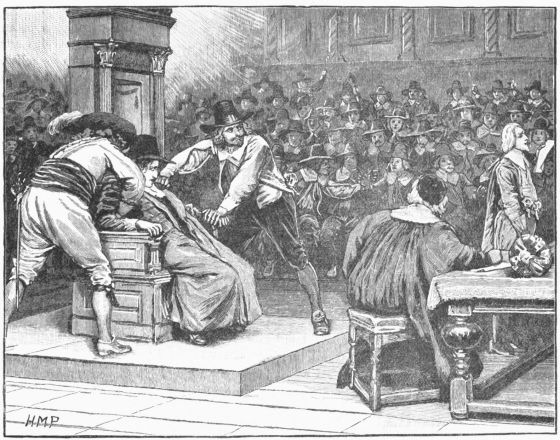
SCENE IN THE HOUSE OF COMMONS: THE SPEAKER COERCED. (See p. 541.)
Whether prudence, a rare virtue in Charles, or other more congenial motives, determined him in withdrawing from the compact with Spain regarding Holland is doubtful, for in the very next year he was found busily engaged with the Catholic States of Flanders and Brabant in a project to drive thence his new ally Philip of Spain. France and Holland were equally eager to assist in this design; but the people of Flanders were suspicious of them, dreading to find in such powerful allies only fresh masters. They therefore applied to the King of England, and a correspondence took place in which Secretary Coke was at great pains to show how much more to the advantage of the people of Flanders and Brabant would be the alliance of England, than that of the ambitious French, or of the Calvinistic farmers of Holland. In religion Coke was zealous to prove that the Catholic and Anglican Churches were almost identical; but his efforts ended, not in offering support in the coming struggle, but in promising to protect them against everyone except the King of Spain. Charles having recently made peace with the Spanish sovereign, "it would be against honour and conscience to debauch his subjects from their allegiance." But if what Coke proposed were not that very fact of tampering with them, it would be difficult to imagine what could be; and, moreover, it was just the King of Spain against whom they required protection. Coke advised them to declare their independence, and then the King of England, he told them, could help them as an independent State; and Philip would not then have cause of offence from Charles, but ought rather to be obliged to him for endeavouring to prevent the States from falling into the hands of France, or some other of his powerful enemies. This duplicity, however, was not by any means encouraging to revolt, and in the meantime Philip, learning what was going on, settled the question by sending into the Provinces an overwhelming force of soldiers.
But the war which ought to have excited the deepest interest in Charles as a Protestant prince, and as the brother-in-law of the Protestant Prince Palatine, was the great war—since called the Thirty Years' War—which was raging in Germany. It was a war expressly of Catholicism for the utter extirpation of Protestantism. The resistance had begun in Bohemia: the Protestants had invited Frederick of the Palatinate to become their king and defend them against the power of Austria and the exterminating Catholic emperor. We have seen that Frederick had, without weighing the hazards of the enterprise sufficiently, accepted the crown, lost it immediately, together with his hereditary dominions; and that all the efforts of England, Denmark, and of an allied host in Germany, had failed to make head against Austria, Spain, and Bavaria. Germany was overrun with the victorious troops of Austria, led on by the ruthless and victorious Generals Wallenstein, Piccolomini, Tilly, and Pappenheim. Horrible desolation had followed the march of their armies all over Germany; the most important of its cities were sacked or plundered; its fields were laid waste; its cultivation was stopped; its people were destroyed or starving; and, with the exception of Saxony and Bavaria, the power of the princes was prostrated, and they were thoroughly divided amongst themselves, and therefore the more readily trodden upon by their oppressors.
But at this moment relief came out of an unexpected quarter. Christian IV. of Denmark had attempted a diversion in favour of the German Protestant princes, and had not only been repulsed, but had drawn the Austrian generals into his own kingdom with fire and sword. But in Sweden had risen up a king, able, pious, earnestly desirous of the restoration of Protestantism, and qualified by long military experience, though yet a young man, to cope with any general of the age. Gustavus Adolphus had mounted the Swedish throne at the age of eighteen, and was now only seven-and-thirty; yet he had already maintained a seventeen years' war against Poland, backed by the power of Austria. But now an armistice of six years was settled with Poland. Wallenstein, the ablest general of Austria, had been removed from the command, in consequence of the universal outcry of the German princes, in an Imperial Council at Ratisbon, against his cruelties and exactions; and the far-seeing Richelieu, who was attacking the Spaniards in Italy and the Netherlands, perceiving the immense advantage of such division in Germany, had offered to make an alliance with the Swede.
On the 23rd of June, 1630, Gustavus embarked fifteen thousand of his veteran troops, and crossed into Pomerania. On the 17th of September the Swedish king gave battle to Tilly and Pappenheim before Leipsic, and routed them with great slaughter. This turned the scale of war: the cowed German princes once more raised their heads and entered into league with Gustavus, who soon drove the Austrians from the larger part of the country, took Hanau and Frankfort-on-the-Main, when Frederick the Palsgrave joined him, hoping to be established by Gustavus in his patrimony. But the brave Swedish king, who was highly incensed against Charles for not joining at his earnest entreaty in this enterprise, in which he himself was hazarding life, crown, and everything, of putting down the Catholic intolerance, and placing a Protestant emperor on the throne, though he received the Palsgrave kindly, gave him no immediate hope of restoration. The English ambassador was there, pressing this vehemently on Gustavus; but the Swede told him he regarded him only as a Spaniard in disguise, and said bluntly, "Let the King of England make a league with me against Spain. Let him send me twelve thousand men, to be maintained at his own cost, and which shall be placed entirely at my command, and I will engage to compel from both Spain and Bavaria full restoration of the Palsgrave's rights."
Gustavus was perfectly right. Had Charles dealt honourably and wisely with his Parliament and people, and husbanded his resources, here was the great opportunity to have re-established his sister and brother-in-law, and have had a glorious share in the victory of Protestantism on the Continent. Gustavus recovered Darmstadt, Oppenheim, and Mainz, and then took up his winter quarters. Meanwhile, the Saxon field-marshal, Von Arnim, invaded Bohemia and took Prague; whilst the Landgrave of Hesse-Cassel, and Duke Bernhard of Weimar, defeated several bodies of Tilly's troops in Westphalia and the Upper Rhine lands.
This sweeping reverse compelled the Emperor to recall Wallenstein to the chief command. Assembling forty thousand men at Znaim in Bohemia, he marched on Prague, and drove the Saxons not only thence but out of Bohemia altogether. Meanwhile Gustavus, issuing from his winter quarters on the Rhine, directed his course to Nuremberg, and so to Donauwörth, and at Rain on the Lech fought with Tilly and the Duke of Bavaria. Tilly was killed (April 30, 1632); and Gustavus advanced and took Augsburg in April, Munich on the 27th of May, and after in vain attacking Wallenstein before Nuremberg, he encountered him at Lützen, in Saxony, and beat him, but fell himself in the hour of victory (November 16, 1632). He had, however, saved Protestantism. Wallenstein lost favour after his defeat, was suspected by the emperor, and finally assassinated by his own officers (February 25, 1634). The generals of Gustavus, under the orders of Gustavus's great Minister Oxenstierna, continued the contest, and enabled the German Protestant princes to establish their power and the exercise of their religion, at the peace of Westphalia in 1648.
Charles, shamed into some degree of co-operation, had despatched the Marquis of Hamilton with six thousand men to the assistance of Gustavus; but the whole affair was so badly managed, the commissariat and general care of the men were so miserable, that the little army speedily became decimated by disease and was of no service. Hamilton returned home, and the remains of his forces under the command of the Prince Charles Louis, son of the Elector Frederick, were routed in Westphalia. Frederick himself, deprived of all hope by the fall of Gustavus, only survived him about a fortnight; and thus ended the dream of the restoration of the Palatinate.
At home Charles had determined to rule without a Parliament, but this necessarily drove him upon all those means of raising an income which Parliament had protested against, and which must, therefore, continue to exasperate the people. Between the dissolution of the Parliament in 1629, and the summons of another in 1640, these proceedings had apparently advanced the cause of despotism, but in reality they promoted the cause of liberty; the nation had been scourged into a temper which left no means but the sword of appeasing it. The first unceremonious violation of his pledge to the public conveyed in the granting of the Petition of Right was levying as unscrupulously as ever the duties of tonnage and poundage; and the goods of all such as refused the illegal payment were immediately distrained upon and sold.
The king next appointed a Committee to inquire into the encroachments on the royal forests, a legitimate and laudable object if conducted in a spirit of fairness and liberality. In every age gross encroachments have been made on these Crown lands, and especially in the reckless reign of James. But it would seem that the Commissioners proceeded in an arbitrary spirit, and, relying on the power of the Crown, often ruined those who resisted their decisions by the costs of law. The Earl of Holland—a noted creature of the king's—was made head of this Commission, and presided in a court established for the purpose. Under its operations vast tracts were recovered to the Crown, and heavy fines for trespasses levied. Rockingham Forest was enlarged from a circuit of six miles to one of sixty, and the Earl of Southampton was nearly ruined by the king's resumption of a large estate adjoining the New Forest. Even where these recoveries were made with right, they exasperated the aristocracy, who had been the chief encroachers, and injured the king in their goodwill. Clarendon says, "To recompense the damage the Crown sustained by the sale of old lands, and by the grant of new pensions, the old laws of the forest are revived; by which not only great fines are imposed, but great annual rents intended, and like to be settled by way of contract, which burden lighted most upon persons of quality and honour, who thought themselves above ordinary oppressions, and therefore like to remember it with more sharpness."
Besides the tonnage and poundage, obsolete laws were revived, and other duties imposed on merchants' goods; and all who resisted were prosecuted, fined, and imprisoned. But a still more plausible scheme was hit upon for extorting money. The old feudal practice, introduced by Henry III. and Edward I., of compelling persons holding lands under the Crown worth twenty pounds per annum, to receive knighthood, or to compound by a fine, had been enforced by Elizabeth and James, and was not likely to be passed over in this general inquisition after the means of income independent of Parliament. All landed proprietors worth forty pounds a year were called on to accept the title of knight and pay the fees, or were fined, and in default of payment thrown into prison. "By this ill-husbandry," says Clarendon, "which, though it was founded in right, was most grievous from the mode of proceeding, vast sums were drawn from the subject. And no less unjust projects of all kinds—many ridiculous, many scandalous, all very grievous—were set on foot, the damage and reproach of which came to the king, the profit to other men; inasmuch as of twenty thousand pounds a year, scarcely one thousand five hundred pounds came to the king's use or account."
A great commotion was raised by the king depriving many freeholders arbitrarily of their lands to enlarge Richmond Park, and he saw the necessity of making some compensation.
Another mode of raising money was by undoing in a great measure what the Parliament had done by abolishing monopolies. True, Charles took care not to grant these monopolies to individuals, but to companies; but this, whilst it arrested the odium of seeing them in the hands of courtiers and favourites, increased their mischief by augmenting the number and power of the oppressors. These companies were enabled to dictate to the public the price of the articles included in their patent, and restrain at their pleasure their manufacture or sale. One of the most flagrant cases was that of the Company of Soap-boilers, who purchased a monopoly of the manufacture of soap for ten thousand pounds, and a duty of eight pounds per ton on all the soap they made. The scheme was that of the renegade Noye; and all who presumed to make soap for themselves, regardless of the monopoly, were fined, the company being authorised to search the premises of all soap-boilers, seize any made without a licence, and prosecute the offender in the Star Chamber. There was a similar monopoly granted to starch-makers.
King James had formed the idea that London was become too large, and that its size was the cause of the prevalence of the plague and contagious fevers. He had not penetrated the fact that the real cause lay in the want of drainage and cleanliness, and he issued repeated proclamations forbidding any more building of houses in the Metropolis. The judges declared the proclamations illegal, and building went on as fast as ever. Here was a splendid opportunity for putting on the screw. Charles therefore appointed a Commission to inquire into the extent of building done in defiance of his father's orders. Such persons who were willing to compound for their offences, got off by paying a fine amounting to three years' rental of the premises. Those who refused, pleaded in vain the decision of the judges, for Charles had a court independent of all judges but himself, namely, the Star Chamber; and those who escaped this fell into another inquisition as detestable—the Court of the Earl Marshal. Sturdy resisters, therefore, had their houses actually demolished, and were then fleeced in those infamous courts to complete their ruin. A Mr. Moore had erected forty-two houses of an expensive class, with coach-houses and stables, near St. Martin's-in-the-Fields. He was fined one thousand pounds, and ordered to pull them down before Easter, under penalty of another thousand pounds, but refusing, the sheriffs demolished the houses, and levied the money by distress. This terrified others, who submitted to a composition, and by these iniquitous means one hundred thousand pounds were brought into the Treasury.
Simultaneously with these proceedings, Laud, Bishop of London, pursued the same course in the Church. He had long been the most abject flatterer of the royal power, and now, supported by Wentworth, went on boldly to reduce all England to the most complete slavery to Church and State. He was supposed to have the intention of restoring the Papal power; but such was far from his design. Neither Laud nor Charles dreamt for a moment of returning to the union with Rome, for the simple reason that they loved too well themselves the enjoyment of absolute power. Like Henry VIII., they could tolerate no Pope but one disguised under the name of an English king. Never did the Church more egregiously deceive itself than by suspecting Laud or Charles of any design to put on again the yoke of the Roman Pontiff. That spiritual potentate, deluded by such empty imagination, offered Laud a cardinal's hat, which was rejected with scorn.
On the 29th of May, 1630, the queen gave birth to a son, afterwards Charles II., who was baptised on the 2nd of July, the ceremony being performed by Laud, who composed a prayer for the occasion.
Charles had issued a proclamation forbidding any one to introduce into the pulpit any remarks bearing on the great Arminian controversy which was raging in the kingdom—Laud and his party in the Church on one side, the zealous Puritans on the other. Both sides were summoned with an air of impartiality into the Star Chamber or High Commission Court, but came out with this difference—that the orthodox divines generally confessed their fault, and were dismissed with a reprimand; but the Puritan ministers could not bend in that manner and sacrifice conscience to fear, so they were fined, imprisoned, and deprived without mercy. Davenant (Bishop of Salisbury), Dr. Burgess, Dr. Prideaux, Dr. Hall (Bishop of Norwich, whose poetry and liberality of spirit will long be held in honourable remembrance), and many others, were harassed because they did not preach exactly to the mind of Charles and Laud; but the treatment of Dr. Alexander Leighton, a Scottish Puritan preacher, was brutality itself. He had published a pamphlet called "An Appeal to Parliament, or Zion's Plea against Prelacy." It attracted the notice of the Government, which in June, 1630, had him dragged before the Star Chamber, where he was condemned to the following horrible punishment, than which the records of the Inquisition preserve nothing more infernal:—That he should be imprisoned for life, should pay a fine of ten thousand pounds, be degraded from his ministry, whipped, set in the pillory, have one of his ears cut off, one side of his nose slit, and be branded on the forehead with a double S.S., as a "sower of sedition." He was then to be carried back to prison, and after a few days to be pilloried again, whipped, have the other side of his nose slit, the other ear cut off, and shut up in his dungeon, to be released only by death.
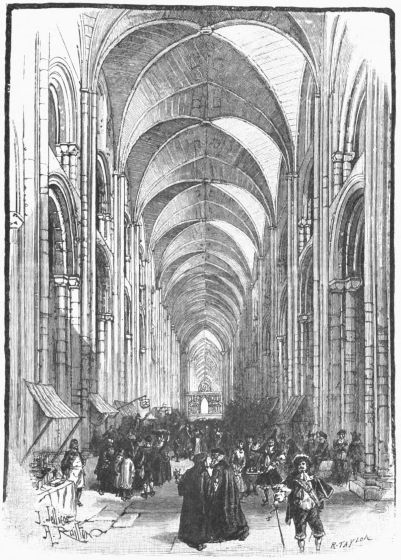
INTERIOR OF OLD ST. PAUL'S.