Chapter II
Reading edition
REIGN OF EDWARD IV.
The Battle of Towton—Edward's Coronation—Henry escapes to Scotland—The Queen seeks aid in France—Battle of Hexham—Henry made Prisoner—Confined in the Tower—Edward marries Lady Elizabeth Grey—Advancement of her Relations—Attacks on the Family of the Nevilles—Warwick negotiates with France—Marriage of Margaret, the King's Sister, to the Duke of Burgundy—Marriage of the Duke of Clarence with a Daughter of Warwick—Battle of Banbury—Rupture between the King and his Brother—Rebellion of Clarence and Warwick—Clarence and Warwick flee to France—Warwick proposes to restore Henry VI.—Marries Edward, Prince of Wales, to his Daughter, Lady Ann Neville—Edward IV.'s reckless Dissipation—Warwick and Clarence invade England—Edward expelled—His return to England—Battle of Barnet—Battle of Tewkesbury, and ruin of the Lancastrian Cause—Rivalry of Clarence and Gloucester—Edward's Futile Intervention in Foreign Politics—Becomes a Pensioner of France—Death of Clarence—Expedition to Scotland—Death and Character of the King.
Edward IV., at this period of his great success, and his acknowledgment by the people of London and the council as king, was only in his twentieth year. Handsome of person and of popular manners, he was not restrained by any such conscientious scruples as guided his father, but was bold and impetuous. He was fond of pleasure, addicted to gallantry, and at the same time as ready to shed blood as he was to make love and revel in courtly pageants. The reluctant approaches to sanguinary measures which had marked the earlier proceedings of his father, had long since vanished in the heated progress of the strife, and Edward might be regarded as the representative of the leaders now on both sides, with the exception of the gentle and forgiving Henry. But on this side Queen Margaret was as energetic as she was ambitious, and as resolute as her husband was the contrary. The circumstances into which she had been thrown had roused in her the spirit of a tigress fighting for its young.
Margaret, on the warm reception of Edward by the Londoners, had retired northward with her marauding soldiers, who had so fatally damaged her cause by their outrages. Three days after his reception in London, Edward despatched Warwick, the chief bulwark of his cause, in pursuit of her, and on the 12th of March, only five days afterwards, he followed himself. On reaching the Earl of Warwick, their combined troops amounted to 40,000. The queen was exerting all her activity and eloquence amongst her northern friends, and lay at York with 60,000 men. Everything denoted the eve of a bloody conflict.
This civil war was now known all over the world as the War of the Roses, a name said to be derived from a circumstance which took place in a dispute in the Temple Gardens betwixt Warwick and Somerset, at an early period of the rival factions. Somerset, in order to collect the suffrages of those on the side of Lancaster, is said to have plucked a red rose from a bush, and called upon every man who held with him to do the like. Warwick, for York, plucked a white rose, and thus the partisans were distinguishable by these differing badges.
The vanguard of the two armies met at Ferrybridge, the passage of the river Aire. The Duke of Somerset was commander-in-chief of the royal army. The king, queen, and prince remained at York. Lord Clifford led the vanguard, and was opposed by Lord Fitzwalter on the part of the Yorkists. The battle at the bridge was furious; Fitzwalter was killed. Lord Falconbridge was instantly sent forward to replace him, and instead of opposing Clifford in front in his strong position, allowing the troops there to hold him in play, he himself crossed the Aire, some miles above Ferrybridge, and falling unexpectedly on the rear of Clifford, routed his force, and revenged the death of Fitzwalter by that of Clifford himself. The Yorkists poured over the bridge, took possession of the town, and advanced towards Towton. Meantime, Warwick, excited by the temporary repulse at the bridge under Fitzwalter, had called for his horse, stabbed him in sight of the whole army, and kissing the hilt of his bloody sword, swore that he would fight on foot, and share every fatigue and disadvantage with the common soldiers.
With minds inflamed to the utmost pitch of animosity, the two armies met on the morning of Palm Sunday, March 29th, in the fields betwixt the villages of Saxton and Towton, about ten miles south of York. Edward issued orders that no quarter should be given, no prisoners taken. The action began at nine o'clock in the morning, under circumstances most unfortunate for the Lancastrians. A snowstorm was blowing full in their faces; and Lord Falconbridge seized at once on this circumstance by an adroit stratagem. He ordered the archers to advance, discharge their arrows, and again retire out of the reach of those of the enemy. The Lancastrians, believing themselves within bow-shot of the enemy, whose arrows did great execution amongst them, returned the compliment without being able to see where their arrows reached for the snowflakes. The Yorkist archers were now out of their range, and they fell useless. Again the Yorkists advanced, and poured in a fresh flight with such effect that the Lancastrians, probably doubting of the success of their own arrows, rushed forward and came hand to hand with their opponents. It was now one terrible clash of swords, battle-axes, and spears, amid the thick-falling and blinding storm; and thus the two infuriated armies continued fighting desperately for nearly five hours. Towards evening the Lancastrians, disheartened by the fall of their principal commanders, broke and fled. They were pursued as far as Tadcaster with the fiercest impetuosity, and fearful slaughter. It was one of the bloodiest battles ever fought in Britain. According to a contemporary historian, those who were employed to number and bury the dead, declared them to be 38,000.
After celebrating the feast of Easter at York, Edward marched to Newcastle, and, leaving Warwick there to keep the north in order, returned to London on the 26th of June.
On reaching Scotland, Margaret placed Henry in a secure retreat at Kirkcudbright, and then hastened to Edinburgh, to try what could be done towards renewing the contest, which no dispersion of her friends and forces could ever teach her to relinquish. There she found a boy sovereign, a divided court, and a country which had suffered by factions almost as deadly as her own. James I., who had seemed to return to his kingdom after his long captivity under such auspicious circumstances—full of intelligence and plans for the improvement of his country, married to the woman of his affections, and courted by both England and France,—was soon murdered by the rude and lawless nobles whom he endeavoured to reduce to some degree of order and subordination. His son, James II., when arrived at years of maturity, endeavoured to recover from distracted England some of the places it had reft from Scotland formerly, but in besieging Roxburgh in 1460, he was killed by the bursting of a cannon. His son was at this time a child of only eight years old, and the kingdom was governed by a council of regency; but the care of the king's person was committed to the queen-mother, Mary of Guelders, who was ambitious of engrossing not only that duty, but the actual powers of the government. In this she was opposed by the powerful family of Douglas.
Margaret had no willing listeners amongst parties who were occupied with their own schemes and feuds. She had the difficult task of appealing to their various interests; and she found no one thing capable of fixing their attention till she hit on the idea of proposing the surrender of Berwick as the price of Scotland's assistance. That key of the northern frontiers of England, for the possession of which so much blood had been spilled from age to age, was an object the proposed recovery of which at once gave her the command of the ears of the whole court. In addition to this, she offered a marriage betwixt her son, Edward, Prince of Wales, and the eldest sister of the young King of Scotland. These treaties were carried into effect, and Berwick was put into the hands of the Scots on the 25th of April, 1461.
Edward, on his return to London, was crowned on the 29th of June. He then summoned a Parliament to meet at Westminster on the 6th of July, but an invasion appearing not improbable, he prorogued it till the 4th of November. The sword and the scaffold had already so thinned the nobility that only one duke, four earls, one viscount, and twenty-nine barons were summoned to this Parliament. The great battle of Towton, which had laid so many of them low, had rendered the rest very submissive. There was no longer any hesitating betwixt the two families, or seeking of those compromises which, in the end, only produced more discord. Whatever Edward dictated was accepted as law and constitution. Of course Henry IV. was declared to have been an arrant usurper; and his posterity were held incapable, not only of wearing the crown, but of enjoying any estate or dignity in any portion of the British dominions for ever. Henry VI., Margaret, Edward, called Prince of Wales, the Dukes of Somerset and Exeter, the Earls of Northumberland, Devonshire, and Pembroke, and a vast number of lords, knights, and gentlemen, were attainted. Edward IV. was proclaimed to be the only rightful king; and all those of the York party who had been declared traitors by the Lancaster party when it was uppermost, and expelled from honours and estates, were restored.
Meanwhile, nothing daunted, Margaret was exerting her ingenuity to rouse a party in Scotland. She pleaded to deaf ears. Her surrender of Berwick brought her no real assistance; and she now sent over Somerset to endeavour to obtain succour from France. All these efforts were equally vain. Charles VII. died in 1461, and his successor, Louis XI., was immovable. Somerset, her ambassador, returned completely unsuccessful. He and his attendants had, indeed, been arrested by Louis when they attempted to escape in the guise of merchants, for fear of the despicable king giving them up to Edward to propitiate his favour. It was only through the earnest intercession of the Count of Charolais, the son of the Duke of Burgundy, that they were liberated. Louis XI. was cousin-german to both Margaret and Henry VI.; but such relationships weigh nothing with selfish men, in comparison to their own immediate interests. While this unwelcome news was arriving, Margaret was rendered the more uneasy and unsafe by the appearance of Warwick at the court of Scotland, proposing a marriage betwixt the Scottish queen and the victorious Edward of England. Under these circumstances, neither Margaret nor Henry was safe. She resolved, therefore, to make one more effort with Louis of France, and a personal one. By means of a French merchant, who owed her some kindness for past benefit, she managed to get over to France, where she threw herself at the feet of Louis, who was at Chinon in Normandy. She was only able to reach his court by the assistance of the Duke of Brittany, who gave her 12,000 crowns.
Margaret agreed to surrender the rights of the crown in Calais, and that Henry should do the same. And what was to be the price of this sacrifice—this sacrifice of this proud stronghold of England, this sacrifice of her own honour, and this last remaining fragment of her good fame in Britain? The paltry sum of 20,000 livres! That was all she could squeeze from the miserable French king for this intensely desired object. True, he had it still to win, for it was not in the possession of Margaret or her husband; but the acknowledged purchase from the Lancastrian king would give him great weight in any attempts to compel the surrender, and if Henry did again recover his throne, Calais must be made over to him at once.
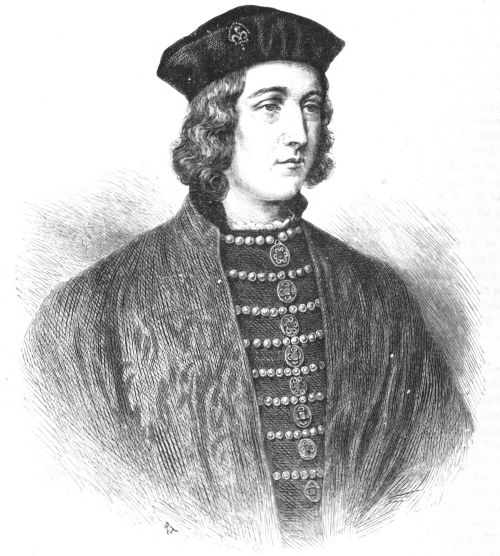
EDWARD IV.
With her 20,000 livres Margaret was enabled to engage the services of Pierre de Brézé, the seneschal of Normandy. He had been an old admirer of Margaret's, and now offered to follow her with 2,000 men. With this force, after an absence of five months, she set sail for England, and attempted to land at Tynemouth, in October, 1462, but was repelled by the garrison. The fleet was now attacked by a terrible storm; the very elements seemed to fight against her. Many of her ships ran ashore near Bamborough. Yet, spite of all her difficulties, Margaret effected a landing, and gained possession of the castles of Bamborough, Dunstanburgh, and Alnwick. She sent for Henry from his safe hiding-place at Harlech Castle in Merionethshire, where she had left him while she went to France, and was gathering some considerable forces of Scots and French when Warwick drew near with 20,000 men, and news was received that Edward was approaching with an equal number. Edward halted at Newcastle, but Warwick advancing, divided his forces into three bodies, and simultaneously invested the three strongholds. Somerset surrendered Bamborough on condition that himself and Sir Ralph Percy, and others, should be allowed to take the oath of fealty to Edward, and be restored to all their honours and estates; and that the rest of the two garrisons, with the Earl of Pembroke, and some others, whose lands had been conferred on Edward's friends, and could not, therefore, be now restored, should be conveyed in safety to Scotland. This defection of her chief supporters was a dreadful blow to the queen, and, to add to her misfortunes, 500 of her French followers, who had established themselves in Holy Island were attacked and cut to pieces by Sir Robert Ogle. Alnwick Castle still held out in the hands of the brave De Brézé and Lord Hungerford; but the Earl of Angus coming up with a party of relief, the besieged took the opportunity to make a sally and escape from the castle to their friends. Bamborough and Dunstanburgh were restored by the king to Lord Percy; but Alnwick he gave to Sir John Ashley, to the great offence of Sir Ralph Grey, who had formerly won it for Edward, and now expected to have had it.
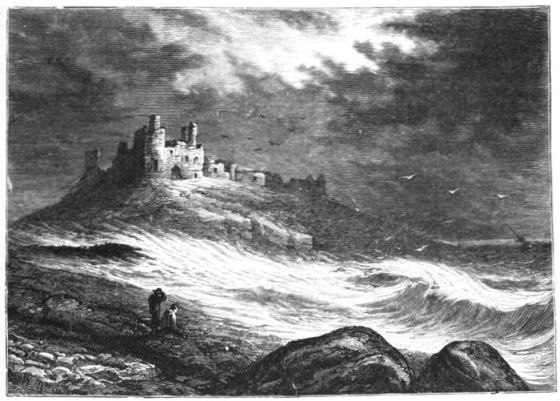
DUNSTANBURGH CASTLE.
It might have been supposed that all hope of ever restoring the Lancastrian cause was now at an end. But in the soul of Margaret hope never seemed to die. With an admirable and indomitable resolution, she again turned her efforts to reconstruct a fresh army. She traversed Scotland, drew together her scattered friends, joined them to her French auxiliaries, whom she again mustered on the Continent: and by the spring of 1464 was in a condition once more to march into England. For some time her affairs wore a promising aspect. She retook the castles of Alnwick, Bamborough, and Dunstanburgh. Somerset, Sir Ralph Percy, and the rest who had made their peace with Edward, hearing of her successes, again flew to her standard. Sir Ralph Grey, who resented the preference given to Sir John Ashley by Edward in the disposal of Alnwick, came over to her, and was made commander of Bamborough.
Edward, on the news of these reverses, dispatched the Lord Montague, the brother of Warwick, into the north to raise his forces there, and make head against the never-resting queen. He met with Sir Ralph Percy on Hedgeley Moor, near Wooler, on the 25th of April, defeated his forces, and killed Sir Ralph. Having received fresh reinforcements from the south, he advanced towards Margaret's main army, and encamped on a plain, called the Levels, near Hexham. There, on the 15th of May, the two armies came to a general action, and after a long and bloody conflict the Lancastrians were again completely routed. Poor King Henry fled for his life, and this time managed not to be left in the hands of his enemies.
Margaret and her son, with a few attendants, were meanwhile flying wildly through the neighbouring forests from the tender mercies of this sanguinary young king. She was endeavouring to reach the Scottish borders, when they were met by a party of marauders, with whom the Border country abounded. The queen on her knees implored mercy, and avowed who she was; but the villains who had hold of her, seeing their associates busy dividing the rich booty, turned to them, and she seized the opportunity, while they were quarrelling over it, to fly with her son. The fugitives rushed onward, not knowing whither they were going, till night overtook them. Nearly fainting with terror, fatigue, and hunger, as the moon broke through the clouds they beheld a huge man, armed, and with threatening gestures hastening towards them. Imagining it was one of the band that had robbed them who had now overtaken her, she expected nothing but death; but, mustering her characteristic resolution, she bade the man see that if he hoped for booty it was useless, for she and her child had been stripped even of their upper garments for their value. The man appeared to be one of the numerous outlaws harboured in that locality, and many of whom had seen better days. He was touched by her appeal, and Margaret, perceiving it, said, "Here, my friend, save the son of your king! I charge thee to preserve from violence that innocent royal blood. Take him, and conceal him from those who seek his life. Give him a refuge in thine obscure hiding-place, and he will one day give thee free access to his royal chamber, and make thee one of his barons." The man, struck by the majestic presence of the queen, the pleading innocence of the prince, and the words of Margaret, knelt, and vowed he would rather die a thousand deaths than injure or betray them. He carried the young prince in his arms to his cave, on the south bank of a little stream which runs at the foot of Blockhill, and, from this circumstance, still called "Queen Margaret's cave." There the man's wife made them right welcome, and, after two days' concealment, the outlaw succeeded in meeting with De Brézé, and his followers soon afterwards discovered the Duke of Exeter and Edward Beaufort—from the execution of his brother now Duke of Somerset; and with them Margaret escaped to Scotland, and, after many adventures, reached France. There Margaret received the melancholy news of the capture and imprisonment of her husband. For about twelve months the unfortunate monarch had contrived to elude the eager quest of his enemies. He went from place to place amongst the friends of the house of Lancaster in Westmoreland, Lancashire, and Yorkshire. At the various halls and castles where he sojourned, tradition has to this day retained the memory of his presence. He was at length betrayed by a monk of Abingdon, and he was taken by the servants of Sir John Harrington, as he sat at dinner at Waddington Hall. He was treated with the utmost indignity on his way to London. He was mounted on a miserable hack, his legs being tied to his stirrups, and an insulting placard fixed on his back. At Islington Warwick met the fallen king, and disgraced himself by commanding the thronging spectators to show no respect to him. To enforce his command by his own example, he led the unhappy man three times round the pillory, as if he had been a common felon, crying, "Treason! treason! Behold the traitor!"
Edward, now freed from his enemies, considered himself as established on the throne beyond all doubt. He created Lord Montacute Earl of Northumberland for his services at Hexham, and Lord Herbert Earl of Pembroke. He issued a long list of attainders to exhaust the resources of his opponents and increase those of his adherents. He then passed an Act for the resumption of the Crown lands to supply a royal income; but this was clogged by so many exceptions that it proved fruitless. He then gave himself up to mirth and jollity, and in the pursuit of his pleasures made himself so affable and agreeable, especially with the Londoners, that, in spite of his free gallantries, he was very popular. So strongly did he now seem to be grounded in the affections of his subjects, that he ventured to make known a private marriage, which he had contracted some time before, though he knew that it would give deep offence in several quarters.
It is a curious circumstance that in the early part of the reign of Henry VI., two ladies of royal lineage, and one of them of royal rank, had condescended to marry private gentlemen, to the great scandal of their high-born connections. One of these was Catherine of Valois, the widow of Henry V., and mother of Henry VI., who married Owen Tudor. The other was Jacquetta of Luxembourg, the widow of the great Duke of Bedford, Regent of France, who married Sir Richard Woodville. Both Tudor and Woodville were men of remarkable beauty; and both were imprisoned and persecuted for the offence of marrying, without permission of the Crown, princesses who chose to fall in love with them. Woodville regained his liberty by the payment of a fine of 1,000 crowns. Tudor's persecutions were more severe and prolonged. Yet, from these two scandalous mésalliances, as they were regarded by the Court and high nobility, sprang a line of the most remarkable princes that ever sat upon the English throne. The blood of both these ladies mingled in the burly body of Henry VIII. and his descendants. We have seen how Tudor became the grandfather of Henry VII.; we have now to observe how Woodville became the grandfather of Henry's wife, Elizabeth of York.
Jacquetta had several children by Sir Richard Woodville, one of whom, Elizabeth, was a woman of much beauty and great accomplishments. She had been married to Sir John Grey of Groby, a Lancastrian, who fell at the second battle of St. Albans. His estate was consequently confiscated; his widow, with seven children, returned to her father, and was living at his seat at Grafton, in Northamptonshire. Edward being out on a hunting party in the neighbourhood, took the opportunity to call on the Duchess of Bedford. There he saw and was greatly struck with the beauty of the Lady Grey. She, on her part, seized the occasion to endeavour to secure some restitution of their property for her children. The whole of her subsequent life showed that she was not a woman to neglect such opportunities. She threw herself at the feet of the gay monarch, and with many tears besought him to restore to her innocent children their father's patrimony.
Lady Grey made more impression than she probably intended. Edward was perfectly fascinated by her beauty and spirit. He raised her from her suppliant posture, and promised her his favour. He soon communicated to her the terms on which he would grant the restitution of her property; but he found in Elizabeth Woodville, or Grey, a very different person to those he had been accustomed to meet. She firmly refused every concession inconsistent with her honour, and the king, piqued by the resistance he encountered, became more and more enamoured.
On the 1st of May, 1464, he married her at Grafton, in the presence only of the priest, the clerk, the Duchess of Bedford, and two female attendants. Within a few days after the marriage he set out to meet the Lancastrians in the north; but the battles of Hedgeley Moor and Hexham were fought before his arrival; and on his return he became anxious to open the matter to his council, and to obtain its sanction. Accordingly, at Michaelmas, he summoned a general council of the peers at the abbey of Reading, where he announced this important event. Amongst the Peers present were Edward's brother the Duke of Clarence, and the great king-maker, Warwick. To neither of these individuals was the transaction agreeable. To Clarence it appeared too inferior a choice for the King of England, though Elizabeth Grey, by her mother's side, was of princely blood. But to Warwick there was offence in it, personal and deep. He had been commissioned by Edward to solicit for him the hand of Bona of Savoy, the sister of the Queen of France. The proposal had been accepted; the King of France had given his consent; the treaty of marriage was actually drawn; and there lacked nothing but the ratification of the terms agreed upon, and the bringing over of the princess to England. At this moment came the order to pause in the proceedings, and the mystery was soon cleared up by the confident rumour of this sudden matrimonial caprice of the king. Warwick returned in high dudgeon; from Edward he did not try to conceal it; but the time for revenge of his injured honour was not yet come; and therefore, after the royal announcement in the council, Clarence and Warwick took Elizabeth by the hand, and introduced her to the rest of the peers. A second council was held at Westminster, in December, and the income of the new queen was settled at 4,000 marks a year.
It was not to be expected that this sudden elevation of a simple knight's daughter to the throne would pass without murmuring and discontent, which was probably the more fully expressed as it was shared by the all-powerful Warwick and the king's brothers. There were busy rumours that the politic old duchess, Jacquetta, and her daughter, had practised magical arts upon the king, and administered philtres; and that, recovering from their effect, he had grievously repented, and endeavoured to free himself. But Edward's whole conduct towards the queen showed the falsity of this jealous gossip; and to make it obvious that she was of no mean parentage, he invited to the coronation her mother's brother, John of Luxembourg, with a retinue of a hundred knights and gentlemen.
But if the king had made apparent her noble birth and his continued affection for her, it became speedily as apparent that the marriage of a subject was to be followed by all its inconveniences. Elizabeth, though raised to the throne, might still be said to be on her knees, imploring the favour of the king. There was nothing which she thought too much for her numerous relations, and the king displayed a marvellous facility in complying with her requests. Her father was created Earl Rivers, and soon after the Lord Mountjoy, a partisan of the Nevilles, was removed to make way for him as Treasurer of England; and again, on the resignation of the Earl of Worcester, the office of Lord High Constable was conferred on him. That was very well for a beginning, but it was nothing to what followed; every branch of the queen's family must be aggrandised without delay. She had five sisters, and each of them was married to one of the highest noblemen in the realm: one to the Duke of Buckingham; one to the heir of the Earl of Essex; a third to the Earl of Arundel; a fourth to Lord Grey de Ruthin, who was made Earl of Kent; and the fifth to Lord William Herbert, created Earl of Huntingdon. Her brother Anthony was married to the heiress of the late Lord Scales, and endowed with her estate and title. Her younger brother John, in his twentieth year, was married to the wealthy old dowager Duchess of Norfolk, in her eightieth year; such was the shameless greed of this family. The queen's son, Thomas Grey, was married to the king's niece, the daughter and heiress of the Duke of Exeter. The Nevilles looked on all these extraordinary proceedings with ominous gloom.
Fresh cause of disunion arose between the king and Warwick. A marriage had for some time been in agitation between Margaret, the king's sister, and the Count of Charolais, son and heir of the Duke of Burgundy. The count was sprung from the house of Lancaster, and even when his father showed the most settled coolness towards Henry VI. and Margaret, had displayed a warm sympathy for them. It was a good stroke of policy, therefore, to win him over by this marriage to the reigning dynasty. But Warwick, who in his former intercourse with Burgundy in France had conceived a deep dislike to him, opposed this match, and represented one with a son of Louis XI. as far more advantageous. To Warwick's arguments was opposed the evident policy of maintaining our commercial intercourse with the Netherlands, and of possessing so efficient an ally on the borders of France against the deep and selfish schemes of Louis. But in the end Warwick prevailed. He was sent over to France to negotiate the affair with Louis. Warwick went attended with a princely train, and with all the magnificence which distinguished him at home, more like that of a great sovereign than of a subject. Louis, who never lost an opportunity of sowing jealousies amongst his enemies, even while he appeared to be honouring them, met Warwick at Rouen, attended by the queen and princesses. The inhabitants, obeying royal orders, went out and escorted Warwick into the city with banners and processions of priests, who conducted the earl to the cathedral, and then to the lodgings prepared for him at the Jacobins. There also Louis and the court took up their quarters, and for twelve days, during which the conference lasted, Louis used to visit the earl in private, passing through a side door into his apartments. With all this secret and familiar intercourse, no pains were taken to conceal its existence; and the consequence was such as the astute and mischievous Louis intended. Reports were forwarded to Edward from those whom he had placed in Warwick's train, which roused his ever uncalculating anger. He hastened to the house of Warwick's brother—the Archbishop of York and Chancellor of the kingdom—demanded the instant surrender of the seals; and, enforcing the act of resumption of Crown lands lately passed, deprived the archbishop of two manors formerly belonging to the Crown.
Warwick returned, as may be supposed, in no very good humour, but still with every prospect of success in his mission. The court of France was agreeable to the match. And on the heels of the earl came the Archbishop of Narbonne and the Bastard of Bourbon to complete the arrangements. They were prepared to offer an annual pension to Edward from Louis, and to pledge the king to submit to the Pope Edward's demand for the restoration of Normandy and Aquitaine, which should be decided within four years. But the importance of these propositions, and the evident prudence of at least appearing to listen to the terms of a monarch like that of France, had no weight with Edward, who was far more distinguished for petulance and rashness than for policy. He treated the French ambassadors with the most insulting coldness; and unceremoniously quitted the capital, leaving his ministers to deal with the ambassadors, and, in fact, to get rid of them. His resentment against Warwick made him not only thus forget the courtesy due to the envoys of a great foreign prince—conduct sure to create its own punishment,—but he gave all the more favour to the suit of the Count of Charolais from the same cause.
The count had sent over his relative, the Bastard of Burgundy, ostensibly to hold a tournament with Lord Scales, the queen's brother, but really to press forward the match with the English princess. The Duke of Burgundy dying at this juncture, all difficulties vanished. The princess was affianced to the new Duke of Burgundy.
This completed the resentment of Warwick. The open insult offered to the court of France, and the rejection of the alliance which he had effected, sunk deep into his proud mind. He retired to his castle of Middleham, in Yorkshire; and occasion was taken of his absence from court to accuse him, on the evidence of one of Queen Margaret's emissaries taken in Wales, of being a secret partisan of the Lancastrian faction. The charge failed; but Edward, resolved to mortify and humiliate the man to whom he owed his throne, affected still to believe him a secret ally of the Lancastrians, and that his own safety was threatened by him. He therefore summoned a body-guard of 200 archers, without whose attendance he never stirred abroad. He expelled the Nevilles from court, and took every means to express his dislike and suspicion of that house. On the other hand, the Nevilles repaid the hatred of the upstart family of Woodville with interest; and from this moment, whatever might be the outward seeming, the feud betwixt these rival families was settled, deadly, and never terminated till it had completed the ruin of all parties.
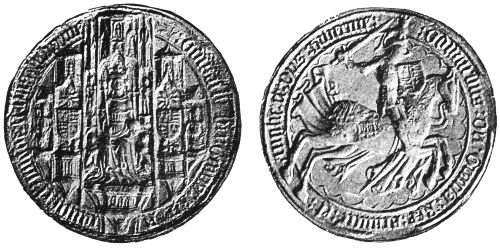
GREAT SEAL OF EDWARD IV.
At present the Archbishop of York, though suffering under the immediate severity of the king, was too wise to give way to his resentment. He justly feared the influence of the Woodvilles with the king, and that it might prove most injurious to his own family. He therefore stood forth as a peacemaker. He volunteered a visit to Earl Rivers, the queen's father; met him at Nottingham, and agreed on terms of reconciliation between the families. The king, queen, and court were keeping the Christmas of 1467 at Coventry. The archbishop hastened to his brother at Middleham, and prevailed upon him to accompany him to Coventry, where he was graciously received by Edward; all subjects of offence betwixt him and the relatives of the queen—especially her brothers-in-law, the Lords Herbert, Stafford, and Audley—were arranged; and the king expressed himself so much pleased with the conduct of the archbishop, that he restored to him his two manors. This pacific state of things lasted for little more than a year. On the 18th of June, 1468, the king's sister set out on her journey to meet her husband in Flanders. The king accompanied her to the coast; and, as a proof that Warwick at this moment held his old position of honour at court, the princess rode behind him through the streets of London. A conspiracy having been discovered, or supposed, of several gentlemen with Queen Margaret, Warwick and his brother, the Earl of Northumberland, were joined with the king's brothers, Clarence and Gloucester, in a commission to try them; and the two Nevilles certainly executed their part of the trust with a zeal which looked like anything but disaffection. Very arbitrary measures were used towards the prisoners, several of whom were condemned and executed.
This calm was soon broken. The Duke of Clarence had from the first shown as deep a dislike to the ascendency of the Woodvilles as the Nevilles themselves. This drew him into closer intimacy with Warwick. He frequently withdrew for long periods from court, and was generally to be found at one of the residences of Warwick. It soon came out that there was a cause still more influential than his dislike of the queen's relations; it was his admiration of the Earl's eldest daughter, Isabella, who was co-heiress of his vast estates. Warwick was delighted with the prospect of this alliance, for as yet the king, having no male heir, and his only daughter being but four years old, Clarence stood as the next male heir to his brother. Edward, on the contrary, beheld this proposed connection with the utmost alarm. The Nevilles were already too powerful; and should Warwick succeed, through Clarence, in placing his descendants so near the throne, it might produce the most dangerous consequences to his own line. He therefore did all in his power to frustrate the marriage, but in vain. Clarence and Warwick retired to Calais, of which Warwick remained the governor; and there the marriage was celebrated, in the Church of St. Nicholas, on the 11th of July, 1469.
With the exception of this annoying event, at this moment Edward appeared so firmly seated on his throne, and so well secured by foreign treaties with almost all the European powers, and especially with the Dukes of Burgundy and Brittany, the latter of whom had recently become his ally, that he actually contemplated the enterprise of recovering by his arms the territories which his weak predecessor had lost in France. His hatred of the cold-blooded Louis XI., who in political cunning was infinitely Edward's superior, probably urged him to this idea. To draw off the attention of the different factions at home, and find some common medium of uniting them in action abroad, might be another. The most remarkable circumstance of all was, that Parliament, after its experience of the drain which these French wars had been to the blood and resources of the nation, received the king's proposal with cordial approbation.
But these dreams of martial glory were very quickly swept from the brain of the king by domestic troubles. At first these troubles appeared to originate in private and local causes, but there was such food for combustion existing throughout the kingdom, that the farther they went, the wider they opened, and at every step onwards assumed more and more the aspect of a Warwick and Clarence conspiracy. Nothing could be farther removed from such an appearance than the opening occurrence.
The hospital of St. Leonard, near York, had possessed, from the reign of King Athelstan, a right of levying a thrave of corn (twenty-four sheaves) from every ploughland in the county. There had long been complaints that this grant was grossly abused, and instead of benefiting the poor, as it was intended, was converted to the emolument of the managers. During the last reign many had refused in consequence to yield the stipulated thrave, and Parliament had passed an act to compel the delivery. Now again the refusal to pay the demand was become general. The vassals had their goods distrained, and were themselves thrown into prison. This raised the peasantry, who were all of the old Lancastrian party, and regarded the present dynasty as usurpers and oppressors. They flew to arms, under the leadership of one Robert Hilyard, called by the insurgents Robin of Redesdale, and vowed that they would march south and reform the Government. Lord Montague, Earl of Northumberland, brother of Warwick, marched out against them, forming as they now did a body of 15,000 men, and menacing the city of York. He defeated them, seized their leader Hilyard, and executed him on the field of battle.
So far there appeared certainly no hand of the Nevilles in this movement. Northumberland did his best to crush it, and Warwick and Clarence were away at Calais, thinking, apparently, not of rebellion, but of matrimonial festivities. But the very next move revealed a startling fact.
The insurgents, though dispersed, were by no means subdued. They had lost their peasant head, but they reappeared in still greater forces, with two heads, and those no other than the Lords Fitzhugh and Latimer, the nephew and the cousin-german of Warwick. Northumberland contented himself with protecting the city of York. He made no attempt to pursue this still more menacing body, who, dropping their cry of the hospital and the thrave of corn, declared that their object was to meet the Earl of Warwick, and by his aid and advice to remove from the councils of the king the swarm of Woodvilles, whom they charged with being the authors of the oppressive taxes, and of all the calamities of the nation. The young noblemen who headed the insurrection were assisted by the military abilities of an old and experienced officer, Sir William Conyers. At the name of Warwick, his tenants came streaming from every quarter, and in a few days, the insurgent army numbered 60,000 men.
Edward, on the news of this formidable movement, called together what troops he could, and fixed his headquarters at the castle of Fotheringay. Towards this place the insurgent army marched, growing, as they proceeded, in numbers and boldness. The whole outcry resolved itself into a capital charge against the Woodvilles, and the movement being headed by the Nevilles, there could not be much mystery about the matter. Yet Edward, after advancing as far as Newark, and becoming intimidated by the spirit of disaffection which everywhere prevailed, wrote imploringly to Warwick and Clarence to hasten from Calais to his assistance. The result was such as might have been expected. Warwick and Clarence, instead of complying with the king's urgent entreaty, summoned their friends to meet them at Canterbury, on the following Sunday, to proceed with them to the king to lay before him the petitions of the Commons.
In this alarming extremity, Edward looked with impatience for the arrival of the Earls of Devonshire and Pembroke, who had been mustering forces for his assistance. Devon was at the head of a strong body of archers, and Pembroke of 10,000 Welshmen. They met at Banbury, where the demon of discord divided them in their quest of quarters, and made them forget the critical situation of their sovereign. Pembroke, leaving Devon in possession, advanced to Edgecote. There he came in contact with the insurgents, who, falling upon him, deprived as he was of the assistance of Devon's archers, easily routed him. In this engagement 2,000 of his soldiers are said to have perished, and Pembroke and his brother were taken and put to death, with ten other gentlemen, on the field. Devon made no attempt to restore the fortunes of his party.
This fatal defeat completely annihilated the hopes of Edward. At the news of it, all his troops stole away from their colours, and his favourites fled for concealment. But the queen's father, Earl Rivers, was discovered in the Forest of Dean, with his son, Sir John Woodville; and the Earl of Devon, late Earl Stafford, the queen's brother-in-law, abandoned by his soldiers, was taken at Bridgewater. The whole of them were executed, Rivers and his son Woodville being conveyed to their own neighbourhood, and beheaded at Northampton.
Warwick, Clarence, and Northumberland, who had, no doubt, conducted all these movements from a distance, now appeared as principals on the scene. They marched forward from Canterbury at the head of a powerful force, and overtook Edward at Olney, plunged in despair at the sudden ruin which had surrounded him. They approached him with an air of sympathy and loyal obeisance; and Edward, imposed upon by this, with his usual unguarded anger, upbraided them with being the real authors of his troubles. He very soon perceived his folly, for he found himself, not their commander, but their captive. Warwick dismissed the insurgent army to their homes, who retired laden with booty, and sensible that they had executed all that was expected of them. Under protection of their Kentish troops, they then conducted Edward to Warwick Castle, and thence, for greater security, to Middleham.
Thus England had at the same time two kings, and both of them captive; Henry in the Tower of London, Edward at Middleham, in Yorkshire. Men now expected nothing less than that Warwick would proclaim Clarence as king, but probably the measures of Warwick and Clarence were deranged by a fresh insurrection which broke out. This time it was the Lancastrians, who seized the opportunity to raise again the banner of Henry. They appeared in the marches of Scotland, under Sir Humphrey Neville, one of the fugitives from the battle of Hexham. Warwick advanced against him in the king's name, but he found that the soldiers refused to fight until they were assured of the king's safety. Warwick was therefore compelled to produce Edward to the army at York. After that they followed him against the Lancastrians, whom they defeated, and taking their leader, brought him to the king, who ordered his instant execution.
Edward was now permitted to return to London, accompanied by several leaders of the party. There a council of peers was summoned, and then it appeared that though Warwick's faction had probably not accomplished all they had intended, they bound the king to terms which, while they neutralised the hopes of Clarence in some degree, still were calculated to add to the greatness of the house of Neville. The king announced that he had proposed to give his daughter, yet only four years old, to George, the son of the Earl of Northumberland, and presumptive heir of all the Nevilles. The council gave its unanimous approbation of the measure, and the young nobleman, to raise his name to a level with his affianced bride, was created Duke of Bedford.
Outwardly everything was so harmonious, that not only was a general pardon granted to all who had been in any way concerned in the late disturbances, but the king and his reconciled friends were again proposing to invade France in concert with the Duke of Burgundy. The French court was so convinced of the reality of this invasion that it commanded a general muster of troops for the 1st of May, 1470.
But the designs of the Nevilles lay nearer home in reality. The Archbishop of York invited the king to meet Clarence and Warwick at his seat—the Moor—in Hertfordshire. As Edward was washing his hands preparatory to supper, John Ratcliff, afterwards Lord Fitzwalter, whispered in his ear that 100 armed men were on the watch to seize him and convey him to prison. Edward, having been once before trepanned by his loving friends, gave instant credence to the information, stole out, mounted a horse, and rode off to Windsor. This open confession of his opinion of the Nevilles produced a fresh scene of discord, which, with some difficulty, was appeased by the king's mother, the Duchess of York, and the parties were reconciled with just the same sincerity as before.
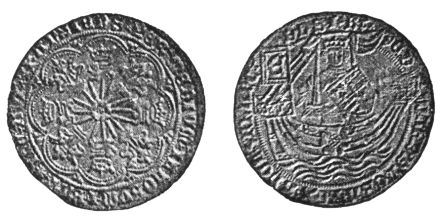
GOLD ROSE NOBLE OF EDWARD IV.
The Nevilles were now in too critical a position to pause. They or the king must fall. At any hour some stratagem might surprise them, and give the advantage to their injured and deadly enemies, the Woodvilles. Insurrection, therefore, was not long in showing itself again. This time it broke out in Lincolnshire, and, as in the case of the hospital of St. Leonard, appeared to have nothing whatever to do with Warwick or his party. Its ostensible cause was the old grievance of purveyance, and Sir Robert Burgh, one of the purveyors, was attacked, his house burnt down, and himself chased out of the county. Had the cause been really local, there the mischief would have ended; but now again stepped forward a partisan of Warwick, Sir Robert Wells, who encouraged the rioters to keep together, and proceed to redress, not the evils of one county, but of the nation. He put himself at their head, and they soon amounted to 30,000 men. The king required a number of nobles to raise troops with all speed, and so well did Warwick and Clarence feign loyalty that they were amongst this number.
Edward summoned Lord Wells, the father of the insurgent chief, and Sir Thomas Dymoke, the Champion, both Lincolnshire men, to the council, in order to obtain information of the extent of the insurrection, and to engage them to exert their influence to check it. Both these gentlemen, as if conscious of guilt, fled to sanctuary, but, on a promise of pardon, repaired to court. Edward insisted that Lord Wells should command his son to lay down his arms, and disperse his followers, with which order Lord Wells complied; but Sir Robert Wells received at the same time letters from Warwick and Clarence, encouraging him to hold out, assuring him that they were on the march to support him. When Edward reached Stamford, bearing Lord Wells and Dymoke with him, he found Sir Robert still in arms, and in his anger he wreaked his vengeance on his father, Lord Wells, and on Dymoke, beheading them in direct violation of his promise. He then sent a second order to Sir Robert to lay down his arms, but he replied that he scorned to surrender to a man destitute of honour, who had murdered his father. Edward then fell upon the insurgents at Empingham, in Rutlandshire, and made a terrible slaughter of them. The leaders, Wells and Sir Thomas Delalaunde, were taken and immediately executed. The inferior prisoners, as dupes to the designs of others, were dismissed.
Warwick and Clarence made for Calais. But there Warwick's lieutenant, Vauclerc, a Gascon knight, to whom he had entrusted the care of the city, refused to admit them. When they attempted to enter, the batteries were opened upon them; and when they remonstrated on this strange conduct, Vauclerc sent secretly to inform Warwick that the garrison, aware of what had taken place in England, were ill affected, and would certainly seize him if he entered; that his only chance of preserving the place for him was to appear at present hostile; and he prayed him to retire till a more favourable opportunity. To Edward, however, Vauclerc sent word that he would hold the town for him as his sovereign against all attempts—for which Edward rewarded him with the government of the place, and the Duke of Burgundy added a pension of a thousand crowns. Warwick and Clarence, enraged at this unexpected repulse, sailed along the coast towards Normandy, seizing every Flemish merchantman that fell in their way in revenge against Burgundy, and entered Harfleur, where they were received with all honour by the admiral of France.
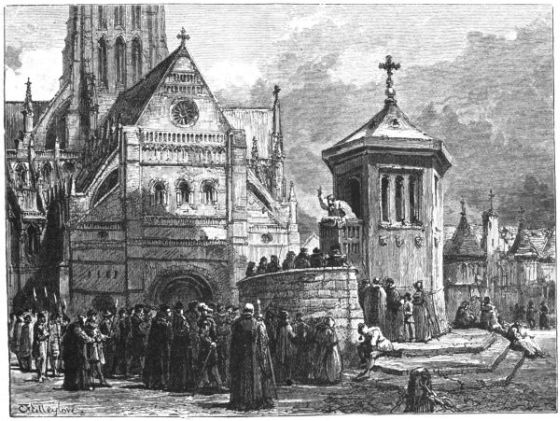
PREACHING AT ST. PAUL'S CROSS. (See p. 50.)
Low as were now the fortunes of Warwick and Clarence, decided as had been the failure of their attempts against Edward IV., Louis of France thought he had, in the possession of these great leaders, a means of consolidating a formidable party against Edward, who had treated his alliance with such contempt, and who entered into the closest relations with his most formidable opponent, the Duke of Burgundy. He therefore received them at Amboise, where he was holding his court, with the most marked honours, and ordered them and their ladies to have the best accommodations that could be procured in the neighbourhood. He proposed to these two chiefs to coalesce with the Lancastrian party, by which means they would be sure to gain the instant support of all that faction. He sent for Queen Margaret, who was then at Angers, and assured her that Providence had at length prepared the certain means of the restoration of King Henry and his family.
Warwick engaged, by the assistance of Louis and of the Lancastrians, to replace Henry again upon the throne. By this means Warwick was to depose, and if possible to destroy, Edward of York. But Warwick never forgot the suggestions of his ambition. He must, if possible, sit on the throne of England in the persons of his descendants. For this he had married one daughter to Clarence. When the success of Edward had enfeebled his chance, he had succeeded in affiancing his nephew to the daughter of Edward, so that if not a Warwick at least a Neville might reign. He now sacrificed both these hopes to that of placing another daughter on the throne, as the queen of Margaret's son, the Prince of Wales. This alliance was the price of Warwick's assistance, and, however bitter might be the necessity, Margaret submitted to it, and the young Prince of Wales was forthwith married to Anne, the daughter of Warwick. Warwick then acknowledged Henry VI. as the rightful sovereign of England, and at the same time entered into solemn engagements to exert all his power to reinstate and maintain him on the throne. Margaret on her part swore on the holy Gospels never to reproach Warwick with the past, but to esteem him as a loyal and faithful subject. The French king, on the completion of this reconciliation, engaged to furnish the means necessary for the expedition.
Edward, on hearing of the extraordinary meeting and negotiations of Warwick and Margaret, of the active agency of the French king, and the proposed marriage of Edward, Prince of Wales, and Anne of Warwick, sent off a lady of pre-eminent art and address, who belonged to the train of the Duchess of Clarence, but who had somehow been left behind. The clever dame no sooner reached the court of Clarence than she expressed to him and the duchess her amazement at their permitting such a coalition as the present; that in every point of view it was destructive to their own hopes, and even security; that the continued adhesion of Warwick and Margaret was impossible. Their mutual antipathies were too deeply rooted ever to be eradicated.
Clarence was only one-and-twenty years of age. He was of a slender capacity, easily guided or misguided, and he agreed, on the first favourable opportunity, to abandon Warwick and go over to the king.
On the other hand, Warwick was as actively and secretly engaged in preparing the defection of partisans of the king in England. His brother, Montague, though he had not deemed it prudent to join Warwick and Clarence in their unfortunate attempt to raise the country against Edward, had been suspected by him, and stripped of the earldom of Northumberland. He was still an ostensible adherent of the king, but he was watched. Warwick apprised him of the new and wonderful turn of affairs, and engaged him to keep up a zealous show of loyalty that his defection at an important moment might tell with the more disastrous effect on the Yorkist cause.
Edward, satisfied with having detached Clarence from Warwick's interests, continued as careless as ever. The Duke of Burgundy, more sagacious than his brother-in-law, the King of England, did all that he could to arouse him to a sense of his danger, and to obstruct the progress of the expedition. He sent ambassadors to Paris to complain of the reception given to the enemies of his brother and ally. He menaced Louis with instant war if he did not desist from aiding and protecting the English traitors. He sent spies to watch the proceedings of Vauclerc, in Calais, and dispatched a squadron to make reprisals on the French merchantmen for the seizures made by Warwick, and to blockade the mouth of the Seine. Edward laughed at the fears and precautions of Burgundy. He bade him take no pains to guard the Channel, for that he should enjoy nothing better than to see Warwick venture to set foot in England.
He was not long without that pleasure. A tempest dispersed the Burgundian fleet, and the fleet of Warwick and Clarence, seizing the opportunity, put to sea, crossed the Channel, and landed on the 13th of September, 1470, without opposition, at Portsmouth and Dartmouth. Warwick had prepared his own way very skilfully. Edward was deluded by a ruse on the part of Lord Fitzwalter, the brother-in-law of Warwick, who appeared in arms in Northumberland, as if meditating an insurrection; by which means the unwary king was induced to march towards the north, leaving the southern counties exposed to the invaders. This was the object of Warwick, and, as soon as it was effected, Fitzwalter retreated into Scotland. Meantime, the real danger was growing rapidly in the south. The men of Kent rose in arms; London was thrown into a ferment by Dr. Goddard preaching at St. Paul's Cross in favour of Henry VI.; and from every quarter people hastened to the standard of Warwick with such eagerness that he speedily found himself at the head of 60,000 men.
As London and the southern counties appeared safe, Warwick proclaimed Henry, and set out to encounter Edward without delay. He advanced towards Nottingham. Edward, who had taken up his headquarters at Doncaster, had issued his orders for all who could bear arms to join his banner. They came in slowly; and Edward, who had ridiculed the idea of the return of Warwick, saying Burgundy would take care that he did not cross the sea, was now rudely aroused from his fancied security. He was compelled with unequal forces to advance against Warwick. A great battle appeared imminent in the neighbourhood of Nottingham; but the rapid defection of Edward's adherents rendered that unnecessary. The speedy movements of Warwick, and the general demonstration in favour of Henry, had not permitted Clarence to carry into effect his intended transit from Warwick to Edward, when a startling act of desertion occurred to the king's side, which completed Edward's ruin. Before Edward could reach Nottingham, and while lying near the river Welland, in Lincolnshire, Montague, Warwick's brother, from whom Edward had taken the earldom of Northumberland, now revenged himself by suddenly marching from York at the head of 6,000 men, and in the night, and in full concert with his officers, advancing upon Edward's quarters, his men wearing the red rose instead of the white, and with loud cries of "God bless King Henry!"
Edward commanded his troops to be put in array to meet the traitor; but Lord Hastings told him that he had not a regiment that he could rely upon; that nothing was to be thought of but his personal safety, and that on the instant. Accordingly, he took horse with the Duke of Gloucester, the Earl Rivers, seven or eight other noblemen, and a small troop of the most reliable followers, with whom he rode away. A guard was posted on a neighbouring bridge to prevent the crossing of Warwick, for he also was within a day's march of him; and with all haste Edward and his little band rode at full speed till he reached Lynn, in Norfolk. It is probable that the royal party had made for this small port on the Wash, knowing that some vessels which had brought provisions for the troops still lay there. They found, indeed, a small English ship, and two Dutch vessels, on board of which they hurried, and put to sea. Edward, on starting from his quarters, had recommended his army to declare at once for Warwick, as the best means of saving themselves, and of again rejoining his standard when opportunity should offer.
The fugitives made sail for the coast of Holland, but no sooner had the king escaped from his enemies on land than he fell amongst fresh ones at sea. These were the Easterlings, or mariners of Ostend, who were now at war with both France and England. The Easterlings were at this time as terrible at sea as the pirates of Algiers were afterwards. They had committed great ravages on the English coast, while the nation was thus engaged in suicidal intestine warfare, and no sooner did they perceive this little fleet than they immediately gave chase. There were eight vessels to Edward's three, and to escape the unequal contest, he ran his vessels aground on the coast of Friesland, near Alkmaar. To ascertain how Vauclerc, the Governor of Calais, was disposed, in case Warwick resolved to attack the duke in his own territories, he sent an envoy to him to sound him. The envoy found all the garrison wearing the red rose. This discovery added to the alarm and chagrin of Burgundy, and, while he conceded to Edward a place of refuge, he publicly declared himself the ally, not of this power or that, but of England, and avowed himself adverse to Edward's designs, who was to expect no aid from him in endeavouring to recover his crown.
On the other hand Louis of France was thrown into ecstasies of delight. He sent for Queen Margaret and her son, the Prince of Wales, who had been living for years totally neglected, and almost forgotten in their poverty, and received her in Paris with the most splendid and expensive pageants and rejoicings. He at the same time despatched a splendid embassy to Henry at London, and immediately concluded with him a treaty of peace and commerce for fifteen years.
Warwick and Clarence made their triumphal entry into London on the 6th of October, 1470. Warwick proceeded to the Tower, and brought forth King Henry, who had lain there as a captive for five years. Henry was proclaimed lawful king, and conducted with great pomp through the streets of London to the bishop's palace, where he resided till the 13th, when he walked in solemn procession, with the crown upon his head, attended by his prelates, nobles, and great officers, to St. Paul's, where solemn thanksgivings were offered up for his restoration.
All this time Clarence was looking on, an immediate spectator of proceedings which pushed him farther from the throne. To keep him quiet, Warwick heaped every favour but the actual possession of the kingdom upon him. He joined him with himself in the regency which was to continue till the majority of the Prince of Wales; he made him Lord-Lieutenant of Ireland, and conferred upon him all the estates of the house of York. Warwick retained himself the offices of Chamberlain of England, Governor of Calais, High Admiral of the seas; his brother, the archbishop, was continued Chancellor; and his other brother, Montague, returned to the Wardenship of the Marches.
Warwick summoned a Parliament, which, surrounded by his troops and his partisans, of course passed whatever acts he pleased. The crown was settled on Edward, the Prince of Wales, and his issue; but that failing, it was to devolve upon Clarence.
Queen Margaret might have been expected, from her characteristic energy and rapidity of action, to have been in London nearly as soon as Warwick; but this was not the case. In the first place, she was in want of the necessary funds. Louis, who was chary of his money, probably thought he had done sufficient in enabling the victorious armament of Warwick to reach England; and poor King Réné, Margaret's father, was in no condition to assist her. In the meantime all the exiled Lancastrians flocked to her; and all were destitute. In February, 1471, she set sail to cross the Channel, but was driven back by tempests. Three times did she make the daring attempt to cross, though warned against it by the seamen of Harfleur; and every time she was driven back with such fury and damage, that many declared it was the will of Heaven she should not pass over; nor was she able to do so till the following month. Till that time Warwick held England in the name of Henry, and appeared established, if not exactly on the throne, in the seat of supreme and settled power.
The mock restoration of Henry VI. was not destined to be of long continuance. The ups and downs of royalty at this period were as rapid and strange as the shifting scenes of a theatre. There is no part of our history where we are left so much in the dark as to the real moving causes. It is difficult to see how Warwick, with his vast popularity, should, in the course of a single winter, become so unpopular as to render his fall and the success of Edward so easy. It must be remembered, however, that there was a secret schism in his party. Clarence was only waiting to seize a good opportunity to overthrow his father-in-law, Warwick, and climb the throne himself. Though he was by no means high-principled, Clarence was not so weak as to build any hopes on Warwick's having given him the succession in case of the issue of the Prince of Wales failing. Warwick had married another of his daughters to the prince, and it was his strongest interest to maintain that line on the throne.
All these causes undoubtedly co-operated to produce what soon followed. Burgundy determined to assist Edward to regain his throne, and thus destroy the ascendency of Warwick. While, therefore, issuing a proclamation forbidding any of his subjects to follow Edward in his expedition, he privately sent to him the cross of St. Andrew; and a gift of 50,000 florins furnished him with four large ships, which were fitted up and stored for him at Vere, in Walcheren. Besides these, he hired for him fourteen ships from the merchants of the Hanse Towns, to transport his troops from Flushing to England. These transactions could leave no question in the minds of the subjects of Burgundy which way lay the real feelings of their sovereign. But the number of troops embarking with Edward was not such as to give to the enterprise a Burgundian appearance. The soldiers furnished him were only 2,000. Edward undoubtedly relied on information sent him from England as to the forces there ready to join him.
The fleet of Edward steered for the Suffolk coast. It was in the south that the Yorkist influence lay, and Clarence was posted in that quarter at the head of a considerable force. But Warwick's preparations were too strong in that quarter; an active body of troops, under a brother of the Earl of Oxford, deterred the invaders from any attempt at landing. They proceeded northward, finding no opportunity of successfully getting on shore till they reached the little port of Ravenspur, in Yorkshire—singularly enough, the very place where Henry IV. landed when he deposed Richard II. From this same port now issued the force which was to terminate his line.
At first, however, the undertaking wore anything but a promising aspect. The north was the very stronghold of the Lancastrian faction, and openly was displayed the hostility of the inhabitants towards the returned Yorkist monarch. But Edward, with that ready dishonesty which is considered defensible in the strife for crowns, solemnly declared that he had abandoned for himself all claims on the throne; that he saw and acknowledged the right of Henry VI. and his line, and for himself only desired the happy security of a private station. His real and most patriotic design, he gave out, was to put down the turbulent and overbearing power of Warwick, and thus give permanent tranquillity to the country, which never could exist so long as Warwick lived. He exhibited a forged safe-conduct from the Earl of Northumberland; he declared that he sought for himself nothing but the possessions of the Duke of York, his father; he mounted in his bonnet an ostrich feather, the device of the Prince of Wales, and ordered his followers to shout "Long live King Henry!" in every place through which they passed.
These exhibitions of his untruth were too barefaced to deceive any one. The people still stood aloof, and, on reaching the gates of York, Edward found them closed against him. But by the boldest use of the same lying policy, Edward managed to prevail on the mayor and aldermen to admit him. He swore the most solemn oath that he abjured the crown for ever, and would do all in his power to maintain Henry and his issue upon it. Not satisfied with this, the clergy demanded that he should repeat this oath most emphatically before the high altar in the cathedral. Edward assented with alacrity, and would undoubtedly have sworn anything and any number of oaths to the same effect. He then marched in with that bold precipitance which was the secret of his success, and which, as in the case of the great Napoleon, always threw his enemies into consternation and confusion. At Pontefract lay the Marquis of Montague, Warwick's brother, with a force superior to that of Edward, and all the world looked to see him throw himself across the path of the invader, and to set battle against him. Nothing of the kind; Montague lay still in the fortress, and Edward, marching within four miles of this commander, went on his way without any check from him.
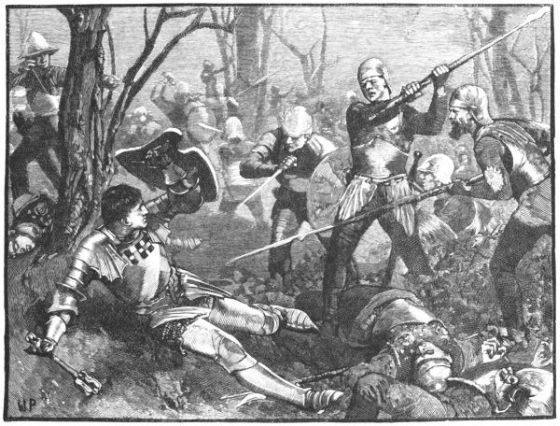
BATTLE OF BARNET: DEATH OF THE KING-MAKER. (See p. 34.)
As Edward approached the midland counties, and especially when he had crossed the Trent, the scene changed rapidly in his favour. He had left the Lancastrian districts behind, and reached those where Yorkism prevailed. People now flocked to his standard. At Nottingham the Lord Stanley, Sir Thomas Parr, Sir James Harrington, Sir Thomas Montgomery, and several other gentlemen, came in with reinforcements. Edward felt himself strong enough to throw off the mask: he assumed the title of king, and marched towards Coventry, where lay Warwick and Clarence with a force sufficient to punish this odious perjury. But a fresh turn of the royal kaleidoscope was here to astonish the public. Edward challenged the united army of Warwick and Clarence on the 29th of March, 1471. In the night, Richard, Duke of Gloucester, paid a visit to his brother Clarence. The two brothers flew into each other's arms with a transport which, if not that of genuine affection, was at least that of successful conspiracy. The morning beheld the army of Clarence, amounting to 12,000 men, arrayed, not on the part of Warwick, but of Edward, the soldiers wearing, not the red, but the white rose over their gorgets.
Here, then, was fully disclosed the secret which had induced Edward to march on so confidently through hostile districts, and people standing aloof from his banners. Clarence, whether in weak simplicity, or under the influence of others, sent to Warwick to apologise for his breach of his most solemn oaths, and offered to become mediator betwixt him, his father-in-law, and Edward his brother. Warwick rejected the offer with disdain, refusing all further intercourse with the perjured Clarence; but he was now too weak to engage him and Edward, and the Yorkist king then boldly advanced towards the capital. The gates of the city, like those of York, he found closed against him, but he possessed sufficient means to unlock the one as he had done the other. There were upwards of 2,000 persons of rank and influence, including no less than 400 knights and gentlemen, crowded into the various sanctuaries of London and Westminster, who were ready not only to declare, but to act in his favour. The ladies, who were charmed with the gay and gallant disposition of Edward, were avowedly his zealous friends; and perhaps still more persuasive was the fact that the jovial monarch owed large sums to the merchants, who saw in his return their only chance of payment. Edward even succeeded in securing the Archbishop of York, who was, in his brother Warwick's absence, the custodian of the city and the person of King Henry. All regard to oaths, and all fidelity to principle or party, seemed to have disappeared at this epoch. By permission of the archbishop, Edward was admitted on Thursday, April 2nd, by a postern into the bishop's palace, where he found the poor and helpless King Henry, and immediately sent him to the Tower.
So confident now was Edward of victory, that he disdained to shelter himself any longer within the walls of the city, but marched out against the enemy. It was late on Easter eve when the two armies met on Barnet Common. Both had made long marches, Edward having left London that day. The Earl of Warwick, being first on the ground, had chosen his position. Edward, who came later, had to make his arrangements in the dark, the consequence of which was, that he committed a great error. His right wing, instead of confronting the left wing of Warwick, was opposed to his centre, and the left wing of Edward consequently had no opponents, but stretched far away to the west. Daylight must have discovered this error, and most probably fatally for Edward; but day—the 14th of April—came accompanied by a dense fog, believed to have been raised by a celebrated magician, Friar Bungy. The left wing of each army, advancing through the obscurity of the fog, and finding no enemy, wheeled in the direction of the main body. By this movement the left wing of Warwick trampled down the right wing of Edward, and defeating it, pursued the flying Yorkists through Barnet on the way to London.
Meantime, the left wing of the Yorkists, instead of encountering the right of the Lancastrians, came up so as to strengthen their own centre, where Edward and Warwick were contending with all their might against each other. Both chiefs were in the very front of the battle, which was raging with the utmost fury. Warwick, contrary to his custom, had been persuaded by his brother Montague to dismount, send away his horse, and fight on foot.
The battle commenced at four o'clock in the morning, and lasted till ten. The rage of the combatants was terrible, and the slaughter was proportionate, for Edward, exasperated at the commons, who had shown such favour to Warwick on all occasions, had, contrary to his usual custom, issued orders to spare none of them, and to kill all the leaders if possible. The conflict was terminated by a singular mistake. The device of the Earl of Oxford, who was fighting for Warwick, was a star with rays, emblazoned both on the front and back of his soldiers' coats. The device of Edward's own soldiers on this occasion was a sun with rays. Oxford had beaten his opponents in the field, and was returning to assist Warwick, when Warwick's troops, mistaking through the mist the stars of Oxford for the sun of Edward, fell upon Oxford's followers, supposing them to be Yorkists, and put them to flight. Oxford fled with 800 of his soldiers, supposing himself the object of some fatal treachery, while, on the other hand, Warwick, weakened by the apparent defection of Oxford, and his troops thrown into confusion, rushed desperately into the thickest of the enemy, trusting thus to revive the courage of his troops, and was thus slain, fighting.
No sooner was the body of Warwick, stripped of its armour and covered with wounds, discovered on the field, than his forces gave way, and fled amain. Thus fell the great "king-maker," who so long had kept alive the spirit of contention, placing the crown first on one head and then on another. With him perished the power of his faction and the prosperity of his family. On the field with him lay all the chief lords who fought on his side, except the Earl of Oxford and the Duke of Somerset, who escaped into Wales, and joined Jasper Tudor, the Earl of Pembroke, who was in arms for Henry. The Duke of Exeter was taken up for dead, but being found to be alive, he was conveyed by his servants secretly to the sanctuary at Westminster; but the holiness of the sanctuary does not appear to have proved any defence against the lawless vengeance of Edward, for, some months after, his dead body was found floating in the sea near Dover. On the side of Edward fell the Lords Say and Cromwell, Sir John Lisle, the son of Lord Berners, and many other squires and gentlemen. The soldiers who fell on both sides have been variously stated at from 1,000 to 10,000; the number more commonly credited is about 1,500. The dead were buried where they fell, and a chapel was erected near the spot for the repose of their souls. The battle-field is now marked by a stone obelisk. The bodies of Warwick and Montague were exposed for three days, naked, on the floor of St. Paul's Church, as a striking warning against subjects interfering with kings and crowns. They were then conveyed to the burial-place of their family in the abbey of Bilsam, in Berkshire.
In the fall of Warwick Edward might justly suppose that he saw the only real obstacle to the permanency of his own power; but Margaret was still alive. She was no longer, however, the elastic and indomitable Margaret who had led her forces up to the battles of St. Albans, Northampton, Wakefield, Towton, and Hexham. On the day that she landed at Weymouth, imagining she had now nothing to do but to march in triumph to London, and resume with her husband their vacant throne, the fatal battle of Barnet was fought. The first news she received was of the total overthrow of her party and the death of Warwick. The life of the great king-maker might have caused her future trouble; his fall was her total ruin. Confounded by the tidings, her once lofty spirit abandoned her, and she sank on the ground in a swoon.
It was the plan of her generals to hasten to Pembroke; and, having effected a junction with him, to proceed to Cheshire, to render the army effective by a good body of archers. But Edward, always rapid in his movements, allowed them no time for so formidable a combination. He left London on the 19th of April, and reached Tewkesbury on the 3rd of May. Margaret and her company set out from Bath, and prepared to cross the Severn at Gloucester, to join Pembroke and Jasper Tudor. But the people of Gloucester had fortified the bridge, and neither threats nor bribes could induce them to let her pass. She then marched on to Tewkesbury, near which they found Edward already awaiting them.
The troops being worn down by the fatigue of a long and fearful march, Margaret was in the utmost anxiety to avoid an engagement, and to press on to their friends in Wales. But Somerset represented that such a thing was utterly impossible. For a night and a day the foot-soldiers had been plunging along for six-and-thirty miles through a foul country—all lanes, and stony ways, betwixt woods, and having no proper refreshment. To move farther in the face of the enemy was out of the question. He must pitch his camp in the park, and take such fortune as God should send.
The queen, as well as the most experienced officers of the army, were much averse from this, but the duke either could not or would not move, and Edward presented himself in readiness for battle. Thus compelled to give up the cheering hope of a junction with the Welsh army, Margaret and her son did all in their power to inspire the soldiers with courage for this most eventful conflict. The next morning, being the 4th of May, the forces were drawn out in order. The Duke of Somerset took the charge of the main body. The Prince of Wales commanded the second division under the direction of Lord Wenlock and the Prior of St. John's. The Earl of Devonshire brought up the rear. The Lancastrian army was entrenched in a particularly strong position on the banks of the Severn; having, both in front and on the flanks, a country so deeply intersected with lanes, hedges, and ditches, that there was scarcely any approaching it. This grand advantage, however, was completely lost by the folly and impetuosity of the Duke of Somerset, who, not content to defend himself against the superior forces and heavier artillery of Edward, rushed out beyond the entrenchments, where he was speedily taken in flank by a body of 200 spearsmen, and thrown into confusion. The Lancastrians were utterly defeated, and the Prince of Wales fell on the field, or, according to other accounts, was put to death immediately after the battle. Somerset was condemned and beheaded.
No fate can be conceived more consummately wretched than that of Margaret now—her cause utterly ruined, her only son slain, her husband and herself the captives of their haughty enemies. They who had thus barbarously shed the blood of the prince might, with a little cunning, shed that of her husband and herself. No such good fortune awaited Margaret. She was doomed to hear of the death of her imprisoned consort, and to be left to long years of grief over the utter wreck of crown, husband, child, and friends—a great and distinguished band.
Edward returned to London triumphant over all his enemies, and the next morning Henry VI. was found dead in the Tower. It was given out that he died of grief and melancholy, but nobody at that day doubted that he was murdered, and it was generally attributed to Richard of Gloucester, but probably without reason. The continuator of the chronicles of Croyland prays that the doer of the deed, whoever he was, may have time for repentance, and declares that it was done by "an agent of the tyrant" and a subject of the murdered king. Who was this? The chronicler in Leland points it out plainly. "That night," he says, "King Henry was put to death in the Tower, the Duke of Gloucester and divers of his men being there." Fabyan, also a contemporary, says, "Divers tales were told, but the most common fame went that he was sticked with a dagger by the hands of the Duke Gloucester."
To satisfy the people the same means were resorted to as in the case of Richard II. The body of the unfortunate king was conveyed on a bier, with the face exposed, from the Tower through Cheapside to St. Paul's. Four of the principal chroniclers of the day assert that the fresh blood from his wounds "welled upon the pavement," giving certain evidence of the manner of his death; and the same thing occurred when he was removed to Blackfriars. To get rid of so unsatisfactory a proof of Henry's natural death the body was the same day put into a barge with a guard of soldiers from Calais, and thus, says the Croyland chronicler, "without singing or saying, he was conveyed up the dark waters of the Thames at midnight, to his silent interment at Chertsey Abbey, where it was long pretended that miracles were performed at his tomb."
Henry's reputation for holiness during his life, and his tragical death, occasioned such a resort to his tomb, that Gloucester, on mounting the throne as Richard III., caused the remains of the poor king to be removed, it was said, to Windsor. Afterwards, when Henry VII. wished to convey them to Westminster, they could not be found, having been carefully concealed from public attention.
Margaret, who was conveyed to the Tower the very night on which her husband was murdered there, was at first rigorously treated. There had been an attempt on the part of the Bastard of Falconberg, who was vice-admiral under Warwick, to liberate Henry, during the absence of Edward and Gloucester, at the battle of Tewkesbury. He landed at Blackwall with a body of marines, and, calling on the people of Essex and Kent to aid him, made two desperate attempts to penetrate to the Tower, burning Bishopsgate, but was repulsed, and on the approach of Edward, retreated. To prevent any similar attempt in favour of Margaret she was successively removed to Windsor, and lastly to Wallingford. She remained a prisoner for five years, when at the entreaty of King Réné, she was ransomed by Louis of France, and retired to the castle of Reculé, near Angers. She died at the château of Dampierre, near Saumur, in 1482, in the fifty-third year of her age.
The two brothers, Clarence and Gloucester, came now, on the first return of peace, to quarrel at the very foot of the throne for the vast property of Warwick. Edward would fain have forgotten everything else in his pleasures. The blood upon his own hands gave him no concern; he was only anxious to devote his leisure hours to Jane Shore, the silversmith's wife, whom he had, like numbers of other ladies, seduced from her duty. But Clarence and Gloucester broke through his gaieties with their wranglings and mutual menaces.
The fact was, that Clarence having, as we have seen, married Isabella, the eldest daughter, was determined, if possible, to monopolise all the property of Warwick, as if the eldest daughter were sole heiress. But Gloucester, who was always on the look out for his own aggrandisement, now cast his eyes on Anne, the other daughter, who had been married to the Prince of Wales. Clarence, aware that he should have a daring and a lawless rival in Gloucester, in regard to the property, opposed the match with all his might. On this point they rose to high words and much heat. Clarence declared at length that Richard might marry Anne if he pleased, but that he should have no share whatever in the property; but only let Richard get the lady, and he would soon possess himself of the lands. The question was debated by the two brothers with such fury before the council, that civil war was anticipated.
All this time the property was rightfully that of the widow of Warwick, the mother of the two young ladies. Anne, the Countess of Warwick, was the sole heiress of the vast estates of the Despensers and the Beauchamps, Earls of Warwick. To all the great court party, who had once been her friends—as the world calls friendship—and many of them her humble flatterers and admirers, she applied from her sanctuary at Beaulieu, in the most moving terms, for their kind aid in obtaining a modicum of freedom and support out of her own lands, the most wealthy in England. But it was not her that the two princes courted, it was her property; and nobody dared or cared to move a finger in favour of the once great Anne of Warwick. The daughter, Anne, so far from desiring to marry Richard of Gloucester, detested him. Cooperating, therefore, with the wishes and interests of Clarence, she, by his assistance, escaped out of the sanctuary of Beaulieu, where she had been with the countess, her mother, and disappeared. For some time no trace of her could be discovered; but Gloucester had his spies and emissaries everywhere; and, at length, the daughter of Warwick, and the future queen of England, was found in the guise of a cookmaid in London. Gloucester removed her to the sanctuary of St. Martin's-le-Grand. Afterwards she was allowed to visit her uncle, the Archbishop of York, before his disgrace, and the Queen Margaret in the Tower. All this was probably conceded by Gloucester in order to win Anne's favour; but Anne still repelling with disgust his addresses, he refused her these solaces, and procuring the removal of her mother from Beaulieu, sent her, under the escort of Sir John Tyrrell, into the north, where he is said to have kept her confined till his own death, even while she was his mother-in-law. Anne was at length compelled to marry the hated Gloucester; and her hatred appeared to increase from nearer acquaintance, for she was soon after praying for a divorce.
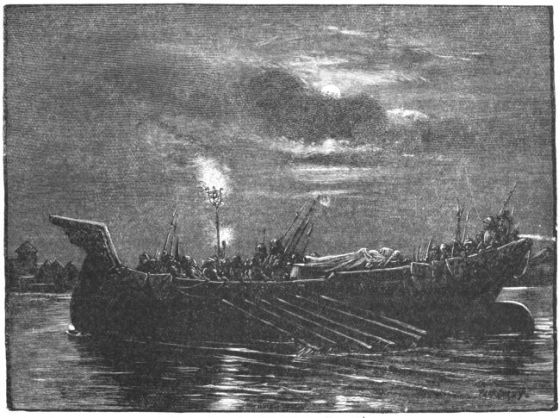
BURIAL OF KING HENRY. (See p. 36.)
The king was compelled to award to Gloucester a large share of Warwick's property; and the servile Parliament passed an act in 1474, embodying the disgraceful commands of these most unnatural and unprincipled princes. The two daughters were to succeed to the Warwick property, as though their mother, the possessor in her own right, were dead. If either of them should die before her husband, he should continue to retain her estates during his natural life. If a divorce should take place between Richard and Anne, for which Anne was striving, Richard was still to retain her property, provided he married or did his best to marry her to some one else. Thus, by this most iniquitous arrangement, while Richard kept his wife's property, they made it a motive with her to force her into some other alliance, if not so hateful, perhaps more degrading. It is impossible to conceive the tyranny of vice and selfishness carried farther than in these odious transactions. But this was not all. There was living a son of the Marquis of Montague, Warwick's brother; and to prevent any claim from him as next heir male, all such lands as he might become the claimant of were tied upon Clarence and Gloucester, and their heirs, so long as there should remain any heirs male of the marquis. By these means did these amiable brothers imagine that they had stepped into the full and perpetual possession of the enormous wealth of the great Warwick. Edward, having rather smoothed over than appeased the jealousies of his brothers, now turned his ambition to foreign conquest.
In all his contests at home, Edward had shown great military talents. He had fought ten battles, and never lost one; for at the time of the treason of Lord Montague in 1470, he had not fought at all, but, deserted by his army, had fled to Flanders. He had always entertained a flattering idea that he could emulate the martial glory of the Edwards and of Henry V., and once more recover the lost territories of France, and the lost prestige of the British arms on the Continent. His relations with France and Burgundy were such as encouraged this roseate notion. Louis XI. had supported the claims of Henry, and accomplishing the alliance of Margaret and his most formidable enemy Warwick, had sent them to push him from his throne. The time appeared to be arrived for inflicting full retribution. Burgundy was his brother-in-law, and had aided him in recovering his crown. True, the assistance of Burgundy had not been prompted by love to him, but by enmity to Warwick and Louis; nor had his reception of him in his distress been such as to merit much gratitude, but he did not care to probe too deeply into the motives of the prince; the great matter was, that Burgundy was the antagonist of Louis, and their interests were, therefore, the same.
The Duke of Burgundy, formerly Count of Charolais—called Charles le Téméraire, or the Bold—was no match for the cold and politic Louis XI. He and his ally, the Duke of Brittany, fancied themselves incapable of standing their ground against Louis, and now made an offer of mutual alliance to Edward, for the purpose of enforcing their common claims in France. Nothing could accord more with the desires of Edward than this proposition. He had employed 1473 in settling his disputes with the Hanse Towns, in confirming the truce with Scotland, and renewing his alliances with Portugal and Denmark. His Parliament had granted him large supplies. They voted him a tenth of rents, or two shillings in the pound, calculated to produce at that day £31,460, equal to more than £300,000 of our present money. They then added to this a whole fifteenth, and three-quarters of another. But when Edward entered into the scheme of Burgundy and Brittany for the French conquest, they granted him permission to raise any further moneys by what were called benevolences, or free gifts—a kind of exaction perhaps more irksome than any other, because it was vague, arbitrary, and put the advances of the subjects on the basis of loyalty. Such a mode of fleecing the people had been resorted to under Henry III. and Richard II. Now there was added a clause to the Act of Parliament, providing that the proceeds of the fifteenth should be deposited in religious houses, and, if the French campaign should not take place, should be refunded to the people: as if any one had ever heard of taxes, once obtained, ever being refunded to the payers!
All being in readiness, Edward passed over from Sandwich to Calais, where he landed on the 22nd of June, 1475. He had with him 1,500 men-at-arms, and 15,000 archers, an army with which the former Edwards would have made Louis tremble on his throne. He dispatched Garter-king-at-arms with a letter of defiance to Louis, demanding nothing less than the crown of France. The position of Louis was to all appearance most critical. If Burgundy, Brittany, and the Count of St. Pol, the Constable of France, who had entered into the league against him, had acted wisely and faithfully together, the war must have been as dreadful, and the losses of France as severe, as in the past days. But probably Louis was well satisfied of the crumbling character of the coalition. Comines, who was at the time in the service of Louis, has left us ample accounts of these transactions and, according to them, the conduct of the French king was masterly in the extreme. Instead of firing with resentment at the proud demands of the letter, he took the herald politely into his private closet, and there, in the most courteous and familiar manner, told him he was sorry for this misunderstanding with the King of England; that, for his part, he had the highest respect for Edward, and desired to be on amicable terms with him, but that he knew very well that all this was stirred up by the Duke of Burgundy and the Constable St. Pol, who would be the very first to abandon Edward, if any difficulty arose, or after they had got their own turn served. He put it to the herald how much better it would be for England and France to be on good terms, and gave the greatest weight to his arguments by smilingly placing in Garter's hand a purse of 300 crowns, assuring him that if he used his endeavours effectually to preserve the peace between the two kingdoms, he would add to it a thousand more.
The herald was so completely captivated by the suavity, the sound reasons, and the money of Louis, that he promised to do everything in his power to promote a peace, and advised the king to open a correspondence with the Lords Howard and Stanley, noblemen not only high in the favour of Edward, but secretly adverse to this expedition. This being settled, Louis committed Garter-king-at-arms to the care of Philip de Comines, telling him to give the herald publicly a piece of crimson velvet thirty ells in length, as though it were the only present, and to get him away as soon as he could, with all courtesy, without allowing him to hold any communication with the courtiers. This being done, Louis summoned his great barons and the rest of the courtiers around him, and ordered the letter of defiance to be read aloud, all the time sitting with a look of the greatest tranquillity, for he was himself much assured by what he had heard from the herald.
The words of Louis came rapidly to pass as regarded Edward's allies. Nothing could equal the folly of Burgundy and the treachery of the others. Charles the Rash, instead of coming up punctually with his promised forces, and in his usual wild way, led them to avenge some affront from the Duke of Lorraine, and the princes of Germany, far away from the really important scene of action. When the duke appeared in Edward's camp, with only a small retinue instead of a large army, and there was no prospect of his rendering any effective aid that summer, Edward was highly chagrined. All his officers were eager for the campaign, promising themselves a renewal of the fame and booty which their fathers had won. But when Edward advanced from Péronne, where he lay, to St. Quentin, on the assurances of Burgundy that St. Pol, who held it, would open its gates to him, and when, instead of such surrender, St. Pol fired on his troops from the walls, the king's wrath knew no bounds; he upbraided the duke with his conduct in thus deceiving and making a laughing-stock of him, and Burgundy retired in haste from the English camp. To add to Edward's disgust, Burgundy and his subjects had from the first landing of the English betrayed the utmost reluctance to admit the British forces into any of their towns. Artois and Picardy were shut against them, as if they came, not as allies, but as intending conquerors.
Precisely at this juncture, the herald returned with his narrative of his kind reception, and the amiable disposition of Louis. This was by no means unwelcome in the present temper of Edward. It gave him the most direct prospect of punishing his perfidious allies. On the heels of Garter-king-at-arms arrived heralds from Louis, confirming all he had stated, and offering every means of pacification. The king called a council in the camp of Péronne, in which it was resolved to negotiate a peace with France on three grounds—the approach of winter, the absence of all supplies for the army, and the failure of assistance from the allies. For two months, while the terms of this treaty were being discussed, the agents and money of Louis were freely circulating amongst the courtiers and ministers of Edward.