Chapter XVIII
Reading edition
JAMES I. (concluded).
Reign of Favourites—Robert Carr—His Marriage—Death of Overbury—Venality at Court—The Addled Parliament—George Villiers—Fall of Somerset—Disgrace of Coke—Bacon becomes Lord Chancellor—Position of England Abroad—The Scottish Church—Introduction of Episcopacy—Andrew Melville—Visit of James to Scotland—The Book of Sports—Persecution of the Irish Catholics—Examination into Titles—Rebellion of the Chiefs—Plantation of Ulster—Fresh Confiscations—Quarrel between Bacon and Coke—Prosperity of Buckingham—Raleigh's Last Voyage—His Execution—Beginnings of the Thirty Years' War—Indecision of James—Despatch of Troops to the Palatinate—Parliament of 1621—Impeachment of Bacon—His Fall—Floyd's Case—James's Proceedings during the Recess—Dissolution of Parliament—Reasons for the Spanish Match—Charles and Buckingham go to Spain—The Match is Broken Off—Punishment of Bristol—Popularity of Buckingham—Change of Foreign Policy—Marriage of Charles and Henrietta Maria—Death of James.
From the death of Cecil we may date the reign of favourites, which continued as long as the king lived. That cautious and able minister was too fond of power himself to allow it to pass into the hands of much weaker men. James, while Cecil lived, had indeed no lack of favourites on whom he lavished affluence and honours; but his cunning minister had the address to prevent him from giving them places of real power and responsibility. James therefore, so long as Cecil remained, was content to make his favourites his companions and left Cecil to conduct public affairs; but no sooner was Salisbury in his grave, than James became the slave of his favourites, who ruled both him and the kingdom.
The first of these was Robert Carr, or Ker, a young border Scot of the Kers of Fernihurst. He had been some years in France, and being a handsome youth—"straight-limbed, well-formed, strong-shouldered, and smooth-faced"—he had been led to believe that if he cultivated his personal appearance and a gaiety and courtliness of address, he was sure of making his fortune at the Court of James. Accordingly he managed to appear as page to Lord Dingwall at a grand tilting match at Westminster, in 1606. According to chivalric usage, it became his duty to present his lord's shield to his Majesty; but in manœuvring his horse on the occasion, it fell and broke his leg. That fall was his rise. James was immediately struck with the beauty of the youth who lay disabled at his feet, and had him straightway carried into a house near Charing Cross, and sent his own surgeon to him. As soon as he could get away from the tilt-yard, he hastened to him himself. He renewed his visits daily, waiting upon him himself, and displaying to the whole Court the intensity of his sudden regard for him. "Lord!" says Weldon, "how the great men flocked then to see him, and to offer to his shrine in such abundance, that the king was forced to lay a restraint, lest it might retard his recovery."
The lad's fortune was made; and though James, in conversing with him, found that he was very ignorant—the whole of his education having been directed to his outside—this did not abate his regard, for he condescended to be at once his nurse and schoolmaster. "The prince," says Harrington, "leaneth on his arm, pinches his cheek, smooths his ruffled garments. The young man doth study much art and device; he hath changed his tailors and tiremen many times, and all to please the prince. The king teaches him Latin every morning, and I think some one should teach him English too, for he is a Scotch lad, and hath much need of better language."
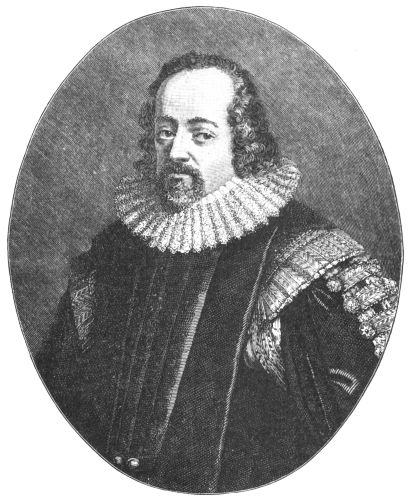
SIR FRANCIS BACON (VISCOUNT ST. ALBANS).
(From the Portrait by Van Somer.)
James found that Carr had been his page in Scotland, and that his father had suffered much in the cause of the unhappy Mary Stuart; these were additional causes of favour. On Christmas-day, 1607, James knighted him and made him a gentleman of the bed-chamber, so as to have him constantly about his person. Such was his favour that every one pressed around him to obtain their suits with the king. He received rich presents; the ladies courted his attention; the greatest lords did him the most obsequious and disgusting homage. Carr, however, had an eye to pleasing the public and therefore, Scotsman as he was, he turned the cold shoulder to his countrymen, and associated with and favoured the English; probably, too, finding this the most profitable. Those about him were almost wholly English; and his affairs were in the hands of one Sir Thomas Overbury, a man of an evil look, and with a countenance said to be shaped like that of a horse. The dark ability of this man supplied the lack of talent in his patron, and became a mine of wealth to Overbury himself. Even Cecil and the Earl of Suffolk strove to avail themselves of his services; and when Cecil quitted the scene, Carr, through Overbury's management, carried all before him. In March, 1611, he had been created Viscount Rochester; in April, 1612, he became a member of the Privy Council, and was invested with the order of the Garter. The Earl of Suffolk succeeding to Cecil's post of Lord Treasurer, Carr stepped into Suffolk's office of Lord Chamberlain, at the same time discharging the duties of the post of Secretary by the aid of Sir Thomas Overbury. The favourite's favourite, however, was no favourite of the king, who was jealous of having so much of the time and confidence of Carr occupied by Overbury, and this feeling was probably much heightened by the queen, who had an instinctive aversion to the man. On one occasion the queen succeeded in obtaining his expulsion from Court, for alleged discourtesy to her, but he soon returned; and though the king appointed Sir Ralph Winwood and Sir Thomas Lake to occupy jointly the office of Secretary of State, yet Carr, by the king's favour and Overbury's ability, remained lord paramount in the Court; Overbury himself being the avenue to every favour. On April 21, 1613, Overbury boasted to Sir Henry Wotton of his good fortune, and his flattering prospects, yet that very day saw him committed close prisoner to the Tower. Adept as he was in all Court intrigues, he had yet committed an irremediable blunder, and aroused a spirit of vengeance which nothing but his blood could quench. This spirit lived in the bosom of a beautiful girl not yet twenty years of age.
Lady Frances Howard, the daughter of the Earl of Suffolk, had been married at the age of thirteen to the Earl of Essex, the son of Elizabeth's unfortunate favourite, who was only a year older. It was a match promoted by the king out of regard, as he said, for the memory of the young earl's father. The ceremony being performed, the bride returned to the care of her mother, and the boy bridegroom proceeded, under care of a tutor, on his travels. At the end of four years he returned, and claimed his wife, whom he found the beauty and pride of the Court. But whilst he was enraptured with her loveliness, he was mortified to find that she treated him with every mark of aversion. It was only by the stern command of her father that she consented to live with him at all, and he soon discovered that in his absence her affections had been stolen away by the profligate favourite Rochester, who had won her even from another and a royal suitor, Prince Henry.
This discovery, and the constant bickerings which took place between the earl and countess, made Essex willing that a divorce should be obtained. There were others who were glad of this expedient: Lady Howard's father, Lord Suffolk, and the Earl of Northampton, Lord Privy Seal, saw in her marriage with Rochester a mode of putting an end to the rivalry which existed between them, and the king was equally eager for this result. But to Overbury the scheme boded the destruction of his power, which would be at an end if his patron coalesced with his enemies. He therefore commenced a determined opposition to the match. He it was who had written the glowing and eloquent love-letters of Rochester, and had promoted the liaison to the utmost of his power; but he had never dreamt of its leading to a marriage which must work his own ruin. He therefore represented to Rochester the odium of such a marriage; the base and abandoned character of the woman, who might do for his mistress, but was not to be thought of as a wife. When he found that his arguments did not produce the effect which he wished, he took the dangerous step of menaces, and declared that he could and would throw an insuperable bar in the way of the divorce from Essex, without which there could be no marriage. This bar was undoubtedly Overbury's knowledge of the adulterous connection which had existed between the parties, and which would certainly ruin the countess's demand of a separation.
The master of deep policy could not see the rock upon which he was running, and which would have been very clear to him in another person's case. Rochester repeated to the countess all that he said, and the rage of a sinful woman, proverbially fierce as hell, seized upon her. She vowed that she would have his life. In her first fury she offered £1,000 to Sir John Wood to kill him in a duel, but her friends interposed, and suggested a less hazardous and less criminal method of getting Overbury out of the way, which was to send him on an embassy to France or Russia. If he accepted the office, he would be detained abroad till the divorce was effected; if he refused, it would be easy to construe his conduct into a contempt of the king's service.
Overbury was sounded on the subject of a mission to Russia, and listened to it with apparent pleasure; but the young beauty could not thus satisfy her revenge, and at her instigation Rochester affected to feel his projected absence intolerable. He declared his presence and counsel were indispensable to him, and he promised to satisfy the king, if he agreed to decline the offer. No sooner did Overbury consent than Rochester, so far from excusing him to the king, represented his conduct as not only disobedient to his Majesty, but as insolent and intolerable to himself. James was only too glad to clear the Court of the hated man; a warrant was immediately issued, and Overbury was committed to the Tower. By the arrangement of Rochester and the Earl of Northampton, the lieutenant of the Tower, Sir William Wade, was removed, and a creature of theirs, Sir Jervis Elwes, was installed in his place. Under the care of Elwes, Sir Thomas Overbury was at once cut off from all communication with the outer world. Neither servant nor relative was permitted to see him; he was already dead to the world, and the world was soon to be dead to him.
The dangerous man secured, the measures for the divorce commenced. The countess petitioned for it, alleging serious grounds, and her father signed the petition. But no one was more forward and determined in carrying this disgraceful transaction through than the king. He appointed without delay a commission to try the cause. The commissioners were Abbot the Archbishop of Canterbury, the bishops of London, Winchester, Rochester, Ely, Lichfield, and Coventry; Sir Julius Cæsar, Sir John Barry, Sir Daniel Dunne, Sir John Bennet, Francis James and Thomas Edwards, doctors of civil law.
The Earl of Essex was only too glad to be rid of his virago, and consented to anything, even to the most humiliating imputations on his manhood. The real causes of the vile business were sufficiently notorious; and the Primate, though at the head of the commission, revolting at being made a tool for the accommodation of aristocratic licentiousness, strongly opposed the divorce. But James took him sharply to task, telling him in so many words that it was his duty to resign his own judgment and follow that of his sovereign. "If," he wrote, in a most imperative letter, "a judge should have a prejudice in respect of persons, it should become you rather to have a kind of implicit faith in my judgment, as well in respect of some skill I have in divinity, as also that I hope no honest man doubts the uprightness of my conscience; and the best thankfulness that you, that are so far my creature, can use towards me, is to reverence and follow my judgment and not to contradict it, except where you may demonstrate unto me that I am mistaken or wrong informed."
But James did not content himself with recommending implicit obedience; he influenced and controlled the proceedings, and intimidated the judges by all means in his power. His zeal was quickened by the receipt of twenty-five thousand pounds from Rochester, at a moment when his officers were at their wits' end for money. But do what he would, he could not bend the integrity of the Primate, who to the last resisted the divorce, and three of the doctors of law supported him. The Bishop of London also voted with him, but the rest of the bishops and civil lawyers voted for the divorce, which was carried by seven voices against five. The Bishop of Winchester showed himself so servile on the occasion, that the king knighted his son, who was ever afterwards dubbed by the people Sir Nullity Bilson. The other judges and bishops who voted according to his wish were also rewarded by James, and the sentence of divorce was pronounced on the 25th of September.
The public at large, to whom the facts of the case were no secret, condemned the whole proceeding in no measured terms, and this reprobation rose into actual horror when the news oozed out that, the very day before the verdict for the divorce, Sir Thomas Overbury was found dead in his cell in the Tower. He was buried in all haste, and with profound secrecy, the officials diligently propagating a report that he died of a loathsome and contagious disease: but the public entertained no doubt of his perishing of poison.
In the face of all this, James proceeded immediately to raise Rochester to the dignity of Earl of Somerset, that he might equal in rank, if not in iniquity, the murder-breathing countess. The marriage, moreover, was celebrated on the 26th of December, at the royal chapel in Whitehall, the king making it his own affair, being himself present, with Prince Charles, and a great crowd of bishops and noblemen. The queen kept herself commendably apart from the whole infamous business. The blood-stained bride, with a shamelessness unparalleled, appeared with her hair hanging loose on her shoulders, in the character of a virgin! Montague, Bishop of Bath and Wells, married the guilty couple, and Mountain, Dean of Westminster, pronounced a blessing upon them. Then the king gave a series of banquets and masques at Whitehall in honour of them, which continued till the 4th of January, 1614; and, as if all classes of public men were eager to disgrace themselves by sanctioning this Court wickedness, the Lord Mayor and aldermen invited the adulterous couple to a splendid banquet, given at the Merchant Taylors' Hall, on the same 4th of January, whither they were accompanied by the Duke of Lennox, the Earl of Northampton, Lord Privy Seal, the Lord Chamberlain, and the Earls of Worcester, Pembroke, and Montgomery.
From his gaieties James was called, by his eternal want of money, to face his Parliament. Since 1611, when he dissolved his last House of Commons, he had endeavoured to carry on by any illegal and unconstitutional means that the people would submit to. But the Dutch did not keep their engagement to pay off their debt of upwards of eight hundred thousand pounds by annual instalments of sixty thousand pounds, and James was too pusillanimous to adopt the means which a Cromwell would have done. He threatened war, and threatened only; and therefore became despised by his debtors, who thenceforth made no movement towards paying. Disappointed here, the only alternative was to fleece his own subjects. He resorted to the scandalous measure of selling all the places of honour and trust, and all kinds of dignities, for money. He sold several peerages for high prices. Every place under Government was to be had only for cash; nor did the proceeds of this infamous traffic always reach the king's hands, but fell into those of his minion Somerset, and the Howards, the relatives of Somerset's wife. The wicked Countess of Somerset, and Lady Suffolk, her mother, got four thousand pounds as a bribe from Sir Fulke Greville, for the Chancellorship of the Exchequer. The example thus set at Court ran through all departments, and the whole management of the country was given up to corruption and venality. So little of these proceeds of iniquity came to the king, and that little was so foolishly and recklessly given away amongst his hangers-on, that the salaries of all who were not in a situation to be bribed, and thus pay themselves, remained unpaid. In this difficulty, James hit upon a notable scheme, and originated a new order of aristocracy—namely baronets, or little barons, a link between the barons, or lowest peers, and knights. These new titles he sold at one thousand pounds apiece. Sir Nicholas Bacon was the first created for England, and Sir Francis Blundell for Ireland, in 1620. Baronets for Nova Scotia, of whom Sir Robert Gordon was first, were added by Charles I., to extend this source of income, in 1625.
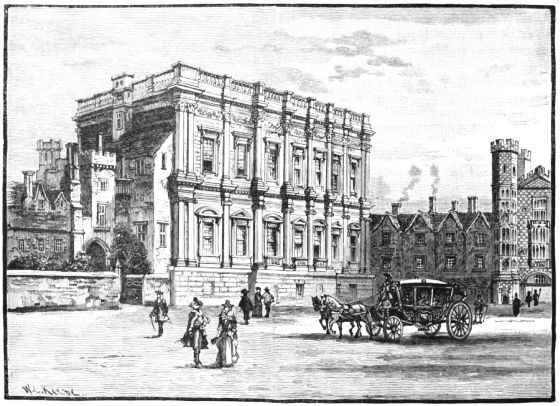
THE BANQUETING HOUSE, WHITEHALL.
James was now compelled to summon a Parliament, and Sir Francis Bacon concocted a scheme for managing the House of Commons. Bacon's plan was this, and he had regularly weighed it and drawn it up for the king's consideration: that, according to a principle afterwards made a maxim by Sir Robert Walpole, every one had his price; that the leaders of the late opposition, Neville, Yelverton, Hyde, Crew, and Sir Dudley Digges, were chiefly lawyers, and there were plenty of means, by prospects of promotion skilfully applied, to bring them zealously to the king's side; that they being once brought over, he had the talking, persuasive power of the House; and that much might be done beforehand also with the city men and country gentlemen, and where any obstinate man appeared, means might be used to keep him out. At the same time Bacon assured James that it was necessary to make a show of some concession. It was suggested that as he had promised to abolish abuses, he should at least give up some of the lesser ones; and on his accepting this plan, he and his friends were ready to "undertake" to manage Parliament, and to guarantee his Majesty plenty of money and little trouble, provided James would only avoid irritating speeches.
James's Parliament met on the 5th of April 1614, and he endeavoured to put in practice the Machiavellian instructions of Bacon by delivering a very popular speech—popular because it promised plentiful persecution for religion, which was the spirit of the day, and a liberal removal of grievances; but, as usual, first of all he placed the supply of his necessities. But the Undertakers had not succeeded in their first out-of-door efforts; there was a sturdy assemblage of popular members, and such faces appeared amongst them, according to a writer of the time, as made the Court to droop. The House of Commons at once reversed the topics of the king's speech, placing the grievances in the front and making the supplies conditional on their abolition. The royal party which the Undertakers had got together, found their pleas for slavish obedience drowned in a storm of angry demand for justice; and the House demanded a conference with the Lords on the subject. The Lords asked the opinion of the judges on the question, and especially that of Coke the Lord Chief Justice. Coke, who remembered the endeavours of Bacon to supplant him in the good graces of the king, and who hoped for no higher preferment, took the opportunity to throw cold water on the conference, asserting that the judges, after consultation among themselves, felt that they were bound by their office to decide between the king and his subjects, and were therefore equally bound not to appear as disputants or partisans on either side. The Lords on hearing this declined the conference, and Neale, who had recently been transferred from the see of Lichfield to the wealthier one of Lincoln, for his services in procuring the Countess of Essex's divorce, rose and uttered a most unbecoming tirade against the Commons, charging them with striking at the root of the royal prerogative, and anticipating that if admitted to a conference, they might use very disloyal and seditious language.
This roused the indignation of the Commons: they did not understand the etiquette of our time, which supposes what passes in one House unknown in the other; but they immediately demanded of the Lords the punishment of the man who had thus dared to slander their loyalty. On this the bishop, who was as cowardly as he was insolent, and who was hated by the Puritans as a merciless persecutor, instantly recanted in his place; and with many tears, and fervent declarations of his high respect for the Commons, denied many of the offensive expressions attributed to him. But the House was not thus to be appeased. The members were greatly exasperated at the plan of managing them, which had become public, and fell on Bacon as the author of the scheme. The versatile Sir Francis pretended to ridicule the very idea of any such scheme being in existence, as the king had done in his opening speech, but the House gave him no credit; they proceeded to question even his right to sit in their House, on his accepting the office of Attorney-General, and only permitted it as a special indulgence, which was not to be drawn into a precedent.
The king, who saw no chance of supplies in the present temper of the House, sent them a sharp message, desiring them to proceed to the business of the supplies, attended with a threat of immediate dissolution in case of non-compliance. This produced no effect, and the House was dissolved on the 7th of June. Having thus broken the immediate power of retaliation in the House, he, the next morning, arrested the most refractory members and committed five of them to the Tower, amongst whom was Wentworth, a lawyer, destined to act a very prominent part in the next reign. These members were not discharged till they had, by their admissions, occasioned the king to arrest others, who were committed in their turn. This Parliament obtained the name of the Addled Parliament, because it had not passed a single bill, but it had displayed a spirit which was pregnant with the most momentous consequences. It had laid the foundation of the rights of the Commons, and at the same time had displayed its rigid temperament, by issuing an order which excluded all Catholics, and by making it necessary for every member, before taking his seat, to receive the Sacrament according to the form of the Church of England.
James had indeed got from the determined tone of the House a fright which lasted him nearly seven years. He returned to his usual unconstitutional modes of extorting revenue. Besides the sale of monopolies and privileges, he compelled the payment of benevolences, an odious tax, not only because raised without sanction of Parliament, but because its name implied a free gift. Those who resisted these modes of royal robbery were dragged into the Star Chamber, and there sentenced to enormous fines. Mr. Oliver St. John, a gentleman who had not only refused such payment, but had vindicated his conduct in an able letter, in which he commented freely on the king's violation of Magna Charta, was fined by the tyrannic Star Chamber five thousand pounds, and ordered to be imprisoned during the king's pleasure.
A new era now arrived in the history of the king's favourites. Though the Countess of Somerset was hardened enough to stalk through adultery and poison to the gratification of her desires, and show no remorse, it appears that her new husband was not altogether of so callous a nature. From the moment of the death of Overbury, he was a totally changed man. All pleasure in life had deserted him; he had lost all his gaiety and went about moody and morose. His person became neglected, his dress disorderly, and even in the king's company he was absent of mind and took no pains to please him. This was not lost on those courtiers who envied the favour of the Howards, who now enjoyed complete ascendency through their wicked kinswoman. The Earls of Bedford, Pembroke, and Hertford maintained a sharp watch for a new favourite to bring before James, confident that a suitable man once found, the day of Somerset was over. This man soon appeared in a youth of the name of George Villiers, the younger son of Sir George Villiers of Brooksby, in Leicestershire. Sir George was dead, and young Villiers had been brought up under the care of his mother, who was at once one of the most beautiful and infamous women of her time. She saw in the beauty and grace of this boy the means of advancing the fortunes of the whole family. She therefore carefully educated him to win the favour of the favourite-loving king, confident that if he once attracted his attention, the result was sure. This far-seeing and ambitious woman therefore sent the lad to France, to acquire the gay and easy manner of that Court.
His courtly education being considered perfect, at the age of one-and-twenty, the post of cup-bearer to his Majesty was purchased amongst the lavish sale of offices of the time, as one that must unavoidably place him under the eye of the king. Accordingly, he appeared in that employment with a fine suit of French clothes on his back, and as many French graces as any silly modern Solomon could desire. He was a fine, tall young fellow, and pre-eminently handsome, at the same time that he was one of the emptiest, haughtiest, and most profligate men that ever lived. Time, however, was yet to display these qualities; they were at present concealed under a garb of finished courtesy and agreeable manners. The Herberts, the Russells, and the Seymours were delighted; and it was planned that young Villiers should discharge his office of cup-bearer at a supper entertainment at Baynard's Castle, in such a manner as must strike the imagination of the king. James was, according to expectation, smitten with the looks of the youth, and pointed out his imagined likeness to a beautiful head of St. Stephen at Whitehall, whence he gave him the pet name of "Steenie," which he always after used.
Villiers once installed in James's good graces, the fall of Somerset was easy, and no time was lost in effecting it. Somerset was not so lost to observance of what passed around him as to be unaware of some danger; probably his vigilant spouse brought the fact to his attention. He therefore solicited a pardon of the king, in full and formal style, of all and everything which he might have done, or should hereafter do, which might subject him to a charge of treason, misprision of treason, felony, or other accusation. James, who had not yet been incited to his destruction, with his usual facility in such matters, especially when under certain genial influences, freely granted it; but the Lord Chancellor Ellesmere refused to put the Great Seal to such a document, declaring that it would subject him to a Præmunire. After all, it might be a ruse of James to grant this pardon, thus still preserving an appearance of favour to Somerset, as he did to the last moment, knowing that a hint to Ellesmere, who was a very compliant creature of his, would prevent the deed taking effect. James went further; he sent Villiers to Somerset, to assure him that he desired not in any way to interfere between him and the king's favour, but would seek preferment only through his means and be "his servant and creature;" to which Somerset, with the moroseness which had become his manner, replied, "I will have none of your service, and you shall have none of my favour. I will, if I can, break your neck."
Matters now being ripe, Mr. Secretary Winwood was induced by Archbishop Abbot, under promise of protection from the queen, to communicate to James the popular rumour that Overbury had been poisoned in the Tower, and that this had been confirmed by some admissions of Elwes, the lieutenant of that fortress, in conversation with the Earl of Shrewsbury. That the old favourite had lost his place in James's heart was immediately evident. He took up the matter with his usual avidity where a mystery was to be probed. He put a number of questions to Elwes in writing, and demanded, on pain of his life, a faithful answer. The answer satisfied James that Somerset and his wife were guilty of this foul murder. He immediately sent for the Lord Chief Justice Coke, and ordered him to arrest them. Coke demurred till the king had named several others in commission with him. This being settled, this extraordinary royal dissembler set out to Royston to hunt, and took Somerset with him, showing him all his old marks of fondness. In the days of his real favour he had refused him not the most iniquitous request. Even when the wife of Sir Walter Raleigh, on his first condemnation for treason, had gone down on her knees to him, to implore him to spare his castle and estate at Sherborne, in Dorsetshire, for his children, James had ruthlessly replied, "Na, na; I maun hae the land; I maun hae it for Carr." And at this moment, when he was dooming the same Carr to destruction, he was pretending the same infatuated regard. When the Chief Justice's messenger arrived at Royston with the warrant, he found the king hanging about Somerset's neck, kissing him in the true Judas style, and saying, "When shall I see thee again? When shall I see thee again?"
When the warrant was delivered to Somerset, in the midst of these disgusting affectations of endearment, he exclaimed that never had such an affront been offered to a peer of England in presence of his sovereign. "Nay, man," replied the royal hypocrite, coaxingly, "if Coke sends for me, I maun go;" and as soon as Somerset's back was turned, he added, "Now the deil go with thee, for I will never see thy face mair." Soon after Coke himself arrived, to whom James indignantly complained that Somerset and his wife had made him a go-between in their adultery and murder. Even his enormous self-conceit was so far overcome, as to compel him to admit that he had been grossly duped. He commanded Coke to search the affair to the bottom, and to spare no man or woman that he found guilty, however great or powerful. "And," added he, "may God's curse be upon you and your house if you spare any of them; and God's curse be upon me and mine, if I pardon any of them."
Coke seemed quite willing to act as vigorously and unsparingly as the king could desire. The commissioners, of whom he was the chief, subjected the adulterous pair to no less than three hundred examinations, and then announced that they found ample proofs of their guilt; that Frances Howard, formerly Countess of Essex, had resorted to sorcery to incapacitate her then husband, the Earl of Essex, and to procure the love of Lord Rochester; that, finding Sir Thomas Overbury an obstacle to their criminal designs, they had, by the assistance of the countess's late uncle, the Earl of Northampton, procured the commitment of Sir Thomas to the Tower, and the removal of the lieutenant, and the appointment in his place of their creature Elwes, and of one Weston to be the warder of the prisoner; that this Weston had formerly been the servant of Mrs. Turner, a woman famous for the introduction of yellow starch for ruffs, and an early companion of the said Lady Frances Howard; that, through Weston and Mrs. Turner, the countess had procured three kinds of poison from one Franklin, an apothecary; and that Weston had administered these poisons to his prisoner Overbury, and thus procured his death. Coke added that, from private memorandum books and letters which he had found amongst the papers of the prisoners, he had discovered that Somerset had undoubtedly poisoned Prince Henry. The queen is said to have been greatly excited by this intelligence, and had all her former belief of this poisoning revived. She declared her full conviction that Somerset and his clique had planned the removal of herself, and her son Charles also, in order to marry the Princess Elizabeth to the son of the Earl of Suffolk, brother to the countess. But James was too well satisfied by the post mortem examination of the body of Prince Henry, and by the insufficiency of Coke's proof, to be led into this absurd belief, though he admitted a persuasion that Somerset had received money from Spain on condition of delivering up the Prince Charles to that monarch.
Though the minor confederates were promptly hanged, the trial of Somerset and his wife was deferred till April, 1616. The real cause of delay was probably the fear of bringing a man like Somerset, who had been so long in all James's secrets, to trial, lest he should avow something in his despair to the damage of the royal reputation. Certain it is that, when the time of trial approached, James betrayed the most extreme terror and uneasiness, and omitted no means to induce Somerset to make a full confession in private, offering him both life and restoration to his estates. He sent messenger after messenger to Somerset in prison, the Attorney-General Bacon being the principal, James Hay, afterwards Earl of Carlisle, another, with whom was employed Somerset's late private secretary. They did all in their power to induce Somerset to accept the king's terms, but he remained obstinate, replying, when offered life and fortune, "Of what use is life when honour is gone?" He demanded earnestly to be permitted to see the king himself, declaring that in half an hour's interview he could place all in so clear a light as should perfectly satisfy his majesty. This interview James declined, as well as a proposal to send a private letter to the king. These requests being refused, he assumed an attitude of menace, declaring that whenever he was brought into court, he would make such avowals as should astonish the country, and cause the king to rue his rejection of his offers. James displayed much alarm on hearing of this.
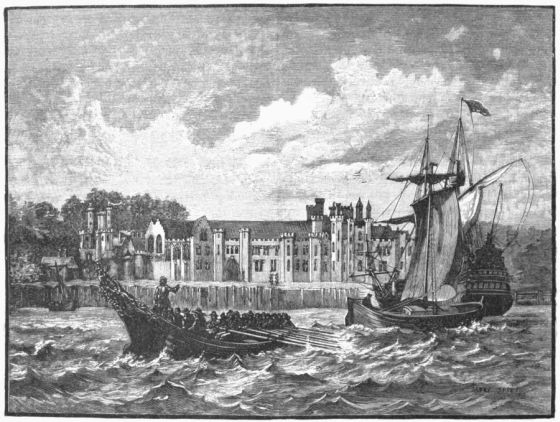
GREENWICH PALACE IN THE TIME OF JAMES I.
On the 24th of May the countess was brought before the Peers, where, as she had already confessed, she had only to plead guilty. She was extremely agitated, pale, spiritless. She trembled greatly all the time that the clerk was reading the indictment, and put her fan before her face at the mention of Weston. Her words were nearly inaudible, through weeping, as she pleaded guilty, and threw herself on the royal mercy. This done, she was removed from the bar before the sentence was pronounced, during which interval Bacon delivered a perfectly unnecessary speech, as she had pleaded guilty, detailing the damning facts which he was prepared to produce, had he been compelled by her denying her guilt. This manœuvre was intended to criminate Somerset, without the hazard of his wife's declaring his innocence on hearing him implicated. Bacon's purpose being served, she was recalled, and the Lord Chancellor Ellesmere, who acted as High Steward on the trials, pronounced sentence of death upon her.
That day Somerset was informed that he would go to trial on the morrow: they had not deemed it safe to try him and his wife together. On hearing this he went into a great rage, declaring that the king had assured him that he should never go to trial, and protesting that if they took him there, it should be by force and in his bed. He repeated his former threats, adding the king dared not bring him into open court. More, the lieutenant of the Tower, was so alarmed at this temper and language, that he hastened away to James at Greenwich, though it was getting late, and was midnight when he reached the palace. He was hastily admitted to the king's chamber, and James, on hearing his statement, burst into an agony of tears, and exclaimed: "On my soul, More, I wot not what to do. Thou art a wise man: help me in this great strait, and thou shalt find thou dost it for a thankful master." More promised to do his best, and was afterwards actually rewarded for his services on this occasion with a suit worth to him fifteen hundred pounds, though the Earl of Annandale, his great friend, managed to get half of it.
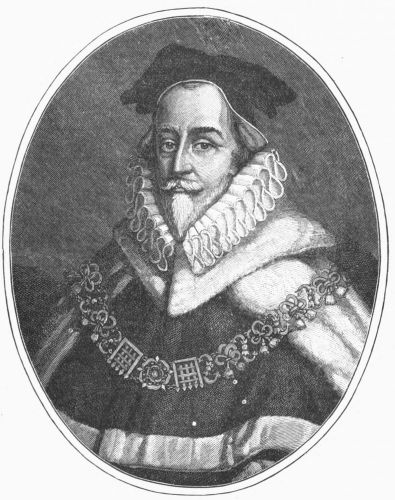
SIR EDWARD COKE.
(From the Portrait by Cornelius Janssen.)
The lieutenant hastened back to the Tower, and told Somerset that he had communicated his wishes to the king, who was in the most gracious disposition towards him, and sent him assurance that though for form's sake he must appear in court, he should not be detained there by any proceedings; but whilst he had there an opportunity of seeing his enemies and their malice towards him, the royal power should protect him from any harm.
This appeased the rage of Somerset, and he prepared calmly to make his appearance in the morning. But even then the officers of the court were by no means secure of the result when he should find himself compelled to plead, notwithstanding the royal promise. Bacon had planned all necessary cautions for this emergency, as we find from his "Particular Remembrances for his Majesty," preserved in the State Trials. "It were good," he says, "that after he is come into the hall, so that he may perceive that he must go to trial, and shall be retired to the place appointed till the court call for him, then the lieutenant shall tell him roundly that, if in his speeches he shall tax the king, the justice of England is that he shall be taken away, and the evidence go on without him; and then all the people will cry away with him, and then it shall not be in the king's power to save his life, the people will be so set on fire."
The lieutenant had carefully acted on this plan, and had provided two servants, each with a cloak on his arm, to stand behind Somerset, so that if More's representations did not after all prevent Somerset from speaking out to the discredit of the king, they should throw the cloaks instantly over his head, and drag him from the bar, from all consequence of which proceeding he promised to protect them.
These singular precautions, which betrayed an awful terror on the part of the king of some withering exposure from the exasperated favourite, so far prevailed, that Somerset stood upon his trial with apparent calmness, but refused steadfastly to plead guilty. Bacon, on his part, was careful in stating the charges against him, to do it so mildly that the prisoner should not be excited to any dangerous pitch. Somerset never mentioned the king, but he defended himself resolutely and with consummate ability. He analysed the whole string of charges brought against him, explained away whatever appeared to tell most forcibly to his disadvantage, and for eleven hours prolonged the trial and the intolerable agony and suspense of the king, who, during the whole time, was in the most pitiable condition of terror. "But who had seen," says Sir Anthony Weldon, in a passage which is fully borne out by the letters of More, the lieutenant, "the king's restless motion all that day, sending to every boat landing at the bridge, cursing all that came without tidings, would have easily judged that all was not right, and that there had been some grounds for his fears of Somerset's boldness; but at last, one bringing him word that he was condemned, all was quiet."
In the course of a few weeks James actually granted a pardon to the murder-stained countess, on the plea that she was not tried as a principal, but as an accessory before the fact; though all the facts of the case go to show that she was the chief instrumental instigator of the death of Overbury. He also offered the same grace to Somerset; but the proud, though fallen, favourite haughtily refused it, saying that he was an innocent man, who therefore needed no pardon, but expected a reversal of his sentence.
Time, however, showed him that the favour of the prince had passed on to others, and that his enemies were working for further injury to him; he therefore condescended in the autumn of 1624 to petition for the pardon formerly rejected. It was granted on the 24th of October, with a promise of the restoration of his property. James meanwhile allowed him an income of four thousand pounds a year, and protected him from the infamy attaching to his condemnation. He would not allow him to be expelled from the Order of St. George, nor his arms to be reversed in the chapel of that saint at Windsor.
The guilty earl and countess are said to have retired together into the country, not to the felicity of innocent affection but, as it was said, to mutual hatred and recrimination. The countess died in 1632; the earl, who never recovered his estates, lived on thirteen years longer. Their only child, Lady Ann Carr, who was born in the Tower, was married to William, the fifth Earl, and afterwards Duke, of Bedford, and became the mother of the celebrated Lord William Russell, who perished on the scaffold under Charles II. Out of such a soil can rise such plants; nay, even the daughter of this infamous couple is declared to have been a woman of the purest and noblest character; and so carefully was the horrible history of her parents kept from her, that it never reached her ears till a few years before her own death. The Earl of Essex, so cruelly treated in this revolting affair, lived to lead with high distinction the army of the Commonwealth.
Fast on the fall of Somerset followed that of the Chief Justice Coke. He had rendered distinguished service to James in hunting out the evidence and bringing to punishment the favourite and his wife; but he had neutralised this benefit by his haughtiness and opposition to the royal authority in other respects. Coke and Bacon had pursued two opposite systems of policy in their courses towards the highest honours of the State. Bacon had affected liberalism and a championship of popular rights, which the higher he rose the more he sacrificed to the pleasure of the monarch. There was a profound flattery in this, for it seemed to give an additional value to his growing attachment to the Crown, that it was won from his original bias towards the people. On the other hand, Coke commenced as a thorough-going supporter of the prerogative, and as his abilities were pre-eminent, and his prosecution of State offenders unrestrained by any scruples of conscience, he did the work of that despotic prince with a gusto and a ruthlessness which highly delighted his employer. No lawyer, except Jeffreys, in a later age, ever indulged in the same unsparing abuse of those against whom he was retained. His disposition was not merely unfeeling, it was truculent, and the insolence of his language was beyond all former experience. When let loose on a victim, he certainly was no respecter of persons; an Arabella Stuart or a Raleigh were abused in a style which would not now be tolerated towards the most abject criminal. But when Coke had reached the summit of his ambition, and thought the height to which he had climbed secure, he began to display the inherent pride of his nature, by assuming an independence of manner and a haughtiness of opinion, exhibited even towards the Throne, which astonished and irritated James. In the Commons he openly opposed the claims of prerogative, came out in defence of popular rights, and ended where Bacon had begun. From abject servility he rapidly passed to daring opposition. On the subject of the late benevolences, he stood forward as a patriot in the Commons; in the case of Peacham, that which was prosecuted as treason, Coke declared was only defamation; and in that of Owen, he agreed with the prisoner that he had committed no treason in saying that the king, if excommunicated, might lawfully be killed, because the king not having been excommunicated, the opinion could not apply to him. These declarations, both in Parliament and on the Bench, roused James to a keen resentment, and this was continually augmented. He set his own court of the King's Bench above every other, and threatened with the penalties of a Præmunire the judges of the Court of Chancery, and all other judges who should grant relief in Equity after judgment had been pronounced in the King's Bench; and he extended the same menace to all suitors who sought for such relief. The judges of the Courts of Admiralty, of High Commission, of Requests, of the Duchy of Lancaster, and even the presidents of the Councils of the North and of Wales, felt their jurisdictions invaded and repressed by his pretensions. The Court of Star Chamber even, hitherto above all law, was called in question by him, and its power to levy fines in many cases denied. He went farther, and, as in the case of Owen and Peacham, dictated to the Privy Council, and contradicted the Sovereign to his very face.
It would seem as if at the moment when Coke was hunting down his former benefactor Somerset, the secret decree had gone out from the king against the Lord Chief Justice himself. Somerset was condemned on the 25th of May, and on the 30th of June Coke received an order from the king to absent himself from the Council chamber, and not to proceed on his circuit, but to employ himself in correcting the errors in his Book of Reports. He had outraged James's sense of his own supreme authority, by opposing him in the matter of Commendams and bishoprics, and had, moreover, contended with Villiers, the new favourite, respecting a patent place at Court. Long before he received this startling order for the suspension of his diplomatic and judicial functions, the Archbishop, the Chancellor, and Mr. Attorney-General Bacon had been employed by royal command to collect charges against him. He was now charged with concealing a debt of twelve thousand pounds, due from the late Chancellor Hatton to the Crown; with contempt of the king's authority in declaring from the Bench that the Common Law would be overthrown by proceedings in Equity, or by claims of prerogative; and for disrespect to the Crown in the affair of the Commendams.
The charge regarding the money Coke refuted when brought before the Council, and confirmed his case by a decision at law; as to the second charge, he explained it as in no way reflecting on the king; and for the third, he humbly solicited his majesty's forgiveness. James professed to retain the highest regard for the Lord Chief Justice, and intended, on his showing a proper humility, to continue to him his favour; but when Coke brought in his Book of Reports, and maintained that he could only find five trivial errors in it, James, in great anger for his "deceit, contempt, and slander of government," dismissed him from the Bench, and made Montague, the Recorder of London, chief justice in his place. Coke, with all his harshness and cutting style to others, felt for himself keenly, and is said to have wept like a child on receiving his dismissal. Bacon displayed anything but a philosophical magnanimity on the fall of his rival. He not only joked with Villiers on the disgrace of the great man who had offended the favourite, but he wrote a most insulting letter to the fallen judge, which was particularly odious from being garnished with the cant of piety.
Bacon now looked confidently towards the Chancellorship, and in March of the next year (1617) Brackley resigning from age, the Great Seal was transferred to him, with the title of Lord Keeper. Sir Francis had reached the elevation to which he had so long and so ardently aspired, by a slavish advocacy of the most unlimited claims of prerogative and, as far as in him lay, the restriction of constitutional liberty—a deplorable instance of how completely the most transcendent talents can be united in an ignoble and mercenary nature. Indeed, the conduct of Bacon on this occasion was vain and weak to a pitiable degree. Though he had now reached the mature age of fifty-four, and drew an enormous income from his grants and offices, he was so profuse of expenditure that he was a needy man, pressed with difficulties, which he saw in the Chancellorship an exhaustless means of dispersing. His vanity burst forth to a surprising extent and he assumed all the state of a Wolsey. He rode to Westminster Hall on horseback, in a gown of rich purple satin, and attended by a crowd of nobles, judges, great law officers, lawyers, and students, rivalling even the splendour of the king.
While these affairs were progressing at home, the credit of James abroad had sunk very low. At the conference for effecting a truce between Holland and Spain, held at the Hague—a conference which established the independence of the Low Countries—the English ministers had been made to feel the ignominy of their position, compared with the dignity of the ambassadors of Elizabeth. Prince Maurice told them openly that their master dare not open his mouth in contradiction to the King of Spain; and their allies, the French, in consequence assumed a superiority throughout the negotiations which mortified deeply the English envoys. Nor was that the only slight which James's truckling policy brought on him abroad. He was anxious to ally his son to the Court of Spain, notwithstanding the intense aversion of his subjects from the idea of a Catholic Princess. But Spain declined the offer. He next applied for the hand of Madame Christine, sister to Louis XIII. of France; but here again he was met with the contempt which his mean and insecure character merited: France preferred the suit of the Duke of Savoy. It was never before the fortune of England to have to go begging to the Continental states for wives for its princes: they had hitherto been only too officiously pressed on its acceptance.
We must now trace the proceedings of James in Scotland and Ireland, where he was anxious to establish his principles of Church and State supremacy as thoroughly as in England, and where the seed he sowed rapidly grew into the same harvest of bloodshed and revolution as on the south side of the Tweed.
The Church of Scotland, as established by Knox and his contemporaries, was, like Switzerland (from which they brought the idea), a republic. It acknowledged no head but Christ, nor any concern which the State had with it, except to furnish the support of the ministers whose lives were devoted to the civilisation and religious improvement of the community. The minister and the lay elders of a parish constituted the parochial assembly, which governed all the spiritual affairs of that little circle; a certain number of these assemblies constituted a presbytery, which heard all appeals from the parochial assemblies, and sanctioned the appointment, suspension, or dismissal of their ministers. Beyond the presbytery extended the provincial synod, and the General Assembly claimed the supreme management of the affairs of the Church under God.
This free form of the Scottish Church had always been extremely repugnant to James's despotic notions. Even when he professed to admire its constitution as the purest and most perfect on earth, he was writhing under its authority; and no sooner did he ascend the English throne than he avowed his real opinion of its inconsistency with monarchy. The hierarchy of England delighted him; he regarded it as the surest bulwark of the Throne, and bishops he seemed to regard as the guarantees of royal security. "No bishop no king," was his favourite motto; and the hatred of presbytery which he expressed at Hampton Court led him to seek its utter overthrow in Scotland. He knew the sturdy materials that he had to deal with in the Scottish ministry and people, who had driven out his mother in their hatred of Catholicism; yet this did not deter him from endeavouring to plant episcopacy as firmly in Scotland as in England. He looked on the spirit and form of the Scottish Church but as one remove from republicanism in the State; and his first step, taken in 1605, was a bold one, being no less than to assume the right to prorogue the General Assembly at will. This was at once annihilating the theocratic constitution of the Assembly, and placing the king at its head. This measure was carried out by Sir George Home the Lord Treasurer of Scotland, afterwards Earl of Dunbar. The ministers, though prorogued, met again in defiance of the royal fiat, but were dissolved again and again. The ministers from nine presbyteries still boldly met in assertion of the paramount right of the Church, at Aberdeen, called themselves "an Assembly," appointed a moderator, and before dissolving at the command of the Council, adjourned their sitting to a fixed time that year.
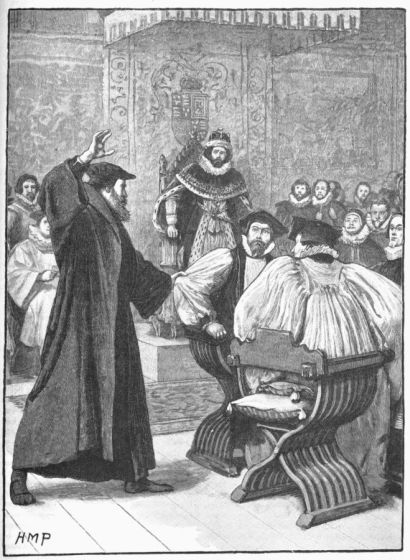
ANDREW MELVILLE BEFORE THE SCOTTISH PRIVY COUNCIL. (See p. 462.)
Thirteen of the most prominent ministers were immediately arrested on the charge of having violated the Act of 1584, "for maintenance of the royal power over all estates." The jury was packed by Dunbar, and six of the most refractory clergy were condemned as guilty of high treason, and banished for life. They retired into Holland and France, and were followed thither by numbers of their admirers. Meanwhile, at home, undaunted by this lawless exercise of power, the ministers offered up prayers for their exiled brethren, whom they boldly proclaimed from their pulpits as martyrs to the freedom of the faith; and unsilenced by the menaces of the Court, loudly warned the people of the impending danger to the Church.
But James, with the blind hardihood of a true Stuart, went on, and in 1606 appointed thirteen clergymen to the ancient abolished bishoprics, and gave them precedency in the synods and Assembly. The ministers refused to submit to their authority, and, as they were unsupported by the old reverence, treated their assumed dignity with contempt. But James went on to repeal the Act which had confiscated the episcopal estates, endowed the bishops, and made them moderators of both synods and presbyteries within their own districts. He erected two courts of High Commission, and indeed gave them a power such as their predecessors had never possessed. In 1610 three of these bishops went to England, and received episcopal ordination from the English prelates, and on their return conferred it on their colleagues. And finally, in 1612, it was enacted by the Scottish Parliament that all General Assemblies should only be appointed by the Crown; that the bishops only should present to livings; that they should admit no one who would not first take the Oath of Supremacy to the king, and of canonical obedience to the bishop; that they should possess the power of deprivation and the right of visitation, each in his own diocese.
Andrew Melville, the successor of Knox, boldly though respectfully denied these innovations, asserting the freedom of conscience, and its immunity from the power of any earthly potentate. When pressed by some slavish Scottish lords to conform, he said: "My lords, I am a free subject of Scotland, a free kingdom, that has laws and privileges of its own. By these I stand. No legal citation has been issued against me; nor are you and I in our own country, where such an inquisition, so oppressive as the present, is condemned by Parliament. I am bound by no law to criminate or to furnish accusations against myself. My lords, remember what you are; mean as I am, remember that I am a free-born Scotsman, to be dealt with as you would be dealt with yourselves, according to the laws of the Scottish nation."
This was noble and patriotic language; but Melville had to deal with a vain despot, who declared himself above all laws. He insisted on their attending the royal chapel to hear the preaching of his bishops. The plain presbyterian Scots were scandalised at both what they saw and heard there: at the ceremonies, the gilded altar, the chalices, and tapers, but above all, at the slavish doctrines of those courtly preachers. The Scottish ministers did not hesitate to express their contempt and indignation at the whole spectacle, and Melville ridiculed the entire service in a Latin epigram. For this audacity James summoned him before his Privy Council; but the preacher's blood was now chafed beyond restraint, for he and his colleagues, though they were impatient to get away from what they considered this idolatrous scene, where the conduct of the bishops and clergy was by no means edifying, had been compelled to stay. So far from expressing any regret for his satire on the royal mode of worship, he denounced in the strongest terms the whole system of the Anglican Church, and in his excitement seized the surplice of the primate, and shook angrily what he called the Romish rags of the Archbishop of Canterbury.
James committed him to the Tower for his contumacy (1606), where he kept him four years, and then banished him for life. He went to reside at Sedan, where he died in 1622. His nephew, James Melville, was shut up at Berwick, and died six years before his uncle; the rest of the preachers were banished to remote districts of Scotland, wide apart from each other.
To put the finish to this daring change, James determined to make a journey to Scotland himself in 1617. On leaving that country he had assured his Scottish subjects that he would visit his ancient capital at least once in three years: fourteen years had now elapsed without his redeeming his word, his poverty having hitherto presented an insurmountable obstacle. But he had now consented to yield up the cautionary towns, Brell, Flushing, and Rammekens, for 2,728,000 florins instead of 8,000,000, which were due to him. He had been induced to this by his necessities and the persuasions of Secretary Winwood, who was said to have received £29,000 from the Dutch for his services on the occasion. James now discharged some of his most pressing debts, and obtained a loan of £96,000, with which he set forward to Scotland in the spring of 1617.
On the 7th of June the Scottish Estates met, and James excluded such of the representatives as he knew were hostile to his object of establishing the English Church in all its forms and authority, as the State Church of Scotland for ever. But the Peers, alarmed lest he should restore to his pet church the lands of which they now were in possession, rejected the articles which he recommended. To win over these nobles, James invited them to a secret conference, in which he assured them that no revocation of these lands should be made. Reassured on this head, the Peers were ready to vote as he pleased, and he opened the Estates in one of his vaunting speeches about his power, in which he told his audience that "he had nothing more at heart than to reduce their barbarity to the sweet civility of their neighbours; and if the Scots would be as docible to learn the goodness of the English as they were teachable to limp after their ill, then he should not doubt of success; for they had already learnt of the English to drink healths, to wear coaches and gay clothes, to take tobacco, and to speak a language which was neither English nor Scottish."
In this insolent speech the king might have included himself both as to clothes and language; but these were small matters in comparison with those which he had in view. He brought in a Bill to enact that what the king might determine upon regarding the Church, with the concurrence of the bishops and a certain number of the clergy, should be good in law. At this proposition the ministers were instantly in arms, and presented so determined a remonstrance against it, that he became afraid and gave it up, saying it was unnecessary to give him that by statute which was already his by authority of the Crown. He managed, however, to carry a Bill adding chapters to the bishoprics, regulating the appointment of bishops, and also one for converting the hereditary offices of sheriffs into annual ones, which he would thus be able to influence. Never, surely, with a spirit so essentially cowardly, was there a monarch so ingrained with the bigotry of absolutism, or who so perseveringly laboured to annihilate every liberty of the subject, and leave the nation a base and soulless heritage of the Crown. But the nation was not thus to be trodden into a horde of serfs; and though James escaped to a quiet tomb, it took a terrible vengeance on his children, whom he had inoculated with his incorrigible lust of absolutism.
As nothing more was to be obtained from Parliament, the uncouth tyrant wended his way to St. Andrews, where he had planned a severe retribution for the remonstrant ministers, from a more obsequious tribunal. There the ministers having met at his summons, he singled out Simpson, Ewart, and Calderwood, who had signed the remonstrance which baulked him of his full intentions, and brought them before the High Commission Court, and condemned Simpson and Ewart to suspension and imprisonment. Calderwood, who by his influence and ability excited most of all his dread and resentment, he banished for life. Having thus given the ministers a sharp lesson, he now announced to them that it was his will that the whole ritual of the English Church should be adopted in Scotland in five articles, the name of which afterwards became famous, namely:—1st, That the Eucharist should be received in a kneeling, and not in a sitting, posture, as had been hitherto the mode in Scotland; 2nd, That the Sacrament should be given to the sick at their own houses when they were in danger of death; 3rd, That baptism should, in like cases, be administered in private houses; 4th, That the youth should be confirmed by the bishops; and 5th, That the festivals of Christmas, Good Friday, Easter, Ascension Day, and Whit-Sunday, should be observed in Scotland just as in England. These commands were received with unequivocal marks of displeasure by the ministers, but the fate of the three remonstrants availed to keep them silent for a time, and James regarded his plans as fully accomplished; but presently the preachers fell on their knees and implored him to refer the Five Articles to the General Assembly of the Kirk. James for some time refused to listen to them, but on Patrick Galloway assuring him that matters should be so managed that all should go right, he consented.
He then kept his Whitsuntide in the English fashion, with all his crouching prelates and courtiers around him; and afterwards took his way homeward, in the full persuasion that he had succeeded in his object. Time told a very different tale; nor was he himself long in perceiving that, though he had overawed, he had not subdued the sturdy Scottish clergy. Scarcely had he reached England when he learned that the Scots, both clergy and laity, were loud in denouncing the administration of the Eucharist in private houses as a remnant of Popery; the revival of the festivals of Christmas as the return to the ancient Saturnalia; and of those of Easter and Whitsuntide as the renewal of the feasts of the Jews. And on the 24th of November the ministers, in their assembly at St. Andrews, confirmed none of the Five Articles except that of the administration of the Sacrament at the houses of the sick, provided that the sick person first took an oath that he or she did not expect to recover. James was highly enraged. He ordered the observance of the Five Articles to be commanded by proclamation, and withdrew the promised augmentations of stipend. Nor did the king give way in the slightest degree. The next year he managed the Assembly so far, through Lord Binning, as to carry the Articles by a majority of eighty-six against forty-one; and in 1621, three years later, he obtained an Act of Parliament enforcing these Articles on the repugnant spirit of the people. Dr. Laud, whose name we now meet for the first time, afterwards to become so notorious, even urged James to go further lengths; but his fatal advice was destined to act with more force on the next generation.
Whilst James's hand was in, however, he hit upon another mode of incensing the Puritans, and showing his dislike of them. He had been extremely annoyed by the severity of the Presbyterian manners during his visit; and when, on returning, the Catholics of Lancashire presented to him petitions complaining of the strictness of the Puritans, who forbade those sports and recreations to which they had been accustomed on Sundays after service, adding that it drove men to the ale-house, a bright idea occurred to him, and he determined to publish a Book of Sports, encouraging the people on Sundays, after church, to play at running, leaping, archery, morris-dances, and to enjoy their church-ales and festivities as aforetime. These sports, however, were not to be indulged in by the recusants, nor any who had not attended Church in the morning. He also prohibited on Sundays bull and bear-baitings, interludes, and bowls; the last, probably, because they led to gambling. He restored all the jollity of may-poles and rush-bearings.
Many of the established clergy were conscientiously opposed to this mode of spending the Sunday, which appeared to them to savour greatly of Papacy; but James persisted in his scheme, and not only published his Book of Sports, but ordered the bishops, each in his own diocese, to publish his ordinance regarding the Sunday amusements. Abbot, the Primate, is said to have steadfastly refused to read the book in his own church at Croydon, but the other bishops complied. Laud was zealous in its promulgation, and in after years roused the stern and undaunted spirit of the reformers by recommending the revival of the Book to Charles I.
In Ireland the same system had been pursued by James from the commencement of his reign, of endeavouring to force the consciences of his subjects into the mould of his own ideas. On the death of Elizabeth the Irish had openly resumed the Catholic worship in most of the South of Ireland. Mountjoy, the Lord-Deputy, issued a proclamation for its immediate suppression; but the fear of the old lioness of a queen being removed, they treated his orders with contempt and defiance. Mountjoy marched down upon them, and compelled submission at the point of the bayonet, and then passed over to England, having with him the two great chiefs, Tyrone and O'Donnell, with a number of their followers.
These chieftains being well received by James, Tyrone being restored to his honours and estates, and O'Donnell created Earl of Tyrconnel, the Irish conceived wonderful hopes of the clemency and liberality of James. They sent a deputation to join the two earls in petitioning for the full enjoyment of their religion, but they found themselves grievously deceived. James declared that he would never consent to anything of the kind, but so long as he had a hundred men left, he would fight to the death to put down so idolatrous a worship. In his anger he committed four of the delegates to the Tower, where he kept them three months; and this practice of committing Irish deputies to prison for daring to present petitions on such subjects, became his regular practice.
The British Solomon never relaxed his war upon the religion of his subjects, if it were not of the same colour and shape as his own, so long as breath was left in him. It was in his eyes akin to the sin against the Holy Ghost to differ from or doubt the infallibility of his wisdom, for he deemed himself, according to his open avowal, a god upon earth. In 1605, two years only after ascending the throne of England, he issued a proclamation, commanding all Catholic priests to quit Ireland on pain of death; and he commanded all officers, magistrates, and chief citizens of Dublin to attend the Established Church, or suffer the fine of twenty pounds a month, and moreover, imprisonment. The nobility prayed to be permitted the exercise of their religion, but the ill-fated presenters of the petition were thrown into the Castle of Dublin, and their spokesman, Sir Patrick Barnewell, was sent over to England, and incarcerated in the Tower.
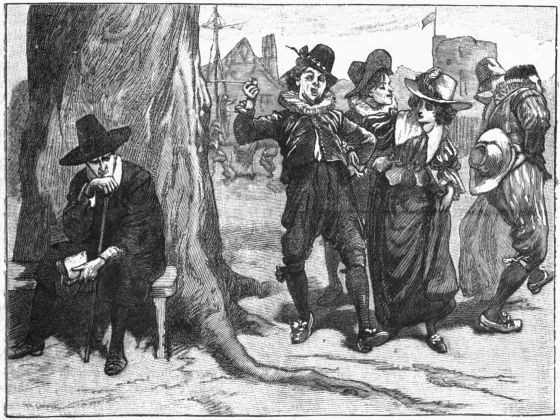
KEEPING SUNDAY, ACCORDING TO KING JAMES'S BOOK OF SPORTS. (See p. 464.)
James now hit on a bold scheme for breaking down the clanship of Ireland, and so weakening the opposition of the people to his despotic will. He ordered all possessors of lands to bring in their titles to commissioners appointed for the purpose, on the promise that they should receive them again in a more valid and advantageous form. As, from the disturbed state of the country for ages past, many of these titles were defective, the landowners accepted the offer in good faith, but they found that the commissioners, instead of returning them of the same value, and bearing the same conditions, only returned them freehold titles of such lands as were in their own hands. All such lands as were in the hands of tenants, were made over to these tenants, only subject to the rent charges and dues which they had formerly paid. Thus the great bulk of the tenantry of Ireland was freed from its dependence on the will of the chief in capite, and now set him at naught. But though the power of the chiefs was broken, the commonalty showed no more inclination to adhere to a Government which persecuted them on account of their faith. They were now more at liberty, and readier than ever to follow some bold and defiant leader who promised them protection and vengeance on their tyrants. The great lords, thus tricked out of their hereditary rights, were converted into deadly enemies of the English Government.
Tyrone and Tyrconnel, on taking leave of the English Court to return to Ireland, professed extreme gratitude for the kindness of their reception, but in reality they were full of the most hostile sentiments. They looked on this transfer of their seigneurial rights as a measure intended to sever their vassals from them, and thus to subjugate the whole island to the yoke of the English hierarchy. No sooner did they land in Ireland, than Richard Nugent, Lord Delvin, invited them to meet him at his Castle of Maynooth. They unanimously agreed that the destruction of the hereditary faith of Ireland was planned, and they bound themselves by oath to act together for its defence.
Two years later, intelligence was gathered by some one at Brussels, in the service of the archduke, that Tyrone had renewed his relations with the Court of Spain; and, in order to decoy him into England, a pretender to a large extent of his lands was set up, and both parties were summoned over to have the cause tried before the Privy Council. Tyrone, aware of the design, avoided the snare by sending an attorney with full powers to act in his behalf. This stratagem did not succeed. Tyrone received from the Lord-Deputy information that his presence would be necessary in London to defeat the pretensions of his opponent. Tyrone, feigning to comply, only solicited a delay of a month, in order to settle his affairs and raise money for his journey and sojourn at Court. The request being acceded to, he escaped in a vessel sent on purpose from Dunkirk, with two of his sons and nephew, accompanied by Tyrconnel, with his son, and Lord Dungannon, his brother, with thirty of their retainers, and reached in a few days Quillebeque in Normandy.
On the discovery of the escape of these nobles, James was greatly alarmed, believing that they had gone to Spain to join the Armada which during the summer had been collecting in the Spanish ports, and to conduct it to Ireland. The news of their real resort abated his fears. He demanded their delivery from France, and then from the Netherlands, whither they betook themselves, describing them as traitors, and men of mean birth, who had been merely ennobled for purposes of State. He accused them of an intention to excite a rebellion, and returning to Ireland with foreign confederates, to put to death all Irishmen of English descent. The Court of Brussels declined to give up men exiled only on account of their religion, and admitted them into the Spanish army of Brabant. Tyrone himself proceeded to Rome, where the King of Spain allowed him a pension of six hundred crowns per month, and the Pope one hundred.
Active search was made in Ireland for the accomplices of the fugitives; many were arrested in Ulster, some were sent over for trial to England. Lord Delvin, with the eldest son of Tyrone, and Sir Christopher St. Lawrence, were secured and lodged in Dublin Castle. Delvin was tried and condemned as a traitor, but he escaped on the morning fixed for his execution; and no trace of him could be found till he suddenly appeared at the English Court, and throwing himself on his knees before the king, presented such a list of real wrongs inflicted on himself and his father, as compelled James to pardon him and to make him amends by creating him Earl of Westmeath; a clemency, as it proved, well bestowed, and which might have taught the king a more successful way to secure obedience and loyalty from his subjects, than those which he unhappily pursued.
Another Irish chief, O'Dogherty of Inishowen, having received a mortal insult from Paulet, the Governor of Derry, surprised him at table, and by the aid of his followers succeeded in killing him and five others. The avengers captured alive Hart, the governor of the Fortress of Culmore, and leading him to the gates of the Castle, called on the governor's wife to surrender the place, or see her husband murdered on the spot. Conjugal affection prevailed, and O'Dogherty found himself in possession of the stronghold. Possessed by this means of arms and ammunition, O'Dogherty marched with a strong force to Derry, and received the submission of the castle and town. The hopes of the exiles were wonderfully raised by so unexpected an event. They despatched messengers instructing O'Dogherty to hold the place, if possible, till their arrival with foreign aid; but after two unsuccessful attacks, the place was evacuated on the approach of Wingfield, the marshal of the camp, and O'Dogherty fled to the mountains. There, in the month of June, 1608, he was accidentally discovered, and shot.
The rebellion of these great chiefs, by throwing into the hands of the Crown an immense territory, suggested to James the planting of a new English Colony. Undeterred by the failure of Elizabeth's plantation of Ulster, he proceeded to divide the confiscated region, which included nearly the whole of the northern counties of Cavan, Fermanagh, Armagh, Derry, Tyrone, and Tyrconnel, amounting to two millions of acres, into four great divisions. Two of these were again divided into lots of one thousand acres each, a third into lots of fifteen hundred acres, and the fourth into lots of two thousand acres. The two thousand acre lots were appropriated to a class of men called "undertakers and servitors," adventurers of capital from England and Scotland, with the civil and military officers of the Crown. The lesser lots went amongst these and the natives of the province also; but the natives were only to receive their lots in the plains and open country, not in the hills and fastnesses, where they might become formidable to Government. The possessors were bound to pay a mark a year for every sixty acres, and the lesser ones besides to take the Oath of Supremacy, and engage to admit no recusant as tenant.
By these means some hundred thousand acres were planted; but whole districts in the hills were never divided at all, whilst many of the undertakers managed to get immensely more land than they had any right to. It was at this time (1611) that the scheme, already mentioned, of creating baronets was proposed to James by Sir Anthony Shirley, as a means of raising money for the support of the army in Ulster. James caught eagerly at the idea, coined upwards of one hundred thousand pounds out of it, but neither sent any of the money to Ireland, nor gave a handsome gratuity to Shirley for the suggestion, as he promised.
After these measures, James ventured to call a Parliament in Ireland, in 1613, the first for seven-and-twenty years. He wanted money, and he wanted also to enact new laws. But the Catholics were naturally apprehensive of these intended laws, for the whole of James's policy went to crush their religion out of the majority of the inhabitants, and impose on them his own model church. So little had this shallow sovereign profited by the lessons of history, that he expected to convert a whole nation by the sword and confiscation. But Ireland had by all former English monarchs, down to Elizabeth, been taught to regard the Pope as the lord paramount of the island; it was a doctrine that secured the obedience of the people under all their oppressions. But since Elizabeth had separated from the Catholic Church, and stood excommunicated by the pontiff, this maxim, so convenient before, was become extremely inconvenient. To the political causes of discontent was now added the far more irritating one of violated religious faith, which has continued till our time.
Under these circumstances the Lord-Deputy summoned the Parliament, and soon found that, though he had a majority of more than twenty Protestants, the spirit of the Catholics was such that he did not dare to proceed. Since the former Parliament, no less than seventeen new counties and forty new boroughs had been created, and these had been filled by men devoted to the measures of the Crown; the boroughs, the Catholics complained, had been put into the hands of attorneys' clerks and servants, and they expected to find on the projected new plantations only evil-disposed persons, ready to insult and injure the old inhabitants. They objected to many of the returns; they complained that obsolete statutes had been revived for the purposes of oppression; that Catholics of noble birth were excluded from posts of honour; that they were expelled from the magistracy; that they were forbidden to educate their children abroad; that Catholic barristers were not permitted to practise; that Catholic citizens were excluded from all influence in the corporations; and that the whole community was subjected to fines, excommunications, and punishments, which spread poverty and misery over the island.
The Lord-Deputy prorogued the impracticable assembly, and both parties appealed to the king. The Catholics sent as deputies the Lords Gormansbury and Dunboyne, and two knights and two barristers to plead their cause. The expense of the mission was defrayed by a general collection, which was made in spite of a severe proclamation against it. James received them at first graciously, but his anger soon broke out when he found them impervious to his controversial eloquence; and, as usual, he threw two of them into prison—Luttrel into the Fleet, and Talbot into the Tower. He soon had Talbot before the Star Chamber, and strictly interrogated him on the point of loyalty to the Crown, and he severely reprimanded the whole deputation on the same ground; but Lord Delvin on his knees declared that he would ever be faithful to the king as his rightful liege, yet that nothing should ever induce him to abandon his religion. James dismissed them, after having appointed a commission of inquiry regarding the representatives of the new Irish boroughs, which decided that none of the four boroughs incorporated after the writs were issued had a right to sit that Session.
As to the religious grievances, no concession was made, and scarcely had the deputies reached home, when a proclamation appeared ordering all the Catholic clergy to quit Ireland on pain of death. When Parliament met again in Dublin, in 1615, there was an outward air of conciliation; the two parties avoided the grand subjects of discord, except that both Houses joined in a petition that Catholic barristers might be permitted to plead. The attainders of Tyrone, Tyrconnel, and O'Dogherty were confirmed, as well as the plantation of Ulster, and all distinctions between the two races of the Irish—that is, the native Irish and the Anglo-Irish—were abolished by statute, and a liberal subsidy was obtained.
The conciliatory air did not long continue. The Lord-Deputy Chichester made a cautious attempt to enforce the fines for absence from church, beginning with a few timid persons in each county, whose compliance might influence others. In 1623, Lord Falkland, then Lord-Deputy, repeated the proclamation ordering all Catholic priests to leave the kingdom on pain of death; but they only retired into the mountains and morasses and defied his authority. James saw that it was useless to hope for success in his scheme of crushing out Catholicism, till he had planted the whole island after the Ulster fashion, and this was set about in good earnest. Commissions were issued for the examination of all grants and titles, and, by the most iniquitous proceedings, hardly a single foot of land was exempted from the claim of forfeiture to the Crown. It was found that the proprietors of the vast counties of Connaught, Galway, and Clare, had been induced to surrender their titles to Elizabeth, on condition that they should receive fresh ones, and that they had paid three thousand pounds for the enrolment of these titles, but had never got them. On this discovery James was advised to claim the whole island, with the exception of the small portion which he had himself planted; but the owners declared on all hands that they would defend their lands with their swords rather than admit such a claim; and James preferred getting a sum of money. His pretensions were commuted for a double annual rent and a fine of ten thousand pounds. He, however, proceeded to plant the coast between Dublin and Wexford, then the counties of Leitrim and Longford, and finally Westmeath, and King's and Queen's Counties. In this business all law and justice were set aside. James gave orders that three-fourths of the lands should be settled on the original proprietors, but no regard was paid to this. Few of the old possessors obtained above a quarter of their lands again, and many were stripped of every acre which they had inherited from their fathers. Whole septs were removed to the parts most distant from their native localities. Seven such septs were transported from Queen's County to King's, and menaced with instant death by martial law if they dared return. Sir Patrick Crosby received the seigniory of Tarbert, on condition that he leased out one-fourth of it to those unhappy exiles, but very few of them got anything; and, in a word, Carte declares that the injustice and cruelty then committed are scarcely to be paralleled in the history of any age or country. At the same time, the north of Ireland, hitherto a mere wilderness, began immediately to assume an appearance of prosperity.
Such was the condition of Ireland as left by James. He imagined that he had pacified it; it was only the sullen lull before the storm which burst forth in the days of his successor, with a fury only the more terrible from its temporary delay.
During the king's absence in Scotland, Bacon had shown such arrogance in the Council, that he had disgusted everybody. He had appeared to imagine himself king, took up his quarters in Whitehall, and gave audiences in the great Banqueting-house at Whitehall. Mr. Secretary Winwood was so incensed at his presumption that he quitted the Council Chamber, declaring, that he would not enter it again till the king's return; and he wrote at once an account of Bacon's proceedings, assuring the king that it was high time that he returned, for his throne was already occupied. The vain, foolish conduct of the Lord Keeper was watched by an eye which owed him no favour, and a spirit smarting with envy, which was relentless in his revenge. Coke, by offending the favourite, lost his position, but he now saw a way to turn this opposition to Buckingham against Bacon. Buckingham, since his rising into favour, had taken care to promote the fortunes of his friends and relatives. He had cast his eyes on the daughter of the fallen Chief Justice Coke, by Lady Hatton, the widow of Queen Elizabeth's Chancellor; this young lady, who was likely to have a large fortune from her mother, he determined to obtain for his brother John Villiers, a sickly and nearly idiotic youth. Coke, who despised the favourite, and was at feud with him respecting the already mentioned patent place at Court, opposed the match, which was agreeable neither to the young lady nor her mother. But when Coke found himself deprived of his office, and his rival, Bacon, advanced, he bethought himself that by the means of his daughter he had the power of regaining the goodwill of the favourite, and pulling down the arrogant Lord Keeper. Before Buckingham had left for Scotland, Coke had had a private interview with him, in which he agreed to consent to the marriage on condition of regaining his honours and position in the Council and on the Bench.
During the absence of the Court in Scotland, and while Bacon was in the full tide of his assumed greatness, he discovered this compact, which boded him nothing but destruction. Without delay he incited the Lady Hatton, who was in almost everything violently opposed to her husband, to make haste and secure her daughter by secreting her with herself in the house of Sir Edward Withipole near Oxford, and by contracting her in marriage to Henry de Vere, Earl of Oxford, for whom the young lady really entertained a regard. Coke, enraged at this flight, and at the attempt to marry his daughter contrary to his own plans, applied for a search-warrant to enter the house where she was secreted. Bacon refused it, but Winwood was only too happy to grant it. Coke, supported by twelve armed men, made a forcible entry and carried away his daughter. On this Bacon procured the new Attorney-General, Yelverton, to file an information against Coke in the Star Chamber for a breach of the peace. Bacon also wrote to the king and the favourite in Scotland, representing to Buckingham that it was by no means to his honour or interest to ally his family to that of Coke, a fallen, disgraced man, and disliked of the king, especially as much better matches might be found. To James he represented the trouble which Coke had given to his majesty, his fondness for opposing the king's wishes, and the disturbances there had been in the kingdom and courts of justice so long as Coke had been in power. Sir Francis added that now everything was quiet, and that his majesty knew that he had in him an officer always anxious to do his will.
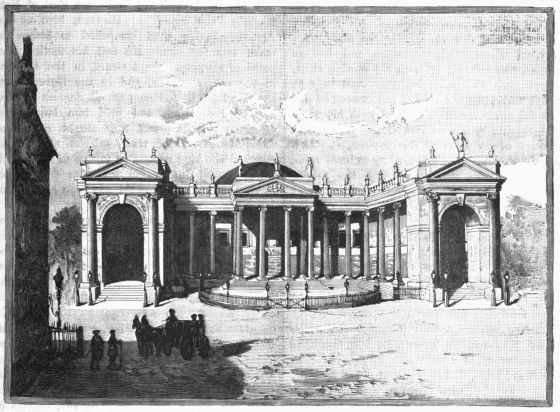
PARLIAMENT HOUSE, DUBLIN, IN THE SEVENTEENTH CENTURY.
The answer of the king struck him at once to the earth. The great philosopher was not aware how far the compact with Coke had really gone; and when he read the king's letter, reprimanding his presumption, accompanied by another from Buckingham, in which he rated him for his officious meddling, and telling him that the same hand which had made him could unmake him, he saw the gulf into which he had plunged. At once he wrote off to both monarch and minion, imploring the humblest pardon for this unworthy offence, which he would now do all in his power to wipe away. Accordingly, he stopped the proceedings before the Council and in the Star Chamber against Coke, and assured Lady Hatton and her friends that he could not assist them in a course so opposed to the wishes of the young lady's father.
On the return of the Court, Bacon hastened to pay his homage to the proud favourite; but he was then made to feel how much it is in the power of a base and little-souled man in favour, to humiliate the most gigantic mind when it forgets to be submissive. The great renovator of science, the proud and vaunting Lord Keeper, was made to wait for two whole days in the lobby of the upstart. This is Weldon's account of it:—"He attended two days at Buckingham's chamber, being not admitted to any better place than the room where trencher-scrapers and lackeys attended, there sitting upon an old wooden chest, amongst such as for his baseness were only fit for his companions, although the honour of his place did merit far more respect, with his purse and Seal lying by him on that chest. Myself told a servant of my Lord of Buckingham, it was a shame to see the purse and Seal of so little value or esteem in his chamber, though the carrier without it merited nothing but scorn, being worst amongst the basest. But the servant told me they had command it must be so. After two days he had admittance. At his first entrance he fell down flat at the duke's foot, kissing it, and vowing never to rise till he had his pardon; and thus was he again reconciled. And since that time so very a slave to the duke and all that family, that he durst not deny the command of the meanest of the kindred, nor yet oppose anything. By which you see a base spirit is even most concomitant with the proudest mind; and surely, never so many brave parts, and so base and abject a spirit, tenanted together in any one earthen cottage, as in this one man."
Buckingham condescended to forgive the suppliant Lord Keeper: the projected marriage was accomplished, and Bacon soon after—that is, on the 4th of January, 1618—was raised to the dignity of Lord Chancellor, with a pension of twelve hundred pounds a year and the title of Baron Verulam. For, provided he threw no obstacle in the way of the marriage, both James and Buckingham preferred his pliancy to the sturdy spirit of Coke.
The consequences of this forced and unnatural marriage were as deplorable as the means of effecting it were vile. The brother of Villiers was created Viscount Purbeck; but no title could give him a sound body or a healthy intellect. It was not long before he was pronounced utterly mad, was shut up in an asylum, and Buckingham took possession of Lady Purbeck's property under pretence of managing it for her and Lord Purbeck, but spent it for his own purposes; and Coke's daughter, outraged in all her feelings as a woman and her rights as a subject, became a degraded and abandoned character.
Buckingham now reigned supreme at Court. He had rapidly risen from a simple country youth into a baron, viscount, earl, and marquis; he was a member of the Privy Council, Knight of the Garter, had been a Master of the Horse, and was now Lord High Admiral; the Earl of Nottingham—the brave old Howard, hero of the Armada—having been compelled to resign to make way for him. He and his mother disposed of all places about Court, in the Church, in the courts of law, and in the Government. Peers, prelates, and men of all degrees courted humbly his favour, and paid him large sums of money for the places they sought, or agreed to annuities out of their salaries and emoluments. The king seemed to rejoice in the wealth which flowed in on his favourite from these corrupt services, and could not bear him out of his sight.
Let us take Weldon's account of this state of things:—"And now Buckingham, having the Chancellor or Treasurer, and all great officers, his very slaves, swells in the height of pride, and summons up all his country kindred, the old countess providing a place for them to learn to carry themselves in a Court-like garb." The old countess, as Weldon calls her, was far from old, but a woman yet in her prime, and of singular beauty and notorious wickedness. She was another Elizabeth Woodville in looking out for rich heirs and heiresses, and marrying her kin to them. The brothers, half-brothers, cousins of Buckingham, were all matched to rich women, and the women were matched to the eldest sons of earls, barons, and men of large estate. And where there was no title, such was soon conferred. The madman that they gave to Coke's daughter, as we have seen, was made Lord Purbeck; another brother was created Earl of Anglesea. Fielding, who married Buckingham's sister, was made Earl of Denbigh, and his brother Earl of Desmond. Cranfield, who married a female relative, was made Earl of Middlesex. But the most shameful case of all, perhaps, was that of Williams, Dean of Westminster, a paramour of the countess's, who was made Bishop of Lincoln, and allowed to retain not only the deanery of Westminster, but the rectories of Dinam, Waldgrave, Grafton, and Peterborough; the prebends of Asgarbie and Nonnington, besides other dignities; so that, says Heylin, he was a perfect diocese in himself, being bishop, dean, prebendary, residentiary, and parson, and these all at once. Other livings and bishoprics were sold as highly as these were freely given. Fotherby of Salisbury paid three thousand five hundred pounds for his see, and all other dignities and benefices in the Church were equally at the disposal of this upstart and his venal, lascivious mother. "There were books of rates," says Weldon, "on all offices, bishoprics, and deaneries in England, that could tell you what fines and pensions were to pay." He adds, "that Buckingham's female relatives were numerous enough to have peopled any plantation. So that King James, that naturally in former times hated women, had his lodgings replenished with them, and all of the kindred, and little children did run up and down the king's lodgings like rabbits startled out of their burrows. Here was a strange change, that the king, who formerly would not endure his queen and children in his lodgings, now you would have judged that none but women frequented them. Nay, this was not all; but the kindred had all the houses about Whitehall, as if bulwarks and flankers to that citadel."