Chapter XVIII · (continued 2)
Reading edition
Buckingham himself, in time, seemed to clothe himself with half the offices in the country. He became Warden of the Cinque Ports, chief justice in eyre of all the parks and forests south of the Trent, Master of the King's Bench Office, High Steward of Westminster, and Constable of Windsor Castle. In his person he was lavish and showy even to tawdriness. He was skilled in dancing, and therefore kept the Court one scene of balls and masques. He had his clothes trimmed at even an ordinary dance with great buttons of diamond, with diamond hatbands, cockades, and earrings; "he was yoked with manifold ropes and knots of pearl; in short, he was accustomed to be manacled, fettered, and imprisoned in jewels."
But one of the most interesting and painful events of the reign of James, and one which does him little credit, now occurred. Sir Walter Raleigh, deprived (as we have seen, to gratify the favourite Carr) of his beautiful estate of Sherborne in Dorsetshire—"which he had beautified with orchards, gardens, and groves, of much variety and delight"—had remained in the Tower from the time of his trial in 1603, that is, thirteen years. His captivity was rendered less severe by the presence in the Tower of other prisoners of intelligence, and, more than all the rest, of the Earl of Northumberland, who gathered around him in his prison men of science and literature, and thus was instrumental in converting his cell into a palace of knowledge and refined delight. Northumberland was another of those men who revelled in learning, whom a king really wise and learned would have rejoiced to honour. But James's love was not a love of learning or literature on its own account, it was a love of himself. It was the vanity of passing for a sagacious and learned king which he possessed, and not the sagacity and the learning themselves. Therefore, so far from cherishing science and learning, and loving the possessor of them, James was too shallow to comprehend the one, and so egotistical that he hated the other. Northumberland had been in prison ever since the year of the Gunpowder Plot, 1605, eleven years, a victim to the suspicions of the king and the tyranny of the Star Chamber, for no participation in the plot was ever proved against him. Amongst his visitants and pensioners were the most profound mathematicians of the age, Allen, Hariot, Warner—"the Atlantes of the mathematical world," Burchill—the celebrated Greek and Hebrew scholar, and other noted characters. Amongst them Sir Walter found the pleasure of cultivating inquiries which his busy public and Court life had before kept unknown to him. He commenced a series of chemical experiments, and the celebrated Lucy Hutchinson, who was the daughter of Sir Allen Apsley, Lieutenant of the Tower, in the preface to her interesting life of her husband, Colonel Hutchinson, says:—"Sir Walter Raleigh and Mr. Ruthin, being prisoners in the Tower, and addicting themselves to chemistry, my mother suffered them to make their rare experiments at her cost, partly to comfort and divert the poor prisoners, and partly to gain the knowledge of their experiments and the medicines, to help such poor people as were not able to seek physicians."
In these chemical inquiries, Sir Walter imagined that he had discovered a universal panacea. The queen in an illness had taken it, and appeared cured by it, and afterwards, as we have seen, tried it in the case of Prince Henry, but without effect.
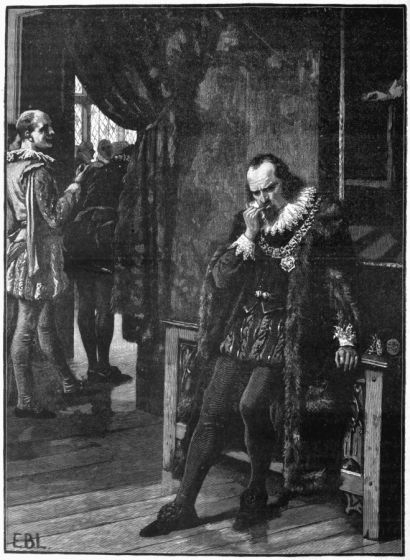
SIR FRANCIS BACON WAITING AN AUDIENCE OF BUCKINGHAM. (See p. 470.)
Sir Walter next turned his attention to history, and commenced a History of the World, a gigantic undertaking, but no doubt one that offered great consolation to the mind of a prisoner for life, from the very fact of its immensity, thus promising to him a constant forgetfulness of his captivity, and a busy discursiveness amid the peoples of the whole globe. Such men as Burchill, who was not only a great classical scholar but a distinguished Latin poet, could furnish him with books and translations, by which means he has displayed so vast an acquaintance with Greek and Rabbinical writers. Raleigh commenced his History for the instruction of Prince Henry, who had a high regard for the author, but the death of that prince in 1612, gave a check to the undertaking, and all that Raleigh has completed extends from the Creation to about a century and a half before the Christian era.
The fall of Somerset and the rise of Buckingham awoke new hopes of liberty in Raleigh. His friends made zealous applications to the favourite, which for a time produced little effect because the true persuasive with the greedy Villiers family was not applied. In the meantime, however, Raleigh managed to interest Secretary Winwood in a grand scheme which he had for discovering and working gold mines in Guiana. Raleigh, as our readers are aware, was of a romantic and adventurous turn. The Admirals Drake, Hawkins, and Frobisher, with whom he had had the honour of defeating the Grand Armada, had brought home immense treasures from the Spanish and Portuguese territories of South America. Raleigh himself had been engaged in the scheme of settling Virginia in North America, in the year 1584, when he procured a patent from Elizabeth—a copy of one granted still earlier to his half-brother, Sir Humphrey Gilbert—with full power to discover and settle any heathen lands not already in the possession of any Christian prince. In consequence, he had equipped various expeditions to the coast of Virginia, which, however, had all proved failures, and Sir Humphrey Gilbert, who conducted one of them, lost his life at sea. Sir Walter's enterprises, which had cost him much money, were immediate failures—failures to himself and his associates, but ultimate successes to the country, for they led to the settlement of that great Federated Republic of Northern America.
But still earlier, in 1595, he had made a voyage to Guiana. The glories of Drake and the other piratical admirals, and the wondrous legend of the golden empire of Guiana, with its inconceivable affluence, and the reported splendours of its capital, Manoa, called by the Spaniards El Dorado, or the golden city, inflamed his imagination. He sailed thither, touching at Trinidad, as if on his way to Virginia; and the Spaniards, deluded by this belief, entered into friendly relations and bartered various commodities with him. But suddenly Raleigh, watching his opportunity, fell on the garrison, killed the guard, and secured the person of Berrio the governor, whom he carried away as guide to Guiana, Berrio having already settled a colony there. This transaction, which was in the true spirit of Drake and the rest, who acted in those regions as if the Spaniards were at war, though they were at entire peace with England, was one of the charges afterwards brought against him. To this Raleigh replied that Berrio, at Trinidad, had formerly made prisoners of eight Englishmen, and that to leave him at his back when he was about to ascend the Orinoco, was to have been an ass. Whether the story of the eight Englishmen was true or not, it was clearly no business of Raleigh's, and the real motive was partly the last assigned—to secure so dangerous a person as Berrio, and at the same time so valuable a guide. In fact, Raleigh, with all his genius, was never renowned for very scrupulous ideas of right and wrong, and shared in all the loose maritime notions of the age.
Thus provided, he sailed for the Orinoco and advanced up it three hundred miles in boats. He seemed to have heard many wonderful rumours of gold mines, and cities built of gold and silver and embossed with precious stones; but he discovered no magnificent Manoa, with pinnacles blazing with diamonds and rubies, nor any gold mines, only signs of gold in the mountains beyond the Spanish town of St. Thomas. He gave out to the natives that he was come to relieve them of the Spaniards, and by their assistance explored the country for a month, when the waters of the mighty Orinoco rose so suddenly and with such impetuosity, that they were carried down at the peril of their lives to their ships.
On his return, Raleigh, although he brought no riches, brought marvellous descriptions of them. Though he had seen nothing but a pleasant country and friendly natives, he did not hesitate to publish the most amazing stories to draw fresh colleagues to the enterprise. He described the country and the climate in colours of heaven, and as for its riches, "the common soldier," he said—detailing the discovery of the large, rich, and beautiful empire of Guiana, with relations of the great and golden city, Manoa—"shall here fight for gold, and pay himself, instead of pence, with plates of half a foot broad, whereas he breaks his bones in other wars for provant and penury. Those commanders and chieftains that shoot at honour and abundance, shall find here more rich and beautiful cities, more temples adorned with golden images, more sepulchres filled with treasure, than either Cortez found in Mexico, or Pizarro in Peru."
Probably Raleigh believed all this himself, on the faith of the natives; but though several expeditions went out nothing of the kind was discovered. Yet these failures in no degree abated the enthusiasm of Raleigh. He represented to objectors that the adventurers sent out were ignorant alike of the locality and of the art of conciliating the natives. Were he permitted to go, he would make Guiana to England what Peru was to Spain.
His glowing descriptions at length captivated the imagination of Winwood, who did his best to excite the cupidity of James on the subject, and not without effect, for he began to speak of Raleigh as a very clever and gallant fellow. The scheme suited James extremely well, as he was always in want of money, and Raleigh asked for nothing, not even a ship to accomplish the enterprise, but guaranteed to the king one-fifth of the gold. Still there was one obstacle; James dared not issue the desired commission without the approbation of the favourite, and this Raleigh and his friends were obliged to purchase by a present of fifteen hundred pounds to Buckingham's uncles, Sir Edward Villiers and Sir William St. John.
In the month of August, 1616, Sir Walter issued from his thirteen years' captivity in the Tower, and commenced preparations for the voyage. Plenty of adventurers and co-operators were found: the Countess of Bedford advanced eight thousand pounds, and Lady Raleigh sold her estate at Mitcham for two thousand five hundred pounds. A fleet of fourteen sail was equipped and manned. But before Raleigh could get out to sea, the Spanish ambassador, Gondomar, had caught wind of the real destination of the squadron. The Spaniard was a deep politician, who assumed an air of gaiety and freedom which won on the courtiers, and not less on James, whose vanity he flattered to the utmost; often speaking false Latin, that James might correct him, he would reply, "Ah, your majesty speaks Latin like a pedant, but I only speak it like a gentleman."
On making the discovery, Gondomar rushed into the presence of the king, exclaiming, "Pirates! pirates! pirates!" James, who was always paralysed at the very idea of war, sent in a hurry for Raleigh, took back the patent which he had granted him, and altered it with his own hand. He strictly prohibited the adventurers from invading any territories in possession of his allies, especially of the King of Spain, but commanded that they should confine their enterprise to countries still in the hands of the heathen. They were allowed to trade and to defend themselves if attacked, but not to act on the offensive. He moreover demanded from Raleigh a memorandum under his own hand, of the places with which he meant to trade, and the force he proposed to take out. All this James is said to have shown to Gondomar, so that, fully forewarned, the Spanish ambassador despatched a squadron with troops to St. Thomas, of which his brother was governor.
In all this, it is clear that Raleigh was imposing on the king. This Raleigh himself admits in his address to Lord Carew:—"I acquainted his majesty with my intention to land in Guiana, yet I never made it known to his majesty that the Spaniards had any footing there. Neither had I any authority from my patent to remove them thence." But this was a point on which Gondomar could and probably did enlighten James.
After the guarantees given by Raleigh, Gondomar appears to have ceased his opposition; having, moreover, taken measures to guard against any attack in Guiana. On the 28th of March, 1617, the fleet set sail, but owing to bad weather was obliged to put into Cork, where they lay till August, and did not reach the coast of Guiana till November 12th, after a troublesome voyage of four months. On arriving, two of his ships were missing: disease had reduced his men to a state of miserable weakness, forty-two on board Raleigh's own vessel having died. He himself was disabled for active service, and to his mortification he learned that a Spanish fleet was cruising near in order to intercept them. He wrote to his wife, that reduced as they were, he deemed himself in sufficient force to accomplish the enterprise if the care taken at home to let the Spaniards know of their numbers, had not caused all approaches to be fortified against them.
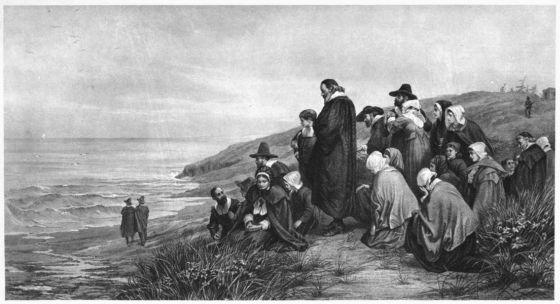
THE DEPARTURE OF THE MAYFLOWER.
From an Engraving after the picture by A. W. Bayes.
Being unable to proceed immediately, he sent Captain Keymis up the river in boats to discover the mine, while he lay at its mouth to ward off the Spanish squadron. Keymis was said to have been at the mine they were in search of in the expedition of 1595. He began the ascent of the river on the 10th of December, under orders to make straight for the mine, and if he found it rich to fix himself there; if but poor, to bring away a basket of the ore to convince the king that they had gone out after a reality. The exploring force landed near St. Thomas, but found the Spaniards prepared for them; a battle ensued, in which the governor, the brother of Gondomar, was killed, but at the same time also fell the eldest son of Sir Walter, Captain Walter Raleigh. This enraged the soldiers, who carried the town of St. Thomas by storm and set fire to it. They expected to find in it great wealth, but all that they discovered was two ingots of gold and four refining houses, whence any ore that there might have been was carried off. The Spaniards entrenched themselves in formidable positions amongst the hills—as the invaders supposed, between them and the mines; but Keymis was so much discouraged by the death of young Raleigh, and the violent discontent of the men on discovering the emptiness of the place, and the preparations of the enemy, who again fired upon and killed several of them, that he gave up the enterprise and dropped down the river again.
When Keymis reached the ships with the news of their ill success and of the death of Raleigh's son, Sir Walter was beside himself. Though Keymis had been a faithful officer and friend of his for many years, sharing the dangers and hardships of his former adventures, he upbraided him bitterly with his ruin. Keymis replied that when the young captain was dead, the men set him at defiance, and that to have attempted to reach the mines with them would have been an act of madness; had it succeeded even, it would only have enriched these murderous villains; had it failed, both himself, and probably Sir Walter, would have fallen their victims. Recollecting the feeble condition of his commander-in-chief, he deemed it his duty to return to him.
All was lost on Raleigh, who, feeling the acutest grief for the death of his son, and seeing nothing but destruction await him at home from the wrath of the Spaniards and the disappointed cupidity of the king, raved against Keymis like a madman. The unfortunate officer drew up a statement of the real facts of the case, addressed to the Earl of Arundel, and asked Raleigh to sign it in justice to him: he peremptorily refused. Some days passed on, but instead of moderating his bitterness when Keymis again urged him to sign the statement, he refused, heaping upon him reproaches of imbecility or cowardice. Stung by this ungenerous conduct, the unhappy officer retired to his cabin, and shot himself with a pocket-pistol, and as that had not killed him, finished the bloody deed by a stab with a long knife.
Horror took possession of the fleet at the news of Keymis's suicide, and discord and mutiny broke out on all sides. The officers and men alike expressed their indignation. Captain Whitney, in whom Raleigh reposed the most confidence, and who was under great obligations to him, sailed for England. Others followed his example, and Raleigh soon found himself with only five ships. Yet still he had a larger fleet, manned with a stronger force of daring fellows than the brave crews who had done amazing things under Drake, Hawkins, and others, had Raleigh been in a mood to lead them. Death and disgrace awaited his return home; death or the acquisition of wealth capable of appeasing the royal resentment, was the alternative which attended a bold onslaught on the Spanish shores. But Raleigh's spirit was crushed. In a letter to his wife he declared that "his brains were broken;" and he sailed away to Newfoundland, where he refitted his ships.
He now contemplated the chance of intercepting one of the Spanish treasure-ships, which he felt assured would set all right with James; but fresh mutinies arose and he took his course homewards. In the month of June, 1618, after much hesitation, he entered the harbour of Plymouth, where he was met with the news that a royal warrant was out for his apprehension. Gondomar, furious at the fate of his brother, demanded condign punishment for Raleigh's outrages on the subjects of his most Catholic majesty in Guiana. There were many reasons why the Spanish Court should long for the destruction of Raleigh. He was by far the ablest naval commander that James possessed. He had been one of those who led the English fleet to the triumph over the Armada. He had committed terrible depredations in the Azores and Canary Isles when he sailed with Essex, besides his seizure of the Governor of Trinidad.
Sir Walter was advised by his friends to fly instantly to France, a vessel lying ready to carry him over. But he seemed to have lost all power of self-direction, or it might be that, as his younger son Carew relates, the Earls of Arundel and Pembroke were sureties for his return, and it was a point of honour to keep faith with them. He landed, and was arrested by his near kinsman, Sir Lewis Stukeley, Vice-Admiral of Devon, who conducted him to the house of Sir Christopher Harris, near the port, where he detained him for nearly a week, till he received the royal order for his disposal. No sooner was it announced at Court that Raleigh was secured, than Buckingham wrote, by direction of the king, to inform the Spanish ambassador of the fact, and to assure him that he would give him up to him to be sent to Spain, and dealt with as his royal master should see fit, unless his most Catholic majesty preferred that he should suffer the penalty of his crimes here. Gondomar sent off a special messenger to learn the decision of the King of Spain, and meantime Stukeley was ordered to proceed to London with his prisoner.
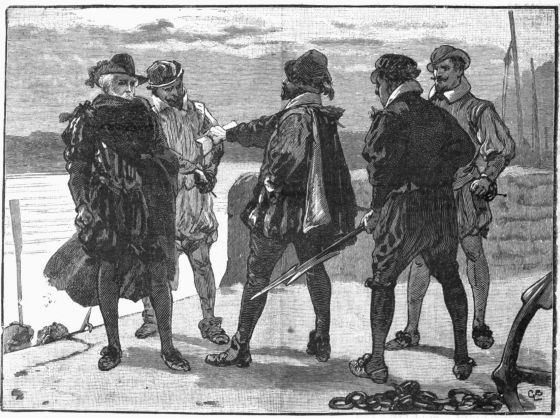
SIR WALTER RALEIGH RE-ARRESTED BY STUKELEY. (See p. 477.)
Struck now with awe at the prospect of once more being immured in the Tower, and with only the most gloomy prospect of his exit thence, Sir Walter procured some drugs from Manourie a Frenchman, with which he brought on violent sickness, and aquafortis, with which he produced blisters and excoriations on his face, arms, breast, and legs. He was found in his shirt on all fours, gnawing the rushes on the floor and affecting madness; the physicians pronounced him to be in considerable danger, and James, who was then at Salisbury, ordered him to be conveyed for a short time to his own house in London, lest he should convey some infection into the Tower.
This was Raleigh's object, and he now employed the time afforded him to effect his escape in earnest. He despatched his faithful friend, Captain King, to provide a ship for his purpose. This was arranged, but Raleigh, not aware that Manourie was a spy upon him, confided the secret to him, and it was immediately communicated to Stukeley. Raleigh, observing the strict watch which Stukeley kept over him, and deeming him worthy of his confidence, gave him a valuable jewel and a bond for one thousand pounds, on condition that he allowed him to escape. Stukeley took the bribe, but while pretending to be now his sworn friend, only the more effectually played the traitor. He was commissioned to procure all possible evidence of Raleigh's connection with France, and circumstances favoured him. At Brentford Raleigh received a visit from De Chesne, the secretary of the French Envoy in London, offering him, from Le Clerk, his master, the use of a French barque and a safe-conduct to the Governor of Calais. On arriving in London, Le Clerk himself waited on him and renewed the offer. Raleigh expressed his gratitude, but concluded to take the vessel engaged by Captain King, and lying near Tilbury Fort. All this Stukeley communicated daily to the Council.
At the time fixed, Raleigh in disguise, and accompanied by King and Stukeley, who expressed much interest in seeing his relative safely off, took a boat and dropped down the river to reach the vessel at Gravesend. But from the moment that they were on the water, the quick eye of Raleigh noticed a wherry which kept steadily in their wake; and the tide failing, it was judged useless to proceed to Gravesend. They went, therefore, into Greenwich; the wherry also lay to there, and Sir Walter found himself immediately re-arrested by the traitor Stukeley, whose men were in the wherry. King also was arrested, and Sir Walter was conveyed next morning to the Tower. The French Envoy was forbidden the Court and soon after ordered to leave the country.
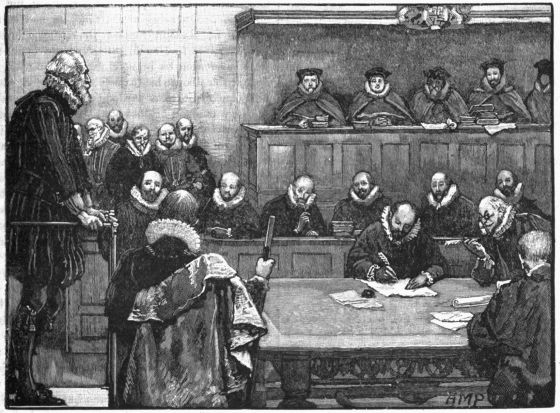
SIR WALTER RALEIGH BEFORE THE JUDGES. (See p. 478.)
The answer from the King of Spain did not arrive for five weeks. It stated that in his opinion the punishment of Raleigh's offences should take place where his commission—which he had violated—was issued. It was, therefore, necessary to bring him to trial in London. Meanwhile, he had been subjected to close and repeated interrogations before a commission appointed for the purpose, composed of Lord Chancellor Bacon, the Archbishop of Canterbury, Sir Edward Coke, and several other members of Council. He was charged with having imposed upon the king, by representing that his object was to discover a gold mine, when he only wanted to get out of prison and commence piracy; that he had endeavoured to provoke a war with Spain; that he had barbarously deserted his ships' companies, and pushed them into unnecessary danger; that he had ridiculed and maligned the king; that he had feigned madness to deceive his majesty; and that he had attempted to escape in defiance of his authority.
Raleigh denied the charge of treating the name of the king disrespectfully; asserted that nothing proved his sincerity in expecting to reach mines so completely, as his having expended two thousand pounds in the necessary apparatus for refining the ore; that he had never exposed his men to any danger that he did not share himself, except when illness incapacitated him; and that as to feigning madness and trying to escape, the charges were true, but they were, under the circumstances, perfectly natural and pardonable.
The commissioners, finding that they could establish no real case against him of sufficient gravity to implicate his life, resorted to the usual stratagem of Government in those times, as well as in times long after—and set a spy upon him under the colour of a friend. The individual who accepted this dirty office—such villains are always plentifully at hand—was one Sir Thomas Wilson, Keeper of the State Paper Office. He appeared to be hit upon because he had as much learning and ingenuity as he had little principle, and could therefore easily draw out Raleigh to talk by assuming a kindly interest in him. Sir Walter appeared to talk freely, and related his adventures, and also what daily took place before the commission; yet this government pump could bring up nothing very criminating. Raleigh declared that had he fallen in with one of the Spanish galleons, he would have seized it with the same freedom that Drake had done; but his mere intention to do what had won so much fame and favour for other commanders, was not a charge likely to go down with the public. Raleigh remarked that when he made that avowal before the commission, Bacon said, "Why, you would have been a pirate!" and that he had replied, "Oh, my lord, did you ever know of any that were pirates for millions? They that work for small things are pirates."
Finding that there was nothing in Raleigh's proceedings on this occasion which had not been done, and far more than done, with high public approbation, by the greatest commanders of the British Navy, they dared not attempt to condemn him on that score, and therefore James demanded of his Council what other mode they could suggest to take his life. Coke and Bacon proposed that they should fall back simply on the plea of his old sentence, and the king sent to the Tower an order for his execution. The judges, therefore, received an order to issue a warrant for his immediate beheading, but they wisely shrank from such a responsibility, declaring that after such a lapse of time neither a writ of privy seal nor a warrant under the Great Seal would be legal without calling on the party to show cause against it. They accordingly summoned him before them by habeas corpus, and Raleigh, who was suffering from fever and ague, real enough this time, was the next day brought before them at the King's Bench, Westminster. Yelverton, the Attorney General, reminded the Court that Sir Walter had been sentenced to death for high treason, fifteen years before; that the king, in his clemency, had deferred the execution of the prisoner, but now deemed it necessary to call for it. He observed that Sir Walter had been a statesman, and a man who, in respect to his talents, was to be pitied, and that he had been as a star at which the world had gazed; but "stars," he continued, "may fall; nay, they must fall when they trouble the spheres wherein they abide." He called, therefore, at the command of his majesty, for their order for his execution. On being asked what he had to say against it, Raleigh replied that the judgment given against him so many years ago could not with any reason be brought against him then, for he had since borne his majesty's commission, which was equivalent to a pardon; and that no other charge was made against him. The Chief Justice told him that this pleading would not avail him; that in cases of treason nothing but a pardon in express words was sufficient. Raleigh then said, if that were the case, he could only throw himself on the king's mercy; but that he was certain that, had the king not been afresh exasperated against him, he might have lived a thousand years, if nature enabled him, without hearing anything more of the old sentence.
Montague, the Chief Justice, admitted this by saying that "new offences had stirred up his majesty's justice to revive what the law had formerly decreed;" and he ended with the fatal words—"Execution is granted."
Thus Raleigh was put to death to oblige the King of Spain, with whom James was anxious to form an alliance by his son's marriage to the Infanta. The old sentence was but the stalking-horse for the occasion, the Court not daring to allege as the true offence that he died for having invaded the territories of the King of Spain. The public having a strong repugnance to both Spain and any matrimonial alliance with it, which must introduce a Popish queen, would have gloried in the real chastisement of that nation and the capture of its treasure-ships. Sir Walter was executed on the 29th of October, 1618.
Hitherto James had contrived to avoid war for sixteen years. He now saw himself dragged into a hopeless contest by the folly of his son-in-law, Frederick, the Elector of the Palatinate. Frederick was a Calvinistic Protestant, and the Protestants of Bohemia, anxious to prevent the Catholic Emperor of Austria from acquiring their Crown, offered it to him, and the Elector was imprudent enough to accept it. James was thunderstruck by the news, and instantly avowed that the Elector had entered on an enterprise which would involve him in utter ruin. To enable the reader, however, to understand the question, we must take a brief review of the antecedents of the case. Bohemia, a country inhabited by a branch of the great Sclavonic race called Czechs, had early imbibed the doctrines of Protestantism. The people resisted the imposition of the Papal yoke by the Austrian princes, and insurrection and carnage were the consequences. At length the Emperor Rudolph was obliged to cede to the sturdy Bohemians the right of enjoying their own religious faith, and it was stipulated that they should be at liberty to erect churches on the Crown lands. The Calvinists, the most resolute sect of the Bohemian Protestants—for they were divided into Calvinists and Lutherans—declared the Church lands were in fact Crown lands, and began to build churches on estates belonging to the Archbishop of Prague and the Abbot of Braunau. These prelates appealed to the Emperor Matthias, who decided against the Protestants; and an order was issued to pull down again the churches both at Prague and Braunau. At Braunau the people made resistance, and some of their leaders were thrown into prison. This created a great excitement, and Count Thurm, the head of the Evangelical Church, called an assembly of the Protestants at Prague, on the 6th of March, 1618, to take measures for the maintenance of their privileges; but the enthusiasm with which this step was attended, from all parts of the country, much alarming the Austrians, menaces of punishment were issued by Imperial brief against those who took part in it. This roused the wrath of the people, who, headed by Count Thurm, on the 23rd of May, 1618, marched to the royal palace, seized two obnoxious councillors, and hurled them out of the window of the council chamber, which was eighty feet from the ground. These men had been the servile tools of the Austrian Court, and had thereby excited the hatred of the people. They refused the rites of marriage, baptism, and burial to all who would not consent to become Catholics; they were accused of having drawn up the threatening letter which came signed by the Emperor, and of hunting the Protestants into the Catholic churches with dogs. Luckily for them there was plenty of mud in the palace ditch, and they escaped with their lives to scourge the people at a later date.
This bold deed kindled a flame throughout all Bohemia, Moravia, Lusatia, and Silesia. Thurm sent forth a proclamation assuring the Protestants that the die was cast; that they had nothing but vengeance and oppression to expect from Austria; and therefore the time was come to throw off the Austrian yoke, to resume the independence of Bohemia, and make common cause with the Protestants of Germany and the Netherlands. The people flocked to Prague; the palace was occupied by the troops of the different provinces; an oath was taken from the magistrates and officials to obey the States alone; the taxes were ordered to be paid only to those appointed by them; the Jesuits were chased from the country; a council of thirty members was elected to assume the government, and Thurm placed at their head. All this passed with lightning rapidity and caused the utmost consternation in Vienna.
Matthias was sickly and feeble both in body and mind, but his cousin Ferdinand—who had already assumed the title of King of Bohemia, a bigot of the very first water, and whose name soon became the rallying cry of all bigotry in Europe—caught at the opportunity as one sent by Heaven, to enable him to exterminate Protestantism in Austria. He sent off to the Spanish Court in the Netherlands demands for co-operation in this great work, and armies were prepared in Austria; whilst Thurm and the Bohemians, on their part, mustered with all eagerness their forces. Matthias proposed to settle the difference by arbitration, but Ferdinand rejected any such means, seized Cardinal Klesel the Emperor's adviser, and sent him prisoner into the Tyrol, so that the poor invalid Matthias remained a puppet in their hands. He died in March, 1619. Ferdinand, the prince of bigots, to whom whole nations of lives were only as so much dust in comparison with the sacredness of his dogmas, mounted the throne, being elected emperor in August of that year. Now all Europe stood in expectation of the bloody decision of this quarrel,—a quarrel which was destined to spread over all Germany, draw into its vortex Sweden, Denmark, Holland, France, and England, and to be for ever remembered in the world as the most terrible of contests, the "Thirty Years' War."
At this moment, when the Protestants of Germany were joined in a Union for the maintenance of their principles, but were opposed by the far more powerful League of the Catholic princes; when Ferdinand, Emperor of Austria, supported by the Elector Maximilian of Bavaria, the head of the League in Germany, was promised the co-operation of Spain; at this moment the Crown of Bohemia was offered to Frederick, the palsgrave, and he foolishly accepted it. He was a mere youth of twenty, with more ambition than ability; but he was spurred on by his wife, Elizabeth of England, who told him he had courage enough to aspire to the hand of a king's daughter, but not to grasp a crown when offered, and who, when reminded by him of the electoral province which they possessed in safety, exclaimed, "Better a crown with a crust, than a petty electorate with abundance."
This fatal crown, which Elizabeth came to wear, and to have the crust speedily afterwards, had been already offered to John George, Elector of Saxony, who was too shrewd to accept it. Count Thurm had for a time carried all before him, and had even marched into Austria and besieged the Emperor in Vienna; but this success was soon over. The Catholic princes had armed in defence of the Emperor; the students of Vienna and fifteen hundred citizens volunteered in his cause; the distinguished Spanish General Spinola was already on his march to invade the palsgrave's hereditary State, so despised by the Princess Elizabeth; and Count Mansfeld, the general of the German Protestants, was defeated on the Bohemian soil, when Frederick the Elector was crowned king of that country in Prague, on the 25th of October, 1619. He reigned only till the 8th of November of the following year, when he was expelled from his capital by the Austrian and Bavarian forces under Maximilian and General Bucquoi. They had defeated the Protestant generals in Upper Austria and Bohemia, while Frederick—who obtained the name of the "Winter King," because he only reigned one winter—had lost the confidence of his subjects by his luxurious effeminacy, his inattention to government, his impolitic treatment of the native nobles and generals, and his bigoted partiality to the Calvinistic party. Even the Protestant Elector of Saxony, who had refused the crown, allied himself to the Catholic Emperor against him. He was roused from table only by the news of the battle before his walls, rushed out only to see his army scattered, and fled. The Counts Thurm and Hohenlohe counselled him still to make a stand in Glatz, but he was no hero to fight, even for a kingdom; he continued his flight to Breslau, thence to Berlin, and did not stop till he reached Holland. Elizabeth, his queen, now reduced to the crust, far advanced in pregnancy, and deeply pitied by all generous and chivalric minds, accompanied him in his ignominious flight.
Meanwhile, James had been a prey to the most conflicting interests. His Protestant subjects, as ill informed of the state of parties on the Continent as the unfortunate Frederick himself, had received with an outburst of joy the news of the palsgrave being crowned King of Bohemia; and Archbishop Abbot gave the very text from the Apocalypse in which this event, so favourable to the Reformed faith, was predicted. James was urged to send an army to his son-in-law's support, but he saw no chance of keeping him on the Bohemian throne. The Bohemians were divided into three violent parties—Calvinists, Lutherans, and Catholics. The Protestants of Germany were equally divided; some of them had voluntarily offered their aid to the Emperor, and others had submitted to his victorious generals. Spinola was marching on the Palatinate, and James was distracted by the fear of his daughter and son-in-law being reduced to beggary. Yet if he attempted to prop the King of Bohemia on his tottering throne, he should offend the Catholic King of Spain, the sworn ally of the Emperor, and with whom he was at this very time seeking an alliance. Without being able to save his Protestant son-in-law, he should thus lose a Catholic daughter-in-law. If he lay still, all men would call him an unnatural father, all Protestants would declare him an apostate to his religion. Never was man in such a strait. One moment he declared to the Spanish ambassador that the Elector was a fool and a villain, and that he would abandon him to his fate; at another he assured the Protestant envoys from Germany that he would support him to the utmost. At length he hit upon the only rational course; which was, not to attempt an impossibility—the support of Frederick on the baseless throne of Bohemia—but to send a force to defend his patrimonial territories from the Spaniards. The first enterprise was, in fact, soon out of the question: Prague had fallen, his son-in-law and daughter were fugitives; but the second object was still possible, and more necessary than ever.
He sent an army of four thousand men under the Earls of Oxford and Essex to the rescue of the Palatinate. This force was altogether inadequate to cope with the numerous army of the able Spinola; and yet James had exhausted all his means and all his efforts in raising it. Money he had none, and had been compelled to seek a loan and a voluntary subscription. By the autumn the Lower Palatinate was overrun by the Spaniards, and Bohemia had sought and received pardon from the Imperial Court. James's real hope was that Spain would join him in mediating a peace.
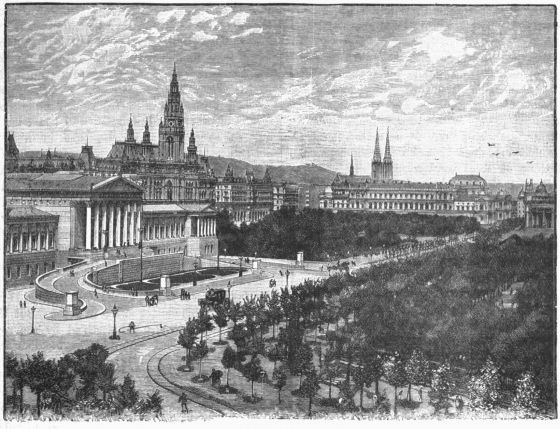
THE FRANZENSRING, VIENNA.
In this state of affairs James was compelled to summon a Parliament. It assembled on the 30th of January, 1621, the king having used all the unconstitutional means in his power to influence the return of members. In his opening speech he now admitted what he had so stoutly denied before, the presence of Undertakers in the last Parliament, "a strange kind of beasts which had done mischief." In that shallow, wheedling tone, that rather showed the hollowness of the man than conciliated, as it was meant to do, he even enlarged his confessions and admitted that he had been swayed by evil counsellors. He then demanded liberal supplies to carry on the war in the Palatinate, for which the people had indeed loudly called. The Commons expressed their readiness, but first demanded that the king should enforce the penalties against the Papists with additional rigour, observing that they were the Papists in Germany who had deprived the Elector Palatine of his crown, and were now seeking to deprive him of his hereditary domains. They recommended that no recusants should be allowed to come within ten miles of London, that they should not be permitted to attend Mass in their own houses or in the chapels of ambassadors; and they offered to pass a Bill, giving to the Crown two-thirds of the property of recusants. They then granted him two subsidies, but no tenths or fifteenths—a sum wholly inadequate to the necessities of the war, much less of his expenditure in general. Yet James, to keep them in good humour—hoping to obtain more before the close of the Session—professed to be more satisfied with it than if it had been millions, because it was so freely granted.
The Commons showed more alacrity in complaining of the breach of their privileges. They reminded the king of the four members of their House whom he had imprisoned after the last Session of Parliament, and insisted that such a practice rendered the liberty of speech amongst them a mere fiction. As it was James's policy to remain on good terms with them, he made a solemn assurance that he would respect their freedom in that matter. Yet, the next day, the House, as if to show that they themselves were ready to destroy the liberty within, which they so warmly contended against being infringed from without, expelled one of their members named Shepherd, for declaring, in a speech against a Bill for restraining the abuses of the Sabbath, that the Sabbath was Saturday, and not Sunday; that the Scriptures recommended dancing on the Sabbath day; and that this Bill was in direct opposition to the king's ordinances for the keeping of Sunday.
From their own members they next extended their prosecutions to public officers. They had appointed a committee of inquiry into public abuses, and now summoned witnesses. The conduct of public officers, judges, and their dependents, was subjected to a severe scrutiny. They first examined into the abuses of patents, and three of these incurred particular censure: the one for the licensing of ale-houses, another for the inspection of inns and hostelries, and the third for the exclusive manufacture of gold and silver thread. Patents, to secure to inventors the fruits of their discoveries in arts and manufactures, are beneficial, stimulating to improvement and extending traffic. But these patents were of a directly contrary nature, being grants, for money or through Court favour, to individuals to monopolise some particular business; thus checking competition, and defrauding the fair trader of his legitimate profits. The inquiry laid open a scene of the most extraordinary fraud, corruption, and oppression. The three patents just mentioned were denounced as national injuries, and Sir Giles Mompesson and Sir Francis Michell, a justice of the peace, his partner in them, were arrested as offenders. The culprits sought protection from the Government, Buckingham having sold them the patents and divided the profits with his half-brother, Sir Edward Villiers. The Court was in great tremor, and it was proposed to dissolve Parliament to save the patentees. But Williams, Dean of Westminster, represented this as a very imprudent measure, and another course was adopted at his recommendation. Buckingham affected a patriotic air, as if he himself had been no way concerned in it, and said if his brother had shared the emolument, let him also share the punishment. But this was safely said, for Villiers was already abroad out of the reach of Parliament; and means were not long wanting to let Mompesson escape out of the custody of the Serjeant-at-Arms. Michell was not so fortunate; he was secured and lodged in the Tower.
In these prosecutions Coke was extremely active, for he saw a prospect of taking a signal revenge on Bacon, who had not only supplanted him, but insulted him in his fall. Bacon was notoriously mixed up with the corruptions of the Court of Chancery; and Coke informed the Commons that it was not within their jurisdiction to punish offenders not of their own House, but that they could punish all offences against the State in co-operation with the Lords. Accordingly they invited the Upper House to take cognisance of these offences, with which they readily complied, and sentenced Mompesson and Michell to be degraded from their knighthood, fined, and imprisoned. James, who had done his best to screen the offenders, then in a fit of affected patriotism expressed his indignation at having had his credulity imposed on by these men, and by an illegal stretch of prerogative converted Mompesson's sentence into perpetual banishment. Buckingham, the guiltiest party of all, did not quite escape observation. Yelverton, the Attorney-General, who was accused of participation in these illegal practices, and who was condemned to severe fines and imprisonment for life, boldly accused Buckingham, before the House of Lords, of his master share in them. But that favourite was too strongly fortified by the royal favour, and by those who must have fallen with him, to be seriously endangered. But lesser men did not escape so well. Sir John Bennet, Judge of the Prerogative Court, was impeached, as well as Dr. Field, Bishop of Llandaff, for bribery and corruption. Bennet was charged with having granted administration of wills for money, contrary to law; but he escaped his punishment by obtaining time to prepare his defence, during which Parliament was prorogued; but he was afterwards fined twenty thousand pounds in the Star Chamber, for which, however, he obtained a pardon. Field of Llandaff had bound a suitor in Chancery to pay him over six thousand pounds, if he obtained his suit for him, through Buckingham. At the entreaty of the archbishop, however, he, too, escaped, under the pretence of being left to the dealing of the Church.
But the great offender, at whom Coke and others were directing their main efforts, was the Lord Chancellor Bacon. Bacon had managed to make his way from a moderate position to the highest honours of the State. He was not only Lord Chancellor of the kingdom, and a baron, but in January, 1621, became Viscount St. Albans. Besides this elevation, he possessed a far higher one in the fame of his philosophical works; and had he possessed as much real greatness of mind as talent, might have stood in the admiration of posterity as Milton does—poor, but glorious beyond the tinsel glory of Courts; and it might have been said of him as of the great poet—
"His soul was like a star and dwelt apart."
But Bacon, who had placed his name high on the scroll of immortality by his genius, was destined, like Lucifer, to become more notorious by his fall than by his standing. Brilliant as were his powers, superb as were his accomplishments, he had not hesitated to trail his finest qualities through the mire of Courts and corruption, in the eager quest of worldly distinction. He had risen, perhaps, more by his base flatteries, and his calumnious envy of his contemporaries, than by his abilities; and he had continued, whilst rising, to make enemies on all sides. The king and Buckingham had both conceived a deep dislike to him. James hated all men of genius with the jealousy of a pedant, and was only rendered tolerant of Bacon by his abject adulation, and his services in punishing Coke and carrying out relentlessly the fiats of prerogative. Buckingham probably never forgot what he had done in the matter of Coke's daughter. The Lords hated him for his upstart vanity and ostentation, and the Commons for his desertion of the public cause for that of the despotic king. But perhaps not all these causes together would have availed to pull him down, if Buckingham had not wanted the Great Seal for his creature Williams, now Bishop of Lincoln.
The Parliamentary Committee inquiring into the abuses of office, recommended the House of Commons to impeach the Lord Chancellor for bribery and corruption in the court over which he presided; and the Commons accordingly presented to the Upper House a Bill of Impeachment against him, consisting of two-and-twenty instances of bribery and corruption in his own person, and of allowing the same in his officers. The corruption of the Chancellor was notorious; and out of doors it was asserted that he had received in presents no less than one hundred thousand pounds in the three years of his Chancellorship. This he denied in a letter to Buckingham; but the charges brought against him by the Commons, who were prepared to support them, were so formidable that they completely struck down the guilty man. He felt that his ruin was at hand, and either feeling or feigning sickness, he took to his bed. If he had not perceived sufficient indications of his impending fate from other quarters, the conduct of the king left him in no doubt. James informed the Lords that he trusted the Chancellor might clear himself, but that if he did not, he would punish him with the utmost severity.
It must not be supposed, however, that Bacon was the first to introduce bribery into the Court of Chancery; it was an old and well-known practice, which had been both familiar to Elizabeth and sanctioned by her. But Bacon ought to have had a soul above it, whereas he had indulged in the villainous custom the more profusely because his mode of living was so extravagant and ostentatious, that he saved not a penny of his enormous gain, but was always in need.
Bacon, on the presentation of the Bill of Impeachment, on the 21st of March, prayed for time to prepare his defence, and this was granted him, the House adjourning till the 17th of April. On the 24th of that month, the humbled statesman drew up a general confession of his guilt, which was presented by Prince Charles. In this letter he threw himself on the mercy of the House and the king, and pleaded, with a strange mixture of humility and ingenuity, his very crimes as meritorious, since their punishment would deter others from them. He represented his spirit as broken, his mind as overwhelmed by his calamities; but he added that he found a certain gladness in the fact that "hereafter the greatness of a judge or magistrate shall be no sanctuary or protection to him against guiltiness; which is the beginning of a golden work—the purgation of the courts of justice. And," he added, "in these two points, God is my witness, though it be my fortune to be the anvil upon which these two effects are broken and wrought, I take no small comfort." After this edifying spectacle of exhibiting his punishment as a public benefit, he proceeded to apply that unctuous adulation to the Sovereign and to the Peers in which he was so unabashed a master. He implored mercy at the hands of the king—"a king of incomparable clemency, whose heart was inscrutable for wisdom and goodness—a prince whose like had not been seen these hundred years!" And then the Lords were equally bepraised, "compassion ever beating in the veins of noble blood;" nor were the bishops forgotten, "the servants of Him who would not break the bruised reed, nor quench the smoking flax."
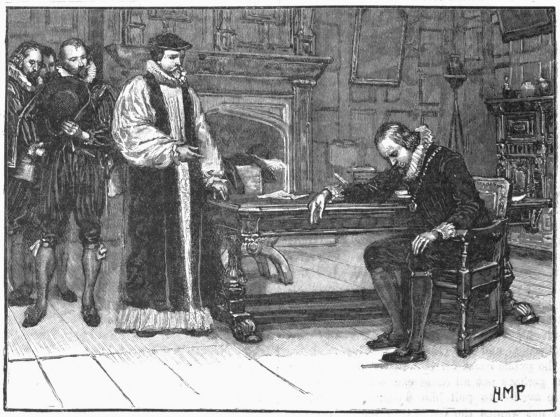
INTERVIEW BETWEEN BACON AND THE DEPUTATION FROM THE LORDS. (See p. 484.)
But all this cringing to the Crown, the coronet, and the mitre, did not serve him: he was required by the Peers to make a separate and distinct answer to each charge. He complied fully with the demand, confessing everything; and when a deputation from the Lords waited on him to know whether this was his own voluntary act—for they excused him the humiliation of appearing at the bar of the House—he replied with tears, "It is my act—my hand—my heart. Oh, my lords, spare a broken reed!" This full and explicit confession being read in the House, on the 3rd of May the Commons, headed by their Speaker, attended to demand judgment, which the Lord Chief Justice, acting as Speaker of the Upper House, declared to this effect:—That the Lord Chancellor being found guilty of many acts of bribery and corruption, both by his own confession and the evidence of witnesses, he was condemned to pay a fine of forty thousand pounds, to be imprisoned in the Tower during the king's pleasure, to be dismissed from all his offices, and deemed incapable of either holding office again or sitting in Parliament, and to be prohibited from coming within twelve miles of the seat of Parliament.
The king remitted the fine, for the best of reasons—that Bacon had nothing to pay it with; he also liberated him from the Tower after a mere pro formâ imprisonment of a few days, and Bacon retired to hide his dishonour at his house at Gorhambury, near St. Albans. Nor had his fall extinguished all admiration for him as a great lawyer and philosopher. Even in the House Sir Robert Philips, Sir Edward Sackville, and others, reminded the public of the Lord Chancellor's wonderful genius and acquirements; and as Prince Charles returned from hunting one day, he beheld "a coach accompanied by a goodly troop of horsemen," escorting the ex-Lord Chancellor to his house at Gorhambury.
In that beautiful retreat, it was in Bacon's power to have so lived and so written, that his disgrace as a statesman would have been soon lost in the splendour of his genius and the dignified wisdom of his latter years. But unfortunately Bacon was steeped to the core in the love of worldly greatness, and the five years that he lived were rendered still more miserable and still more contemptible by his incessant hankering after restoration to place and honour, and his persevering and cringing importunities to the king and Buckingham for these objects. To such a length did the wretched man proceed, that his letters became actually impious. He told the prince that as the king, his father, had been his creator, he had hoped that he would be his redeemer. The works which he completed after his disgrace were only such as could result from so miserable a condition of mind. They were suggested to him by the king, but were not executed with the zest of his own inclination. They consisted chiefly of a life of Henry VII., a revision of his former works, and the superintendence of a Latin translation of them. At length, finding all his efforts vain to move the king towards his restoration, his health and temper gave way, and he died on the 9th of April, 1626, the melancholy victim of an unworthy ambition.
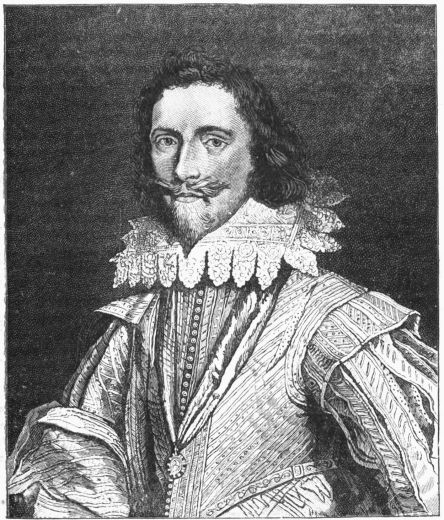
GEORGE VILLIERS, DUKE OF BUCKINGHAM.
(After the Portrait by Van Dyck.)
The Commons had rendered a very valuable service by these impeachments of public men, and one which has since then operated as a precedent in the hands of Parliament to check and punish on a large scale the too daring and unprincipled servants of the Crown. But, as if carried beyond themselves by their success, they now fell into a grievous error, and displayed a spirit as aggressive in themselves, as it was cruel, bigoted, and unconstitutional. One Edward Floyd, a Catholic barrister, a prisoner in the Fleet, was reported to have exulted in the success of the Catholics in Germany over the Elector Palatine. This being mentioned in the Commons, that august body took immediately such violent offence, that it was proposed by members to nail him by the ears, bore him through the tongue, set him in the pillory, and so forth. On inquiry, all that could be substantiated against him was, that he had said "that goodman Palsgrave and goodwife Palsgrave had been driven from Prague."
For this paltry offence—which would not now attract a passing notice in a newspaper—the Commons adjudged Floyd to pay a fine of one thousand pounds, to stand in the pillory in three different places, and to be carried from place to place on a horse without a saddle, and with his face to the tail. The Commons had clearly stepped out of their jurisdiction to adjudge a man who was no member of their House, and Floyd instantly appealed to the king against the proceeding. James, who had so often been checked in his prerogative by the Commons, did not neglect this grand opportunity of rebuking their error. He sent the very next morning to demand by what authority they condemned one who did not belong to them, nor had committed any breach of their privileges; and still more, by what right they sentenced him without evidence taken on oath?
This was a posing inquiry. The House was greatly disconcerted, for they were clearly in the wrong, and the king in the right. It was a hard matter, however, to confess their fault: the case was debated warmly for several days; but at length it was agreed to confer with the Peers, who asserted that the Commons had invaded their privilege of pronouncing judgment in such cases. The Commons still contended that they had a right to administer an oath, and therefore to pass judgment. But the Lords would not admit this, and it was agreed that the Lords should sentence Floyd, which they proceeded to do, as exercising their own exclusive right, the Commons contending that the Lords now judged him by a similar right by which they had already judged him. The sentence was severe enough to satisfy the Commons. The fine was increased from one to five thousand pounds, Floyd was to be flogged at the cart's tail from the Fleet to Westminster Hall, to sit in the pillory, to be degraded from the rank of a gentleman, to be held infamous, and to be imprisoned in Newgate for life.
Perhaps so atrocious a sentence was never pronounced for so trivial an offence. It showed how little either the Lords or Commons were yet to be trusted with the lives and liberties of the subject, and how ill-defined were still their functions. The public expressed its abhorrence of the barbarous proceeding, and Prince Charles exerted himself to procure a mitigation of the punishment, but could only succeed in obtaining the remission of the flogging. The Commons having executed so much justice and so much injustice, but making no approach to a vote of further supplies, James adjourned Parliament on the 4th of June to November. Vehement as had been the wrath of the Commons against a disrespectful allusion to the Palsgrave, they had done nothing towards the defence of his territory. As the public were by no means so indifferent on this point, the fear of their constituents suddenly flashed on the Commons, and they then made a declaration that if nothing effectual was done during the recess for the restoration of the Elector Palatine and the Protestant religion, they would sacrifice their lives and fortunes in the cause. This was not only carried by acclamation, but Coke, falling on his knees, with many tears and signs of deep emotion, read aloud the collect for the king and royal family from the Book of Common Prayer.
Parliament being adjourned, James proceeded to appoint a new Lord Chancellor in the place of Bacon. There were three public candidates for the office—Ley and Hobart, the two Chief Justices, and Lord Cranfield, the Treasurer, who had been originally a city merchant, but had risen by marrying a relative of Buckingham's. But there was another and still more extraordinary competitor determined on by Buckingham and James for the Chancellorship—no other than a clergyman—Williams, late Dean of Westminster, now Bishop of Lincoln. That a clergyman should be placed at the head of the Court of Chancery instead of a lawyer, was enough to astonish not only the members of the legal profession, but the whole public. Williams himself was openly professing to support the claims of Cranfield, and expressed astonishment when the post was offered to him. He declared so strongly his sense of his incapacity for the office, being inexperienced in matters of law, that he would only accept of it on trial for eighteen months, and on condition that two judges should sit with him to assist him. Yet this truly scandalous appointment was actually made, the real cause out of doors being assigned that "his too grate familiarity with Buckingham's mother procured him these grate favours and preferments one a suddaine." It was some time ere the barristers would plead before him.
But not the less did another event confound the dignitaries of the Church. Abbot, the Archbishop of Canterbury, hunting with Lord Zouch in Bramshill Park, in Hampshire, accidentally shot the keeper of the Park in aiming at a buck. The verdict of the coroner's inquest was unintentional homicide; but still the clergy contended that by the canon law the shedding of blood had disqualified him for discharging any ecclesiastical functions. Much censure was also expressed on his engaging in hunting at all; and as there were just then four bishops-elect who awaited consecration, they refused to receive it at his hands. Amongst these were Williams, the Lord Keeper, and Laud, Bishop of St. David's, who were supposed to be partly influenced by a hope of securing the primacy, if Abbot were pronounced disqualified. A commission, however, of prelates and canonists proposed that the archbishop should be absolved from all irregularity, and James, as head of the Church, granted him a pardon and appointed eight bishops to give him absolution; but from this time forward he seldom appeared at Court.
During the recess the king performed an act calculated to conciliate the Commons. By the advice, as it was said, of Williams, the Lord Keeper, he had abolished thirty-seven of the most oppressive of the patents and monopolies, of which the Commons had so long complained. But the effect of this was totally neutralised by other measures of a contrary tendency. Complaints had been made of the growing audacity of the Algerine pirates, who had not only seized several English merchant ships in the Mediterranean, but even on the British coast. James requested Spain, which also was a sufferer from these robbers, to join in an expedition to burn all their ships and destroy Algiers itself. Sir Robert Monsell was sent with a squadron for this purpose, but the Spaniards did not join him, and he was said to have a royal order not to risk his ships. Under such circumstances, nothing very vigorous was to be expected, yet on the 24th of May Monsell sailed up to the fort, and the sailors set fire to the ships and then retired. No attack was made on the town, and the firing of the vessels was so imperfectly done, that the Algerines soon put out the flames, and threw booms across the harbour to prevent the re-entrance of the English. Only two of the pirate vessels were consumed, and the Algerines, like a swarm of hornets irritated in their nest but not injured, rushed forth soon afterwards in such force and fury, that they speedily captured no less than five-and-thirty English merchantmen. Loud and bitter were the complaints in the country of this worse than useless proceeding.
To add to the ill-humour generated by this imbecile transaction, the public had been greatly incensed by the arrest of a number of liberal-minded men—the Earls of Oxford and Southampton, Sutcliffe, Dean of Exeter, Brise, a Puritan preacher, Sir Christopher Neville, Sir Edward Sandys, and Selden, the great lawyer and antiquary; and a prosecution had been commenced against Sir Edward Coke, on no less than eleven charges of misdemeanour during the time that he was a judge. Coke, unlike Bacon, had amassed great wealth during his official life, and it was understood that these charges of peculation and bribery had been got up at the suggestion of Bacon and Coke's own wife, Lady Hatton.
The Commons took up zealously the cause of their members, Sandys and Coke. Sandys had been examined on some secret charge before the Council, and after a month's detention was discharged. Being confined to his bed at the commencement of the Session, two members were appointed to wait on him and learn the cause of his arrest, notwithstanding the assurance of the Secretary of State that it had no connection with his conduct in the House. They also ordered the Serjeant-at-Arms to take into custody the accusers of Coke, and appointed a committee to examine witnesses. They felt assured that the proceedings against these gentlemen originated with their popular conduct in Parliament.
At the same time, Coke, in the Commons, proposed a petition to the king against the increase of Popery and the marriage of the Prince of Wales to a Catholic. It represented that the success in Germany against the Elector Palatine had so encouraged the Papists, that they flocked in crowds to the chapels of the foreign ambassadors; sent their children abroad for education, and were treated with so much lenity that, if not prevented, they would soon again be in the ascendant. Spain was represented, without directly naming it, as the worst enemy of England, and the king was implored to recall all the children of Catholic noblemen and gentlemen from abroad, to marry his son to a Protestant princess, and to enforce the laws with rigour against the Papists.
James received a private copy of this petition, and was thrown into a paroxysm of rage at its perusal. To dictate to him how he should marry his son; to recommend that he should invade the territories of Spain, and to reflect on the honour of his ally, the Spanish king, were examples of intolerable interference with his dearly valued prerogative. He wrote at once to the Speaker, denouncing certain "fiery, popular, and turbulent spirits" in the House, and desiring them not to concern themselves about such matters as were included in the petition. Adverting to Sandys, he denied that his offence was connected with the House of Commons, but at the same time declared that the Crown possessed a right to punish subjects, whether members of Parliament or not, and would not fail to exercise it.
The House received this missive with much dissatisfaction, but with dignity, and vindicated their right of liberty of speech in a firm memorial. James replied that though their privileges were no undoubted right, but were derived from the grace of his ancestors on the throne, yet so long as they kept them within the limits of duty, he should not exercise his prerogative and withdraw those privileges. The House declared its high resentment at this language, which reduced their right into mere matter of royal favour, and the expression of feeling ran so high that James became alarmed, and wrote to Secretary Calvert, instructing him to qualify his assertions a little. But the House was not thus to be satisfied where the question of its privileges was directly raised, and on the 18th of December it drew up the following protest:—"That the liberties and jurisdictions of Parliament are the most ancient and undoubted birthright and inheritance of the subjects of England; that arduous and urgent affairs concerning the king, the State, and defence of the realm, and the Church of England, the making and maintenance of laws, and the redress of grievances, are proper subjects of counsel and debate in Parliament; that in the handling of these businesses every member hath and ought to have freedom of speech; that the Commons in Parliament have like liberty to treat of these matters in such order as they think proper; that every member hath like freedom from all impeachment, imprisonment, and molestation, other than by the censure of the House itself, concerning any Bill, speaking or reasoning touching Parliament matters; and that if any be complained of for anything said or done in Parliament, the same is to be showed to the king by assent of the Commons before the king give evidence to any private information."
This was speaking out; the Parliament threw down the gage and James, in his wrath, took it up. Forgetting that he was represented as ill, he rode up to London in a fury and ordered the clerk of the Commons to bring him the Journals of the House. According to Rushworth, he tore out the obnoxious protest with his own hands, in full Council, and in presence of the judges; at all events he cancelled it; had what he had done entered in the Council-book; and on the 6th of January, 1622, by an insulting proclamation, dissolved Parliament, assuring the public that it was on account of its evil temper that he had dissolved the House of Commons, and not with any intention of doing without one; that he should soon call another; and in the meantime the country might rest assured that he would endeavour to govern well.
The first proof of his notions of governing well was the summoning of the Earls of Oxford and Southampton from the House of Peers, of Coke, Philip, Pym, and Mallory from the Commons, and of Sir John Selden, to appear before the Council. Some were committed to the Tower, some to the Fleet, and others to the custody of private individuals. Though nothing in either House could have occasioned these arrests, various reasons were assigned for them. Moreover, Selden was not a member of the Commons, and he therefore could have incurred no blame there. But he was the legal adviser of Sandys and others, who had made themselves prominent in the popular cause, and he was known as one of the ablest legal advocates of Parliamentary and public rights. The two Peers were also at the head of a popular party which had sprung up in the Lords, and the whole matter was too palpable for mistake. Nothing could, however, be fixed on any of the prisoners which the Government dared to charge as a crime, and after a sharp rebuke they were liberated. There were still other members whose conduct had excited the anger of the Court, but against whom no specific charge could be established. These were Sir Dudley Digges, Sir James Parrott, Sir Nathaniel Rich, and Sir Thomas Carew. To punish them a singular mode was devised. They were appointed to a commission in Ireland to inquire into the state of the army and navy, into the condition of the Church and of public schools, into the abuses in the collection of revenue and in the settlement of the plantations, and into the existence of illegal and mischievous patents. As it was extremely inconvenient for these gentlemen to absent themselves on such business, they protested decidedly against it; but they were told that the king had a right to the services of his subjects, in any way that he pleased; and though these gentlemen had stood boldly with their fellows in a collective capacity for the rights of the subject, they were not sufficiently screwed up to the pitch of martyrdom to stand upon their individual freedom, and refuse at all costs. Coke, who had now taken the lead in the popular cause, because the Court had repelled and dismissed him, offered to accompany them, and assist them with his legal advice and experience, but his offer was declined. The subjects of inquiry, of themselves, were of a nature to furnish much strength and information to the reformers, and the mode of punishing these men was as short-sighted as it was arbitrary. But the great contest was now fully begun, in which the blindness and tyranny of the Stuarts, and the firm intelligence of the people, were to fight out the grand question of constitutional government. Those who regard this as a matter only of Charles I.'s reign have strangely overlooked the doings and doctrines of James, who was the real author of the conflict, and opened it himself with all the dogmatism which distinguished the royal side to the end. This very session Prince Charles had been a diligent attender of the House of Lords, but seems to have had no perception whatever of the spirit which was dominant in the House of Commons, and rapidly diffusing its electric fire through the nation. The names of Pym, Coke, Wentworth, and Laud, were already in men's mouths, the heralds of that mighty host, which, for good or for evil, was soon to engage in terrible combat; the issue of which was to be the morning-star of governmental science to the nations, determining the true powers, uses, and limitations of governments, as well as the liberty of the people protected, by its own popular safeguards, from licence and anarchy.
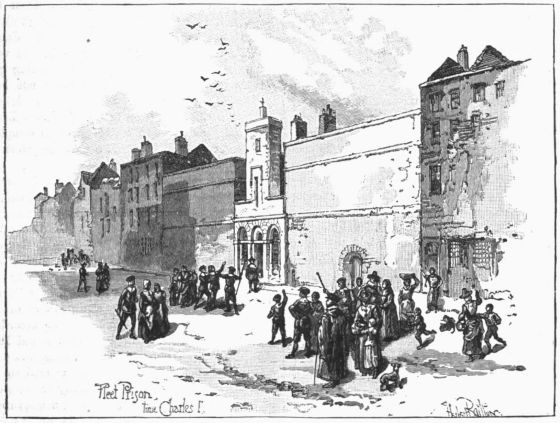
THE FLEET PRISON.
In foreign affairs James was placed in particular difficulties. The two objects which he had more than all others at heart, were the marriage of his son, the Prince of Wales, to the Infanta of Spain, and the restoration of the Elector Palatine to his hereditary possessions. He had tried too late to secure the Princess Christine of France. She was already affianced to Philip of Spain. He had since negotiated for the hand of Donna Maria of Spain. If he could accomplish this marriage, he should be at once able to secure by it his other grand desire—the restoration of the Palsgrave,—for Spain would then be induced to withdraw its forces from the assistance of the Emperor against the Palatinate, and to add its earnest co-operation in arranging for the Palsgrave's re-instatement.
But against this project of marriage—the stepping-stone to these measures in Germany—stood the aversion of the people in England to a match with so pronouncedly Catholic a country as Spain, and so bigoted a family as that of its Sovereign. Just as adverse were the Spaniards, and especially the priests, to the young Infanta coming into a heretical country, and to any impediment thrown in the way of the Emperor of Germany exterminating the Protestants there. During the life of Philip III., the father of Donna Maria, little progress was made in these negotiations, but on the accession of his son Philip IV., in 1621, the prospect brightened. Both James and Charles wrote to the new king and his favourite Olivarez. In England Gondomar, the Spanish minister, was warmly in favour of the alliance, seeing in it a guarantee for the relief of the Catholics and of increased strength against France. Lord Digby, now Earl of Bristol, late ambassador at Madrid, was equally zealous for the marriage; and James was the more eager for it as he saw no hope of aid in his German project from France. There the feeble monarch, Louis XIII., was wholly in the hands of a despicable favourite, De Luynes, who was insolently opposed to the English interests, though the French people, from the hereditary hatred of the house of Austria, would have gladly marched against the invaders of the Palatinate.
The affairs of Frederick, the Elector Palatine, were desperate. The Palatinate, in fact, was already lost. Count Mansfeldt—the ablest general who had fought for the Elector's interests—and the Prince Christian of Brunswick, had evacuated the Palatinate; Heidelberg and Mannheim were in the hands of the enemy; and these generals had entered the service of the Dutch. The Emperor, in reward for the successful services of Maximilian of Bavaria, had conferred on him the Electorate of the Palatinate with the greater part of the territory.
James himself, to get rid of the maintenance of the garrison, had given up Frankenthal to the Spaniards, on condition that if, within eighteen months, a satisfactory peace were not made, it should be returned. Everything, therefore, was lost, and James fondly hoped that the Spanish match might yet recover everything.
Circumstances appeared to favour his hopes. The young King of Spain and his minister, Olivarez, responded cordially to James's proposal; Gondomar hastened on to Madrid to promote the object, and was soon followed by the Earl of Bristol, equally earnest for the accomplishment of the marriage. It was, however, necessary to procure a dispensation for this union from the Pope, and this the King of Spain undertook to procure through his ambassador at Rome. James was not to appear at all in the affair, but with the unconquerable propensity to be meddling personally in every negotiation, he could not help despatching George Gage, a Catholic, with letters to the Pontiff, as well as to the Cardinals Ludovisio and Bandini; and Buckingham, to complete the intercession, sent Bennet, a Catholic priest, on the same errand.
The Pope was not likely to grant the favour to James without a quid pro quo, and therefore, as might have been expected, replied that the canons of the Church could only be suspended for the benefit of the Church; that the King of England had been very liberal of his promises to the late King of Spain, but had performed nothing; he must now give proof of his sincerity by relieving the English Catholics from the pressure of his penal laws, and the request would be accorded. This was a demand in limine which would have shown to any prudent monarch the dangerous path he was entering upon; but James trusted to his tortuous art of king-craft, and rashly set to work to undo all that he had done throughout his reign against the Catholics. He caused an order under the Great Seal to be issued, granting pardons to all recusants who should apply for them within five years; and the judges were commanded to discharge from prison those who gave security for their compliance with these terms.
There was a glad and universal acceptance of the proffered lenity by the Catholics. The doors of the prisons were opened, and the astonished Puritans saw thousands on thousands of the dreaded Papists once more coming abroad. There was instantly a cry of terror and indignation from John O'Groat's to the Land's End. The pulpits resounded with the execrations of enthusiastic preachers on the traitorous dealing of the Court, and the depicted horrors of Catholic and Spanish ascendency. James trembled, but ordered the Lord Keeper Williams and the Bishop of London to assure the public that he was only seeking to gain better treatment for the Protestants abroad, whom the Continental princes declared they would punish with the same rigour as James had punished the Catholics in England, unless the British severity was somewhat mitigated; and that, moreover, there was no danger; for the recusants, though out of prison, had still the shackles about their heels, and could at any moment be remanded. This, without satisfying the Puritans, undid all confidence amongst the Catholics. They recalled the habitual duplicity of James and felt no longer any security; and when Gondomar boasted in Spain that four thousand Catholics had been released in England, those Catholics only remarked, "Yes; but we have still the shackles about our heels, and may at any moment be thrust again into our dungeons."
His only consolation was that the Spanish match now seemed really to progress. On the 5th of January, 1623, the twenty articles securing the freedom of her worship to the Infanta in England, the cessation of persecution of the Catholics, and the exercise of their religious rites in their own houses, were signed by James and Prince Charles. The dower of the princess was to be two millions of ducats. The espousals were to take place at Madrid by proxy, within forty days from the receipt of the dispensation; and the princess was to set out for England within three weeks. The time for the final consummation of the marriage, and the intervals between the several payments of the dower, were all fixed, and Gondomar and Bristol congratulated themselves on the completion of their arduous negotiation.
At this crisis, however, arrived two Englishmen at the Earl of Bristol's residence at Madrid, under the names of John and Thomas Smith. To the ambassador's astonishment and chagrin, on appearing before him, they turned out to be no other than the Prince of Wales and Buckingham, who had arrived in disguise, and with only three attendants. But how this extraordinary and imprudent journey had come about requires to be told with some detail. It was said to have originated with Gondomar; it had been planned on his visit to London the preceding summer, and had since been stimulated by his letters. He is declared to have represented to the prince, who complained of delay, that all obstacles would vanish at once if he were to suddenly appear and press his own suit. The idea caught the imagination of the prince, and was warmly seconded by Buckingham, who not only longed to seek adventures among the beauties of Madrid, but also hoped to snatch the achievement of the match out of the hands of Bristol, whom he hated. If it were really the scheme of the wily Spaniard, he must have prided himself greatly on its success; a success, however, which produced its own ruin.
When the plan was first opened to James by Charles and Buckingham, he gave in to them without hesitation so much did he desire to have the affair settled. But on thinking it over alone, he was immediately sensible of the danger and the impolitic character of the enterprise. He therefore begged the prince and the favourite to give it up, pointing out, with great justice, how much they would put themselves in the power of the Spaniards, what advantages they would give them over them, and what a storm of anger and alarm would break out at home as soon as it became known. The two knights-errant bade him dismiss his fears, saying that all would go well and that they had selected Sir Francis Cottington and Sir Endymion Porter to attend them. James approved their choice, but commanded Cottington to tell him plainly what he thought of the project. Cottington, who did not seem yet to have been let into the secret, on hearing it, was much agitated and declared that it was a rash and perilous adventure; whereupon James threw himself upon his bed in an agony, crying—"I told you so; I told you so before. I shall be undone, and lose baby Charles." The prince and Buckingham were furious at the behaviour of Cottington, and handled him severely; but after all, James, with his usual weakness, gave his consent, and the travellers set forward on the 17th of February, 1623, and after an adventurous journey arrived at their destination.
Lord Bristol had despatched a messenger immediately on the prince reaching his house, informing the king that his son and friend were safe in Madrid, after a journey of sixteen days. Meanwhile, strange rumours began to run about the Spanish capital that some great man from England had arrived, supposed to be the king himself; and it was deemed best to make the fact known to the Court. Accordingly they sent for Gondomar, who hurried off to Court with the welcome news. There were first private but stately interviews, and then a public reception. The prince was first privately conducted to the Monastery of St. Jerome, from which the Spanish kings proceed to their coronation, and was then brought back publicly by the king, his two brothers, and the élite of the Spanish nobility. Charles rode at the king's right hand through the whole city to the palace, when he was conducted to the apartments appropriated to him. He had then a formal introduction to the queen and Infanta. Charles had two keys of gold given him, by which he could pass into the royal apartments at all hours, yet Spanish etiquette did not allow him to converse with the Infanta except in public. Tired of this restraint, Charles determined to break through the Court formality, and speak unceremoniously with his proposed wife; wherefore, hearing that Donna Maria used to go to the Casa de Campo on the other side of the river to gather Maydew, he rose early and went thither also. He passed through the house and garden, but found that the princess was in the orchard, and between him and her a high wall, and the door strongly bolted. Without further ceremony he got over the wall, dropped down, and seeing the princess at a distance, hastened towards her. But the princess, on perceiving him, gave a shriek and ran off; and the old marquis, her guardian, falling on his knees before the prince, entreated him to retire, as he should lose his head if he permitted the interview. Accordingly he let him out and rebolted the door.
Great were the public rejoicings, however, on account of this chivalric visit. The king professed to feel himself much complimented by the reliance of the English prince on the Spanish honour, on the earnestness it evinced in the prosecution of his suit; and the people as firmly calculated on his conversion to the Catholic faith. The prisons were thrown open; presents and favours were heaped upon him, the king insisted on his taking precedence of himself, and assured him that any petition which he presented to him for a whole month should be granted. There were bull-fights, tournaments, fencing matches, feasts, and religious processions, held in his honour and for his amusement.
But at home, dire was the consternation when it was known that Charles had gone off with slight attendance to Spain. It was stoutly declared that he would never escape alive from amongst the inquisitions and monks of that priest-ridden country, or if he did, it would only be as a Papist. The freedom of comment on the occasion in the pulpits caused James to issue an order through the Bishop of London that the clergy should not in their prayers "prejudicate the prince's journey, but only pray to God to return him home in safety again to us, and no more." Whereupon a preacher, with an air of great simplicity, prayed that the prince might return in safety again, and no more—that is, as it was understood, without a Catholic wife. Yet to pacify his subjects, the king informed them that he had sent after them two Protestant chaplains, together with all the stuff and ornaments fit for the service of God. And he added, "I have fully instructed them, so as all their behaviour and service shall, I hope, prove decent and agreeable to the purity of the primitive Church, and yet so near the Roman form as can lawfully be done. For," says this stern persecutor of Catholicism, "it hath ever been my way to go with the Church of Rome usque ad aras."
In so very complying a mood was James at this moment, that when these chaplains asked him what they were to do if they met the Host in the streets, he replied they must avoid meeting it whenever they could; when they could not, they must do as the people did there. And poor James soon found that he had need of all his moral pliability. The Spanish Court, as might have been foreseen, once having the prince in their power, resolved to benefit by it. They soon let the prince and Buckingham know that the Pope made grave difficulty about the dispensation, and the Papal nuncio was sternly set against it, and it was inquired how far the prince could go in concession. Buckingham wrote, therefore, to the king in these ominous words:—"We would gladly have your directions how far we may engage you in the acknowledgment of the Pope's special power, for we almost find, if you will be contented to acknowledge the Pope chief head under Christ, that the match will be made without him."
This was asking everything and James was brought to a stand. He wrote in reply that he did not know what they meant by acknowledging the Pope's spiritual supremacy. He was sure they would not have him renounce his religion for all the world. "Perhaps," he wrote, "you allude to a passage in my book against Cardinal Bellarmine, where I say that if the Pope would quit his godhead and usurping over kings, I would acknowledge him for chief bishop, to whom all appeals of Churchmen ought to lie en dernier ressort. That is the farthest my conscience would permit me to go; for I am not a monsieur who can shift his religion as easily as he can shift his shirt when he cometh from tennis."
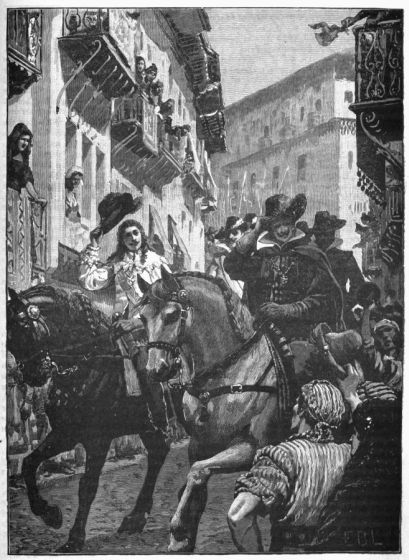
PUBLIC RECEPTION OF PRINCE CHARLES IN MADRID. (See p. 492.)
That Buckingham would have advised Charles to abandon his religion for the achievement of his object, had he dared, there is little question, for his mother was an avowed Papist and was his constant prompter in his policy. Before leaving London, the two adventurers had obtained the king's solemn promise in writing, that whatever they agreed to with the Spanish monarch he would ratify; so that James might well be alarmed at their suggestion. Charles, in fact, did not hesitate, in reply to a letter from the Pope, to pledge himself to abstain from every act hostile to the Catholic religion, and to seek every opportunity of accomplishing the reunion of the Church of England with that of Rome. The letter—which, Lord Clarendon truly says, "is, by your favour, more than a compliment"—may be seen in the Hardwicke papers. Charles afterwards said that it was only a promise that he never meant to keep; we may therefore see that already his father's notions of king-craft had taken full possession of him, which, with his large self-esteem and a persevering disposition, produced in him that fatal mixture of determination and unscrupulous insincerity which ruined him. Instead of a firm resistance to the palpable schemes of the Pope and the Spaniard, and a truthful candour which would have convinced them that they had no chance of moving him, he led them by his apparent acquiescence to believe that they could win him over; and when they had carried him beyond the bounds of prudence, and much beyond those of honesty, he had no alternative but to steal away and repudiate his own solemn words and acts. Is it at all to be wondered at that neither foreign nations nor his own could ever after put faith in him? The sophistry and absolutism of the father had already destroyed the son, by perverting his moral constitution. It is probable that Charles also acquired a strong taste for ecclesiastical pomp and circumstance during this visit and its religious shows and ceremonies, which falling in afterwards with the ambitious taste of Laud, also tended to direct him towards the same "facilis descensus Averni."
James had despatched after the prince a great number of people, to form a becoming attendance on the heir of England. Others flocked thither of their own accord and especially Catholic refugees, who swarmed in the prince's court, and particularly about Buckingham. The Jesuits did their best to convert them, and were encouraged by every appearance of success. Though James had sent what he called the "stuff and ornaments" for public Protestant worship, we are informed that these were never used; for though the Prince had the Earl of Carlisle, and the Lords Mountjoy, Holland, Rochfort, Andover, Denbigh, Vaughan, and Kensington, besides a number of other courtiers and their dependents around him, they had no public worship, as if they were ashamed of their heretical faith, or feared to offend their Catholic friends. Charles contented himself with bed-chamber prayers. The consequence was, as Howell, who was there, wrote, that the Spaniards, hardly believing the English Christians and seeing no evidence of worship, set them down as little better than infidels. This occasioned great discontent amongst the more conscientious of the retinue, and they did not hesitate to avow their religious belief, and their contempt of the mummery which they saw around them, which led to much scandal and anger. Archie, or Archibald, Armstrong, the famous Court fool, whom oddly enough James had sent as well as the Church plate and vestments, seemed to think himself privileged by his office to say what he pleased, and he did not hesitate to laugh at the religious ceremonies, and argue on religious points with all the zeal of a Scottish Presbyterian, as he was. Others even proceeded to blows. Sir Edward Varney, finding a priest at the bedside of a sick Englishman, struck him under the ear and they fell to fighting till they were thrust asunder.
This state of things would not have been tolerated so near the Inquisition except for the great end in view—the belief that Charles would become a Catholic. Gregory XV. had written to the Inquisitor-General to this effect:—"We understand that the Prince of Wales, the King of Great Britain's son, is lately arrived there, carried with a hope of Catholic marriage. Our desire is that he should not stay in vain in the courts of those to whom the defence of the Pope's authority, and care of advancing religion, hath procured the renowned name of Catholic. Wherefore, by apostolic letters, we exhort his Catholic majesty that he would gently endeavour sweetly to reduce the prince to the obedience of the Roman Church, to which the ancient kings of Great Britain, with Heaven's approbation, submitted their crowns and sceptres. Now, to the attaining of this victory, which to the conquered promiseth triumphs and principalities of heavenly felicity, we need not exhaust the king's treasures, nor levy armies of furious soldiers, but we must fetch from heaven the armour of light, whose divine splendour may allure the prince's eye, and gently expel all errors from his mind. Now, in the managing of these businesses, what power and art you have, we have well known long ago; wherefore, we wish you to go like a religious counsellor to the Catholic king, and to try all ways which, by this present occasion, may benefit the kingdom of Britain and the Church of Rome. The matter is of great weight and moment, and therefore not to be amplified with words. Whoever shall inflame the mind of this royal youth with a love of the Catholic religion, and breed a hate in him of heretical impiety, shall begin to open the kingdom of heaven to the Prince of Britain, and to gain the kingdom of Britain to the Apostolic See."
It was easy to foresee that this absurd journey would lead to these determined attempts to regain the rich islands of Great Britain to the Catholic Church. The Catholics everywhere regarded the rupture to have been occasioned by Henry VIII.'s Protestant marriage, and nothing appeared so likely as that a Catholic marriage would heal it. It was not so easy to foresee that Charles, at the age of twenty-three, should so consummately act the hypocrite. He wrote to the Pope, in reply to a most gracious and paternal letter from his holiness, calling him "Most Holy Father," telling him how much he deplored the division of the Churches and longed to restore union. Gregory was dead before this extraordinary epistle arrived at Rome, but Urban VIII., the new Pope, lifted up his hands in joyful astonishment on reading it, and "gave thanks to the Father of Mercies, that on the very entrance of his reign a British prince performed this kind of obeisance to the Pope of Rome." Having apparently so favourable a subject to operate upon, Olivarez now told Charles that the treaty entered into through the Earl of Bristol had been rather for show than use, and that now, as the prince and his able adviser were there themselves, they should make a real and effective compact. Accordingly, in spite of the strenuous remonstrances of the two British ambassadors against re-opening the question already settled, Charles and Buckingham permitted it; and the Spanish minister found little difficulty in introducing several new and more favourable clauses. There was, in fact, a public and a private treaty agreed to. By the public one the marriage was to be celebrated in Spain and afterwards in England; the children were to remain in the care of their mother till ten years of age; the Infanta, was to have an open church and chapel for the free exercise of her religion, and her chaplains were to be Spaniards under the control of their own bishops. By the private treaty it was engaged that the penal laws against Catholics should be suspended; that Catholic worship should be freely performed in private houses; that no attempts should be made to entice the princess to abandon her hereditary faith; and that the king should swear to obtain the repeal of the penal Statutes by Parliament.