Chapter XVI · (continued 3)
Reading edition
The coif was of various materials, from simple linen to rich velvet and cloth of gold; either with the round front, as in Mary and Elizabeth as princesses, in Catherine Parr and Catherine Howard, or dipping in front, which came to be called the "Queen of Scots" bonnet; but the commonest shape was the five-cornered one. This last was indeed the hood of the time of Henry VII., in which we have a portrait of his queen, Elizabeth of York; the lappets of the hood depending on the bosom, embroidered and edged with pearls; the scarf behind hanging on the shoulders. In the portrait of Catherine of Aragon, the front, embroidered and jewelled, had become shorter, touching the neck only; but the scarf behind still spread on the shoulder. In Anne Boleyn's portrait the coif had reached its extreme of elegance; the frontlet, consisting of the five-pointed frame, is still shorter, only covering the ears, and is faced with a double row of pearls (see p. 165). Her hair is scarcely seen, being concealed by an under-coif, which shows as a band in a slanting direction over the forehead. The back consists of a green velvet hood, with broad scarf lappets, of which one is turned up over the back of the head, and the other hangs on the left shoulder. Of the dress of the ladies of the citizen class we have a curious account in the bride of John of Winchcomb, the famous clothier, called "Jack of Newbury." "She was habited in a gown of sheep's russet, and a kirtle of fine worsted, her head attired with a billiment of gold, and her hair, as yellow as gold, hanging down behind her, which was curiously combed and plaited. She was led to church by two boys with bride laces and rosemary tied about their silken sleeves. When she in after years came out of her widow's weeds, she appeared in a fair train gown stuck full of silver pins, having a white cap on her head, with cuts of curious needlework under the same, and an apron before her as white as driven snow."
With Elizabeth came in a totally new fashion, not only of women's but of men's costumes. The large trunk hose made their appearance; the long-waisted doublet, the short cloak or mantle, with its standing collar, the ruff, the hat, the band and feather, the roses in the shoes, are all of this period. To such a degree did the fashion of puffed and stuffed breeches obtain, which had begun to swell in the prior reigns, that about the thirty-third of Elizabeth, over the seats in the Parliament House, were certain holes, some two inches square, in the walls, in which were placed posts to uphold scaffolds round about the house for those to sit upon who wore great breeches stuffed with hair, like woolsacks.
As to ruffs, Stubbs, in his "Anatomie of Abuses," tells us that sooner than go without them, men would mortgage their lands, or risk their lives at Tyburn; and he adds, "They have now newly (1595) found out a more monstrous kind of ruff of twelve, yea, sixteen lengths apiece, set three or four times double, thence called three steps and a half to the gallows." The French or Venetian hose, he tells us, cost often £100 a pair, probably from being cloth of gold and set with jewels. To these were added boot hose of the finest cloth, also splendidly embroidered with birds, beasts, and antiques. The doublets, he says, grew longer and longer in the waist, stuffed and quilted with four, five, or six pounds of bombast, the exterior being of silk, satin, taffeta, gold, or silver stuff, slashed, jagged, covered, pinched, and laced with all kinds of costly devices. Over these were their coats and jerkins, some with collars, some without, some close to the body, some loose, called mandilions; some buttoned down the breast, some under the arm, some down the back. They had cloaks also—white, red, tawny, yellow, green, violet—of cloth, silk, or taffeta, and of French, Spanish, or Dutch fashion, ornamented with costly lace of gold, silver, or silk. These cloaks were as costly inside as out. Their slippers or "pantoufles" were of all colours, and yet, says Stubbs, they were difficult to keep on, and went flap-flap up and down in the dirt, casting the mire up to their knees. Their hats, he states, were sharp at the crown, peaking up like the shaft of a steeple a quarter of a yard above the crown of their heads, some more, some less; others were flat and broad on the crown; some had round crowns and bands of all colours; and these hats or caps were of velvet, taffeta, or sarcenet, ornamented with big bunches of feathers; and finally we hear of beaver hats, costing from twenty to forty shillings apiece, brought from beyond seas.
But if such was the dress of gentlemen to please the strange taste of the maiden queen, that of this famous queen herself, as evinced by her numerous portraits, has nothing like it in all the annals of fashion. In an early portrait of Elizabeth we have her dressed in a costume very little different to that of a man. Over her gown or doublet she wore a coat with the enormous shoulder-points standing up six inches, and with a close upright collar completely enveloping her neck, and surmounted by a ruff; her coat cut and slashed all over, and on her head a round hat, pulled down to a peak in front, and thickly jewelled. Stubbs, alluding to this particular fashion, says, "The women have doublets and jerkins as the men have, buttoned up to the breast, and made with wings, welts, and pinions on the shoulder-points, as men's apparel in all respects.... Yet they blush not to wear it."
But it was about the middle of her reign that Elizabeth introduced that astounding style of dress in which she figures in most of her portraits, and in which the body was imprisoned in whalebone to the hips; the partlet or habit-shirt, which had for some time been in use, and covered the whole bosom to the chin, was removed, and an enormous ruff, rising gradually from the front of the shoulders to nearly the height of the head behind, encircled the wearer like the enormous wings of some nondescript butterfly. In fact, there was ruff beyond ruff; first, a crimped one round the neck like a collar; and then a round one standing up from the shoulders behind the head; and, finally, the enormous circular fans towering high and wide. The head of the queen is seen covered with one of her eighty sets of false hair, and hoisted above that a jaunty hat, jewelled and plumed.
In order to enable this monstrous expanse of ruff to support itself, it was necessary to resort to starch, and, as Stubbs tells us, also to a machinery of wires, "erected for the purpose, and whipped all over with gold thread, silver, or silk." This was called a "supportasse, or underpropper." The queen sent to Holland for women skilled in the art of starching; and one Mistress Dingham Vander Plasse came over and became famous in the mystery of tormenting pride with starch. "The devil," says Stubbs, "hath learned them to wash and dress their ruffs, which, being dry, will then stand inflexible about their necks."
From the bosom, now partly left bare, descended an interminable stomacher, and then the farthingale spread out its enormous breadth, like the Victorian crinoline. Stockings of worsted yarn and silk had now become common; and Mistress Montague presented Her Majesty, in the third year of her reign, with a pair of silk stockings knit in England; thereupon she would never wear any else. A fashion of both ladies and gentlemen of this time was to wear small looking-glasses hanging at their sides or inserted in the fan of ostrich feathers.
The history of the coinage from Henry VII. to the reign of Elizabeth is one of depreciation and adulteration, as it had been in the preceding century. Not till Elizabeth did it begin to return to a sound and honest standard.
Henry VII. made several variations in the money of the realm. He preserved the standard of Edward IV. and Richard III., coining 450 pennies from the pound of silver, or thirty-seven nominal shillings and sixpences. He introduced shillings as actual money, being before only nominal, and used in accounts. These shillings, struck in 1504—called at first large groats, and then testons, from the French "teste," or "tête," a head—bore the profile of the king instead of the full face; a thing unknown since the reign of Stephen, but ever after followed, except by Henry VIII. and Edward VI., who, however, used the profile in their groats. Henry coined also a novel coin—the sovereign, or "double rose noble," worth twenty shillings, and the "rose rial," or half-sovereign. These gold coins are now very rare. On the reverse of his coins he for the first time placed the Royal arms.
The gold coins of Henry VIII. were sovereigns, half-sovereigns, or rials, half and quarter rials, angels, angelets, or half angels, and quarter-angels, George nobles—so called from bearing on the reverse St. George and the dragon—crowns, and half-crowns. His silver coins were shillings, groats, half-groats, and pennies. Amongst these appeared groats and half-groats coined by Wolsey at York, in accordance with a privilege, exercised by the Church long before. In his impeachment it was made a capital charge that he had placed the cardinal's hat on the groats under the king's arms. The groats also bore on each side of the arms his initials, "T. W.," and the half-groats "W. A."—Wolsey Archiepiscopus.
Not only did Henry adulterate the coin in the most scandalous manner, but he also depreciated the value of the silver coins, by coining a much larger number of pennies out of a pound of the base alloy. Before his time the mixed mint pound had consisted of eleven ounces two pennyweights of silver, and eighteen pennyweights of alloy; but Henry, in 1543, altered it to ten ounces of silver and two ounces of alloy. Two years later he added as much alloy as there was silver; and not content with that, in 1546, or one year after, he left only four ounces of silver in the pound, or eight ounces of alloy to the four ounces of silver! But this even did not satisfy him: he next proceeded to coin his base metal into a larger amount than the good metal had ever produced before. Instead of 37s. 6d., or 450 pennies, into which it had been coined ever since the reign of Edward IV., he made it yield 540 pennies, or 45s., in 1527, and in 1543 he extended it to 48s., or 576 pennies. He thus, instead of 450 pennies out of a pound containing eleven ounces two pennyweights of silver, coined 576 pennies out of only four ounces of silver! Such were the lawless robberies which "Bluff Harry" committed on his subjects. Any one of the smallest debasements by a subject would have sent him to the gallows. He certainly was one of the most wholesale issuers of bad money that ever lived.
The counsellors of his son Edward—a most rapacious set of adventurers—however, even out-Harryed Harry; for though Edward restored at first the value of the mint mixture in some degree, in 1551 the amount of silver in a pound of that alloy was only three ounces, or an ounce less than the worst coin of his father. And still worse, instead of 48s., the largest number coined by his father out of a pound, he coined 72s., or instead of 450 pennies out of four ounces of silver, 864 pennies were coined out of three ounces. The ruin, the confusion of prices, and the public outcry, however, consequent upon this violent public fraud, at length compelled Government to restore the amount of silver in the pound to nearly what it was at the beginning of the reign of Henry VIII., and the number of shillings was reduced from seventy-two to sixty. The gold, which was equally debased, was also restored to the same extent.
Queen Mary, while she issued a proclamation at the commencement of her reign denouncing the dishonest proceedings of her predecessors, again increased the alloy in a pound of mint silver to an ounce instead of nineteen pennyweights; and she added two pennyweights more of alloy to the ounce of gold. The coins issued by Philip and Mary bear both their profiles.
Elizabeth honourably restored the coinage to its ancient value. She fixed the alloy in a pound of silver at only eighteen pennyweights; but she coined sixty-two shillings out of the pound instead of sixty, at which it remained till 1816, when it became sixty-six, as it still remains. The standard mixture of Elizabeth has continued the same to our own day. She called in and melted down the base money of her father and brother to the nominal value of £638,000, but of real value only £244,000. The gold coins of Elizabeth are rials, angels, half-angels, and quarter-angels, crowns and half-crowns, nobles and double nobles. Some of her coins were the first which had milled edges, both of gold and silver. Besides shillings, sixpences, groats, and pence, Elizabeth coined a crown, for the use of the East India Company, called portcullis crowns, in imitation of the Spanish dollar. These were valued at four shillings and sixpence, and are now rare.
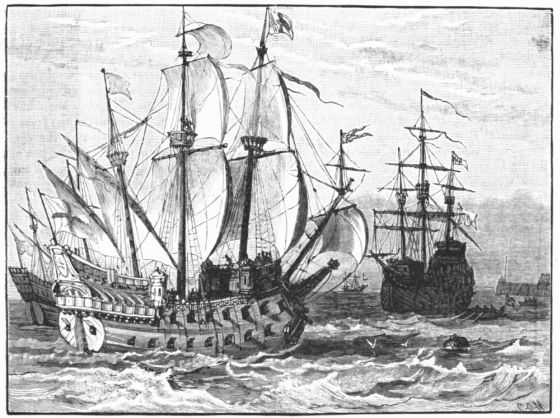
SHIPS OF ELIZABETH'S TIME.
In Scotland the alloy of the silver at the mint was not so great as in England during this period; but the number of shillings coined out of one pound of silver was astonishingly increased. This kind of depreciation had been going on for two centuries before this period; but from 1475, when only 144 shillings were coined out of the pound of silver, the number was rapidly augmented every few years, till in 1601 no less than 720 shillings were coined out of it, or, in other words, the original value of one pound was made to pass for thirty-six pounds.
In tracing the historical events of these reigns, we have had occasion to show the increasing strength of the Royal navy of England. Both in the reigns of Henry VIII. and of Elizabeth the sea fights were of a character and attended by results which marked out England as a maritime power growing ever more formidable. In the fourth year of his reign Henry drove the French fleet from the Channel with forty-two ships, Royal and others. He chastised the Scots, who, under James V., had become daring at sea; and on various occasions during his reign he showed his superiority to the French and Spaniards.
But it was the victory over the Armada under Elizabeth, and the exploits of Drake, Essex, Raleigh, and others in the Spanish ports, and of Drake, Hawkins, and Frobisher in the Spanish settlements of America, that raised the fame of the British fleet to a pitch which it had never reached before. For, after all, the amount of Henry's fleet never was large. We are told, indeed, that at first he had only one ship of war, the Great Harry, till he took the Lion, a large Scottish ship, with its commander, the celebrated Andrew Barton; but probably this is meant of such size as to merit the name of man-of-war. Parsimonious as was Henry VII., and careful to avoid any collisions with foreign powers, we cannot suppose he left the kingdom totally destitute of a navy. But Henry VIII. was not contented with owning merely a mediocre fleet; he had an ambition of building large vessels, and in 1512 he built one of 1,000 tons, called the Regent. This was blown up in a battle with the French fleet off Brest, and instead of it he built another called Grâce de Dieu. The rivalry of Henry was excited by the King of Scotland building a much larger ship than his Regent, which was said to carry 300 seamen, 120 gunners, and 1,000 soldiers. This ship, like Henry's Regent, was unfortunately lost at sea. By the end of Henry's reign, his fleet altogether amounted to 12,500 tons.
Besides building of ships, Henry seems to have planned all the necessary offices for a naval system. He established the Navy Office, with a sort of Board of Admiralty for its management, and he also founded, in the fourth year of his reign, the Corporation of the Trinity House at Deptford, for managing everything relating to the education, selection, and appointment of pilots, the putting down of buoys, and erecting beacons and lighthouses. Similar establishments were created by him at Hull and Newcastle. He built at great cost the first pier at Dover, and passed an Act of Parliament for improving the harbours of Plymouth, Dartmouth, Teignmouth, Falmouth, and Fowey, which had been choked up by the refuse of certain tin-works, which he prohibited. But perhaps his greatest works of the kind were his establishment of the navy-yards and storehouses at Woolwich and Deptford. No monarch, in fact, had hitherto planned so efficiently and exerted himself so earnestly to found an English navy. Great merit is due to him for his advancement of the maritime interests of the nation.
The manner in which the different monarchs of the Tudor dynasty advanced or neglected the navy is well shown by the returns of the Navy Office to Parliament in 1791. At the end of the reign of Henry VIII. it amounted to 12,500 tons, at the end of that of Edward VI. to only 11,065 tons, and at the end of Mary's to 7,110 tons, but at the end of Elizabeth's it rose to 17,110. At the time of the Armada, Elizabeth had at sea 150 sail, of which, however, only forty were the property of the Crown; the rest belonged to the merchants who were liable to be called upon on such emergencies to furnish their largest craft for the public service. Thirty-four of these ships were from 500 to 1,100 tons each, and these larger vessels are said to have carried 300 men and forty cannon each. Besides the vessels thus called out for war, the mercantile navy at this time amounted to another 150 sail of various capacity, averaging each 150 tons, and carrying forty seamen.
This extent of Royal and mercantile navy had not been reached without much fostering care on the part of the queen. With all her parsimony and dread of expense, it was one of the finest parts of her very mixed character, that she saw the necessity of a strong power at sea and had all the pride of her father to maintain it. Whilst on land she introduced the manufacture of gunpowder, and raised the pay of the soldiers, she extended her care to the fleet, and made it in the end the best equipped navy in Europe. She raised the pay of the sailors as she had done that of the soldiers, and the merchants entered so readily into her service that she had no longer occasion to hire vessels, as her predecessors had done, from the Hanse Towns, or from Venice and Genoa. She built a fort on the Medway, somewhere near the present Sheerness, to protect her fleet, and justly acquired the name of the Queen of the North Seas. Many circumstances combined to give a new and wonderful development in her time to commerce—the discovery and partial settlement of the New World; the way opened by the Cape to India; the extension of commercial inquiry and enterprise into the north of Europe and to the banks of Newfoundland. But ere this stirring period arrived, commerce had had to struggle with many severe restrictions, the fruit of the ignorance of political economy.
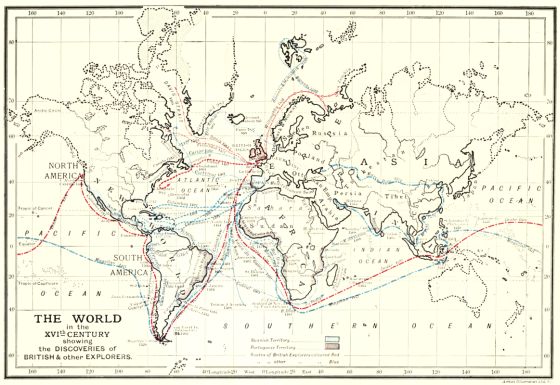
THE WORLD
Henry VII. is praised by Hall, the chronicler, as a prince who "by his high policy marvellously enriched his realm and himself, and left his subjects in high wealth and prosperity; as is apparent by the great abundance of gold and silver yearly brought into the kingdom, in plate, money, and bullion, by merchants passing and repassing." But the true reason of the rapid advance of commerce under Henry VII. was, undoubtedly, the quietness and stability of affairs which he introduced; for Henry was too fond of hoarding to be a very munificent patron of trade. Amongst the very first measures which he passed was one against usury, totally forbidding the loan of money on interest, which, if it could have been really carried out, would have nearly extinguished commerce altogether. In this, however, Henry was but continuing the practice of his predecessors, who, though great warriors, were no merchants. So severe was Henry's enactment against usury, that, by the Act of the third year of his reign, every offender was, on discovery, to be fined £100, and the bargain to be made void. Henry VIII. abrogated this law, and allowed usury under ten per cent.; it was again put in force by Edward VI. in terms of the utmost severity, declaring it to be "a vice most odious and detestable, and utterly prohibited by the Word of God." Elizabeth, however, again restored the law of her father in 1571, permitting interest under ten per cent.
Whilst Henry VII. endeavoured to extinguish usury, he was equally jealous of foreign merchants—of their bringing their foreign manufactures and carrying out English goods—lest our wealth should be drained away by them. The careful old king could not see that it mattered little by whom the exchanges of commerce were made, so that merchants were left to make their own bargains; whence the result would be that they would only purchase such things as they wanted, and sell such as they did not want, with benefit to everybody. It accorded, however, with Henry's ideas, and was so far beneficial as to induce the settling of English merchants in foreign countries, with the object of endeavouring to drain them of their wealth. Therefore, he was careful to heal the breach with the Netherlands which the patronage of Perkin Warbeck by the Duchess of Burgundy had made, and the company of Merchant Adventurers was again established in Antwerp. The treaty on this occasion was termed by the rejoicing Flemings the "Intercursus Magnus," or Great Treaty of Intercourse; but Henry, in 1506, on intercepting the Archduke Philip at Weymouth, forced from him a less liberal treaty, which the Flemings branded as the "Intercursus Malus," or Evil Treaty.
In the same one-sided spirit of trade, Henry, in 1489, concluded a treaty with Denmark, by which English companies were authorised to purchase lands in Bergen in Norway, Lund and Landskrona in Sweden, and Lowisa in Finland, on which to erect factories and warehouses, to remain theirs in perpetuity for the purposes of trade. He also renewed a similar treaty at the same time with the great trading republic of Venice, by which the English companies were to enjoy all the privileges of the citizens of Florence and Pisa, where they were established, and were privileged to export English wool, and re-ship the spices and valuable articles which were brought by the Venetians overland from India.
It was not long, however, before Henry was called on to check the effects of monopoly in his English companies. The Merchant Adventurers of London soon showed so strongly these effects, that they compelled the king to interfere with a view to counteract them.
The markets of Europe were now fast growing in importance and demand. The wealth of South America was flowing into Spain, in the shape of gold, to the amount of a million sterling annually, and the spices and riches of the East Indies into Portugal, since the discovery of the way round the Cape. Amsterdam became the great mercantile depôt of these commodities in Europe, and the benefit of it was felt nowhere more sensibly than in England. Henry VII., who had let slip the opportunity of securing South America and the West Indies by neglecting the offers of Columbus, now endeavoured to repair the mischief by granting patents to the Cabots and others for the discovery of new lands. He could not open his heart or his coffers sufficiently to assist the adventurers with funds, but he was ready to reap his share of the benefit, which was to consist of all the countries discovered and a fifth of the immediate proceeds. Under such patents the Cabots, father and son, in the course of several voyages, discovered Labrador in 1497, and afterwards ran along the whole coast of North America, to the Gulf of Mexico.
From this moment the spirit of mercantile enterprise rapidly developed itself. In 1562 we find Captain Hawkins trading to Guinea for elephants' teeth, and to Brazil, to which coasts voyages soon became common. Trading to all parts of the Mediterranean was frequent during the reign of Henry VIII.; taking out wool, cloth, and skins, and importing silks, drugs, wines, cotton-wool, spices, and Turkey carpets. The voyages of Cabot had opened up a new trade—that of cod-fishing—on the coasts of Newfoundland, which was eagerly engaged in; and the voyages of Willoughby and Richard Chancellor, by exploring the White Sea, at the suggestion of Cabot, opened a new trade with Russia. A Russian company was formed by Edward VI., and fully incorporated by Mary, who vigorously prosecuted that trade; and in 1556 an ambassador arrived at London from the Czar. Jenkinson, an agent of this company afterwards descended the Volga to Astrakhan, and crossing the Caspian Sea, reached Bokhara, the great resort of the merchants of Russia, Persia, India, and China. He is said to have made six other voyages to Bokhara by that route—a striking proof of the growing enterprise of the English merchant. The loss of Calais by Mary was a circumstance which, as was to be expected, exerted an injurious influence on commerce in her unfortunate reign.
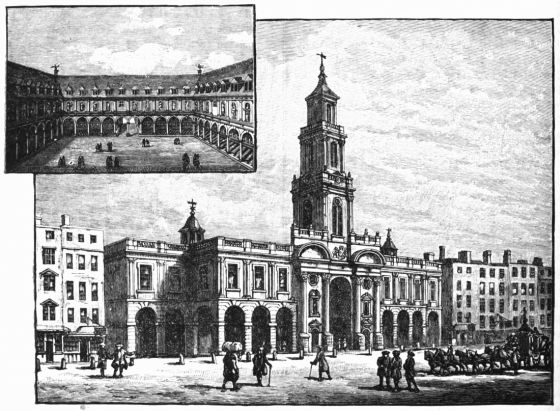
THE FIRST ROYAL EXCHANGE, LONDON (FOUNDED BY SIR THOMAS GRESHAM).
The earliest European trade with India was Venetian, and was conducted by way of the Black Sea. On the discovery by Vasco da Gama of the passage by the Cape of Good Hope, in 1497, the Dutch claimed the exclusive right of navigating those seas. The Spaniards again were equally exclusive with regard to their own subsequent discovery of a passage by the Straits of Magellan. These monopolies, so strange in their contrast to our modern conceptions and practice, left the English the sole alternative of a north-west or north-east passage. About 1500, a Portuguese named Corte Real attempted to discover a north-west passage, and was followed by a similar effort on the part of the English in 1553. The idea received the greatest encouragement from Queen Elizabeth, and a company was formed in 1585, called the "Fellowship for the discovery of the North-West Passage." Sir Hugh Willoughby's last voyage, which was entered on with a view to discover a north-east passage to China, was fatal to him and his brave comrades, who perished in the ice. The instructions given to Sir Hugh by Sebastian Cabot, Grand Pilot of England by appointment of Henry VII., are extant, and furnish a curious and interesting specimen of naval regulation. No dicing, carding, tabling, nor other such practices were to be allowed on ship-board; morning and evening prayers were to be diligently observed. On the other hand, the natives of strange countries were to be "enticed on board and made drunk with your beer and wine, for then you shall know the secrets of their hearts:" and they were to be cautious with regard to "certain creatures with men's heads and the tails of fishes, who swim with bows and arrows about the fords and bays, and live on human flesh."
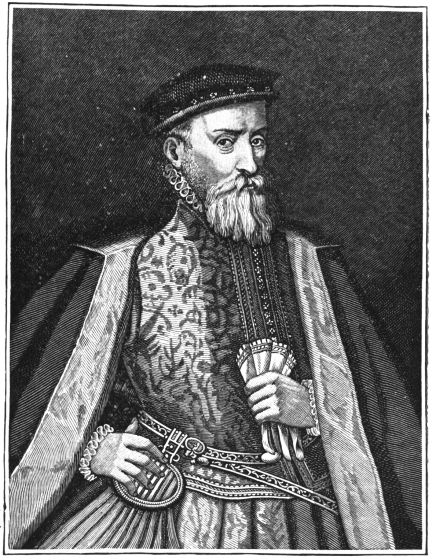
SIR THOMAS GRESHAM.
During the long reign of Elizabeth foreign trade made gigantic strides. Among the very first acts of this queen was one to abolish the restriction of English merchants to English ships in the transport of goods. The Act states that this restriction had provoked the natural adoption of like restrictions by foreign princes. This was the first acknowledgment of the mischief of meddling with the freedom of trade; and our foreign trade had now acquired an importance which demanded respect. With the Netherlands alone our trade was extraordinary, its value amounting to nearly two millions and a half sterling annually; and we find at this time the first mention of insurance of goods on their voyage. In 1562 we hear also of that detestable commerce the slave trade, which was introduced by John Hawkins, so well known afterwards as the daring compeer of Drake and Frobisher, and one of the heroic conquerors of the Armada. Hawkins carried out English goods, called at the Guinea Coast, and took in slaves, sailed to Hispaniola, and brought thence sugar, ginger, hides, and pearls.
During the reign of Elizabeth the many voyages which were made in order to discover a north-west passage to India led to a more intimate knowledge of the North American coasts. In these Frobisher, Cavendish, and Davis distinguished themselves. From 1576 to the end of Elizabeth's reign, Raleigh and his step-brother, Sir Humphrey Gilbert, made repeated attempts to colonise North America, and particularly Virginia—so called in honour of Elizabeth—but in vain. Equally strenuous and unsuccessful efforts were made to open a direct sea communication with India by the English; and it was not till the close of Elizabeth's reign that the incorporation of an East India Company, destined to establish that trade, was effected. The charter was granted by Elizabeth in 1600. Elizabeth also chartered a company in 1579 for the exclusive right of trading to all the countries of the Baltic.
As regarded the domestic manufactures of this period, the woollen manufactures were the most important, and extended themselves greatly on account of the foreign demand. This manufacture had to contend with many old charters and restrictions which were introduced to monopolise the practice of it to certain towns and persons; but these were gradually broken through after much contest, and people in both town and country were allowed to make cloths and other woollen goods. Originally London, Norwich, Bristol, Gloucester, and Coventry were the privileged places. Essex became a clothing county; but by degrees the trade spread into those quarters where it still prevails. Berks, Oxford, Surrey, and Yorkshire made coarse kerseys for exportation; Wales manufactured fringes and coarse cloths; but Tiverton, Bridgewater, Chard, and other towns of Wilts, Gloucester, and Somerset were famous for their broad-cloths; those of Kidderminster, Bromwich, Coventry, Worcester, Evesham, Droitwich, as also of Norfolk, Suffolk, and Essex, were in esteem. Manchester and Halifax were already noted for rugs and fringes, Norfolk for coverlets, and Lincolnshire and Chester for what were called "cottons," but which were a species of woollen. There was much complaint at that day of the adulteration of these fabrics by intermixture of inferior yarns, and by not taking the proper means to prevent them from shrinking on being exposed to wet. Norwich had manufactures of woollen different to ordinary cloth, in which it excelled all other places; and in Elizabeth's reign the Norwich manufacturers introduced new kinds under the name of Norwich satins and fustians.
The art of dyeing received a new impulse and new colours from the discovery of Brazil and other distant countries. Soap-making was also introduced, soap having before 1524 been chiefly imported. Many manufacturing processes in weaving, dyeing, and cleaning cloths were brought over by the refugees from the Netherlands, driven to England by the Spanish persecutions. During Elizabeth's reign the smelting of iron, which had been chiefly carried on in Kent, Sussex, and Surrey, became restricted there on account of the consumption of wood. Copper mines and alum pits were discovered in the time of Elizabeth, in Cumberland and Yorkshire, which contributed to the extension of the manufacturing arts.
Sir Thomas Gresham, the chief financial leader of the day, although a protégé of the Duke of Northumberland's, was received with much favour by Elizabeth on her accession. The great merchant then gave her advice—the following of which may well be called an epoch in the history of this country. He told her that all the debased coin should be converted into fine coin of a certain weight; that their monopoly should not be restored to the Steelyard merchants; that licences should be granted as seldom as possible; that she should incur no debt, or as little debt as possible, beyond the seas; and that she should keep her credit with her own merchants, as they would be her best and most powerful friends. These wise measures of reform were gradually carried out. Elizabeth probably perceived their value, but she could not find it in her heart to act altogether with the necessary self-denial and liberality. Thus she would not give up her power to reward favourites by means of special grants and licences. The monopoly of sweet wines which Essex enjoyed is an instance of her influence in this respect.
Gresham himself superintended the restoration of the coinage, and his advice with regard to the Steelyard merchants was also carried into practice. It was to him that the merchants of that day owed their first place of meeting for the transaction of business. Before that they had been "constrained either to endure all extremities of weather, namely, heat and cold, snow and rain, or else to shelter themselves in shops." Gresham therefore built a house for them, which the queen visited in 1570 and called the Royal Exchange. This building, like many others belonging to the City companies, was destroyed in the Great Fire. It was designed after the model of the Bourse of Antwerp, and was Flemish also in its architect, its workmen, and its materials. The commerce of Scotland during this century was affected by precisely the same circumstances as that of England.
During this century much progress was made in the improvement of London. Henry VIII. passed various Acts for the paving of the thoroughfares, which before were horrible sloughs, "very foul and full of pits."
The public amusements of the nation underwent as great a revolution during this century as its religion or its literature. The fall of the Church and the introduction of firearms were fatal to the spirit of chivalry, and the whole host of religious pageants and plays. Henry VIII. and Elizabeth exerted themselves to prolong the exercises of chivalry, but they had lost their spirit, and fell lifeless to the ground. In vain was the tournament of the Cloth of Gold, or the jousts at which Elizabeth presided at Greenwich. They were become mere mockeries of what once had been the all-engrossing contests of knightly honour. In vain did they endeavour to keep alive the long bow and the feats of archery. The musket and the sportsman's gun had made the bow and quiver mere playthings. The tournament made way for the joust, in which the contest was conducted with headless lances, and fighting at the barriers with blunted axes; and that gave way to "riding at the ring," in which the gentlemen did not run their lances through their antagonists, but through a ring suspended for the purpose. The last of the ancient exercises was the contest with the sword and buckler; but the sword was deprived of both edge and point, and as the combatants were not allowed to lunge, but only to strike, the practice was perfectly harmless. In the time of Henry VIII., however, the art of fencing was introduced; and in the time of Elizabeth the use of the rapier and the deadly thrust rendered the acquirement of the art of fence a matter of the first importance.
But though the chivalric exercises went out in this age, never was the love of pageant and display more alive. The revival of the Greek literature brought forward a crowd of gods and goddesses, who figured in public processions and galas; and the strangest allegoric absurdities were gazed upon by grave princes and their counsellors, as well as by the ladies, with all the enthusiasm of country lads and lasses gaping at a strolling theatre or a puppet-show.
Strange masquerades and allegoric pageants were got up in London for Mary and Elizabeth; and readers of worthy Laneham's description of the nineteen days in which Queen Bess was entertained at Kenilworth by Leicester, will find plenty of giants, distressed Ladies of the Lake, "salvage men," presents from Bacchus, Pomona, Ceres, floating islands, and sham Arions riding on sham dolphins. More healthy but little less romantic were the holiday sports which had survived the Church, and were mingled in by both princes, nobles, and people. The old Mystery did not for some time disappear before the secular drama, and the Coventry Play was played before Elizabeth at Kenilworth. May-day had its grand may-pole still; and Henry VIII. did not disdain, on May-day, 1515, to go a-maying to Shooter's Hill, with his queen and his sister, the Queen-Dowager of France. May-day was also the great day of the milkmaids, who danced from door to door with a pyramid of plates on their heads.
Stubbs—who, Puritan as he was, seems to have enjoyed what he describes so well—gives us the following description of the amusements of the merry gentlemen of the Temple in those days:—
"First, all the wild heads of the parish covening together, choose them a grand captain of mischief, whom they ennoble with the title of My Lord of Misrule, and him they crown with great solemnity and adopt for their king. This king anointed chooseth for him twenty, forty, threescore, or a hundred lusty guts like to himself to wait upon his lordly majesty and to guard his noble person. Then every one of these his men he investeth with his liveries of green, yellow, or some other wanton colour. And, as though they were not gaudy enough, they bedeck themselves with scarfs, ribbons, and laces, hanged all over with gold rings, precious stones, and other jewels; this done, they tie about either leg twenty or forty bells, with rich handkerchiefs in their hands, and sometimes laid across over their shoulders and necks, borrowed for the most part of their pretty Mopsies and loving Bessies.... Thus all things set in order, then have they their hobby-horses, dragons, and other antics, together with their pipers and thundering drummers to strike up the devil's dance withal; then march these heathen company towards the church and churchyard, their pipers piping, their drummers thundering, their stumps dancing, their bells jingling, their handkerchiefs swinging about their heads like madmen, their hobby-horses and other monsters skirmishing amongst the throng; and in this sort they go to the church (though the minister be at prayer or preaching), dancing and swinging their handkerchiefs over their heads in the church like devils incarnate, with such a confused noise that no man can hear his own voice. Then the foolish people they look, they stare, they laugh, they fleer, and mount upon forms and pews to see these goodly pageants solemnised in this sort. Then, after this, about the church they go again and again, and so forth into the churchyard, where they have commonly their summer halls, their bowers, arbours, and banqueting-houses set up, wherein they feast, banquet, and dance all that day, and peradventure all that night, too. And thus these terrestrial furies spend the Sabbath-day in the country."
To relate all the jollity with which Christmas was celebrated is beyond our space. The Christmas carols with which the waits awoke all the sleeping people for a fortnight before; the yule-log dragged into the hall and piled on the fire; the boar's-head feast, with plum-pudding and mince-pies, and all the dances and games, were as much in fashion as in the days of the ancient Church. Plough Monday, Valentine Day, Easter and Whitsuntide, St. John's Eve, and all the charities of Maundy Thursday, were still maintained. Even Palm Sunday, when the figure of Christ went on its procession mounted on a wooden ass, resisted the Reformation till the year 1548.
The drama, which was now shaping itself into freedom and splendour under such men as Shakespeare and Marlowe, was yet conducted in a very rough style. The theatres were mostly of wood; the actors were rarely arrayed in proper costume; women's parts were represented by boys; any scenery which the play had, remained, like a picture on a country fair booth, through the whole piece. The aristocratic frequenters sate on the stage, for there were no boxes or dress-circle, and the commonalty sate on stools and enjoyed their pipes and beer during the performance. What was worse, the theatre had to contend, in the affections of the public, with the bear-garden, bull-baiting, and cock-fighting. This was true—and to us the fact must seem deplorable—of the very highest classes among the people.
As Sunday had been the great day of the Church plays or Mysteries, so Sunday was the chief day of the theatre, which brought it into disrepute with the serious portion of the community; and when there was bull-baiting, the theatre was closed that it might not interfere. Queen Elizabeth was especially fond of the bear-garden, and that sport was consequently included by Leicester in the recreations which he provided for her at Kenilworth. In truth, bear-gardens, cock-pits, bowling-greens, tennis-courts, dicing-houses, taverns, smoking ordinaries, and the like abounded, giving us a fair idea of the grade of taste of that age. Hunting and hawking were still pastimes of the gentry, and horse-racing became a great rage. The first notice we have of this latter pastime is on the occasion before mentioned, when Henry went a-maying in 1515; after which it is said that he and his brother-in-law, the Duke of Suffolk, diverted themselves by "racing on great coursers."
But amid the pleasures of this century there must have existed a large intermixture of a more moral class, for the Bible had become extensively read, and the Reformers must have been numerous to enable the Government to effect the ecclesiastical changes which they did; and the advance of physical improvement must not be judged of by the popular condition of to-day, but of previous times. In the course of the century the condition of the people considerably advanced. At the beginning the houses of farmers were generally of timber, and those of labourers of mud, or wattle and mud. In many of them were no chimneys, except one for cooking. Wooden trenchers and wooden spoons were used instead of pewter or earthenware; and a yeoman who had half a dozen pewter dishes in his house was looked on as wealthy. Their lodging was equally mean. Straw beds and pillows of chaff were most common; flock beds were a rural luxury; and the farm servants lay on straw, and often had not even a coverlet to throw over them. The bread of the common people was made of rye, barley, or oats, and in many districts of peas or beans. The gentry only ate wheaten bread. The men by the fire in the evening, after their day's work, made their own shoes, or prepared the yokes for oxen, and their plough-gear. The women made the wool and the hemp or flax ready for the weaver at the spinning-wheel. As they do now on the Continent, the countrywomen worked much in the fields. Fitzherbert, the first of our writers on husbandry, says that it was the business of the farmer's wife "to winnow all manner of corn, to make malt, to wash, to make hay, to shear corn, and, in time of need, to help her husband to fill the muck-wain, or dung-cart, drive the plough, to load hay or corn, to go to market and sell butter or pigs or fowls."
Latimer, who was a farmer's son, describes the advance in the value of land in his time. When he was young, he says, his father's farm was rented by him at £4 a year; that he employed half-a-dozen men upon it, and had 100 sheep and thirty cows; that his father managed to send him to school and college, and to give to each of his daughters £5 on her marriage. But, continues Latimer, at the time he wrote this, the same farm was charged £16 a year, or fourfold, and then the farmer of it could do nothing for his prince, himself, or his children, nor give a cup of drink to the poor. The cause of this was the increased demand for wool, which had occasioned great enclosures, and a decrease of tillage in favour of pasturage. This pressed greatly on the labouring class who were not employed; for the gentlemen had flocks of from 10,000 to 20,000, and a few shepherds were all they needed in their great enclosures. The gentry, who thus occupied the land, we are told, did not reside on it, but crowded up to London and hung about the Court. "Hence," says Roger Ascham, "so many families dispersed, so many houses ruined. Hence the honour and strength of England, the noble yeomanry, are broken up and destroyed."
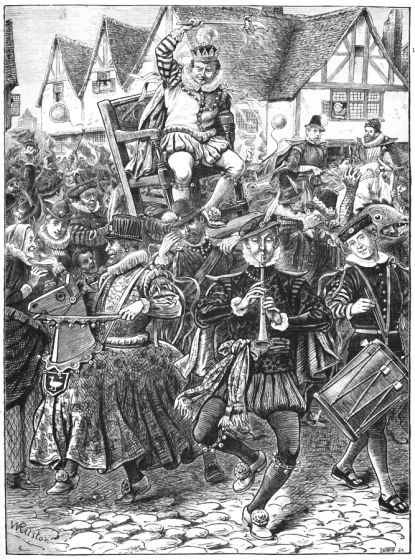
THE FROLIC OF MY LORD OF MISRULE. (See p. 399.)
The evils of this state of things compelled the Legislature to put restrictions on the extent of pasturage, to insist on the tillage of sufficient land for the wants of the community; and penalties were enacted for such as did not build proper cottages for their labourers, with four acres of land each, or who allowed more than one family in one cottage. The evil produced its own remedy. The scarcity of tillage land raised the price of produce, and that stimulated to the manuring and better culture of the land. We learn from Harrison and Norden, writers of the period, that towards the end of the century things were greatly improved. The farmers and small builders were become more painstaking and skilful. They collected manure and even the sweepings of streets, burnt lime, and carted sea sand, as in Cornwall and Devon. The consequence was that they had better cattle and better crops, they had milk from their cows, ewes, and goats; and they used much more meat. In the autumn they cured bacon and beef for the winter; and in summer they had abundance of veal, beef, and mutton, which, says Harrison, they ceased to baste with lard, but basted with butter, or suffered the fattest to baste itself.
With their living, their houses improved. Wood or wattle gave way to stone or brick, the wooden trenchers were superseded at substantial tables by pewter, and with the pewter were sometimes seen articles of silver. Feather beds replaced the straw and chaff mattresses; there was more abundant linen, bed-covers, and better clothing. Coal was beginning to make the scarcity of wood less felt.
The vast increase of foreign trade and of manufactures which has been described must have proved the most effectual means, far more than enactments, for encouraging tillage, from the augmented demand of provisions and luxuries; and the same causes would provide employment and good wages for increased numbers. The land as well as every other thing in the kingdom was in a transition state, and as the large estates of nobles and the Church, now divided amongst a multitude, came to be settled and cultivated, the diffusion of life and prosperity through the rural districts was no doubt proportional. At this time there must have been a great flow of population from the agricultural to the manufacturing districts, as the latter were making increased demands on the strength of the nation; yet it appears that the produce both of the tilled ground and of pasturage grew steadily. The small cottagers, who had probably been but poor farmers, being now gradually absorbed into the growing artisan population, gave place to greater and wealthier men, who laid out the ground in large grazing farms. This gave rise to the false impression that the population was decreasing, and the statistics of the period give frequent evidence of the alarm thus occasioned. The evidence, however, for the increase of the population is incontestable; and the wage for ordinary labour seems to have been quite double its old amount in this century. It may be interesting to record some of the salaries of the period. In the household of the Earl of Northumberland, in 1511, the principal priest of the chapel received £5 a year; a chaplain graduate, £3 6s. 8d.; a chaplain, not a graduate, £2; a minstrel, £4; a serving-boy, 13s. 4d.; all these being lodged and fed in addition. In 1500 a mason received 4d. a day, and 2d. for diet. In 1575 a master mason received 1s. a day, and a common labourer 8d. In 1601 a master mason had 1s. 2d. a day, and a labourer 10d. The long continuance of internal peace had increased the population from two millions and a half in the commencement of the fifteenth century, to six millions and a half at the end of the sixteenth; but the increase of trade, of commerce, and of tillage, had not been able to absorb a tithe of the homeless and destitute people who had been increasing since the abolition of villenage and the destruction of the monasteries, which had fed swarms of them. We have had occasion to show that these wandering tribes overran the country like a flood—"vagabonds, rogues, and sturdy beggars"—carrying terror and crime everywhere. Henry VIII., Harrison tells us, in the course of his reign, hanged of robbers, thieves, and vagabonds, no fewer than 72,000, and Elizabeth, toward the latter part of her reign, sent 300 or 400 of them annually to the gallows.
We find a statute of the first year of Edward VI. containing the following:—"Idleness and vagabondry is the mother and root of all thefts, robberies, and all evil acts and other mischiefs, and the multitude of people given thereto hath always been here within this realm very great and more in number, as it may appear, than in other regions; the which idleness and vagabondry all the king's highness' noble progenitors, kings of this realm, and this high court of Parliament hath often and with great travail gone about and assayed with godly acts and statutes to repress; yet until this our time it hath not had that success which hath been wished; but—partly by foolish pity and mercy of them which should have seen the said godly laws executed, partly by perverse natures and long-accustomed idleness of the persons given to loitering—the said godly statutes hitherto hath had small effect, and idle and vagabond persons hath been suffered to remain and increase, and yet so do." "If," continues the Act, "they should be punished by death, whipping, imprisonment, or with other corporal pain, it were not without their desert, for the example of others and to the benefit of the commonwealth; yet if they could be brought to be made profitable and do service, it were much to be wished and desired." Such words would lead us to conclude that they were about to adopt conciliatory measures with regard to this troublesome class, but we find on the contrary the harshest enactments put in execution. Thus, every person found idle and wandering without any effort to obtain work was to be considered a vagabond, and was liable to be seized by any one and forced to labour, for which he was to receive only his daily food. If he attempted to run away, he was to be branded on the breast with the letter "V" and made the slave of his owner for two years. If he made a second attempt for liberty, he was to be branded on the forehead or cheek with the letter "S" and made his master's slave for ever; while a third effort at escape was punishable by death. The severity of this law prevented it from being properly executed, and caused its repeal in two years. After various futile enactments, Henry VIII., in 1530, gave the sick and impotent permission to beg; and in 1536 the magistrates and the clergy were ordered to make collections for their relief. These were the first approaches to a poor-law, and in the year 1562 Queen Elizabeth passed an Act making parochial assessments for the poor compulsory. The poor-law, therefore, in reality dates from that period; but in the year 1601, the celebrated Act of the 43rd of Elizabeth organised and completed that system of employing and maintaining the destitute poor, which—with its subsequent modifications—has remained ever since the law of England.
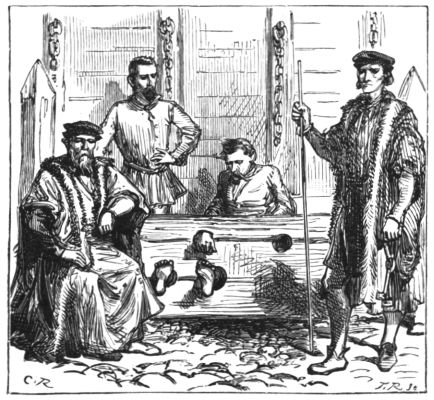
PUNISHMENT OF THE STOCKS.